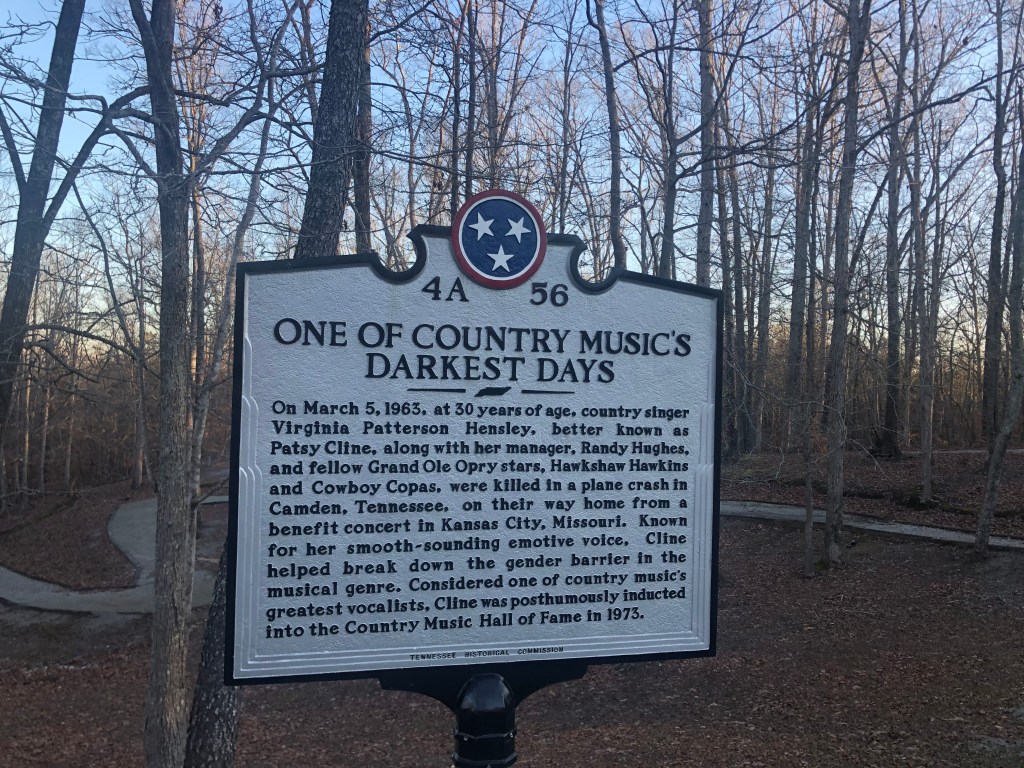
Soon after getting on the road this morning, I spotted a historic marker near Camden, TN, commemorating “One of Country Music’s Darkest Days.” Stopping to read the sign, I learned that Patsy Cline, her manager, and two other musicians were killed on March 5, 1963 when their plane crashed near this spot.
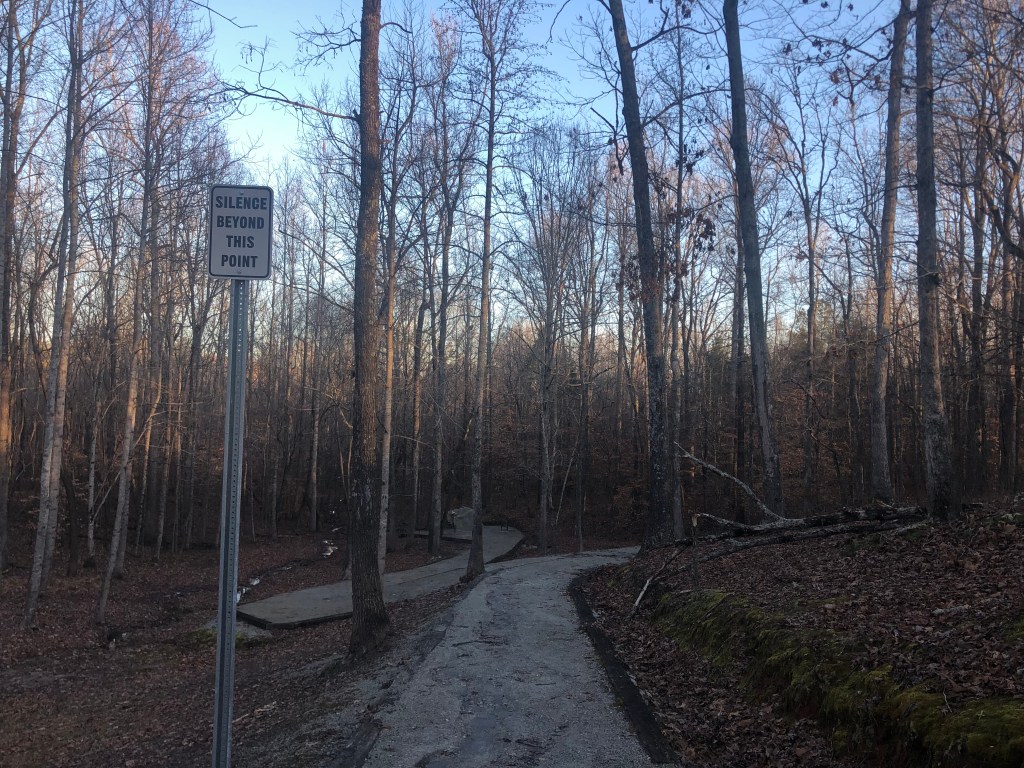
A winding gravel path led down the hill to the spot itself. So I locked the trusty Ford and made my way through tall birch trees, taking in the still morning air. It was good to be out in nature, hearing nothing but the occasional bird.
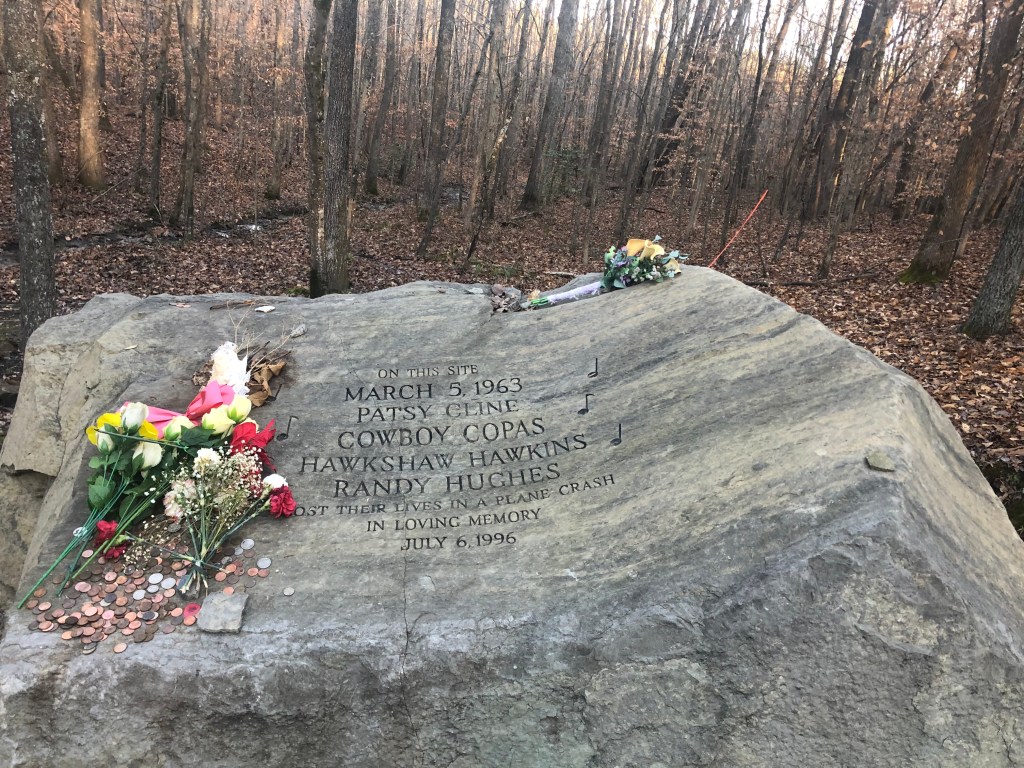
Soon I came to a clearing, fitted with a couple of benches, and in the center was a simple rock memorial marking the location of the plane crash. I found myself strangely moved, in this quiet grove in the middle of winter in rural Tennessee. I reflected a bit on Patsy Cline, only a few of whose songs I know. But it must have been a horrific ending to such a gifted life. Some people had left coins on the rock, and I reached into my pocket and found that I had exactly four pennies. One for each of the people killed in the crash.
I realize there seems to be a lot of untimely deaths showing up on this trip–Patsy Cline, Casey Jones, even Billy the Kid (or, more appropriately, his victims). But some of the towns I’ve encountered also seem to have experienced death, or are facing it. Why is this? What causes a working, living town to become a ghost town? Part of it of course owes to a reversal of economic fortunes. The gold rush boom towns were especially susceptible to this. But what about places like Paducah, TX (highlighted on Jan 4?) What caused it to decline? Where did everyone go? Why did they walk away from homes, businesses, major hotels, and other properties?
Or why is there a huge abandoned parking lot in town of Burns, TN, that I passed today? I suppose that’s a fairly easy question to answer: It had been a drive-in, and people stopped going to drive-ins all across the country many years ago.
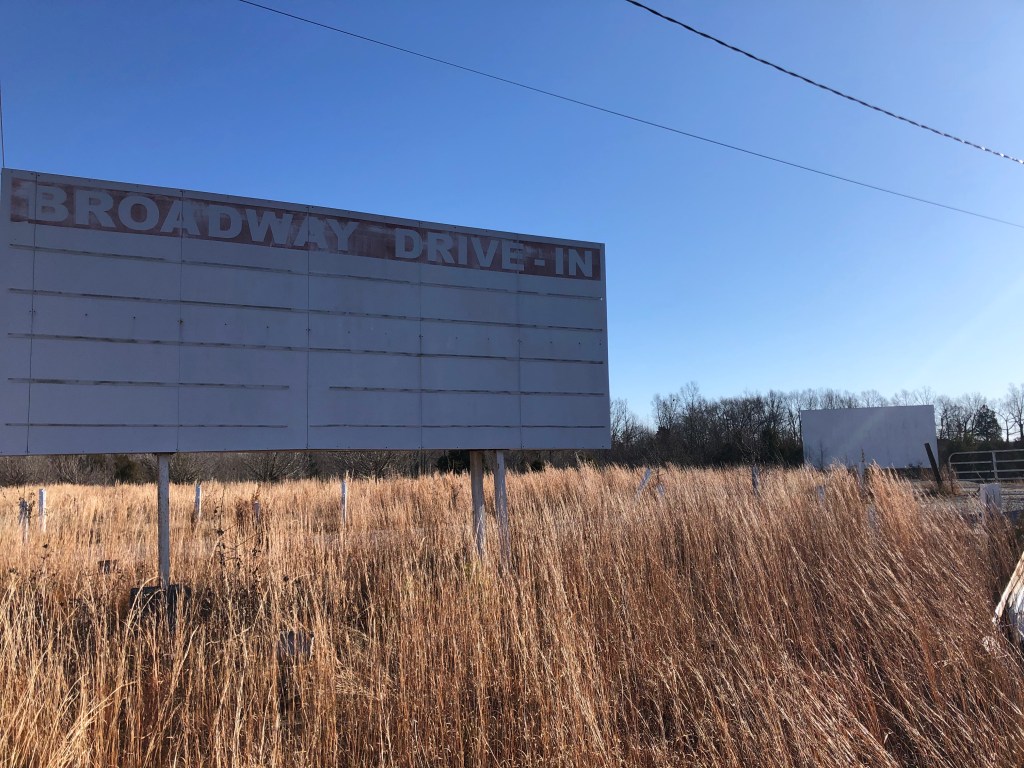
But the question, to me, isn’t why the drive-in died; rather, it’s why was it a thing to begin with? Why would people think that parking their cars in a huge lot and watching the movie through their windshields, projected on a distant screen, with the sound coming through a tinny, scratchy speaker, would be enjoyable? Especially with all the distractions from the other cars that invariably flash their lights and drive in and out of the parking lot. Why would this be preferable to the old-fashioned idea of sitting in a comfortable seat in a golden-age Movie Palace with cute usherettes offering you gum, candy, and popcorn? (I do understand that a teenager on a date might find something to recommend the car-based seating.)
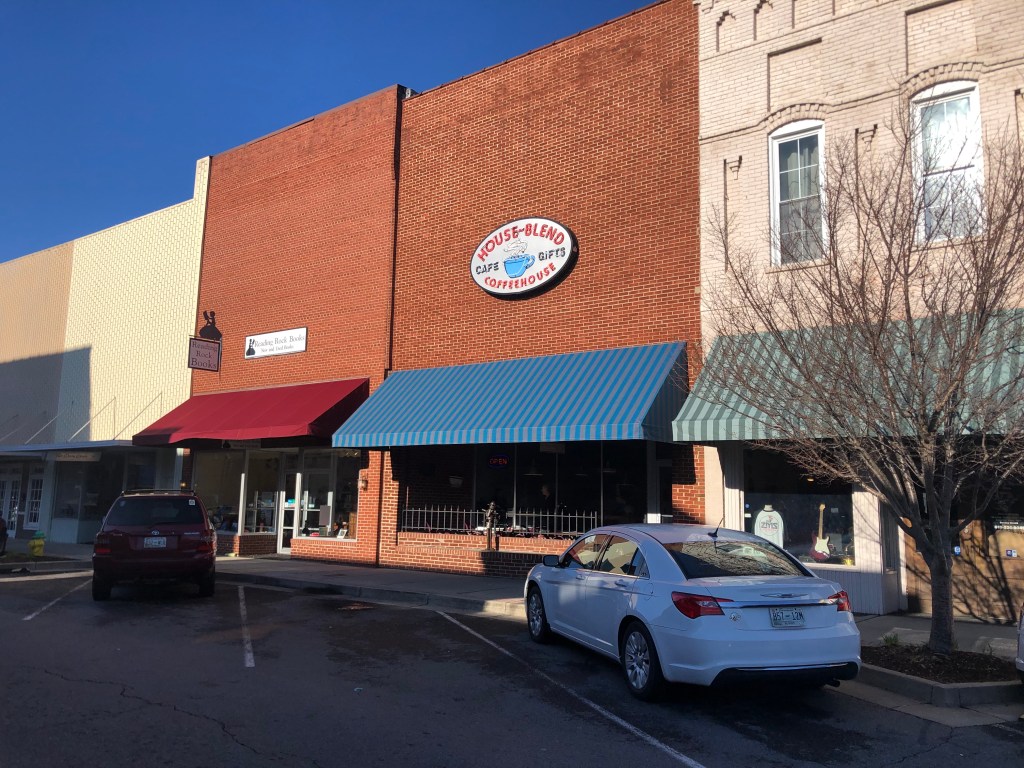
But to return to the Declining Towns Hypothesis: It’s not the case that towns just have a natural lifespan, and eventually die of old age. There are plenty of American towns that have survived, and even thrived well into their second century. Take the example of Dickson, TN (Population: 14, 500), which I drove through this morning. Dickson is a clean, attractive, appealing town. It’s not bustling exactly, but it’s definitely active. I drove down the main street and stopped for coffee at “House Blend,” which is one of those hipster places in a building that dates back to the Roosevelt Administration.
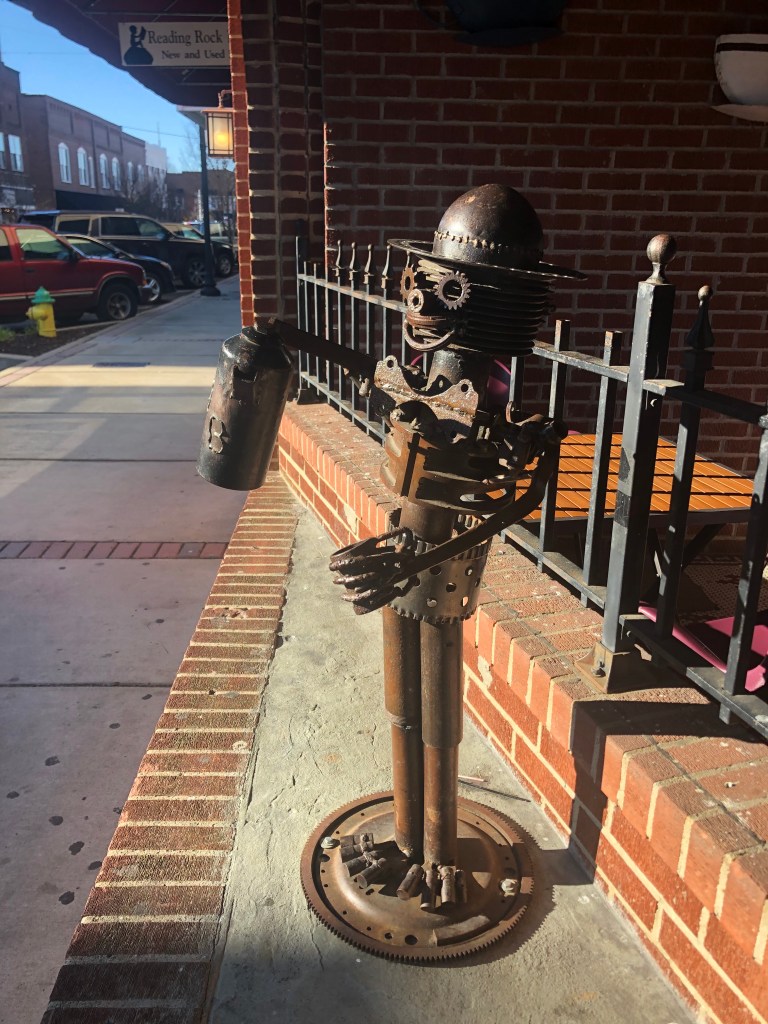
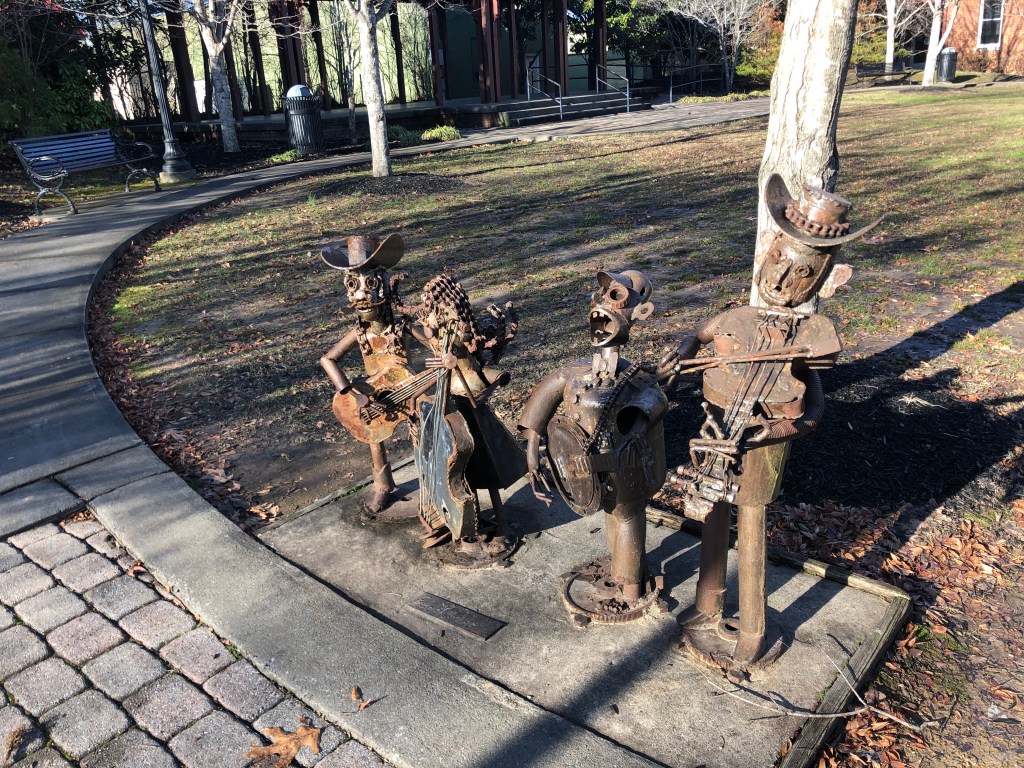
Driving around the town, I saw other evidence of its well-being. I count public art as one such indicator.
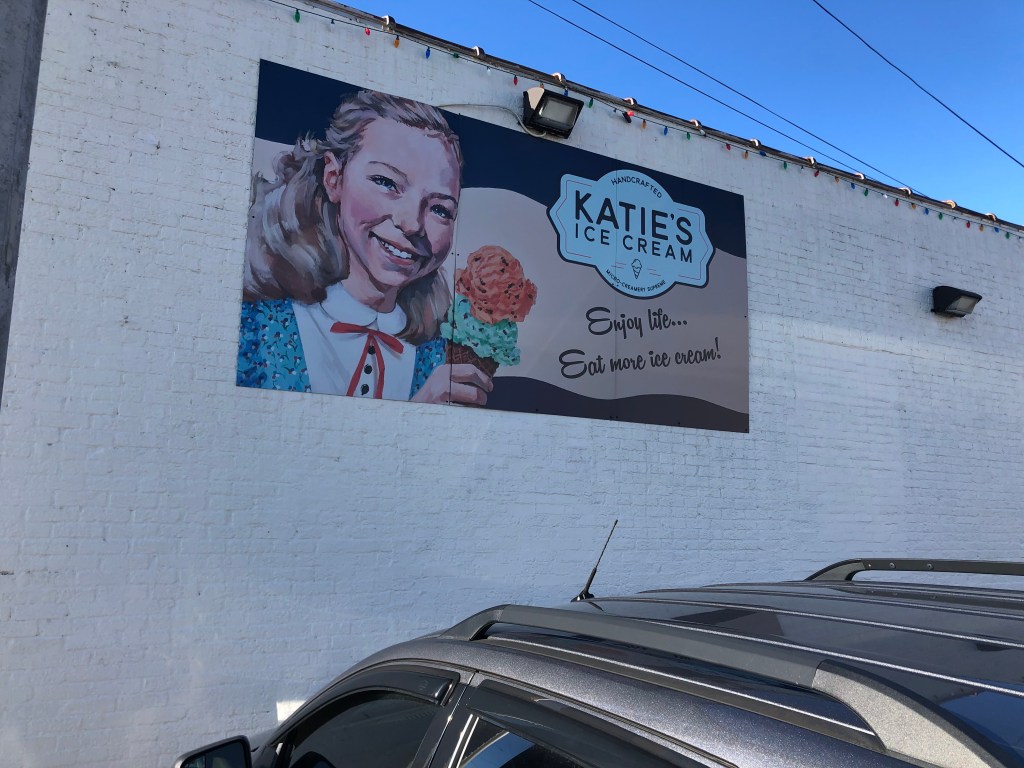
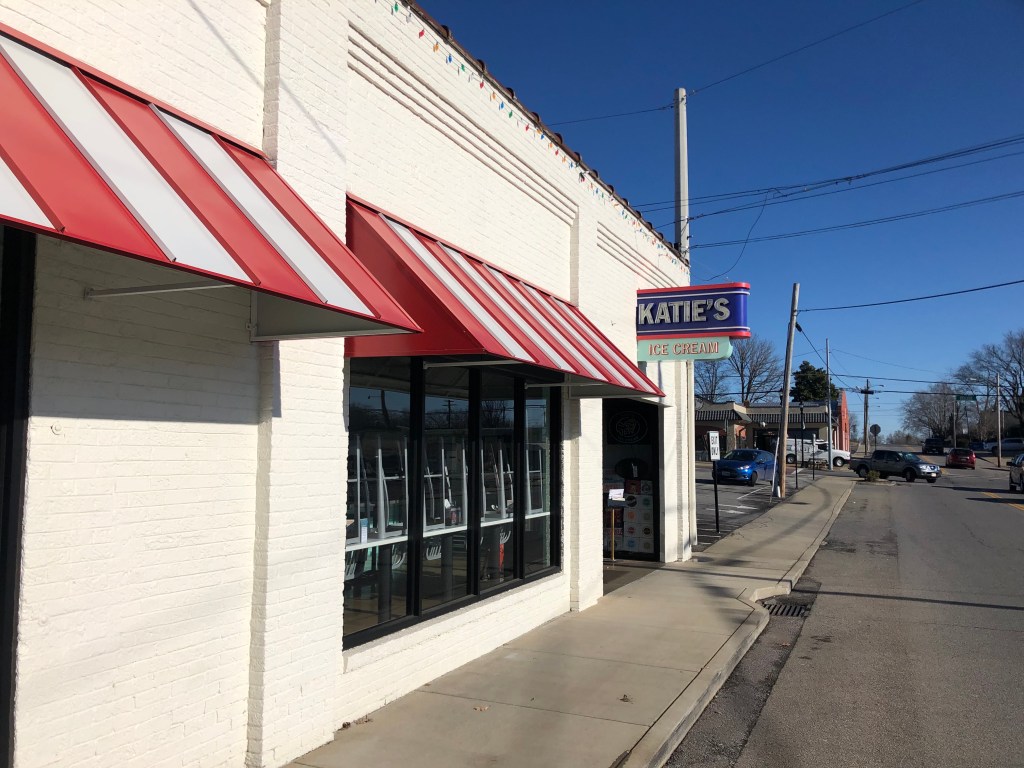
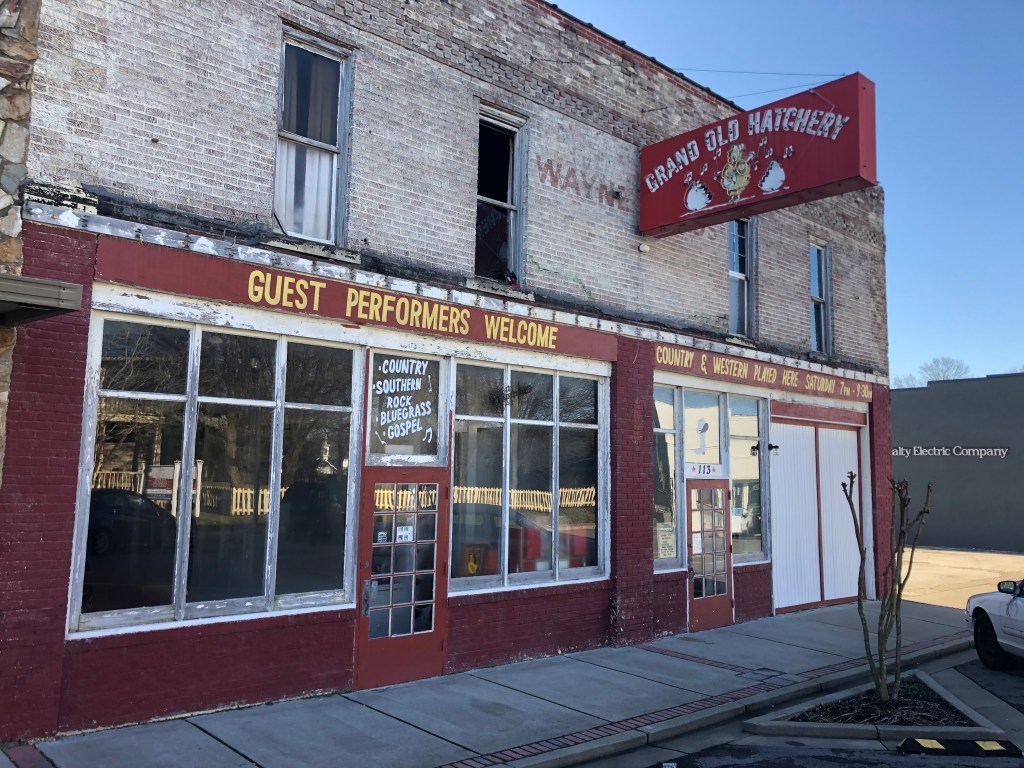
Even this unrestored building exuded an atmosphere of activity. It’s well worn, but not decaying. it’s earned its wrinkles.
(Later I discovered a few clues about how Dickson has been able to prosper while other small towns along US 70 are dying: Partly it’s because Dickson is located not just on US 70, but it’s reasonably close to the Interstate (I-40). It’s also within the gravitational pull of Nashville, which is about 45 minutes away. And it has a community college. So, maybe it has some unfair advantages.)
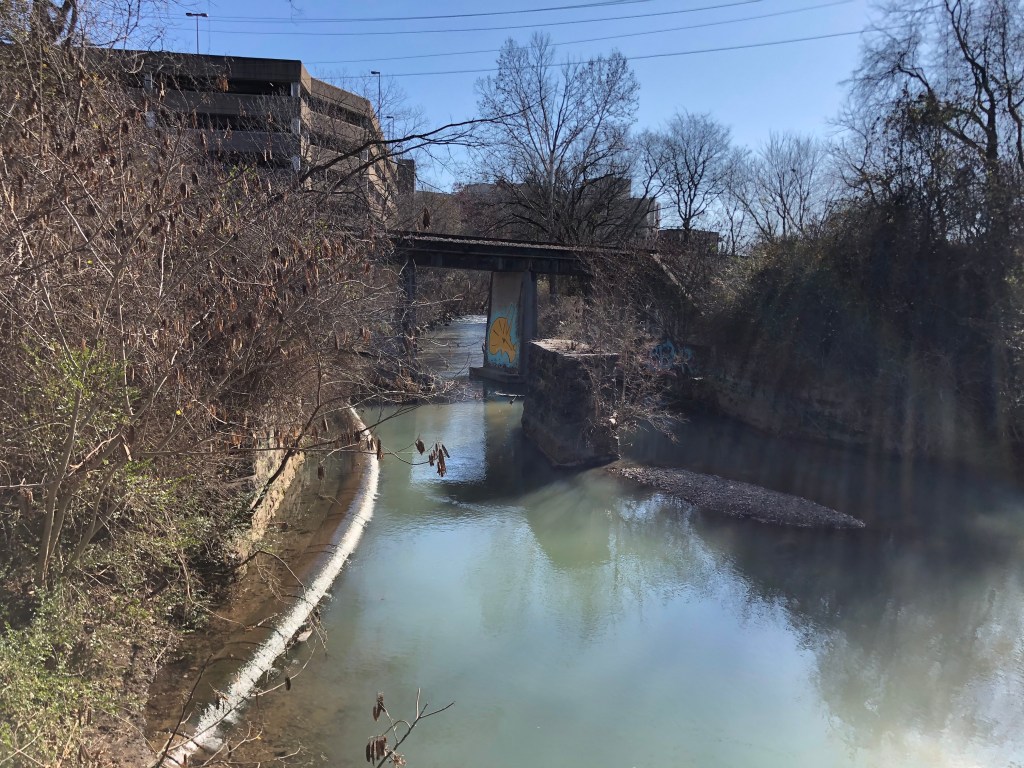
A little later I arrived at the capital of the Volunteer State. As alert readers know, bigger cities are not the focus of this trip. But Nashville (population: 668,000), known as “Music City,” does have one compelling feature to recommend it. And that, of course, is that it’s the site of the country’s worst railroad disaster. It happened at “Dutchman’s Curve” on July 9, 1918, when two passenger trains collided head-on. Over 100 people died. It gives a good illustration of the disaster that could have been, but which Casey Jones had prevented, some 18 years earlier. Anyway, I walked a bike/walking path for a mile or so to arrive at the site of the crash. The piers of the railroad bridge, which had been originally constructed during the Civil War, are still in place.
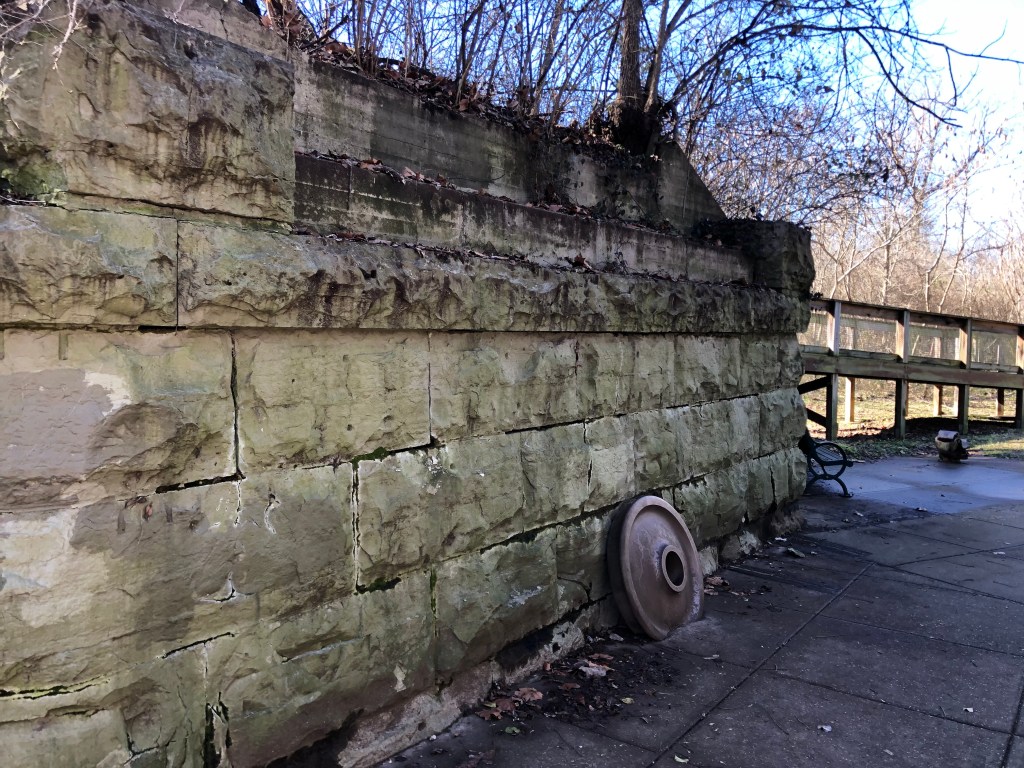
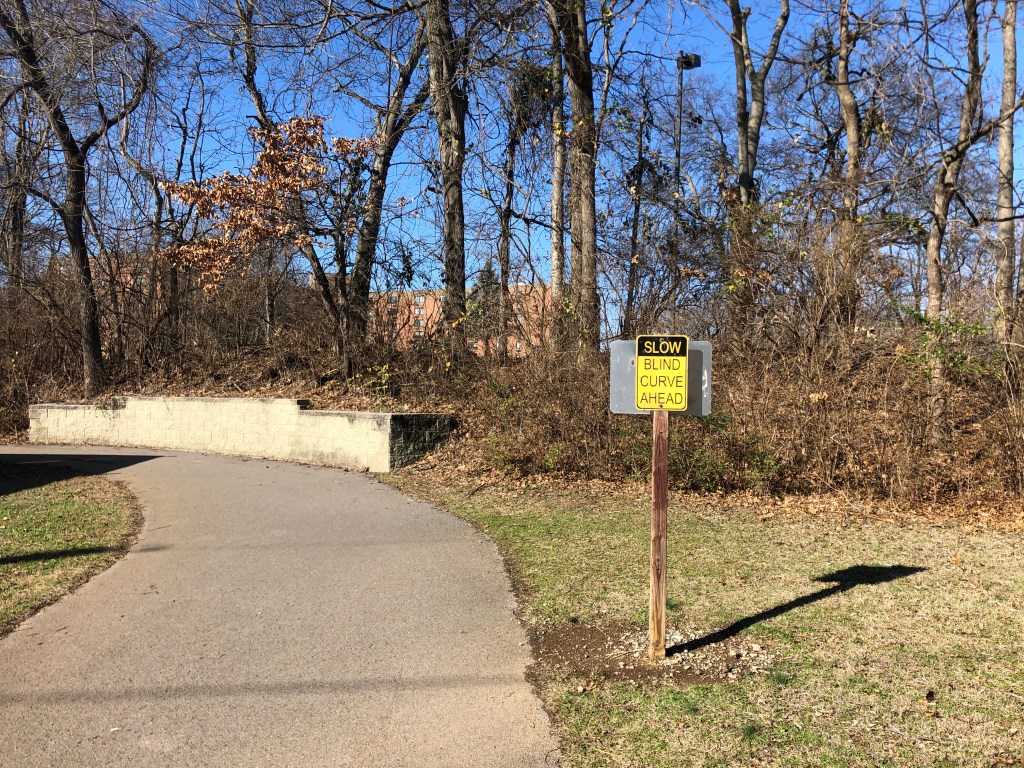
After that welcome walk, I got back onto the familiar pavement of US 70. Since it was almost noon and I was in the Big City, I found myself a proper brew pub in the form of M.L. Rose Craft Beer and Burgers. So, let’s do the:
BREW OF THE DAY
I ordered up a Blackstone Black Belle Imperial Stout to go with my awesome BLT sandwich. Blackstone is a local brewery, and their imperial stout is aged in used barrels that had contained Nashville’s Belle Mead Bourbon. Blackstone’s stout is a “high gravity” beer, with an ABV of 13.5 percent. (That’s why it’s served in a small glass. )
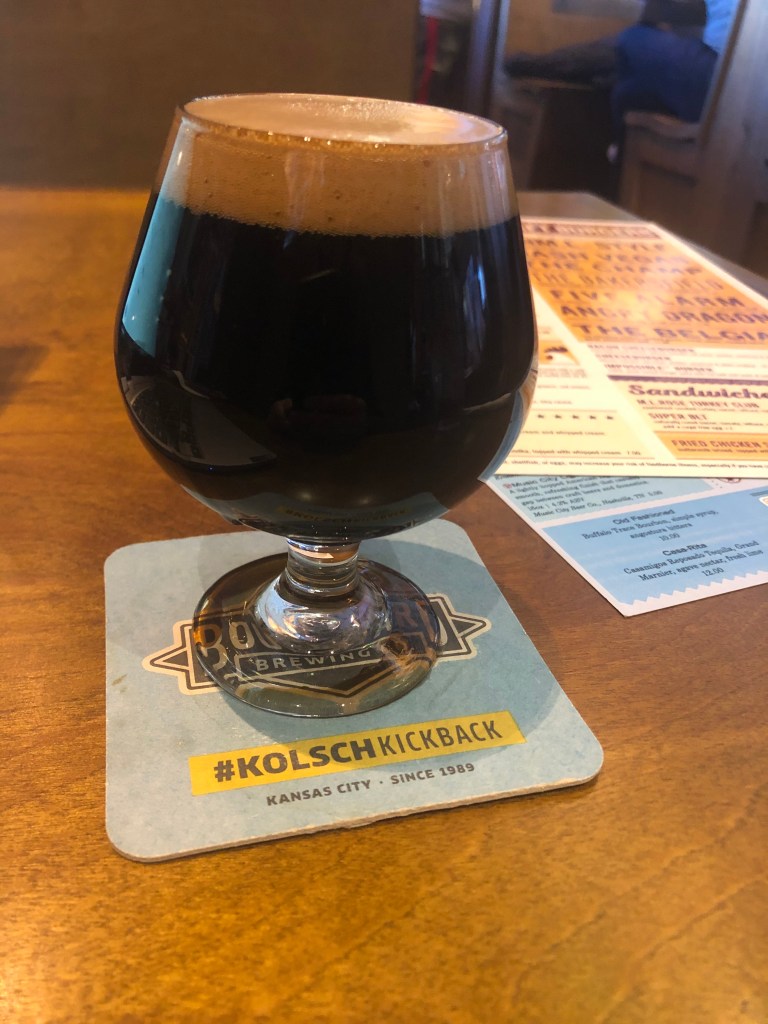
It has the color and consistency of used motor oil, but the taste is considerably better than that. It’s amazing, stupendous. Rich, sweet, woody. An explosion of flavors–chocolate, maple syrup, maybe some sweetened oatmeal. The sweet hits the front of your tongue, and something more fermented is registered on the back sides of your tongue. As I recall, that’s where our sour receptors are, but this doesn’t really have any sour notes. A little hoppy bitterness perhaps, but mainly malty and whisky flavors. It’s like drinking a big, hot, loaded pastrami sandwich with sweet mustard that’s spent a week in a smoker, soaked in Aunt Jemima, and drizzled with chocolate sauce and bourbon. It was worth the drive from Los Angeles to experience this.
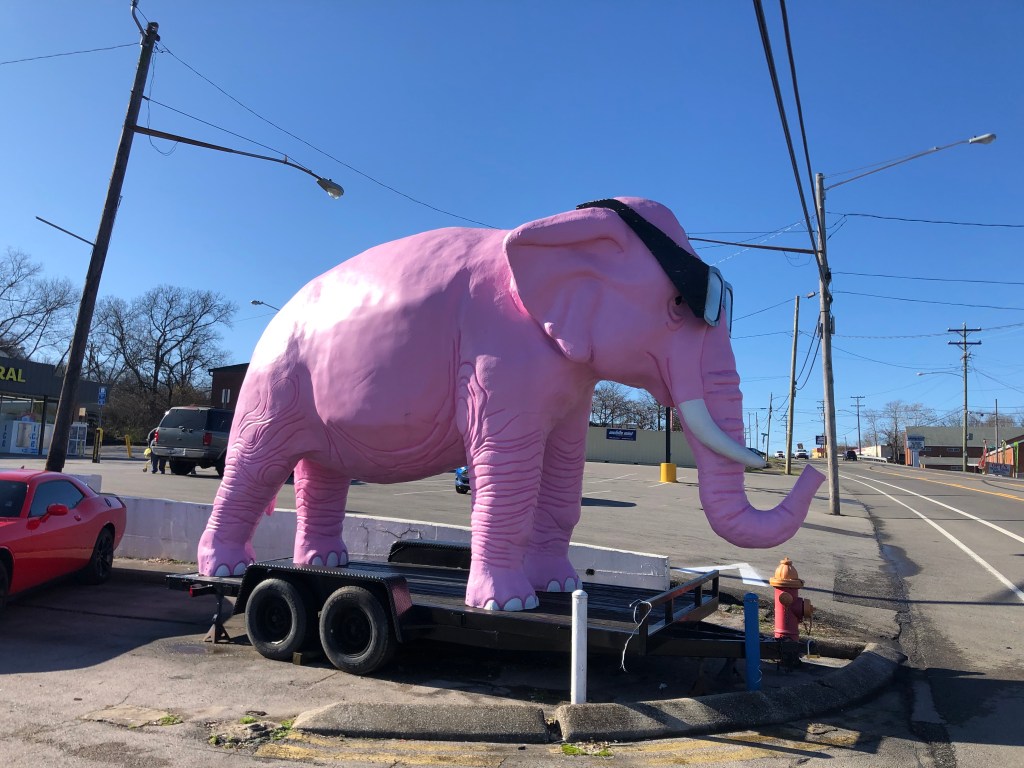
So, why don’t you guess what I saw before I left Nashville, given my consumption of this high-alcohol beer? Yes, it was another of the pachyderms that I’m beginning to think are the unofficial mascot of US Route 70. You can bet I was on the lookout for a sobriety checkpoint afterwards…
After leaving Nashville, US 70 soon began to rise and twist up toward the Appalachians. The drive was relaxing, the weather was beautiful, I had Patsy Cline on the stereo.
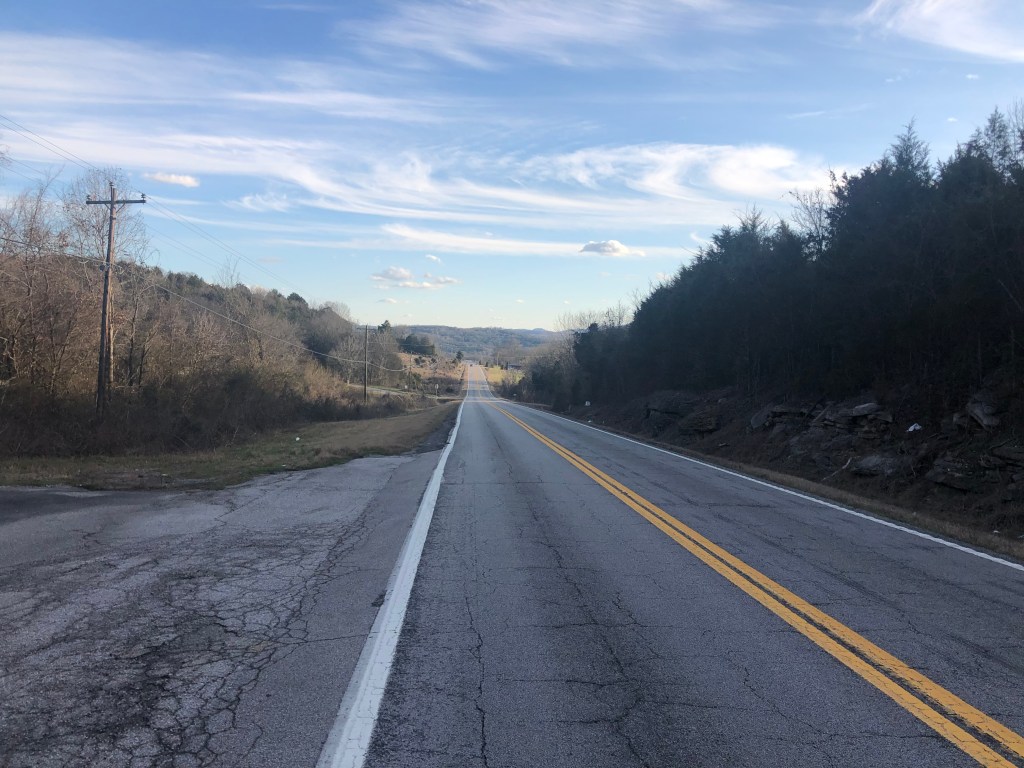
Tonight I’m in Knoxville, getting close to the state line . But before we enter North Carolina, I have one more item from the Volunteer State:
When I was driving through the town of Mason, TN, I saw a sign for Bozo’s Hot Pit Bar-B-Q Restaurant. (I’ve been told that there’s a difference between BBQ and Barbecue, but I’m not sure where Bar-B-Q fits in.)
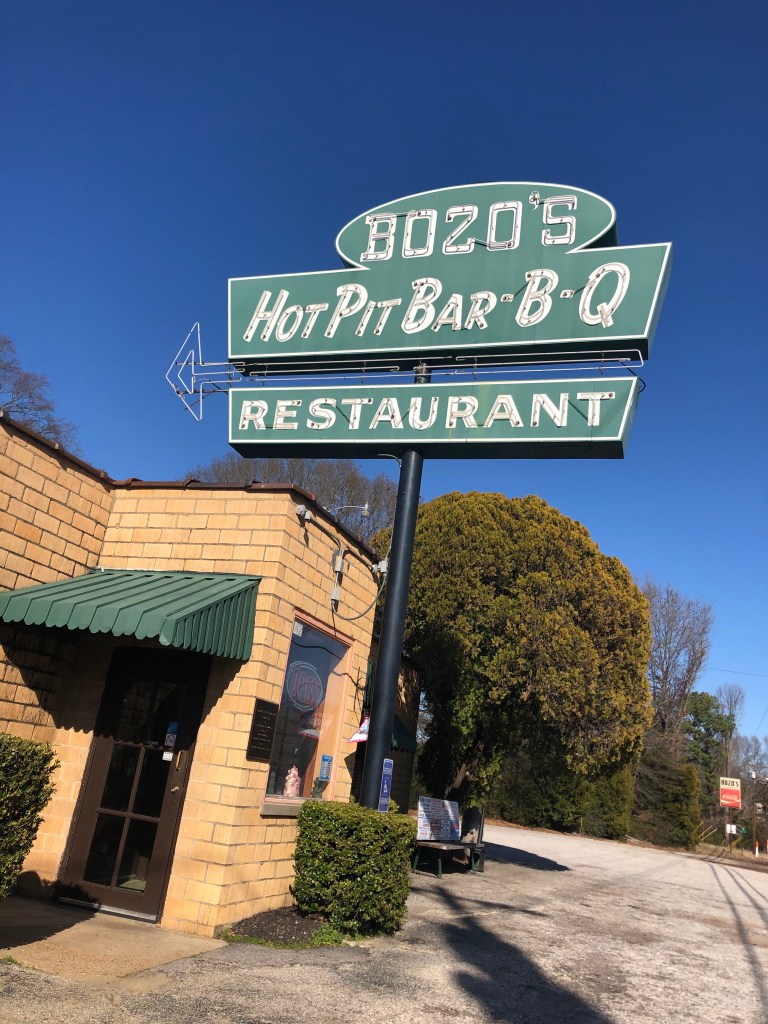
Anyway, the sight of that sign nagged at me, triggering a memory of something I’d heard about a place in the south that got sued by Larry Harmon (TV’s Bozo) for infringing on his trademark. A quick internet search confirmed that this was that place! It seems that a fellow named Thomas Jefferson Williams was born in Tipton County, Tennessee, in 1876. Somehow, he was given the nickname “Bozo” which stuck with him until his death in 1935. Bozo Williams opened his Bar-B-Q restaurant on Highway 70 when that stretch of highway was completed in 1925. Years later, in 1982. Bozo’s daughter, who now owned the place, thought she’d open a second restaurant, and decided to apply for a trademark for the restaurant’s name. So far, so good.
But Larry Harmon, who’d performed as Bozo the Clown since the 1950s, wasn’t having any of this. He thought that he should the only person permitted to use the name Bozo for business purposes. He challenged the daughter’s trademark attempt, but her trademark was granted by the government. Harmon appealed to the US Court of Appeals, which upheld her trademark. Harmon then took the case to the US Supreme Court, but the Court in 1991 refused to hear the case. “Bozo” Williams’ family had won. I’m happy for the outcome, but wouldn’t it have been great if the Rehnquist court issued an opinion on Bozo v. Bozo?
And so it is that the restaurant, begun in 1925, still sits on US 70, and still brings in crowds from all over the country. Maybe somewhere in that story is the secret to keeping a town alive.

 Chasing Phantoms