Now that I’ve managed to claw my way out of the Mojave desert, I thought I’d post a few additional photos that didn’t fit neatly into my scintillating narrative. Maybe think of these as “bonus features.”
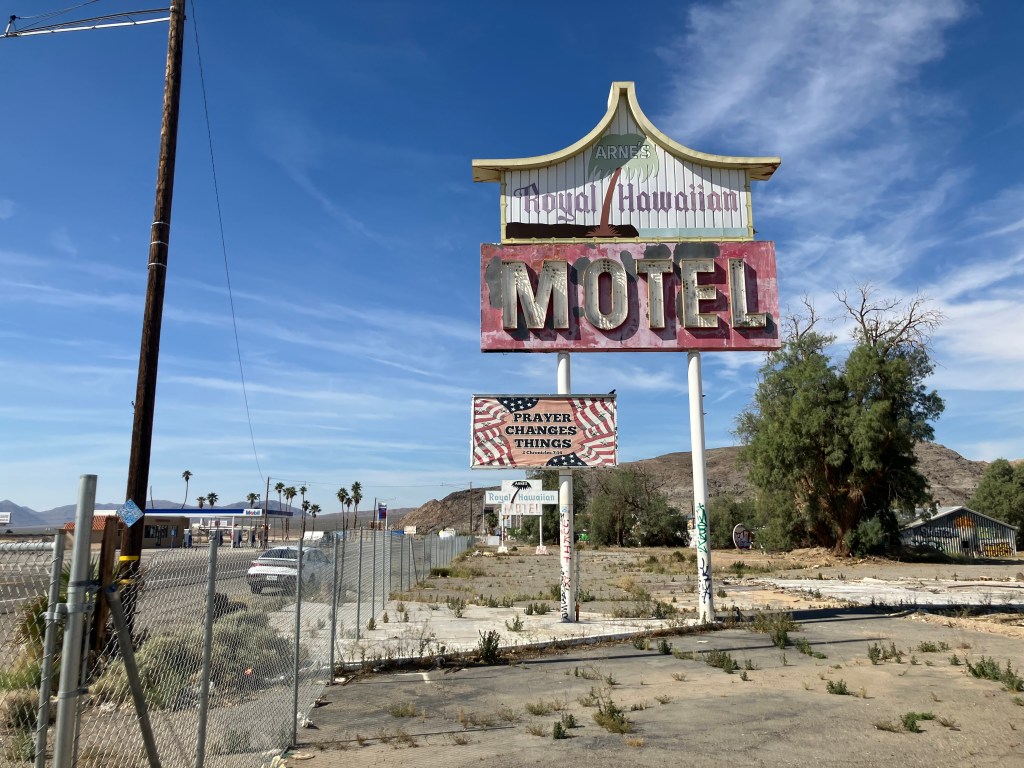
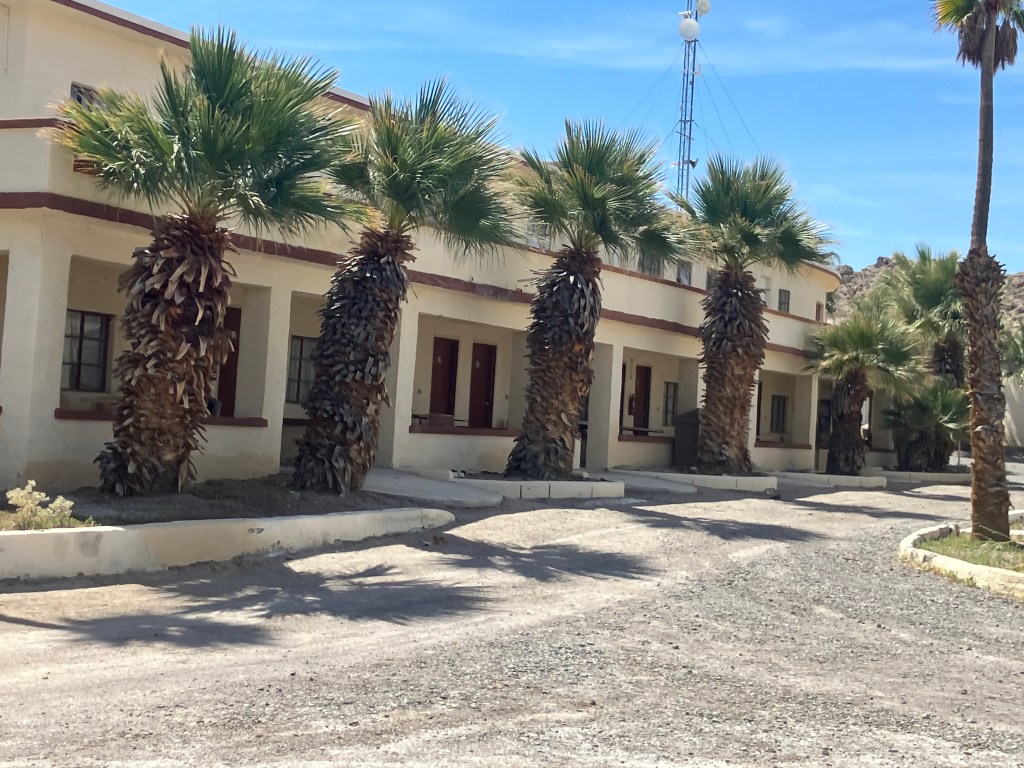
This first photo is of the Royal Hawaiian Motel in Baker, CA…which is not royal, not Hawaiian, and not even a motel anymore. It opened in 1957 and closed in 2009. It sat vacant until just last year, when the building was demolished. I’m told that, just before it was demolished, it appeared in the Amazon Prime series “Fallout” (Season 2, Episode 1). But I can’t vouch for that, as I haven’t watched TV since they cancelled Happy Days.
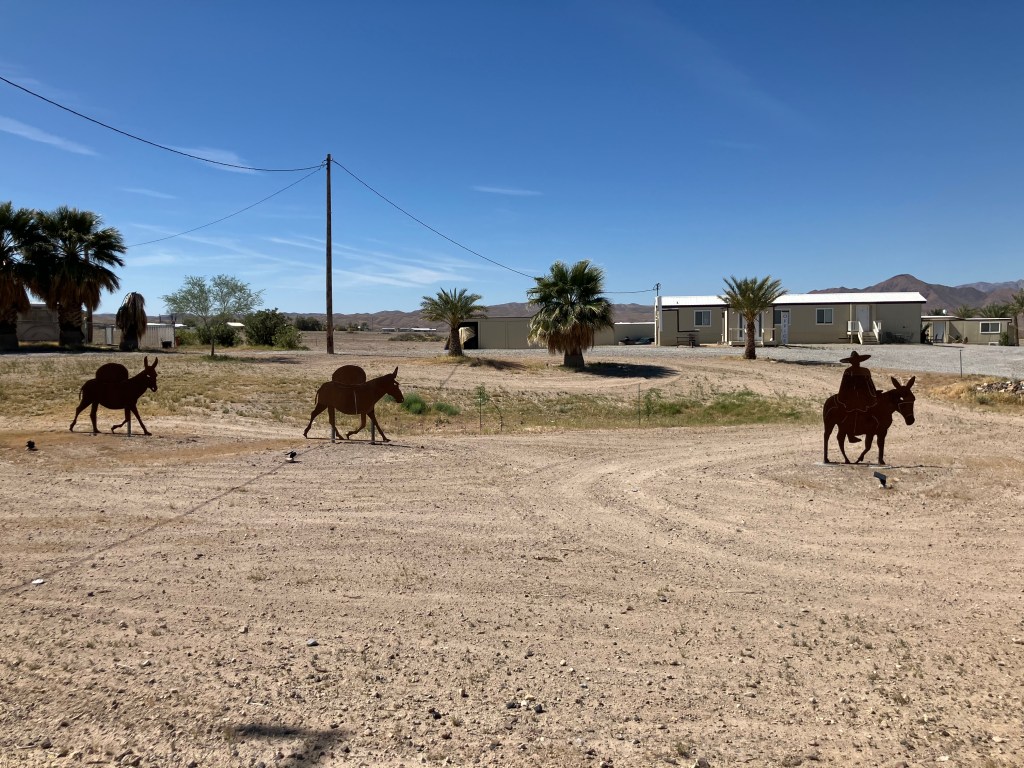
At first I thought the art installation featured here was the three wise men. But the “camels” are actually mules (donkeys? burros?) with packs on their backs. I took this photo near the Old Spanish Trail in Tecopa.
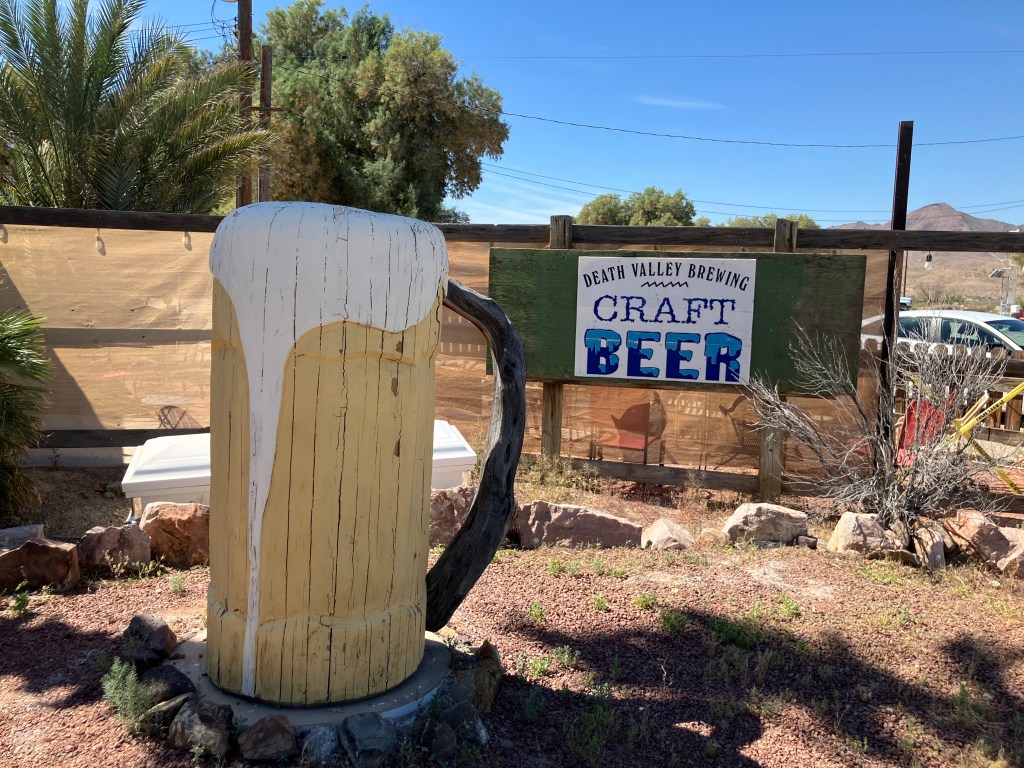
This beer mug is crafted out of wood. I guess that’s why I took the photo. Sorry–I don’t have any other info on this.
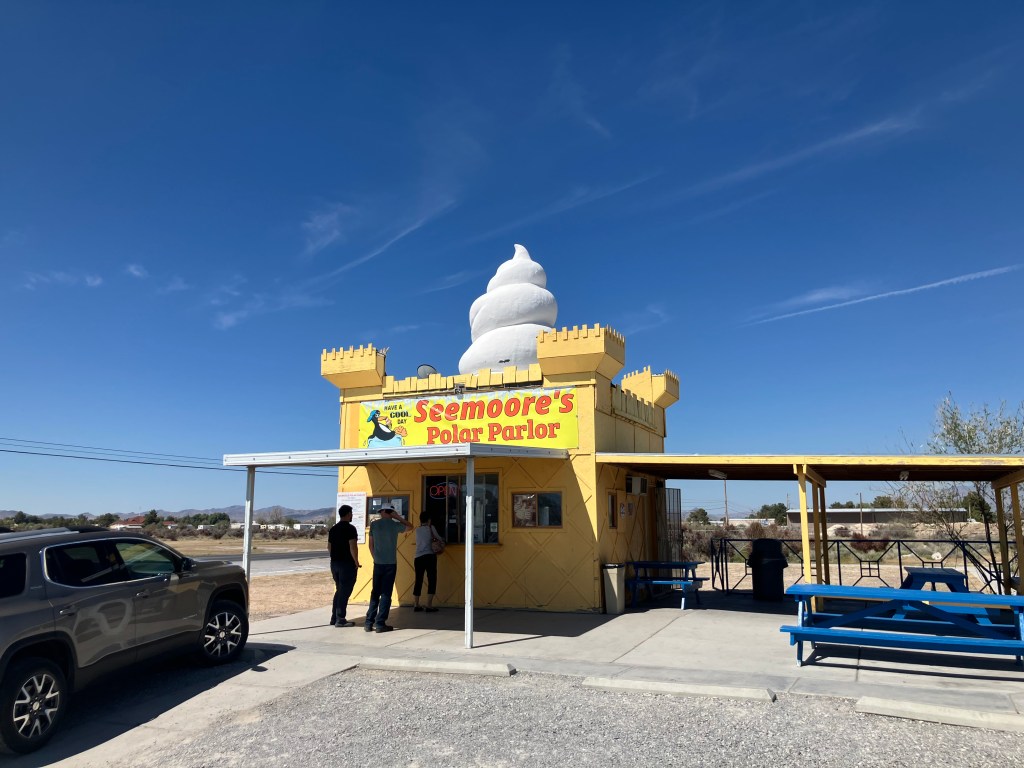
Seemoore’s Polar Parlor sits on the main highway into Pahrump, NV. A nice, cold softserve is of course welcome in the desert. But Seemoore’s real claim to fame (according to the teenager serving me at the window) is that it’s the “world’s tallest ice cream stand.” I expressed my incredulity, for this place is barely two stories tall. His deadpan response: “Yeah, but all the other ones are one story. They don’t have a giant ice cream on the top.”
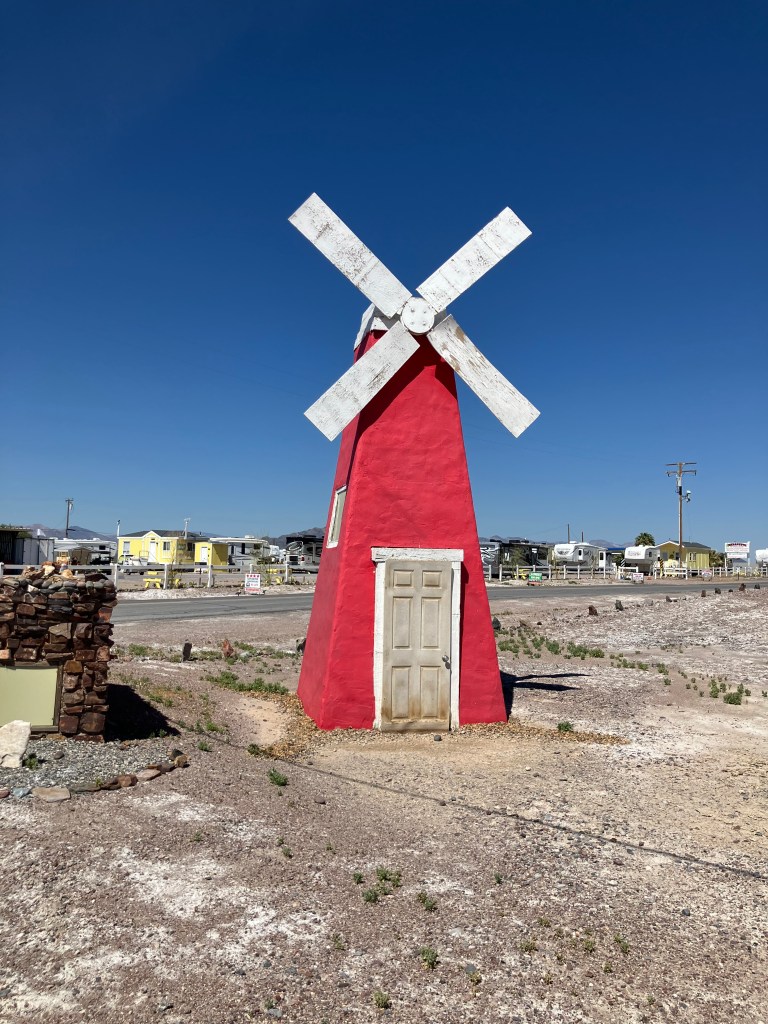
Unexplained “windmill”in Tecopa Hot Springs.
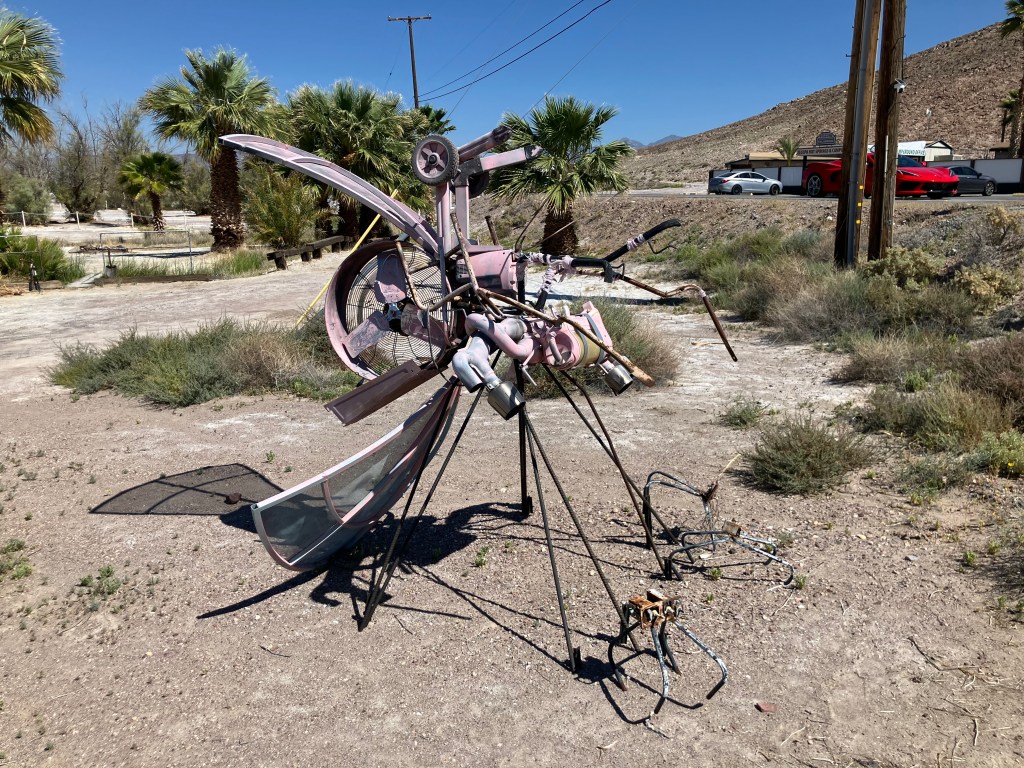
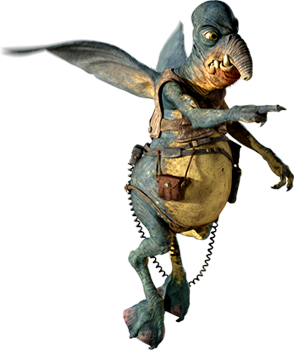
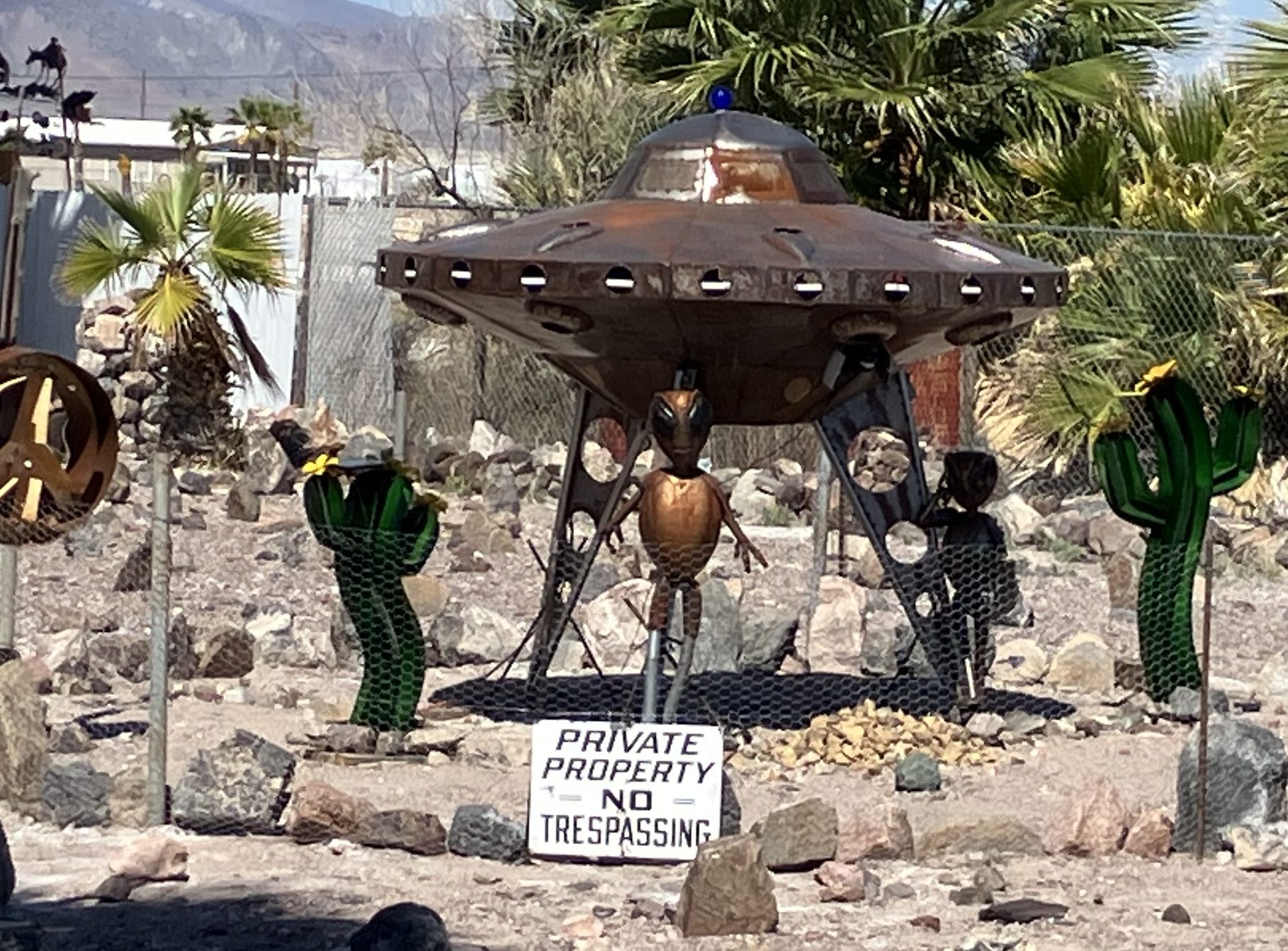
I’ve commented before that people in the desert have a special talent for yard art. I’m not sure what this is supposed to be–Maybe Watto from Star Wars Episode 1?
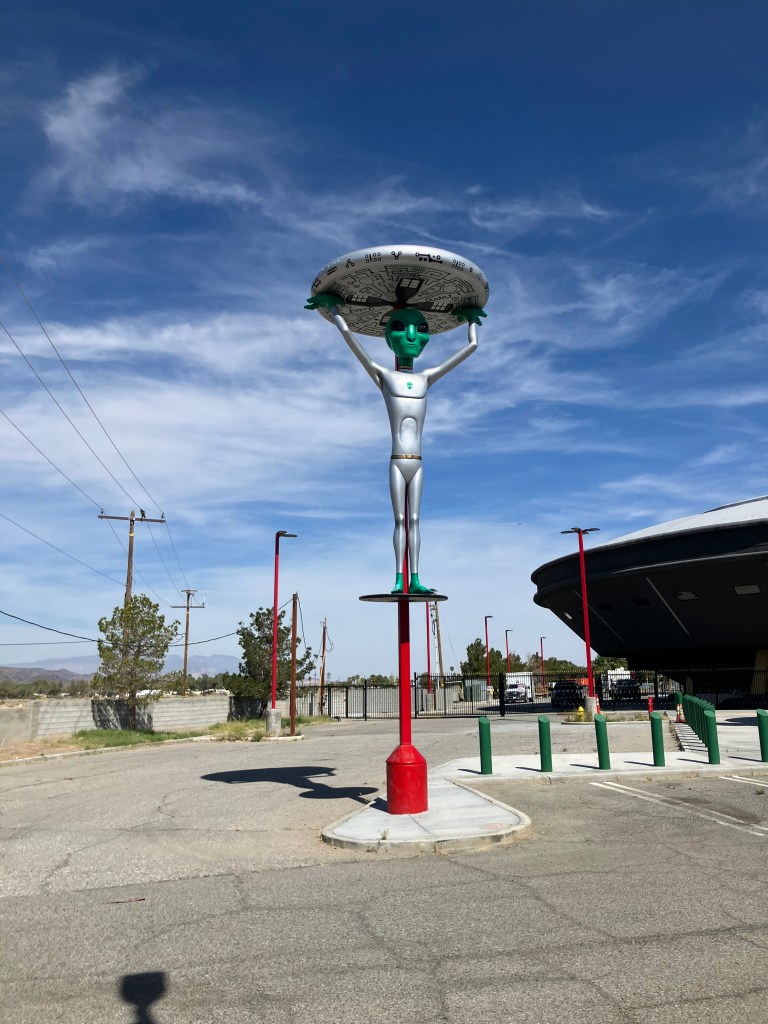
Speaking of aliens and yard art…
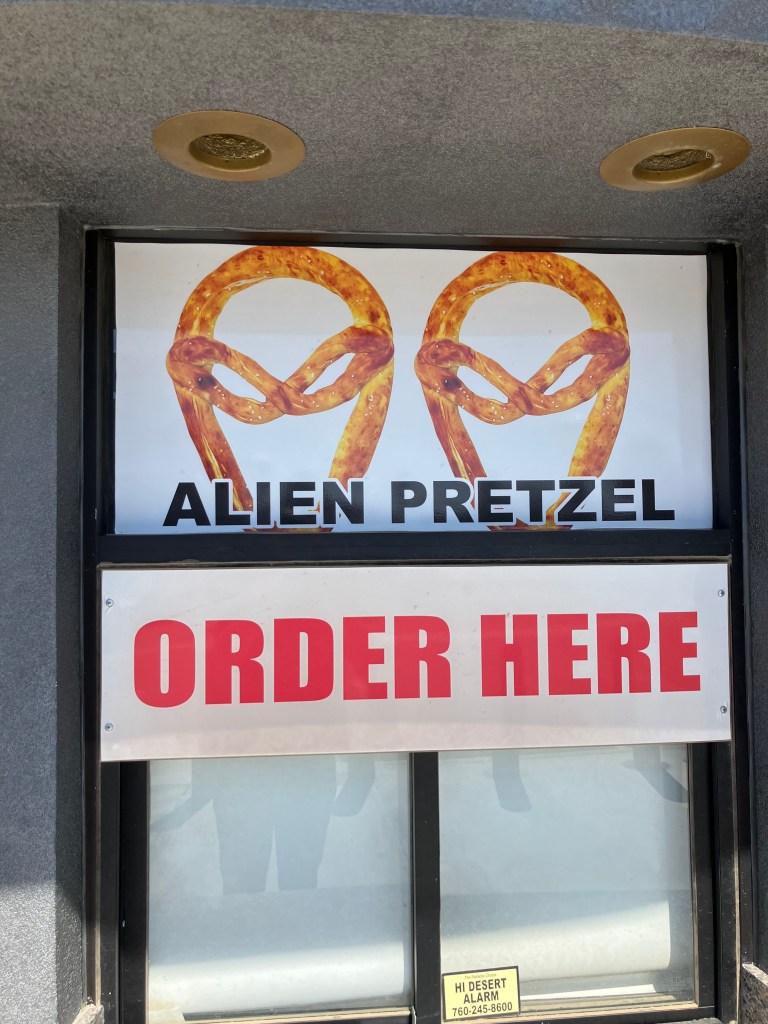
Sticking with the alien theme a little longer, these were advertised at the Alien Fresh Jerky store Baker. Sadly, they were out of them when I was there.
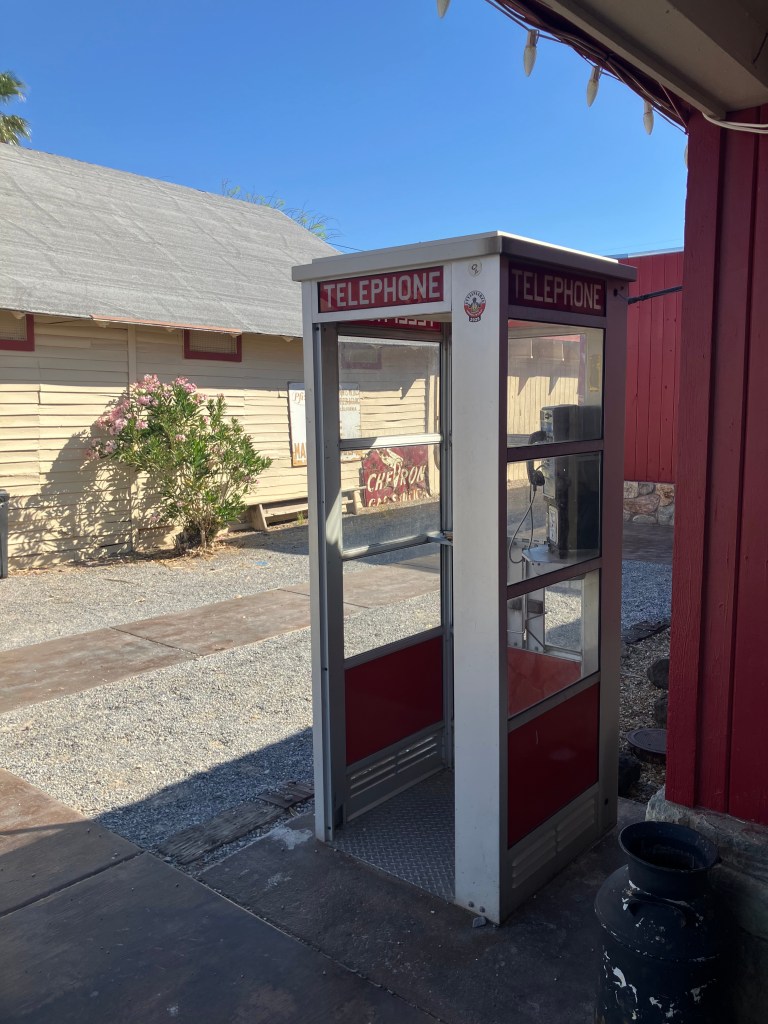
Younger readers might not recognize this photo. In the old days, people would actually go inside these glass boxes, deposit little metal discs called “coins,” and make a phone call from a clunky “handset” connected to a wire. This phone was still intact, but there was no dial tone. It got me wondering if there are any working pay phones anymore.
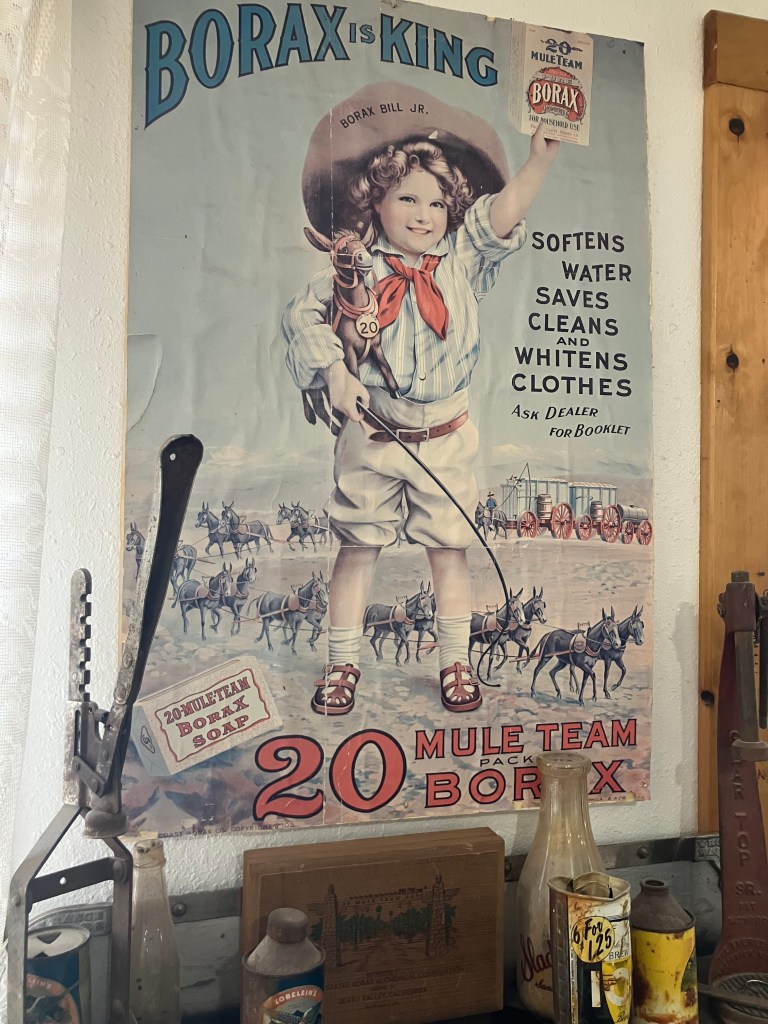
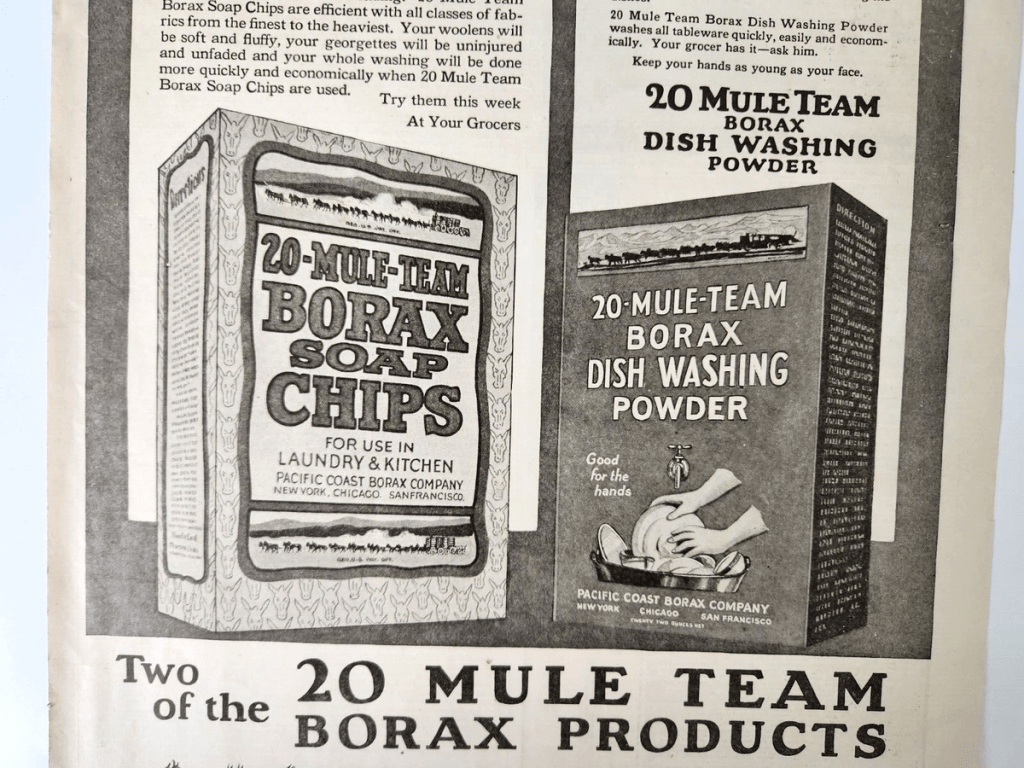
Another of the many advertisements for borax that one encounters around Death Valley.
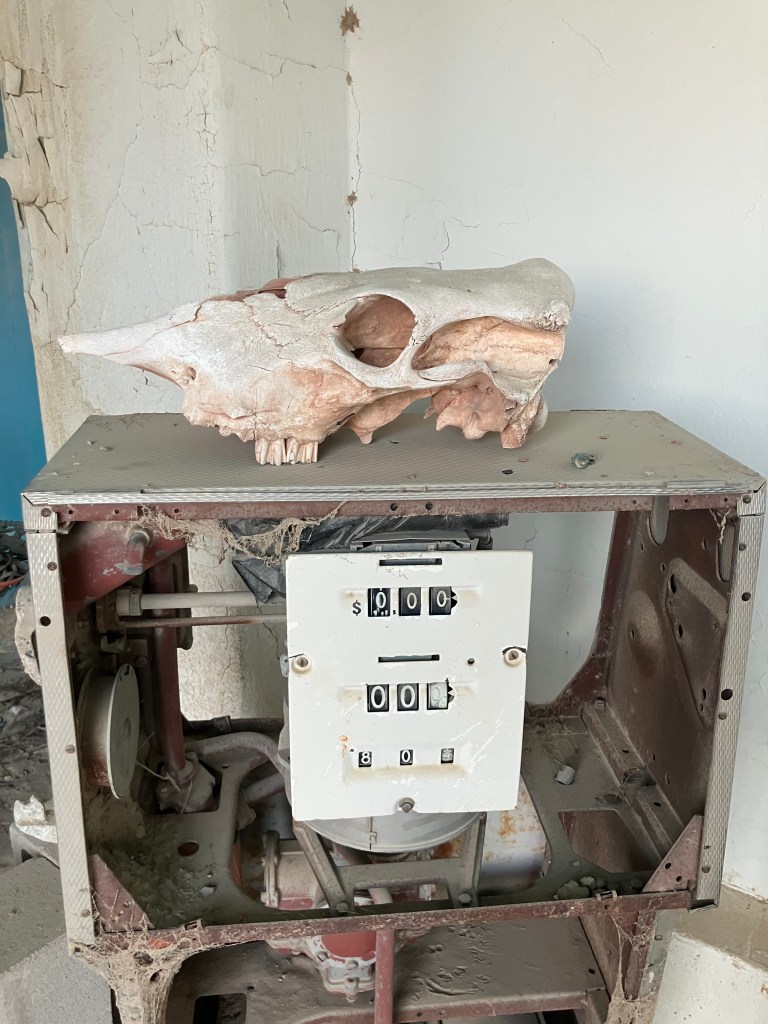
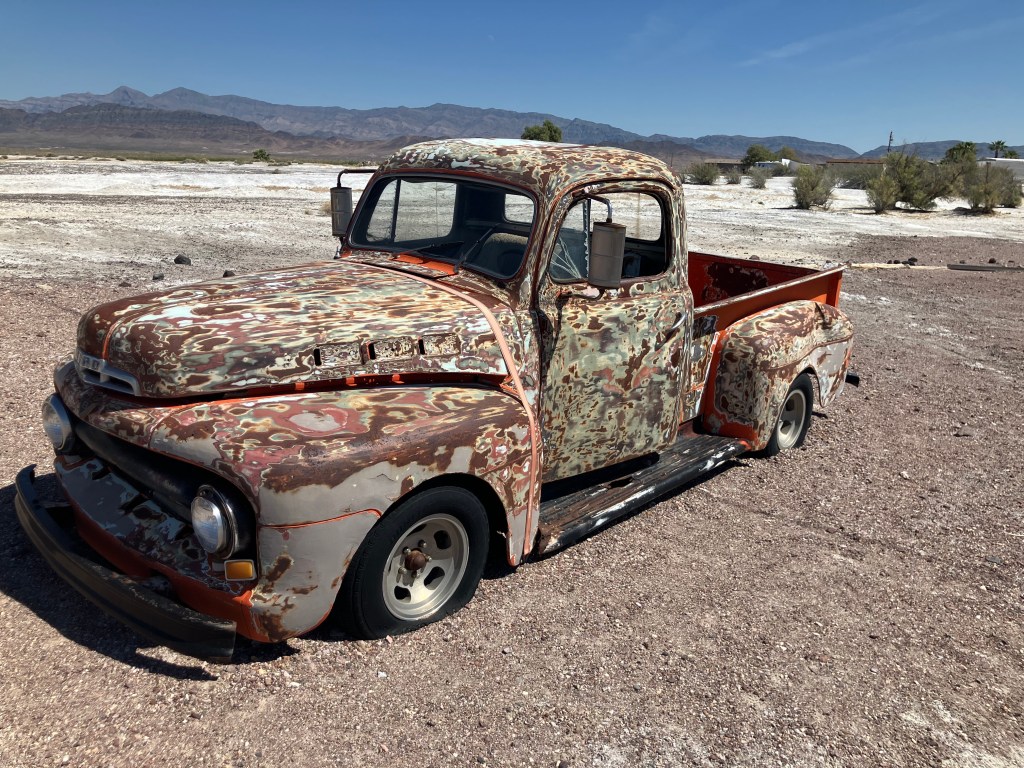
This may or may not be an example of desert folk art.
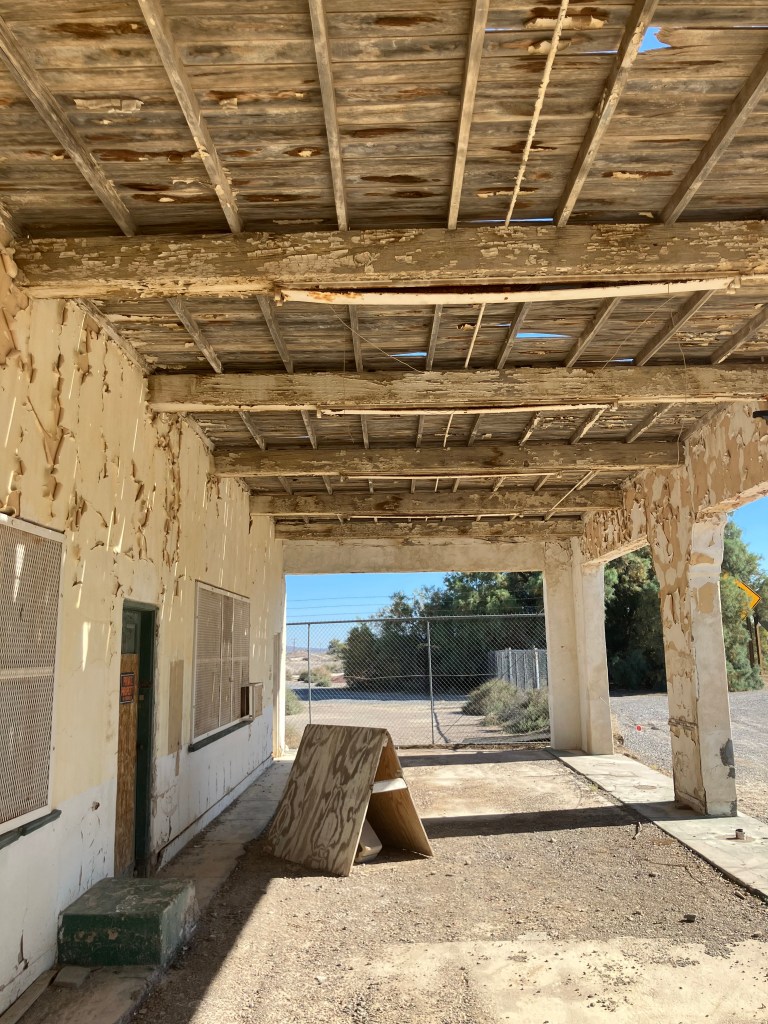
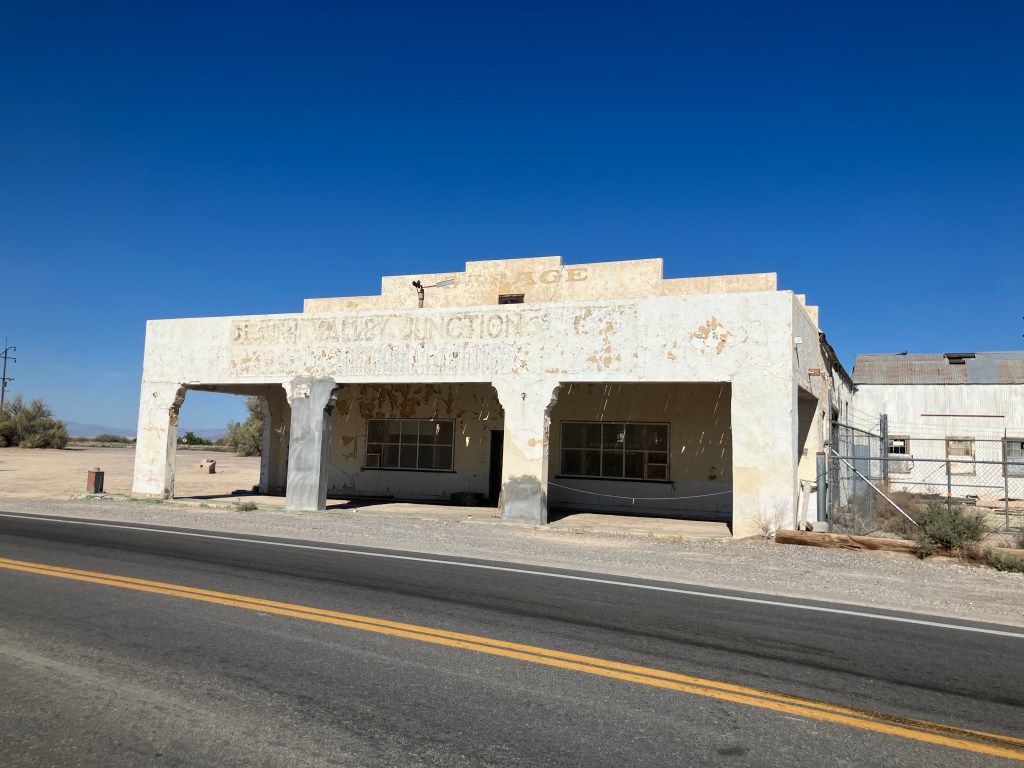
The covered porch of the service station at Death Valley Junction where Marta Becket had her car repaired and envisioned the Amargosa Opera House.
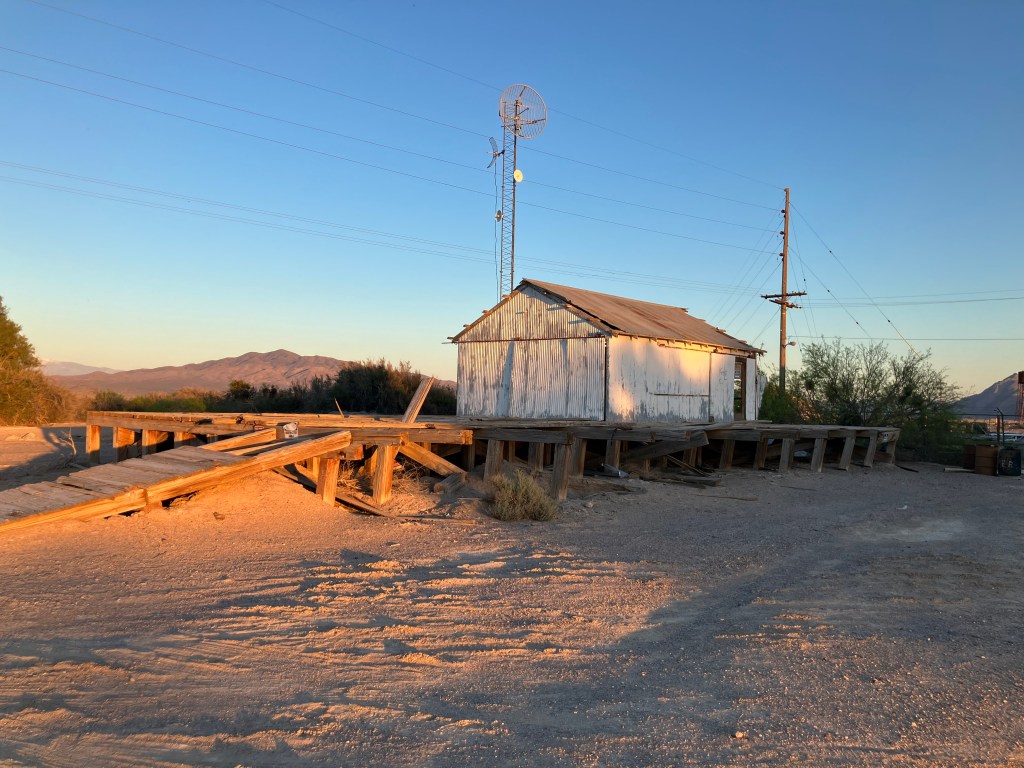
Finally, here’s the borax loading dock at Death Valley Junction/Amargosa. I just liked the lighting.
Thus concludes my Mojave trip. Mark your calendars for my visit to the Republic of Molossia on April 25. Until then, remember: Borax is King!
My hotel for last night was in Pahrump, NV, and when I checked in, the desk clerk explained the town is pronounced “paw-RUMP.” And so, when I awoke this morning, a Christmas carol was running through my head: “Pa-rump-a-pum-pum…”
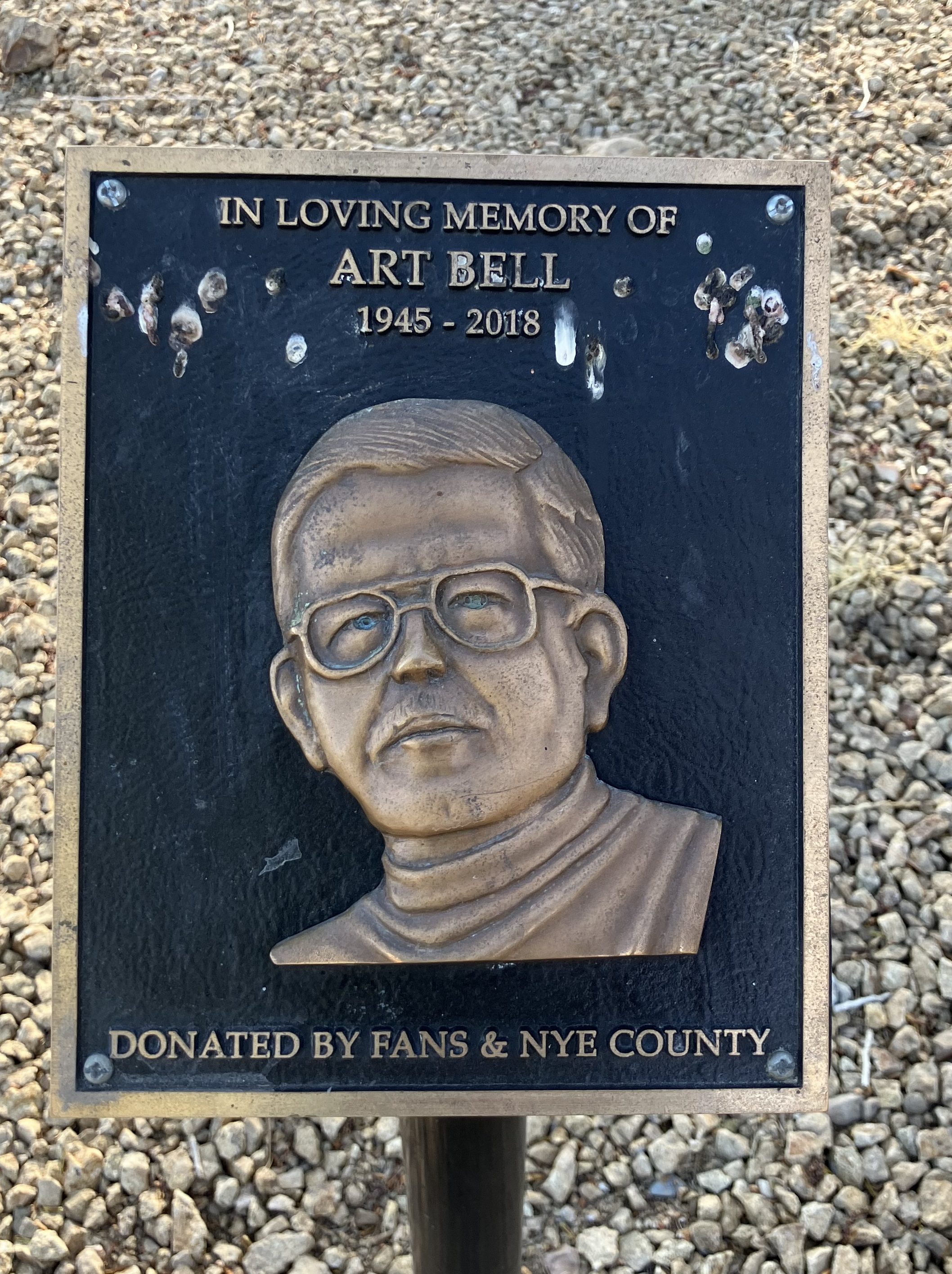
I was eager to make the 25-minute drive back to Shoshone and finish my trip along CA-127. But first I settled onto a Pahrump park bench and enjoyed my coffee and muffin in the warm morning air. But what’s this? Next to my bench was a plaque commemorating Pahrump favorite son Art Bell.
Why was his name familiar? I pondered a bit, then recalled he’d been mentioned by Sue at the Amargosa Hotel on the first night. Sue had explained she’d spent years working in radio, and was always intrigued by a guy who used to broadcast a paranormal- and conspiracy-related radio show from his home “compound” in Pahrump. That man was, of course, Art Bell. Sue was born in Canada and her career moved her around a lot, but because Art Bell had a strong transmitter (or maybe just because his show was syndicated), Sue was able to listen to him wherever she lived.
Art Bell was a complicated guy. Sure, we are all complicated, but Art was especially so. He definitely trafficked in conspiracy theories, but it’s unclear how much of it he actually believed. He set records, won awards, and had a huge influence upon the medium of radio from the 1970s until his death in 2018. He was married four times and had many children. There’s far too much to go into here, but if you’re interested, check out his Wikipedia page. But remember his name; we’ll come back to it.
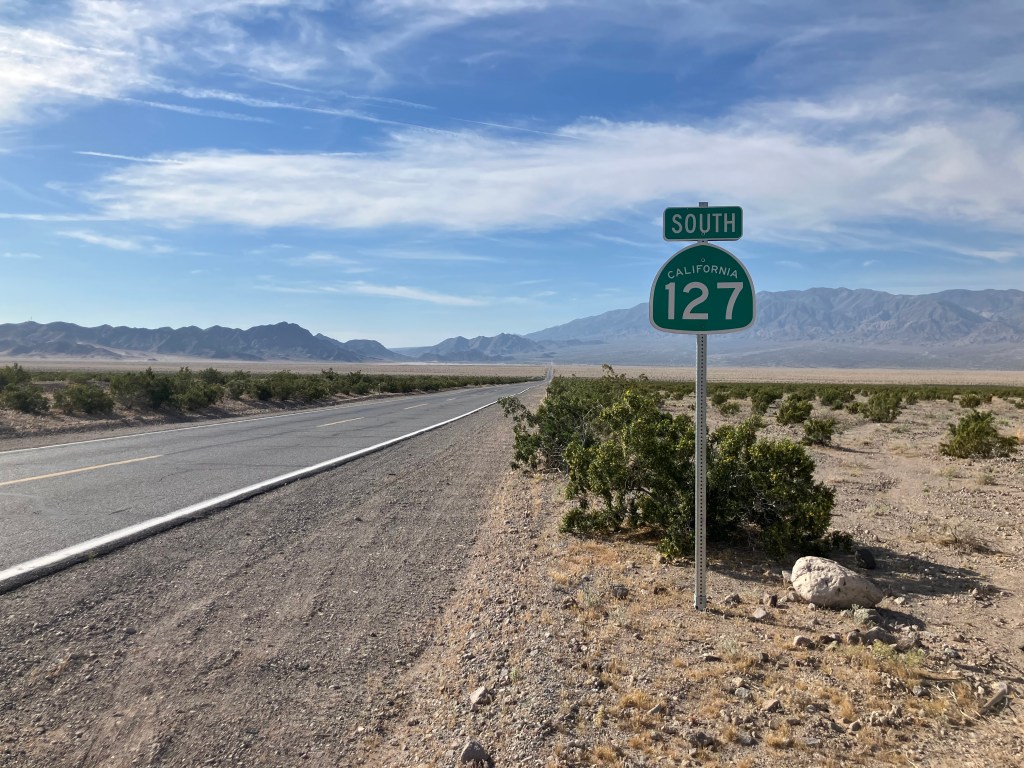
After I finished my coffee with the graven image of Art Bell, I returned to Shoshone and resumed my southward journey along CA-127. It was a relaxing and uneventful drive, as there was nothing but desert to be seen for about 50 miles.
But then, just as I was reaching the highway’s southern terminus, I entered the town of Baker, CA (pop: 480). Like the other towns on CA-127, Baker owes its existence to the Tonopah & Tidewater Railroad and to “Dad” Fairbanks. And because Baker is situated where CA-127 meets Interstate 15, it benefits from significant tourist activity.
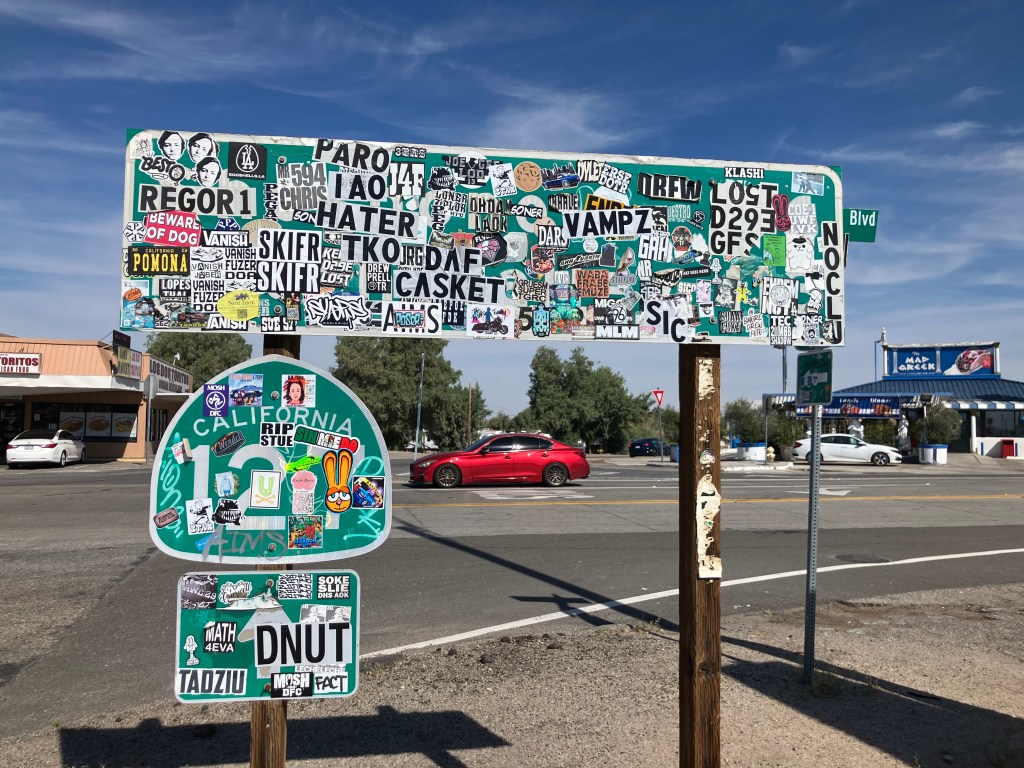
Sadly, there was no sign marking the End of CA-127 South. The closest approximation is the first Northbound sign, and it’s been obliterated by stickers. (I guess this is one of the downsides of having a steady inflow of interstate travelers.)
Paging CalTrans. Clean-up on aisle I-15.
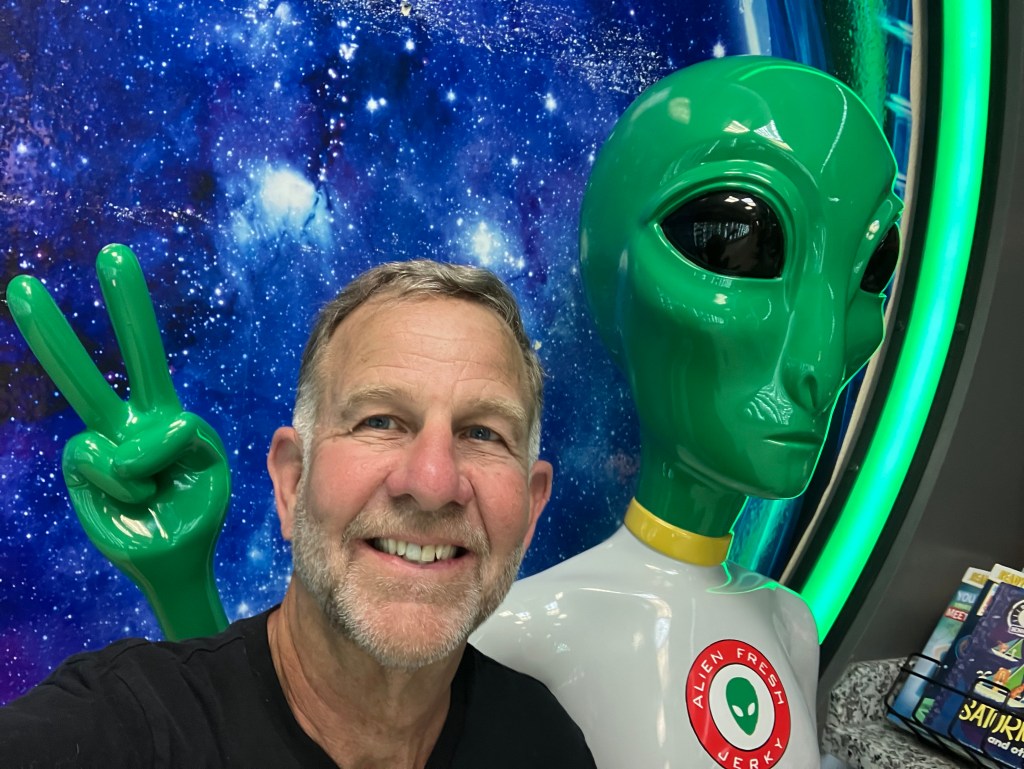
Deprived of my customary end-of-the-highway photo-op, I had to settle for this alien-themed selfie:
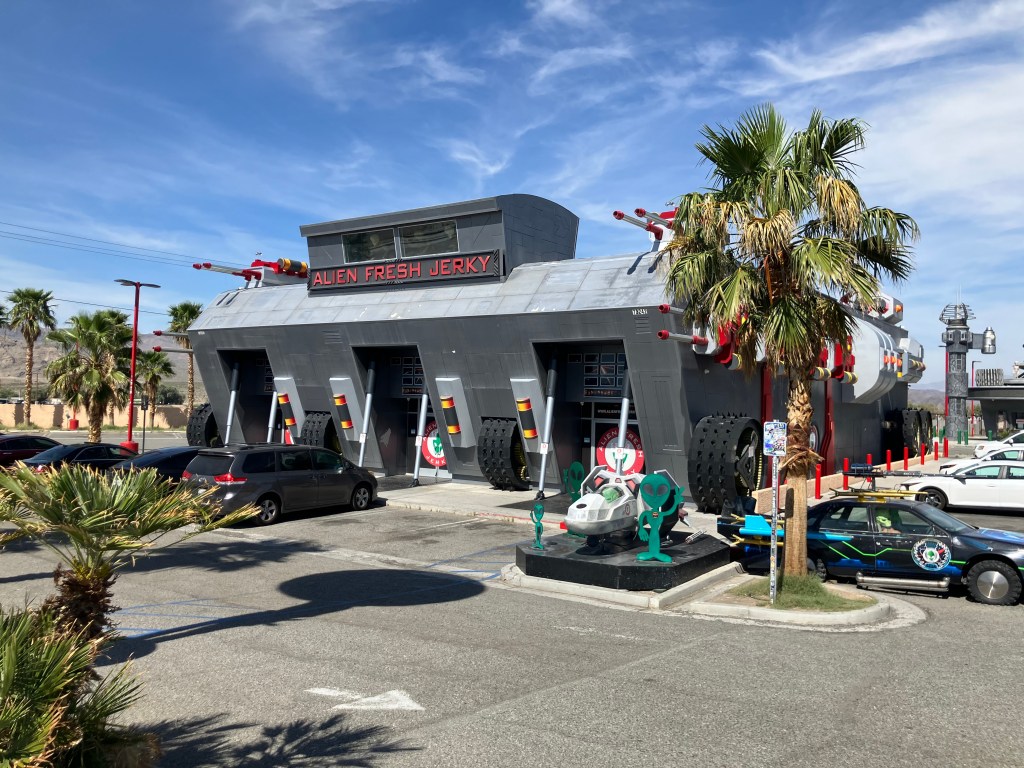
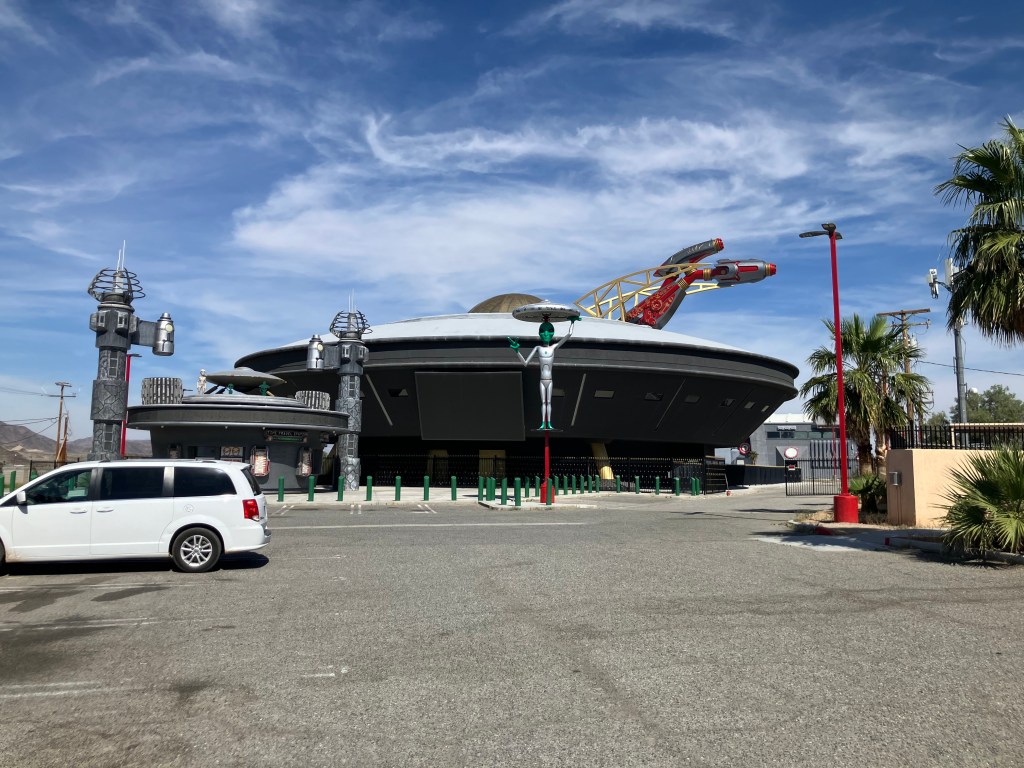
As should be obvious, Baker’s primary tourist draw is an extraterrestrial-themed snack store called Alien Fresh Jerky. The enormous space-fighter(?)-shaped building looms over the main drag.
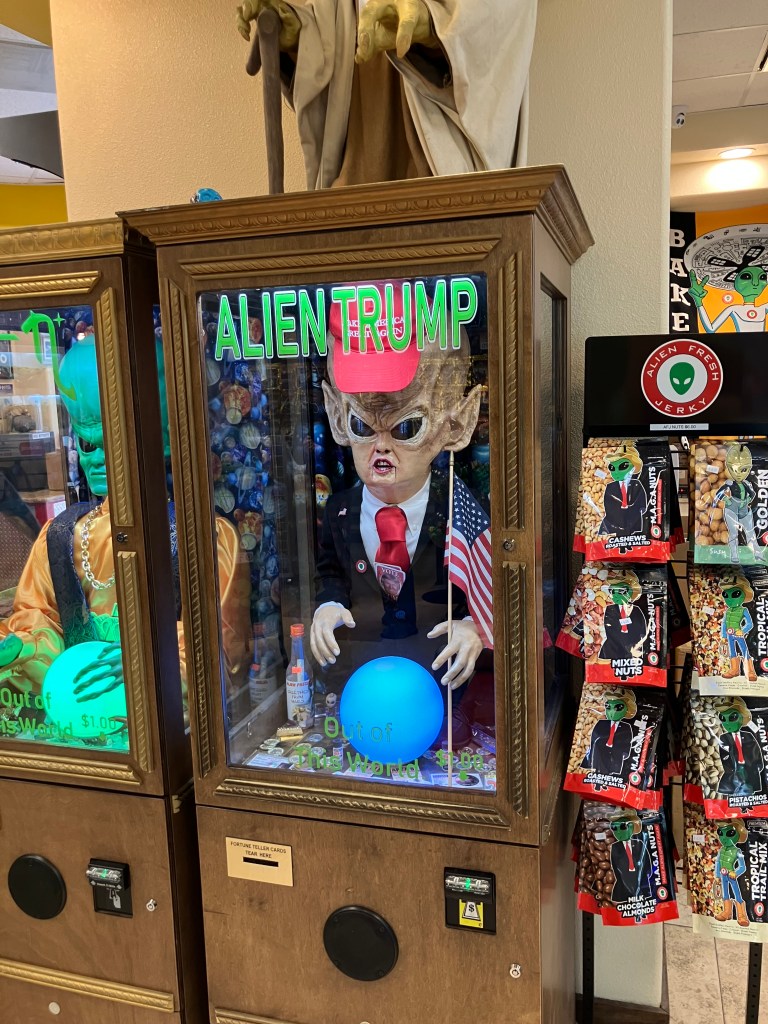
Inside are a million different flavors of beef jerky, as well as alien-themed snacks, sodas, T-shirts, and plush toys. There are also various aliens posing on benches for selfies, and several “fortune-telling” booths.
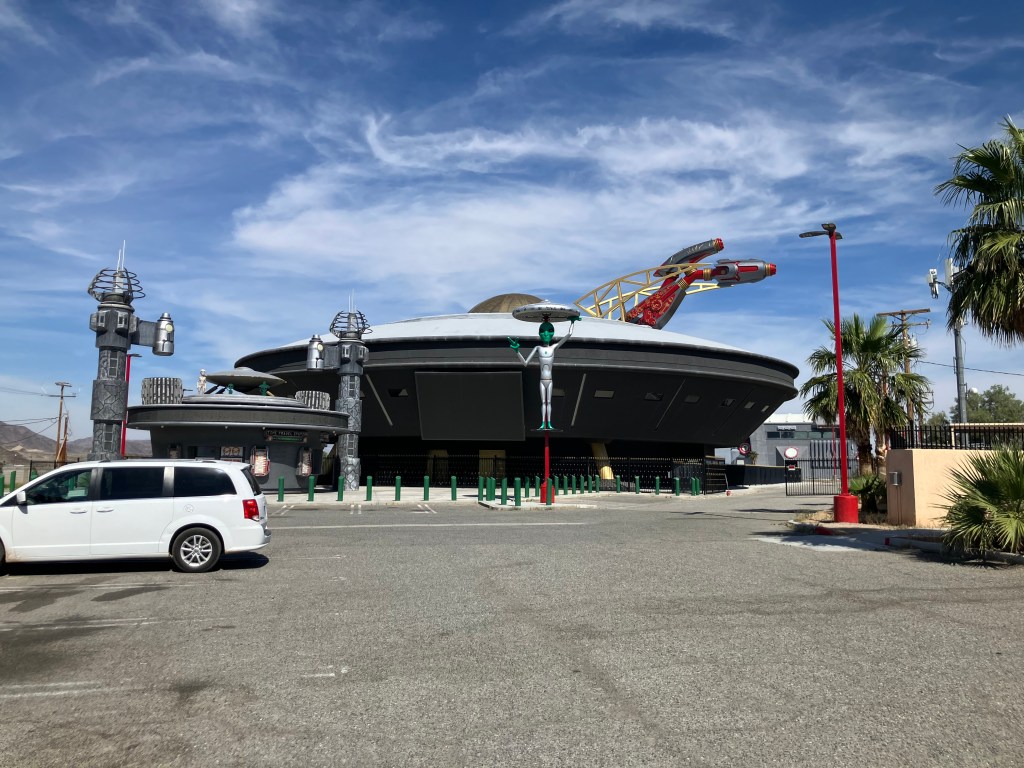
In the back parking lot there’s a giant flying saucer. I’m not making this up. The clerk in the store explained it’s a hotel that, for reasons she didn’t want to get into, hasn’t yet been approved for occupancy. I am so staying there next time I come through.
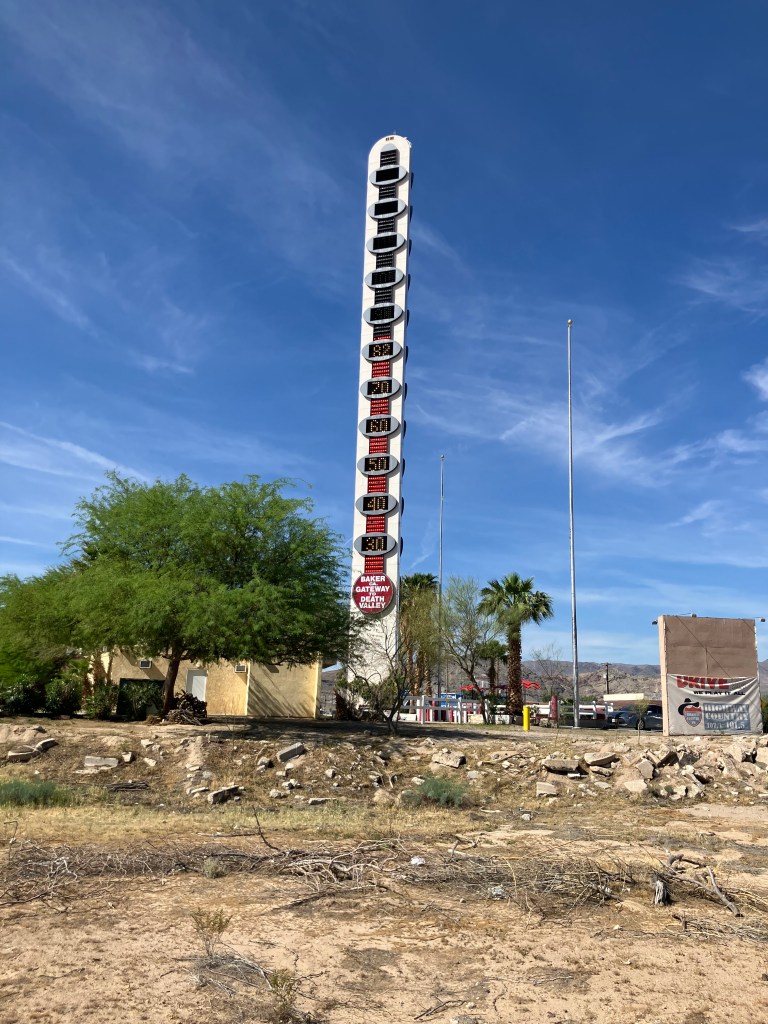
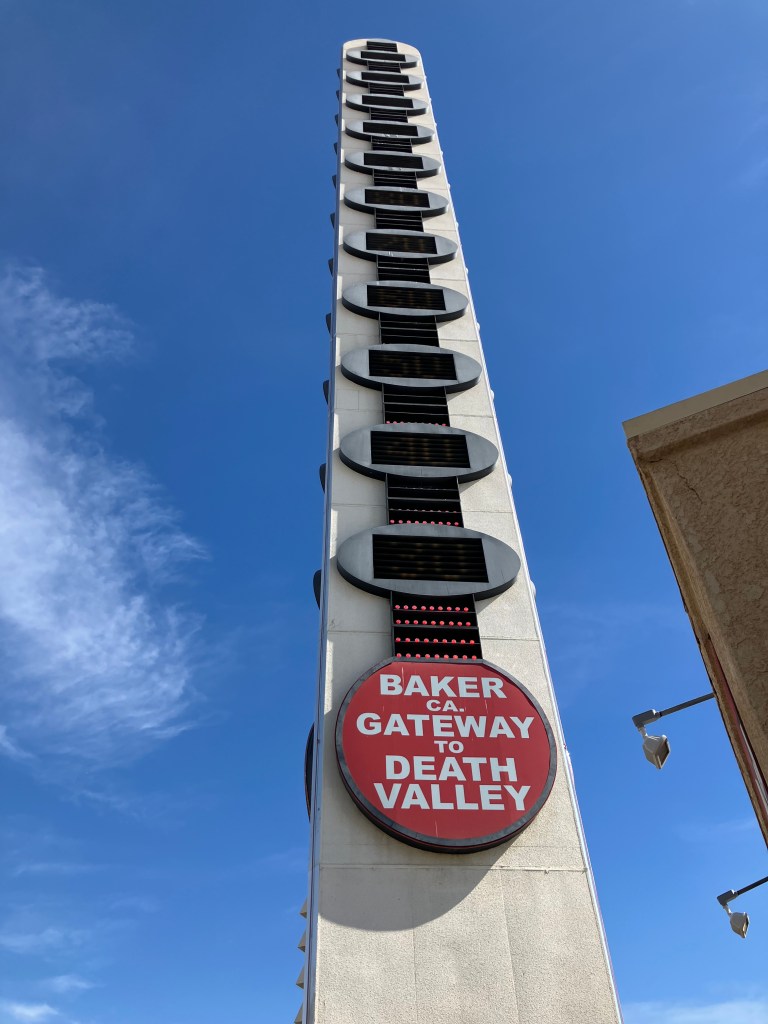
Across the street from the alien jerky place is The World’s Tallest Thermometer (134 feet!), which was registering a comfortable 82 degrees.
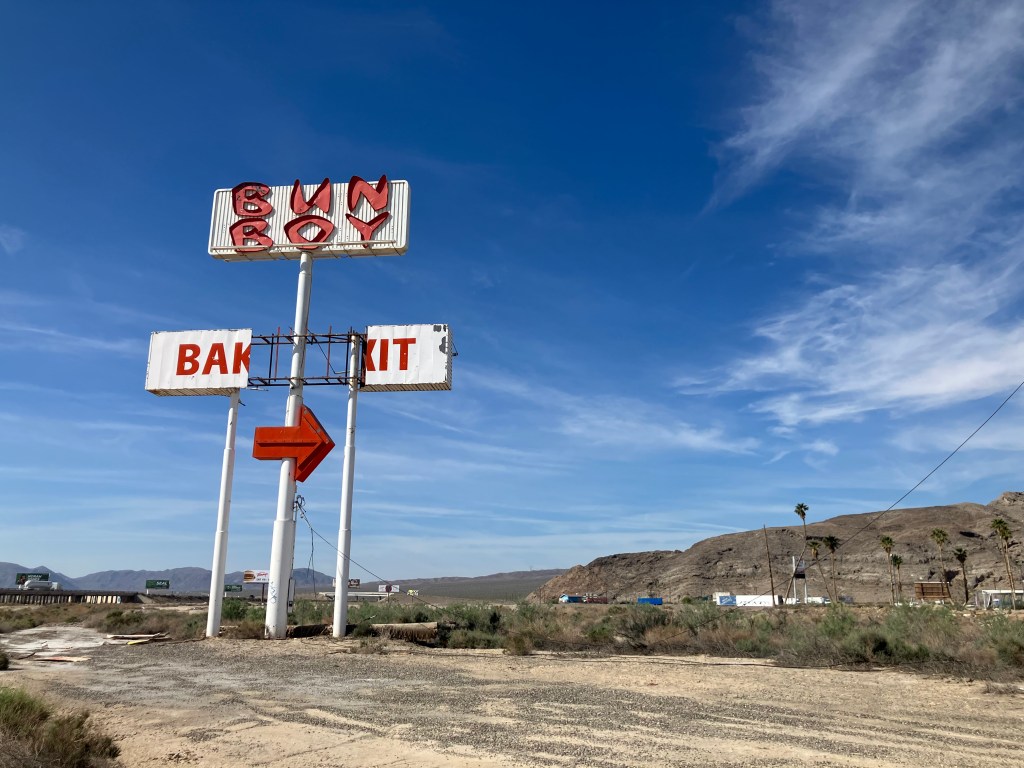
The thermometer was erected by Willis Herron, the owner of Baker’s famous Bun Boy restaurant that used to stand next door.
The Bun Boy restaurant had been around since 1926, and Willis bought it in 1956. Things were going well, then it burned down in 1990. Undeterred, Willis had the restaurant rebuilt the next year, but he added the giant thermometer as a gimmicky attraction. This was the state of affairs until 2005, when Willis sold the restaurant and the thermometer.
Willis died in 2007. And sadly, the new owner neglected the thermometer, which began to malfunction and eventually went dark. Even the Bun Boy fell on hard times, and briefly became a Bob’s Big Boy before closing entirely in 2013.
But that’s not the end of the story, obviously. Willis’s widow bought back the thermometer, had it restored, and held a grand re-lighting in 2014. And that’s why I was able to see it today.
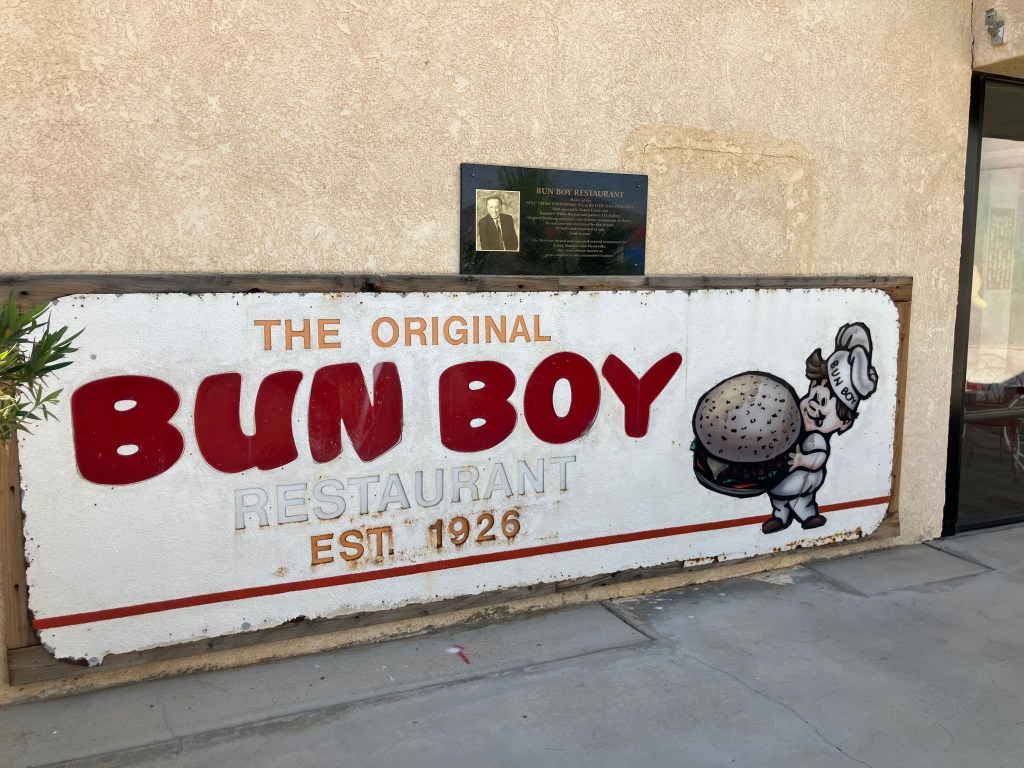
There’s a Gift Shop near the base of the thermometer, because of course there is. On the wall of the gift shop is an antique Bun Boy sign.
And, at least for now, a towering Bun Boy sign still beckons travelers on Interstate 15.
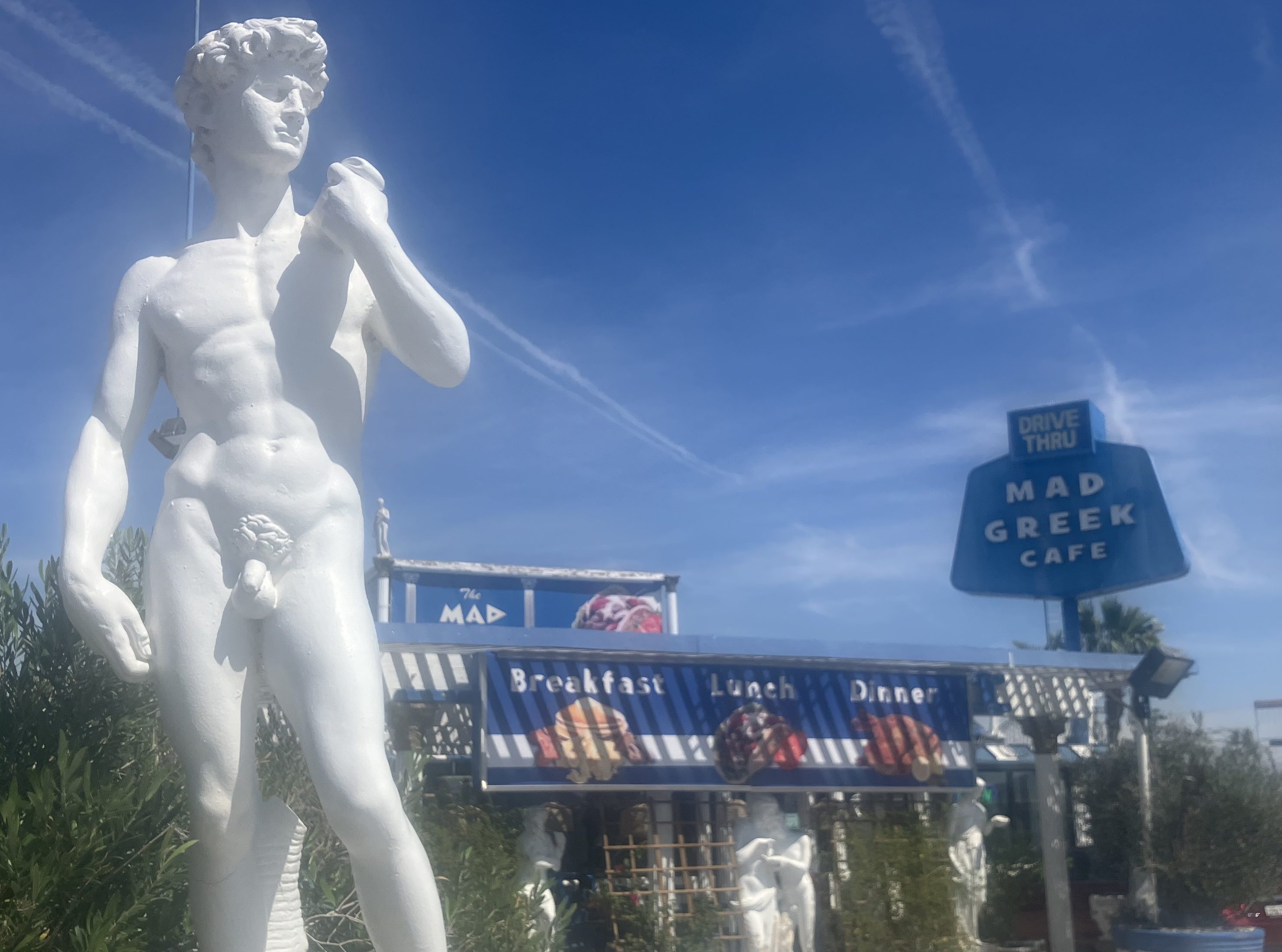
And so, lacking a Bun Boy, I decided to have lunch at a different local institution: The Mad Greek Cafe.
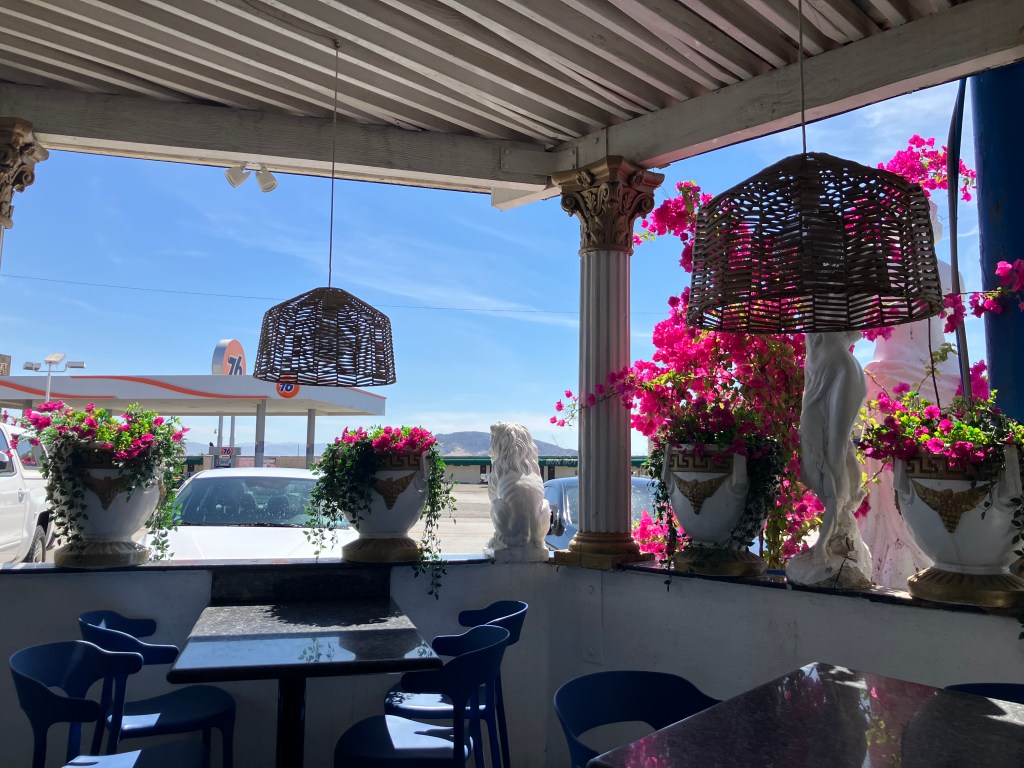
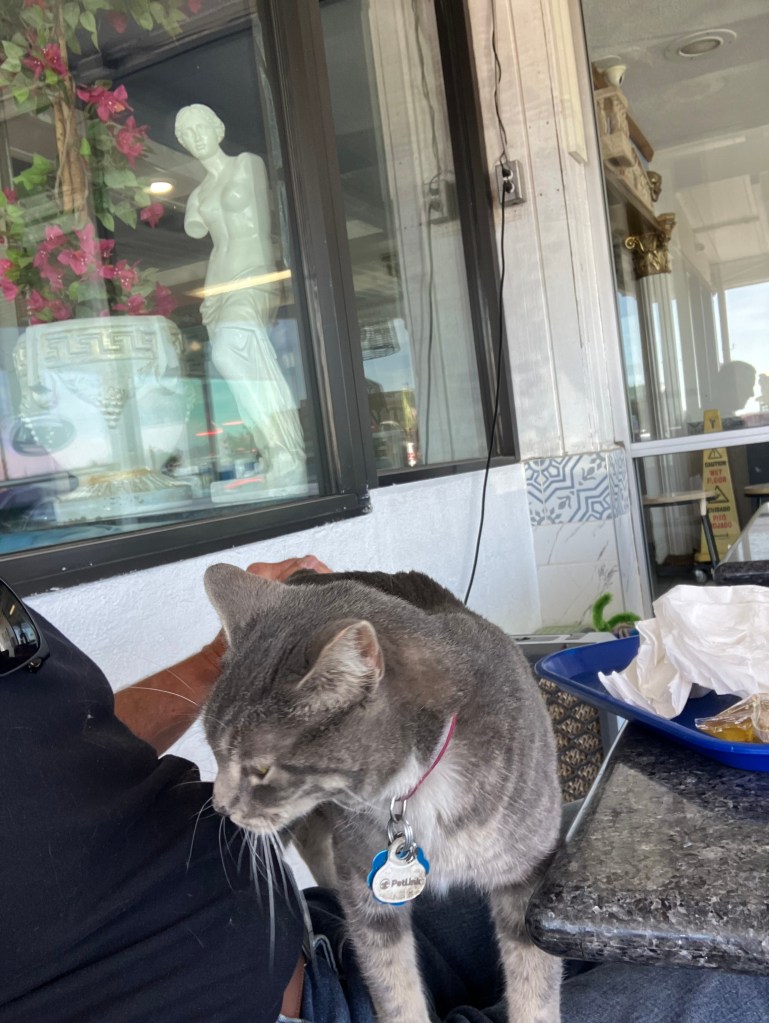
It’s delightfully tacky, painted up in the colors of the Greek flag and surrounded by statuary. It’s sort of a Greek version of Buca di Beppo. But it’s not a chain–the same Greek family has been running this place since 1974. And this place is not just surviving; it’s thriving.
I ordered a gyro and took a seat in the enclosed patio…
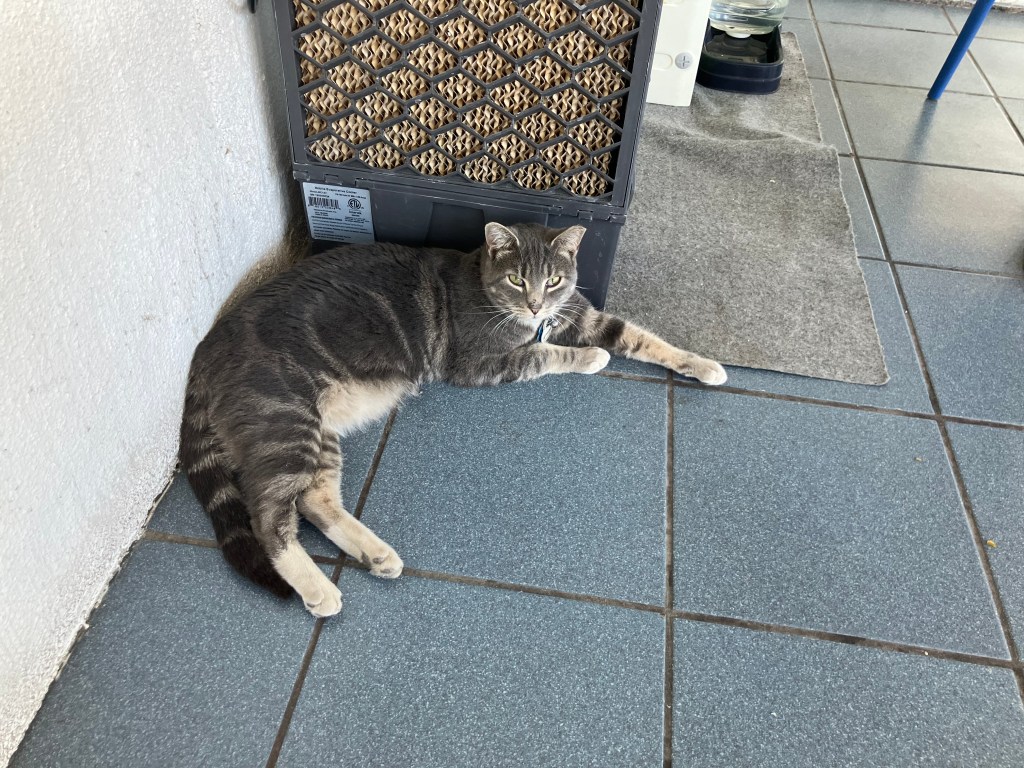
…which, it turns out, is home to the restaurant’s pet cat.
I managed to keep maybe 3/4 of the Gyro for myself.
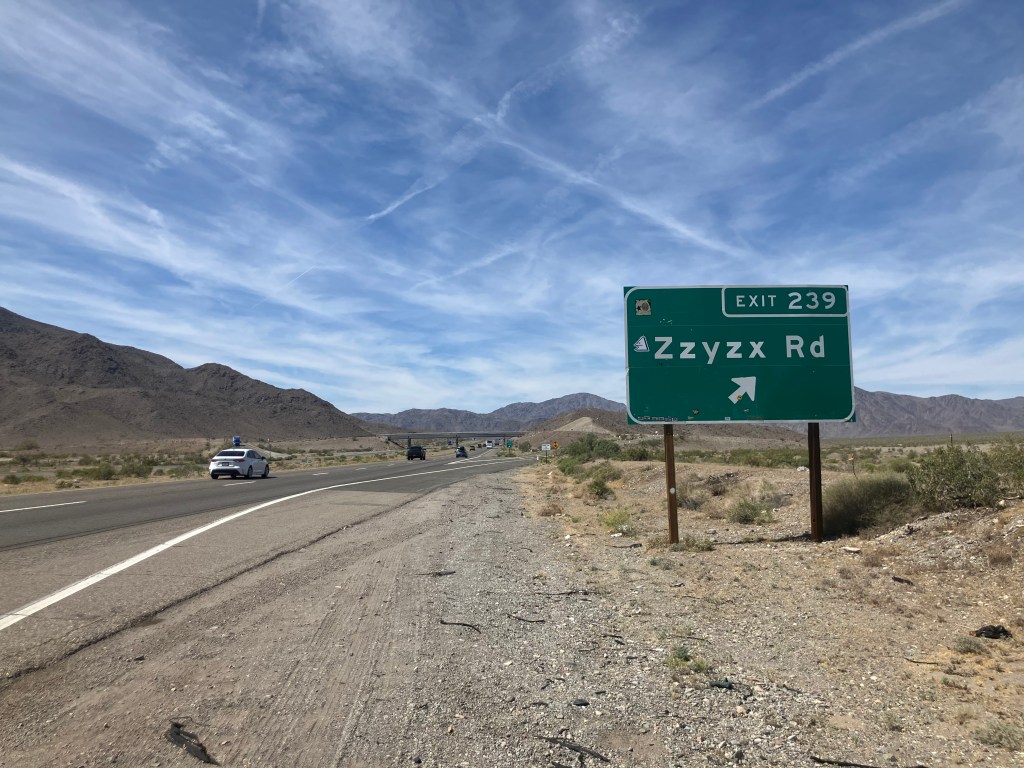
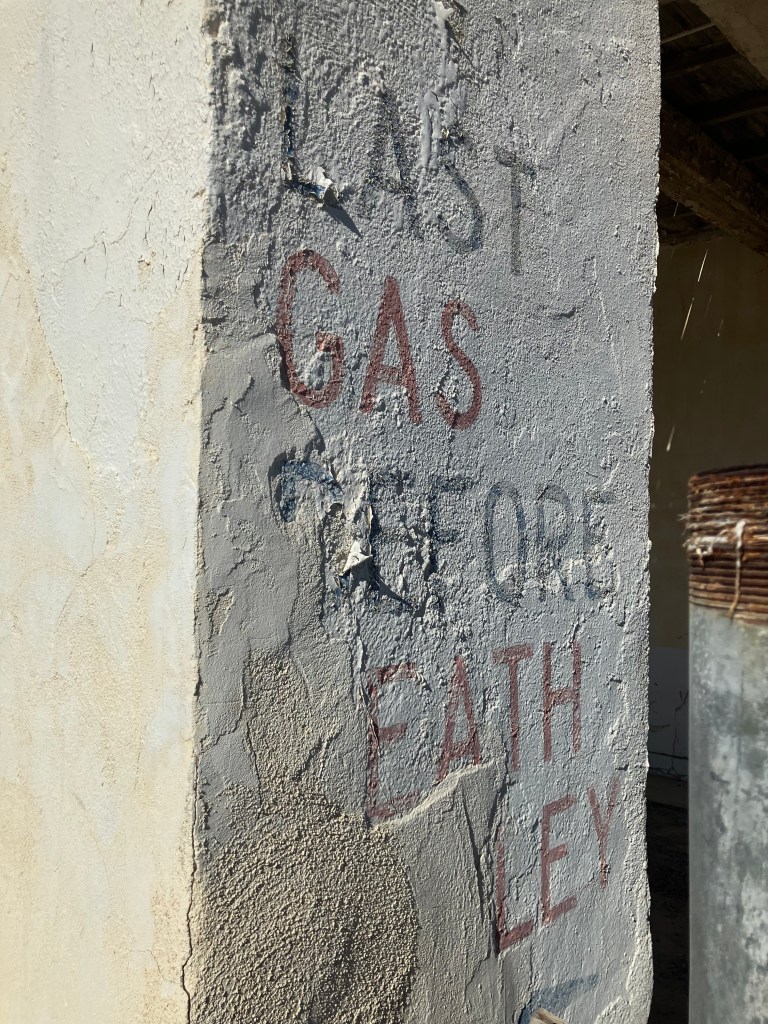
That kind of sums up Baker, and thus it kind of sums up CA-127. But before I close, I want to return to the “Last Word” promised in this blog’s title. And it’s claimed that the last word in the English dictionary is (or should be) “Zzyzx.”
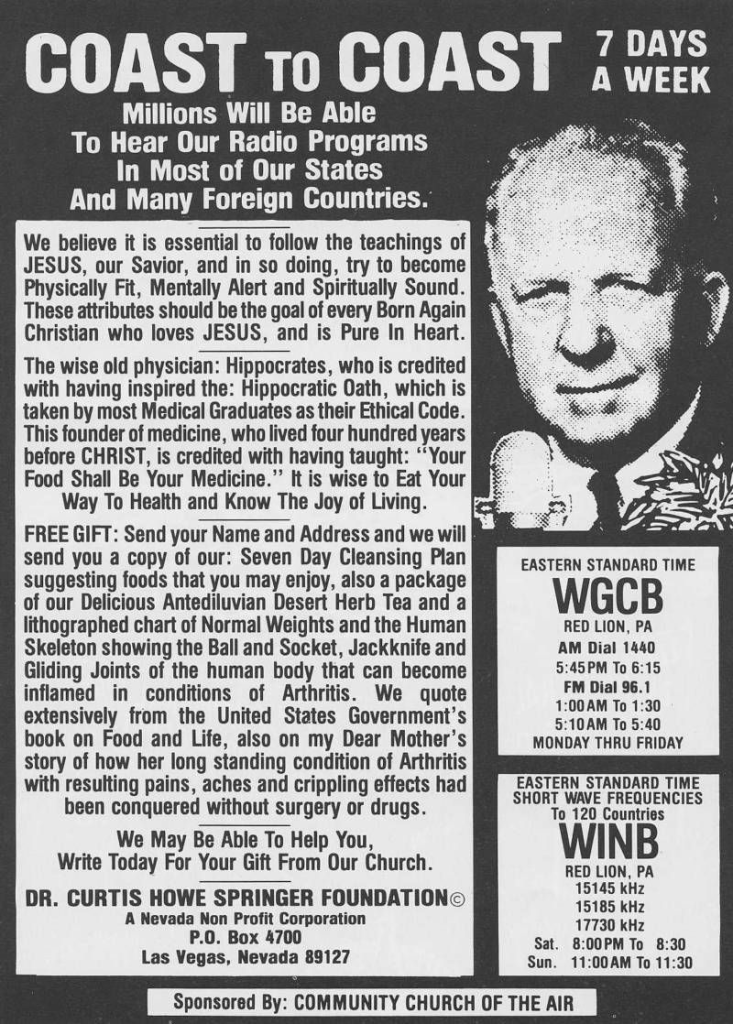
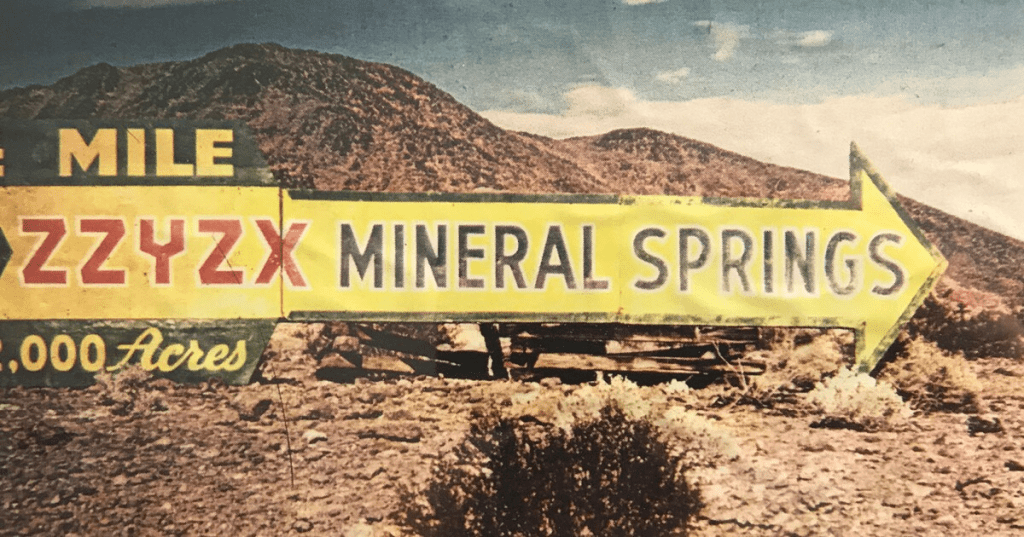
Zzyzx (pronounced ZYE-zix) is a community just a few miles west of Baker. It was originally known as Soda Springs, But in 1944 a self-proclaimed doctor and radio evangelist named Curtis Springer filed mining claims for almost 13,000 acres in the area, and he named it Zzyzx (because, he said, it’s “the last word in the English language.”)
Springer reminds me a bit of Art Bell, the conspiracy monger who broadcast from Pahrump. Springer claimed to be a minister (but he was ordained by no church), and he developed a nationwide radio following. And, like Bell, he would set up his own broadcast studio on his property.
Springer created the Zzyzx Mineral Springs and Health Spa on his Mojave mining claim, which was fed by natural springs. People flocked to this putative health oasis in the desert, where Springer blended some legitimate physical therapies with spiritual programming and some outright quack nostrums. The place was a destination to be sure, but like some other oasis, it was something of an illusion. The property’s “naturally occurring hot springs” were actually heated by gas boilers. And Springer’s “mining claims” contained no valuable minerals. Thirty years later, in 1974, the federal government reclaimed Zzyzx on the grounds that Springer’s mining claims weren’t valid. Springer would (unsuccessfully) fight that decision for the rest of his life. He died in 1985, at the age of 88.
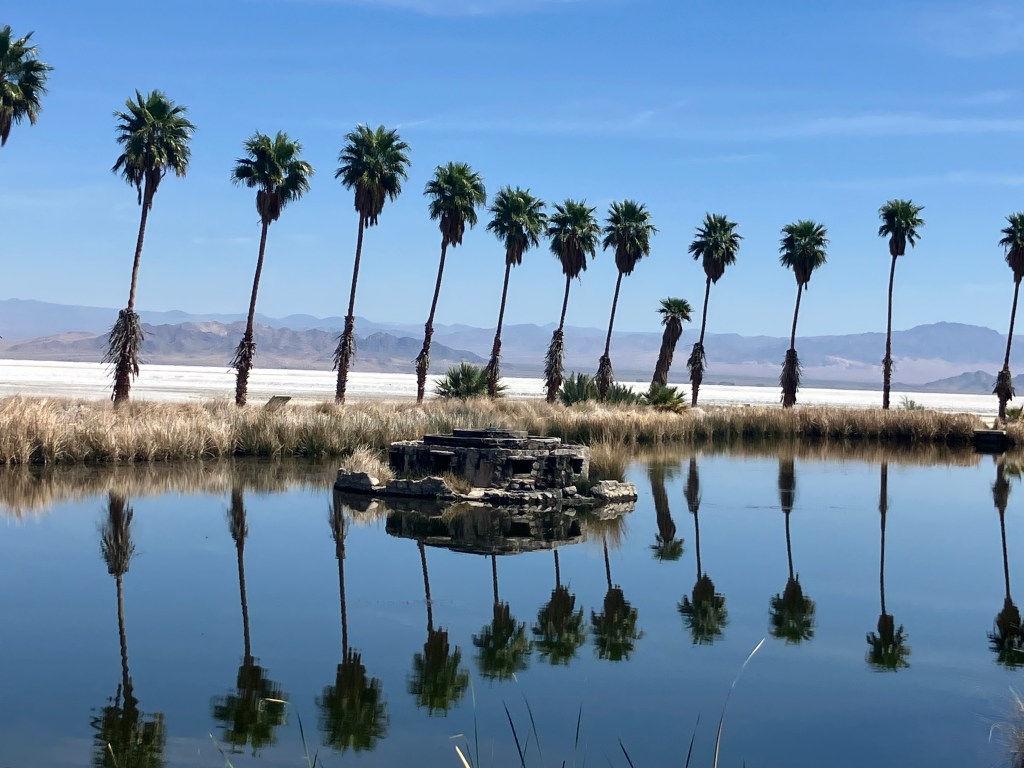
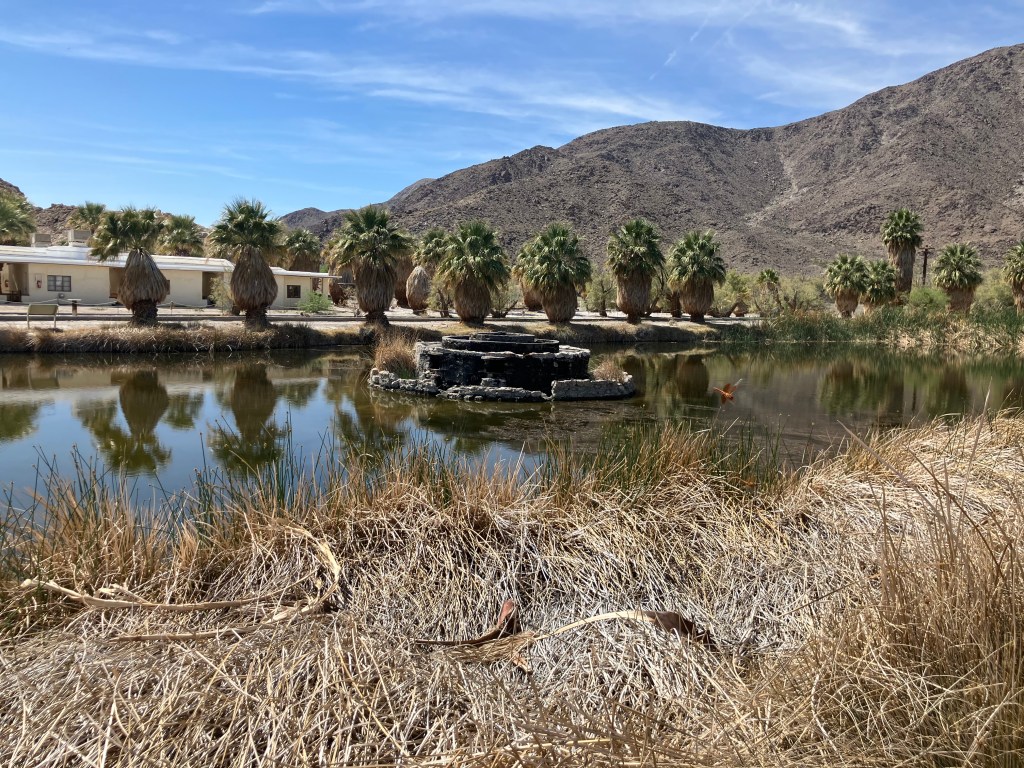
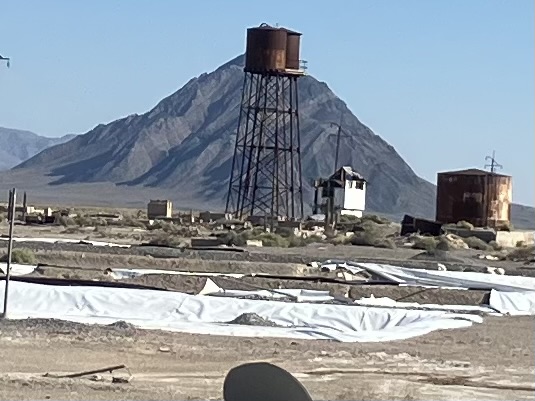
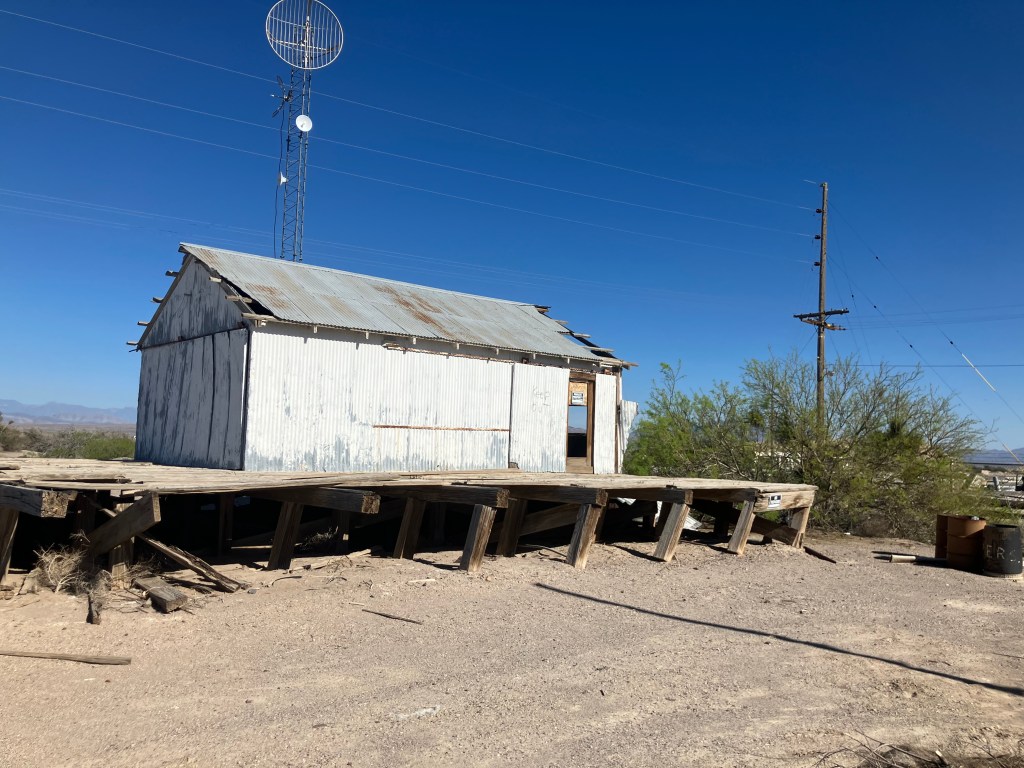
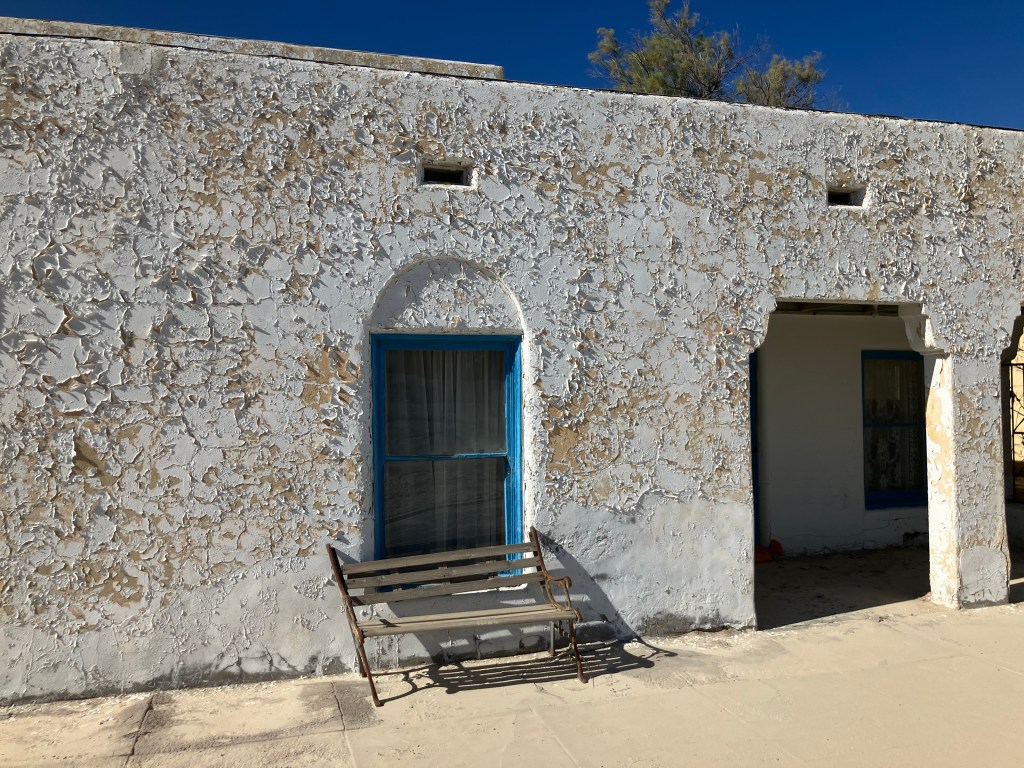
The federal government handed the property over to the California State University, which to this day uses it for a Desert Studies Center. Many of the original buildings, palm trees, and water features remain. When I visited today, there wasn’t a soul around. It was eerie to see this abandoned oasis just sitting in the middle of the desert. Here are some of my pictures.
That’s a dry lake bed in the background.
(Now-defunct) fountain originally put in place by Springer.
As the desert sun reached high in the sky, it was time for me to put a wrap on this road trip and head back to the airport. CA-127 isn’t an exciting road. In fact, it’s pretty empty, with only three towns of any note to drive through. Even in March the weather is less than hospitable, and rattlesnakes hide in the shadows. And yet, the scene through the windshield is entrancing, and the (few) people you meet are warm and welcoming. I wouldn’t choose to live here myself, but I’m glad places like this exist.
Post Script
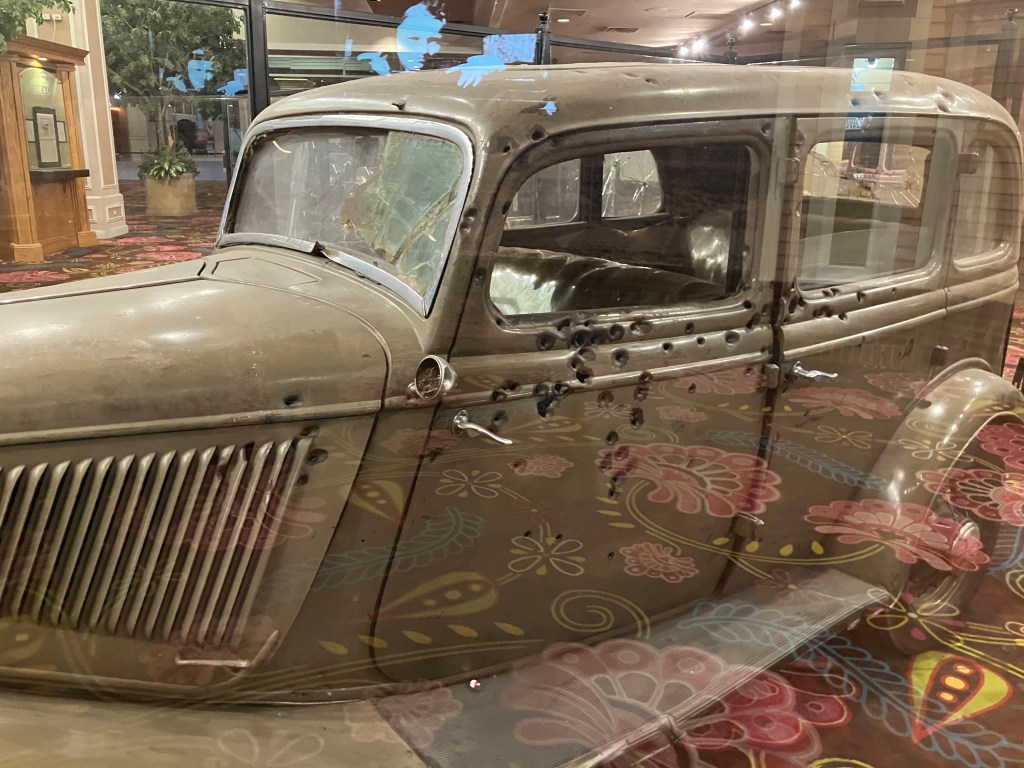
Now, you’d think Zzyzx would truly be the Last Word. But on my may back to Las Vegas International airport, I made a brief pit stop at the Primm Valley casino. And what did I see inside but the 1934 Ford sedan that Bonnie and Clyde were driving when a posse ambushed and killed them. There are over 100 bullet holes in this car.
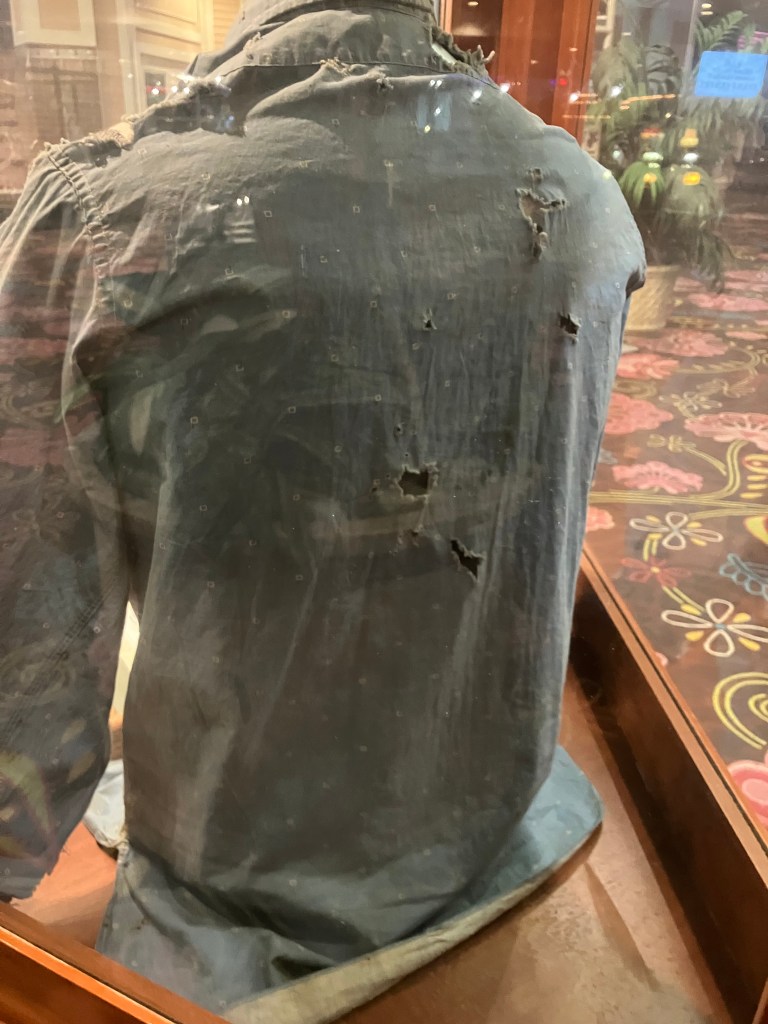
Not only that, but the shirt that Clyde had been wearing is also on display:
Which brings us back to yesterday’s meditation about burying the dead. Bonnie and Clyde’s bodies are both buried in Texas, but the scene of their death–this car–has been on display literally around the world for some 90 years. And here I am gawking at it. But I ask the question again: What’s the interplay between embracing our past and moving on? When do we bury the dead? At this moment, I think the car is a legit artifact of history. The shirt, not so much.
Spending a few days in the desert gives you time to think. To ruminate. To meditate. To shorten your sentences to unconjugated verbs.
This morning I headed south on CA 127, and within the hour I was at Shoshone (official pop: 31). I say “official”population because one of the locals told me the actual population is now down to 13. In any event, Shoshone was founded in 1910 by Ralph “Dad” Fairbanks, by literally relocating buildings from nearby abandoned mines and towns. Shoshone was situated on the Tonopah and Tidewater Railroad line which, we learned yesterday, was launched a few years earlier to haul borax. Interestingly, the T&T’s name was an unfulfilled aspiration. It never reached north to Tonopah, and it never reach southwest to San Diego (which was the “tidewater” envisioned by the name). Anyway, “Dad” Fairbanks’ daughter married a boy named Charlie Brown (well, Charles Brown), and young Charles essentially became the heir apparent of the town.
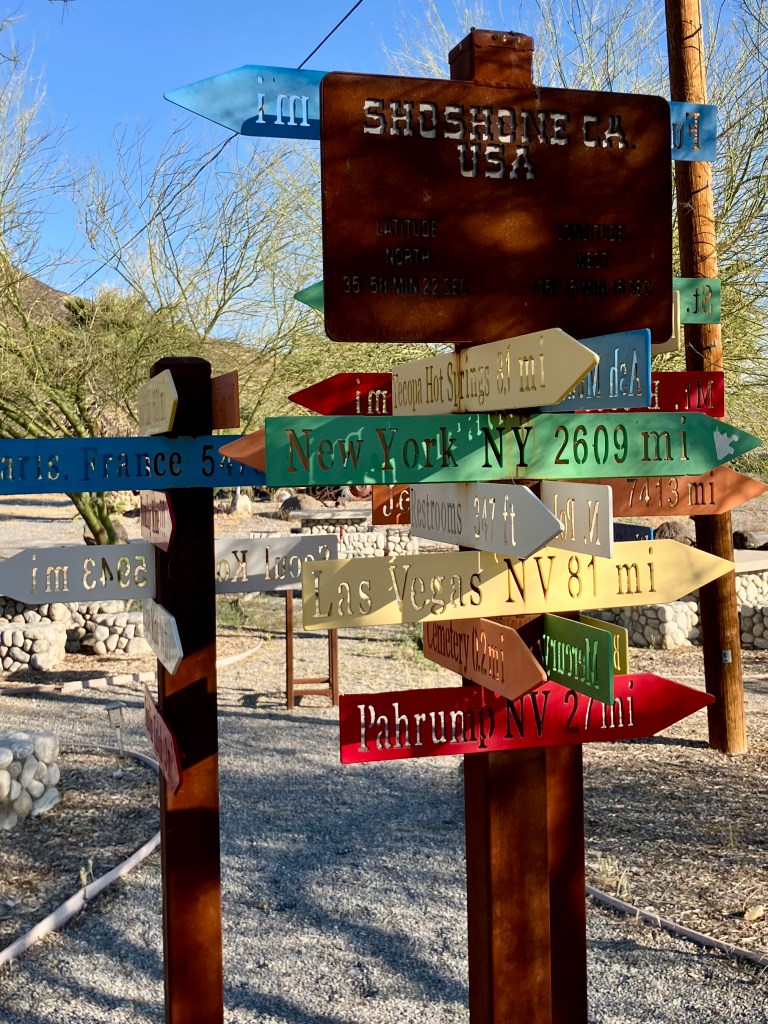
All roads lead to Shoshone.
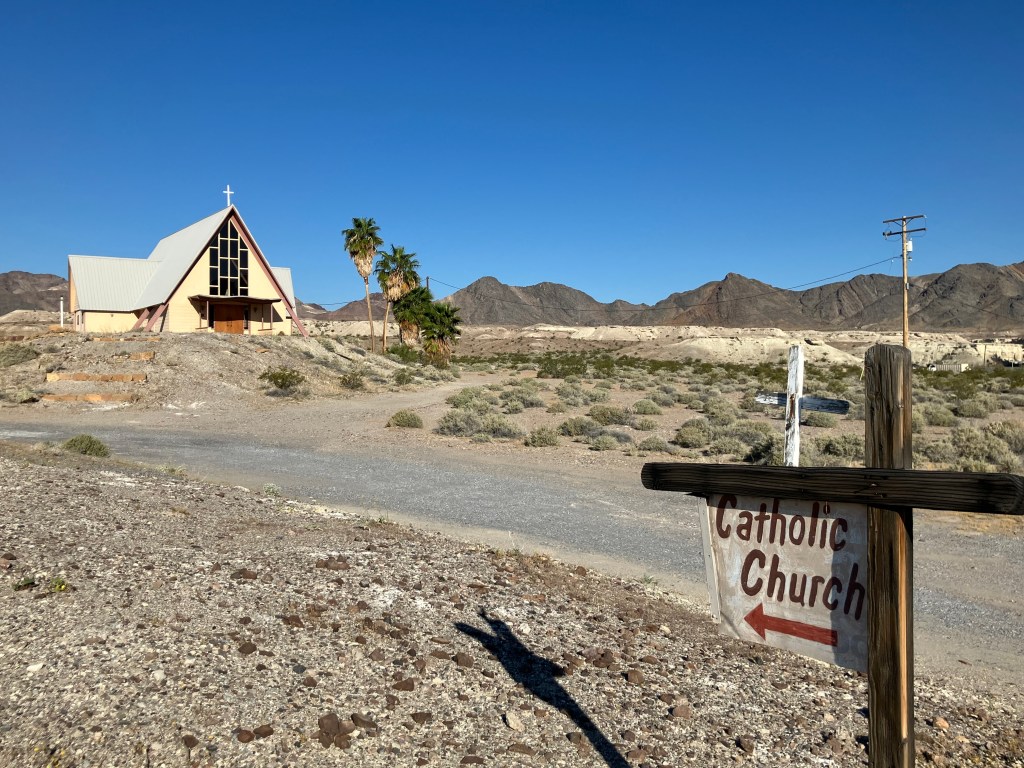
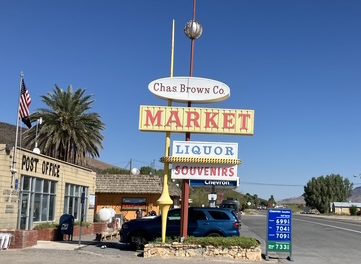
Despite its limited population, Shoshone today remains a going concern. It’s well-positioned as the southern gateway to Death Valley, and it’s at the crossroads of a couple of important highways. Services are therefore oriented towards travelers, with a gas station, a market, a restaurant, a museum, and even a generic Catholic church.
Note the ownership of the market. Also, is it just me, or is the sign done in the Googie tradition?
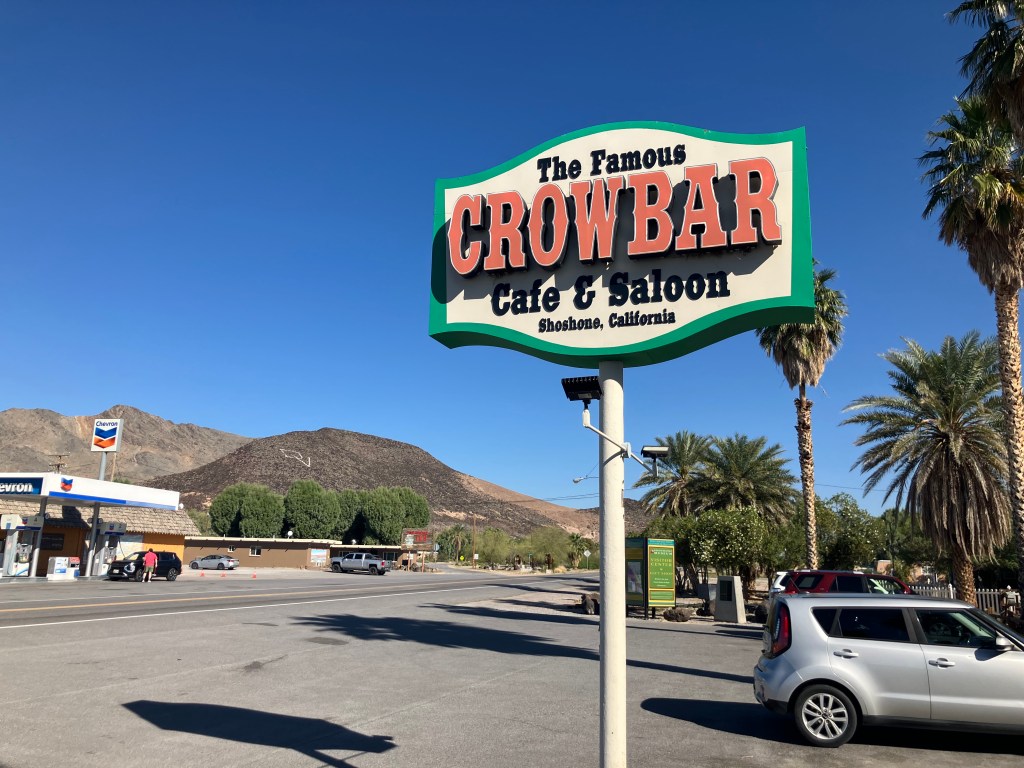
I decided to get breakfast at the “famous” Crowbar Cafe & Saloon. There were a few other people at the counter, and they seemed to be travelers like myself.
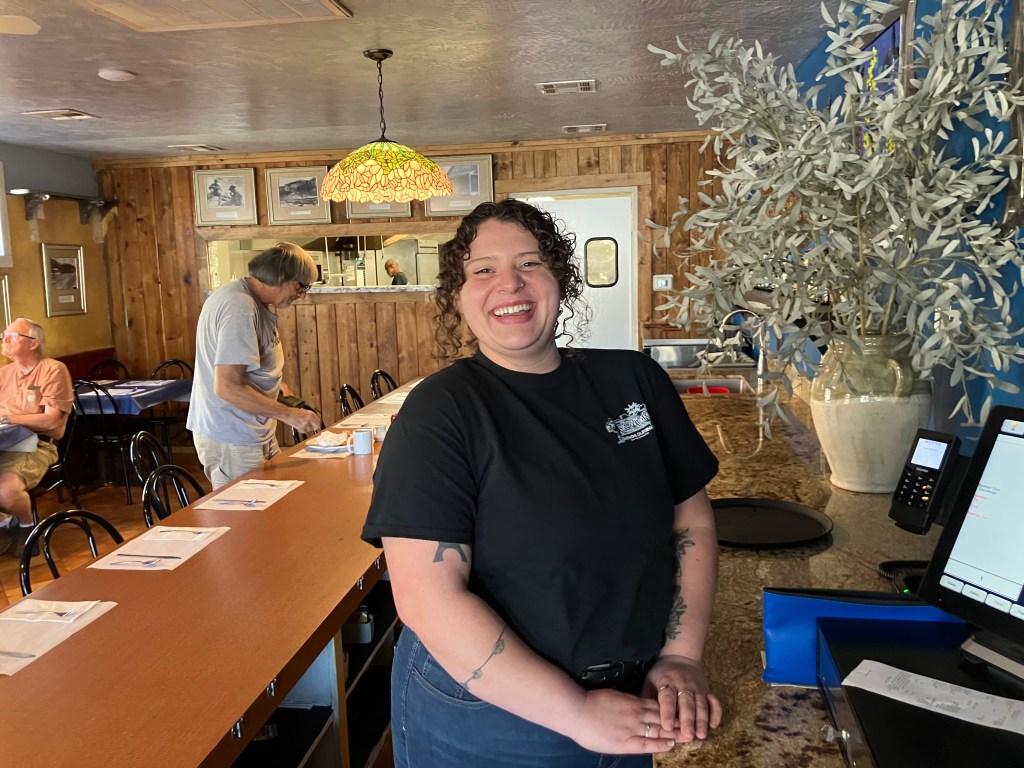
I’m still not sure whether the restaurant has earned the term “famous,” but Brianna–the server–is memorable. Friendly, attentive, and effervescent, with a sly sense of humor, she gives the place a buoyancy that goes well with the strong coffee.
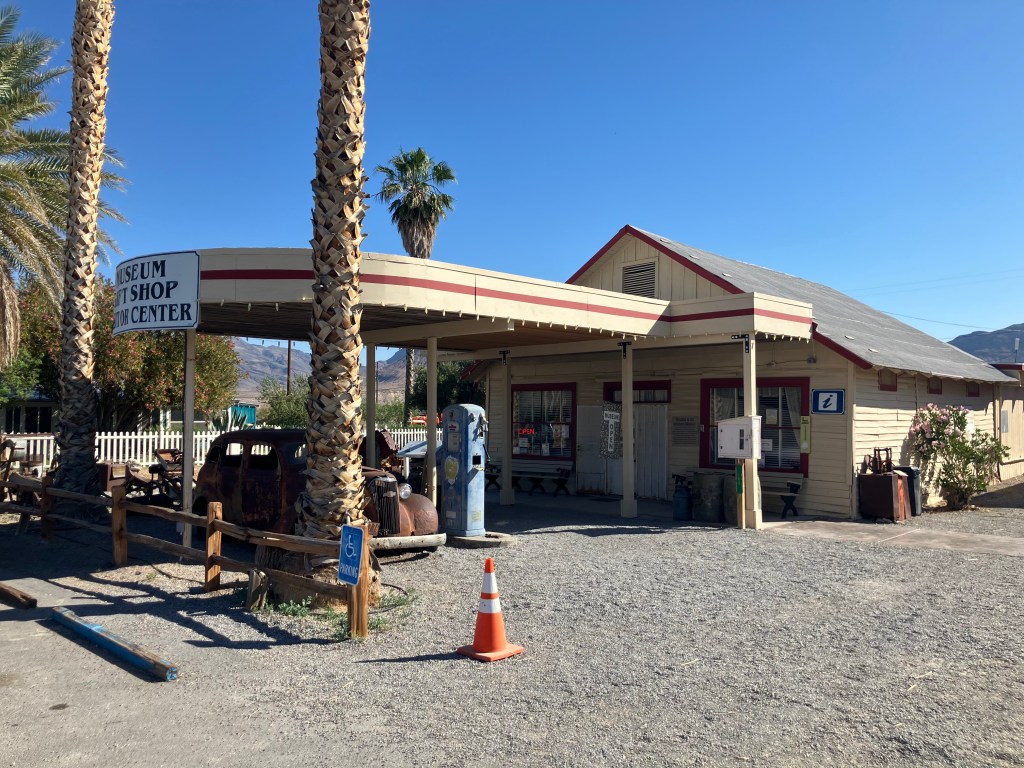
Directly next door to the Crowbar is an old service station that’s been converted into a museum and visitor center. What the heck, thought I. Let’s see what I can learn about this town.
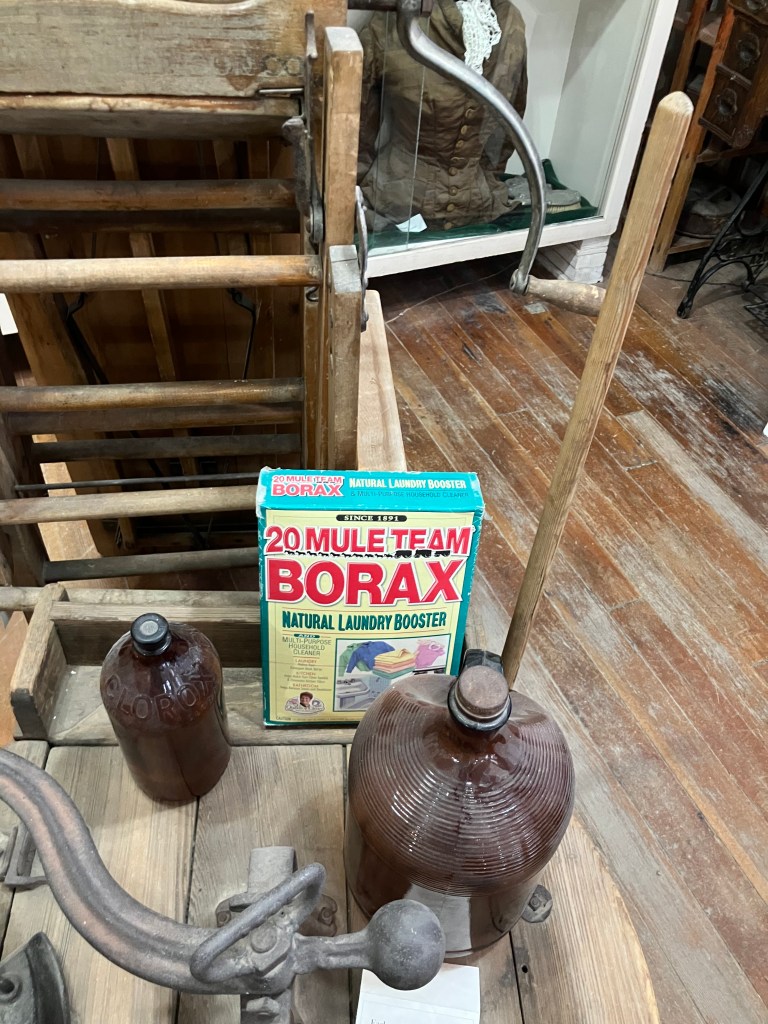
Even though it’s small, every corner of the building is packed with artifacts: old railroad schedules, household appliances, guns, photographs, maps, sheriff’s badges, even an old mastodon skeleton that was uncovered by local students. And of course there’s the requisite box of that white gold of Death Valley: Borax.
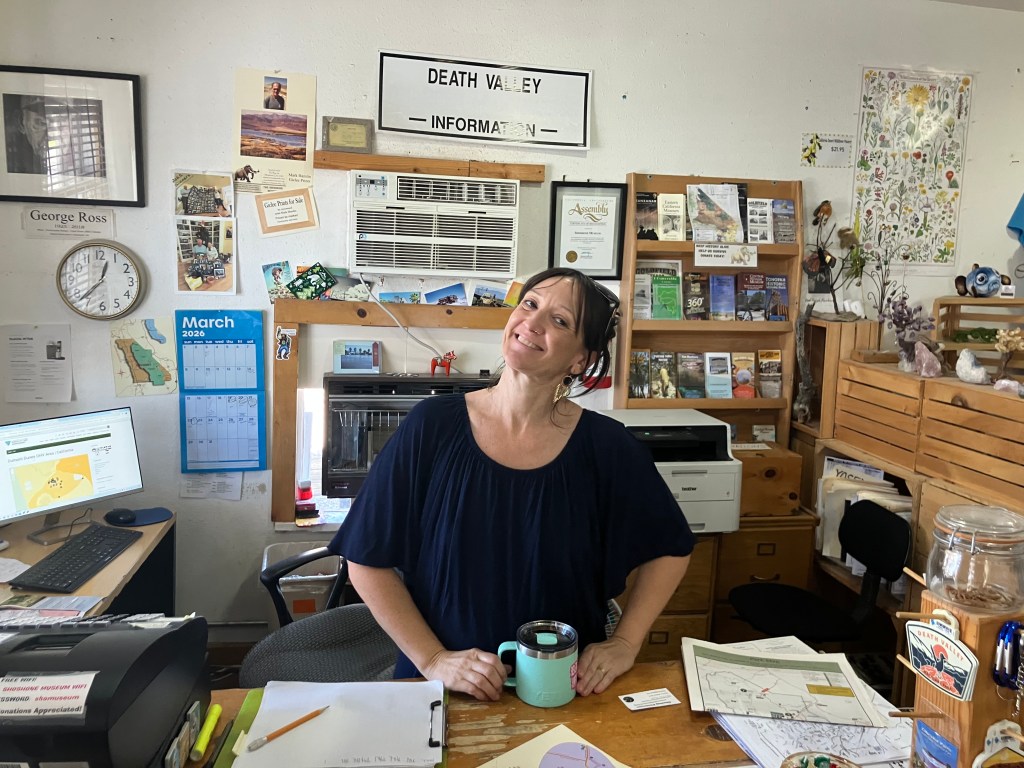
If I have any critique of the museum, it’s that some of the exhibits lack enough descriptive backstory. Fortunately, there’s a remedy in the form of Eliza, who runs the place (or at least today she was).
Eliza–Shoshone’s answer to Google.
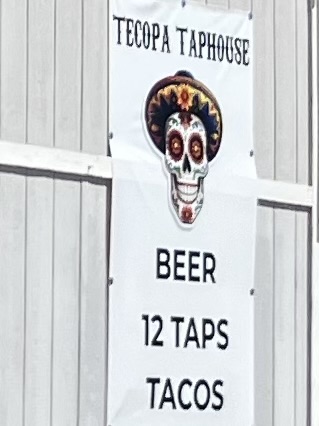
It was Eliza who sketched the town’s history for me, who pointed me to the remnants of the T&T Railroad, who told me which local breweries were open and which were still getting their taps installed, and who insisted that I make a short detour to the date orchards of Tecopa for a date shake.
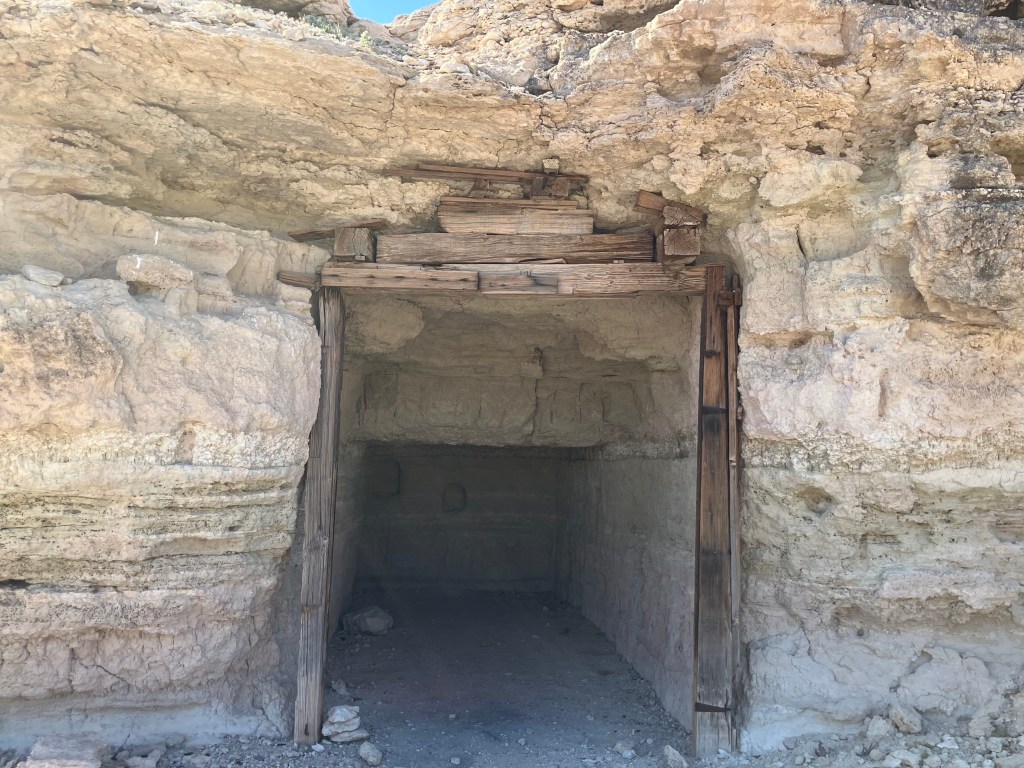
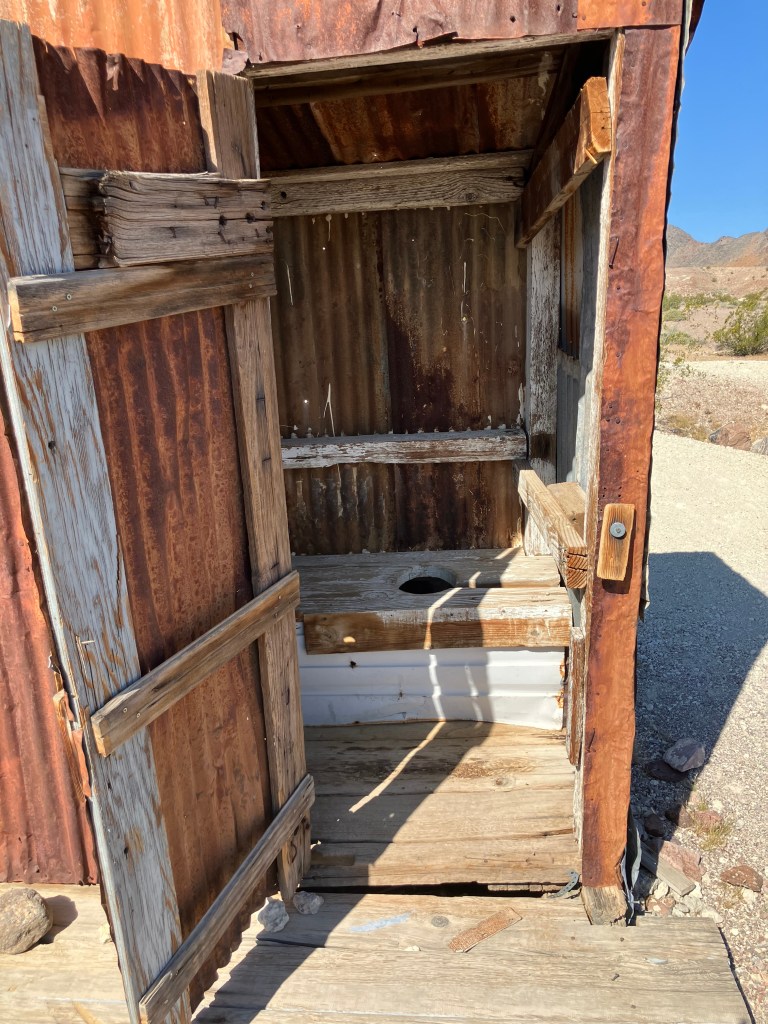
Based in part of Eliza’s suggestions, I first went across the street to Dublin Gulch, where miners dug rough-hewn caves into the hillside a century ago.
Be it ever so humble…
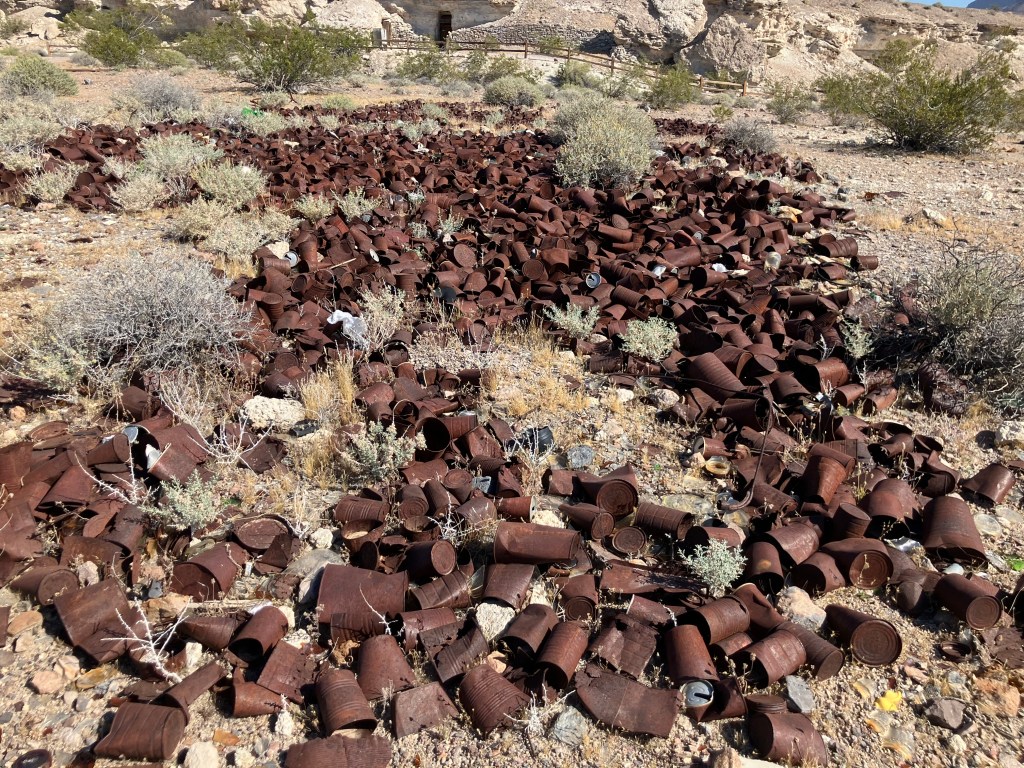
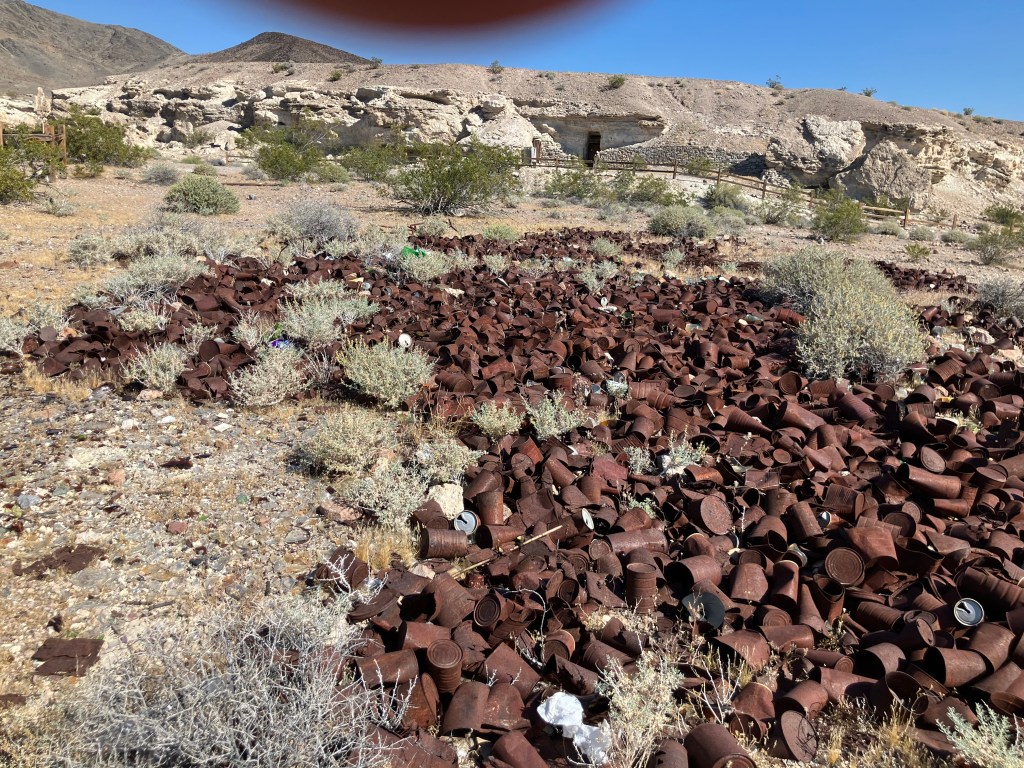
The ground around the caves is strewn with old cans. Presumably these once contained dinner.
More cans…
…and another….
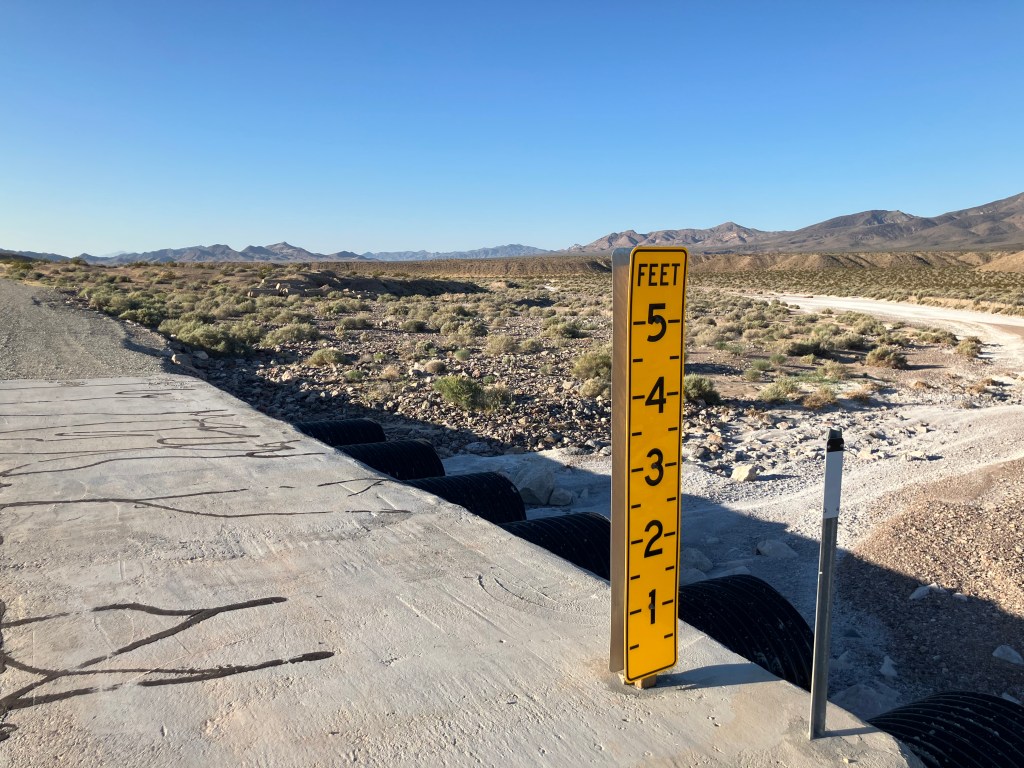
Having seen what I could see in Shoshone, I got back in the car and headed out to Tecopa (pop: 169). Along the way I spotted a few of these 5-foot markers where the road comes close to the Amargosa River. I learned yesterday that flash floods are a real and persistent danger out here; the Amargosa Opera House has been flooded several times. I’m guessing the markers help drivers to judge the depth of water on the roadway?
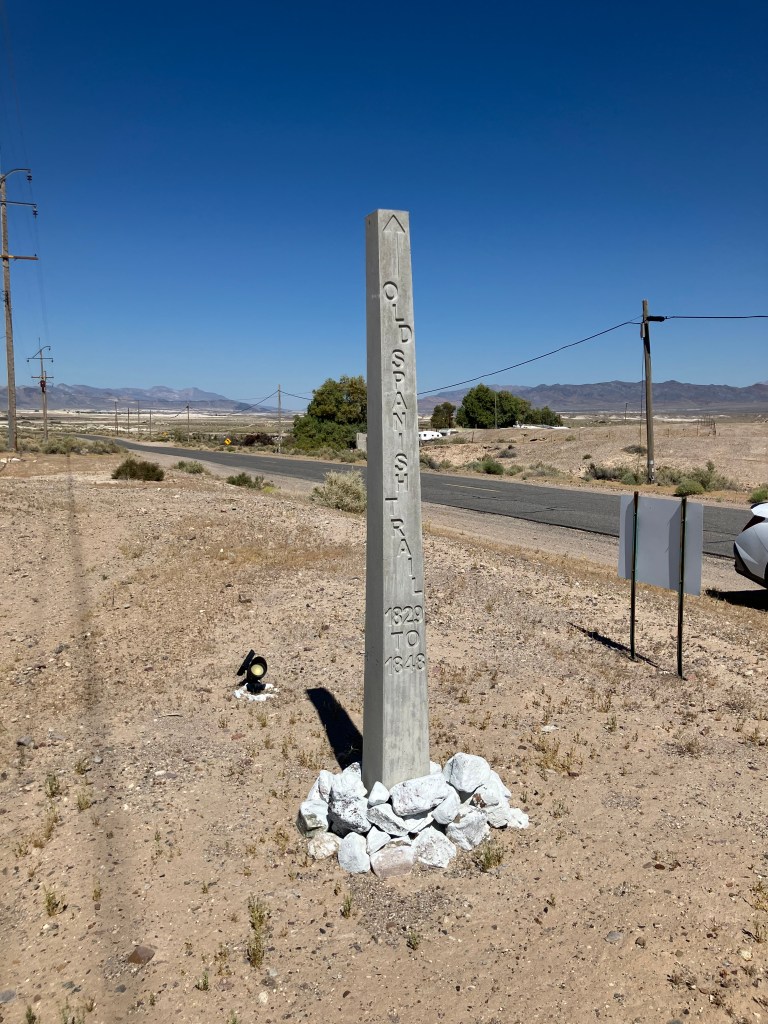
Tecopa is a few miles off CA-127, and to get there you cross the Old Spanish Trail, that connected the settlements of Santa Fe with Los Angeles in the 19th century. I saw a small obelisk (about 5 feet tall, designated #32) marking the route. I surmise there are at least 31 others, and most likely many more. This may be the subject of an upcoming road trip…
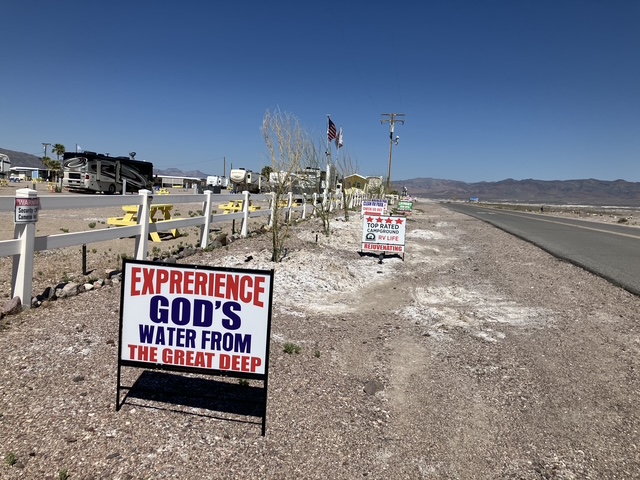
The road to the date orchards passes along a string of privately-owned hot springs. Signage from competing outfits lines the road. Some of the claims seem a bit over-the-top…
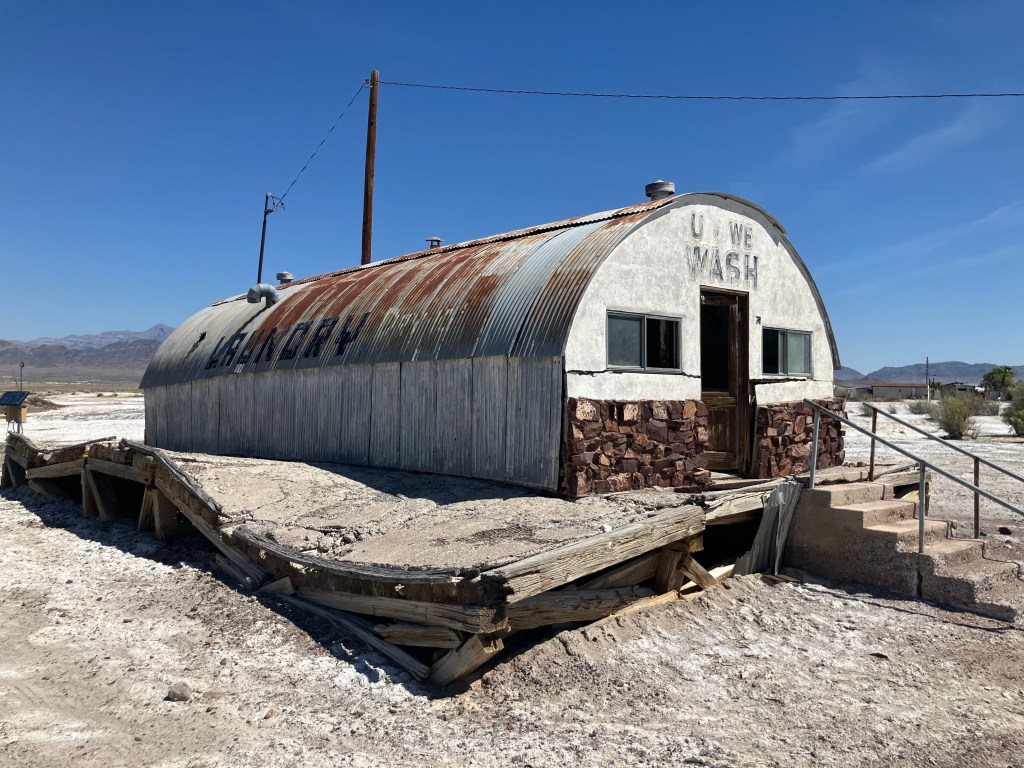
I did eventually get to the China Ranch Date Farm, where I had me one of best of the two date shakes I’ve consumed in my life. But near the farm I encountered two sites that spurred the rumination suggested in the title of this post. First, there’s the U-We Wash:
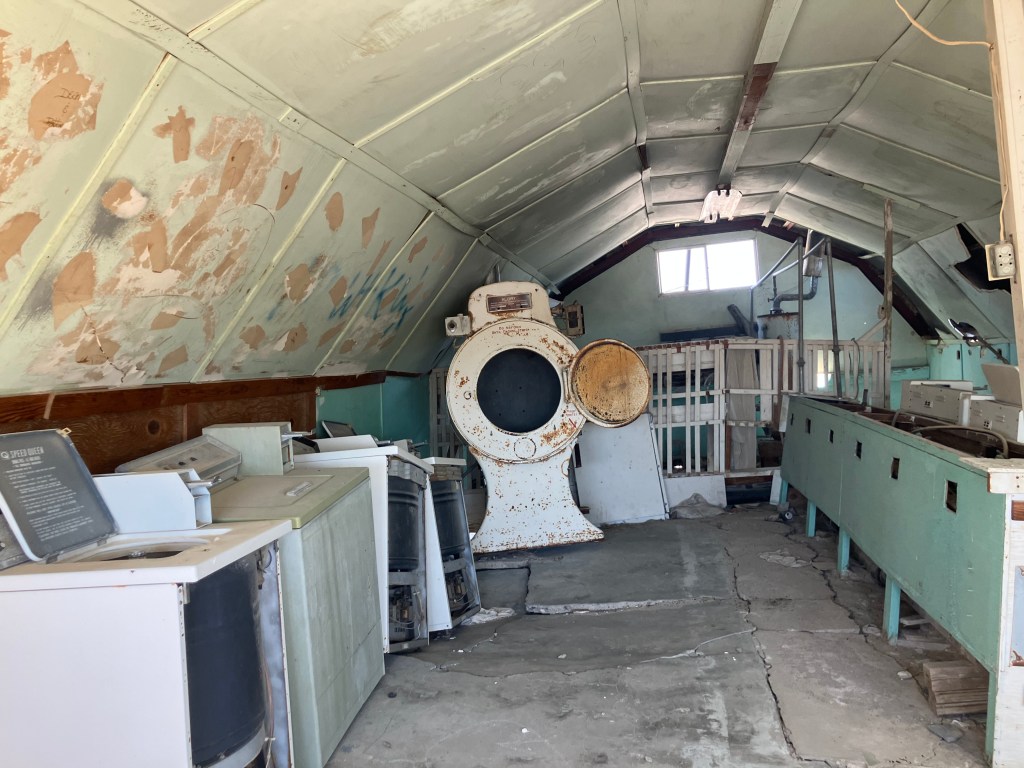
It’s a long-defunct laundromat in a quonset hut. The equipment remains largely intact, seemingly spared from vandals.
It seems the place has been around since early in the last century, and has been abandoned for decades. It must have served visitors staying at the trailer and RV parks across the street. It’s got a bit of an eerie, Twilight Zone vibe, as though the the owners and customers all instantly disappeared decades ago, perhaps due to a nuclear explosion.
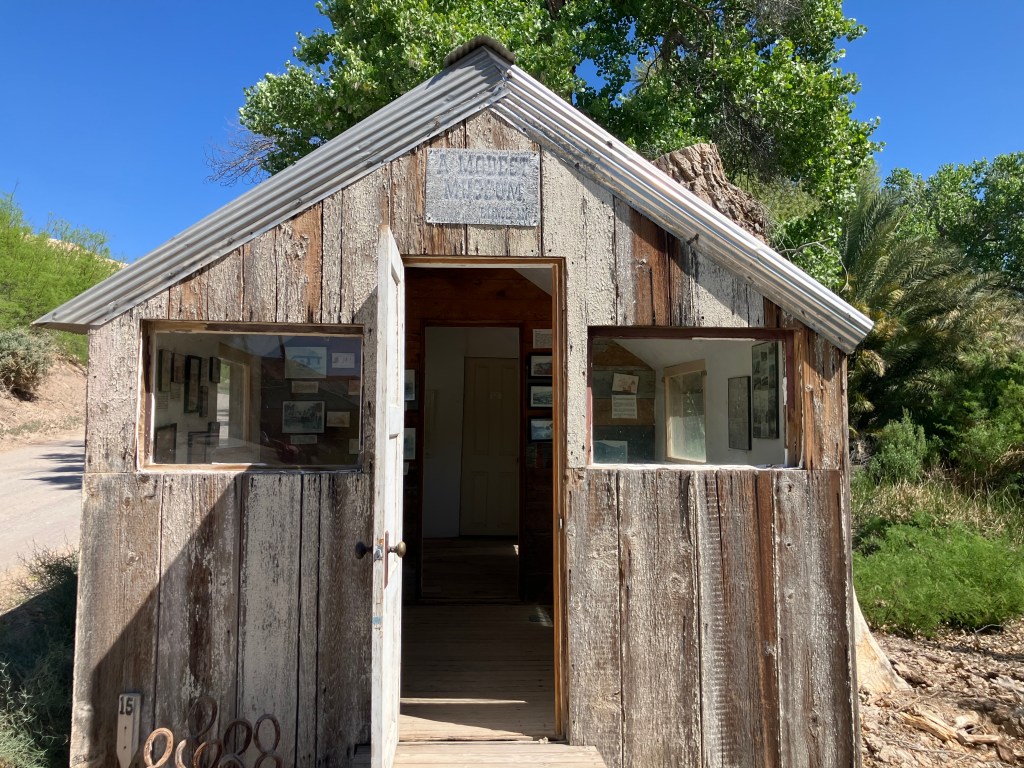
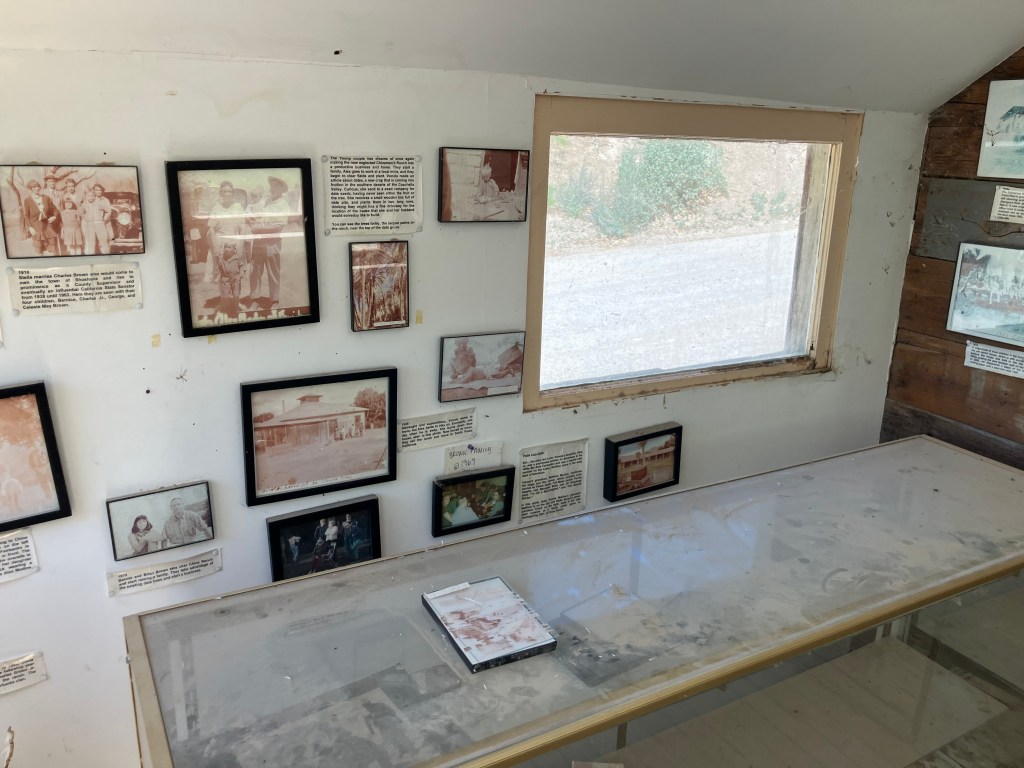
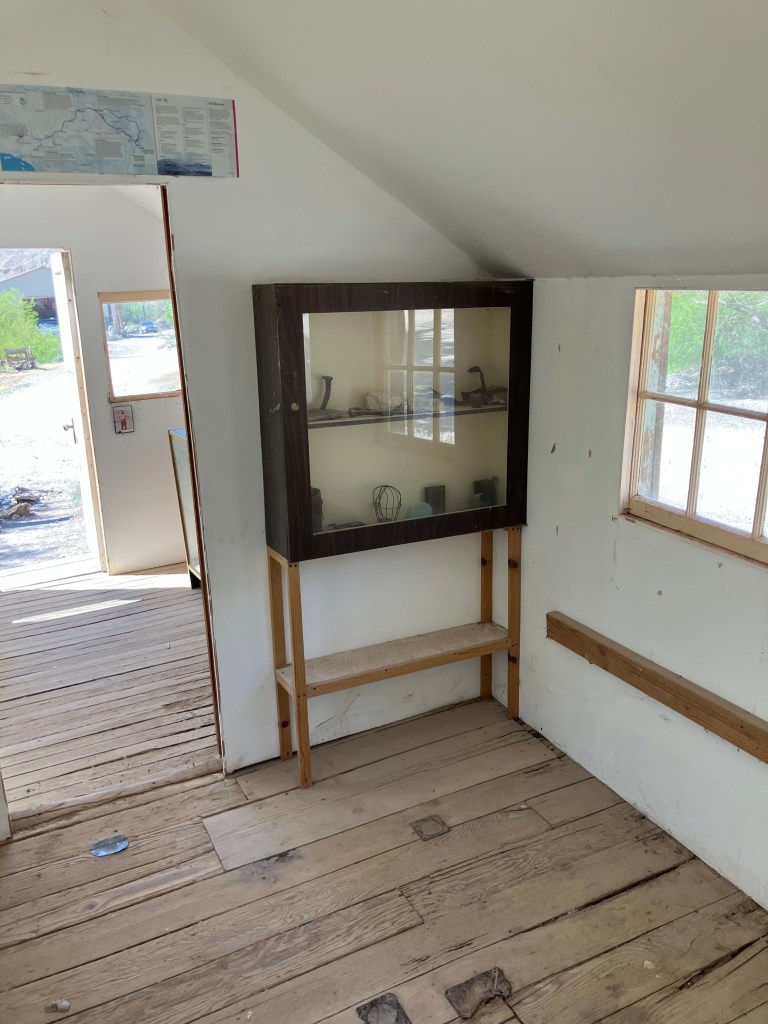
Now, hold that thought and consider the second site that got me ruminating: Just down the dirt road from the date farm is the self-proclaimed “Modest Museum,” which is a simple, old two-room building which a few neglected displays about the history of the area.
A sign on the wall reads: “We have deliberately made these exhibits accessible to the public, especially children, so they can get a real sense of the history here. Please behave honorably and do not remove or vandalize anything in this little museum.” And indeed, there are no signs of vandalism or theft, which is of course a good thing. And yet, there’s also no sign that the museum has been visited or cared for in the slightest. Dust is thick on the display cases, the photographs are sun-bleached and virtually indecipherable, and descriptive labels have fallen to the ground.
To me, the U-We Wash is cool and intriguing, an artifact in our midst that testifies to a different time. But the Modest Museum is depressing: a well-intentioned and hopeful endeavor that has fallen flat and/or been abandoned. Why my different reactions? Why are some artifacts cool, and others are junk? I’m thinking now of an old home-made theme park in Wisconsin that I visited in 2022. The man who lovingly created it had recently died, and the place was falling into disrepair. As I walked through it on a rainy afternoon I felt melancholy but appreciative of his effort. I did not feel like the remnants of his little park should be torn down. Just as I did not feel the U-We wash should be torn down. And to be fair, it’s not that I think the Modest Museum should be torn down exactly, but if the owners still believe in the mission, they need to give it some TLC or think of a new approach.
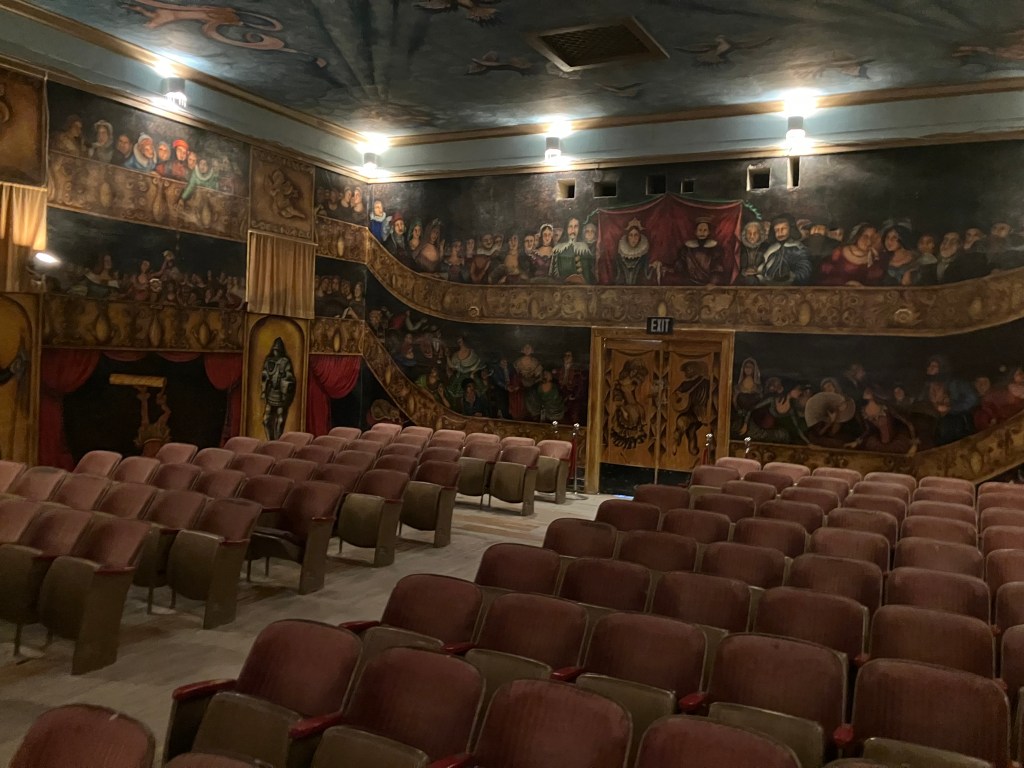
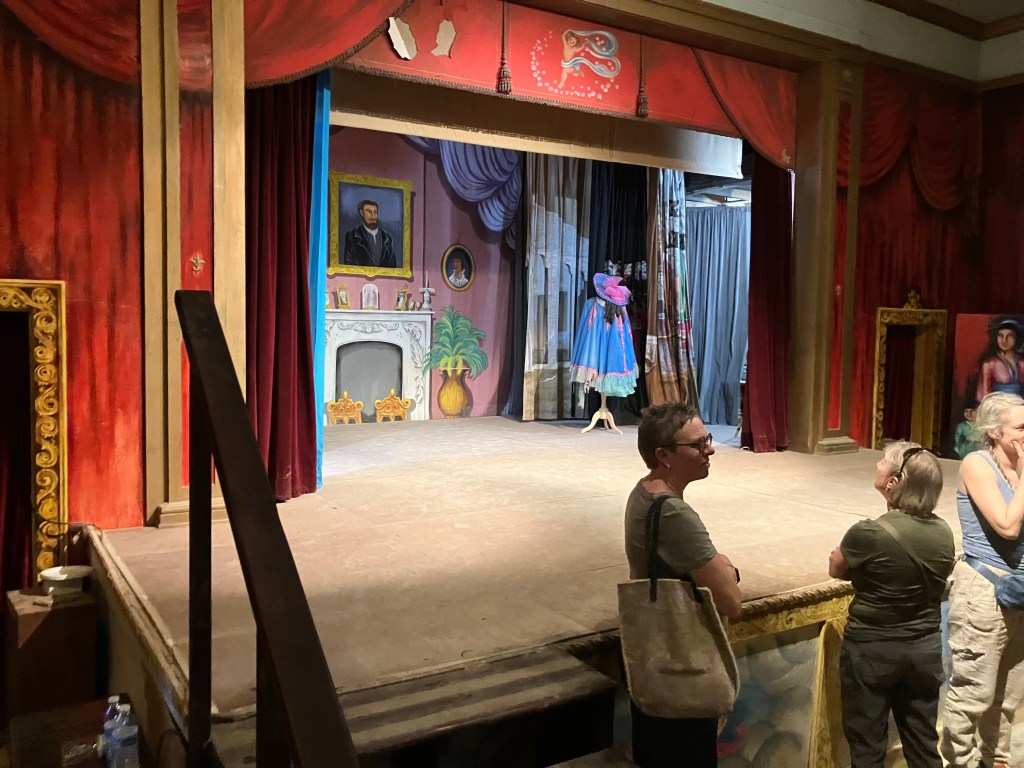
Part of this rumination comes from something that tourguide Sue mentioned at the Amargosa Opera House. According to Sue, Marta Becket had always insisted that, after her death, no one should ever restore or otherwise repaint any of the murals she had painted on the walls of the opera house and the hotel. She believed that the desert will rightly reclaim all that she did out here, and she was OK with that. Don’t fight it, she said. And so, as our tour group walked through the opera house, we saw areas of peeling paint and torn fabric that, according to Sue, the caretakers just have to accept.
I spent a lot of time thinking about this today, and the thought that keeps coming to my mind is the notion of burying the dead. Trees die in our gardens and we cut them down. Buildings become uninhabitable and unsalvagable, so we take a wrecking ball to them. An open bottle of wine goes bad and we pour it out. And, of course, our pets and our relatives die, so we return their bodies to the earth. I still don’t know exactly why I don’t feel that the U-We Wash shouldn’t be torn down. But I do know that the guy in my neighborhood with the weathered, broken, and rudderless boat in his side yard needs to get rid of the damn thing.
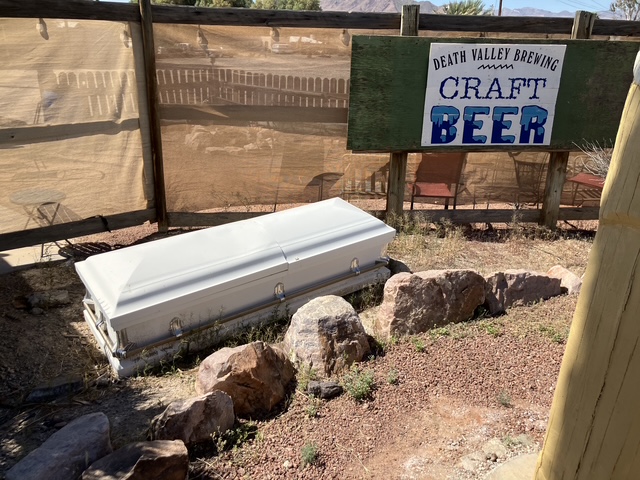
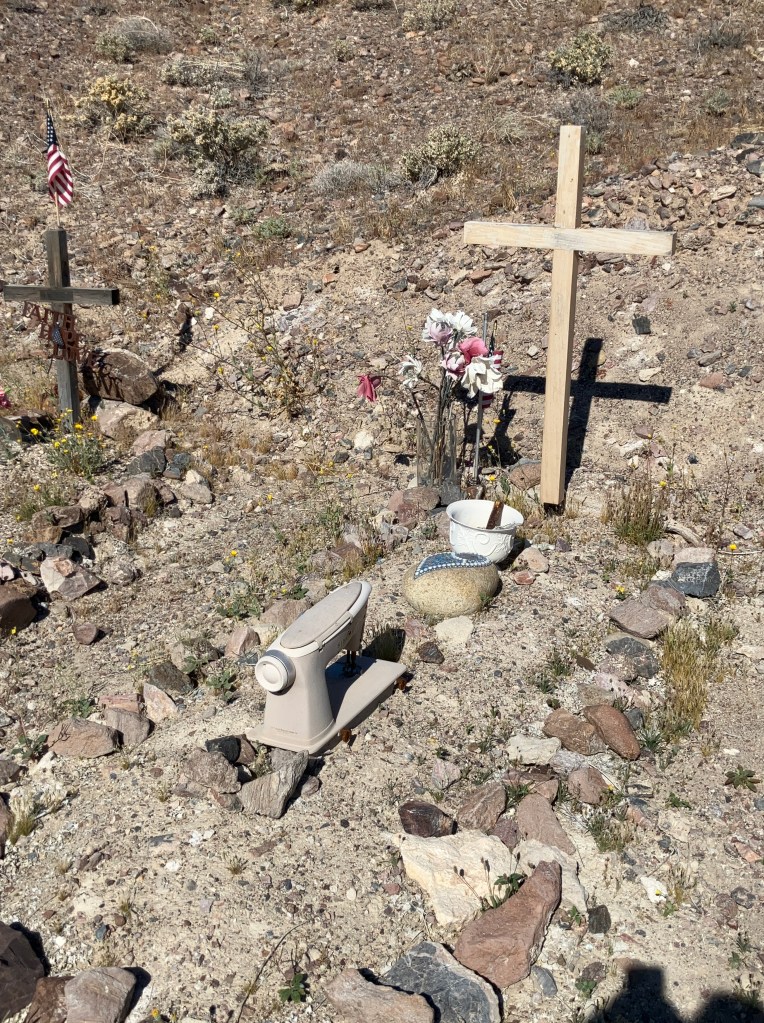
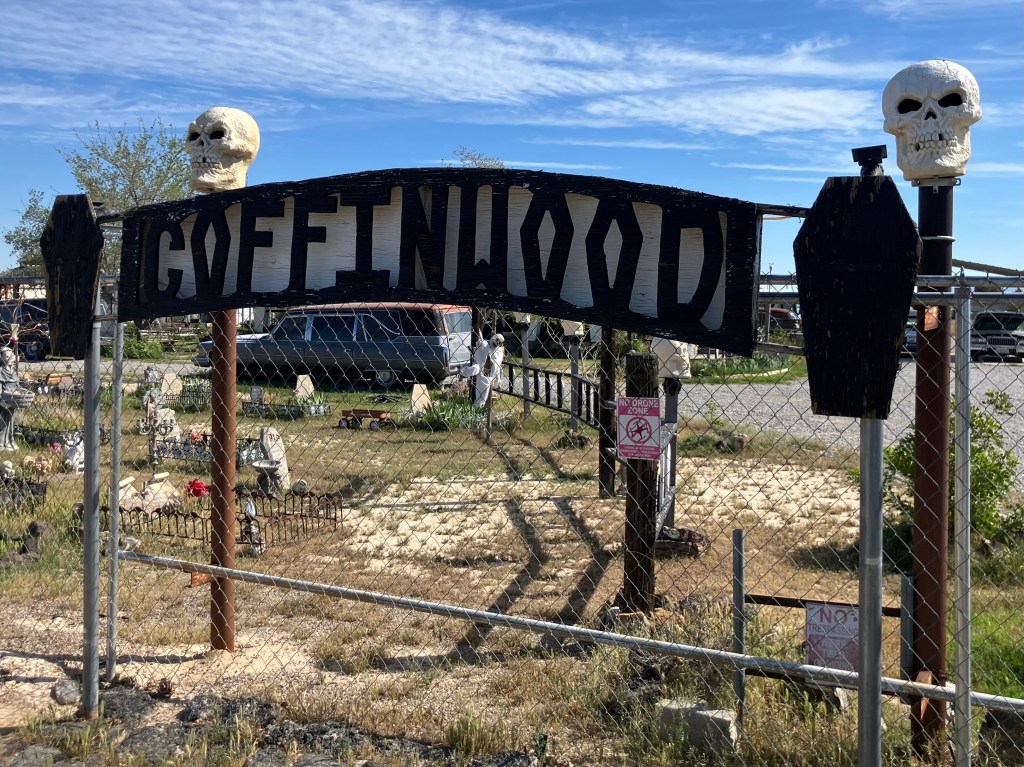
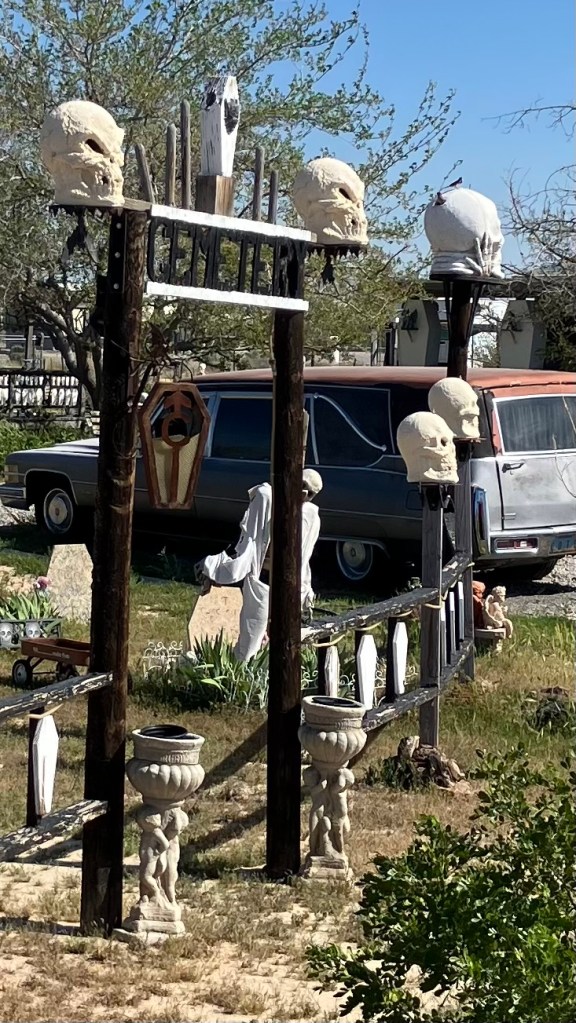
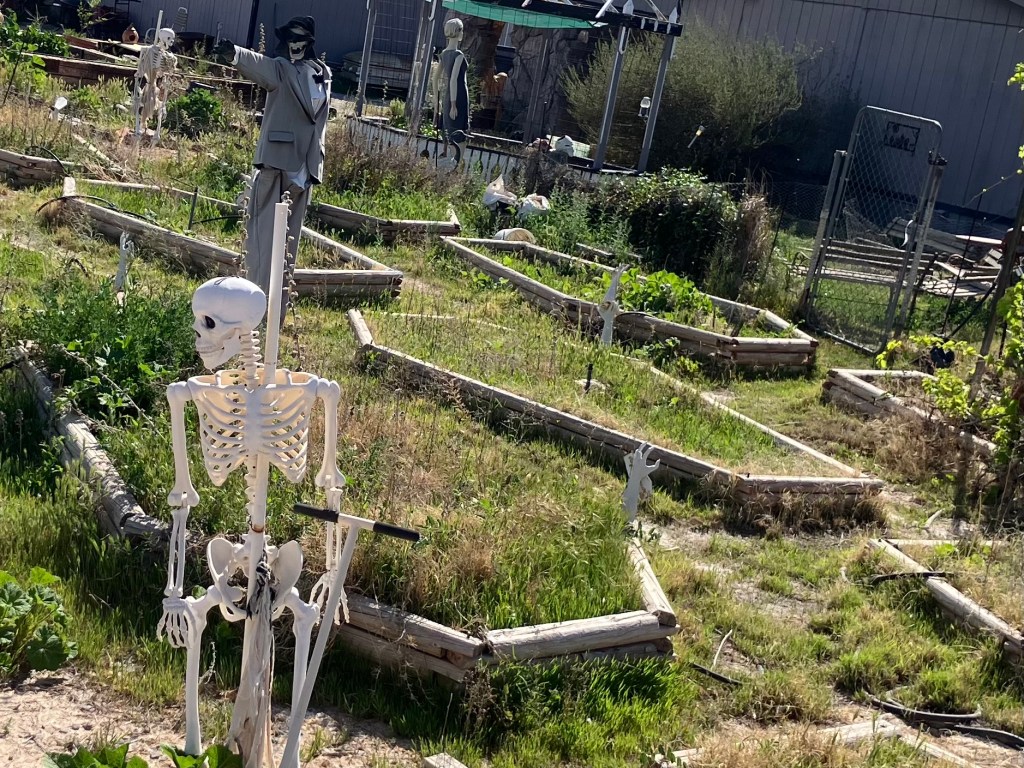
Out here in the desert there seems to be different attitude about death. Desert people appear to do a better job of accepting the concept. The imagery of death of all around the desert, including, of course, in the name Death Valley. So I’ll leave you with some of that imagery.
I’m betting the deceased was a singer. Har.
BEER OF THE DAY
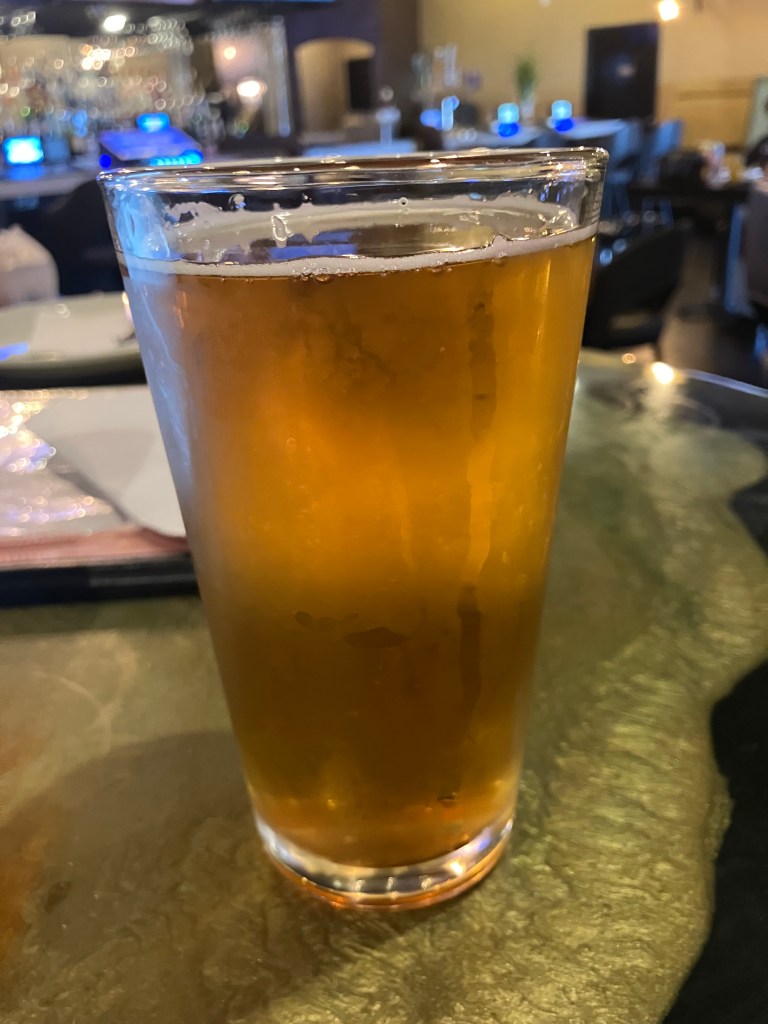
OK, that was a little heavy. So let’s end with the Beer of the Day. I had a beer at Steelbound Brewery and Distillery in Pahrump, NV (pop: 44,000). (I had to make a 20-minute detour across the state line to find a place to spend the night.)
Speaking of imagery of death…
This brewery/restaurant feels a little weird, and seems to still be trying to find its niche. (I’m told the place recently changed ownership.) It’s attached to the Best Western hotel, which seems to seriously undercut its effort to appear like a hip microbrewery. Video gambling machines are situated at every seat at the bar. Giant TV screens show The Price is Right, a program that’s punctuated with endless ads for prescription weight loss and asthma drugs. The menu is overrepresented with Indian food. The Sirius country-western station is piped over the speakers. The whole place has a soulless corporate feel. Even the servers seem robotic.
But they make their own beer. Perhaps because they’re still in the start-up phase, they only had three beers on tap. I chose the Chocolate Peanut Honey Cream Ale. Believe it or not, I considered this to be the safer choice.
And I wasn’t disappointed! It’s got a golden honey color with a slight cloudiness. There’s no nose to speak up, but it is definitely refreshing. It’s not too hopped, not too carbonated, but neither is it flat or bland. I’d call it “brisk.” The mouthfeel is slightly creamy. I don’t taste the “chocolate” mentioned in the name, except maybe that slight chocolate essence you get from chocolate bitters. A full pint of this stuff was not filling in the slightest. If I lived near here, this would be my go-to summer beer. 5 out of 5 stars.
Spring officially began a few days ago, which of course signals the opening of road trip season. And right on cue, loyal reader Peter D. helpfully sent us a Los Angeles Times article highlighting a stretch of highway in the Mojave Desert that piqued our interest. It’s California Route 127, and it’s known to old-timers as Death Valley Road. It dates back to the FDR administration–or, perhaps more relevant for a California highway, it dates back to the administration of Governor James “Sunny Jim” Rolph, Jr, a man who lasted three years in office before he collapsed and died while campaigning for re-election.
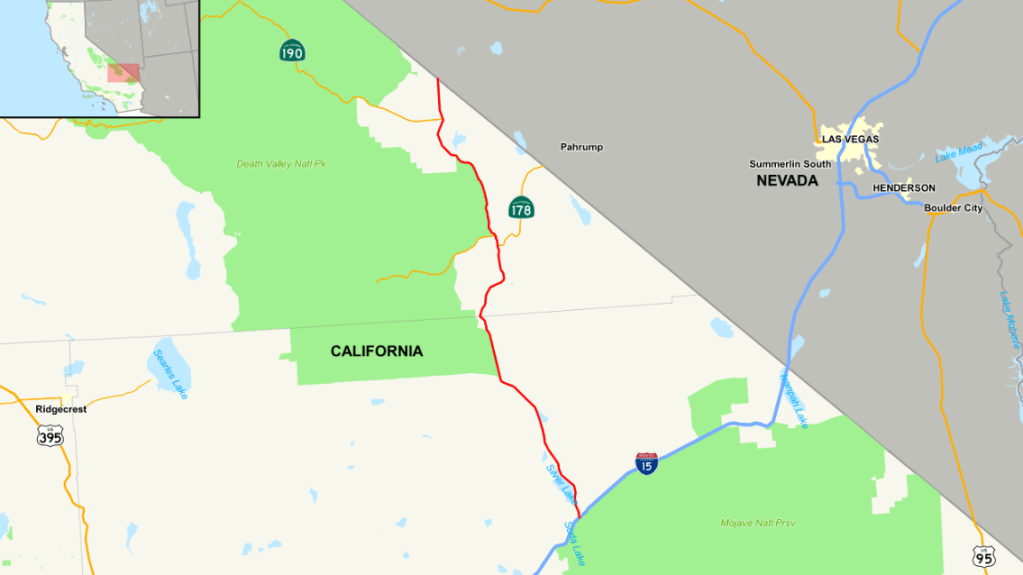
Route 127 is about 91 miles miles long, running along the eastern edge of Death Valley National Park from the Nevada state line down to the town of Baker on Interstate 15.
State Route 127 in red.
And so this morning I took a cheap Southwest flight to Las Vegas, where I rented a car and set out to explore this fabled (?) stretch of roadway. I’m going to cover the full 91 miles, but first I had to get there.
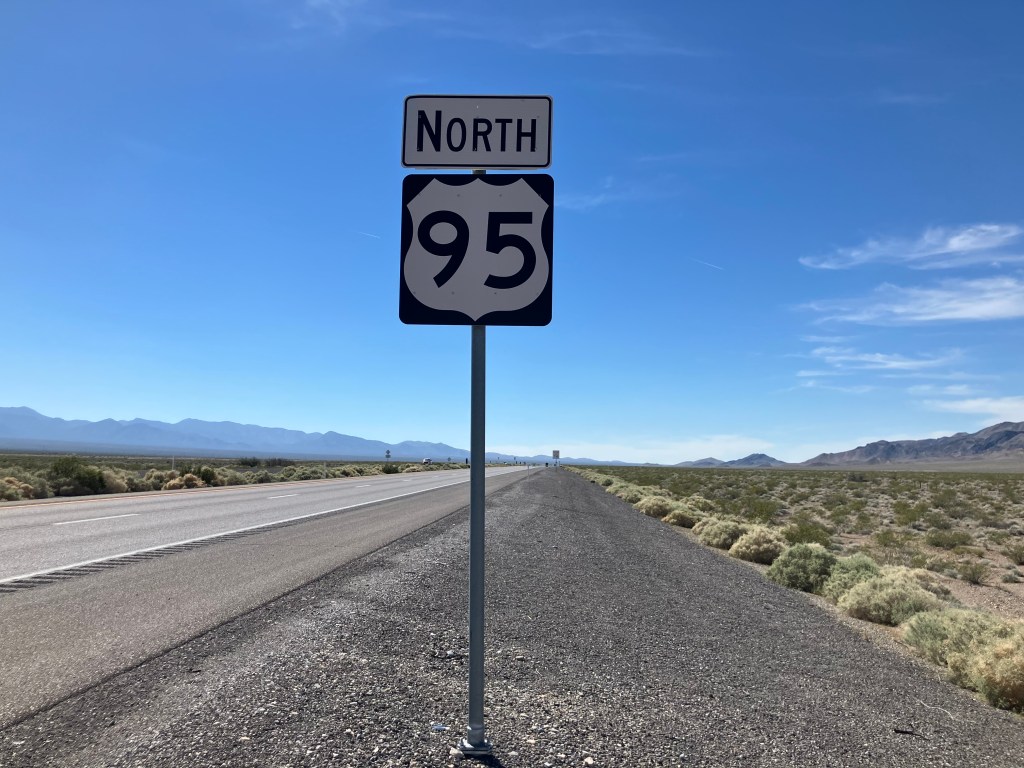
As luck would have it, getting to the beginning (or end, depending on your perspective) of Route 127 meant driving a stretch of US Route 95, which is a highway I explored in 2021. Attentive readers might recall that I got as far south as Beatty, Nevada on that trip. Today I had the opportunity to cover another stretch of US 95, between Las Vegas and Beatty. I must say, it’s a whole lotta nothin’.
“In the desert you can’t remember your name/’cuz there ain’t no one for to give you no pain.”
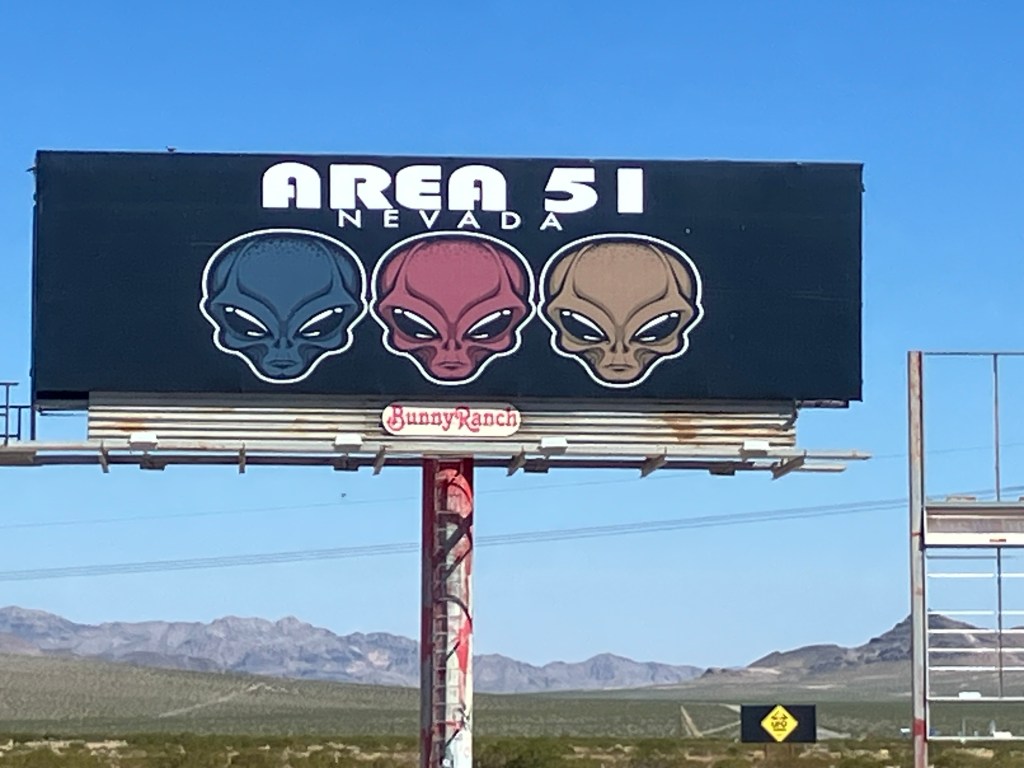
Well, not quite nothing. While looking for a gas station, I saw this sign along US 95:
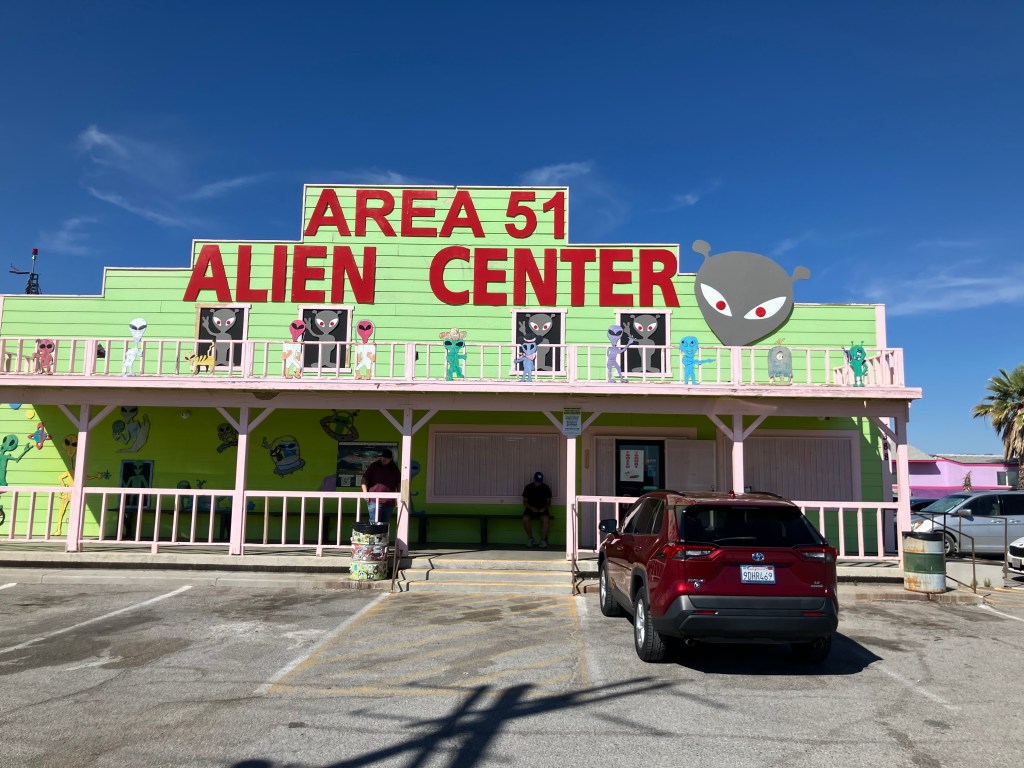
Now, Area 51 is indeed in this general area, but this facility and signage feel a little too obvious:
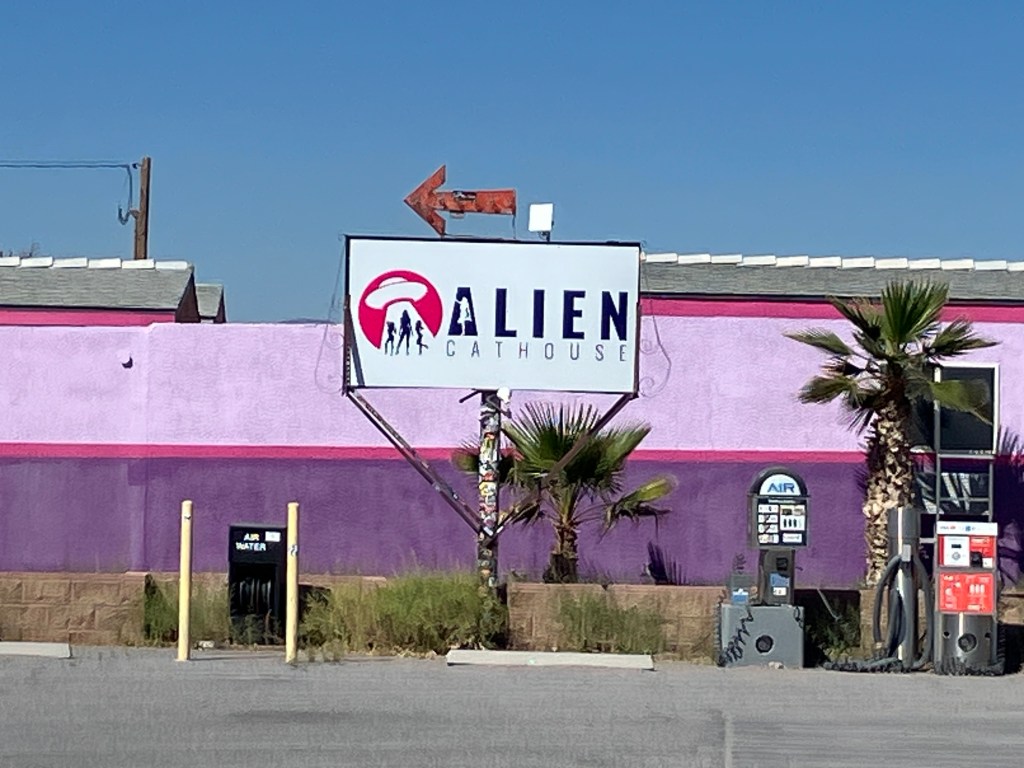
It turned out to be one of those combination convenience store/alien souvenir junk/gas station operations. (It’s almost identical to Jackass Joe’s, that I visited in Utah last year.) But this UFO-themed place has another distinguishing feature:
That’s right–the front door of the Älien Cathouse is right next to the gas station’s water and air hoses. As you may or may not know, brothels are legal in Nye County, Nevada. While I was pumping my ethyl (if you’ll pardon the expression) a husband and wife were posing with their young children in front of the Cathouse.
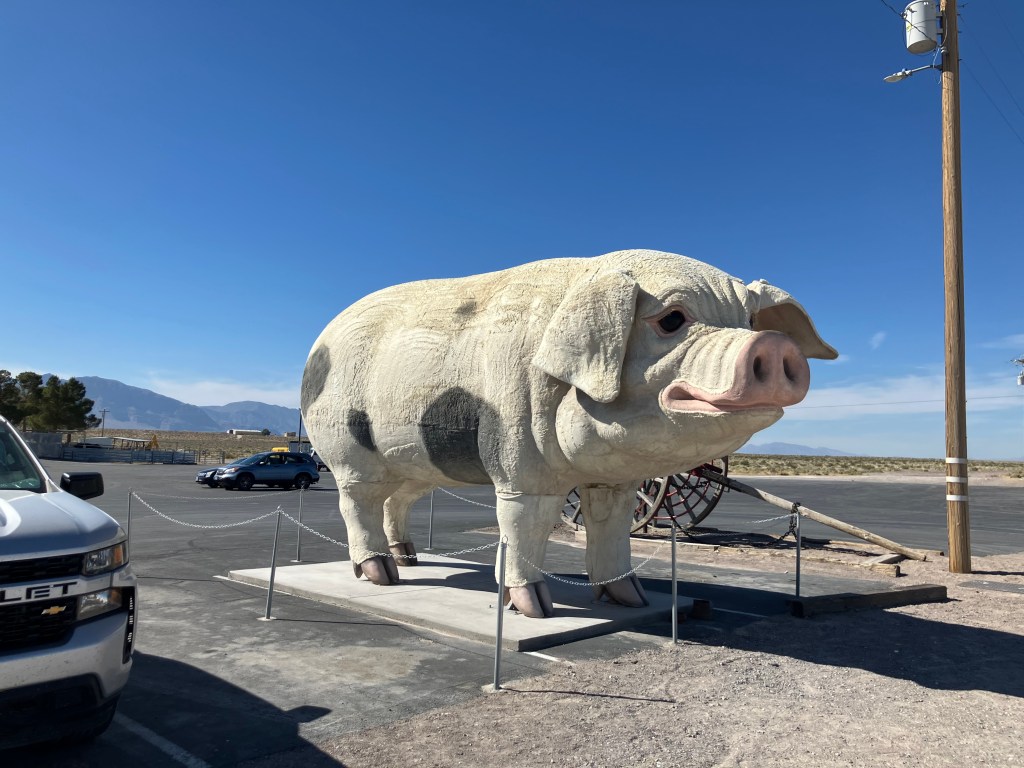
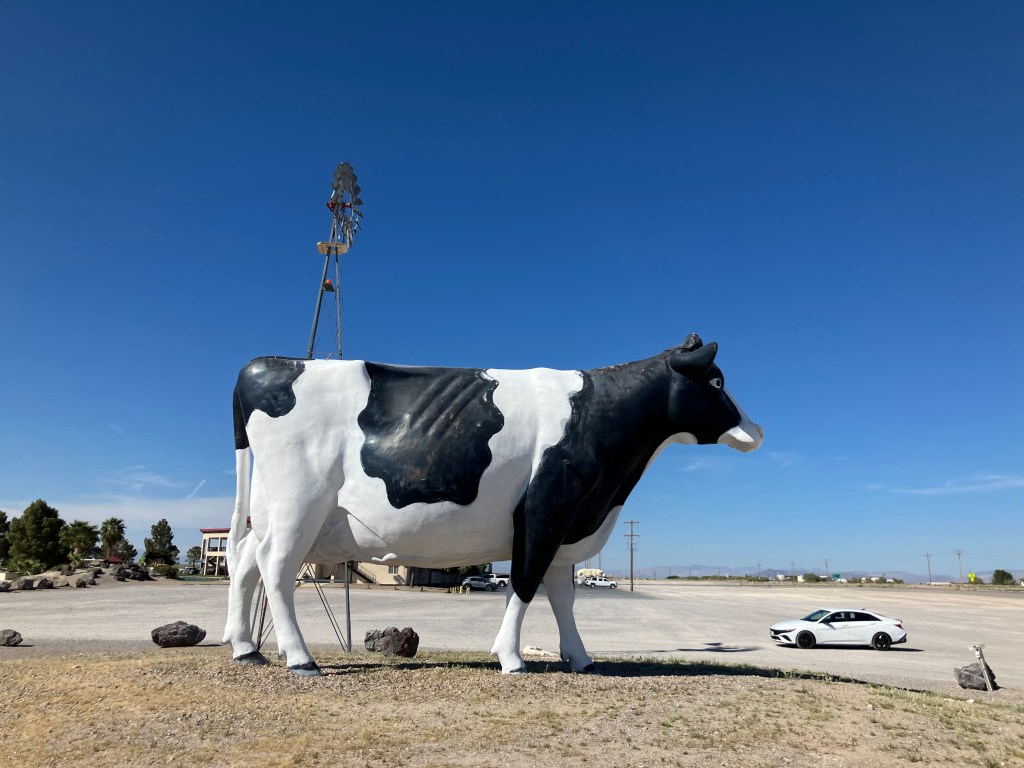
I got back on the road, and after a short time I was approaching the California state line, where I passed a Last Chance Nevada casino whose roadside calling cards are, confusingly, a giant pig and a giant cow.
(Interesting side note: The cow used to stand atop the now-defunct “Holy Cow! Casino and Brewery”in Las Vegas.)
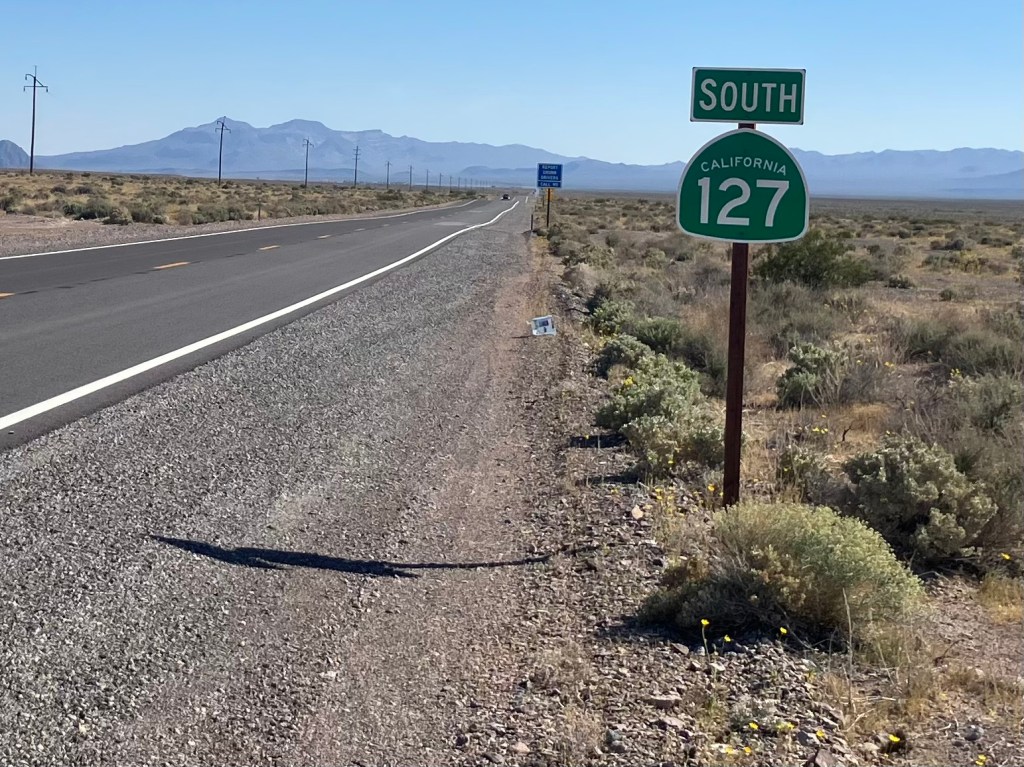
Finally, as I crossed into California, I was instantly on California Route 127. I was eager to see for myself the road that the LA Times calls an “antidote to the frantic pace of our modern condition, a necessary pause to see not what has been forgotten, but what endures.”
Shortly after starting my journey along CA 127, I arrived at a magical place called Death Valley Junction (pop: 3). The town was founded in 1907, when the Tonapah and Tidewater Railroad ran a spur line here to serve the Pacific Coast Borax Company’s plant. (You have to admire the chutzpah of naming a mining operation in the middle of Death Valley after the shores of the Pacific Ocean.) Borax is a naturally occurring mineral that was discovered here in Death Valley, and is used for cleaning and other uses.
Anyway, the western writer Zane Grey published an article decrying the horrible living conditions of the borax workers living in tents out here in the desert. So the Pacific Coast Borax Company, sensing a potential PR nightmare, built proper housing and facilities right here where I’m standing. This company town was constructed almost exactly a century ago, and it had offices, a hotel, worker dormitories, an infirmary, a community hall, and other facilities. By all accounts it was a thriving community.
This state of affairs only lasted for a few years. It seems that a richer vein of borax was discovered elsewhere, and the Pacific Coast Borax Company moved its operation out of Death Valley Junction. Then, in the 1940s, even the railroad left town…literally. The rails were pulled up and sold to the US government, which used them for the war effort in Egypt.
The few remnants of Death Valley Junction’s borax plant, as seen today.
The 100-year-old dock where borax was once loaded onto railcars.
Without the railroad or the borax operation, Death Valley Junction essentially became a ghost town. Except for the hotel, which struggled along, the old company town was left to decay.
Abandoned company town.
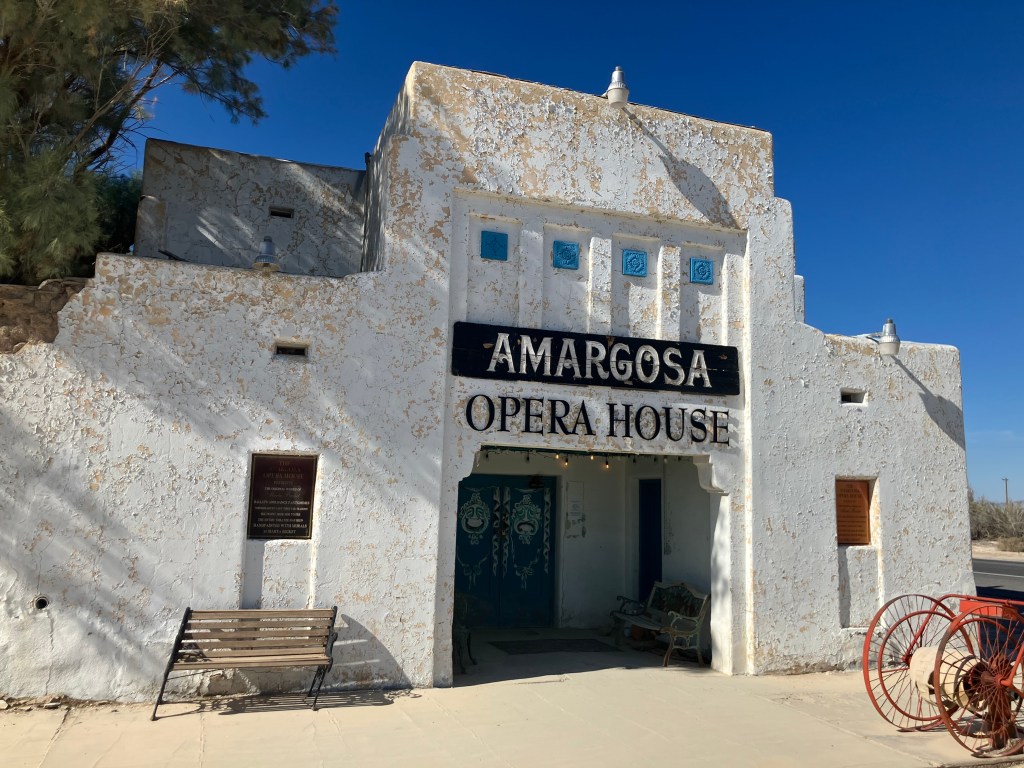
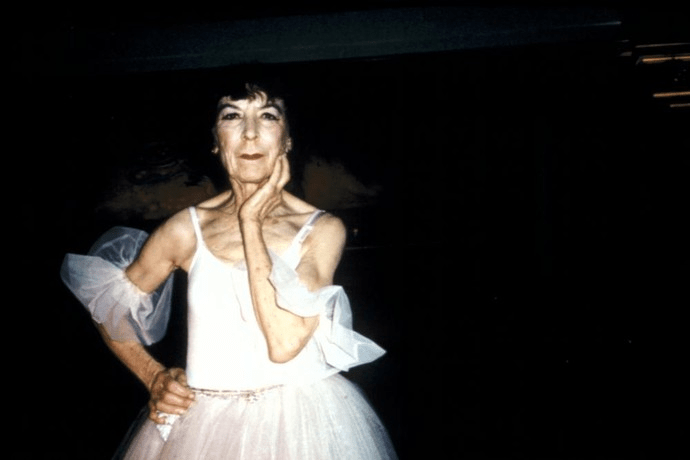
Then something wonderful happened. In 1967, a ballerina and artist from New York named Marta Becket was on tour through the west, and her car broke down near Death Valley Junction. While the car was being repaired at the town’s sole garage, Marta explored the old buildings and fell in love with them. In particular, she envisioned the old, abandoned community hall as an opera house. Here. In the middle of the desert.
The garage where Marta Becket serendipitously took her car and walked across the street to discover what would become the Amargosa Opera House.
So Marta Becket and her husband leased (and later bought) the property, converted the community hall into the Amargosa Opera House, and opened for business. Marta herself would perform on the stage every weekend. For forty years. Here, in the middle of the desert. A story in National Geographic in 1970 caused this little secret in the desert to become world famous. People came from around the world to watch her perform and to see the artwork she painted on the walls of the opera house and the adjoining hotel.
Marta finally retired in 2012, and died at age 92 in 2017.
RIP Marta Becket.
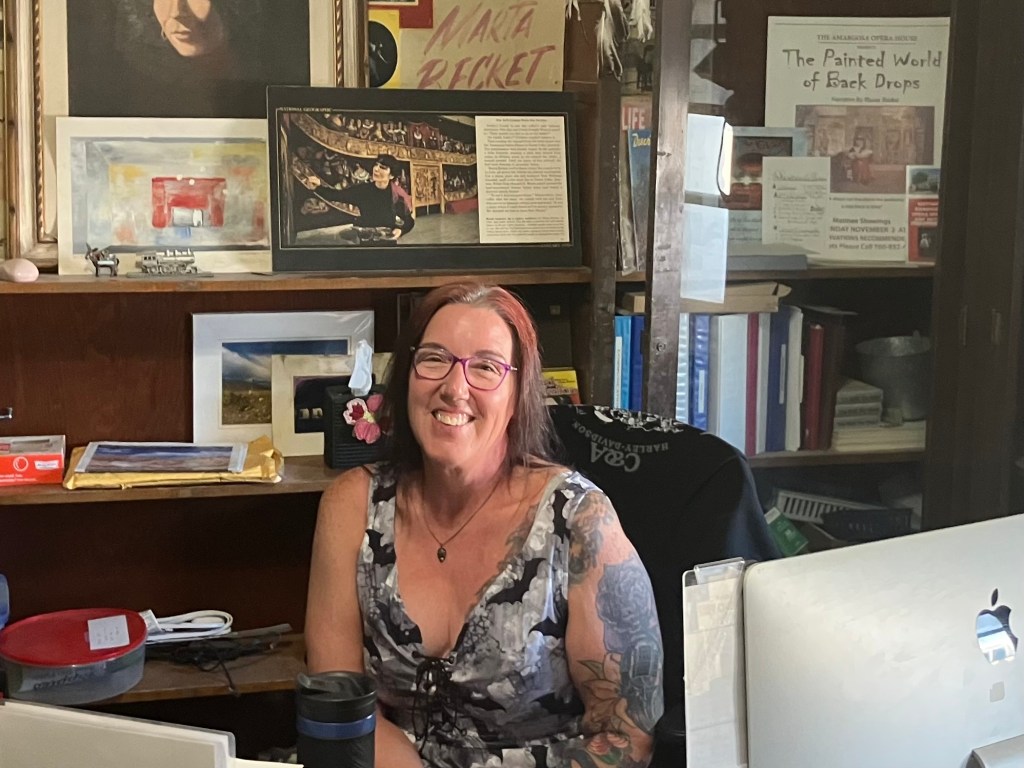
The Amargosa Opera House continues to honor the legacy of its creator with daily tours and various performances throughout the year. My tour guide was an enthusiastic and knowledgeable person named Sue, and she also works at the hotel.
Sue and her 1000-megawatt smile.
Speaking of which, I’m spending the night here in the old, original hotel that the Pacific Coast Borax Company built in 1924. Some say the place is haunted…..
Beer of the Day
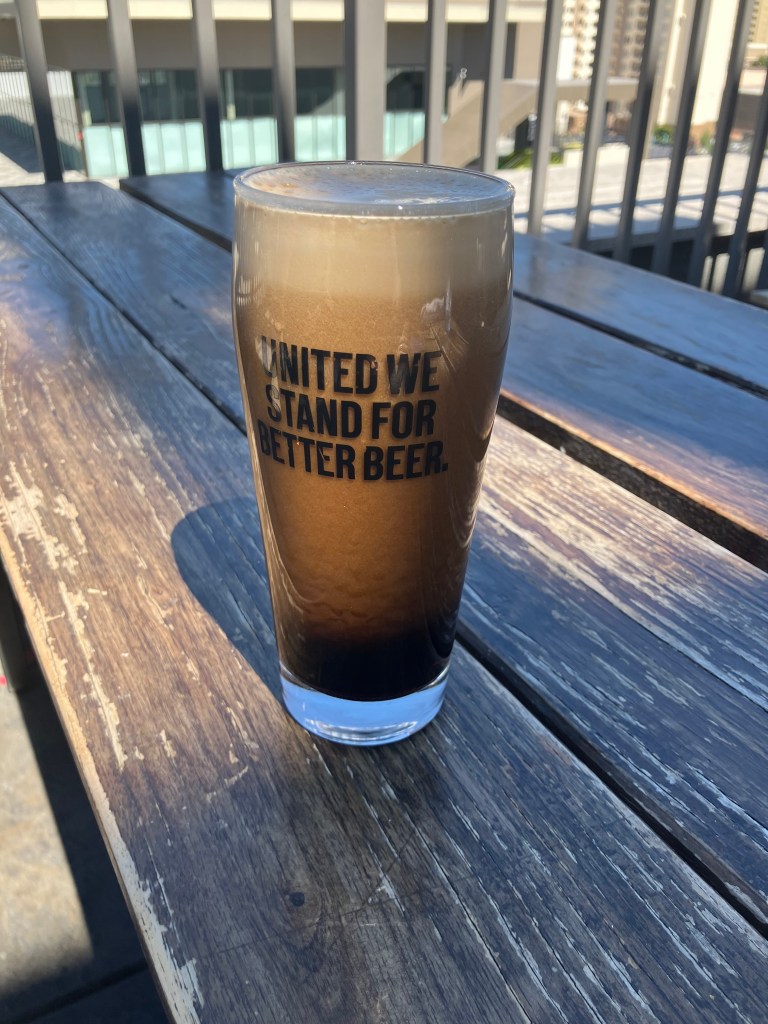
The BOTD comes from BrewDog in Las Vegas. It’s their Black Heart Nitro Stout.
Because it’s a stout, it has the usual roasty and malty notes. Plus, as a nitro beer (i.e., it’s carbonated not with the usual carbon dioxide but with nitrogen), it has a creamy mouthfeel and a slightly sweeter taste. The nitro also presents an attractive, cascading-bubbles effect and a creamy head.
All that said, this beer was underwhelming. It has no complexity; it just tastes like someone filled a sock with oatmeal and steeped it in dishwater. There is absolutely no finish and, it seems, no hops. And at a scant 4.1 ABV, there’s no alcohol bite. This is a beer that’s nice to look at, but that’s about it.
 Chasing Phantoms