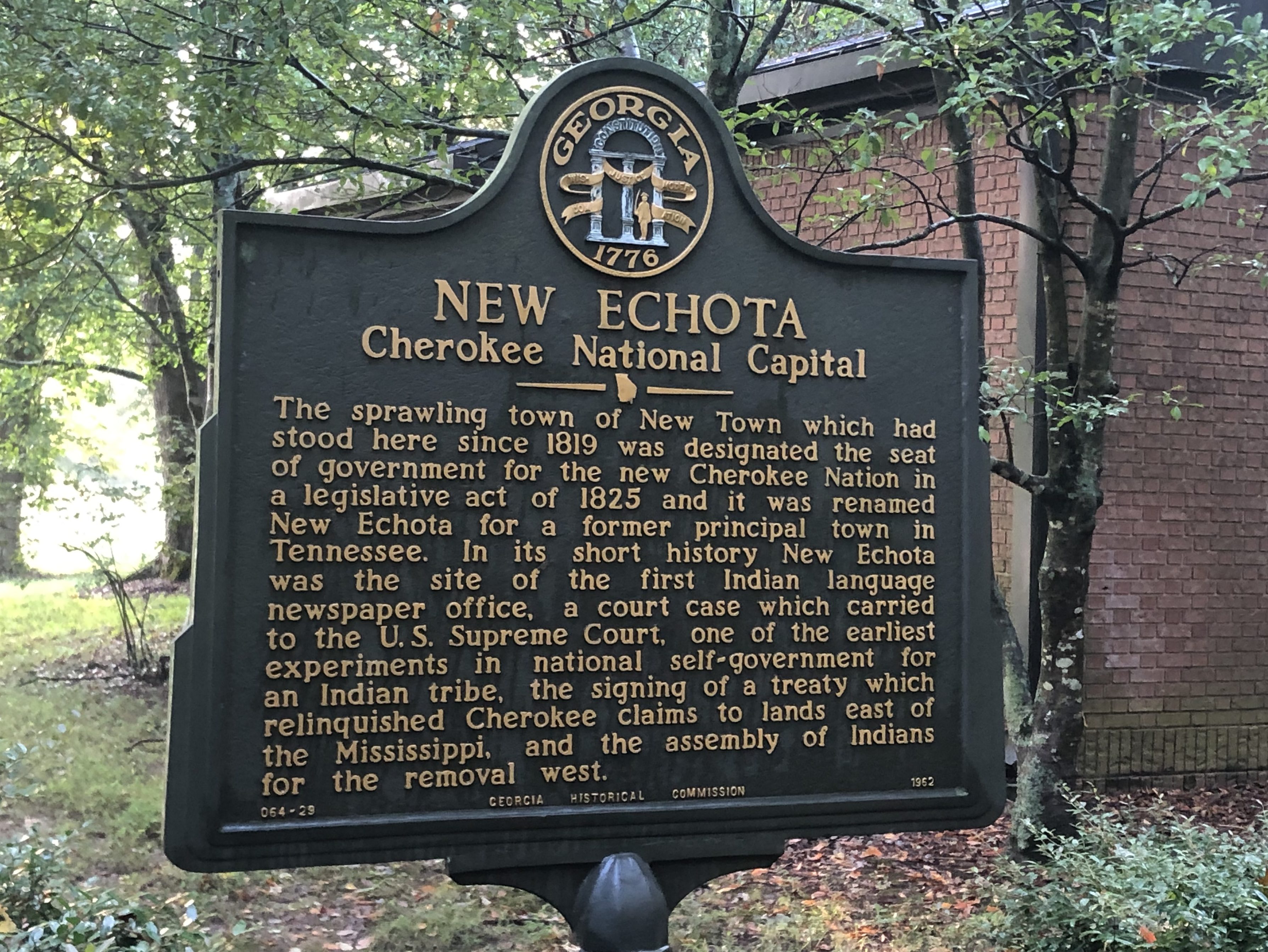
This morning Scott and I began our Trail of Tears Tour (T3) with a visit to New Echota, Georgia. This was the short-lived capital of the Cherokee nation before everyone was rounded and up and driven out to the new “Indian Territory” in Oklahoma in 1838. New Echota is now a Georgia State Park, and the exceedingly helpful Ranger Jackie gave us a valluable orientation about the Cherokees and the Trail of Tears.
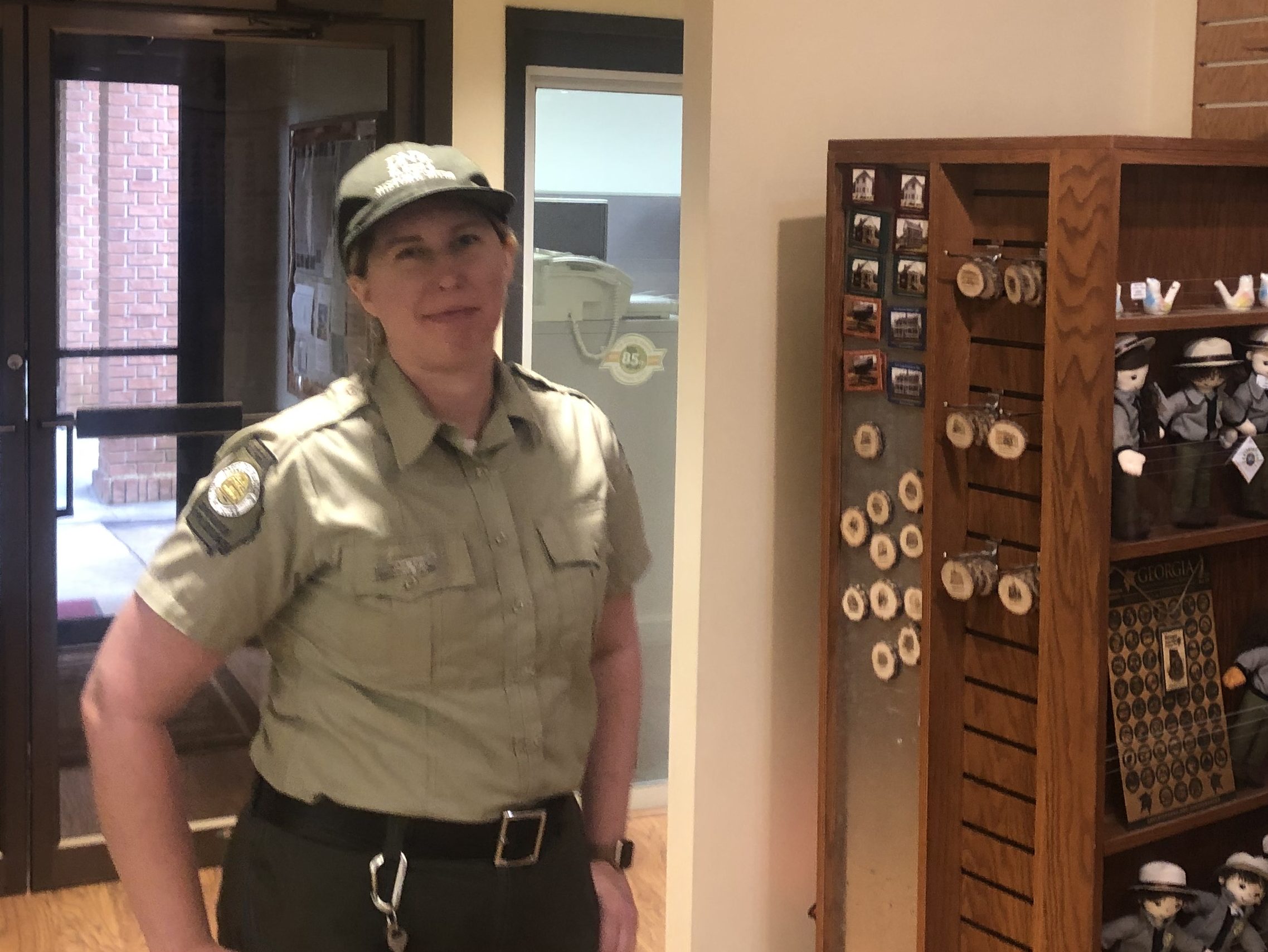
The Cherokees, we learned, had a remarkably progressive and European-influenced culture, especially when compared with other Native American groups (let alone the stereotypes of western movies). They adopted a written constitution that reflected many of the features of the US Constitution. They build their economy on farming and trade, and they constructed hewn-wood cabins and clapboard buildings. They developed a written alphabet, and produced their own Cherokee newspaper. Their government operated as a democratic republic, with separate executive, legislative, and judicial branches. Some intermarried with whites, and generally maintained good relations with the white authorities.
At the same time, the Cherokees were not above criticism by today’s standards. For example, they kept African Americans as slaves, and generally harbored what today would be considered racist views about blacks.
Yet Scott and I felt only sorrow for the Cherokees as we learned more about their treatment on the Trail of Tears. Here was a people who, by all accounts, tried to assimilate into a young United States — despite the fact that they were here hundreds of years earlier. They sought mutually beneficial trade relations with the American settlers, and when conflicts arose, they turned to the American courts, rather than violence, to gain their due. Despite this, as Georgia’s appetite for land increased (and as it became clear that Cherokee land included some rich gold deposits), it was decided that the Cherokees had to go and the land handed over to white settlers.
Some 16,000 Cherokees forced to make the westward trek along the Trail of Tears. Only a portion of them passed through New Echota, but the town is important for its role as the political center of the Cherokee nation. After the Cherokees had been relocated, New Echota was left to fall into disrepair. But in the early- to mid-twentieth century, various groups worked to restore and rebuild the structures. Today, about a dozen of these buildings bear mute testimony to the Cherokee way of life in 19th-century Georgia.
It strikes me that the story of the Trail of Tears carries two separate tragedies. One is the the brutal treatment of these human beings, pushed, often at the point of a bayonet, along an 800-mile trek without adequate food or clothing. As many as 4000 Cherokees died during that forced march. But the second tragedy is the very fact that they were pushed out of their homes and off their ancestral lands. That is, even if the “relocation” (as it was sometimes euphemistically called) was conducted much more civilly, with comfortable transportation and good provisions, the entire enterprise would still be tainted as unjustified and cruel.
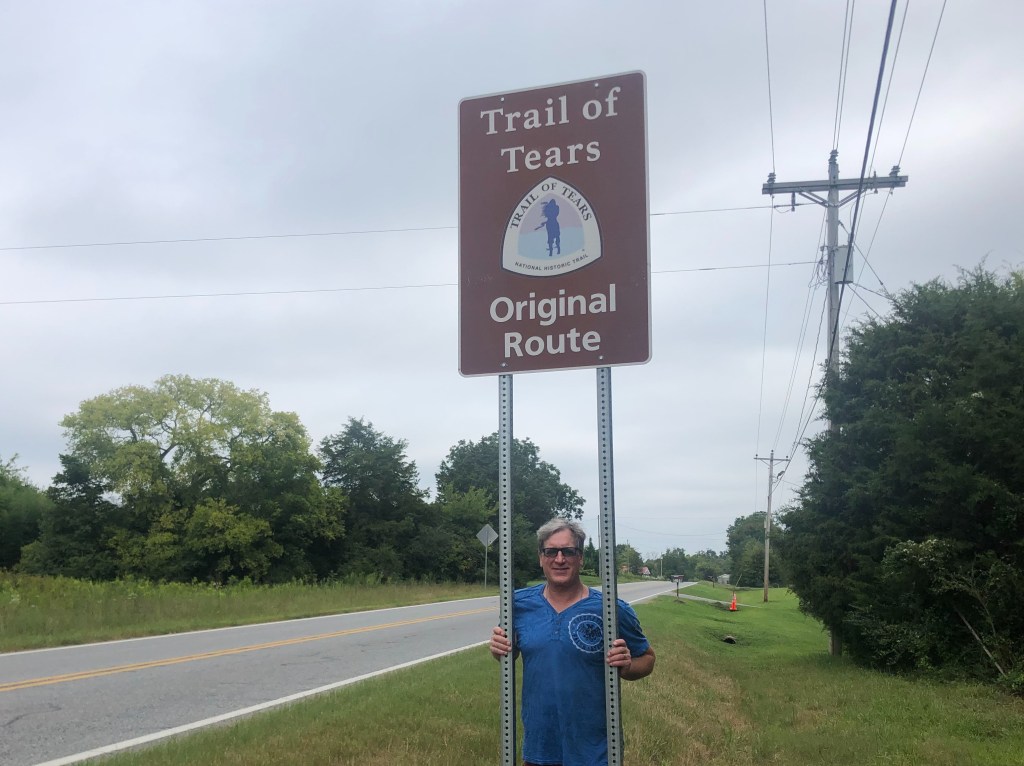
With these sobering thoughts, we set out along one of the routes (the northern one) taken by the hapless Cherokees. This part of the country is exceedingly green and alive with the sounds of cicadas, and we could imagine the ragtag groups struggling along the way.
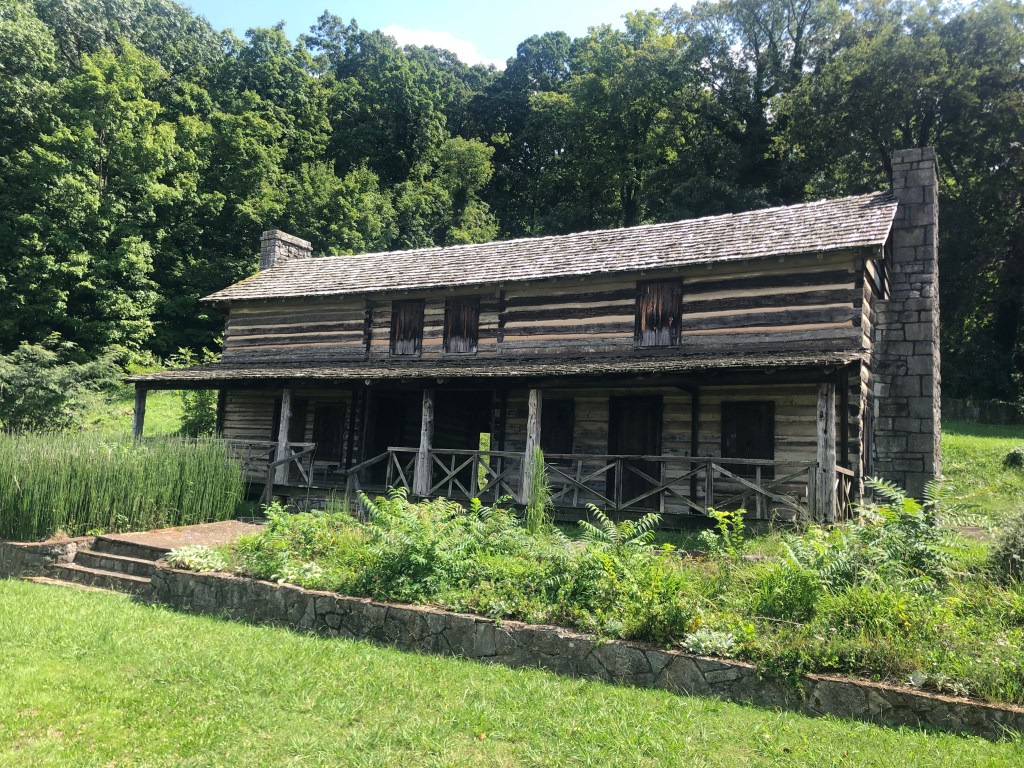
Along the drive today we passed two homes that had belonged to important Cherokee Chiefs. The first is the home of Chief James Vann, a wealthy Cherokee leader and businessman. Vann’s family lost the home when they were forced with the others to the Oklahoma in 1838. It now belongs to the Georgia State Parks System.
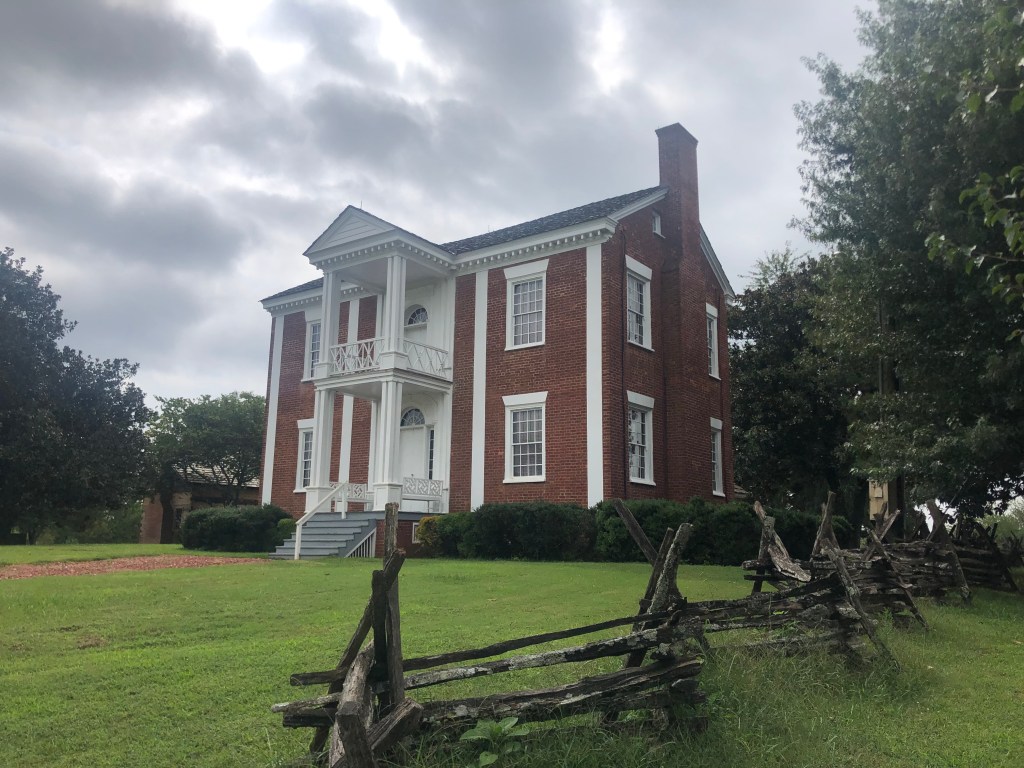
We also came upon the home of Chief John Ross. Ross, who was only one-eighth Cherokee, nevertheless served as the nation’s principal chief for almost 40 years–longer than any other Cherokee chief. He presided over the nation all through the events leading up to the Trail of Tears, the actual relocation, and the aftermath. His is a complicated but fascinating story.
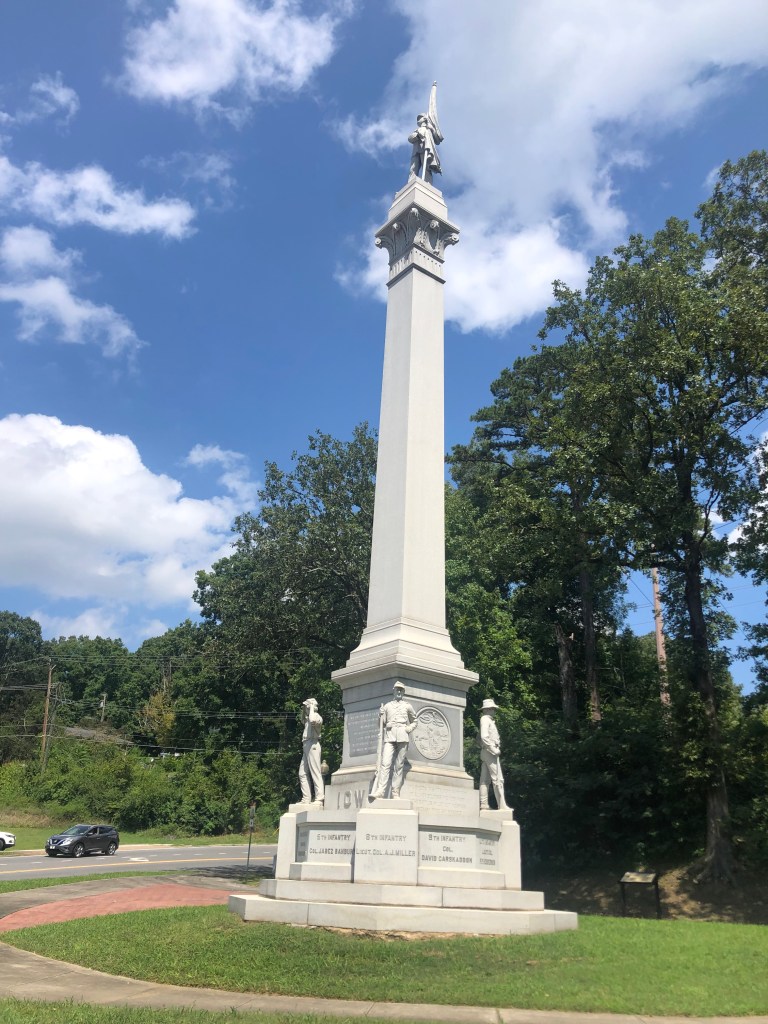
There were plenty of other notable sites along today’s drive, many of which related to the Civil War (which took place a quarter century after the Trail of Tears). For example, there was this monument in Chatanooga, which commemorates Ohio soldiers who fought at the Battle of Missionary Ridge. I’m no Civil War historian, but I find it somewhat surprising that a Union state (Ohio) was able to erect a monument to its soldiers in a Confederate state (Tennesee). The monument also includes an 80-foot obelisk, to add to our collection.
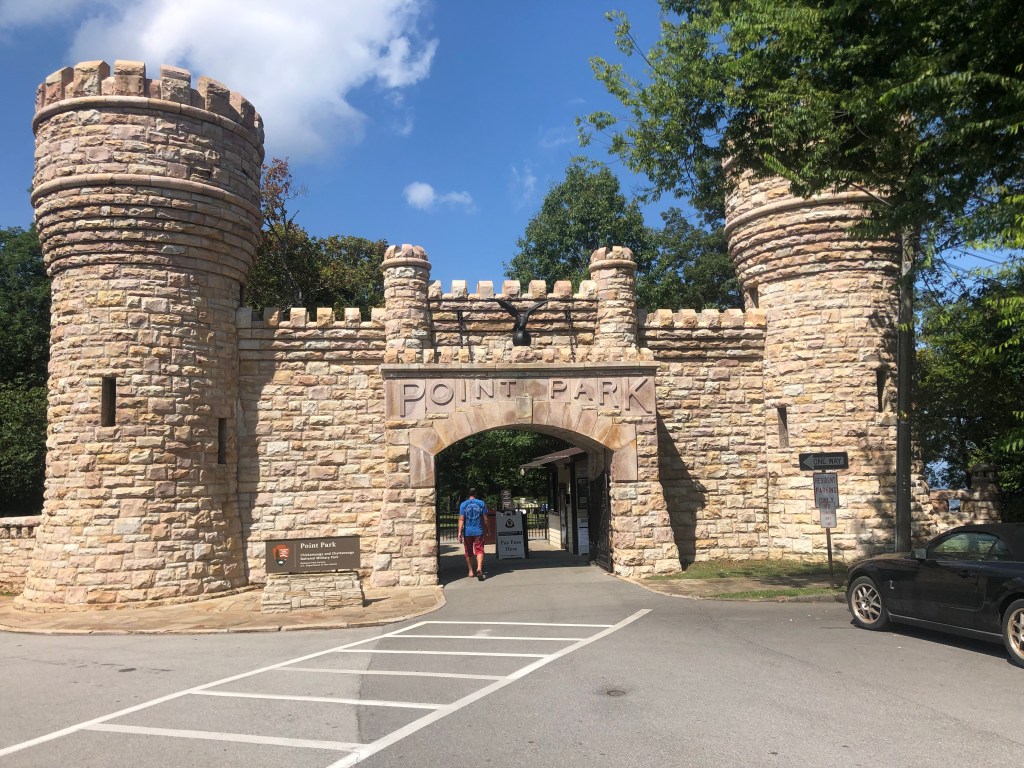
Not far from Ohio’s monument is Point Park, on Lookout Mountain. Scott remembered visiting the mountain as a school child a half-century ago, when he was living near Atlanta. Point Park is a national park that commemorates a Civil War battle. More importantly for us, it has a great view of the Tennessee River snaking through Chattanooga.
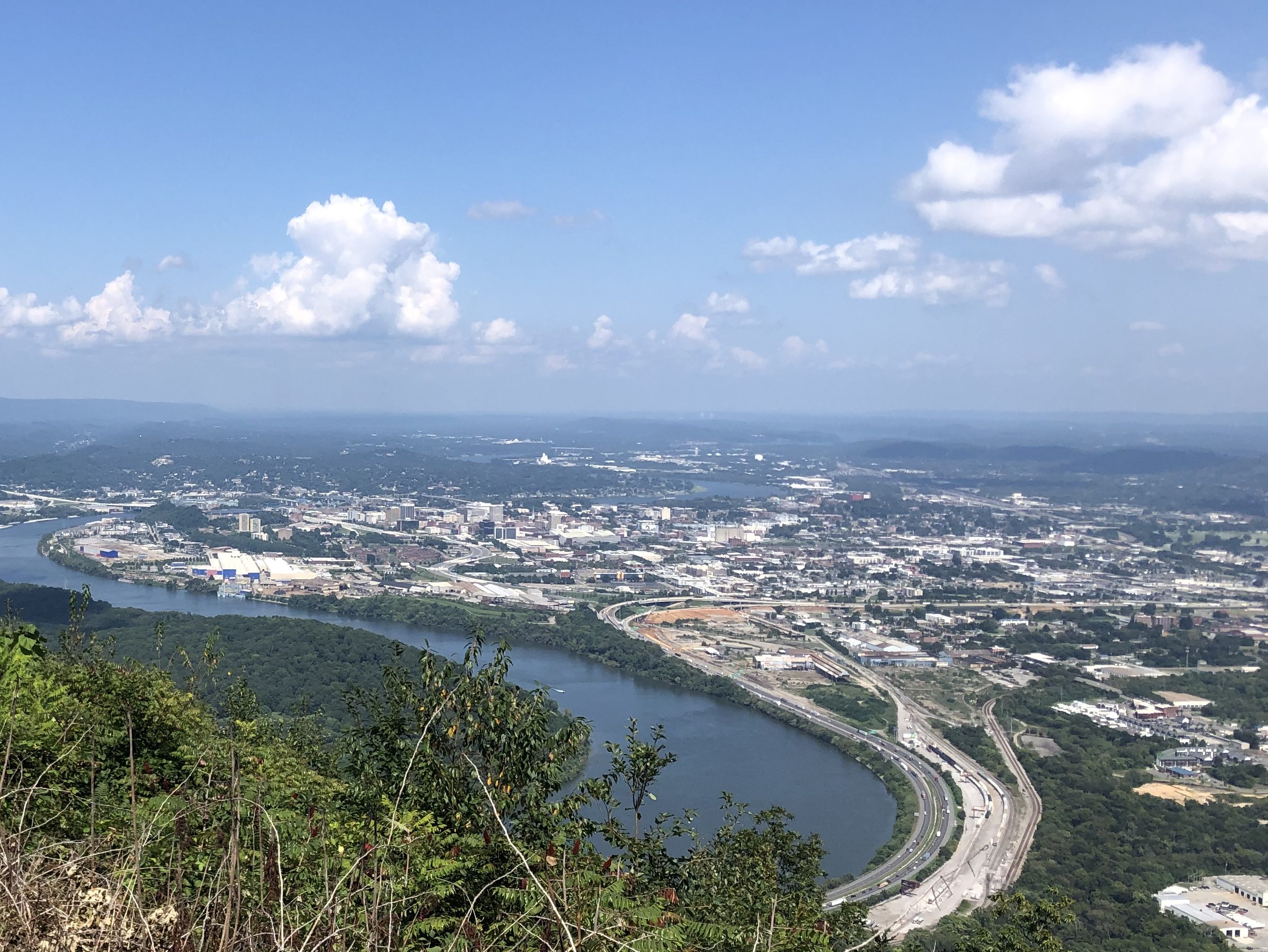
It turns out that Lookout Mountain has a number of other attractions, including a cable car that claims to be the “world’s steepest railway.” It was constructed in the late 1800s, and still runs today, taking passengers up and down the side of Lookout Mountain.
But more enticing, to me a least, is Rock City. Doubtless you’ve seen, or at least heard of, the multitudinous advertisements painted on barn roofs along Route 66 and other highways, urging travelers to “See Rock City.” Here is an example, stolen from the Internet:
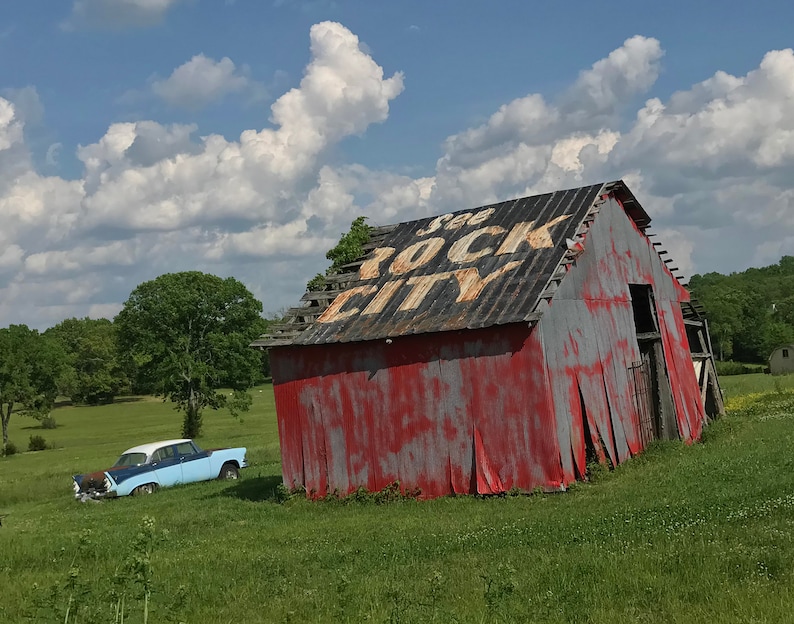
I’ve seen plenty of the barn-emblazoned advertisements, but I’ve never seen Rock City. In fact, I can’t say that I ever had much desire to see Rock City. But let’s back up a bit. About 100 years ago, a fellow named Garnet Carter (you may know him as the inventor of miniature golf, but that’s another story) decided to turn an unusual outcropping of rocks on Lookout Mountain into a tourist attraction. He purchased a large parcel (about 700 acres) of land, with this “rock city” in the middle of it. He developed a network of trails, and added statutes of gnomes for good measure (as one does). He then paid to have advertisements for Rock City painted on barns across the midwest and south. It’s said that over 900 barns across 19 states were eventually painted with the advertisements. The advertisements, especially linked with the picturesque old barns, became iconic. Rock City has been open to the public since 1932.
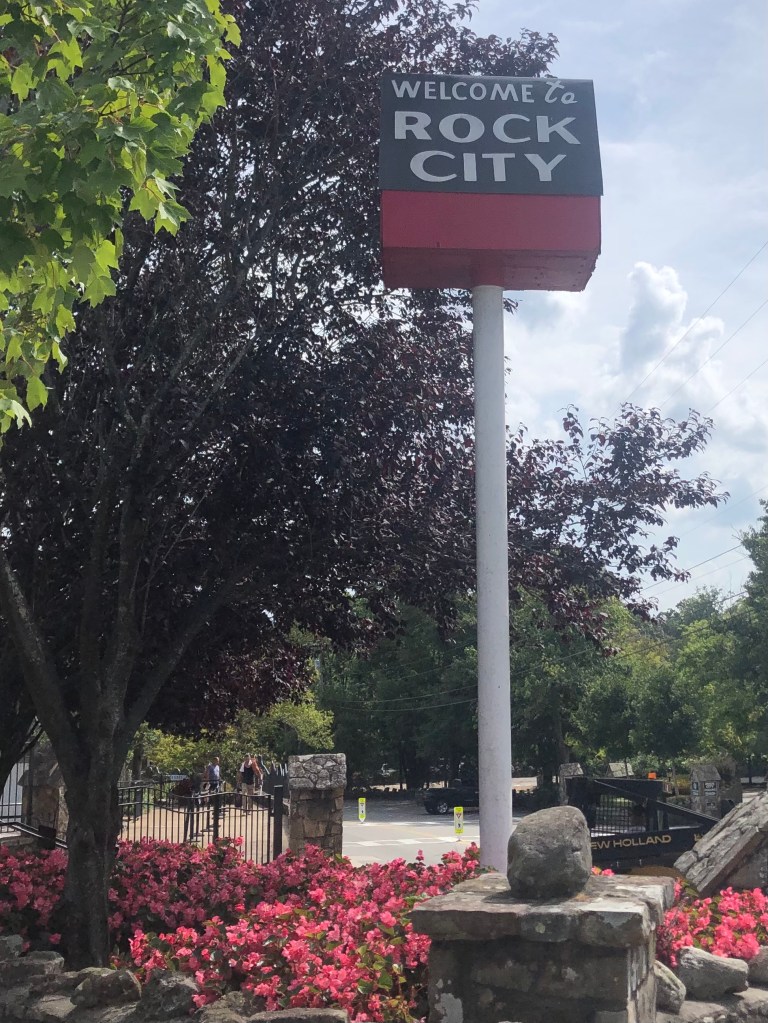
Well, it turns out that Rock City is just a few miles from Lookout Point, so Scott and I went to see what all the fuss is about. I can’t say that it’s an impressive phenomenon. But I can say that, finally, I’ve followed the injunction to See Rock City.
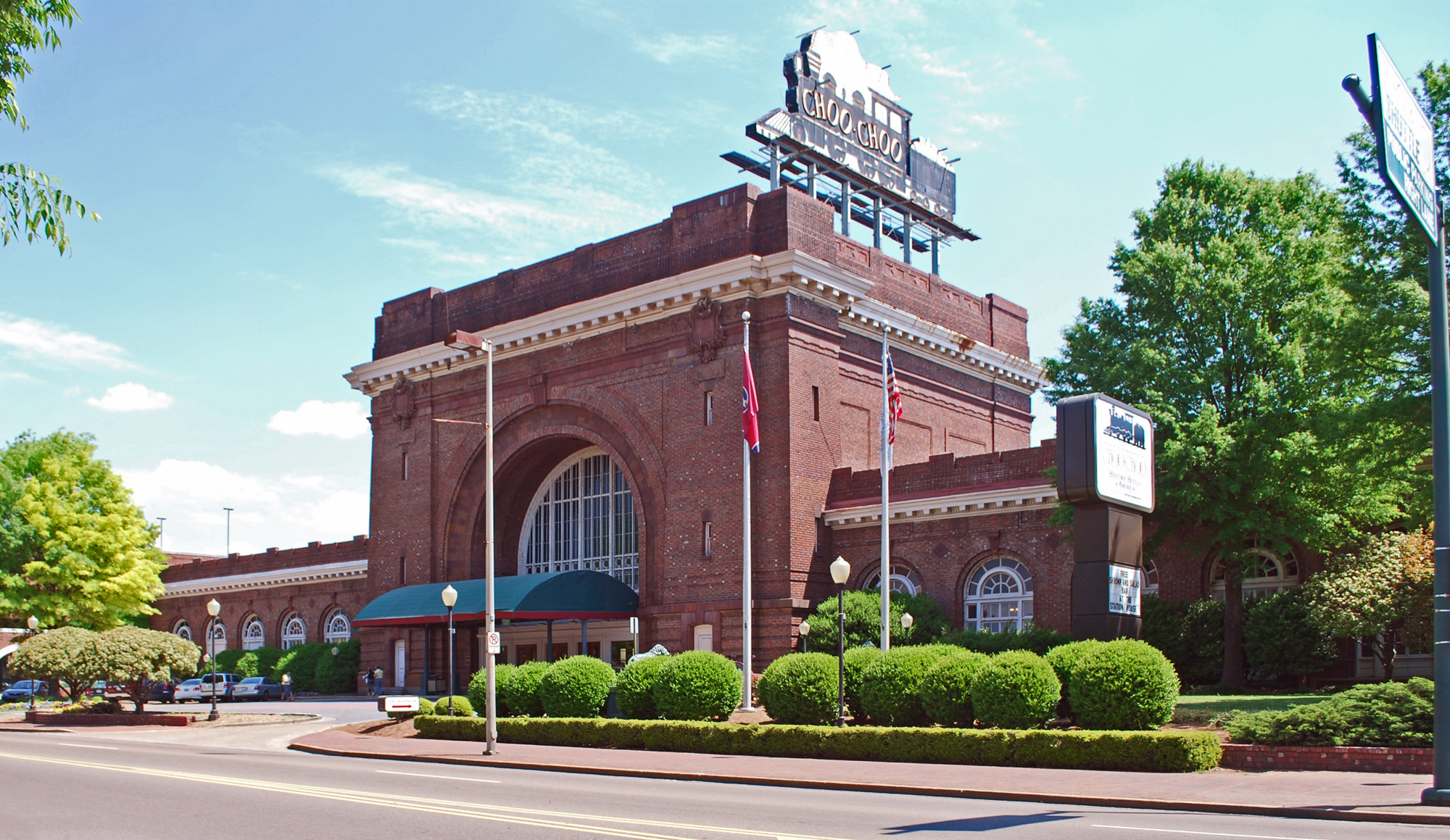
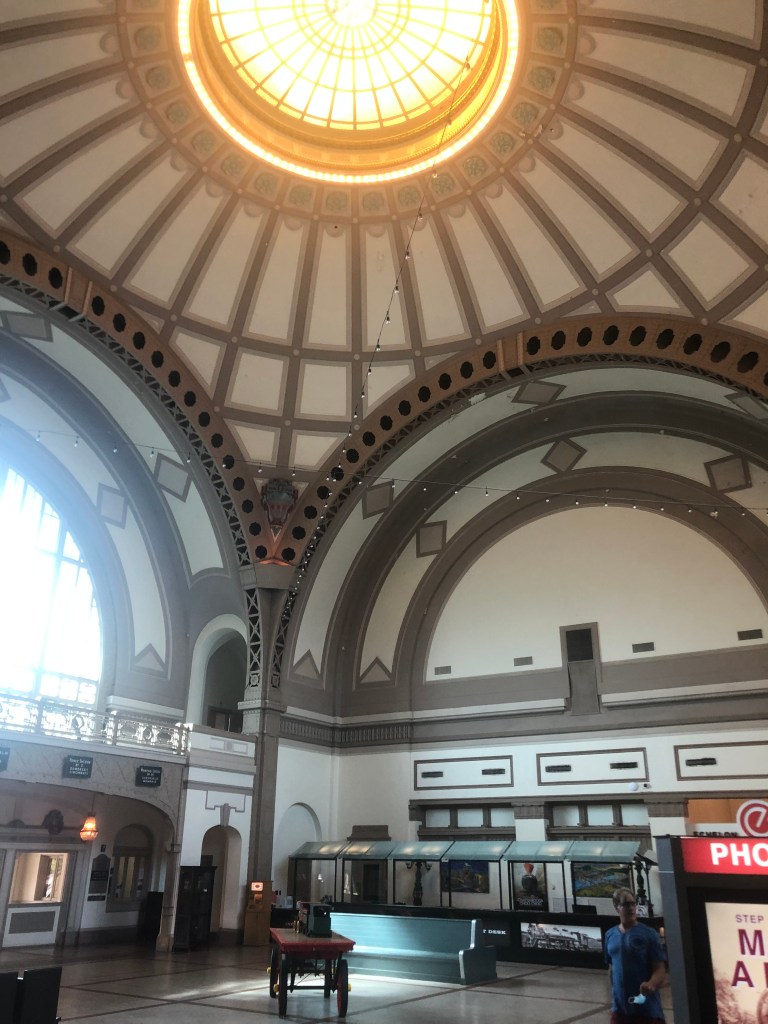
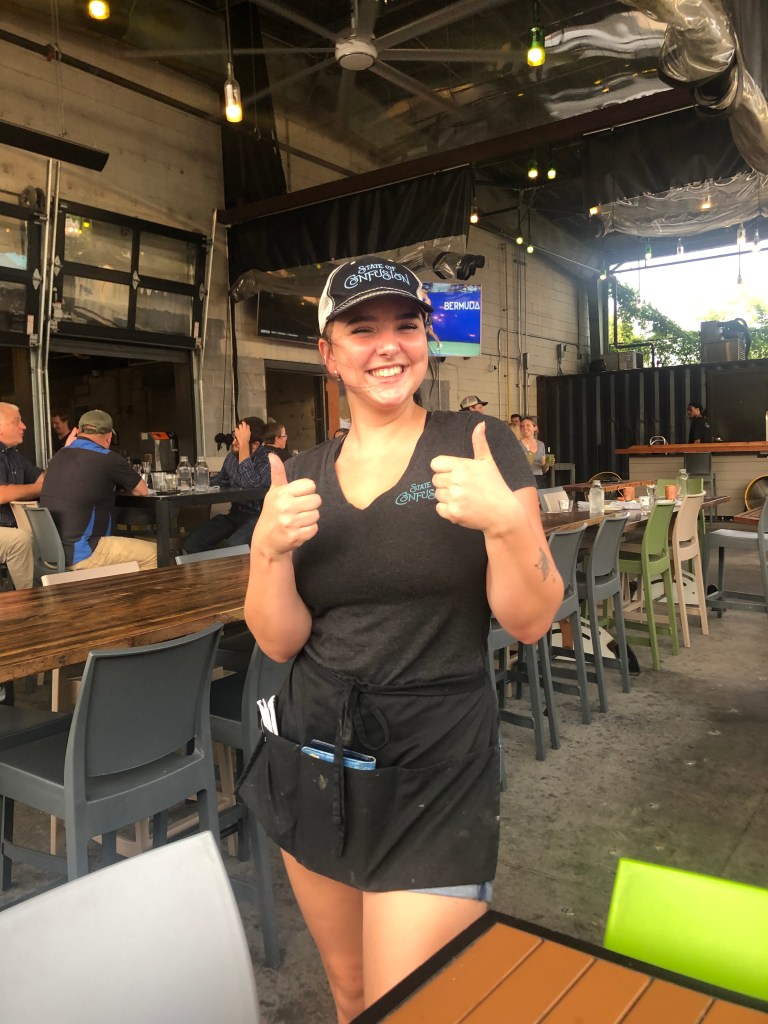
As we drove down from Lookout Mountain, we realized we’d worked up an appetite. So we repaired to a restaurant called State of Confusion. The restaurant is next to Chattanooga’s historic Terminal Station, which had been constructed in 1909, and was restored to its former grandeur in the 1970s.
So, having driven about 75 miles of the Trail of Tears, seeing Rock City, and fortifying ourselves with greasy food, all that was left was to get a Brew of the Day….
BREW OF THE DAY
Today’s BOTD came from American Draft, which is a beer bar situated in a historic railroad car parked at Terminal Station. It’s a cool setting. Evidently, it was conceived as another one of the beer automats like the one we went to the previous evening. Check out their webpage. But tonight there was no serve-yourself option, and we instead were served by a charming and helpful young woman. After a half-dozen “could I just have a taste?” pours, I finally settled on the O’Fallon Salted Caramel Pumpkin Ale.
Now, I know what you’re thinking: Isn’t that a little bit girly for a manly guy like yourself? And you’d be right. But I guess I was feeling in touch with my feminine side. Plus, as we walked around Terminal Station, Scott and I had already stopped at not one but two distilleries, and had sampled a few bourbons and gins. So I needed to throttle back the alcohol intake a bit. The pumpkin concoction is only 5.4 percent ABV.
I have to admit, though, it’s a well-balanced beer. It’s not just a cynical attempt to go after the Starbucks Pumpkin Spice Latte crowd. This is quality stuff, with caramel malts, pink Himalayan sea salt, a “proprietary blend” of spices, and a little lactose to suggest a pumpkin puree mouthfeel. There’s none of that cloying aftertaste you get from artificially-flavored beers. With the calendar moving towards fall, I suggest you try a pint….if you’re man enough to do so.

 Chasing Phantoms