When you think of the story of Frankenstein, and especially when you envision the monster, chances are it’s the 1931 Universal movie, rather than Mary Shelley’s book, that’s responsible. Shelley’s monster was eight feet tall, was able to speak witih an extensive vocabulary, and was highly emotional. The Universal version, by contrast, was about six and a half feet and was unable to speak. What’s more, Mary Shelley didn’t really describe the scene of Dr. Frankenstein creating his creature. The lonely old castle, the laboratory with the electrical apparatus, the lightning storm — that was all Hollywood’s creation, And it seems to have eclipsed — indeed, it has replaced — the less atmospheric (ha!) scene painted by Shelley.

Simply put, this 1931 movie starring Boris Karloff is the definitive Frankenstein movie, not because it’s true to the original source material (ha again!), but because it’s the basis for almost all other renditions that followed. For this reason, I’ll be comparing many of the rest of the Frankenstein movies this month to this O.G. version.
The Plot. Surely you know the basic outlines of this movie: a student of medicine by the name of Henry Frankenstein sews together body parts from cadavers to build a living man. He brings the creature to life by harnessing the power of an electrical storm, and at first he is thrilled. “Now I know what it’s like to be God!”, he shouts, in a line that was censored from the film as blasphemy for many, many years. But the creature is somewhat unruly, and soon becomes violent. Dr. F comes to loathe his creation, and eventually realizes that obsession is affecting his relationship with his fiance. He therefore resolves to destroy the creature, but it escapes and wreaks havoc in the countryside. Ultimately, the creature and Dr. F become trapped in an old windmill surrounded by angry villagers.
Notably, the plot is quite different from the sweeping, 300-page epic that Shelley wrote. The movie is highly condensed and simplified, fitting into a tidy 70-minute film.
The Monster. Even more than the simplified story, it’s our understanding of the creature’s appearance that comes entirely from the Universal movie. Makeup artist Jack Pierce created the look out of whole cloth, with a flat head, electrodes in the neck, hooded eyes, various scars, cadaverous cheeks, and ill-fitting clothes. And of course, the monster looks a lot like Boris Karloff, because it was he who played the role in this landmark movie.
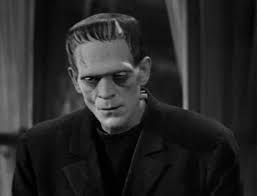
Karloff’s monster has no facility for speech; he just growls. (Shelley’s monster, as noted above, was highly articulate.) The monster is mercilessly taunted by Dr. Frankenstein’s assistant, Fritz (not Igor, who wouldn’t appear until a sequel). Fritz was played by Dwight Frye, who a few months earlier played Renfield in Univeral’s Dracula, starring Bela Lugosi. But that’s another story.
Incidentally, Lugosi was originally offered the part of Frankenstein’s monster, but he turned it down as an unworthy part with no dialogue or nuance. So the then-unknown Boris Karloff was cast, and the rest, as they say, is history. Karloff threw himself into the part, and made it his own. It’s hard to think of Frankenstein’s monster without thinking of Boris Karloff. Notably, Karloff played the monster as a sympathetic creature, who became violent only in response to taunting and torture. He was confused by his sudden birth, fully-formed, in the world, feeling like a lost child. And, like a child, he could be charmed by a flower, a ray of sunlight, or a young girl. Especially in this first Universal version, Karloff’s creature is nuanced and pitiable.
The Atmosphere. This movie defines what atmosphere should be like in a Frankenstein movie. Desolate graveyards, old castles, sparking “mad scientist” lab equipment, lightning storms, torch- and pitchfork-bearing villagers, towering windmills–it’s all here.

This first Universal Frankenstein movie came out near the beginning of the “talkie” era. Some of the cinematography is pretty impressive for its day, but this is clearly an early motion picture effort. For one thing, background music is almost entirely absent (limited only to the opening and closing credits). The outdoor scenes are clearly on a sound stage, and the editing can be quite clumsy in places. Still, director James Whale did some wonderful things with the technology that was available to him. It’s a groundbreaking film. (Har!)
Overall Comments. This is the definitive Frankenstein movie, and you should watch it. I understand that, as a 90-year-old (!) film, it lacks some of the production values, multi-camera shooting techniques, computer-generated special effects, Dolby surround-sound, car chases, gratuitous nudity, and hip-hop soundtrack of modern films. But its technical simplicity enhances its melancholy and stark atmosphere. The acting and directing are good enough to stand on their own, without the accoutrements. Do yourself a favor and watch it.

Tomorrow: Karloff returns in Bride of Frankenstein! (Available here on YouTube for $3.99)

 Chasing Phantoms