The unexpected success of Universal’s original Frankenstein got the studio execs thinking: Let’s do a sequel! They asked director James Whale to crank out another one, but he demurred for several years. Eventually he relented, and in 1935 Universal released its second Frankenstein movie: “The Bride of Frankenstein.”

In addition to getting James Whale take the director’s chair again, Universal again signed up Boris Karloff as the monster and Colin Clive as Baron Henry Frankenstein. Dwight Frye (who’d played Fritz [essentially, Igor] in the first movie reappeared here as a different assistant. A few other bit players were also recast. The movie was so successful that Universal would go on to make a number of other Frankenstein movies, and for the next decade or so the studio would be known for a whole range of monsters.
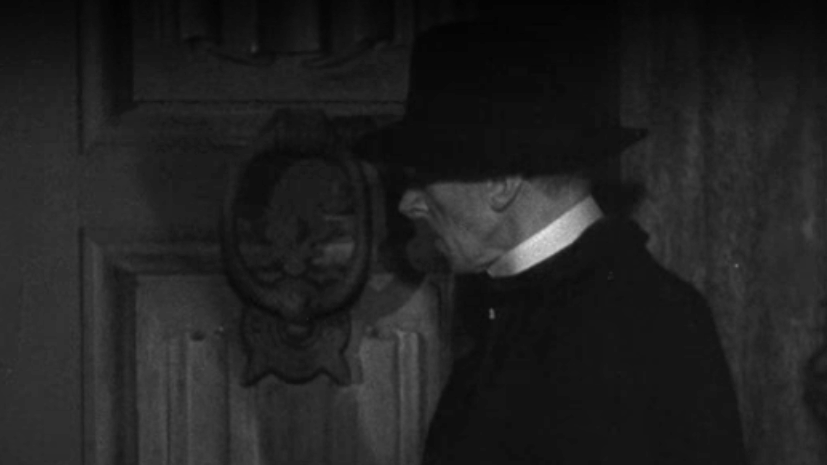
The Plot: This movie picks up essentially where its predecessor left off: With the monster presumably destroyed in a fire in an abandoned windmill, and with Baron Frankenstein recuperating at home and vowing to put all this behind him. Of course, we soon learn that the monster is not in fact dead, and he re-emerges, a bit the worse for wear, to terrorize the village. At almost the same moment, Baron Frankenstein’s old teacher, Dr. Pretorius, shows up on the Baron’s doorstep, looking for all the world like “The Exorcist.” But rather than casting out demons, Pretorius is clearly on the dark side, and wants to team up with his old pupil to create a female creature. The monster (Karloff), evidently feeling a bit randy, is all for that idea. So between the monster’s threats and Pretorius’ kidnapping of Henry’s wife, Henry agrees to the scheme. What could go wrong?
And yet it’s worth noting that the idea of the monster demanding a female mate was actually part of Shelly’s original story. It’s one of the small ways that the movie hews to its source material.
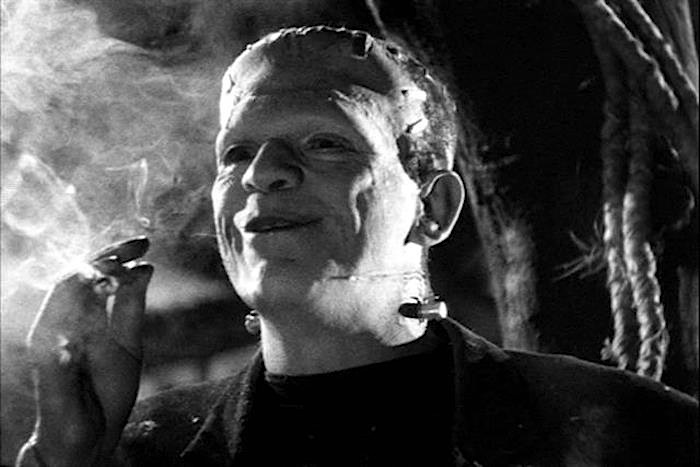
The Monster: Boris Karloff reprises his role as the monster. But there are a few small changes. For starters, Karloff’s makeup now includes some burns (because he’s supposed to have survived a fire) and his hair is largely singed away. He face also looks fuller, because (unlike in the first movie) he did not take out the removable bridgework from his mouth. (He’d removed it in the first movie in order to create a more hollow-cheeked, cadaverous appearance.)
But the biggest change to the monster is that he now speaks, albeit with a limited vocabulary. (One review I read pegs his vocabulary at 41 words.) Karloff is said to have been strongly against the decision to have the monster talk, feeling that it removes some of the mystery from the creature. But director James Whale and the Universal execs insisted, presumably knowing a good gimmick when they see one.

As with the first movie, the monster is portrayed sympathetically. In fact, this time around, he’s almost downright likable. He befriends a lonely hermit, and delights with childlike wonder at food, drink, music, and even cigars.
But wait! There’s more! There’s a second monster in this movie, and it’s the titular Bride. And yet, the Bride does not even show up until the last few minutes of the film. She has no speaking role, and doesn’t do much more than just peremptorally spurn her would-be mate. Still, her character would go on to become one of the most iconic monsters in Universal’s stable.

The Atmosphere: “Bride of Frankenstein” was filmed entirely on Universal’s sets, and the atmosphere feels very similar to the first movie. There are graveyards, castles, electrical storms, that same mad-scientist’s laboratory, and torch-lit dungeons. But James Whale had clearly honed his craft between the two movies, adding atmospheric touches throughout. For starters, there’s actually a music score (underpinning most scenes). The cinematography seems a bit more nuanced, and the use of shadows is spooky and powerful.
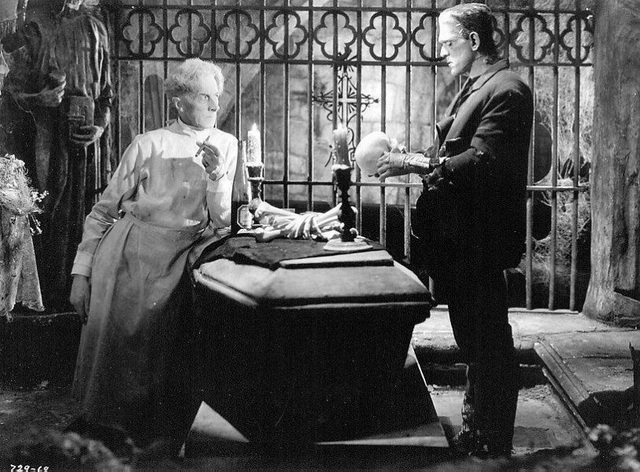
In fact, the atmosphere is so strong and, well, “atmospheric,” that the movie is able to indulge in a bit of humor without descending into farce. Dr. Pretorius is of course a villainous character in this movie, but he’s also the main source of comic relief. Start with the fact that he’s a bit over-the-top as an (unacknowledged) “old queen” (to use a term that the actor, Ernest Thesiger, would use). One wonders if it’s an in-joke when Baron Frankenstein’s maid says Pretorius is “a very queer old gentleman.” Pretorius also seems to engage in a pun when says he’s come to speak with Herr Frankenstein on a “grave” matter. There’s also an extended sequence where Pretorius shows off miniature people he’s created (having not yet figured out how to make them full size), and the antics of these miniature people are a source of hijinks. There are other occasions for levity involving the Burgomaster, as well as a scene with some “resurrection men.”
General Comments: It’s a fun movie that’s well worth watching, certainly for Karloff’s acting but also for the added fun of Dr. Pretorius. The movie contains a number of the cliches that we’ve come to associate with the Frankenstein story (the monster’s interaction with the blind man, the iconic “Bride of Frankenstein” creature, the lightning storms, the old castle on a hill….)
There’s just one part of this movie that’s really odd, and that’s the beginning. The movie opens with Mary Shelley (author of the original Frankenstein story), the poet Percy Shelley (her husband), and the poet Lord Byron, sitting together in a drawing room while a fierce storm lashes at the windows. In real life, these three had engaged in a competition to see who could write the best horror story, and it was in this way that the book Frankenstein was born. In this vignette in the movie, Lord Byron contrives to summarize Mary Shelley’s book, then asks her to develop the story further. We then shift to the Karloff movie, which presumably is the unfolding of the rest of Mary’s story.

The woman who plays Mary Shelley is Elsa Lanchester. Interestingly, it is she who plays the Bride of Frankenstein as well. And while Lanchester is listed in the opening and closing credits as Shelley, the credits don’t list her as the Bride. Instead, the actress playing the Bride is listed simply as “?” (You’ll recall that the actor portraying the monster was listed as “?” in the opening credits of the first movie, and that Boris Karloff was listed only in the closing credits. In Bride, Universal makes a big deal of listing their star simply as “Karloff.” Man, had he gone from no one to a major star in just a few years!)
One other character note: The inimitable Billy Barty appears in this movie. Most of his scene ended up on the cutting room floor, but you can catch a glimpse of him. Hint: He’s the baby in one of Dr. Praetorius’s bottles. I’m not making this up.
Anyway, if you enjoyed the first Frankenstein movie, you’ll almost certainly enjoy this one. In fact, you really need to do so if you’re going to appreciate Mel Brooks’ satire from the 1970s, which we’ll get to in due course…
TOMORROW: Son of Frankenstein, available on YouTube.

 Chasing Phantoms
Oh my! Compare The Bride’s hairdo to Madelyn Kahn’s character Elizabeth’s hairdo in “Young Frankenstein,” https://www.youtube.com/watch?v=eqauqShtKbE Imitating Elsa Lanchester’s white “racing stripes” is fantastic satire.
LikeLike
Agreed–And the hiss is also straight from Elsa Lanchester’s character!
LikeLike