I would have titled this one “Frankenstein Jumps the Shark.” Universal was clearly running out of new ideas for the Frankenstein series, so they decided to spice things up with a second monster.
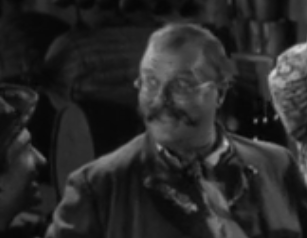
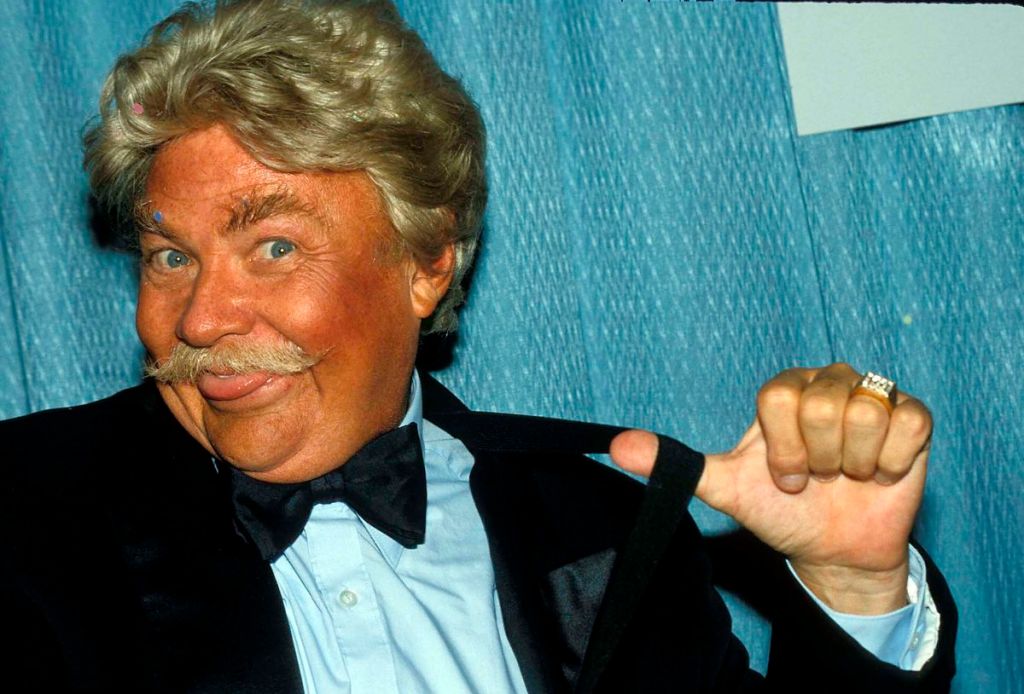
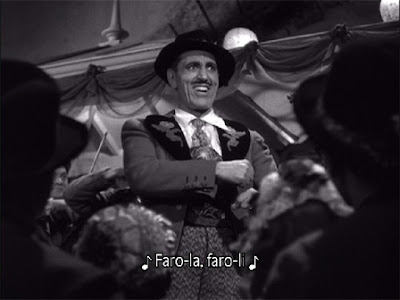
The logic seemed to run thus: Universal had had a hit with Frankenstein, and the Wolfman had been received well, so why not put the two into the same movie? (The answer to that question is: Because it’s pointless and stupid, but Universal execs didn’t see it that way.) What’s more, they felt no need to keep their growing stable of monsters associated with specific actors; they seemed to believe that actors and monsters were entirely interchangeable. So here we have the man who had played Frankenstein’s monster in the last movie (Chaney) now playing the Wolfman instead. And Lugosi, who earned his fame playing Dracula and in the last movie played Ygor, now plays Frankenstein’s monster. Meanwhile, Lionel Atwill, who had been Inspector Krogh in Son of Frankenstein, and then played Ludwig Frankenstein’s assistant in Ghost of Frankenstein, now has been drafted to play the mayor of Vasaria. Oh, and for good measure, a lot of screen time is given to a flamboyant Vasarian villager who looks a lot like Rip Taylor.
Lon Chaney, Jr. is a clunky actor. His character here is sad, melancholy, with an air of the tragic. I kept wanting to slap him out of it. His character on the screen seems more like an unemployed shoe salesman than a cursed werewolf. But since Chaney played the Wolfman in the first Wolfman movie (1941), they seem to have opted for continuity, in this case at least.
The Plot: The plot is contrived and silly, with plot holes large enough to drive Inga’s hay wagon through. It starts out promisingly enough, with grave robbers breaking into the coffin of one Larry Talbot (Chaney), who’d become a werewolf in 1941’s The Wolfman.
Quick tutorial for those of you who don’t know your Universal monster lore: a person who’s bitten (but not killed) by a werewolf becomes one himself. And as such, each time the moon is full, the afflicted individual will transform into a wolf and kill others. Once day breaks, the person is restored to his normal human form. The only way to end the cycle is for the person to be pierced with a silver bullet, or perhaps some other silver object.
Anyway, the grave robbers open Talbot’s grave, but unfortunately for them they chose the night of a full moon to do their work. You can guess what happens next….

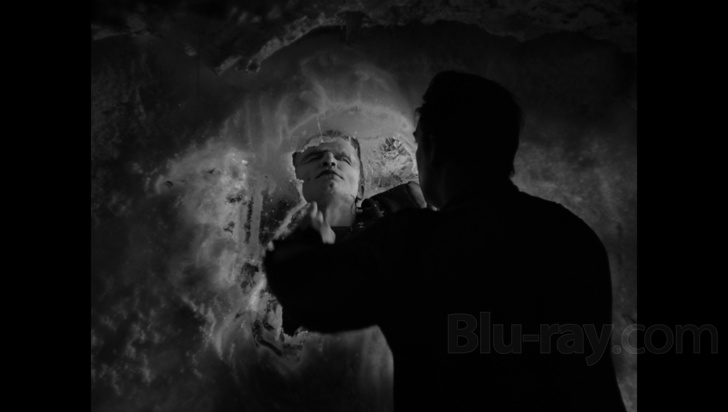
The first half of the movie is essentially your basic werewolf story–Chaney goes on a killing spree that night, and wakes outdoors in the morning in human form. He is found and sent to a hospital for a head wound (which was acquired in the earlier Wolfman film) where one Dr. Mannering treats him. Talbot comes to recognize his curse, and decides to find seek the help of Dr. Frankenstein (?!) as the one person who could end that curse. Chaney travels to Vasaria and learns, to his disappointment, that Dr. F had died in the last movie (Ghost of Frankenstein). But wait! Through some plot contrivances Chaney winds up at the old Frankenstein castle. And at exactly the halfway point of the movie (to the second!), he finds the creature frozen in ice. He cracks the ice with a rock, and the creature (played by Bela Lugosi) is free, alive and kicking.
Meanwhile, that doctor who’d originally treated Talbot back in Britain tracks him down for some reason, and becomes the star of the show. He becomes obsessed with Frankenstein’s experiments, and ends up continuing them himself, somehow with the object of transferring Talbot’s life energy to the creature. (I told you this was a silly plot.) As if it’s not clear enough that the doctor is taking on the role of Dr. Frankenstein, Universal decided to make his name “Frank.” I’m not making this up. Anyway, we eventually arrive at the climax, where Frank succeeds in fully restoring the creature just at the moment that Talbot (thanks to a full moon) transforms into the Wolfman. But then, a flood washes everyone and everything away when a villager (they guy who looks like Rip Taylor, above) blows up a dam.
This story feels very much like it was made up on the fly, like the campfire game where successive people add a short segment to an unscripted story. The result is a movie with all the continuity sensibilities of a Bugs Bunny cartoon.
The Monster: Ironically, Bela Lugosi plays the monster in exactly the same manner that he complained it would be presented back in 1931, when he’d turned down the role: stiff-armed, exaggerated, mechanical. (It’s said that Lugosi emphasized the outstretched arms because his character was supposed to have become blind (as we’d learned at the end of Ghost of Frankenstein.) Anyway, the result is a very clunky monster. And yet, for one brief moment, Lugosi gives us a glimpse of the cunning, diabolical look he was famous for with Dracula.
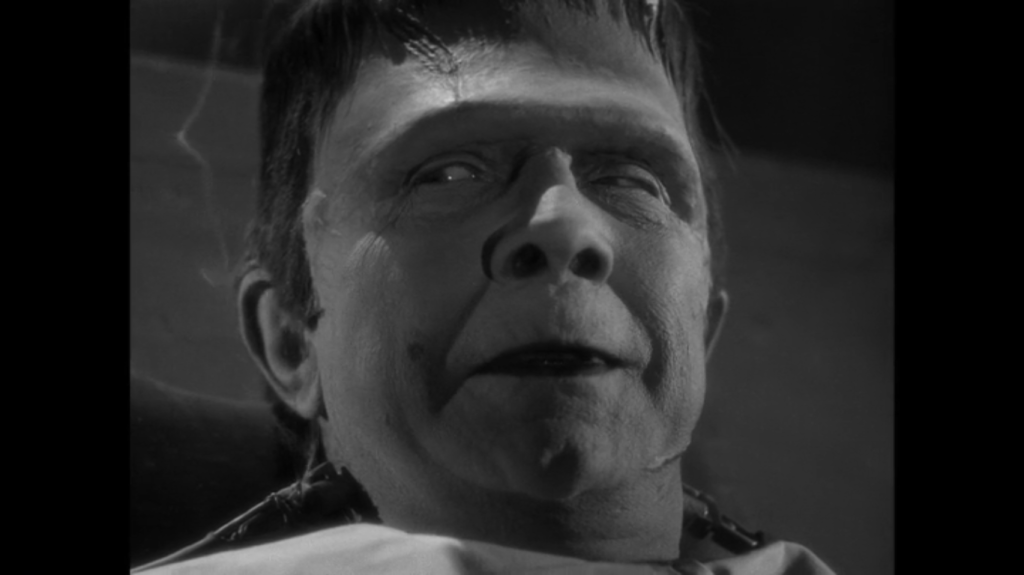
When this movie was shot, Lugosi had various speaking lines as the monster. But in test screenings, audiences laughed every time the Frankenstein monster spoke with that heavy Hungarian accent. So the decision was made to erase all of Lugosi’s speaking lines. And yet, Lugosi’s lips can clearly be seen moving in various scenes. (To get a sense of what the original lines had sounded like, check out this clip.)
The Atmosphere: The atmosphere of the film hews pretty closely to what we’ve come to expect for a Universal horror film. The opening scene in the Talbot crypt is a classic example, as are the scenes in Frankenstein’s ruined castle.

Inexplicably, though, the middle of the film contains a lengthy musical number that takes place during Vasaria’s Festival of New Wine. Perhaps this was to give the audience a break from the supposed nonstop drama and shock of this supposed horror movie. But it comes across as an odd and unnecessary interruption of whatever flow this movie had managed to develop.
General Comments: Universal’s monster cycle had clearly lost its way by the time of this movie. The casting is questionable, the sets are getting tired and cheap, the directing is uneven, the script is laughable, and the plot is absurd, even for a monster movie. Saddest of all for Frankenphiles is that the monster has become a two-dimensional caricature that is little more than a MacGuffin (to use a term coined by Alfred Hitchcock).
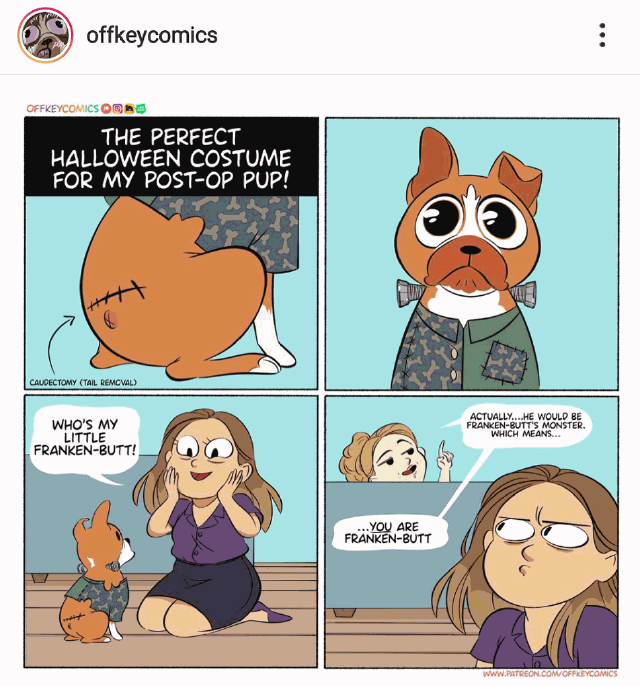
Incidently, the “Frankenstein” that the Wolfman meets is, obviously, Frankenstein’s monster. Doctor Frankenstein makes no appearance here. So, in working up the title for this film, Universal seems to have caved to the public’s common mischaracterization of Frankenstein’s monster as simply “Frankenstein.” It’s a point ably illustrated in the accompanying cartoon sent in by loyal reader Katelyn P. (who also happens to be my daughter-in-law).
Tomorrow: There’s hope! Karloff returns in House of Frankenstein (1944)…but not in the way you’d expect. Available on YouTube.

 Chasing Phantoms
almost as scary as when he met Abbot & Costello.
LikeLike
I can tell from the comments that folks are clamoring for A&C. You won’t be disappointed…
LikeLike
Are you going so far as to include Abbott & Costello meet Frankenstein???
Jonathan Chute Senior Pastor Rolling Hills UMC 26438 Crenshaw Blvd. Rolling Hills Estates, CA 90274 310-377-6771 ext. 301 jonathan@rhumc.org
>
LikeLike
You’ve anticipated Saturday’s post….
LikeLike
Did you send one out for Friday? For some reason, I think I was ghosted!
LikeLike
You’re right; somehow Friday’s post didn’t make it. I’m resolving that oversight now….
LikeLike