Well.
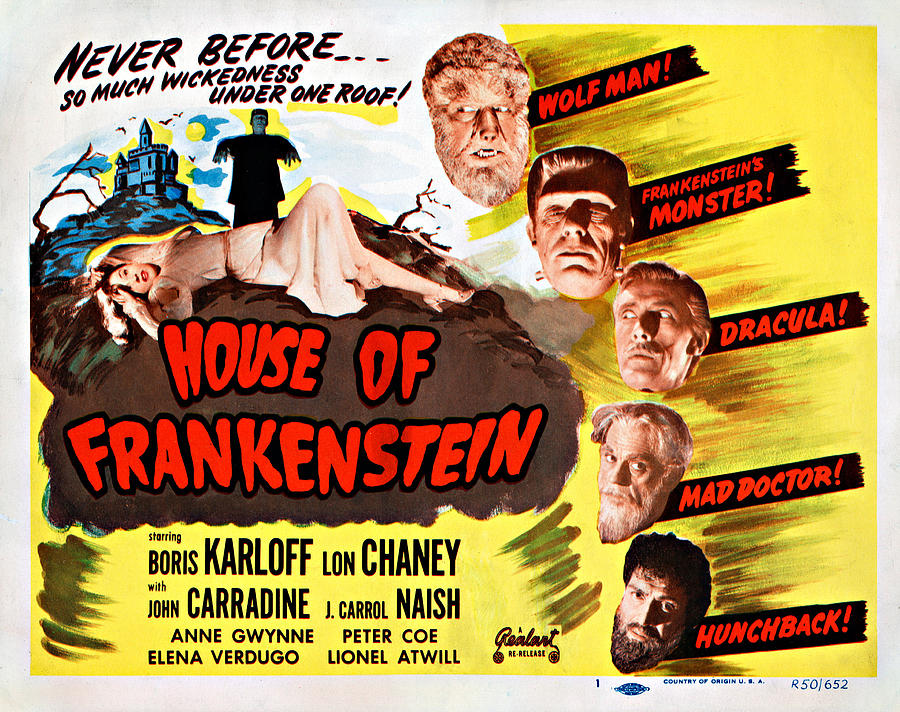
This must have been the conversation among Universal execs: “Frankenstein Meets the Wolfman did pretty well. What say we add even more monsters for our next picture?” And so was born House of Frankenstein, which was promoted as a five-monster picture: Three of them we know well at this point (Frankenstein’s monster, the Wolfman, and Dracula), but the other two aren’t exactly monsters (the “Mad Scientist” and the Hunchback). We’ll get to them in a bit.
The big news is that Karloff is back, and he’s deservedly at the center of this movie. But he doesn’t appear as Frankenstein’s monster. Instead, Karloff’s character (Dr. Niemann) is the brother of Dr. Frankenstein’s assistant (presumably Fritz from the first movie, I guess). Niemann learned from this brother many of Dr. Frankenstein’s secrets. And Niemann very much wants to continue Dr. Frankenstein’s experiments himself. So that makes Niemann the “Mad Scientist.” (One wonders why they didn’t just make him another Frankenstein relative.)
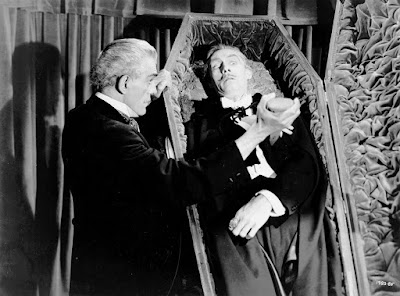
John Carradine plays Dracula, which I think was an odd choice. Gaunt, mustachioed, and American, Carradine looks nothing like the popular conception of Dracula. Lon Chaney reprises his role as the Wolfman, and Frankenstein’s monster is played by a then-popular western movie actor named Glenn Strange.

Rounding out the “monsters” is J. Carroll Naish, who plays “Daniel” (surely one of the least likely names for a supposed monster). Daniel happens to be a hunchback, and sure, he does some bad stuff like killing people for his “master,” the Mad Scientist. But Daniel is a sad figure, mocked by the woman he loves and mercilessly worked by Karloff. In fact, in my mind, Daniel is the only sympathetic character in this whole movie. Still, Universal played him up as “The Hunchback” (presumably to trade on the fame of the Hunchback of Notre Dame, who was of course played by Lon Chaney Sr., the father of the man who plays the Wolfman in this film).

The Plot: When the movie opens, Dr. Niemann is in prison with his hunchbacked assistant, Daniel, serving time for stealing bodies and such. But a freak storm allows the two of them to escape, and they set out (as one does) for Frankenstein’s castle. Along the way they encounter a traveling “chamber of horrors,” kill the proprietor, and accidentally bring to life the skeleton of Dracula. There ensues a brief sub-plot focused on Dracula, but he soon dies from exposure to sunlight, and Niemann and Daniel continue on their way journey to Frankenstein’s castle. Seriously: The segment with Dracula feels grafted on as an afterthought, and makes absolutely no contribution to the plot.
When Niemann and Daniel finally arrive at the castle, they discover the bodies of Frankenstein’s monster and the Wolfman frozen in ice. (Does this sound familiar? Recall that Larry Talbot, aka the Wolfman, had discovered Frankenstein’s monster frozen in ice in the same castle in the earlier movie.) Anyway, there’s a lot of stilted, obligatory exposition by characters to help us understand that the water came from when the villagers blew up the dam in the last movie.
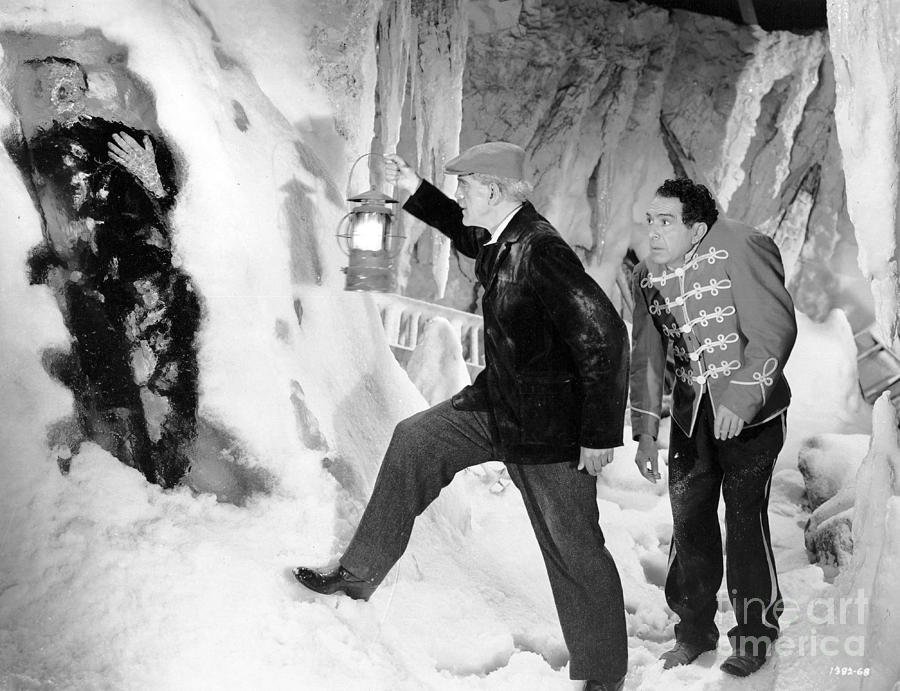
Karloff does what any of us would do upon encountering two unholy, lethal monsters; he ponders a moment and opines, “They may know where the records are! We’ll set them free, and they’ll help us.” So Niemann and Daniel thaw out the bodies. The monster is in some kind of coma, but the wolfman immediately transforms back into Larry Talbot. And Larry’s upset: “Why did you free me from the ice that imprisoned the beast within me?”
We now move to the brain-swapping fiesta: In order to convince Larry to help him find Dr. Frankenstein’s records, Niemann promises that he’ll transplant Larry’s werewolf brain into the monster’s head. (I’m not sure why this would be an improvement, but OK). Conveniently, Daniel wants for his own brain to be transplanted into Larry’s body, because Daniel doesn’t wants to use the new body to attract a gypsy girl that they’ve picked up along the way. Meanwhile, Niemann just wants to revive the monster.
Then things go awry, and all the monsters end up dead. We already know about Dracula, who met his demise the first 25 minutes or so. The gypsy girl, who has fallen for Larry, learns that he’s a werewolf and shoots him with a silver bullet just as he’s killing her. So they’re both now gone. Then Daniel, who loved the gypsy girl and blames Niemann for her death, strangles Niemann, but he’s interrrupted by the monster, who Niemann has just brought to life, and the monster throws Daniel out a window, to his death. The monster then picks up the injured Niemann, and helps to lead him out of the castle just as the villagers, with their torches, storm the castle. But the monster encounters quicksand, and he and Niemann sink to their deaths.

The Monster: Glenn Strange was a prolific actor who almost exclusively did westerns. But for this movie, his 6’5″ frame seemed to fit the bill for Frankenstein’s monster. In fact, legend has it that Strange was working on a western at Universal when the make-up guy, Jack Pierce, made up Strange to look like Frankenstein, just for fun. The result was so good that Strange would later be cast for this movie. It’s said that movie audiences accepted Strange as the monster–certainly better than they accepted Lugosi in that role. And as if to put a fine point on it, when Karloff died in 1969, the Frankenstein photo that accompanied his AP obituary was actually that of Glenn Strange. If you’re interested in learning more about Strange, there’s a good article here.
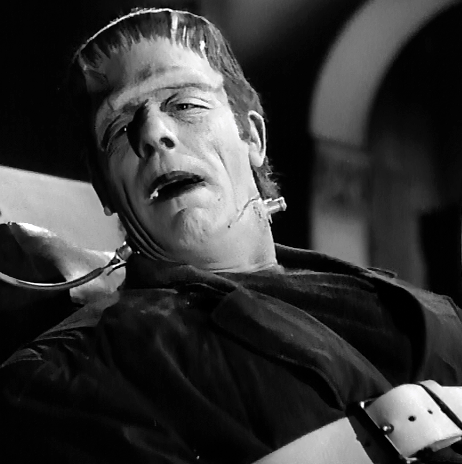
Anyway, the monster doesn’t come to life in this movie until the final scenes. It’s not a huge role, but it’s an important one, given the movie’s title and, perhaps more importantly, given the ironic twist of having the original monster (Karloff) meeting his demise alongside the new one (Strange). Strange, by the way, would go on to play the monster in several more Universal films.
The Atmosphere: I really liked the feel of this movie (though the plot stunk). Although the hodgepodge of scenes really don’t hang together, each one is a gloomy, atmospheric set-piece. The castle interiors, the barren countryside shots, the dank prison, the creepy traveling chamber of horrors, the usual Universal mad-scientist’s laboratory, even the Gypsy camp. Every scene has that brooding, other-worldly quality that makes you feel uneasy, even while you’re scoffing at the outlandish dialogue.
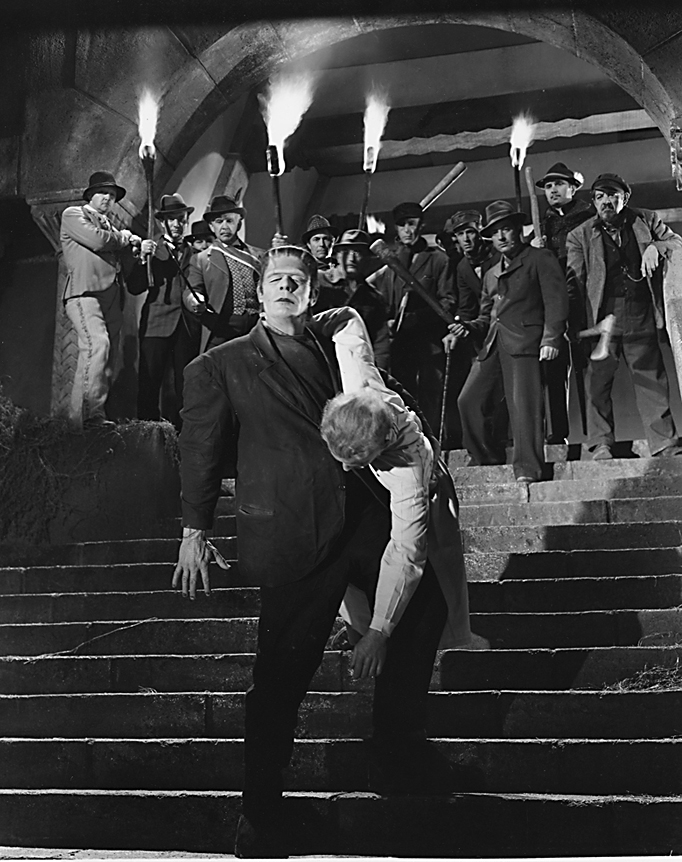


General Comments: In many ways, this is a silly and pointless story. There’s no real story arc (or perhaps there are too many competing subplots). You really don’t care much about the fate of most of the principals, and there’s very little in the way of scary scenes. As noted above, the atmosphere is thick and well-done, but it’s not enough to carry a film for an hour and a half. Still, it’s almost worth it to watch Karloff at work again. Even when he plays a mad scientist, his believable earnestness and captivating charm show through.
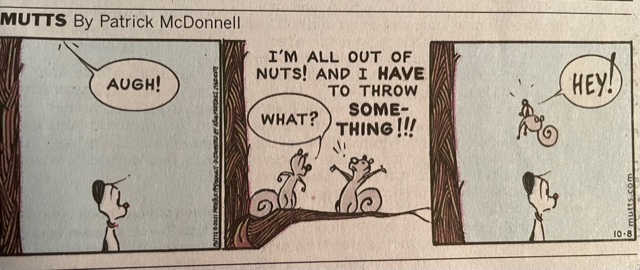
FRANKENFUNNIES: We’ve received another Frankenstein-related cartoon, this one from loyal reader Jonathan C. The connection to Frankenstein, though, is not obvious. See if you can divine the link:
Tomorrow: You’ll look back on today’s film as high art when you experience Abbott and Costello Meet Frankenstein. (That will be the last of the Universal films that we review, by the way.) You can watch it on YouTube. At the very least, check out this trailer.

 Chasing Phantoms