
In 1973 I was a 12 year old kid who loved monster movies. That fall NBC started breathlessly advertising its miniseries, “Frankenstein: The True Story,” which NBC promised would portray “the great story as [Mary] Shelley wrote it.” Finally, after all the liberties taken by Universal and Hammer and even Rankin-Bass, NBC was here to authoritatively present a genuine portrayal of the actual book! I counted down the days until November 30 and December 1, when the “miniseries” would be broadcast. I watched both nights with rapt attention, and came away feeling enlightened and a little superior for finally understanding the “true story” of Frankenstein.
It would be many years before I would actually read the book and discover what a load of crap NBC had foisted on me. While the miniseries was well done, with good production values, excellent acting, great makeup, impressive sets, and a very literate script, it simply wasn’t Mary Shelley’s story. Normally I wouldn’t quibble with a movie that takes extreme liberties in re-interpreting the source material. But when the title claims that this is the “true story,” and when the advertising copy emphasizes that it faithfully depicts Shelley’s tale, it’s fair to criticize major departures from the original.

Now, to be clear, this was a made-for-TV movie. But it really doesn’t feel like one. The actors are top-notch (James Mason, Jane Seymour, etc), the sets are well-presented, it has some great location shots. It also pushed the envelope on the portrayal of surgeries and beheadings and such, at least by then-current television standards. This movie could have been released in the theaters. They just should have changed the title…
The Plot: Victor Frankenstein is a normal, young German man with a fiance and an English accent. When his younger brother dies in a tragic boat accident, Victor dedicates his life to learning how medical science could be used to overcome death. He goes back to college and meets an unorthodox professor named Henri Clerval, who has been conducting experiments on reanimating dead beings. Soon Henri takes Victor as a protege, and together they piece together a man that they plan to bring to life. It’s worth noting that this plot has already departed from Shelly’s book. In the original, Victor was not motivated by the death of any sibling, and he discovered how to create a living being himself. The name Henri Clerval does appear in Shelley’s book, but it belongs to Victor’s friend, not a professor involved in reanimation experiments.

Anyway, Henri dies the night before they are to bring the body to life, and the next day Victor proceeds with the task himself, after first transplanting Henri’s brain into the body. He successfully brings to life a handsome and intelligent man (that, oddly, is never given a name. Let’s call him Michael Sarrazin, which is the name of the actor that portrayed him.) Victor is overjoyed at his success, and seems to genuinely admire and befriend this newly-created being. Again this is a huge departure from Shelley’s book, as in the book Victor immediately loathed the creature, which was ugly and deformed.
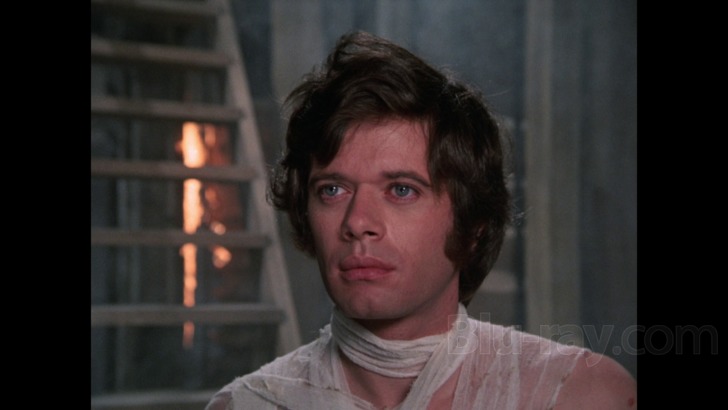
As time passes, though, Michael Sarrazin begins to regress, as the body parts he’s made of begin to degrade. With this change in appearance, Victor comes to loathe the good-natured, child-like creature. It’s truly sad and tragic how Victor distances himself from his creation, and the creature, robbed of his approving “parent,” despairs and throws himself off of a high cliff into the ocean. So you think that would be the end of things.
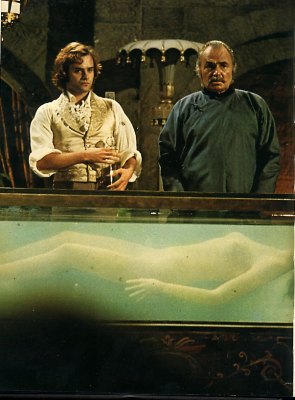
But: Henri’s old partner, a Dr. Polidori (played by an oily James Mason, who almost steals the show), discovers Victor’s creature, that somehow survived the jump into the ocean. Polidori bends the creature to his own purposes, and he (Michael Sarrazin) ends up killing a few people. Polidori then blackmails Victor on his wedding day to get him to help create a female creature. You see, Polidori knows why Victor’s creature ended up regressing, and Polidori plans to avoid that issue with his new creature. Victor agrees to help, and they create a beautiful woman (Jane Seymour) that Polidori calls “Prima,” since she’s the first of a new race. More to the point, Polidori sees Prima as the instrument he will use to connect with powerful leaders in Europe. (Let’s again note that this has nothing to do with Shelley’s book; in the book, Victor starts to build a female mate for his creature, but he destroys her before he finishes.)

With Prima now on the scene, Polidori and Victor burn up Michael Sarrazin in a house. They throw a coming-out ball to introduce Prima to polite society. But (you could have expected this) Michael Sarrazin shows up and pulls off her head.

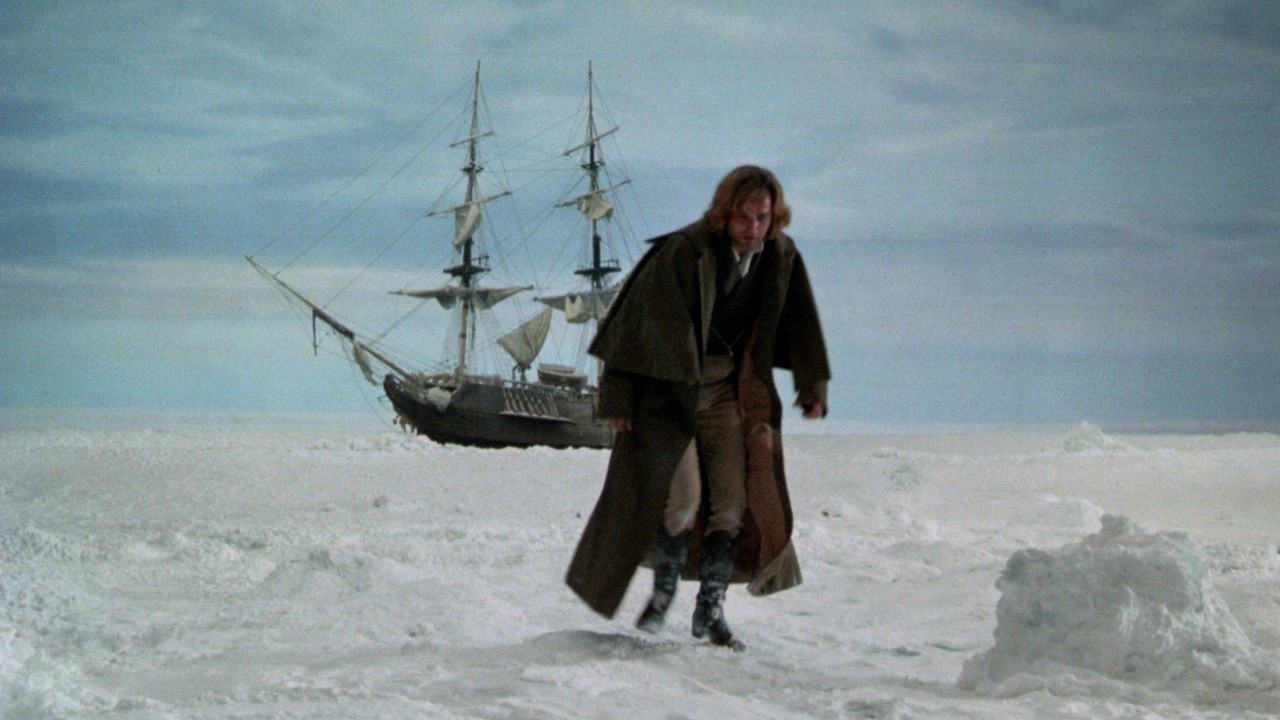
Victor and his wife understandably feel like life here in London has taken a bad turn, so they charter a ship to America to start over. But it turns out that Polidori had somehow gotten aboard. He essentially blackmails Victor again, saying that he’ll pin the creature’s murders on him if he doesn’t help Polidori with a new set of experiments. But wait: Michael Sarrazin is also aboard! Doesn’t this guy ever die? And he’s ticked that Polidori tried to burn him up, so he kills Polidori. And then, for good measure, he kills Victor’s wife. The crew abandons ship, and the creature pilots the vessel to the North Pole, where, finally, we reconnect with Shelley’s story. The creature goes ashore, and Victor, with nothing left to live for, follows. An avalanche buries them both. The end.
The Monster: I have to admit that the decision to portray the creature as handsome (at least initially) makes for an interesting plot. Victor is thrilled with his creation (unlike in the original story), and we end up rooting for the two of them. Then, when the creature’s body begins to turn ugly, we feel strong sympathy for him. (At least I do; it’s a metaphor for my puberty) It’s painful to see Victor rejecting him, simply on the basis of his appearance. The creature seems hurt and confused.

As noted above, the creature is played by Michael Sarrazin, a Canadian actor who ended up appearing in a number of Hollywood movies, but never really hit the big time. He died of cancer in 2011.
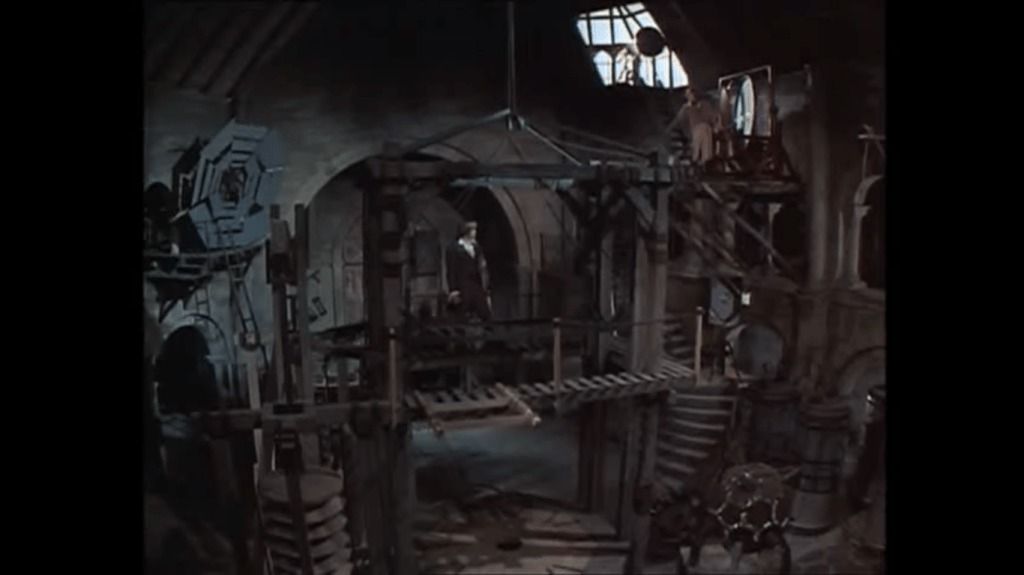
The Atmosphere: The look of this movie is sumptuous, sort of like one of those BBC series like “Upstairs, Downstairs.” The filmmakers have a real eye for detail with the period costumes, the sweeping location shots, and the convincing sets. Frankenstein’s laboratory is kind of an early steam-punk, before steampunk was even a thing.
As noted above, this film includes some gory scenes, and I’ve always felt that such an approach cheapens a horror film. But I suppose it could be argued that the explicit shots of illicit surgeries and such is necessary to establish the gruesome side of Frankenstein’s craft.
General Comments: At over three hours (when you combine parts 1 and 2), this is a long movie. There are definitely places where it feels like they padded it out a bit. But overall it’s an engaging film with good acting and a good plot. So, if you go into this not expecting a faithful depiction of Shelley’s book, you’re in for an entertaining few hours. What’s more, the movie does a better job of raising issues of life/death, beauty, morality, and love than do most Frankenstein movies.
FRANKELLANEOUS: Alert reader Chris F. pointed out that the actor who played the creature in Horror of Frankenstein (David Prowse) had also portrayed Darth Vader in the Star Wars movies. I suppose that the fact one man played both parts is why we never saw the ultimate smack-down, “Frankenstein Vs. Darth Vader.”
Tomorrow it’s 1977’s Terror of Frankenstein (which had originally been titled “Victor Frankenstein”). Watch it for free on YouTube.

 Chasing Phantoms
It was simply the best movie ever made!
LikeLike