

This is probably the most intense portrayal of the Frankenstein story we’ve reviewed so far. That’s not necessarily to say it’s the best (though it is, in my opinion, very good). But in terms of drama, character development, and suspense, this movie is exceptional. It also is one of the most faithful to Shelley’s book. So, unlike Frankenstein: The True Story, Mary Shelley’s Frankenstein is an apt title.
This movie has its flaws. As a product of the 1990s, it gets a little too impressed with its own computer-generated special effects. And the movie kind of hyperventilates near its big climax. But even with the soulless CGI, this remains a character-driven movie, and an engaging one at that. And keeping your interest is no small feat for a movie of over 2 hours.
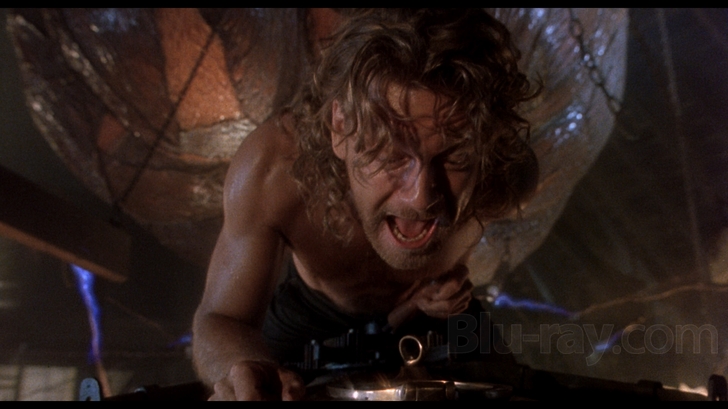
The Plot: As noted above, this is perhaps the most faithful portrayal of Shelley’s book. It opens with a late-18th century research vessel getting stuck in the Arctic, when an exhausted Victor Frankenstein (Kenneth Branagh) collapses on the ice in front of the ship. True to Shelley’s story, we then hear Victor’s narrative about how he came to be here. It takes the form of a long flashback, starting with Victor’s childhood and a (somewhat treacly, for a movie like this) romance with his stepsister Elizabeth, played by Helena Bonham Carter.

Along the way Victor’s mother dies, and he makes the melodramatic declaration that “No one ever need die. I will stop this. I promise.” To fulfill that promise, he goes to medical school where he studies under a Professor Waldman (Monty Python’s John Cleese [!]), who has conducted similar research of his own. But Waldman warns Victor that the goal should be the preservation of life, not the creation of it. When Victor asks why not, Waldman says simply “Because it would result in an abomination.”
But Waldman is killed in scene with an anti-vaxer (this was 25 years before Covid!), and Victor obtains Waldman’s journals and pursues his research on creating life.

A creature (Robert DeNiro [!]) is created, and he’s understandably perplexed about his sudden appearance on the scene. As with Shelley’s book, Victor immediately regrets what he has done, loathes the creature, and abandons it, assuming it will just die without help and attention.
But, as we know, the creature doesn’t just disappear, but quickly learns the “ways of man.” He has taken Victor’s journal, and learns about his own creation. And then there’s that pivotal segment with the blind man (both in Shelley’s book and here), which is a poignant and valuable segment of the story. The creature is spurned by those (unlike the blind man) who can see him and who react to his ugliness. In fact, far from being born evil, the creature (both in the novel and here) learns cruelty from others. The creature soon realizes that he has no place in this world. So he pursues his creator (Frankenstein) and demands that he make him a mate just like himself.
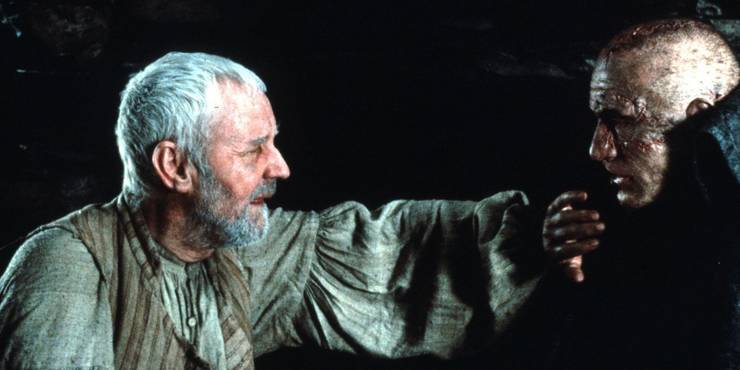
Victor refuses to make a bride, so the creature begins killing off Victor’s family to get his revenge, reaching its peak when he kills Victor’s own bride, Elizabeth, on their wedding night. But here’s where this movie suddenly and inexplicably takes a sharp turn away from the original story: Victor carries the body of Elizabeth up to his laboratory, chops her head off, and attaches it to another female body (that he just happened to have up there?)
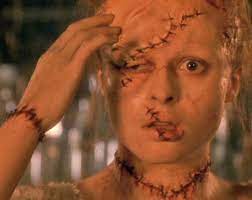
I suppose Victor thinks he can just pick up where he left off with his bride, but the creature shows up and claims her as his mate. The bride is caught between the two of them–the man who created her, and the creature who was made in the same way–and rather than choose, she becomes disgusted with the whole situation and burns herself to death. (Don’t you hate it when that happens?)
With that silly and unneeded detour out of the way, we get back to the original story: With nothing else to live for, Victor tracks the creature up to the Arctic, where Victor encounters Captain Walton as we saw at the beginning of the movie. With the flashback now played out, Victor dies and the creature comes onto the ship and finds Victor’s body. He weeps. Captain Walton, who’d considered Victor’s tale to be the ravings of a madman, now sees that the story was true. “Who are you?” he asks the creature. “He never gave me a name,” is the reply. “Why do you weep,” Walton asks. “Because he was my father.” Poignant stuff, that economically summarizes the conversation that Shelley wrote between the two. There’s then some dramatic scenes of a funeral pyre that reimagine a brief reference in Shelley’s novel. And then, in a direct copy of the scene from 1984’s Frankenstein (but not in Shelley’s novel), Walton, having witnessed Victor’s cautionary tale of monomania, decides to abandon his dangerous quest for the north pole and tells his crew that they’re going home. (To be fair, there is a line in Shelley’s book where a dying Victor tells Walton, “Farewell, Walton! Seek happiness in tranquillity [sic], and avoid ambition, even if it be only the apparently innocent one of distinguishing yourself in science and discoveries.” One could imagine Walton taking that to heart.)

The Monster: I never would have imagined De Niro for this part, but I have to admit that his is one of the best portrayals of the creature. He has deep scars from being stitched together, and speaks as one who has recently discovered a facility for speech. His is simultaneously a touching and frightening portrayal.
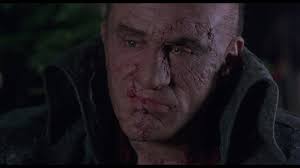
The process of creating the creature is portrayed as messy and dirty and frankly disgusting. And when it emerges from a tank of amniotic fluid, we can identify with Victor’s immediate revulsion.
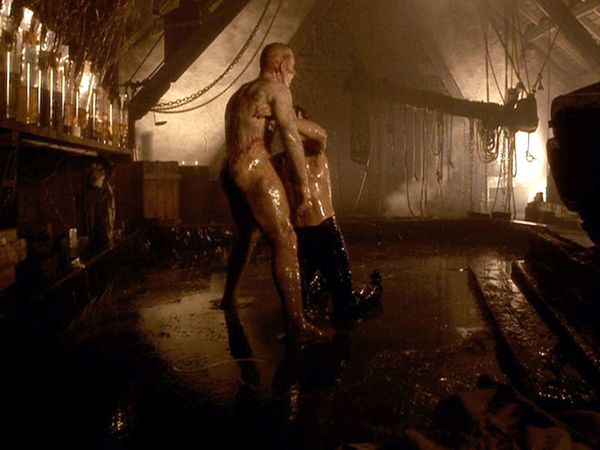
The Atmosphere: The first part of this movie feels like a Merchant Ivory romance. But it takes a dark turn when Victor goes off to college, and it seems to revel in in-you-face scenes of childbirth bleeding, a pregnant woman’s water breaking, decapitations, hangings, and all manner of other disgusting things that can happen to a body. One wonders if Branagh realizes that you can imply plot developments without having to detail them in all their gory detail?

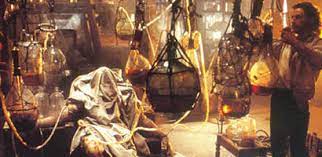
The movie does effectively convey the gritty, unclean and unholy aspect of creating life from corpses. The scenes of Frankenstein’s lab or positively disgusting, as are the scenes of the creature ripping Elizabeth’s beating heart from her chest, and Frankenstein grafting her head onto another body.
There’s also a few ill-advised flourishes, like a slow-motion fight scene that looks like something out of The Matrix. Also, Victor’s friend Henri Clerval (played by a lost-looking Tom Hulce) appears primarily just for comic relief.
The movie has an epic feel to it, and runs for over two hours. It’s got plenty of drama and pathos, and excellent acting….so it seems entirely unnecessary for it to employ that bombastic, soaring music in a misguided attempt to elevate the excitement. Instead, the musical score often becomes intrusive and distracting.
Overall, the movie is arresting, but it often feels like its a little too self-impressed.
General Comments: I wanted not to like this movie. I was prepared to be irritated by Kenneth Branagh’s hubris, and, c’mon, De Niro as the creature?? But for the most part, this movie works. I give the credit more to De Niro than to Branagh. De Niro simultaneously conveys anguish, confusion, anger, and also gentleness, wonder, and even love. All those feelings swirl inside him as he tries to figure out how to respond to his mistreatment by others. The questions he asks are haunting: What of my soul? Do I have one ? Who are these people of whom I am comprised. Did you ever consider the consequences of your actions? You gave me life, and then you left me to die. Who am I?

Overall, this movie is a powerful, poignant, and thoughtful take on the Frankenstein story that, with a few exceptions (notably the pointless and silly resurrection of Elizabeth) respects Mary Shelley’s original work.
Tomorrow we go to a significantly less serious portrayal of the Frankenstein story. Tim Burton’s Frankenweenie is up–you can watch the original, short, live-action version here (for free, starting at the 6 minute mark), or, if you’re insane, you could instead watch the later, full-length, animated version (but you’ll have to pay).

 Chasing Phantoms
Trivia question: In what Grateful Dead song are Mary Shelley and Frankenstein acknowledged?
Maybe there’s still a chance you’ll give The Dead a shout-out before your favorite holiday? They were right there with your theme.
From: Chasing Phantoms Date: Wednesday, October 27, 2021 at 10:53 AM To: ronpostrel@gmail.com Subject: [New post] Mary Shelley’s Frankenstein (1994) steveboilard posted: ” This is probably the most intense portrayal of the Frankenstein story we’ve reviewed so far. That’s not necessarily to say it’s the best (though it is, in my opinion, very good). But in terms of drama, character development, and suspense, this movie “
LikeLike
Ramble On Rose! “Just like Mary Shelley, Just like Frankenstein, Clank your chains…”
The same song also mentions the Wolfman (although it’s Wolfman Jack).
LikeLike