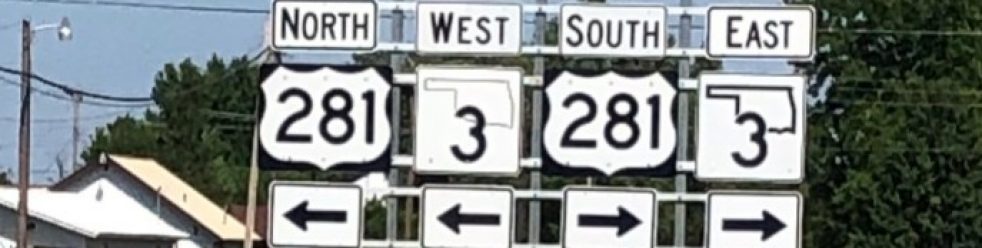
So, here we are in the final state of this two-week odyssey. Not only have we traveled through 11 states (VT, NY, PA, OH, MI, WI, MN, ND, MT, ID, WA), but along the way we’ve seemingly experienced most of the types of terrain this country has to offer. For example, today I left behind the green mountains of western Montana and Idaho, and entered the flat, arid, scrub brush-covered badlands of eastern Washington.
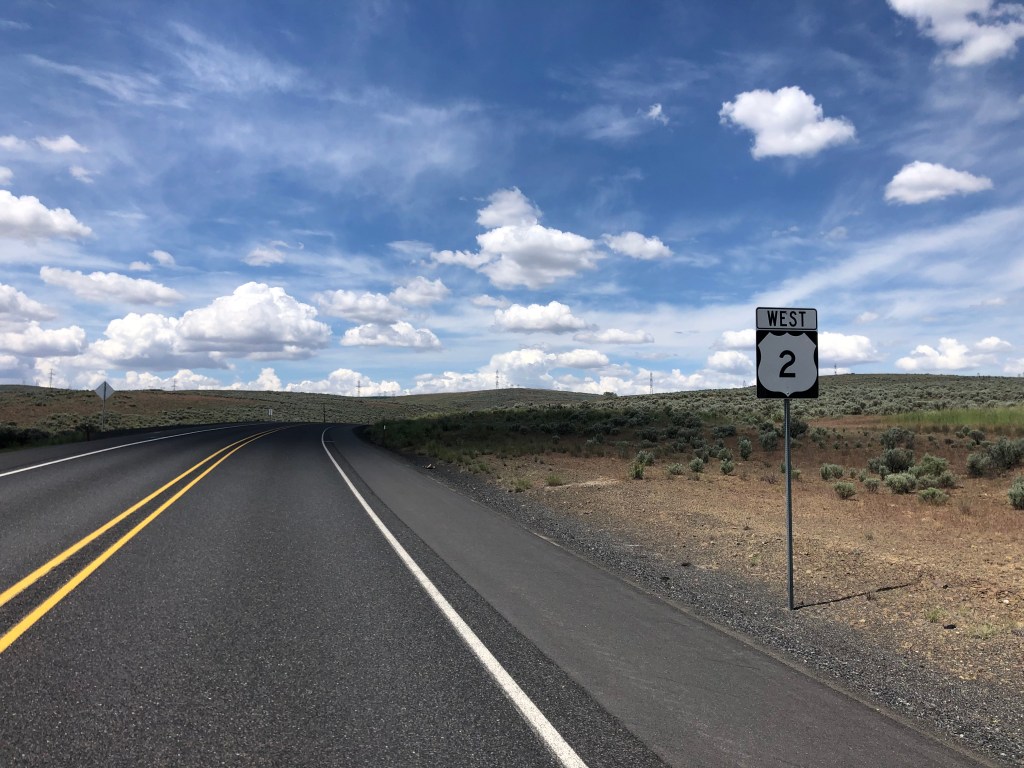
There’s not a lot of settlements out in this part of the country. One of the isolated towns I drove through this morning was Wilbur (pop: 900). It’s worth quoting Wikipedia about how the town got its name:
Just prior to the construction of the Central Washington Railroad line in 1889, no towns existed west of Davenport in Lincoln County. One place along the line, “Wild Goose Bill’s Ranch,” run by Samuel Wilbur Condit, was assigned a post office by the Federal government. Condit was 62 years old and known throughout the region as Wild Goose Bill when he and another man shot each other to death on Jan. 21, 1895. Condit platted the town that bears his middle name “Wilbur,” though he didn’t have anything to do with the naming. Goosetown was a consideration, until the blacksmith’s wife complained that she would never live in a place with such a silly name. Instead, the name Wilbur was chosen by town surveyors.
OK, so knowing that, check out this mascot next to the visitor’s center:
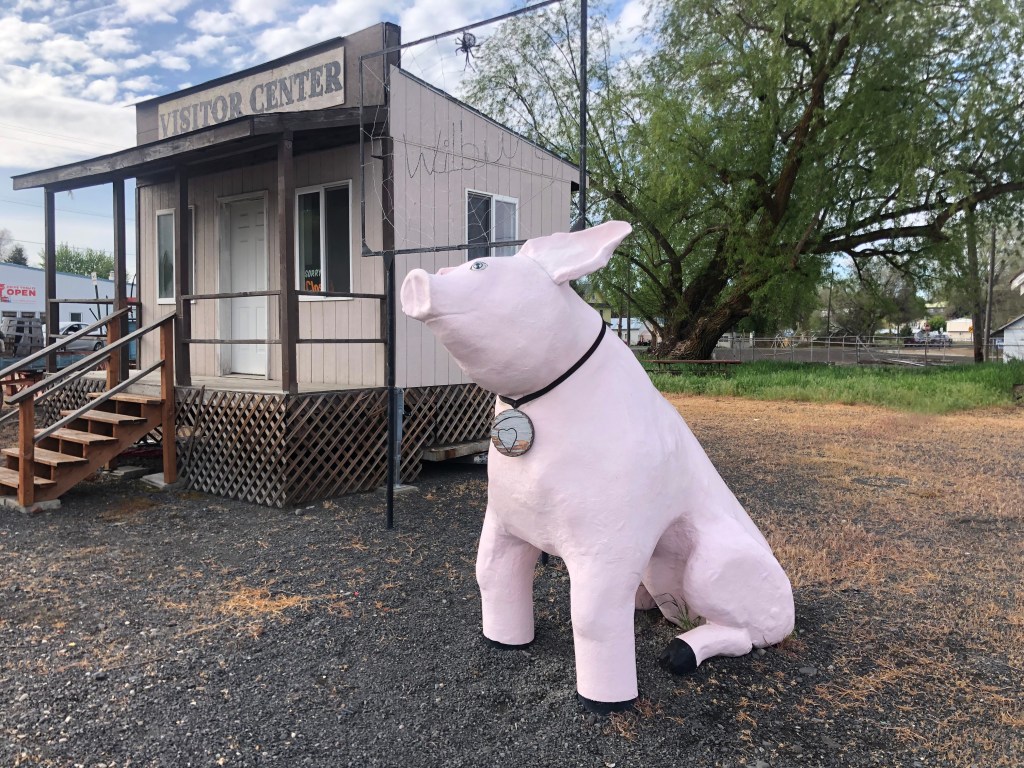
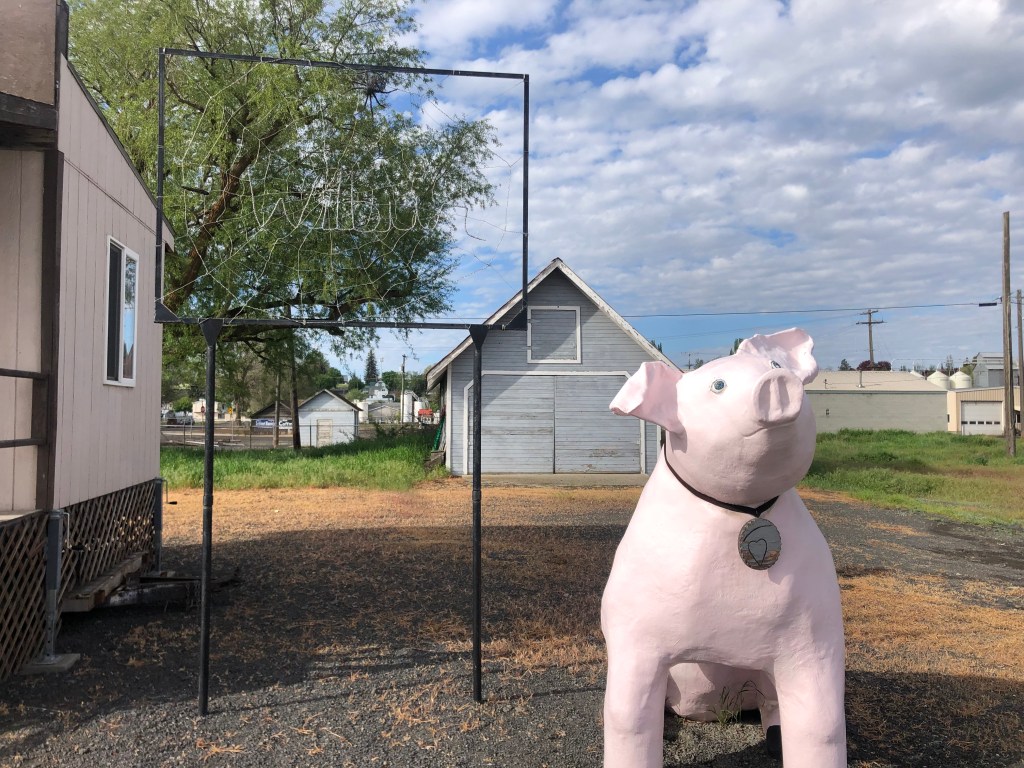
I won”t comment on the unusual shape of the anorexic pig, but I will note that a wire spiderweb (barely visible in the below photo) bears the name Wilbur. Clearly the Chamber (or whoever is responsible for this pig) doesn’t know the true origin of the town’s name. But E. B. White must be smiling.
A little past Wilbur on Route 2 is the town of Coulee City (pop: 550). With all due respect, it’s not much of a town…but it is home to “the world’s largest waterfall.” The only catch is there’s no water. Let me explain.
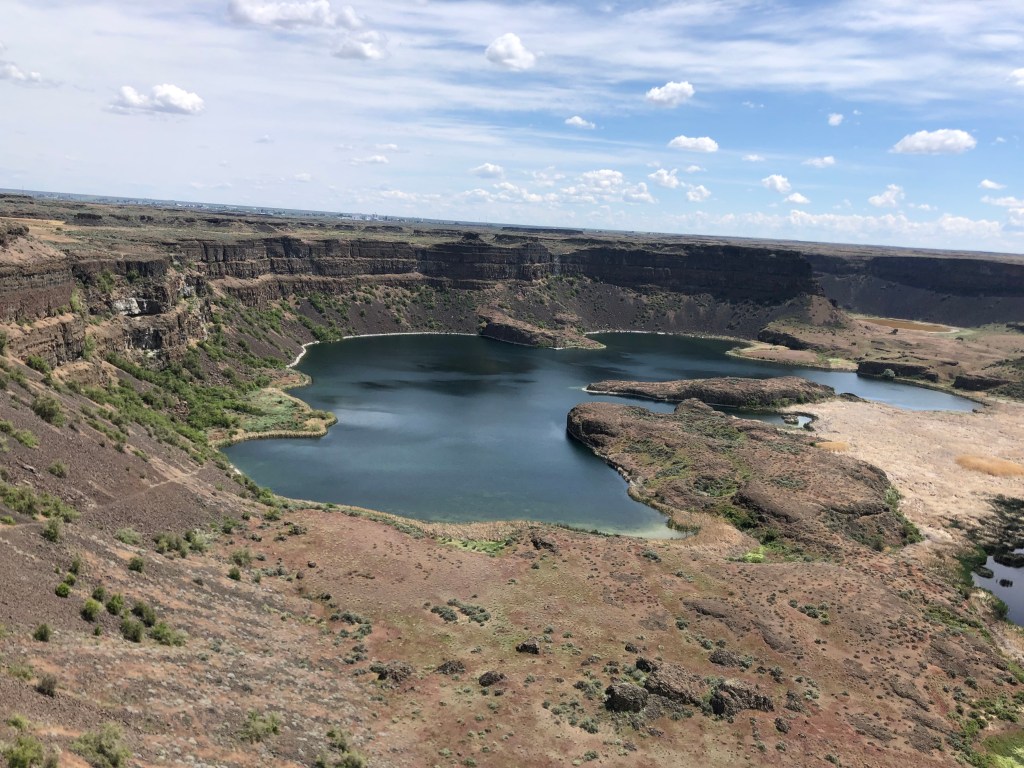
Scientists have determined that at the end of the last ice age, an ice dam blocked a river in Idaho, which gradually created an enormous lake that reached into Montana. Eventually the ice dam failed, and the stored water rushed westward toward the Pacific, scouring the landscape along the way. This evidently happened a number of times, and the hydraulic activity created these “coulees” (deep ravines), which in turn produced enormous falls when the next flood occurred. The falls at Coulee City were over 400 feet high and 3.5 miles across.
All this reminded me of a cul-de-sac near my childhood home named Grand Coulee Court. It’s where Phillip Waters lived. (I’m not making up that serendipous surname.) Did this ravine I was now taking photos of–called a “coulee”–relate in some way to “Grand Coulee”? Then, somewhere in the back of my mind, I remembered there’s a “Grand Coulee Dam,” though I didn’t know any details about it. A quick consultation of my trusty road atlas (that I’ve been carrying around since 2010) informed me that the Grand Coulee Dam was a short 20-minute detour from Coulee City. So off I went.
I won’t bore you with the details, but the basic points are these: The US Bureau of Reclamation built the Grand Coulee Dam in the decade leading up to World War II. The dam is on the Columbia River, creating a reservoir (Lake Roosevelt) from which water is pumped to irrigate farms in central Washington. In addition, water passing through the dam powers generators which produce the largest amount of hydroelectric power in the US (about 21 billion kilowatt hours each year.) I learned all this on a guided tour, which took me into the pump stations and onto the top of the dam.
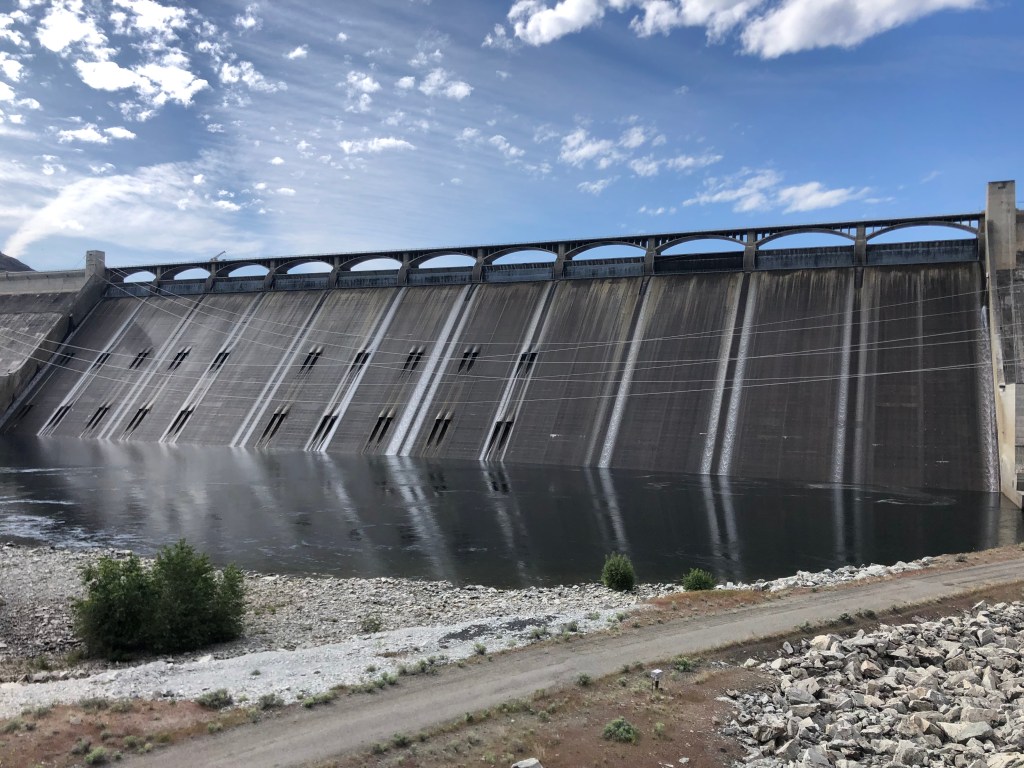
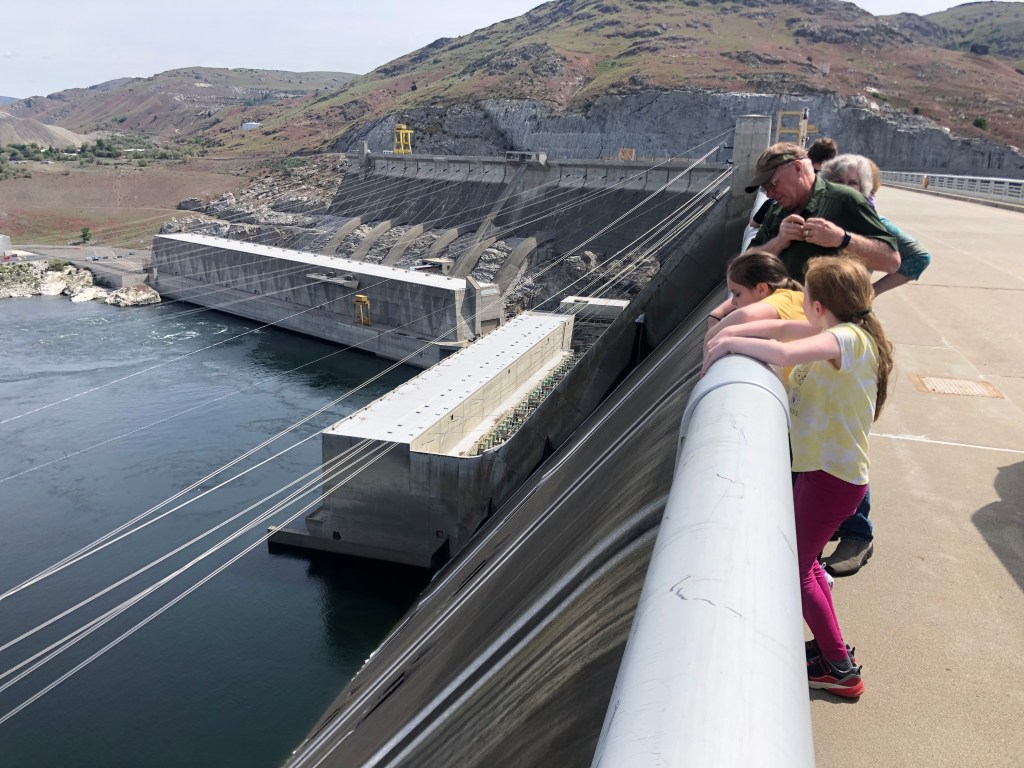
And if you’re interested, here’s a short video showing my view looking over the edge of the dam, on the downstream side.
Around noon I wound up this educational detour and reconnected with that familiar friend, Route 2. Along the way I drove through “Electric City” (pop: 1,000), whose name relates to the nearby Grand Coulee Dam’s generating capacity. But what struck me about Electric City was not its proximity to someone else’s generators, but rather a large collection of homemade windmill sculptures in a “windmill garden” next to a park.
The sculptures were created by a hobbyist metalworker named Emil Gehrke, and they’ve supposedly been featured in National Geographic magazine. Gehrke created the sculptures from scrap that he collected from all over the world. He displayed the sculptures in his yard for years, but after his death in 1979 (at age 95) most of them were moved to this park.
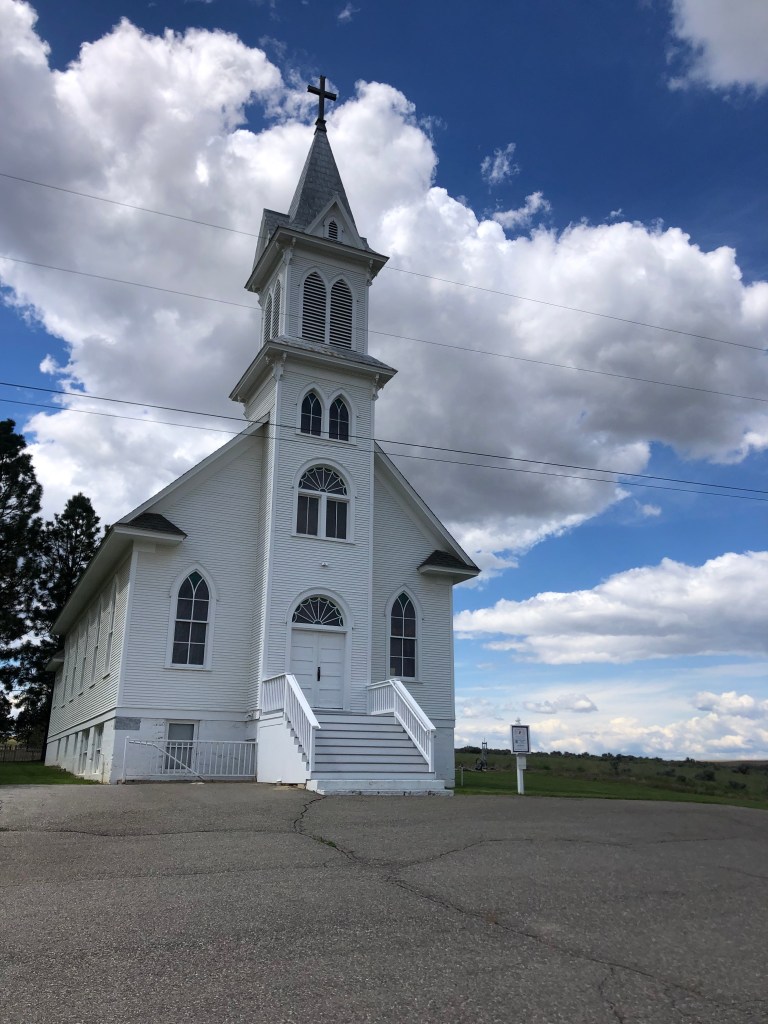
Soon I reconnected with Route 2 and returned to my westward trek. I came to the town of Waterville, where I encountered the daily, obligatory former church building. Today’s ex-church started out as St. Paul’s Lutheran Church in 1915. It closed in 1968, when the congregation built a new church along with another Lutheran congregation. The old building was purchased by the local historical society in 2006, and it’s now used as a community center and wedding venue. The historical society did an impressive job of restoring the structure.
I am spending the night in Wenatchee (pop: 35,000, which is one of the largest towns on this trip). Wenatchee is a comfortable, seemingly prosperous town at the confluence of the Wenatchee and Columbia Rivers, with lots of outdoor venues for enjoying the great weather. It calls itself “the apple capital of the world,” in reference to its many apple orchards.
I’ll end my description of today’s travels with these two semi-creepy floating faces that evidently had been employed for advertising purposes in the middle of the last century.
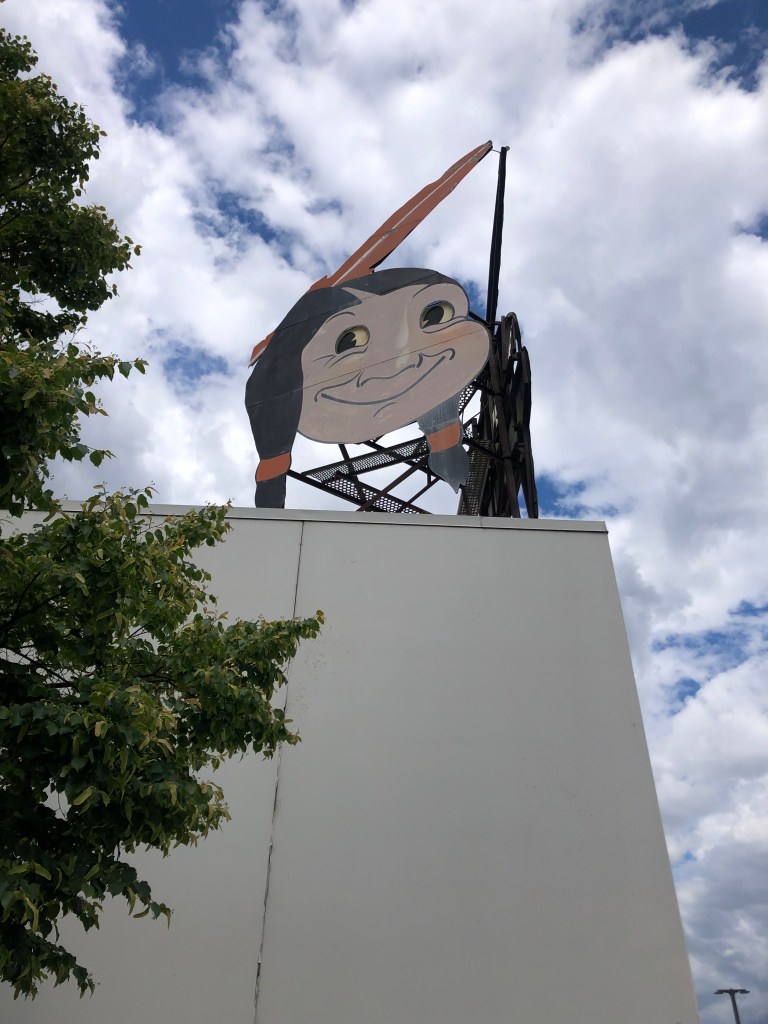
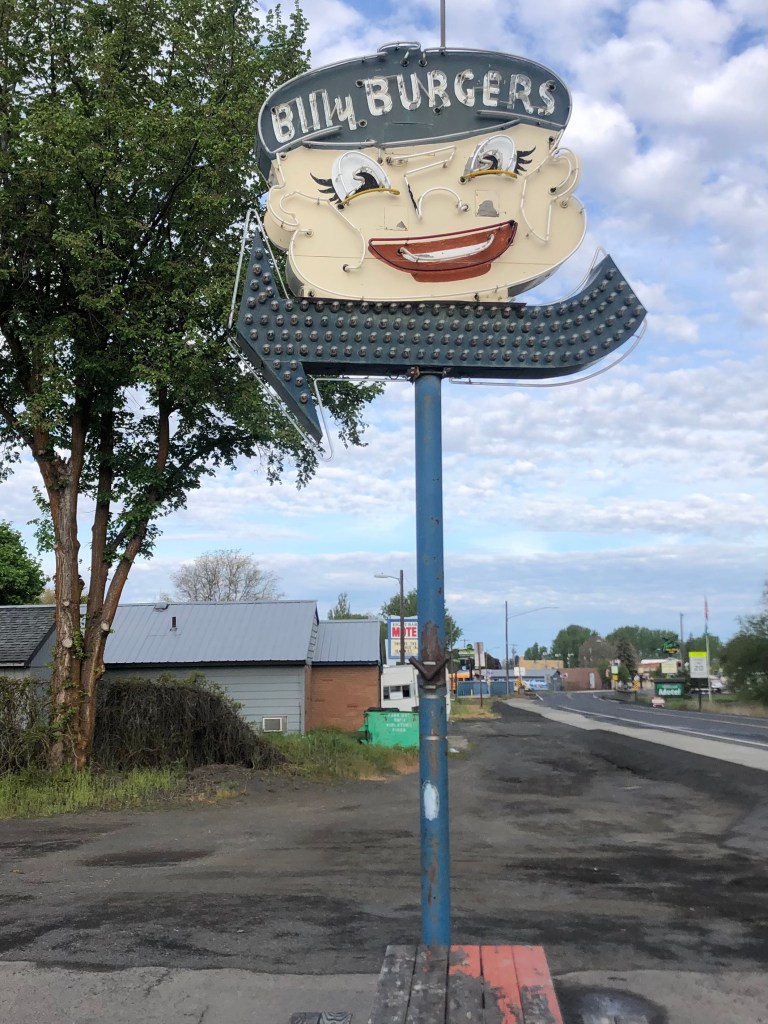
Tomorrow I’m planning to reach the end of Route 2, in Everett.
Brew(s) of the Day
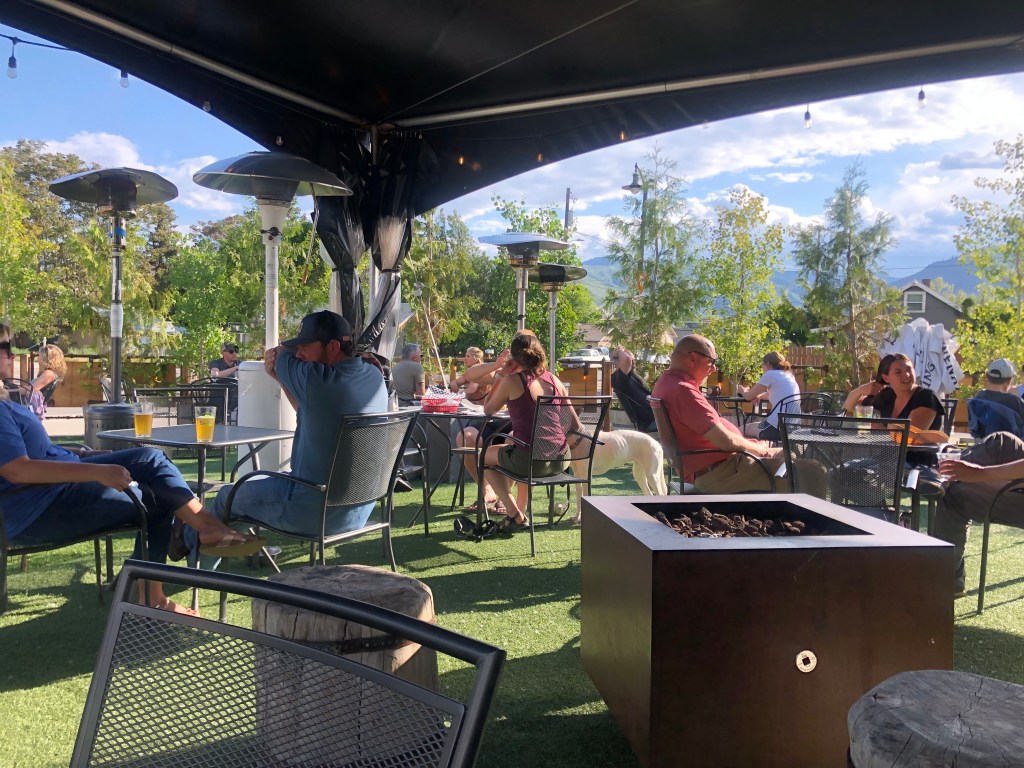
Today’s BOTD comes courtesy of the good folks at Wenatchee Valley Brewing Company in Wenatchee, Washington. It’s the usual modern, western brew pub, with the brewery and service counter in a warehouse-like space, lots of outdoor seating with views of the busy street, and the ubiquitous corn hole game set up on the lawn. Wenatchee Valley Brewing is located on the bank of the Columbia River, which makes for a pleasant environment.
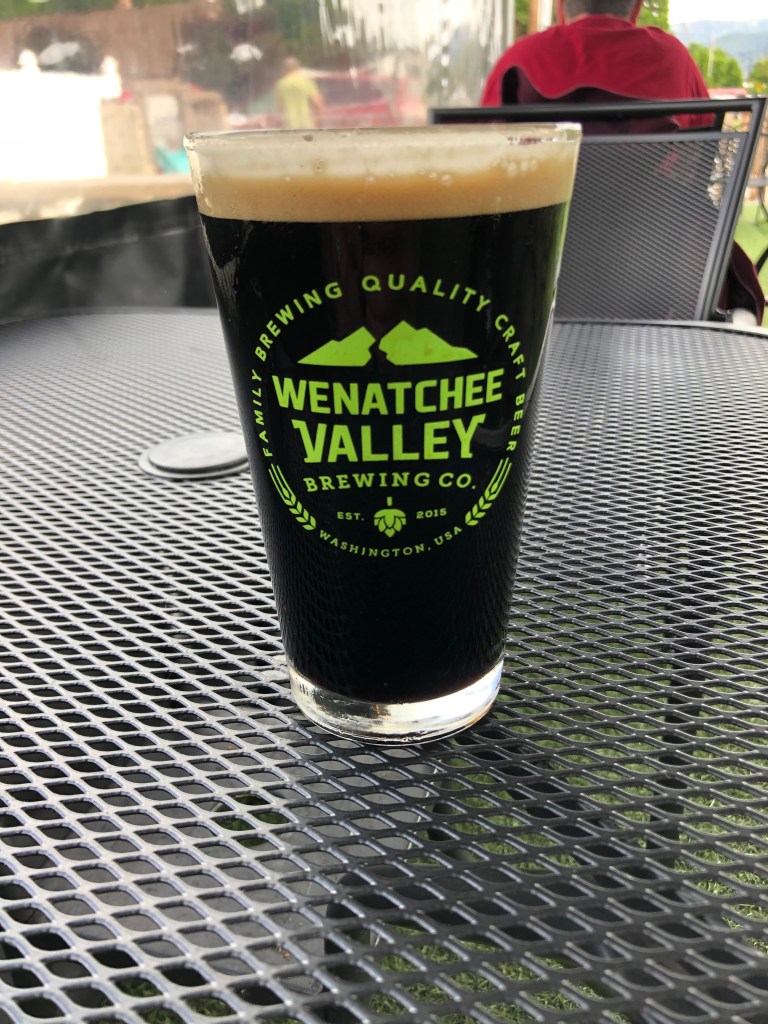
I ordered the Trout Stout on nitro. (“Nitro” is a dispensing process for some draft beers–particularly stouts–which uses nitrogen rather than carbon dioxide, lending a creamier mouthfeel.) I have to say that it was a good presentation, and a tasty brew. The beer is a dark-chocolate brown, with a thick, creamy, tan head. The taste is remarkably smooth and balanced. It manages to avoid the bitterness that plagued the last few stouts that I’ve drunk. The main flavors that come through are roasty ones: espresso, burnt toast, maybe a little bit of roasted chestnut. And at only 6% ABV, this is a very drinkable beer. Recommended. I give it four stars.
Now, recall that I couldn’t find a BOTD yesterday, so I’m making up for that by having a second BOTD today. Loyal reader Ron P. sugested I have a hazy IPA, but there are none to be found at this place. So instead I had a “Hopcicle Double IPA.”
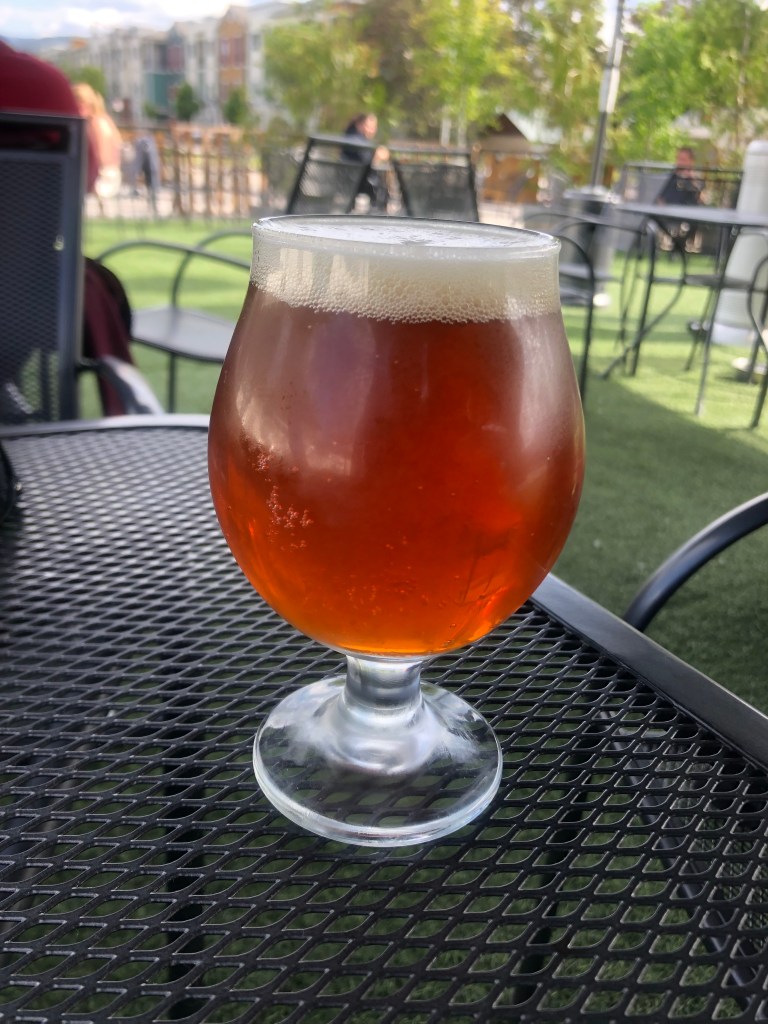
This is a good summer brew, made all the more enjoyable because I’m sitting outside in the warm sunshine with it. It’s pretty sweet for an IPA, with hints of honey and marmelade. Hops balance out that sweetness, but it doesn’t taste bitter. It’s got a light body, which makes it go down pretty easy. But it’s 9.2 percent ABV, so they serve it in a smaller (12-oz) glass. Which is a good thing, I’m sure. I give it 4.5 stars, but that might be alcohol talking…

 Chasing Phantoms