Our work advanced steadily, and by the end of the summer Prof. Glauben felt that we had achieved our goal: a way to achieve immortality by arresting the aging process. The body would not decay. “But ve need ein volunteer on vhich to test ze formula.” He stared at me. “Und ve cannot afford another arrest.” I immediately understood his meaning, and offered to drink the potion myself. “It vill be dangerous,” he intoned in a way that suggested raised eyebrows, which, of course, his naked skull lacked. I assured him not only that I was willing to take the risk, especially in light of his own earlier sacrifice. “Schoen. You are ein gut scientist,” he said as he placed a bony arm around my shoulders.
Bolstered by the praise from my mentor, I took the flask into my hand, fearing that if I waited any longer my courage would evaporate. I raised the vessel but, just before the liquid touched my lips, Prof. Glauben grabbed my arm with a skeletal hand. “Nein! Halt!” With a sigh half of frustration and half of relief, I set the flask back on the table. “Venwick, do not you think zhat ve should make a presentation?” In response to my confused look he went on. “Great discoveries should be presented to ze scientific community formally. Ve should assemble ze scientific minds of the area at your Hause, und tell them of our experiments. Und then you should drink ze potion in front of zhem. There vill be no dramatic change for zhem to see, of course, but ze drama vill be gut nonetheless. Und then,” his eye sockets here widened, “Und then, I shall come before zhem as proof zhat ve can achieve immortality!”
Prof. Glauben had become quite excited, and a sweat had broken out on his skull. He spoke of national attention, of world recognition, of general notoriety. He talked about changing the course of history. He mentioned power, honoraria, and patents. It was with regret, therefore, that I felt compelled to interrupt him.
“Professor, this is, undoubtedly, a great moment. Our discovery, if successful–nay, it will be successful; it is successful–our discovery, I say, should certainly be shared with mankind. But I believe a presentation such as you suggest, featuring a living skeleton, would be unwise. Let us sacrifice the theatrics and instead publish a monograph on our findings. Monographs command respect; monsters create a scene.”
This last comment, prompted by a vivid recollection of my dream, seemed to strike the calcium figure like a blow to the cranium. He shook; his chin dropped to his sternum; he fell with a slight rattle into the armchair behind him. Then he murmured something which I could not discern.
The room was excruciatingly quiet. I watched the professor’s bleached face, and immediately I regretted having spoken out as I had. I had called my teacher and my friend a monster. I had rejected his desire for public recognition of his work which was, to be sure, brilliant and revolutionary work.
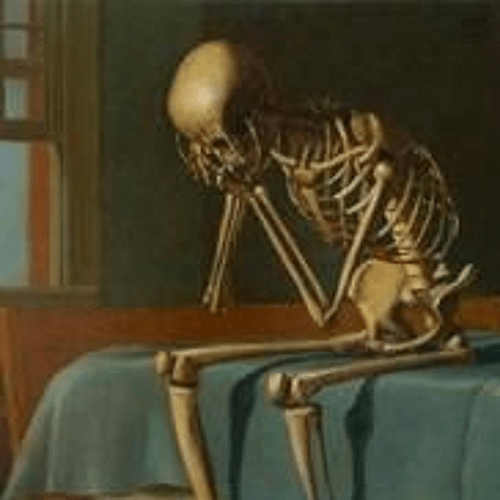
There sat the pitious form with bowed head and slumped shoulders. Compassion and regret overcame me, and I offered my sincere apologies to the object of my earlier ridicule. “Nein, you are right, Venwick. I have achieved immortality, it is true, but vhat good is immortality if I cannot enjoy the companionship of other persons? I have not extended mein life; I have protracted mein death!”
I was dumbfounded. What could I possibly say to correct my error? I tried to console the miserable being, first by proclaiming my undying gratitude for his friendship, and then, seeing that it had no effect, by espousing the virtues of solitude, viz. Undivided attention to one’s work, peace of mind through meditation, and the pleasures of single-player card games. But my efforts were all in vain; the sad, sullen skeleton still sat silently. With a sigh I gently suggested that we should delay the experiment until a more appropriate time. I bade him goodnight and retired to my bedroom to consider my increasingly absurd predicament.
PART 8 WILL APPEAR ON WEDNESDAY

 Chasing Phantoms