As an old geezer in modern America, I am legally required to keep several bottles of bourbon in my liquor cabinet. I’m not sure why that’s so, but I’m sure you’ve noticed the preponderance of brownish liquors whenever you visit your retired Uncle or anyone else of this demographic.
First, let’s review the definition for a bourbon (which is, of course, a type of whiskey). Bourbon must be produced in the United States; the grains that are fermented to make it must be at least 51 corn; it must be aged in new, charred oak barrels; it must clock in at least 80 proof; it must not include any added coloring or flavoring; and it can only be consumed by white males with receding hairlines and a closet full of polo-style shirts. (I made up that last part.)
Today’s spirit is Bulleit Bourbon. Bulleit is made in Kentucky, which, to repeat, is not a requirement for bourbon, but the two are closely associated in the minds of many. Bourbons are also frequently associated with slow and labor-intensive manufacturing processes, preferably in weathered old distilleries in the hills of Kentucky, and using a family recipe that goes back generations. Bulleit checks a number of those boxes, and it’s been around since 1830. However, like so many distillers, it’s been acquired by the global spirits company Diageo. What’s more, Diageo has moved production to modern distilling facilities. When Diageo took over, they claimed they weren’t going to mess with Bulleit’s traditions. But how many times have we fallen for that line? I still remember when Heineken bought the scrappy and wonderful Lagunitas, and Lagunitas has gone downhill ever since.
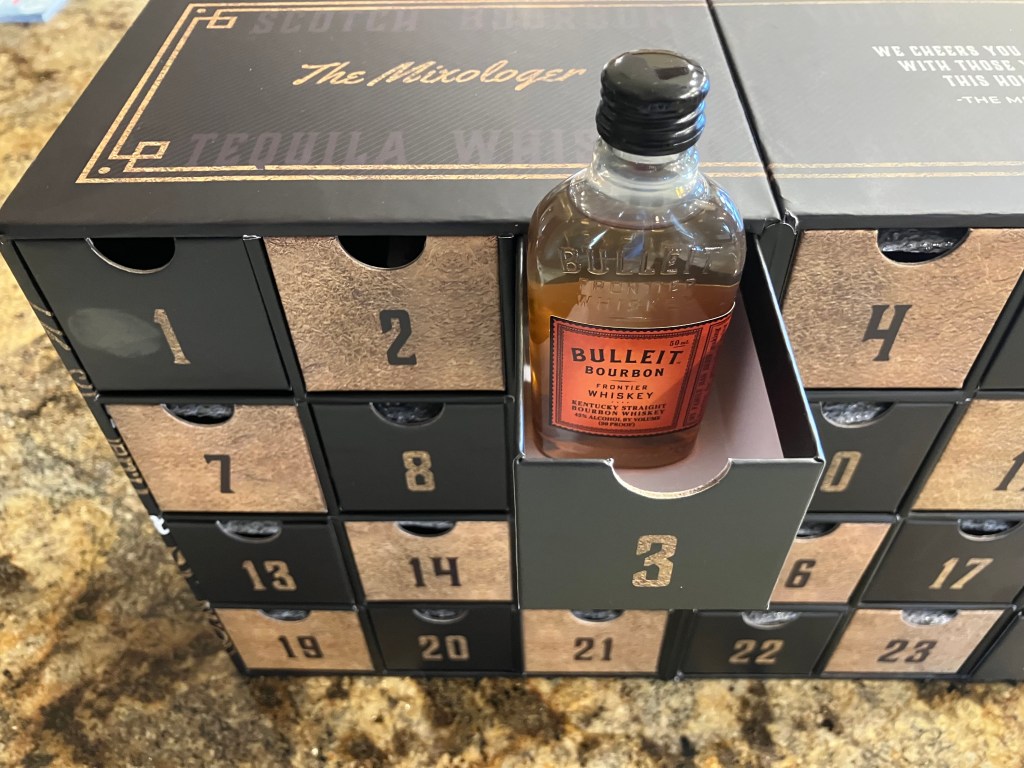
Anyway, I’m willing to approach this Bulleit stuff with an open mind. Here’s the description from their website:
“Bulleit Bourbon is inspired by the whiskey pioneered by an old family recipe over 150 years ago. Only ingredients of the very highest quality are used. The subtlety and complexity of Bulleit Bourbon come from its unique blend of rye, corn, and barley malt, along with special strains of yeast and pure Kentucky limestone filtered water. Due to its especially high rye content, Bulleit Bourbon has a bold, spicy character with a finish that’s distinctively clean and smooth.
Medium amber in color, with gentle spiciness and sweet oak aromas. Mid-palate is smooth with tones of maple, oak, and nutmeg. Finish is long, dry, and satiny with a light toffee flavor.”
Time to get to work.
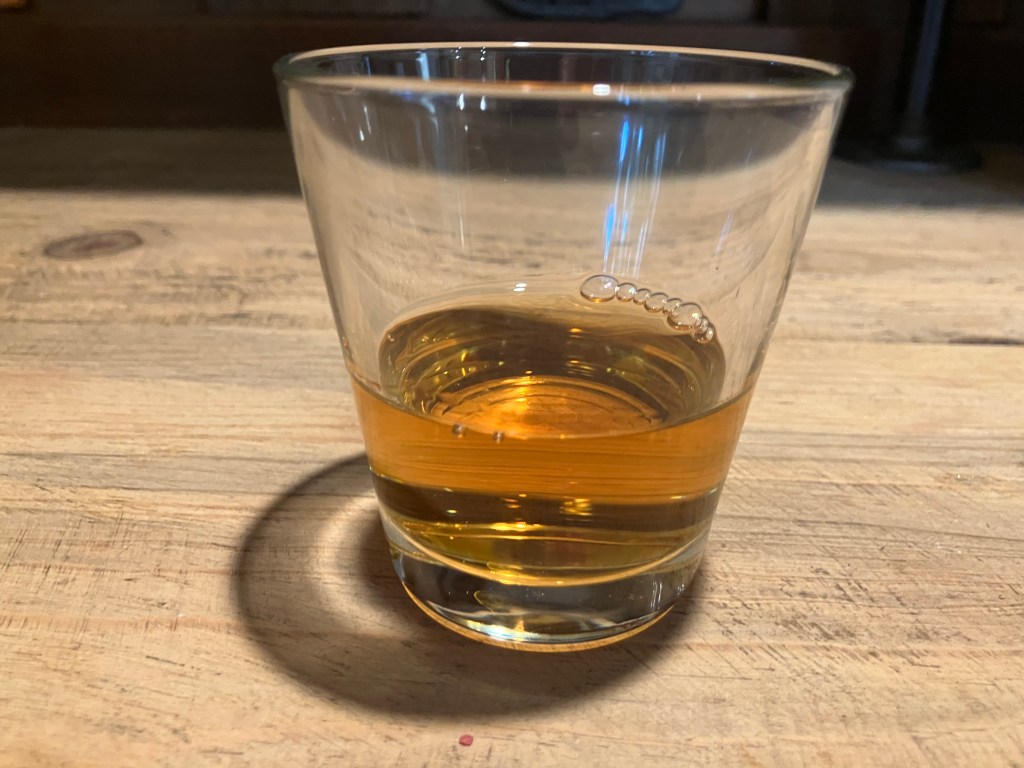
Appearance: It’s got a nice, mellow honey color, evocative of extremely old hydraulic clutch fluid. A glass full of this stuff looks iconic, like something Sam Spade would drink in his seedy private-eye office on Sutter Street in San Francisco. It would look good on a cluttered desk next to a Webley-Fosbery automatic.
Aroma: The nose on this Bourbon is woody and sweet and spicy, like a muted version of your teenage daughter’s Billie Eilish perfume.
Taste: This is a very spicy bourbon. It’s peppery and tumeric-y with just a bit of clove. (The spice is to be expected, as Bulleit is made from 28% rye. Compare that to a typical Bourbon, which uses more like 10% rye.) Underlying the spicy notes is a warm mix of caramel and orange peel. It’s an enjoyable, interesting taste.
Finish: The finish is warm and satisfying. The spices linger, although there is also a bit of an astringency that remains on the tongue.
Bottom Line: This is a very solid, reliable bourbon, albeit one that is unusually spicy. It’s worth keeping a bottle or two on your liquor shelf, particularly if you fit the target demographic, and/or if you like spicy rye. It’s also a good choice if you like the lore that typically accompanies a bourbon. In Bulleit’s case, there’s a story that their founder, Augustus Bulleit, filled a flatboat with barrels of his bourbon in 1860 and headed to New Orleans. He never made it, mysteriously vanishing, never to be heard from again. No Bulleit whiskey was produced for over a century, until his great-grandson Thomas Bulleit revived the brand in 1987. Some say you can summon Augustus’s spirit if you whisper “Justice for Augustus” while making the first pour from a fresh bottle. That last sentence might be a total fabrication…but isn’t it worth a try?

 Chasing Phantoms
Wait, which model Webley-Fosbery did you have in mind? The .455 (6 rounds) or the .38 (8 rounds). Actually, when it comes to drinking any bourbon, you might not want to exceed 2 rounds…
LikeLike
Maybe that’s where “the first round’s on me” came from…
LikeLike