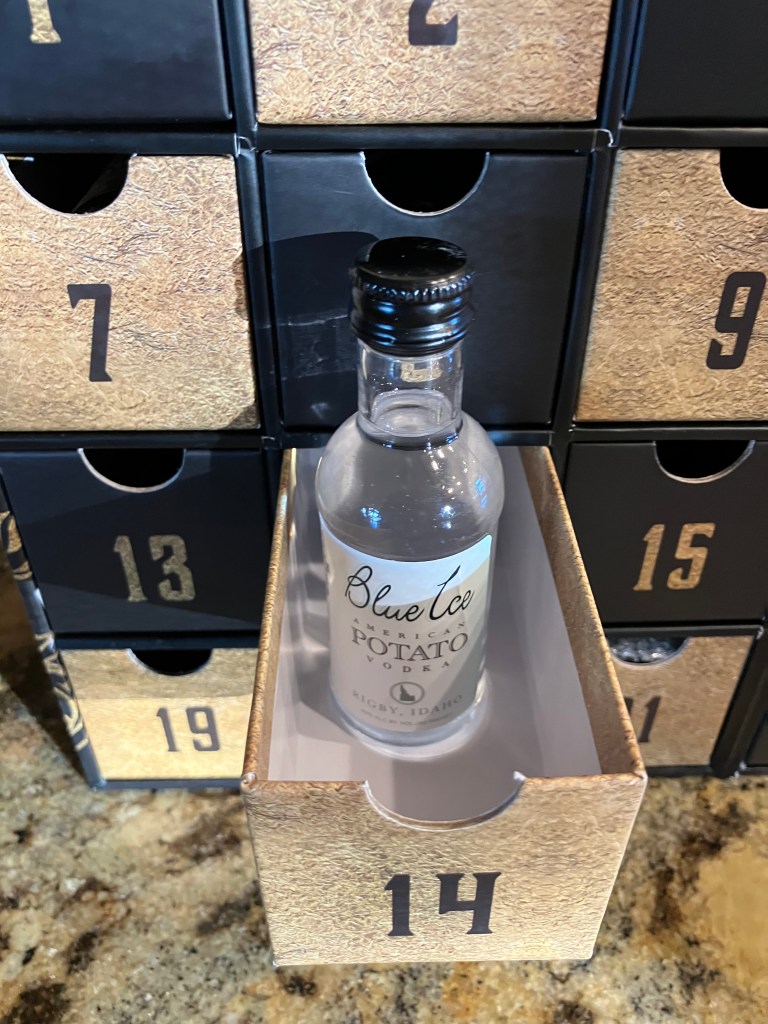
OK, this almost sounds like a parody of a modern vodka. It’s potato vodka from–where else?–Idaho. And the key marketing points are that it’s low-calorie, gluten-free, and non-GMO. The only thing missing is any discussion of taste!
Let’s see how they describe their product:
“America’s finest potato vodka can only come from one place—Idaho. The home of the luscious Russet Burbank potato and the birthplace of Blue Ice Vodka. Idaho is where the people behind our brand come from and live, where our natural ingredients are sourced and where our product is crafted. Perfect for cocktails under 100 calories, with only 64 calories per ounce serving.”
So, again, it sounds like they’re focused on everything but the taste. That’s where this blog comes in. Let’s see what we can discover…
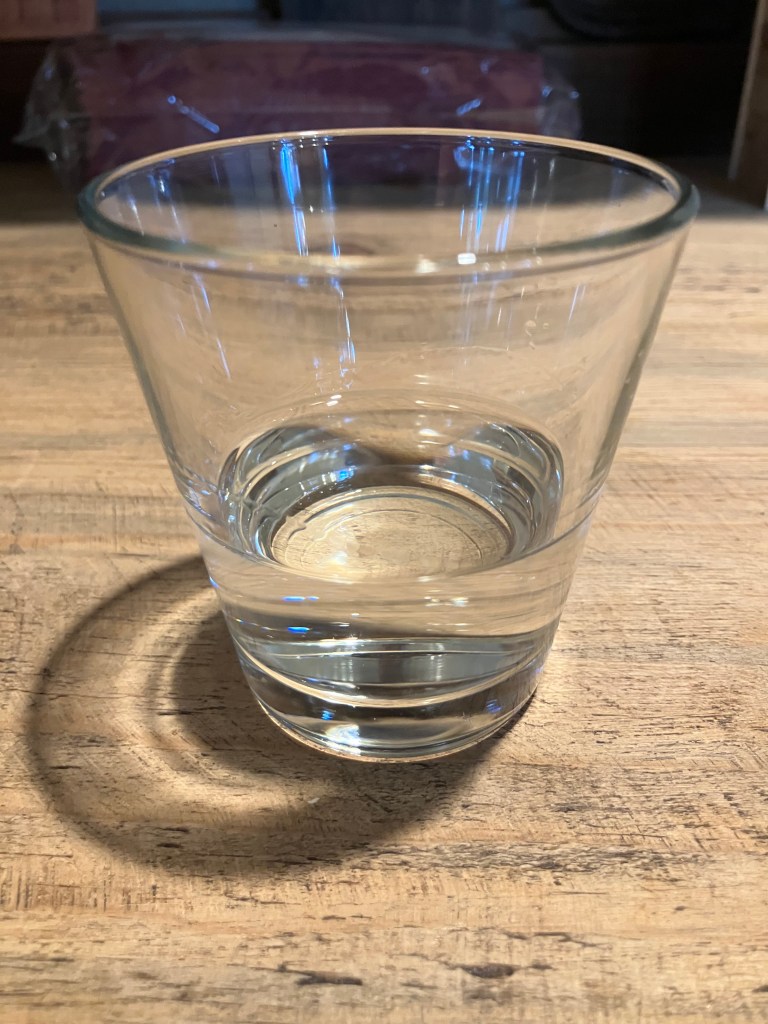
Appearance: It looks like nothing. It’s completely clear.
Aroma: It smells like nothing. Seriously. This is the Sgt Schultz of spirits; “I see nothing! I smell nothing!”
Taste: It tastes like almost nothing. The taste, such as it is, is pretty subtle. There’s some French fry on the palate, and a little au gratin in the background. OK, that’s just a lame joke. It tastes like very smooth vodka, which is to say, it doesn’t taste like much. It’s main job is just to deliver 40 percent alcohol.
Finish: Exceptionally smooth. There’s none of that burn that you get from the cheap-o vodkas. It doesn’t leave you wanting more, but it doesn’t leave you running for a chaser, either.
Bottom Line: This would probably be a good vodka for a mixed drink. It’s almost invisible in terms of appearance and aroma and taste and finish. My local Total Wine has it for 19 bucks. So, why not?
When you hear that something is the world’s most popular of its kind in the world, do you think (1) wow–it’s gotta be good for that many people to like it, or (2) it’s gotta be plebian pablum to appeal to the global masses. And whether you chose (1) or (2), why do you think “gotta” rather than “got to”?
Anyway, as you might have guessed from context clues, Jim Beam sells the most bourbon in the world. And if you were going to object that Jim Beam is eclipsed by Jack Daniels, I’d be obligated to point out that, technically, Jack Daniels is not labeled as bourbon but as “Tennessee Whiskey.” Unlike bourbon, Tennessee Whiskey must be produced in Tennessee, and it must go through a final filtering process not required of bourbon. I suppose you could argue that Tennessee Whiskey is a sub-type of bourbon…but JD has chosen instead to insist it’s not a bourbon, and so it does not technically compete in the same category as Jim Beam.
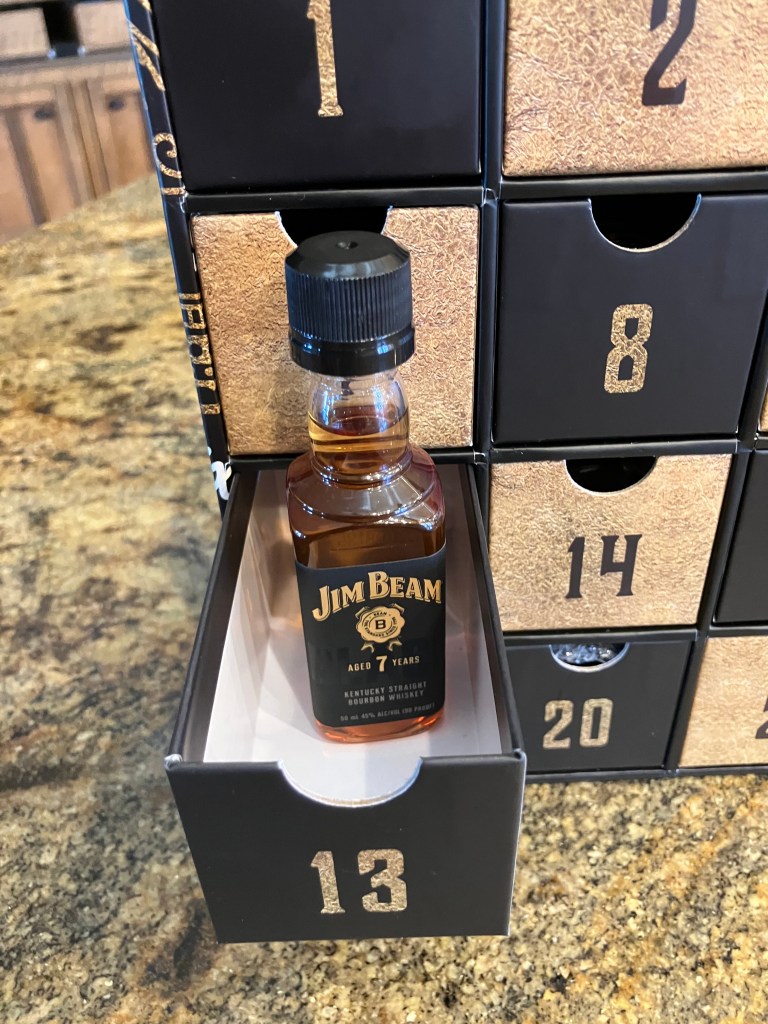
Now that we’ve dispensed with the throat-clearing, let’s take a look at today’s spirit, which is Jim Beam Black. This is distinct from the classic, white-label Jim Beam bourbon, that is probably responsible for the majority of Jim Beam’s global sales. The black label, which we’re trying today, is aged longer (7 years vs. 4 years) and has a higher proof (90 vs. 80). Let’s see what Jim Beam himself has to say about it:
“Something magical happens to the whiskey in its seventh year in cask. We call it the sweet spot, where an easy smoothness meets notes of caramel, vanilla, and warm oak, and the liquid turns a rich gold.
This is the mellow whiskey you’ll find in the 7 year aged Jim Beam Black. We’re proud of this longer time in cask, and we’re making a firm commitment to our drinkers to always age Jim Beam Black for those seven years.
Now at 90-proof, enjoy Jim Beam Black neat, on the rocks, or any way you damn please.”
Overlooking the gratuitous “any way you damn please” (which, if it were me, I would write as “any damn way you please”), I do think they make a good case for the extra aging. So let’s pour our sample and see if something magical really does happen.
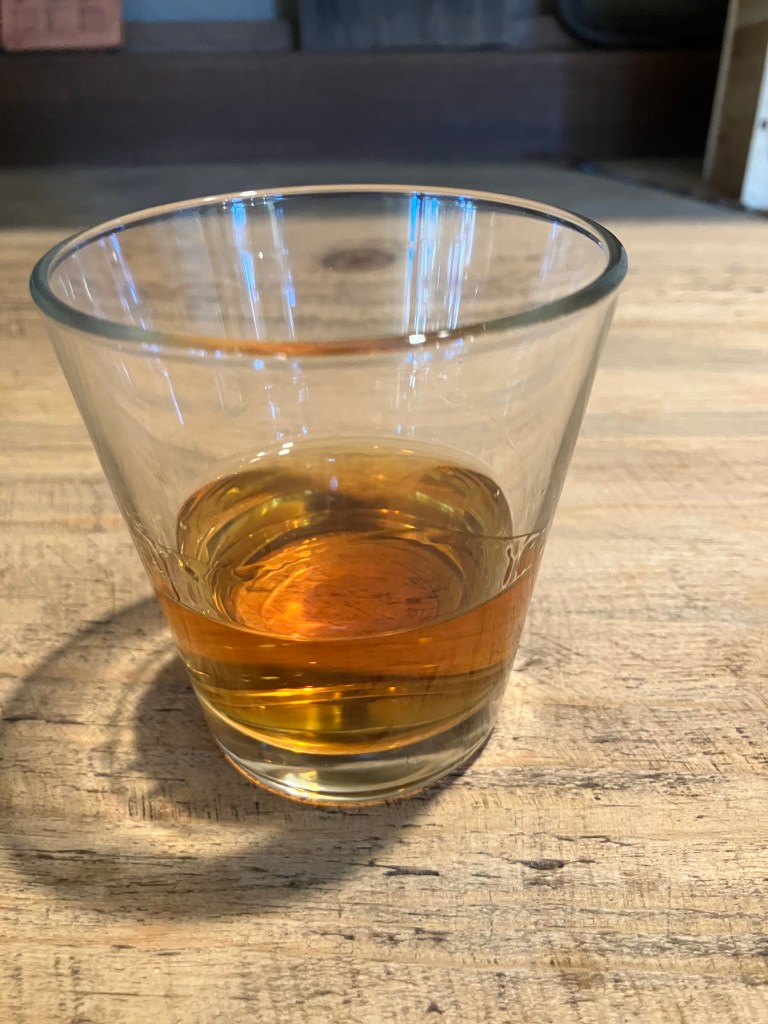
Appearance: It’s exactly the color of Rapunzel’s “splendid long hair, as fine as spun gold.”
Aroma: It’s kind of like the smell of vanilla extract–the real stuff, not McCormick’s fake “vanillin” stuff that your mom used for baking, but the real stuff from actual vanilla beans. I say this because I don’t detect the sharp whiff of alcohol you get from those artificial vanillas and from younger bourbons. There’s also a hint of caramel.
Taste: This stuff is delicious! No wonder the majority of the world’s population drinks it for breakfast (or whatever the claim was that I cited at the top of this post). The taste is rich–creamy and high-viscosity and full–and bold, without being overpowering. I taste caramel and spice and brown sugar. It all comes together in a very balanced way.
Finish: There’s a bit of hot alcohol on the finish, which perhaps it to be expected from a 90-proof spirit. But each sip leaves you wanting more.
Bottom Line: This stuff would make a good sipping whiskey, to be next to the fireplace while waiting for Santa during this Advent season. I guess I do believe in magic after all.
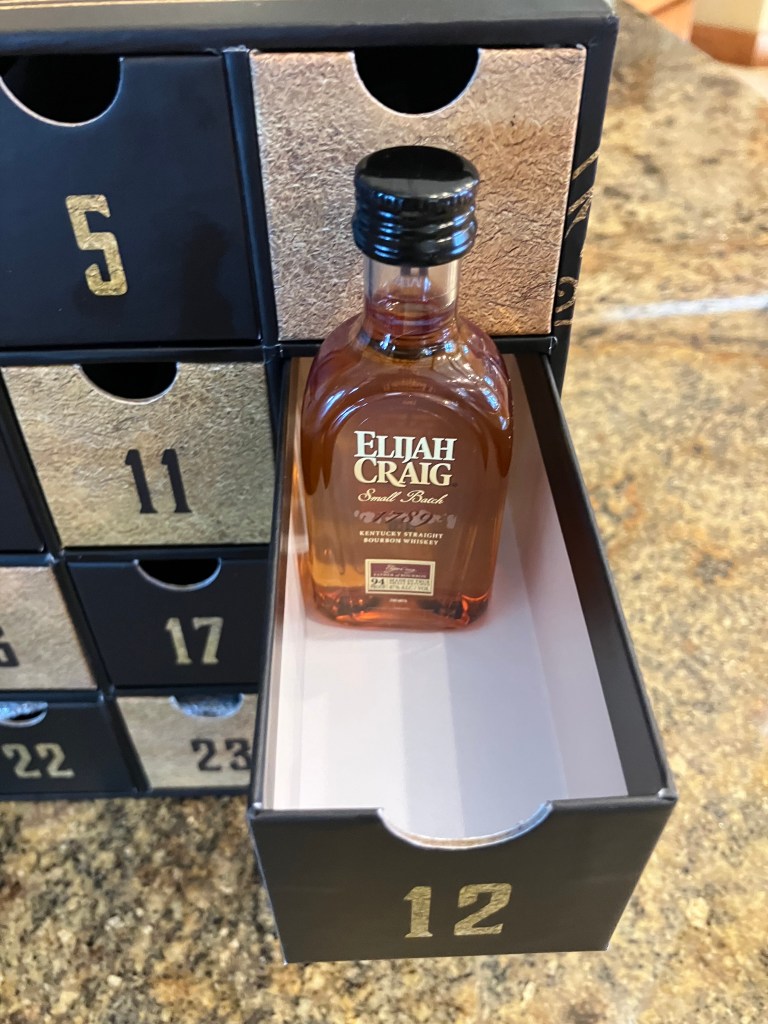
Today’s spirit presents us with an interesting opportunity. It’s Elijah Craig Straight Kentucky Bourbon. Checkitout:
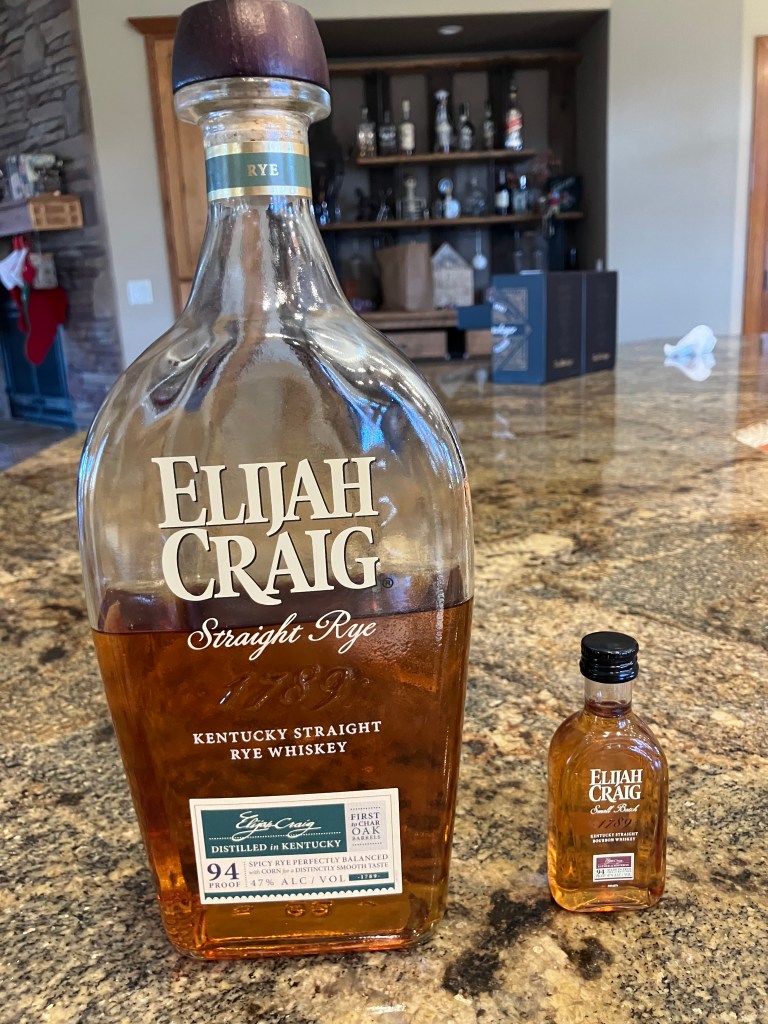
As soon as I opened the drawer I recognized the distinctive shape of the bottle. It turns out that Elijah Craig is one of the staples of my bar that’s always on-hand. Observe:
Now, attentive readers will have already noticed that the Elijah Craig from my bar is a rye whiskey, while today’s Advent Spirit is a bourbon whiskey. What’s the difference? Recall that helpful ditty:
Bourbon is born from majority corn/If you want something spicier you need a good Rye, me sir!
OK, I actually just made that up. Let’s see if ChatGPT can do better:
Though Bourbon is sweet, its corn base is known, While Rye offers spice, with a sharper, dry tone.
(Please vote on whether I’ve been outdone by ChatGPT, and/or provide your own couplet in the comments.)
Anyway, the point we’re trying to make is that bourbon is made from at least 51 percent corn, while rye whiskey is made from at least 51 percent rye. Since we have both a bourbon and a rye from the same distiller, we should be able to isolate the key differences between the two styles. But first, let’s see what Elijah himself has to say about the bourbon:
“This is the award-winning bourbon that started it all. Our signature Small Batch owes its distinctive warm spice and subtle smoke flavor to Level 3 charred oak barrels. A favorite of bourbon connoisseurs and casual whiskey fans alike.”
(I don’t know if it’s a true point of pride to say that even people who don’t know much about whiskey choose this as their favorite. It’s like saying “our premium wagyu beef is appreciated by people who love to eat Big Macs.”)
Be that as it may, let’s crack open a mini bottle and see what we have here.
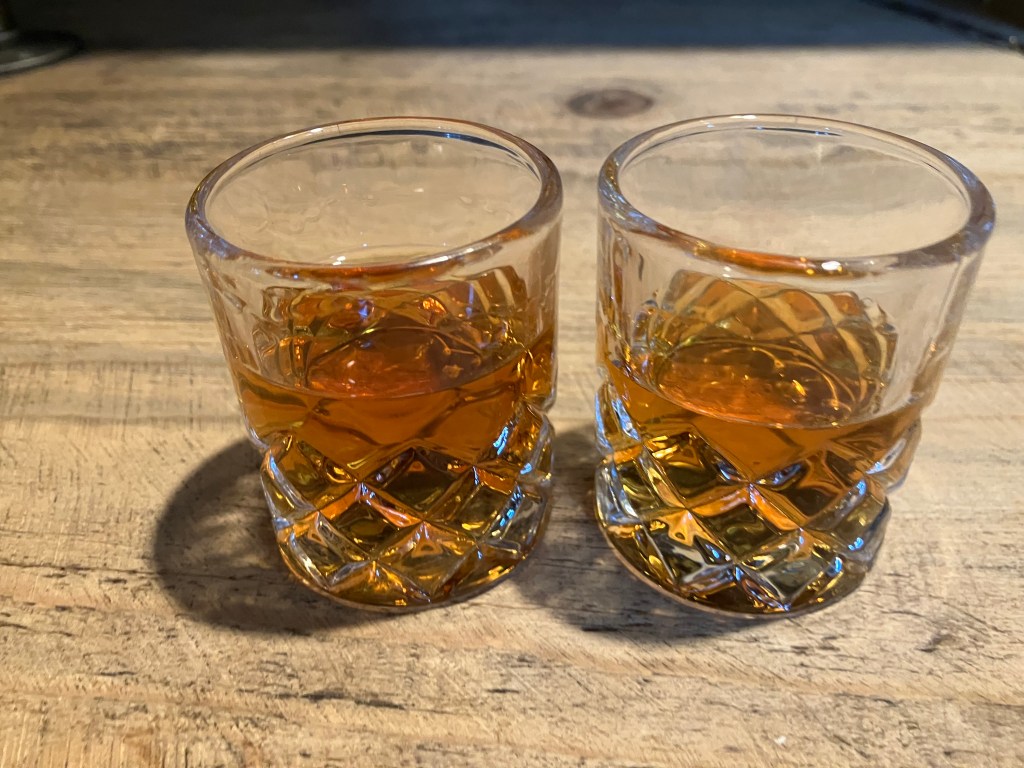
E.C. bourbon on left, rye on right. Or is it the other way around?
Appearance: The bourbon is honey-gold, while the rye is….pretty much honey-gold. The rye might be a little lighter, but it’s barely a perceptible difference. I’m guessing that the color is imparted more from the barrels than from the grains, and I’m further guessing that Elijah Craig uses the same kinds of barrels for both.
Aroma: The bourbon smells sweet and has a distinct note of vanilla. There’s no sharp smell of alcohol. The rye….smells about the same. Again, I wonder if the nose comes more from the barrels?
Taste: OK, here’s where the difference becomes evident. The bourbon tastes sweet (and when I say “sweet,” I don’t mean sweet exactly, but rather “less bitter.” It’s kind of like calling crude oil “sweet” or “sour”) with a secondary note of sourgrass/oxalis. The rye, on the other hand, is a little peppery and a bit bolder. We should note, however, that this rye uses only the bare-minimum 51 percent rye, as opposed to other brands which use as much as 75 percent. For this reason, Elijah Craig rye is sometimes referred to as “barely legal” rye. I’m not making this up.
Finish: It actually seems like the finish is the aspect that differentiates the two whiskeys the most. The sweetness of the bourbon and the spiciness of the rye are most pronounced after you’ve swallowed and let your tongue try to sort things out.
Bottom Line: I’m not gonna lie–there’s not a huge difference between these two whiskeys. I’m beginning to think that a large amount of the supposed difference we normally observe between the two styles is more a function of comparing products from two different distilleries, rather than comparing different mashbills. That said, I will continue to stock Elijah Craig rye in my bar, rather than their bourbon.
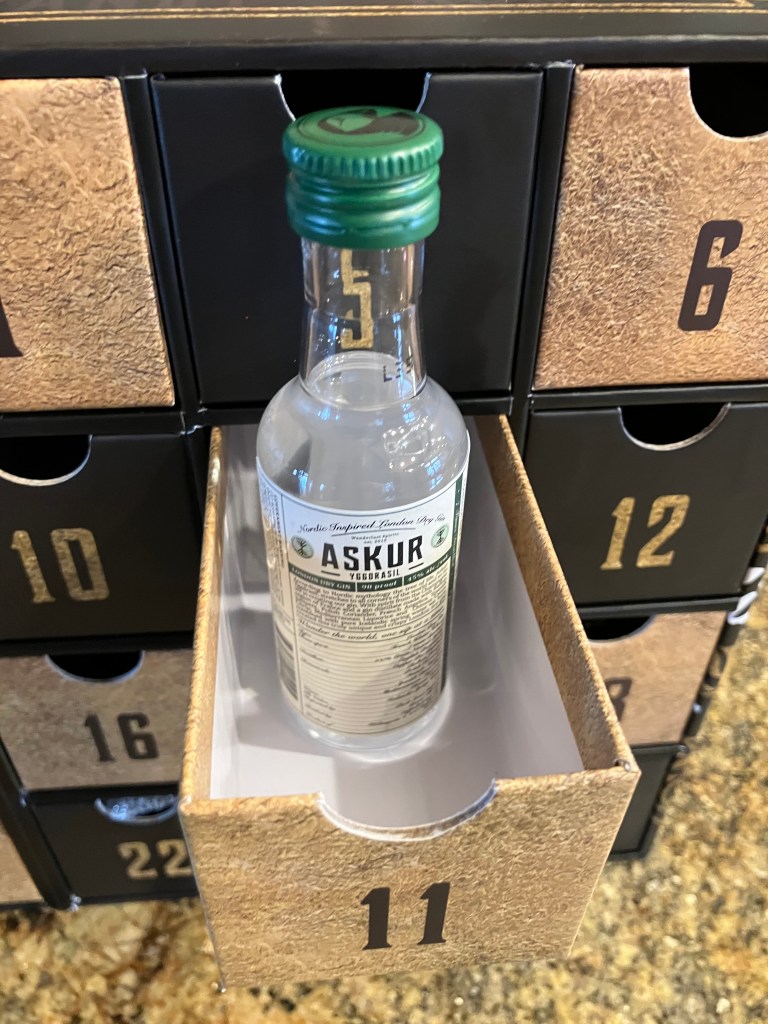
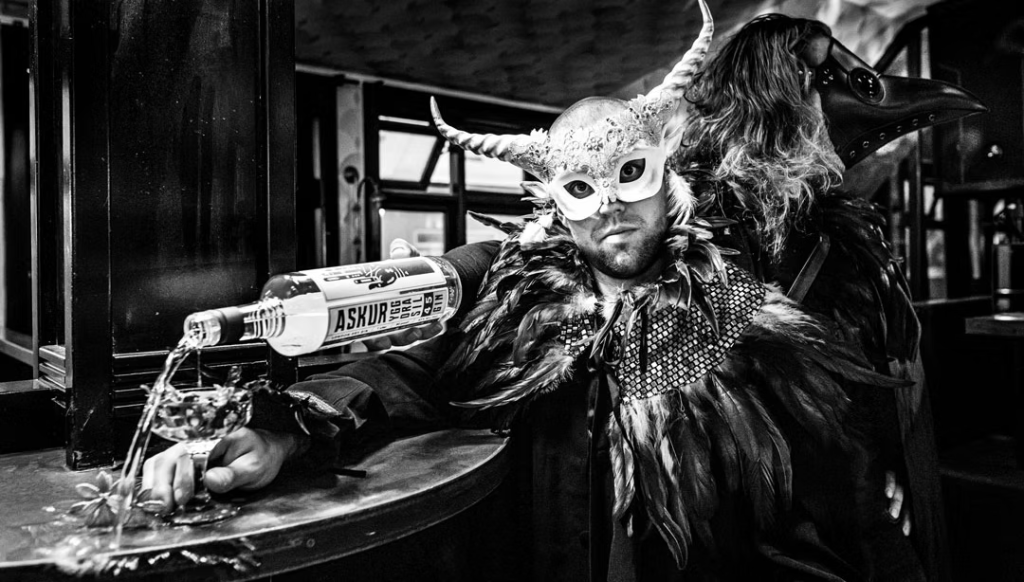
So, just to give you a peek behind the curtain: As soon as I open the Advent Drawer O’ Spirits and see the drink of the day, I go to the company website to get a feel for what they are trying to do. Today’s spirit is something called Askur Dry Gin.
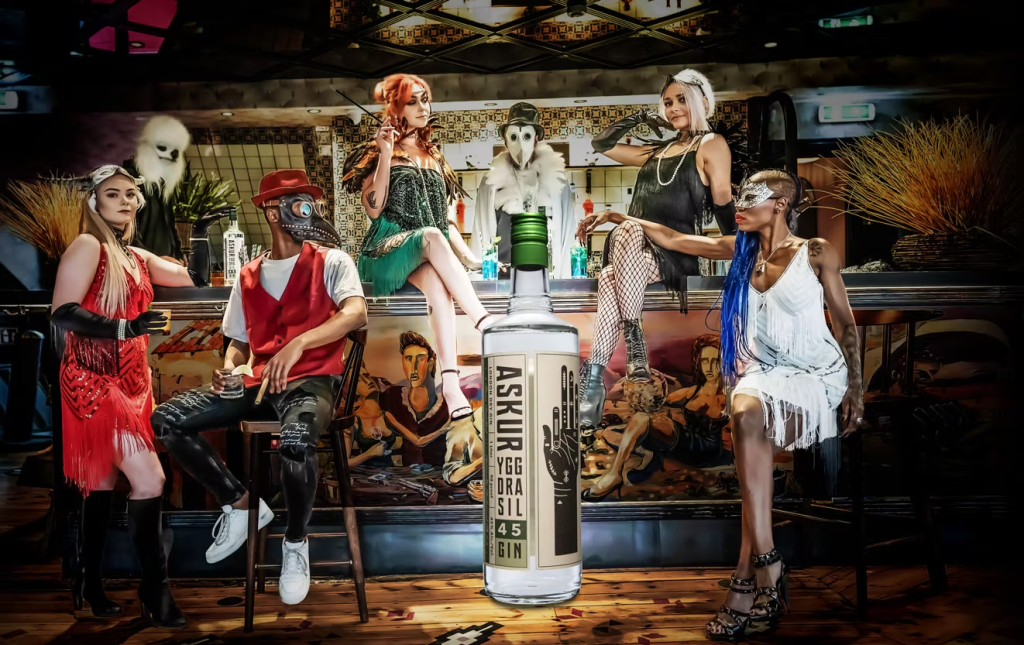
So I dutifully plugged that name into Google and was immediately met with these images:
This in itself should speak volumes about how desperate spirits companies are to try to snag younger customers. But what struck me even more than the painfully desperate attempt to appear hip and relevant and ironic was the uncanny sense of déjà vu I felt when I saw the website. Especially when I read their description of their gin: “The base spirit is made from the highest quality wheat from the champagne region of France,” then “Blended with pure Icelandic water which is very low in minerals and high in PH allows the character of our distillates to flourish.” Remember this from Day 2 of this series? The “Helix7 Vodka“? It too used French wheat and Icelandic water.
Turns out both Helix7 and Askur Gin are made by a company called Wanderlust Spirits, based in Florida. And they evidently used the same models for the respective websites of the two spirits.
Anyway, Wanderlust is not unique it trying to portray its spirits as small, quirky, stand-alone companies. It’s not an unforgivable sin. So let’s just proceed with our tasting.
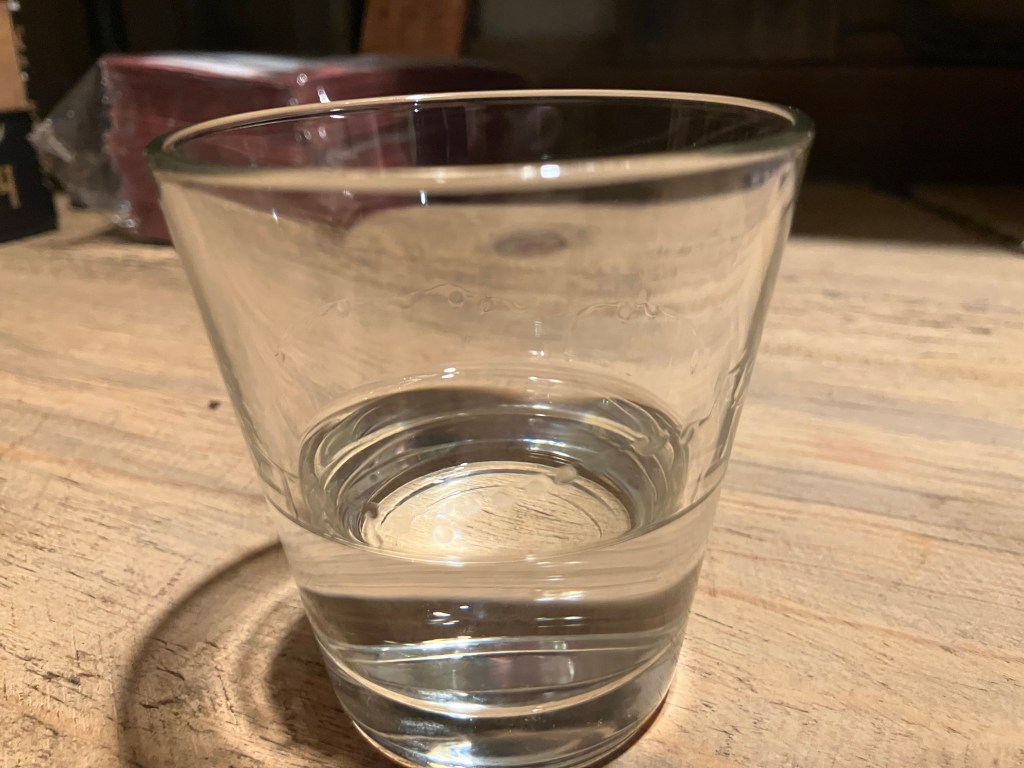
Color: The color is identical to that of Costco’s bottled drinking water. In other words, there is no color. And that’s as it should be.
Aroma: There is a strong scent of juniper–overwhelmingly so. It reminds me of when I hid in the juniper bushes while playing hide and seek as a child, and I kept picking off juniper berries and tossing them at my brother (who was “It”) whenever he had his back to me. For the rest of the day my hands smelled of juniper berries/gin. Returning to the present day, I do note that this gin also has a bit of a citrus aroma on the nose, which adds a note of freshness to the piney smell of the juniper berries.
Taste: This is honestly like no other gin I’ve tasted. Sure, it’s got the expected botanicals, though this has a bit of a medicinal taste mid-palate. I also am reminded of those mysterious, unpopular nuts that are always the last to be eaten from the bowl of mixed nuts my mom would put out on Christmas. (Brazil nuts? Filberts? I never knew which was which.) But there’s something else going on with this gin–something unexpected and interesting.
In the interests of science, I did a side-by-side comparison with Bombay London Dry Gin. The difference is astounding. The Askur is brighter, bolder, more complex, and more citrus-y. The Bombay, by comparison, is muted and boring. I don’t know if that French wheat and Icelandic water really make a difference, or if there’s something else going on. But this is a far superior gin, in my opinion.
Finish: There’s a pronounced warmth on the finish, and a lingering hint of limoncello. Somehow it also feels like you just brushed your teeth.
Bottom Line: To be honest, I wasn’t prepared to like this, given the website that seems to be trying way too hard to show how hip and different and trendy they are. But this is truly delicious. What’s more, it looks like you can buy a bottle for about $22. So I’m definitely going to try this in my next martini and/or Gin and Tonic.
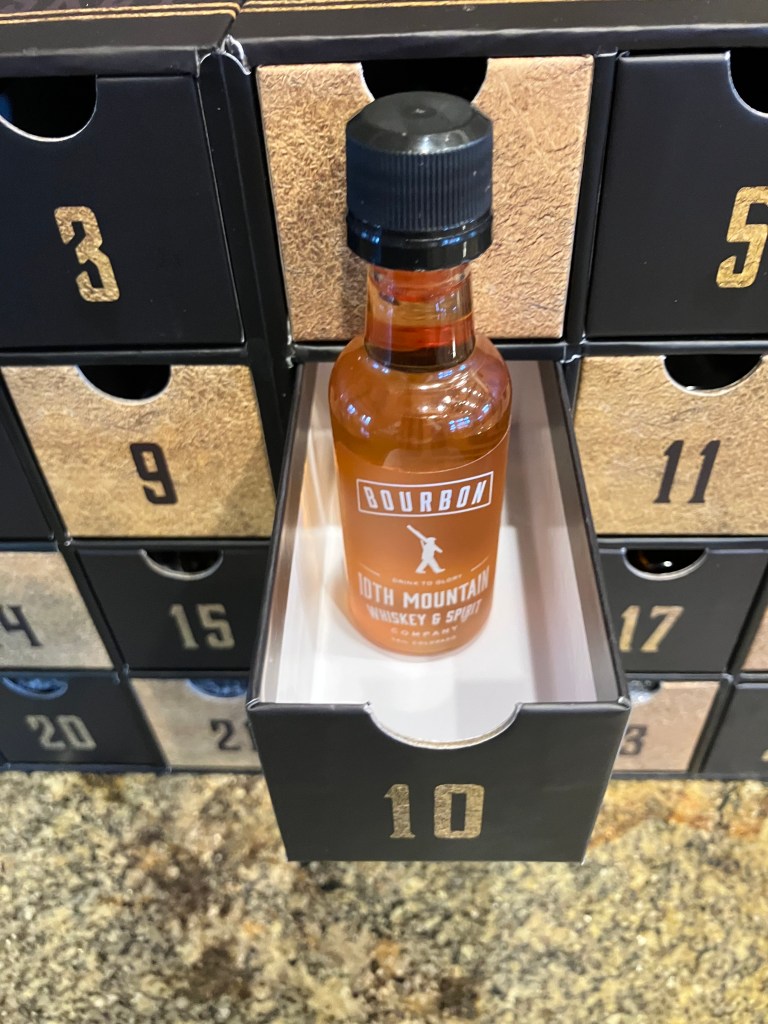
There can be many reasons to choose a bourbon. Ideally you select it for its taste. But cost probably figures in as well. And maybe the alcohol content. And then sometimes you just like the look of the bottle on your liquor shelf. Or perhaps you want to show support for a cause, such as Freeland Spirits (women-owned) or Uncle Nearest (black-owned). Today’s bourbon is from 10th Mountain Whiskey and Spirit Company, which is named in honor of the 10th Mountain Army Division, that fought in the Italian mountains during the Second World War. The company is veteran-owned and much of its marketing plays up support for veterans and active soldiers.
That’s all well and good, but how the heck does it taste?? First, let’s see how they describe it on their website:
“Our 10th Mountain Bourbon is an award-winning spirit made from a handcrafted blend of Colorado Corn (75%), American Rye (20%), and Malted Barley (5%). This 750ML bottle will make a lasting impression with a bold flavor and smooth finish.”
OK, so with a fairly high rye content we might expect some spice. Let’s check it out…
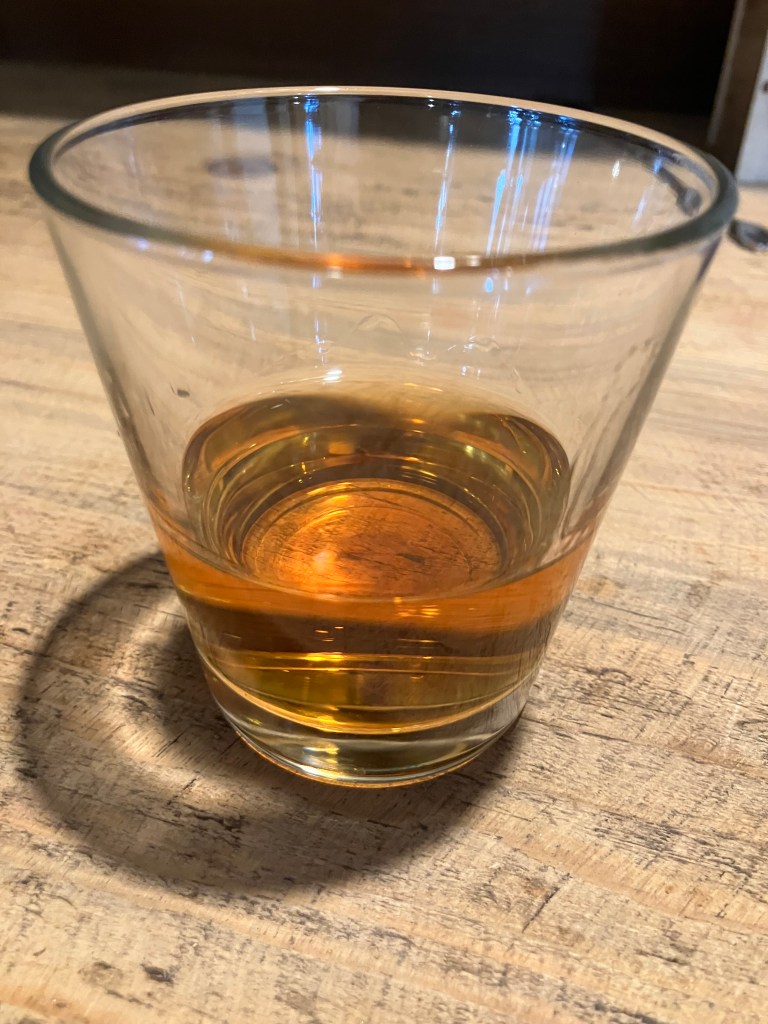
Appearance: Honey-gold, like the stuff dripping off the drizzler on a box of Golden Grahams.
Aroma: I can’t detect much but macerated pencil shavings stewed in lacquer thinner. This got me wondering how long it’s been aged. There is no age statement on the bottle, but a quick Google search tells me it’s aged for six months. I think this may be our culprit.
Taste: It’s definitely strong and bold and spicy, and at 92 proof, you definitely taste and feel the alcohol. But it’s not unpleasant. There’s a sweet vanilla note that takes the edge of the burn. I also taste a little honey mustard, like you’d put on a pub pretzel.
Finish: Surprisingly for such a strong spirit, the finish is neither harsh nor bitter. There is a pleasant lingering warmth.
Bottom Line: This seems to be an interesting and well-crafted bourbon. But at sixty bucks a bottle, it ought to be. I think there are better bourbons out there for the price (or equally good bourbons for a lower price). Unless you just want to show your support for veterans. But if that’s the case, why not just donate to the USO?
 Chasing Phantoms