2025 Advent cocktails

Advent Spirits Day 4: Evan Williams Straight Bourbon

I spent about five years of my squandered early adulthood in Kentucky, about 100 miles from Louisville’s famed and historic Distillery Row. And yet I never went to a bourbon distillery during that time. Years later, I found myself on a trip along the Kentucky Bourbon Trail, and made a stop at a place in downtown Louisville called the Evan Williams Experience–which sounds like a tribute band show at an Indian casino. The EWE is essentially a visitor center, Disney ride, propaganda machine, and boutique distillery for Evan Williams, which claims to be Kentucky’s “oldest licensed distiller.” 

Now, I didn’t know much about bourbon at that time (and, if truth be told, I still don’t), but as I passed through the dioramas of 18th-century distilling techniques, sampled small pours of their bourbon, and was lectured by a hologram of Evan Williams himself, I came to believe that I should become a bourbon drinker. For a short time I drank only Evan Williams bourbon, but over time I was introduced to other brands, and I forgot all about Evan Williams. Such is the tenuousness of my brand loyalty.

But with today’s Advent Spirit I am reunited with Evan. Will he live up to my memory, or will he let me down? Let’s find out.
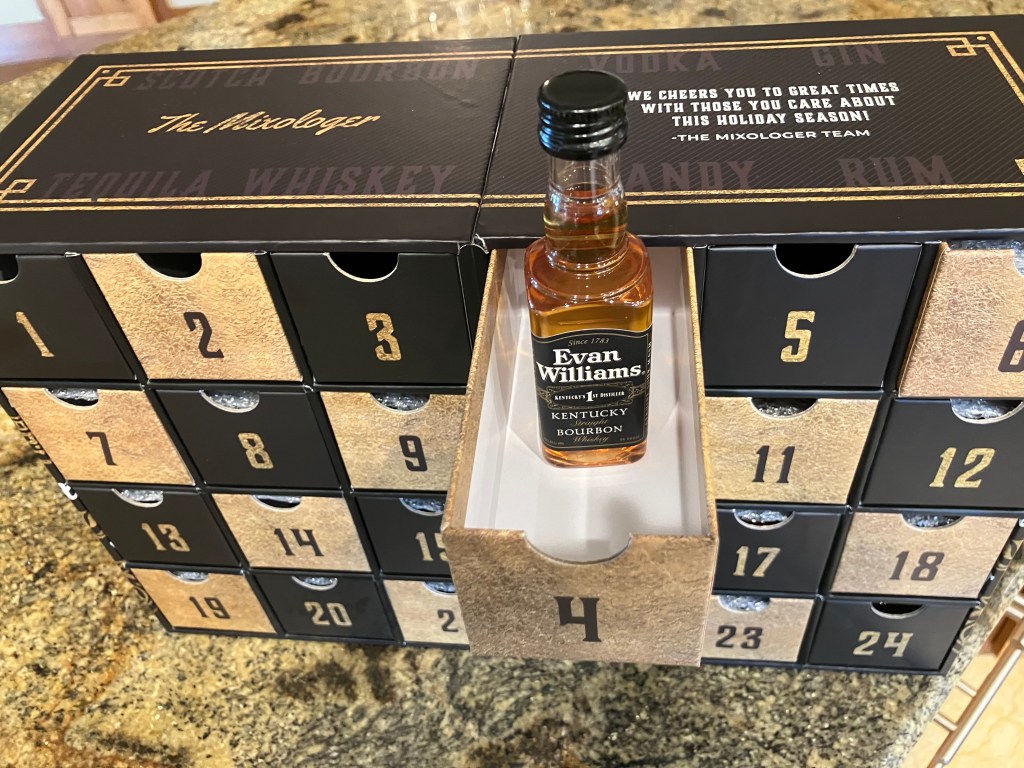
First, here’s the blurb from their website:

“Our Kentucky Straight Bourbon is full of character and simply done right. Named after Evan Williams, who opened Kentucky’s First Distillery along the banks of the Ohio River in 1783, it’s aged far longer than required by law. The result is a Bourbon that’s smooth, rich, and easy to enjoy.”

OK, that sounds pretty good. Let’s try it.
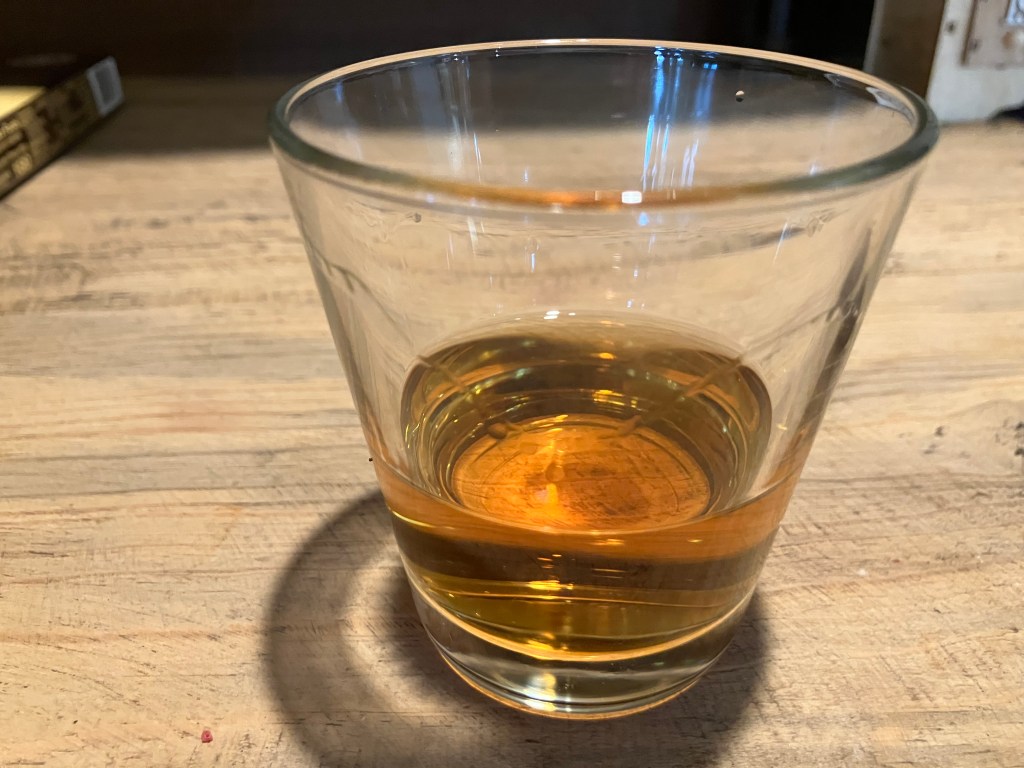
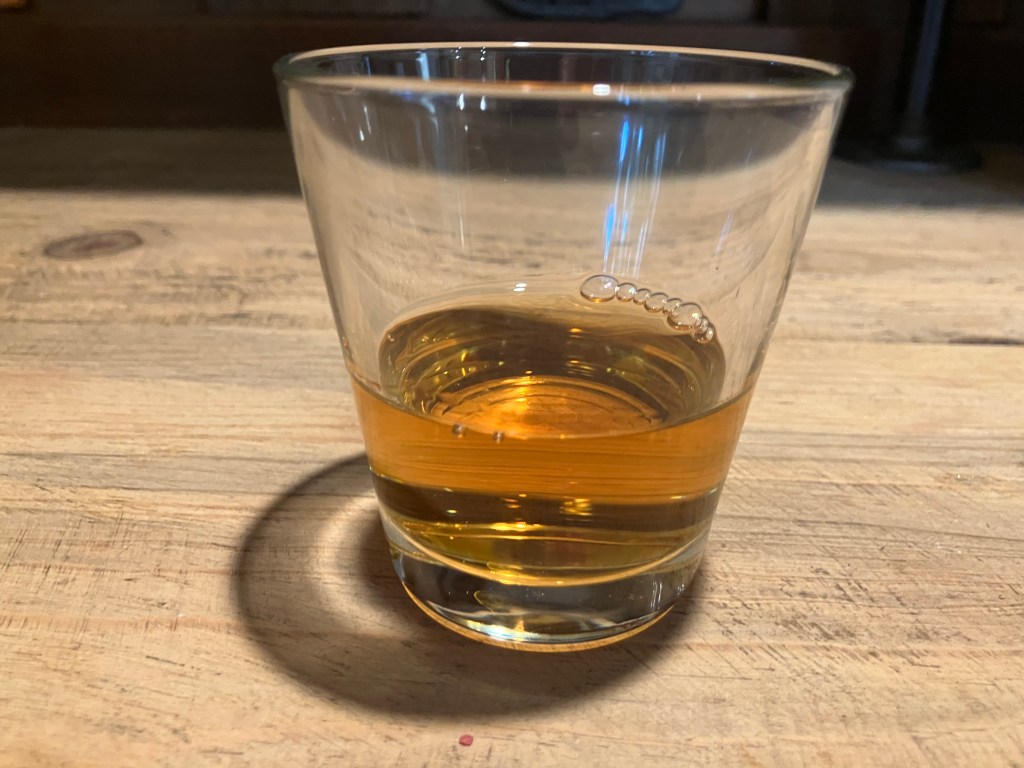
Appearance: The color reminds me of yellow Paas easter egg dye when it’s first mixed with vinegar. It’s a little brighter than I’d expect from a bourbon. Let’s hope this doesn’t presage a brassy taste.

Aroma: There’s a pleasant mix of the scents of clove, vanilla, and fresh morning dew on pasture grass. 

Taste: I taste lots of citrus. A strong taste of orange peel dominates, with a little lemon and grapefruit. It’s a round, wholesome flavor that keeps you raising the glass for another sip. I taste a little toffee and cinnamon in the background, but it’s really that orange that predominates.

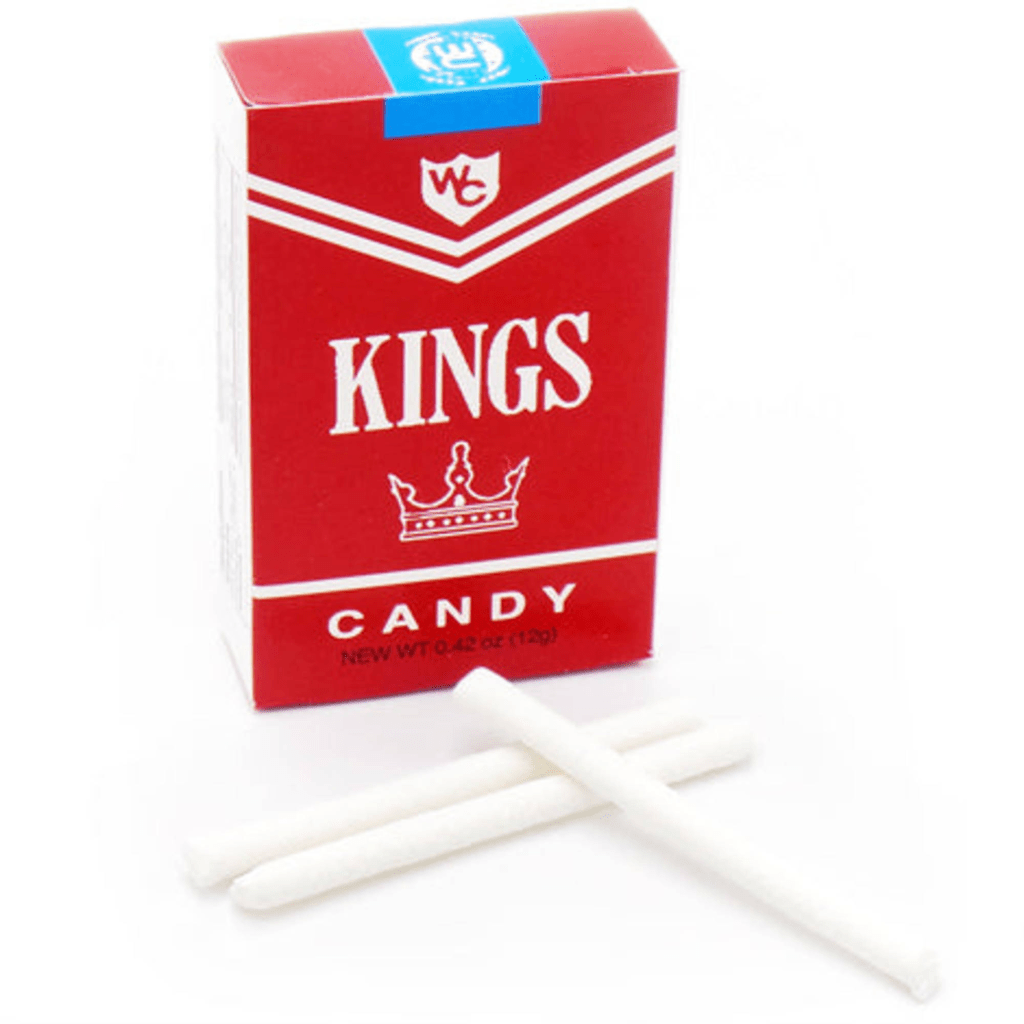
Finish: The finish is warm and satisfying. A sweet dextrose flavor, reminiscent of candy cigarettes, lingers at the end.

Bottom Line: There is something distinctive about this bourbon, and I think it has something to do with that orange peel flavor. It’s a good sipping bourbon, but I would never return to making it my go-to drink.
2025 Advent cocktails

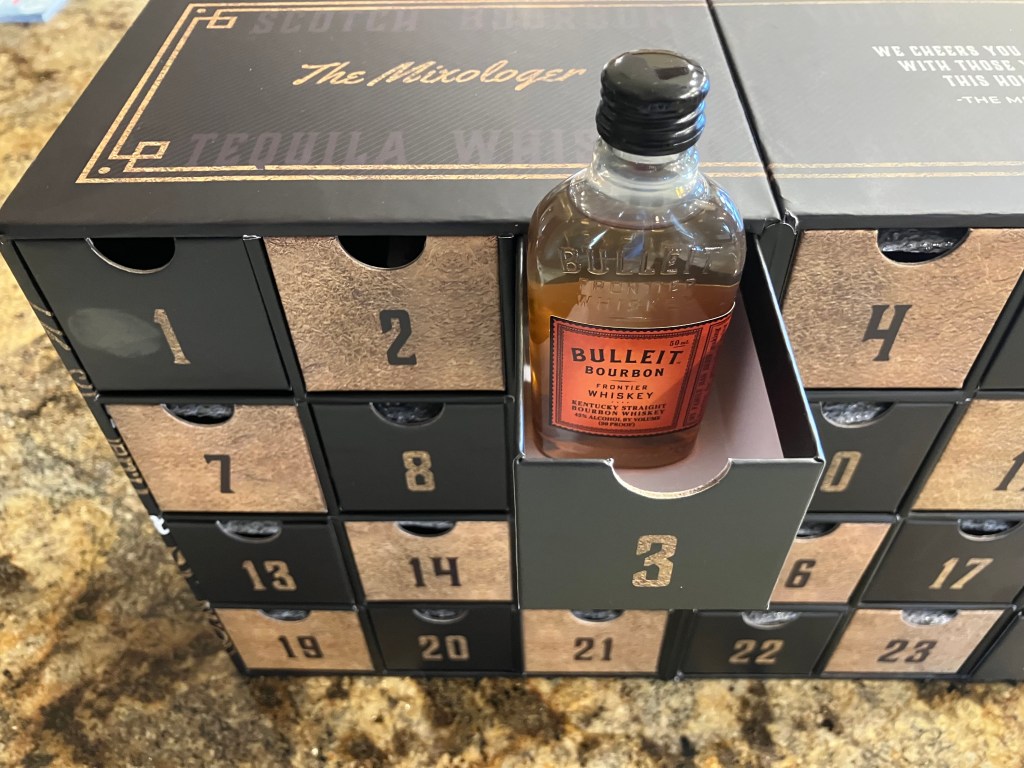
Advent Spirits Day 3: Bulleit Bourbon

As an old geezer in modern America, I am legally required to keep several bottles of bourbon in my liquor cabinet. I’m not sure why that’s so, but I’m sure you’ve noticed the preponderance of brownish liquors whenever you visit your retired Uncle or anyone else of this demographic.

First, let’s review the definition for a bourbon (which is, of course, a type of whiskey). Bourbon must be produced in the United States; the grains that are fermented to make it must be at least 51 corn; it must be aged in new, charred oak barrels; it must clock in at least 80 proof; it must not include any added coloring or flavoring; and it can only be consumed by white males with receding hairlines and a closet full of polo-style shirts. (I made up that last part.)

Today’s spirit is Bulleit Bourbon. Bulleit is made in Kentucky, which, to repeat, is not a requirement for bourbon, but the two are closely associated in the minds of many. Bourbons are also frequently associated with slow and labor-intensive manufacturing processes, preferably in weathered old distilleries in the hills of Kentucky, and using a family recipe that goes back generations. Bulleit checks a number of those boxes, and it’s been around since 1830. However, like so many distillers, it’s been acquired by the global spirits company Diageo. What’s more, Diageo has moved production to modern distilling facilities. When Diageo took over, they claimed they weren’t going to mess with Bulleit’s traditions. But how many times have we fallen for that line? I still remember when Heineken bought the scrappy and wonderful Lagunitas, and Lagunitas has gone downhill ever since.

Anyway, I’m willing to approach this Bulleit stuff with an open mind. Here’s the description from their website:

“Bulleit Bourbon is inspired by the whiskey pioneered by an old family recipe over 150 years ago. Only ingredients of the very highest quality are used. The subtlety and complexity of Bulleit Bourbon come from its unique blend of rye, corn, and barley malt, along with special strains of yeast and pure Kentucky limestone filtered water. Due to its especially high rye content, Bulleit Bourbon has a bold, spicy character with a finish that’s distinctively clean and smooth.

Medium amber in color, with gentle spiciness and sweet oak aromas. Mid-palate is smooth with tones of maple, oak, and nutmeg. Finish is long, dry, and satiny with a light toffee flavor.”

Time to get to work.

Appearance: It’s got a nice, mellow honey color, evocative of extremely old hydraulic clutch fluid. A glass full of this stuff looks iconic, like something Sam Spade would drink in his seedy private-eye office on Sutter Street in San Francisco. It would look good on a cluttered desk next to a Webley-Fosbery automatic.

Aroma: The nose on this Bourbon is woody and sweet and spicy, like a muted version of your teenage daughter’s Billie Eilish perfume.

Taste: This is a very spicy bourbon. It’s peppery and tumeric-y with just a bit of clove. (The spice is to be expected, as Bulleit is made from 28% rye. Compare that to a typical Bourbon, which uses more like 10% rye.) Underlying the spicy notes is a warm mix of caramel and orange peel. It’s an enjoyable, interesting taste.

Finish: The finish is warm and satisfying. The spices linger, although there is also a bit of an astringency that remains on the tongue.

Bottom Line: This is a very solid, reliable bourbon, albeit one that is unusually spicy. It’s worth keeping a bottle or two on your liquor shelf, particularly if you fit the target demographic, and/or if you like spicy rye. It’s also a good choice if you like the lore that typically accompanies a bourbon. In Bulleit’s case, there’s a story that their founder, Augustus Bulleit, filled a flatboat with barrels of his bourbon in 1860 and headed to New Orleans. He never made it, mysteriously vanishing, never to be heard from again. No Bulleit whiskey was produced for over a century, until his great-grandson Thomas Bulleit revived the brand in 1987. Some say you can summon Augustus’s spirit if you whisper “Justice for Augustus” while making the first pour from a fresh bottle. That last sentence might be a total fabrication…but isn’t it worth a try?

2025 Advent cocktails

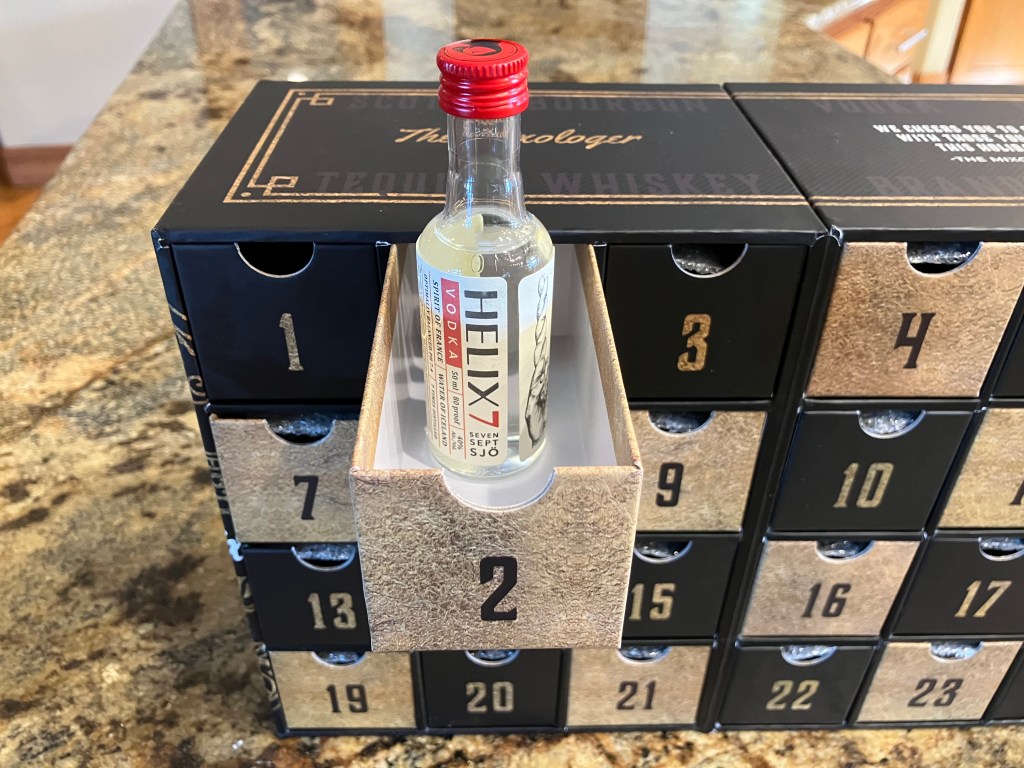
Advent Spirit Day 2: Helix7 Vokda

What do you know about vodka? All I remember from my Russian language class in grad school is that “vodka” means “little water.” And thus it’s supposed to have little if any taste. (My wife makes the same claim about me.) Anyway, because it doesn’t bring a lot of baggage, vodka considered to be a great mixer.

Of course, the “it tastes like water!” slogan poses a problem for distillers trying to stand out. How can you differentiate your product if it tastes like water. Of course, the folks at Fiji Water and Smart Water and countless other tap-water purveyors have managed to find a way.

And thus we come to today’s Advent spirit, which is Helix7 Vodka.

I checked out their distractingly-fussy, trying-too-hard website, featuring Scandinavian dudes who look like Thor working at the stills, disaffected hipsters smoking giant cigars, and obscure Viking references. Here’s how they describe their vodka:

“WE SOURCE THE HIGHEST QUALITY WHEAT FROM THE CHAMPAGNE REGION OF FRANCE.

This premium spirit is then shipped to Iceland where its [sic] carbon filter [sic]  and blended with icelandic [sic] water. Icelandic water has a very low mineral content and a high alkaline level which ensures a clean crisp taste to the end product.

With this perfect blend of high-quality spirit from France and high quality water from Iceland helix hits the optimal balanced pH of 7.4

This never before made, blend of French spirits and Icelandic water, together creates [sic] the DNA of this ultra premium vodka. This is the inspiration of the name helix, which is the name of the two shapes in a DNA thread.”

So let’s overlook the poor editing and try out the vodka!

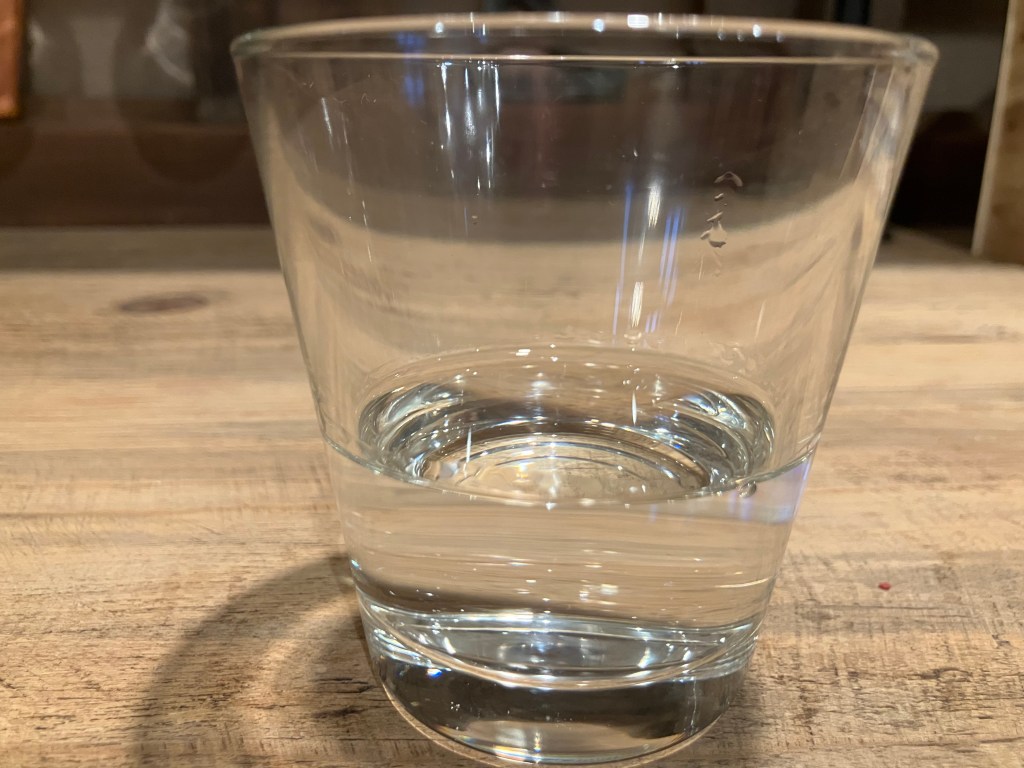
Appearance: It’s clear. Like water. Nothing to see here. Literally.

Aroma: There’s a very slight hint of Windex, but otherwise there’s no aroma. Again, I think this is a good thing, consistent with the ideal nature of the spirit.

Taste: Oh. My. God. Where have you been all my life?? I have to admit this is among the smoothest vodkas I’ve tasted. It’s like feathers wrapped in cotton, then floated from a gossamer tether tied to a helium balloon. I don’t know if it’s because of the supposedly “optimal balanced pH of 7.4,” but this vodka gently caresses your tongue with no drama and no empty promise to respect you in the morning. Like any good vodka, you really don’t taste much at all. There’s a very slight sweetness, as though someone dissolved a single grain of sugar in this small bottle. You can detect it, but it doesn’t predominate. And maybe a slight hint of baked bread comes through from that French wheat, but if you notice it at all it’s faint and triggers only pleasant memories of a mom-and-pop bakery in your neighborhood when you were growing up in Greenwich Village. In short, this stuff is a pleasure to drink straight. I could throw back a tumbler of this stuff no problem. But I suspect you’d want to mix it into a cocktail–maybe a Moscow Mule or a Cosmopolitan?

Finish: There’s a tiny hint of burn on the finish, but nothing like the hideous blistering you’d experience from Popov or similar rot-guts. This stuff mainly just leaves you with a warm feeling of Good Will Toward Men. Seriously; it would make a great nightcap!

Bottom Line: I’d call this the vodka of choice for people who don’t like vodka.

2025 Advent cocktails

Spirited Advent-ures

OK, so as you know, I recently had a book published that features 31 Edgar Allan Poe-related cocktails.

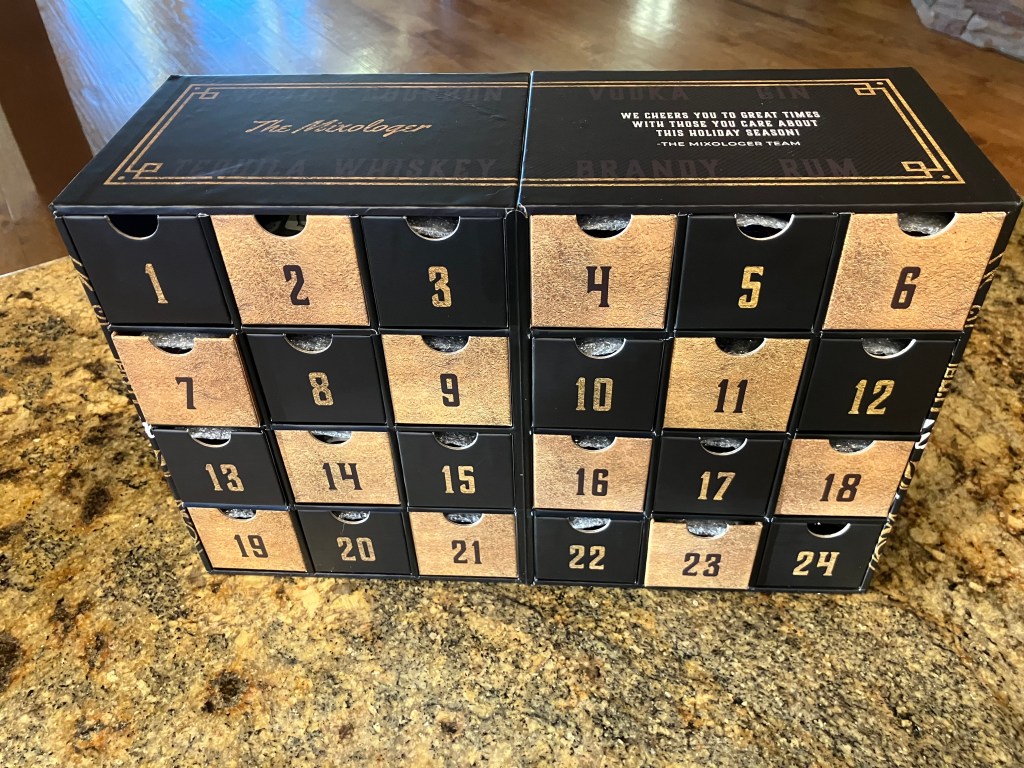
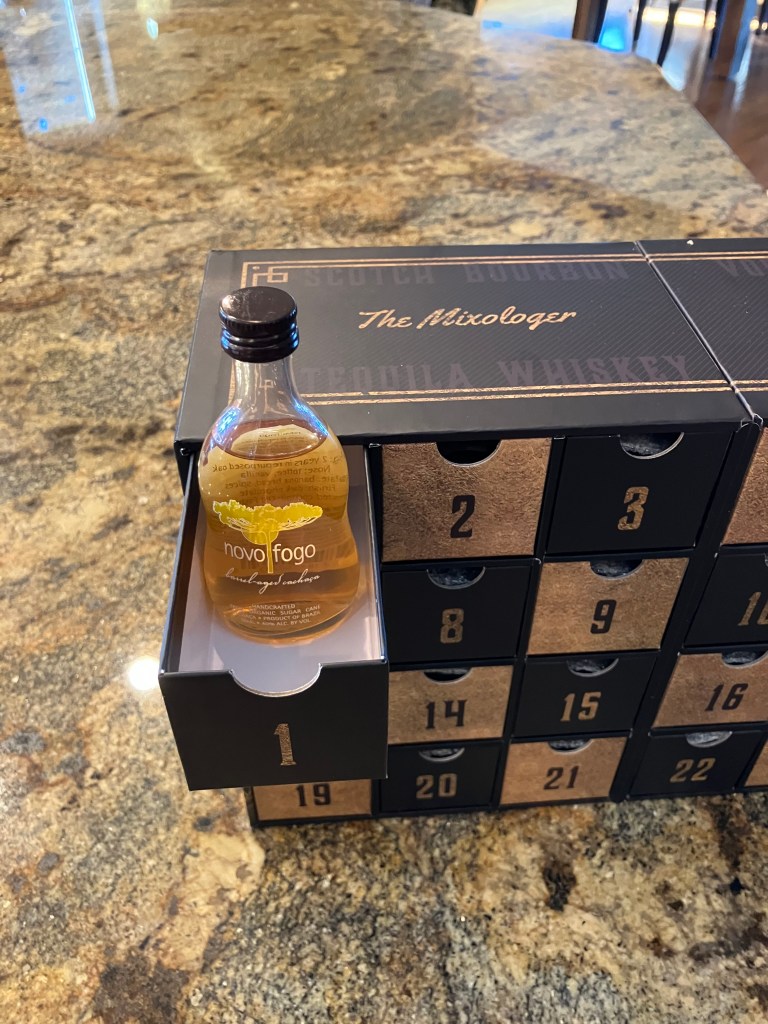
Fortuitously, at about the same time I came into possession of an Advent calendar. But this isn’t any old Advent calendar; this one provides a different, 50 ml bottle of spirits for each day of Advent. Is this a great country, or what?

Talk about Christmas “spirit!”

The manufacturer (“The Mixologer”) provides a recommendation for a cocktail to make with each spirit. But I’ve decided to sample each entry “neat” (i.e., straight and without ice). And I’m going to provide my honest assessment of each one, using four criteria: (1) appearance; (2) aroma; (3) taste; and (4) finish. I’m also going to use the opportunity to learn a little trivia about each of these different spirits. And I’m going to post my findings each day during Advent. Consider it my Christmas gift to you, Dear Reader.

So, without further ado, let’s get to today’s spirit.

“Spirit, conduct me where you will.”
  1. Novo Fogo barrel-aged cachaça

Cachaça is, essentially, Brazilian rum. But don’t let a Brazilian hear you say that. They will insist that cachaça is a unique spirit, and in the legal sense they are right. By law, no one can call their rum cachaça unless it is made in Brazil and follows strict protocols. It’s akin to how no one outside of Scotland can call their whisk(e)y Scotch.

Cachaça is made from sugar cane grown in Brazil, with nothing else but water and maybe a little caramel coloring. (Regular old rum is goes through an extra step, whereby the sugar is first refined into molasses.) Cachaça can be aged in hardwood casks, or bottled directly. The ABV of the bottled spirit must be between 38 and 48 percent.

Today we’re tasting a barrel-aged cachaça made by Novo Fogo. Here’s how they describe their product: “This aged spirit bakes the banana notes from the un-aged cachaça in 53-gallon American oak barrels that have been taken apart, sanded, and re-toasted. The heat and humidity of the rainforest changes the spirit to the flavors of banana bread, with notes of chocolate, cinnamon bark, coffee, and black pepper.” Let’s check it out!

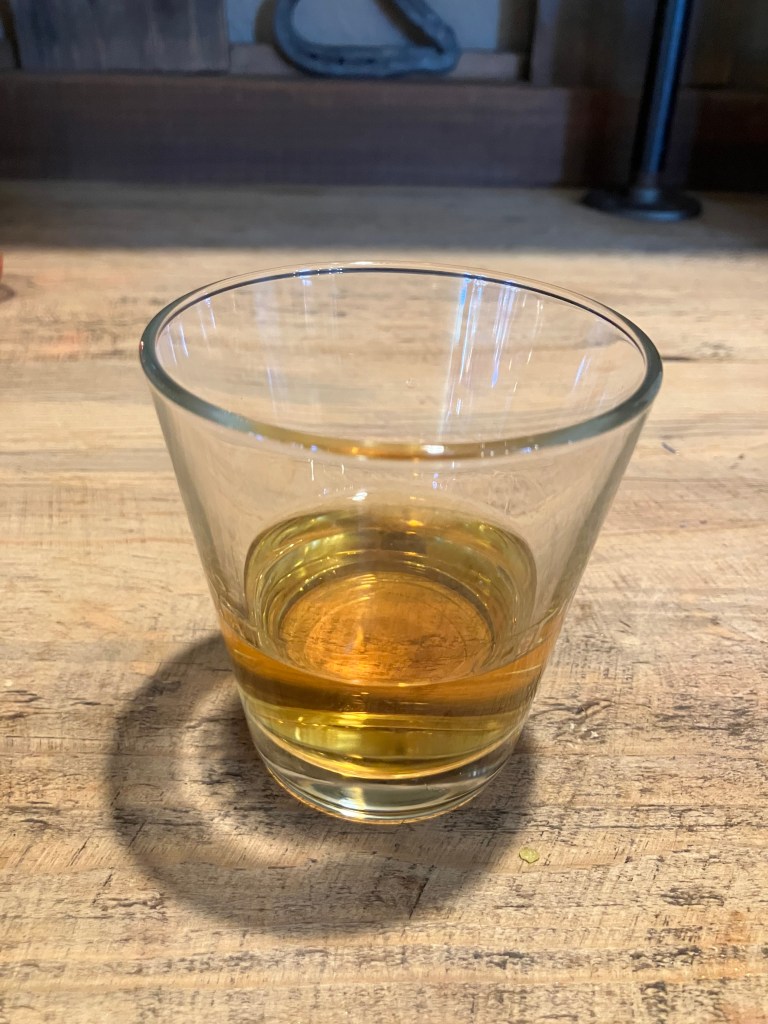
Appearance: Light-to-medium bronze-gold hue, like a urine sample when you’re a bit dehydrated. Or like Miller Genuine Draft, if that’s more your thing.

Aroma: Pleasant, not overpowering. The barrel aging really comes through–vanilla, baking spices, maybe a little clove. A slight hint of sugar cookies–inexplicably with raisins–baking in the oven.

Taste: This is unusual but surprisingly tasty. It’s got the sweetness of the milk at the bottom of your cereal bowl after eating Frosted Mini Wheats, and it’s balanced with the flavors of raw celery sticks, fresh-cut grass, and some Old English furniture polish.

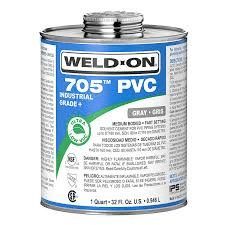
Finish: The finish is definitely unusual and intriguing. You can tell you’ve just sipped something with minimal processing; the rough edges have not been sanded away, and your tongue is left trying to figure out what just happened. There’s also a notable solvent aftertaste that lingers at the end, but thankfully there’s no accompanying burn. It reminds me of when I was working with plastic pipe while plumbing the barn, and I accidentally got some PVC glue on the rim of my coffee mug. Each time I took a sip of coffee, there was a solvent-y taste in the background. It didn’t stop me from finishing the coffee, though.

Bottom Line: This cachaça is a bit more interesting and less heavy-handed than your standard Bacardi Gold…but it also costs over twice as much. I might pour myself a small glass of this stuff before dinner, but if I were making a cocktail, I’d just use Bacardi and use the money I saved to buy a new can of Weld-On.