2025 Poe Cocktails

Cocktail 27: The Facts in the Case of M. Valdemar

I was thoroughly unnerved, and for an instant remained undecided what to do. At first I made an endeavor to re-compose the patient; but, failing in this through total abeyance of the will, I retraced my steps and as earnestly struggled to awaken him. In this attempt I soon saw that I should be successful — or at least I soon fancied that my success would be complete — and I am sure that all in the room were prepared to see the patient awaken.

For what really occurred, however, it is quite impossible that any human being could have been prepared.

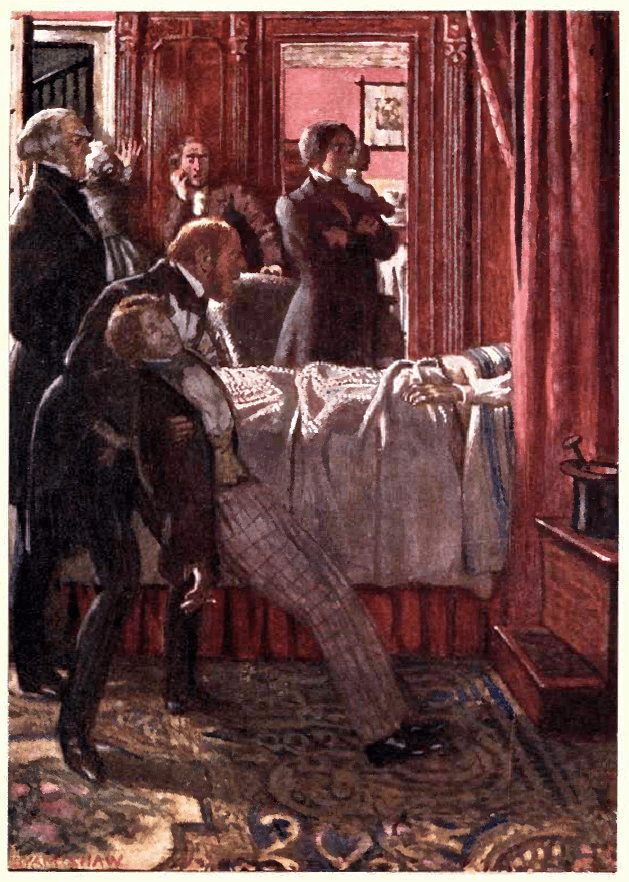
As I rapidly made the mesmeric passes, amid ejaculations of “dead! dead!” absolutely bursting from the tongue and not from the lips of the sufferer, his whole frame at once — within the space of a single minute, or even less — shrunk — crumbled — absolutely rotted away beneath my hands. Upon the bed, before that whole company, there lay a nearly liquid mass of loathsome — of detestable putrescence.
The Tale

This is another of Poe’s suite of mesmerism stories (which includes “Mesmeric Revelation” and yesterday’s “A Tale of the Ragged Mountains”). In this story, a Mesmerist hypnotizes a man (M. Valdemar) at the moment of his expected death from tuberculosis. This somehow holds Valdemar in a state of suspended animation so that, it would seem, death is indefinitely delayed. The Mesmerist is able to communicate with his patient, as I suppose one can talk to someone in a state of hypnosis. Valdemar explains that he is dying. Then, it would seem, he dies. His breathing and pulse stop, and his skin turns cold.

As the nurses prepare to remove the body, Valdemar’s voice is heard–though his lips don’t move–and he says “I am dead.” For the next seven months, Valdemar’s body is monitored, and while it shows no signs of life, neither does it show signs of decay. Finally, the Mesmerist decides to try to wake Valdemar from his trance. Valdemar’s voice is again heard, saying ““For God’s sake! — quick! — quick! — put me to sleep — or, quick! — waken me! — quick! — I say to you that I am dead!” At that request, the Mesmerist “earnestly tries to awaken him,” and immediately Valdemar’s body undergoes the decomposition that should have been occurring on the dead body over the preceding months.

The full story is available here.

The Drink

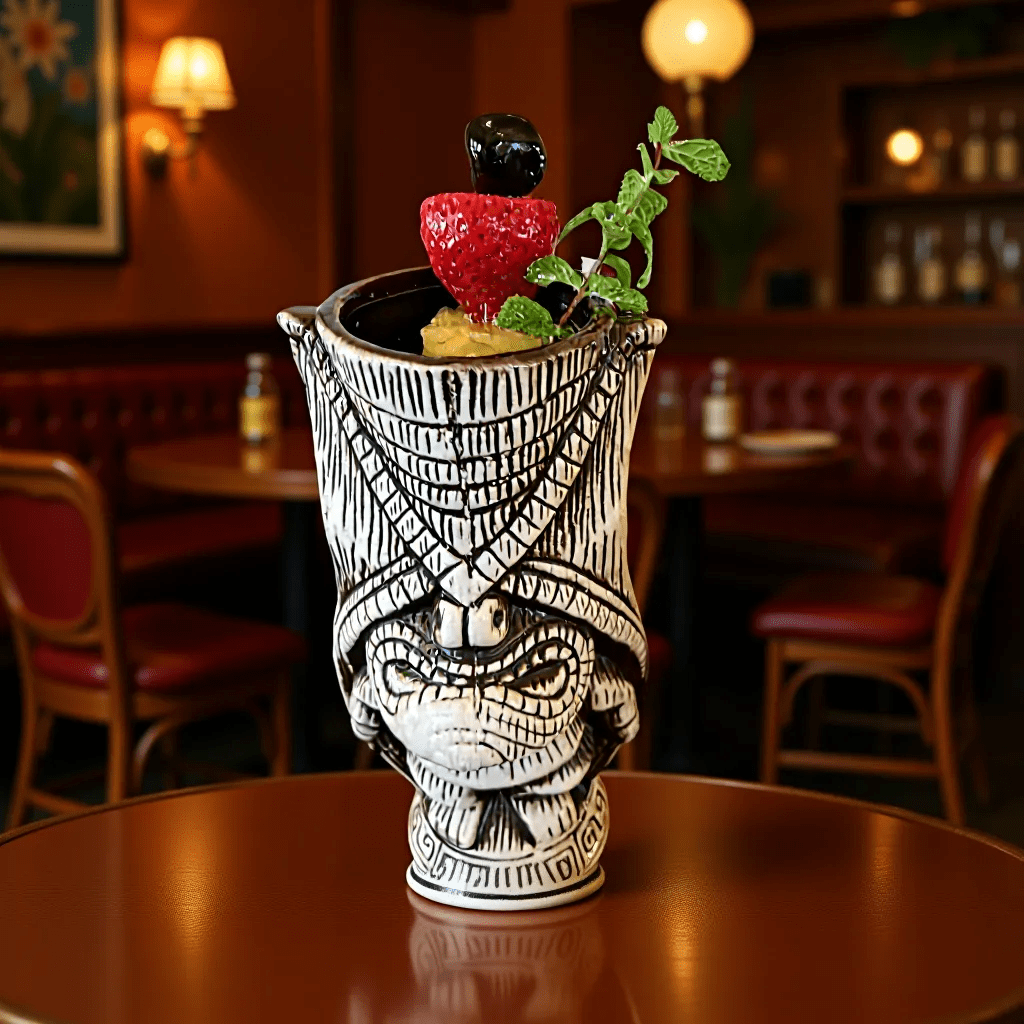
Riffing off the excerpt I shared at top of this post, I at first considered creating a drink called “Detestable Putrescence.” Cooler heads prevailed, however, and instead we’re going to make your standard, classic zombie. For isn’t a zombie, essentially, what M. Valdemar became?

The zombie cocktail was created by that godfather of the tiki bar, Donn Beach, in the 1930s. It’s said the name was inspired by one of Donn Beach’s customers, who said the strong drink turned him into “the walking dead.” We’ve all been there, right?

Here’s the classic recipe:

Ingredients:

1 1/2 ounces Jamaican rum

1 1/2 ounces Puerto Rican gold rum

1 ounce 151-proof demerara rum

3/4 ounce lime juice, freshly squeezed

1/2 ounce Don’s mix (see discussion below)

1/2 ounce falernum

1 teaspoon grenadine

4 dashes absinth

1 dash Angostura bitters

Crushed ice

Tropical fruits, a maraschino cherry, and a sprig of mint (as a garnish)

Dump it all (except the garnish) into a blender and blend. Pour into your favorite Tiki mug. Add crushed ice, if needed. Garnish. Drink. Pass out.

This is simultaneously one of the most complicated drinks (in terms of number of ingredients) and one of the most forgiving (in terms of receptivity to substitutions). But I would caution that a little absinth goes a long way. (If anyone wants to make T-shirts with this slogan, accompanied by an image of Poe looking a little loopy, please do so with my blessing.) The main ingredients for this drink are various rums (including the critical 151-proof rum) and sweeteners (especially the falernum and/or the “Don’s Mix.”)

The Don’s Mix is something that’s difficult, if not impossible, to obtain commercially. To make a decent facsimile of your own, just combine two parts fresh grapefruit juice with one part cinnamon syrup. Note that, even though the creator was Donn Beach, his mix is called Don’s Mix.
Poe-Script

When this story was published in two journals in late 1845, many assumed it to be a true report of an actual event. It’s unclear whether Poe intended for his story to be received in this way. But the clinical and authoritative writing style does come across as rather convincing. It’s not hard to imagine the rubes of 1845, who believed in the healing powers of snake oil nostrums, would accept Poe’s tale as fact. Of course, 13 percent of us still believe in Bigfoot…
2025 Poe Cocktails

Cocktail 26: A Tale of the Ragged Mountains

“For many minutes,” continued the latter, “my sole sentiment — my sole feeling — was that of darkness and nonentity, with the consciousness of death. At length there seemed to pass a violent and sudden shock through my soul, as if of electricity. With it came the sense of elasticity and of light. This latter I felt — not saw. In an instant I seemed to rise from the ground. But I had no bodily, no visible, audible, or palpable presence. … Beneath me lay my corpse, with the arrow in my temple, the whole head greatly swollen and disfigured. But all these things I felt — not saw. I took interest in nothing. Even the corpse seemed a matter in which I had no concern.”

The Tale

This is one of Poe’s more convoluted stories, around which I’m still trying to wrap my head. In it, the narrator recounts a tale told to him by an acquaintance named Bedloe, who had mysteriously disappeared in the back country of Virginia, and then he just as mysteriously reappeared. To make matters more confusing, Bedloe claims that, during his disappearance, he had died and somehow recovered. Meanwhile, Bedloe’s personal doctor, who was also present when Bedloe tells his tale,suggests that Bedloe’s temporary death had been a recollection of a historic death in battle that originally had been suffered by Bedloe’s doppelganger…a man named Oldeb. Which, in the big reveal, we are informed is Bedloe spelled backwards, minus the E. Oh, and somehow Mesmerism  (aka animal magnetism, coupled with maybe hypnotism) figures into the plot.

Meanwhile, the eponymous Ragged Mountains of the title are simply the place where Bedloe had temporarily disappeared. They are described as a “chain of wild and dreary hills that lie westward and southward of Charlottesville, and are there dignified by the title of the Ragged Mountains.” They do in fact exist; they’re near the University of Virginia, where Poe spent his brief stint as a student in 1826.

The full story is available here.

The Drink

Given that I can derive little coherent meaning from the tale itself, I figured I would focus on its evocative title. Surely this calls for a drink that features some manner of mountain peaks. And these, I initially thought, can be portrayed with some carefully-sculpted meringue.  Now, to be honest, I have never made meringue. My experience with it limited primarily to my mom’s lemon meringue pies, which are a whole other Tale of the Grotesque. In any event, the meringue on a pie isn’t really defined by sharp peaks; rather, it evokes low, rolling hills. But perhaps that’s what, in actuality, Poe is describing??

So I tried to make meringue. It’s a pretty simple recipe–mainly just sugar and egg whites. And the final step involves browning the outside with a culinary torch….or, in my case, a plumber’s butane torch from a cabinet in my garage. Flame is flame, right?

Alas, I learned that there’s some black magic aspect to making the meringue that I failed to master. My meringue never advanced beyond the thick icing stage. No way that it would evoke mountains…or even “wild and dreary hills.” I nevertheless browned it with my torch and dejectedly ate it by the spoonful over the kitchen sink. Waste not want not, I always say.

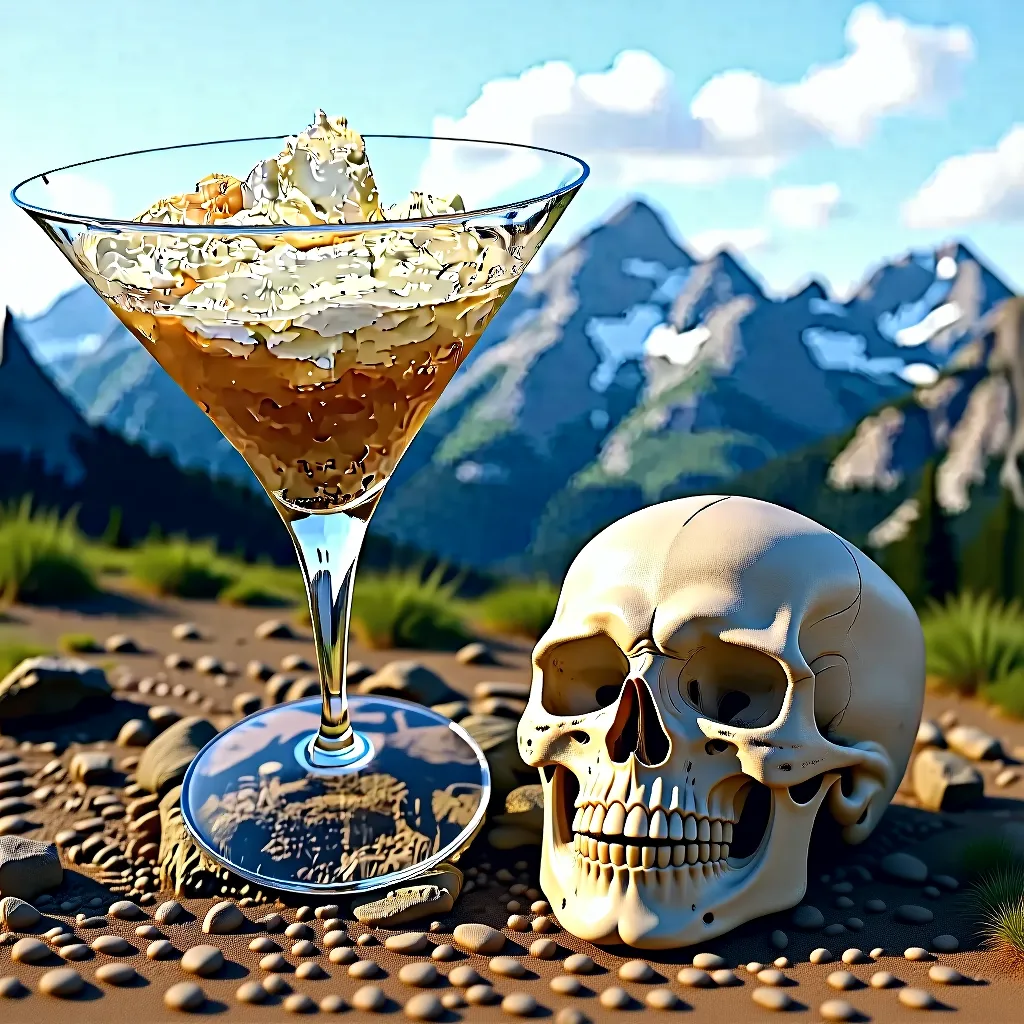
So, moving on to Plan B, I figured I would make the Ragged Mountains out of whipped cream. This worked a little better. The only question was what kind of spirit to place it atop? I settled on a simple chocolate martini. Now, chocolate martinis are not really my bag, baby. I’m far too insecure to drink such a froofy drink. But what else are you going to put under whipped-cream mountains? My manly persona braced for a direct attack as I assembled the ingredients:

Ingredients:

2 oz. vodka

1-1/2 oz. creme de cacao

¼ cup heavy whipping cream

1 tsp vanilla

1 tsp sugar

Grated nutmeg

Combine the whipping cream, vanilla, and sugar. Whip with a whisk until it forms stiff, raggedy peaks…or at least least wild and dreary hills. Set aside. Combine the vodka and creme de cacao in a shaker with ice. Shake until chilled, then strain into a martini glass. Top with the whipped cream, forming ragged peaks. Sprinkle with grated nutmeg (as I did), or with chocolate sprinkles, if you are feeling really secure.

Poe-script

Poe’s original manuscript for this story takes the form of a long roll of paper (like a scroll, perhaps?) that’s 15 feet long and 8 inches wide. It’s owned by the Morgan Pierpont Library in New York City. I dare you to try to steal it.

2025 Poe Cocktails

Cocktail 25: A Dream Within a Dream

I stand amid the roar

Of a surf-tormented shore,

And I hold within my hand

Grains of the golden sand —

How few! yet how they creep

Through my fingers to the deep,

While I weep — while I weep!

O God! Can I not grasp

Them with a tighter clasp?

O God! can I not save

One from the pitiless wave?

Is all that we see or seem

But a dream within a dream?

The Poem

This poem was published in 1849, just months before Poe died. It comprises two stanzas (the second of which is reproduced above). It’s a somewhat nihilistic poem, questioning the meaning and purpose of existence. He suggests that we cannot have any real influence on our surroundings; that our puny little actions are ultimately impotent and purposeless. Indeed, his central proposition is that our lives are mere illusions–that “all that we see or seem is but a dream within a dream.” It would seem that Poe is here channeling Eeyore.

The full poem is available here.

The Drink

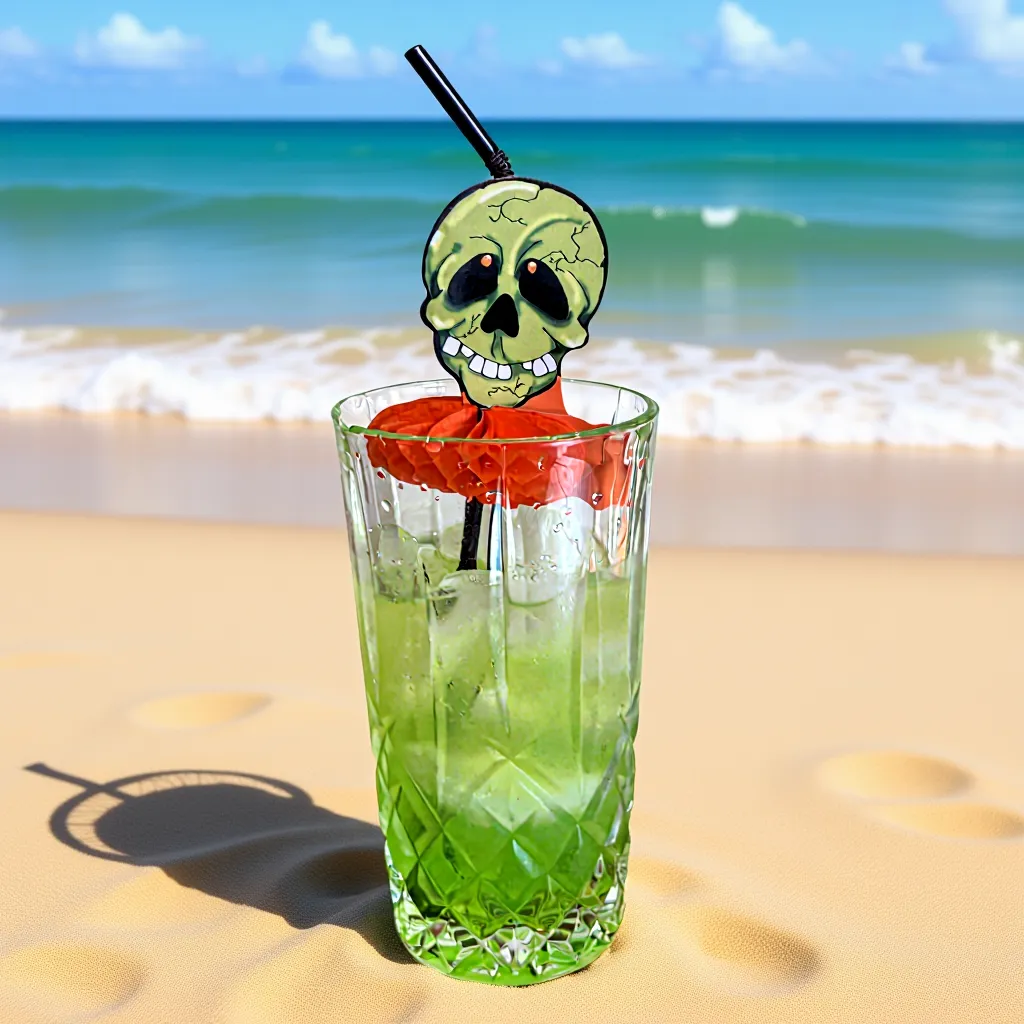
This idea of Life’s Illusions was, of course, picked up by Joni Mitchell 120 years later in “Both Sides Now.” It also inspired a class of cocktail called the Midori Illusion. And that’s what I’ve selected to represent this poem. (Note: There’s really no illusion involved with this drink. It’s just an unnaturally-neon green cocktail. But it’s the best I could do. Give me a break.)

Ingredients:

1-½ oz Midori

1 oz vodka

½ triple sec

1 oz. pineapple juice

Splash of lime juice

If you have anything on hand to suggest “illusion” by way of garnish, go for it. All I could find was a goofy-looking skull-straw.

Mix everything together in a Collins glass filled with ice. Stir. Drink. Despond.

Poe-Script

I cannot encounter the word “illusion” without thinking of William Castle’s 1960 schlock horror film, 13 Ghosts. Castle had developed a reputation for (generally silly) gimmicks to promote his films. Accordingly, he claimed that 13 Ghosts was filmed in “Illusion-O,” which supposedly made ghosts visible on the screen. What’s more, movie patrons were provided with a “ghost viewer” (a cheap set of cardboard glasses with red and blue cellophane lenses) that allowed you to choose whether to see the ghosts or, if you’re a scaredy-cat, not.

I confess that I find this low-tech, sideshow-level gimmick to be rather endearing. But it really has nothing to do with “A Dream Within a Dream,” aside from the “illusion” reference. 

2025 Poe Cocktails

Cocktail 24: Spirits of the Dead

Thy soul shall find itself alone

‘Mid dark thoughts of the grey tombstone;

Not one, of all the crowd, to pry

Into thine hour of secrecy.

Be silent in that solitude,

Which is not loneliness- for then

The spirits of the dead, who stood

In life before thee, are again

In death around thee, and their will

Shall overshadow thee; be still.

The Poem

“Spirits of the Dead” explores the mysteries of life and death in a convincing and evocative fashion–which is somewhat surprising, as Poe was a mere 18 years old when it was first published (under the title “Visit of the Dead.”) The poem is five stanzas long (the first two are reproduced above), and it does not stick with any consistent structure or rhyme scheme. For all that, it’s a remarkably haunting and, in its own way, beautiful poem. (I will let slide his rhyming of “Heaven” and “given.” But not so “pry” and “secrecy.”)

All that said, it’s the imagery that I find most notable: “gray tombstone,” “high thrones in the Heaven,” “red orbs, without beam,” “the breath of God,” “shadowy yet unbroken.” They’re the kind of phrases you’d find in a Gothic ghost story. And that’s convenient, because I’ve been dying (ha!) to make a ghost-themed cocktail. So let’s do this!

The full poem is available here.

The Drink

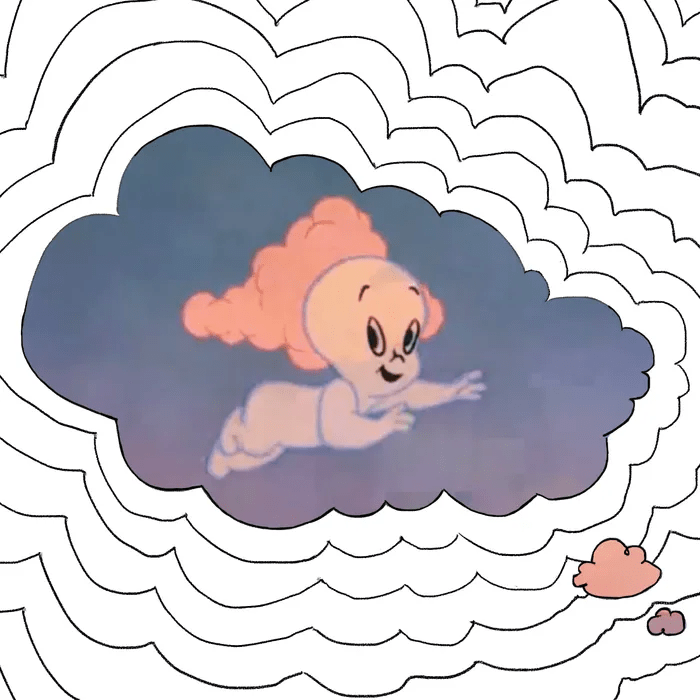
There are a number of “ghost” cocktails out there, most of which are white and frothy. Who am I to go against that formula? I’m envisioning something like Casper the Friendly Ghost, that’s cute and saccharine and, if you binge on it, makes you want to throw up. So let’s get to it!

Ingredients:

1-½ oz RumChata

1 oz vanilla vodka

2 oz Cool Whip

Splash of spiced rum

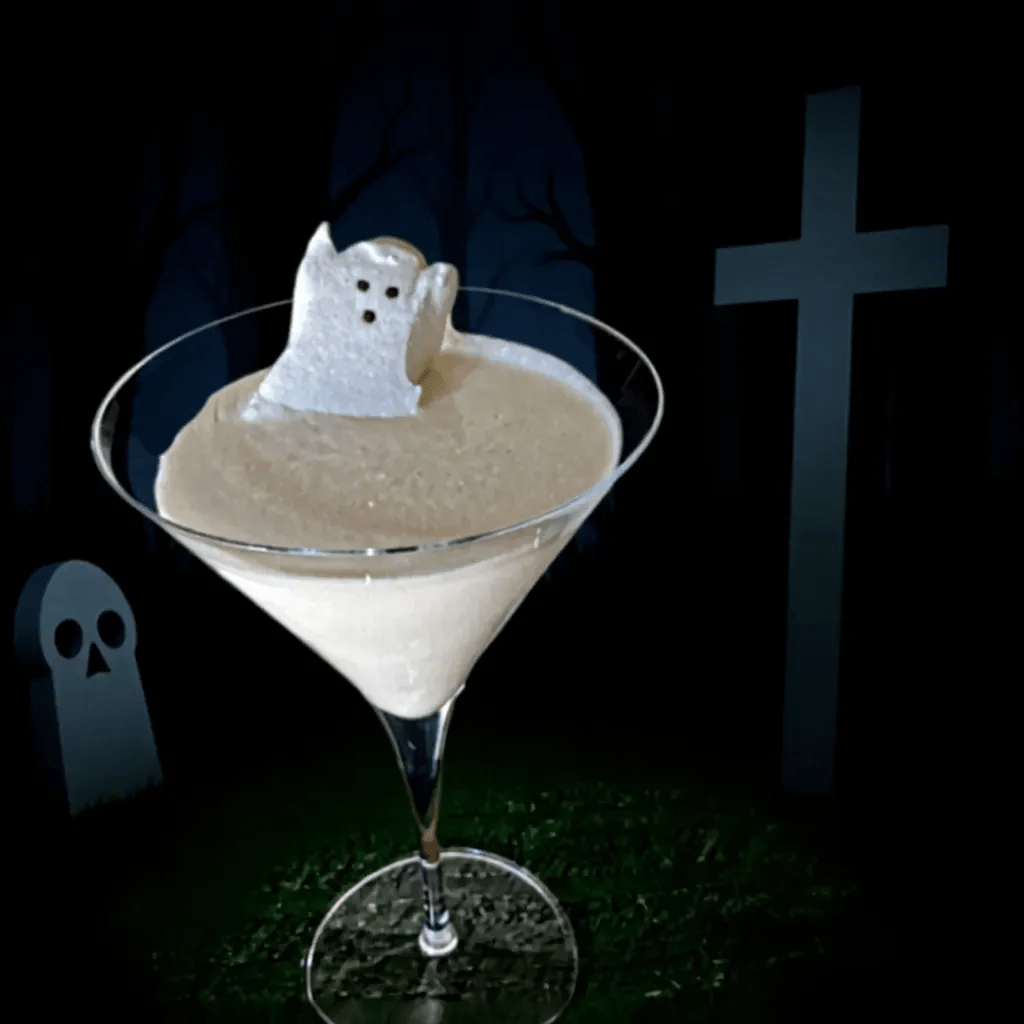
1 Peeps ghost

Mix all the liquid ingredients into a cocktail shaker with ice. Strain into a chilled martini glass. Garnish with a Peeps ghost. You should use your own judgment with the spiced rum. I added it to combat the cloying sweetness of the RumChata and Cool Whip, but you might not feel that’s quite as necessary as I did. Alternatively, you might substitute whipping cream for the Cool Whip. Follow your instincts here. Truth be told, the only indispensable ingredient is the Peeps ghost.

Poe-Script

The title “Spirits of the Dead” was borrowed for a 1968 horror film released by American International. The movie is an anthology of three Poe stories, each directed by a different director. However, none of the three tales relates to the eponymous poem. You should not confuse this with “Orgy of the Dead,” which was a 1965 nude zombie film by none other than Ed Wood.

2025 Poe Cocktails

Cocktail 23: Three Sundays in a Week

“Hush, sir!” — “I’ll oblige you for once. You shall have my consent — and the plum, we mus’nt forget the plum — let me see! when shall it be? To-day’s Sunday — is’nt it? Well, then, you shall be married precisely — precisely, now mind! — when three Sundays come together in a week! Do you hear me, sir! What are you gaping at? I say, you shall have Kate and her plum when three Sundays come together in a week — but not till then — you young scapegrace — not till then, if I die for it. You know me — I’m a man of my word — now be off!” Here he swallowed his bumper of port, while I rushed from the room in despair.

The Tale

This is another of Poe’s lesser-known humorous tales. The story goes thus: the narrator seeks his uncle’s permission to marry his daughter Kate. But this uncle, who never makes things easy, decrees the marriage shall happen only “when three Sundays come together in a week.” This surely is intended as a “Twelfth of Never” kind of construction. And yet, it so happens that, three weeks later, two sea captains known to the uncle happen to arrive at his house. One has just finished sailing around the globe eastward, and one has just finished sailing around the globe westward. Since this happened before the invention of the International Date Line, the westward-traveling captain “lost” a day, and the eastern-traveling captain “gained” a day. (This is much in the same way that you and I lose or gain hours while traveling across time zones.) As a result, one captain believes that yesterday was Sunday, the other believes that tomorrow is Sunday, and the uncle believes that today is Sunday. Thus, three Sundays come together in one week, and the narrator can be wed.

The full story is available here.

The Drink

This is all well and good, but, more importantly, it provides us a capital opportunity to make a Sundae Cocktail. Now, there are many rich, indulgent versions which involve ice cream and chocolate sauce and all the usual fixings for a sundae, and they almost all call themselves “decadent,” which is a dead giveaway that they are aimed at posers. More to the point, the alcohol in these typical sundae cocktails is limited to a sprinkling of liqueur over the top of the ice cream. This is cheating; anything that you eat with a spoon is not a cocktail.

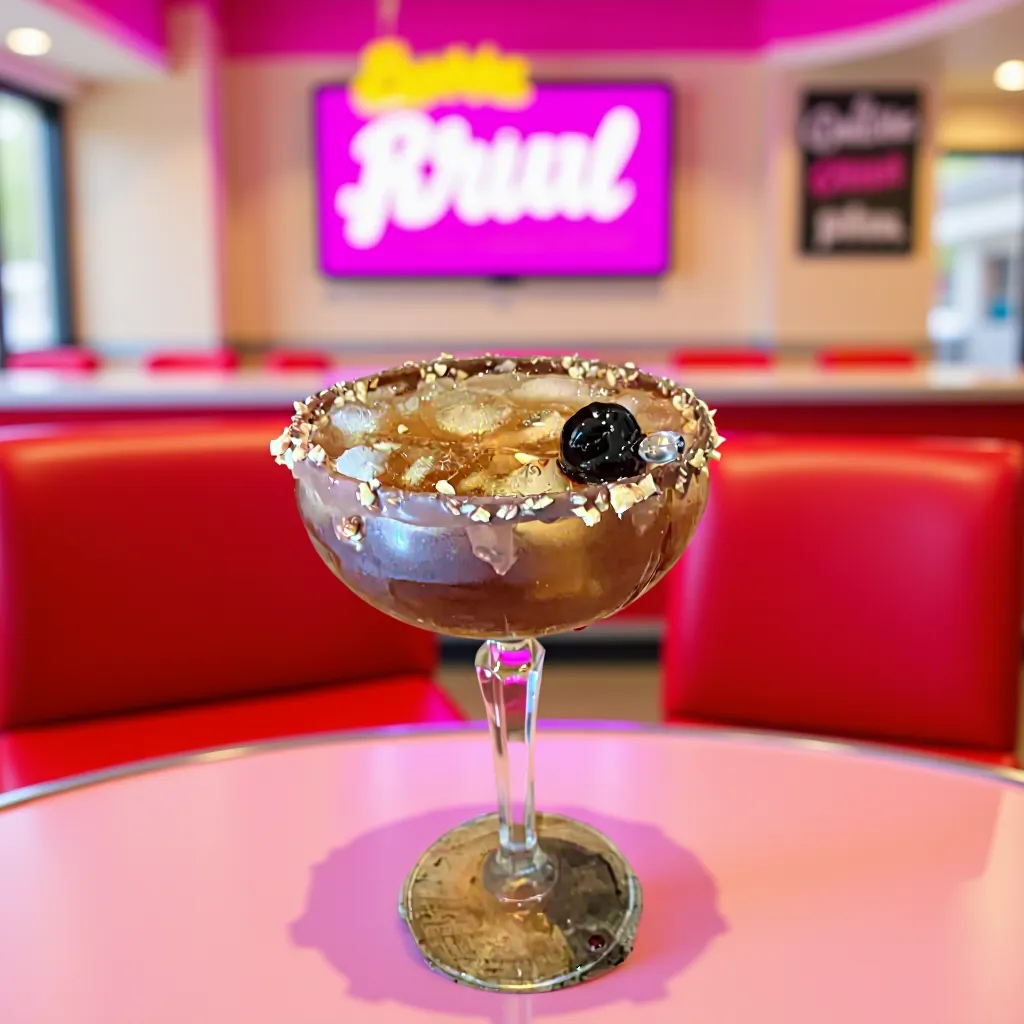
 No, we are going to be more imaginative. And when I say “we,” I mean some random guy I found on the Internet who came up with something he says “tastes just like an ice cream sundae,” and it only has two ingredients: a “whipped cream whiskey” and some A&W soda. In his video he describes the taste as “gawd damm!” I was intrigued. I made and drank the drink, and it was tasty enough, but it fell a bit short in terms of invoking a sundae (let alone three sundaes in a week). So I added some creme de cacao and I rimmed the glass with some chopped nuts. Now we’re talking!

Ingredients:

2 oz Whiplash Whiskey

2 oz A&W cream soda

1 oz creme de cacao

1 tbs finely chopped peanuts (for rimming the glass)

1 maraschino cherry

Prepare a coupe glass (which, to my mind, look like something you might use to serve a scoop of ice cream) by moistening the rim with a little chocolate syrup and then coating the rim with chopped peanuts. Stir together the liquid ingredients in a mixing glass with ice, and strain into your prepared coupe glass.  (I had added crushed ice to my coupe glass, because I thought it makes it look more like a sundae. You can forego this if you’re a purist, though.) Garnish with a maraschino cherry, of course! The result is a cocktail that even your crusty old Uncle Rumgudgeon would like.

Poe-Script

I find the concept of the international date line to be simultaneously fascinating and mind-bending. It was established in 1884, pretty much to solve the very issue that Poe identifies in his story. That is, if you keep adjusting your clock as you go around the world (adding or subtracting an hour every 15 degrees of latitude), you’ll eventually find yourself on a different calendar day than that recognized by the local population. To correct this problem, the IDL convention has you add or subtract a full 24 hours whenever you cross that (imaginary) line. If you find this concept intriguing, I  highly recommend Umberto Eco’s novel The Island of the Day Before.