2025 Poe Cocktails

Cocktail 22: Eleonora

We had always dwelled together, beneath a tropical sun, in the Valley of the Many-Colored Grass. No unguided footstep ever came upon that vale; for it lay away up among a range of giant hills that hung beetling around about it, shutting out the sunlight from its sweetest recesses. No path was trodden in its vicinity; and, to reach our happy home, there was need of putting back, with force, the foliage of many thousands of forest trees, and of crushing to death the glories of many millions of fragrant flowers. Thus it was that we lived all alone, knowing nothing of the world without the valley — I, and my cousin, and her mother.

The Tale

This is a highly descriptive, tragically romantic tale, which may or may not involve a touch of madness. The narrator describes a magical, idyllic time when he lived in the Valley of the Many-Colored Grass with his cousin and her mother (a polycule that might sound familiar to those with knowledge of Poe’s biography). Several pages of this short tale are devoted to the beauty of the valley and of the lovely cousin, whose name was Eleonora. Alas, Eleonora is not long for this world, and in her final days the narrator makes a solemn vow that he “would never bind [himself] in marriage to any daughter on Earth.” He even invokes a curse, whereby he accepts “a penalty the exceedingly great horror of which will not permit [him] to make record of it here” if ever he were to violate his vow. (Do you see where this is headed?)

Eleonora is relieved to hear the narrator’s sacred vow, and dies an easier death because of it. Alas, the narrator soon afterward leaves the Valley of the Many-Colored Grass and finds himself in a strange land, where he encounters Ermengarde– “a maiden to whose beauty my whole recreant heart yielded at once.” He married this hot maiden, never mind the curse that doing so would invoke. And yet, during the night he heard Eleonora’s disembodied voice, urging him “Sleep in peace! For the Spirit of Love reigneth and ruleth, and, in talking to thy passionate heart her who is Ermengarde, thou art absolved, for reasons which shall be made known to thee in Heaven, of thy vows unto Eleonora.”

The full story is available here.

The Drink

What struck out to me about this tale was Poe’s description of the luxuriant Valley of the Many-Colored Grass. So I figured what we need here is a Cocktail of Many Colors. And here it is:

Ingredients:

1 oz grenadine

1.5 oz pineapple juice

2 oz blue curacao and vodka (1 ounce of each, mixed together)

A few dashes of bitters (because this drink is way too sweet otherwise!)

Orange rind and two maraschino cherries (for garnish)

Chill the liquid ingredients. Then, create colored layers by s-l-o-w-l-y pouring each over the back of a spoon into a martini glass. (The blue curacao and vodka should already be mixed into a 2-ounce shot.) Gently add a few dashes of bitters by dripping them along the side of the glass. Create a garnish by shaping a thin strip of orange rind into a heart, with a maraschino cherry within each half of the heart, and held together with a cocktail pick. (See photo.) This represents the eternal love of the narrator and Eleonora…or perhaps their love broken in two?

Poe-Script

This tale has clear autobiographical elements. Poe did indeed live with his young cousin (Virginia) and her mother, and he eventually married Virginia when she was 13 years old. What’s more, Virginia became ill and eventually died. Poe would go on to woo (but not marry) other women. It is not known whether Virginia’s spirit ever forgave him and released him.
2025 Poe Cocktails

21. Some Words With a Mummy

The application of electricity to a mummy three or four thousand years old at the least, was an idea, if not very sage, still sufficiently original, and we all caught it at once. About one-tenth in earnest and nine-tenths in jest, we arranged a battery in the Doctor’s study, and conveyed thither the Egyptian. … Readjusting the battery, we now applied the fluid to the bisected nerves — when, with a movement of exceeding life-likeness, the Mummy first drew up its right knee so as to bring it nearly in contact with the abdomen, and then, straightening the limb with inconceivable force, bestowed a kick upon Doctor Ponnonner, which had the effect of discharging that gentleman, like an arrow from a catapult, through a window into the street below.

The Tale

This is one of Poe’s more satirical tales, to the point of broad silliness. (I would be remiss, however, if I didn’t point out that the narrator confesses to drinking five bottles of a “brown stout” shortly before these events unfolded. It’s unclear whether this potentially impugns the veracity of the narration that follows.)

In any event, the narrator is present as a doctor and several colleagues unwrap an ancient Egyptian mummy and playfully apply an electric charge to its limbs. They are amazed to discover that they in fact revived a living being, and proceed to have a conversation with the now-fully-conscious body over cigars and brandy. Hence, “some words with a mummy.”

The principal topic of conversation is whether 19th-century American civilization is superior to the ancient Egyptian civilization. The doctor and his friends proffer example after example of their modern achievements in architecture, science, transportation, arts, and the like, while the mummy belittles each example and offers a more impressive counterpoint from his own time and land. The Mummy almost convinces the group that ancient Egypt was in fact more advanced than modern America, but the men manage a last-minute triumph when they superciliously ask whether ancient Egypt had ever managed “the manufacture of either Ponnonner’s lozenges or Brandreth’s pills.” The mummy was speechless. “Never was triumph more consummate; never was defeat borne with so ill a grace. Indeed, I could not endure the spectacle of the poor Mummy’s mortification. I reached my hat, bowed to him stiffly, and took leave.”

The tale is obviously a broad parody of nineteenth-century Western chauvinism. Accordingly, the supposed triumph of the men is so hollow that it belies their blind faith in their own society. The narrator ultimately seems to sense this, for at the end of the tale he confesses “I am heartily sick of this life and of the nineteenth century in general. I am convinced that every thing is going wrong.” And he announces his intention to get himself “embalmed for a couple of hundred years.” Surely you have never experienced such an impetus to slap your knee and guffaw.

The full story is available here.

The Drink

In keeping with the decidedly sophomoric humor, I originally conceived this as incorporating General Mills’ Yummy Mummy breakfast cereal. For those of you not familiar with this cereal, Yummy Mummy was produced from 1988 to 1993 (and briefly resurrected [ha!] a couple of times after that). It was a spinoff to mainstays Count Chocula and Franken Berry, which were introduced in 1971 and are still available each Halloween season at Target and other purveyors of fine foods. Alas, Yummy Mummy, which was an allegedly fruit-flavored cereal, seems to have been permanently retired. Our inquiries to General Mills went unanswered, but we suspect it has something to do with the term being co-opted to mean attractive celebrity mothers, and all the baggage that goes along with it.

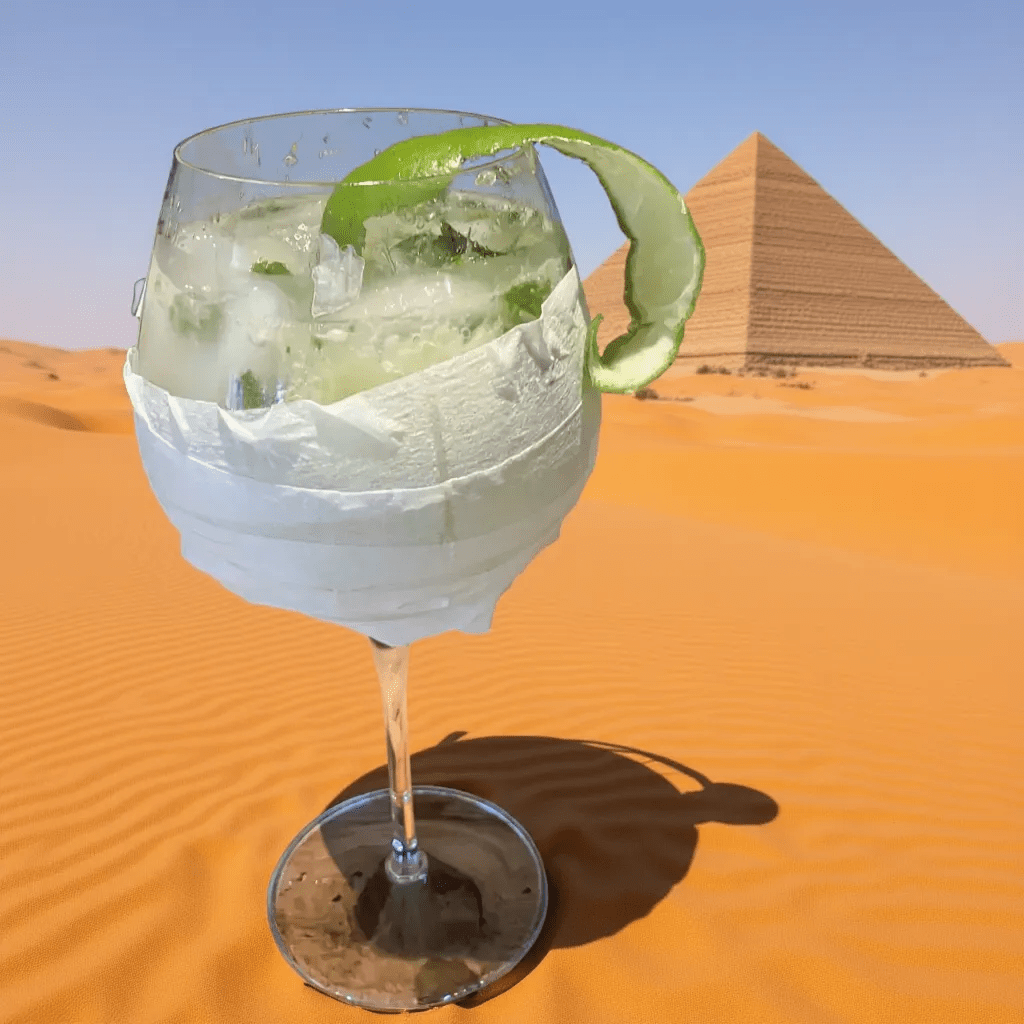
Now, fortunately for us, there’s a broad (ha!) category of cocktail called a Yummy Mummy, which generally is aimed at young mothers, especially on special occasions like Mother’s Day. So that will serve as our starting point. But as a link to Poe’s story this connection is a bit obscure. So to drive the point home we’ll wrap the glass in gauze. Really. You just read on.

Ingredients:

1 lime

2 oz Gin

1 tbsp simple syrup

5 slices of cucumber

Tonic water

Mint leaves

Roll of white, adhesive gauze

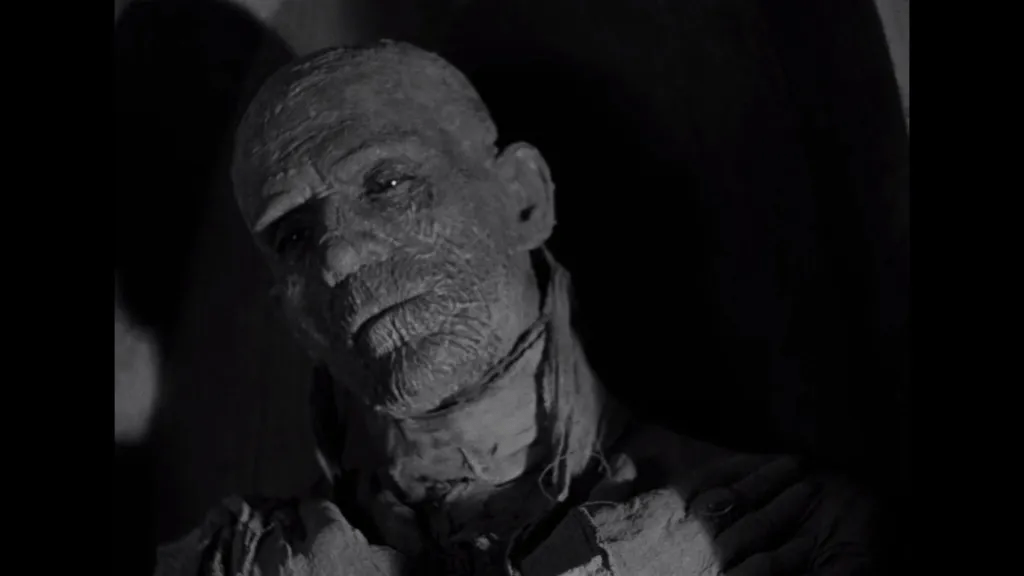
First you’re going to want to prepare your glass. Get a good-size wine glass, the kind that is shaped like a small fishbowl on a stick. Now wrap it with adhesive gauze. The idea is to evoke the idea of a wrapped mummy. To get the full effect, don’t apply the gauze too evenly; you want it to look like it’s been mouldering away in a pyramid for a few millennia, like Boris Karloff’s Imhotep in The Mummy. Fill it half-full with ice.

Set aside the glass and grab your lime (if you’ll pardon the expression). Using a sharp knife, cut off a length of peel about ½” wide and 3-4 inches long. This will serve as a garnish that will again evoke the idea of mummy bandages. (To get an idea of what comes to my mind’s eye, look at the cover of The Alan Parsons Project’s “Tales of Mystery and Imagination.”)

Now, take the mercilessly-flayed lime and quarter it. Toss two or three of those pieces in a cocktail shaker. Then add exactly three mint leaves and muddle it all together. (The three mint leaves mirror the three tana leaves that kept the mummy alive in Universal’s The Mummy’s Hand.) Now add the gin and syrup and some ice and shake it up. Next we need to add some cucumber slices. The number of slice I used is five, which equals the number of persons (living and/or dead) who were engaged in the conversation described above. Shake the content vigorously, then drain everything (including the muddled mint and lime) into your prepared glass.

Top off the glass with cold tonic water, and gently stir while offering the incantation “Allamistakeo” (the name Poe’s Mummy). Finally garnish with the lime peel at a jaunty angle.

The result is a highly refreshing drink that, if you close your eyes, should fit the bill of a standard Yummy Mummy cocktail. But with your eyes open and fixed on this drink, you cannot fail but think of Allamistakeo in all his Ponnonner-kicking, Egypt-defending glory.

Poe-Script

Italian composer Giulio Viozzi wrote a one-act opera entitled “Allamistakeo” in 1954. And yes, it was based on Poe’s story. A quick Google search did not uncover any recent performances of the opera in the United States. However, in 2023 there appeared an off-Broadway play called “The Mummy Speaks,” which is based on “Some Words With a Mummy.” If you’re lucky you might be able to catch a performance.

2025 Poe Cocktails

Cocktail 20: Hop-Frog

And now, while the whole assembly (the apes included) were convulsed with laughter, the jester suddenly uttered a shrill whistle; when the chain flew violently up for about thirty feet — dragging with it the dismayed and struggling ourang-outangs, and leaving them suspended in mid-air between the sky-light and the floor. Hop-Frog, clinging to the chain as it rose, still maintained his relative position in respect to the eight maskers, and still (as if nothing were the matter) continued to thrust his torch down toward them, as though endeavoring to discover who they were.

The Tale

Hop-Frog is a terrible story. I don’t mean that it’s poorly-written or not entertaining; rather, it’s grisly and sinister and a bit revolting. Still, it grips the imagination and simultaneously excites a variety of conflicting emotions. It is masterful. A terrible, masterful story.

It’s essentially a tale of vengeance. A king’s jester–who happens to be a “dwarf” (Poe’s term, not mine)–is habitually mistreated. But a line is crossed when the king mistreats the jester’s girlfriend. In that moment, the reader knows that this has become a revenge tale.

The literary fuse burns steadily and methodically, until the trap is sprung at the royal masquerade ball. The king and his seven courtiers are disguised as “ourang-outangs” (orangutans to you and me), having coated themselves with tar and flax, when the jester suddenly has them raised as a group by a chain and set on fire to die a horrible, grisly death as the horrified crowd looks on. The jester and the girl escape to a distant land, presumably to live happily ever after.

The full story is available here.

The Drink

You realize, of course, that fire must somehow be featured in this drink. Which means we’re going to need some high-test alcohol. I’m making this drink in California where the upper limit is 151 proof (75.5% ABV). So I got myself a bottle of Don Q’s 151 rum. (The Bacardi 151 you remember from your high school parties has somehow vanished from the liquor stores like Hop-Frog from the kingdom.)

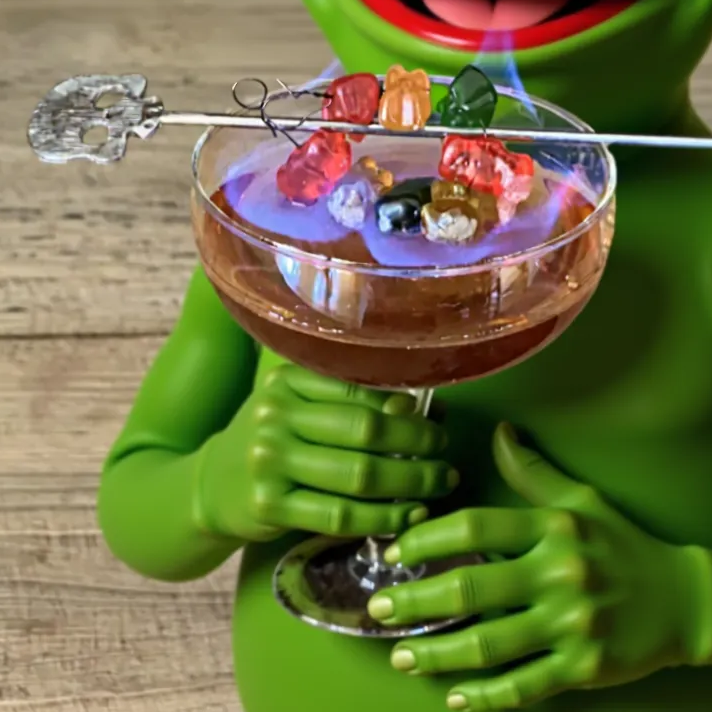
Now, 151 is virtually undrinkable, and it’s used here strictly for pyrotechnic purposes. For the base alcohol we’ll use a more-reasonable 80 proof spirit. Meanwhile, the centerpiece of this drink will be 8 immolating ourang-outangs. For these, I’ve substituted gummy bears. This is because (1) ourang-outangs are hard to find in edible candy form, and (2) the gummies kind of sparkle when they burn. (Some of you may have watched the famous “screaming gummy bear” at a science demonstration in elementary school. Seriously–it’s a thing.)

Ingredients:

13 gummy bears (8 as garnish, 5 for dissolving into the drink)

2 oz. Bacardi rum

½ oz. pineapple juice

½ oz. orange juice

Dash of lime juice

½ oz Don Q 151 rum

Small length of keychain chain, or wire

The main conceit here is to chain together eight gummy bears and light them on fire. Originally, I thought I could just soak them in 151 and that would make them ignitable, but they ended up dissolving before I remembered to take them out of the rum. Still, the resulting thick emulsion didn’t taste bad, so I decided to intentionally dissolve a few gummy bears into the base spirit. They lend a sweet, quasi-fruity taste to the rum, sort of like your grandma’s annual Christmas fruitcake that you’ve never eaten. 

So, here are the steps: 

  1. Make the garnish. You want to “chain” together 8 gummy bears to represent the king and his 7 courtiers dressed as orangutans. I tried to thread a length of ball chain from a keychain through the gummy bears, but I got nowhere. So I turned to a length of thin but stiff wire, which easily slid through each gummy bear. Connect the “chain” into a loop, which mimics the setup in the Poe story.
  2. Make the base spirit. Dissolve approximately five gummy bears into 2 ounces of Bacardi rum. This might be an overnight task. Stir occasionally. And keep it refrigerated.
  3. Add the three juices (pre-chilled) to the base spirit, and stir well. Pour the mix into a coupe glass. 
  4. Balance a metal or other nonflammable bar spoon across the rim of the coupe glass. Drape the unfortunate orangutans over the spoon.
  5. Slowly float a half ounce of 151 on top of the drink.
  6. Ignite the 151 with your Zippo.
  7. Admire your handiwork for a few seconds, then blow out the blaze.
  8. (Optional) Pour the drink down the sink. After two sips it tastes disgusting.

Poe-Script

Some say that Poe may have identified with Hop-Frog. The character was abducted from his home country to serve the King of a distant kingdom. Poe, meanwhile, was taken (as an orphan) to live with the wealthy John Allan, at whose hands he often felt mistreated. And like Hop-Frog, Poe resented it when others would try to force him to drink against his will. In fact, one wonders if most of Poe’s characters contain autobiographical elements.

2025 Poe Cocktails

Cocktail 19: Manuscript Found in a Bottle

it was no long while ago that I ventured into the captain’s own private cabin and took thence the materials with which I write, and have written. I shall from time to time continue this journal. It is true that I may not find an opportunity of transmitting it to the world, but I will not fail to make the endeavor. At the last moment I will enclose the MS. in a bottle and cast it within the sea.

The Tale

This is another of Poe’s Gilligan’s Island-themed stories. As the title not-so-subtly implies, the story is presented as a long, handwritten note (i.e., a manuscript, or “MS”) that was placed into a bottle to be discovered when it eventually made it to shore.

The long MS derives from a somewhat outlandish premise, as it portrays ever-worsening maritime predicaments and tragedies, and yet its author devotes hours and hours writing this long, extravagant tale rather than solely fight for survival. First, a sudden storm washes the entire crew off the deck of the ship on which the narrator is a passenger, and only he and an “Old Swede” survive.  For five days they drift toward the south pole, and eventually the sun disappears for good. They then collide with a huge galleon that essentially falls out of the sky; the Swede perishes and the narrator manages to board the larger ship. This ship is populated by ghosts (or maybe the narrator is the ghost, for he is never acknowledged by the galleon’s crew). The galleon itself eventually sinks in a whirlpool, but at the last moment the narrator manages to finish his MS, stick it into a bottle, and cast it overboard.

The tale feels absurd, and it has been suggested that it’s in fact a parody of the overwrought adventure tales that were popular in Poe’s time. But at least it makes use of unintentionally-humorous nautical phrases like “the wind is still in our poop.”

The full story is available here.

The Drink

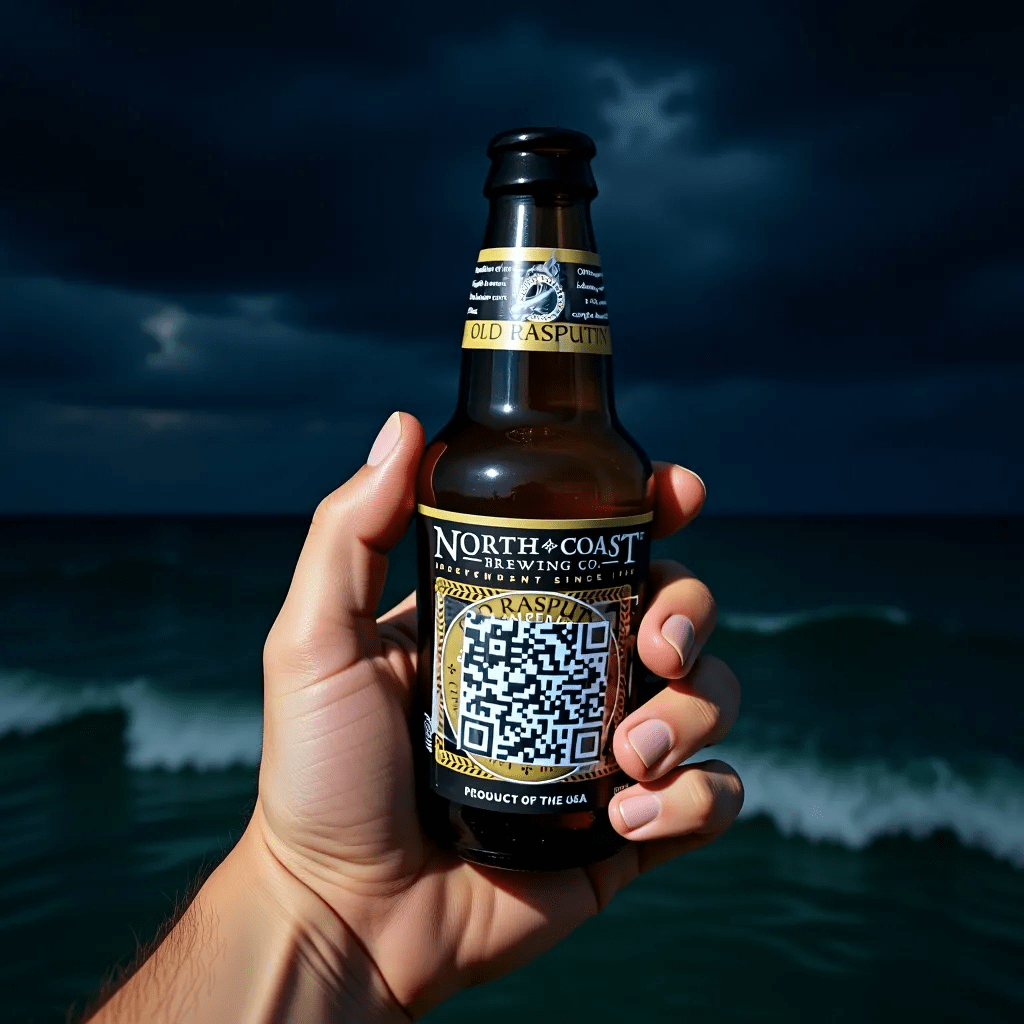
Given the title, this cocktail will of course have to be served in a bottle. And therefore we’ll turn to the underappreciated (but ostentatiously-named) “Boozy Dark Delight.” The BBD begins with a bottle of stout, and we’ll use that bottle for the vessel (ha!) that contains our finished cocktail.

So we’ve got the bottle part licked; but what of the “MS” part? The purists among you might want to literally insert a rolled-up message into the bottle, perhaps using waterproof paper or some other method for avoiding a soggy, disgusting mess. But here is where modern technology for once presents an improvement on the old-fashioned approach to mixology: We’re simply going to add a QR code, which in turn will link to Poe’s MS! Huzzah! Even better, this cocktail contains a nice puzzle element, allowing the imbiber to “discover” the MS in (or on) the bottle. 

To really drive the story home, this drink contains “jaggeree” – an unrefined sugar made from palm sap – on which the narrator subsisted for five days while drifting aboard the storm-ruined vessel. Who wouldn’t want to be figuratively transported into that adventure?!

Ingredients

1 bottle of good stout

1 oz. good Scotch

1 oz. passable orange liqueur

1 small cube of jaggeree, or, in a pinch, a brown sugar cube will do.

A suitable QR code, printed onto an adhesive mailing label

  1. Print out the QR code that I’ve helpfully placed at the bottom of this page. Affix it to a bottle of stout.
  2. Dissolve a small cube of jaggeree or other palm-sap based sugar in the Scotch. Set aside.
  3. Open and drink about half the bottle of stout. If you somehow mess this step up, then finish the bottle and try again with another bottle. Repeat until you get it right.
  4. Carefully add the Scotch/jaggeree mixture and the liqueur to your half-full bottle of stout. You may want to use a funnel for this step.
  5. Serve to an unsuspecting guest, telling them only the name of the drink. Wait for them to figure out the puzzle.

Poe-Script

Poe submitted this tale to a short-story contest by the Baltimore Saturday Visiter (their spelling not mine). It won the contest and was published in the October 19, 1833 issue of the Visiter. Poe received a $50 prize for the story…which is over five times what he would  later receive for “The Raven.” Sometimes life is like that.

Oh, and here’s your QR code:

2025 Poe Cocktails

Cocktail 18: The Premature Burial

It may be asserted, without hesitation, that no event is so terribly well adapted to inspire the supremeness of bodily and of mental distress, as is burial before death. The unendurable oppression of the lungs — the stifling fumes from the damp earth — the clinging to the death garments — the rigid embrace of the narrow house — the blackness of the absolute Night — the silence like a sea that overwhelms — the unseen but palpable presence of the Conqueror Worm — these things, with the thoughts of the air and grass above, with memory of dear friends who would fly to save us if but informed of our fate, and with consciousness that of this fate they can never be informed — that our hopeless portion is that of the really dead — these considerations, I say, carry into the heart, which still palpitates, a degree of appalling and intolerable horror from which the most daring imagination must recoil.

The Tale

Poe spends the first half of this tale cataloguing various instances of persons mistakenly being declared dead and subsequently entombed. He asserts that there’s nothing more horrifying than the idea of being buried alive. I find this to be a questionable claim. I mean, sure, it would suck mightily to awaken from some mysterious illness to find yourself consigned to a coffin six feet under the ground. But surely one can imagine worse fates. Has this man never taken a transatlantic flight on Southwest? Sorry–that was a cheap shot. But didn’t Poe detail a catalogue of tortures in the Pit and the Pendulum that are arguably worse than taking a dirt bath? I’m not convinced that being buried alive would be worse than having your torso gradually sliced open by a giant, slowly-oscillating blade.

In this tale the narrator describes his affliction with catalepsy, and how he constructed all manner of contrivances to save him if he were somehow buried alive. He had his family vault prepared with a spring-loaded door, bell ropes, stores of emergency food, and other mechanisms to assist him if he awoke after being mistakenly entombed. And yet, this being a Poe tale, he nevertheless finds himself trapped in a lightless and noiseless casket, ”buried … as a dog — nailed up in some common coffin — and thrust deep, deep, and for ever, into some ordinary and nameless grave” He cries out in hopeless agony…and is answered by several voices telling him to shut the hell up. It’s then that he remembers he’s been sleeping in a dark, tiny berth aboard a rude boat. His relief is so great that he permanently overcomes his fear of premature burial. 

Anyway, let’s just agree that being buried alive would indeed be an unfortunate circumstance.  And what better way to shake off the disquietude than by mocking the concept with a parodic cocktail? 

The full story is available here.

The Drink

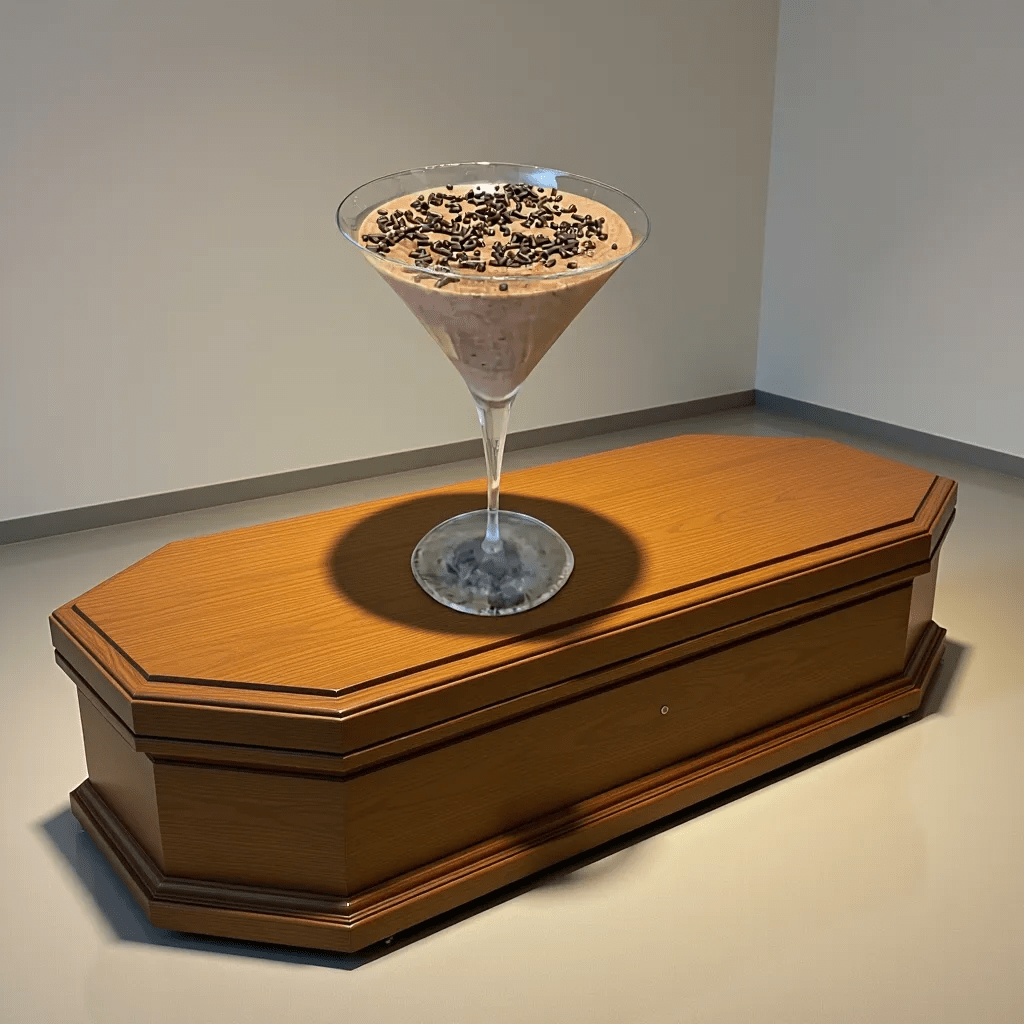
For this drink I envisioned a small, hapless figure buried within a glassful of delicious “earth.” To represent the grave I chose a chocolate pudding shot. For the hapless figure there are many options. I thought immediately of the tiny, plastic baby Jesus that my secretary would bake into her King Cake for Mardi Gras every year. But (1) the little plastic figure isn’t edible, and could pose a choking hazard, and (2) I would feel a little uneasy burying an avatar of baby Jesus in a mess of boozy pudding. So I opted to use a small, human figure made by a UK candy company that is sold under the name “Sweet People.” (I am not making this up.) If you can’t find these at your local candy store, other readily-available options include Sour Patch Kids, a Gummy Bear, or–if Halloween candies are available to you–one of those little wax, syrup-filled skeletons.

Ingredients:

1 package chocolate Jell-O pudding mix. (Make sure you get the instant stuff.)

¾ cup whole milk

¼ cup vodka

⅓ cup Kahlua or Baileys or some other suitable liqueur

¼ cup Cool Whip

1 candy figure

Chocolate sprinkles (as a garnish)

Using a whisk or an electric mixer, combine the pudding mix, milk, vodka, and liqueur. Then fold in the Cool Whip. Pour into a couple of good-size martini glasses, about one-third full. Then deposit your unfortunate victim, then finish filling each glass. Garnish with the chocolate sprinkles. Refrigerate for half an hour or so. The result will be more of a boozy dessert than a proper cocktail. You might need to consume it with a spoon…or a sexton’s spade.

Poe-Script

The Premature Burial (1962) was the title of Roger Corman’s third Poe Picture. It stars Ray Milland (Dial M For Murder, The Uninvited) and Hazel Court (hubba, hubba). It also features Alan Napier, who you’ll remember as Alfred from the original Batman television series. This movie takes the idea of a man morbidly obsessed with premature burial, and spins it out into a barely-recognizable tale. It’s nonetheless entertaining, and might be enjoyed with one or two of these cocktails.