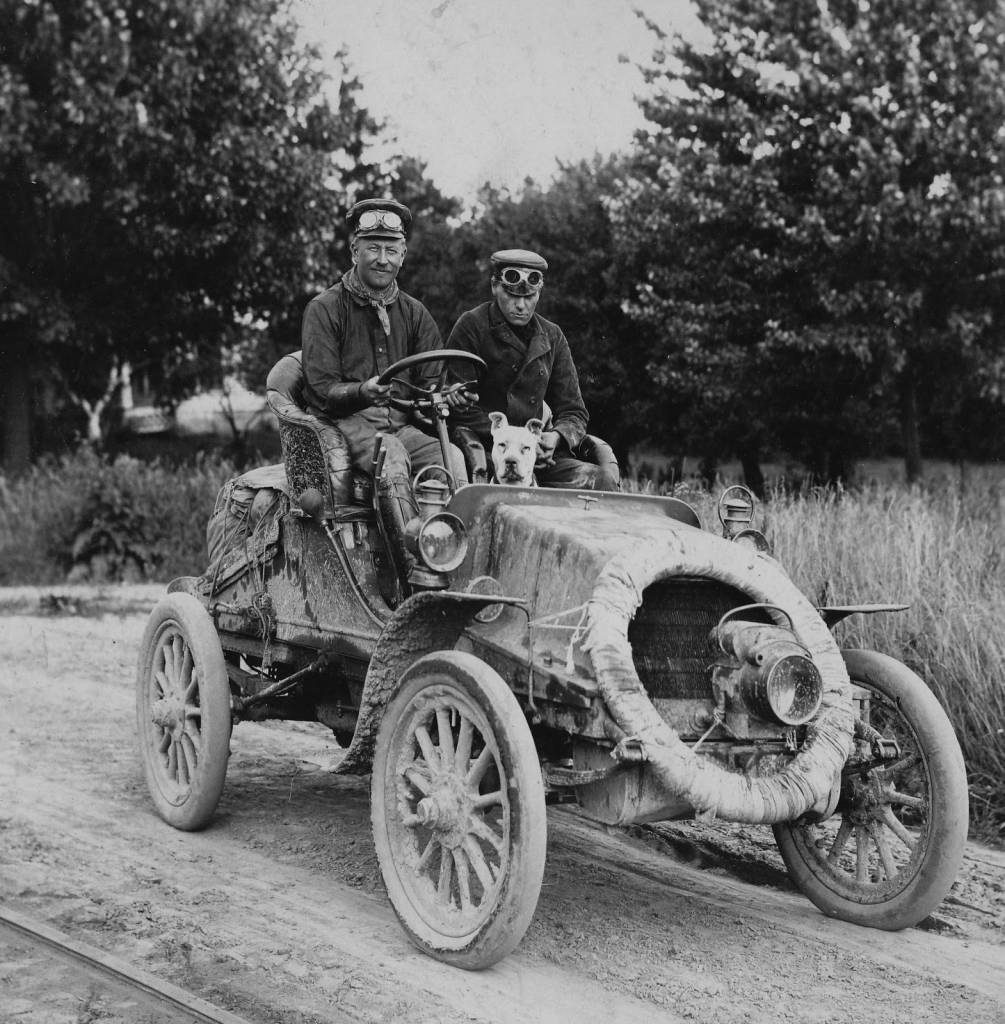
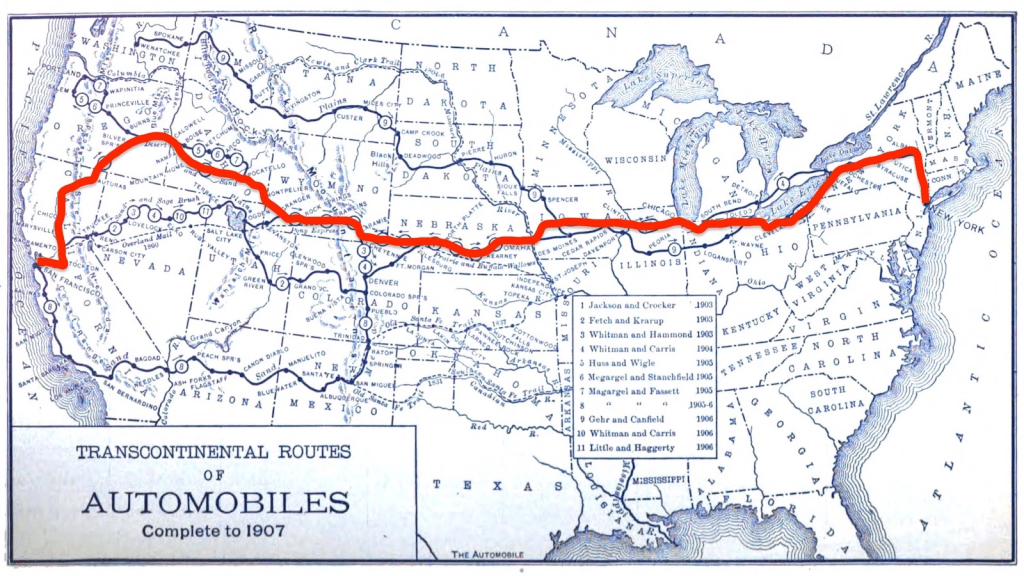
Some of you (such as Alert Reader Detlef K.) have come across articles and news stories about the 120th anniversary of the cross-country automobile road trip. For those of you who haven’t, I am providing this link to a great story in “Big Think.” It was a big deal, as it took Horatio Jackson 63 days to make the trip along (mainly) dirt roads with a mechanic and a dog. It was a big deal at the time. Now, most of my coast-to-coast road trips have taken more like a week. (Once I did it in a little more than three days….but I was on the lam at the time…) But in 1903, 63 days was lightning fast, considering there were no gas stations, no AAA, no signage, and precious little pavement.
I’m seriously thinking of re-tracing Horatio’s route. Somebody talk me out of this…
If I had it to do all over again (and my wife reminds me that, if I’m not careful, I just might receive that opportunity), I would seriously consider living in a small town in middle America. But I’d put a lot of conditions on it: It would have to be out of the snow belt and out of the humidity belt. It would have to have an interesting history linked, ideally, to railroads or mining or the Marathon Motor Car. And it would have to have successfully preserved a large number of historic structures in its downtown. And it would have to exude vitality. Oh, and there’d be no dogs and the gas prices would be low.
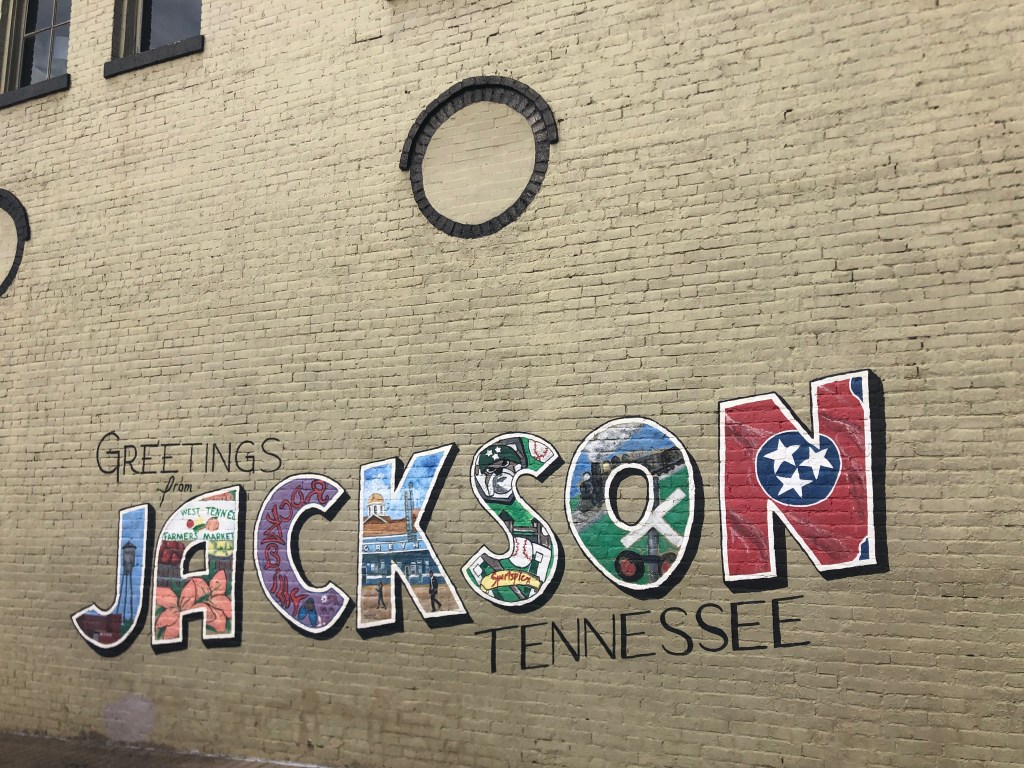
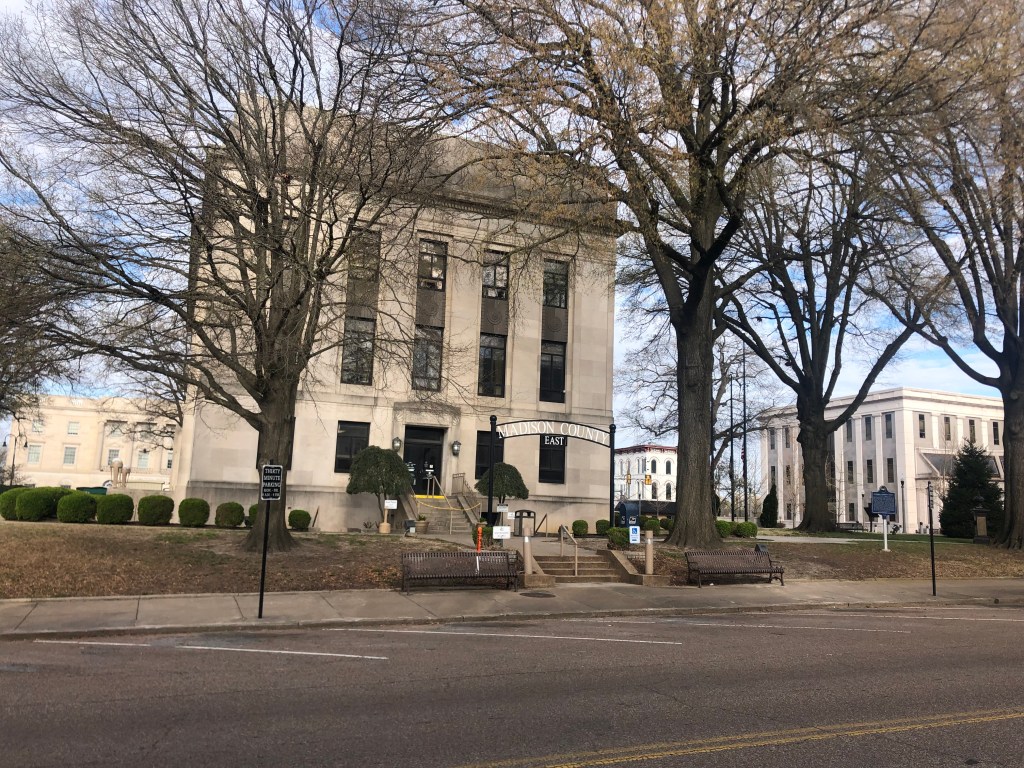
To a large extent I’ve found that city in Jackson, Tenn. It’s a little larger than my ideal, with a soulless sprawl of undistinguished national chain stores and fast food restaurants around the periphery. And there’s always something a little sinister in the air in these former Confederate strongholds. But the historic downtown is wonderful. It’s here that one finds the restored Greyhound depot I described yesterday. There’s a performing arts center in another restored, historic building, which appears to be well-utilized by the residents. As Jackson is the county seat of Madison County, there’s a historic courthouse. And today the temperature was 72 degrees.
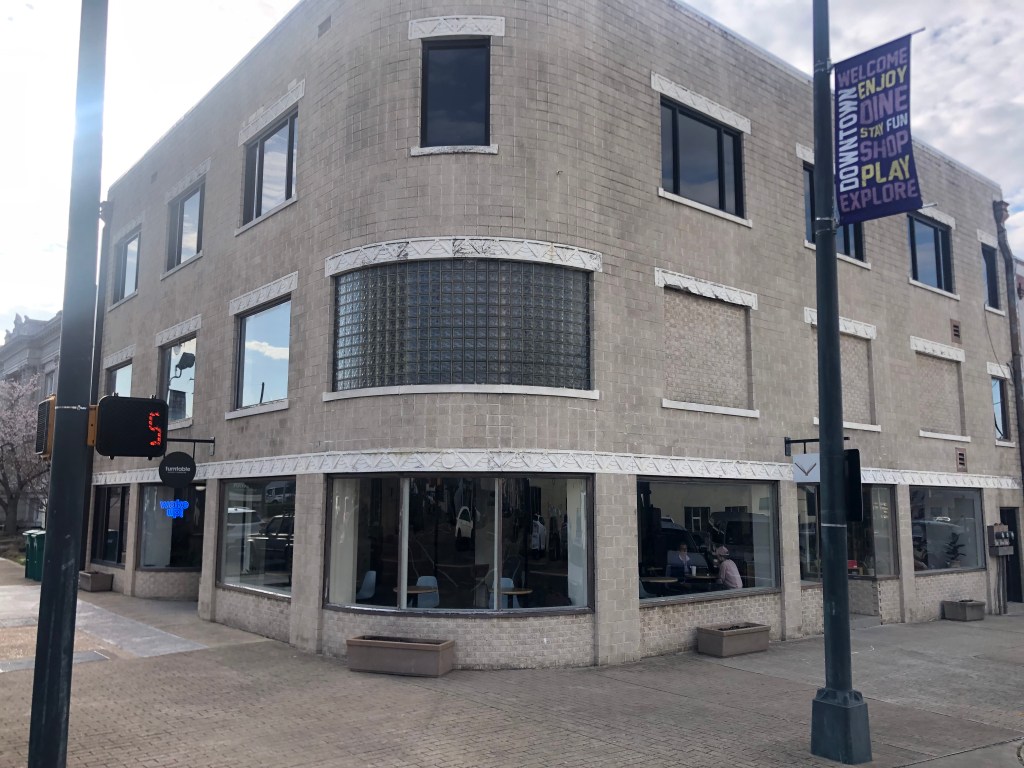
This morning I got my coffee and a galette (I’d never heard of it either) at a place called Turntable Coffee Counter. It’s almost directly across the street from the Greyhound station, in a historic building that had once been a department store. It had been vacant for years when in 2018 Anthony Kirk renovated part of the space and created this coffee place. It’s decorated in mid-century modern, with (probably faux) Eames chairs and a very hipster vibe. Racks of vinyl albums are for sale along one wall, and abstract art hangs on the walls. As I enjoyed my coffee I watched a churn of customers coming through: lawyers from the courthouse, writers with their laptops, a young couple who were getting lattes after their pilates class. This is an active community gathering place. (See related article from the local paper here.)
Turntable Coffee.
Turntable Coffee neatly illustrates what I appreciate about towns like this: They’ve created a modern (retro) space while respecting the history and flavor of the town. It works, and it draws people in. There’s a vibrancy and positivity about the place. And it’s unique–not just another Starbucks. The barista told me that Turntable began in a shared “incubator” space down the street, and after a bit was able to move to its current space. A couple of other businesses from the incubator (a book store and a record store) soon followed to the same location. So they’re doing something right.
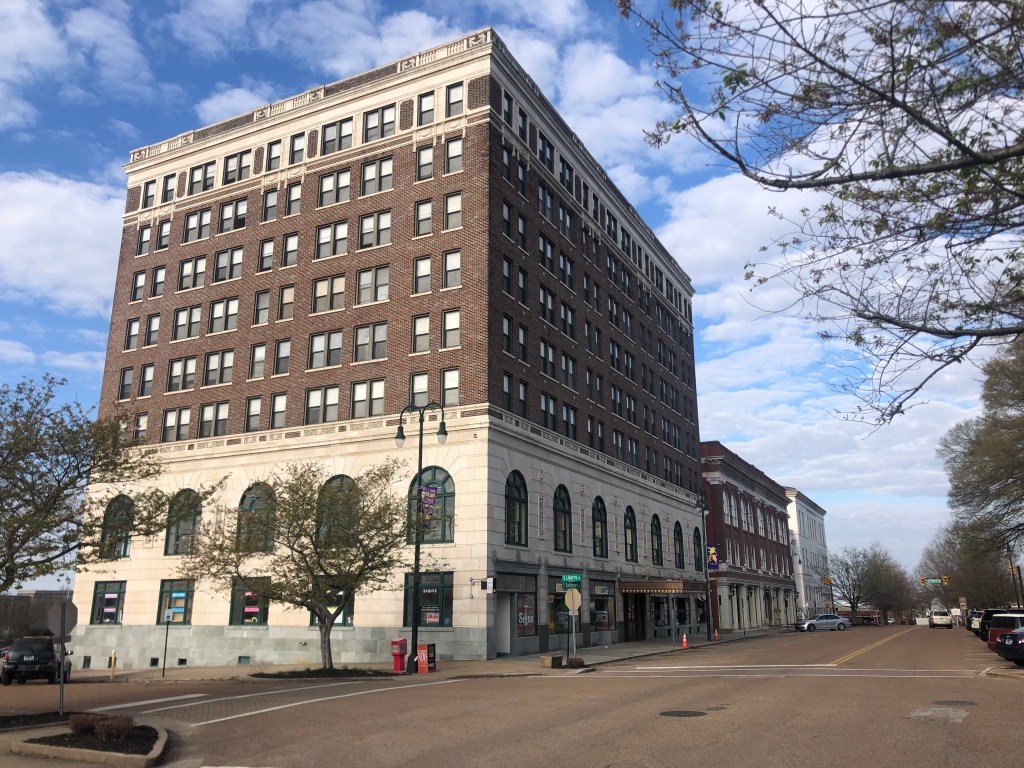
After coffee I took a walk around the downtown and saw more examples of well-maintained historic structures that added to Jackson’s very successful formula.
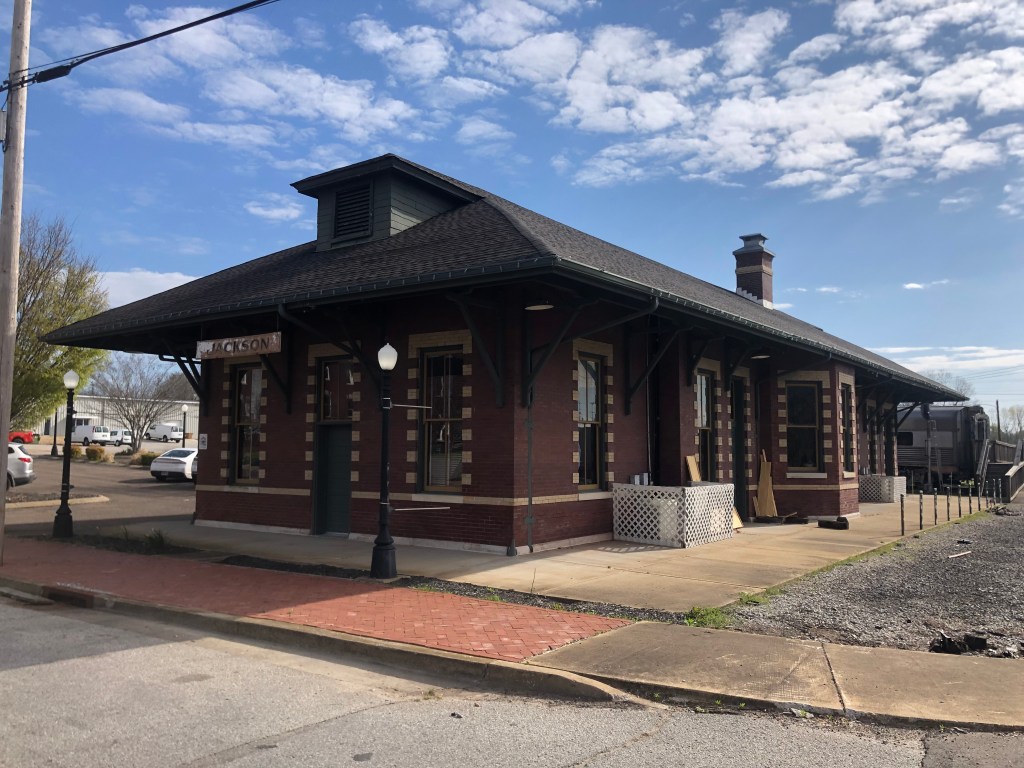
Jackson’s Nashville, Chatanooga & St. Louis Railway depot.
Of particular interest to me was the restored NC&St.L Railway depot. It was originally constructed in 1907, and after passenger trains stopped coming to town it was converted to a museum. Alas, when I arrived today the friendly woman inside told me the museum had moved and that the building was now a photography studio (among other uses). While I would have liked to have been able to spend some time in Jackson’s railroad museum, this is a good illustration of that same principle I was just describing: Jackson has wisely preserved its historic buildings, but rather than making them all into museums that the locals probably wouldn’t visit very often, they have repurposed them into vibrant, viable and useful public enterprises for which there is local demand.
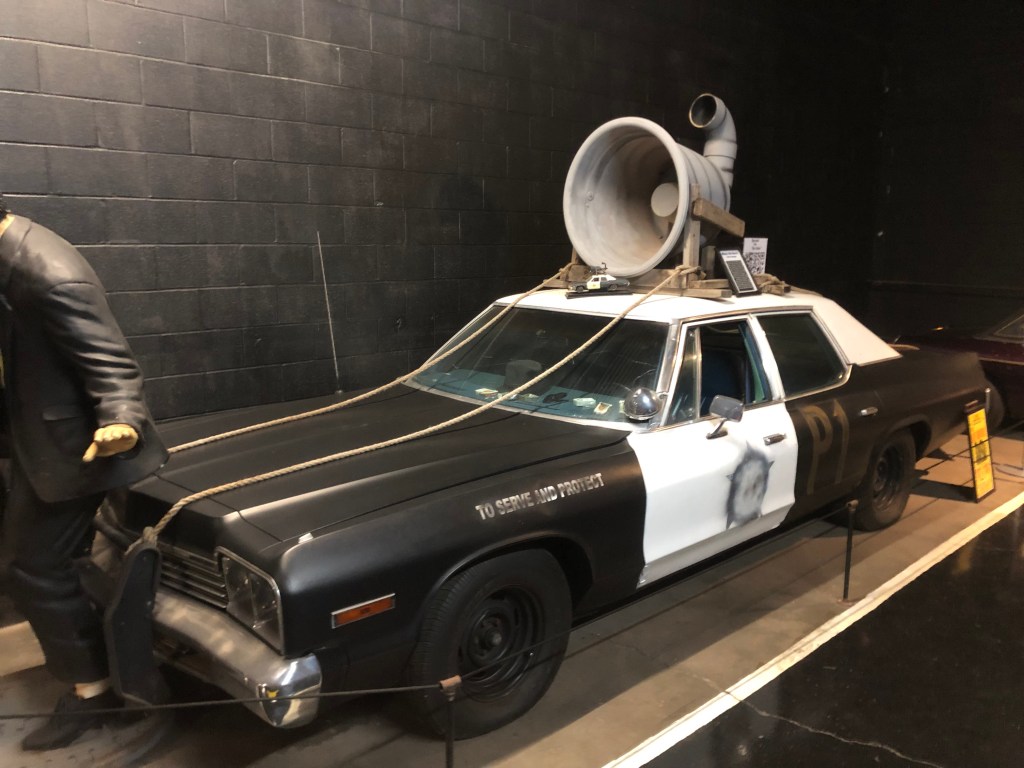
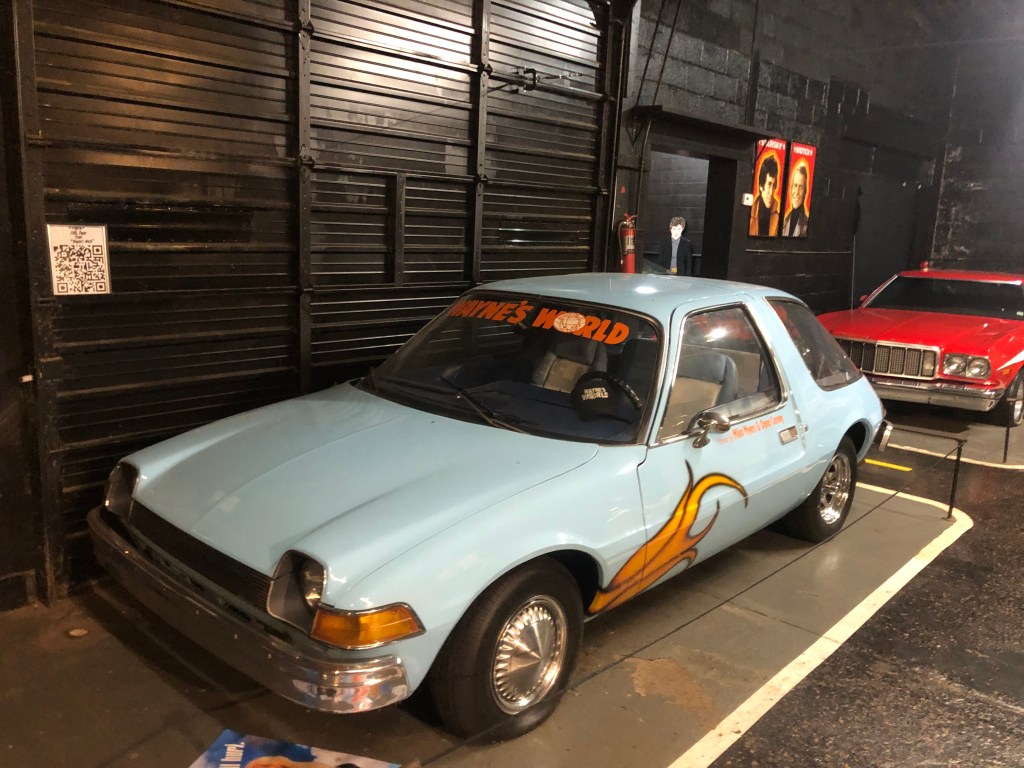
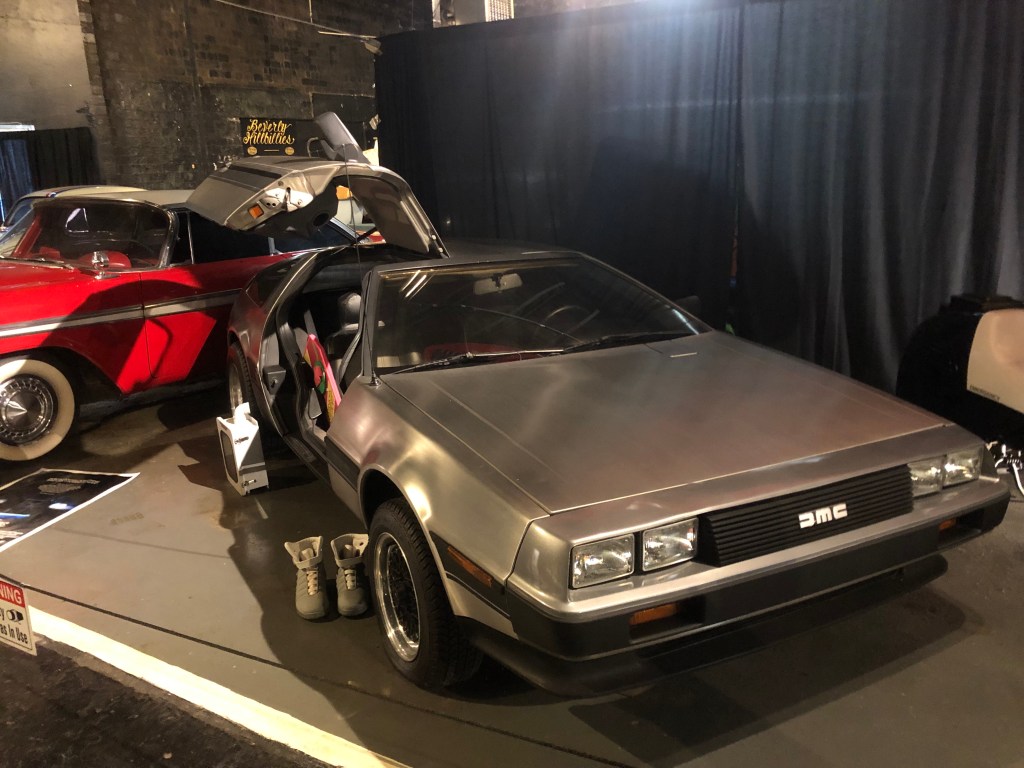
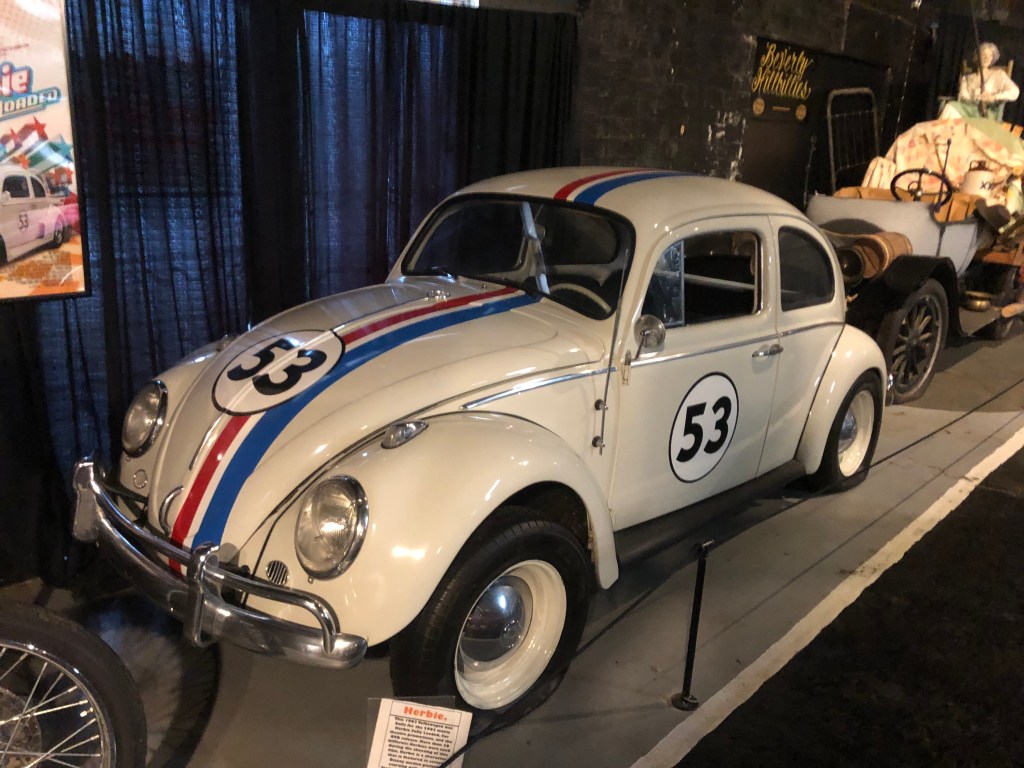
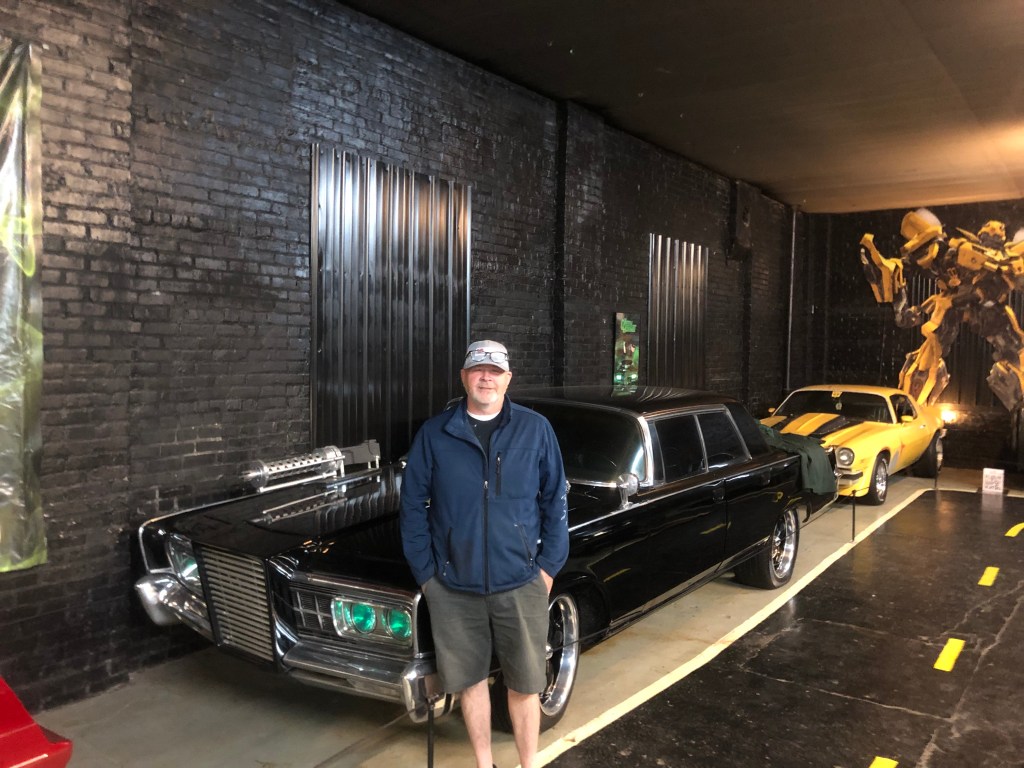
At the same time, I did visit two wonderful museums in Jackson this morning. The first is Rusty’s TV and Movie Car Museum. Rusty Robinson has been collecting cars for over a quarter of a century and he has them on display here in Jackson. Rusty was the only other person at the museum this morning, and I appreciated the opportunity to wander among his collection. It’s worth nothing that the collection is a mix of vehicles that actually appeared on the screen, as well as some reproductions that Randy himself has manufactured
Jake and Elwood’s “Blues Mobile.” (One of many cars used in that movie.)
Garth’s “Mirthmobile,” from Wayne’s World. (Original from the movie.)
Delorean time machine from Back To the Future. (Not from the movie. But it’s a real Delorean, which is rare in its own right. Rusty and I had a long talk about the new John Delorean documentary on Netflix.)
Herbie from the 2005 relaunch of the Love Bug franchise with Lindsay Lohan. (Actual car from the movie.)
Rusty himself, in front of The Green Hornet’s “Black Beauty.” (Not original from the movie; Rusty built it himself!)
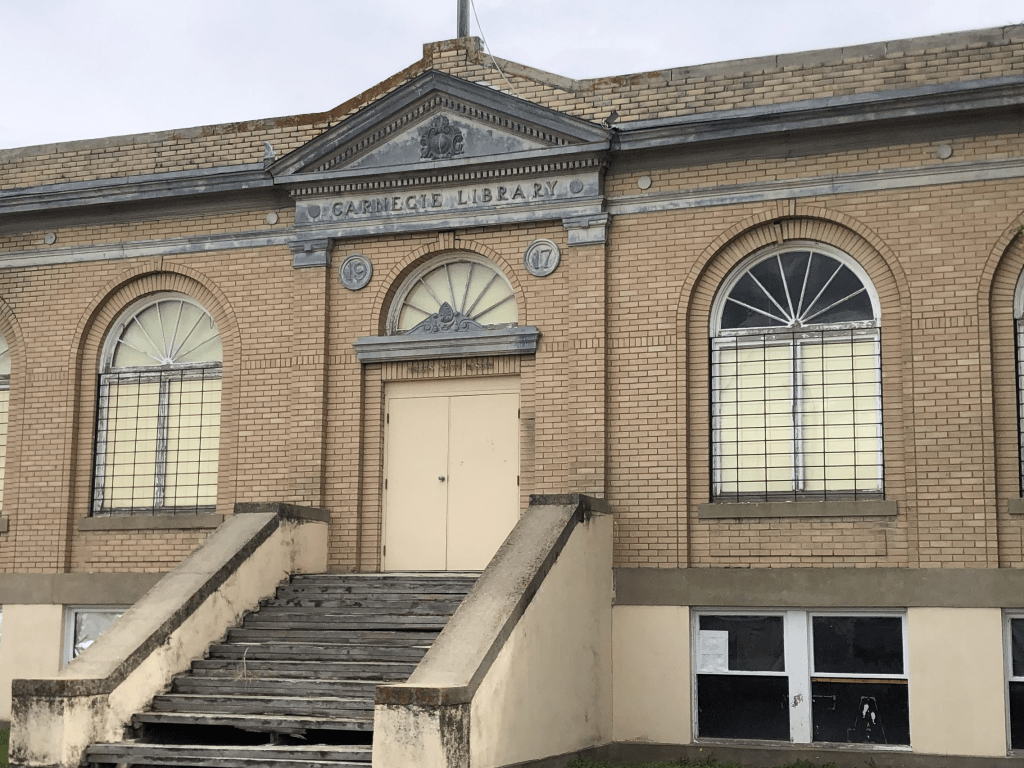
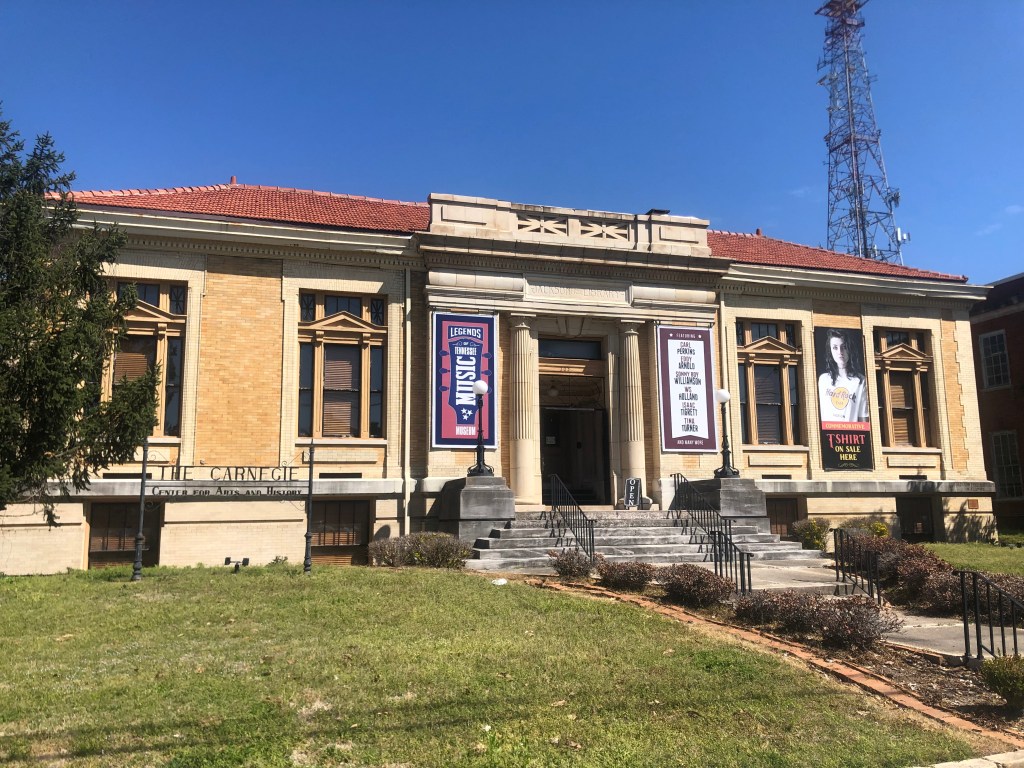
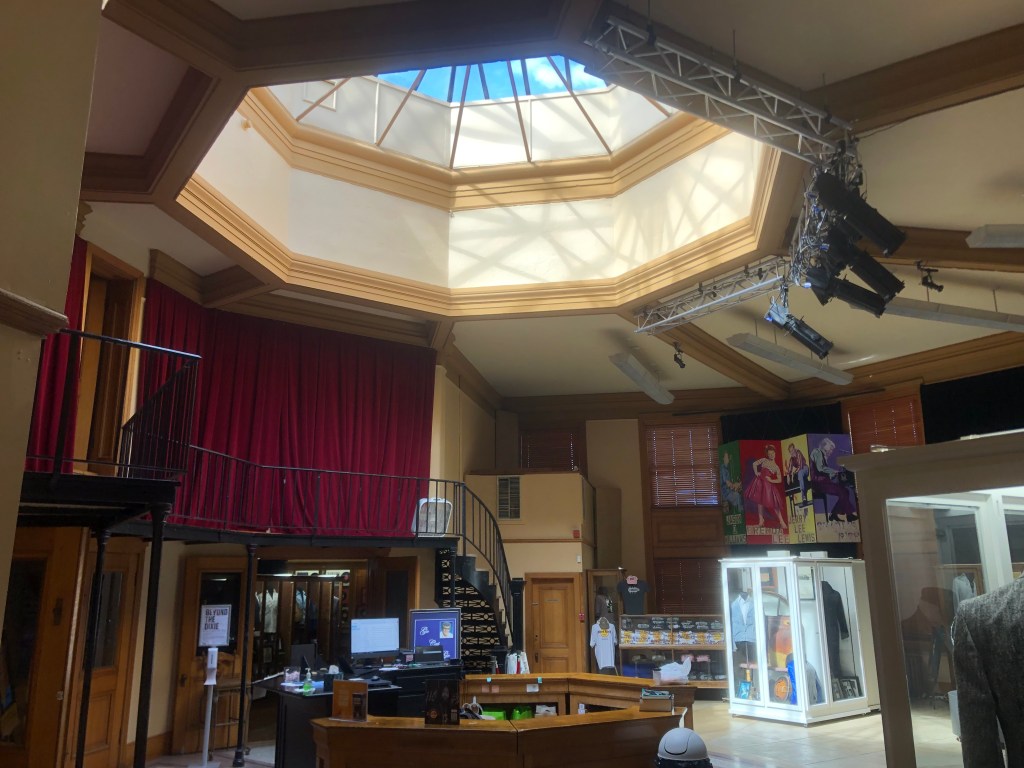
The other museum in Jackson I visited was the Southern Legends of Music at the Carnegie. It’s a very small museum inside an old library built in 1901. (Hence the “Carnegie” part. As you may know, Andrew Carnegie funded the construction of almost 1700 libraries around the country between the 1880s and the 1920s….like this one, below, that I saw on my Route 2 trip last year)
Unrestored Carnegie library from 1917, in Malta, MT. I passed it on my Route 2 trip.
Here is the Carnegie library in Jackson–fully restored and open to the public as a music museum:
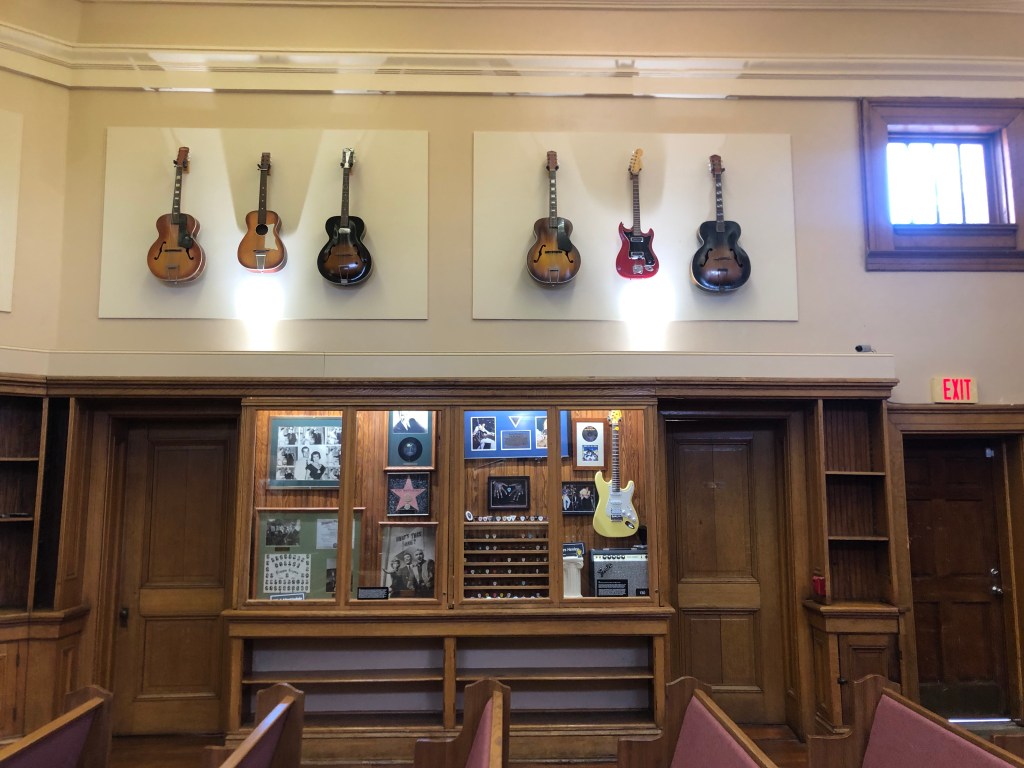
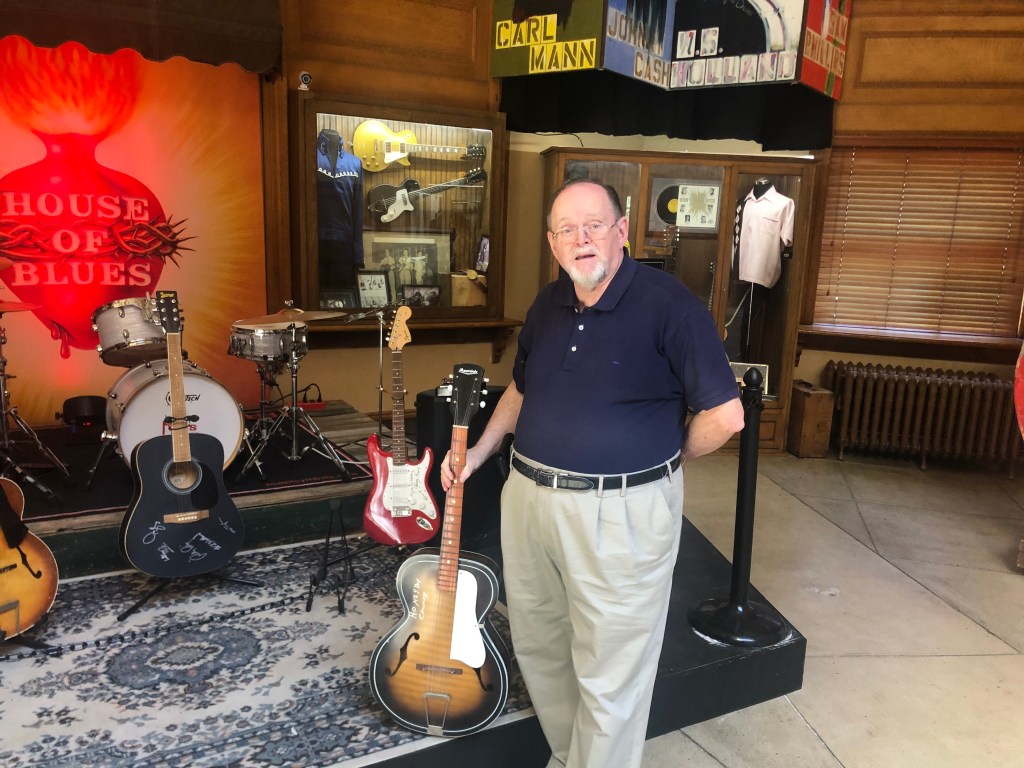
It’s a wonderful museum, focused on western Tennessee’s music history. (By “western Tennessee” they mean mainly Jackson and Memphis). While small, the museum is stuffed to the gills with guitars, recording equipment, framed photos, harmonicas, stage outfits, awards, guitar picks, sheet music, handwritten lyrics, and tons of other stuff.
In the center of the main room is a large, octagonal skylight. It must have been an awesome place to spend an afternoon reading.
Speaking of which, the docent who helped me (Roger) told me he was drawn to work at this museum because as a kid he spent many, many hours in this library. Over the years, though, he’s learned much about western Tennessee’s music history, and he was able to convey an enthusiasm about the music that’s infectious. I’m starting to get why music is such a big deal to this area. It’s partly a shared language, partly a relieve valve for emotions, and partly storytelling. Notably, each region out here seems to put its own stamp on the music. In Nashville it’s country; here in Jackson it’s moving more to bluegrass. By the time you get to Memphis it’s blues. But there are intersections and overlap among these styles, and they all fall under an American Roots umbrella. It’s heartfelt and earnest and moving. In just a short time at this museum I got a better feel for why this music matters. And I was able to connect the through lines linking Elvis and Johnny Cash and Ray Charles and Roy Orbison and Jerry Lee Lewis and on and on….
Docent Roger sharing stories about the music of western Tennessee.
I was thoroughly enjoying my music history lesson but unfortunately I had to get back on the road to get to a haircut appointment at noon. I’m not making this up.
Before I’d left California I had learned about a quirky museum in Brownsville Tenn. that also served as a functioning barber shop. It’s only open by appointment during the week, so I called the owner (Anthony Turner) and asked if I could make a visit on Thursday. “For a haircut or for the museum?” he asked. I figured the right answer was “both.” I arrived at Anthony’s “Master Barber Shop Menagerie Museum” at the appointed time.
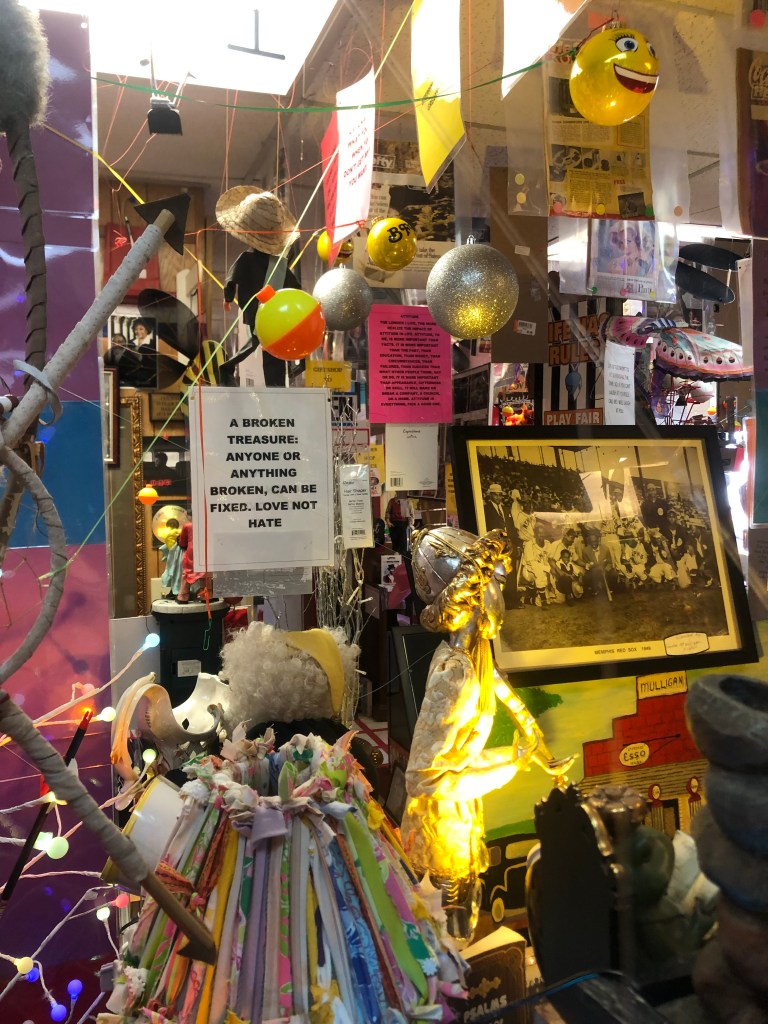
Anthony greeted me with a thousand-watt smile and took me to the building, which looked like a circus had exploded.
A tiny fraction of the Menagerie Museum.
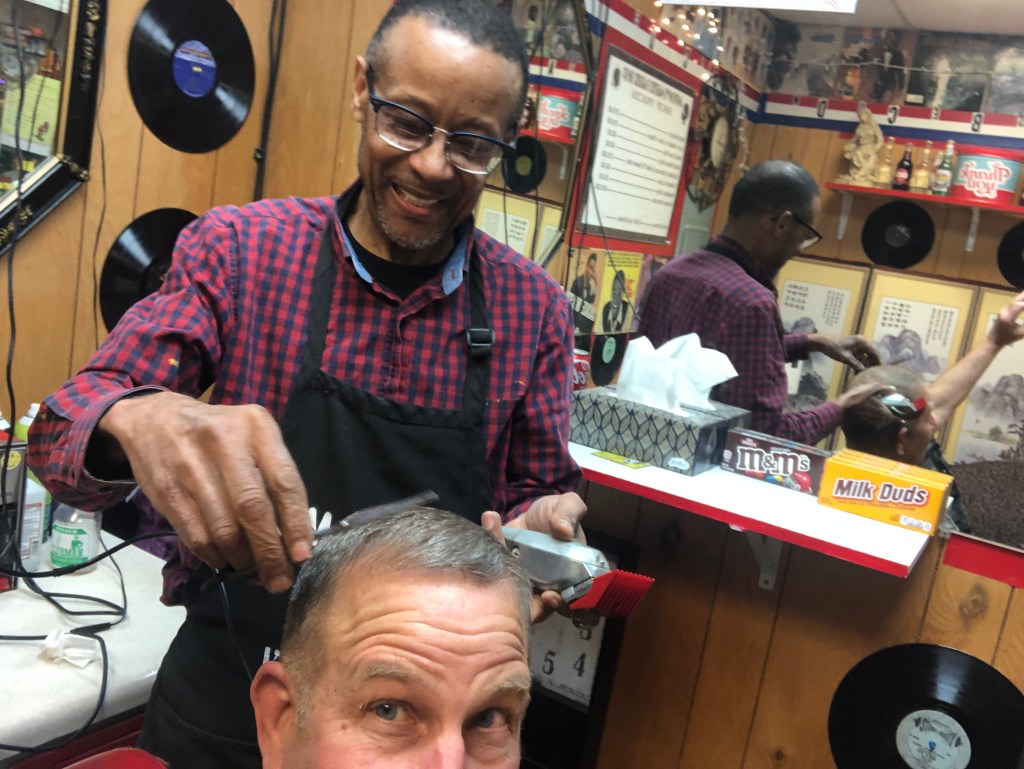
I asked what it all meant, but Anthony directed me to a tiny room with a barber chair. For the next hour he cut my hair and told me his story. I can’t do justice to his whole spiel, but the basic outlines are as follows:
I told Anthony just to do whatever he thought needed doing on my head. “All’s you need is a high fade.” And so it went.
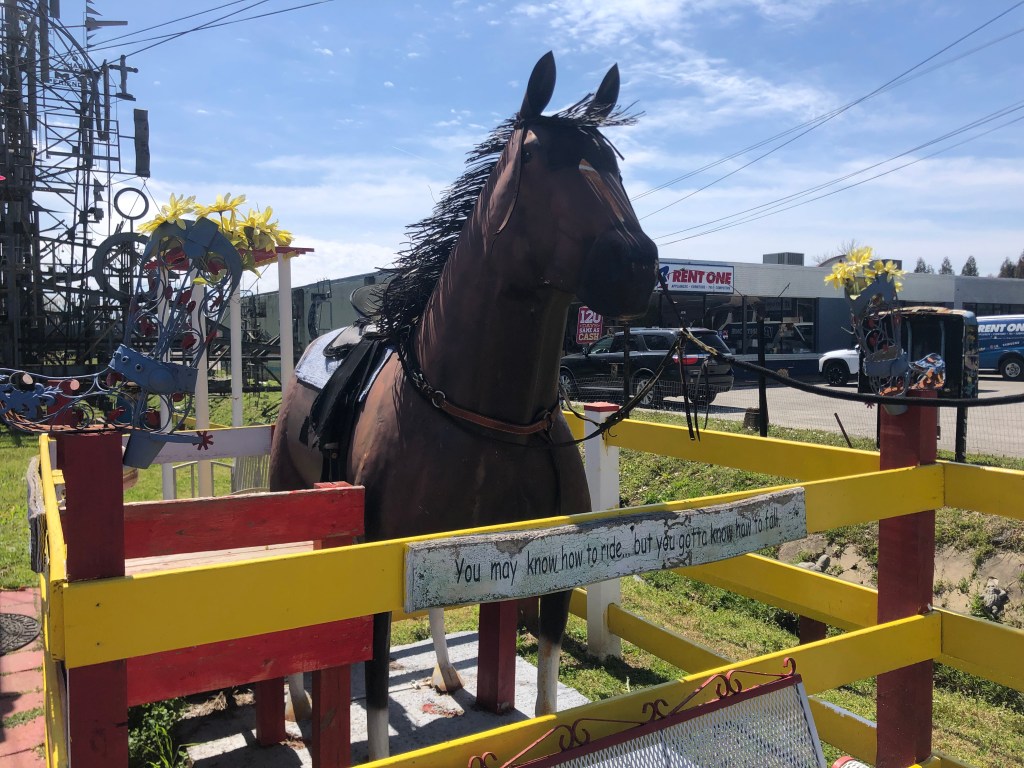
Anthony grew up here in Jackson, and after graduating he attended barber college. For reasons he doesn’t really understand, his fellow students and instructors kept bringing him various items (pieces of art, antiques, odds and ends). He opened his barber shop next to where his chum from public school, Billy Tripp, was building an enormous sculpture out of scrap metal. He felt there was a synergy between their two projects. In his shop Anthony displayed the various objects he’d received while at barber’s college. But he kept feeling he was supposed to have a bigger impact. He planned a grand opening, and for reasons not entirely clear, decided he’d invite Oprah Winfrey’s father (whom he’d never met) to MC the opening. He tracked down Mr. Winfrey, who accepted. The museum grew and grew, and more and more people brought him more stuff. Anthony was also always looking for specific additions that he would purchase, including this horse:
In a repeat of the Oprah’s dad trick, Anthony managed to get John Wayne’s grandson to show up for the unveiling of the horse, as he needed a “real cowboy” for that job.
Again I asked Anthony what the whole museum is all about; what unites everything? And he responded sincerely and convincingly that it was all united by positivity. Anthony is a man of faith, and believes that God has led him to do this project to make the world a more positive place. And if my hour with him is any indication, he’s doing a good job.
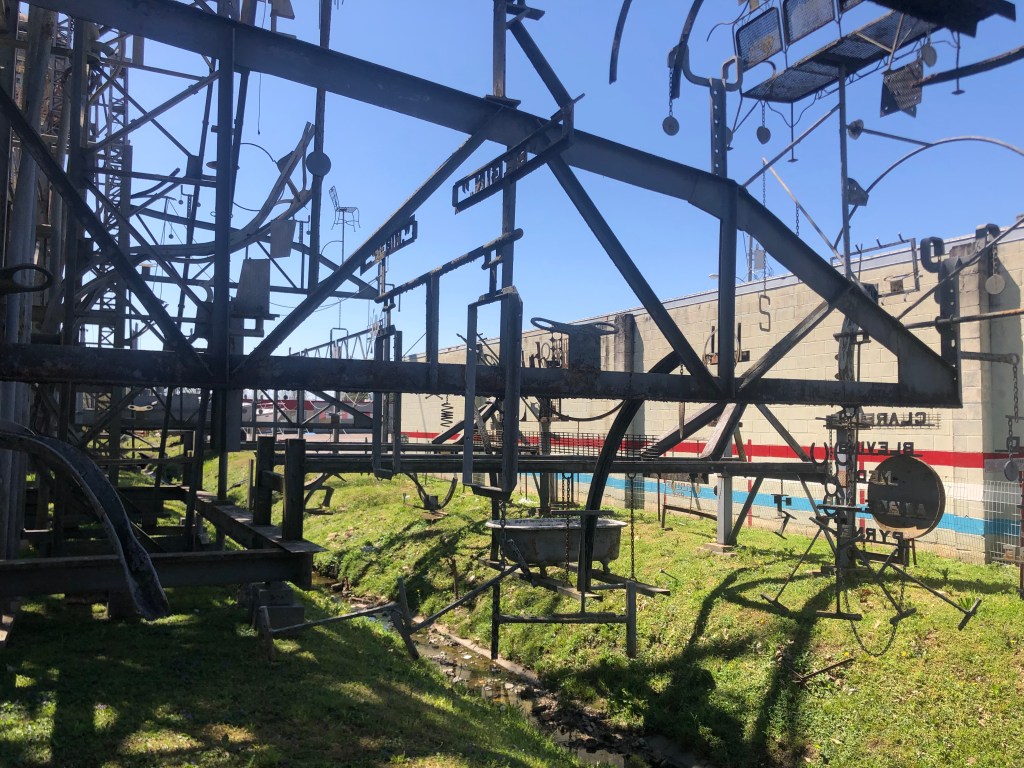
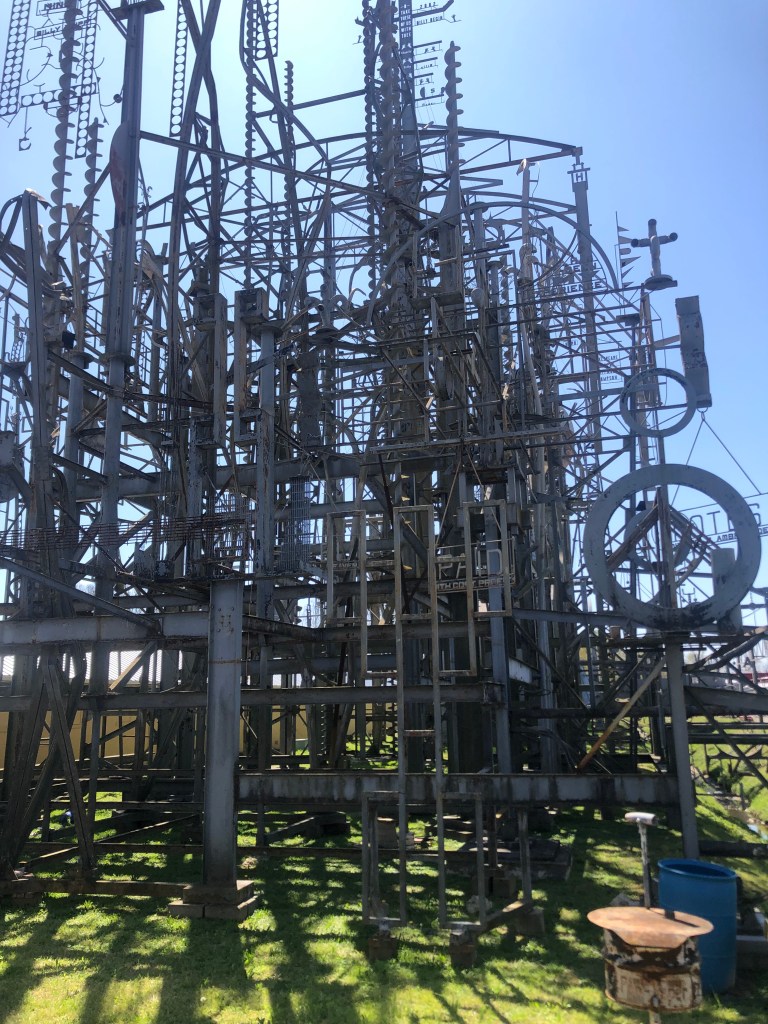
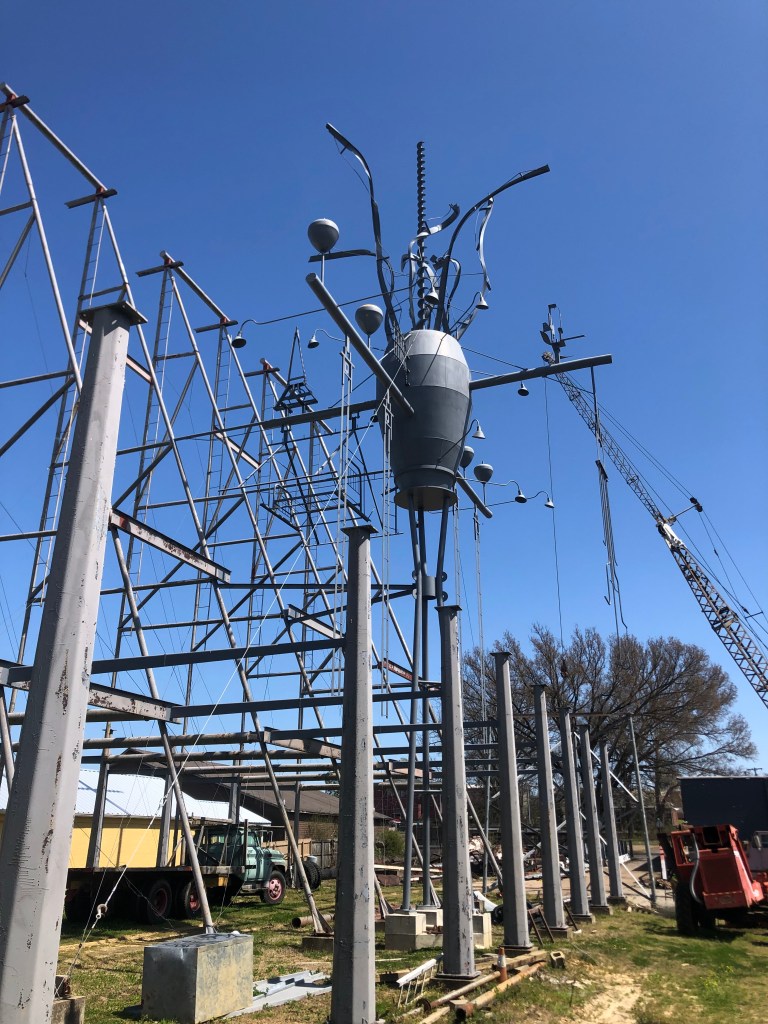
After my haircut Anthony had another customer to take care of, so I browsed his small museum and then checked out Billy Tripp’s sculpture in the back. Words cannot describe how enormous, complicated, and overwhelming the sculpture is. And pictures don’t do it justice, because it’s so large and contorted you just can’t get a full picture. But here are a few attempts:
Anthony tells me that Billy works on the sculpture almost every day, and that he plans to keep working on it until the day he dies. I suspect that Anthony takes the same approach with his museum.
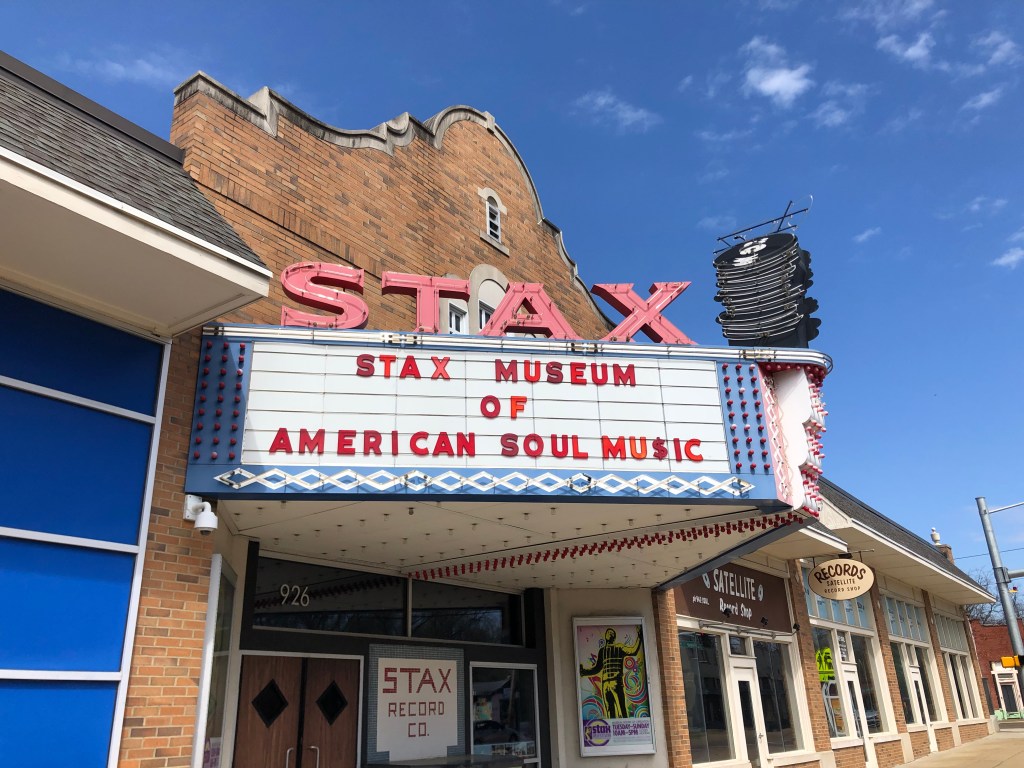
Finally, freshly shorn, I was back on the road to Memphis. I had been in Memphis just last year on my Route 70 trip. While I was there I saw the outside of the building where Stax records made music history in the 1960s and 1970s. I have a fondness for Stax in part because my dad had Booker T. and the MG’s “Greatest Hits” album, and I thought it was the coolest thing in our household. (It actually was, considering that most of Mom and Dad’s other records were stuff like Motovani and Percy Faith.) I also saw Booker T give a talk in LA a few years ago, when he was promoting his autobiography. He’s a remarkable and articulate man. Booker T and Stax represent a magical time in music history, and they’re central to the so-called Memphis sound. Recall that earlier I mentioned how Jackson merged Nashville’s country into more of a bluegrass? Well, Stax merged bluegrass and blues with soul and R&B. In addition to the MGs, classic Stax acts included Issac Hayes, Otis Redding, Sam and Dave, Albert King, and various other acts that you’ve heard on the radio.
You’ve heard this before, but you might not have known the title.
Anyway, when I’d visited the Stax building (which is now a museum) last year it was closed, so I made a point to see it today. And I’m glad I did. It further deepened my appreciation for Blues/R&B and all its variants.
Full disclosure: The original Stax building was razed in 1989, This museum was built on the same site, faithfully recreating the facade and the interior recording studio.
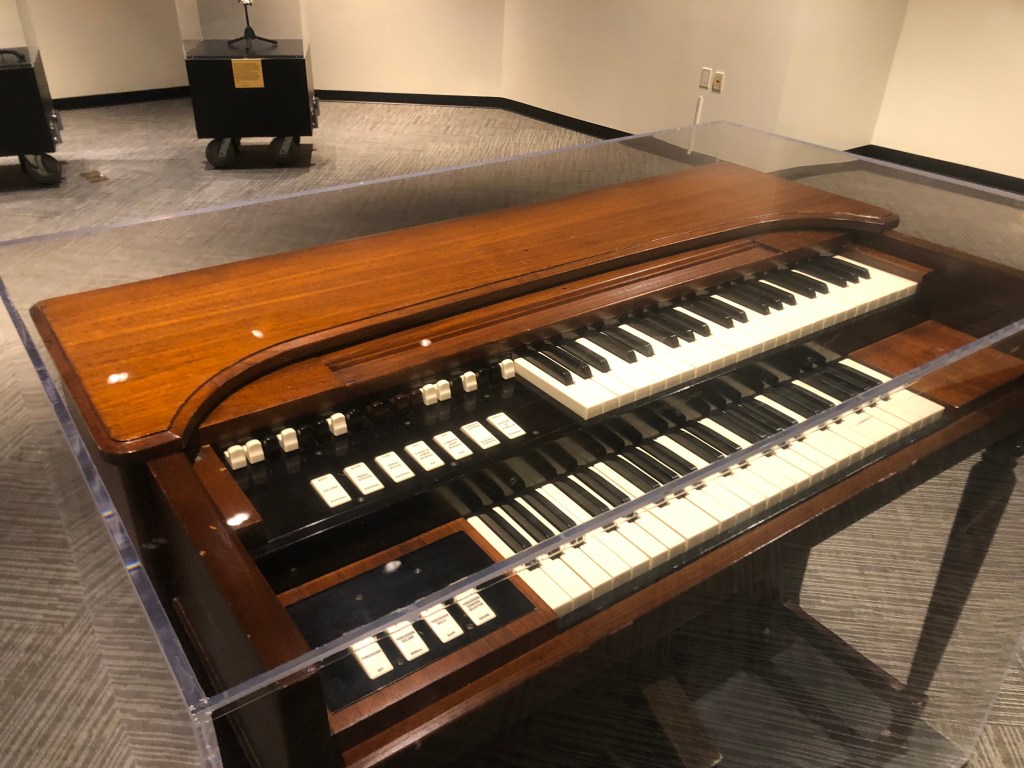
The Hammond organ that Booker T Jones used to record “Green Onions.”
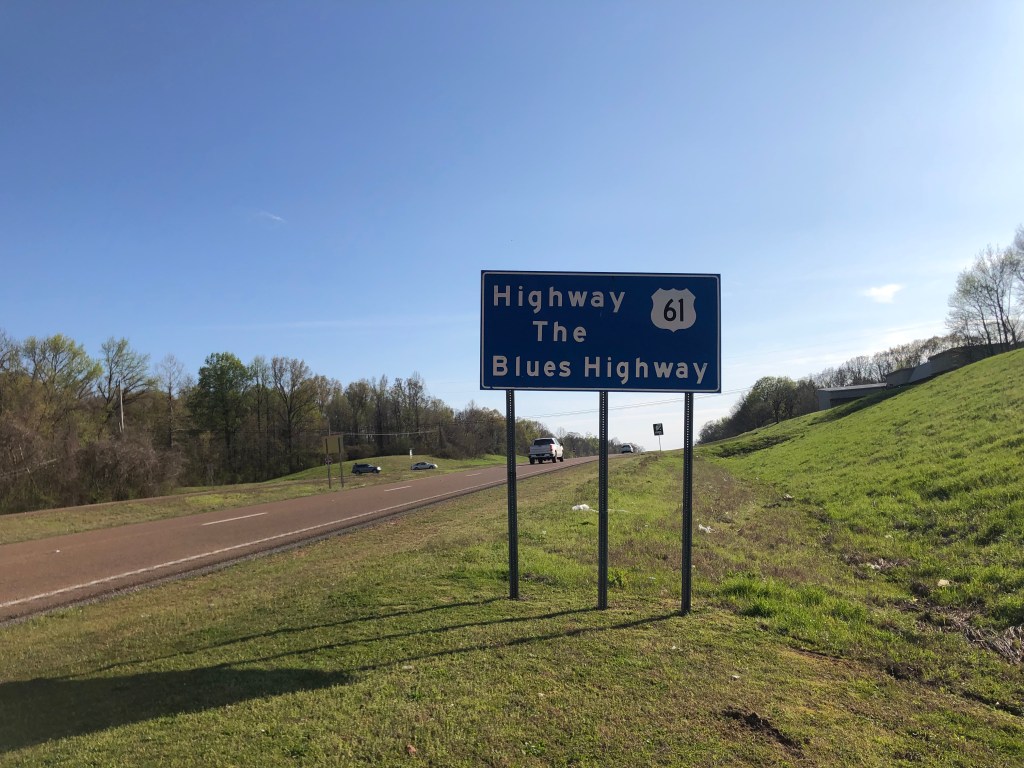
Since I’d been to Memphis just last year, Stax was my only stop this time. So afterwards I got back into the trusty Trailblazer and got onto Route 61– the Blues Highway!
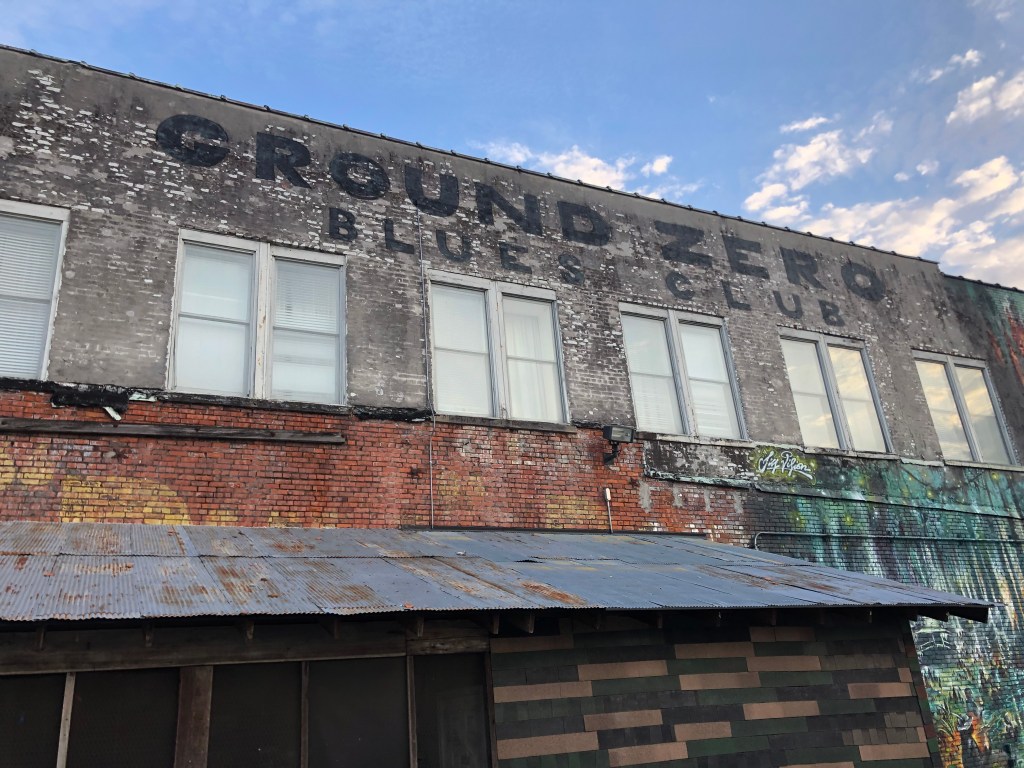
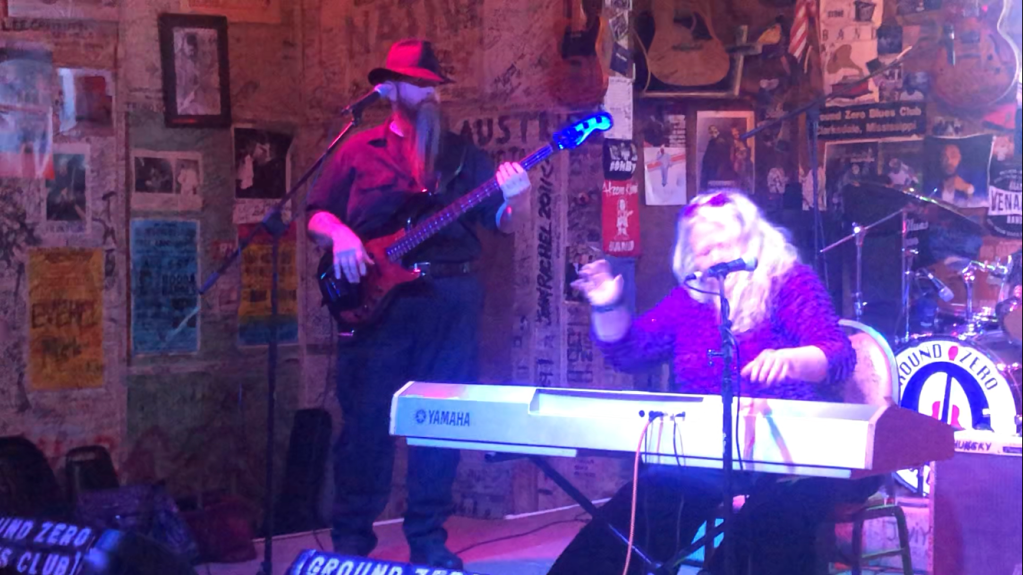
I stopped for the night in Clarksdale, Mississippi. I had dinner at the estimable Ground Zero Blues Club (owned in part by Morgan Freeman).
I had some good BBQ (as it’s called in these parts) and enjoyed listening to some live blues. It was a perfect end to this day. It’s one thing to learn about music in museums, but there’s no substitute for hearing it performed live.
BREW OF THE DAY
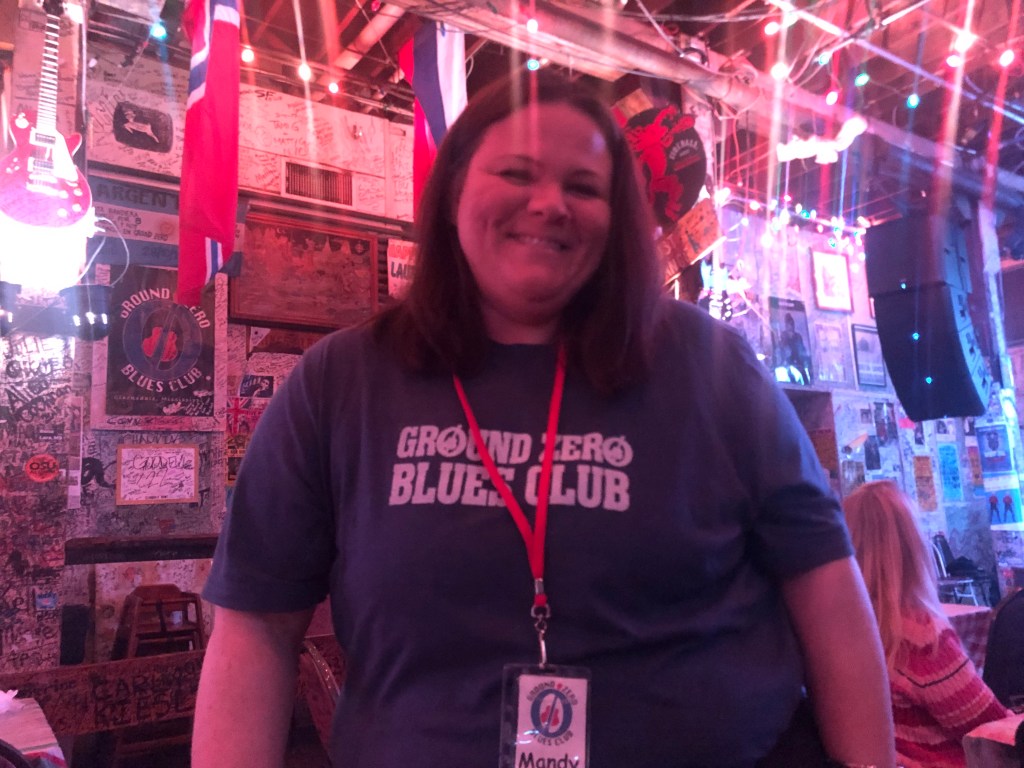
I’ve noticed that most of these music venues have a pretty crappy selection of beers. The Ground Zero Blues Club is no exception; their most interesting beer was an IPA. So I decided instead to order a cocktail. How about an Old Fashioned? That’s pretty basic, right? The waitress (Mandy, who was being very patient with me) came back and told me the bartender couldn’t make me one because they’re “out of bitters.”
Mandy, bearer of bad news.
Ok, fine. How about just a Scotch then, served neat? Again Mandy consults with the bartender, and comes back with the sad news that they’re “out of Scotch.” Borrowing a line from Monty Python’s cheese shop sketch, in which a neighborhood cheese shop was out of even the most common cheeses, I spluttered “How can a bar be out of Scotch?! It’s one of the most basic staples for making cocktails!”
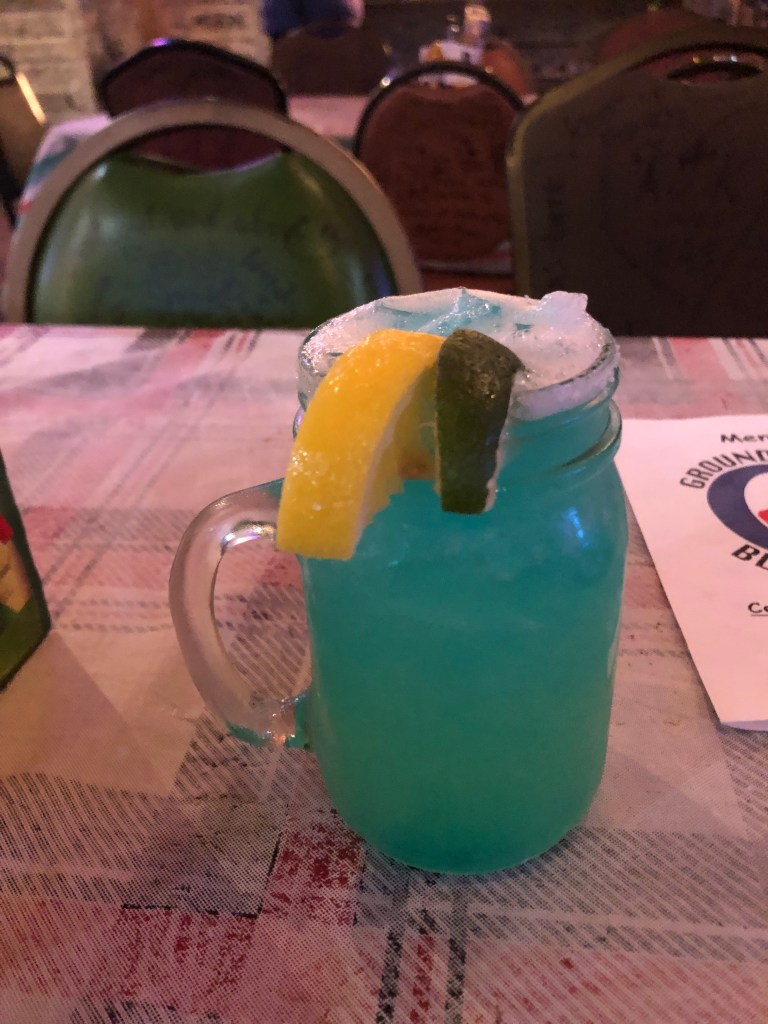
I settled for the “featured cocktail,” which is a “moonshine margarita.”
The Moonshine Margarita is essentially lots of margarita mix and some “moonshine” (i.e., distilled whiskey that hasn’t been aged in a barrel). Let me give you the pros and cons:
On the pro side, it contains alcohol, which goes well with a BBQ dinner at a blues club. But it’s cloyingly sweet, like sno-cone juice. And it’s the same color, as well. Of course, when all you have is hammer everything presents as a nail. So I ordered a second one.
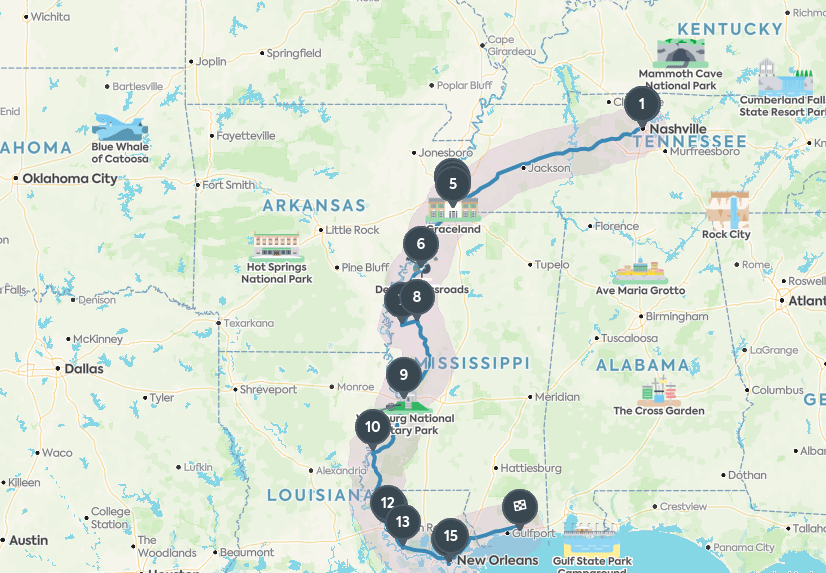
Much of this trip will be spent on US Highway 61, which is sometimes called The Blues Highway. It runs from the confusingly-named town of Wyoming, Minnesota, down to New Orleans. Until about 30 years ago the highway reached further north, passing through Duluth on its way to the Canadian border. Attentive readers (I’m looking at you, Peter D) will recall that I’d visited Duluth last May as I was traveling west across the country on US Route 2. While in Duluth I visited the boyhood home of one Robert Allen Zimmerman, who you and I would know today as Bob Dylan. Dylan famously released an album in 1965 called Highway 61 Revisited, an influential, landmark album with notable roots in the blues tradition. Dylan said this about that: “Highway 61, the main thoroughfare of the country blues, begins about where I began. I always felt like I’d started on it, always had been on it and could go anywhere, even down in to the deep Delta country. It was the same road, full of the same contradictions, the same one-horse towns, the same spiritual ancestors … It was my place in the universe, always felt like it was in my blood.”
For this trip I’m going to travel the southern part of the Blues Highway, through Tennessee, Mississippi, and Louisiana. But first I’m starting in Nashville (pop: 690,000), from which I’ll head due west to pick up Route 61 in Memphis. Why am I starting in Nashville? Because the Roadtripper guide told me to.
I arrived in Nashville about 9:15 am this morning and “promptly” picked up my rental car. (I put “promptly” in scare quotes because while I went directly to the Dollar counter, the “workers” didn’t share my sense of urgency. The line ahead of me took half an hour to clear, one hapless renter at a time.Then, after finally getting to the counter, I cooled my heels while the “worker” used a single index finger to re-type all the data I’d already filled out online. (Bottom line: Don’t patronize Dollar.) Anyway, by 10:30 I was in command of a Chevy Trailblazer, making my way to the downtown Nashville farmer’s market.
By now you know that these road trips of mine don’t normally linger in big cities. But given that a theme of this trip is music (especially blues), I figured I should pay a little homage to Nashville’s iconic music scene. And who better to help me do that than the Jugg Sisters??
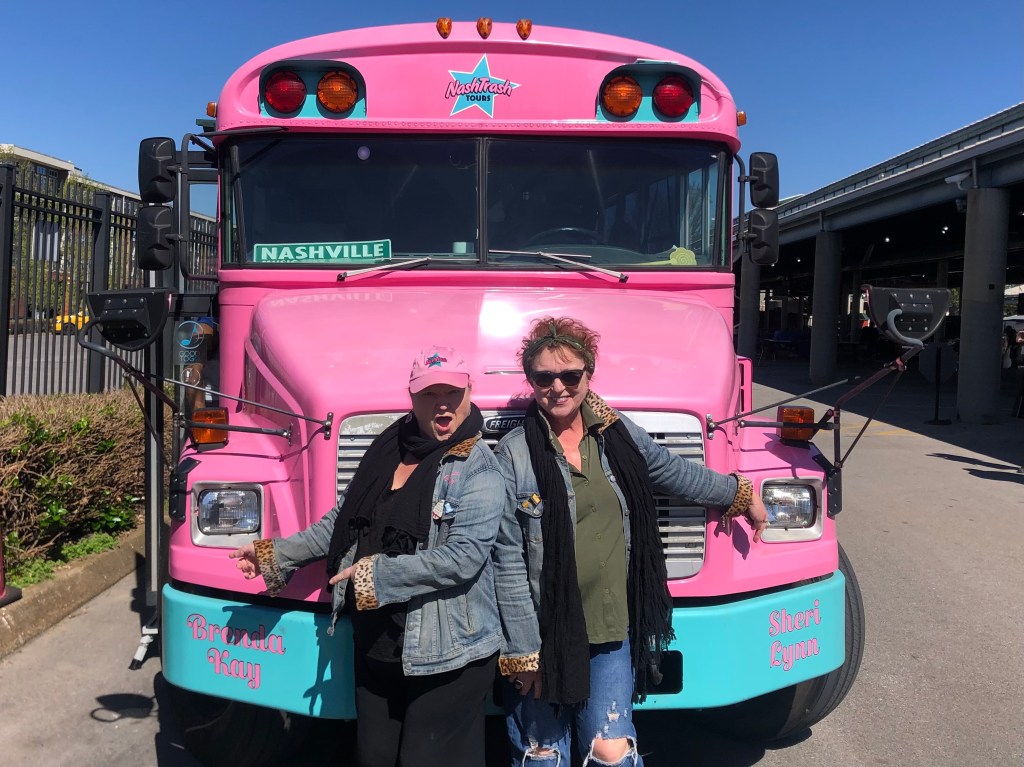
Brenda Kay and Sheri Lynn–The Jugg Sisters–kindly agreed to pose with their bus.
For decades now, The Jugg Sisters have been doing a comedy bus tour of Nashville’s music history. They created, managed, and have starred in the “NashTrash tours” that present tourists with the irreverent musical highlights of downtown Nashville. Recently, however, they’ve been farming out some of the tour guide duties to a new duo: Hank and Jenny. Today was only their sixth time giving the tour. For two hours, driver Darron drove the big pink bus while Hank sang country songs accompanied by his guitar, and Jenny mainly told him “that’s enough now.” Still, they managed to point out literally dozens of music-related sites and share tons of music-related trivia. I confess that I didn’t realize how big the music industry looms in Nashville. There are recording studios, halls of fame, museums, statues, music venues, theme restaurants, and on and on. Nashville has claimed an association with Elvis, Loretta Lynn, Dolly Parton, Chet Atkins, Rosanne Cash, and a bunch of famous people I’ve never heard of. A person could easily spend a week here soaking up the music history.
My only complaint is that, as a country-music novice, I had a hard time separating the genuine factoids from the exaggerations and jokes. Still, the overall effect was to appreciate the musical importance of this city.
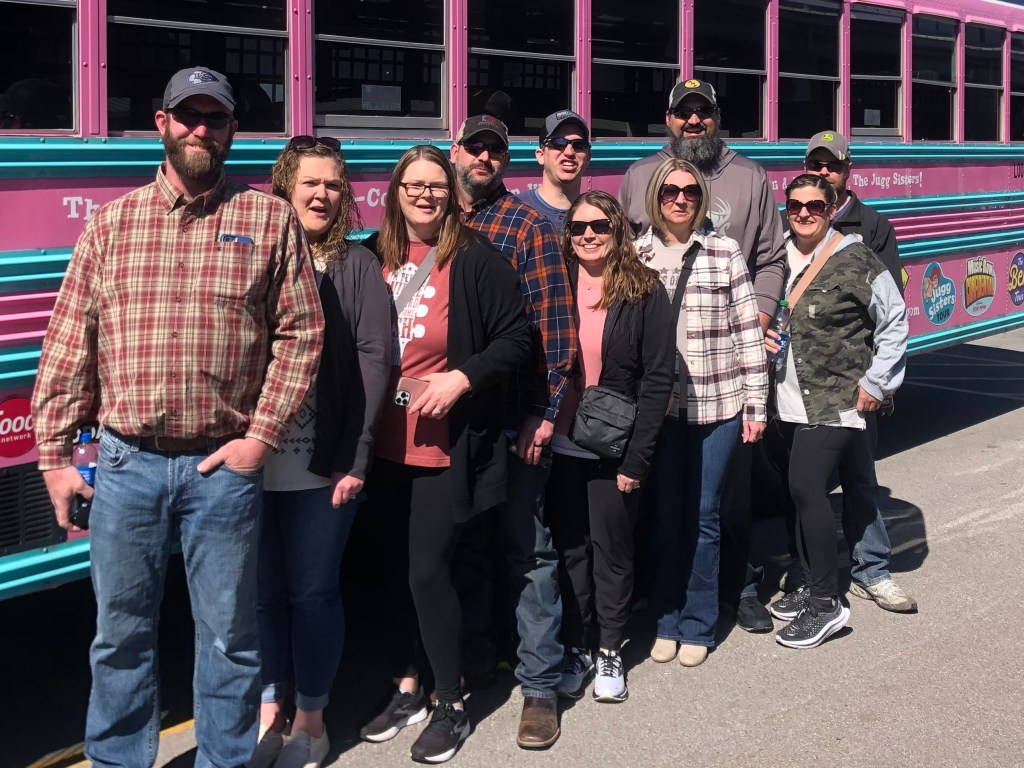
I should mention that today’s bus passengers were mainly just me and a group of 10 folks from Iowa. They let me take their picture, and when I asked them how I should identify the group in my blog, they said “Just call us the Iowa Shit Show.”
The good folks of the ISS.
Hank and Jenny let us take a 10-minute break at lower Broadway’s honky tonk district to attend to our biological needs. I used the occasion to get my fortune told by one of those animatronic fortune teller booths. But instead of a Zoltar or a gypsy or whatever, this one had….Elvis. I took a video of it, just because I didn’t think you’d believe me.
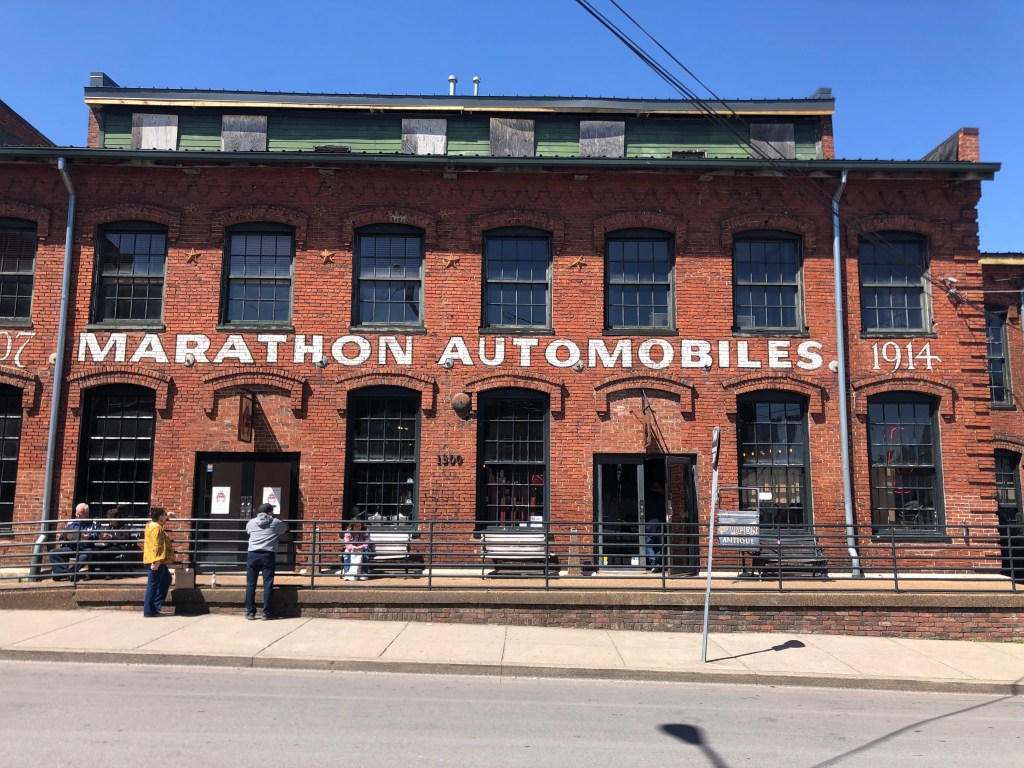
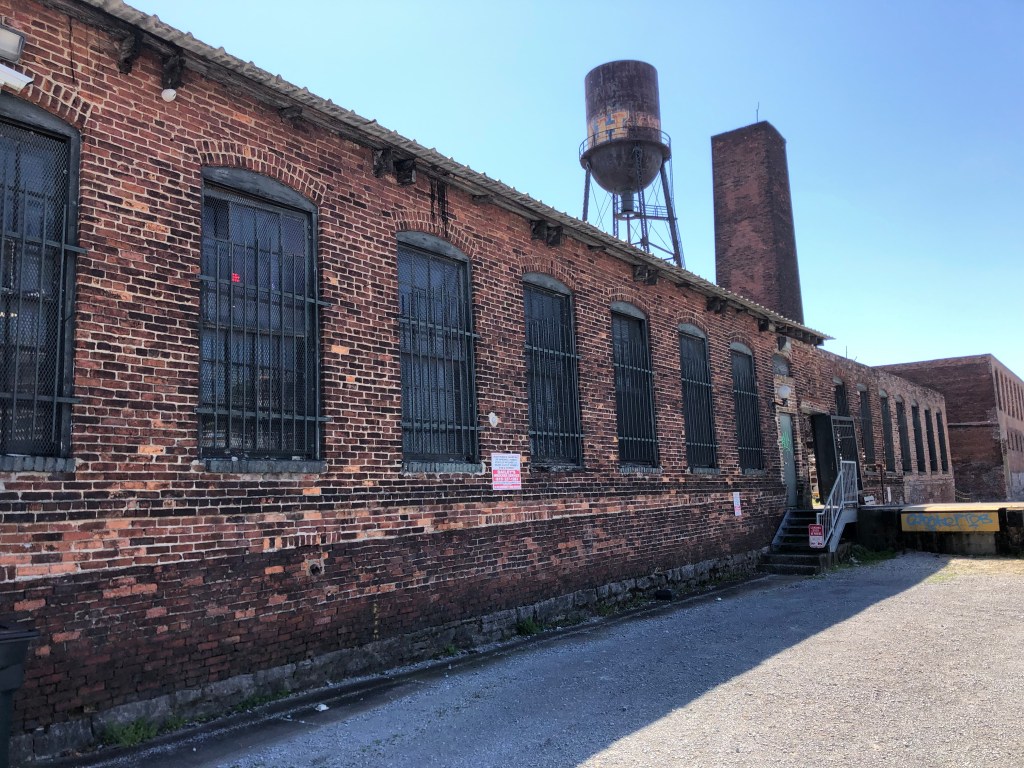
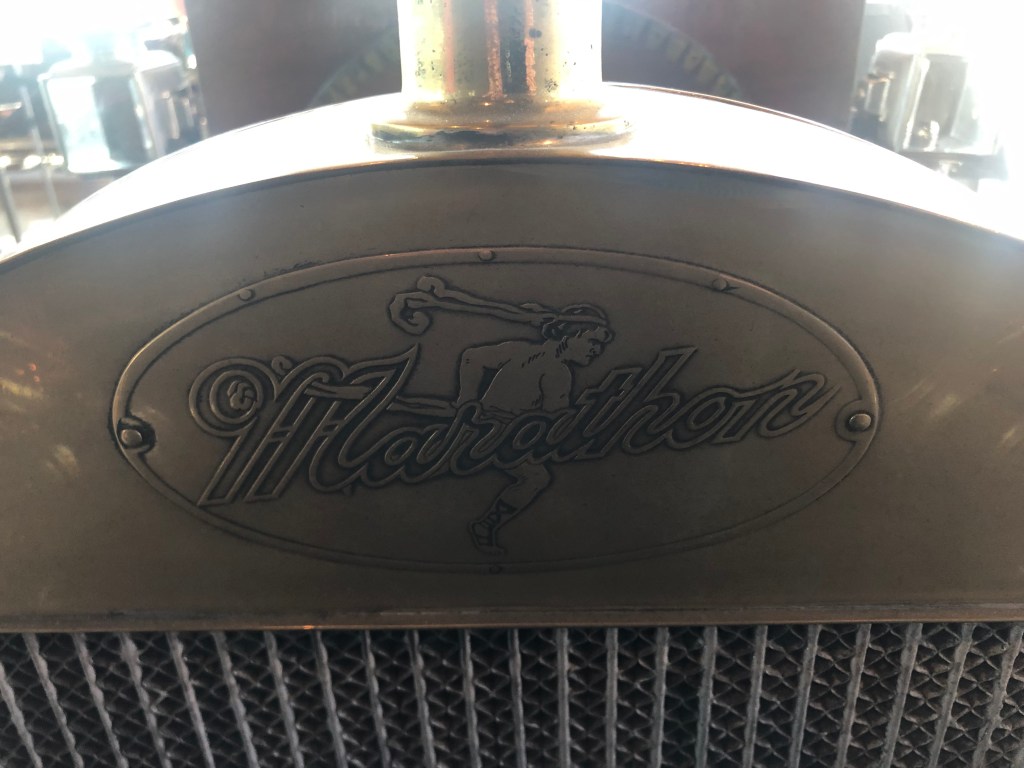
One of the rare non-music-related sites Hank and Jenny pointed out was the Marathon Motor Works. You’d never heard of it either? Apparently for five brief years in the very early 20th Century, Nashville had its own automobile company. An engineer named William Henry Collier at the Southern Engine and Boiler works in nearby Jackson decided in 1909 to try his hand at a new technology called the motor car. For a few years thousands of the vehicles were produced, but the whole operation slowed and ultimately died about the time of World War I.
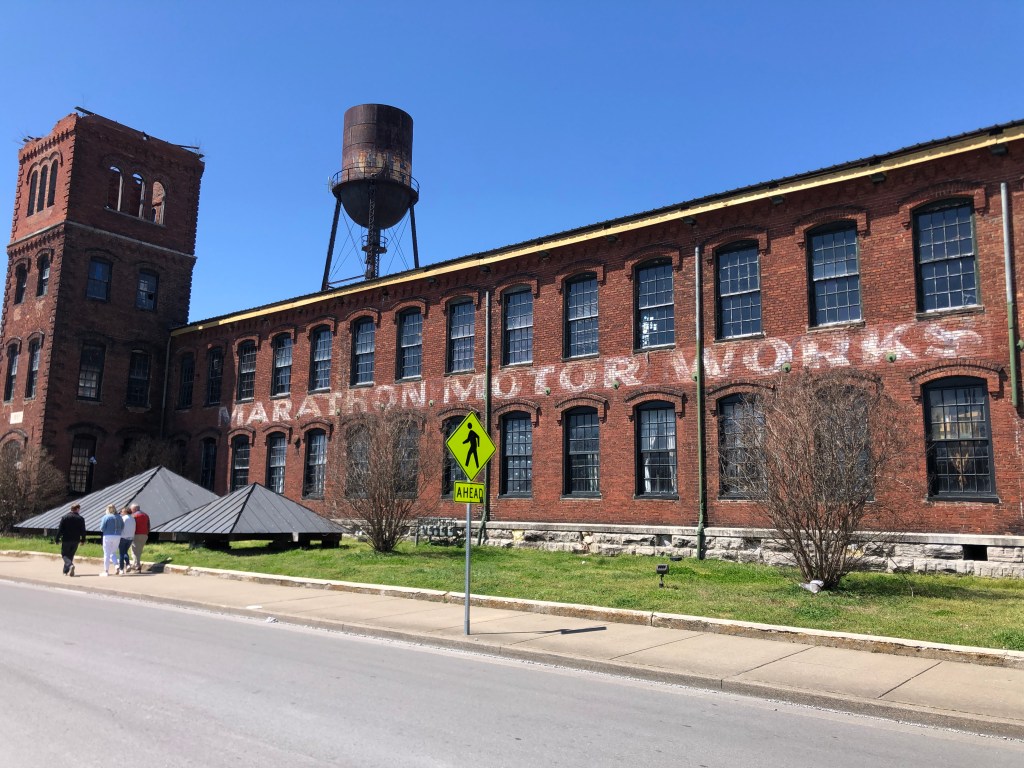
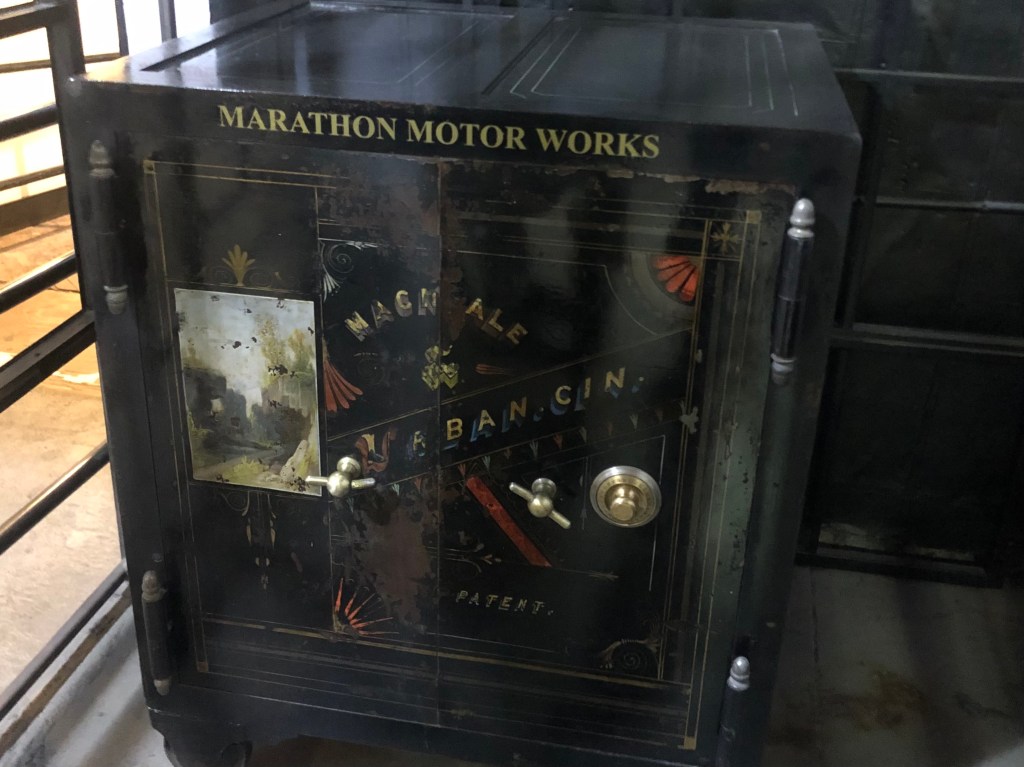
It’s an intriguing story, so after NashTrash I returned to the Marathon Motor Works on my own and puttered around for a couple of hours. I was entranced by this place. Notably, the century-old buildings are remarkably well-maintained and they house museums related to the marque as well as various independent, tourist-oriented shops. (One of them is the antique shop from the TV show American Pickers.)
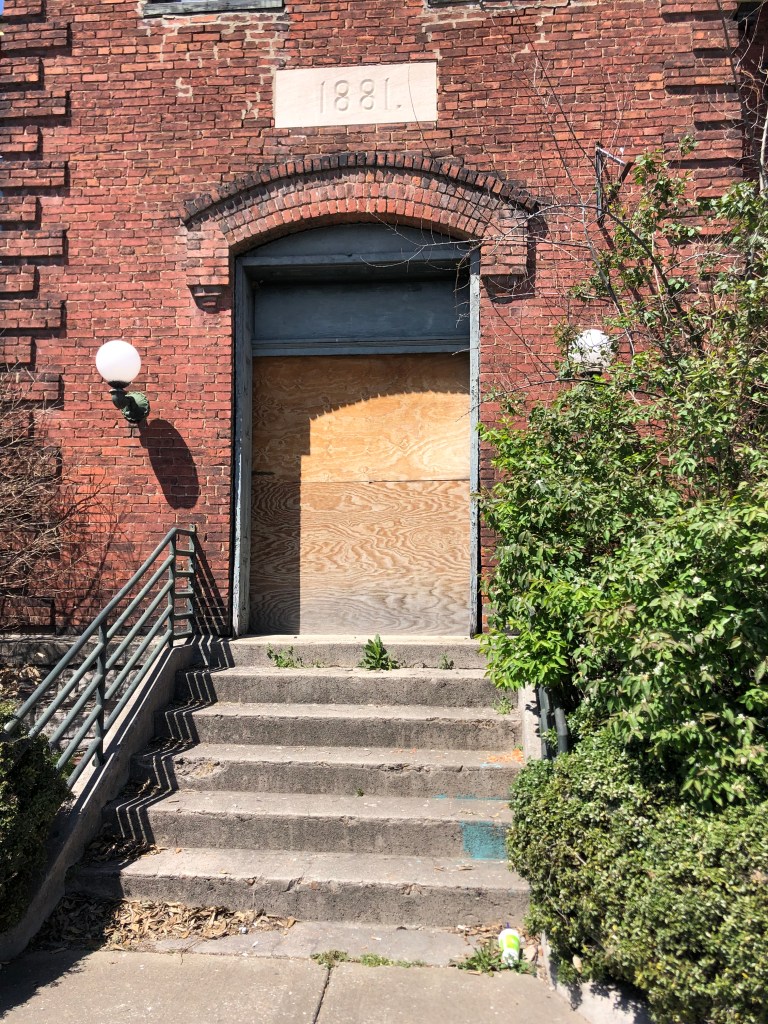
Parts of the complex predate Marathon.
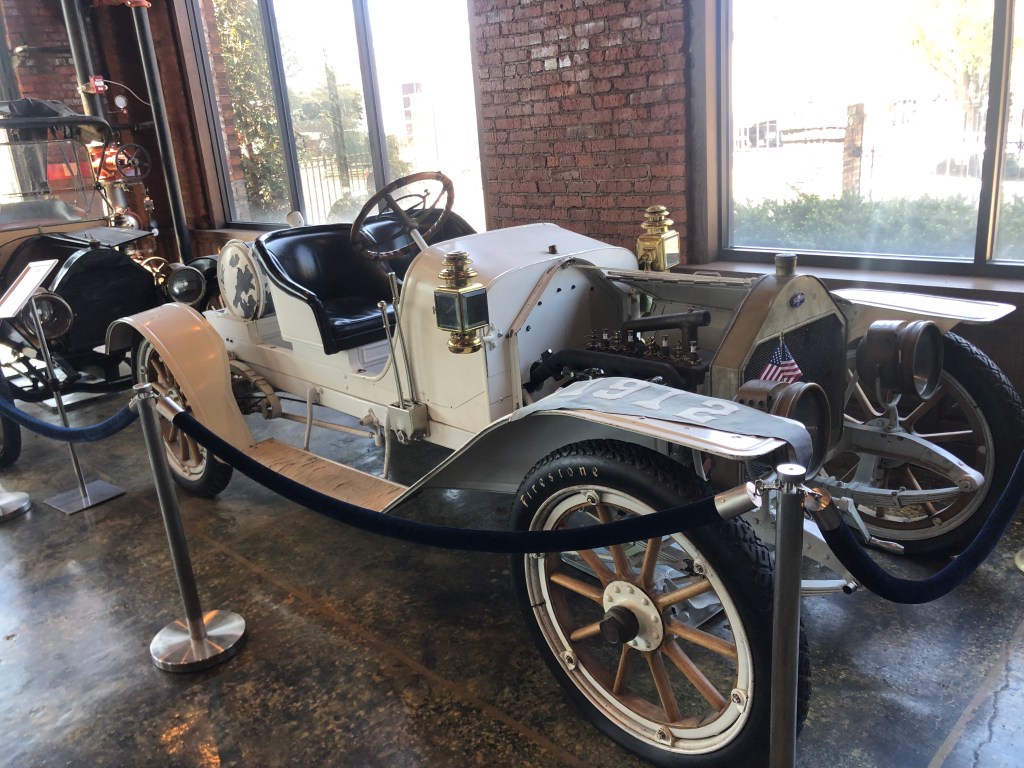
There are said to be only eight surviving Marathon automobiles. (Their production just before World War I made them highly susceptible to scrap metal recycling as part of the war effort.) Impressively, five of those remaining cars are on display at the Motor Works. Numerous other artifacts are also displayed.
One of the few extant Marathon cars. This one is a roadster.
I’m not sure why this car plant resonated with me so much. Part of it is just the novelty of a short-lived, hundred-year-old automobile factory that’s still standing. This particular operation is not flashy like some museums can be, so you feel like the environment isn’t that different at all when workers were casting wheels and assembling frames.
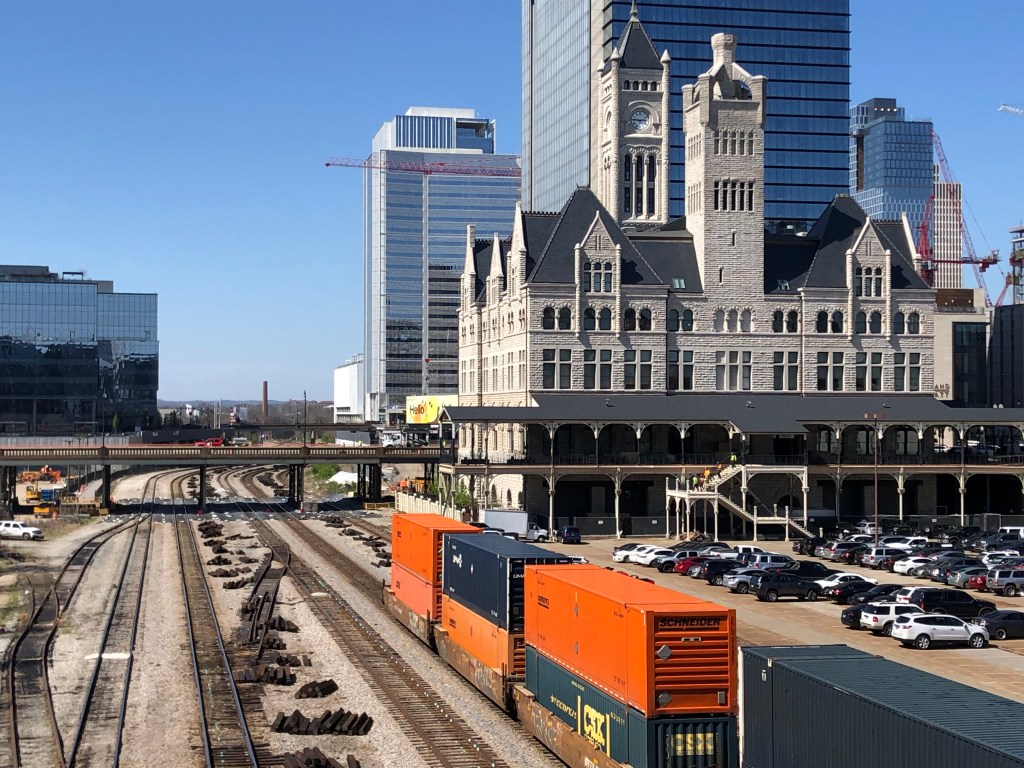
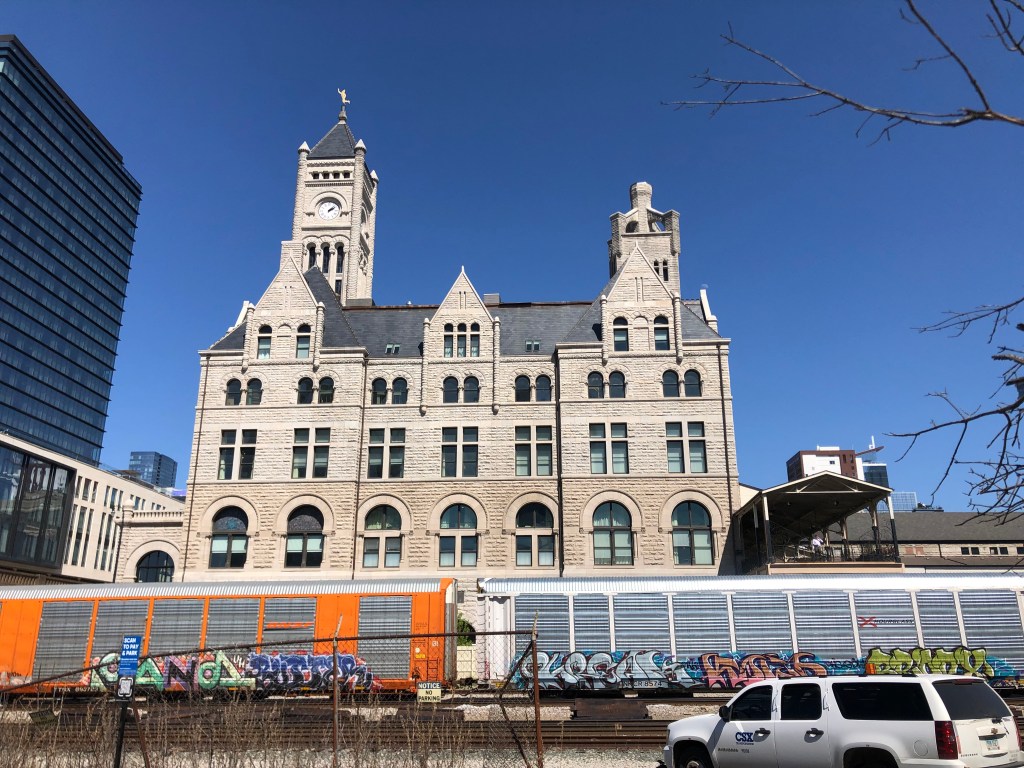
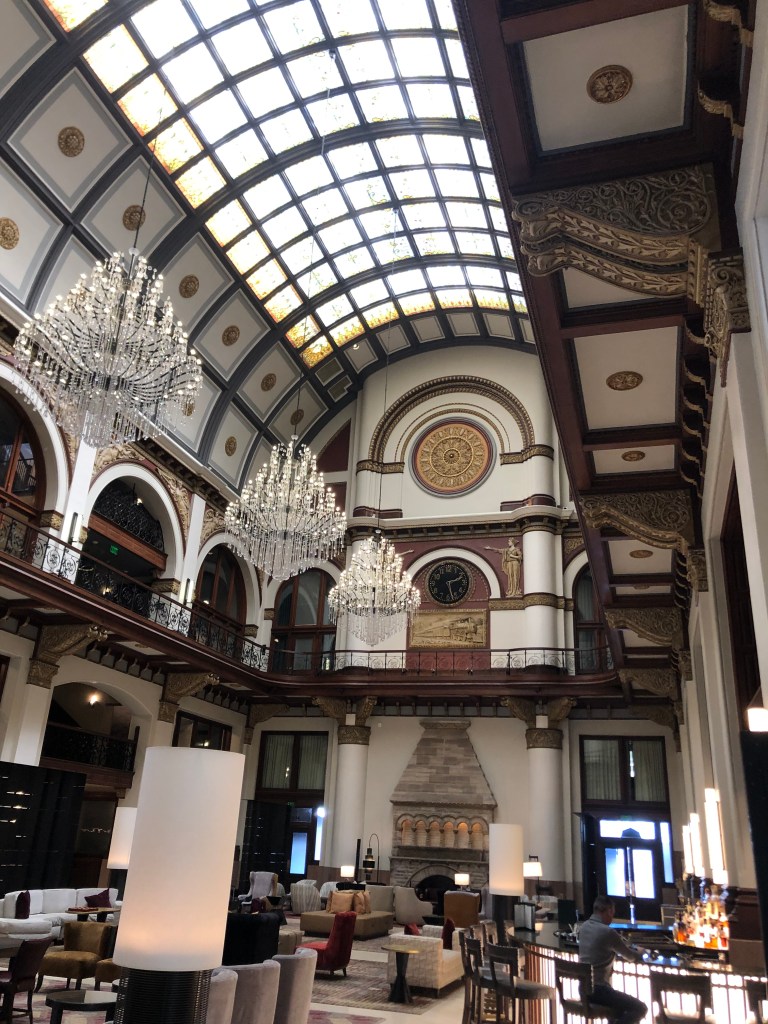
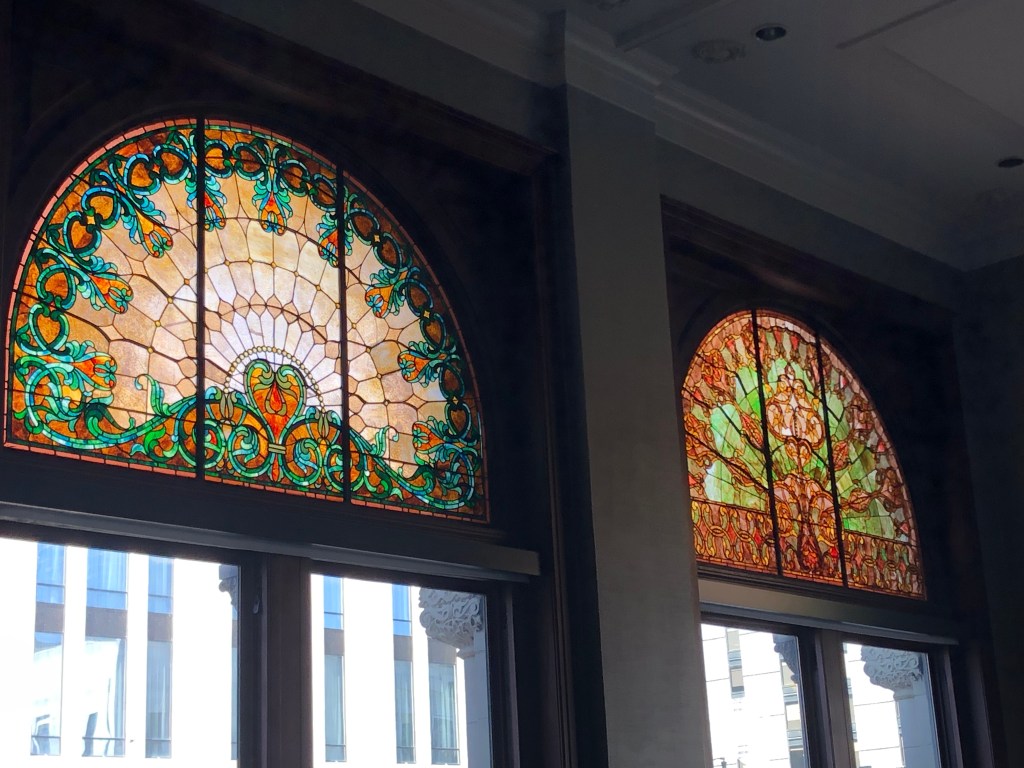
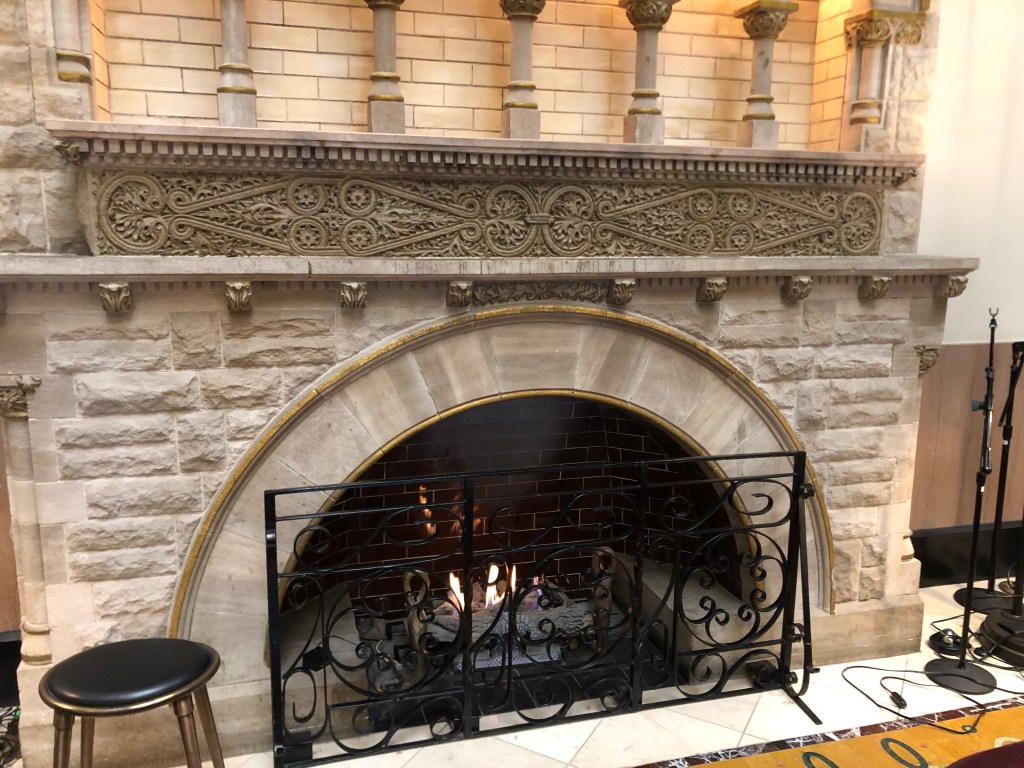
After Marathon I made another transportation-related visit to Nashville’s Union Station. Surely you’re familiar with Union Stations in other cities (Washington DC, Chicago, Louisville, Los Angeles, etc. etc). There must have been scores of them back in the Golden Age of Railroading. Nashville’s Union Station was built in 1898 and was in operation until 1979. It was slated for demolition, but local preservationists and others managed to save it from the wrecking ball. Today it is a luxury hotel, retaining the main structure and many of the appointments from its heyday.
Union Station is the gothic-looking building on the right.
Inside the lobby.
Original stained glass.
Original fireplace.
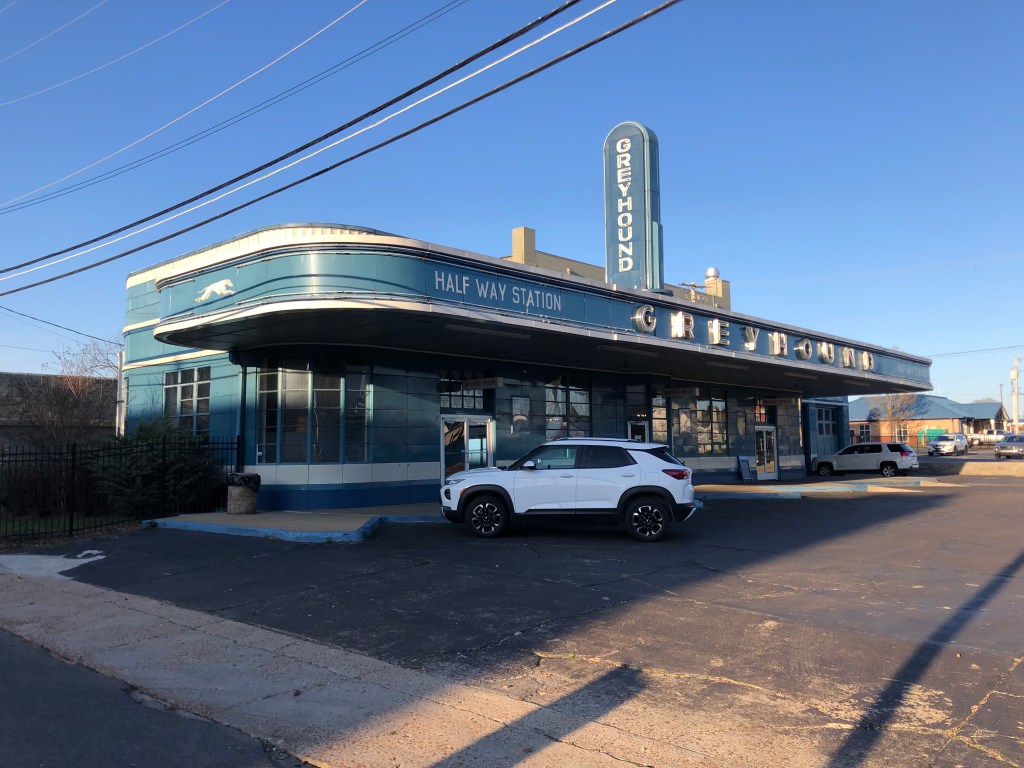
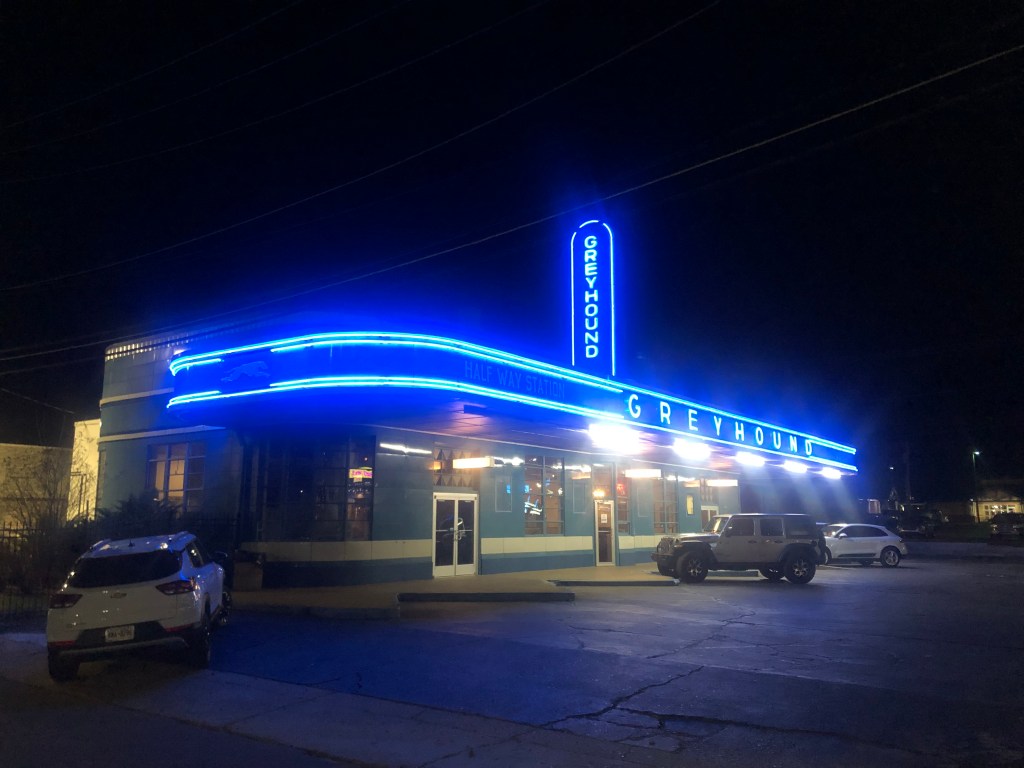
Finally it was time to leave Nashville. I got onto I-40 West toward Memphis, and made it to the halfway point at the town of Jackson, TN (pop: 68,000). Jackson has lots of music history in its own right. For example, it’s the birthplace of Big Maybelle and of Denise LaSalle. I’m spending the night here and will report more about Jackson in tomorrow’s post. But I did want to highlight the Greyhound station I saw on Main Street. Check it out:
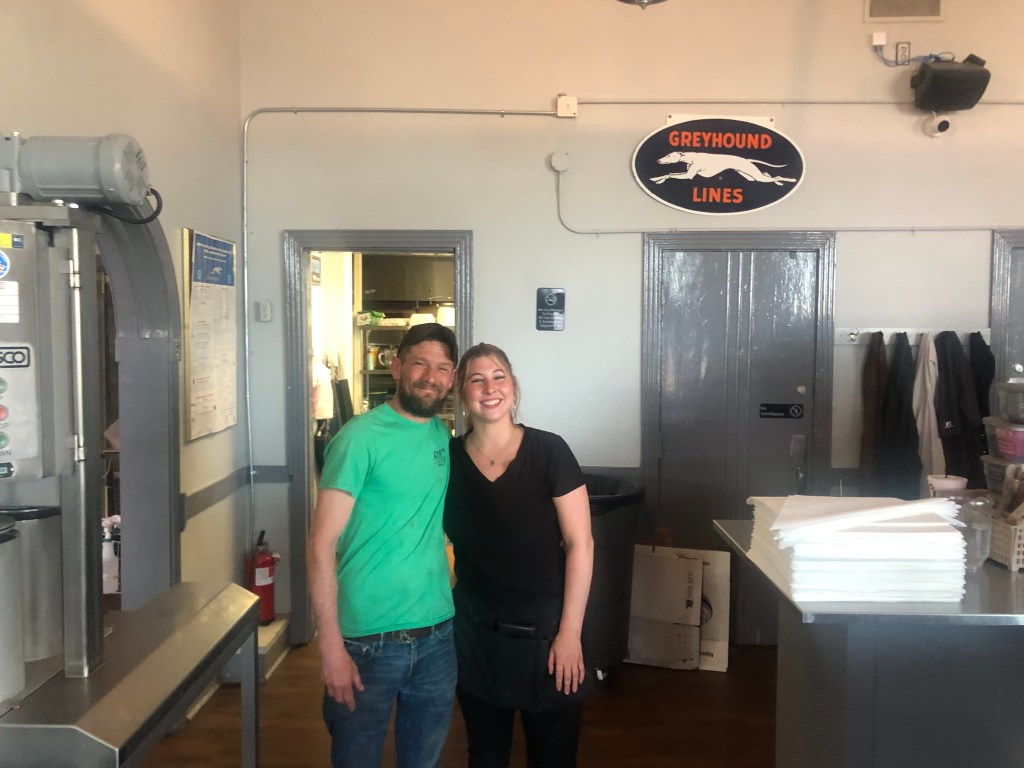
It’s a beautiful art deco, streamlined structure built in 1938. It closed in 2018, but quickly was restored and maintained as a historic structure. There was a young lady cleaning the outside windows when I drove by, and she told me it recently became the third restaurant called Doe’s Eat Place. (Doe’s has its own interesting history dating back to the 1930s which you can read here.) Since it was dinner time I went in and had the best fried shrimp I’ve ever had. I also chatted with the employees, who were all friendly and seemed to love the idea of a down-home restaurant in a converted Greyhound station.
Chris and Kendall provided southern hospitality.
Since I’m spending the night in Jackson, I went back to the Greyhound station/Doe’s Eat Place to get this picture of the restored neon signage.
And thus we’re almost done with today’s blog post. All that’s left is the….
BREW OF THE DAY
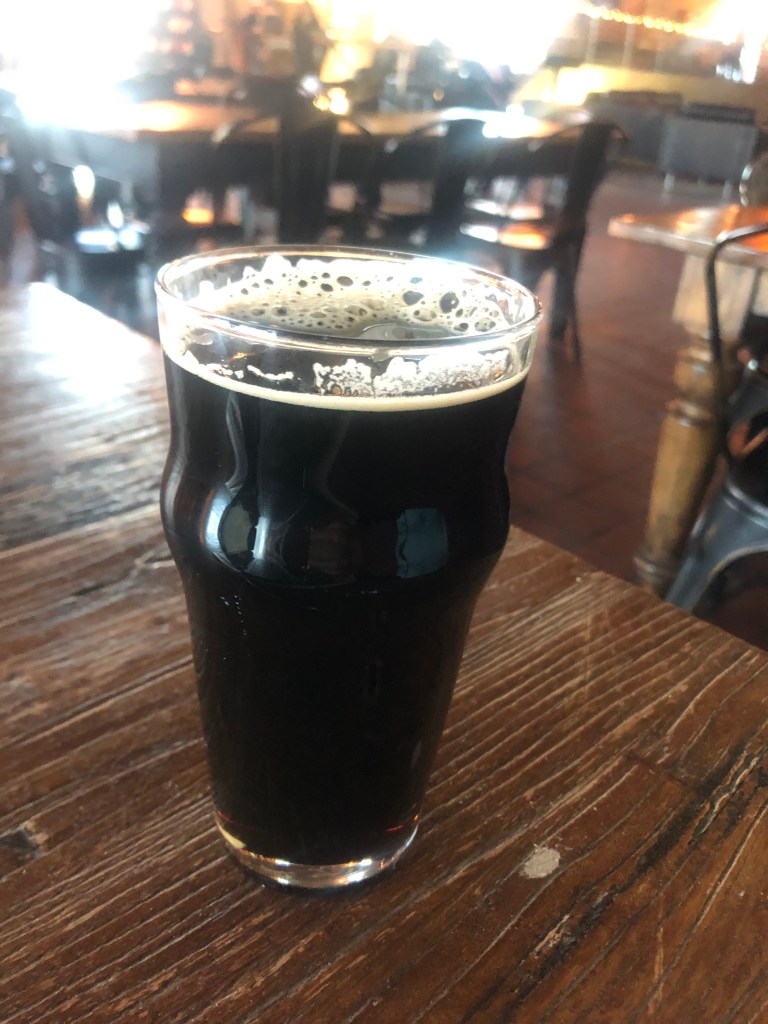
For all its good points, Doe’s Eat Place has a boring beer menu. So after dinner I went to Hub City Brewing, which is just down the street. The bartender explained to me that Jackson is known as Hub City because of its strategic location halfway between Nashville and Memphis. It’s at the crossroads of I-40, US 45, US 70, US 412, and various state routes. It also was historically a railroad hub. (Alert readers will recall I visited Casey Jones’ home and his grave here in Jackson three years ago when I drove across the country on Route 70.)
Anyway, Hub City Brewing makes a healthy assortment of beers, including a few good porters and stouts. I chose the Snowplow Vanilla Porter. The first thing you notice about this beer is how dark it is, like a Starbucks cold brew. It has just enough foam to visually remind you it’s not a coffee but a beer. The nose is slightly sweet, with vanilla notes (as you’d expect) but also with a little molasses or brown sugar.
It’s incredibly drinkable. It’s malty without being cloying, and it’s roasty without any of the acidic sharpness a porter sometimes can have. The mouthfeel is meatier than your typical porter as well, reminding me a bit of a stout. With an ABV of 7.2 percent, this warms you a bit but it doesn’t kick your ass the way an imperial stout (my preferred beer) can. I give it 4 out of 5 stars.
If you ever find yourself in the Hub City, get yourself one of these!
Today we’re going to take a break from those vile green liqueurs and get back to basics. We’re going to try a version of an Old Fashioned, that bourbon-based drink with an adjectival name. But the recipe gets Halloweenified with some pumpkin and maple syrup.
Dating back to the 19th century, the Old Fashioned is indeed old fashioned. It’s said that the drink was originally called a “bittered sling,” which I actually prefer as a name. But as drinks became ever fussier as time went on (recall my ordeal with the Herman), purists would ask their bartender for something “old fashioned,” and the new name stuck.
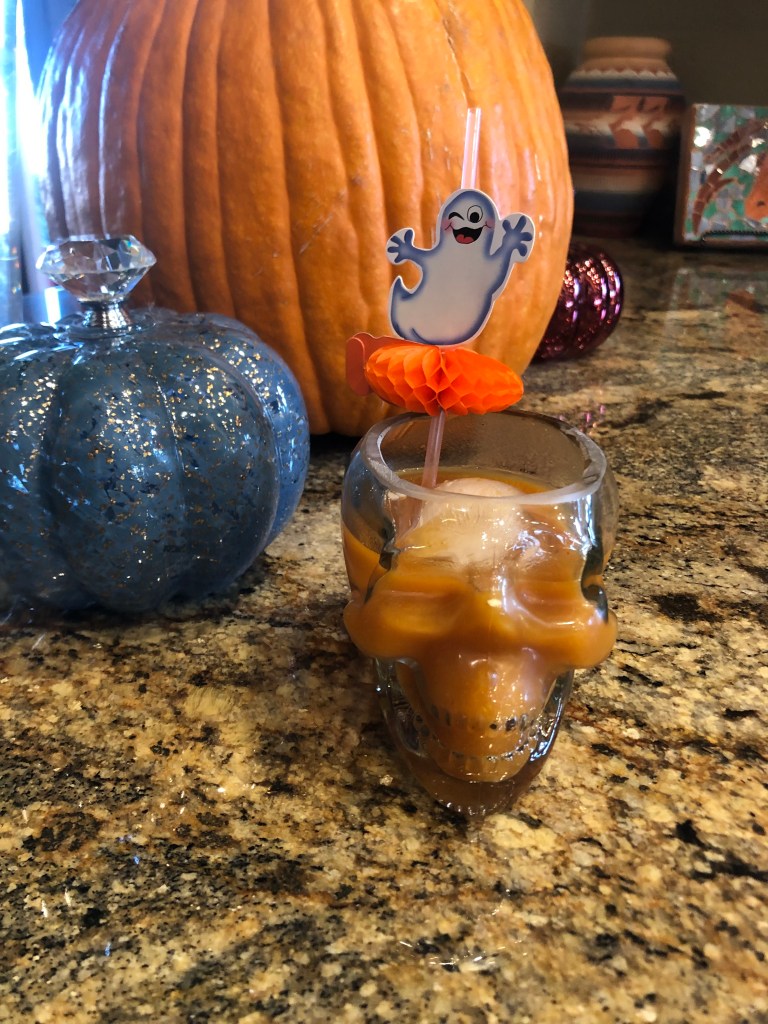
The Recipe: Mix 2 oz bourbon, 1 Tbsp pumpkin puree, 1/2 Tbsp maple syrup, 1/4 tsp pumpkin pie spice, 1/4 tsp vanilla extract, and a dash of Angostura bitters in a shaker. Pour over fresh ice.
The Ratings:
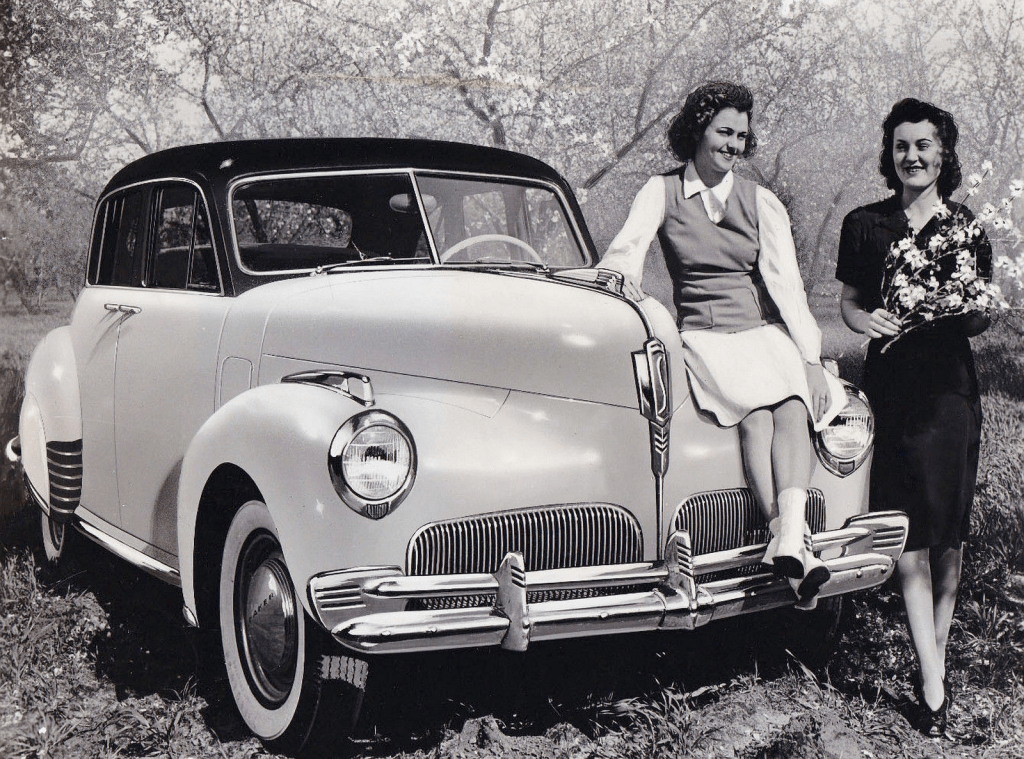
The appearance is somewhat off-putting. It’s not bright enough to be a frivolous, fun drink, and it’s not translucent enough to look like a proper Old Fashioned. The color looks like Bakelite plastic from the radio tuning knob of a 1940s Studebaker. It certainly doesn’t look like a Halloween drink. But it does have a vague pumpkin hue, so I’ll give it two points.
Old Fashioned indeed.
In terms of taste, the bourbon dominates, as it should. The bitters fight a bit against the maple syrup, and the pumpkin spices kind of get lost in all the infighting. But the pumpkin puree gives it a depth and heft not normally present in an Old Fashioned. I’ll give it 2.5 points.
I give the nameone point. It would have been two points if they’d had the presence of mind to name it an Old Fashioned Pumpkin.
Grand Total: 5.5 points.
Dark N’ Stormy Corner
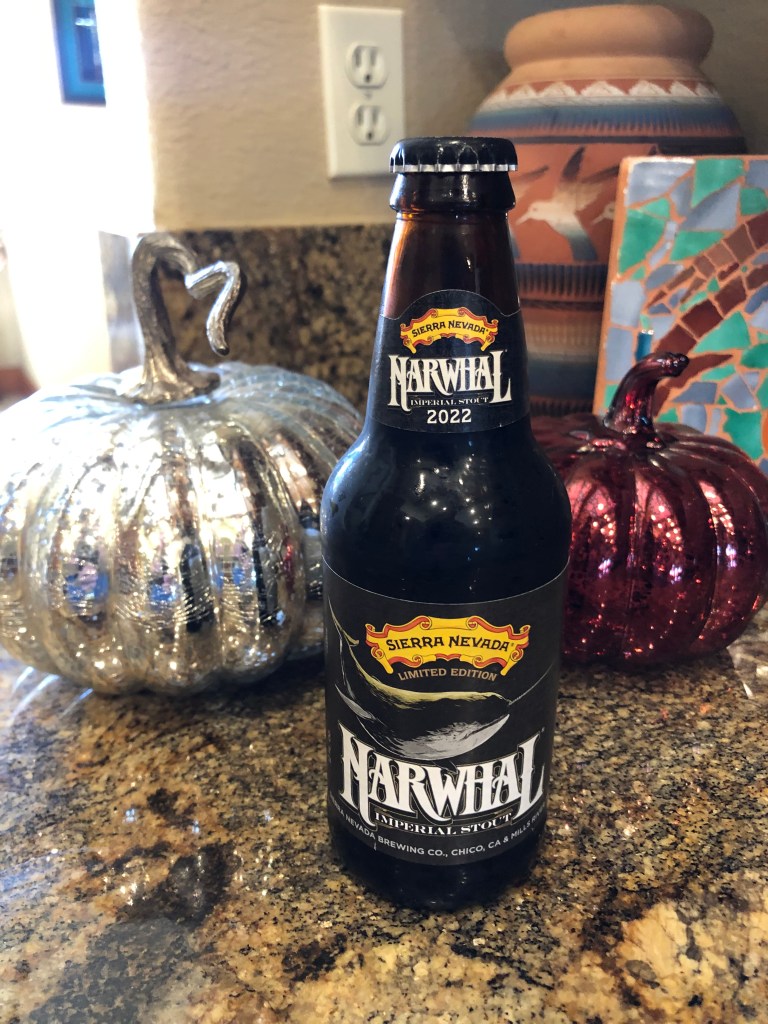
Recall that I’m trying to find a way to make this Dark N’ Stormy darker and stormier. This time I tried adding 2 oz of Sierra Nevada’s Narwhal to the drink. It did not improve on the taste. In the same way that filling your mattress with glass shards does not improve on its comfort. I find it surprising, because Narwhal (only available seasonally) is my favorite widely-available imperial stout. Best to just drink the beer on its own.
Do yourself a favor and grab a six pack before they’re gone til next year!
As for the Dark N’ Stormy, it’s back to the drawing board.
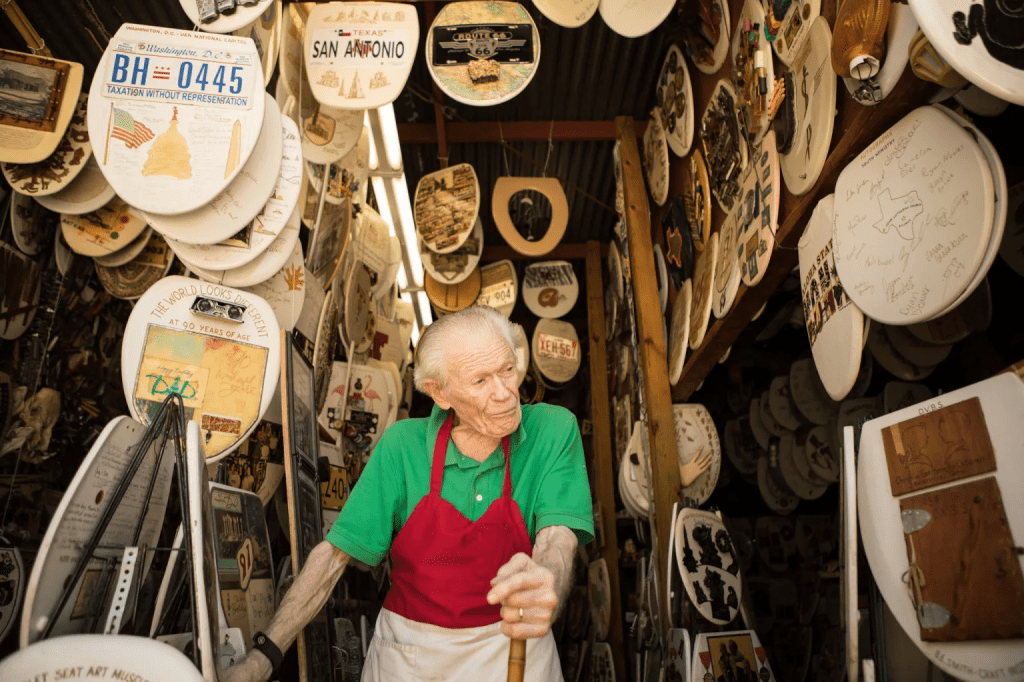
Once upon a time (in 1921, to be exact) a guy named Barney Smith was born in Eastland, TX. Barney became a plumber, but he also indulged his artistic side. In his words: “I went to a plumbing supply house one time, and they had about 50 toilet seats out on the dock that they were going to throw away. And I said [to the owner], what are you going to do with those toilet seats? I would like to have some of these toilet seats to do some art on.” Somehow Barney managed to get all those seats, and he began transforming them into works of art.
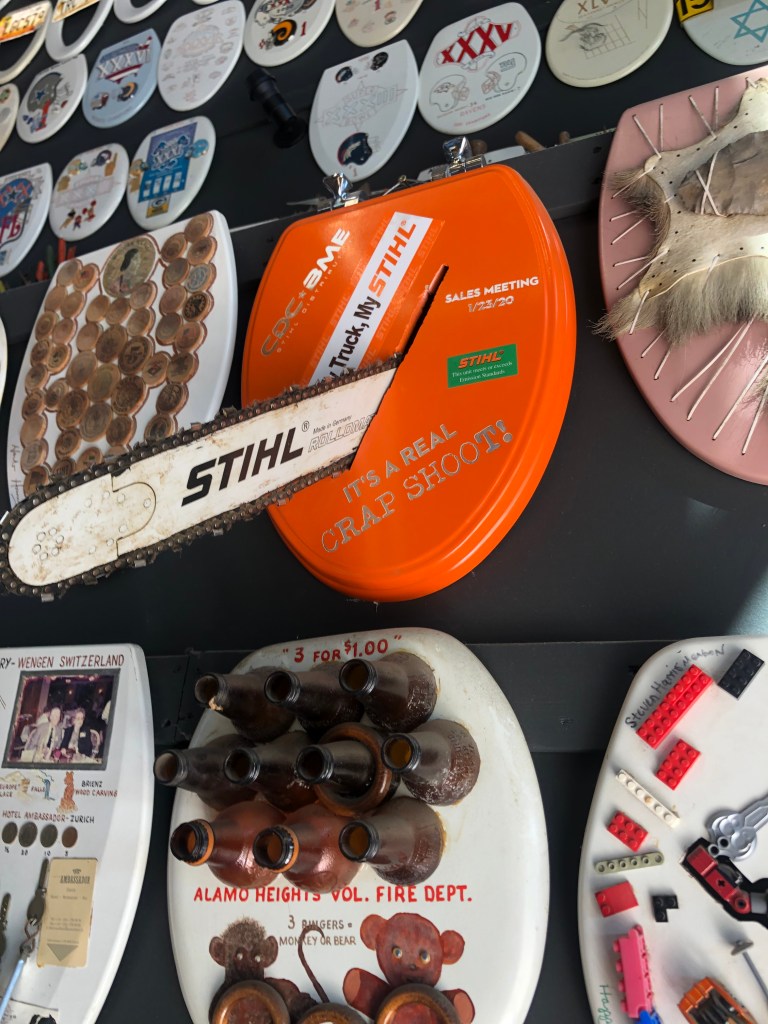
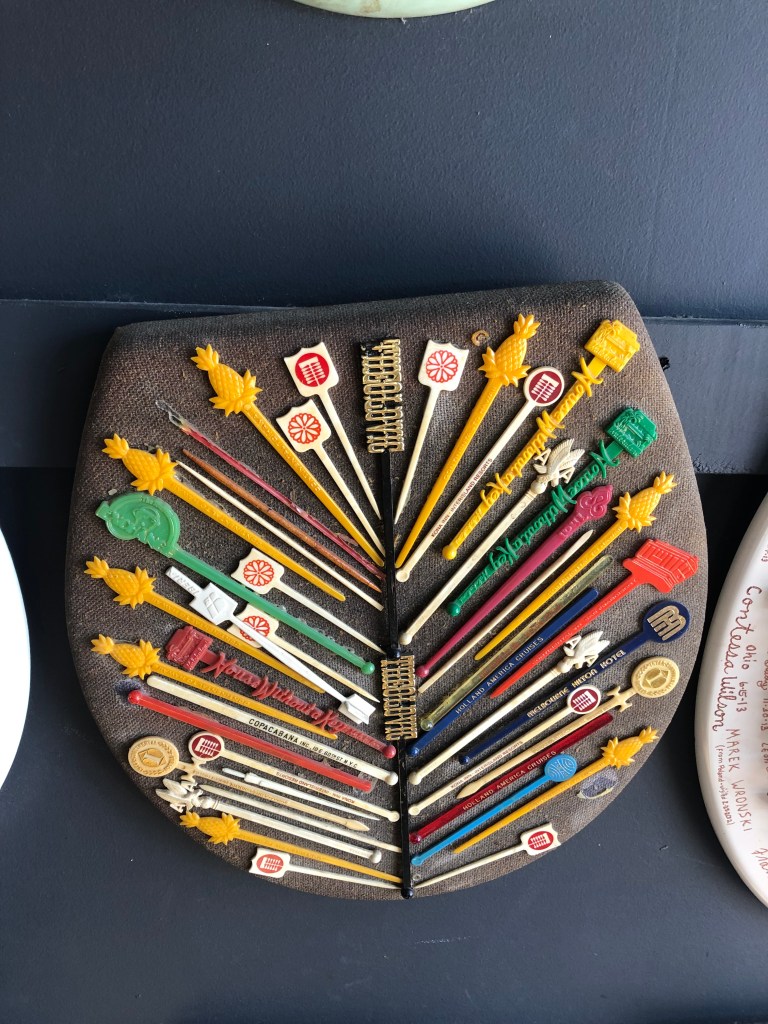
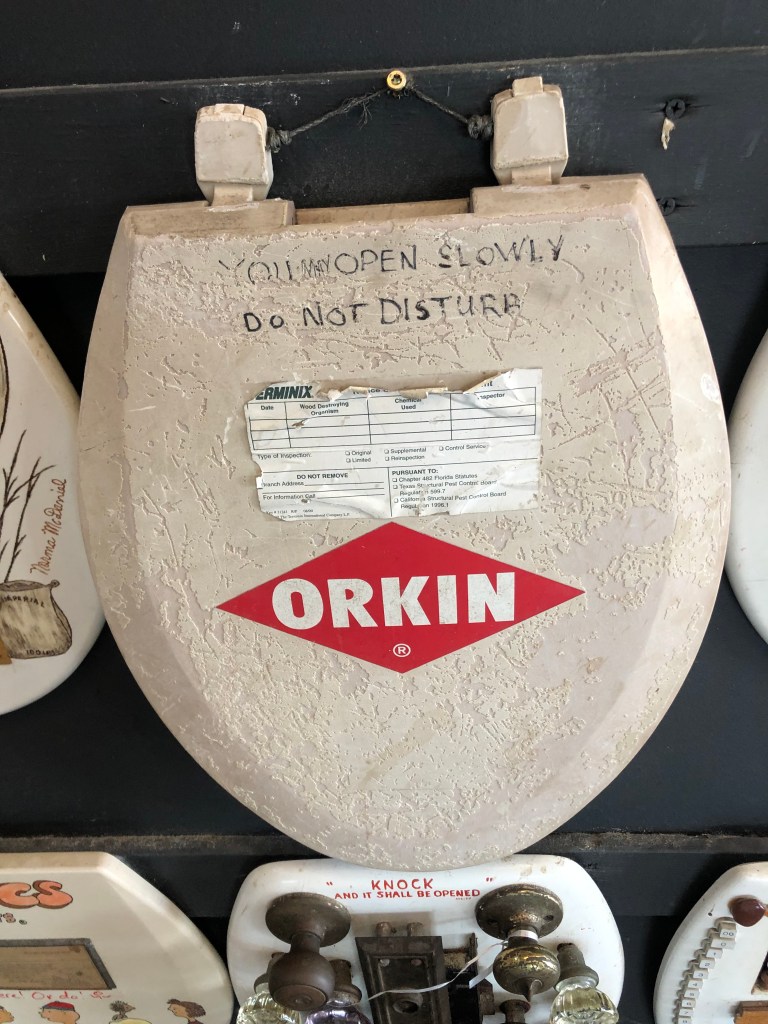
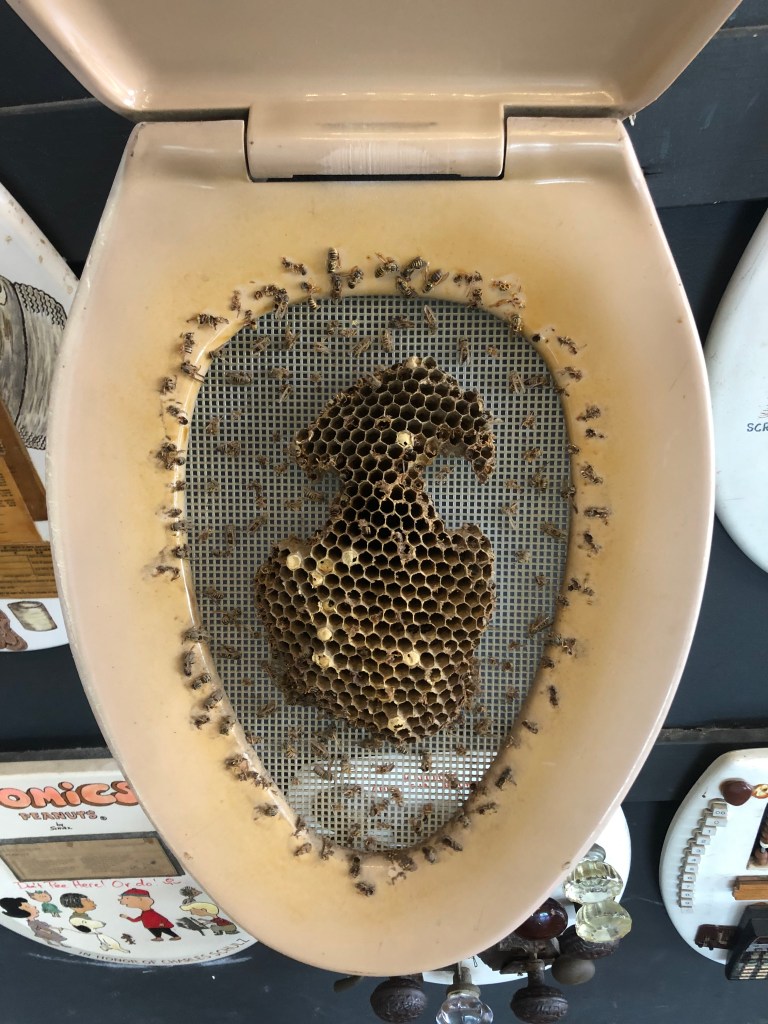
The art took various forms, but in general he glued found objects onto the seats and added lettering and other ornamentation. Barney kept getting more seats, and there seemed to be no topic that he couldn’t capture in toilet seat art: history, celebrities, professions, geography, transportation, entomology…the list goes on and on. Eventually, over a period of 50 years, he created over 1,400 of these objets d’art. The collection turned Barney into a minor celebrity, appearing in magazines like Life and People, and on television news programs like the Today Show. He displayed the seats in his garage, but in his twilight years he sought out a more permanent, public venue to display his collection.
Barney in his garage in 2016. Photo c/o Bonnie Arbittier / San Antonio Report
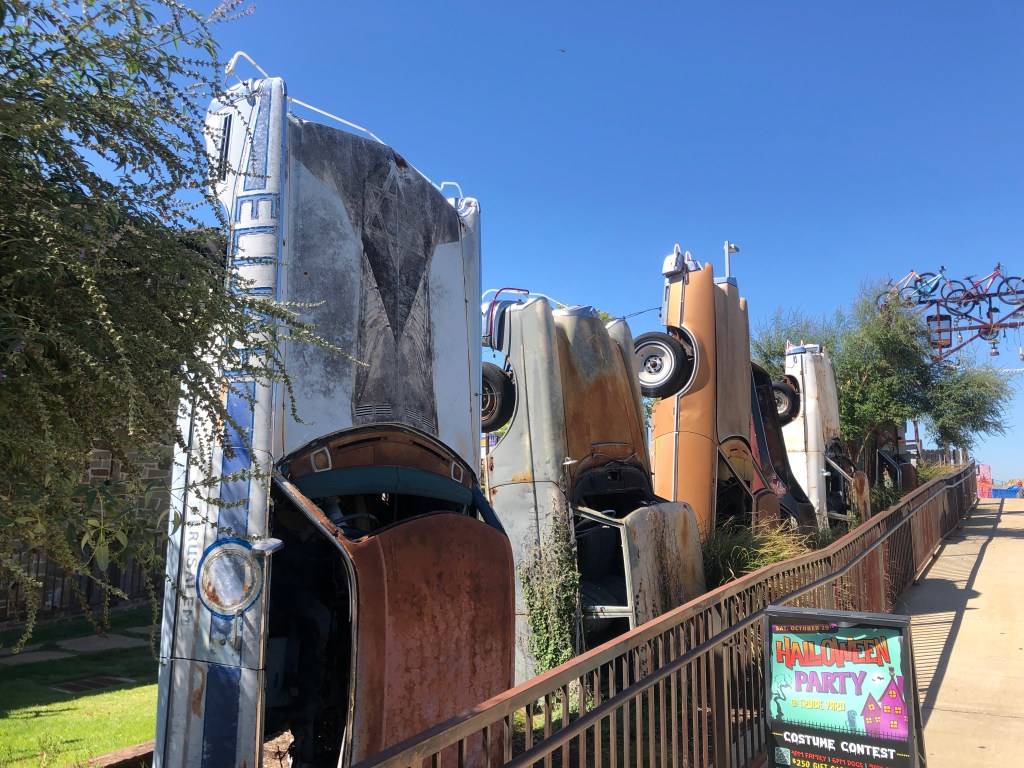
Meanwhile, in 2018, a guy named Jason Boso was about to open an outdoor beer garden with a Cadillac Ranch vibe called “The Truck Yard” just outside Dallas, TX.
Paging Stanley Marsh 3–we may have found your car.
Jason had heard about Barney’s collection, and reached out to see if he could borrow a few pieces as decor for the Truck Yard. One thing led to another, and Jason ended up buying Barney’s entire collection, promising to put it on permanent public display. Barney Smith’s Toilet Seat Art Museum officially opened on Memorial Day 2019. The 98-year-old Barney Smith himself cut the…ribbon. A scant two months later Barney died peacefully, knowing that his toilet seats were in good hands.
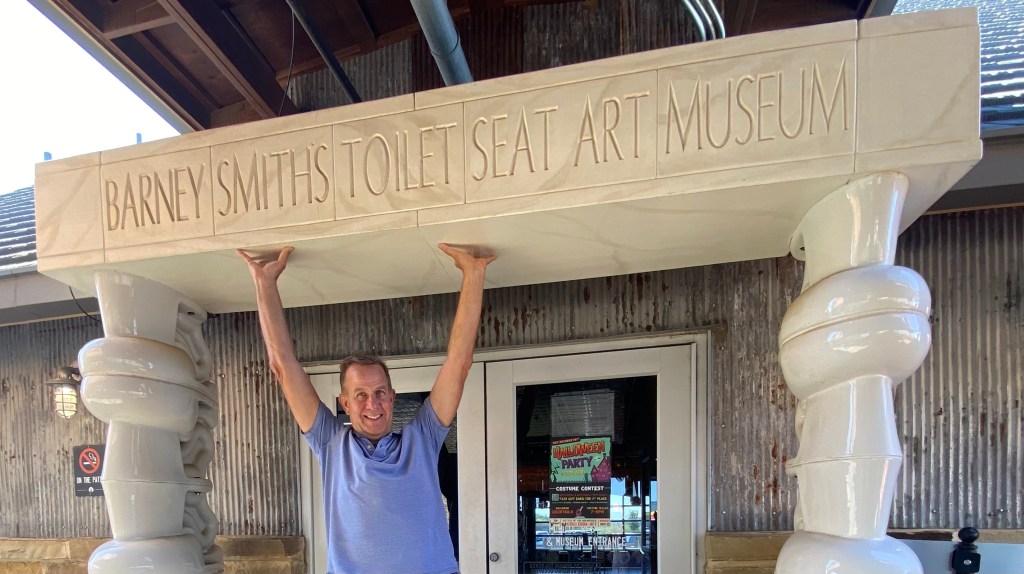
My best Samson pose.
I mention all this because I’m in the Dallas area for a family birthday celebration (Happy Birthday, Michael!) and I suggested to my ever-suffering wife that, as long as we’re in town, we should visit the toilet seat museum. Yes, she puts up with a lot of crap in this marriage. And, being a woman, she normally wouldn’t stand for anything toilet-related. But even though at first she pooh-poohed the idea of joining me, she realized it was her duty. And that’s why she’s Number 1 in my book.
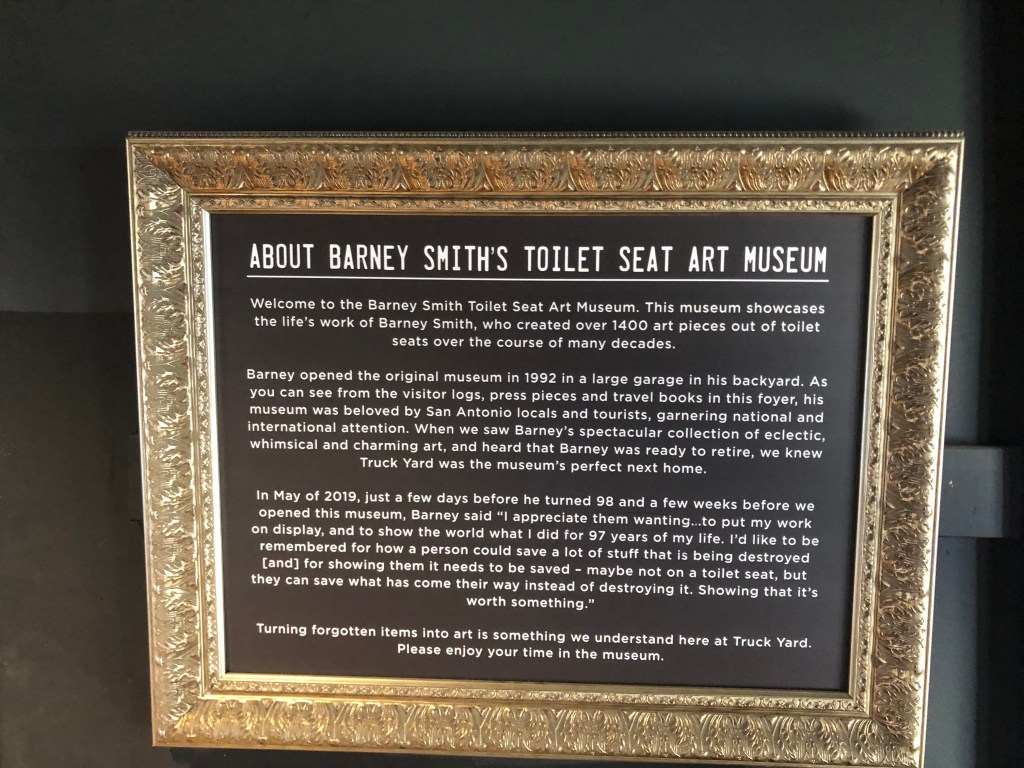
When you enter the museum a small anteroom gives you the poop on the collection. Not only is there a plaque and the original toilet seat sign from Barney’s garage, but there’s also a wall of newspaper clippings and magazine articles about Barney and his toilet seats.
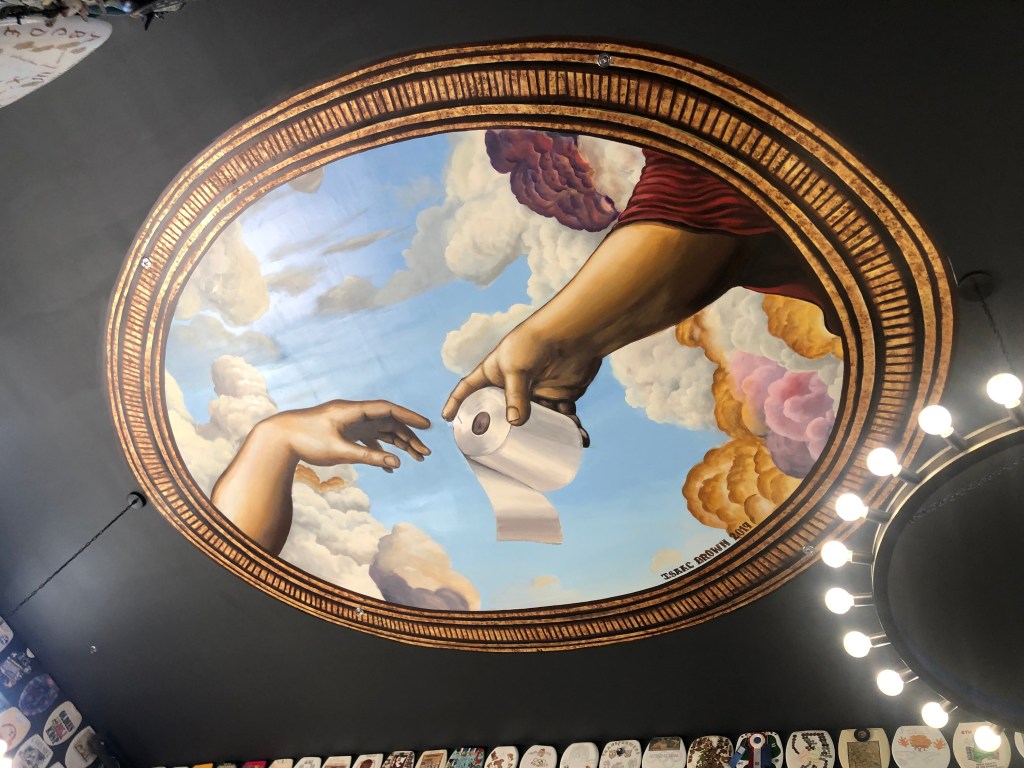
You then “pass” into the main museum room, whose ceiling is adorned with a variation on Michelangelo’s “The Creation of Adam.”
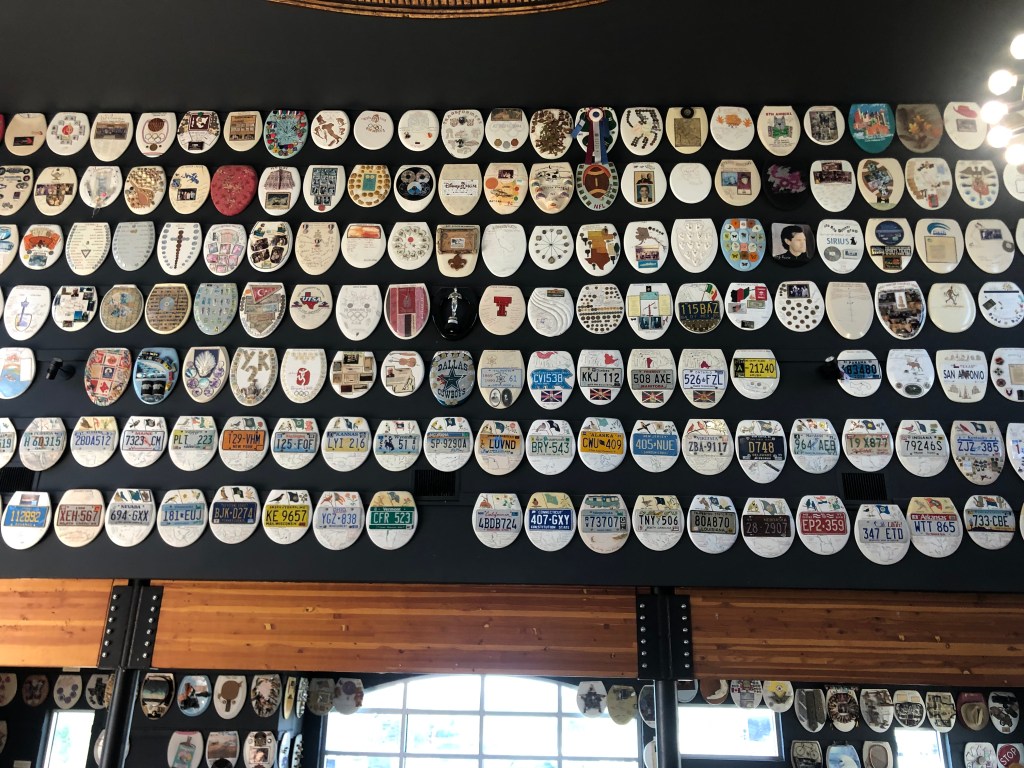
For scale, note the row of toilet seats along the top edge of the wall.
The walls are covered with the 1400-plus toilet seats that Barney decorated. Here’s just a small sample:
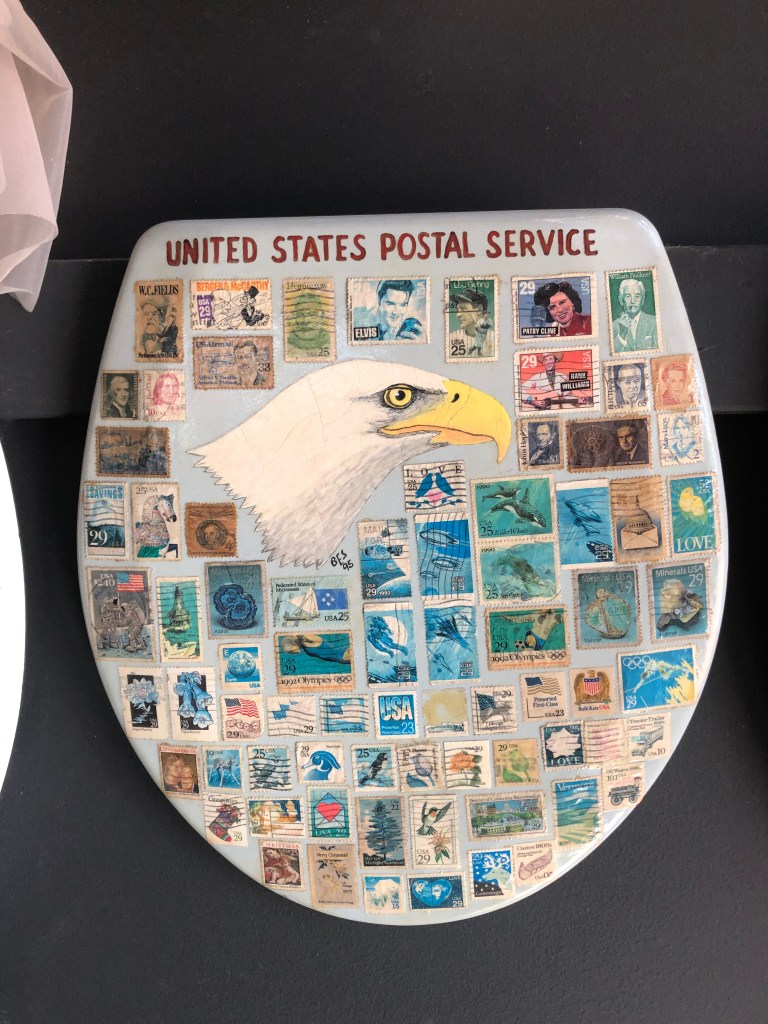
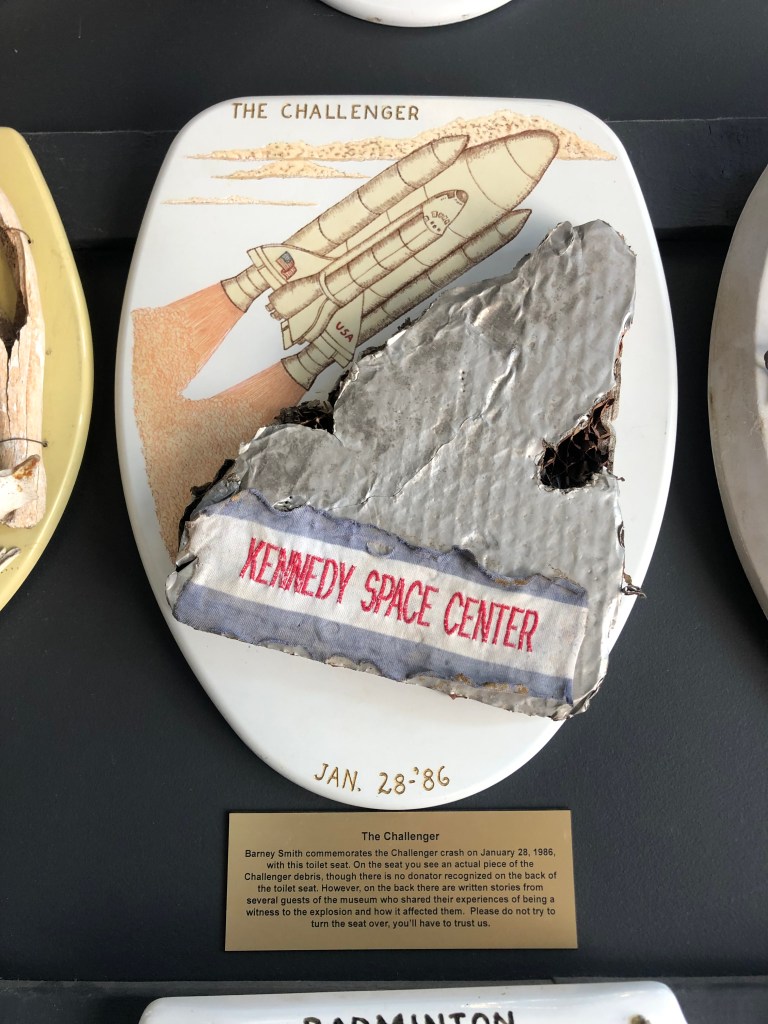
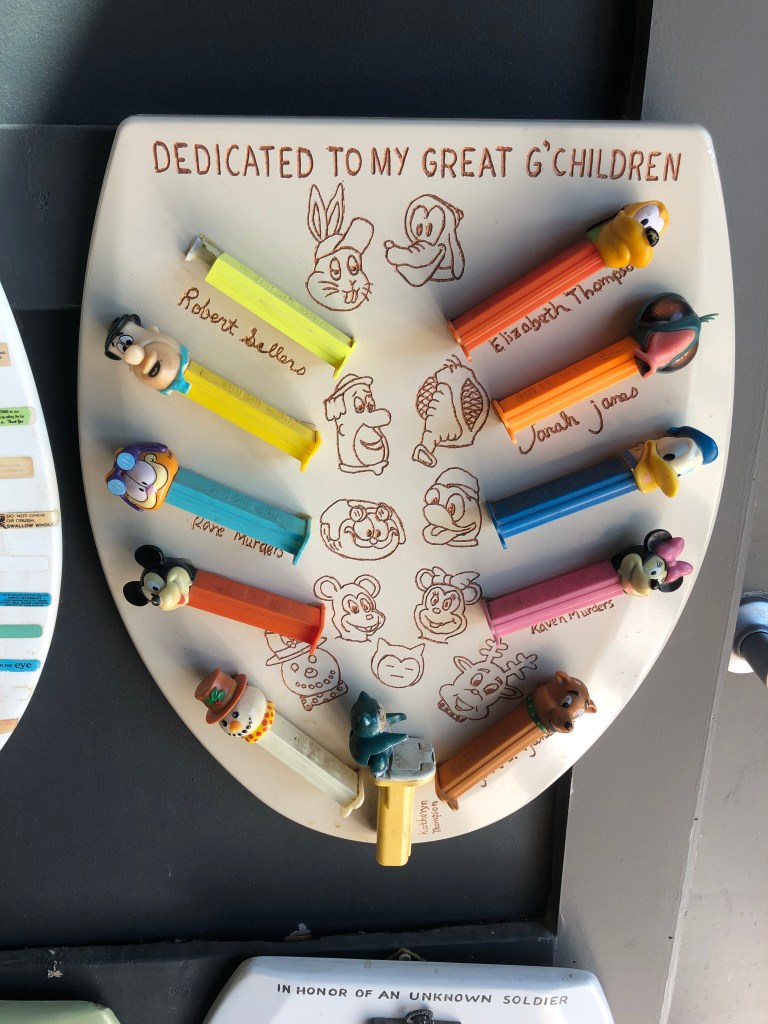
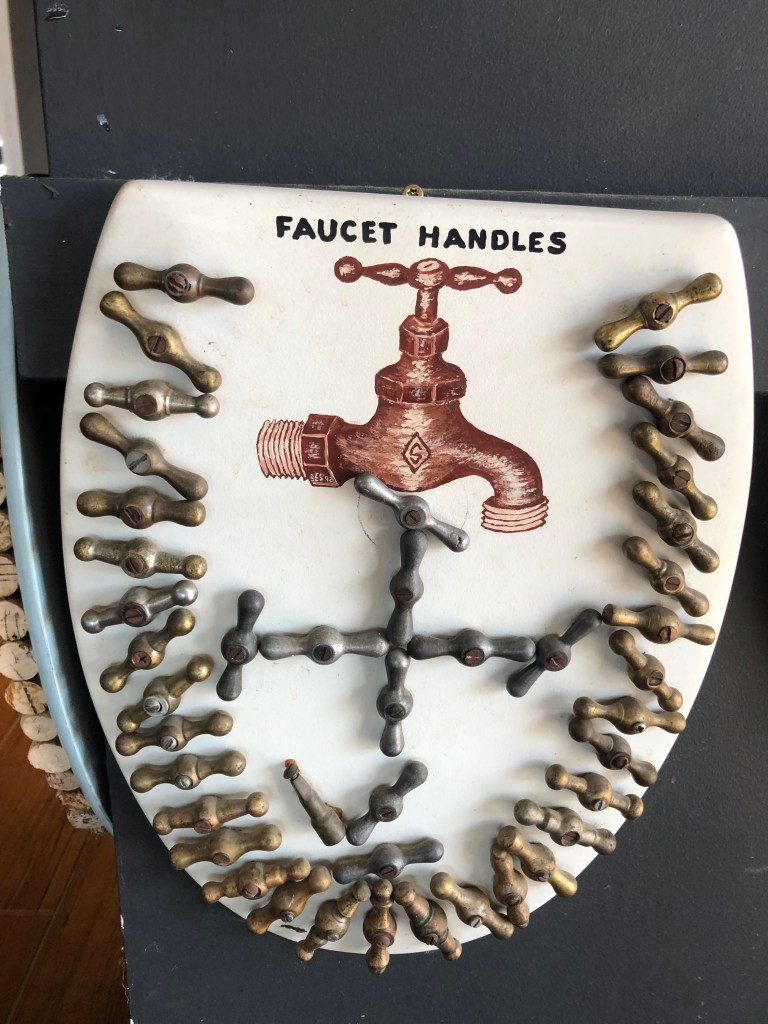
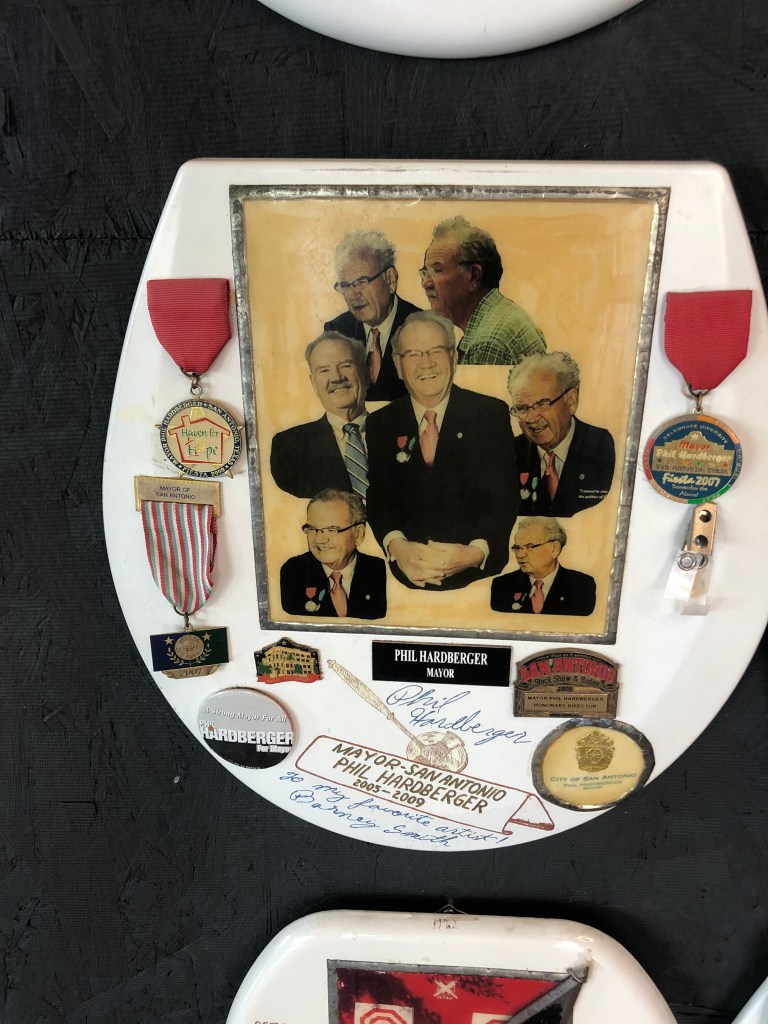
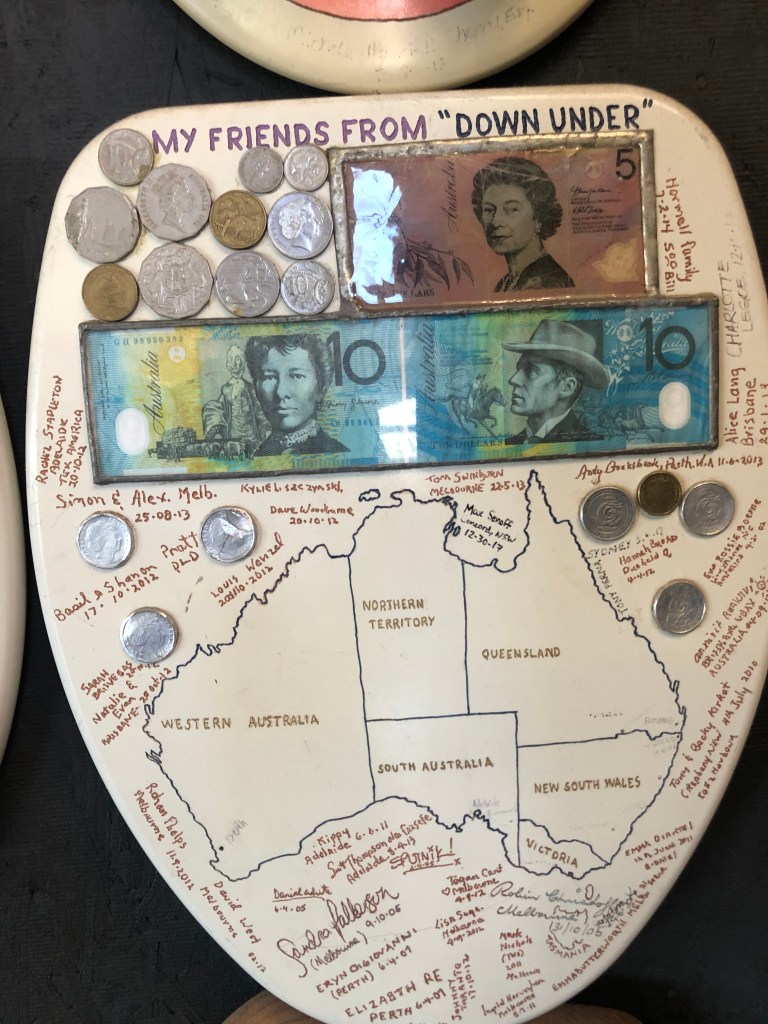
Every state is represented.Ever receive a letter with postage “doo”?Jan 28, 1986: When things went to shit.I’m surprised he didn’t include this one.Handy for stopping leaks.OK, it’s time to cut out the toilet puns.Swizzle fo’ shizzle.This one dares you to open it…Bee careful!No offense to Mayor Hardberger specifically, but there’s something fitting about a politician getting free publicity from a toilet seat.An unintentional tribute to the Queen. RIP.
I can’t say that any of this is high art, but the sheer scale is impressive. What’s more, you really get a sense of how Barney Smith was dedicated to his life’s work. Sure, he didn’t discover a cure for cancer, but it’s clear that he enjoyed a zest for life, loved people, and had a sense of humor. Surely the world needs more people like that. If you have a few extra minutes, check out this video of Barney at his garage-museum at age 96…shortly before the collection was moved to the Truck Yard. The part about Saddam Hussein’s toilet is especially interesting.

 Chasing Phantoms