bridges · cemeteries · churches · Obelisks · Road trips · trains

Philadelphia Stories

I’ve been working on a top-secret project (which will likely be revealed by the end of the year) and it involves, oddly, Benjamin Franklin. I’m not making this up. And this project has made clear to me how much my grasp of American history is lacking.

Growing up in California, I never learned much about the Continental Congress or the Revolutionary War or really anything that took place before 1849. I’ve made a few attempts to remedy this, including my trip with friend Vic to Salem, Mass.

So I’m now trying to fill in some of the gaps in my education Which is why this morning I found myself in The Quaker City for a few days of exploration. What could go wrong?

My crash course on Philadelphia actually began on the plane ride. I’d taken a red-eye from Sacramento, and my seatmate was a garrulous Philadelphian (if you’ll permit me that redundant phrase). He was on his way home after a vacation with his wife, but they were taking separate planes. It seems there was some kind of booking mix-up related to the use of frequent flyer points. But the real point, for my purposes, is that he was unexpectedly flying solo and looking for someone to talk to. And having learned that I was going to be sight-seeing around his home turf, he spent the next few thousand miles sharing his insights about the city. (Did you know that Elphreth’s Alley is the oldest continuously-habitated street in America?)

Anyway, I got breakfast and a Nissan Sentra near the airport and set out for downtown Philly. Ben Franklin is certainly well represented around the city. Bridges, parkways, institutes, boulevards, schools, and various other features of the city are named after Franklin. There’s even a large, modern sculpture of his distinctive bespectacled face and stringy hair on a random street corner.
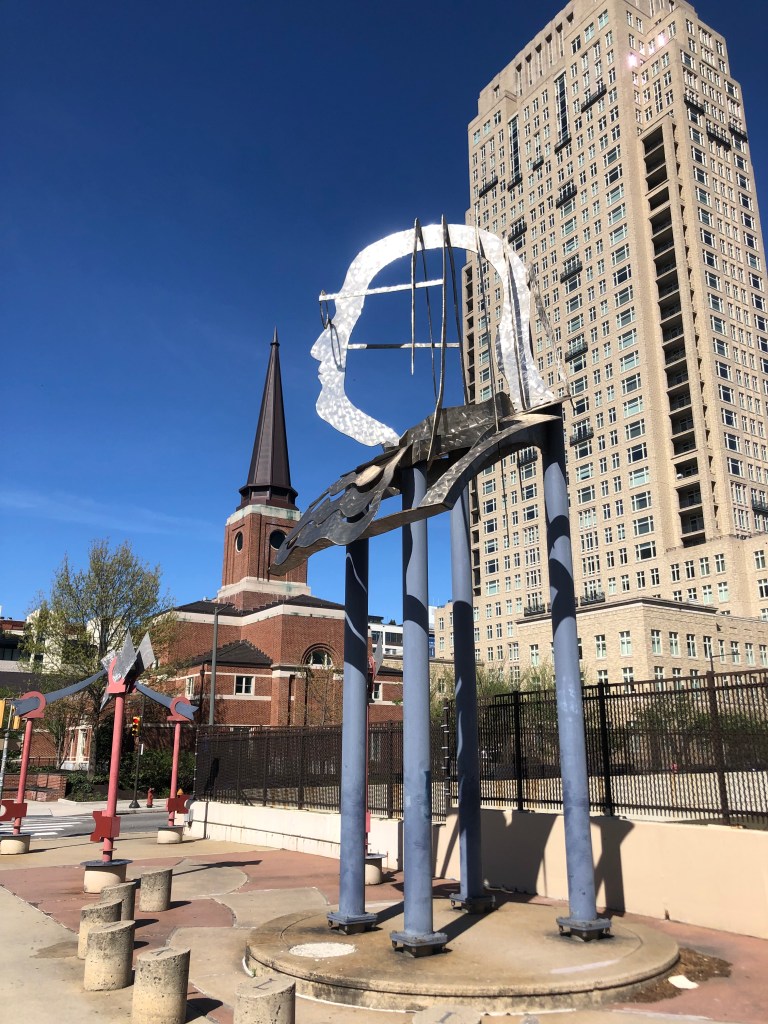
“Big Ben” sculpture from 1992.

While chatting up the National Park ranger at the Ben Franklin Museum, I learned the following story: Some years back the Philadelphia Inquirer was taking up a collection for a Frank Sinatra mural somewhere in the city. A rival paper objected, pointing out in an editorial that Philadelphia should instead create a mural for one of its native sons. And, perhaps as a joke, the editorial noted that Larry Fine (of Three Stooges fame) is one such native son. The idea nevertheless caught on, donations were made, and the mural was painted at the location (S. 3rd and South Street) where Fine was born.
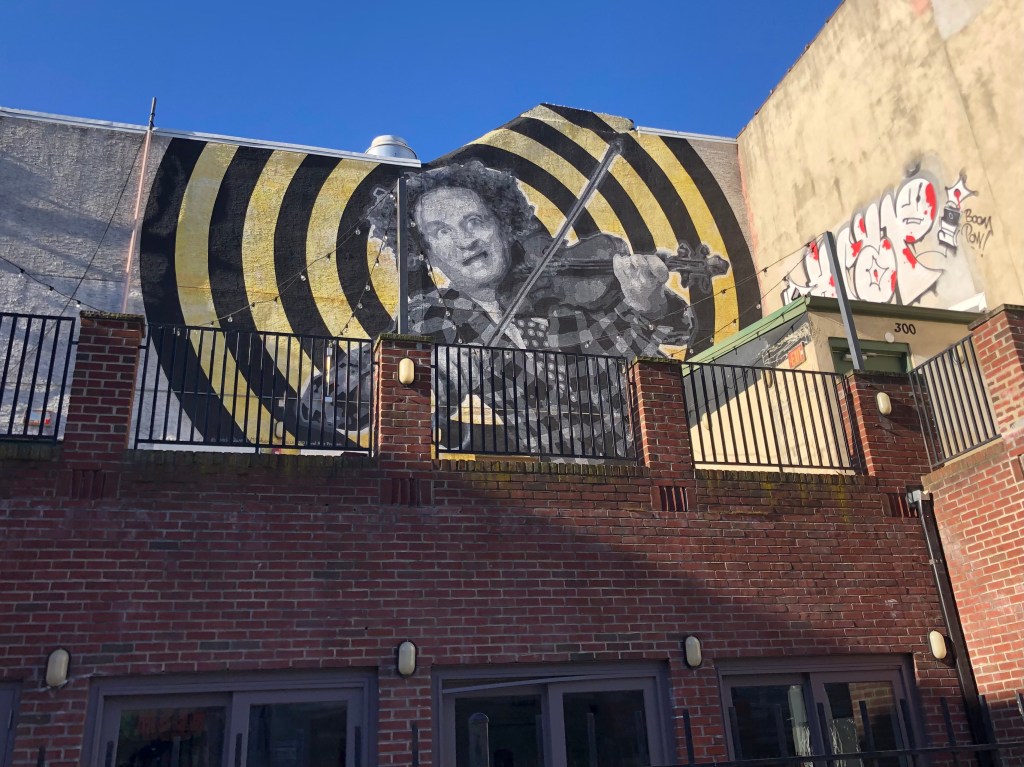
Giving Ben Franklin a run for his money.
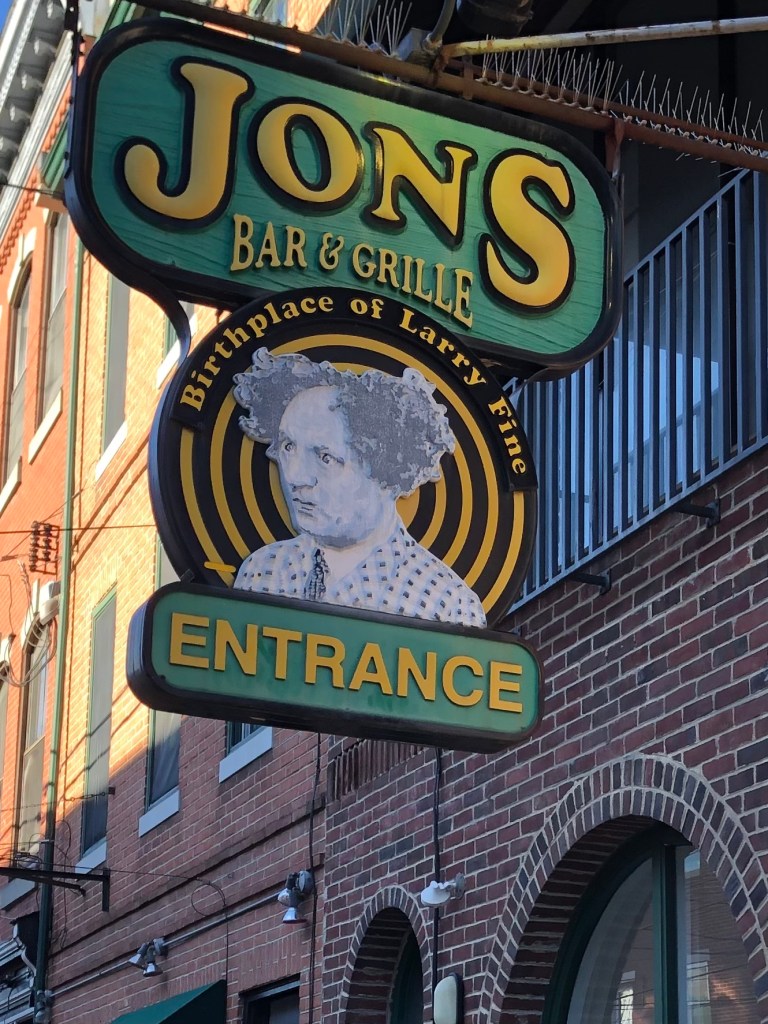
A bar in the same building capitalizes on the Fine connection as well.

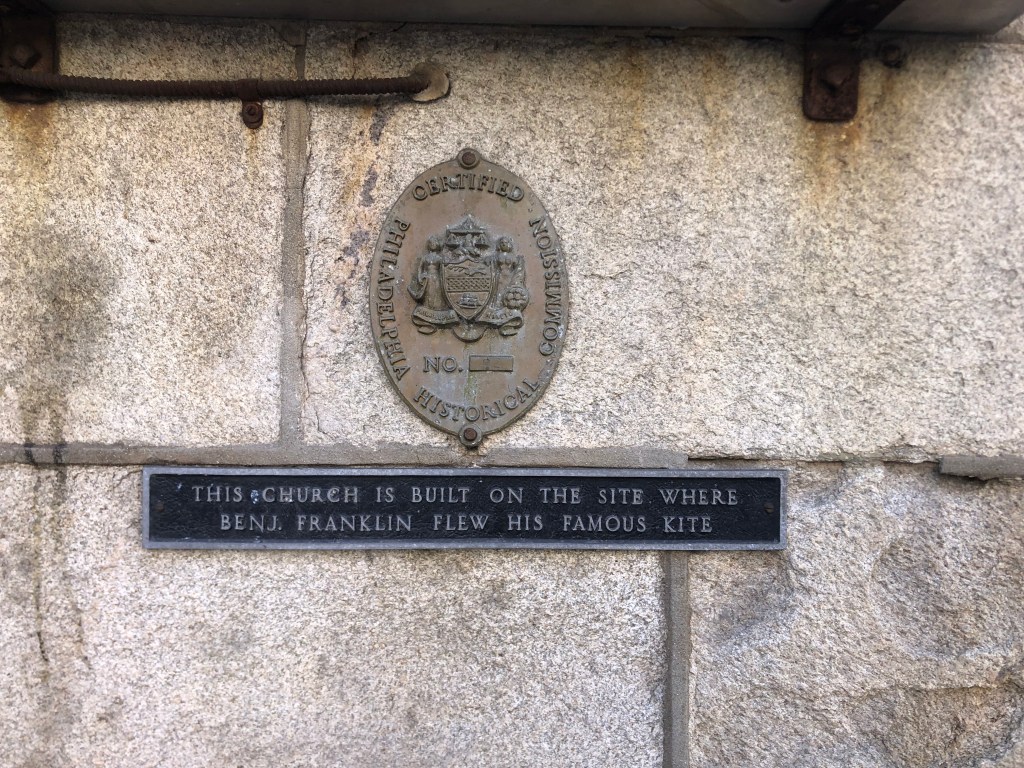
But I digress. I was talking about how Ben Franklin has captured this city’s imagination. And in addition to all the named structures and graven images, the city has been tagged with various plaques that commemorate Franklin’s various activities in the area. For example, on St. Stephen’s Church is a brass plaque which claims Ben Franklin conducted his famous kite experiment on this site in 1752.
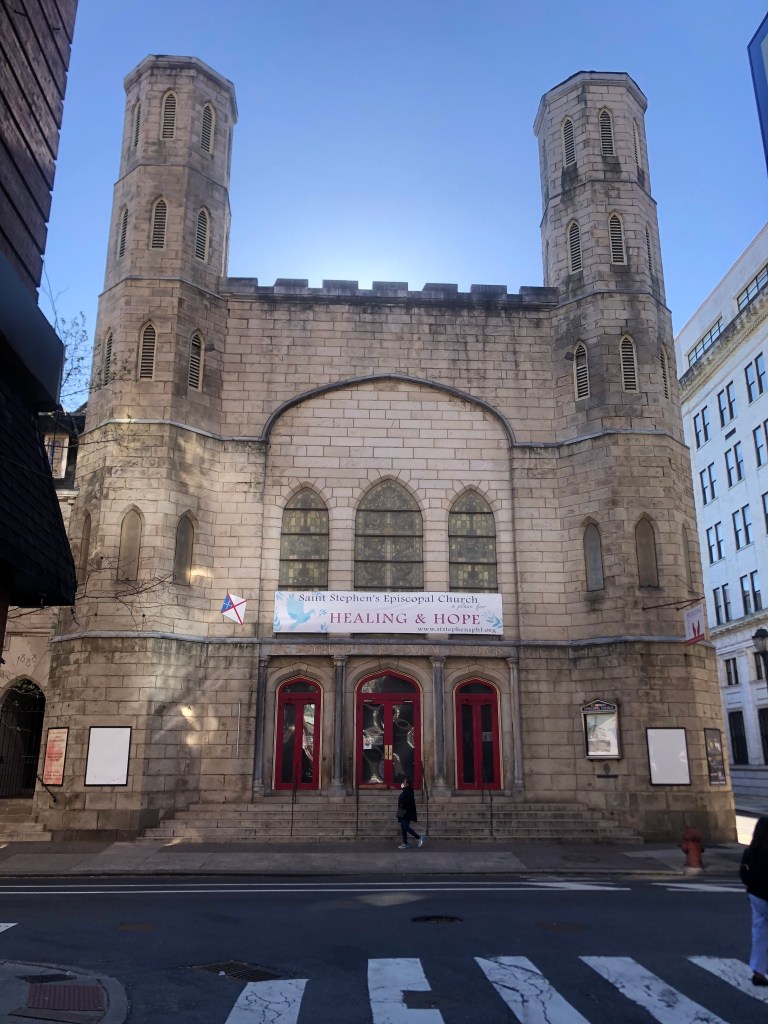
Built in 1823 at 10th and Ludlow, which may or may not be where Ben flew his kite.

Here’s a closer look at the plaque:

Now, it turns out that there’s considerable debate as to whether this is really the site of Frankin’s kite adventure. And while the “Certified” marker above the plaque would seem to lend credence to the plaque’s claim, it turns out the marker relates to the church building, and not to the plaque.

A few blocks from the dubious kite claim is a bare steel pipe structure outlining where Franklin’s last family home had stood. Ben’s kids had the house razed some years after he died. But in the 1940s, archeological efforts uncovered the foundations of the house. The steel “ghost house” was erected in the 1970s, since there were insufficient records or drawings to reconstruct the house itself.
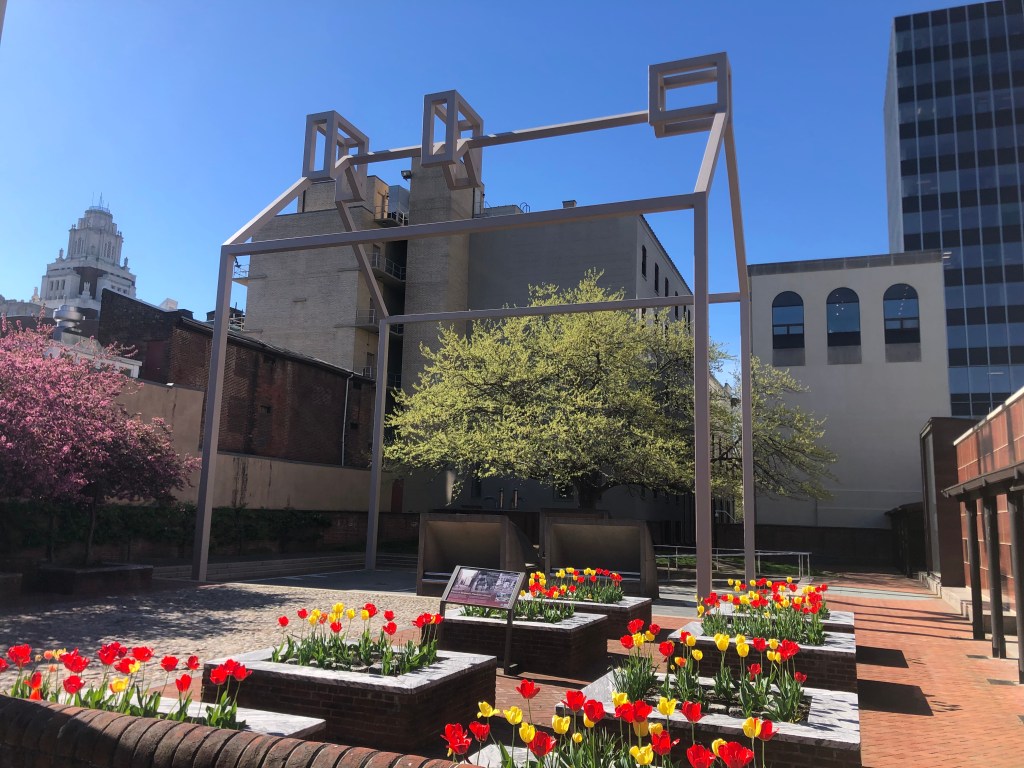
The ghostly outline of Franklin’s house, marking its exact location some two and a half centuries ago.

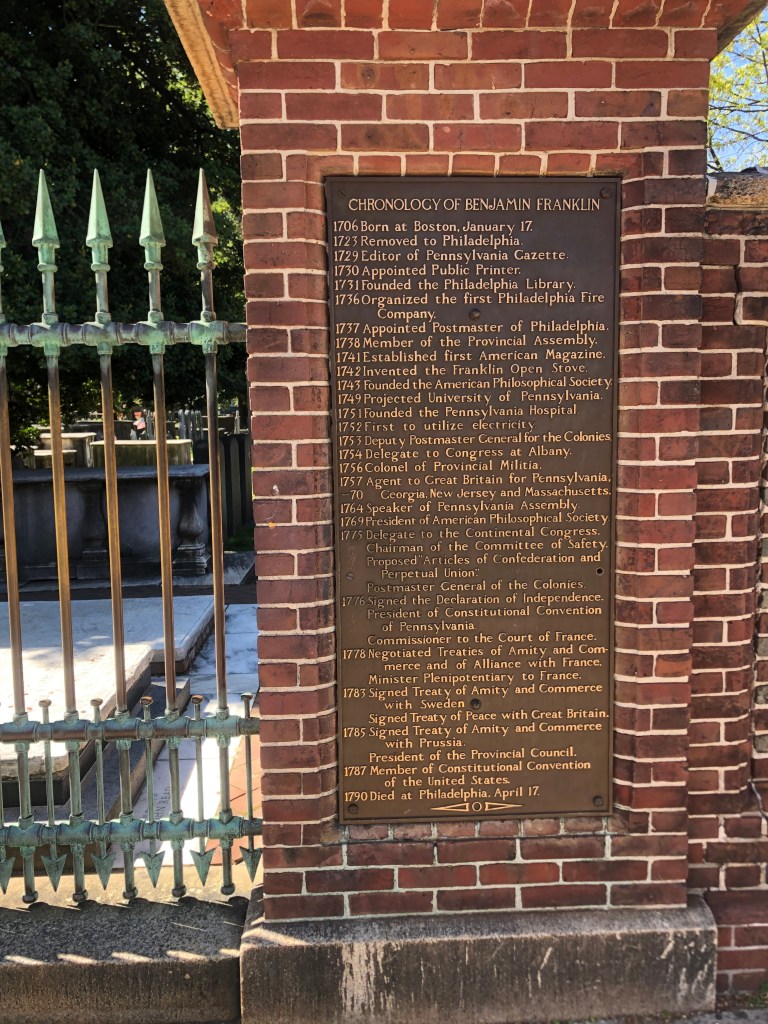
Finally, and inevitably, Franklin’s body rests in Philadelphia, not far from the ghost house. He is buried at Christ Church Burial Ground under a smooth marble tablet that’s perpetually covered with a scattering of pennies from passersby.
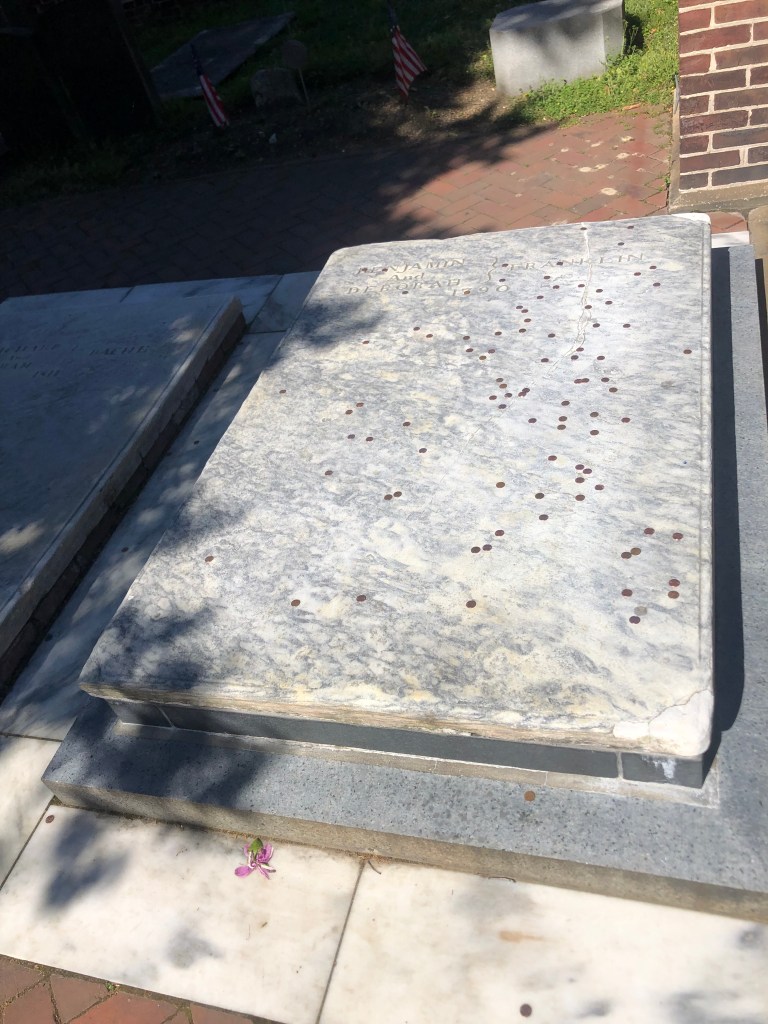
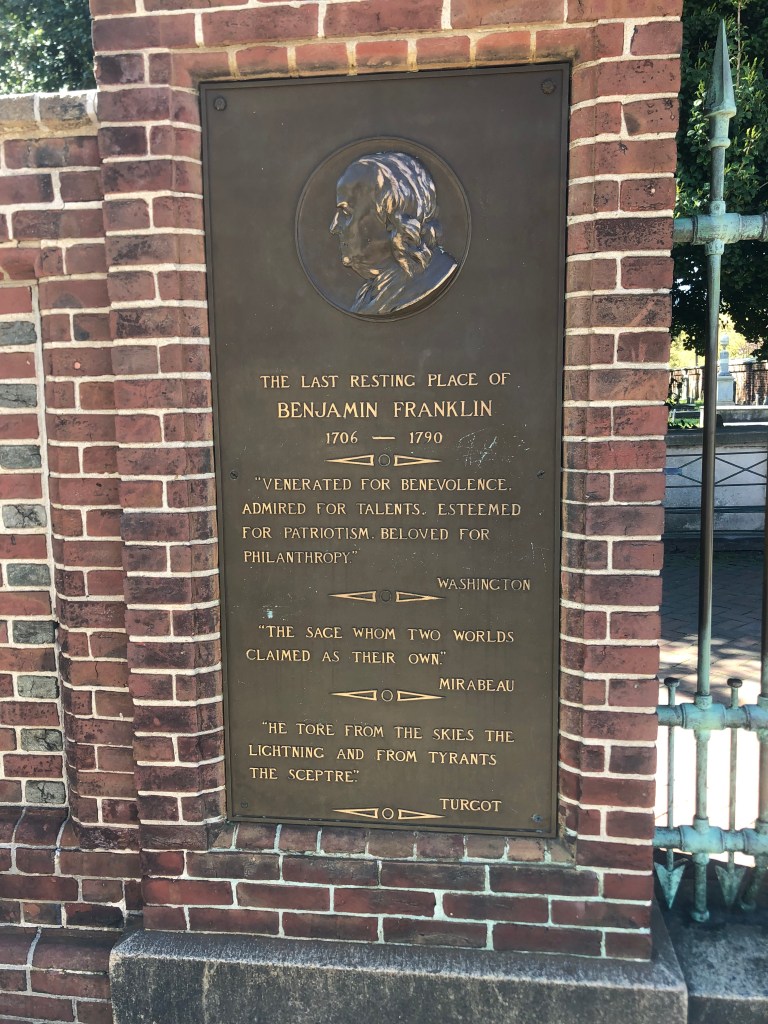
“A penny saved is a penny earned.”
Even allowing for some resume-padding, it’s an impressive list of accomplishments.

Of course, Philadelphia isn’t all Ben Franklin and Larry Fine. For example, there are these random nudes built into a pedestrian walkway. For no discernible reason.
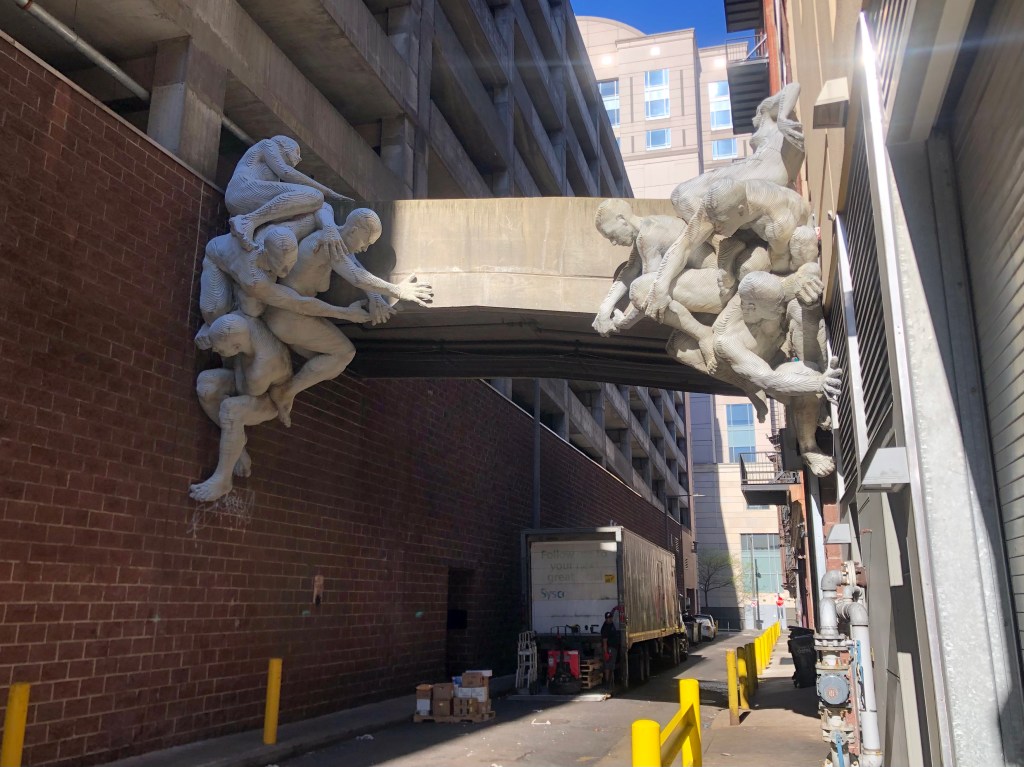
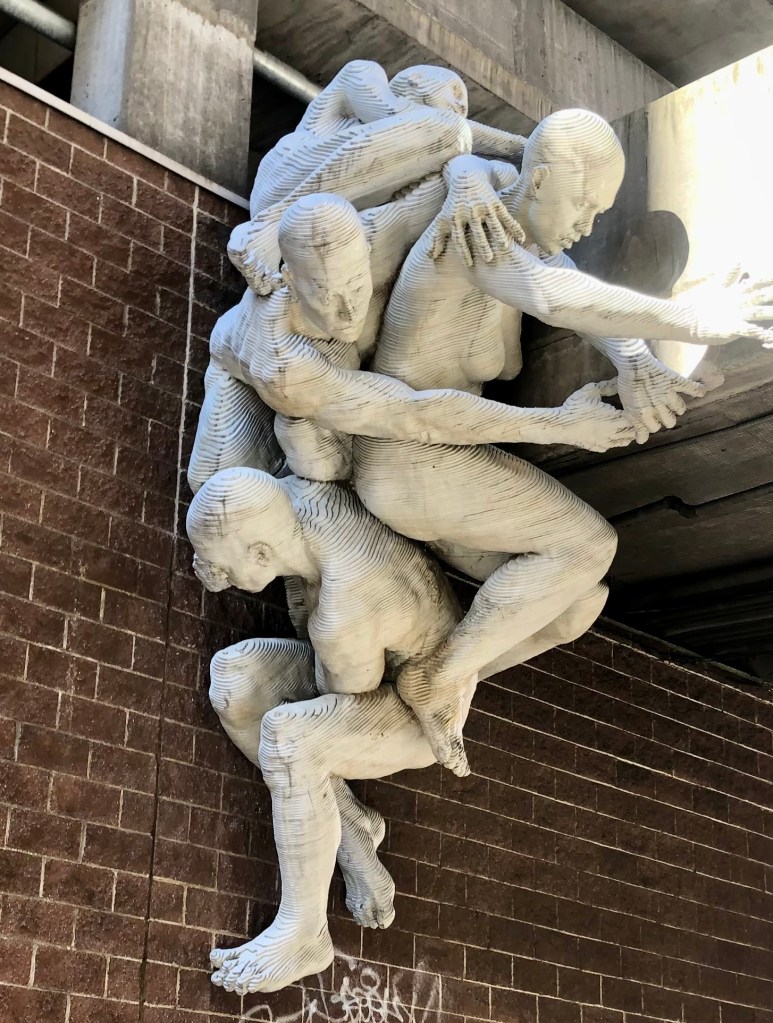
There’s got to be a flying buttress joke in here somewhere...

There’s also Auguste Rodin’s bronze sculpture The Thinker on the grounds of Philadelphia’s Rodin Museum:
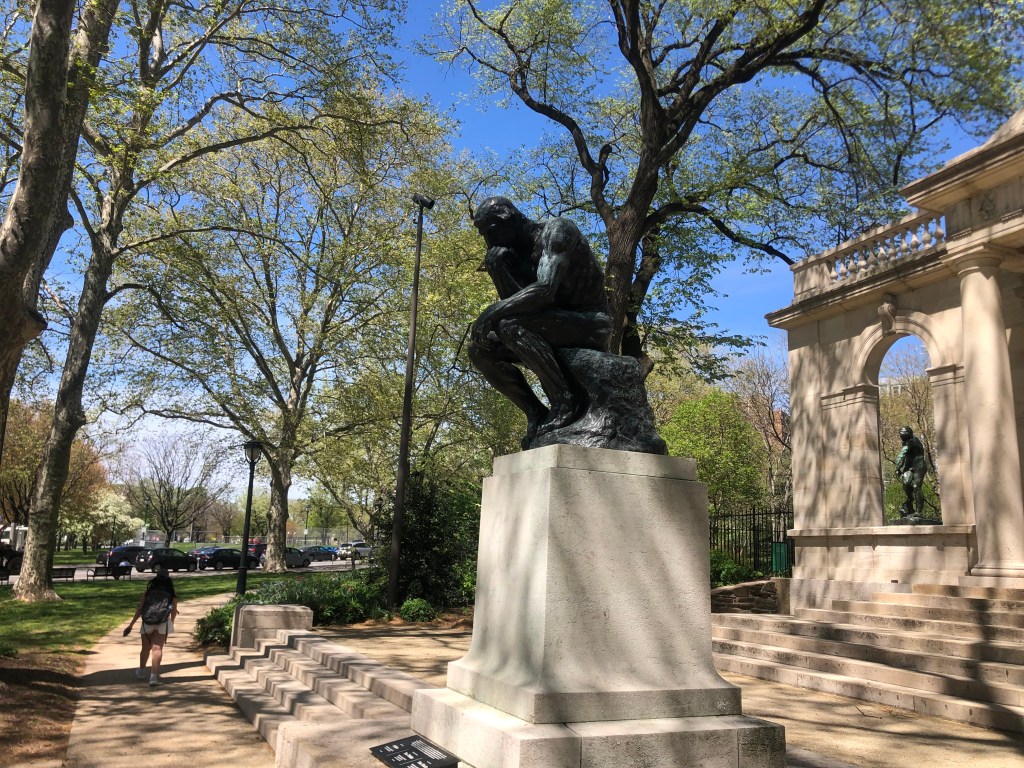
I think I can…I think I can…

You probably know of this piece. Rodin actually cast a number of identical bronze Thinkers. I remember once seeing one at Stanford University. But I’ll forever associate it with Dobie Gillis, who had a habit of sitting next to the statue in a copycat pose.
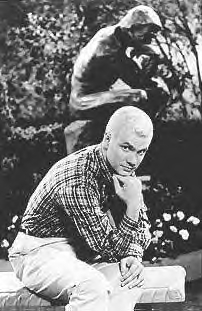
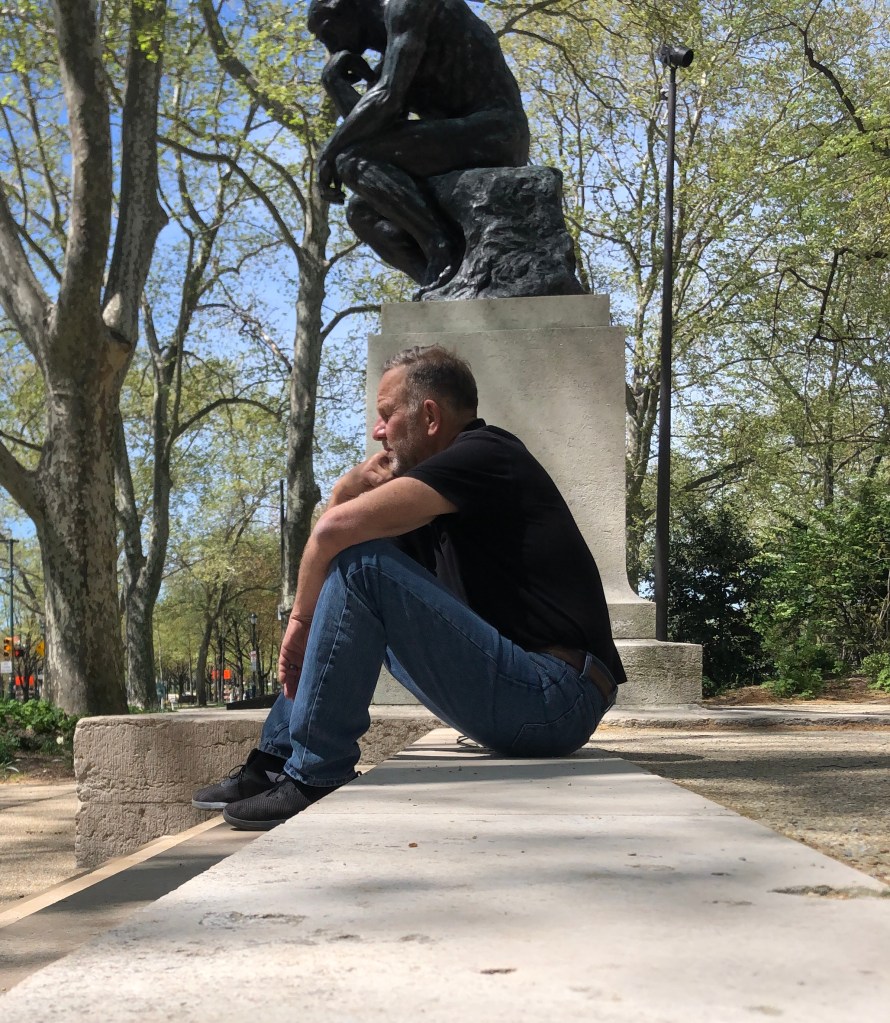
Kind of inevitable.

And if that’s not enough, today I also ran into some literary luminaries that you don’t often associate with Philadelphia. In the Philadelphia Free Library’s Central branch (built almost a century ago in the beau arts style) one finds a bust of Charles Dickens in the Rare Books Room.
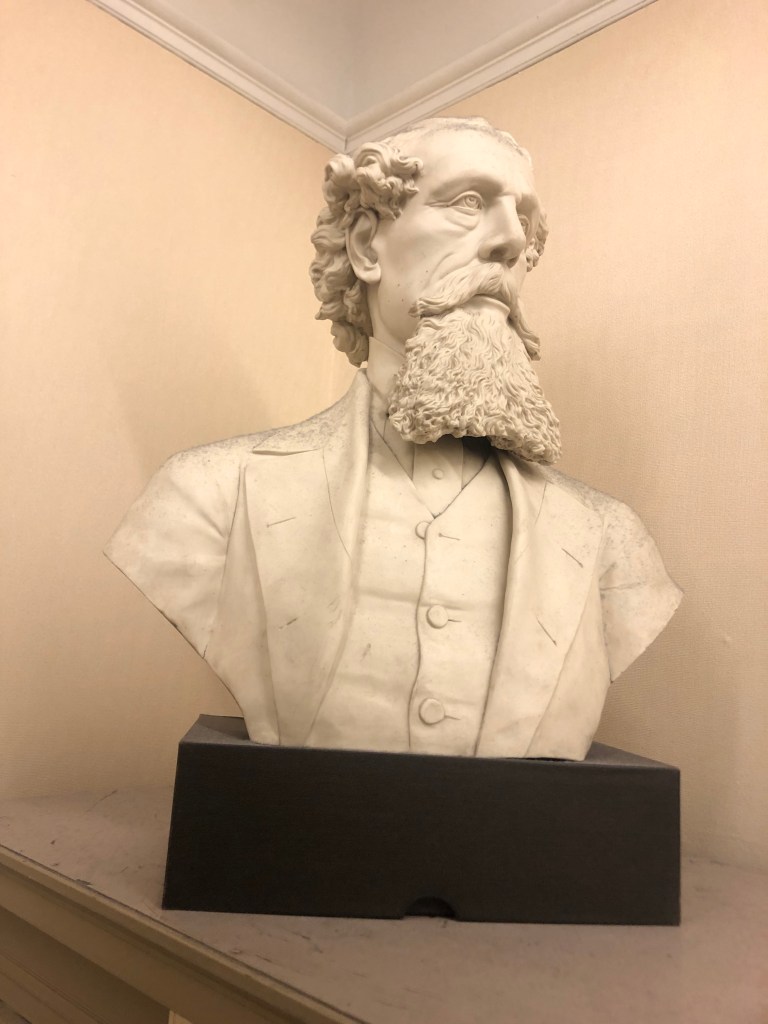
Have you ever noticed how Charles Dickens resembles Don Quixote?

Not far from the Dickens’ bust is his actual pet bird, now stuffed and mounted in a glass box.
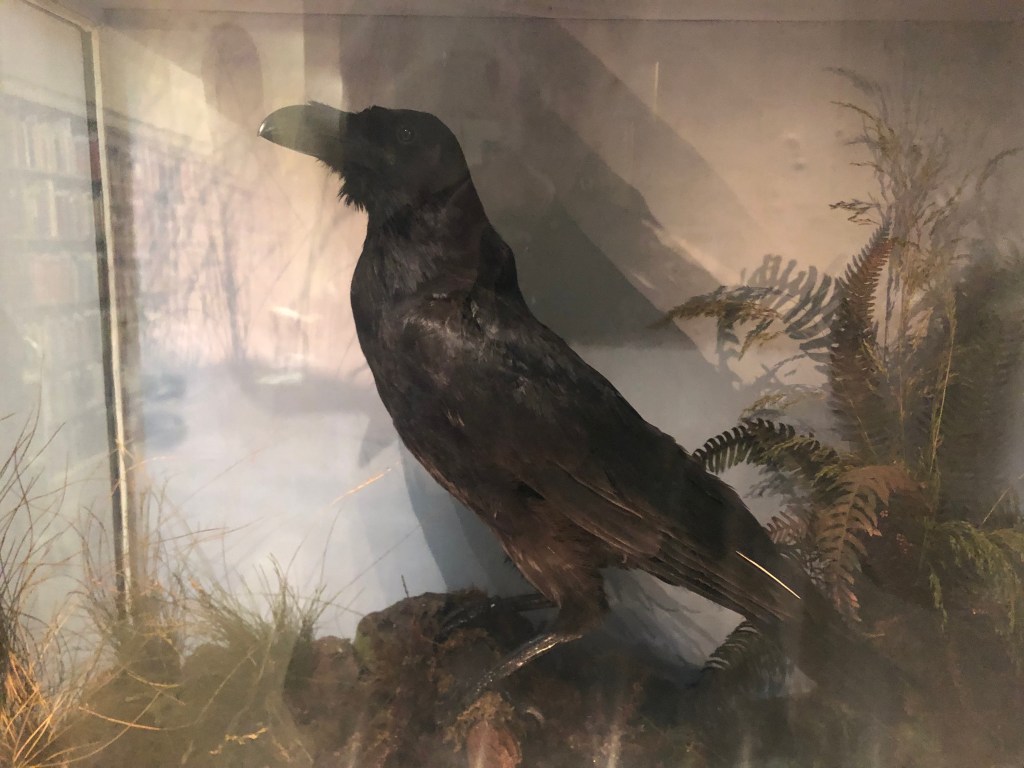
That’s so Raven.

The bird is (was?) a raven by the name of Grip. Grip even gets some speaking lines in Dickens’ novel Barnaby Rudge. But she (for Grip is a female) also played a much more important literary role: She is said to be the inspiration for Edgar Allan Poe’s The Raven.
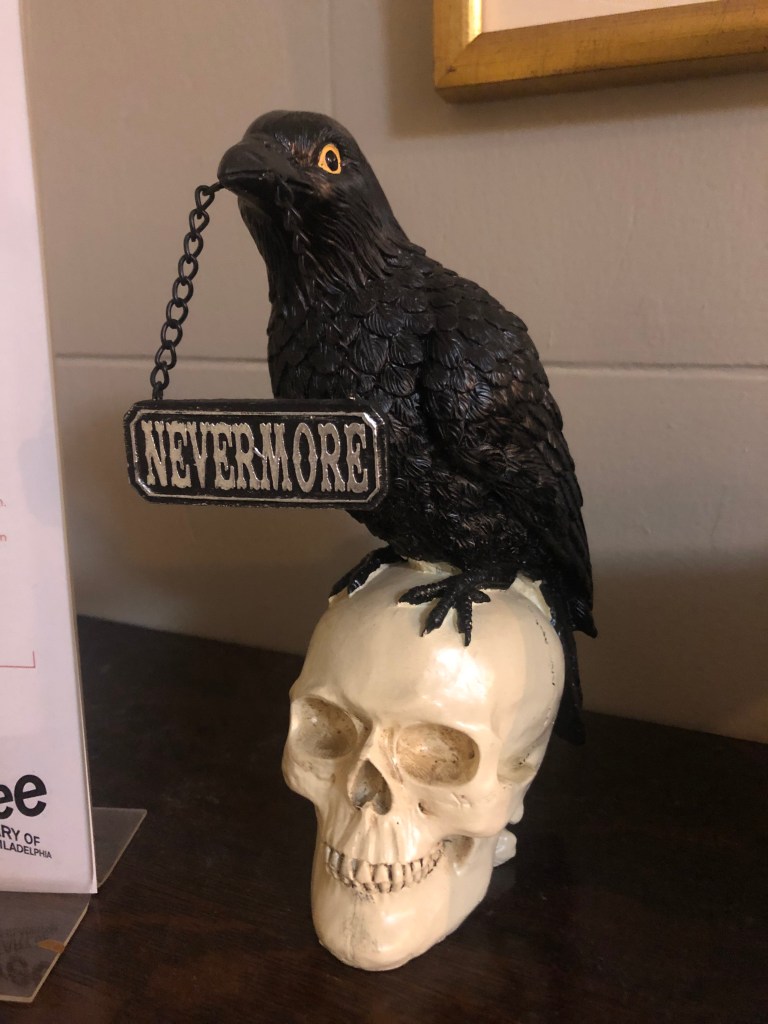
Wasn’t Nevermore the title of a Nirvana album?

As we all know, Poe lived in Philadelphia for six years. And one of his Philadelphia homes still stands. I will be visiting it on Friday, so we’ll be returning to this theme later.

It’s now getting late, but I do have two more items to share from today. The first is:

OBELISK CORNER

I was taking an afternoon walk through Philadelphia’s Woodlands Cemetery. It dates back to the 1840s, and has a distinctive Victorian air about it. Many of the grave markers take the form of obelisks, with some quite large specimens cropping up here and there.
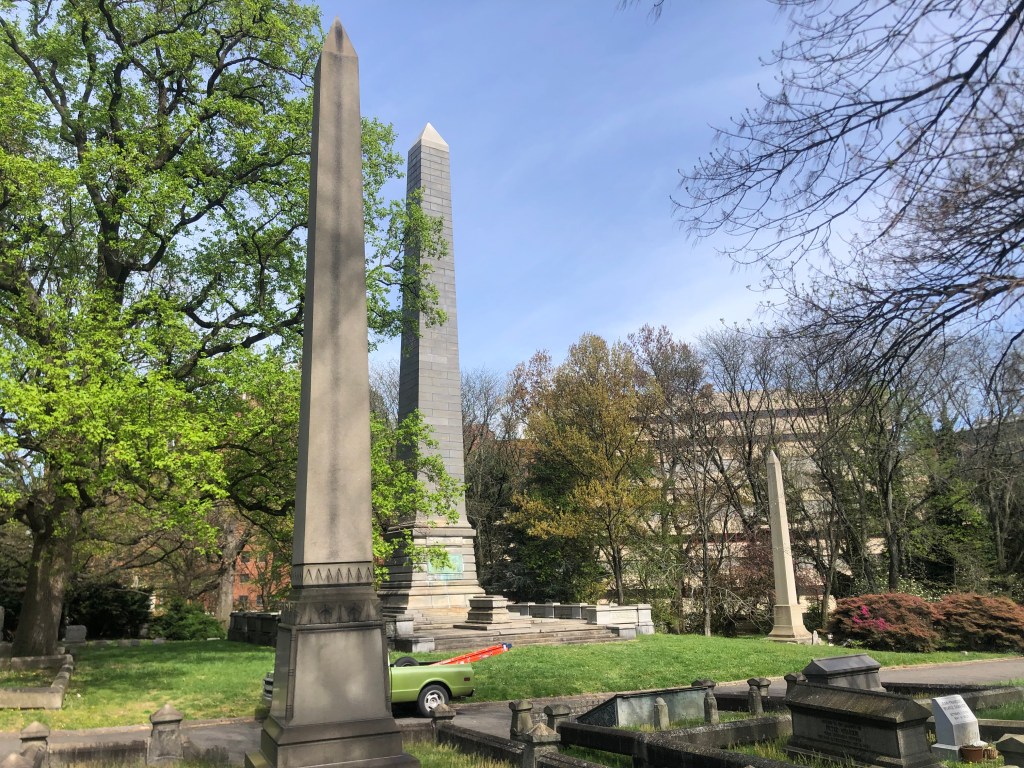
…or are you just happy to see me?

But take a closer look at that one in the center. Though it doesn’t appear especially large in the photo, it’s actually about 15 stories high. In fact, it’s the largest gravestone in the Continental U.S. Let’s take a closer look:
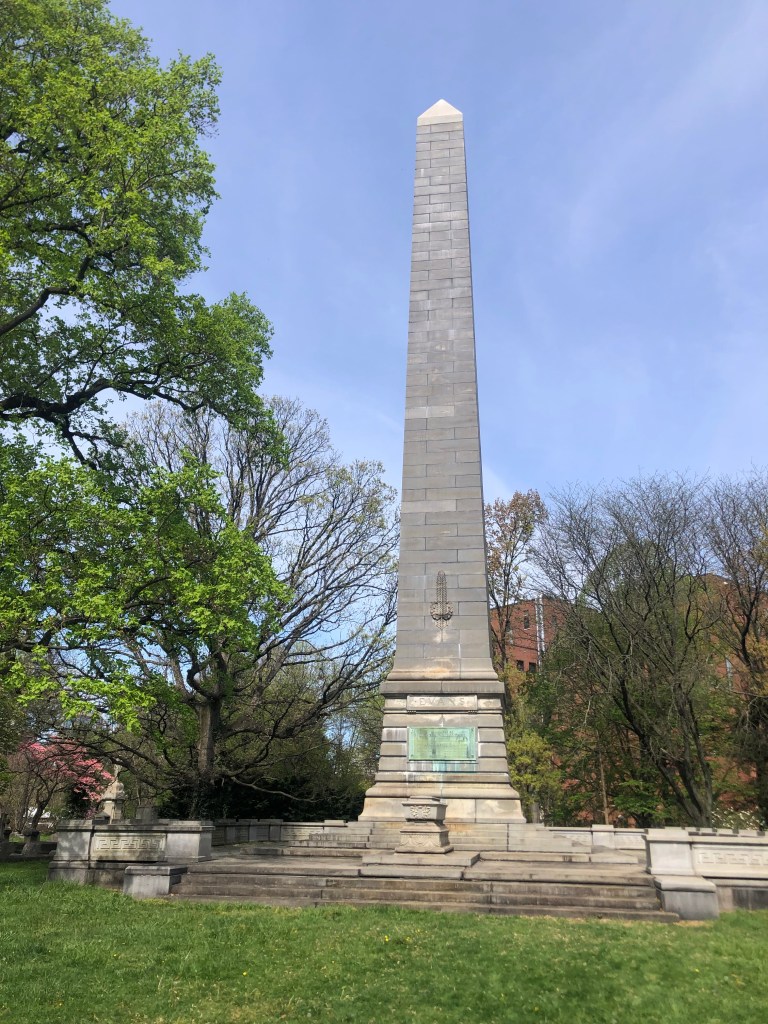
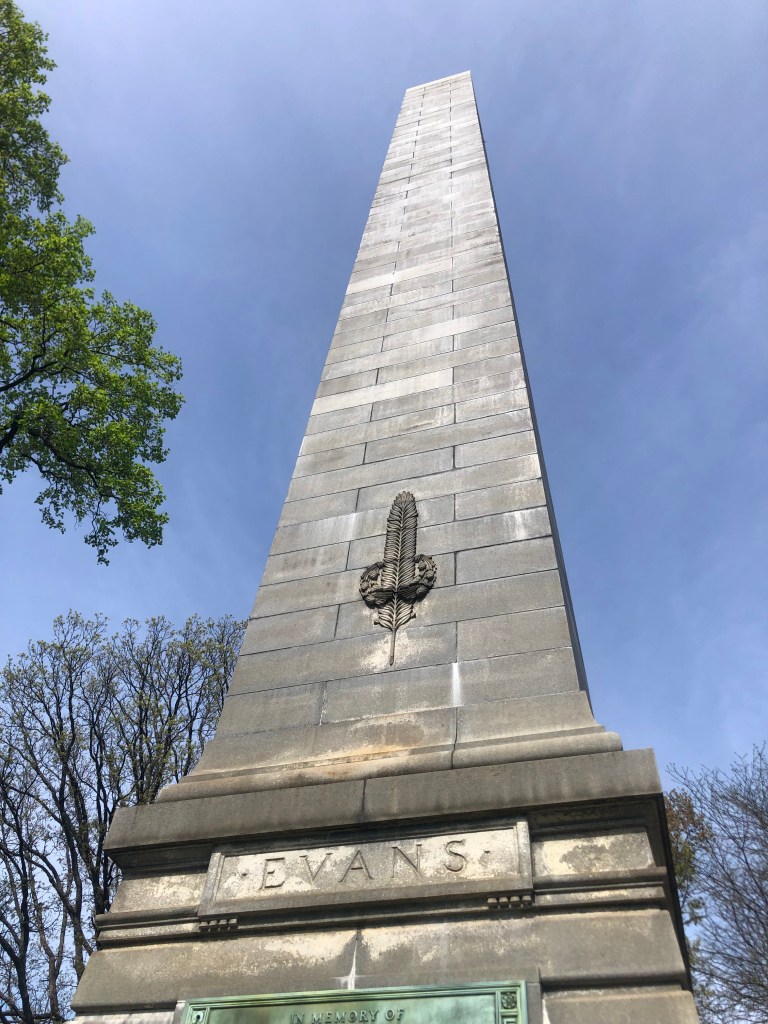
For perspective, note the two stacked sarcophagi at the foot of the obelisk.

The obelisk marks the grave of one Thomas Wiltberger Evans, who died in 1897. You never heard of him either? It seems that the man with the country’s tallest headstone was a….dentist.

And now, let’s finish up with the

BREW OF THE DAY

I drank my BOTD at Manayunk Brewing Company, which sits in a cavernous, historic cotton mill on the banks of the Schuylkill River. The cotton mill dates back to 1822, and it operated (making cotton or, later, wool) until 1992. At that point it became a brewery.

My words can’t do justice to the wonderful setting. Not only is the historic building awe-inspiring, but there’s an old railroad (?) bridge crossing the river right behind the brewery. And I had a great spot in the sun to enjoy the view.
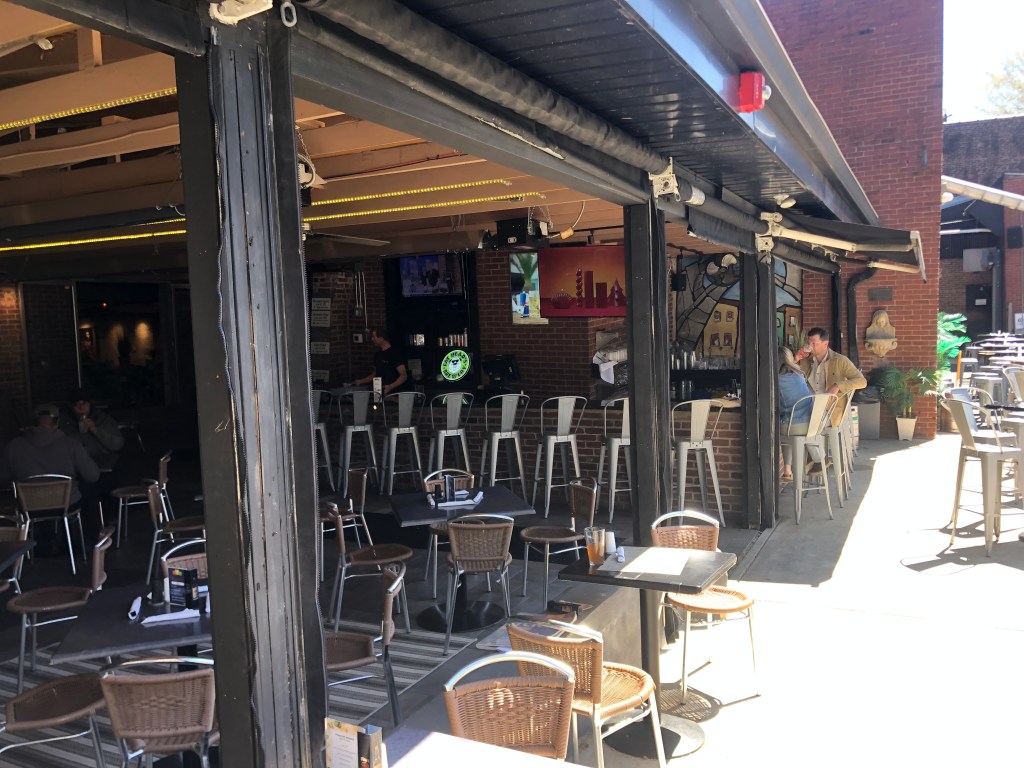
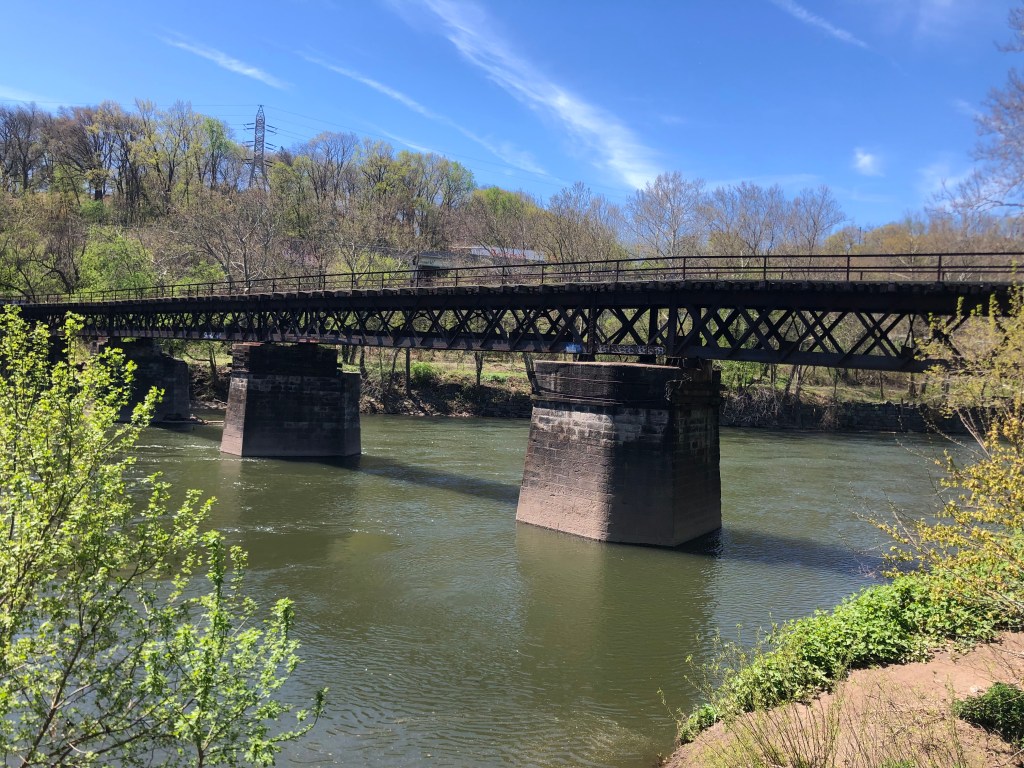
First cotton, then wool, now ales.
I couldn’t find any info on this bridge that’s directly behind the old cotton mill. Uncle Ed, please help!

I had my heart set on getting one of Manayunk’s home-made brews. But sadly, my server informed me that they lost their entire brewing setup to a flood a few years back. It seems that flooding has been a recurrent problem, judging from the “high water mark” signs in the bar.
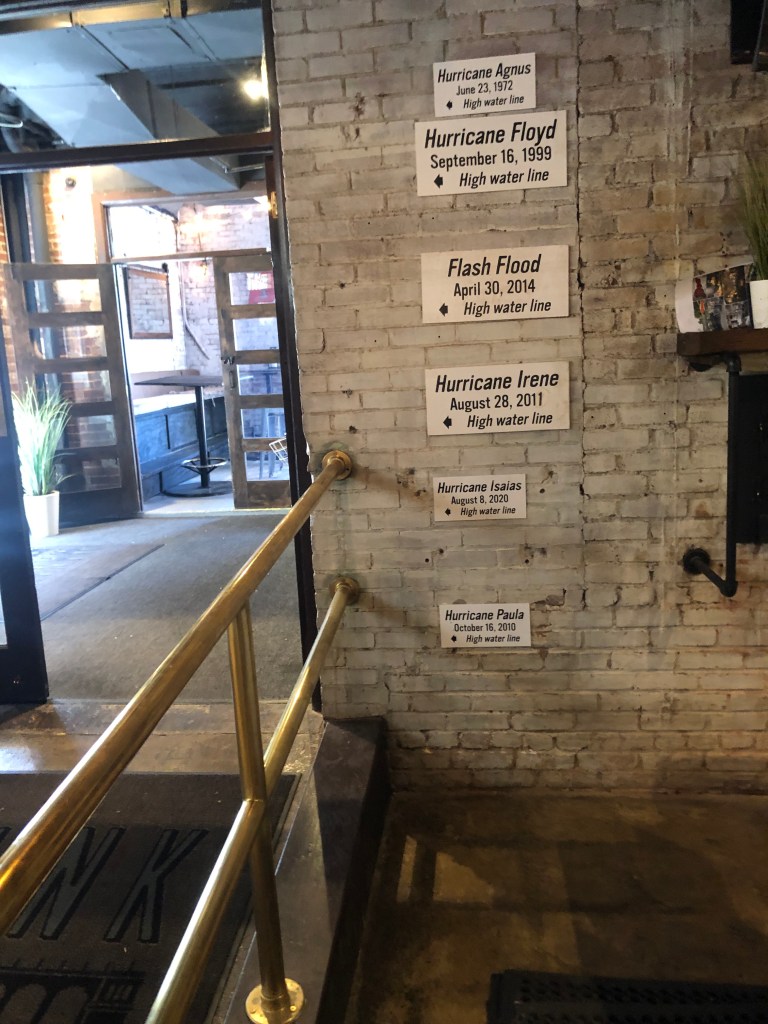
However, a few of their beer recipes are still being faithfully produced by local brewing partners. I selected the Schuylkill Punch, which is being brewed by Yards Brewing.
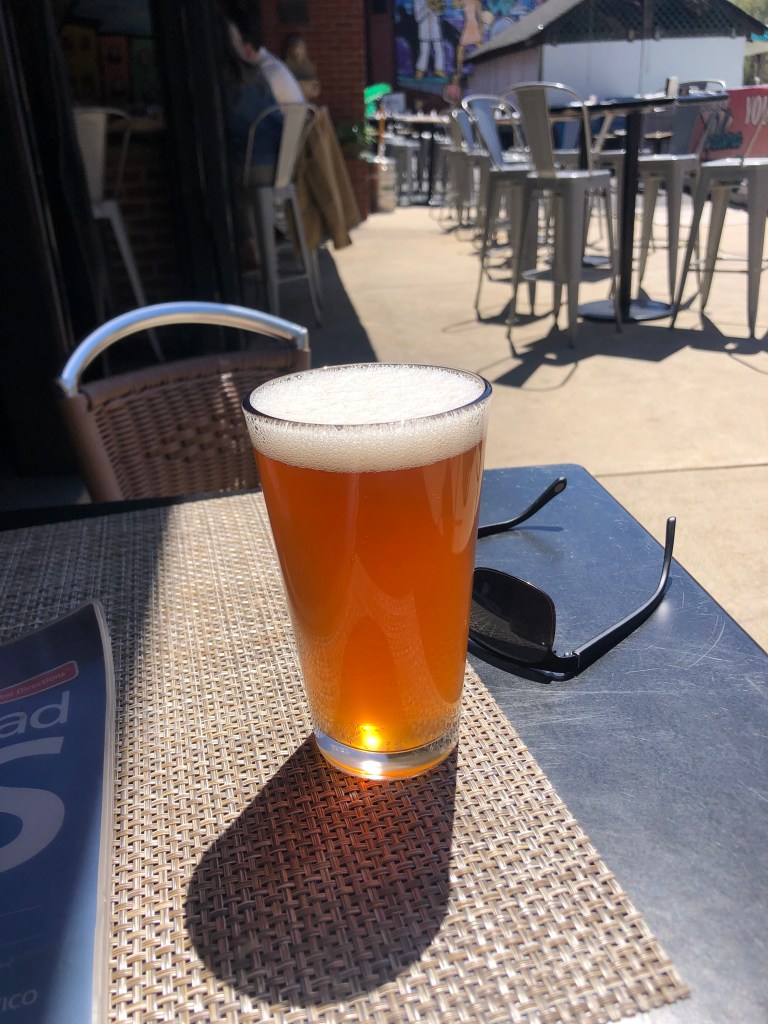
“How would you like a nice Hawaiian Punch?”

This is nothing like what I normally drink. It’s light, with a body light iced tea. There’s almost no malt. And with an ABV of 4.5 percent, it has about half the alcohol of my usual brews.

But this is an exceedingly smooth beer, and it complemented the warm weather perfectly. It’s slightly sweet, with distinct citrus notes of grapefruit, lemon, and some tropical fruits. Carbonation is low, but it has a nice head. Overall, I’d call this a “session” beer, especially if your session is outdoors on a warm day next to the Schuylkill River. I give it 3.5 stars out of five. If they could up the flavor a bit (maybe brewing it with more fruit), I’d knock it up to a solid 4.
Cars · cemeteries · Ghost stories · Road trips · Yard art

Route 82–Bonus Features

Thank you all for your kind comments, recommendations, and suggestions while I was cruising Route 82. I’m now back home, planning my next journey. Meanwhile, I leave you with a few additional photos from that trip that didn’t fit into the daily blog posts. Enjoy!

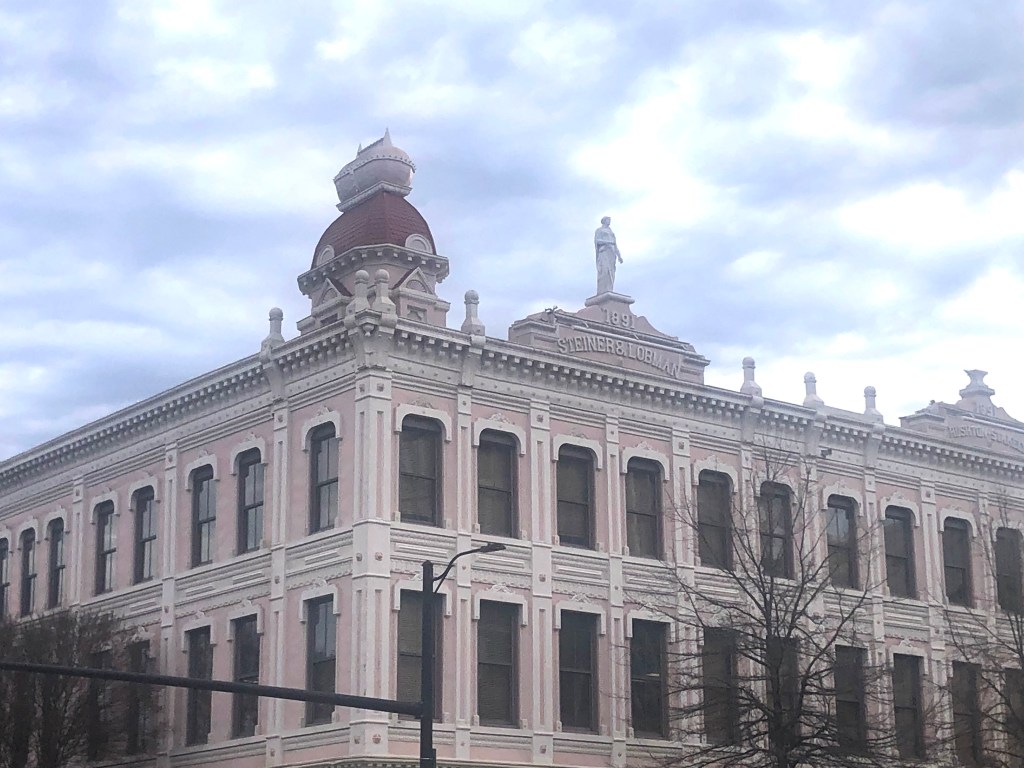
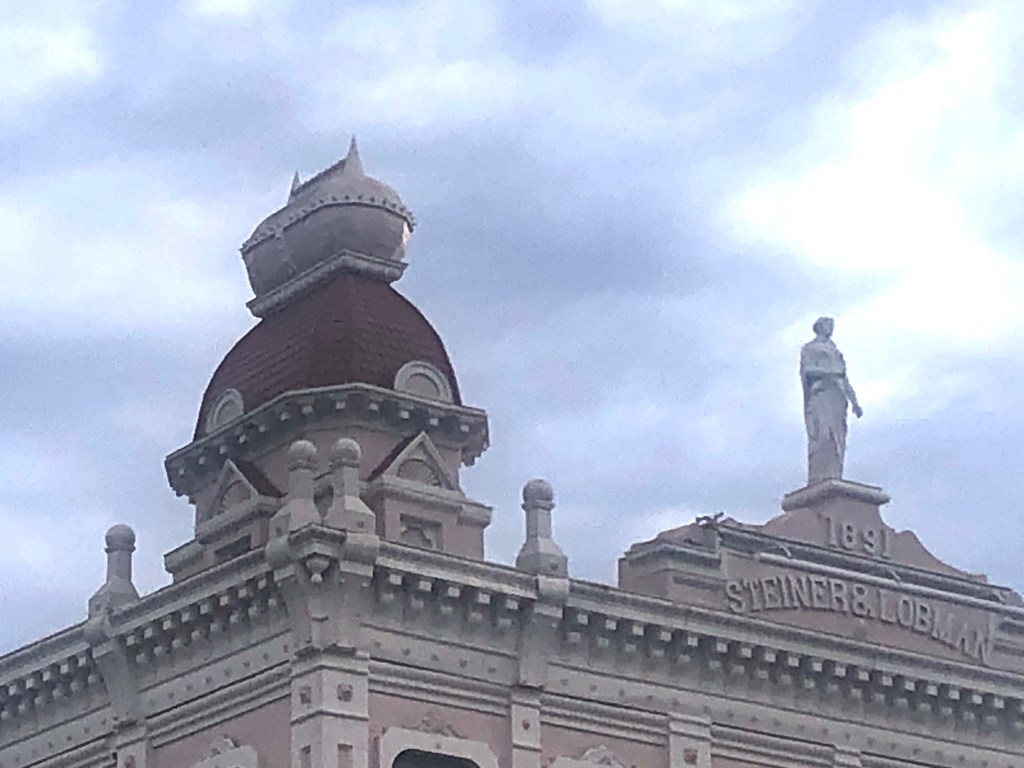
Impressive 1891 Steiner and Lobman building in downtown Montgomery, Alabama. But what’s that atop the front corner?
Yes, it’s a sarcophagus. The townsfolk say that the mortal remains of old man Steiner himself is entombed in it. Other sources scoff at that story.
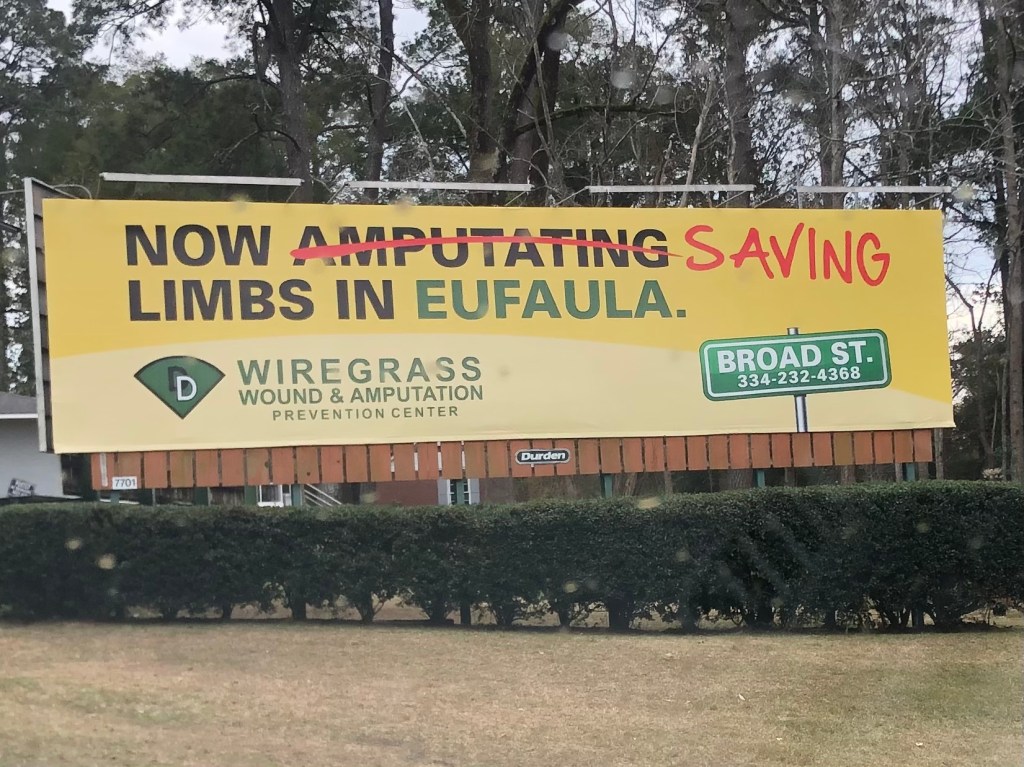
Billboard in Eufaula, Alabama. If you want your limb saved, your first choice probably wouldn’t be a place called an “Amputation Center.” And are amputations so common in Eufaula that they have a special center dedicated to the practice?
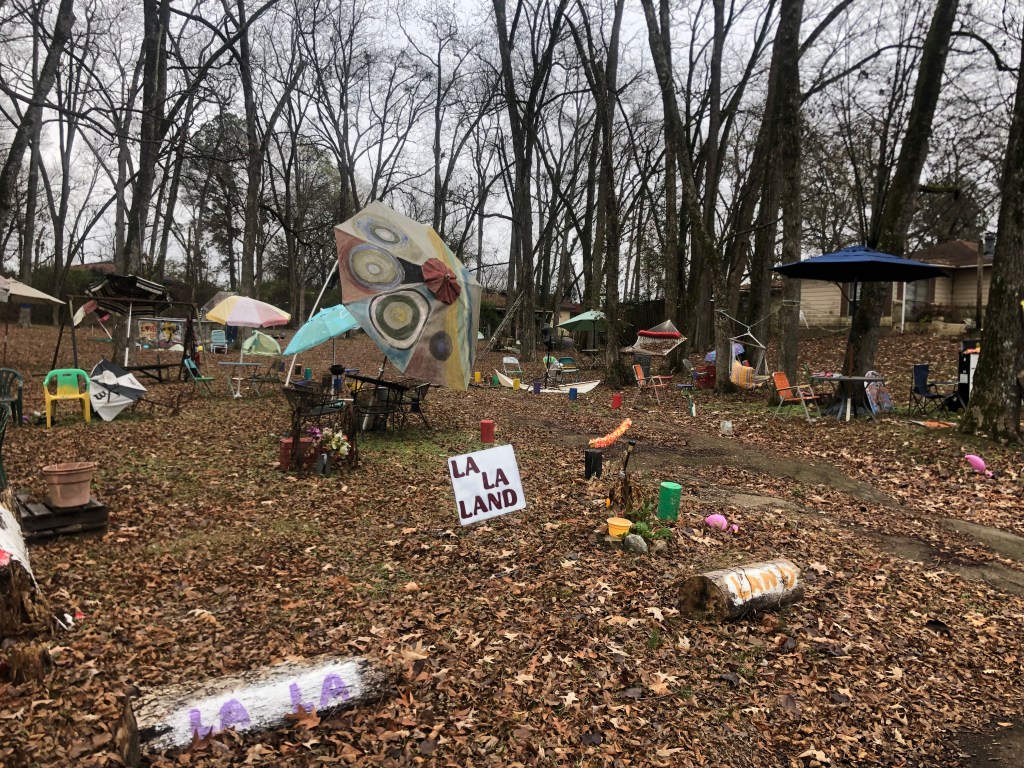
To you it might just look like a junky front yard, but it’s said that the owner, one Charles “LaLa” Evans, decorated his front yard as a tribute to his wife when she passed some 13 years ago.
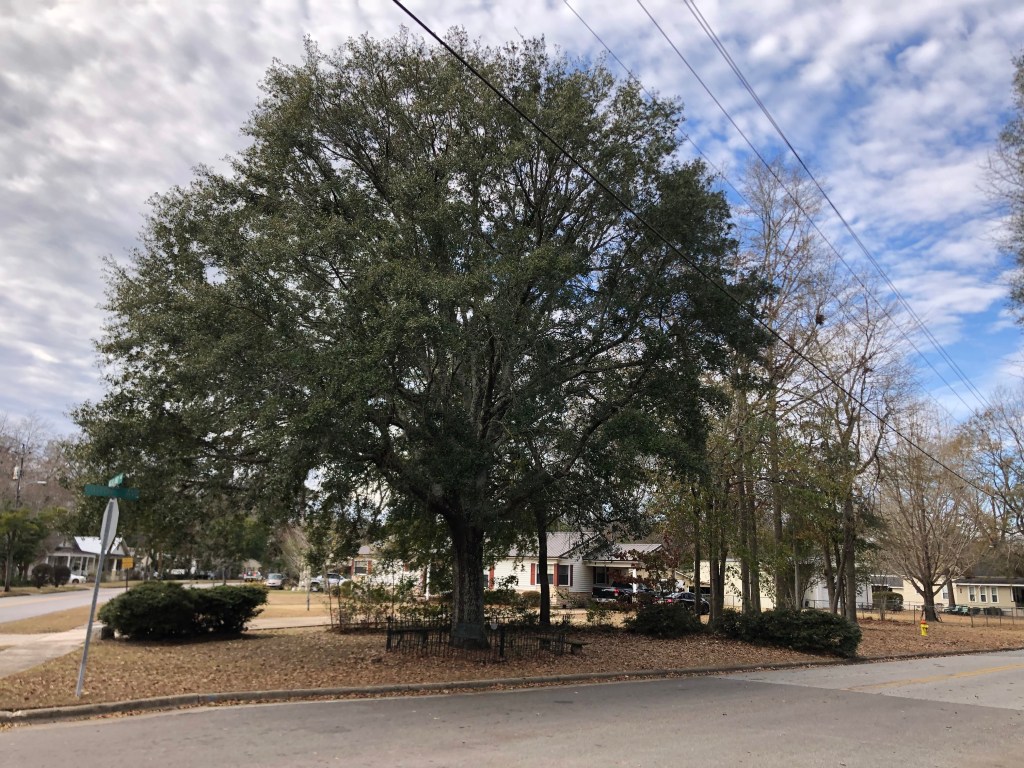
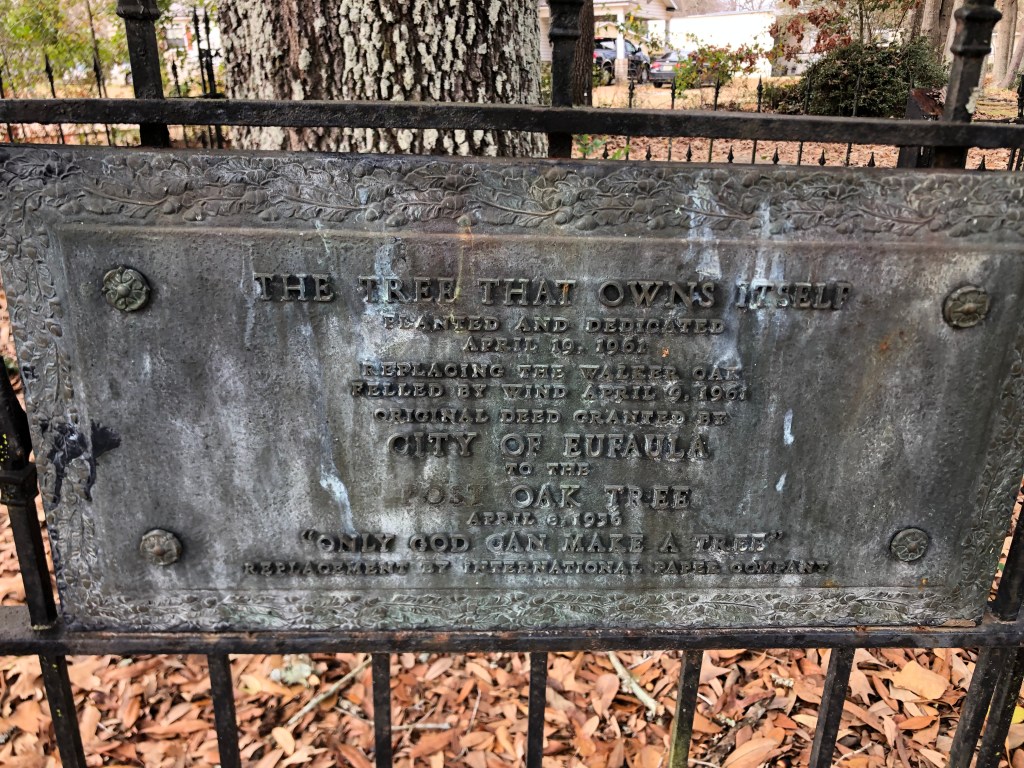
The good people of Eufala, Alabama call this “The Tree That Owns Itself.” The story is a bit confusing: in 1936, the mayor of Eufaula officially granted a deed to to a 200-year-old oak tree, which declared the tree to be “a creation and gift of the Almighty, standing in our midst—to itself—to have and to hold itself, its branches, limbs, trunk and roots so long as it shall live.” Sadly, it stopped living in 1961, when it was uprooted by a tornado. The townsfolk soon planted a new tree, which is the one you see here, and the mayor’s proclamation has been extended to it and all successor trees on this property. No one really knows why.
Plaque under The Tree That Owns Itself.
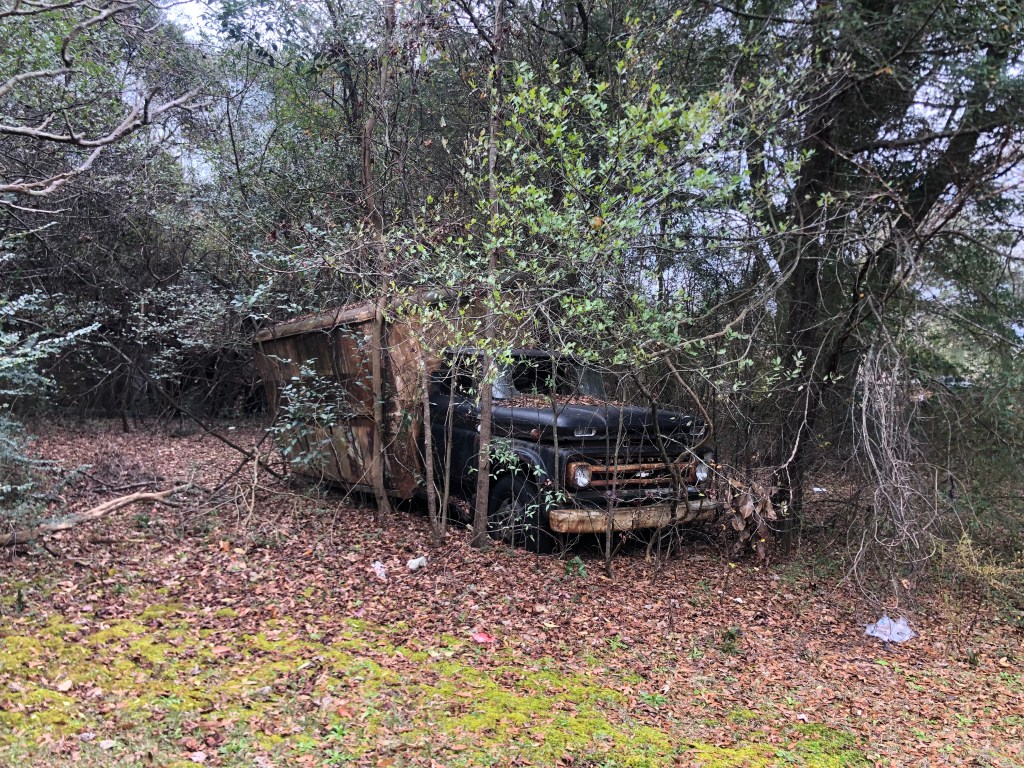
Speaking of trees that have been granted their freedom: Someone needs to free this truck from the tyranny of this tree in Midway, Alabama.
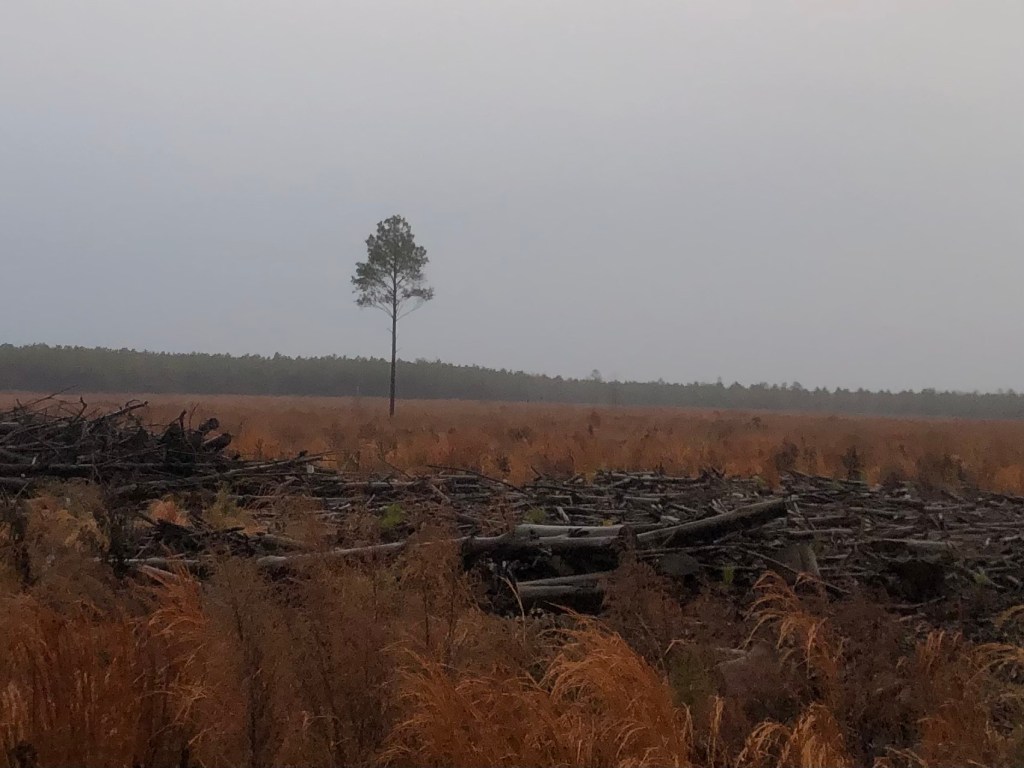
One more tree photo: This lone tree stands amid the carcasses of its brethren. Why it was spared, no one knows. But I took this photo when I was in Crossett, Arkansas, looking for the storied “Spook Lights.” Knowing that, doesn’t this photo seem a little sinister?
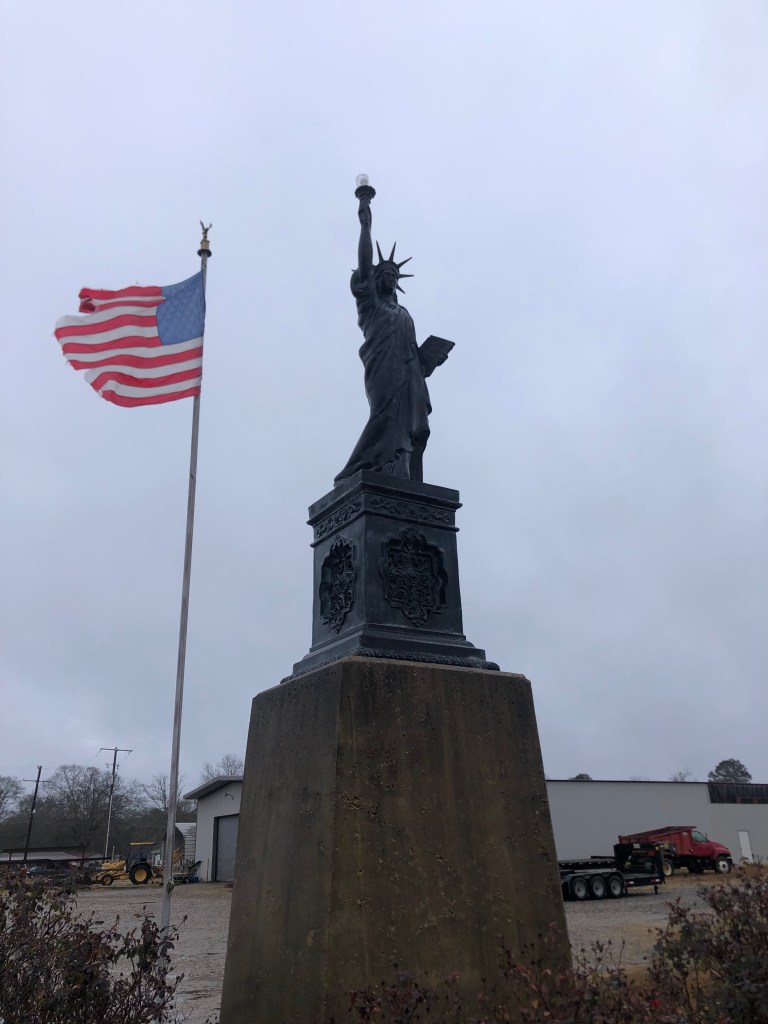
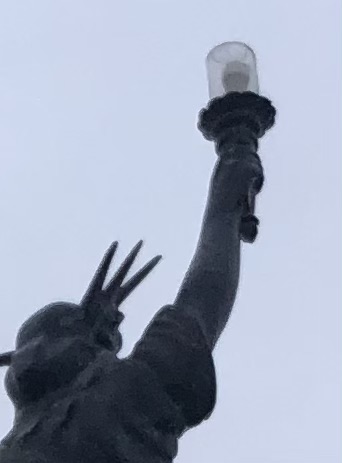
A miniature Statue of Liberty in Strong Arkansas. Not a bad reproduction…but wait, what’s up with her torch?
They cheaped out. Another Home Depot special.
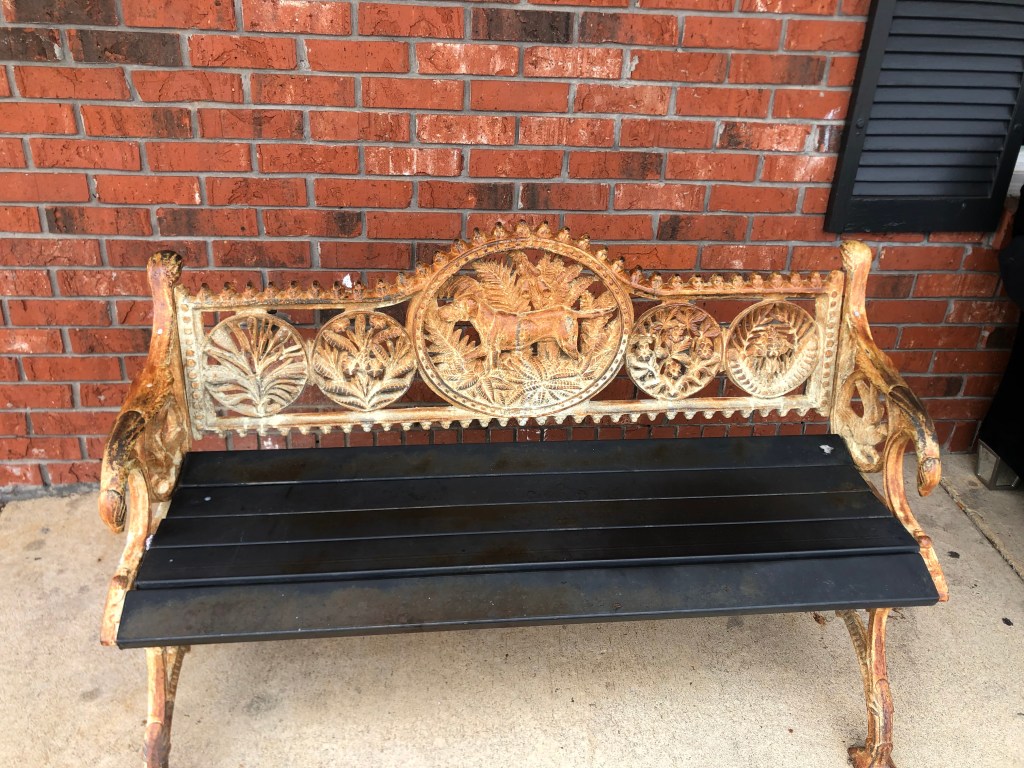
Sidewalk bench in Union Springs, Alabama, which you’ll recall is the “hunting dog field trial capital of the world.” Check out the center of the backrest.
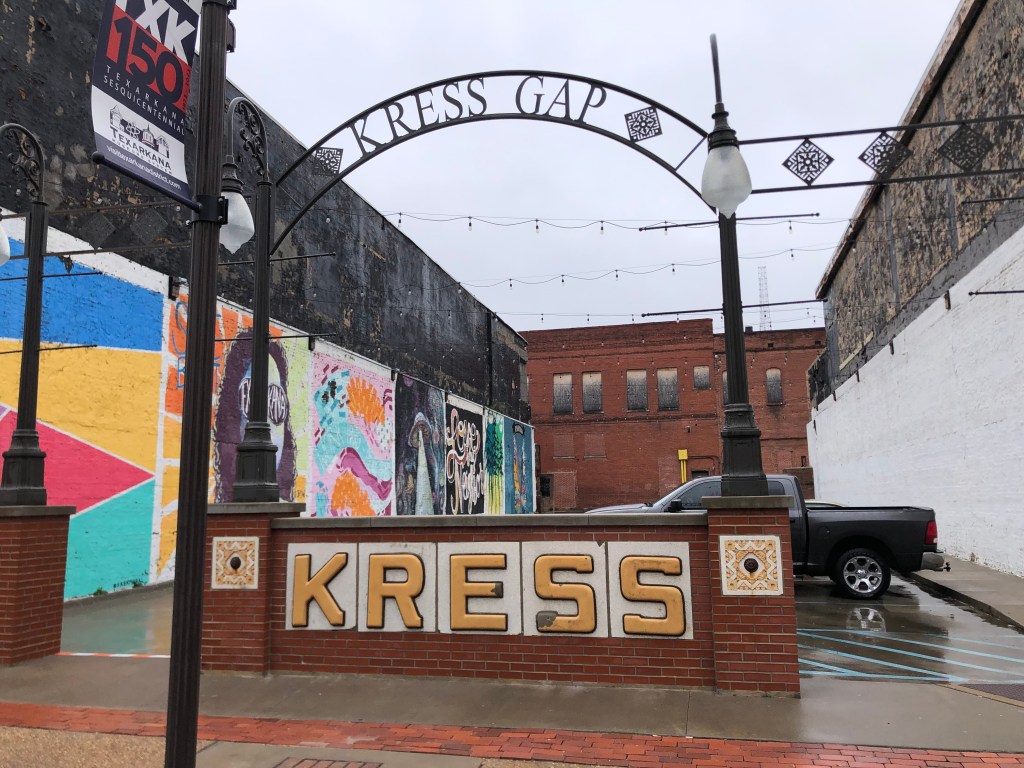
Former site of a Kress department store in Texarkana, Arkansas. As sad as it is to see a historic structure go, I do think it was a nice gesture to commemorate the place with its original signage.
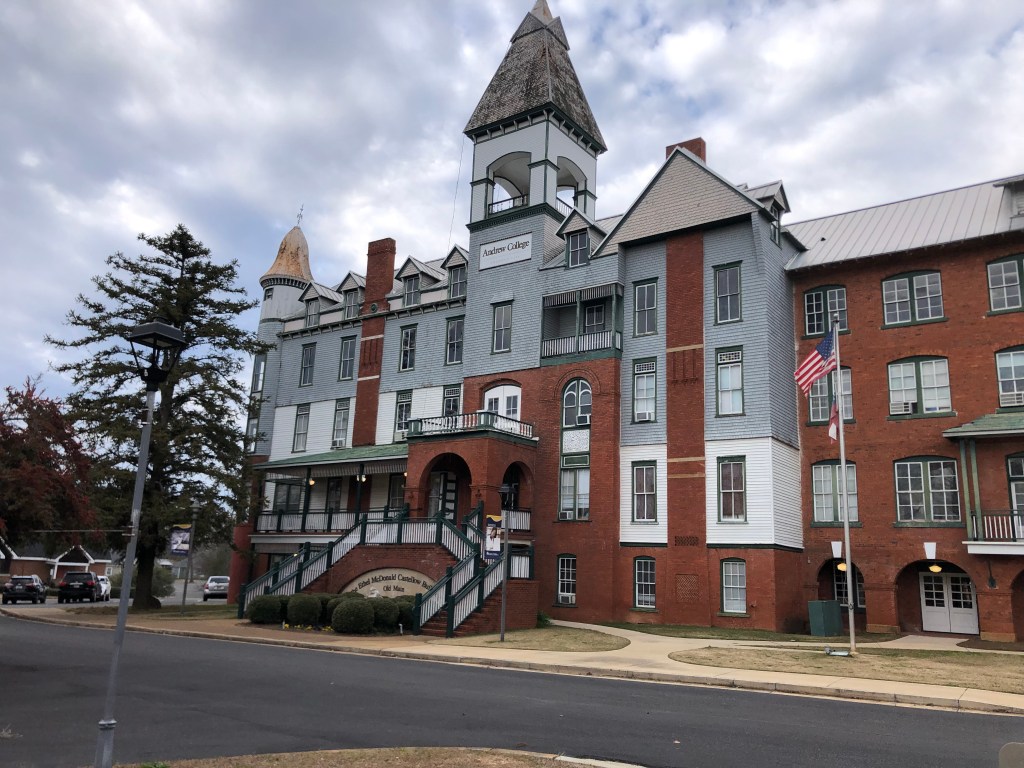
Andrew College in Cuthbert, Georgia, dates back to 1854. This main building was constructed in 1892. It’s still an active, accredited college today. I just like how it looks.
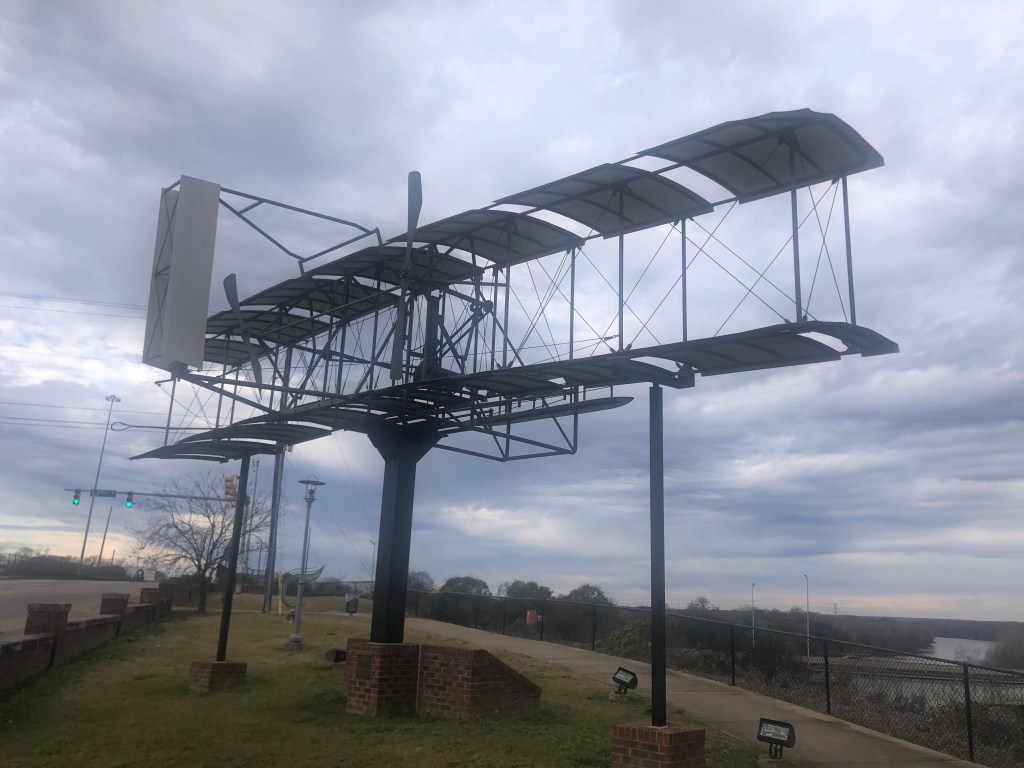
This flying machine seemed a bit out of place in Montgomery, Alabama. But it turns out that the Wright Brothers opened a flying school here in 1910.
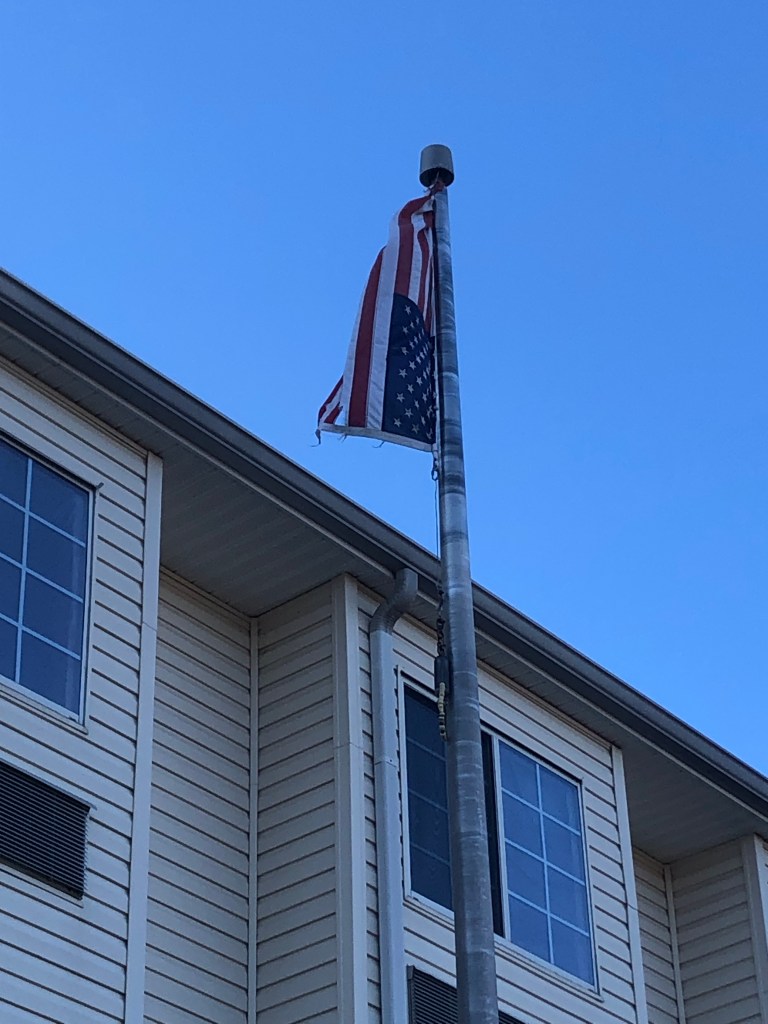
Distressed flag in Starkville, Mississippi. I asked a guy coming out of this building about it. He just looked up and shrugged.
Cars · cemeteries · movie theaters · Road trips · trains

Ruminatin’

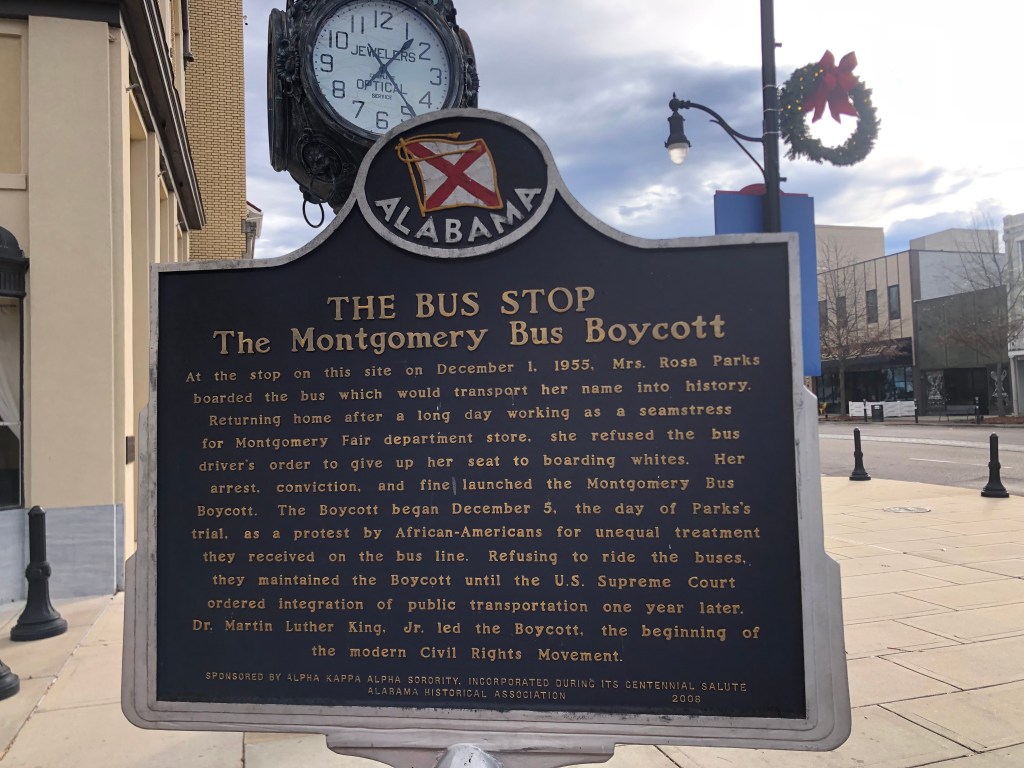
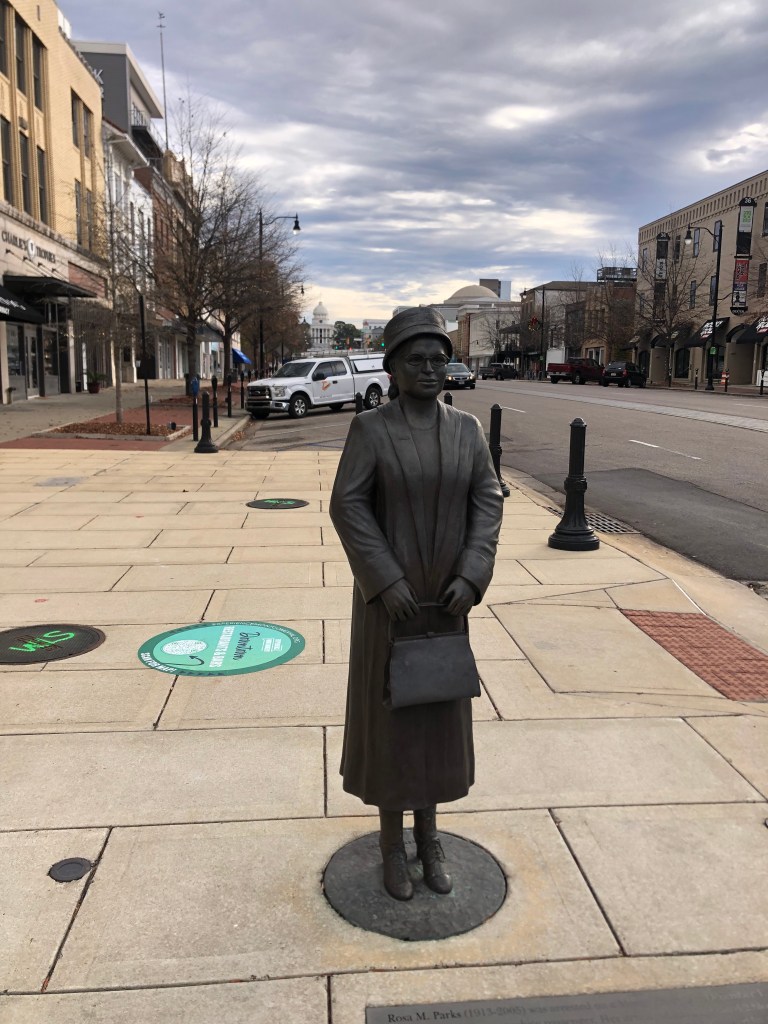
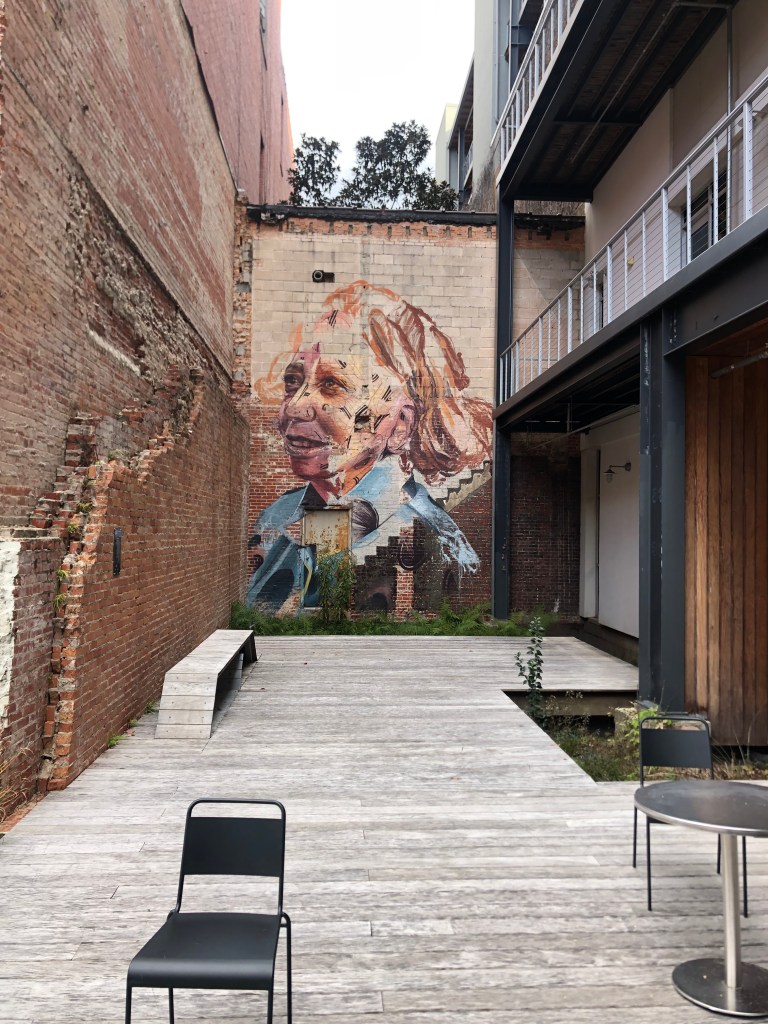
Only a short drive along Route 82 from my hotel takes one to Alabama’s capital city. Montgomery (pop: 200,000) is far and away the largest city I’ve been to on this trip. Montgomery was, of course, ground zero for the Civil Rights movement in the 1950s and 1960s. Throughout the downtown you encounter murals, statues, commemorative plaques, and other installations marking aspects of Montgomery’s civil rights history.

The spot where it all began.
Mother of the Freedom Movement.
Valda Harris Montgomery.

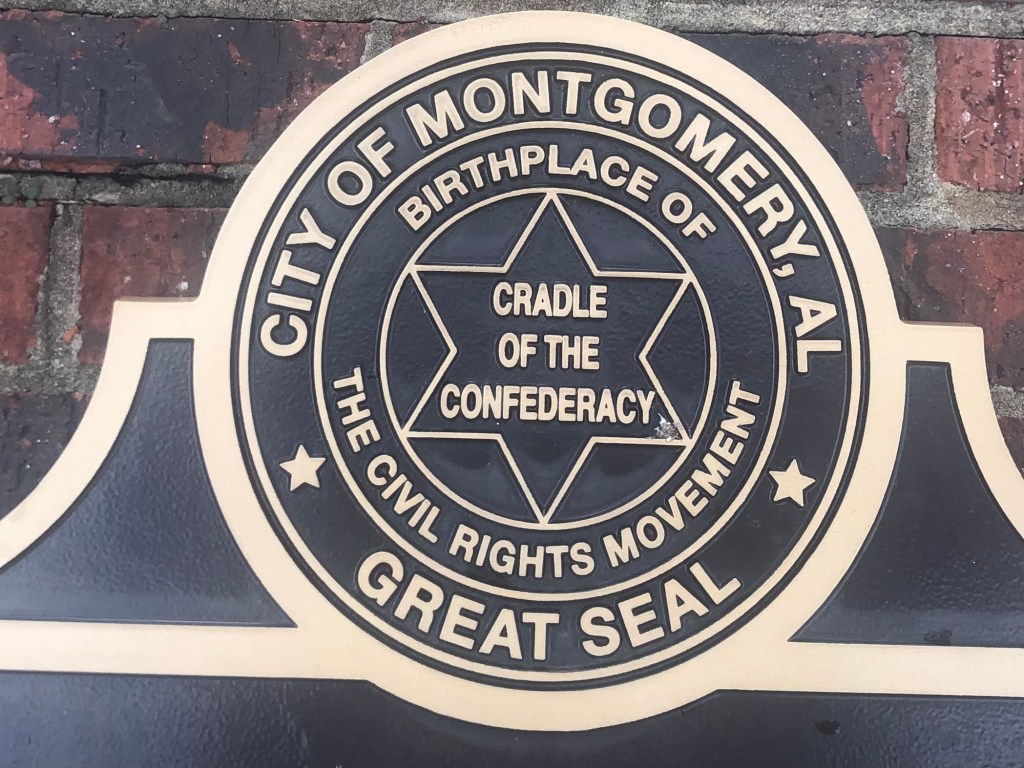
Montgomery’s streets are filled with many dozens of such iconography of the Civil Rights movement. Clearly the city’s official attitudes have changed greatly since the 1950s. And yet, it’s also evident that the city has not fully reconciled its history. The dissonance is captured in the city’s “great seal,” which I spotted on one of the historical markers:

By way of background: For many years, the city seal included the “Cradle of the Confederacy” phrase, but not the reference to the Civil Rights Movement. The latter phrase was added in 2002, in an effort to take the sting out of what sounded like a paean to the confederacy. And yet, to me this seems to simply highlight the simultaneous existence of two conflicting mindsets: an embrace of Montgomery’s history as the capital of the Confederacy, and an embrace of its role in promoting the Civil Movement.

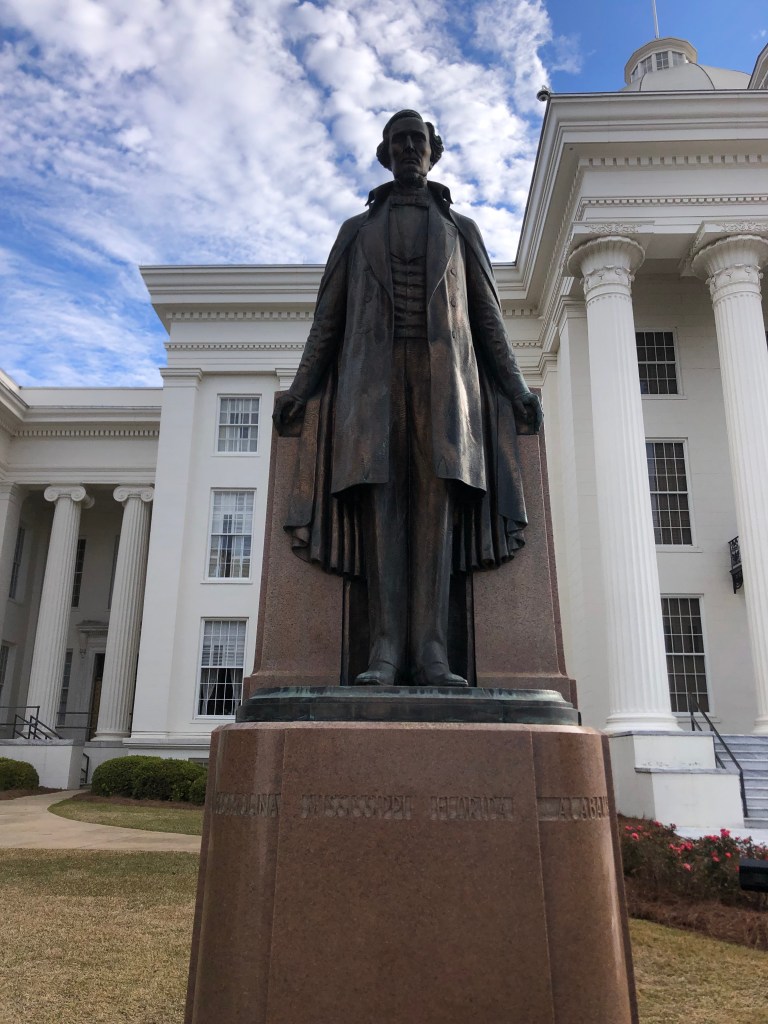
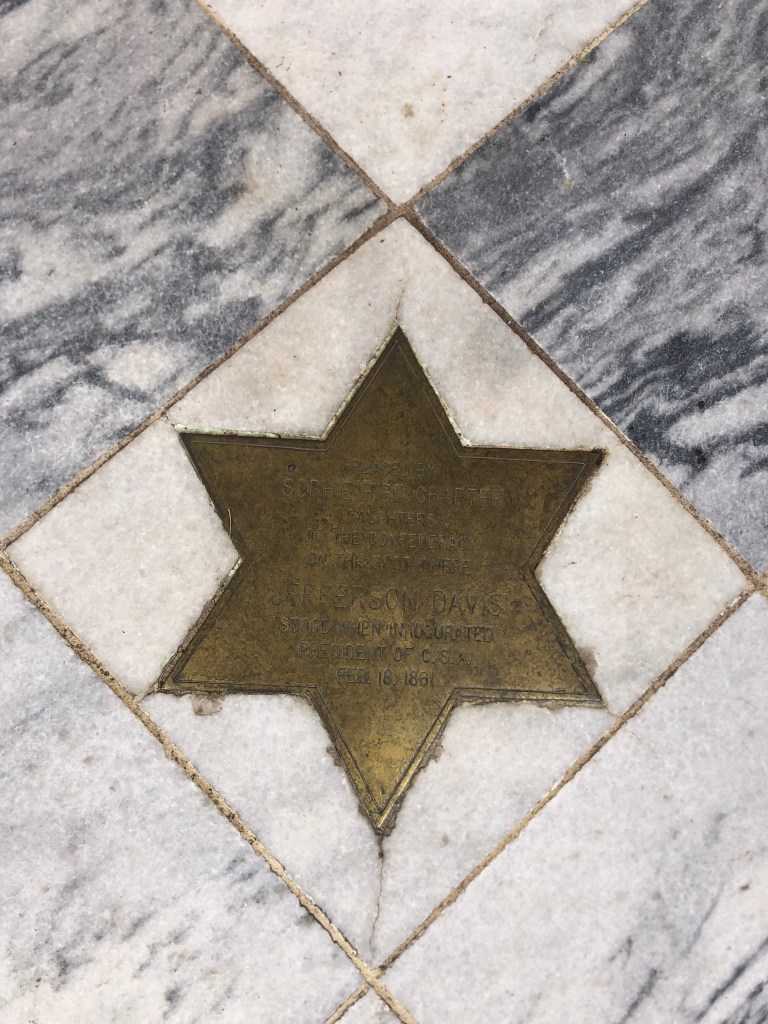
That contradiction becomes clearer as you walk up the street toward the Capitol building. There you can find a series of bronze reliefs depicting aspects of the slave trade and other mistreatment of African Americans. But you’ll also see a solemn statue of Confederate President Jefferson Davis, as well as a bronze star on the steps of the Capitol marking the spot where he took the oath of office.

Jefferson Davis doing his Count Dracula impersonation.
“Placed by Sophie Bibb Chapter Daughters of the Confederacy on the spot where Jefferson Davis stood when inaugurated President of C.S.A. Feb. 16. 1861.”

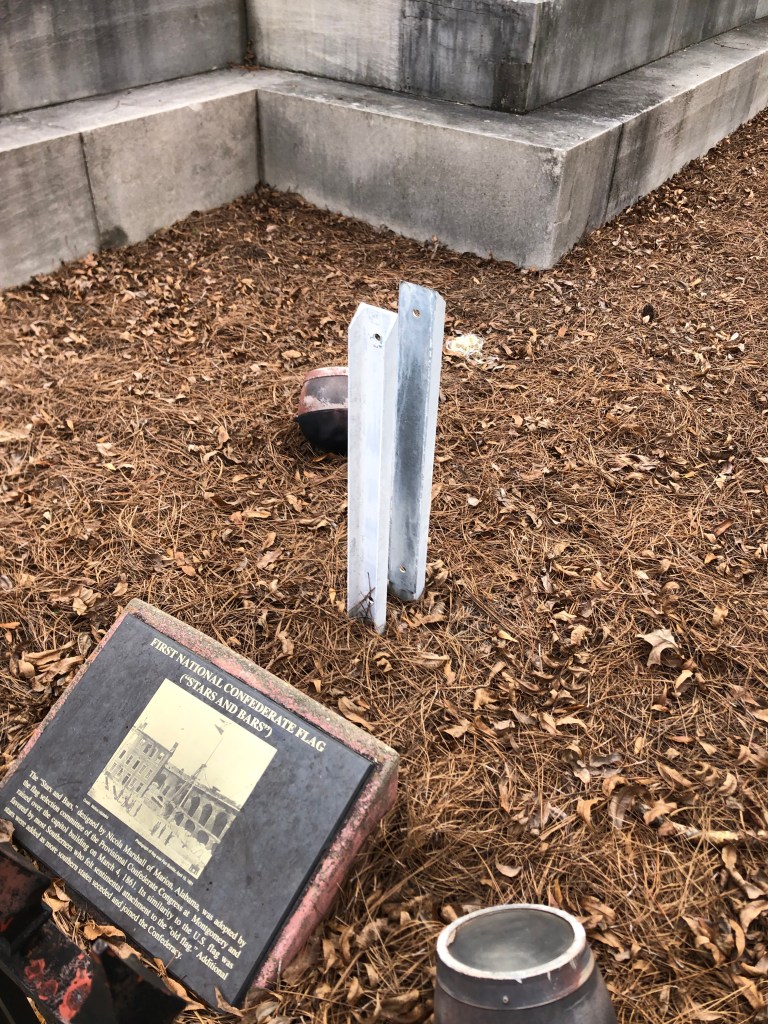
You’ll also see the empty spots where Confederate flags had flown until the Governor ordered their removal in 2015. But the bronze and limestone Confederate monument that those flags had surrounded still stands.

Flagless for over eight years.

I certainly don’t presume to tell Montgomerians how to reconcile the various aspects of their history. But I would observe that there is a difference between acknowledging history and celebrating it.

OK, now that I’ve once and for all solved the cultural arguments over the Civil War, let’s move on…

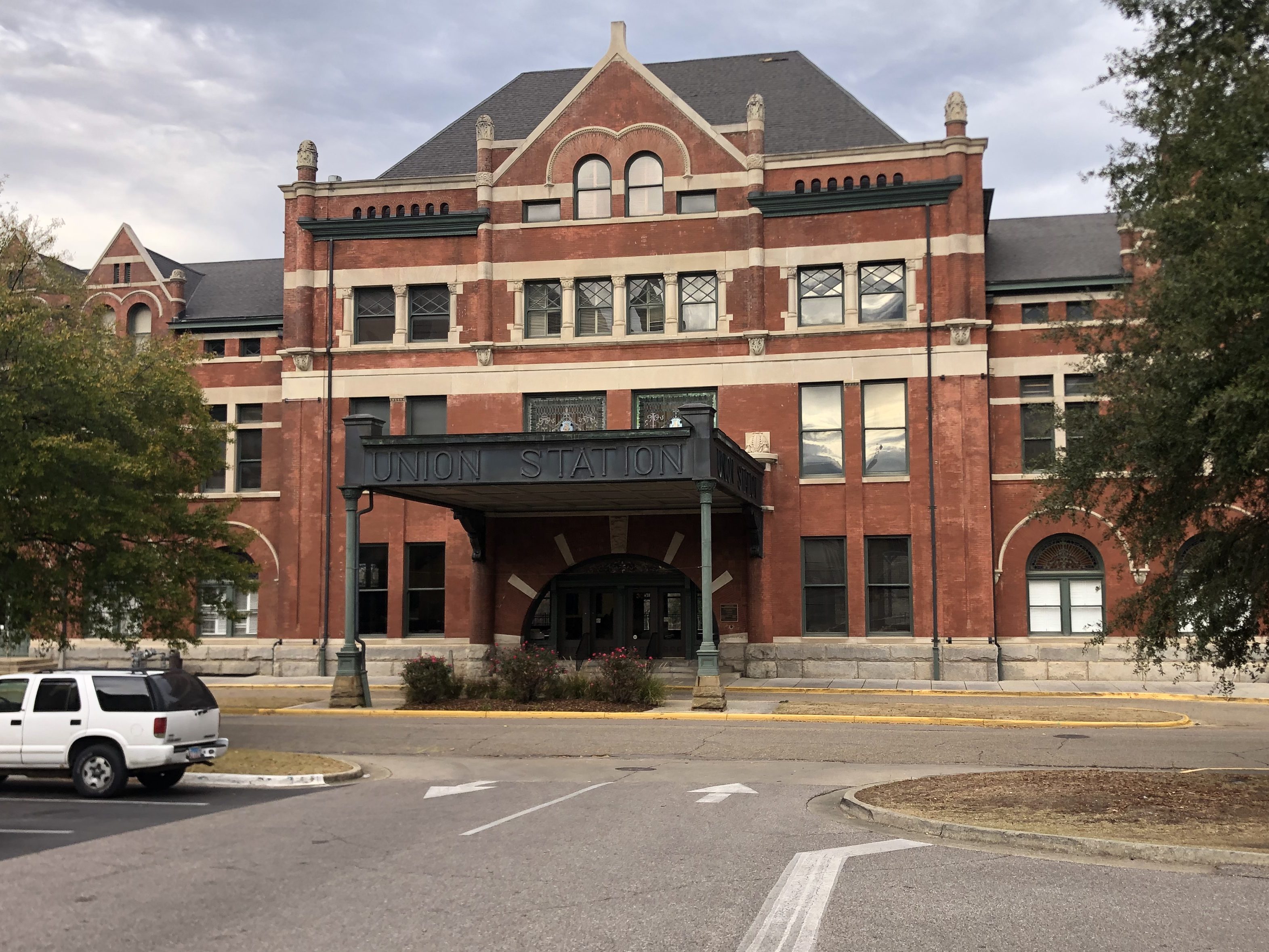
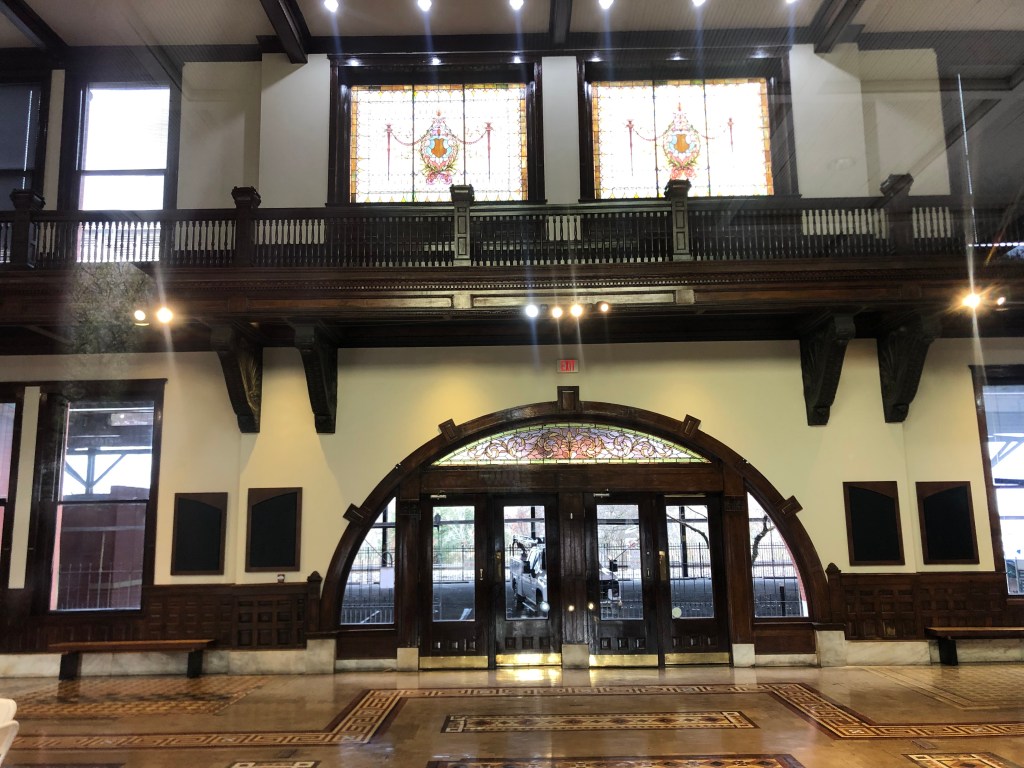
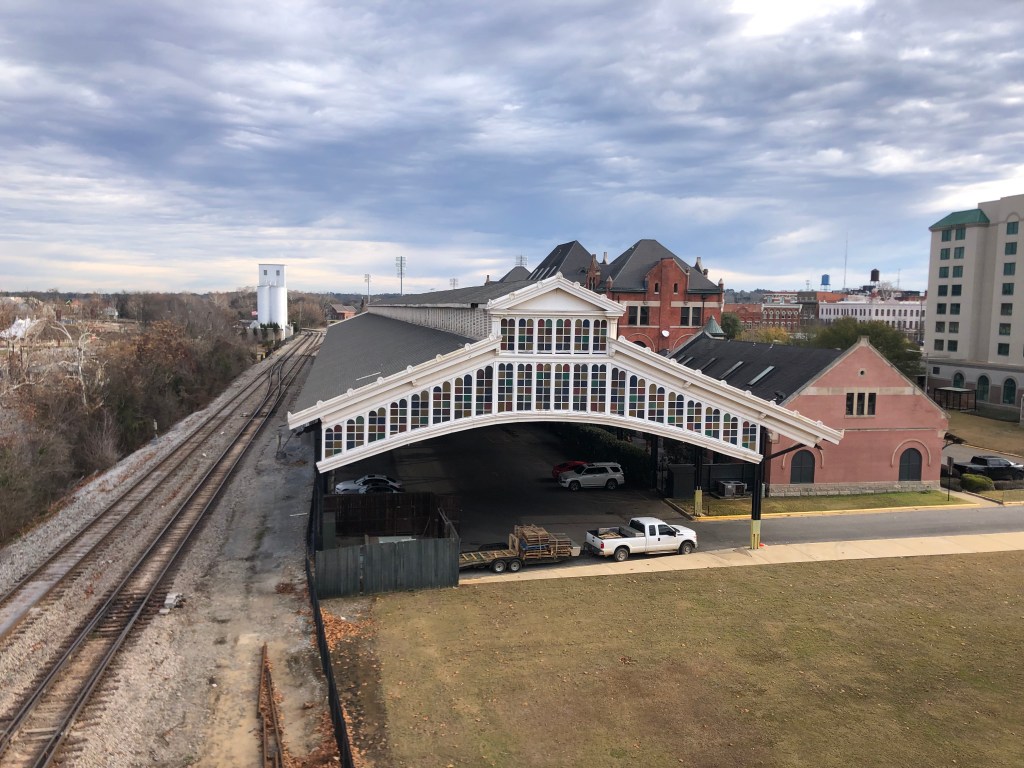
Believe it or not, while in Montgomery I encountered my third Union Station on this trip. Montgomery’s Union Station was built in 1898 for the Louisville and Nashville Railroad. It was one of the country’s busier stations, serving 44 passenger trains from a dozen railroads during its peak. Over time, of course, rail travel diminished and the last train stopped at Union Station in 1979. Since then the station was converted to a visitor center and has been leased to various commercial clients. You’ll note that this structure has been magnificently preserved; the comparison to Texarkana’s crumbling structure is stark.

Another day, another Union Station.
Interior of waiting room–now an event space.
Aerial view of covered trainshed adjoining Union Station. (Photo taken from atop a parking structure.)

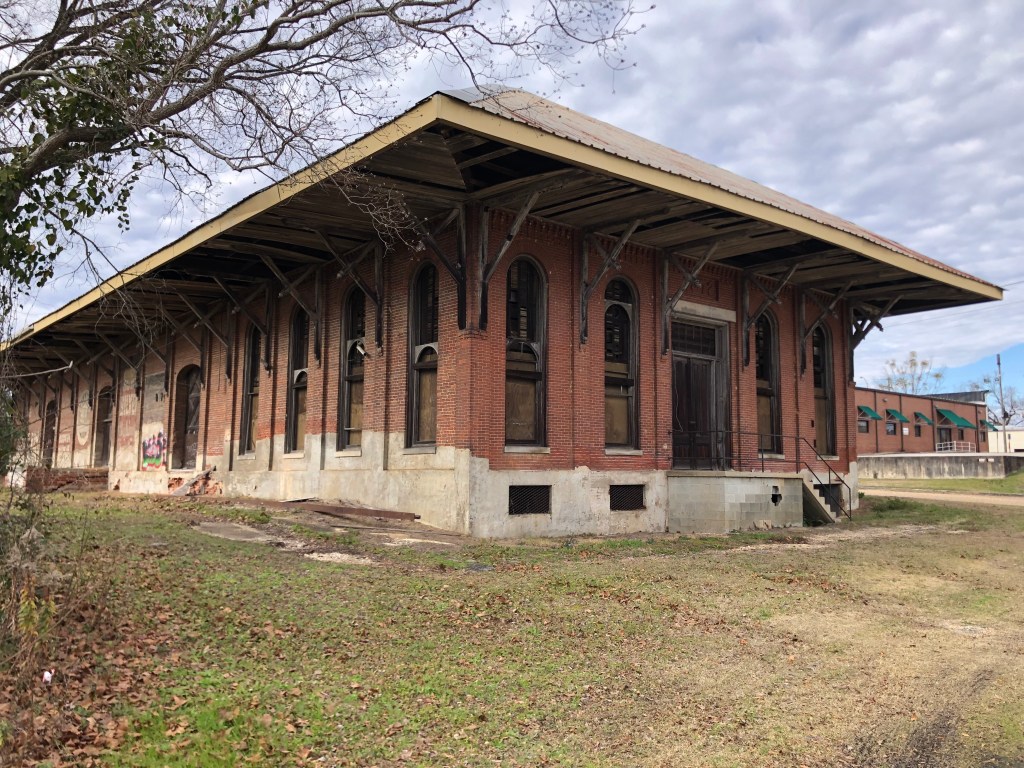
Railroads were crucial to the development and survival of southern towns. That’s true for the rest of the country as well, of course. But it seems that railroad infrastructure is more prominent in the towns I’ve encountered on this trip than it is in California towns. Maybe that’s just because California has (sadly) been more aggressive in tearing out the obsolete railroad infrastructure and substituting new housing developments and business parks. Whatever the reason, scenes like the one below (from Eufaula, Alabama) seem common on this trip.

The Vicksburg and Brunswick Railroad built this passenger and freight depot in Eufaula, Alabama in 1872. It has not served passengers for over a century, and it’s now owned by the local Methodist Church for reasons that aren’t entirely clear.
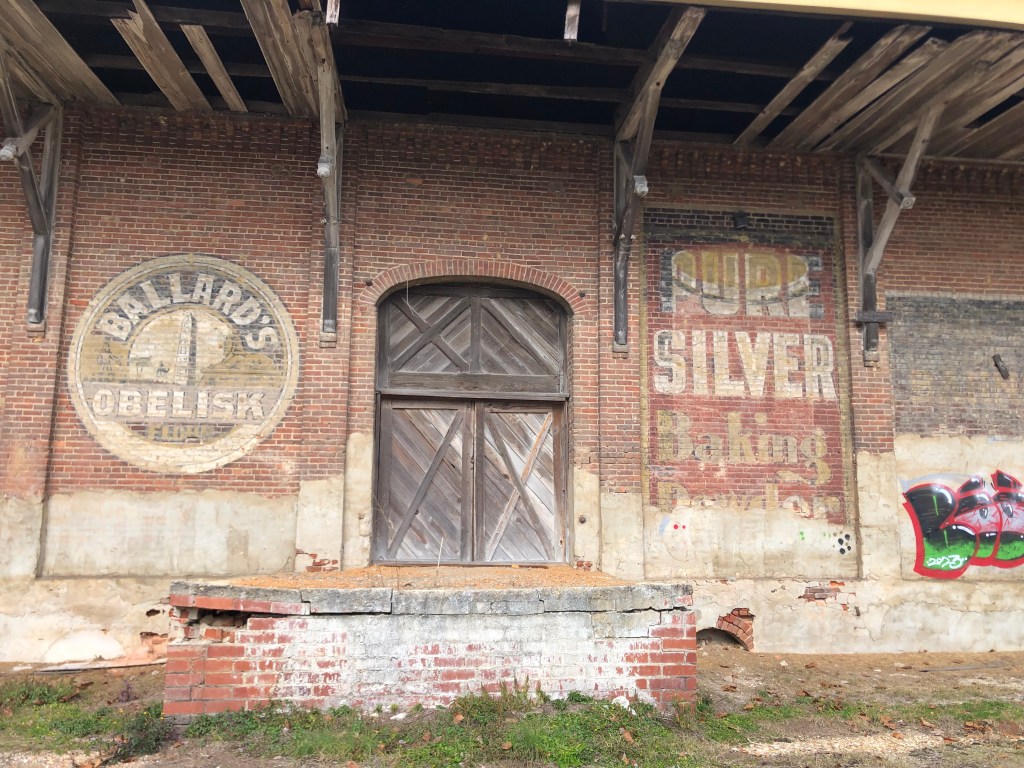
Note to taggers: PLEASE don’t mess with those historic advertisements!

This leads to a third thought: I’ve given a lot of thought in this blog to the comparison of thriving and declining historic districts along various US highways, including of course Route 82. I’ve speculated about the influence of local universities, the re-routing of trains and highways (i.e., the Route 66 effect), and other possible factors. There’s also the chicken and egg question about needing funds to redevelop historic buildings, and needing redeveloped historic buildings in order to generate revenue. One thing does seem clear: some of the old towns have managed to successfully preserve and/or renovate their historic districts (let’s call them The Preservationists). Others have knocked down the old structures and replaced them with a Piggly Wiggly or a Dollar General (call them The Replacers). And still others, either due to a lack of will or a lack of funds, don’t do much of anything, and their buildings slowly decay. Call them the Porch-Sitters.

It’s not like any one approach is always the best. Circumstances and resources matter. But it should be clear that I especially appreciate those towns that have found a way to maintain aspects that make their town unique and that connect them with their history. I think the problem with the Replacers is they all end up looking alike, hosting the same Olive Gardens and Kohls and Home Depot and Bed Bath & Beyond.

I feel the sorriest for the Porch-Sitters. I think towns that slowly decay aren’t doing so because they don’t care. Rather, they’ve lost their major employers or their young people have moved away or the interstate siphoned off their drive-through traffic. They fall into a destructive cycle where the population and the infrastructure together age and eventually collapse.

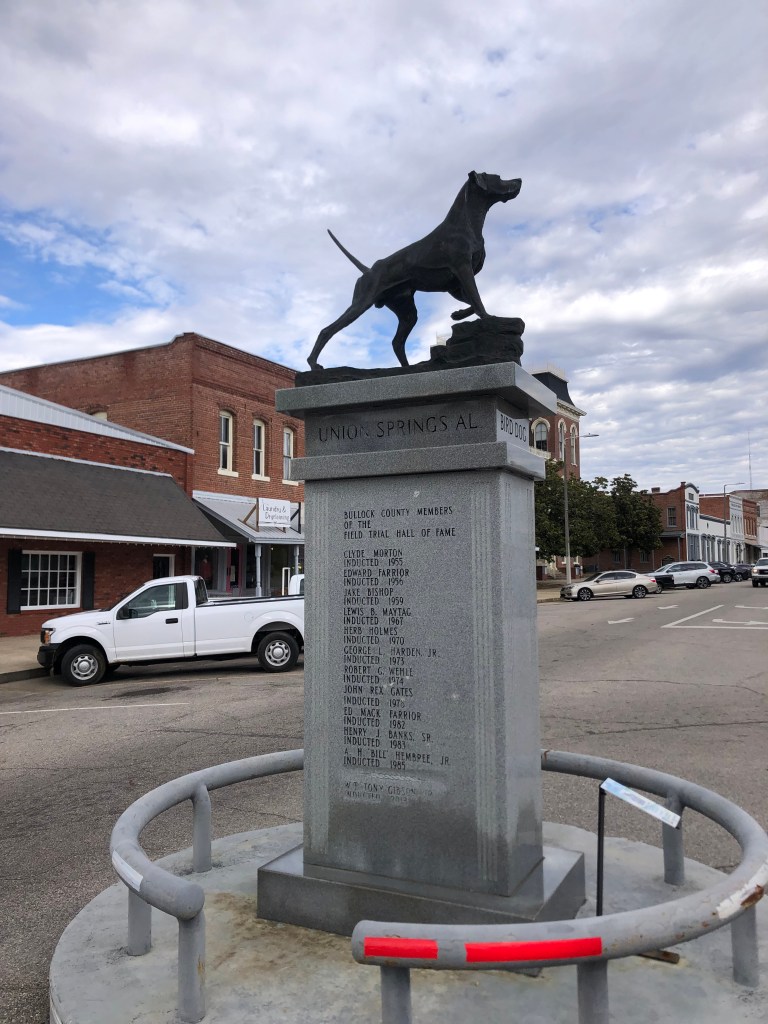
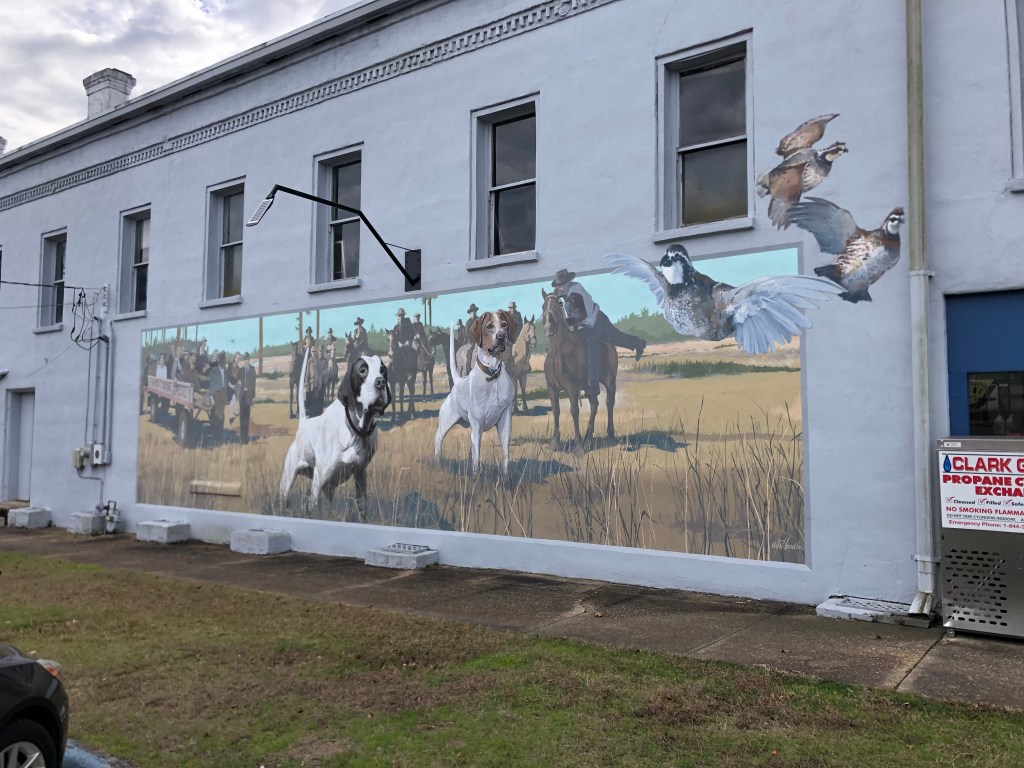
Today I drove through the town of Union Springs, Georgia (pop: 3,300). It’s not a prosperous town; about 44 percent of the population is below the poverty line. The local economy sprung up from the cotton industry, but in the 20th century many of the cotton fields were converted to hunting preserves. Interestingly, the town has capitalized on that change by rebranding itself “The Bird Dog Field Trial Capitol [sic] of the World.” The town hosts annual field trials for hunting dogs every fall and spring, and it has erected monuments and murals celebrating that fact.

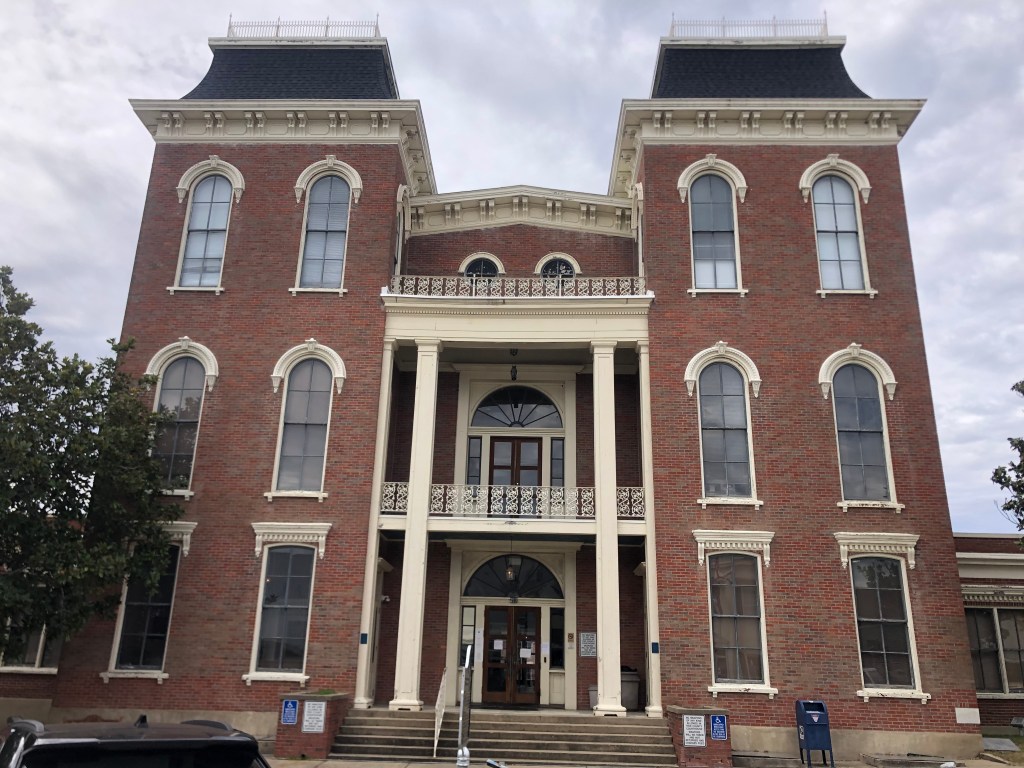
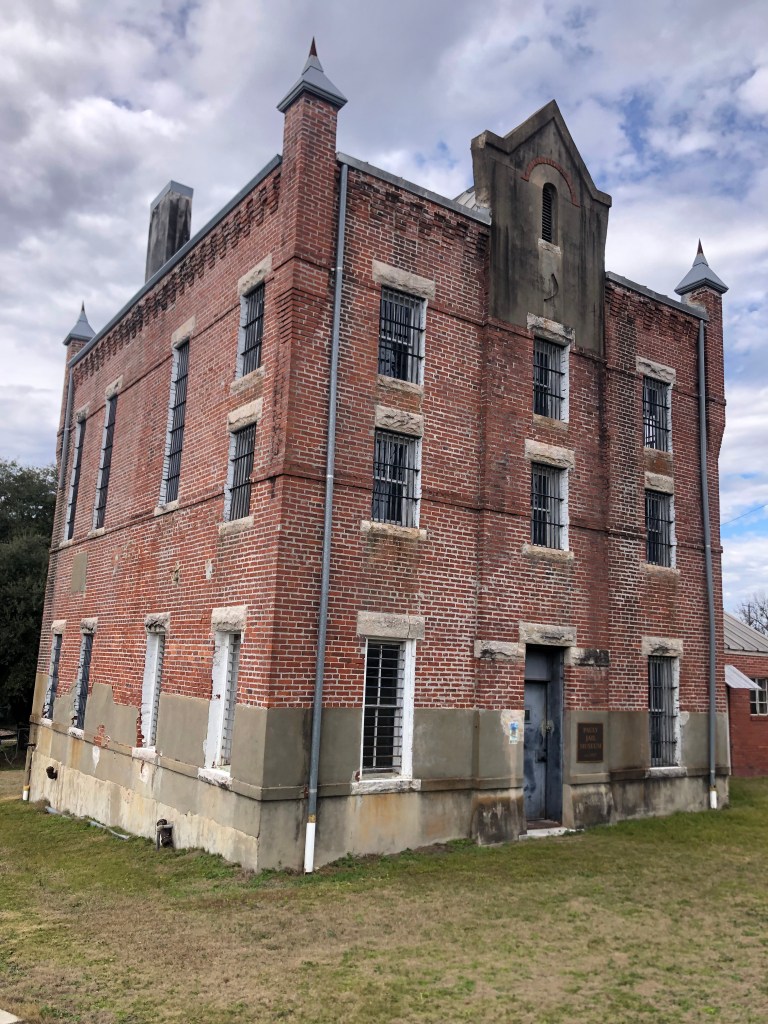
The town also restored its historic county courthouse and jail to the tune of about $2 million…

The 1871 courthouse looks impressive…but it wasn’t open to the public, because the Barney Fife-like guard was taking a break.
The 1897 jail was partially restored and converted to a museum….but it was closed to visitors when I saw it.

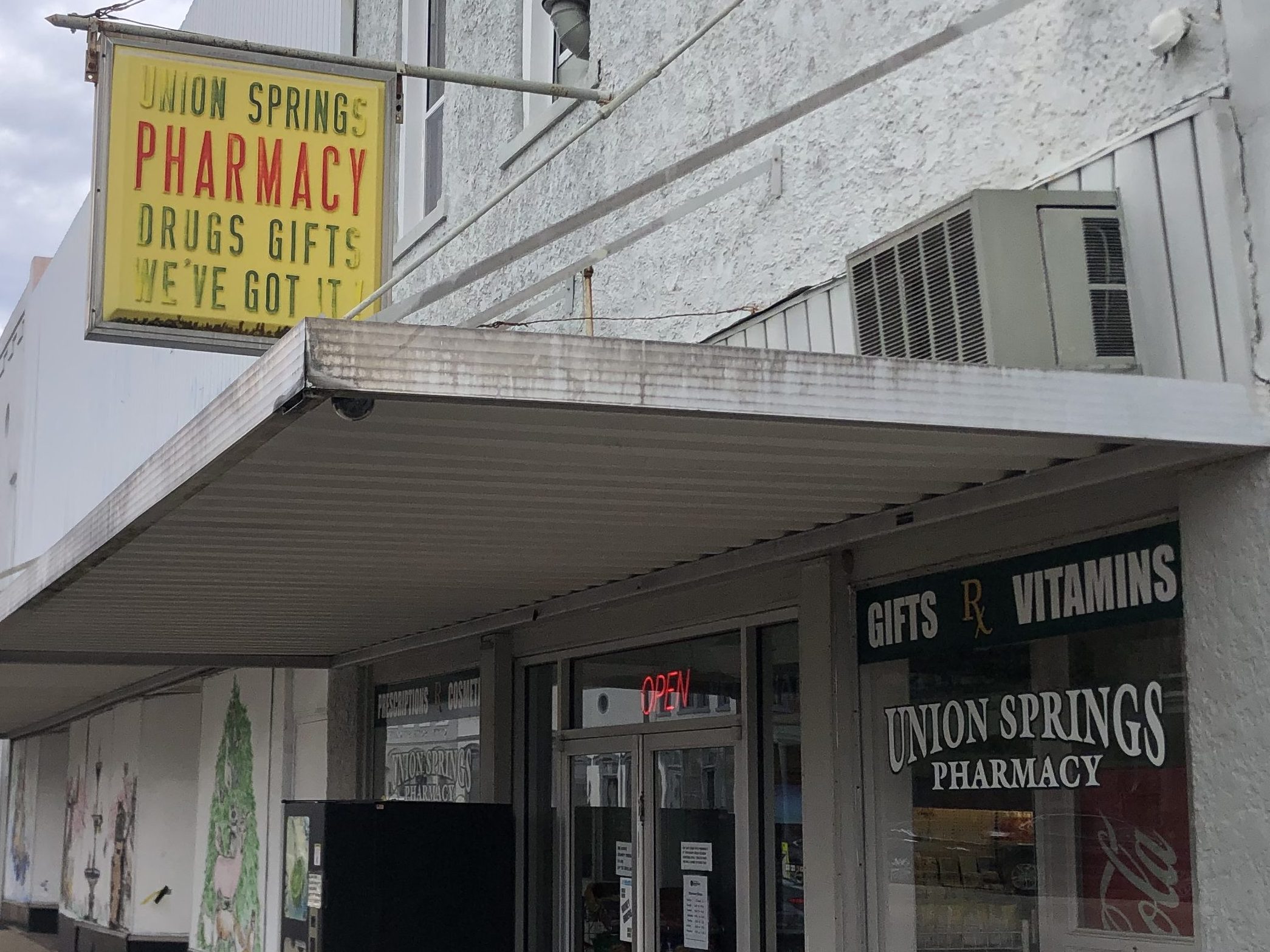
At the same time, however, most of the buildings along the commercial main street haven’t had a facelift in many years.

The one human being I saw on the street was a guard from the courthouse. He didn’t seem particularly interested in showing off his city to a (presumably rare) winter visitor. I’ll be interested to see how Union Springs fares over the next decade. I can’t quite tell whether the balance is tipping toward Preservation or Porch-Sitting.

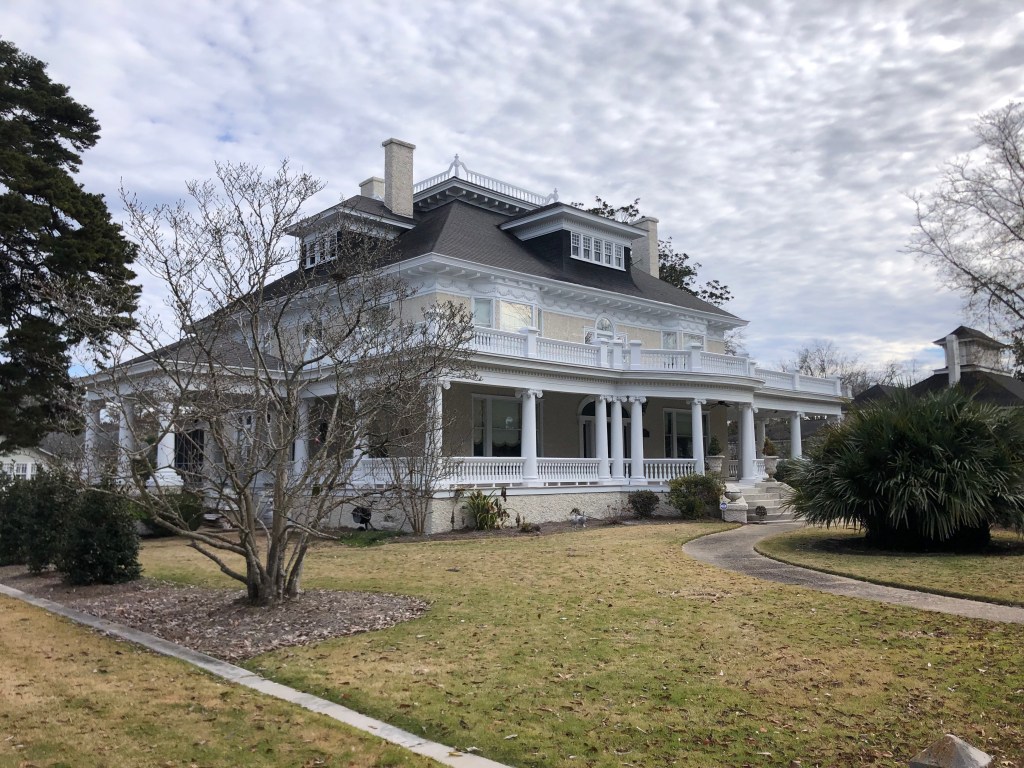
About 40 miles further down Route 82 is the town of Eufaula (pop: 13,000). This town seems to be firmly in the Preservationist camp. Large, plantation-style homes line a section of US 82 as you come into town.

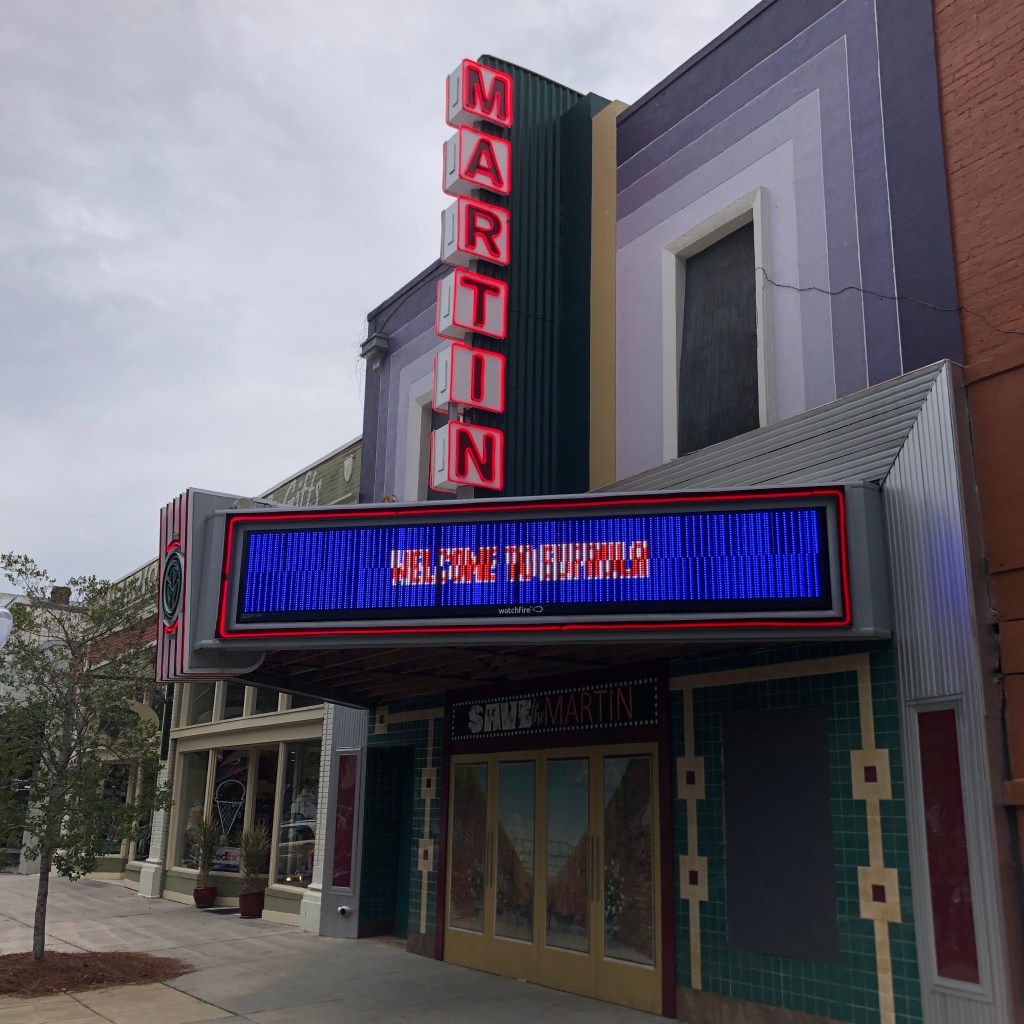
The core, historic business district, meanwhile, has a large number of shops, restaurants, cafes, professional services, and even a historic theater. I had lunch at a Mexican restaurant that was completely full of families and couples.

The 1927 theater facade was recently “restored” (with the unfortunate addition of a garish, pixelated marquee). The interior is still being renovated.

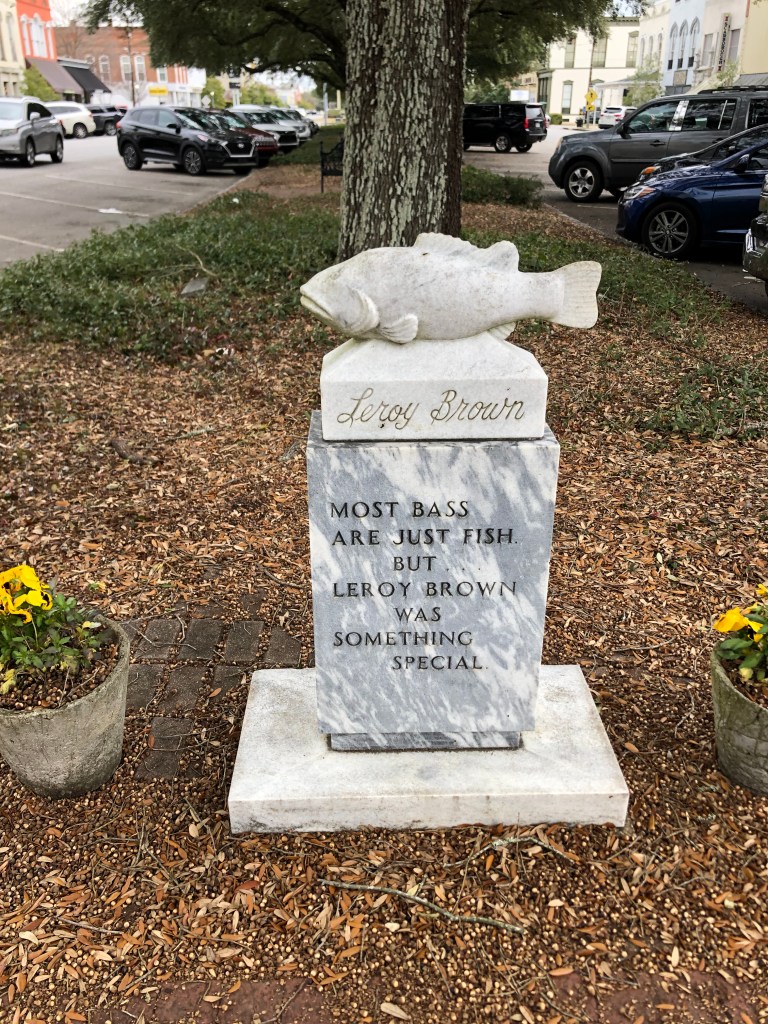
On a green, tree-lined strip in the middle of Main Street is what looks like a tombstone for a fish.

And meaner than a junkyard dog!

When the fish (a bass) was caught in 1973, the fisherman (Tom Mann) decided to keep it in an aquarium–sort of a half-ass catch-and-release, I suppose. Mann named the fish Leroy Brown (after the Jim Croce song) and taught him to jump through a hoop he held over the water. Leroy Brown became a town celebrity, and lived for seven years in that tank.

When Leroy Brown died in 1980, Mann held a funeral for him, and it’s said that over 500 mourners attended. The Governor of Alabama even declared it a day of mourning. I’m not making this up. For reasons too complicated to get into here (but not here), Leroy is not buried under this tombstone. But the town fondly recalls his memory.

And since we’re on a whimsical note: Today I had another opportunity to explore paranormal phenomena (after my failed Crossett Spook Light experiment). I learned of a place just a few miles off Route 82 in southwestern Georgia that’s been informally dubbed “Gravity Hill.” At first I thought it might be one of those roadside tourist traps like the Mystery Spot, but it’s actually just an unmarked, lonely stretch of narrow road in the countryside. Here’s how it works: After cresting a gently rolling hill, one drives down to the low point, just before the road begins to climb again. Stop your car here, put it into neutral, and let your foot off the brake. Gravity Hill is supposed to pull you backwards, uphill.

Although skeptical after the Crossett experience, I was willing to give it a whirl. So I cruised to the outskirts of the town of Fort Gaines on a narrow country road. I stopped my car at the low point, put the rental car in neutral, and released the brake. Nothing. I was about to declare this another fraud when I noticed that I was very slowly beginning to roll backwards, up the hill I’d just come down. The car gradually picked up speed until I was rolling uphill at maybe 10 mph. I repeated this several times, and it worked each time. I even recorded this video so you can judge for yourself:

I guarantee there’s no trick photography or anything like that going on. You’re seeing exactly what I saw. You may think it’s some kind of natural illusion or something like that, but I prefer not to think about it too hard.

I lost an hour due to a time zone change when I entered Georgia, so after my gravity experiment I decided to hunker down for the night in Albany, Georgia (pop: 69,000). Tomorrow I plan to reach the coastal terminus of US 82 in Brunswick.

Brew of the Day

I stopped in at the Mellow Mushroom, a pizza restaurant in Albany. It’s part of a multi-state collection of such restaurants, but each one is locally owned. And the company began in nearby Atlanta, so my guilt from eating at a chain restaurant was attenuated a bit.

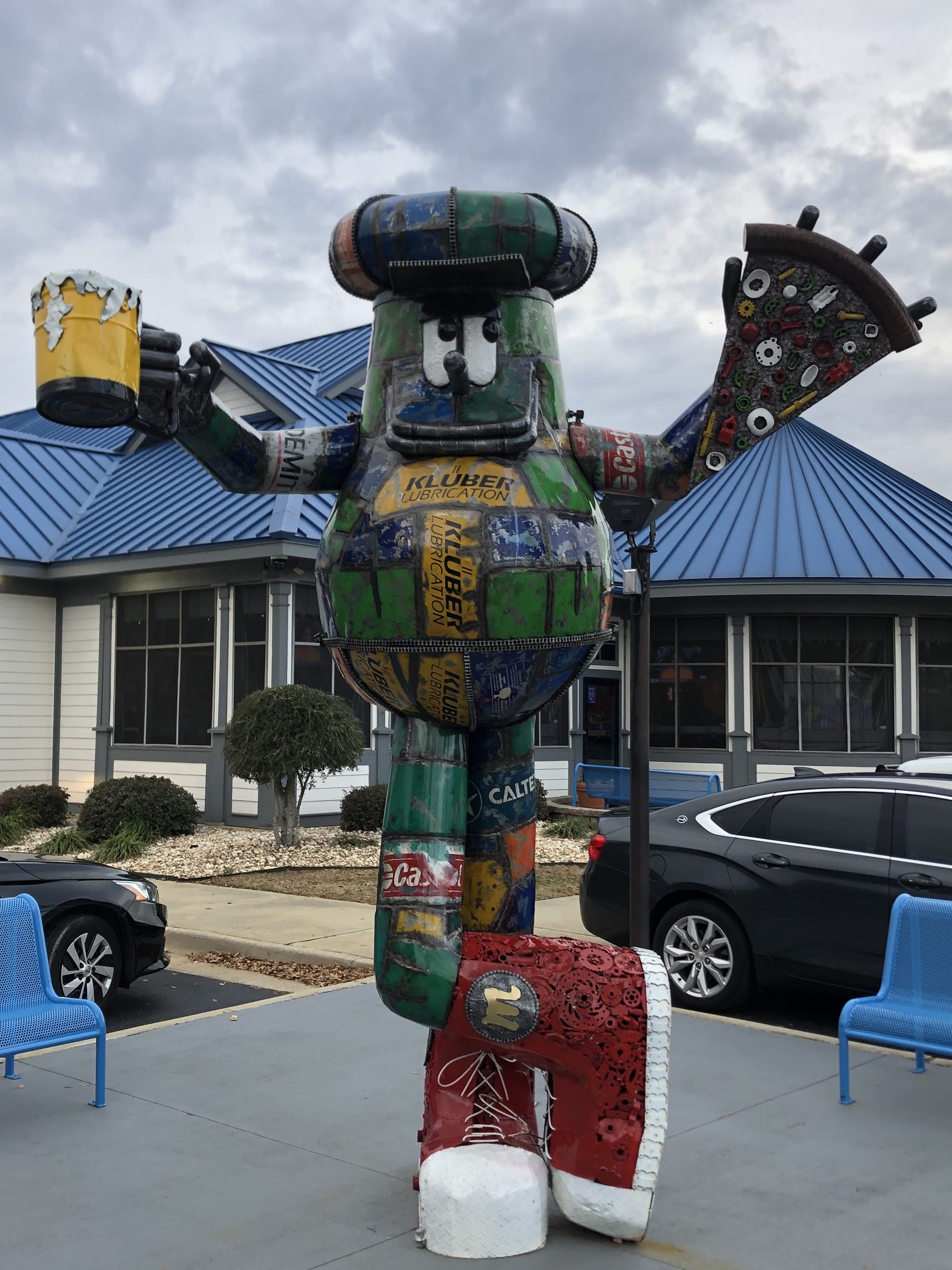
As you might imagine, the “mellow mushroom” theme is expressed in the decor and menu in the form of psychedelic trips, Jimmy Hendrix, the 1960s, and general hippie-ness. The sculpture in front of the restaurant says it all:

“Tune In, Turn On, Drop Out, Dude.”

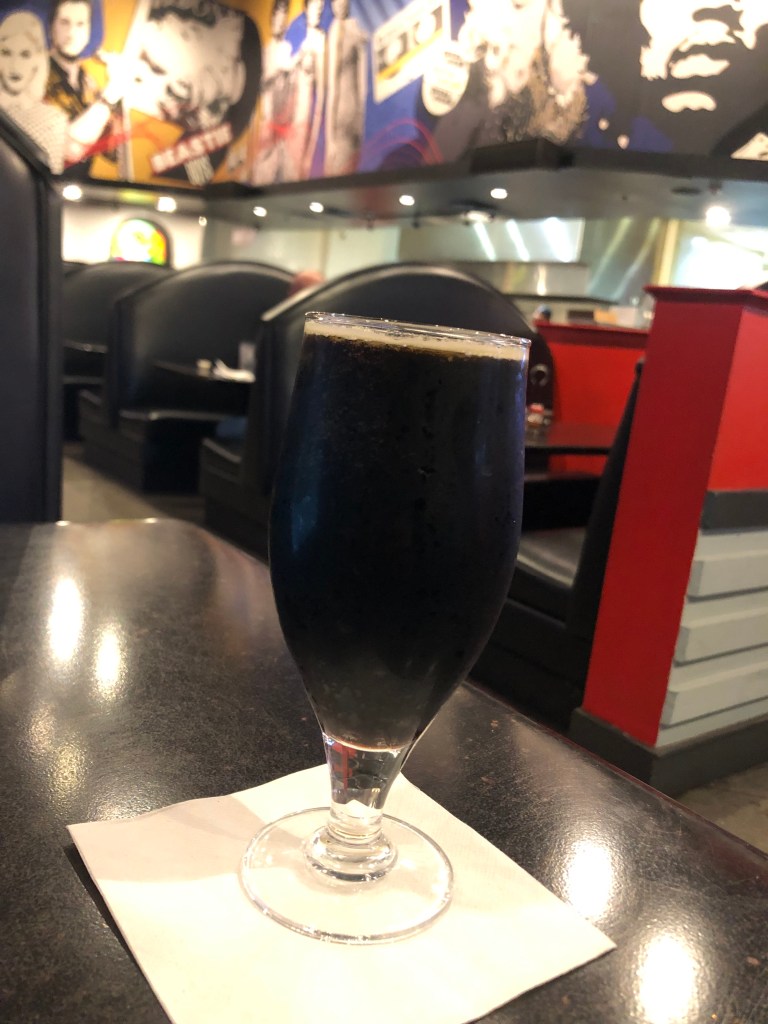
Anyway, this place has a surprisingly large beer menu. So, along with my pepperoni-bacon-jalapeno pizza, I ordered a Stone Xocaveza imperial stout.

Note the decor in the background.

Now, San Diego-based Stone is a reliable brewery, with big, hop-forward beers. I especially like their Arrogant Bastard Ale. The Xocoveza looks inviting: the color is of a ruby-shot Coca Cola. It has no head to speak of, and in fact there’s little evidence even of carbonation. But none of this is fatal for a stout. And the nose is quite inviting–it smells of chocolate, maybe a hint of anise. Let’s see how it tastes…

(Sip. Gulp. Gag.)

This is quite possibly the worst Stone beer I’ve tasted. Flat as my feet. It’s like the half-finished glass of generic-brand root beer you put in the refrigerator and then forgot about. For a month.

Unlike a normal stout, this is not malty. And it’s not hoppy. In fact, it’s not really beer-y. The taste reminds me of meatloaf, somehow converted to liquid form.

But that’s a bit unfair…to meatloaf. I’m not a fan of meatloaf, but I acknowledge that it delivers a blend of different tastes. This beer, on the other hand, is one-dimensional. It lacks the complexity that one seeks in a good beer. What you taste on the front end is what you taste on the back end. And this tastes like back end.

And another thing–this is marketed as an “imperial stout.” In my book, the “imperial” part is supposed to signify a “big” beer, with an ABV that gets into the double digits. This, however, weighs in at a puny 8.1 percent. I suppose that might be about right for some people. But unless you wear a short-sleeved white shirt and place the title “Elder” before you last name, I think you’ll find the Xocoveza to lack the bite you’d expect from an imperial stout.

I give it one star. And that’s just because I like the color and the nose on this beer.

cemeteries · churches · Ghost stories · Halloween · Road trips

Bonus! A True Halloween Story

I hope you all enjoyed this month’s Halloween offering, “A Dying Wish.” Of course, the way the timing worked out, the story ended on October 30 (All Hallow’s Eve Eve). So for today, which is Halloween proper, I offer this “true” ghost story for Halloween.

[Editor’s Note: Long-time readers may recall that I related this incident some years back, while I was on my US Route 60 trip. But that story appeared in the days when I was composing my so-called “blog” in Google Docs and emailing it to a small number of friends, so you might not have seen it. We pick up the story on Day 7 of my trip, as I’d entered West Virginia.]

It struck me today that this drive across the country on US 60 is similar in many ways to my trip across the country last fall on US 50. Sure, US 50 is a northern route, and US 60 is a southern route, so they each have a distinct flavor. But there are many similarities between the roads. Both are mainly two-lane highways, and both cut through the middle of countless towns. The two roads even end up in the same state, not too far apart. And this morning I was feeling that this leg, through West Virginia, feels as remote and lonely as US 50 passing through Nevada. They call that stretch of US 50 “The loneliest road in America,” and for good reason. In a similar way, today’s stretch of US 60 had me driving for long stretches without seeing a town or even another car. It’s not a bad thing. In fact, it’s pretty therapeutic to be driving all alone along a windy road closed in on both sides with foliage. It’s calming and gives you time and room to meditate.

The narrow ribbon of asphalt that is US 60, cutting through the briars and brambles of The Mountain State.

As the afternoon wore on, the sky began to cloud over and the mountains began to take on a more melancholy feel. I was passing through the unincorporated village of Sam Black Church (named after a church building, which itself was named after an itinerant 19th-century minister). Here’s the church:

A white church named Black.

As I was passing through the deserted village and sensing the melancholy air, I came across this sign:

Roadside ghost story.

This was awesome! A “real” ghost story! (The full tale is explained here, in Wikipedia.)

Maybe it was just how my mood was affected by the weather and the long, solitary drive, but I felt compelled to find the grave of this Zona Heaster Shue. Surely she would be buried close by. After a quick consultation of Find-a-Grave on my iPhone, I found that she was buried in a churchyard just a few miles away. I set out for Soule Chapel Methodist Cemetery. The route was a narrow, twisting road over some hills, without a living soul anywhere in sight. Not so much as a grazing horse was out in the fields.

A good road for ghostspotting.

Finally, I arrived at the cemetery, which turned out to be a 150-year-old churchyard next to a white clapboard chapel. It was the perfect setting for a ghost sighting.

“So sure of death the marbles rhyme, yet can’t help marking all the time/How no one dead will seem to come. What is it men are shrinking from?” -Robert Frost

I walked among the graves and quickly found Zona’s headstone:

I have to admit that, while it was gratifying to have found the “ghost’s” grave, I was disappointed that the headstone looked so much fancier, perhaps newer, than the others in the cemetery. And it’s a little garish to identify her as the Greenbrier Ghost on her headstone. (The ghostly phantom you see in the headstone is my reflection, which just goes to show how shiny the headstone is.)

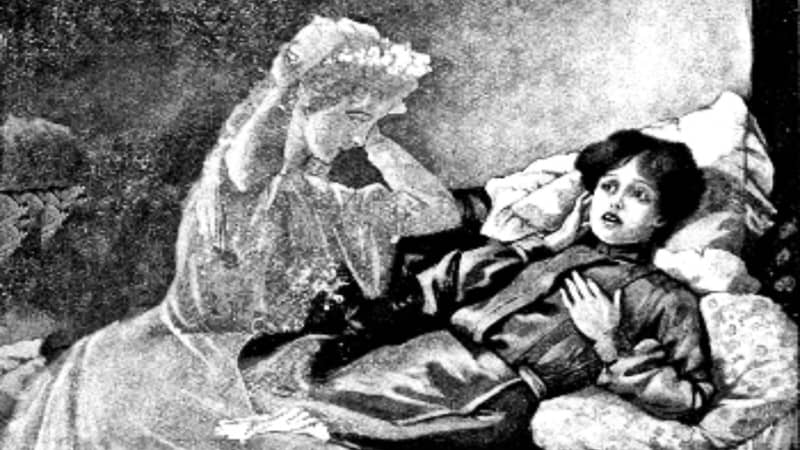
I should point out that this is Zona’s second headstone. She was first buried shortly after her death, but after her ghost supposedly appeared to her grieving mother, the authorities were compelled to exhume her body. Her corpse showed evidence (earlier overlooked) that she’d been murdered, and her husband was implicated and soon sent to prison. When she was re-buried, someone saw fit to identify her as the “Greenbrier Ghost” on her headstone. I assume that she’s OK with that, because even in death she doesn’t seem to be shy about communicating her complaints to others.

OK–It’s me again, on Halloween 2023. I hope you enjoyed all this month’s spooky offerings. Feel free to suggest your ideas for next October! Meanwhile, watch this space for another road trip soon.

sdb

cemeteries · Road trips

Mamma Mia!

Get it?

NOTE: As we take the weekend off from our Halloween tale, I figured I’d update my loyal readership on my latest travels (which is, after all, the putative purpose of Chasing Phantoms.)

Last week I took a motorcycle trip in a formerly fascist country that’s now run by a far-right government, where people treat traffic laws as mere suggestions, and where still-active volcanoes periodically spew lava. What could go wrong?

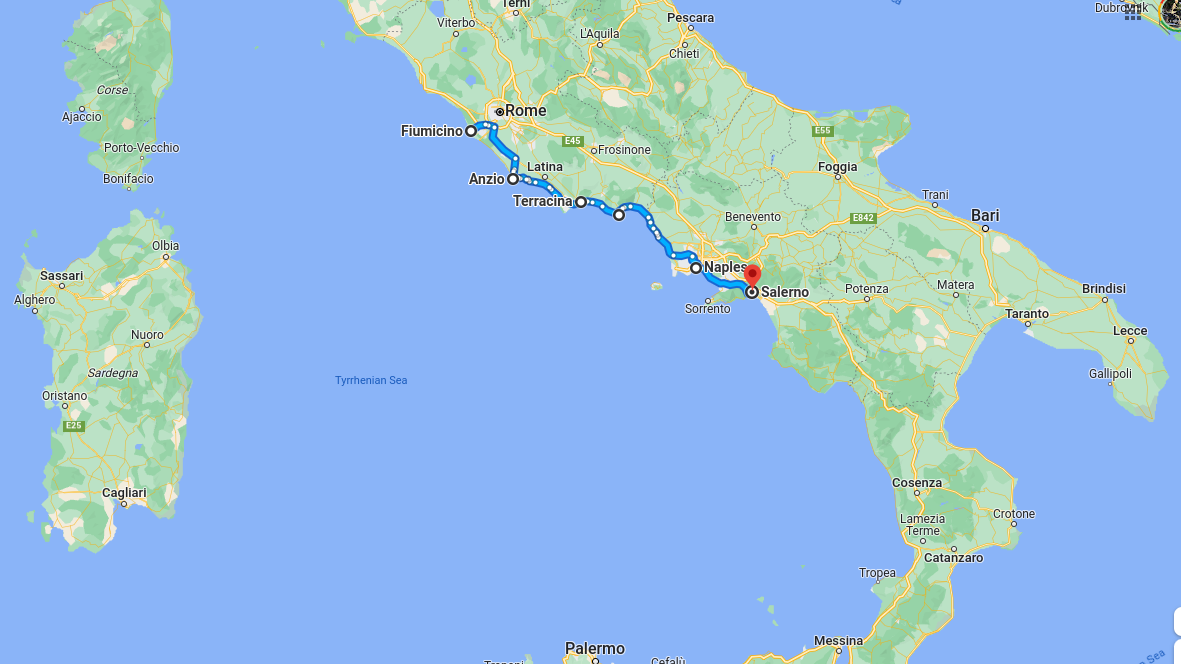
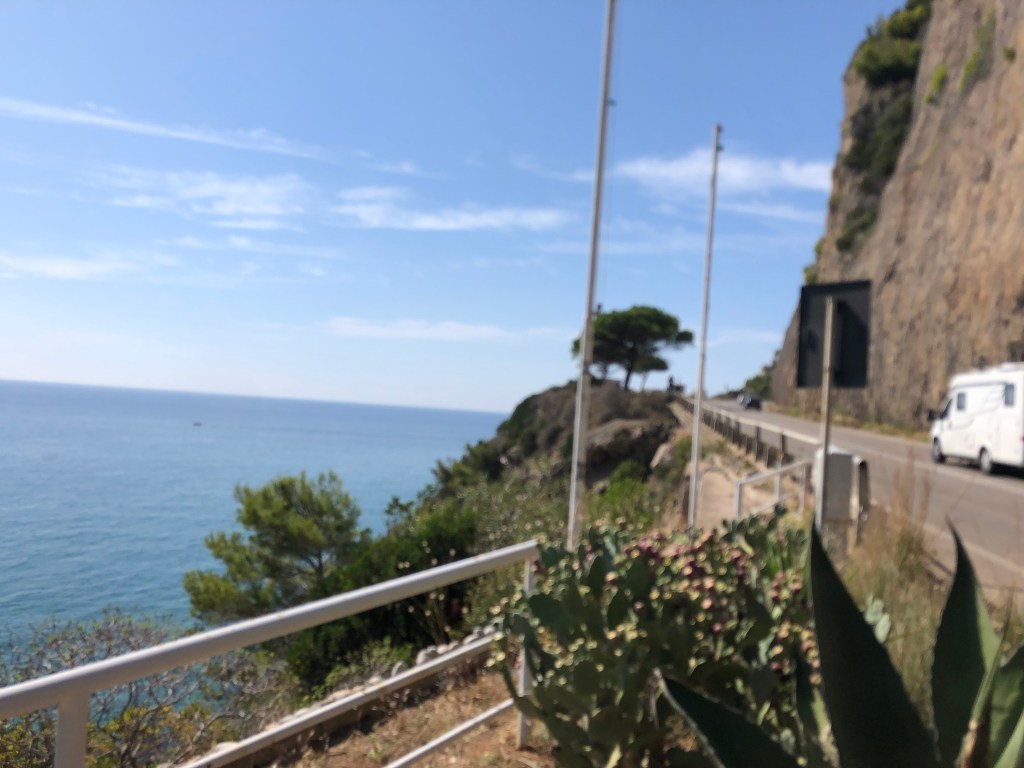
I speak, of course, of Italy. My wife and I decided to take a trip to Europe, and as part of our Preserve The Marriage Pact (whereby we try to keep at least two countries between us while on vacation), she went to Portugal and I got The Boot. I rented a Ducati motorcycle with the unsettling model name “Monster,” and started cruising down the Italian coast from Fiumicino to Salerno.

To paraphrase Joel Coen: “We rent monsters and then we can’t control them.”
My route in blue.

Now, the Internet already has tons of reviews and photos of Italy’s coastline, so I’m not going to add to that saturated theme. But I would like to make a few observations about Italy’s drivers. You may have heard that they’re insane. That charge is patently unfair–to the mentally ill.

Let me paint a picture for you: Most of the roads I’ve been riding are two lanes (i.e., one in each direction). The lanes are narrow, but they’re sufficient to allow one car width each. So I can comfortably keep the Monster in the center of my lane. Periodically another motorcycle will pass me in my lane, which makes for a pretty tight squeeze, but you get used to it. However, cars do the same thing; they come up behind me and pass me in my lane.

The real challenge, though, comes from the oncoming vehicles. In my lane. Seriously. Sometimes oncoming drivers find that there’s no room left to pass someone in their own lane, so they shift over to the opposing traffic lane to pass. But they are totally unconcerned about the presence of other vehicles. As a result, many times I looked ahead to see an Alfa Romeo coming straight at me at 100 km/hour. I get the sense that whoever’s got the smaller vehicle is the one who’s expected to take evasive action, so, since I’m on a motorcycle, I move toward the right shoulder and let the guy pass me. Did I mention this all takes place in my lane?

Not much margin for error.

The other notable thing is the speed of traffic. These coastal roads have posted speed limits of anything from 30 km/hr up to 80 km/hr. (The inland “Autostrada” goes up to 130 km/hr.) But on all these roads they might as well display meaningless symbols like the one Prince confusingly adopted, since the actual speed of traffic bears no relationship. Periodically you’ll see a sign that says “controllo della velocita con sistema Tutor,” which seems to mean that speed is monitored electronically. Either these are just empty warnings, or half of Italy’s GDP is based on traffic fines.

Where’s the fire, Mac? Can’t you read the signs?

And then there’s Naples (pop: 900,000). Naples makes the hazards of Italy’s coastal motorways seem like the Autopia at Disneyland. Neopolitans must dodge speeding, swerving cars and everyone tries to avoid the motorcycles that are parked helter-skelter…and that’s just the sidewalks I’m talking about!

A rough approximation of driving in Naples.

I can’t let this topic go without commenting on Italian parking. To be fair, these people are pros. They can parallel park a 9-foot minivan into a 9.5-foot space. And I have proof. Check out this video I took from my hotel room in Rome, figuring I’d need it for my insurance claim when the guy hit my motorcycle. Somehow there was no collision!

Anyway, it’s the smaller towns where one really experiences Italy’s charm. For me, the unsung gem is the town of Anzio (pop: 60,000), where I spent my first night. Anzio is an unpresupposing fishing port just a little south of Rome. Ancient ruins from the Roman empire (including the remains of Nero’s villa) still stand in the town, largely ignored by the residents. And, somewhat randomly, it’s a sister city to Brooklyn.

In January 1944 Anzio was the site of an Allied landing which slowly (over four long months) pushed the Germans out of their strongholds and eventually led to the liberation of Rome. This paved the way for D-Day and, ultimately, the defeat of Germany. Anzio seems to be quite proud of its accidental heritage, and the local museum is largely dedicated to the allied landing.

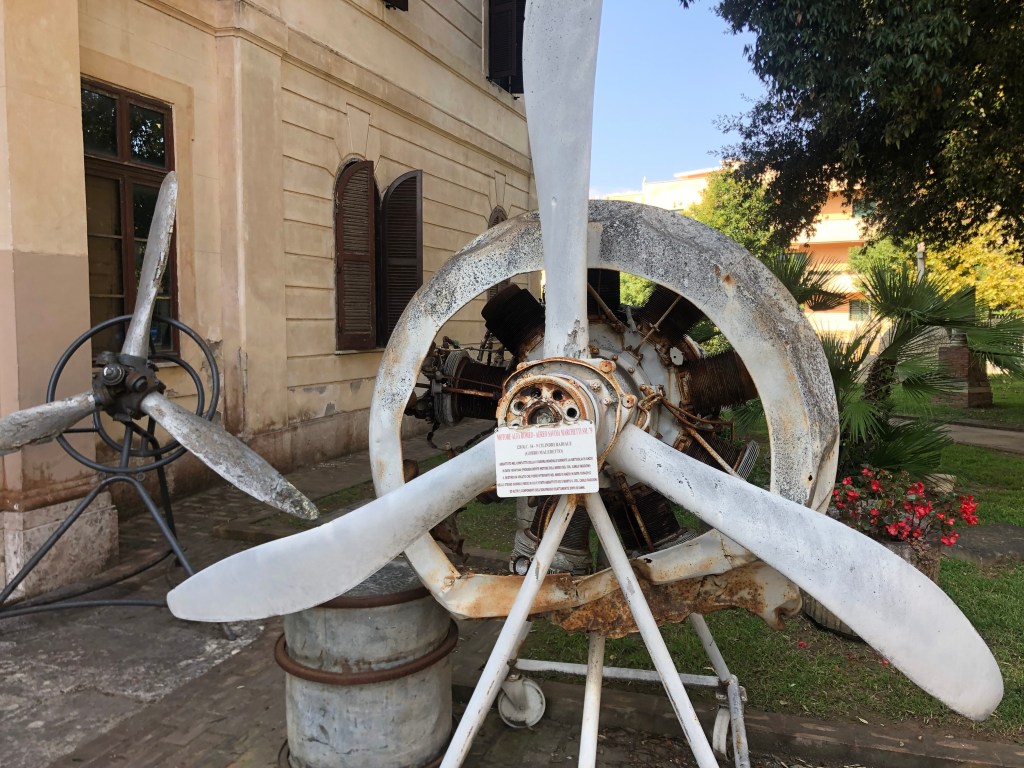
Recovered WWII propellers outside the Anzio BeachHead Museum.
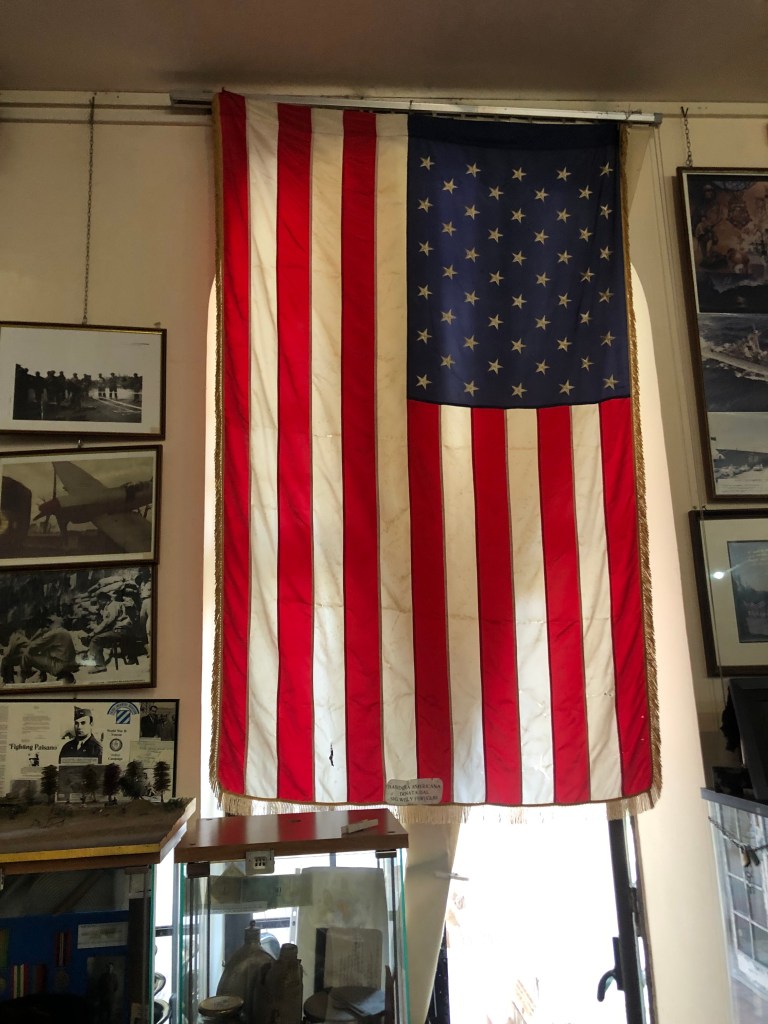
Recovered American flag. I tried to point out to the docent that the flag was hanging backwards, but he didn’t seem too concerned…or, more likely, he didn’t understand my rudimentary Italian.
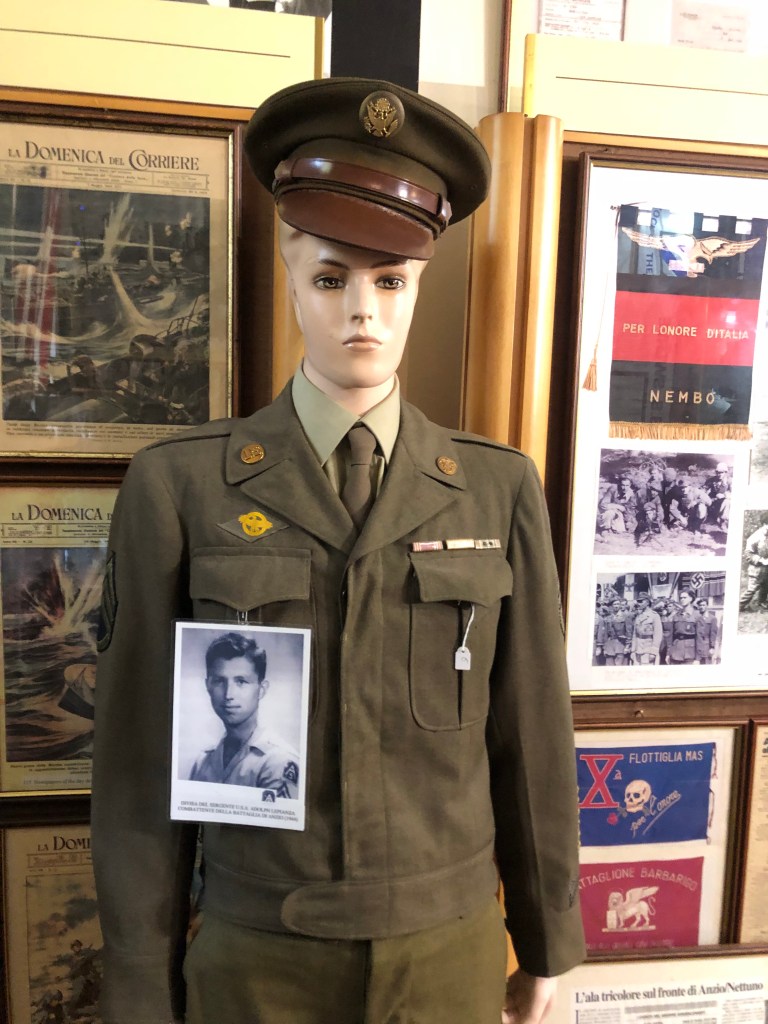
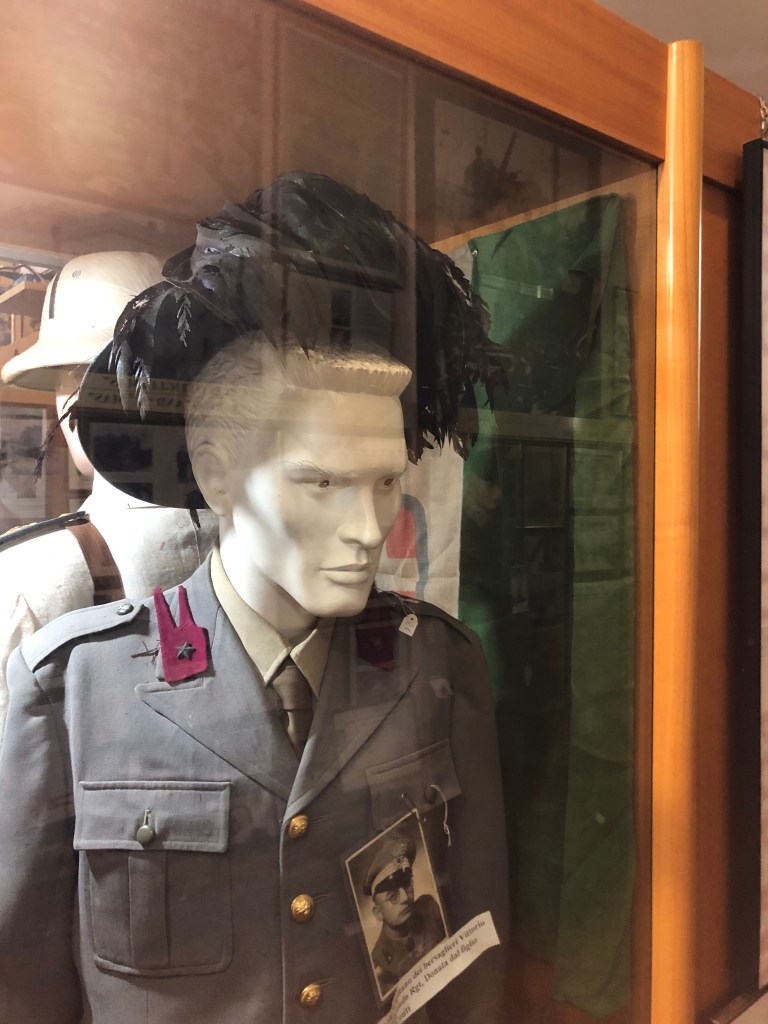
Does the mannequin used to display this soldier’s uniform look a little, uh, feminine (compared to the photo of the soldier)?
And what’s up with this soldier’s headgear?

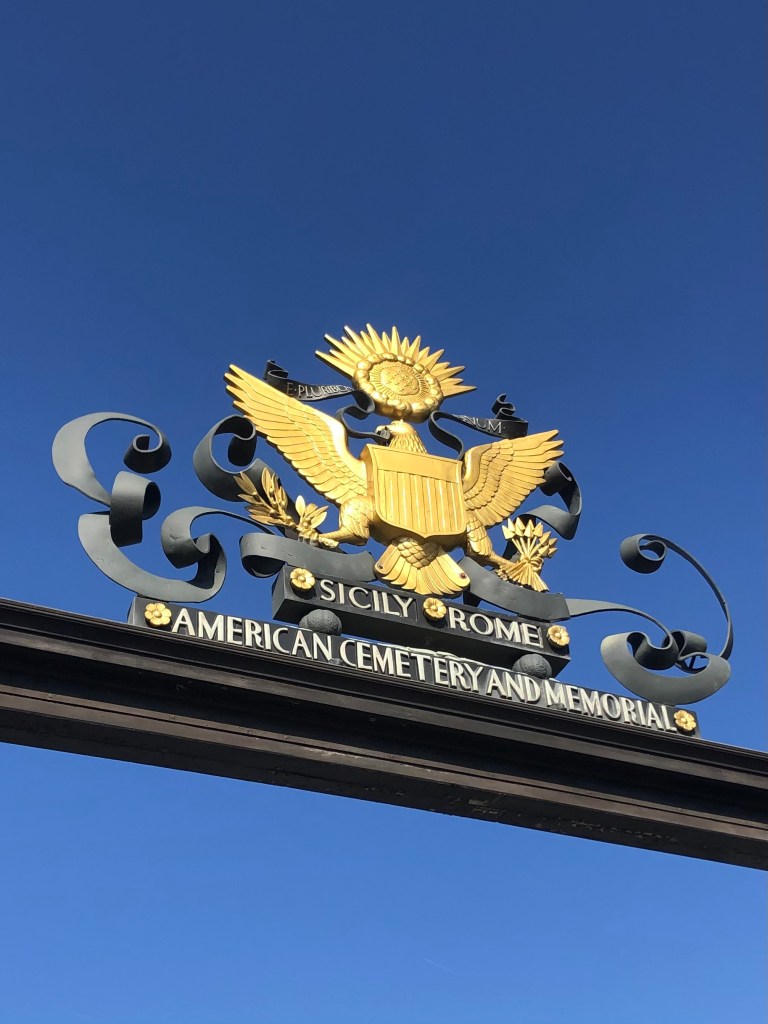
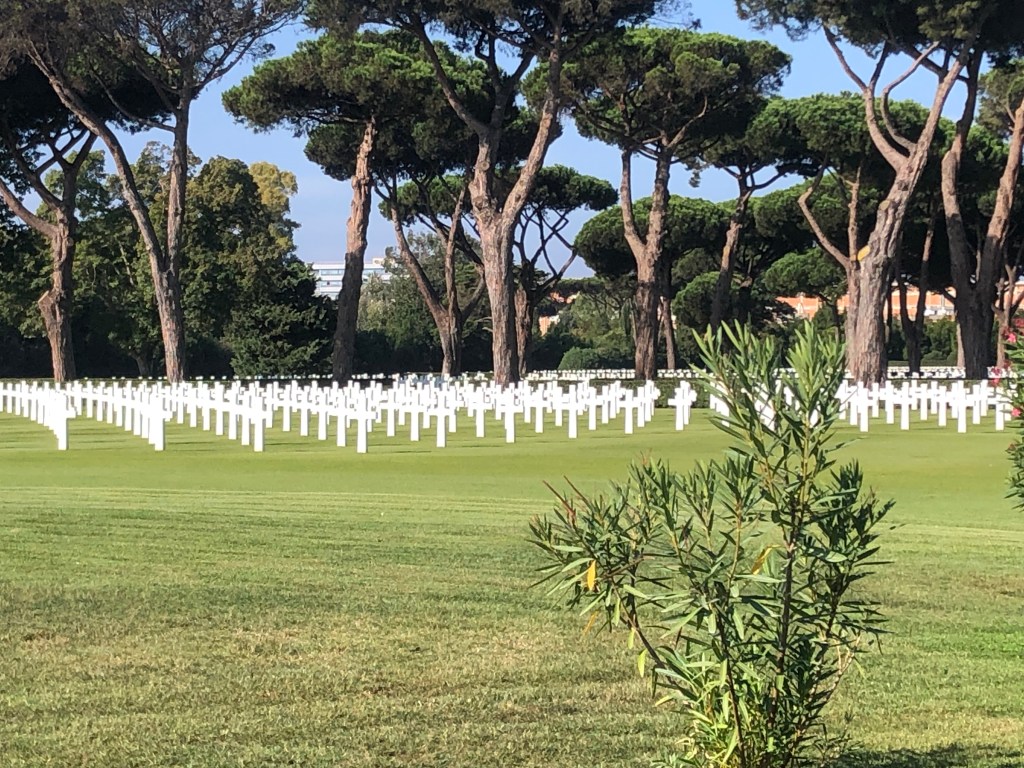
Anzio also hosts an American cemetery with the remains of over 7,800 American war dead.

A small portion of a very large sacrifice.

For me, the best part of Anzio was the Villa Romano B&B. It’s a spacious and comfortable home off the beaten track. It’s also the family homestead of brothers Alessandro and Francesco, whose family has deep roots in the town. They were the perfect hosts, and shared good tips for visiting the area. Francesco tells me they’re planning to open an American-style barbecue restaurant and plant a vineyard on the property. If you ever find yourself in central Italy, you must visit.

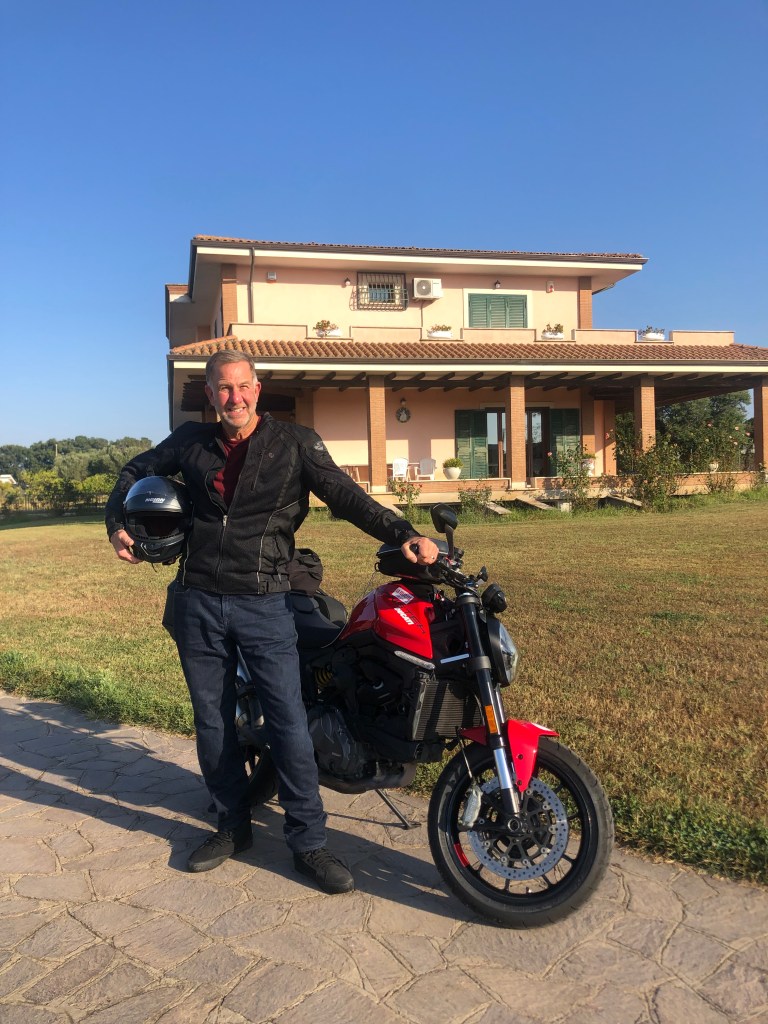
Hanging with Alessandro.

Anyway, I promised not to try to replicate the much-better Italian travelogues that are readily available online. So I’ll say “Arrivederci.” I’ll be back Monday with the next installment of A Dying Wish.