
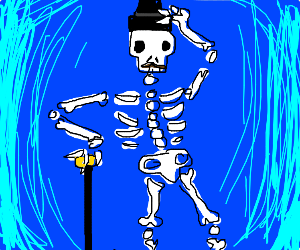
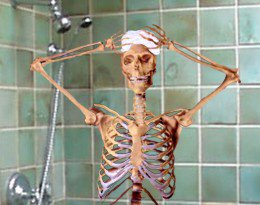
Immediately after the first shoe appeared at the top of the stair, an identical shoe and trouser leg immediately joined it. Then the hideously narrow waist (wrapped in a red cummerbund); then the white, rib-corrugated shirt and black coat; and finally the crowning symbol of Death–the skull. The entire spectacle glided down the stairs with such grace and dignity that I almost forgot that it was a creature from the grave, but surely my guests would not overlook this fact.
This well-dressed assemblage of bleached bones made its way to the punch bowl. “How do you do?” asked the skeleton of the silent, shocked, staring crowd. “I am ze famous Dr. Ludwig Glauben.” It held up a glass and made a toast “to science.” As it raised the glass to its teeth, the liquid spilled through the jaw and splashed over the front of the white shirt and onto the floor.
I turned my gaze from this absurdity to the faces of my guests, which, not surprisingly, had assumed a collective look of shock. I anticipated that this would momentarily change to horror but, to my puzzlement, the visage of old Dr. Hart broke into a broad smile. “Ho ho ho ho!” he bellowed, with both hands resting on his ample belly. “Very good! Very good indeed!” he roared between guffaws. “Mr. Fenwick,” he continued, turning to me with an amused expression, “You have certainly taken us all quite by surprise.”
By now the other guests had recovered from their initial shock and, not knowing how to respond, began to follow the lead of the merry Dr. Hart. Here was Mrs. Grunwald, tittering with her pudgy hand over her mouth. And there was Dr. Webster, whose jowls vibrated fiercely as he laughed at the late Prof. Glauben’s articulated bones. Even the awkward Dr. Borée, after glancing at the response of his fellow guests, broke into a nervous giggle. But my relief was truly complete when I noticed that my female companion had joined in the mirth of the others.
Dr. Hart’s laughter, like most things, began to die, and with it faded the laughter of the rest of the crowd. This was followed by some prefatory throat-clearing by Dr. Triste, who, notably, had not joined in the crowd’s mirth. “Mr. Fenwick,” he said finally, “I have a good idea of what has occurred, and I ask that you now verify or dismiss my conclusions.” Eager to have someone else explain my way out of the situation, I nodded for the doctor to continue.
Dr. Triste looked at the tuxedoed skeleton standing in a puddle of punch, and then back to me. “I suppose I should first explain that I, too, have done a great deal of research on the subject of longevity and even immortality. I have had my small triumphs, but”–here he glanced again at Prof. Glauben–”I have certainly not experienced the results that you have apparently achieved.”
I sensed that the crowd was just beginning to realize that the skeleton before them was actually alive, but the calm demeanor of Dr. Trieste kept them sedated.
“Mr. Fenwick, I expect that you now plan to explain to us the course of your experiments. I also anticipate that you will rhapsodize about the potential benefit for mankind.” Dr. Triste’s features became sharper and his voice took on an aggrieved tone. “Well, I’d request that you spare us your self-praise and pompous claims. The world does not need them any more than it needs living skeletons.” Prof. Glauben here coughed. “Further,” continued Dr. Triste, glancing about the room, “None of these people could possibly comprehend the full meaning of your discovery. I am not certain, Mr. Fenwick, that even you fully grasp the potential consequences. Imagine immortal armies! Think of the eternal reign of kings! Consider the overcrowding of a world where no one dies!
“But, more importantly, what of the individual? What is life–even eternal life–without a goal? Has anyone given thought to the consequences of not being able to see Heaven? He who achieves immortality denies himself the reward of the promised land; he damns himself to an earthbound existence for all time. But no one considers such things until it is too late.” He swallowed, and then repeated, barely audibly: “Too late.”
There prevailed a prolonged silence, which was broken finally by Prof. Glauben. “Ja, vhat you say is true, Herr Doktor. I am not happy, though I’ve been granted my great wish–to live forever. Oh, to be mortal again! If I had a second chance, I vouldn’t be caught dead drinking an immortality potion. Like so many sings, one does not sink of ze consequences until afterwards.”
Prof. Glauben’s words affected Dr. Triste more powerfully than I would have expected. The latter’s indignant and angry countenance shifted to one of deep reflection and sympathy, even pity. On the verge of tears, Dr. Triste lunged toward me, extending a clenched hand directly at me. I dodged what I thought to be an attempted blow to my head, but which proved to be an effort to grab the vial of my immortality potion, which sat on a small table behind me. He clutched the flask, held it aloft, and then hurled it against the wall, sending bits of glass all over the parquet floor. He then bolted for the door, leaving us all standing speechless.
All, that is, except Prof. Glauben. I could tell by his bleached face that he knew what was happening–at least, more so than I. He mumbled something about “that poor devil” and, after glancing at me with his dark, empty eyes, he, too, departed into the frigid night air.
PART 13 WILL APPEAR ON MONDAY




 Chasing Phantoms