bridges · Cars · Puns · Road trips · Yard art

O Say Can You See?

The short answer is: Not very well.

The longer answer is this: Son Ian recommended I take advantage of my proximity to Baltimore (pop: 570,000) and check out the remains of the Francis Scott Key bridge, which collapsed a scant 3 weeks ago. It’s the kind of light-hearted whimsy we Boilards are known for.

The FSK Bridge opened in 1977, and it carried over 11 million vehicles annually until a container ship struck one of its piers last month. Much of the span is now underwater, posing a hazard to ships.

“My bad!”

This week the Army Corps of Engineers is supposed to be removing much of that wreckage. It should make for a cool photo op! And according to Google Maps, I was only about an hour and a half from the foot of the bridge.
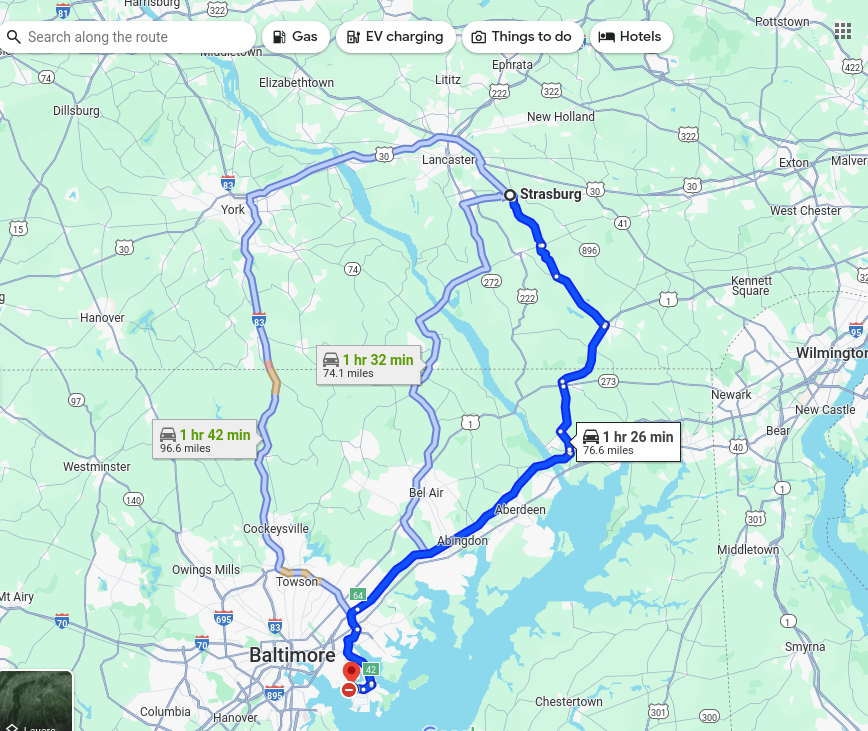
How hard could it be?

So after getting a cup of coffee and a Power Muffin from The Speckled Hen in Strasburg, I set out for the greater Baltimore area.

Getting there was easy enough–until the last couple of miles, when I encountered a police roadblock. They weren’t going to let me get anywhere close to the foot of the bridge. I’m not sure what I was expecting. I guess I envisioned a big, Roadrunner-style “Bridge Out” sign on sawhorses a dozen yards from the shore of Boston Harbor.

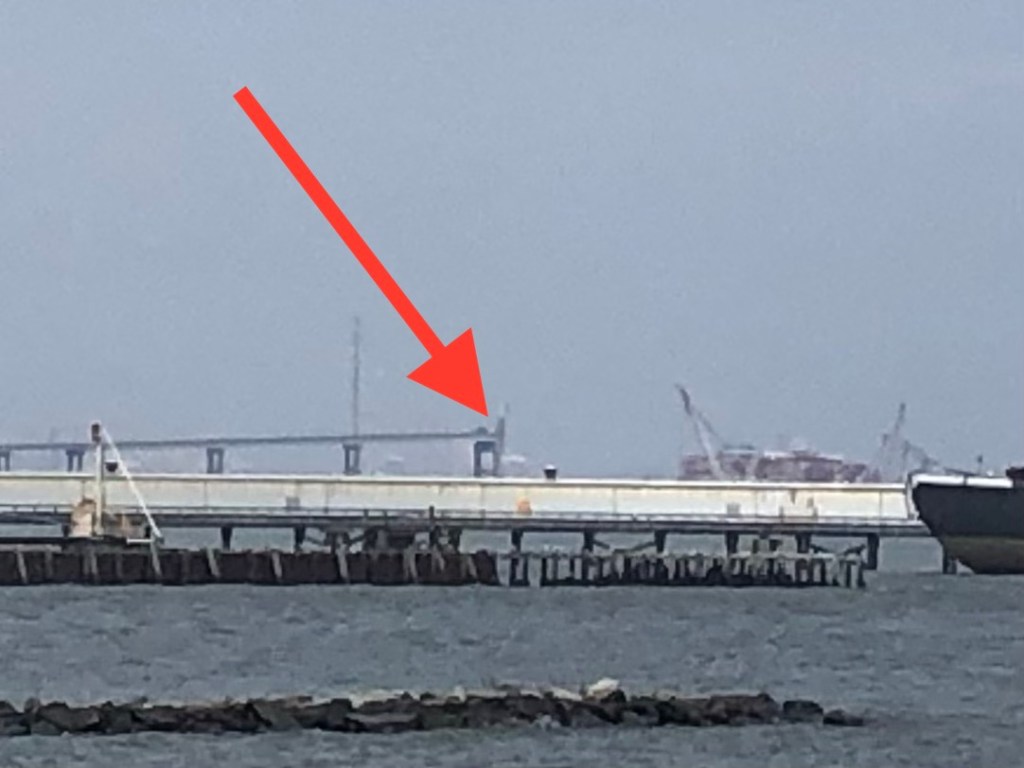
No matter. There’s more than one way to skin a cat. I consulted Google and found a nearby spot that should afford a good view of the salvage operation. Alas, all the property in the area seemed to be a naval base or some other official facility that prohibits visitors. Undeterred, I drove under the harbor through the miraculous Baltimore Harbor Tunnel, and approached the Key bridge from the southern end. More roadblocks. Finally, I headed further south to a private beach community, where through a combination of illegal parking and trespassing I was able to get a decent view of the Francis Scott Key bridge in the distance.
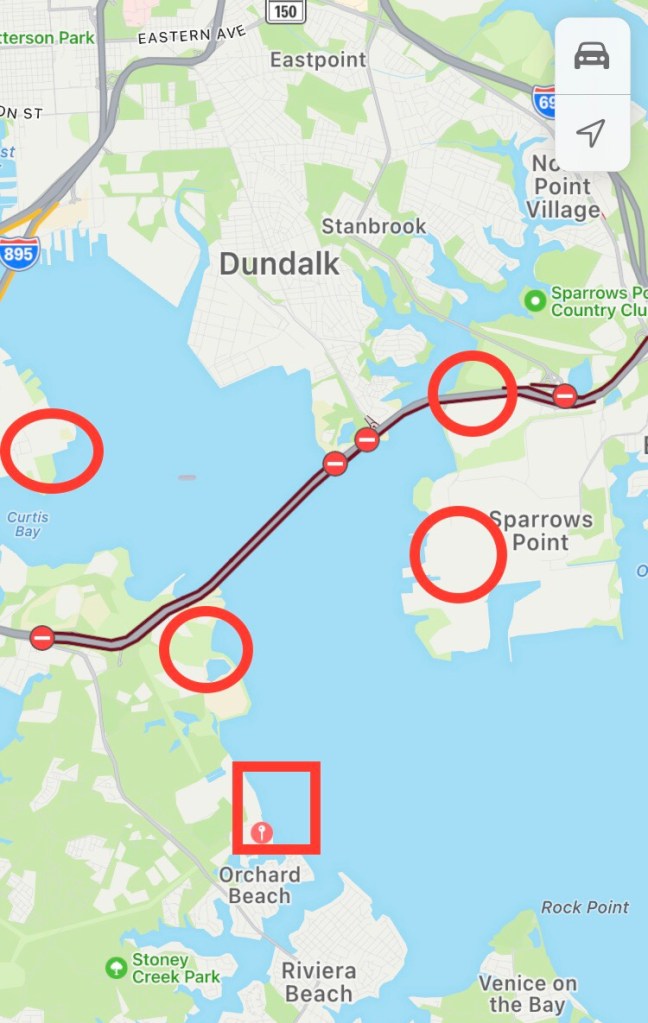
Circles represent my failed attempts to see the bridge; the square is where I finally succeeded.
FSK Bridge in the background, terminating at the head of the arrow.

So, now with that pointless project out of the way, I began a leisurely drive in the direction of Philadelphia.

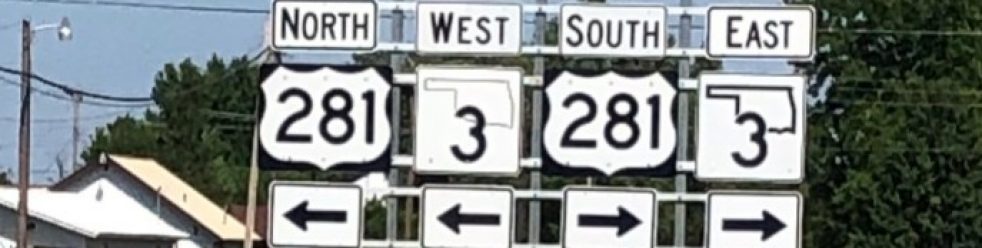
The drive through the Maryland countryside was pleasant and picturesque. The road carved its way through hills dense with trees and other flora. My only complaint is that some of the signage was a bit hard to comprehend at a glance.
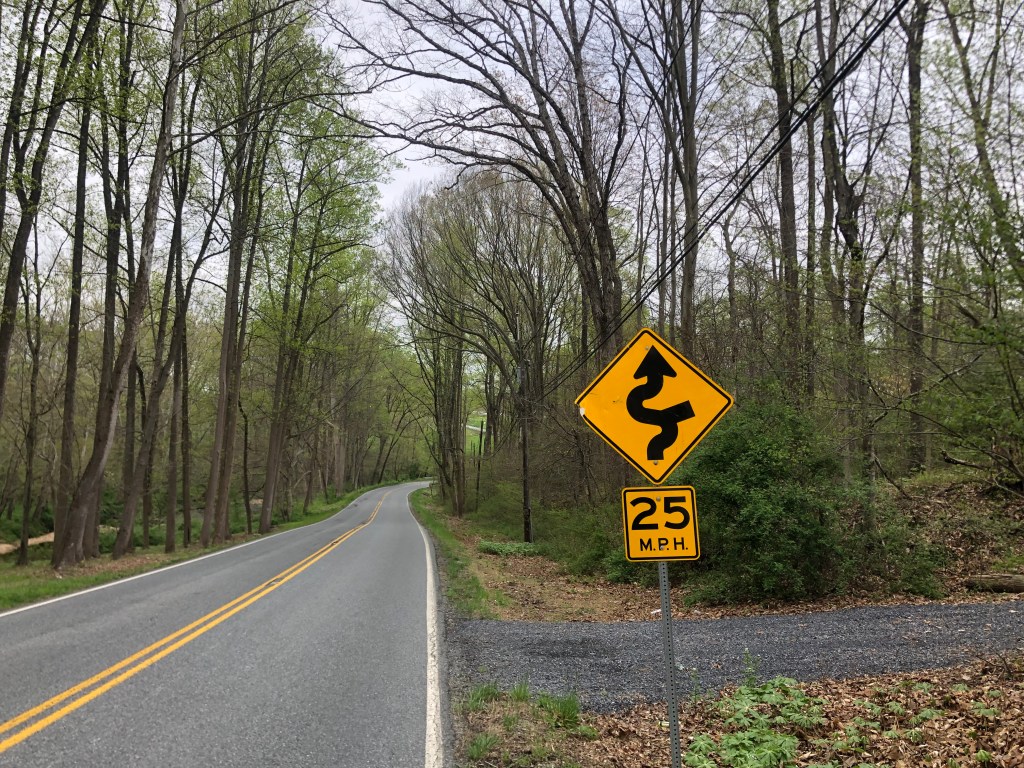
Signs like these remind me of the nighttime driving scene in Pee Wee’s Big Adventure. It appears in the following clip, which is only 45 seconds. Note that the guy who uploaded the clip wants to point out you can see a pulley system moving the scenery. But we want to watch the clip just for the signs.

I know just how you feel, Pee Wee.

Along the way I passed another bridge that, like the FSK Bridge, no longer carries traffic. The Gilpin’s Falls covered bridge in Maryland’s Cecil County was originally constructed in 1860, and restored in 1959 and again in 2010. And unlike the FSK Bridge, it still sits on the same piers where it was placed in 1860.
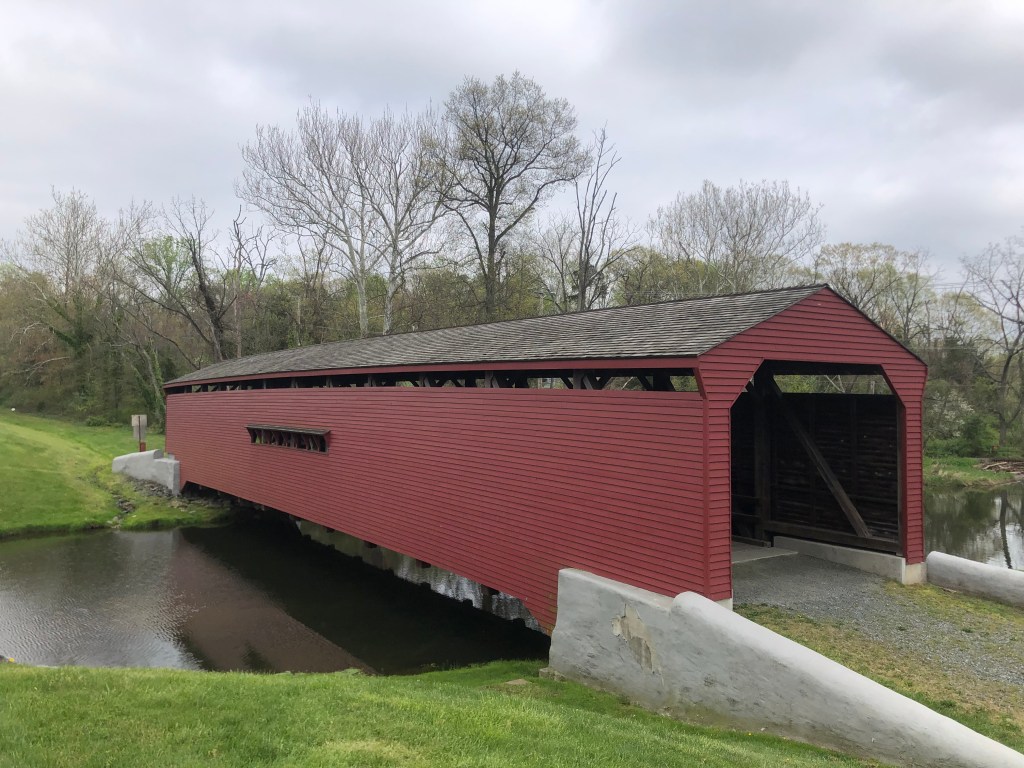
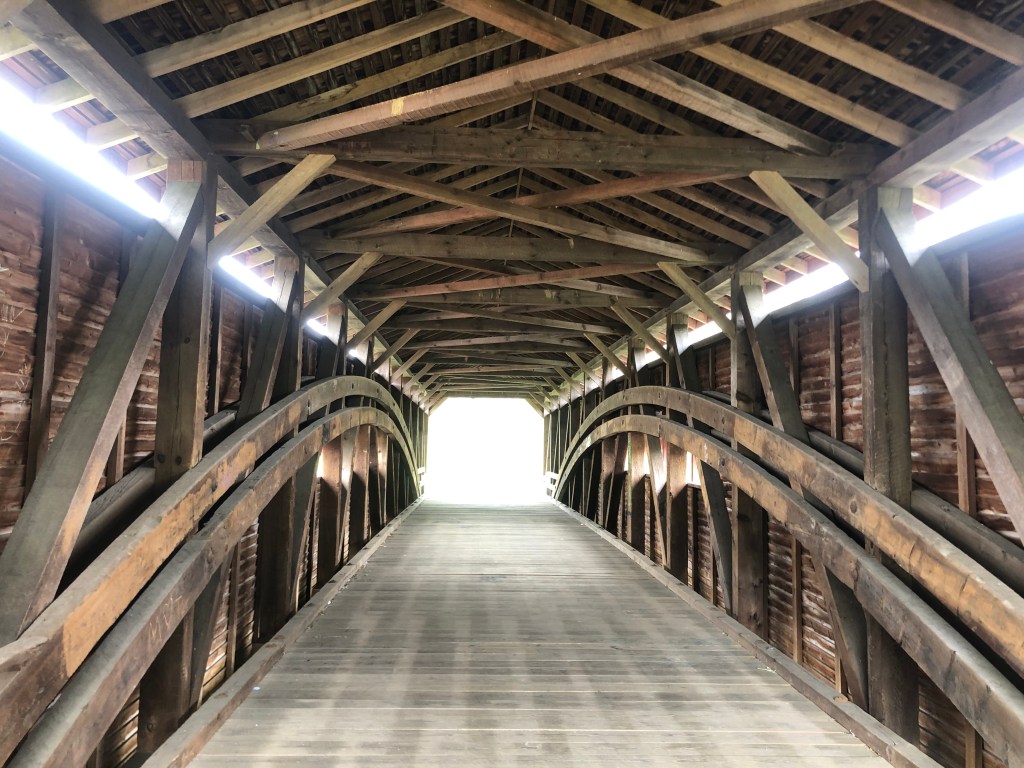
Straight out of The Bridges of Cecil County.
Where form and function come together

The next roadside attraction requires a bit of a setup: You may recall that I’ve been charmed by Tin Man-themed yard art that I’ve spotted on my travels. Here are two recent examples:
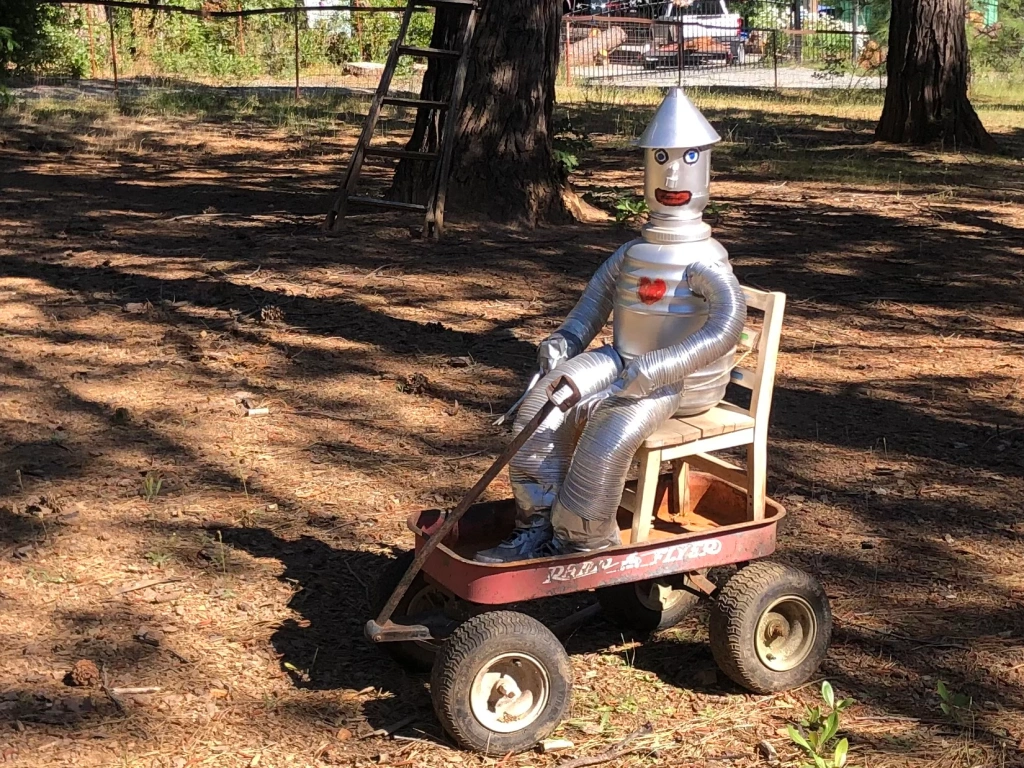
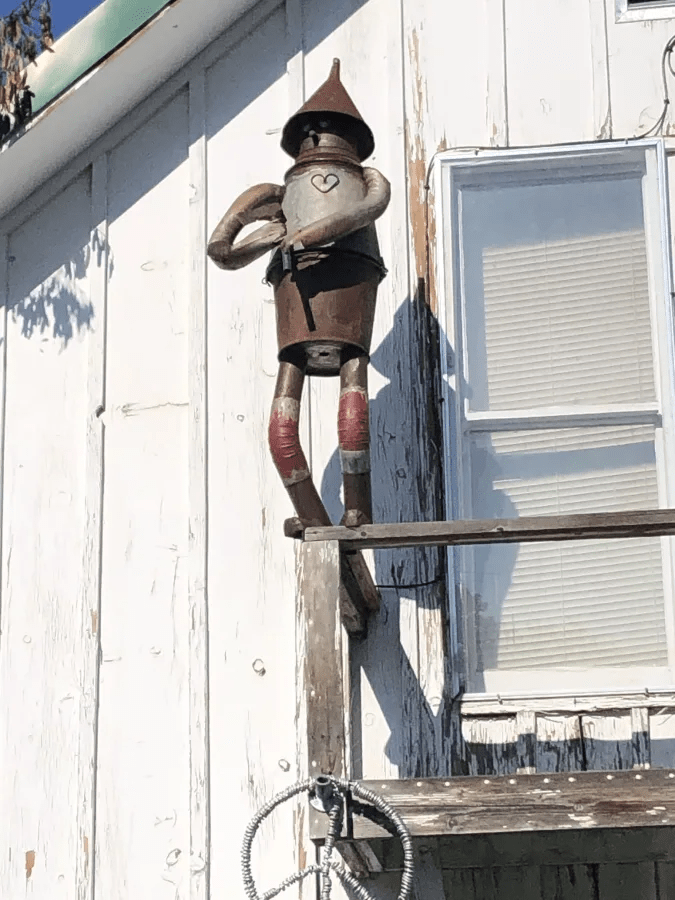
In Georgetown, CA. Blog post here.
In Lakeview, Oregon. Blog post here.

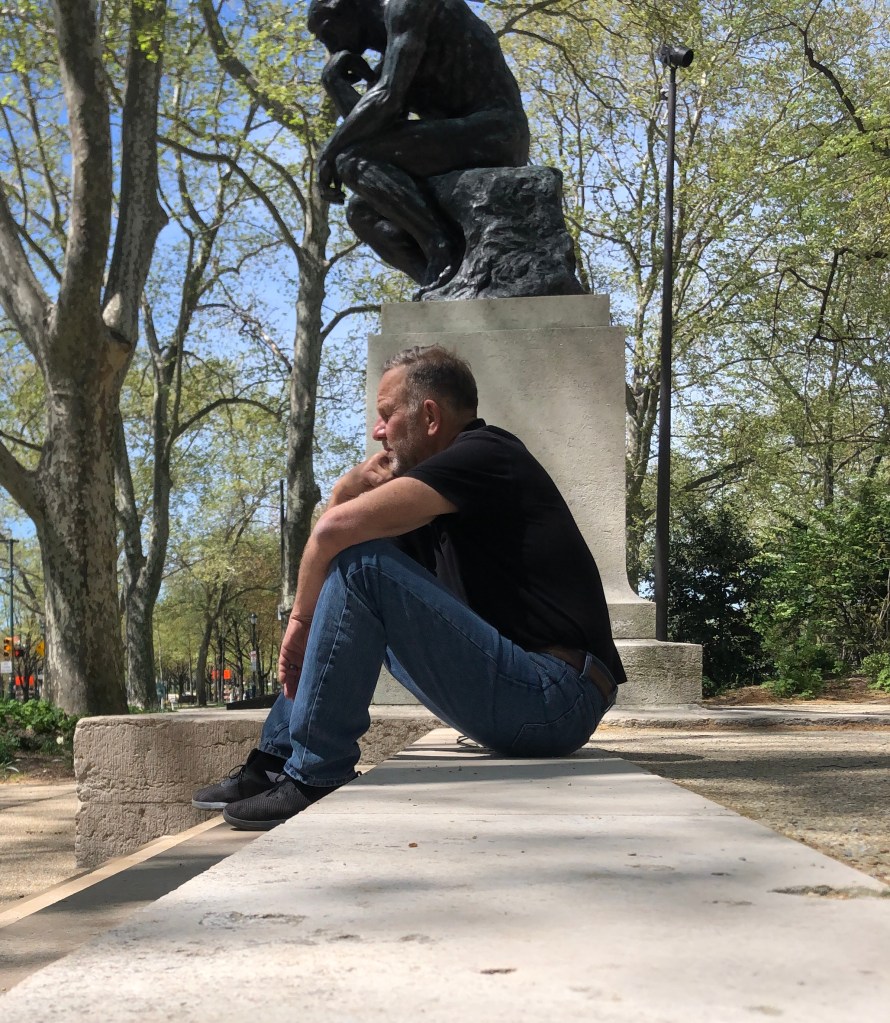
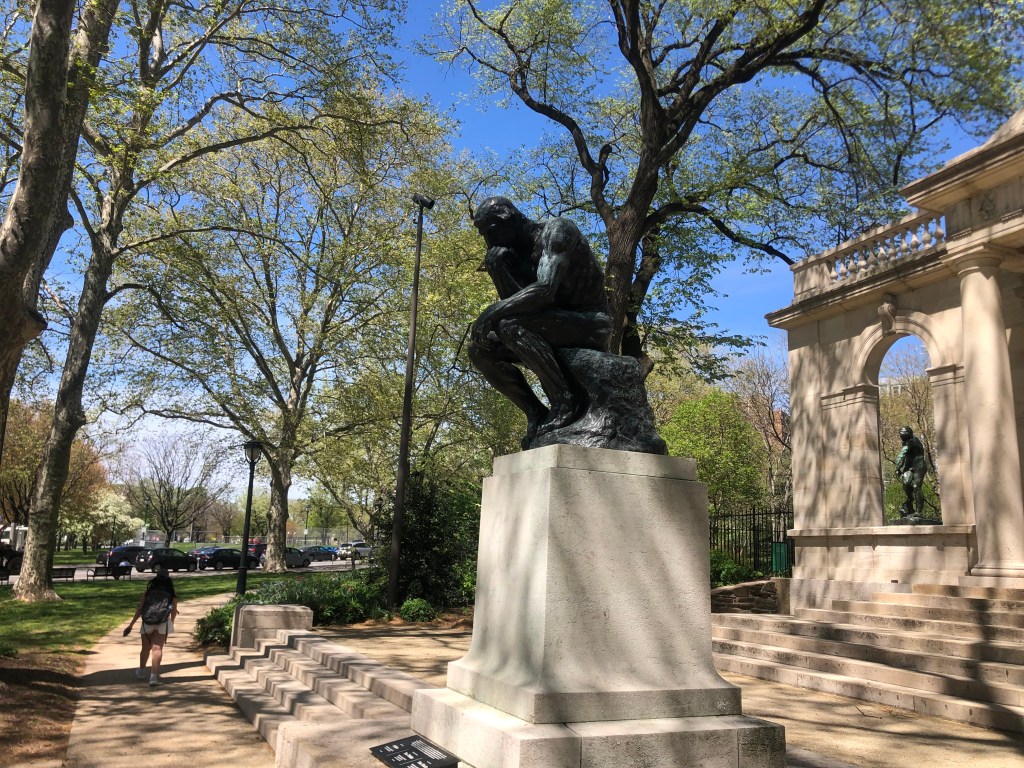
Now, recall my photo of Rodin’s “The Thinker” that I took in Philadelphia:
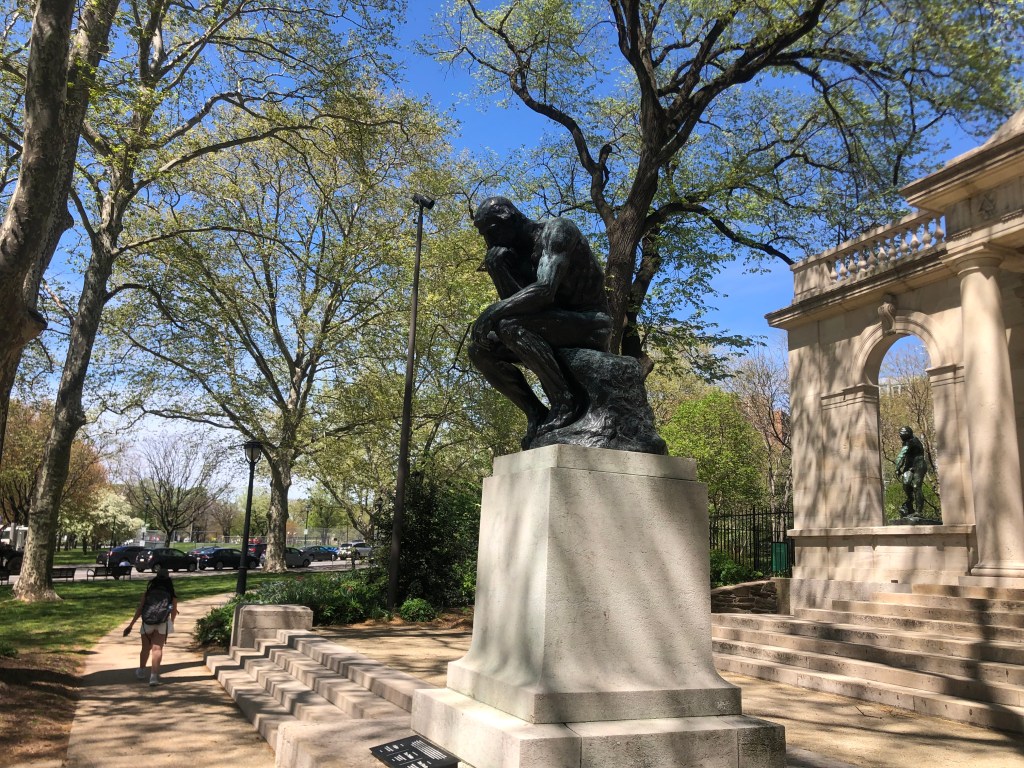
Put them together and what do you get? This sculpture of “The Tinker” (note spelling) that sits in front of a brewery in York, Pennsylvania.
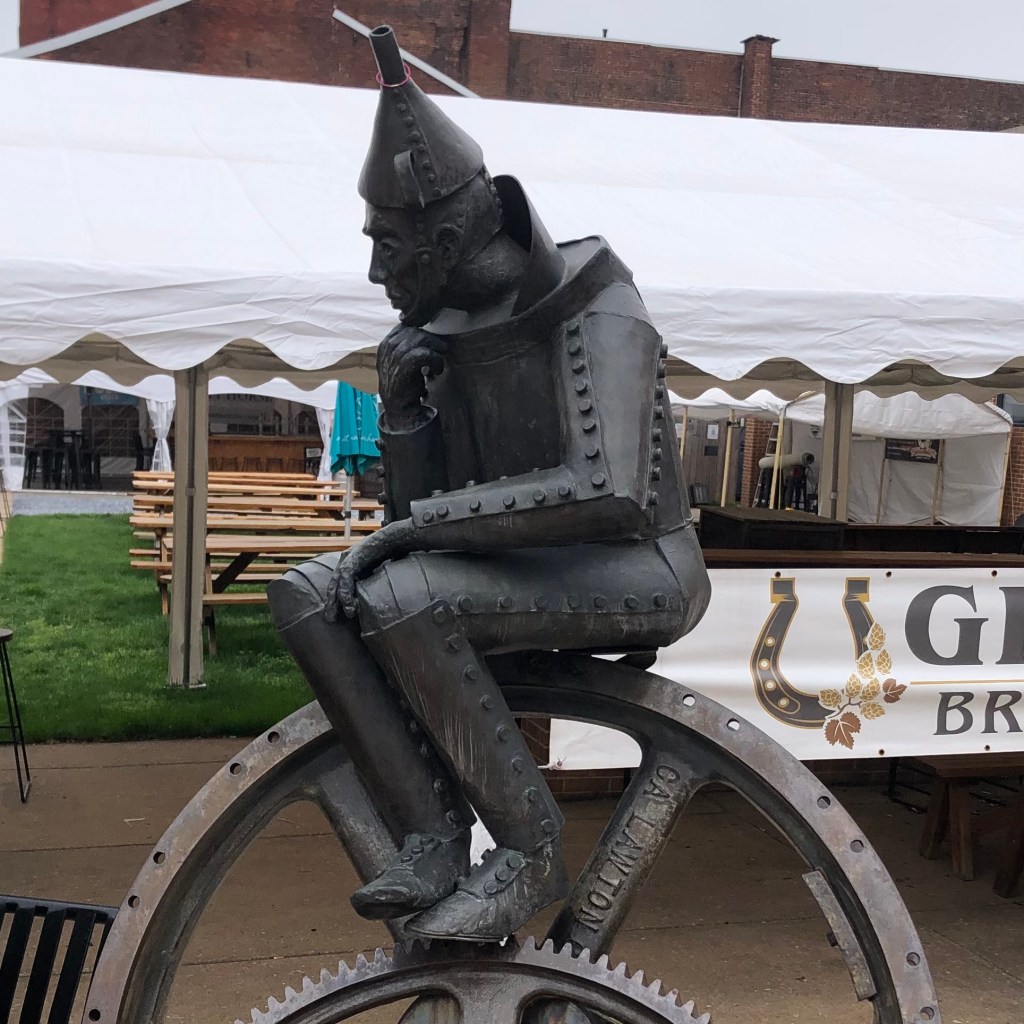
For some reason I think this is brilliant!

The artist claims his sculpture says something about York’s industrial history. I don’t know about that, but I’m simply taken by the whimsy and humanity of the thing. As I’ve said before: This world needs more Tin Men.

I stopped for the night in Wilmington, Delaware–less than an hour from Philly. After my big splurge on the Red Caboose Motel last night I figured I’d bed down in a simple Days Inn. Upon my arrival, I was greeted by this sign whose reference to “”the best” seems like a dubious claim.
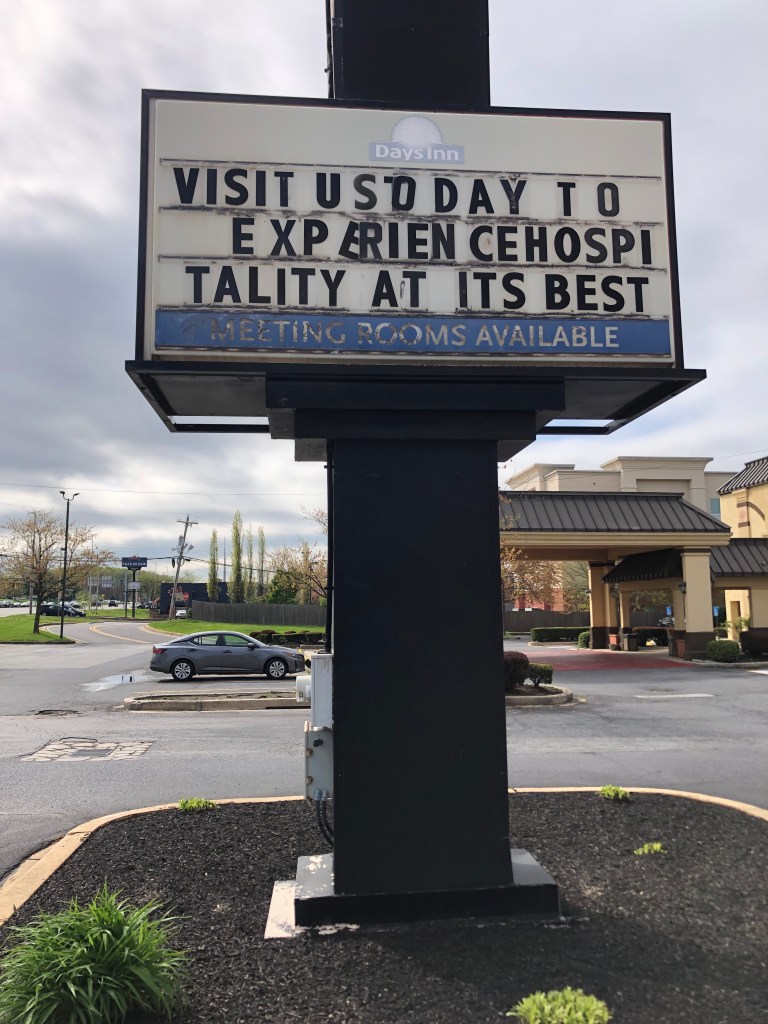
At least they didn’t make the common error of adding an apostrophe to “its.”

Then I got to the office and saw this idling near the front doors:
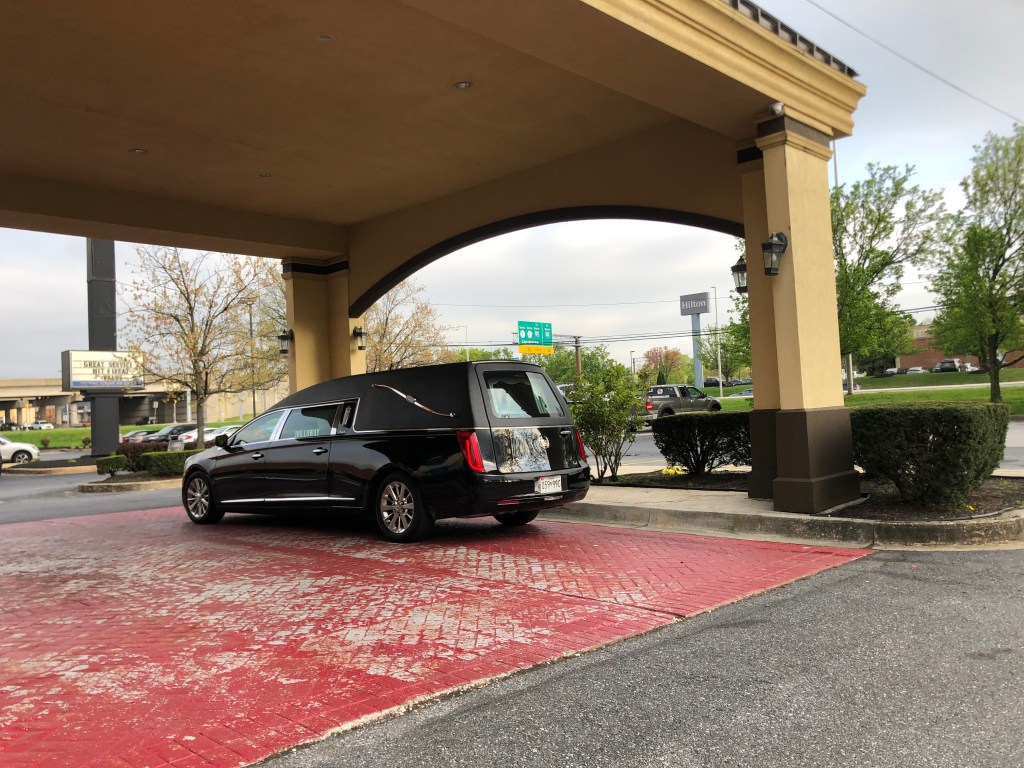
Must be check-out time.

Tomorrow I’ll head back into Philadelphia. God willing.

Mail Corner

Loyal reader Brian W sent along this photo he took of a Lincoln Highway sign he spotted near Route 30 in Tama, Iowa. It dates from 1915, which is just two years after the Lincoln Highway was established.
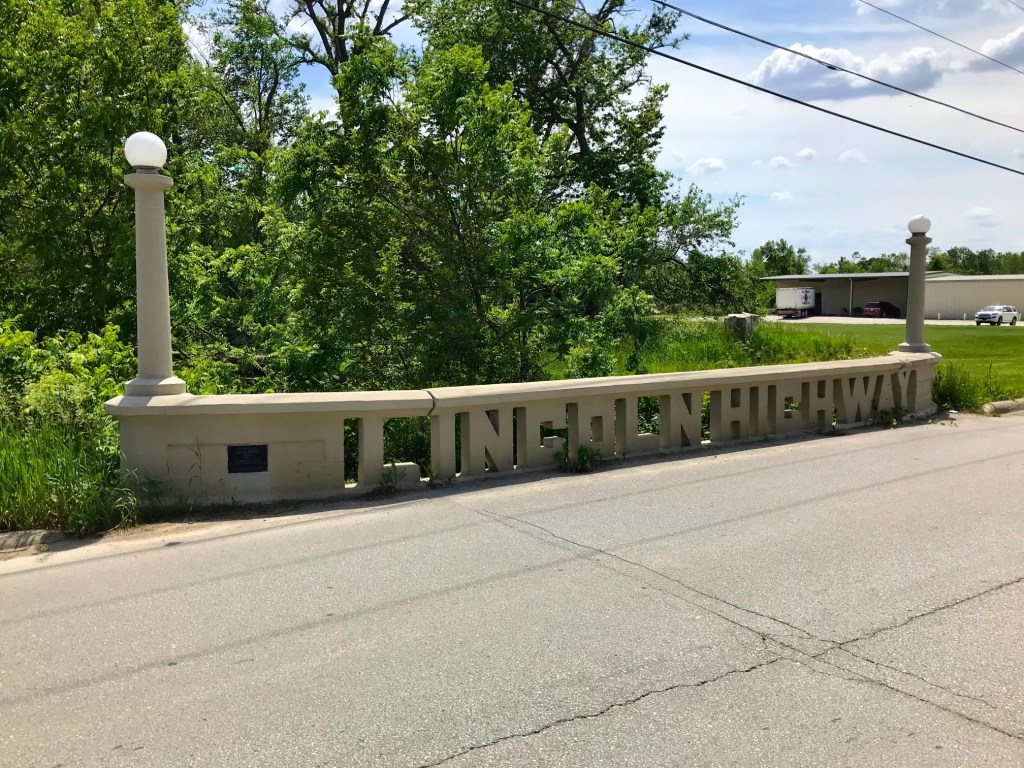
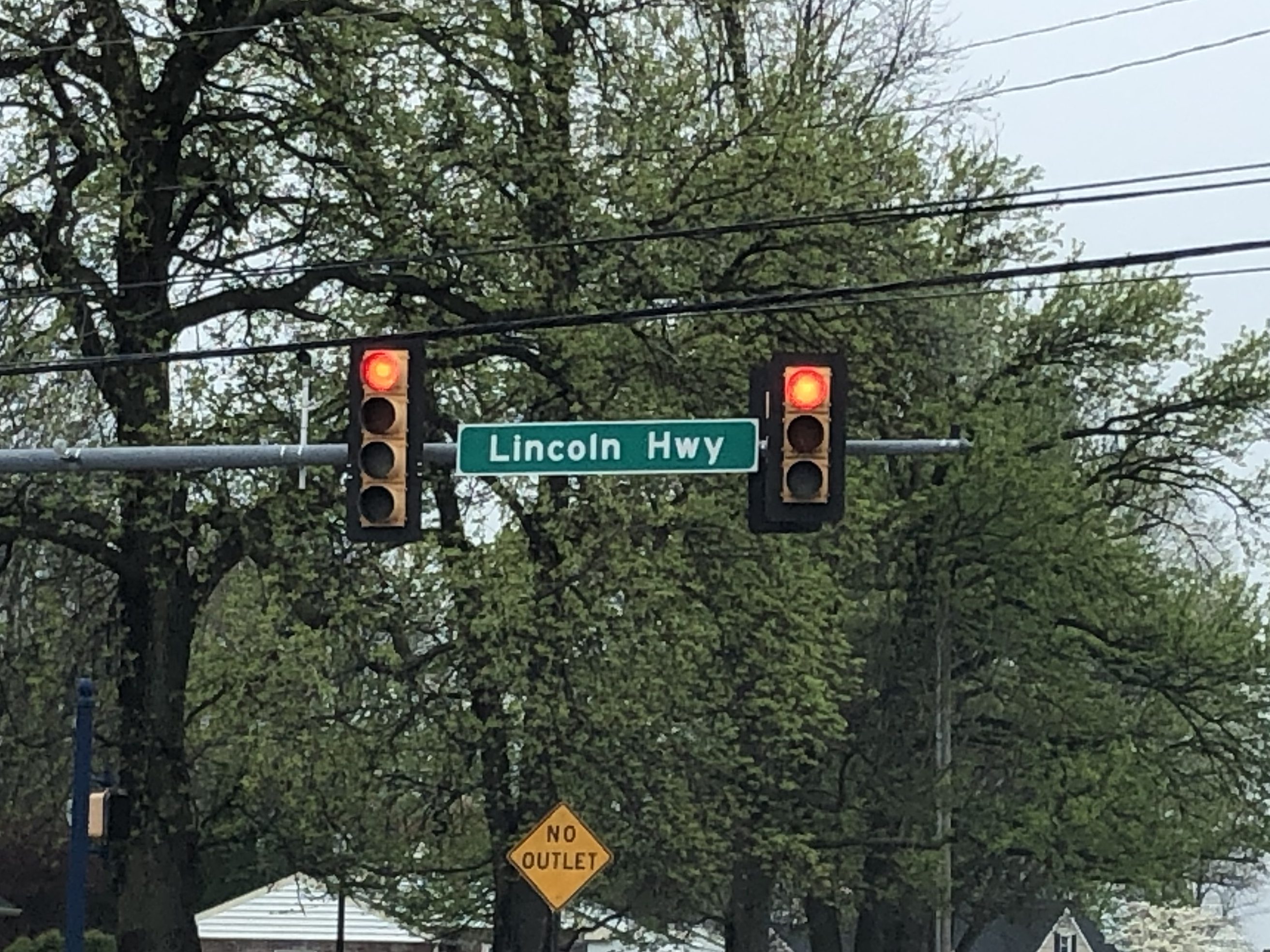
It’s a far cry from the boring, utilitarian signage I encountered today in Strasburg.
Brew of the Day

I got today’s BOTD at Valhalla Brewing Company in Elkton, Maryland. It’s an out-of-the-way roadhouse with an empty parking lot and an nearly-empty bar. The bartender spent most of his time leaning on the bar and staring at his phone. But to be fair, it was 2 in the afternoon on a Thursday.
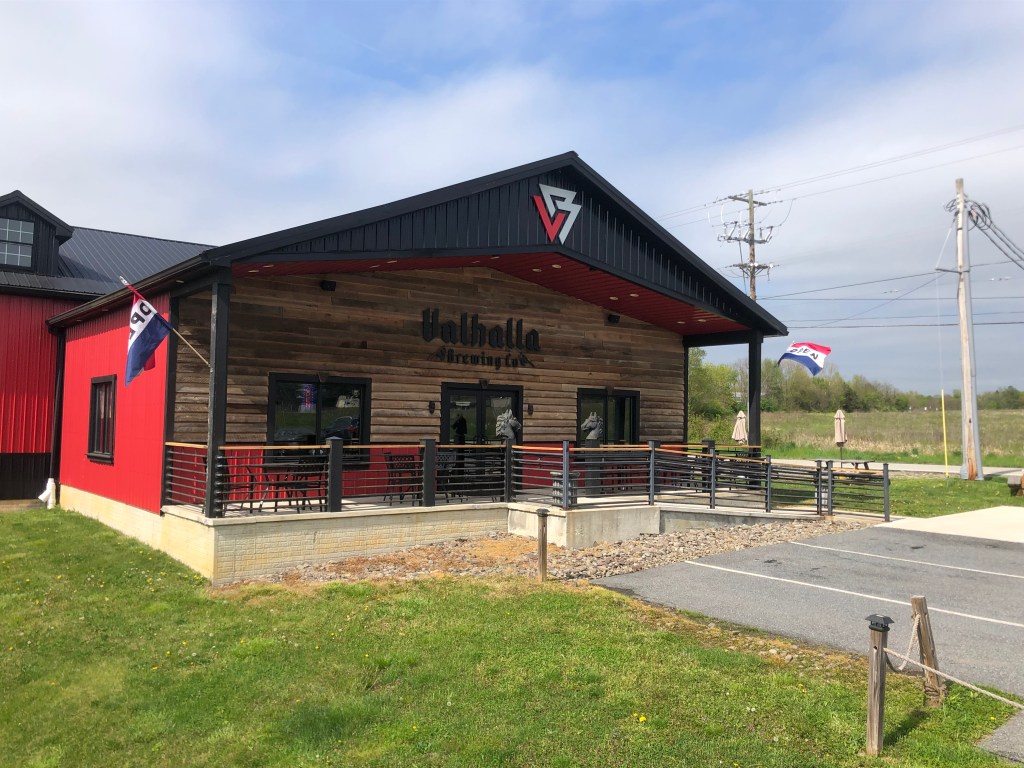
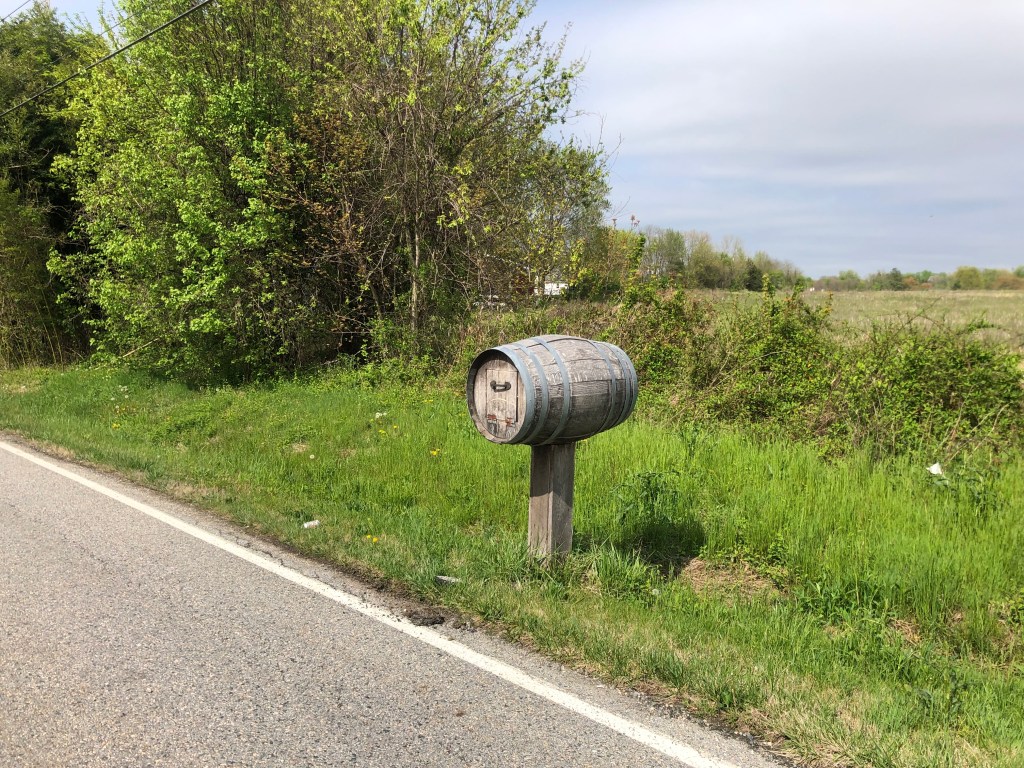
Middle of nowhere. Which I guess is where you’d expect to find Valhalla.
Cool mailbox, though.

I chose the Zombie Ice Double IPA. It turns out it’s a guest brew, made by 3 Floyds Brewing Co, in Munster, Indiana. Behold the golden-copper color:
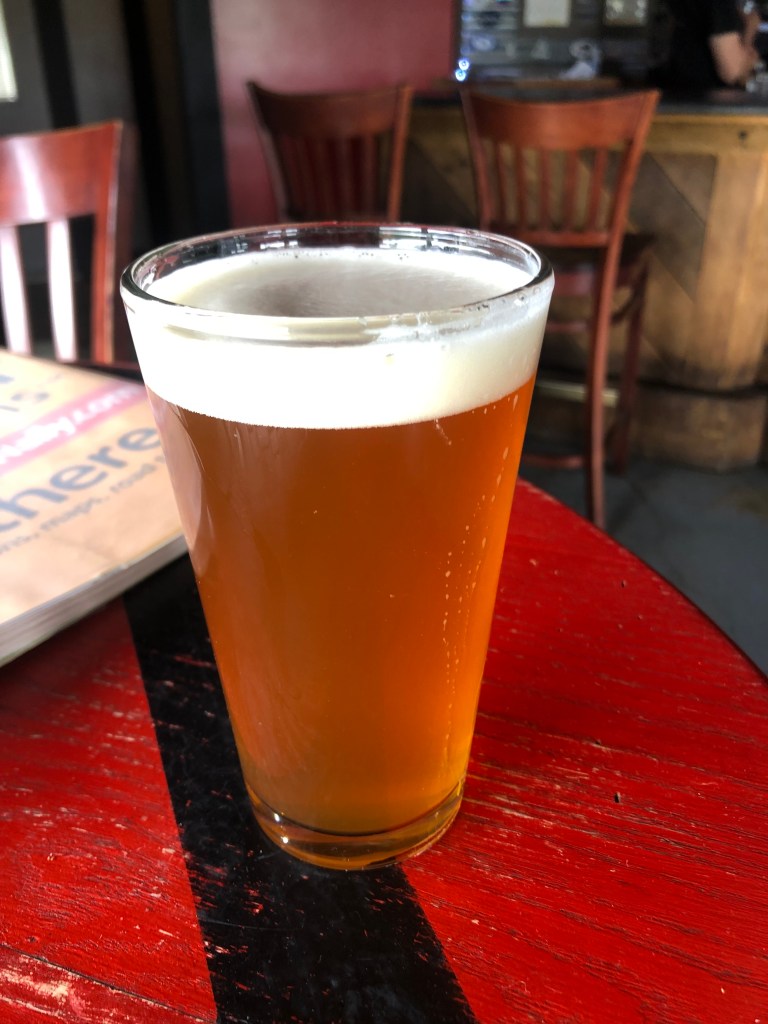
The first sip suggested that this is just a basic IPA. But with subsequent sips it became more interesting. The usual citrus and hops are omnipresent, but as you move through it you detect orange peel, library paste, and shoe polish. You might not think that sounds especially tasty, but somehow it works. There’s a total lack of pretentiousness about this beer (except for its name, of course). It’s solid, genuine, and hardworking. I give it a solid 4 out of 5 stars.

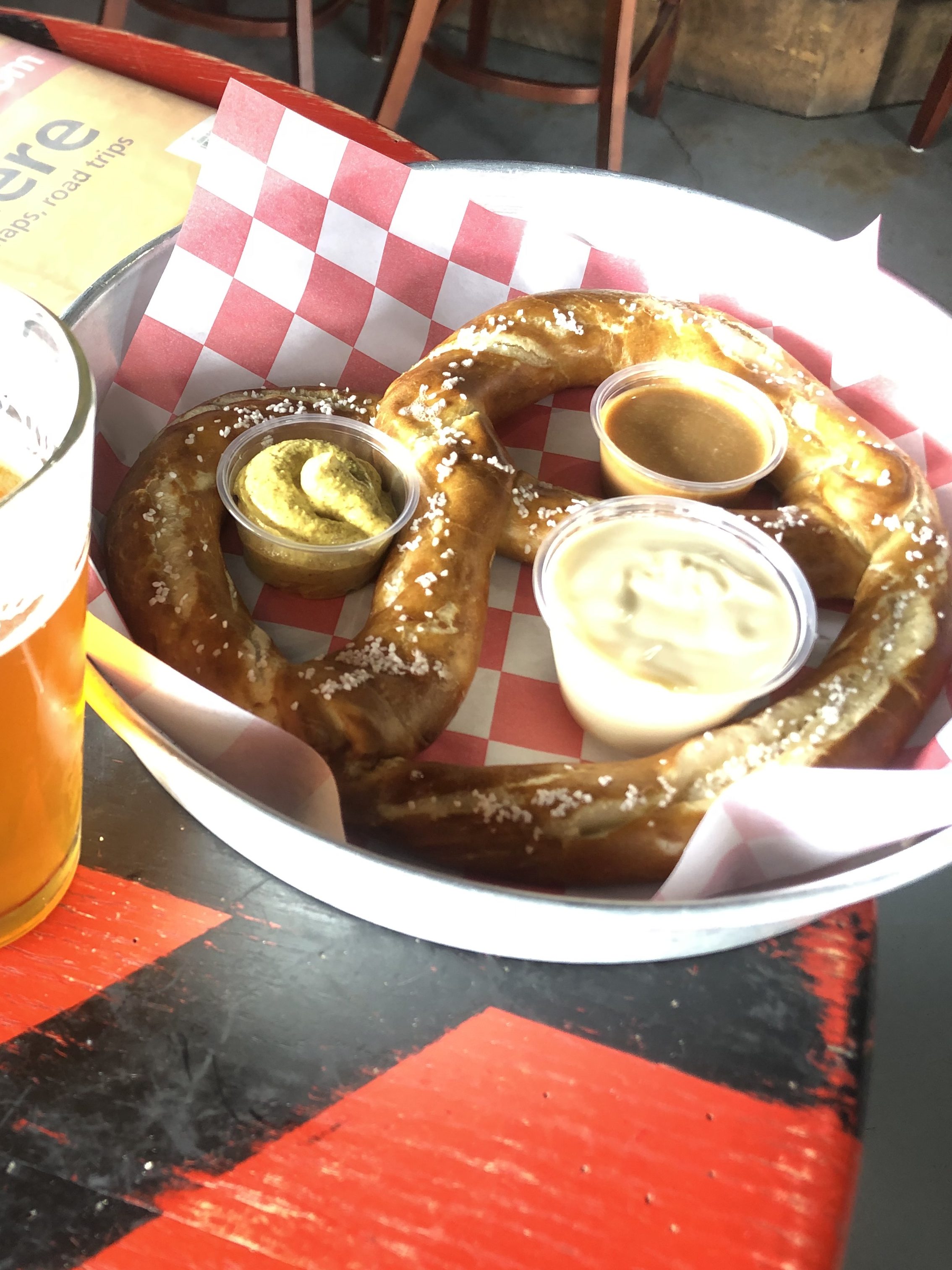
In the interests of full disclosure, I should note that I paired this IPA with Valhalla’s “Big Ass Pretzel,” which is served with mustard, beer cheese, and a maple-caramel sauce that is to die for. So consider that it might just be the pretzel talking. In fact, the Pretzel gave the beer 5 stars.
bridges · movie theaters · Road trips · trains

Blob Blog

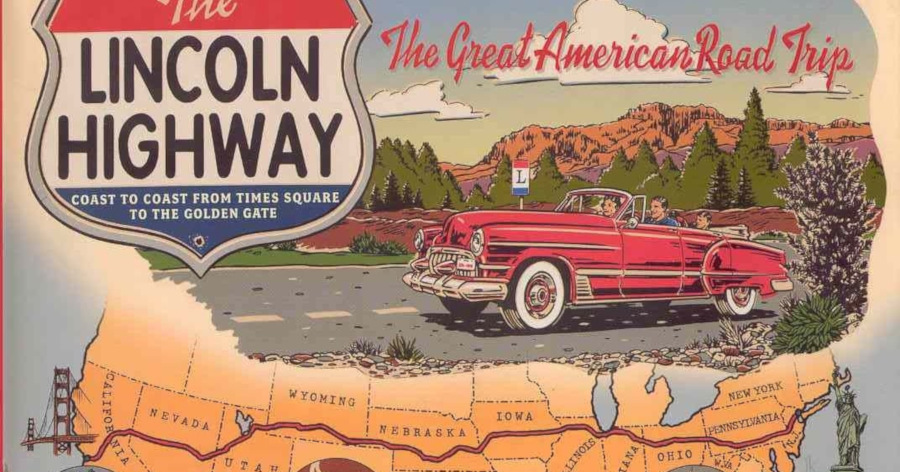
By coincidence, I recently received as gifts two books concerning the Lincoln Highway. The first, which I read last year, is The Lincoln Highway by Amor Towles. It’s a fictional account about a trip along the fabled transcontinental route. The second book, which I’m currently reading, is American Road by Pete Davies. It’s a true account about a caravan of military vehicles which traversed the Lincoln Highway in 1919, in an effort to raise awareness and promote the paving of the route.

Established in 1913, the Lincoln Highway was the country’s first transcontinental route for automobiles. It began as a patchwork of existing stretches of roadway, most of which were just rutted dirt roads. Over time it got re-aligned and paved, with gas stations and diners and motels dotting the roadside. Today, most of the old Lincoln Highway is long gone, superseded by modern interstates.

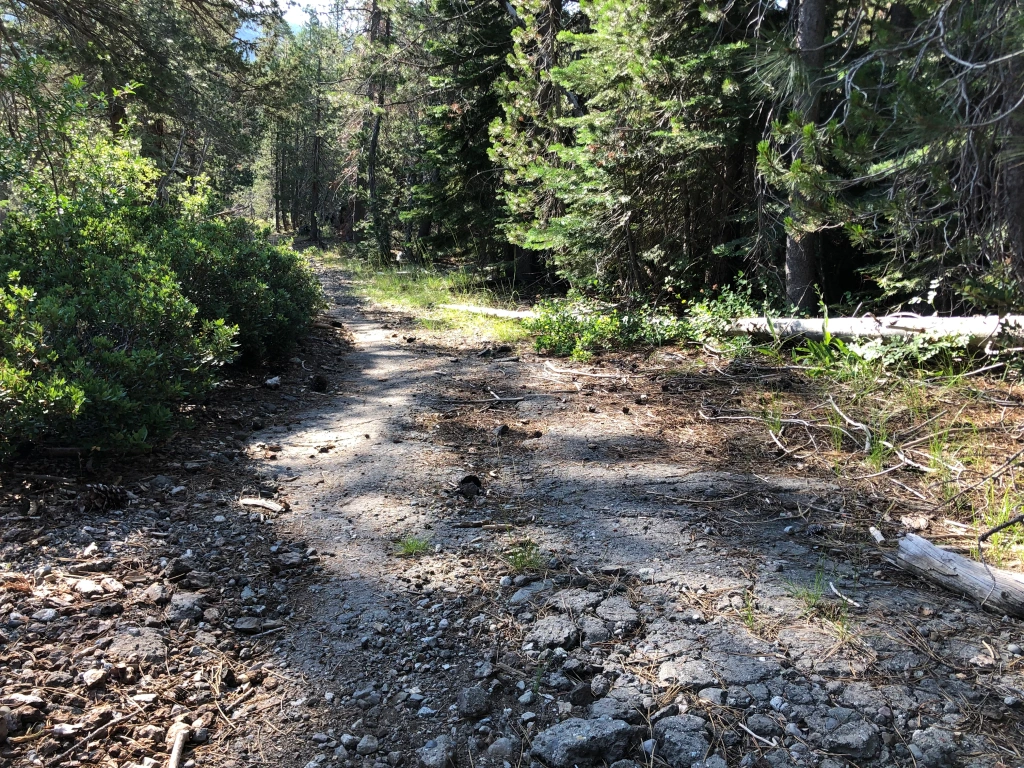
In California, I-80 roughly traverses the old route. There are a few markers and memorials a long the way. (A couple of years ago I hiked a crumbling, original section of the road near Donner Pass. Here’s the blog post and here’s the photo:)

I also discussed the Lincoln Highway and included a photo of an original Lincoln Highway marker in this blog post.

I bring all this up because today I drove around a hundred miles of the old Lincoln Highway route heading west out of Philadelphia. Most of the original route is now U.S. Route 30. I was hoping to see some ancient infrastructure and roadside structures from the Old Days, but most of the route today looks like any other two-lane highway. Yet I did spy a few elements that date back to the early 20th century.

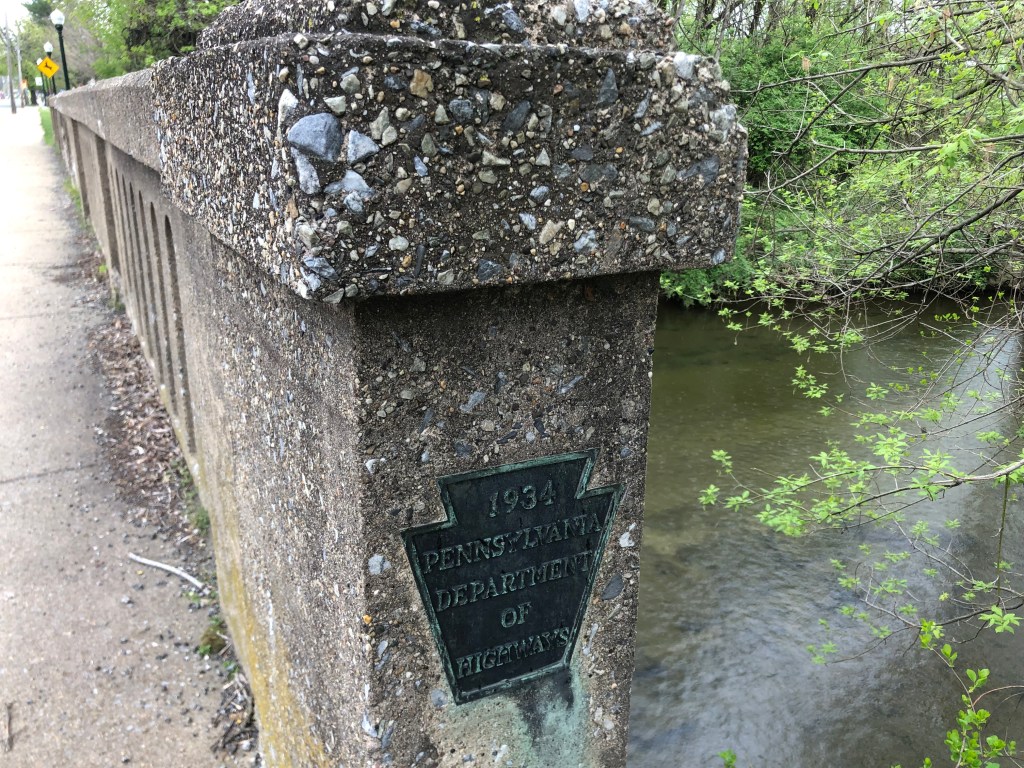
90-year-old bridge marker
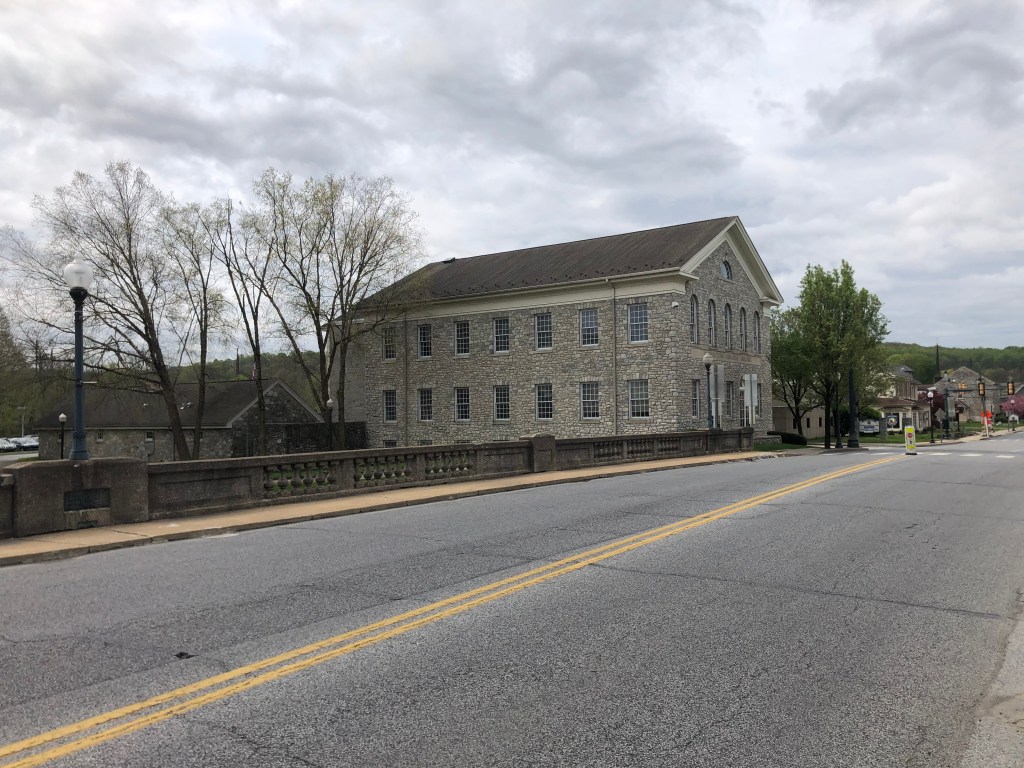
1922 bridge and (presumably) much older building. These were surely around for the Lincoln Highway’s early years.
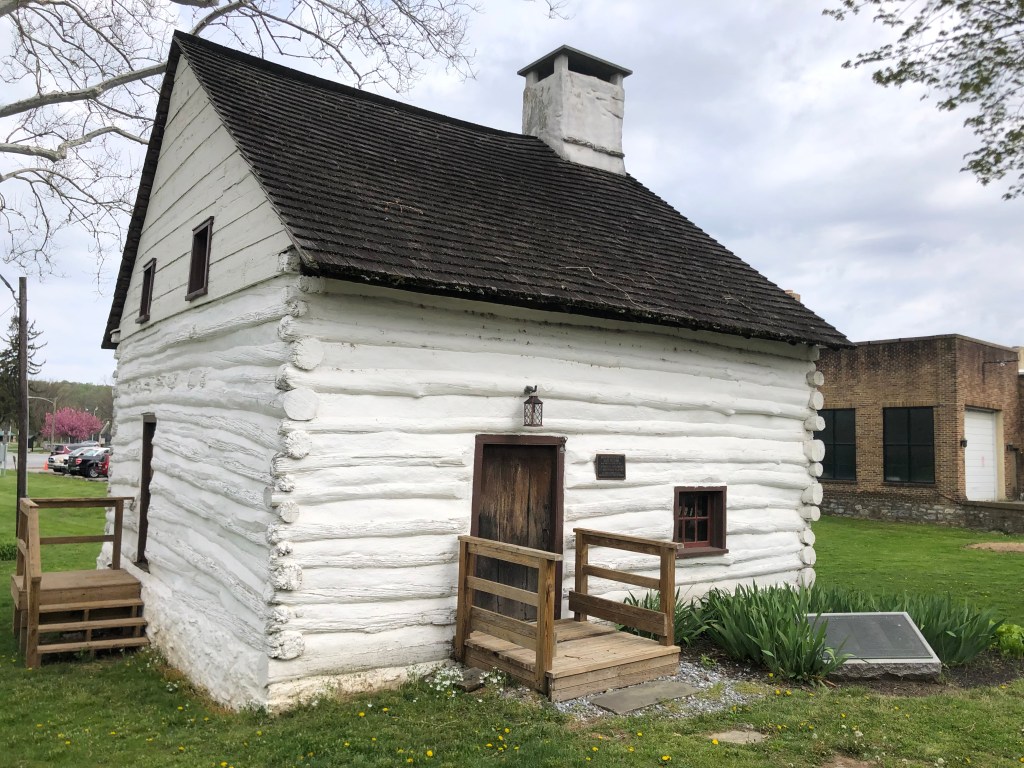
18th-century log house along Route 30.
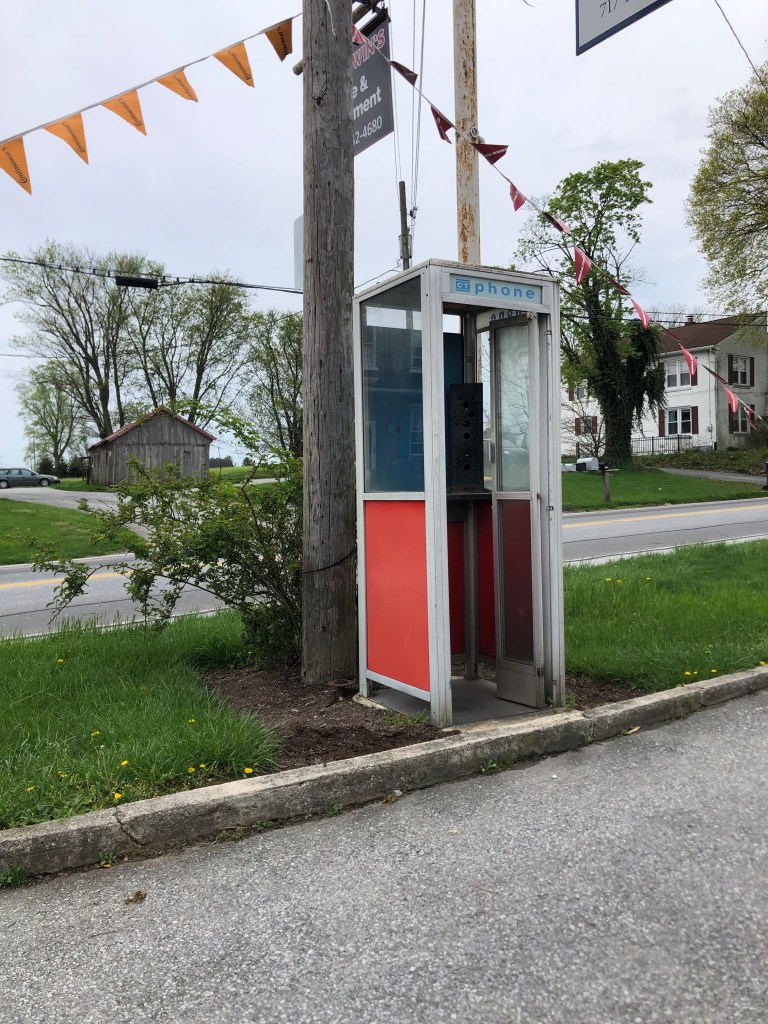
Phone booth in Compass, PA might not have been around for the original Lincoln Highway, but it qualifies as historic.

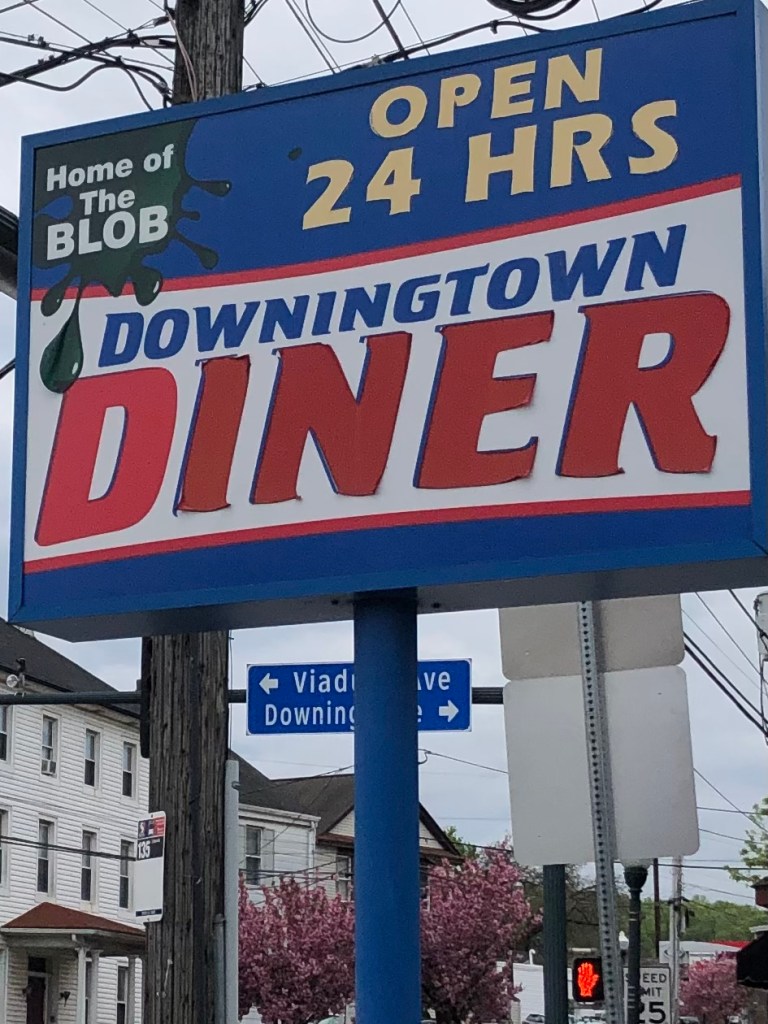
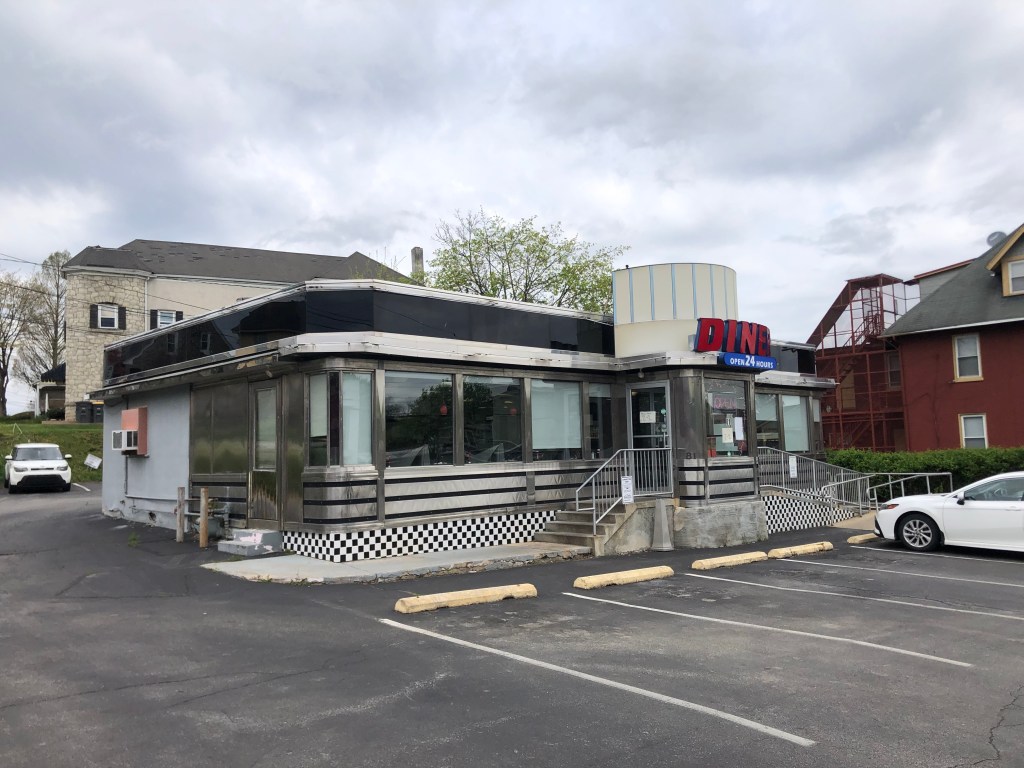
When I eventually arrived in Downingtown (pop: 7,900) I was feeling a bit peckish. I stopped at the mid-century Downingtown Diner, whose sign announces that it’s the “Home of the Blob.”

For the 90 percent of the country that isn’t familiar with the movie, is “home of the blob” a winning slogan for a diner?

You remember The Blob, right? It was a 1958 science fiction film that featured a young Steve McQueen in his first starring role. The plot (such as it is) involves a giant, carnivorous blob of Jell-O from outer space. Do yourself a favor and watch the trailer; there’s even a shot of the diner.

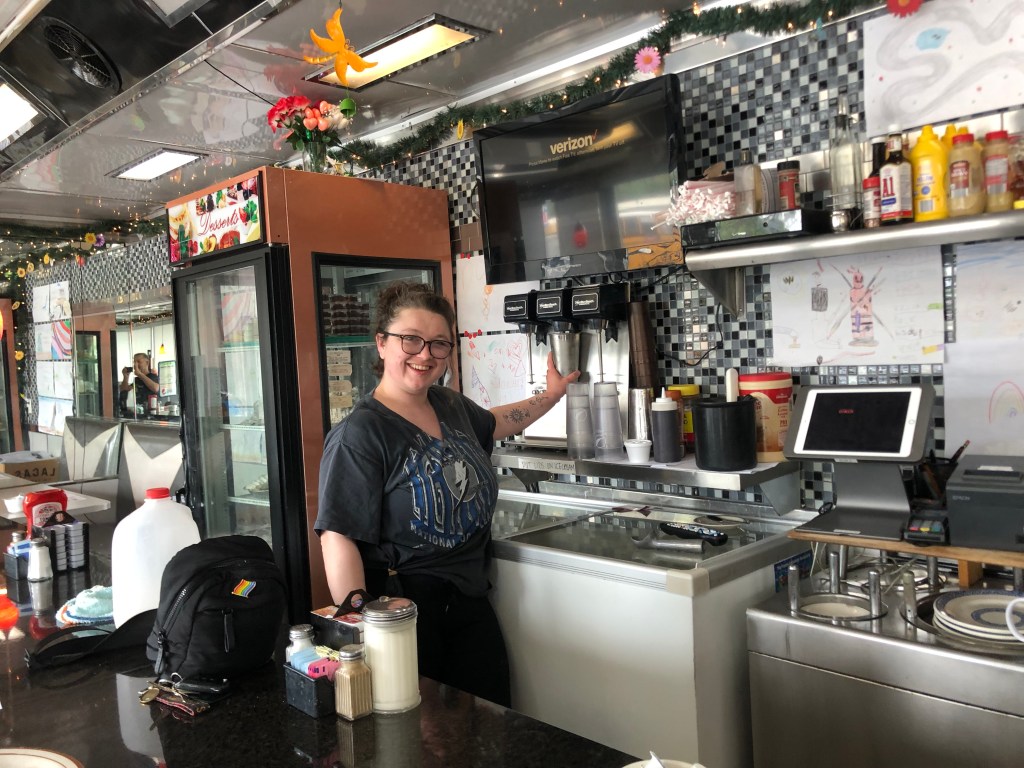
I went into the diner and was greeted by Shannon. I quizzed her about the Blob connection, but surprisingly (shockingly, even) she admitted to never having watched the movie. She did inform me, however, that the diner building was replaced since the movie was made. (“But the basement is original!”)

Though not the original, it does look a lot like the diner in the movie.

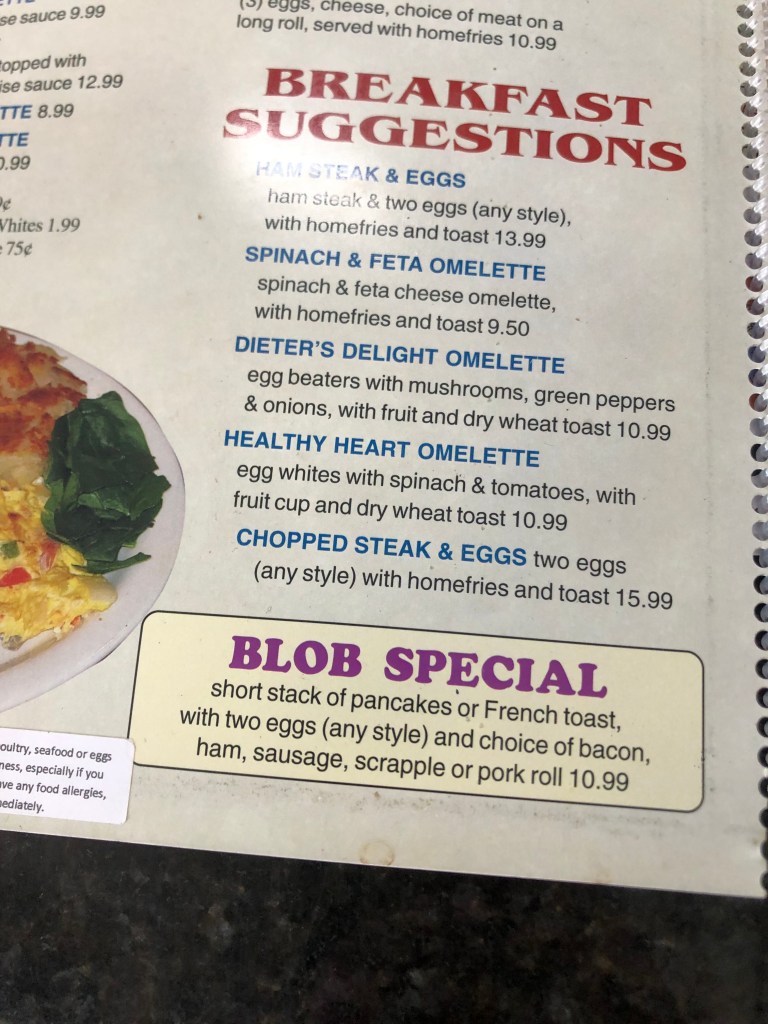
The Downington Diner doesn’t shrink from it’s B-movie connection. Not only is The Blob featured on their roadside sign, but the menu features a “Blob Special.”

I couldn’t bring myself to order the Blob Special.

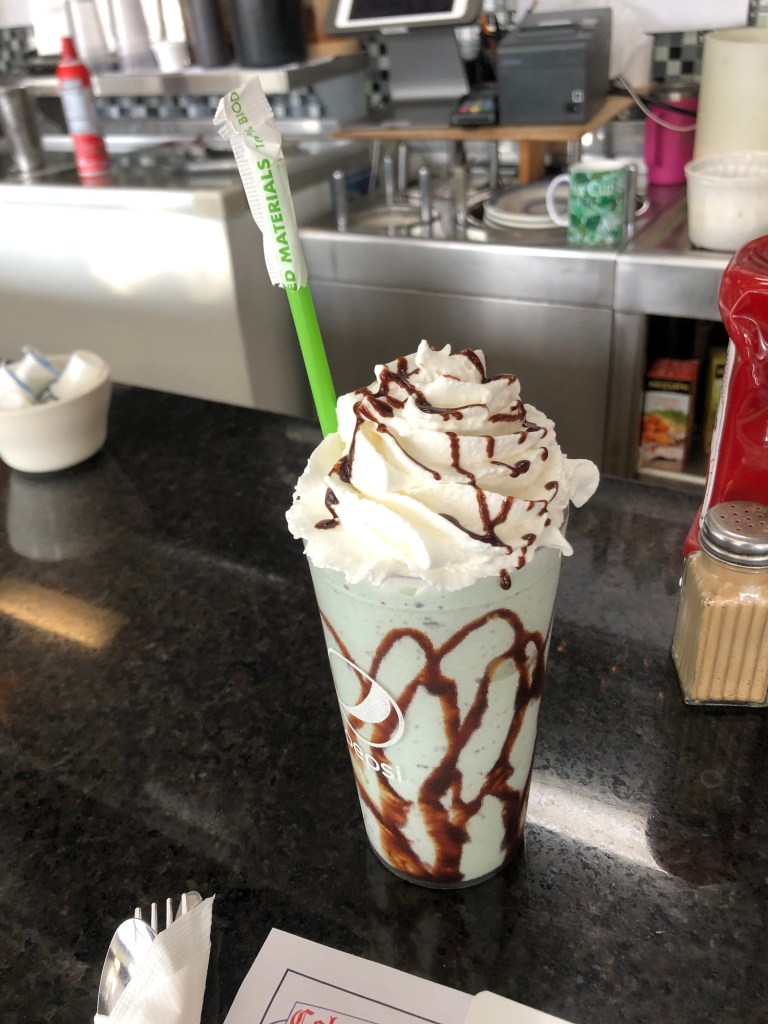
Shannon, who was as friendly and helpful as they come, instead whipped me up a delicious mint chip milkshake. (“It’s green, like the Blob!”) Which is true, if you go by the green blob on their sign. But it should be noted that the Blob in the movie is red.

Shannon making a Blob-Shake.
Seriously the best milkshake I’ve ever had.

Now that I was fortified with 1,700 calories of blended ice cream, there was only one thing to do: Head over to the nearby town of Phoenixville (pop: 20,000), where the Blob’s famous Movie Theater Scene was filmed. (You saw it in the trailer, above.) Phoenixville was founded in 1849, and for years the local economy was centered on the Phoenix Iron Works. The company closed in the 1980s, and Phoenixville suffered a economic decline. But in recent years the city has been transformed, and today it appears charming and downright prosperous.

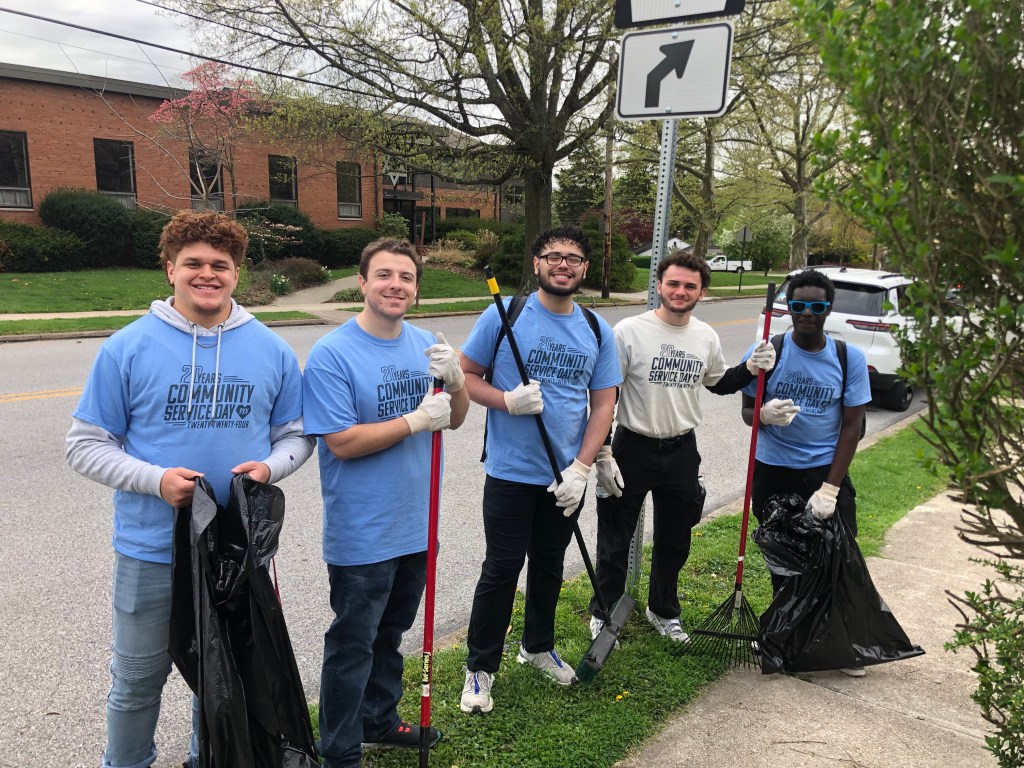
I sensed a good deal of civic pride in the spotless business district and beautiful homes. I even encountered a group of students from the local college who were spending the morning sprucing up the public spaces with rakes and brooms. These kids are seriously the best–energetic, outward-oriented, positive, friendly.

Makes me optimistic about our future!

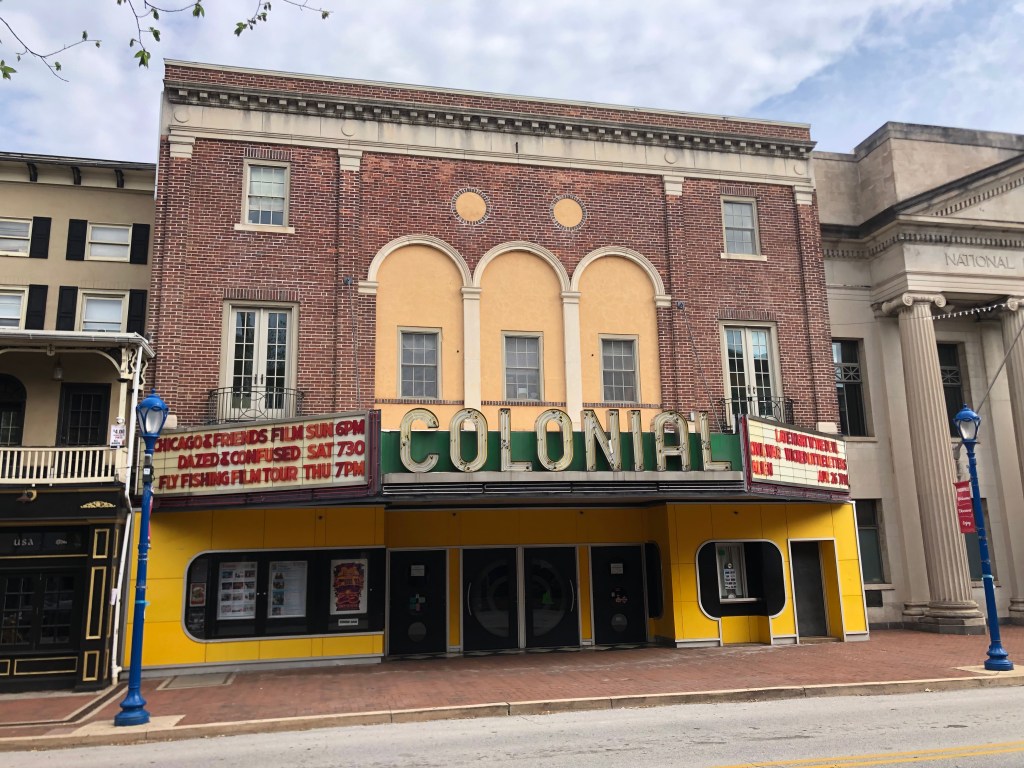
But let’s get back to the reason I came to Phoenixville: to see the theater from The Blob. The place looks practically unchanged from its 1958 movie appearance.

Still going strong.

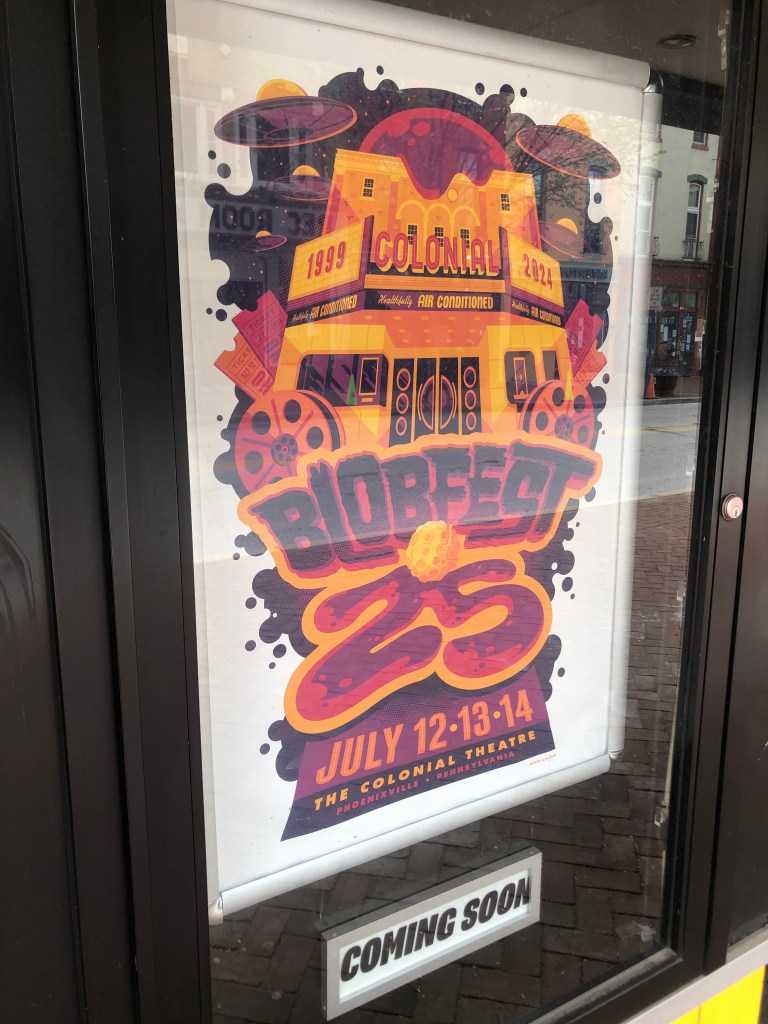
The Colonial Theater actually dates all the way back to 1903, when it started out hosting Vaudeville shows. Showbiz greats like Mary Pickford and Harry Houdini have graced its stage. It’s gratifying that the good people of Phoenixville have seen fit to preserve and support this historic venue. In fact, every summer the town and the theater throw a major festival called Blobfest. I’m seriously thinking about coming back in July…

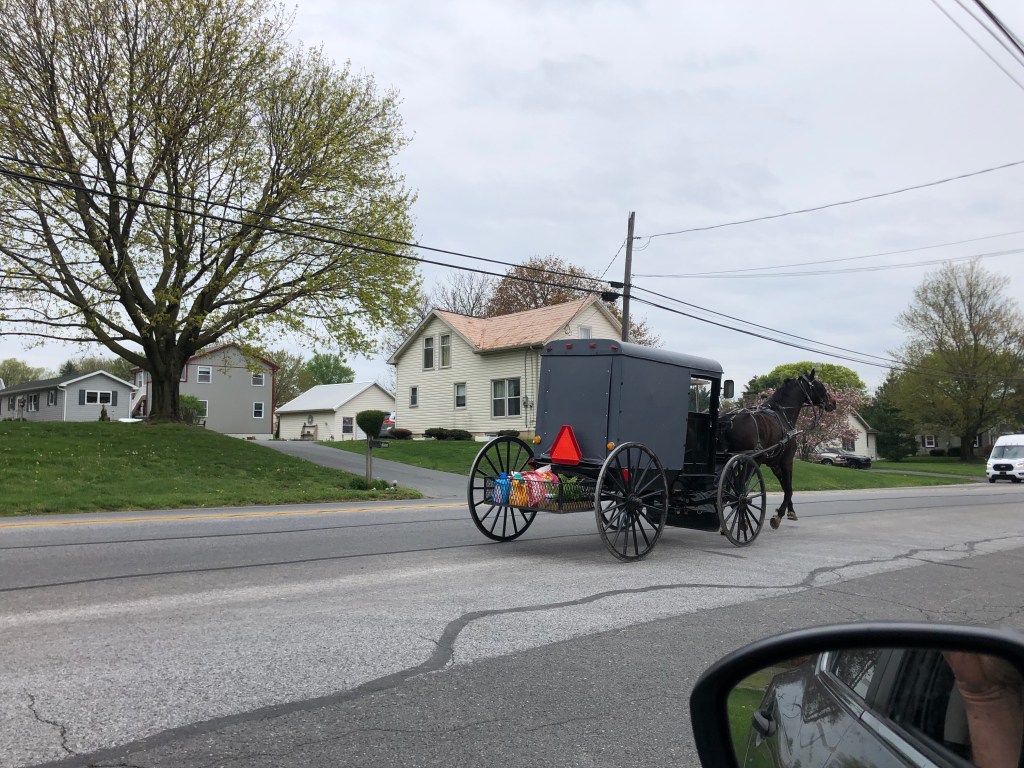
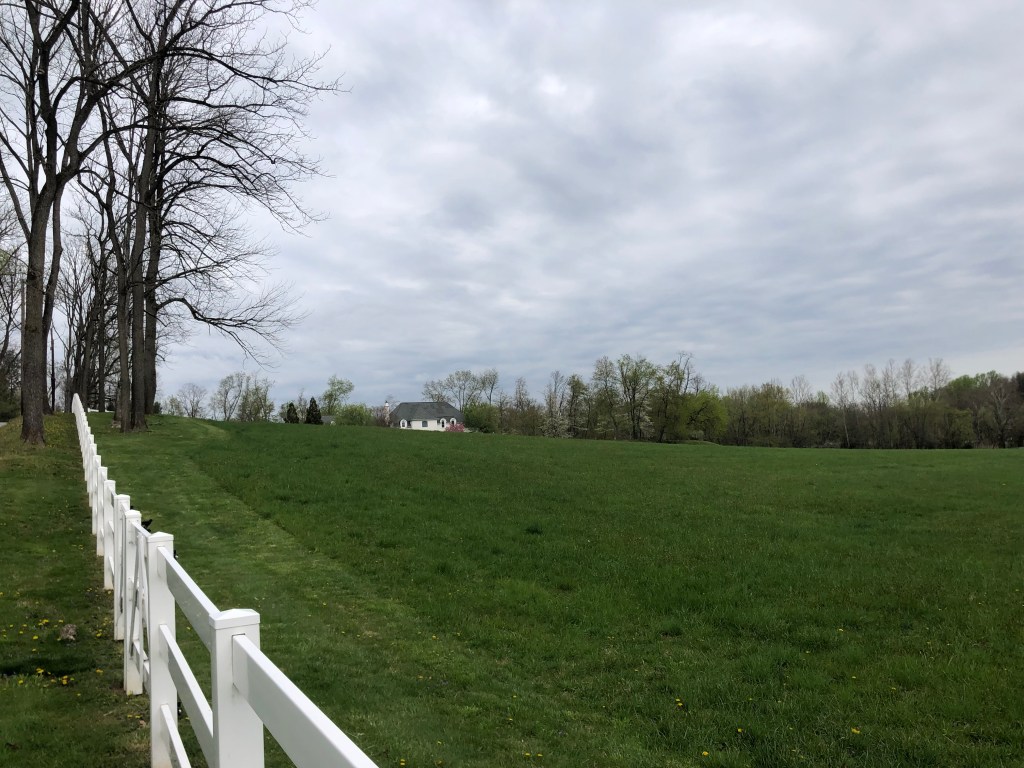
It was now time to return to the Lincoln Highway, which in the form of US Route 30, cuts through Pennsylvania’s picturesque Amish county. Farm houses, rolling hills, and horse-drawn buggies constitute the main scenery. I figure these scenes are pretty much unchanged from when the Lincoln Highway was established over a century ago.

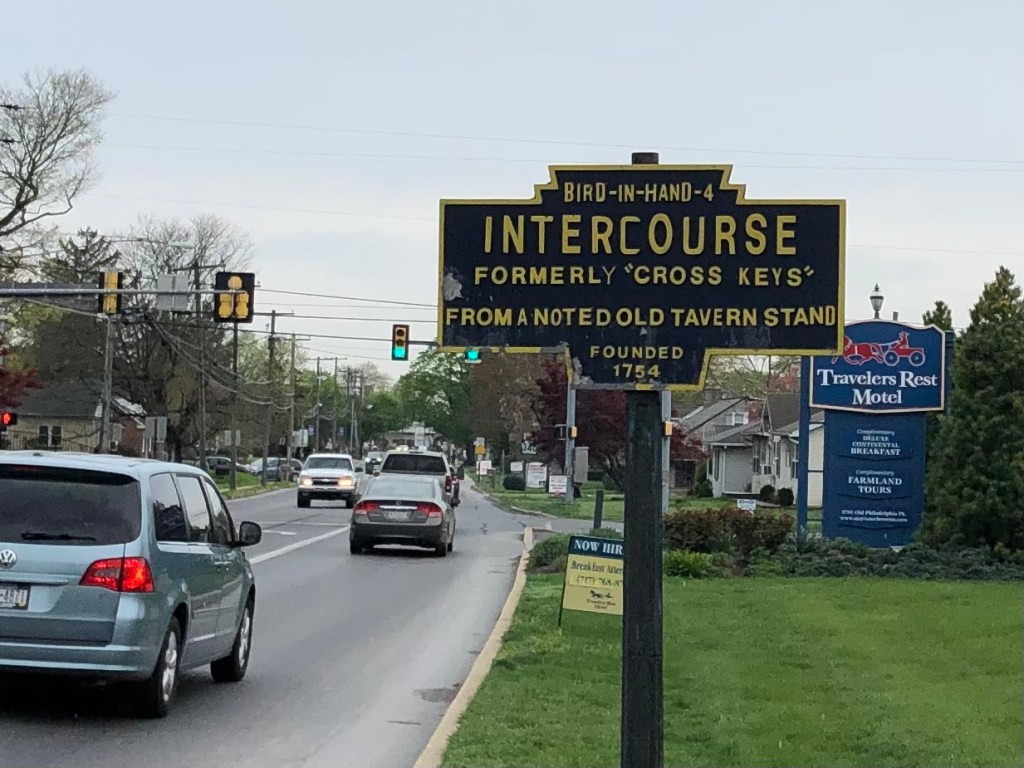
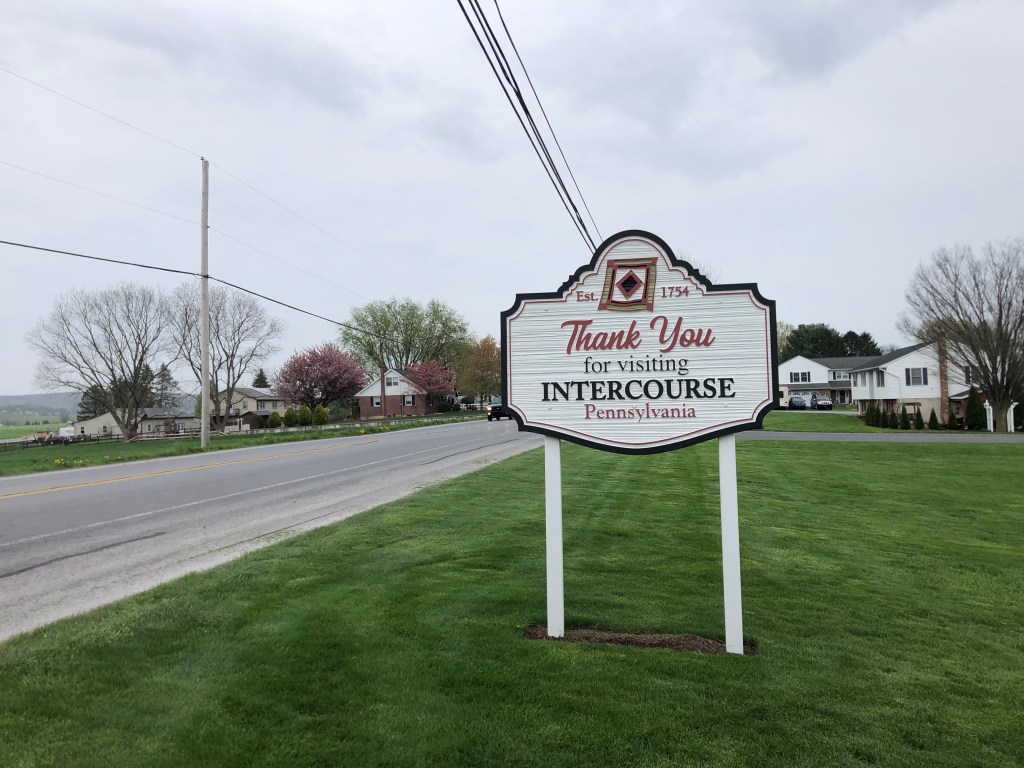
Of course, when one travels through Pennsylvania’s Amish country one is obligated to take advantage of the Intercourse photo-op.

There’s got to be a story behind the name change.
“Please come again.”

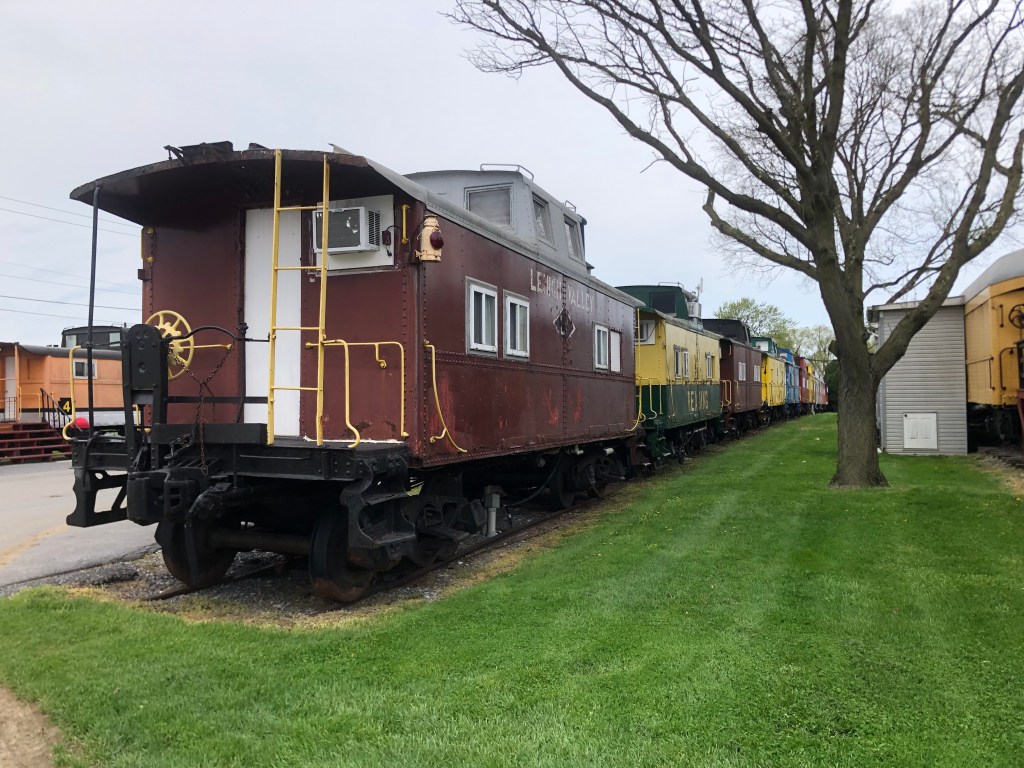
After Intercourse I had a cigarette, and then headed into Strasburg, which is a well-known railroad Mecca. In addition to several impressive railroad museums, a steam-powered railroad, a model railroad display, and antique stores jammed with railroad memorabilia, Strasburg has a motel comprised entirely of old, full-size railroad cabooses.

Not your father’s motel. (Well, not my father’s, at least.)

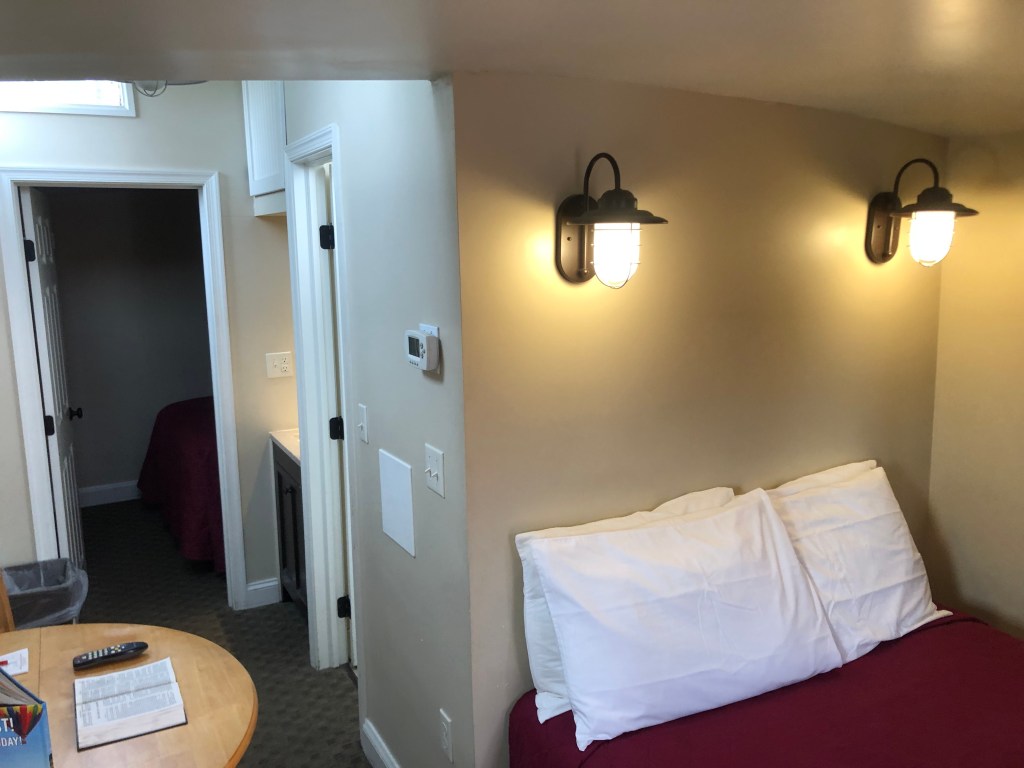
When I was a lad I begged my dad to let us stay at a place like this while we were on a driving vacation. What could be more cool than sleeping in a railroad cabooses? Dad said no, however, figuring that the fun factor (such as it was) wouldn’t justify the compromises in terms of comfort. But today I made a different calculation. So, over a half-century later, I’m finally spending the night in a caboose. It’s actually a nice little room, and the funky floorplan and high windows really lends a certain charm. Plugs, I’m surrounded by other railcars and a full-size steam railroad. I admit, however, that if my wife were with me this would not be an option.

Finally!

BsOTD

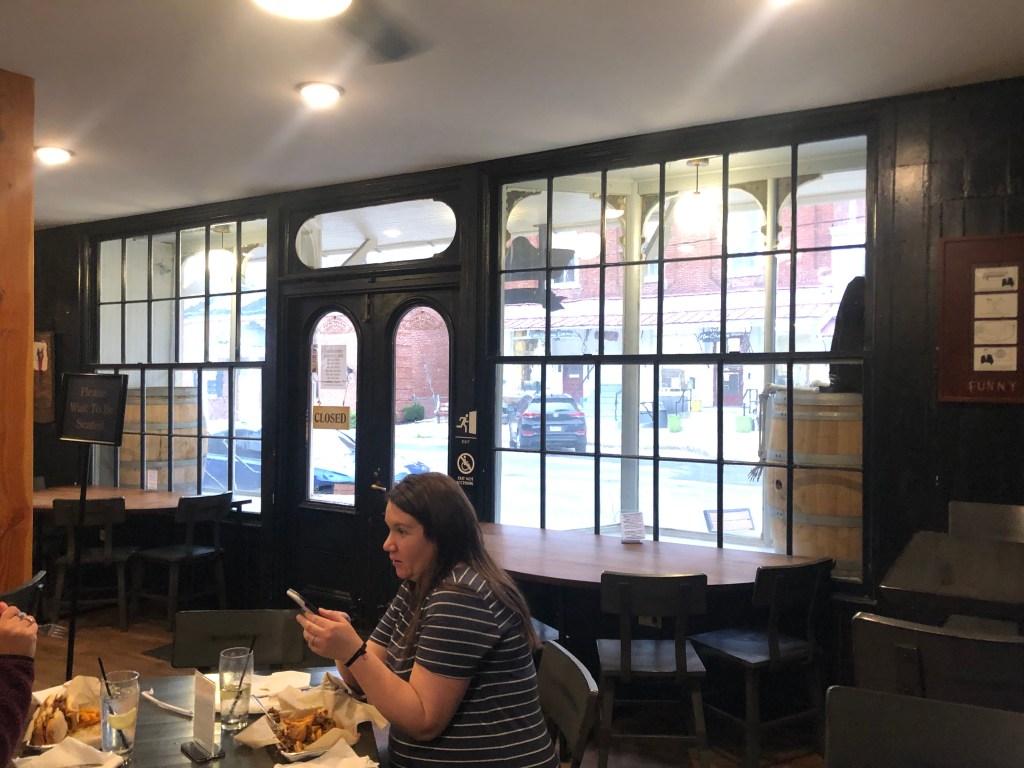
Today’s Brews (note the plural) Of The Day come from Spring House Brewing Company in Strasburg. Their tavern on Main Street is comfortable and inviting, with ancient dark-wood paneling and a dark-wood stairway to unexplained upstairs rooms. My server (Dani) didn’t know how old the building is, but the ripples in the front window glass suggest at least a century.

Cozy tavern.

The brewery had 13 of their own beers on tap, and I found it hard to choose just one. So I ordered a flight of four. And then, I ordered another flight of another 4. What follows, then, are my eight Brews of the Day.

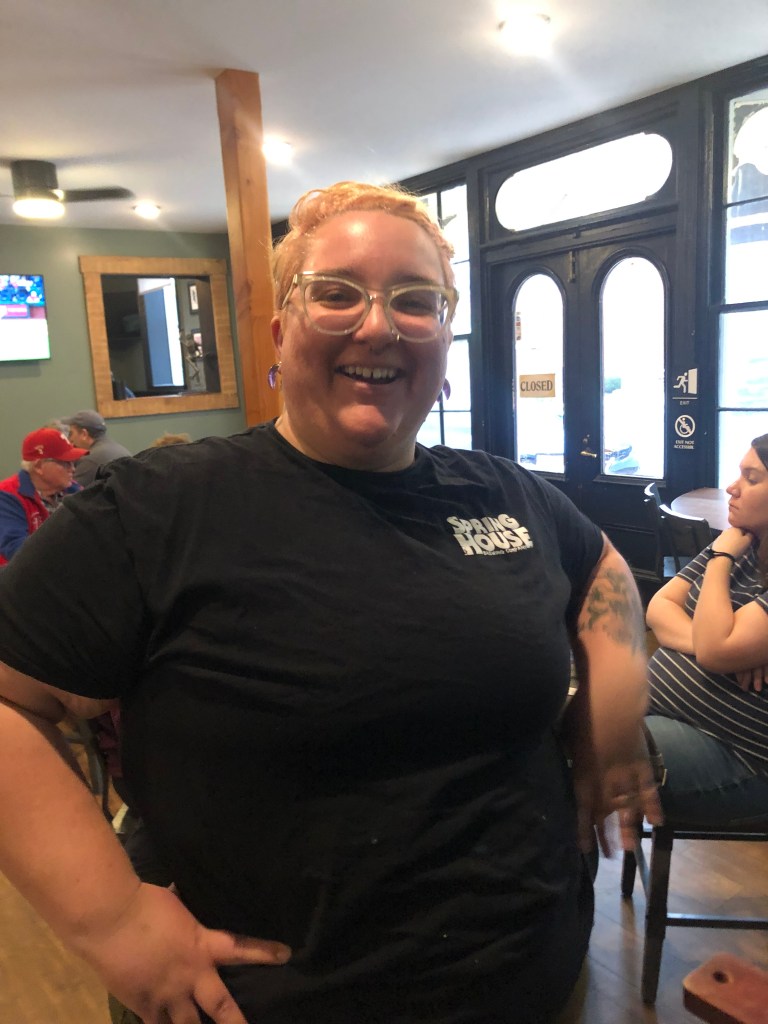
Server Dani, who delivered my 8 Brews of the Day.
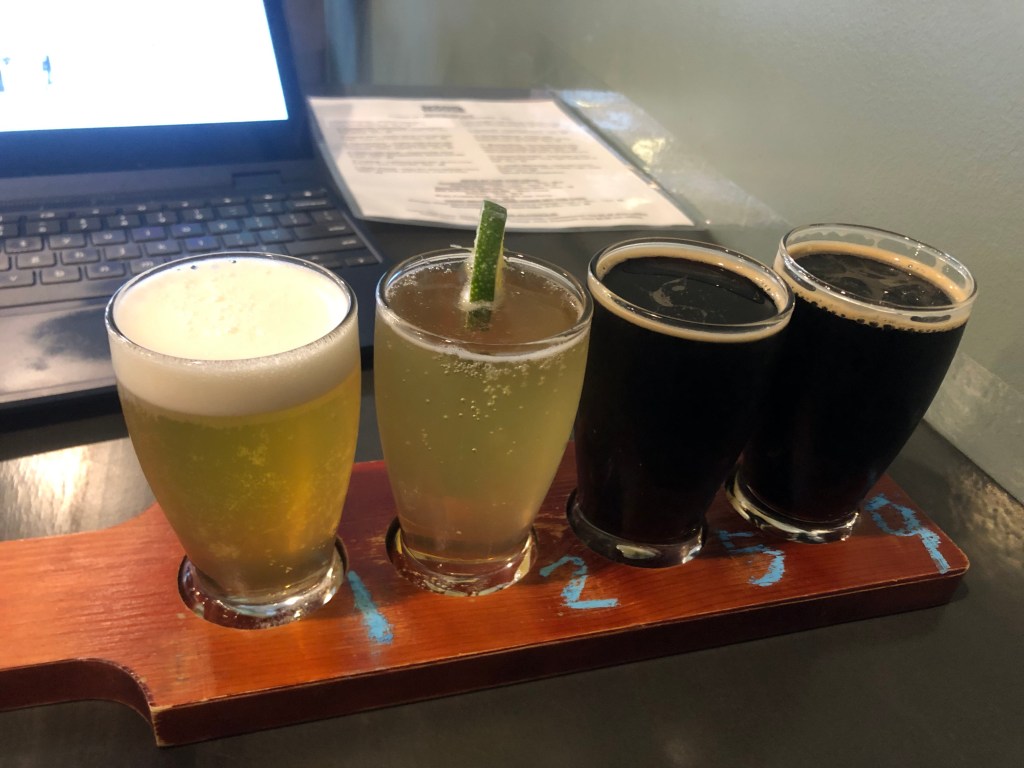
My first 4 Brews of the Day (in order from left to right)

Empty Terrarium: Nitro Fruited IPA (6.3% ABV). Watery. Boring. A slight tinge of citrus but no real flavor and no fizziness. It’s like a chocolate Easter Bunny after the first, decapitating bite: no head and not hoppy. 1 star out of 5.

Commander Salamander: Fruited sour (4.5%). Seems to start with the same base as the Empty Terrarium, but somehow it’s fizzier (without really becoming hoppy). The sour taste is quite enjoyable–it’s fairly understated; more like sour apple gum than a lemon Warheads (TM) hard candy. This would be satisfying on a warm day (which today is not). It’s one of those beers that you should only have one of–not because of the alcohol, but because the second pint could be cloying. For the first glass, though, it’s quite satisfying. 3.5 stars.

Tasty Little Devil: Imperial Milk Stout (7.5%). Characteristic sweetness and creaminess of a milk stout. More roasty than chocolatey, But a slight peppermint note on the finish evokes a Christmas hot chocolate. Well balanced. I give it 3.5 out of 5 stars. I would have given it a 4 if they upped the alcohol at least to 8 percent, which in my mind is the floor for anything called “Imperial.”
Kerplunk! Imperial chocolate stout (8.0%). The punctuation is part of the name, presumably taken from the Milton Bradley game. A bit harsher than the Tasty Little Devil. But more importantly, this doesn’t really attain its potential. Reminds me of brownie mix stirred into water. 2 stars.

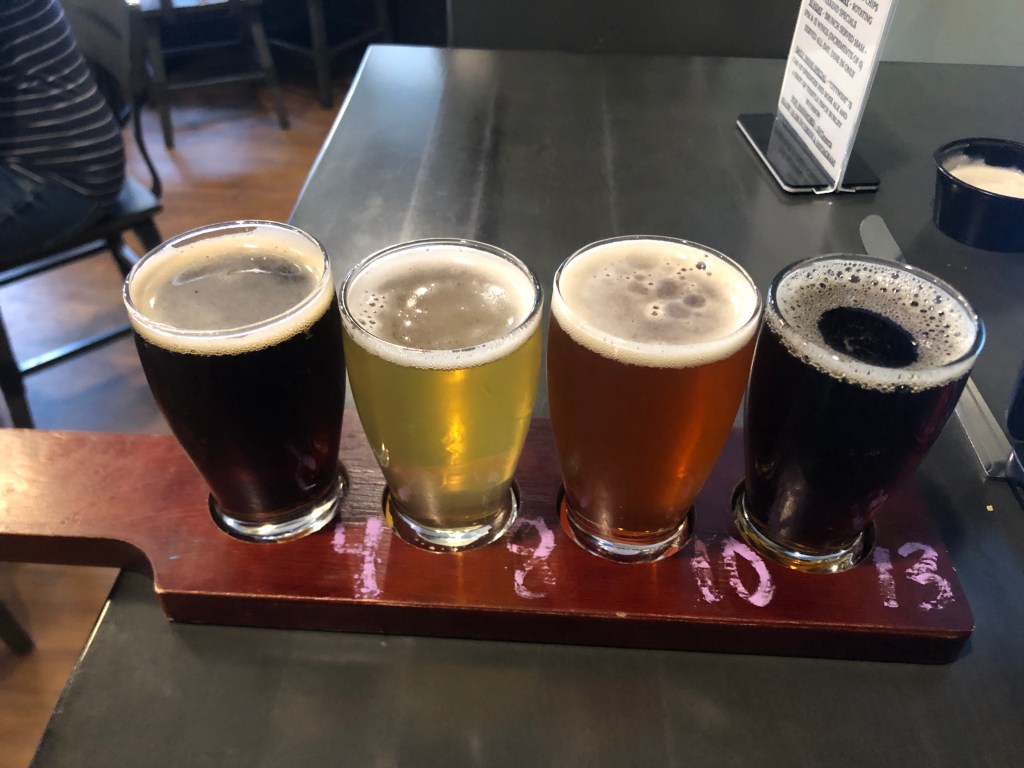
Next four Brews of the Day.

Painted Pony: English style brown ale (5.4%). Nicely balanced. A bit on the bitter side (which maybe is the “English style” coming through?) Definite chocolate notes. Good backbone. The kind of beer you’d enjoy at the neighborhood pub at the end of your 12-hour shift in the mines. 3 stars

The Angler: Cali Pale Ale (5%). Definitely the California style. Clean, citrusy, bright. It’s perfect for those of you who like this style of beer. Which I don’t. But I know quality when I taste it, so I’ll give it four stars.

Demon Squirrel: Amber lager (5.3%). Now this is interesting. Malty, with some hints of fruitiness. Very balanced hops. Heavy carbonation adds dimensionality and compensates for the neutral finish. Flavorful without being overpowering. 4.5 stars.
CASK Mild Party: Dark mild (3.3%). The name of the style (“dark mild”) says it all. Intentionally served at room temperature, this is a dark-colored beer with absolutely no structure, backbone, carbonation, or even flavor. It has the consistency and mouthfeel of dishwater. It tastes like watery tea that’s been left in a styrofoam cup on the dirty Formica counter for a day and a half. And it can’t even deliver a mild buzz. It’s the kind of beer that makes you question your faith in God. 1/2 star.

bridges · cemeteries · churches · Obelisks · Road trips · trains

Philadelphia Stories

I’ve been working on a top-secret project (which will likely be revealed by the end of the year) and it involves, oddly, Benjamin Franklin. I’m not making this up. And this project has made clear to me how much my grasp of American history is lacking.

Growing up in California, I never learned much about the Continental Congress or the Revolutionary War or really anything that took place before 1849. I’ve made a few attempts to remedy this, including my trip with friend Vic to Salem, Mass.

So I’m now trying to fill in some of the gaps in my education Which is why this morning I found myself in The Quaker City for a few days of exploration. What could go wrong?

My crash course on Philadelphia actually began on the plane ride. I’d taken a red-eye from Sacramento, and my seatmate was a garrulous Philadelphian (if you’ll permit me that redundant phrase). He was on his way home after a vacation with his wife, but they were taking separate planes. It seems there was some kind of booking mix-up related to the use of frequent flyer points. But the real point, for my purposes, is that he was unexpectedly flying solo and looking for someone to talk to. And having learned that I was going to be sight-seeing around his home turf, he spent the next few thousand miles sharing his insights about the city. (Did you know that Elphreth’s Alley is the oldest continuously-habitated street in America?)

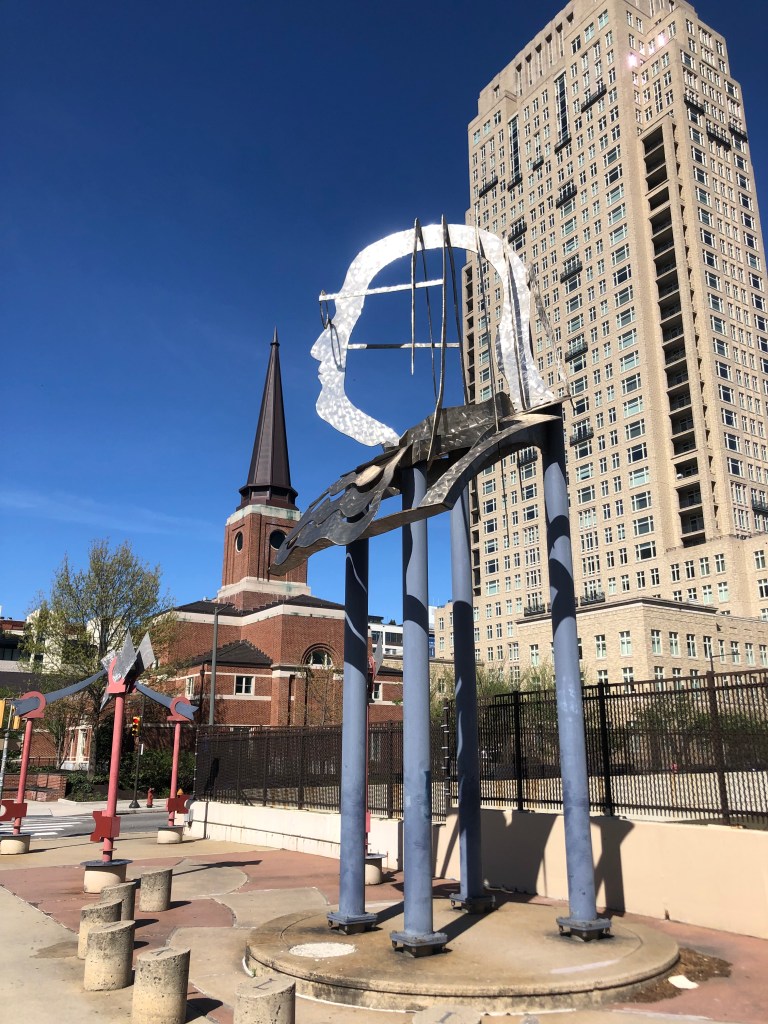
Anyway, I got breakfast and a Nissan Sentra near the airport and set out for downtown Philly. Ben Franklin is certainly well represented around the city. Bridges, parkways, institutes, boulevards, schools, and various other features of the city are named after Franklin. There’s even a large, modern sculpture of his distinctive bespectacled face and stringy hair on a random street corner.

“Big Ben” sculpture from 1992.

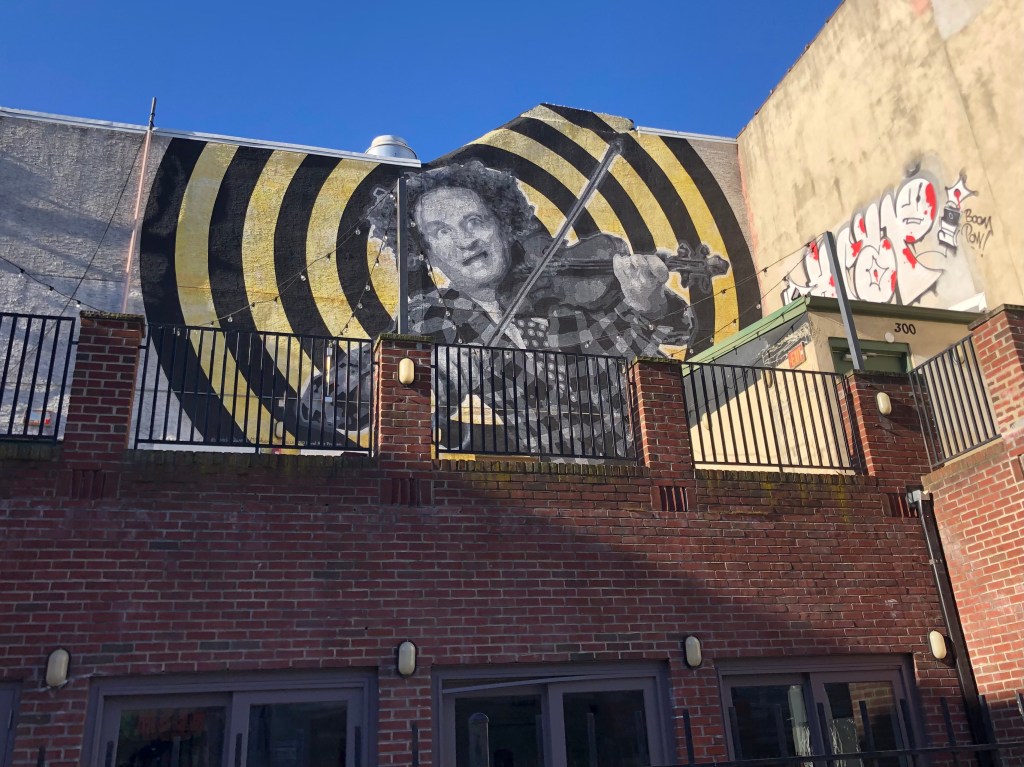
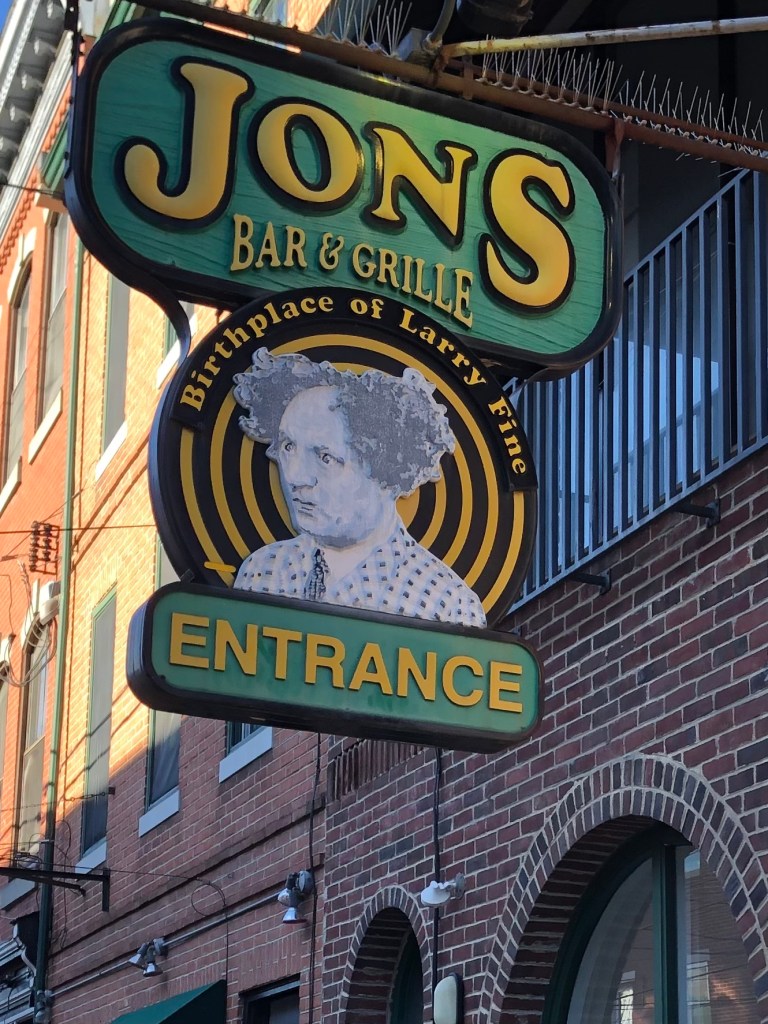
While chatting up the National Park ranger at the Ben Franklin Museum, I learned the following story: Some years back the Philadelphia Inquirer was taking up a collection for a Frank Sinatra mural somewhere in the city. A rival paper objected, pointing out in an editorial that Philadelphia should instead create a mural for one of its native sons. And, perhaps as a joke, the editorial noted that Larry Fine (of Three Stooges fame) is one such native son. The idea nevertheless caught on, donations were made, and the mural was painted at the location (S. 3rd and South Street) where Fine was born.

Giving Ben Franklin a run for his money.
A bar in the same building capitalizes on the Fine connection as well.

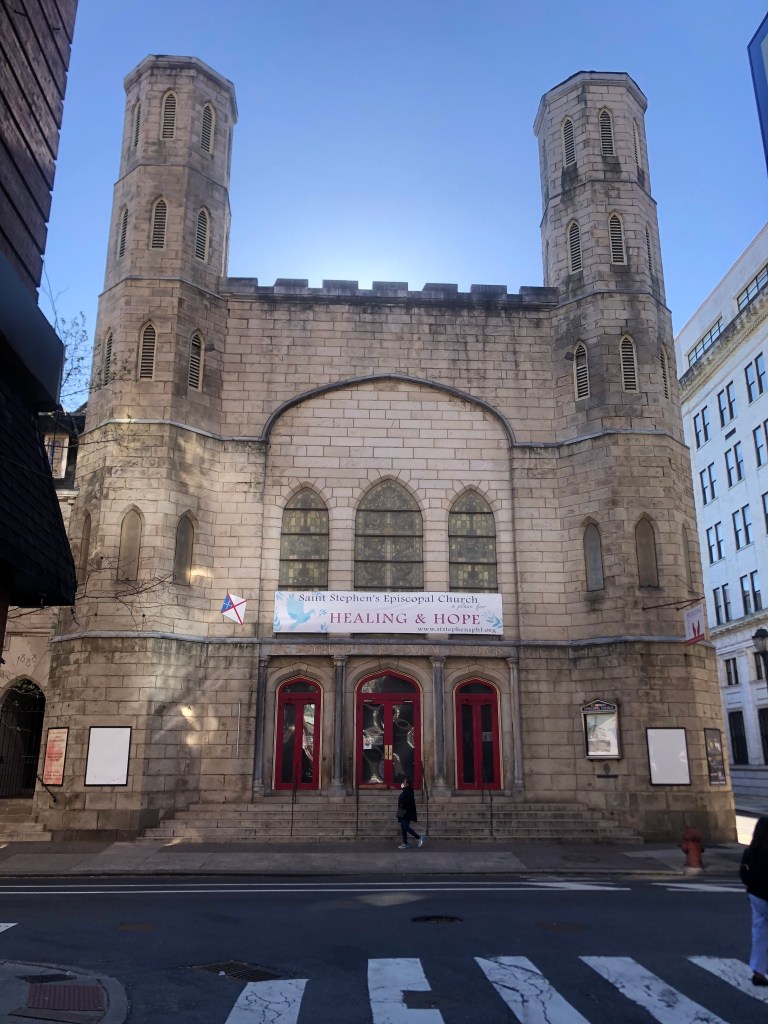
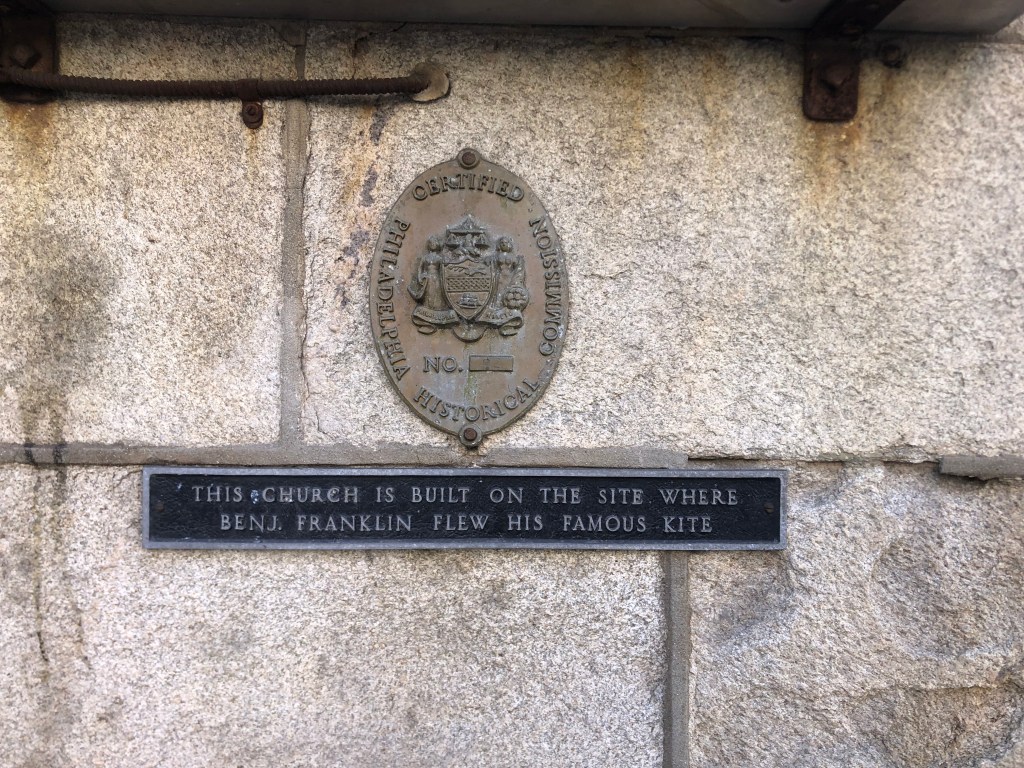
But I digress. I was talking about how Ben Franklin has captured this city’s imagination. And in addition to all the named structures and graven images, the city has been tagged with various plaques that commemorate Franklin’s various activities in the area. For example, on St. Stephen’s Church is a brass plaque which claims Ben Franklin conducted his famous kite experiment on this site in 1752.

Built in 1823 at 10th and Ludlow, which may or may not be where Ben flew his kite.

Here’s a closer look at the plaque:

Now, it turns out that there’s considerable debate as to whether this is really the site of Frankin’s kite adventure. And while the “Certified” marker above the plaque would seem to lend credence to the plaque’s claim, it turns out the marker relates to the church building, and not to the plaque.

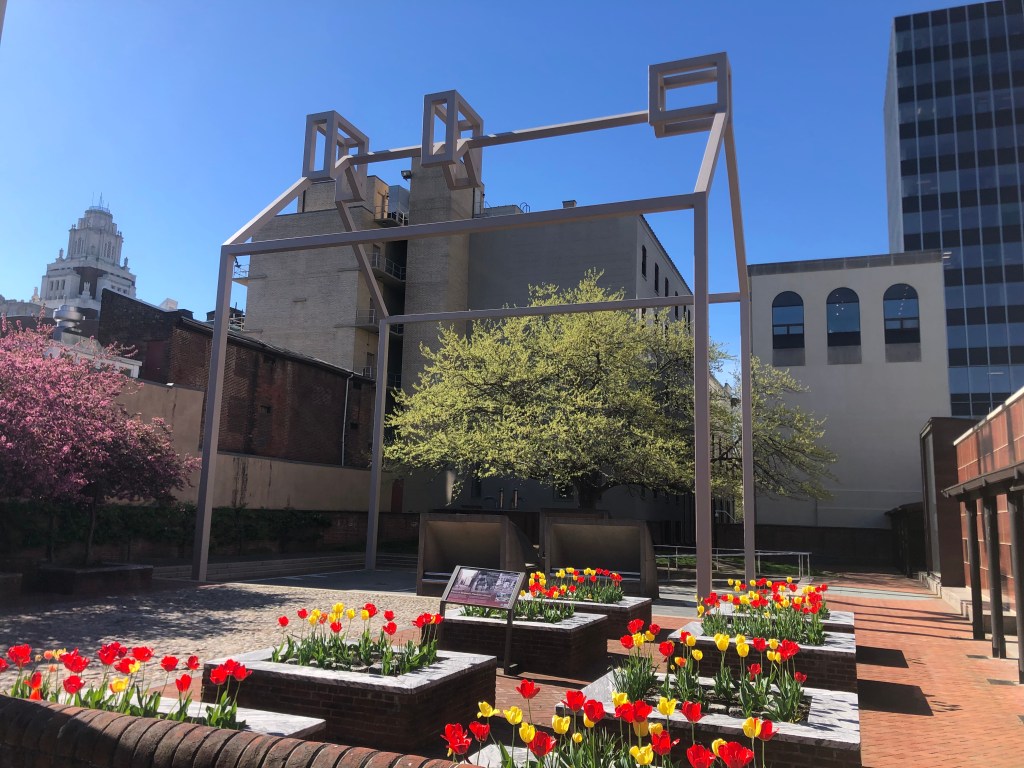
A few blocks from the dubious kite claim is a bare steel pipe structure outlining where Franklin’s last family home had stood. Ben’s kids had the house razed some years after he died. But in the 1940s, archeological efforts uncovered the foundations of the house. The steel “ghost house” was erected in the 1970s, since there were insufficient records or drawings to reconstruct the house itself.

The ghostly outline of Franklin’s house, marking its exact location some two and a half centuries ago.

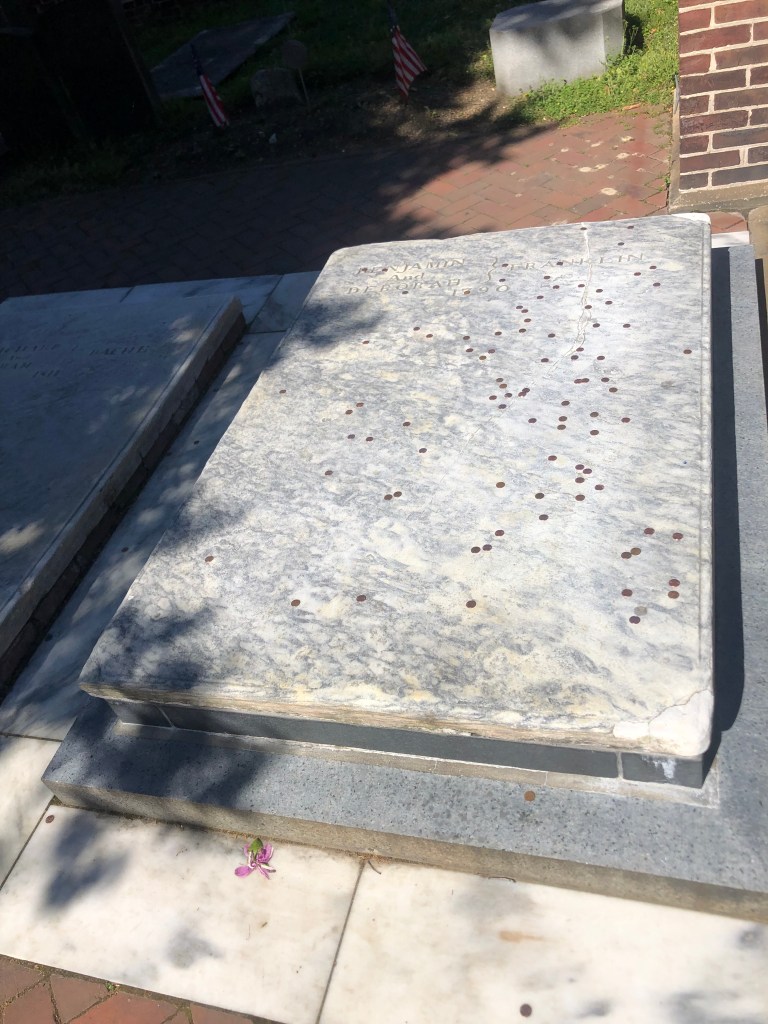
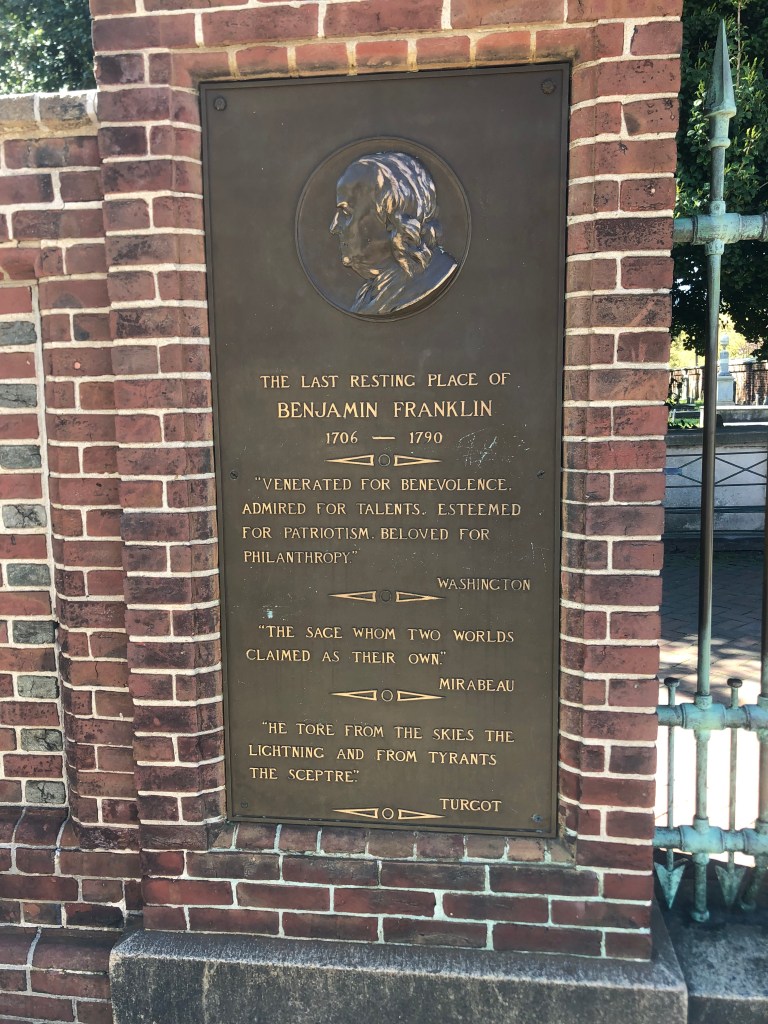
Finally, and inevitably, Franklin’s body rests in Philadelphia, not far from the ghost house. He is buried at Christ Church Burial Ground under a smooth marble tablet that’s perpetually covered with a scattering of pennies from passersby.

“A penny saved is a penny earned.”
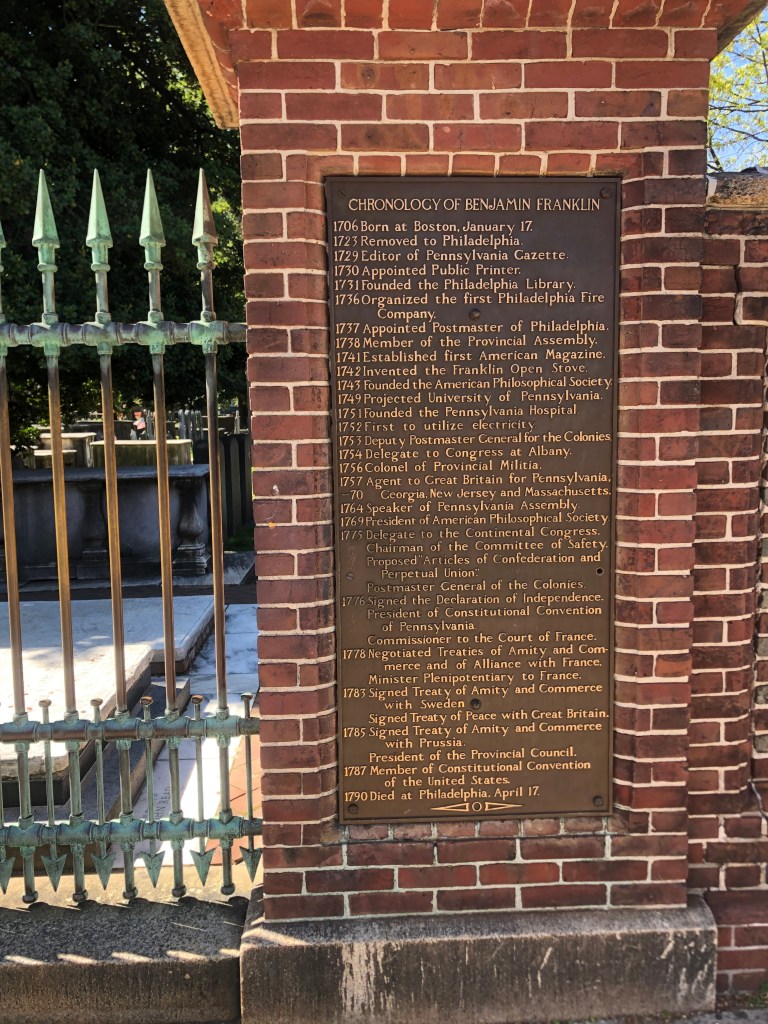
Even allowing for some resume-padding, it’s an impressive list of accomplishments.

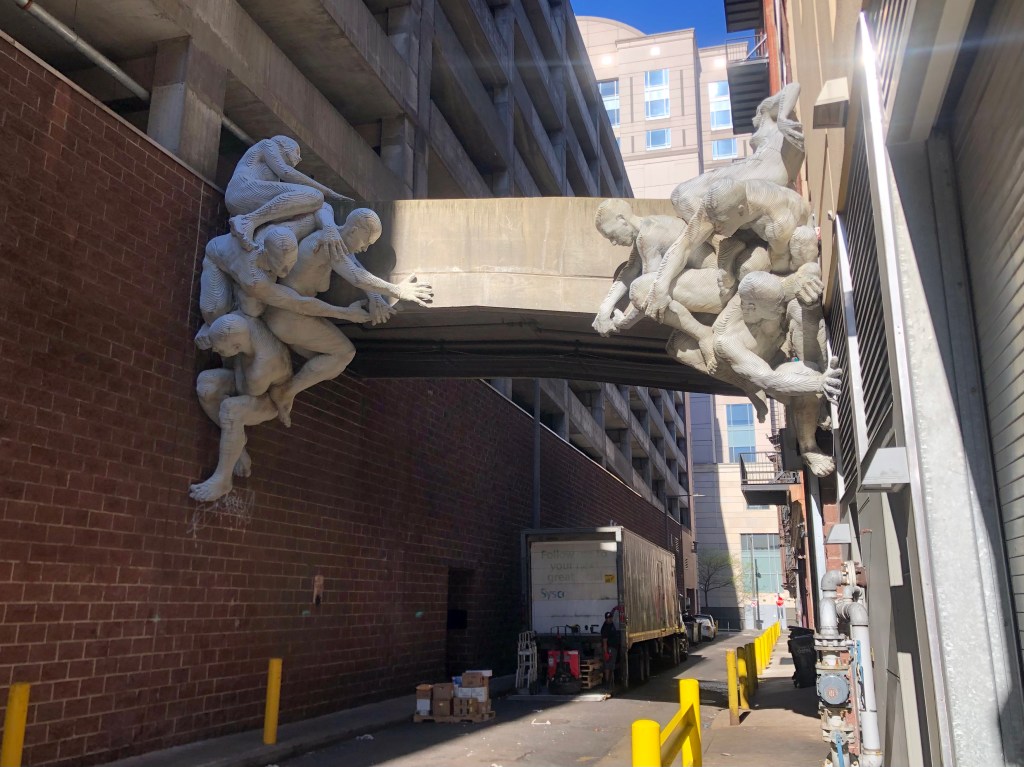
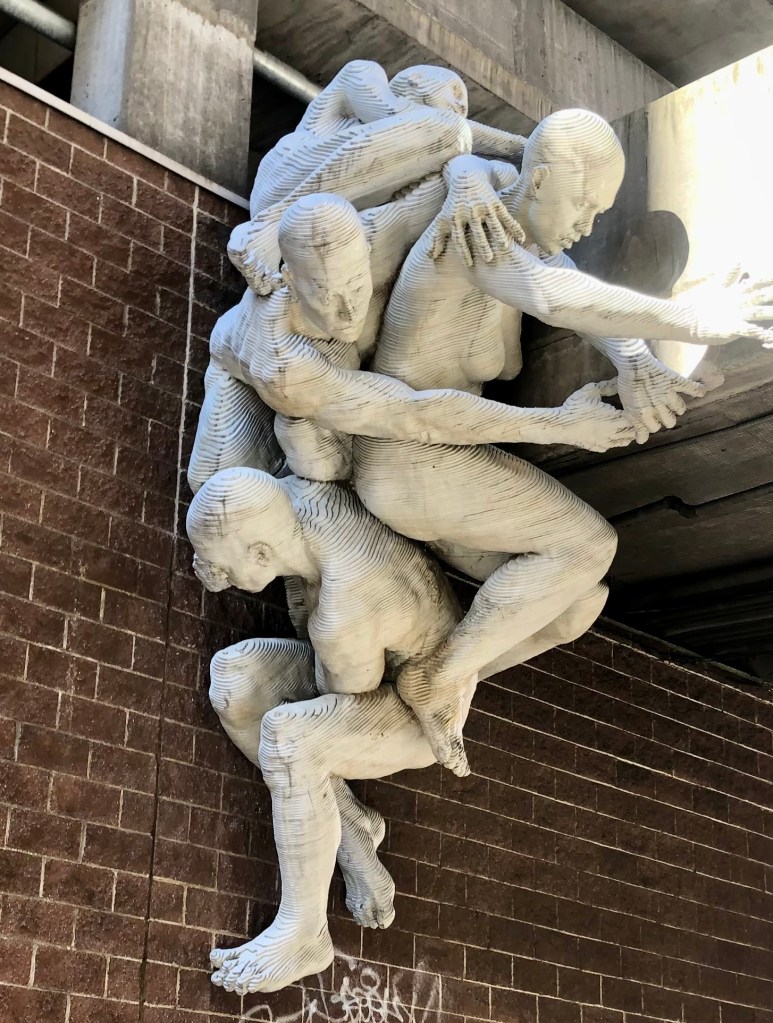
Of course, Philadelphia isn’t all Ben Franklin and Larry Fine. For example, there are these random nudes built into a pedestrian walkway. For no discernible reason.

There’s got to be a flying buttress joke in here somewhere...

There’s also Auguste Rodin’s bronze sculpture The Thinker on the grounds of Philadelphia’s Rodin Museum:

I think I can…I think I can…

You probably know of this piece. Rodin actually cast a number of identical bronze Thinkers. I remember once seeing one at Stanford University. But I’ll forever associate it with Dobie Gillis, who had a habit of sitting next to the statue in a copycat pose.

Kind of inevitable.

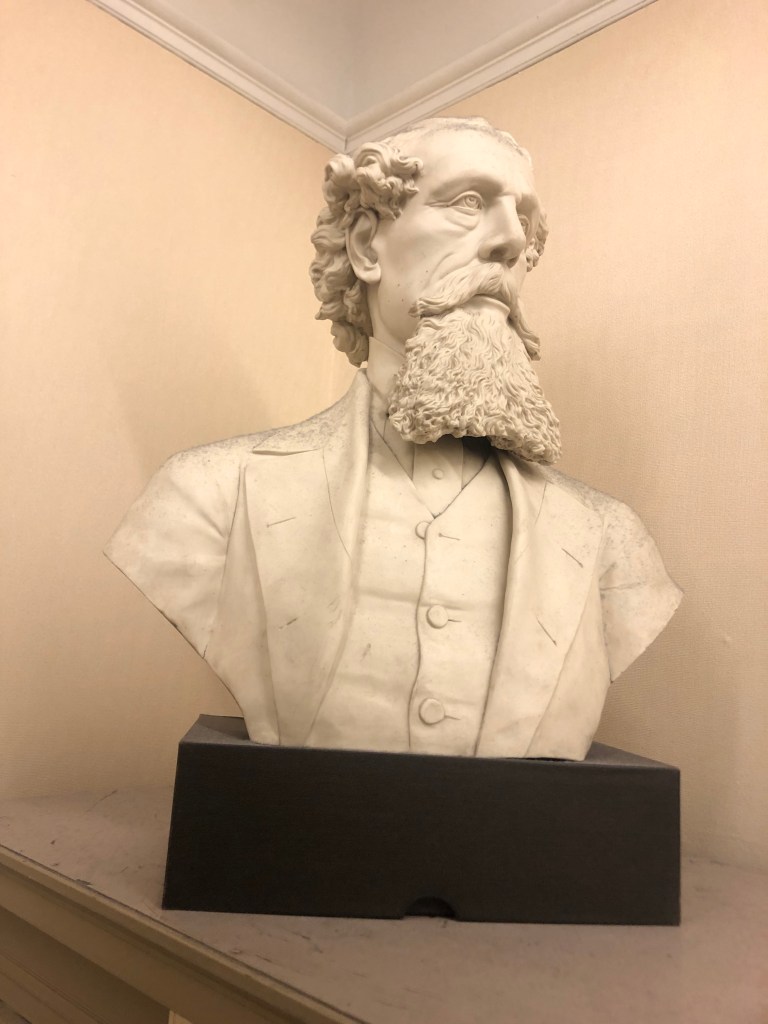
And if that’s not enough, today I also ran into some literary luminaries that you don’t often associate with Philadelphia. In the Philadelphia Free Library’s Central branch (built almost a century ago in the beau arts style) one finds a bust of Charles Dickens in the Rare Books Room.

Have you ever noticed how Charles Dickens resembles Don Quixote?

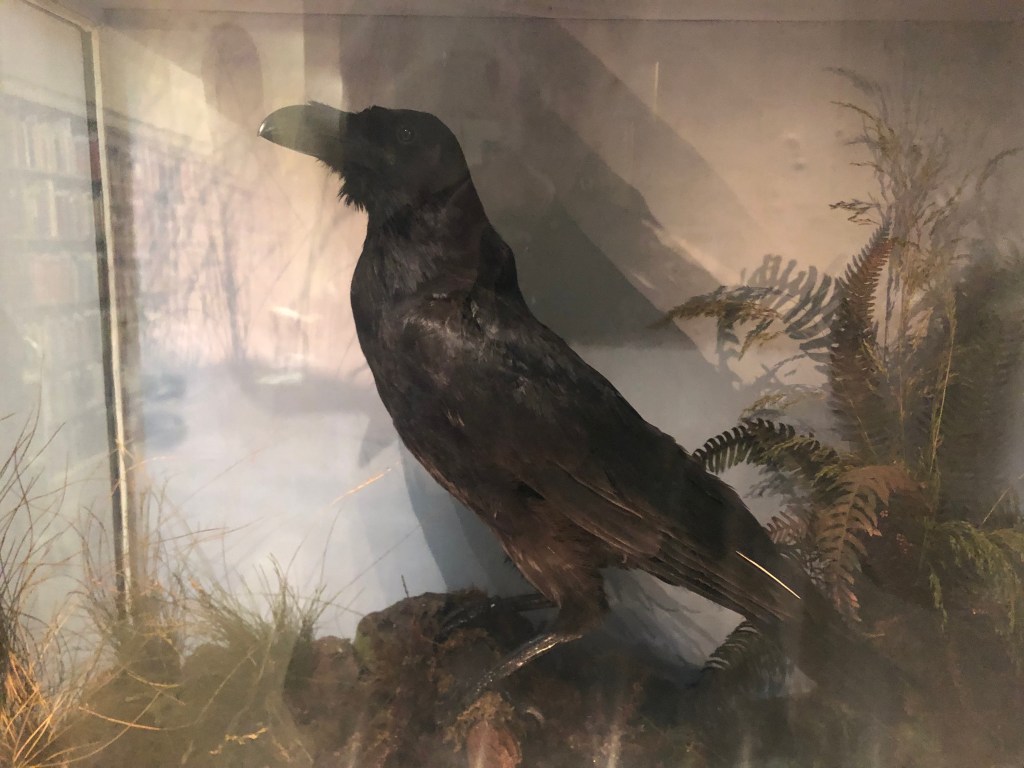
Not far from the Dickens’ bust is his actual pet bird, now stuffed and mounted in a glass box.

That’s so Raven.

The bird is (was?) a raven by the name of Grip. Grip even gets some speaking lines in Dickens’ novel Barnaby Rudge. But she (for Grip is a female) also played a much more important literary role: She is said to be the inspiration for Edgar Allan Poe’s The Raven.

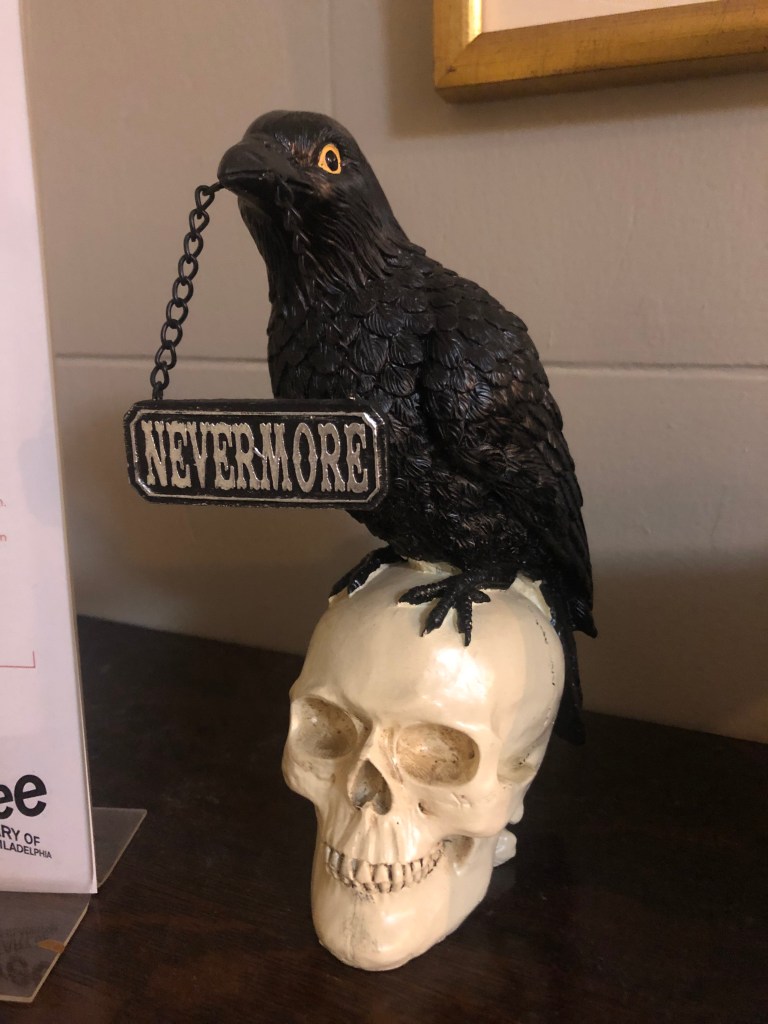
Wasn’t Nevermore the title of a Nirvana album?

As we all know, Poe lived in Philadelphia for six years. And one of his Philadelphia homes still stands. I will be visiting it on Friday, so we’ll be returning to this theme later.
It’s now getting late, but I do have two more items to share from today. The first is:

OBELISK CORNER

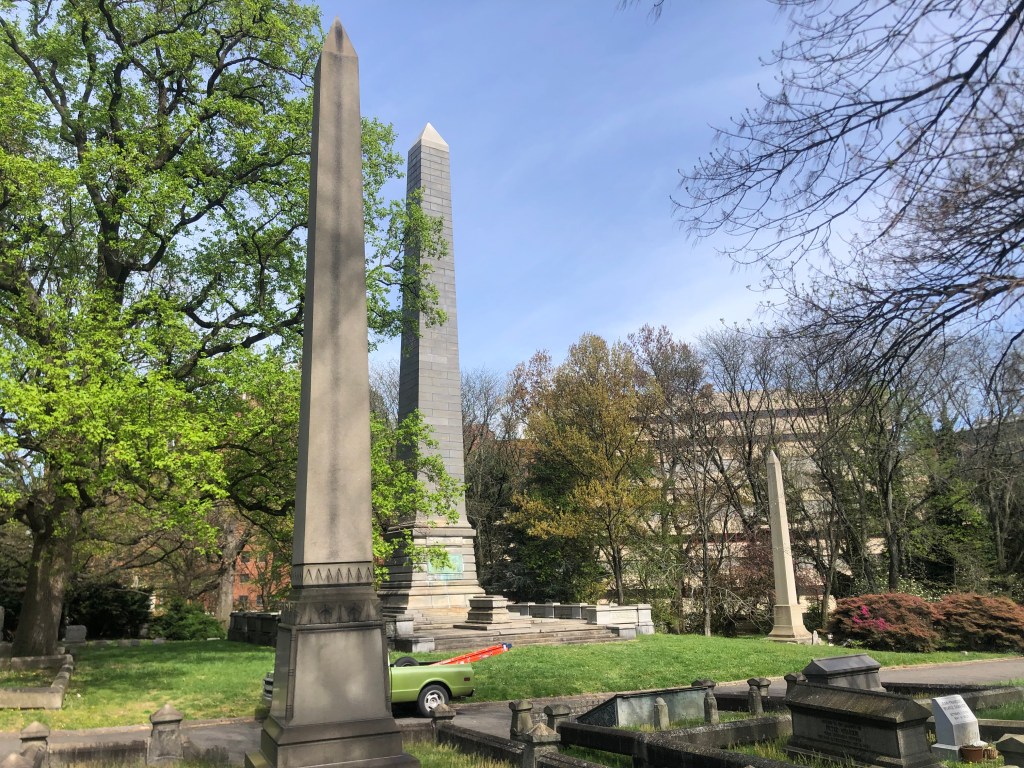
I was taking an afternoon walk through Philadelphia’s Woodlands Cemetery. It dates back to the 1840s, and has a distinctive Victorian air about it. Many of the grave markers take the form of obelisks, with some quite large specimens cropping up here and there.

…or are you just happy to see me?

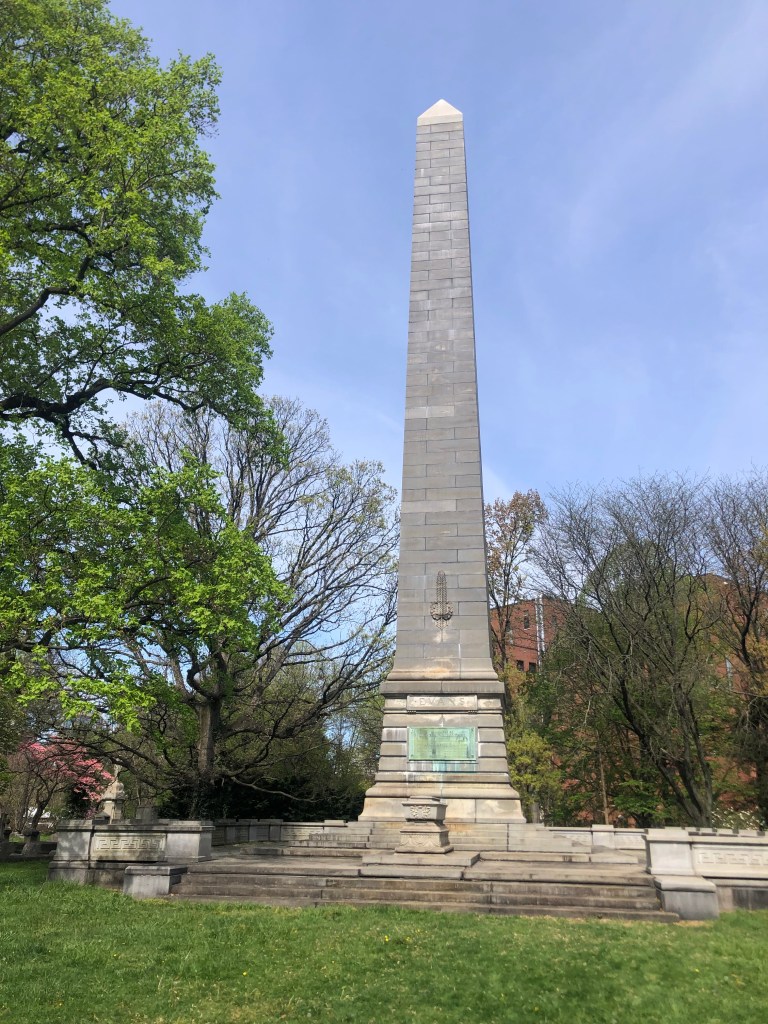
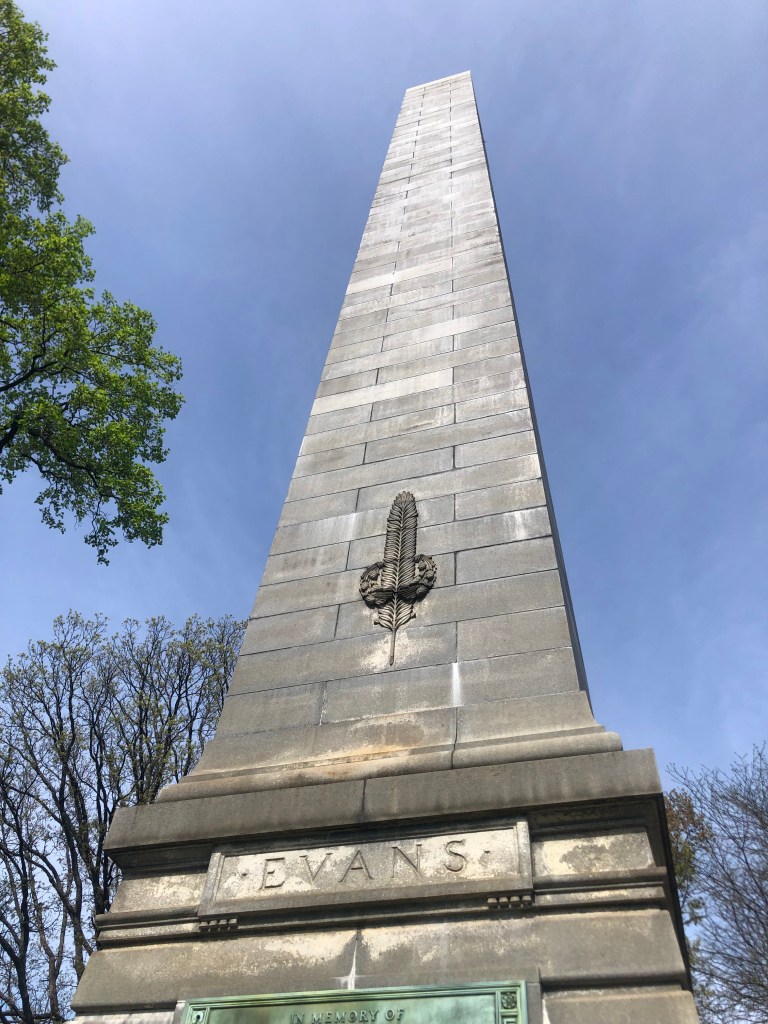
But take a closer look at that one in the center. Though it doesn’t appear especially large in the photo, it’s actually about 15 stories high. In fact, it’s the largest gravestone in the Continental U.S. Let’s take a closer look:

For perspective, note the two stacked sarcophagi at the foot of the obelisk.

The obelisk marks the grave of one Thomas Wiltberger Evans, who died in 1897. You never heard of him either? It seems that the man with the country’s tallest headstone was a….dentist.

And now, let’s finish up with the

BREW OF THE DAY

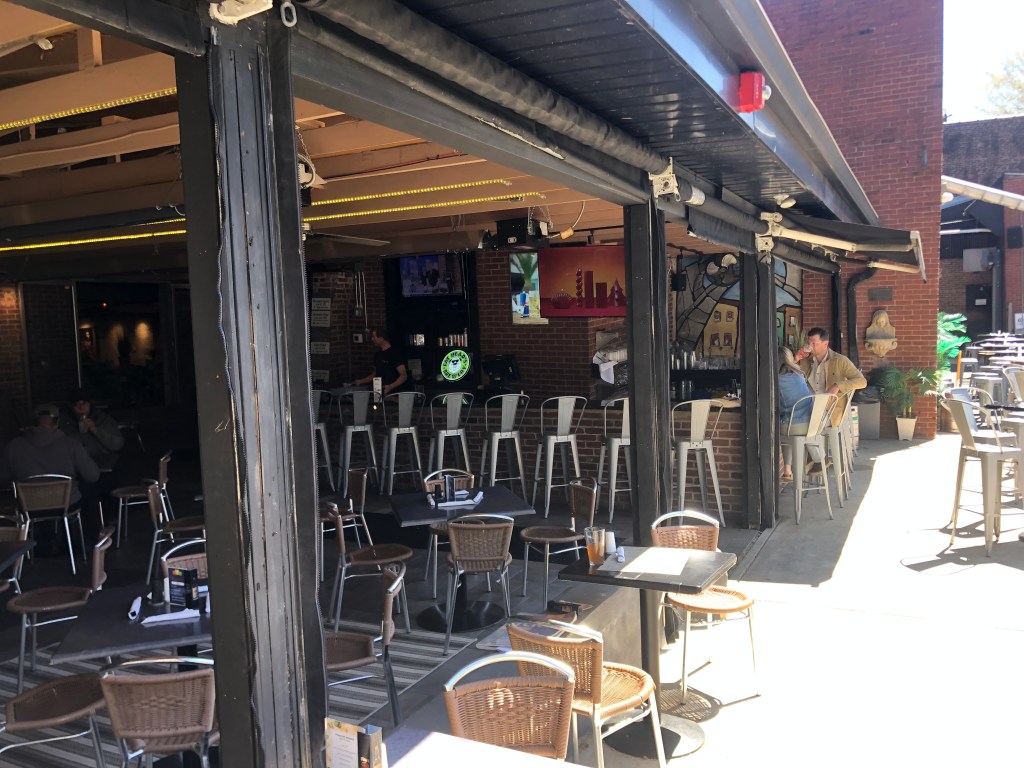
I drank my BOTD at Manayunk Brewing Company, which sits in a cavernous, historic cotton mill on the banks of the Schuylkill River. The cotton mill dates back to 1822, and it operated (making cotton or, later, wool) until 1992. At that point it became a brewery.

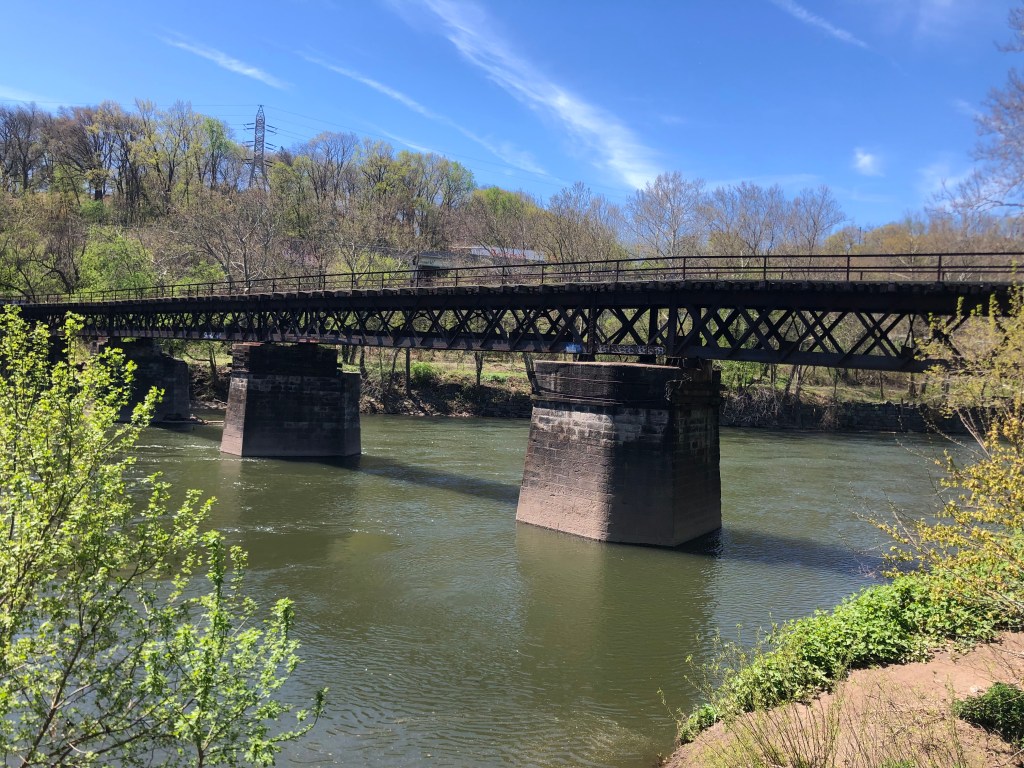
My words can’t do justice to the wonderful setting. Not only is the historic building awe-inspiring, but there’s an old railroad (?) bridge crossing the river right behind the brewery. And I had a great spot in the sun to enjoy the view.

First cotton, then wool, now ales.
I couldn’t find any info on this bridge that’s directly behind the old cotton mill. Uncle Ed, please help!

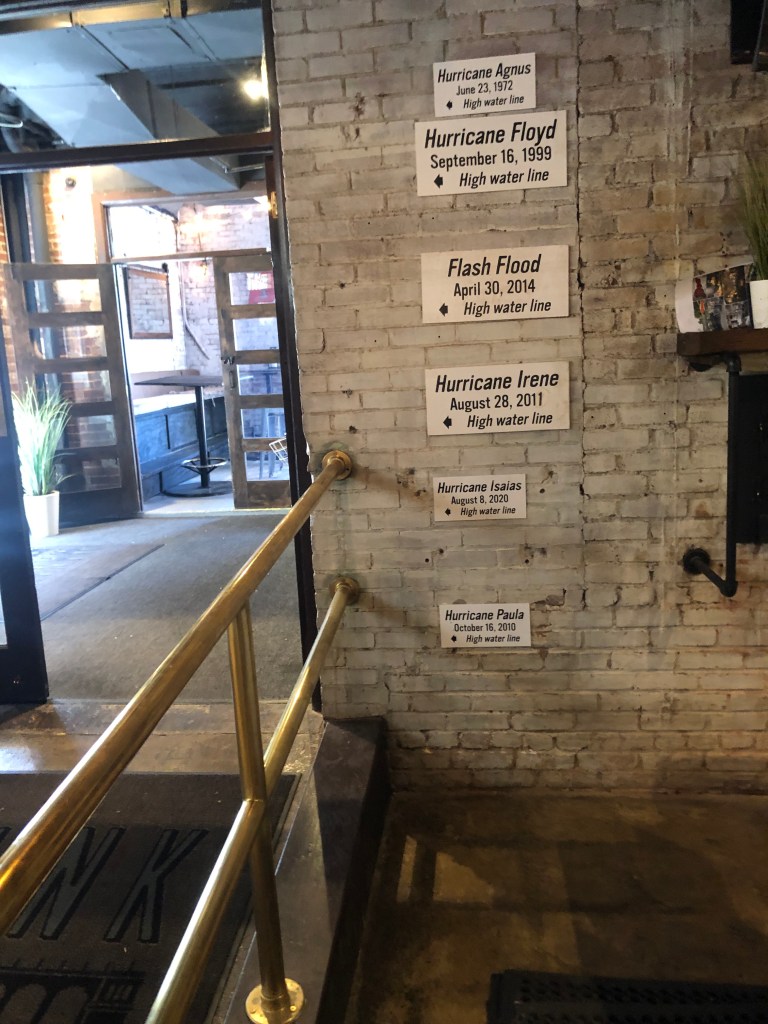
I had my heart set on getting one of Manayunk’s home-made brews. But sadly, my server informed me that they lost their entire brewing setup to a flood a few years back. It seems that flooding has been a recurrent problem, judging from the “high water mark” signs in the bar.

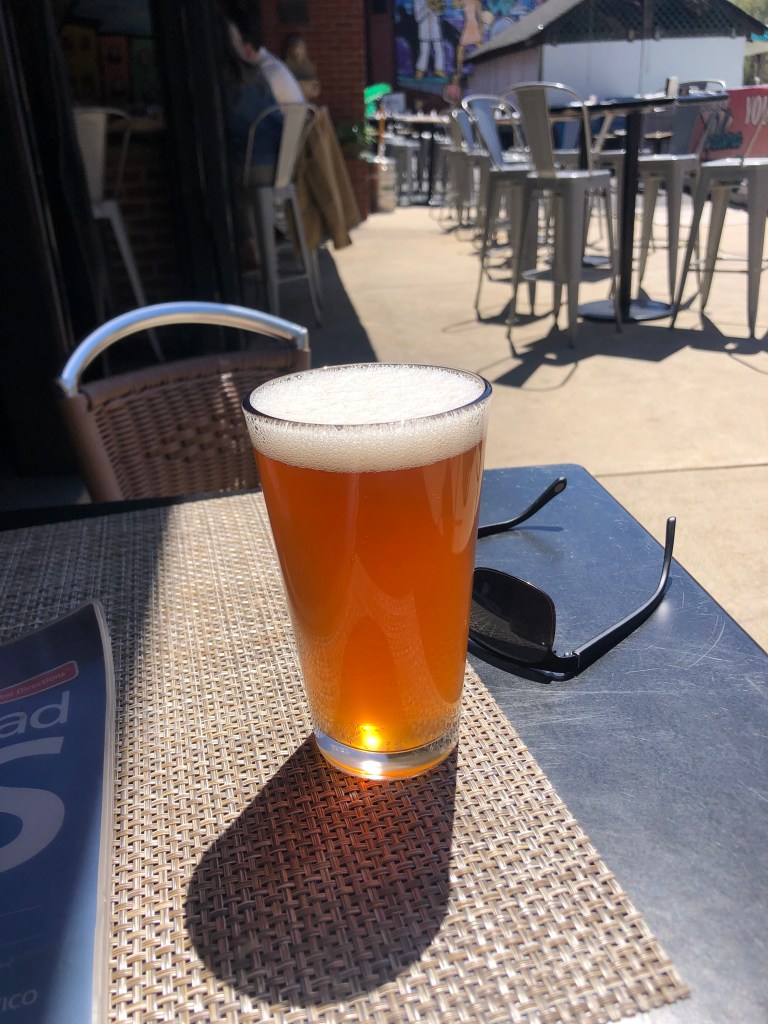
However, a few of their beer recipes are still being faithfully produced by local brewing partners. I selected the Schuylkill Punch, which is being brewed by Yards Brewing.
“How would you like a nice Hawaiian Punch?”

This is nothing like what I normally drink. It’s light, with a body light iced tea. There’s almost no malt. And with an ABV of 4.5 percent, it has about half the alcohol of my usual brews.
But this is an exceedingly smooth beer, and it complemented the warm weather perfectly. It’s slightly sweet, with distinct citrus notes of grapefruit, lemon, and some tropical fruits. Carbonation is low, but it has a nice head. Overall, I’d call this a “session” beer, especially if your session is outdoors on a warm day next to the Schuylkill River. I give it 3.5 stars out of five. If they could up the flavor a bit (maybe brewing it with more fruit), I’d knock it up to a solid 4.
Cars · cemeteries · Ghost stories · Road trips · Yard art

Route 82–Bonus Features

Thank you all for your kind comments, recommendations, and suggestions while I was cruising Route 82. I’m now back home, planning my next journey. Meanwhile, I leave you with a few additional photos from that trip that didn’t fit into the daily blog posts. Enjoy!

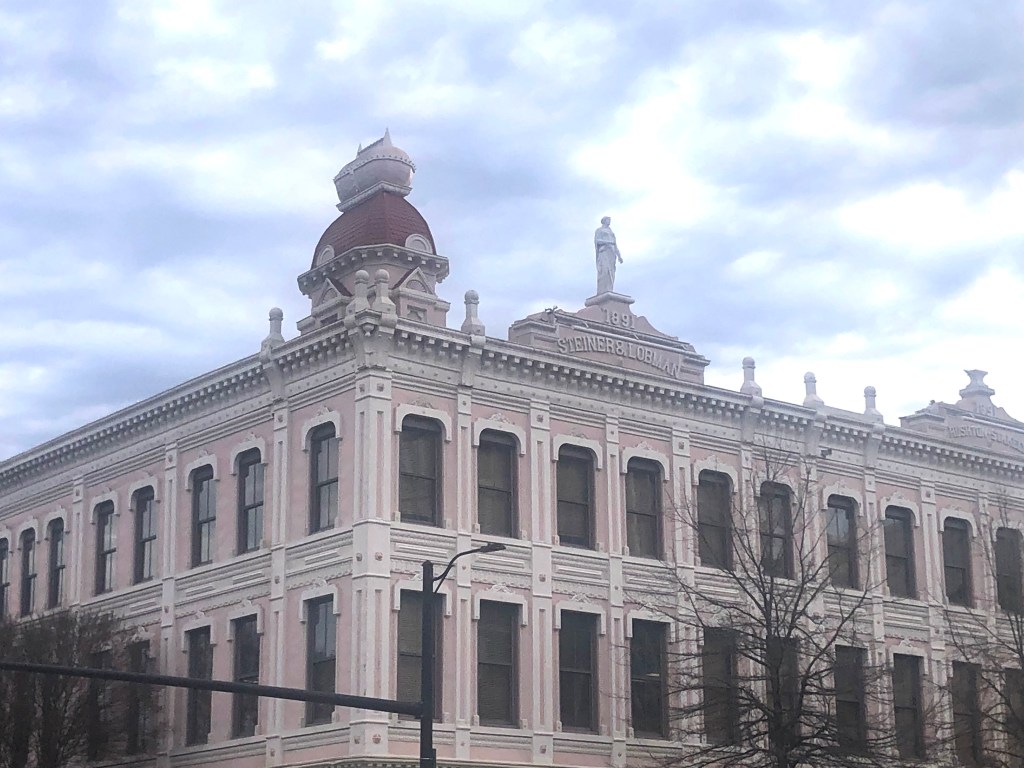
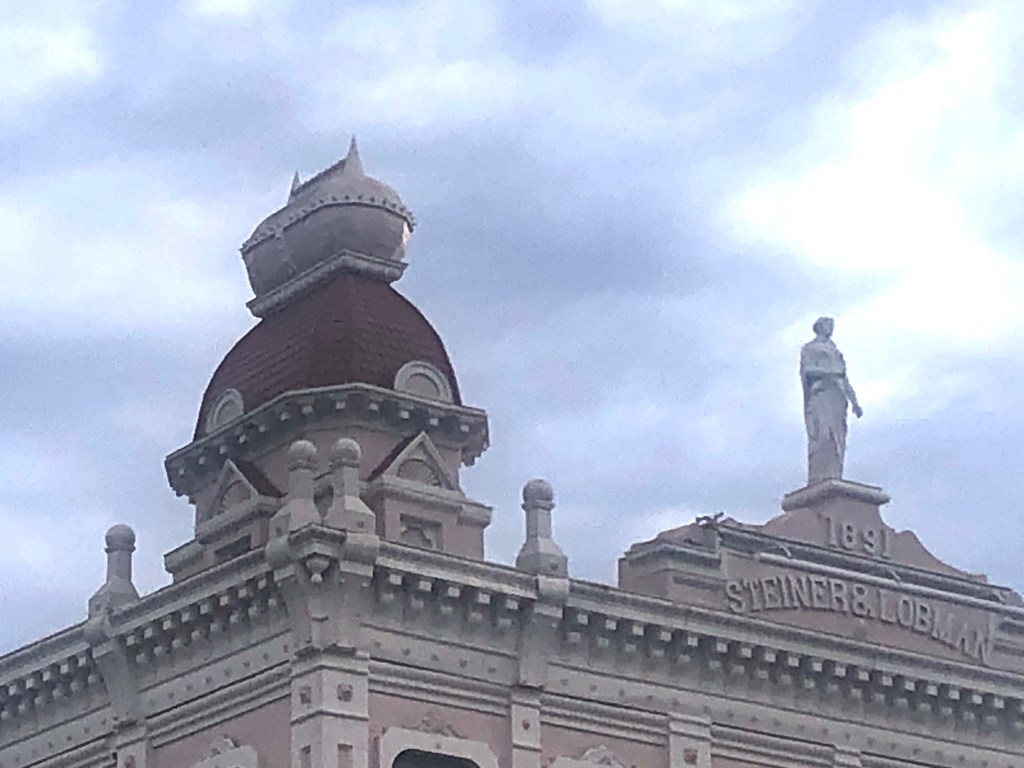
Impressive 1891 Steiner and Lobman building in downtown Montgomery, Alabama. But what’s that atop the front corner?
Yes, it’s a sarcophagus. The townsfolk say that the mortal remains of old man Steiner himself is entombed in it. Other sources scoff at that story.
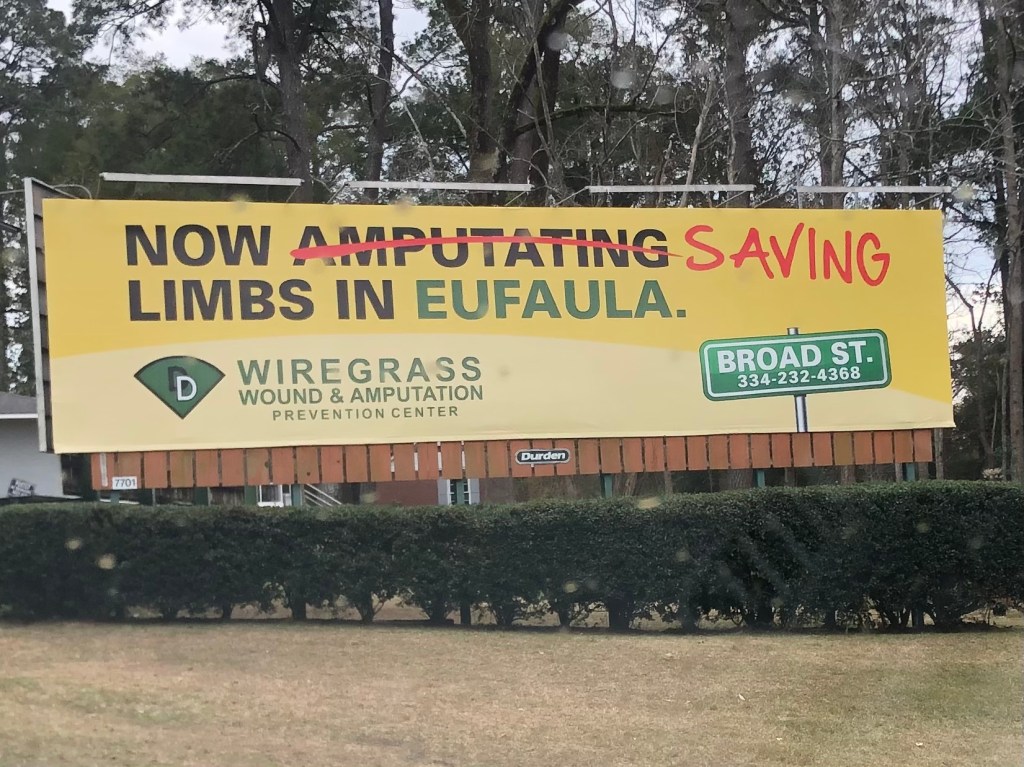
Billboard in Eufaula, Alabama. If you want your limb saved, your first choice probably wouldn’t be a place called an “Amputation Center.” And are amputations so common in Eufaula that they have a special center dedicated to the practice?
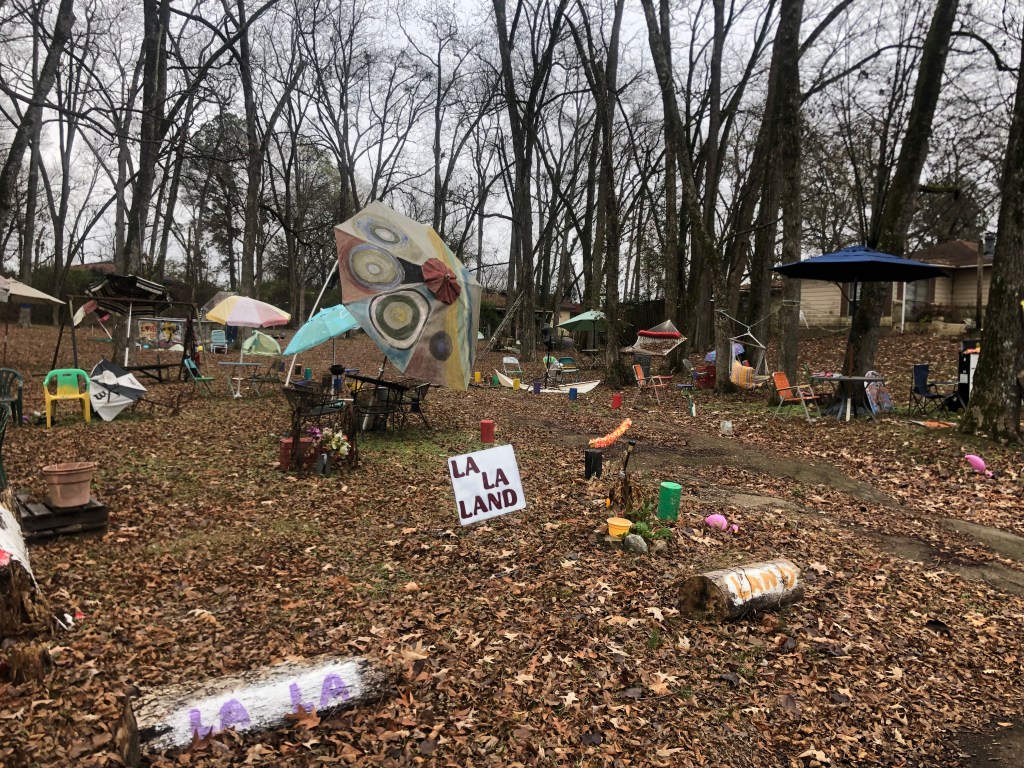
To you it might just look like a junky front yard, but it’s said that the owner, one Charles “LaLa” Evans, decorated his front yard as a tribute to his wife when she passed some 13 years ago.
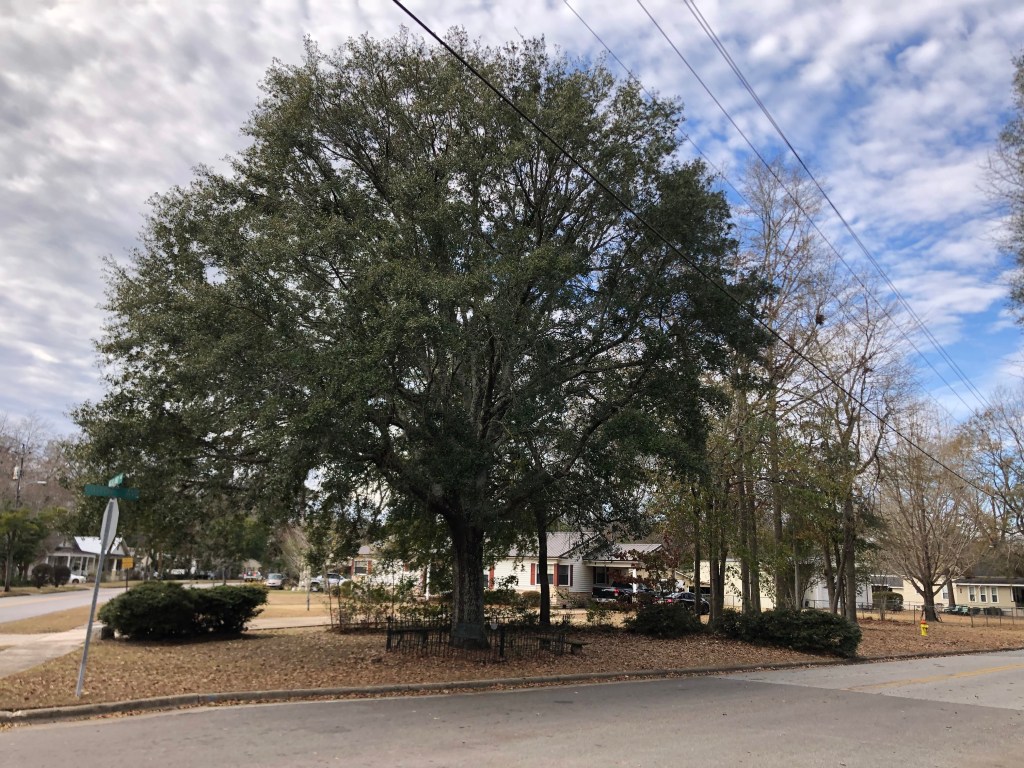
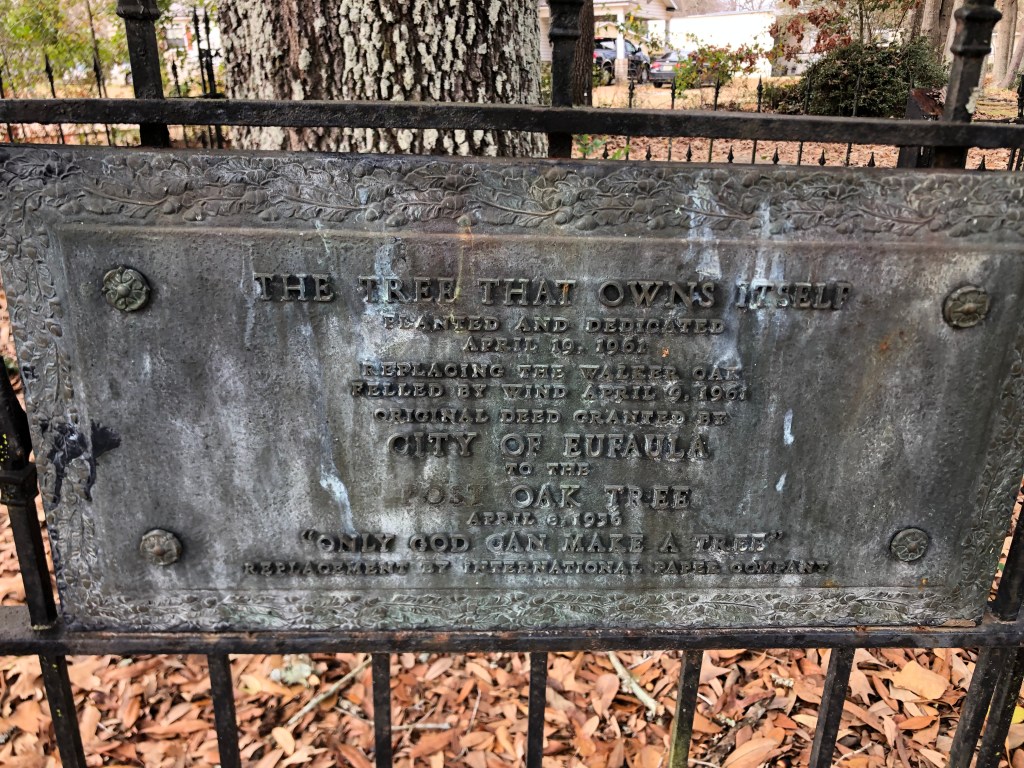
The good people of Eufala, Alabama call this “The Tree That Owns Itself.” The story is a bit confusing: in 1936, the mayor of Eufaula officially granted a deed to to a 200-year-old oak tree, which declared the tree to be “a creation and gift of the Almighty, standing in our midst—to itself—to have and to hold itself, its branches, limbs, trunk and roots so long as it shall live.” Sadly, it stopped living in 1961, when it was uprooted by a tornado. The townsfolk soon planted a new tree, which is the one you see here, and the mayor’s proclamation has been extended to it and all successor trees on this property. No one really knows why.
Plaque under The Tree That Owns Itself.
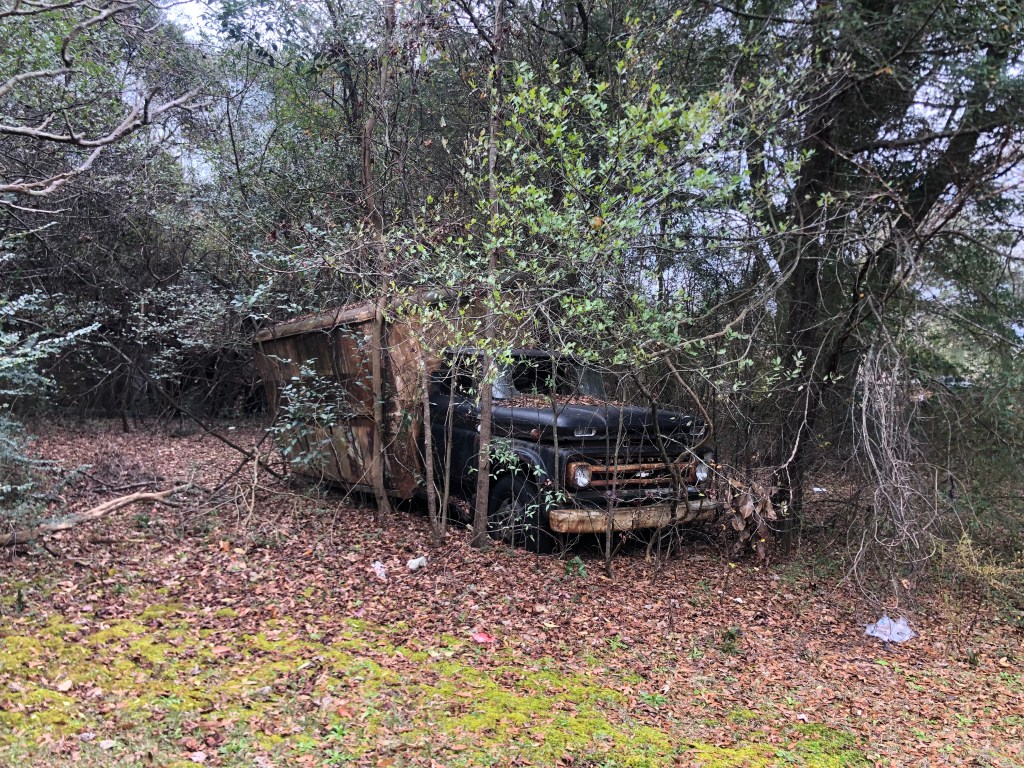
Speaking of trees that have been granted their freedom: Someone needs to free this truck from the tyranny of this tree in Midway, Alabama.
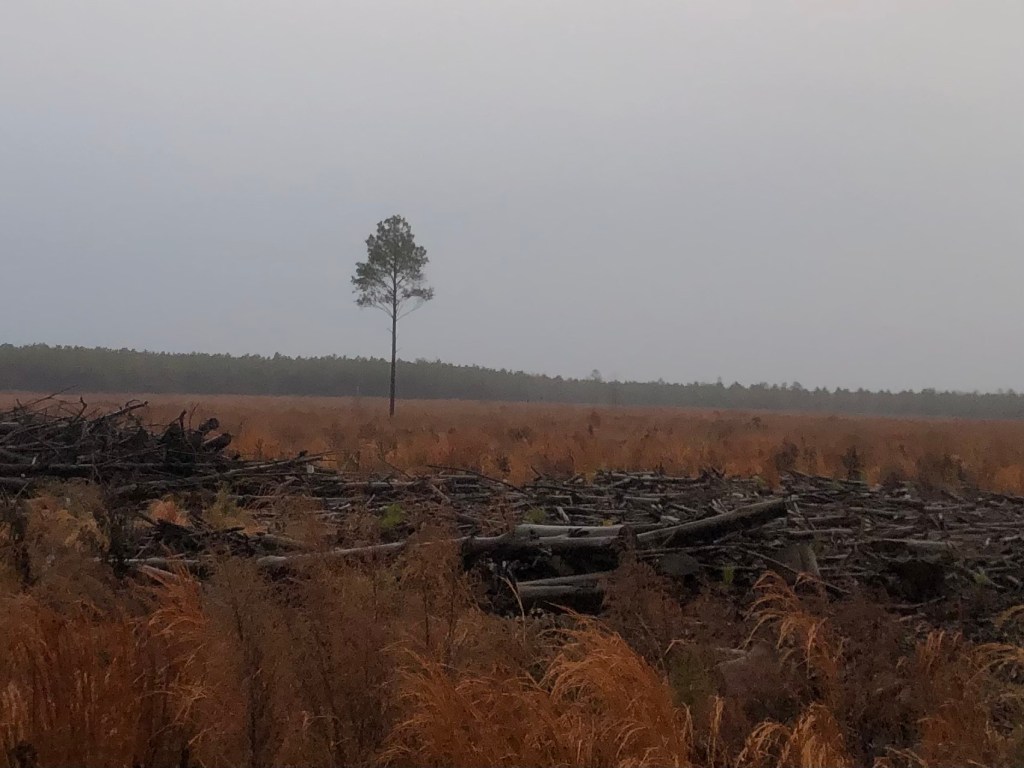
One more tree photo: This lone tree stands amid the carcasses of its brethren. Why it was spared, no one knows. But I took this photo when I was in Crossett, Arkansas, looking for the storied “Spook Lights.” Knowing that, doesn’t this photo seem a little sinister?
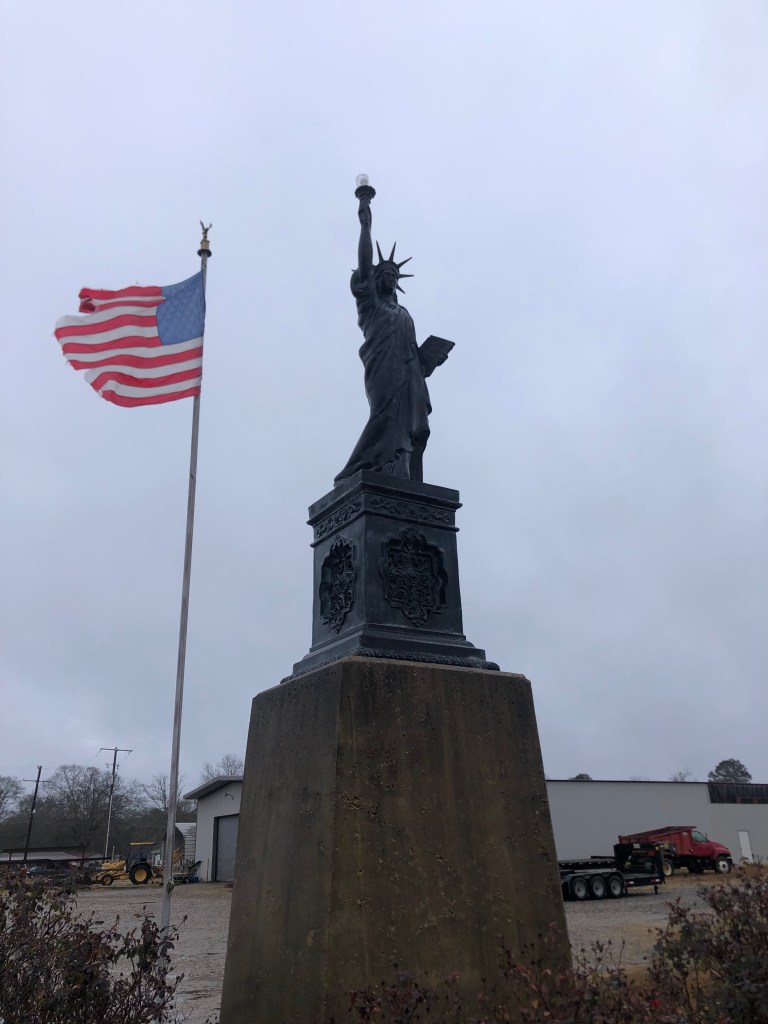
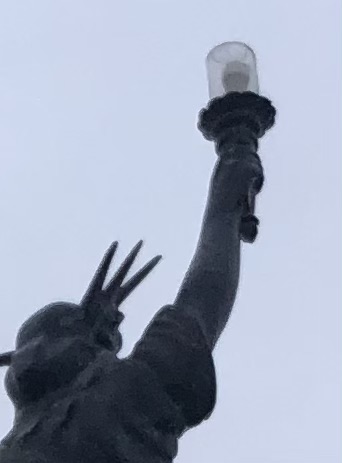
A miniature Statue of Liberty in Strong Arkansas. Not a bad reproduction…but wait, what’s up with her torch?
They cheaped out. Another Home Depot special.
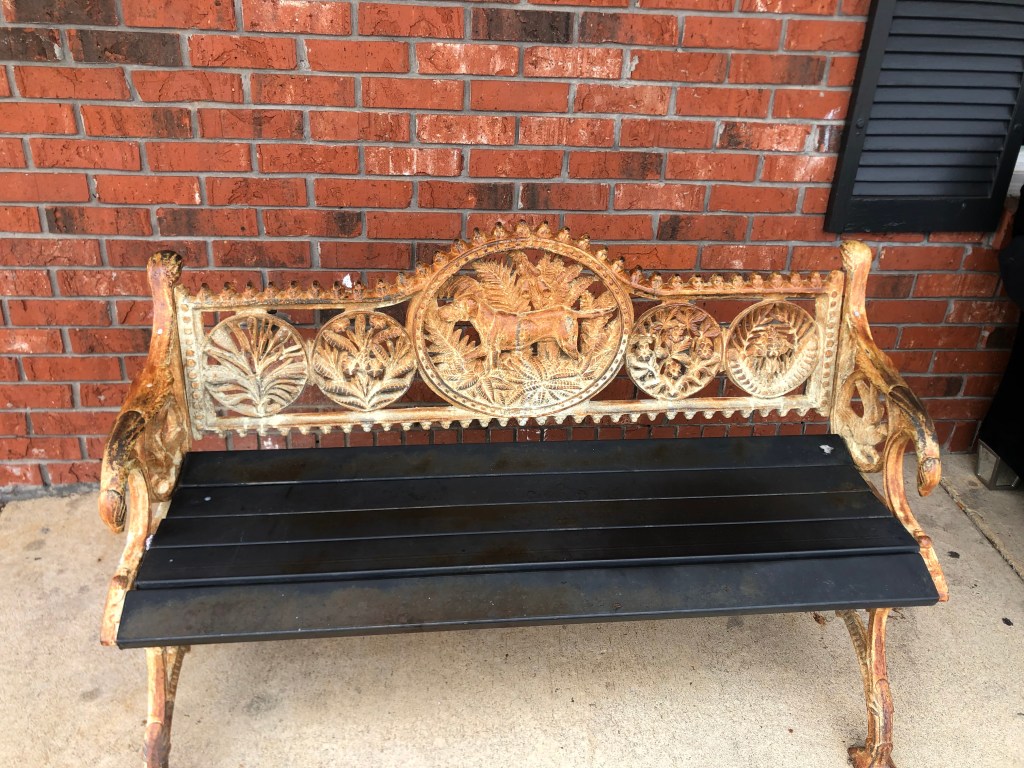
Sidewalk bench in Union Springs, Alabama, which you’ll recall is the “hunting dog field trial capital of the world.” Check out the center of the backrest.
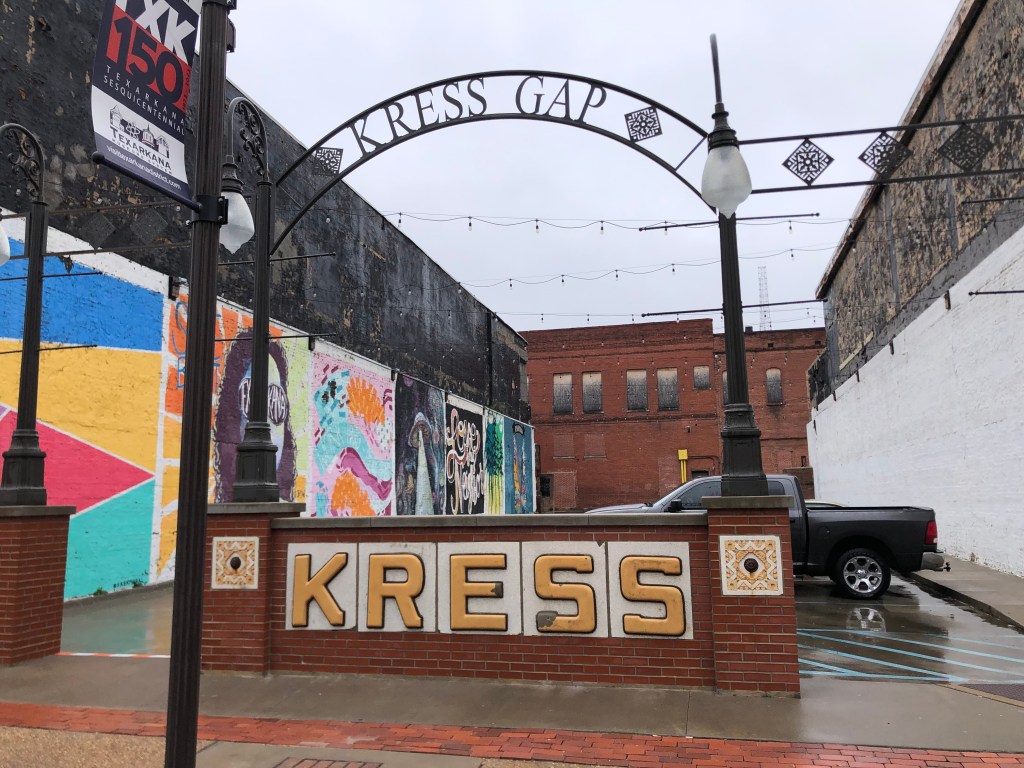
Former site of a Kress department store in Texarkana, Arkansas. As sad as it is to see a historic structure go, I do think it was a nice gesture to commemorate the place with its original signage.
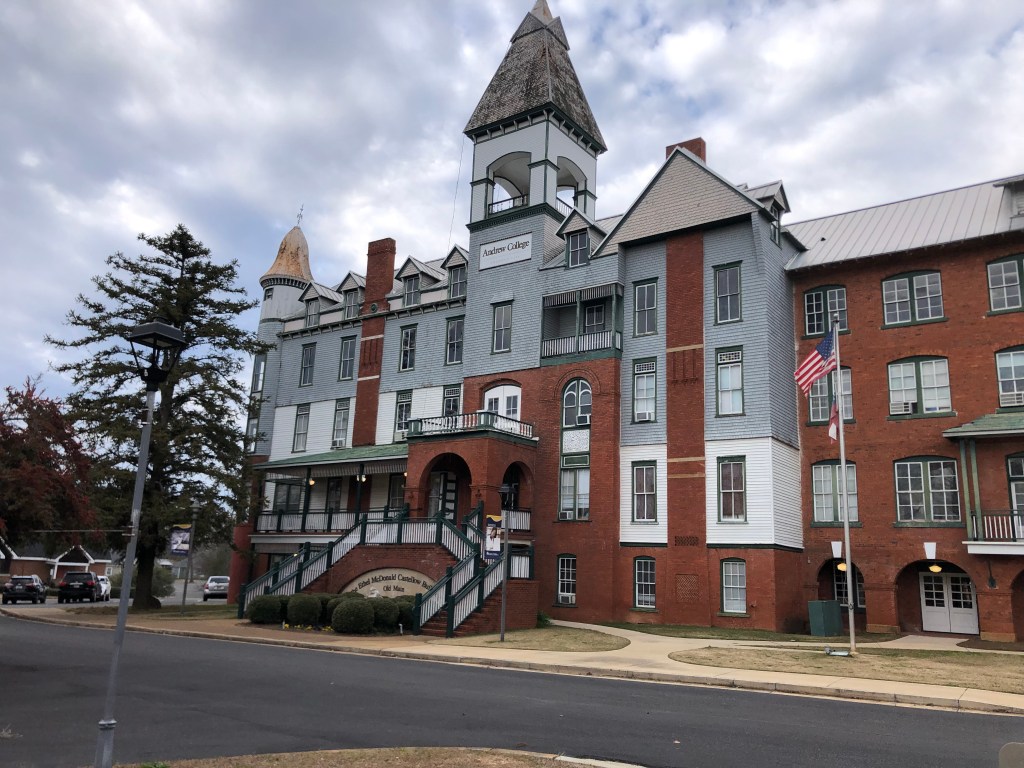
Andrew College in Cuthbert, Georgia, dates back to 1854. This main building was constructed in 1892. It’s still an active, accredited college today. I just like how it looks.
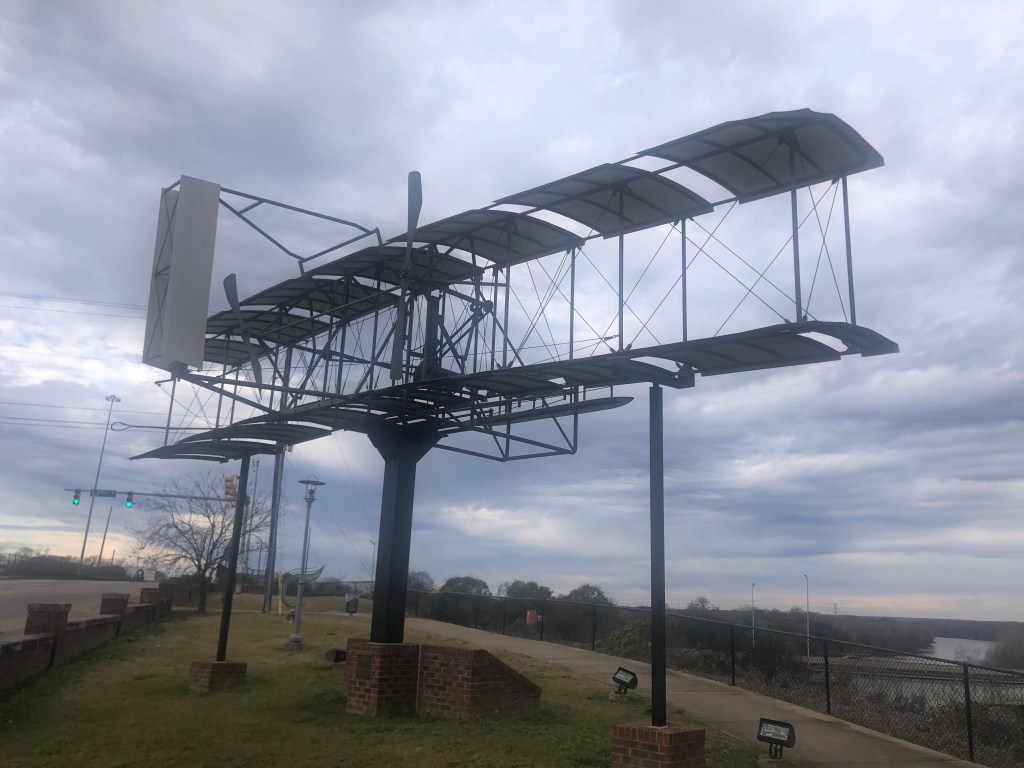
This flying machine seemed a bit out of place in Montgomery, Alabama. But it turns out that the Wright Brothers opened a flying school here in 1910.
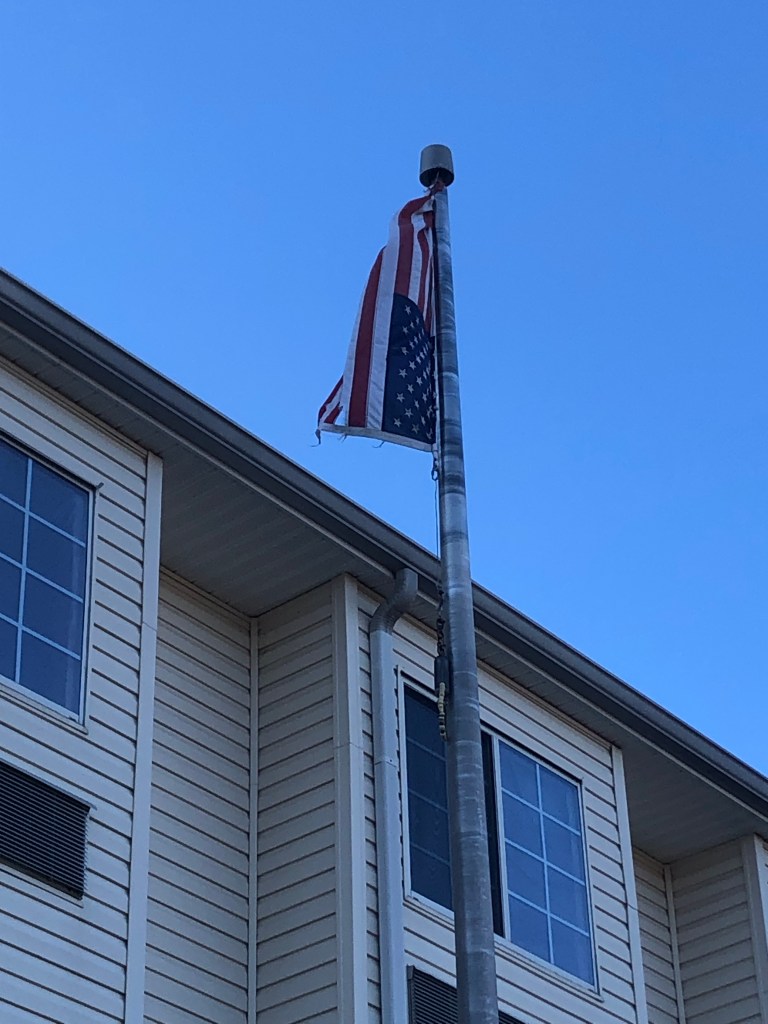
Distressed flag in Starkville, Mississippi. I asked a guy coming out of this building about it. He just looked up and shrugged.
Road trips

Gotta Catch ‘Em All!

Today was the day. In the course of my many, undistinguished years, I’ve visited 49 out of the 50 states in this country. I’m not sure why this is important to me, but it’s been a goal of mine for awhile. I’ve even developed a set of rules for counting the states–for example, simply changing planes at an airport does count. Neither does just passing through on an interstate. For a state to count, I need to place my feet on its soil, have a meal at a local (non-chain) restaurant, and learn something I didn’t know about the state. Even with that fairly low bar, I’ve been unable to claim that I’ve visited all 50 states.

Until today.

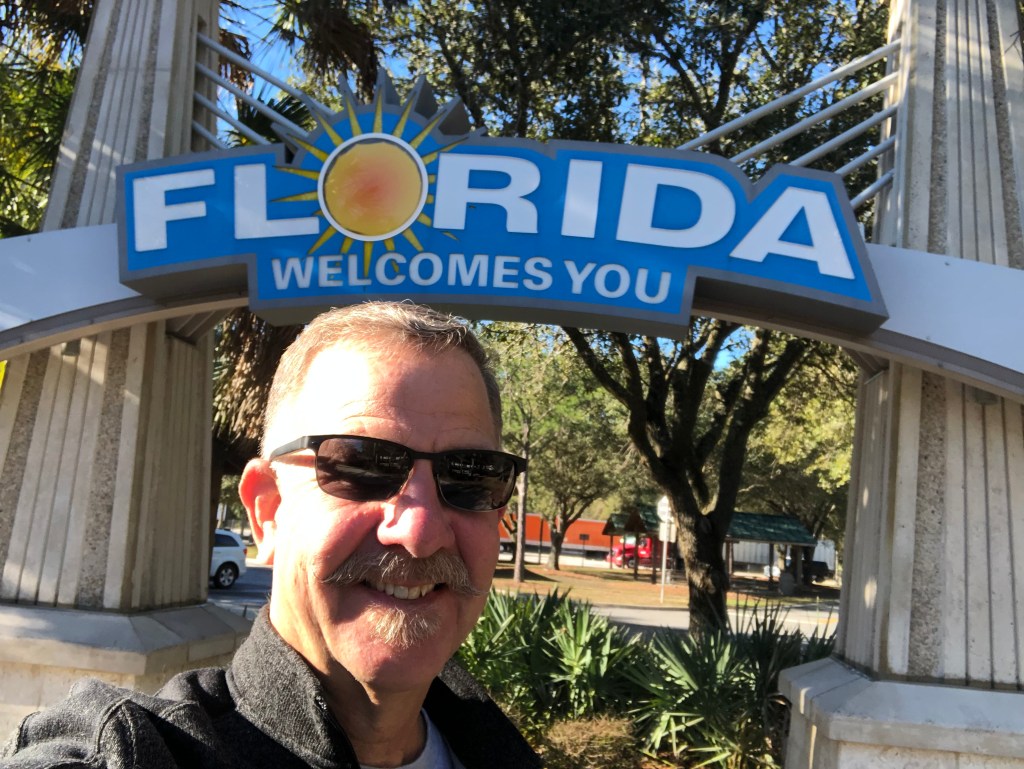
Oh, didn’t I mention I’ve been working on a Doc Holliday mustache?

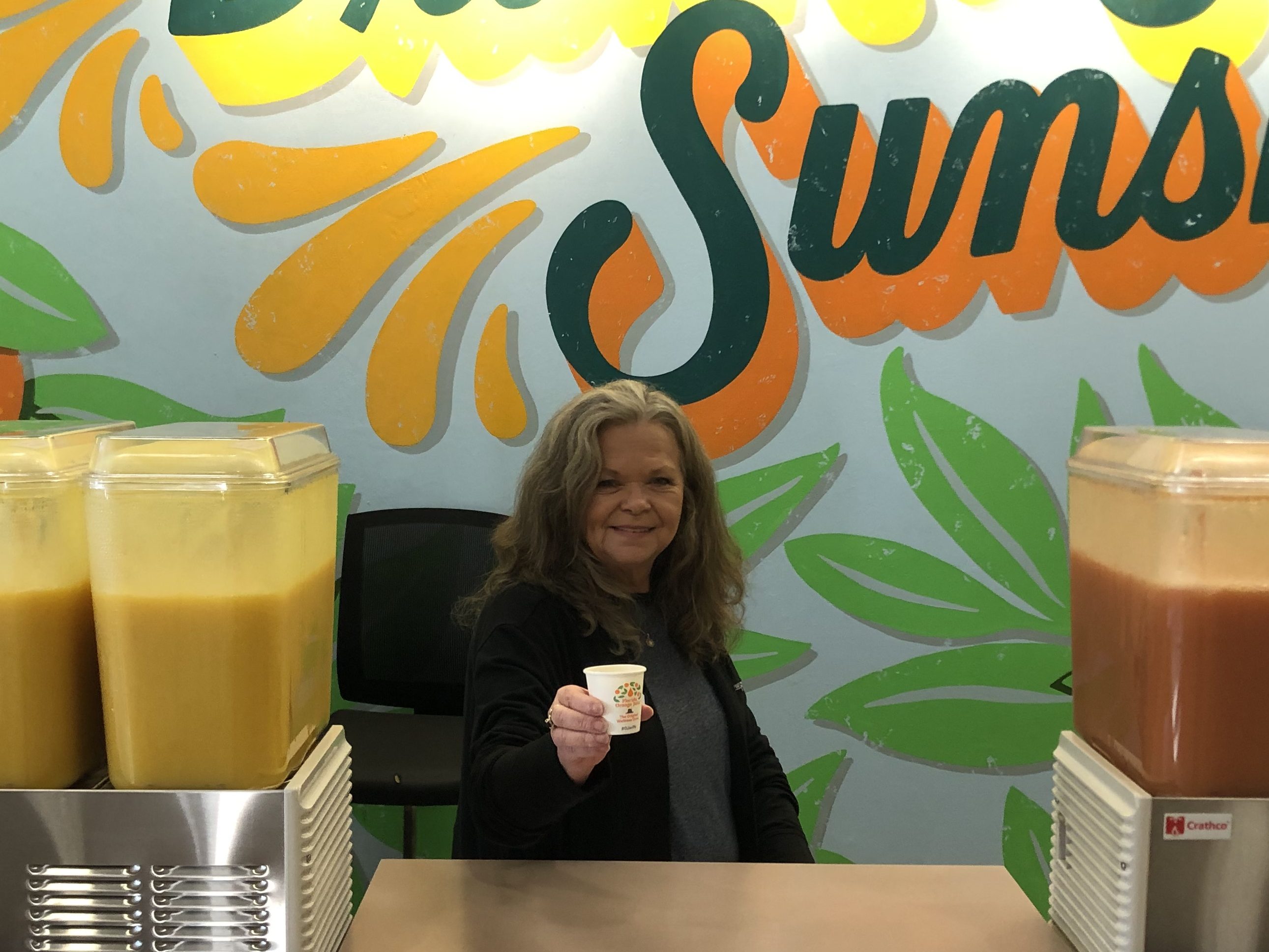
Now, I’m sure much of this is due to serendipity, but I was struck by the contrast of yesterday’s stormy, soggy drive through Georgia, and today’s sunny, warm drive through Florida. What’s more, just a couple of minutes after I crossed the state line I was literally greeted by a smiling Floridian offering me a cup of Florida’s Natural Orange Juice (TM).

The friendly and lovely Gail, greeting a weary traveler at the Florida Welcome Center.

I drove around the Jacksonville area for an hour or so, admiring the palm trees and the sandy beaches. As I said, the weather was pleasant and sunny, so I just kind of basked in the respite from winter.

All that was left was to have a meal at a local eatery. The breakfast I’d eaten didn’t count, because it was in Georgia. That place, by the way, was perplexing. Remember that Monty Python skit where Eric Idle goes to a travel agency and the receptionist asks if he wants to go upstairs? If not, here’s the clip:

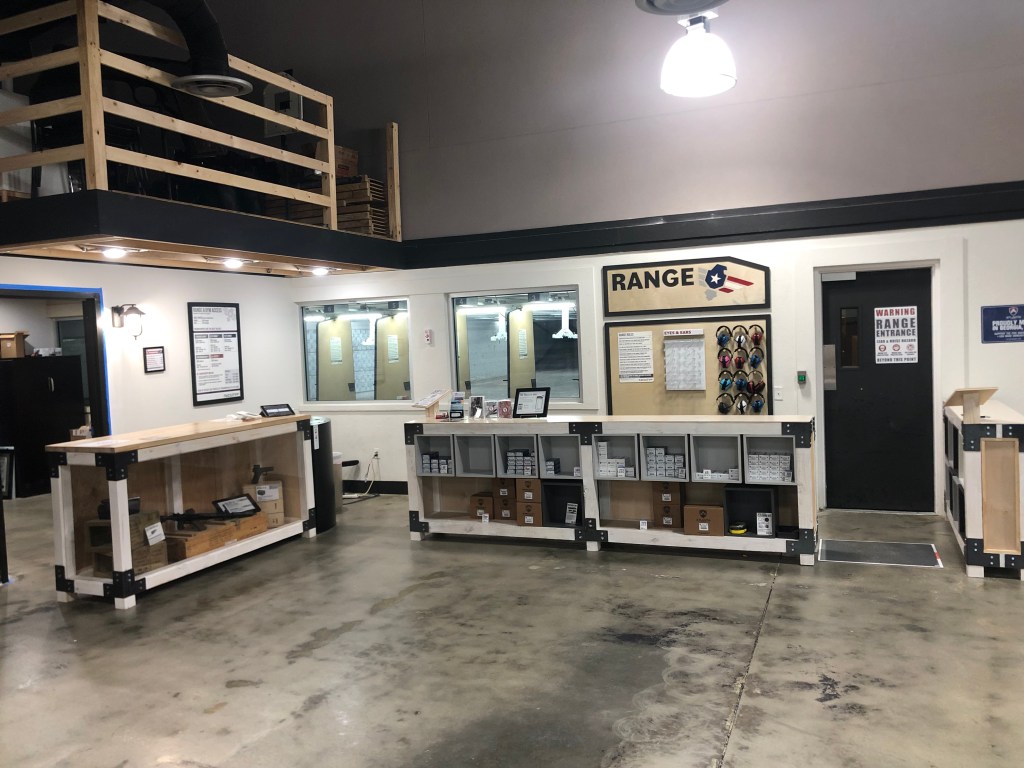
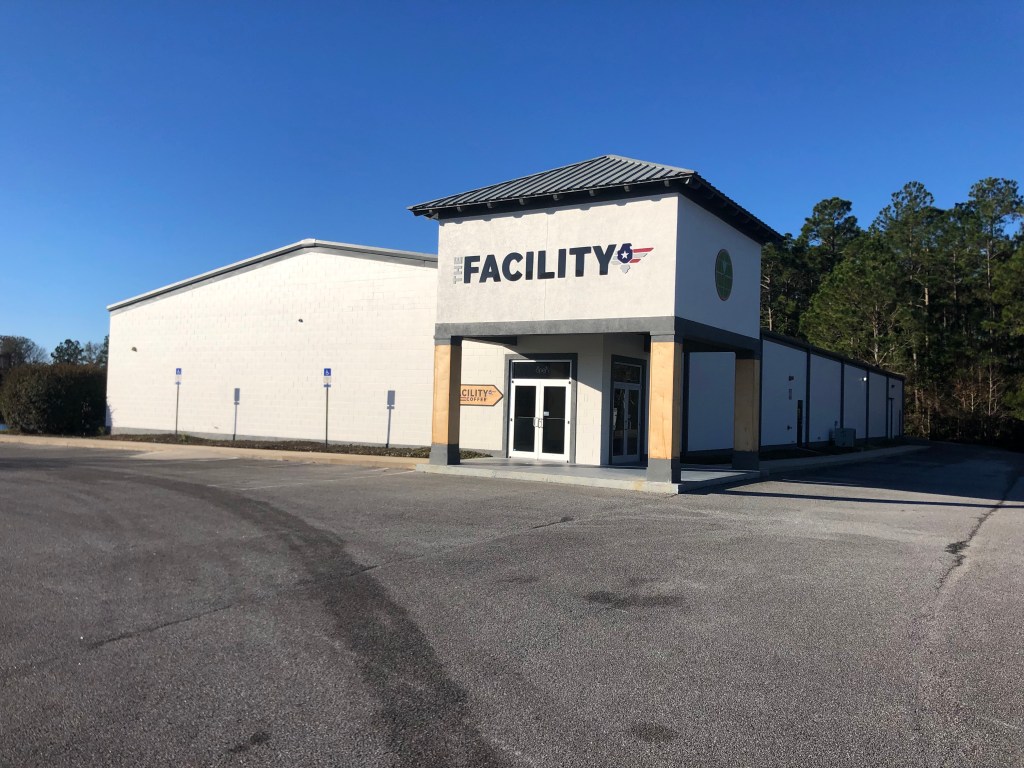
Anyway, I was thinking of Eric Idle’s experience when I walked into The Facility Coffee.The person at the counter looked at me and asked “are you shooting today?,” and when I looked puzzled she hastily added “Oh, or are you here for coffee?” It was at that moment I noticed the various firearms accessories for sale, as well as the fully-equipped firing range in the back. I’m not making this up.

Taking the trope of “leaded” coffee to new heights.
Even the outside looks a little sketchy.

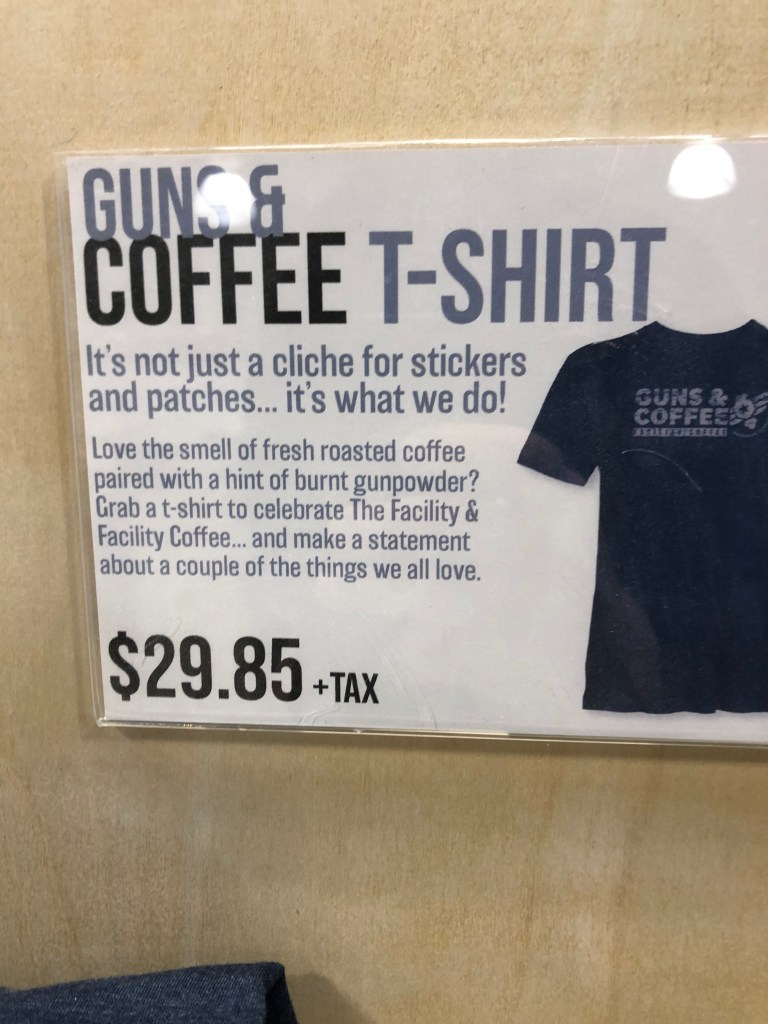
You might think it’s an odd business model, to combine a coffee shop and a firing range. If so, the T-shirts they had for sale probably wouldn’t appeal to you

So when I asked for a bagel to go with my coffee, the young woman pointed to literally two lonely bagels in the case–one plain and one everything. That was it. Surely the coffee shop side of this business was a front.

Anyway, that was all in Georgia. For me to be able to check off my last state I still had to eat at a local restaurant in Florida. So I stopped at the Flying Fish Taproom in Jacksonville (pop: 955,000) and ordered a burger. That task has now been completed, and I’m now able to declare that I’ve visited all 50 states. Finally I can die happy.

Brew of the Day

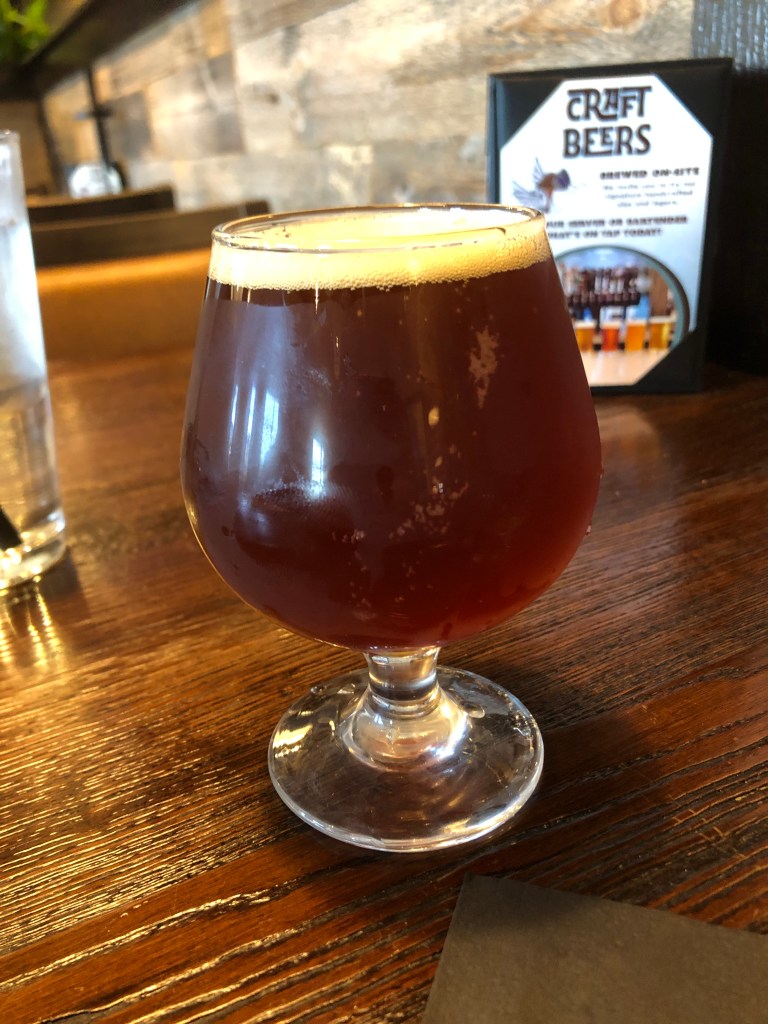
While at the Flying Fish Taproom I enjoyed a goblet of the Buckle Up Buckaroo Barleywine (which is, of course, not a wine but a beer). It’s clocks in with an ABV of 10.5 percent.

The Buckle Up Buckaroo has a beautiful golden honey color and a thin, foamy head. There’s almost no nose to speak of, save a very slight hint of cloves and maybe some cardamom. Overall, it appears pretty innocuous just sitting there on the table.

Things get more interesting when you take a sip. The taste has something of a Belgian vibe. It’s not sweet exactly, but it kind of brushes up against the sweet receptors on your tongue, similar to when you lick the blood from a cut finger. What, you don’t find that to be an enjoyable taste?

This barleywine imparts a distinct flavor of dates, figs, and maybe a little bit of Ocean Spray Craisin. Underlying that is an earthiness that evokes spoiled milk and apple cider vinegar. This drink is light on the hops but not on the carbonation, so you get a tingle without the bitterness. The overall experience is a taste that’s not immediately gratifying, but which you nevertheless find yourself wanting more of. This is perhaps a cautionary tale in itself.

But let’s talk about the alcohol. For your average beer, 10.5 percent is a lot. But not for a barleywine, which can get as high as 13 percent. (The very term “barleywine” was invented to describe high-alcohol beers. I’d always understood this was because, in some jurisdictions and at some point in history, beers above a threshold ABV were not permitted to be called beer. Readers able to confirm or reject this theory should please comment below!) All that said, this 10-oz goblet knocked me for a loop. By the time I took the final sip I was hugging a lamp post and singing Auld Lang Syne.

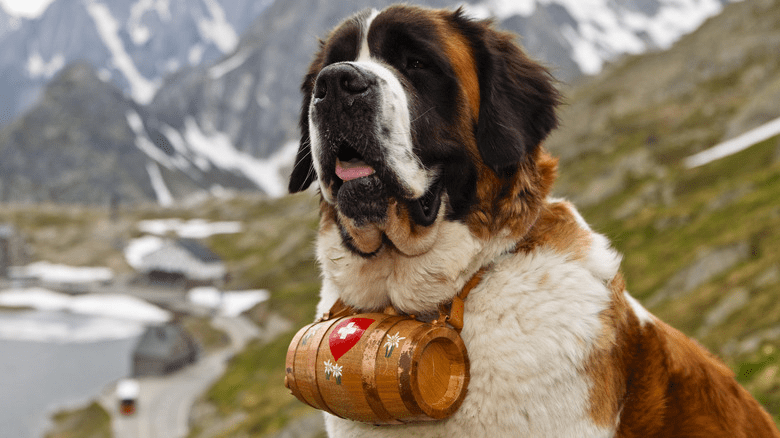
Now, the point of the alcohol in a beer is not just to give you a buzz. It also influences the taste and body and mouthfeel. I’d also argue that a higher-alcohol beer imparts a certain warmth, which is welcome on a winter day. It’s not for nothing that St. Bernards carried brandy to rescue snowbound travelers.

Care for a little Buckle-Up Buckaroo?”

But my point is that I was unprepared for the buzz this tiny glass produced. And I’m writing this under the influence. So I’m awarding this barleywine six stars out of five.