When I was in college I often made the 300-mile trip on US 101 between my home in the San Francisco Bay Area and the University of California at Santa Barbara. I remember thinking on those drives that the point at which I crossed from northern California to southern California was the dense stand of eucalyptus trees through which the highway passed near San Juan Bautista. It was a romantic notion, that there’s a distinct portal where one steps out of the land of redwoods, vineyards, and the tech industry into the land of beaches, movie studios, and traffic. The feeling was made more tangible because the eucalyptus trees and a gradual curve in the highway temporarily block the vistas. When you come out the other side, it’s as though you’ve made some kind of important transition. So I decided, without any real knowledge on the topic, that this place represented the boundary between northern and southern California.
The problem with this notion is that the “portal” is only a few dozen miles south of San Jose, and still well north of even Salinas. I’m sure the good citizens of Monterey would be surprised to learn that they were southern Californians, at least by my reckoning.
It turns out that most people place the boundary between northern and southern California much further south, with the Grapevine in Kern County being the epicenter of their choices. And when people talk about “the Grapevine,” what they usually mean is the stretch of Interstate 5 that crosses over the Tehachapi Mountains at Tejon Pass. A few points of clarification here: First, a southern Californian would call this freeway “the Five,” rather than “Interstate 5.” This phrasing, more than any geographical feature, marks the boundary between northern and southern California. If the locals refer to “the 101” or “the Ten” or “the Five,” you’re in southern California. I’ve noticed another reliable indicator is whether your local Subway restaurant includes cilantro within its range of produce. If so, you’re in southern California. I’m not making this up.
A second point about the Grapevine is that the name is mistakenly considered to be a reference to the twisting nature of the roadway. But it’s actually named for the wild grapes that have grown (and still grow) in the region. Still, you might wonder why anyone would believe that this multi-lane, relatively straight stretch of interstate traveled by big rigs at 70 miles per hour resembled a meandering grapevine. In fact, the comparison dates back to the original road over these mountains, which was a twisting two-lane road built in 1915. And that is the object of today’s travels.
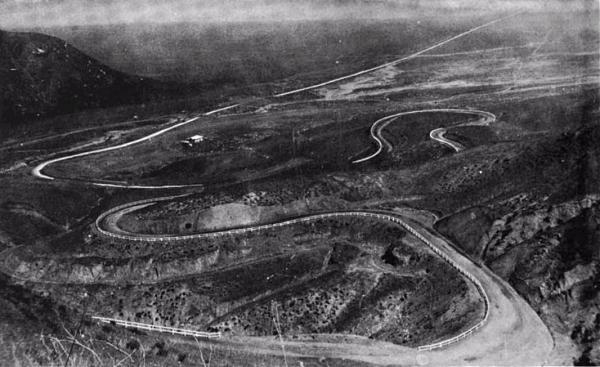
This original road, known as the Ridge Route, had been constructed to link the burgeoning Los Angeles basin to the rest of the state by way of the Central Valley. It was considered an impressive engineering feat at the time, with 697 curves and climbing to more than 4,000 feet above sea level. But the road, with its 15 miles-per-hour speed limit quickly became obsolete as road standards were raised to meet the demands of California’s fast-growing automobile culture. A straighter, three-lane “Ridge Route Alternate” was opened in the 1930s, followed by the US 99 highway in the 1950s and, finally, Interstate 5 in the late 1960s. By this time, the original ridge route was being used mainly for local traffic, and maintenance was severely cut back. Yet the road remains largely intact, and so this morning I hopped on the trusty Speedmaster and went out to see what I could see.
Now, the original ridge route runs 44 miles northward from Castaic to the town of Grapevine. And while you can still see the original road on a modern map, I’d been told conflicting stories about how truly accessible it is. This is a point I intended to clarify.
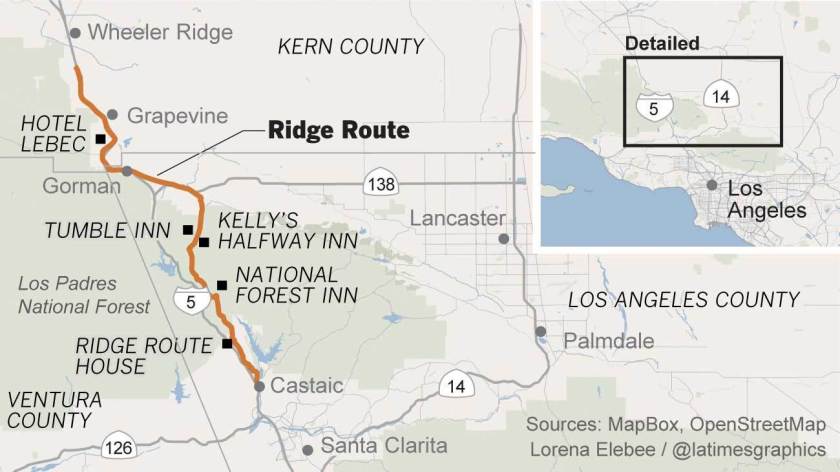
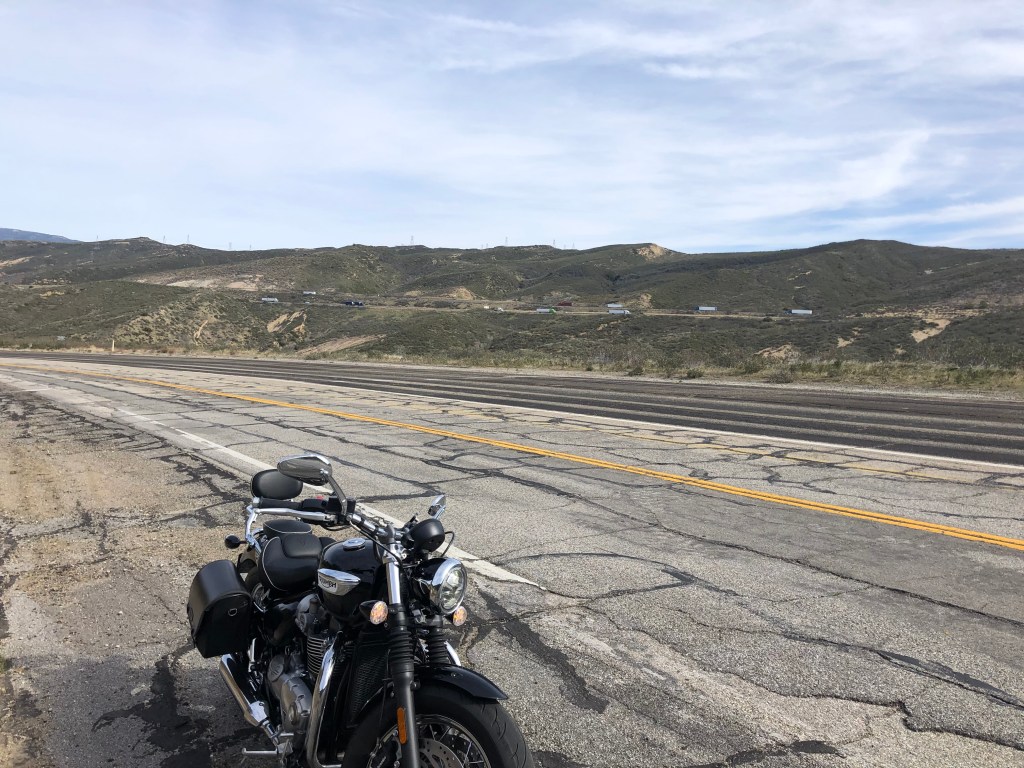
I rode up the interstate directly to the town of Grapevine, where I started looking for the ridge road. I spotted segments of what I assume to be the original roadway on the other side of some hills, but I kept failing in my attempts to find a way over to the elusive road. I jumped back onto “the Five” a couple of times to move a little further south, and tried again. Finally, while driving a stretch of Lancaster Road (Los Angeles County Highway 138), I found a turnoff for “Old Ridge Route Road.” Could it really be that easy?
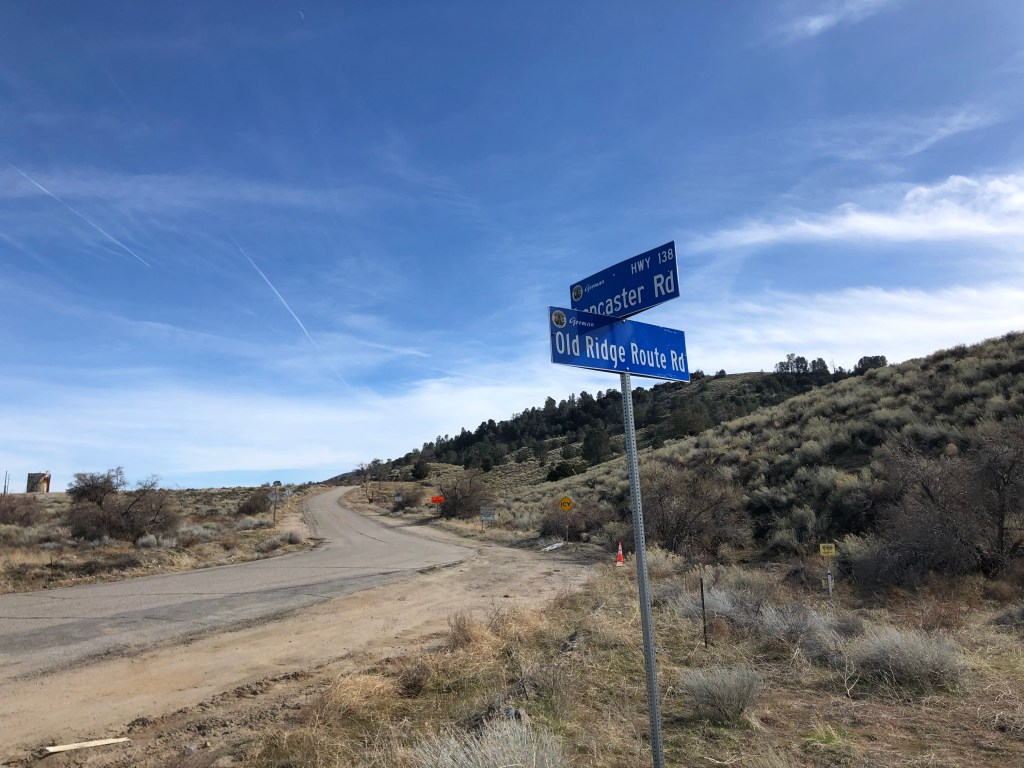
After traversing this road about a mile, I encountered a sign that confirmed I’d found the old, original ridge route:
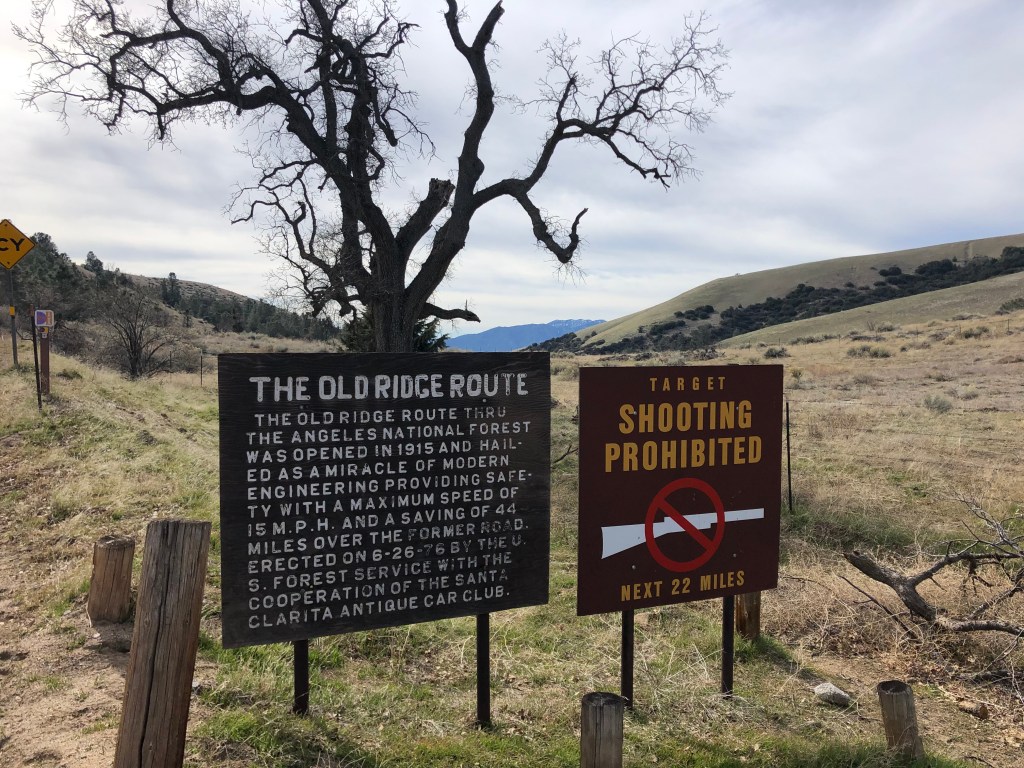
The route is no longer maintained by the county, and as I pushed forward the road got narrower, rutted, and strewn with rocks. I was forced by physics to stick with the original speed limit of 15 mph. Still, the concrete roadway was in remarkably good shape for 100 years old, and I imagined what it must have been like to drive a flivver along it back in the day.
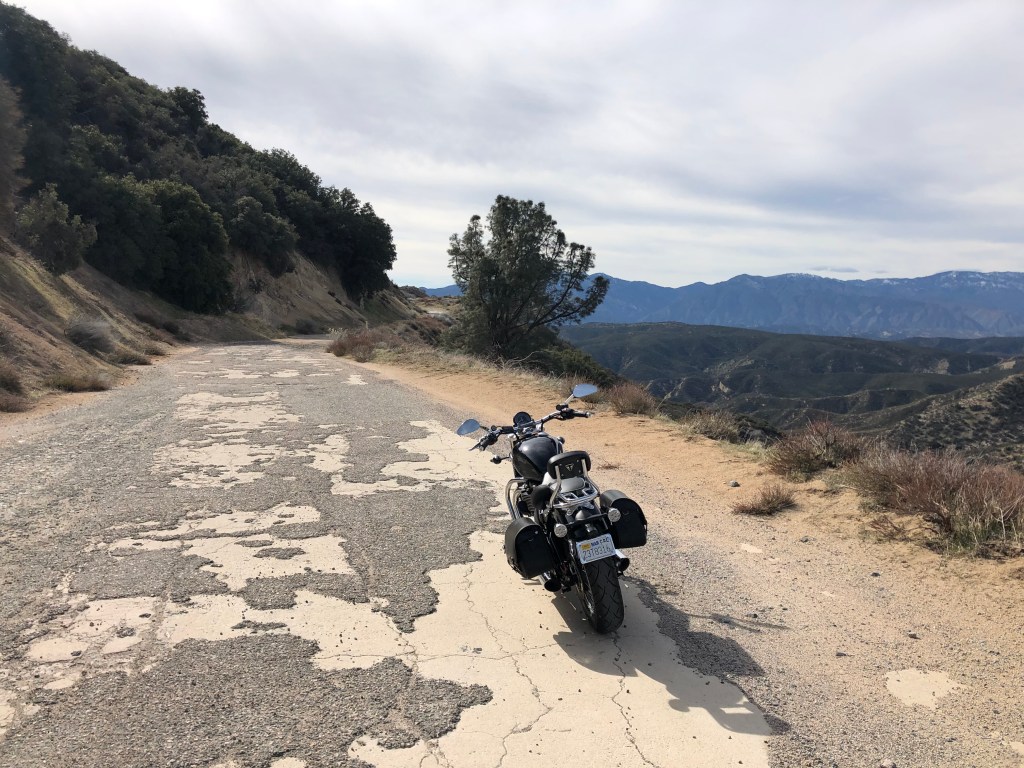
Only once was my safe travel along the roadway in question, where a mudslide had washed over the road during a recent rain. But the mud was now dry, and with my feet on the ground I walked the bike over this treacherous part. Not surprisingly, I encountered no one else on the road.
At one point I passed a sign indicating that Castaic (the southern end of the route) was 31 miles away. I began to think that perhaps I would be able to ride the entire length of the ridge route. I hadn’t seen any signs telling me that motor vehicles were prohibited, and I wasn’t about to go out of my way to find any such restrictions. Still, at 15 miles per hour, I had another couple of hours of bumpy riding ahead of me.
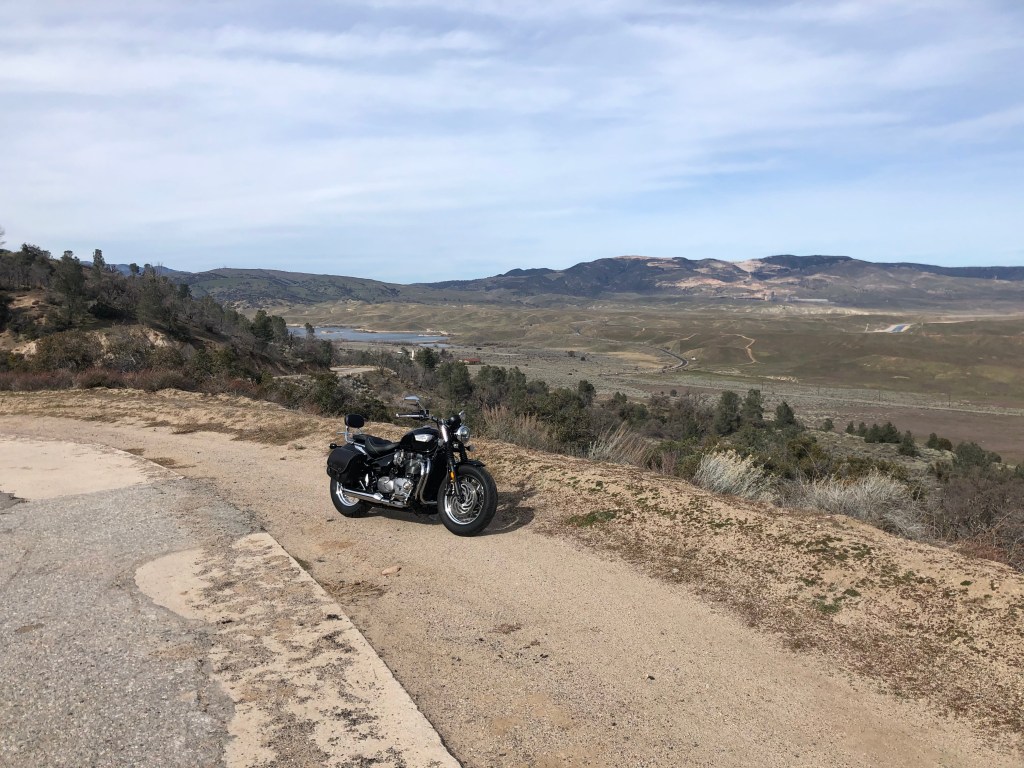
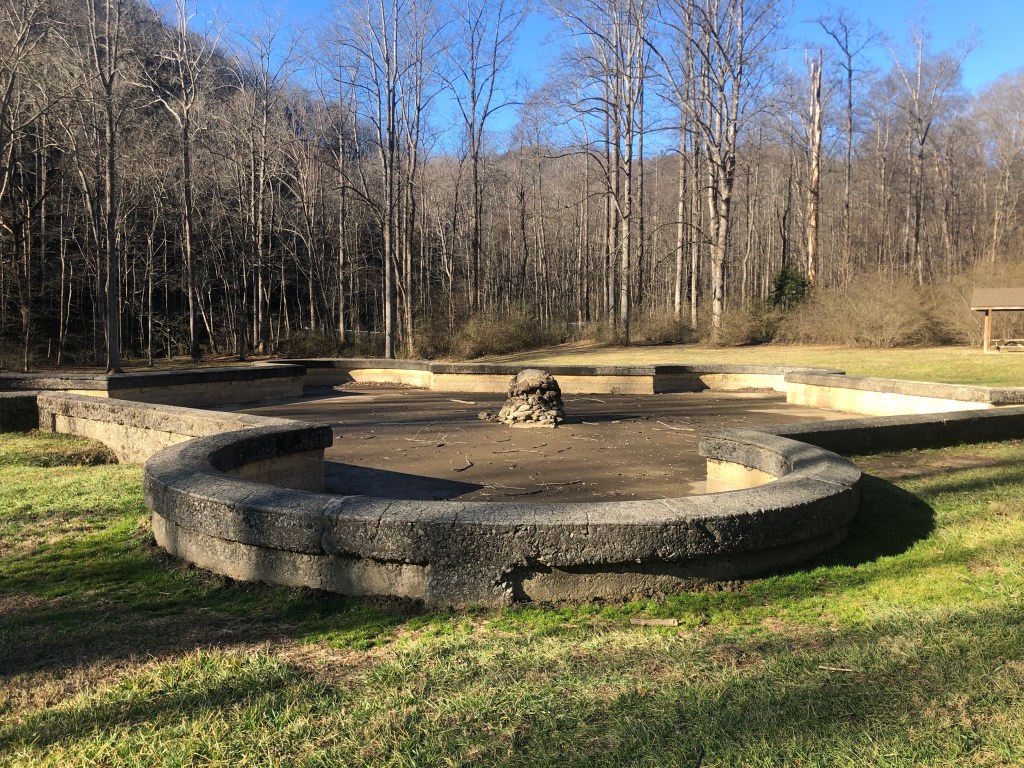
After a bit longer I rounded a corner to see the remains of the fabled Tumble Inn. It was constructed shortly after the Ridge Route opened in 1915, and included a Richfield filling station and a cafe at the road level. Walking up the cement steps and through a stone arch brought you to a lodge with views of the surrounding mountains. It was a welcome oasis along the slow, bumpy route. It closed in 1933, when the Ridge Route Alternate opened.
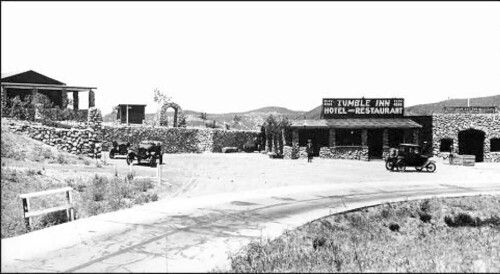
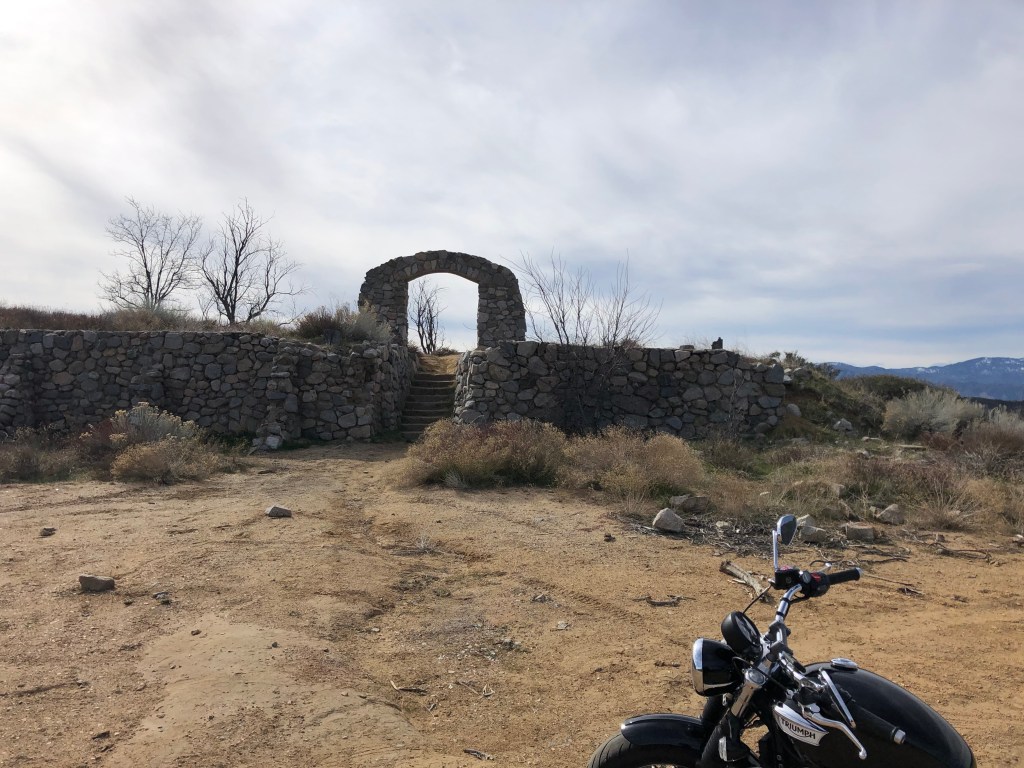
After exploring the remains of the Tumble Inn and listening for the ghosts of pre-World War I auto travel, I jumped back on the Speedmaster to continue my leisurely ride along this historic road. But no sooner had I rounded the next corner than I encountered a large, sturdy gate with a sign prohibiting motor vehicles. Curses–Foiled again! I had no choice but to turn around and head back to Highway 138, whence I’d come.
I eventually got back onto I-5 and, while heading south, took a few exits to try to rejoin the ridge route. I failed in those attempts. I’ll spare you the gory details, except to note that, when I finally got to Castaic, which is the southern end of the Ridge Route, I did manage to find the old, original road. And so I began taking the route northward, knowing that at some point I’d have to encounter another barrier.
That barrier showed up much sooner than I’d expected. After fewer than 5 miles, I encountered a gate almost identical to the one that stopped me by the Tumble Inn. This one, however, was in the process of being closed by a security guard. I (somewhat foolishly) asked him if the road was open to traffic, and he told me, firmly, that it wasn’t. “Then why,” I asked, doing my best Columbo impersonation, “had it been open just a moment ago?” It was to let some workers through, he told me. They’re doing some work up at Pyramid Lake, and they’re really “paranoid” (his word) about “civilians” (also his word) in the area. And so, for the second time, I found myself backtracking on my journey.
When I got home I did a little research on the story of the Ridge Route’s closure. It’s a long and sordid tale, but the short version is this: In 2005 the Los Angeles County Board of Supervisors “vacated” the ridge route (presumably to avoid the costs of maintenance and the risk of liability). The road reverted to the US Forest Service, on whose land it travels. That same year, storms caused parts of the road to fail, and it was closed for safety reasons. Today, 15 years later, most of the road is still closed to vehicle traffic, because (a) no one maintains the road any longer, and/or (b) some portions are now private property, as a result of the Supervisors’ vacating of the easement. Whatever the reasons behind the closure to motor vehicles, however, the entire road officially remains open for hiking, biking and horseback riding. And I’m planning to take a mountain bike along part of the route later this spring. Anyone interested in joining me should let me know…


 Chasing Phantoms