2025 Poe Cocktails

Cocktail 19: Manuscript Found in a Bottle

it was no long while ago that I ventured into the captain’s own private cabin and took thence the materials with which I write, and have written. I shall from time to time continue this journal. It is true that I may not find an opportunity of transmitting it to the world, but I will not fail to make the endeavor. At the last moment I will enclose the MS. in a bottle and cast it within the sea.

The Tale

This is another of Poe’s Gilligan’s Island-themed stories. As the title not-so-subtly implies, the story is presented as a long, handwritten note (i.e., a manuscript, or “MS”) that was placed into a bottle to be discovered when it eventually made it to shore.

The long MS derives from a somewhat outlandish premise, as it portrays ever-worsening maritime predicaments and tragedies, and yet its author devotes hours and hours writing this long, extravagant tale rather than solely fight for survival. First, a sudden storm washes the entire crew off the deck of the ship on which the narrator is a passenger, and only he and an “Old Swede” survive.  For five days they drift toward the south pole, and eventually the sun disappears for good. They then collide with a huge galleon that essentially falls out of the sky; the Swede perishes and the narrator manages to board the larger ship. This ship is populated by ghosts (or maybe the narrator is the ghost, for he is never acknowledged by the galleon’s crew). The galleon itself eventually sinks in a whirlpool, but at the last moment the narrator manages to finish his MS, stick it into a bottle, and cast it overboard.

The tale feels absurd, and it has been suggested that it’s in fact a parody of the overwrought adventure tales that were popular in Poe’s time. But at least it makes use of unintentionally-humorous nautical phrases like “the wind is still in our poop.”

The full story is available here.

The Drink

Given the title, this cocktail will of course have to be served in a bottle. And therefore we’ll turn to the underappreciated (but ostentatiously-named) “Boozy Dark Delight.” The BBD begins with a bottle of stout, and we’ll use that bottle for the vessel (ha!) that contains our finished cocktail.

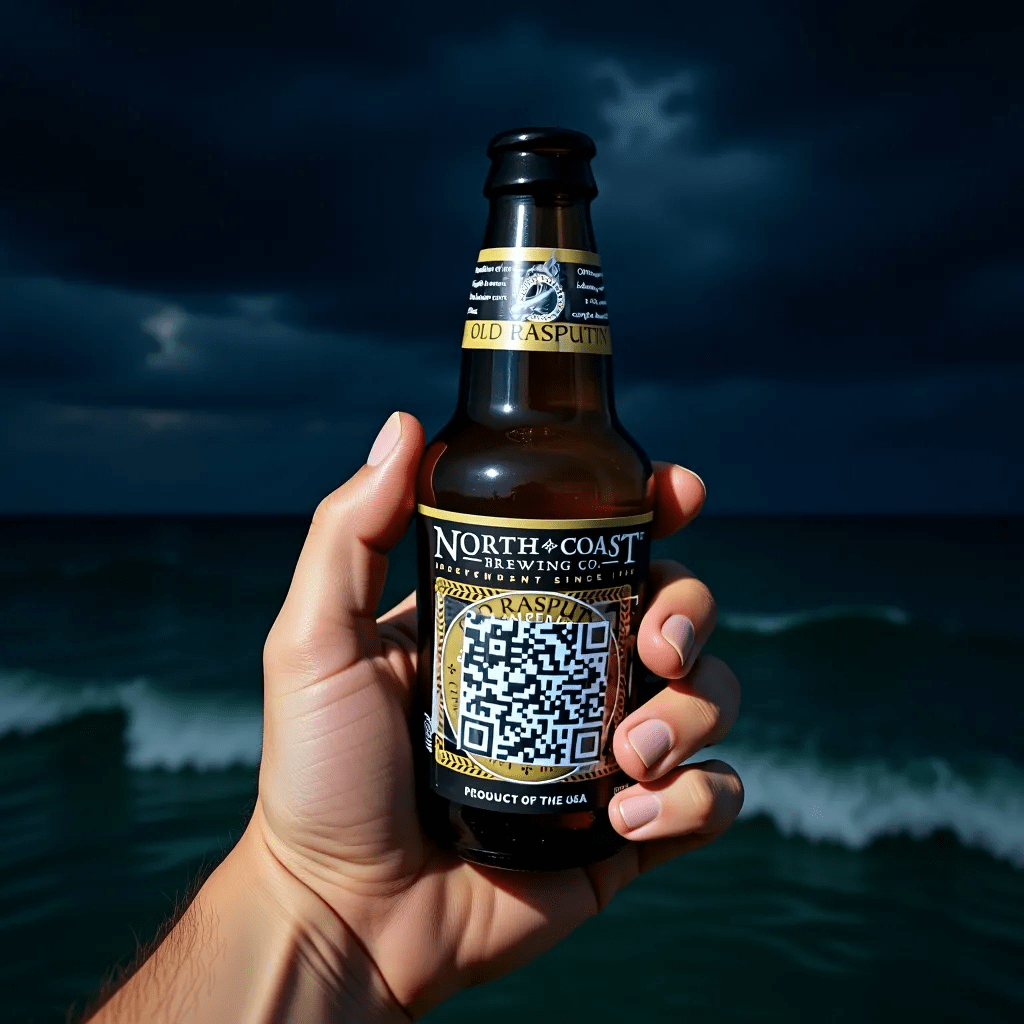
So we’ve got the bottle part licked; but what of the “MS” part? The purists among you might want to literally insert a rolled-up message into the bottle, perhaps using waterproof paper or some other method for avoiding a soggy, disgusting mess. But here is where modern technology for once presents an improvement on the old-fashioned approach to mixology: We’re simply going to add a QR code, which in turn will link to Poe’s MS! Huzzah! Even better, this cocktail contains a nice puzzle element, allowing the imbiber to “discover” the MS in (or on) the bottle. 

To really drive the story home, this drink contains “jaggeree” – an unrefined sugar made from palm sap – on which the narrator subsisted for five days while drifting aboard the storm-ruined vessel. Who wouldn’t want to be figuratively transported into that adventure?!

Ingredients

1 bottle of good stout

1 oz. good Scotch

1 oz. passable orange liqueur

1 small cube of jaggeree, or, in a pinch, a brown sugar cube will do.

A suitable QR code, printed onto an adhesive mailing label

  1. Print out the QR code that I’ve helpfully placed at the bottom of this page. Affix it to a bottle of stout.
  2. Dissolve a small cube of jaggeree or other palm-sap based sugar in the Scotch. Set aside.
  3. Open and drink about half the bottle of stout. If you somehow mess this step up, then finish the bottle and try again with another bottle. Repeat until you get it right.
  4. Carefully add the Scotch/jaggeree mixture and the liqueur to your half-full bottle of stout. You may want to use a funnel for this step.
  5. Serve to an unsuspecting guest, telling them only the name of the drink. Wait for them to figure out the puzzle.
Poe-Script

Poe submitted this tale to a short-story contest by the Baltimore Saturday Visiter (their spelling not mine). It won the contest and was published in the October 19, 1833 issue of the Visiter. Poe received a $50 prize for the story…which is over five times what he would  later receive for “The Raven.” Sometimes life is like that.

Oh, and here’s your QR code:

2025 Poe Cocktails

Cocktail 18: The Premature Burial

It may be asserted, without hesitation, that no event is so terribly well adapted to inspire the supremeness of bodily and of mental distress, as is burial before death. The unendurable oppression of the lungs — the stifling fumes from the damp earth — the clinging to the death garments — the rigid embrace of the narrow house — the blackness of the absolute Night — the silence like a sea that overwhelms — the unseen but palpable presence of the Conqueror Worm — these things, with the thoughts of the air and grass above, with memory of dear friends who would fly to save us if but informed of our fate, and with consciousness that of this fate they can never be informed — that our hopeless portion is that of the really dead — these considerations, I say, carry into the heart, which still palpitates, a degree of appalling and intolerable horror from which the most daring imagination must recoil.

The Tale

Poe spends the first half of this tale cataloguing various instances of persons mistakenly being declared dead and subsequently entombed. He asserts that there’s nothing more horrifying than the idea of being buried alive. I find this to be a questionable claim. I mean, sure, it would suck mightily to awaken from some mysterious illness to find yourself consigned to a coffin six feet under the ground. But surely one can imagine worse fates. Has this man never taken a transatlantic flight on Southwest? Sorry–that was a cheap shot. But didn’t Poe detail a catalogue of tortures in the Pit and the Pendulum that are arguably worse than taking a dirt bath? I’m not convinced that being buried alive would be worse than having your torso gradually sliced open by a giant, slowly-oscillating blade.

In this tale the narrator describes his affliction with catalepsy, and how he constructed all manner of contrivances to save him if he were somehow buried alive. He had his family vault prepared with a spring-loaded door, bell ropes, stores of emergency food, and other mechanisms to assist him if he awoke after being mistakenly entombed. And yet, this being a Poe tale, he nevertheless finds himself trapped in a lightless and noiseless casket, ”buried … as a dog — nailed up in some common coffin — and thrust deep, deep, and for ever, into some ordinary and nameless grave” He cries out in hopeless agony…and is answered by several voices telling him to shut the hell up. It’s then that he remembers he’s been sleeping in a dark, tiny berth aboard a rude boat. His relief is so great that he permanently overcomes his fear of premature burial. 

Anyway, let’s just agree that being buried alive would indeed be an unfortunate circumstance.  And what better way to shake off the disquietude than by mocking the concept with a parodic cocktail? 

The full story is available here.

The Drink

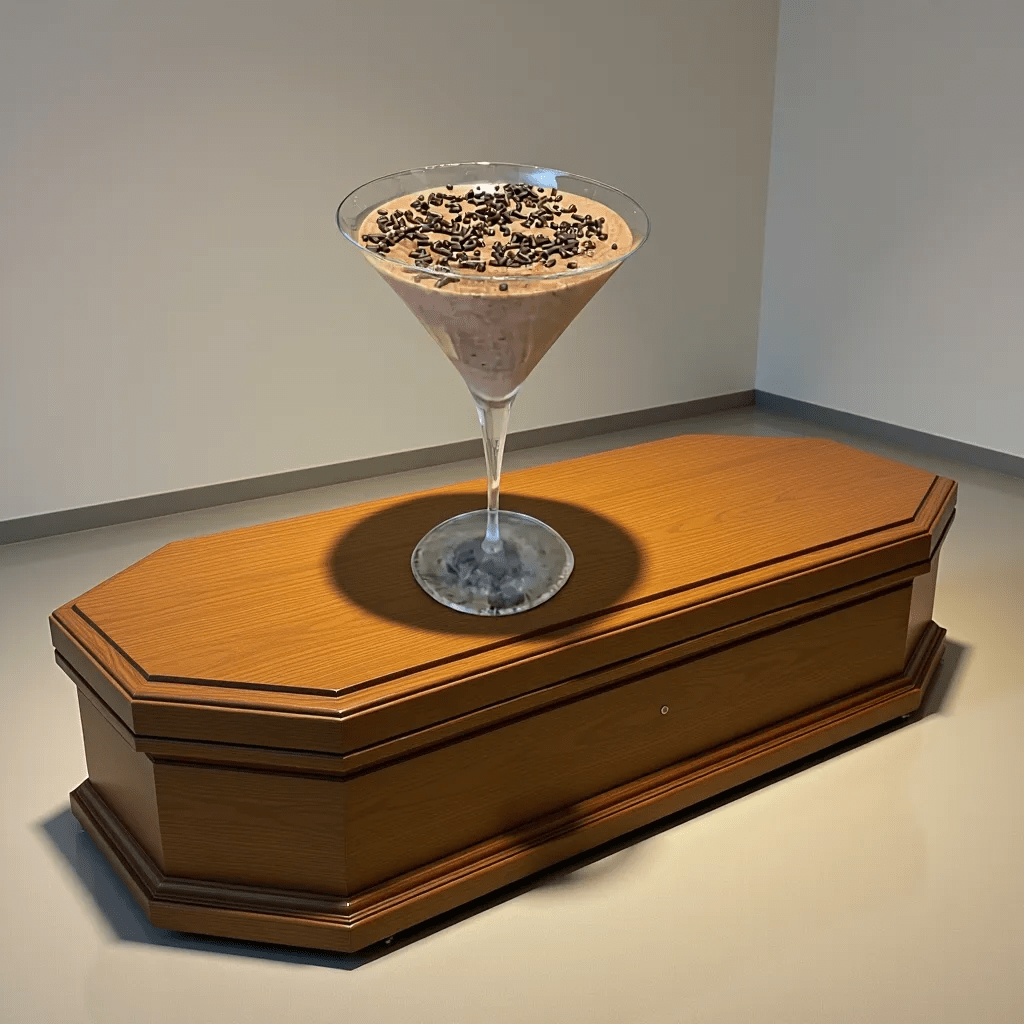
For this drink I envisioned a small, hapless figure buried within a glassful of delicious “earth.” To represent the grave I chose a chocolate pudding shot. For the hapless figure there are many options. I thought immediately of the tiny, plastic baby Jesus that my secretary would bake into her King Cake for Mardi Gras every year. But (1) the little plastic figure isn’t edible, and could pose a choking hazard, and (2) I would feel a little uneasy burying an avatar of baby Jesus in a mess of boozy pudding. So I opted to use a small, human figure made by a UK candy company that is sold under the name “Sweet People.” (I am not making this up.) If you can’t find these at your local candy store, other readily-available options include Sour Patch Kids, a Gummy Bear, or–if Halloween candies are available to you–one of those little wax, syrup-filled skeletons.

Ingredients:

1 package chocolate Jell-O pudding mix. (Make sure you get the instant stuff.)

¾ cup whole milk

¼ cup vodka

⅓ cup Kahlua or Baileys or some other suitable liqueur

¼ cup Cool Whip

1 candy figure

Chocolate sprinkles (as a garnish)

Using a whisk or an electric mixer, combine the pudding mix, milk, vodka, and liqueur. Then fold in the Cool Whip. Pour into a couple of good-size martini glasses, about one-third full. Then deposit your unfortunate victim, then finish filling each glass. Garnish with the chocolate sprinkles. Refrigerate for half an hour or so. The result will be more of a boozy dessert than a proper cocktail. You might need to consume it with a spoon…or a sexton’s spade.

Poe-Script

The Premature Burial (1962) was the title of Roger Corman’s third Poe Picture. It stars Ray Milland (Dial M For Murder, The Uninvited) and Hazel Court (hubba, hubba). It also features Alan Napier, who you’ll remember as Alfred from the original Batman television series. This movie takes the idea of a man morbidly obsessed with premature burial, and spins it out into a barely-recognizable tale. It’s nonetheless entertaining, and might be enjoyed with one or two of these cocktails.

2025 Poe Cocktails

Cocktail 17: The Pit and the Pendulum

I was sick — sick unto death with that long agony; and when they at length unbound me, and I was permitted to sit, I felt that my senses were leaving me. The sentence — the dread sentence of death — was the last of distinct accentuation which reached my ears.

The Tale

This might well be Poe’s best-known story…or at least his best-known title. It describes an unfortunate individual who has been sentenced to death by the Spanish Inquisition, to face a series of ever-worsening tortures with the promise of eventual death. Two of these tortures are the titular pit (a literally abysmal well of doom) and the pendulum (a large steel blade at the end of a long rod that swings back and forth, gradually and ineluctably descending toward the narrator’s bound body). At the final moment the narrator is liberated by General Lasalle of Napoleon’s army. Huzzah!

The full story is available here.

The Drink

Like the Inquisition’s torture chamber, this drink is not for the faint-hearted. It’s based on a 19th-century cocktail called a Turf Club. It starts harmlessly enough with some good, dry gin and vermouth, but the addition of maraschino cherry liqueur creates an unexpected and not altogether harmonious flavor. It’s also got the requisite Poe-esque absinthe which, we’ve learned, must be handled with care.

Admittedly, the central gimmick to this drink is the play on the word “pit,” as well as the visual allegory of a lime pendulum blade. The umami bitters are the most reckless of the ingredients, mucking up what might otherwise be a refreshing drink, but I felt them necessary to evoke the spicy meat that the narrator rubbed on the rope that bound him, in order to entice the rats to gnaw through it and set him free. So there’s that.

Ingredients:

2 oz. dry gin

¾ oz dry vermouth

¼ oz. maraschino cherry liqueur

2 dashes absinthe

2 dashes umami bitters

½ of a lime wheel, for garnish

1 cherry (with pit)

First, carve up a lime wheel into a crescent shape and place it at the end of a cocktail pick, to resemble the deadly “pendulum.” Place it at a menacing angle in a chilled coupe glass. Combine the gin, liqueur, and bitters in a mixing glass with ice and stir, then strain into the prepared glass. Add a cherry (with the pit–that’s the whole point!).

(Originally I tried using Scotch and orange juice, but you couldn’t easily make out the pendulum through the murky liquid. This is a form-over-function kind of situation.)

Poe-Script

This story first appeared in 1842, in a compendium of Christmas-themed (!) stories entitled The Gift: A Christmas and New Year’s Present. Poe’s entry must have seemed a bit jarring among the other stories in the volume, including “Billy Snub, the News-Boy,” “Flowers,” and “The Lace Cap.”

2025 Poe Cocktails

Cocktail 16: The Conqueror Worm

It writhes!–it writhes!–with mortal pangs

The mimes become its food,

And the angels sob at vermin fangs

In human gore imbued.

The Tale

The Conqueror Worm is one of Poe’s more gruesome poems, describing how, at the end of our mortal lives, our bodies are consumed by worms (or, to be more precise, maggots). It’s a fair (though disgusting) characterization, though his broader conclusion (What’s the point of life, as in the end we’re all dead) isn’t exactly uplifting. This isn’t the kind of poem that you’d want to include in a valentine.

The basic outline of the poem presents a theater presentation that is horribly ruined by a “conqueror worm” that essentially eats up the performers (“mimes”). Poe ends the poem on this cheery note: “…the play is the tragedy, ‘Man,’ / And its hero the Conqueror Worm.”

The poem (or at least its title) has made its way into songs and movies. For example: The 1968 British horror film The Witchfinder General, starring Vincent Price, was retitled The Conqueror Worm for its release in the US. But the film really has nothing to do with Poe’s poem.

The full story is available here.

The Drink

This cocktail employs the humble gummy worm in the lead role. It sits atop a mountain of ice, which seems like an appropriate pose for a conqueror. 

For the ingredients, I figured we needed a neutral spirit so as not to clash with the distinct gummy flavor. So I chose vodka. To this we add some Aperol, whose sweetness is in sync with the gummy’s sugar, but whose bitterness saves this drink from being too cloying. A couple of dashes of chocolate bitters adds depth; trust me on this one.

Ingredients:

1-1/2 oz vodka

½ oz Aperol

2 dashes chocolate bitters

I Gummy worm (flavor of your choice; I used a sour gummy)

Mix the vodka, aperol, and bitters in a shaker with ice. Strain into a coupe glass that’s been filled to the top with crushed ice. Add a single gummy worm on top of the ice, leaning over the rim of the glass.

This drink goes down easy, like a Sunday morning. Eat the alcohol-soaked worm at the end as a special treat.

Poe-script

Poe’s birth-parents were both actors. Surely this somehow figures into his describing life as a stage. And yet, didn’t someone else once use that metaphor?

2025 Poe Cocktails

Cocktail 15: The Devil in the Belfry

Owing to their vast antiquity, the style of architecture is somewhat odd — but is not for that reason the less strikingly picturesque. They are fashioned of hard-burned little bricks, red, with black ends, so that the walls look like chess-boards upon a great scale. The gables are turned to the front, and there are cornices as big as all the rest of the house over the eaves, and over the main doors. The windows are narrow and deep, with very tiny panes and a great deal of sash. On the roof is a vast quantity of tiles with long curly ears. The wood-work, throughout, is of dingy oak, and there is much carving about it, with but a trifling variety of pattern; for time out of mind, the carvers of Vondervotteimittiss have never been able to carve more than two objects — a time-piece and a cabbage. But these they do excellently well, and intersperse them with singular ingenuity wherever they find room for the chisel.

The Tale

An unnamed narrator describes “the Dutch borough of Vondervotteimittiss.” If you relax your ears enough, the town’s name sounds like “Wonder-what-time-it-is.” Which is apropos, because the town’s inhabitants famously fixate only on clocks and, even more outre, cabbages. Indeed, in all of the town’s near-identical homes, the mantelpieces all have engravings of clocks and cabbages, and upon each mantelpiece sits a clock and a potted cabbage plant. To top it off, the town’s council adopted a resolution that “We will stick by our clocks and our cabbages.”

The plot, such as it is, centers on the town’s enormous, seven-faced clock, which is the village’s “pride and wonder” that sits atop a steeple. One day a sinister-looking stranger gets to the top of the tower, assaults the clock-keeper, and causes the clock to strike thirteen, which in turn throws the time-fixated and routinized townspeople into rudderless confusion. The narrator concludes with this: “Let us proceed in a body to the borough, and restore the ancient order of things in Vondervotteimittiss by ejecting that little chap from the steeple.” If only all of life’s problems could be solved so easily!

The full story is available here.

The Drink

Obviously the only kind of cocktail to evoke this story must somehow incorporate clocks and cabbages. The first of these is easy enough, if you’ll allow me to use “thyme” as a stand-in for a clock. Get it?

The cabbage part is simultaneously simple and fraught. I opted for a purple cabbage, which will impart a lovely hue but also a disgusting, flatulent taste and smell. I’m told that one can somewhat mitigate the taste and smell by using dehydrated cabbage. But really, where am I going to find that? No, this is one of those cases where I’m just going to have to (literally) hold my nose and soldier through.

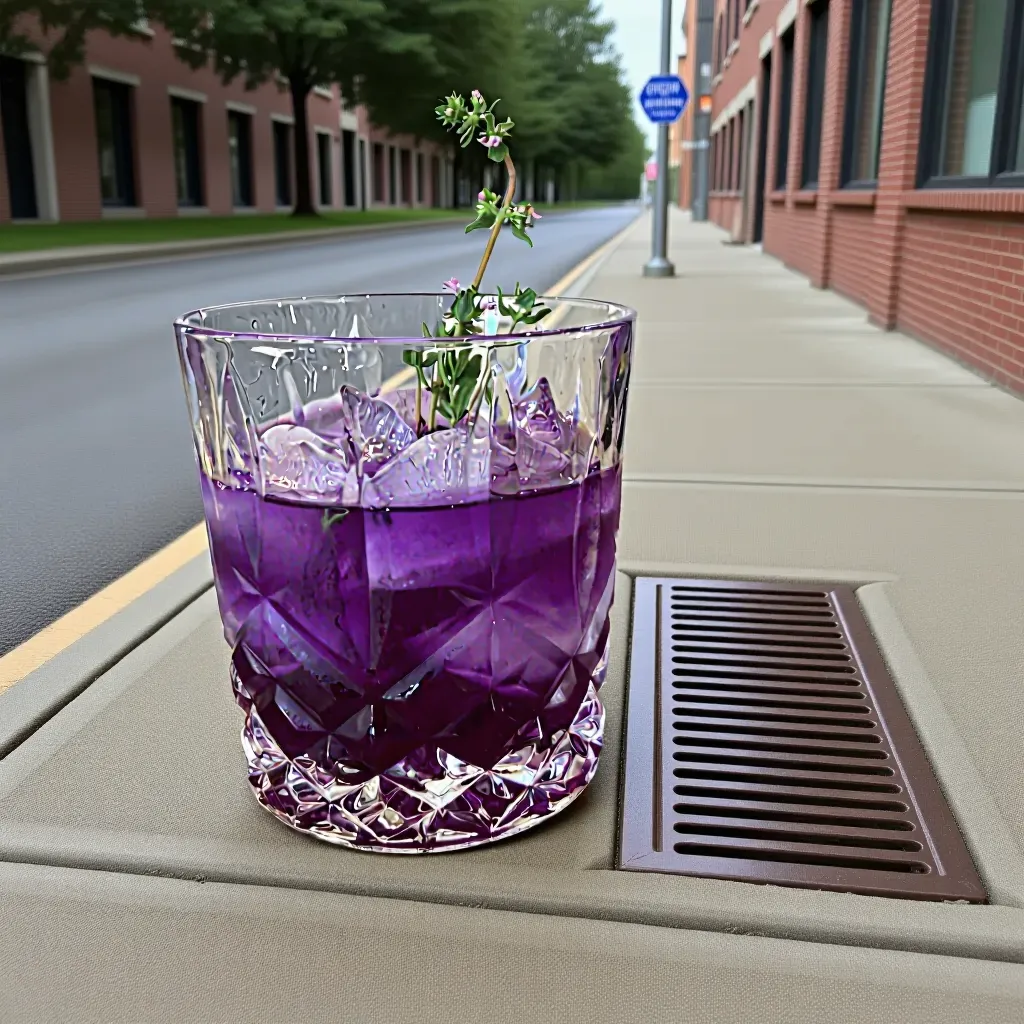
I chopped up some cabbage and thyme, and steeped them in vodka for an hour. The longer it steeps, the more intense the color…and the more disgusting the taste. So you’ll have to use your own judgment here. I then added some triple sec to try to mask the cabbage a bit, but this strategy invokes the proverbial lipstick-on-a-pig epithet. Finally, as the cabbage is readily evident in the color of the drink, I added a spring of thyme to drive home the timepiece reference. The result was visually satisfactory, though, alas, the same cannot be said for its gustatory qualities.

Ingredients:

2 oz. vodka

⅛ cup of chopped red or purple cabbage

1 oz. triple sec

⅛ cup of chopped thyme, plus a sprig of thyme as garnish

Add the vodka, cabbage, and chopped thyme to a cocktail shaker. Shake it up, then let it steep for 10 minutes to an hour, depending on where you draw the line between attractive color and disgusting taste. Strain into a rocks glass with fresh ice. Add triple sec, stir, and add a sprig of thyme as a garnish.

I’m not going to lie: This is quite possibly the most revolting cocktail I’ve ever experienced. I would encourage you to pour it down the sink. Unless you have old, unreliable plumbing, in which case I would pour it down the sewer grate in the gutter in front of your house. Make sure the local environmental-quality authorities are not watching.

Poe-Script

As hard as it might be to believe, this story with its exceedingly-thin plot was the subject of an unfinished comic opera by none other than Claude Debussy. Le Diable dans le beffroi was meant to be rather faithful to Poe’s story, and the voiceless Devil’s solo part was to be whistled and played on the violin.