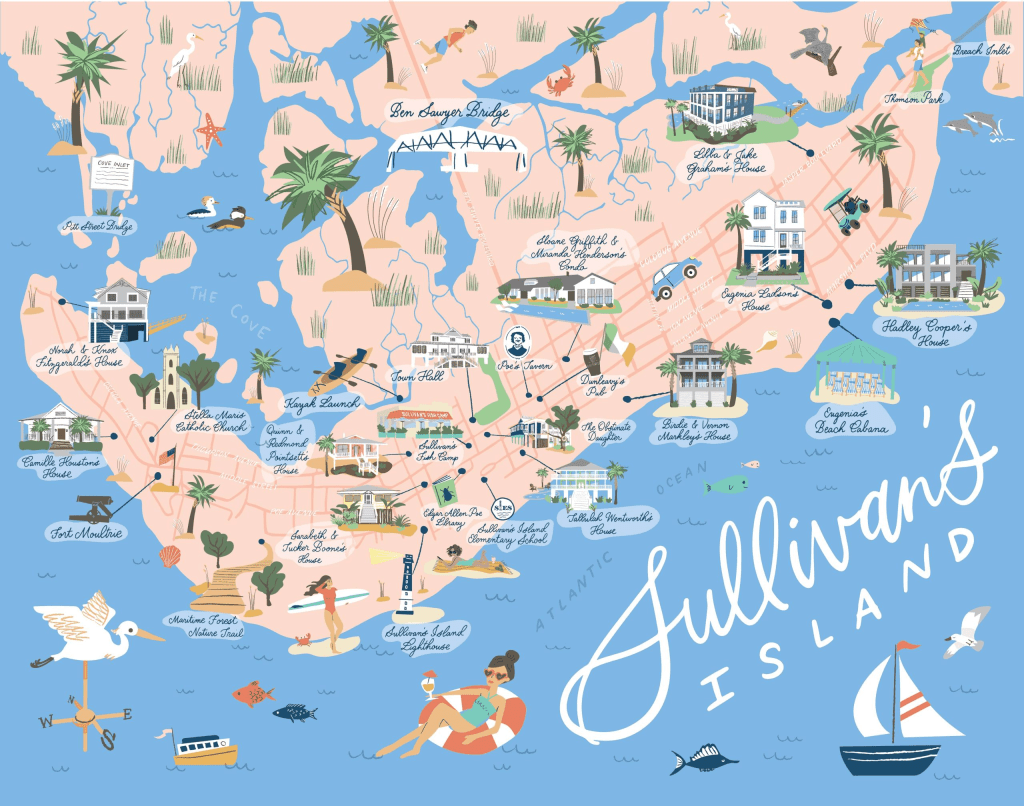
Our eastern correspondent, Christopher F., was evidently so inspired by our Gold Bug cocktail and associated palaver that yesterday he made the trek to Sullivan’s Island, S.C., which is the setting for Poe’s “The Gold Bug.” Poe describes the setting in some detail in his story, evidently drawing on his experience living on the island for about a year between 1827 and 1828, when he was stationed at Fort Moultrie.
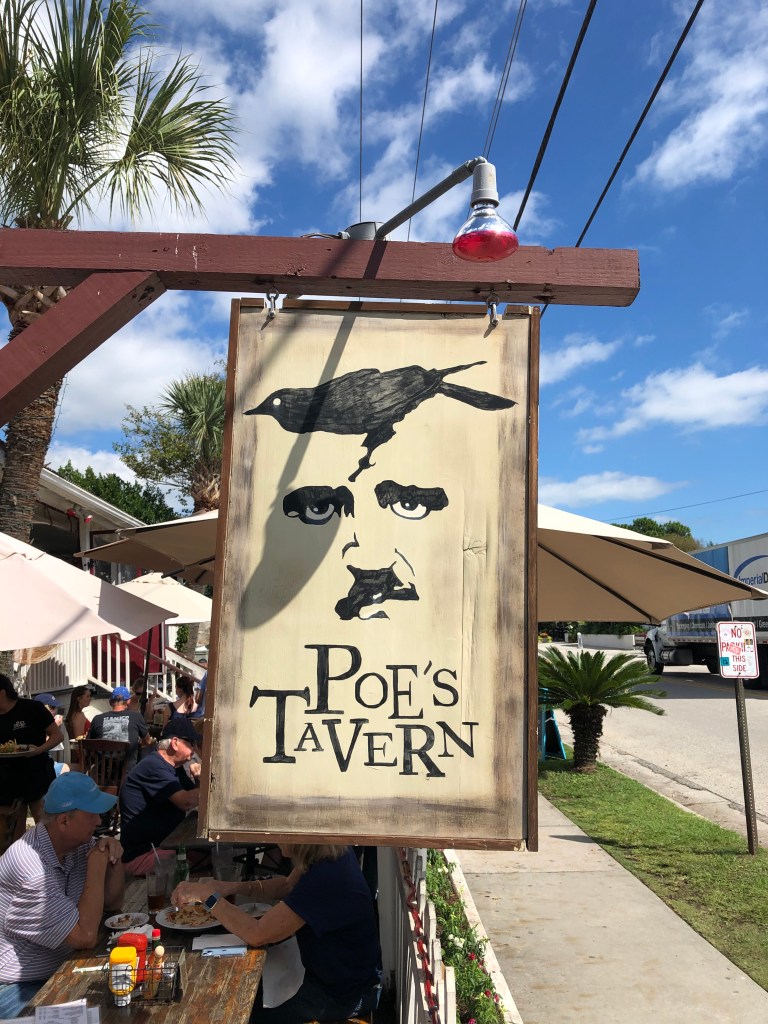
The good people of Sullivan’s Island know a good tourist opportunity when they see it, which explains the presence of Poe’s Tavern.
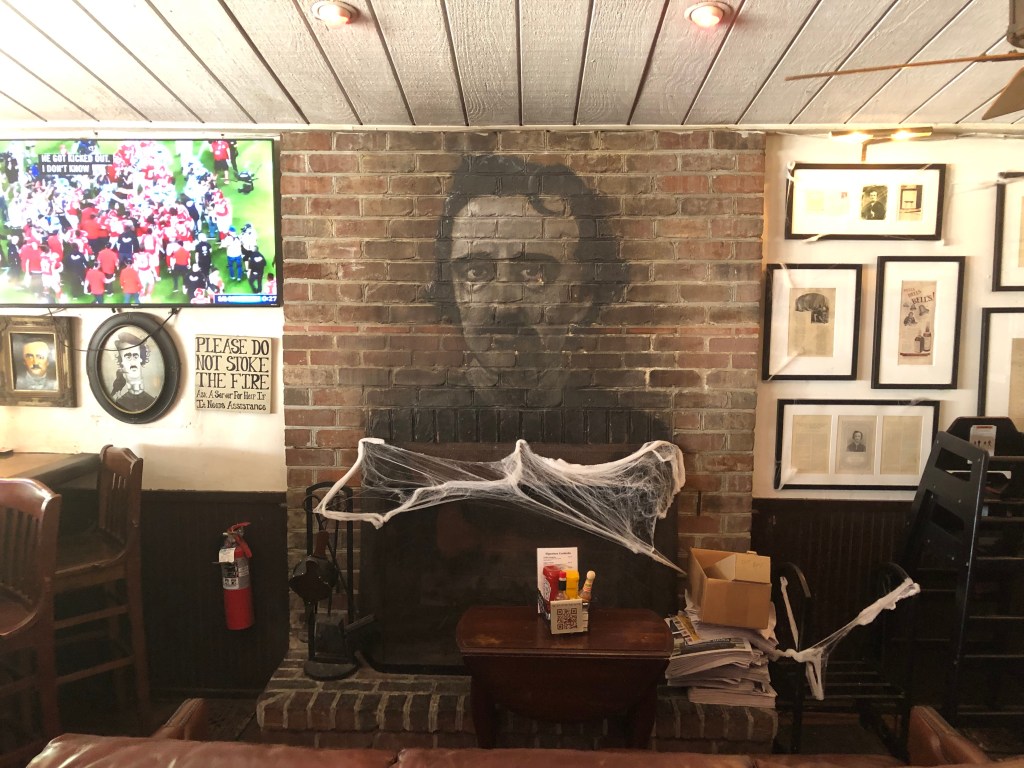
Correspondent Chris reports that the burgers all have Poe-themed names (The Raven, the Pit and the Pendulum, the Rue Morgue), and yet he ordered the fish tacos. He sent us this photo of the fireplace, which, he reports, “is cool and the image of Poe looks like it could have been done in soot.”
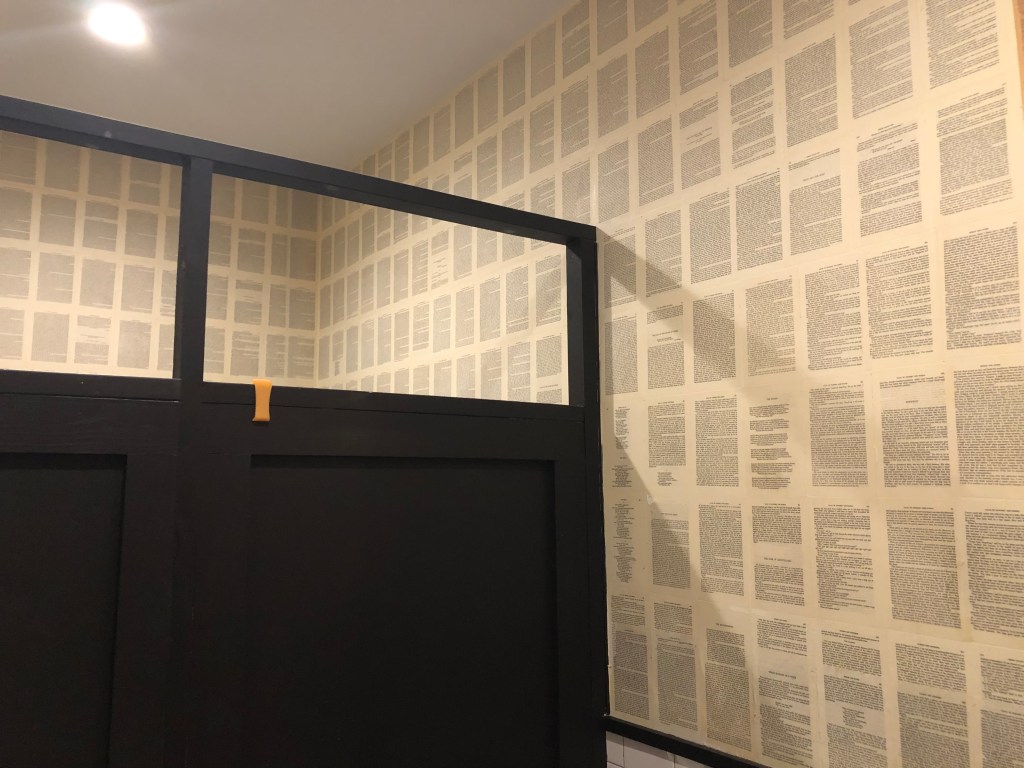
The restrooms have literally been wallpapered with pages from Poe tales (“The Mystery of Marie Bidet”, perhaps?)
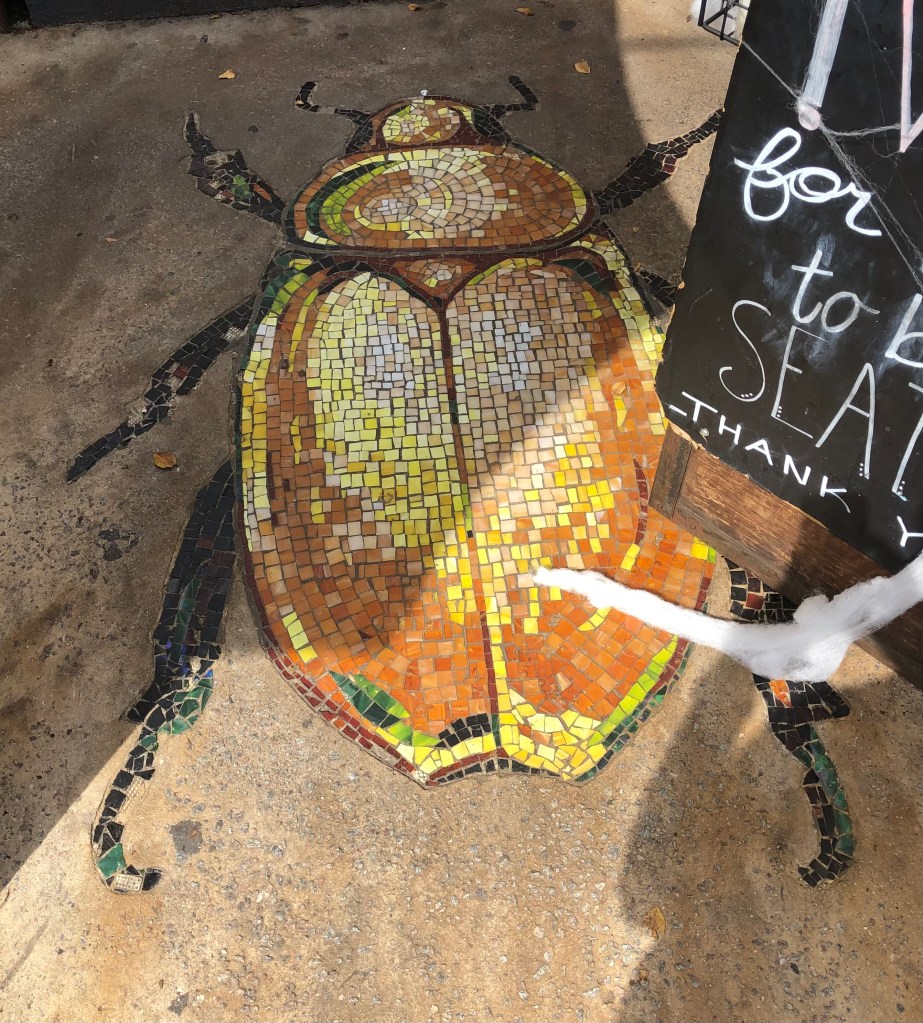
But the coolest element of the Tavern, given its location, has got to be the Gold Bug mosaic that greets you on the walkway.
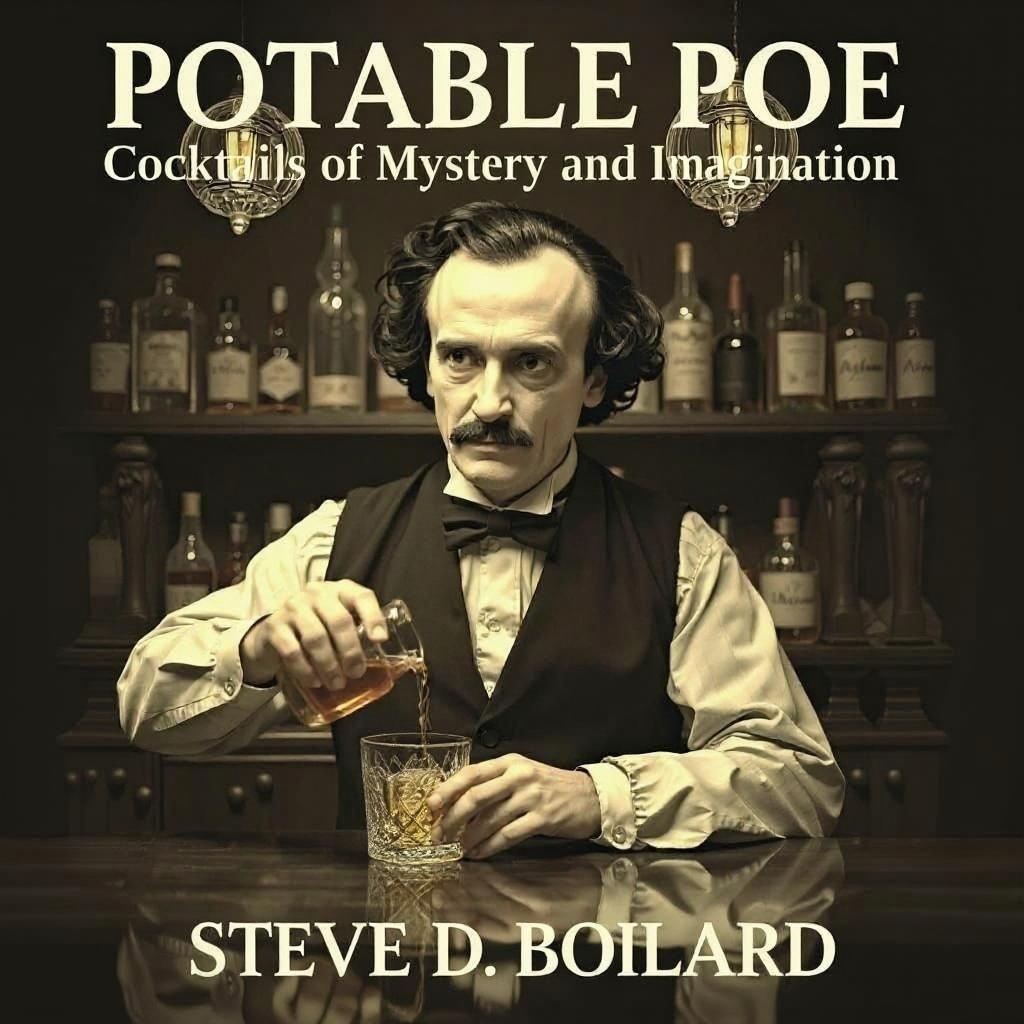
We thank correspondent Chris for his report, and encourage the thousands of our other loyal readers to keep an eye out for anything related to the Poe cocktails/stories being posted this month. We will be issuing a prize for the best photo. First prize is a signed copy of my forthcoming cocktail book, Potable Poe. Second prize is two signed copies of the same.
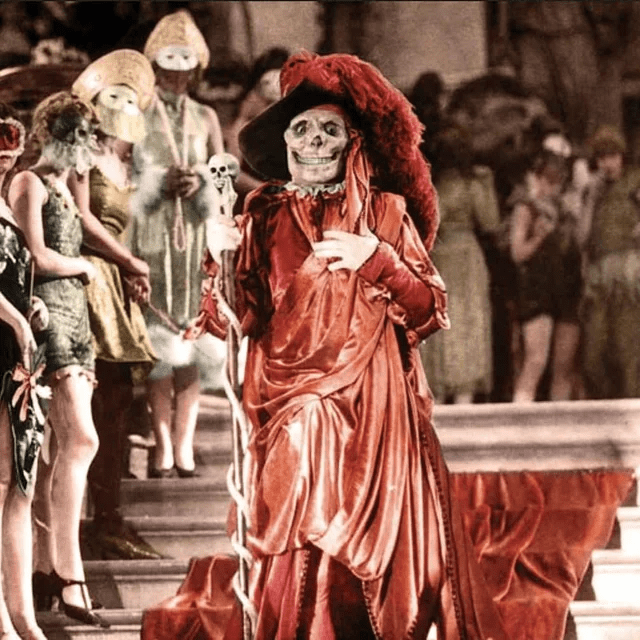
And now was acknowledged the presence of the Red Death. He had come like a thief in the night. And one by one dropped the revellers in the blood-bedewed halls of their revel, and died each in the despairing posture of his fall. And the life of the ebony clock went out with that of the last of the gay. And the flames of the tripods expired. And Darkness and Decay and the Red Death held illimitable dominion over all.
The Tale
Poe’s short story “The Masque of the Red Death” was first published in 1842. In essence, it’s a tale about a self-seeking prince’s attempt to sequester himself and a large number of his friends and courtiers in his large castle, away from a fearsome plague that was rife throughout the land. You can guess how well that plan worked out.
The story works on a number of levels. On its face it’s a Gothic tale rich in imagery and Angst and, ultimately, doom. But it also works on an allegorical level, reminding us of the folly of trying to cheat Death. It’s been the subject of many films and plays over the years, most notably the 1964 Roger Corman movie starring Vincent Price. You could do worse than to spend an evening watching it with the lights down and with this cocktail in hand.
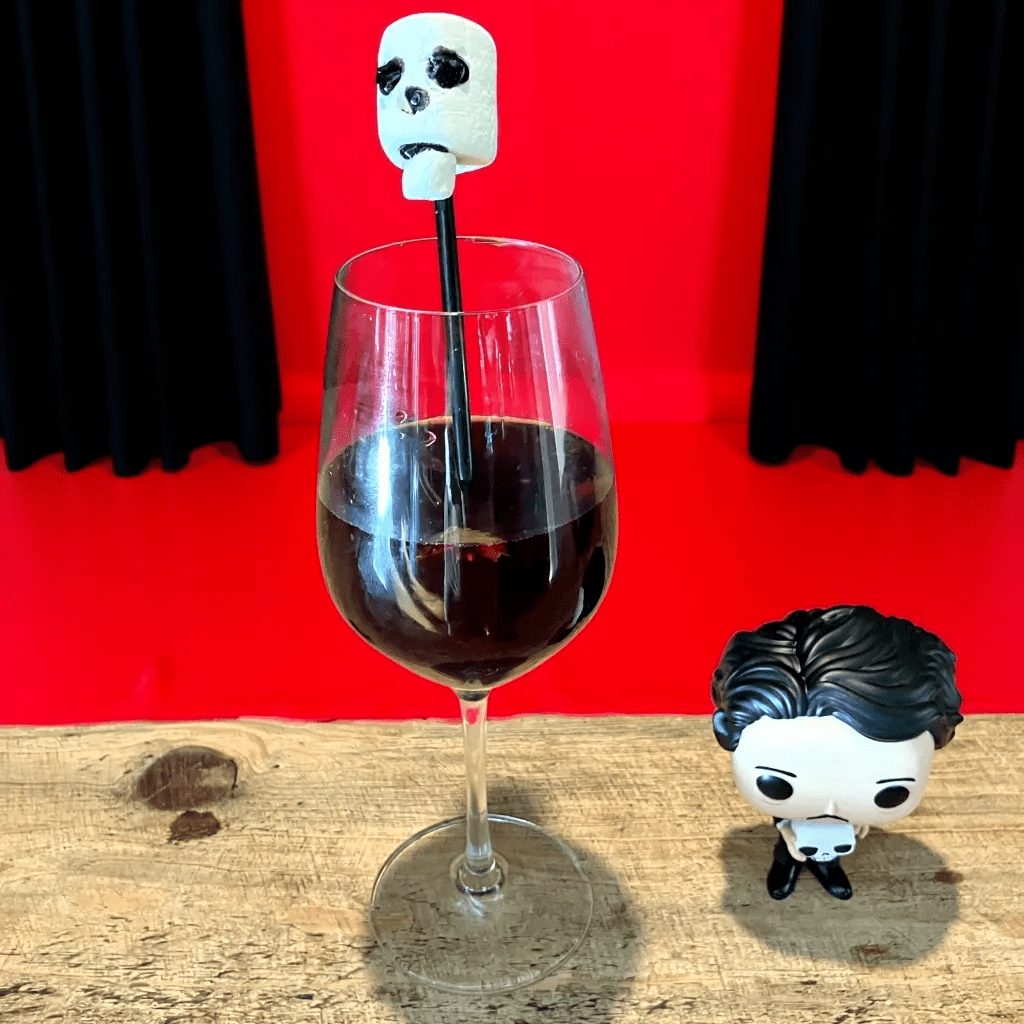
Obviously, the drink has to be red. The “death” part is symbolized by a marshmallow garnish in the shape of a skull. OK, subtlety is not my strong suit.
The red color comes largely from pomegranate juice. I added some muddled blackberries (which darken the color a bit) and some mint (which prevents the drink from becoming too heavy).
Ingredients:
1-½ oz. white rum
½ cup pomegranate juice (chilled)
A small handful of blackberries
A few mint leaves
For the skull:
1 regular marshmallow and one mini marshmallow
Black icing and/or black jelly beans
First you gotta make your skull. (That would make a good bumper sticker.) Use a standard, regulation marshmallow for this, and add eye sockets and a nose hole. Use your own instincts here. You can use either small, black jelly beans or icing for these.Then dab the top of a mini marshmallow with black icing, and stick it on the bottom of the regular marshmallow to serve as the jaw. Add a little icing where the two marshmallows meet to represent the mouth.
Set aside your skull (another bumper sticker candidate) and muddle the blackberries and mint leaves in a cocktail shaker. Add rum and chilled pomegranate juice. Shake it up. Then remove the top and pour the un-strained mixture into a wine glass. (I suppose you could strain it if you don’t want bits of blackberry and mint leaves in your drink, but I like the added texture.) Add the skull as a garnish, perhaps at the end of a straw, a cocktail pick, or a catheter…whatever you have around should work.
This drink is already pretty sweet, but you can add a little simple syrup if you don’t like the slight tartness of the pomegranate juice. You might want to affect a Prince Prospero pose, laughing carelessly at the latest disaster broadcast on the evening news as you throw a few of these back in your gated McMansion.
Poe-script
Despite the plot’s central reliance on the idea of a fatal plague called Red Death, there is no such disease. So, you can at least rest a little easier knowing that.
The feeling of vexation thus engendered grew stronger with every circumstance tending to show resemblance, moral or physical, between my rival and myself. I had not then discovered the remarkable fact that we were of the same age; but I saw that we were of the same height, and I perceived that we were even singularly alike in general contour of person and outline of feature.
The Tale
William Wilson is a classic doppelganger story. The narrator encounters his look-alike in school, and this mysterious figure repeatedly shows up to sabotage the author’s many schemes. The doppelganger exhibits slight variations from the narrator (including a voice which is only a whisper), but in general bears an uncanny physical resemblance. In the end the narrator kills his doppelganger, whose final words ring thus: “You have conquered, and I yield. Yet, henceforward art thou also dead — dead to the World, to Heaven and to Hope! In me didst thou exist — and, in my death, see by this image, which is thine own, how utterly thou hast murdered thyself.” Is it just me, or does this strike you also as a cross between Shakespeare and Star Trek?
One of the great philosophical questions that everyone eventually faces is: Should I make my Old Fashioned with bourbon or rye? Thankfully, Poe’s William Wilson gives us a way to avoid that agonizing dilemma and have it both ways. Like the two William Wilsons in a classroom, this drink takes two slightly-different versions of a whiskey cocktail and combines them with satisfying results. The spicy rye and sweet bourbon play off each other nicely. The rich brown sugar draws out the bourbon while the plebian white sugar softens the rye. Meanwhile, the two bitters add interest and complexity. The two different cherries are mainly for show, but if you’re smart you’ll finish off your drink with a one-two punch that underscores the source material.
Ingredients:
1 generous shot of rye
1 generous shot of bourbon
1 white sugar cube
1 brown sugar cube
1 teaspoon water
2 dashes of Angostura bitters
2 dashes of orange bitters
1 maraschino cherry (as garnish)
1 amarina cherry (as garnish)
Place both sugar cubes in a rocks glass along with the water and bitters. Muddle until the sugar is dissolved. Now add ice and both whiskeys. Stir for about 30 seconds. Add the two cherries on separate cocktail picks. Drink it while wearing your embroidered morning wrapper.
Poe-Script
This tale is told in Poe’s inimical style, but the general thrust of the story has flowed from many pens. I think in particular of Oscar Wilde’s Picture of Dorian Gray, which was published a half-century after “William Wilson.” As with Poe’s tale, Wilde’s has the protagonist murder himself in an effort to destroy his doppelganger. Please don’t try this at home.
I presume the fancy of the skull, of letting fall a bullet through the skull’s eye–was suggested to Kidd by the piratical flag. No doubt he felt a kind of poetical consistency in recovering his money through this ominous insignium.
The Tale
First published in 1843, “The Gold-Bug” is one of Poe’s more intricate tales. It involves a buried treasure, a pirate map, a cryptogram, a mysterious scarab beetle, and a human skull. It reads like a cross between Treasure Island and an armchair mystery. Some say that it belongs alongside Poe’s “Dupin” detective stories.
The story goes thus: the narrator visits a friend who has discovered an unusual type of beetle. Through a convoluted plot device, the beetle leads to a pirate treasure map printed in disappearing ink and coded into a cipher. Much of the story involves decoding the cipher, climbing a tree, dropping the beetle through a skull’s eye socket, and pacing off steps according to the map. Ultimately a pirate’s treasure chest is discovered. Apparently the reading public at the time was ga-ga over cryptography and so-called “secret writing.” In fact, it’s said that Poe helped popularize those themes. In any event, there is something very Holmesian about this story.
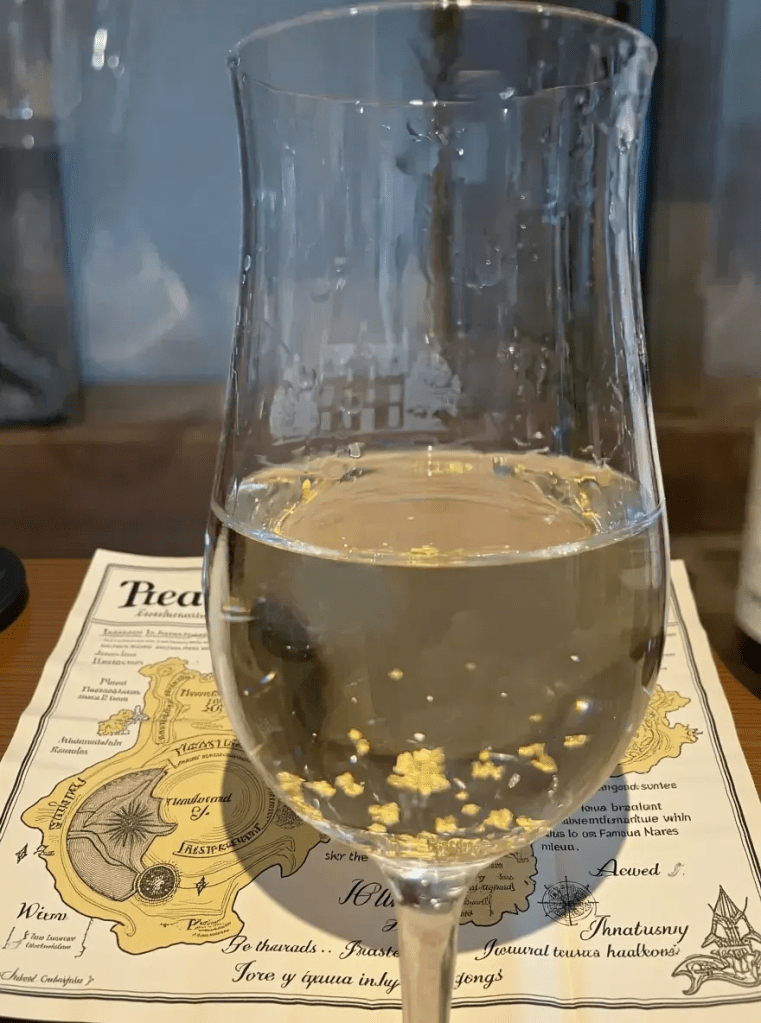
It doesn’t take a C. Auguste Dupin to realize that a cocktail evoking this story should somehow be connected to gold. At first I considered the Golden Cadillac, which was invented just down the road from me at Poor Red’s BBQ over 70 years ago. But I was out of Galliano, and instead, two different gold-themed ingredients stared back at me coquettishly from my liquor cabinet: (1) Cuervo Gold tequila, which has a light gold color, and (2) Goldschlager, which contains flakes of genuine 24-karat gold. (I’m not making this up). In creating the recipe, I made a King-Solomon decision and included both spirits.
Ingredients:
1 oz. Cuervo Gold tequila
1 oz. Goldschlager liqueur
This is presented as a shooter, but how you drink it is up to you. Combine the ingredients in a tall shot glass or (as I did) in a stolen port glass. Let the gold settle at the bottom, representing the buried treasure in Poe’s tale. If you’re making one for a guest, present it with a “yo-ho-ho.”
This is a visually appealing and Poe-evocative drink that packs a punch. But I wouldn’t say it’s especially delicious. Goldschlager is essentially cinnamon Schnapps, which may or may not bring back horrible memories from high school. Still, the cloying taste of the Goldschlager is somewhat attenuated by the tequila, resulting in a tolerable, warming drink that can be shot (to get it over with) or sipped by the fireplace as you labor over a cryptogram. I opted for the latter.
Poe-script
Poe received a $100 prize for the story, which is the most he ever received for any single piece of writing. What’s more, It has been estimated that “The Gold-Bug” was the most widely-read of Poe’s works during his lifetime, during which it was translated into French and Russian. Robert Louis Stevenson has acknowledged the story’s influence on his 1883 adventure novel, Treasure Island. Over the years, “The Gold-Bug” has been made into a stage play, movies, TV specials, a radio play, and a comic (?) opera.
Yet, although I saw that the features of Ligeia were not of classic regularity — although I perceived that her loveliness was indeed “exquisite,” and felt that there was much of “strangeness” pervading it, yet I have tried in vain to detect the irregularity and to trace home my own perception of “the strange.” I examined the contour of the lofty and pale forehead — it was faultless — how cold indeed that word when applied to a majesty so divine! — the skin rivalling the purest ivory, the commanding extent and repose, the gentle prominence of the regions above the temples; and then the raven-black, the glossy, the luxuriant and naturally-curling tresses, setting forth the full force of the Homeric epithet, “hyacinthine!”
The Tale
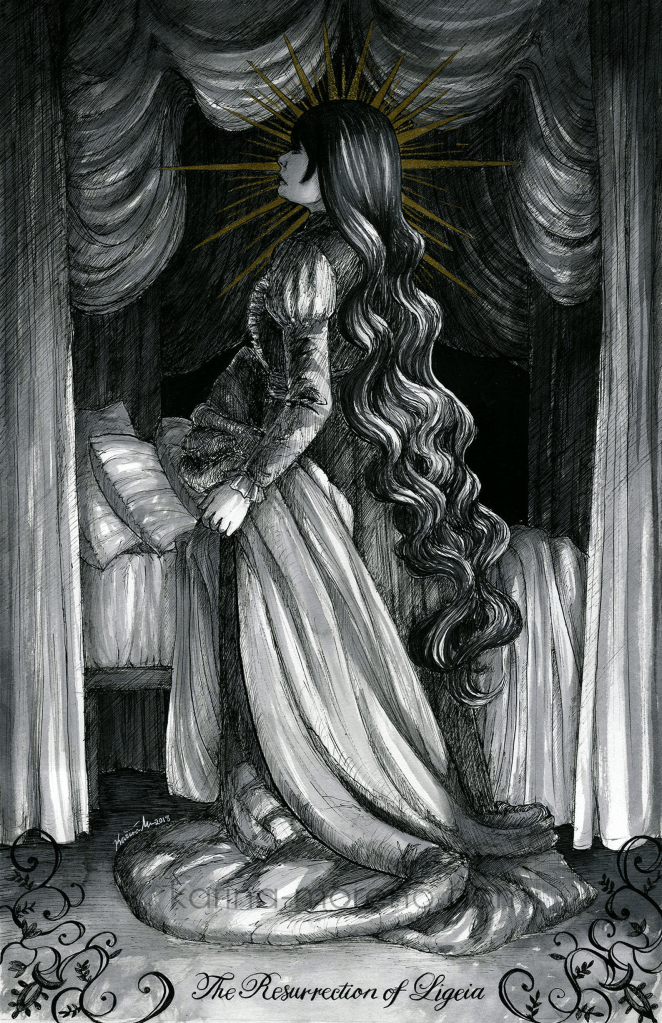
In the first half of this story the narrator meticulously describes his wife Ligeia with soaring, worshipful, effusive and poetic language that would make King Solomon blush. In extreme detail he sketches the features of her face, her hair, her forehead, her stature, even her voice in the most grandiloquent language. And anticipating the rules of political correctness by two centuries, he hastens to add that she’s not just hot; she’s also smart, with greater knowledge of “moral, physical, and mathematical science” than anyone he knew, man or woman. And then he describes how she died, and how he was devastated by the loss.
Somewhat less effusive is his description of his rebound squeeze, Lady Rowena Trevanion. In many ways Rowena is the opposite of her predecessor: fair where Ligeia was dark-haired, blue-eyed in contrast to the “brilliant black” of Ligeia’s peepers.
And instead of lavish praise, the narrator confides that he “loathed [Lady Rowena] with a hatred belonging more to demon than to man.” Then she too falls ill and is declared dead. And yet, while lying on her death bed, she repeatedly fights off Death, each time briefly returning to life, until at last she rises from the bed. Her shroud falls away and in appearance she is…Ligeia. The narrator doesn’t seem too excited about this.
For this cocktail we’re going to tap into that long, flowery description of Ligeia, with the “Homeric epithet” of “hyacinthine.” `It seems he associates her with the fragrant, colorful flower that evokes spring and rebirth.
Now, there is a class of Hyacinth cocktails which make use of either hyacinth flowers or of fruits and botanicals that impart a similar blue color. I couldn’t find hyacinth flowers this time of year, so I instead went with a mix of violet and elderflower liqueurs, combined with a highly-botanical gin. Now, if you stubbornly opt for actual hyacinth, make sure you use grape hyacinth, as the other variants are toxic and could make you into the latest meal for the Conqueror Worm. I played it safe and went a different, flowery route. The resulting recipe creates a light, floral drink that will have you “aroused” by Ligeia’s “large and luminous orbs.” (Those are Poe’s words, not mine!)
Ingredients:
1 oz gin
1 oz violet liqueur
½ oz Elderflower liqueur
Splash of lime juice
Sprig of mint (as garnish)
Combine all the liquid ingredients in a shaker and shake well. Add ice and shake some more. Strain into a champagne flute or some other glass that’s as graceful and slender as Ligeia. Garnish with mint, which, at least in my garden, keeps returning even though I thought it had died many times over.
Poe-Script
Within this tale, Ligeia composes a poem which you will recognize as “The Conqueror Worm.” In fact, the short story “Ligeia” was originally published without the poem in 1838, then Poe published “The Conqueror Worm” as a stand-alone poem in 1843, and then he revised “Ligeia” to include the poem in 1845. Kind of like how I’m going to re-use this blog post as an entry in my Poe cocktail book.





 Chasing Phantoms