2025 Poe Cocktails

Cocktail 6: The Business Man

My eighth and last speculation has been in the Cat-Growing way. I have found this a most pleasant and lucrative business, and, really, no trouble at all. The country, it is well known, has become infested with cats — so much so of late, that a petition for relief, most numerously and respectably signed, was brought before the legislature at its last memorable session. The assembly, at this epoch, was unusually well-informed, and, having passed many other wise and wholesome enactments, it crowned all with the Cat-Act. In its original form, this law offered a premium for cat-heads, (fourpence a-piece) but the Senate succeeded in amending the main clause, so as to substitute the word “tails” for “heads.” This amendment was so obviously proper, that the house concurred in it nem. con. As soon as the Governor had signed the bill, I invested my whole estate in the purchase of Toms and Tabbies…. Their tails, at the legislative price, now bring me in a good income; for I have discovered a way, in which, by means of Macassar oil, I can force three crops in a year. It delights me to find, too, that the animals soon get accustomed to the thing, and would rather have the appendages cut off than otherwise.
The Tale (as it were…)

This is another of Poe’s satirical tales, in this case lampooning the concept of the self-made man. He names his protagonist Peter Proffit, and yes, it would seem that Poe was kind of phoning this one in. The story basically amounts to a listing of the schemes Peter Proffit has undertaken, including inciting violence upon himself so he can sue for damages, loudly and poorly playing a street organ so as to get paid to cease playing, and delivering fake letters and collecting the postage due. The cat-tail-harvesting scam was his final and most successful endeavor.

This story does not have much of a plot, and it’s frankly one of Poe’s less entertaining efforts. But, as usual, Poe’s wordcraft is exceptional, and he does manage to come up with a couple of amusing jests. Sadly, the cat-tail scheme is not one of them. But as it is the final, successful project that rounds out the story, it will serve as the basis for our drink.

(The full story is available here.)

The Drink

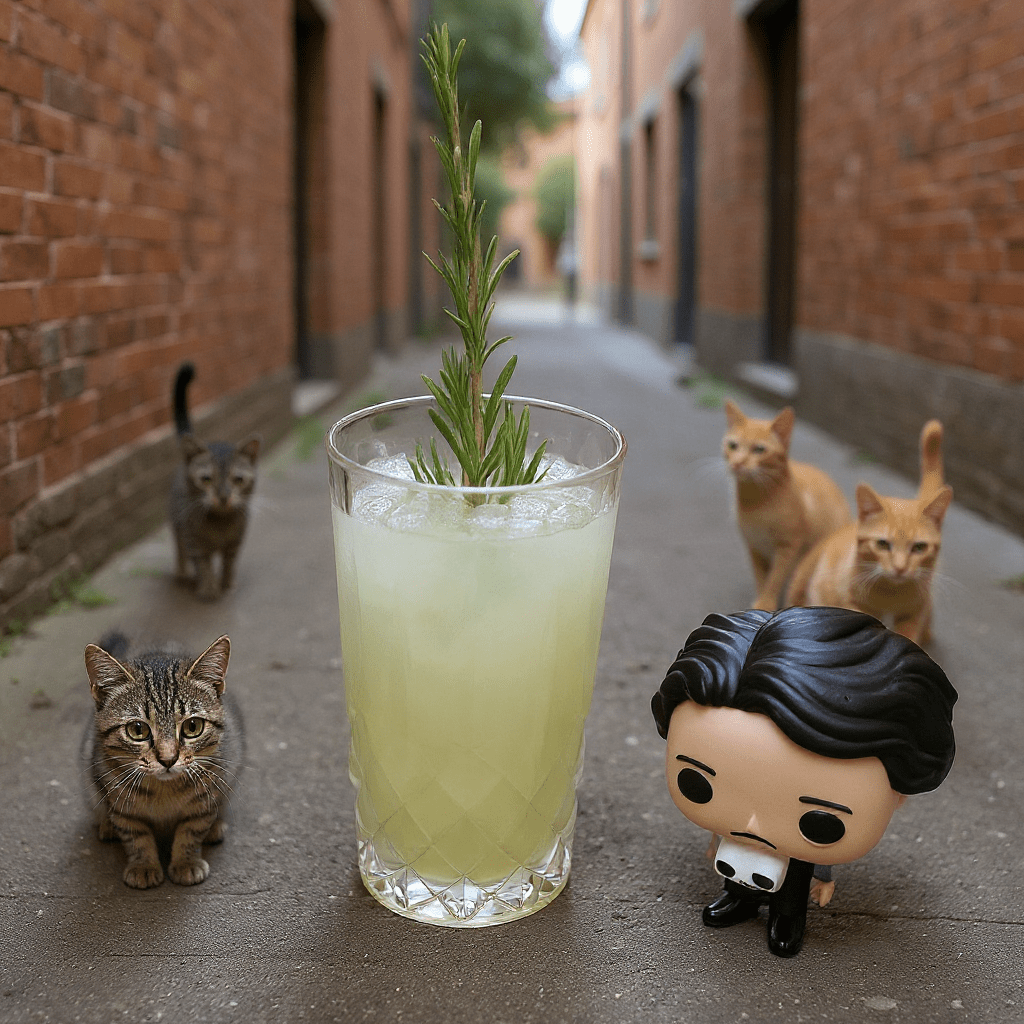
According to the Interwebs, it seems there is a (fairly obscure) class of cocktail called the Cat Tail. The recipes are quite varied, and I really can’t see much of a connection among them. But I picked the one that uses rosemary, for which I am perennially a sucker. This drink is bright and refreshing and easy to drink. Make sure you get a big, fluffy rosemary sprig that resembles a cat tail for your garnish. 

Ingredients:

1-1/2 oz. vodka

2 oz. lemonade

1 oz St Germain (elderflower liqueur)

A bit of ginger root

Fresh rosemary (as garnish and for muddling)

Thinly slice some ginger root (the more the better) and put it in a shaker. Add some fresh rosemary leaves (again, the more the better) and the vodka. Muddle it well, add ice, and shake it up. Let it steep for maybe five minutes. Give it a final shake and strain it into a Collins glass with fresh ice. Add lemonade and St. Germain, and stir. Add a fresh, cat-tail-like sprig of rosemary as a garnish. Then, in true Peter Proffit style, complain to your liquor shop/grocery store/me that the spirits/garnish/recipe is somehow faulty and demand 2x damages. Repeat as necessary.
Poe-Script

An earlier version of this story was titled “Peter Pendulum.” I can’t say that the “Proffit” gag is much of an improvement.
2025 Poe Cocktails

Cocktail 5: The System of Doctor Tarr and Professor Fether

And now came the climax — the catastrophe of the drama. As no resistance, beyond whooping and yelling and cock-a-doodling, was offered to the encroachments of the party without, the ten windows were very speedily, and almost simultaneously, broken in. But I shall never forget the emotions of wonder and horror with which I gazed, when, leaping through these windows, and down among us pele-mele, fighting, stamping, scratching, and howling, there rushed a perfect army of what I took to be Chimpanzees, Ourang-Outangs, or big black baboons of the Cape of Good Hope.

The Tale

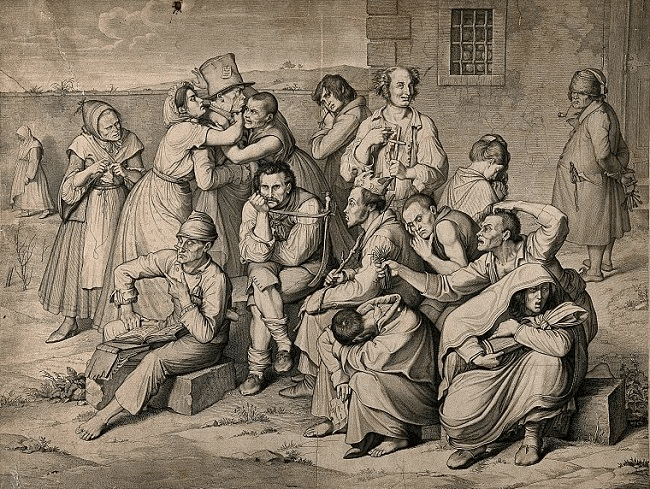
A traveller decides he’d like to visit a “private mad-house” (as one does) while touring southern France. He therefore makes a  slight detour and, with an introduction from a friend, is welcomed by Monsieur Maillard, who is in charge of the place. Maillard is famous for managing his patents with a “soothing system,” whereby all punishments are avoided and the patients are largely allowed to live fairly normal, unrestricted lives within the chateau. Before visiting the patients, however, the narrator is invited to dine with Maillard and a number of his friends and assistants.

In response to his inquiry, the narrator learns that the “soothing system” has recently been abandoned due to some unnamed, terrible consequences. During dinner he gradually comes to realize the assembled guests are a bit “off.” A little later a commotion ensues as a number of creatures resembling large, hairy animals break into the room and attack the narrator and the other diners. In the big reveal (which had been telegraphed quite plainly throughout the tale), we learn that Monsieur Maillard had earlier lost his mind and had become a patient at the mad-house, and then he led an uprising where the patients locked the staff away. They replaced the soothing-system with a so-called “System of Doctor Tarr and Professor Fether” whereby they tarred and feathered the staff…which accounts for the appearance of the baboon-like creatures, who are in fact the tarred-and-feathered staff. Who could have ever seen that coming?

The full story is available here.

The Drink

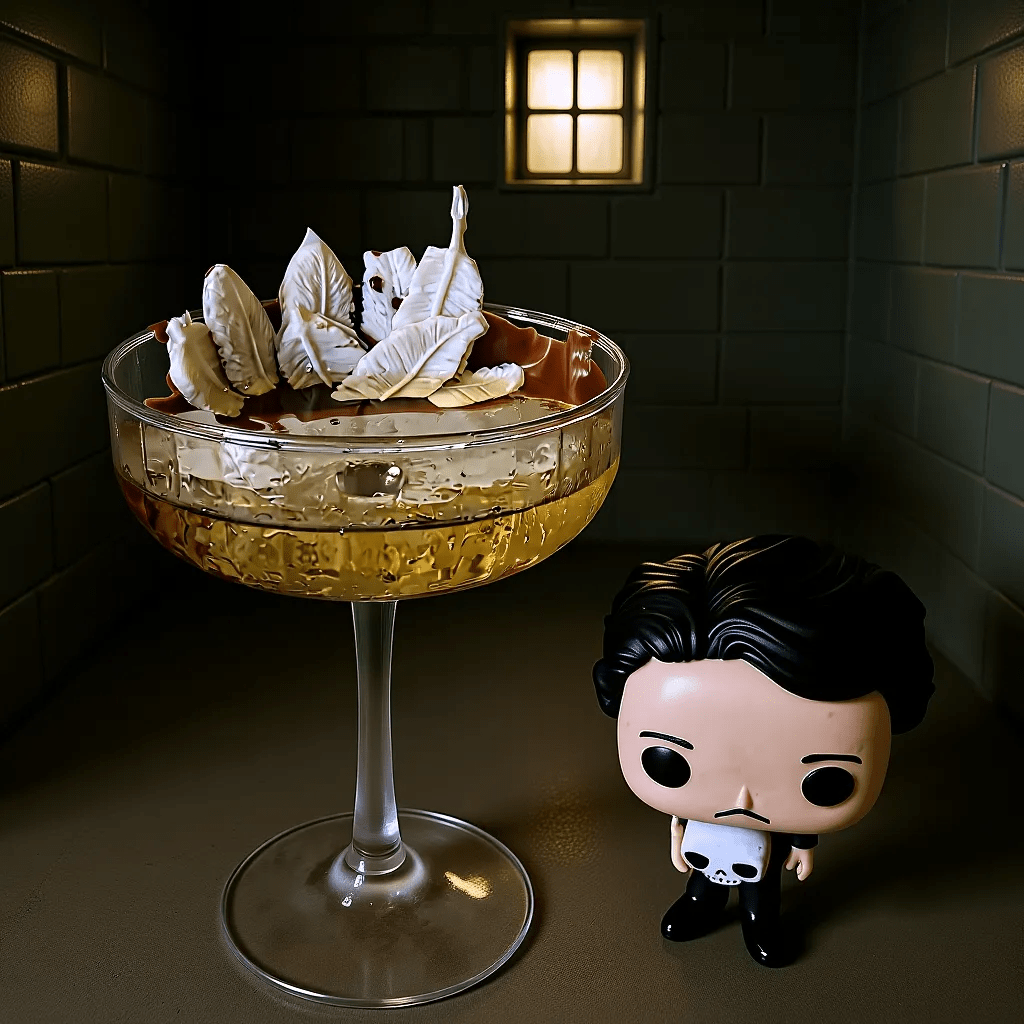
Given the central role of “tar and feathers” in this story, we will fashion our cocktail accordingly. Specifically, we are going to “tar” the inside of a glass with gooey chocolate and then affix white-chocolate “feathers.” For the drink itself, we’re going to employ a healthy pour of Sauternes, which is the wine that Monsieur Maillard pours for the narrator just before the climax of the story.

Ingredients:

Dark chocolate “magic shell” topping

2 oz. white baking chocolate

4 oz. Sauternes wine

Your main job here is making white chocolate “feathers.” Get some good white baking chocolate, and melt it in a double boiler (or, if you’re lazy like me, use a microwave). Pour the melted chocolate into a silicone feather mold. What, you don’t have a feather mold? Neither did I. But I bought one on Amazon for five bucks. Pay attention to the size of the molds; small feathers are better than large ones for this cocktail.

Now, select a glass. If you want to be proper about it, use a dessert wine glass. But make sure it’s large enough to accommodate your “feathers.” (I used a coupe glass.) Now, coat half the inner rim of the glass with liquid “magic shell” chocolate that’s made for topping ice cream. Get the dark chocolate version if you can, as it best resembles “tar.” It helps to warm the bottle in hot water for a few minutes. As soon as you’ve coated the inside of the glass, immediately press your white chocolate “feathers” into the chocolate coating. Give them a haphazard arrangement, with some of them sticking up above the rim of the glass. Now put the prepared glass in the refrigerator so the “tar” will harden.

Finally, after the “tar” has set, remove the glass from the fridge and pour a nice glass of Sauternes. If you’re making this cocktail for someone else, kindly press their hand and say “join me now in a glass of Sauterne.” Ignore the pandemonium about you.

Poe-Script

“(The System of) Dr. Tarr and Professor Fether” is a track on a 1976 album by the Alan Parsons Project. It reached 37 on the US Billboard Top 100. Feel free to play the song while enjoying this drink.

2025 Poe Cocktails

Cocktail 4: The Angel of the Odd

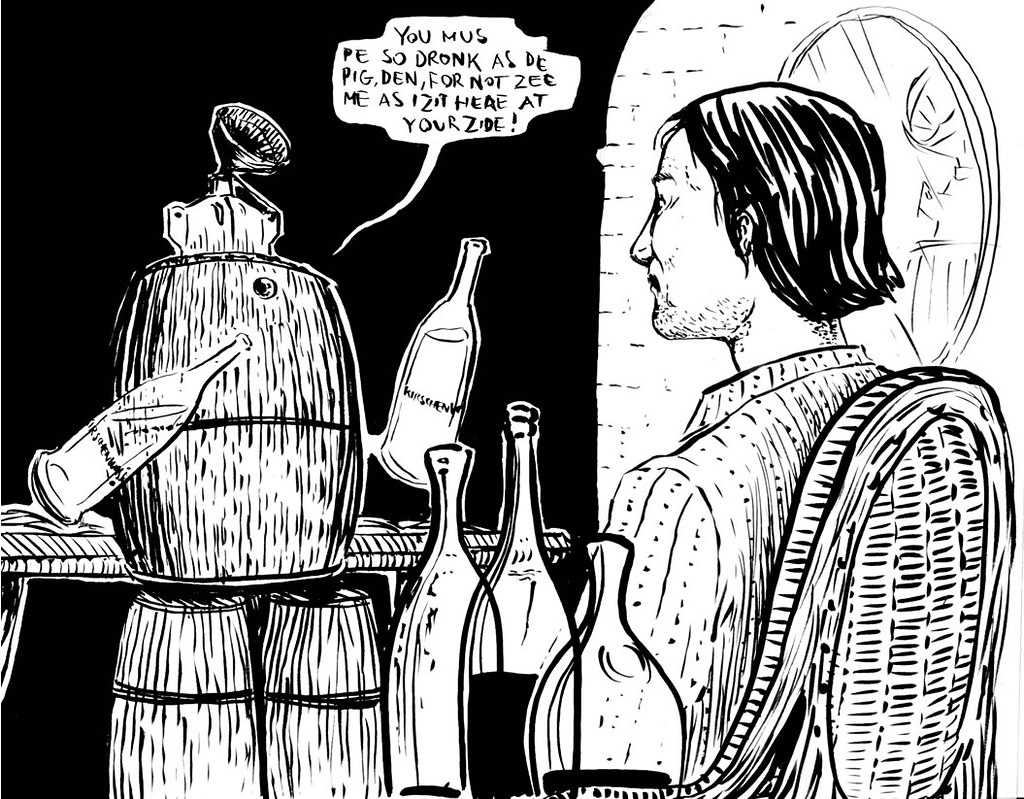
Hereupon I bethought me of looking immediately before my nose, and there, sure enough, confronting me at the table sat a personage nondescript, although not altogether indescribable.  His body was a wine-pipe, or a rum-puncheon, or something of that character, and had a truly Falstaffian air.  In its nether extremity were inserted two kegs, which seemed to answer all the purposes of legs.  For arms there dangled from the upper portion of the carcass two tolerably long bottles, with the necks outward for hands. All the head that I saw the monster possessed of was one of those Hessian canteens which resemble a large snuff-box with a hole in the middle of the lid.  This canteen (with a funnel on its top, like a cavalier cap slouched over the eyes) was set on edge upon the puncheon, with the hole toward myself; and through this hole, which seemed puckered up like the mouth of a very precise old maid, the creature was emitting certain rumbling and grumbling noises which he evidently intended for intelligible talk.

The Tale

If there had been any question that Poe had personal experience with wild benders, this story should settle all speculation. The story opens with the narrator sitting by his fire after dinner, surrounded by “some miscellaneous bottles of wine, spirit and liqueur.” Amid enjoying “a very few glasses of Lafitte” he reads an article in his newspaper about a freak, fatal accident involving a dart, and scoffs that the story is too outrageous to be true. It must be a hoax. At that moment a creature composed of drinking vessels (the fellow described in the excerpt above) appears and accuses the narrator of being drunk and stupid; he declares that every word of the newspaper story is true. This creature, who calls himself “The Angel of the Odd,” decrees that the narrator should not drink his wine so strong; that he should dilute it with water. “Hereupon the Angel of the Odd replenished my goblet (which was about a third full of Port) with a colorless fluid that he poured from one of his hand bottles.  I observed that these bottles had labels about their necks, and that these labels were inscribed ‘Kirschenwasser.’” 

The remainder of the story finds the narrator experiencing a convoluted series of far-fetched, outlandish coincidences involving fires and hogs and wigs and hot air balloons. In the end, the narrator falls from the sky through the chimney of his own house, and he comes to understand that the Angel of the Odd brought about these trials to convince him of “the possibility of the odd.” He ends the tale with these words: “Thus revenged himself the Angel of the Odd.”

The full story is available here.

The Drink

(or, “te trink,” to use the Angel of the Odd’s dialect.)

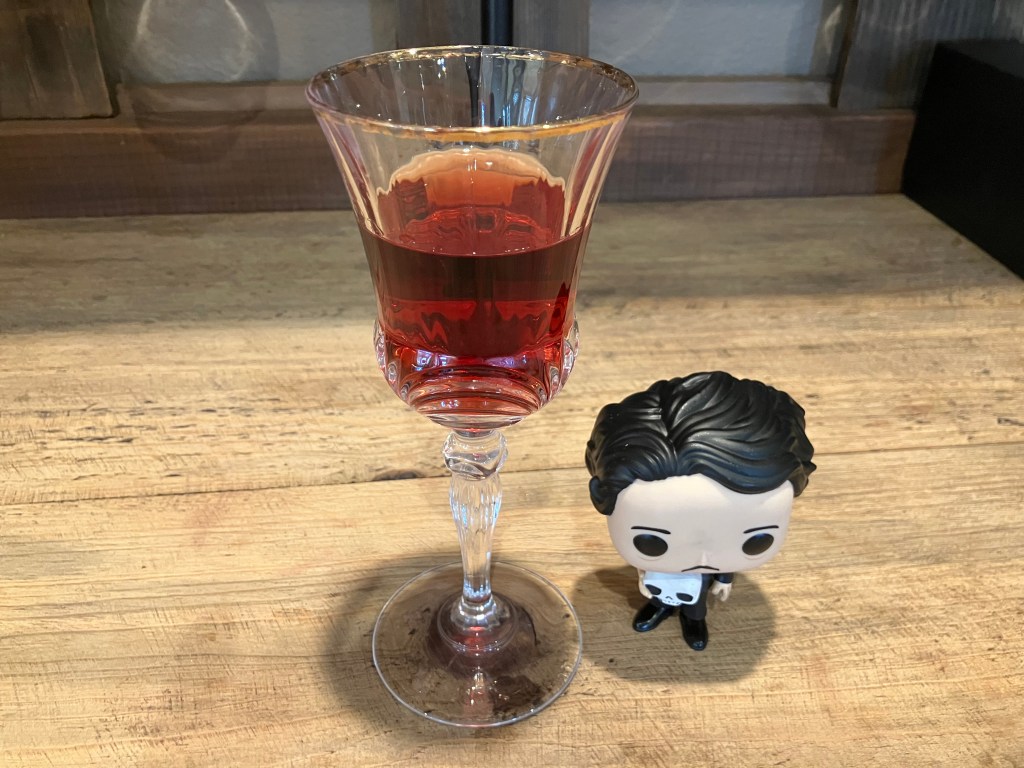
Our formula for a cocktail seems obvious enough: We will “replenish [a] goblet (which [is] about a third full of port) with a colorless fluid,” which is, of course, Kirschenwasser. Here in the modern, English-speaking world the spirit is typically spelled “Kirschwasser,” but either way it is cherry brandy. (This means the Angel of the Odd “diluted” the narrator’s port with 80-proof alcohol, which is about twice the ABV of the port. I suppose this is one of Poe’s many satirical and/or comical touches.)

Anyway, using context clues, we can deduce that the drink created by the Angel of the Odd is one part port and two parts Kischwasser. I made myself a drink with those proportions, and found it to be far too bitter. Sticking with the cherry theme, I added a splash of maraschino liqueur, which did succeed in masking the bitterness a bit. But the drink is made more drinkable still by chilling it. (I stuck the finished drink in the fridge for a half hour.) In all honesty, this is a perfectly drinkable drink–which perhaps cannot be said for all the cocktails in this compilation.

Ingredients:

2 oz Kirschwasser

1 oz Port

½ oz maraschino liqueur

Mix all three ingredients in a suitable “goblet.” Refrigerate for half an hour and serve.

Alternatively, you could combine them in a shaker with ice and strain into a chilled goblet. Either way, you’ll find it a serviceable alternative to your “frequent Lafitte.”

Poe-Script

In an effort not to make this story more confusing, I have ignored the fact that Poe’s “Angel of the Odd” speaks with a virtually-indecipherable accent. True, the Angel of the Odd utters the German terms “Mein Gott” and “der Teufel,” which together pretty much span the theological waterfront.  But the Angel’s accented English is mystifying. For example, the Angel says “I zay, you mos pe dronk as de pig, vor zit dare and not zee me zit ere; and I zay, doo, you most pe pigger vool as de goose….” With time one can figure out what the words mean, but I’m not convinced that the humorous payoff justifies the effort.

2025 Poe Cocktails

Cocktail 3: The Cask of Amontillado

I said to him—“My dear Fortunato, you are luckily met. How remarkably well you are looking to-day. But I have received a pipe of what passes for Amontillado, and I have my doubts.”

“How?” said he. “Amontillado, A pipe? Impossible! And in the middle of the carnival!”

“I have my doubts,” I replied; “and I was silly enough to pay the full Amontillado price without consulting you in the matter. You were not to be found, and I was fearful of losing a bargain.”

“Amontillado!”

“I have my doubts.”

The Tale

The narrator of this tale has long ago been subjected to “a thousand injuries” at the hand of the ironically-named Fortunato, so he comes up with a plan to exact his revenge. Fortunato is a wine snob, and the narrator lures him into his catacombs with a promise of sampling some Amontillado that he recently purchased. But rather than tasting the wine, Fortunato is chained to the ancient stone wall and left for dead. It is a grim, heartless, and deadly vengeance. 

The full story is available here.

The Drink

Let me here confess that I don’t know much about history, don’t know much biology, don’t know much about a science book…and don’t know much about Amontillado. Other than in Poe’s story, I’ve never even heard of the stuff. I understand it’s a Spanish, fortified wine, but beyond that I’m as clueless as Fortunato following his guide’s torch into the catacombs.

Anyway, it strikes me that there are two kinds of people in this world: Those who understand and appreciate Amontillado, and those who have better things to concern themselves with. I count myself in the latter category. And yet, for the sake of this noble project, I’m willing to experiment “in the manner of Montilla.” Now, the easiest approach here is to just have a glass of Amontillado, the way that Poe’s narrator and/or Fortunato would have drunk it. But upon the first sip I decided it was–how shall I put this?–revolting.

As an alternative, I read somewhere that Amontillado can be substituted for sweet vermouth, so why not make a Manhattan with it? This I tried, and I discovered that a Manhattan made with Amontillado could be significantly improved by simply leaving out the Amontillado.

Finally, I hit upon the tried-and-true method of drowning out the offending spirit with other, preferable flavors. And by that I mean, of course, coconut. And thus we arrive at this modified version of a Cabana Club. 

Ingredients:

1-1/2 ounces Amontillado

1/2 ounce absinthe

2 ounces cream of coconut

1 ounce coconut water

1/4 ounce agave syrup

A pinch or two of ground cinnamon

Garnish: Coconut flakes

Garnish: grated nutmeg

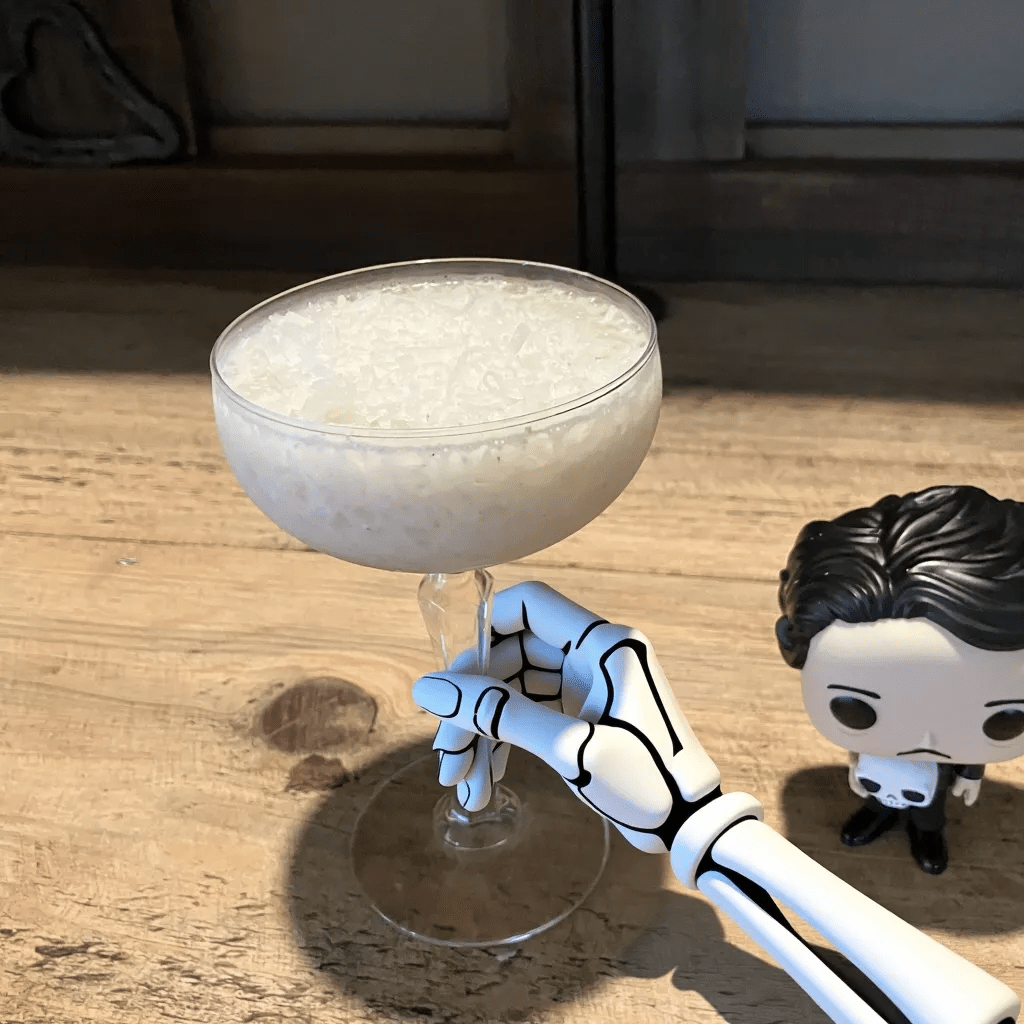
Dump the first six ingredients into a blender with ice. Blend to a slushy consistency, like a Slurpee. Pour into a coupe glass, garnish with the coconut and grated nutmeg. I guarantee you won’t know that you’ve just consumed Amontillado.

Poe-Script:

While it hasn’t been definitely proven that Poe drank absinthe, he certainly drank his share of alcohol, and absinthe was popular among writers and artists in Poe’s day. So I consider the blending of Amontillado and absinthe in this cocktail to be apt. Plus, coconut is said to contain medium-chain triglycerides, which, I’m told, are good for you. So this drink is healthful…unlike what Fortunato encountered.

2025 Poe Cocktails

Cocktail 2: Never Bet the Devil Your Head

Punctually at the word “away,” my poor friend set off in a strong gallop. The stile was not very high, like Mr. Lord’s — nor yet very low, like that of Mr. Lord’s reviewers, but upon the whole I made sure that he would clear it. And then what if he did not? — ah, that was the question — what if he did not? “What right,” said I, “had the old gentleman to make any other gentleman jump? The little old dot-and-carry-one! who is he? If he asks me to jump, I won’t do it, that’s flat, and I don’t care who the devil he is.” The bridge, as I say, was arched and covered in, in a very ridiculous manner, and there was a most uncomfortable echo about it at all times — an echo which I never before so particularly observed as when I uttered the four last words of my remark.

The Tale

As obliquely insinuated at the end of the above passage, this is a story about the Devil. (I suppose, to be fair, it’s also explicitly stated in the title. But still.) And despite the fiendish subject matter, this is also one of Poe’s humorous tales. The plot is a simple one: The narrator’s friend, one Toby Dammit (haha!), has acquired the habit of punctuating his statements with offers to take a bet. And his favorite formulation of that oath was “I’ll bet the devil my head…” As can be imagined, such an arrogant pronouncement will not go unpunished in a Poe tale.

So we find the narrator and Toby Dammit approaching a covered bridge, and Toby “insisted upon leaping the stile, and said he could cut a pigeon-wing over it in the air.” In response to the narrator’s scoffing, Toby bets the devil his head that he can do it. At that moment the small, old gentleman mentioned in the above excerpt coughs from the shadows and, in so many words, accepts Toby’s bet. The old gentleman gives the signal and Toby runs and jumps…and is decapitated by a horizontal metal bar above the stile that had been hidden by the gloom. The old man runs away with Toby’s head.

The full story is available here.

The drink

The star of this story, I think, is not so much Toby Dammit as it is the devil. Admittedly he doesn’t have much of a speaking role, but it is he who delivers the lesson contained in the story’s title. There’s also something very theatrical about how the narrator’s words (“…the devil he is”) echo uncomfortably through the covered bridge. For these reasons, our drink will focus on the infernal little gentleman.

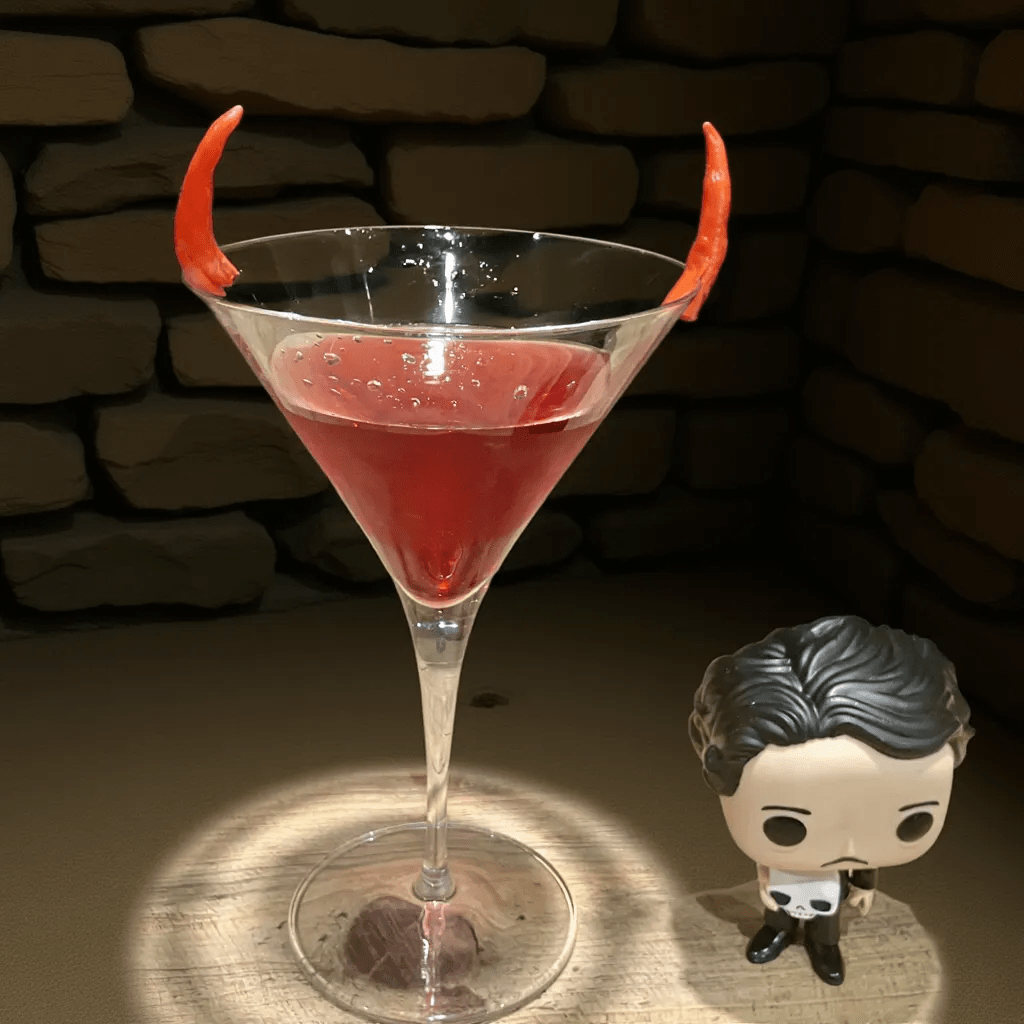
There are many drinks out there that take some variation of the name “demon blood” or “devil’s blood.” All of them are red, for obvious reasons. But the variant we present here has the signature touches of a devil-horn garnish and a fiery burn. 

Ingredients:

2 oz. carta blanca rum

2 oz unsweetened cranberry juice

1-1/2 tbs peppermint schnapps

Several dashes of tabasco (the more the better)

2 chili peppers (for garnish)

Cut slots into the bottom of the two chili peppers and affix them to the rim of a martini glass. Put all the liquid ingredients into your cocktail shaker with ice. Shake the hell out of it (Har!). Strain into the prepared martini glass. Damn, it’s good!

(Note: The tabasco is the key to this drink. Put in as much as you can stand–I did six healthy dashes. The tabasco adds dimensionality and balances the sweet and tart flavors.)

Poe-Script

It’s said that Poe may have gotten the idea for Toby’s mishap from Dickens’ The Posthumous Papers of the Pickwick Club. To wit:

“Heads, heads, take care of your heads,” cried the loquacious stranger, as they came out under the low archway, which, in those days, formed the entrance to the coach-yard. “Terrible place — dangerous work; other day, five children — mother — tall lady, eating sandwiches — forgot the arch — crash, knock — children look round, mother’s head off … head of a family off; shocking, shocking.”