2025 Poe Cocktails

Halloween Extravaganza!

Happy All-Hallow’s Eve! I trust your holiday is Spooktacular (to use a term popularized by local businesses leveraging a holiday about dead bodies and ghosts and candy to get you to buy a new refrigerator).

But seriously, make sure you take the time to enjoy the day, for in two more days daylight savings time ends, and then we enter the mad, frenetic rush headlong into the Thanksgiving and Christmas craziness and, before you know it, it’s 2026. And as you lay there on the couch next to your dead Christmas tree, exhausted with a massive NYE hangover and a credit card full of holiday debt, you’ll wish you’d taken the time to enjoy the simple pleasure of a handful of candy corn and Svengoolie on the TV.

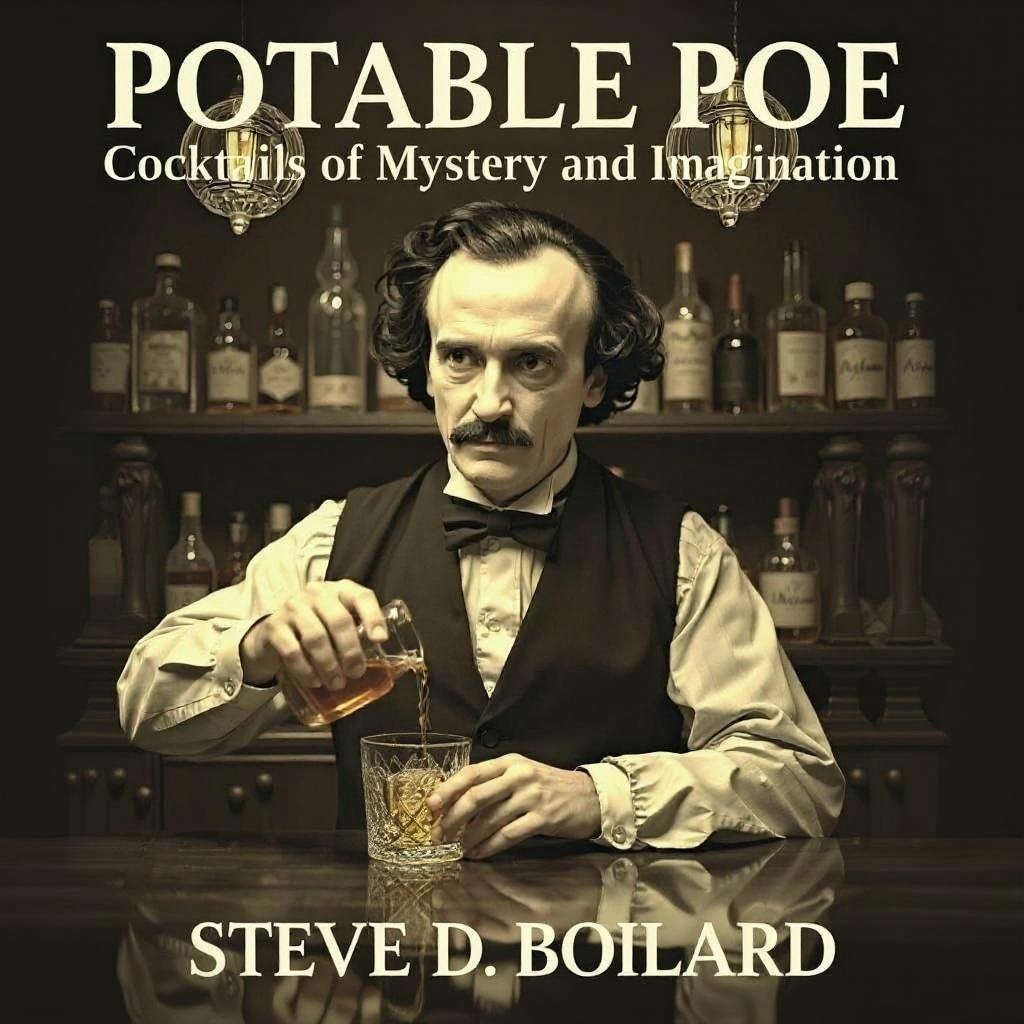
Before we get into our final cocktail, I wanted you to know that all 31 of this month’s concoctions are featured in my forthcoming book, Potable Poe. Talk about the perfect Christmas gift! It’ll be available on Amazon early next month, with Spooktacular Savings. I’ll send out a notice when the book goes live.
Now, let’s get to our final Poe story/cocktail entry for October:

Cocktail 31: The Tell-Tale Heart

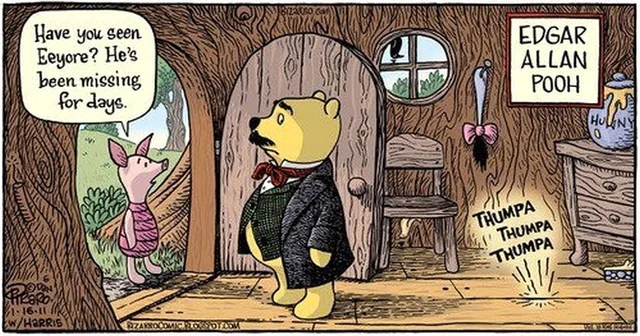
It was a low, dull, quick sound — much such a sound as a watch makes when enveloped in cotton. I gasped for breath — and yet the officers heard it not. I talked more quickly — more vehemently; but the noise steadily increased. I arose and argued about trifles, in a high key and with violent gesticulations; but the noise steadily increased. Why would they not be gone? I paced the floor to and fro with heavy strides, as if excited to fury by the observations of the men — but the noise steadily increased. Oh God! what could I do? I foamed — I raved — I swore! I swung the chair upon which I had been sitting, and grated it upon the boards, but the noise arose over all and continually increased. It grew louder — louder — louder! And still the men chatted pleasantly, and smiled. Was it possible they heard not? Almighty God! — no, no! They heard! — they suspected! — they knew! — they were making a mockery of my horror! — this I thought, and this I think. But anything was better than this agony! Anything was more tolerable than this derision! I could bear those hypocritical smiles no longer! I felt that I must scream or die! — and now — again! — hark! louder! louder! louder! louder! —
The Tale

This is, without a doubt, one of my favorite Poe stories. And evidently I’m not alone, as “The Tell-Tale Heart” is near the top of most rankings of Poe’s works.

In this tale, the narrator tries to convince us that he is perfectly sane (which is almost always a sure sign of the opposite). He describes how he lived with an old man who never gave him any cause for offense…and yet how he hated the old man. A major factor was the old man’s vulture-like “pale blue eye, with a film over it. Whenever it fell upon me, my blood ran cold; and so by degrees — very gradually — I made up my mind to take the life of the old man, and thus rid myself of the eye forever.”

The narrator describes in careful detail how he lay in wait until the perfect opportunity; how he killed the old man; and how he dismembered the body and placed it under the floorboards. A bit later three local police officers show up, having been alerted by reports of a scream. But the narrator calmly replies that the sound was simply he, himself, experiencing a nightmare. With cocky confidence the narrator invites the police to search the old man’s room and judge for themselves that none of his treasures were missing. The police seem satisfied, and yet, the cocky narrator places chairs directly above the old man’s hidden remains and invites the officers to stay and rest a bit. He is the picture of confidence and innocence.

And yet, the narrator begins to hear a ringing, which becomes louder and morphs into what he assumes to be the beating of [the old man’s] hideous heart.” Unable to take it anymore, he rips up the floorboards and admits the deed.

The full story is available here.

The Drink

 Yes. Well. This is quite a dramatic set-piece to capture in a cocktail. And yet, I think we can do it. What we need is to create a cocktail with a beating, hideous heart beneath the floorboards. Mwahahahahaha!

I labored on this cocktail night after night. You fancy me mad? Madmen know nothing. But you should have seen me. You should have seen how wisely I proceeded — with what caution — with what foresight — with what dissimulation I went to work!

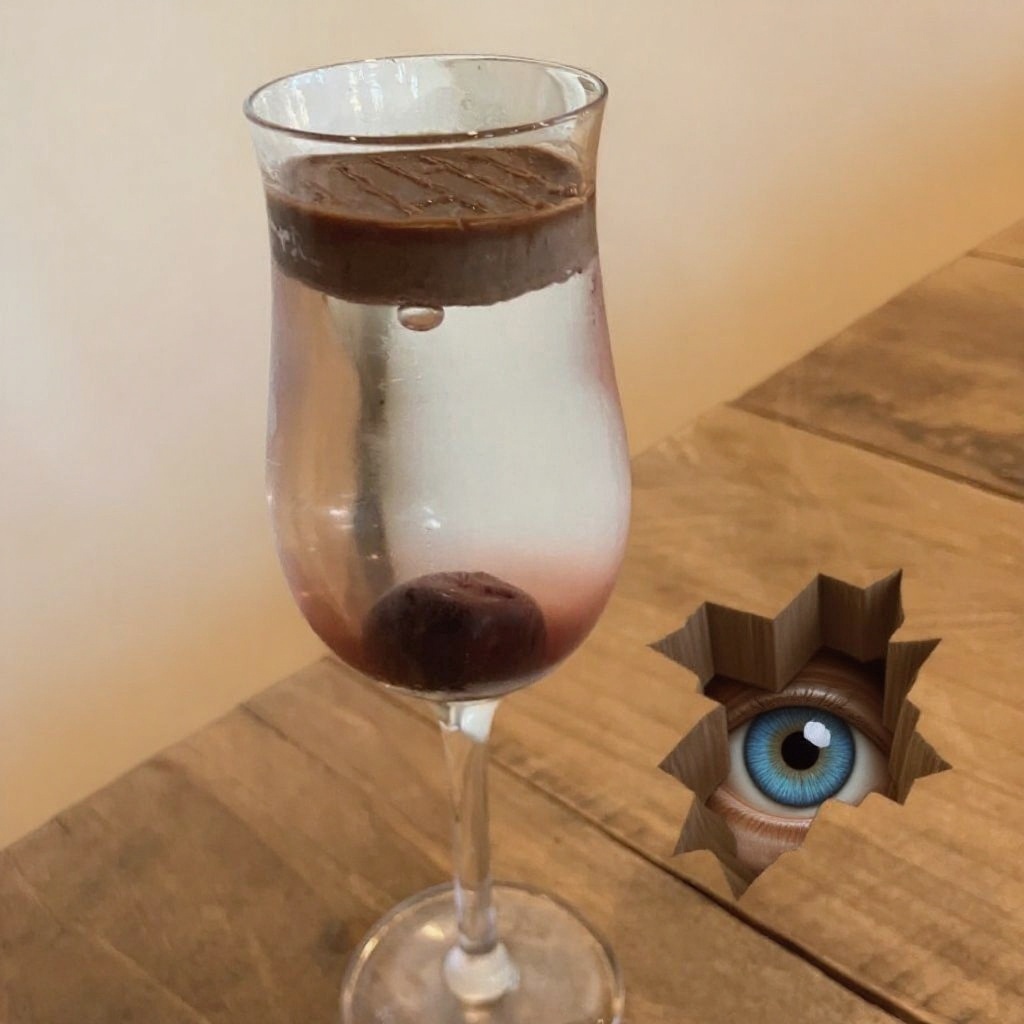
The cocktail–yes, it must somehow capture the very essence of Poe’s story. The essence, I say! I envisioned the top of the cocktail as a flat, solid surface which would resemble a floor, beneath which lay a beating, hideous heart. But how to accomplish this? After considering many plausible approaches, I decided that the “floor” should be represented with a layer of chocolate hard-shell, such as you might pour on an iced-cream.  And what of the “heart?” This, I decided, could be admirably represented with a suitable and evocative candy that would lie, still beating, still beating, at the bottom of the glass.

Alas, I did encounter a difficulty.  Creating the chocolate floor required that I somehow float the liquid chocolate at the top of the drink and keep it there, for several minutes, until it hardened into a solid layer. I made several fruitless attempts, carefully squeezing a thin layer of chocolate from the bottle, and each time the liquid immediately sank to the bottom of the drink. I tried floating a disk of Nori (that is, cut from a sheet of dried seaweed), to support the chocolate while it hardened, but this created a disgusting and inedible mess. And yet, did I give up? Most assuredly not! Eventually my labors were rewarded, and I settled on the method of first freezing the drink, so that the chocolate had a solid base on which to rest while it hardened. Then, after the chocolate had solidified, I could thaw the drink underneath it and leave the chocolate “floor” intact! Surely a madman could not devise such a clever plan! A drink thus prepared would present its recipient with the need to “tear up” the floorboards with a spoon in order to gain access to the drink…and to the hideous heart.

And what of the drink itself? This, too, I considered carefully. You will recall, of course, that in Poe’s tale the narrator says:

The old man was dead. I removed the bed and examined the corpse. Yes, he was stone, stone dead. I placed my hand upon the heart and held it there many minutes. There was no pulsation. He was stone dead.

Thrice Poe uses the adjective stone to describe the old man’s condition. Surely this is suggestive for the associated spirit (ha!) in this drink. Of course! We will use Stone’s Original Ginger Wine! Even more fortuitous, the “Ginger” in Ginger Wine reminds us of how carefully and cautiously–dare I say gingerly–the narrator opens the lantern to release a single ray of light on the old man’s Evil Eye? You must confess that no spirit is better suited to this cocktail than Stone’s Original Ginger Wine!

I will now share with you my recipe. Pay close attention!

Ingredients:

3-4 oz. Stone’s Original Ginger Wine

1 Tbsp honey

1-2 oz. chocolate hard-shell

1 cherry, or a candy heart (there are many options here)

The presence of the chocolate suggests that this drink should take the form of a dessert cocktail. So our cocktail will essentially amount to a small glass of fortified wine. Find a small tulip glass, and place into it a hideous heart. I used a maraschino cherry, mainly because it behaves itself in liquid. I had earlier tried red saltwater taffy that I molded into an anatomically-correct heart, but it gradually dissolved and “bled” into the drink while the drink was cooling in the freezer.

Set aside the prepared glass, and mix the Stone’s and the honey in a mixing glass. The honey adds a bit more sweetness to the ginger-forward wine, helping it to stand up to the chocolate. Now pour the mixture into the tulip glass. Place the filled glass into your freezer.

The alcohol content of this drink is about 14 percent, and this strength of an alcohol mixture has a freezing point of 23 degrees Fahrenheit. See, I left nothing to chance! Would a madman have thought of this? You can be assured that, after a couple of hours, your drink will be frozen. Stone cold, even. 

Once the drink is frozen, remove it from the freezer and pour a thin layer of hard-shell on top. It will harden almost instantly. Use a sharp knife–I used a bloody stiletto–to lightly score lines in the chocolate to represent individual planks of flooring. Now place the drink in a refrigerator (not the freezer) or, if you’re impatient, leave it out on the counter.

You’re going to want to serve this drink the moment the Stone’s has returned to liquid…but before the hard shell melts. The job of the drink’s lucky recipient is to break through the chocolate “floorboards” with a demitasse spoon. Extra points for exclaiming “Villains! Dissemble no more! I admit the deed! — tear up the planks! — here, here! — it is the beating of his hideous heart!”
Poe-Script

As one of Poe’s most famous short stories, “The Tell-Tale Heart” has been translated into many languages, adapted for stage and radio and TV and film, been parodied in countless ways, made into video games and songs and comic books. One of the oldest adaptations was a silent movie released in 1928. It’s an exhilarating expressionist film with a strong Dr. Caligari vibe. It’s worth spending the 20 minutes required to watch this movie, which is available on YouTube. In fact, seeing as today is Halloween, here’s the link:
And thus, we come to the end of the month and of our journey into Edgar Allan Poe’s stories through the medium of spirits (so to speak). Thank you for joining me! This blog now returns to its more pedestrian purpose of exploring out-of-the-way and offbeat locales in this great country of ours. And we have some exciting trips planned for the coming months. So make sure you’re subscribed to this blog (see the link below)! Until then, remember: There’s no such thing as lychees.
2025 Poe Cocktails

Cocktail 30: Loss of Breath

“Thou wretch! — thou vixen! — thou shrew!” — said I to my wife on the morning after our wedding — “thou witch! — thou hag! — thou whippersnapper! — thou sink of iniquity! — thou fiery-faced quintessence of all that is abominable! — thou — thou —” Here standing upon tiptoe, seizing her by the throat, and placing my mouth close to her ear, I was preparing to launch forth a new and more decided epithet of opprobrium which should not fail, if ejaculated, to convince her of her insignificance, when, to my extreme horror and astonishment, I discovered that I had lost my breath.

The phrases “I am out of breath,” “I have lost my breath,” &c. are often enough repeated in common conversation, but it had never occurred to me that the terrible accident of which I speak could bonâ fide and actually happen! Imagine — that is if you have a fanciful turn — imagine I say, my wonder — my consternation — my despair!

The Tale

In this story, Poe relates the unfortunate adventures of Mr. Lacko’breath, who–follow me closely here–loses his breath! Haha! Is that not a hilarious premise? And, at the risk of giving away the surprise ending, his lost breath is inadvertently caught by a Mr. Windenough. Get it??!

In my humble opinion, this is one of Poe’s less successful parodies. For yes, he is mocking the sensationalist and literally incredible style of popular fiction published in Blackwood’s Magazine. Indeed, to drive home the link Poe affixes the subtitle, “A Tale Neither In Nor Out of Blackwood.” Poe, it will be remembered, explicitly mocks Blackwood tales in two other stories: “How To Write a Blackwood Article” and “A Predicament.

But to return to “Loss of Breath”: after Mr. Lacko’breath loses his breath, he attempts to hide his affliction and sets out to somehow live a semi-normal life in another land. Alas, what follows is an ever-worsening series of mishaps which find him mistaken for dead, made the subject of gruesome medical experiments, and even hanged. (Because he lacks breath, however, the process of hanging him has no effect on his respiration, and he lives on.) He ends up being placed in a tomb next to his neighbor, Mr. Windenough, who also had been assumed dead, in his case after going into a catatonic state as a result of accidentally inhaling (?) Mr. Lacko’breath’s breath.

There’s a lot more detail and twists in this story, but I think you get the point. Moving on.

The Drink

This story presents a capital opportunity to make a Prohibition-era cocktail that has recently gained in popularity, including in the parlour of my son and daughter-in-law. I’m talking, of course, about the Last Word, a drink that combines gin, green Chartreuse, maraschino liqueur and fresh lime juice. I’ll admit that neither the ingredients nor the drink’s appearance do much to call Poe’s story to mind. Instead, the link is found in the name “last word” and how it is necessarily coincident with a literal loss of breath. OK, fine; let’s see you do better!

Ingredients:

3/4 ounce gin

3/4 ounce green Chartreuse or Dolin Genepy

3/4 ounce maraschino liqueur

3/4 ounce lime juice

brandied cherry (as a garnish)

Put all the liquid ingredients in a shaker with ice, pour into a chilled coupe glass, and garnish with a cherry.

Poe-Script

At the top of this tale, Poe appends a brief epigraph that reads “O breathe not, &c.” This is an excerpt he attributes to Moore’s Melodies. It appears to reference an Irish tune by Thomas Moore, entitled “Oh! breathe not his name.” The first stanza runs thus:

Oh! breathe not his name, let it sleep in the shade

Where cold and unhonor’d his relics are laid:

Sad, silent and dark, be the tears that we shed,

As the night-dew that falls on the grass o’er his head!

Poe-Poe-Script

Attentive readers will recall my unfortunate run-in with green Chartreuse a few years back. The description of the wreckage is here. For this reason I jumped at the opportunity to substitute Dolin Genepy for the Chartreuse. The herbal flavor profiles are similar, but the Dolin doesn’t quite resurrect the hideous memories of yore.

2025 Poe Cocktails

Cocktail 29: Silence–A Fable

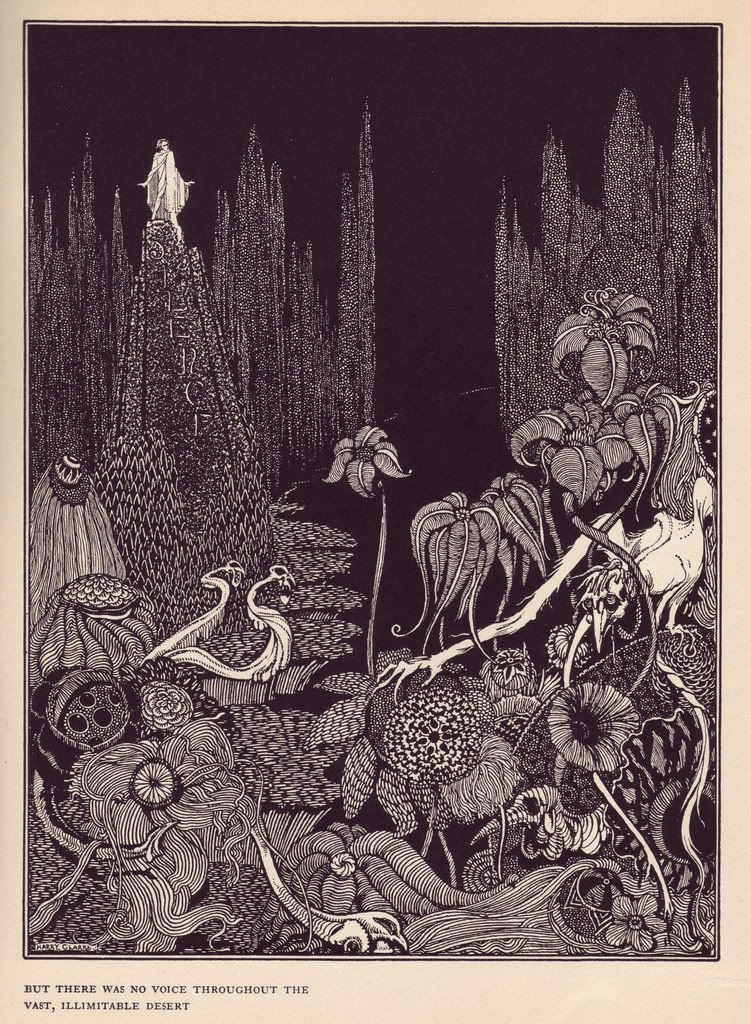
“Then I grew angry and cursed, with the curse of silence, the river, and the lilies, and the wind, and the forest, and the heaven, and the thunder, and the sighs of the water-lilies. And they became accursed, and were still. And the moon ceased to totter up its pathway to heaven — and the thunder died away — and the lightning did not flash — and the clouds hung motionless — and the waters sunk to their level and remained — and the trees ceased to rock — and the water-lilies sighed no more — and the murmur was heard no longer from among them, nor any shadow of sound throughout the vast illimitable desert. And I looked upon the characters of the rock, and they were changed; — and the characters were SILENCE.”

The Tale

OK, this is one of Poe’s more “trippy” tales (to use an adjective popularized during my long-past and wasted youth). It takes place in a mysterious, melancholy, and rather depressing world of vast deserts and monotonous weather patterns. “The waters of the river have a saffron and sickly hue; and they flow not onwards to the sea, but palpitate forever and forever beneath the red eye of the sun with a tumultuous and convulsive motion.” It’s like the Cuyahoga River in 1969.

Now, in this land there was a demon. The demon observes a man standing on a rock and, for some unknown reason, imposes a curse:

“Then I cursed the elements with the curse of tumult; and a frightful tempest gathered in the heaven where, before, there had been no wind. And the heaven became livid with the violence of the tempest — and the rain beat upon the head of the man — and the floods of the river came down — and the river was tormented into foam — and the water-lilies shrieked within their beds — and the forest crumbled before the wind — and the thunder rolled — and the lightning fell — and the rock rocked to its foundation. And I lay close within my covert and observed the actions of the man. And the man trembled in the solitude; — but the night waned and he sat upon the rock.”

So now the demon decides to curse the region into silence, as described in the excerpt I shared at the beginning of this entry. At this frightening silence the man flees in terror. That’s pretty much the whole tale.

The full story is available here.

The Drink

For this cocktail, we’re going to zero in on two central aspects of Poe’s story. First is the  “saffron and sickly hue” of the river. And what better ingredient to represent this saffron color than…saffron? Saffron is a spice with floral and earthy qualities that, I think, might pair well with tequila. So let’s make a saffron margarita. Second, I want to capture the turmoil of the first curse and for this we turn to that questionable treat (?) at the bottom of every trick-or-treater’s Halloween haul in the 1970s: Pop Rocks.

Ingredients

2 oz. reposado tequila

1 tbs lime juice

½ oz Cointreau

¼ oz agave syrup, plus a little more for rimming the glass

A half-dozen strands of saffron (soaked in 1 tsp warm water), plus a few more as a garnish

1 pkg Pop Rocks (to rim glass)

Prepare a margarita glass by coating the rim with some agave syrup and rolling the rim in Pop Rocks. (Extra points if you, like me, couldn’t find a margarita glass anywhere in the house, and so in desperation you go to Target and find a couple of these “ghost” margarita glasses, which are simultaneously cute and embarrassing.)

Combine the tequila, lime juice, Cointreau, agave syrup, and saffron water in a shaker with ice. Shake it “with the violence of a tempest.”

Strain the drink into your prepared ghost glass. Use crushed ice if you must, but I’m too manly for that. Garnish with a few more strands of saffron. If you’re up for it, curse the world about you.

Poe-Script

This fable is often referred to as a “prose-poem,” which is another way of saying that it doesn’t rhyme and it doesn’t really tell a coherent story. Still, it’s a haunting narrative that seems to communicate the horror of silence. Which is a phrase that nicely describes my first date in high school.

2025 Poe Cocktails

Cocktail 28: The Imp of the Perverse

A paradoxical something, which we may call perverseness, [prompts us to] act, for the reason that we should not. In theory, no reason can be more unreasonable, but, in fact, there is none more strong. With certain minds, under certain conditions, it becomes absolutely irresistible.

The Tale

It’s a compelling thesis: we are tempted to do things that we shouldn’t. A museum display’s “do not touch” sign gives rise to the desire to do just that, resulting in unintentional damage.  (Ask me how I know.) An adolescent sneaks his first smoke behind the proverbial shed. A hunter takes a pot shot at a No Trespassing sign. Part of the attraction of these acts is the thrill of committing a taboo. Indeed, I have a friend who confides that he feels an urge, whenever he’s near a police officer, to grab the holstered pistol. (I do not recommend trying this.) But the urge is there. Perhaps Poe’s observation goes a long way toward explaining the sin of adultery.

The first half of Poe’s story is essentially an essay explaining this phenomenon. (Along the way he mentions man’s “organ of amativeness,” which simultaneously provides fodder for sophomoric giggles and explains a lot about man’s compulsion to misbehave.) It’s a bit unclear whether the notion that “we should not” is imposed externally (like the stricture against adultery) or rather more intrinsically (i.e., that the act would be harmful to us). At one point in his essay Poe speaks of our desire “to do wrong for the wrong’s sake,” which sounds like a desire to go against convention. And yet the long example he provides–in which the story’s narrator describes how he was compelled to incriminate himself for a murder that he’d gotten away with years earlier–suggests the essay is concerned with how we act against our own interests. Either way, Poe’s “Imp of the Perverse” is the personification of the urge to misbehave, even (or especially) when it’s bad for us.

Surely you can recall instances where you felt compelled to act in a way that, deep down, you knew you shouldn’t. Did you give in to the urge? Or did something–a sense of morality or conscience, or perhaps just a desire for self-preservation–prevent you from acting on that urge? Would that I had been blessed with a bit more self-restraint when I was younger. (For the back story, see my memoir, Midcentury Miscreant.) Meanwhile, an article in a 2018 issue of Pacific Standard magazine describes the Imp phenomenon, and helpfully explains that “the thoughts themselves are fairly harmless…but how we respond to them can be a problem.” You don’t say.

Now, Poe’s story concerns major wrongful acts–neglect of duty, opposing the will of God, suicide, and murder. He did not include on his list the category of crimes against Mixology.  But I will. So join me as we blithely and recklessly give in to the Imp of the Perverse.

The full story is available here.

The Drink

Let’s start by violating the “Golden Ratio,” which decrees cocktails should contain 2 parts spirit, 1 part a sweet mixer, and 1 part a tart mixer. Let’s reverse this to 1:2:2. Doesn’t that make you feel perverse?

Let’s also blithely ignore the aphorism “Grape or grain, but never the twain.” This piece of folk-wisdom holds that you should never mix wine and spirits, either in a single drinking session or, presumably, in a cocktail. Here comes the twain!

Finally, it’s commonly held that one should only shake cocktails that contain fruit juice; all other cocktails should be stirred. Our drink eschews fruit juice, and yet we’re going to shake the hell out of it. Embrace your inner Caligula!

The central crime of grape and grain is provided by some Amontillado (for obvious, Poe-related reasons) and some neutral vodka (because even in this “perverse” cocktail it’s probably wise to minimize the extravagant clash of tastes). As mixers let’s use some Triple Sec and Cynar. (Cynar, as you probably know, is a liqueur made from artichokes, of all things. This in itself lends a bit of perversity.)

Ingredients:

½ oz Amontillado

½  oz vodka

1 oz Triple Sec

1 oz. Cynar

(Optional) some tonic water

Perverse garnish of your choosing

Add the first four ingredients to a shaker with ice, and shake it. Then, pick up the shaker and shake that. (Haha!) Strain the mixture into some ridiculous non-barware. (I used my Studebaker Museum coffee mug.) Maybe add one of those giant ice cubes that are all the rage these days, simply because they’re ridiculous. If you want to make the drink a little less disgusting, you can dilute it with some tonic water. Garnish with your own token of perversity. I used a candle, which, it may be remembered, was the murder weapon used by the narrator in this tale. Seriously.

Take a swig, and you’ll understand why those cocktail rules were created in the first place. You’ll also be tempted to never again give in to the Imp of the Perverse. You’re welcome.

Poe-Script

Psychological researchers have produced voluminous studies, papers, and articles that reference and attempt to explain the Imp of the Perverse. Indeed, our capacity for self-destructive actions is probably one of the main reasons for the field of psychology itself. And yet I’m not convinced that any of the academics’ offerings succeeds in explaining the phenomenon any better than Poe did in 1845.

2025 Poe Cocktails

Cocktail 27: The Facts in the Case of M. Valdemar

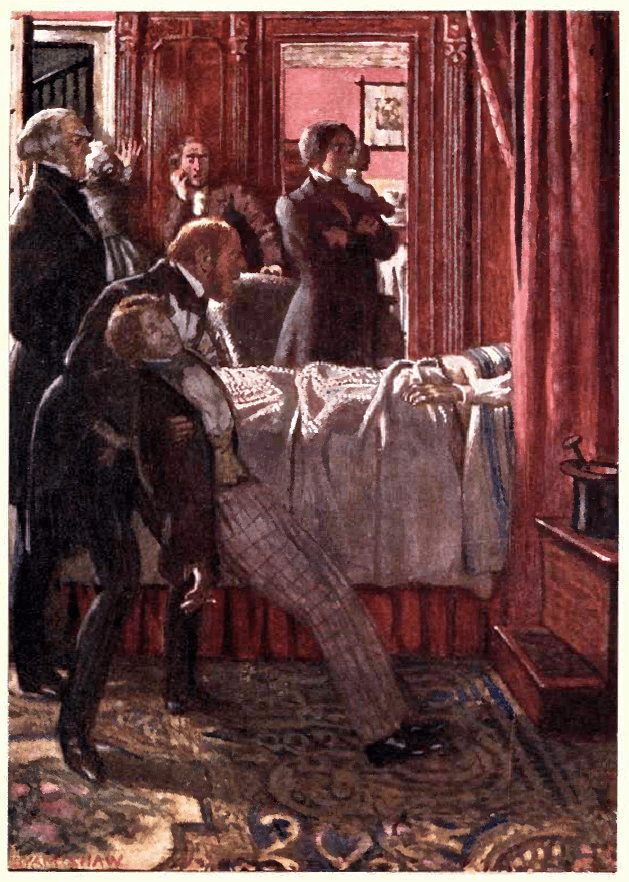
I was thoroughly unnerved, and for an instant remained undecided what to do. At first I made an endeavor to re-compose the patient; but, failing in this through total abeyance of the will, I retraced my steps and as earnestly struggled to awaken him. In this attempt I soon saw that I should be successful — or at least I soon fancied that my success would be complete — and I am sure that all in the room were prepared to see the patient awaken.

For what really occurred, however, it is quite impossible that any human being could have been prepared.

As I rapidly made the mesmeric passes, amid ejaculations of “dead! dead!” absolutely bursting from the tongue and not from the lips of the sufferer, his whole frame at once — within the space of a single minute, or even less — shrunk — crumbled — absolutely rotted away beneath my hands. Upon the bed, before that whole company, there lay a nearly liquid mass of loathsome — of detestable putrescence.

The Tale

This is another of Poe’s suite of mesmerism stories (which includes “Mesmeric Revelation” and yesterday’s “A Tale of the Ragged Mountains”). In this story, a Mesmerist hypnotizes a man (M. Valdemar) at the moment of his expected death from tuberculosis. This somehow holds Valdemar in a state of suspended animation so that, it would seem, death is indefinitely delayed. The Mesmerist is able to communicate with his patient, as I suppose one can talk to someone in a state of hypnosis. Valdemar explains that he is dying. Then, it would seem, he dies. His breathing and pulse stop, and his skin turns cold.

As the nurses prepare to remove the body, Valdemar’s voice is heard–though his lips don’t move–and he says “I am dead.” For the next seven months, Valdemar’s body is monitored, and while it shows no signs of life, neither does it show signs of decay. Finally, the Mesmerist decides to try to wake Valdemar from his trance. Valdemar’s voice is again heard, saying ““For God’s sake! — quick! — quick! — put me to sleep — or, quick! — waken me! — quick! — I say to you that I am dead!” At that request, the Mesmerist “earnestly tries to awaken him,” and immediately Valdemar’s body undergoes the decomposition that should have been occurring on the dead body over the preceding months.

The full story is available here.

The Drink

Riffing off the excerpt I shared at top of this post, I at first considered creating a drink called “Detestable Putrescence.” Cooler heads prevailed, however, and instead we’re going to make your standard, classic zombie. For isn’t a zombie, essentially, what M. Valdemar became?

The zombie cocktail was created by that godfather of the tiki bar, Donn Beach, in the 1930s. It’s said the name was inspired by one of Donn Beach’s customers, who said the strong drink turned him into “the walking dead.” We’ve all been there, right?

Here’s the classic recipe:

Ingredients:

1 1/2 ounces Jamaican rum

1 1/2 ounces Puerto Rican gold rum

1 ounce 151-proof demerara rum

3/4 ounce lime juice, freshly squeezed

1/2 ounce Don’s mix (see discussion below)

1/2 ounce falernum

1 teaspoon grenadine

4 dashes absinth

1 dash Angostura bitters

Crushed ice

Tropical fruits, a maraschino cherry, and a sprig of mint (as a garnish)

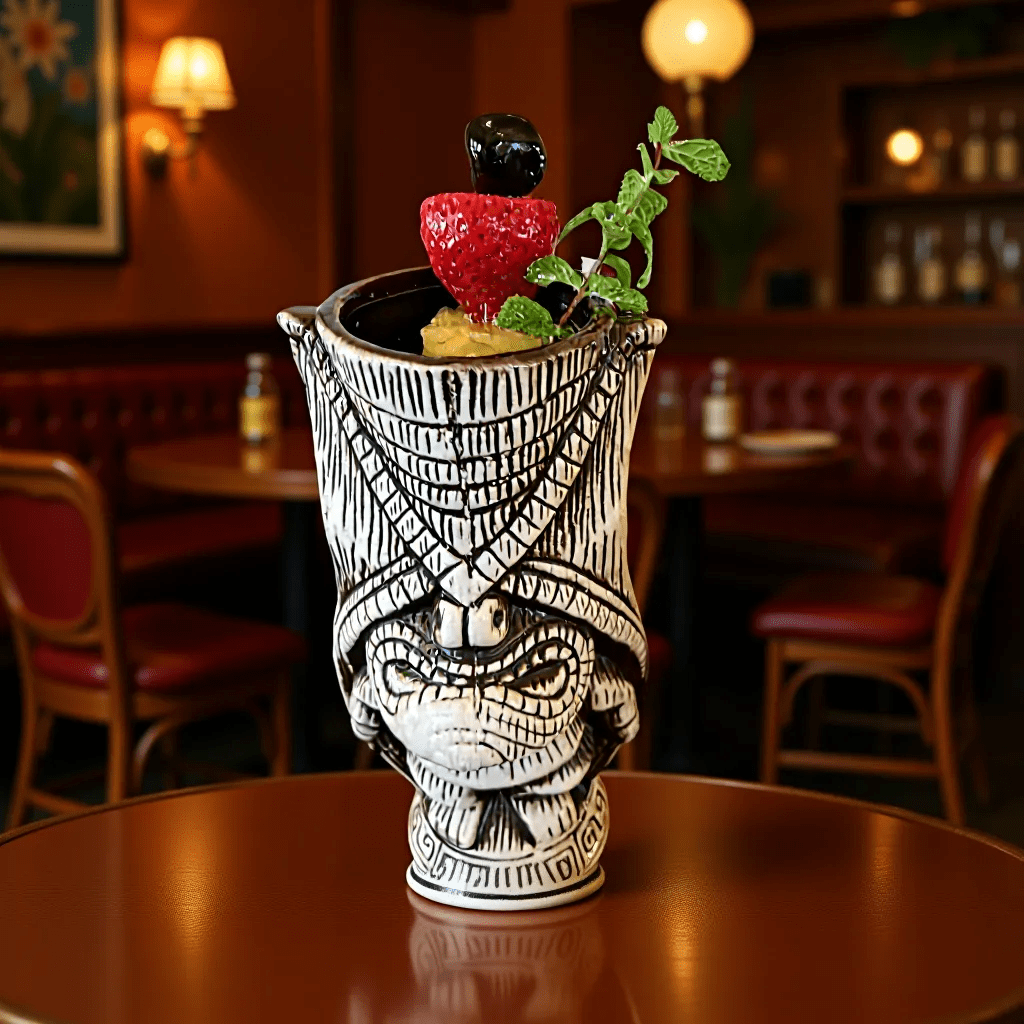
Dump it all (except the garnish) into a blender and blend. Pour into your favorite Tiki mug. Add crushed ice, if needed. Garnish. Drink. Pass out.

This is simultaneously one of the most complicated drinks (in terms of number of ingredients) and one of the most forgiving (in terms of receptivity to substitutions). But I would caution that a little absinth goes a long way. (If anyone wants to make T-shirts with this slogan, accompanied by an image of Poe looking a little loopy, please do so with my blessing.) The main ingredients for this drink are various rums (including the critical 151-proof rum) and sweeteners (especially the falernum and/or the “Don’s Mix.”)

The Don’s Mix is something that’s difficult, if not impossible, to obtain commercially. To make a decent facsimile of your own, just combine two parts fresh grapefruit juice with one part cinnamon syrup. Note that, even though the creator was Donn Beach, his mix is called Don’s Mix.

Poe-Script

When this story was published in two journals in late 1845, many assumed it to be a true report of an actual event. It’s unclear whether Poe intended for his story to be received in this way. But the clinical and authoritative writing style does come across as rather convincing. It’s not hard to imagine the rubes of 1845, who believed in the healing powers of snake oil nostrums, would accept Poe’s tale as fact. Of course, 13 percent of us still believe in Bigfoot…