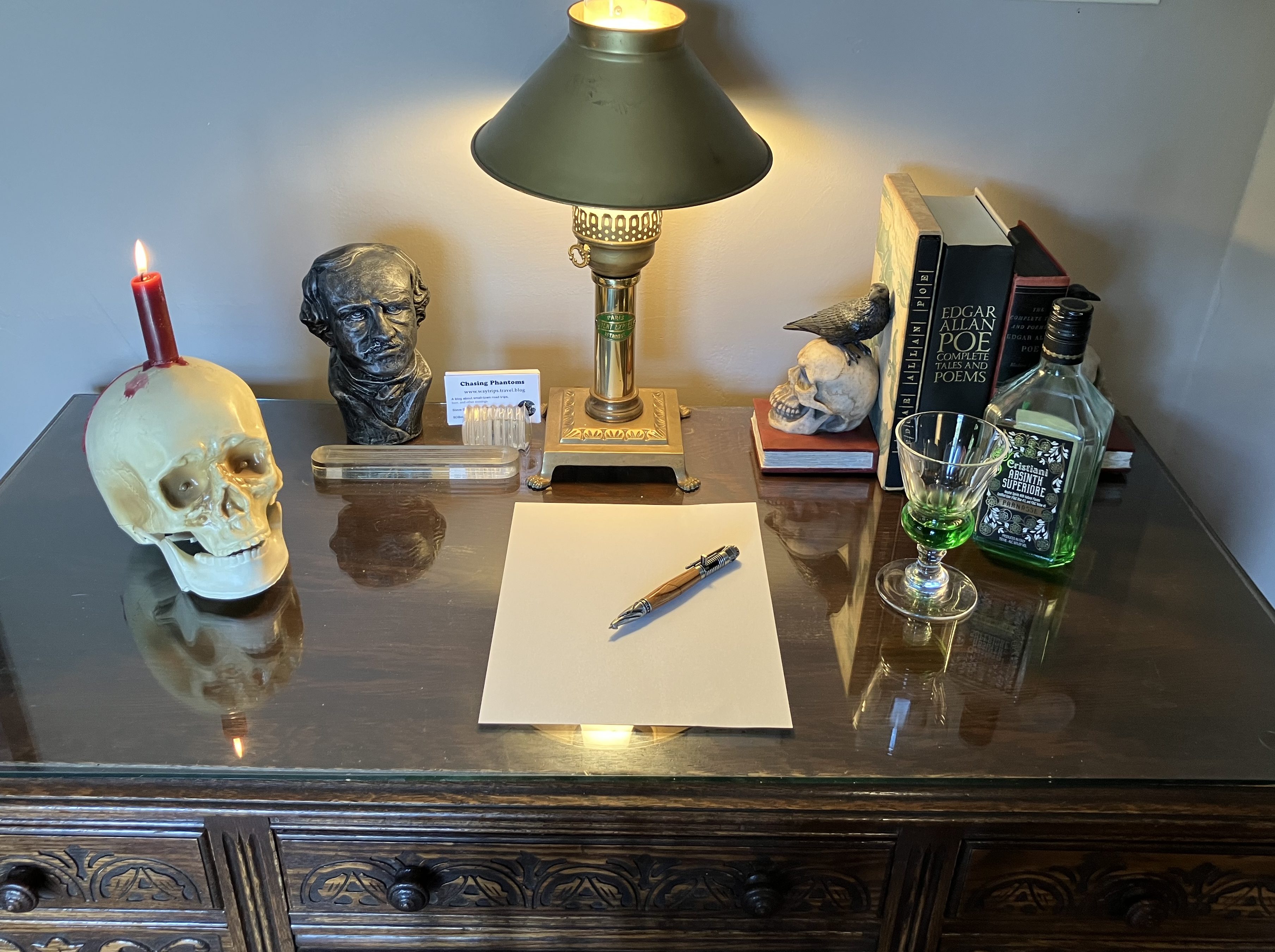
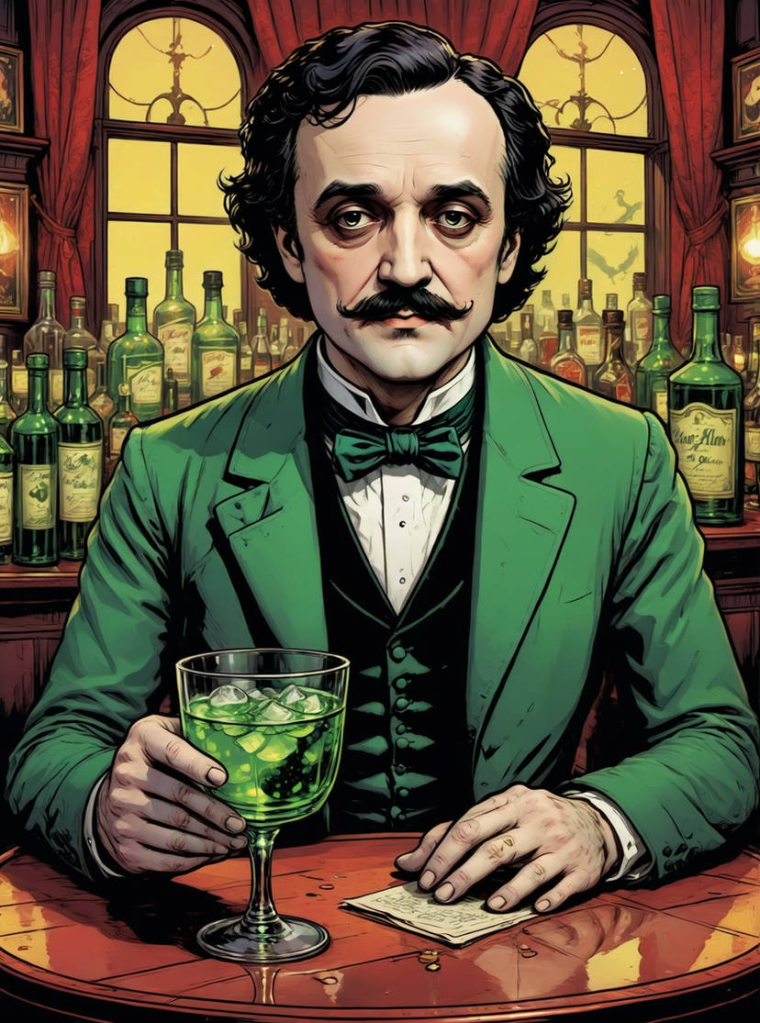
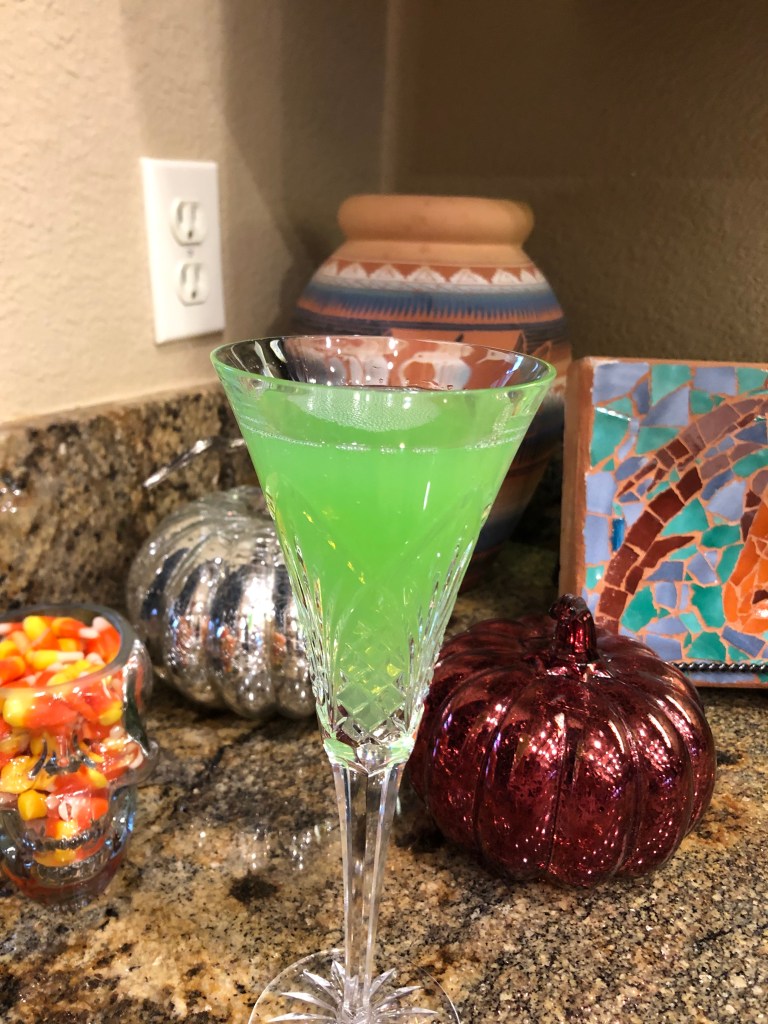
It’s Day 3 of #AuthorMadness2026, and the Poetastic Two at The Six Degrees of Poe offered participants this prompt: “Highlight the wonderful aspects of writing you enjoy.” And so I offer these thousand words, in a picture:
In the argot of acting, this would be considered “method.”
Once a year around this time I break out the absinthe. And then, after having a drink, I put the bottle away in disgust until the next year.
Why do I keep going back??
Attentive readers will recall my review of absinthe in 2022. That was straight absinthe which I drank via the”Bohemian” method. It wasn’t terrible.
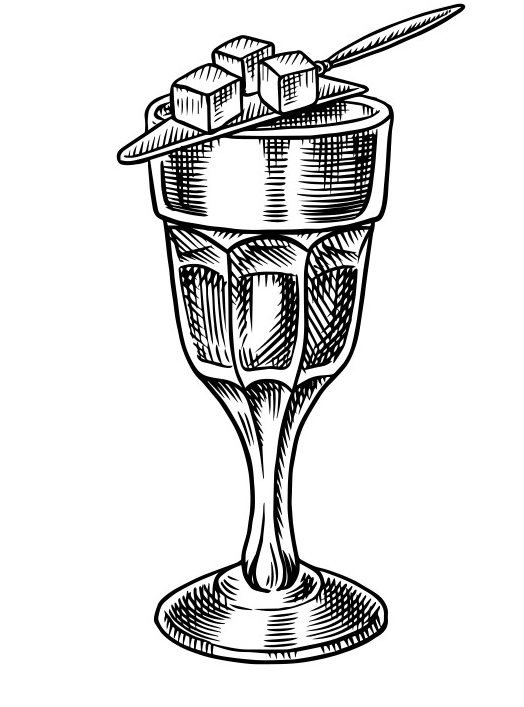
The proper apparatus.
The real attraction of absinthe is not the flavor (which is rather foul), but the appearance, the lore, and the association with the likes of Edgar Allan Poe and Oscar Wilde. Let’s take them one by one:
Absinthe is characterized by a bright green color, which is imparted from chlorophyll in its constituent herbs. It’s an otherworldly color which is perfect for Halloween.
Absinthe was popular among artists and other members of society’s fringe in the 19th century. It was considered the LSD of its day. Many claimed that the drink was highly addictive and promoted hallucinations and even, eventually, insanity. This led to its being banned in Europe and the US. Interestingly, this prohibition wasn’t lifted until 2007.
Absinthe is associated with some famous offbeat characters. It’s said that the drink was responsible for Van Gogh’s ear-lopping incident. It’s also said to have inspired some of Edgar Allan Poe’s more outre tales. (Interested readers can learn more here.)
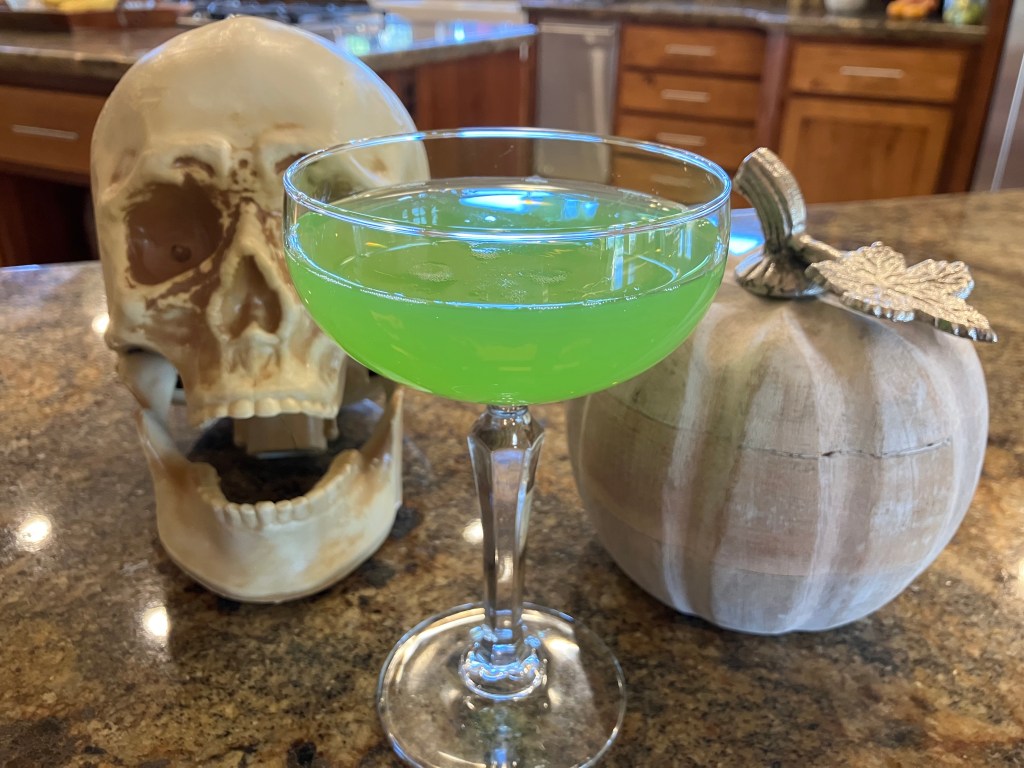
Absinthe is also associated with Ernest Hemingway, who created a cocktail he called “Death in the Afternoon” (after his 1932 book about bullfighting). Here’s how Hemingway described the drink: “Pour one jigger absinthe into a Champagne glass. Add iced Champagne until it attains the proper opalescent milkiness. Drink three to five of these slowly.” I love a challenge–let’s make five of them!
Conceptual Soundness: As noted above, the mere inclusion of absinthe imbues the drink with Bohemian cred. But the addition of champagne seems an odd choice, especially for a two-ingredient cocktail. What’s more, the name, while perhaps evocative for a Halloween cocktail, seems to have nothing to do with the drink itself. 1 point.
Appearance: In a bit of reverse alchemy, this cocktail takes two attractive ingredients–bright green absinthe and pale gold champagne–and combines them into a sickly viridescent color reminiscent of lime Kool-Aid cut with cat urine. I can’t get behind this. Zero points.
Meow!
Taste: The combination of brut champagne and absinthe is rather jarring. It’s like sucking on a lime immediately after brushing your teeth with Pepsodent. You simultaneously experience a sickly sweet taste on the front of your tongue while back around your adenoids a sour, citrus flavor is triggering your saliva glands. I haven’t experienced a taste like this since a fluoride treatment I received in the third grade. Zero points.
Ease of Preparation: Combining these two ingredients is simplicity itself. Absinthe might not be a staple in your home bar, though. And I daresay this cocktail might be too simple. There’s no complexity at all. I’ll give it two points, and that’s being generous.
Total Treat Score: 3 points, making this drink the worst we’ve reviewed so far!
Full disclosure: I only drank one of these, so technically I didn’t follow Hemingway’s directions which require you drink “three to five slowly.” If any of you is up for the challenge, please follow these directions to the letter and report back.
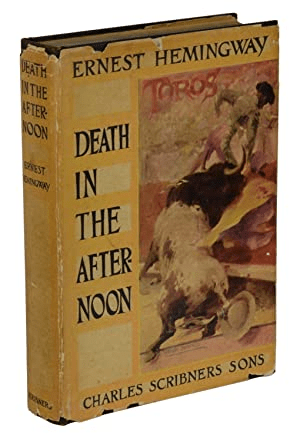
As you may know, Death in the Afternoon is the name of a 1932 book by Ernest Hemingway. The title reminds one of an Agatha Christie story. (Agatha Christie wrote a number of books with “Death” titles , including Death In the Clouds, Death on the Nile, and Death Comes As the End.) Hemingway’s Death in the Afternoon, however, is definitely not a Whodunit, but rather is a treatise on and celebration of Spanish bullfighting. And knowing that the title is about the ritualized killing of an imprisoned, male cow is definitely a buzzkill.
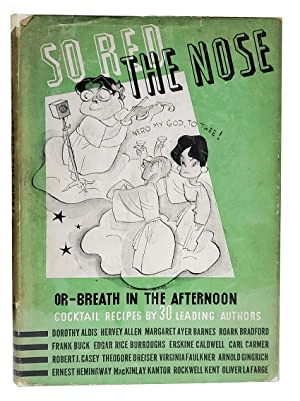
And yet, Hemingway repurposed that same title (Death in the Afternoon) for a cocktail he invented. It seems that, in 1935, writer Sterling North and a bookseller named Carl Kroch (I’m not making this up) put together a book that featured cocktail recipes from 30 famous writers, including Edgar Rice Burroughs, Christopher Morley, a bunch of people I never heard of, and Ernest Hemingway.
Now, for our purposes, “Death in the Afternoon” is a pretty good name for a Halloween cocktail. (And thanks to loyal reader Marie R for bringing this to my attention.) So let’s make one!
The Recipe: In Hemingway’s own words: “Pour one jigger absinthe into a Champagne glass. Add iced Champagne until it attains the proper opalescent milkiness. Drink three to five of these slowly.”
First of five…
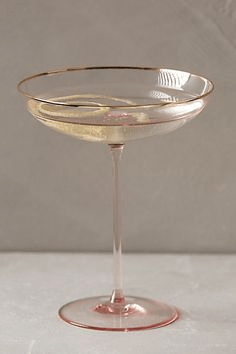
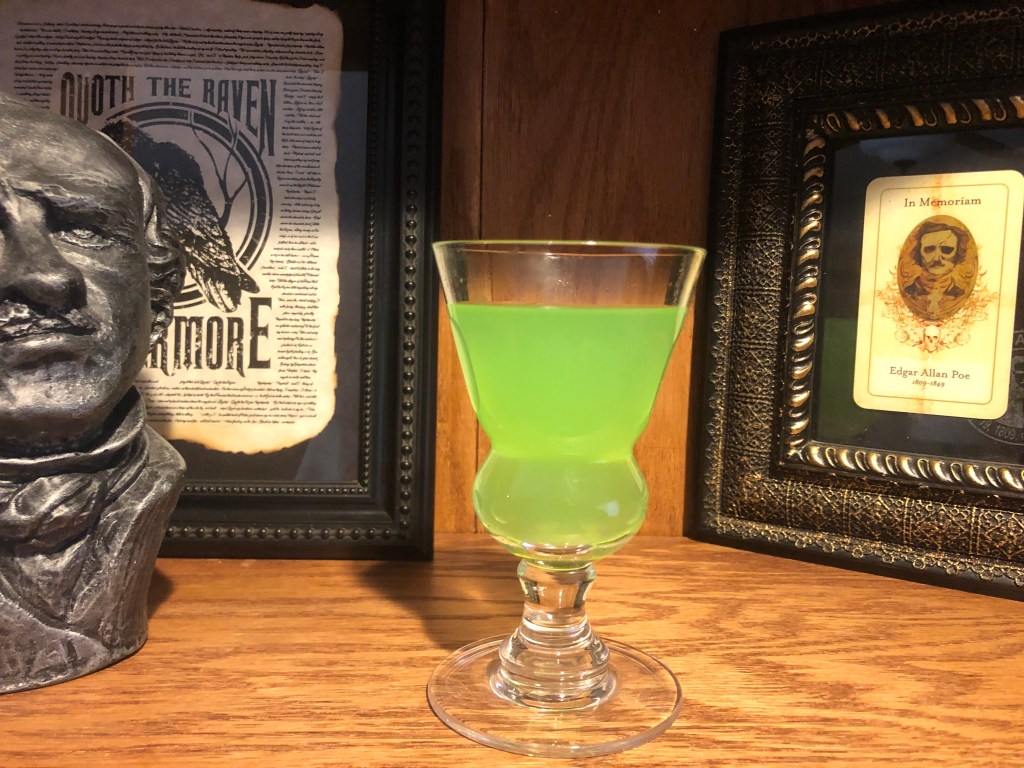
The Ratings: Well, it’s another green cocktail. Thankfully the color is imparted by absinthe and not by chartreuse. The green is made lighter and somehow more neon by the addition of the champagne, which also lends an effervescence. It’s probably the fault of my inadequate absinthe selection that it didn’t achieve “the proper opalescent milkiness.” In any event, I suppose it’s worth two points for appearance, which is essentially a B- on my grading scale. It’s not especially entrancing, but the color is unusual, and the use of a champagne glass adds a little bit of interest. (It would have been better if I’d had one of the old-timey champagne glasses that you see in New Years Eve memes.)
Now there’s a proper champagne glass!
As for the taste: I really wanted to like this one. Its Hemingway pedigree makes it cool, and the comingling of bohemian absinthe and patrician champagne is intriguing. The first sip was interesting — the licorice of the absinthe added depth and texture to the champagne. But with each successive sip the absinthe became more cloying and extraneous. I couldn’t see how this was an improvement over just a simple glass of good champagne. Of course, the absinthe (at 50% ABV) definitely boosts the alcohol content of the Roederer (12.5% ABV). (How on earth does Hemingway expect me to drink “three to five of these slowly”?!) But if your objective is simply to get inebriated, a good Scotch could achieve that objective with less fuss and muss. I can’t in good conscience give the taste more than 1.5 points. (My wife’s one-word comment about the taste was “Yuck.”)
I’ll give the full 2 points for the name, even though it’s actually a reference to a despicable sport. I’m still trying to imagine it as an Agatha Christie title.
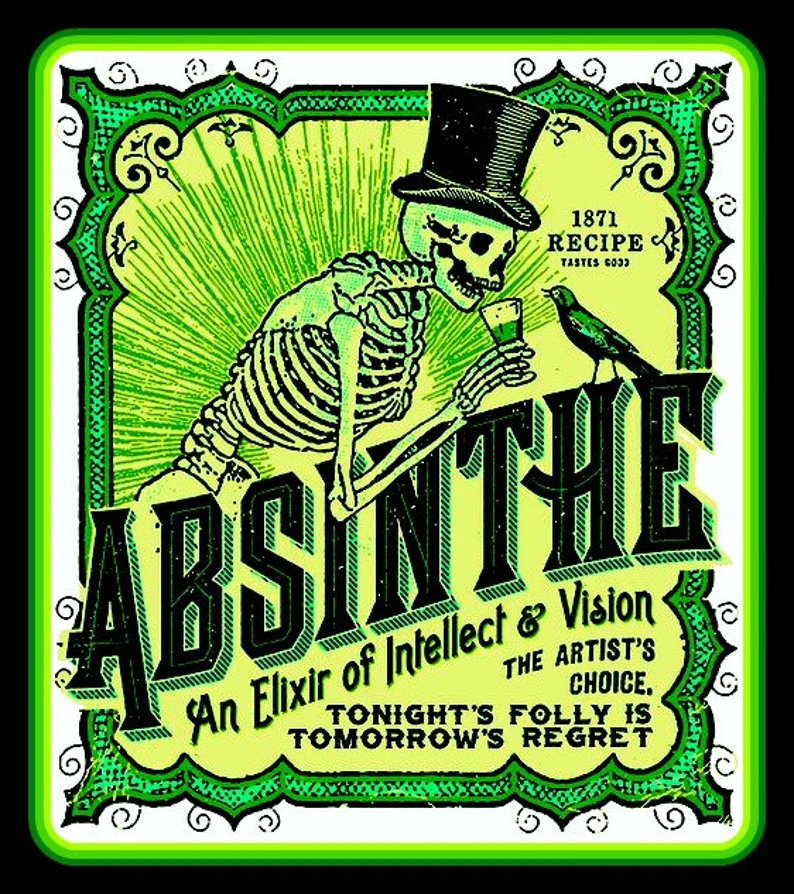
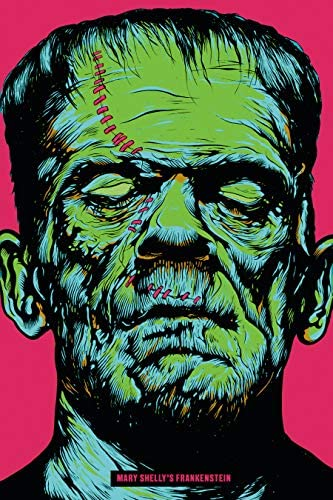
One drink that shows up on a couple of Halloween cocktail lists is absinthe–not as a mere ingredient, but rather as the whole drink. The unearthly green color is in the Frankenstein vein, but more to the point, it has a mysterious and Byzantine history that involves hallucinogenics, evil spirits, and the likes of Edgar Allan Poe. Let’s review:
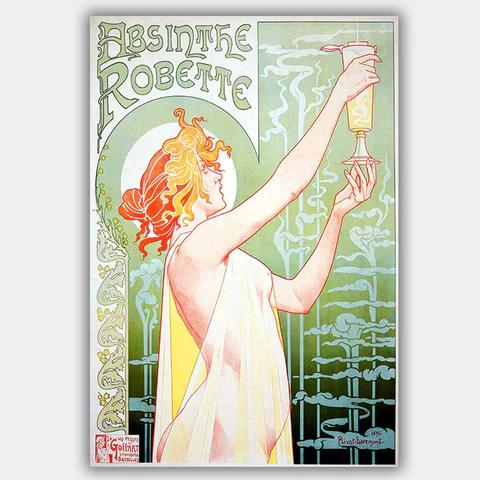
Color me absinthe
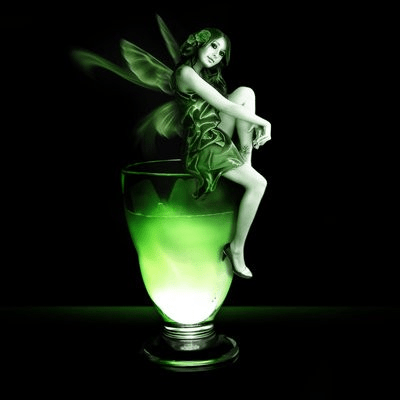
Absinthe is a high-alcohol spirit made from wormwood, anise, fennel, and various other exotic and ordinary ingredients. It tastes strongly of anise, and has been compared (usually favorably) to Jagermeister. Absinthe has a distinct green color which, in the more authentic (and expensive) versions occurs naturally from the ingredients. In the 19th Century absinthe became a popular drink among the Bohemian set, who would gather in cafes and drink the stuff all evening. They called the drink “The Green Fairy” for its supposed magical effects.
Tinkerbell she’s not.
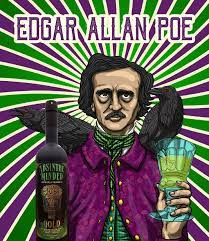
Conservatives railed against absinthe as a hallucinogenic spirit that was wreaking havoc with young people. Those claims were overblown, although absinthe does include trace amounts of thujone. As is often the case, the moral outrage from conservatives made absinthe all the more popular among the hipsters. Notable absinthe drinkers (addicts?) included Edgar Allan Poe, Oscar Wilde, and Lord Byron, which would be enough to solidify its Bohemian street cred.
Rhapsodic Bohemian (“He’s just a Poe boy from a Poe family…)
For most of the 20th century absinthe was banned in the US and most of Europe. It wasn’t until 2007 that America’s ban was lifted. Because we’re fortunate enough to be living in the post-absinthe Prohibition era, we’re able to add this drink to our October list. So what are we waiting for?
The recipe: With its high alcohol content (the stuff I used is 100 proof), absinthe is traditionally diluted with water. Also, as absinthe contains no sugar (and thus it is not classified as a liqueur), the drink is normally prepared with the addition of a sugar cube. Now, there are two ways to do this preparation: the French method and the Bohemian method. Guess which one I used?
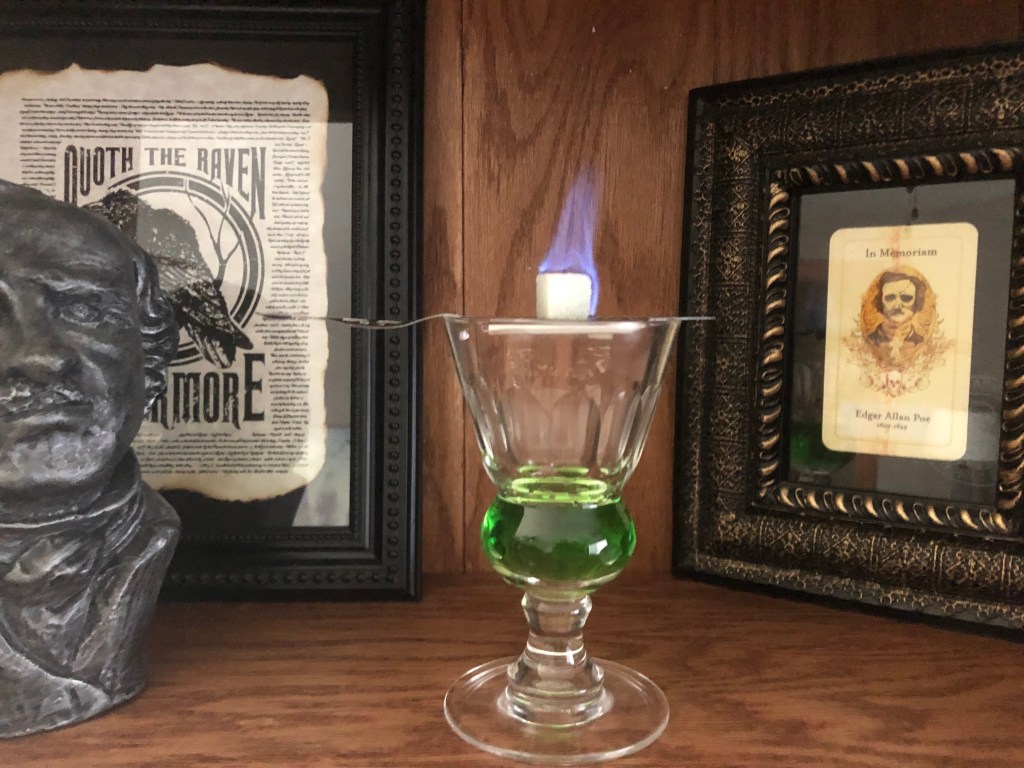
There is a distinct ritual to all this. First you need to get yourself an absinthe glass, whose shape makes it easy to measure the exact amount of absinthe to pour from the bottle. Then you need to get a slotted absinthe spoon. (All this stuff is available on Amazon.) Rest the spoon on top of the glass, and place a sugar cube on the spoon. (I had to go out to the barn and steal a sugar cube from the horses’ treat stash.) Now, pour a little more absinthe over the sugar cube to soak it with alcohol. Then light it on fire. I’m not making this up.
Horse treats burn, evidently.
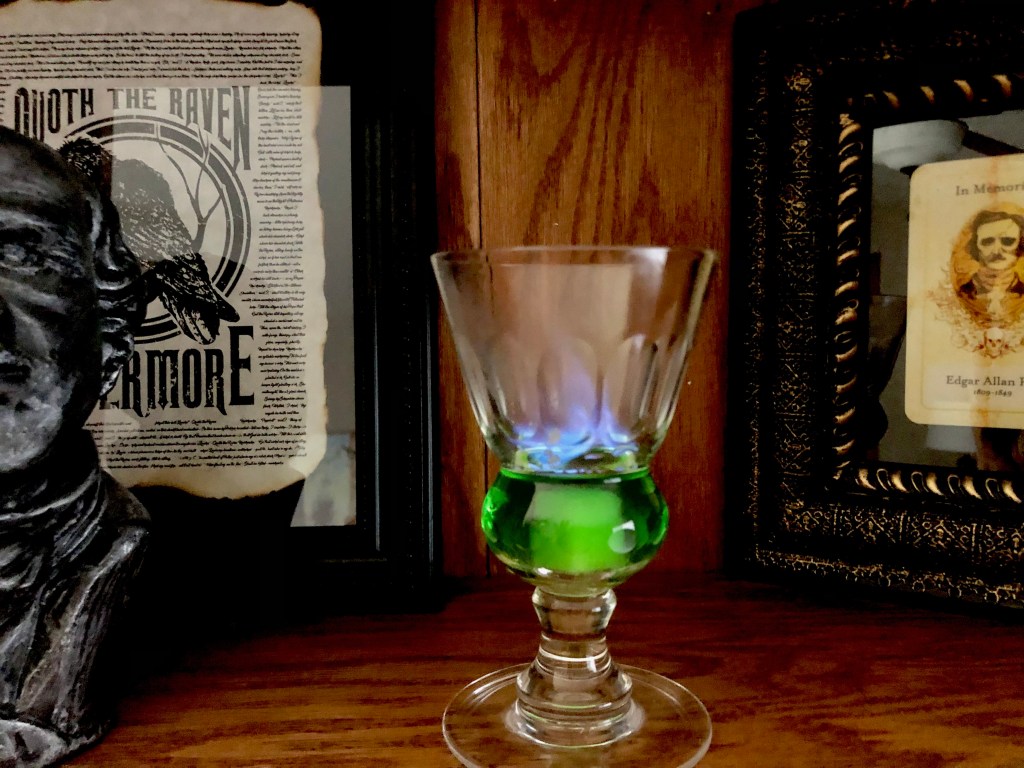
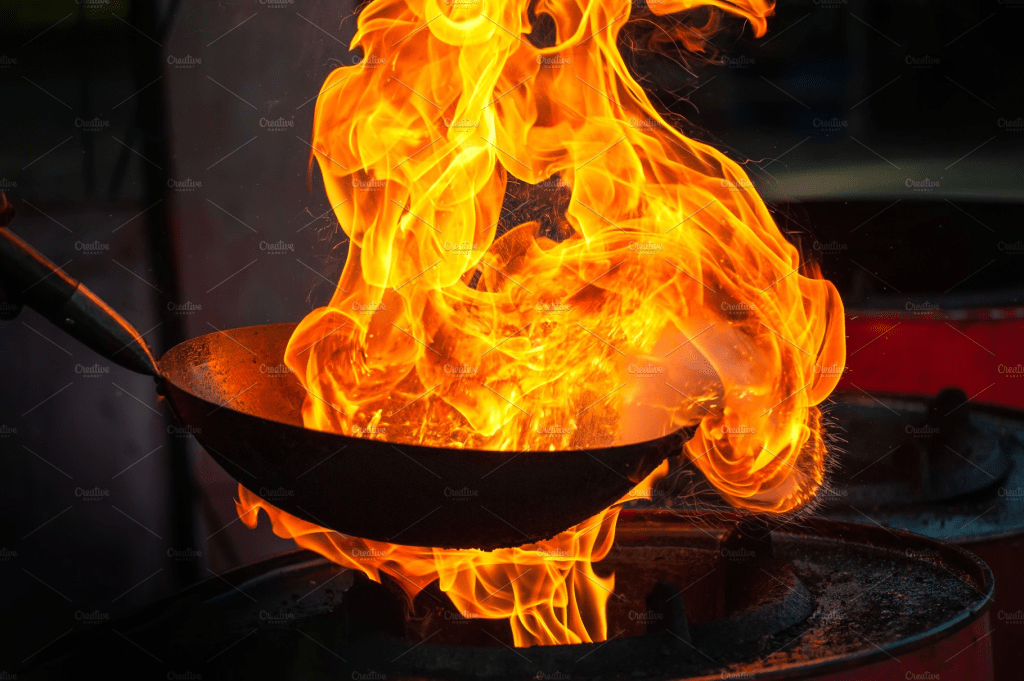
Now, dump the flaming sugar cube into the absinthe, setting it ablaze.
Trouble and toil indeed!
And finally douse the flames with a shot glass full of water. Everything mixes together, with some of the ingredients dissolving and some coming out of solution, resulting in a cloudy liquid called louche. Drink up and meet the Green Fairy!
I didn’t get much of a louche. I’m told that’s because I used a cheap absinthe.
The Ratings: I’m going to consider all the ritual to be part of the “appearance,” and for that I’m awarding fullpoints. The whole process is quite Steampunk, and all the flames and color changes remind one of a mad scientist’s laboratory. The final product looks suitably Gothic in its fussy stemware. 4 points.
But how did it taste? The resulting drink felt more watery than I expected it would be. I used 1 oz of absinthe and 3 parts of water, while Wikipedia says one typically uses between 5 and 7 parts water! So, I guess this preparation is supposed to be watery. The water of course dilutes the alcohol content, which would allow you to spend all day drinking the stuff in a Parisian cafe. Still, even though I thought it watery, it wasn’t unpleasantly so. The taste stands up to the water, with the botanicals fighting each other on your tongue, and there’s a sweet, medicinal bite that hangs on the finish. Clearly this is for sipping rather than quaffing. I can see how you could get used to this. The taste pairs really well with a standard Bohemian lifestyle, but for drinking under more prosaic circumstances, it’s really not appropriate “cocktail” fare. Therefore I’ll rate the taste in the middle at 2.
I’m not sure about how to rate the name. The simple name of the spirit doesn’t exactly evoke Halloween, but absinthe’s close association with insanity, hallucinations, and moral degradation surely helps nudge up the rating. And of course the nickname–Green Fairy–is a worthy Halloween name. So I’ll give it 2 points.
Grand Total: 8 points
MixologyMailbag–
Acclaimed mixologist and family friend Erin R informs me that my misadventures with Chartreuse were my own damn fault. Apparently the amount of Chartreuse I was using in those drinks was absurd. She writes: “The internet is full of bad information and I blame that [the online recipe] for Steve’s mishaps here. Chartreuse should be used sparingly, most recipes use a quarter to half ounce. There are people who take shots of it, but that’s insane and very expensive!”
Erin also offers a superior Corpse Reviver recipe, which I may try before this month is out. Plus, I’m trying to commission her to design her own Halloween drink. Stay tuned.
When we left off yesterday, I had made two Munsters-themed drinks (The Herman [or, as Grandpa calls it, The Hoiman] and The Lily). The drinks were a huge disappointment, and I traced most of the problem to a foul spirit called Chartreuse. (Foul Spirits would be an excellent name for a rock band, by the way.) Now, before I tell you what happened next, let me reiterate that Chartreuse is 110 proof (i.e., 55 percent ABV). And I ended up consuming one Herman and one Lily and then another Herman (as I tried omitting the lemon juice from the second one, hoping I could make the thing drinkable). Now for a little math: I drank 1.75 oz plus 1.5 oz plus 1.75 oz of Chartreuse, for a total of 5 oz of the foul stuff. And that equates to 5 x 55% = 2.75 ounces of pure alcohol. Now, maybe that doesn’t sound like a lot to you young ones, but at my advanced age that’s enough to do some damage. Or think of it this way: I drank the alcohol equivalent of 4.58 cans of that Budweiser swill you drink.
Then I went to bed.
I awoke around 2 pm with a pounding headache; I felt feverish; and my body felt like Indiana Jones’ after he’d been dragged behind a truck. (The wife says it would be worth it if I at least looked like Harrison Ford.)
I spent the next six hours in a feverish hell, weighing the pros and cons of ending it all right now. It might sound like I’m exaggerating, but I’m not. I don’t think it was purely the fault of the alcohol content. For it seems to me that one or more of the 130 herbs in that malignant, green swill destroy a person at a cellular level. Finally, around dawn, I was able to get a little sleep, and then a shower, and my condition had improved by 75 percent. In other words, I was now only feeling ghastly. Halloween theme indeed.
Now, as luck would have it, loyal reader Chris had sent me some recipes for various types of a drink called a “Corpse Reviver.” This sounded perfect. It had a suitably Halloween vibe, and also because my corpse needed reanimating. The Corpse Reviver is billed as a kind of hangover cure. What have I got to lose?
The Recipe: There are many different versions of this drink. Here’s the one I tried: Add 25 ml each (I just round it to an ounce) of London Dry Gin, sweet vermouth, triple sec, and lemon juice to a shaker. Add 1tsp abscinthe and 1-2 tsp simple syrup. Add ice and shake and pour.
The Ratings: Careful readers will note that I’m trying to counteract last night’s kitchen-sink drink that included a fussy green liqueur by drinking a different kitchen-sink drink that included a fussy green liqueur. (Today’s green spirit is absinthe. If you hate Jagermeister, you’ll detest absinthe.) Now, the Corpse Reviver only uses one teaspoon of the stuff, but somehow it dominates the drink. All you can really taste is the absinthe and the lemon juice. Which are two flavors that don’t belong on the same counter, let alone in the same drink. One sip was enough. I’m going to cure my hangover the old fashioned way: by eating a pint of ice cream in front of the TV in my underwear. No points for taste.
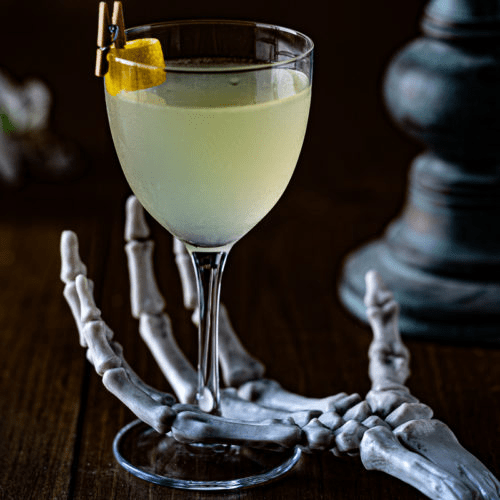
The appearance is unappealing. It resembles a cross between dishwater and a urine sample. But maybe that’s just because I’m still feeling a little green around the gills. No points.
Photo stolen from the Internet. Somehow, in my delirious state, I failed to take a picture of my version.
The name is worthy. I’ll give it two points.
Grand Total: 2 points.
Dark N’ Stormy Update:
In my spare time I’ve been experimenting with variations on the Dark N’ Stormy. I tried adding a spoonful of molasses in order to make it darker and give it a thicker profile. But the molasses congealed as soon as it encountered the cold drink. I tried shaking it up, which resulted in little shards of molasses drops swimming around the drink like dead, brown guppies. But even overlooking the appearance, the flavor was horrible. Surprisingly, molasses isn’t sweet enough for this drink. It lends a distinct tang and an odd taste of corn. Back to the drawing board…



 Chasing Phantoms