Halloween Cocktails

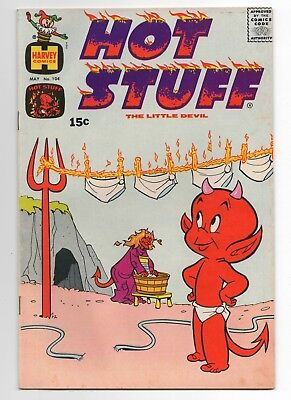
Hot Stuff

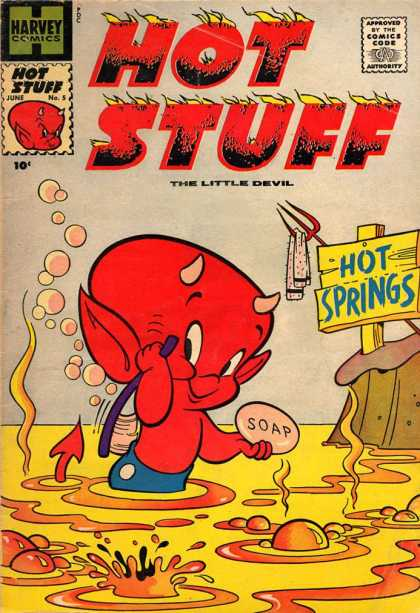
When I was a lad, my brother and I had “comic books,” which I put in quotes because they were always the most off-brand, never-heard-of, outdated, cheap comics that cost less than a quarter an issue. While other kids were reading DC and Marvel comics, or maybe Archie or MAD, my brother and I were stuck with “Little Lulu,” “Dot,” and “Hot Stuff.” This last one was about some benign, cute devil (literally) who was always getting in trouble. And the cover each month had some lame gag about how he used his pitchfork or tail for some mundane, workaday task.
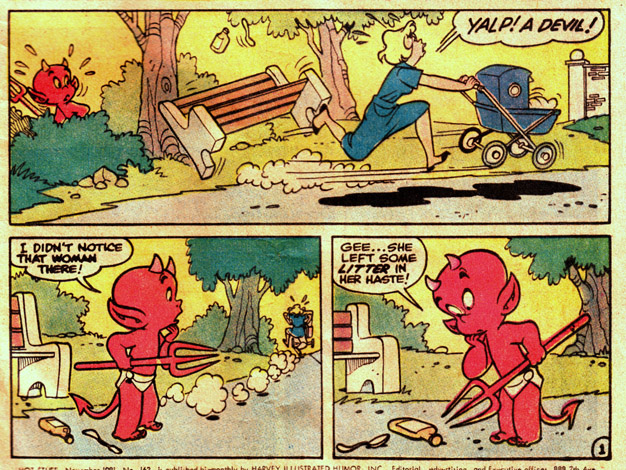
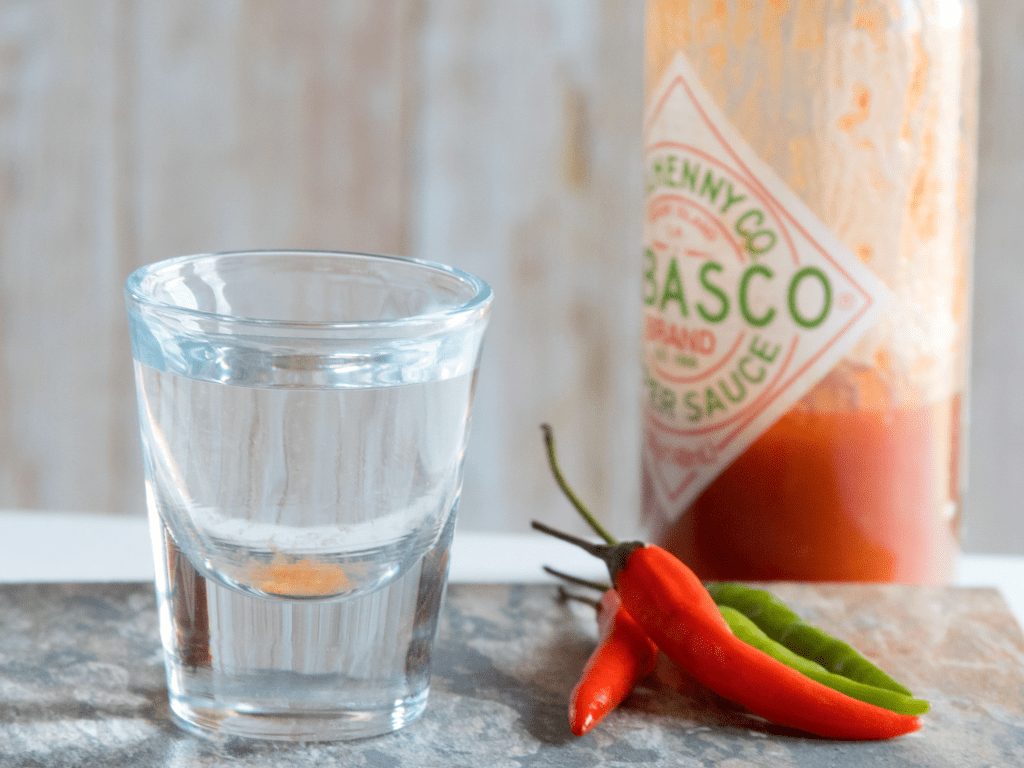
Anyway, I’m thinking about Hot Stuff because today’s drink is something called a Hell Fire. The name reminds me of something called a “Prairie Fire” that I had a few times on dares in college. It involves a healthy shot of 151 and a Tabasco floater.
But the Hell Fire is a little different. Once again, there are a number of drinks on the web that carry this name. but the one I’m making is from a recent issue of Town&Country, and involves (1) homemade grilled peach sherbet [please don’t mispronounce or misspell that word] and (2) real fire. What could go wrong?

The Recipe: Combine 2 oz bourbon, 3/4 oz lemon juice, and 3/4 oz grilled peach sherbet in a shaker. (The sherbet is made by grilling peaches, tossing them in a blender with an equal amount of sugar, and then freezing the concoction.) Strain into a glass, and garnish with fresh mint and ground cinnamon. Light the cinnamon on fire.

I should acknowledge that I had trouble getting the cinnamon to ignite. So, I added a little 151 (from my Prairie Fire days!) to the top, lit that on fire, and sprinkled on cinnamon. It provided a nice, sparkly effect. If anyone has a better suggestion for igniting cinnamon, I’m all ears.
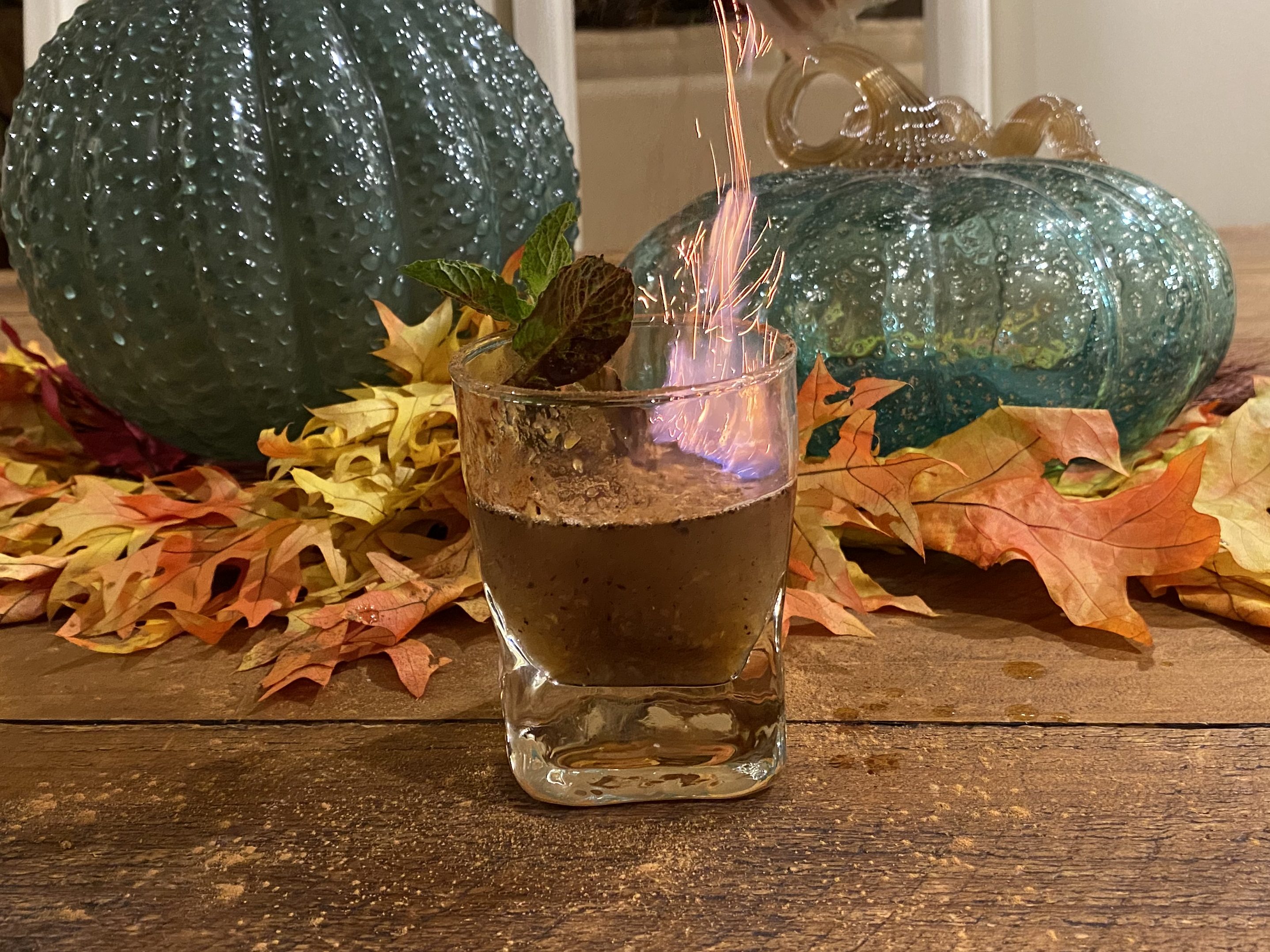
The Ratings: Well, you really can’t beat the appearance. The drink itself is kind of rustic, with a viscous consistency, a seasonable pumpkin hue, and little black bits (seeds? Pieces of char?) swimming around. But the sparkling flames seem the ideal adornment for a Halloween drink. This deserves the full 4 points for appearance…but I’m only giving it 3.5 points, because the cinnamon wouldn’t light without the assistance of 151.

The taste is de-lic-ious! Admittedly, part of the reason is because I added 1/3 cup of sugar to the sherbet. But I only used a small amount of the total sherbet, so one drink probably only has a tablespoon or two of sugar. The grilled peaches are absolutely delectable–rich and flavorful and fruity. The bourbon lends the usual gravitas, with oak and spice and brown sugar. The lemon slightly attenuates all that sweetness. And as I mentioned earlier, the mouthfeel is full and rich, like a Jamba Juice. Four points for taste.

Hell Fire is a controversial choice for a name. It might be a little ungodly for some. But it definitely connects with the fire element that distinguishes the cocktail’s appearance. And Hell conjures up (hopefully not literally) devils, demons, death, and various other Halloween-esque elements. I feel obligated to give the name the full 2 points.

Grand Total: 9.5. I recommend you make yourself one of these drinks!Just consider using 151 instead of Maker’s bourbon.
Halloween Cocktails

Back in Black

By pure coincidence, immediately after I received Erin R’s recipe for a black “Headless Horseman,” my friend Chris F. sent me a recipe for a “Black Magic Margarita.” Who knew that there’d be multiple recipes for black cocktails?

Very clever name for a potting soil.

Whenever I hear the phrase “Black Magic, I think of my dad. Let me explain: Dad was skeptical about almost everything, and when a heating/air conditioning guy came out to fix Dad’s furnace, Dad pronounced that the work he did was “black magic.” It’s the only way Dad could reconcile the fact that a twenty-something guy with a community college degree could successfully fix something that had stumped him.

Anyway, a “Black Magic Margarita” is clearly more Halloween-appropriate than a generic margarita. So let’s make one!

The Recipe: Before I provide the recipe, let me acknowledge that I’ve cut all the ingredients in half. The original recipe was created by a bourbon distiller, and they call for a full 4 oz (!) of their bourbon for this cocktail. I think half that would be more than enough. So, all the ingredients listed here are cut in half.

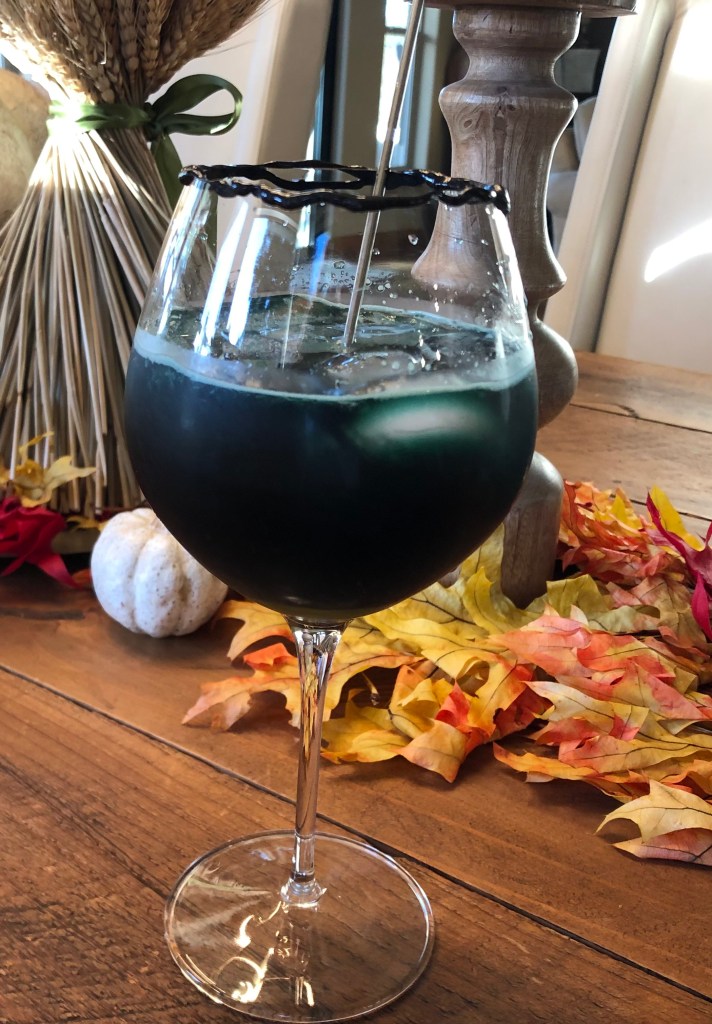
So here’s my altered recipe: combine 2 oz bourbon, 1 oz orange juice, 1/2 oz Triple Sec, 1 oz lime juice, and 1 oz agave nectar in a shaker with ice. Shake, and pour into a glass with ice that’s had the rim prepared with black sugar icing. Add 1.5 oz sparkling water, and green, red, and blue food coloring. Stir.

The Ratings: The appearance of this drink is suitable for something called a “Black Magic Margarita.” But I must acknowledge that the color, while very dark, has a distinct green cast. The idea (according to the recipe) is that combining red, blue, and green food coloring should produce black. But that’s not the case, even after I repeatedly added a drop of this and a drop of that. If you want a black cocktail, I recommend adding activated charcoal (as we did for the Headless Horseman yesterday).

So, the appearance gets a 2.5 (brought down a bit because of the green cast).

Remember?

But let’s talk about taste: Yum! This is a very tasty cocktail indeed. It’s not your typical margarita. For starters, it uses bourbon rather than tequila. And while I do appreciate tequila (and even more than that, Mescal), bourbon provides a bolder taste with notes of brown sugar, maple syrup, vanilla, and various spices. This particular cocktail balances the bourbon and the sweet agave nectar quite well. The orange juice and lime juice lend a solid citrus backbone, and the sugar on the rim ensures a sweet finish. It’s a complex cocktail that goes down easy. I have to give this 4 points. Seriously. This is an enjoyable drink. Now I’m thinking that maybe I shouldn’t have cut all the ingredients in half!

The name of this cocktail is moderately cool. “Black magic” is a Halloween theme of course, but “Black Magic Margarita” not an especially imaginative name for a black margarita. I’ll give the name 1.5 points…and that’s my final offer.

Grand Total: 8 points.

Halloween Cocktails

Back to Basics

Tonight we return to some October basics: apple cider, maple syrup, pumpkin pie spices, and some good bourbon. This will not be a gimmicky drink–No lychees here! But the list of ingredients is promising. Let’s make…

Nightmare on Bourbon Street

(Random graphic stolen from the Web. It’s not connected to the drink in any way.)

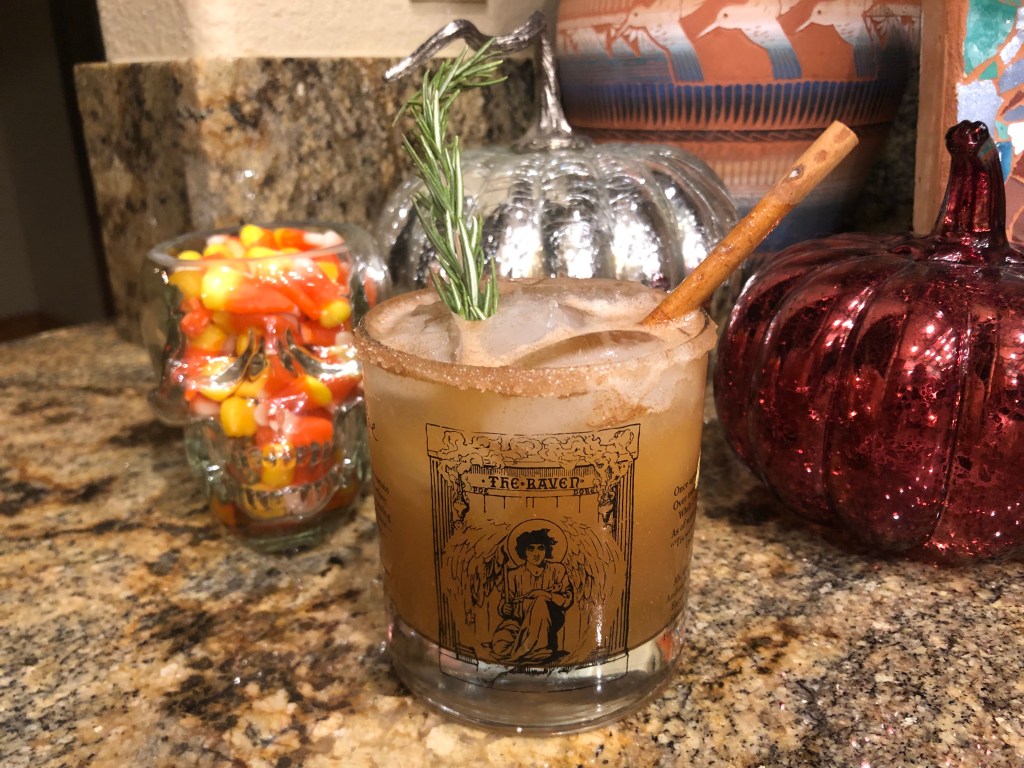
The Recipe: OK, this sounds awesome: Start by preparing a cocktail glass by rimming it with cinnamon sugar, and filling it with ice. For the occasion, I used my “Edgar Allan Poe’s The Raven” glass, provided to me by longtime friend Chris F.

Now, in a cocktail shaker, combine 1.5 oz bourbon (use the good stuff!), 1 oz fresh lemon juice, 1/4 cup apple cider, 2 tsp maple syrup (I get mine from Cousin Bonnie in Vermont), 1/4 tsp ground ginger, and 1/8 tsp ground cinnamon. Shake the hell out of it, and strain into the prepared glass. Now top the glass with Martinelli’s sparkling apple cider. (Note: The recipe actually asks that you top the drink with hard cider, but I figured Martinelli’s would be preferable. And I was right. As I always am. Well, sometimes.) Finally, add rosemary and a cinnamon stick as garnish.

The Ratings:

The appearance of this drink is welcoming and rich. To be fair, it’s not really Halloween-y, in that there’s no floating eyeballs or odd colors or fake blood. But it comes across as an honest, solid drink that’s somewhere between pumpkin and cinnamon in color. The rosemary evokes a tree in the spooky woods, and the cinnamon stick is a standard symbol of fall cookery. The sugar-cinnamon rim of the drink is just pure indulgence. I’ll give it 3 points for appearance. (It would have been 4 if I could have somehow called it a Halloween drink.)

Spooky woods

But let’s shift to the taste: O. M. G. This is the ideal drink for a fall evening. The apple cider (NOT apple juice, you Philistine) is rich and complex and earthy. It perfectly complements (NOT compliments, you Philistine) the caramel and vanilla of the bourbon. The lemon juice emphasizes the tartness of the cider, but the maple syrup emphasizes the sweetness of the cider. The ginger and cinnamon are suggestive of an apple pie, while the Martinelli’s tips the balance toward apple sweetness, and also lends an effervescence. And as if all that’s not enough, the rosemary garnish adds depth of flavor and brings out the earthy notes, while the cinnamon stick is suggestive of a hot apple cider (even though this drink is iced). How could I not give this four points for taste?

The name “Nightmare on Bourbon Street” simultaneously evokes the Freddy Krueger franchise and the iconic street in New Orleans. It’s scary and fun and historic. It gets the full 2 points.

Leatherman, eat your heart out!

Grand Total: 9 points.

Make one tonight, and thank me later.

Road trips

Subourbon Lifestyle

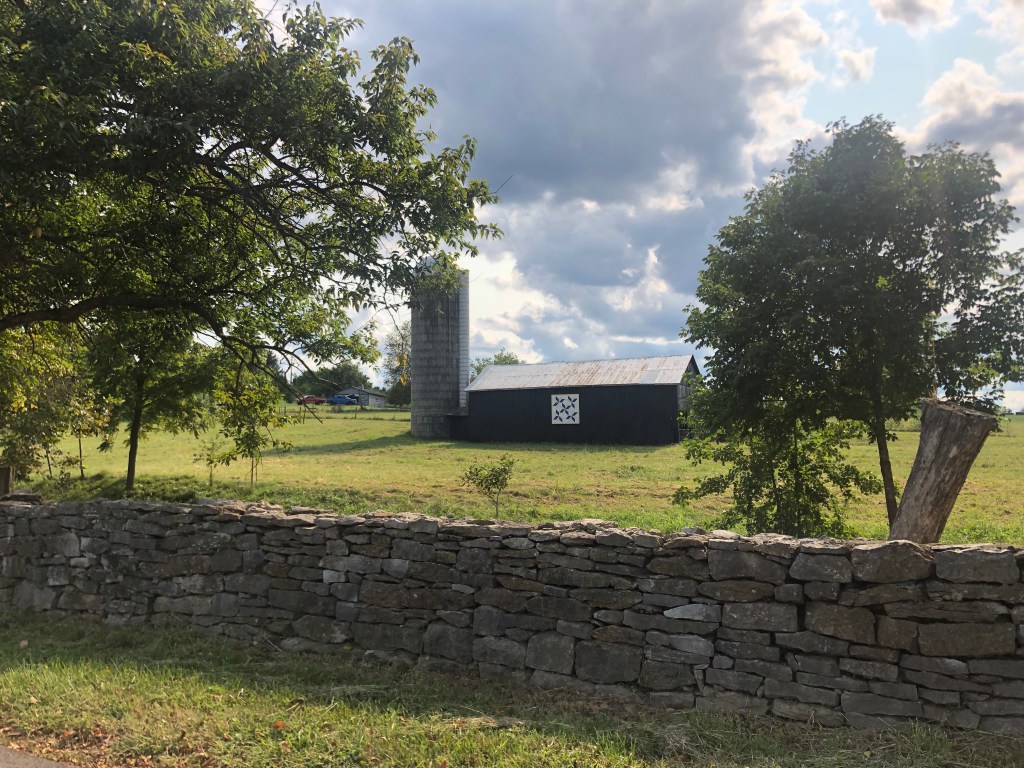
[Delayed posting from Friday] Today we took a break from our tear-y travels and spent a day in Kentucky’s bourbon country. As many of you know, Kentucky is a beautiful state, with rolling green hills, expansive maple and poplar forests, picturesque horse and tobacco farms, and some of the nicest damn people you’d ever want to meet.

Idyllic countryside of the Bluegrass State

Most of Kentucky’s distilleries are clustered between Louisville and Lexington. Each has its own story to tell, but pretty much all of them try to convince you that their particular bourbon is the best.

The Kentucky Bourbon Trail: Why You Need to Visit Before You Die

Of course, all bourbons are remarkably similar in that they all must follow the same stringent guidelines to be marketed as bourbon. Let’s review those requirements:

  1. The majority (i.e., 51%) of grains used must be corn.
  2. It must be produced in the United States. (Note that it does not have to be produced in Kentucky, although about 95 percent of all bourbon happens to be made in Kentucky.)
  3. It must be distilled at 160 proof (i.e., 80% alcohol by volume) or less. This will not be the final ABV, of course. Water will be added later to cut the ABV.
  4. It must be stored in new (i.e., not previously used) barrels that have been charred inside. (You’ll recall that Scotch Whisky is stored in used bourbon barrels.)
  5. It must enter the barrels at no more than 125 proof.
  6. There is no absolute requirement as to how long it ages, but to be called “straight bourbon” it must be aged at least two years.
  7. It must not have any additives or coloring agents.
  8. Once it is bottled, it must be at least 80 proof.

So, working within those constraints, distilleries essentially just take a bunch of corn (and a smaller amount of other grains), cook it in water, ferment the resulting soup with yeast, distill the alcohol from it, and put the resulting alcohol distillate in barrels. If you want it to taste any good, you’ll let it age in those barrels for some years.

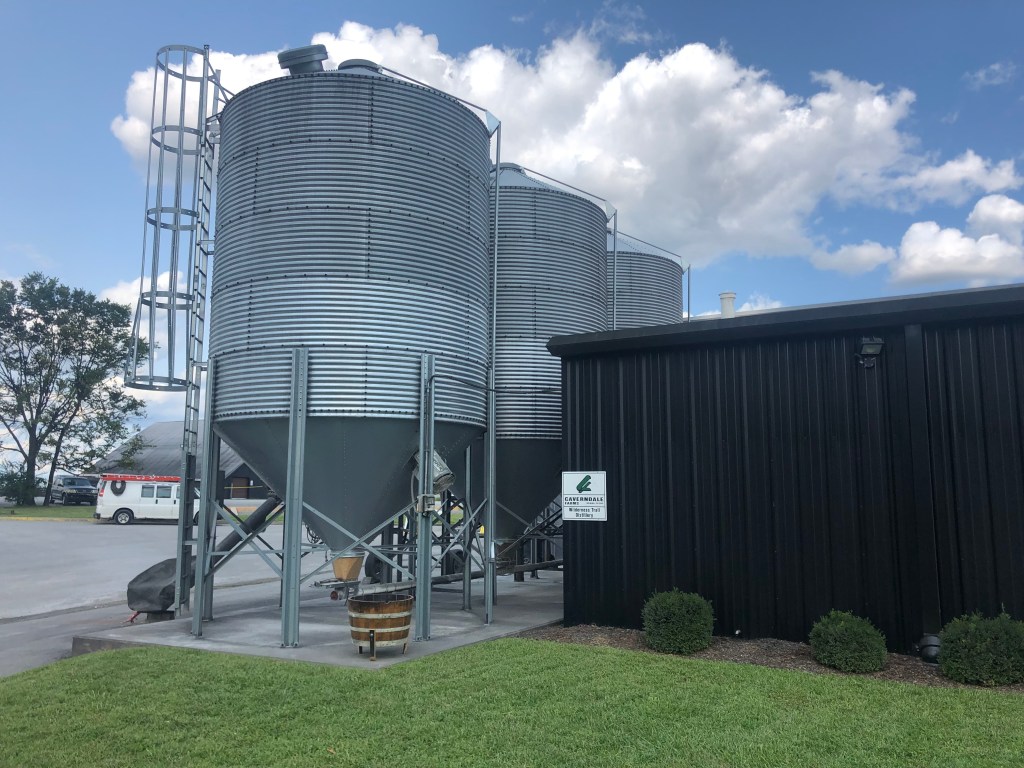
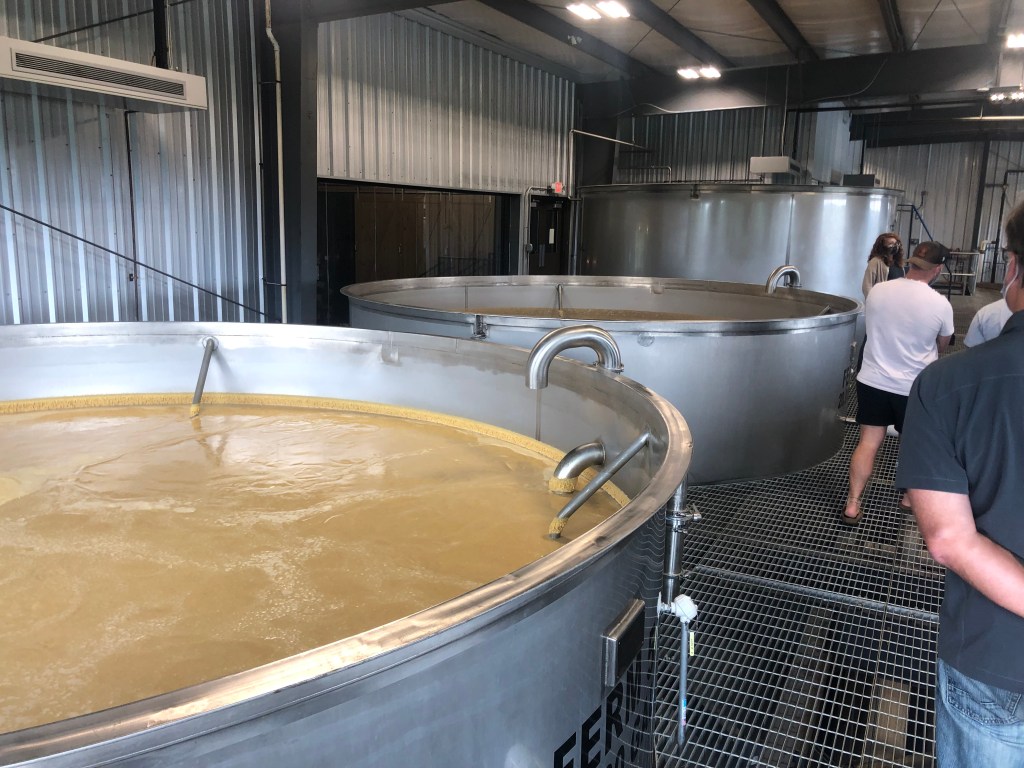
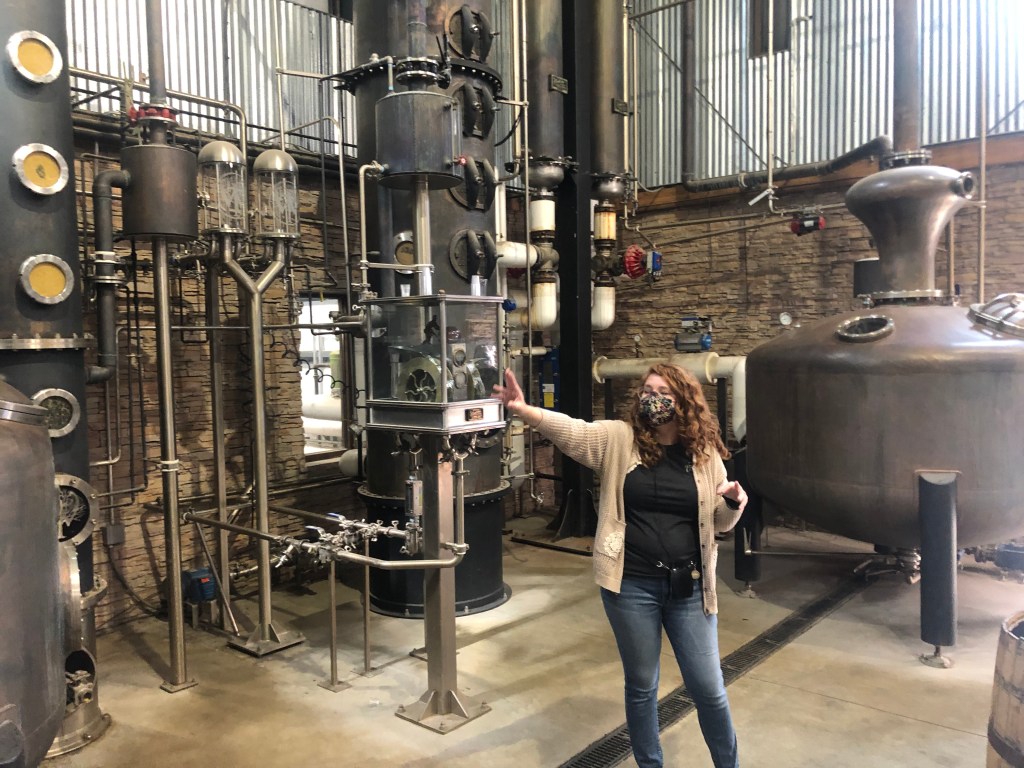
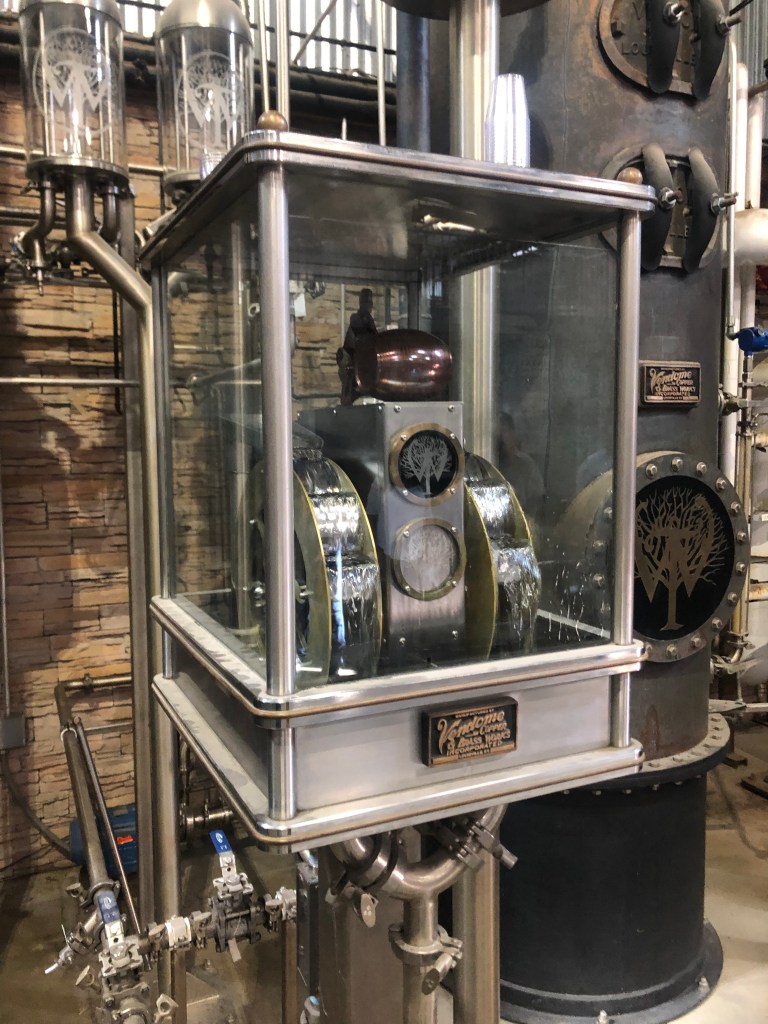
Scott and I went to two distilleries today: Four Roses in Lawrenceburg, and Wilderness Trail in Danville. They represent a rather old and a very new distillery, respectively. Here are a few photos from Wilderness Trail.

A place to store the grains.
Fermenting the mash.
Distilling the wort. Doesn’t this look like Frankenstein’s laboratory?

Halloween Science: Dr. Frankenstein and his monster-Death Wish Coffee  Company
Distillate (the results of the distillation process) flowing like a spring.
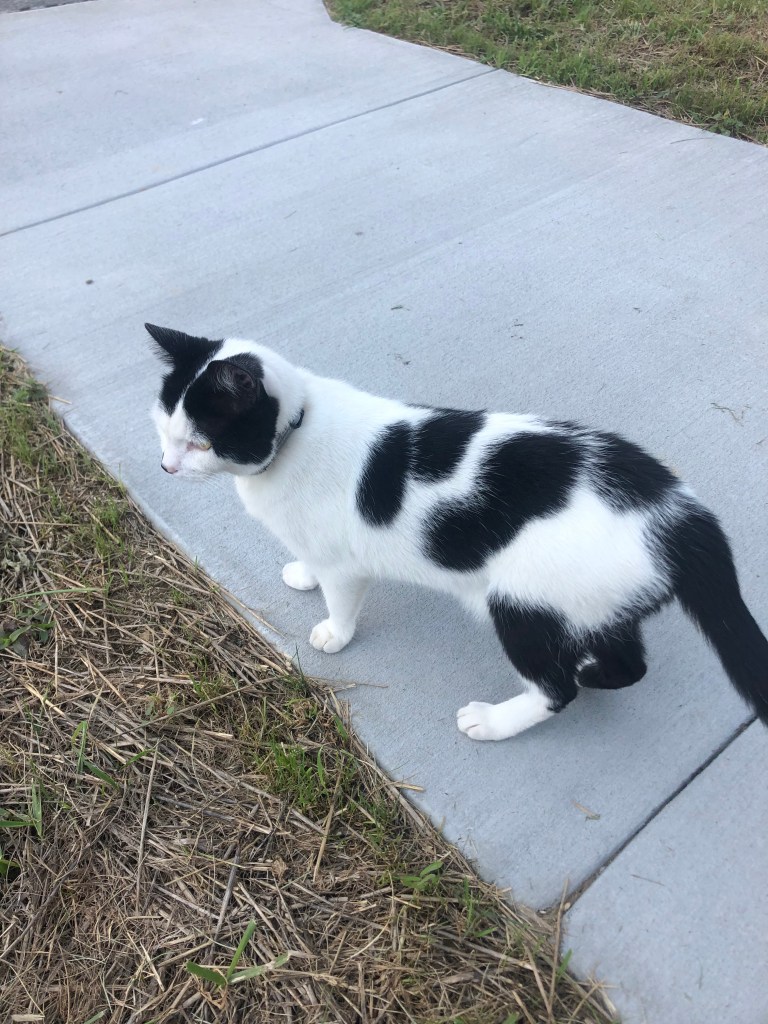
Cooper, the distillery’s cat, leading our tour group.

After visiting the distilleries, we got dinner in downtown Louisville, where we plan to do some exploring tomorrow, before returning to the Trail of Tears on Sunday. Which leads us to the…

BREW OF THE DAY

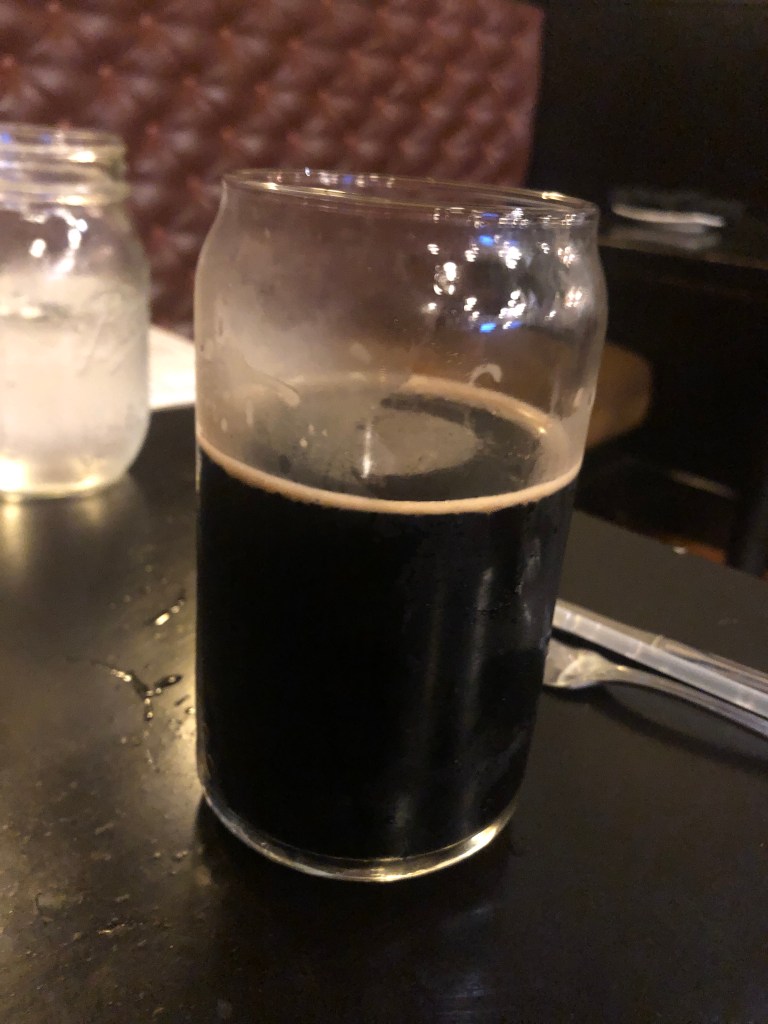
We went to the improbably-named Mussel and Burger Bar on 7th Street. Feeling a need to stick with the day’s vibe, I ordered a Goodwood Bourbon Barrel Stout. Goodwood Brewing Company is based right here in Louisville.

As the name suggests, this is an imperial stout that’s been aged in bourbon barrels. The barrels impart a rich and smoky flavor that nicely complements a stout. It probably deepens the color as well.

I’m trying to imagine how this particular stout tasted before it was barrel aged. I suspect it’s one of the less complex stouts, with a pretty straightforward malty character. They probably chose a simple recipe in order to allow the barrel’s flavors to shine through. This is an imperial stout, meaning that it has a somewhat higher ABV (8%, which is actually on the low side for an imperial), and a somewhat stronger finish. You definitely get some hints of bourbon on the nose and the finish, but they’re not overwhelming. I’m not a guy who likes subtlety, though, and I would have preferred a bolder bourbon taste in this beer. Of course, maybe my taste buds were inured to bourbon after a day at the distilleries….

I’d give this beer a 3.5 out of 5 stars, but if I had an option, I would have chosen a competitor brand, Kentucky Bourbon Barrel Stout, where the stout is made with coffee, and then aged in bourbon barrels. This is not a drink for the timid.

Tomorrow (Saturday) we’ll spend the day checking out Louisville, then it’s back to the TOT on Sunday morning.