
cemeteries · churches · Halloween Cocktails · trains

Poe-tober 2022

Chartreuse? Nevermore!

We interrupt this month of Halloween cocktails to bring you breaking news that I’m in Virginia for an Edgar Allan Poe pilgrimage. I will give you the gory details in a moment, but first let me share some other breaking news:

The Twentieth Anniversary Edition of the Dome of Foam is live!

Uncle Edward’s Fever Dream

I am aware that a number of my readers respond positively to any railroad-themed content from my road trips, so they will be especially heartened by this news. The Dome o’ Foam, for those of you not already familiar, is a quirky, hard-to-define, and entirely mesmerizing collection of railroad history and miscellanea, focusing in particular on the Southern Pacific Railroad. The Dome is the brainchild of my Uncle Edward — E.O. Gibson, to you. Alert readers will recall that Uncle Ed has periodically made appearances in this blog. The new, 20th anniversary edition of his site contains a dizzying array of new content, updates on old content, photographs, personal stories, and cartoons. You owe it to yourself to check it out here.


So, on to my Poe trip. As everyone should have learned as a school child, Edgar Allan Poe lived in various cities of the East during the 19th century, focused largely on Richmond, VA (where he grew up) and Baltimore, MD (where he died under mysterious circumstances). Three years ago (before Covid shut down public gatherings) my friend Chris and I attended the International Edgar Allan Poe festival, held literally in Poe’s old neighborhood in Baltimore, MD. Today Chris and I bookended that trip with a visit to Poe’s old neighborhood in Richmond VA.
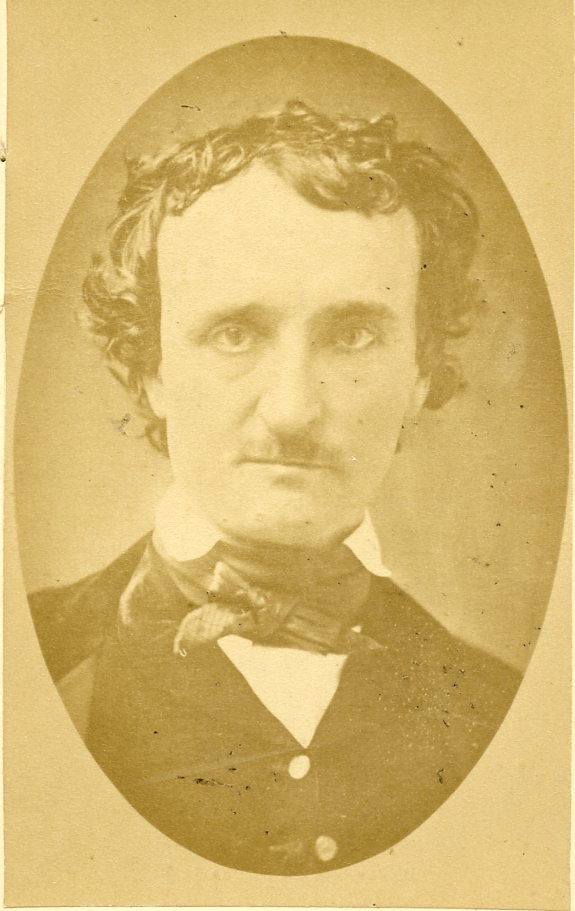
Before beauty filters.

The main Poe attraction in Richmond is the Poe Museum on E. Main Street. You may recall that I drove right by the museum on my Route 50 trip in 2018, as Route 50 becomes Richmond’s Main Street and takes you right through the neighborhood. Alas, the museum was closed when I passed it. So this time, I was finally able to darken its doorstep.
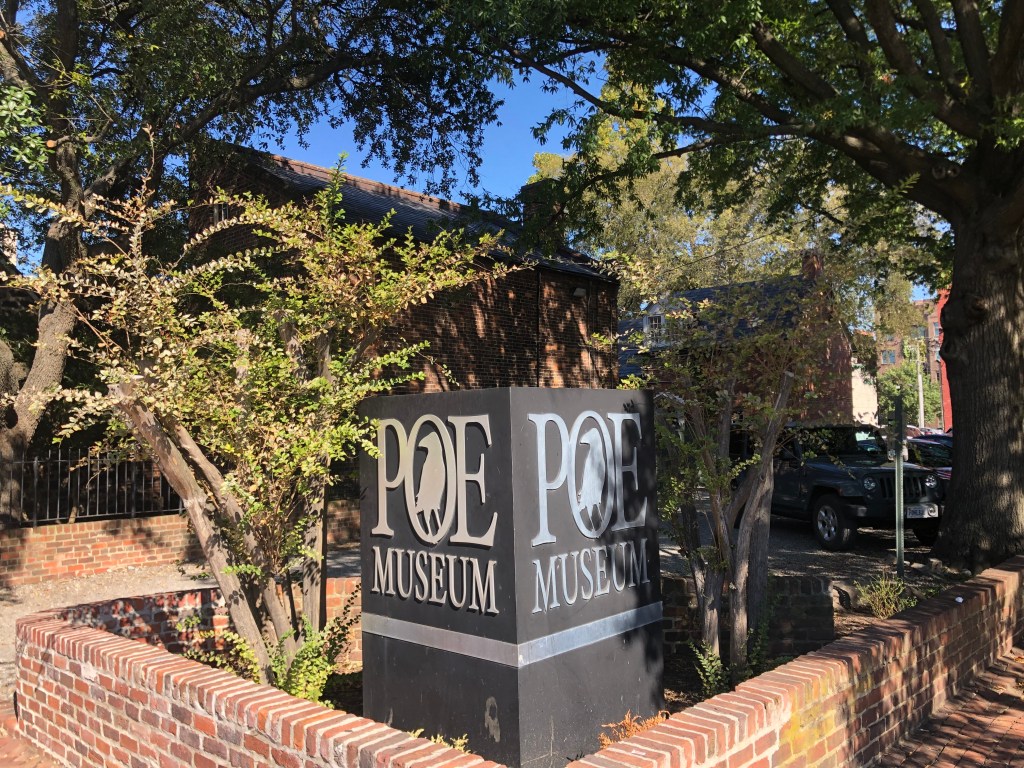
Better late than never.

It’s a remarkable museum, with the world’s largest collection of authentic Poe memorabilia: His bed, writing desk, walking cane, various letters, articles of clothing, photographs and daguereotypes, books, other personal effects, and even the staircase and fireplace mantel from prior Poe residences. It also has a meditation garden and major shrine to Poe.

Two cats–Edgar and Pluto–roam the museum grounds like the own the place…which in a way they do.
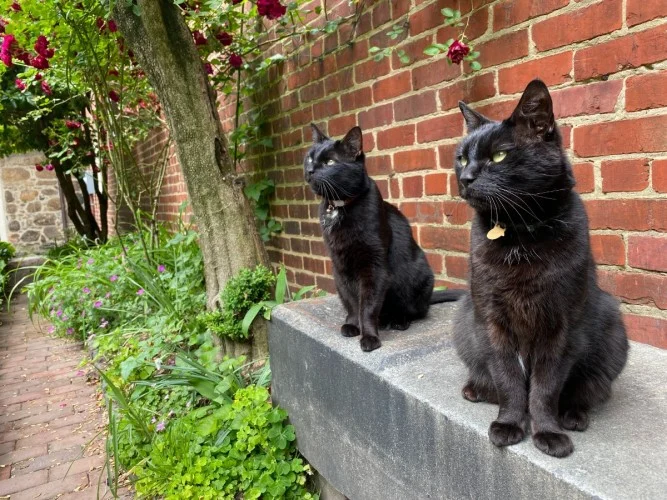
Edgar and Pluto…or is that Pluto and Edgar?

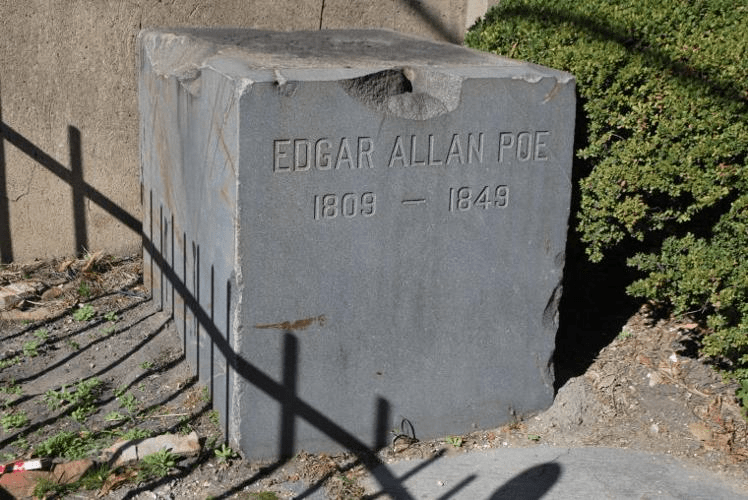
In front of the museum is a large granite block with Poe’s name and birth and death years inscribed on it. No, it’s not a giant tombstone; it’s the pedestal base for a Poe statue that was created in the mid-1950s–when Richmond finally decided to embrace Poe.
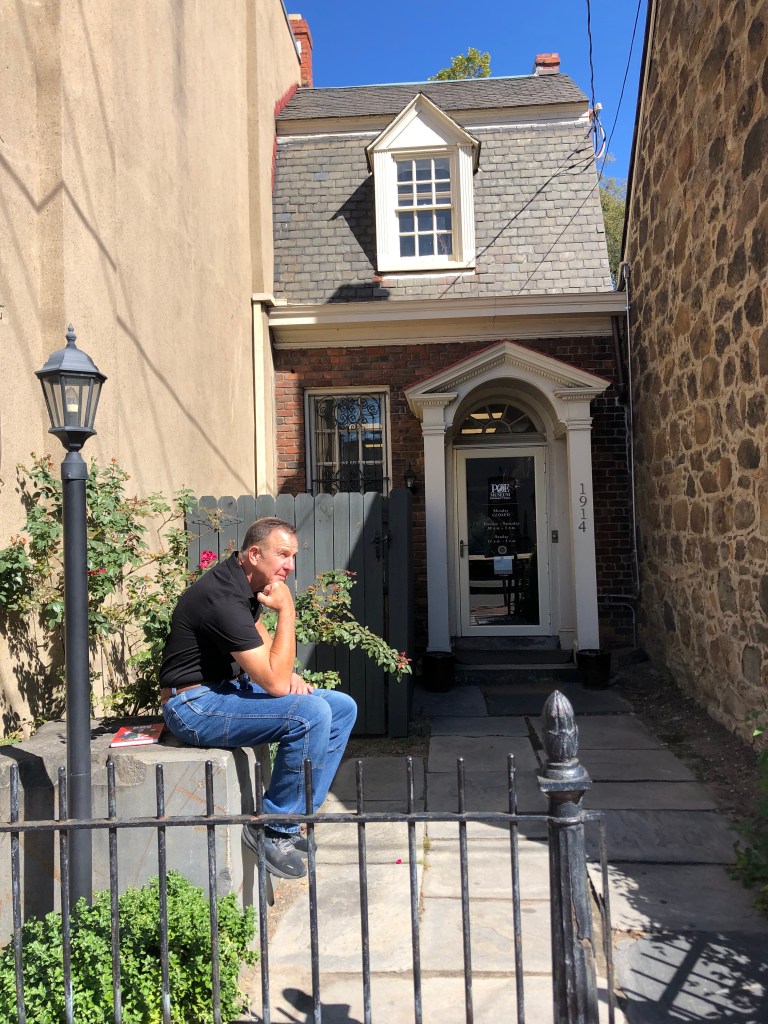
Channeling my inner Dobie Gillis

For reasons that aren’t entirely clear, the pedestal base was discovered in a local landfill by some kids many years later (in 1973, to be exact). It seems that it had been rejected by the city, and a new one had been cut. This “new” base sits, with the statue atop it, in Richmond’s capitol park.
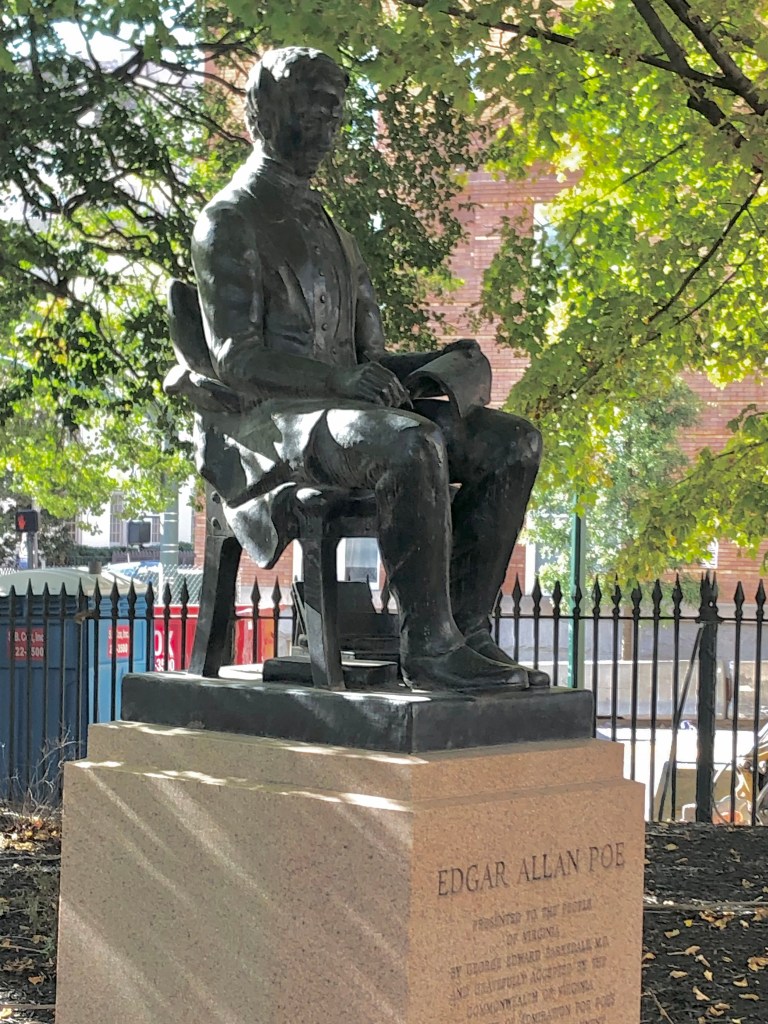
Poe statue in Capitol Park

After the museum, Chris and I visited a number of other Poe-related sites in Richmond, as depicted below.
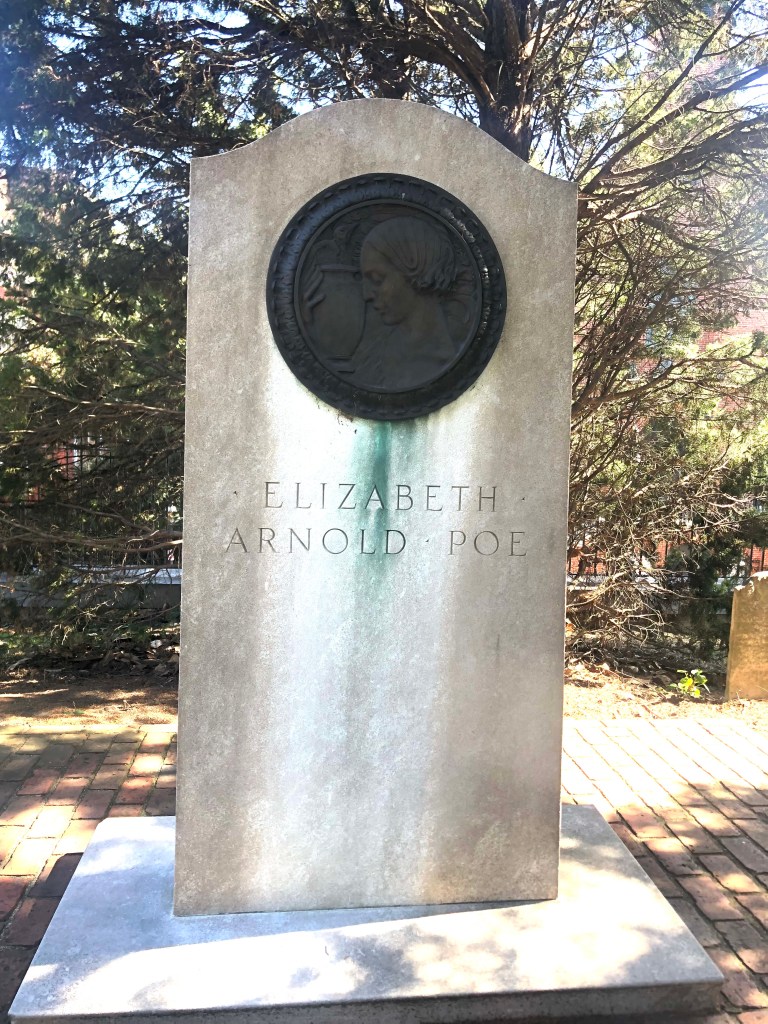
Grave marker for Poe’s mother–an English actress who died of tuberculosis in Richmond at age 24, when Poe was only 2.
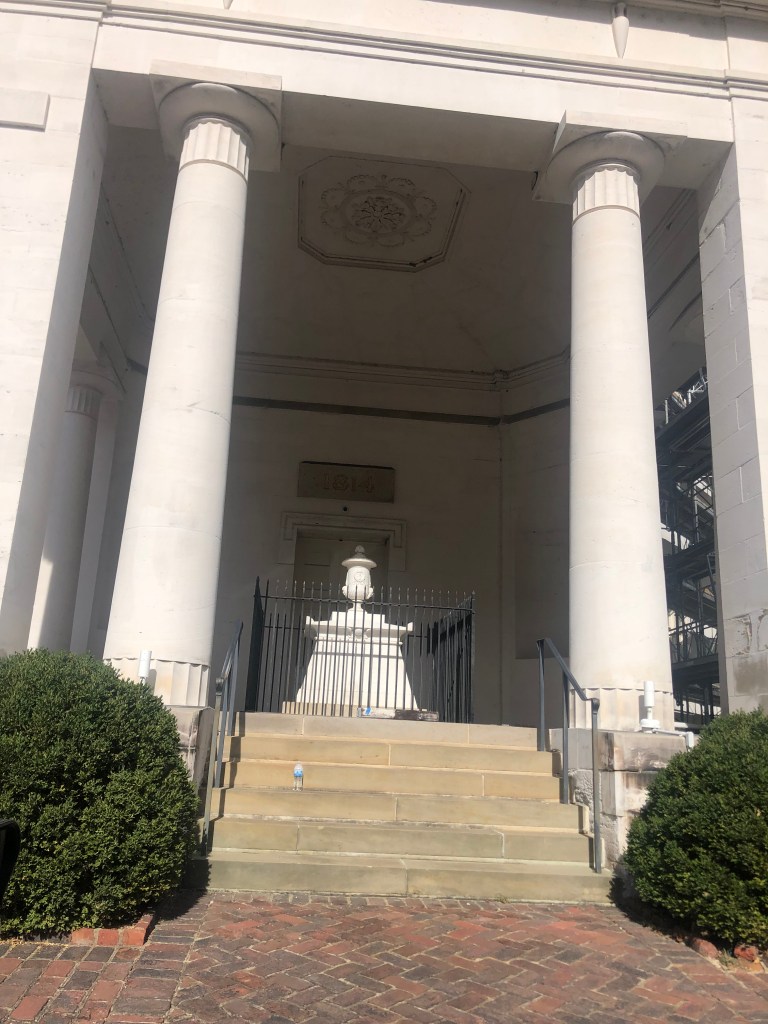
Richmond’s Monument Church, where John and Frances Allan were parishioners. The Allans took in the orphaned Edgar Poe (as his father had abandoned the family before Eliza Poe’s death). This is how Edgar Poe became Edgar Allan Poe.
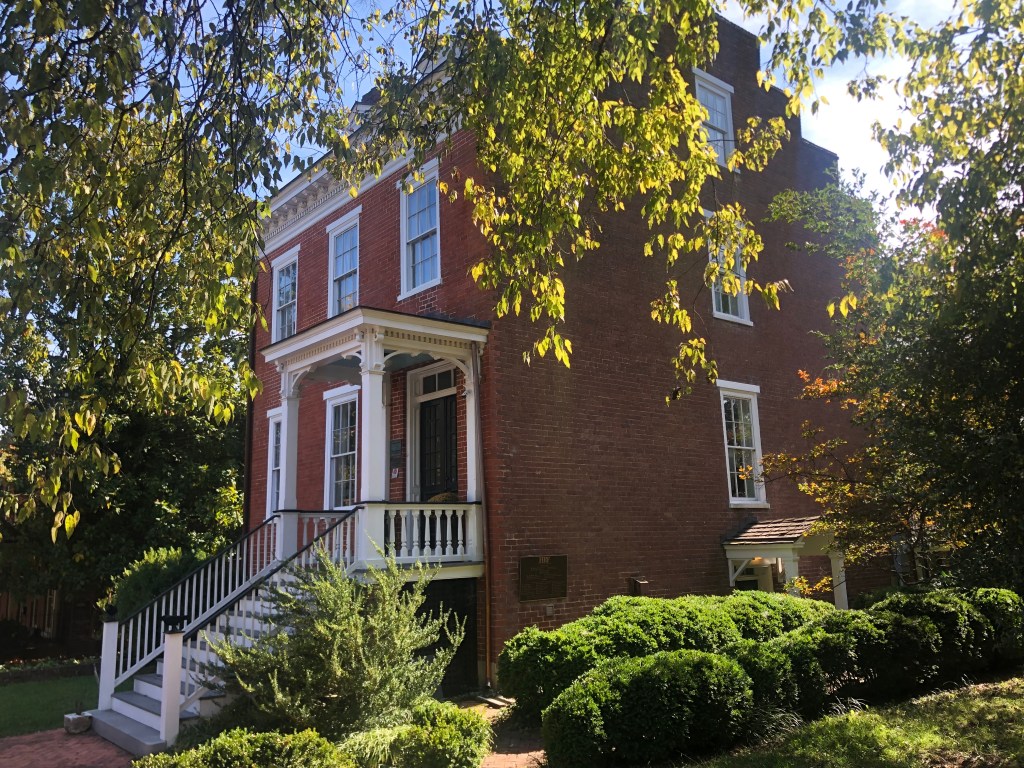
The house of Elmira Shelton. Poe became engaged to Elmira at the tender age of 16, just before leaving for UVA. Her father disapproved of the courtship, and intercepted Poe’s letters to Elmira. Thinking that Poe had forgotten about her, Elmira married another man. Later, Poe famously married his own 13-year-old cousin. But after she died of tuberculosis and Elmira’s husband also died, Poe and Elmira again became engaged. To complete the tragedy, Poe himself died at age 40 just a week and a half before he and Elmira were to be married.
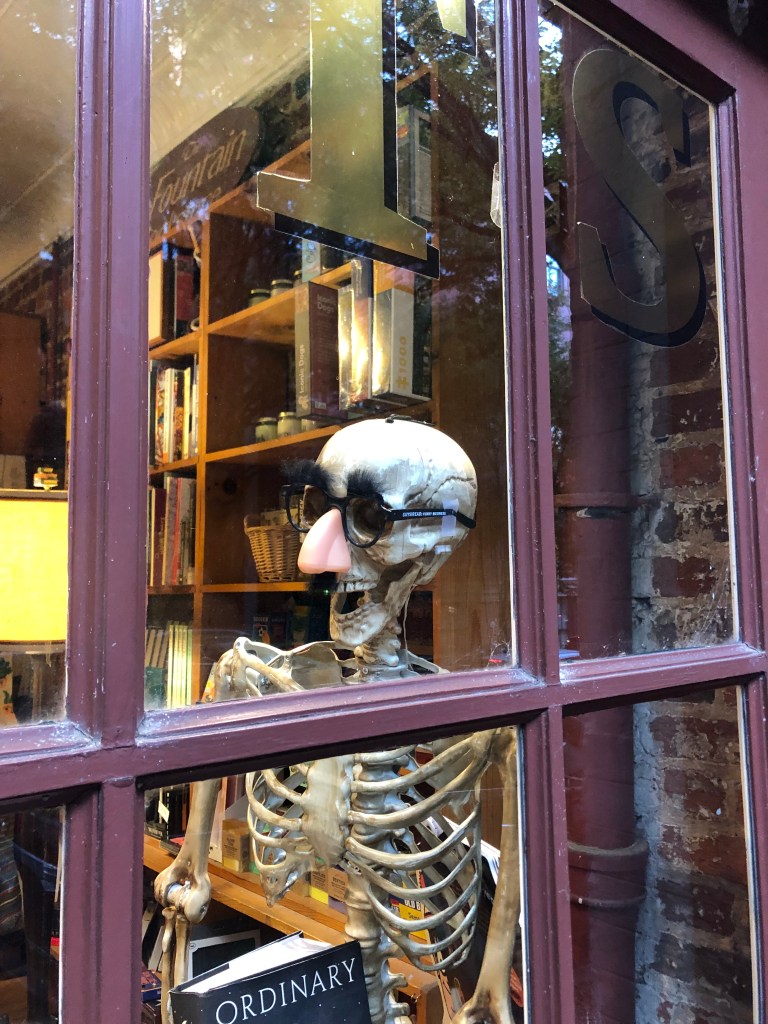
Skeleton in a local bookstore. It’s not directly Poe-related, but somehow it’s appropriate.
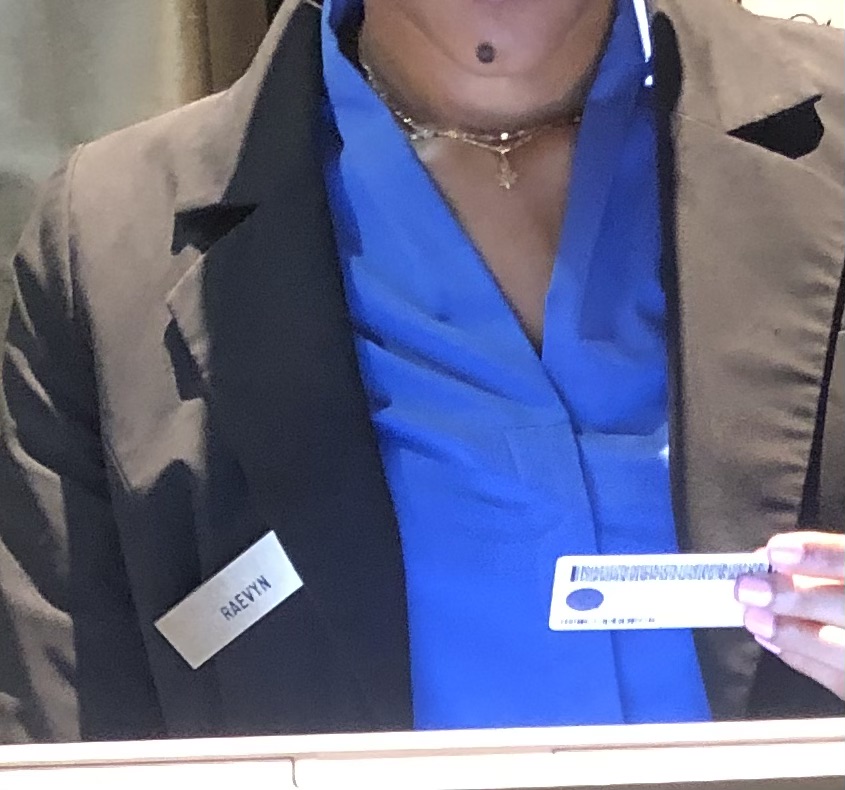
And to round out our Poe-themed day, the receptionist at our hotel is named “Raevyn” (as in, Raven).I’m not making this up.

I hope that all this explains why I wasn’t able to prepare a Halloween cocktail for the blog today. I promise to double-up my cocktail posts when I get home.

Halloween Cocktails

Absinthe makes the heart grow fonder

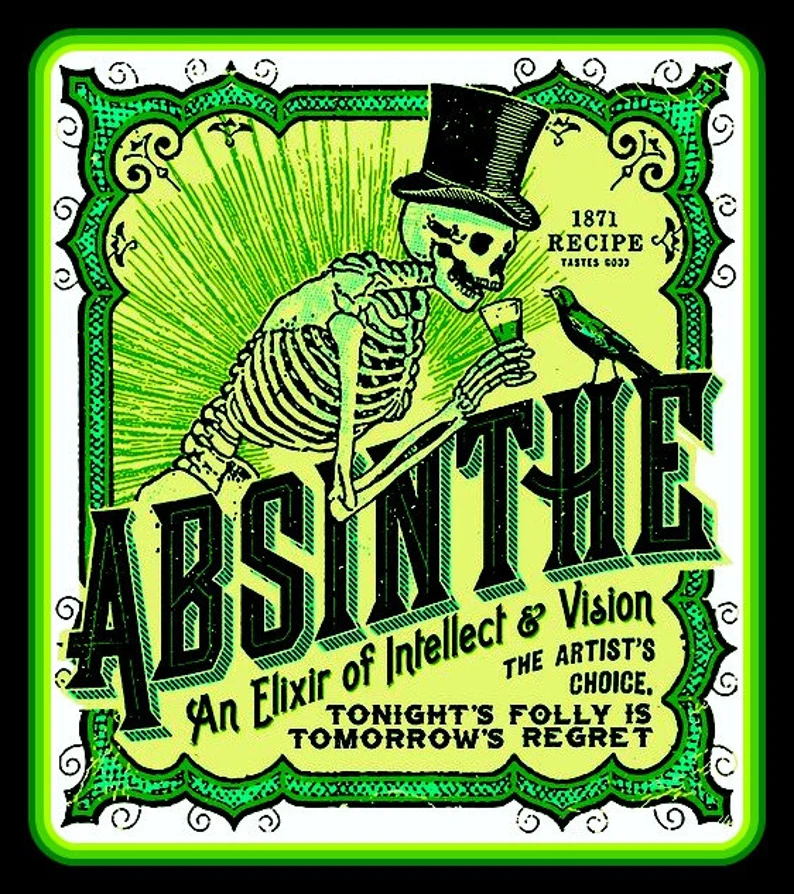
One drink that shows up on a couple of Halloween cocktail lists is absinthe–not as a mere ingredient, but rather as the whole drink. The unearthly green color is in the Frankenstein vein, but more to the point, it has a mysterious and Byzantine history that involves hallucinogenics, evil spirits, and the likes of Edgar Allan Poe. Let’s review:

Color me absinthe

Absinthe is a high-alcohol spirit made from wormwood, anise, fennel, and various other exotic and ordinary ingredients. It tastes strongly of anise, and has been compared (usually favorably) to Jagermeister. Absinthe has a distinct green color which, in the more authentic (and expensive) versions occurs naturally from the ingredients. In the 19th Century absinthe became a popular drink among the Bohemian set, who would gather in cafes and drink the stuff all evening. They called the drink “The Green Fairy” for its supposed magical effects.

Tinkerbell she’s not.

Conservatives railed against absinthe as a hallucinogenic spirit that was wreaking havoc with young people. Those claims were overblown, although absinthe does include trace amounts of thujone. As is often the case, the moral outrage from conservatives made absinthe all the more popular among the hipsters. Notable absinthe drinkers (addicts?) included Edgar Allan Poe, Oscar Wilde, and Lord Byron, which would be enough to solidify its Bohemian street cred.

Rhapsodic Bohemian (“He’s just a Poe boy from a Poe family…)

For most of the 20th century absinthe was banned in the US and most of Europe. It wasn’t until 2007 that America’s ban was lifted. Because we’re fortunate enough to be living in the post-absinthe Prohibition era, we’re able to add this drink to our October list. So what are we waiting for?

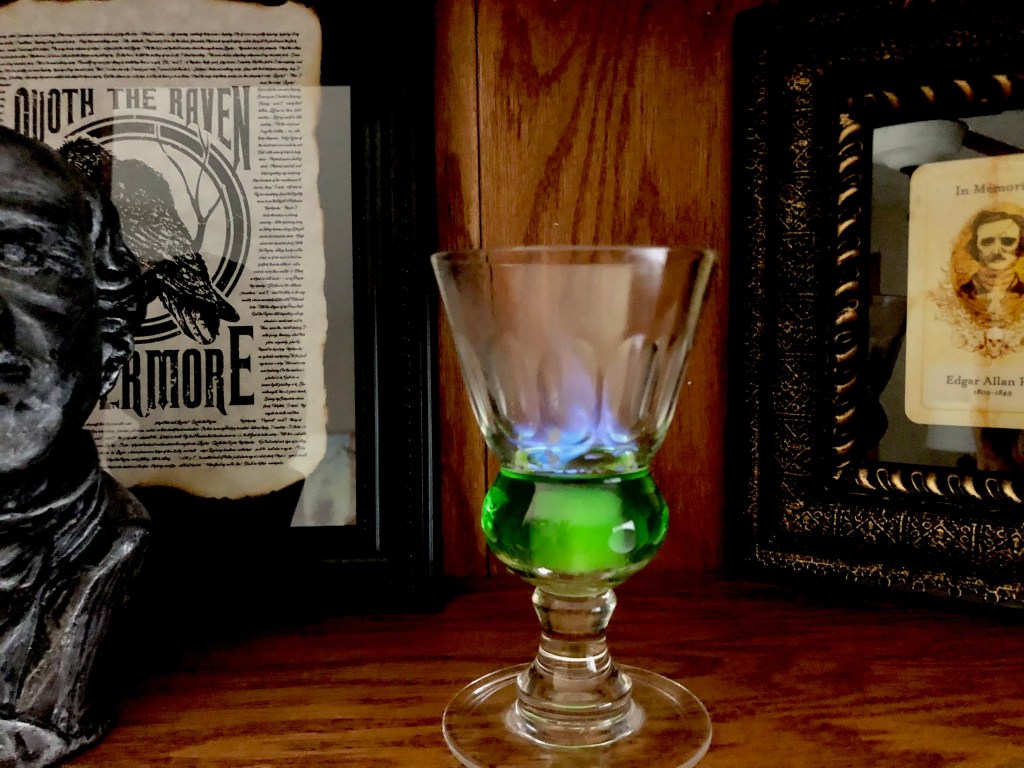
The recipe: With its high alcohol content (the stuff I used is 100 proof), absinthe is traditionally diluted with water. Also, as absinthe contains no sugar (and thus it is not classified as a liqueur), the drink is normally prepared with the addition of a sugar cube. Now, there are two ways to do this preparation: the French method and the Bohemian method. Guess which one I used?

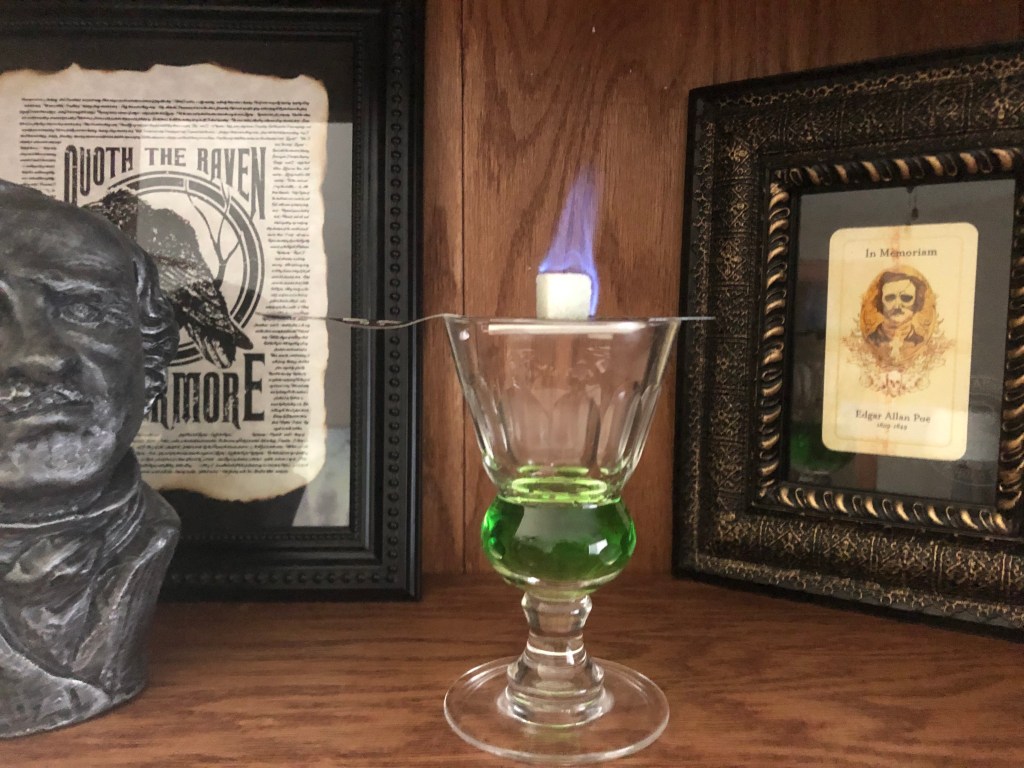
There is a distinct ritual to all this. First you need to get yourself an absinthe glass, whose shape makes it easy to measure the exact amount of absinthe to pour from the bottle. Then you need to get a slotted absinthe spoon. (All this stuff is available on Amazon.) Rest the spoon on top of the glass, and place a sugar cube on the spoon. (I had to go out to the barn and steal a sugar cube from the horses’ treat stash.) Now, pour a little more absinthe over the sugar cube to soak it with alcohol. Then light it on fire. I’m not making this up.

Horse treats burn, evidently.

Now, dump the flaming sugar cube into the absinthe, setting it ablaze.

Trouble and toil indeed!

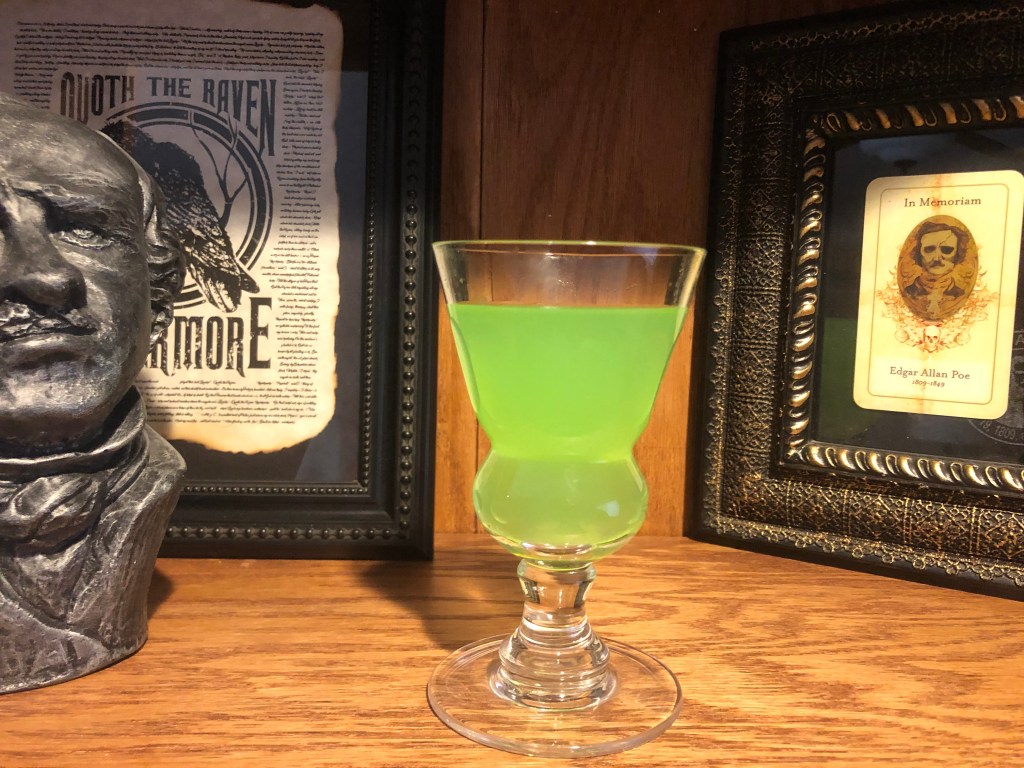
And finally douse the flames with a shot glass full of water. Everything mixes together, with some of the ingredients dissolving and some coming out of solution, resulting in a cloudy liquid called louche. Drink up and meet the Green Fairy!

I didn’t get much of a louche. I’m told that’s because I used a cheap absinthe.

The Ratings: I’m going to consider all the ritual to be part of the “appearance,” and for that I’m awarding full points. The whole process is quite Steampunk, and all the flames and color changes remind one of a mad scientist’s laboratory. The final product looks suitably Gothic in its fussy stemware. 4 points.

But how did it taste? The resulting drink felt more watery than I expected it would be. I used 1 oz of absinthe and 3 parts of water, while Wikipedia says one typically uses between 5 and 7 parts water! So, I guess this preparation is supposed to be watery. The water of course dilutes the alcohol content, which would allow you to spend all day drinking the stuff in a Parisian cafe. Still, even though I thought it watery, it wasn’t unpleasantly so. The taste stands up to the water, with the botanicals fighting each other on your tongue, and there’s a sweet, medicinal bite that hangs on the finish. Clearly this is for sipping rather than quaffing. I can see how you could get used to this. The taste pairs really well with a standard Bohemian lifestyle, but for drinking under more prosaic circumstances, it’s really not appropriate “cocktail” fare. Therefore I’ll rate the taste in the middle at 2.

I’m not sure about how to rate the name. The simple name of the spirit doesn’t exactly evoke Halloween, but absinthe’s close association with insanity, hallucinations, and moral degradation surely helps nudge up the rating. And of course the nickname–Green Fairy–is a worthy Halloween name. So I’ll give it 2 points.

Grand Total: 8 points


Mixology Mailbag–

Acclaimed mixologist and family friend Erin R informs me that my misadventures with Chartreuse were my own damn fault. Apparently the amount of Chartreuse I was using in those drinks was absurd. She writes: “The internet is full of bad information and I blame that [the online recipe] for Steve’s mishaps here. Chartreuse should be used sparingly, most recipes use a quarter to half ounce. There are people who take shots of it, but that’s insane and very expensive!”

Erin also offers a superior Corpse Reviver recipe, which I may try before this month is out. Plus, I’m trying to commission her to design her own Halloween drink. Stay tuned.

Road trips

Days 8 and 9: Old Dominion

Editor’s note: Given limited travel opportunities these days, I decided each Thursday to post travel stories I’d written prior to starting this blog. The following is from a cross-country trip I made along the length of US 50 in the spring of 2018. I hope you might vicariously enjoy this trip while we’re all hunkering down at home. Because this is a longer trip (a week and a half), I’m going to post each of the daily entries over each of the next 10 days.

So, I took yesterday off from driving 50, and instead spent the day visiting my friend Chris and his wonderful wife Carol at their lakefront home in Moneta, which is 40 minutes outside of Roanoke (pop: 9,891) in southern Virginia. Even if you haven’t been to Moneta, you’ve seen it in the classic Bill Murray film, What About Bob? Chris shares a number of my interests, including trains, Edward Allen Poe, and Sherlock Holmes. Accordingly, we spent yesterday at the O. Winston Link museum and the Virginia Museum of Transportation. We ate a late lunch at Roanoke’s oldest (and perhaps smallest) restaurant, and then went back home to fail miserably at a game based around a Sherlock Holmes mystery. 

Chris, enjoying the local brew
I always feel obliged to take Studebaker photos. This 1870 Studebaker Half-Platform Wagon is at the Virginia Museum of Transportation.

Today I left Moneta around noon, and, at Chris’ suggestion, I stopped at the University of Virginia in Charlottesville (pop: 47,000) to see Edgar Allan Poe’s dorm room. It turns out that Poe had studied at UVA in 1826.

Poe was a po’ old soul, and a poet.

Poe’s dorm room is preserved with period furniture and references to his then-budding literary career.

Is that a pallid bust of Pallas on the windowsill?

It should be noted that the room is part of a still-operating dorm building. Poe’s room (#13, fittingly) is glassed off, but the all the other rooms are occupied by UVA students. To that point, the space in front of Poe’s current next door neighbor was littered with beer empties. I am not making this up. You’d wish that the current residents of Poe’s dorm building would show more respect for Poe’s memory. And yet, if you think about how Poe met his demise, perhaps the beer empties are fitting.

I suspect the university police told the revelers, “Nevermore.”

About 6 pm I finally make it back to Winchester, VA, whence I’d taken my detour away from US 50 on Wednesday evening. Rather than resume my driving trip immediately, I decided to just get some dinner and find a hotel for the night, and start out fresh in the morning. Now, I’ve had surprisingly good luck with my hotel accommodations all along this trip. I’ve been stopping mainly in small towns, and the innkeepers have seemed genuinely happy to see me. Today, however, I’m in a somewhat larger town, the motel is rather crowded, and to the innkeeper I’m just another traveler who’s washed up onto his doorstep. Out in the parking lot, next to my room, some other guests are drinking beer and rebuilding the engine of their Cutlass. Next to them, a group of young people has a Weber barbecue set up in the parking lot, with flames at an alarming height. It actually seems rather festive. But I wonder if any of these people is actually staying at the motel.

Since I don’t have any US 50 stories from today, allow me to share a few earlier photos that didn’t make it into previous blogs:

View of Lake Tahoe from US 50:
Ominous memorial on the shoulder of US 50 in Nevada
Windmill valiantly struggling to pump water in the Nevada desert
The Apostrophiser strikes again! (Delta, UT)

OK, now you’re caught up on my photo collection from US 50 so far. Tomorrow I should get through Washington, DC and into MD. Until then!

Sdb

P.S.” The Yaris has now logged close to 3,000 miles on this trip (with detours). There are two ways of measuring this. One is the odometer, and the other is the accretion of bugs on the sideview mirror:

Thank God Hertz didn’t ask for a cleaning deposit