On my way out of Devils Lake I drove through its historic downtown. With numerous buildings dating back to the early 1900s, it feels like you’ve stepped back in time.
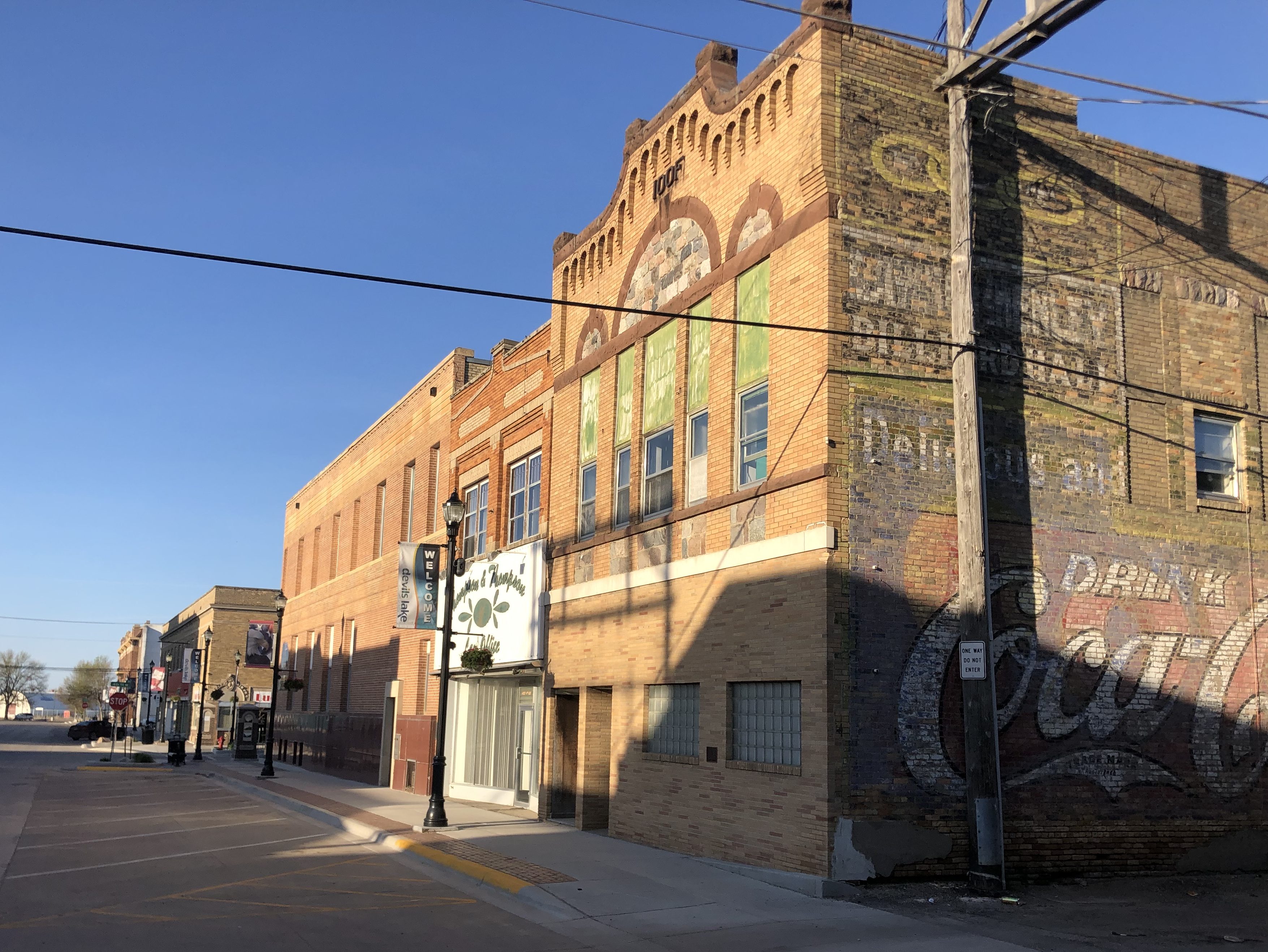
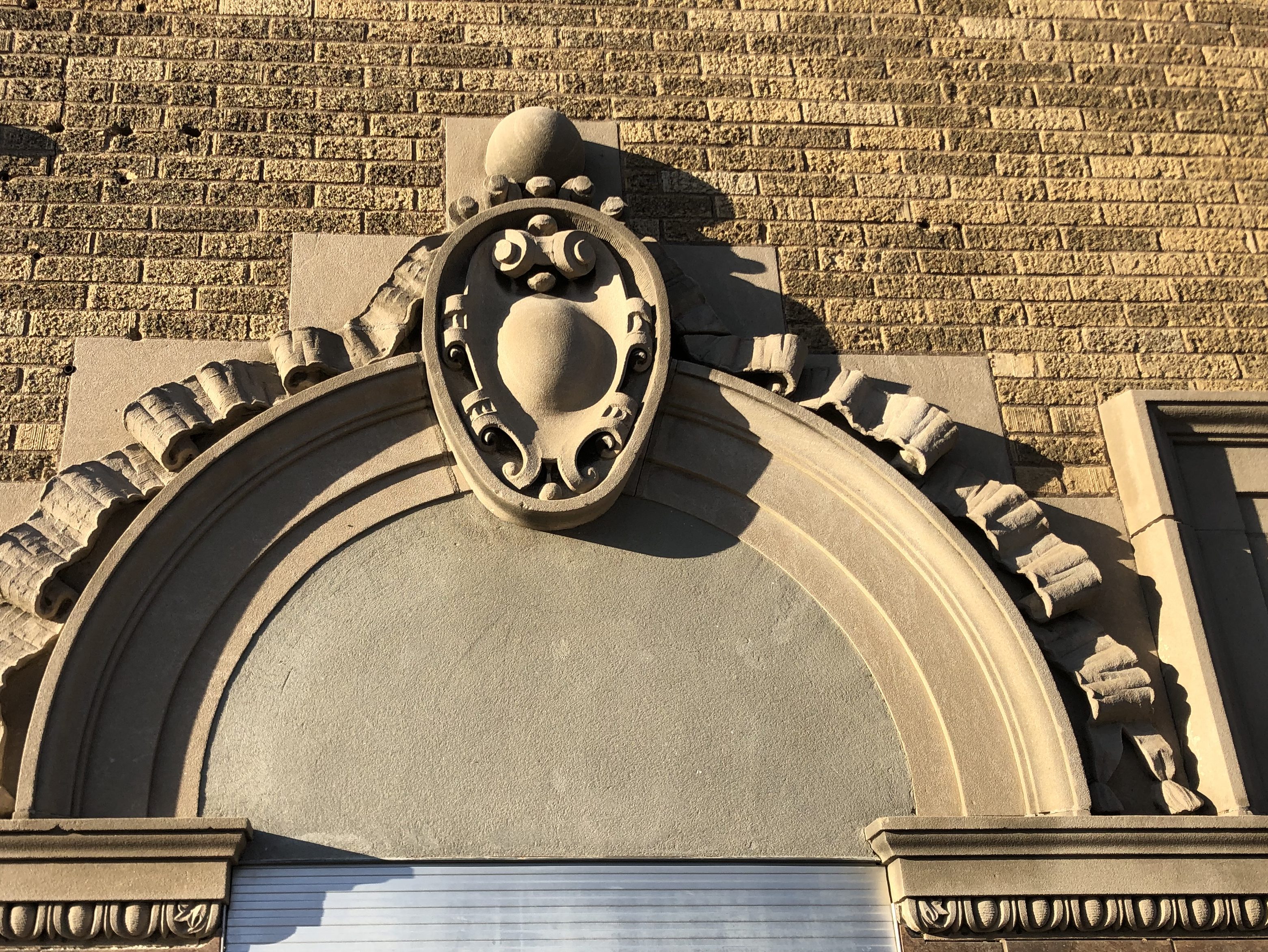
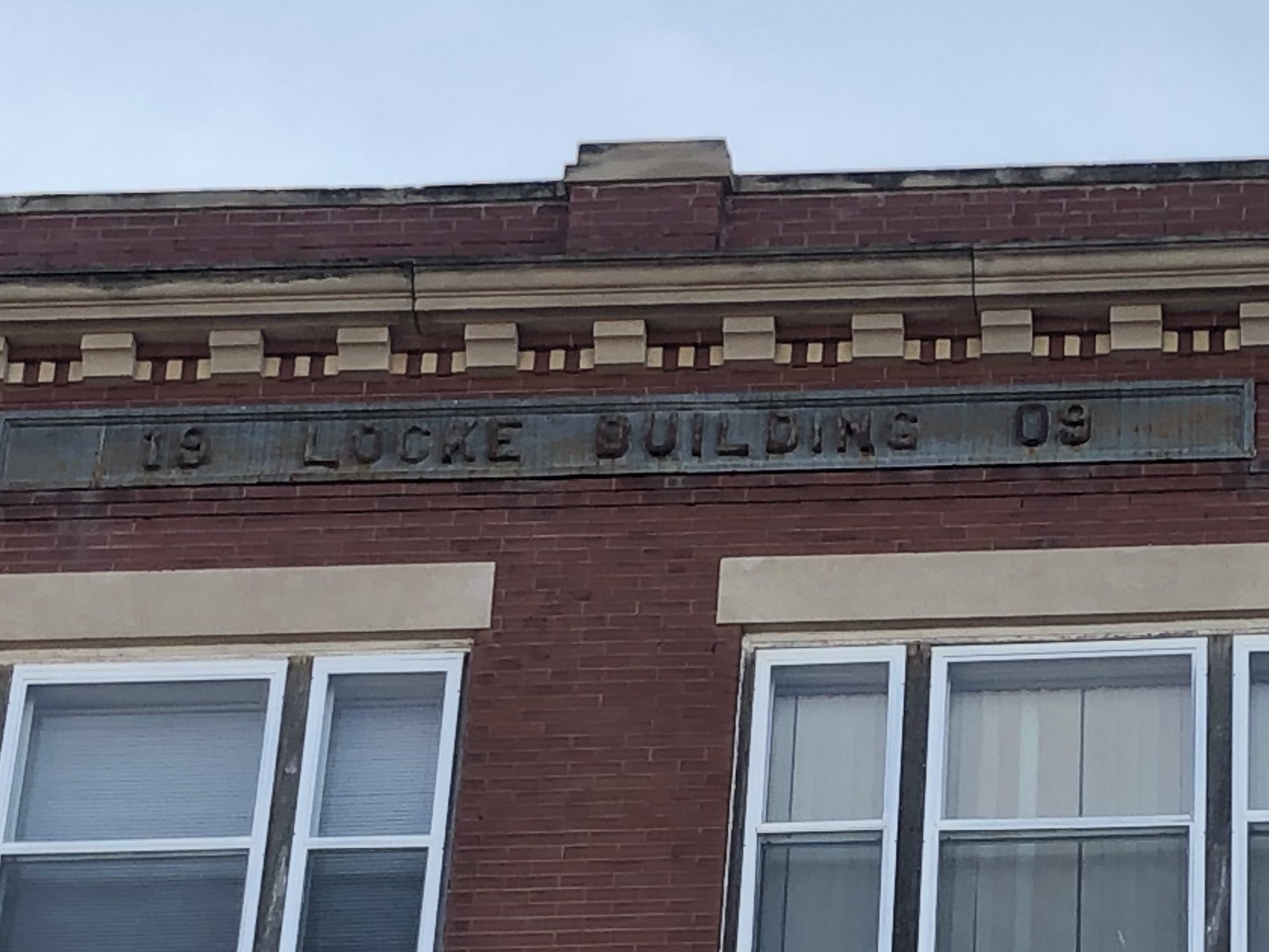
The downtown feels viable, with various renovated structures that are occupied by active businesses.
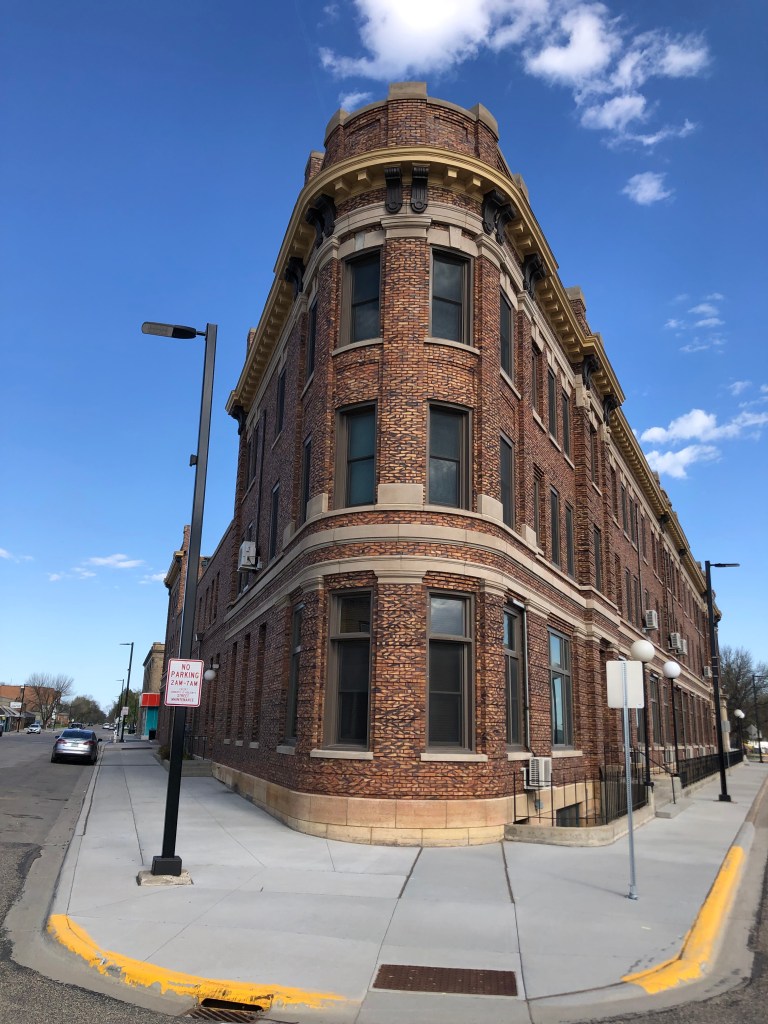
I stopped in at a coffee shop taking up a good chunk of the first floor of the historic Bangs-Wineman building that dates back to 1895. The Liquid Bean seemed unusually hip, vibrant, and busy for a coffee chop in the historic section of a small North Dakota town. It had local artwork on the walls and a steady stream of college students and moms with kids dropped by to get their coffee while on their way to school. (Today was the last day of the school year.) There was also a handful of regulars parked on stools at the coffee bar.
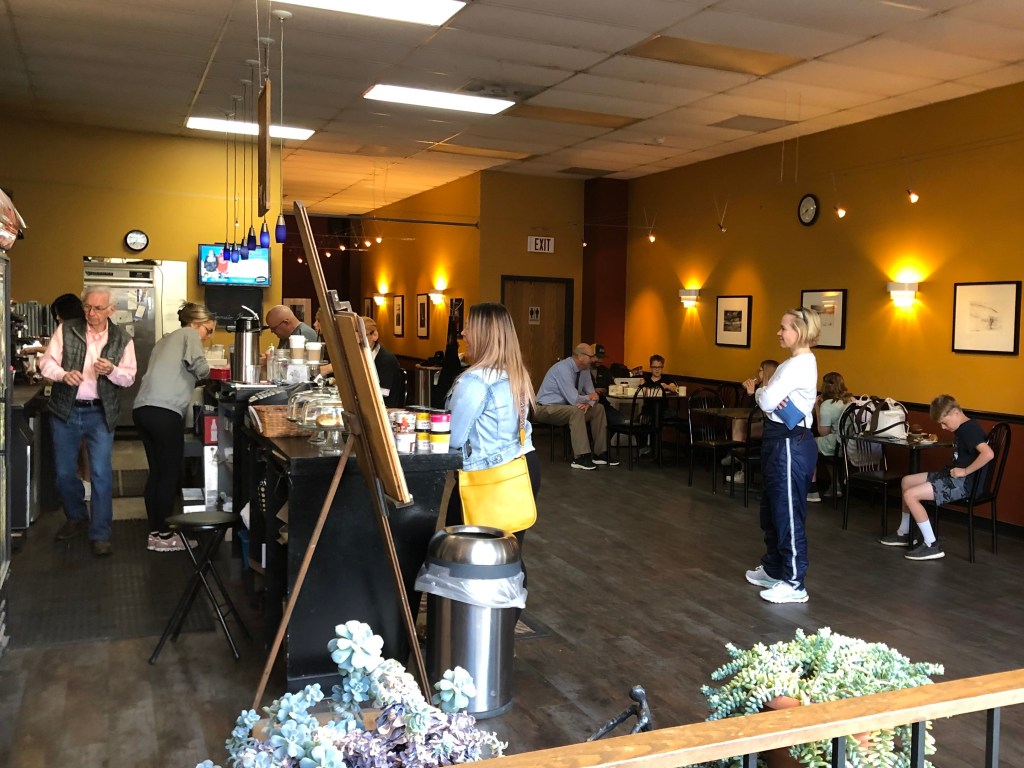
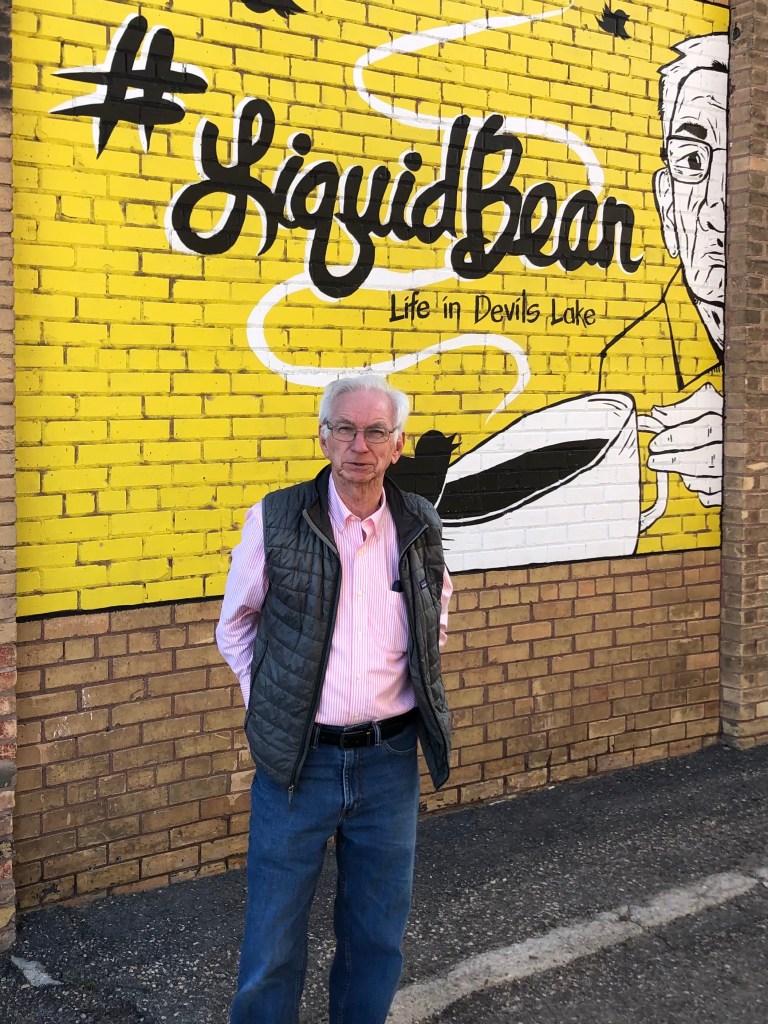
When I sat down with my coffee, the owner came to my table to ask about my road trip. Dan Johnson has owned The Liquid Bean for 28 years, and appears to know all the locals who drop by his establishment. He’s watched the downtown experience something of a renaissance in recent years, and he is an enthusiastic booster for the community. (He also works at the local two-year college.) Dan was familiar with Route 2’s long reach, and commented that the route is popular with bicyclists–though they tend to travel west to east, in order to avoid the prevailing headwinds.
After mingling with the locals a bit longer, I got back out onto the highway. Before long I arrived at the small town of Rugby (pop: 3,000). Rugby claims it’s the geographic center of North America. And they’ve erected an obelisk (!) to commemmorate that claim.
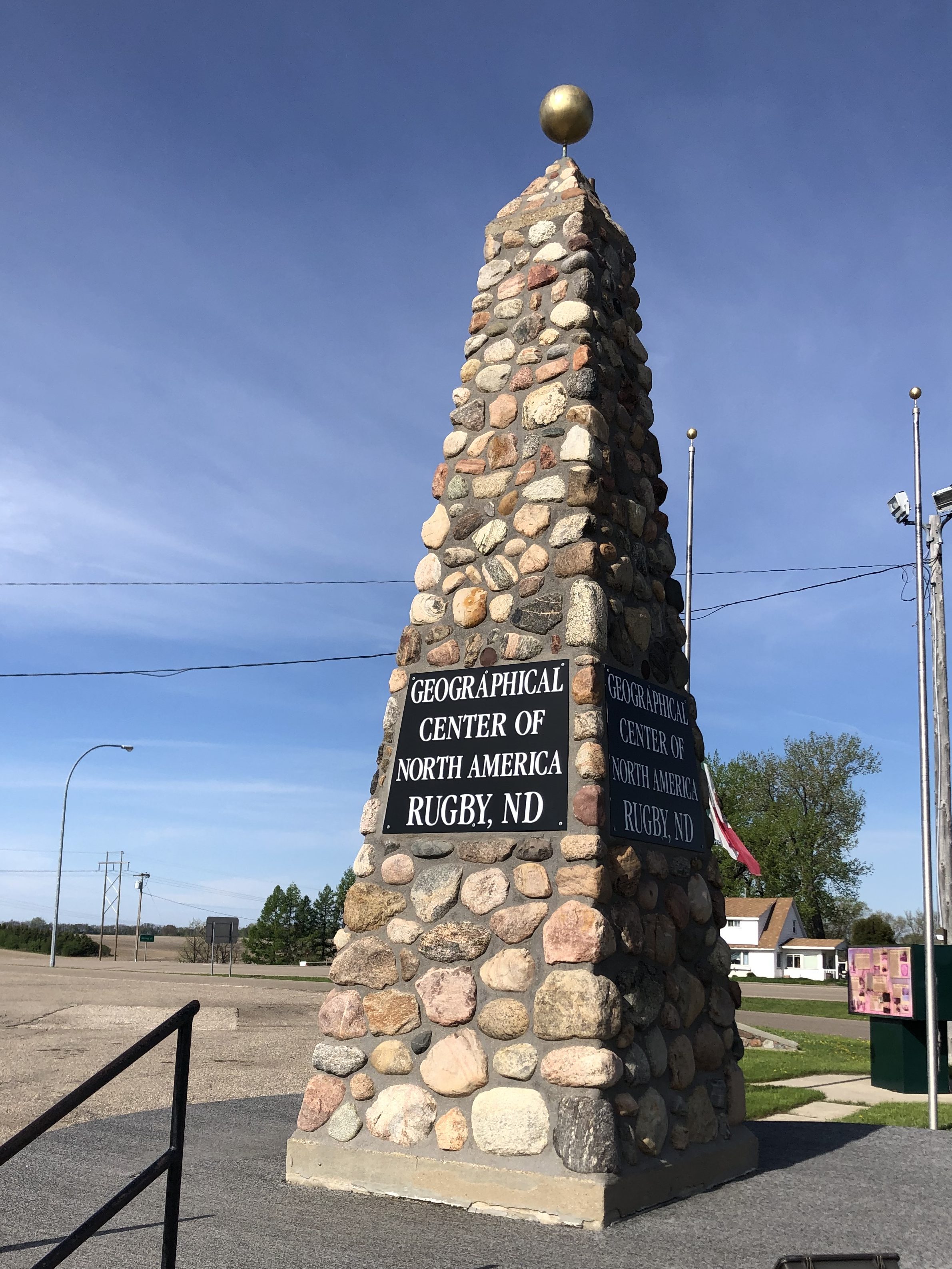
Now, calculating the continent’s geographical center was performed in 1931 by the US Geodetic Survey Office–and it’s said that it involved a laughably low-tech process of teetering a cardboard cutout of the continent on a pencil point, and marking where it evenly balanced. That point was Rugby, ND. A year later Rugby’s Boy Scout troop got a bunch of stones, mixed up some cement, and made this obelisk. In 1971 the obelisk got moved somewhat to accommodate the widening of US Route 2, but it’s still in the ballpark.
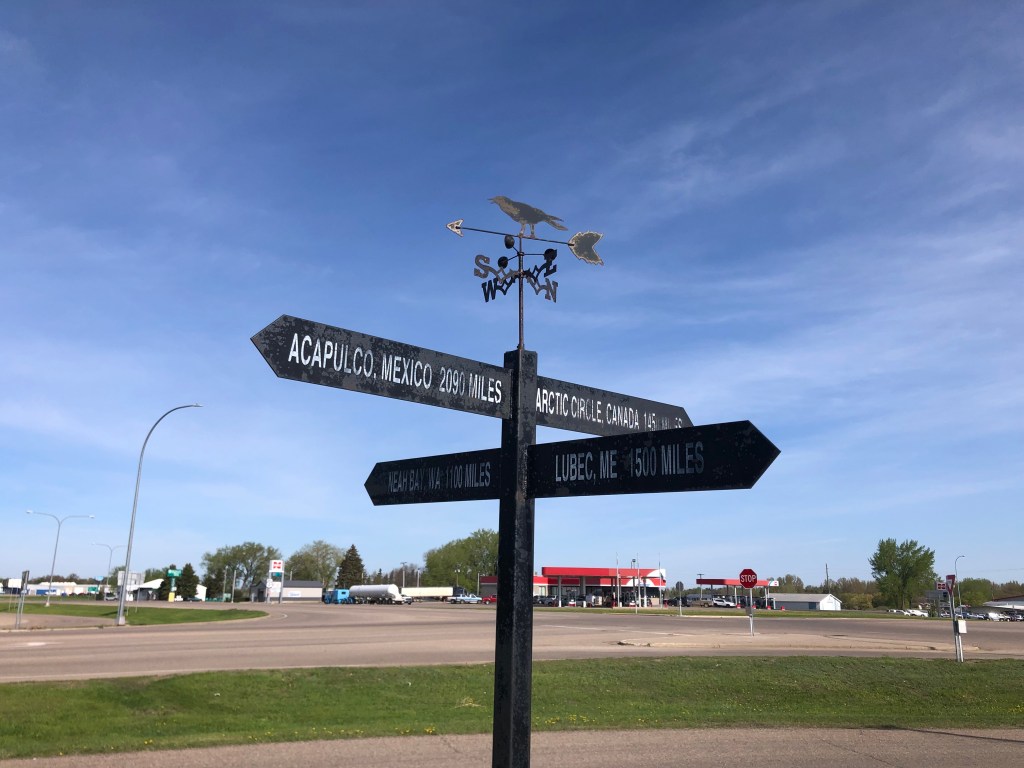
However, modern calculations place the actual geographical center over 100 miles away. About a year ago CBS News did a story on the controversy. You should read it through, all the way to the surprise ending…
Anyway, geographical center aside, my main objective in Rugby was the railroad depot, which was built in 1907. Unlike most of the other depots I’ve stopped at along this trip, the Rugby depot still receives passenger service.
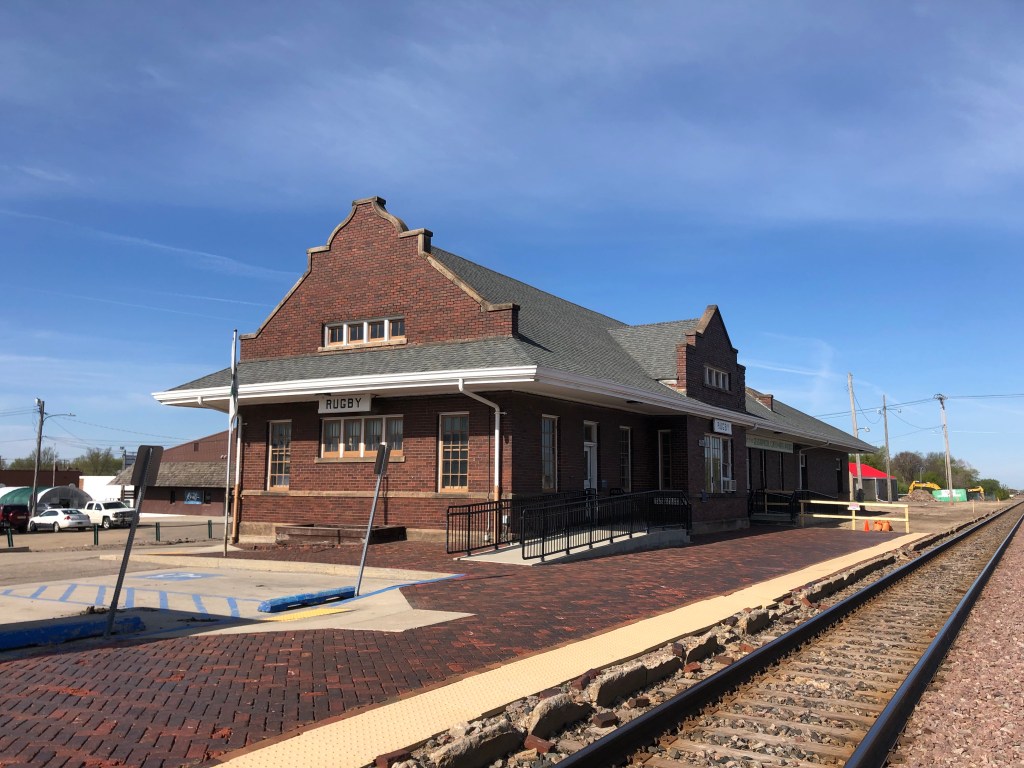
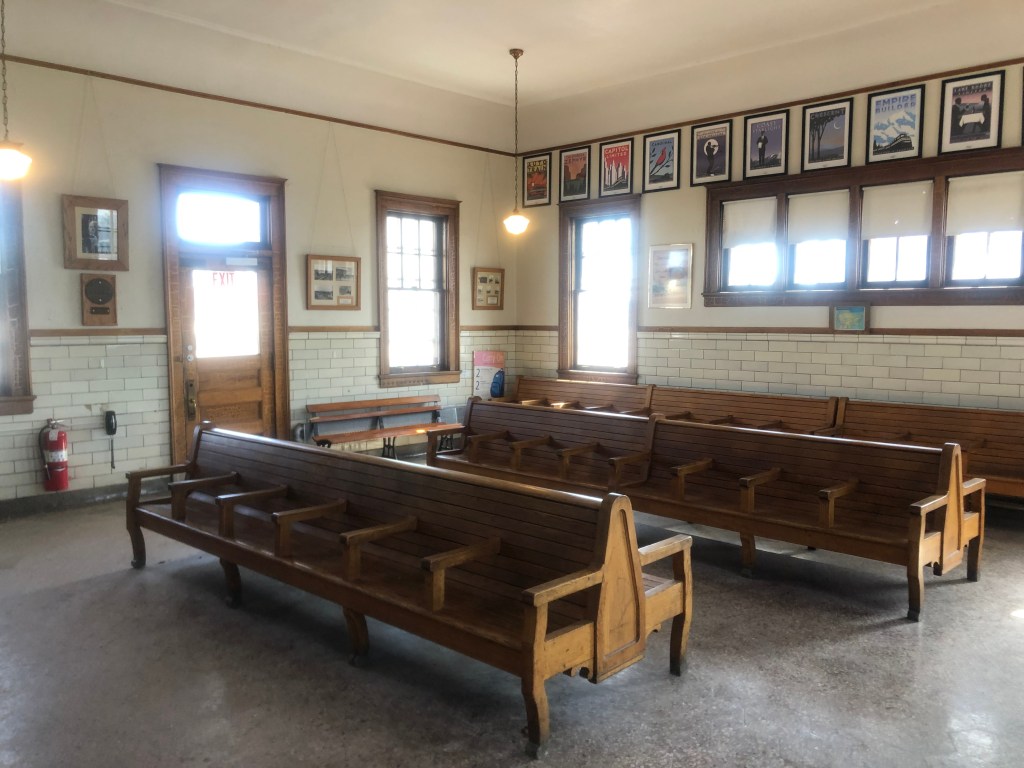
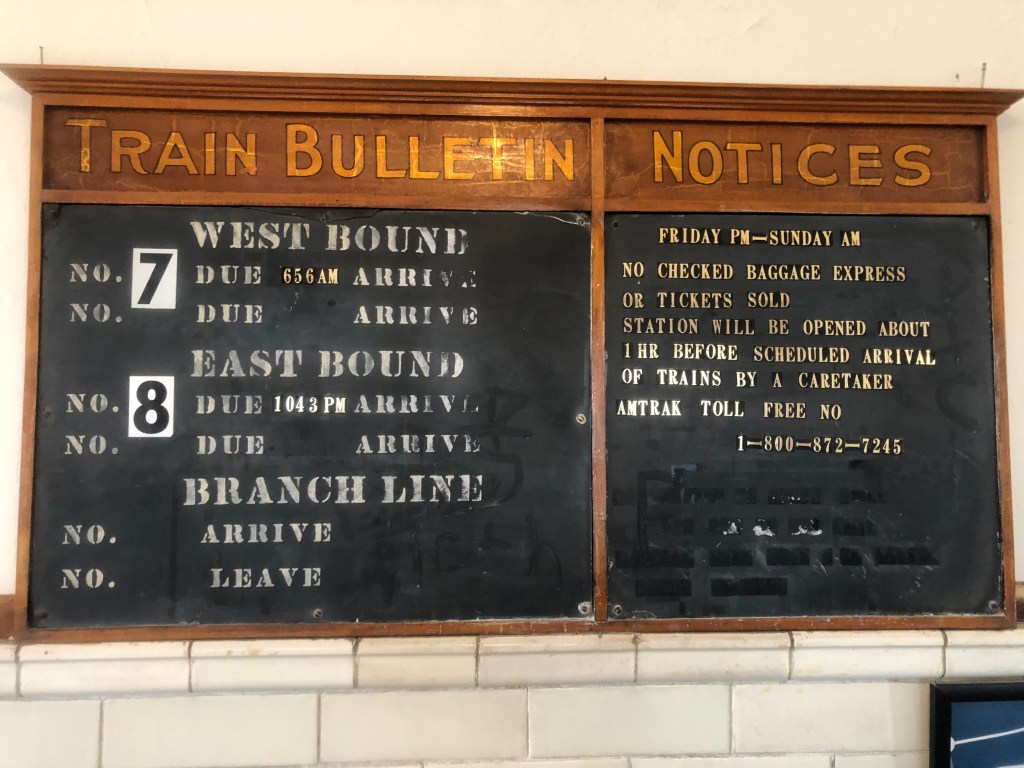
There’s something romantic about an American midwestern railroad depot. Just look at that classic architecture and that deco waiting room. And it’s all the more special when it’s still in daily use, rather than behind a museum rope. I soaked up the atmosphere a bit, watched a freight train come through, and then headed back out of town. Along the way a large bell tower caught my eye:
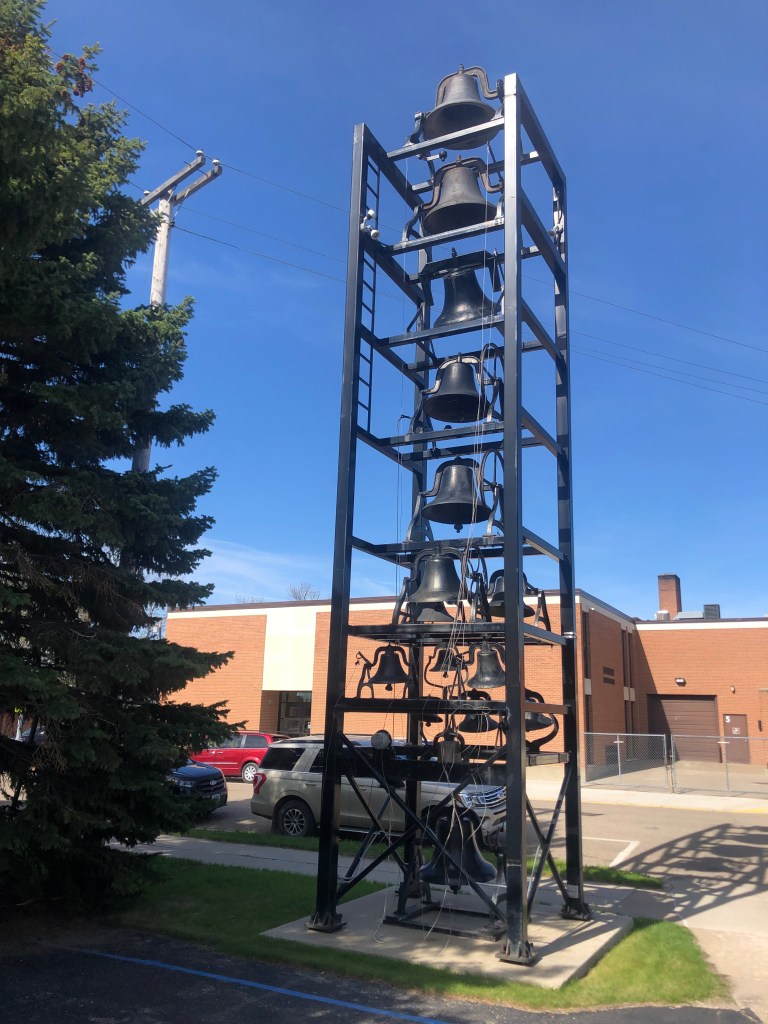
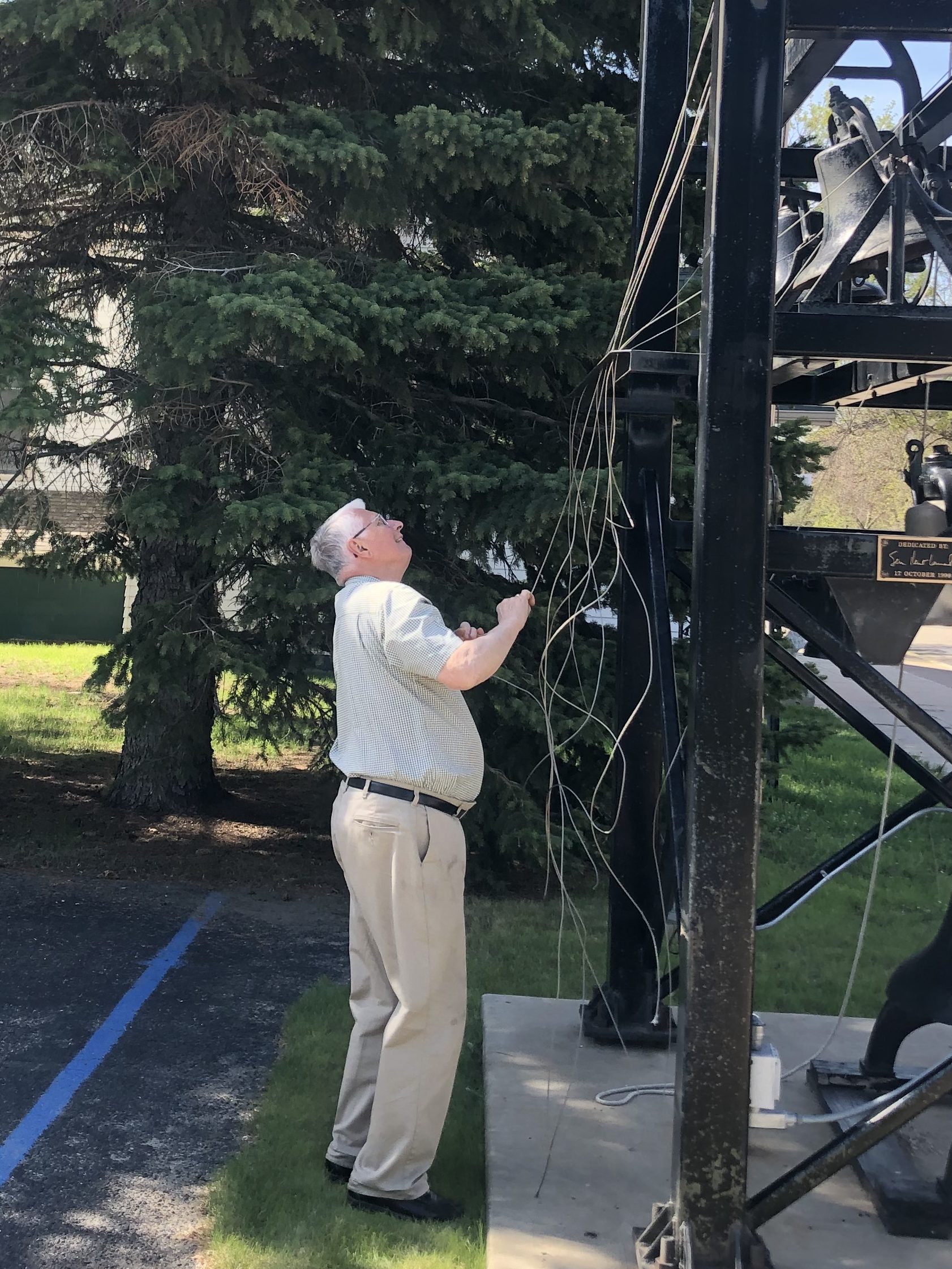
The tower stands in the parking lot of a local mortuary. I saw that there were some pull cords on the bells, and a sudden urge to ring them came over me. I parked and approached the tower, and then noticed a sign requesting that I “ask before ringing.” While I was pondering whom to ask, a middle-aged man drove into the parking lot like he owned the place. As it turned out, he owned the place. Dale Niewoehner (of Niewoehner Funeral Home) is a friendly man, and when I asked him if he knew the story behind the bells he said “Sure. Which story do you want?” He’s been collecting bells since he was a kid, and eventually he mounted the biggest ones into this tower in 1999. Among the 15 bells in the tower are church bells, school bells, fire bells, and railroad locomotive bells. He gave me a small booklet describing all the bells.
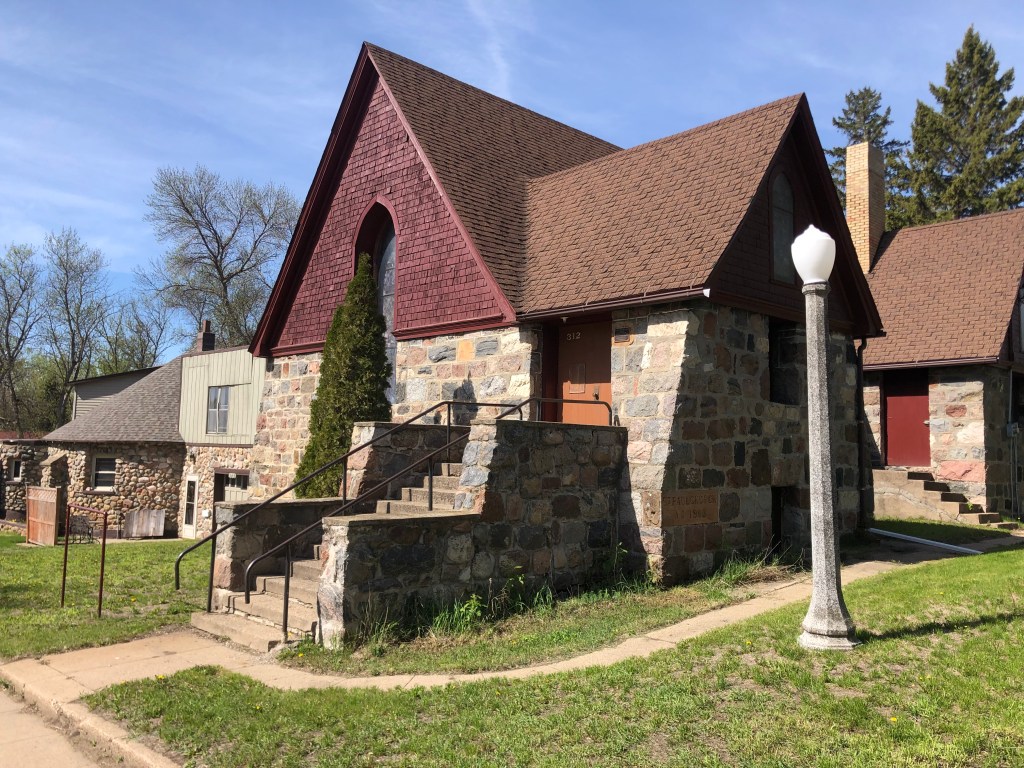
We chatted for awhile about the town. Dale is Rugby’s unofficial historian, and has been involved in a number of preservation efforts (including the mortuary building itself, which dates back to the turn of the last century). And then he mentioned that he and his wife had purchased an old Episcopal church just down the block. I was stunned; in two days, I’ve encountered two different couples who have purchased deconsecrated Episcopal churches! Is this a thing??
Finally I got back on the road, following the now-familiar US Route 2 West signs. Then, about 10 miles after leaving Rugby, I spotted a tall, proud whitewashed church standing alone on the prairie about a mile or two to the south. I figured I’d give in to the obvious ecclesiastical turn that this trip is taking, and I turned down a dirt road toward the church.
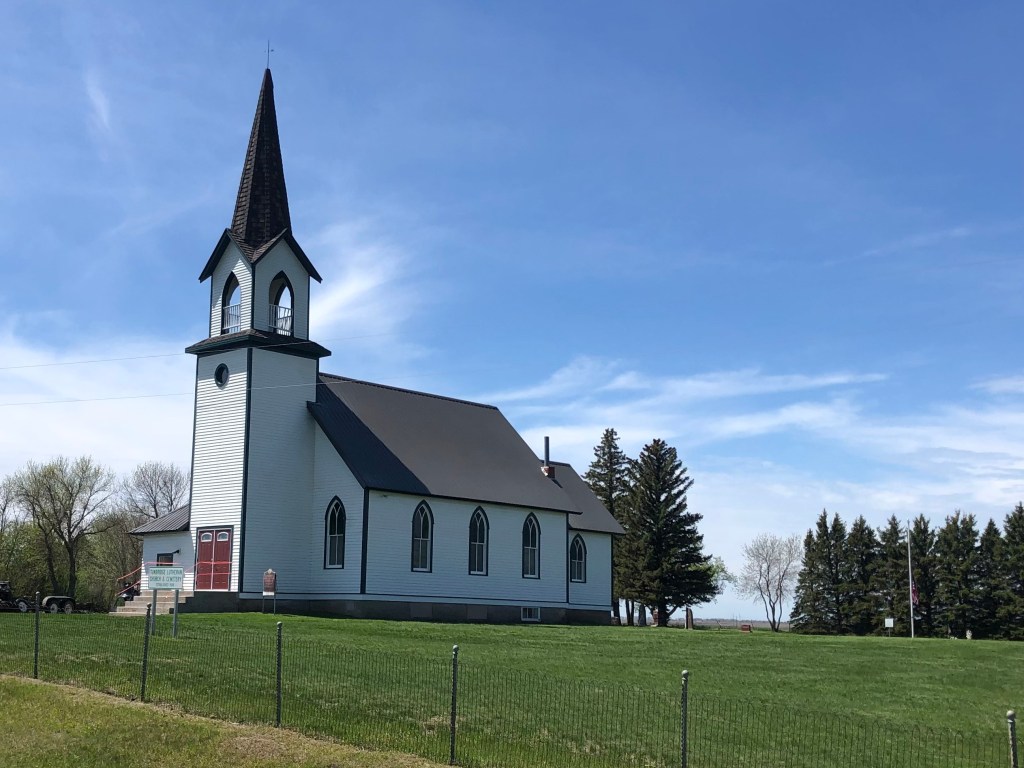
The church grounds were being prepared for a dedication ceremony planned for tomorrow. Chairs and barbecues were being set up, the lawn was being mowed, signs were being put up. I introduced myself to the guy who seemed to be in charge, and learned that Tunbridge Lutheran Church was essentially being re-opened to the community after sitting vacant since 1988. Jason, who’s my age, grew up in the community and his family is very closely connected with the church. His great-grandfather is even buried in the churchyard.
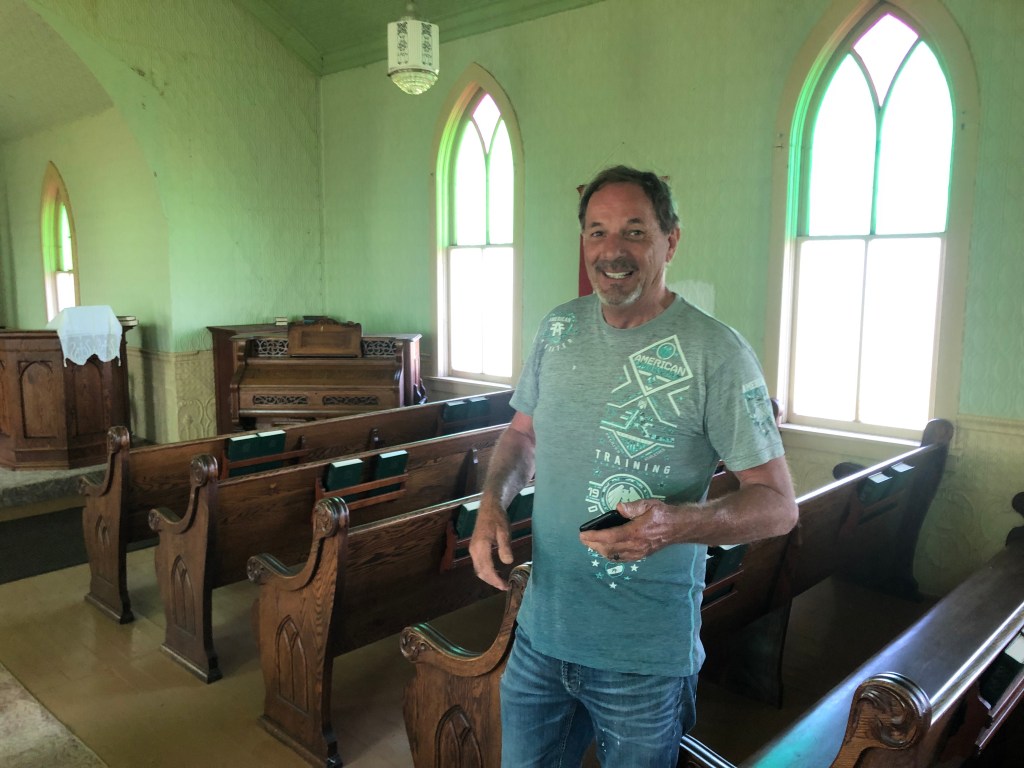
It turns out that Jason has spearheaded the effort to restore the 1914 building, which involved replacing the roof, repairing the steeple, replacing light fixtures, painting, and other work. Almost all the work is now done, and tomorrow they’ll be holding a church service, with the regional bishop serving communion. There’ll also be some speeches and then food and drink and celebration. Jason feels strongly that the church should be a place for the community to come together and support one another. It’s a worthy sentiment, and I sense that he’s providing great benefit to his community.
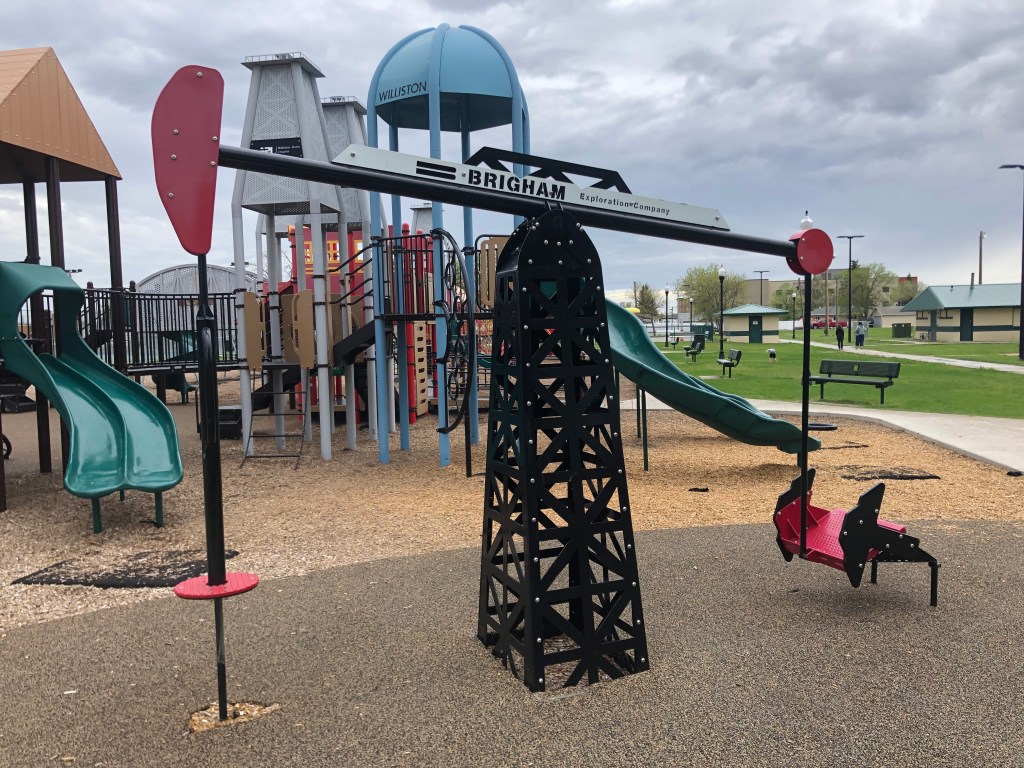
At the end of the day I arrived in Williston, ND (pop: 29,000). By Route 2 standards, this is a big city. I’m now at the western edge of North Dakota, and clearly I’m in oil country. Not only is Route 2 dotted with oil wells, tanks, and gas flares, but even the local playground has an oil rig-shaped see-saw.
BREW OF THE DAY
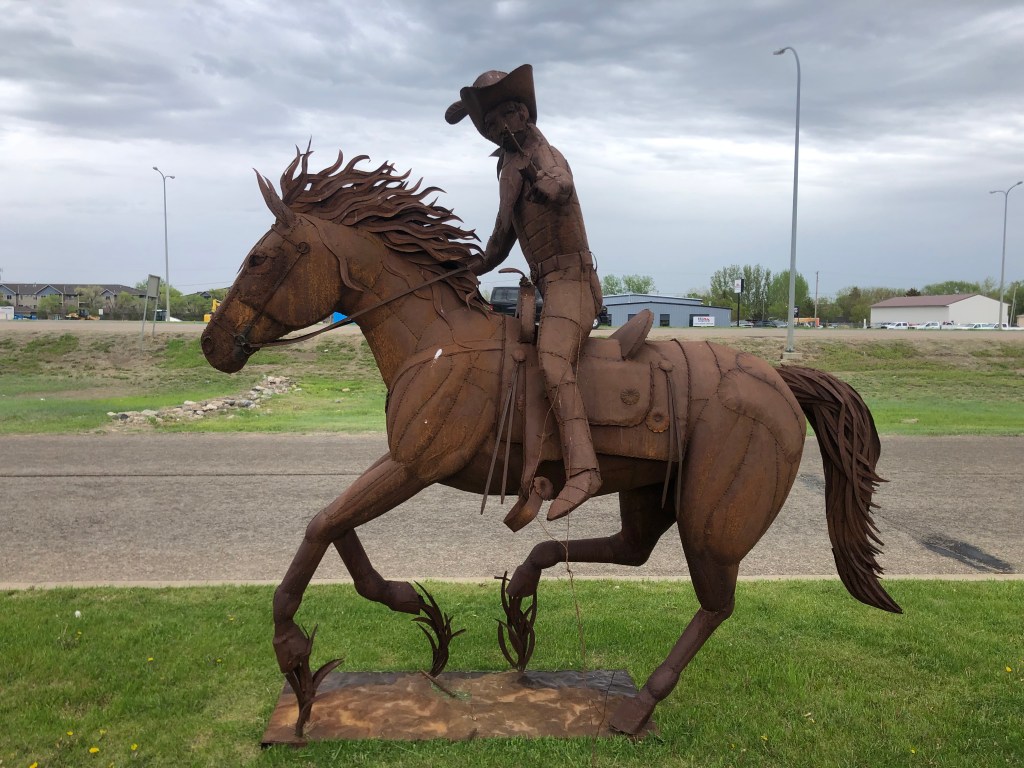
I ate dinner at a place called Doc Holliday’s Roadhouse. It’s one of those slick-looking places, with fancy signage and integrated artwork that suggests it’s part of a corporate chain. But evidently it’s not; it’s just a one-off outfit here in Williston. The lone driveway is lined with life-size, metal buffalo and horse sculptures, which must have cost a pretty penny.
The draft beers weren’t really exciting me, so I ordered a bottle of Black Butte Porter from Deschutes Brewing Company in Bend, Oregon. For a decade or so in the 1990s we used to go on vacation in Bend every summer, and I’ve been to the brewery a number of times. Black Butte Porter (BBP) had been my go-to beer. But it’s been awhile, so I figured I’d try one for the BOTD.
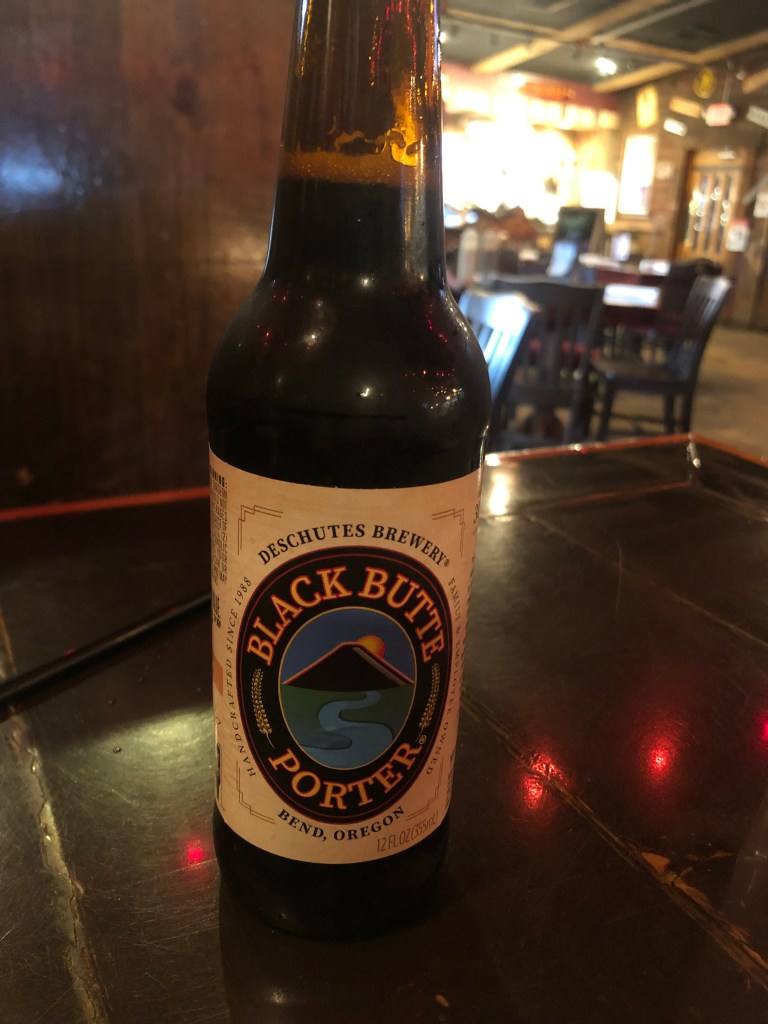
Porters are a little lighter than stouts, but they both make use of lots of heavily-roasted malt. While there’s no hard and fast rule, I think of porters as a little less malty, a little less chewy, and maybe a bit hoppier than a stout.
Tonight’s BBP had a bit of a burnt taste, but not in a bad way. The mouthfeel was more watery than creamy, but it definitely had some heft. Unfortunately, the BBP got worse as my tastebuds acclimated to it. The flavors are not complex at all, and there’s a little bit of inexplicable Budweiser mustiness on the finish. And at 5.5 percent ABV, this is kind of a wimpy beer. I wondered why this used to be my go-to beer.
Here’s the breakthrough that came to me tonight: There are two kinds of (good) beer in this world: there are the lighter beers, which are good for quenching thirst and cooling you down on a hot day. They’re astringent, hoppy, refreshing. Think IPAs. Second, we have the darker beers. Their purpose is not to refresh, but to comfort. They are the port wine of beers. Malty, heavy, thick. The extreme of this is the imperial stout, and maybe also some barleywines. The imperials are high-gravity beers, sometimes called “big” beers, that are bold and not subtle at all. Often they are served in “tulip” glasses, which further advances the comparison to port.
The problem with BBP (and perhaps most porters) is that it falls between the light/refreshing and dark/comforting categories. It’s not at all a lighter beer, but it also pulls its punches on the key dimensions of a high-gravity dark beer. I suppose that a porter is an IPA drinker’s stout. As I’ve aged since those days at Deschutes Brewing Company in Bend, my palate has been worn down to the point where I can’t appreciate nuance. So the porters just don’t work for me anymore. I don’t want to criticize the BBP for not being something that it’s not supposed to be, so rather than give it a low rating, I’ll just say I wish I’d had an imperial stout. With any luck, tomorrow’s BOTD will feature a good one.
 Chasing Phantoms