Readers of a certain age might remember the Baader-Meinhof gang, which was a German militant group that was frequently in the news in the 1970s. Years later its name came to describe a phenomenon whereby you learn of a new word or thing, and suddenly it starts popping up everywhere. (In this case, it was some guy who learned about the Baader-Meinhof gang, then kept noticing it in books and articles and such. It isn’t that the gang had suddenly had a resurgence; rather it was just that his brain was now primed to notice it. Thus, the Baader-Meinhof effect.)
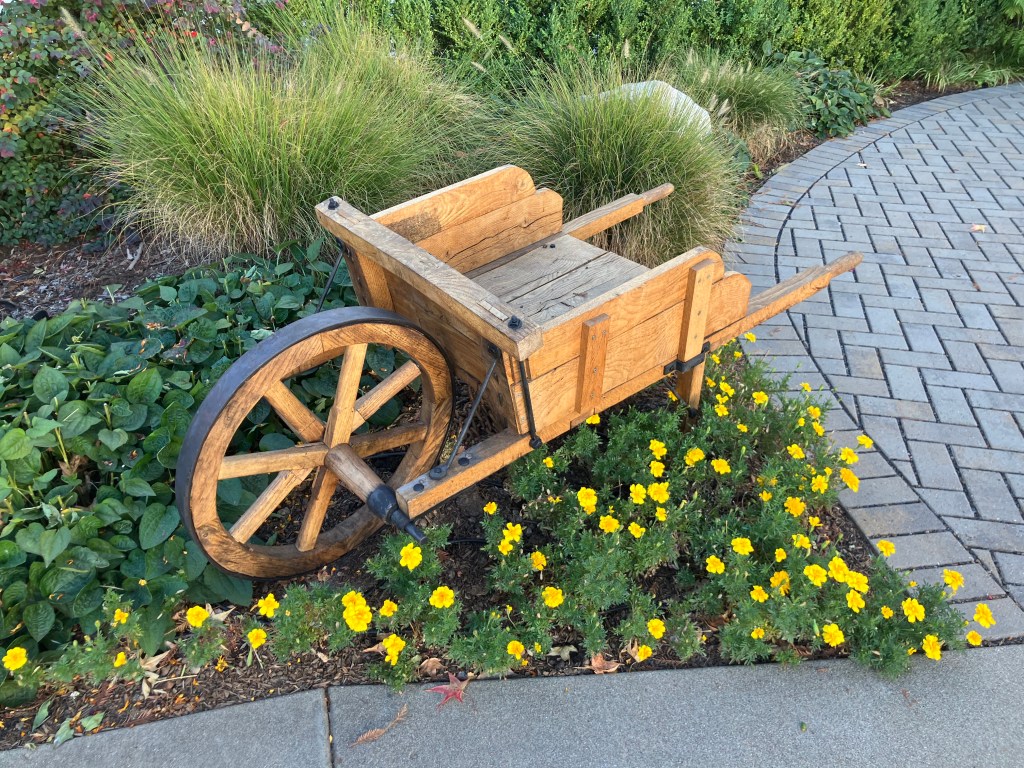
This all came to mind this morning, when I noticed this wheelbarrow set in a flower bed in downtown Placerville.
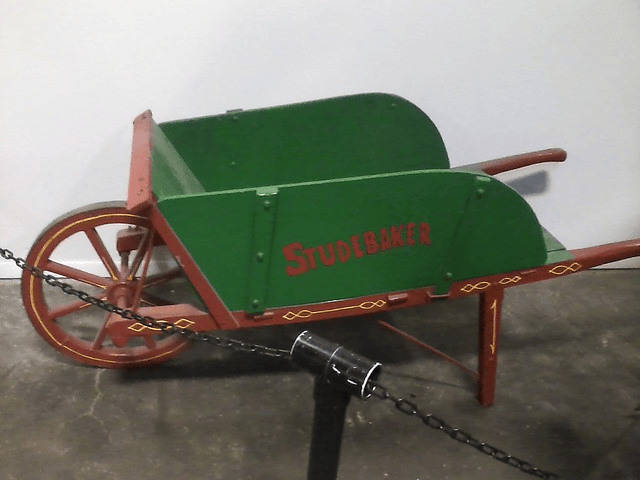
Now, as you know I recently did a post about John “Wheelbarrow Johnny” Studebaker, and how Placerville commemorates him with an annual wheelbarrow race. It sure looks like a Studebaker wheelbarrow. Is the fact that I just now noticed the wheelbarrow an example of the Baader-Meinhof effect?
Courtesy of the Studebaker National Museum
Turns out, the wheelbarrow’s been at this location for almost 5 months. According to the local paper, “A decades-long vision to honor local history reached its conclusion April 28 as the Placerville City Council received a presentation on the completion of a replica Studebaker wheelbarrow.” A group of shop students at the local high school built it. The wheelbarrow was constructed from “local oak from a tree downed near Diamond Springs to better match historical materials.” And the ironwork was forged in collaboration with blacksmiths at the local historical park.
According to the article, Placerville resident Sue Rodman called the piece “the most beautiful wheelbarrow I have ever seen.” (Today’s post is about the Baader-Meinhof effect, but perhaps next week we’ll tackle sarcasm…)
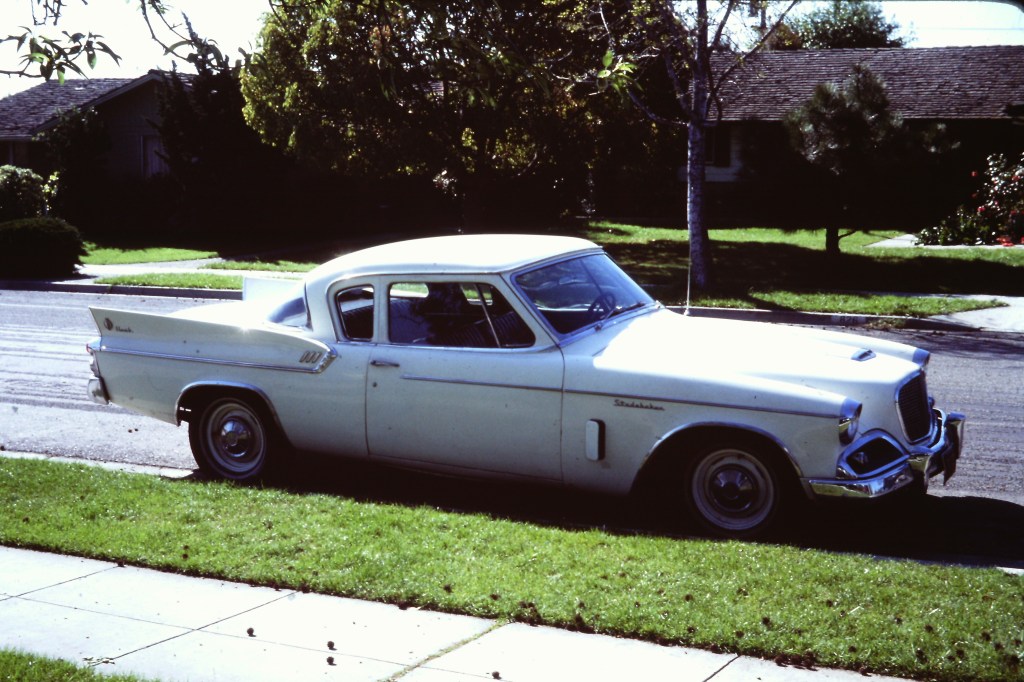
Unless you’ve been living under a rock, surely you’re aware that today in International Drive Your Studebaker Day. Or, as my friend Vic cheekily calls it, “International Push Your Studebaker Day.” For Vic had been my neighbor many years ago, when I owned a 1960 Studebaker Hawk. And thus Vic witnessed the not-infrequent appearance of a AAA towtruck bringing home the Hawk from its travels.
In its natural state: stationary.
Those of you who have read my memoir know that that Studebaker Hawk was my first car, purchased immediately after I got my license, and it remained my main source of transportation for a good 20 years. I finally felt compelled to get rid of after I found myself married with a young son. My wife wouldn’t let our son ride in “that death trap,” and in any event I didn’t have the time or money or space to maintain it.
You’d think that would be the end of the story. But about five years ago I moved to the town of Placerville, California, which, it turns out, is (almost) literally haunted by John Studebaker. As every schoolchild knows, John Studebaker was lured to Placerville during the Gold Rush, but quickly realized his fortune could be earned not in the gold mines but by selling provisions to the miners. Studebaker took a job at a local blacksmith’s shop, and in his off hours built wheelbarrows that he sold to the miners. After he amassed enough money, he returned to South Bend Indiana, where he and his brothers formed the Studebaker Manufacturing Company. They built wagons for the Union during the Civil War, and in the early 20th century they began producing automobiles. Like my 1960 Hawk.
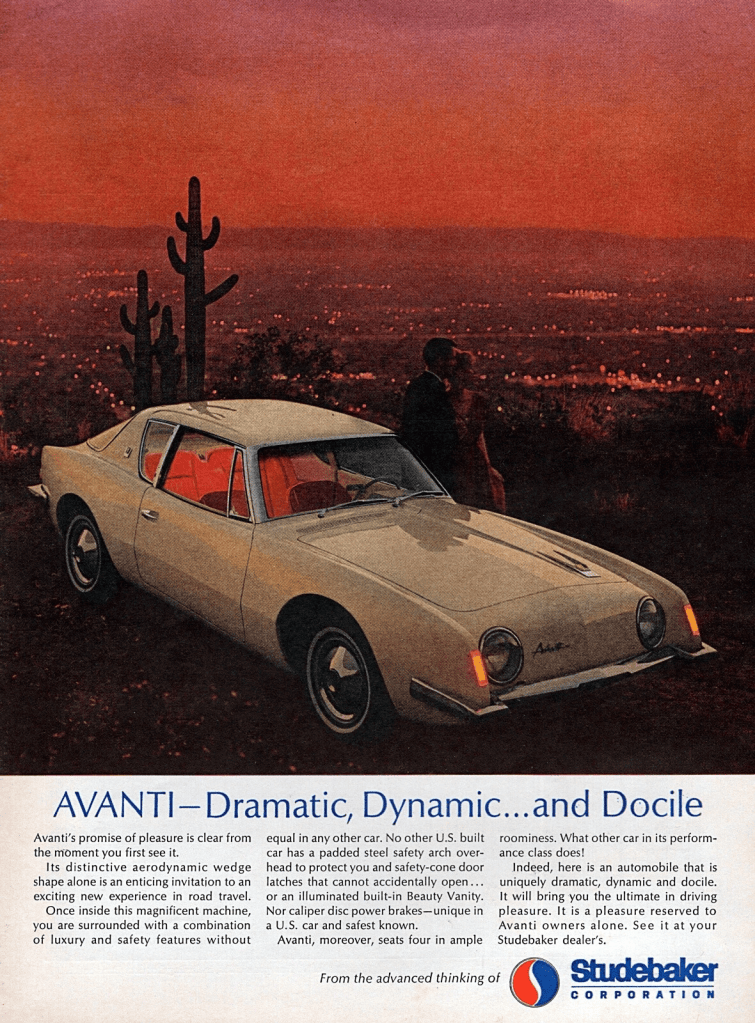
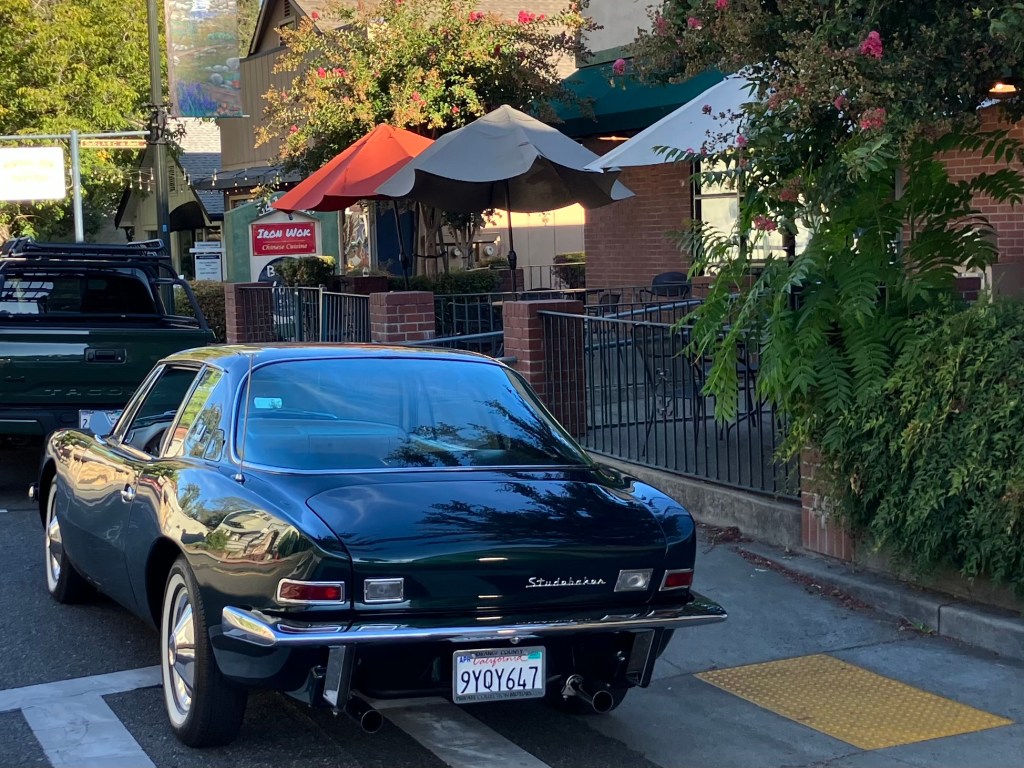
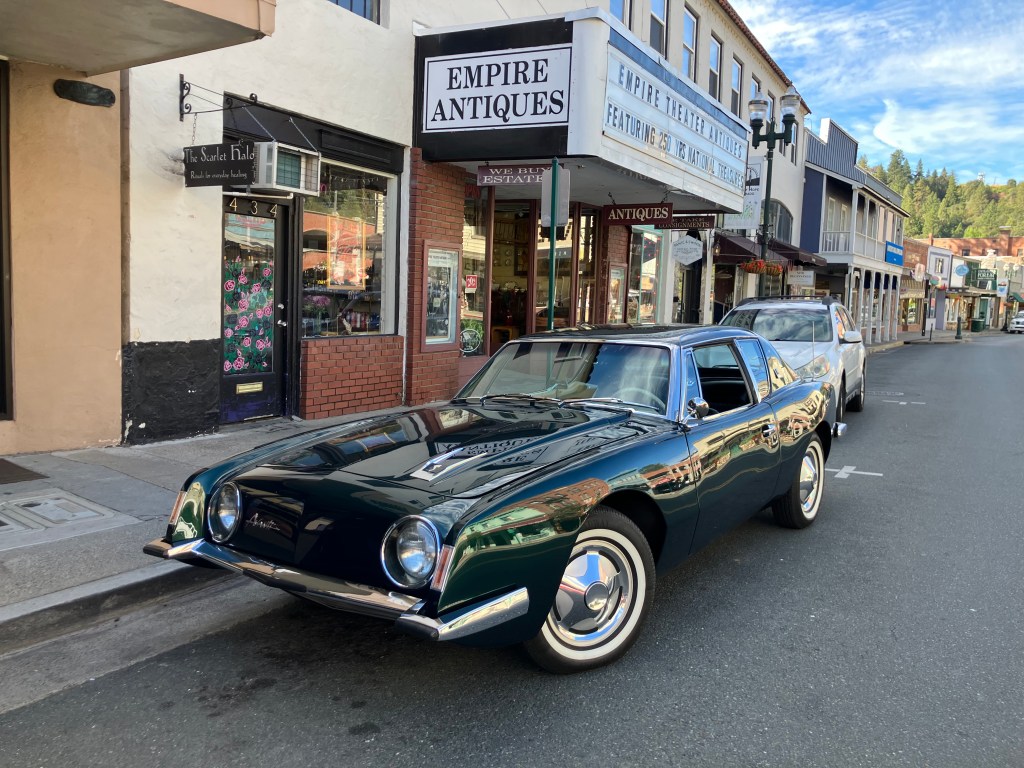
Living in the town that played such a crucial part in the history of Studebaker reignited my interest in the marque, and so earlier this year I went out and got me another Studebaker–this time a 1963 Studebaker Avanti.
The Avanti was Studebaker’s last-ditch effort to turn around its flagging sales figures. It was conceived as a “luxury sports car,” designed by the legendary industrial designer Raymond Loewy during a six-week crash program in Palm Springs. Alas, the Avanti could not save the company and Studebaker shuttered its South Bend factory in 1964.
So the Avanti, like all Studebakers, is considered an “orphan car,” and their owners keep them on the road thanks to a network of specialty vendors and the mighty Studebaker Drivers Club. It’s the SDC that promotes “International Drive Your Studebaker Day” each year.
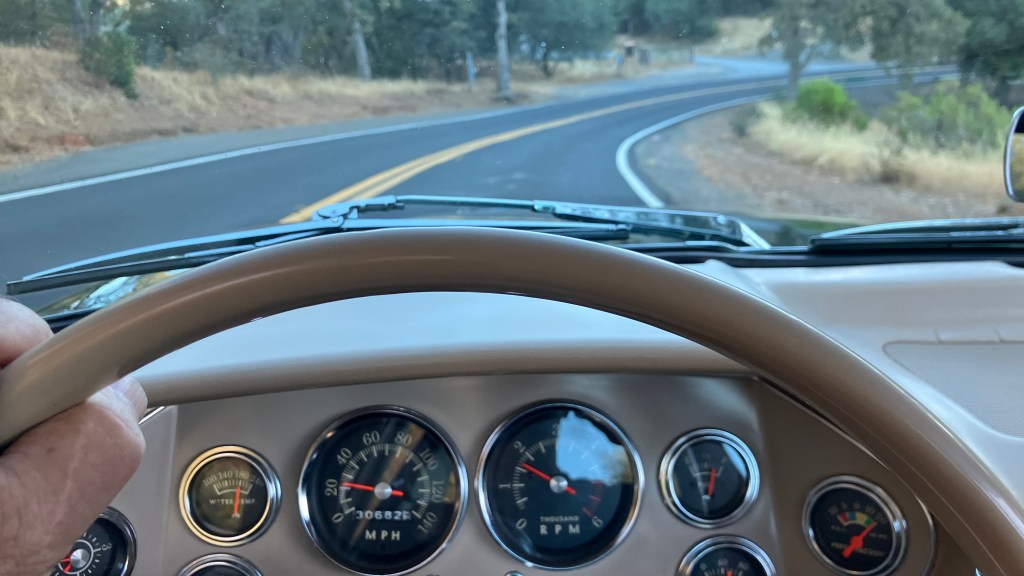
So today I did my part: I took the Avanti on a nice, scenic drive along CA Route 49 into downtown Placerville.
Action photo from my drive this morning. The more things that can potentially go wrong with a car, the more gauges you need…
When I got into town, I parked at the site of that old blacksmith’s shop where John Studebaker built his wheelbarrows some 175 years ago. (The site is now a bagel shop.)
175 years later, one of John Studebaker’s progeny returns to the wheel barrow site.
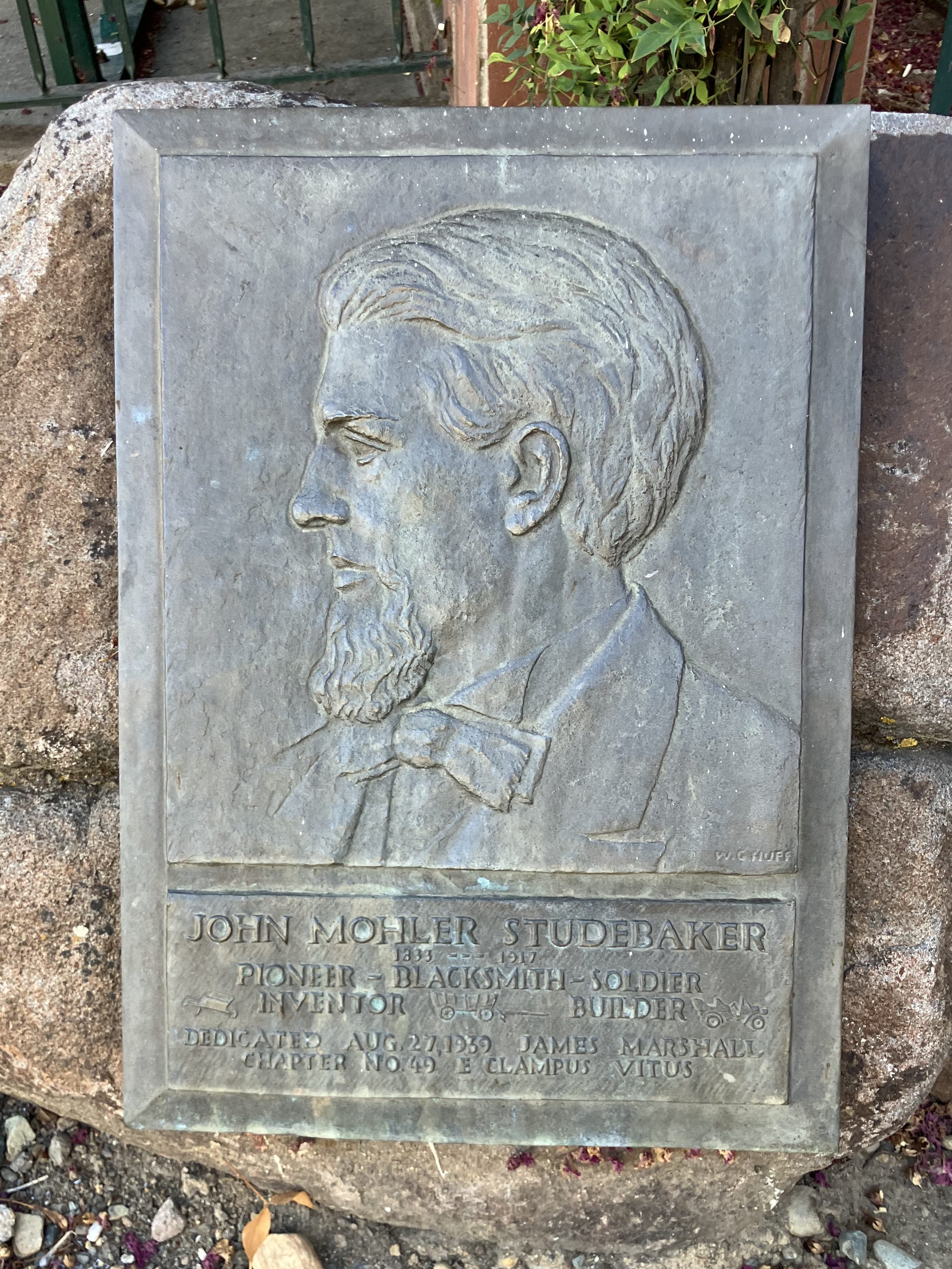
Stude-plaque in front of Bagel Works/blacksmith shop.
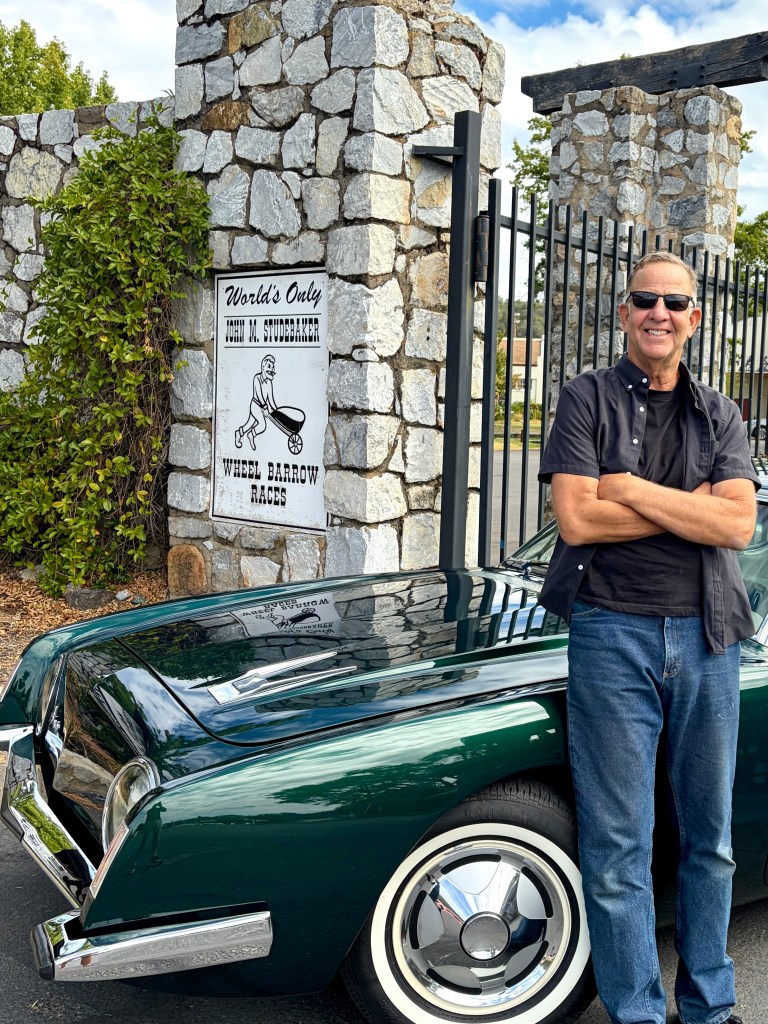
I also made a drive out to the Placerville Fairgrounds, where every year they hold the “John M. Studebaker Wheelbarrow Races.” I’m not making this up.
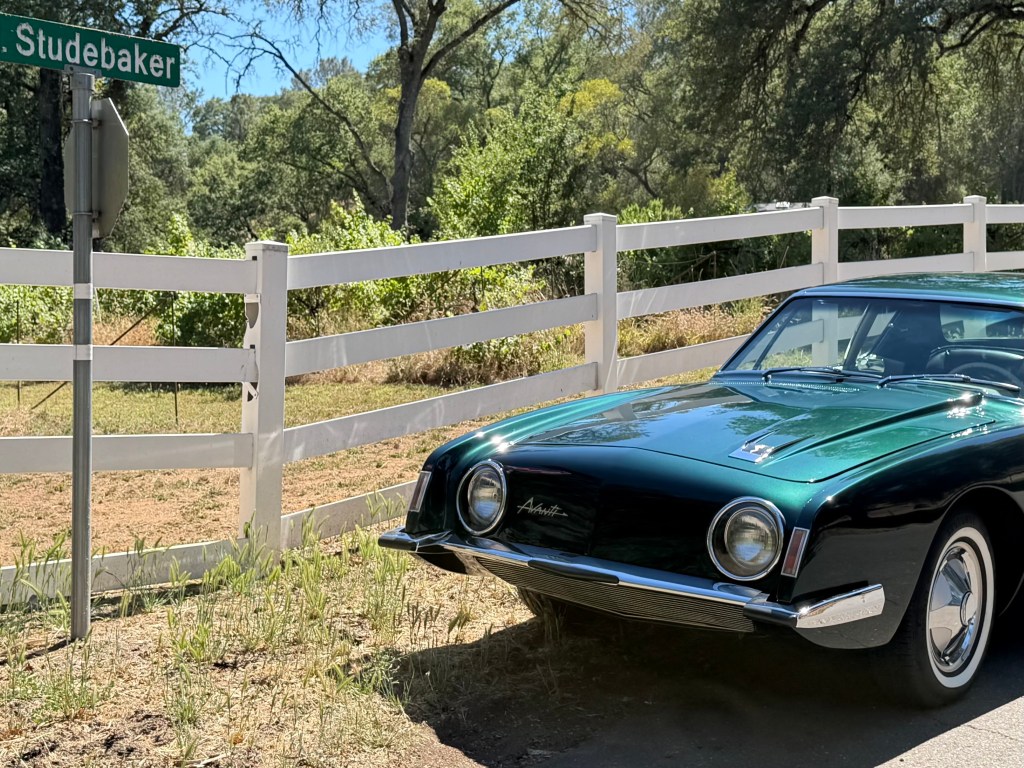
Placerville also has a road named Studebaker Road. I have not been able to determine if John Studebaker had any direct connection to this street, or if it simply honors him. If you have any leads, please share them!
Sadly, I did not see anyone else driving a Studebaker in town. (There is local guy who owns four Studebakers from the 1920s, but they were all parked in his driveway this morning. Maybe he’ll be making a drive later this afternoon.) I am aware that there’s a local Studebaker group based in Sacramento that’s driving together to the Sacramento River Delta for lunch. Me, I mainly just cruised around Placerville’s Main Street.
I’m still getting the hang of parallel parking without a backup camera…
No matter how you choose to celebrate International Drive Your Studebaker Day, I hope all my readers have a Stude-tastic holiday.
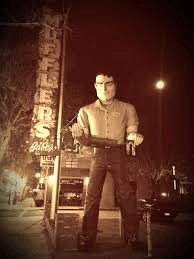
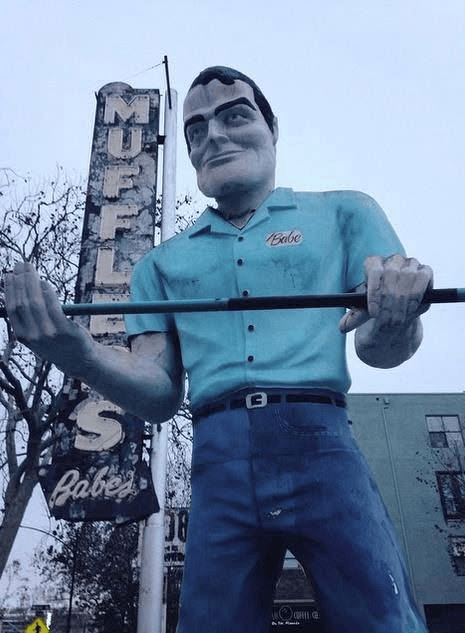
Back in the 1960s, when I was just a sprout, there was a muffler shop in San Jose called Babe’s Mufflers, and facing the street they had a 20-foot-tall fiberglass figure holding a muffler. I always thought the guy’s expression looked a little too determined, like he was about to clobber an unsuspecting passerby with the muffler. I also felt his hand positions on the muffler were unnatural; one was facing up, and the other was facing down. That his shirt pocket was embroidered with “Babe” didn’t help. Anyway, I thought this was just a unique, if unsettling, piece of advertising art.
Babe with his muffler/assault weapon.
It turns out “Babe”is a reference to Roland “Babe” Royer, who owned the place. He died in 2011. But Babe’s Muffler lives on. What’s more, the iconic fiberglass figure still stands in front, holding a muffler. (Sometimes, when the San Jose Sharks hockey team is playing an important game, the muffler gets swapped out for a hockey stick. I’m not making this up.) Indeed, the giant figure is now an official San Jose landmark.
…or are you just happy to see me?
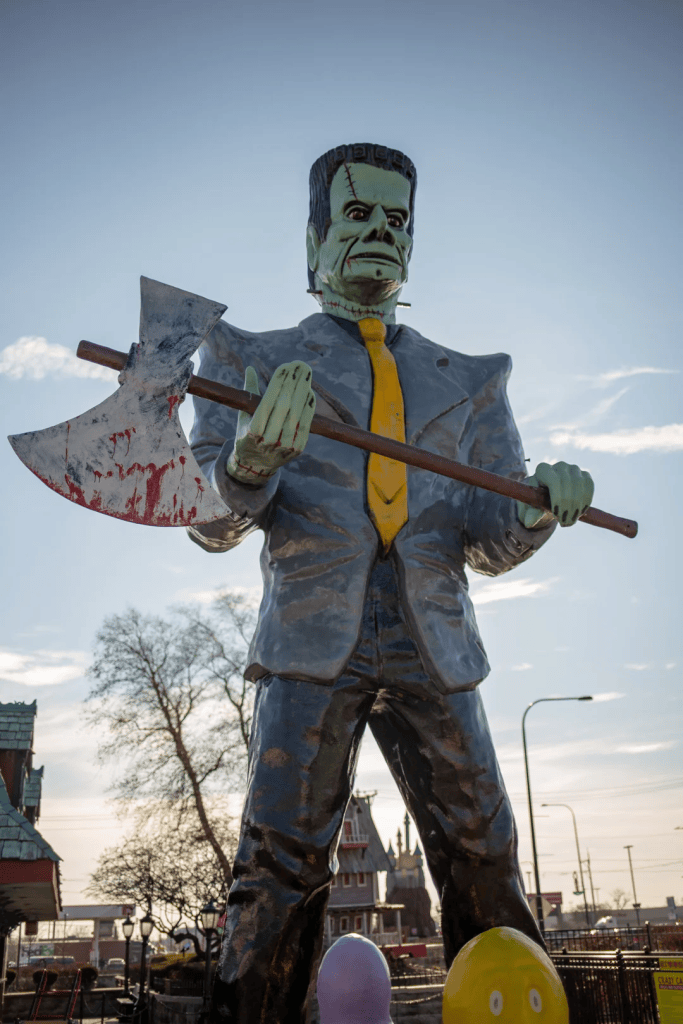
On my travels over the years I’ve encountered a number of similar fiberglass figures. Some look identical to Babe (but advertise other businesses), and some look a little different. Most have the same odd hand positions.
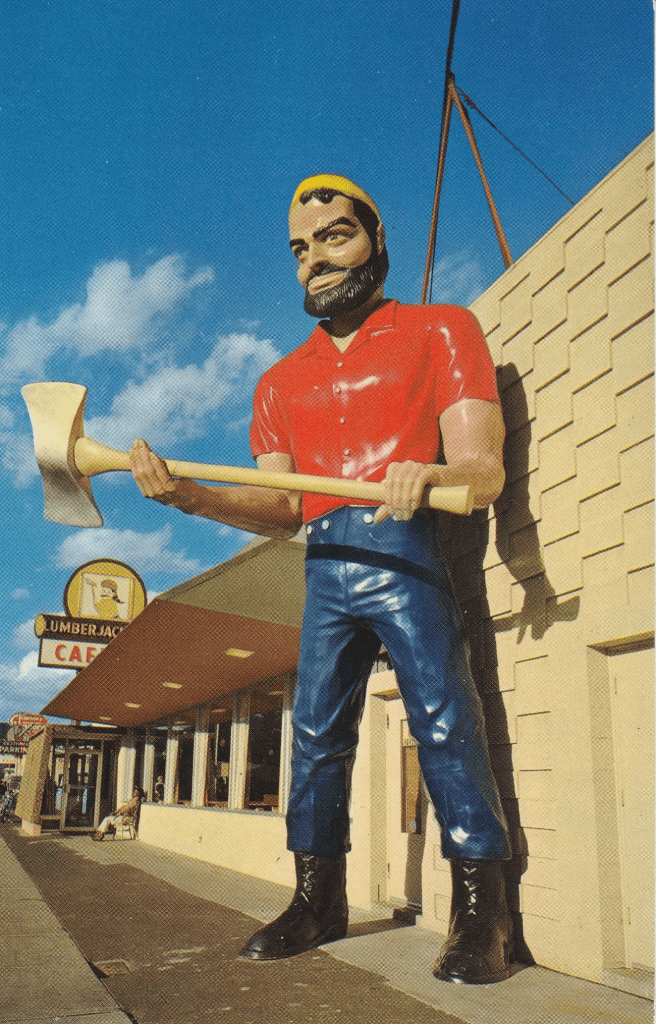
It turns out these “muffler men” (as they are usually dubbed) were made in the 1960s by a company in Venice, CA called International Fiberglass. They’re the same company that made all those brontosauruses (brontosauri?) that you see in front of Sinclair gas stations. Apparently their first muffler man was actually a Paul Bunyan figure to advertise the Lumberjack Cafe on Route 66. In this case the hand positions actually made sense, as the figure was holding an axe.
International Fiberglass would end up making thousands of these fiberglass figures, with a handful of variations (different faces, different attire, etc.) They could be spotted along the highways all across the country. Later, when establishments would go out of business, the new owners would often repurpose the muffler men.
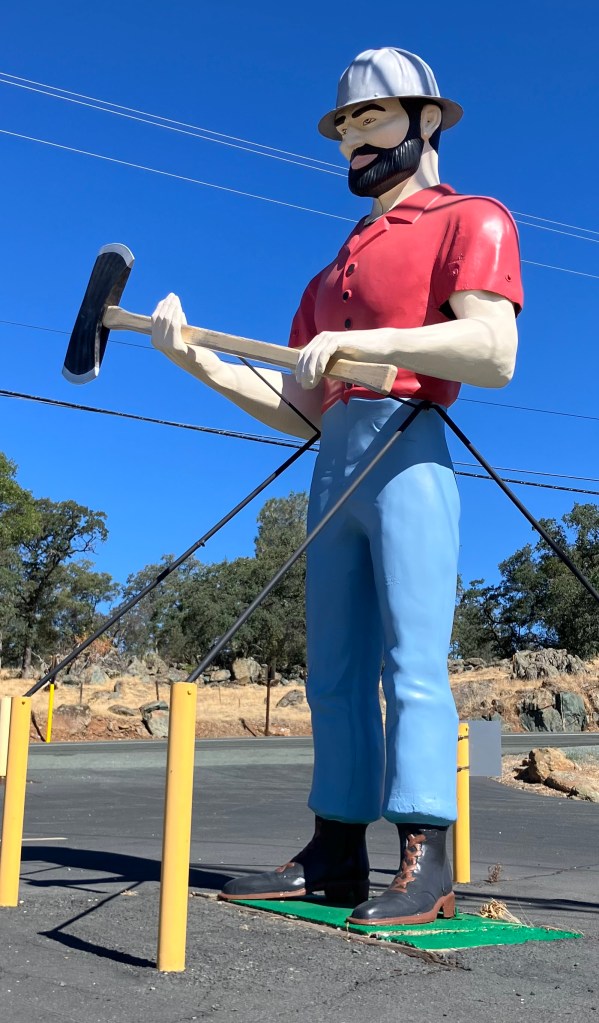
Anyway, I was reminded of all this the other day, when I arrived in the town of Jackson (pop: 5,000), in order to collect dead animal parts at Swingles Meat Company (nickname: A Carnivore’s Playground). On the side of Highway 88 I spotted a muffler man in front of a fitness center called Warriors Lodge. He predates the Warriors Lodge, having stood in this spot (and perhaps other parts of town) advertising other businesses, including a thrift store. He doesn’t quite look like that original Paul Bunyan muffler man, but he looks pretty close, with the telltale hand positions.
If you know any of this guy’s back story, please let me know. Better yet, why don’t you join the Muffler Man Challenge? All you have to do is send me a picture of a muffler man that discover in your own travels, and give me a little information about it (location, associated business, back story, whatever). Bonus points if you can find one that’s not listed on the Muffler Man Wikipedia page. The one I spotted in Jackson is not listed on the page, and I’m guessing there are many more out there.
Poe Corner
(Not to be confused with The House on Pooh Corner)
I was recently interviewed about my Poe-related writing by the hosts of Poe Unplugged. Check it out, if you dare:
Ah, the Father’s Day weekend–presenting a fine opportunity to take a motorcycle ride in the fine June weather without feeling guilty that I’m not mowing the lawn.
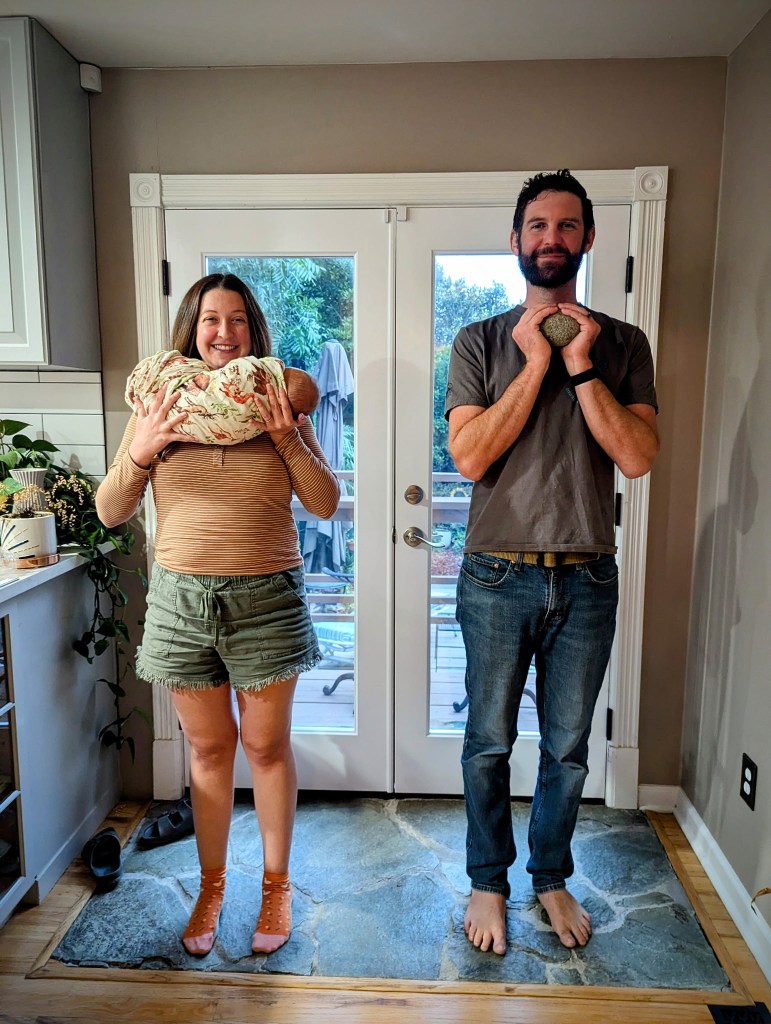
If I might be permitted a brief personal aside, apropos of Father’s Day: As of two weeks ago, I’m officially a grandfather. Observe the evidence:
Plus, this important context:
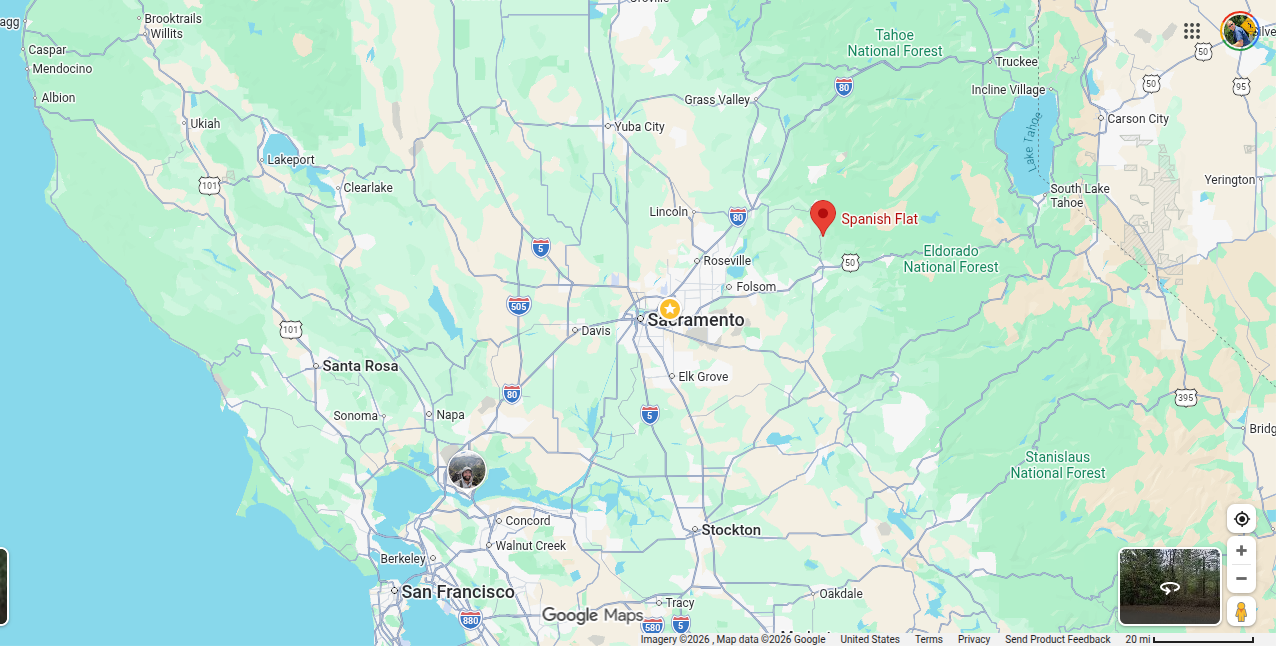
But to get back to my story: I was cruising along CA Route 193 (my earlier trip on this route is here) in the glorious spring weather, and on a whim I took a short detour to a place called Spanish Flat (pop: 8,000).
Spanish Flat arose as a mining town during the Gold Rush in 1849. Its name does not relate to Spaniards per se, but rather to Spanish-speaking miners who arrived from Mexico, Portugal, and Chile.
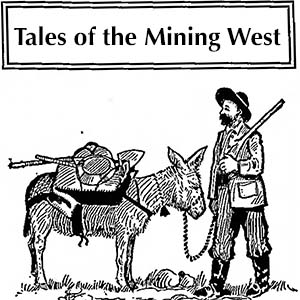
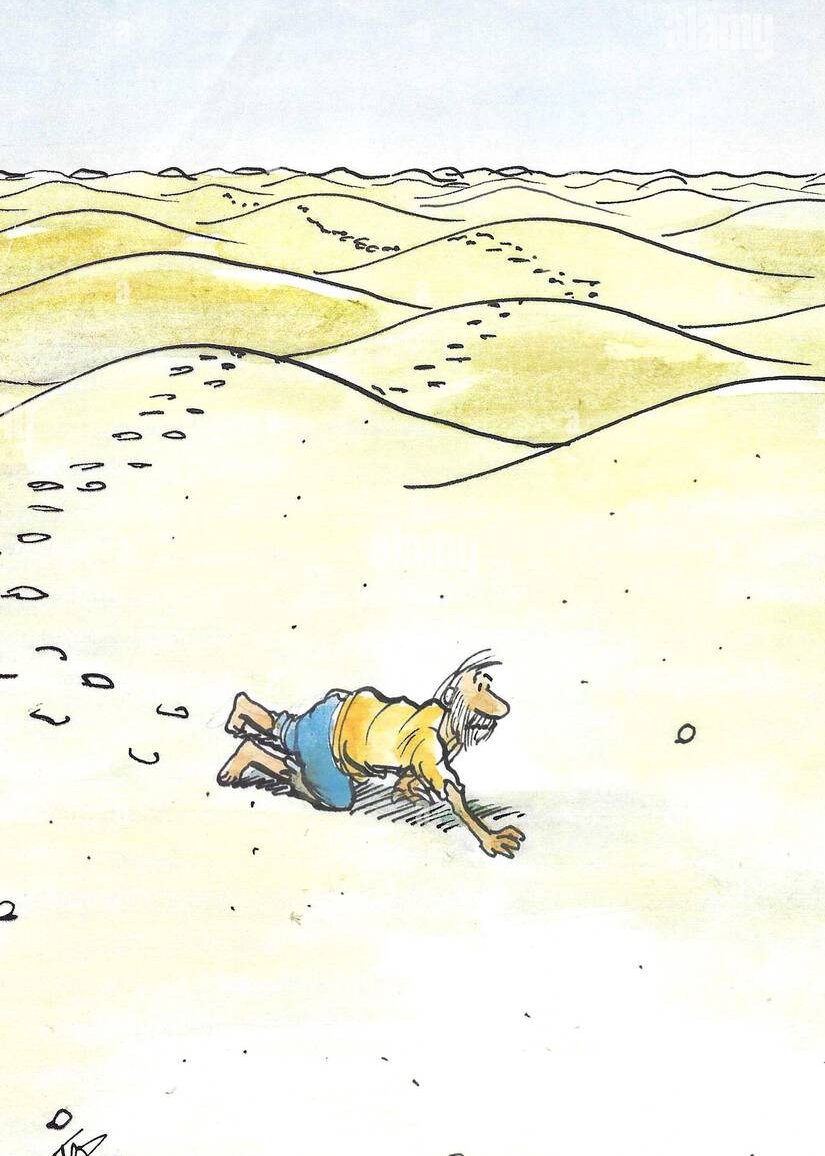
There is so little photographic record of Spanish Flat that I’m forced to employ this cartoon.
The early years of the Gold Rush in this region were characterized by placer mining–essentially collecting gold that lay on the surface of the land, usually in current and former creek beds. Spanish Flat was evidently a rich source of gold, and it grew into a sizable community. Then, after the easy pickings played out, the miners moved on to other areas, and Spanish Flat’s population rapidly declined. On several occasions–most recently in the 1930s and 1940s–it experienced a resurgence as mines were dug deep into the ground. But these veins played out as well, and Spanish Flat eventually became a sleepy, rural hamlet that subsists on ranching and farming.
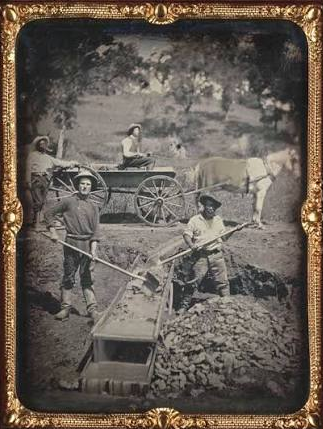
These days, Spanish Flat is notable only for this famous Gold-Rush era photograph.
Allow me to quote from Doug Noble, whose blog (“Doug Steps Out”) is quite informative:
The name of this town is known world-wide because of a single daguerreotype (photograph) entitled, “Miners at Spanish Flat, El Dorado County”, that appears in nearly every book about the Gold Rush. Attributed to an early photographer name Joseph Blaney Starkweather, the often printed photo shows four miners, two of whom are black, working together in what appears to be conditions of equality. The original of this photo is kept at the California State Library and was prominently on display at the Oakland Museum’s Sesquicentennial of the Gold Rush exhibition a few years ago. It is believed to have been taken in 1852.
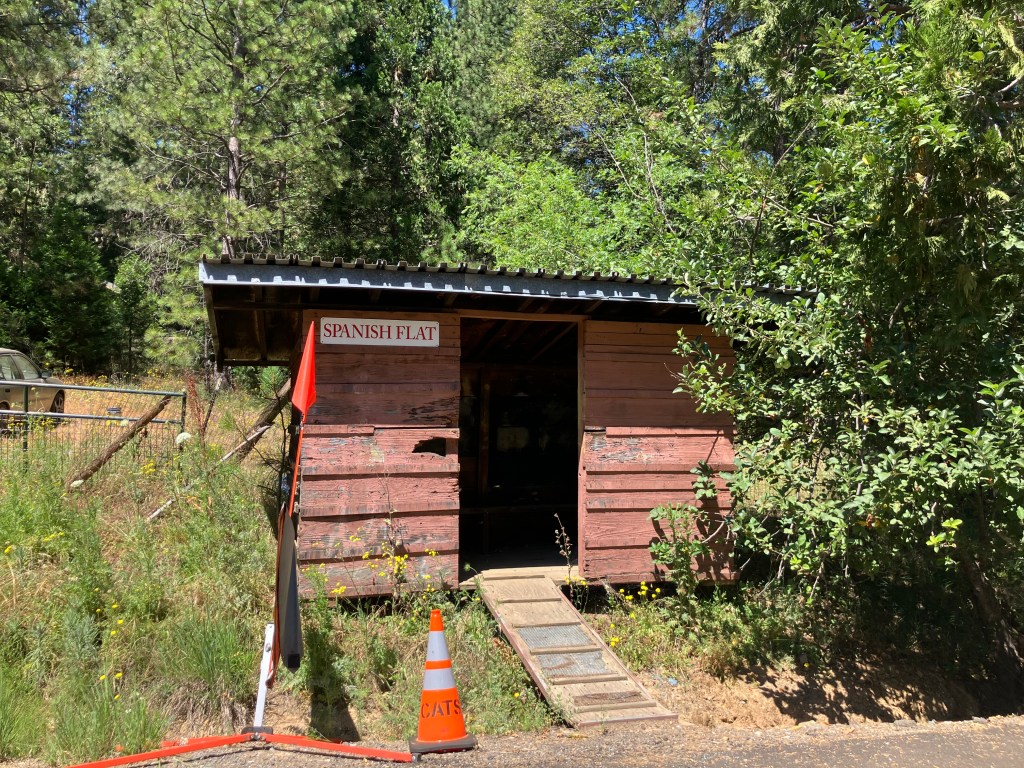
But that was all over 170 years ago. Today, there is no real “town” that I could see–no city offices, no fire station, no businesses of any kind. Just some scattered houses and this old, mysterious cabin that might once have been anything from a bus shelter to a multi-seat outhouse.
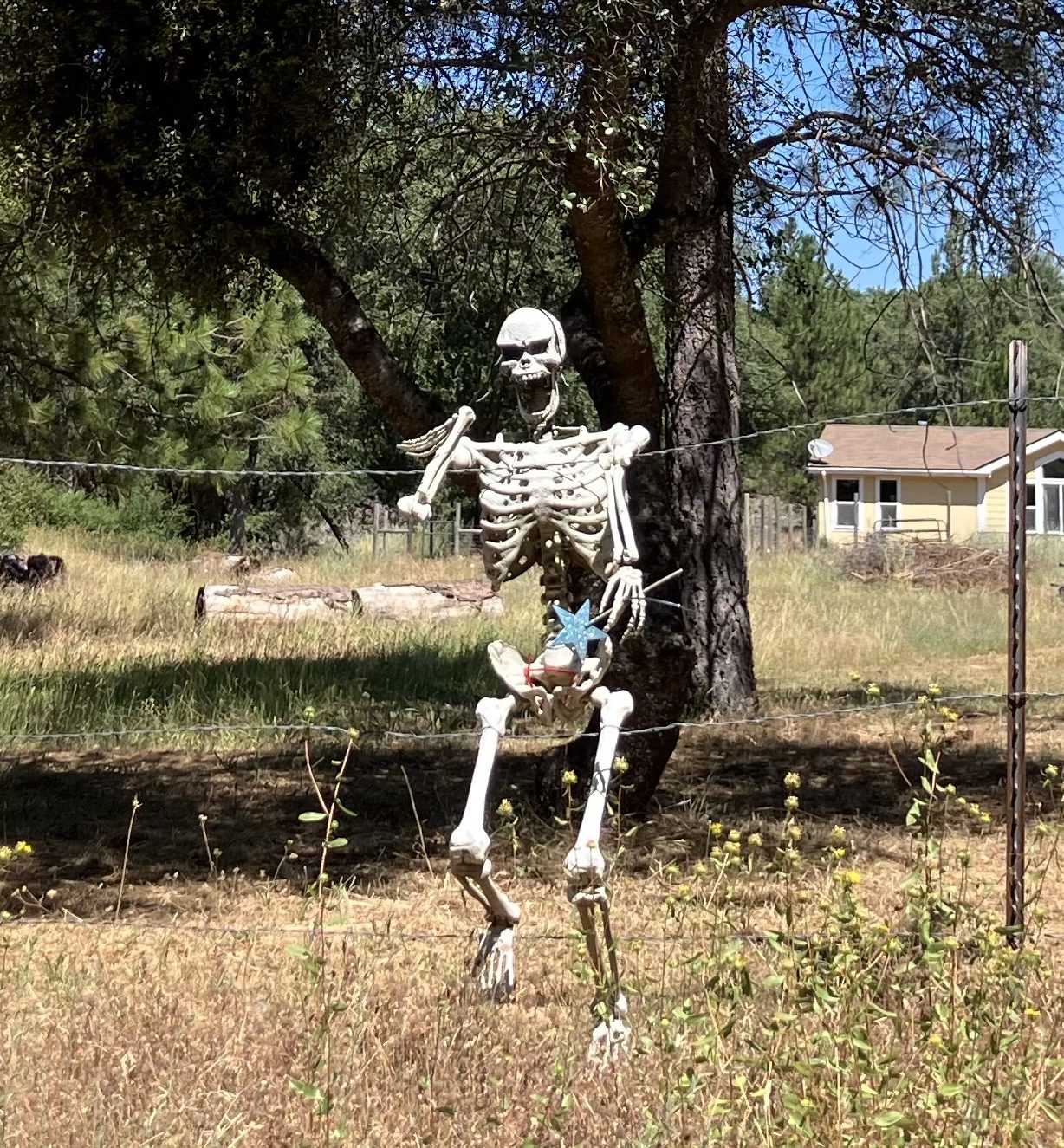
Now, I always feel a little uncomfortable dropping into remote areas like this, where few nonresidents are ever spotted traversing the narrow road. I know that many small communities are actually quite welcoming, but here I spotted a few less-than-friendly signs:
Admittedly, the fairy wand does somewhat mitigate the sense of menace.
The ties that bind…
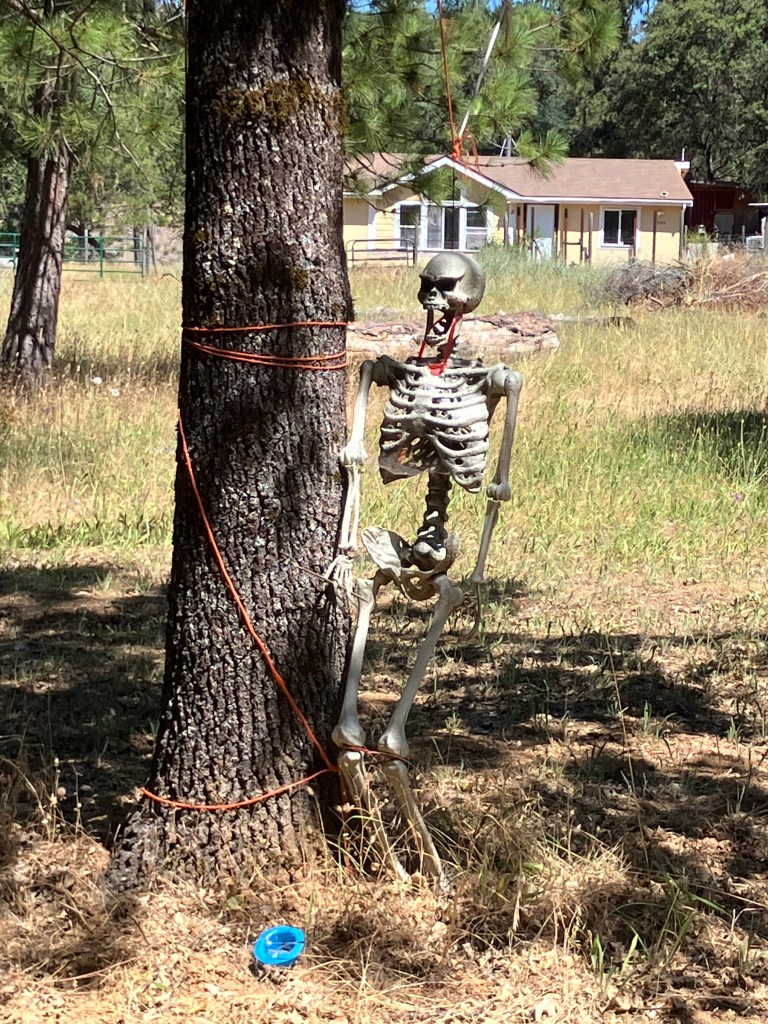
I must say that I didn’t see anywhere near enough houses to shelter the supposedly 8,000 residents of this tiny village. But assuming that they’re hidden away in the hills and hollers, it becomes obvious that these people rely mightily on the one or two paved roads that connect them with Highway 193 and beyond. This was on my mind as I cruised along Traverse Creek Road, which is one of the only two roads worthy of the name that cut through Spanish Flat. It dips and turns through stands of oak, manzanita, and toyon, and several times it crosses the eponymous Traverse Creek, which feeds into the south fork of the American River. It was then that I felt an appreciation for the nameless workers and bureaucrats who are responsible for this narrow ribbon of infrastructure. I doubt the county gives Traverse Creek Road a lot of regular attention, but it’s a blessing that it’s there at all, providing a vital like to civilization for the skeleton-flaunting residents of Spanish Flat.
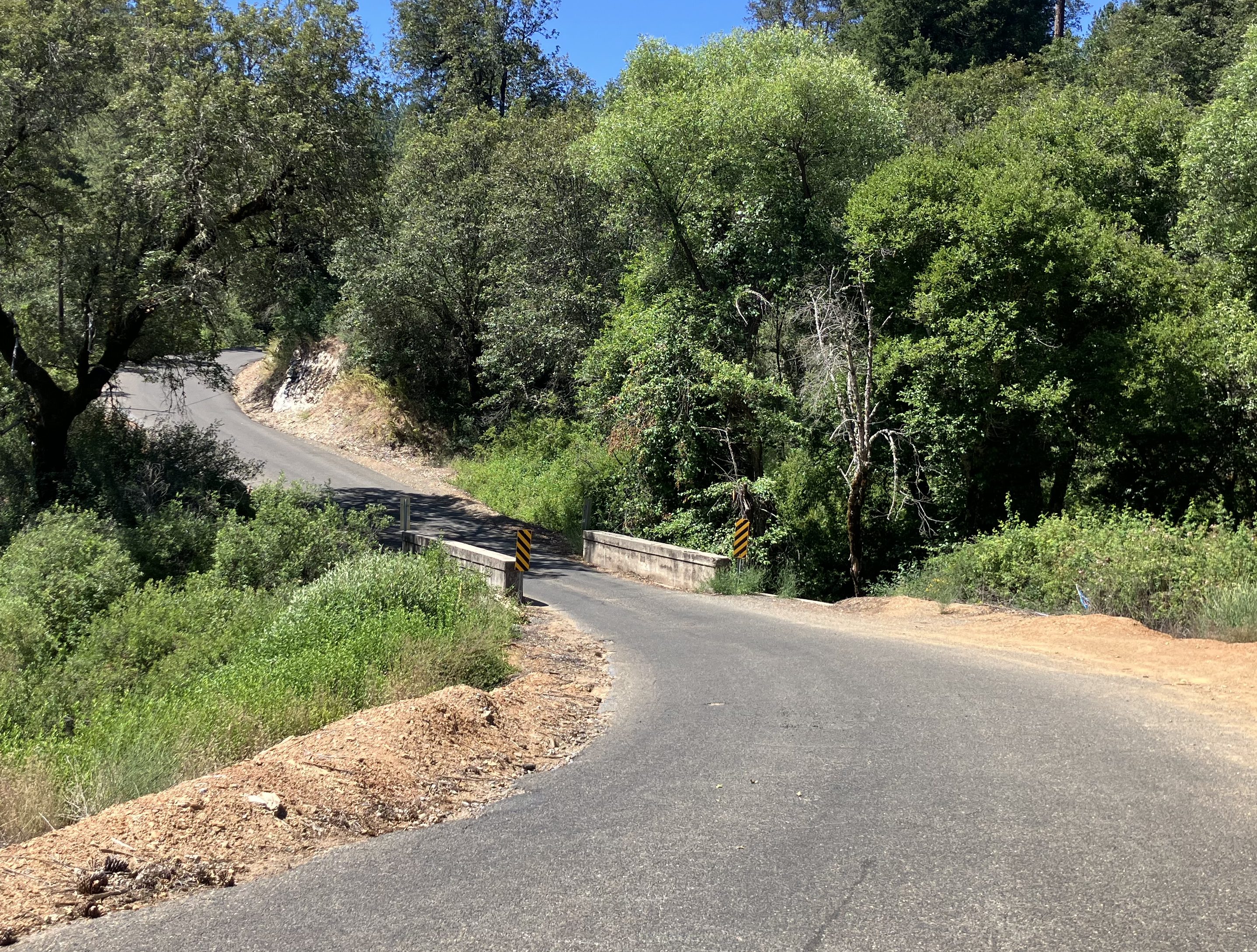
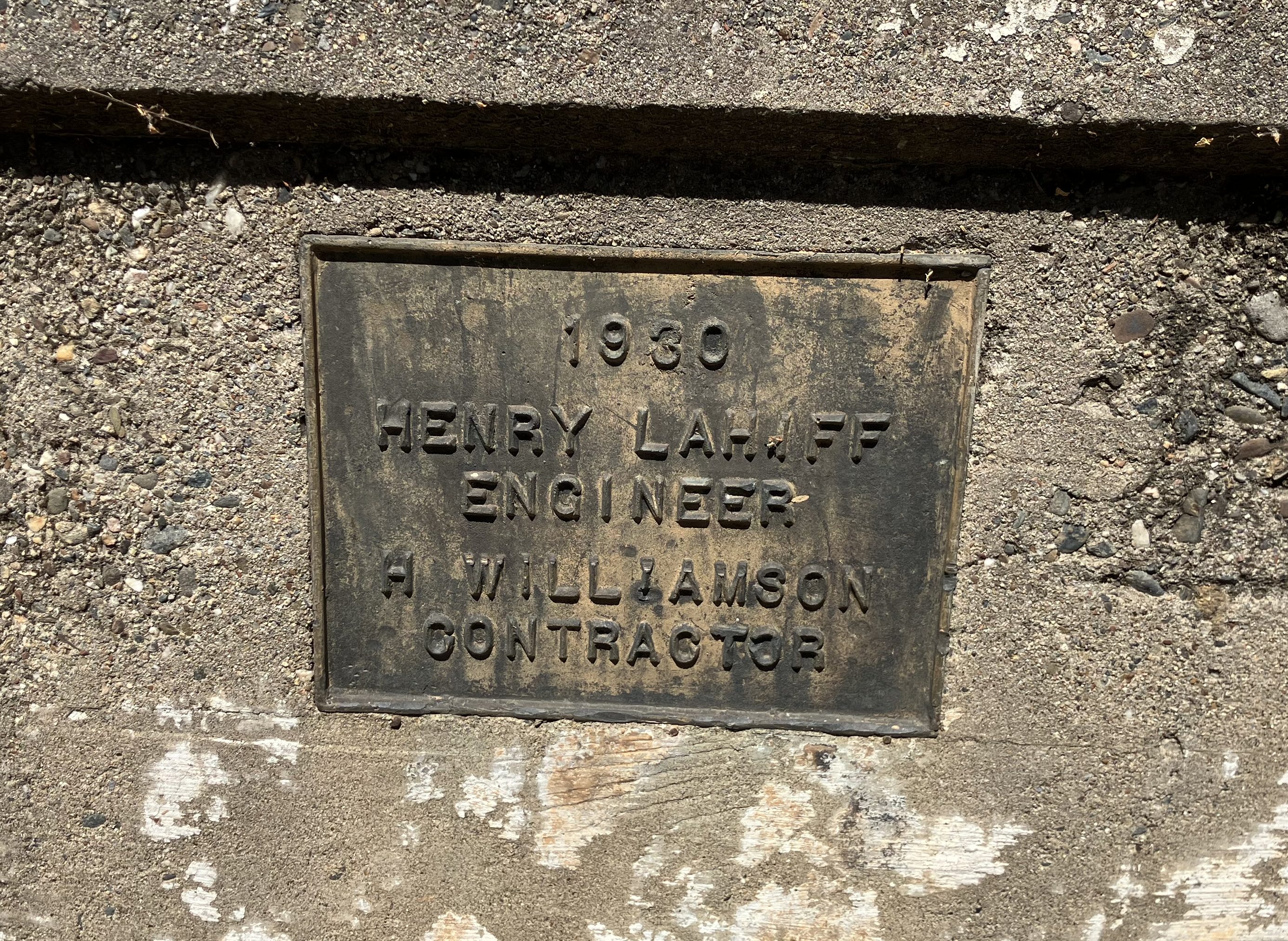
Oh, and did I say “nameless bureaucrats”? The exception that proves the rule is Henry Lahiff, the engineer responsible for a modest, one-lane bridge on Traverse Creek Road.
Bridge over Traverse Creek.
Henry Lahiff (1868-1954) was an Irish immigrant who settled in Placerville after the Gold Rush, and became the US Deputy Mineral Surveyor in the area, as well as the El Dorado County Surveyor. He’s responsible for a number of bridges in the region, and in the 1930s seems to have developed the habit of having his name affixed to each one. (Note that in my earlier Highway 193 trip I called attention to one of Lahiff’s bridges.)
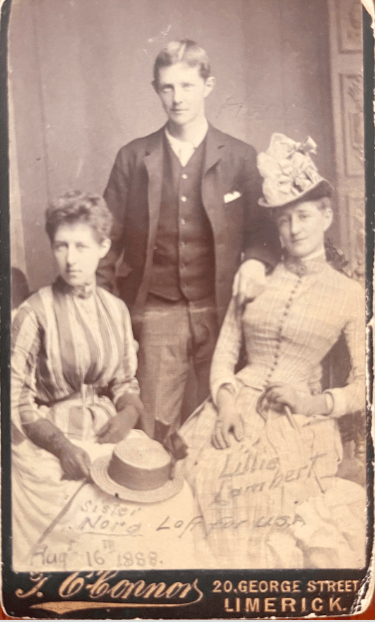
Henry seems to have been quite capable in his work, which we still use today. He was also something of a stud.
Henry with his sister Nora (left) and some floozy named Lillie Lambert.
Anyway, my point is (1) that Spanish Flat is one of those many Gold Rush-era settlements that once held economic and social significance but today exists as a pale shadow of its former self, and (2) God bless Henry Lahiff and the myriad other public works professionals whose efforts from a century (or more) ago we still rely on in our so-called modern lives.
Now that I’ve managed to claw my way out of the Mojave desert, I thought I’d post a few additional photos that didn’t fit neatly into my scintillating narrative. Maybe think of these as “bonus features.”
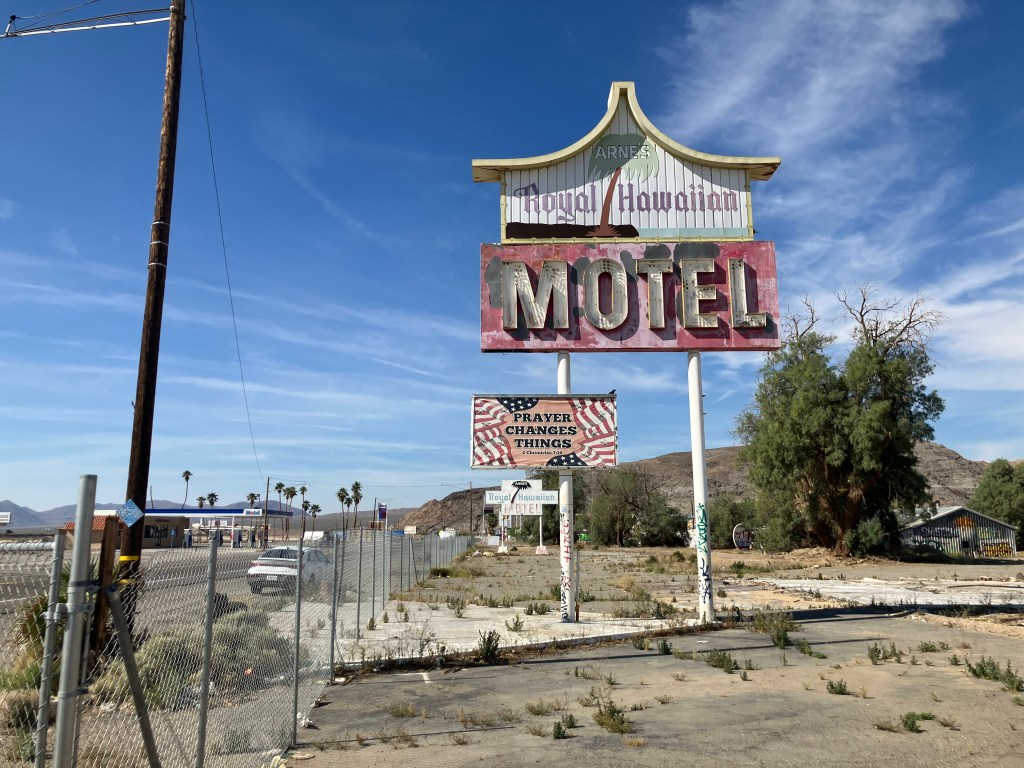
This first photo is of the Royal Hawaiian Motel in Baker, CA…which is not royal, not Hawaiian, and not even a motel anymore. It opened in 1957 and closed in 2009. It sat vacant until just last year, when the building was demolished. I’m told that, just before it was demolished, it appeared in the Amazon Prime series “Fallout” (Season 2, Episode 1). But I can’t vouch for that, as I haven’t watched TV since they cancelled Happy Days.
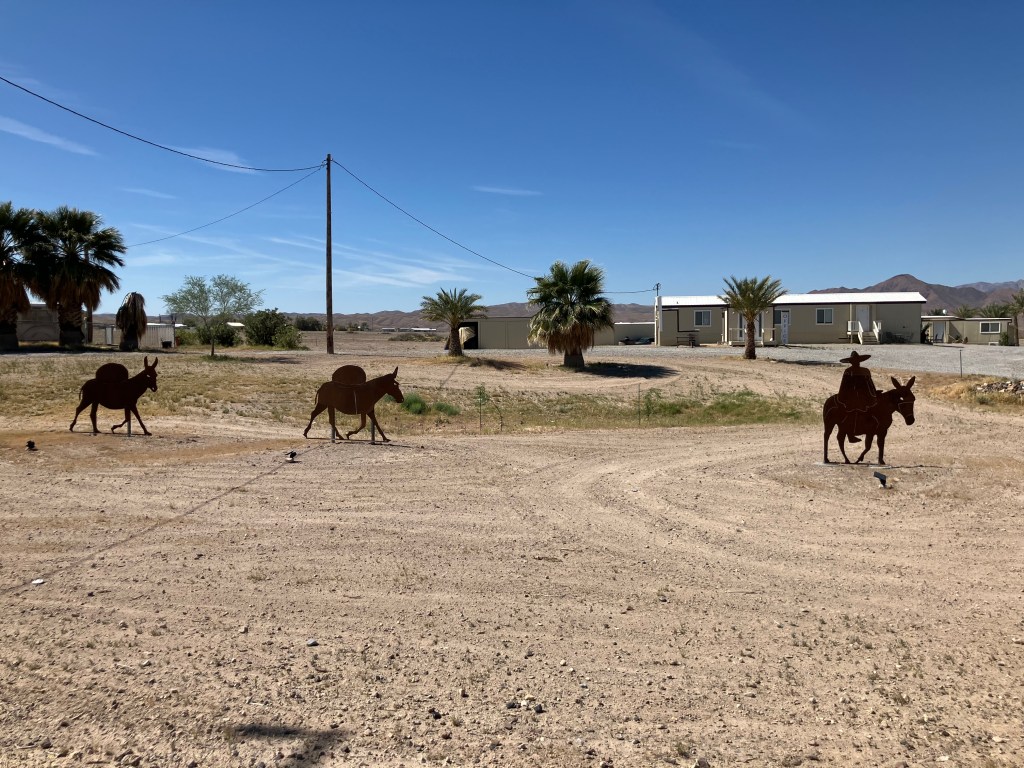
At first I thought the art installation featured here was the three wise men. But the “camels” are actually mules (donkeys? burros?) with packs on their backs. I took this photo near the Old Spanish Trail in Tecopa.
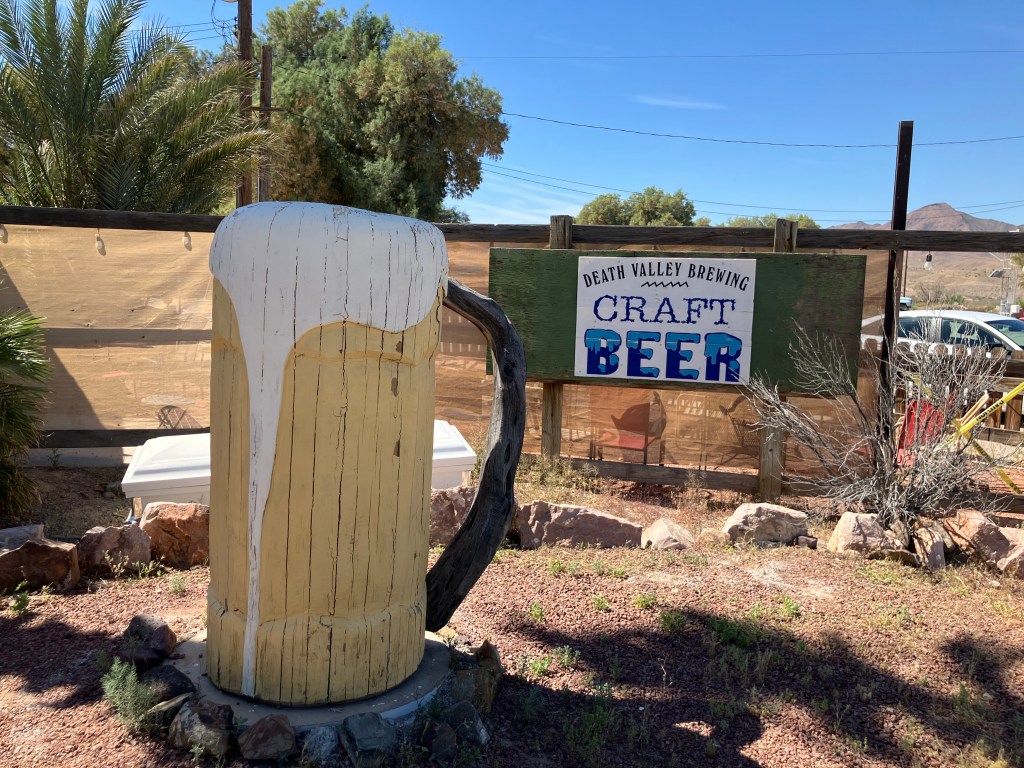
This beer mug is crafted out of wood. I guess that’s why I took the photo. Sorry–I don’t have any other info on this.
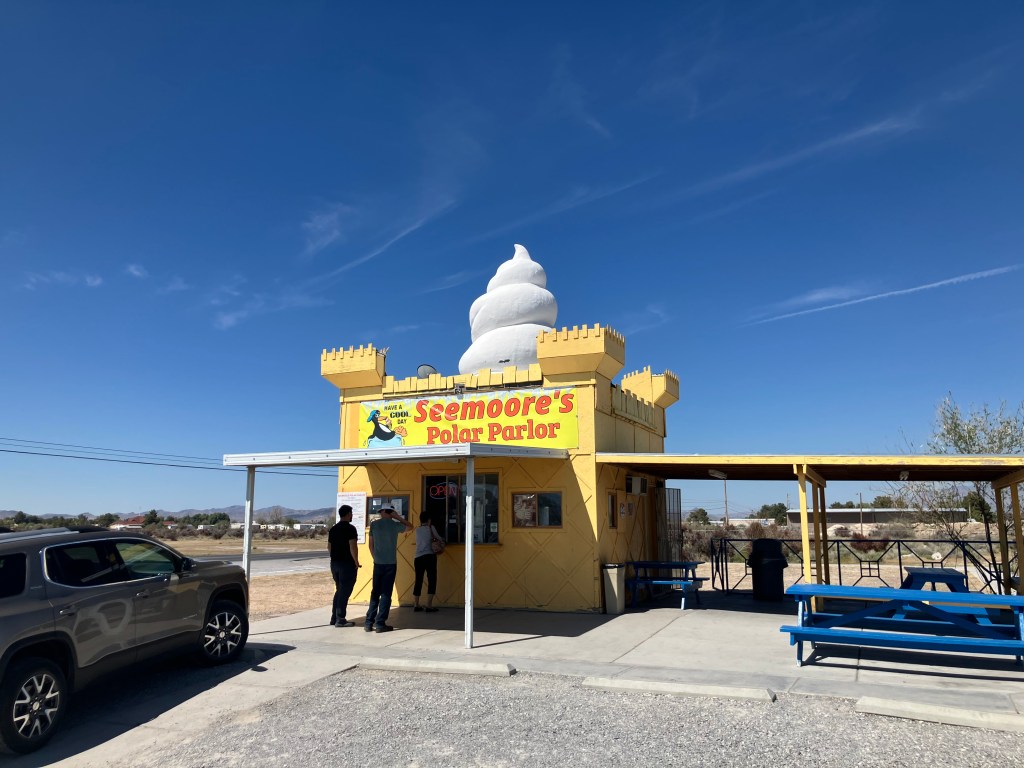
Seemoore’s Polar Parlor sits on the main highway into Pahrump, NV. A nice, cold softserve is of course welcome in the desert. But Seemoore’s real claim to fame (according to the teenager serving me at the window) is that it’s the “world’s tallest ice cream stand.” I expressed my incredulity, for this place is barely two stories tall. His deadpan response: “Yeah, but all the other ones are one story. They don’t have a giant ice cream on the top.”
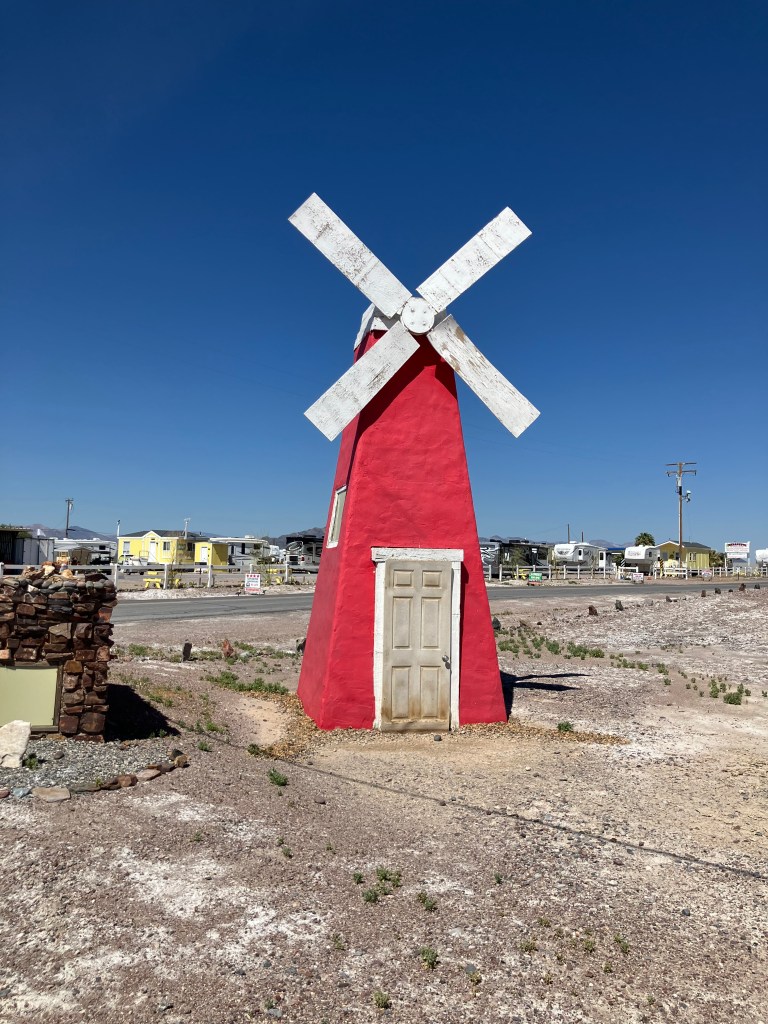
Unexplained “windmill”in Tecopa Hot Springs.
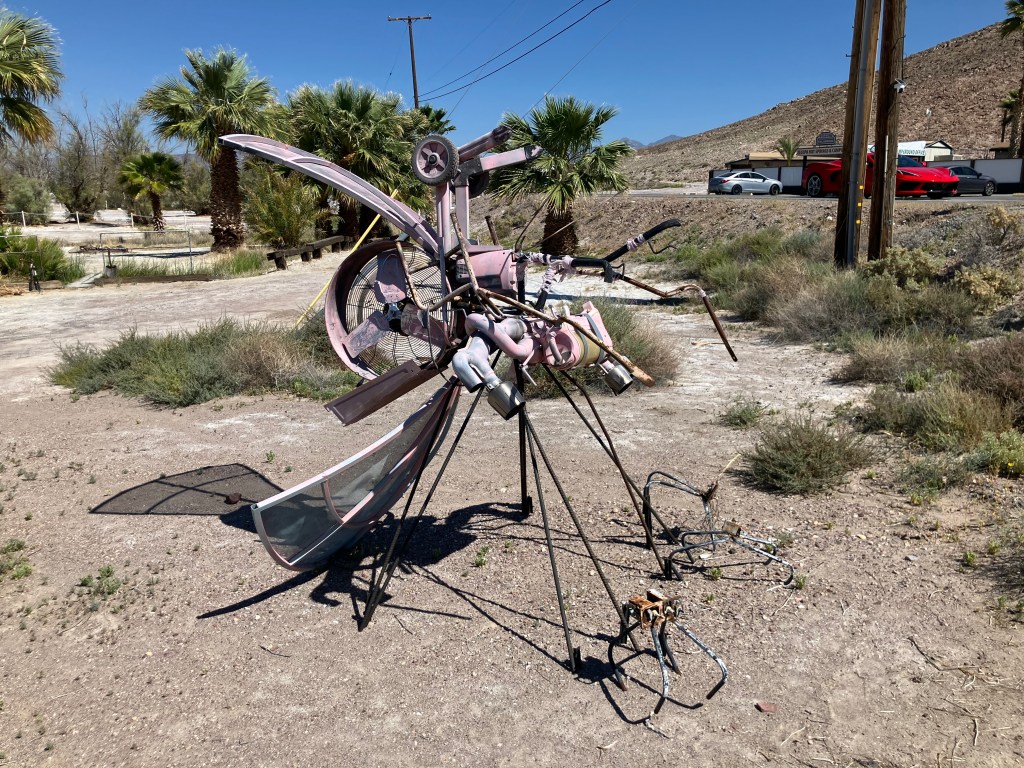
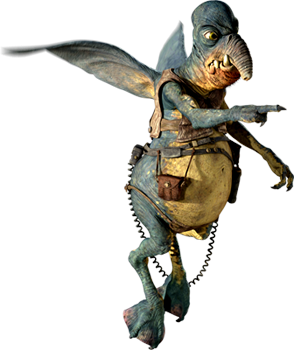
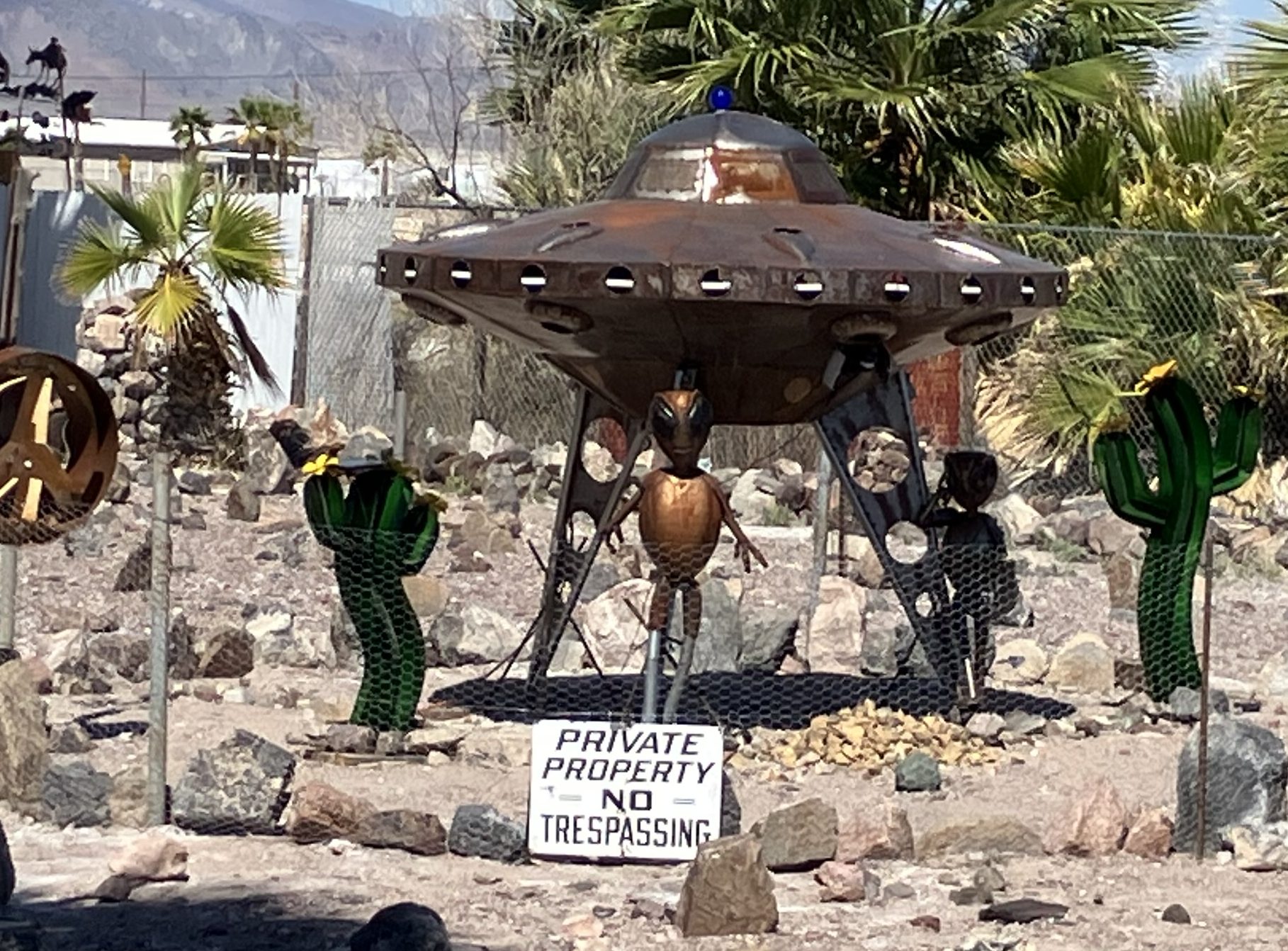
I’ve commented before that people in the desert have a special talent for yard art. I’m not sure what this is supposed to be–Maybe Watto from Star Wars Episode 1?
Speaking of aliens and yard art…
Sticking with the alien theme a little longer, these were advertised at the Alien Fresh Jerky store Baker. Sadly, they were out of them when I was there.
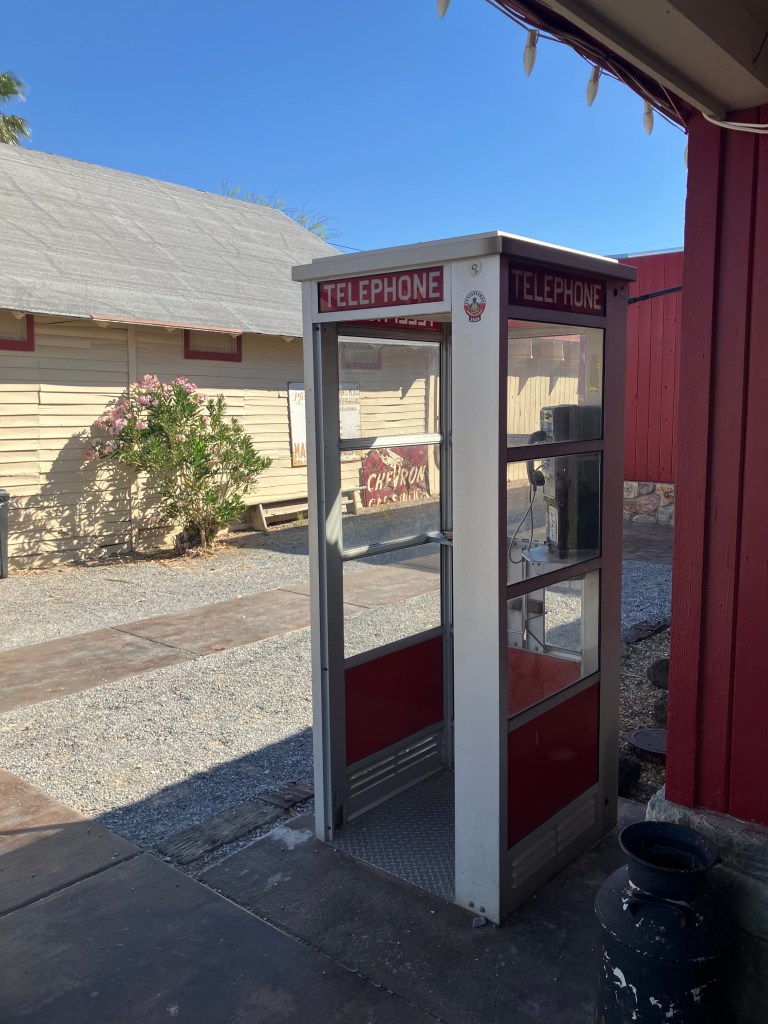
Younger readers might not recognize this photo. In the old days, people would actually go inside these glass boxes, deposit little metal discs called “coins,” and make a phone call from a clunky “handset” connected to a wire. This phone was still intact, but there was no dial tone. It got me wondering if there are any working pay phones anymore.
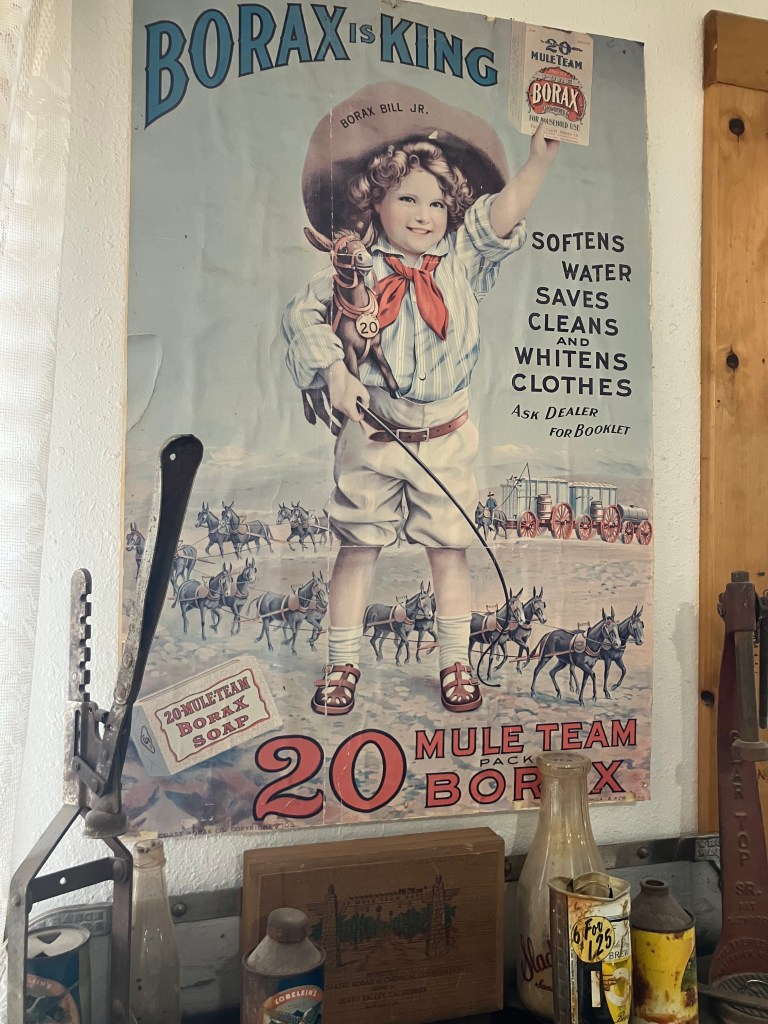
Another of the many advertisements for borax that one encounters around Death Valley.
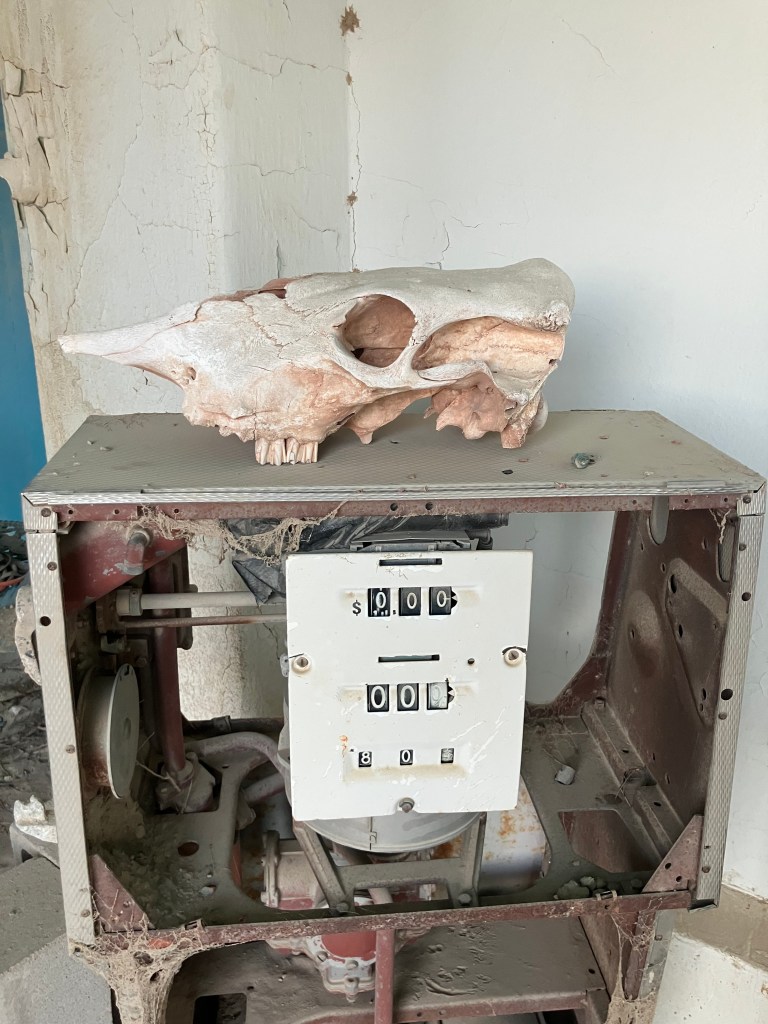
This may or may not be an example of desert folk art.
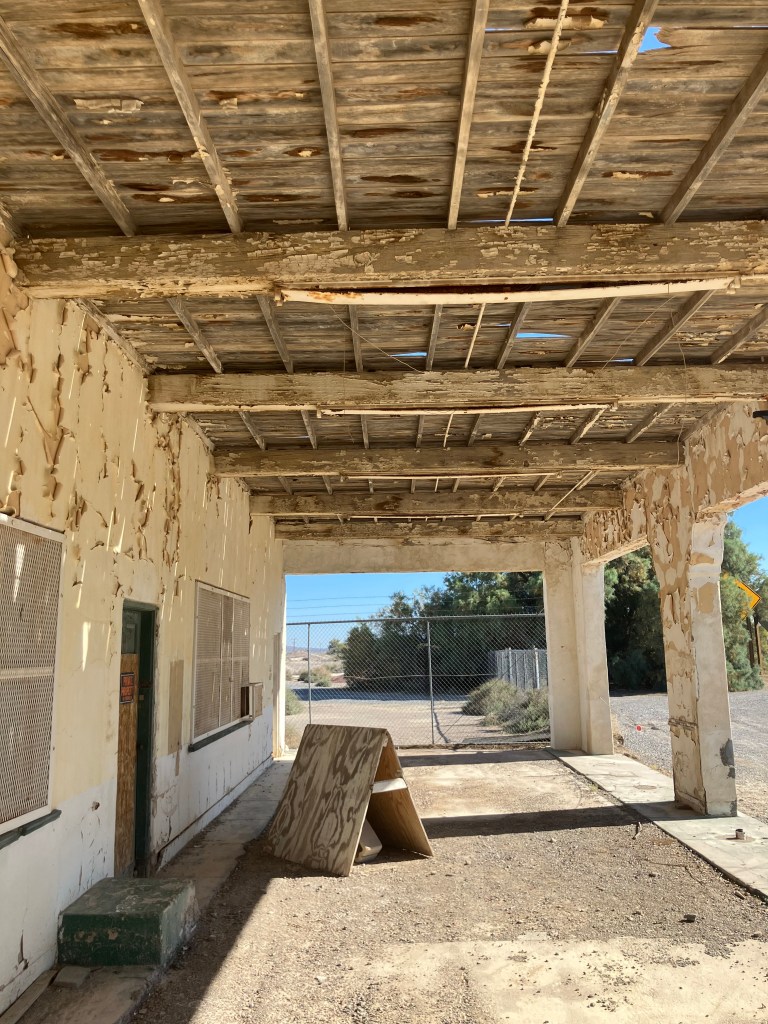
The covered porch of the service station at Death Valley Junction where Marta Becket had her car repaired and envisioned the Amargosa Opera House.
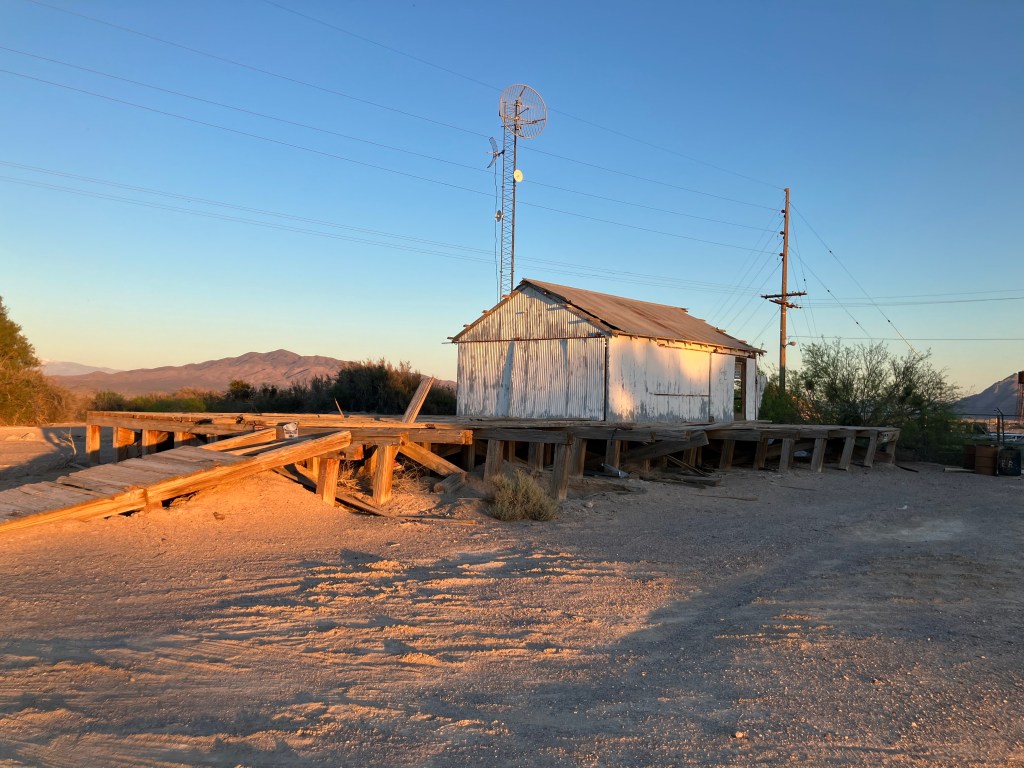
Finally, here’s the borax loading dock at Death Valley Junction/Amargosa. I just liked the lighting.
Thus concludes my Mojave trip. Mark your calendars for my visit to the Republic of Molossia on April 25. Until then, remember: Borax is King!