My hotel for last night was in Pahrump, NV, and when I checked in, the desk clerk explained the town is pronounced “paw-RUMP.” And so, when I awoke this morning, a Christmas carol was running through my head: “Pa-rump-a-pum-pum…”
I was eager to make the 25-minute drive back to Shoshone and finish my trip along CA-127. But first I settled onto a Pahrump park bench and enjoyed my coffee and muffin in the warm morning air. But what’s this? Next to my bench was a plaque commemorating Pahrump favorite son Art Bell.
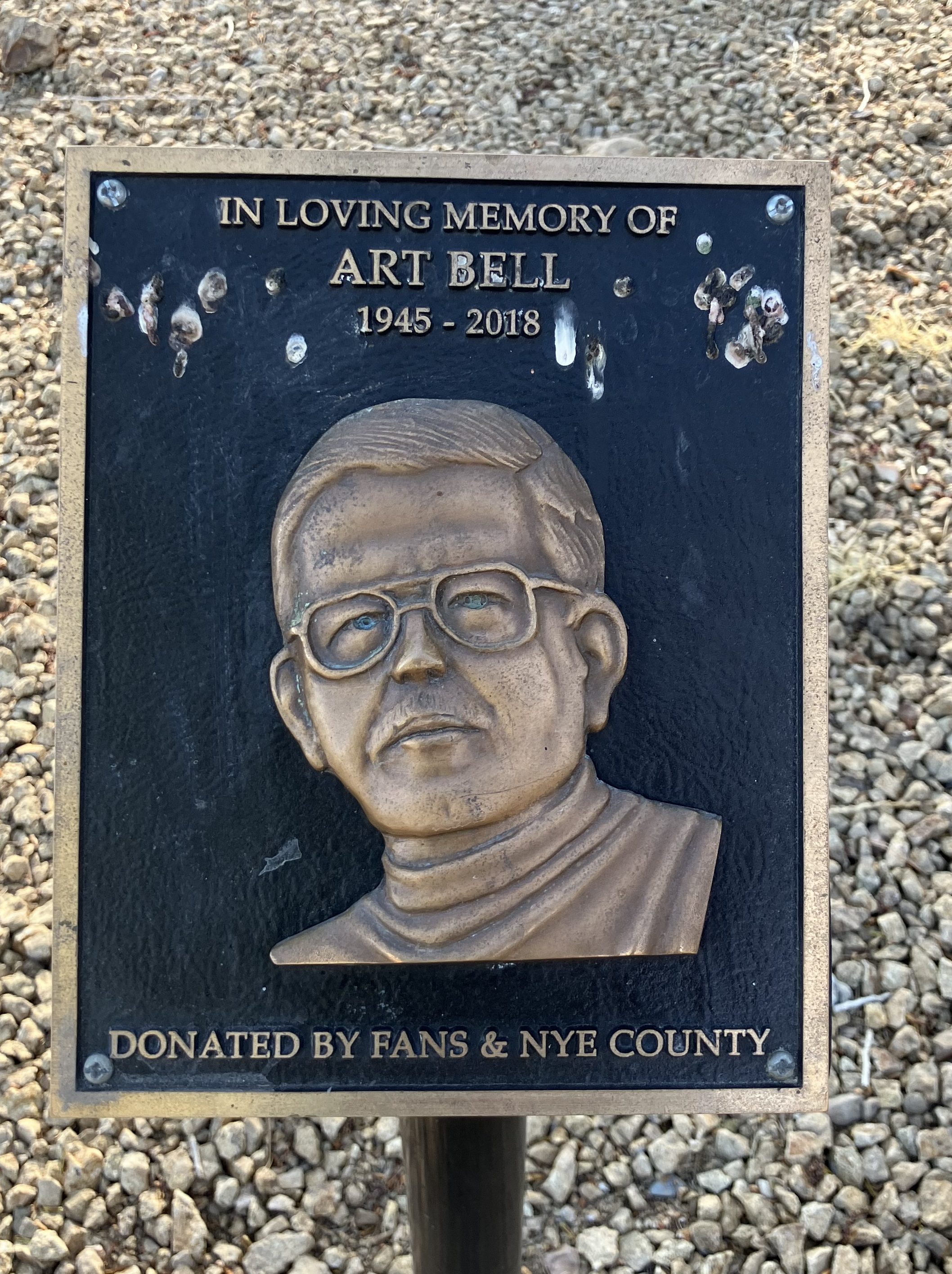
Why was his name familiar? I pondered a bit, then recalled he’d been mentioned by Sue at the Amargosa Hotel on the first night. Sue had explained she’d spent years working in radio, and was always intrigued by a guy who used to broadcast a paranormal- and conspiracy-related radio show from his home “compound” in Pahrump. That man was, of course, Art Bell. Sue was born in Canada and her career moved her around a lot, but because Art Bell had a strong transmitter (or maybe just because his show was syndicated), Sue was able to listen to him wherever she lived.
Art Bell was a complicated guy. Sure, we are all complicated, but Art was especially so. He definitely trafficked in conspiracy theories, but it’s unclear how much of it he actually believed. He set records, won awards, and had a huge influence upon the medium of radio from the 1970s until his death in 2018. He was married four times and had many children. There’s far too much to go into here, but if you’re interested, check out his Wikipedia page. But remember his name; we’ll come back to it.
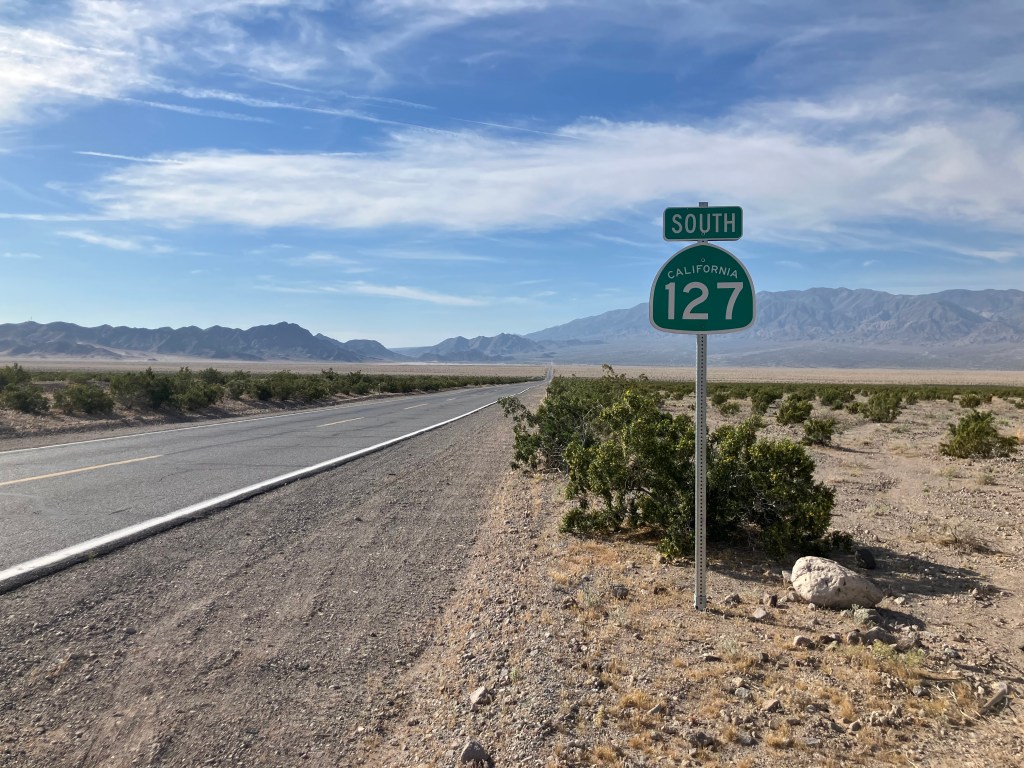
After I finished my coffee with the graven image of Art Bell, I returned to Shoshone and resumed my southward journey along CA-127. It was a relaxing and uneventful drive, as there was nothing but desert to be seen for about 50 miles.
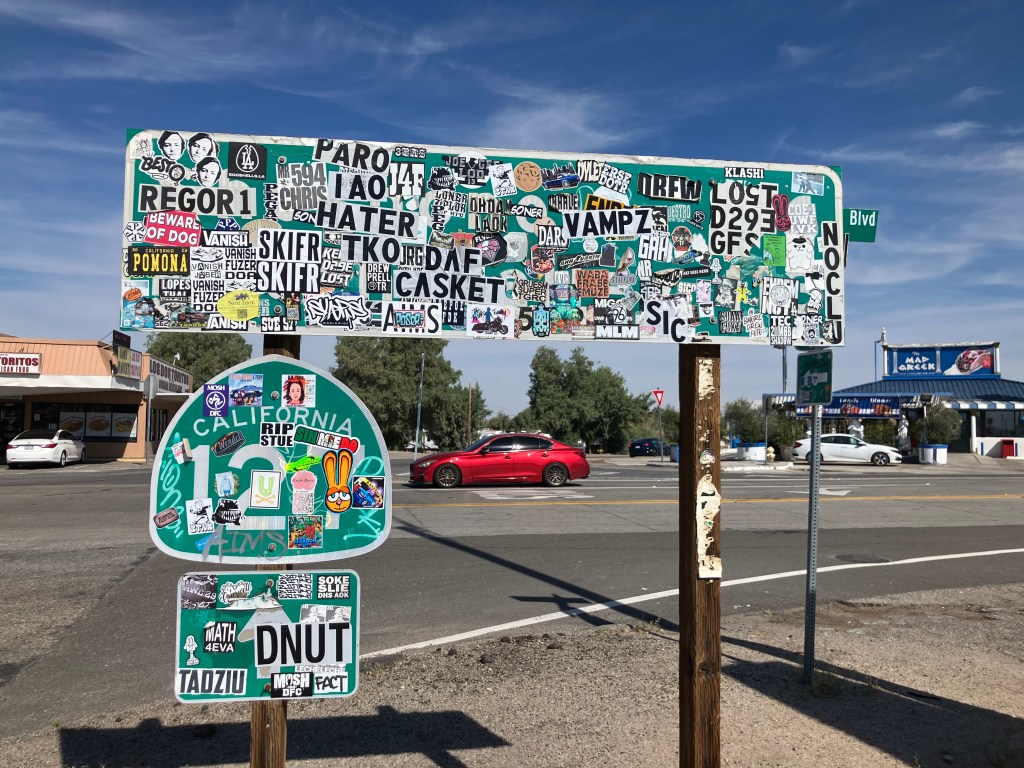
But then, just as I was reaching the highway’s southern terminus, I entered the town of Baker, CA (pop: 480). Like the other towns on CA-127, Baker owes its existence to the Tonopah & Tidewater Railroad and to “Dad” Fairbanks. And because Baker is situated where CA-127 meets Interstate 15, it benefits from significant tourist activity.
Sadly, there was no sign marking the End of CA-127 South. The closest approximation is the first Northbound sign, and it’s been obliterated by stickers. (I guess this is one of the downsides of having a steady inflow of interstate travelers.)
Deprived of my customary end-of-the-highway photo-op, I had to settle for this alien-themed selfie:
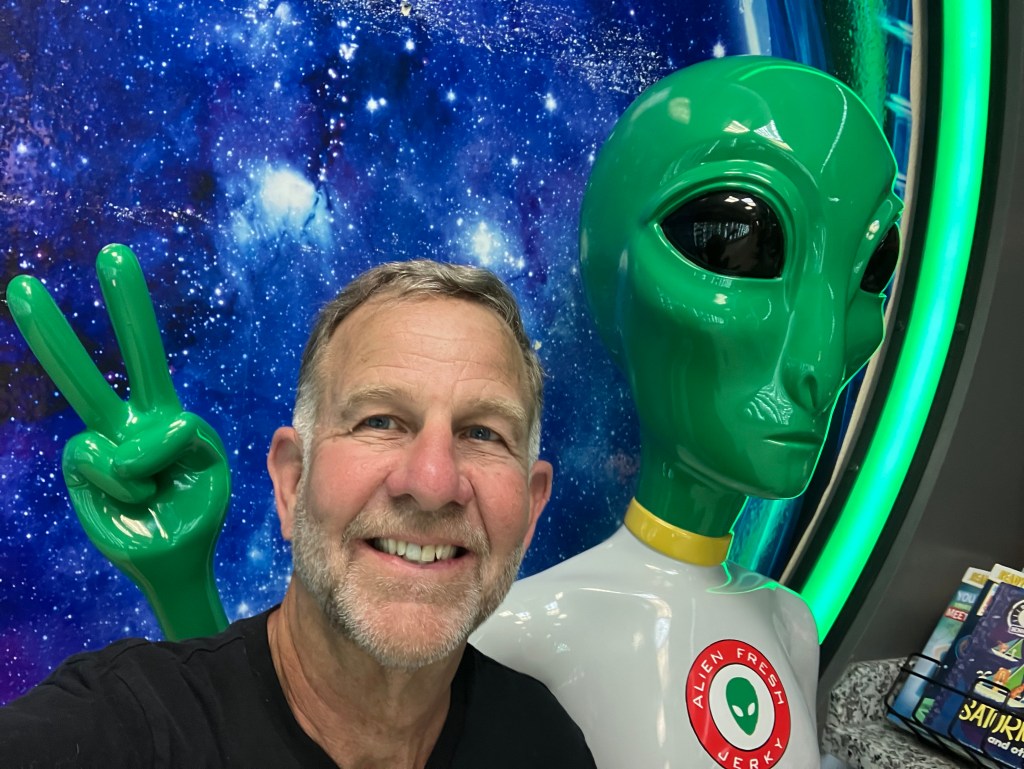
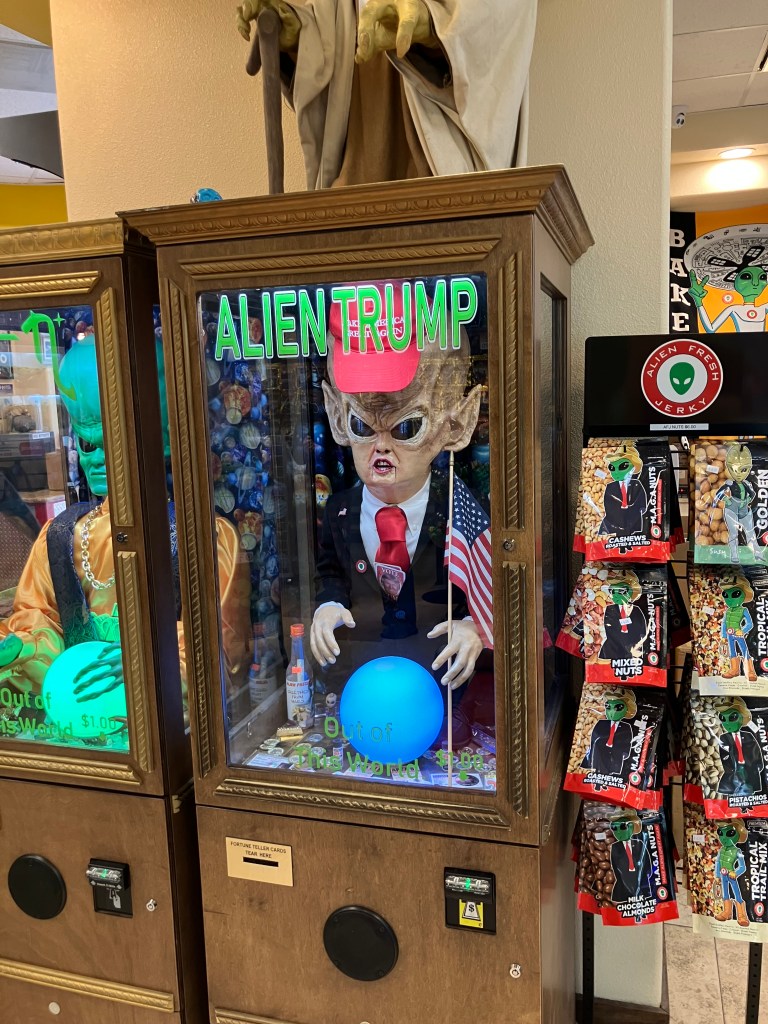
As should be obvious, Baker’s primary tourist draw is an extraterrestrial-themed snack store called Alien Fresh Jerky. The enormous space-fighter(?)-shaped building looms over the main drag.
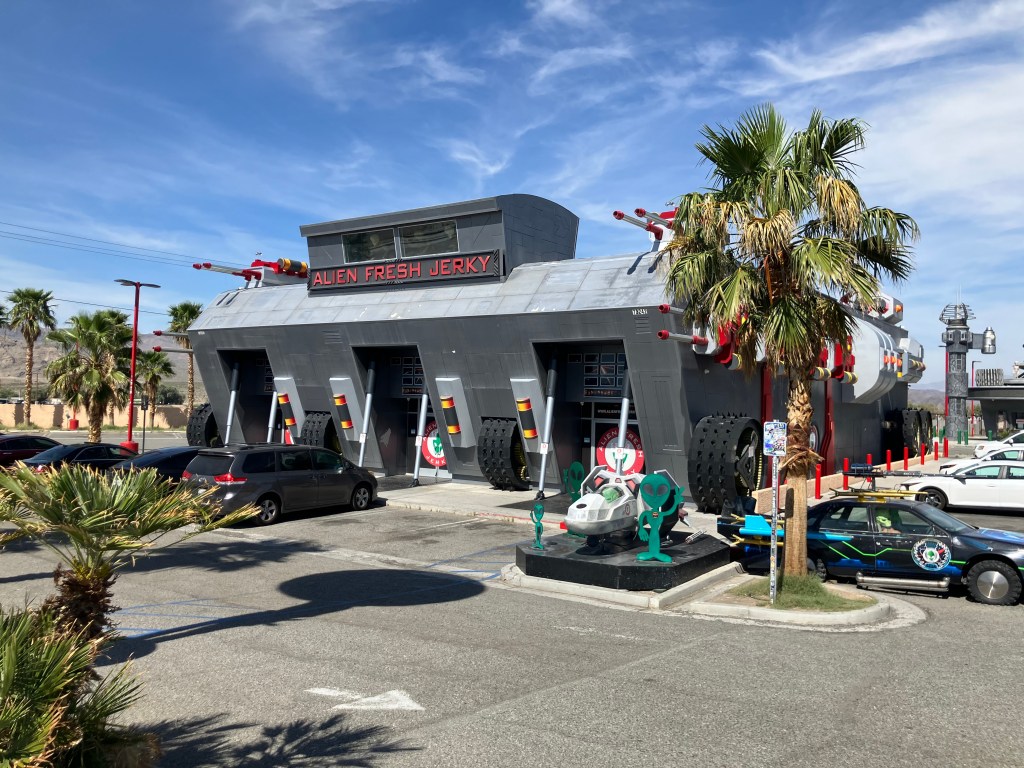
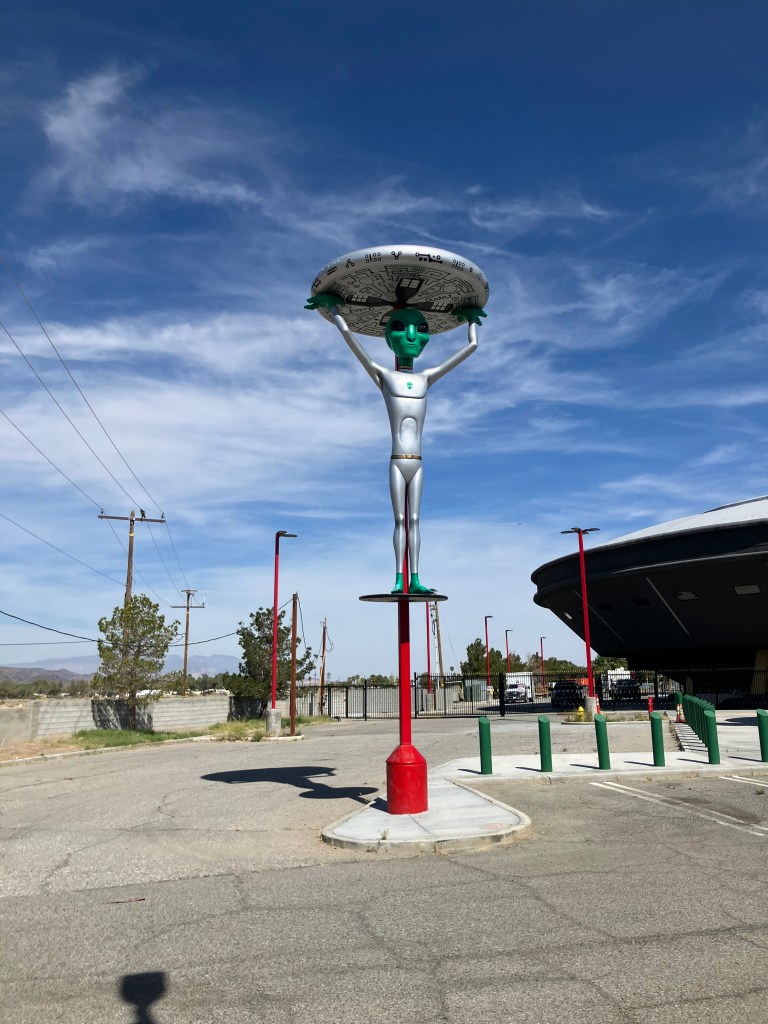
Inside are a million different flavors of beef jerky, as well as alien-themed snacks, sodas, T-shirts, and plush toys. There are also various aliens posing on benches for selfies, and several “fortune-telling” booths.
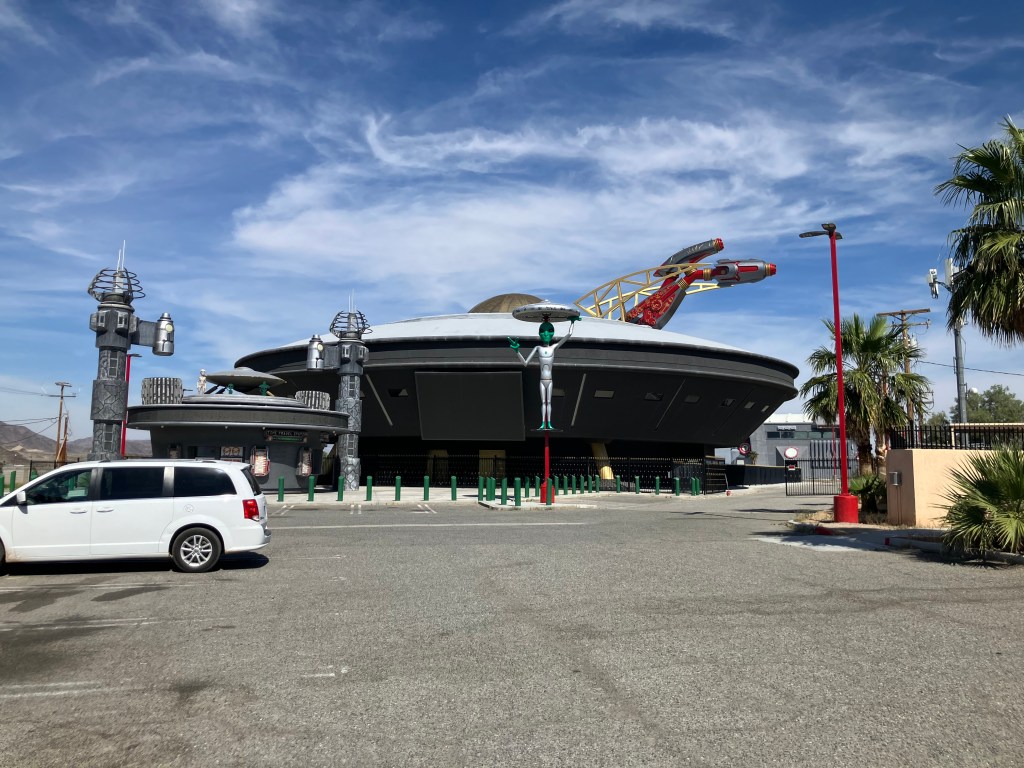
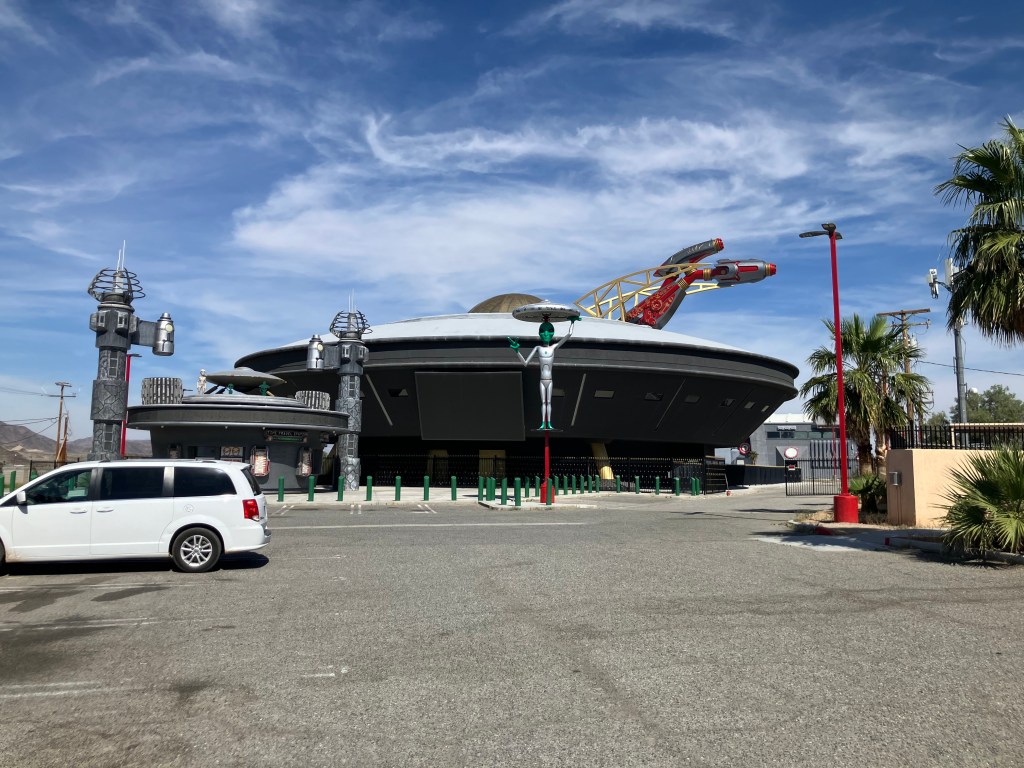
In the back parking lot there’s a giant flying saucer. I’m not making this up. The clerk in the store explained it’s a hotel that, for reasons she didn’t want to get into, hasn’t yet been approved for occupancy. I am so staying there next time I come through.
Across the street from the alien jerky place is The World’s Tallest Thermometer (134 feet!), which was registering a comfortable 82 degrees.
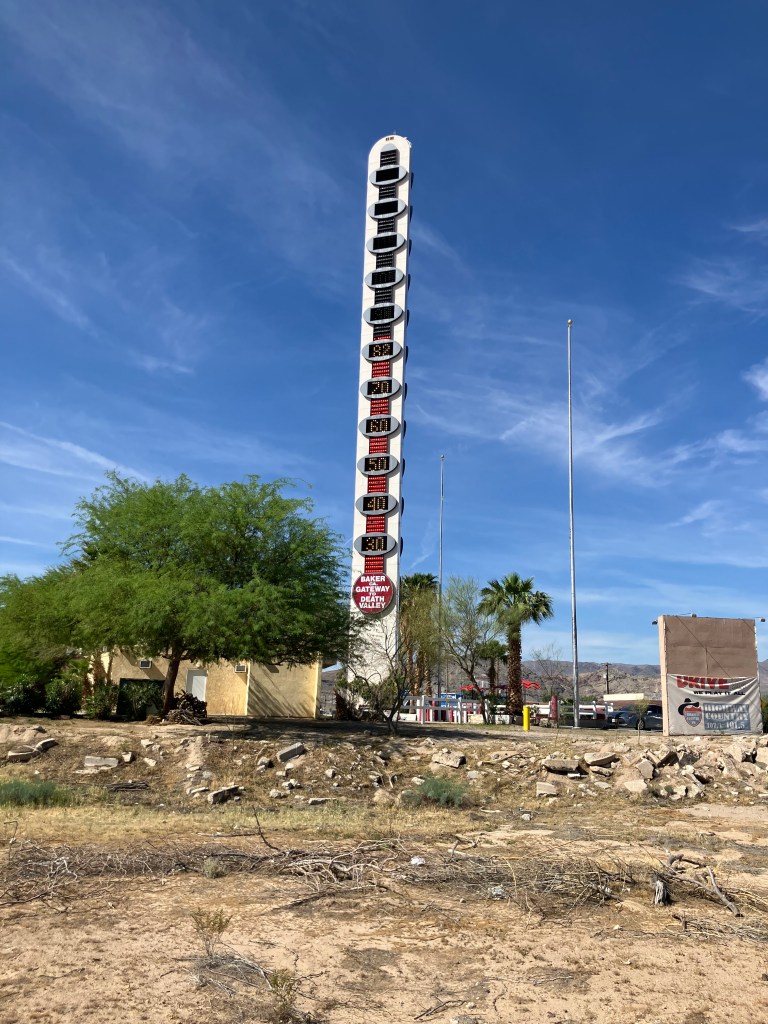
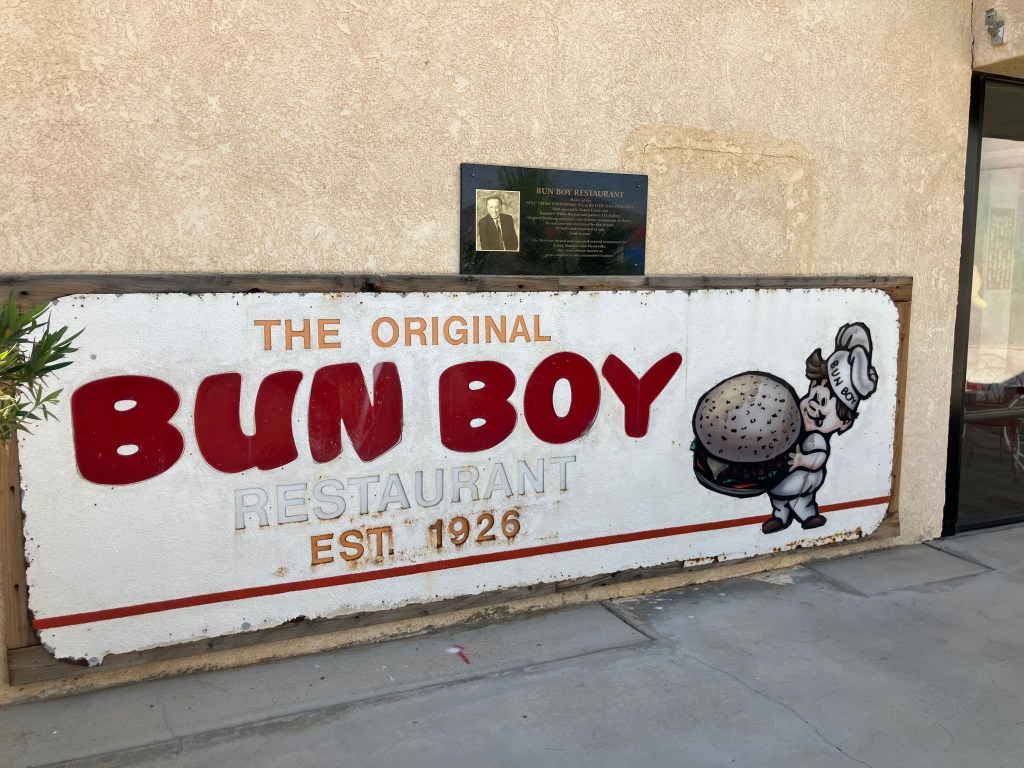
The thermometer was erected by Willis Herron, the owner of Baker’s famous Bun Boy restaurant that used to stand next door.
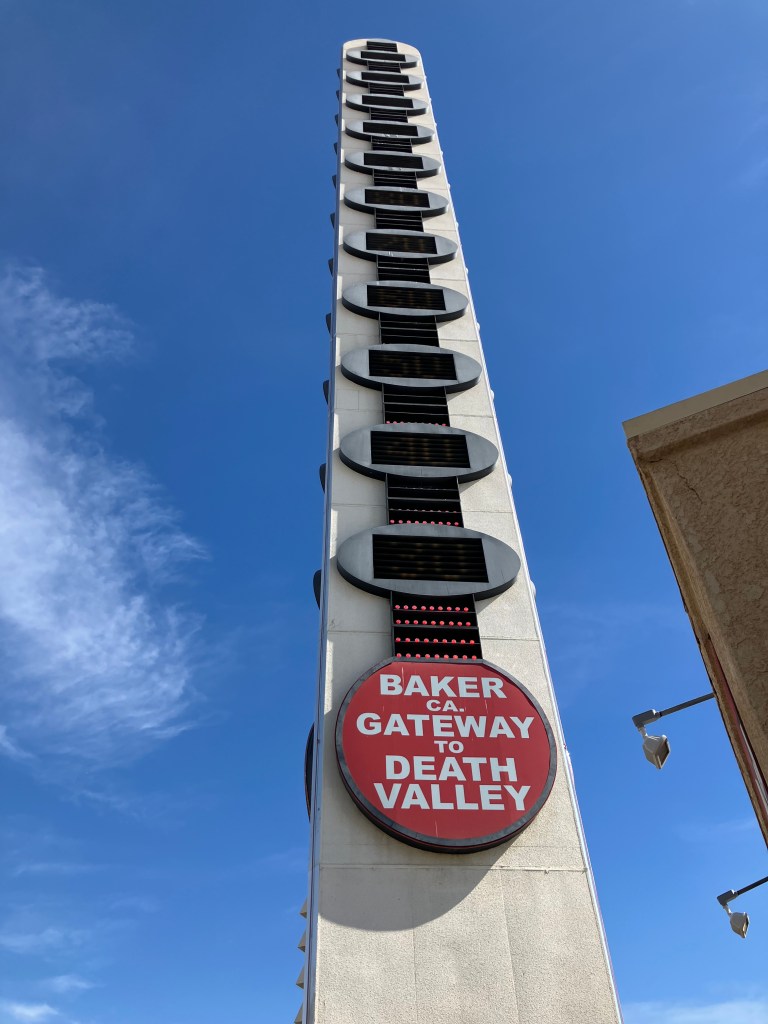
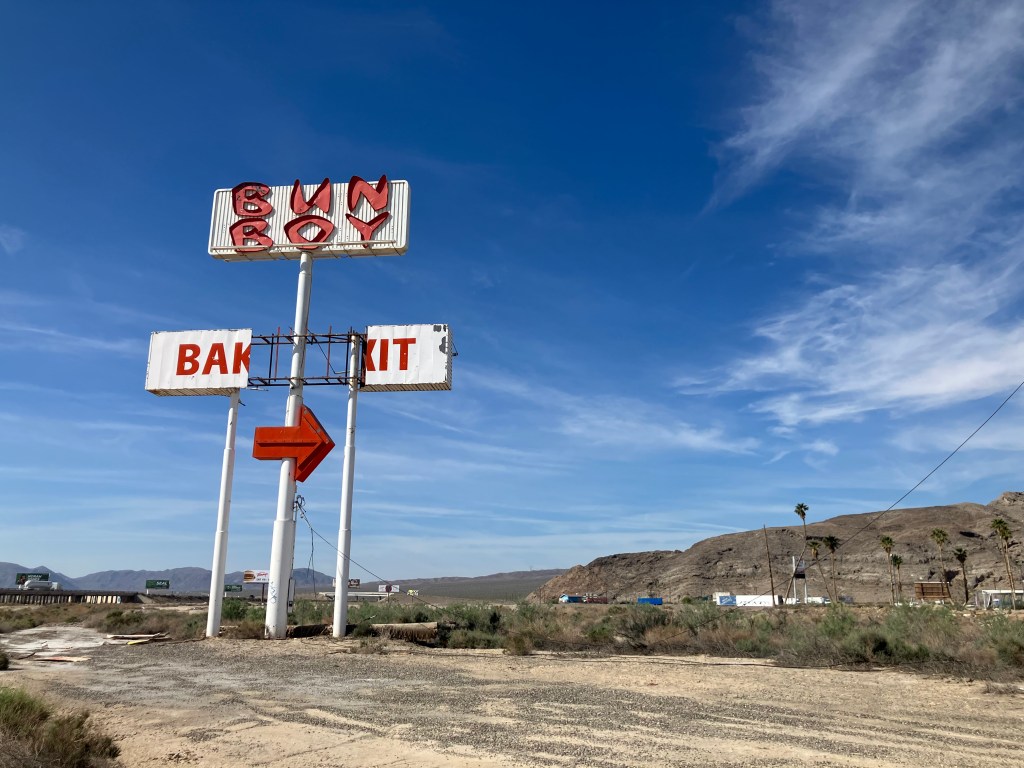
The Bun Boy restaurant had been around since 1926, and Willis bought it in 1956. Things were going well, then it burned down in 1990. Undeterred, Willis had the restaurant rebuilt the next year, but he added the giant thermometer as a gimmicky attraction. This was the state of affairs until 2005, when Willis sold the restaurant and the thermometer.
Willis died in 2007. And sadly, the new owner neglected the thermometer, which began to malfunction and eventually went dark. Even the Bun Boy fell on hard times, and briefly became a Bob’s Big Boy before closing entirely in 2013.
But that’s not the end of the story, obviously. Willis’s widow bought back the thermometer, had it restored, and held a grand re-lighting in 2014. And that’s why I was able to see it today.
There’s a Gift Shop near the base of the thermometer, because of course there is. On the wall of the gift shop is an antique Bun Boy sign.
And, at least for now, a towering Bun Boy sign still beckons travelers on Interstate 15.
And so, lacking a Bun Boy, I decided to have lunch at a different local institution: The Mad Greek Cafe.
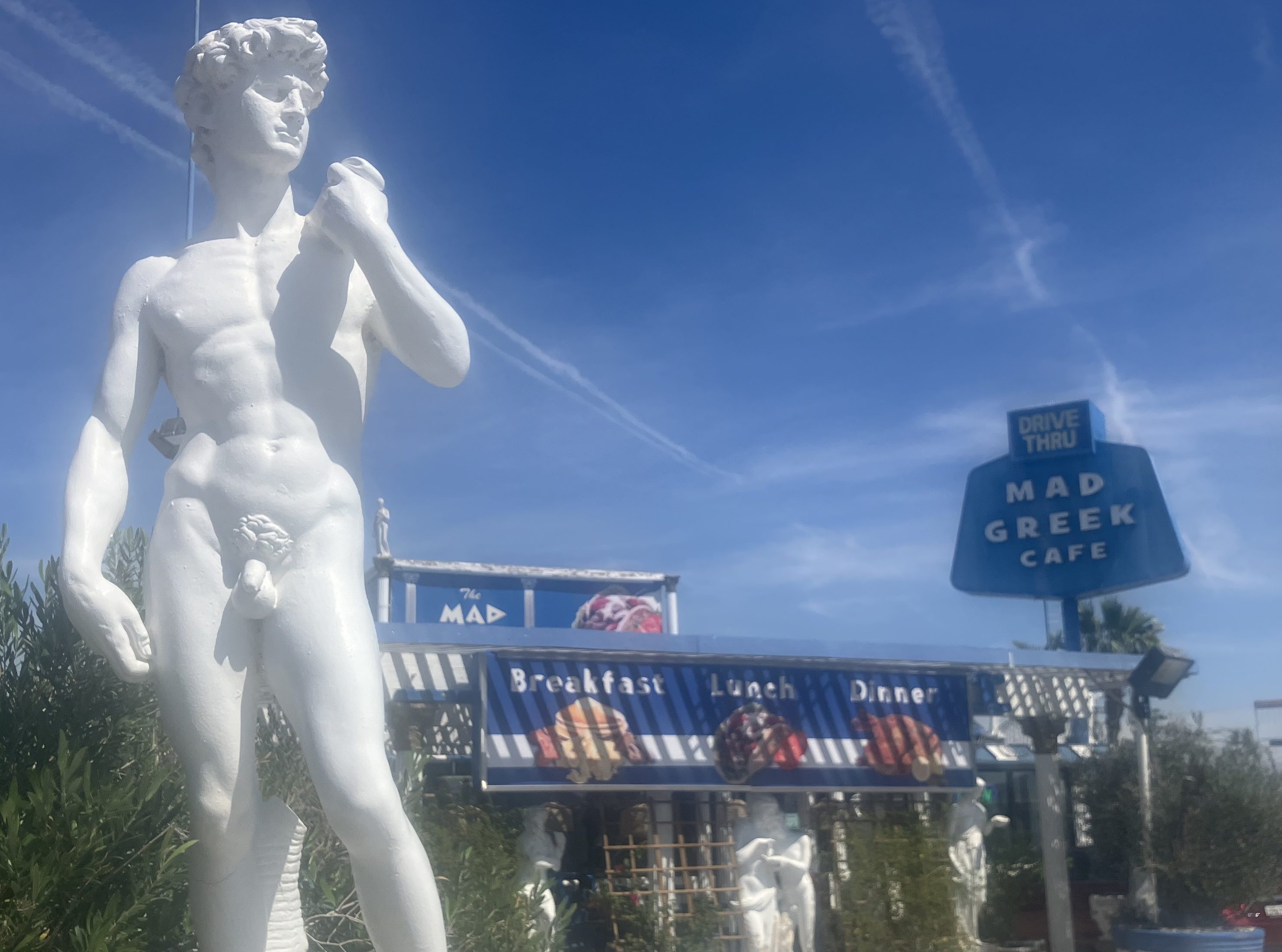
It’s delightfully tacky, painted up in the colors of the Greek flag and surrounded by statuary. It’s sort of a Greek version of Buca di Beppo. But it’s not a chain–the same Greek family has been running this place since 1974. And this place is not just surviving; it’s thriving.
I ordered a gyro and took a seat in the enclosed patio…
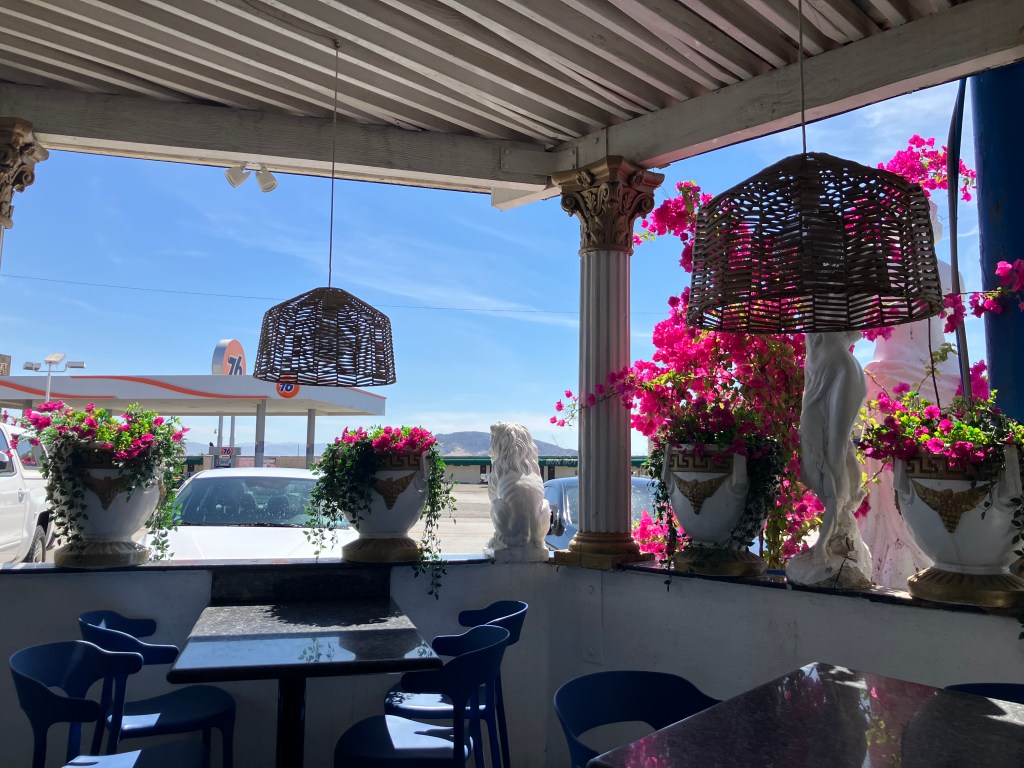
…which, it turns out, is home to the restaurant’s pet cat.
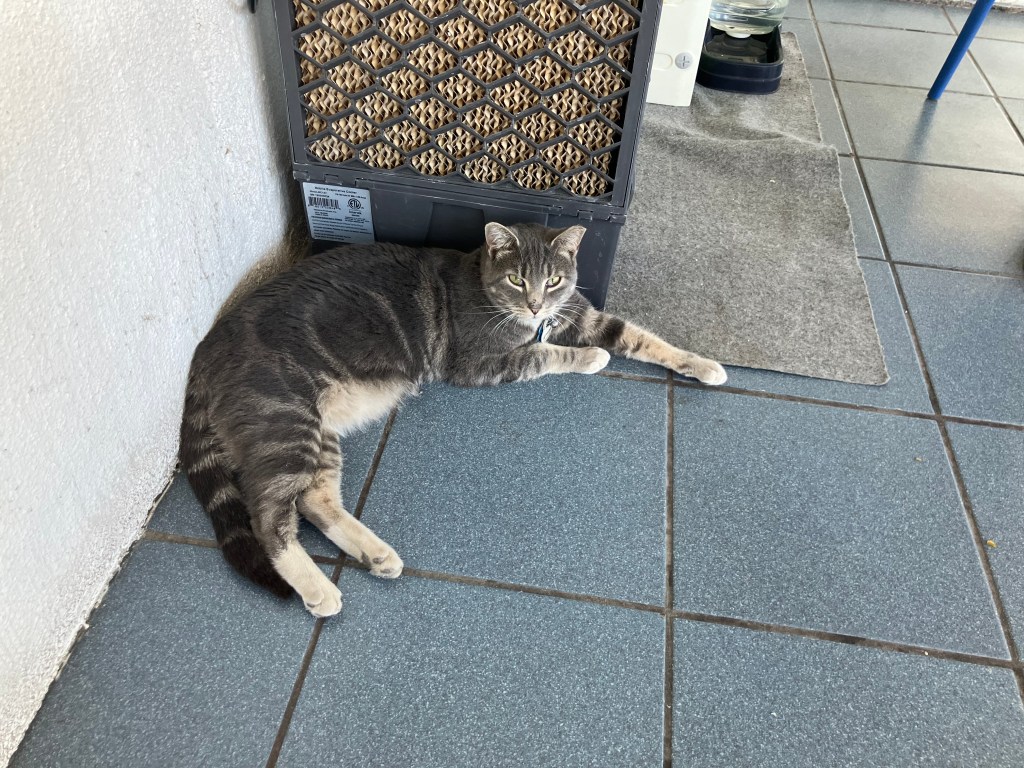
I managed to keep maybe 3/4 of the Gyro for myself.
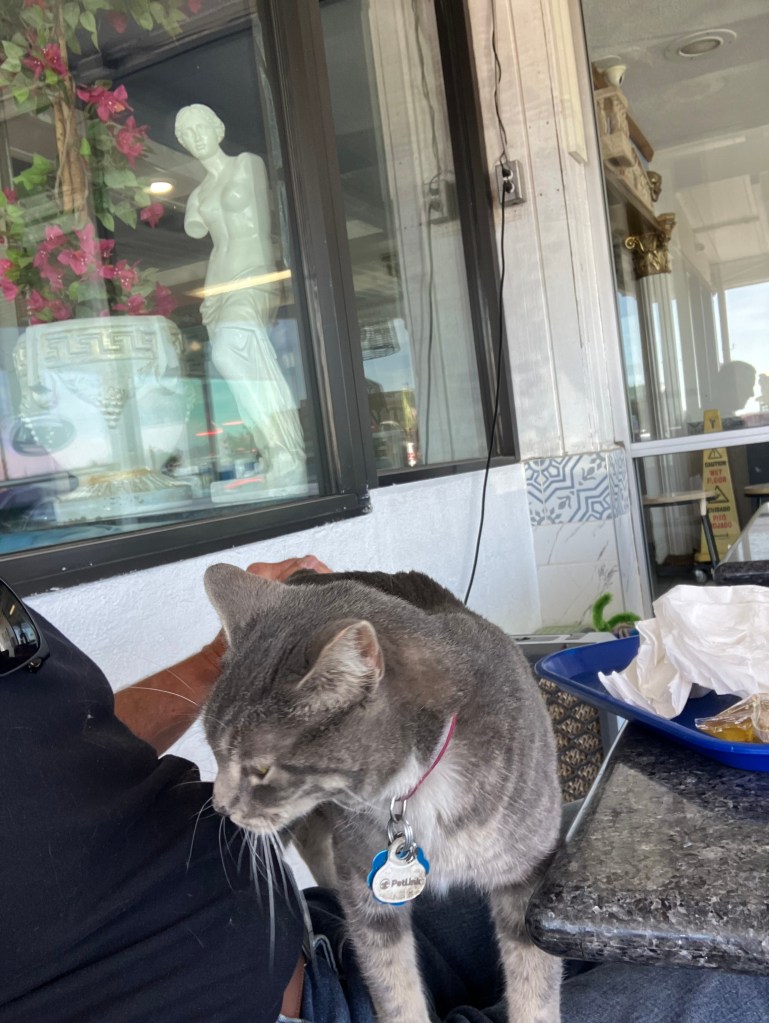
That kind of sums up Baker, and thus it kind of sums up CA-127. But before I close, I want to return to the “Last Word” promised in this blog’s title. And it’s claimed that the last word in the English dictionary is (or should be) “Zzyzx.”
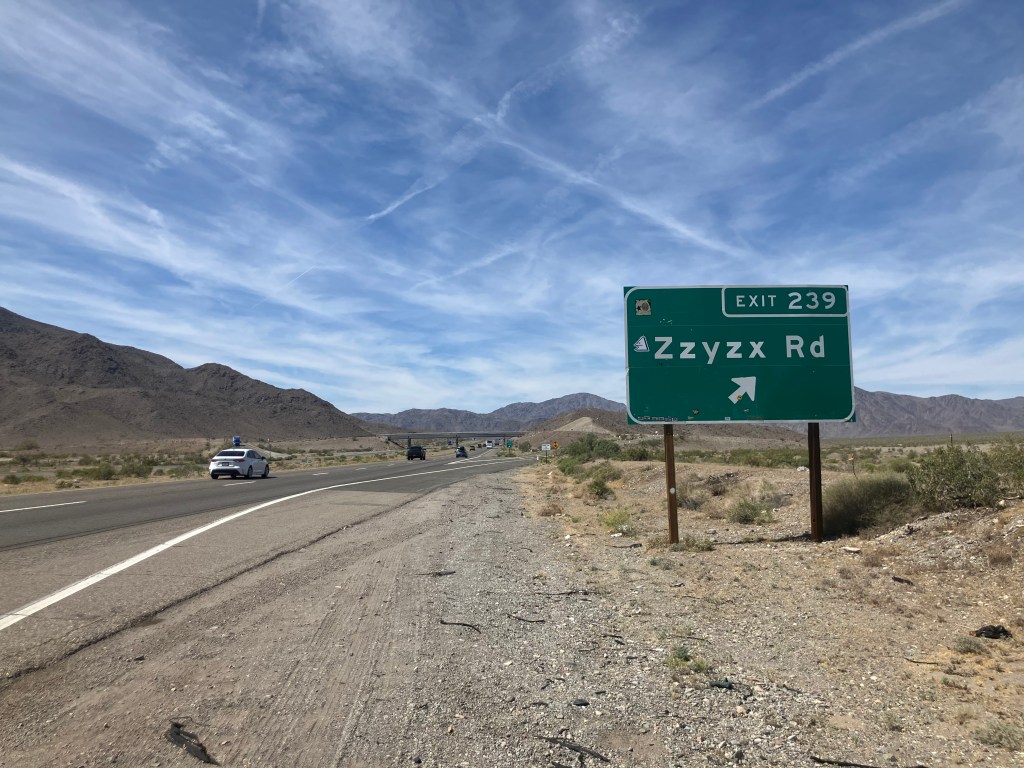
Zzyzx (pronounced ZYE-zix) is a community just a few miles west of Baker. It was originally known as Soda Springs, But in 1944 a self-proclaimed doctor and radio evangelist named Curtis Springer filed mining claims for almost 13,000 acres in the area, and he named it Zzyzx (because, he said, it’s “the last word in the English language.”)
Springer reminds me a bit of Art Bell, the conspiracy monger who broadcast from Pahrump. Springer claimed to be a minister (but he was ordained by no church), and he developed a nationwide radio following. And, like Bell, he would set up his own broadcast studio on his property.
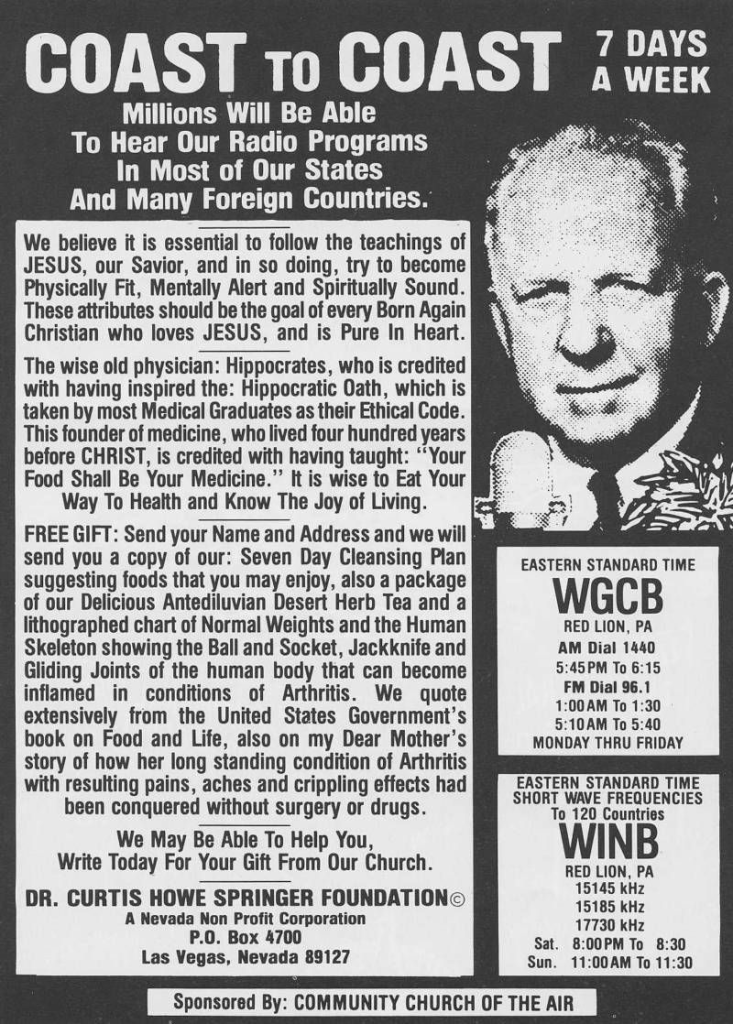
Springer created the Zzyzx Mineral Springs and Health Spa on his Mojave mining claim, which was fed by natural springs. People flocked to this putative health oasis in the desert, where Springer blended some legitimate physical therapies with spiritual programming and some outright quack nostrums. The place was a destination to be sure, but like some other oasis, it was something of an illusion. The property’s “naturally occurring hot springs” were actually heated by gas boilers. And Springer’s “mining claims” contained no valuable minerals. Thirty years later, in 1974, the federal government reclaimed Zzyzx on the grounds that Springer’s mining claims weren’t valid. Springer would (unsuccessfully) fight that decision for the rest of his life. He died in 1985, at the age of 88.
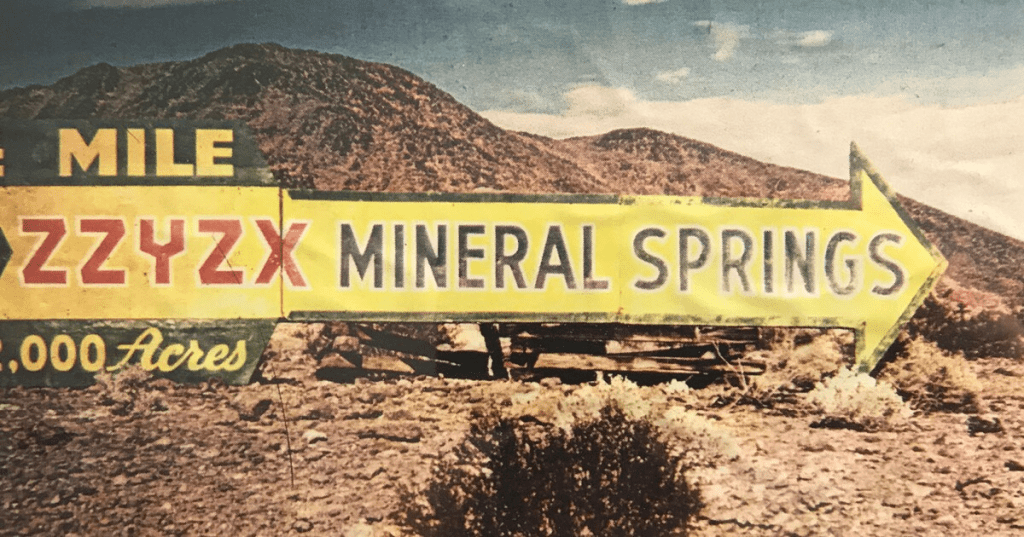
The federal government handed the property over to the California State University, which to this day uses it for a Desert Studies Center. Many of the original buildings, palm trees, and water features remain. When I visited today, there wasn’t a soul around. It was eerie to see this abandoned oasis just sitting in the middle of the desert. Here are some of my pictures.
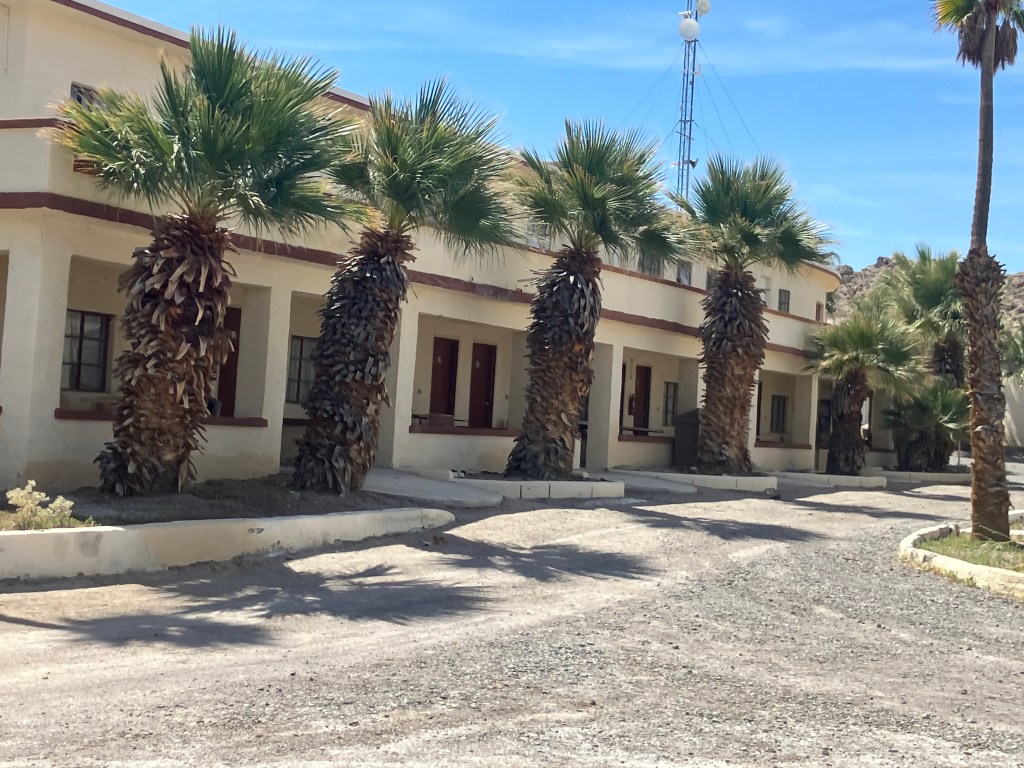
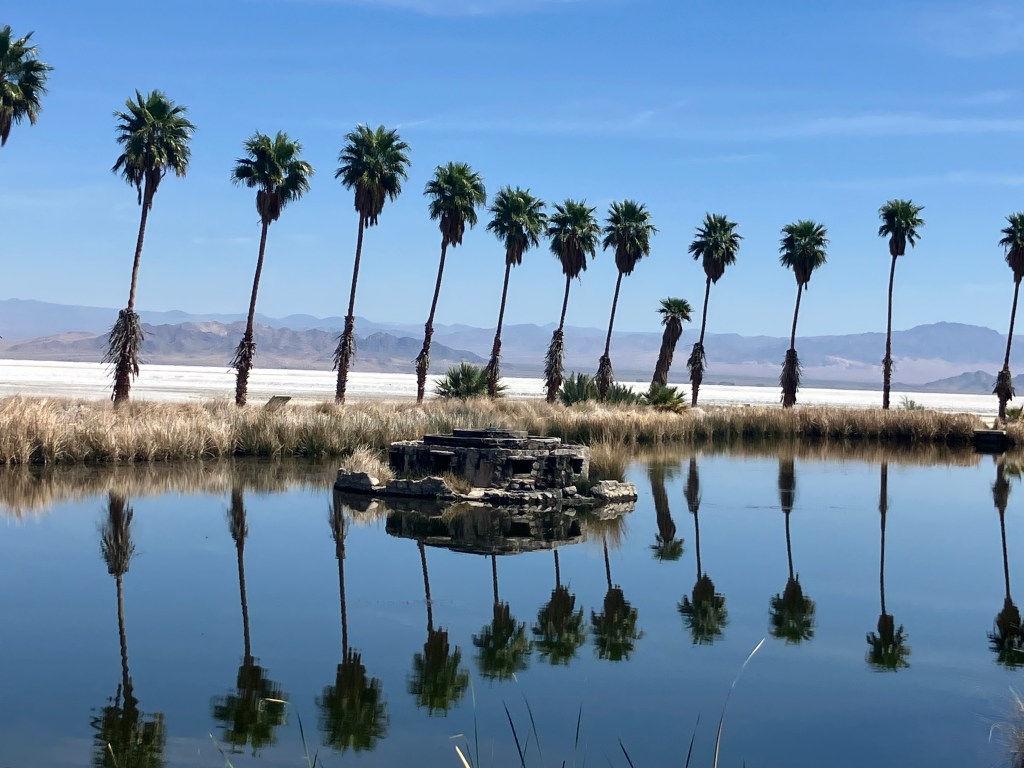
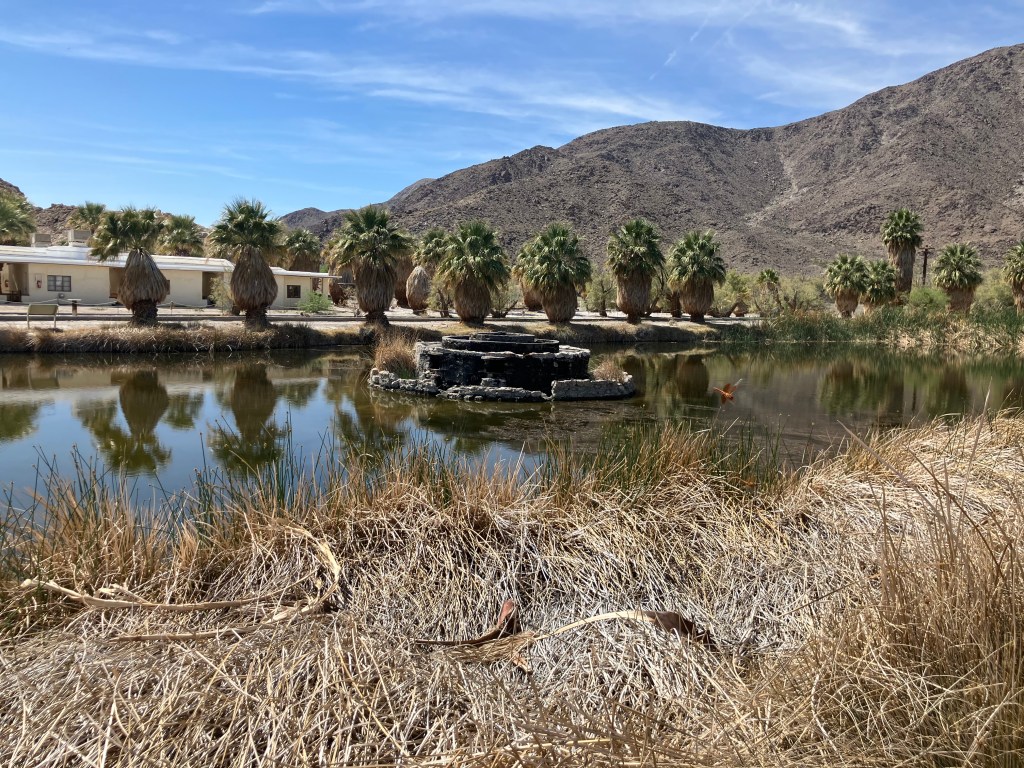
As the desert sun reached high in the sky, it was time for me to put a wrap on this road trip and head back to the airport. CA-127 isn’t an exciting road. In fact, it’s pretty empty, with only three towns of any note to drive through. Even in March the weather is less than hospitable, and rattlesnakes hide in the shadows. And yet, the scene through the windshield is entrancing, and the (few) people you meet are warm and welcoming. I wouldn’t choose to live here myself, but I’m glad places like this exist.
Post Script
Now, you’d think Zzyzx would truly be the Last Word. But on my may back to Las Vegas International airport, I made a brief pit stop at the Primm Valley casino. And what did I see inside but the 1934 Ford sedan that Bonnie and Clyde were driving when a posse ambushed and killed them. There are over 100 bullet holes in this car.
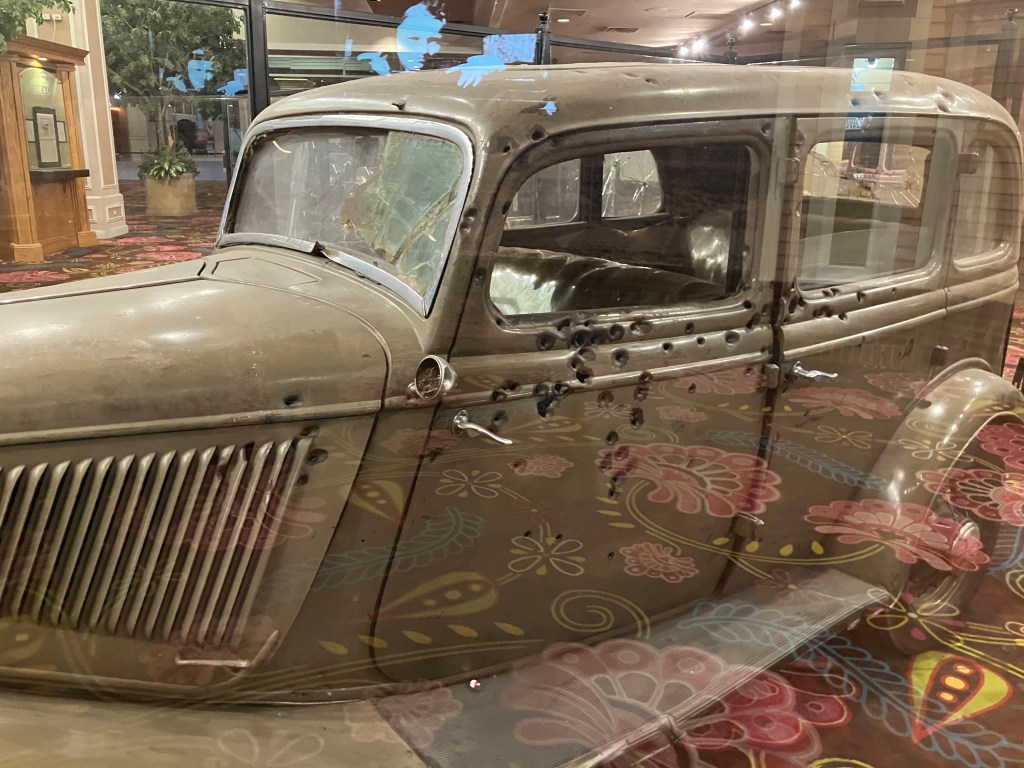
Not only that, but the shirt that Clyde had been wearing is also on display:
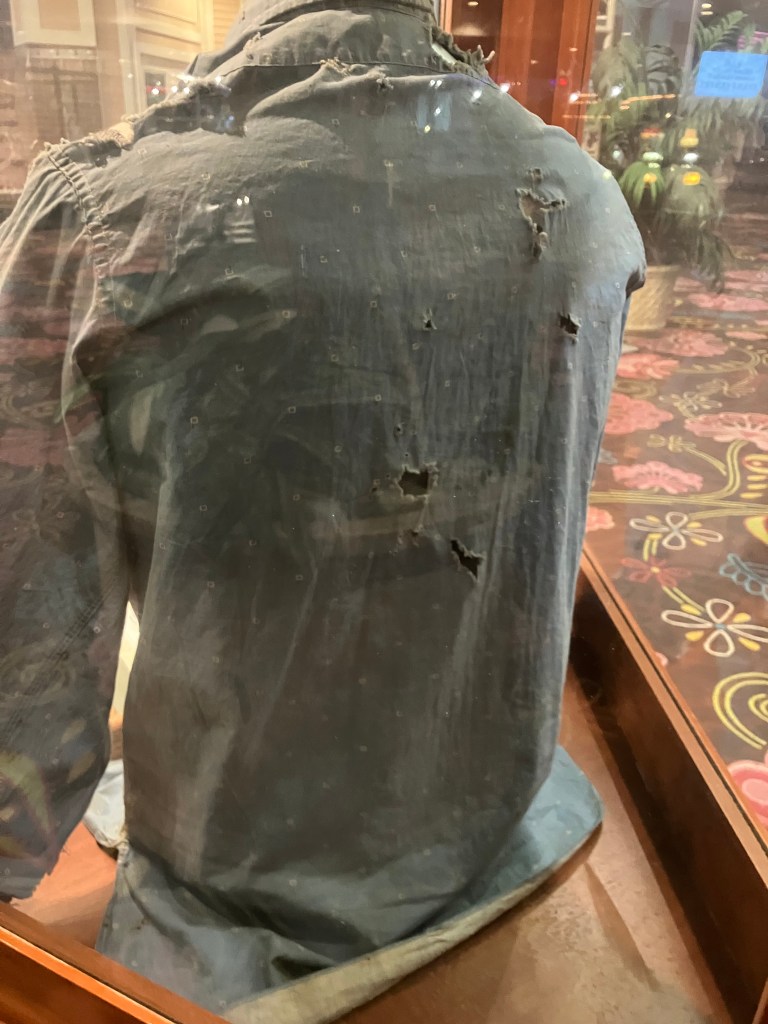
Which brings us back to yesterday’s meditation about burying the dead. Bonnie and Clyde’s bodies are both buried in Texas, but the scene of their death–this car–has been on display literally around the world for some 90 years. And here I am gawking at it. But I ask the question again: What’s the interplay between embracing our past and moving on? When do we bury the dead? At this moment, I think the car is a legit artifact of history. The shirt, not so much.

 Chasing Phantoms