Readers of a certain age might remember the Baader-Meinhof gang, which was a German militant group that was frequently in the news in the 1970s. Years later its name came to describe a phenomenon whereby you learn of a new word or thing, and suddenly it starts popping up everywhere. (In this case, it was some guy who learned about the Baader-Meinhof gang, then kept noticing it in books and articles and such. It isn’t that the gang had suddenly had a resurgence; rather it was just that his brain was now primed to notice it. Thus, the Baader-Meinhof effect.)
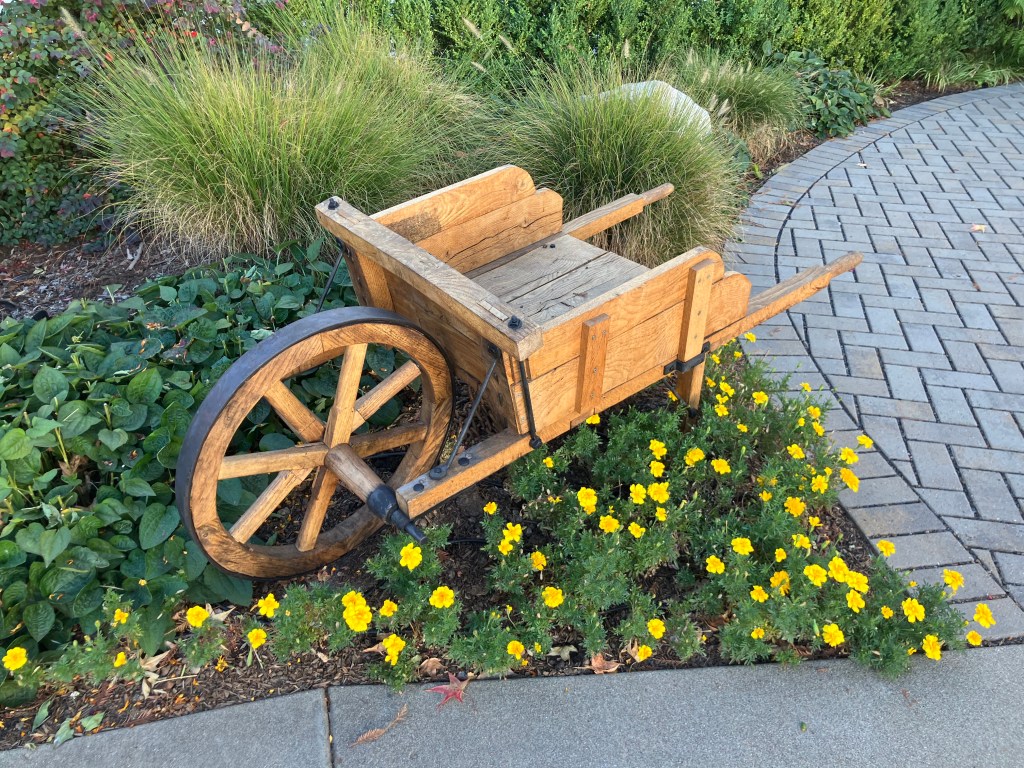
This all came to mind this morning, when I noticed this wheelbarrow set in a flower bed in downtown Placerville.
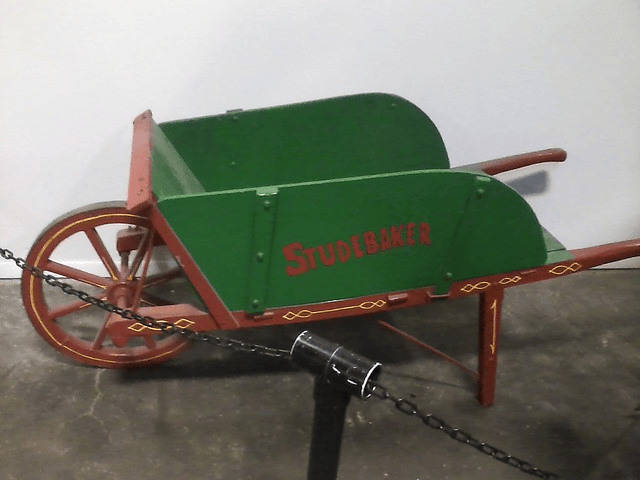
Now, as you know I recently did a post about John “Wheelbarrow Johnny” Studebaker, and how Placerville commemorates him with an annual wheelbarrow race. It sure looks like a Studebaker wheelbarrow. Is the fact that I just now noticed the wheelbarrow an example of the Baader-Meinhof effect?
Courtesy of the Studebaker National Museum
Turns out, the wheelbarrow’s been at this location for almost 5 months. According to the local paper, “A decades-long vision to honor local history reached its conclusion April 28 as the Placerville City Council received a presentation on the completion of a replica Studebaker wheelbarrow.” A group of shop students at the local high school built it. The wheelbarrow was constructed from “local oak from a tree downed near Diamond Springs to better match historical materials.” And the ironwork was forged in collaboration with blacksmiths at the local historical park.
According to the article, Placerville resident Sue Rodman called the piece “the most beautiful wheelbarrow I have ever seen.” (Today’s post is about the Baader-Meinhof effect, but perhaps next week we’ll tackle sarcasm…)
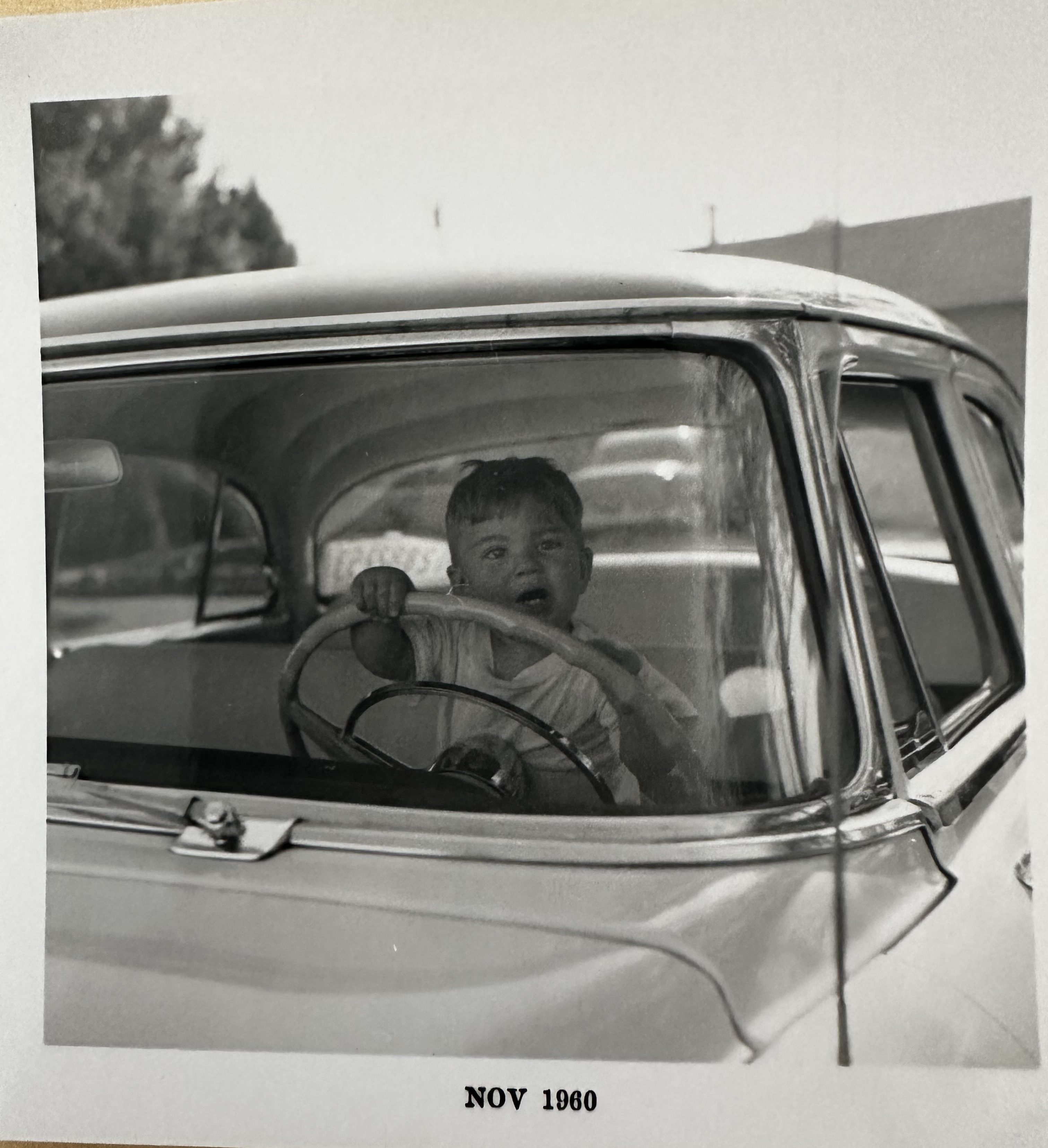
Ron P. shared this photo of himself behind the wheel of his dad’s 1951 Studebaker Commander. The photo was taken in 1960. Ron does not identify the specific day the photo was taken, but let’s assume it was on the second Saturday of September, which is International Drive Your Studebaker Day.
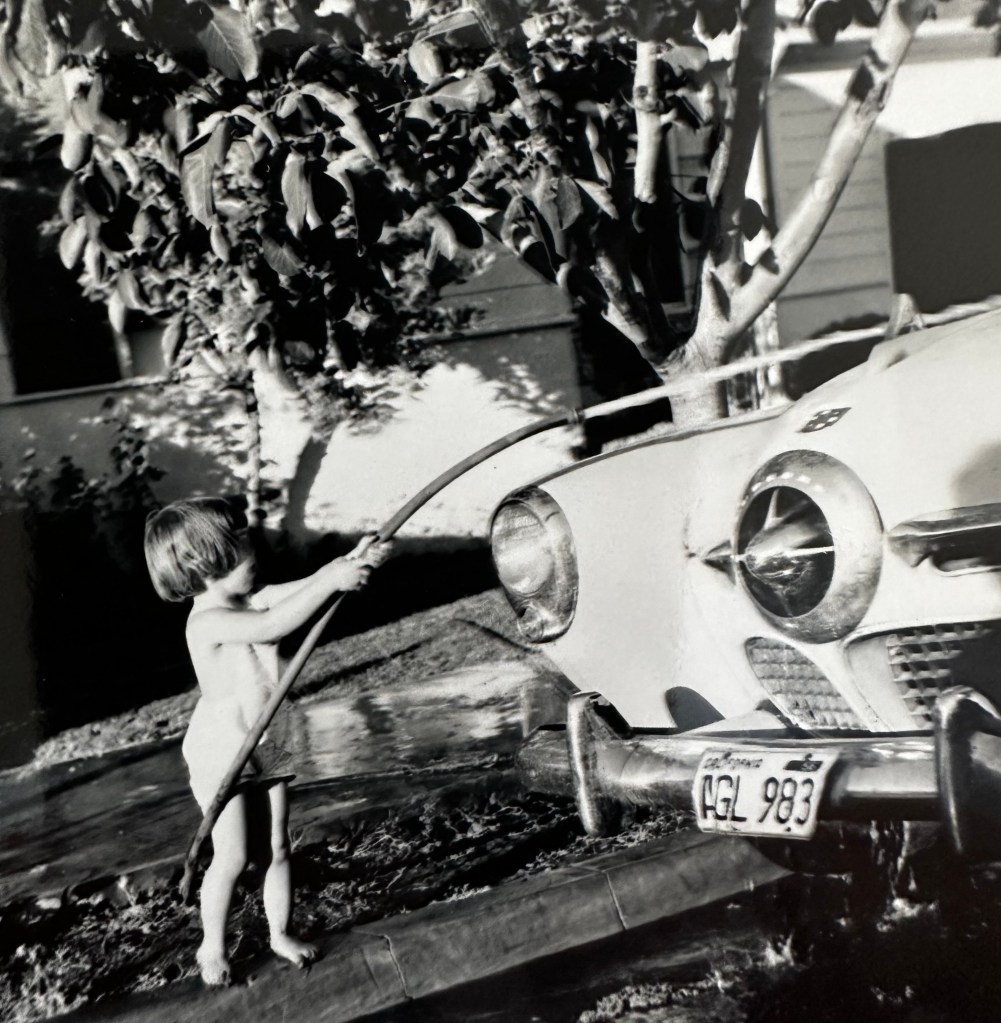
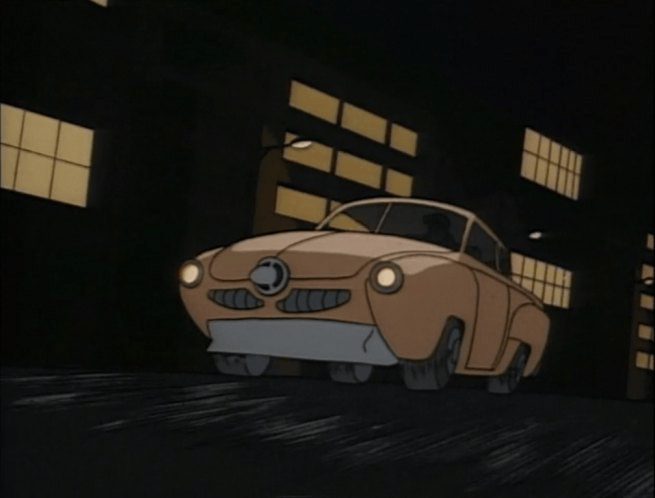
The 1951 Commander is an iconic car, with a bullet nose and a wrap-around rear window reminiscent of a B-52. It was truly distinctive and unique. Here’s a shot of the front of the car, theoretically being washed by Ron’s sister:
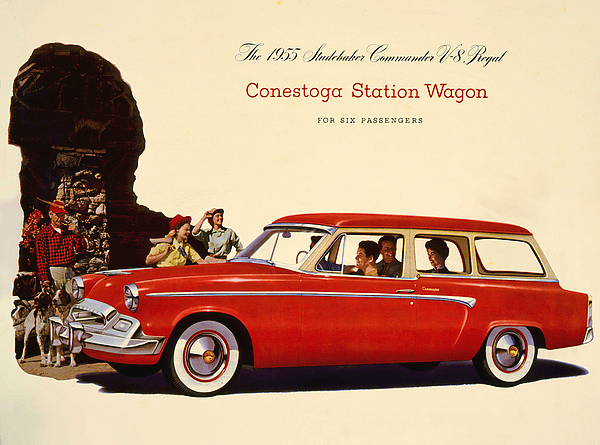
Meanwhile, the Rev. Jonathan C. shared his own Studebaker story: In 1964 his family drove from New York to California in a Studebaker. Much of that journey followed the storied Route 66. The Studebaker was a 1953 Conestoga. You’ll recall that Studebaker started out making Conestoga wagons in the 1800s, but Jonathan’s Studebaker was a station wagon. (Although his family may have purchased the car in 1953, 1954 was the first model year of the Conestoga.) Also notable about the car: It was the company’s first all-steel station wagon, and it only had two doors. The Conestoga was also available in an ambulance form, which Studebaker called the “Ambulet.” I’m not making this up.
Next, there’s this: Loyal reader Brian W. reminded me that Frank Zappa had a symphonic fairy tale (?) from 1971 titled “Billy the Mountain,” with a short movement that featured Studebaker Hoch. Among the unforgettable lyrics:
Studebaker Hoch, he’s really outta sight! Studebaker Hoch, he does it every night! Studebaker Hoch, he treats the flies all right Studebaker Hoch, that’s why they never bite, hey!
Don’t believe me? Have a listen:
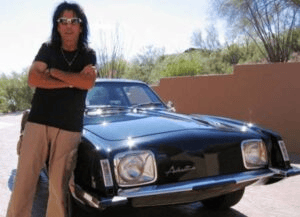
And speaking of Studebaker-associated musicians: Did you know that Alice Cooper owns a Studebaker Avanti? It’s true!
Meanwhile, high school buddy Detlef K. shared this Studebaker reminiscence:
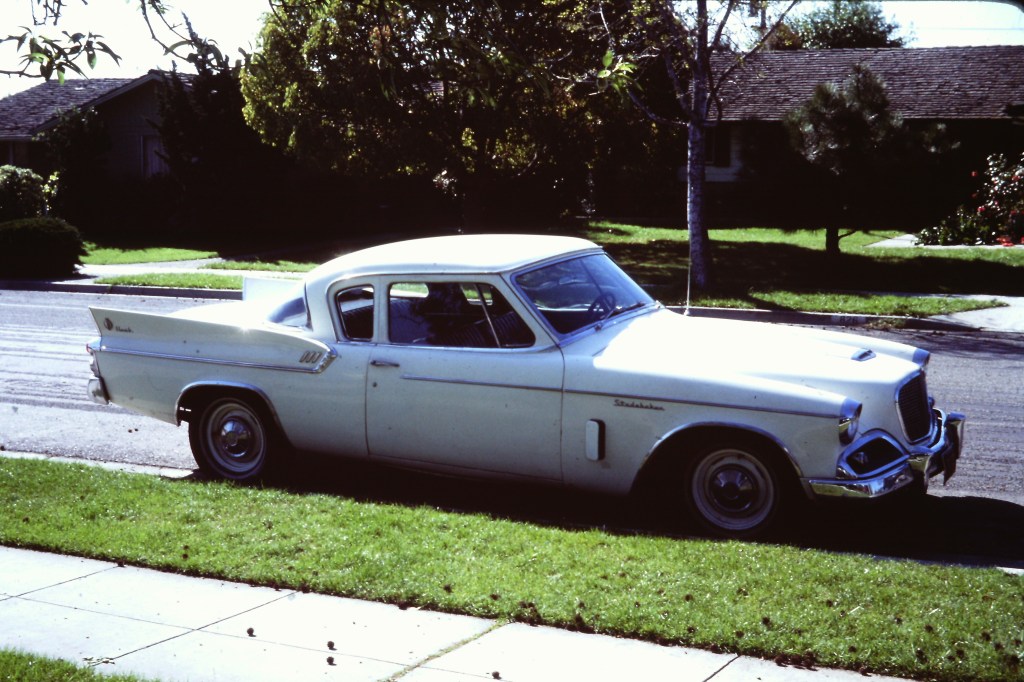
[Driving with the Studebaker Hawk] was an off-the-charts exceedingly cool experience. I can recall back the two of us cruising side by side up Foothill Expressway – I seem to recall driving my mom’s 1974 Chrysler T&C Station Wagon – both machines each with a massive V8s reverberating between the cars made for an unforgettable experience! But keep in mind a 1960 Studebaker in 1979 is only a 19 year old car. Barely can be acknowledged as a used car, let alone a classic. It’s an entirely different thing to consider driving a 1963 production vehicle in 2026. That is a whopping 63 years old!
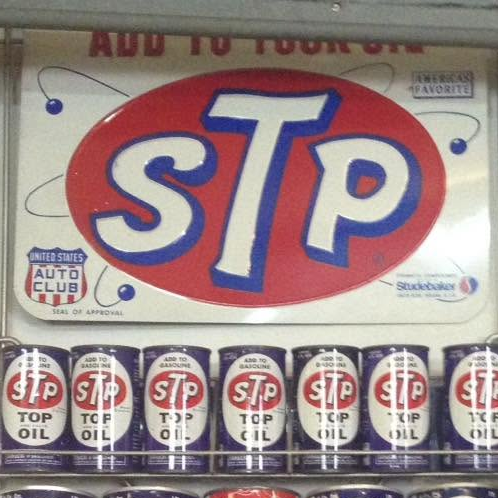
Finally, my brother David B. was musing about how the well-known oil additive STP was a property of the Studebaker Corporation in the 1960s. In their advertising they claimed STP stands for “Studebaker Tested Products.” To which Dave scoffed “As if ‘Studebaker Tested Products’ would be a selling point for anything!”
Note Studebaker logo in lower right-hand corner of sign.
Thus concludes today’s episode of Stude-Talk. Send in your own Studebaker stories and we might do another one!
Unless you’ve been living under a rock, surely you’re aware that today in International Drive Your Studebaker Day. Or, as my friend Vic cheekily calls it, “International Push Your Studebaker Day.” For Vic had been my neighbor many years ago, when I owned a 1960 Studebaker Hawk. And thus Vic witnessed the not-infrequent appearance of a AAA towtruck bringing home the Hawk from its travels.
In its natural state: stationary.
Those of you who have read my memoir know that that Studebaker Hawk was my first car, purchased immediately after I got my license, and it remained my main source of transportation for a good 20 years. I finally felt compelled to get rid of after I found myself married with a young son. My wife wouldn’t let our son ride in “that death trap,” and in any event I didn’t have the time or money or space to maintain it.
You’d think that would be the end of the story. But about five years ago I moved to the town of Placerville, California, which, it turns out, is (almost) literally haunted by John Studebaker. As every schoolchild knows, John Studebaker was lured to Placerville during the Gold Rush, but quickly realized his fortune could be earned not in the gold mines but by selling provisions to the miners. Studebaker took a job at a local blacksmith’s shop, and in his off hours built wheelbarrows that he sold to the miners. After he amassed enough money, he returned to South Bend Indiana, where he and his brothers formed the Studebaker Manufacturing Company. They built wagons for the Union during the Civil War, and in the early 20th century they began producing automobiles. Like my 1960 Hawk.
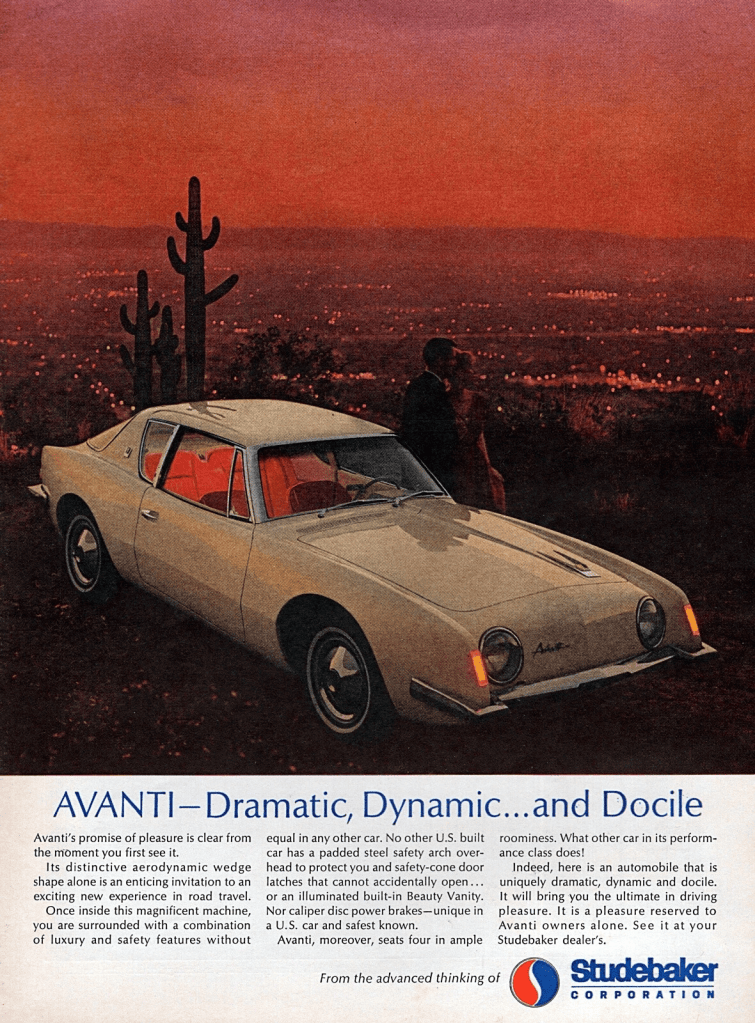
Living in the town that played such a crucial part in the history of Studebaker reignited my interest in the marque, and so earlier this year I went out and got me another Studebaker–this time a 1963 Studebaker Avanti.
The Avanti was Studebaker’s last-ditch effort to turn around its flagging sales figures. It was conceived as a “luxury sports car,” designed by the legendary industrial designer Raymond Loewy during a six-week crash program in Palm Springs. Alas, the Avanti could not save the company and Studebaker shuttered its South Bend factory in 1964.
So the Avanti, like all Studebakers, is considered an “orphan car,” and their owners keep them on the road thanks to a network of specialty vendors and the mighty Studebaker Drivers Club. It’s the SDC that promotes “International Drive Your Studebaker Day” each year.
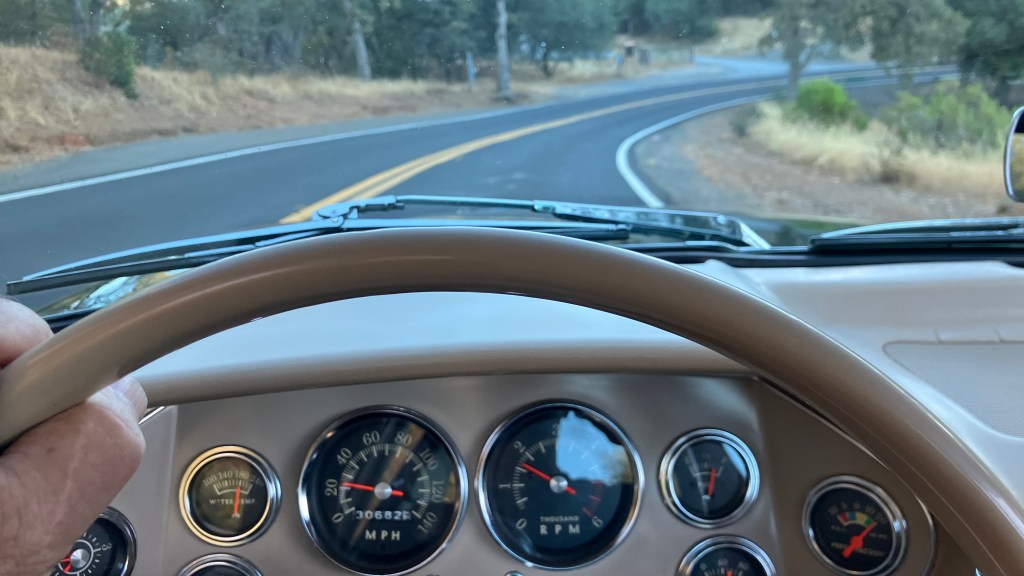
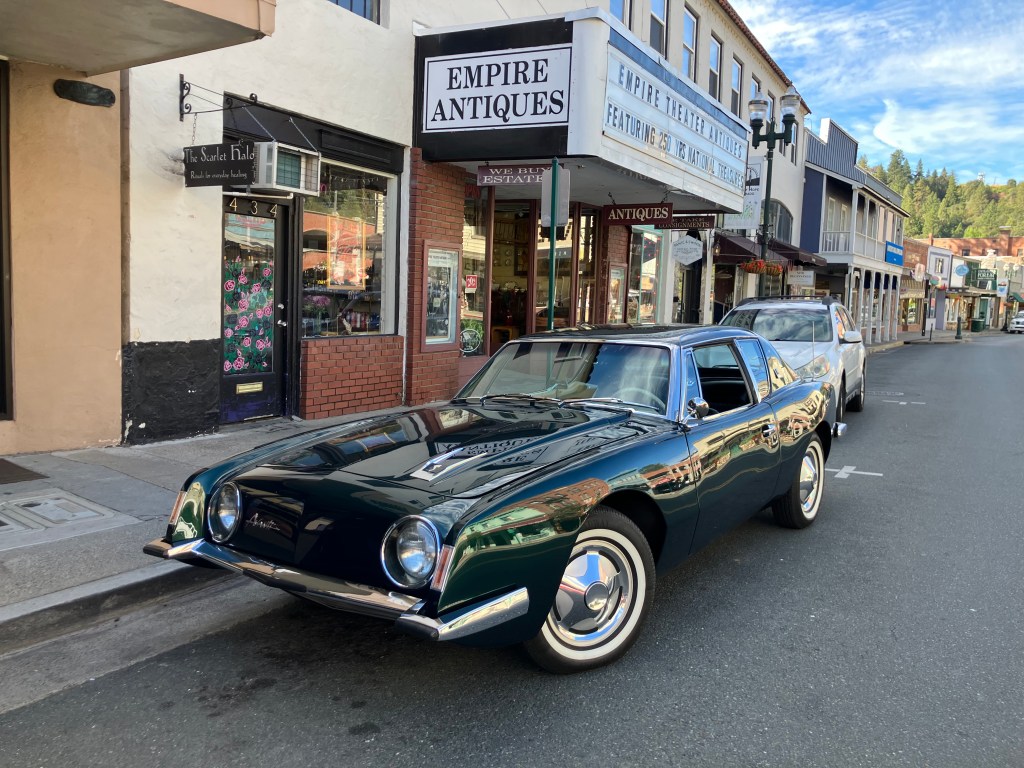
So today I did my part: I took the Avanti on a nice, scenic drive along CA Route 49 into downtown Placerville.
Action photo from my drive this morning. The more things that can potentially go wrong with a car, the more gauges you need…
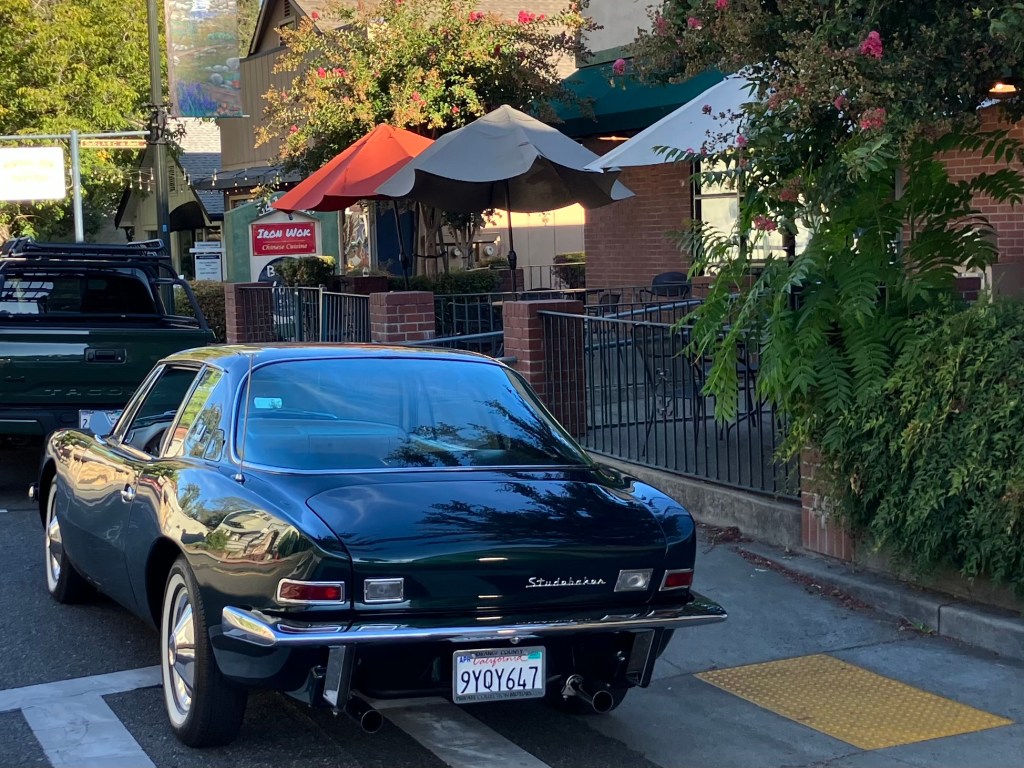
When I got into town, I parked at the site of that old blacksmith’s shop where John Studebaker built his wheelbarrows some 175 years ago. (The site is now a bagel shop.)
175 years later, one of John Studebaker’s progeny returns to the wheel barrow site.
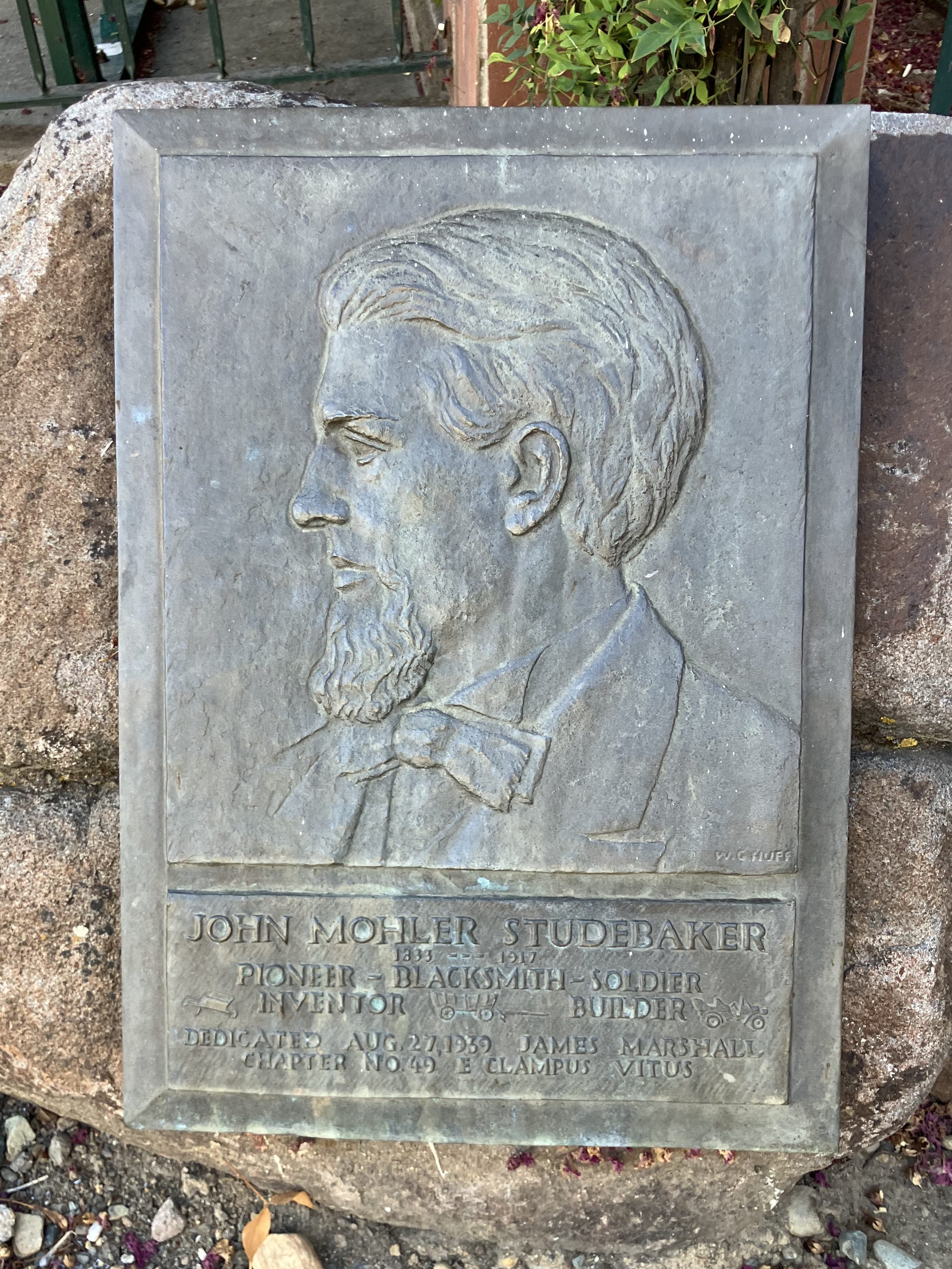
Stude-plaque in front of Bagel Works/blacksmith shop.
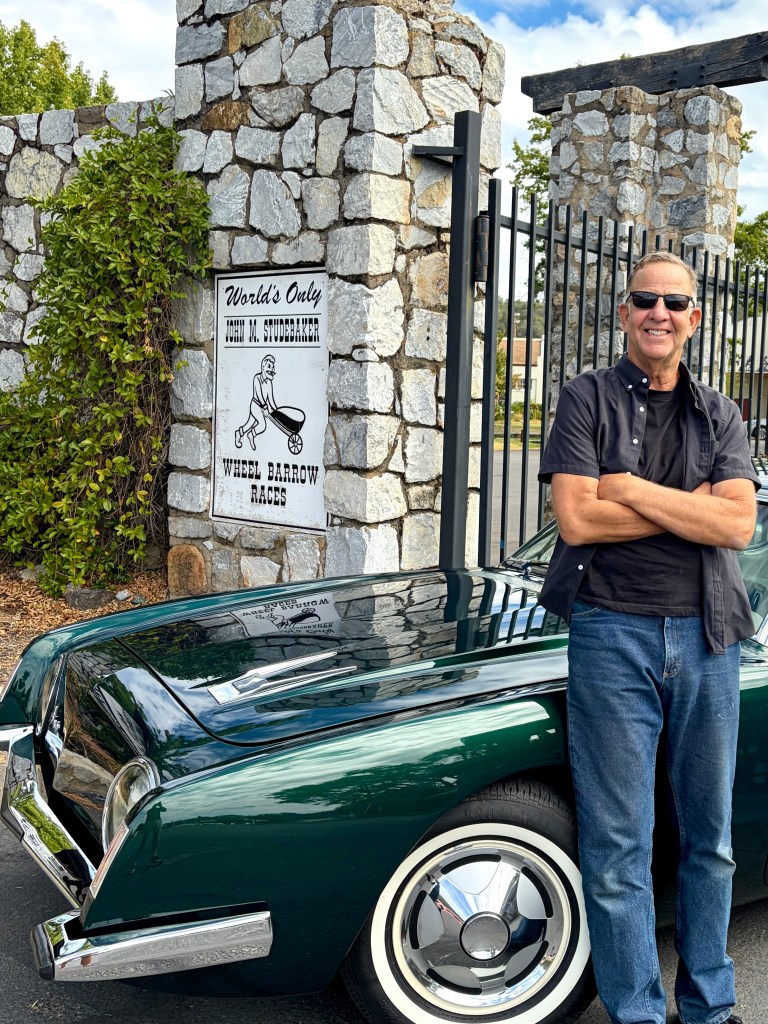
I also made a drive out to the Placerville Fairgrounds, where every year they hold the “John M. Studebaker Wheelbarrow Races.” I’m not making this up.
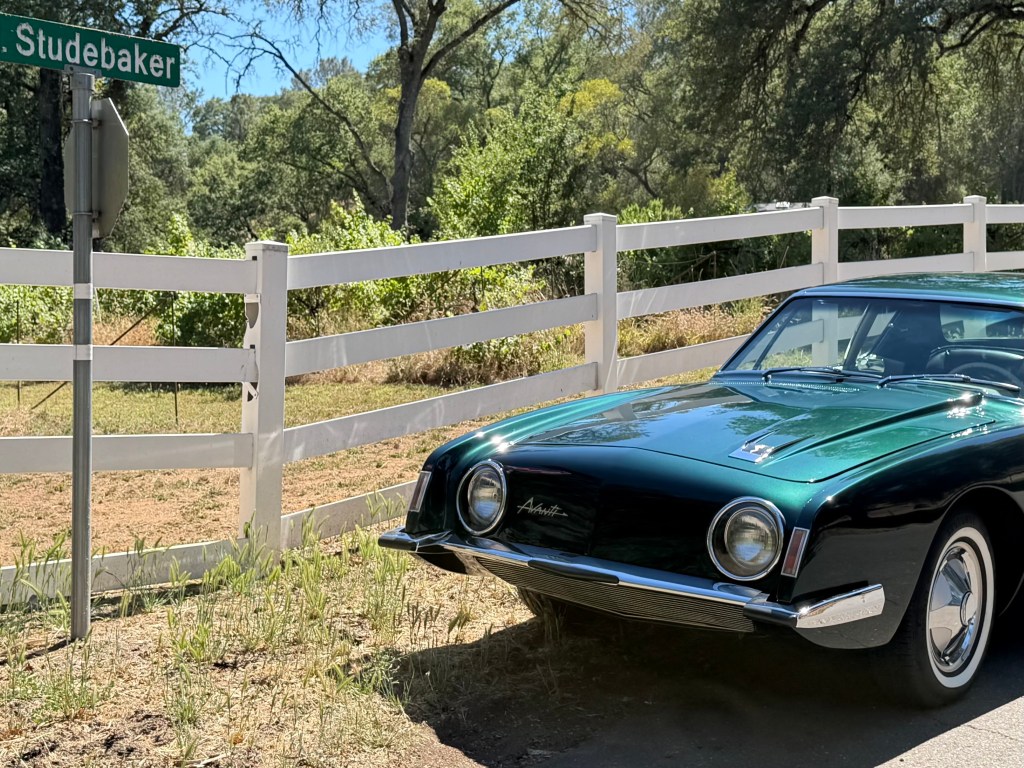
Placerville also has a road named Studebaker Road. I have not been able to determine if John Studebaker had any direct connection to this street, or if it simply honors him. If you have any leads, please share them!
Sadly, I did not see anyone else driving a Studebaker in town. (There is local guy who owns four Studebakers from the 1920s, but they were all parked in his driveway this morning. Maybe he’ll be making a drive later this afternoon.) I am aware that there’s a local Studebaker group based in Sacramento that’s driving together to the Sacramento River Delta for lunch. Me, I mainly just cruised around Placerville’s Main Street.
I’m still getting the hang of parallel parking without a backup camera…
No matter how you choose to celebrate International Drive Your Studebaker Day, I hope all my readers have a Stude-tastic holiday.
Readers of a certain age may remember a moment, in a galaxy far, far away, when we couldn’t get enough of Star Wars. And everyone was trying to make a buck off that moment–from Star Wars “collectible” Slurpee cups to the Star Wars soundtrack album (which, I admit, I owned) to stormtrooper action figures in your Happy Meal. It’s said that even James Bond got in on the act, with “Moonraker” (1979) sending him into space.
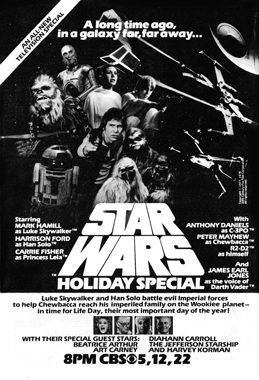
But one of the most cynical attempts to capitalize on Star Wars Mania was the Star Wars Holiday Special, broadcast on CBS on November 17, 1978. George Lucas okayed the project and sketched out a bare-bones plot, then let a team of writers take it from there. This, it would turn out, was a mistake. It is widely regarded as the worst television show ever aired. A reviewer at the A.V. Club wrote “”I’m not convinced the special wasn’t ultimately written and directed by a sentient bag of cocaine.”
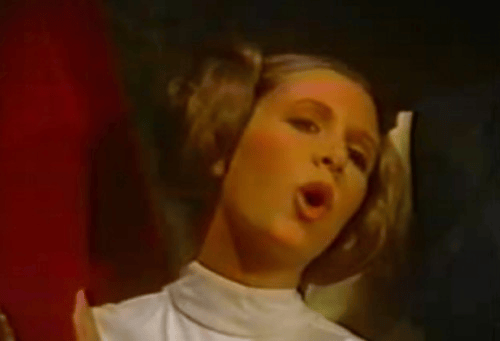
The Star Wars Holiday Special included most of the cast of the original movie, including Carrie Fisher (Princess Leia), and this takes us to why I’m bringing this up. Carrie Fisher saw herself as a singer, and insisted that she be featured singing in the special. Not only did the producers agree to this, but in fact they included four tedious songs by various singers, including Jefferson Starship. (Hey, it was the 1970s.)
There were many reasons that the Star Wars Holiday Special sucked, and it’s not any one person’s fault. In the words of one of the writers, “There were probably no bad welders on the Titanic.” But I’m going to posit that the decision to essentially make it into a musical was spectacularly ill-advised.
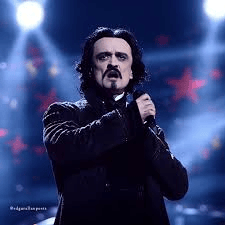
Which brings us, as usual, to Edgar Allan Poe. Alert readers will recall that I’ve praised a comedy troupe called “Shipwrecked Comedy,” which, among other things, did a 13-part series imagining that Edgar Allan Poe invited a bunch of famous authors to a murder mystery dinner party. Here’s the trailer:
I thoroughly enjoyed the full series, which I thought was witty, clever, and fun, and which had surprisingly good production values. So imagine my delight when I learned the original cast was preparing to perform the full program on the stage. But for reasons that make sense only to Shipwrecked Comedy and, perhaps, George Lucas, they decided to turn their show into a musical.
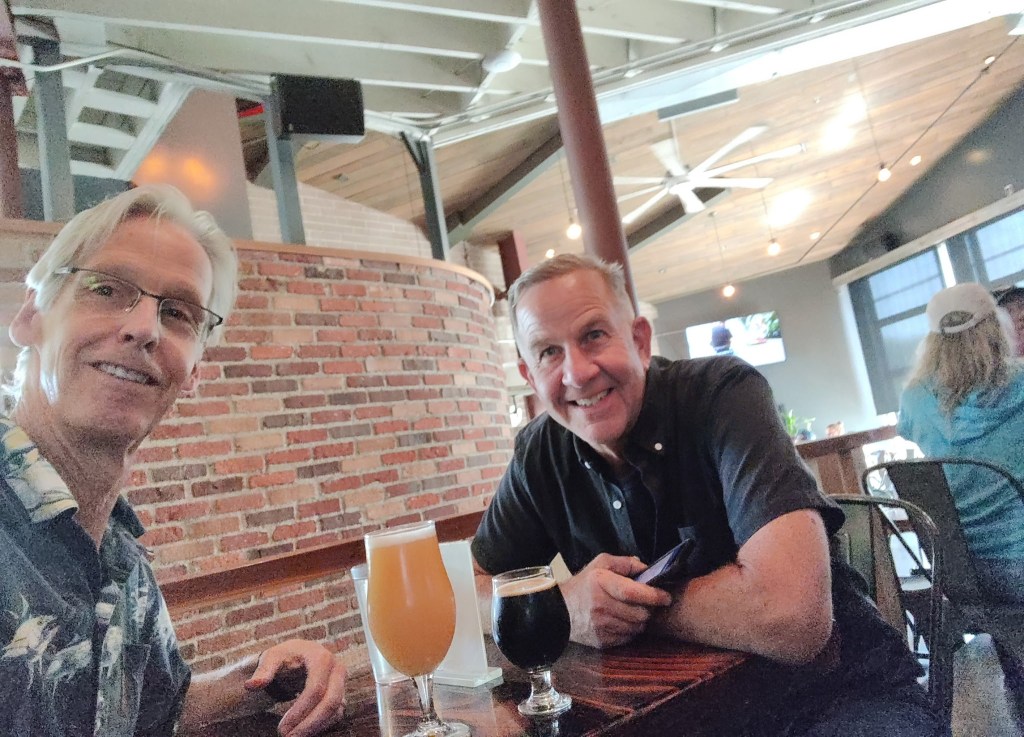
Regardless, like a wine snob who ignores all the danger signs and enters the nitre-infested catacombs in pursuit of Amontillado, I hopped a plane to Burbank Saturday morning, where friend and former roommate Bruce T. met me. After fortifying ourselves with some stiff drinks and greasy burgers we made the short drive to the Garry Marshall Theater.
As we stood in line to enter it became clear to us that the audience was 80-85 percent female. Not that there’s anything wrong with that. But I wouldn’t have expected this for a Poe show. But then, it’s not just any old Poe show, it’s a musical Poe show.
Most of the male patrons at the Poe show.
So herewith I offer my review of the show, which continues to play through August 29.
If you’ve seen the original series (available on YouTube), you already know 90 percent of the plot. For those of you who don’t know the story: Edgar Allan Poe and his “ghostly (female) manservant,” Lenore, decide to throw a dinner party for some famous writers from history. These include Ernest Hemingway, H.G. Wells, Oscar Wilde, Mary Shelley, Alexandre Dumas, George Eliot, Emily Dickinson, Lewis Carroll, and Agatha Christie. The dinner party is of a “murder mystery” variety, but the murders turn out to be real. Whodunnit? There was a moderate change to the big reveal at the end of this mystery, and I thought this new ending was rather clever and surprising. (According to the program, there are “three possible endings. Come back for a new killer each show.”)
I think the value proposition of this show was supposed to be the musical numbers. Fourteen original songs were composed by the brother-and-sister team of Sean (Poe) and Sinéad (Lenore) Persaud. Live music was provided by a seven-piece orchestra, which was a nice touch. However, the songs were unremarkable. They entirely lacked any catchy tune that you might find yourself humming on the way home. Worse, they did almost nothing to advance the plot. Instead, they simply filled long pauses in the action.
On the other hand, the actors did well in their roles. They were for the most part endearing, charismatic, and capable. The humor is fairly witty and fast-paced. Poe is constantly making passive-aggressive jabs at his guests, HG Wells nervously tries to identify the killer with steampunk-style inventions, an oversexed Alexandre Dumas tries to woo Jane Austen, and George Eliot repeatedly tries to pass herself off as a man. It’s a fun, if silly and improbable, farce.
In case it’s not obvious, I submit the show fell into the same trap as the Star Wars Holiday Special. In both cases, the songs feel like an afterthought, grafted on in an effort to create something new, and/or to pad out the length. (This show ran almost three hours, with intermission.) In a true musical, the songs take center stage. We really don’t care about the rather simple plot of Singin’ in the Rain or The Wizard of Oz. We enjoy those classics for their music.
The Edgar Allan Poe Mystery Dinner Party, on the other hand, is enjoyable for its premise and its characters. The music only gets in the way. Three stars.
Today I decided to track down a very special Brew of the Day. This quest took me to the site of a crucial World War II battle, in an abbey where Saint Benedict himself is entombed.
Oh, did I not mention I’m in Italy?
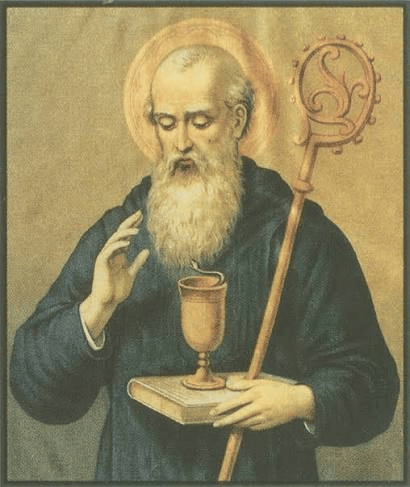
I speak, of course, of Montecassino Abbey, which Benedict founded high on a mountain in central Italy in 529. It’s an impressive structure and is considered the largest abbey in the world.
I won’t go through the full 15 centuries of history, so let’s jump forward to 1943, when Nazi Germany held control over Italy. Given its central, mountaintop location, the abbey was a key strategic site.
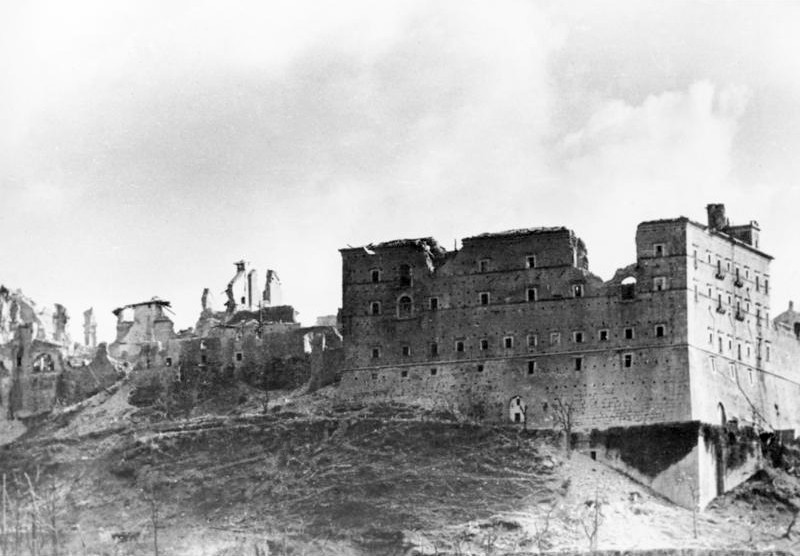
After the Allies defeated the Axis forces in North Africa, they turned to the task of liberating Italy. Allied troops landed in Sicily in July of 1943, and began slowly marching north toward Rome. By the winter of 1944 they were approaching the region of Montecassino. They believed the Germans had taken up positions at the abbey (a belief that may have been mistaken) and so in February Allied planes began a massive bombing of the structure. It was destroyed, and many monks and townspeople died. War, as they say, is hell.
After the bombing (apologies to Engelbert Humperdink) in 1944. [Di Bundesarchiv, Bild 146-2005-0004 / Wittke]
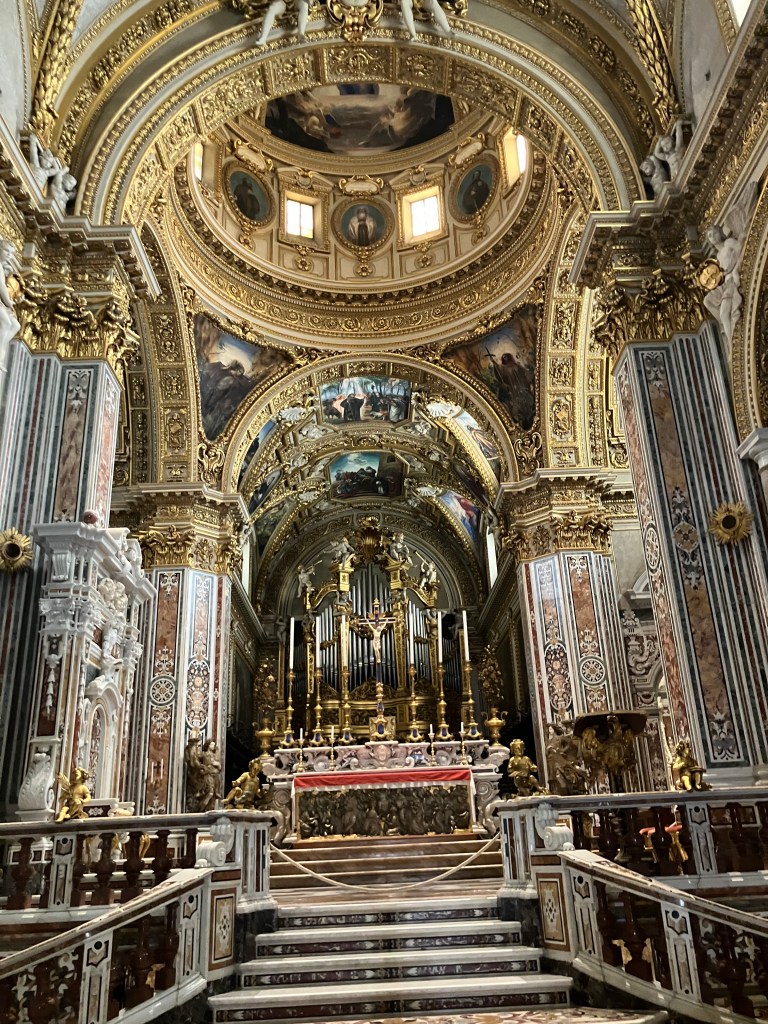
The structure was completely and faithfully rebuilt after the war, and the abbey remains active and important to this day. Indeed, the Pope visited here just a couple of weeks ago.
Inside the abbey’s church today, when I visited.
Now here’s the important part: It’s said that the abbey’s monks had been brewing beer since the time of St. Benedict (who himself advocated brewing as a form of self-sufficiency for the abbey). They grew their own barley and used rock-filtered water from a nearby spring. This all ended in 1944 with the Allied bombing.
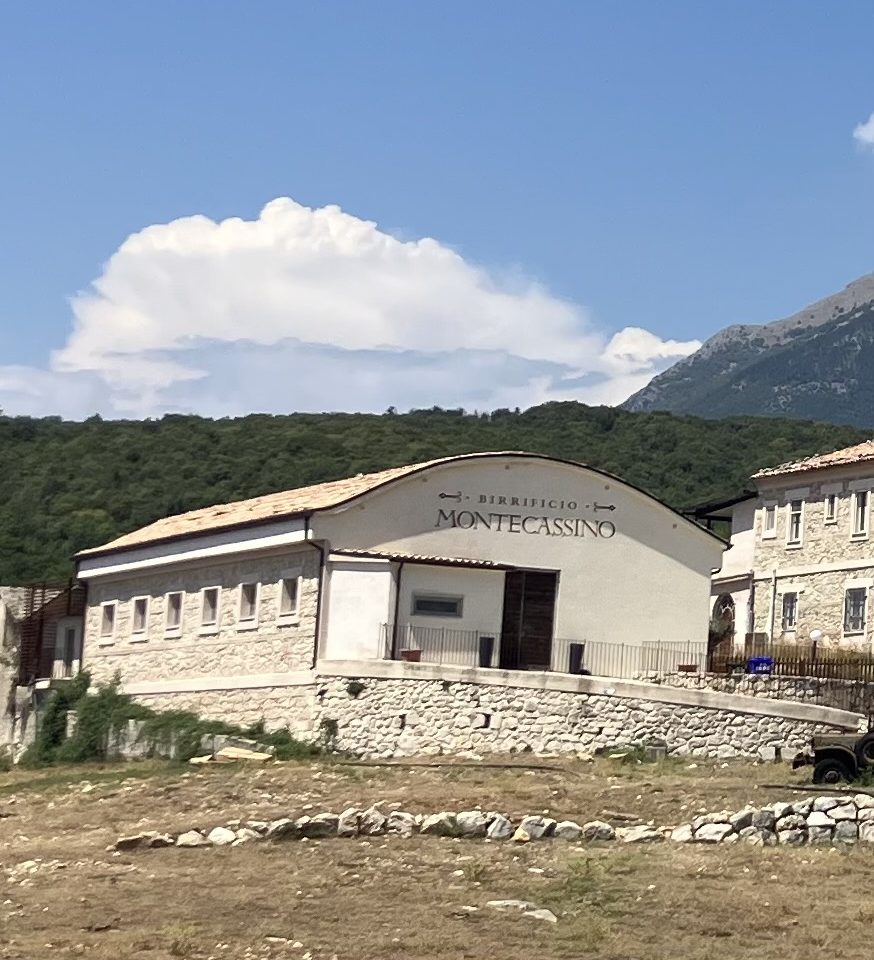
Then–a miracle!–brewing came back to the abbey in 2018, when an entrepreneur named Daniele Miri launched Birrificio Montecassino (“Montecassino Brewery”). He set the place up in a rustic building on the abbey grounds.
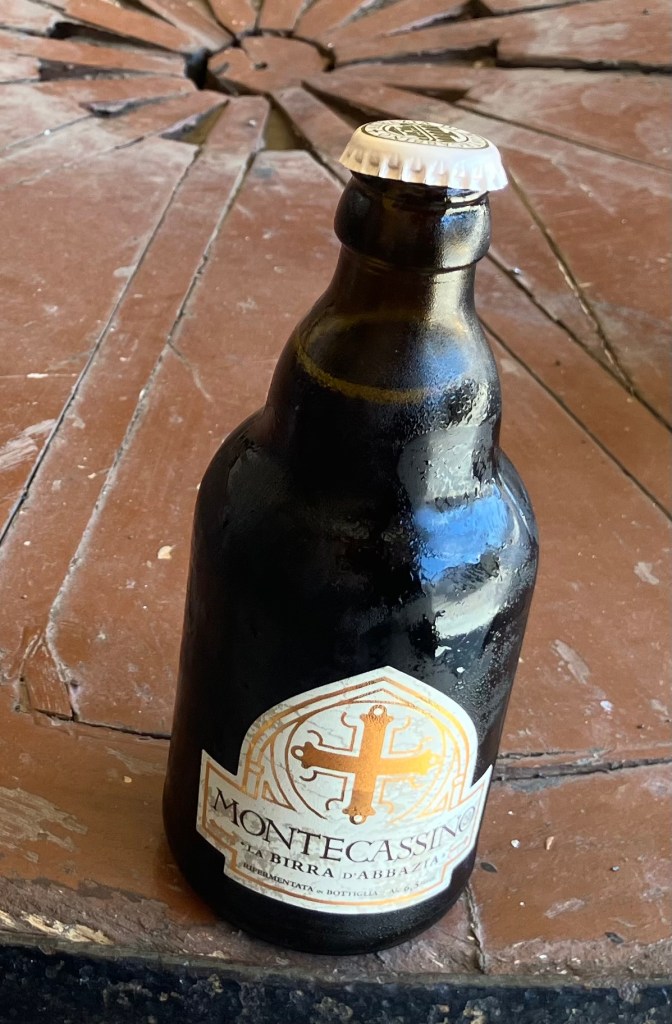
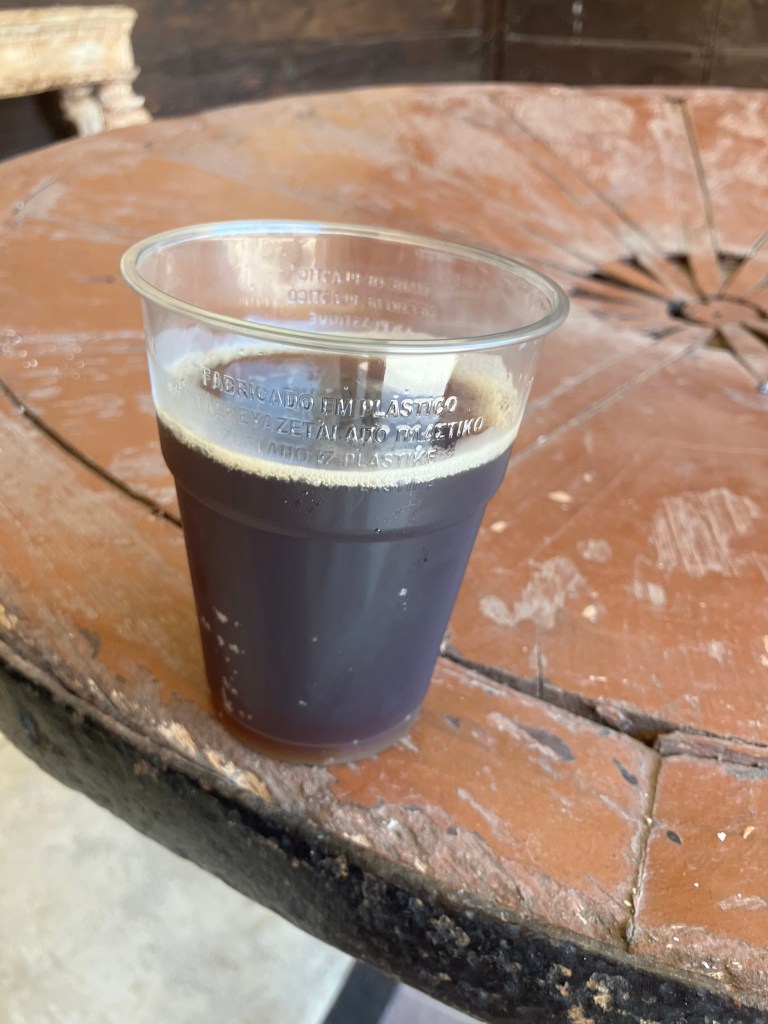
And so it was that this afternoon I found myself at the brewery with friends Kristen and Dave, who happen to spend a couple of months in this region every summer. It was a hot day, and we had visions of a nice, welcoming brewpub with homemade beers on tap, a chatty brewmaster behind the bar, some good pub food, and comfortable high-tops. But it turned out to be more of a, well, Benedictine kind of brewery. The place is like a crowded warehouse with fermenting tanks running at full speed and workers turning valves and connecting hoses. There was really no room for guests, other than a small sales counter in the corner where a busy worker told us “we have three beers. Which do you want?” I chose the “Dubbel,” and we made our way to what appeared to be an old church pew in a shady spot outside of the brewery.
And that finally brings us to the:
BOTD
A Dubbel is a type of ale often associated with modern Belgian beers. It’s a traditional abbey-style ale. Like Birrificio’s other beers, it’s brewed using the same process used by the monks at Montecassio. So they’re again using that natural spring water and estate-grown barley, and allowing relying on the yeast to naturally carbonate the beer.
And you know what? This is a stunningly good beer. Let me count the ways. First, it has a rich, dark-chestnut color that’s got hints of dark ruby.
Great beer, mediocre (plastic) glassware.
Second, that natural carbonation is more delicate and better integrated than what you get from typical pressure-blasted CO2. This beer is fizzy enough to be interesting and bright, without assaulting your tongue and palate with what feels like a pack of Pop Rocks at every sip. Probably because of this, the beer has almost no head, save a bit of tan foam around the edges.
But let’s talk about the flavor: it’s malty and slightly sweet, with recognizable caramel and toffee flavors, mingled with hints of brown sugar and maybe anise. There’s just enough hops to prevent the sweetness from dominating. At 6.5 percent ABV, there’s also a slight alcohol burn that wards off any danger cloyingness that sometimes afflicts this style.
Now, in full disclosure, I should note that I was rather parched and hot when I drank this beer, so that may have contributed to my pleasure in drinking it. But there was absolutely no mistaking that I was drinking a high-quality, well-balanced beer. I may need to try another one.