Breweries · California history · cemeteries · churches · Gas stations · Obelisks · Puns · Road trips · trains

Meditation

Spending a few days in the desert gives you time to think. To ruminate. To meditate. To shorten your sentences to unconjugated verbs.

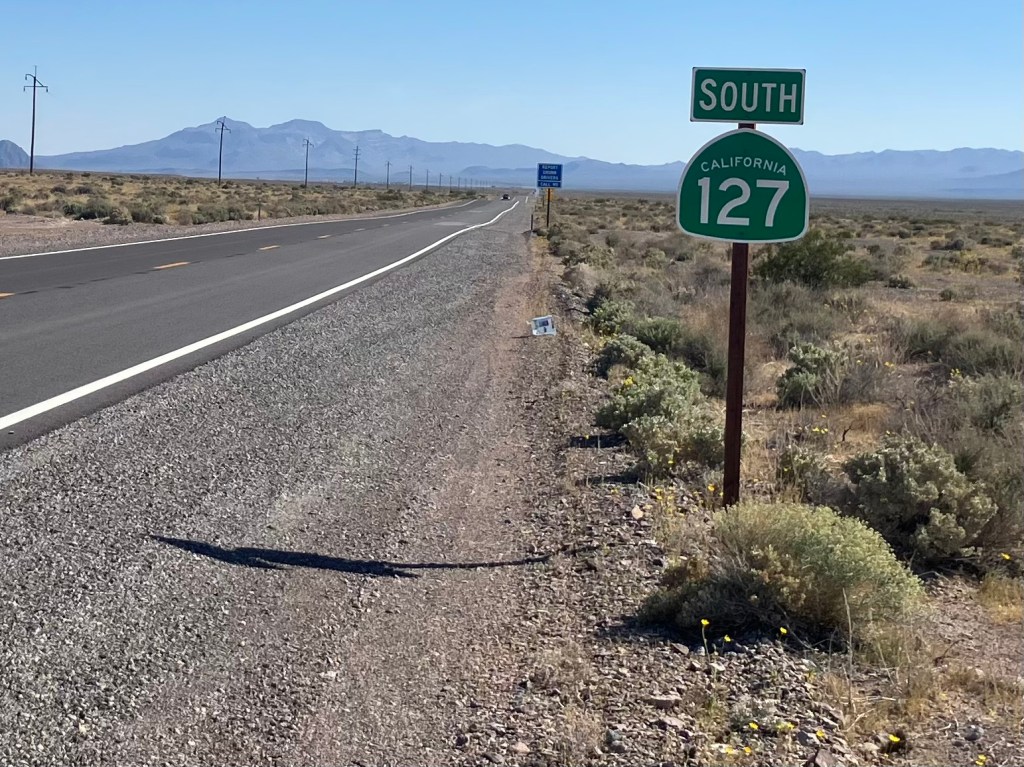
This morning I headed south on CA 127, and within the hour I was at Shoshone (official pop: 31). I say “official”population because one of the locals told me the actual population is now down to 13. In any event, Shoshone was founded in 1910 by Ralph “Dad” Fairbanks, by literally relocating buildings from nearby abandoned mines and towns. Shoshone was situated on the Tonopah and Tidewater Railroad line which, we learned yesterday, was launched a few years earlier to haul borax. Interestingly, the T&T’s name was an unfulfilled aspiration. It never reached north to Tonopah, and it never reach southwest to San Diego (which was the “tidewater” envisioned by the name). Anyway, “Dad” Fairbanks’ daughter married a boy named Charlie Brown (well, Charles Brown), and young Charles essentially became the heir apparent of the town.
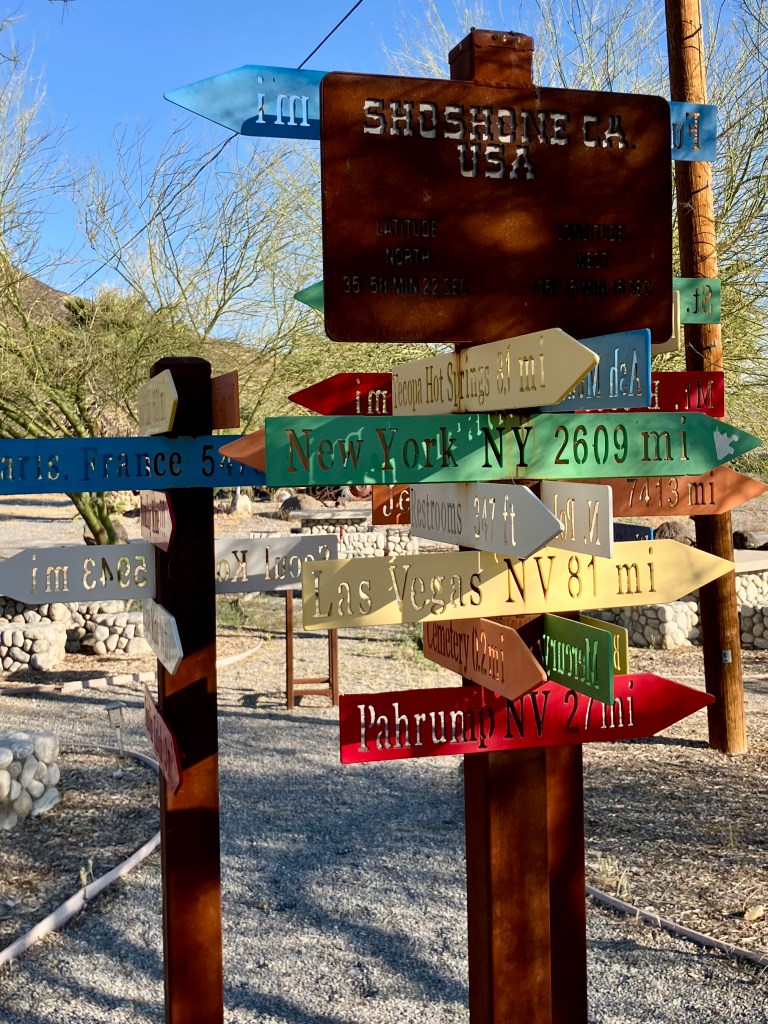
All roads lead to Shoshone.

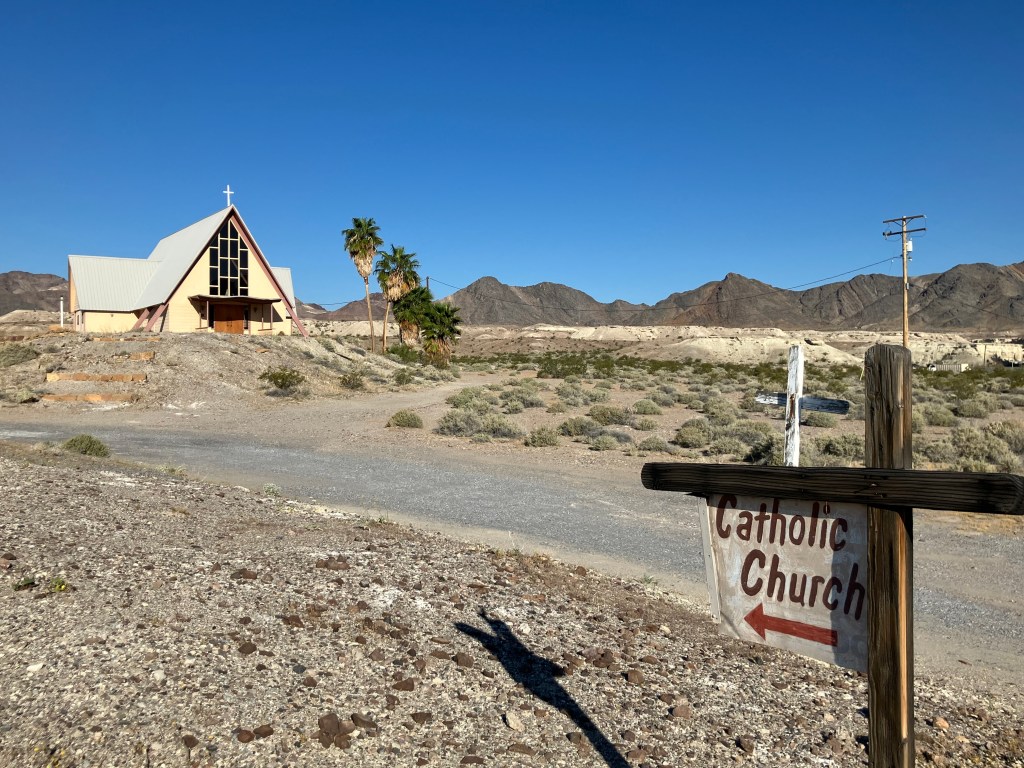
Despite its limited population, Shoshone today remains a going concern. It’s well-positioned as the southern gateway to Death Valley, and it’s at the crossroads of a couple of important highways. Services are therefore oriented towards travelers, with a gas station, a market, a restaurant, a museum, and even a generic Catholic church.
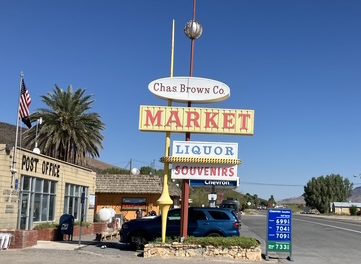
Note the ownership of the market. Also, is it just me, or is the sign done in the Googie tradition?

I decided to get breakfast at the “famous” Crowbar Cafe & Saloon. There were a few other people at the counter, and they seemed to be travelers like myself.
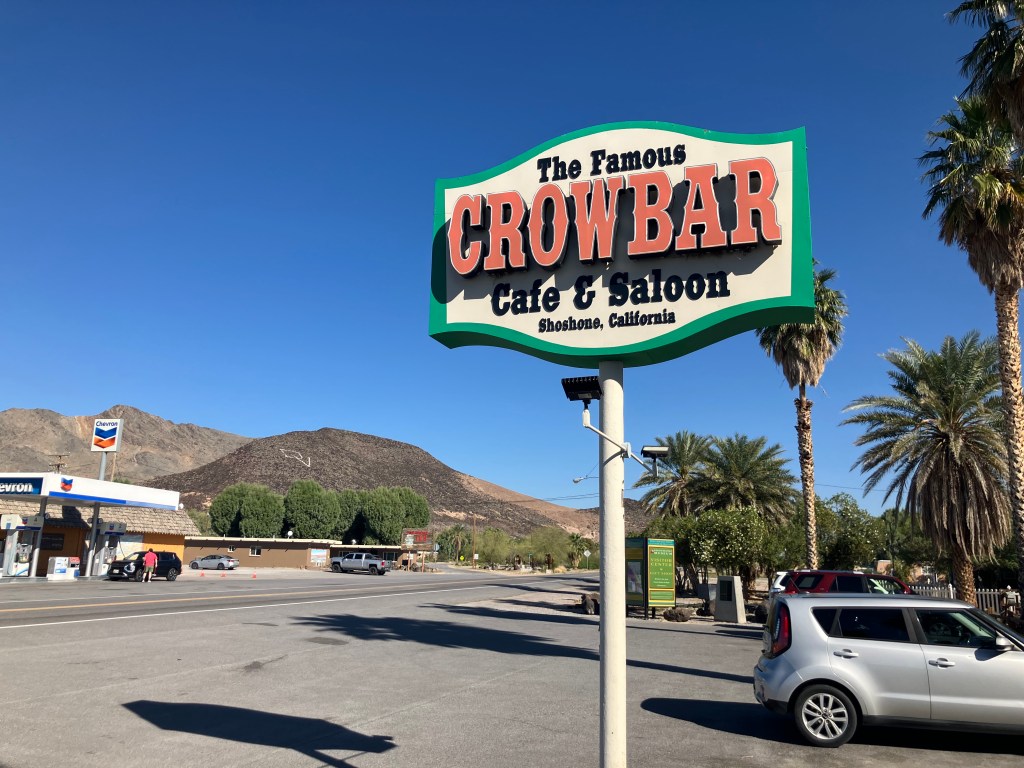
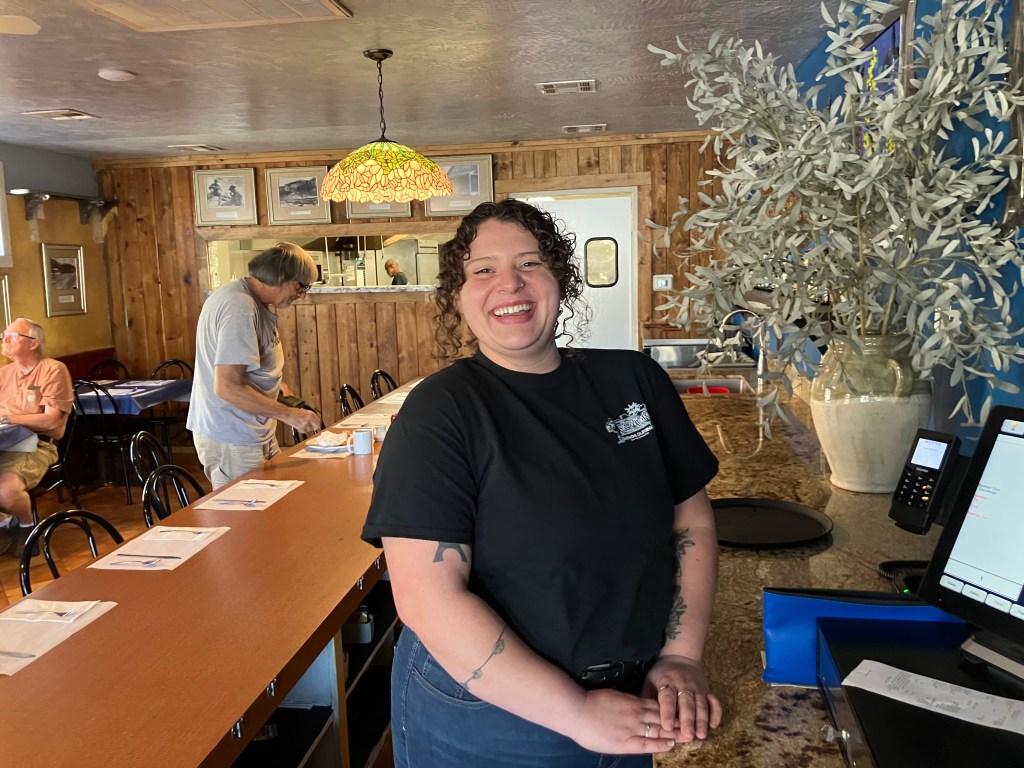
I’m still not sure whether the restaurant has earned the term “famous,” but Brianna–the server–is memorable. Friendly, attentive, and effervescent, with a sly sense of humor, she gives the place a buoyancy that goes well with the strong coffee.
Directly next door to the Crowbar is an old service station that’s been converted into a museum and visitor center. What the heck, thought I. Let’s see what I can learn about this town.
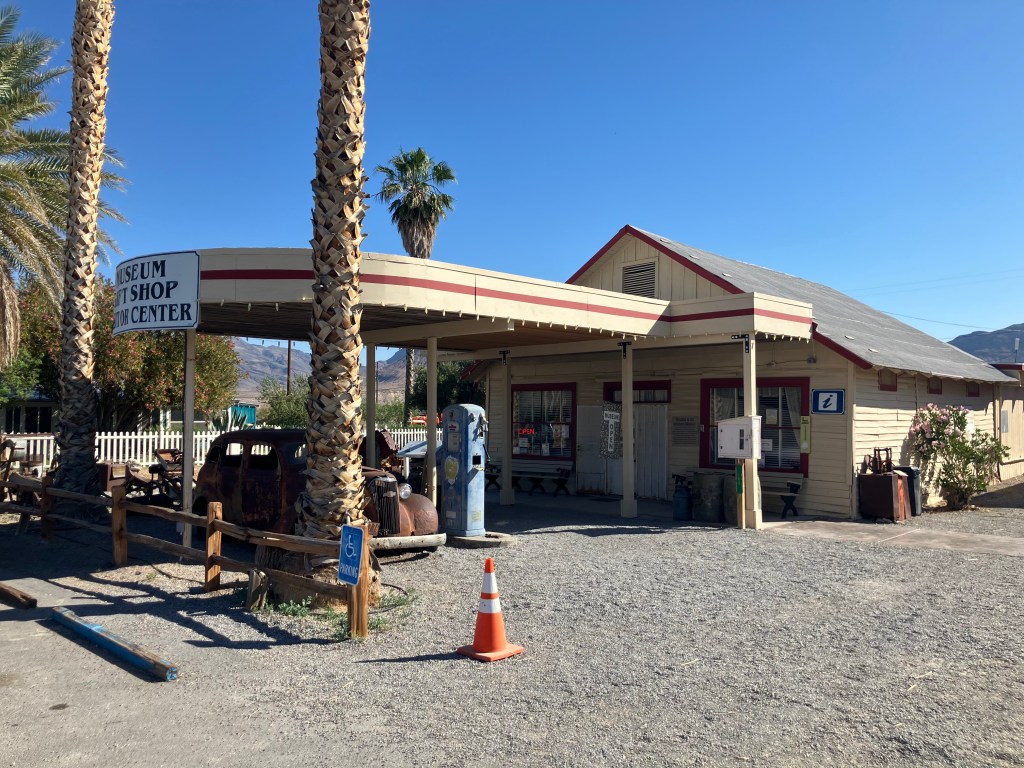
Even though it’s small, every corner of the building is packed with artifacts: old railroad schedules, household appliances, guns, photographs, maps, sheriff’s badges, even an old mastodon skeleton that was uncovered by local students. And of course there’s the requisite box of that white gold of Death Valley: Borax.
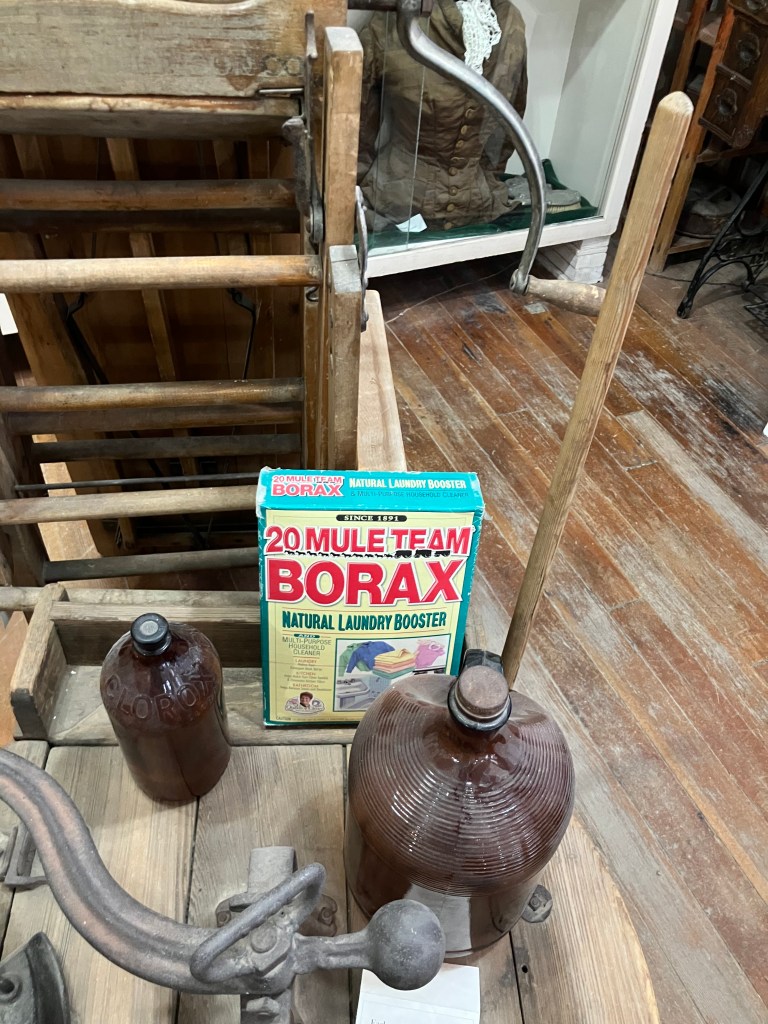
If I have any critique of the museum, it’s that some of the exhibits lack enough descriptive backstory. Fortunately, there’s a remedy in the form of Eliza, who runs the place (or at least today she was).
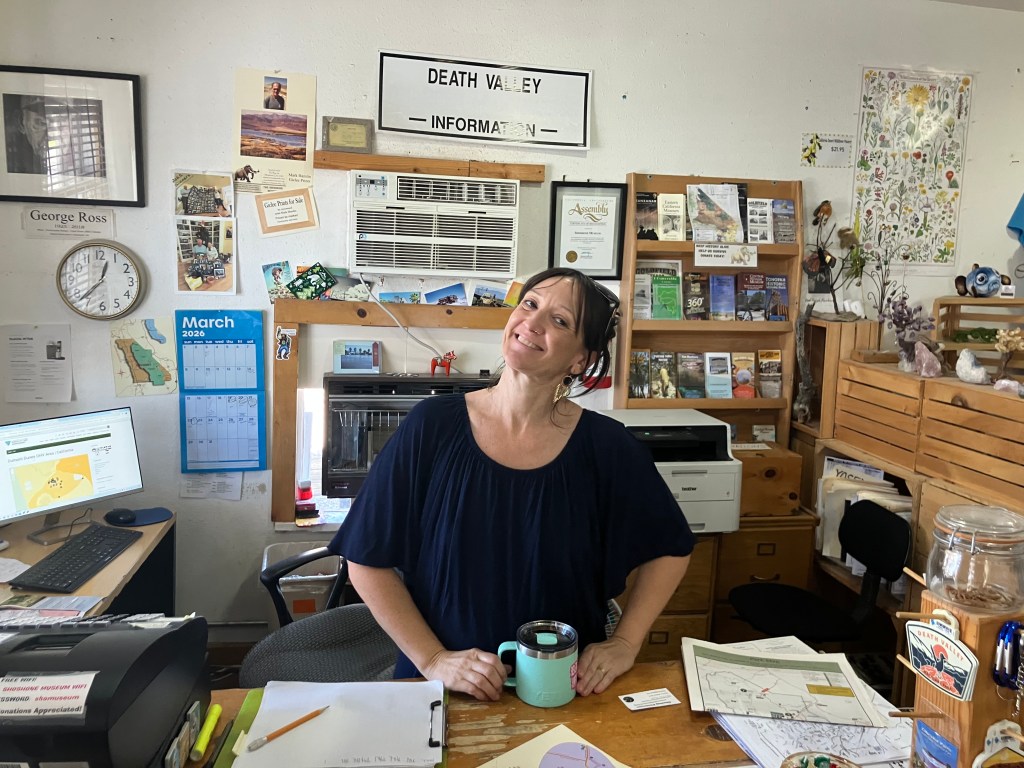
Eliza–Shoshone’s answer to Google.

It was Eliza who sketched the town’s history for me, who pointed me to the remnants of the T&T Railroad, who told me which local breweries were open and which were still getting their taps installed, and who insisted that I make a short detour to the date orchards of Tecopa for a date shake.

Based in part of Eliza’s suggestions, I first went across the street to Dublin Gulch, where miners dug rough-hewn caves into the hillside a century ago.
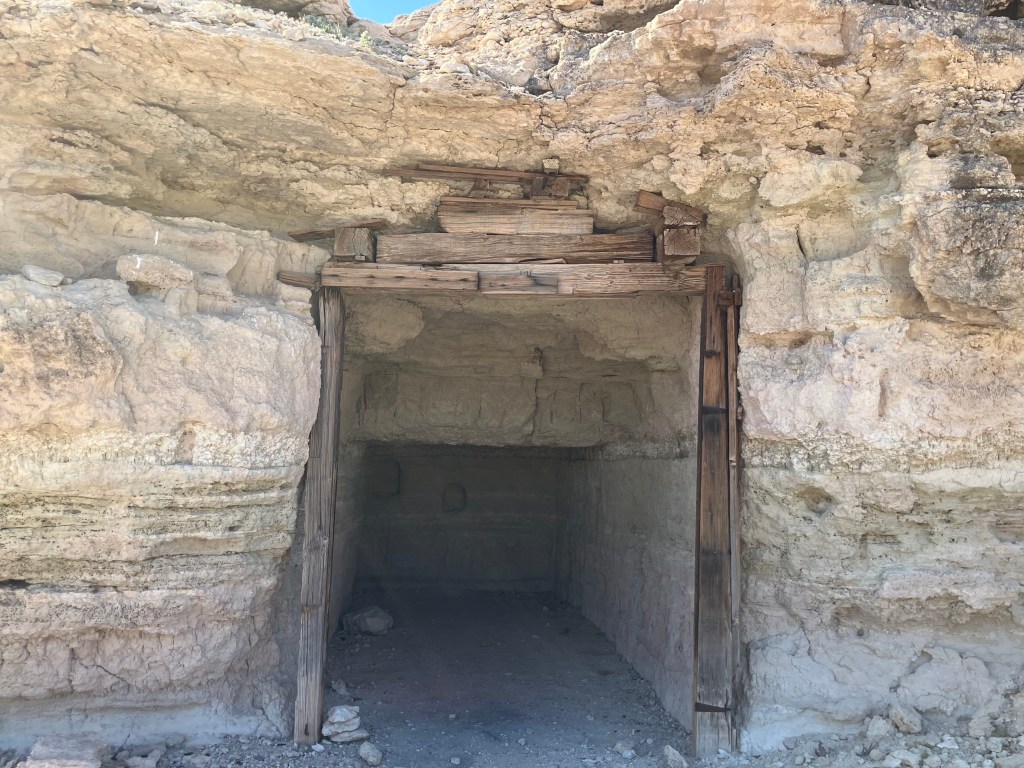
Be it ever so humble…
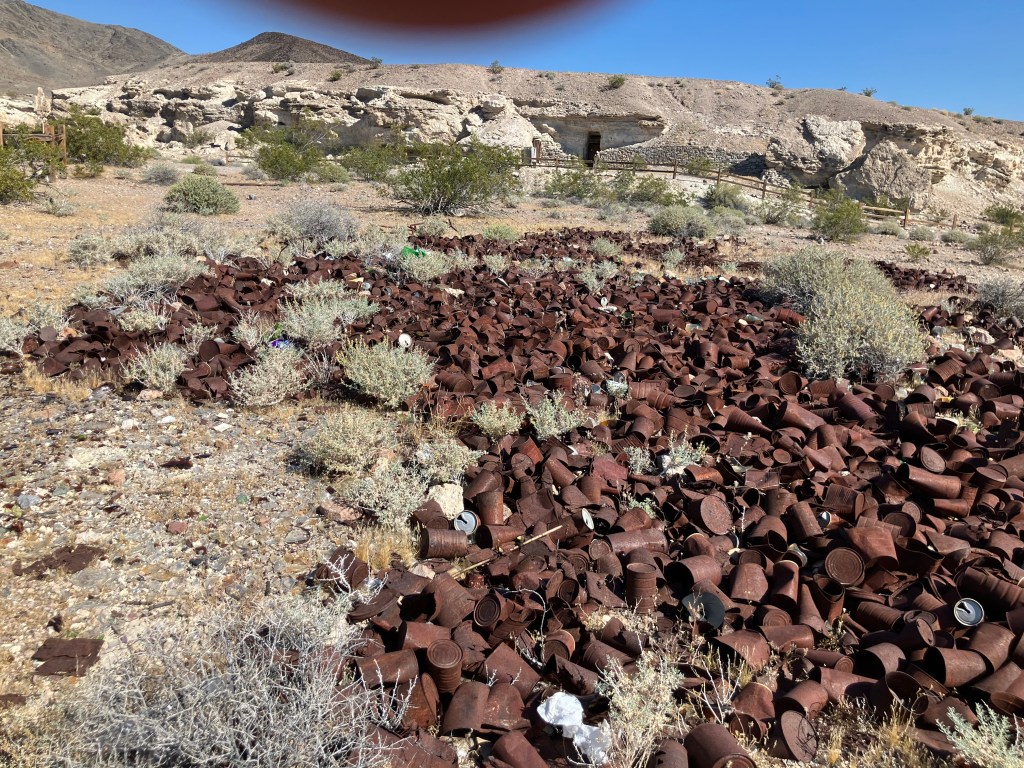
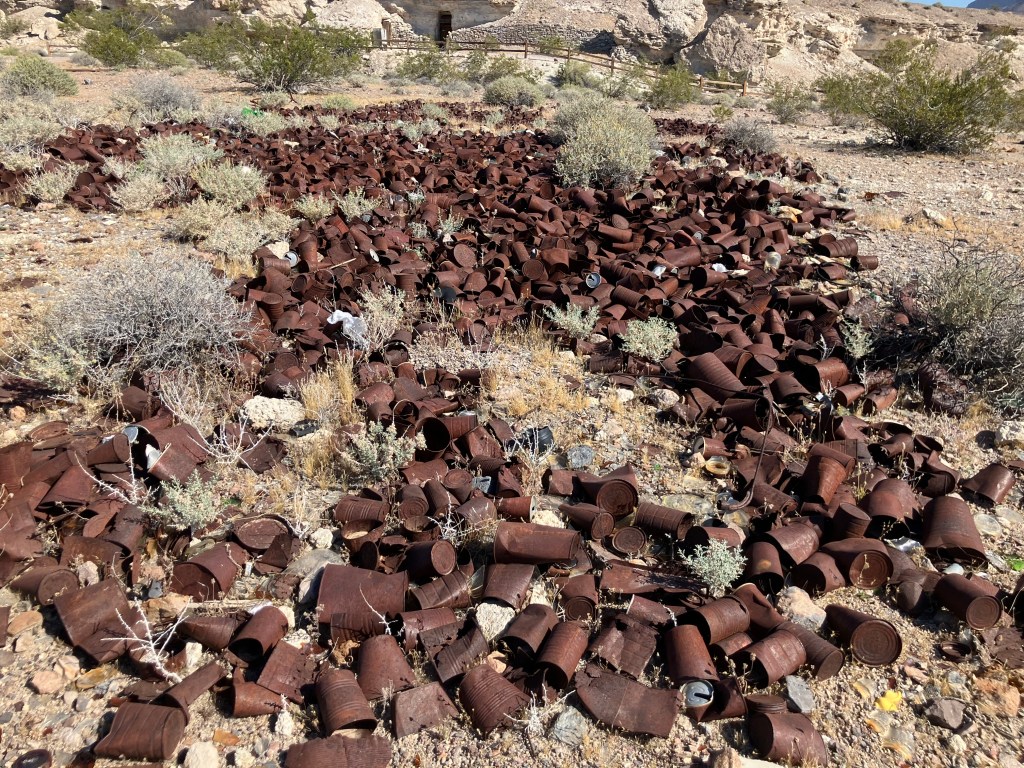
The ground around the caves is strewn with old cans. Presumably these once contained dinner.
More cans…
…and another….

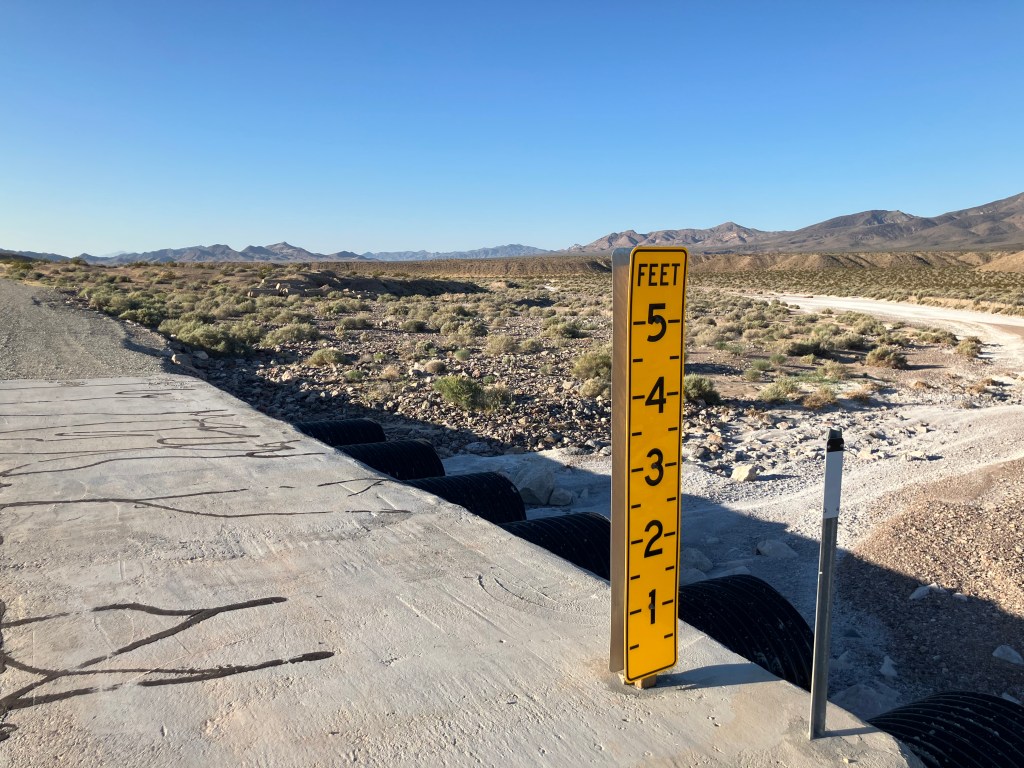
Having seen what I could see in Shoshone, I got back in the car and headed out to Tecopa (pop: 169). Along the way I spotted a few of these 5-foot markers where the road comes close to the Amargosa River. I learned yesterday that flash floods are a real and persistent danger out here; the Amargosa Opera House has been flooded several times. I’m guessing the markers help drivers to judge the depth of water on the roadway?
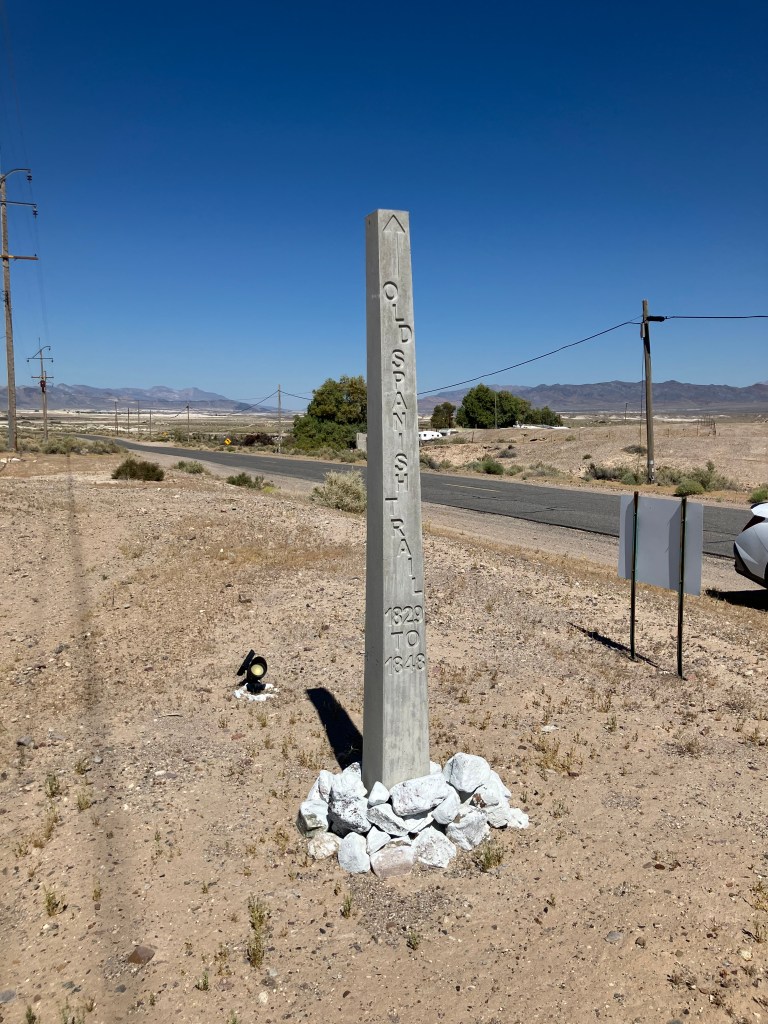
Tecopa is a few miles off CA-127, and to get there you cross the Old Spanish Trail, that connected the settlements of Santa Fe with Los Angeles in the 19th century. I saw a small obelisk (about 5 feet tall, designated #32) marking the route. I surmise there are at least 31 others, and most likely many more. This may be the subject of an upcoming road trip…
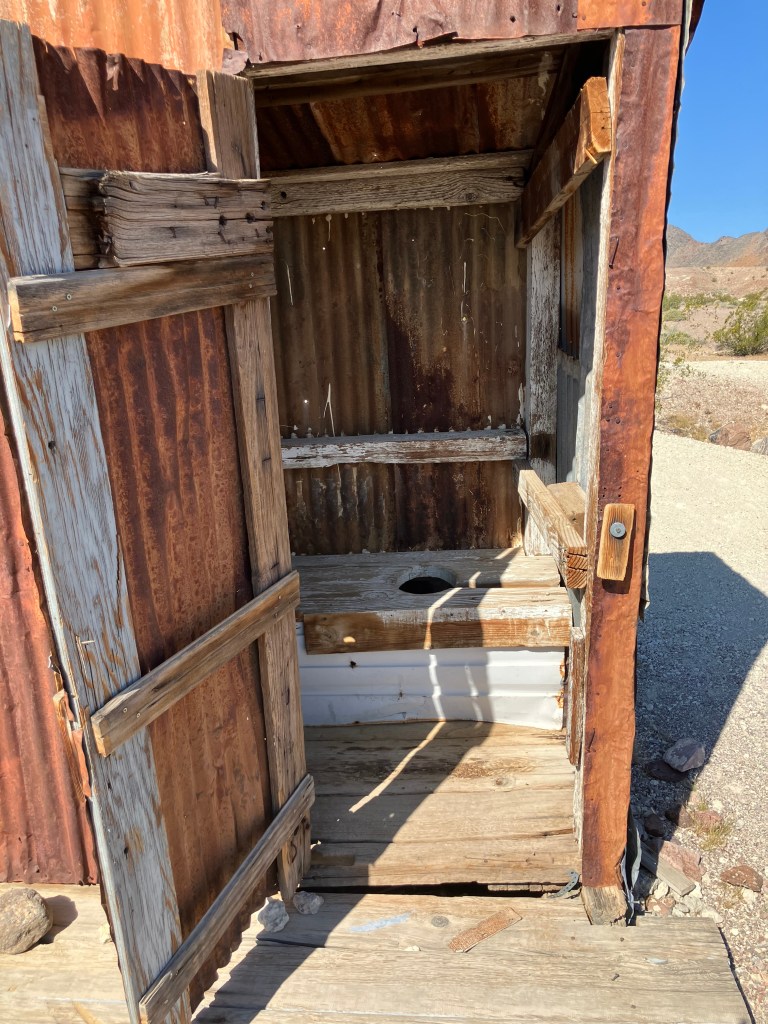
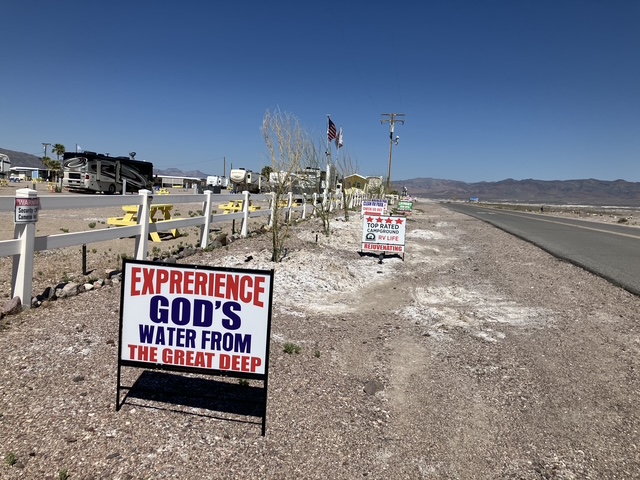
The road to the date orchards passes along a string of privately-owned hot springs. Signage from competing outfits lines the road. Some of the claims seem a bit over-the-top…
I did eventually get to the China Ranch Date Farm, where I had me one of best of the two date shakes I’ve consumed in my life. But near the farm I encountered two sites that spurred the rumination suggested in the title of this post. First, there’s the U-We Wash:
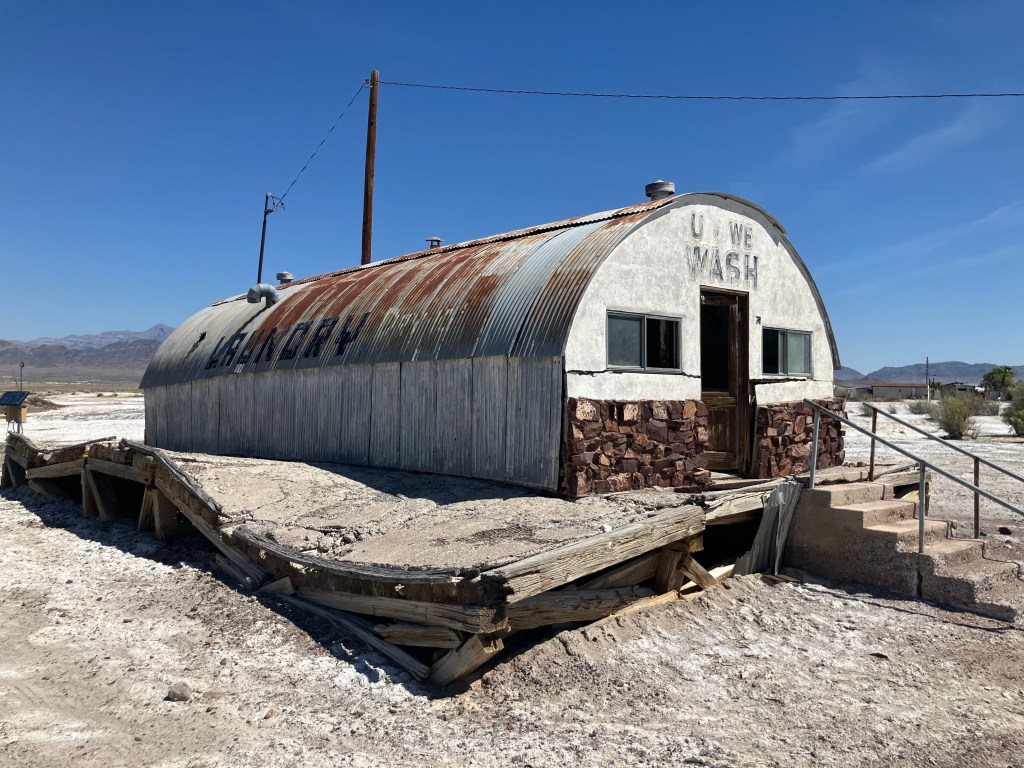
It’s a long-defunct laundromat in a quonset hut. The equipment remains largely intact, seemingly spared from vandals.
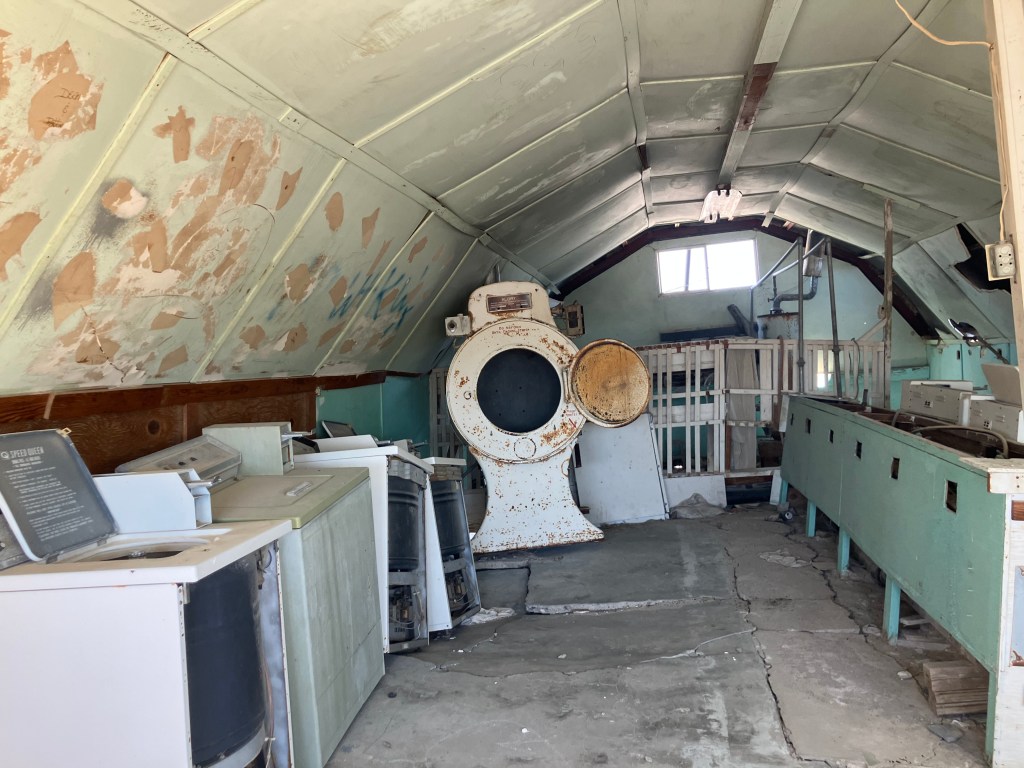
It seems the place has been around since early in the last century, and has been abandoned for decades. It must have served visitors staying at the trailer and RV parks across the street. It’s got a bit of an eerie, Twilight Zone vibe, as though the the owners and customers all instantly disappeared decades ago, perhaps due to a nuclear explosion.

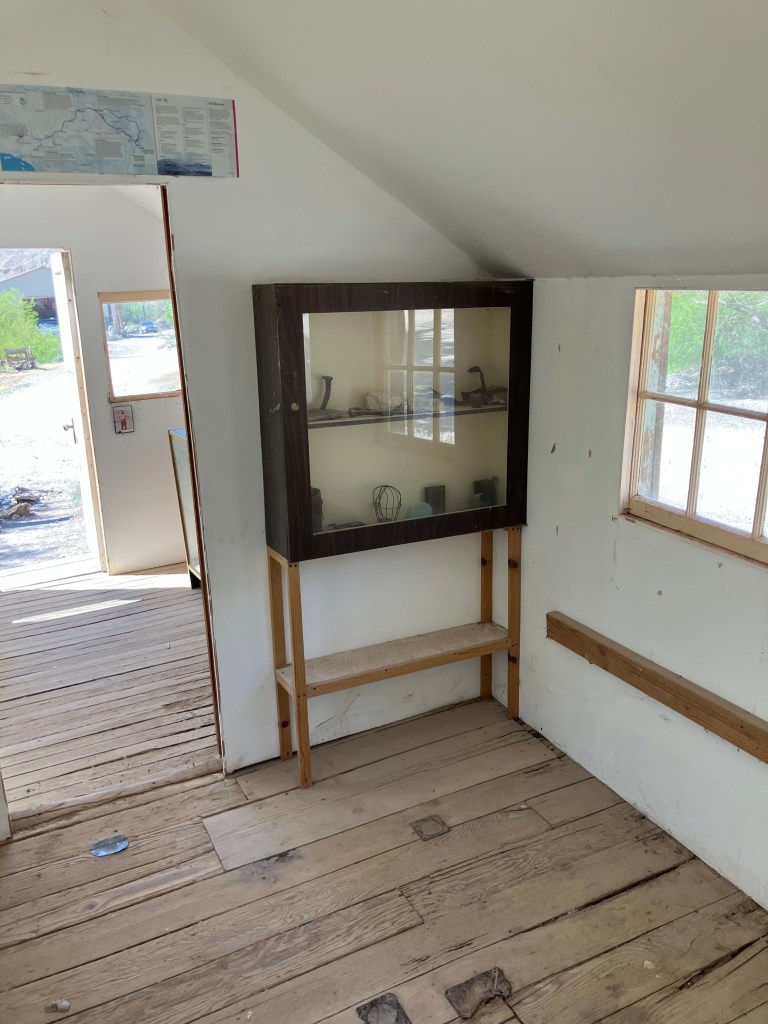
Now, hold that thought and consider the second site that got me ruminating: Just down the dirt road from the date farm is the self-proclaimed “Modest Museum,” which is a simple, old two-room building which a few neglected displays about the history of the area.
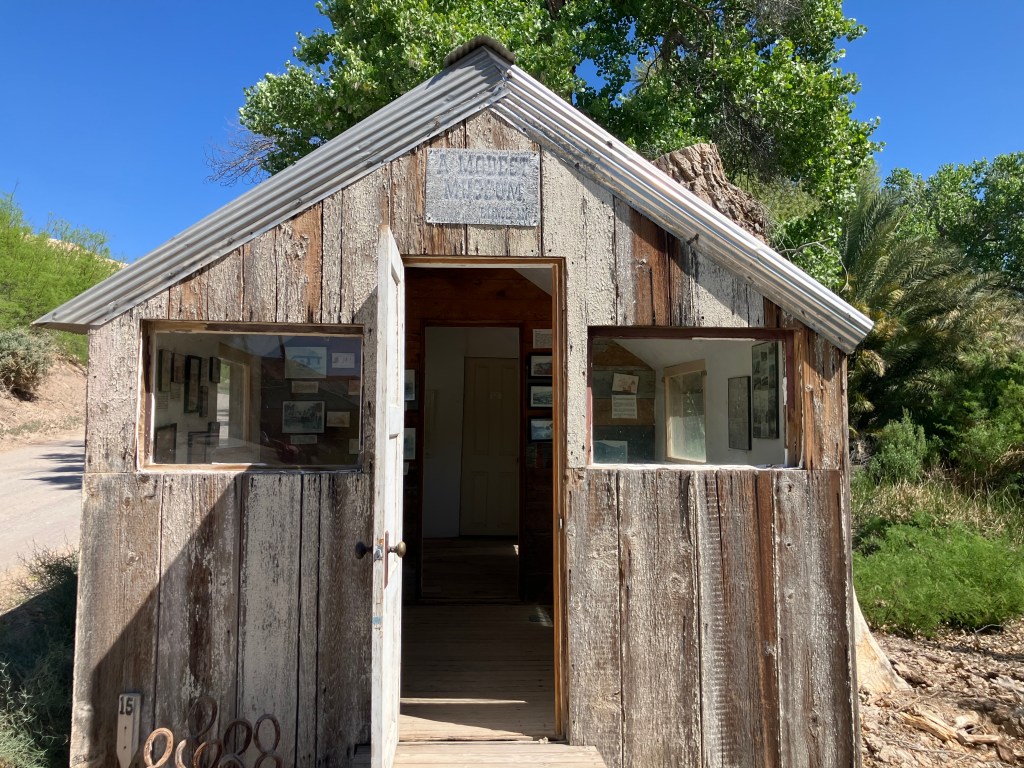
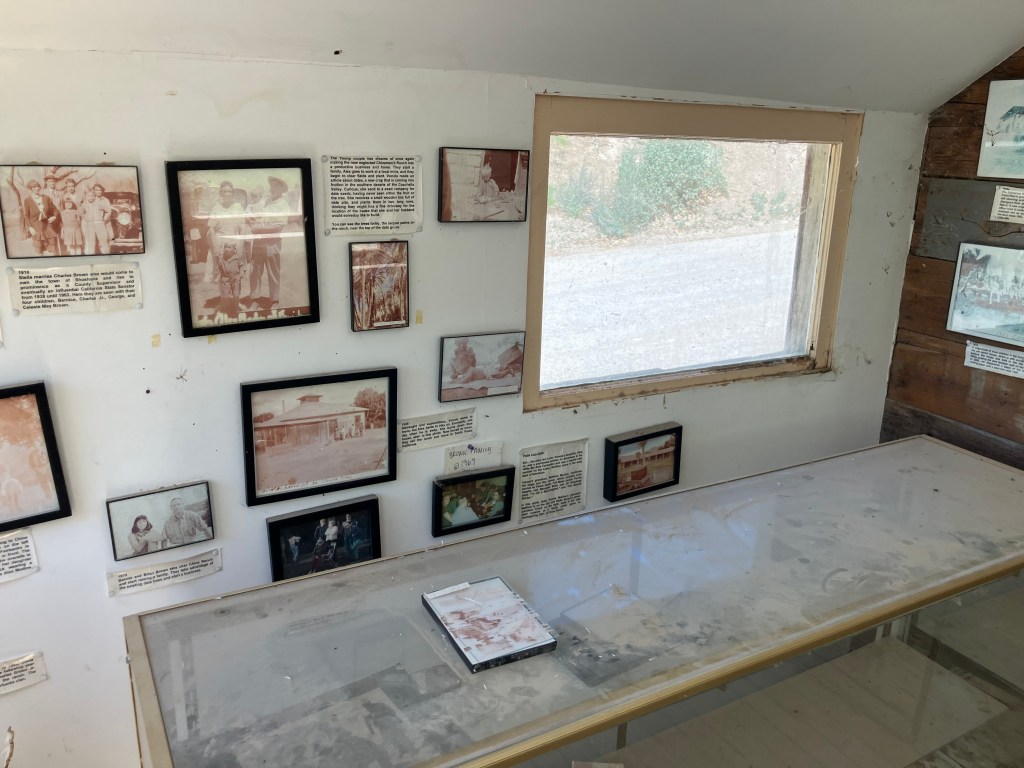
A sign on the wall reads: “We have deliberately made these exhibits accessible to the public, especially children, so they can get a real sense of the history here. Please behave honorably and do not remove or vandalize anything in this little museum.” And indeed, there are no signs of vandalism or theft, which is of course a good thing. And yet, there’s also no sign that the museum has been visited or cared for in the slightest. Dust is thick on the display cases, the photographs are sun-bleached and virtually indecipherable, and descriptive labels have fallen to the ground.

To me, the U-We Wash is cool and intriguing, an artifact in our midst that testifies to a different time. But the Modest Museum is depressing: a well-intentioned and hopeful endeavor that has fallen flat and/or been abandoned. Why my different reactions? Why are some artifacts cool, and others are junk? I’m thinking now of an old home-made theme park in Wisconsin that I visited in 2022. The man who lovingly created it had recently died, and the place was falling into disrepair. As I walked through it on a rainy afternoon I felt melancholy but appreciative of his effort. I did not feel like the remnants of his little park should be torn down. Just as I did not feel the U-We wash should be torn down. And to be fair, it’s not that I think the Modest Museum should be torn down exactly, but if the owners still believe in the mission, they need to give it some TLC or think of a new approach.

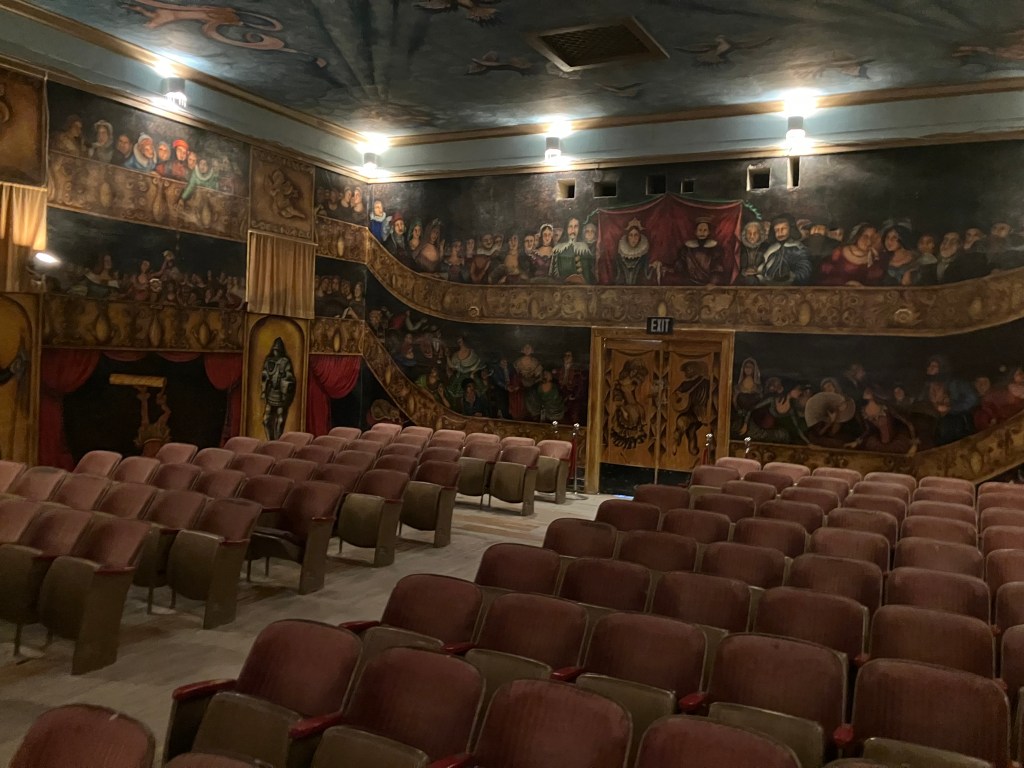
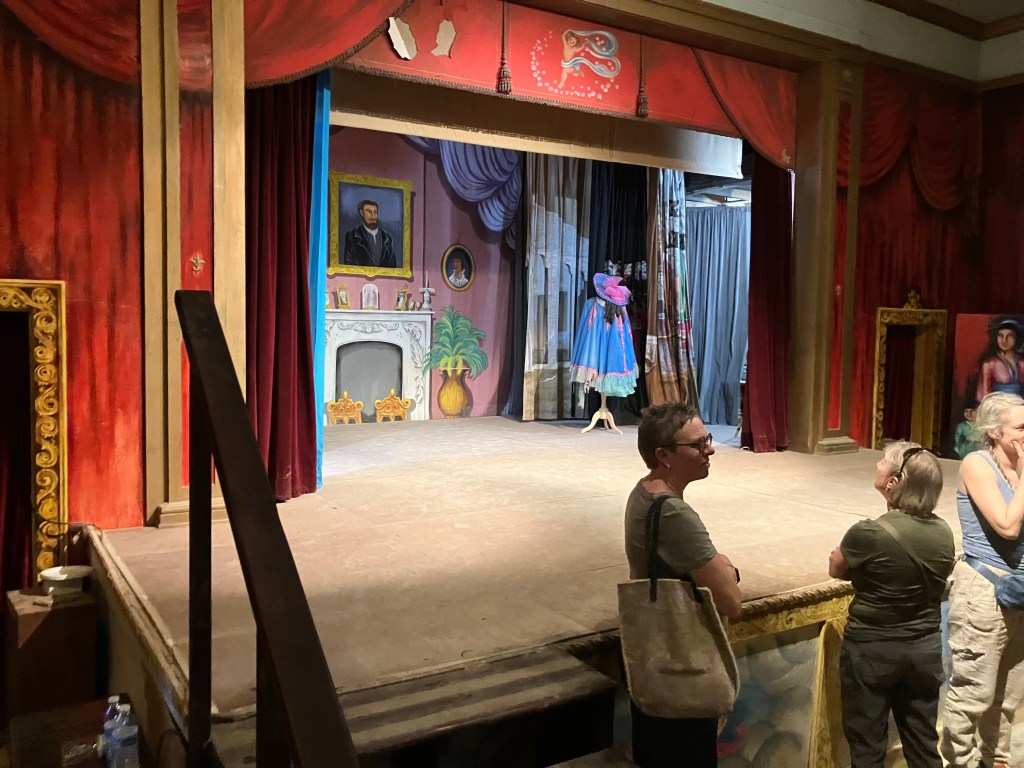
Part of this rumination comes from something that tourguide Sue mentioned at the Amargosa Opera House. According to Sue, Marta Becket had always insisted that, after her death, no one should ever restore or otherwise repaint any of the murals she had painted on the walls of the opera house and the hotel. She believed that the desert will rightly reclaim all that she did out here, and she was OK with that. Don’t fight it, she said. And so, as our tour group walked through the opera house, we saw areas of peeling paint and torn fabric that, according to Sue, the caretakers just have to accept.

I spent a lot of time thinking about this today, and the thought that keeps coming to my mind is the notion of burying the dead. Trees die in our gardens and we cut them down. Buildings become uninhabitable and unsalvagable, so we take a wrecking ball to them. An open bottle of wine goes bad and we pour it out. And, of course, our pets and our relatives die, so we return their bodies to the earth. I still don’t know exactly why I don’t feel that the U-We Wash shouldn’t be torn down. But I do know that the guy in my neighborhood with the weathered, broken, and rudderless boat in his side yard needs to get rid of the damn thing.

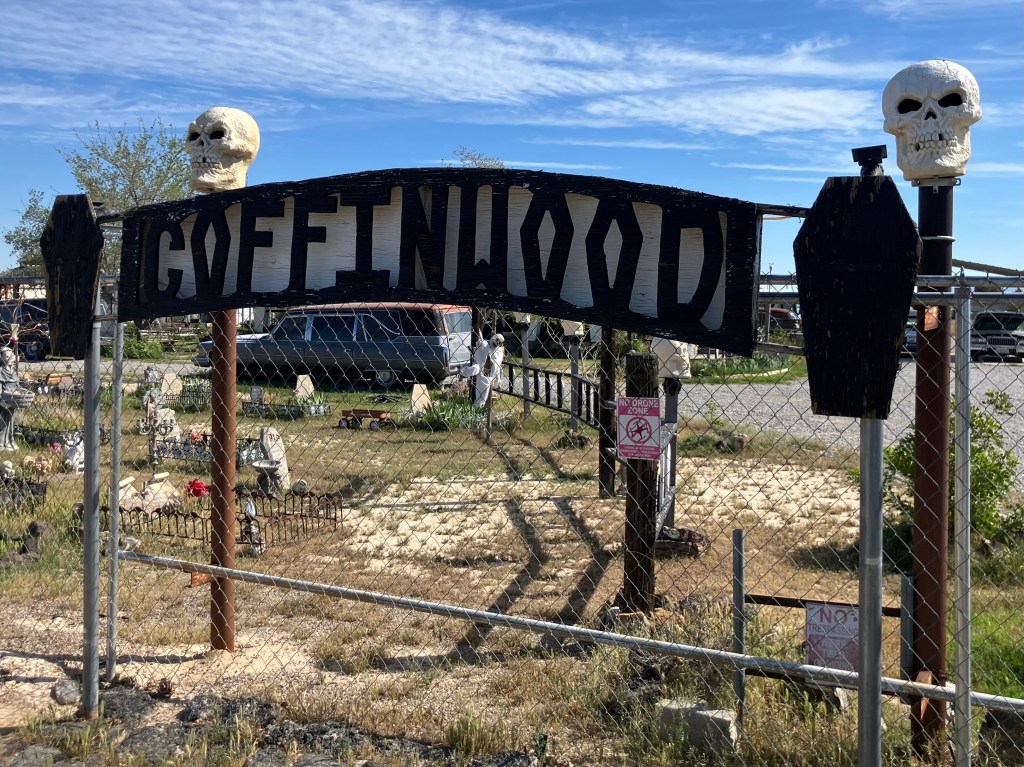
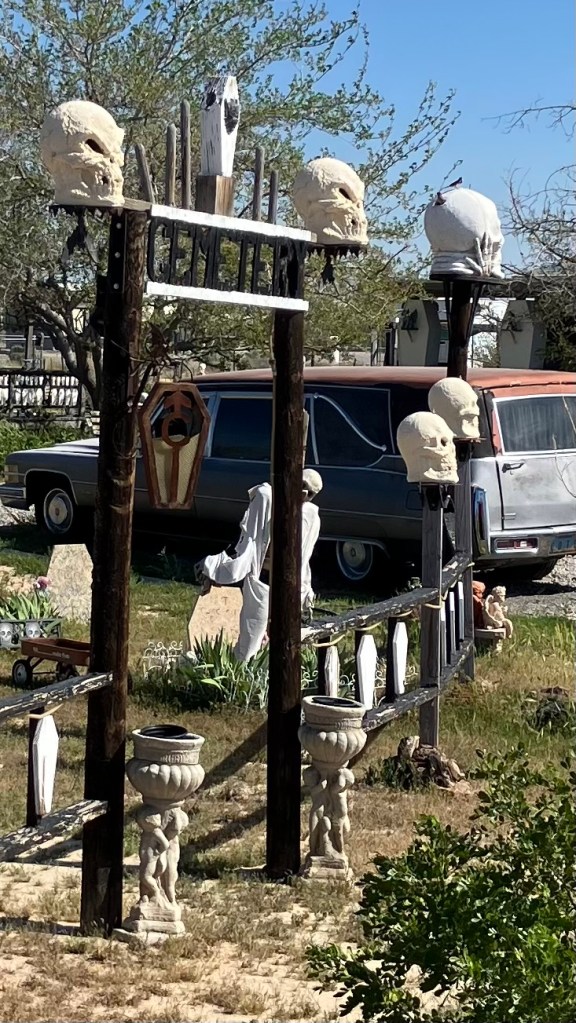
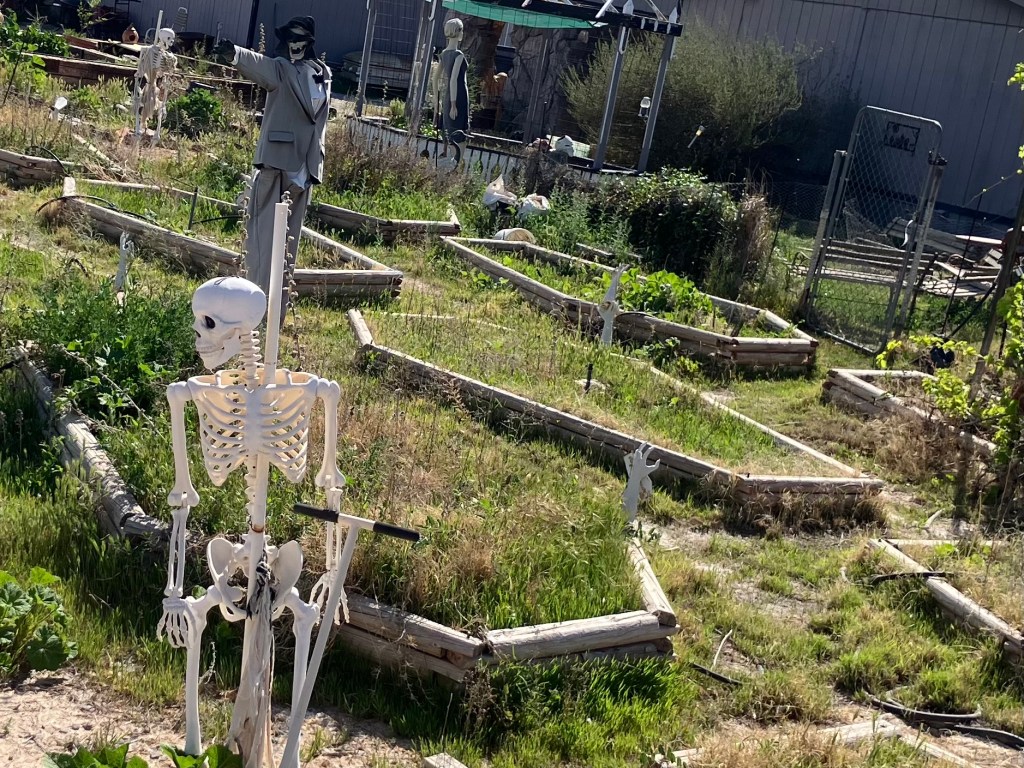
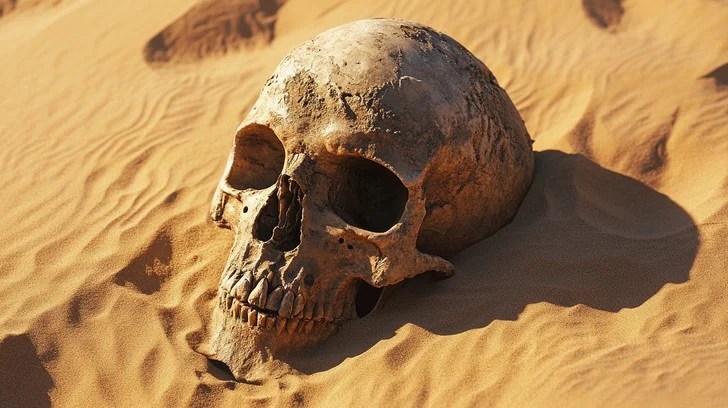
Out here in the desert there seems to be different attitude about death. Desert people appear to do a better job of accepting the concept. The imagery of death of all around the desert, including, of course, in the name Death Valley. So I’ll leave you with some of that imagery.
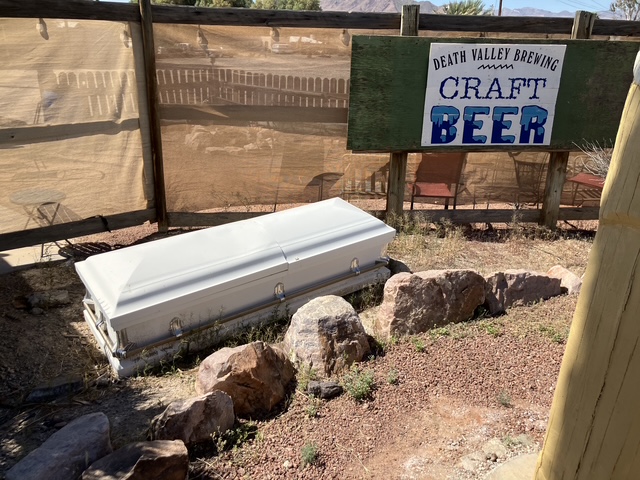
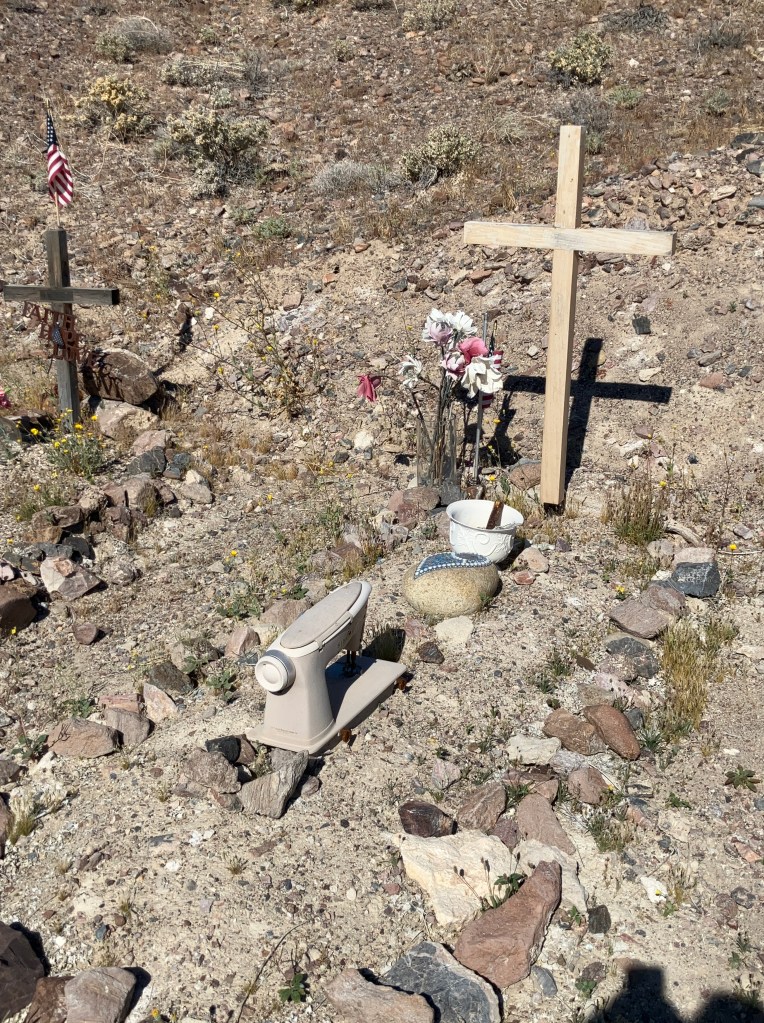
I’m betting the deceased was a singer. Har.

BEER OF THE DAY

OK, that was a little heavy. So let’s end with the Beer of the Day. I had a beer at Steelbound Brewery and Distillery in Pahrump, NV (pop: 44,000). (I had to make a 20-minute detour across the state line to find a place to spend the night.)
Speaking of imagery of death…

This brewery/restaurant feels a little weird, and seems to still be trying to find its niche. (I’m told the place recently changed ownership.) It’s attached to the Best Western hotel, which seems to seriously undercut its effort to appear like a hip microbrewery. Video gambling machines are situated at every seat at the bar. Giant TV screens show The Price is Right, a program that’s punctuated with endless ads for prescription weight loss and asthma drugs. The menu is overrepresented with Indian food. The Sirius country-western station is piped over the speakers. The whole place has a soulless corporate feel. Even the servers seem robotic.

But they make their own beer. Perhaps because they’re still in the start-up phase, they only had three beers on tap. I chose the Chocolate Peanut Honey Cream Ale. Believe it or not, I considered this to be the safer choice.
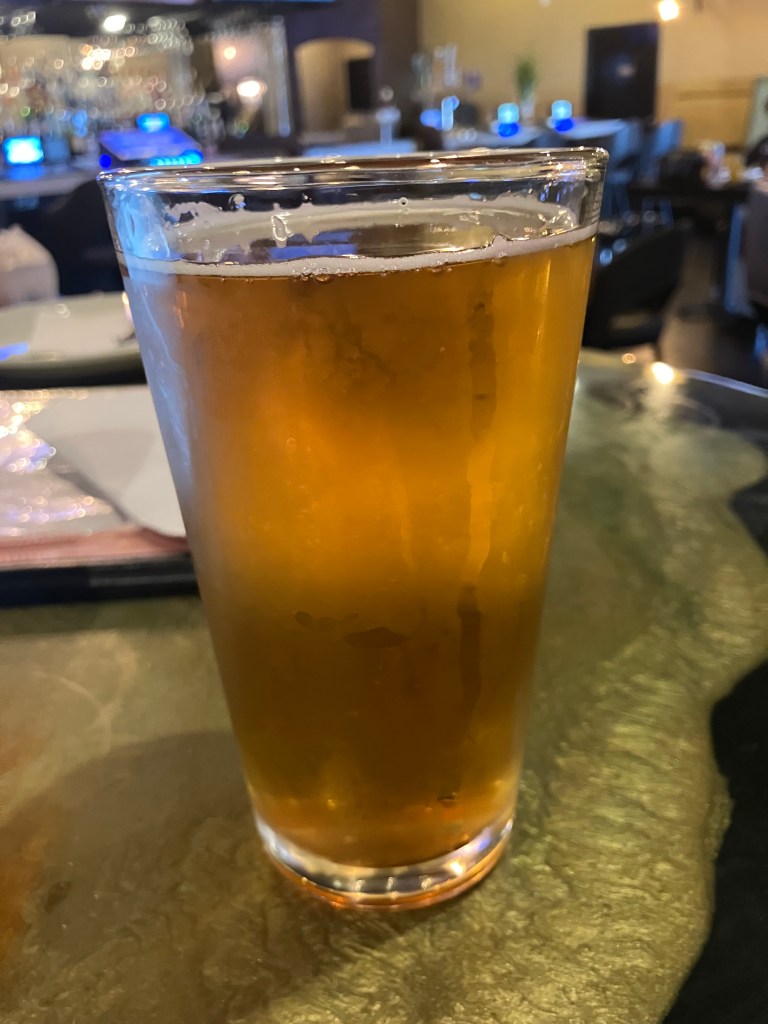
And I wasn’t disappointed! It’s got a golden honey color with a slight cloudiness. There’s no nose to speak up, but it is definitely refreshing. It’s not too hopped, not too carbonated, but neither is it flat or bland. I’d call it “brisk.” The mouthfeel is slightly creamy. I don’t taste the “chocolate” mentioned in the name, except maybe that slight chocolate essence you get from chocolate bitters. A full pint of this stuff was not filling in the slightest. If I lived near here, this would be my go-to summer beer. 5 out of 5 stars.
Breweries · California history · Road trips · trains

“Death Valley Road”: What Could Go Wrong?

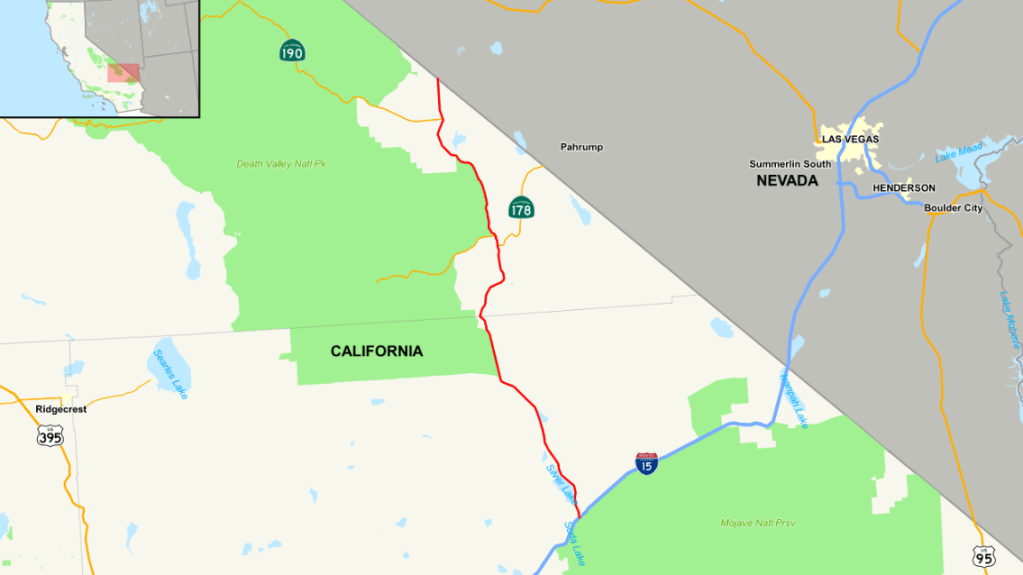
Spring officially began a few days ago, which of course signals the opening of road trip season. And right on cue, loyal reader Peter D. helpfully sent us a Los Angeles Times article highlighting a stretch of highway in the Mojave Desert that piqued our interest. It’s California Route 127, and it’s known to old-timers as Death Valley Road. It dates back to the FDR administration–or, perhaps more relevant for a California highway, it dates back to the administration of Governor James “Sunny Jim” Rolph, Jr, a man who lasted three years in office before he collapsed and died while campaigning for re-election.

Route 127 is about 91 miles miles long, running along the eastern edge of Death Valley National Park from the Nevada state line down to the town of Baker on Interstate 15.

State Route 127 in red.

And so this morning I took a cheap Southwest flight to Las Vegas, where I rented a car and set out to explore this fabled (?) stretch of roadway. I’m going to cover the full 91 miles, but first I had to get there.

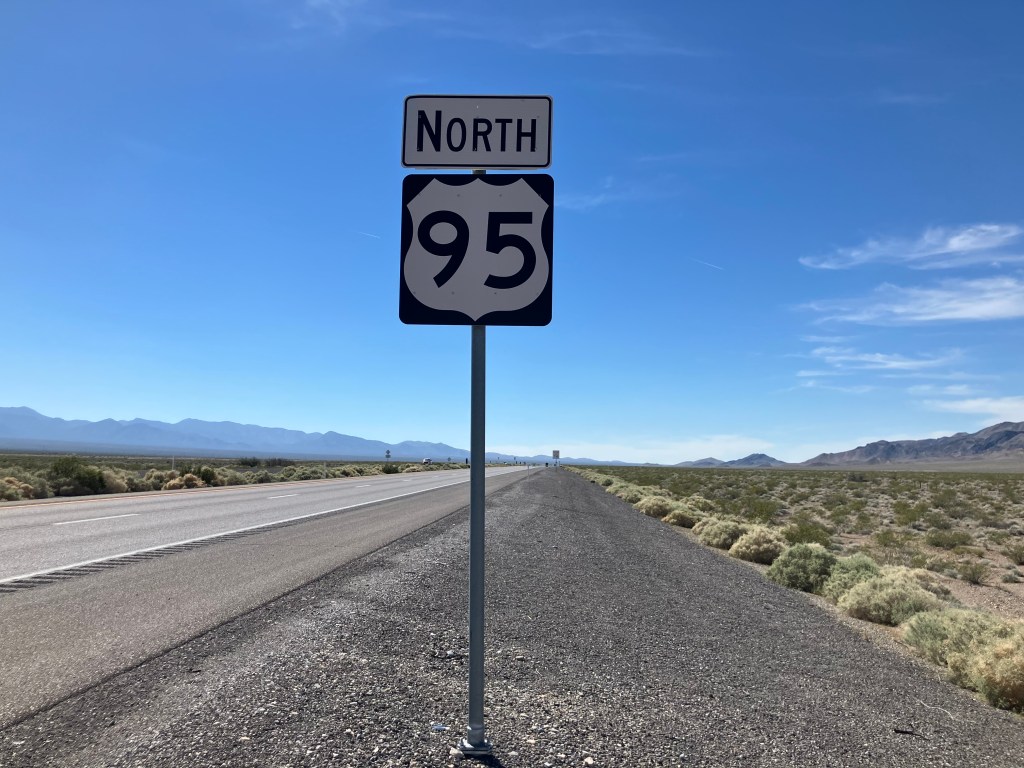
As luck would have it, getting to the beginning (or end, depending on your perspective) of Route 127 meant driving a stretch of US Route 95, which is a highway I explored in 2021. Attentive readers might recall that I got as far south as Beatty, Nevada on that trip. Today I had the opportunity to cover another stretch of US 95, between Las Vegas and Beatty. I must say, it’s a whole lotta nothin’.

“In the desert you can’t remember your name/’cuz there ain’t no one for to give you no pain.”

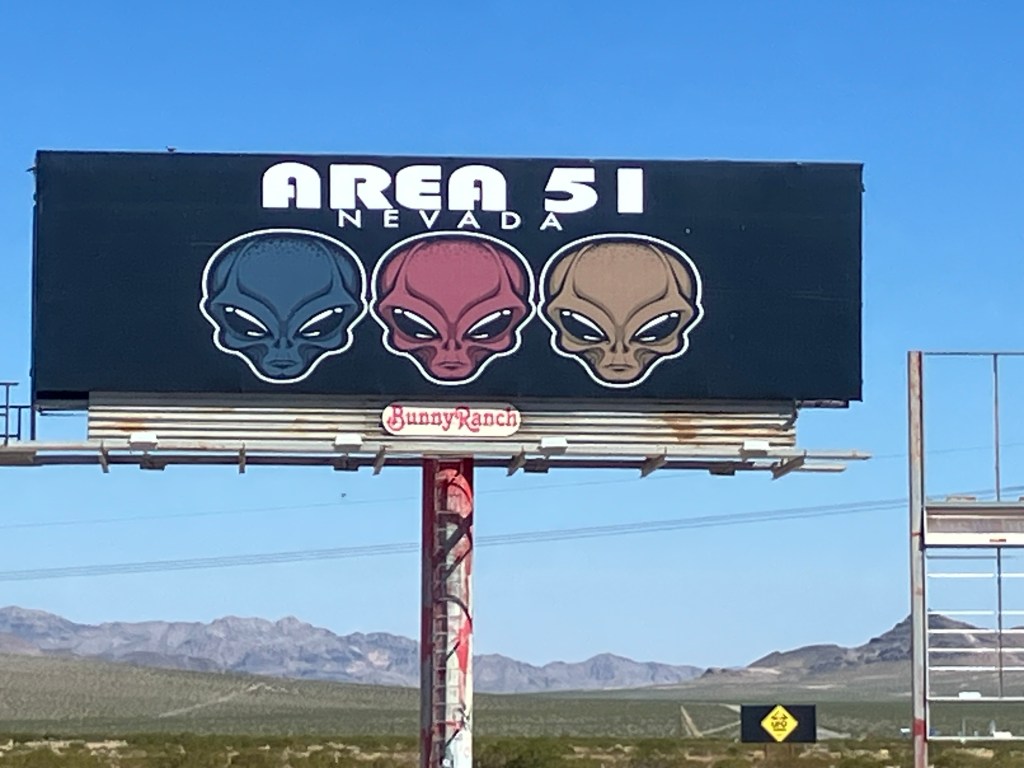
Well, not quite nothing. While looking for a gas station, I saw this sign along US 95:

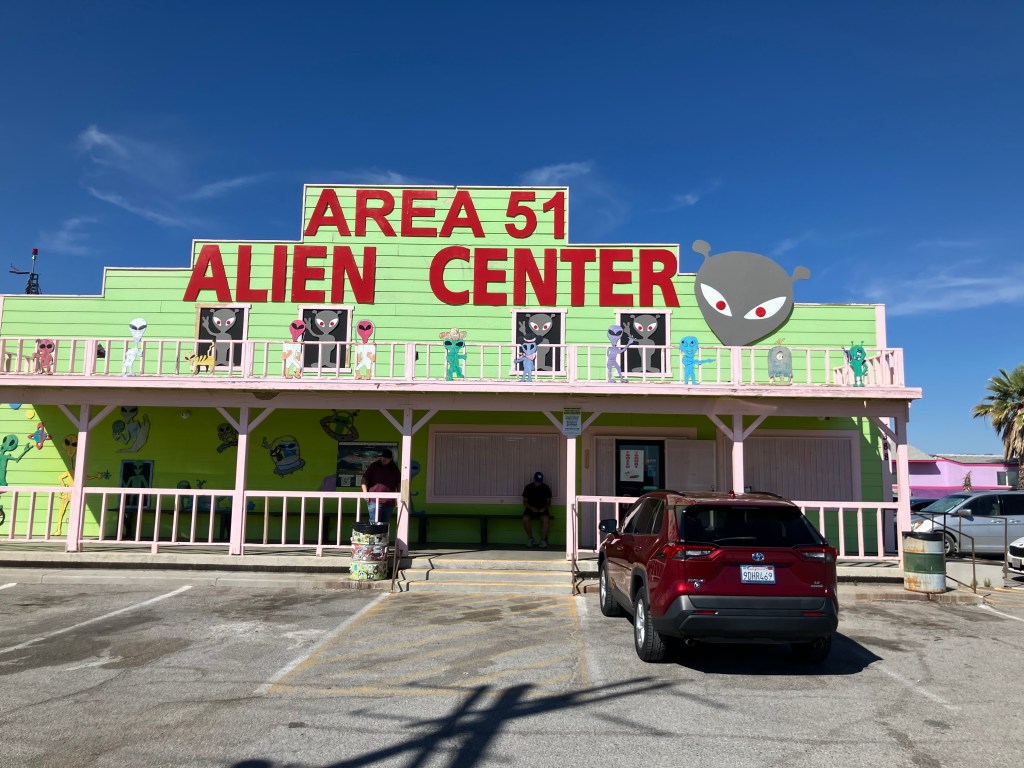
Now, Area 51 is indeed in this general area, but this facility and signage feel a little too obvious:

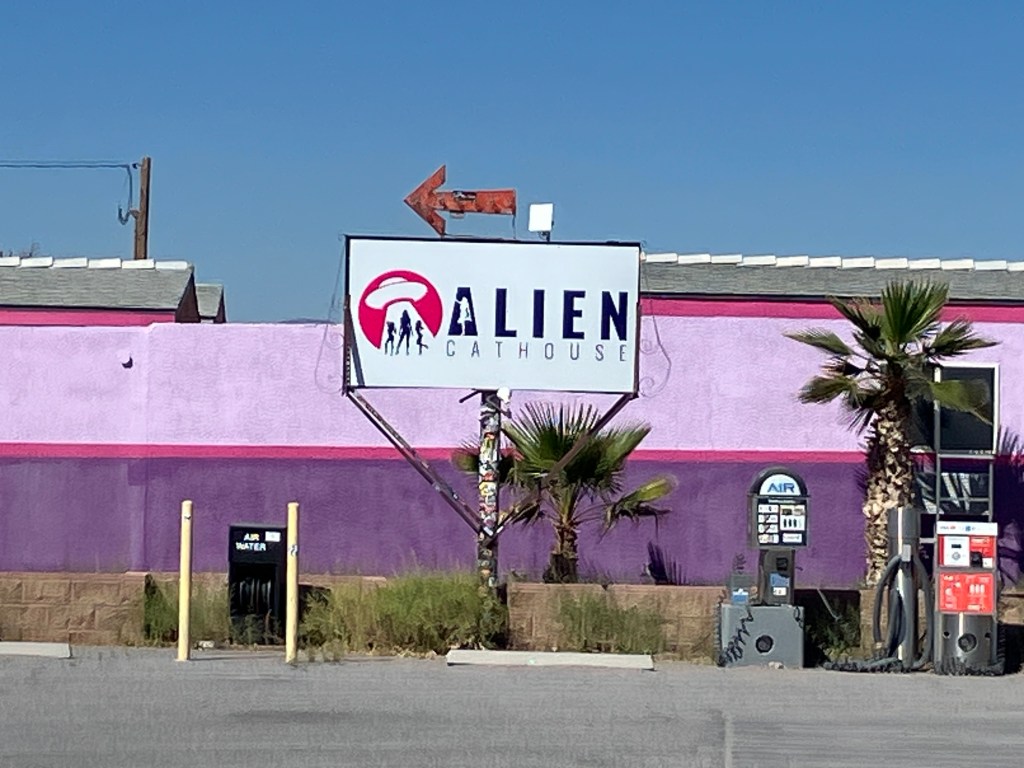
It turned out to be one of those combination convenience store/alien souvenir junk/gas station operations. (It’s almost identical to Jackass Joe’s, that I visited in Utah last year.) But this UFO-themed place has another distinguishing feature:

That’s right–the front door of the Älien Cathouse is right next to the gas station’s water and air hoses. As you may or may not know, brothels are legal in Nye County, Nevada. While I was pumping my ethyl (if you’ll pardon the expression) a husband and wife were posing with their young children in front of the Cathouse.

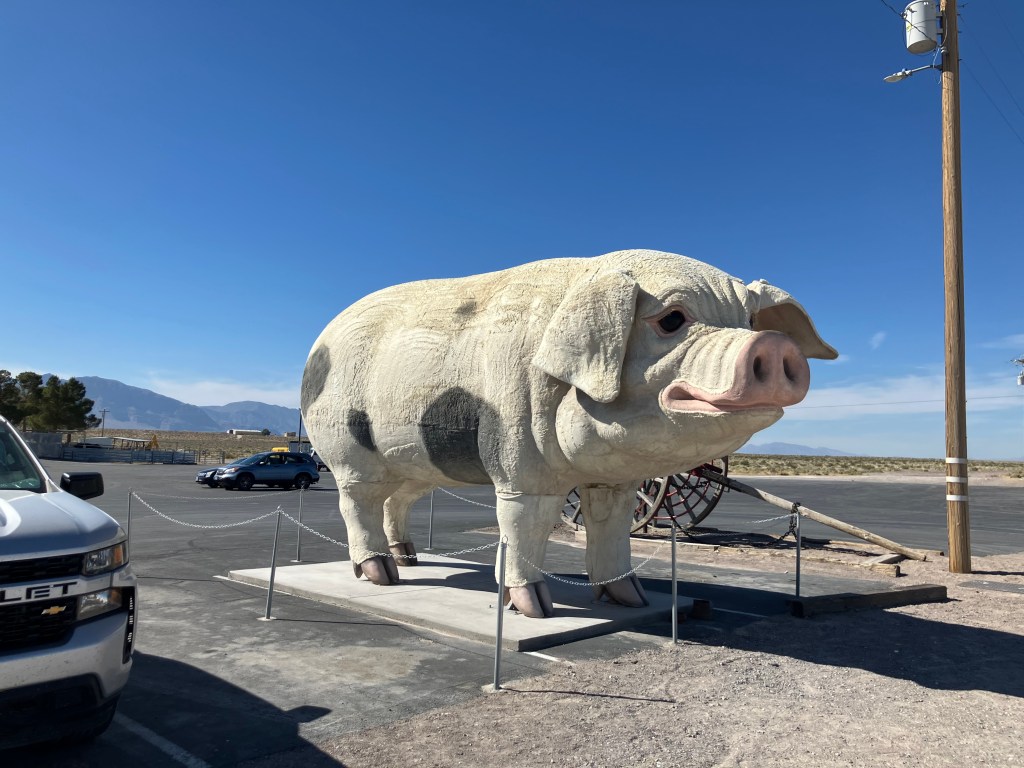
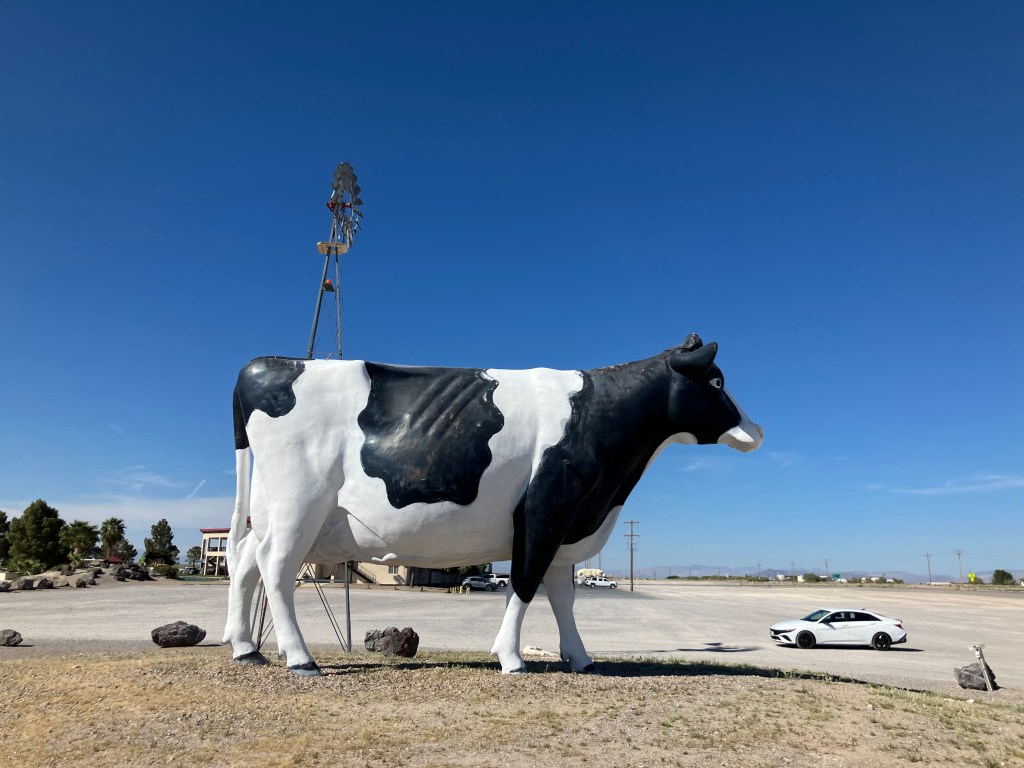
I got back on the road, and after a short time I was approaching the California state line, where I passed a Last Chance Nevada casino whose roadside calling cards are, confusingly, a giant pig and a giant cow.

(Interesting side note: The cow used to stand atop the now-defunct “Holy Cow! Casino and Brewery”in Las Vegas.)

Finally, as I crossed into California, I was instantly on California Route 127. I was eager to see for myself the road that the LA Times calls an “antidote to the frantic pace of our modern condition, a necessary pause to see not what has been forgotten, but what endures.”

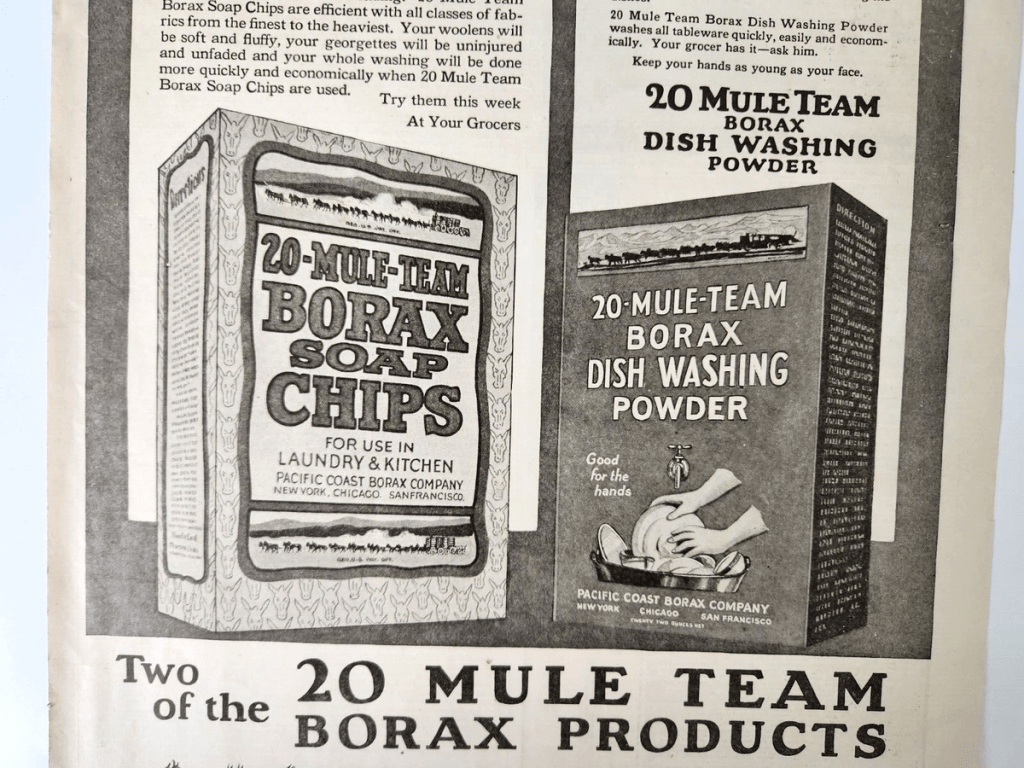
Shortly after starting my journey along CA 127, I arrived at a magical place called Death Valley Junction (pop: 3). The town was founded in 1907, when the Tonapah and Tidewater Railroad ran a spur line here to serve the Pacific Coast Borax Company’s plant. (You have to admire the chutzpah of naming a mining operation in the middle of Death Valley after the shores of the Pacific Ocean.) Borax is a naturally occurring mineral that was discovered here in Death Valley, and is used for cleaning and other uses.

Anyway, the western writer Zane Grey published an article decrying the horrible living conditions of the borax workers living in tents out here in the desert. So the Pacific Coast Borax Company, sensing a potential PR nightmare, built proper housing and facilities right here where I’m standing. This company town was constructed almost exactly a century ago, and it had offices, a hotel, worker dormitories, an infirmary, a community hall, and other facilities. By all accounts it was a thriving community.

This state of affairs only lasted for a few years. It seems that a richer vein of borax was discovered elsewhere, and the Pacific Coast Borax Company moved its operation out of Death Valley Junction. Then, in the 1940s, even the railroad left town…literally. The rails were pulled up and sold to the US government, which used them for the war effort in Egypt.
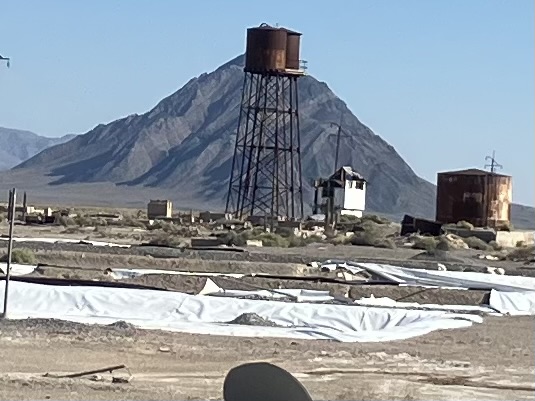
The few remnants of Death Valley Junction’s borax plant, as seen today.
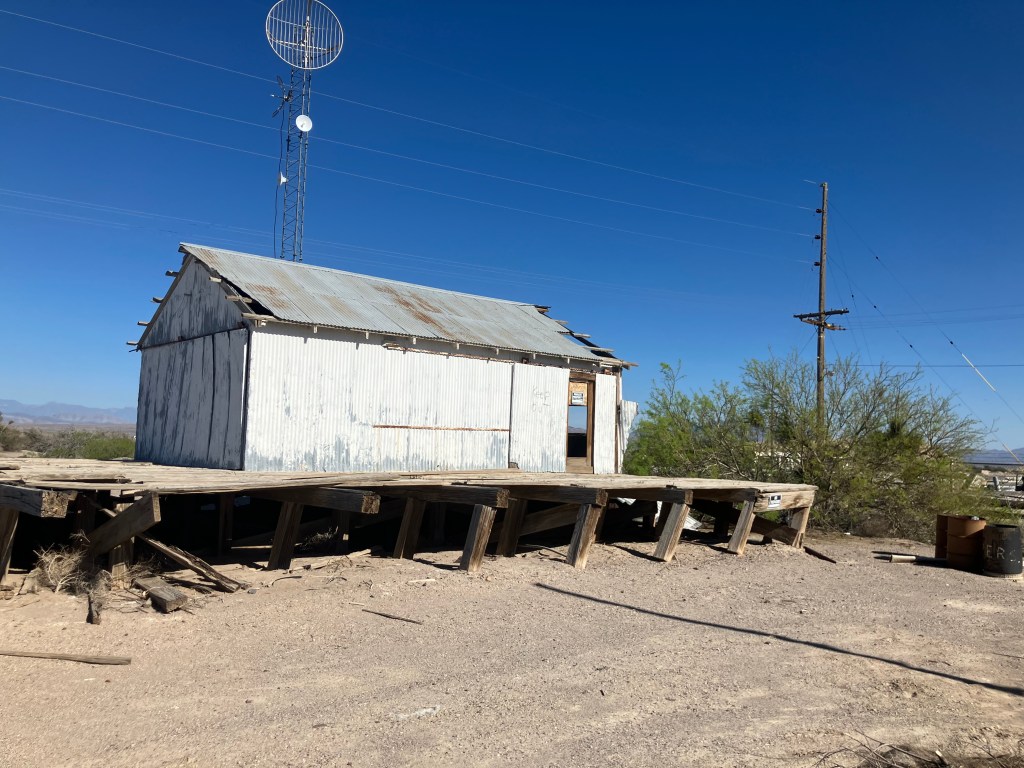
The 100-year-old dock where borax was once loaded onto railcars.
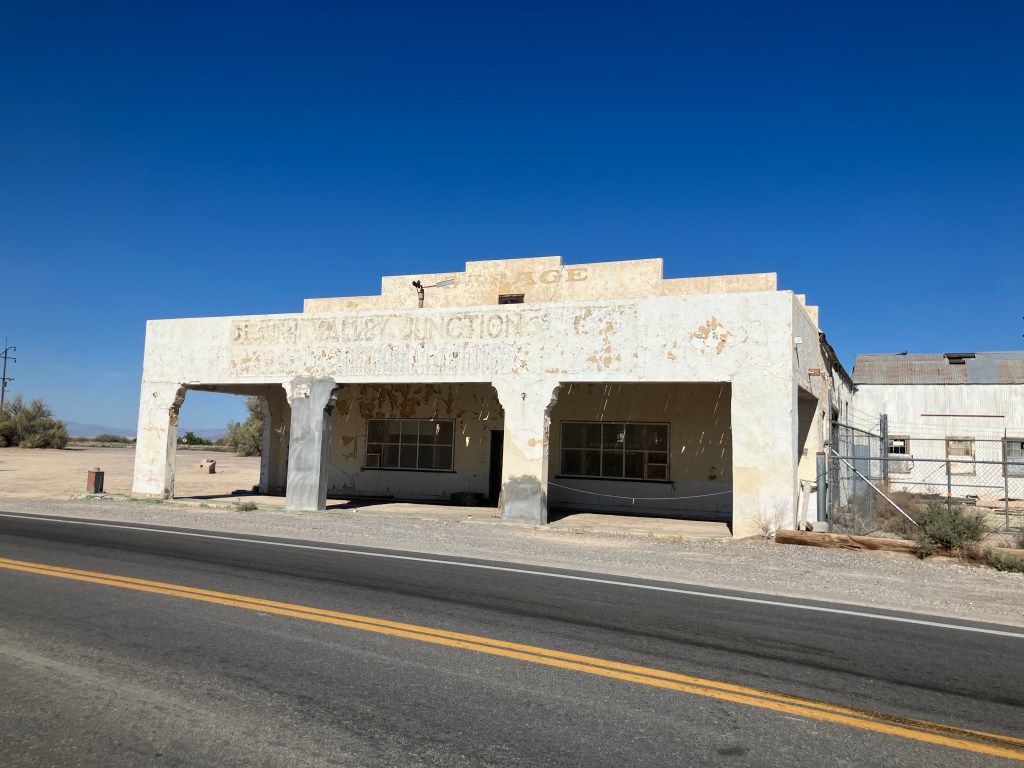
Without the railroad or the borax operation, Death Valley Junction essentially became a ghost town. Except for the hotel, which struggled along, the old company town was left to decay.

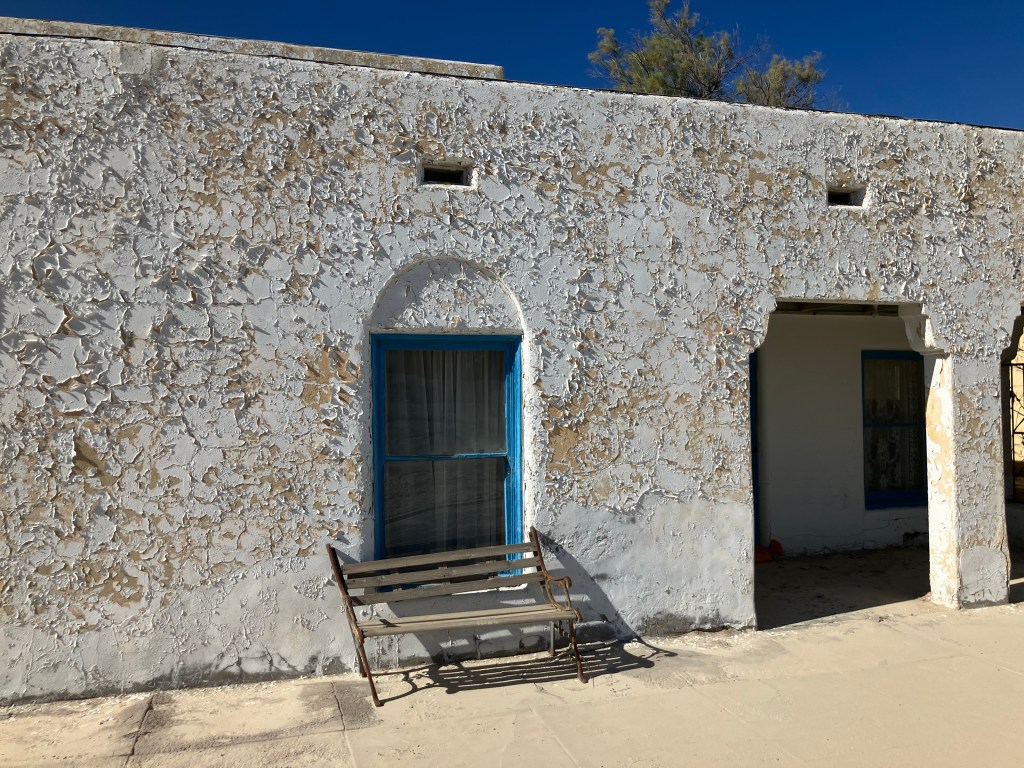
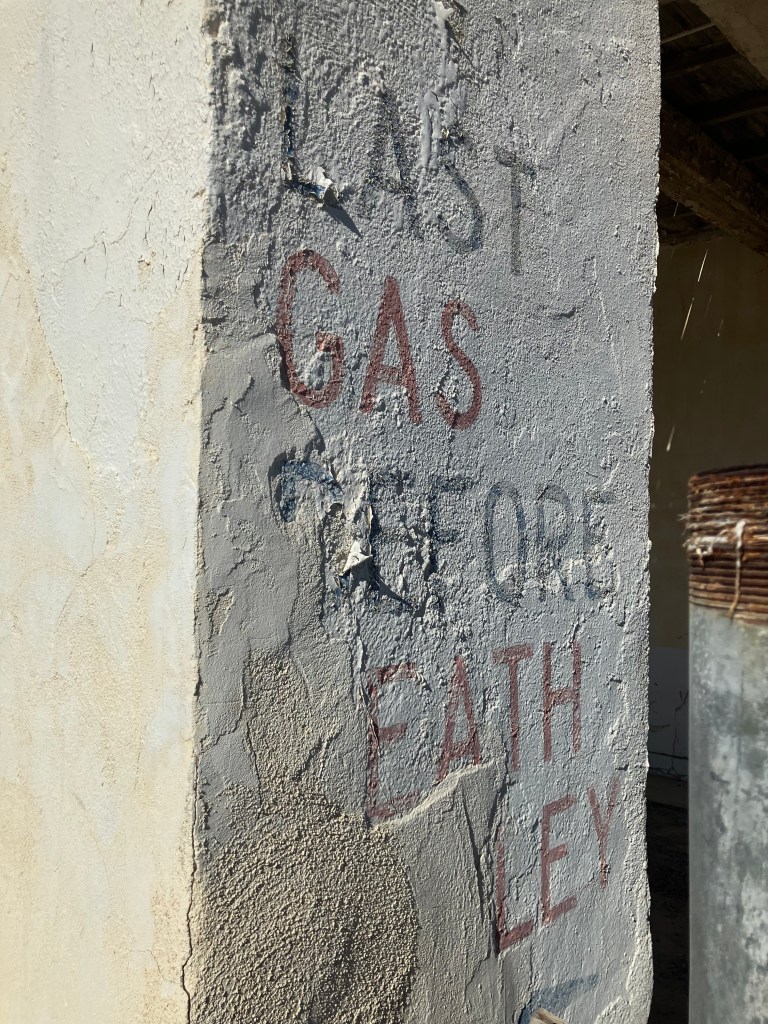
Abandoned company town.

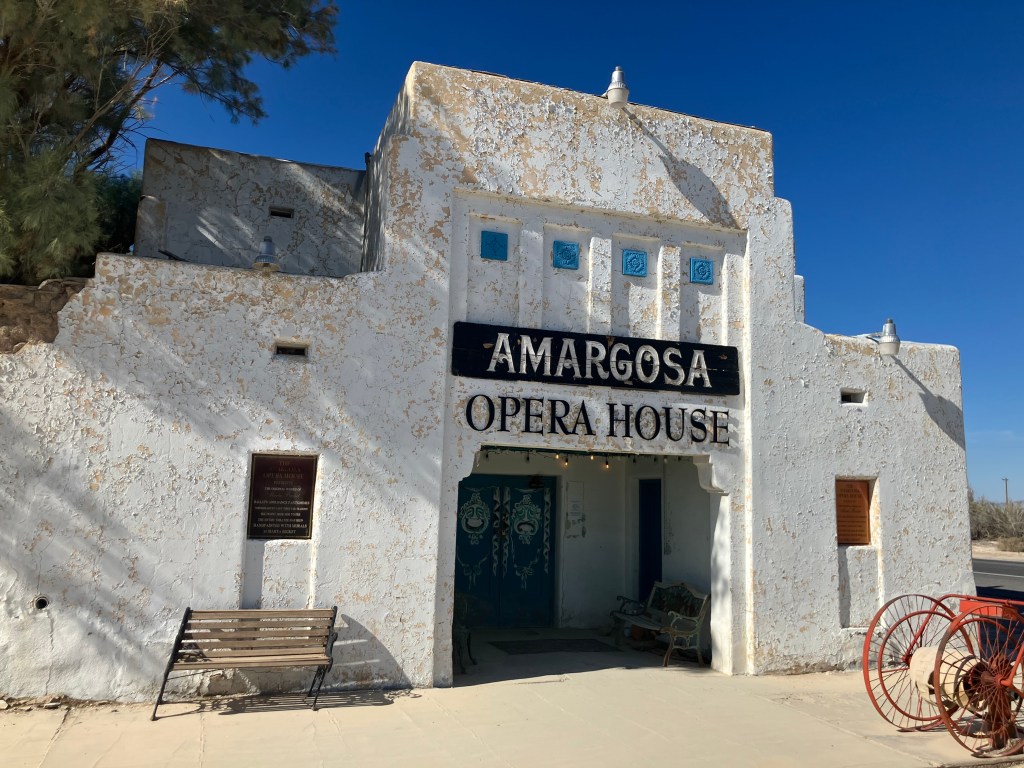
Then something wonderful happened. In 1967, a ballerina and artist from New York named Marta Becket was on tour through the west, and her car broke down near Death Valley Junction. While the car was being repaired at the town’s sole garage, Marta explored the old buildings and fell in love with them. In particular, she envisioned the old, abandoned community hall as an opera house. Here. In the middle of the desert.

The garage where Marta Becket serendipitously took her car and walked across the street to discover what would become the Amargosa Opera House.

So Marta Becket and her husband leased (and later bought) the property, converted the community hall into the Amargosa Opera House, and opened for business. Marta herself would perform on the stage every weekend. For forty years. Here, in the middle of the desert. A story in National Geographic in 1970 caused this little secret in the desert to become world famous. People came from around the world to watch her perform and to see the artwork she painted on the walls of the opera house and the adjoining hotel.
Marta finally retired in 2012, and died at age 92 in 2017.

RIP Marta Becket.

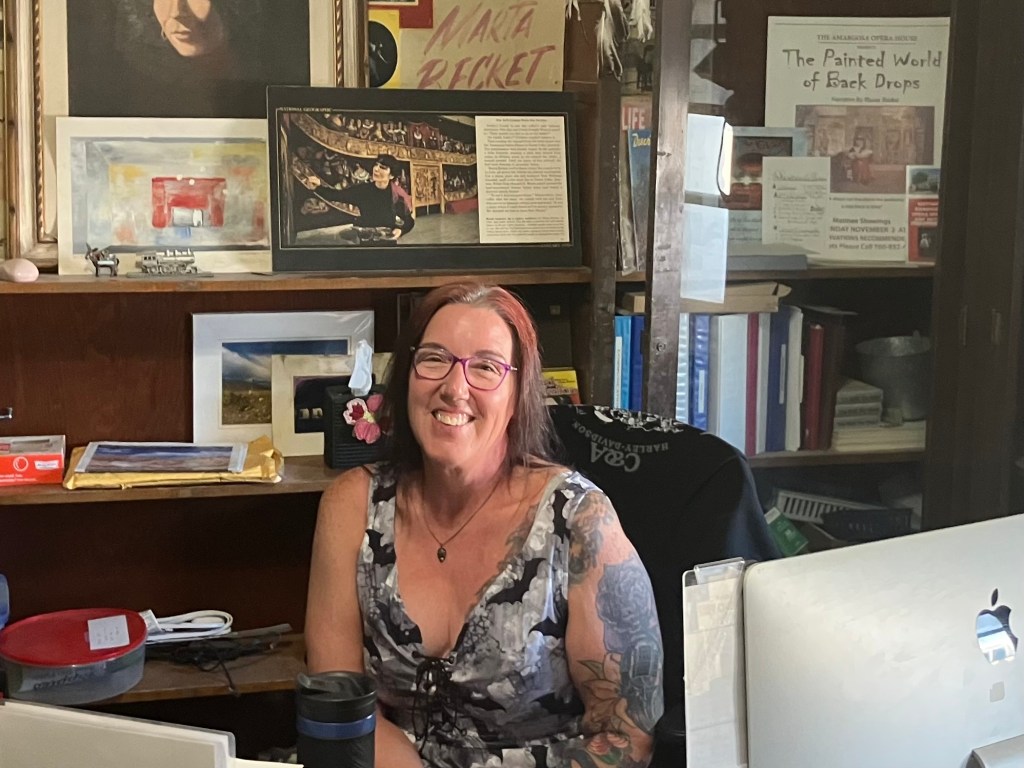
The Amargosa Opera House continues to honor the legacy of its creator with daily tours and various performances throughout the year. My tour guide was an enthusiastic and knowledgeable person named Sue, and she also works at the hotel.

Sue and her 1000-megawatt smile.

Speaking of which, I’m spending the night here in the old, original hotel that the Pacific Coast Borax Company built in 1924. Some say the place is haunted…..

Beer of the Day

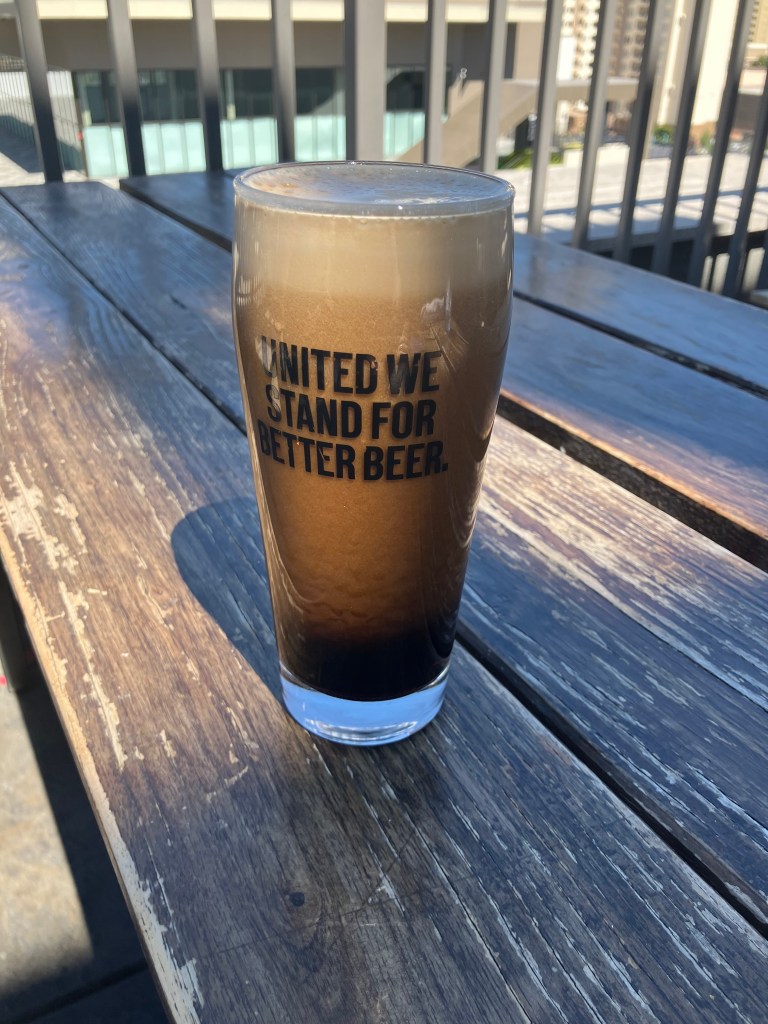
The BOTD comes from BrewDog in Las Vegas. It’s their Black Heart Nitro Stout.

Because it’s a stout, it has the usual roasty and malty notes. Plus, as a nitro beer (i.e., it’s carbonated not with the usual carbon dioxide but with nitrogen), it has a creamy mouthfeel and a slightly sweeter taste. The nitro also presents an attractive, cascading-bubbles effect and a creamy head.

All that said, this beer was underwhelming. It has no complexity; it just tastes like someone filled a sock with oatmeal and steeped it in dishwater. There is absolutely no finish and, it seems, no hops. And at a scant 4.1 ABV, there’s no alcohol bite. This is a beer that’s nice to look at, but that’s about it.

Breweries · Ghost stories · Golden Bear signs · Puns

Hey, Eugene!

In the good old days, by which I mean the days before Covid and Chat GPT and the subsequent, rapid disintegration of society, I was living in the Los Angeles area, where Karen and I would occasionally catch a show at the Hollywood Bowl. For me, this hundred-year-old amphitheater reflects many of LA’s best aspects: warm evenings outdoors, a vibrant entertainment industry, people dressed to the nines, and free popcorn brought to your seat during intermission.

On one of these occasions we saw the band Pink Martini, which is a quirky but virtuosic orchestra/big band from Portland. And they played a catchy number titled “Hey Eugene.” That song has been running through my mind all day. Because this morning I flew to Eugene, Oregon. And boy are my arms tired…

Eugene (pop: 176,000) is described by Wikipedia as having “a significant population of people in pursuit of alternative ideas and a large original hippie population.” Which explains the endless stream of vintage VW minibuses rattling along in the slow lane.

Anyway, I came here to meet son Ian B., who recently took up graduate studies at Oregon State University in the nearby town of Corvallis. Attentive readers may recall that Ian and Katelyn are expecting my first grandchild this June. So clearly, between school and fatherhood, Ian has decided to give up sleep for the next four or five years.

Ian studying for an exam.

Normally I would like to make the trip to Oregon by car, but various factors conspired to prevent that option. I therefore took a Delta flight that routes through Sea-Tac, near the ancestral Boilard home in Tacoma, and terminates in Eugene. As my plane was approaching the airport I was thinking, “Hey, the weather out here is actually nice! What’s all this about Seattle always being perpetually grey and cloudy?” Then we descended from our cruising altitude and were enveloped in dismal, soul-sapping, Vitamin-D-blocking, depression-inducing cloud cover, and my thoughts immediately turned to melancholy.

Ian met me at the airport, and we drove to Corvallis (pop: 61,000), which Wikipedia helpfully notes is “the westernmost city in the contiguous 48 states with a population larger than 50,000.”

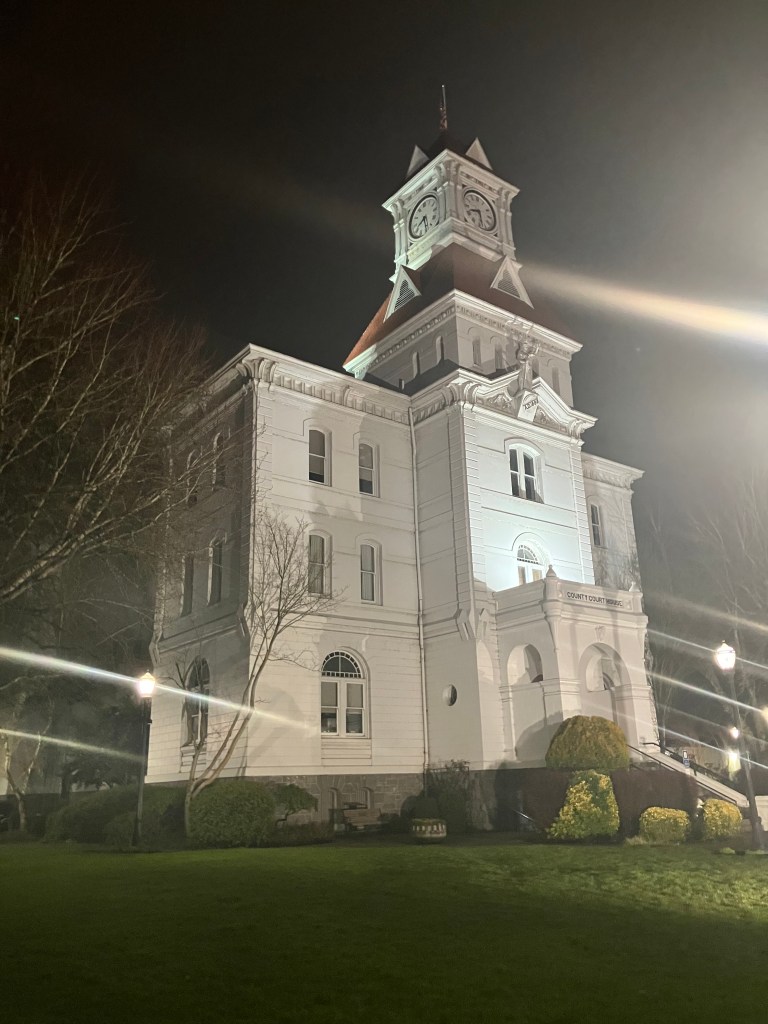
What with the weather and the limited time, we focused mainly on drinking beer. But we did manage to go on a “Corvallis Ghost Tour.” The number of ghosts we encountered was precisely zero. At least we got to see this cool 1888 courthouse, whose heating radiators reportedly make weird sounds. Surely the only explanation for old radiators making noise must involve the paranormal.

Home of the haunted HVAC.

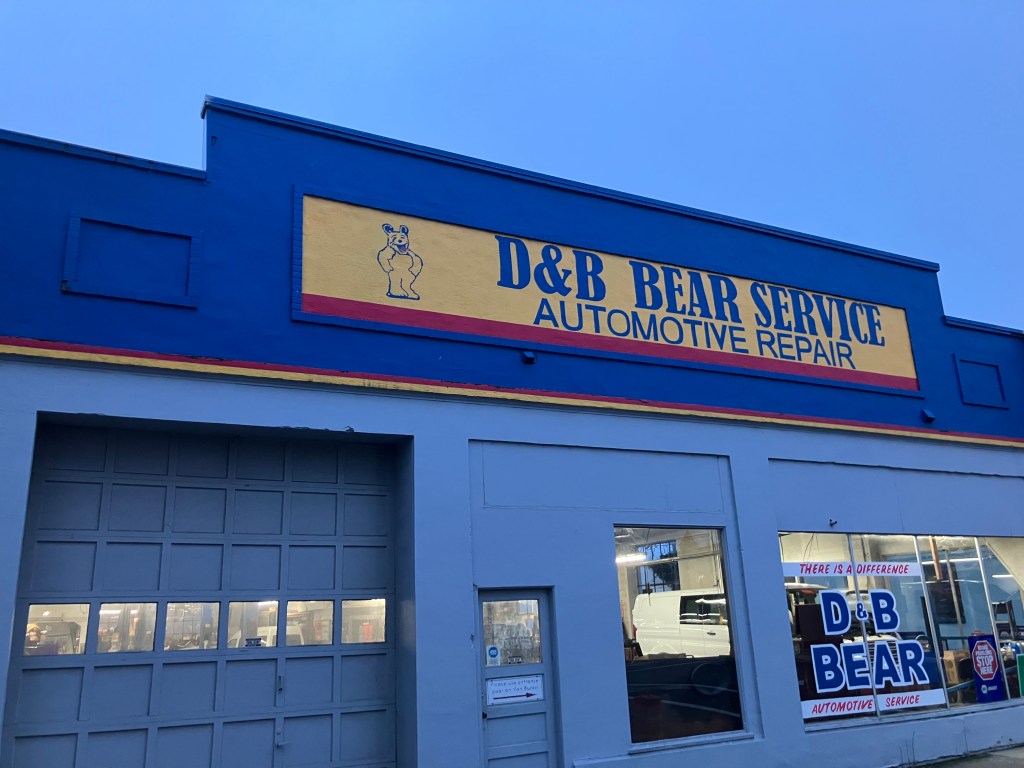
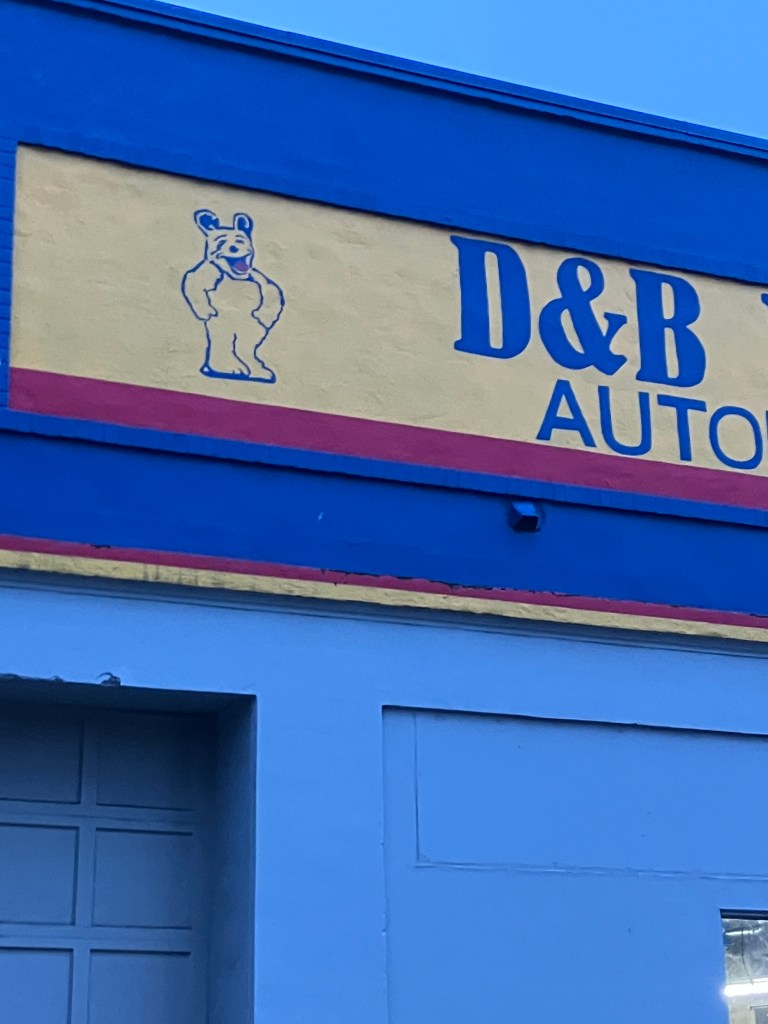
But the Corvallis building that excited me the most was this:

Did you spot the cause of my excitement? Let’s zoom in:

Be still my heart.

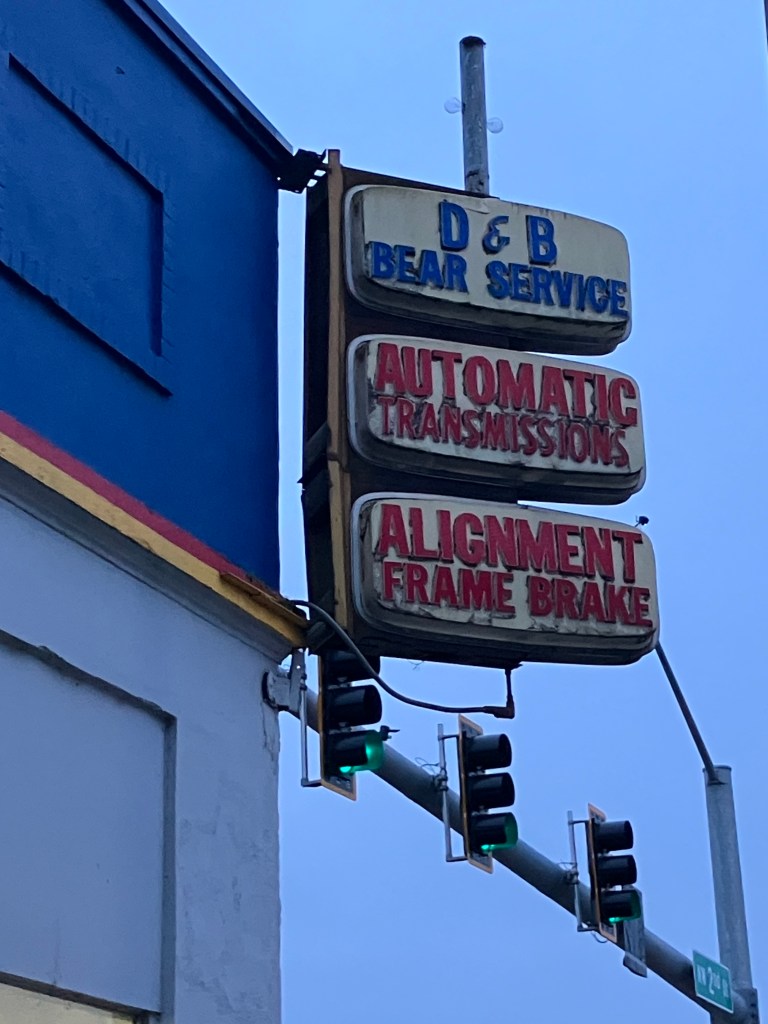
Alert readers will recall that I’ve made a minor study of these Golden Bear signs, which were affixed to countless alignment shops in the postwar era. Additional examples are here and here. To this list we can now add D&B Bear Service on NW 2nd Street in Corvallis. It’s an old-school, family-run auto shop, and the inside appears to look very much as it did during the Truman administration. The online reviews are stellar, so I recommend it to loyal readers in the Willamette Valley.

* * *

And now, back by popular demand, we bring you the

Brew of the Day

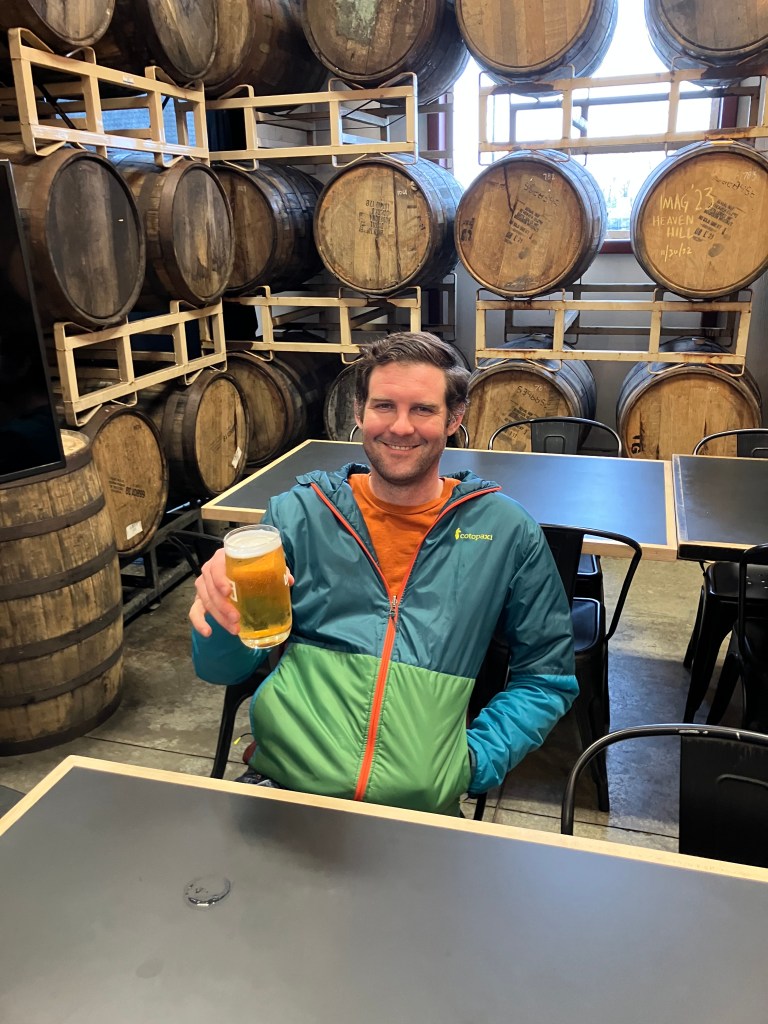
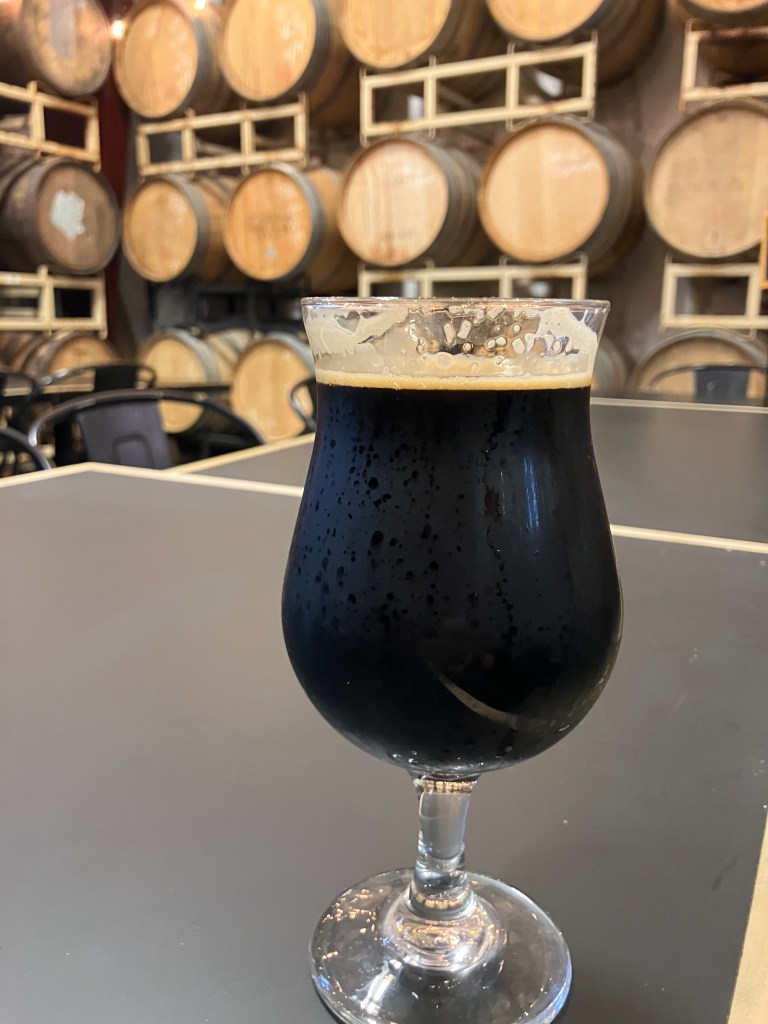
The BOTD comes from Block 51, which is a local brewery in Corvallis. I ordered the Super Nebula, which is an imperial stout that’s been aged in bourbon barrels.

Sometimes these barrel-aged stouts can be cloying if they don’t properly balance the malty sweetness with a decent amount of hops. But you have to select the hops carefully, because the wrong kind of bitterness can destroy the bourbon notes. Meanwhile, a beer this dark and flavorful needs to have body, but not to the point of becoming syrupy. As you can see, creating a quality barrel-aged imperial stout requires lots of patience and nuance.

Fortunately, the good people at Block 51 were up to the task. The flavors come together wonderfully, benefiting from the addition of a judicious amount of cocoa nibs. The alcohol comes in at 13.8 percent, which is in the range of what you’d expect for an imperial stout without entering crazy territory like Bruery’s Chocolate Rain (18 percent) or even Firestone Walker’s Parabola (usually 14-point-something). In a word, I’d characterize Block 51’s effort as balanced.

The only thing I’d ding it for is the finish. After a nice, satisfying sip-and-swallow, there’s something missing. Interestingly, Block 51 also makes something called Super Nebula Valhalla, which includes cardamom, star anise, and juniper. I tried a sip of that and it seemed like there was a bit too much going on, but if they could maybe just add a little of that star anise to the regular Super Nebula, I think the finish would be better.

But this is a minor point. I recommend Block 51 and their Super Nebula. Get yourself a pint while you’re having your car aligned at D&B.

Breweries · bridges · California history · Cars · movie theaters · Road trips · Yard art

Been There, Done That, Got the T-Shirt

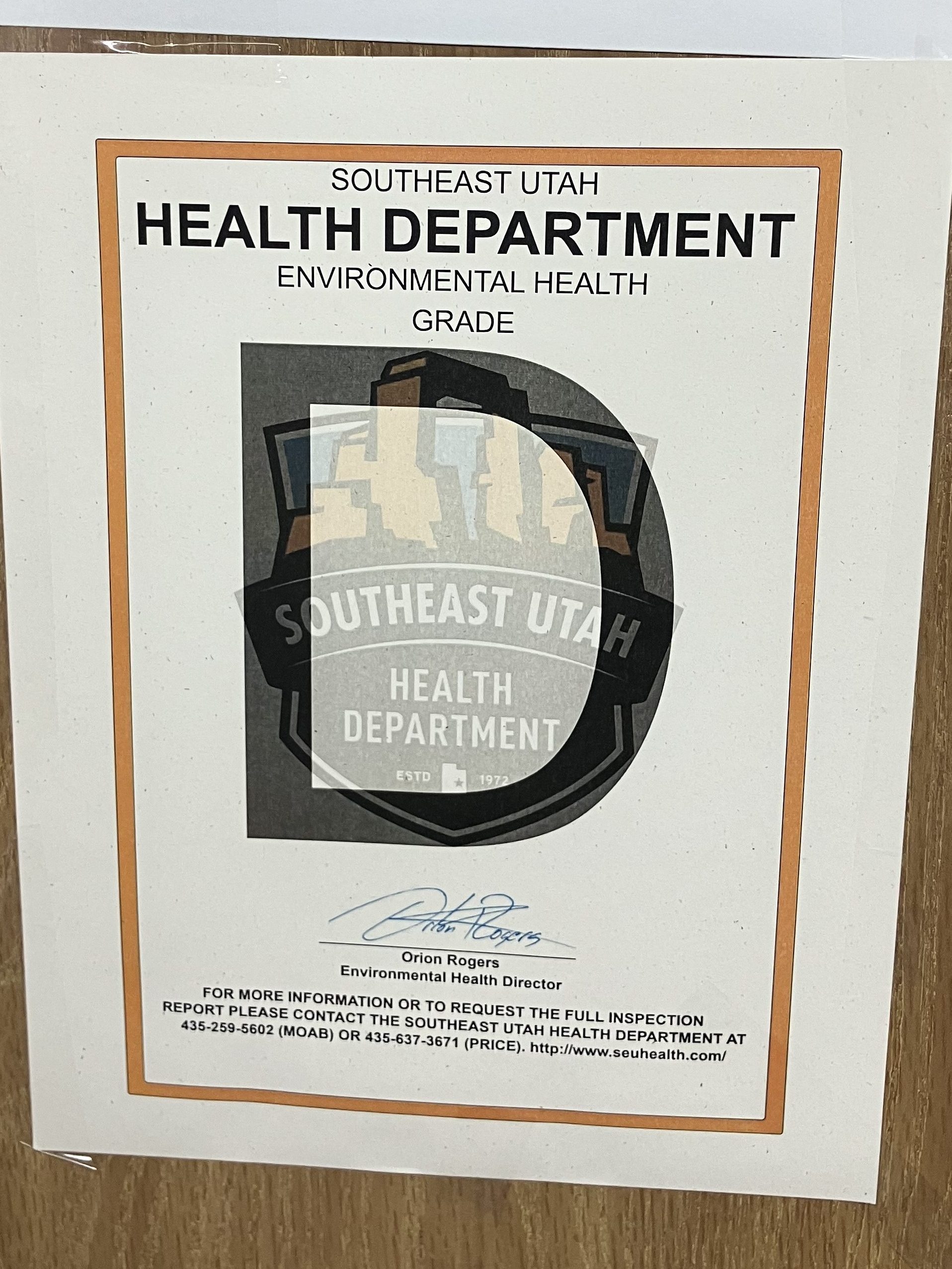
This morning I headed downstairs from my motel room to partake of the “free” breakfast. Then I spotted this sign in the breakfast room:

But a “D” is technically passing right? At least that’s what I used to tell my parents when I brought home my report card.

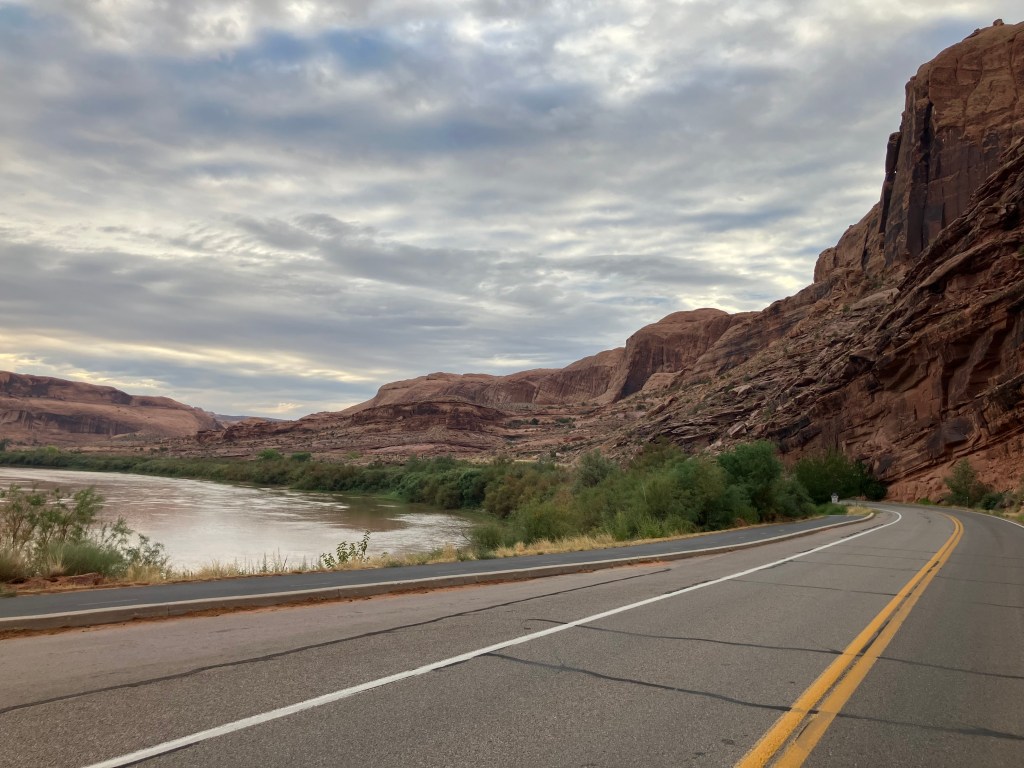
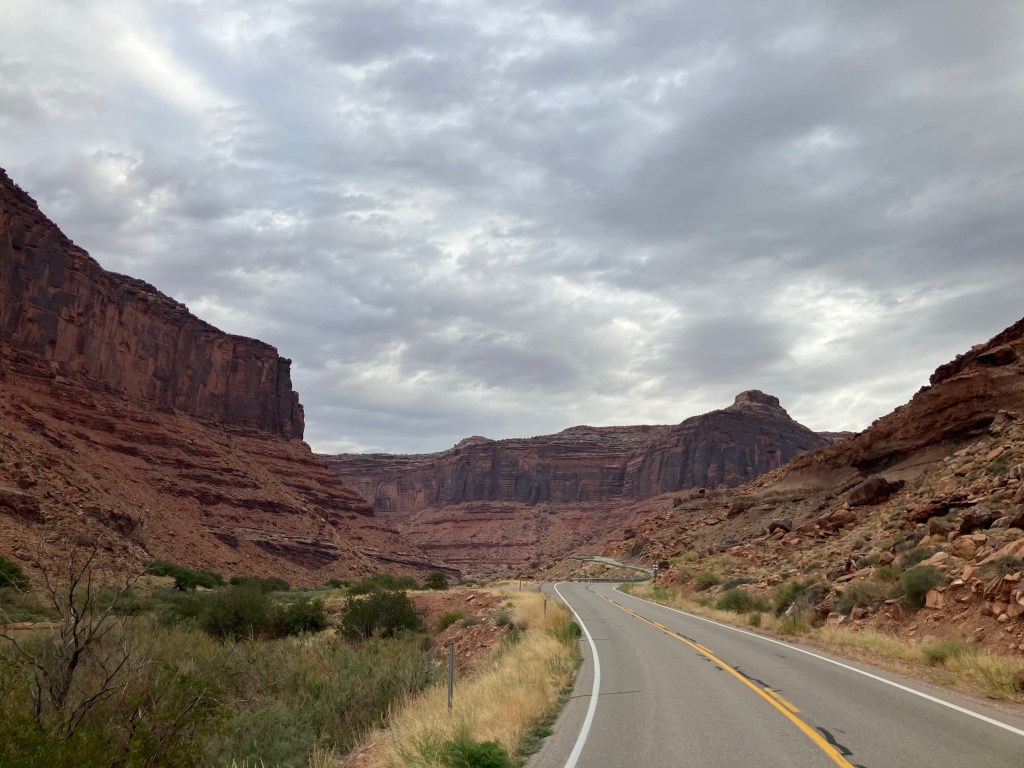
Instead of the motel breakfast, I got a gas-station coffee and donut. I then got onto the U-28 scenic byway, which carves its way through the Colorado River gorge towards Grand Junction. It was so spectacular it even made my donut taste good.

That’s the muddy Colorado River on the left.
A perfect setting for a Western…which it has been, many times.

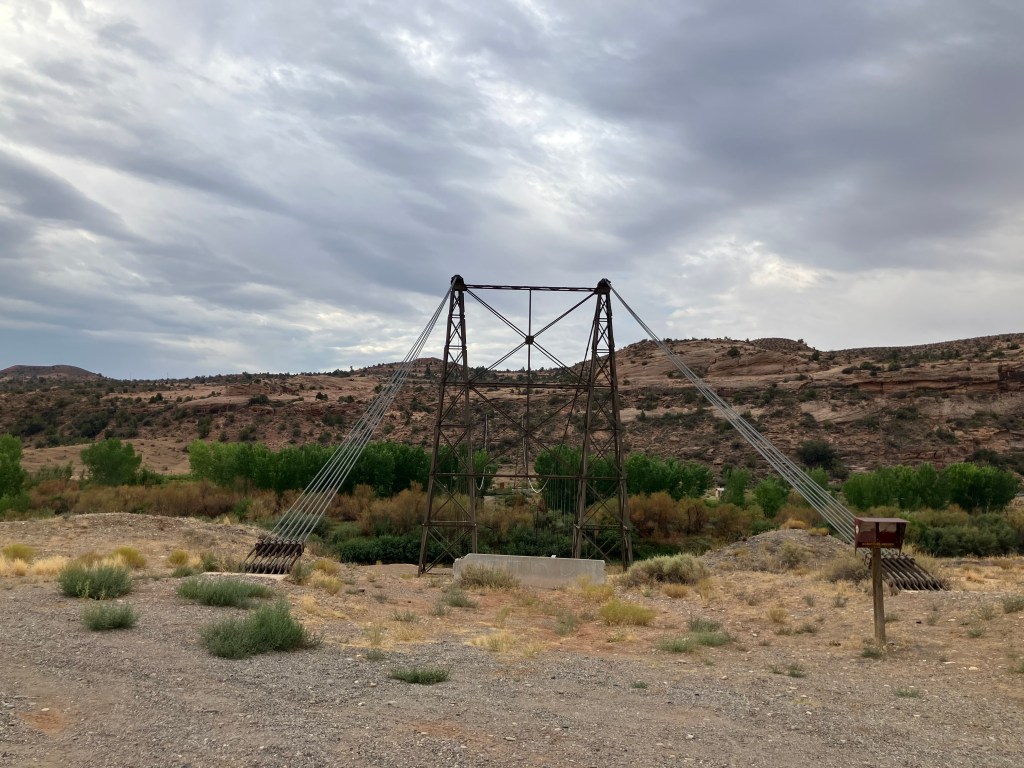
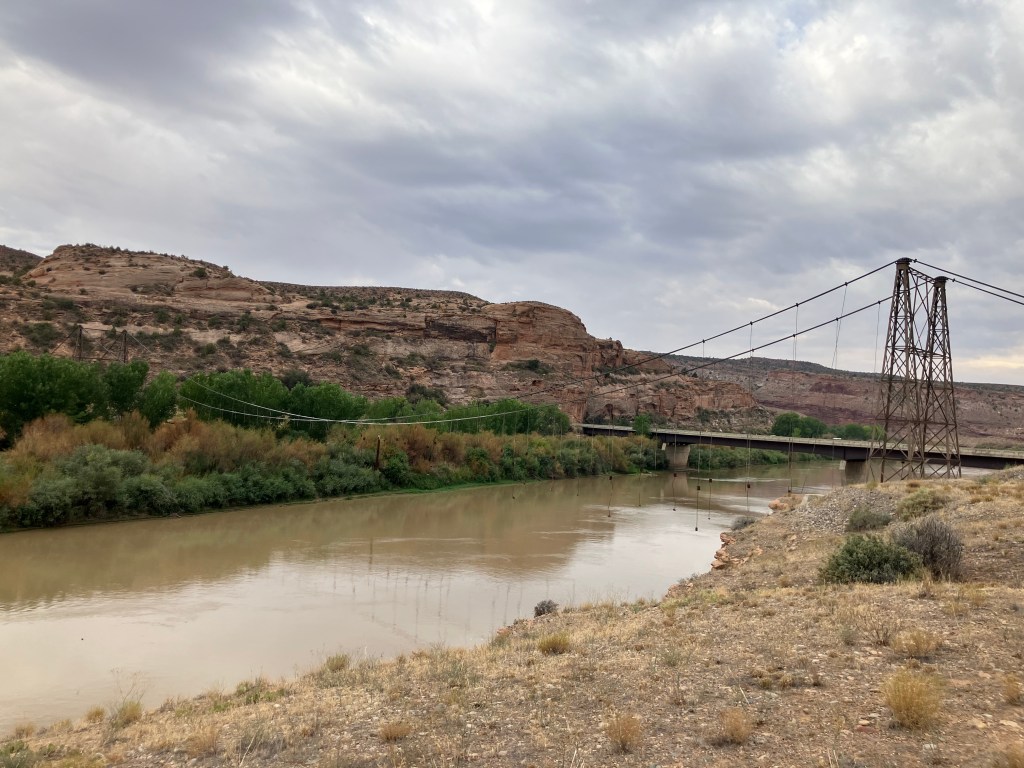
After maybe half an hour of driving I came across a pedestrian suspension bridge that crosses the Colorado River. Attentive readers will recall that I’m a sucker for these things, so I looked for a place to pull over and sway my way across the (not-so-) mighty Colorado.

So far so good…

So imagine my disappointment when I discovered that the bridge’s decking was entirely missing.

…but wait–what’s wrong with this picture?

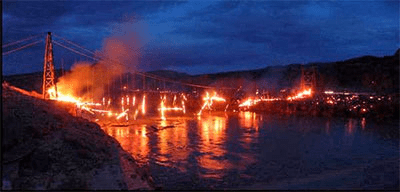
Turns out the Dewey Bridge (for that’s its name) was built in 1916 and is Utah’s longest suspension bridge. It was fully restored in 2000….and eight years later some kid was playing with matches and the whole thing went up in flames.

Kids, don’t play with matches! (2008 photo from Wikipedia Commons.)

A sad and ghostly air hangs about the skeleton of the Dewey Bridge. It set back my good mood a bit.

A little later I came to the town of Fruita, Colorado (pop: 13,400). I could live in this town. It’s one of those places that’s figured out how to preserve its history, cater to modern tastes, create a livable community, and attract tourists. The town is jammed with public art, and the main street has plenty of outdoor cafes and benches to relax, have a cup of coffee, and watch the world go by. It seems that most of the buildings along Main Street are historic and well-preserved or restored.

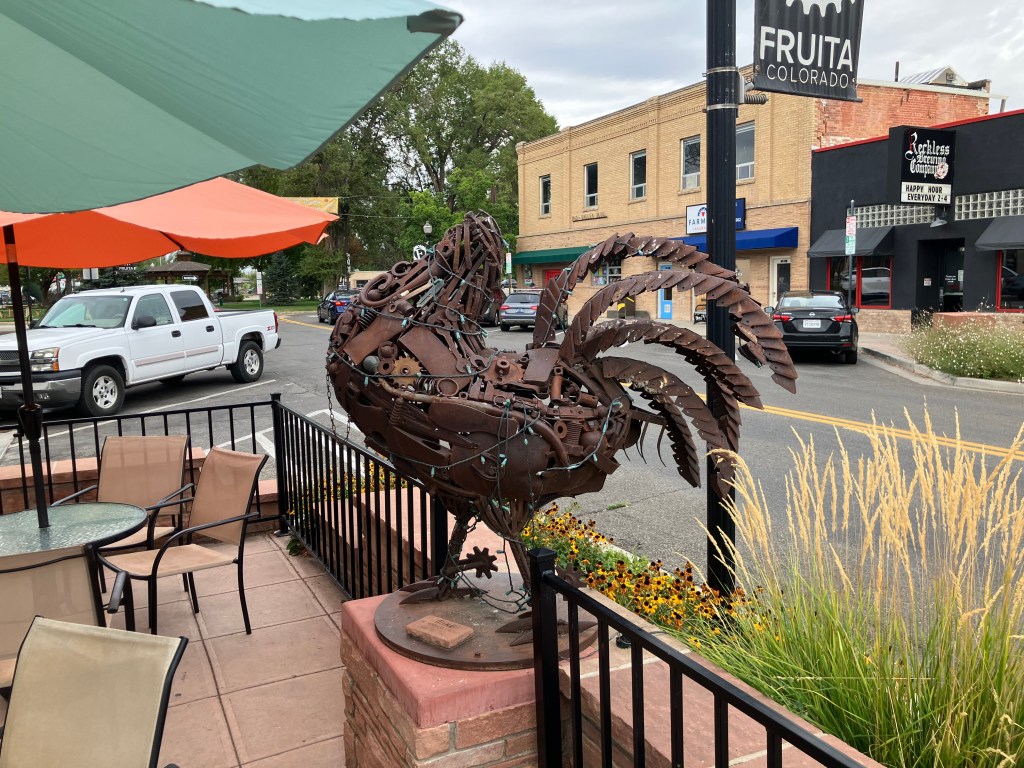
One public art installation that made me scratch my head was this rooster with no head:

A friendly fellow drinking coffee at an outdoor table noticed me photographing the sculpture and gave me the story of Mike the Headless Chicken. (Trigger warning for those sensitive about food preparation by carnivores.) It seems that in 1945, a local farmer by the name of Lloyd Olsen was attempting to behead one of his chickens for dinner. His aim was a little off, and most of the chicken’s brain stem remained with the body. The chicken survived his beheading, flapping his wings and running around headlessly. What was Lloyd to do? He spent the next year and a half carefully feeding Mike (for that was the chicken’s name) individual kernels of corn through the throat and addressing Mike’s thirst with milk and water from an eyedropper. Mike became a sideshow attraction and gained national fame. Indeed, I remember reading about Mike in a “Ripley’s Believe It Or Not” paperback in the 1960s. Fruita still remembers Mike with the sculpture, T-shirts and other souvenirs, and an annual “Mike the Headless Chicken Festival” each spring. I am not making this up.

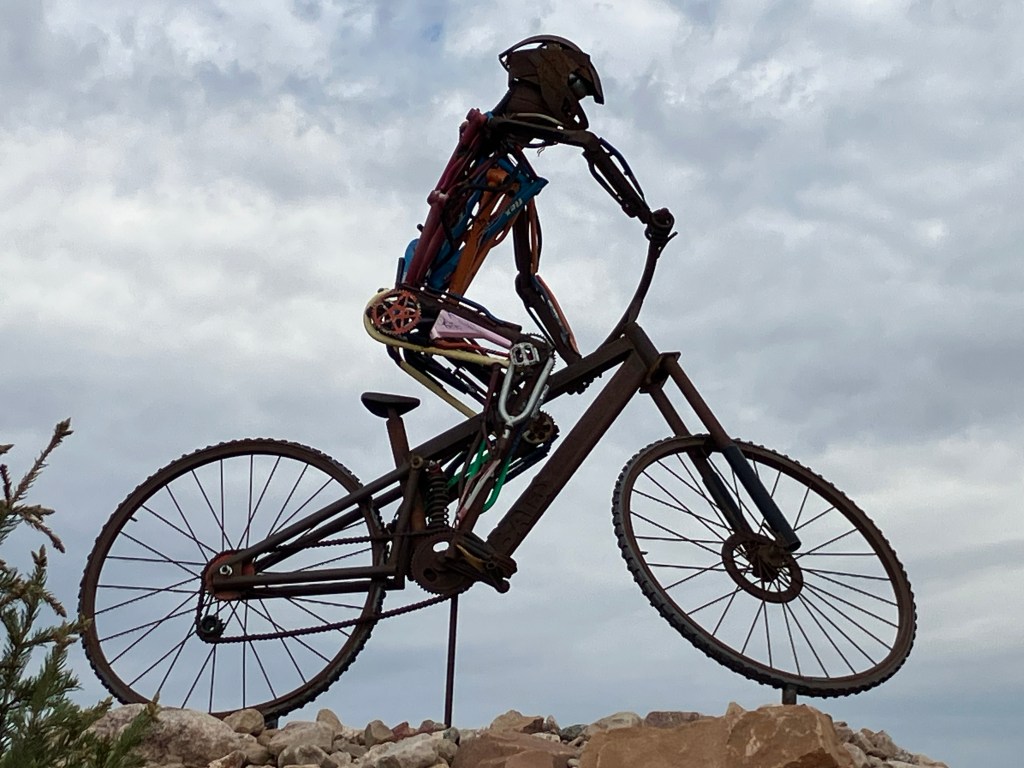
Fruita also has a lot of non-headless-chicken art around town. In fact, I noticed that many of the towns in eastern Utah and western Colorado feature interesting public art installations. Here is a sampling:

Bionic bicyclist in Fruita.
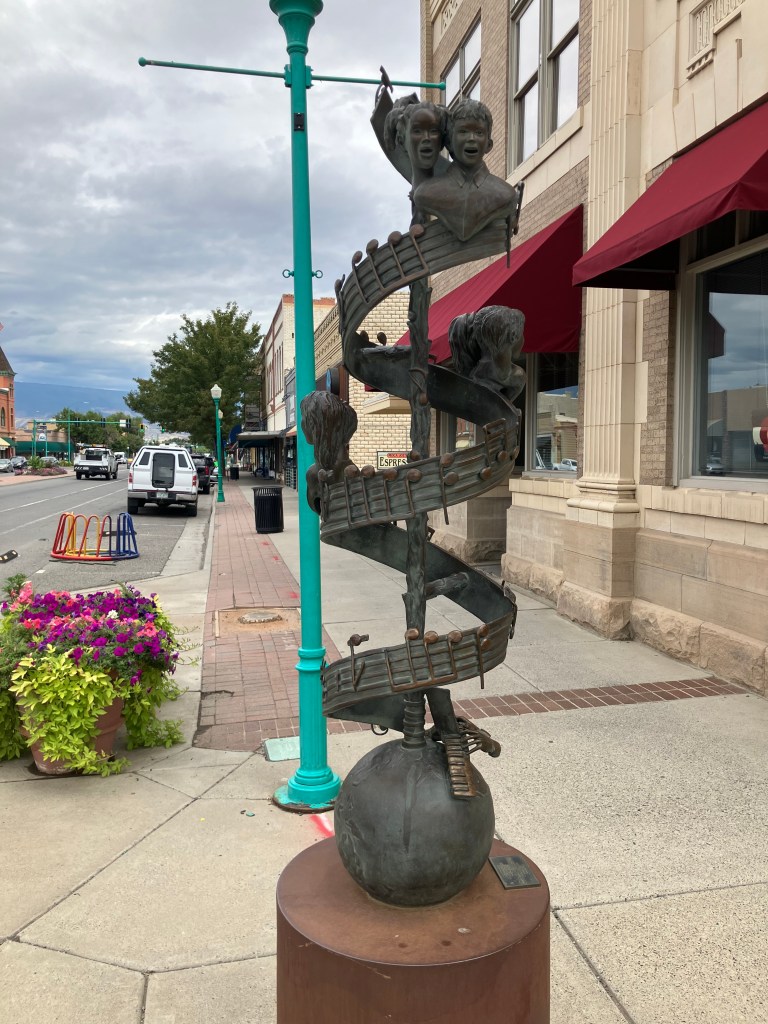
Sculpture honoring children’s music teacher David Carl Moore in Delta, Colorado.
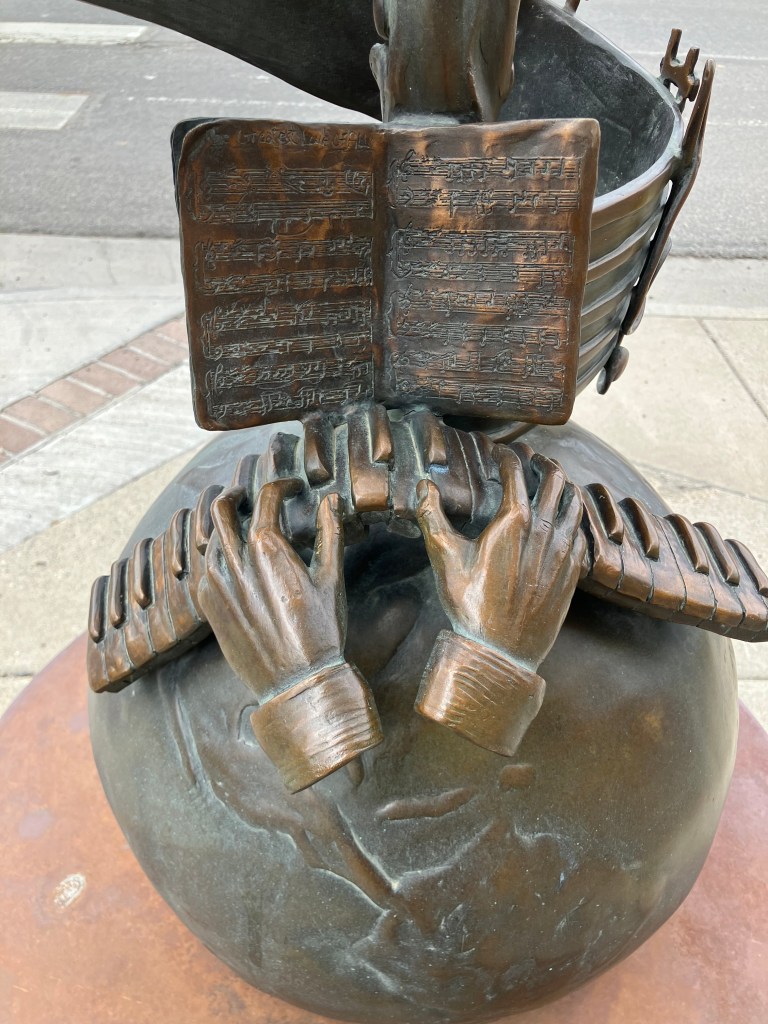
Detail of the Moore sculpture.
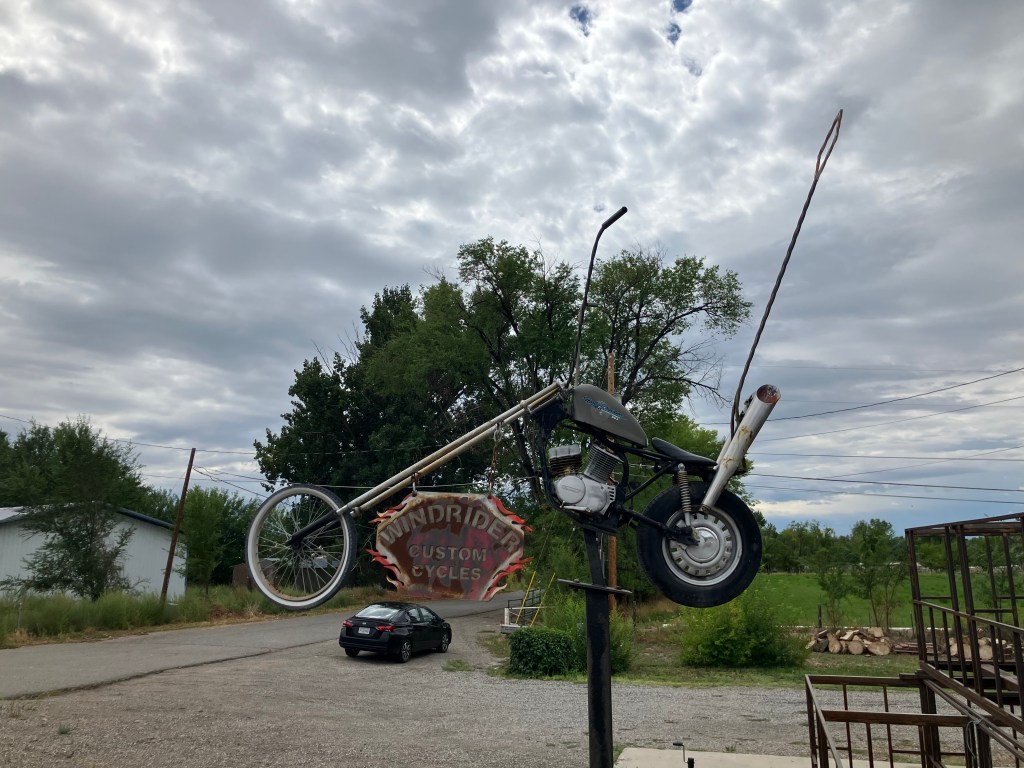
Windrider Custom Cycles sculpture in Delta.
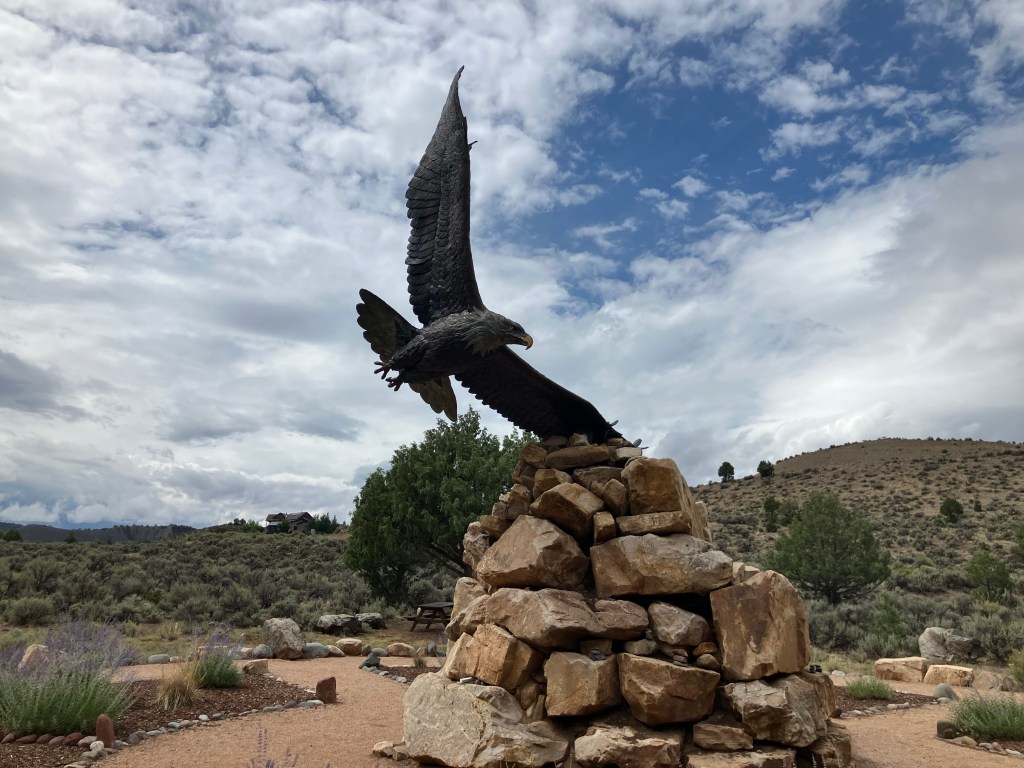
Sculpture at Dennis Weaver Memorial Park in Ridgway, Colorado. Dennis Weaver (I remember him as McCloud from the NBC television series) reportedly loved eagles and lived in Ridgway for many years.

I also randomly ran into these women playing the tubular bells (?) xylophones(?) that are installed at the park. Somehow I think Dennis Weaver would have appreciated it.

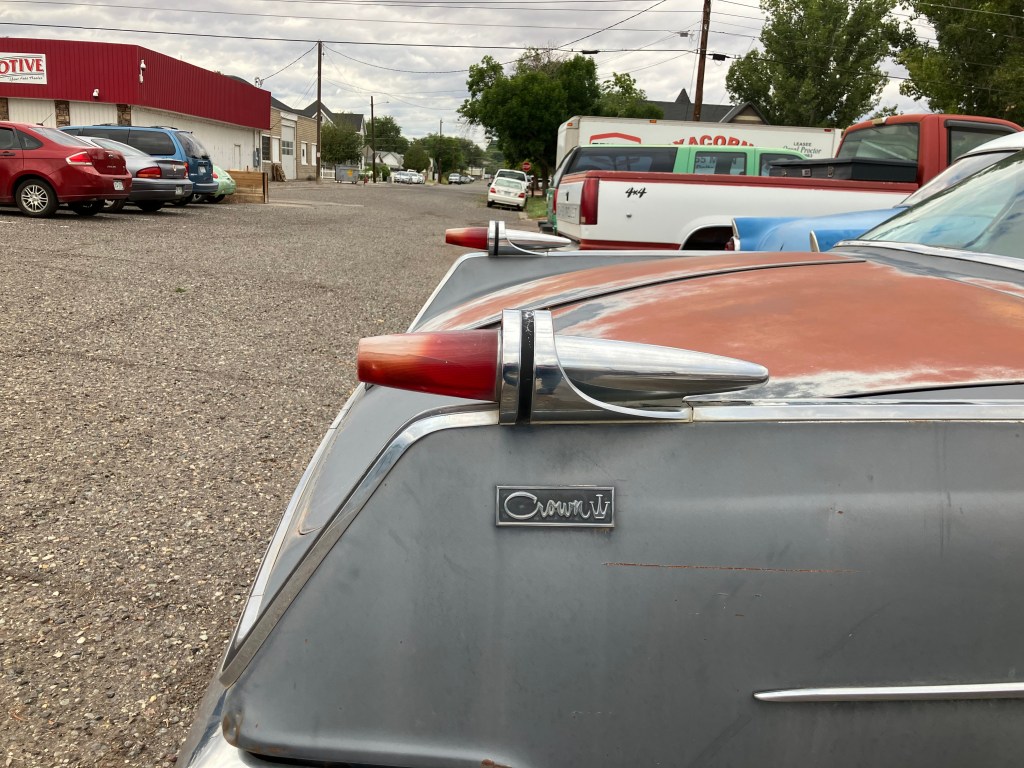
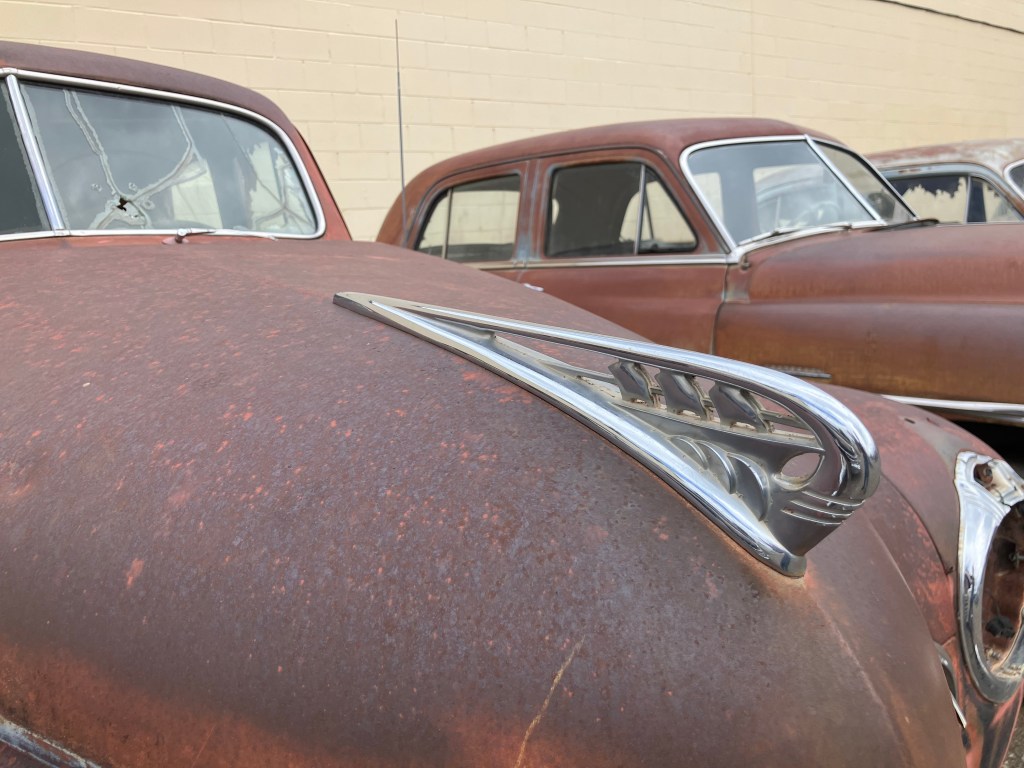
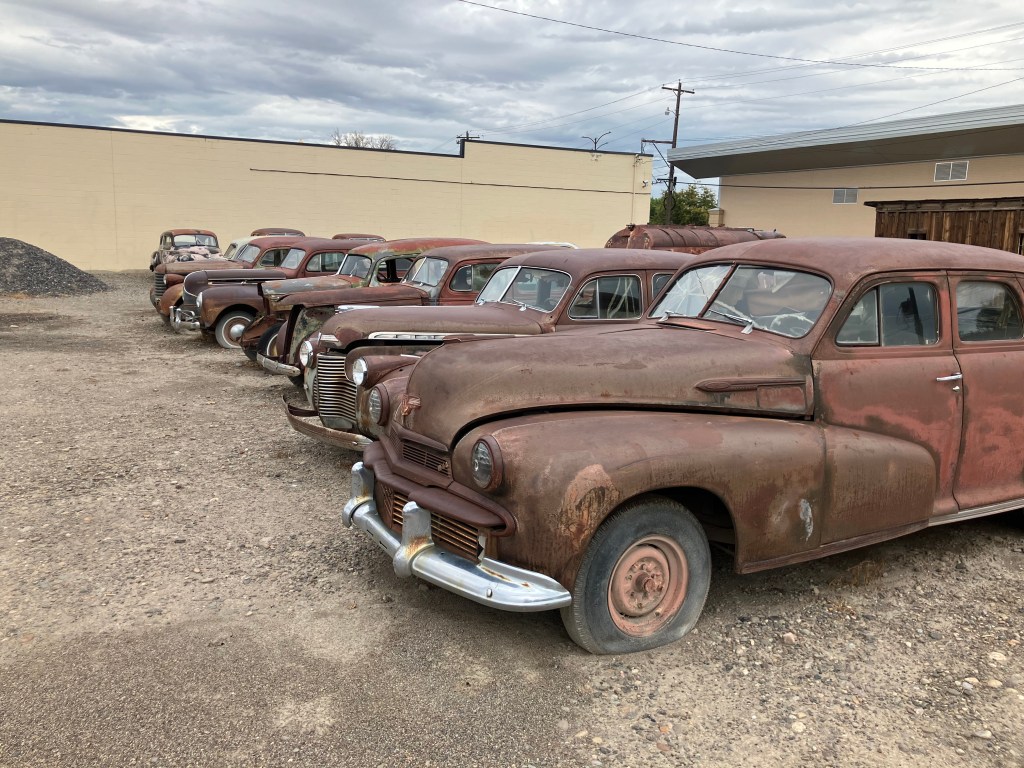
I’m not sure if it technically qualifies as art, but there is a large number of long-parked classic cars on both sides of the street in downtown Delta, Colorado.
Artistic Chrysler hood ornament.
Used car lots, frozen in time.

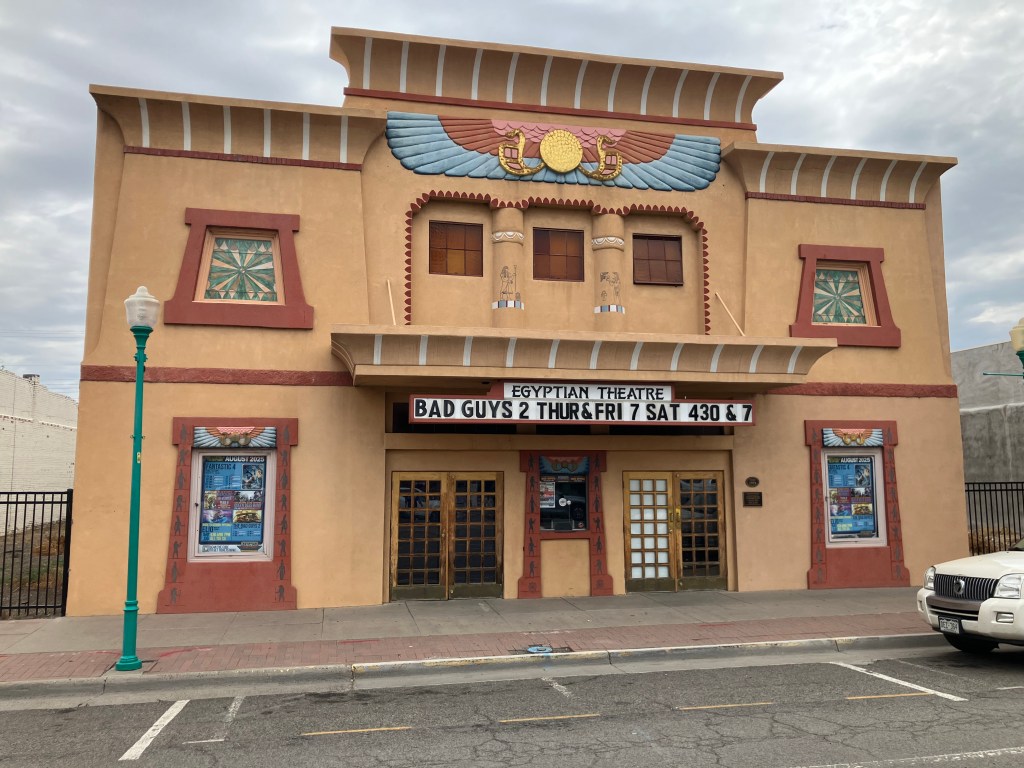
Also related to this theme of public art is the 1928 Egyptian Theater in Delta. It’s obviously been loving restored, and it regularly shows movies and hosts performances. It’s much smaller than the Egyptian Theater in Hollywood, but it similarly reflects the fascination with all things Egyptian in that era.

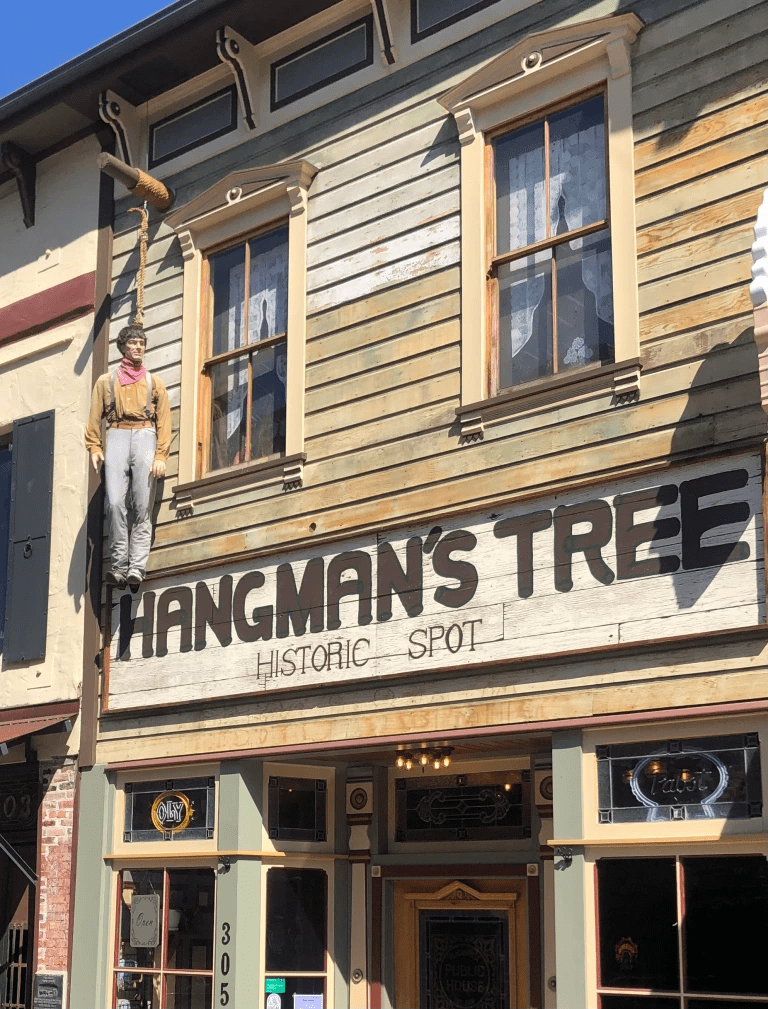
But let’s get back to the purpose of today, which was to complete my trek to Placerville, Colorado. You’ll recall that the California version of Placerville was originally called Hangtown, and the tree where those hangings took place (in 1849) stood on Main Street for many years. Even though it was cut down in 1853, the stump remains in the basement of an old Main Street building, where a dummy perpetually hangs from a noose.

Photo by the author, from my 2021 blog post about Placerville, CA.

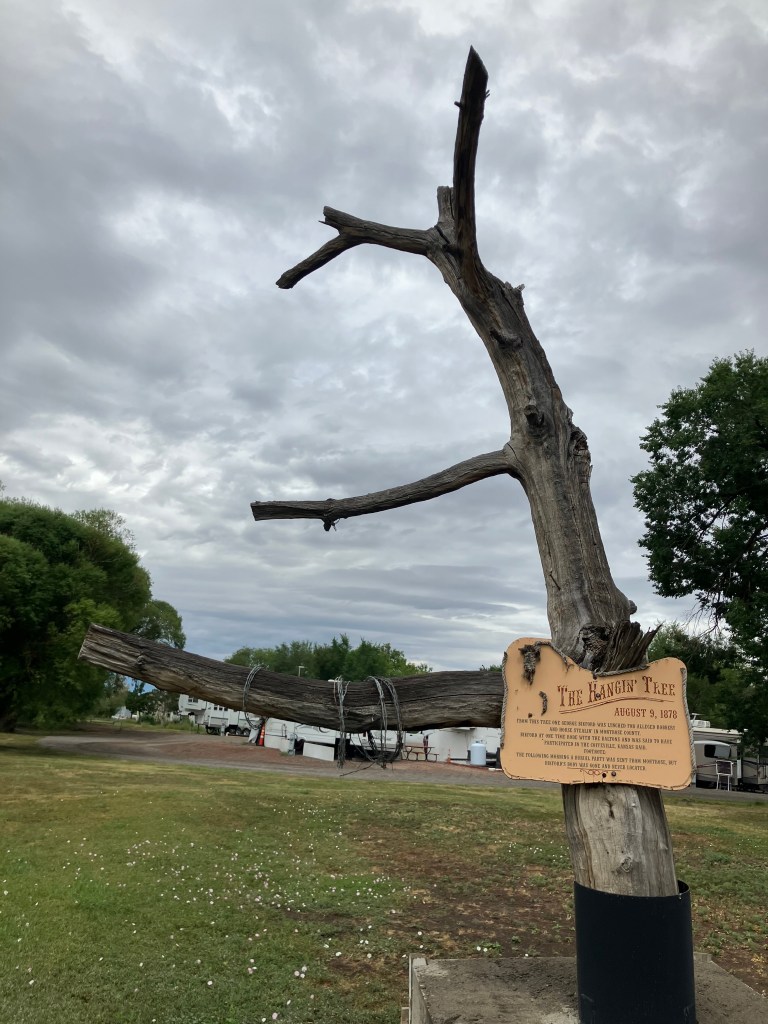
So it was auspicious that, just as I was getting close to Placerville, Colorado, I spotted this hangman’s tree in the town of Montrose:

According to the sign, George Bikford was hanged from this tree for robbery and “horse stealin'” in 1878.

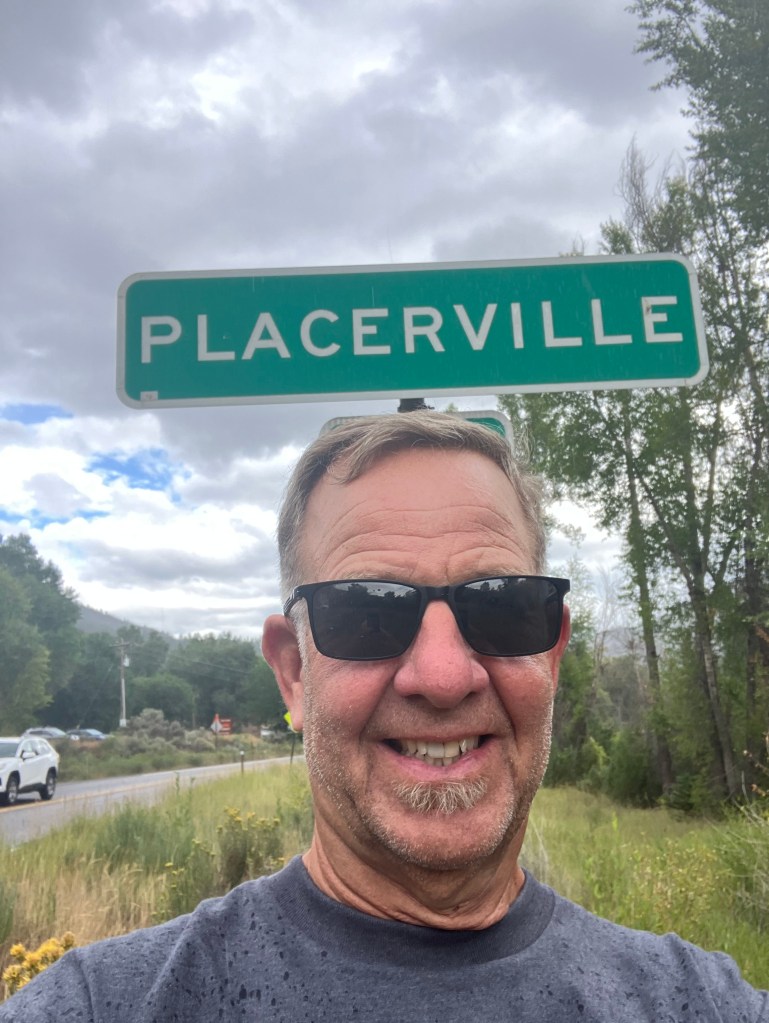
And so, with that preface, I finally came to the storied town of Placerville, Colorado. Let’s just say it wasn’t exactly El Dorado.

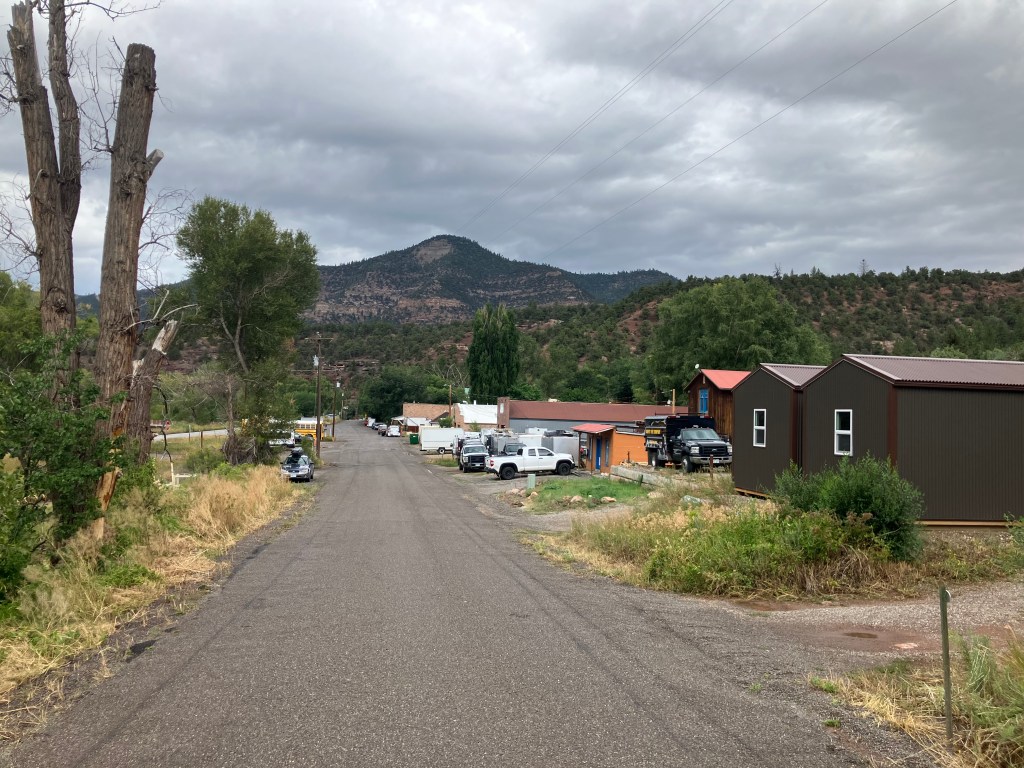
This is seriously about all there is to the town.

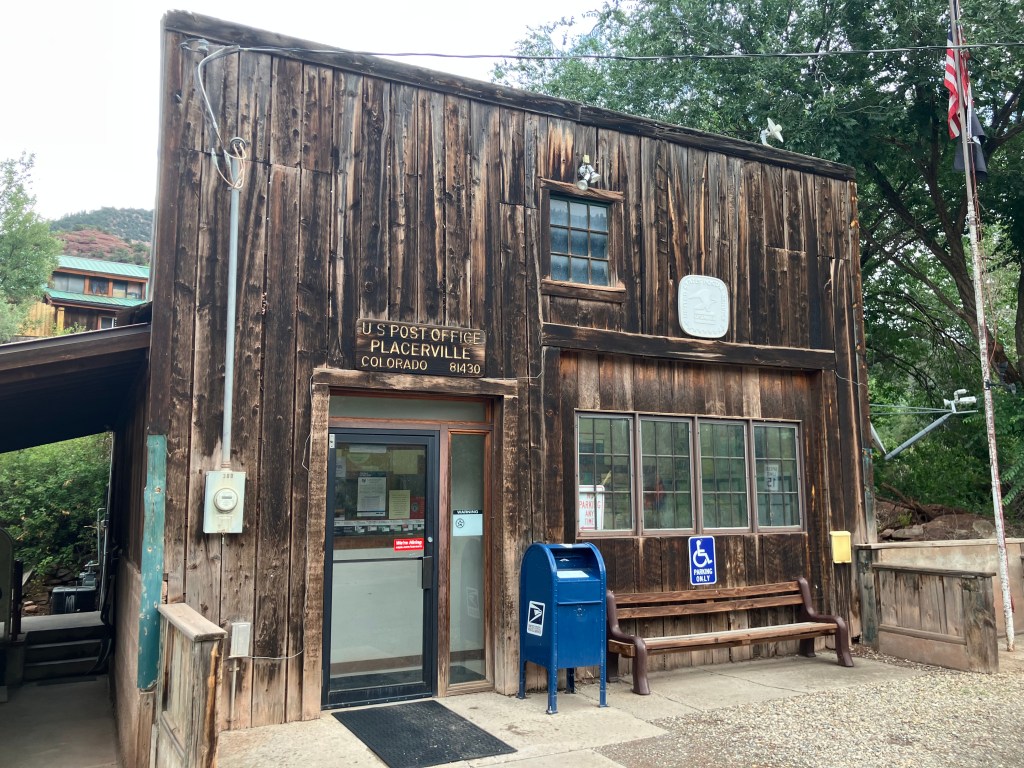
Pretty much all that makes up Placerville is a post office, a general store, a storage facility, and a few houses. In the 1800s it was a mining boom town, but as with many boom towns, the mines dried up and the population went elsewhere. Later, the failure of the local Trout Lake Dam in 1909 wiped out most of what remained.

But be that as it may, I think we can declare this mission a success.

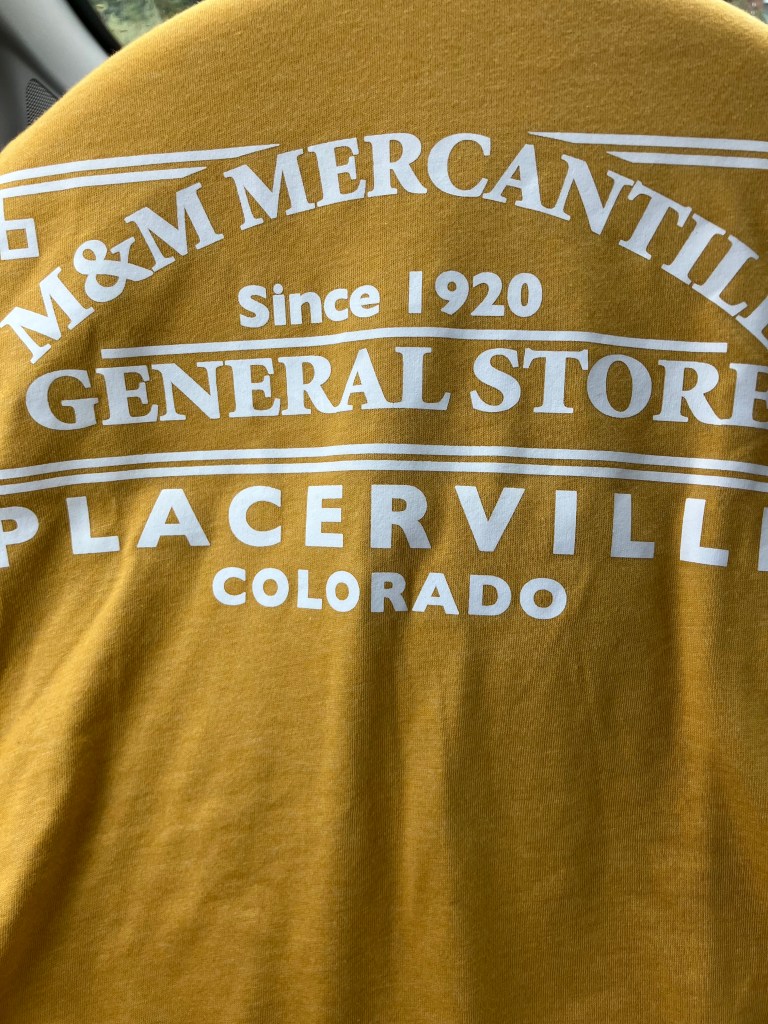
And (shockingly) I was even able to purchase Placerville merch at the general store!

I was hoping for “My husband drove from Placerville to Placerville and all I got was this stupid T-shirt.”

BREW OF THE DAY

We have a winner!

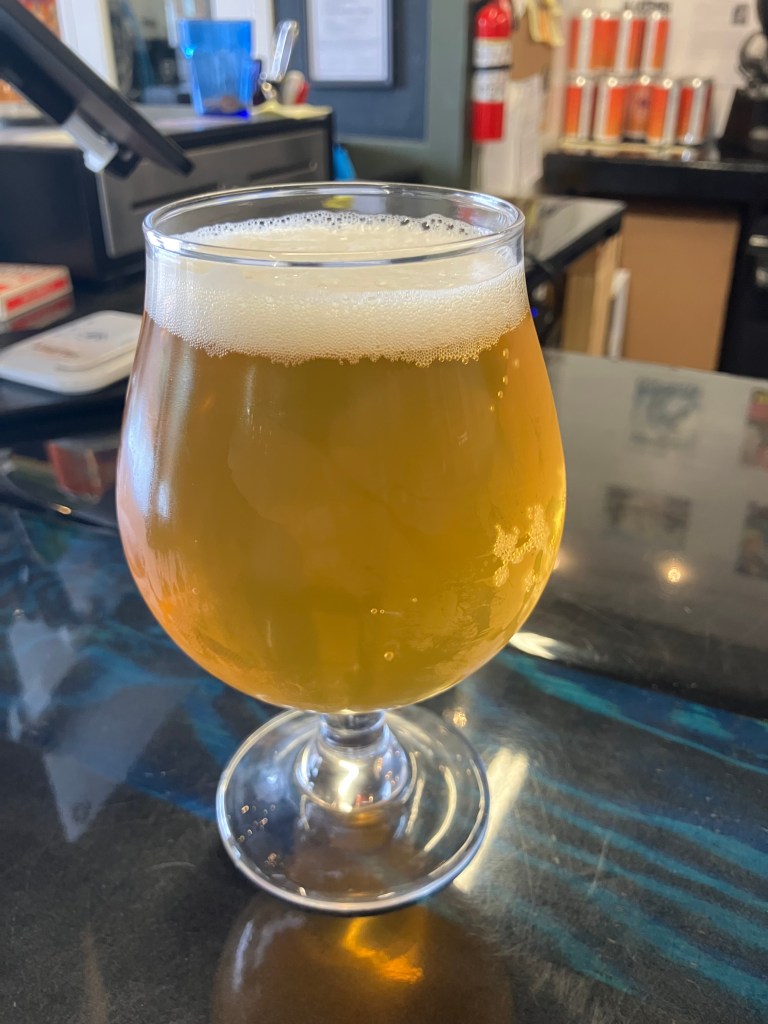
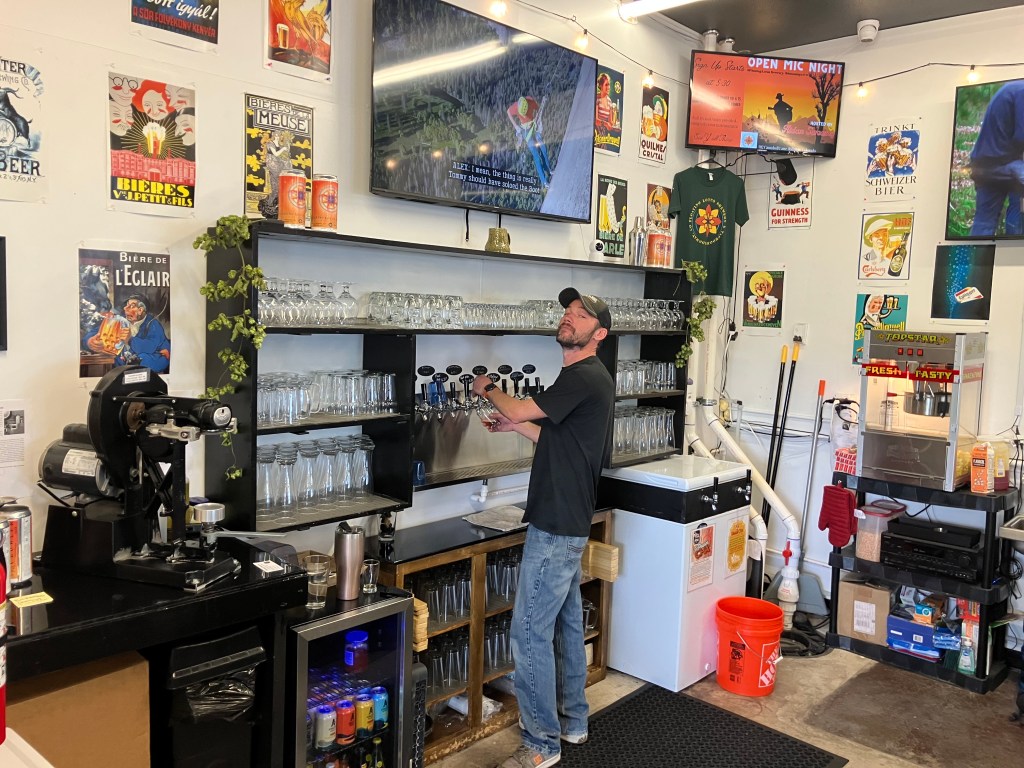
In the town of Ridgway, Colorado (pop: 1,300) I stopped in at the Floating Lotus Brewery. It’s a friendly, casual place with an airy atmosphere, two outdoor patios, a stage for live music, and a great view of the neighboring property where John Wayne filmed some scenes from True Grit. Owner/Brewmaster Kenny Conley hooked me up with his favorite beer: the Blastoplast IPA.

This was hands down the best beer I’ve had on this trip. Of course, that’s an admittedly low bar. But this is seriously a tasty brew. Unlike so many modern IPAs, this one is perfectly balanced. It’s not too hoppy, not to carbonated, not too pungent. At the same time, it’s flavorful and a bit “richer” than you’d expect from an IPA, without the astringent IPA afterburn you sometimes experience by the end of the glass. And at 6.3 percent ABV, I’d say the alcohol content is right where it should be. This is a five-star brew.

Kenny at his post. If you ever find yourself in Ridgway, or even in the vicinity of Telluride, pay him a visit!
Breweries · Road trips

Land of the Giants

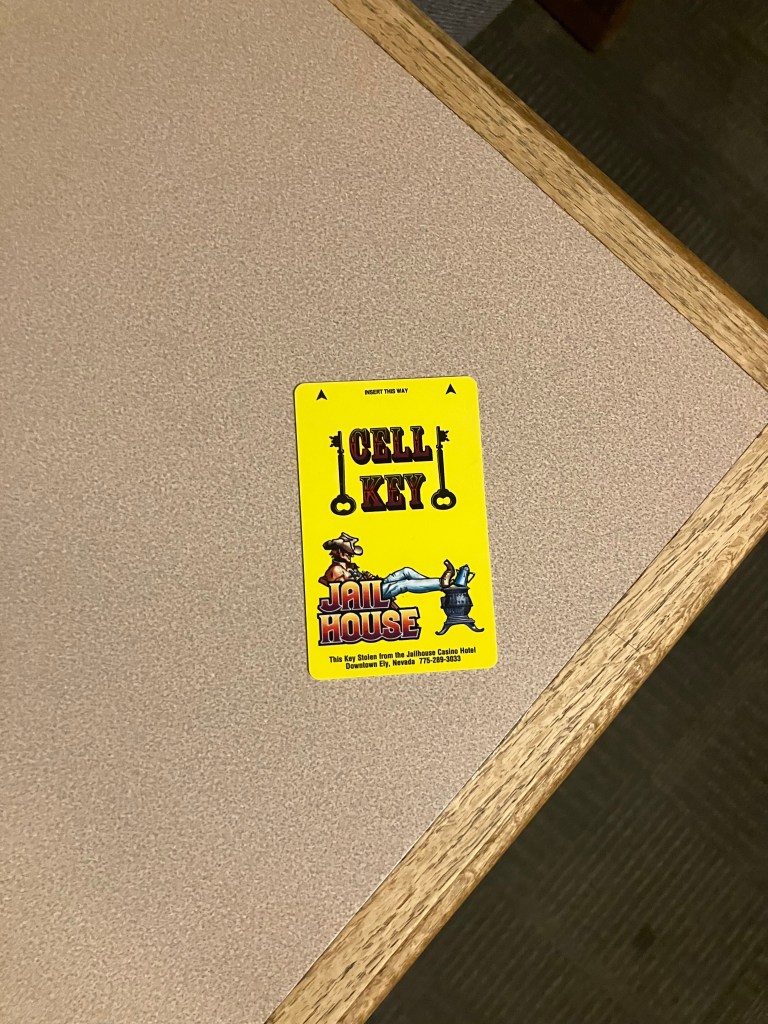
This morning I checked out of the Jailhouse Hotel early. I returned my hilariously-labeled “cell key” to the “warden” at the reception desk.

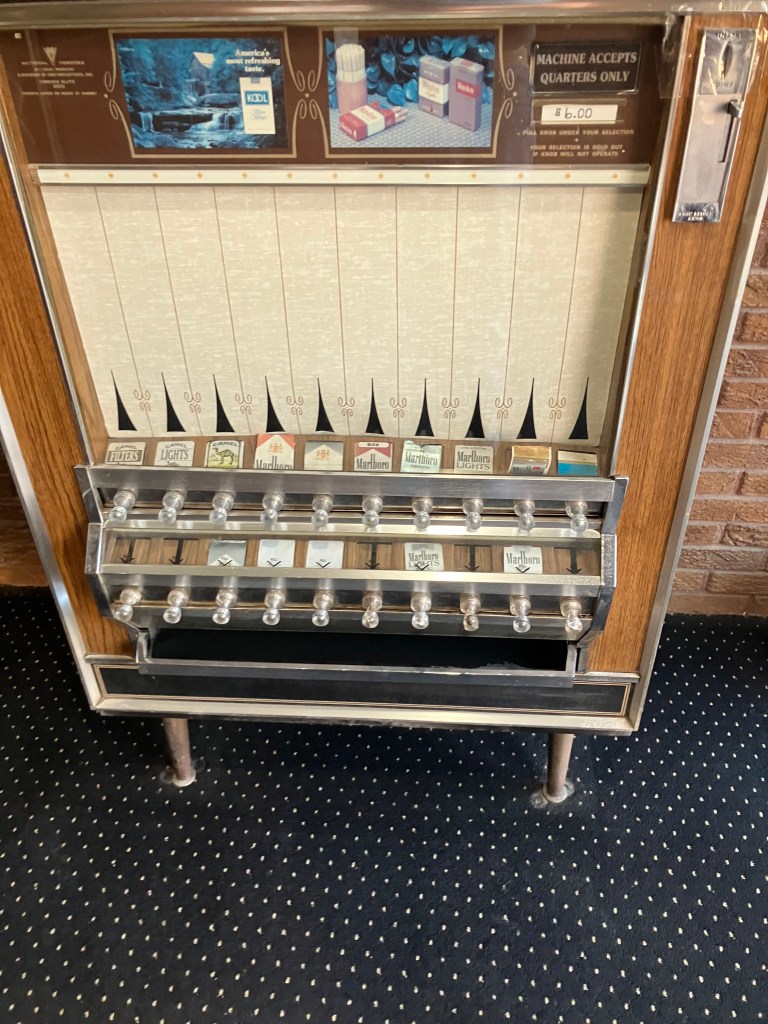
While I waited for the warden to finish processing my paperwork I glanced around the lobby and spotted this blast from the past:

Is anyone old enough to remember these?

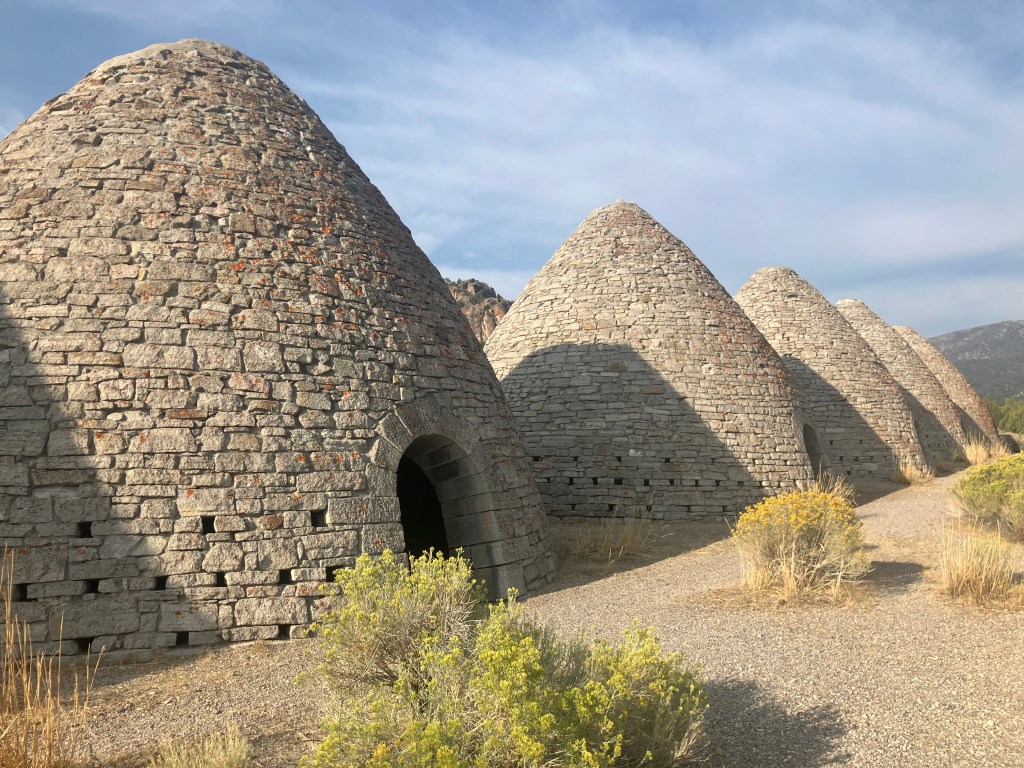
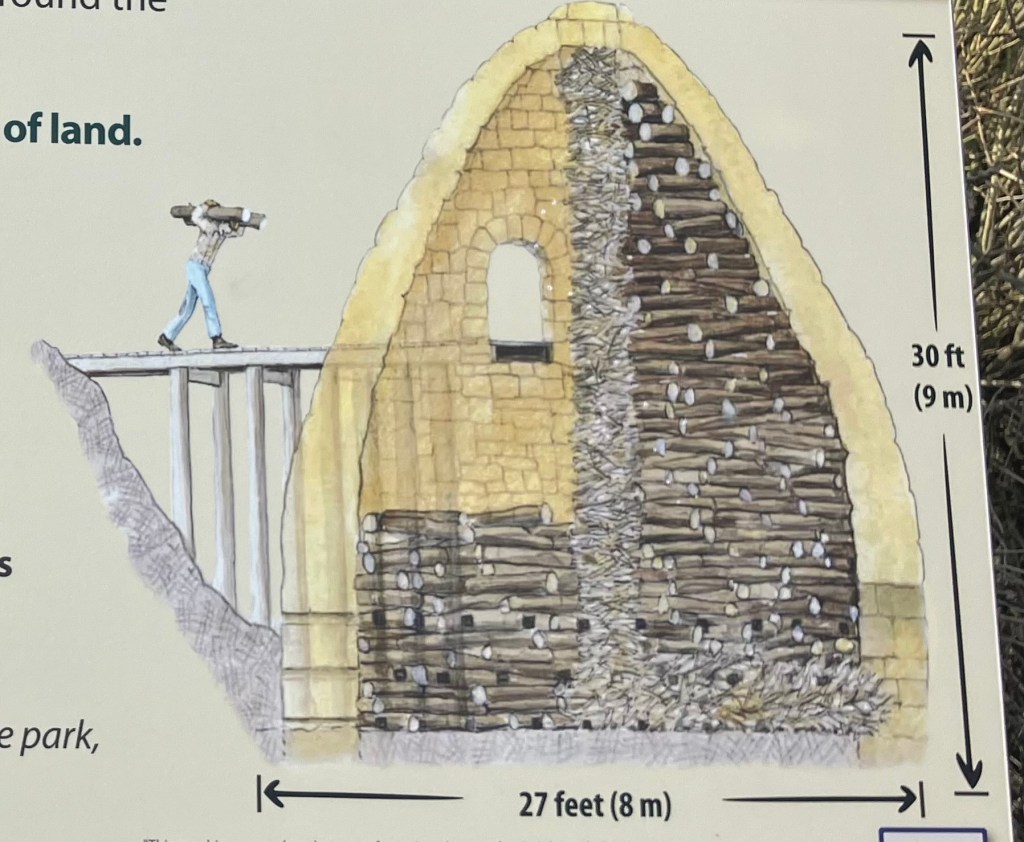
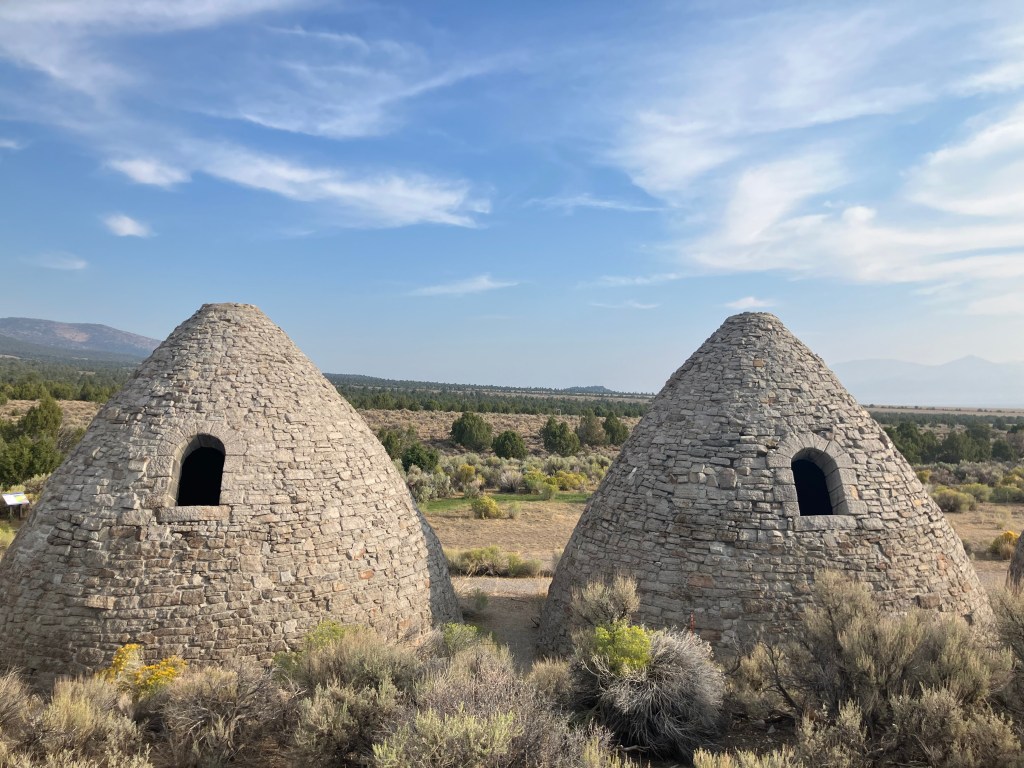
Eventually I was liberated from the Jailhouse and back in my car. On my way out of Ely I spied a sign for the “Ward Charcoal Ovens.” It looked like a minor detour on a dirt road, so I followed the sign. I’m glad I did. After a few dusty miles I encountered a collection of enormous, well-preserved, 19th-century ovens that had been used for making charcoal. Standing about 30 feet high, these are gigantic, otherworldly artifacts in the middle of nowhere.

The ovens were used to transform pinion pine and juniper into charcoal, which in turn was used to fire the smelters that melted ore during Nevada’s silver rush in the 1870s. These ovens were only used for a few years until the silver ran out, yet they’ve been standing for about a century and a half. I was impressed by how well-preserved they are. Not a speck of graffiti, no trash on the ground, and virtually no damage to the stone. (A ranger I talked to informed me that there has been some minor restoration work done to the mortar.)

The ovens (which somehow seem a little creepy to me, even in broad daylight) were a product of the era, when physical challenges (like melting ore) were met with ever-larger infrastructure (bigger locomotives, larger dams, these enormous ovens), rather than, say, intricate technological advances. It’s simultaneously awe-inspiring and incredibly wasteful. About 6 acres of trees would have to be felled each time an oven was filled, and after only a couple of years all the trees in the area had been cut down.

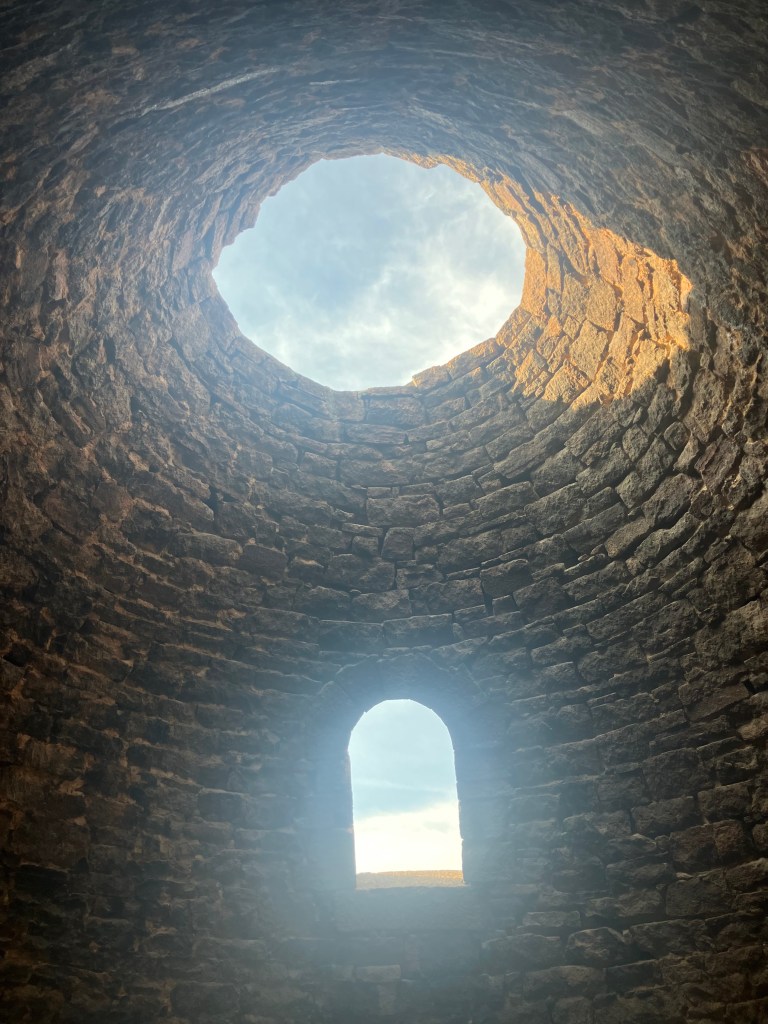
View from inside an oven. The top hole allows smoke to exit; the arched “window” on the side allows for the insertion of wood.

So, these ovens were environmentally damaging and obsolete in a few short years. On the positive side, they produce a cool echo effect.

The ovens are also, um, titillating.

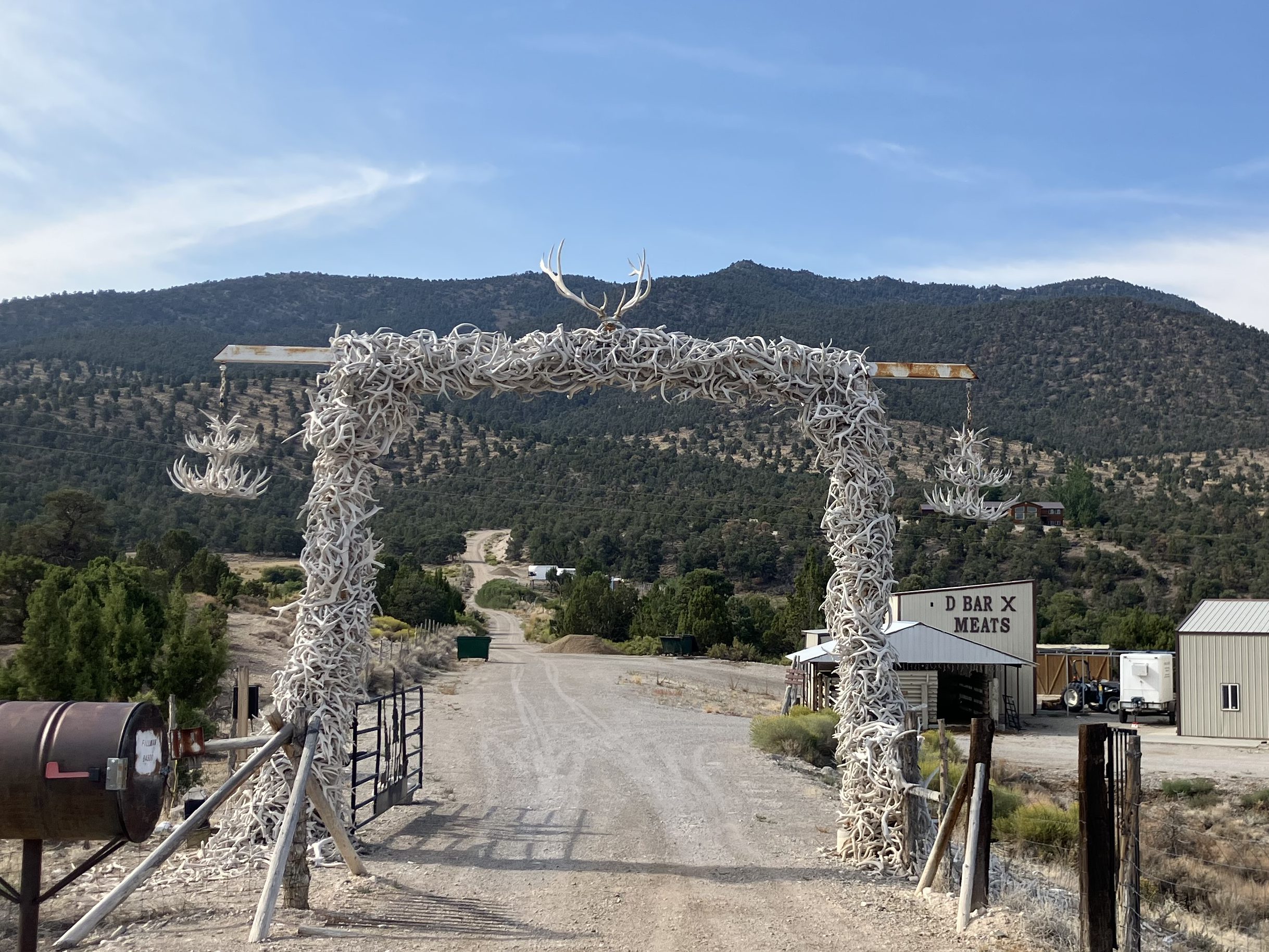
Speaking of racks, I came upon this impressive display at a butcher shop just outside Ely:

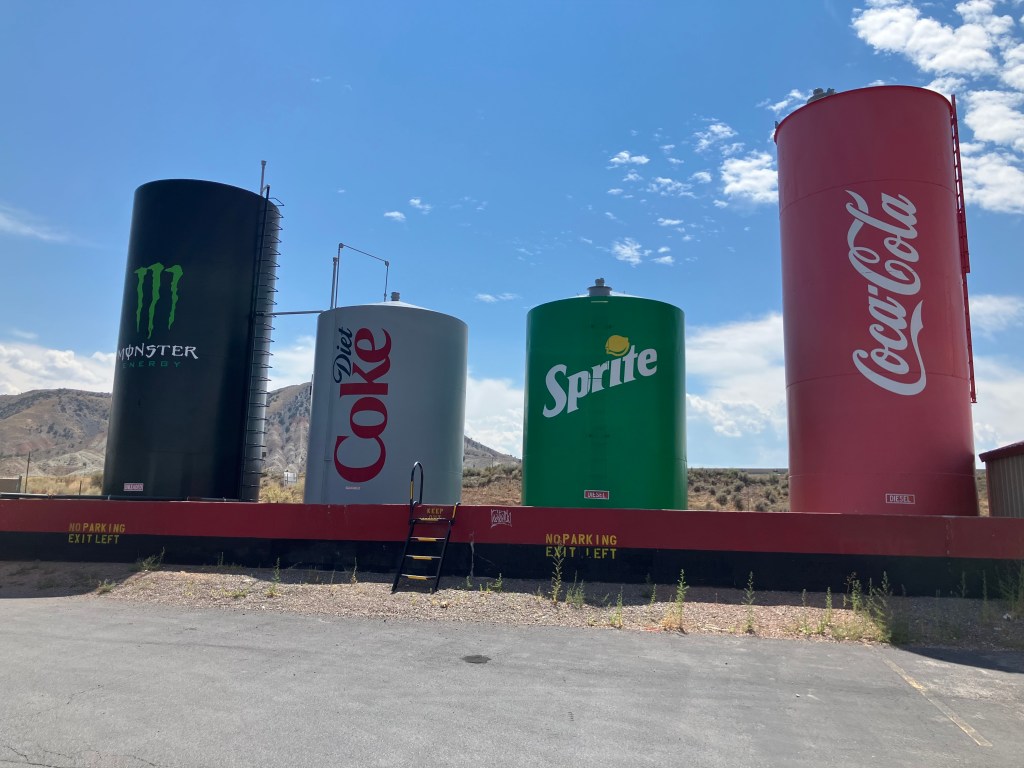
But to get back to the theme of “land of the giants,” I beheld these enormous soda cans at a gas station in Salina, UT. They actually contain diesel fuel, and so are not quite so unhealthy as you would guess from their labels.

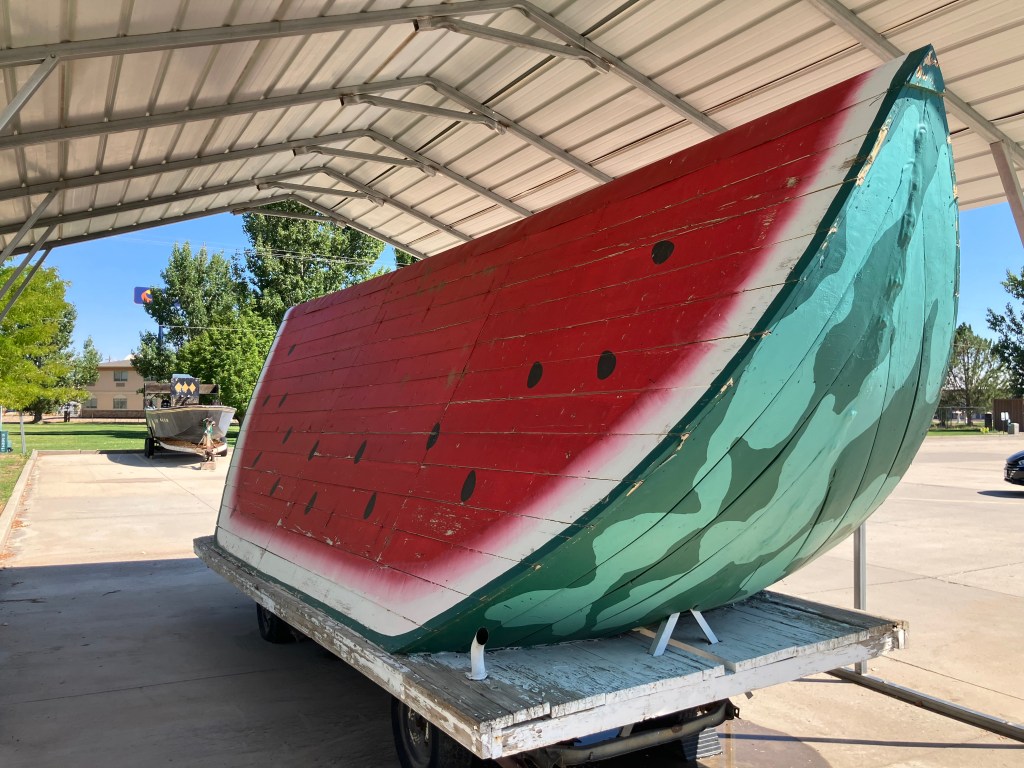
And to round out the Giants theme, this gigantic watermelon slice was sitting in a parking lot in Green River, UT (pop: 850), for no discernible reason.

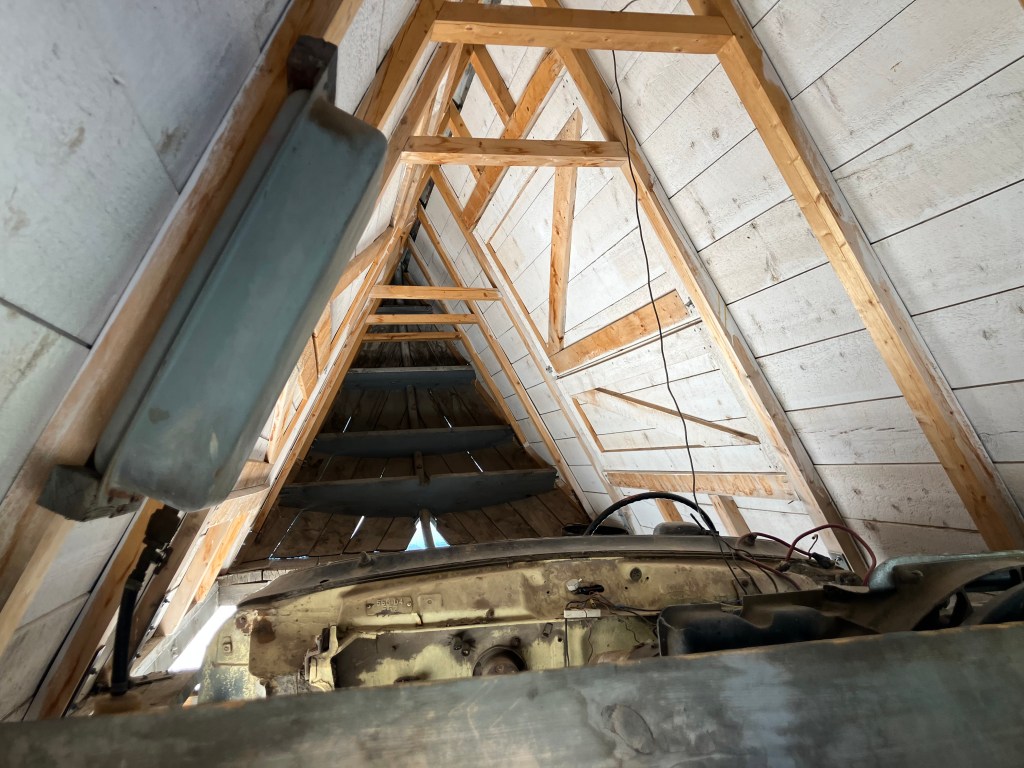
The watermelon slice is constructed entirely of wood, and a little Internet research reveals that it was built in the 1950s as a parade float of sorts. Remarkably, the watermelon is self-powered, with an engine hidden inside. I managed to sneak a photo through a small porthole (?).

Inside a giant seedless watermelon.

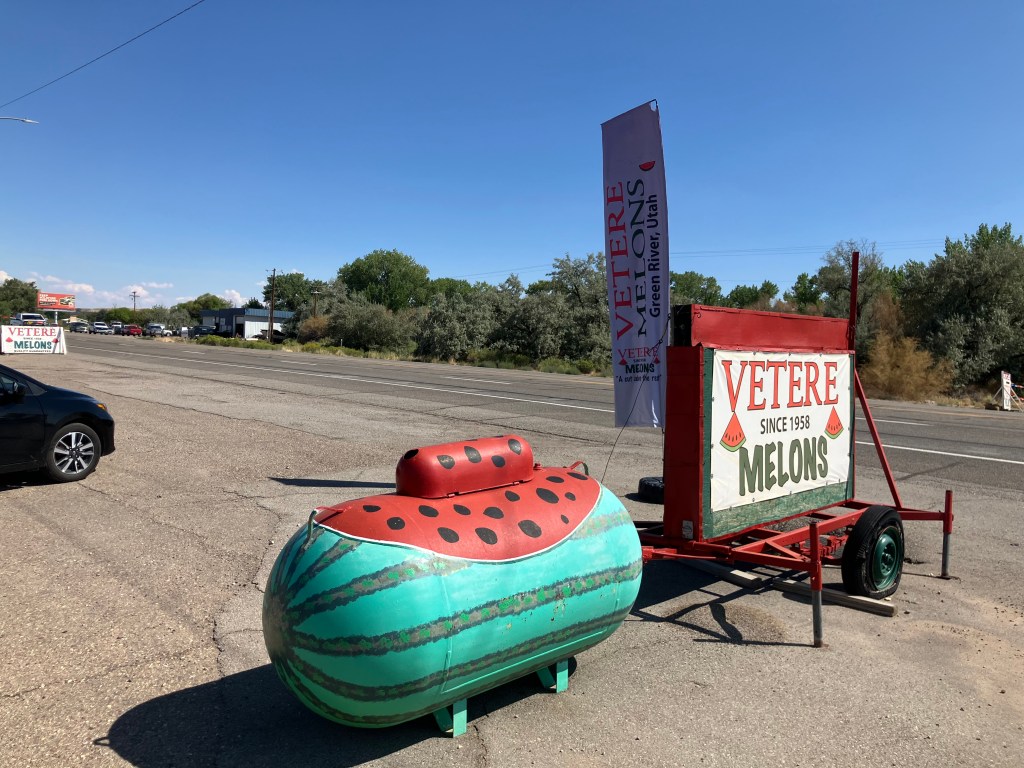
Watermelons seem to figure prominently in the local agriculture, as I saw watermelon vendors set up in several parking lots.

Cucurbitaceous propane tank.

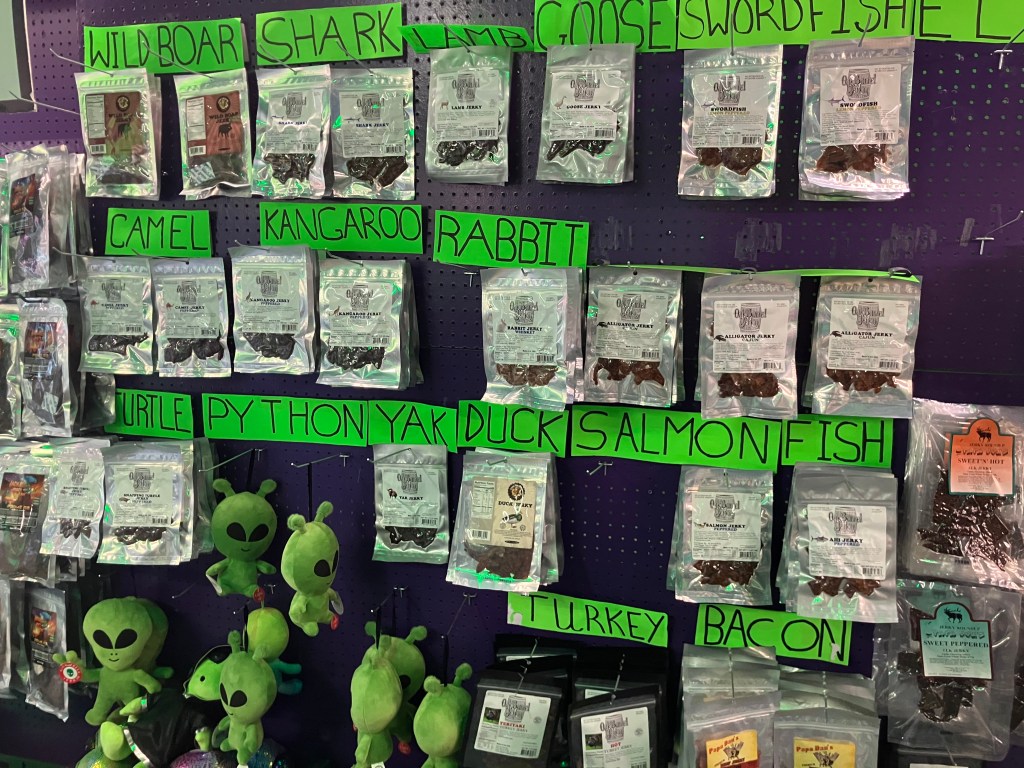
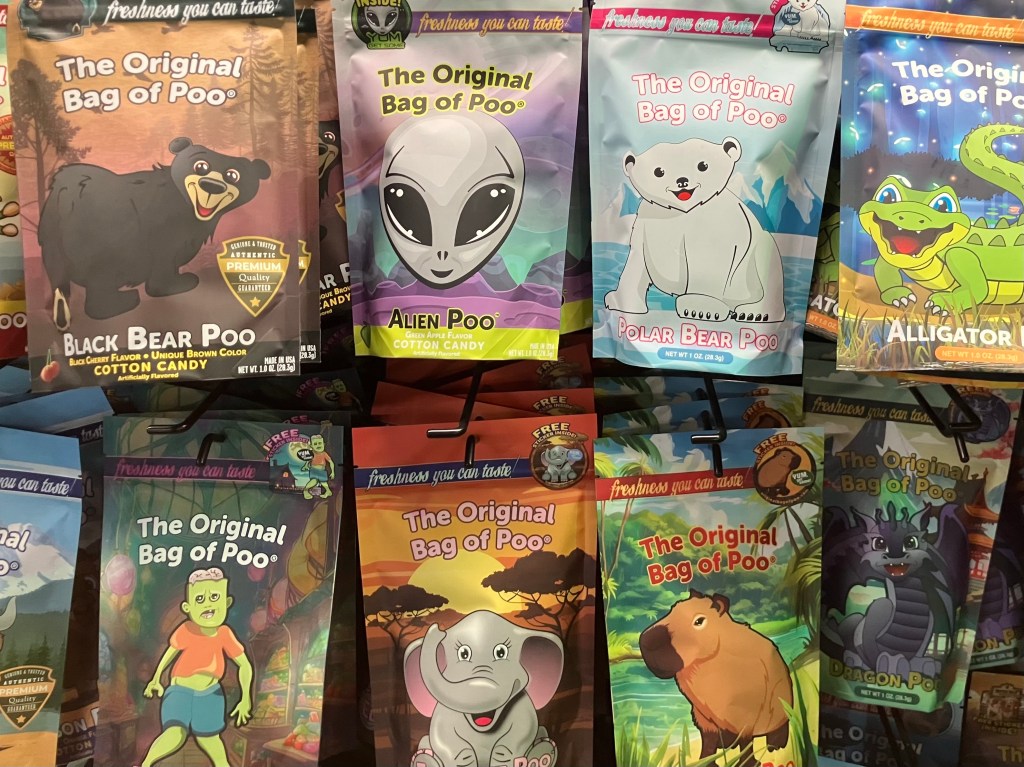
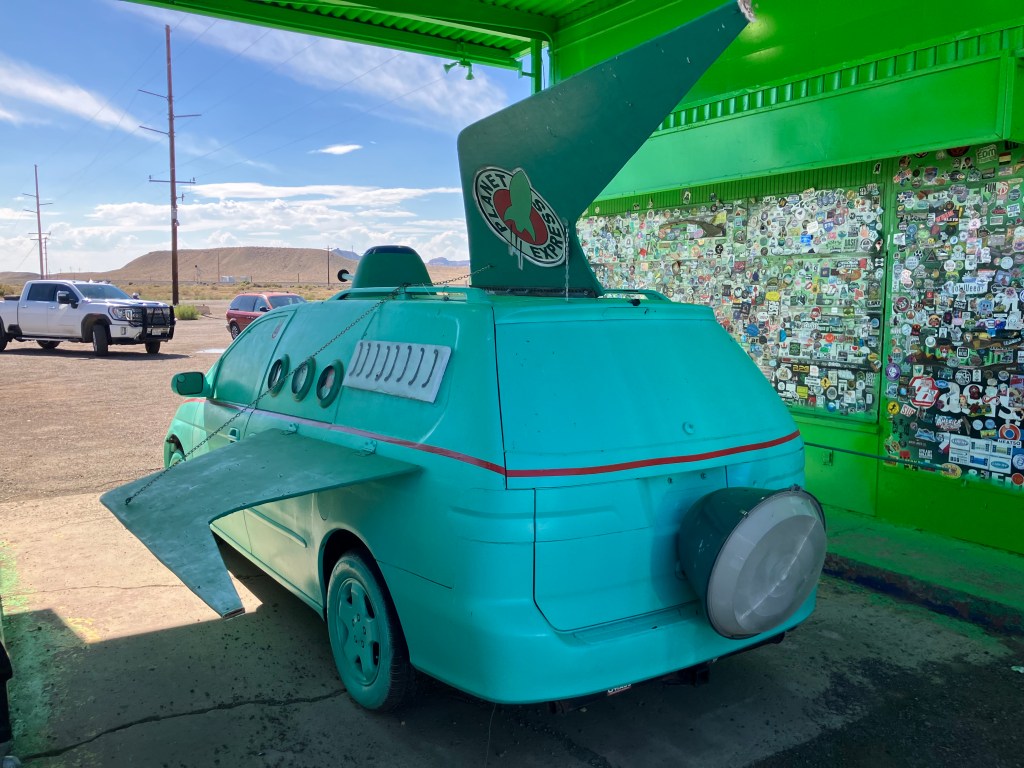
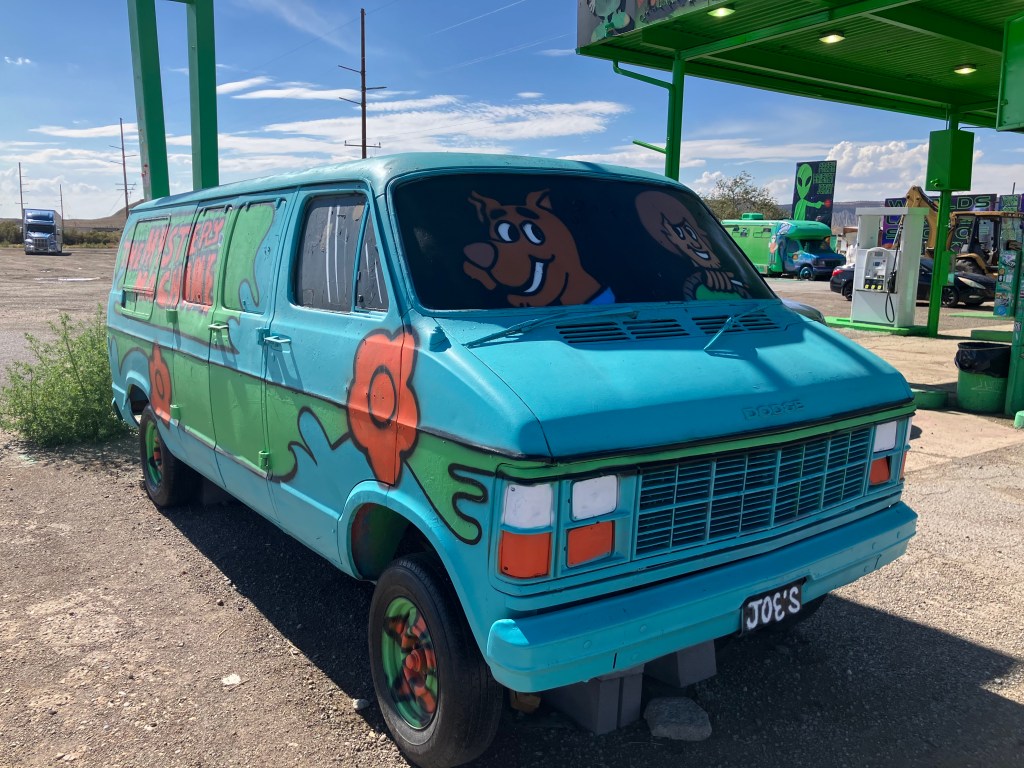
But more interesting to me near Green River was a place called “Jackass Joe’s,” which is a combination gas station and purveyor of all manner of quirky and irreverent stuff. Their specialties seem to be T-shirts (with their own name on them), exotic jerky, and various styles of candy “poo.”

Camel jerky?????
“Freshness you can trust.”
Jackass Joe decorates in an unexplained alien theme.
…and, randomly, Scooby Doo.

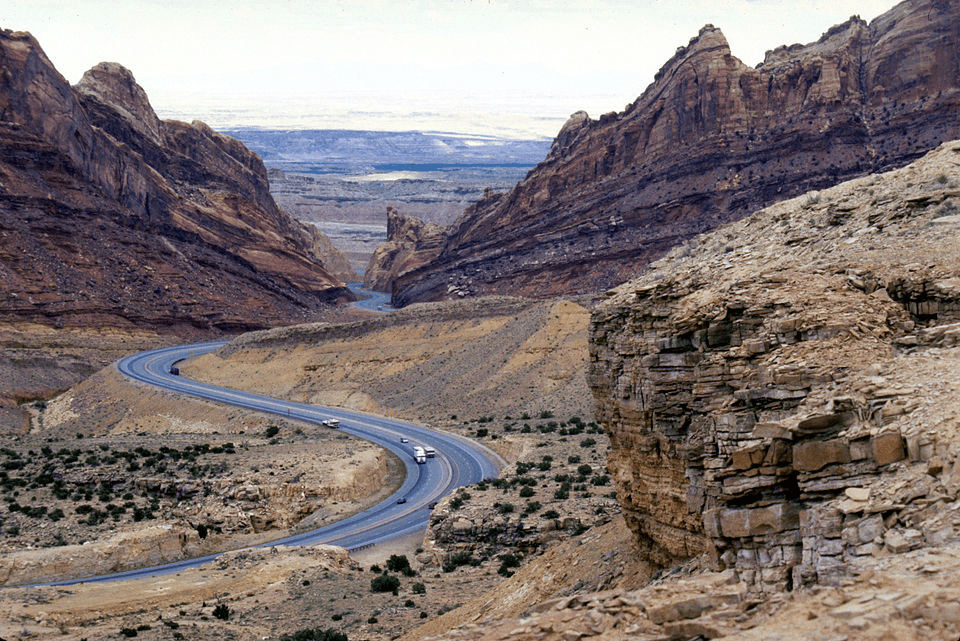
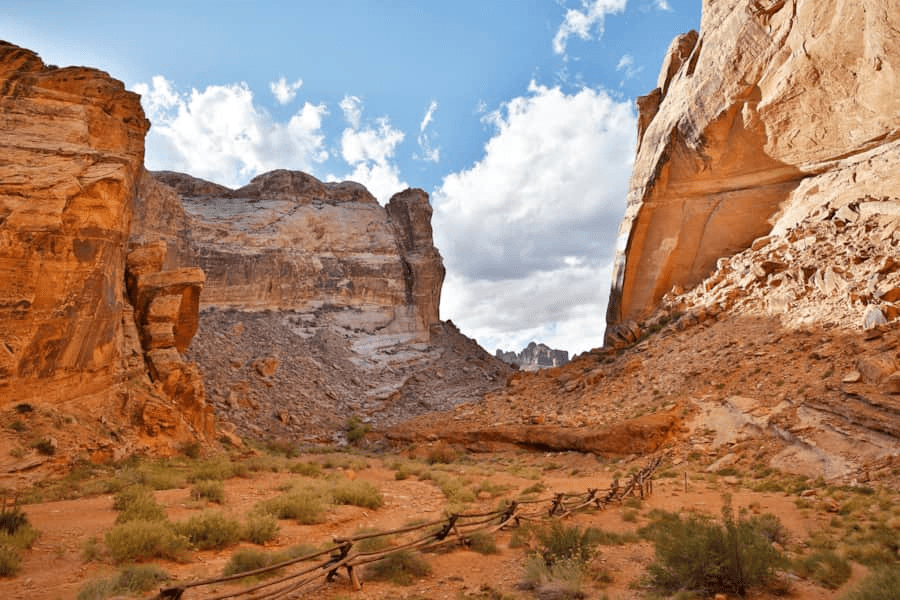
And yet, notwithstanding the fun factor of Jackass Joe’s and the various giant foodstuffs, by far the most impressive part of today’s journey was driving along I-70 through the San Rafael Swell and other geologic formations. It’s simply jaw-dropping. The craggy and stratified shapes are otherworldly, the colors are vivid and varied, and in keeping with our Land of the Giants theme, the scale is enormous. It was almost transformative to drive my little rental car along this narrow ribbon through these formations. Alas, I wasn’t able to take any photos, and more to the point, I realized my little iphone camera couldn’t possibly do the scene justice. So allow me to present a couple of photos taken from the Internet:

Public domain photo from US Dept of Transportation, showing Interstate 70 snaking through the San Rafael Swell in central Utah.
“Swell” photo from Utah Chamber of Commerce.

This section of Interstate 70 has been called an “engineering marvel,” as it twists over, through, and along these geologic formations, while attempting to minimize disruptions to the landscape. The construction process also unearthed various dinosaur fossils.

I’ve encamped for the night in Moab (pop: 5,400). Tomorrow we will finally arrive at Placerville, CO!

BREW OF THE DAY

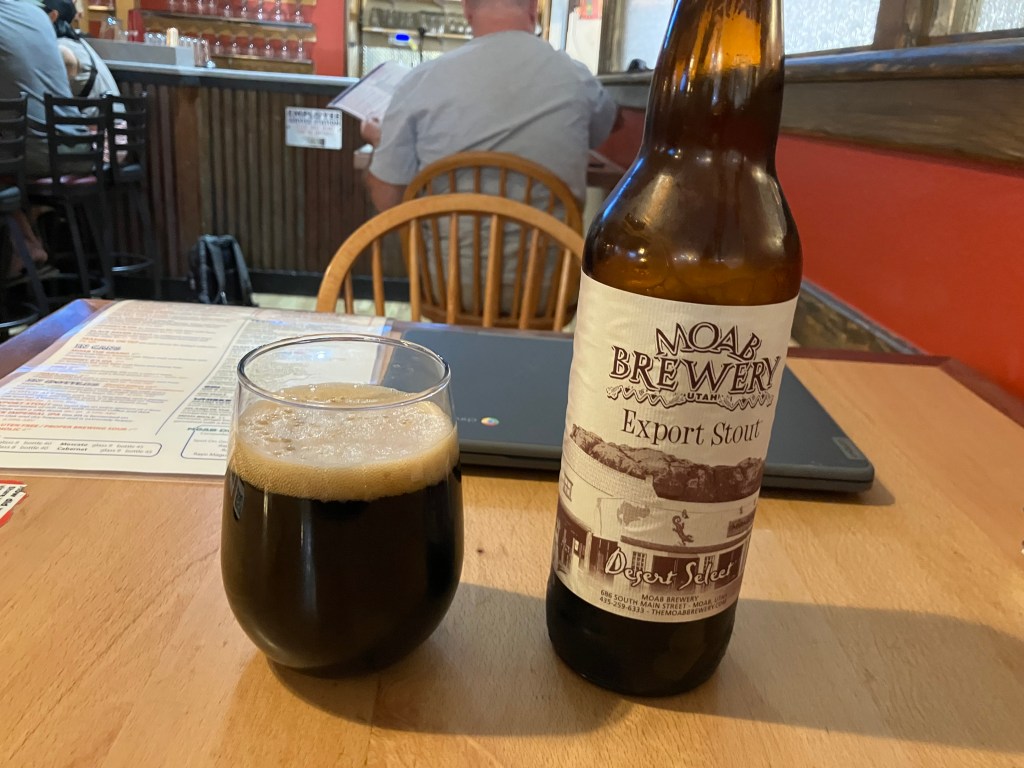
The BOTD comes courtesy of Moab Brewery. They have a fairly extensive menu of their own beers. I let the server choose for me, with the only instruction being that “I don’t want a light beer.” She directed me toward the “Export Stout.” Unfortunately, it is not available on tap (i.e., bottle only), and the bottle holds 22 ounces. So this is a commitment.

Unfortunately, it’s a commitment that doesn’t pay off. I was hoping for a rich, thick, malty, high-gravity beer. What I got was something closer to bathwater.

OK, maybe it wasn’t that bad. But it was definitely thin in body, and it had no nose to speak of. It’s very carbonated–maybe over-carbonated. The flavor tastes of burned coffee (like when the pot has been sitting on the heating element at the truck stop for a few hours) and something slightly vegetative, like maybe moldy alfalfa. Deep in the back of your nasal passages you get a slight sense of Volatile Organic Compounds, reminiscent of Testor’s model glue. The finish reminds me of Crayola crayons.

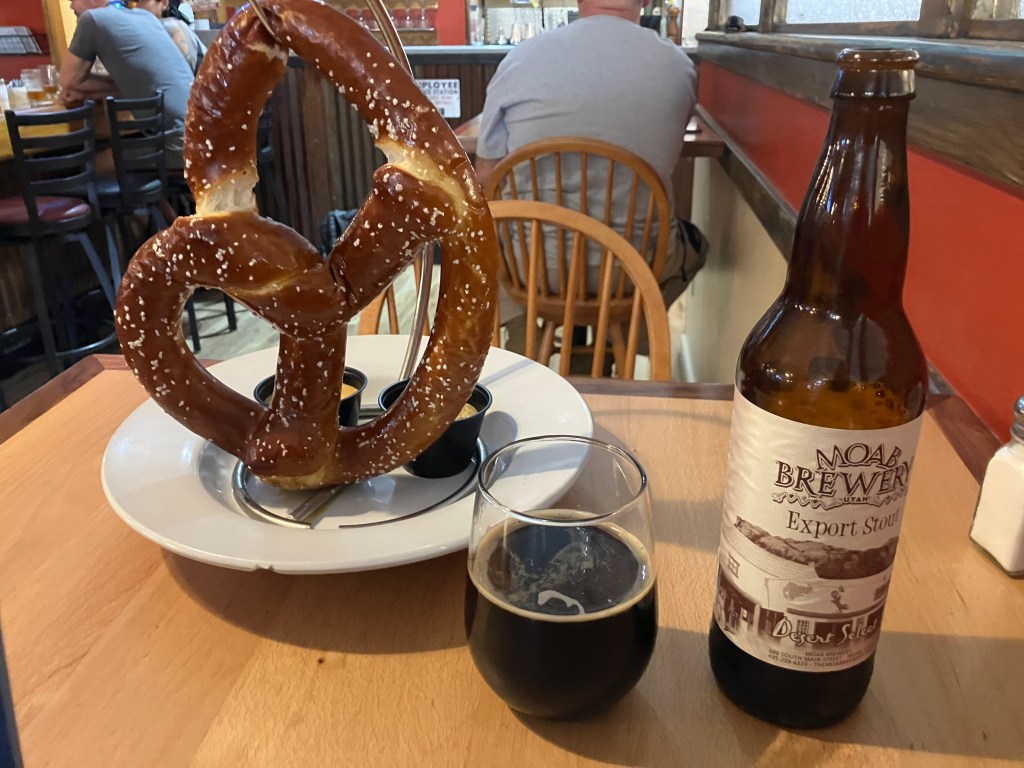
I’m afraid I can only give it 1 star. But I’ll give four stars to the most excellent brewery pretzel that paired with it.