bridges · California history · Road trips · trains

South Pacific

No, not that South Pacific…
this one.

The San Francisco Bay Area today is associated with high-tech start-ups, a tangle of crowded freeways, ubiquitous Teslas driven by tech bros on their way to Starbucks, and outsize McMansions squeezed onto tiny lots that once were once cherry and apple orchards. It’s a thoroughly modern region, where Lime Bikes are available on every street corner and Uber Eats is more popular than McDonalds.

And yet here and there you can still find remnants of a long-forgotten, early-industrial past, if you know where to look. Recall, for example, my hunt last year for a century-old, half-sunken railroad ferry in Antioch. I’ve been struggling to articulate just why I’m find the presence of these historic relics so reassuring. To me they’re a tangible link to an obstreperous past that feels more palpable than our virtual this and digital that. The steam-and-iron age had its negative points, to be sure, but it also showcased our civilization’s determination, boldness, and energy. And yet I think there’s more to my interest in this stuff than just their Romantic aspects. By seeing these artifacts in the wild, rather than behind a museum display case, they are at once more authentic and better contextualized. They connect us to our own past. I’m thinking of that scene in the original Logan’s Run, when Logan 5 and Jessica 6 encounter the old man (played by Peter Ustinov). Even though their modern society worships youth, they are drawn to this ancient, bearded feller with connections to a forgotten time.

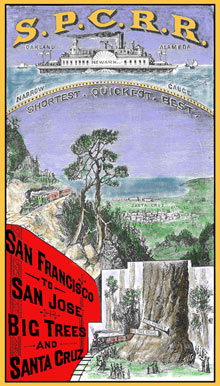
All this brings us to the South Pacific Coast (SPC) Railroad. It’s an audacious, independent Bay Area rail line that was established almost a century and a half ago. It was an earnest upstart that offered a cheaper alternative to the monopolistic Southern Pacific Railroad, which at the time held California in a “monopolistic death-grip.”
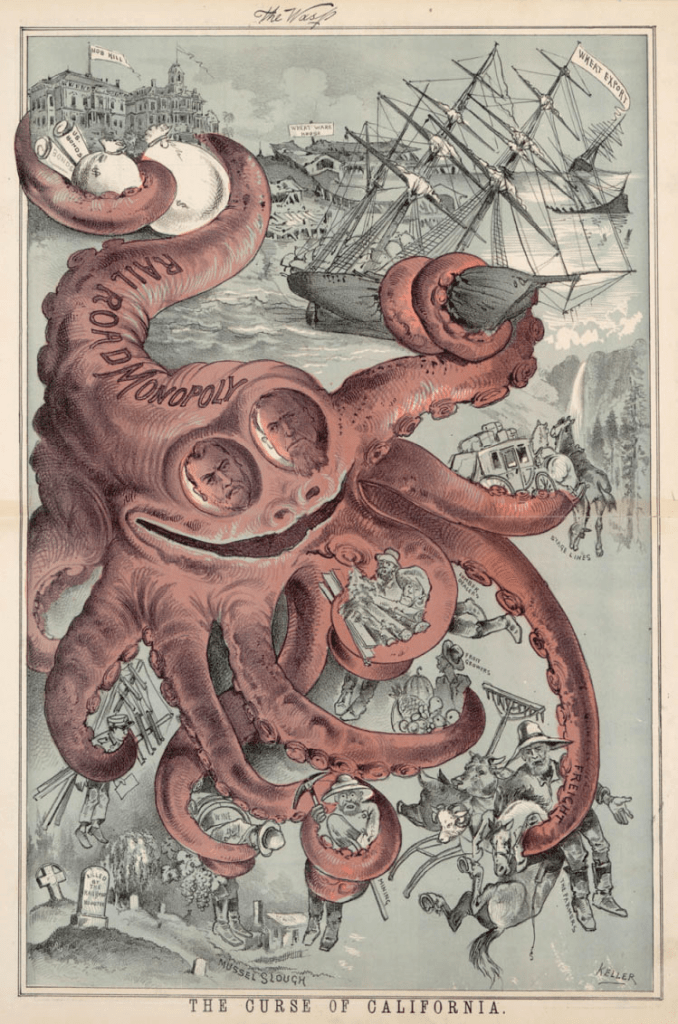
The SPC ran from Alameda down to Santa Cruz–a distance of about 77 miles. The stretch that crossed the Santa Cruz mountains, from Los Gatos to the coast, is especially impressive for a small, independent, narrow-gauge railroad. Trains traversing this section would snake their way through redwood forests, crossing gorges and creeks and passing through eight tunnels. And it was built in the 1880s! The line ended in the town of Santa Cruz.
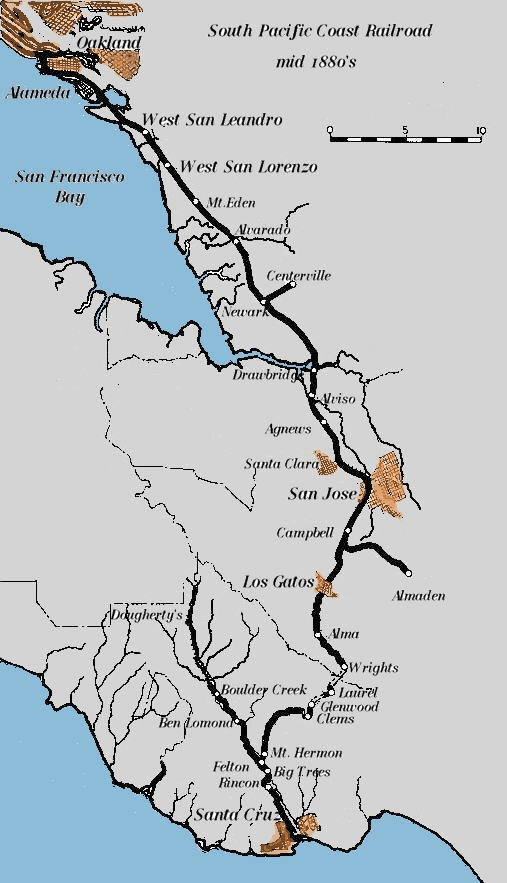
The Southern Pacific Octopus eventually absorbed the SPC line. Then the route became unprofitable with the opening of Highway 17 between San Jose and Santa Cruz in 1940. That same year a storm destroyed major portions of the old SPC line, and the Southern Pacific decided to abandon much of the line rather than repair it. Trains have not traveled over most of the original line for about 85 years.

So what happened to the SPC’s tracks and tunnels after the railroad was abandoned? My son Ian and I spent two days following the old route in order to find out.

We focused primarily on those old tunnels. There were eight of them. Tunnel #1 was obliterated in 1903, and in the 1950s the area was inundated by the creation of Lexington Reservoir. So we moved on to Wrights Station, which is where Tunnel #2 was bored. And it’s still there! The trees and vines and moss of the Santa Cruz mountains are trying to reclaim the tunnel’s mouth, but a steady flow of water seems to be continuously scouring it.
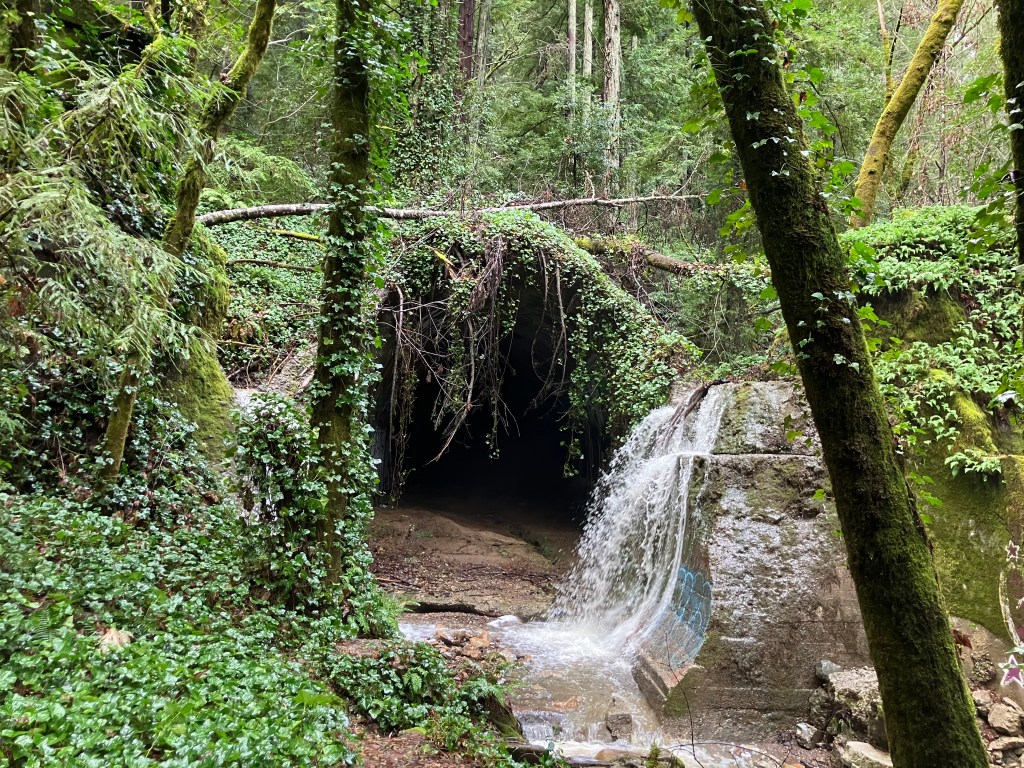
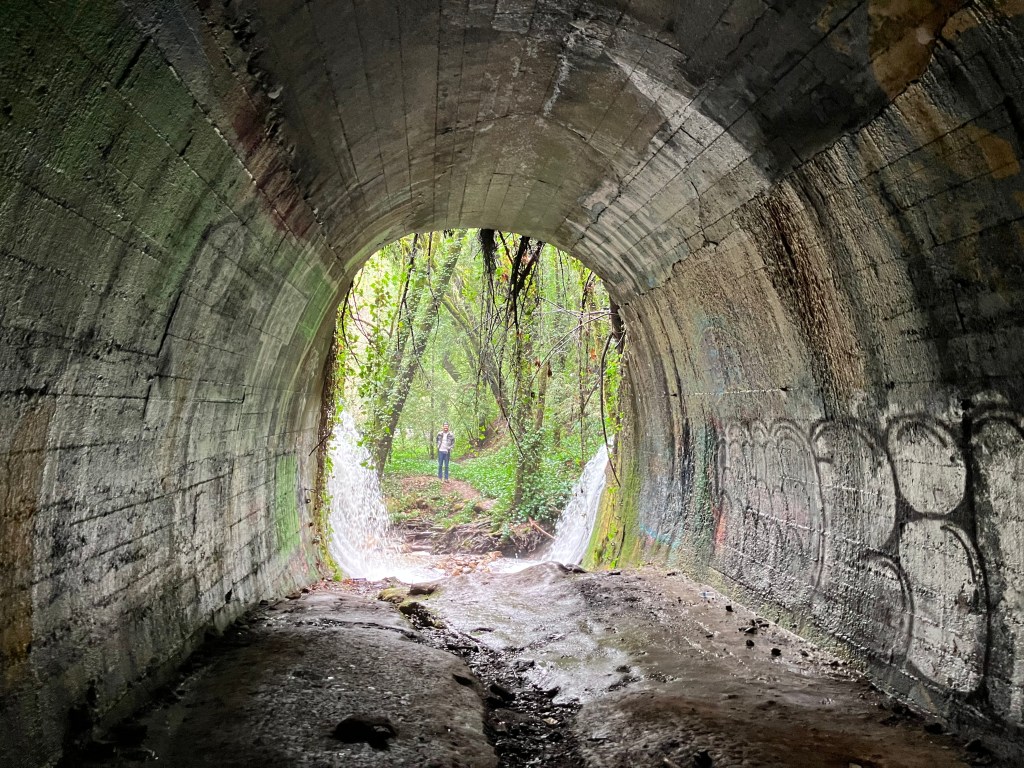
South portal of Tunnel #2 at Wrights
View from inside Tunnel #2. Son Ian is (wisely) standing outside.

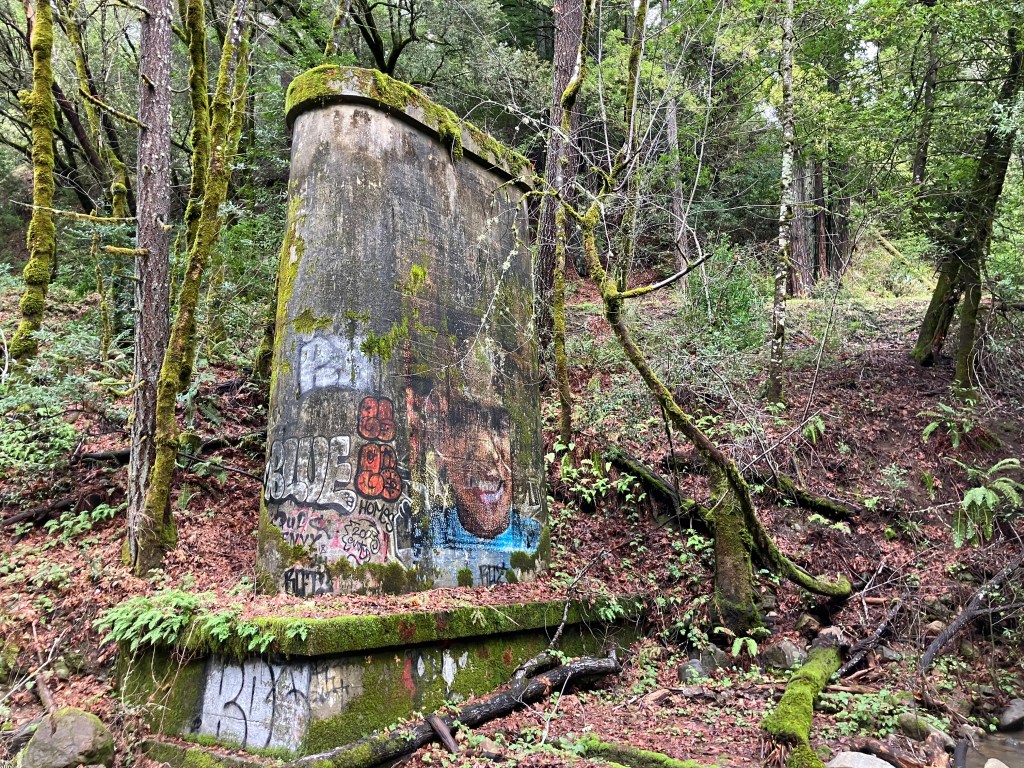
It’s somewhat eerie, these ruins from well over a century ago just silently sitting there in this remote forest. Graffiti reminded us we weren’t the only modern persons to discover these remnants of a past age, but it still felt as though we’d encountered something largely forgotten.
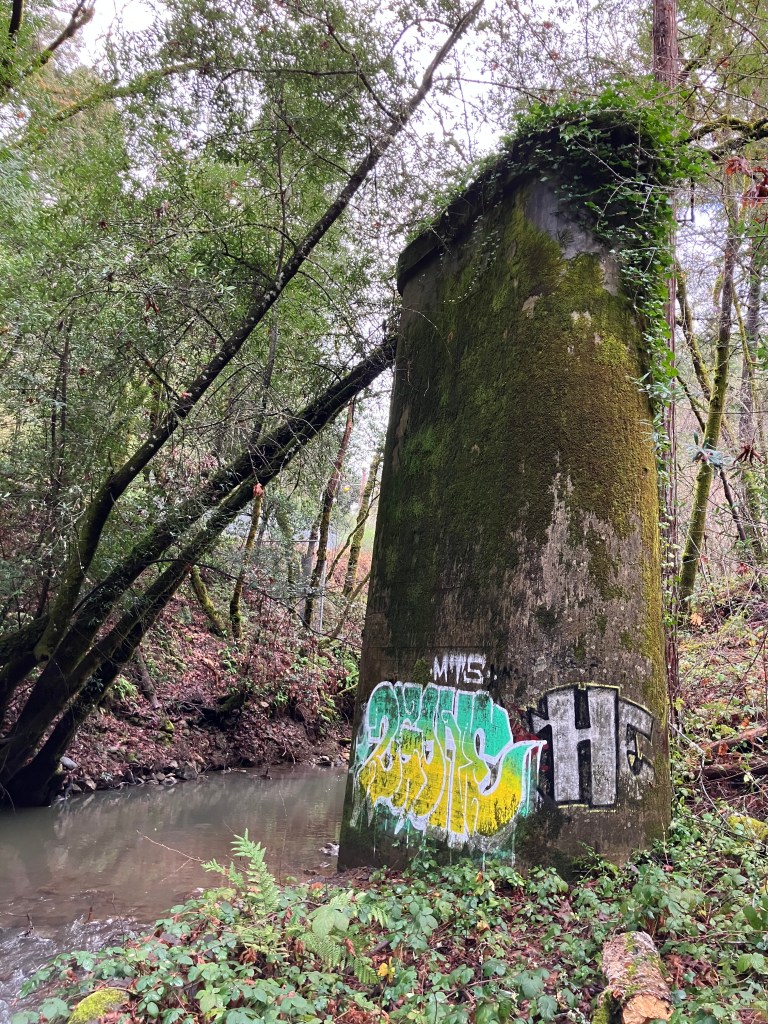
Railroad bridge pier near Wrights.
Another bridge pier, with impressive graffiti.

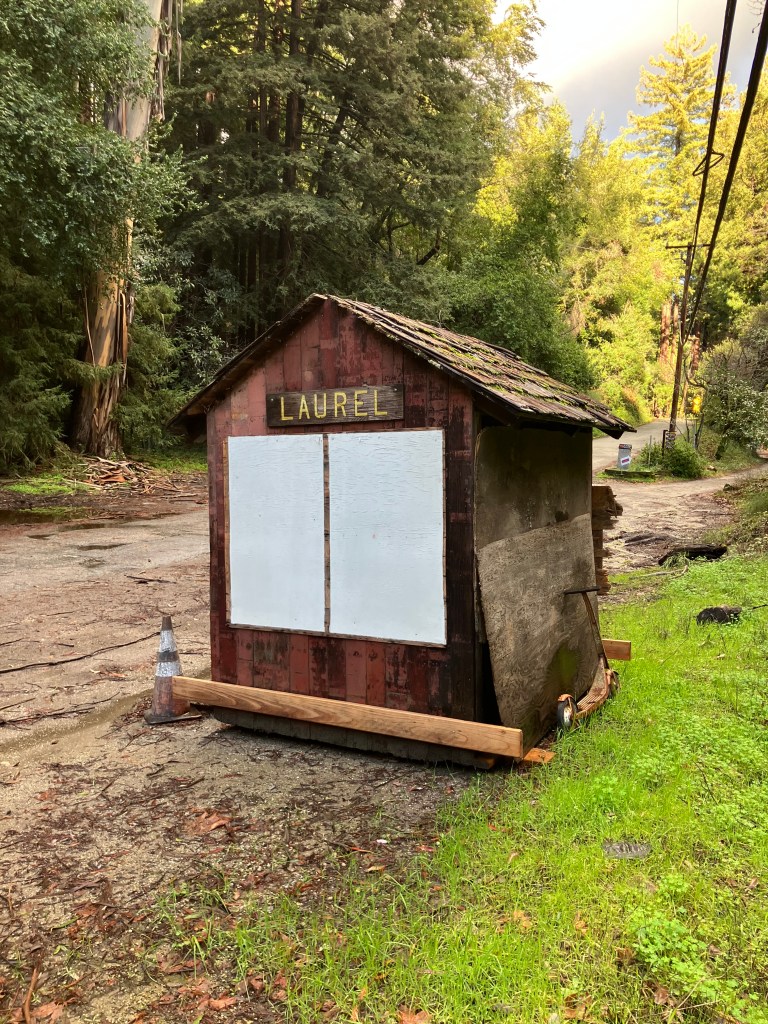
After Wrights we moved on to the town of Laurel (pop: one family). Laurel used to be a significant stop on the line, but today it seems to amount to just one house.
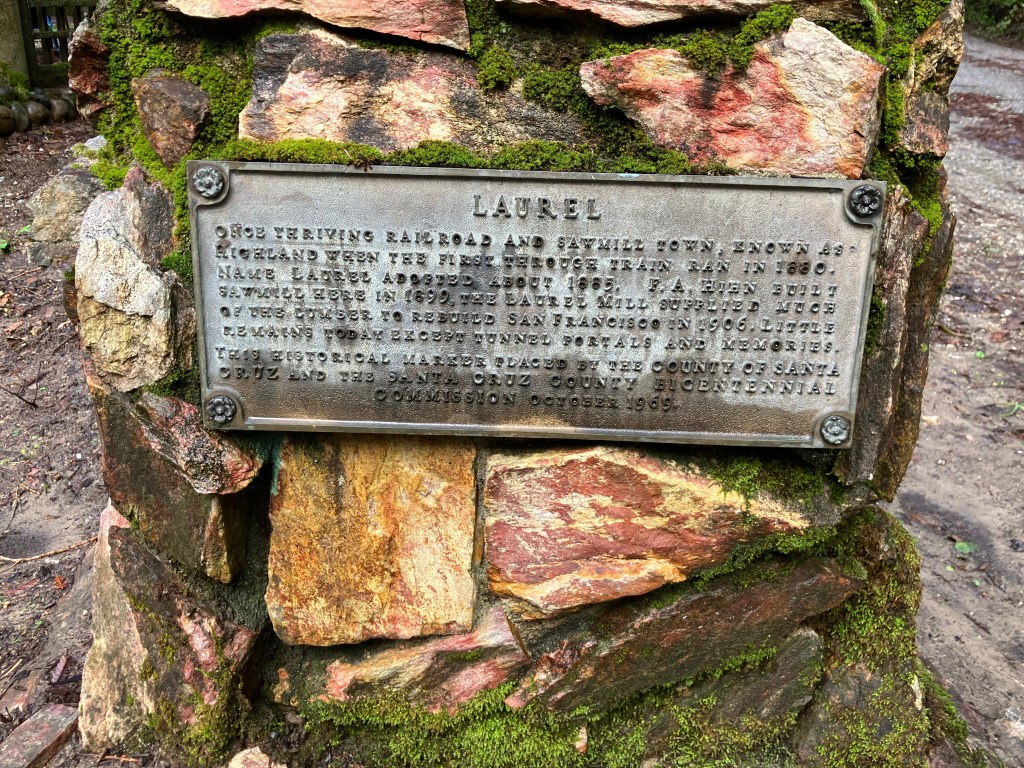
“Once thriving railroad and sawmill town, known as Highland when the first through train ran in 1880. Name Laurel adopted about 1885. F.A. Hihn built sawmill here in 1889. The Laurel Mill supplied much of the lumber to rebuilt San Francisco in 1906. Little remains today except tunnel portals and memories. This historical marker placed by the County of Santa Cruz and the Santa Cruz County Bicentennial Commission October 1969. “

Apparently, that one home now owns the portal to Tunnel #3 in its backyard. And because the portal is on private property, there’s no graffiti. Once again, it strikes me as an eerie remnant of a long-abandoned railroad that looks very much like it did a century ago.
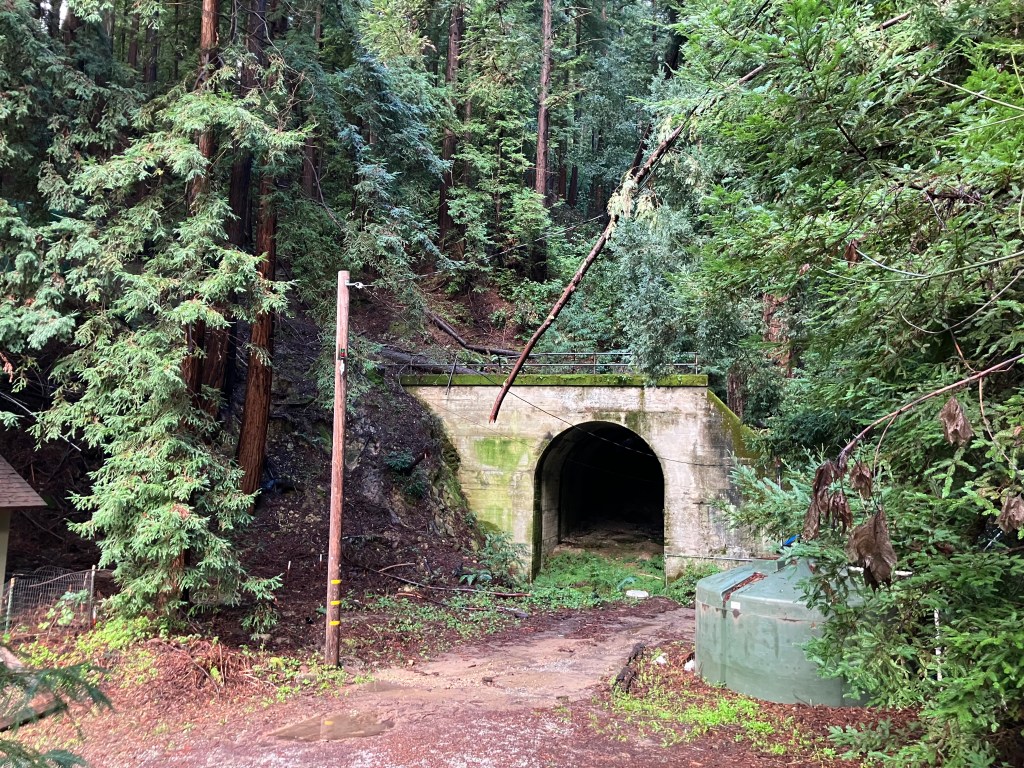
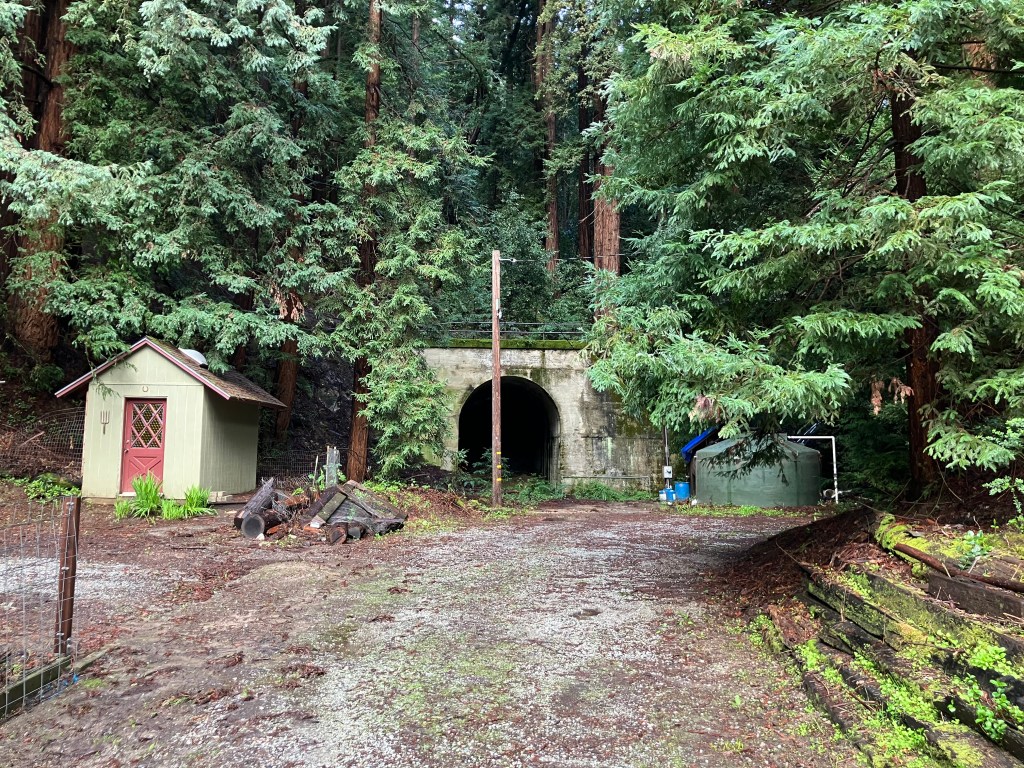
North portal to Tunnel #3.
Another angle of Tunnel #3. Can you imagine having an old railroad tunnel in your back yard?
Little shed near the tunnel portal. I assume it dates back to the SPC?

We found the south portal to this same tunnel emerging under a residential road in Glenwood, This end too appears to be part of someone’s back yard. I would have killed to have had a historic railroad tunnel in my back yard while growing up!
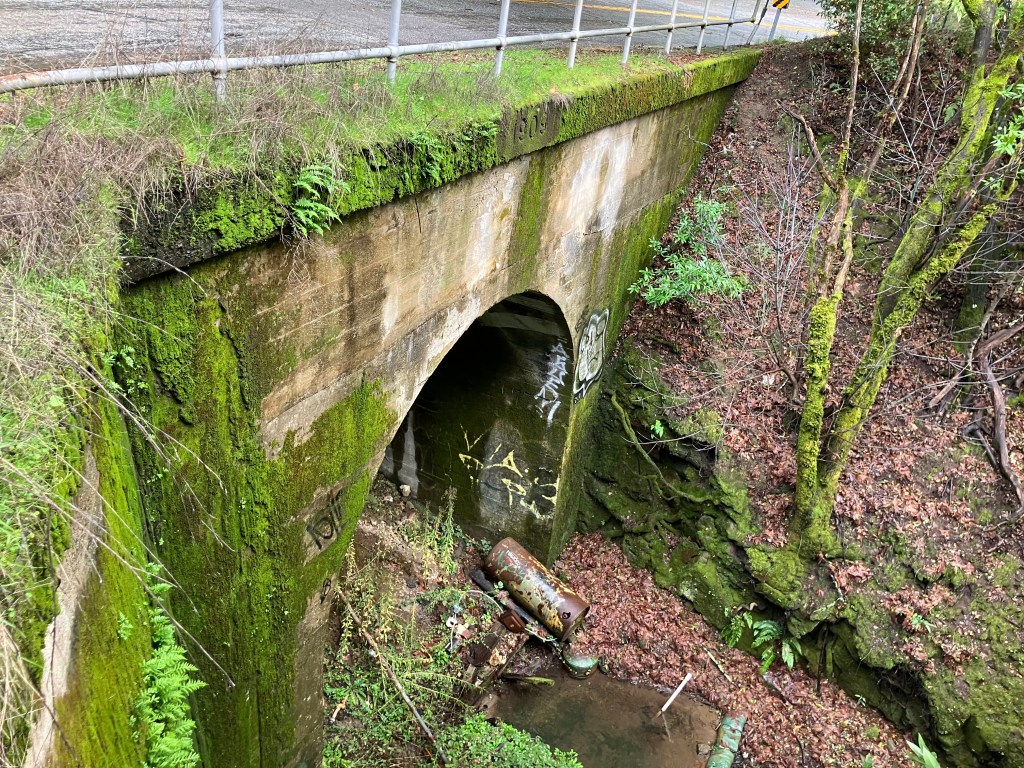
South end of Tunnel #3.

This tunnel, like several others on the SPC line, was re-constructed after the 1906 earthquake. (The SPC crosses the San Andreas fault.) While they were at it, they widened the tunnels to accommodate standard gauge (about 20 inches wider than narrow gauge.) This tunnel bears a 1909 marker, which presumably is when the tunnel was widened.
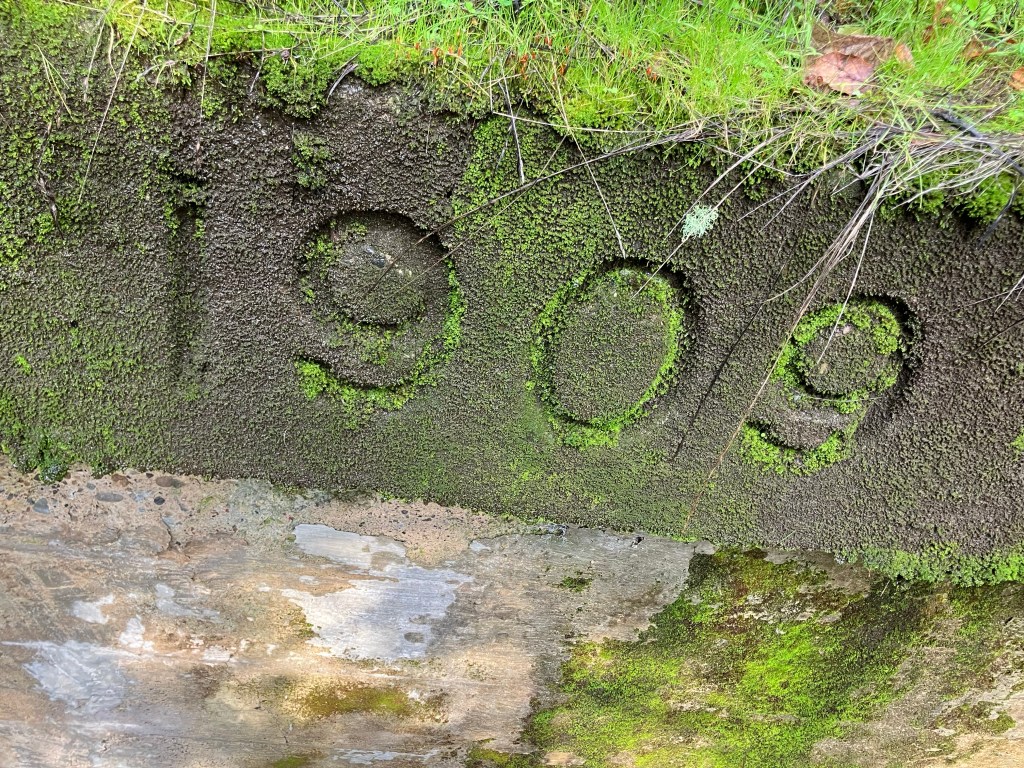
Detail from top of the tunnel.

A little further along we were able to catch a glimpse of Tunnel #4, dubbed “Mountain Charlie.” It was a ways up a private hillside, and we couldn’t access the property. But, like the others, it had a visible concrete portal with lots of moss but unmarred by graffiti. What do these families do with these tunnels? (I should note that Southern Pacific dynamited about half of these tunnels in 1942, so you can only go into the mouth of the tunnel for a little bit before encountering a wall of rubble.)

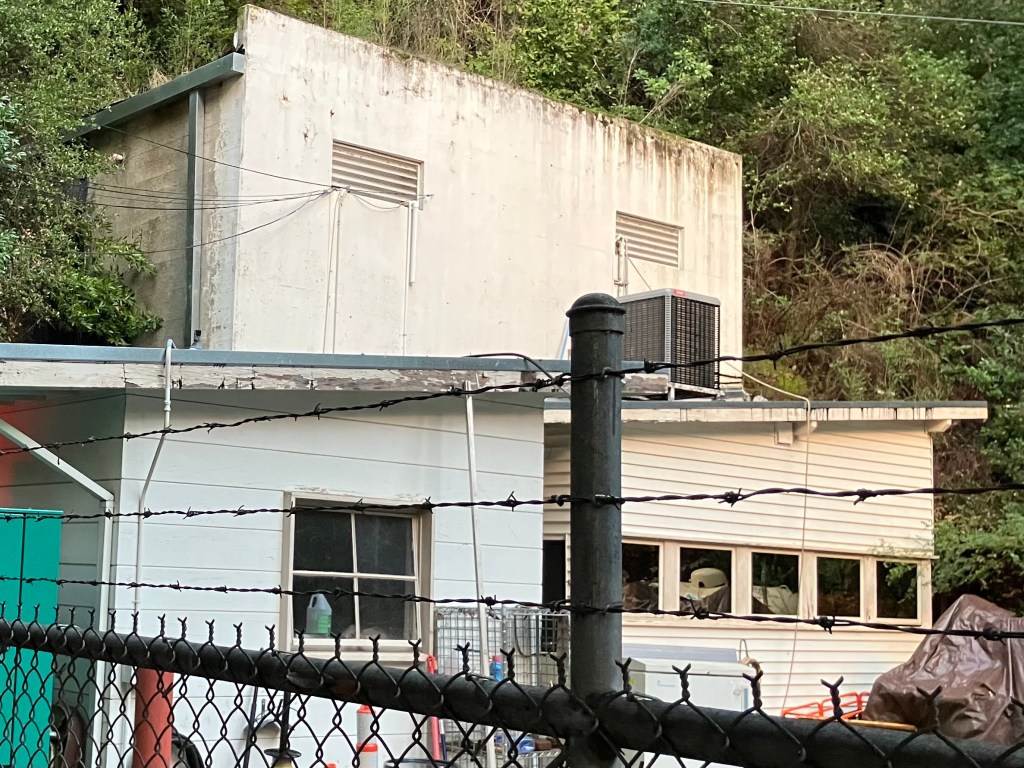
Next up was Tunnel #5: the Zayante tunnel. It’s only about 250 feet long, bored into granite. And this one was not dynamited. Still, it took us awhile to identify it. A little research revealed that a company called Western States Atomic Vaults, Inc sealed off both ends of the tunnel and turned it into a climate-controlled data storage facility at the height of the Cold War. I’m not making this up. Ownership has passed a couple of times, and today it’s owned by Iron Mountain. Reportedly it contains mainly microfiche and microfilm, as well as some original reels of Disney movies.
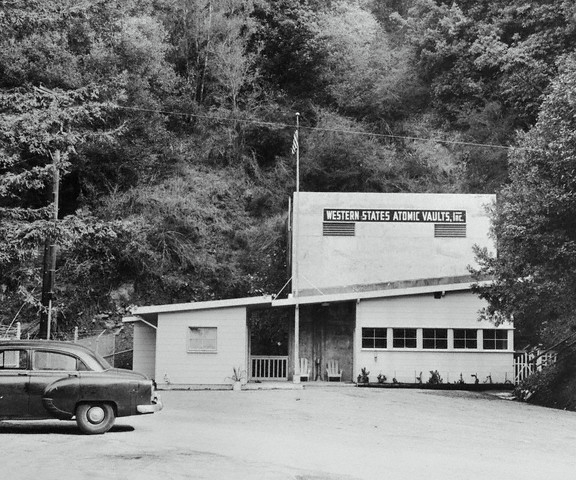
What used to be the south portal of Tunnel #5.
Same tunnel portal, today.

We were unable to get to Tunnel 6, which was down a steep gorge that was beyond our climbing skills.

Tunnel 7 no longer exists; it was “daylighted” (I,e, the top was removed) some years ago. This stretch of the line, however, still carries rail traffic. The Santa Cruz, Big Trees and Pacific Railway runs an excursion train from Felton to the Santa Cruz Beach Boardwalk. Here’s a picture of the track near the location of the daylighted Tunnel #7.
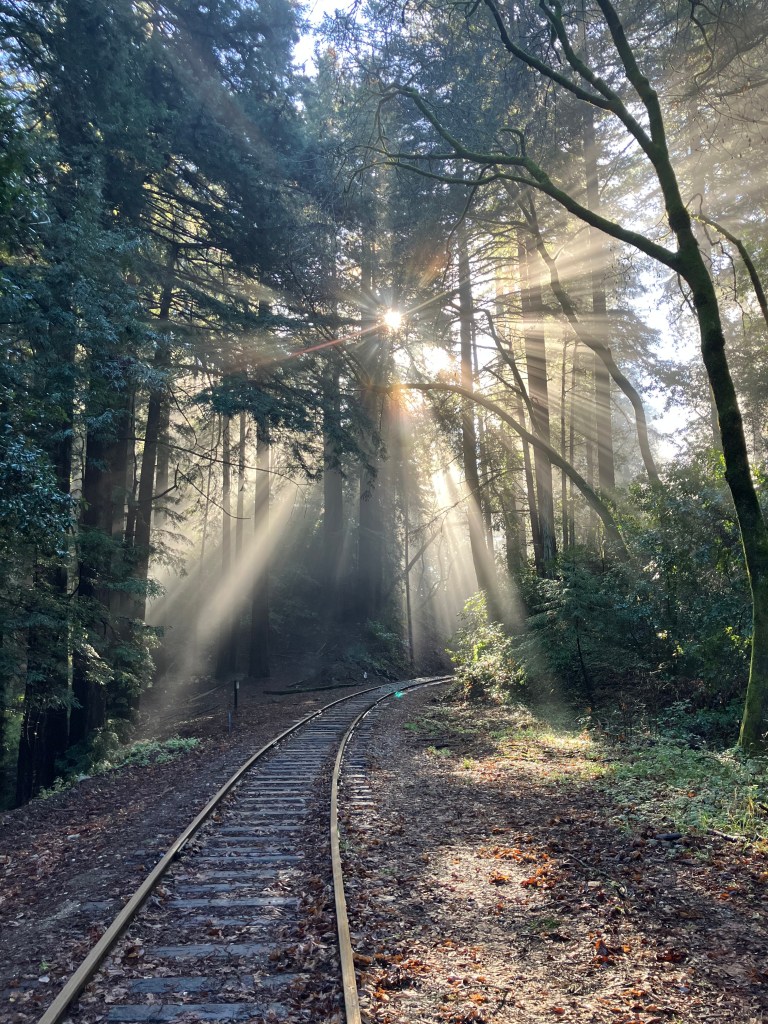
Stretch of the original trackbed, on which an excursion train now runs. I call the lighting in this photo “Voice of God.”

Finally, we ended up in Santa Cruz, where the final tunnel is still in operation! It’s a short tunnel that passes under Mission Santa Cruz. The Santa Cruz, Big Trees and Pacific Railway still uses this tunnel for excursion trips from Felton.
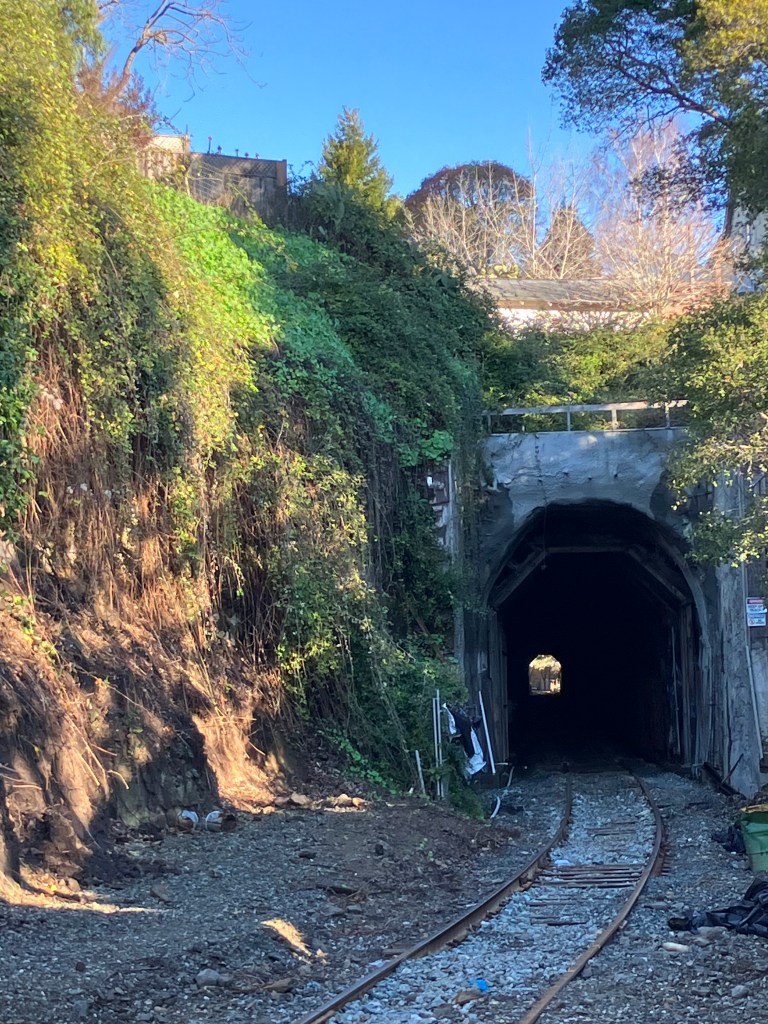
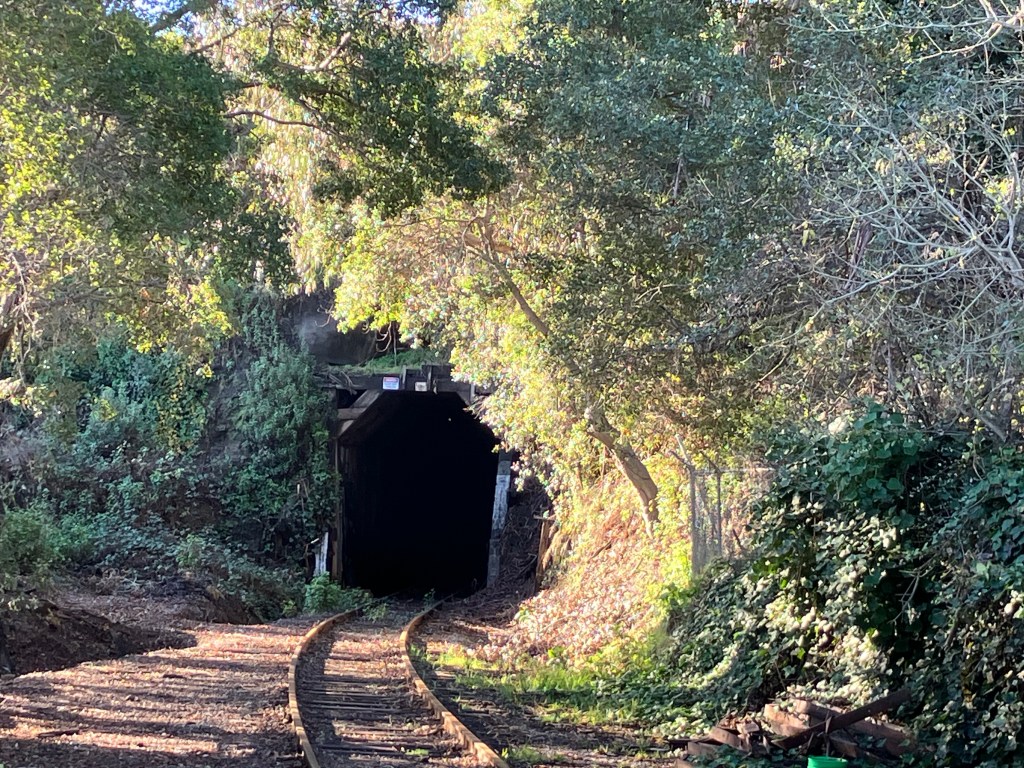
Tunnel #8, viewed from the south.
Tunnel #8, viewed from the north. It’s next to a lumber yard in the middle of Santa Cruz.

So that’s it for the tunnels. To reiterate, I’m surprised so much of the infrastructure is still around, even though most of it hasn’t seen a train in over 80 years. The fact that they’re mostly on private property or out of the way has contributed to their surviving this long.

Here are a couple of other photos of remnants of the old SPC:
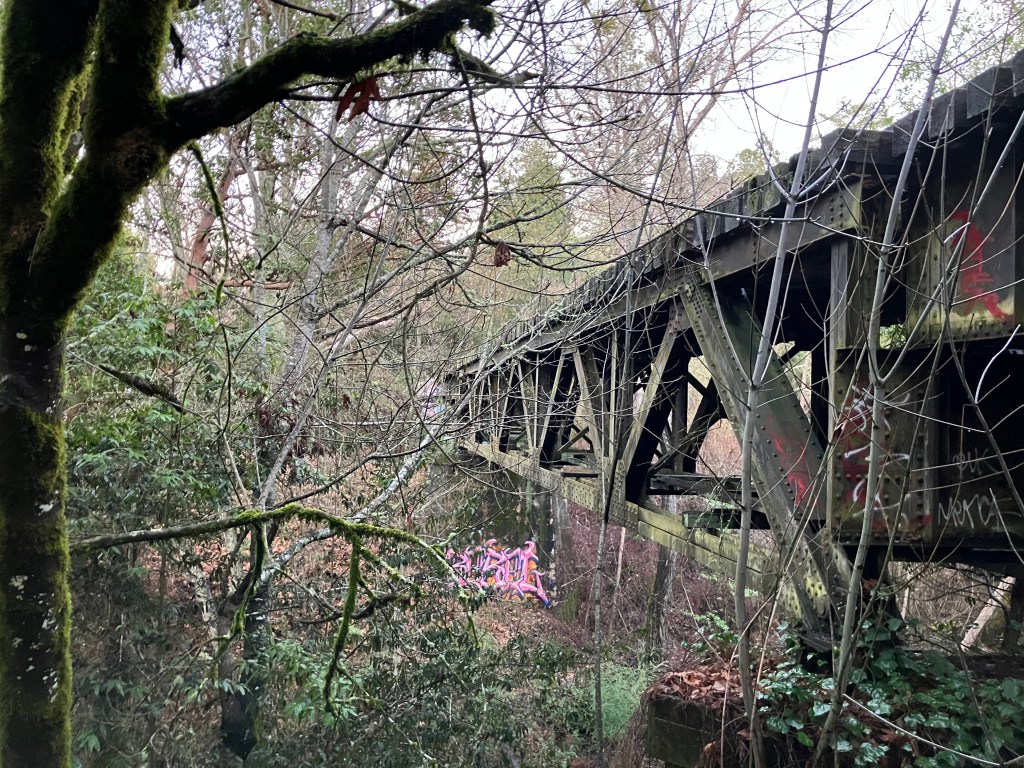
Girder bridge, slowly being reclaimed by nature.
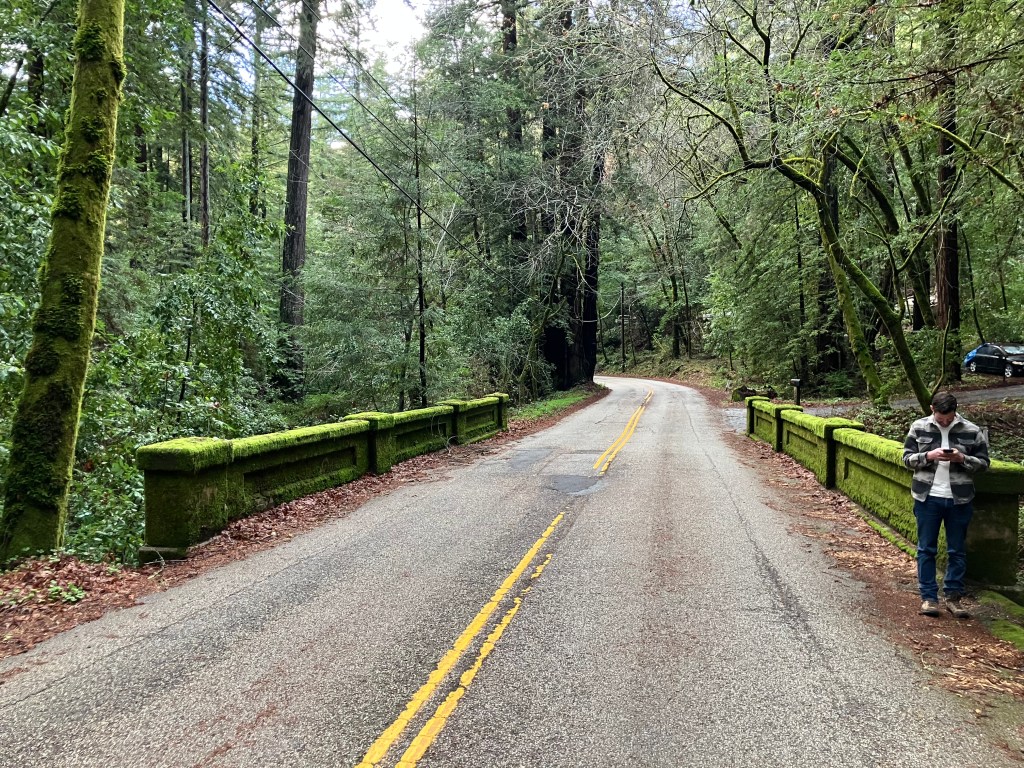
Random road near the railroad right-of-way. This road is still in use and not technically part of the SPC. But I thought it gives a good flavor of the remote, forested environment.

Only one station remains of the original stops on the SPC line. It’s the Agnew station in Santa Clara, and it was built in 1877. Passenger and freight service at the depot ended long ago, although trains still pass by the station on the active tracks next to it. The station is now owned by the California Central Model Railroad Club.
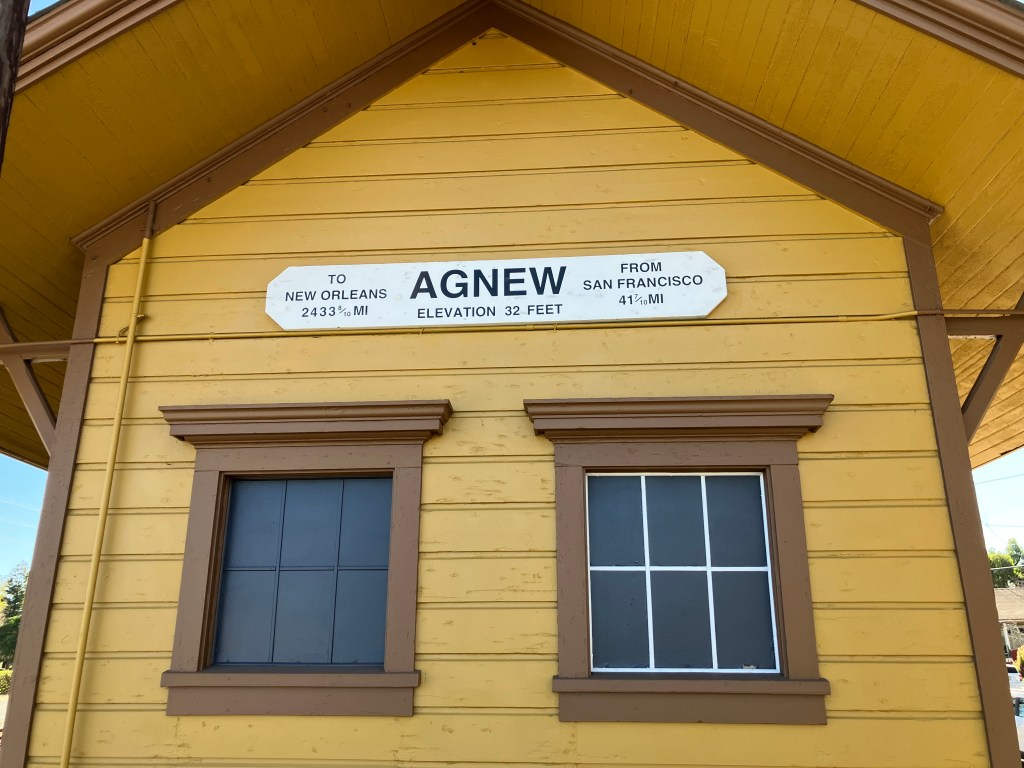
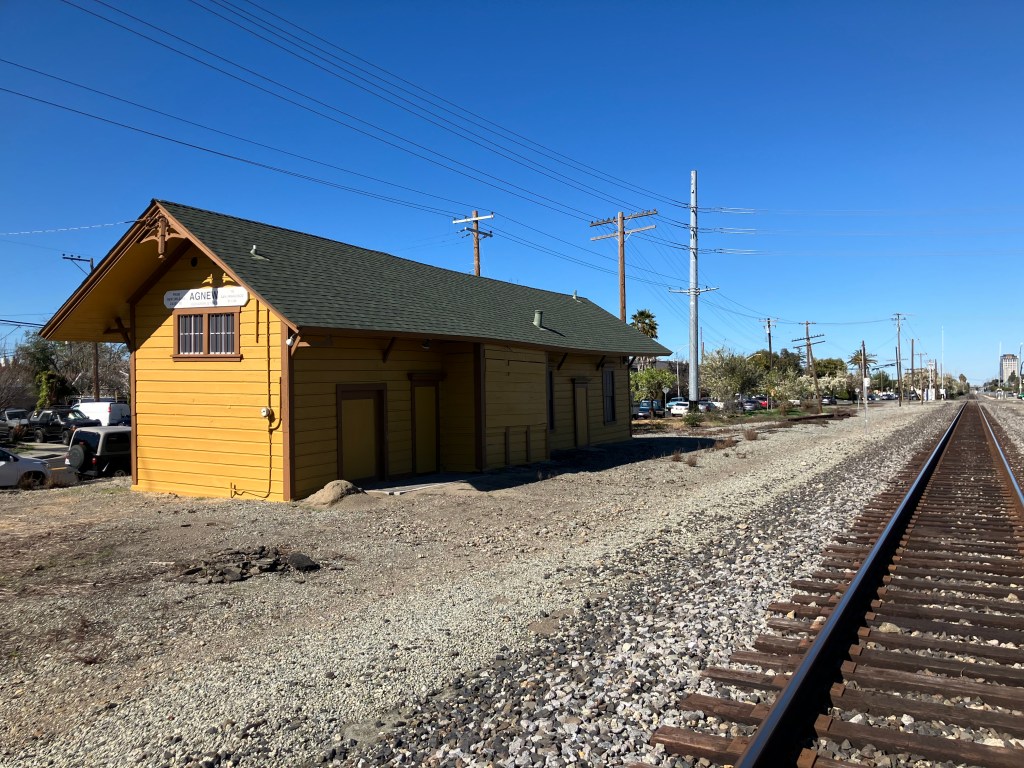
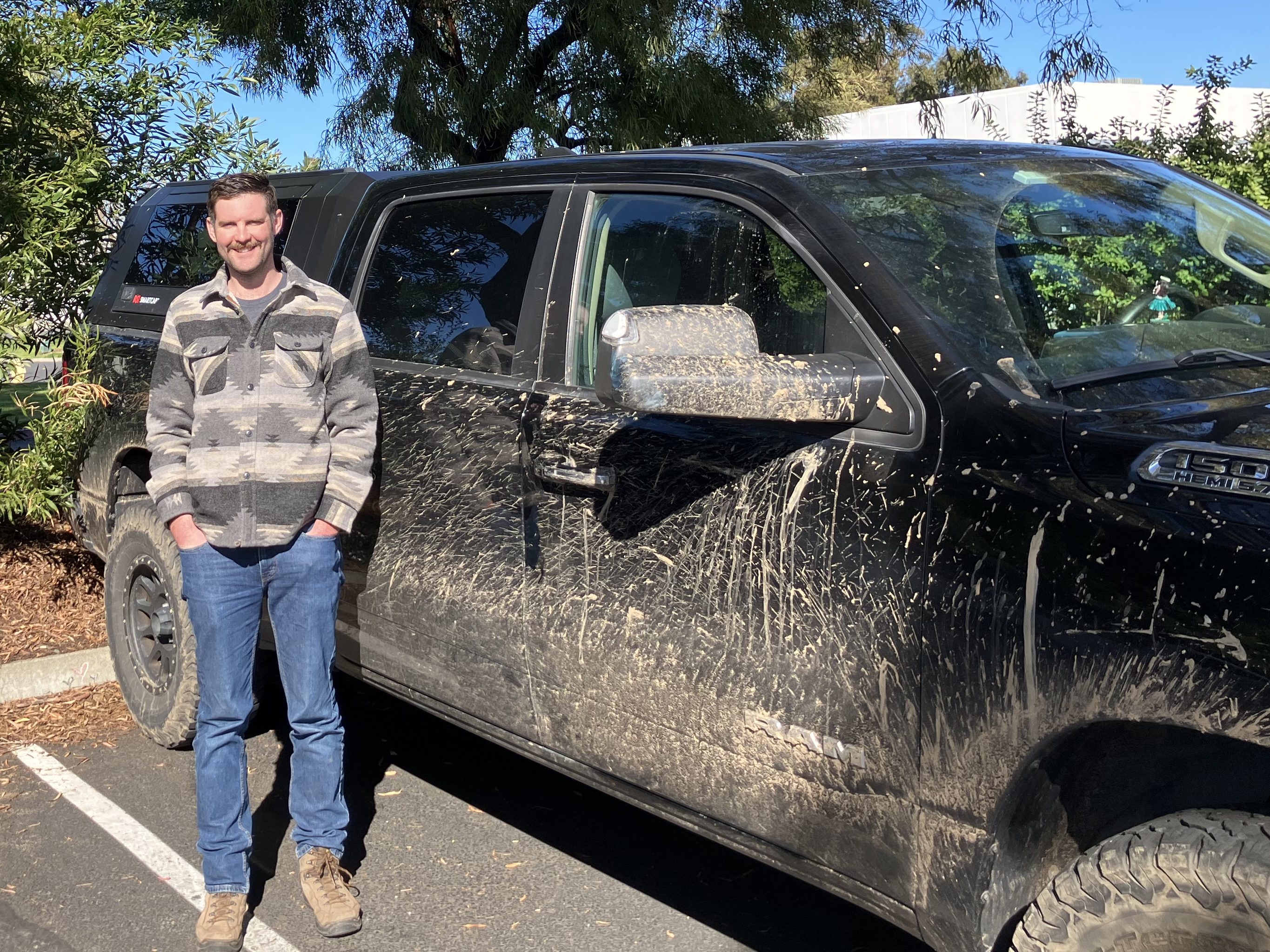
So ends our adventure. If you want to learn more about the SPC, there’s a wonderfully helpful and informative site called “Abandoned Rails” that has a lot of SPC’s back story, an interactive map, and other cool stuff. Thanks also to Uncle Edward and his Dome o’Foam for his helpful tips. Now all that’s left is to wash Ian’s truck!
TREAT (?) of the DAY

During our adventure we stopped at a remote market to replenish our snack supply. For reasons that I really can’t explain, I chose this bag of “Extra Dark Boldly Charred Splits.” It seemed like a good idea at a time.
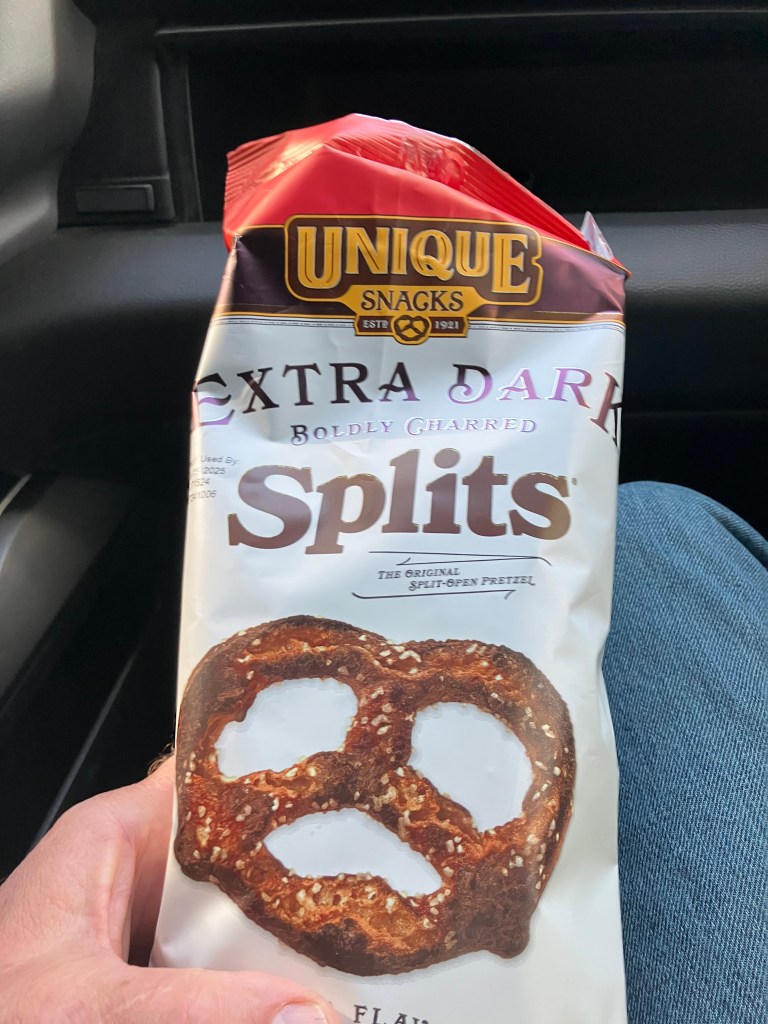
The “Unique Snacks” company lived up to their name, but not in a good way. These were essentially nothing more than burned pretzels.
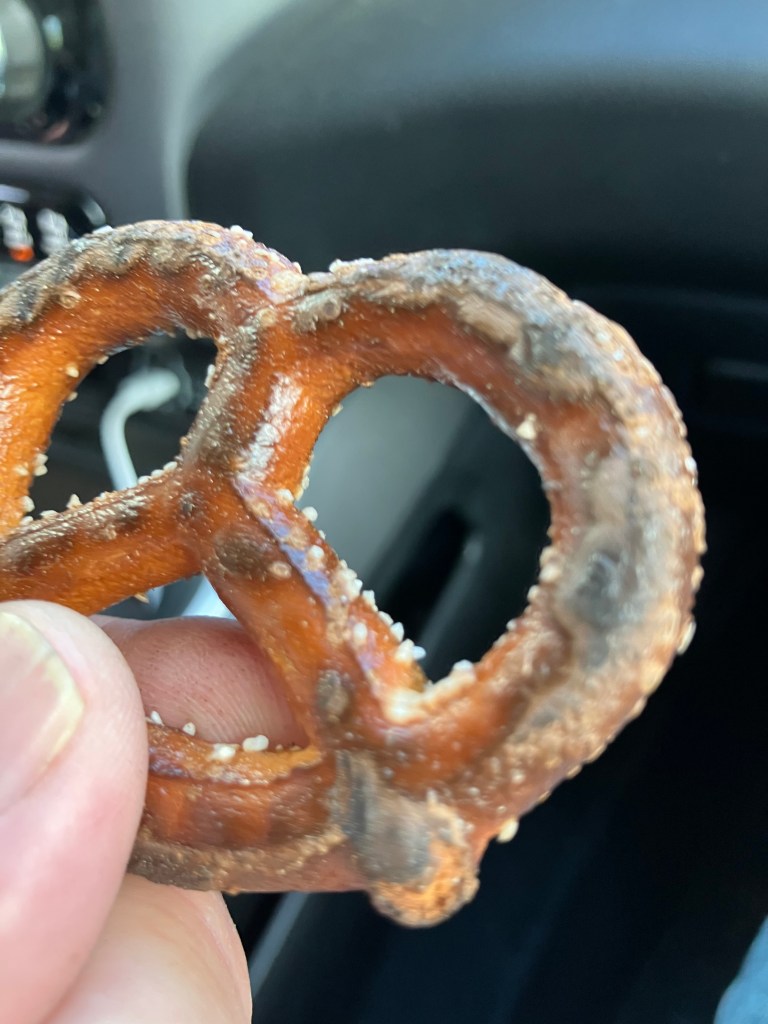
“Boldly Charred” my ass!

They are as dry as a discarded empty canteen in the Sahara, and they have the flavor profile of a Kingsford Briquette. I seriously suspect that something happened to the oven at the Unique Snacks Company, which resulted in a month’s pretzel production being irrevocably burned. But rather than throw away the torched snacks, some marketing genius said “let’s just change the package to say ‘boldly charred!'” Doesn’t an analogous story lie behind the popular “sour” beer style and the invention of buttermilk?
bridges · California history · Puns · Road trips · trains · Yard art

All That Glitters

Get it?
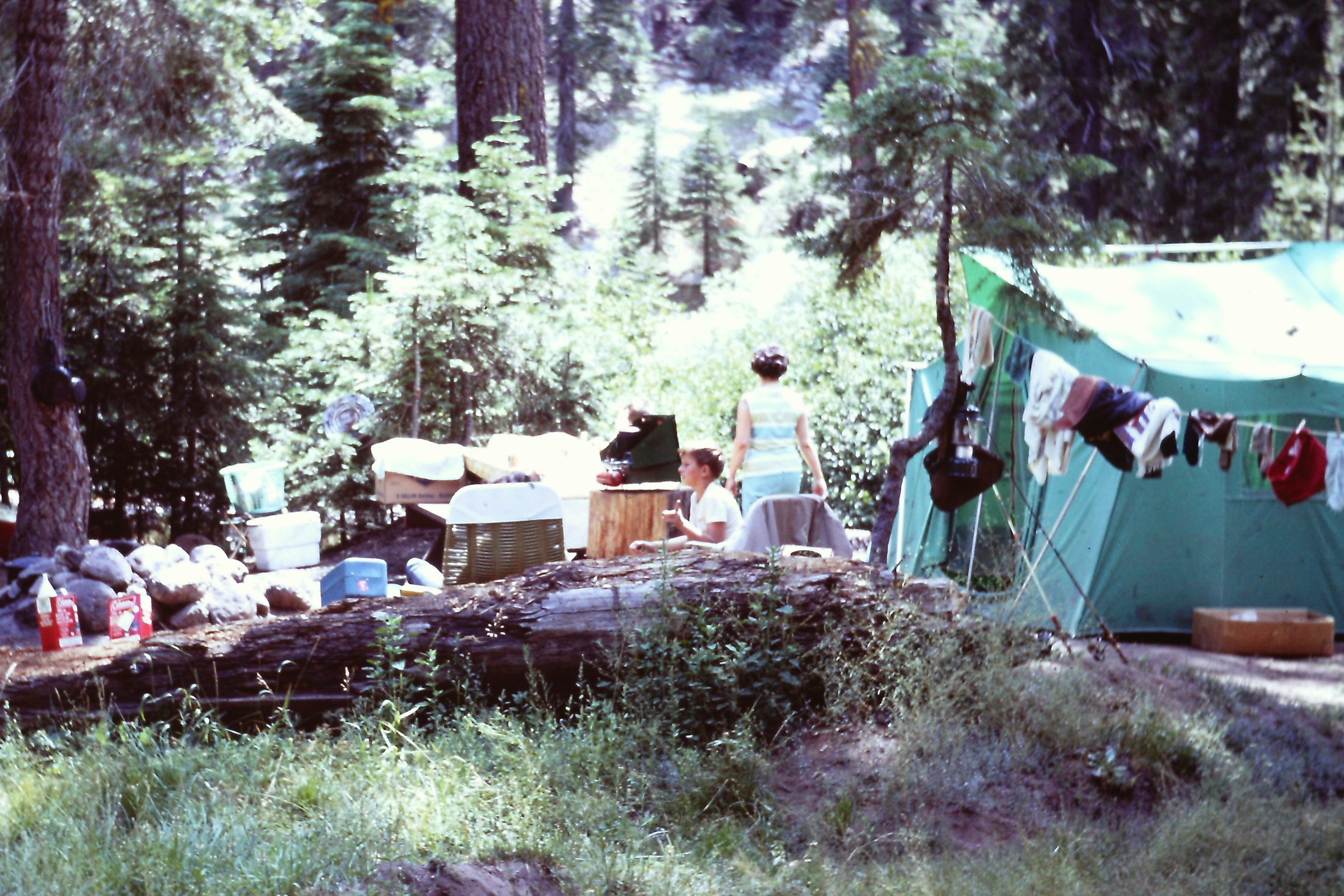
When I was a kid, my family would go camping each summer in California’s gold country. We’d hike to open mineshafts, visit countless museums featuring Gold Rush artifacts, and clamber around decaying miner’s cabins and rusty hydraulic mining equipment that had been abandoned in the foothills. My dad would collect antique square nails (a practice that we later learned was unlawful) and occasionally we’d try our hands panning for gold. My mom would stay back at the campsite, cooking meals, sweeping the tent, and wishing we soon would return to suburbia.

Not exactly glamping

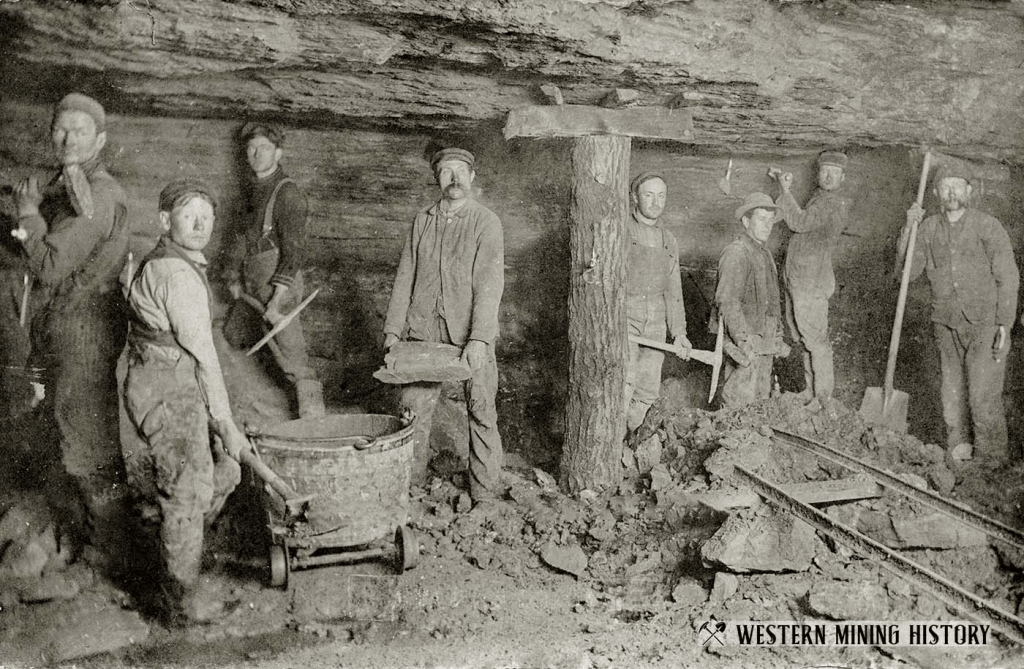
Even as a kid I was impressed by how these relics of the Gold Rush could be seen and touched out in the wild, even after more than a century. To a kid like me in the 1960s, the Gold Rush seemed like ancient history. And now it’s been another half-century since I was a kid! It’s hard for me to explain, but today, as I examined old stone buildings from the 1850s and hillside scars created in the 1860s, I felt a connection with a longer arc of history. The State of California was in its infancy then, and they didn’t call it the Wild West for nothing. We’ve come a long way since we routinely dumped cyanide and mercury into waterways, since we carved into hillsides with powerful water canons, since thousands of miners daily breathed toxic fumes and hundreds of them died in fires and cave-ins. That’s not to say we have no problems today; far from it. But clearly there’s been progress.

California’s Gold Country is a reminder both of how our civilization has changed, and how as humans we’re largely unchanged. There’s a persistent 49er spirit in those small towns that still dot the Mother Lode. You can sense the tenacity, patience, perseverance in your average Amadorian or Calaverasian. Take the owner of a coffee shop named Moke-A-Java in Mokelumne Hill. She told me she opened the place in 2019…just before Covid shut everything down. Somehow she managed to keep the business afloat with mail-order candy sales and catering. Today business is finally picking up, and she’s grateful. She’s a latter-day version of a patient prospector.

There’s also something very soul-soothing about the rolling, oak-covered hills in this part of the state. There’s plenty of space and natural beauty, and no one seems to be in a hurry. Take for example the owner of the B&B where I stayed in San Andreas. He sat in conversation with me through the three-course breakfast he’d cooked for me, then spent half an hour showing me his workshop and his Harley. It was as though nothing mattered more to him than visiting with his guests. You can be sure I’ll be back.

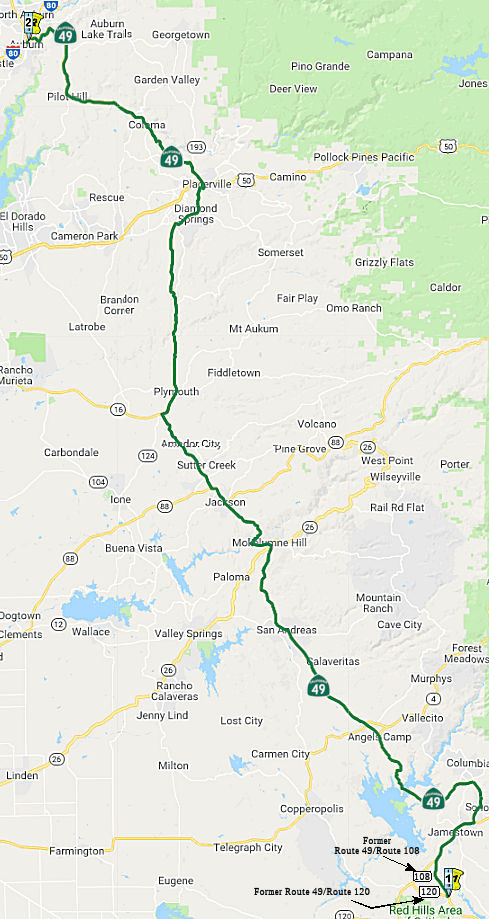
About 10 am I got back on Highway 49 and fired up the driving app I’d purchased specifically for this trip. The idea was to have a knowledgeable guide direct me through a handful of small towns from Angels Camp to Jamestown. While the concept of the guide was a good one, I found it to be a bit clunky and fussy. And not only was the app awkward to navigate (a process which is admittedly complicated on a motorcycle), but the interstitial diary readings by overly-enthusiastic community-theater actors were not my cup of tea. So the app was quickly bagged.

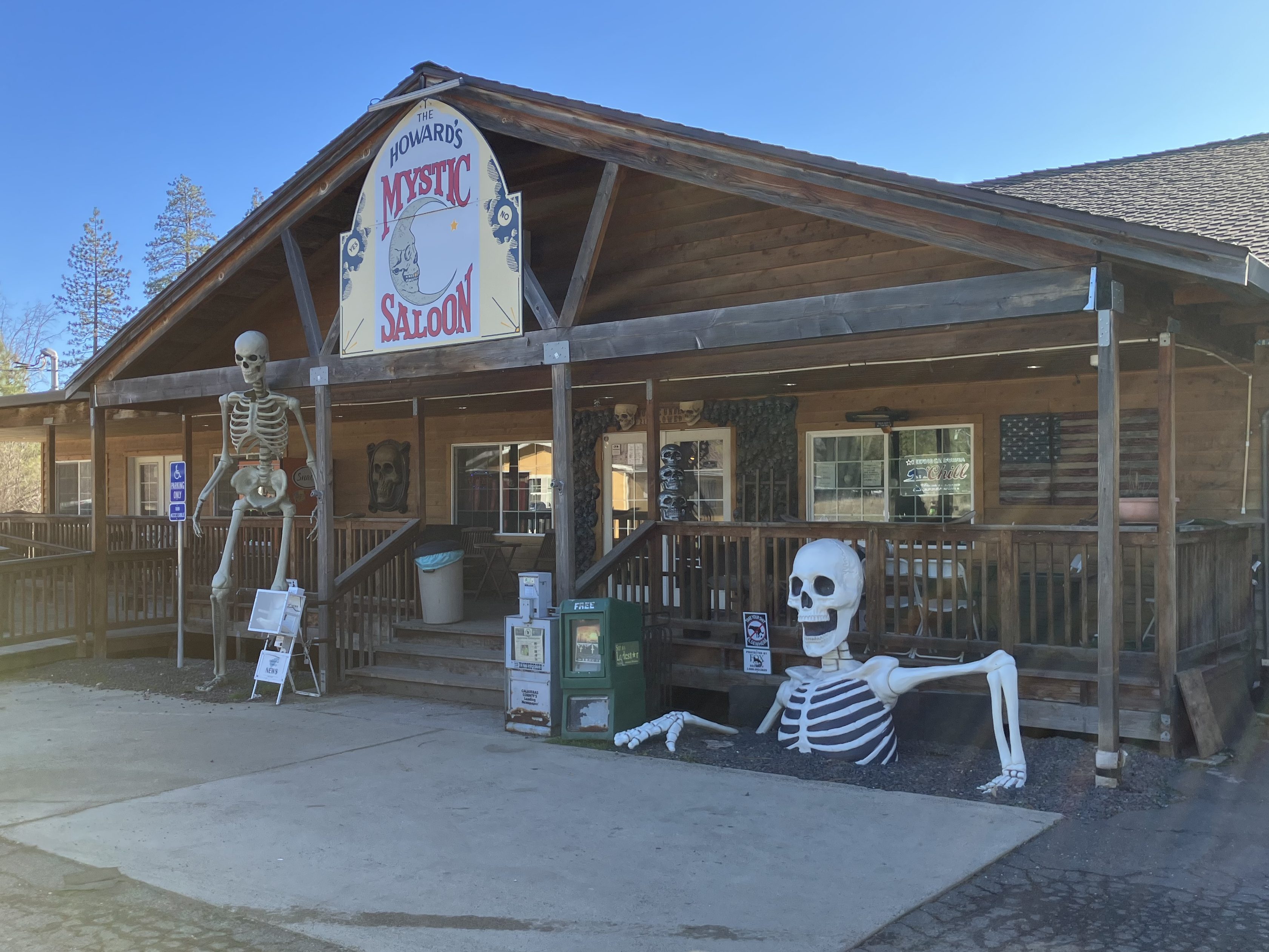
I did learn from the app that Calaveras County gets its name from the Spanish word for “skulls,” a quantity of which were discovered by early explorers along local riverbanks. And at almost the moment I learned that fact my eyes beheld this:

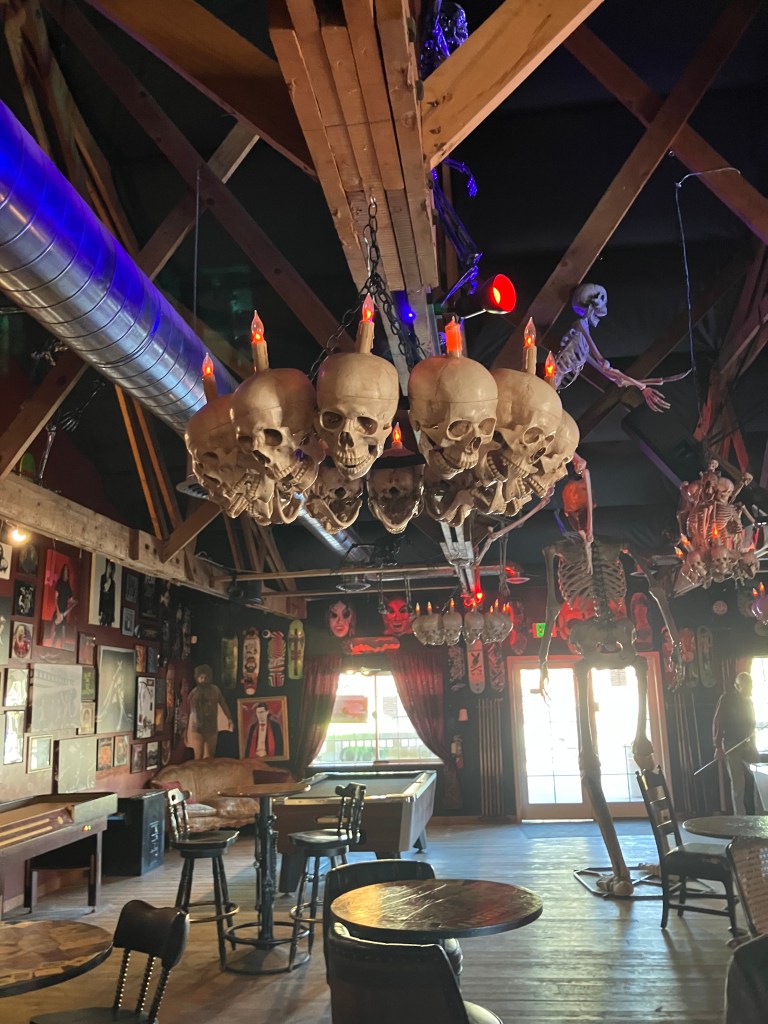
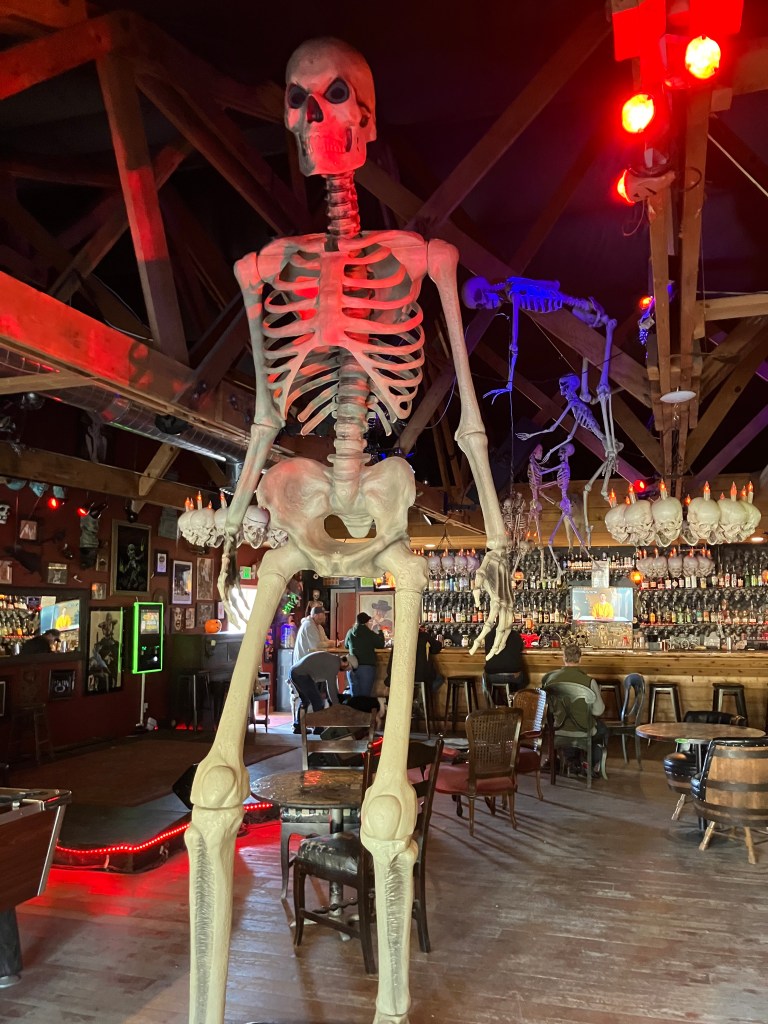
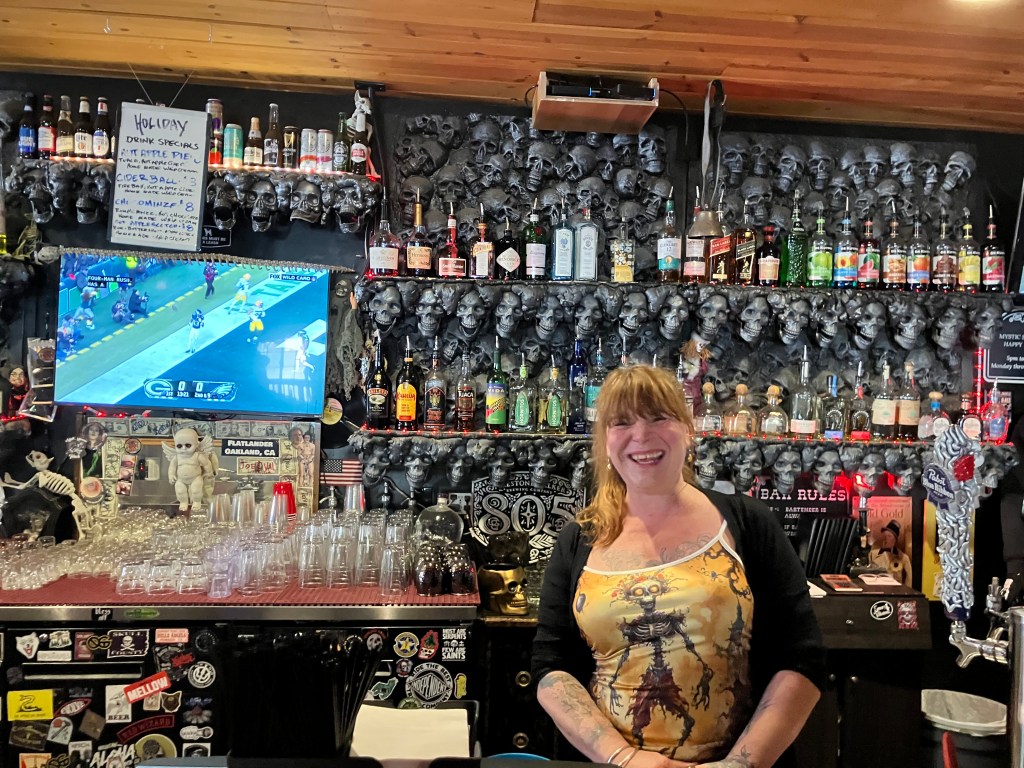
Walking into Howard’s Mystic Saloon is  like entering an ossuary. You’re greeted by a giant skeleton standing just inside the door, and as your eyes adjust to the darkness you notice that all the chandeliers are decorated with skulls and bones. More skeletons hang from the ceiling, and the entire wall behind the wall is covered with black skulls.

I asked the bartender, Ivory, for the story, and she told me the skulls are not meant as a reference to Calaveras County. In fact, the owners (Curtis and Tana Howard) own another skeleton-themed bar in Oakland. At this point a jovial man with a beard and a cowboy hat sitting at the end of the bar said “This place is tame compared to their Oakland place!”

Ebony and Ivory

True to my theory about folks in the Gold Country, and despite being surrounded by skeletons, I found this to be one of the friendliest places I’ve been to in years. I chatted with the locals at the bar for the better part of an hour while nursing my hot apple cider. I had eschewed a higher-octane drink because I’d already had my beer of the day earlier in Murphys. 

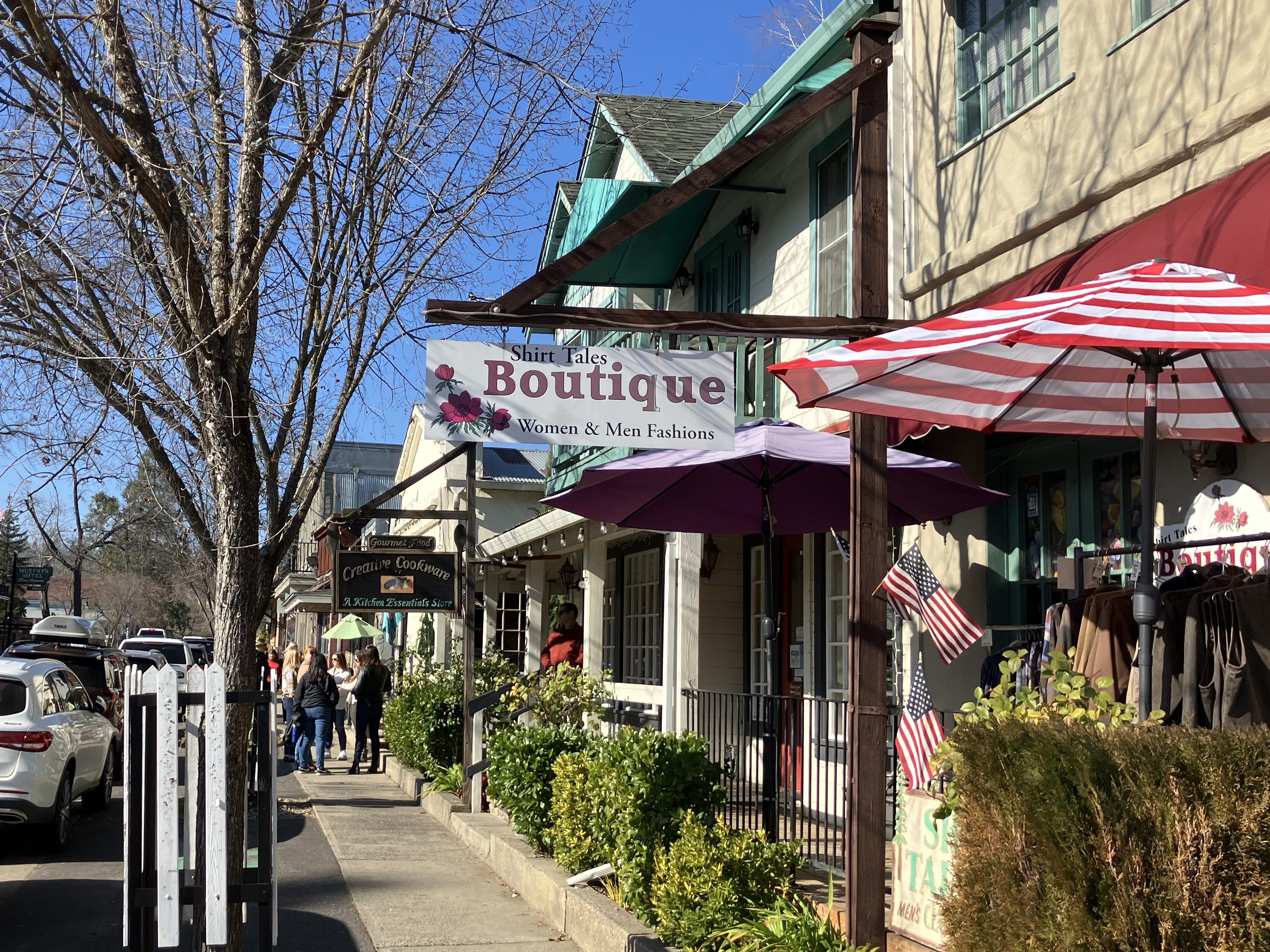
We’ll get to the BOTD shortly, but Murphys (pop: 2,000) was the one stop that didn’t feel authentic to me. At some point they went all-in as a wine tasting destination. According to Wikipedia, Main Street has at least two dozen wine tasting establishments. In between are boutique-y places selling scented candles, panini presses, and other appurtenances that a miner would never recognize.

An example of Murphy’s Law

Murphys is evidently quite prosperous, and I don’t knock their business model. But this is not the Gold Country experience I was looking for.

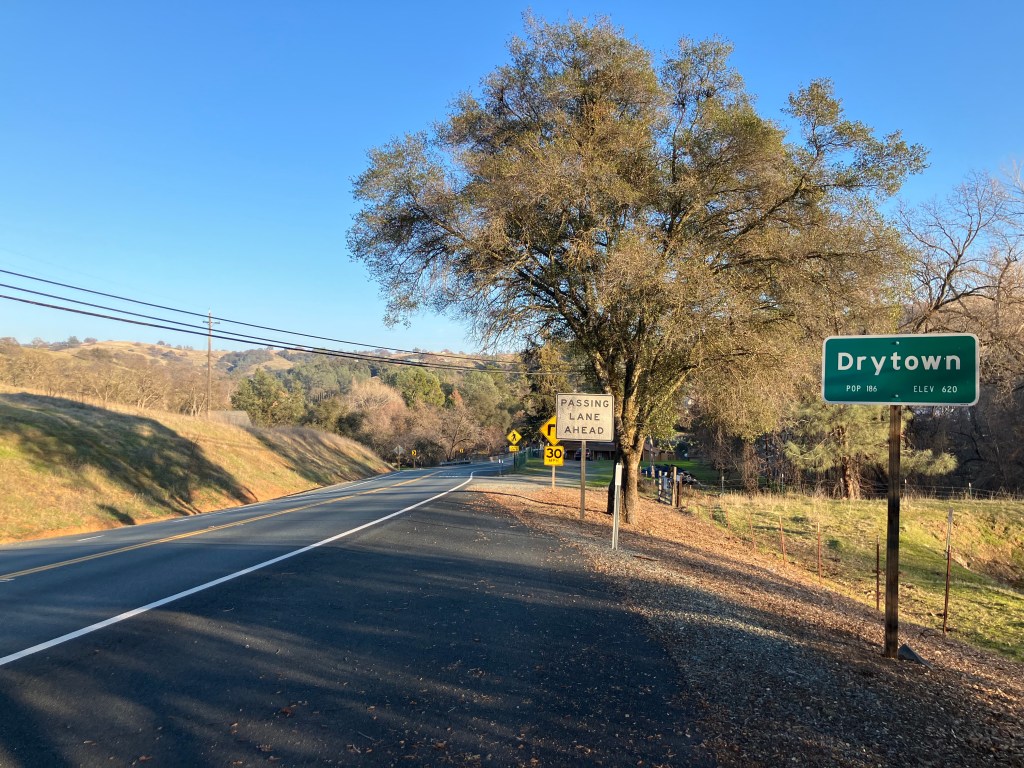
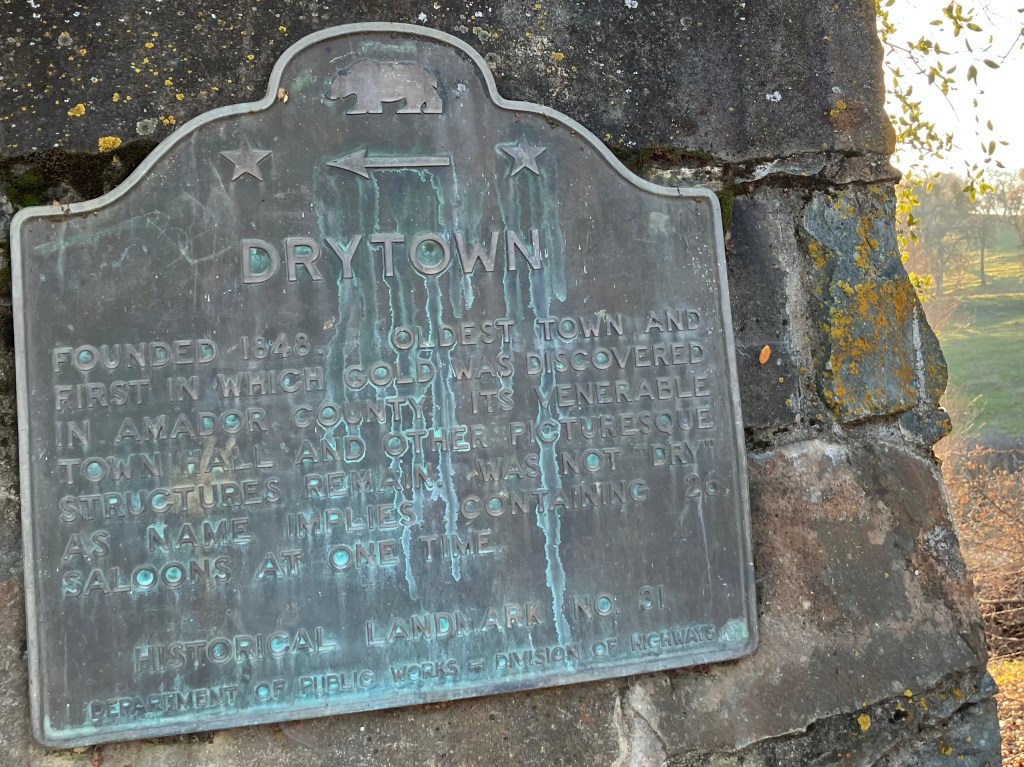
More authentic are places like Drytown (pop: 186).

During the Gold Rush it was home to some 10,000 souls, and despite the name, it also had 26 saloons. (The name refers to a dry creek.) It burned down in 1857, and never really recovered. But there’s a roadside marker and occasional artifacts among the rolling hills and oak trees.

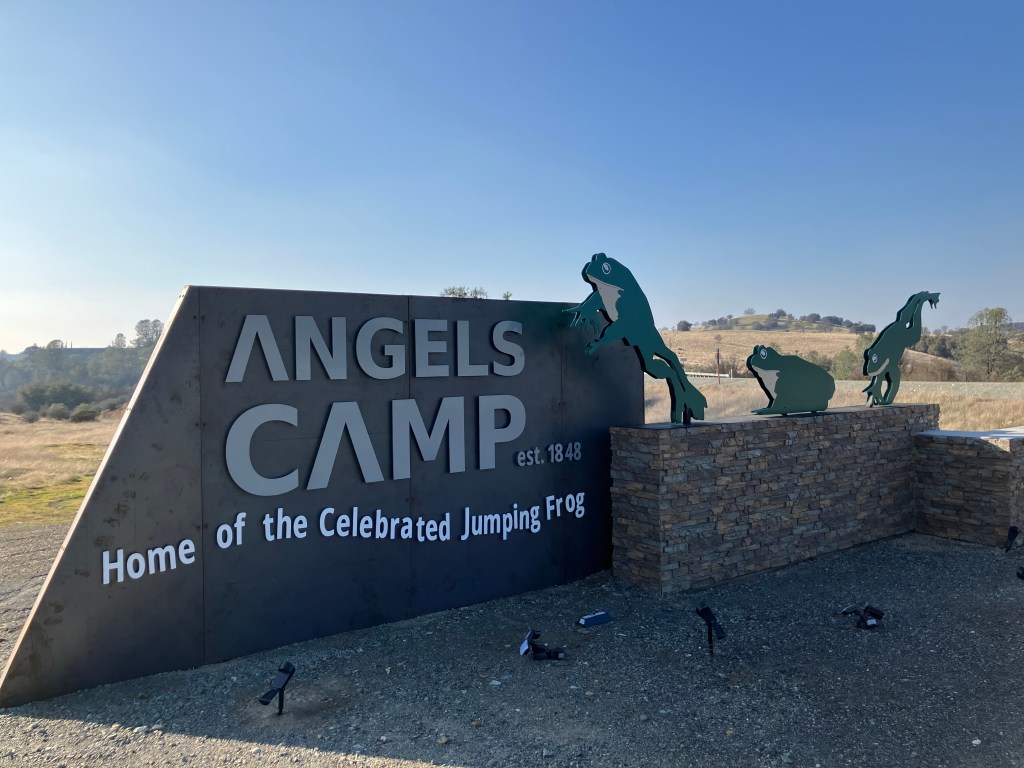
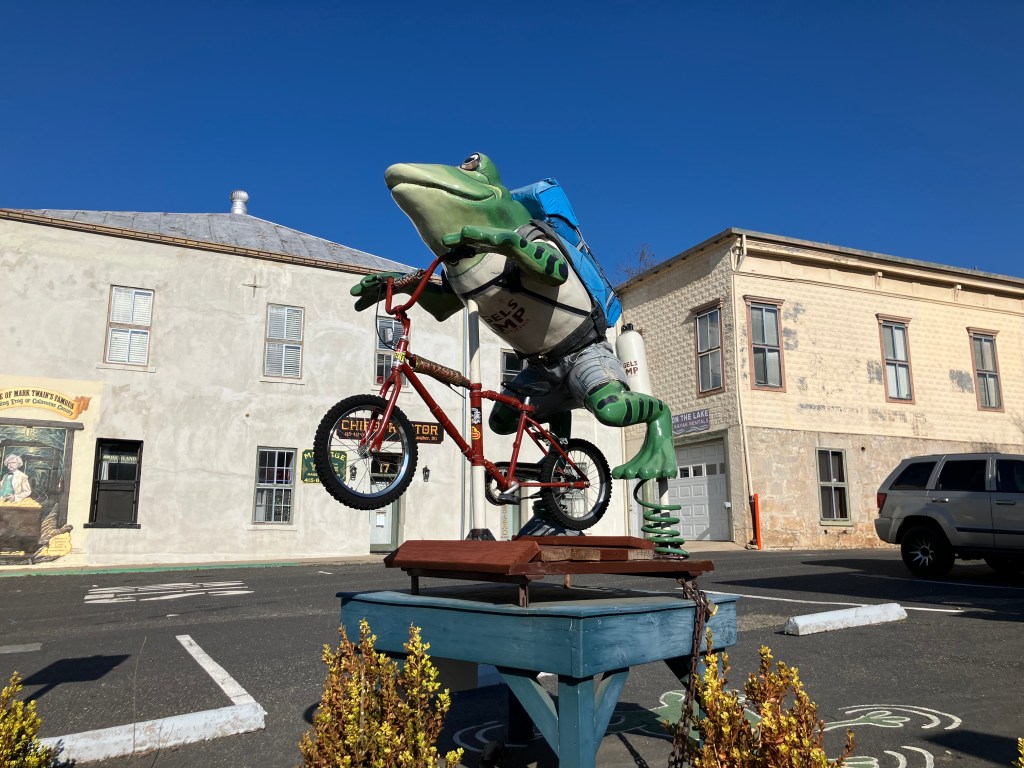
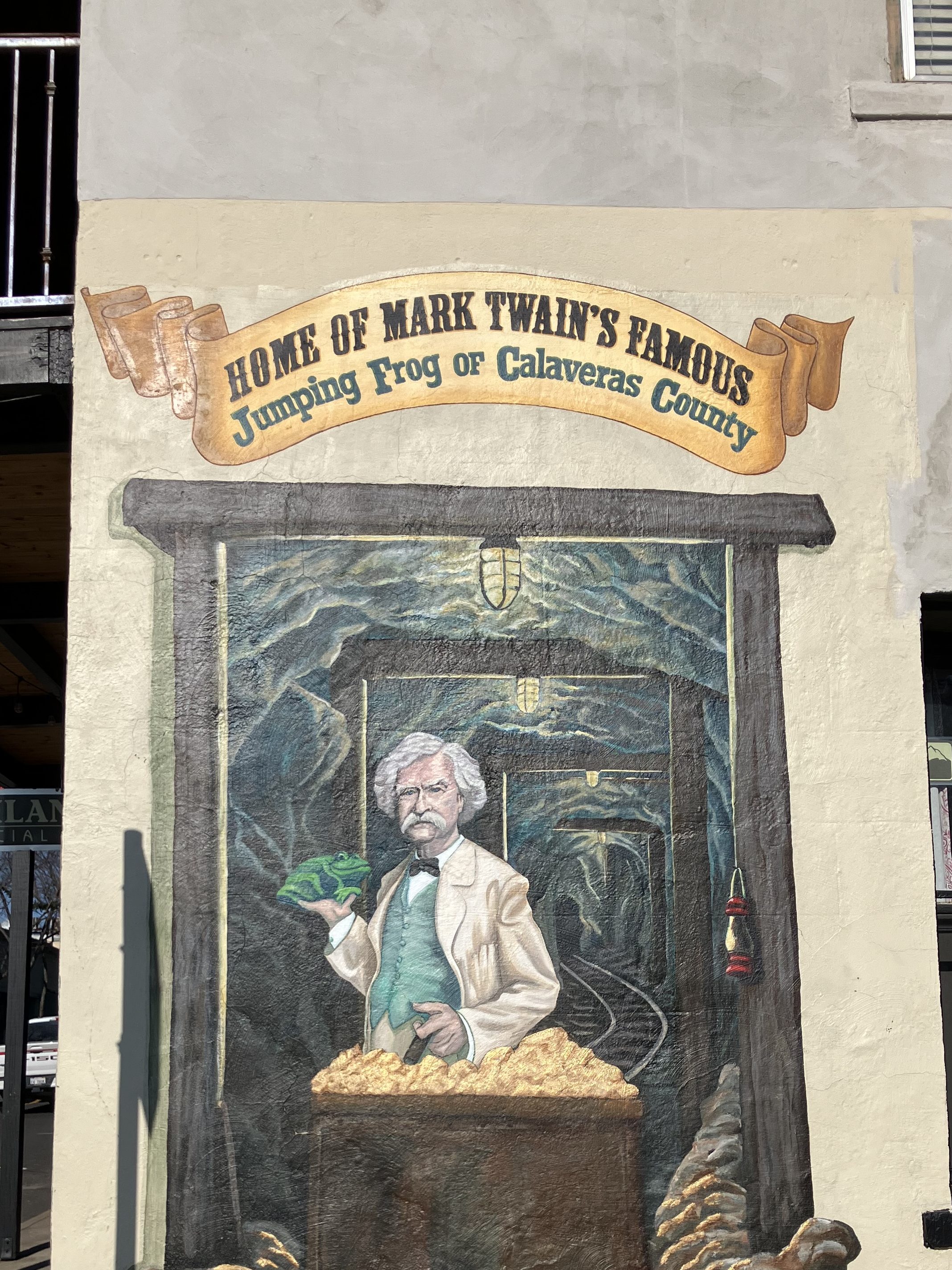
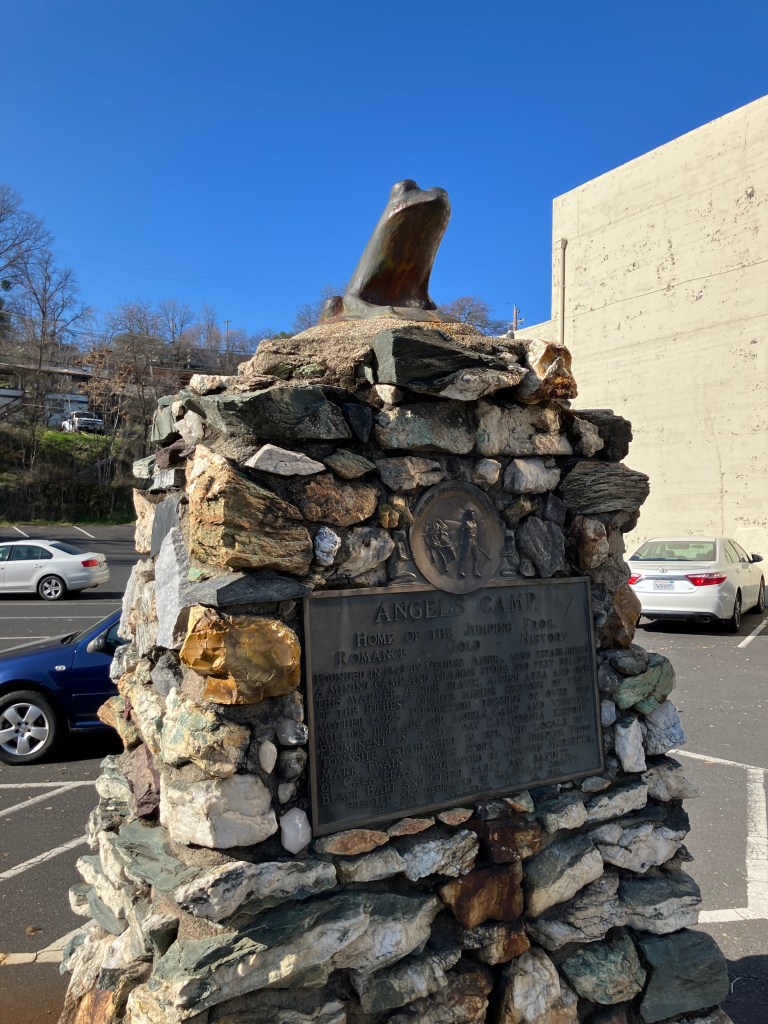
I also appreciate how Angels Camp (pop: 3,700 and the only incorporated city in Calaveras County) has leveraged its purported role in Mark Twain’s story “The Celebrated Jumping Frog of Calaveras County.” The little buggers are everywhere!

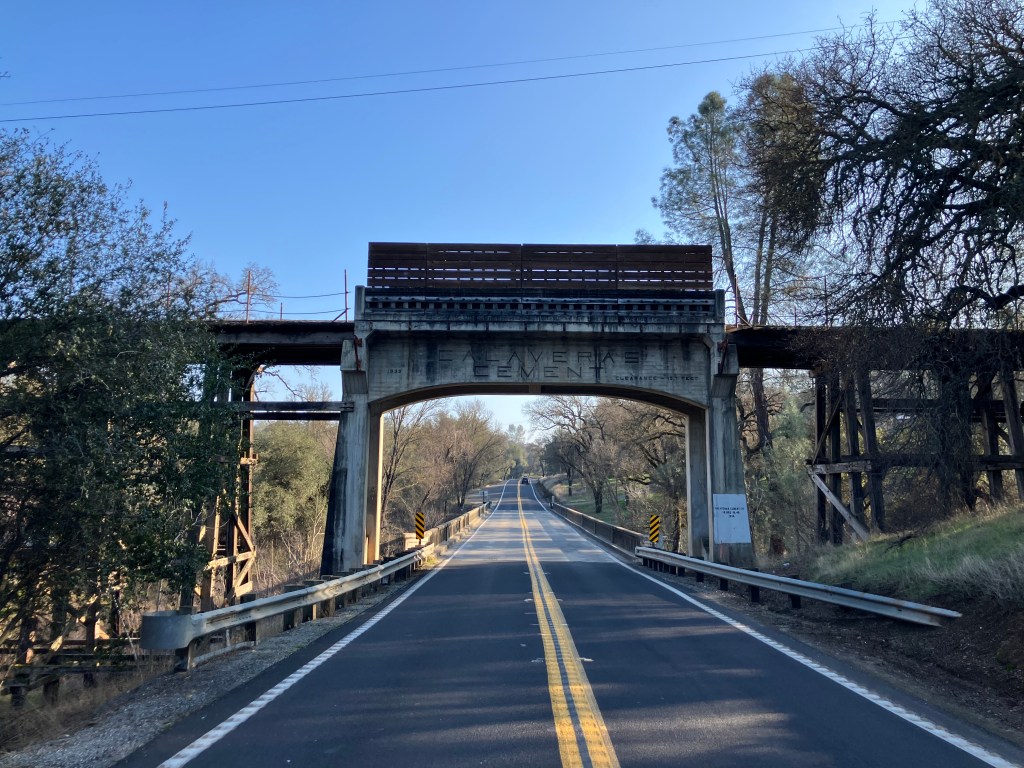
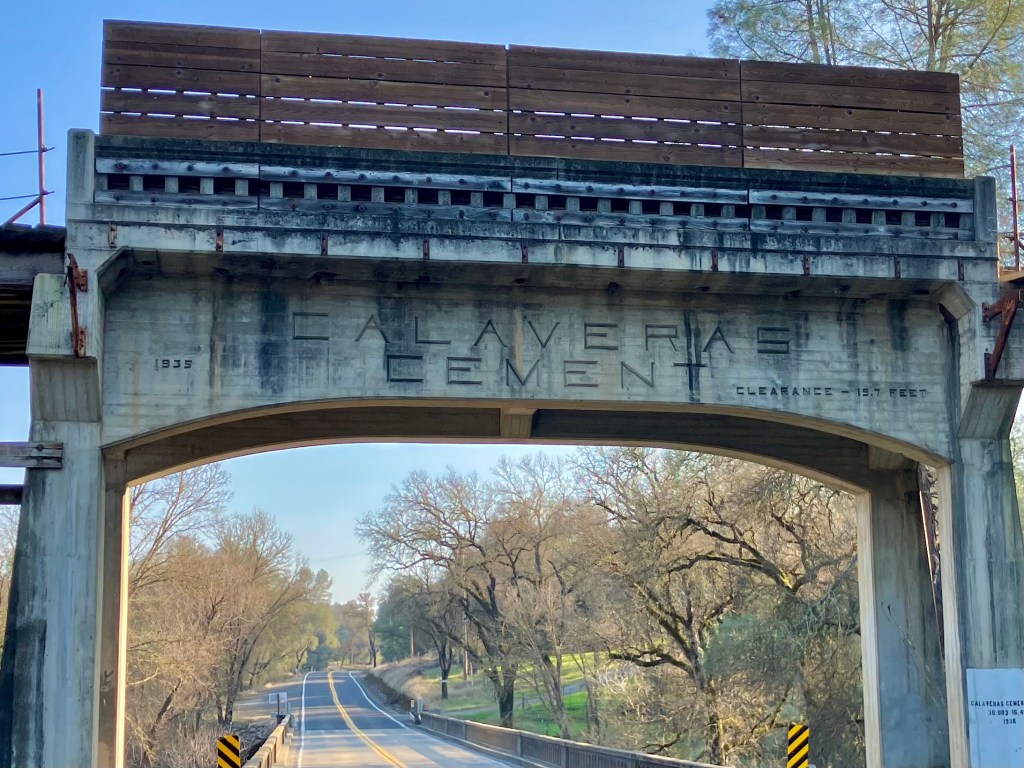
Now, if I had been in charge of that driving app I would have featured a Depression-era railroad bridge that crosses Highway 49 just south of San Andreas. It was part of a railroad short line that connected the Calaveras Cement plant to several local quarries. Calaveras Cement Co. produced material that built dams, freeways, and other infrastructure throughout northern California. The company shut down in 1983 as Chinese imports undercut domestic cement production. But the bridge remains as a proud (and shockingly graffiti-less) relic of a major local industry.

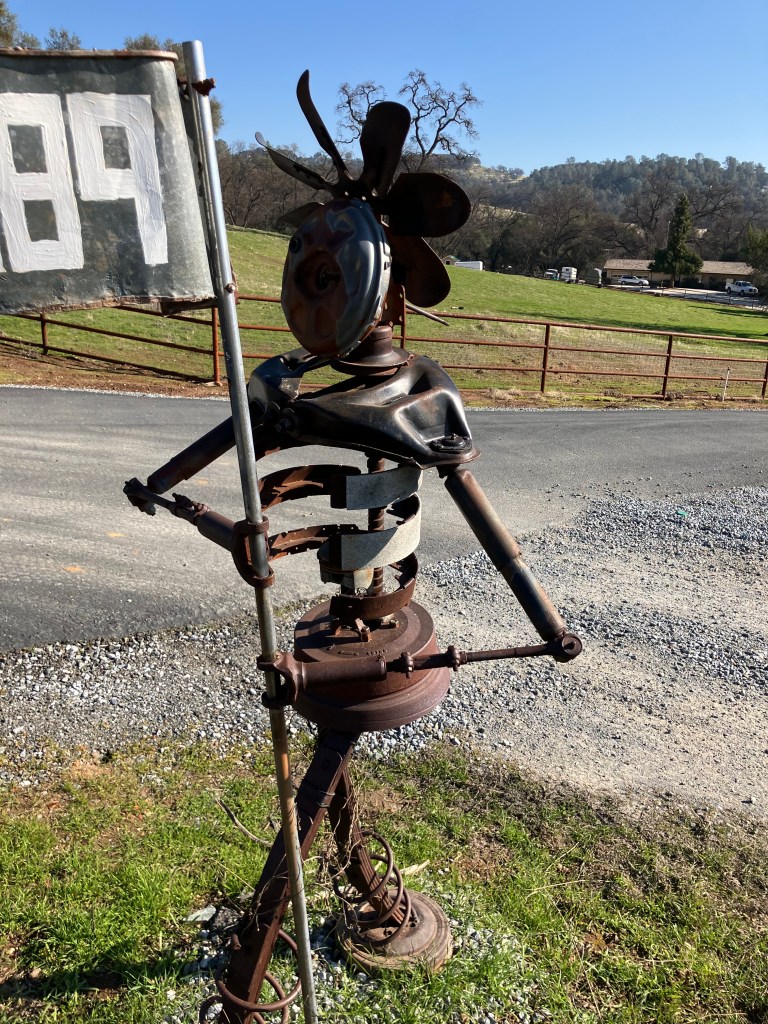
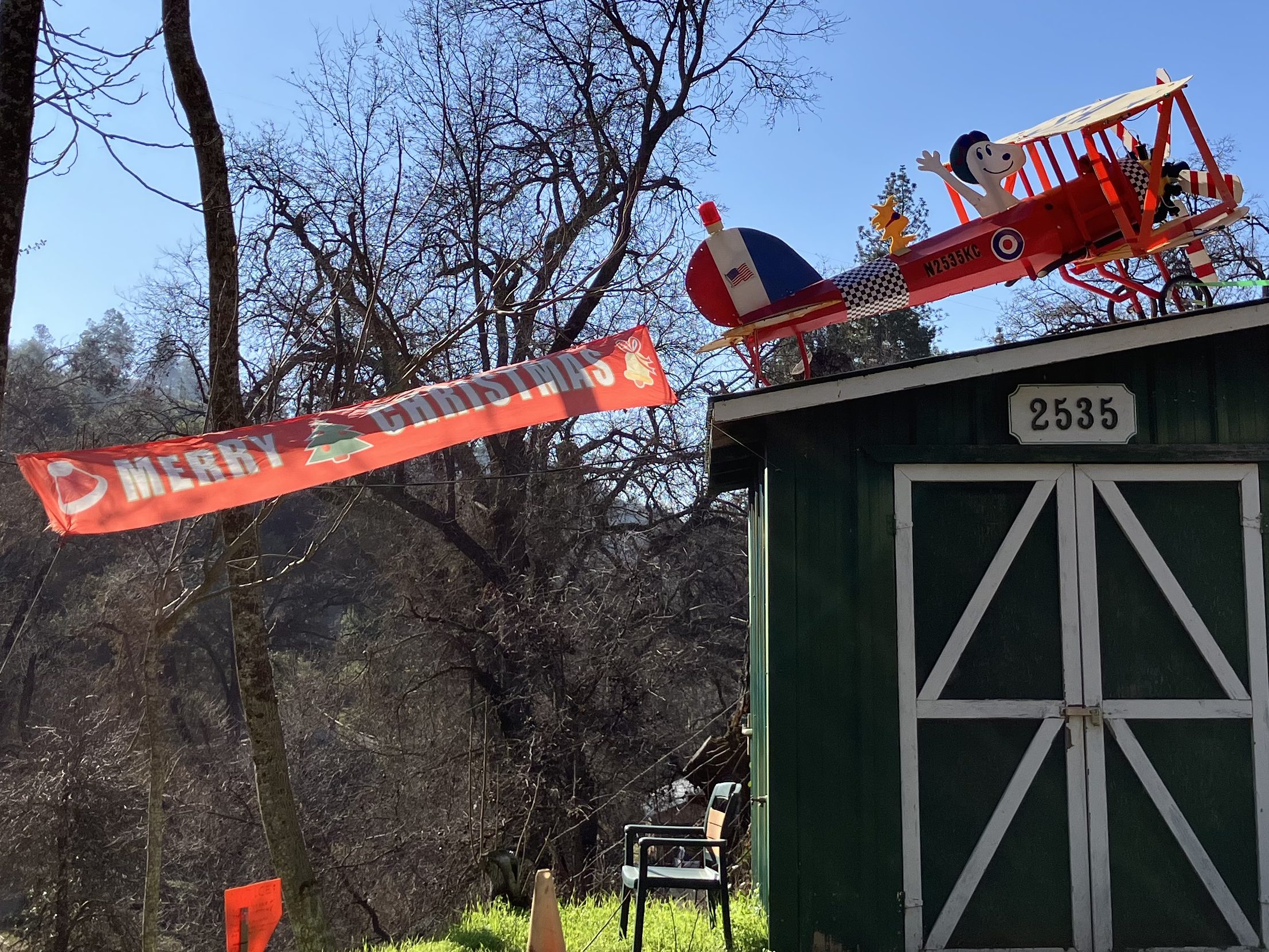
Before we get to the BOTD, let me leave you with a couple of photos of yard art I saw a long the way. These people are true artists.

How many different car parts can you identify?
Please don’t tell the Charles Schultz estate about this one.

BEER OF THE DAY

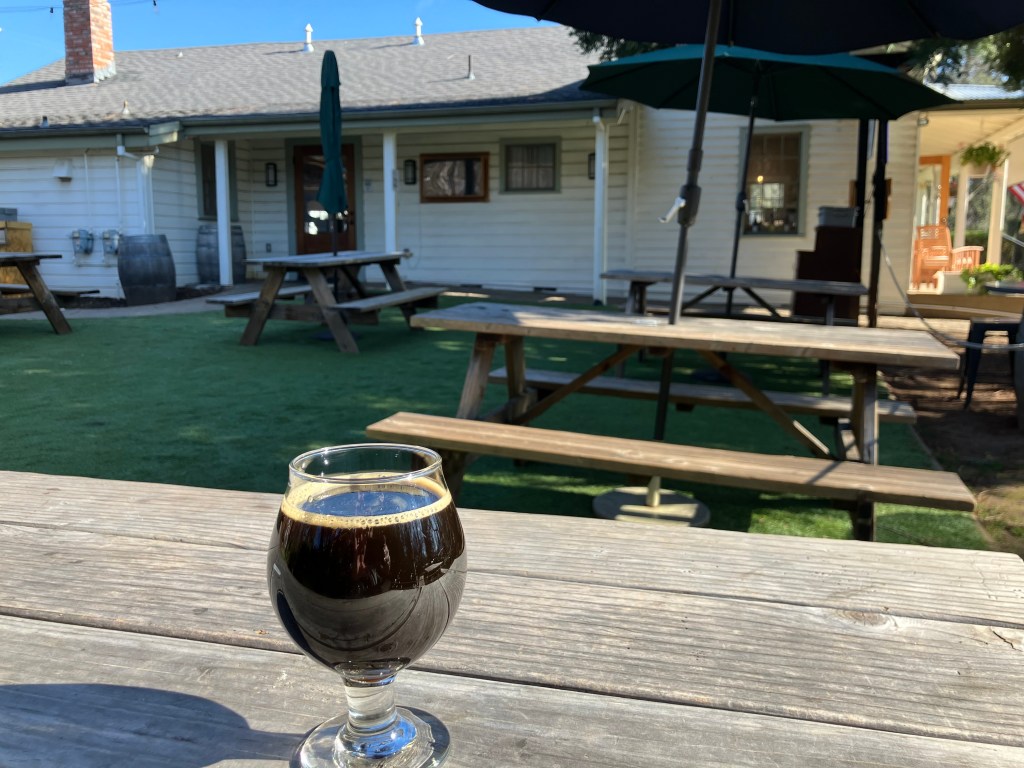
Just because I’m a cranky contrarian, I walked right past all the wine shops in Murphys and snagged myself a brew at Murphy’s Pourhouse. It’s an open, friendly place with outdoor seating and 16 beers on tap. I chose the rare and coveted Anniversary XXVI Strong Ale from Firestone Walker.

Even if you don’t like dark beer, you should try this. It’s aged in bourbon and brandy barrels, and if that doesn’t guarantee a symphony of flavors, it at least delivers a cacophony of flavors. We’re talking anise, black strap molasses, oak, Christmas fruitcake, semi-sweet chocolate, toasted pecans, vanilla extract, cherry sucrets, Worcestershire sauce, and those spent “grounds for your garden” you get at Starbucks. It’s on the sweet side, but there’s just enough hops to prevent it from becoming cloying. Well-carbonated but no head. 11 percent ABV, so if you are riding a motorcycle and find yourself at Howard’s Mystic Saloon shortly thereafter, have yourself a hot apple cider. I give this beer 5 points out of 5.

MAIL BAG

Faithful reader Peter D pointed out that I walked right past a pun opportunity  in my post about the tailing wheels at the Kennedy Mine. I had explained that, despite their shape, they’re not Ferris wheels. Peter’s response: Of course they aren’t Ferrous Wheels; they’re made of wood! Peter also helpfully includes this newspaper report on the bordellos of Jackson, CA.

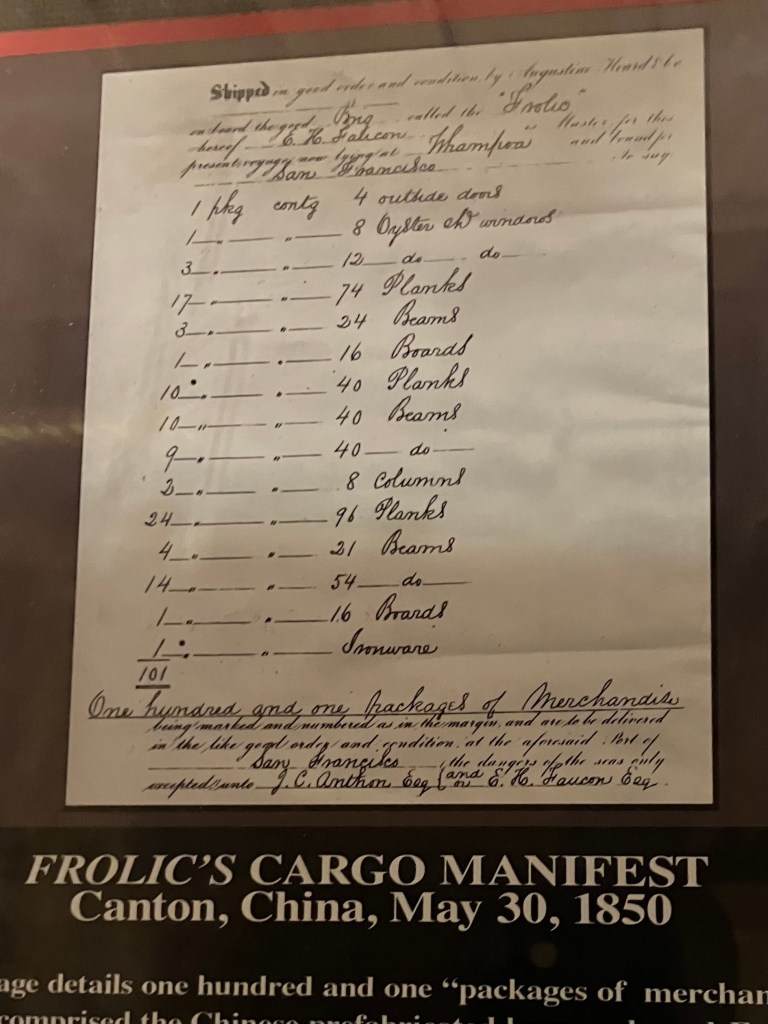
Meanwhile, Victor R points out that the Frolic’s delivery of a disassembled courthouse building in 1849 proves that Americans had stuff delivered from China well before Amazon was even a glint in Jeff Bezos’ eye. 

Finally, Sherrill J informs me that the third book in her mystery series discusses mining for gold in southern California–a topic I confess to knowing almost nothing about!

bridges · California history · cemeteries · Road trips · trains

Big Wheel Keep On Turnin’

The weeks immediately following New Years often can be difficult. The Christmas lights have come down, leaving a murky winter gloom throughout the land. It’s a time of chilly weather, short days,and family budgets decimated by holiday spending. Christmas vacation is over and it’s time to get back to the regular routine, made somewhat less enjoyable by my foolish New Year’s resolutions, which this year involve an ill-considered reduction in whiskey consumption. January, to me, is the real Humbug season. Spring won’t be making its arrival for another 68 days, though who’s counting?

Lookin’ out my back door.

So I figured a trip to southern California might at least allow me to catch a little sunshine. What’s more, my nephew Graham recently informed me, over beers, that near his house in Altadena (pop: 43,000) sits just a stone’s throw from the remains of a historic mountain railroad that dates back to 1893. The Mount Lowe Railway (for that’s its name) was gutted by several fires in the last century, but some ruins remain and the view from the top of the right-of-way is said to be impressive. The whole thing frankly sounds right up my alley, so I dutifully purchased a book about the railway, conducted some research, and began to plan a trip for next week.

Mt. Lowe Railway, back in the day.

You probably see where this is going: Tragically, wildfires this week wiped out Altadena, including, I’m sad to say, my nephew’s house. Can you imagine? You’re minding your own business, and suddenly, just a couple of weeks after Christmas, a Sheriff’s deputy knocks on your door and tells you to evacuate. A few hours later virtually everything you own is gone. It sure puts my puny problems into perspective. 

So, with a prayer for the thousands of people displaced (and an unknown number killed) by the southern California fires, I decided a trip to the Southland isn’t in the cards right now. Instead, I figured I’d stick closer to home. And so this morning I saddled up the Speedmaster and headed south on Highway 49, which is one of my favorite routes. It’s a scenic, two-lane road that endlessly twists through the oak-studded Sierra Nevada foothills. And it passes through innumerable old Gold Rush towns that still somehow evoke the 49er spirit of tenacity and patience.

During today’s ride I stopped for a few hours in the town of Jackson (pop: 5,100). All my prior trips to Jackson have strictly been to purchase huge quantities of maple bacon from Swingle’s Meat Market, which calls itself “The Carnivore’s Toy Store.” They really lean into their identity, with taxidermied heads of elk, bison, deer, and something that looks like a water buffalo. Anyway, today I decided to see what the rest of the town has to offer.

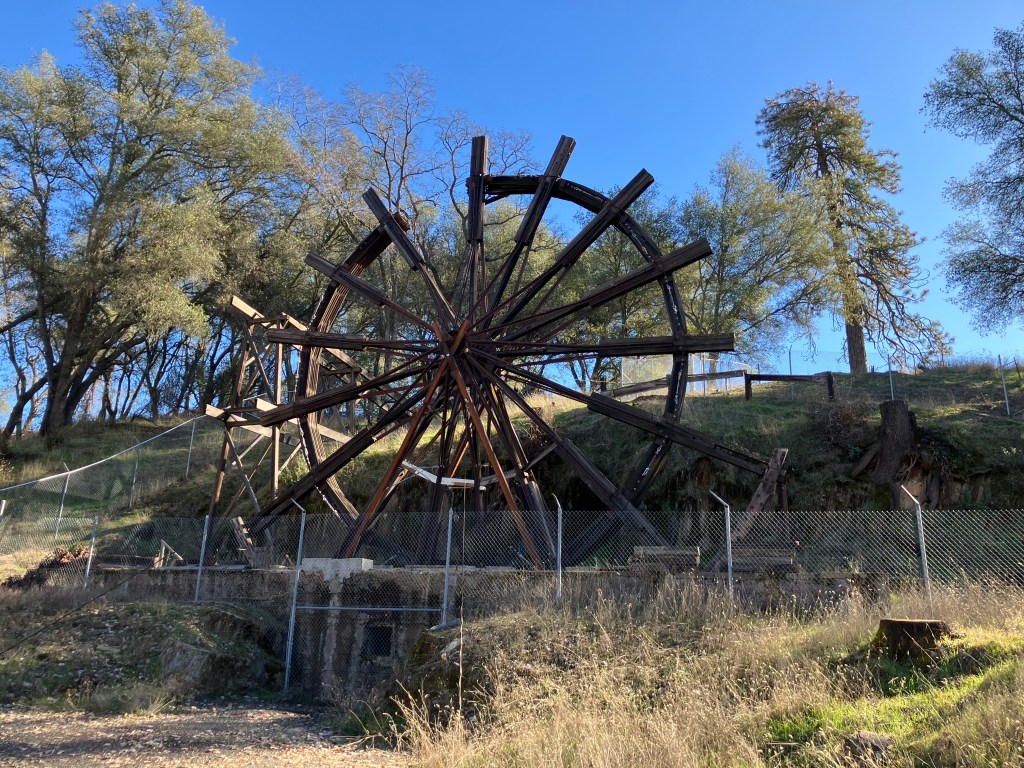
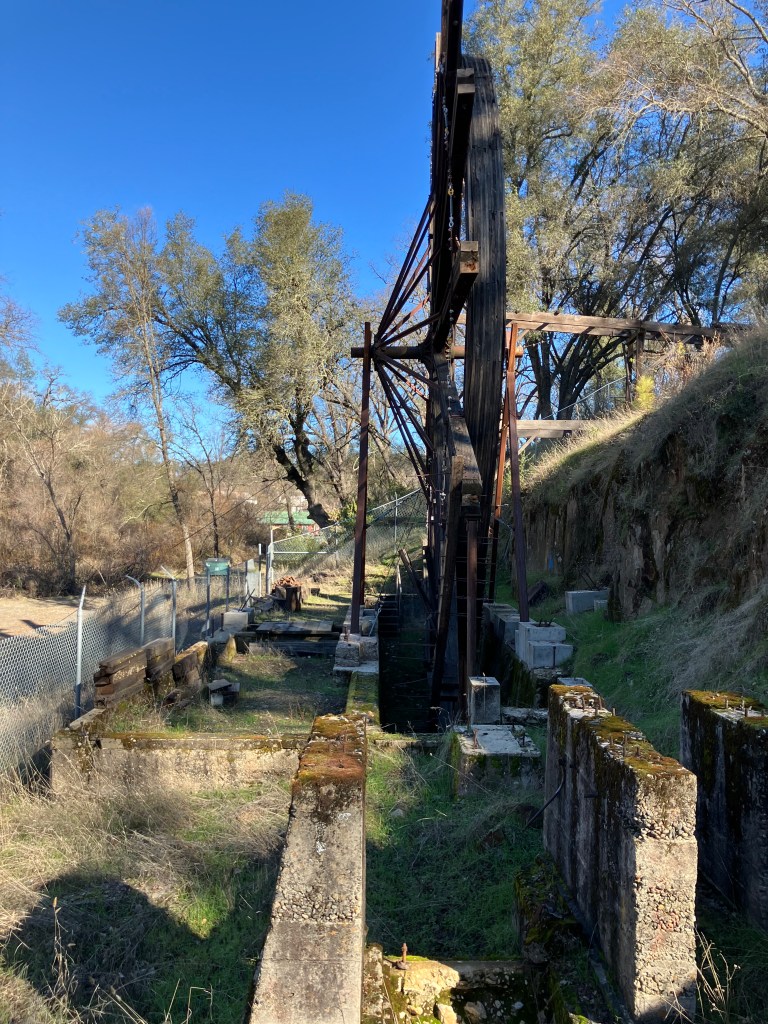
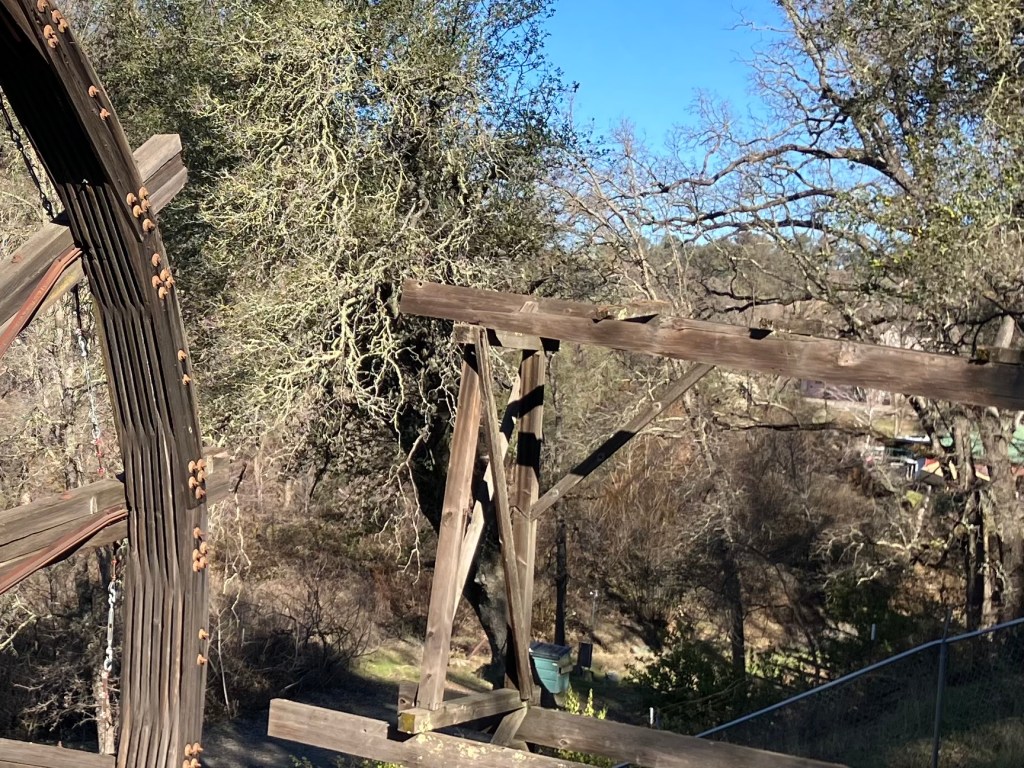
Like many towns along Highway 49, Jackson sprang up during the Gold Rush. It’s home to the Kennedy Mine, which was among the deepest and most productive mines in the country. It operated from 1860 until it was shut down during World War II. Many features of the mine are visible to this day. I was drawn to the four enormous, wooden tailing wheels that had been placed on the low hills to the south of the mine. Those wheels stood about seven stories tall. Here’s a few photos of them today.

No, that’s not a Ferris Wheel.
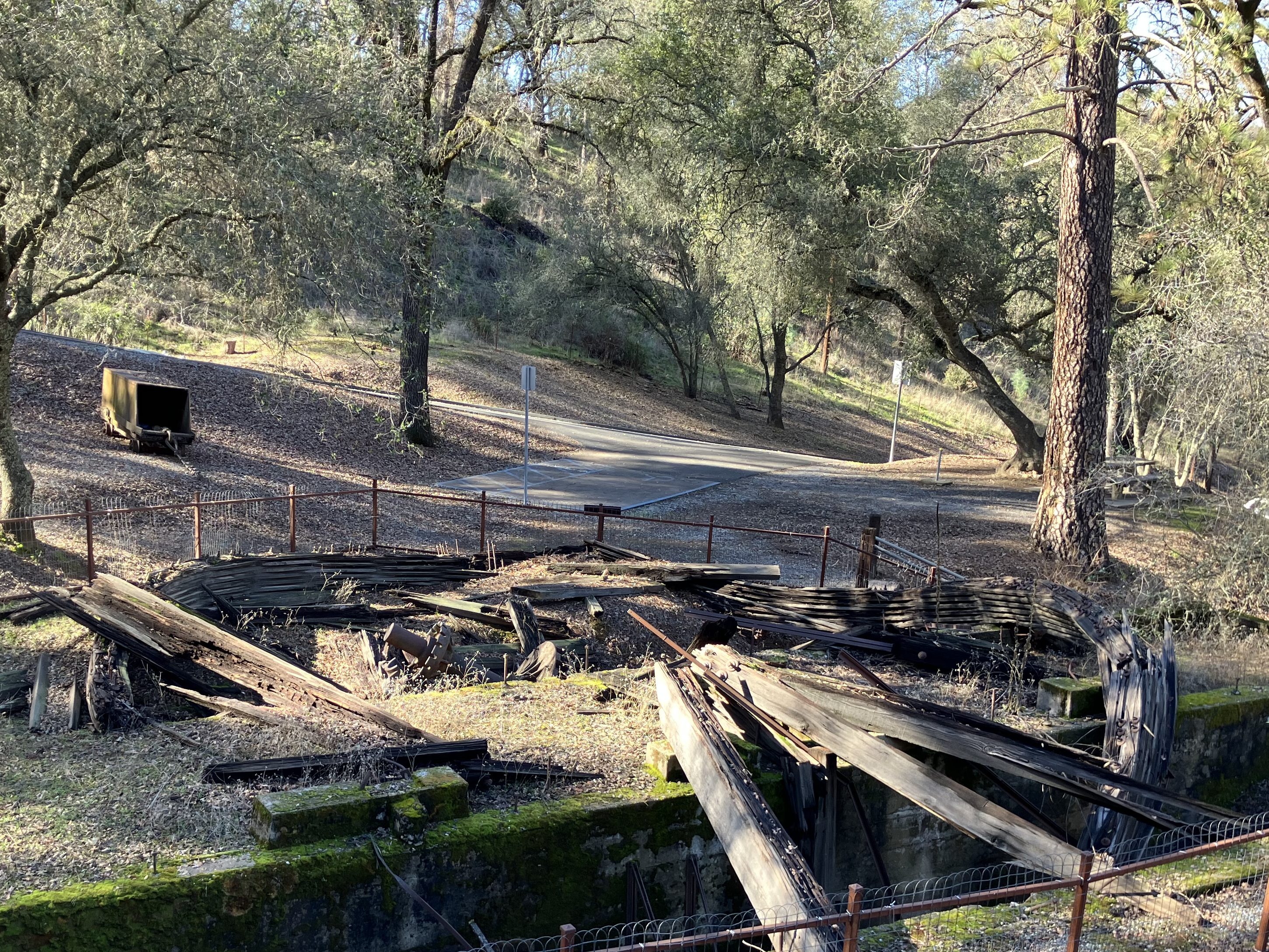
Not much left of this one.

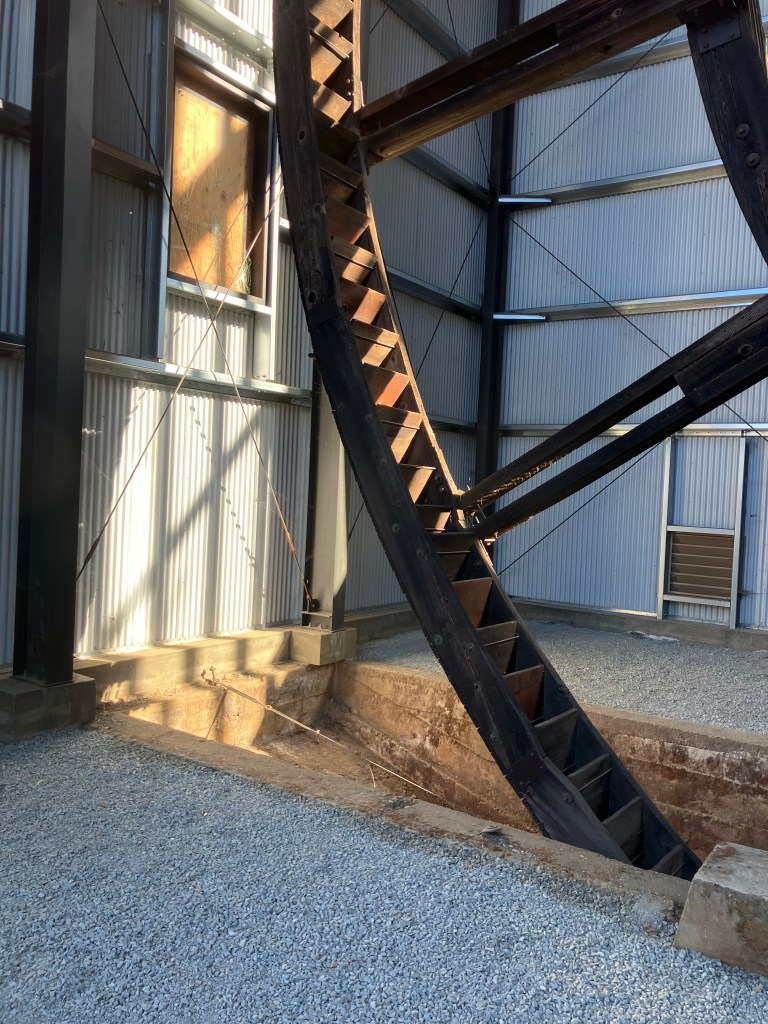
The story behind them is fascinating. Like most hard-rock mines, the Kennedy Mine extracted gold from rock by first pulverizing the rock into fine sand and then separating out the tiny grains of gold with a chemical process. This process left behind tons and tons of silty wastewater called “slickens” that over time fouled nearby streams and ruined local farms. Local farmers threatened lawsuits and eventually a settlement was reached: The Kennedy Mine would send its slickens to an impoundment basin a half-mine away. To get there, the slickens would have to get over a couple of hills, and that’s where those giant wooden wheels come in: They were each fitted with 178 buckets which lifted the slickens up to raised flumes and over the hills.

Remains of one of the flumes.
Undated historic photo. The Tailing Wheels are inside the four buildings.

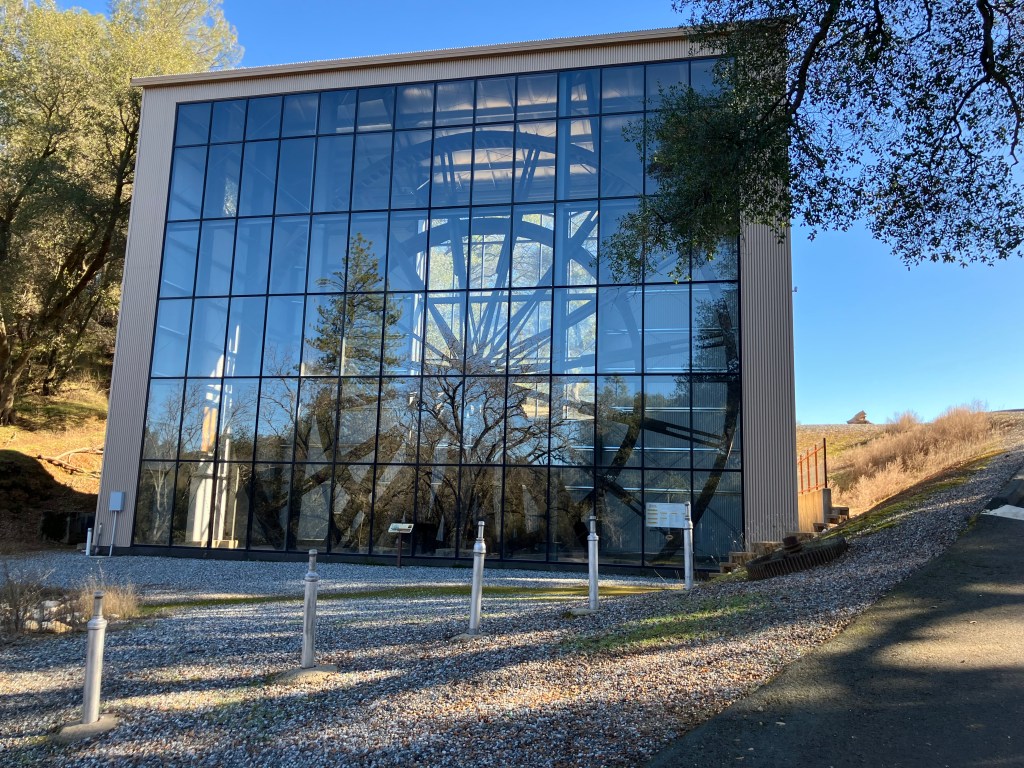
You’ll note in the photo above that the four tailing wheels were contained within corrugated-metal buildings. After the mine closed the metal was sold for scrap and the wheels were exposed to the elements–Hence their condition today. But one wheel has been restored and is enclosed within a modern structure.

A tailing wheel goes Hollywood.
Detail of the buckets.

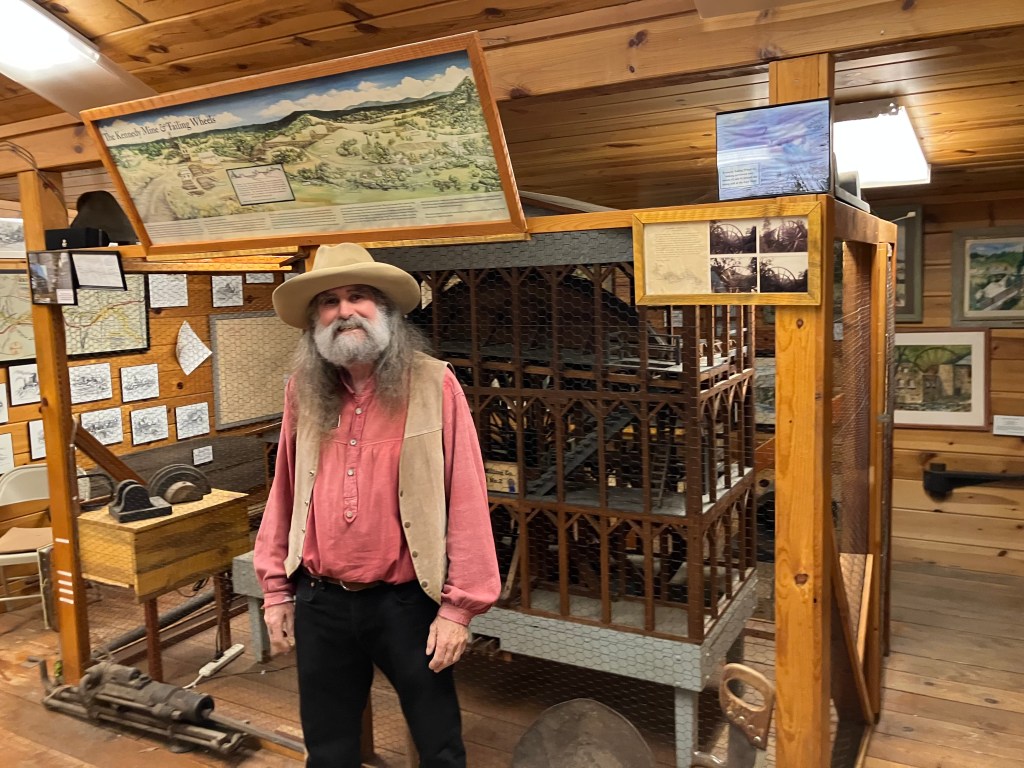
I really can’t explain why I became so fascinated by this primitive technology. But after spending a good hour hiking around the wheels, I went to the Amador Historical Society’s large scale model of the mine and tailing wheels. There I spent another hour chatting with Docent Gary about All Things Mining.

Docent Gary, dressing the part. Behind him is a 1/12 scale model of one of the tailing wheels.

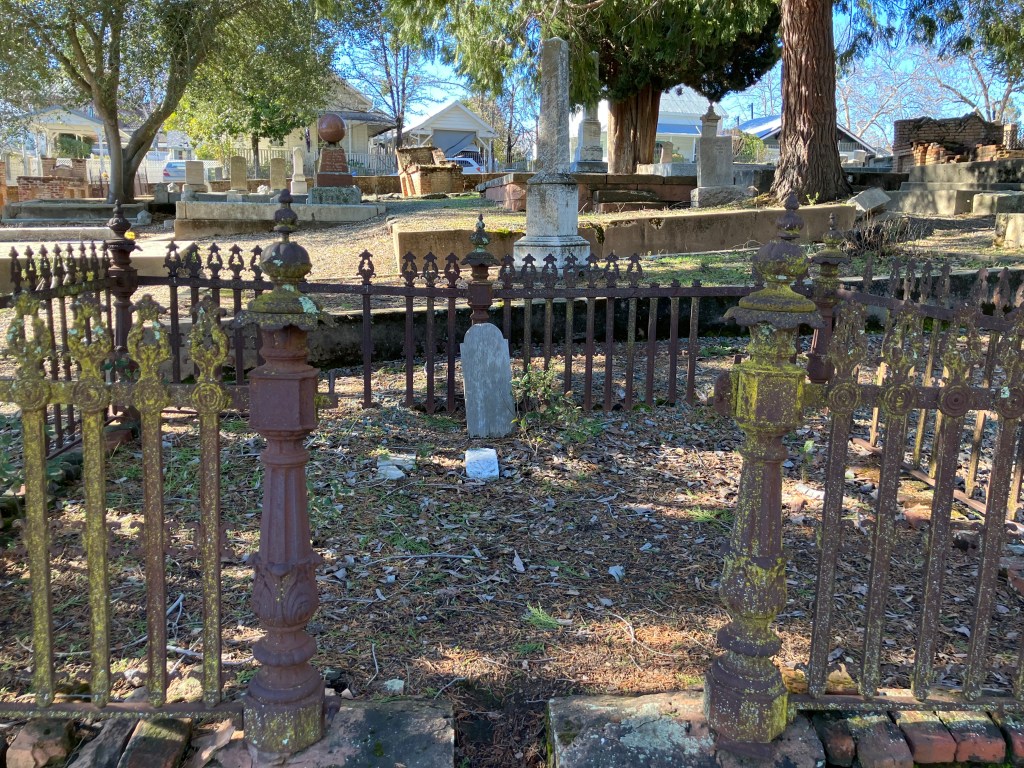
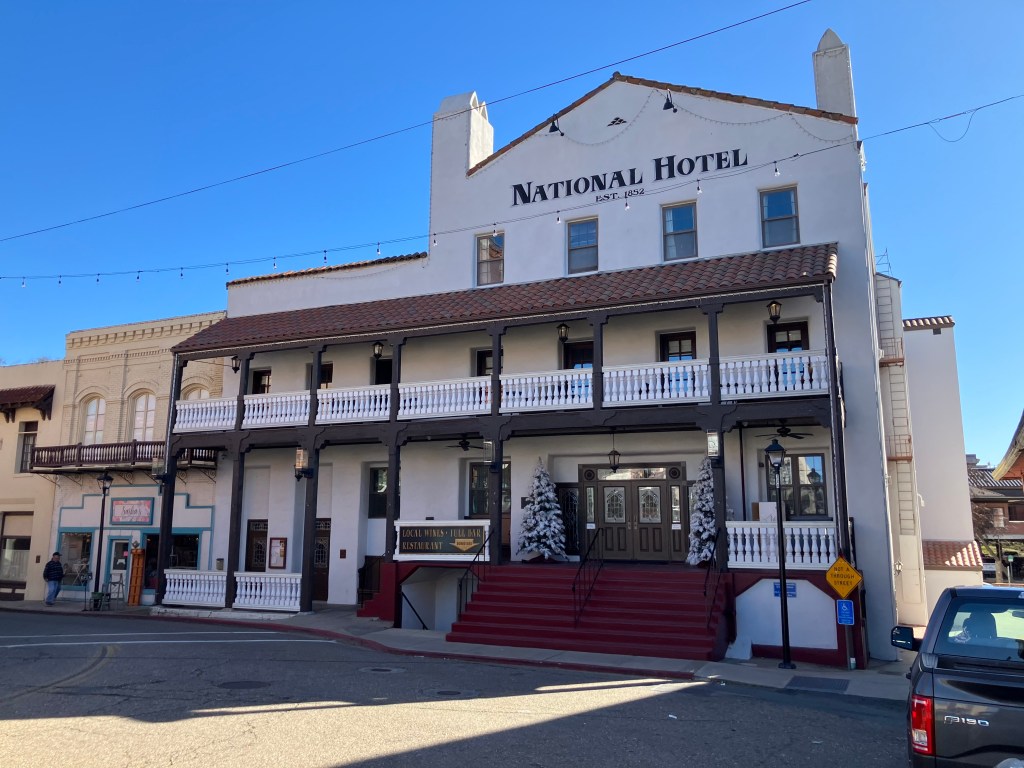
Of course, there are other things to see in Jackson. It’s actually a rather charming town, with a busting historic main street, several historic cemeteries, and a restored, large hotel from 1852.

Boo!

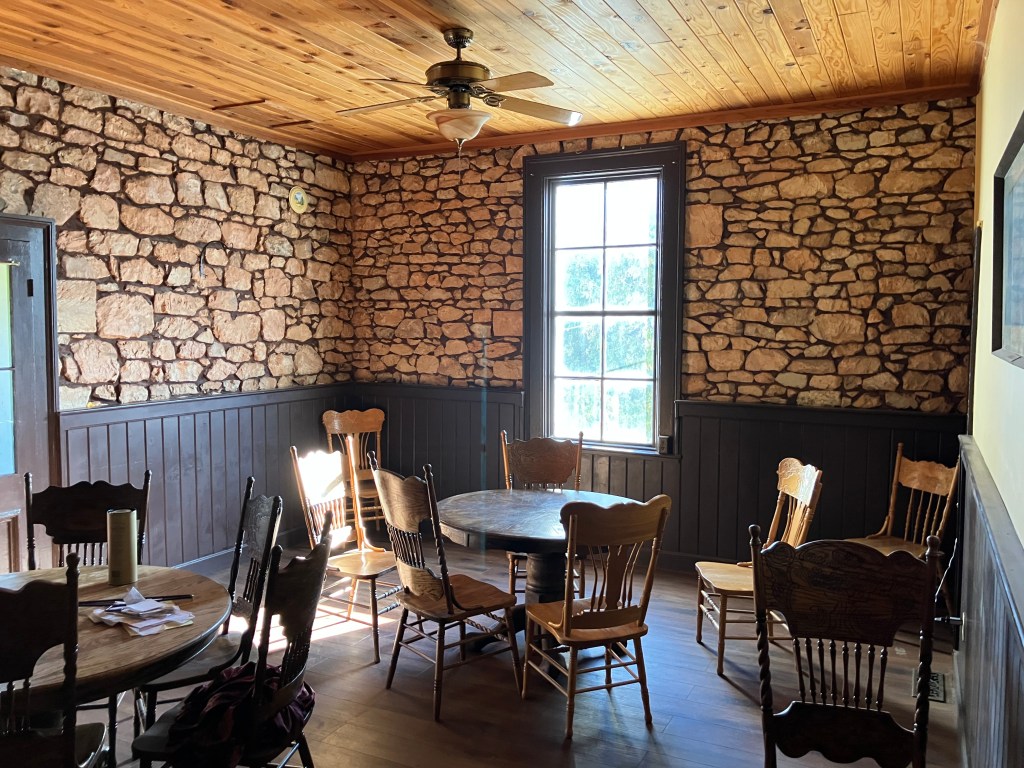
Speaking of historic hotels, I had lunch at the Hotel Leger in Mokelumne Hill (pop: 800). The Leger was rebuilt after several fires, most recently in 1875. My server told me the ghost of George Leger (1815-1879) still haunts the hotel. When I hinted at my skepticism, she told me she had “absolutely seen and heard things to make me a believer.” She also solemnly informed me that the hotel had been featured on Discovery’s Ghost Adventures in 2018. So that pretty much clinches it. 

Dining room of the Hotel Leger. The stone walls are original. Is that ectoplasm in the corner below the wainscoting?

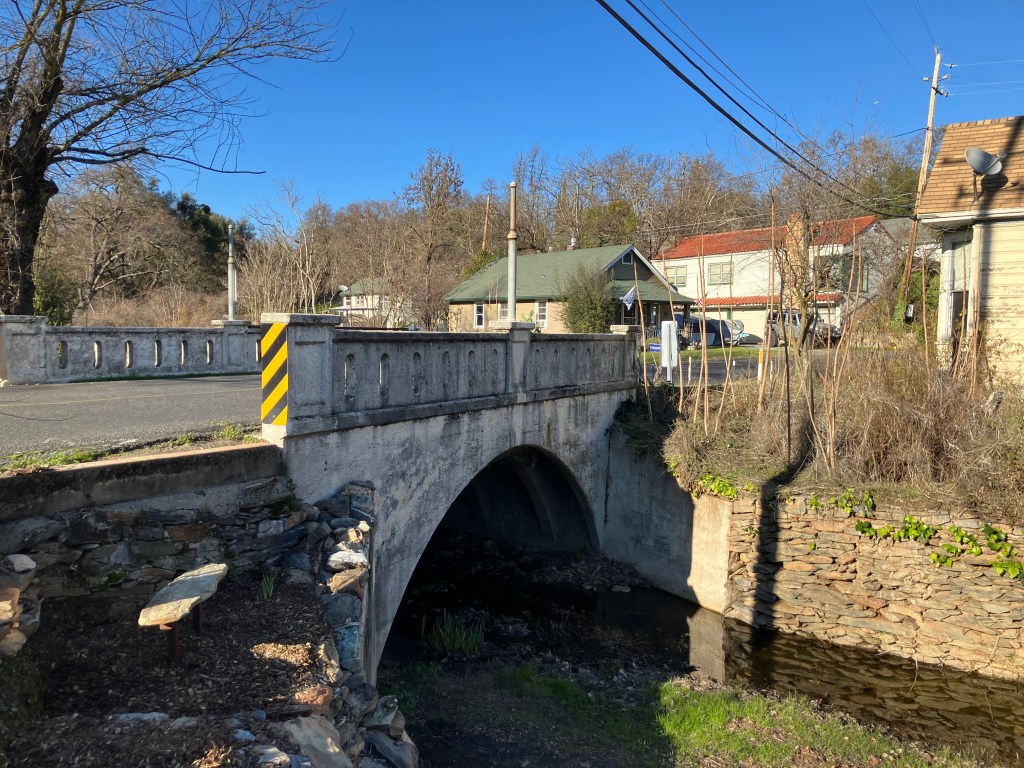
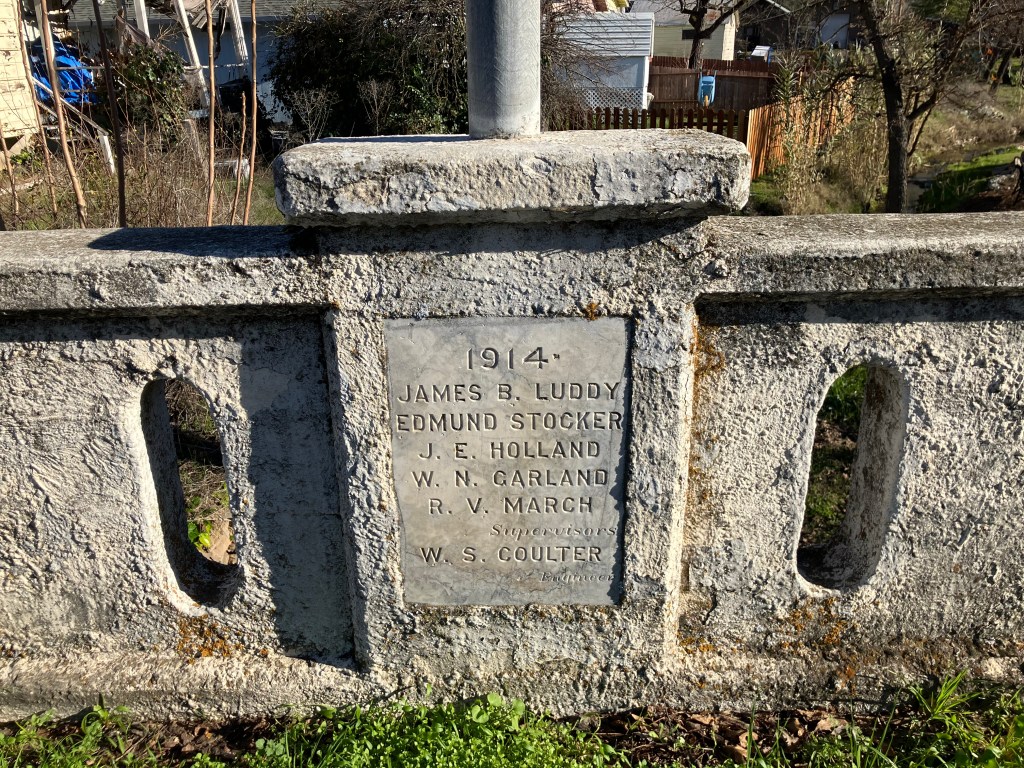
I ended today’s travel in San Andreas (pop: 3,000). There’s not a lot going on here beyond a short, historic Main Street and a small bridge that caught my eye for its age (over a century old) and graceful simplicity.

Thirty-foot long, closed-spandrel arch bridge over San Andreas Creek.
111 years old and still going strong!

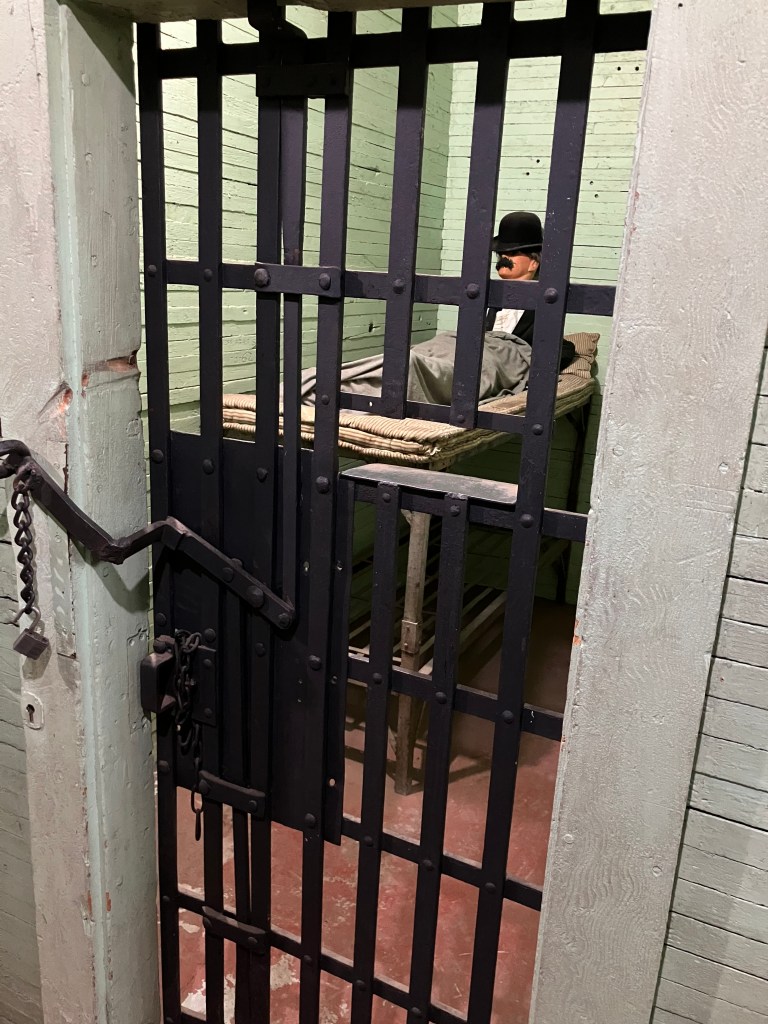
The Main Street does feature a worthy historical museum. Among its many artifacts, I will emphasize two: One is the jail cell where Black Bart had been imprisoned in 1883 for robbing a stagecoach.

Actual jail cell, fake Black Bart.

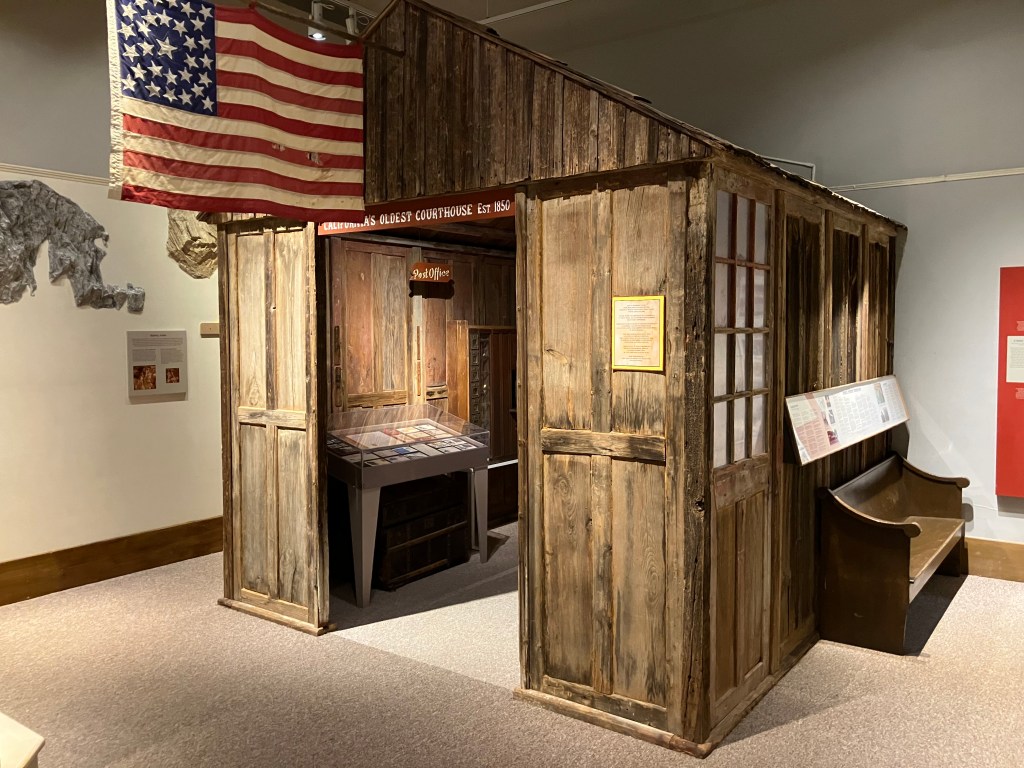
Also notable is California’s first courthouse..which sits entirely within the museum. 

Note the rare 31-star flag.

The story goes like this: There were no sawmills in California at the beginning of the Gold Rush, so all lumber had to be imported. This building was essentially a “build-it-yourself” kit of pre-cut camphor wood that had been shipped from China. It served as the Calaveras County courthouse in 1850, and later served as the post office. A placard assures me that it is not a reproduction, but the actual building (though it has been truncated to fit in the museum space).

There’s a footnote to this story as well: The building was shipped to California aboard the brig Frolic. I thought the name sounded familiar, and then I remembered that last year I visited the site near Point Cabrillo where the Frolic sank in the summer of 1850–just months after it delivered the courthouse building to Calaveras County. This time she was carrying porcelain and opium.

Just weeks before she sank off the coast of California.

Tomorrow I am going to try out a downloadable driving tour app for the stretch of Highway 49 between Angel’s Camp and Jamestown. I don’t normally use travel guides on my trips, as I like to remain open to whatever catches my interest along the way. But this particular driving app is only a two-hour commitment and it seems pretty authoritative.  So for twelve bucks I’m willing to take the risk. Full report tomorrow!

2024 Halloween treats · bridges

Devil Eyez

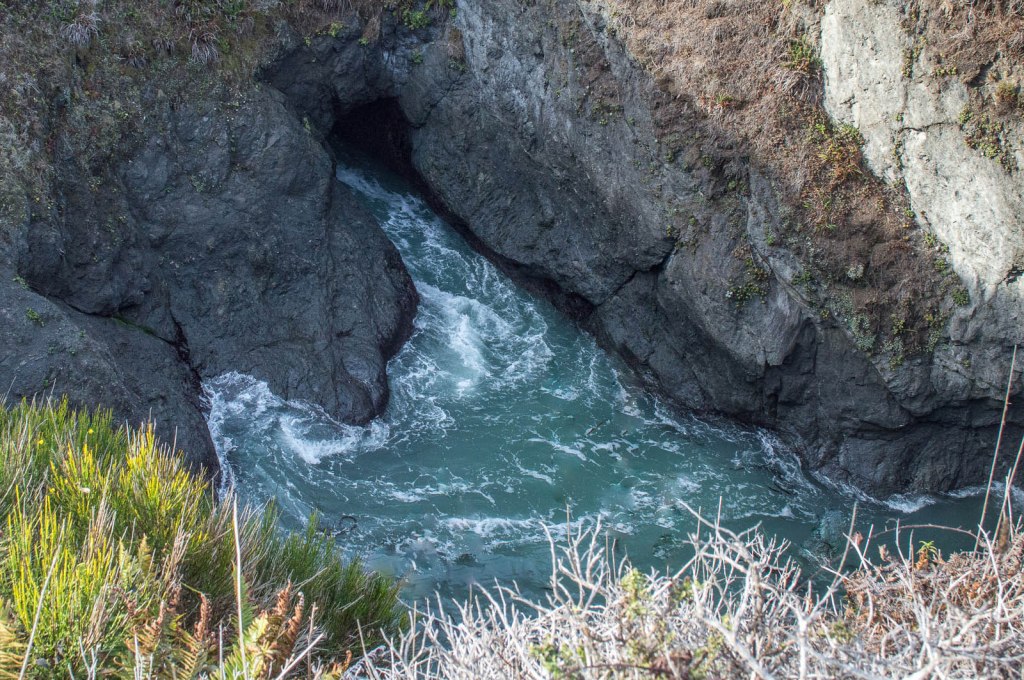
I made a little visit to Russian Gulch State Park on California’s north coast. Among its highlights is something called “the Devil’s Punchbowl,” which is my Halloween tie-in of the day. It seems there’s a natural tunnel that runs under the park from the ocean side, and it somehow found an outlet through a vertical shaft up to the surface. Ocean water boils up through this opening at high tide. Sadly, the tide was out when I visited. But here’s a photo ripped from the California State Parks website:

Devil’s Punchbowl at high tide.

With a name like Devil’s Punchbowl, this place is naturally said to be haunted. You can find a number of ghost stories online, but be aware there are many places called the Devil’s Punchbowl, both in California and beyond. As an aside, the name “Devil’s Punchbowl” reminds me of the Devil’s Gate Dam in southern California, which I reviewed four years ago.

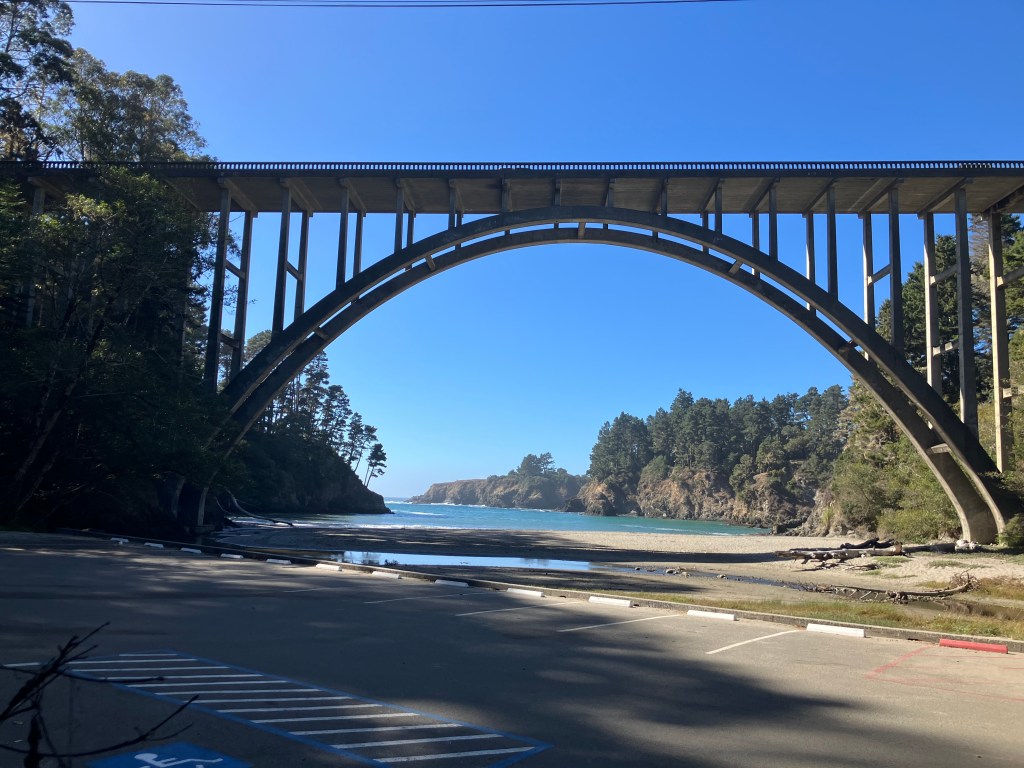
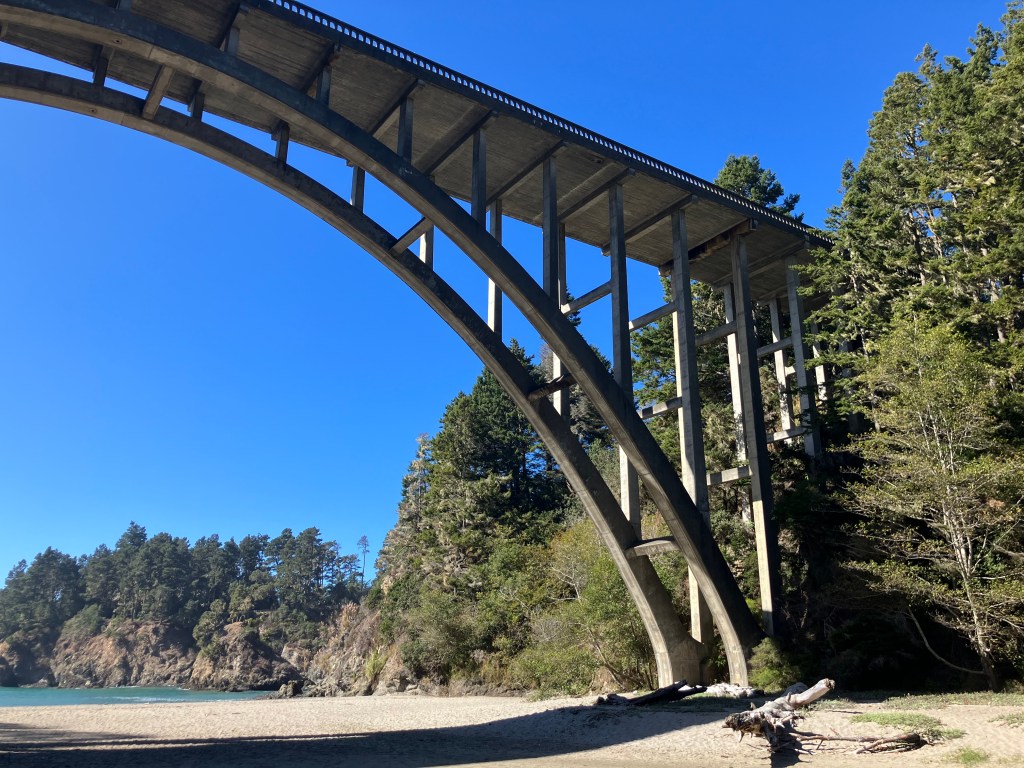
As is typical for me, attention was drawn from the Punchbowl to something a little less sinister: The Frederick W. Panhorst Bridge, which carries CA Route 1 traffic 100 feet above the surface of the ocean near the Devil’s Punchbowl. Built in 1940, this bridge is made of poured concrete and is over 500 feet long. The bridge looks completely boring and nondescript when viewed through your car window as you drive over it. But if you get down under the bridge, as I did, you can appreciate its classic beauty.

“Mr. DeMille, I’m ready for my closeup.”

My research found that this bridge was constructed as a WPA project. As with most WPA projects, I appreciate that the designers combined functionality with aesthetics. The latter consideration seems to be lacking in so much modern transportation infrastructure.

But let’s get back to Halloween. The day ended up getting away from me, so I’ve enlisted loyal reader Victor R. to provide our Halloween treat review. You may recall his review of a Halloween cookie during our October 2020 treat review suite. He now offers something especially disgusting interesting. Enjoy!

VICTOR R’S GUEST REVIEW:

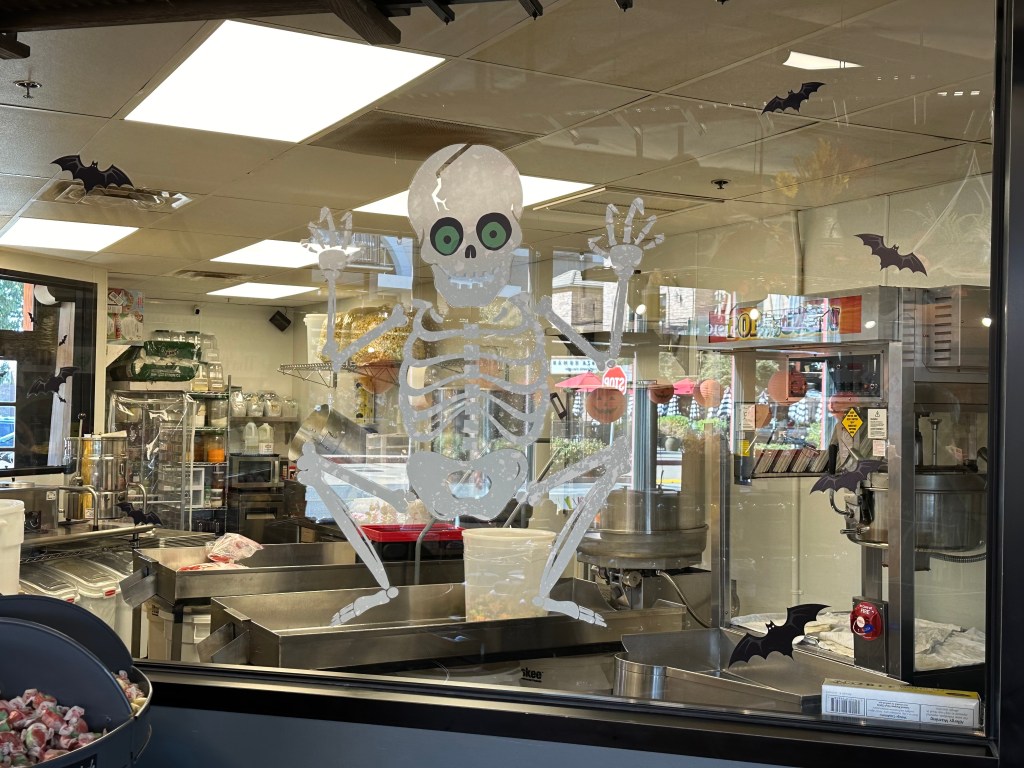
I visited the Nibblers Popcorn Company store in the Town Center shopping center in El Dorado Hills today.  Nibblers has been open since 2018 and is operated by the Sweeney family, specializing in gourmet popcorns (fancy popcorns like cheddar cheese, parmesan garlic or buffalo wing), and a wide variety of candies (such as classic candy bars, gummy fruits and bubble gum).  My wife Peg suggested that, since I was hunting for a great seasonal treat, I should check out Nibblers and I’m happy to say that, after a less-than-satisfying pumpkin ice cream “treat” at Handel’s Ice Cream Parlor in Folsom, I took her advice and visited it.
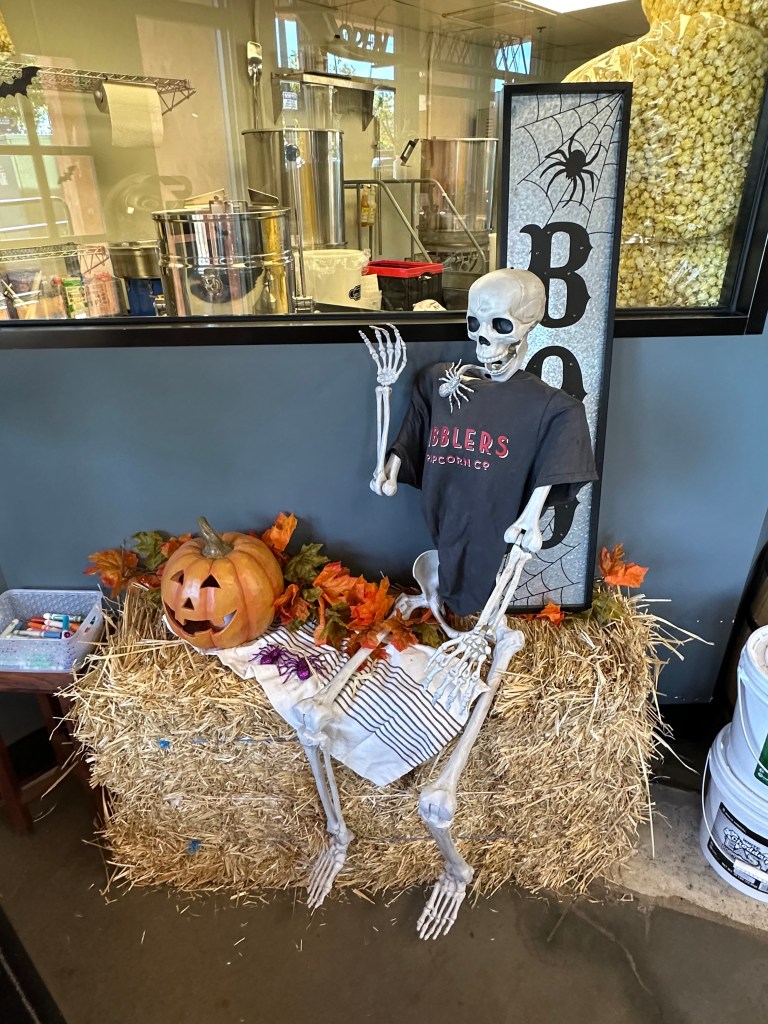
First off, kudos to Nibblers for really getting into the Halloween spirit (see the decorations below).  You really feel like it’s Halloween when you walk into the store.  The decorations, tons of candy, and the model train that runs laps around the inside of the store make you feel like a kid again.  The only difference is now you don’t have to ask your parents if you can buy a bunch of candy…you just pull out the old plastic pass to poverty (a.k.a., your credit card), cross your fingers that your purchase won’t be declined, and voila—off you go with your pile of sugary treats!!

This guy eats here all the time, which is why they gave him an official Nibblers  
Popcorn Company shirt to wear!

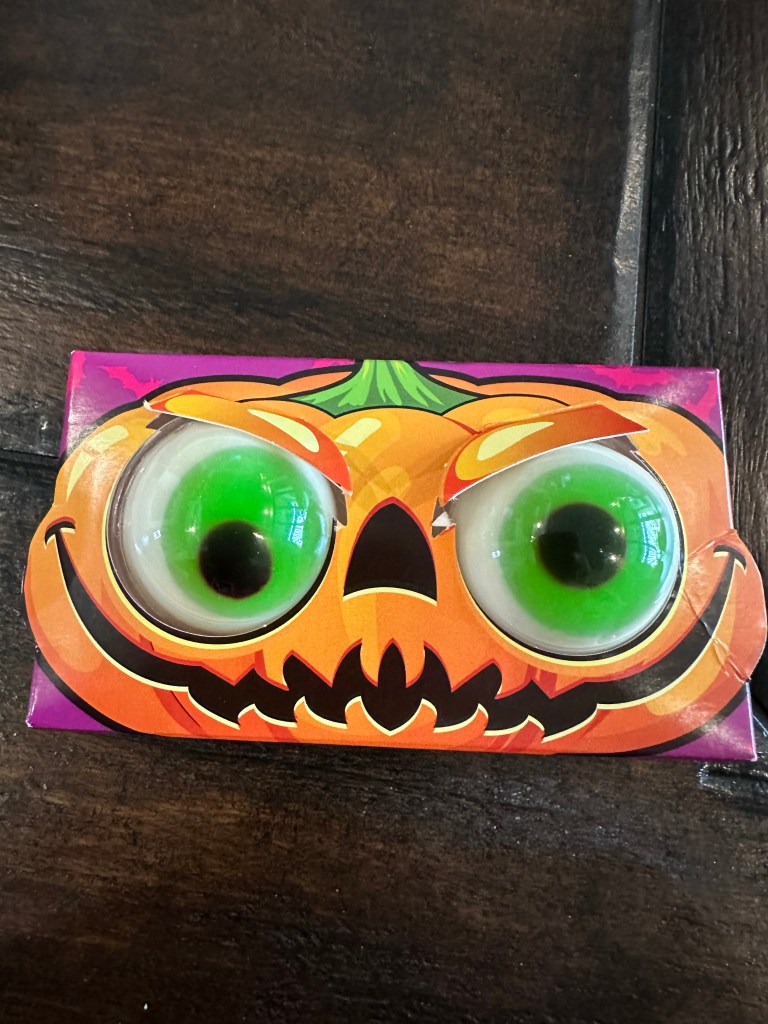
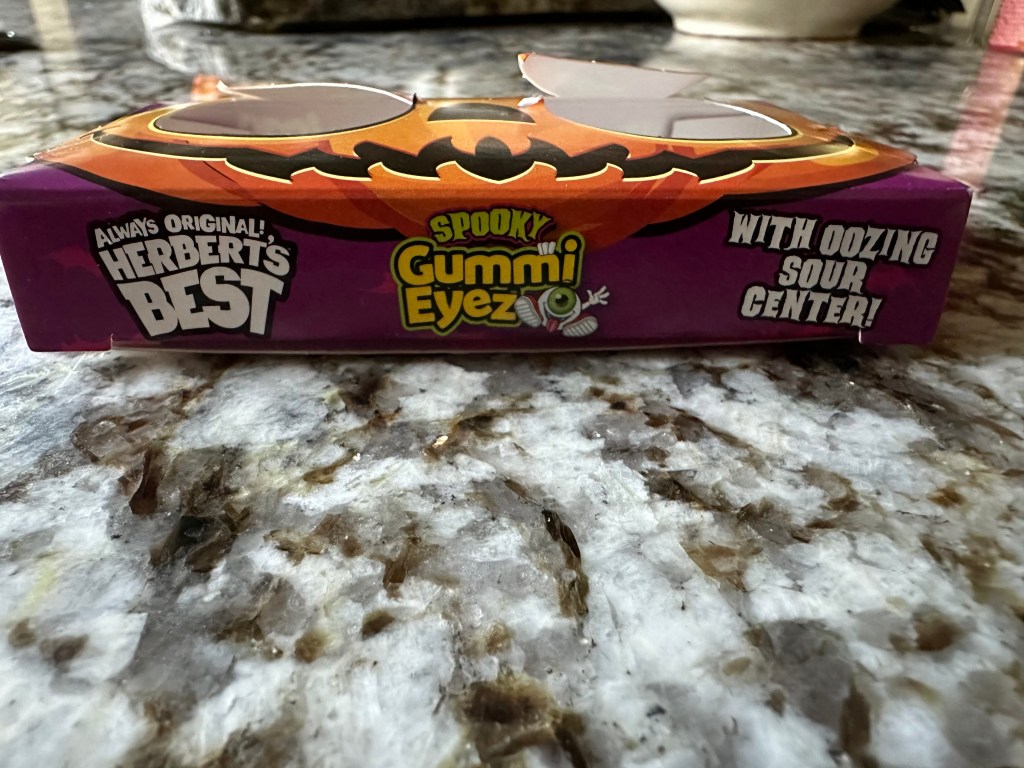
While at the store, I looked over any number of treats, some of which were seasonally focused, and settled on Herbert’s Best “Gummi Eyez” which, according to the box, are spooky and have an “oozing sour center”.  We all know how appealing it is to eat eyeballs, and if they have oozing sour centers, well…who wouldn’t want to try that?  So, I bought a pair and took them home for a test run. 

With eyes like that, you’ll think twice before doing any carving on this Jack-O’-Lantern!

Conceptual Soundness:  I think combining jack-o’-lanterns, spooky eyes and gummy bears is a great idea.  The jack-o’-lantern is very seasonal of course, but what would make you think more of Halloween than eating a couple of Eyez?   And this is a perfect time to tip our hats to Herbert Mederer, who, since 1984, has specialized in making all kinds of gummies.  Thanks to his leadership, gummies have become extremely popular in this country, even among folks who don’t insist that their gummies include hemp. It’s a good concept to tie Gummi’s to Halloween, so I’ll give it the full 4 points.   

Appearance of the Treat:  First off, using a jack-o’-lantern as the packaging for the Eyez is the perfect presentation for the season.  Each eye looks very realistic, with a white sclera and a green eyeball.  While only a small portion of people have green eyes, the green creates a perfect look for Halloween. I do think they could have made the eyes bloodshot, so I’m going to give it 3.5 points for appearance.

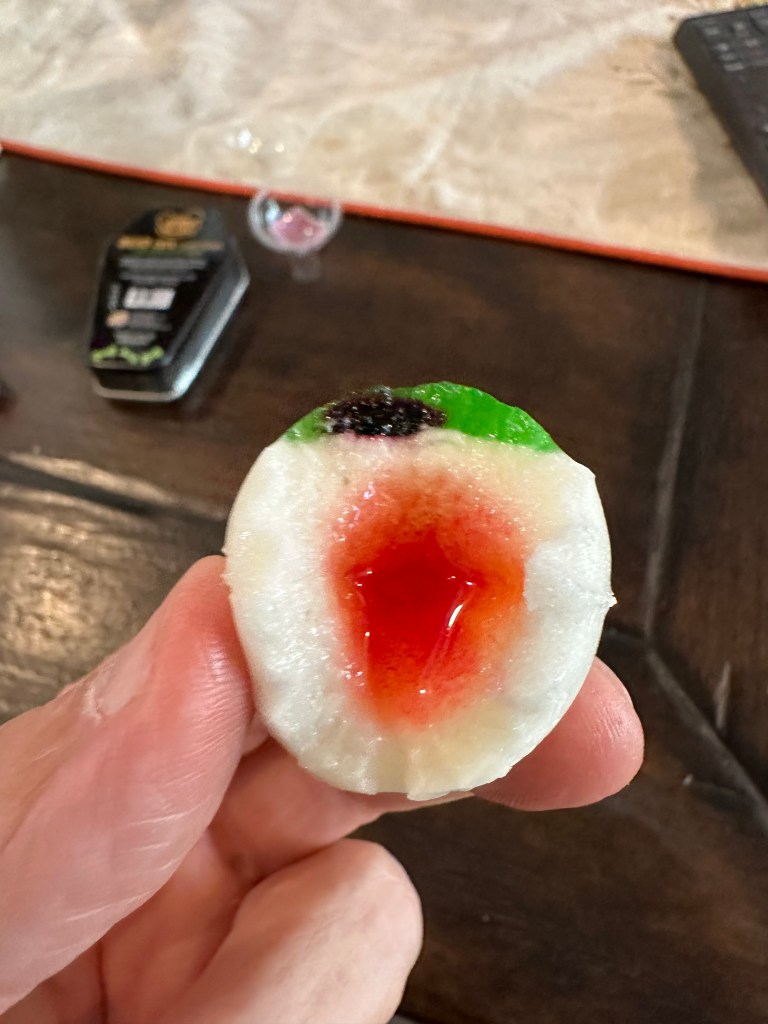
Taste:  As you saw, the packaging makes a point of saying that the Eyez have “oozing sour centers”.  Well, they do have sour centers which are cherry flavor, but they don’t ooze (which would lend more authenticity to it since I’m guessing the red center, along with being cherry, is supposed to represent blood).  And the centers are only a little sour, which was a surprise and a little bit disappointing.  Since it’s a Gummi, it does have the spongy feel of what you imagine a real eyeball would feel like, so thumbs up for that.  As a Gummi treat, it was pretty tasty. I’m going to give it 3 points for taste.

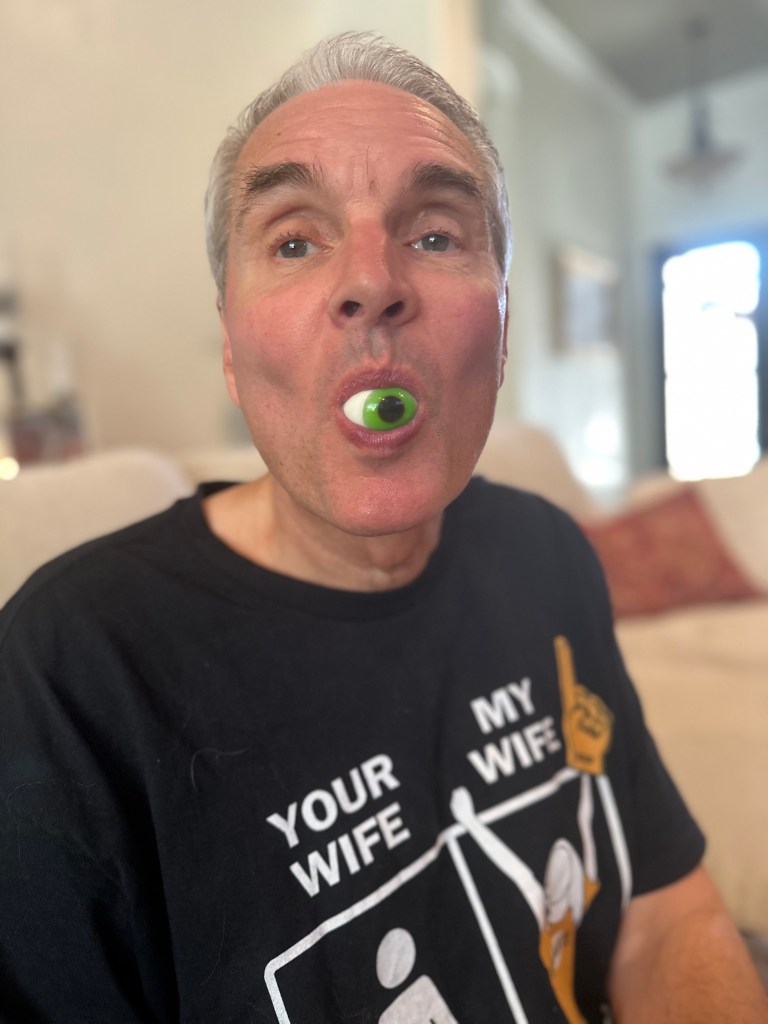
There’s nothing like a tasty eyeball to top off a great meal!

Value:  One package of two Gummi Eyez is only $2.95, which I think is a heck of a deal!  When you think about how expensive it is to buy…well, anything anymore, $2.95 for a scary Halloween treat has to rank as one of the better values you’ll find anywhere.  I’m going to give it 4 points for value.

Total Treat Score: 14.5 points/16 points.  I suggest that, if you’re anywhere near El Dorado Hills, visit Nibblers and pick up your own set of Gummi Eyez.  (You can also buy Herbert’s Best treats on Amazon, but that’s way too easy)!

bridges · California history · Hydrology · trains

“We’re Number Two!”

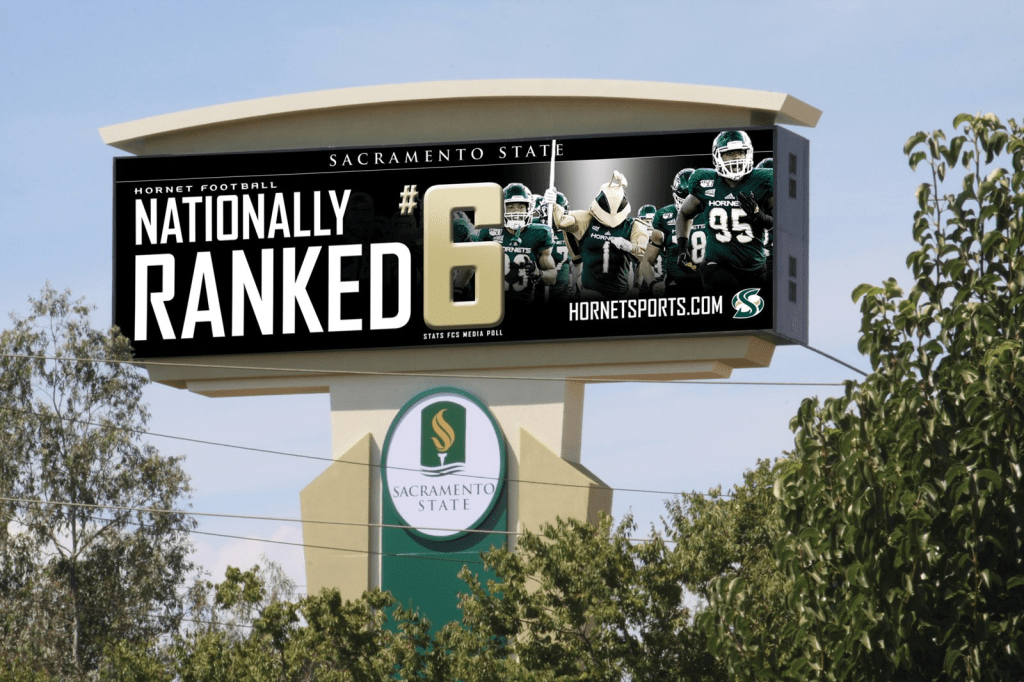
The other day I passed a billboard near Sacramento State University, which touted the campus football team’s Number 6 ranking in a media poll. This of course raises the question: how quickly do bragging rights decay as you move down the list, from first to second to third to fourth….?

A 1966 novelty song (on heavy rotation on Dr. Demento’s radio show while I was growing up) poked fun at this phenomenon. “The Ballad of Irving” sang the praises of the “142nd fastest gun in the West.” My favorite line: “A hundred and forty-one could draw faster than he/
But Irving was looking for one forty-three.
” Give it a listen:

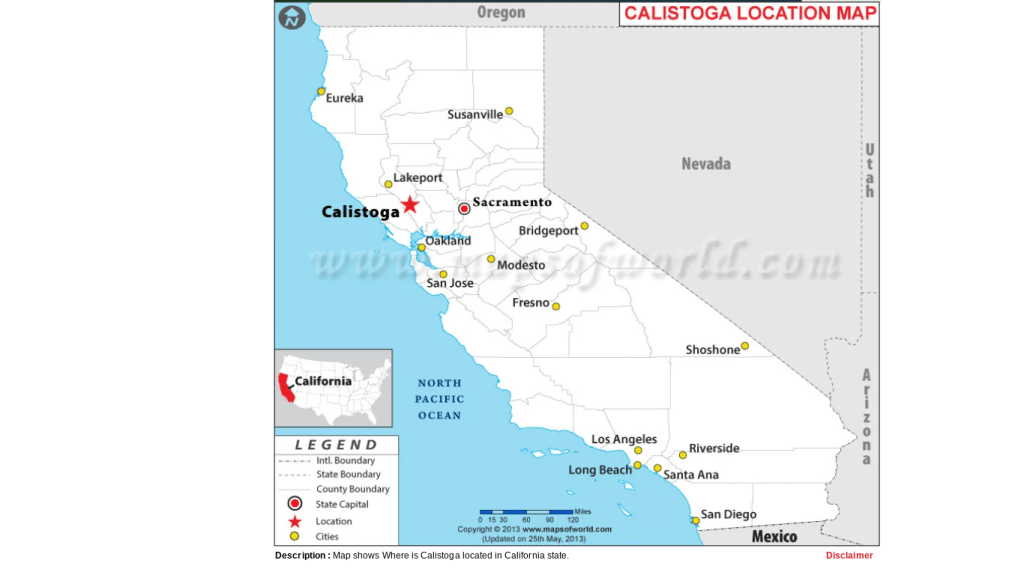
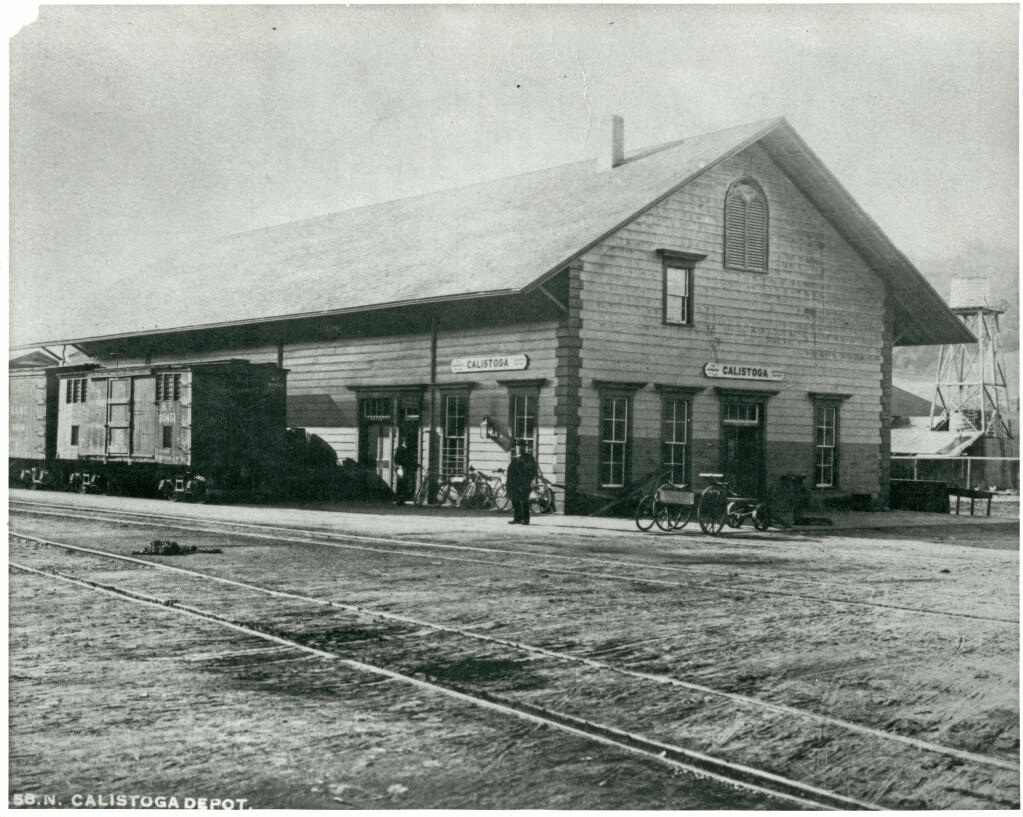
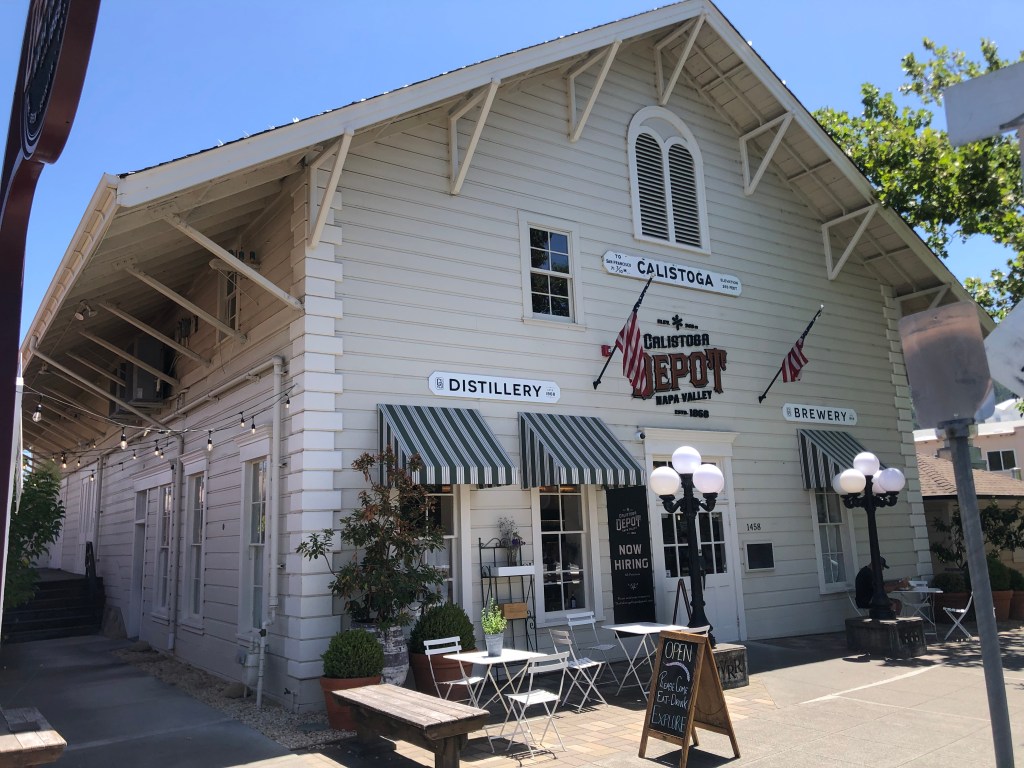
I bring all this up because son Ian called my attention to “the second oldest railroad depot in California.” It’s in Calistoga, in the upper Napa Valley. The depot was built in 1868. (A quick Google search identifies the oldest Depot as Santa Clara Depot, which was constructed in 1863.)

The important thing about the Calistoga Depot is that it held a grand (re-)opening just a couple of months ago, and it’s now repurposed as a microbrewery, distillery, and restaurant venue. Once I learned this I decided it’s obviously time for a road trip. So this morning I set out for Calistoga.

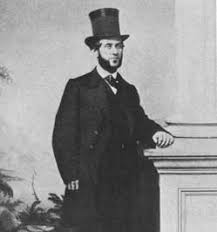
The city of Calistoga (pop: 5,300) was established in the mid-1860s, centered on Sam Brannan’s Hot Springs Resort. Sam Brannan had come to California from New York in 1846, and made his fortune selling gold pans to the miners during the Gold Rush. It should be noted that he first bought all those gold pans and other gear from every supplier in the West, monopolizing the market shortly before the Gold Rush became big news. He sold the equipment at an enormous profit.

Sam Brannan, doing his Honest Abe impersonation.

As a result, Brannan became California’s first millionaire. In addition to building the Resort he co-founded the Napa Valley Railroad. The Calistoga Depot marked the northern terminus of that short line, carrying vacationers from the Bay Area.

End of the Line.

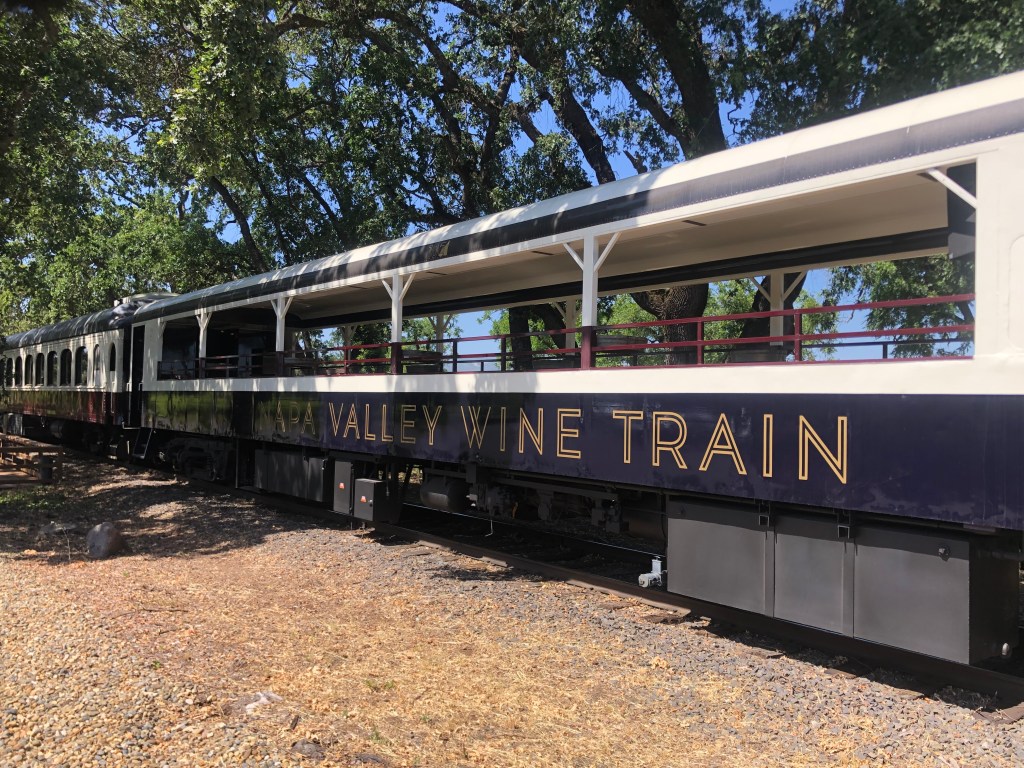
Brannan’s Napa Valley Railroad didn’t last long, and was absorbed by what eventually became the Southern Pacific. SP dropped passenger service along the route in the 1920s, but today trains run again on those rails, in the form of the Napa Valley Wine Train.

The more things change….

Incidentally, the name “Calistoga” is supposedly the result of an unintentional Malapropism. Brannan liked to compare his Hot Springs Resort to the famous Saratoga Springs in his native New York. So at the grand opening of his resort, he intended to say something like “Here’s to the Saratoga of California!” But it came out as “the Calistoga of Sarafornia.” (OK, that’s not exactly a Malapropism. Leave a comment below if you know what specifically this error of speech should be called.)

Paging Mrs. Malaprop…

One other thing about Sam Brannan: He built a distillery that cranked out huge amounts of bandy that, it’s said, rivaled the finest French cognac. All this, as a Mormon leader. The brandy will figure into our story a bit later.

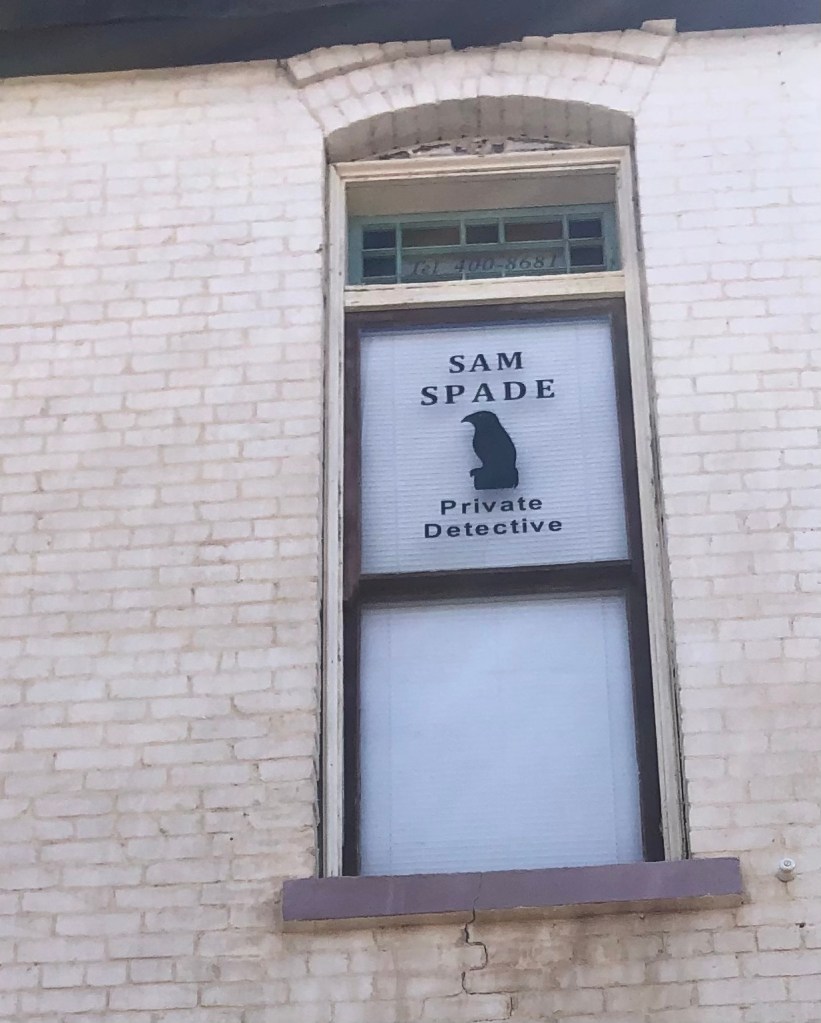
Anyway, as I was saying, I headed out for Calistoga this morning. I took the scenic route roughly paralleling Putah creek westward from Davis. When I stopped for gas in Winters (pop: 7,300) this second-story window of an old office building caught my attention. I guess Sam (Spade, not Brannan) decided to relocate 70 miles eastward from San Francisco sometime after solving the Maltese Falcon caper.

Don’t be too sure I’m as crooked as I’m supposed to be.” –Sam Spade, in The Maltese Falcon.

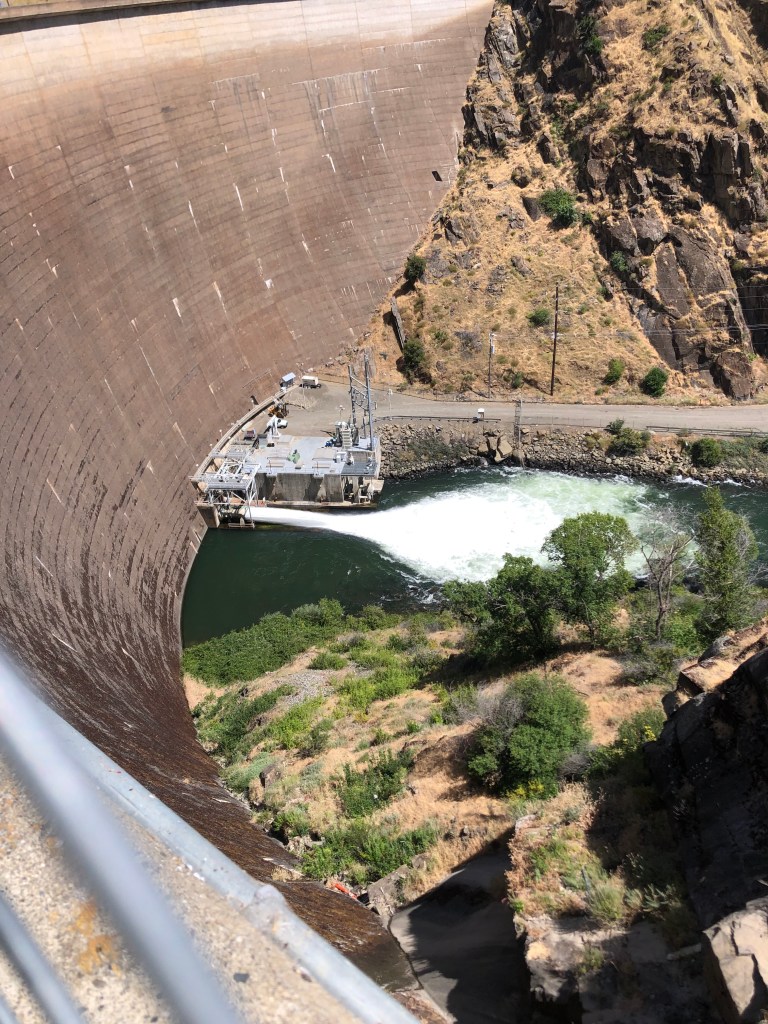
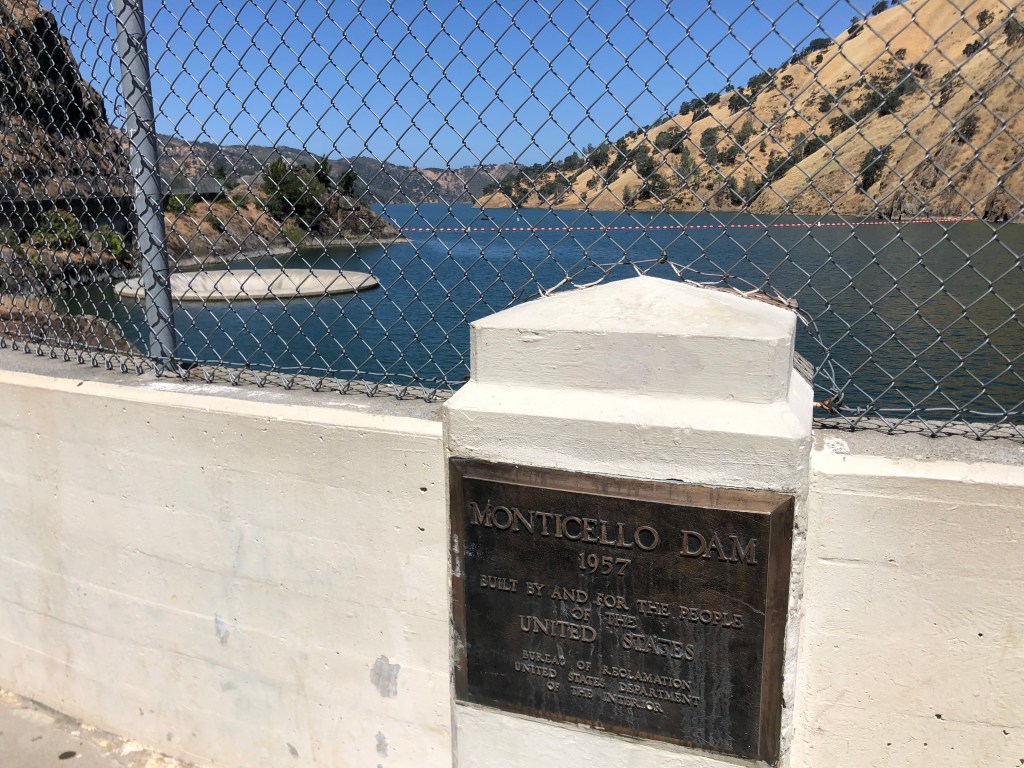
I followed Putah Creek to Monticello Dam, which was built in 1957 as a hydroelectric project that also resulted in Lake Berryessa. (Since we’re focused on rankings, Lake Berryessa is the 7th largest man-made lake in California.) After 65 years, the dam is showing its age, but the lake remains a popular spot for boating.

Looking down at the spillway, where water exits the dam.
Lake Berryessa

Conveniently, I rolled into Calistoga around lunchtime. And there was the Calistoga Depot, in all its glory. If Monticello Dam is looking a little long in the tooth after 65 years, the Calistoga Depot looks fabulous after more than 150 years.

In fact, it might be a little too fabulous. Over the past few years the property has undergone an extensive renovation and repurposing, to the point that it doesn’t really feel as authentic as some of the dilapidated historic structures I’ve seen on other travels. I fear most of the Depot’s ghosts are long gone. Still, the building’s footprint and outward features are largely as they were in Sam Brannan’s time. Just compare the above photo to the historic photo near the beginning of this post.

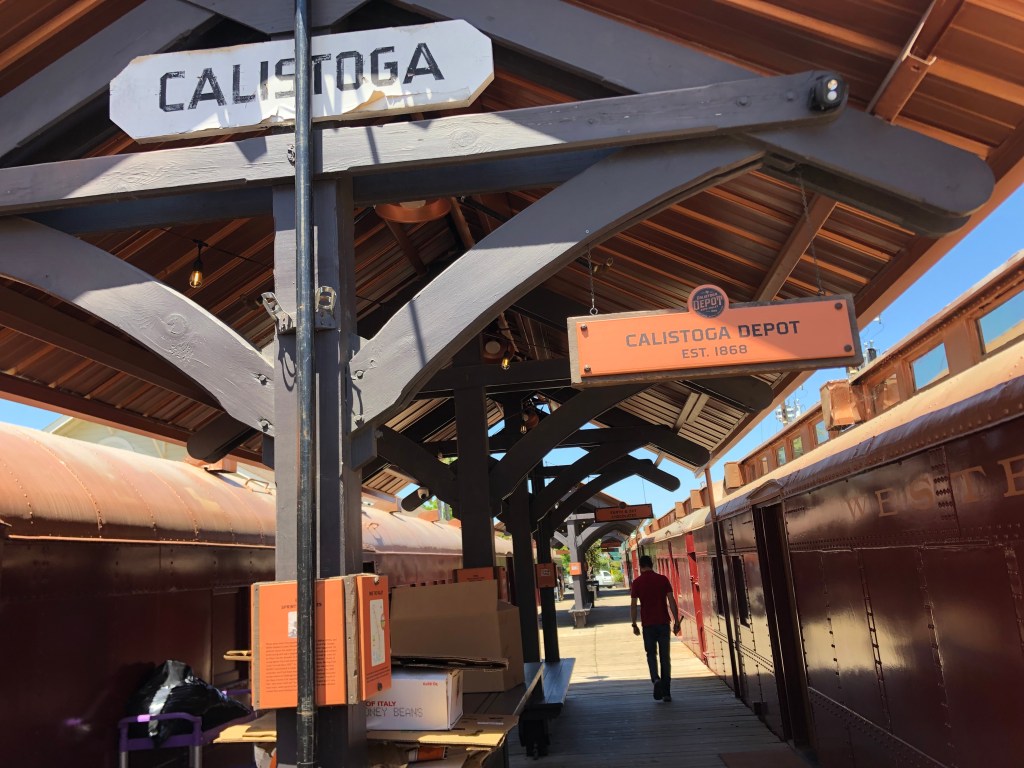
Adding to the ambiance, a half-dozen vintage passenger cars are situated at the station platform. Each car is being used as a restaurant, bar, or boutique. Sadly, the “First Millionaire Saloon” car was closed today.

I got the tickets and a reservation set for two/Luggage waiting on the track/But I got no use for reservations without you/I got to give the tickets back -Lucky Millinder

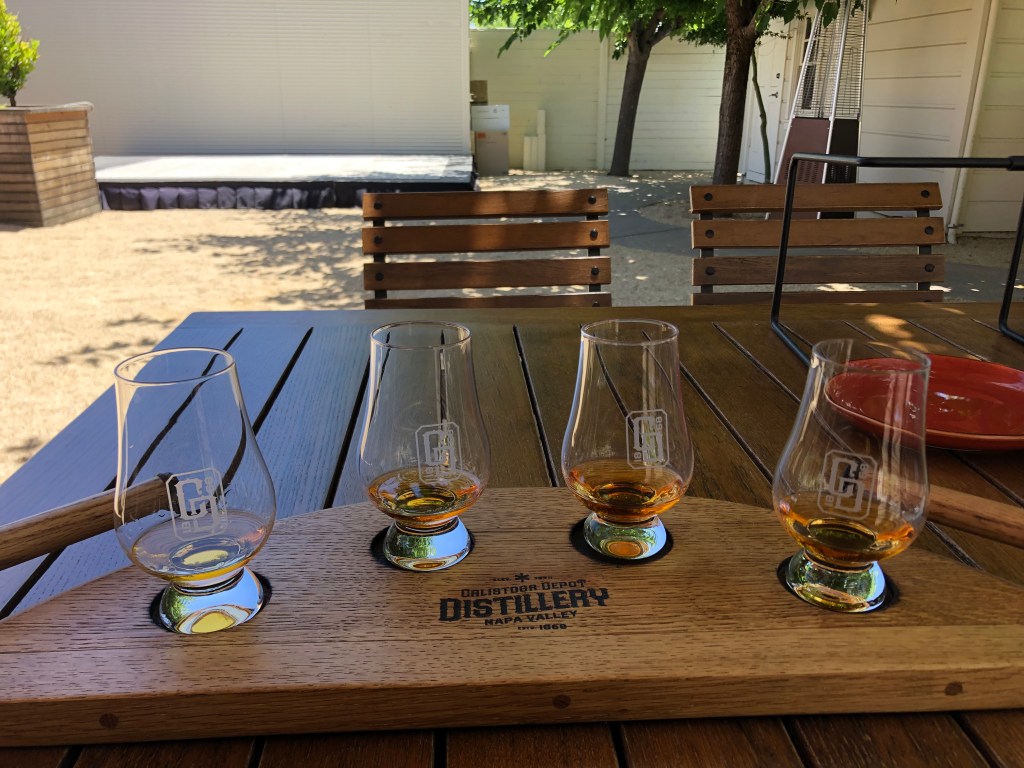
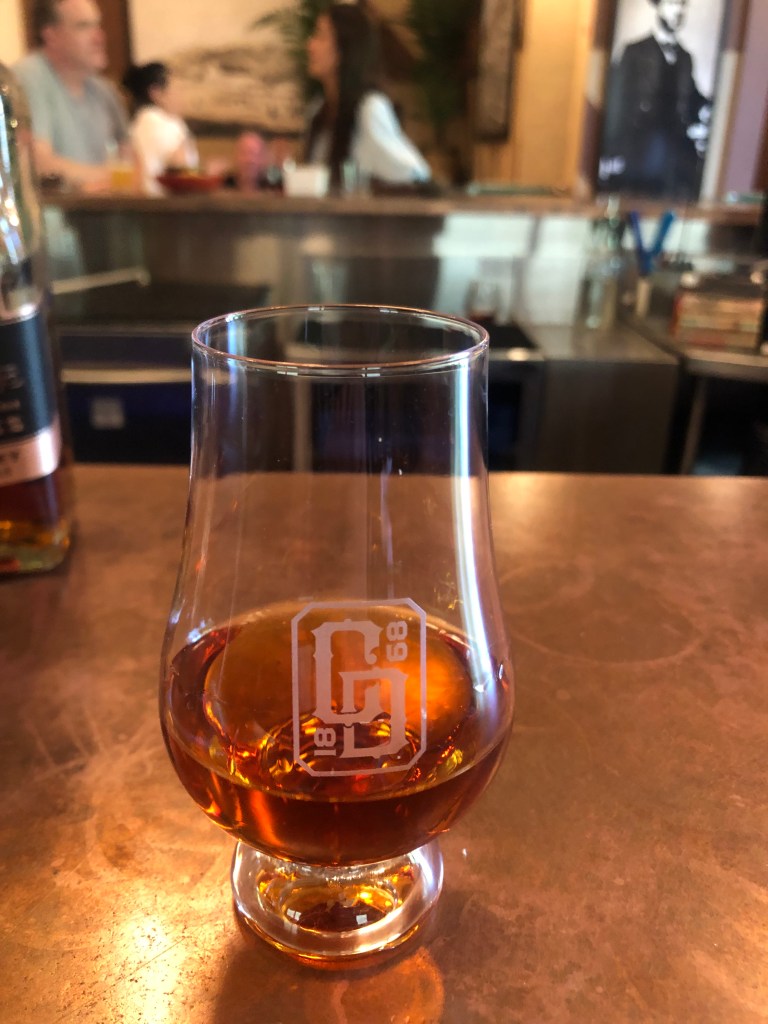
But all was not lost. You can sit anywhere you like on the property–inside a lounge railcar, out in the biergarten, inside the Depot itself–and then you can order whatever you want–drinks, food, dessert. Roaming servers make sure you’re taken care of wherever you choose to sit. I opted for a seat in the biergarten, as the weather was perfect, and had me an awesome wood-fired pizza and a flight of local whiskeys.

Number 2 is my favorite…which we’ll revisit when we get to the BOTD.

Although all the whiskeys are local, none is distilled on site. It seems that the fire risk inside the ancient station is just high. So they work with other local distilleries to create house brands.

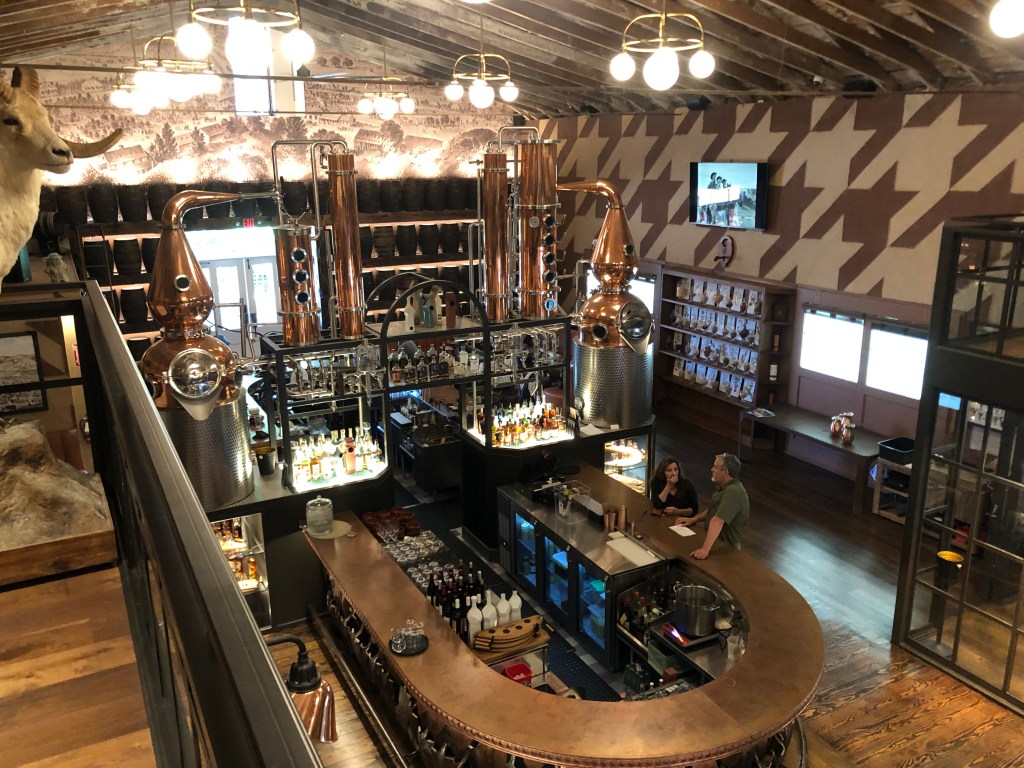
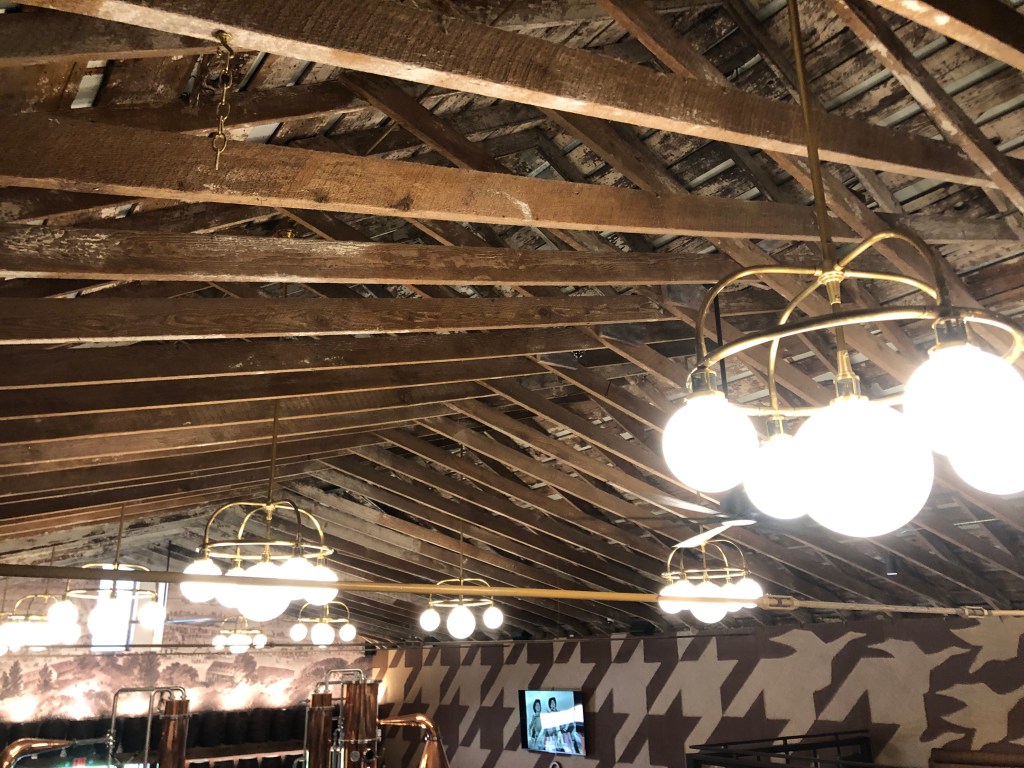
After lunch I moseyed into the Depot building itself. It’s an impressive space, with upstairs seating that looks down on the main bar, taxidermied animals, a regulation pool table, antique chandeliers, historic photos, and various artifacts.

Worthy of California’s first millionaire.
The rafters appear to be original.

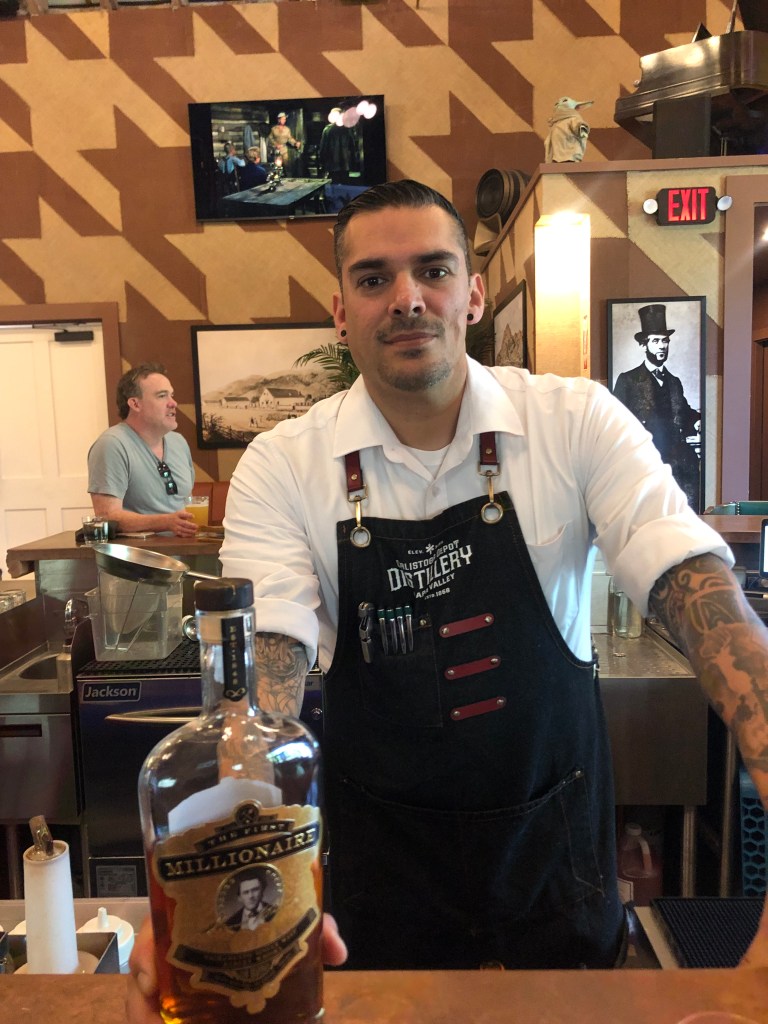
I bellied up to the bar and was served by the estimable Eddie. He’s been here since the (re-)opening, which admittedly was only like two months ago. But still, he’s in for the long haul. He served me a full pour of the second tasting from my flight: The First Millionaire Single-Malt Scotch.

Eddie and a bottle of Sam.

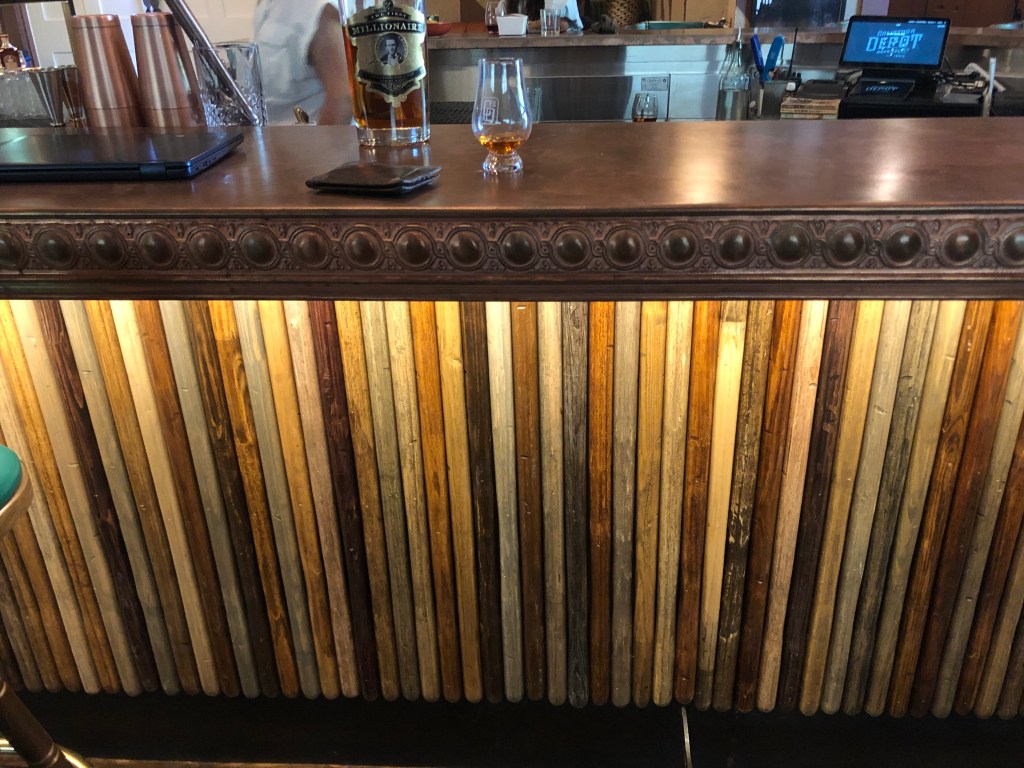
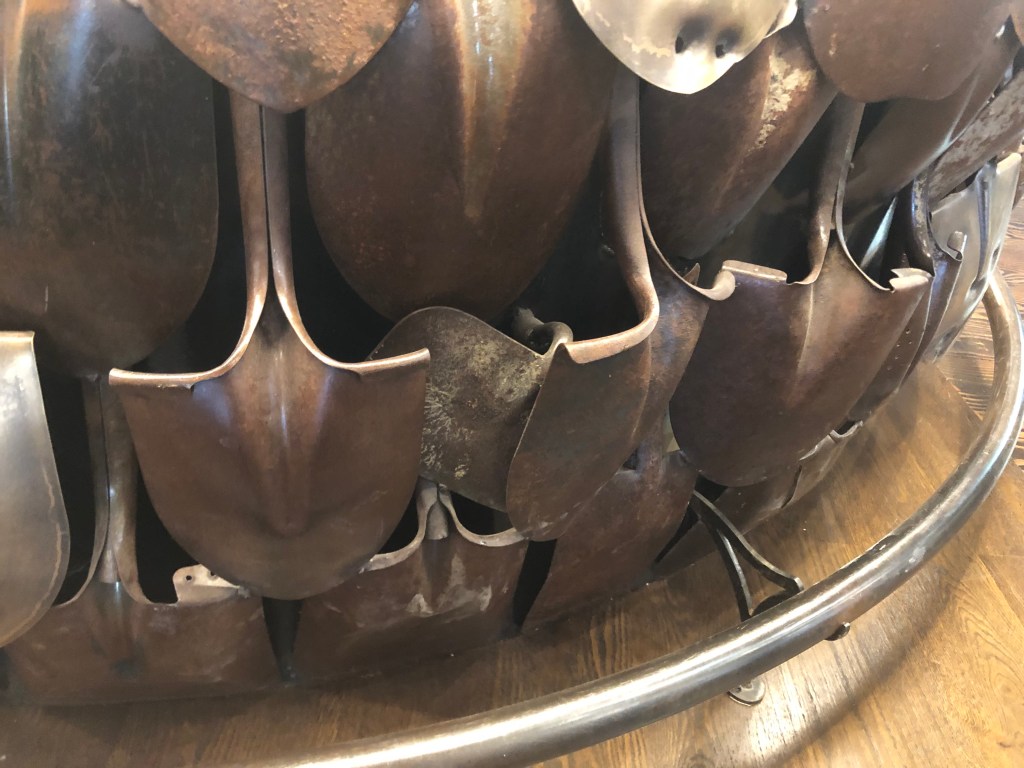
While I enjoyed my Scotch, Eddie pointed out a few features of the bar. Such as the shovel handles lining one end of the bar, and the shovel heads lining the other. Obviously, these are a reference to the tools Sam Brannan sold to the miners at exorbitant prices.

Shovel handles.
One of these things is not like the others….

I’m sure you spotted the irregularity among the shovel heads. Yes, it’s a–ahem–hoe. Eddie informs me it’s a none-too-subtle reference to Lola Montez, who was a famous Bohemian courtesan (among other things). Could she have been a lover to Sam Brannan? Eddie thinks so.

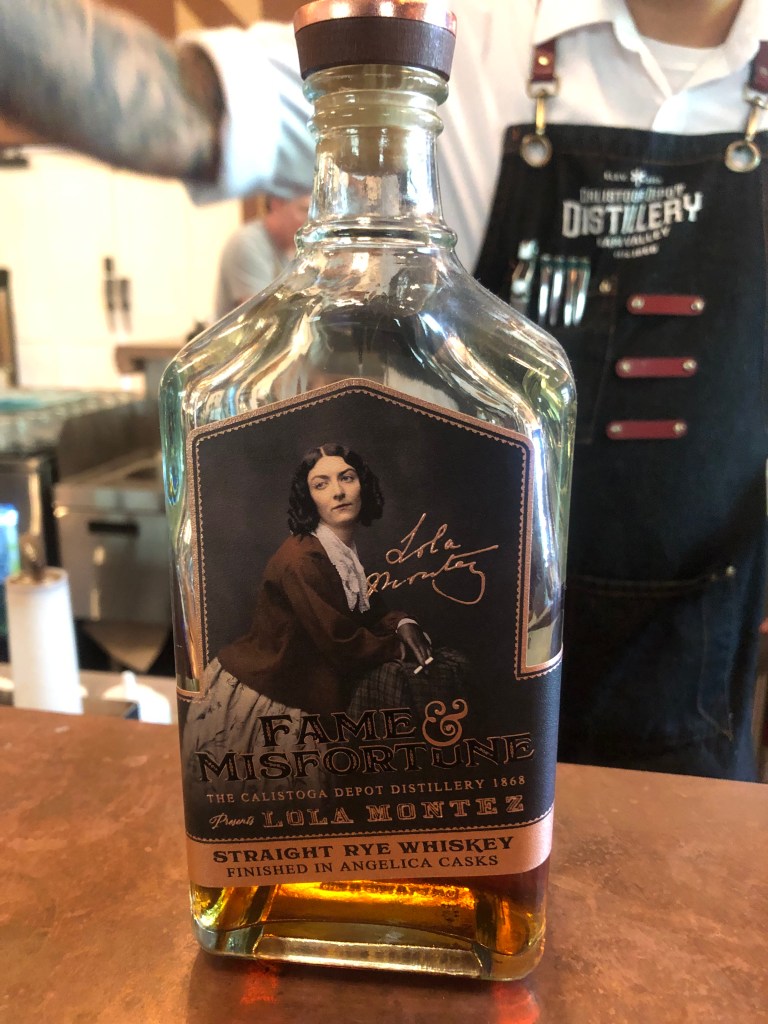
Which leads us to today’s BOTD–which is not a beer, but a rye whiskey. (Let’s call it the “Beverage Of The Day.”) Named “Fame and Misfortune,” it features a picture of Lola Montez.

Yo ho ho and a bottle of Rye.

It’s a straight rye finished in Angelica (brandy) casks. Eddie poured me a healthy two fingers, and we were off to the races.

Now this is a soft and spicy rye. I’ll leave it for others to opine on how that might correlate with its namesake. But this is exceptionally smooth and warm, with no bite. I detect hints of cinnamon, cloves, licorice, and anise. The ABV is a standard 80 proof, which suited me just fine for the lunch hour. I enjoyed it so much I was ready to take a bottle home, but at $150 I found the price (but not the whiskey) hard to swallow. Four stars out of five.

After making my goodbyes to Eddie, I had one more mission: Remember that Sam Brannan had started out in this area with his Hot Springs Resort. It turns out there’s lots of geothermal activity in Calistoga. (It’s not for nothing that Calistoga Mineral Water is based here.) Today, one of the most famous such features is the Old Faithful geyser, which would be my final stop.

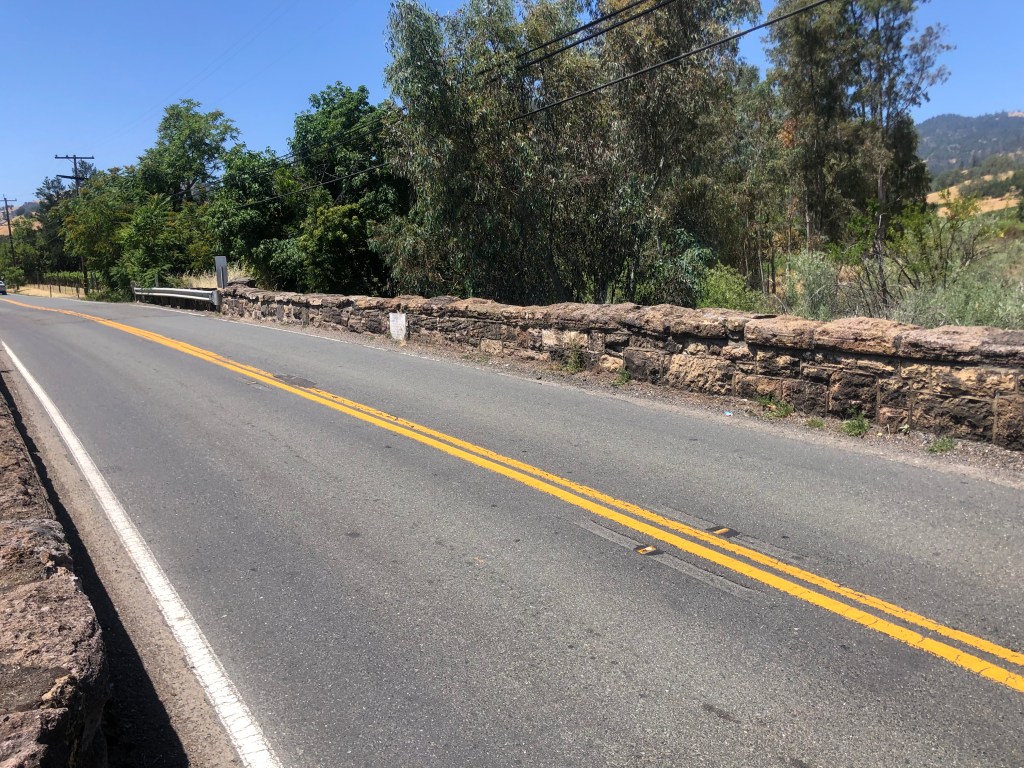
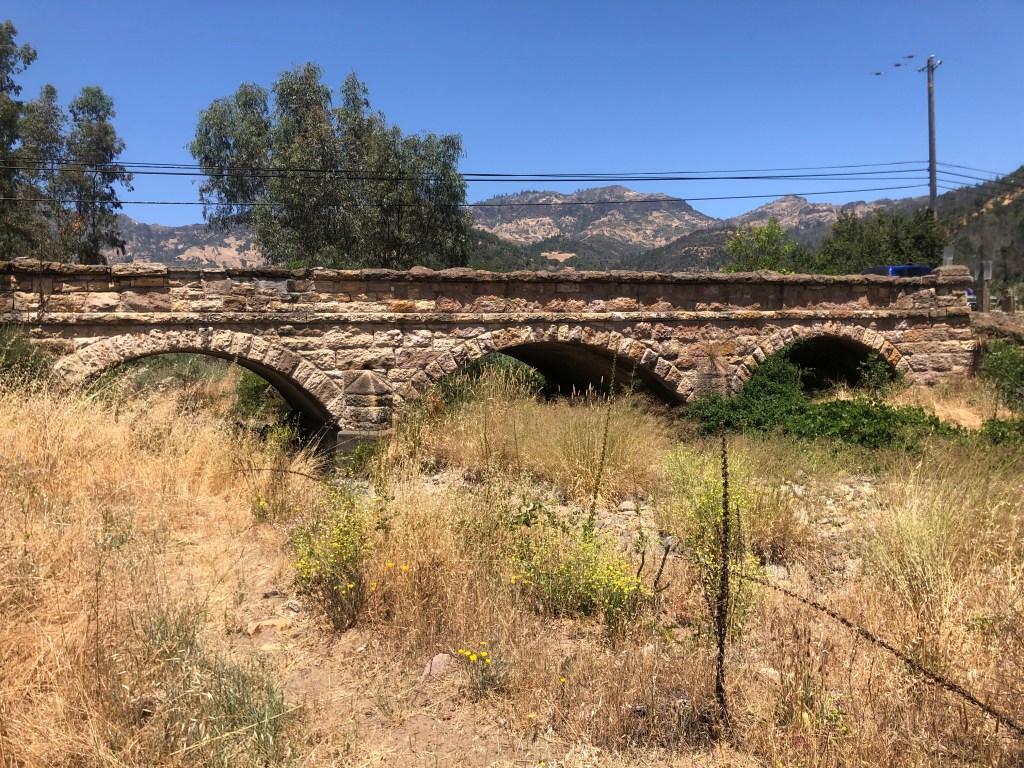
On my way to the geyser I crossed an old (1902) stone bridge over Gannett Creek. I can’t find much in the way of history about the bridge, but she’s a beauty. They just don’t make ’em like this anymore.

Not a whole lot to see from the roadway….
But from the (dry) creekbed, it’s an impressive structure.

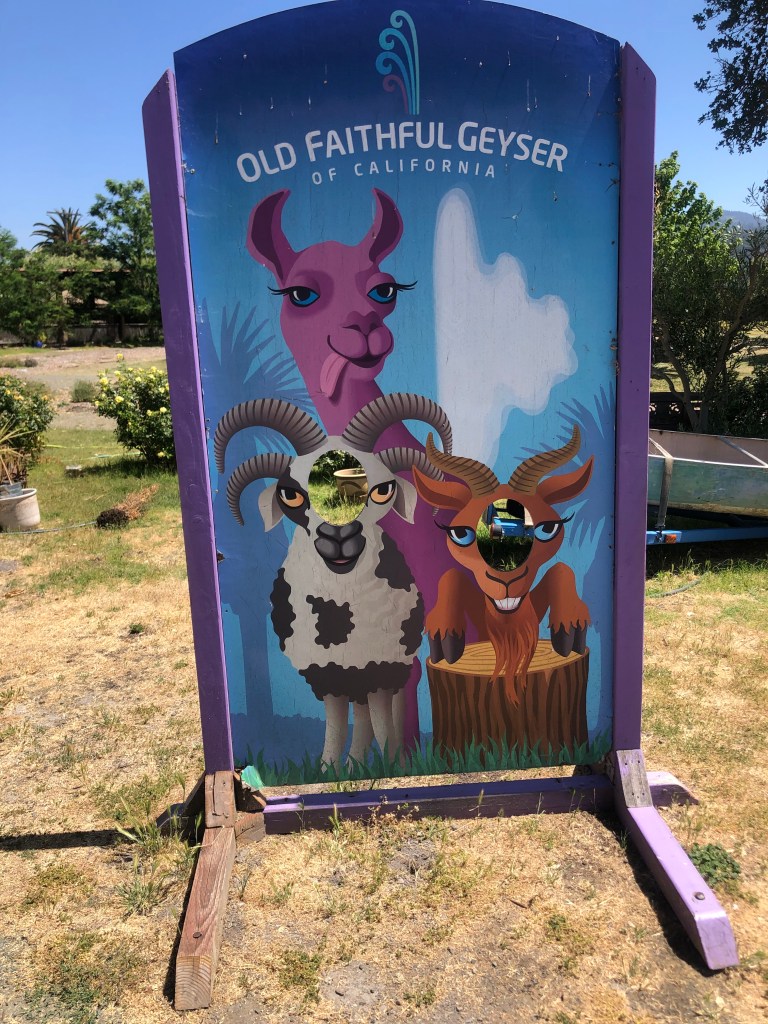
Twenty minutes later I was at Old Faithful. Not to be confused with the geyser in Yellowstone, this one is, well, not quite as faithful. The time between eruptions can be anywhere from 5 minutes to an hour. Today it was about 30 minutes. While I waited, I checked out this photo op:

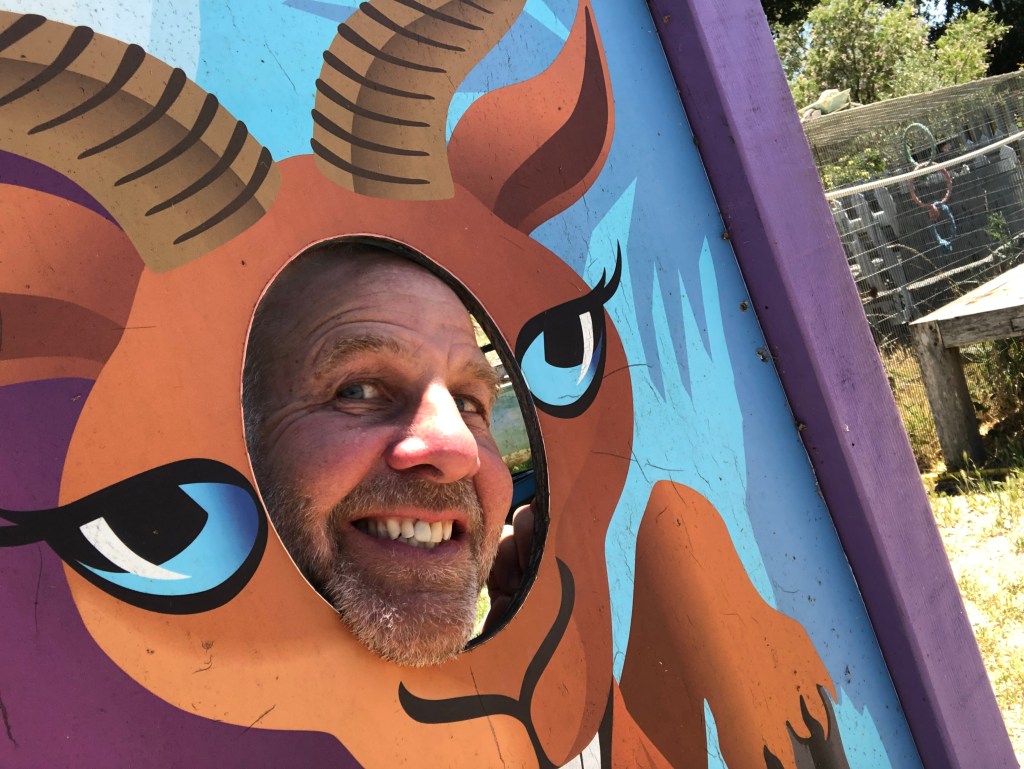
Now, doesn’t it seem odd that the hole for your face isn’t replacing the goat’s face, but just his forehead/nose?

I know what’s going on my Christmas card this year…

Finally, I was rewarded with a spray of 130-degree water that lasted over five minutes. Check out the video:

Near the end it seems to encounter prostate issues. Not that I’d know anything about what that’s like…

And thus concludes my trip to Calistoga. I must say that the Calistoga Depot preserves a worthy slice of California history, not so much because of the short-lived Napa Valley Railroad but because of larger-than-life Sam Brannan. And even those without a huge interest in early California History can enjoy some great food, drink, and hospitality.

Stay tuned for my visit to the oldest railroad station in California, in about two weeks!