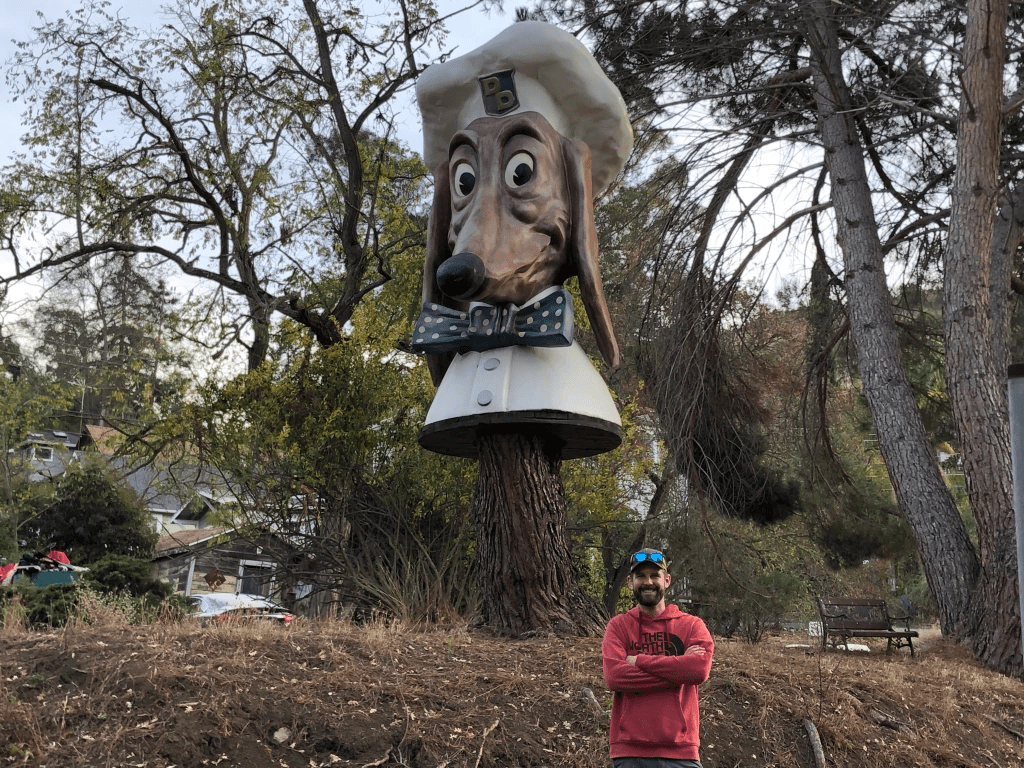
Attentive readers will recall that last November, while in the Bay Area burg of Port Costa (pop: 200), I encountered this dachshund from the long-defunct Doggie Diner chain.
That’s son Ian wearing his sunglasses improperly.
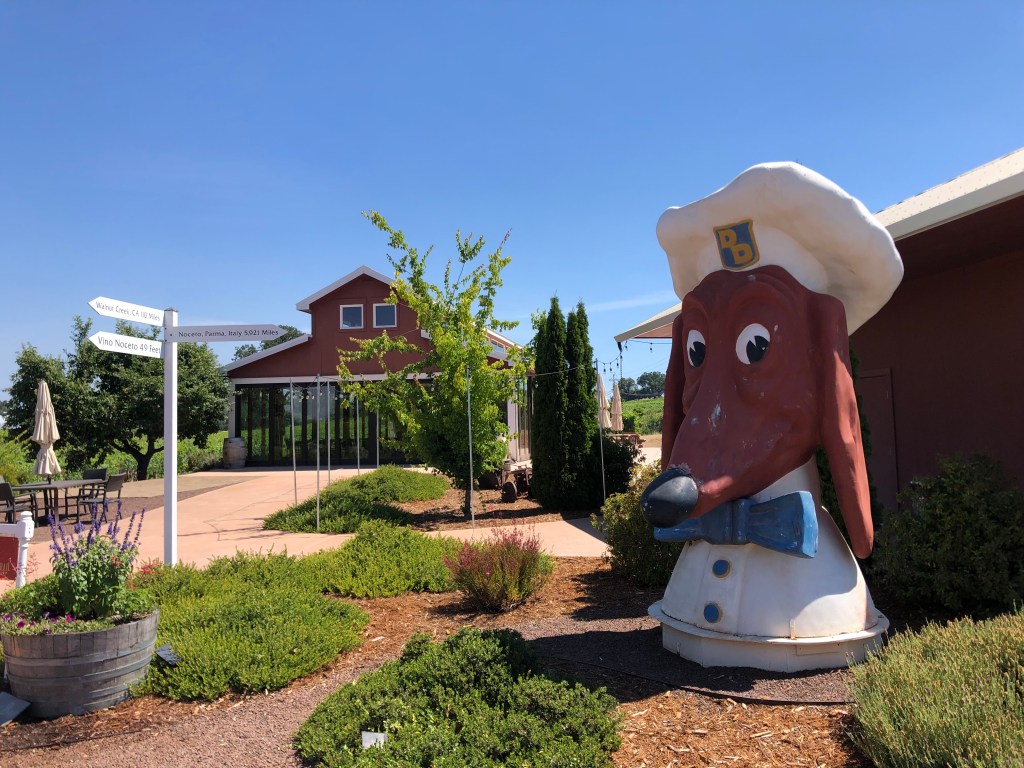
Today as I was cruising CA Route 49 through Amador County, I passed another Doggie Diner head. This one is at the Vino Noceto winery in the town of Plymouth (pop: 1,100).
“Doggie Diner, nothin’ finer.”
The giant heads adorned the 30 or so Doggie Diner restaurants around the Bay Area (concentrated mainly in San Francisco). It seems that when the chain closed in the 1980s, many of the doggie heads were purchased by private parties. The owners of Vino Noceto got theirs in 1985 at a fundraising auction for their kid’s nursery school. On a lark they had offered $300, expecting that surely someone else would outbid them. But theirs was the only bid. Let that be a lesson to you all.
These orphan heads remind me of the Golden Bear signs. I encourage all faithful readers of this blog to report any Doggie Diner Heads you might be aware of. And of course, also let me know of any Golden Bear sightings.
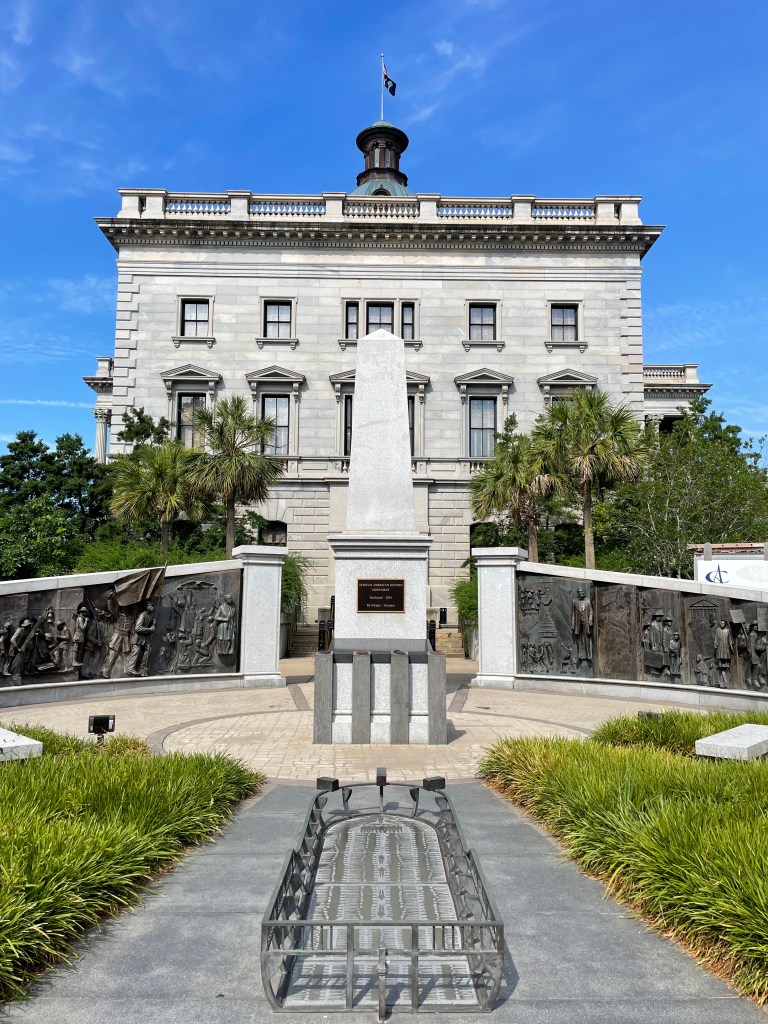
Speaking of crowd-sourced photo collections, loyal reader Brian W shared this photo he took of an obelisk in front of the South Carolina statehouse.
The bronze frieze panels flanking the obelisk depict African American History.
Brian has been commissioned to photograph all the state capitols, which is itself an impressive project. The obelisk is part of the state’s African American History Monument, and was installed in 2001. The artist who designed the monument asserts that obelisk is a form that originated in Africa. Wikipedia tells us that the earliest obelisks come from Egypt, so I guess it depends on whether you consider Egypt to be an African or an Asian country. Either way, the monument is an impressive one and is part of a historic compromise that also removed the Confederate flag from the statehouse building.
That’s it for this brief update. Next week I’ll have the story of California’s oldest operating railroad depot.
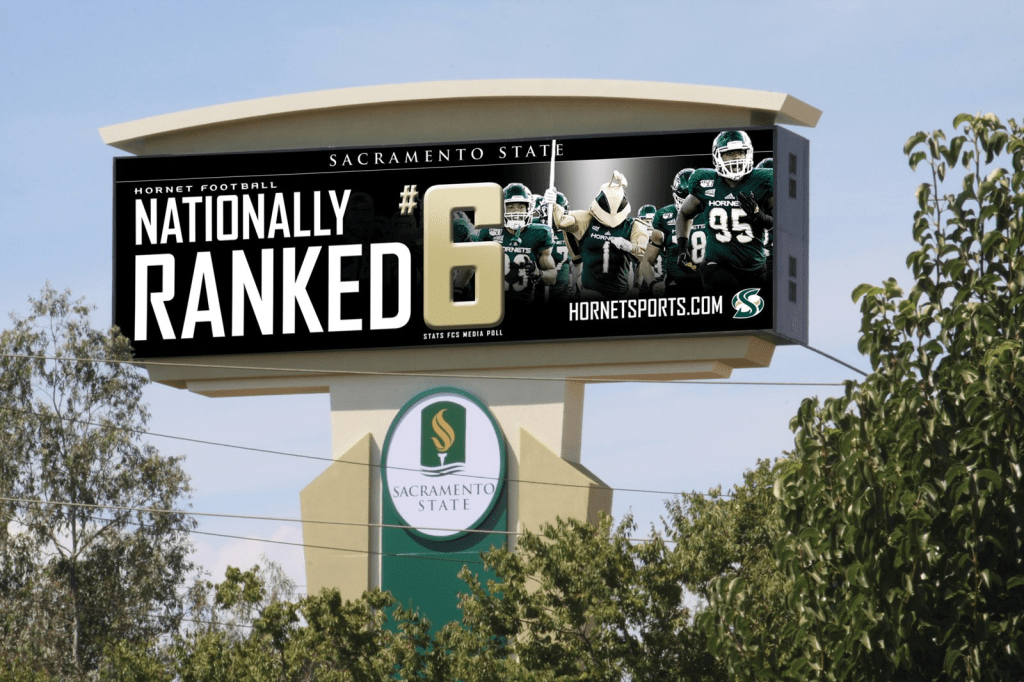
The other day I passed a billboard near Sacramento State University, which touted the campus football team’s Number 6 ranking in a media poll. This of course raises the question: how quickly do bragging rights decay as you move down the list, from first to second to third to fourth….?
A 1966 novelty song (on heavy rotation on Dr. Demento’s radio show while I was growing up) poked fun at this phenomenon. “The Ballad of Irving” sang the praises of the “142nd fastest gun in the West.” My favorite line: “A hundred and forty-one could draw faster than he/ But Irving was looking for one forty-three.” Give it a listen:
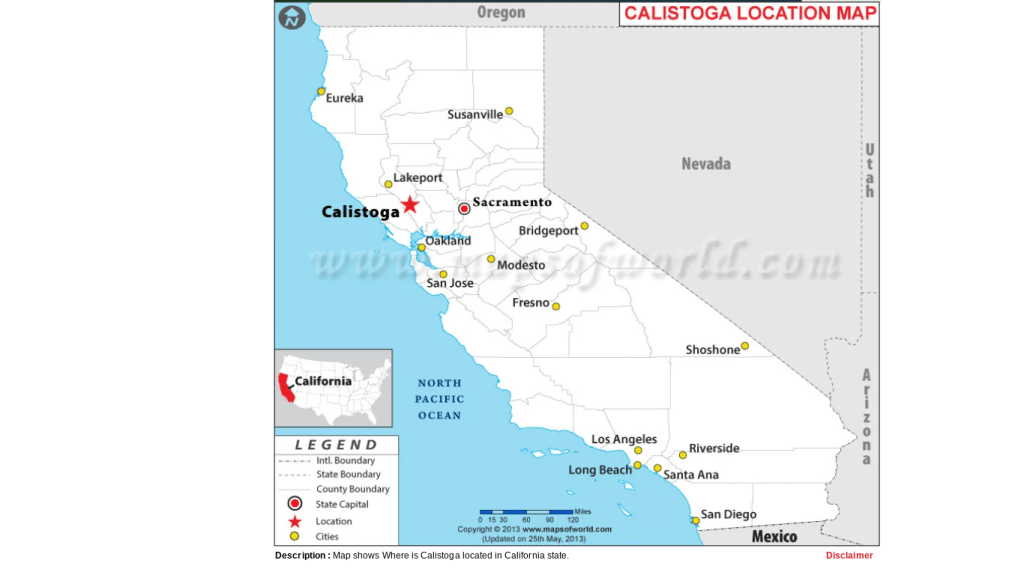
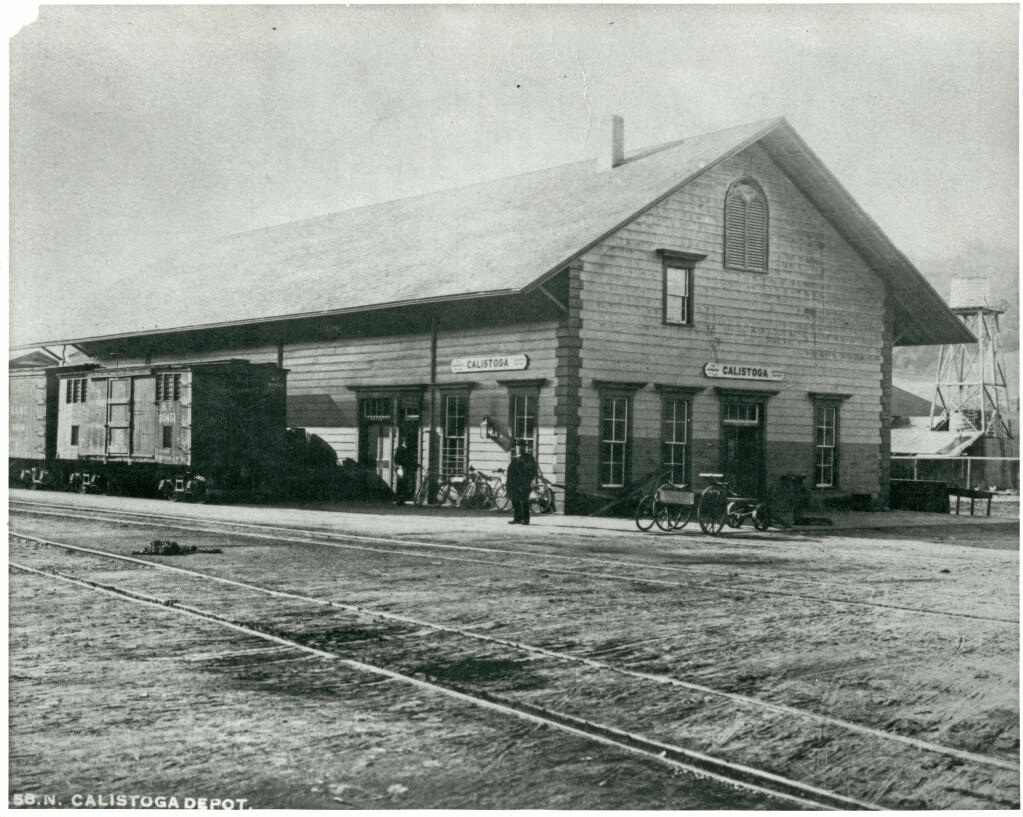
I bring all this up because son Ian called my attention to “the second oldest railroad depot in California.” It’s in Calistoga, in the upper Napa Valley. The depot was built in 1868. (A quick Google search identifies the oldest Depot as Santa Clara Depot, which was constructed in 1863.)
The important thing about the Calistoga Depot is that it held a grand (re-)opening just a couple of months ago, and it’s now repurposed as a microbrewery, distillery, and restaurant venue. Once I learned this I decided it’s obviously time for a road trip. So this morning I set out for Calistoga.
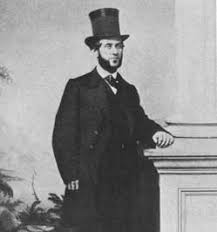
The city of Calistoga (pop: 5,300) was established in the mid-1860s, centered on Sam Brannan’s Hot Springs Resort. Sam Brannan had come to California from New York in 1846, and made his fortune selling gold pans to the miners during the Gold Rush. It should be noted that he first bought all those gold pans and other gear from every supplier in the West, monopolizing the market shortly before the Gold Rush became big news. He sold the equipment at an enormous profit.
Sam Brannan, doing his Honest Abe impersonation.
As a result, Brannan became California’s first millionaire. In addition to building the Resort he co-founded the Napa Valley Railroad. The Calistoga Depot marked the northern terminus of that short line, carrying vacationers from the Bay Area.
End of the Line.
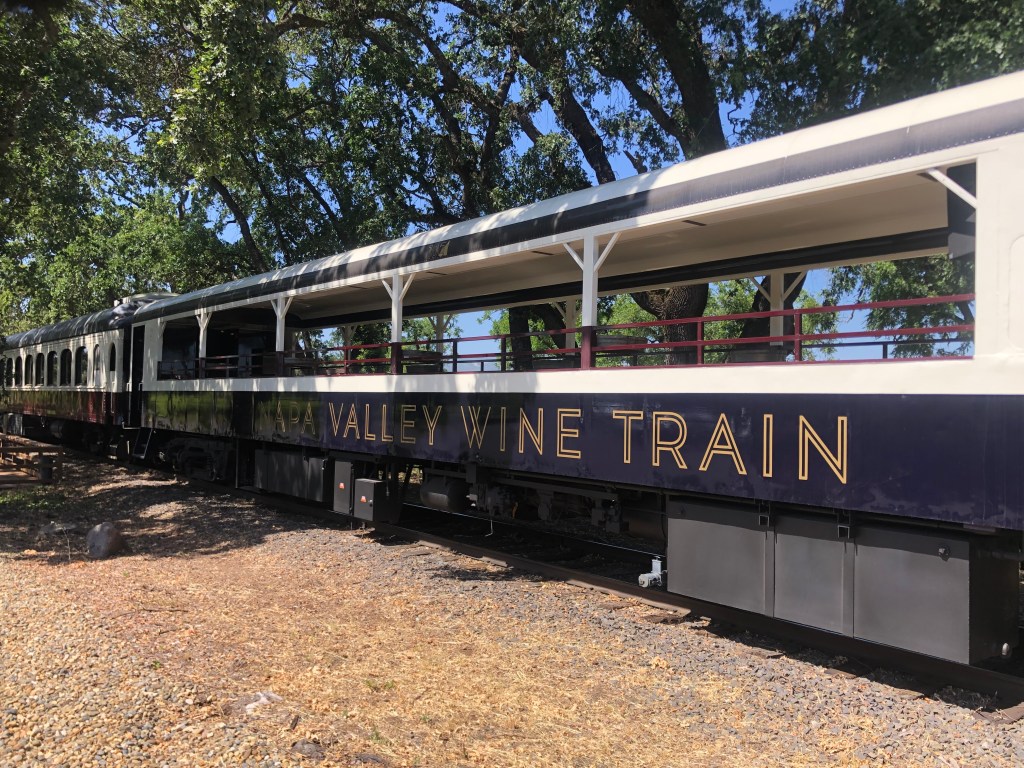
Brannan’s Napa Valley Railroad didn’t last long, and was absorbed by what eventually became the Southern Pacific. SP dropped passenger service along the route in the 1920s, but today trains run again on those rails, in the form of the Napa Valley Wine Train.
The more things change….
Incidentally, the name “Calistoga” is supposedly the result of an unintentional Malapropism. Brannan liked to compare his Hot Springs Resort to the famous Saratoga Springs in his native New York. So at the grand opening of his resort, he intended to say something like “Here’s to the Saratoga of California!” But it came out as “the Calistoga of Sarafornia.” (OK, that’s not exactly a Malapropism. Leave a comment below if you know what specifically this error of speech should be called.)
Paging Mrs. Malaprop…
One other thing about Sam Brannan: He built a distillery that cranked out huge amounts of bandy that, it’s said, rivaled the finest French cognac. All this, as a Mormon leader. The brandy will figure into our story a bit later.
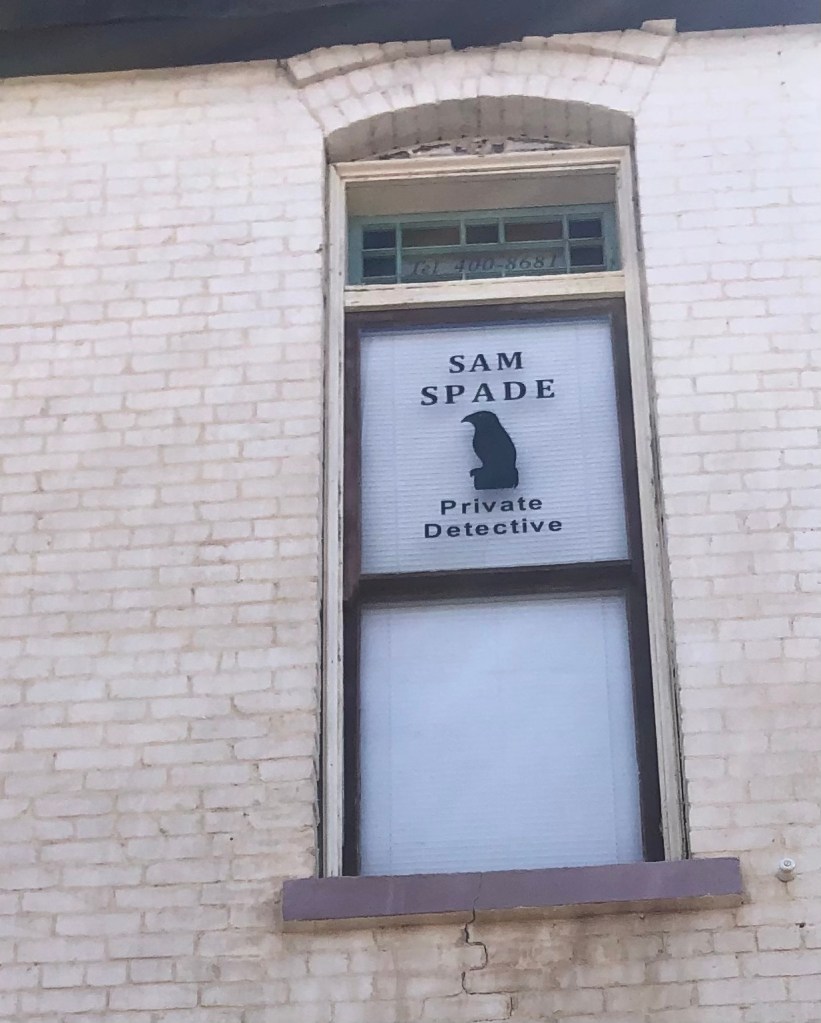
Anyway, as I was saying, I headed out for Calistoga this morning. I took the scenic route roughly paralleling Putah creek westward from Davis. When I stopped for gas in Winters (pop: 7,300) this second-story window of an old office building caught my attention. I guess Sam (Spade, not Brannan) decided to relocate 70 miles eastward from San Francisco sometime after solving the Maltese Falcon caper.
“Don’t be too sure I’m as crooked as I’m supposed to be.” –Sam Spade, in The Maltese Falcon.
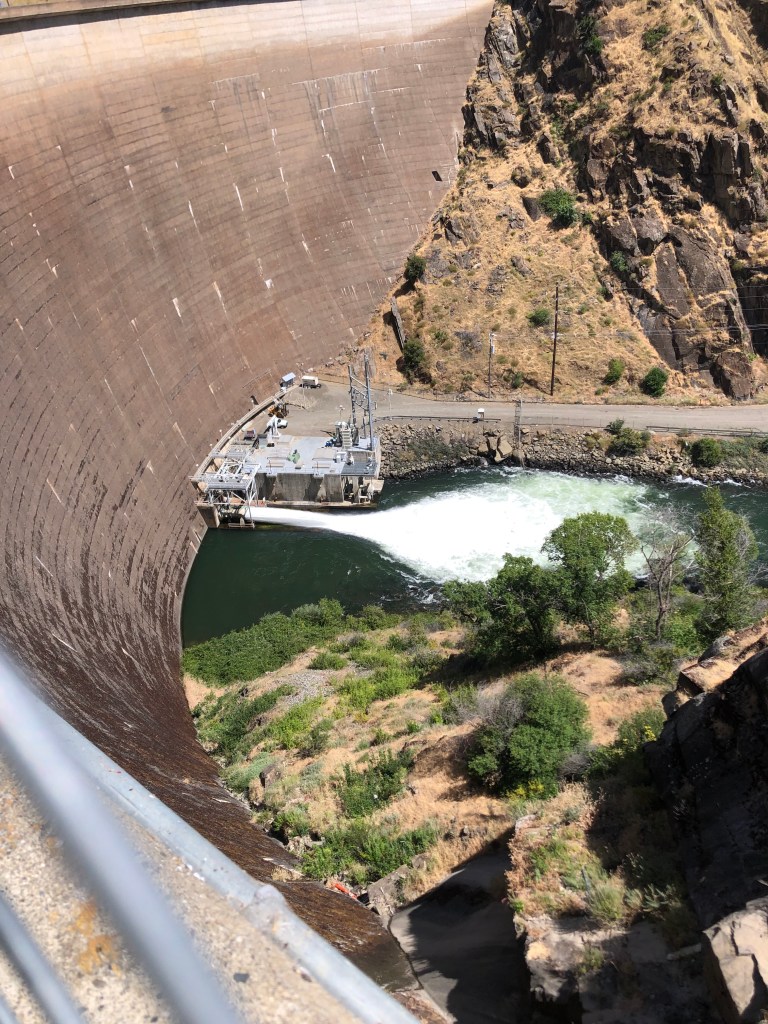
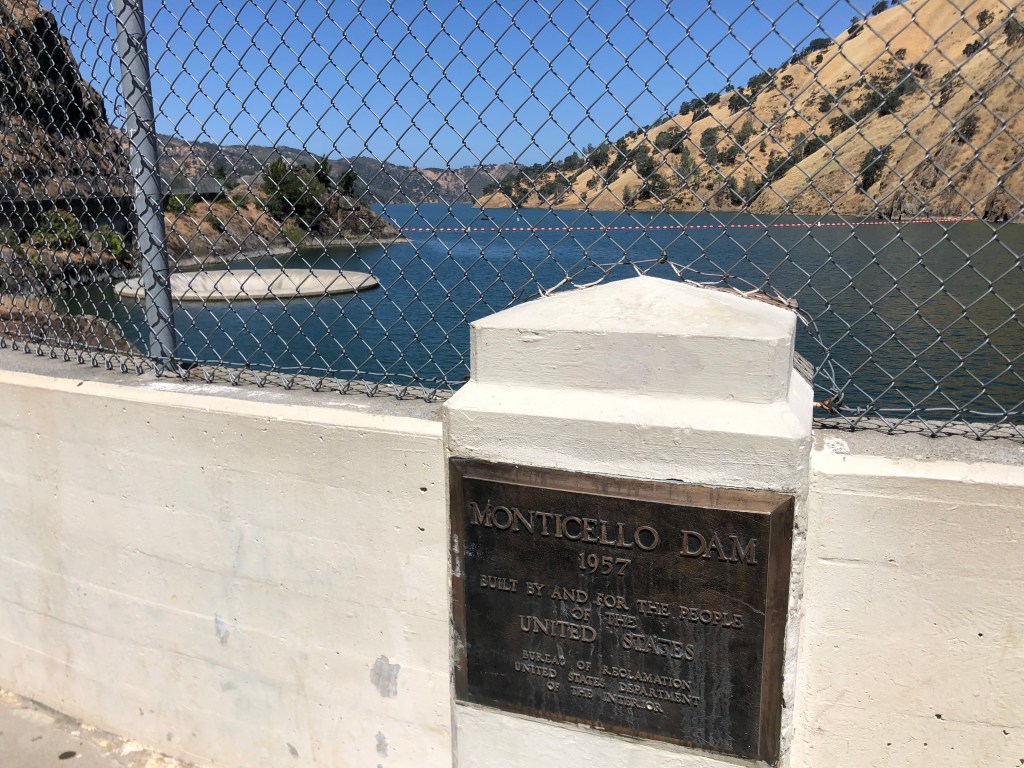
I followed Putah Creek to Monticello Dam, which was built in 1957 as a hydroelectric project that also resulted in Lake Berryessa. (Since we’re focused on rankings, Lake Berryessa is the 7th largest man-made lake in California.) After 65 years, the dam is showing its age, but the lake remains a popular spot for boating.
Looking down at the spillway, where water exits the dam.
Lake Berryessa
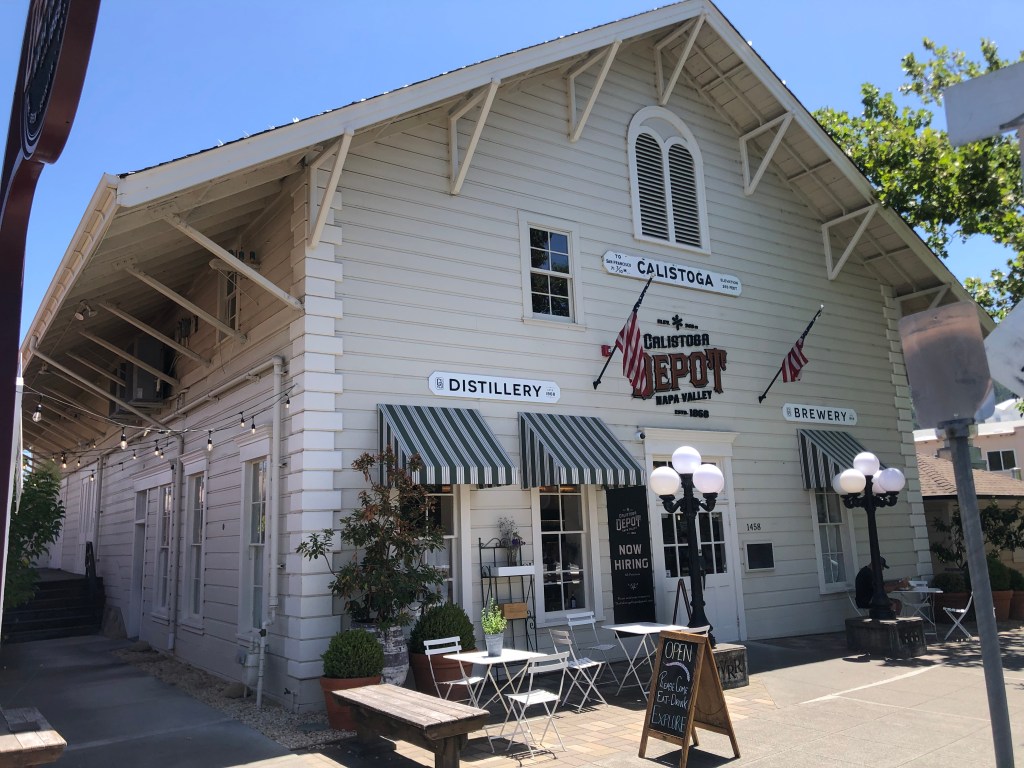
Conveniently, I rolled into Calistoga around lunchtime. And there was the Calistoga Depot, in all its glory. If Monticello Dam is looking a little long in the tooth after 65 years, the Calistoga Depot looks fabulous after more than 150 years.
In fact, it might be a little too fabulous. Over the past few years the property has undergone an extensive renovation and repurposing, to the point that it doesn’t really feel as authentic as some of the dilapidated historic structures I’ve seen on other travels. I fear most of the Depot’s ghosts are long gone. Still, the building’s footprint and outward features are largely as they were in Sam Brannan’s time. Just compare the above photo to the historic photo near the beginning of this post.
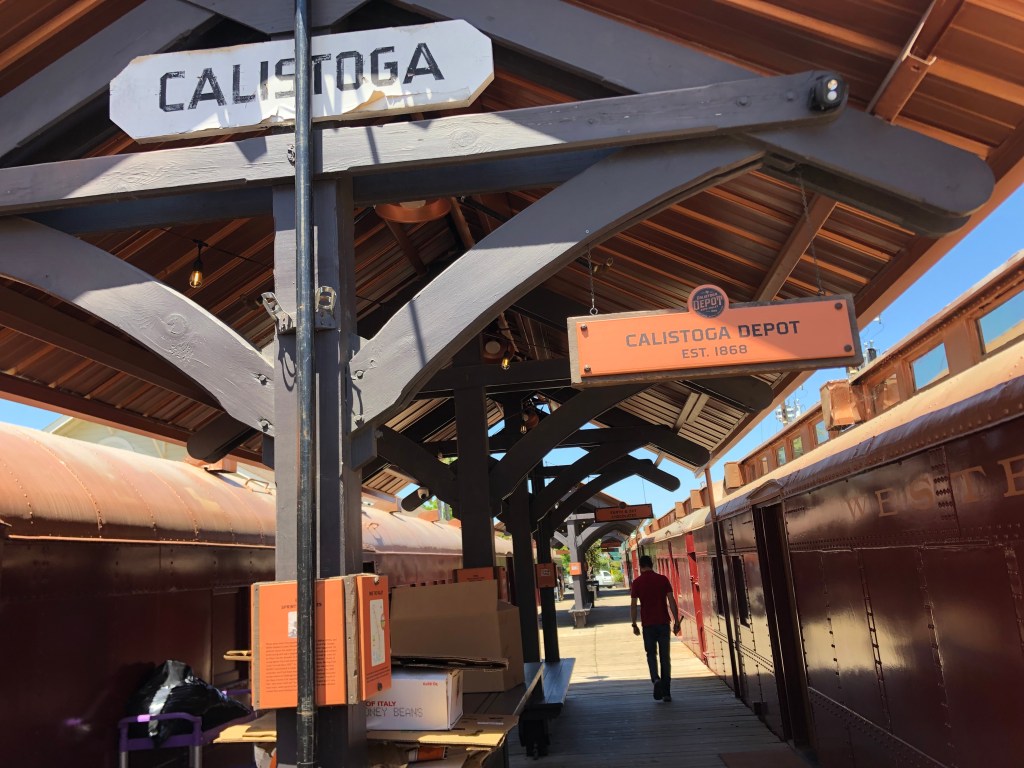
Adding to the ambiance, a half-dozen vintage passenger cars are situated at the station platform. Each car is being used as a restaurant, bar, or boutique. Sadly, the “First Millionaire Saloon” car was closed today.
I got the tickets and a reservation set for two/Luggage waiting on the track/But I got no use for reservations without you/I got to give the tickets back -Lucky Millinder
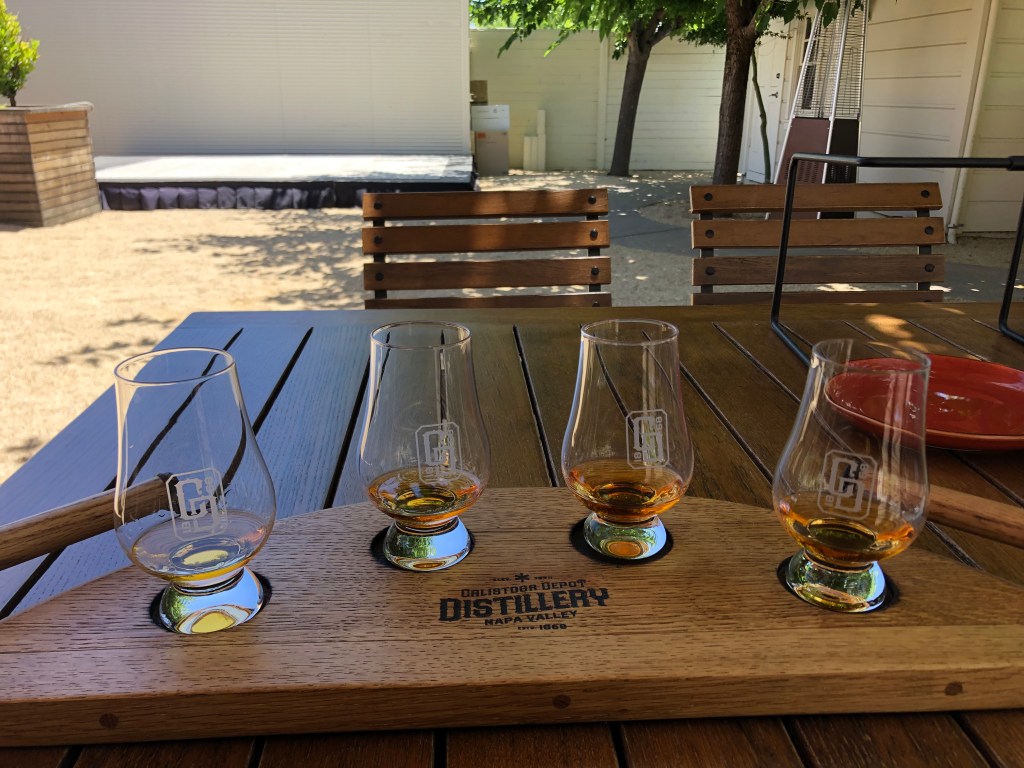
But all was not lost. You can sit anywhere you like on the property–inside a lounge railcar, out in the biergarten, inside the Depot itself–and then you can order whatever you want–drinks, food, dessert. Roaming servers make sure you’re taken care of wherever you choose to sit. I opted for a seat in the biergarten, as the weather was perfect, and had me an awesome wood-fired pizza and a flight of local whiskeys.
Number 2 is my favorite…which we’ll revisit when we get to the BOTD.
Although all the whiskeys are local, none is distilled on site. It seems that the fire risk inside the ancient station is just high. So they work with other local distilleries to create house brands.
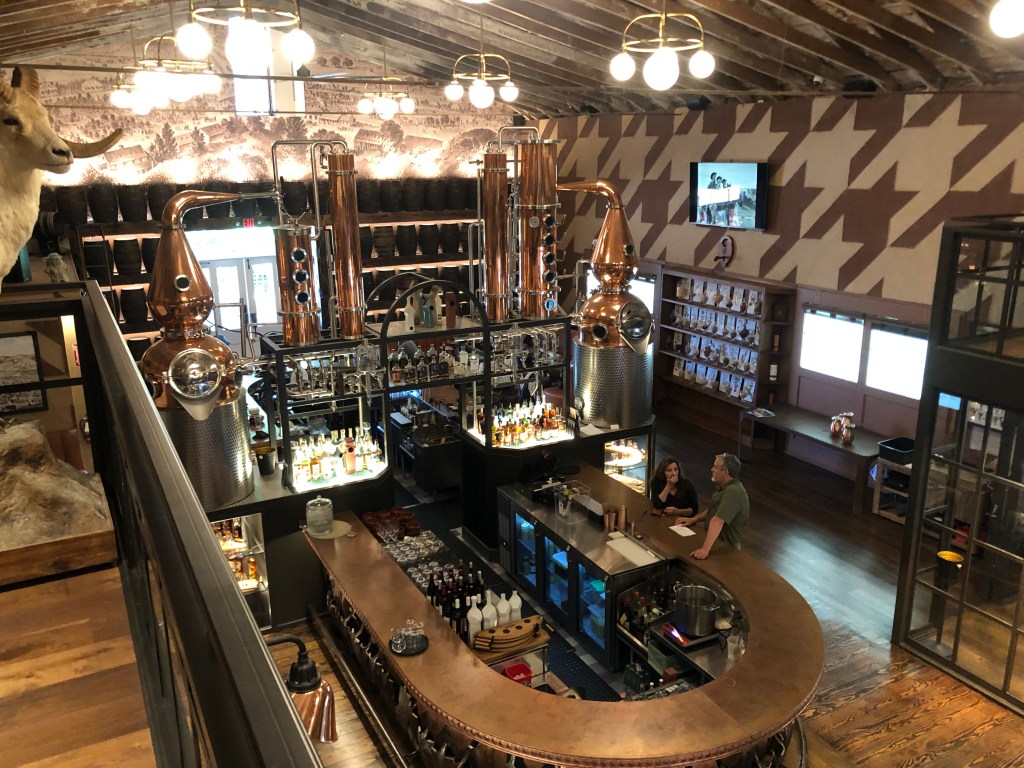
After lunch I moseyed into the Depot building itself. It’s an impressive space, with upstairs seating that looks down on the main bar, taxidermied animals, a regulation pool table, antique chandeliers, historic photos, and various artifacts.
Worthy of California’s first millionaire.
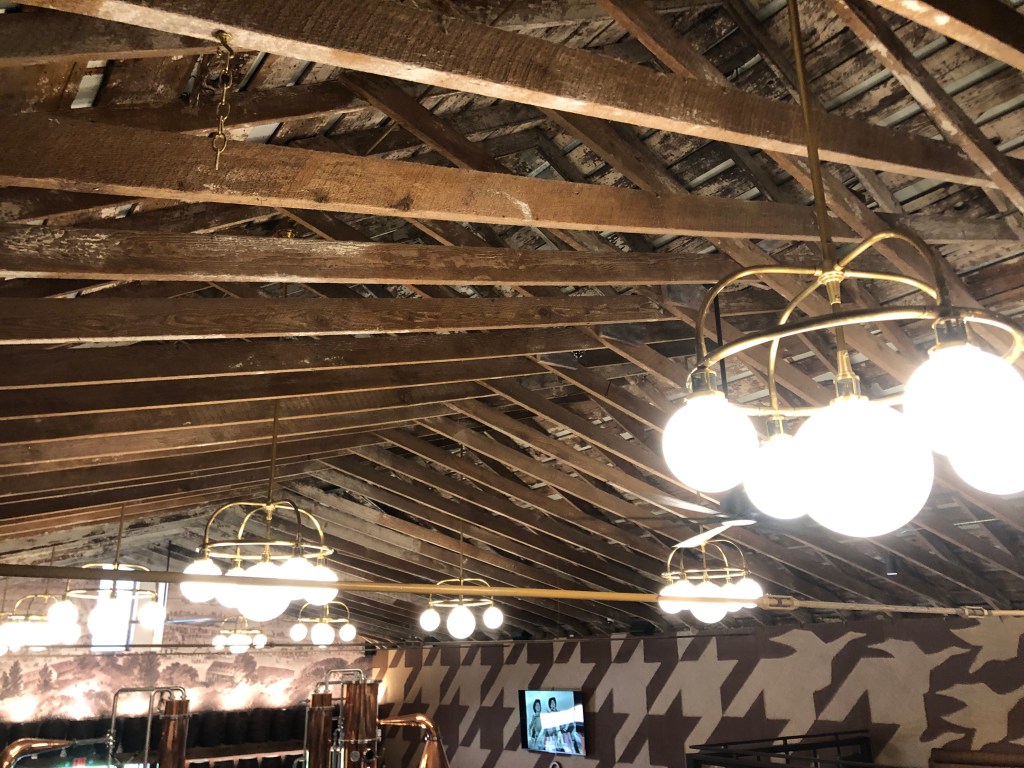
The rafters appear to be original.
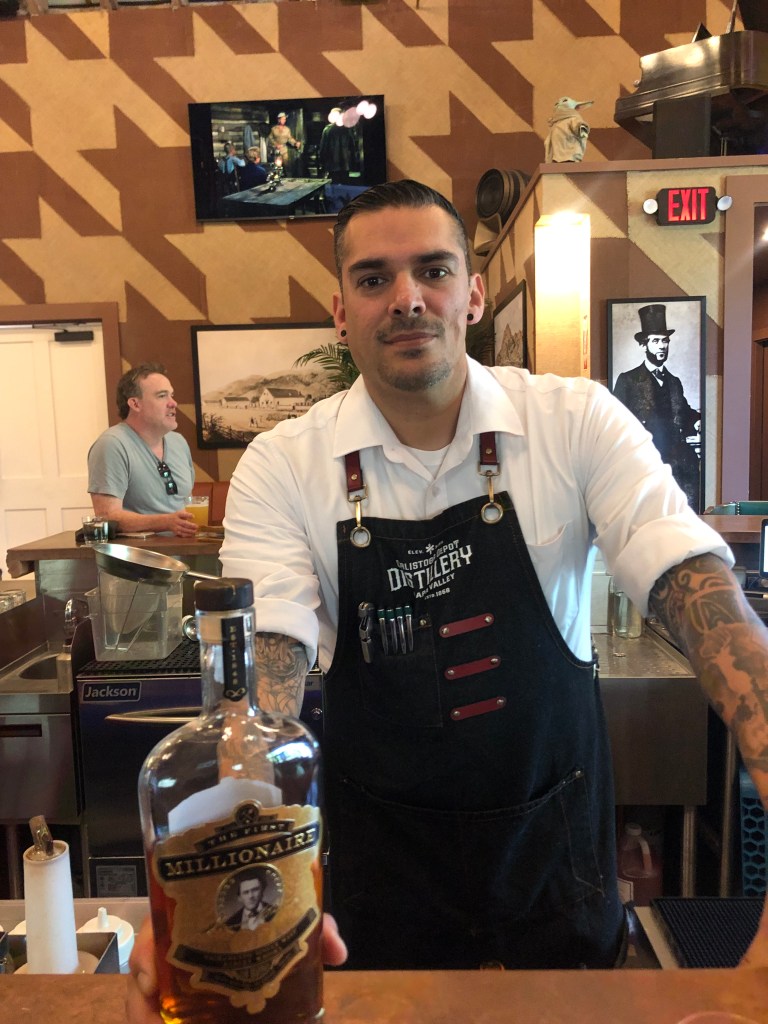
I bellied up to the bar and was served by the estimable Eddie. He’s been here since the (re-)opening, which admittedly was only like two months ago. But still, he’s in for the long haul. He served me a full pour of the second tasting from my flight: The First Millionaire Single-Malt Scotch.
Eddie and a bottle of Sam.
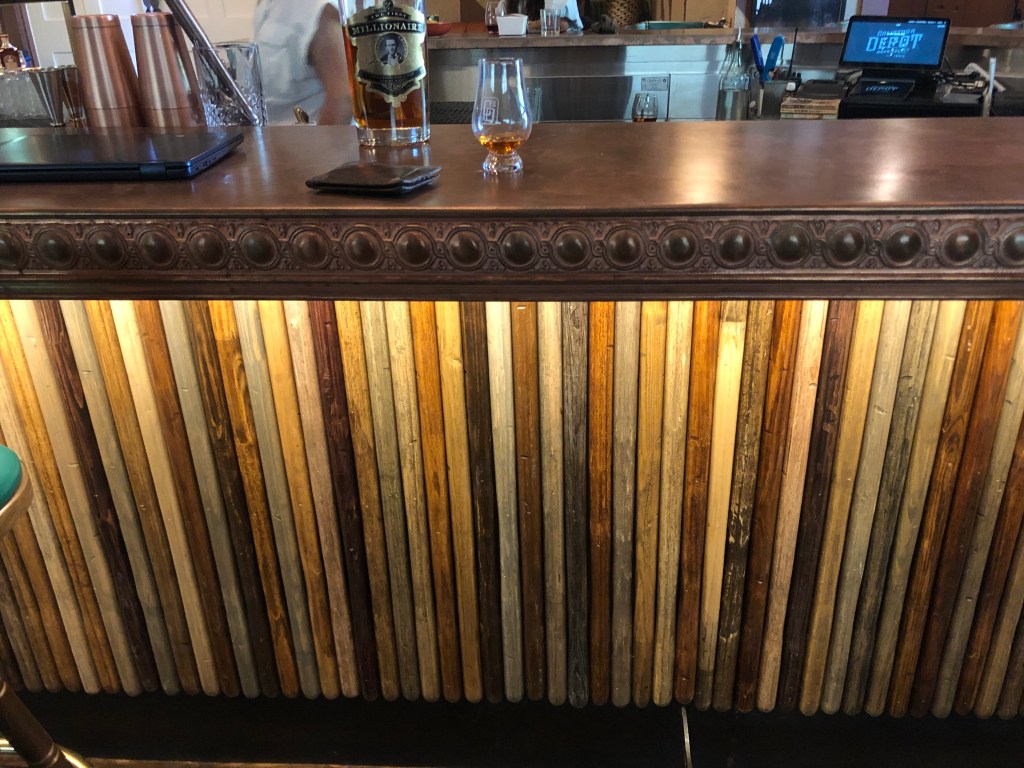
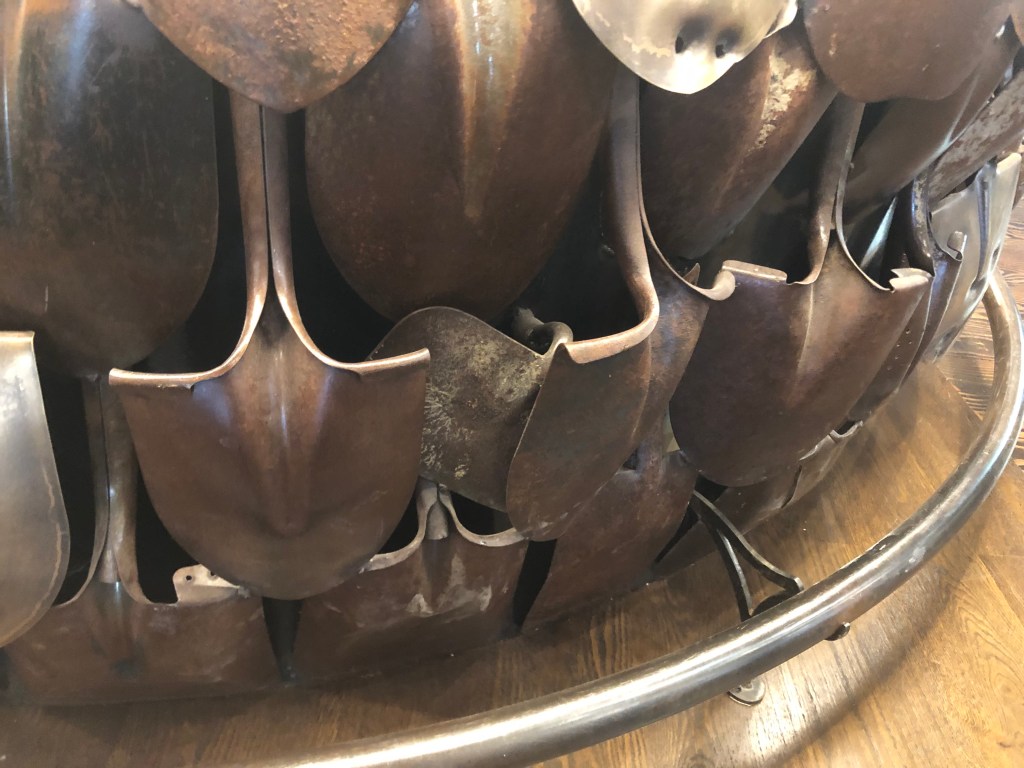
While I enjoyed my Scotch, Eddie pointed out a few features of the bar. Such as the shovel handles lining one end of the bar, and the shovel heads lining the other. Obviously, these are a reference to the tools Sam Brannan sold to the miners at exorbitant prices.
Shovel handles.
One of these things is not like the others….
I’m sure you spotted the irregularity among the shovel heads. Yes, it’s a–ahem–hoe. Eddie informs me it’s a none-too-subtle reference to Lola Montez, who was a famous Bohemian courtesan (among other things). Could she have been a lover to Sam Brannan? Eddie thinks so.
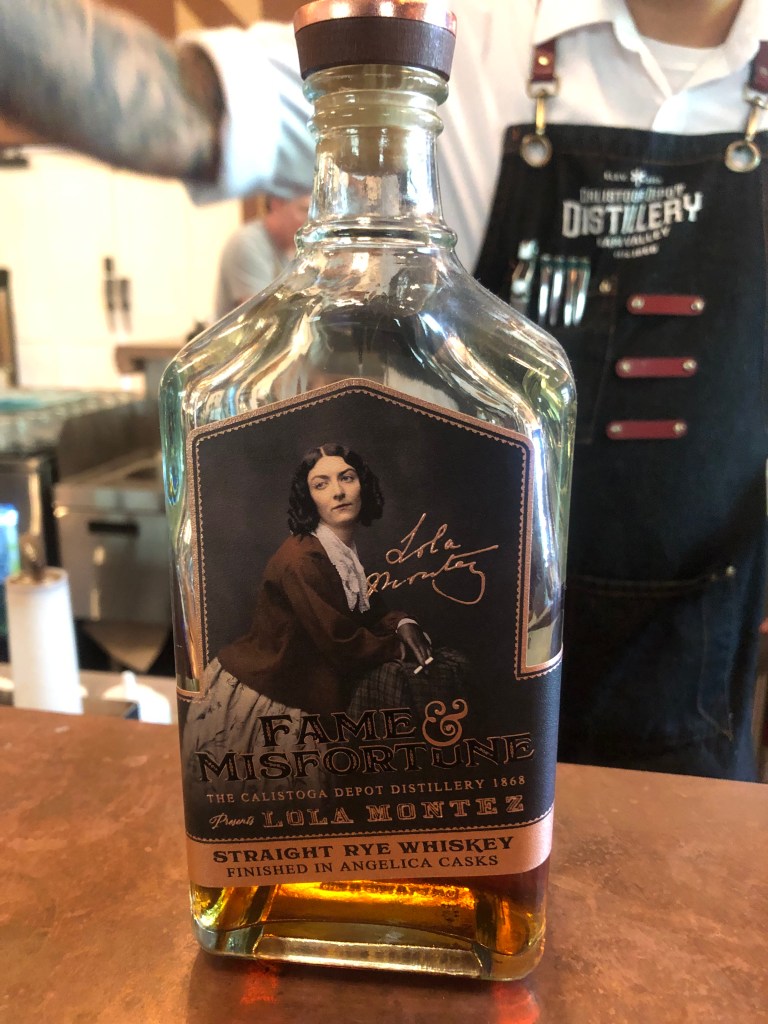
Which leads us to today’s BOTD–which is not a beer, but a rye whiskey. (Let’s call it the “Beverage Of The Day.”) Named “Fame and Misfortune,” it features a picture of Lola Montez.
Yo ho ho and a bottle of Rye.
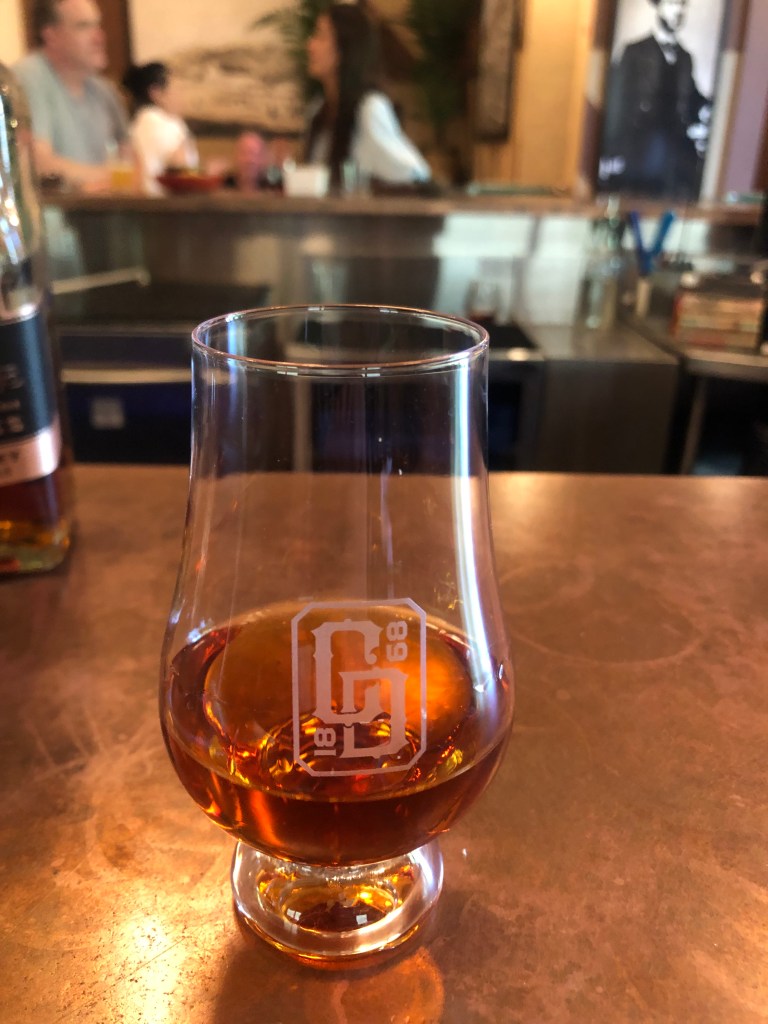
It’s a straight rye finished in Angelica (brandy) casks. Eddie poured me a healthy two fingers, and we were off to the races.
Now this is a soft and spicy rye. I’ll leave it for others to opine on how that might correlate with its namesake. But this is exceptionally smooth and warm, with no bite. I detect hints of cinnamon, cloves, licorice, and anise. The ABV is a standard 80 proof, which suited me just fine for the lunch hour. I enjoyed it so much I was ready to take a bottle home, but at $150 I found the price (but not the whiskey) hard to swallow. Four stars out of five.
After making my goodbyes to Eddie, I had one more mission: Remember that Sam Brannan had started out in this area with his Hot Springs Resort. It turns out there’s lots of geothermal activity in Calistoga. (It’s not for nothing that Calistoga Mineral Water is based here.) Today, one of the most famous such features is the Old Faithful geyser, which would be my final stop.
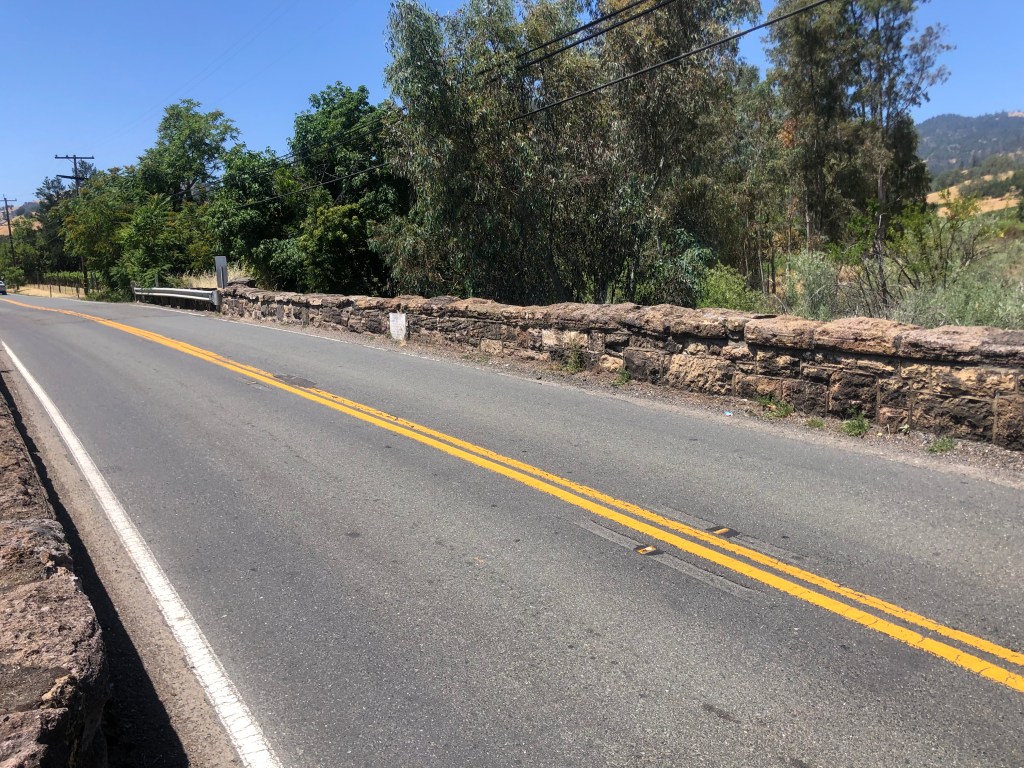
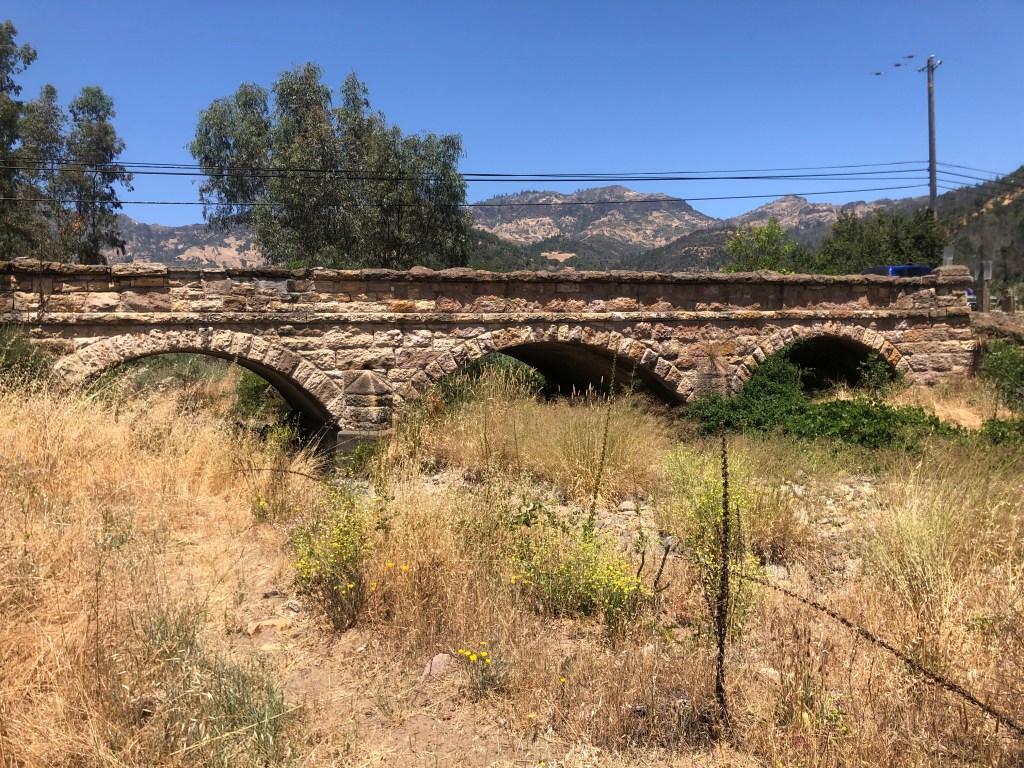
On my way to the geyser I crossed an old (1902) stone bridge over Gannett Creek. I can’t find much in the way of history about the bridge, but she’s a beauty. They just don’t make ’em like this anymore.
Not a whole lot to see from the roadway….
But from the (dry) creekbed, it’s an impressive structure.
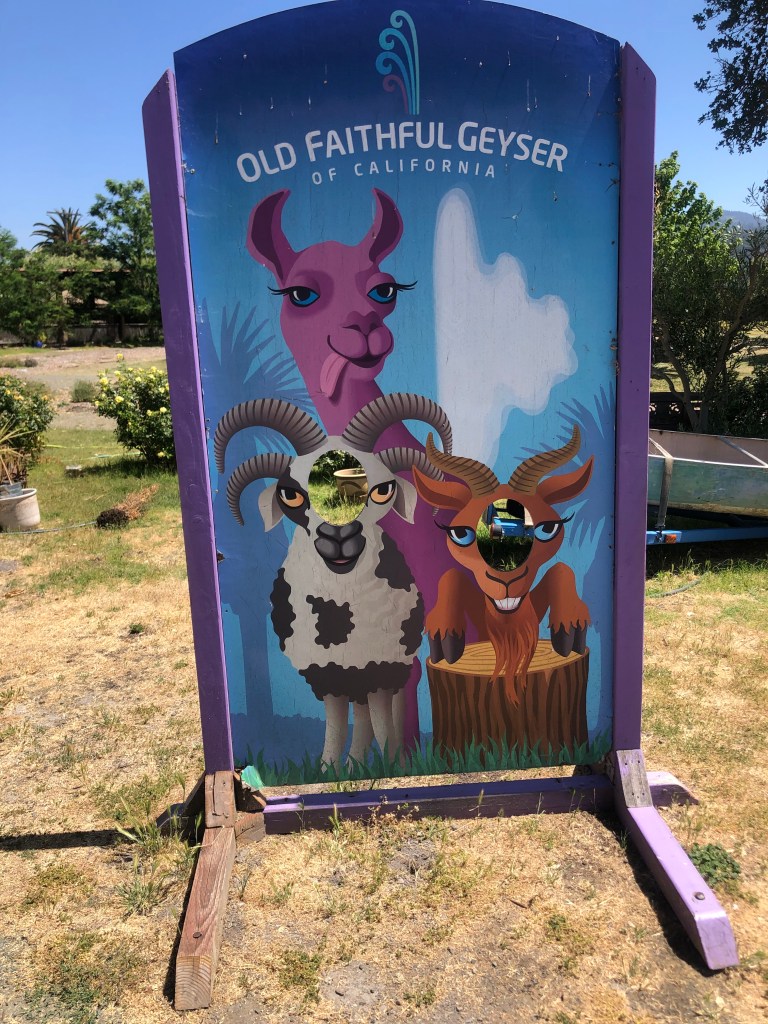
Twenty minutes later I was at Old Faithful. Not to be confused with the geyser in Yellowstone, this one is, well, not quite as faithful. The time between eruptions can be anywhere from 5 minutes to an hour. Today it was about 30 minutes. While I waited, I checked out this photo op:
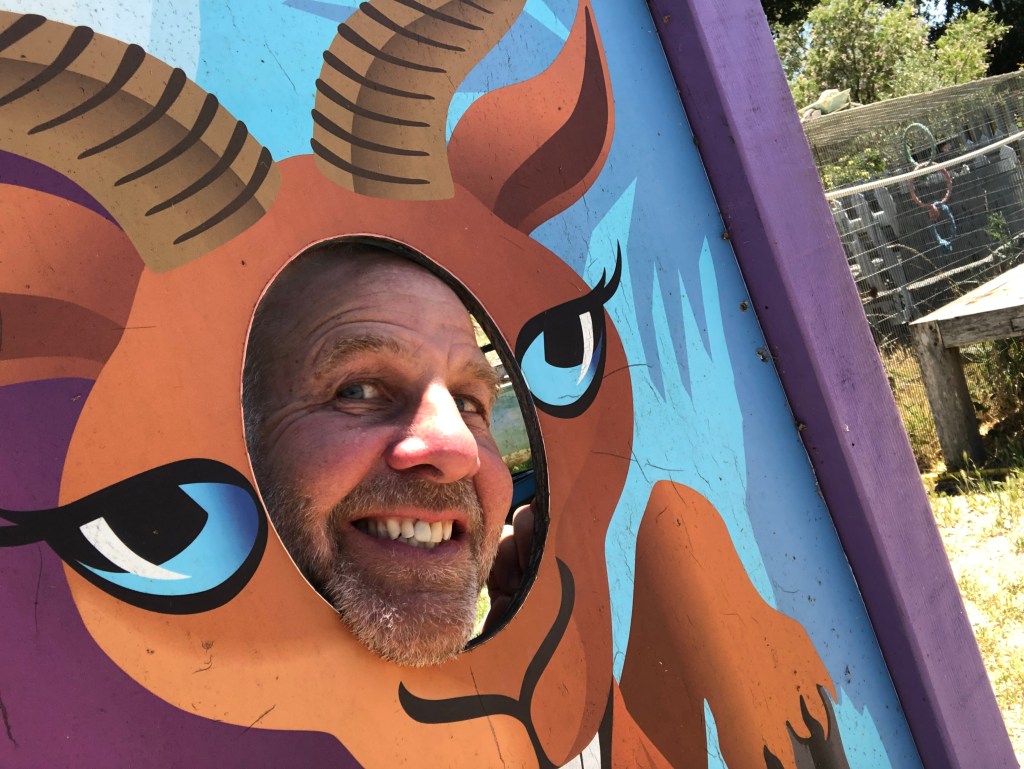
Now, doesn’t it seem odd that the hole for your face isn’t replacing the goat’s face, but just his forehead/nose?
I know what’s going on my Christmas card this year…
Finally, I was rewarded with a spray of 130-degree water that lasted over five minutes. Check out the video:
Near the end it seems to encounter prostate issues. Not that I’d know anything about what that’s like…
And thus concludes my trip to Calistoga. I must say that the Calistoga Depot preserves a worthy slice of California history, not so much because of the short-lived Napa Valley Railroad but because of larger-than-life Sam Brannan. And even those without a huge interest in early California History can enjoy some great food, drink, and hospitality.
Stay tuned for my visit to the oldest railroad station in California, in about two weeks!
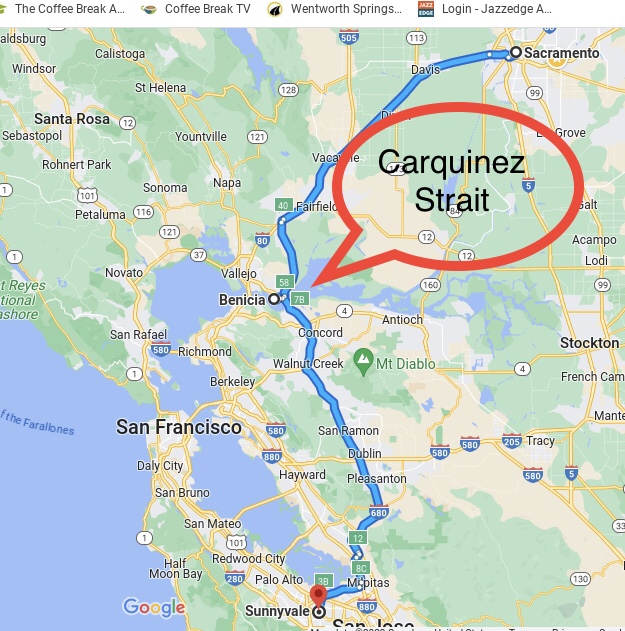
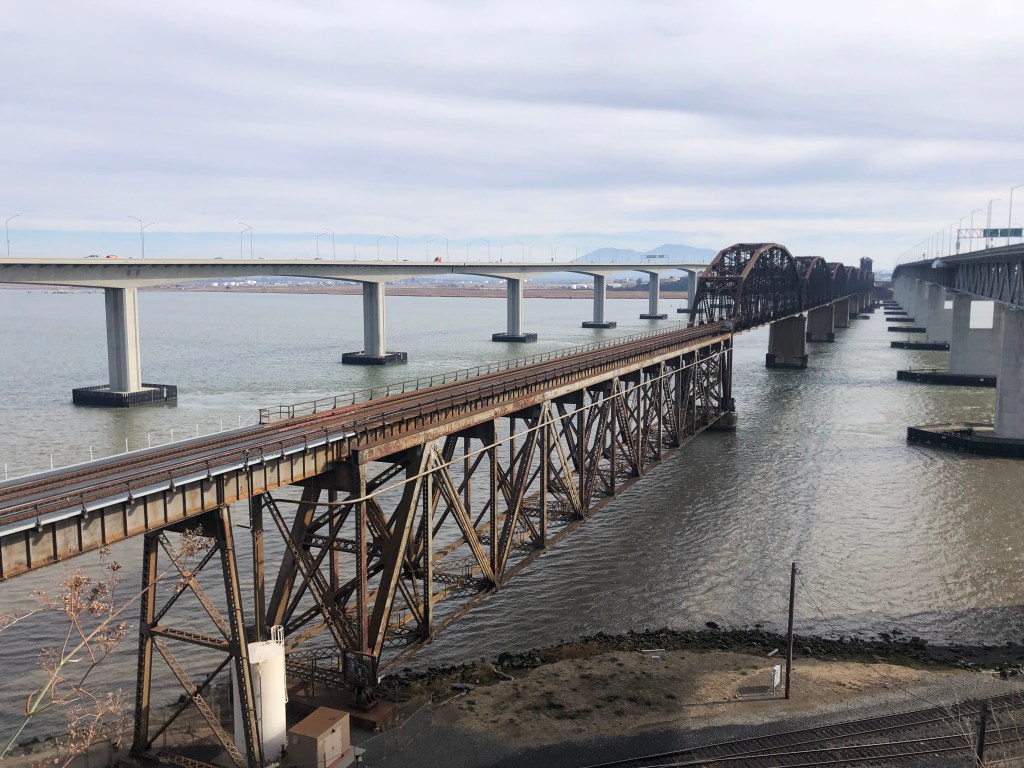
Eons ago, when I finished college, I moved to Sacramento, and in the succeeding years I made many weekend trips back to the familial homestead in Sunnyvale. The trip required crossing the Carquinez strait on the Benicia-Martinez Bridge. In those days, the bridge had traffic going in both directions, but in 2007 a second bridge was opened and each of the two bridges was henceforth devoted to traffic in a single direction.
My overland trail.
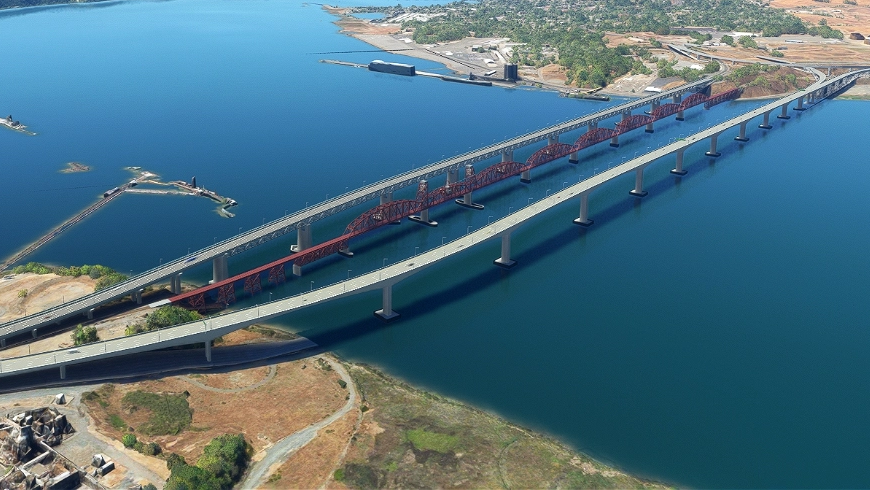
As I crossed the Carquinez Strait in my Studebaker Hawk (which I’m not making up), I would always glance at the old railroad bridge that ran alongside me. Often I’d see a train rumbling over the creaky structure. Here’s a shot I took this morning of the railroad bridge flanked by the two automobile bridges:
Looking south, from Benicia to Martinez.
Aerial view, stolen from the Internet.
The Benicia-Martinez Bridge railroad bridge opened in 1930. It was–and still is today–the second-longest railroad bridge in North America. But did you know that trains had already begun crossing the Carquinez strait more than half a century earlier? How could this be?
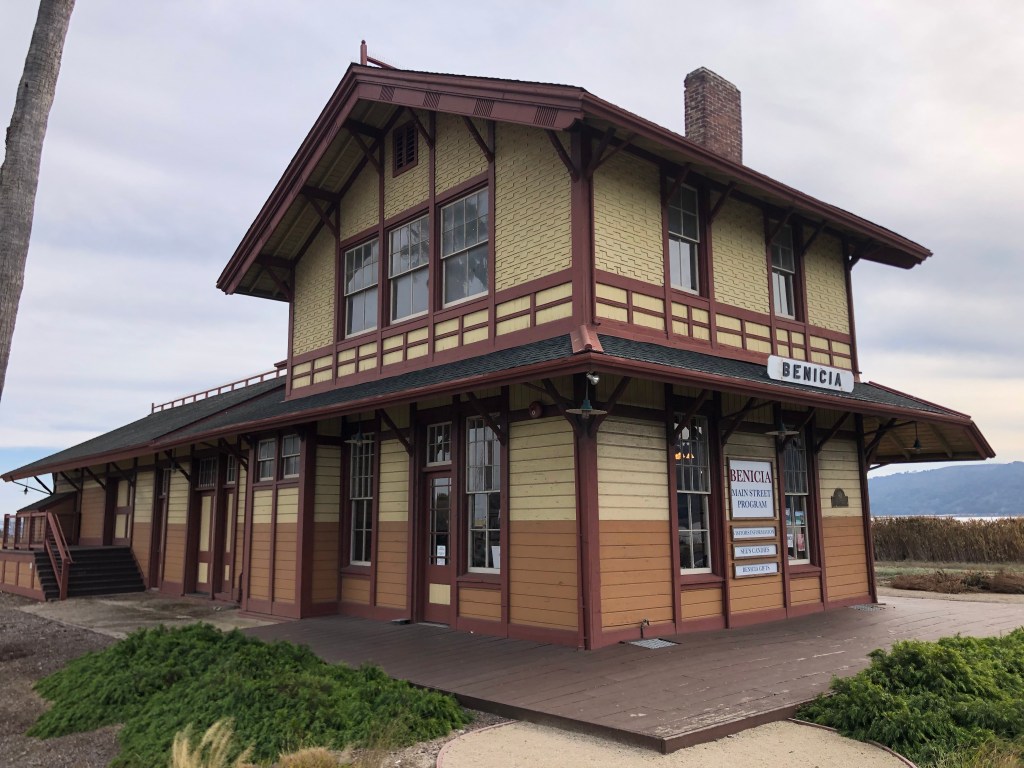
To answer this question, I visited the unassuming town of Benicia (pop: 27,000). Briefly California’s capital (from February 1853 to February 1854), Benicia today is famously home to my son Ian and daughter-in-law Katelyn. But it’s also home to this old depot which can shed some light on our railroad bridge puzzle:
End of the line, in a way…
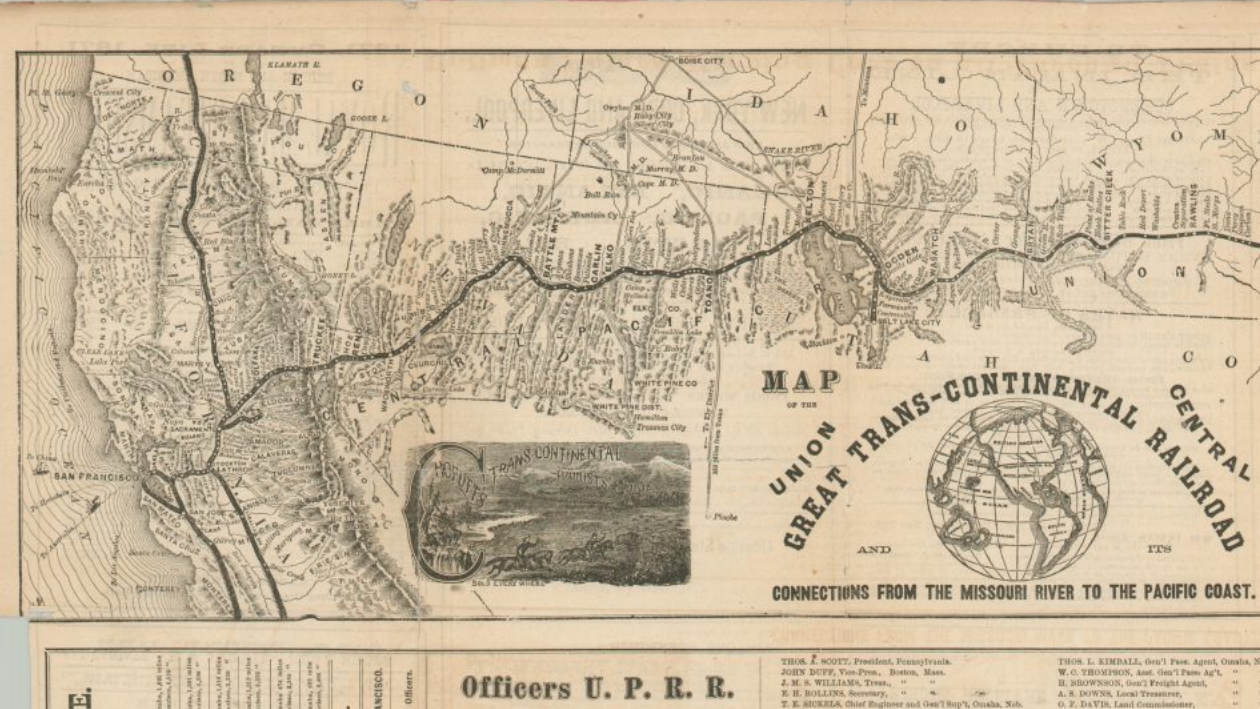
This 144-year-old depot was originally built in 1879 in the small town of Banta, California (pop: unclear, though probably around 100 according to this account). Banta was a whistlestop on the original transcontinental railroad. Westbound trains would make the final leg from Sacramento to the Bay Area by way of the Altamont Pass, which they would cross just after passing Banta.
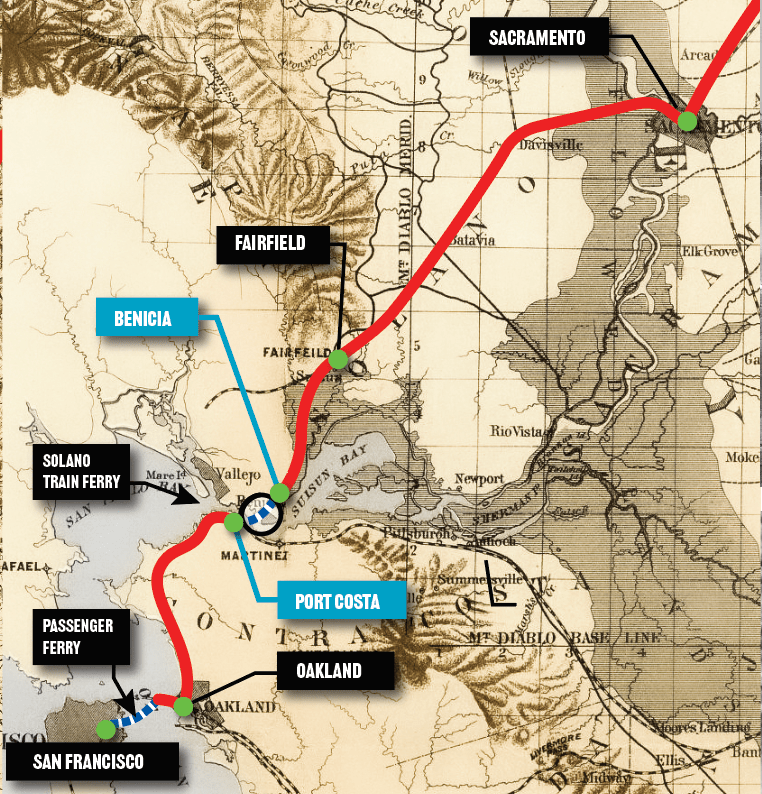
The original route.
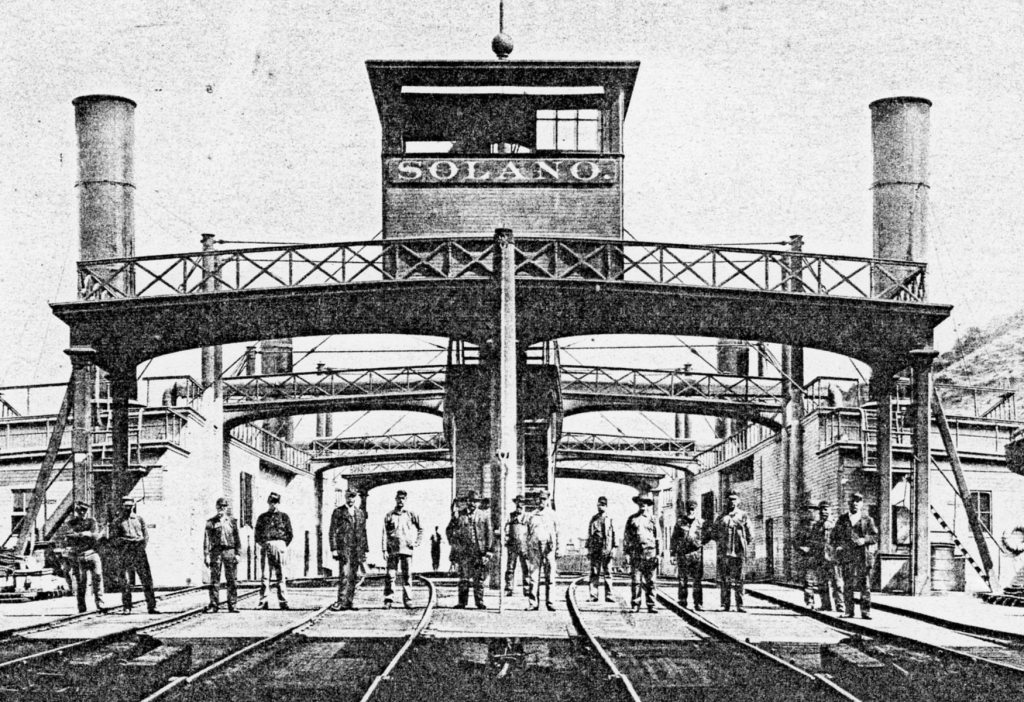
But the same year the Banta train depot was constructed, the Southern Pacific opened a new, shorter route from Sacramento to the Bay Area. This route crossed the Carquinez Strait, shaving off several hours from the old route over Altamont Pass. But since the Benicia-Martinez railroad bridge wouldn’t be constructed until 1930, trains were ferried over the Strait. Seriously. An enormous ferry dubbed The Solano was constructed for this purpose. Westbound trains would slowly chug over the Benicia Pier, roll onto the Solano, and make the half-hour trip to Port Costa, about a mile across the water. From there the trains would return to the mainline and continue to the end of the line in Oakland.
The new route.
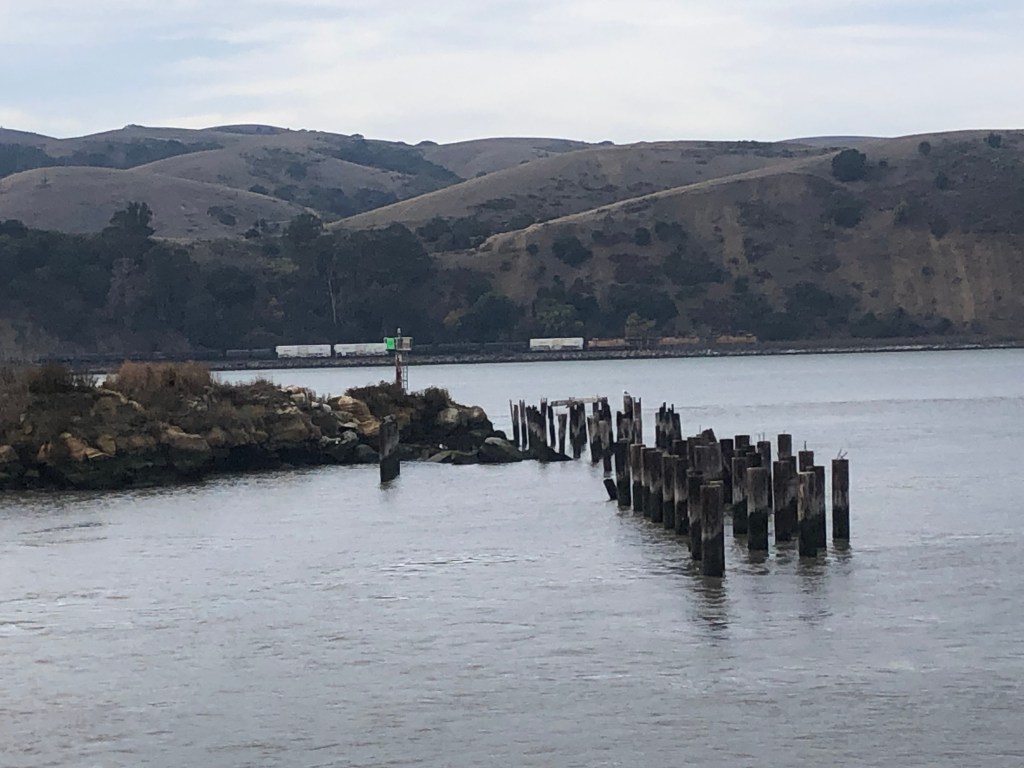
This morning I stood on Benicia’s modern fishing pier and looked out at the ancient pilings from the old pier where the Solano used to dock.
The Solano’s old haunt…perhaps literally?
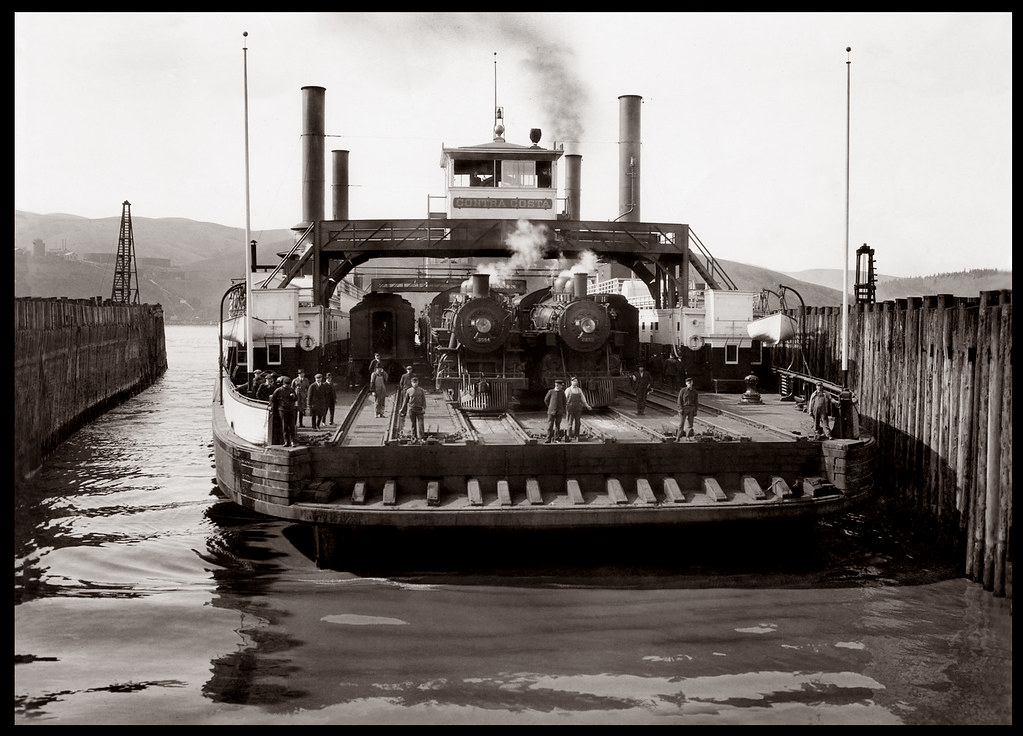
The Solano, which remained in continuous operation for 51 years, had a length of 425 feet and was equipped with four sets of tracks. It was the largest railroad ferry in the world.
Demand on the line increased continually, and eventually it was decided that a full-size railroad station was needed on the Benicia side of the ferry crossing. So in 1902, Southern Pacific uprooted that station they’d built in Banta, floated it on a barge to Benicia, and planted it where you see it today.
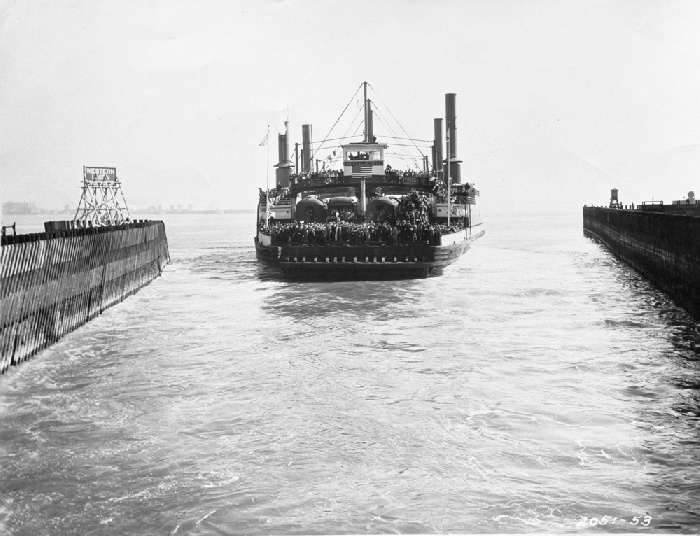
The Solano kept working around the clock, year in and year out. In 1914 she was joined by a sister ferry, the Contra Costa, to absorb the growing demand on the line. But then in 1930, the railroad bridge (which we encountered near the beginning of this post) opened, and the ferries instantly became obsolete. They made their last run in November 1930.
The final run, loaded with well-wishers.
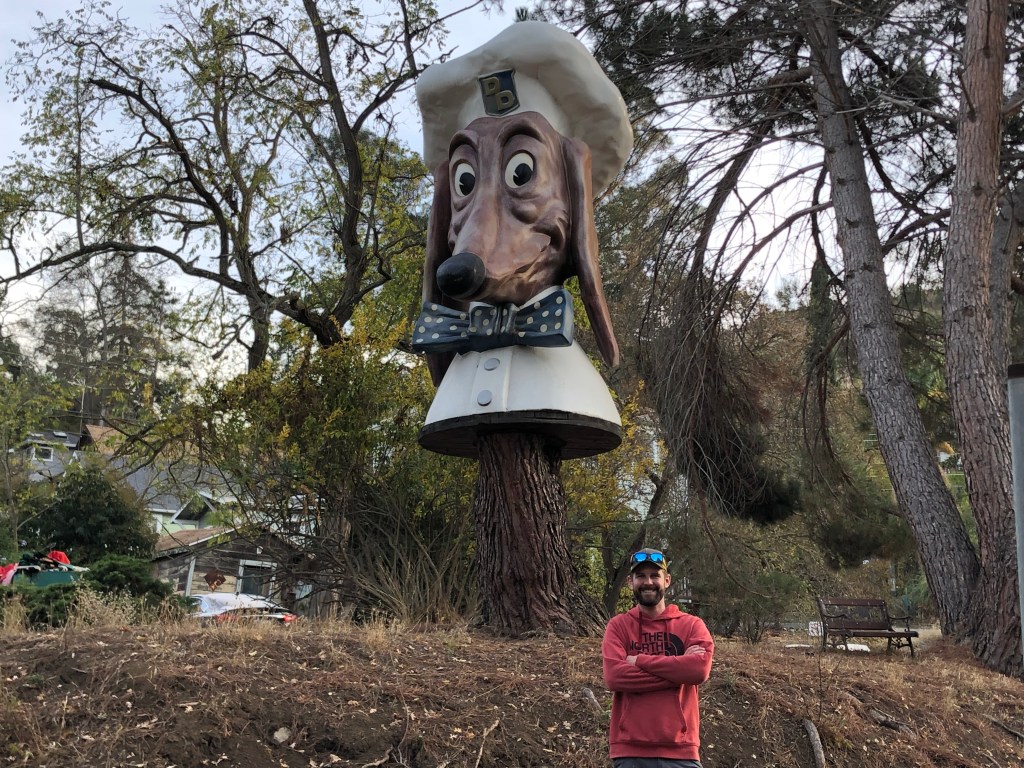
So after exploring the depot and remains of the Benicia ferry pier, I enlisted son Ian to drive us to the other end of the ferry crossing, which was in Port Costa (pop: 200). Port Costa is a small, funky, historic town, replete with a Doggie Diner head. (People of a certain age may remember getting a hotdog at one of the Doggie Diner restaurants in the Bay Area in the 1960s or 1970s. I sure do! Those who don’t remember them can get enlightened here.)
Ian and a midcentury Bay Area icon.
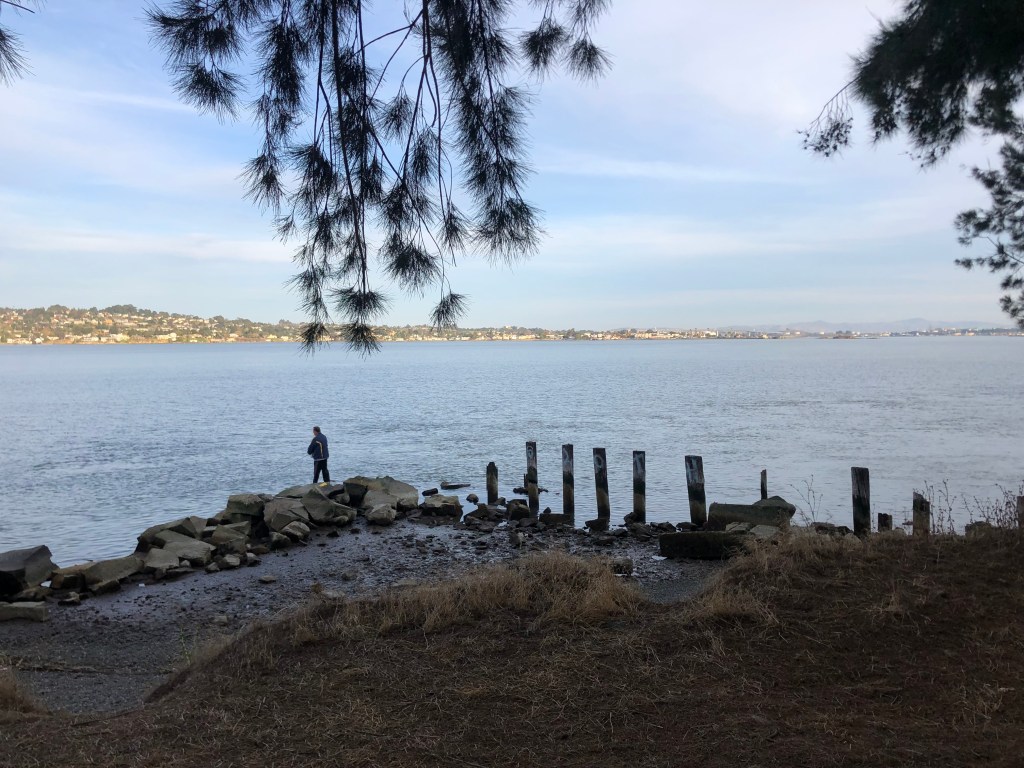
After a bit of walking around Port Costa we came upon the remains of the southern dock of the Carquinez ferry crossing:
The Solano’s southern haunt. Benicia is directly across the strait.
So, for those of you keeping score at home, we’ve managed to find the depot from which ferry-bound trains departed, the remains of both ferry piers, and the bridge that put the ferry out of business. But what of the ferry itself?
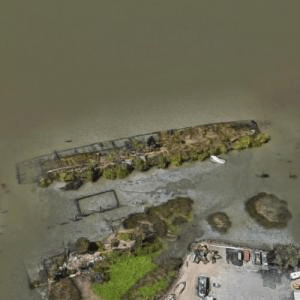
A little Internet research revealed that the Solano was decommissioned and towed out to Antioch in 1931. There she was scuttled near the bank of the San Joaquin River and partially submerged to serve as a breakwater. She remained there, largely identifiable in her old form, for about half a century. But in the 1980s some clown was setting off fireworks and accidentally set The Solano ablaze, and she burned to the waterline.
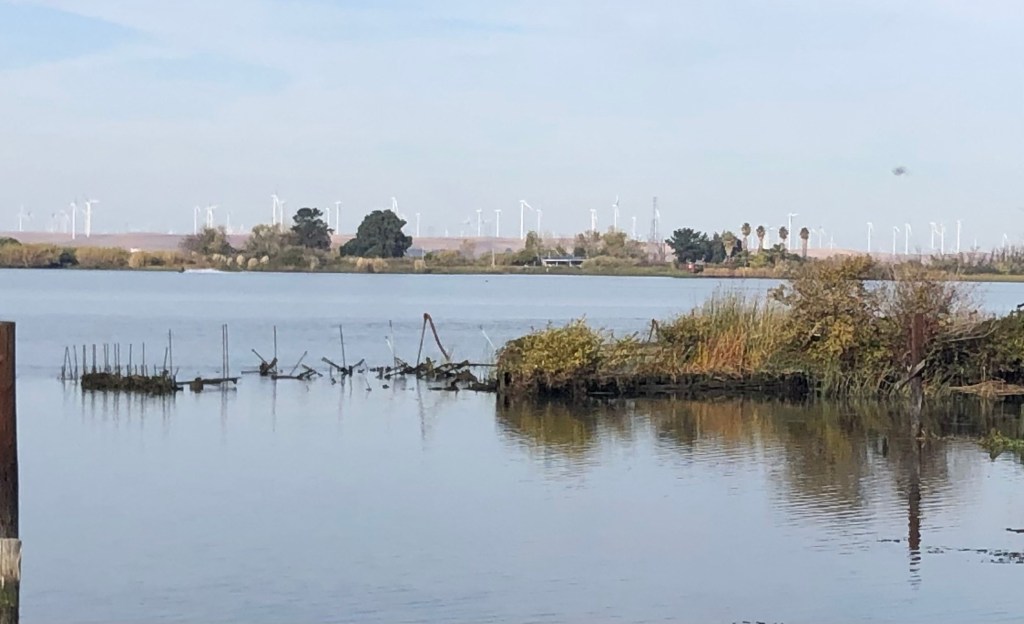
Naturally, Ian and I headed over to Antioch to see what remained of the Solano. The answer is “not a lot,” but there’s still a ghostly presence. Check it out:
Remains of the Solano in Antioch. We’re looking at the port side of the ferry, with metal rods from the bow poking out of the water on the left.
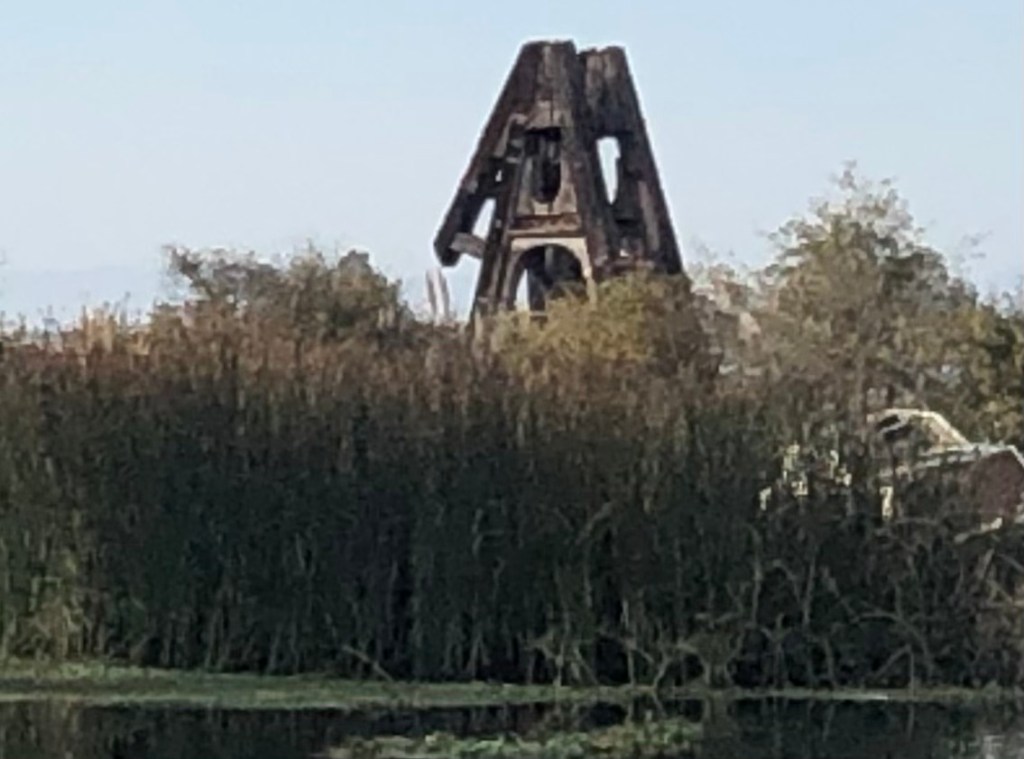
The 40-foot-high A-frame that housed one of The Antioch’s two paddlewheel engines still rises from the wreckage.
Aerial view, courtesy of Virtual Globetrotting, clearly shows the outlines of The Solano.
So that’s pretty much it. As always I’m struck by how physical barriers were overcome in the Age of Steam…and how remnants of that era can still be seen all around us, if we’re just willing to look.
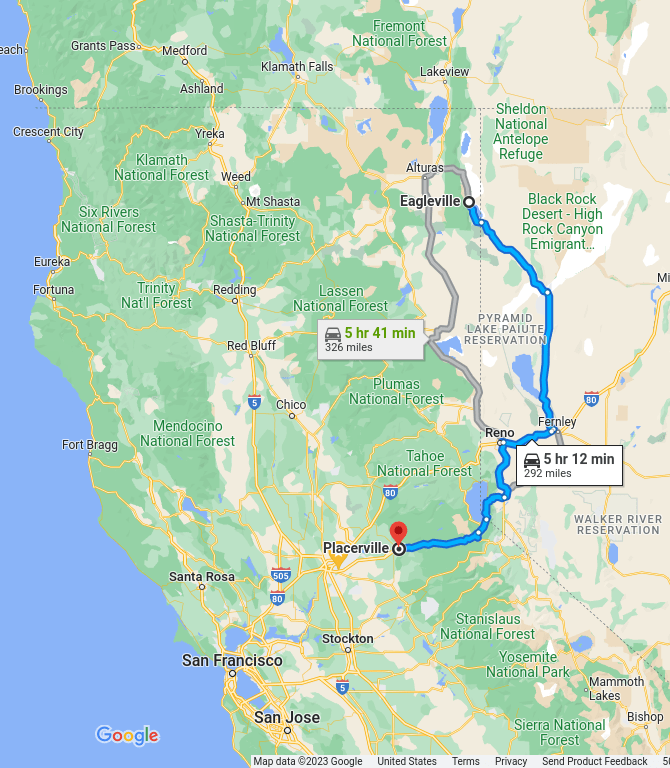
After completing my mission at Eagleville, I headed homeward on NV 447, then back into California via Reno.
My route home (in blue).
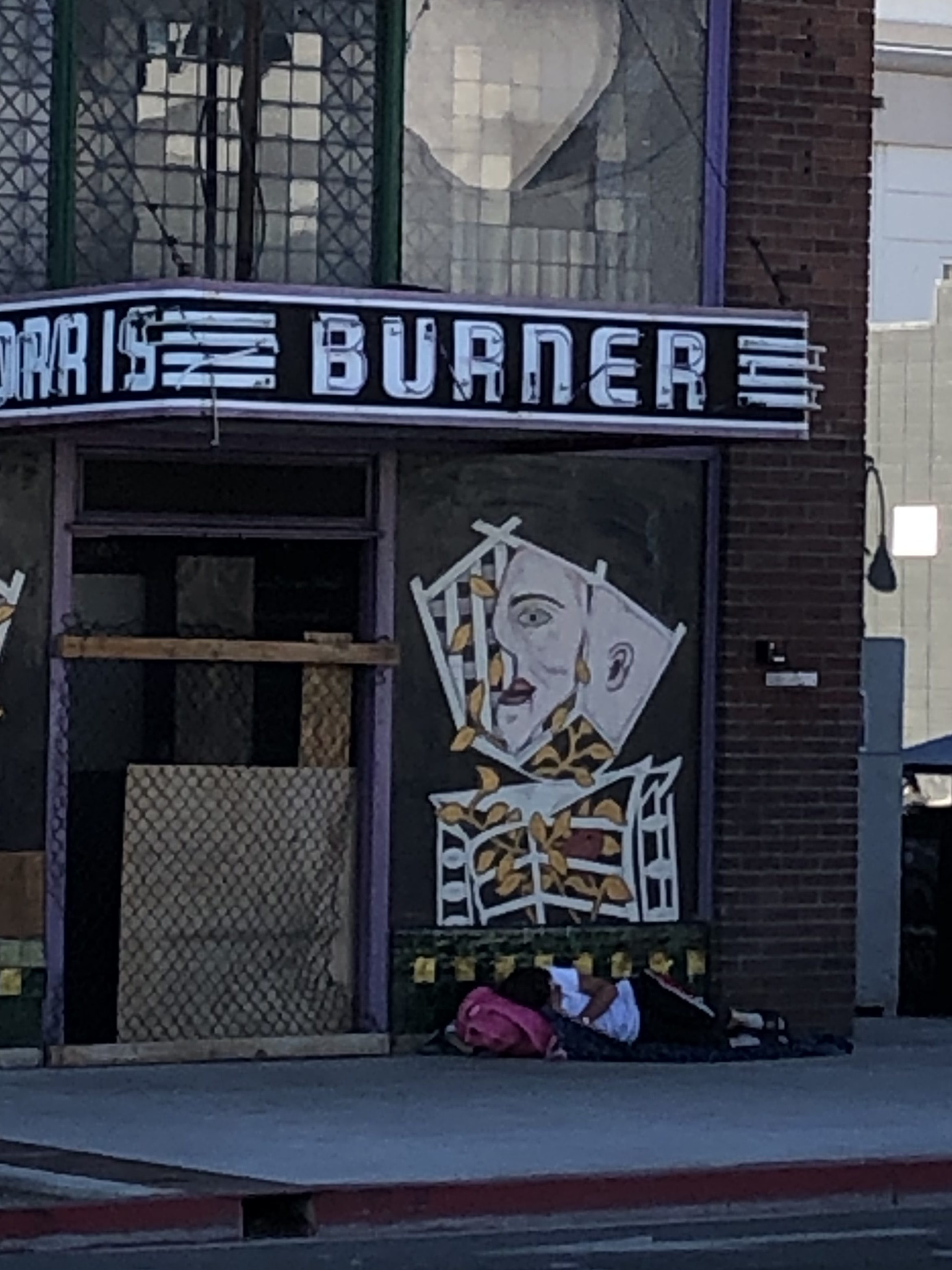
You’ll note that my return trip skirted the west side of the Black Rock Desert, where Burning Man begins this weekend. My entire run through Nevada was overrun with “Burners” in their anti-establishment Winnebagos, powered by thousands of gallons of anti-establishment Chevron gasoline.
Prophetic sign in Reno.
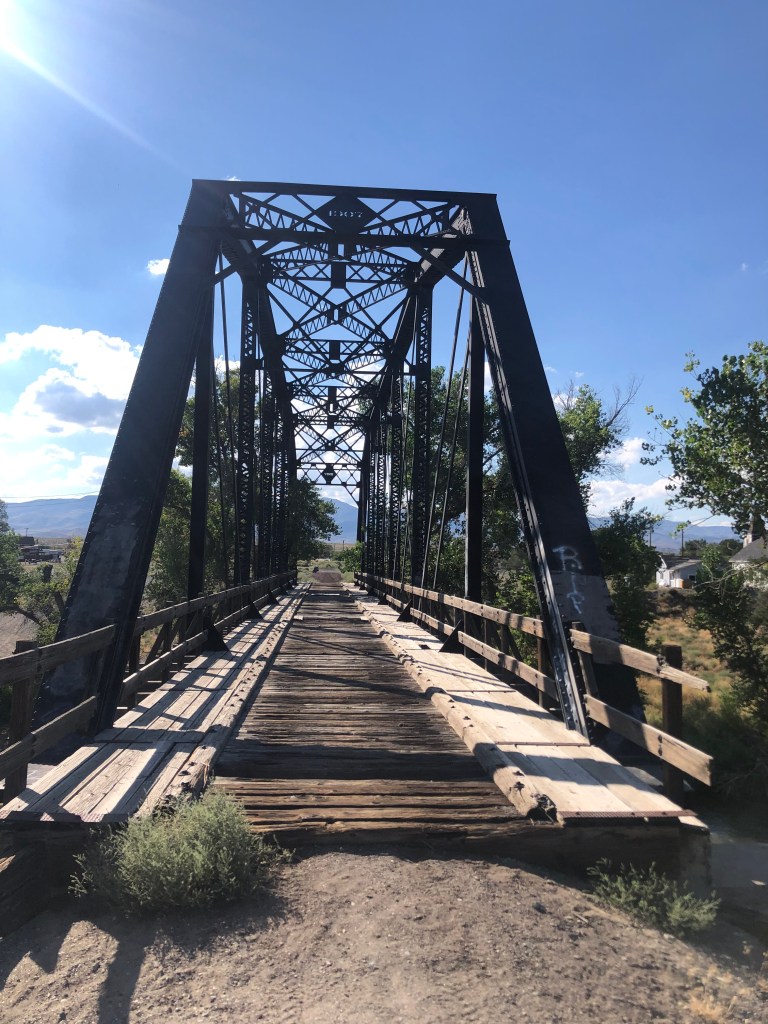
One worthy sight along the way was this 1907 bridge over the Truckee River in Wadsworth, NV.
The bridge served the Fernley and Lassen Railway, which was a 112-mile short line. I’m told that two of the railroad’s depots (in Fernley, Nevada and Susanville, California) have been restored, so this might be the subject of my next road trip.
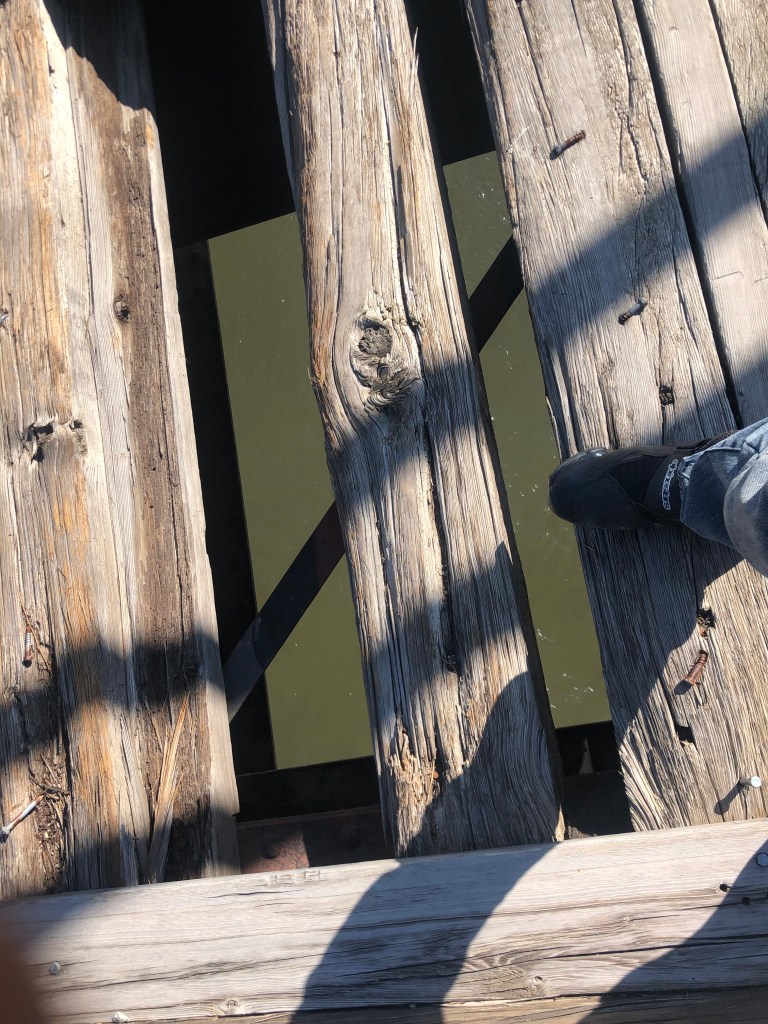
One needs to be careful when crossing this bridge….
You should also check out this cute, heart-warming video that features the bridge:
Watch your step, little girl!!
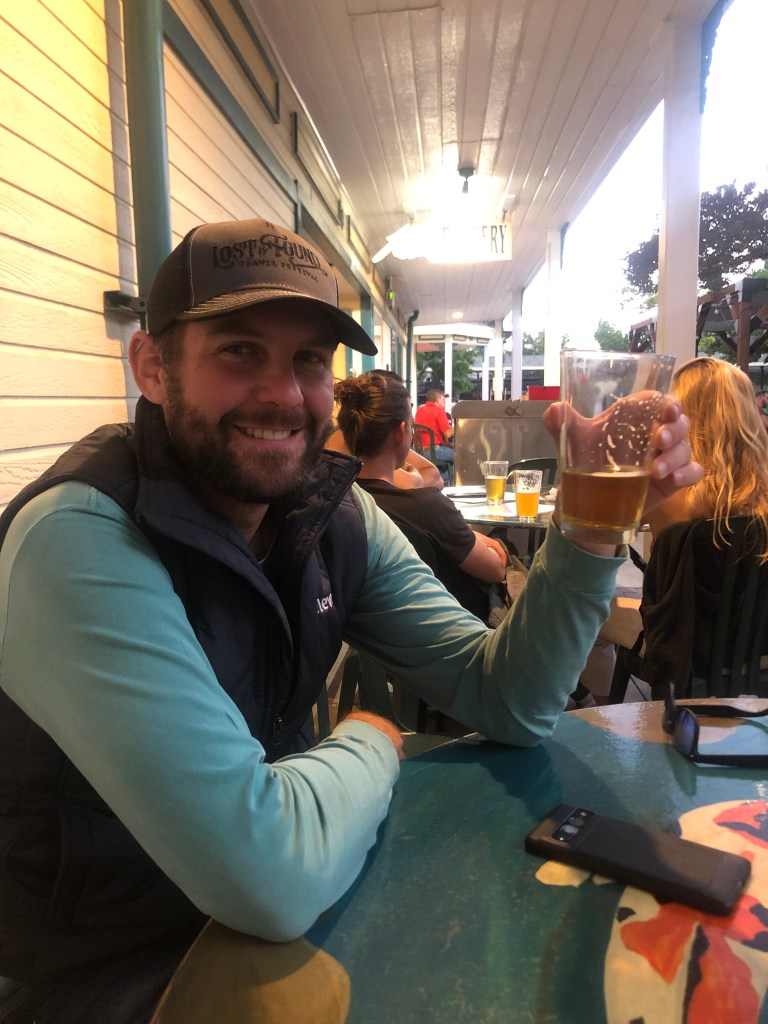
After Wadsworth I stopped in Reno to have dinner with my son Ian, who happened to be in town on business.
Like father, like son.
I spent the night in Reno, and this morning, before leaving town, I made a significant, final discovery related to the N-C-O Railway:
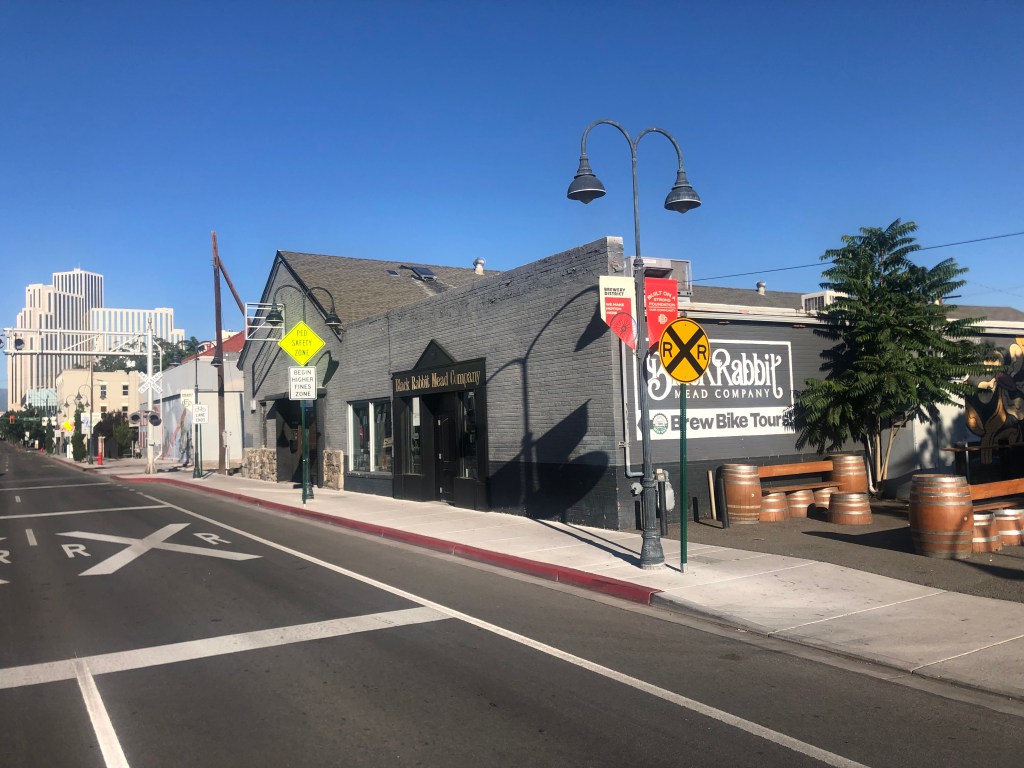
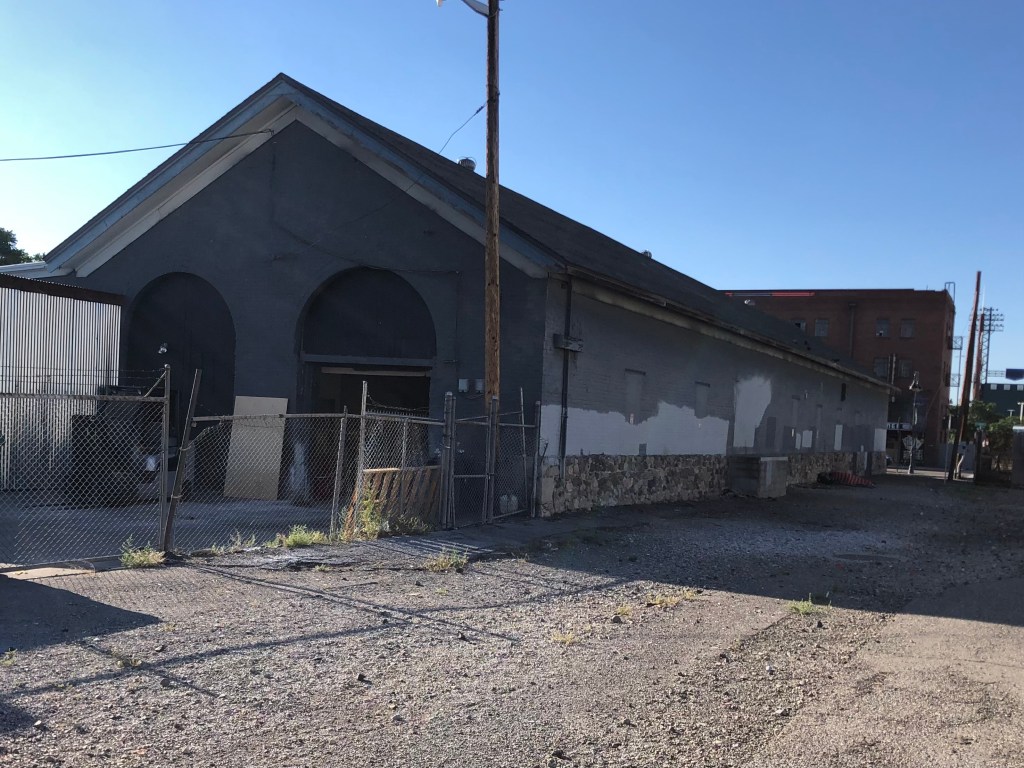
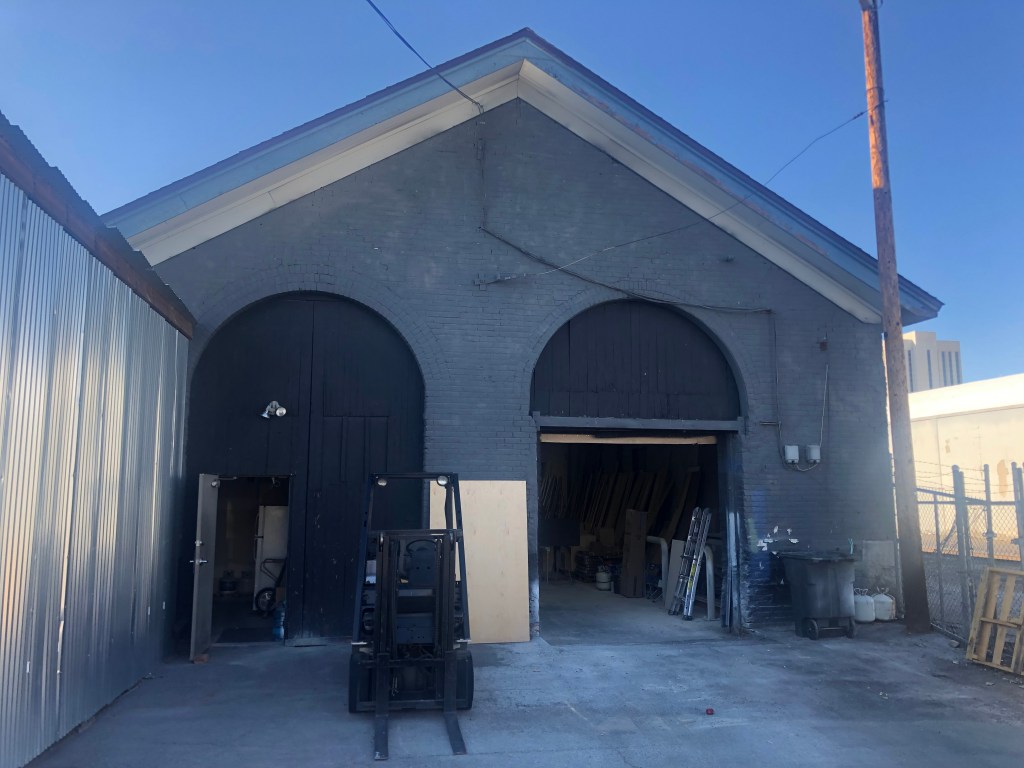
Recall that I had been unable to find the NCO locomotive shop in Lakeview (northern terminus of the railway). This morning, however, I located the NCO’s 19th-century shops building in downtown Reno (the NCO’s southern terminus). The building is on the other side of the tracks from the Depot Brewery and it’s currently serving as the headquarters for Black Rabbit Mead Company. It’s notable that two of the NCO’s surviving Reno structures now make mead and beer.
The NCO’s 1889 locomotive shop, now a meadery.
Same building, viewed from the back.
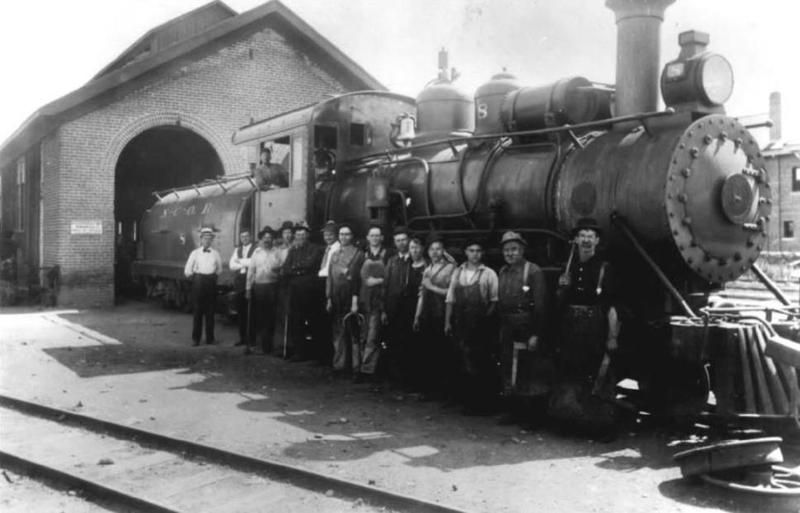
Steam locomotives used to enter those rounded doorways.…
…as proven by this historic photograph.
You can get more information about this building and photographs here.
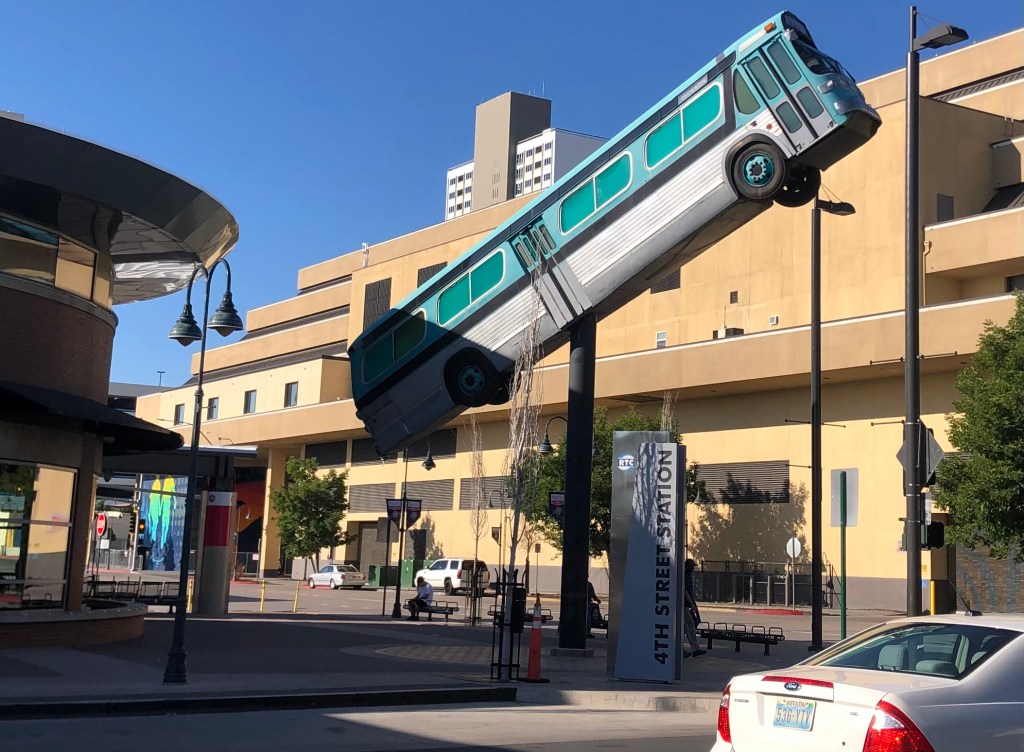
Finally, I need to share this art installation I saw in front of the Reno bus depot. It’s made from a real, retired bus, though it’s been gutted and narrowed. I’m told it also is illuminated from the inside at night, and the headlights and taillights illuminate.
My only complaint is that the bus was retired from New Jersey. Shouldn’t they have used a Reno bus??!
So ends this latest adventure. Be on the lookout for a Fernley and Lassen trip one day soon!
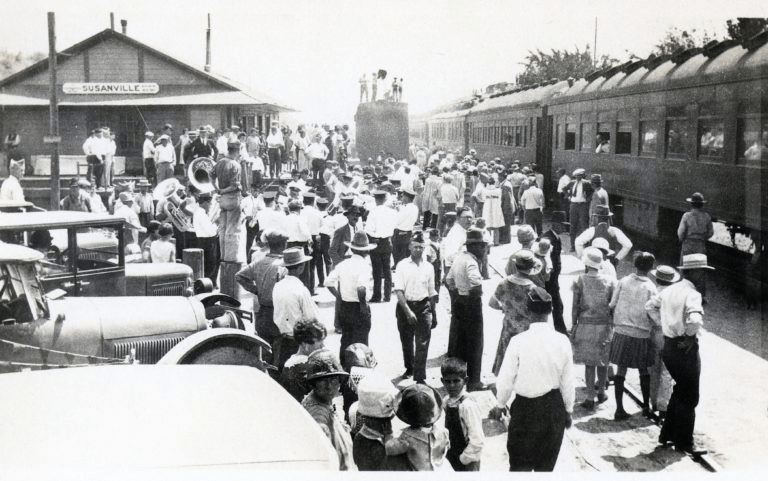
The F&L’s Susanville station looks like a happening place.
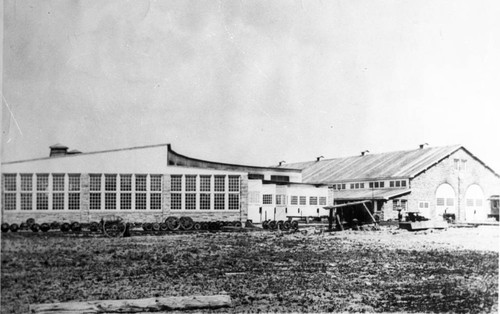
After getting my complimentary coffee and scone from the Niles Hotel this morning, I made a final circuit of Alturas looking for one final NCO structure. Apparently the old locomotive shops buildings are still around, but I could not find an address on the Interwebs. There was just this historic photo from the Modoc County Museum:
“Portrait of the old N.C. & O railroad shop in Alturas, Ca. Published by: The Journal of the Modoc County Historical Society in 1982. Old N. C. & O Railroad Shop”
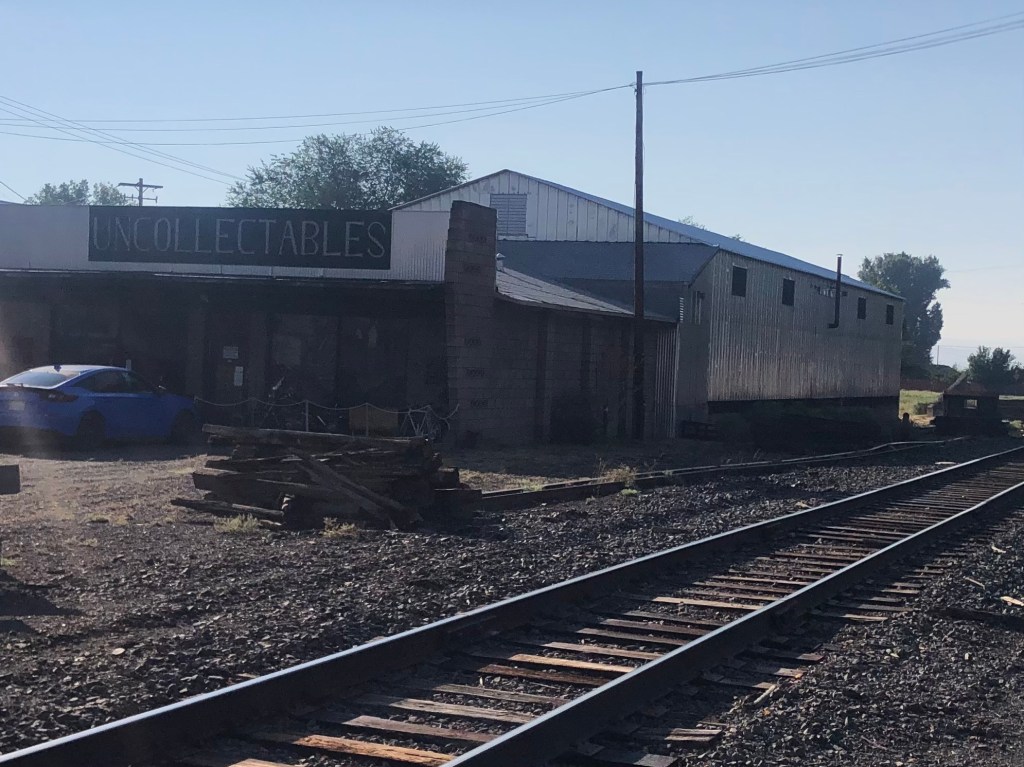
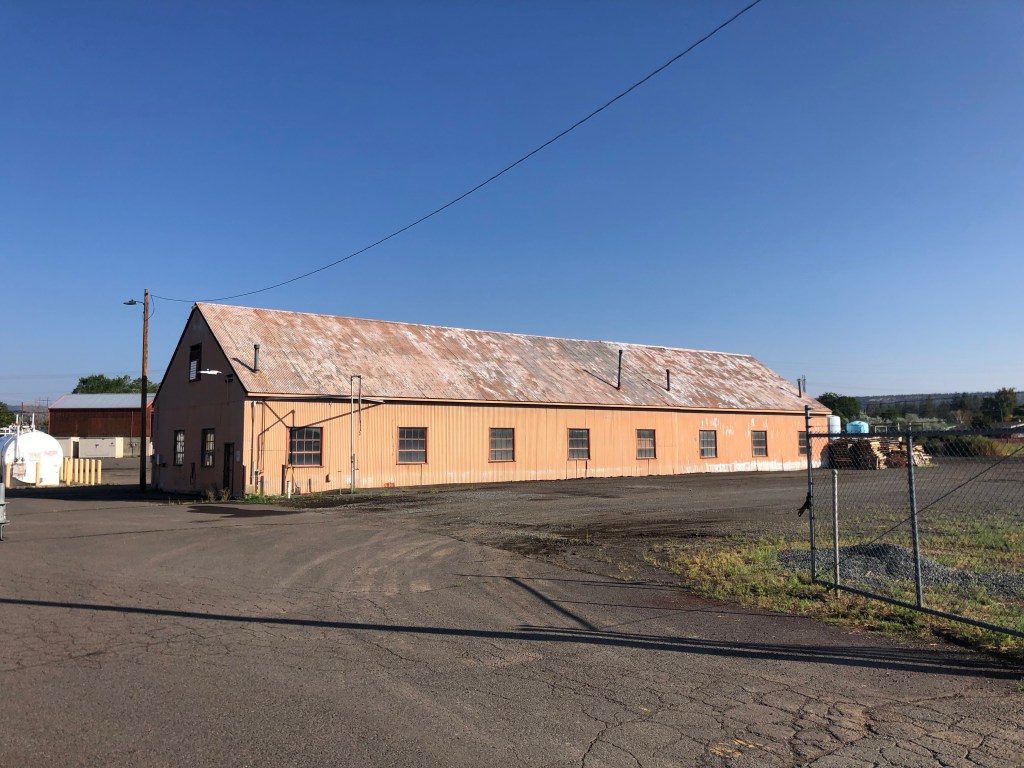
So I just cruised around the city, trying to hew to the rail line on the theory that railroad shops would be connected to the tracks somehow. Only two structures even remotely resembled the rightmost building in the historic photo, but I think they are not what I’m looking for. Here they are:
The roof of the building in the back has the right pitch. Note the misspelling on the “uncollectables” sign.
This CalTrans facility looks like it could have been an old train shed…
Anyone with information or even a hunch (I’m looking at you, Quasimodo) please let me know!
Around 9:30 am I left Alturas in defeat, and got back onto US 395 north. On my way to Lakeview, OR (which you will recall was the northern terminus of the NCO Railway), I passed a couple of noteworthy sites:
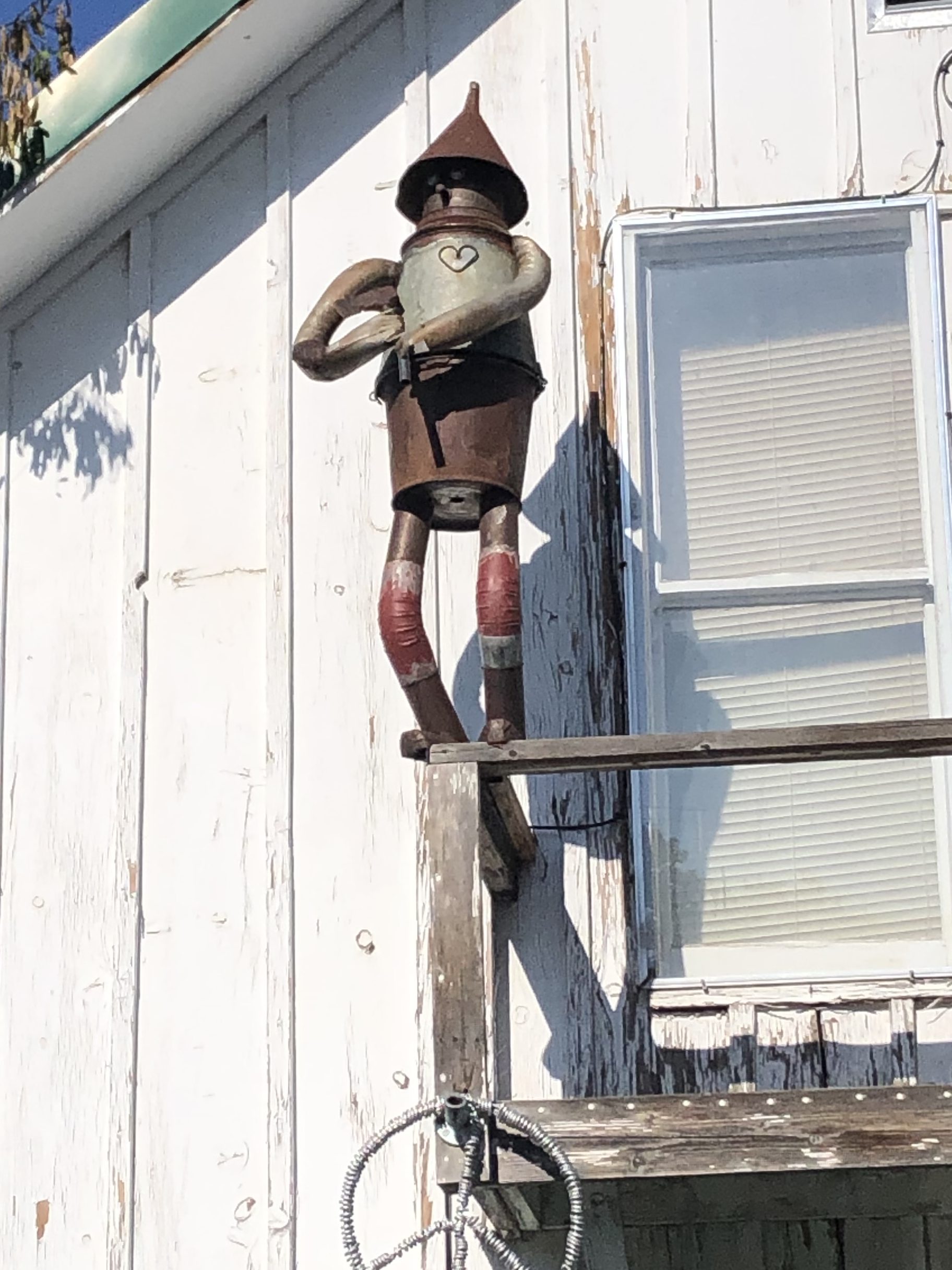
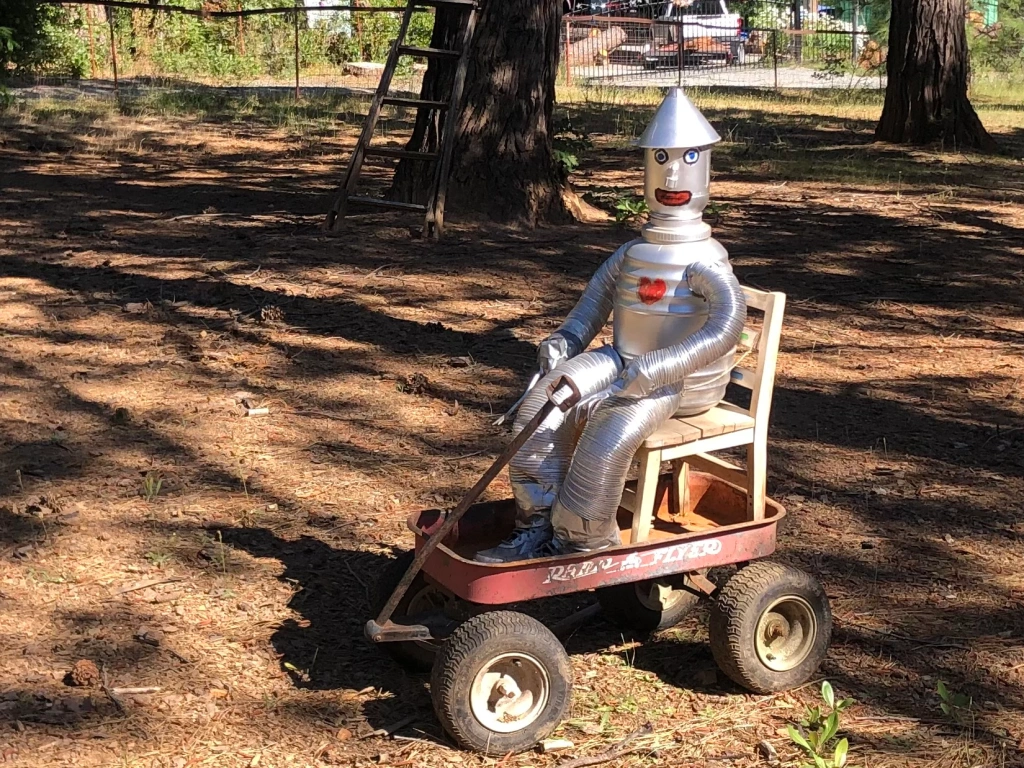
I spotted this Tin Man figure on the side of a house facing the road. Like the one I saw a month ago near Georgetown, CA, it brought a smile to my face. The owner came out of his house while I was taking the photo, and we had a nice chat. I think what this world needs is more Tin Men.
Here’s the one from Georgetown.
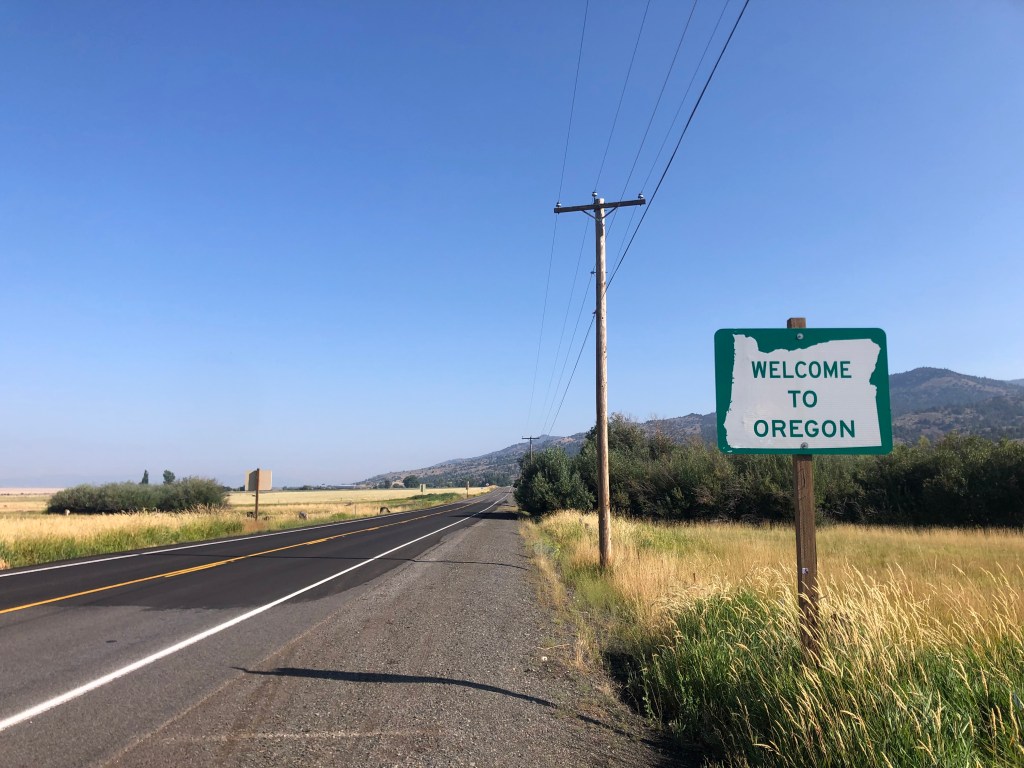
Entering the third state of the NCO!
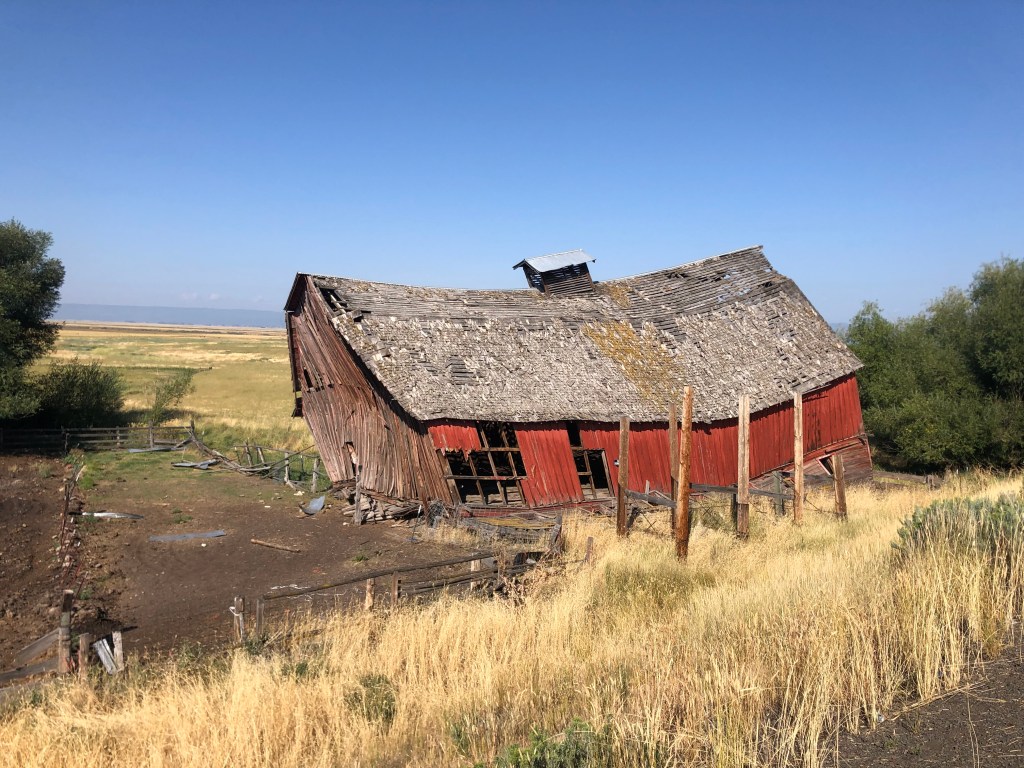
If Salvador Dali built a barn…
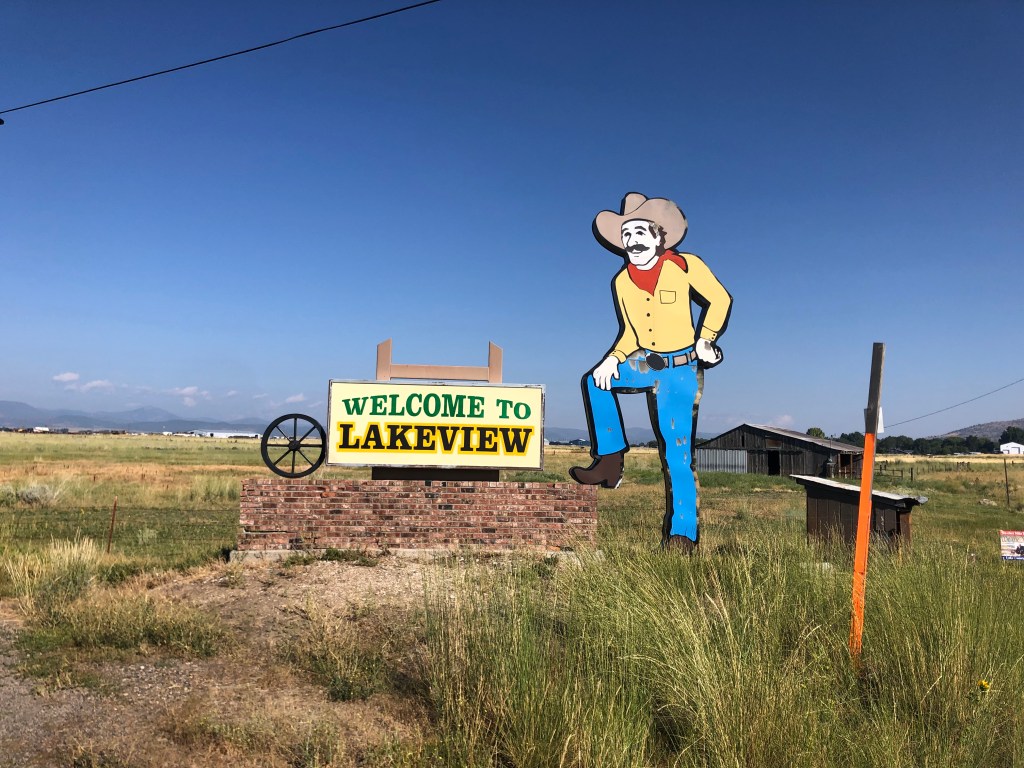
Finally I arrived in Lakeview, Oregon (pop: 2,500).
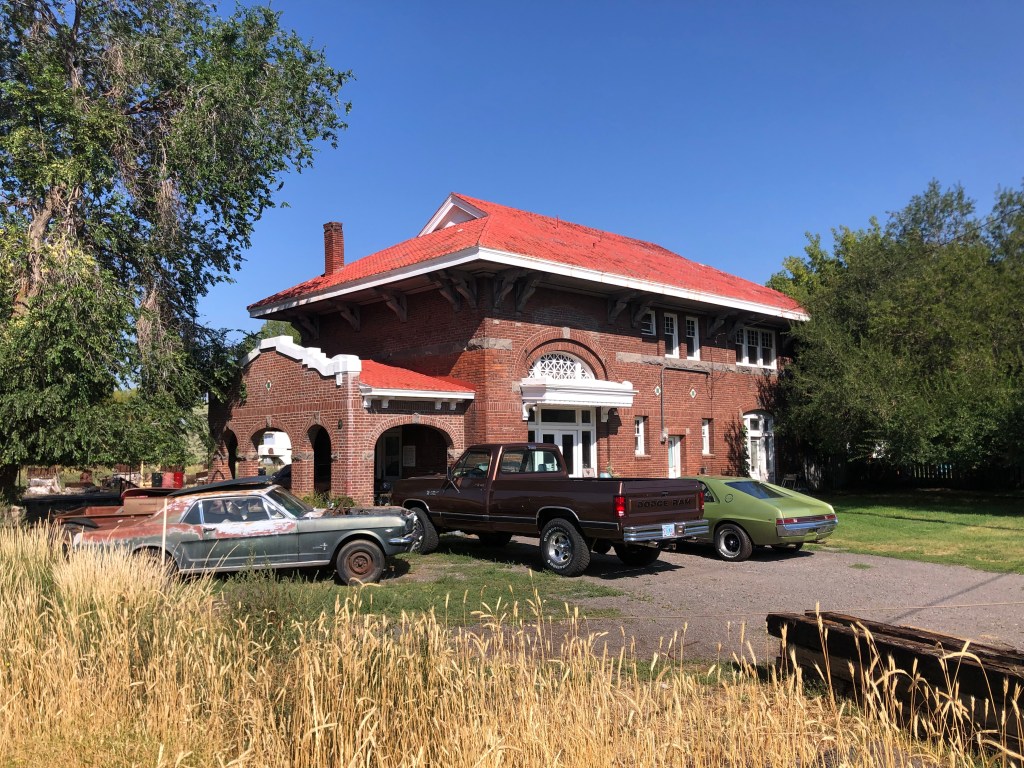
Just to the west of downtown I found the depot. It looked to be a happening place, with numerous cars parked in front.
Note the rare AMC Marlin (?) on the right.
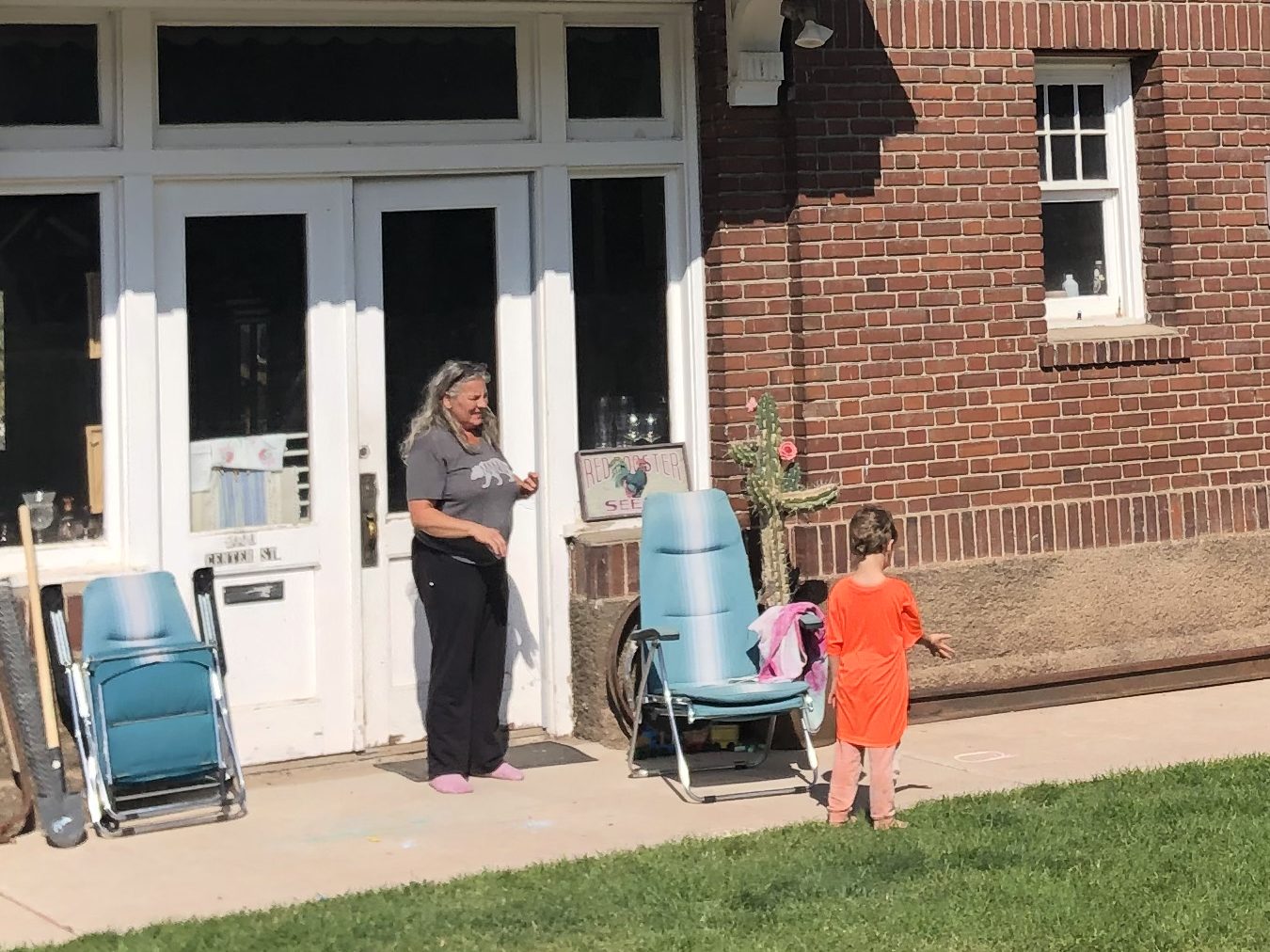
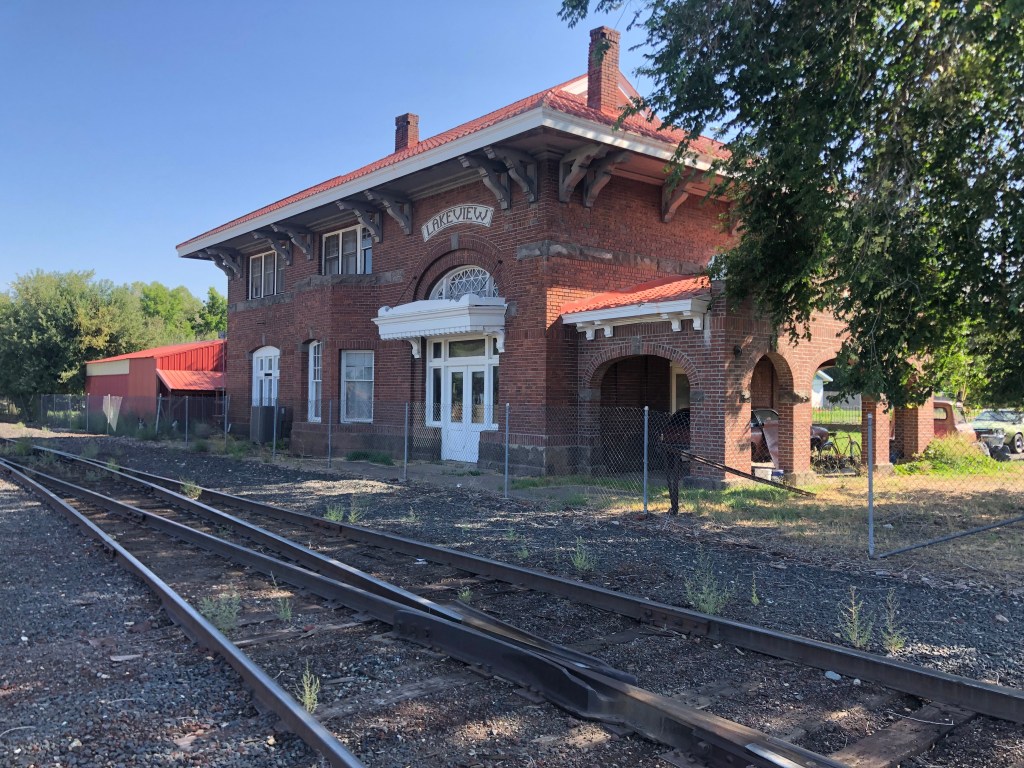
But it turned out that these cars all belong to the depot’s owner. For unlike the other depots on this trip, this one is serving as a private residence. The owner’s name is Carmen, and she bought the depot from the second owner (after the railroad sold it). She appears to have changed little of the outside of the building. As for the interior, I can’t say. She steadfastly ignored my repeated hints that I’d like to see the inside.
Carmen, managing her little Yardmaster.
Interestingly, the tracks immediately behind the depot are still active. It seems there’s a short line railroad that ships goods between Lakeview and Alturas. The tracks are essentially unprotected, and run just a dozen or so feet from the depot’s back door. For a railfan, it sounds ideal. For anyone else, it sounds noisy and dangerous. But I am grateful to Carmen for preserving this piece of NCO history.
Not your typical bungalow.
It was now finally time to fulfill the whole point of this trip: A return visit to Eagleville, CA. I said goodbye to Carmen and headed back down US 395 to Surprise Junction, then headed east on CA-299. After about an hour and a half I stopped in Cedarville (pop: 425) to get gas and lunch. Cedarville is only 17 miles from Eagleville, but the latter has almost no services, so I made use of the former.
While pumping gas I noticed numerous campers and RVs and VW buses lining up at the pumps. Almost all of them were carrying bicycles and other equipment, and the drivers and passengers all had fluorescent hair. “Burners,” muttered the gas station attendant. In response to my confused look, he explained that these folks were all going to the annual Burning Man event in the Black Rock desert. It struck me that, in their effort to be independent and iconoclastic, they all looked and behaved exactly the same way. That said, I did have to admire the work this guy put into his Burner Mobile.
About 20 minutes after I’d finished my pit stop in Cedarville, I was standing in Eagleville (pop: 45) for the first time in almost half a century.
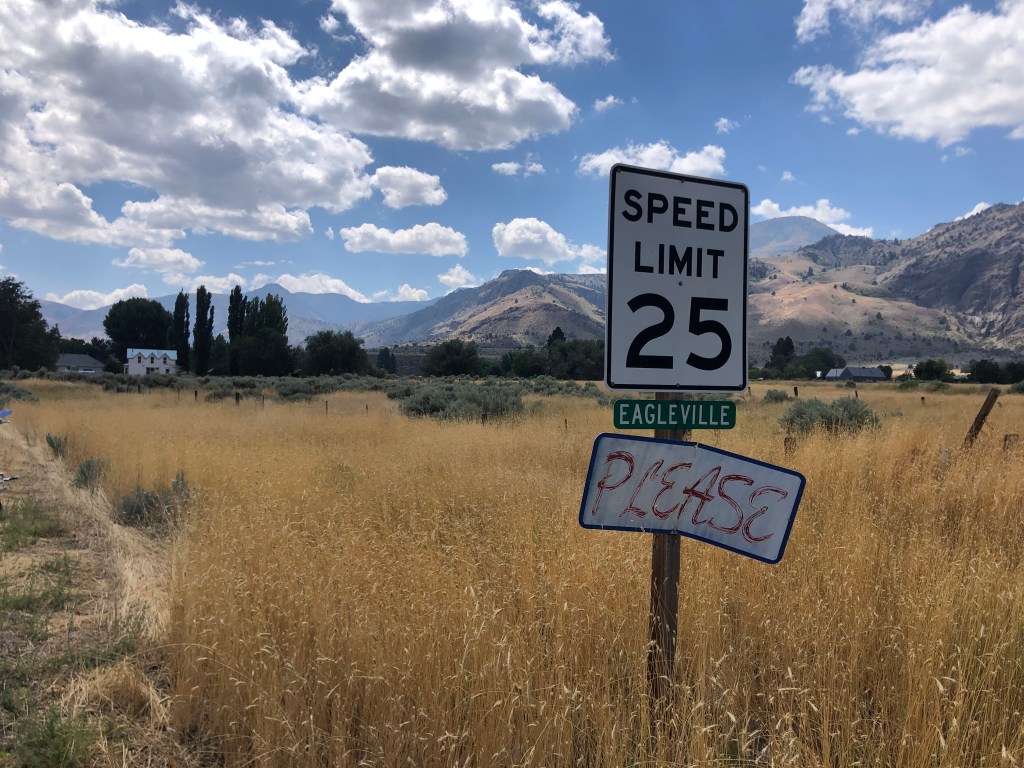
Perpetual plea.
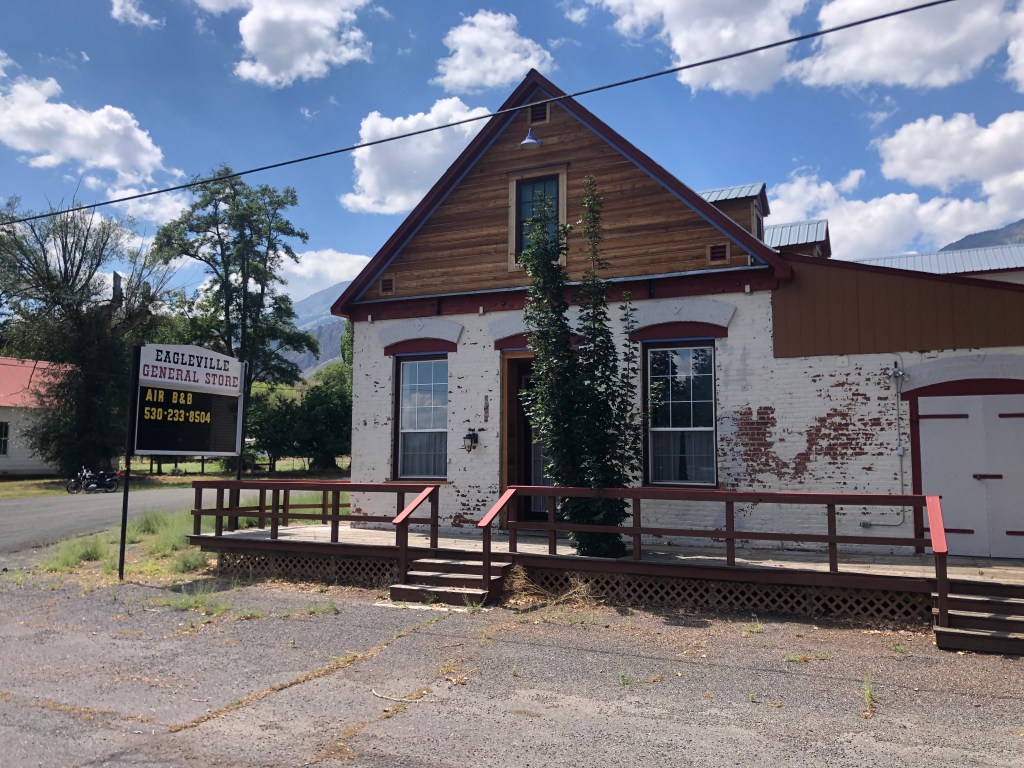
The first thing I noticed was the general store, which was originally built in 1876. It’s gone out of business, and the owners seem to be trying their luck renting it out as a B&B. I think that might be a stretch. The 150-year-old exterior walls look largely unchanged from when I had last seen it.
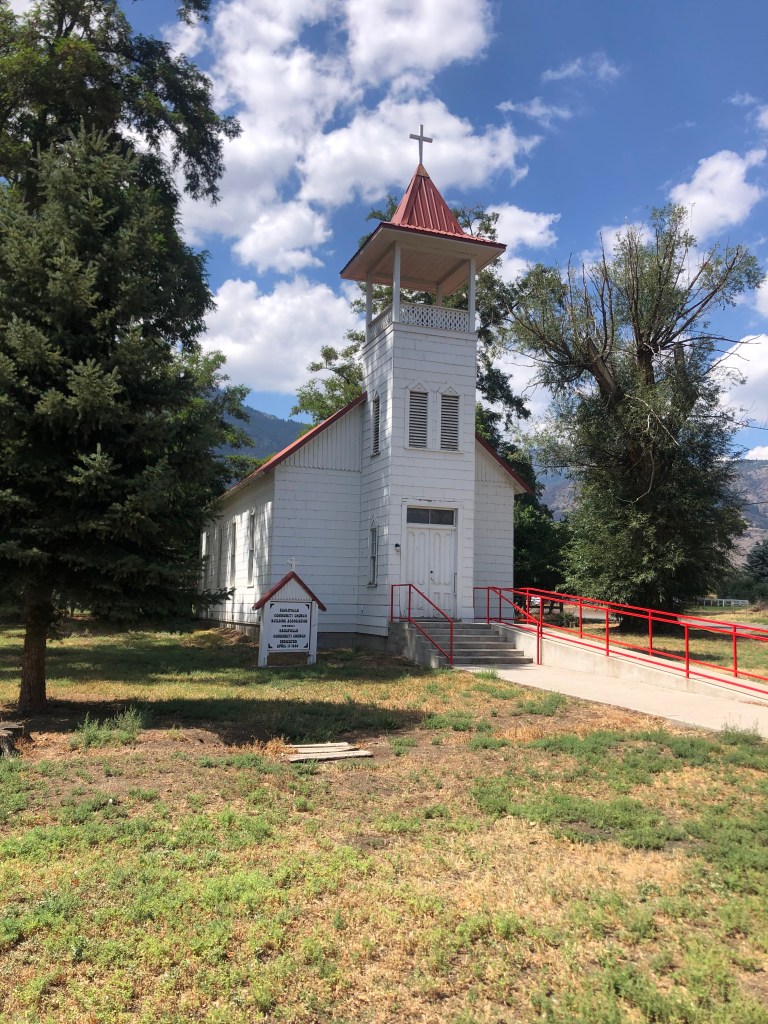
Across from the general store was the old (1888) church I’d remembered. It looked almost exactly the same as my memory, though I read it underwent some restoration work in 2000. This time, though, the door was locked. Evidently they are less trusting than they once were. And who can blame them? I also read the church no longer holds regular worship services.
A restored church that is no longer open for worship.
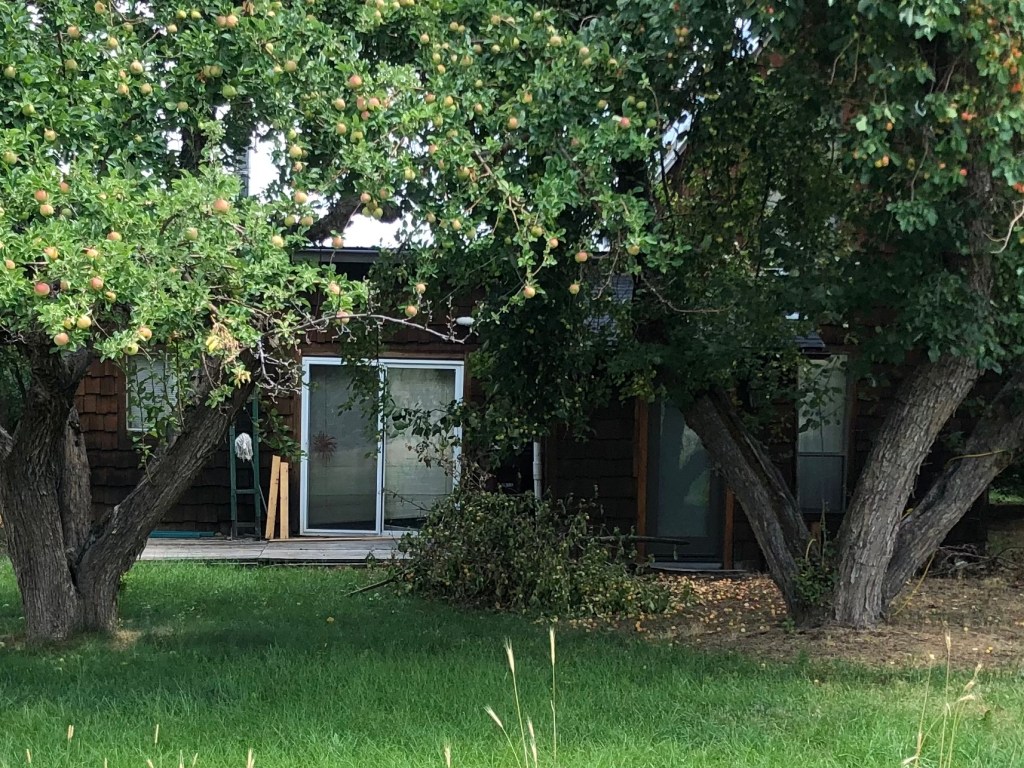
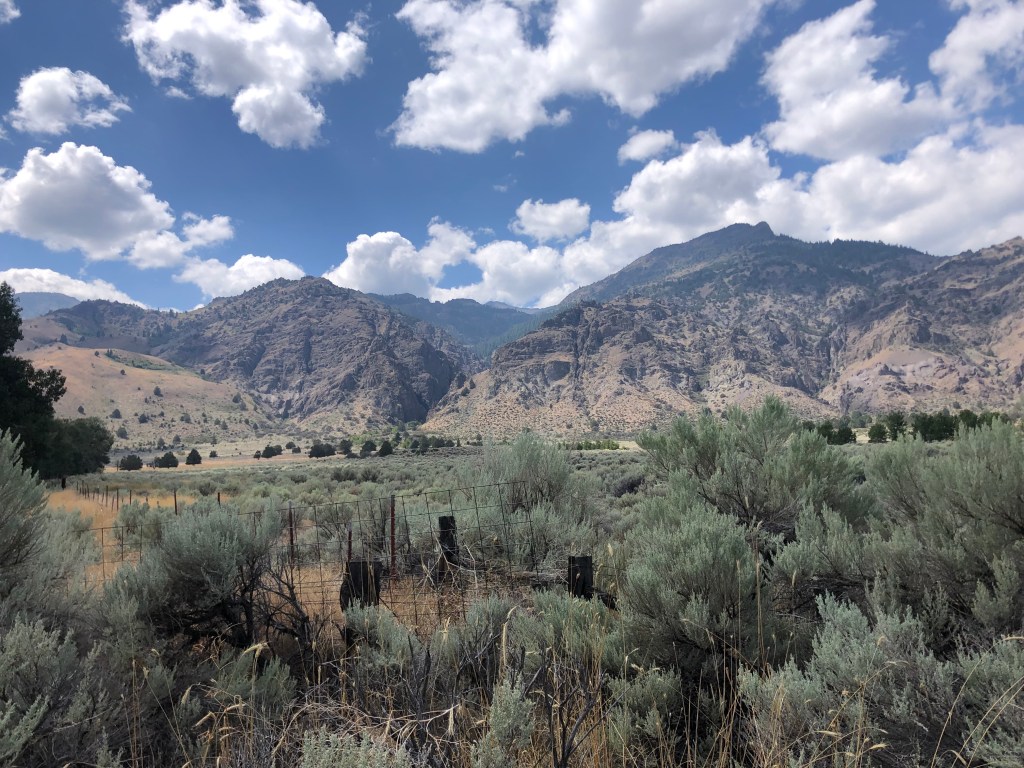
I then went down the street to the street Aunt Alice’s family maintains three homes. The house where we’d spent Thanksgiving in the mid-1970s was still there, seemingly frozen in time. The South Warner Mountains still stand sentry over the town.
Back of the house, just as I remembered it.
Great view from the family homestead.
Notably, I did not see one living soul in Eagleville. Maybe people stay indoors during the mid-day heat. But l it did feel a little unsettling. I guess some people prefer a quiet, isolated existence. Indeed, the gas station attendant in Cedarville told me he left Alturas to “escape the rat race.” He likes “how small this town of Cedarville is.”
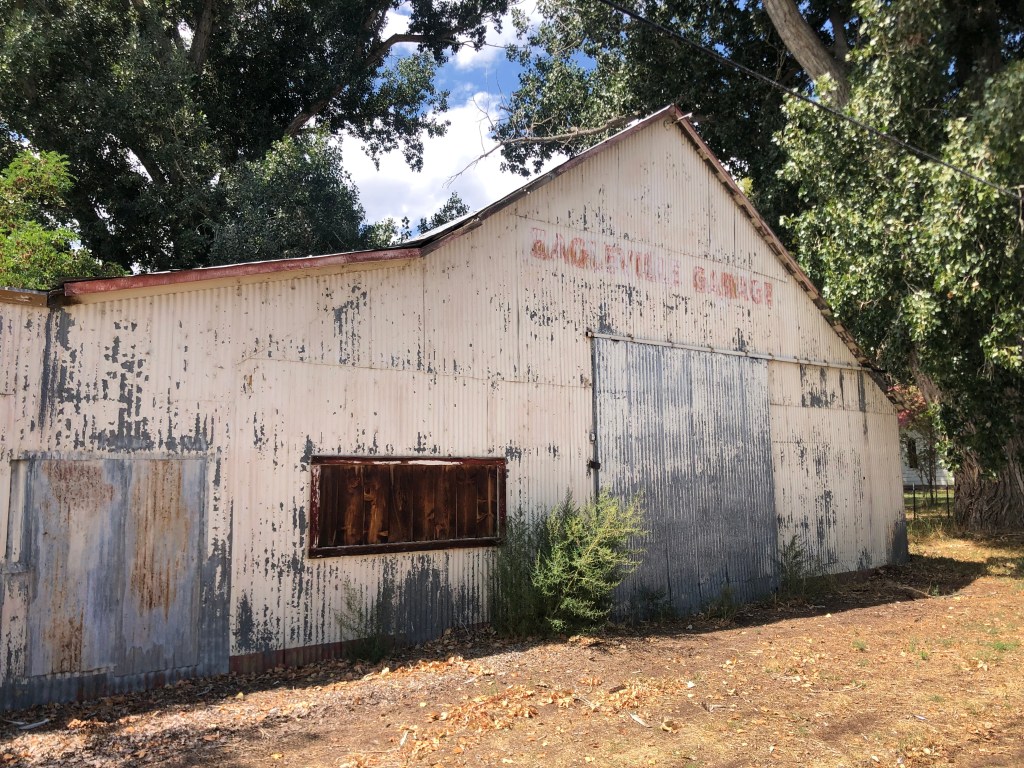
But Cedarville is a metropolis compared to Eagleville. At least Cedarville has a gas station. Most of Eagleville’s erstwhile businesses are long closed. Like the Eagleville Garage.
I think I’d go crazy in a place like Eagleville. But I’m glad it exists, and I’m glad that some people make it their home. We all need to find the place that suits us. In addition, there’s also something reassuring about a memory from my past retaining some physical form.
After melancholy reflections such as these, I got back on the road and started to head home. Hundreds of “burners” shared the road with me as they made their way to the Black Rock desert, seeking to transform one of the country’s most desolate places into a teeming metropolis….if only for a week.
Mail Bag/Miscellany:
I neglected to mention in yesterday’s blog that Uncle Ed’s Dome of Foam includes information on the NGO and its depots. Here is the link.
See also some further input that Ed and others posted in the comments section of yesterday’s blog.
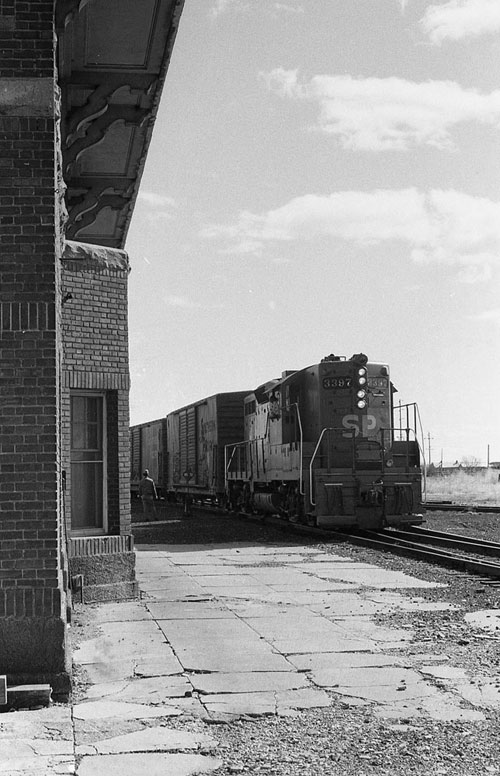
Finally, here’s Edward’s photo of Carmen’s “house,” back when it was serving a very different function.
“Arrival in Lakeview,” 1974. From Uncle Ed’s Dome of Foam.

 Chasing Phantoms