In 1983 Elton John had a hit on the airwaves titled “I’m Still Standing.” It reached #12 on the Billboard Top 100. Today’s blog post looks at some structures that are, remarkably, still standing around the Placerville area. And with a tip of the hat to the season of Lent, those structures are churches.
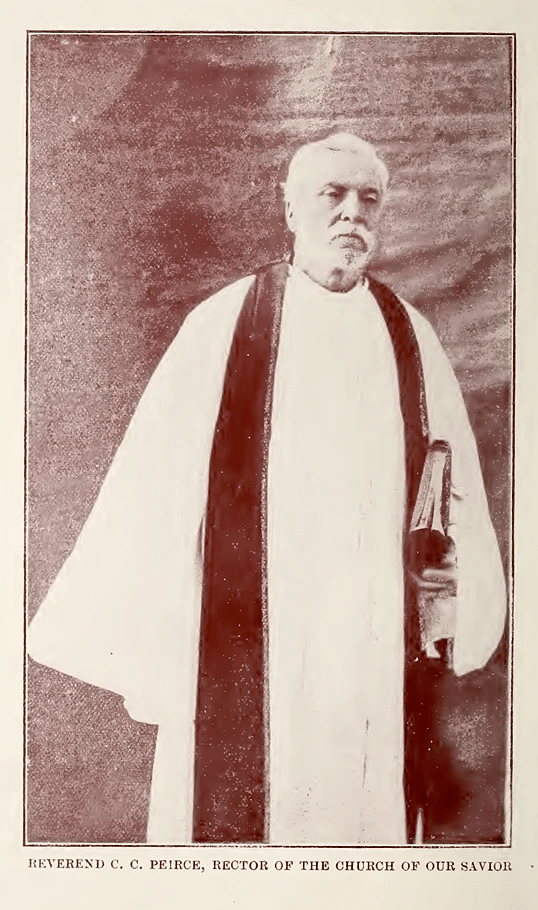
In 1825, Charles Caleb Peirce (yes, that spelling is correct) was born in the eastern United States (or, as it was called then, the central United States). Caleb (as he came to be called) was something of a precocious young man, with a strong literary streak and an industrious attitude. After graduating from college he earned his law degree– before he reached his 21st year. He clerked at the Ohio Supreme Court, but quickly became disillusioned about the “sordidness” of the practice of law. So, in a stunning career change, he entered the General Theological Seminary of New York and became ordained in the Episcopal Church in 1860.
From there, he crossed the continent to an upstart town in the far west called San Francisco (pop. at the time: 57,000)–a place that Peirce figured was in great need of ministry. He became rector of Grace Church (today’s Grace Cathedal), but once again he became disillusioned, this time by what he perceived as the corrupting influence of money in that church. (Notably, Grace Church’s evident difficulty in keeping a rector was satirized by Mark Twain in 1865.)
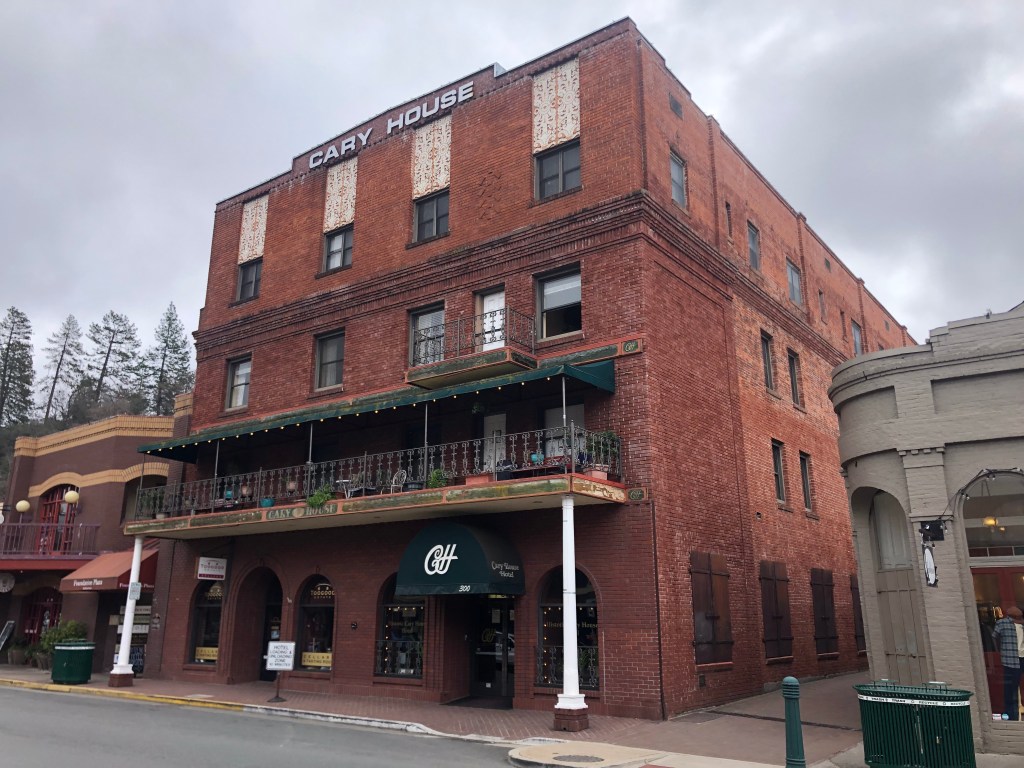
So Caleb Peirce uprooted himself again, this time to “a rough, sparsely settled, obscure corner of the United States” — which is of course Placerville, CA (pop. at the time: 2,500). He’s said to have alighted from his stagecoach in front of the Cary House hotel, which, incidentally, is still standing on Placerville’s Main Street today.
Cary-ing on since 1857.
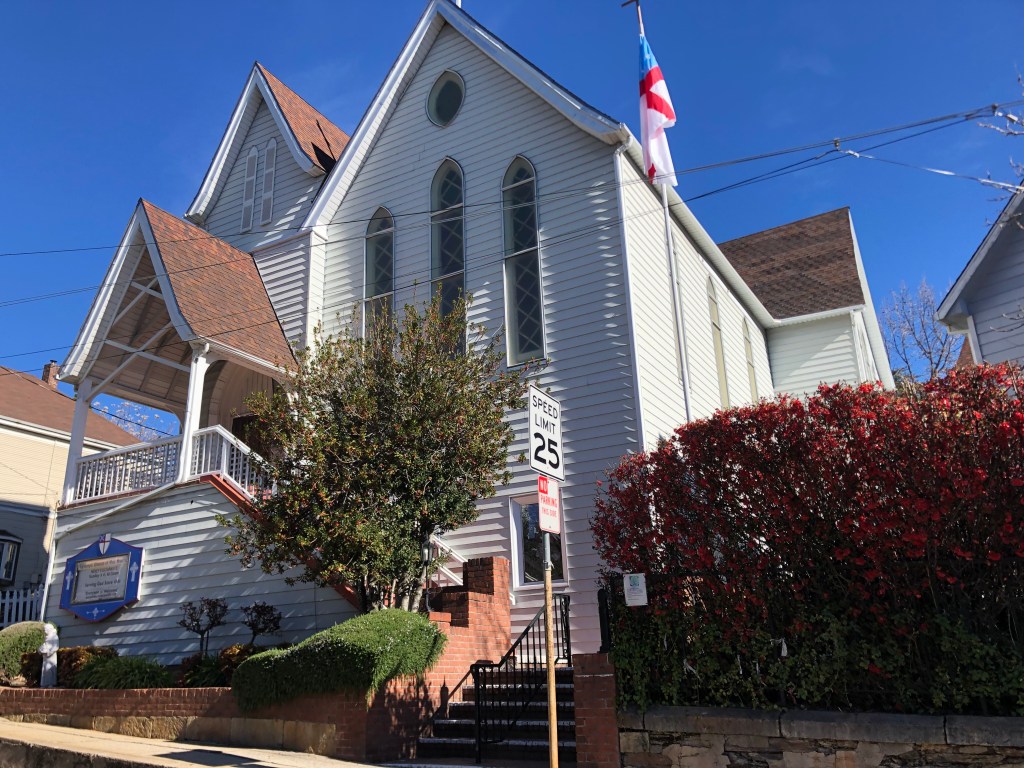
Peirce began organizing a church under the name “Church of Our Saviour.” Services were held in the county courthouse until a dedicated church building could be constructed. That church was completed in 1865, and it too is still standing today, just a few blocks from the Cary House.
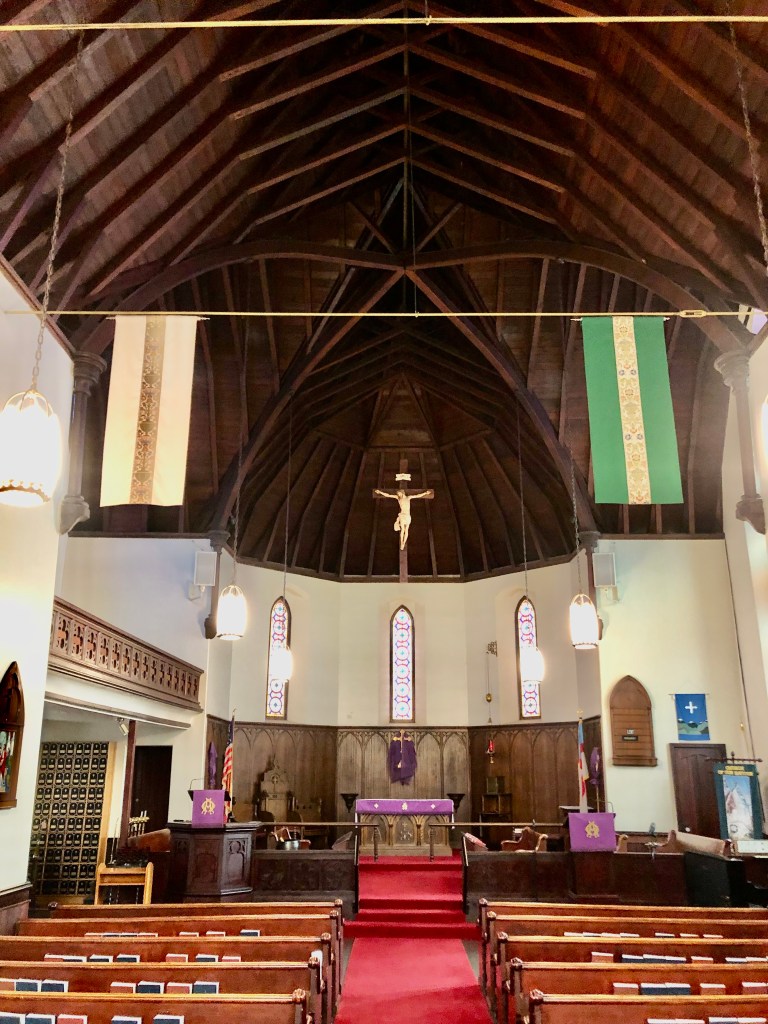
Church of Our Saviour, still standing after 156 years.Our Saviour’s sanctuary.
Caleb Peirce would remain the minister at the Church of Our Saviour for the rest of his life. But he hadn’t quite settled down exactly. Although he preached at the Church of Our Saviour every Sunday, he traveled (on foot!) to towns throughout the county the rest of the week, preaching, officiating at weddings and funerals, baptizing children, and whatnot.
Peripatetic Preacher
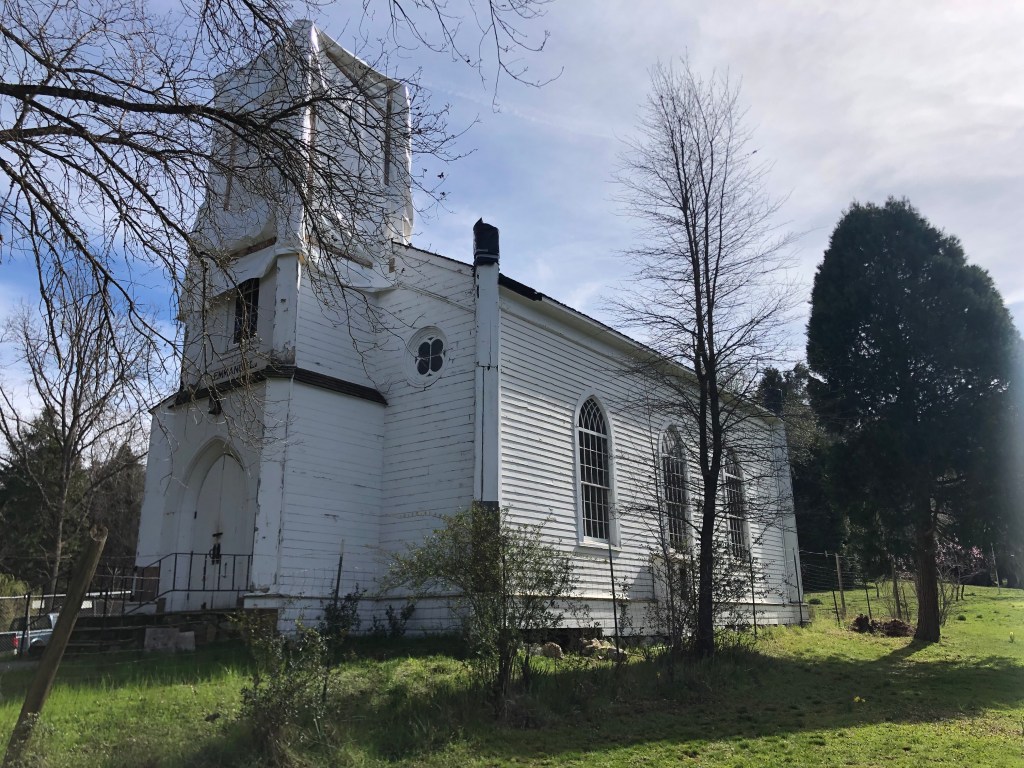
One of those nearby towns was Coloma (pop. at the time: 888). You’ll recall that this is the town where gold was first discovered at Sutter’s Mill. Peirce would preach frequently at Coloma’s Emmanuel Church. This was California’s first Episcopal church, constructed in 1855. And guess what? It too is still standing!
Emmanuel Church of Coloma.
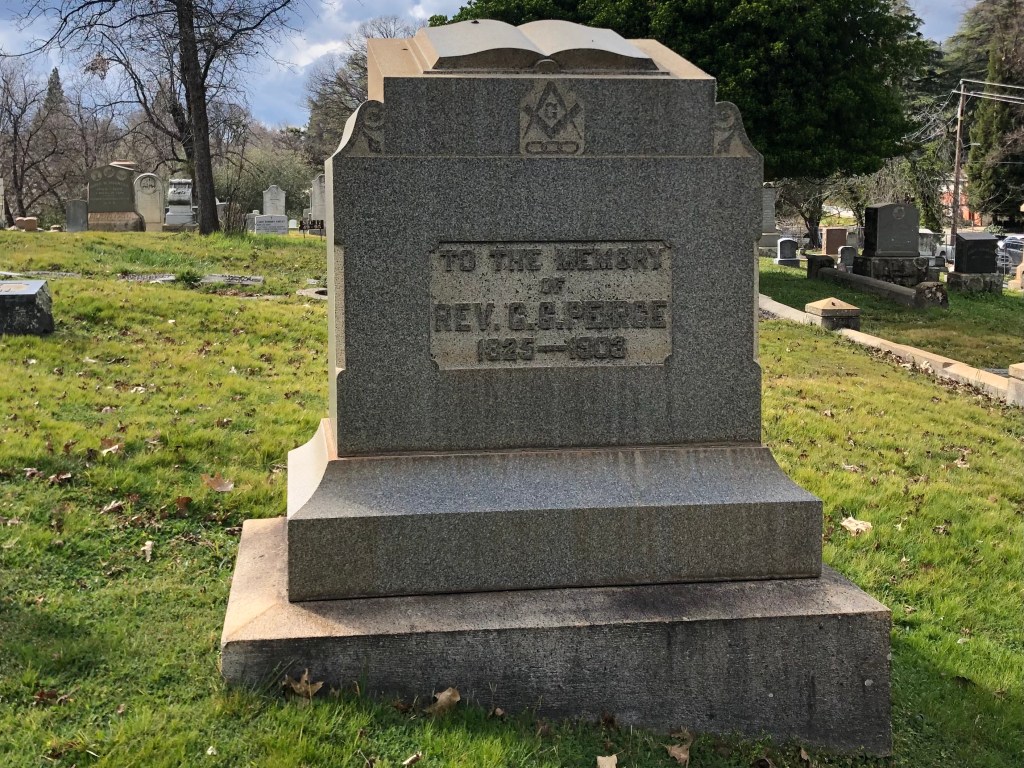
Caleb Peirce died of kidney disease on March 14, 1903. He was buried at Placerville’s Union Cemetery, just couple of blocks from the Church of Our Saviour. He is no longer standing, though perhaps in the eyes of God…
Note the symbols for the Free Masons and the Independent Order of Odd Fellows.
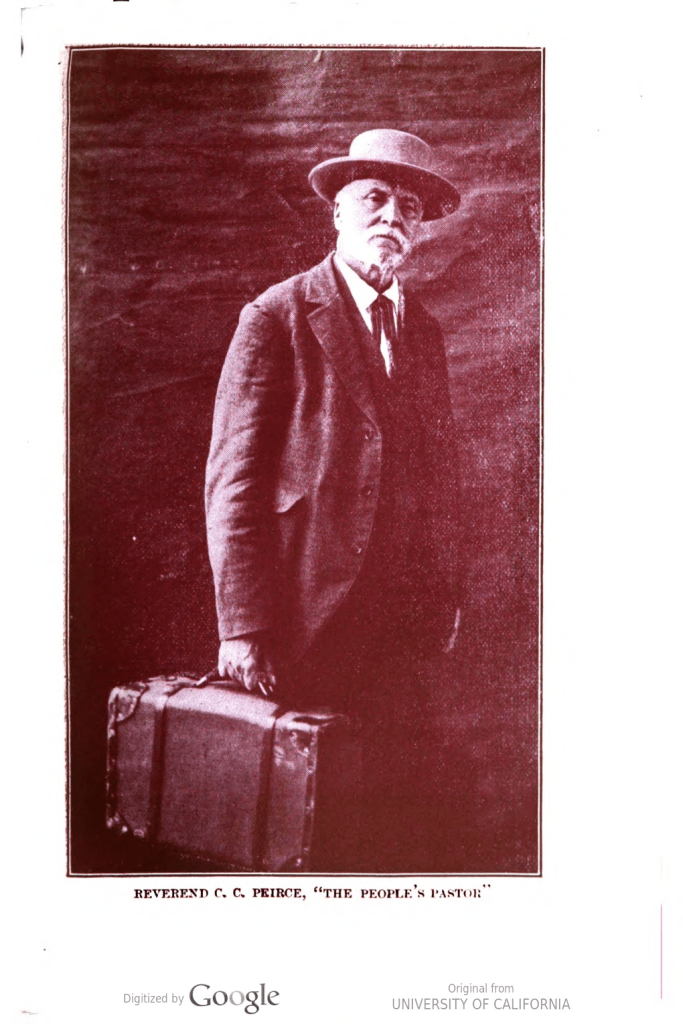
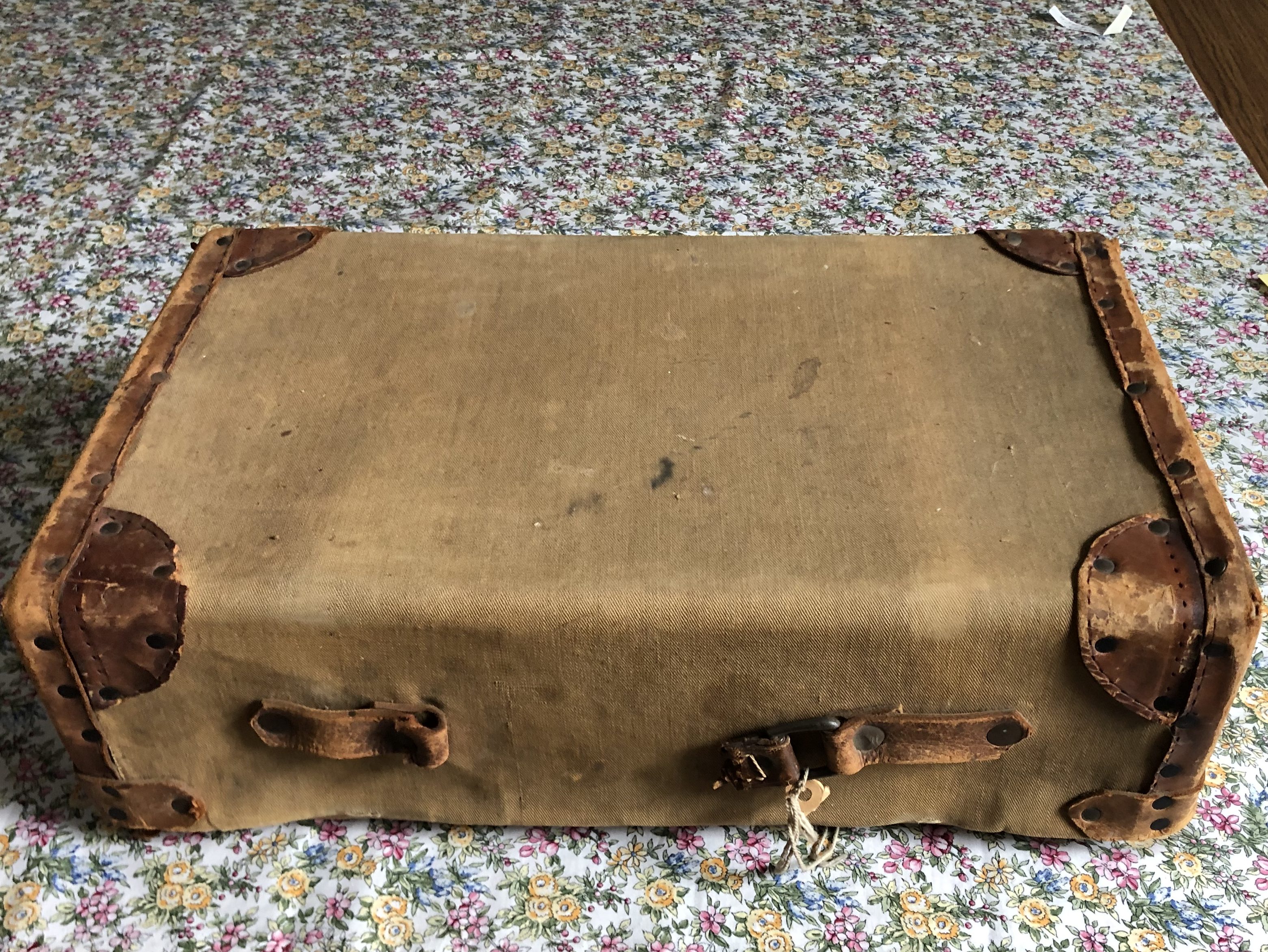
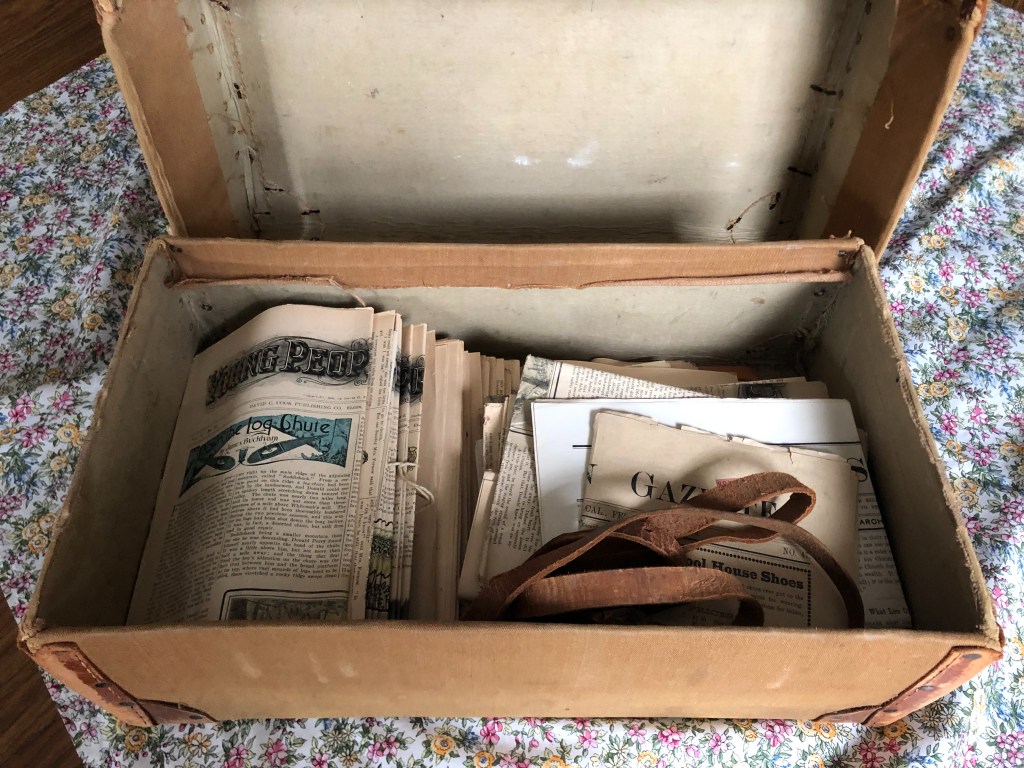
Peirce left few possessions, as most of his books and clothes had been destroyed in a hotel fire a few years earlier. But he did leave a suitcase…
Caleb and his Case.
…and that suitcase still survives today. It’s in The Church of Our Saviour’s Parish Hall, as if waiting for its owner to return.
A little worse for wear. But after 120 years, to be expected.
Today the Church of Our Saviour remains an active, little-engine-that-could church in the Placerville community. And what of the Emmanuel Church in Coloma? It still stands in the same place it’s stood for over 160 years, but its worn condition caused it to be shuttered in 2015, until extensive repairs can be made. That church, like much of Coloma, sits within the Marshall Gold Discovery State Historic Park, and as such it is under the control of the State Parks Department. However, I recently talked to someone who holds the deed to the church building, and this opens an interesting story of its own:
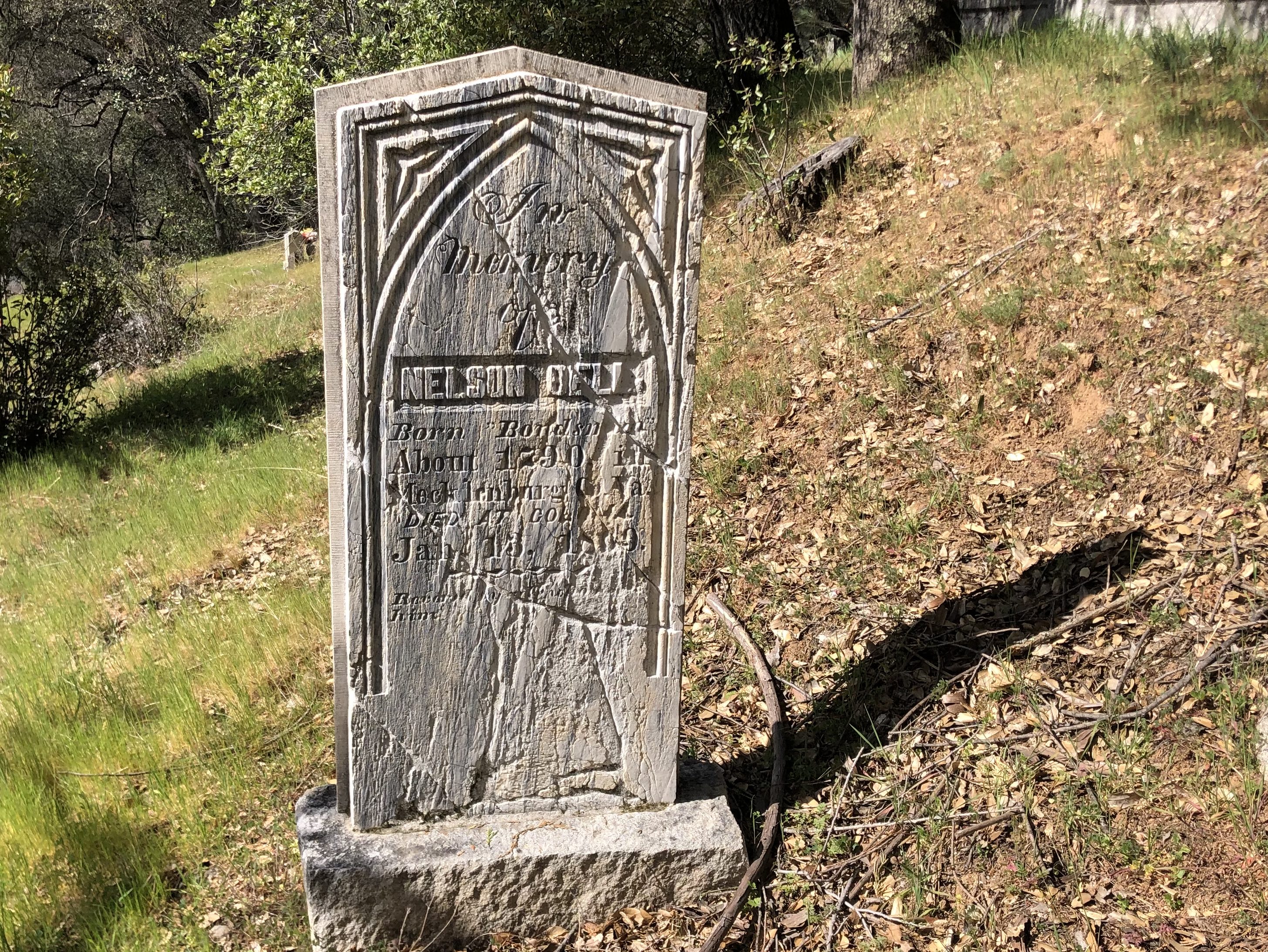
The story goes back to the Gold Rush, just a few years before Caleb Peirce arrived in Placerville. At that time, men from all over the country were pouring into the Sierra foothills in hopes of striking it rich in the goldfields. One of those men was a slave trader named Robert Bell, who brought with him an enslaved man he called Nellson Bell. (Evidently it was customary for slave traders to confer their own last names on the people they sold.) Nellson eventually made enough money mining that he was able to purchase his freedom. He died in 1869, and his headstone is still standing in the Coloma’s Pioneer cemetery.
The grave of Nelson [sic] Bell.
Now, Nellson had a son, named Rufus M. Burgess (no slaver’s surname for him!) He got married, took a job as a blacksmith, and eventually became a prominent, well-liked, and rather wealthy citizen of Coloma. Indeed, he died owning over 90 acres of Coloma land…including the Emmanuel Church building. (You wondered where this was going, didn’t you?)
The State Parks Dept claims the Burgess properties were given up to the state in probate after Rufus M. Burgess’s death. But Rufus’s great grandson, one John Burgess, argues that the land was taken illegally, which of course is plausible given the poor treatment of African Americans by the courts at the time. One wonders how one-time lawyer Jacob Peirce would have framed the legal issues.
As a coda: I met John Burgess (the great grandson) last weekend, and he’s got persuasive arguments as well as copy of his great-grandfather’s deed to his Coloma property. (He’s put out a book for young readers on the topic here.) If he wants to pursue legal action against the State Parks Department, I suppose the question is: Does he have standing?
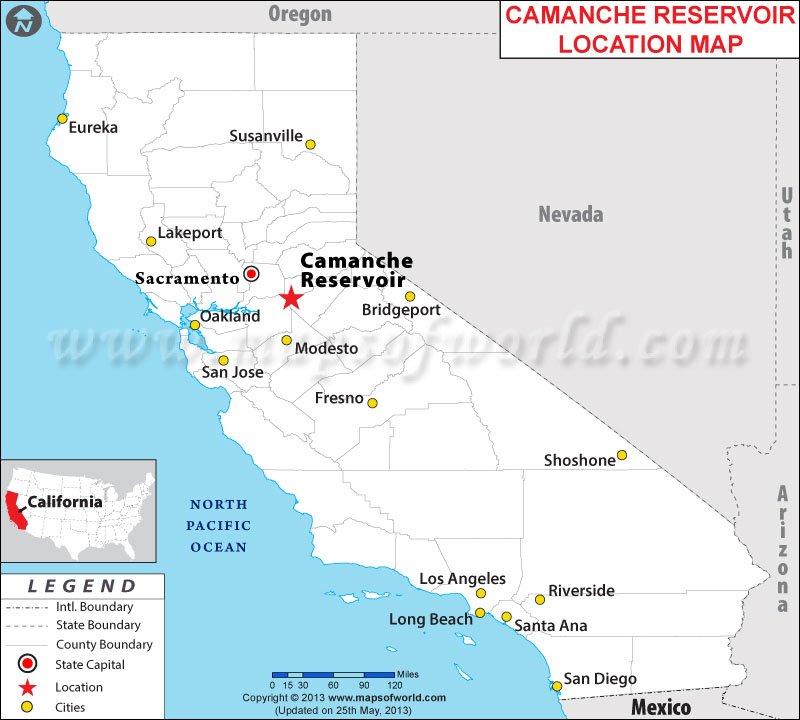
Back when I was a babe (shockingly, no one calls me this anymore), the good folks at the East Bay Municipal Utility District (East Bay MUD) decided to dam the Mokelumne River in the Sierra Foothills, thus creating a reservoir that would supply the growing population of the East Bay with reliable drinking water. They named the reservoir Lake Camanche.
I vaguely remember the too-good-to-be-true commercials, featuring over-excited sport fishermen and giddy children playing at the beach, that were broadcast over the fuzzy UHF stations on our ancient television set in the late 1960s. The commercials sought to entice families to buy undeveloped land that, thanks to the creation of the reservoir, had suddenly become beachfront property. The sales pitches belong to a mildly ineffable class of advertisements that evoke tropical beaches improbably appearing in the shrublands of California’s dry foothills or, say, the deserts of northern Arizona. Here’s a good example of the genre. For an illustration of how these schemes can go wrong, see my post on the Salton Sea.
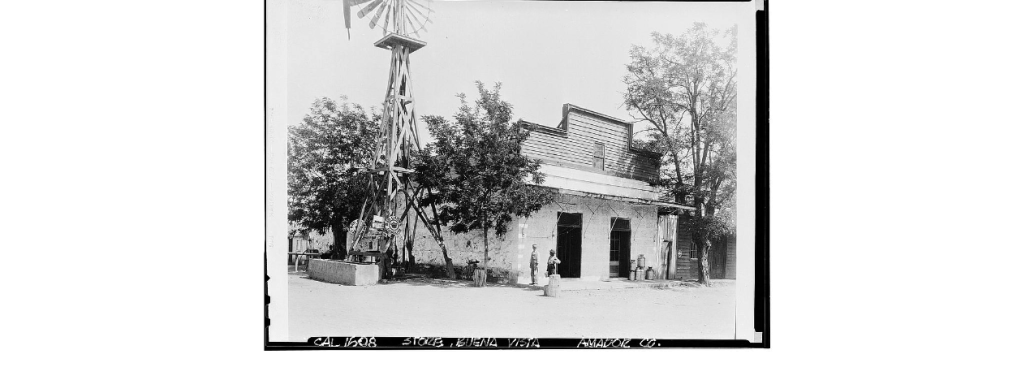
Anyway, although new communities were springing up on the north and south shores of Lake Camanche, several historic settlements found themselves underwater–literally. By damming the Mokelumne River, East Bay MUD flooded several gold rush towns: Lancha Plana, Poverty Bar, and Camanche. The first two were unihabited ghost towns, but Camanche still had some residents and a functioning post office that had to be relocated. (Camanche had been named by settlers in the 1850s after their home town of Camanche, Iowa.) Today, the towns sit under about 150 feet of water. It’s said that scuba divers occasionally explore the submerged remnants of the old towns.
Now, the Sacramento region has been experiencing unusually warm temperatures this week, feeling more like mid-spring than mid-February. And if that’s not a good enough reason for a retired chap to take a little road trip down to Lake Camanche, I don’t know what is.
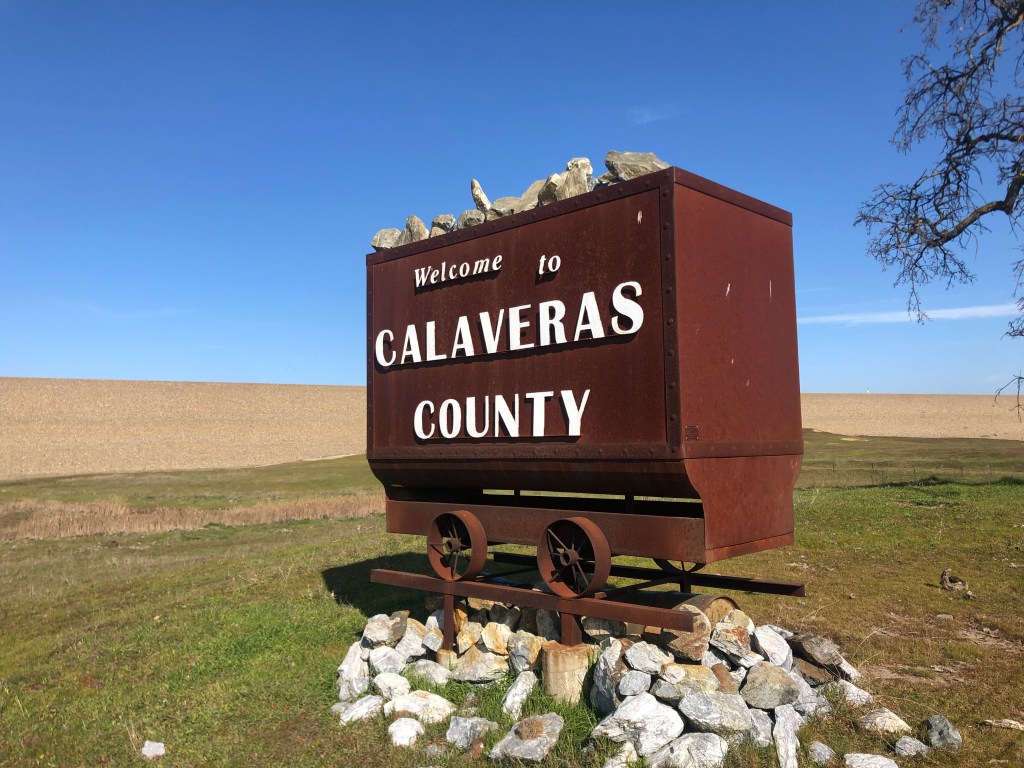
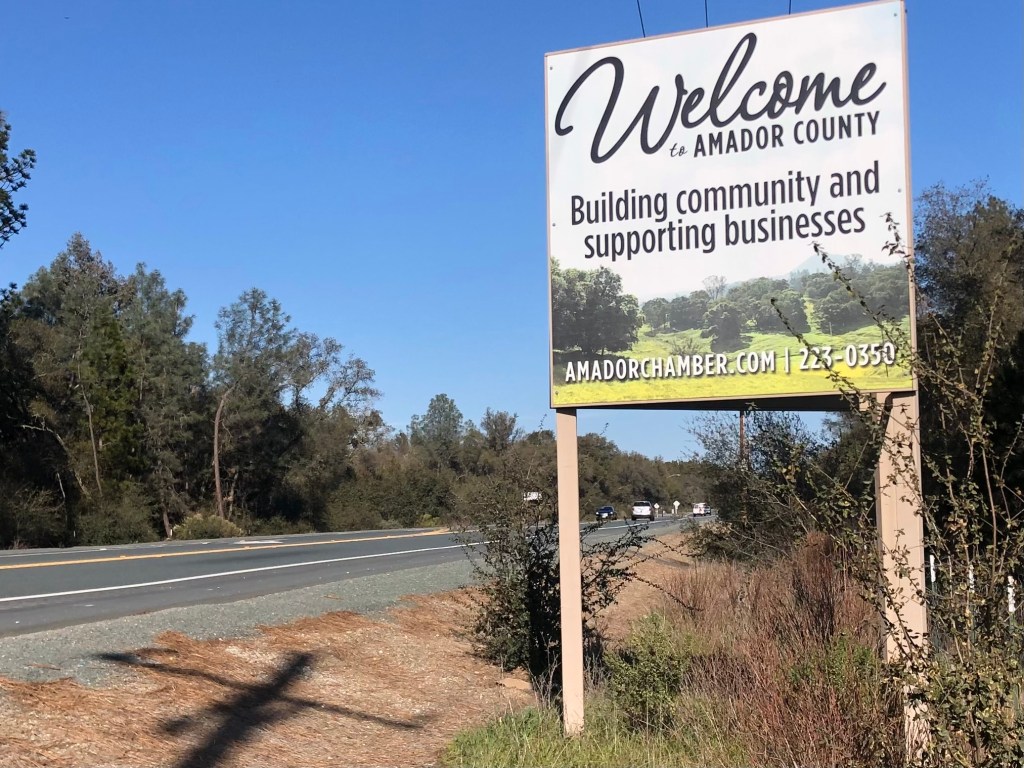
Thus I found myself heading south from my newish stomping grounds near Placerville, down to an area where Amador, San Joaquin, and Calaveras Counties meet. (Most of the trip followed Route 49, which I described in a recent blog post.)
(The San Joaquin sign is clip art; I didn’t actually pass any such sign today.)
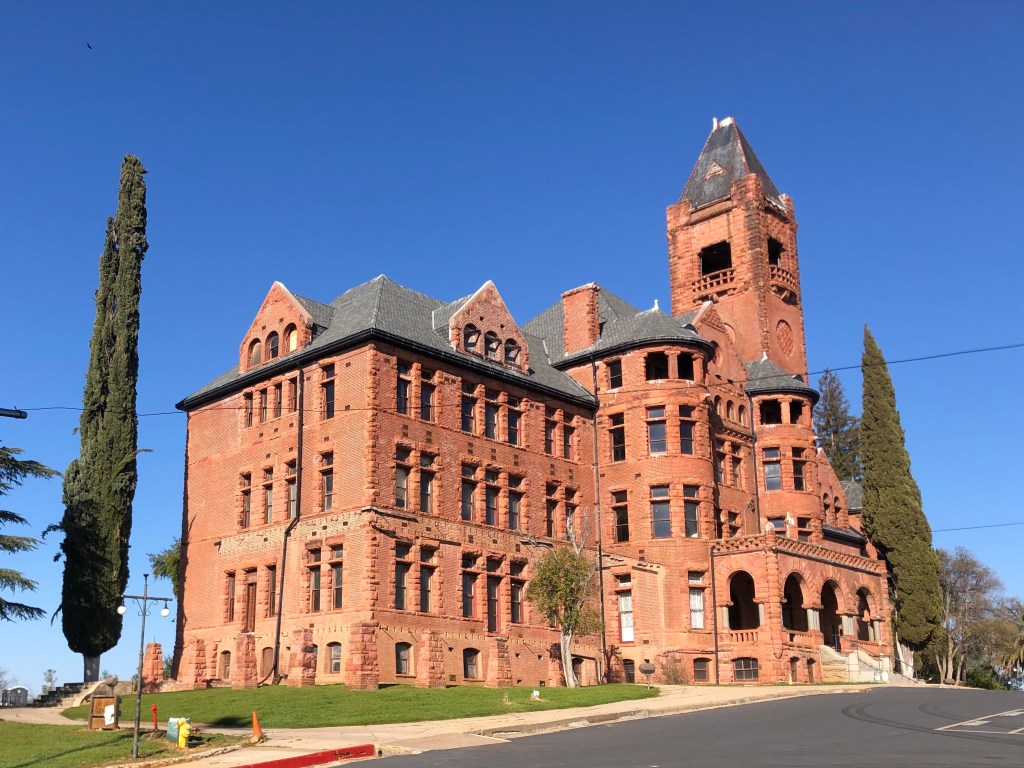
As I got close to Lake Camanche, I passed through the town of Ione (pop: 8,600). It’s a historic, quaint, and reasonably prosperous little community that no doubt will be the subject of a later blog. But for now, let’s just observe that Ione is home to the historic Preston Castle, which had been a reform school for boys that was built at the end of the 19th century. It’s said to be haunted, and for that it will likely be the subject of a blog in October.
You should see it at night.
When I finally arrived at Lake Camanche, I was somewhat disappointed. Let me enumerate the three reasons for my disappointment:
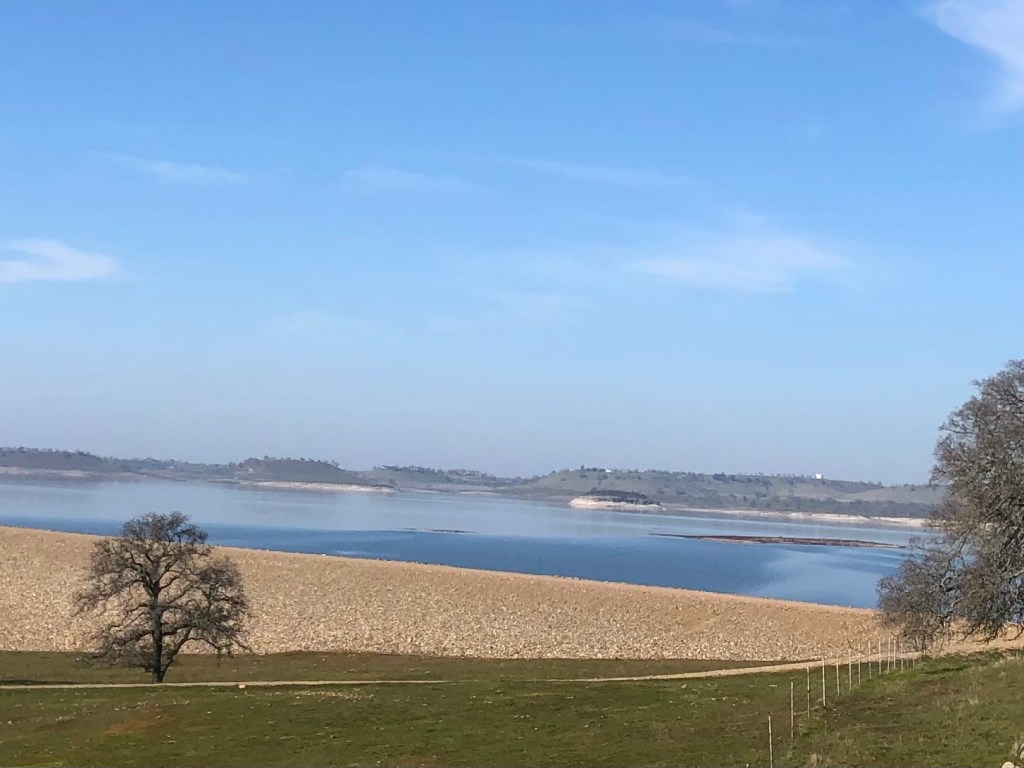
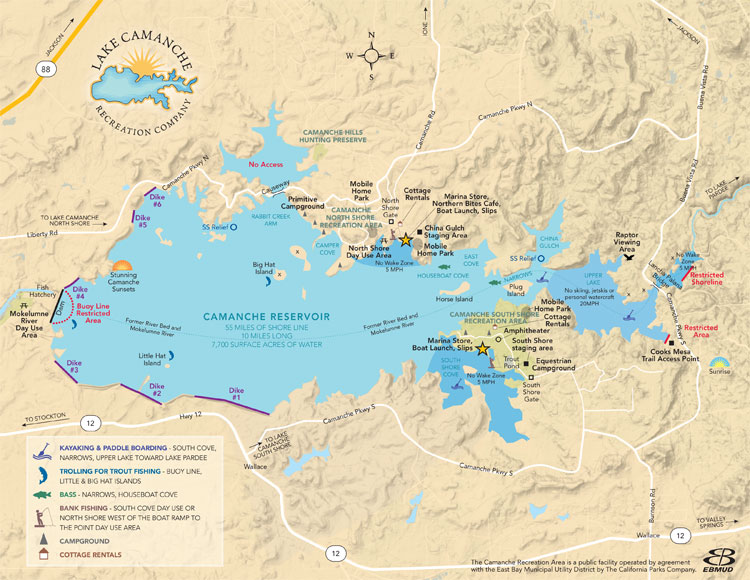
Camanche Reservoir, behind a dike.
There is limited public access to the lake itself. You can pay day use fees to enter at the boat launch, but I couldn’t find any shoreline drive to cruise along. I guess I should have brought a boat.
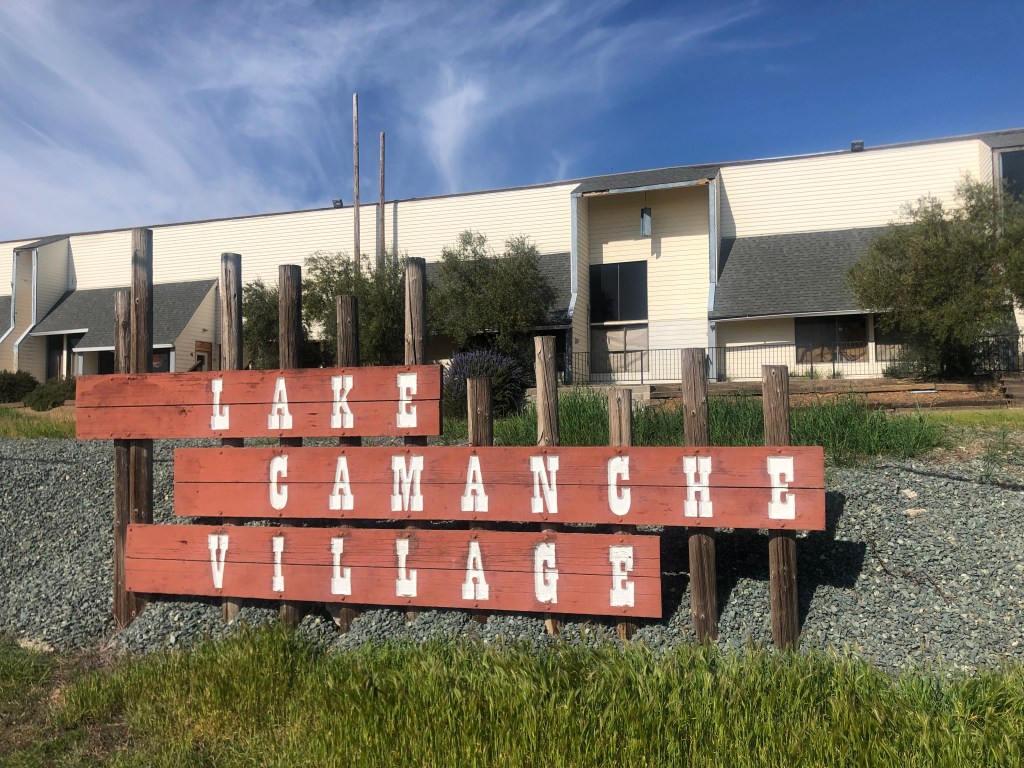
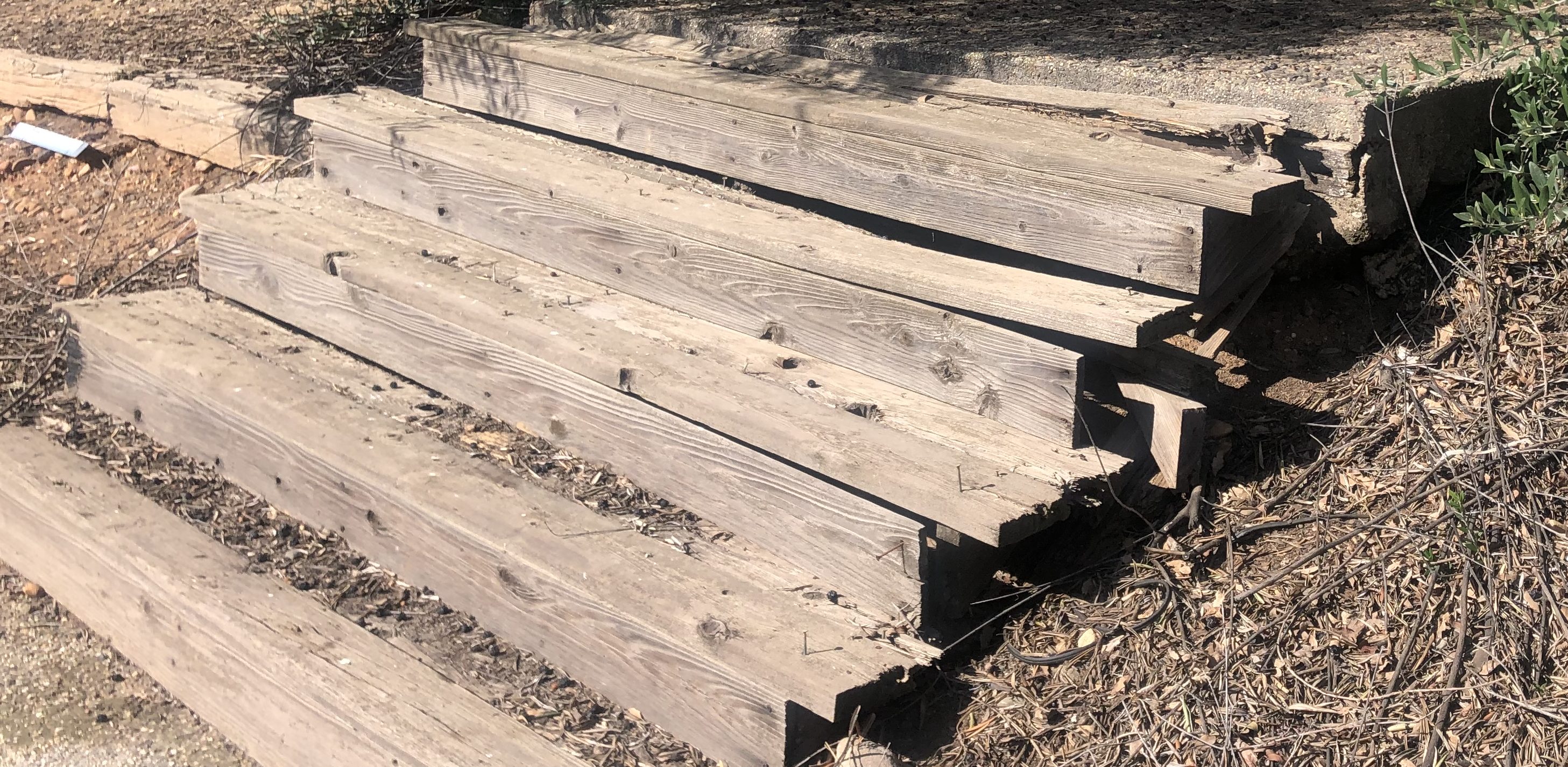
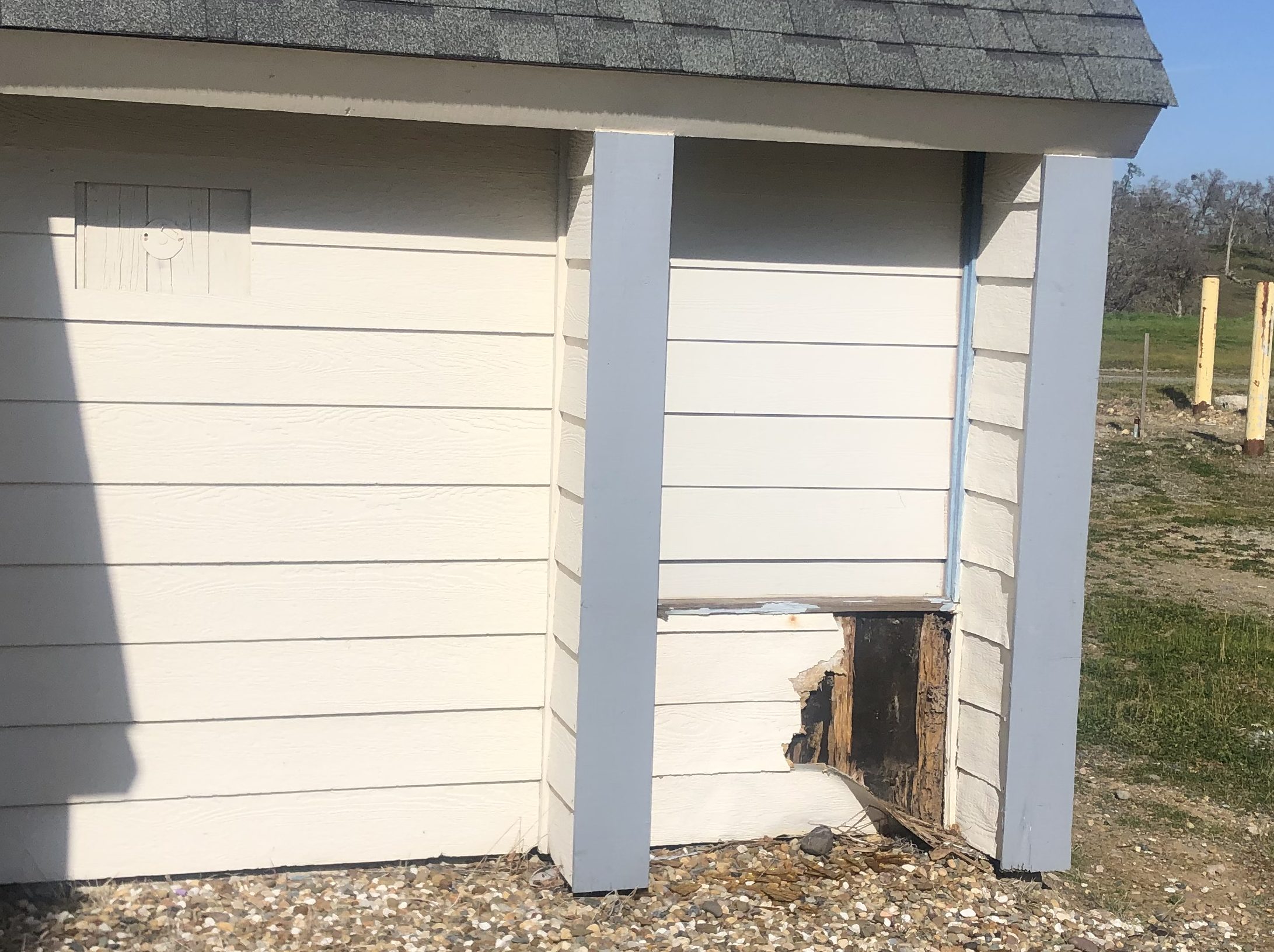
The communities around the lake never seem to have properly taken root. I saw no evidence of viable commercial districts, neighborhood parks, or even a decent brewpub. What little infrastructure I encountered was abandoned and/or decrepit.
Lake Camanche Village has seen better days…
3. Although recent news items spoke of how California’s drought has exposed ruins that normally reside under water, major rains this past December re-covered those historic remains and I was unable to find any evidence of those three historic towns under Lake Camanche.
Somewhere under Lake Camanche
Incidentally, although Lancha Plana had no population when the reservoir was being developed, it did have a cemetery. East Bay MUD decided to move the graves to another location…as if somehow, after over a hundred years, it would be cruel to put a lake over the cemetery. But such are the expectations of civilized society. Let’s just hope they learned the lesson of Poltergeist.
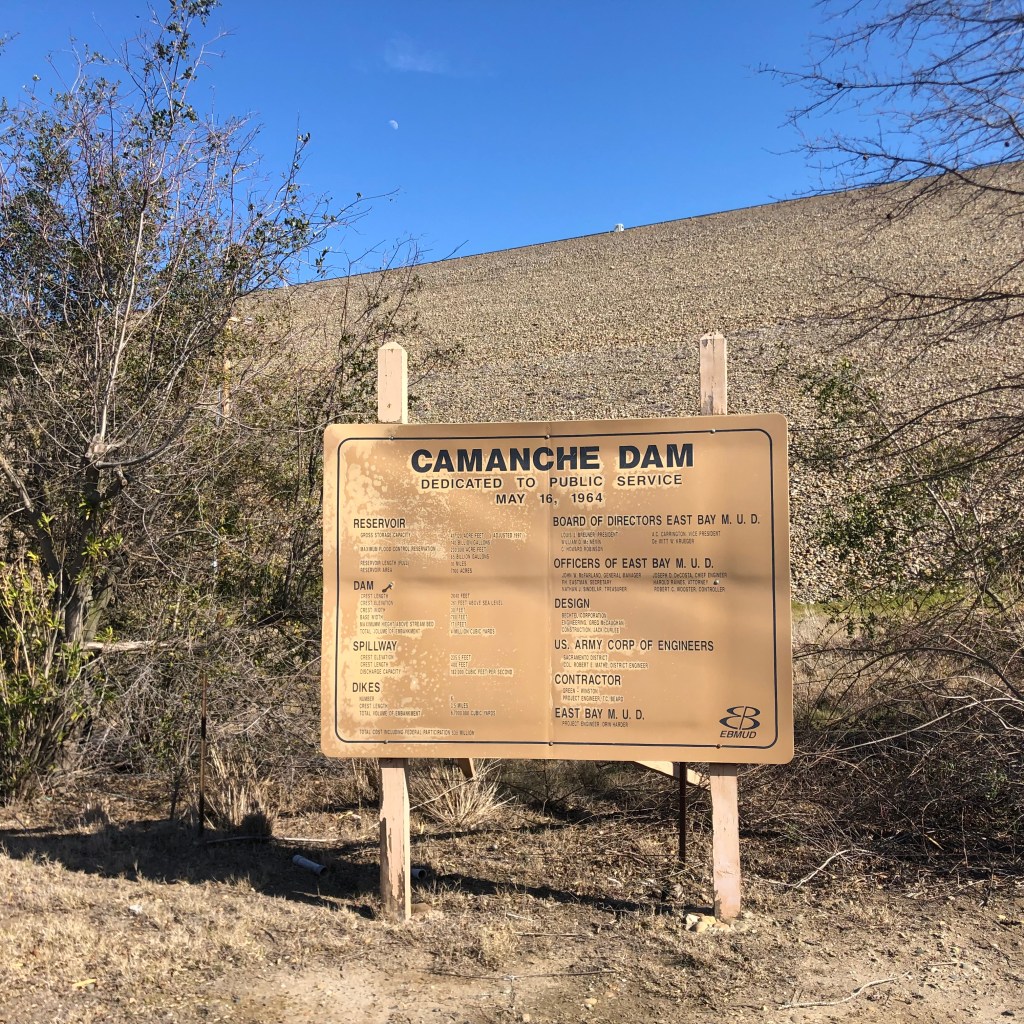
Still, even without encountering drought-exposed ruins, the visit was a good one. I took a pleasant drive more or less around the lake, with glimpses of the blue water and, more often, views of the surrounding hills. Eventually I came to Camanche Dam, which stops the Mokelumne River in its tracks.
A few stats about the dam, which was constructed in 1964: it’s 2640 feet long and 261 feet high, holding back up to 241 billion gallons of water. For those of you who can’t wrap your head around that number, it equates to about 107 billion cases of beer.
Is it just me, or does anyone else think the reservoir is in the shape of a guppy?
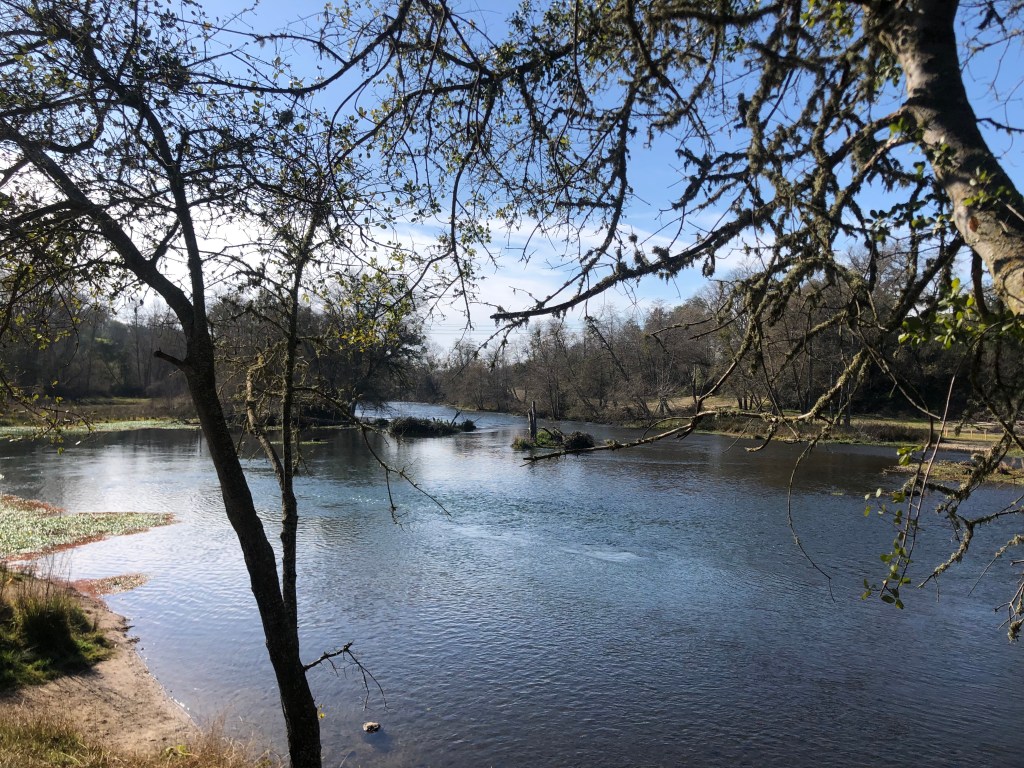
Here’s the placid Mokelumne River shortly after it passes through the dam.
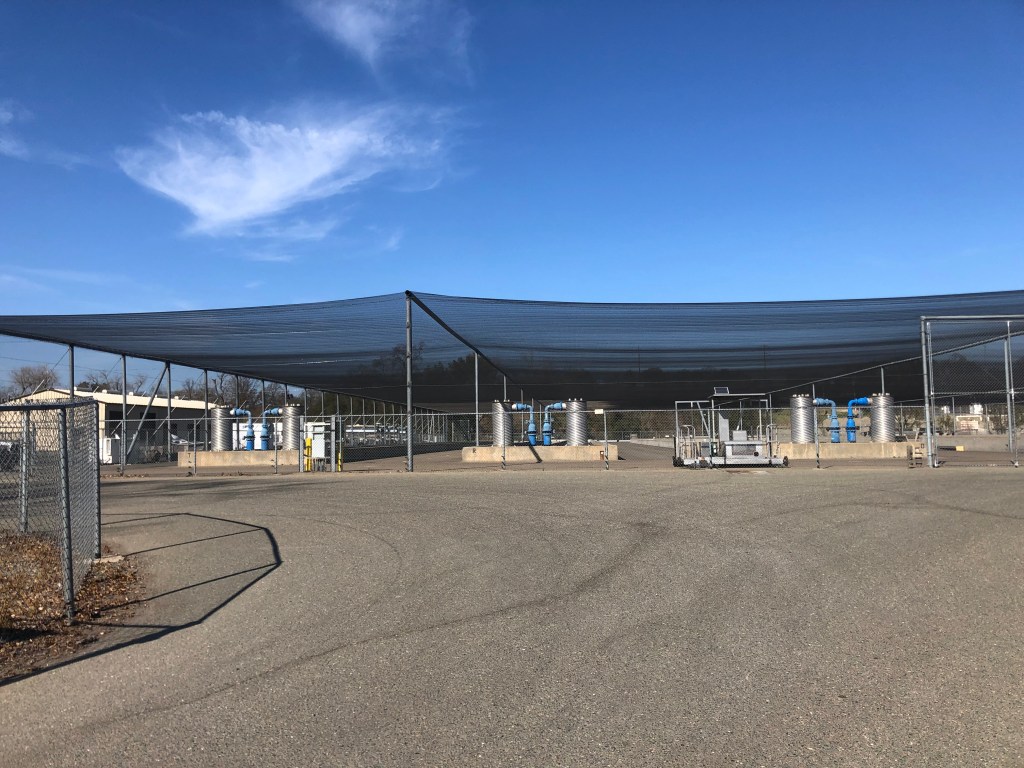
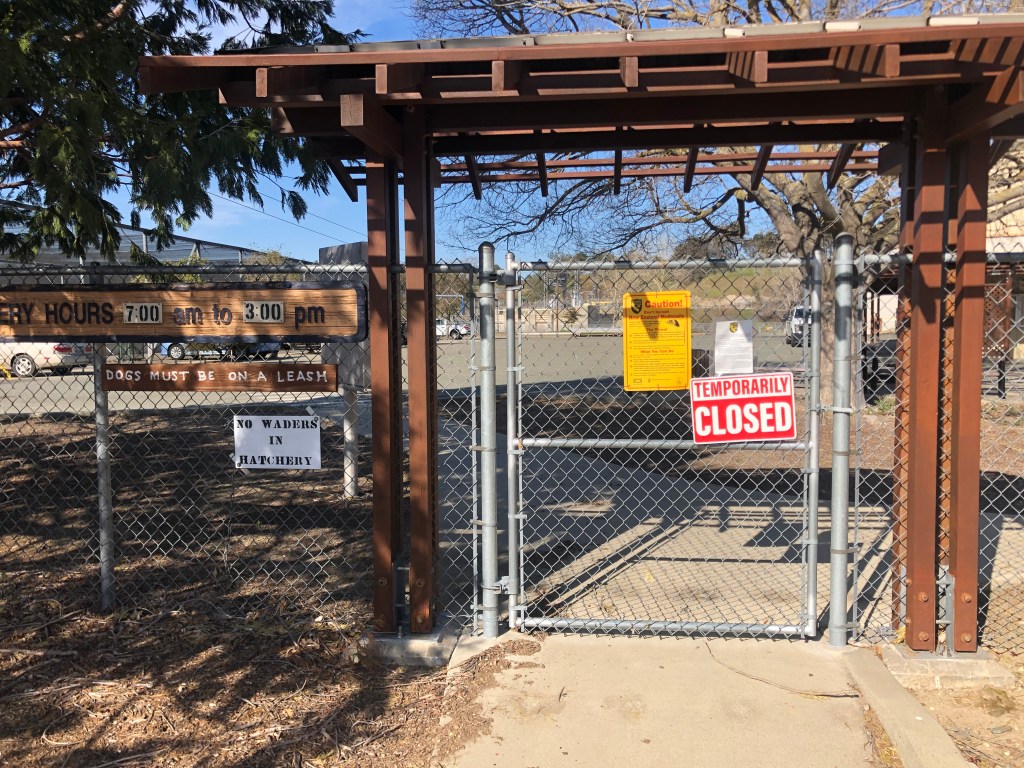
Near the reservoir there’s also a fish hatchery, which is used to restore Chinook salmon and steelhead whose kinky sex lives were impeded by the dam. Sadly, the facility is now “temporarily closed” to visitors.
Mokelumne Fish Hatchery, where salmon get it on. I couldn’t get confirmation on whether they pipe in Barry White music.
Well, that’s kind of it. Without a watercraft or scuba gear, there isn’t a whole lot to do around Lake Camanche. With a final glance at a few anglers attempting to hook, kill, and presumably devour some of the recent graduates from the fish hatchery, I got back on the Speedmaster and headed for home.
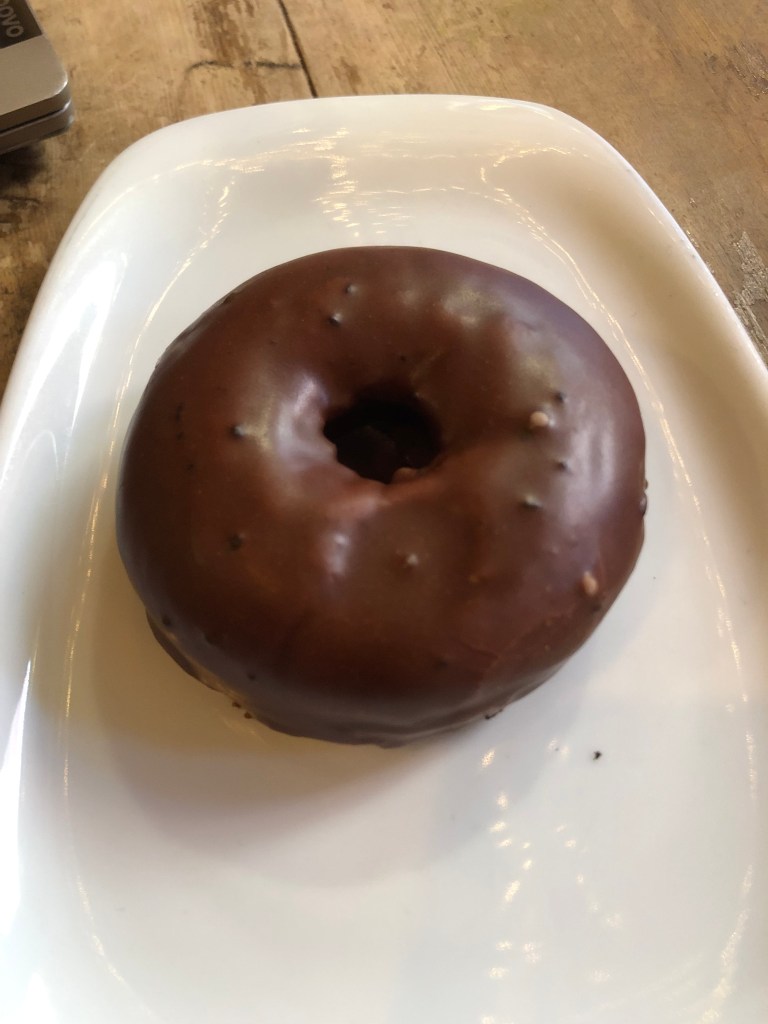
So, today is my birthday. I’m not going to dwell on that, other than to note it’s a prime number, and it earned me a free donut. Anyway, I figured that I’m not getting any younger, so I decided to spend the day exploring the back roads of the Sierra Foothills. The region is beautiful this time of year, with its rolling hills covered with deep green grass. And today was unseasonably warm, feeling much more like spring than winter. So I saddled up the Speedmaster and went to see what I could see.
Thank you, Totem Coffee in Placerville!
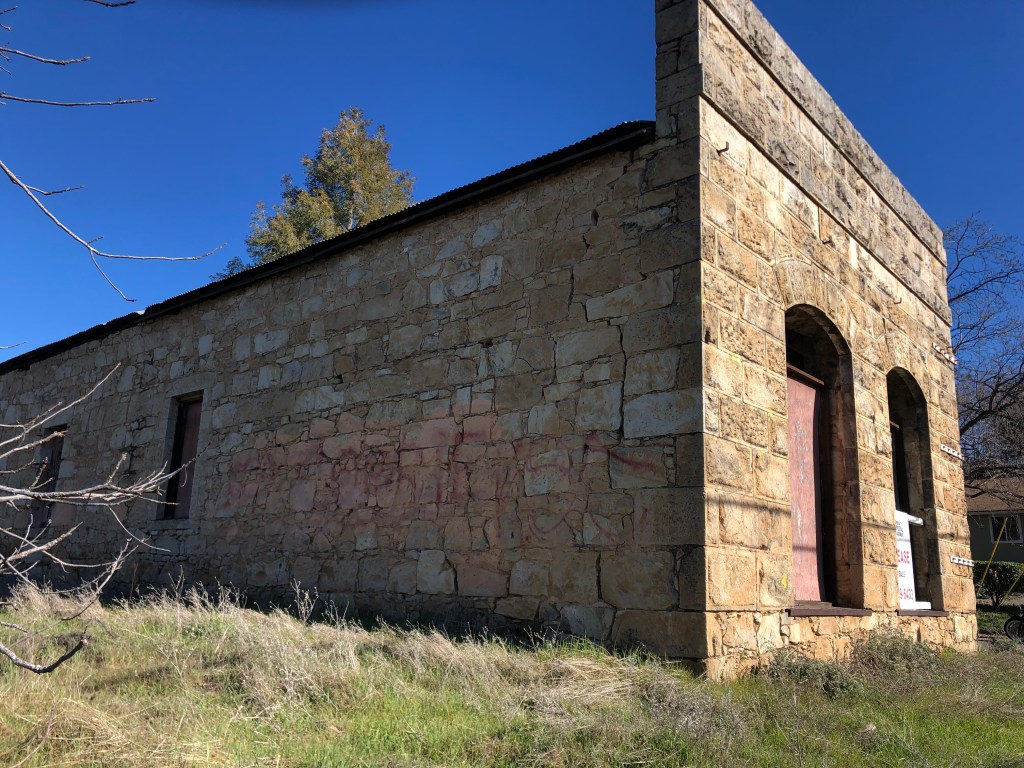
I found myself meandering along CA Route 49–a scenic, historic road that links a number of gold mining towns. (I wrote about an earlier trip along a stretch of it here.) This time I headed south on CA-49, starting around Coloma. I passed through the (relative) metropolis of Placerville, and soon came to Diamond Springs (pop: 11,000). To me, Diamond Springs is one of those gold rush towns that has somehow managed to maintain its historic charm while still being relevant in the 21st century. Its population has more than doubled since 2000. The most attractive business in town, for my money (literally), is Solid Ground Brewing. But the most picturesque building is the old General Store, from the 1850s. It’s for sale or lease, if any of my readers wants an investment property…
Interested? Call University Capital Management at 916-929-5433.Exterior detail of your future lease/purchase.Interior of the building. Like Charlie Brown’s Christmas tree, it just needs a little TLC.
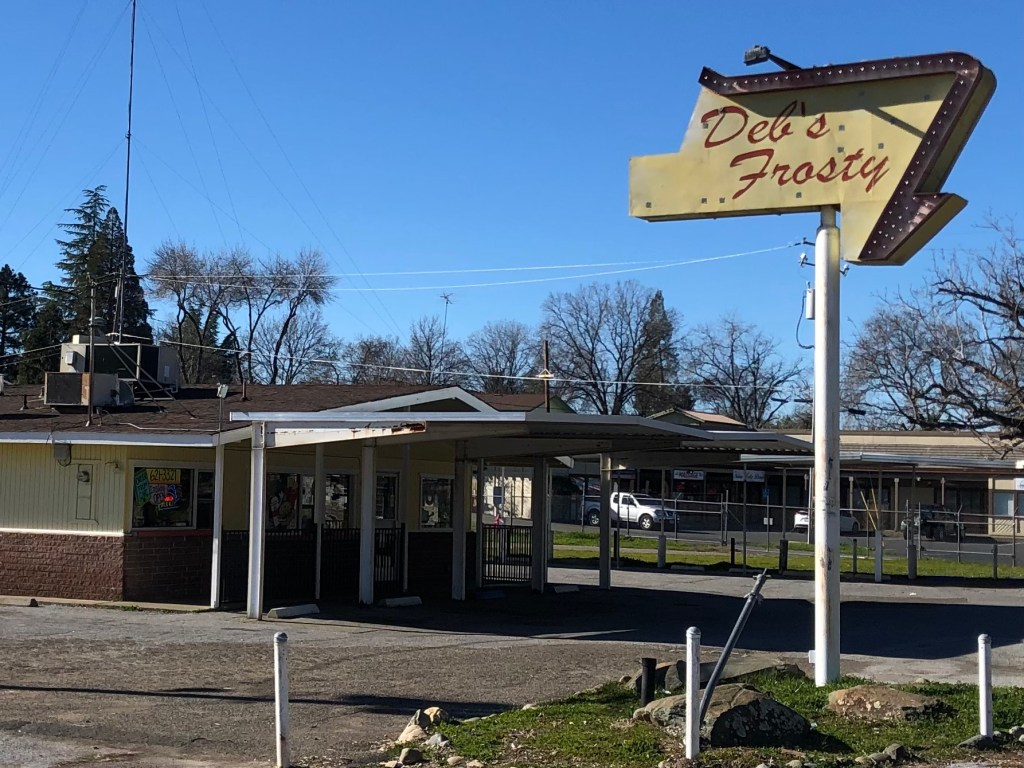
Now, in case you thought Diamond Springs was stuck in the Gold Rush era, it does have some “modern” buildings….from the 1950s. According to Yelp, Deb’s Frosty specializes in Mexican food. (??!)
The go-to spot for Chile Relleno.
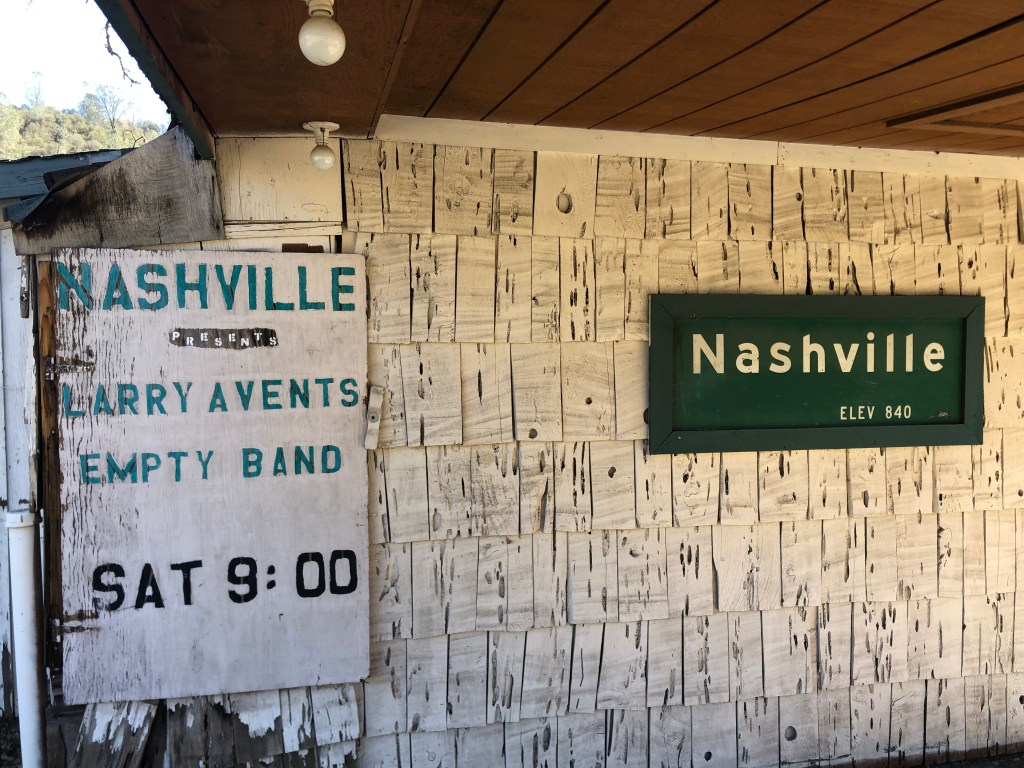
Somewhat further down 49 I entered Nashville. No, not the Nashville. But they do have their own music venue.
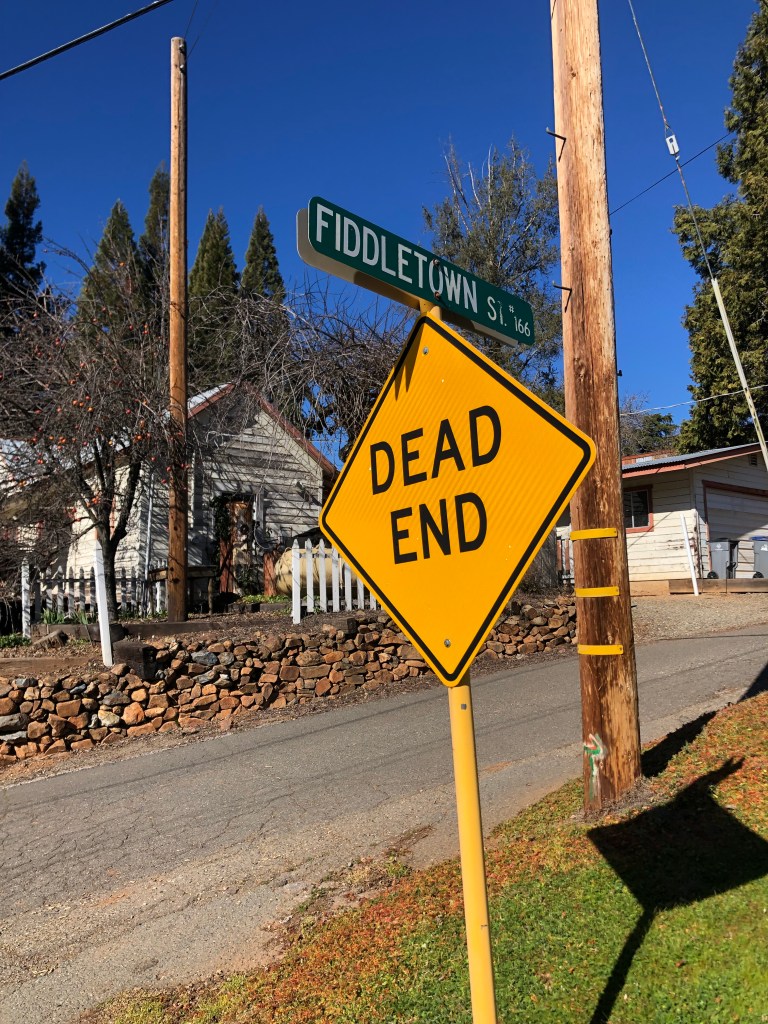
After a few random stops for gas, coffee, and Reeses (it’s my birthday, after all), ended up in Fiddletown (pop: 235). I spent several hours here. Fiddletown dates back to 1849, as do so many of the towns here in the Mother Lode Country. It didn’t start out as a particularly popular place to mine for gold, given that it didn’t have any year-round rivers or streams, which the miners needed for panning and placer mining.
Then, in 1852, gold was found in the region’s dry creekbeds, and everything changed. The town swelled with an influx of prospectors, and a canal was dug to divert water from the Cosumnes river into Fiddletown’s dry creekbeds. Not only did this facilitate easier gold mining, but it also opened the region to agriculture. By 1854 Fiddletown’s population exceeded 2000 souls.
With growth and wealth came the desire for respectability, which for some required changing the name to anything but “Fiddletown.” (It’s unclear where the original name came from, but one story suggests the original settlers from Missouri enjoyed playing fiddles in their spare time.) In any event, a decision was made in 1878 to change the name to “Oleta,” which was the name of a prominent resident’s daughter. Fortunately for those of us who appreciate local color, the original name was restored in 1932.
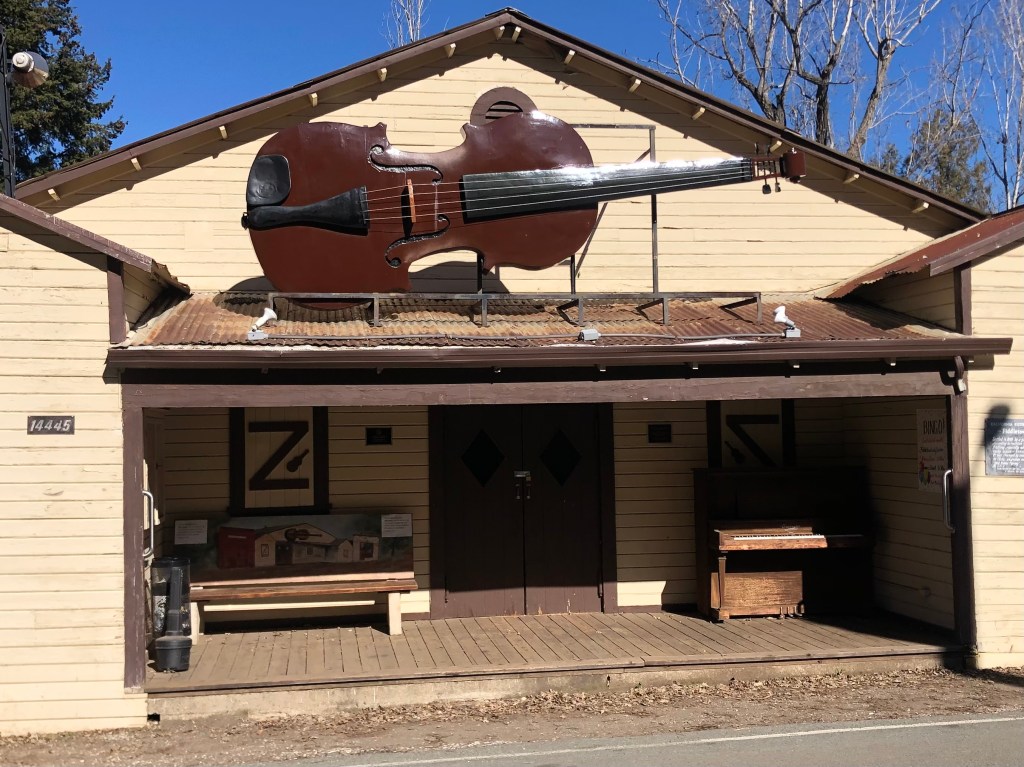
At some point, the town so embraced its name that it erected a huge fiddle over the community center. I’m told that there have been several iterations of this instrument. The latest version is made out of fiberglass.
It’s not a vile inn. It’s a fiddle.
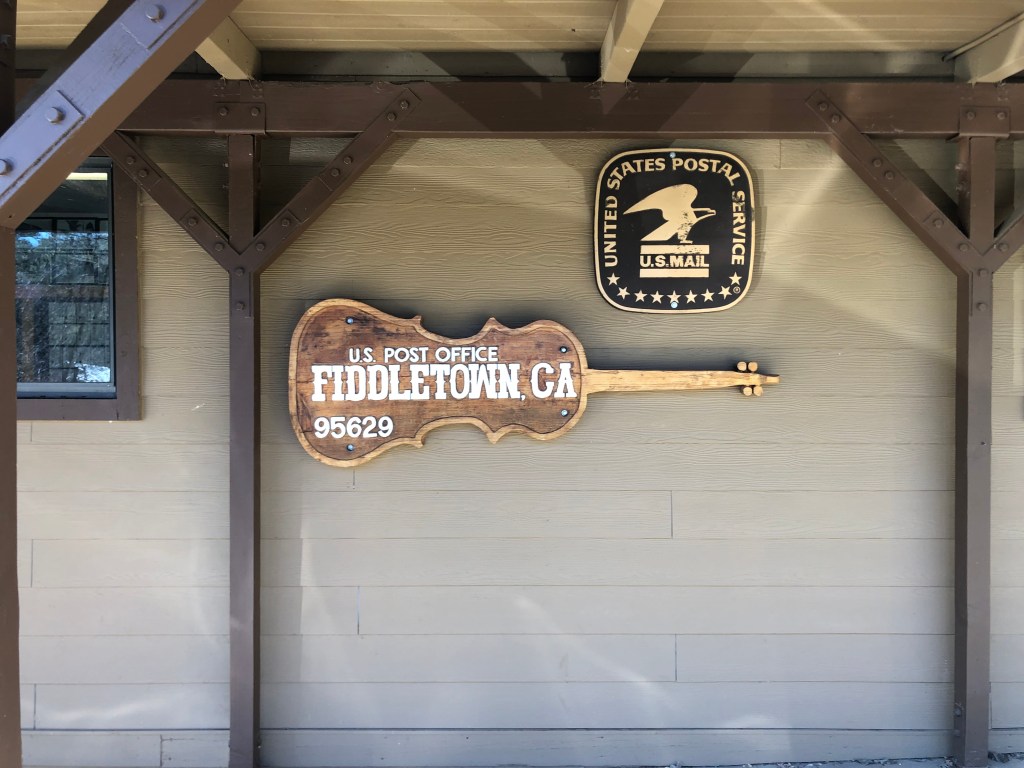
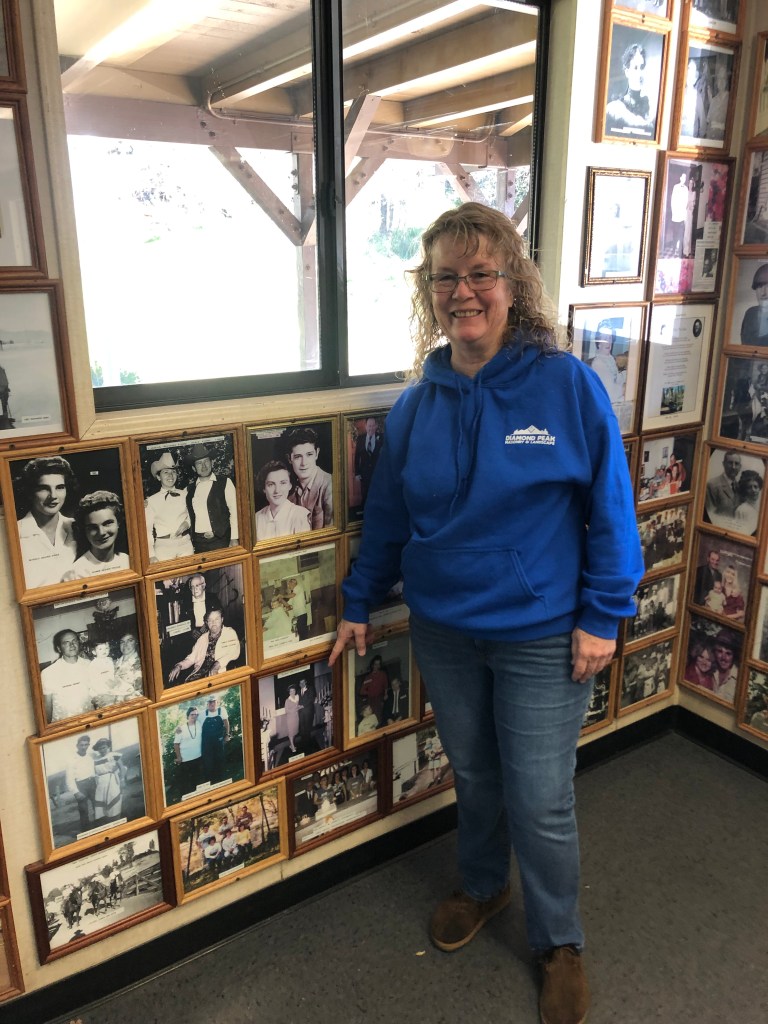
How do I know this? Because Michelle told me. I ran into Michelle at the town’s post office. The walls of the lobby are lined with historic photographs of the town’s residents, and I was perusing them when Michelle walked in to get her mail. There are literally hundreds of photos, so I asked her, “Is every resident in town pictured here? Where’s your photo?” She matter-of-factly told me that the post office ran out of wall space long ago, and replacing an old picture with hers “would require permission from the Post Mistress.”
Another Fiddle
Michelle then spent the next 20 minutes pointing out pictures of friends and relatives on the walls. She grew up in Fiddletown, and says it’s an wonderful place to live. She used to rollerskate in the community center (where the big fiddle is), and knows most of the residents. However, she said the town’s recent growth has made it difficult to keep track of everyone.
Michelle pointing to her grandparents’ wedding photo.
At some point Fiddletown became a major enclave for ethnic Chinese folks–in fact, for a time it boasted the state’s second-largest Chinese population, after San Francisco. Along the main street there are several well-preserved buildings that speak to the town’s Chinese heritage: A general store, a gambling hall, and an apothecary.
General store, built circa 1850.The “Fortune Peaceful Gambling House,” built circa 1852. It’s said that not only gambling but other vices–involving young women that weren’t your wife–took place within these walls.Apothecary, built from “rammed earth” in 1851.
The apothecary also serves as a museum (which, sadly, was closed when I visited). It contains personal effects from over 100 years of continuous habitation by Chinese “herb doctor” Yee Fung Cheung, his successor Chew Kee, and Chew Kee’s adopted son, Jimmie Chow. Jimmie Chow lived his entire life in Fiddletown, and was the town’s last Chinese resident when he died in 1965. Notably, Michelle (whom I’d met at the post office) had met Jimmie in the early 1960s. Her father and she took some fish heads to Jimmy’s house for his fish head soup. Michelle had thought it was a joke until she watched Jimmy add the heads to his soup pot. (If you’re interested, here is a recipe.) Michelle told me she was fascinated by the home/apothecary, and all the unusually artifacts therein.
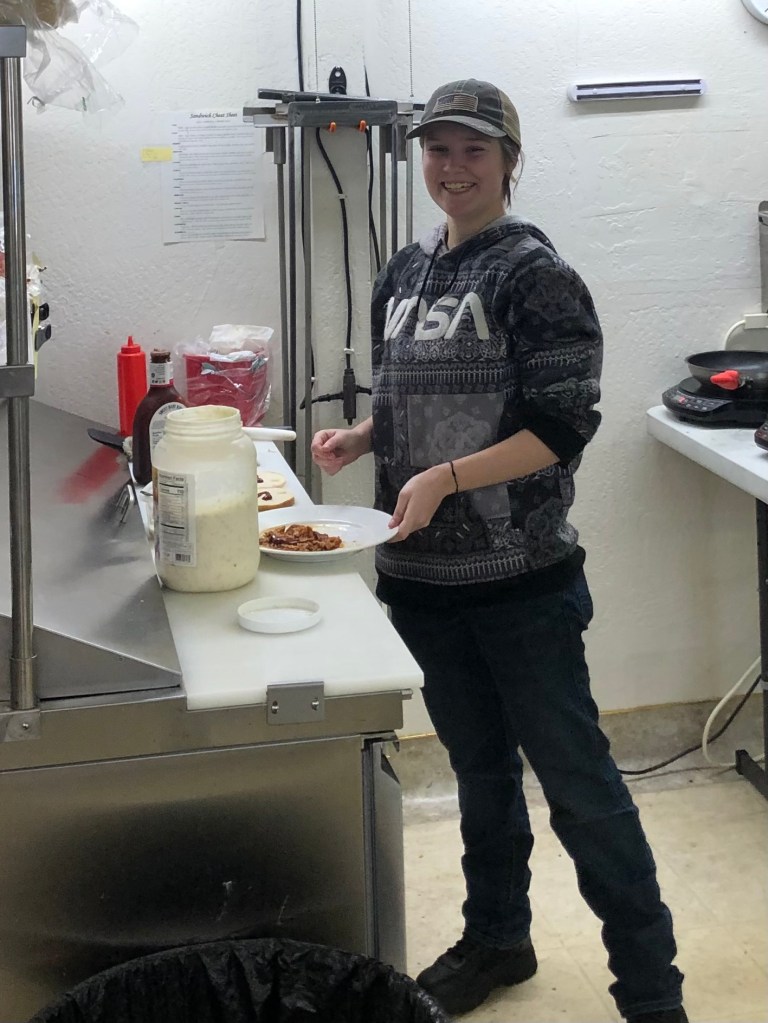
All this talk of fish heads was making me hungry, so I figured I’d scope out a place for lunch. There is exactly one place in town that will serve you a sandwich, so that made my choice easy. Improbably, it’s the Brown’s English Toffee store on Main Street. A young woman named Kailey, who’s been working there for the past two months, took my order. After a few false starts (they were out of the meat and the bread that I wanted. But other than that, they had just what I wanted for a sandwich!), she managed to produce a pulled pork sandwich with cole slaw.
Would you like mayo on that? I have plenty…
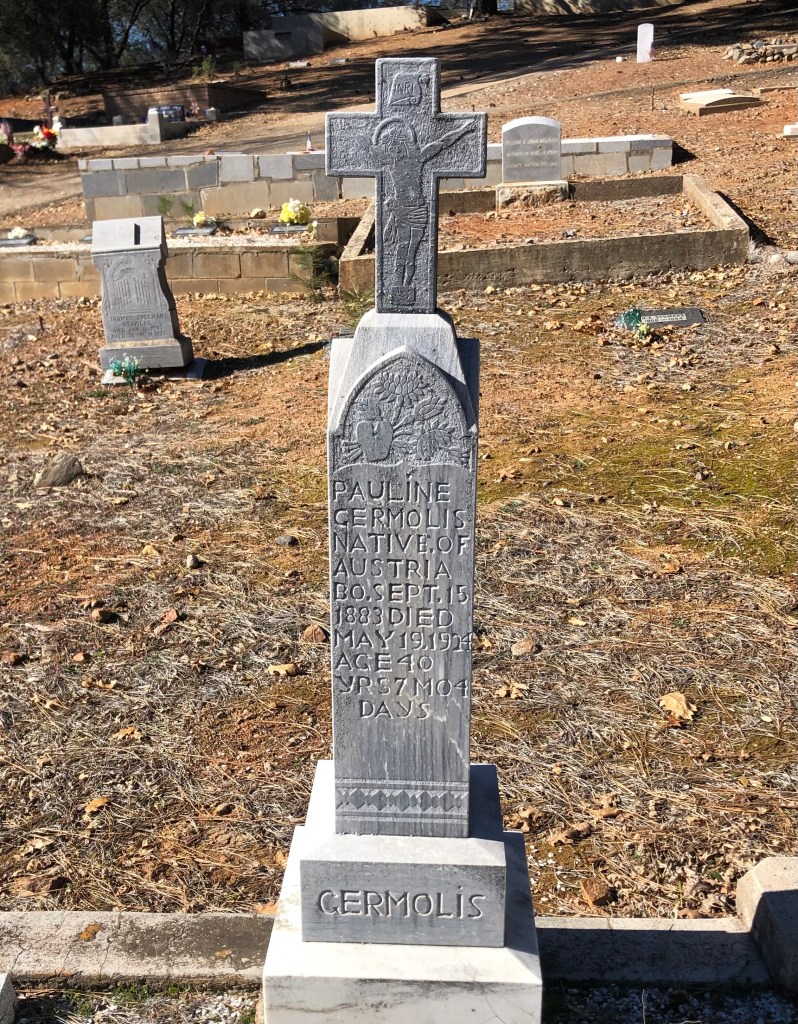
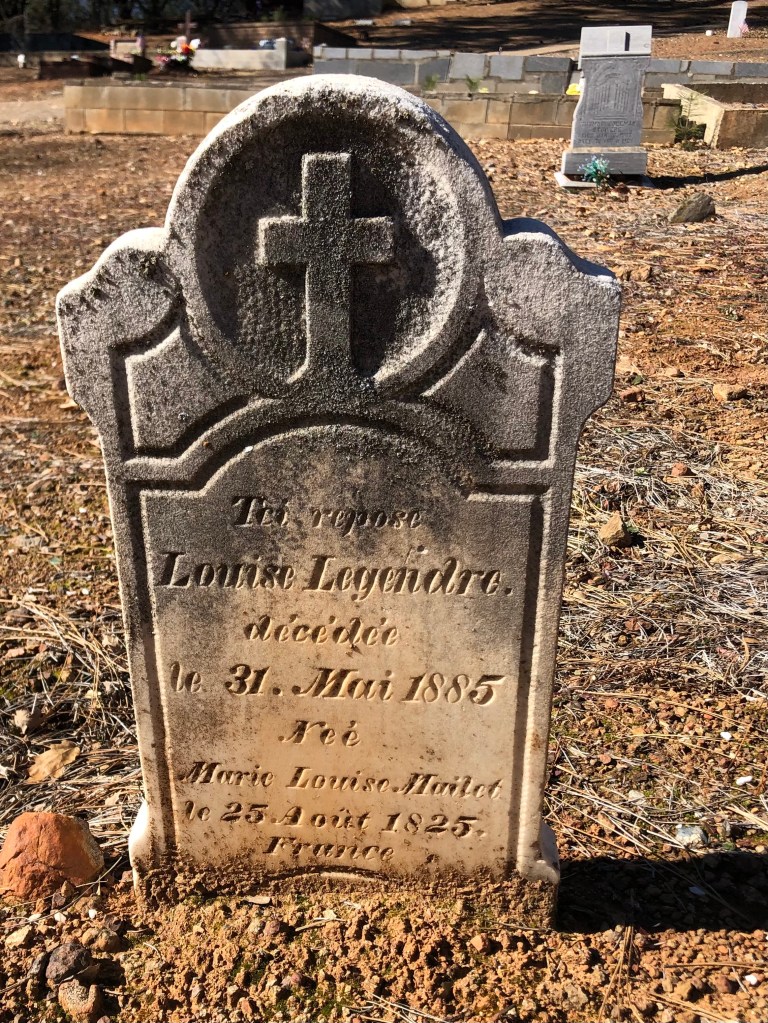
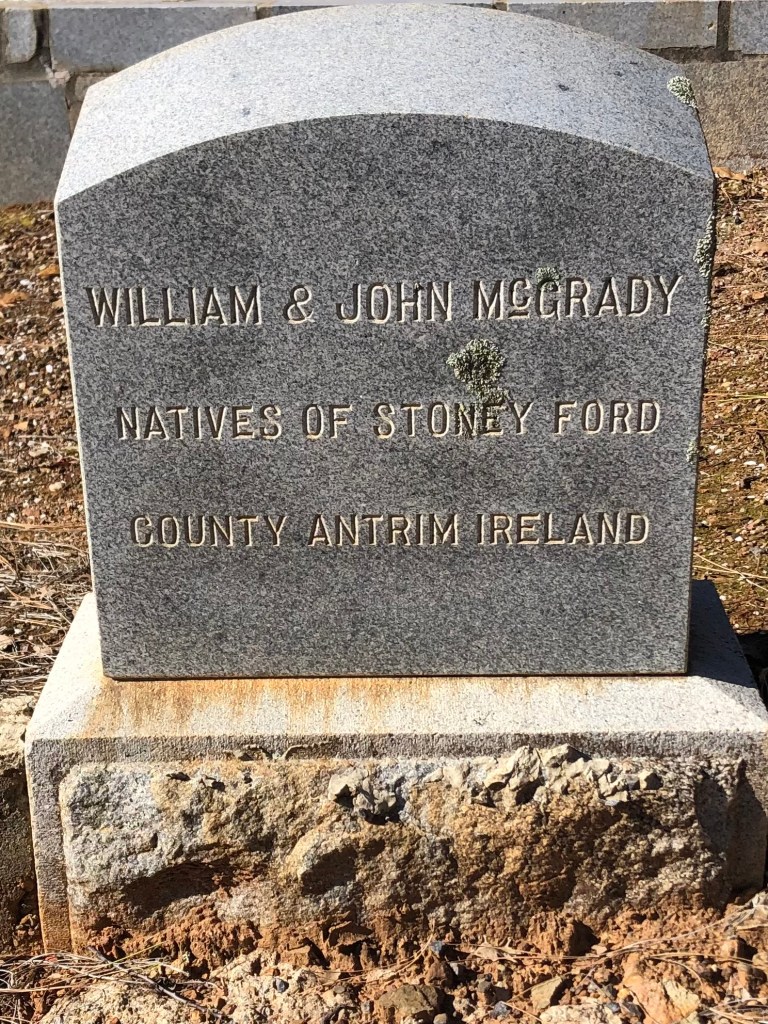
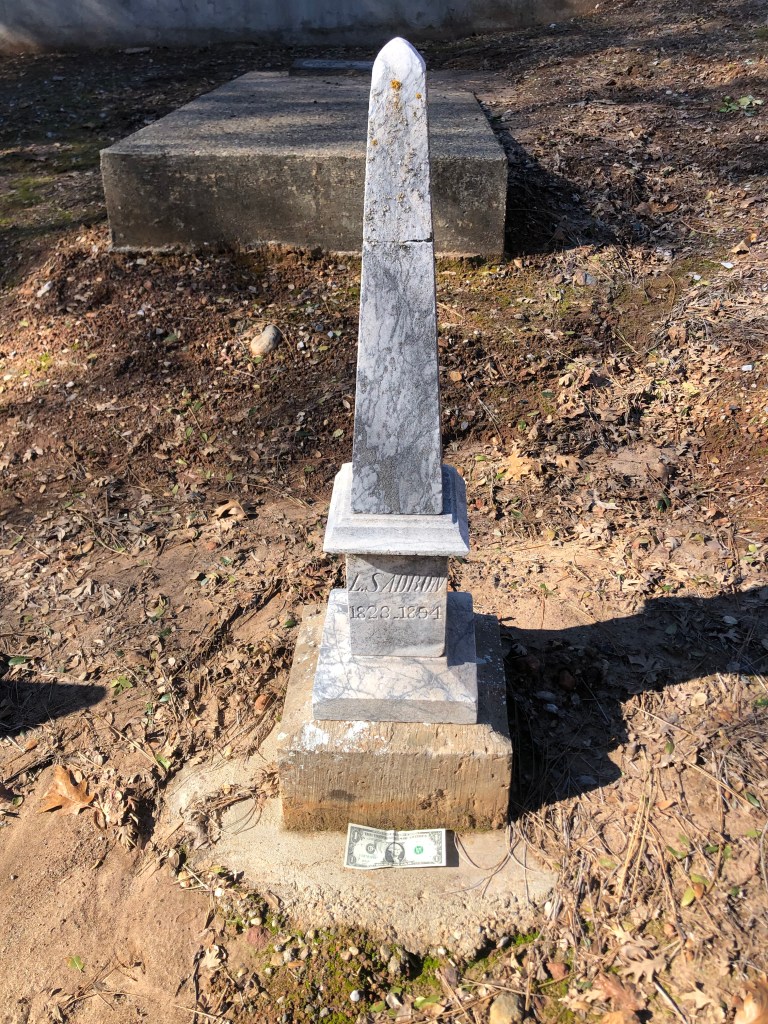
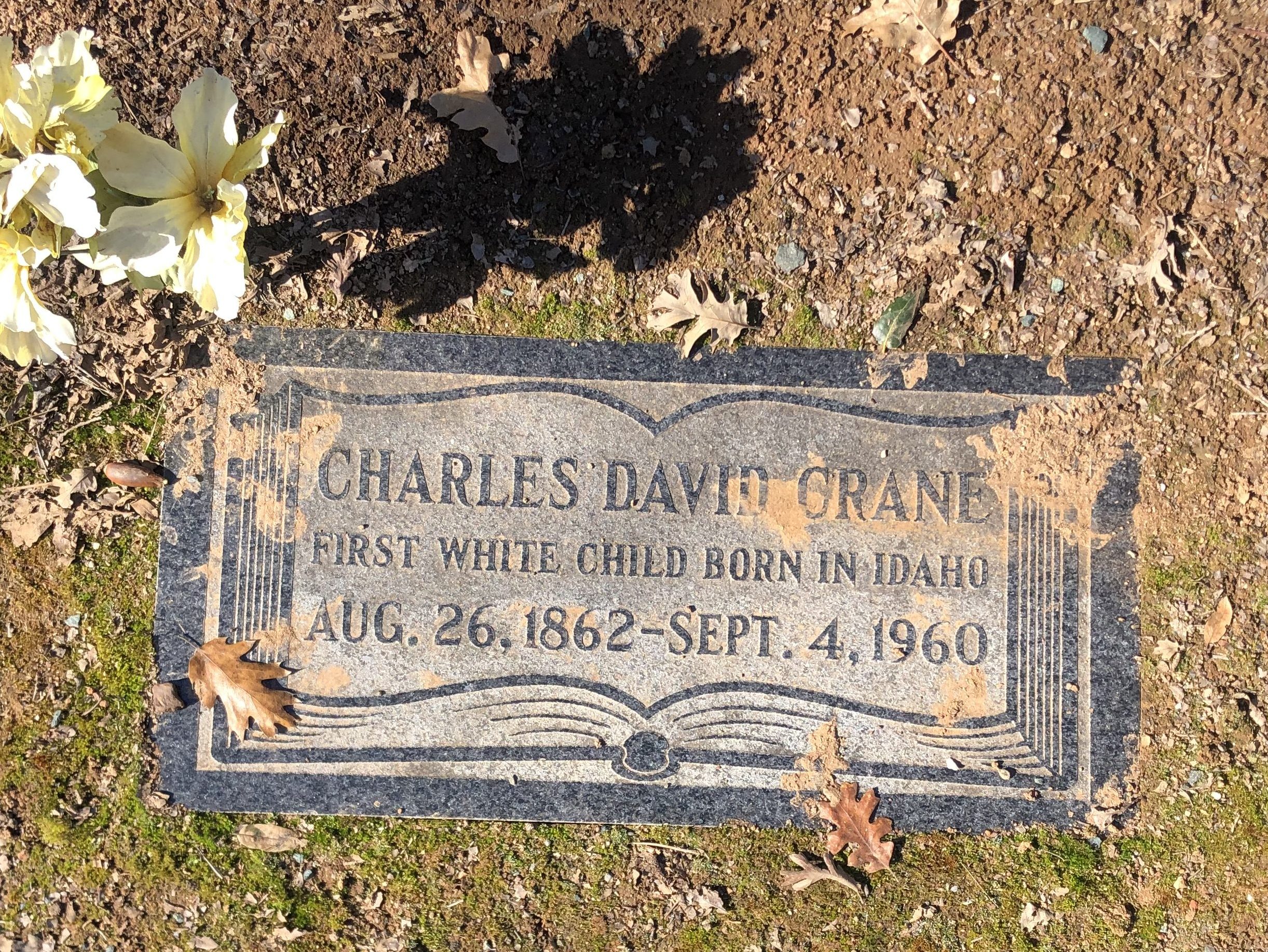
It was now time for my traditional cemetery visit. The Fiddletown Cemetery was established in 1870, and is the final resting place for a broad swath of humanity. The headstones offer testimony to the large number of countries from which the 49ers hailed:
Austrian, French, Irish….
And of course there’s an obelisk. This is tiny (see the dollar bill for scale). They couldn’t even fit on the poor guy’s first name!Everyone has an angle…
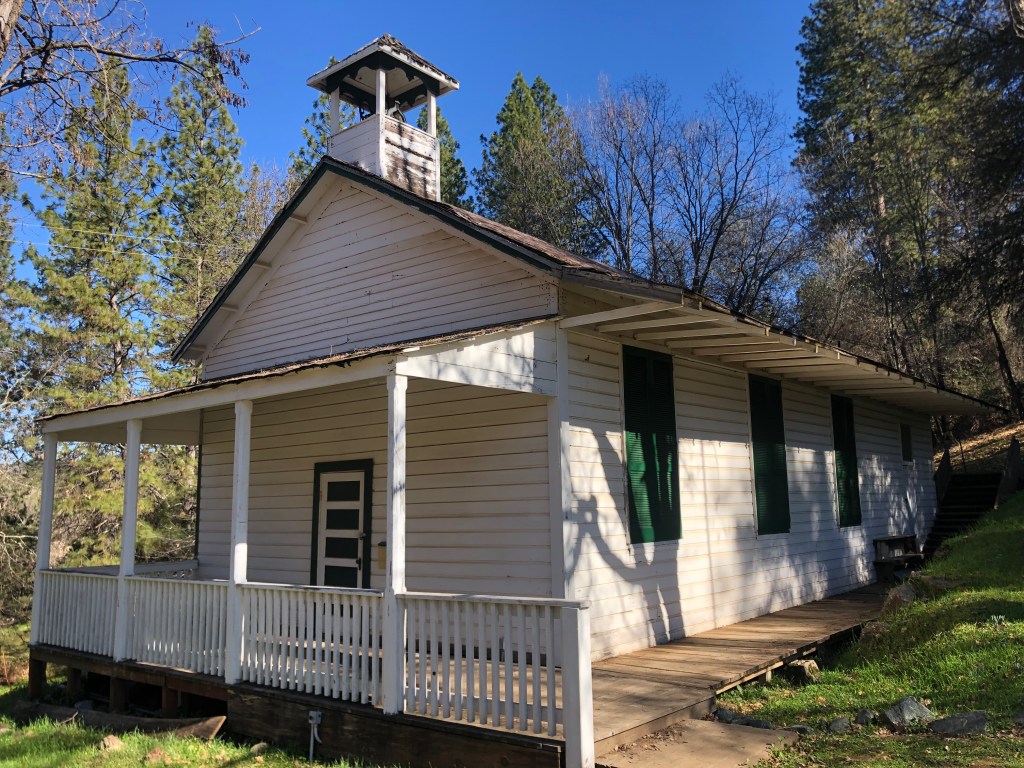
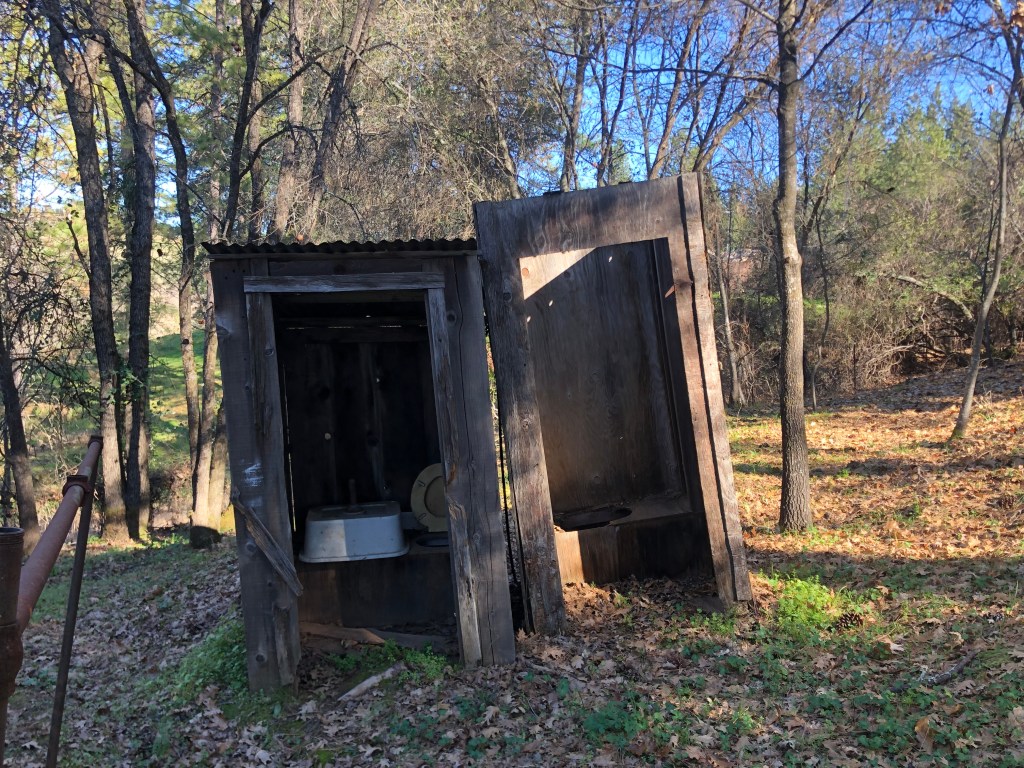
Across the street from the cemetery is Fiddletown’s historic one-room school. It was constructed in 1862 and was in operation until 1955, when the area schools were consolidated and relocated to the nearby town of Plymouth. The school had no running water, and featured outhouses (which are still extant) in the back.
The Schoolhouse….…and privies.
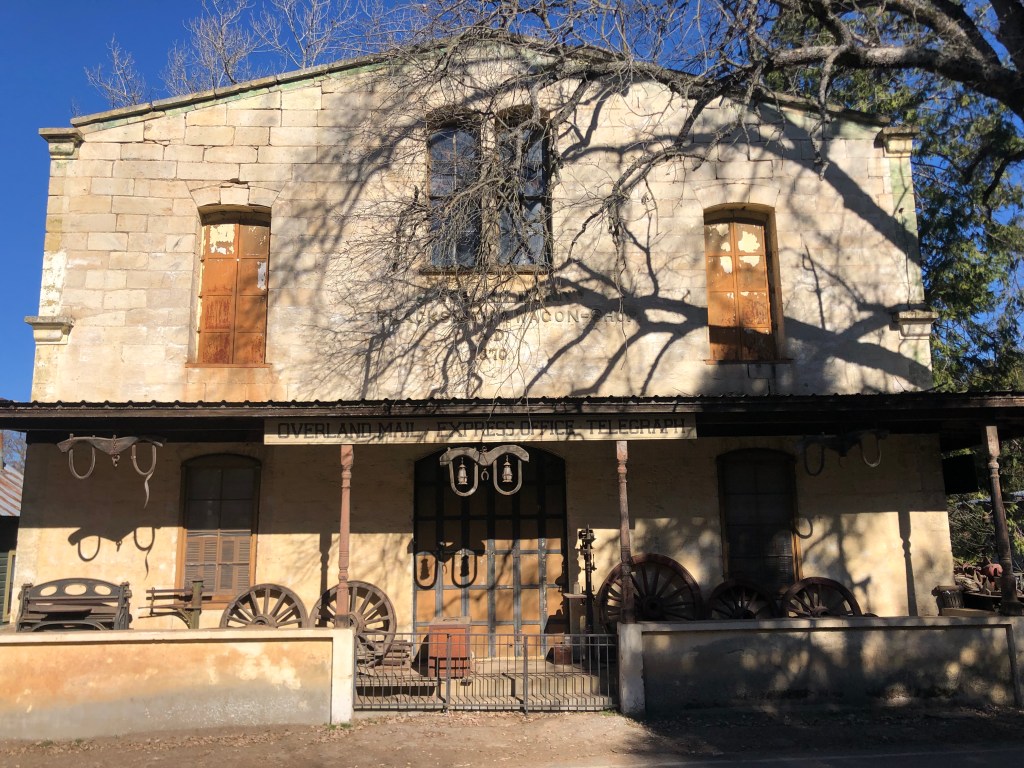
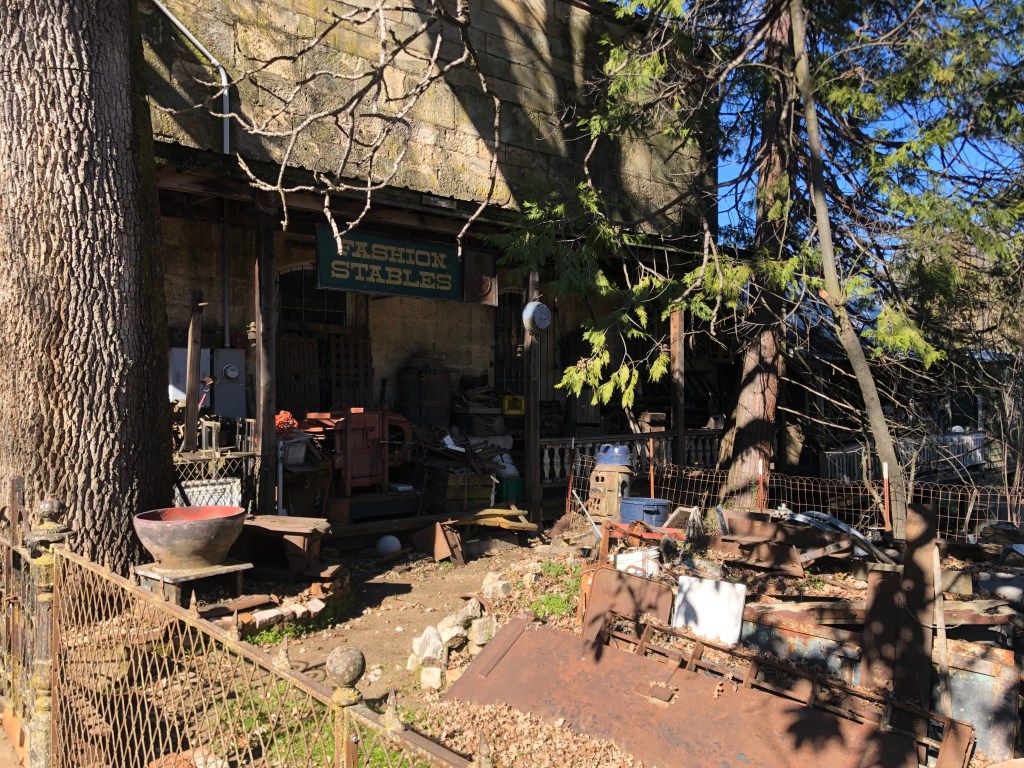
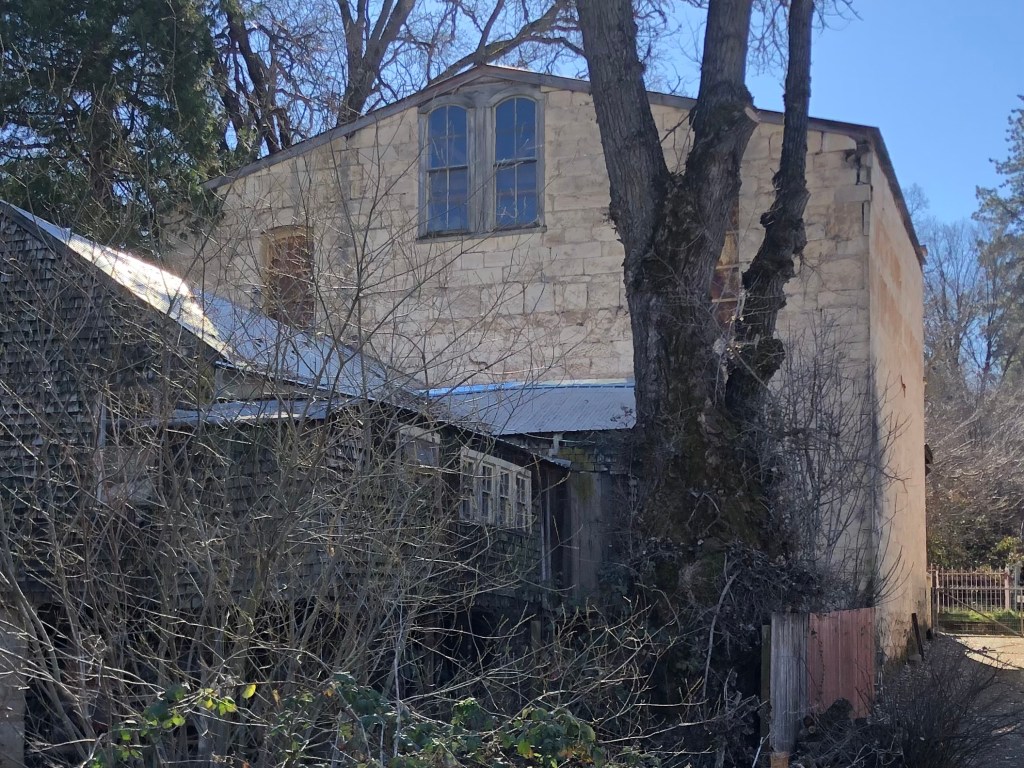
One other notable structure is the looming Schallhorn building, built in 1870. It was a long-time blacksmith’s shop and wagon repair facility, as well as a telegraph office and mail stop. Today it appears to be the site for accumulating various historic artifacts. The front porch is littered with wagon wheels, metalworking equipment, a safe, a old ovens, even a small railcar. Heaven knows what’s inside the massive building itself!
Front o the SchallhornMore junk on the sideBack view
It was beginning to get late, so I decided to head back home. One of my final glimpses of Fiddletown suggests a story that I honestly don’t really think pertains. If you ask me, I think this place has a future.
Unfair intimation.
So, that was my trip to Fiddletown. I managed to get home in the afternoon without incident. I wish you all a very happy Steve Boilard’s birthday. I suggest celebrating with the high-gravity imperial stout of your choice.
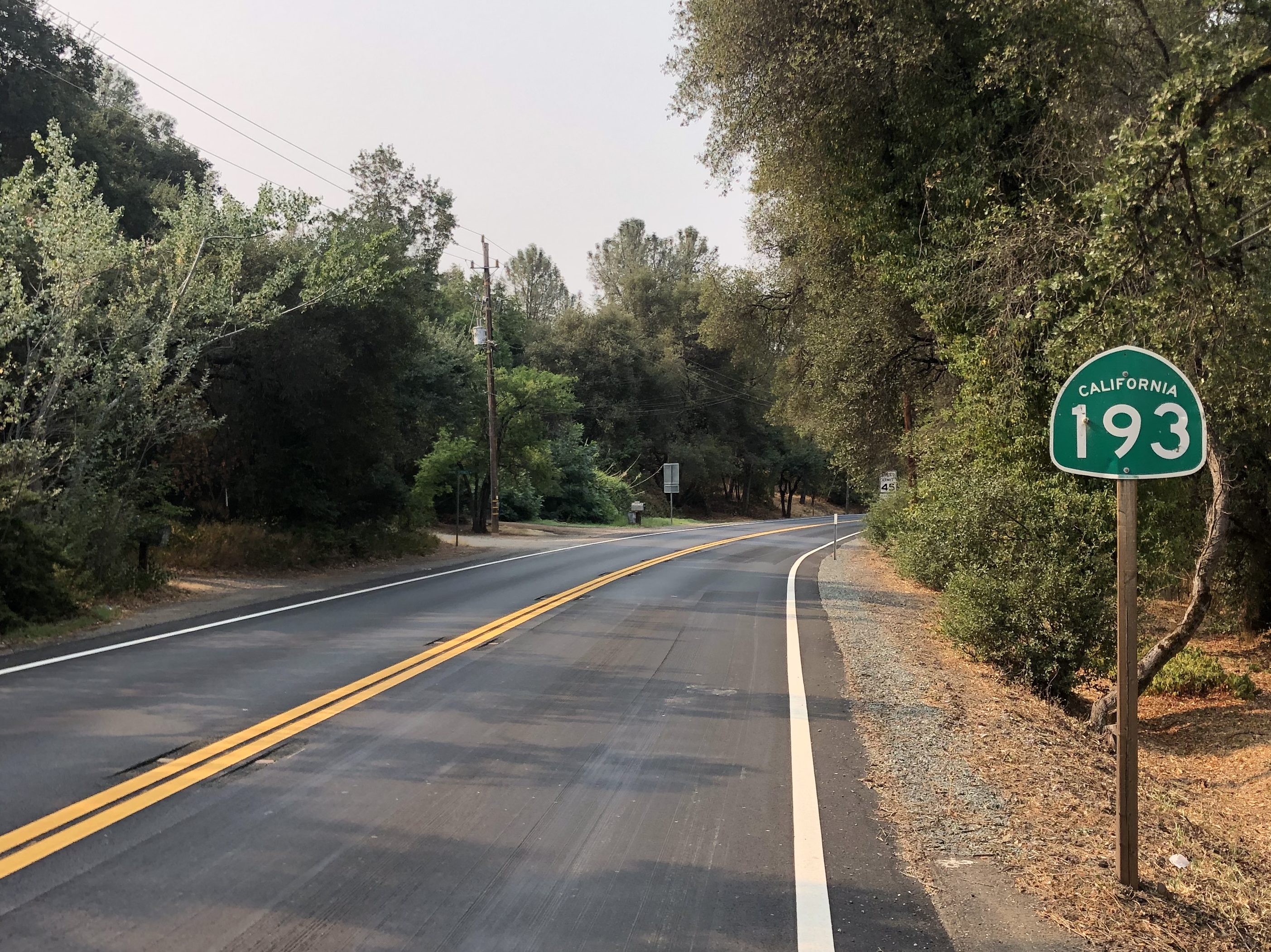
The other day I decided to take a spin along one of the lesser-known California State Routes in northern California. State Route 193 starts (or ends, depending on your perspective) in Lincoln, CA and runs generally east to south through Placer and El Dorado Counties.
For those times when a direct route just won’t do.
Most of Route 193 takes the form of a winding, rural, two-lane road through the Sierra foothills. It’s a wonderfully relaxing drive. As long as you don’t have to be anywhere in particular at any particular time, it’s an ideal roadway.
The land that time forgot.
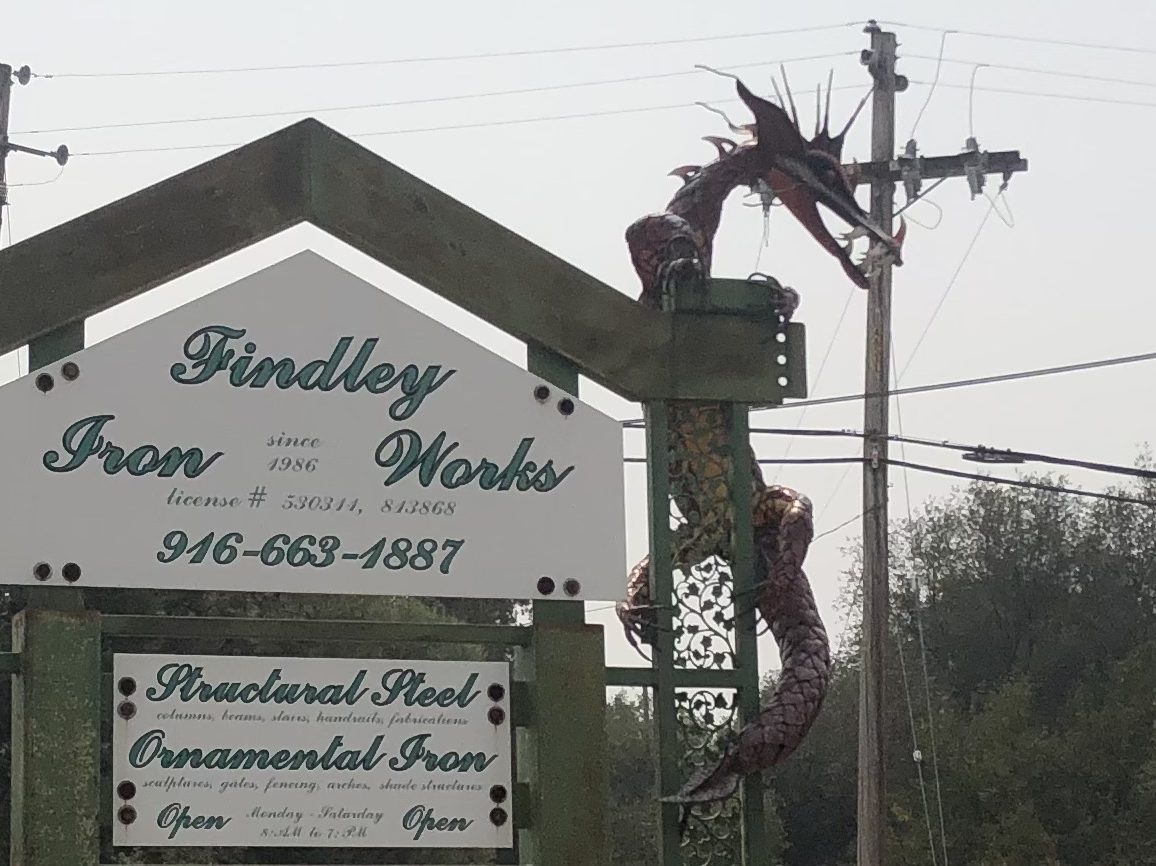
Route 193’s western terminus at Lincoln (pop: 50,000) began as a railroad town in the mid-1800s, and remained a fairly isolated and quiet community for almost 150 years. Then, in the 1990s, it became one of the fastest growing cities in the United States. The incessant expansion of the Sacramento metropolitan area, with families seeking out new suburbs and better schools, swallowed up Citrus Heights, Roseville, and eventually Lincoln. Lincoln’s (relatively) low cost of living and lower crime rate made it a desirable region for new families. Still, despite its railroad heritage, the town doesn’t seem to have a lot of historical interest to offer, at least not along the Route 193 corridor. The most notable roadside scene was the iron dragon at Findley Iron Works in Newcastle, a few miles down the road. The dragon reminds me a lot of Trogdor.
The Burninator stries again.
Route 193 winds through oak-studded hills for about a dozen miles, when it reaches the city of Auburn (pop: 14,000). From here 193 runs concurrently with CA Route 49 for seven or eight miles. (I covered this stretch of Route 49 in an earlier blog post, so I won’t review that stretch again here.) But I will note that I stopped in Auburn to have a burger and a beer with my friend Victor R. The beer appears at the end of this blog entry as my Brew of the Day.
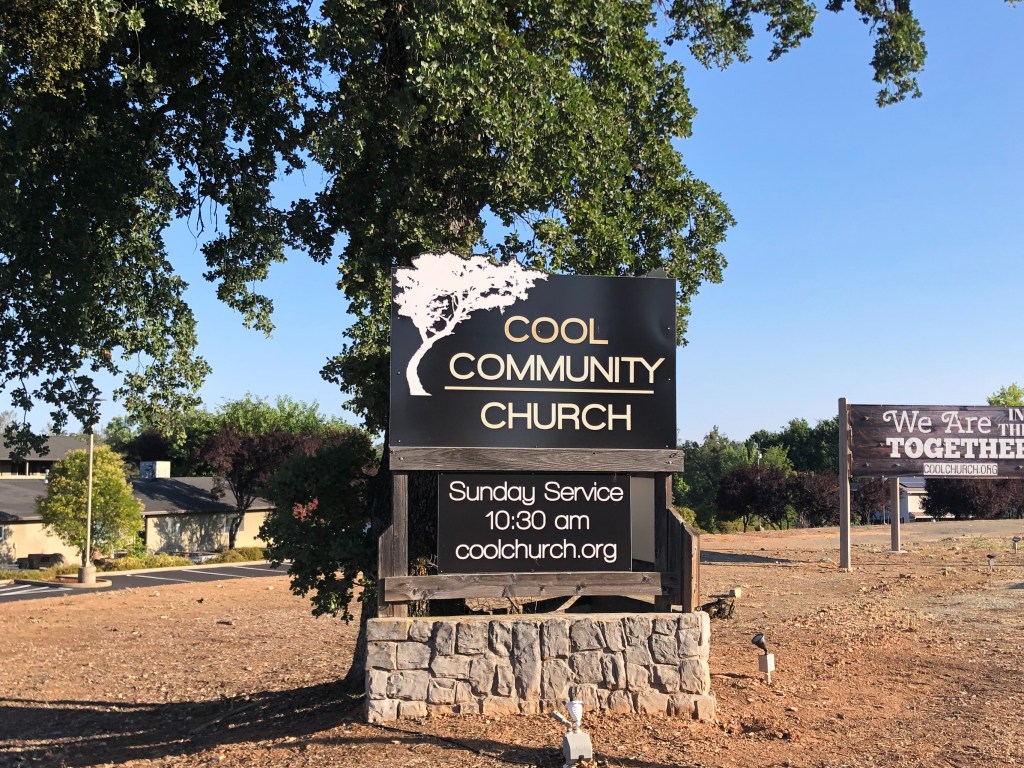
Route 193 again branches off Route 49 at the town of Cool (pop: 4,100). It’s not entirely clear how Cool got its name, but one theory holds that it is a reference to an itinerant preacher named Peter Y. Cool who frequented the area in the 1850s. As you might imagine, the businesses in Cool capitalize on the name’s adjectival properties. Like, “Cool Dentist” and “Cool Tobacco.”
Too Cool for School.Located just past the city limits. Hence, “beyond cool.”
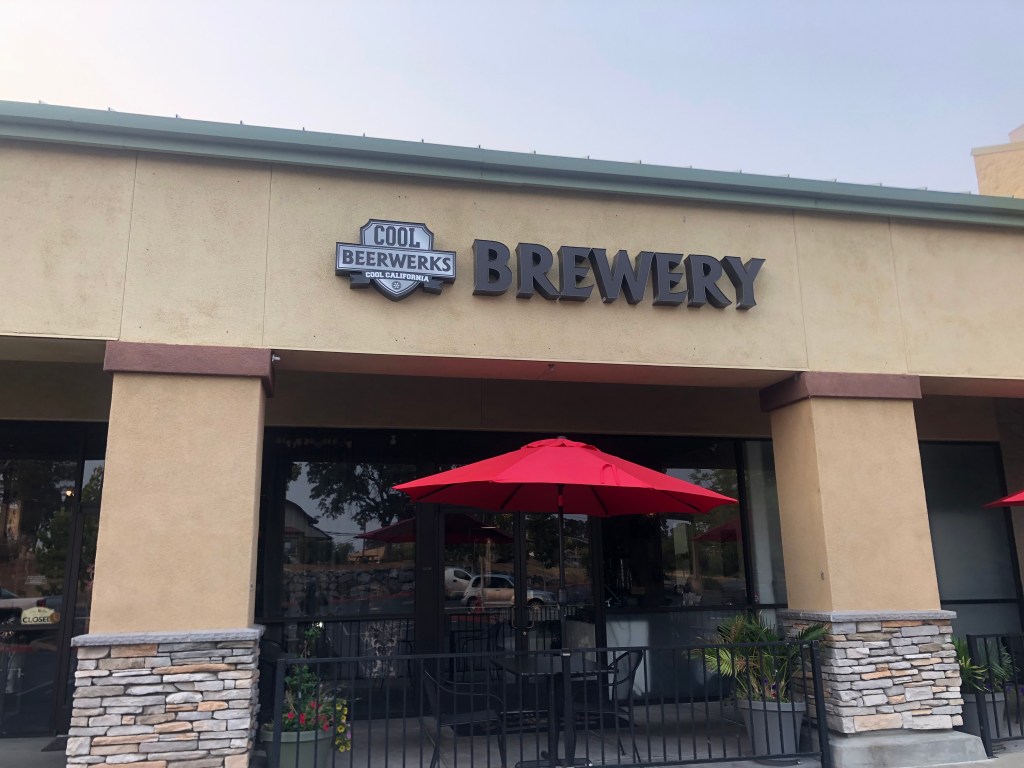
The most notable feature of Cool other than its name is the Cool Beerwerks, whose tagline is the unlikely-sounding “Rockin’ Sushi & Brews.” Fortunately, they were closed when I passed by.
When you’re hot you’re hot, when you’re not you’re cool.
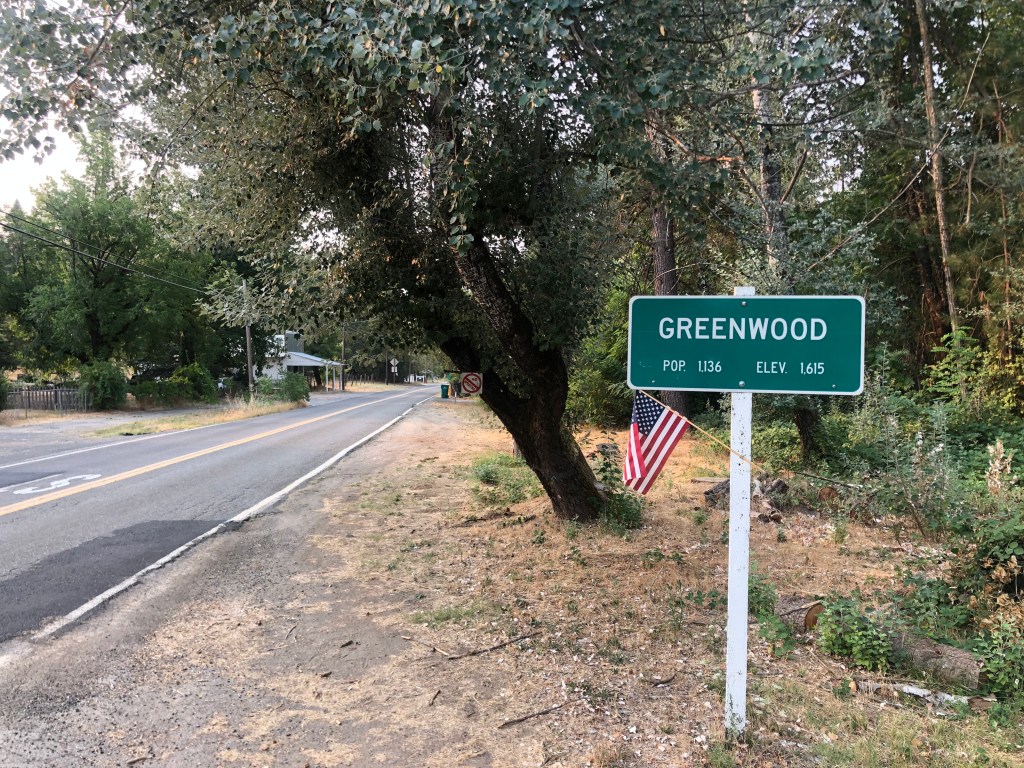
From Cool , Route 193 travels between the middle and south forks of the American River, a hilly area known as the Georgetown Divide. Horse pastures and the occasional farmhouse dot the landscape. The next town of any note is Greenwood (pop: 1,100), nestled among oaks and rolling hills.
Another of those towns where the elevation exceeds the population.
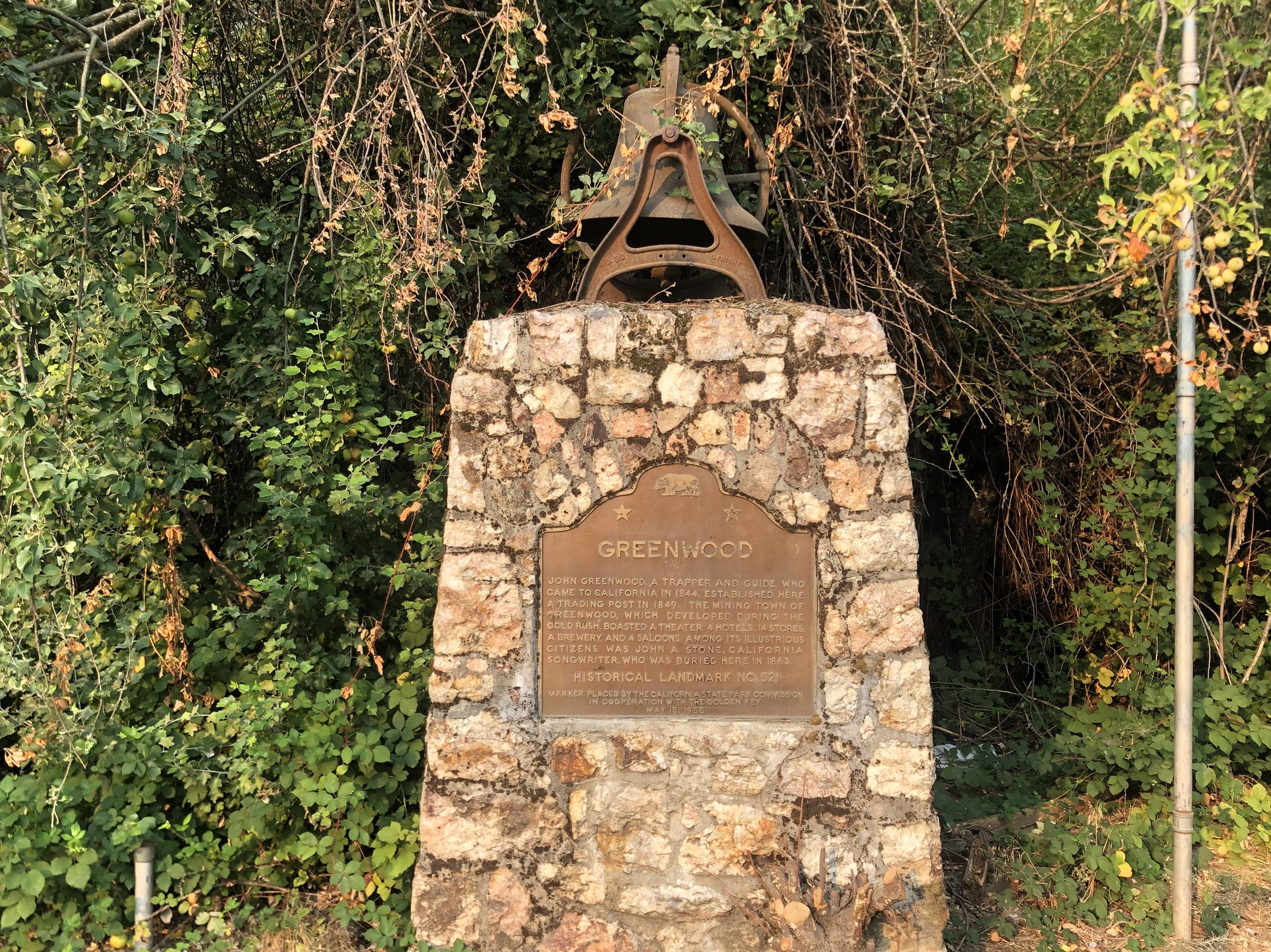
Near the entrance to the town is a stone memorial that was erected in 1955, along with a bronze plaque providing the briefest historical sketch of the town.
Other than the town’s namesake (a trapper named John Greenwood from the 1840s) the plaque mentions only one other famous resident: “John A. Stone, [a] California songwriter who was buried here in 1863.” It seems that Stone (who for some reason was known by the moniker “Old Put”) “wrote most of the songs we associate with the California Gold Rush.” Ummm, which songs would those be, exactly? Maybe My Darlin’ Clementine. Are there any others? Anyway, Old Put published a songbook (called a “Songster” at the time) in 1868.
Put-ting his money where his mouth is.
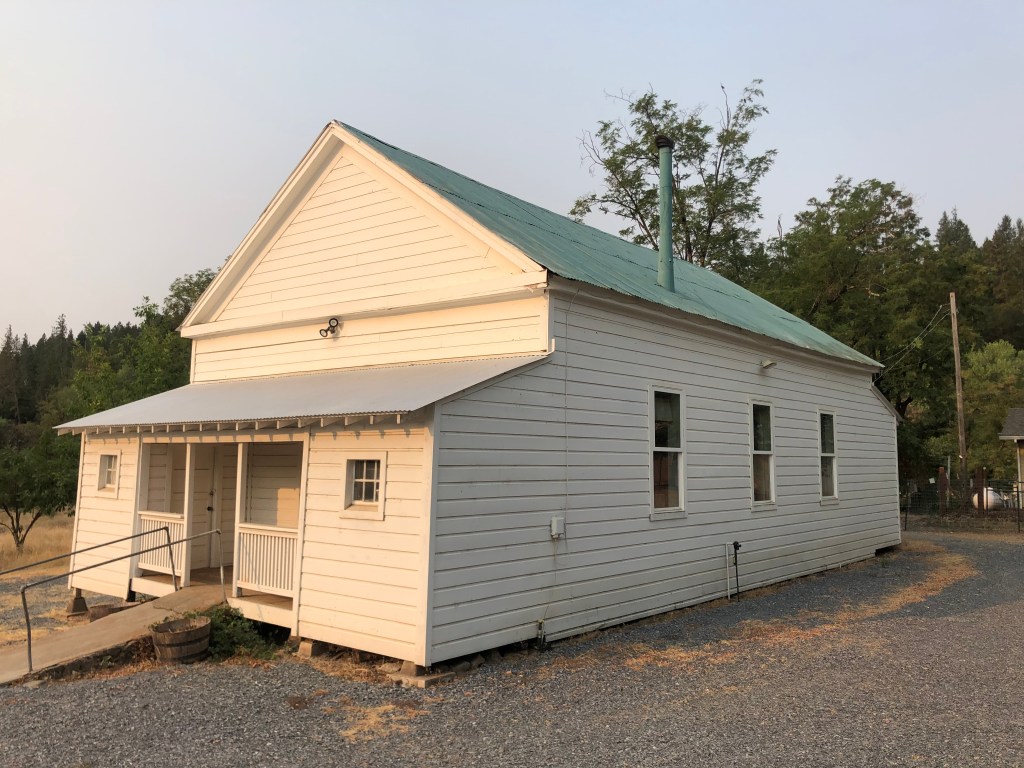
But let’s get back to the memorial plaque. Did you happen to notice the unexplained bell on top of the monument? Was it a fire bell? Is it even related to Greenwood? Well, a short while later I found the answer. A couple of blocks away from the stone memorial there sits an old schoolhouse that was originally constructed in 1858. The school operated for almost a century, until it closed in 1954. (Greenwood’s students thereafter attended in school in Cool, or “Cool School” as they must have called it). The bell on top of the school house was removed and placed on top of the stone memorial pictured above.
Greenwood School, sans bell.
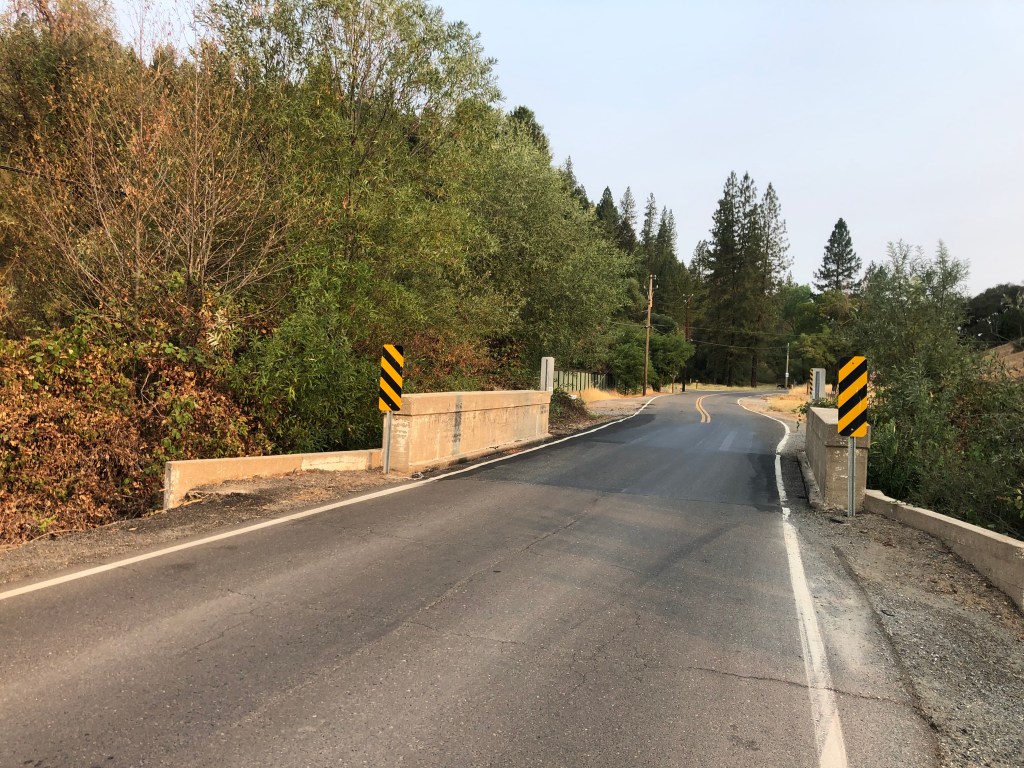
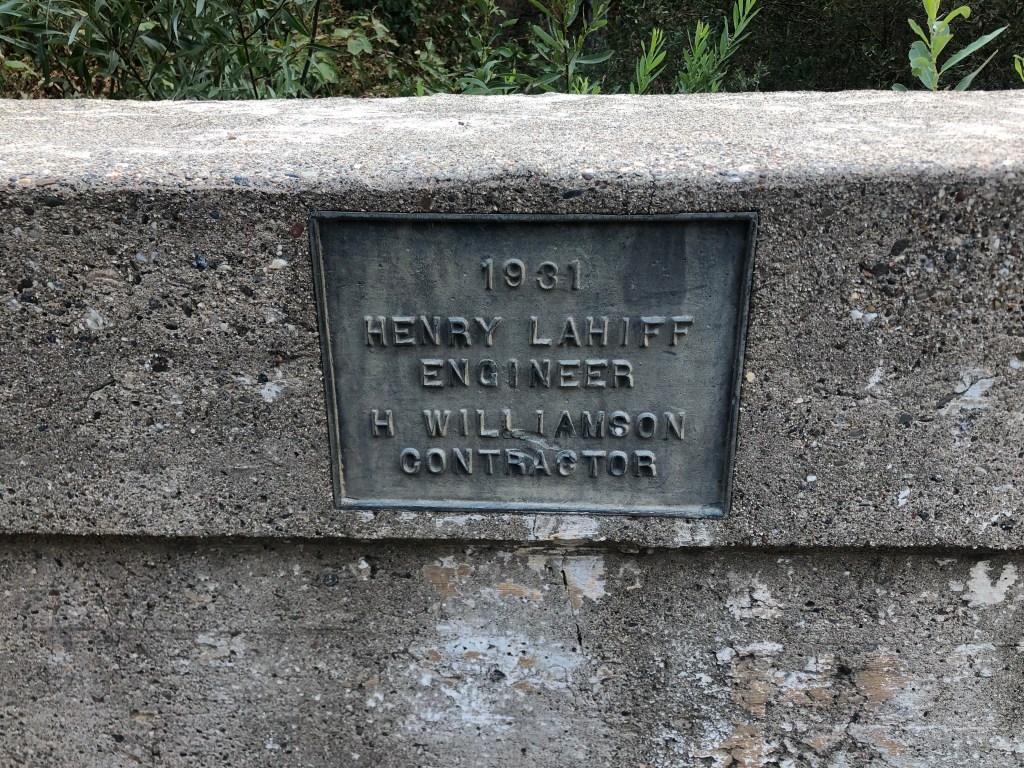
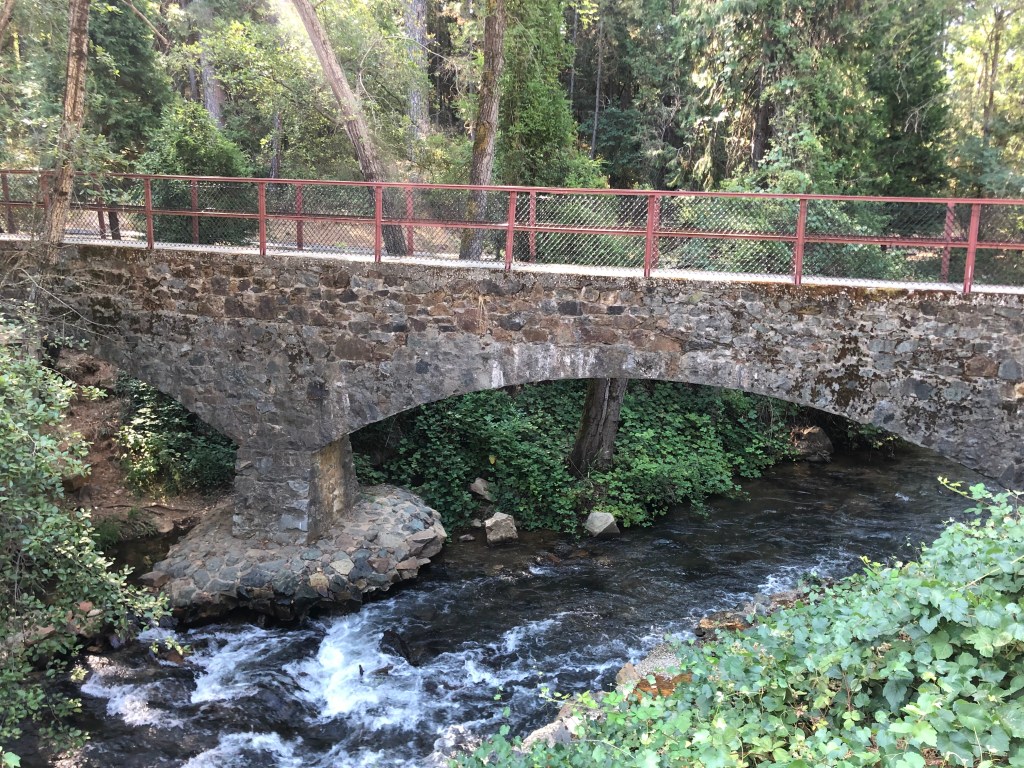
Now, let’s back up for a moment. In the same year (1868) that Old Put published his “Songster,” a man named Henry Lahiff was born in Ireland. He was educated as an engineer, and at age 20 he emigrated to Arizona to work at the Copper Queen Mining Company. He was a capable engineer, and soon was working on projects in other US cities, including a stint as the chief engineer on San Francisco’s Sutro Baths. Eventually he became the surveyor/engineer for El Dorado County, and in 1931 he designed this bridge that I crossed during my visit to Greenwood.
It’s not much to look at. But……it’s nice to still be recognized 80 years later.
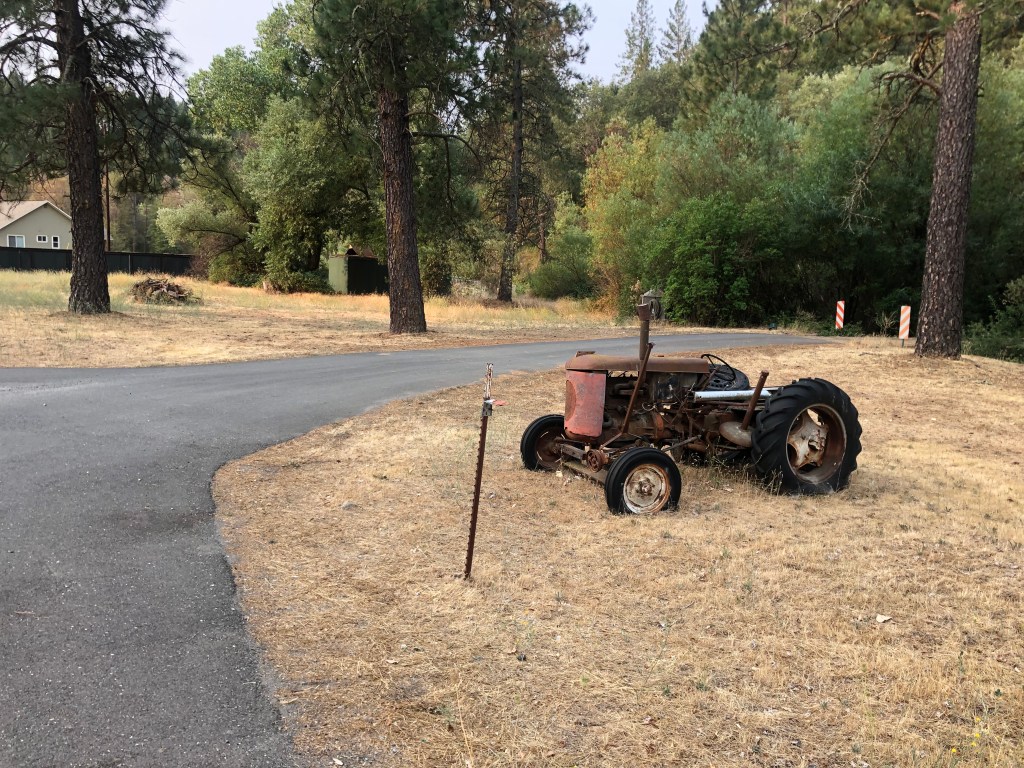
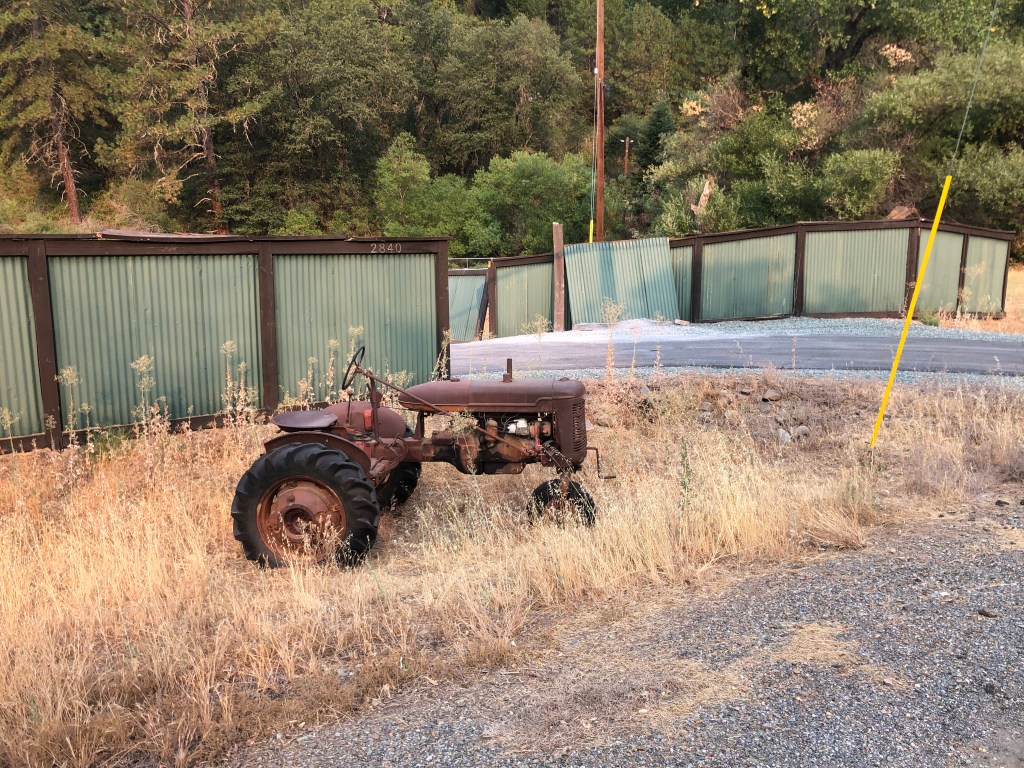
The other notable thing about Greenwood is the propensity for people to permanently park old tractors by the road in front of their property. I must have encountered over a half-dozen of these.
Greenwood’s answer to garden gnomes.
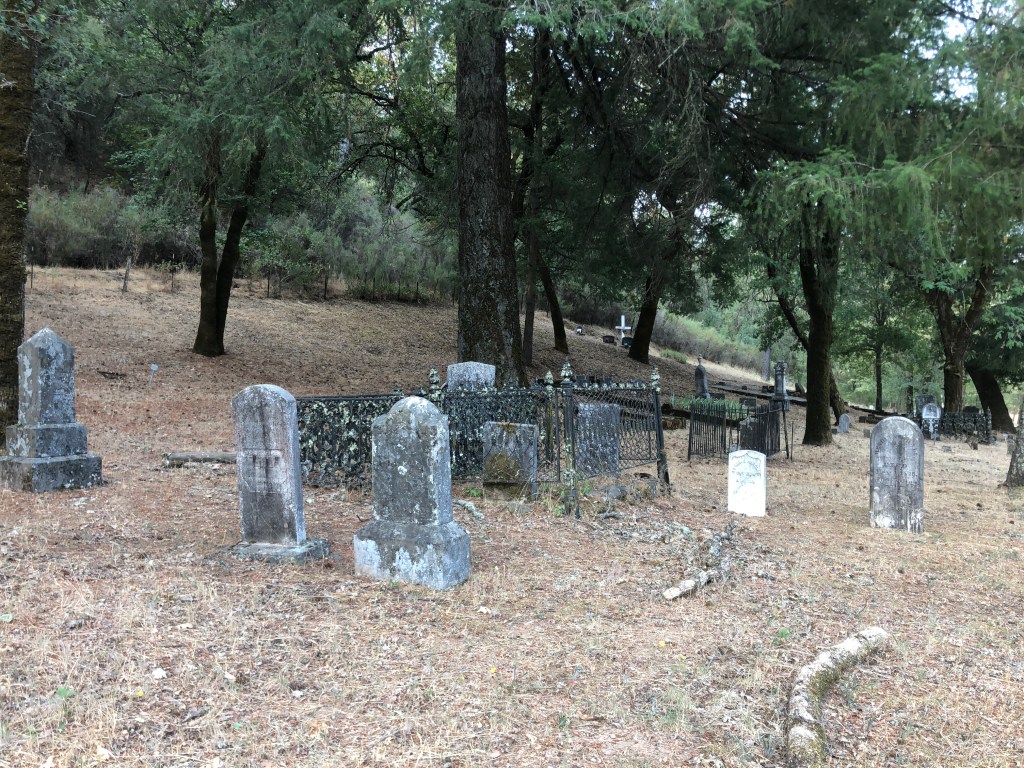
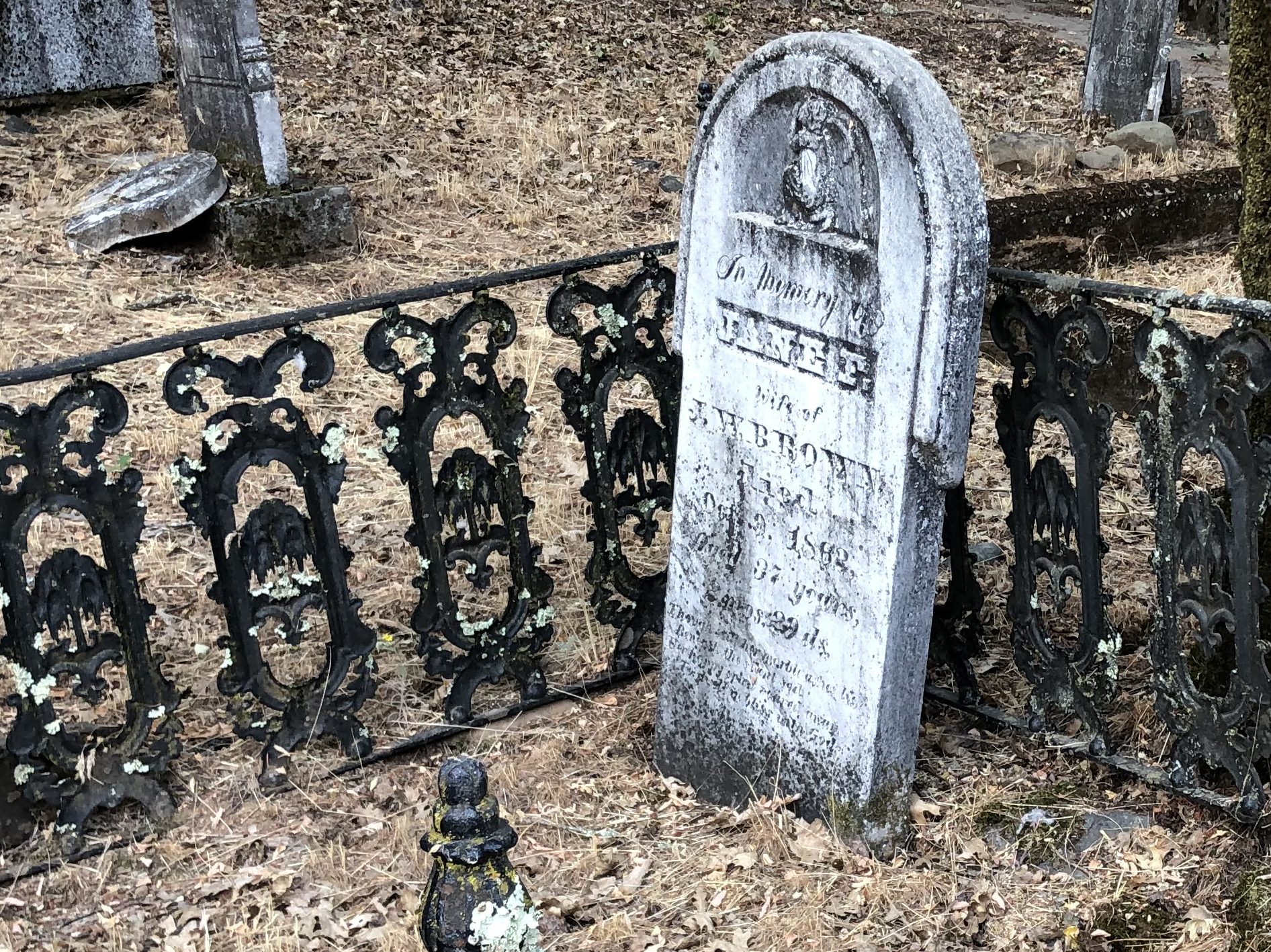
Just as I was leaving town I encountered Greenwood’s old Pioneer Cemetery, with graves dating back to the 1850s. I didn’t find the final resting places for engineer Henry Lahiff or John Stone (“Old Put”) but I did encounter a significant number of ancient gravesites set amid gloomy, drooping trees and weedy earth.
The end of the line for Greenwood’s pioneers.It’s notable that the early pioneers didn’t usually reach a ripe old age.
I found myself in a blue funk (or maybe it was a brown study), thinking about these lives that ended a century and a half ago. These forgotten, neglected markers of granite are all that remain. Or maybe that’s selling them short. I thought of Henry Lahiff, the bridge engineer. While he’s not a household name, and while few people probably even bother to look at the plaque on the local bridge he designed, he did literally leave his mark on this community. And if it weren’t for him, I wouldn’t now be able to cross that creek. Maybe that’s how we achieve immortality: Not be having our names remembered, but by affecting the world in ways, however tiny, that future generations might experience, even if they don’t pay attention.
With these thoughts in my head I re-mounted the trusty Speedmaster and headed west on 193 to the somewhat larger community of Georgetown (pop.: 2,500). As you might have surmised, the town is named after a guy named George. In fact, originally it was called “George’s Town.” I’m not making this up. George Phipps was a sailor who came to the area as a gold prospector, and he founded the mining town in 1849. Georgetown suffered a fire just a few years later, and was rebuilt in a more planned, logical, and attractive fashion than most of the other Gold Rush towns. Georgetown was also more prosperous than most of the others, which led to its being called “The Pride of the Mountains.”
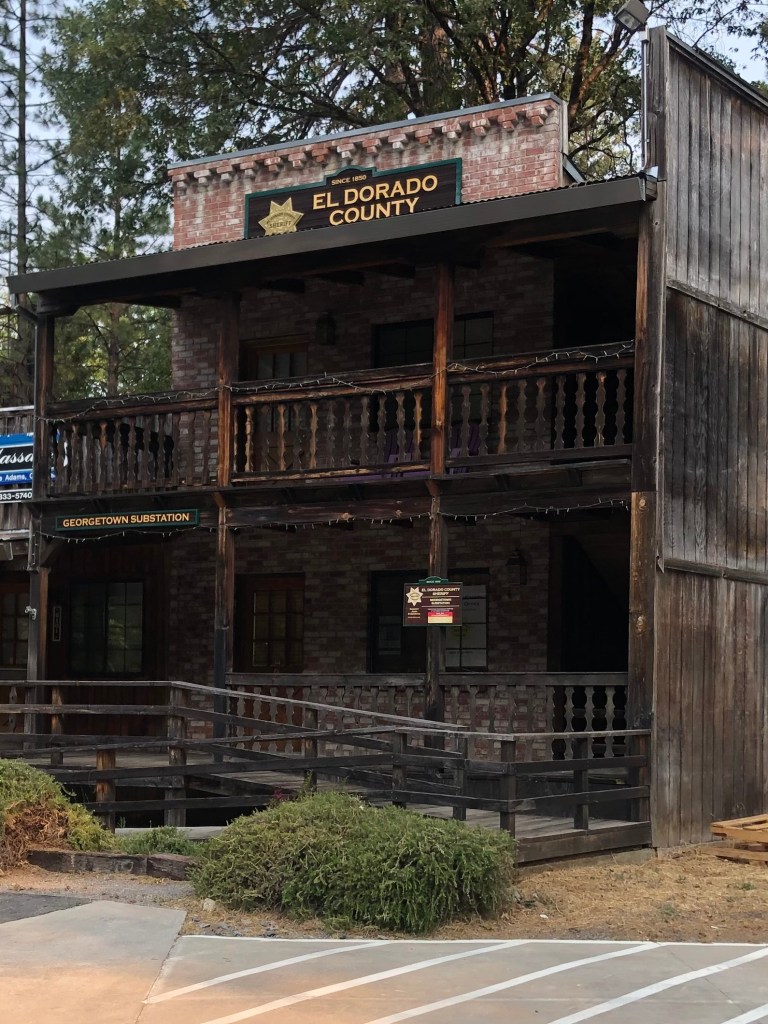
There’s clearly still a lot of pride in Georgetown. Much of the architecture recalls the town’s past. Even the County Sheriff’s Office looks like something out of a John Wayne movie.
Paging Sheriff John T. Chance…
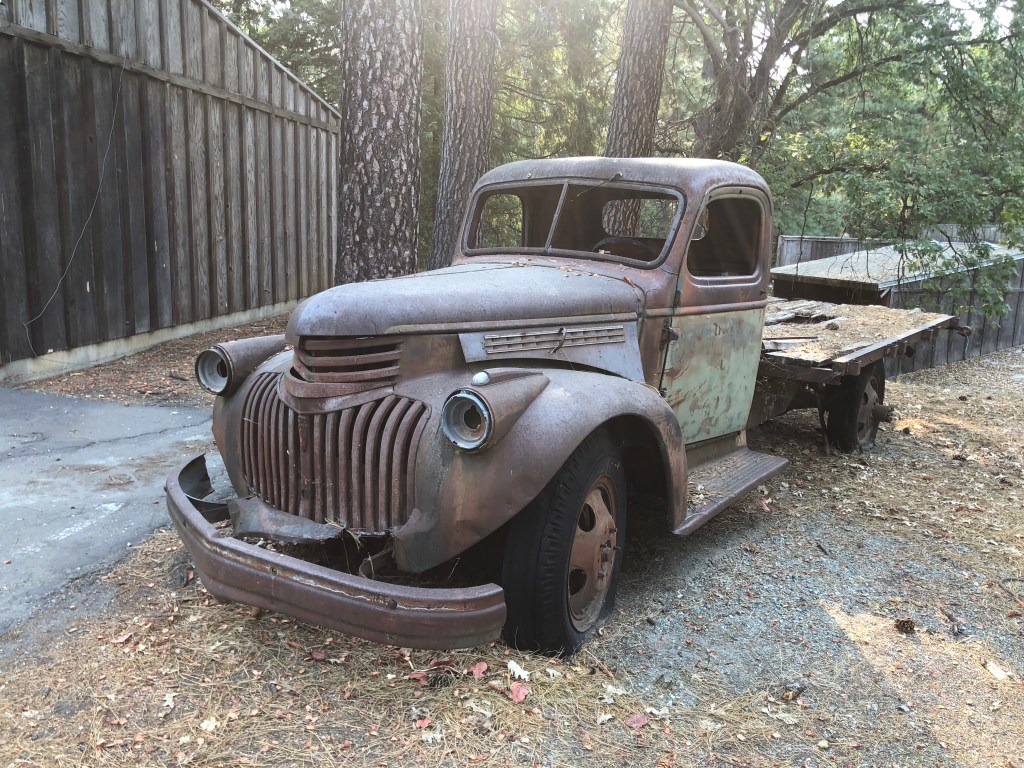
Georgetown seems to have two financial centers. One is a 12-acre commercial zone that calls itself Buffalo Hill. It was conceived and owned for many years by a local couple who wanted an attractive, thriving business node to keep local spending in the area. Most of the buildings display that same old-West style of the Sheriff’s Office, and the property doubles as an outdoor museum with dozens of antique vehicles and logging equipment. When I visited, the businesses looked well cared for and most seemed to be doing a steady business.
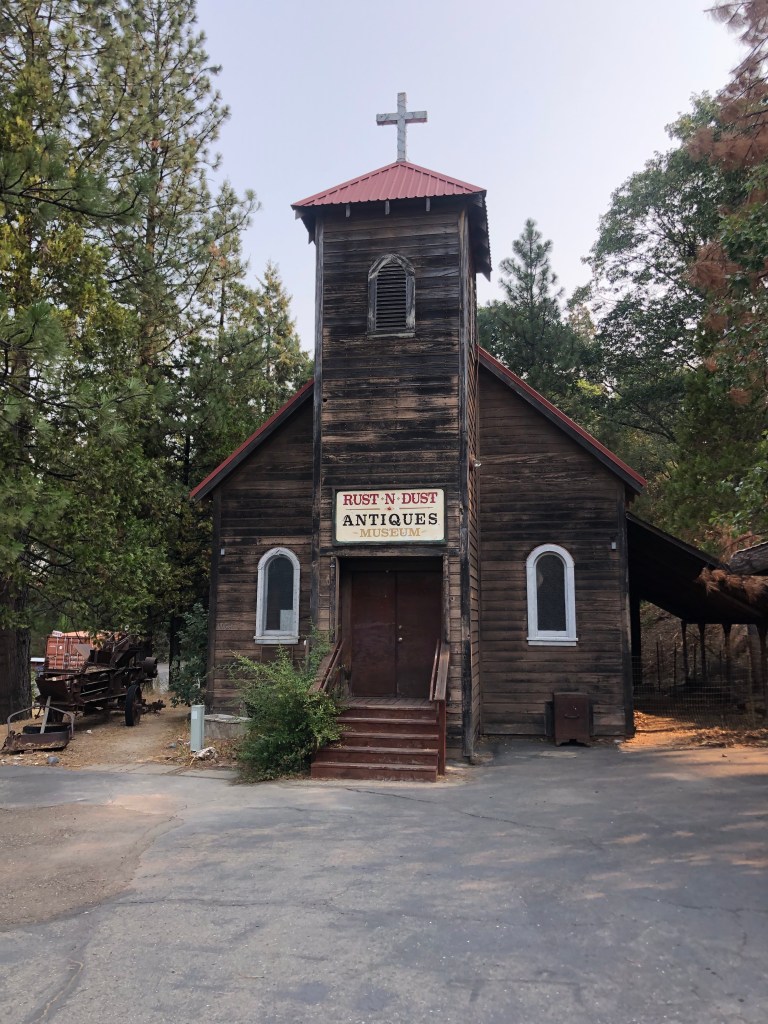
Buffalo Hill’s antique store used to be St. James Catholic Church (built in 1923).Buffalo Hill keeps on truckin’.
Georgetown’s second financial center is its Main Street. Dotted with Gold-Rush era buildings, small crowds of people walk along its covered sidewalks lined with cafes, art galleries, taverns, and small shops.
(Photo stolen from the Web–The one I took didn’t turn out.)
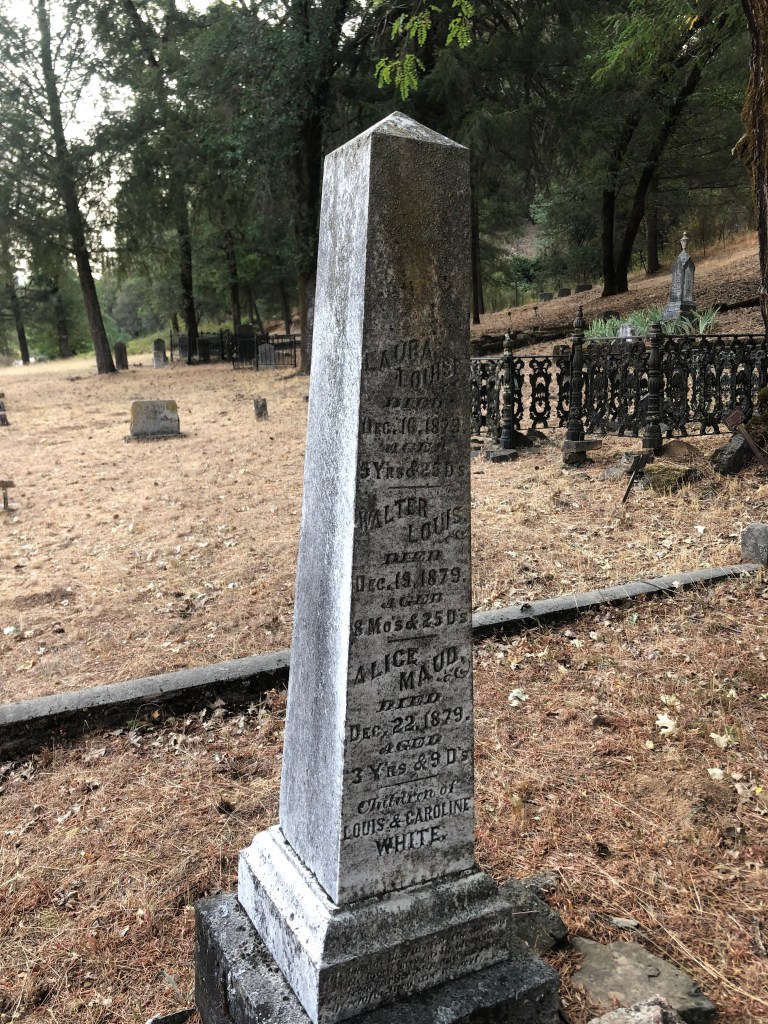
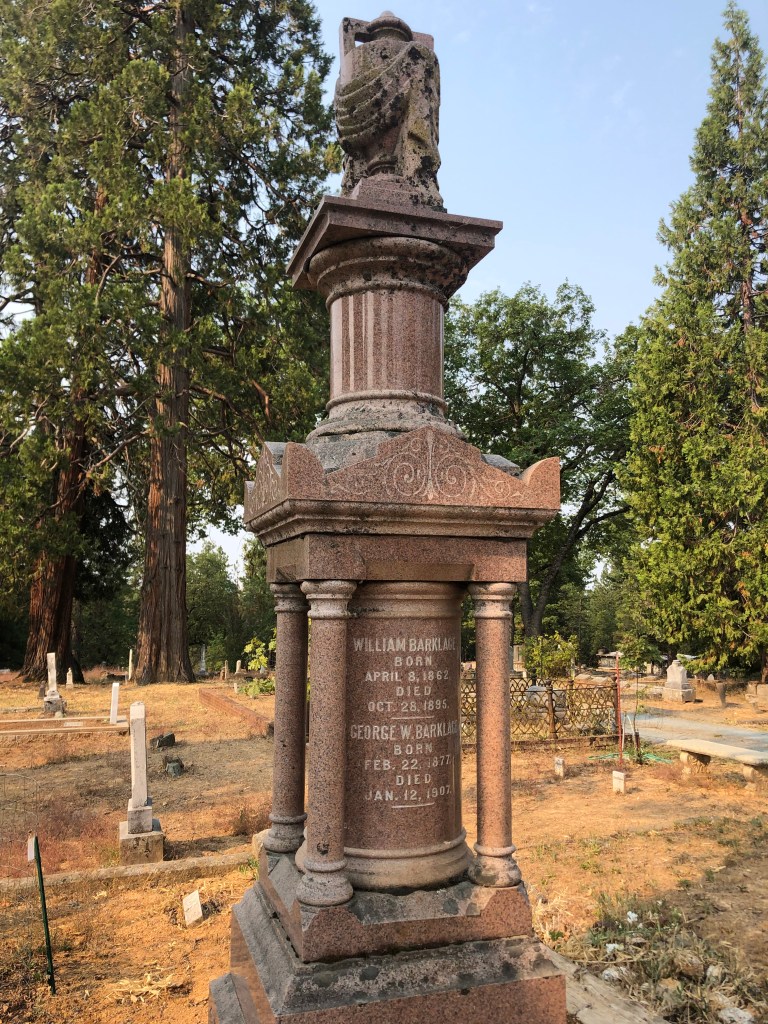
And, of course, Georgetown has its own pioneer cemetery. I suppose cemeteries are the most direct physical link we have with those individuals who came before us. Those from wealthy families often erect ornate monuments in the hope that they will continue to attract attention decades and even centuries later. Like this one from the Barklage family, which emigrated from Germany in the mid-19th Century and made their fortune from timber and mining.
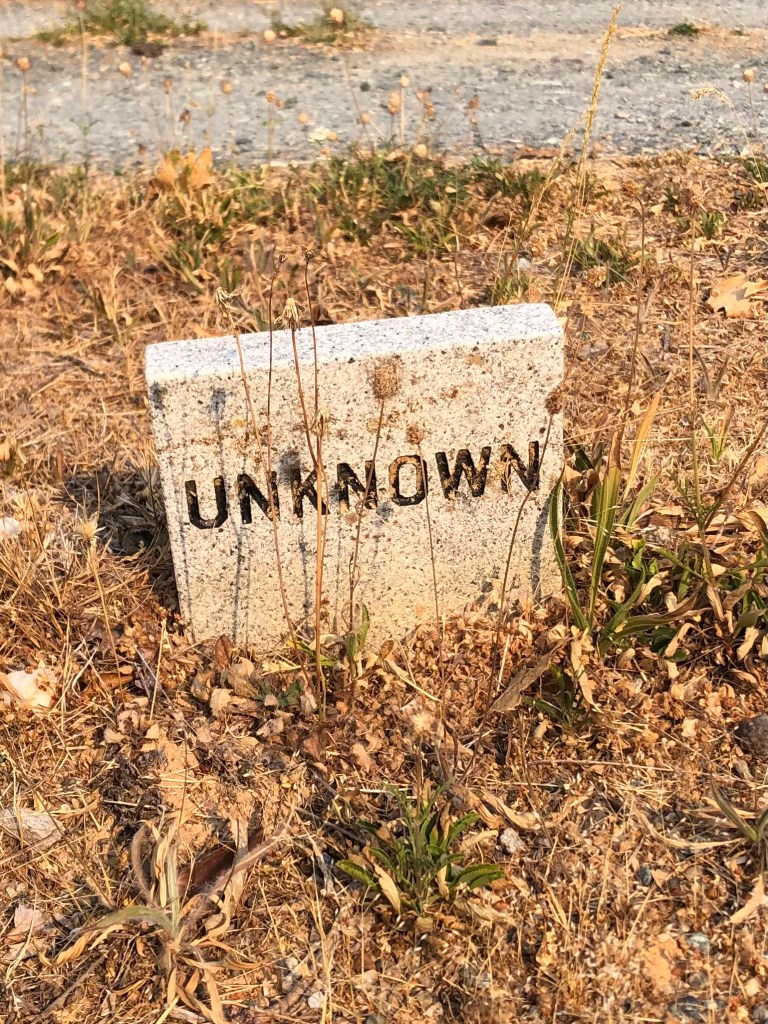
No doubt they expected this imposing monument would ensure their name would always be remembered. And yet, to the people who walk through Georgetown today, are the Barklages any more real than this poor fellow?
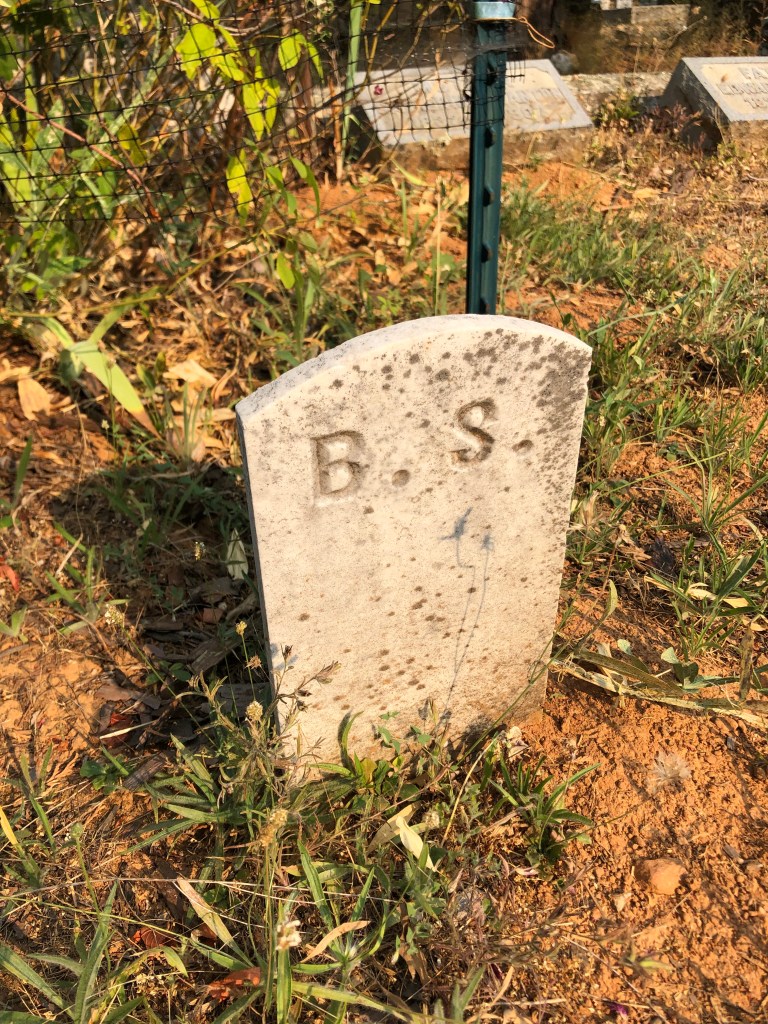
In fact, one wonders if the very idea of achieving immortality through stone monuments is summed up thus:
To my way of thinking, it’s people like engineer Henry Lahiff and even Old Put who live on through their efforts to better the world around them.
BREW OF THE DAY
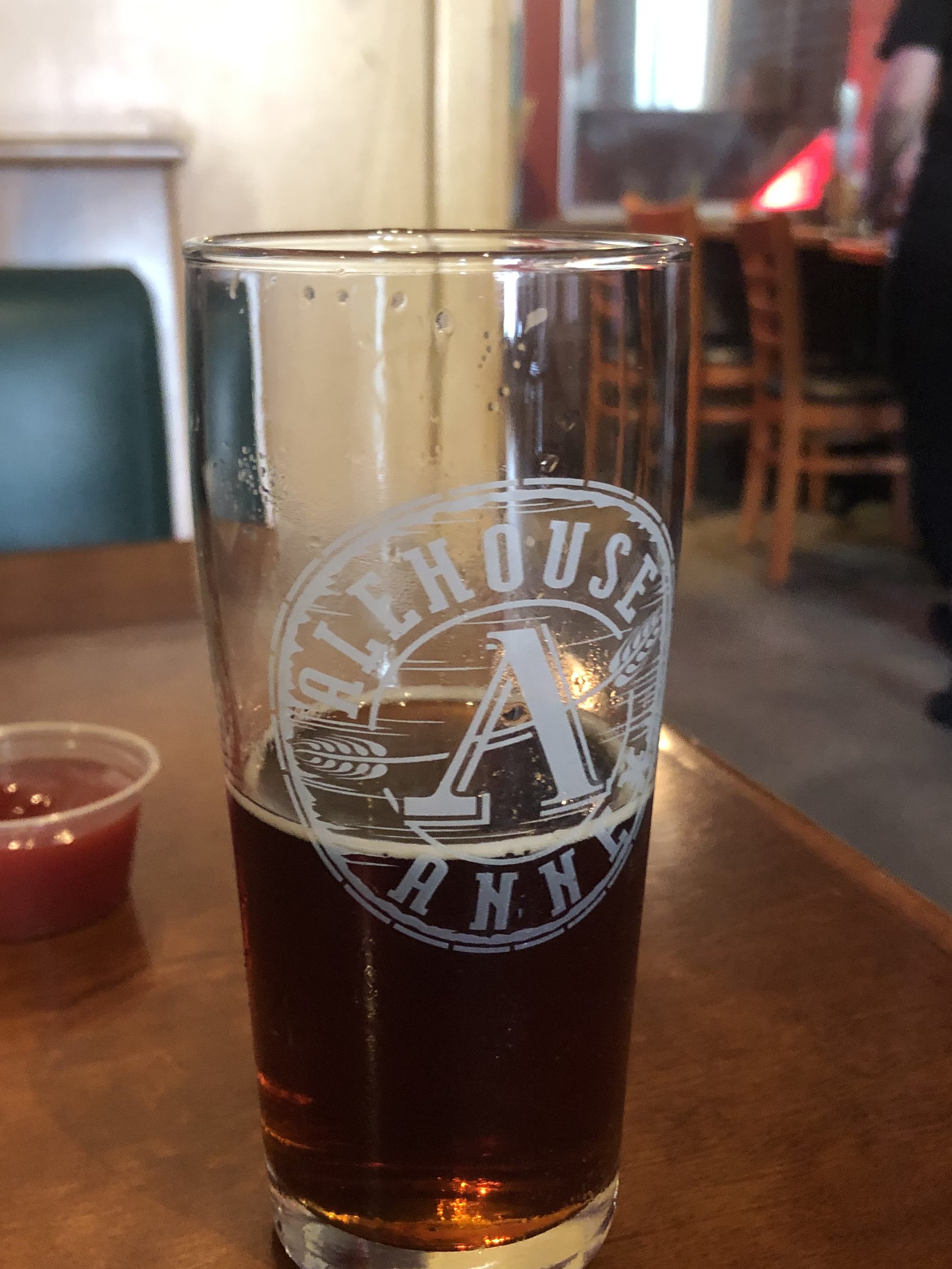
I stopped at the Auburn Alehouse in Auburn’s Old Town. It is located in the venerable structure that was built as a sixteen-room hotel in 1856. (The building has been home to the Auburn Alehouse since 2007.)
I selected the Hop Donkey, which is billed as an Imperial Red Ale. Now, in my experience, many red ales can be somewhat anemic and bitter. But the Hop Donkey is rich and flavorful. Its color reminds me of Starbucks, and its viscosity reminds me of Aunt Jemima. (I note, by the way, that that brand is being retired amid modern sensibilities.) This is an appealing beer. Its rich maltiness is perfectly balanced by its eponymous hops. It has a meaty palate, so much so that you practically chew your way through a glass of it.
Good for what ale you.
I was wanting a second glass of Hop Donkey by the time our meals arrived, but at 9.2 percent ABV, this is beer that requires some self-restraint. But you know that one day soon I’ll be coming back for more.
…dwelt a miner forty-niner and his daughter Clementine. (Copyright 1884, Percy Montrose.)
The forty-niners, of course, got their name from the year in which most of them came to the gold fields of California. Hundreds of thousands came seeking their fortune, tripling the state’s population in just a few years. The original forty-niners are of course long gone, but the forty-niner cognomen lives in in various forms, including an NFL football team, an independent student newspaper at Cal State Long Beach, and an auto repair shop in Grass Valley.
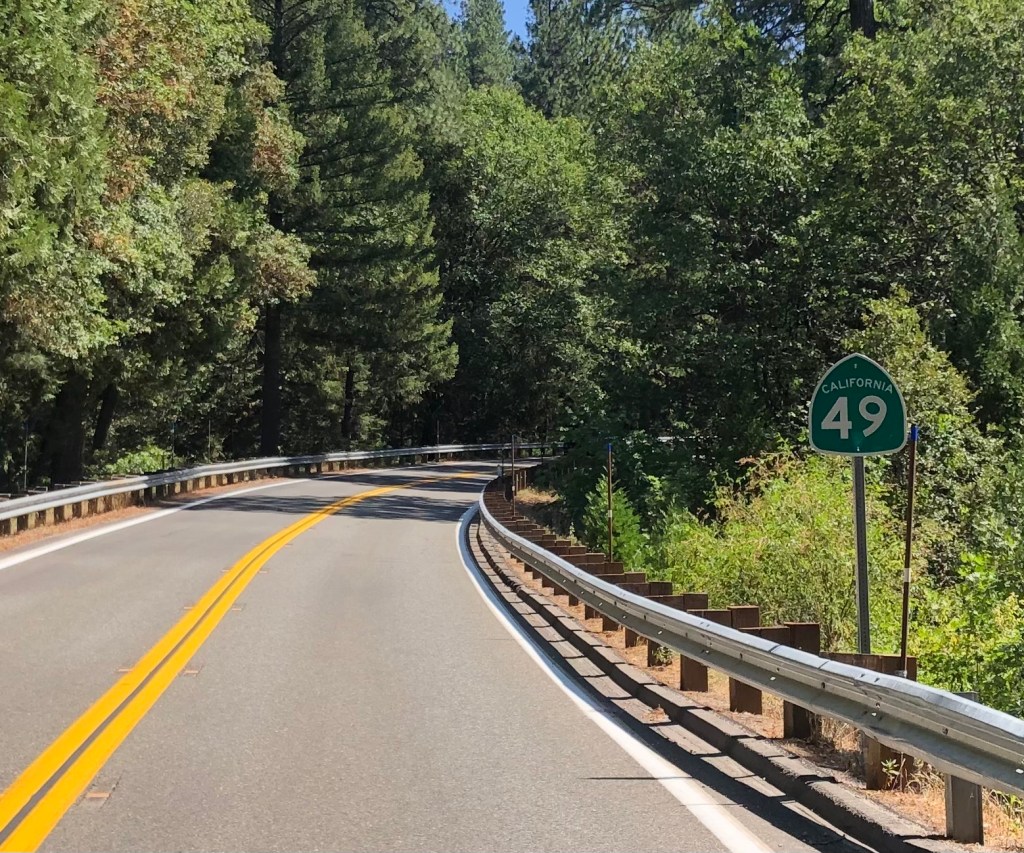
There’s also a state highway with the designation “49” that cuts through the old mining towns in the Sierra foothills. The route was established in 1934, and of course its number is a nod to the prospectors who came in search of gold. (The route also bears the official nickname “Golden Chain Highway,” but I’ve never heard anyone actually call it that.)
I tell you all this because yesterday morning I set out on a trip along a goodly portion of Route 49. I began in the Goldrush-era town of Placerville. Why did I start there? Because I recently moved to the area. There’s no need for this post to go into the sordid tale of why I moved there, but if you want the full story, ask my wife. And then tell me what she said; I’m still trying to figure it out.
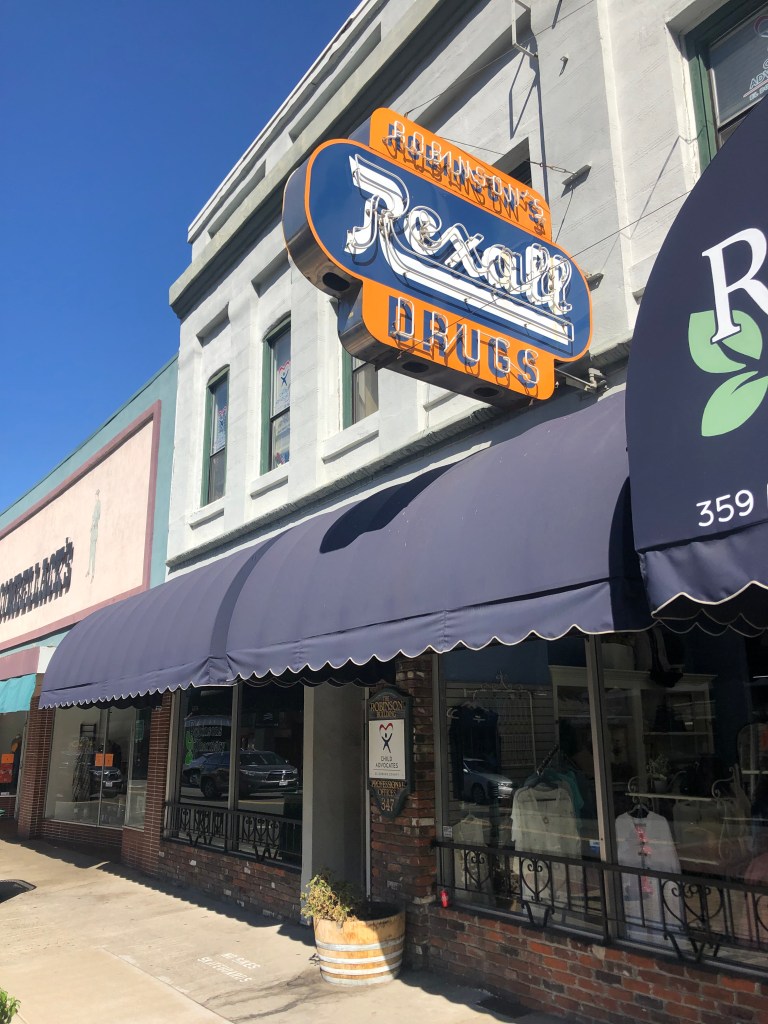
Placerville: Where they haven’t yet received the news that the Rexall chain closed in 1977.
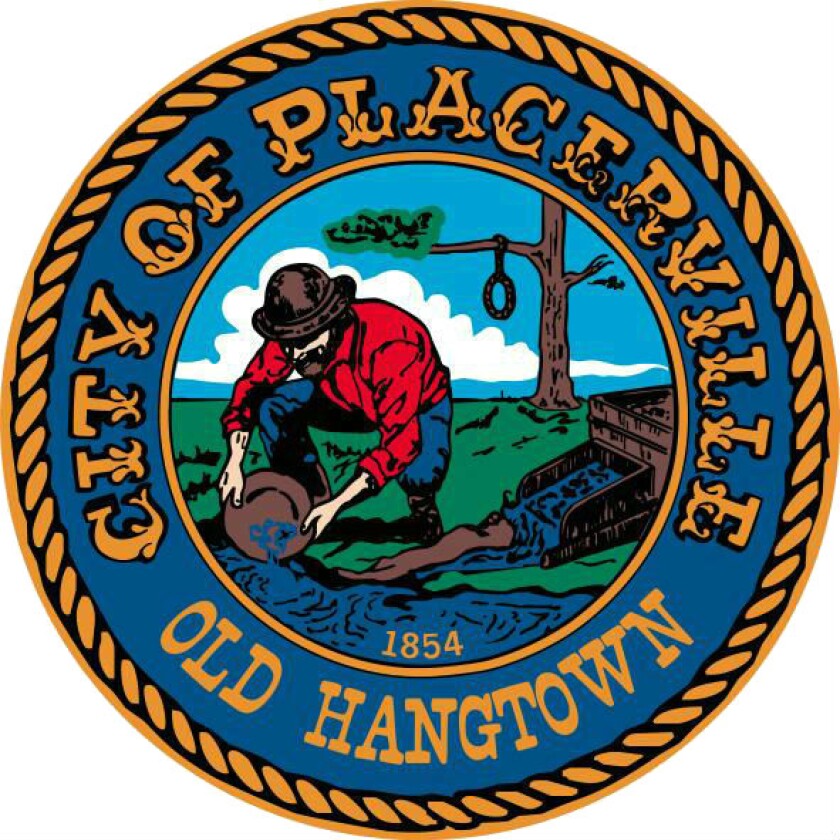
Anyway, I started my Route 49 trip in Placerville (pop: 10,000). Currently the county seat of El Dorado County, Placerville was originally established as a mining camp named Hangtown in 1849. The name referenced the vigilante justice that was meted out at the end of a rope attached to an oak tree on Main Street. After a few years some of the more sensitive souls in town called for a new and less gruesome name, and Hangtown was rechristened Placerville. The more colorful, earlier name still appears around town, including the town logo, complete with a noose. (I am not making this up.)
“Come for the gold, stay for the necktie party”
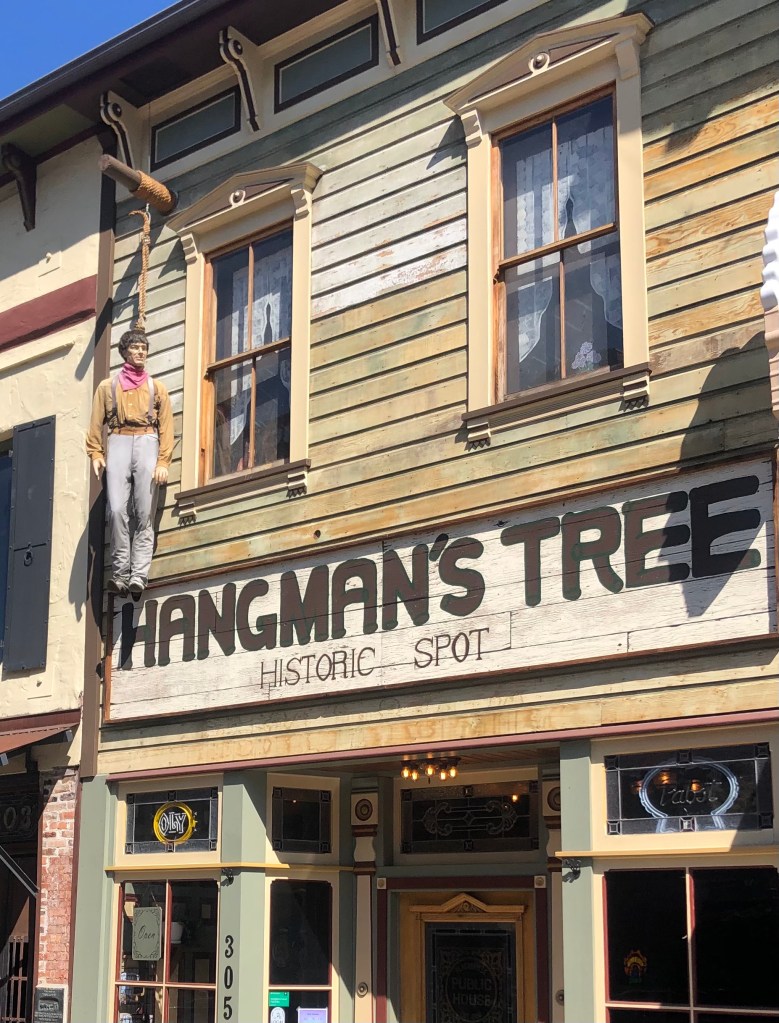
There’s even a saloon on Main Street called “The Hangman’s Tree.” It calls itself a “historic spot” because it’s built on top of the stump of that very tree that once bore the hangman’s noose. And in case the name is too subtle, the proprietors have hung the effigy of a man from a noose outside the second-story window, just to drive home the point.
I’m told it’s a great place to hang out.
Of course, for a town that relies heavily on tourism, this whole gallows theme clashes uncomfortably with current political tides. And so the City Council recently voted to phase out the noose (but not the “Old Hangtown” moniker) from their logo.
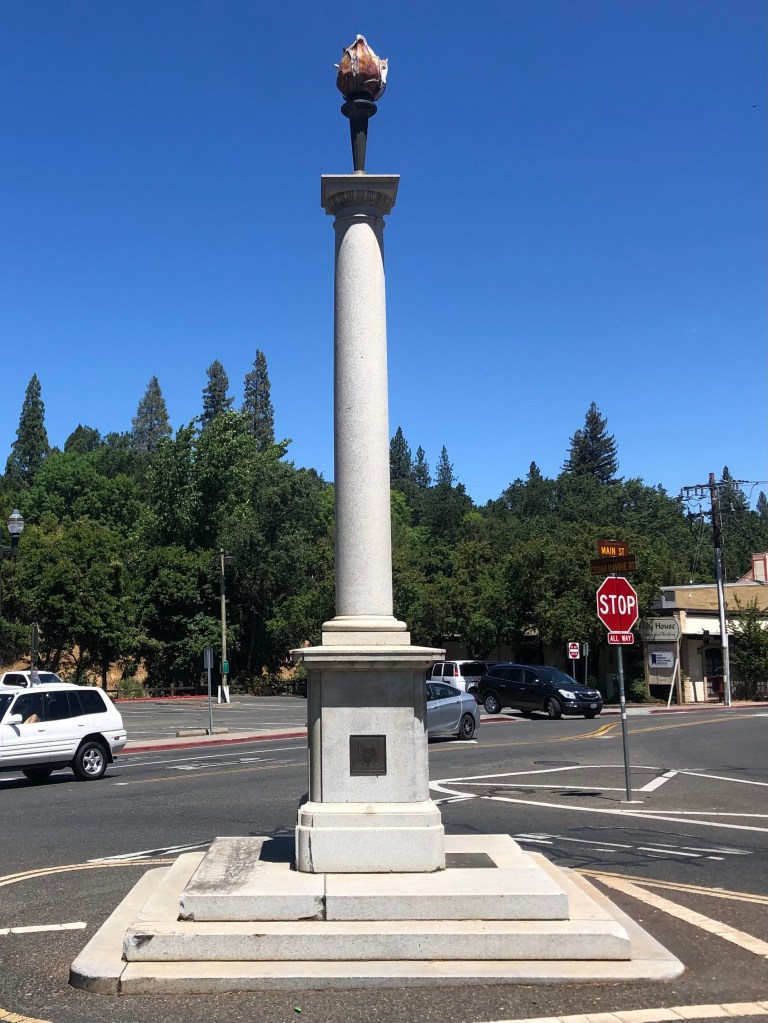
Naturally, Placerville tries to keep up with the likes of Denver, Colo., Trenton, Nebraska, and Boston, Mass. with its own wannabe Washington Monument obelisk. Actually, Placerville’s doesn’t look anything like the Washington Monument, but given my last post, it struck me as propitious that I’d encounter an obelisk at the beginning of my journey. Interestingly, this obelisk was erected by “The Druids of California” in 1926. I’m not making this up.
The designer of this monument first “druid” on paper…
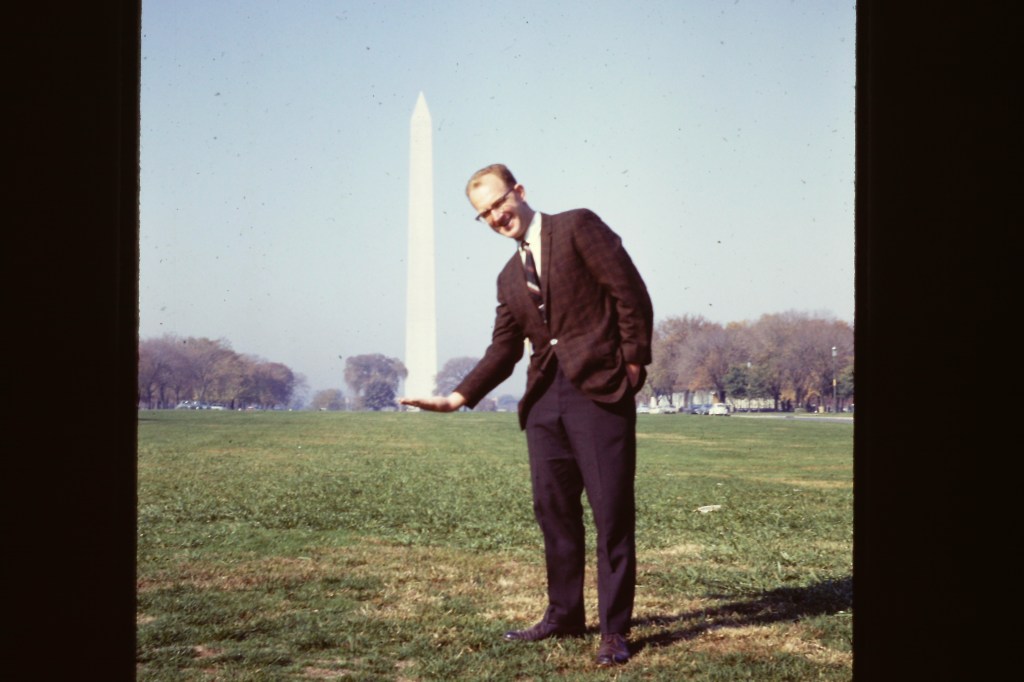
Incidentally, I feel compelled to share with you a Washington Monument photo from the Boilard Family Archives. This is my dad, Dennis Boilard, in the mid-1960s.
A monumental feat.
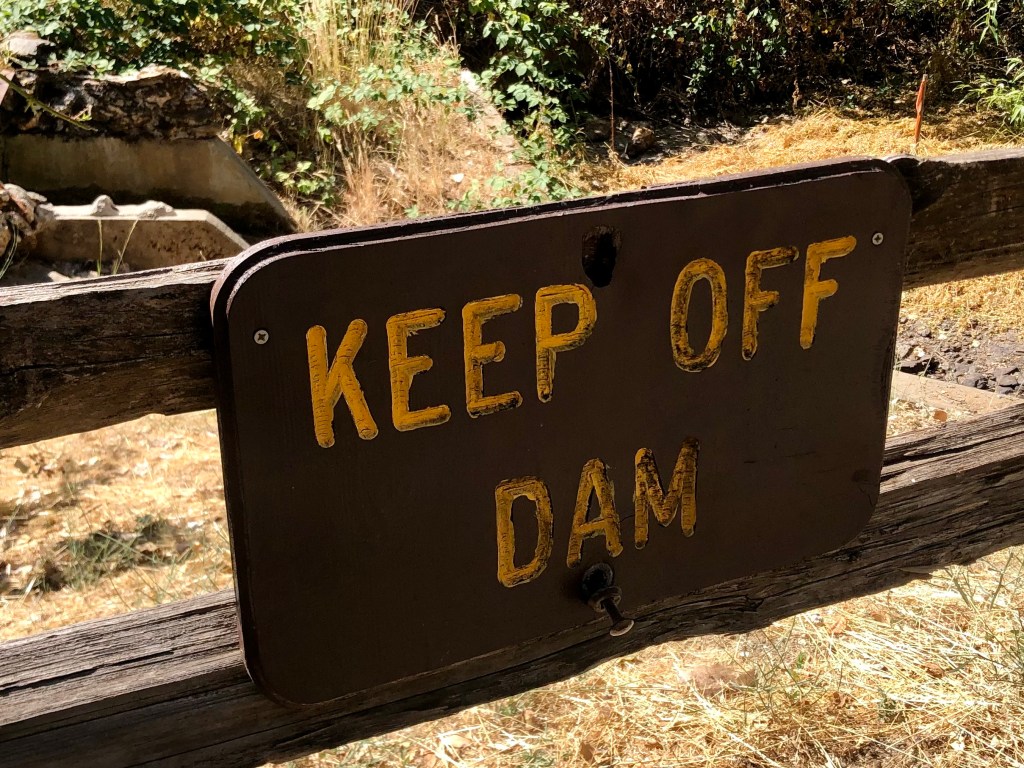
Back to Placervile: An especially tourist-friendly attraction is the town’s “Gold Bug Park,” which includes a historic mine you can walk through, a working blacksmith’s shop, a stamp mill, and other attractions. There’s even a small, historic dam on a stream that once saw hundreds of gold panners.
Keep off dam fence!
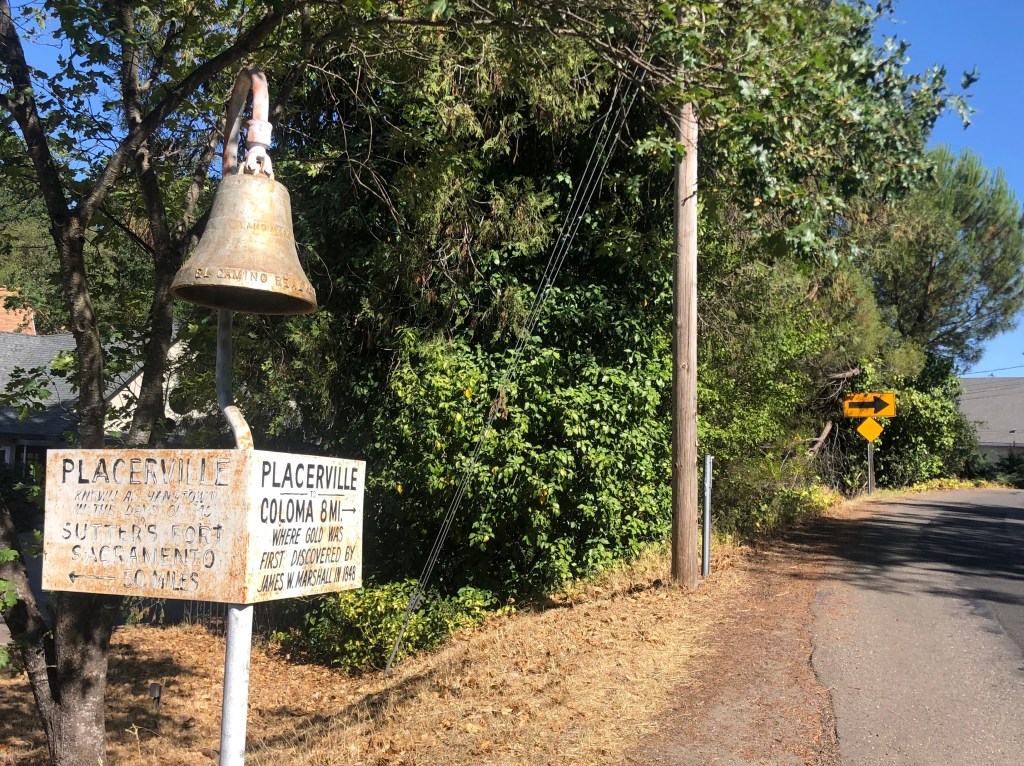
After a friendly chat with the docent at Gold Bug park (a matronly woman who’s been working there for 24 years), I set out north on Highway 49. An ancient sign beneath one of those El Camino Real mission bells pointed the way.
Mysterious Marker
In 1906, cast iron mission bells were placed along the “El Camino Route” that joined California’s Franciscan missions. Much of that route is now modern-day US 101. Over the years many of those bells were damaged or stolen, but periodic efforts have been undertaken to repair or replace them. Today many of these bells can still be seen along US 101.
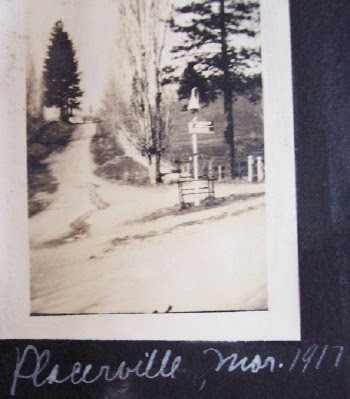
But what’s this bell doing along CA 49? As you can see in the photo above (those of you reading this on your smart phones may need to zoom in on the photo), it’s clearly inscribed as an El Camino Real bell. But Placerville is a long way from the El Camino Real. A little internet research found a historical marker database that claims the bell was placed there in 1948. But the photo below, dated as 1917, suggests the bell was installed much earlier. Anyone with information is encouraged to please contact me!
Maybe the bell designated a “toll” road?
As I left the teeming metropolis of Placerville behind me, I settled into a comfortable cruise along the winding, oak-lined road that is Highway 49.
Even on the open road, I did encounter a few bottlenecks.
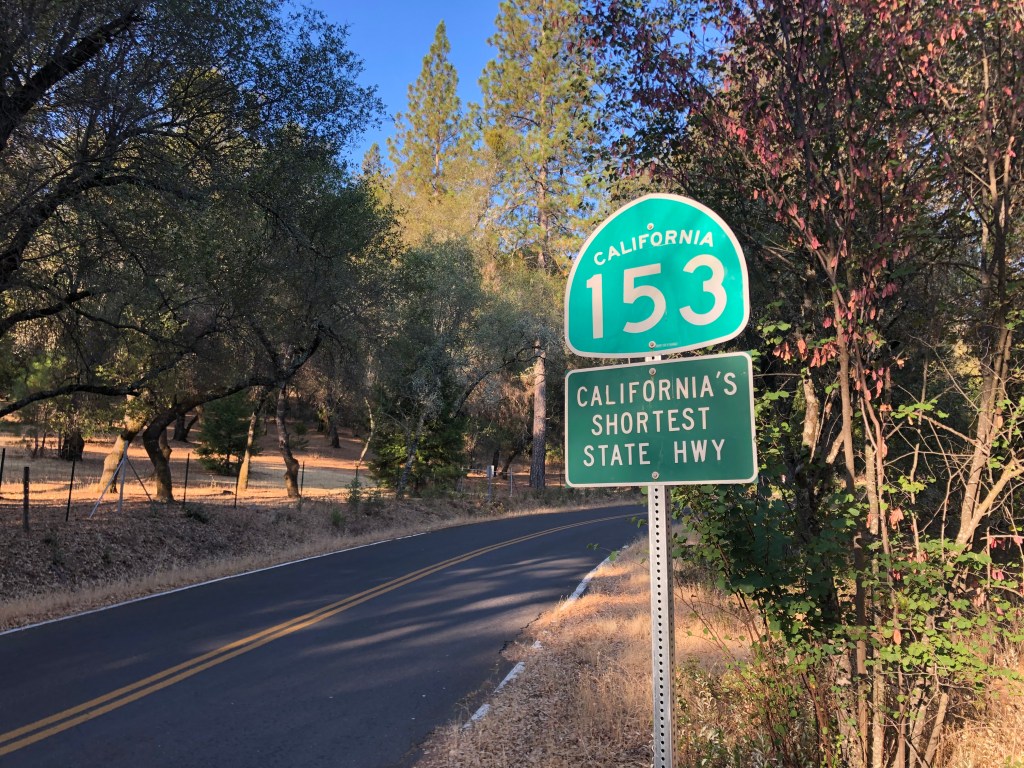
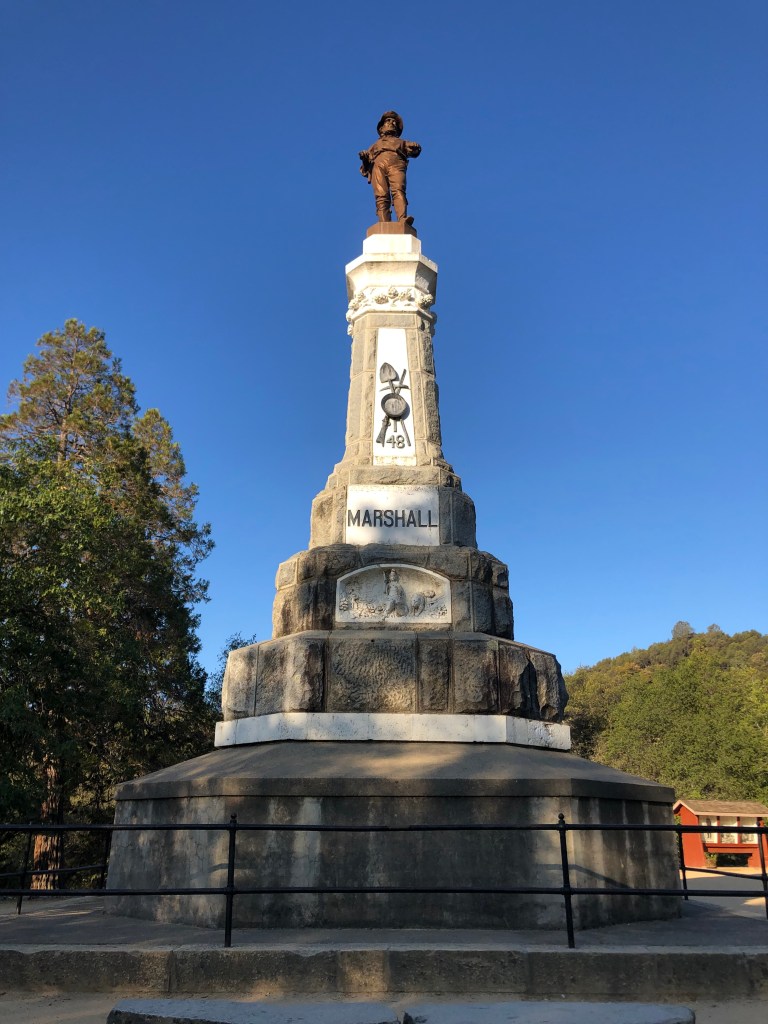
Soon I was passing through the historic town of Coloma (pop: 529) which is where, in January 1848, James Marshall discovered gold in the water channel serving Sutter’s Mill. Word of the find spread instantly, and within months California was inundated with would-be gold prospectors. Notably, Marshall himself never made much money on his discovery, and he eventually died penniless and largely unknown. A few years after his death, however, the state Legislature appropriated funds to have Marshall’s remains dug up and reinterred under a suitable monument. That monument sits just a mile or so off Highway 49, a distance that covers the entire length of CA Route 153. The sign below explains this conundrum.
An unusual brag.
The Marshall monument is indeed impressive. Installed in 1890, it features a larger-than-life statue of Marshall pointing at the spot where gold was discovered. The base of the monument includes all manner of symbolism, from gold mining implements to the California bear to Queen Calafia.
RIP James Marshall, 1810-1885.
All along Highway 49 there are reminders of how California was fundamentally changed by Marshall’s discovery. Most of the towns along Highway 49 served miners in some way. And of course, California’s very statehood was accelerated by the country’s desire to latch onto the Sierra goldfields. And the throngs of people coming to California demanded improved transportation routes, which helped to spur the completion of of the Transcontinental Railroad in the 1860s.
One of the first towns I encountered after Coloma was Pilot Hill (pop: 750), where in 1861 A.J. Bayley began constructing a 10,000 square foot, 22-room hotel to capitalize on what he assumed would be the construction of the Transcontinental Railroad right past his property. Indeed, the Central Pacific had been planning to use that route, but the plans where changed after an easier route was discovered through Auburn. The hotel was completed, but without easy access to the railroad it never saw the business Bayley had hoped for. The building still stands next to Highway 49 on a rise, and local organizations are hoping to renovate it.
Gold Rush-era white elephant.
One of the few “big” towns I encountered on this trip was Auburn (pop: 13,000). Auburn is in Placer County, and you’d of course expect Placerville to be the county seat of Placer County. But as we already learned, Placerville is the county seat of El Dorado County. Auburn is the seat of Placer County. To add to the confusion, Highway 49 also passes through Nevada County, which is a county of California.
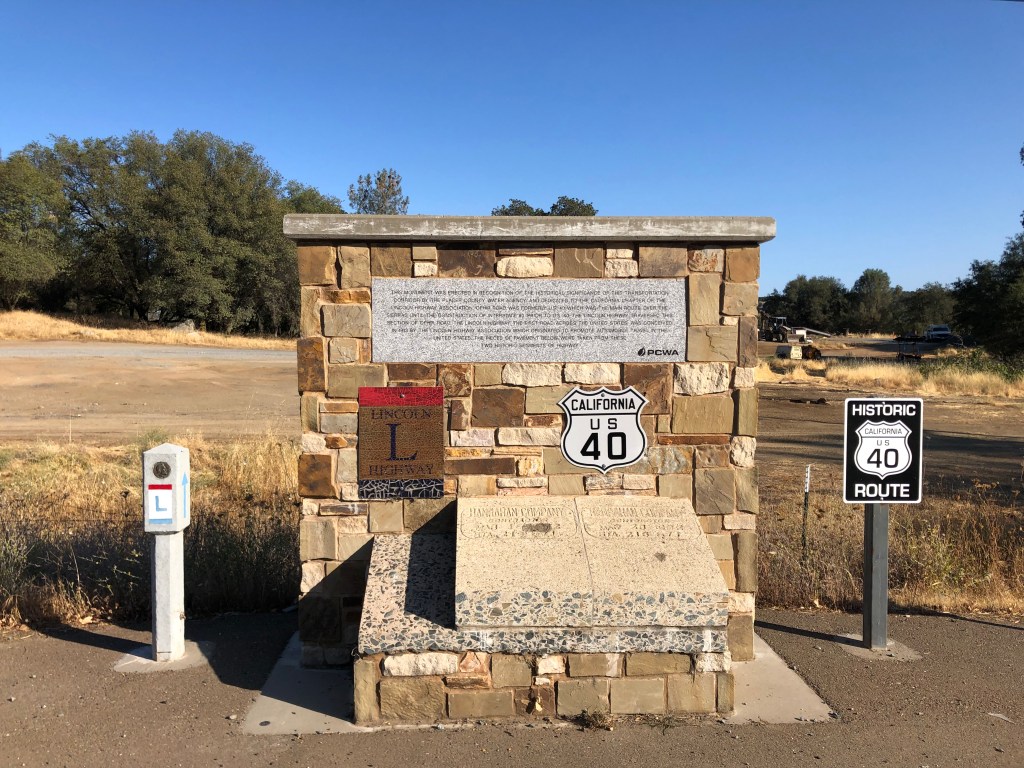
Anyway, as 49 passes through Auburn is crosses the historic “Lincoln Highway.” The Lincoln Highway dates back to 1913, and was the country’s first coast-to-coast highway. It ran from Times Square to San Francisco’s Lincoln Park. When US highway numbering became a thing in the 1930s and 1940s, the portion of the Lincoln Highway passing through Auburn was designated as US Route 40. I tell you all this because in Auburn there is now a marker commemorating the Lincoln Highway and Route 40, with slabs of original pavement from the route.
Roadway Remembrance
Incidentally, most of the Lincoln Highway has now been superseded by Interstate 80.
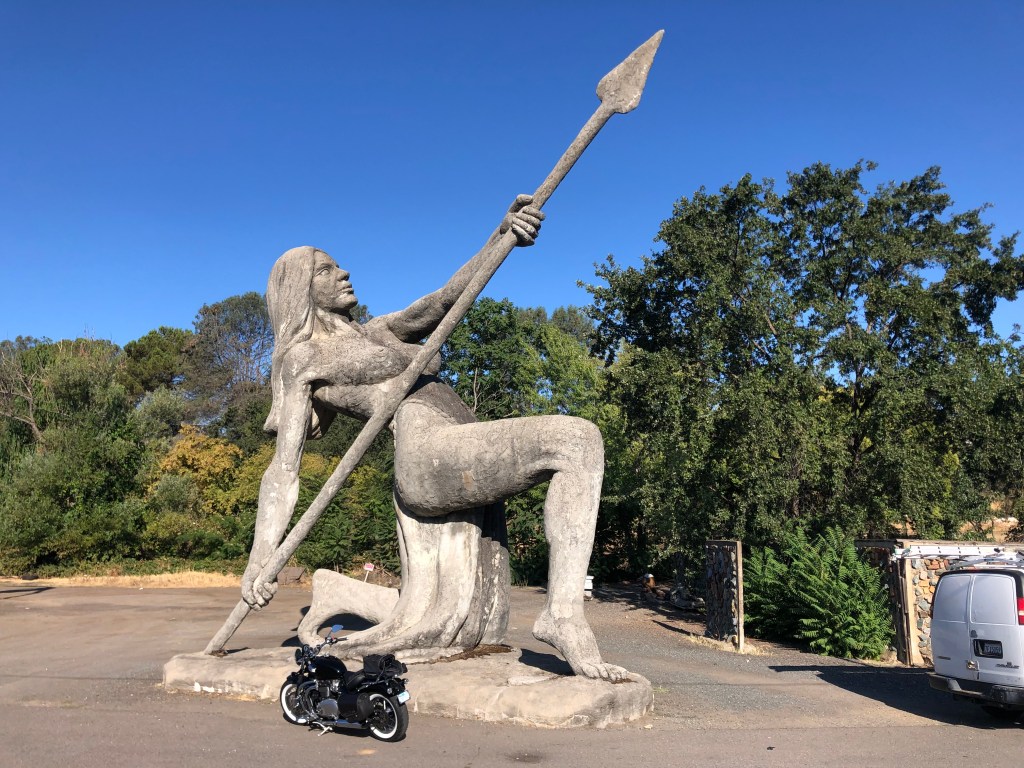
Before leaving Auburn, I took this picture of a roadside art installation. I’m told the statue was created by a local dentist. I’m not sure what it’s supposed to mean, but the sheer size is impressive.
I certainly wouldn’t mess with her.
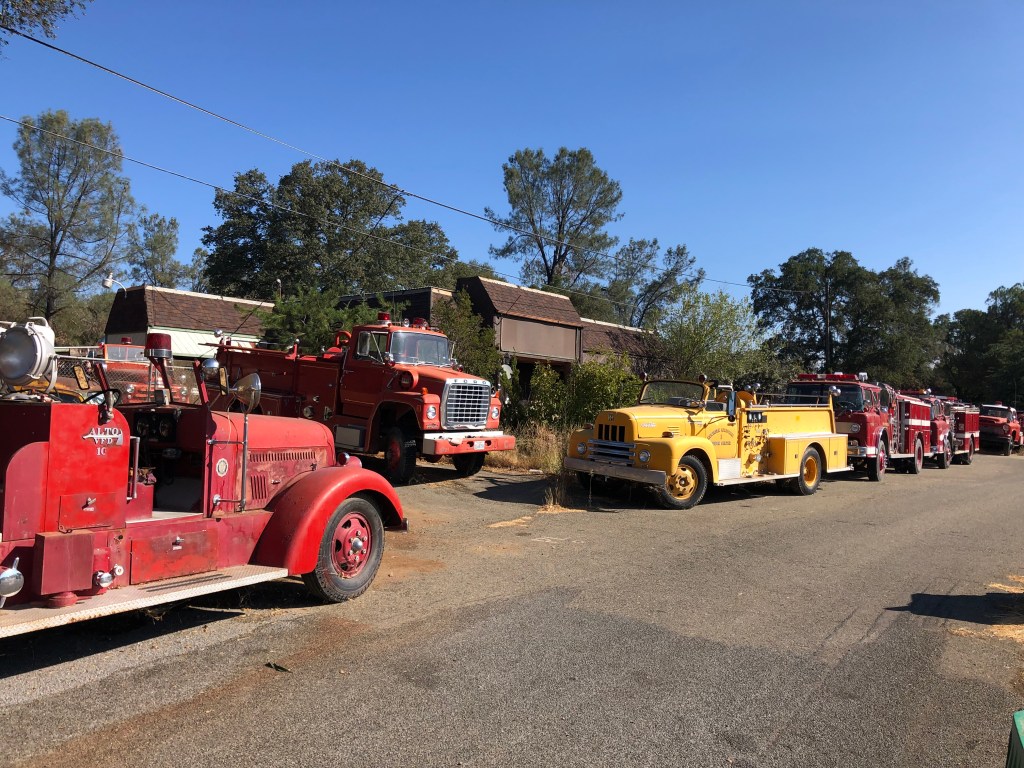
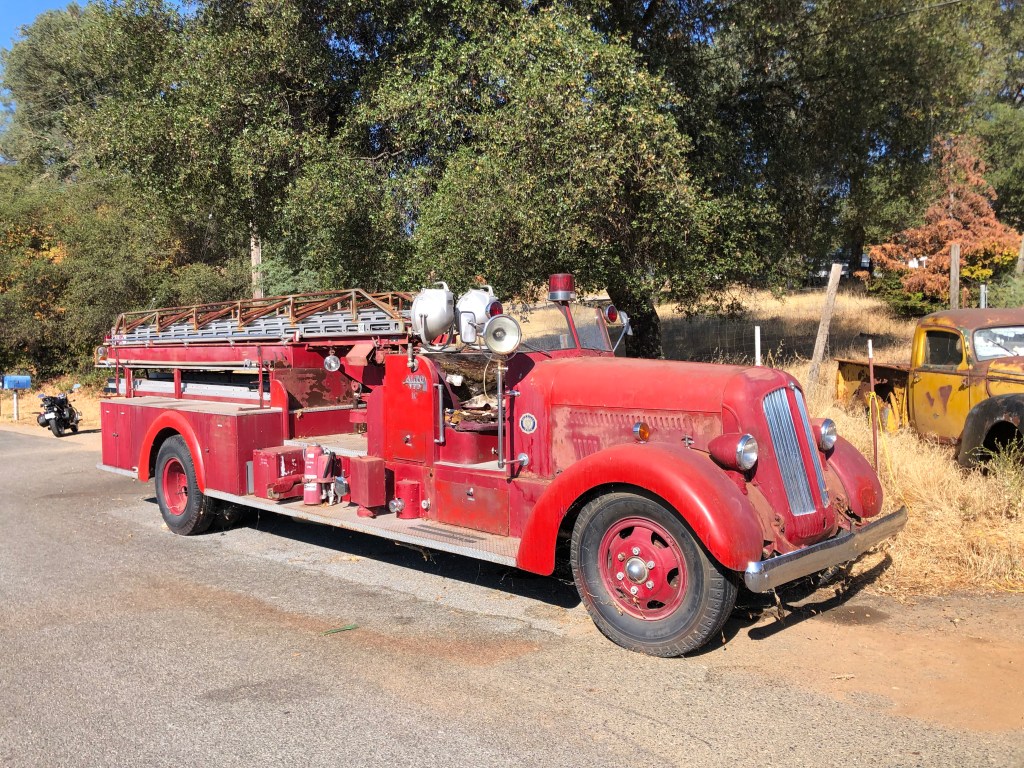
After Auburn, one just has to get through the rival cities of Grass Valley and Nevada City before highway 49 returns to a slow, winding, two-lane road. I didn’t feel much need to stop in those cities, given that they’ve become overrun with weekend tourists, posing hipsters, and college students showing off their starter tats. Between those two cities, though, I encountered a roadside collection of fire engines. They were parked in front of someone’s property, with no signs, no explanation, and no one to ask. Even an internet search came up empty.
Hey, Mac — where’s the fire?Circa 1939, I’d reckon.
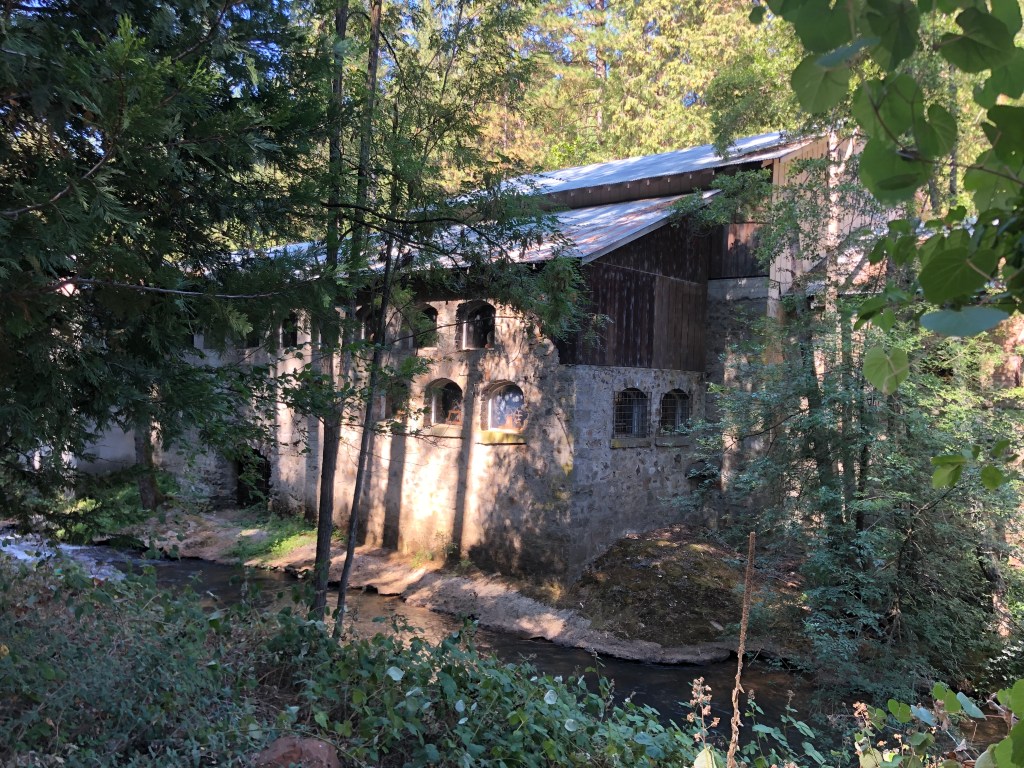
A bit further along the road I came upon the North Star Mine Powerhouse. It was constructed in 1895, and used water power from a neighboring creek to power a mining operation. Large mining operations were, of course, a direct outgrowth of the gold rush. The stone powerhouse building is situated among trees beside the stream, and looks like something out of a Robert Kinkade painting.
Built like a brick powerhouse.Thomas Kinkade, eat your heart out.
And now the road settled into an idyllic, meandering, quiet route that flirted with various forks and tributaries of the American and Yuba Rivers.
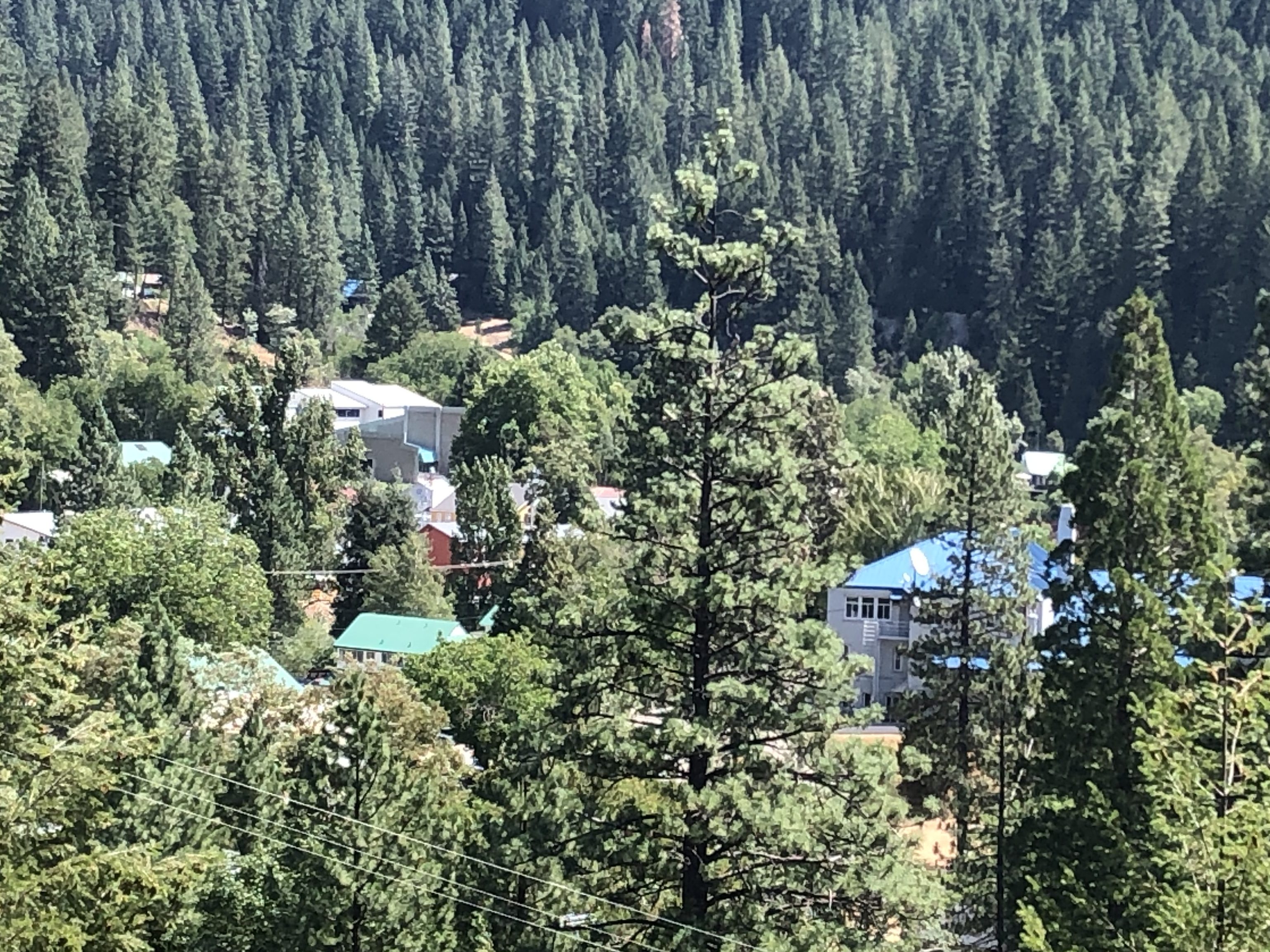
Eventually I came to a turnout that overlooked the town of Downieville (pop: 300). It’s not a big or even a substantial town by any measure, and yet Downieville feels solid if not prosperous, and picturesque if not beautiful.
Downieville, viewed from the final turn of 49 before it becomes the town’s main drag.
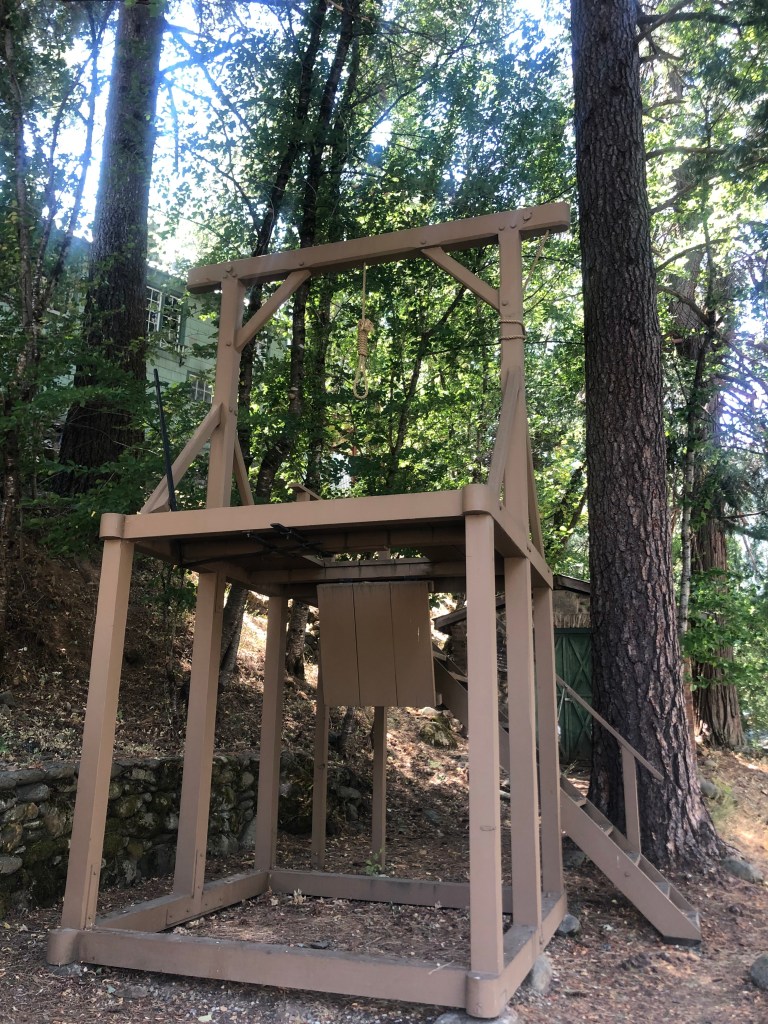
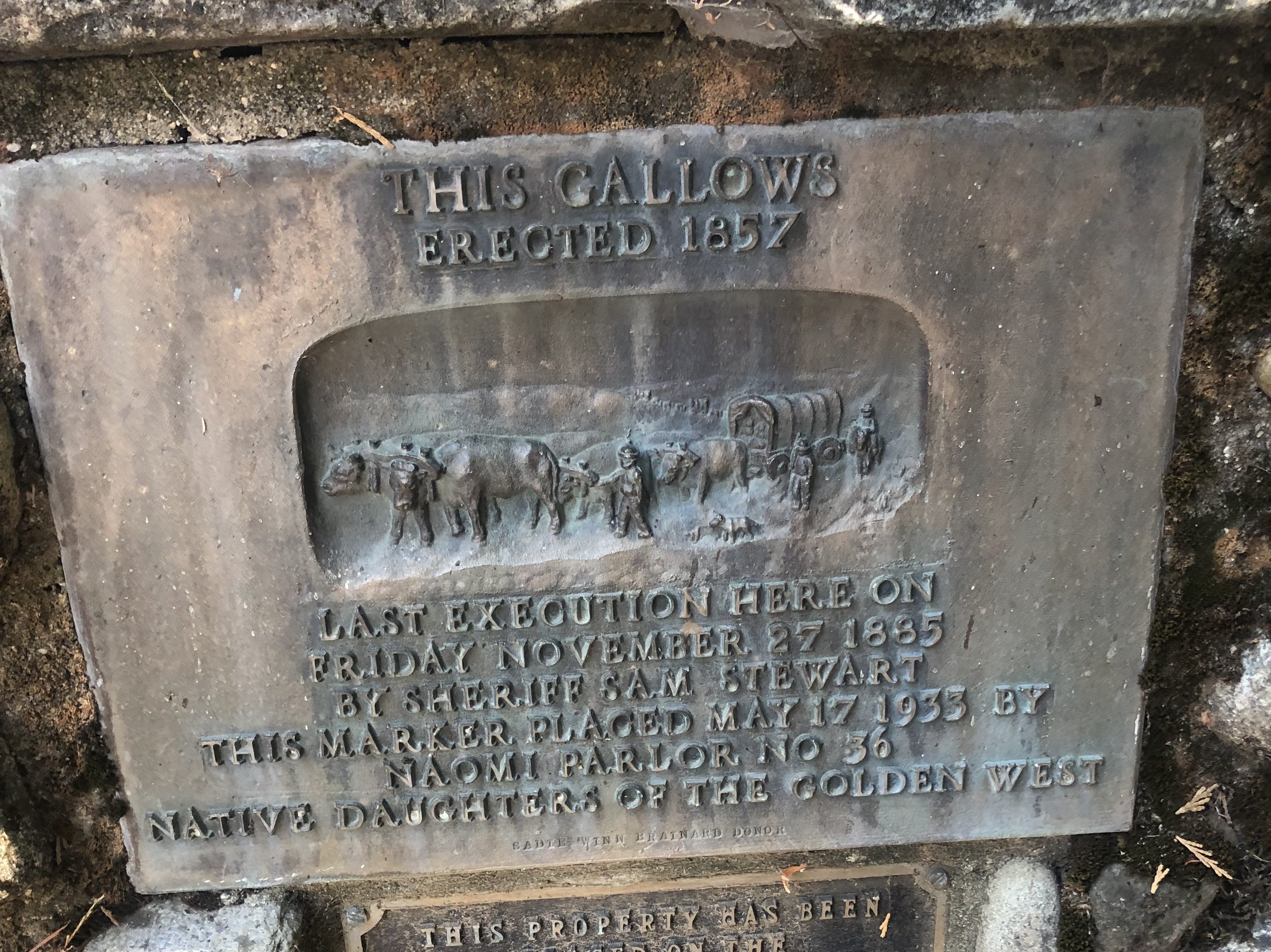
The town quickly arose in 1849 when a Scotsman named William Downie discovered gold in the area. The gold eventually played out, of course, but the isolated little town has refused to die. As the county seat of Sierra County, it does possess a handful of government buildings and a court house. It even has its own gallows, which was used only once, to hang a 20-year-old man for murder in 1881. A change to state law later that year ended local executions in California.
Insert gallows humor here
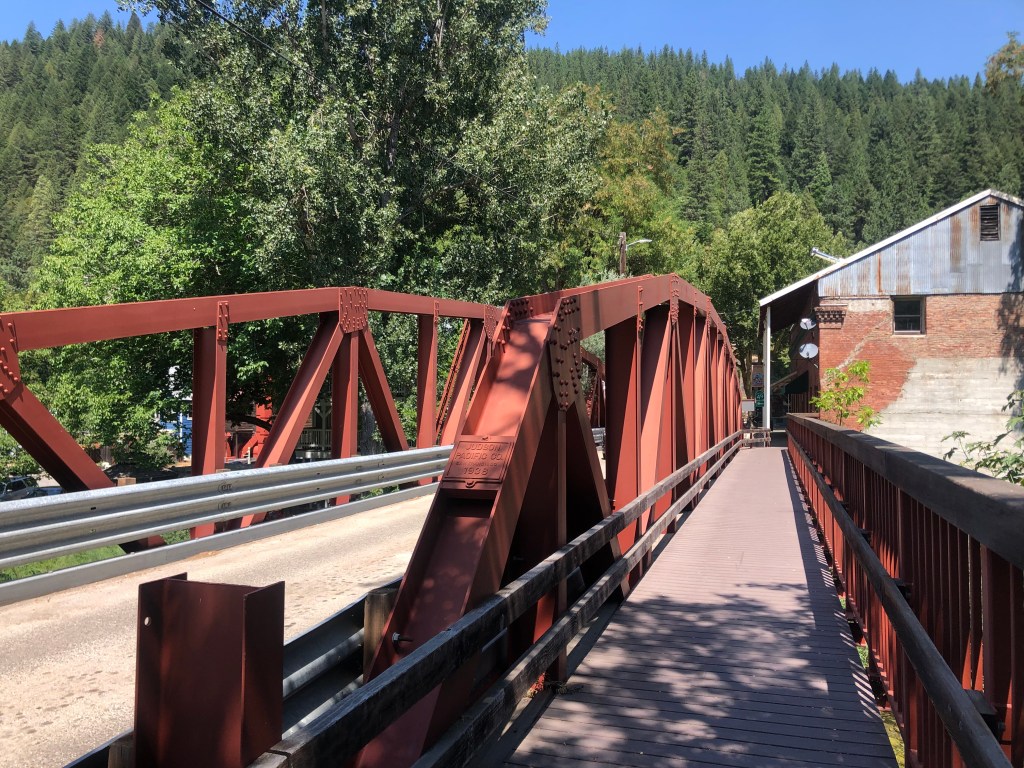
Continuing with our theme of hangings, in 1851 a young woman was hanged from the local bridge by a vigilante mob seeking justice for a murder. Josefa Segovia was the first woman to be executed by hanging in California. Her body rests in the local cemetery, not far from that of the man she supposedly murdered.
Josefa’s last stand. (The bridge was replaced in 1938.)
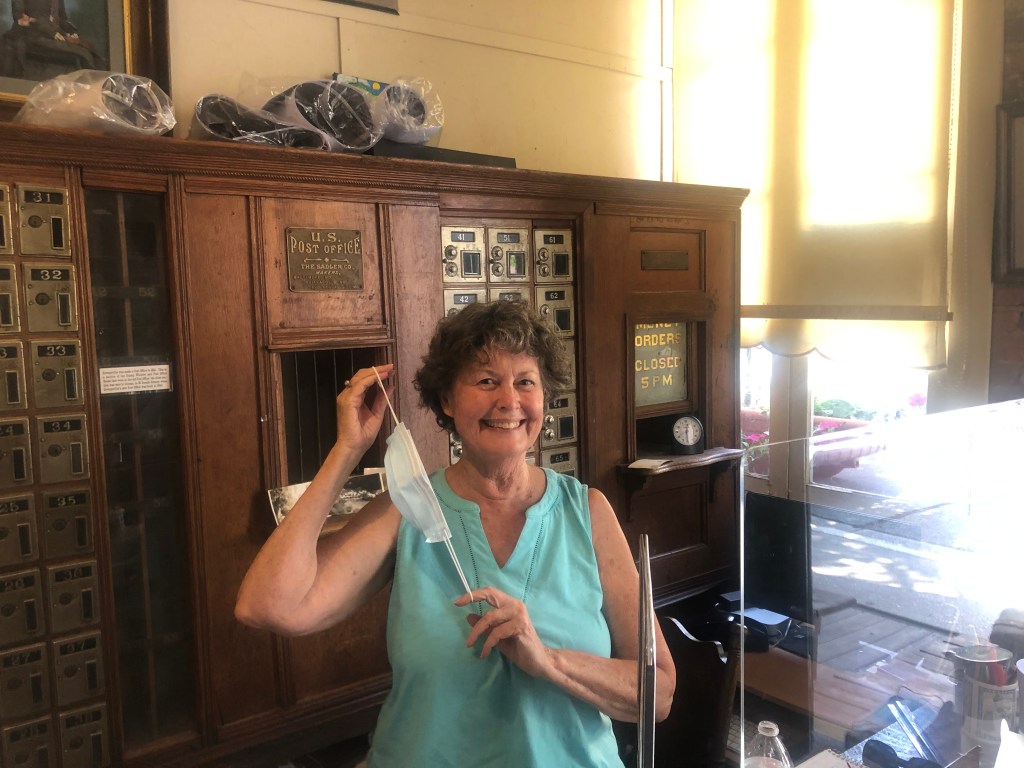
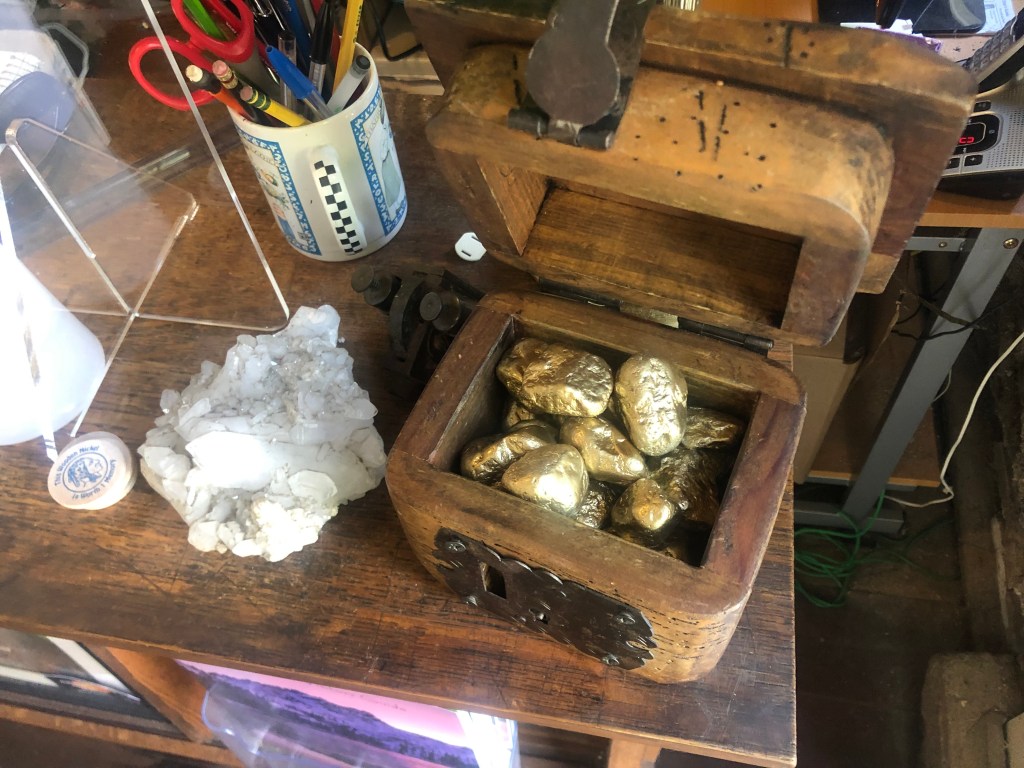
But let’s leave Downieville on a less gruesome note. I passed an enjoyable 30 minutes chatting with Carol at the town’s two-room museum. Carol’s husband (now 80) grew up in this town, and Carol has learned to love the place as her own. She admits that many of the town’s young people feel a need to “spread their wings” by leaving, at least for awhile. But she believes that most of them eventually come back, “at least to visit.” She says it’s a close community, and the residents take pride in the town’s ties to the Gold Rush. Her husband even paints river rocks with gold paint for Carol to give to young visitors at the museum.
Carol, doing a little Covid-strip tease.All that glitters is not gold.
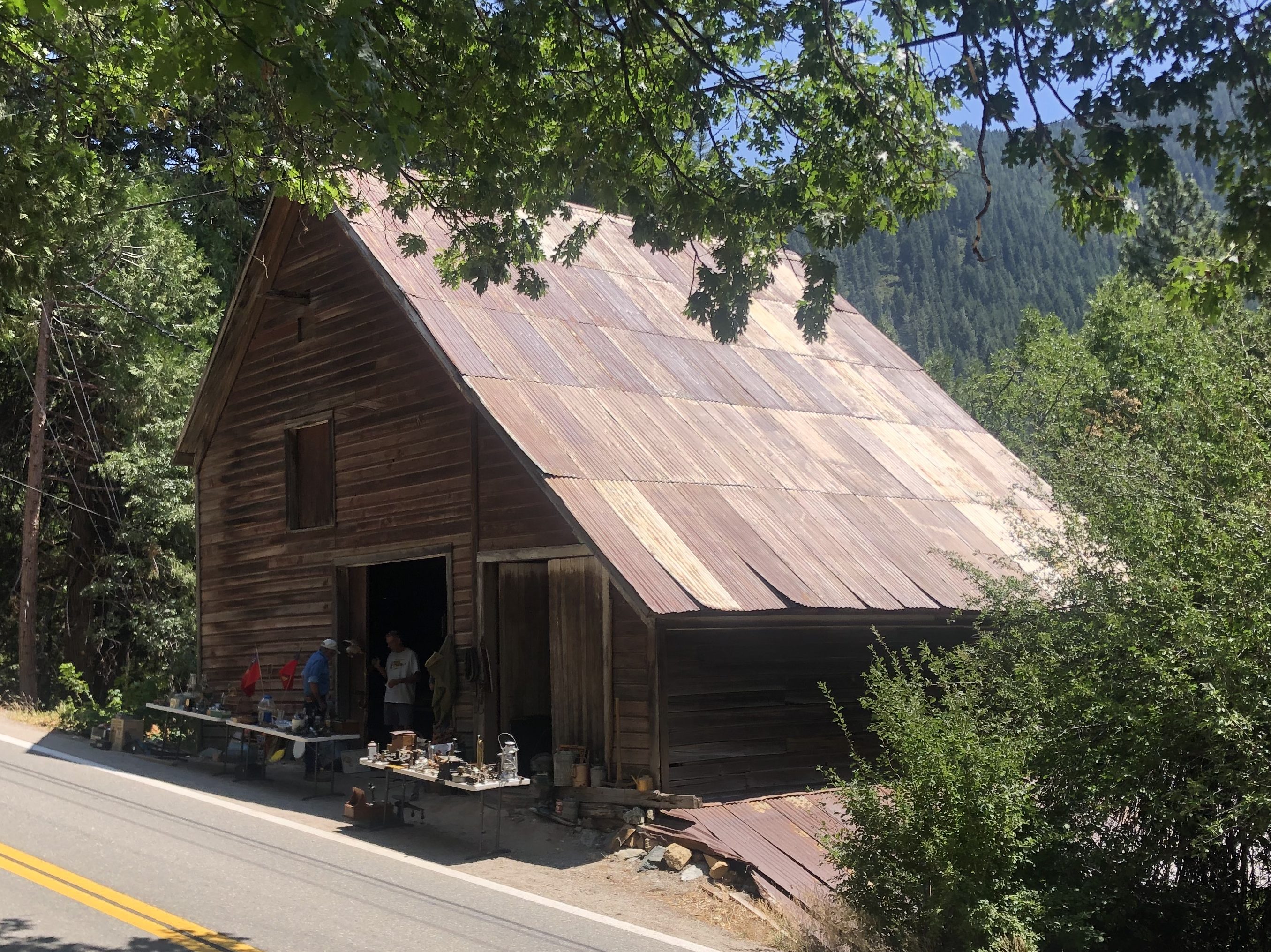
The next town I encountered after Downieville was Sierra City (pop: 200). Like so many of the other settlements along Route 49, Sierra City saw its heyday during the Gold Rush. Today the town has only a handful of structures and few signs of life. The exception to this was an enormous barn with a cluster of people standing around its open doors. I stopped to check it out.
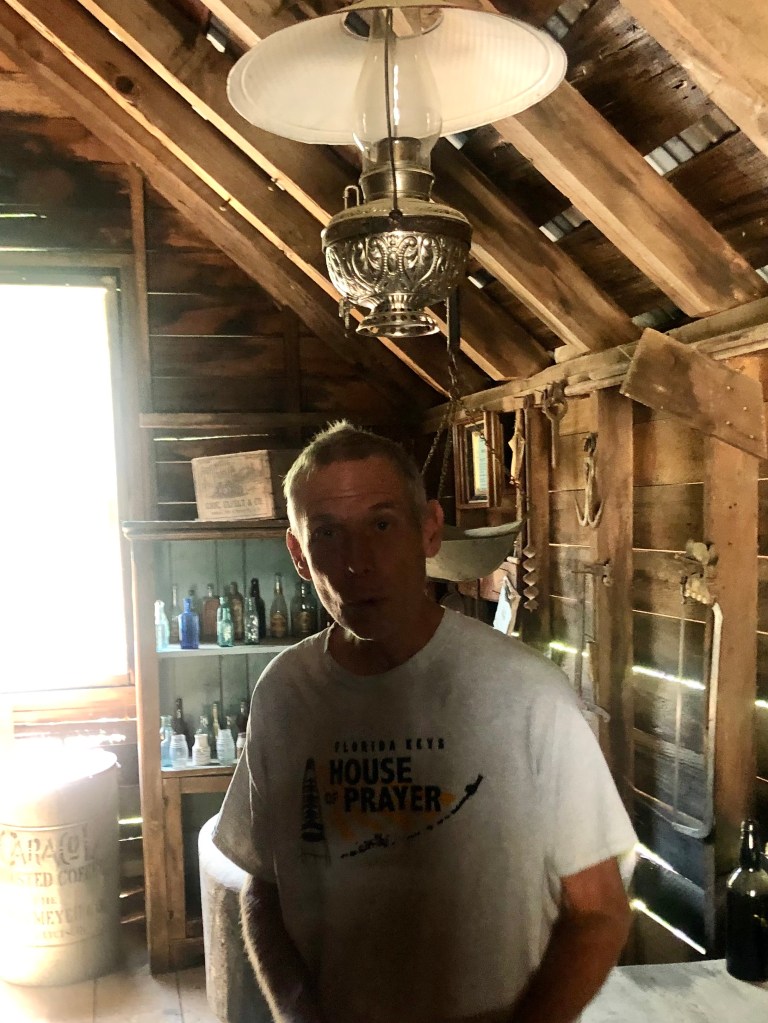
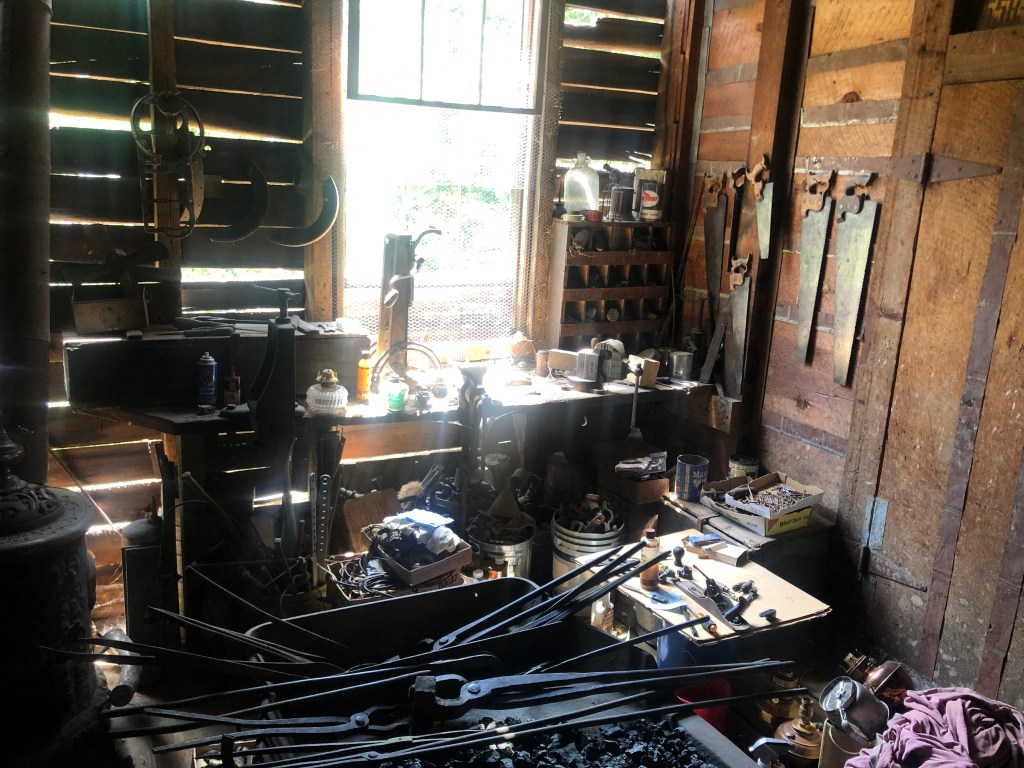
It turns out the barn’s owner, Joshua, was holding an estate sale to raise funds to open a museum in the barn. He told me that the barn was built in 1873, and when he purchased it a few years back it was full of various old (and I mean old) pieces of farm equipment, horse tack, tools, and the like. The barn is even bigger than it looks; it has two stories above ground, and another two floor below ground.
Joshua the Barn BaronSam Drucker would feel at home.
While we talked, cars would stop, people would get out and look at the stuff Joshua had out for sale, and they’d ask him what this doodad is or what that gimcrack does. Joshua had a detailed explanation for each item, including its origin, history, and purpose. (I ended up purchasing a mid-19th century equine curry comb for twenty bucks.) Joshua clearly enjoys history, and he was especially enthusiastic about getting the museum up and running. The barn itself holds a place-bound story about the town, and the artifacts tell stories about our ancestors, their culture, and their way of life. Joshua sees the importance of preserving those stories. Although he grew up in the Bay Area, he (like Carol the docent in Downieville) has come to greatly appreciate his new hometown, and he (like she) works to share it with others.
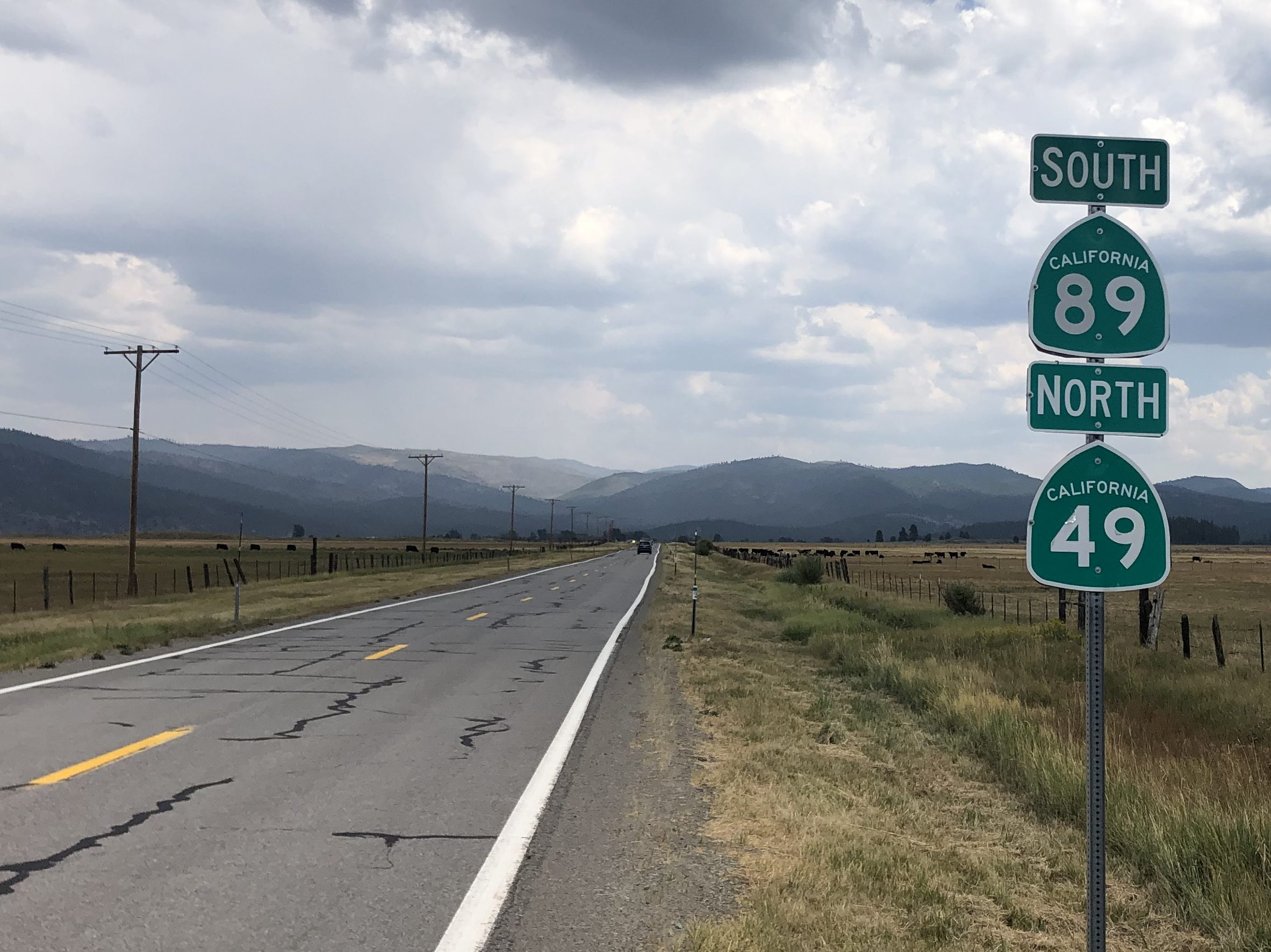
After awhile I got back on the road, and soon found myself heading north and south simultaneously.
Cue the Twilight Zone music…
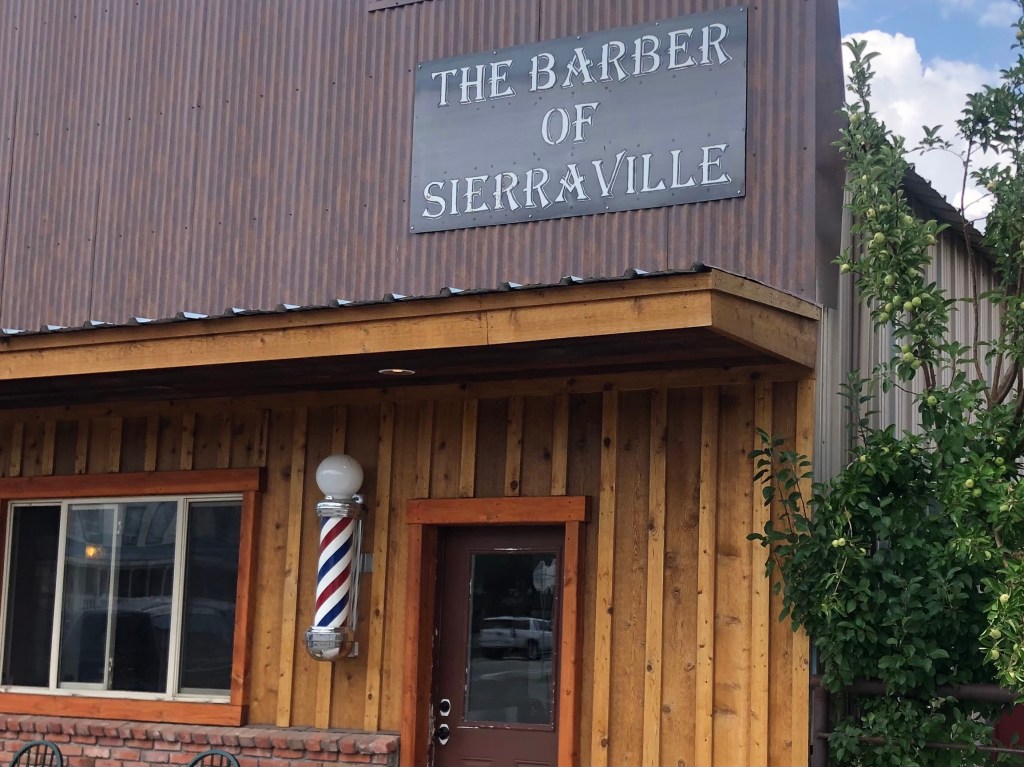
Finally I came to the town of Sierraville (not to be confused with the earlier Sierra City). The town’s barber had some fun referencing the town’s name.
With apologies to Gioachino Rossini.
I stopped at a small cafe for a java, and ended up chatting with a guy roughly my age who was getting a latte for his wife (or so he said). We got to talking, and he mentioned he lives in Reno. “What brings you all the way out here?” I asked. “That,” he answered, pointing across the street to a Mexican restaurant called Los Dos Hermanos. “It’s the best Mexican food in Reno,” he explained, and it took me a moment to understand what he meant. Evidently the place is so good he considers it his “local” Mexican restaurant.
I was noticing that the weather was starting to change, and there was a slight smell of smoke in the air. From Sierraville, highway 49 would head north toward the so-called Dixie fire that’s currently the state’s largest wildfire so far this year. Given my track record of encountering fire-related roadblocks on my road trips, I decided to instead head south on state highway 89 and spend the night on the north shore of Lake Tahoe. I was accommodated by my friend Chris P., who lives in Incline Village with his wife Carla. Chris and I got a couple of beers at the local brewery, then went back to his place for martinis, steaks, and red wine. I am grateful to them both for their hospitality.
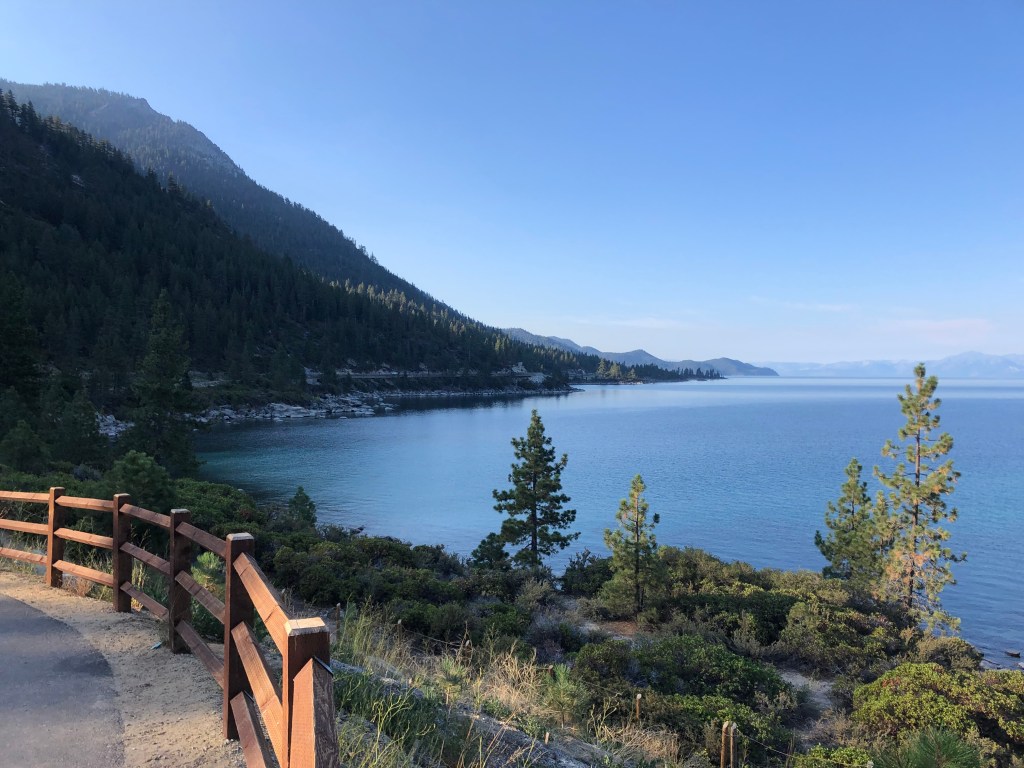
This morning I took a leisurely ride around the Lake Tahoe on the Nevada side, taking in the brisk morning air and enjoying the views. Mine was practically the only vehicle on the road.
Keep Tahoe Blue!
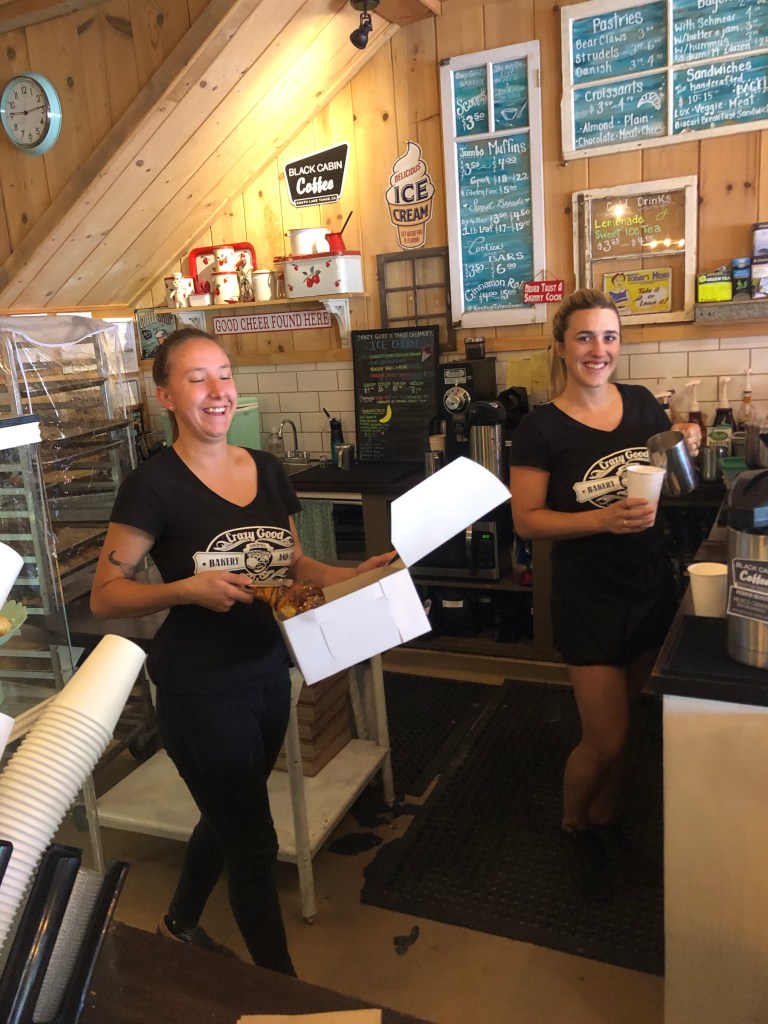
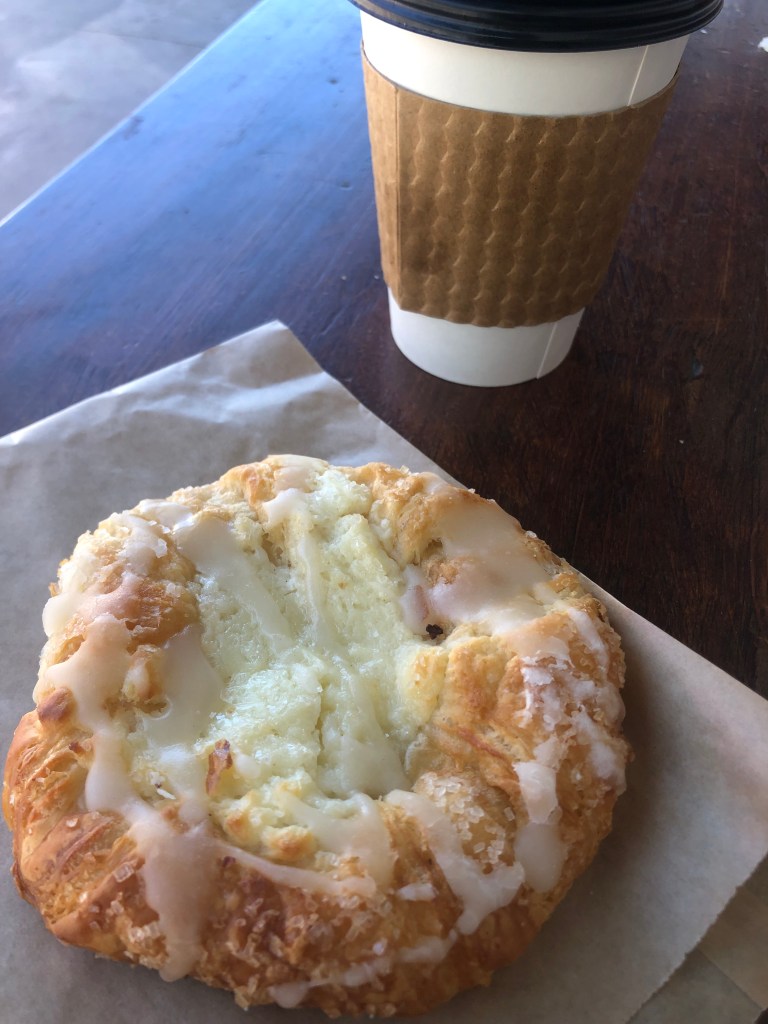
After passing the cluster of aging casinos near the state line, I re-entered California at South Lake Tahoe. I was experiencing a hankering for a good, rich cheese danish and a cup of strong coffee. I tried several local bakeries, and while the proprietors offered me all manner of bagels, scones, and (at the natural food bakery) a CBD muffin, there were no danishes to be had. As my final stop I went to a place called Crazy Good Bakery, where I got a delicious danish, a great cup of coffee, and a heart-warming smile from the owner’s daughter-in-law, who’s up here for the summer from San Diego.
These girls are having way too much fun.650 calories of Danish goodness.
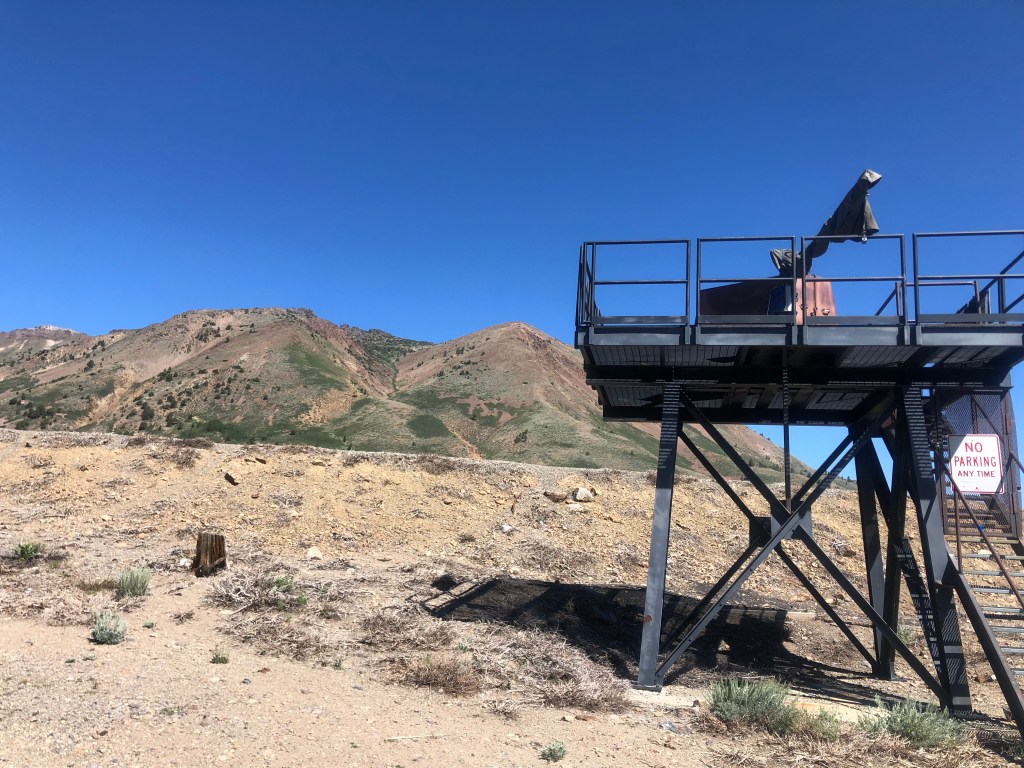
Thus refueled, I got back on the road and rejoined Route 89 south toward Route 88 west. Almost immediately after joining Route 88 I saw a structure that resembled a fire lookout tower, but it was equipped with what appeared to be grenade launchers or mortars of some kind.
Like something Hogan’s Heroes would sabotage.
Closer inspection revealed a “Danger!” sign warning that “unexploded military shell and explosives used for snow avalanche control may be found in target areas.” Does this mean that the equipment on the tower is used to fire live ammunition at the nearby snow-covered mountain? This sounds like one of Peter D’s tall tales, but I’d appreciate it if someone could please explain.
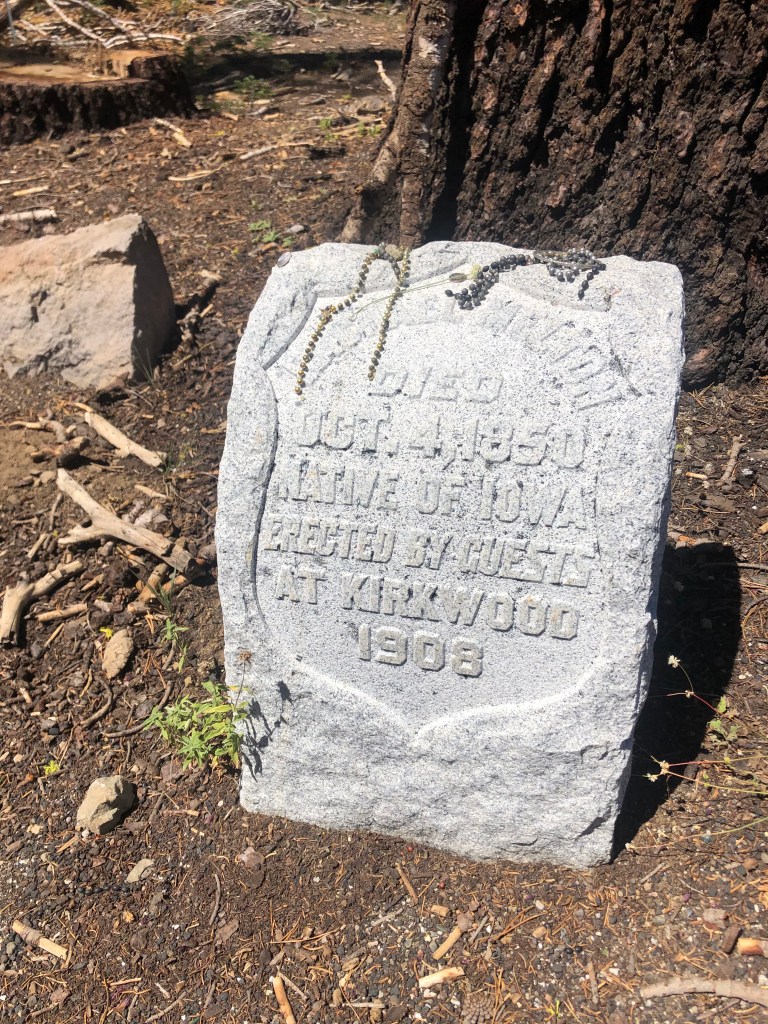
The rest of the trip home was relatively uneventful, with the following exception: Around Carson Pass I saw a sign for a historic site named “Maiden’s Grave.” Those are two words that really should never go together. But I was intrigued, and stopped to look at a small headstone that had been placed there in 1908.
The story goes like this: Remember all those immigrants coming to California during the Gold Rush? It was a hard, dangerous journey, marked with all manner of hardship, injury, and even death. One of those deaths was a young woman named Rachael, who was crossing Carson Pass with her family in 1850. Her parents buried her there near the pass. Half a century later, Rachael’s now-elderly mother came to the area looking for Rachael’s grave in order to bring her daughter’s remains “home.” She inquired of the locals, but no one could provide information on the grave’s whereabouts. The mother left, disappointed.
Word got around about the mother’s inquiries, and some visitors at Kirkwood recalled a grave in the area marked with a crude wooden cross naming its occupant as “Rachael Melton” and noting her death as 1850. They assumed this must be the daughter that the mother sought, and they raised funds to provide a headstone for the grave. Hence, the marker that I saw, placed in 1908.
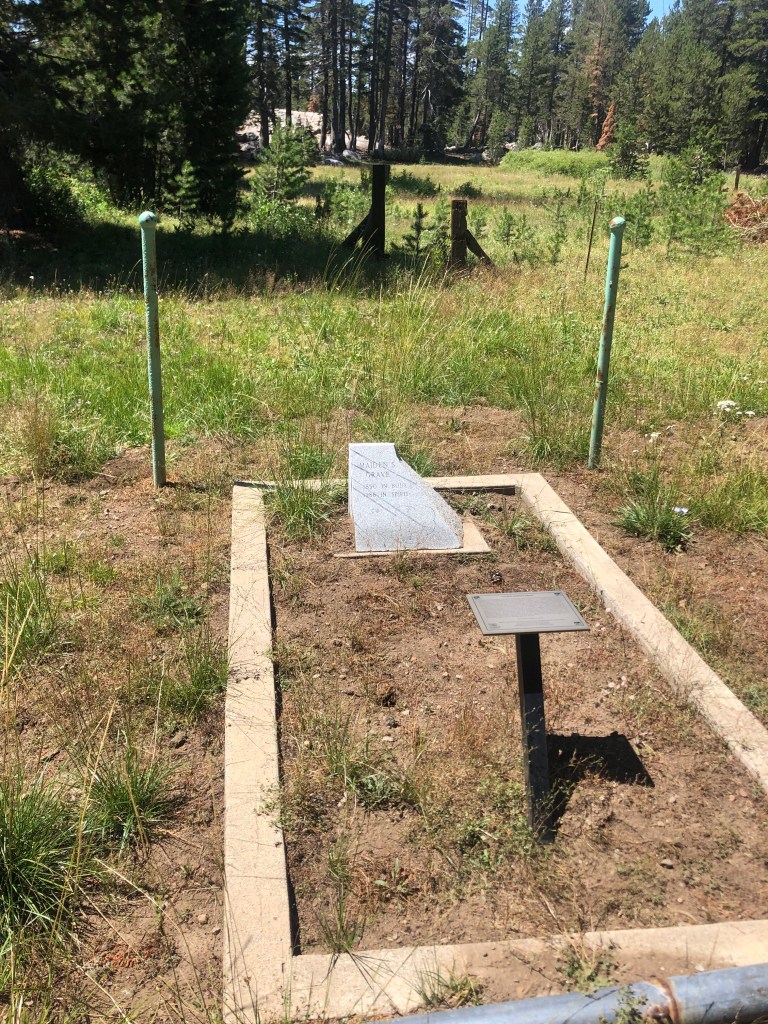
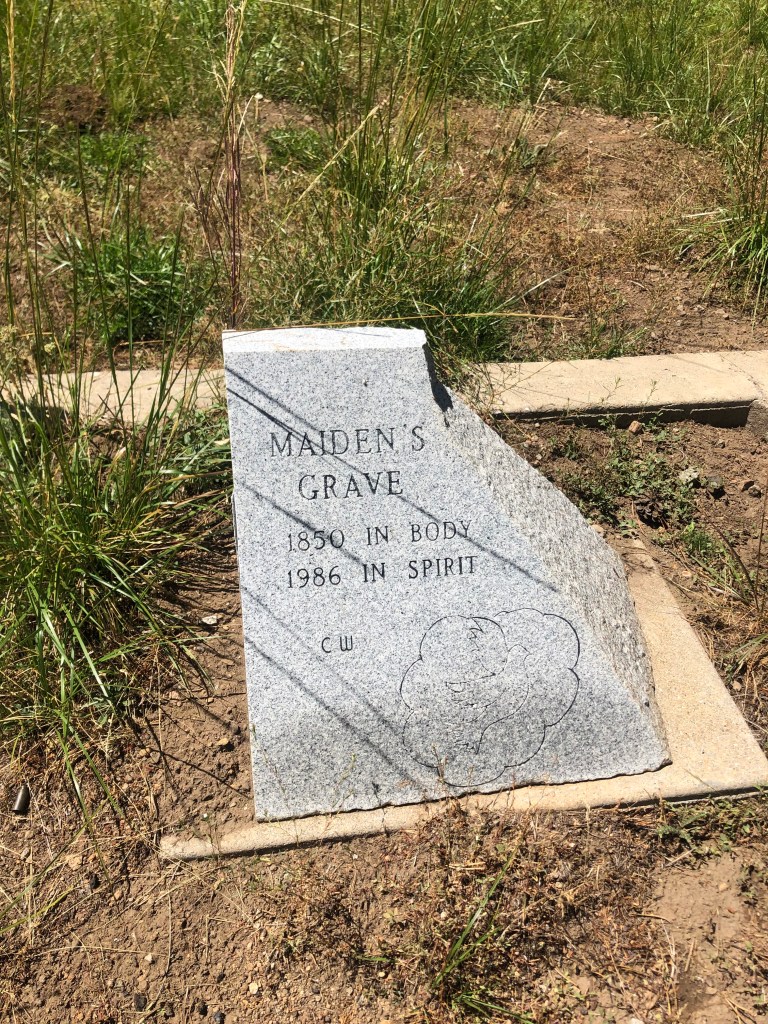
That would be the end of the story, but in 1986 (!) a landowner about 2 miles northeast of the putative maiden’s grave was clearing his land and came across a grave outlined with rocks. Historical records were consulted, research was performed, and it was determined that this was the actual location of Rachael’s remains. The landowner erected a marker for the “Real” maiden’s grave. Such was the postscript appended on a plaque near the marker I encountered along Route 88. So I did some quick Google searches, and armed with that information, I set out in search of the secondary marker. I found it on a nearby road called Tragedy Springs. Here it is:
Rachael’s actual resting place?Short and sweet.
So, that may be the end of Rachael’s story, but then who is buried under the “Maiden’s Grave” on the side of CA-88? Most agree that it’s the body of Allen Melton, who hailed from “Henry County.” His story is all but forgotten, or ignored.
Still, the Maiden’s Grave story strikes me as a positive one. It highlights a mother’s love for her daughter, the decency of a group of strangers who volunteered to help mark (albeit erroneously) a girl’s grave, the decency of a local landowner to tried to right a historical wrong by placing a new marker on his land, and efforts by all of us, channeled through our state government, to remember and honor the hardships and losses experienced by the pioneers who founded this state. For a road trip focused on the Gold Rush, the importance of place, and the impact of history, I can’t imagine a more fitting final reflection.





 Chasing Phantoms