Now that I’ve managed to claw my way out of the Mojave desert, I thought I’d post a few additional photos that didn’t fit neatly into my scintillating narrative. Maybe think of these as “bonus features.”
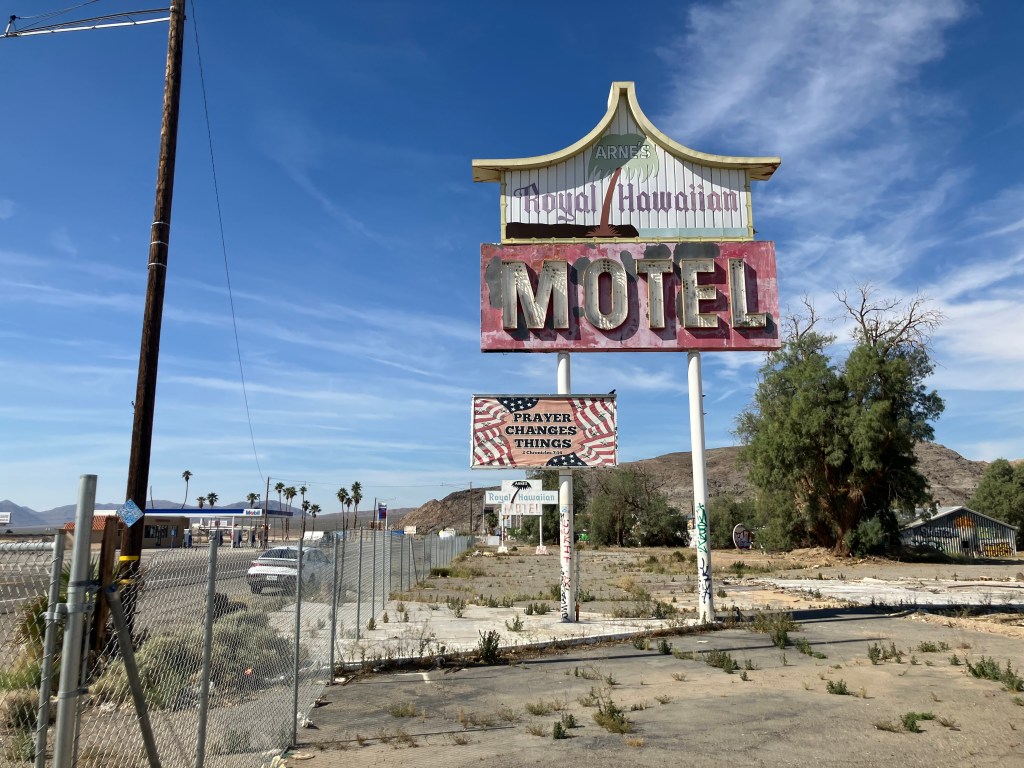
This first photo is of the Royal Hawaiian Motel in Baker, CA…which is not royal, not Hawaiian, and not even a motel anymore. It opened in 1957 and closed in 2009. It sat vacant until just last year, when the building was demolished. I’m told that, just before it was demolished, it appeared in the Amazon Prime series “Fallout” (Season 2, Episode 1). But I can’t vouch for that, as I haven’t watched TV since they cancelled Happy Days.
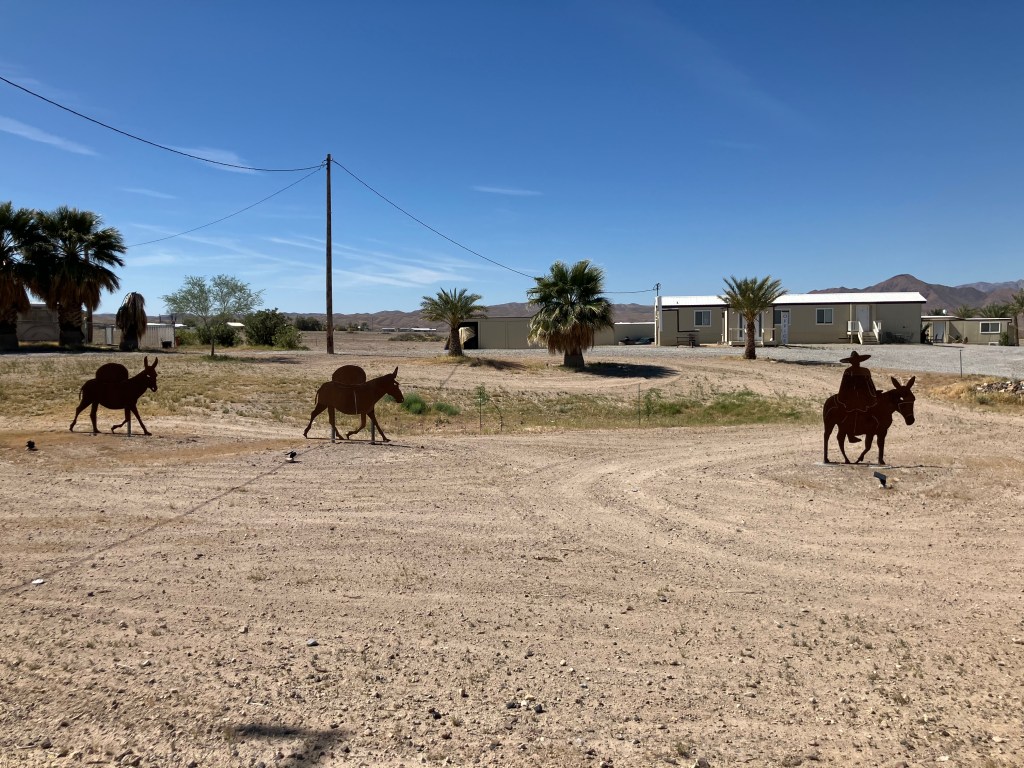
At first I thought the art installation featured here was the three wise men. But the “camels” are actually mules (donkeys? burros?) with packs on their backs. I took this photo near the Old Spanish Trail in Tecopa.
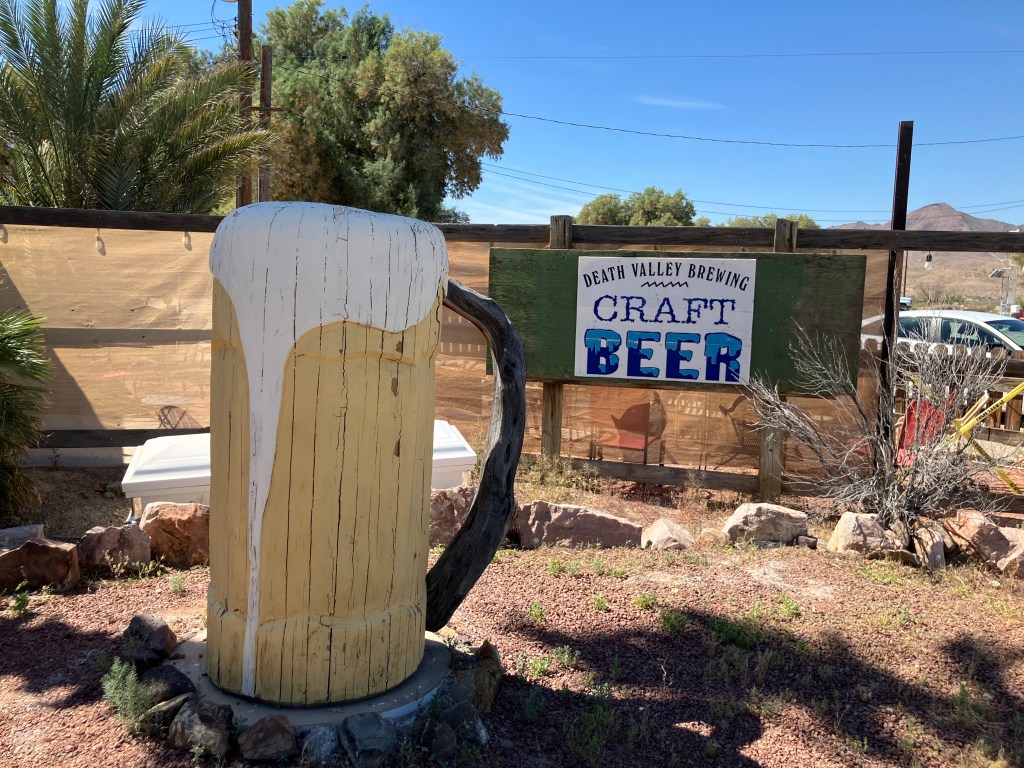
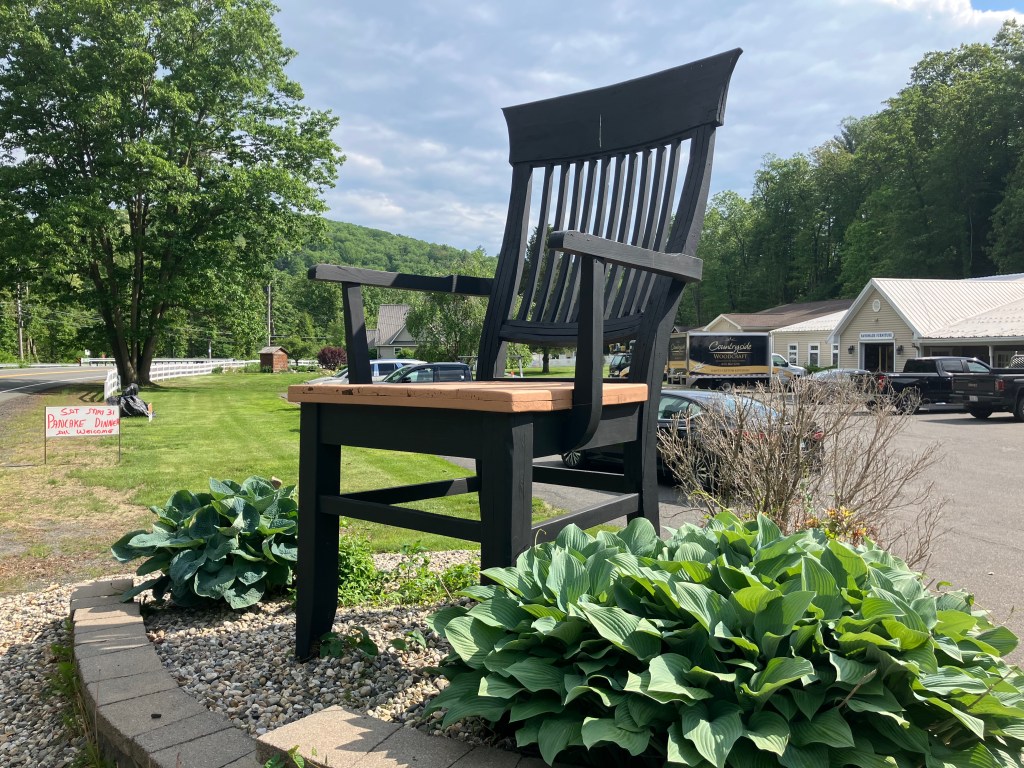
This beer mug is crafted out of wood. I guess that’s why I took the photo. Sorry–I don’t have any other info on this.
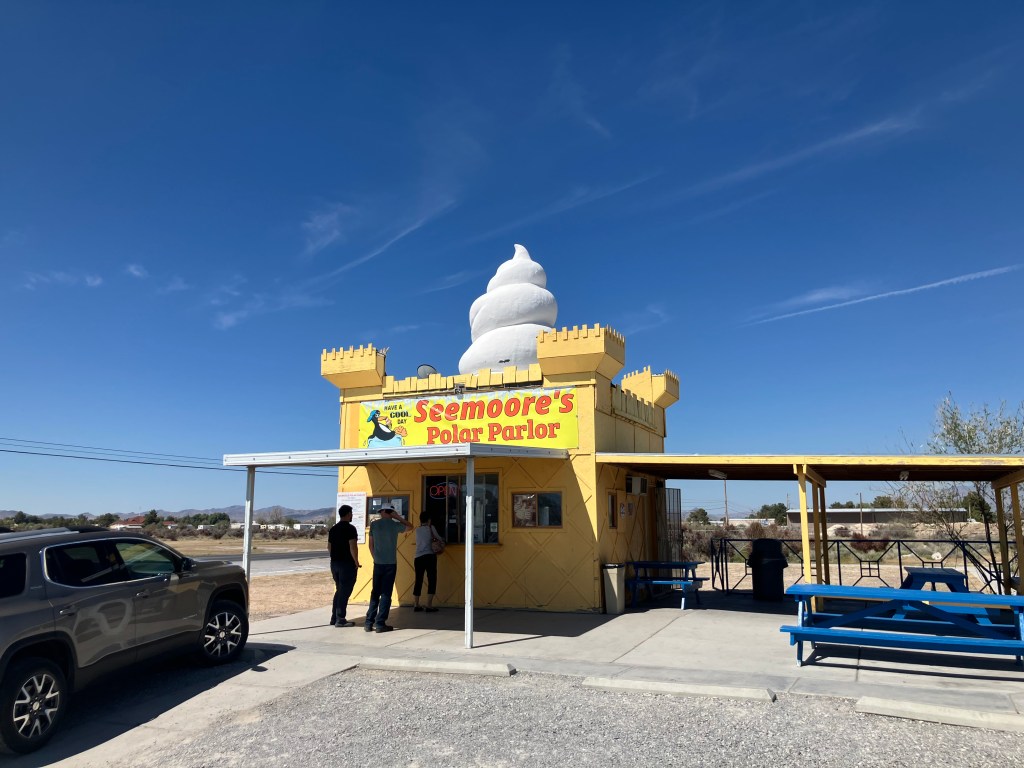
Seemoore’s Polar Parlor sits on the main highway into Pahrump, NV. A nice, cold softserve is of course welcome in the desert. But Seemoore’s real claim to fame (according to the teenager serving me at the window) is that it’s the “world’s tallest ice cream stand.” I expressed my incredulity, for this place is barely two stories tall. His deadpan response: “Yeah, but all the other ones are one story. They don’t have a giant ice cream on the top.”
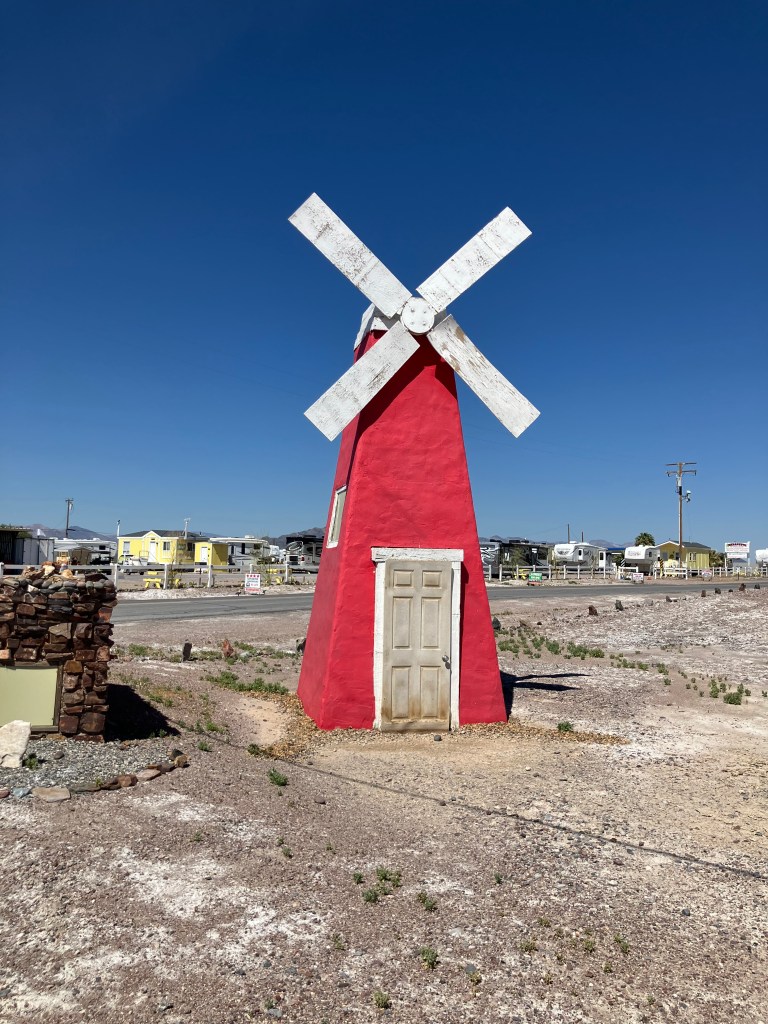
Unexplained “windmill”in Tecopa Hot Springs.
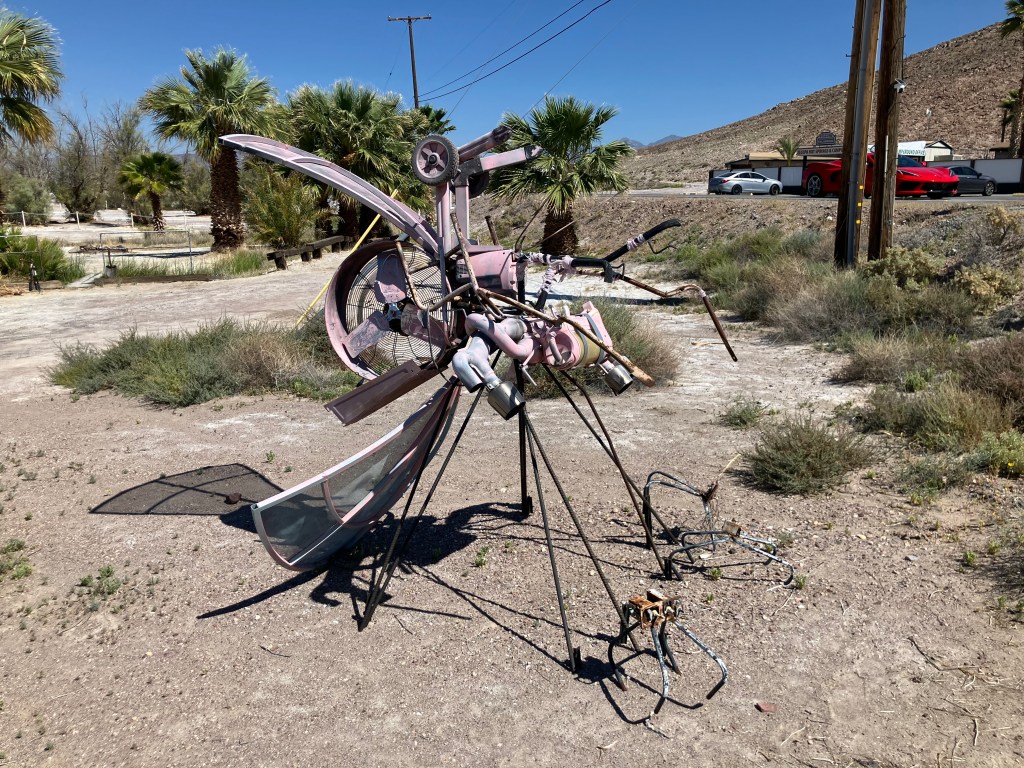
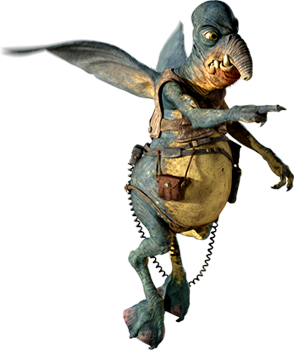
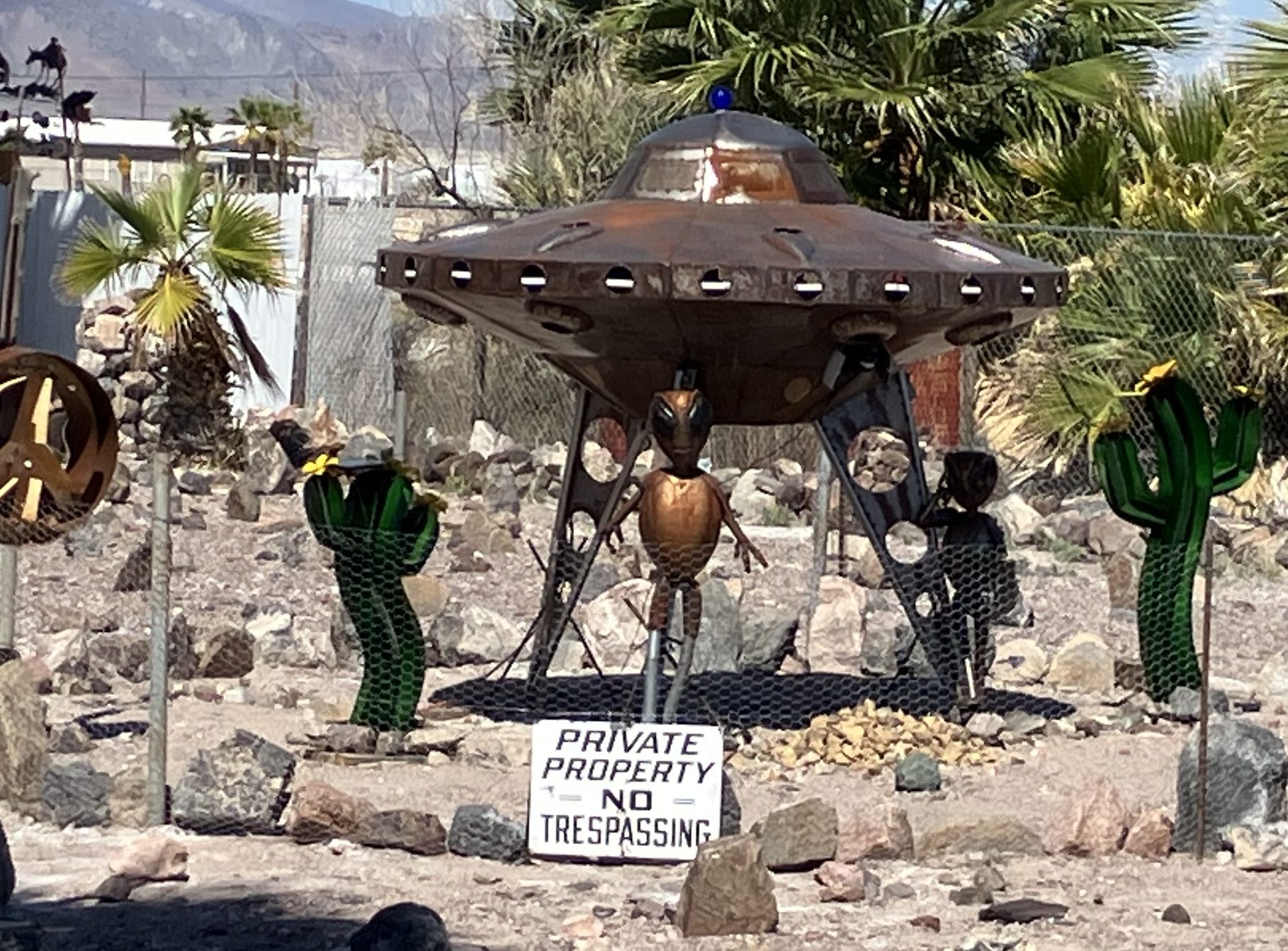
I’ve commented before that people in the desert have a special talent for yard art. I’m not sure what this is supposed to be–Maybe Watto from Star Wars Episode 1?
Speaking of aliens and yard art…
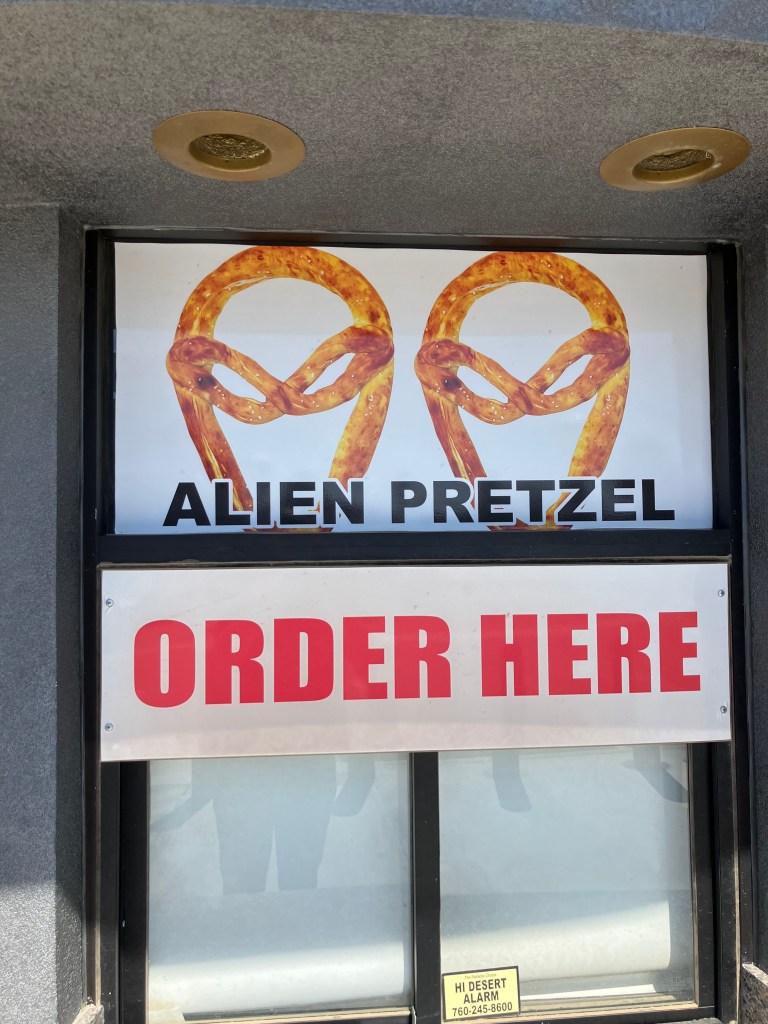
Sticking with the alien theme a little longer, these were advertised at the Alien Fresh Jerky store Baker. Sadly, they were out of them when I was there.
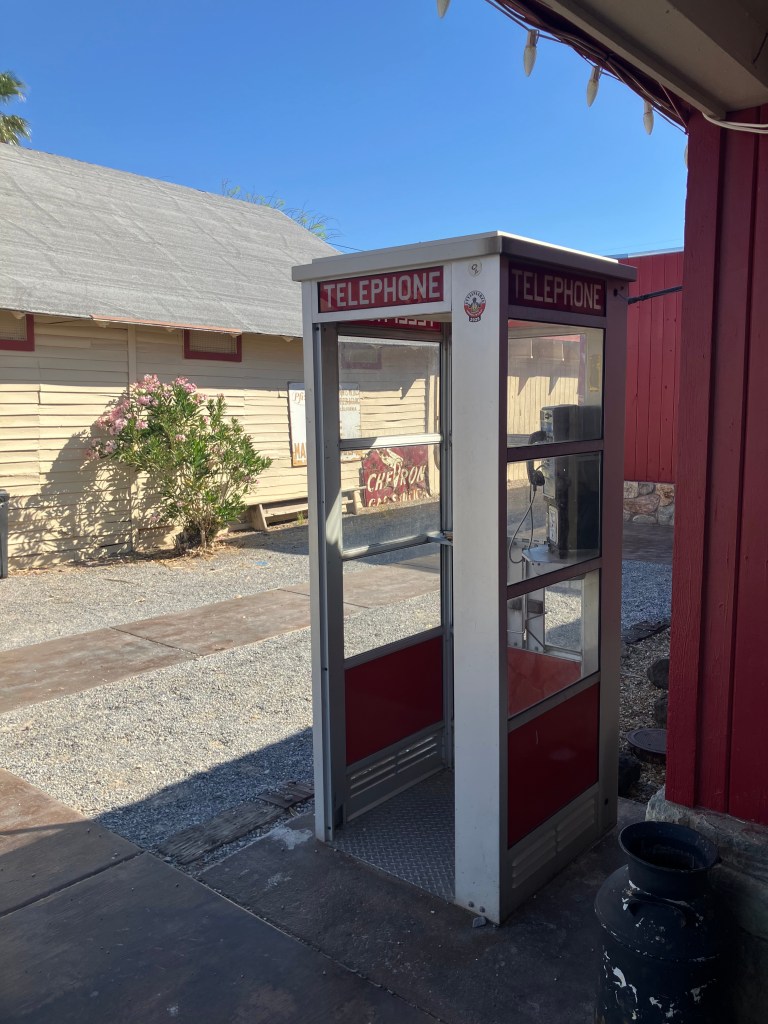
Younger readers might not recognize this photo. In the old days, people would actually go inside these glass boxes, deposit little metal discs called “coins,” and make a phone call from a clunky “handset” connected to a wire. This phone was still intact, but there was no dial tone. It got me wondering if there are any working pay phones anymore.
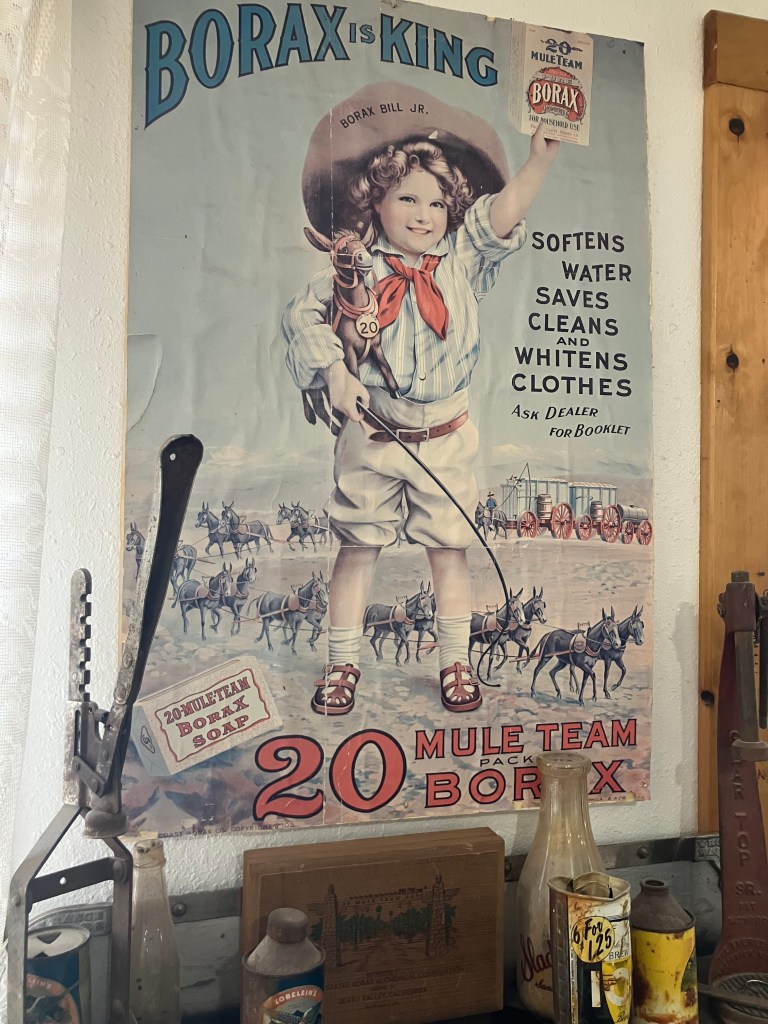
Another of the many advertisements for borax that one encounters around Death Valley.
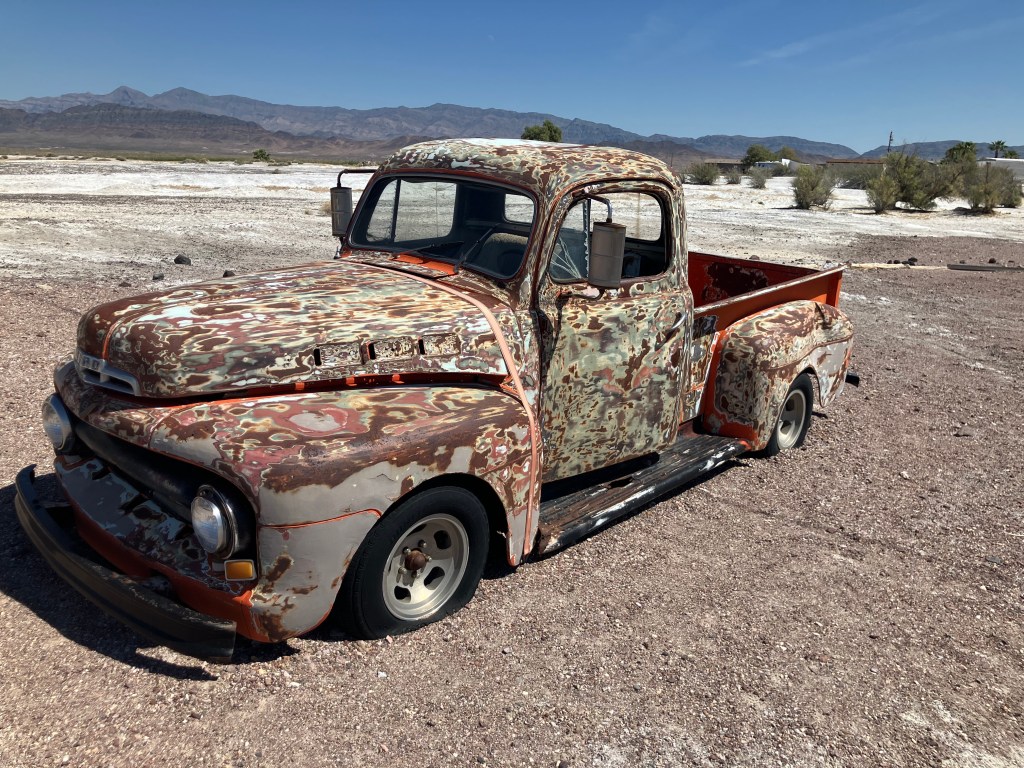
This may or may not be an example of desert folk art.
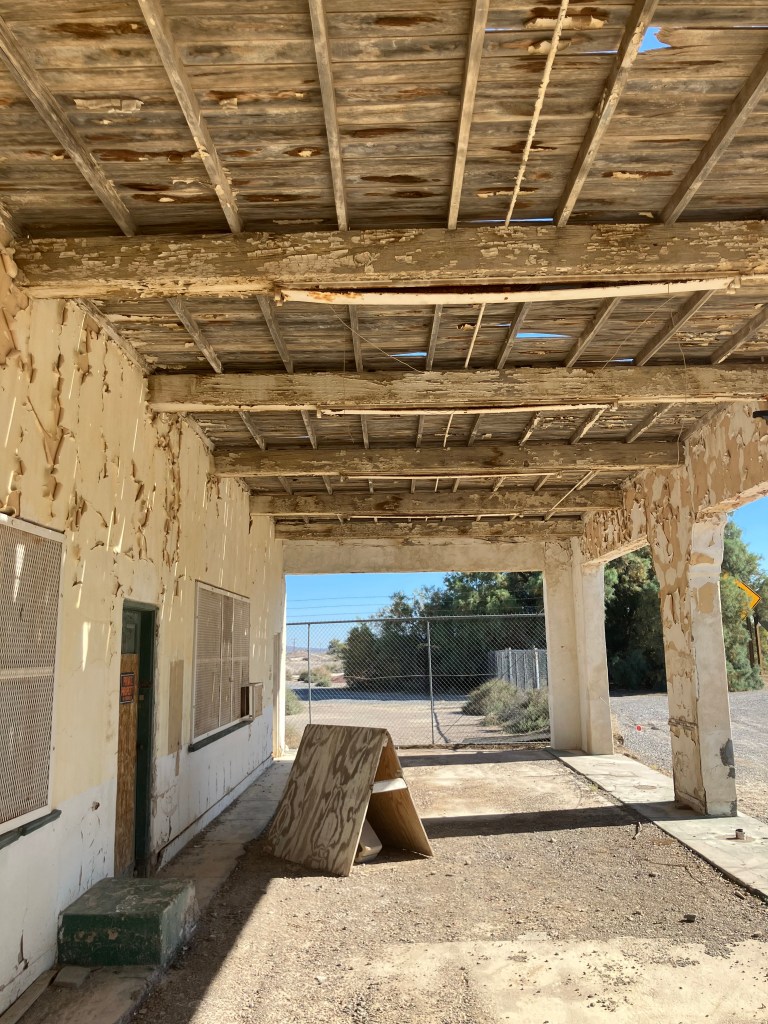
The covered porch of the service station at Death Valley Junction where Marta Becket had her car repaired and envisioned the Amargosa Opera House.
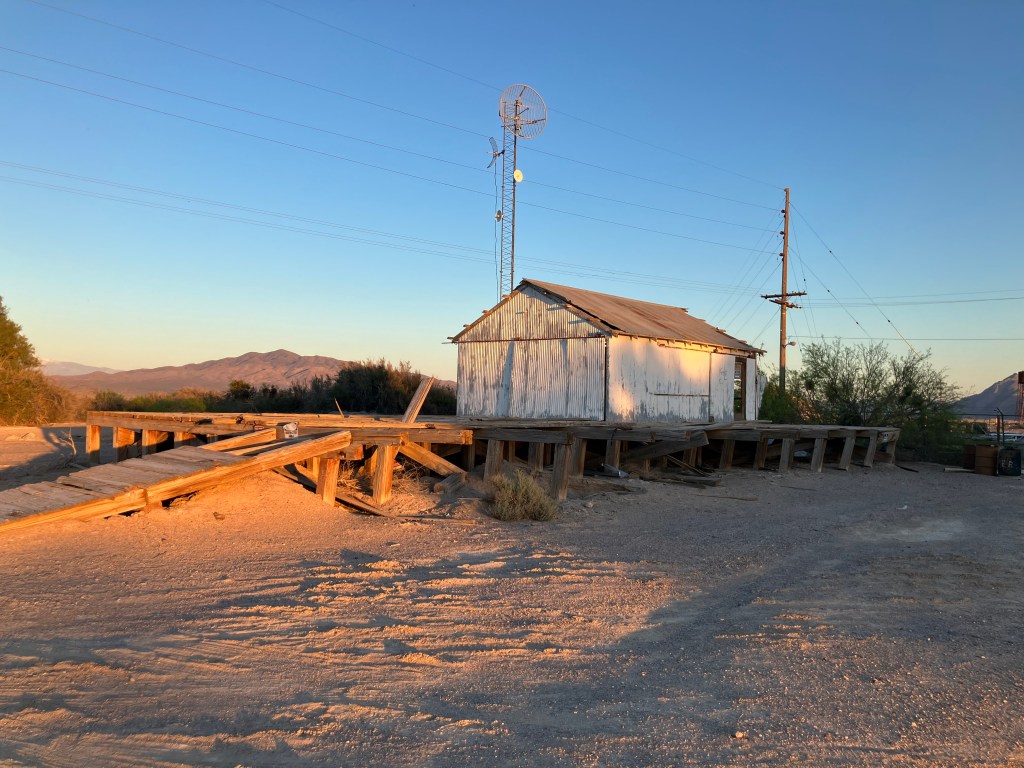
Finally, here’s the borax loading dock at Death Valley Junction/Amargosa. I just liked the lighting.
Thus concludes my Mojave trip. Mark your calendars for my visit to the Republic of Molossia on April 25. Until then, remember: Borax is King!
Spending a few days in the desert gives you time to think. To ruminate. To meditate. To shorten your sentences to unconjugated verbs.
This morning I headed south on CA 127, and within the hour I was at Shoshone (official pop: 31). I say “official”population because one of the locals told me the actual population is now down to 13. In any event, Shoshone was founded in 1910 by Ralph “Dad” Fairbanks, by literally relocating buildings from nearby abandoned mines and towns. Shoshone was situated on the Tonopah and Tidewater Railroad line which, we learned yesterday, was launched a few years earlier to haul borax. Interestingly, the T&T’s name was an unfulfilled aspiration. It never reached north to Tonopah, and it never reach southwest to San Diego (which was the “tidewater” envisioned by the name). Anyway, “Dad” Fairbanks’ daughter married a boy named Charlie Brown (well, Charles Brown), and young Charles essentially became the heir apparent of the town.
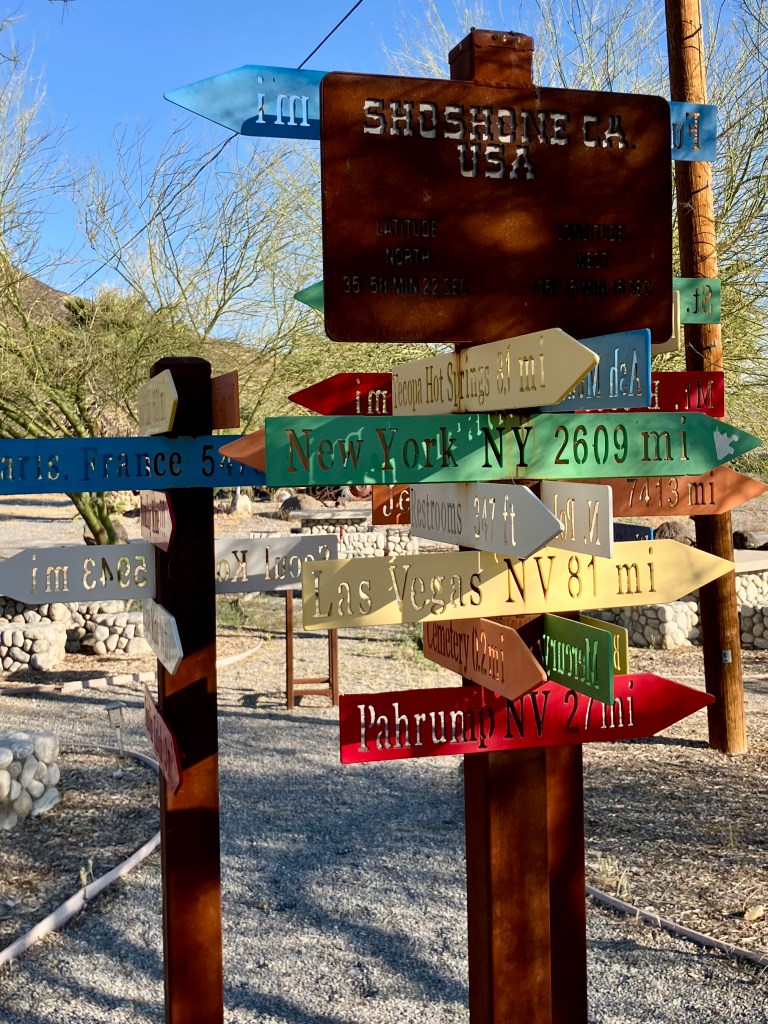
All roads lead to Shoshone.
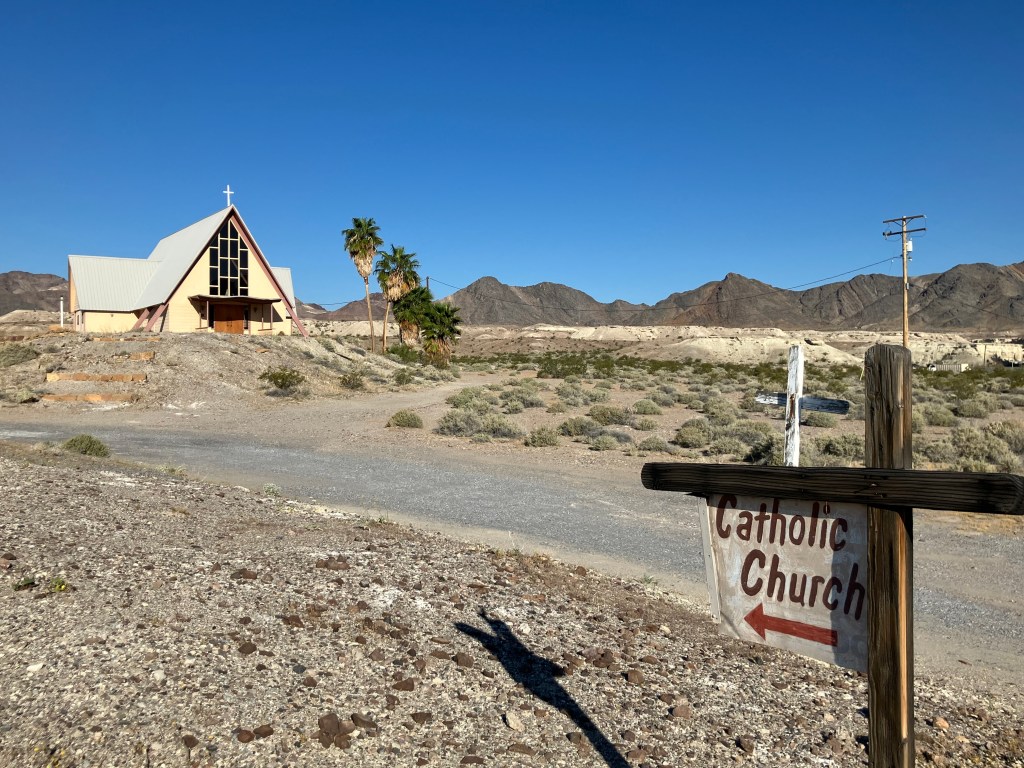
Despite its limited population, Shoshone today remains a going concern. It’s well-positioned as the southern gateway to Death Valley, and it’s at the crossroads of a couple of important highways. Services are therefore oriented towards travelers, with a gas station, a market, a restaurant, a museum, and even a generic Catholic church.
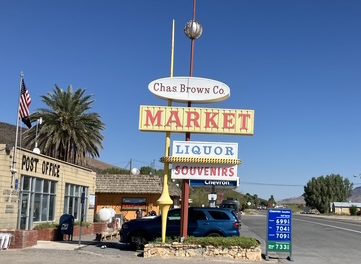
Note the ownership of the market. Also, is it just me, or is the sign done in the Googie tradition?
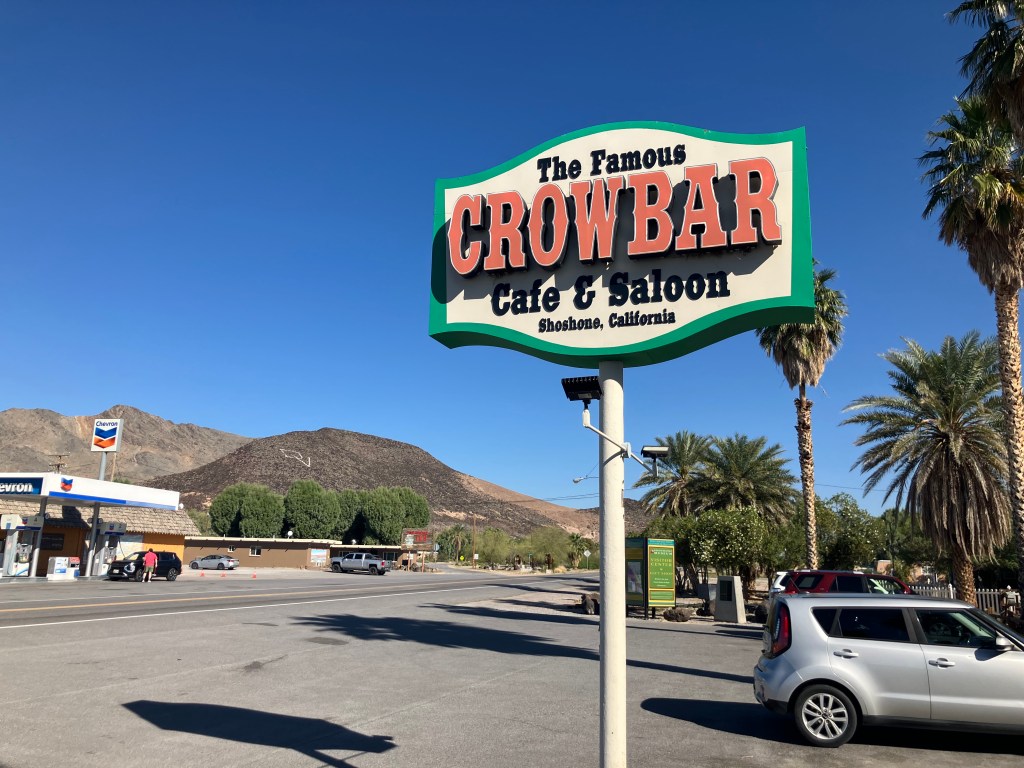
I decided to get breakfast at the “famous” Crowbar Cafe & Saloon. There were a few other people at the counter, and they seemed to be travelers like myself.
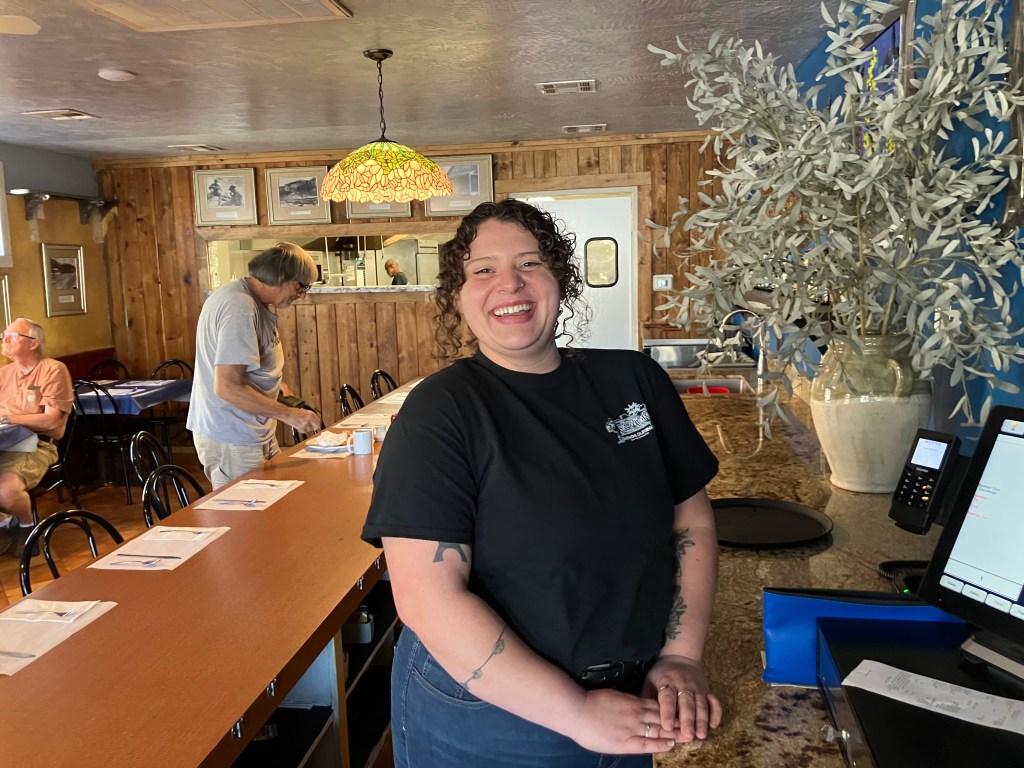
I’m still not sure whether the restaurant has earned the term “famous,” but Brianna–the server–is memorable. Friendly, attentive, and effervescent, with a sly sense of humor, she gives the place a buoyancy that goes well with the strong coffee.
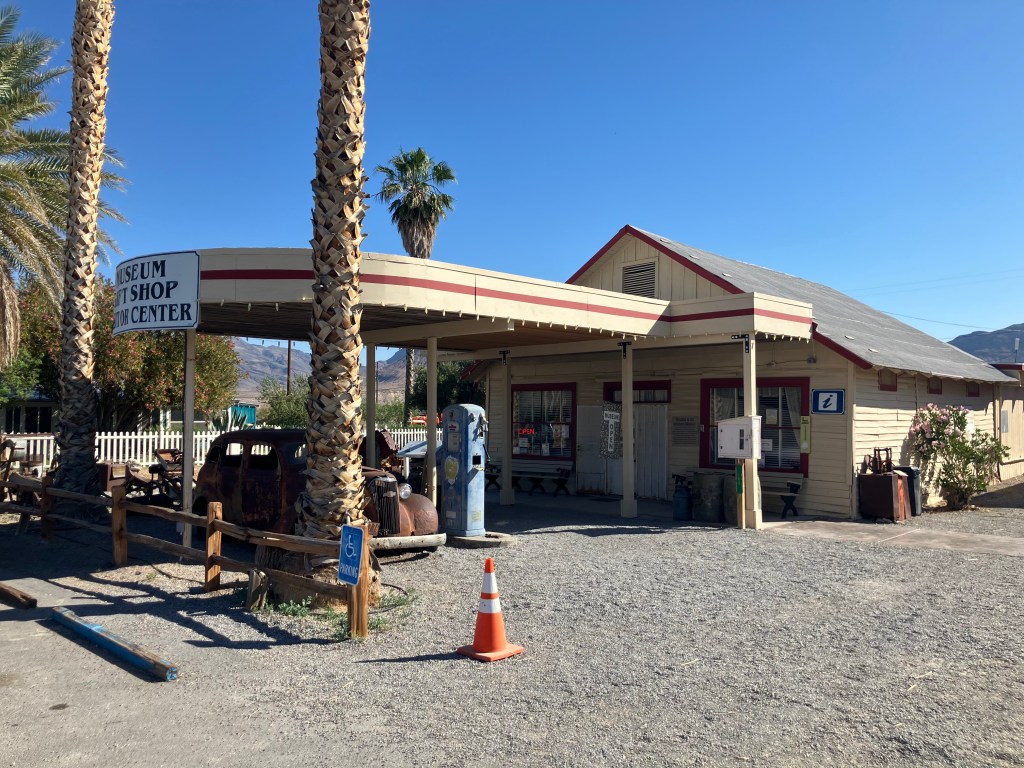
Directly next door to the Crowbar is an old service station that’s been converted into a museum and visitor center. What the heck, thought I. Let’s see what I can learn about this town.
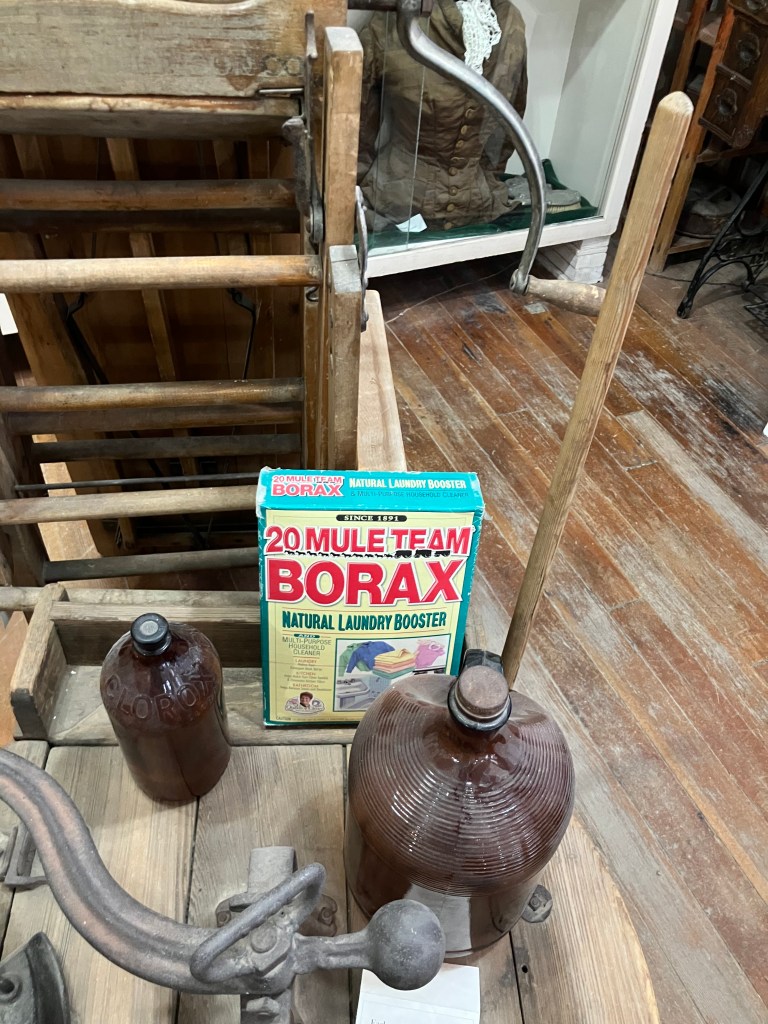
Even though it’s small, every corner of the building is packed with artifacts: old railroad schedules, household appliances, guns, photographs, maps, sheriff’s badges, even an old mastodon skeleton that was uncovered by local students. And of course there’s the requisite box of that white gold of Death Valley: Borax.
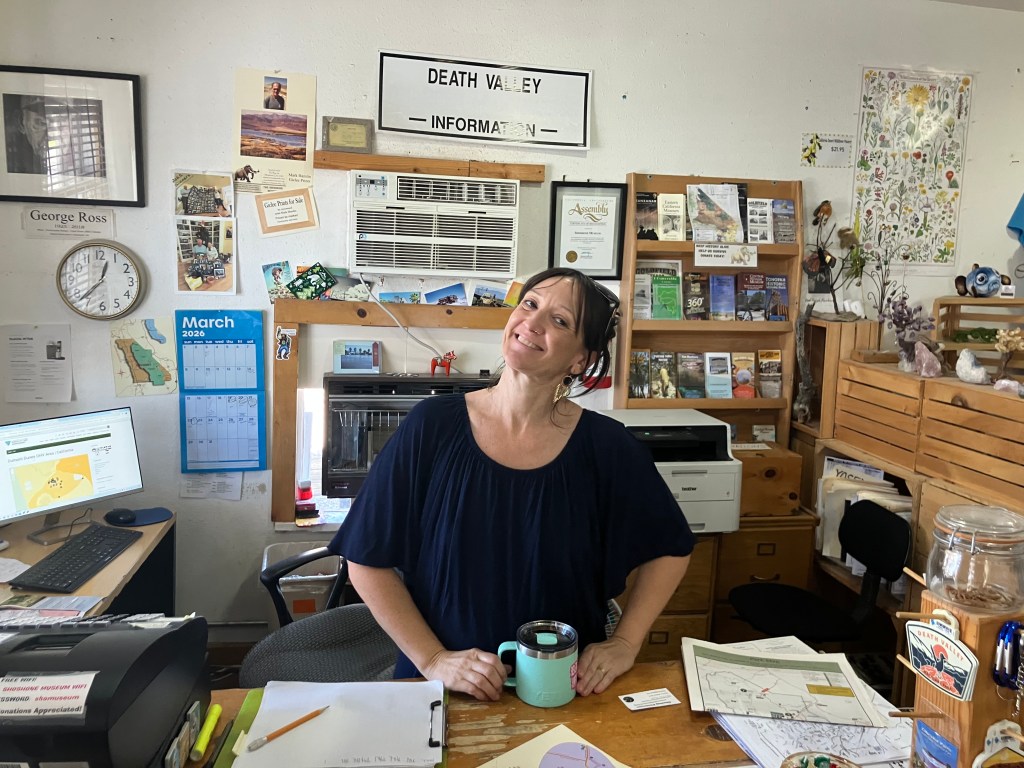
If I have any critique of the museum, it’s that some of the exhibits lack enough descriptive backstory. Fortunately, there’s a remedy in the form of Eliza, who runs the place (or at least today she was).
Eliza–Shoshone’s answer to Google.
It was Eliza who sketched the town’s history for me, who pointed me to the remnants of the T&T Railroad, who told me which local breweries were open and which were still getting their taps installed, and who insisted that I make a short detour to the date orchards of Tecopa for a date shake.
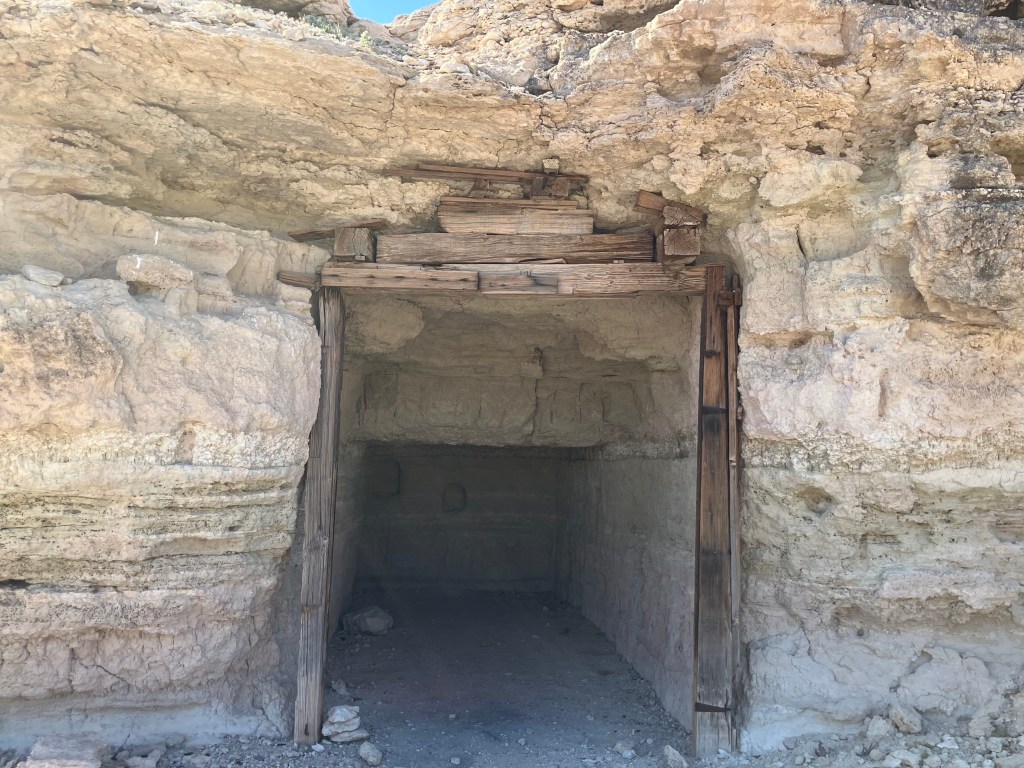
Based in part of Eliza’s suggestions, I first went across the street to Dublin Gulch, where miners dug rough-hewn caves into the hillside a century ago.
Be it ever so humble…
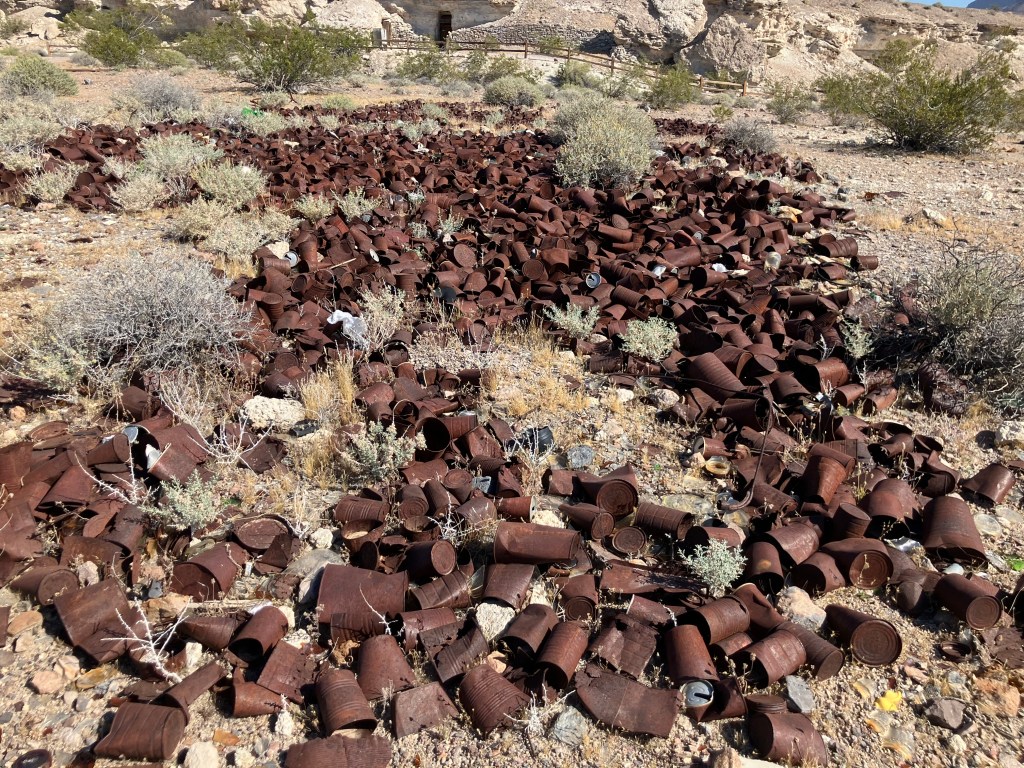
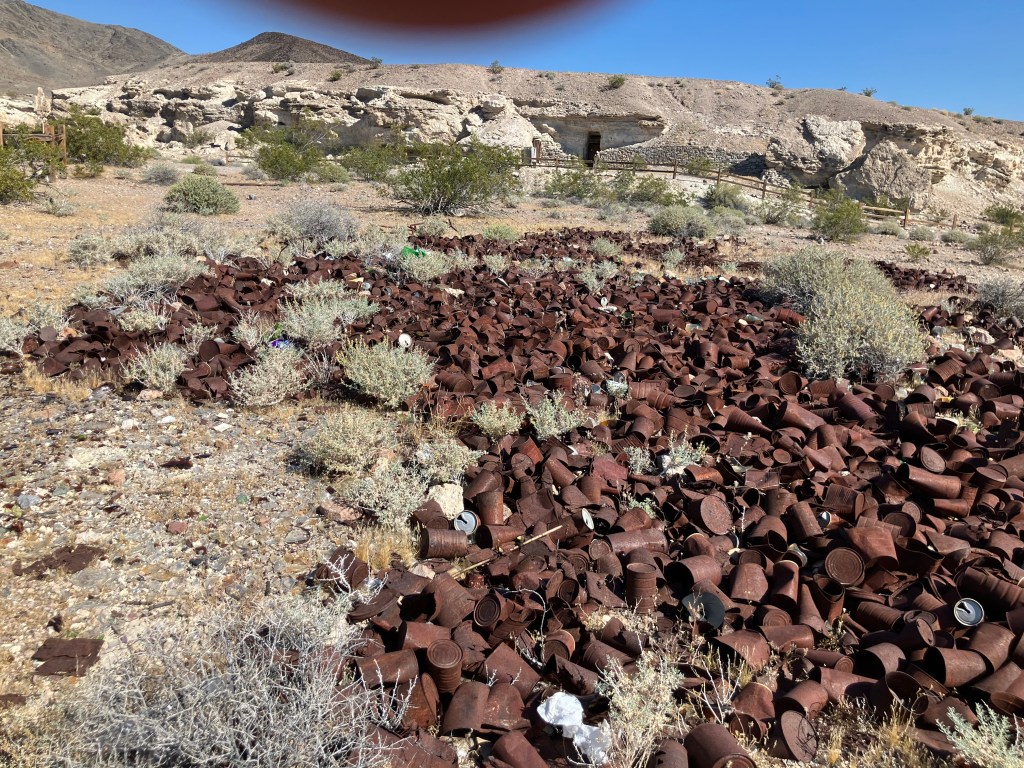
The ground around the caves is strewn with old cans. Presumably these once contained dinner.
More cans…
…and another….
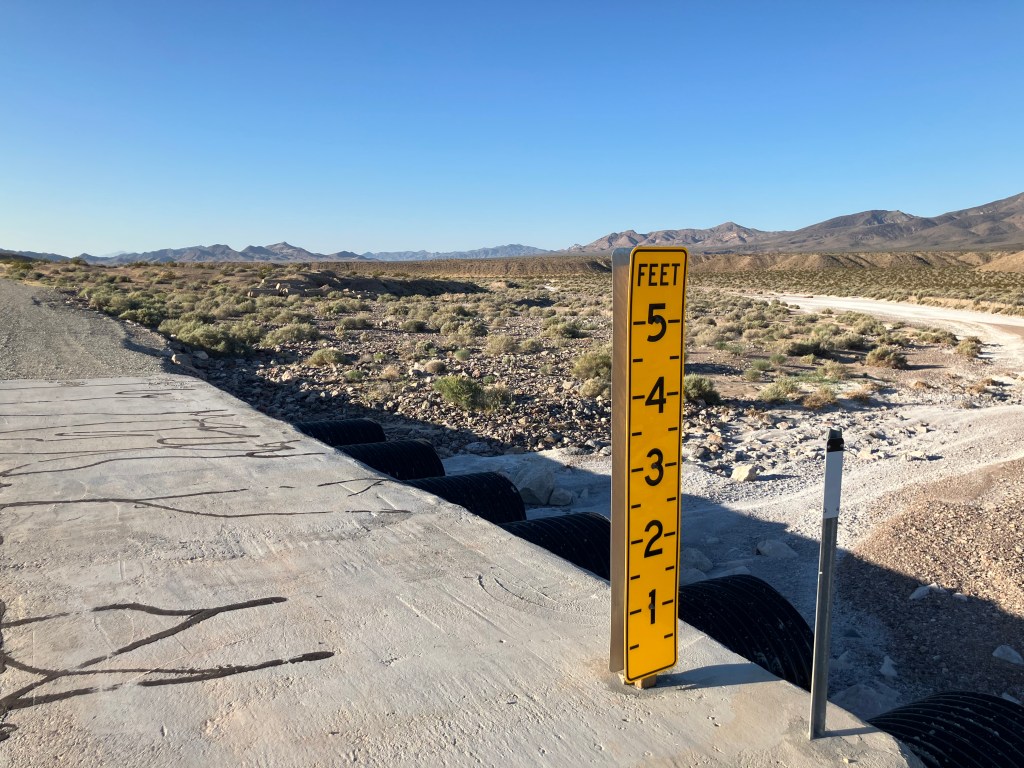
Having seen what I could see in Shoshone, I got back in the car and headed out to Tecopa (pop: 169). Along the way I spotted a few of these 5-foot markers where the road comes close to the Amargosa River. I learned yesterday that flash floods are a real and persistent danger out here; the Amargosa Opera House has been flooded several times. I’m guessing the markers help drivers to judge the depth of water on the roadway?
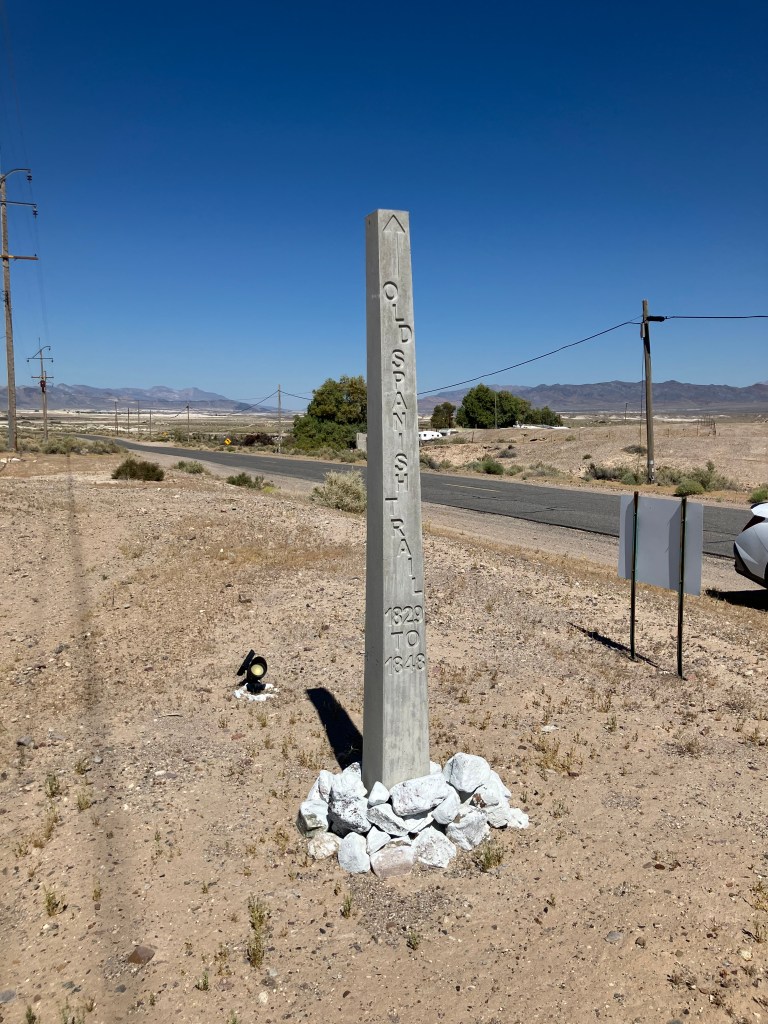
Tecopa is a few miles off CA-127, and to get there you cross the Old Spanish Trail, that connected the settlements of Santa Fe with Los Angeles in the 19th century. I saw a small obelisk (about 5 feet tall, designated #32) marking the route. I surmise there are at least 31 others, and most likely many more. This may be the subject of an upcoming road trip…
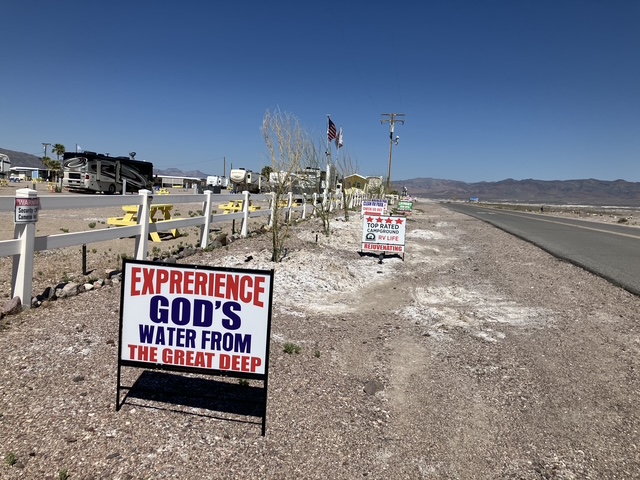
The road to the date orchards passes along a string of privately-owned hot springs. Signage from competing outfits lines the road. Some of the claims seem a bit over-the-top…
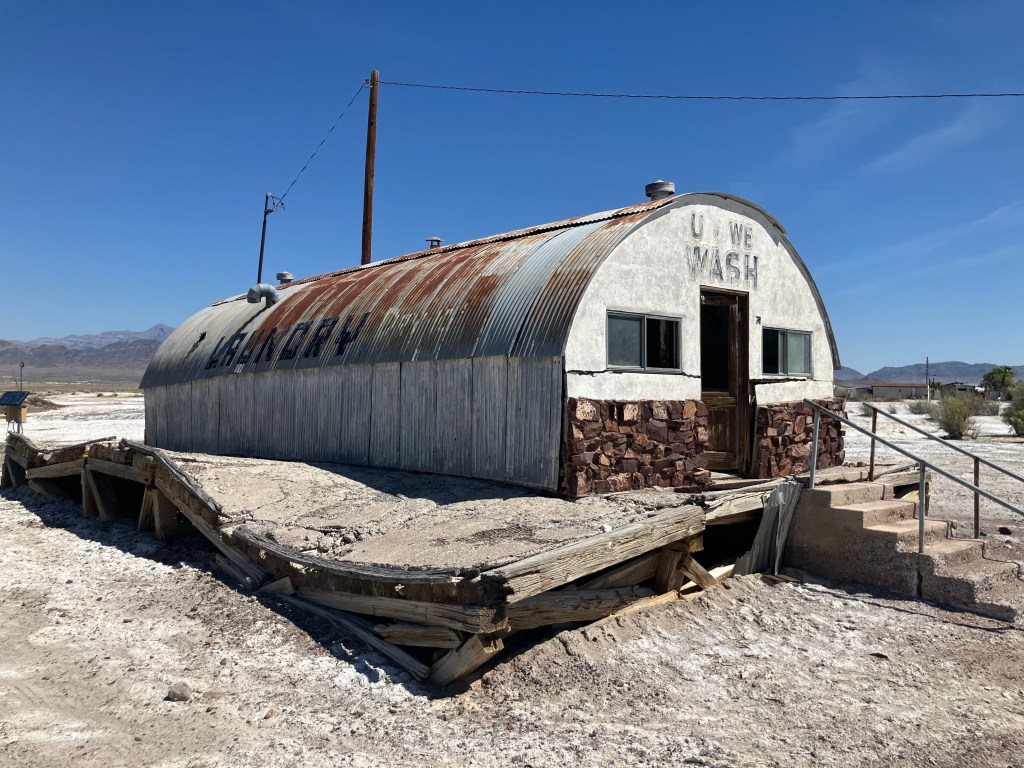
I did eventually get to the China Ranch Date Farm, where I had me one of best of the two date shakes I’ve consumed in my life. But near the farm I encountered two sites that spurred the rumination suggested in the title of this post. First, there’s the U-We Wash:
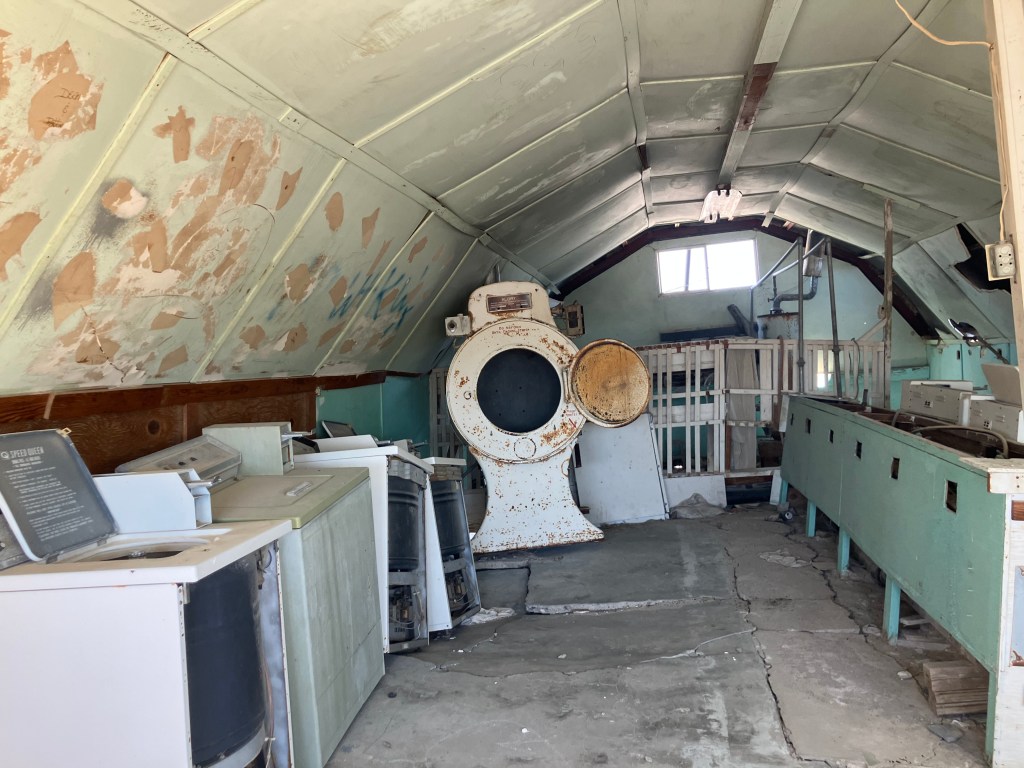
It’s a long-defunct laundromat in a quonset hut. The equipment remains largely intact, seemingly spared from vandals.
It seems the place has been around since early in the last century, and has been abandoned for decades. It must have served visitors staying at the trailer and RV parks across the street. It’s got a bit of an eerie, Twilight Zone vibe, as though the the owners and customers all instantly disappeared decades ago, perhaps due to a nuclear explosion.
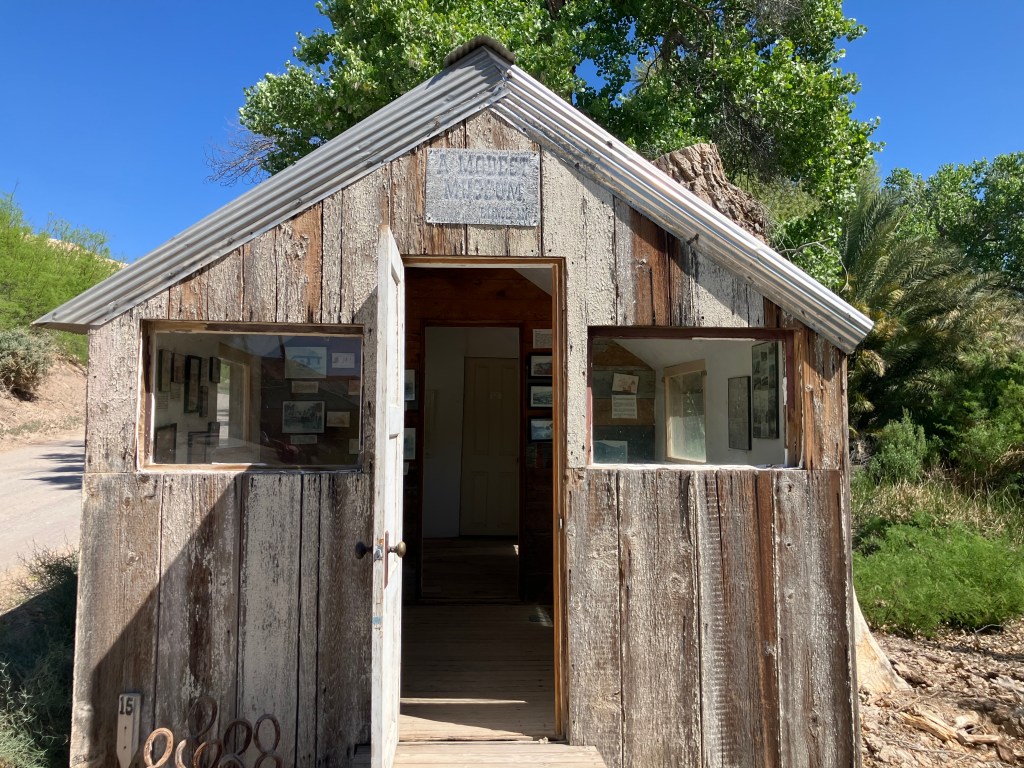
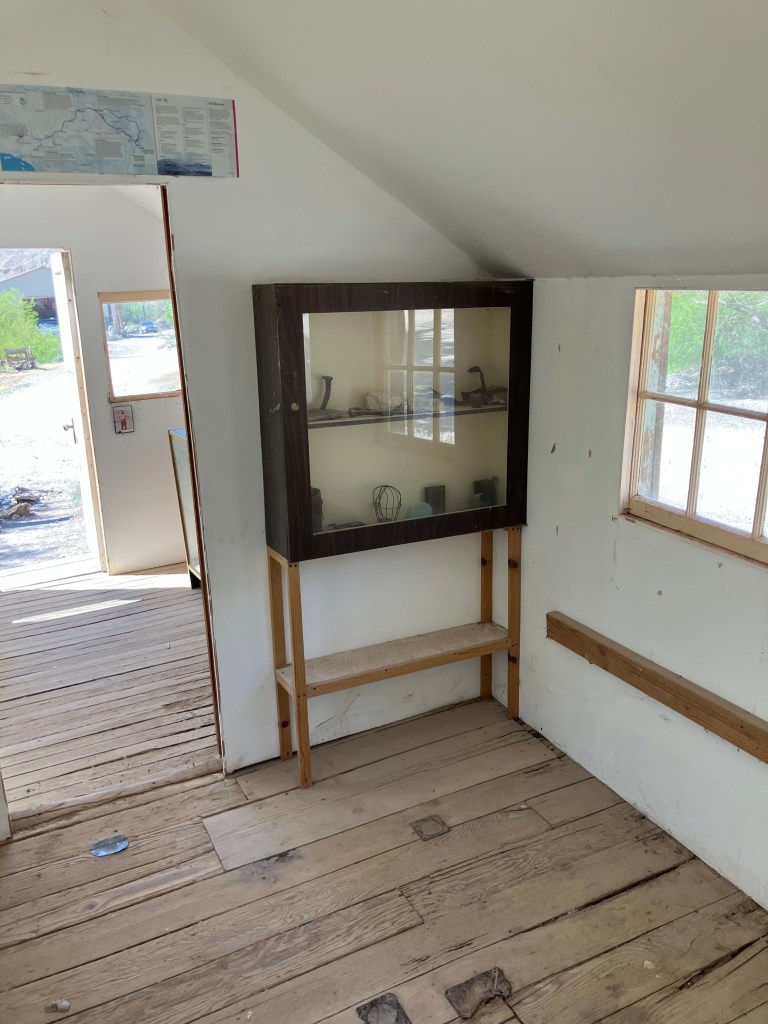
Now, hold that thought and consider the second site that got me ruminating: Just down the dirt road from the date farm is the self-proclaimed “Modest Museum,” which is a simple, old two-room building which a few neglected displays about the history of the area.
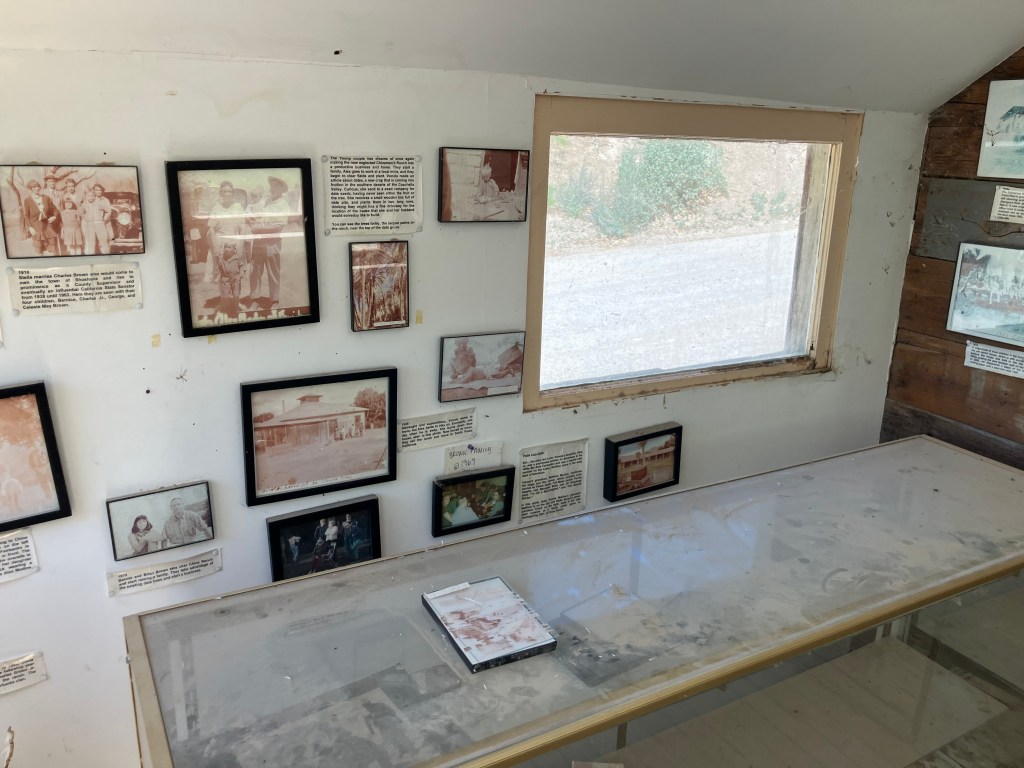
A sign on the wall reads: “We have deliberately made these exhibits accessible to the public, especially children, so they can get a real sense of the history here. Please behave honorably and do not remove or vandalize anything in this little museum.” And indeed, there are no signs of vandalism or theft, which is of course a good thing. And yet, there’s also no sign that the museum has been visited or cared for in the slightest. Dust is thick on the display cases, the photographs are sun-bleached and virtually indecipherable, and descriptive labels have fallen to the ground.
To me, the U-We Wash is cool and intriguing, an artifact in our midst that testifies to a different time. But the Modest Museum is depressing: a well-intentioned and hopeful endeavor that has fallen flat and/or been abandoned. Why my different reactions? Why are some artifacts cool, and others are junk? I’m thinking now of an old home-made theme park in Wisconsin that I visited in 2022. The man who lovingly created it had recently died, and the place was falling into disrepair. As I walked through it on a rainy afternoon I felt melancholy but appreciative of his effort. I did not feel like the remnants of his little park should be torn down. Just as I did not feel the U-We wash should be torn down. And to be fair, it’s not that I think the Modest Museum should be torn down exactly, but if the owners still believe in the mission, they need to give it some TLC or think of a new approach.
Part of this rumination comes from something that tourguide Sue mentioned at the Amargosa Opera House. According to Sue, Marta Becket had always insisted that, after her death, no one should ever restore or otherwise repaint any of the murals she had painted on the walls of the opera house and the hotel. She believed that the desert will rightly reclaim all that she did out here, and she was OK with that. Don’t fight it, she said. And so, as our tour group walked through the opera house, we saw areas of peeling paint and torn fabric that, according to Sue, the caretakers just have to accept.
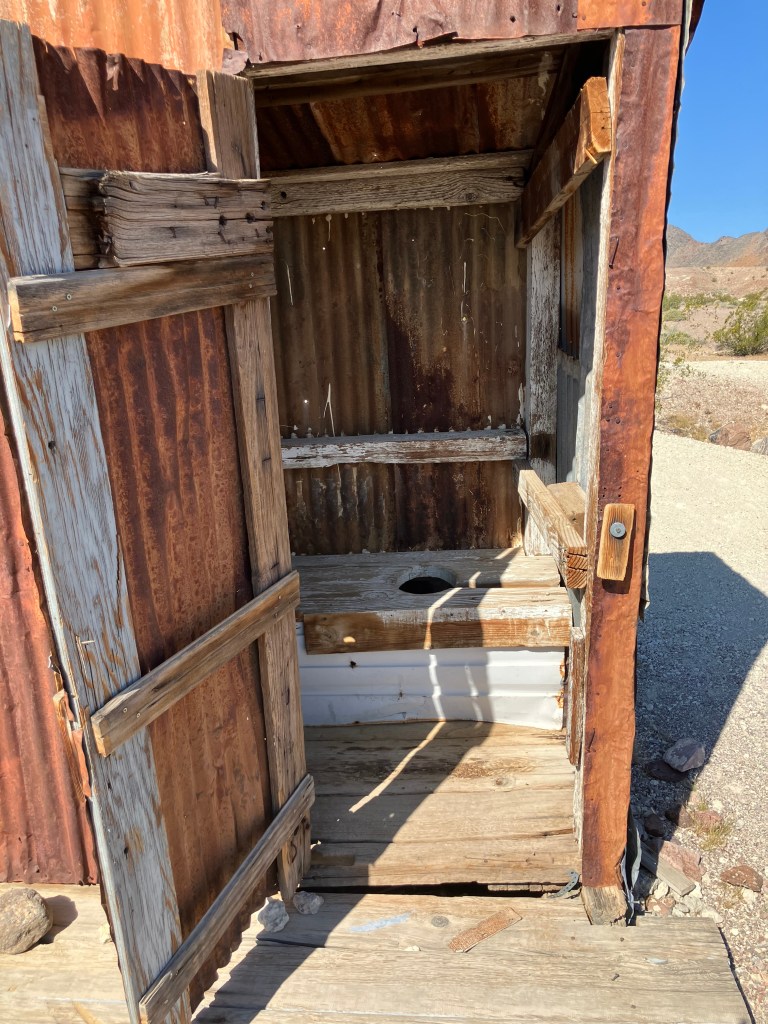
I spent a lot of time thinking about this today, and the thought that keeps coming to my mind is the notion of burying the dead. Trees die in our gardens and we cut them down. Buildings become uninhabitable and unsalvagable, so we take a wrecking ball to them. An open bottle of wine goes bad and we pour it out. And, of course, our pets and our relatives die, so we return their bodies to the earth. I still don’t know exactly why I don’t feel that the U-We Wash shouldn’t be torn down. But I do know that the guy in my neighborhood with the weathered, broken, and rudderless boat in his side yard needs to get rid of the damn thing.
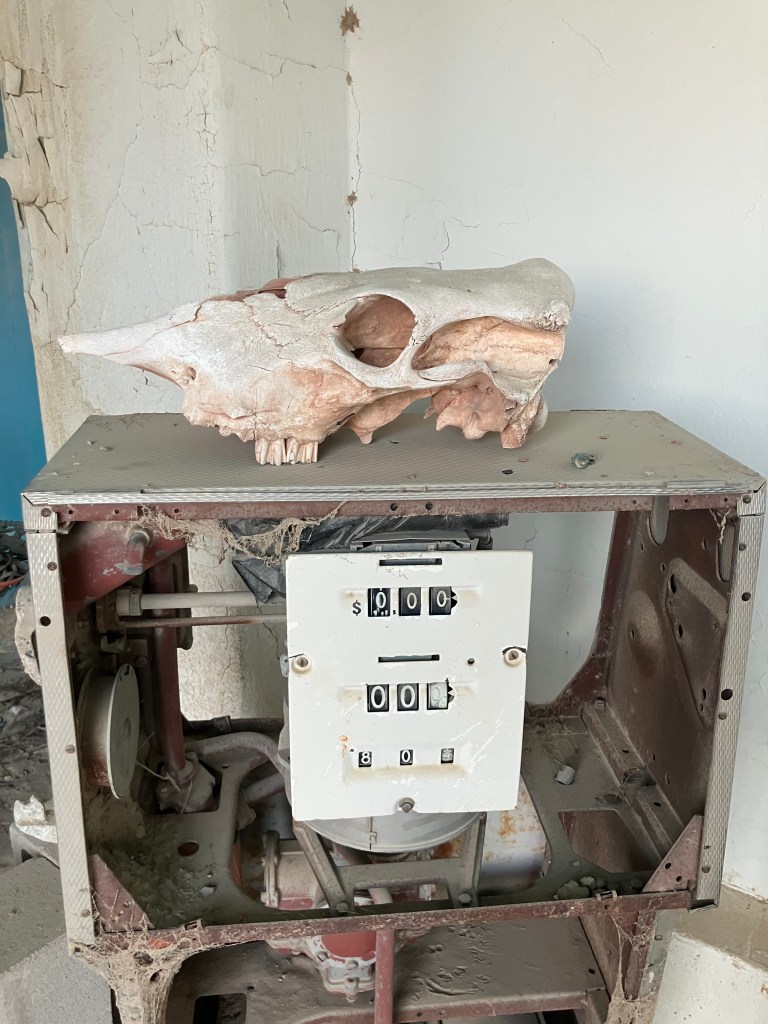
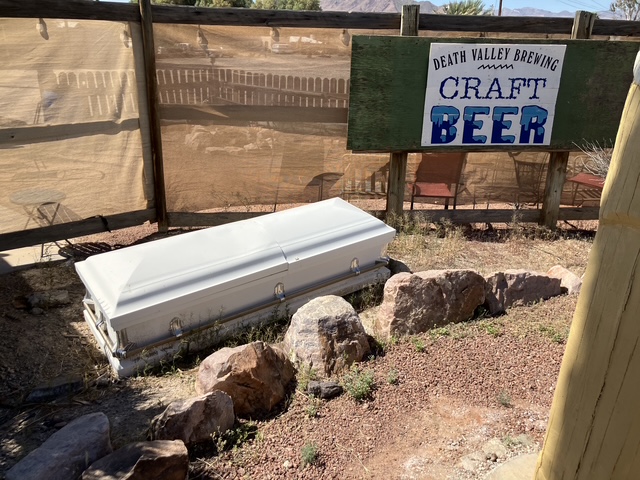
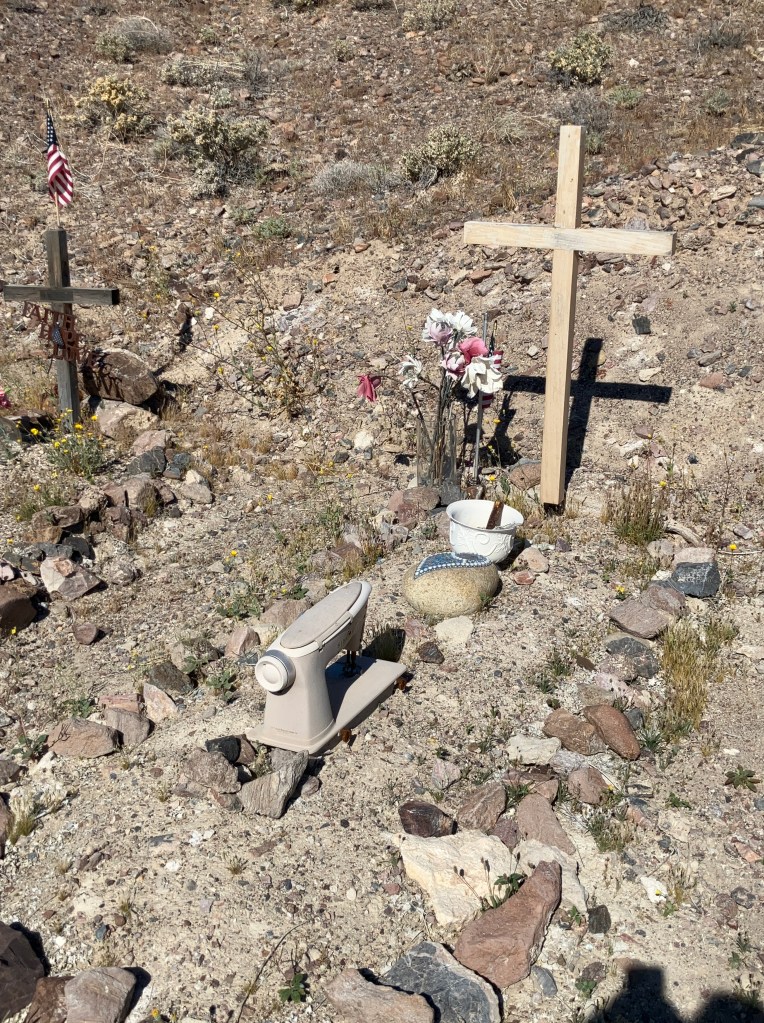
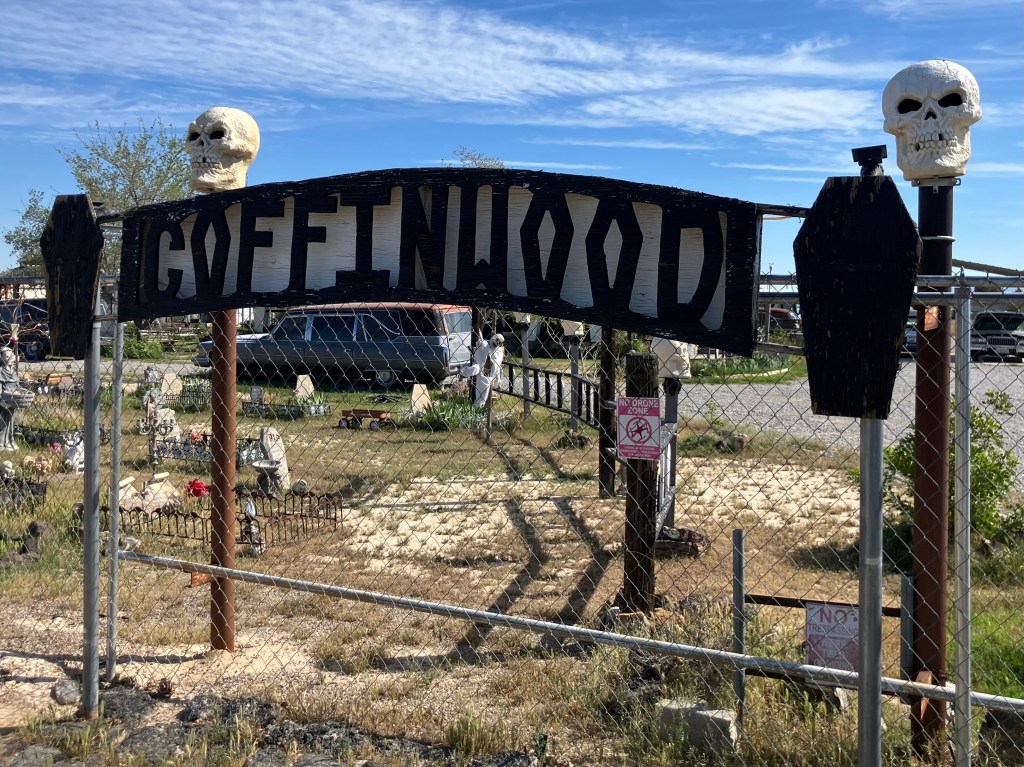
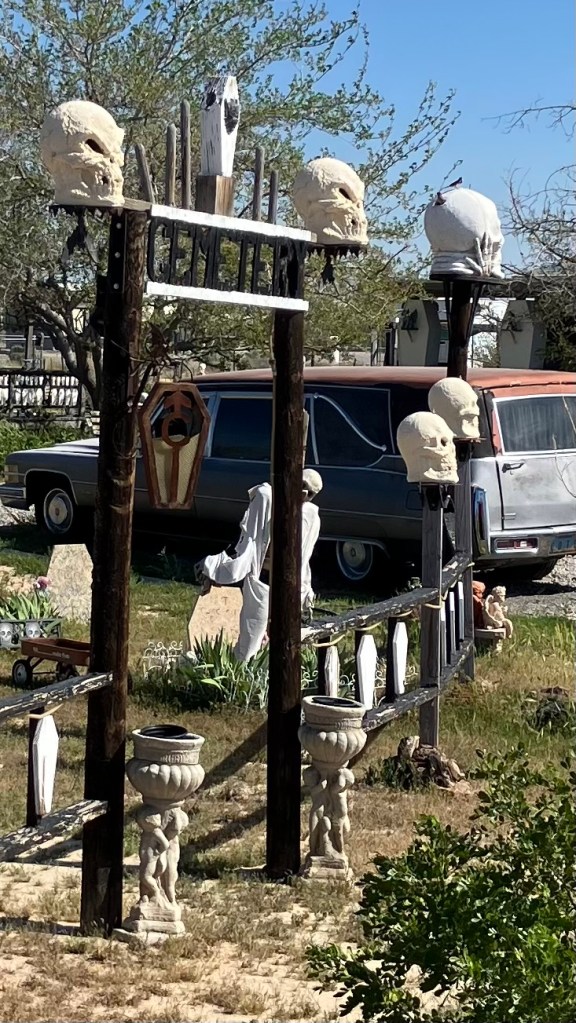
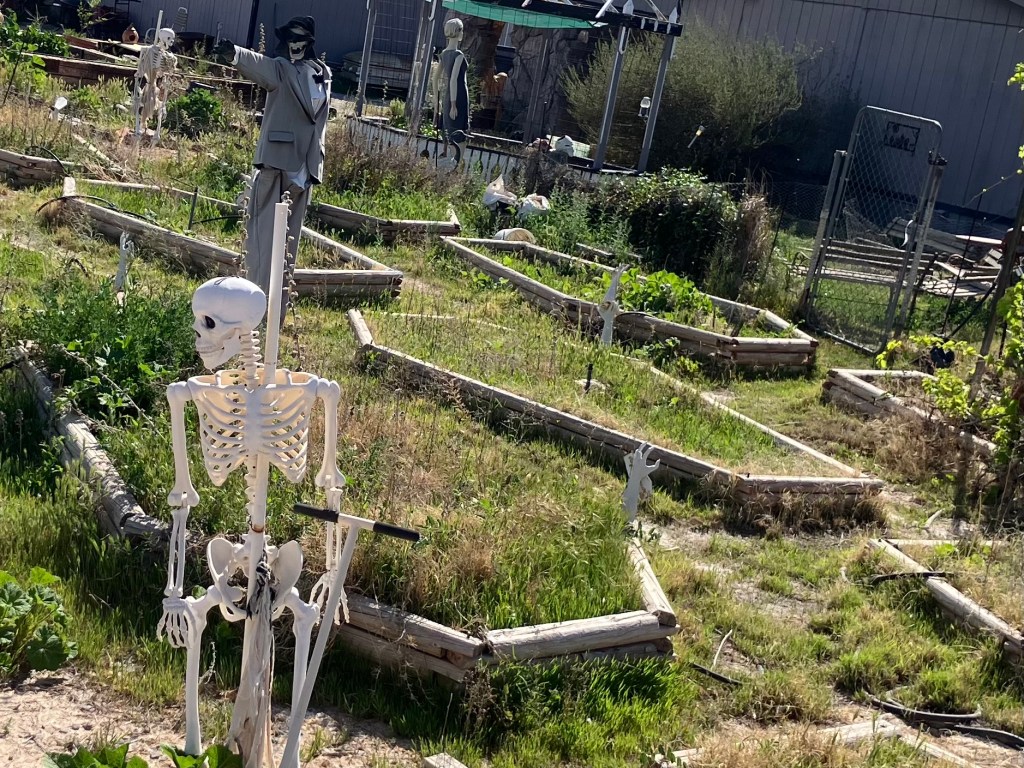
Out here in the desert there seems to be different attitude about death. Desert people appear to do a better job of accepting the concept. The imagery of death of all around the desert, including, of course, in the name Death Valley. So I’ll leave you with some of that imagery.
I’m betting the deceased was a singer. Har.
BEER OF THE DAY
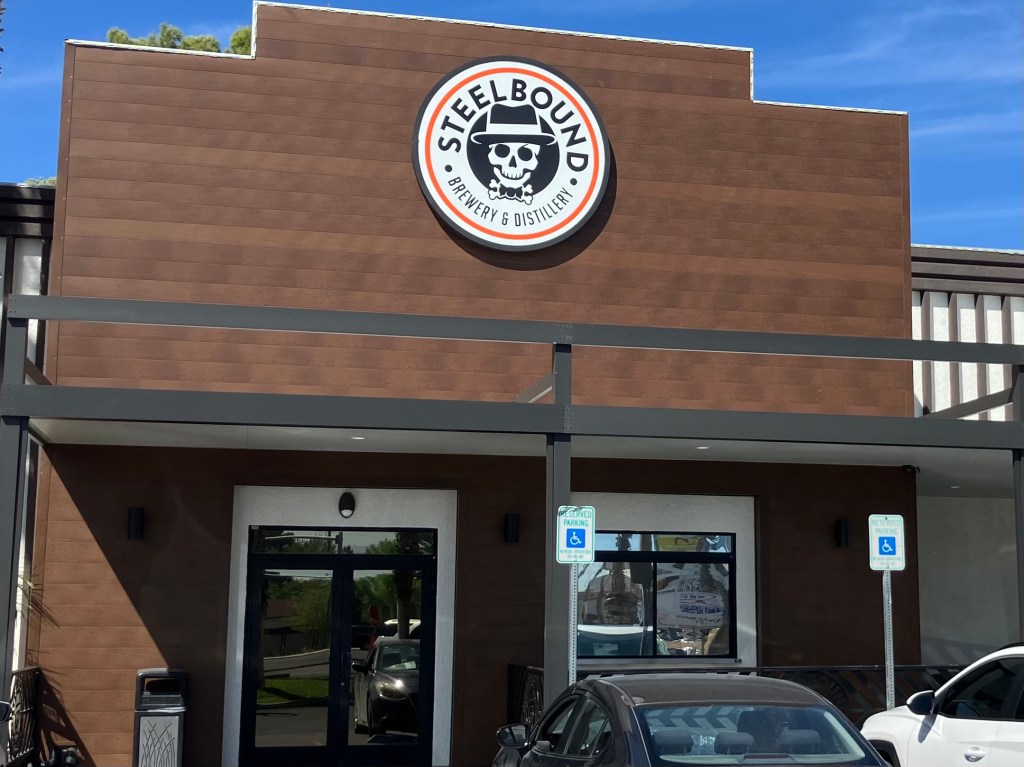
OK, that was a little heavy. So let’s end with the Beer of the Day. I had a beer at Steelbound Brewery and Distillery in Pahrump, NV (pop: 44,000). (I had to make a 20-minute detour across the state line to find a place to spend the night.)
Speaking of imagery of death…
This brewery/restaurant feels a little weird, and seems to still be trying to find its niche. (I’m told the place recently changed ownership.) It’s attached to the Best Western hotel, which seems to seriously undercut its effort to appear like a hip microbrewery. Video gambling machines are situated at every seat at the bar. Giant TV screens show The Price is Right, a program that’s punctuated with endless ads for prescription weight loss and asthma drugs. The menu is overrepresented with Indian food. The Sirius country-western station is piped over the speakers. The whole place has a soulless corporate feel. Even the servers seem robotic.
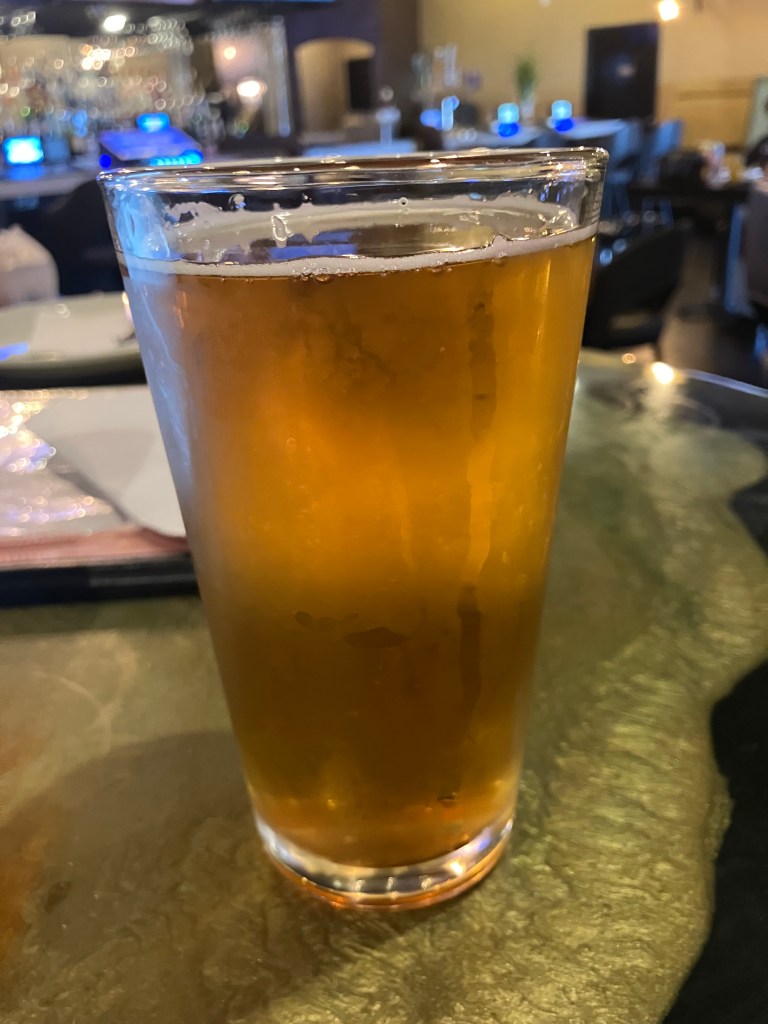
But they make their own beer. Perhaps because they’re still in the start-up phase, they only had three beers on tap. I chose the Chocolate Peanut Honey Cream Ale. Believe it or not, I considered this to be the safer choice.
And I wasn’t disappointed! It’s got a golden honey color with a slight cloudiness. There’s no nose to speak up, but it is definitely refreshing. It’s not too hopped, not too carbonated, but neither is it flat or bland. I’d call it “brisk.” The mouthfeel is slightly creamy. I don’t taste the “chocolate” mentioned in the name, except maybe that slight chocolate essence you get from chocolate bitters. A full pint of this stuff was not filling in the slightest. If I lived near here, this would be my go-to summer beer. 5 out of 5 stars.
You may recall that last year I took an interest in the old Orbit gas stations that have somehow survived from the 1960s. My most recent Orbit-related post concerned an abandoned station near Lake Tahoe.
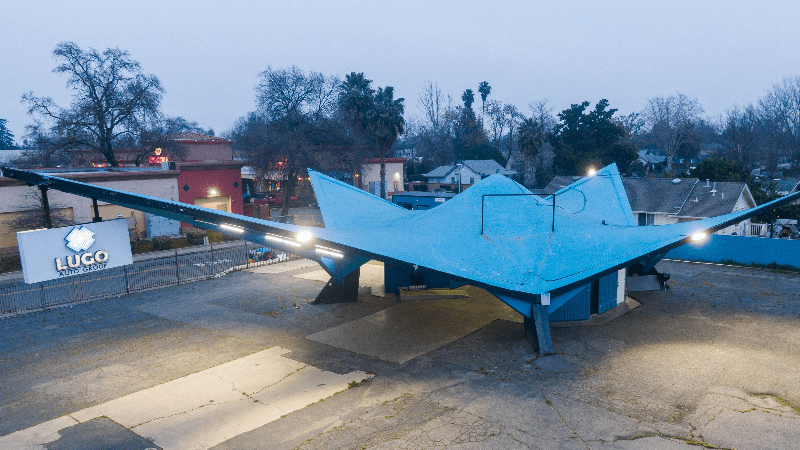
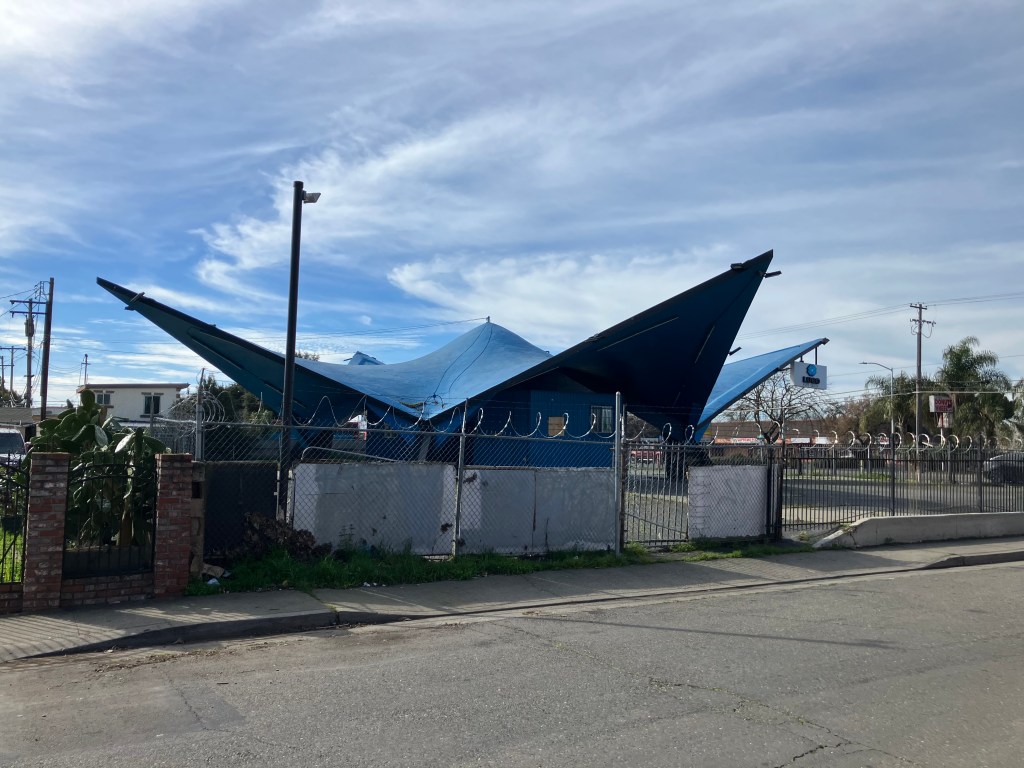
I mention all this because yesterday loyal reader Victor R. shared with us a news item about an old Orbit gas station in north Sacramento. It seems this Orbit station was built in 1963, and ceased operation as a gas station a scant 7 years later. Since that time it’s served various functions, most recently as a used car lot. But last year the car lot closed, and the building has sat vacant behind a fence topped with razor wire.
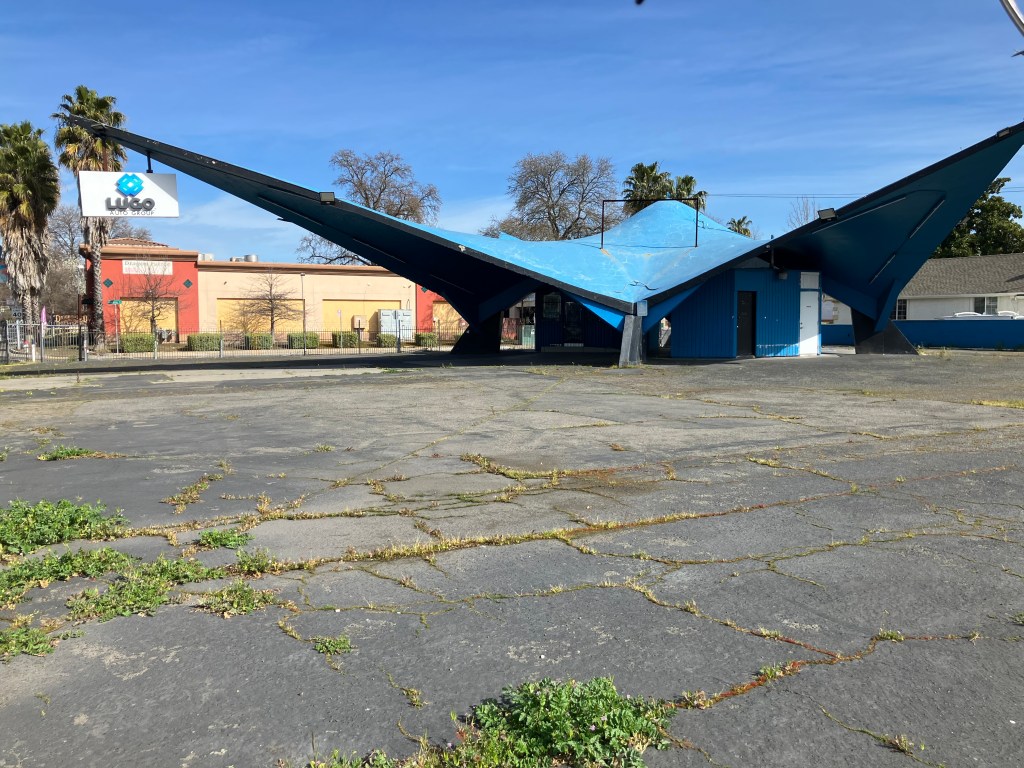
Vic shared a KCRA story about how the Sacramento Preservation Commission voted to recommend that the City Council place the station on the local historic register. Frustratingly, the news item only showed an aerial shot of the gas station. So I decided to head out to North Sacramento and get some ground-level photos for you, dear reader.
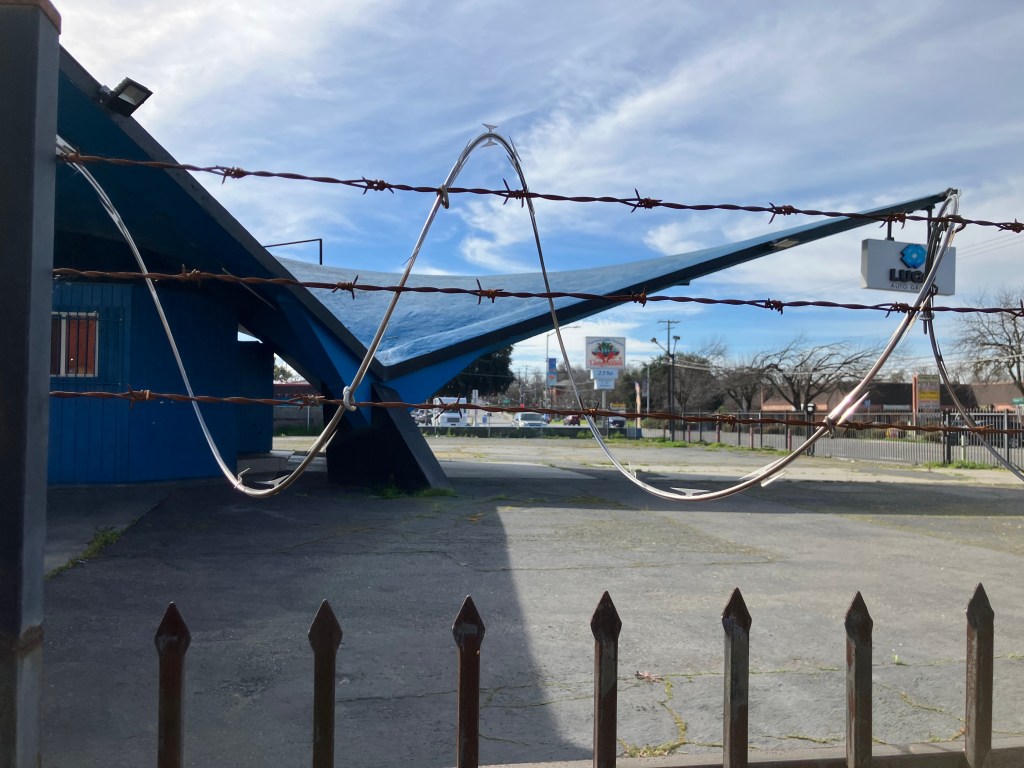
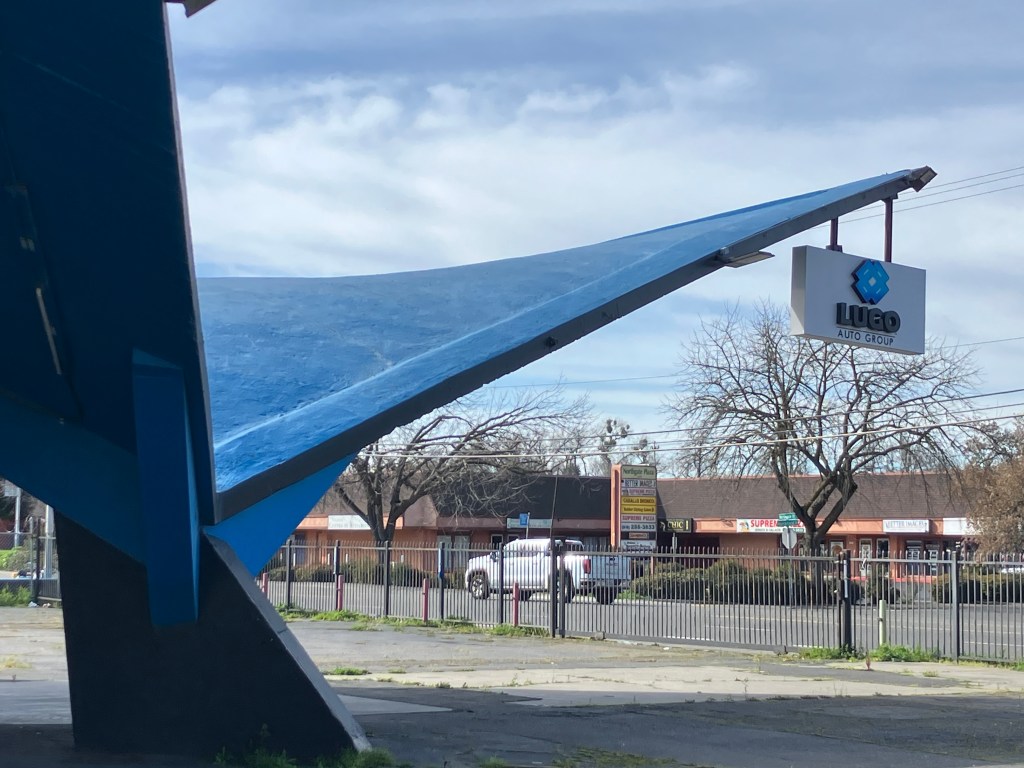
Even stripped of its gas pumps and signage, the structure is unmistakably an Orbit gas station. Here’s a photo I took by poking my camera through a gap in the surrounding fence:
But viewed from the street, the fence makes for an ugly tableau.
Still, the local residents spoke enthusiastically in favor of preserving the structure. “It’s got its own personality for sure; it’s got character,” stated one resident. “To have this go away would be a disservice to our community,” said another. A third noted “It reminds me of a flying saucer,” which, to be honest, it clearly does not. But there is something alien about it.
I think the point, though, is that residents in the area like the odd structure. Notably, while I visited today, it was clear that the neighborhood (which is dubbed “Gardenland,” not for any greenery, but because of its proximity to the Garden Highway) is struggling. Northgate Boulevard, on which this gas station sits, is lined with a depressing array of struggling fast-food eateries, grungy liquor stores, and predatory check-cashing businesses. I can see how a quirky retro-futuristic building might bring some much-needed whimsy and optimism to the area, particularly if it were repurposed as a community center or maybe a hip coffee shop.
Wouldn’t it be great if the sign were changed to “Jetsons Java”?
So I’d encourage my Sacramento-based readers to let your Councilmember know that you support having this building designated a local historical landmark. Meanwhile, please send me any sightings of other Orbit stations.
Obelisk Corner
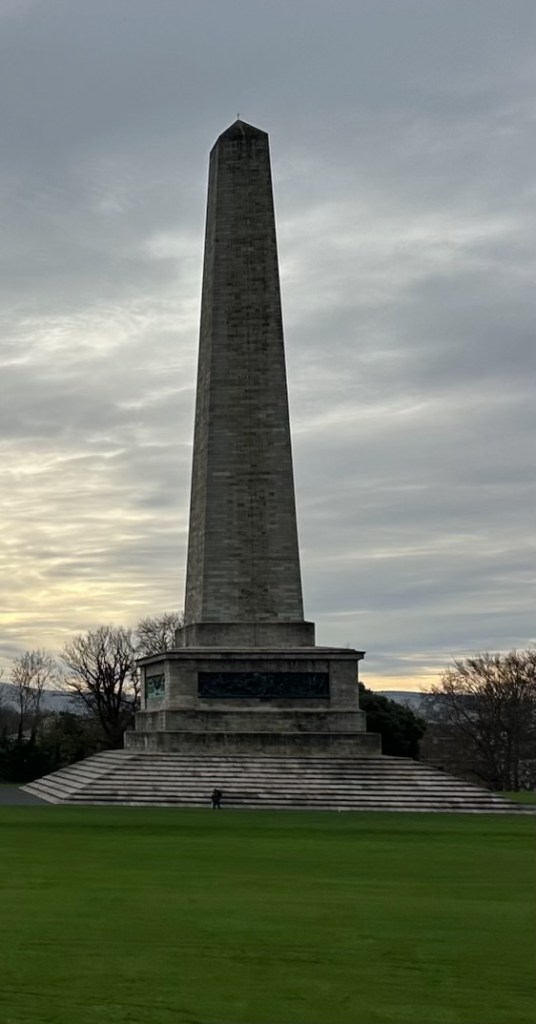
Faithful Reader Ron P. shared this photo of the Wellington Testimonial (which is evidently a fancy way of saying “monument”) in Phoenix Park, in Dublin (Ireland).
(New readers may want to check this post to understand this blog’s fixation with obelisks. It’s not what you think!) Anway, the Wellington Testimonial was erected (so to speak) in 1861, and it’s 203 feet tall, making it the tallest obelisk in all of Europe. As a point of reference, the Washington Monument is 555 feet tall, which I think handily proves the superiority of America.
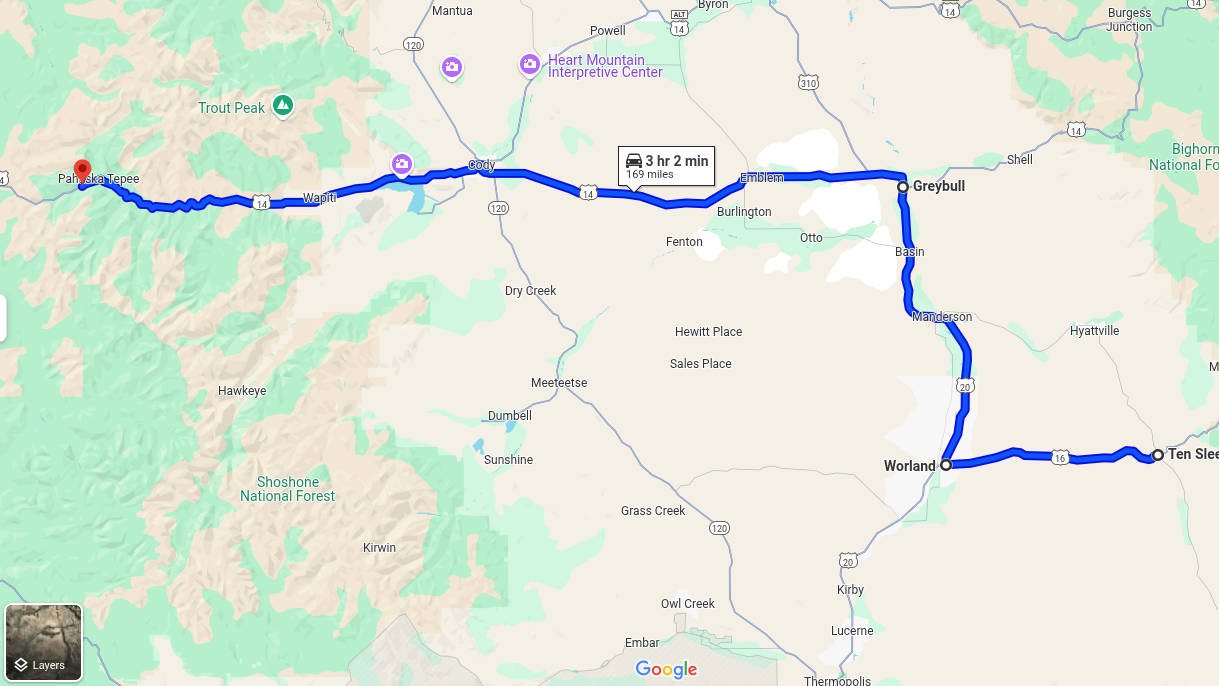
Today I drove the final stretch of Route 20’s original route, which terminates at the eastern entrance to Yellowstone. I left the lads in TenSleep this morning, and rejoined US 20 at Worland, Wyo. From there I headed north to Greybull, and then east to Yellowstone. The whole drive was about 170 miles…and then another 170 miles to get back to TenSleep!
Westward Ho.
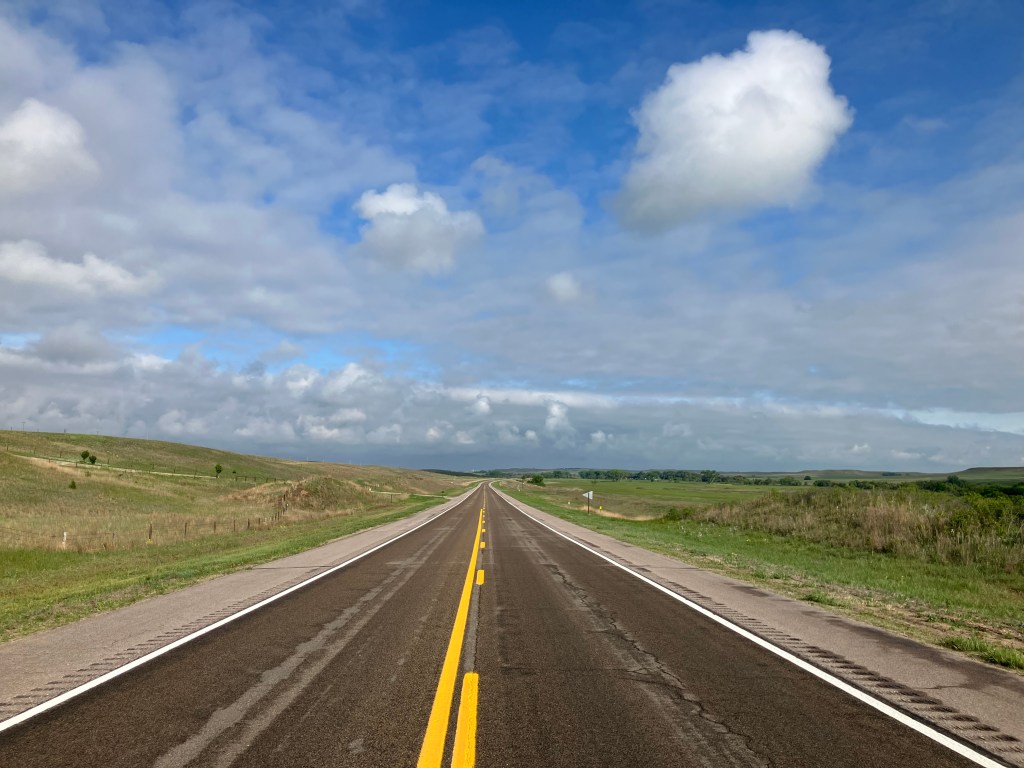
It was a great day for a drive. The weather was perfect, and there was no traffic. It was just me and the open skies. This part of the country, with its solitude and natural beauty, is growing on me.
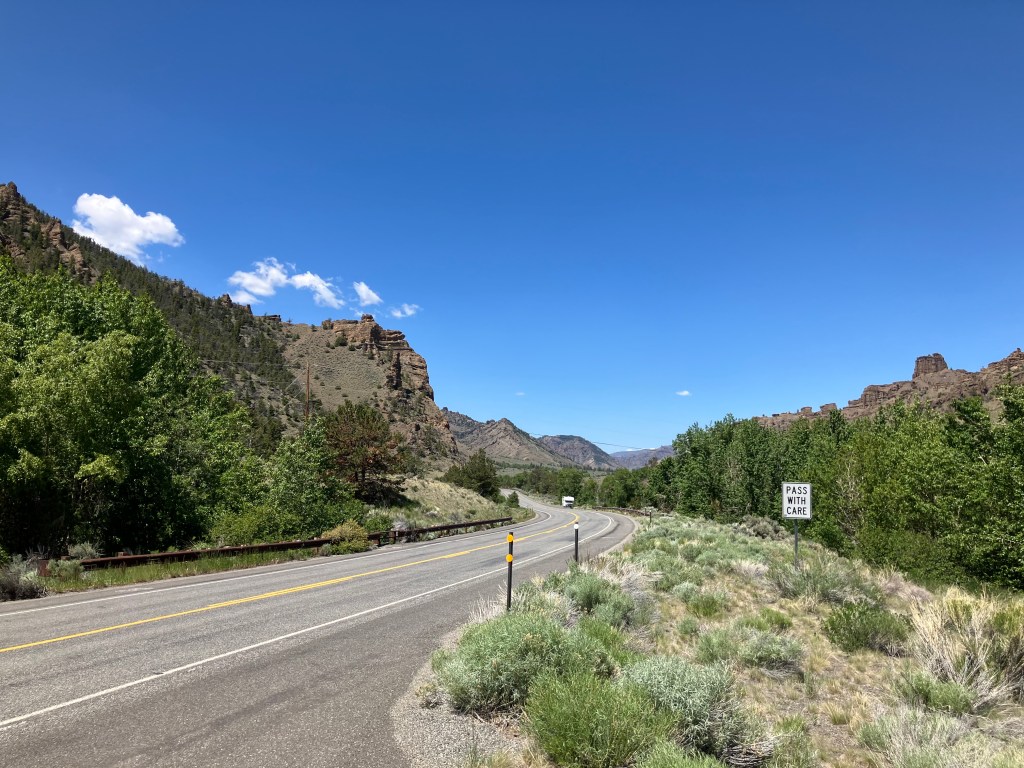
Idyllic drive.
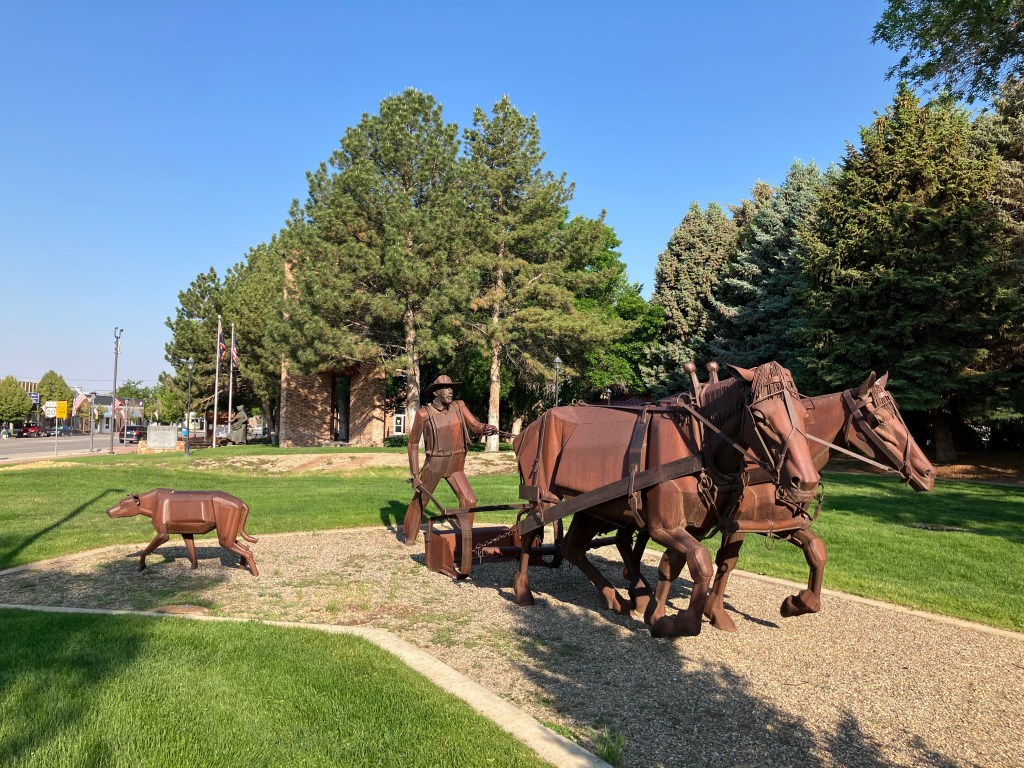
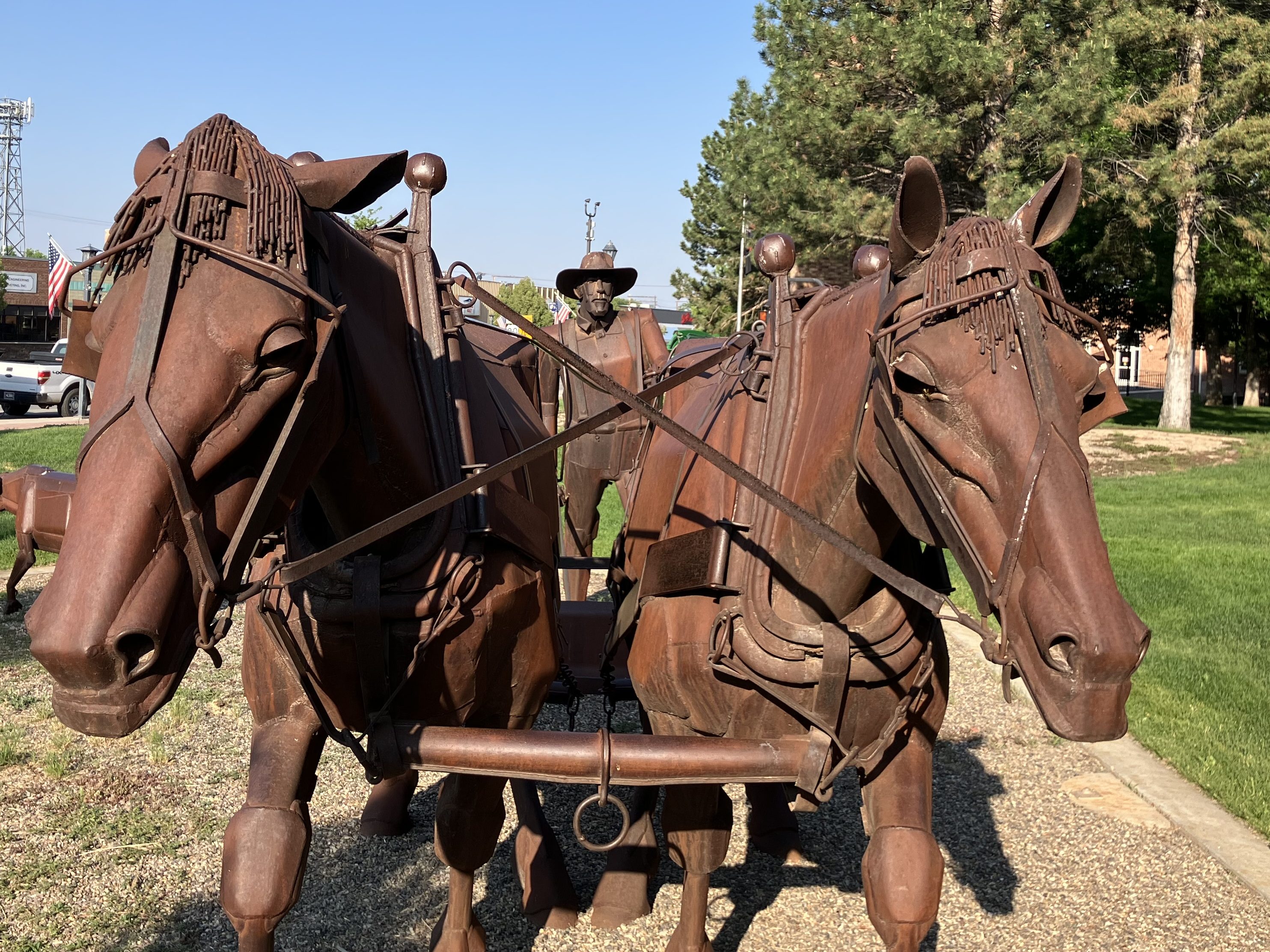
I picked up where I’d left off a couple of days ago at Worland (pop: 4,800). Worland is a tidy and practical town, where the good folks of TenSleep and other surrounding communities go when they need a supermarket or various specialty stores. It’s also a reasonably attractive community, with a number of western art installations like this one that commemorates the pioneers.
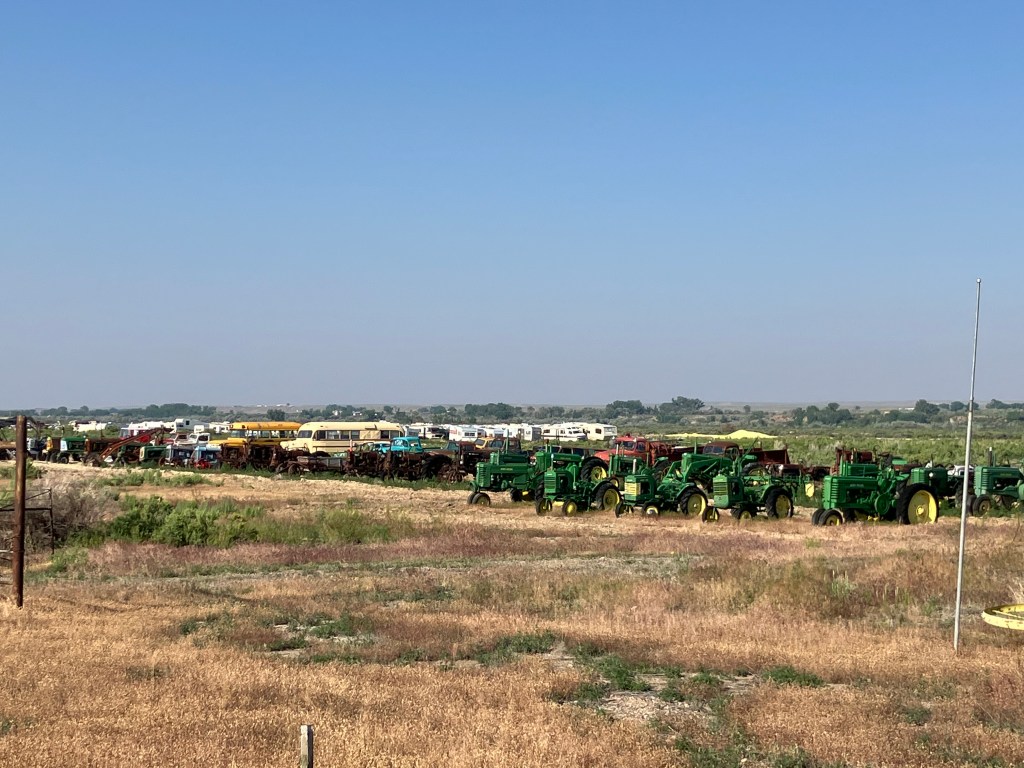
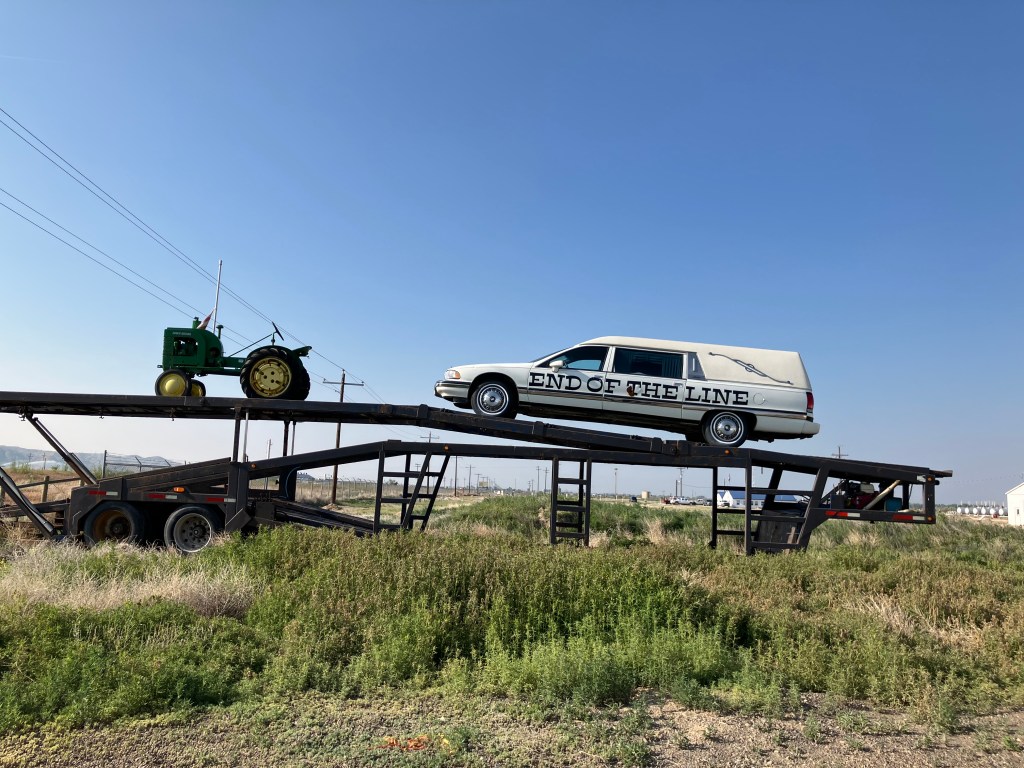
It felt good to be back on US 20 West, with the familiar white signs and the commodious US-standard lanes. Early in today’s trip I came to Manderson, Wyoming (pop: 3,900), where a veritable graveyard of old farm equipment and buses stretches along the side of the road. It’s evidently a vehicle recycling and/or consignment operation, where tractors go to die. The hearse at the edge of the property seems to drive home the point.
Just a small portion of their collection.
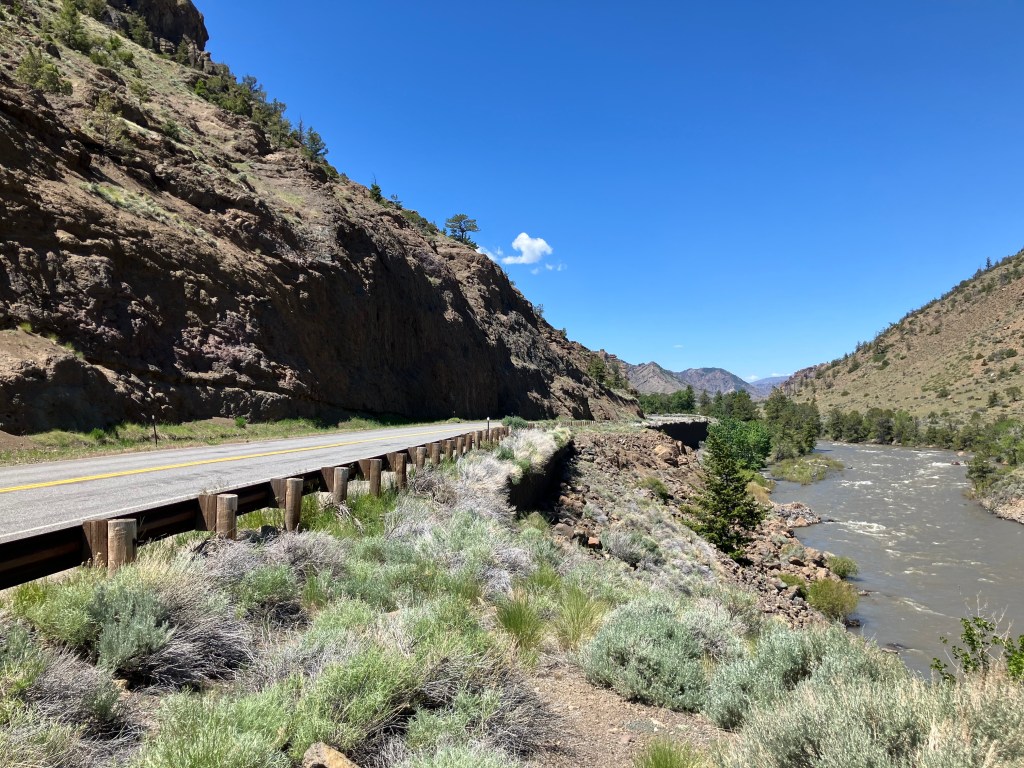
Once I was heading east out of Greybull, the endless prairie began to give way to the peaks and crags of the Bighorn and Owl Creek mountain ranges, and fast-flowing Shoshone River gorge. The passing scenes reminded me of the settings for a John Ford movie.
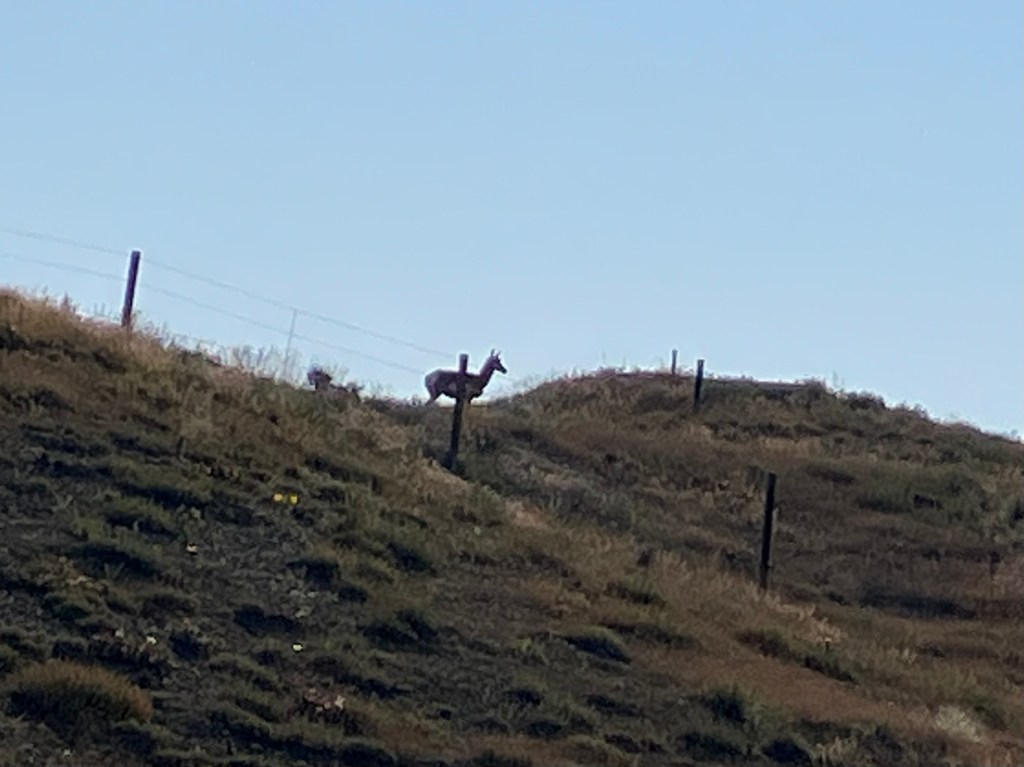
A speed goat keeps watch over US 20.
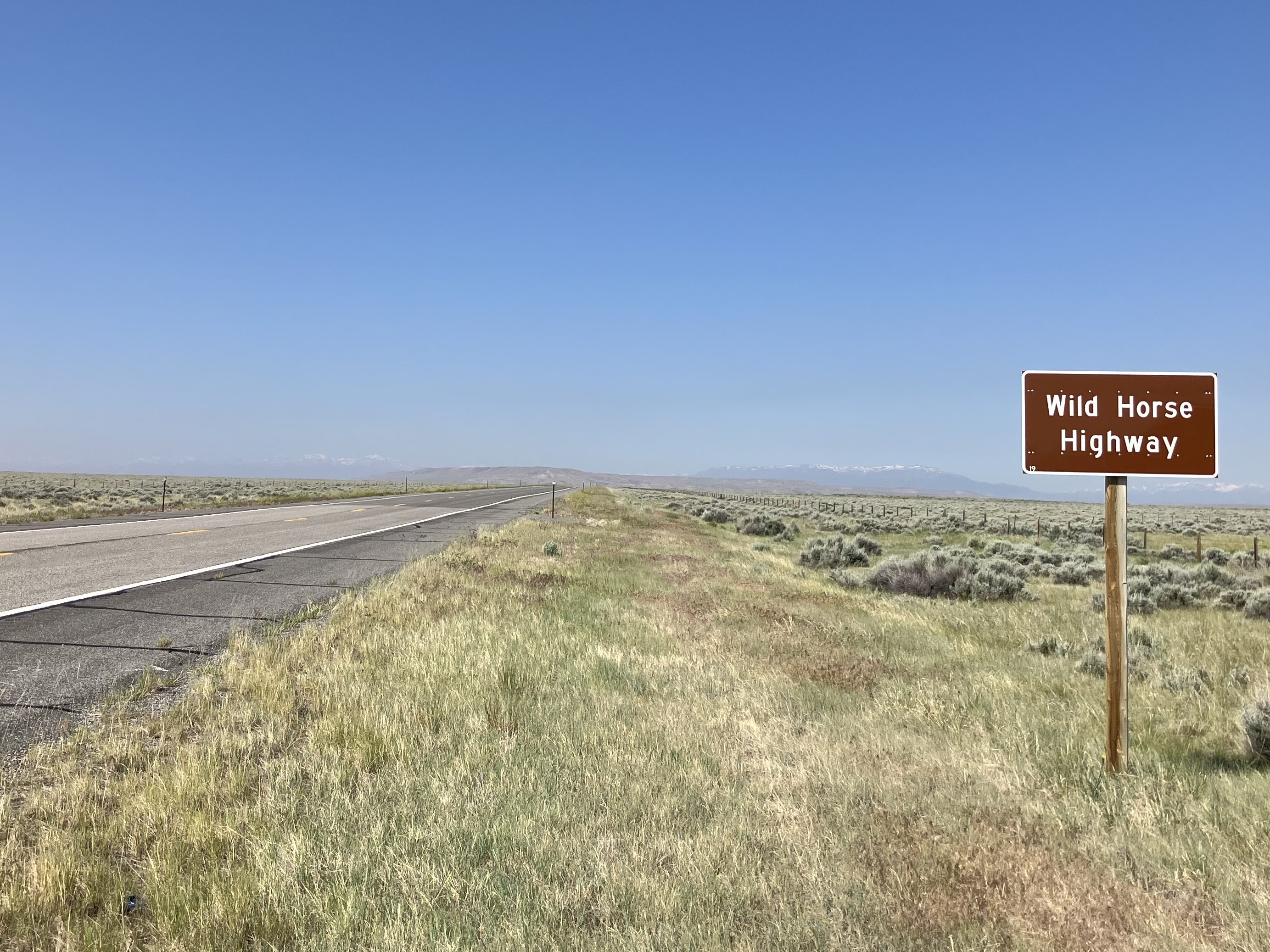
Even though most of US 20 is designated the Medal of Honor Highway, a segment east of Cody was designated the Wild Horse Highway just a few years ago. This segment borders BLM lands where a herd of about 100 wild mustangs still roam the McCullough Peaks range.
Horses are of course an iconic element of the West. They were brought to the Americas by Spanish missionaries and explorers several hundred years ago. Evidently a number of those horses escaped during the pueblo revolts, and descendants of those horses still roam the plains. In 1971 the US Congress passed the Wild Free-Roaming Horses and Burros Act, which provides for the protection of those horses.
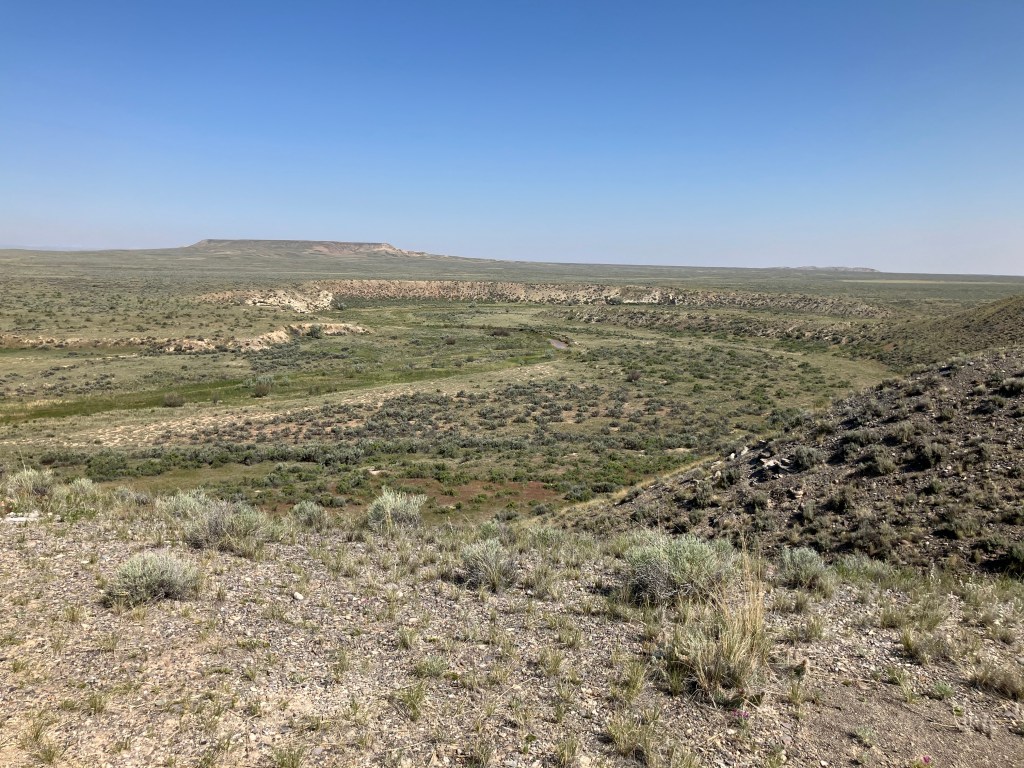
Where the wild horses roam.
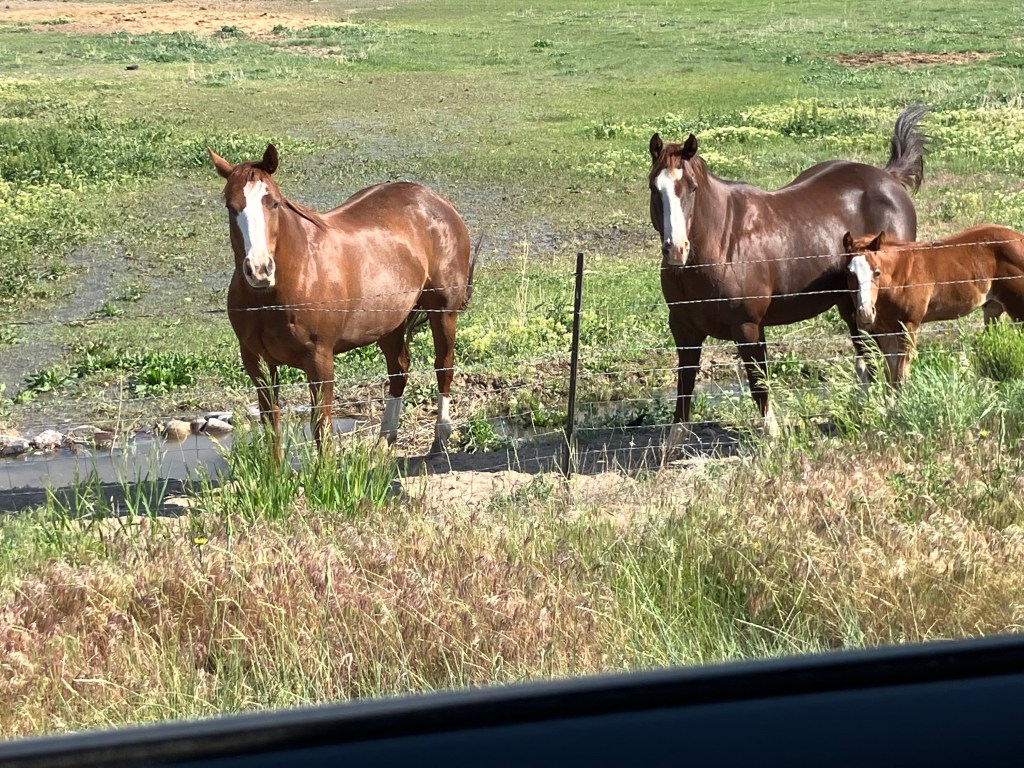
Horses along the Wild Horse Highway.
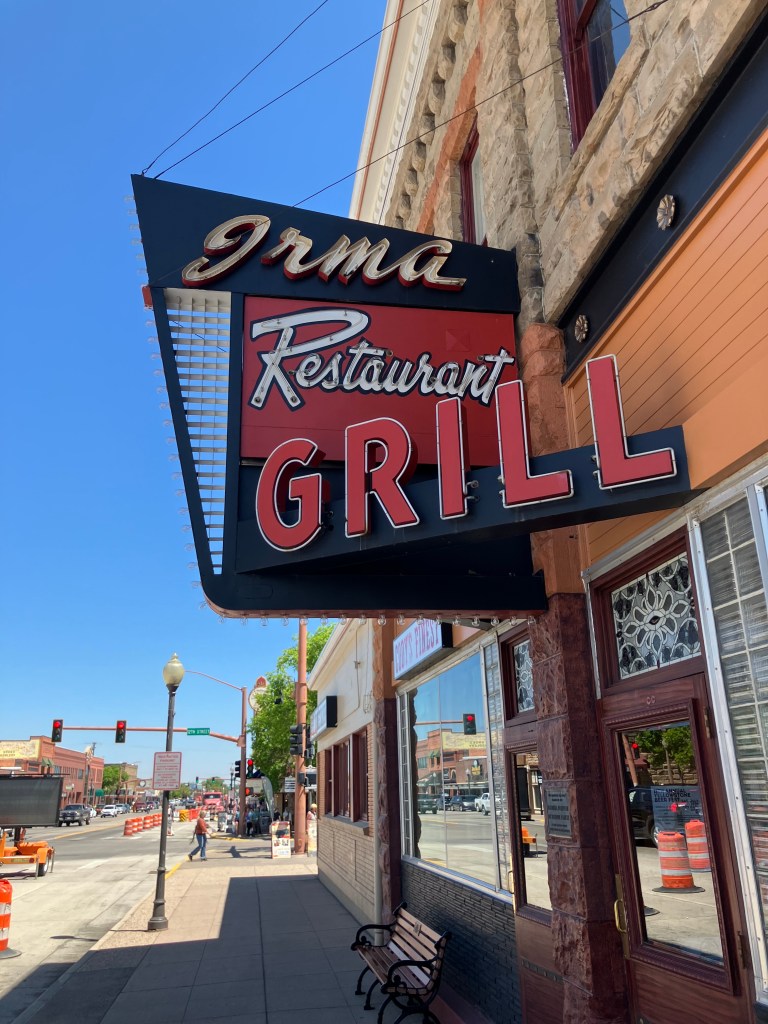
After the Wild Horse Highway I came to the “big city” of today’s trip. Cody, Wyo (pop: 10,250) is one of those larger-than-life towns that inevitably become tourist trips. “Buffalo” Bill Cody founded Cody City in 1895. It was intended as a resort community, near the Demaris mineral hot springs. It was also conveniently located near the eastern entrance to the recently-created Yellowstone National Park. However, just about a year after Buffalo Bill founded Cody City, someone named George Beck established a second city just to the west. It’s this second city that kind of swallowed up Cody City and grew up to be today’s Cody. Ever the entrepreneur, Buffalo Bill embraced the new city and opened a hotel (the Irma) in 1902 that still stands today.
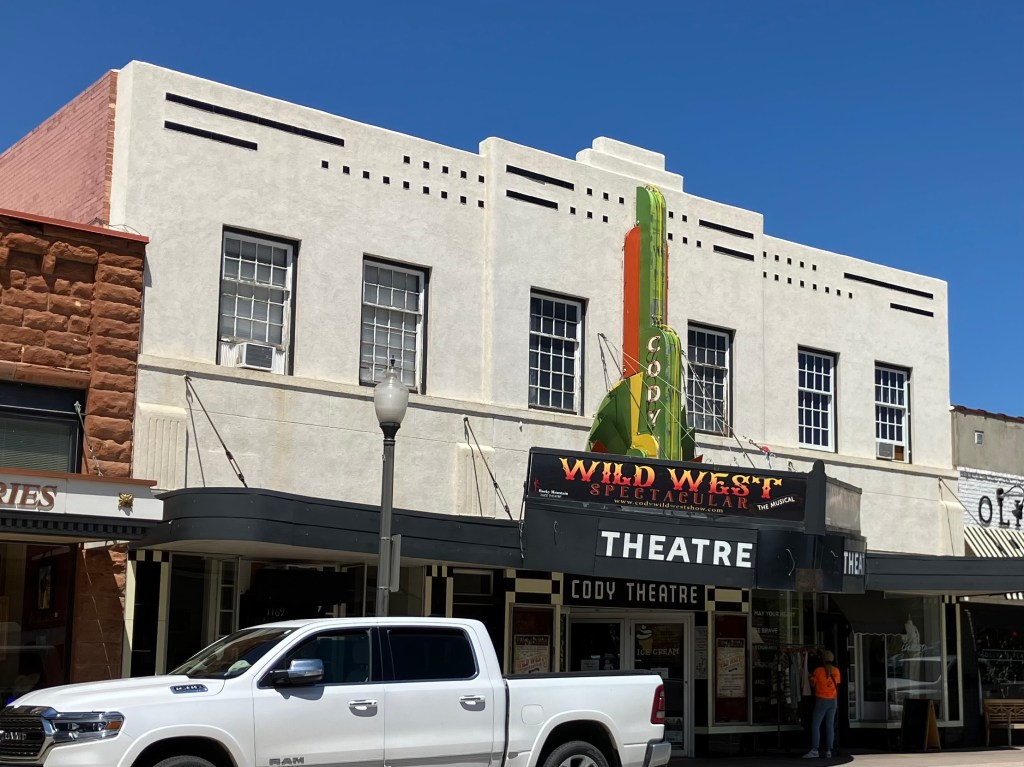
Today’s Cody is a tourist town that leans into its history and western lore. There’s a major museum complex called the Buffalo Bill Center of the West. There are numerous businesses that claim to have authentic links to Buffalo Bill. And the 1936 Cody Theater currently hosts a live musical called the “Wild West Spectacular.”
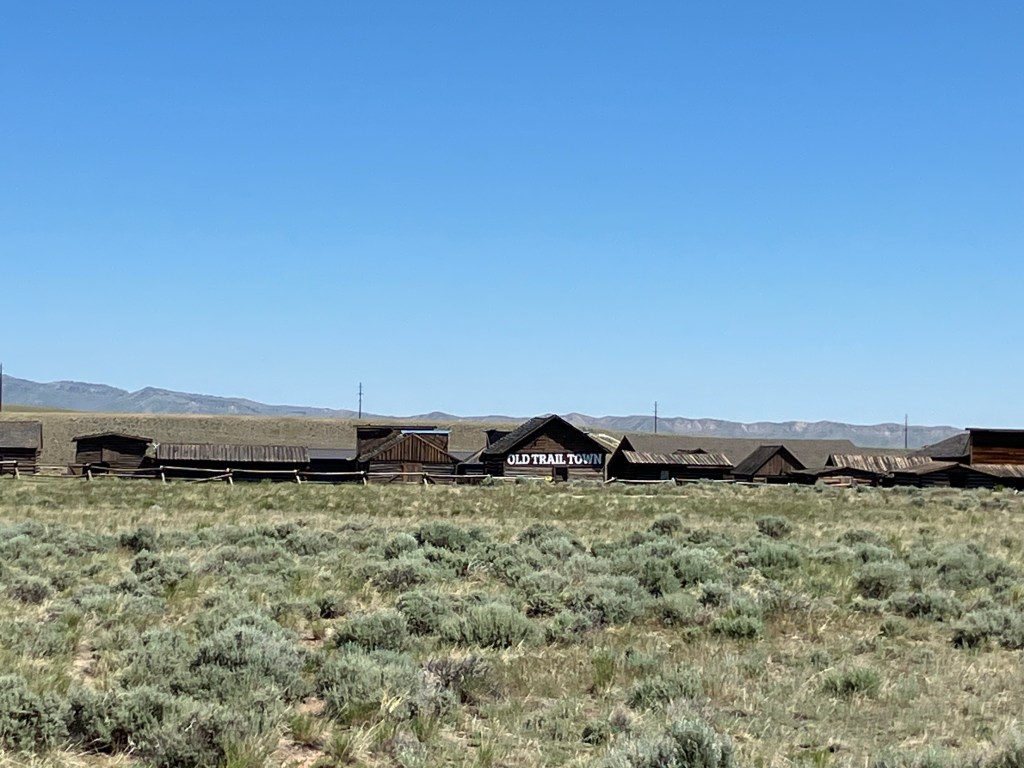
“Old Trail Town,” which purports to be a semi-authentic reconstruction of the original Cody City. It’s comprised of historic structures from across the region.
The Irma–built by Buffalo Bill and named after his daughter.
Active 1936 theater, showing live stage productions.
After getting my BOTD (more on this below), I left Cody and tackled the final segment of US 20. This stretch, which runs 27 miles from Cody westward to Yellowstone, is designated the Buffalo Bill Cody Scenic Byway.
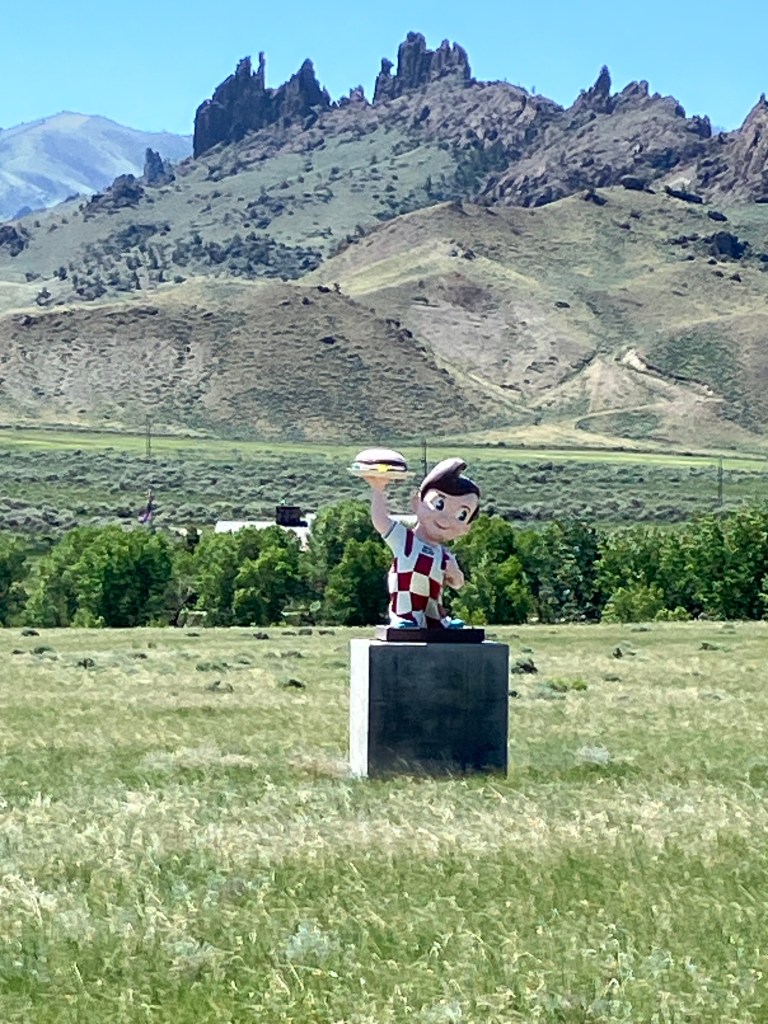
This Bob’s Big Boy in a field on the side of the Buffalo Bill Scenic Byway is completely unexplained.
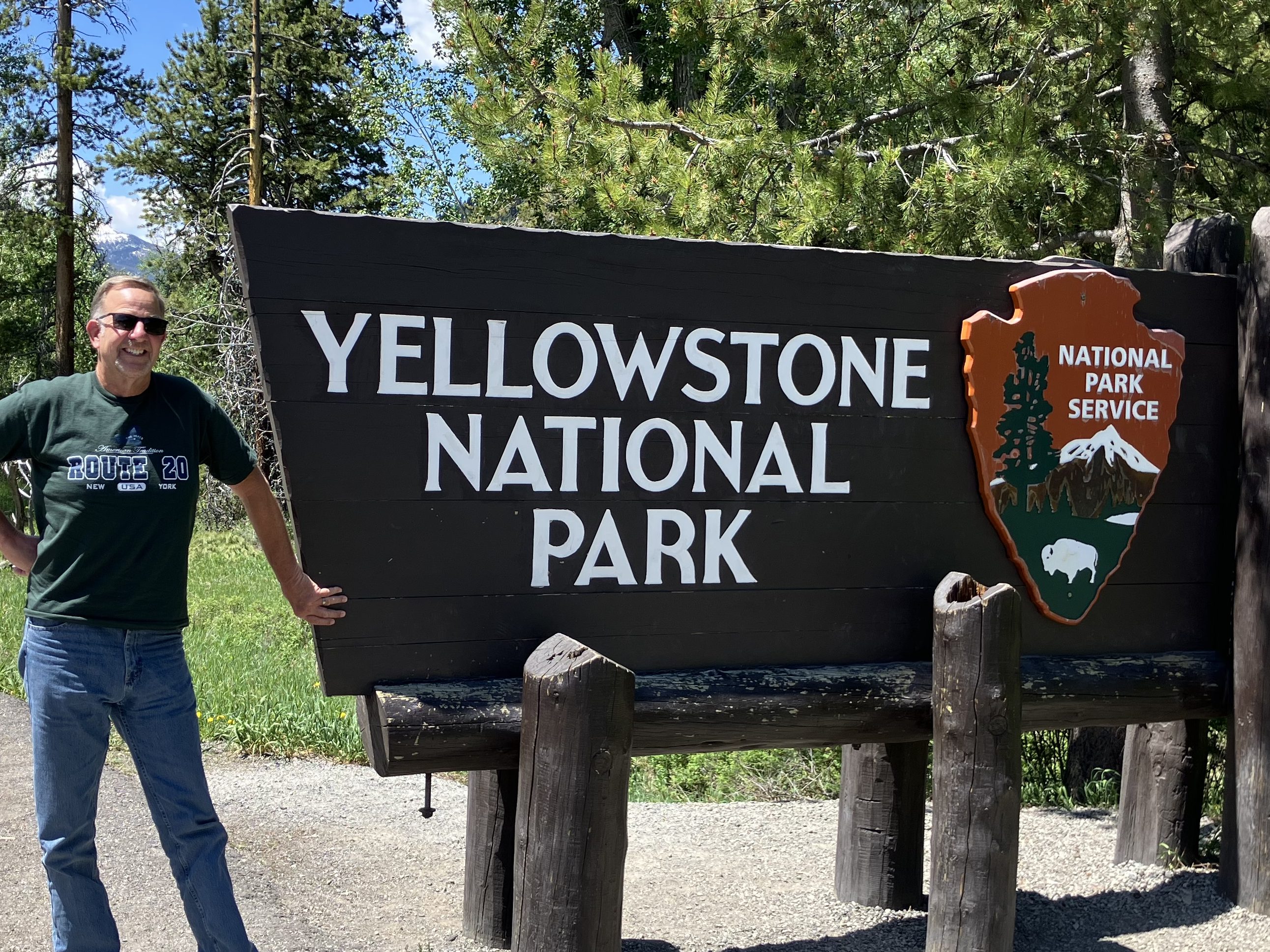
Finally, after about 2,500 miles and a dozen days of driving, I arrived at the end of (original) US 20!
My Route 20 shirt is courtesy of The Tepee near Cherry Valley, NY.
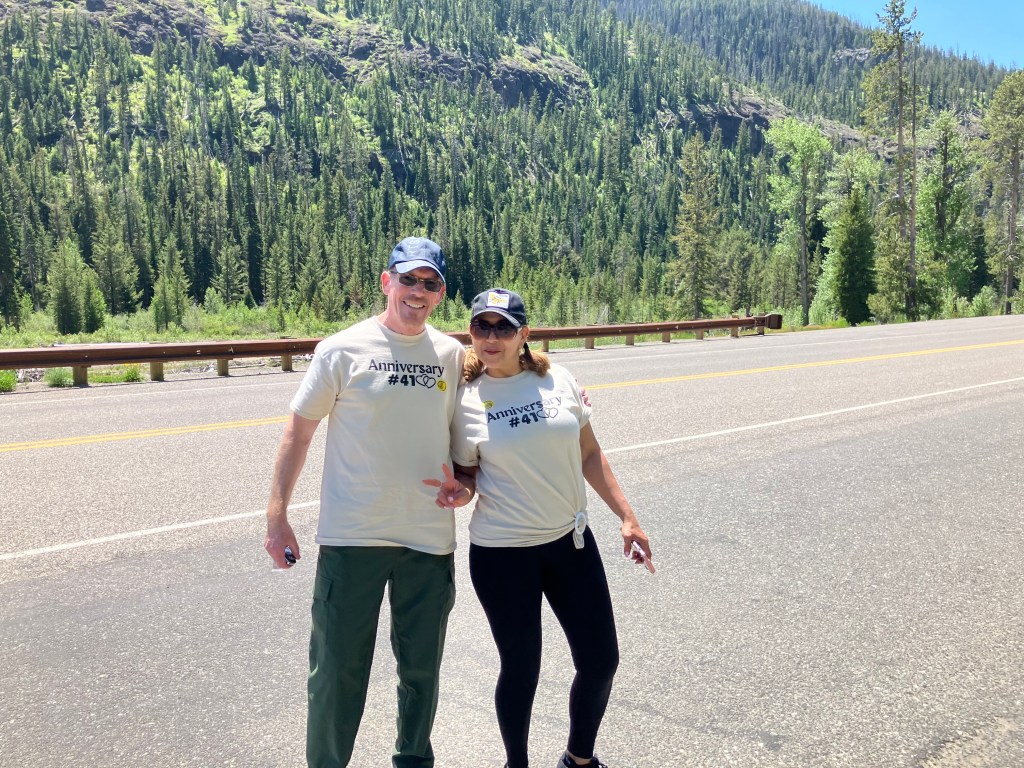
That Yellowstone photo comes courtesy of Harry and Xiomata, who were celebrating their 41st anniversary.
Happy Anniversary!
With the road trip complete, there are just a few items left to round out this blog post. Here we go:
BRIDGE CORNER
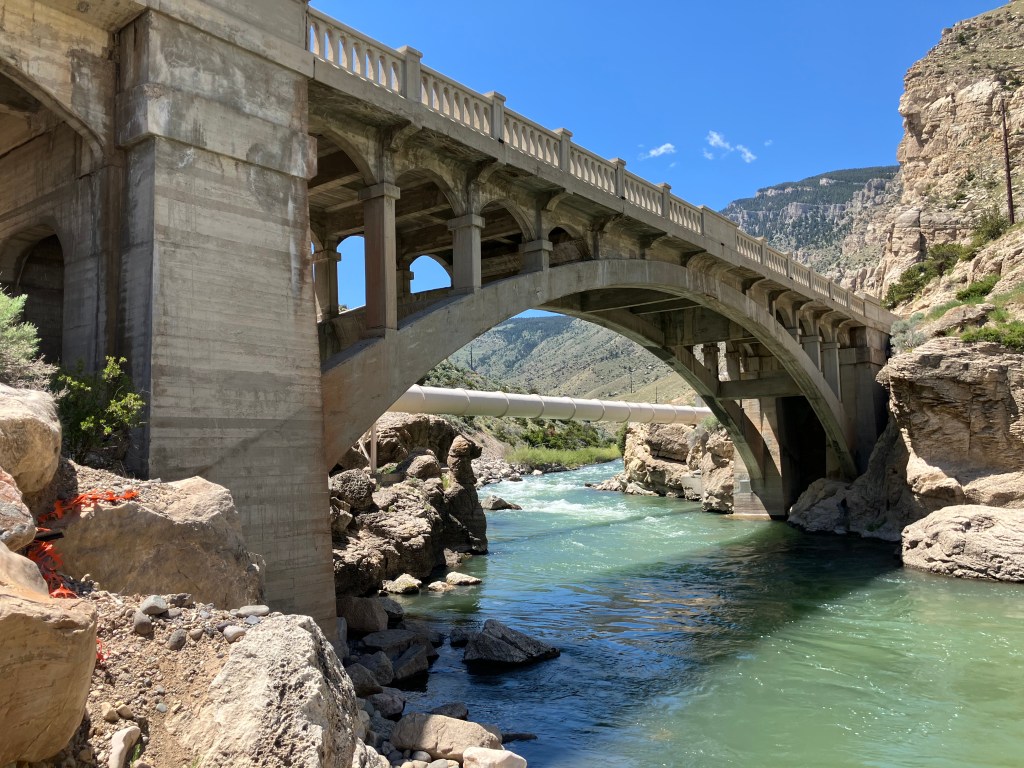
Today I passed what I consider to be a picturesque, historic bridge that deserves mention. The century-old Hayden Arch Bridge crosses Shoshoni creek near just west of Cody. It’s billed as “Wyoming’s only medium span concrete arch vehicular bridge.” Alas, I arrived just a few days too early for a big celebration. According to a recently-posted notice, “The Cody Country Chamber of Commerce invites the public to a special centennial celebration marking 100 years of Hayden’s Arch, one of Wyoming’s most iconic bridges. The commemorative ceremony will take place Saturday, June 21, 2025, at 4:00 PM, at the historic Hayden Arch Bridge.” It’s not to late to plan your trip!
Wyoming’s iconic Hayden Arch Bridge turns 100!
BEER OF THE DAY
I wanted to do something special for the last BOTD for this trip, so I bellied up to the bar at the Hotel Irma, which Buffalo Bill himself had built in 1902. It’s named after his youngest daughter.
Sadly, I wasn’t able to secure a seat at the bar–there was considerable disagreement among the barflies as to whether “Jack” was going to return to the seat he had earlier vacated. And the wait staff and bartenders–all of whom seemed to have been holdovers from the days of Buffalo Bill–seemed irreparably confused. I left.
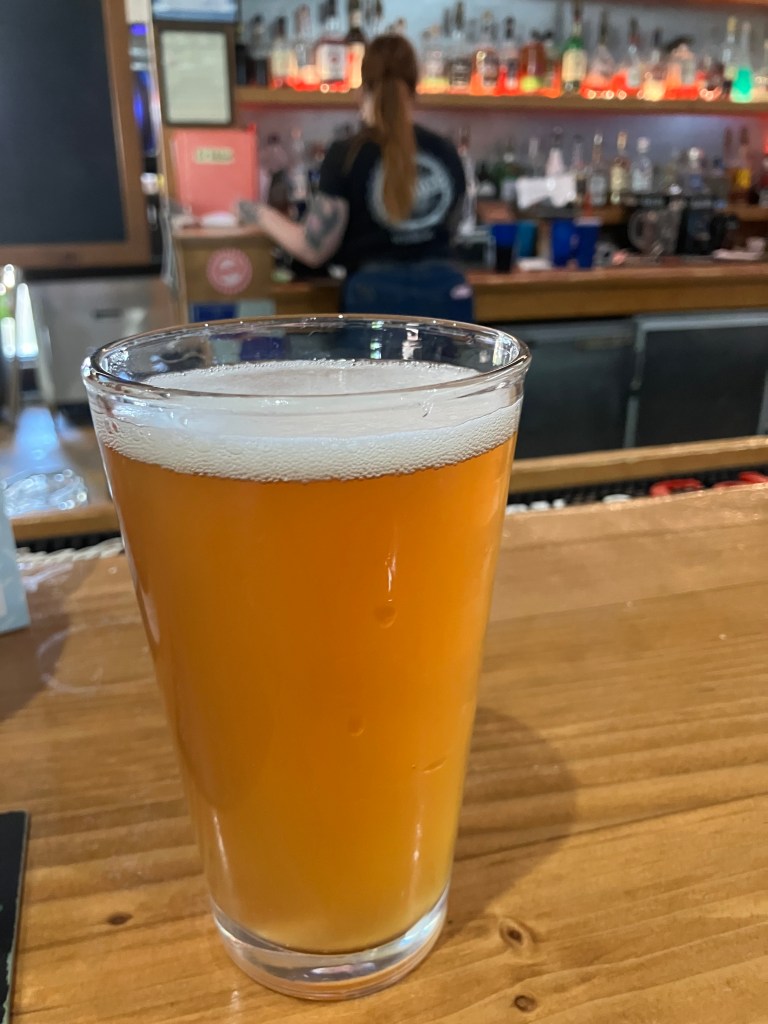
Instead I chose the considerably less historic Millstone Pizza Company and Brewery that sits just across the street from the Irma. On advice of Doogie Howser’s doppelganger who was working behind the bar, I had the Pineapple and Jalapeno Ale.
Doogie’s Fave.
Now, this was a reasonably well-made beer, with smooth body, good hoppiness, nice color, and a delicate foam head. The only thing this beer didn’t have was the taste of pineapple or jalapeno. Which would seem to be a problem for a beer billed as a pineapple/jalapeno beer. There was no sweetness and no heat whatsoever. When I brought this to Doogie’s attention, he kind of shrugged and said, “yeah, I’ve complained to the brewmaster about that myself.” (And yet he’d recommended it to me?!) He also hinted that the brewmaster used green peppers rather than jalapenos. Zero stars for false advertising. It’s a disappointing end to a good string of BOTDs.
DELETED SCENES
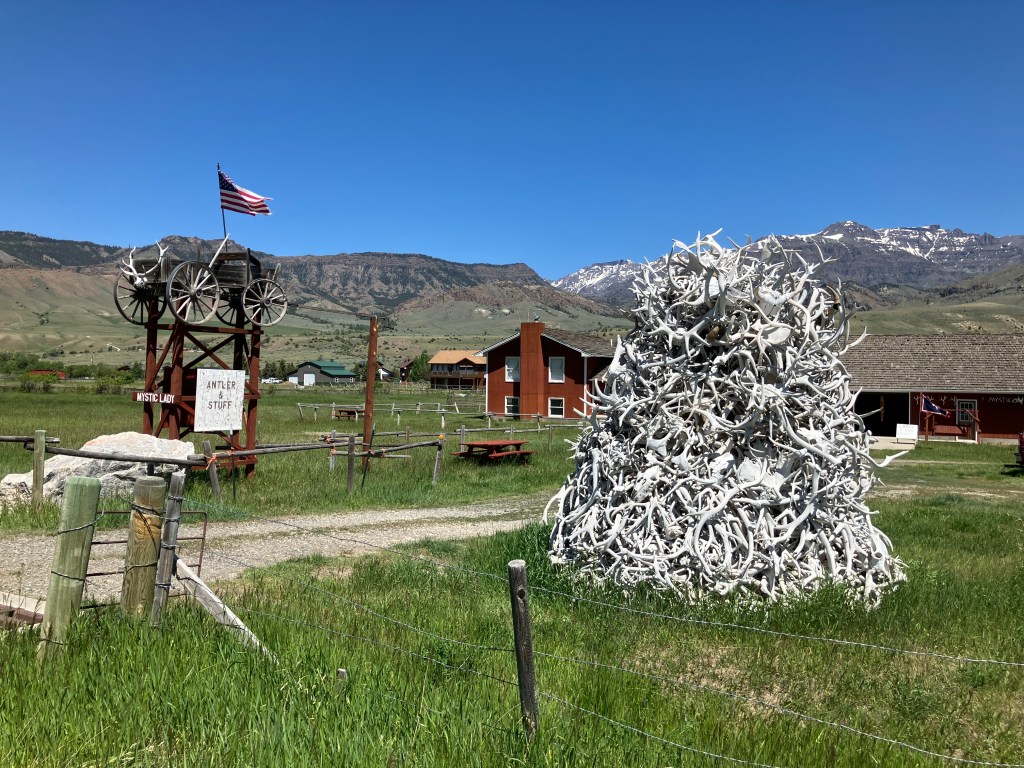
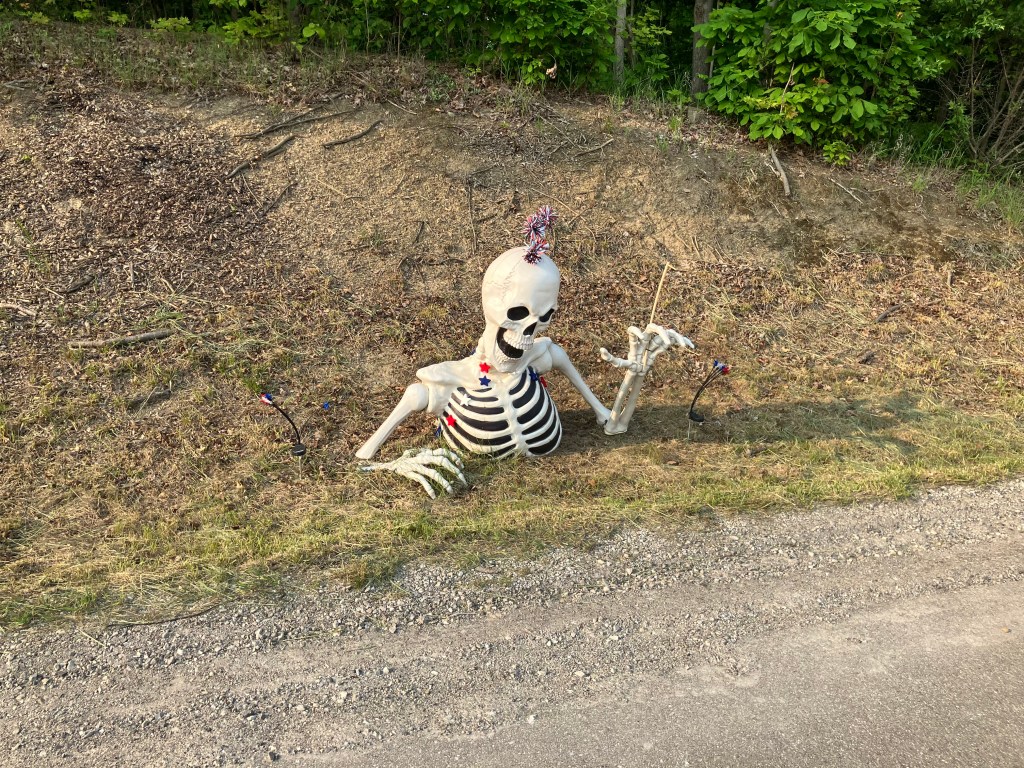
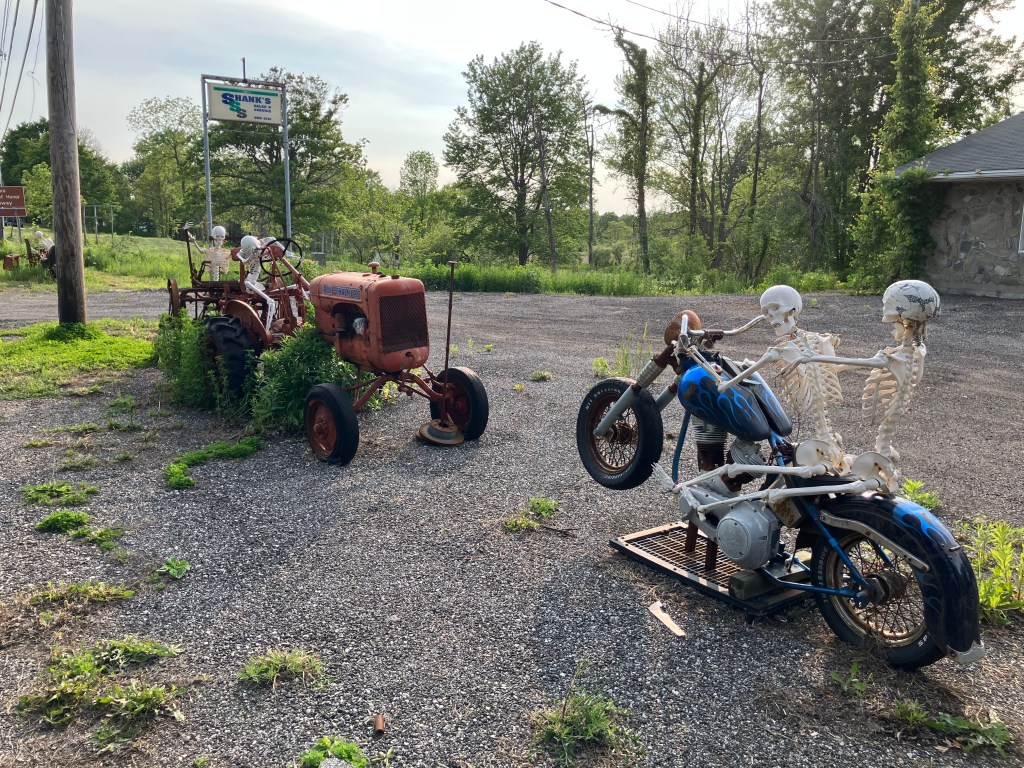
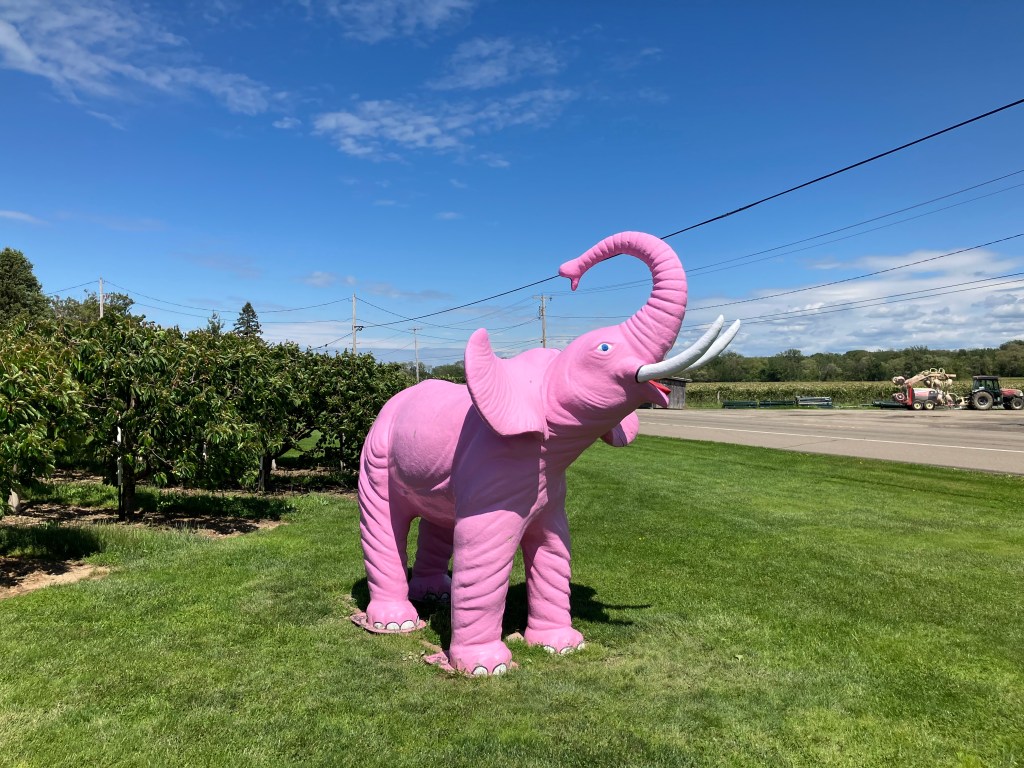
Finally, we end with a handful of photos from all along US 20 that largely speak for themselves. Is this a great country, or what?
(The pink elephant has become a theme of my trips. For other sightings see here and here and here and here.)
My day began in one of the country’s most haunted cities: Casper, Wyoming (pop: 59,000). It was here I learned a valuable lesson. It’s a variation on the Marianne’s’ Phenomenon, which has come up a few times in this blog over the years. To refresh your memory, you experience the Marianne’s Phenomenon when you mistake unique external conditions for food quality. This happened to me 30 years ago, when I ate at an Italian restaurant named Marianne’s. My wife and I had just taken a long bike ride and I was tired and famished. We sat down to a pasta meal and I was in heaven. “This is the best meal I’ve ever had!” I gushed. The next weekend I insisted we go back to Marianne’s to relive the magic. It sucked. I concluded that my elation at the first meal derived simply from my extreme hunger.
Here’s today’s variation: The motel where I spent the night offered free coffee, which I took with me in the car. It was almost undrinkable–it tasted like the watery and malodorous Folgers my mom used to percolate every morning on the stove. So I drove to the nearest coffee shop to try again, and this time it was the most delicious cup of coffee I’ve ever experienced. Now it’s possible that Copper Cup Coffee legitimately makes great coffee. But I suspect it has more to do with the contrast with earlier coffee. Surely there is an aphorism that neatly captures this? Something like “In the Valley of the Blind the one-eyed man is king.” I realize that one doesn’t exactly suit the circumstances; can someone help?
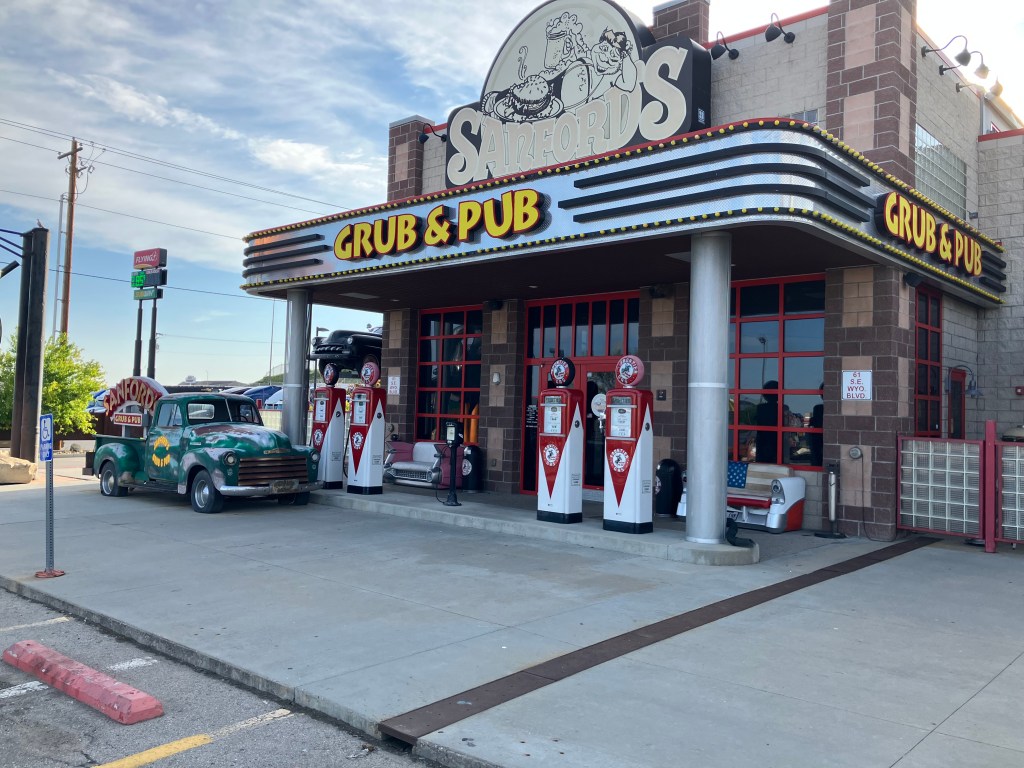
Anyway, equipped with The Best Cup of Coffee Ever, I pointed the Peregrinator west and headed out of Casper. Casper is a worthy town, situated on the banks of the Platte River and possessing a rich history as a US fort and as a waypoint for westward immigrants. But it’s a bit too big and modern for what this trip has focused on. The perfect illustration of this is Sanford’s Grub and Pub on SE Wyoming Blvd:
Sanford’s Grub and Pub in Casper, Wyo.
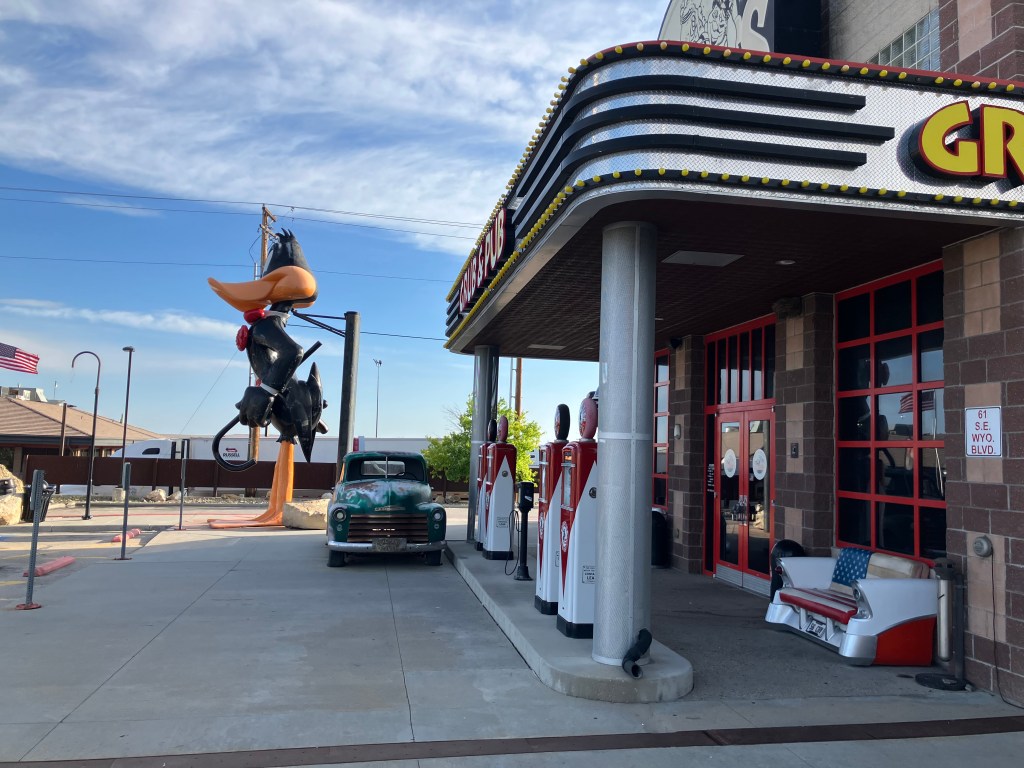
The place is flanked by a giant Daffy Duck and a giant Bugs Bunny.
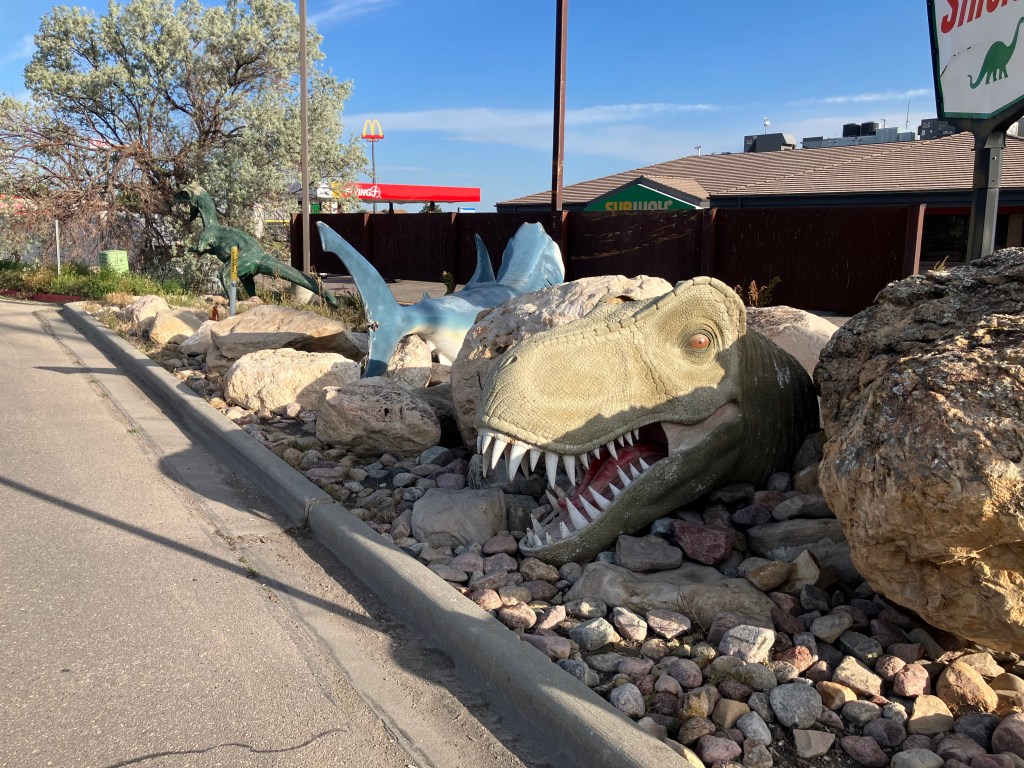
No theme is too random for Sanford’s Grub and Pub!
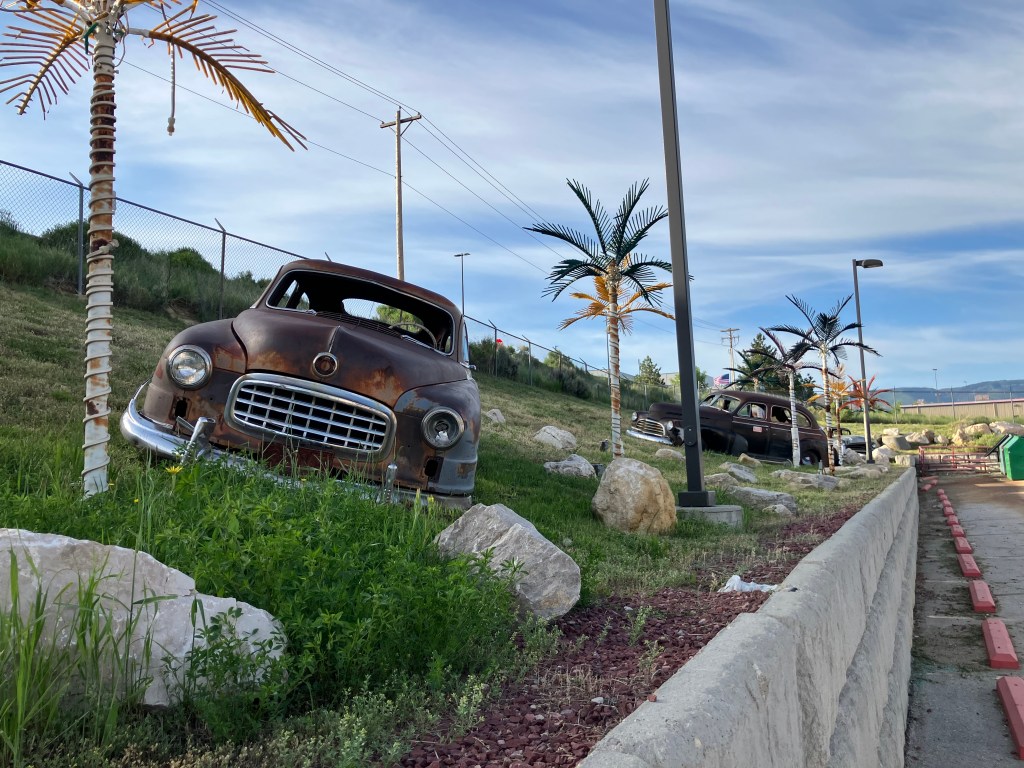
The back parking lot has a Cadillac Ranch vibe, with the hulks of numerous old cars planted in the landscaping.
To be sure, Stanford’s Grub and Pub has many of the things I’ve enjoyed along Route 20: Old cars, streamline moderne architecture, roadside kitch. But it feels too curated, too much like it was designed in a lab by a soulless consulting firm in Greeley Colorado. It just tries to hard. Don’t get me wrong: It’s probably a great place to take the kids. And I’m told they have a great beer selection. It just lacks the sincerity that abounds along the quieter stretches of the route. So I got directly back on Route 20 and headed out of town.
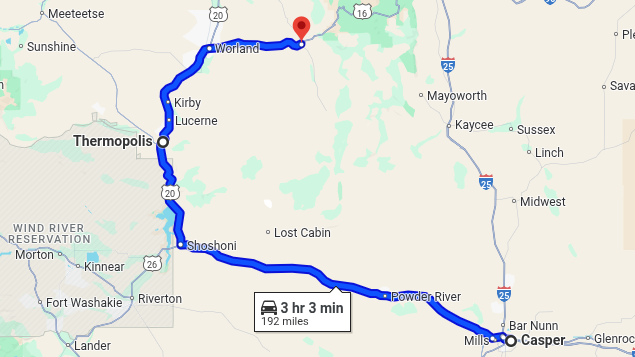
Today’s route: From Casper (lower right) to Worland (where I departed Route 20) and east to Ten Sleep.
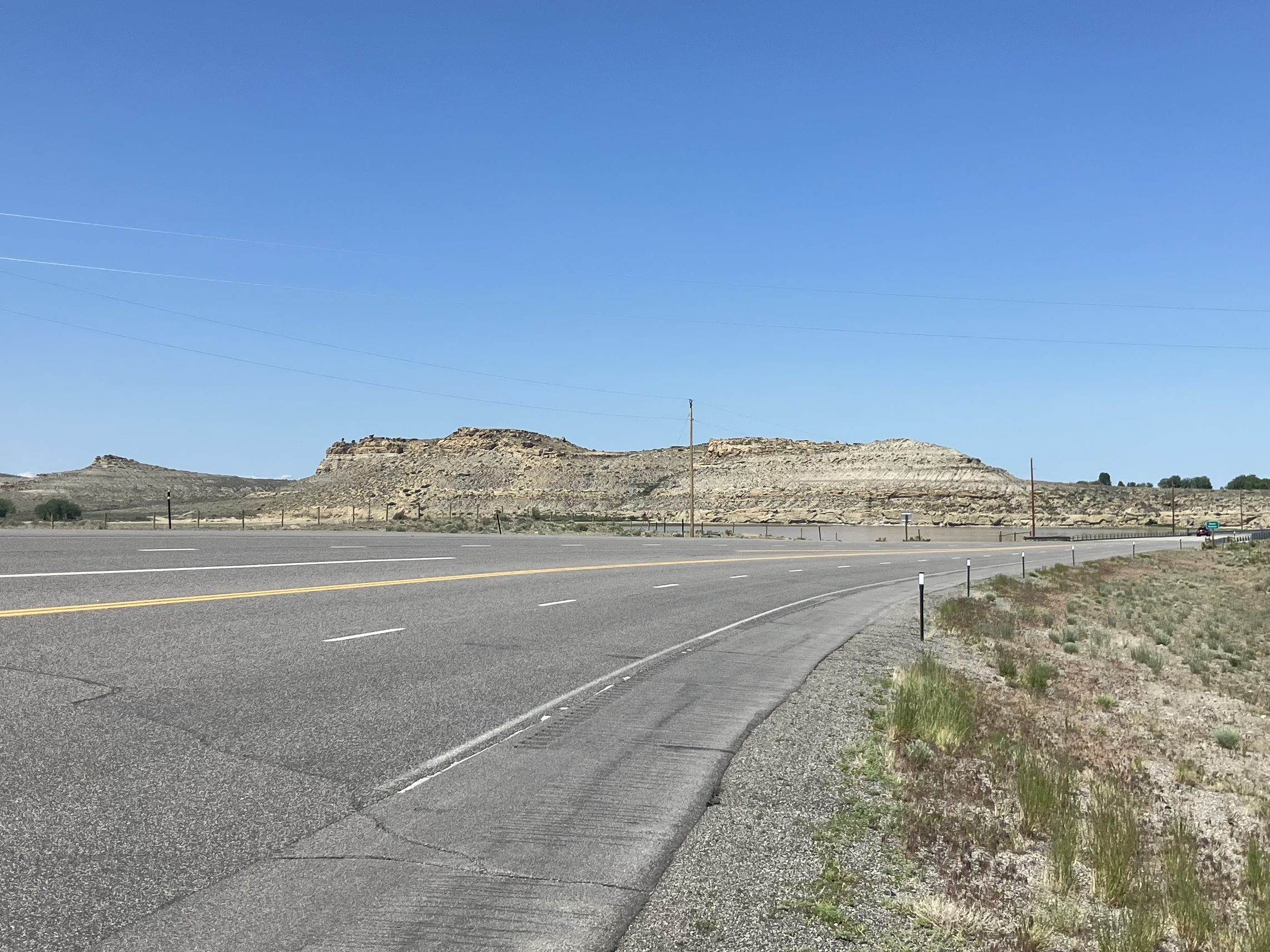
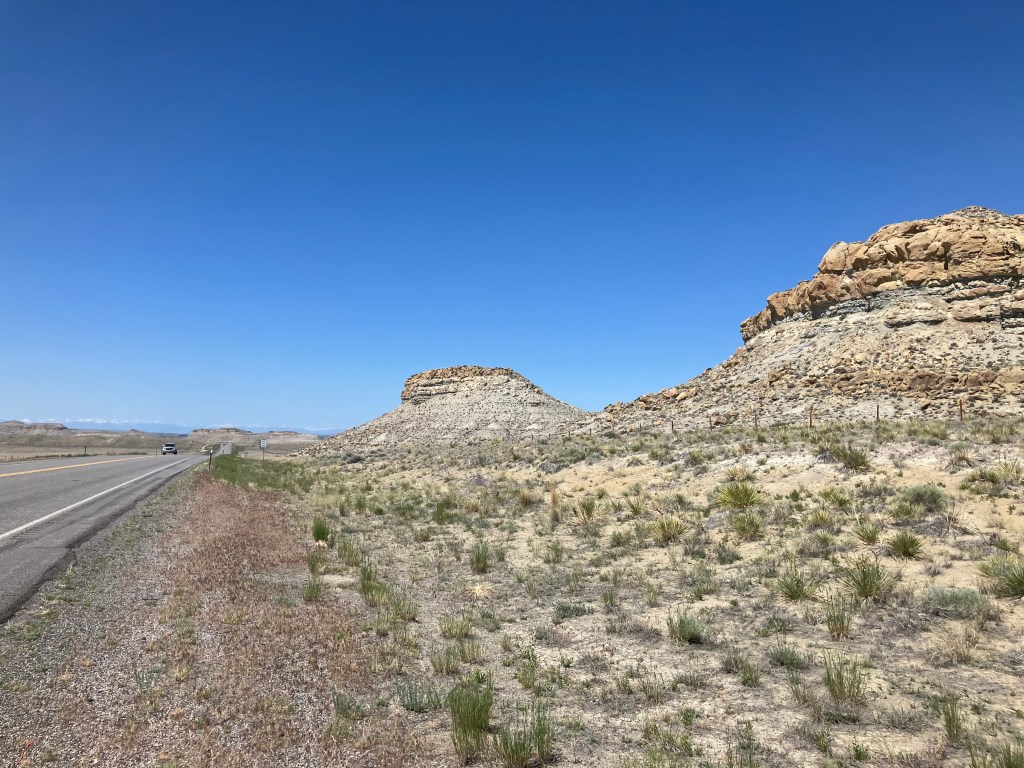
As we discussed yesterday, Wyoming has the least population density of any of the lower 48 states. There just aren’t that many towns, and most of those that I did encounter didn’t have much obvious history or engaging features. That said, the Wyoming landscape is starkly beautiful. Here are a few pictures from today’s drive:
Near Shoshoni, Wyo
Another view near Shoshoni.
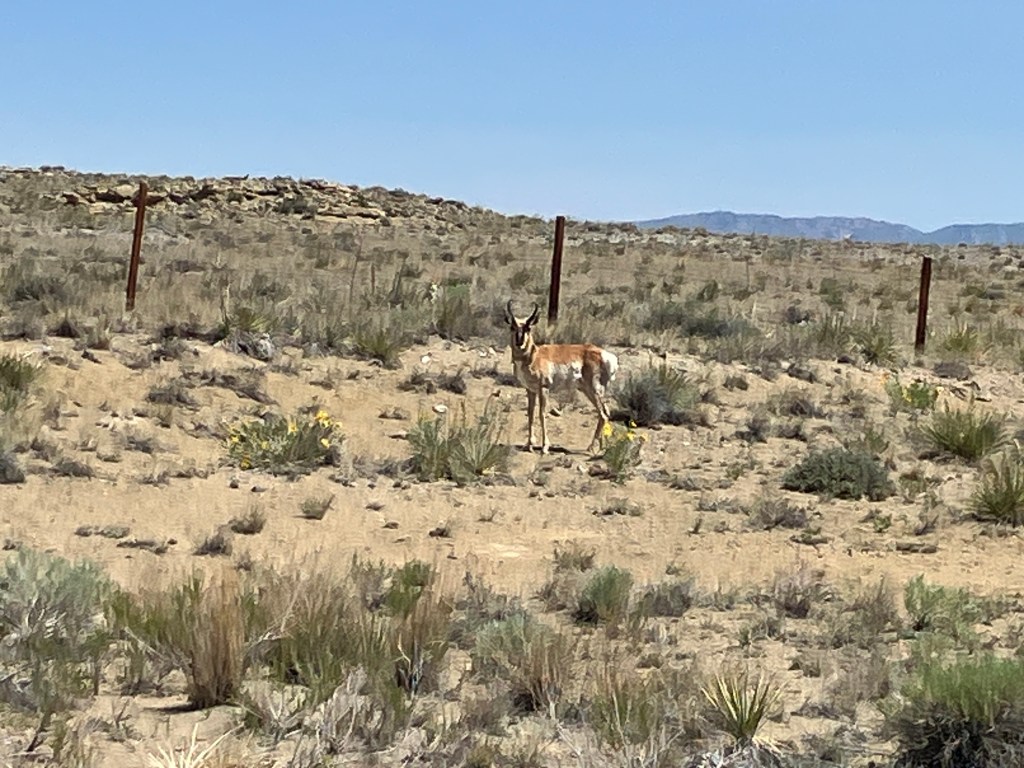
One of the many proghorns in the state. The locals evidently call them “speed goats.” They can run as fast as 55 mph.
Seeking a narrow slice of shade.
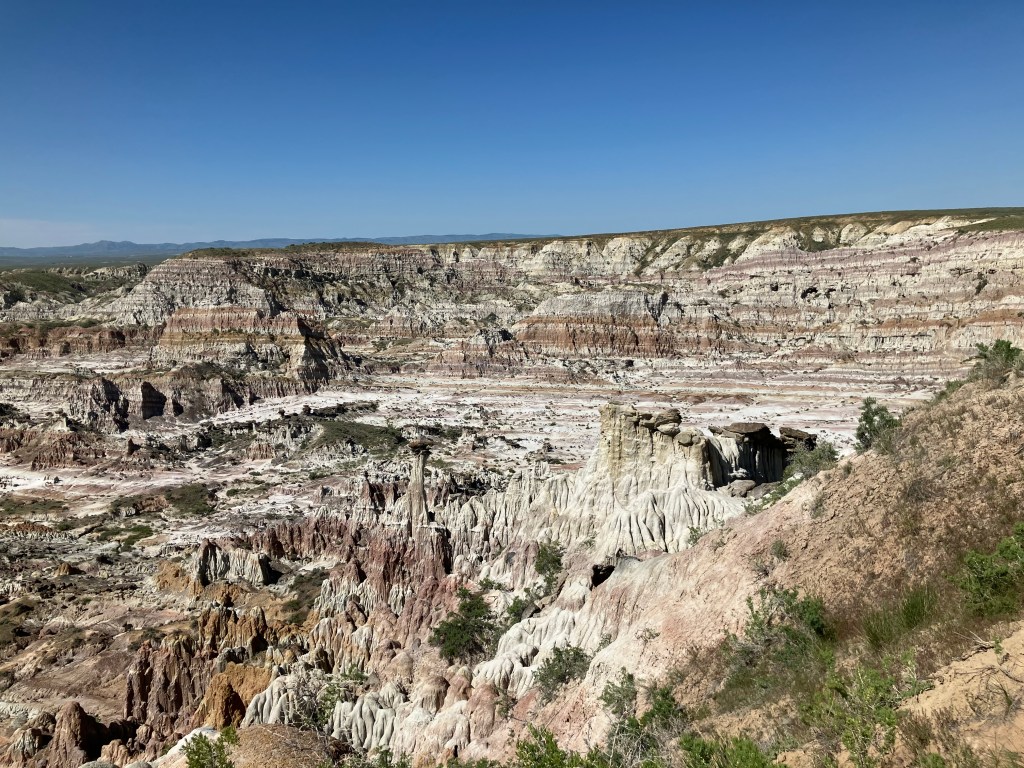
“Hell’s Half Acre” near Powder River, Wyo. It’s an ancient gorge in the middle of the prairie, where Indians used to drive buffalo over the cliffs.
So, that should give you a sense of the stark beauty along my path today. I just don’t have many man-made features to show you.
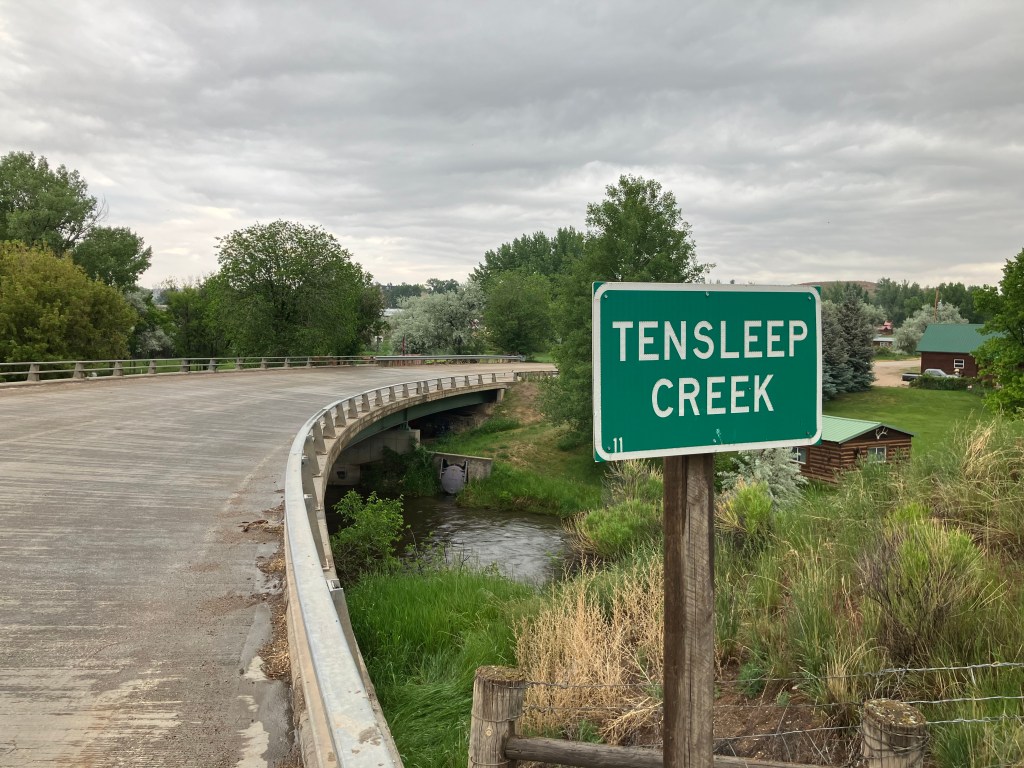
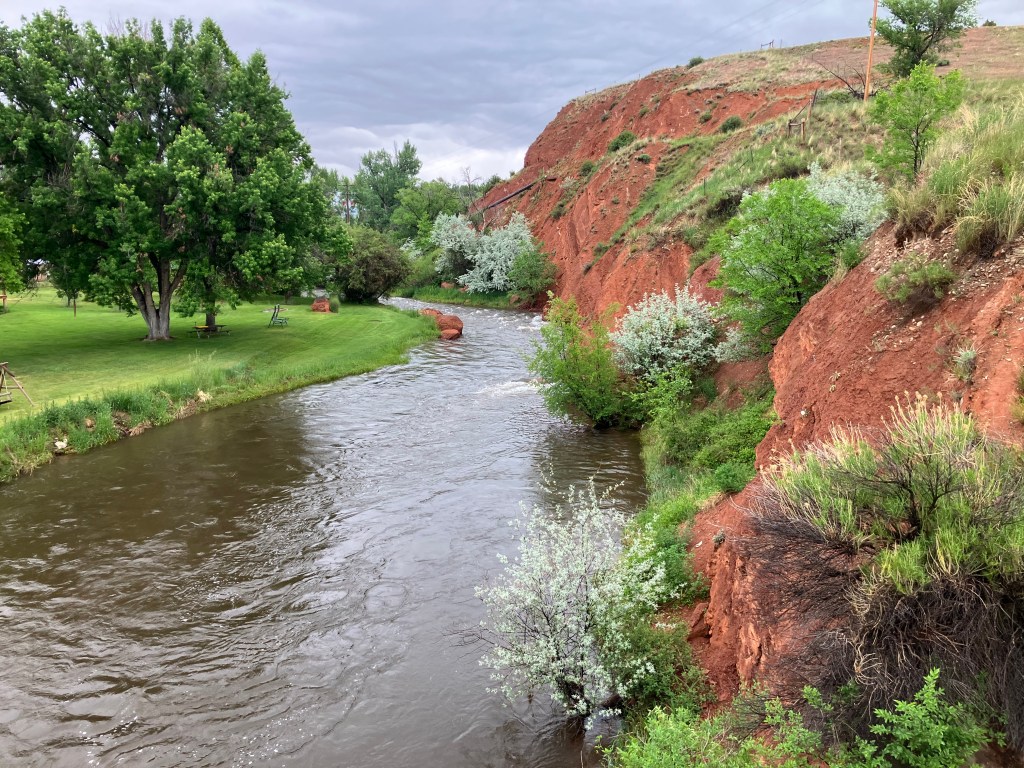
My goal for the day was Ten Sleep, Wyo (pop: 260). The name comes from Native Americans, who said it’s a ten-day (ten “sleeps”) trek from Fort Laramie. Today it’s a quiet and pleasant town situated on the laconic Ten Sleep Creek.
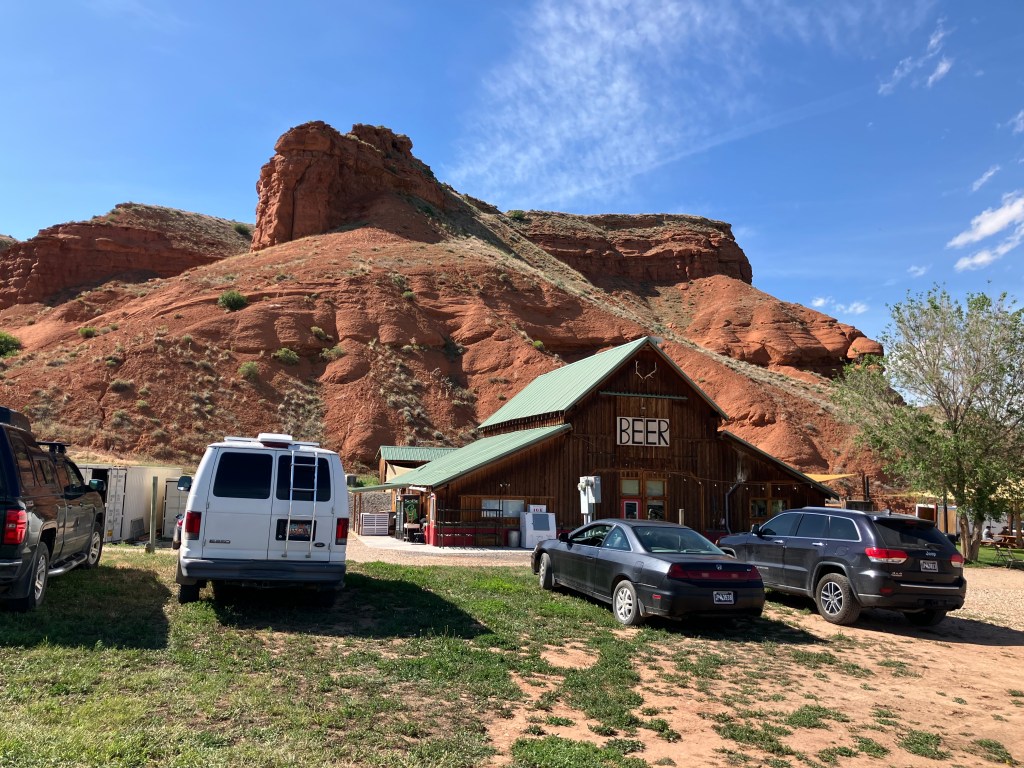
Now, Ten Sleep is actually about 25 miles off Route 20. I took this detour because I’m meeting three old friends for a short reunion at Chris P’s Western Retreat. They will likely join me for the final leg of this trip along the original Route 20, which runs to the eastern entrance of Yellowstone. That will probably be on Monday. Until then, we’ll be hanging out at the Ten Sleep Brewing Company. If you’re lucky, I might post some dispatches of the ensuing hijinks.
Location, location, location.
Speaking of brews, it’s time for the…
Brew of the Day
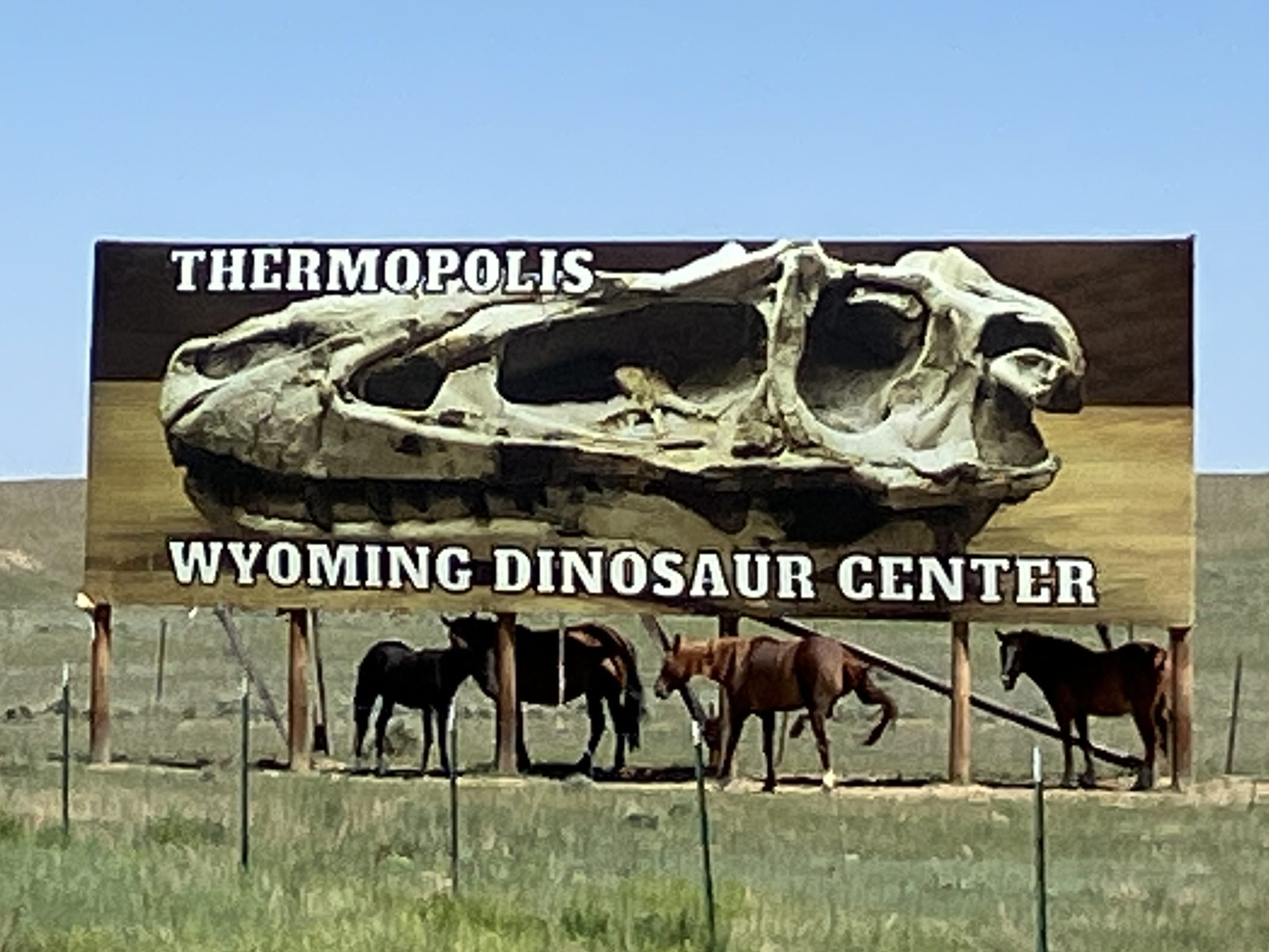
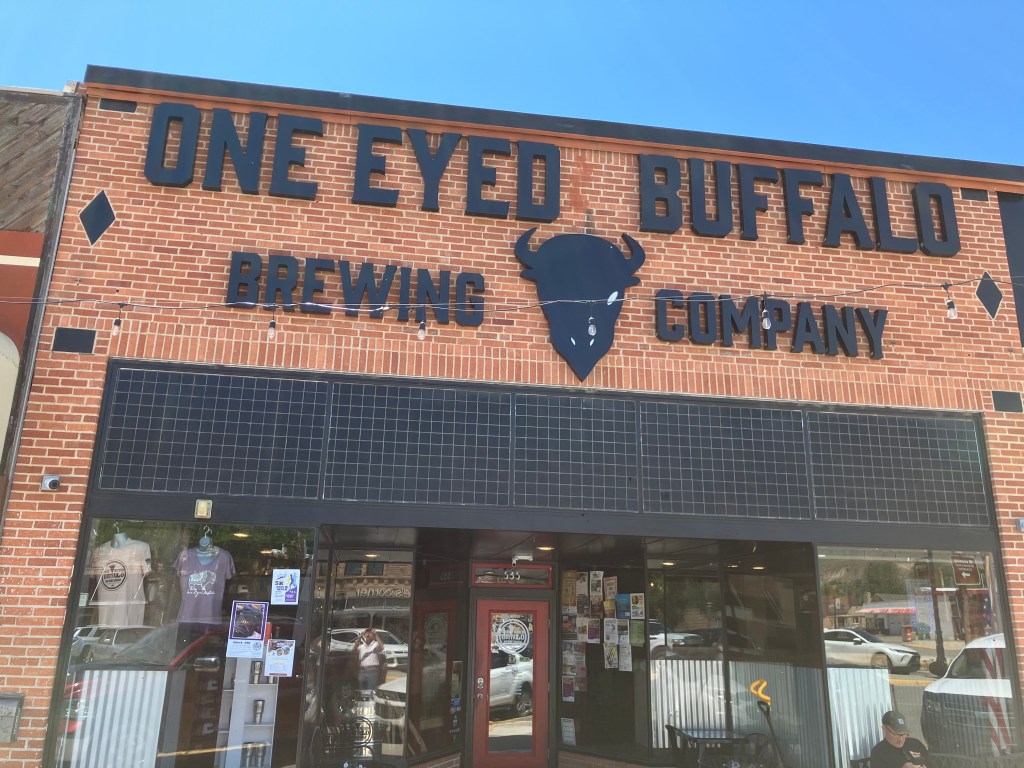
tEven though I spent the evening at the Ten Sleep Brewing Company, the BOTD appropriately comes from a place along Route 20 proper. And that is the One-Eyed Buffalo Brewing Company in Thermopolis (pop: 2,725), which was the largest city on today’s trip. Thermopolis means “hot city” in Greek, in reference to the natural hot springs.
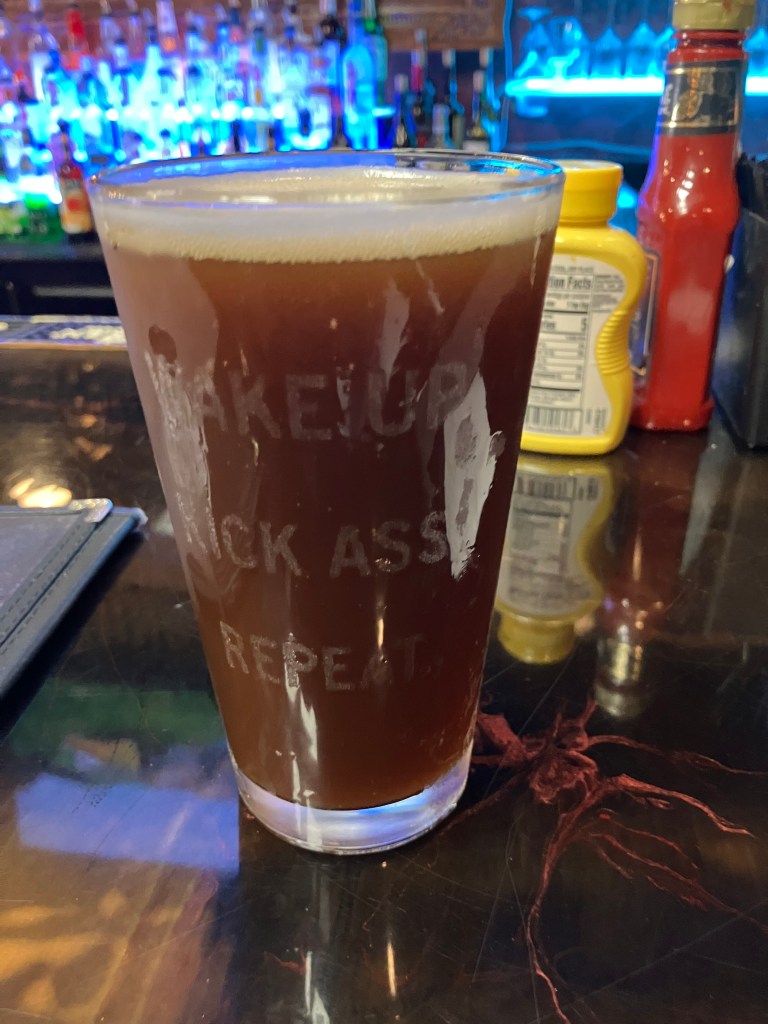
My BOTD was something called the W-Rye-O. It’s a brown ale aged in whiskey cask from Wyoming Whiskey distillers.
I’m a sucker for cask-aged beers of any kind. They generally have more depth and interest than a regular beer. For the W-Rye-O, the cask aging seems to have mellowed the brew. It’s extremely smooth and doesn’t have a lot of carbonation, and the hops are definitely reined it. There’s a distinct tinge of whiskey on the palate, though I wouldn’t say it complements the beer that well. In fact, the two tastes seem to be fighting against each other, akin to brushing your teeth after drinking orange juice. This beer has a slight off-bitterness that tastes like lighter fluid. It’s not enough to ruin the beer, but enough to lose a star. 3 stars.

 Chasing Phantoms