bridges · California history · Hydrology · trains

“We’re Number Two!”

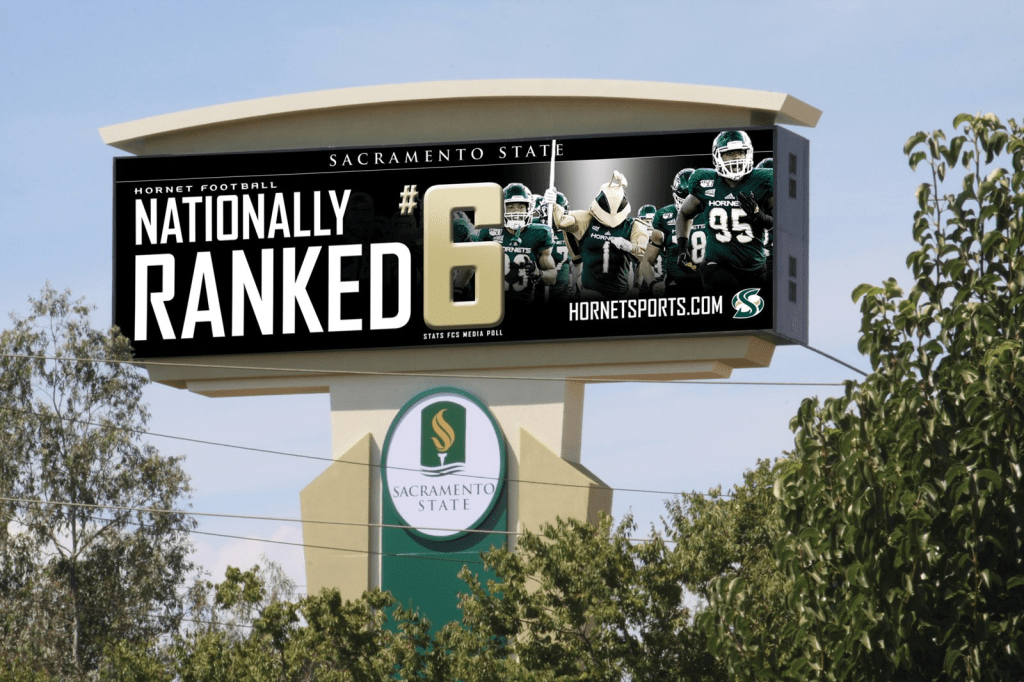
The other day I passed a billboard near Sacramento State University, which touted the campus football team’s Number 6 ranking in a media poll. This of course raises the question: how quickly do bragging rights decay as you move down the list, from first to second to third to fourth….?

A 1966 novelty song (on heavy rotation on Dr. Demento’s radio show while I was growing up) poked fun at this phenomenon. “The Ballad of Irving” sang the praises of the “142nd fastest gun in the West.” My favorite line: “A hundred and forty-one could draw faster than he/
But Irving was looking for one forty-three.
” Give it a listen:

I bring all this up because son Ian called my attention to “the second oldest railroad depot in California.” It’s in Calistoga, in the upper Napa Valley. The depot was built in 1868. (A quick Google search identifies the oldest Depot as Santa Clara Depot, which was constructed in 1863.)
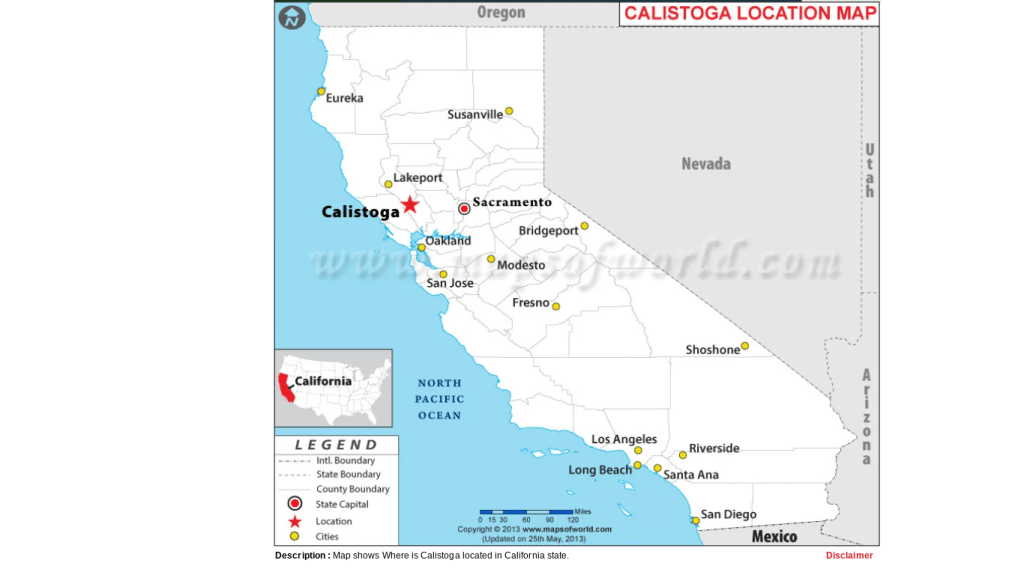
The important thing about the Calistoga Depot is that it held a grand (re-)opening just a couple of months ago, and it’s now repurposed as a microbrewery, distillery, and restaurant venue. Once I learned this I decided it’s obviously time for a road trip. So this morning I set out for Calistoga.

The city of Calistoga (pop: 5,300) was established in the mid-1860s, centered on Sam Brannan’s Hot Springs Resort. Sam Brannan had come to California from New York in 1846, and made his fortune selling gold pans to the miners during the Gold Rush. It should be noted that he first bought all those gold pans and other gear from every supplier in the West, monopolizing the market shortly before the Gold Rush became big news. He sold the equipment at an enormous profit.
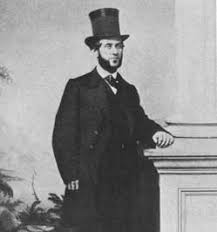
Sam Brannan, doing his Honest Abe impersonation.

As a result, Brannan became California’s first millionaire. In addition to building the Resort he co-founded the Napa Valley Railroad. The Calistoga Depot marked the northern terminus of that short line, carrying vacationers from the Bay Area.
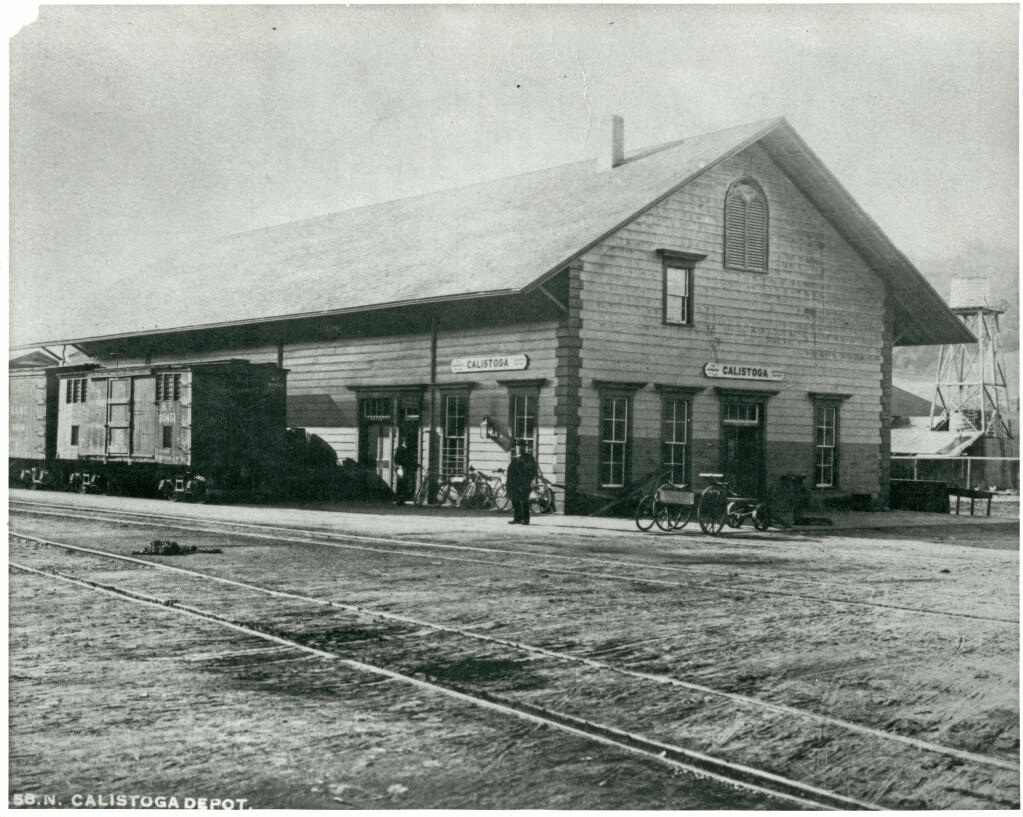
End of the Line.

Brannan’s Napa Valley Railroad didn’t last long, and was absorbed by what eventually became the Southern Pacific. SP dropped passenger service along the route in the 1920s, but today trains run again on those rails, in the form of the Napa Valley Wine Train.
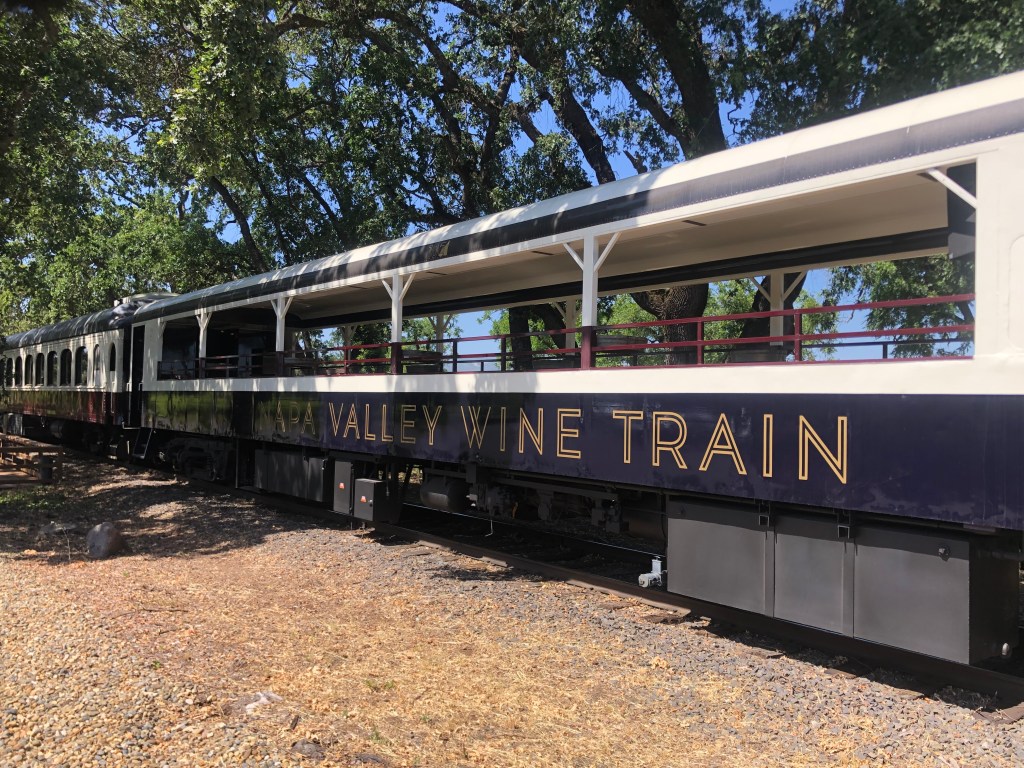
The more things change….

Incidentally, the name “Calistoga” is supposedly the result of an unintentional Malapropism. Brannan liked to compare his Hot Springs Resort to the famous Saratoga Springs in his native New York. So at the grand opening of his resort, he intended to say something like “Here’s to the Saratoga of California!” But it came out as “the Calistoga of Sarafornia.” (OK, that’s not exactly a Malapropism. Leave a comment below if you know what specifically this error of speech should be called.)

Paging Mrs. Malaprop…

One other thing about Sam Brannan: He built a distillery that cranked out huge amounts of bandy that, it’s said, rivaled the finest French cognac. All this, as a Mormon leader. The brandy will figure into our story a bit later.

Anyway, as I was saying, I headed out for Calistoga this morning. I took the scenic route roughly paralleling Putah creek westward from Davis. When I stopped for gas in Winters (pop: 7,300) this second-story window of an old office building caught my attention. I guess Sam (Spade, not Brannan) decided to relocate 70 miles eastward from San Francisco sometime after solving the Maltese Falcon caper.
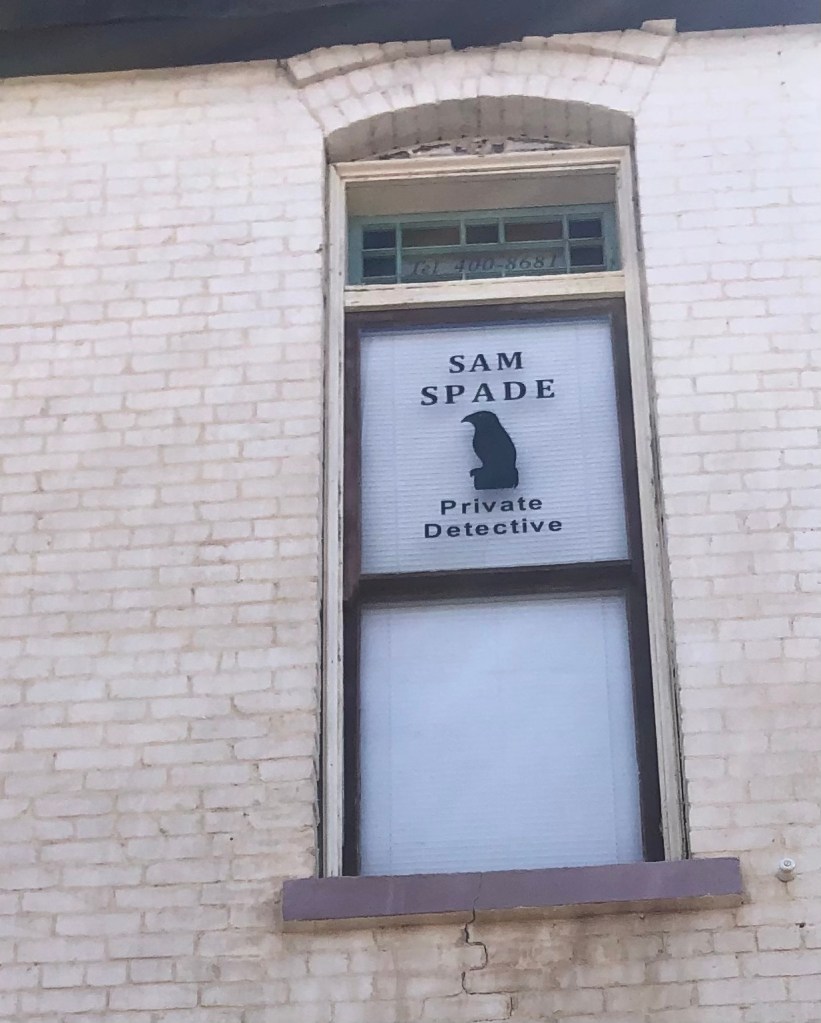
Don’t be too sure I’m as crooked as I’m supposed to be.” –Sam Spade, in The Maltese Falcon.

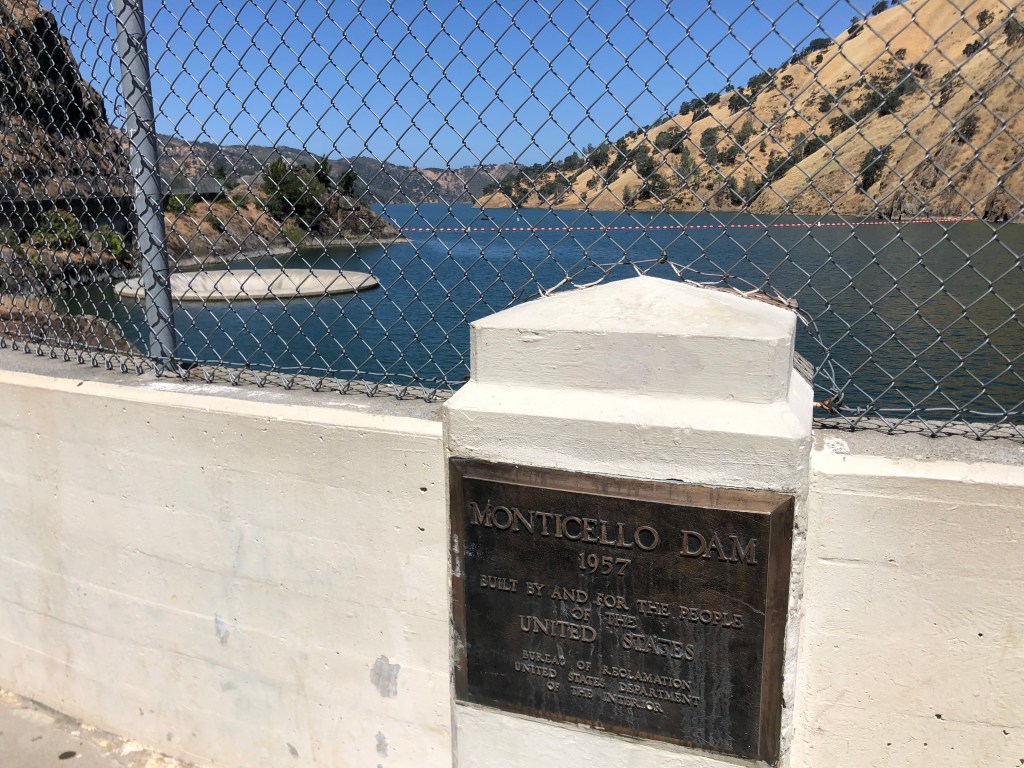
I followed Putah Creek to Monticello Dam, which was built in 1957 as a hydroelectric project that also resulted in Lake Berryessa. (Since we’re focused on rankings, Lake Berryessa is the 7th largest man-made lake in California.) After 65 years, the dam is showing its age, but the lake remains a popular spot for boating.
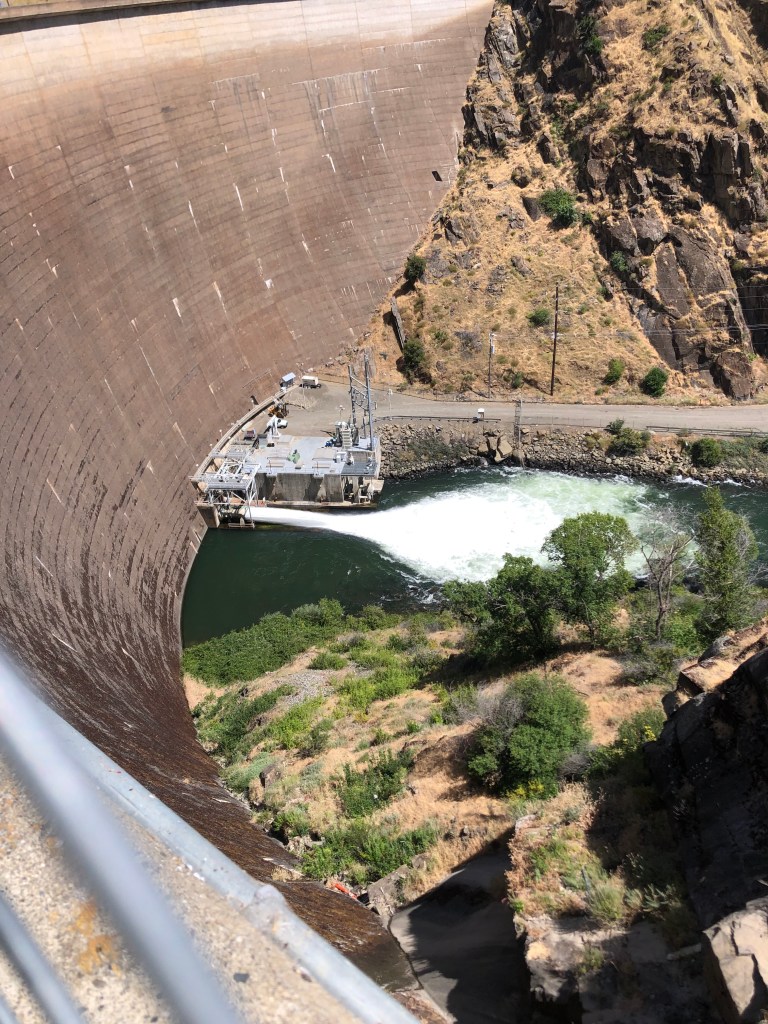
Looking down at the spillway, where water exits the dam.
Lake Berryessa

Conveniently, I rolled into Calistoga around lunchtime. And there was the Calistoga Depot, in all its glory. If Monticello Dam is looking a little long in the tooth after 65 years, the Calistoga Depot looks fabulous after more than 150 years.
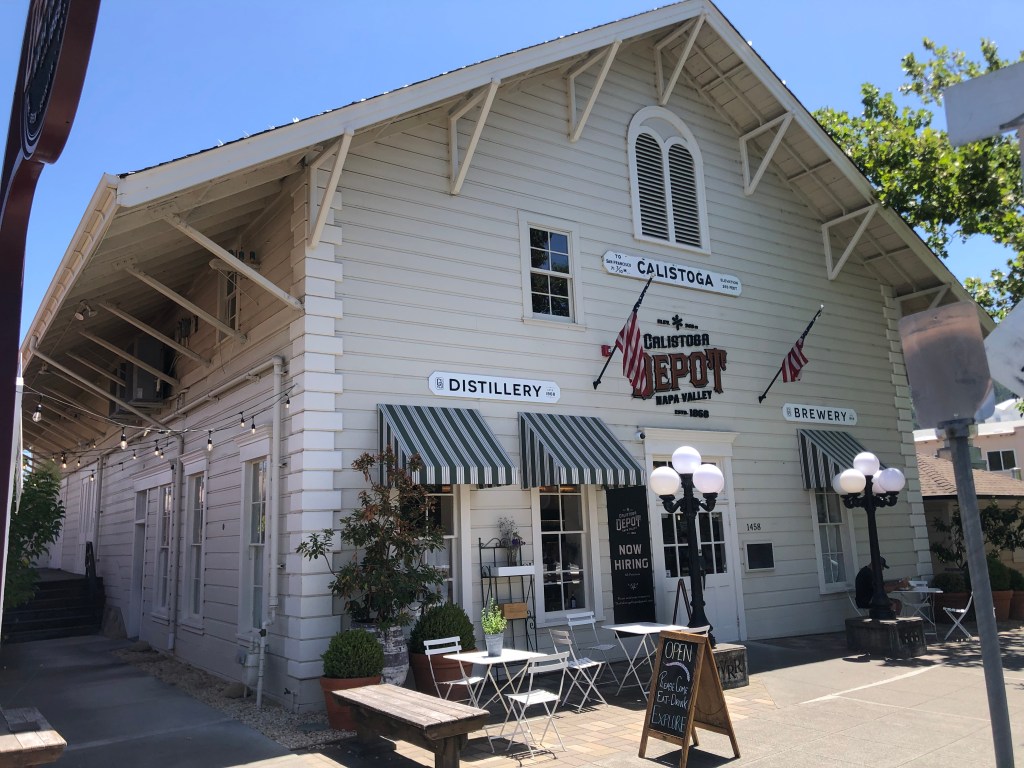
In fact, it might be a little too fabulous. Over the past few years the property has undergone an extensive renovation and repurposing, to the point that it doesn’t really feel as authentic as some of the dilapidated historic structures I’ve seen on other travels. I fear most of the Depot’s ghosts are long gone. Still, the building’s footprint and outward features are largely as they were in Sam Brannan’s time. Just compare the above photo to the historic photo near the beginning of this post.

Adding to the ambiance, a half-dozen vintage passenger cars are situated at the station platform. Each car is being used as a restaurant, bar, or boutique. Sadly, the “First Millionaire Saloon” car was closed today.
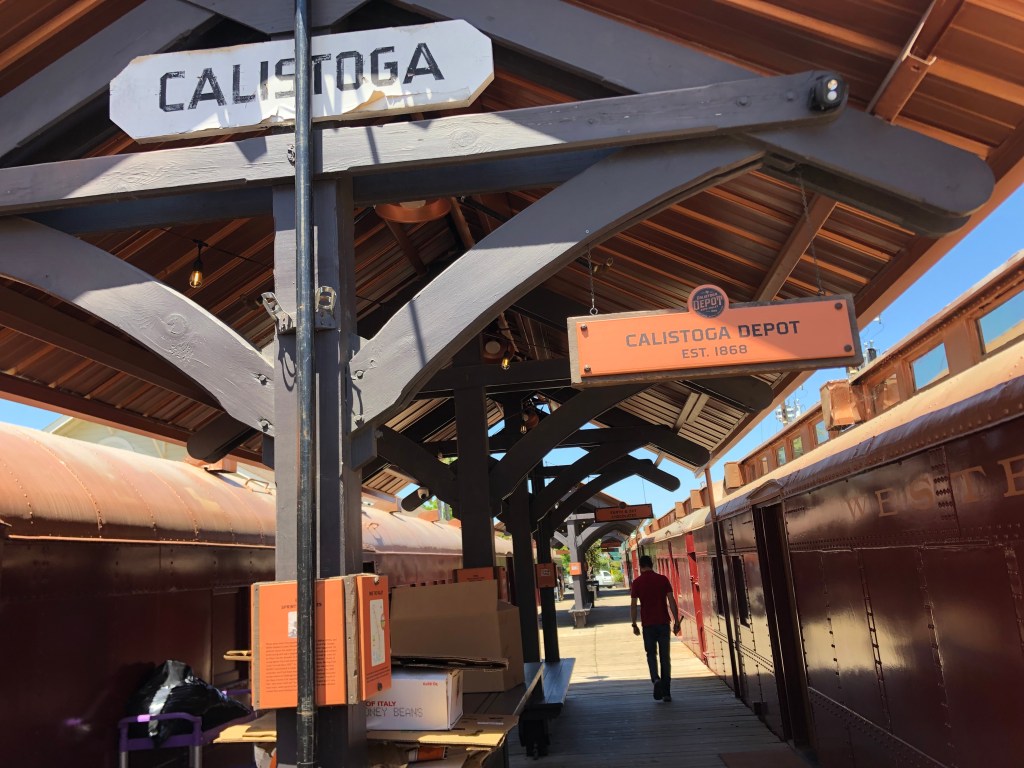
I got the tickets and a reservation set for two/Luggage waiting on the track/But I got no use for reservations without you/I got to give the tickets back -Lucky Millinder

But all was not lost. You can sit anywhere you like on the property–inside a lounge railcar, out in the biergarten, inside the Depot itself–and then you can order whatever you want–drinks, food, dessert. Roaming servers make sure you’re taken care of wherever you choose to sit. I opted for a seat in the biergarten, as the weather was perfect, and had me an awesome wood-fired pizza and a flight of local whiskeys.
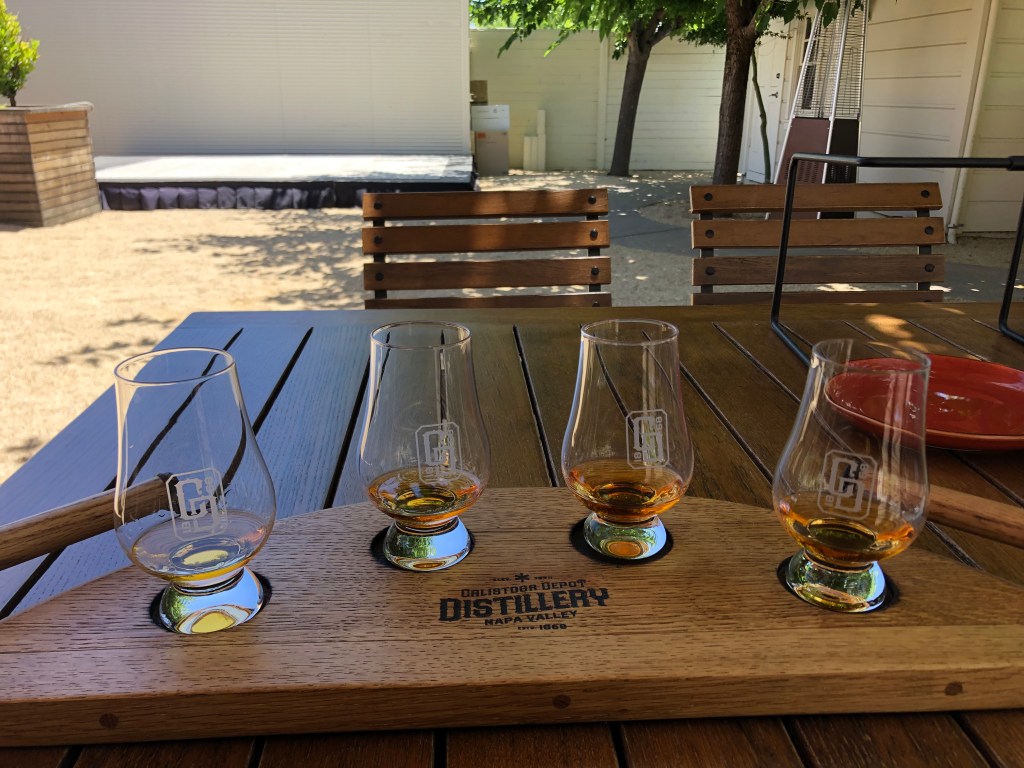
Number 2 is my favorite…which we’ll revisit when we get to the BOTD.

Although all the whiskeys are local, none is distilled on site. It seems that the fire risk inside the ancient station is just high. So they work with other local distilleries to create house brands.

After lunch I moseyed into the Depot building itself. It’s an impressive space, with upstairs seating that looks down on the main bar, taxidermied animals, a regulation pool table, antique chandeliers, historic photos, and various artifacts.
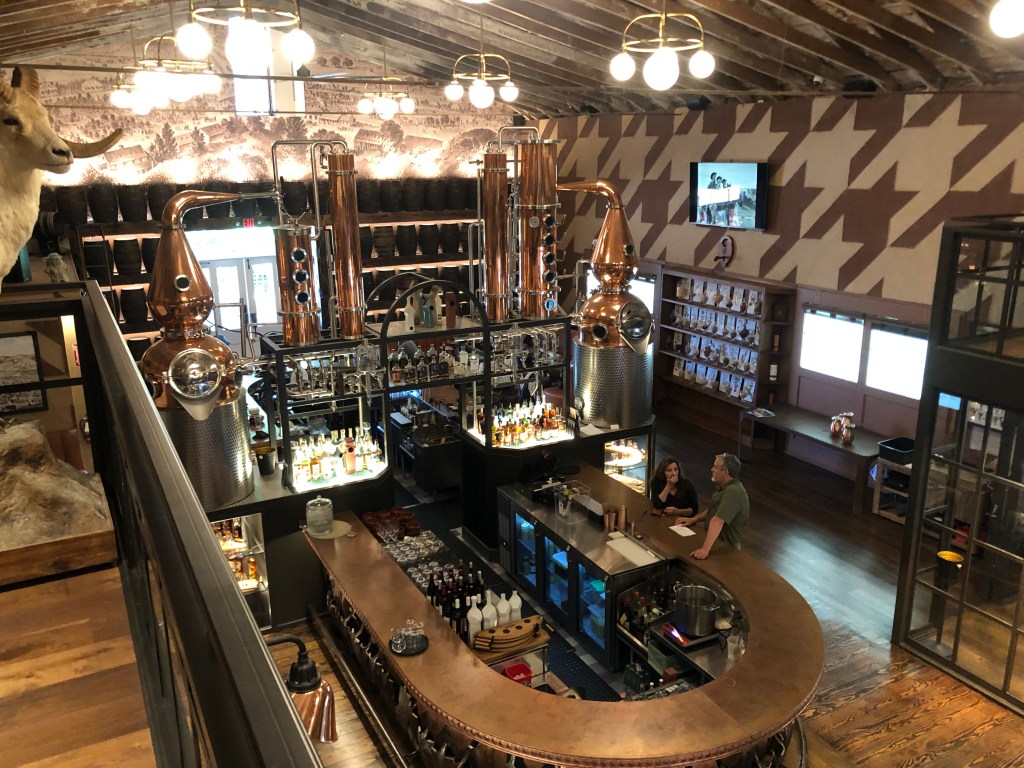
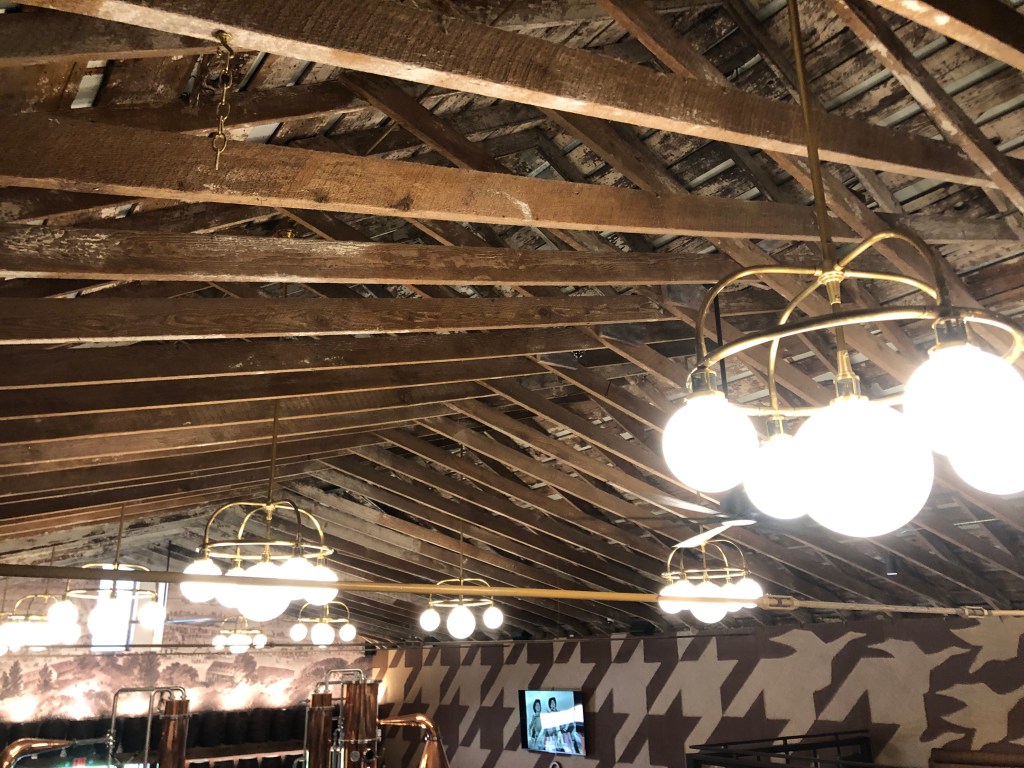
Worthy of California’s first millionaire.
The rafters appear to be original.

I bellied up to the bar and was served by the estimable Eddie. He’s been here since the (re-)opening, which admittedly was only like two months ago. But still, he’s in for the long haul. He served me a full pour of the second tasting from my flight: The First Millionaire Single-Malt Scotch.
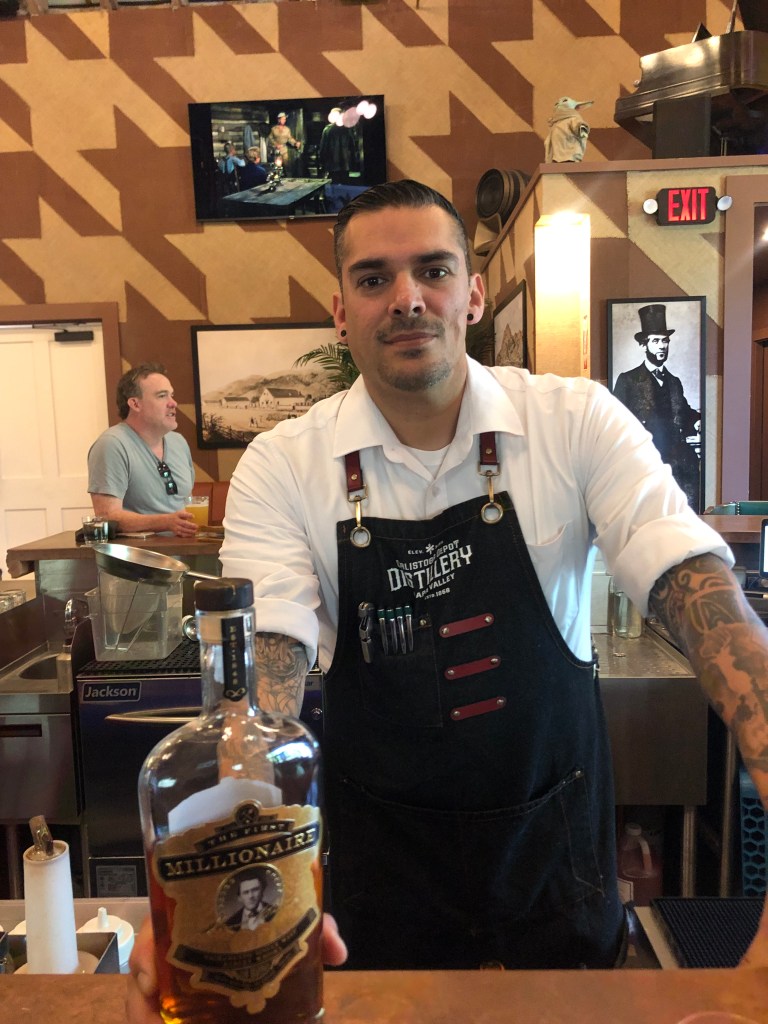
Eddie and a bottle of Sam.

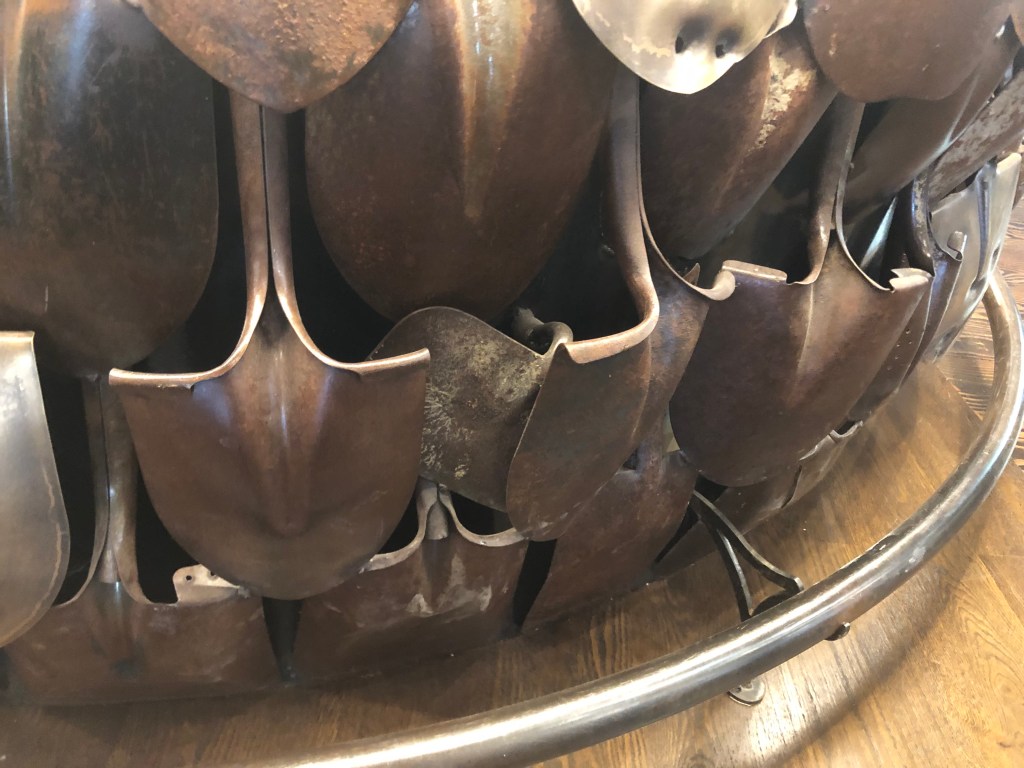
While I enjoyed my Scotch, Eddie pointed out a few features of the bar. Such as the shovel handles lining one end of the bar, and the shovel heads lining the other. Obviously, these are a reference to the tools Sam Brannan sold to the miners at exorbitant prices.
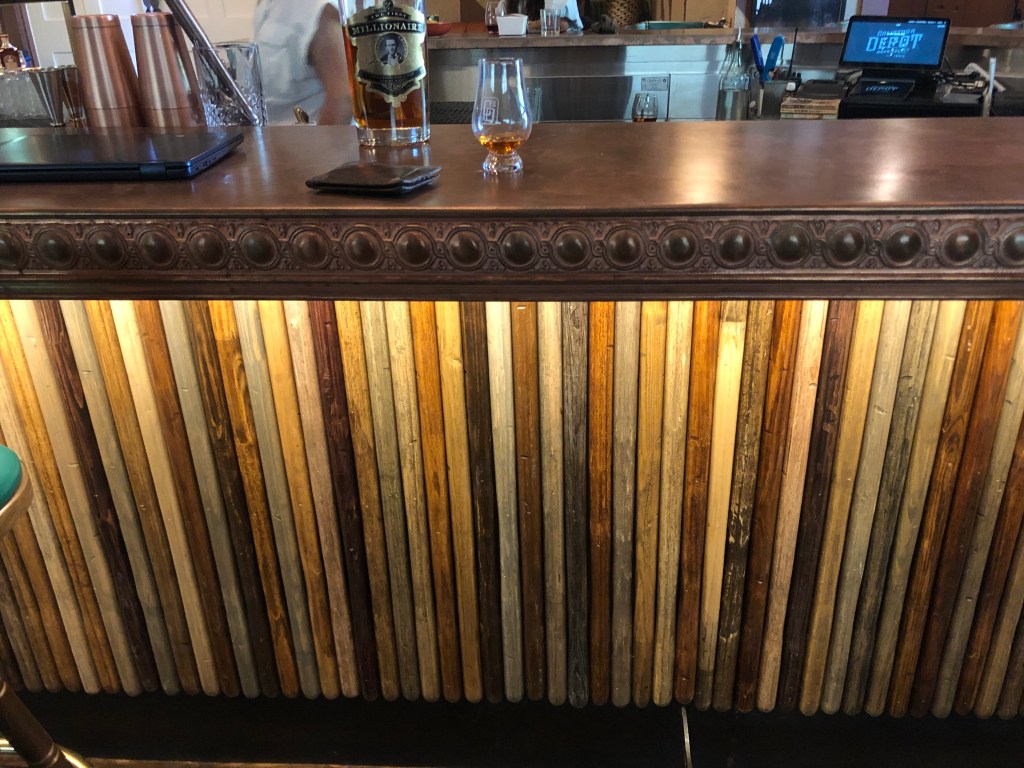
Shovel handles.
One of these things is not like the others….

I’m sure you spotted the irregularity among the shovel heads. Yes, it’s a–ahem–hoe. Eddie informs me it’s a none-too-subtle reference to Lola Montez, who was a famous Bohemian courtesan (among other things). Could she have been a lover to Sam Brannan? Eddie thinks so.

Which leads us to today’s BOTD–which is not a beer, but a rye whiskey. (Let’s call it the “Beverage Of The Day.”) Named “Fame and Misfortune,” it features a picture of Lola Montez.
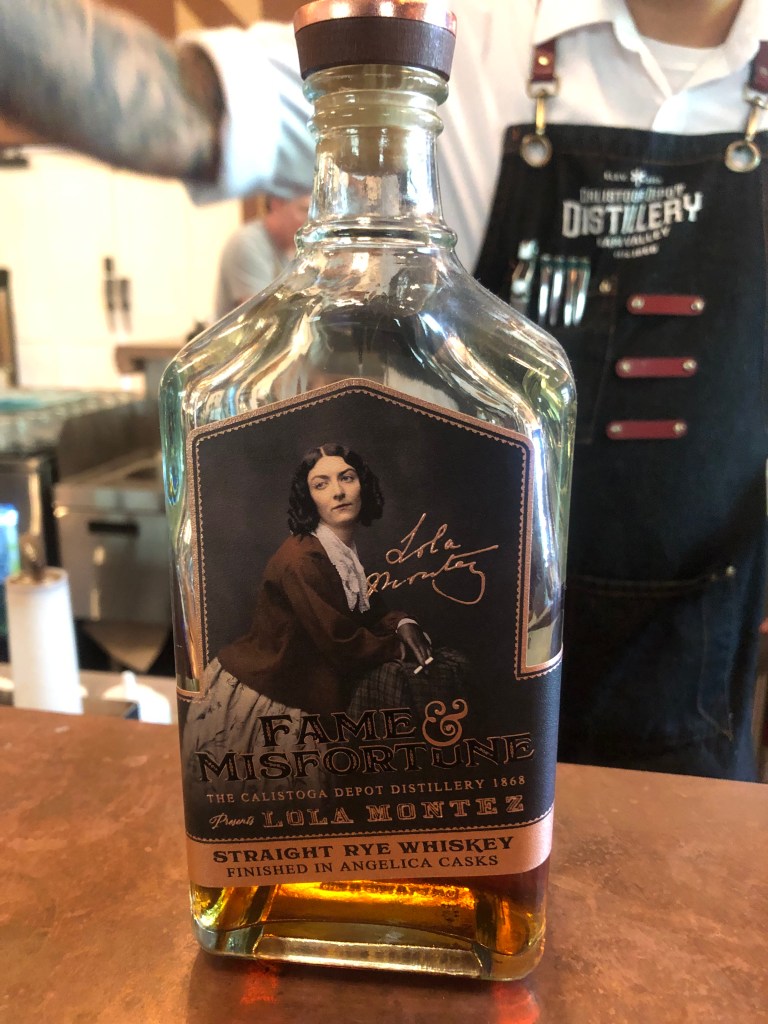
Yo ho ho and a bottle of Rye.

It’s a straight rye finished in Angelica (brandy) casks. Eddie poured me a healthy two fingers, and we were off to the races.
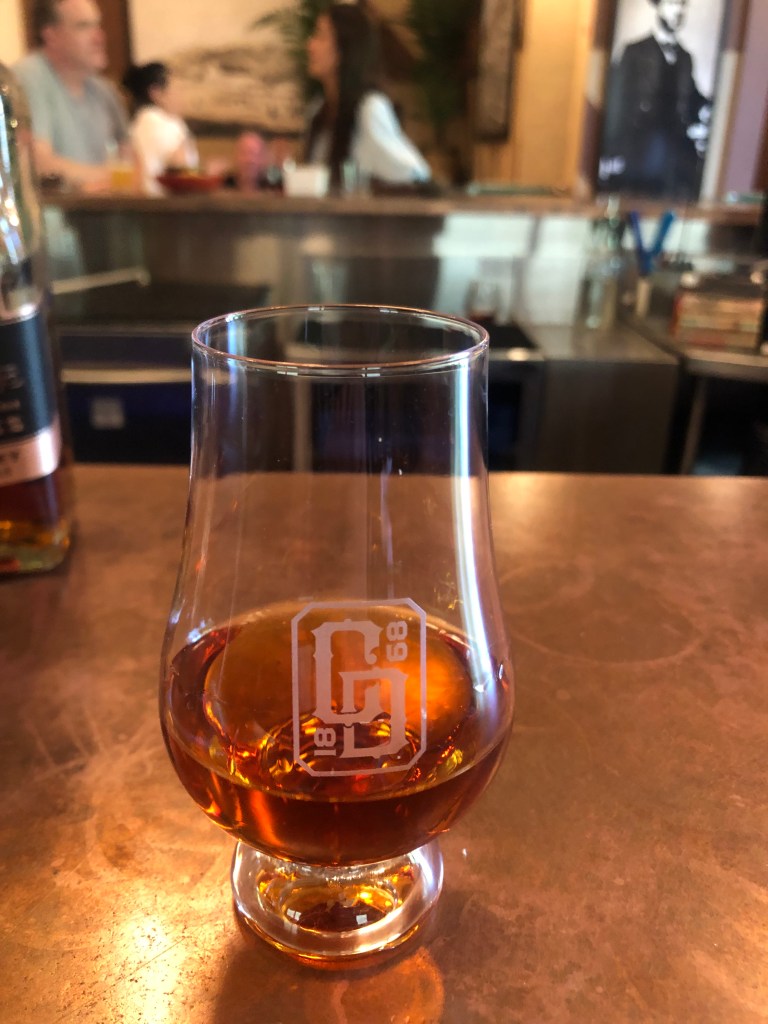
Now this is a soft and spicy rye. I’ll leave it for others to opine on how that might correlate with its namesake. But this is exceptionally smooth and warm, with no bite. I detect hints of cinnamon, cloves, licorice, and anise. The ABV is a standard 80 proof, which suited me just fine for the lunch hour. I enjoyed it so much I was ready to take a bottle home, but at $150 I found the price (but not the whiskey) hard to swallow. Four stars out of five.

After making my goodbyes to Eddie, I had one more mission: Remember that Sam Brannan had started out in this area with his Hot Springs Resort. It turns out there’s lots of geothermal activity in Calistoga. (It’s not for nothing that Calistoga Mineral Water is based here.) Today, one of the most famous such features is the Old Faithful geyser, which would be my final stop.

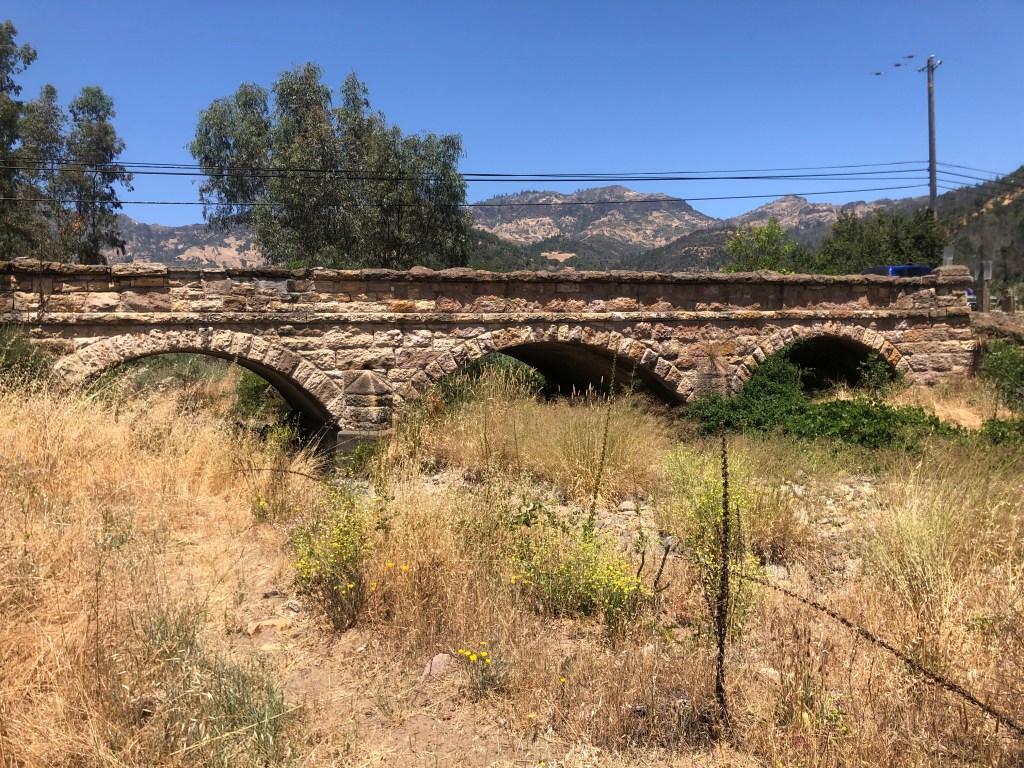
On my way to the geyser I crossed an old (1902) stone bridge over Gannett Creek. I can’t find much in the way of history about the bridge, but she’s a beauty. They just don’t make ’em like this anymore.
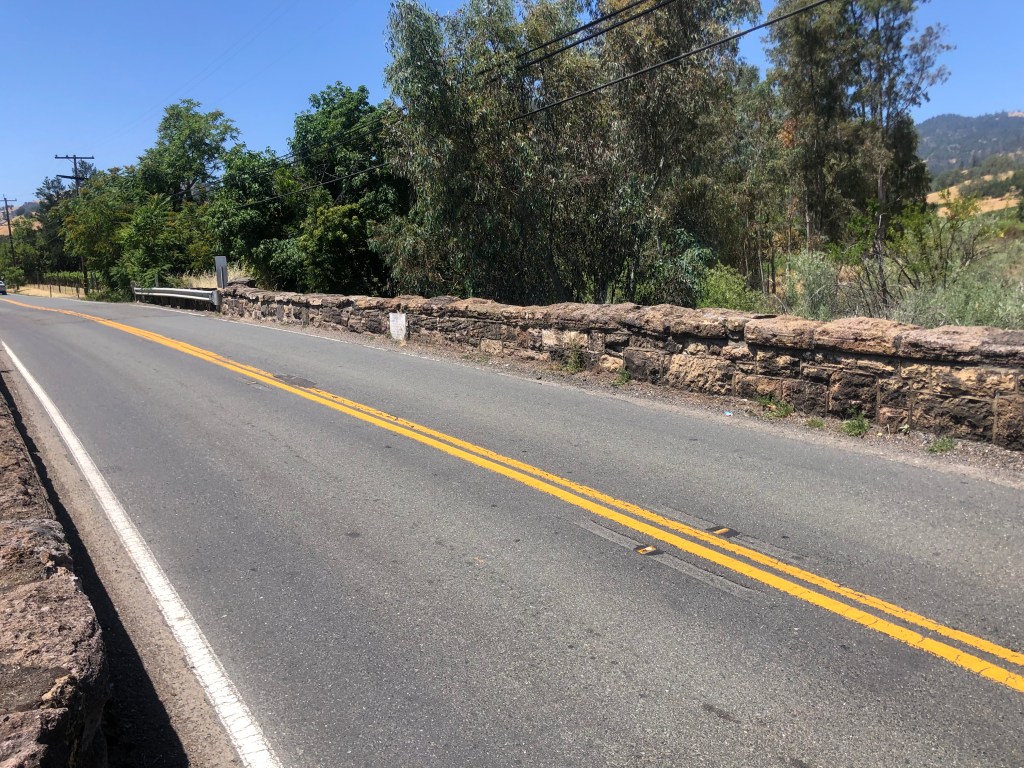
Not a whole lot to see from the roadway….
But from the (dry) creekbed, it’s an impressive structure.

Twenty minutes later I was at Old Faithful. Not to be confused with the geyser in Yellowstone, this one is, well, not quite as faithful. The time between eruptions can be anywhere from 5 minutes to an hour. Today it was about 30 minutes. While I waited, I checked out this photo op:
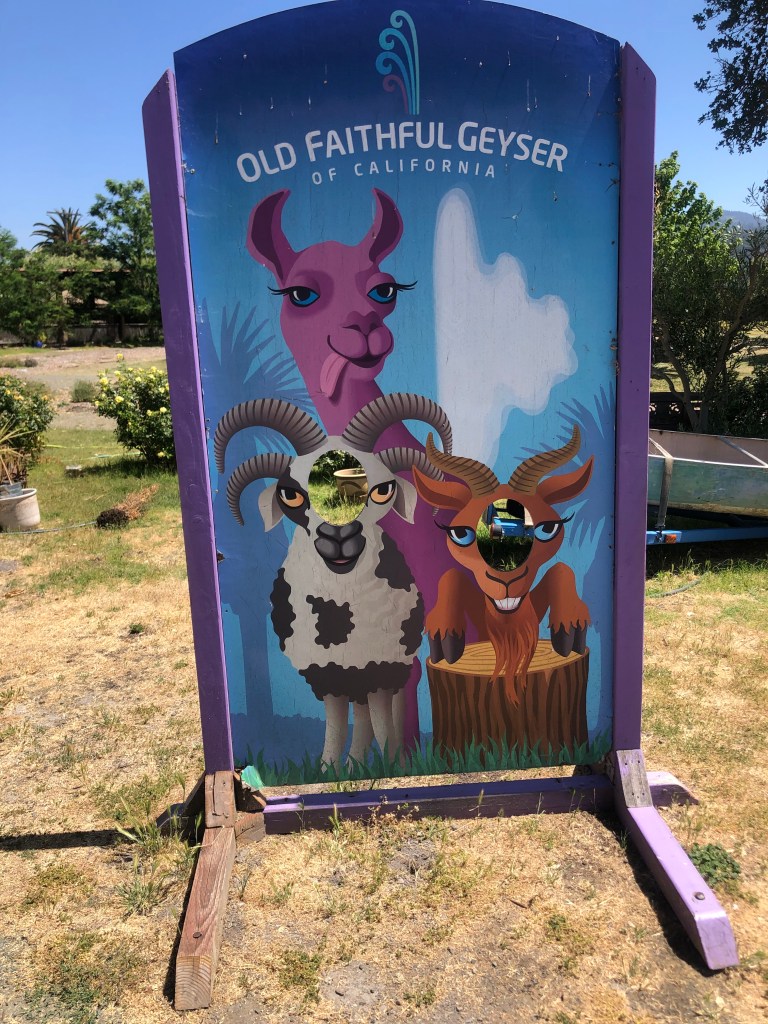
Now, doesn’t it seem odd that the hole for your face isn’t replacing the goat’s face, but just his forehead/nose?
I know what’s going on my Christmas card this year…

Finally, I was rewarded with a spray of 130-degree water that lasted over five minutes. Check out the video:

Near the end it seems to encounter prostate issues. Not that I’d know anything about what that’s like…

And thus concludes my trip to Calistoga. I must say that the Calistoga Depot preserves a worthy slice of California history, not so much because of the short-lived Napa Valley Railroad but because of larger-than-life Sam Brannan. And even those without a huge interest in early California History can enjoy some great food, drink, and hospitality.

Stay tuned for my visit to the oldest railroad station in California, in about two weeks!
bridges · Hydrology · Road trips · trains · Yard art

The Road to Reform

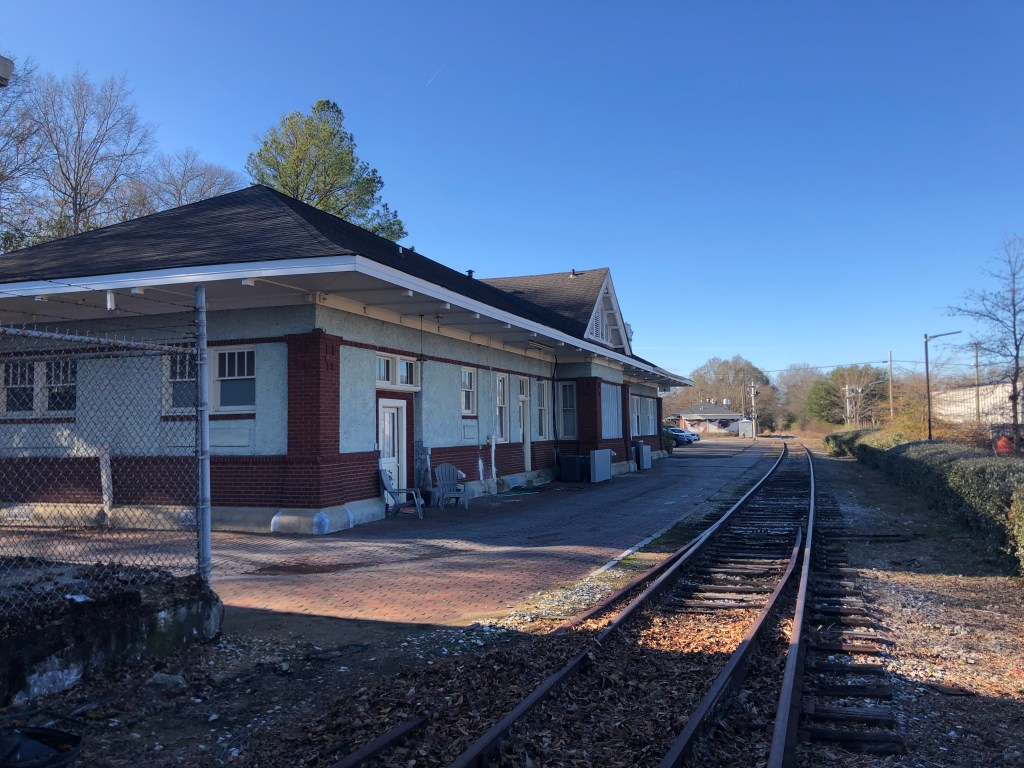
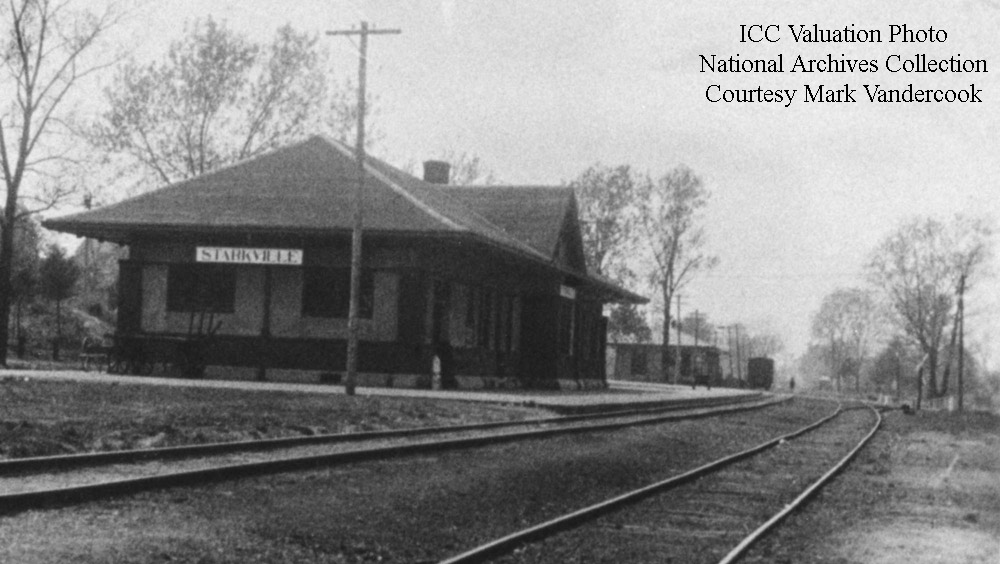
Like Texarkana and many other cities across the country, Starkville once had a “Union Station.” Unlike many of those other Union Stations, Starkville’s was not grand or ornate or even impressive. It was pretty much just your basic depot, one of many on the Mobile & Ohio line. Behold:

Starkville’s Union Station, as it appeared in 1916.

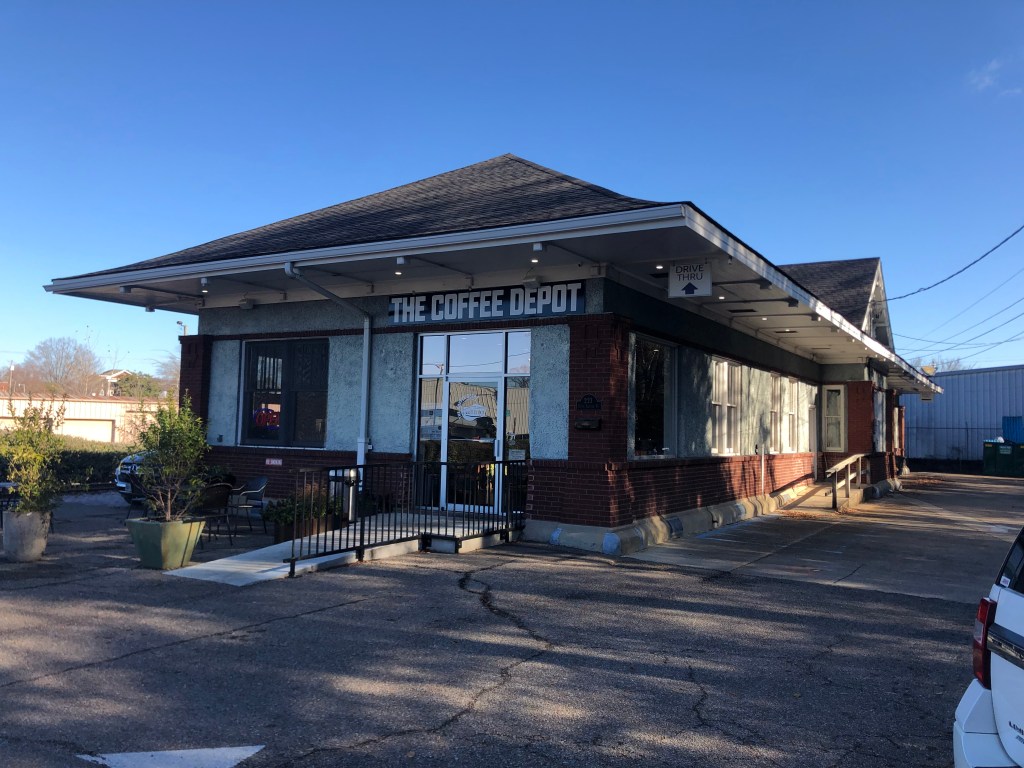
The station was built in 1914, and after the trains quit stopping in Starkville the building was converted into a pharmacy. In the course of time the pharmacy closed. And then, this morning, I had my breakfast in Union Station.

Union Station this morning. (This is the view from the back, to match the historic photo.)
Front view. Looking good after 110 years!
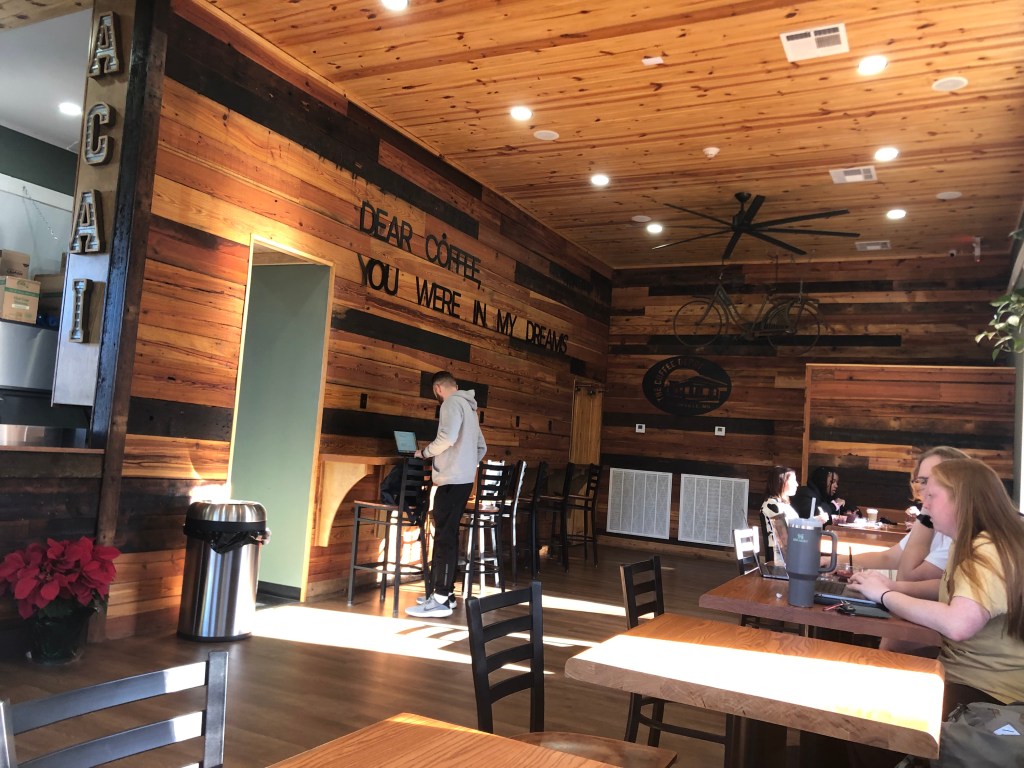
They’re calling it “The Coffee Depot” these days, though from the inside you’d never know it had once been a train station. Renovations were completed just last year, and it opened for business in June. The Coffee Depot is one of those modern, quality-focused coffee bars that cater to college students and what we used to call yuppies. It’s the first such place I’ve seen on my trip so far.

Yuppies and college students in their natural environment.

Though the breakfast menu is limited, the food is quite good. I had something called a “Depot Bowl,” which involved an acai base, strawberries, almonds, and peanut butter. The service is incredibly attentive and friendly. I would make this my usual coffee spot if I lived here.

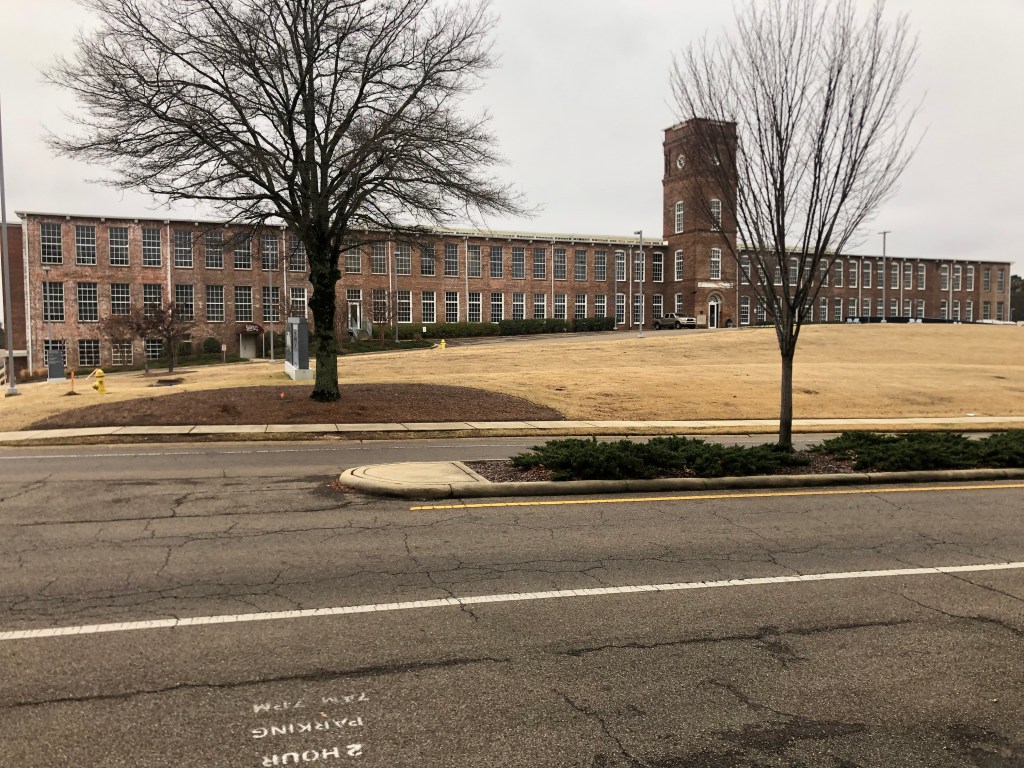
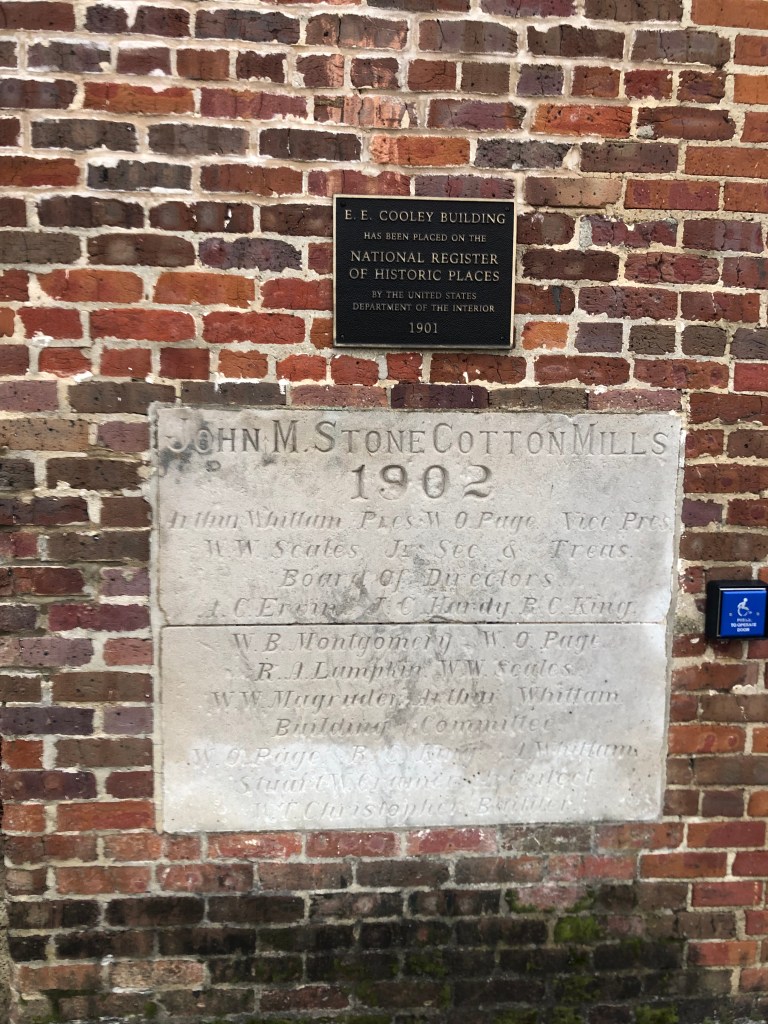
The Coffee Depot is located in the heart of Starkville’s historic downtown. Among other notable historic structures is the 1902 John M. Stone cotton mill. It closed and was sold to MSU in 1965 to house the university’s physical plant. Then, a few years ago, it was converted to an (enormous) events center.

More windows than the software aisle at Best Buy.
Relic from the days when every word was abbreviated.

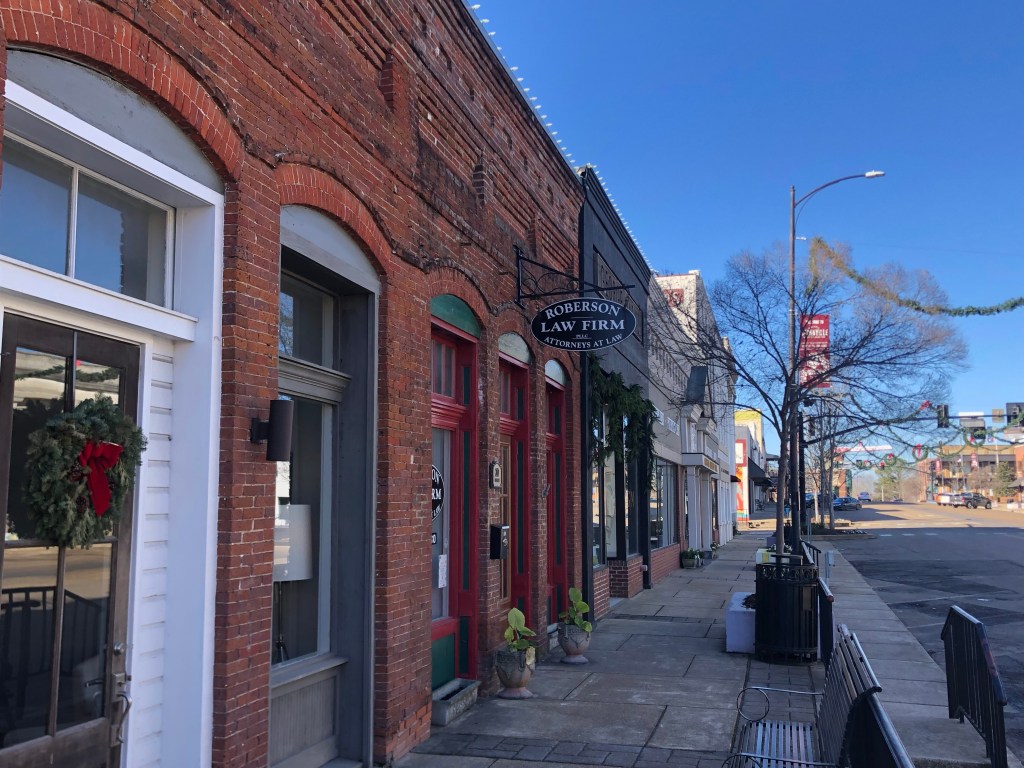
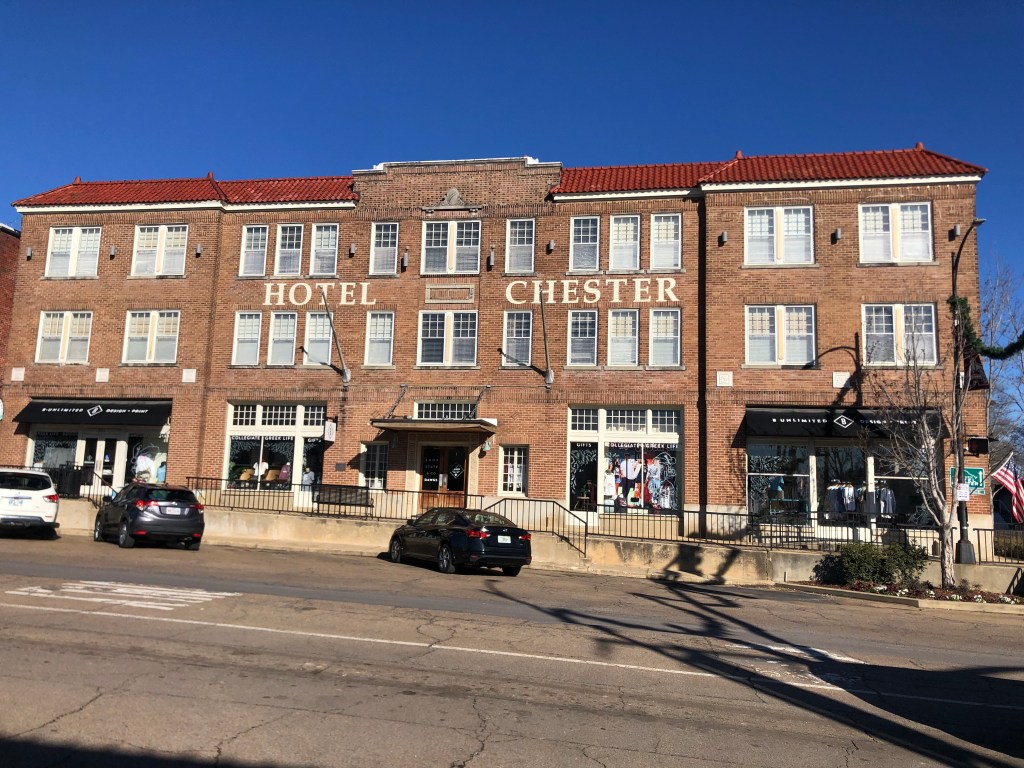
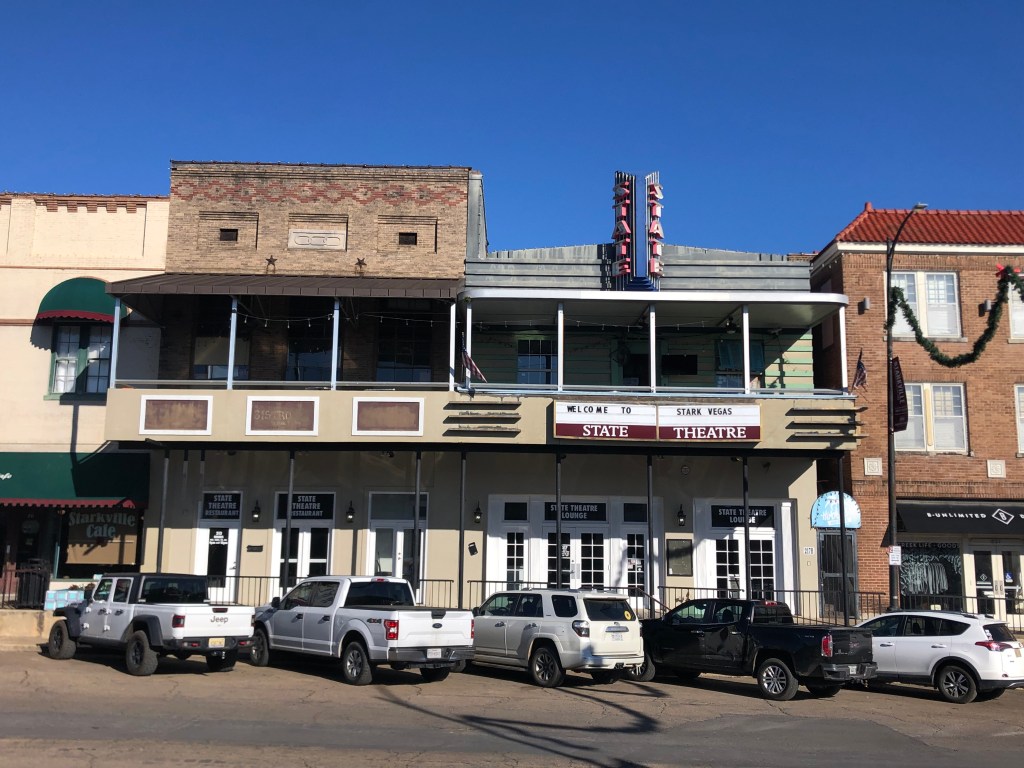
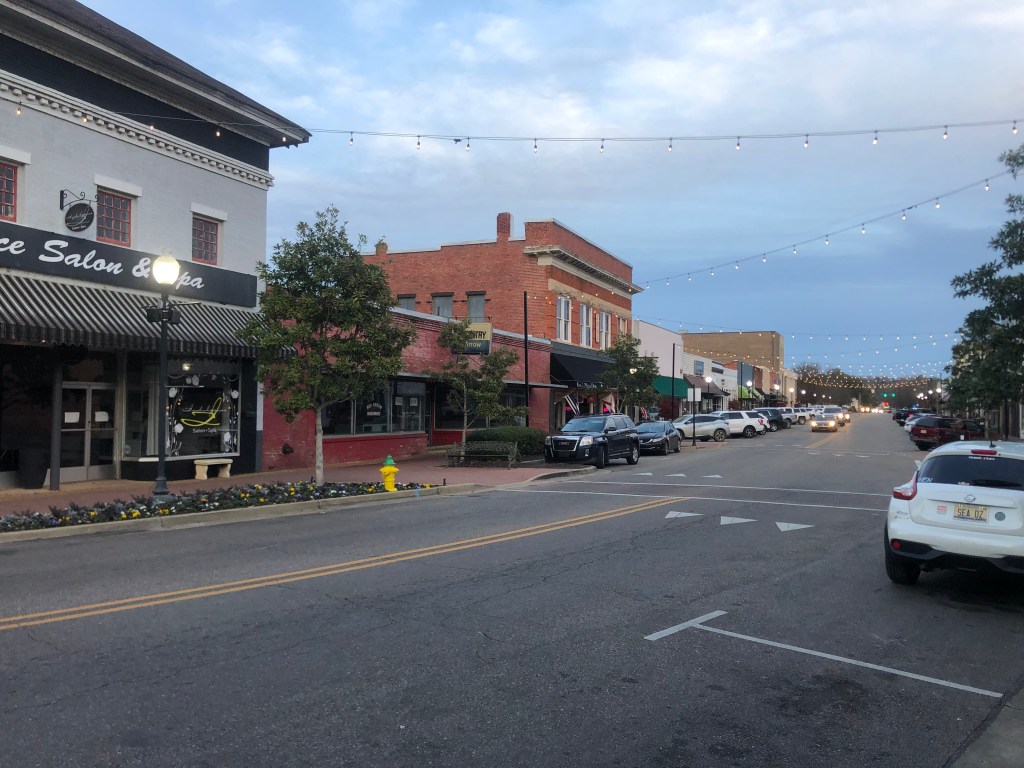
Starkville’s Main Street is a wonder to behold. It’s full of historic buildings, almost all of which have been lovingly restored. The pedestrian-friendly sidewalks are outfitted with benches and street art, and some of the cafes have outdoor seating. On top of all that, the sun finally came out and we’re enjoying glorious January weather.

The Hotel Chester, built in 1925, is still in operation.
Note the 1937 State Theater, which is now a music venue.

I think it’s no mystery why Starkville prospers while some of the other towns along this route are slowly dying. It’s got to be the presence of a major university. All that youthful energy, their future-oriented perspective, and of course their student loan money are all drivers for the local economy.

As much as I hated to leave the sunshine and the pleasant town, it came time to get back on the road. I was overdue for Reform. I speak, of course, about the town of Reform, Alabama.

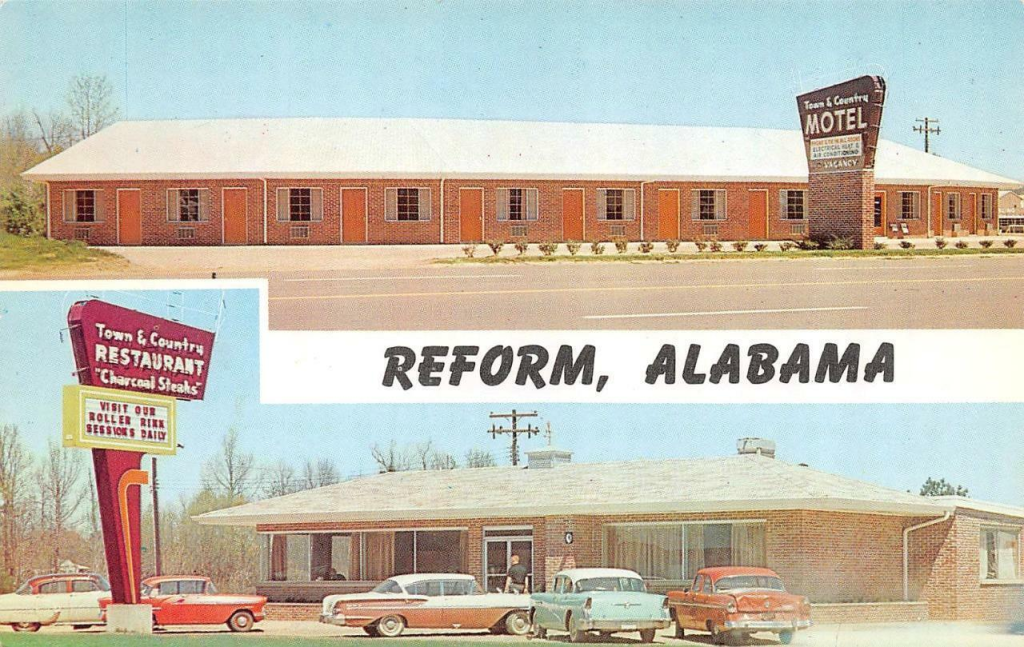
Reform (pop: 1,700) was incorporated in 1898. The story goes that a visiting evangelist urged the community to “reform,” and the townsfolk figured that was as good a name as any. Sadly, it appeared that none of the local businesses have capitalized on the obvious possibilities for a good pun or double entendre. Remember my visit to the town of Cool, California? Those people made use of the potential their name afforded. And Weed, Calif. sells T-shirts with its name in large letters. But not reform. There is no Reform School, no Reform Church, no Reform Fabricating Plant, and definitely no local chapter of Ross Perot’s political party. Even worse, the town apparently couldn’t be bothered to put up a sign at the city limits, thus denying me a photo opportunity.

On the other side of the ledger, Reform counts among its native sons a number of football luminaries: Tony Dixon of the Dallas Cowboys, Doug Elmore of the (then-) Washington Redskins, Michael Williams of the New England Patriots, and James Malone, who was head football coach at Northeast Louisiana State College in the 1950s. (Vic, that list was for you!)

Moving on.

I next came to the town of Northport, Alabama (pop: 31,00), which is planted on the periphery of Tuscaloosa. Northport is another college town. The influence of the University of Alabama is everywhere.

Call me Deacon Blues.

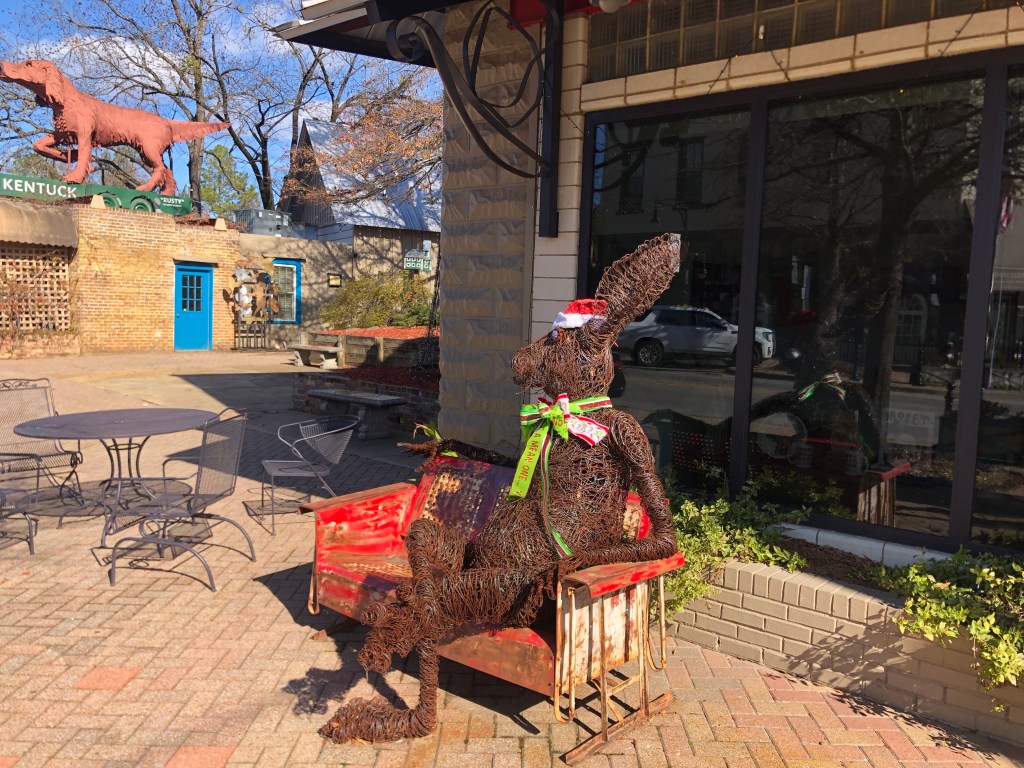
And, as we saw in Starkville, college towns tend to be more lively. Northport’s downtown restaurants were packed, and a whimsical art gallery was just opening. The arts scene is big here, with art walks held on the first Thursday of each month, and a major arts festival each October.

I love the posture of this rabbit.
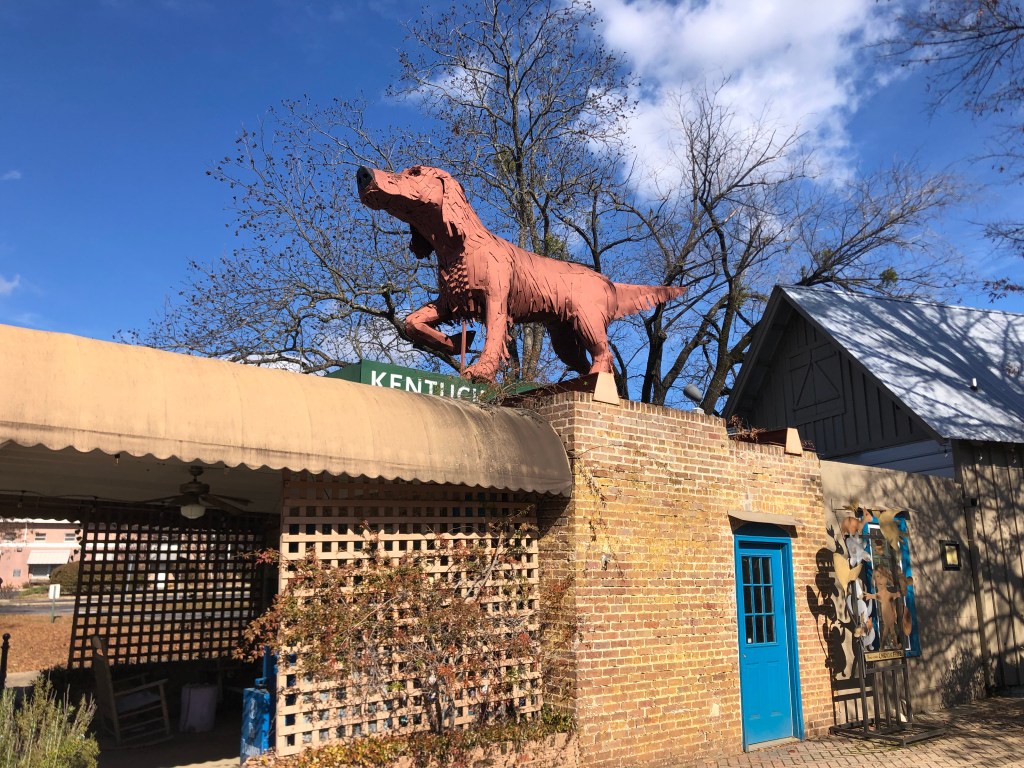
Artist Larry Godwin made this dog, “Rusty,” out of scrap metal in 1983.

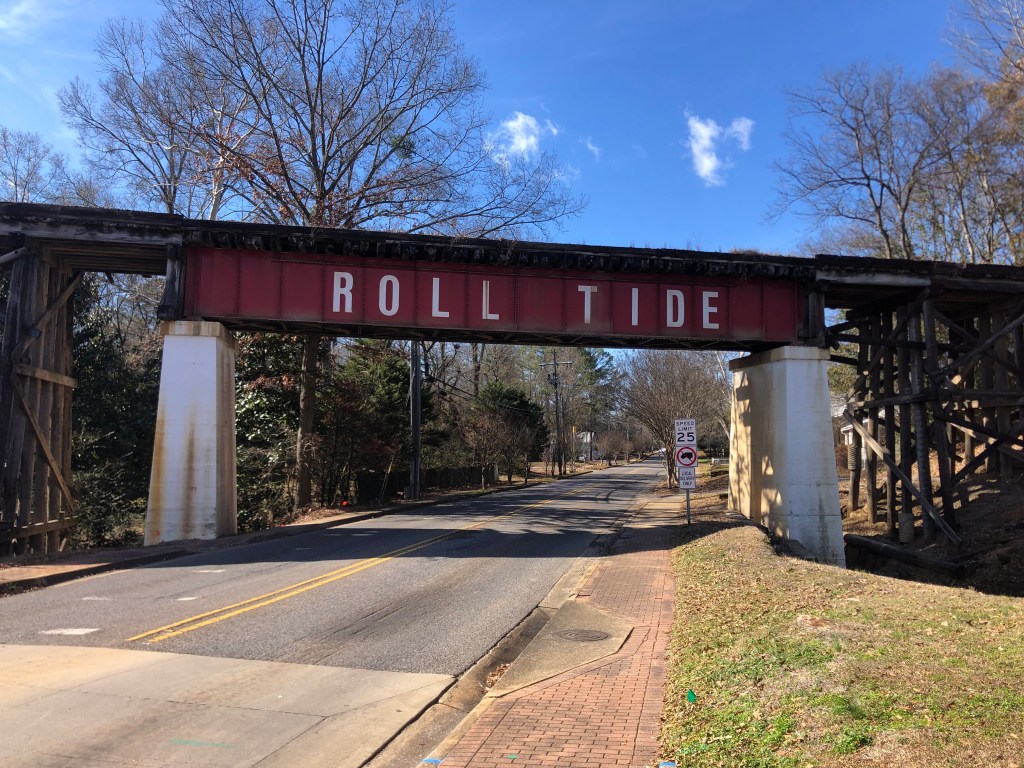
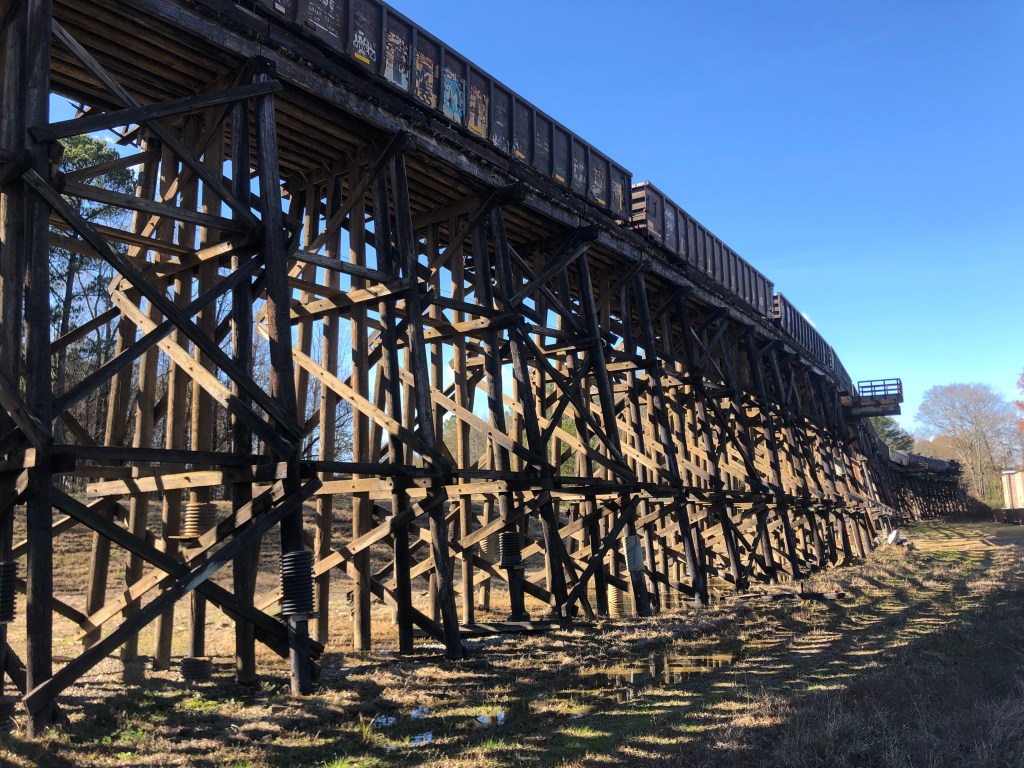
But it’s not all arts. Like so many of these towns, Northport has a rich railroad heritage. Remember the girder bridge in the “Roll Tide” photo, above? It’s part of a railroad trestle that was once the longest in the United States. It was designed and constructed for the Mobile and Ohio Railroad in 1898.

The word “spindly” comes to mind….

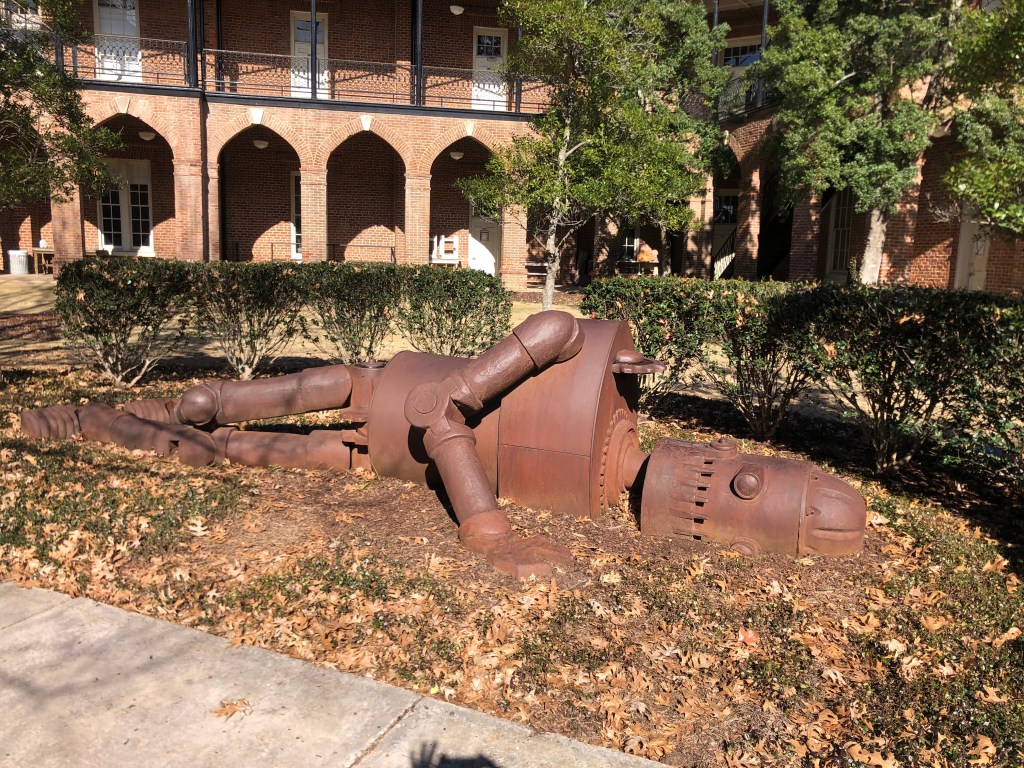
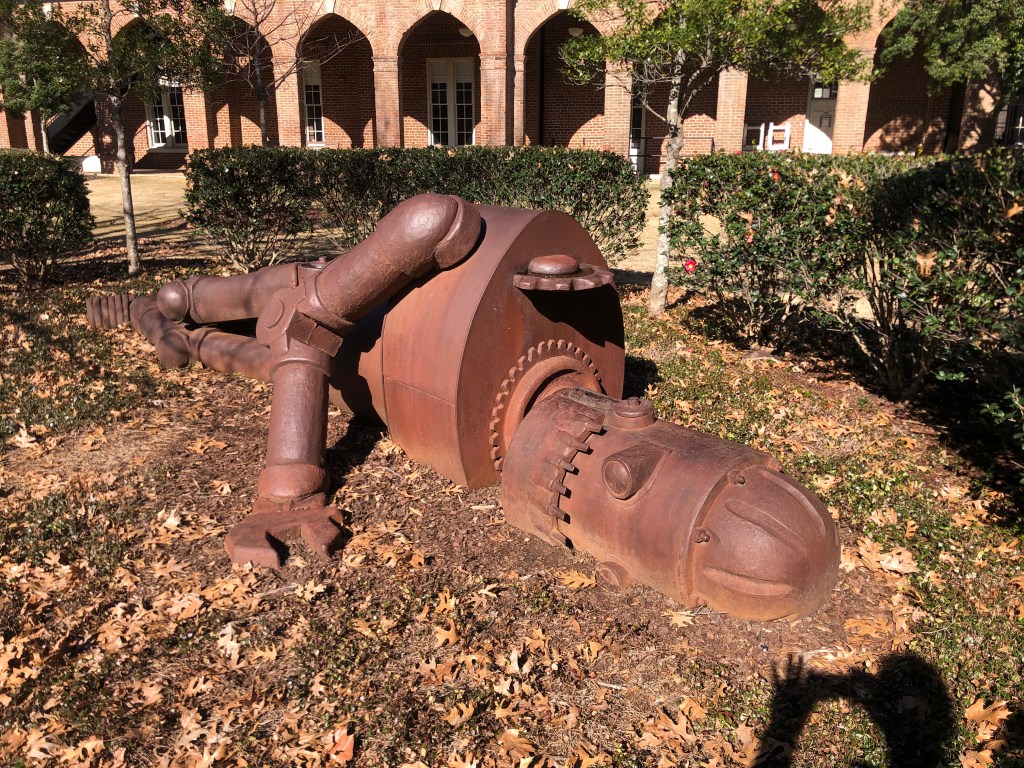
After taking a nice stroll in sunny Northport, I headed across the river to Tuscaloosa (pop: 101,000). Given all the focus on the Crimson Tide I felt compelled to make a visit to U of A (student pop: 39,000). It’s admittedly a beautiful, historic campus that feels orderly and cloistered. I especially enjoyed checking out the student art installations at Woods Quad.

“Goldie 1971,” created by U of A alum Joe McCreary, is supposed to evoke the decline of Birmingham’s steel industry.

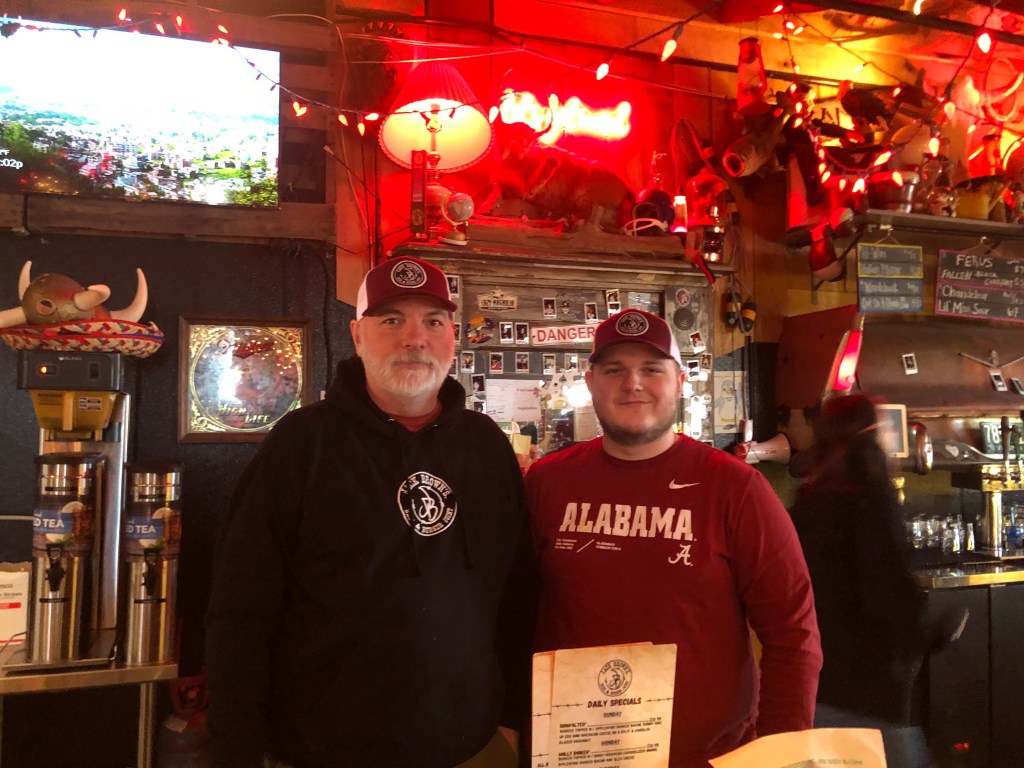
While in Tuscaloosa I stopped for lunch at Jack Brown’s Beer & Burger Joint. The place had just opened three months earlier, and it was packed to the rafters. What a setup! It felt like a roadhouse/dive bar, with that seat-of-your-pants vibe and tons of regulars bantering good-naturedly with the bartender. But wait: It turns out Jack Brown’s is a (privately-owned) chain of 17 restaurants. You can watch the owners telling the story here:
Anyway, chain or no chain, this place has customer service dialed in. Even though the place was packed, the staff were all over me, refilling my drink, bringing me food, asking about my trip, answering my questions about the town.

I decided to order the “Shocker” burger (a hamburger topped with fresh jalapeños, fresh habaneros, house-made Shocker sauce, and 2 slices of Pepper Jack cheese). I asked one of the servers about the sauce, but he said it was a trade secret. No matter; it was truly delicious. I topped it off with a deep-fried Oreo, which is evidently Jack Brown’s trademark (and only) dessert. It tastes kind of like a beignet, but with a core of softened chocolate cookie. What’s not to like?

While I ate my Shocker the manager speculated about the success of the place. It’s not just the awesome customer service and great food, he said. It’s also the “Notch Club.” All it takes to join is drinking 100 beers at your local Jack Brown’s. (After today I am already 2% of the way there, but more on that later.) Once you achieve Notch status, you get an official shirt, your picture goes on the wall, and you get invited to special events just for Notchers. With each 100 additional beers you get a patch for your shirt. And when you get to 1,000 beers, you become a “Saint.” Saints undergo a special investiture ceremony, get some kind of robe or something (I can’t quite remember the details here), and they get to add their own custom burger to the menu that is offered each year on your Saint Day. I tell you: If I lived in the south, I would be all over this thing.

Jack Brown’s manager and the guy who refused to divulge the ingredients of the Shocker Sauce.

Restored and rested from an enjoyable lunch and a few drinks, I got back onto Route 82 East. I’ve noticed that 82 is generally a straight road, but with gently rolling hills to vary the horizon as you drive. At this stage in these cross-country trips I find myself viewing the road, with its uniform signage and federally-mandated lane widths, to be a familiar, comfortable friend. Also, as I’ve mentioned in prior blogs, these US highways tend to be assembled out of pre-existing local roads, and therefore you have no choice but to cruise right through the center of each town along the way, as US 82 becomes, say, Main Street. Or you could think of it as Main Street filling in for US 82 for a few miles. Either way, it guarantees that the driver encounters the brick-and-mortar communities along the way.

Speaking of which: I’ve noticed some cultural themes as I’ve been driving through this part of the country. Some of them are what you’d expect: Lots of barbecue joints, lots of churches, lots of American flags. But some of the stereotypes are not in abundance. I have not seen a single Stars and Bars flag. I have seen only one sign professing support for Donald Trump. And while I’ve seen a lot of pickups, I’ve actually seen far more Nissan Altimas. [Editor’s note: Evidently Altimas are manufactured in Mississippi and Tennessee.]One welcome surprise (compared to my experience in California) is that gasoline can be purchased for about $2.59 a gallon.

The ubiquity of crosses all along the highway is perhaps most foreign for this California native. Most of the time it’s a simple and low-key statement in someone’s front yard, but today I passed an enormous display that was quite in-your-face. It’s really too big to be conveyed in a single photograph, so I took this video:

Don’t be cross…

The display is the life work of one William Carlton Rice. He’d been building, expanding, and maintaining this “cross garden” from the 1960s until his death in 2004. His family promised to maintain it after his passing, but old-timers say the place ain’t what it once was. If you’re interested, brief descriptions of the project and W.C. are here and here.

I noticed that somehow the road leading to W.C.’s property was lined with still more giant, wooden crosses….

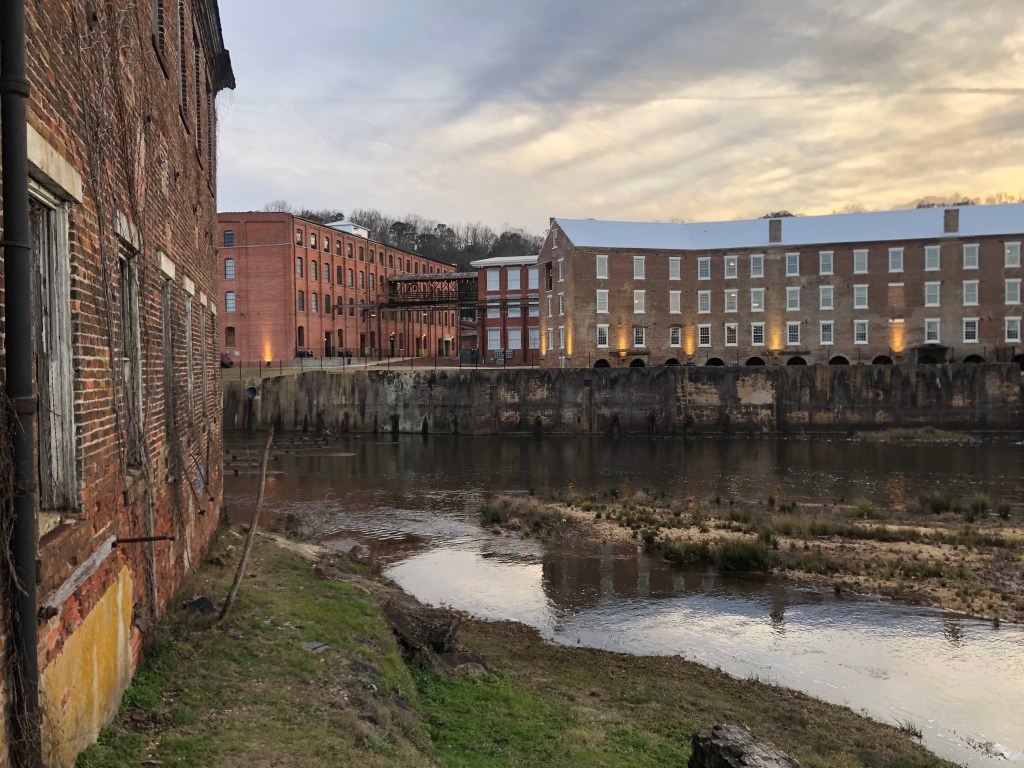
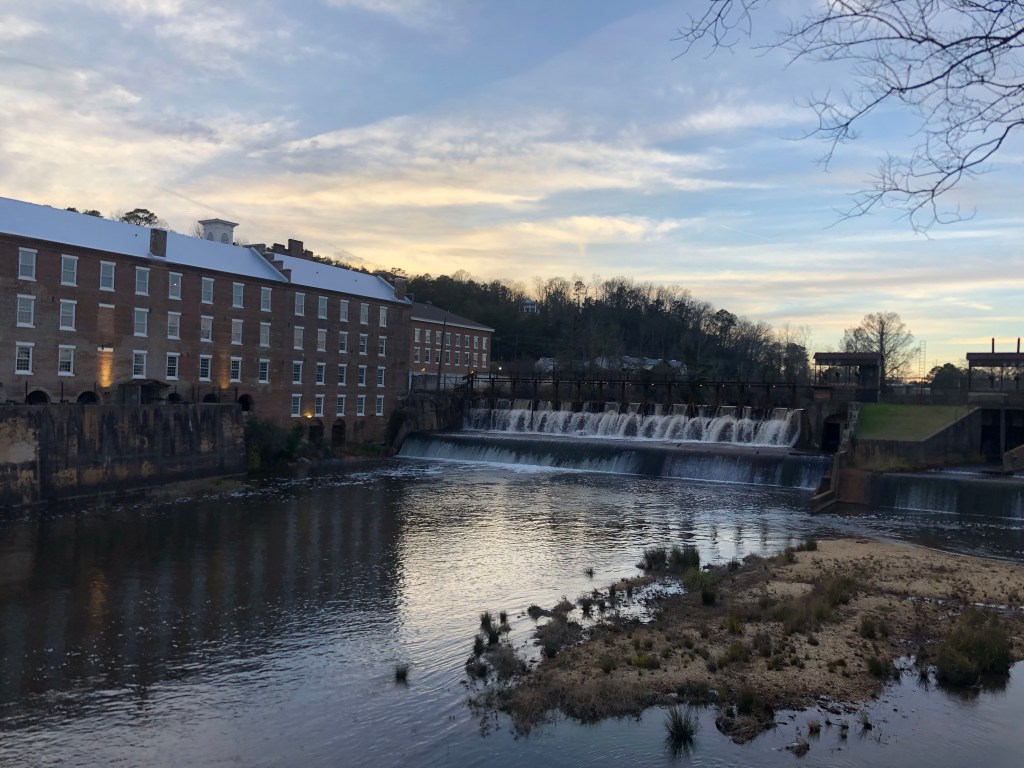
Daylight was growing short when I got to the town of Prattville (pop: 38,000). It was founded by the eponymous Daniel Pratt in 1839. Pratt was an industrialist from New Hampshire, and he figured that the flow of Autauga Creek, which runs through the area, would be a good power source for 19th-century industrial applications. Before long a thriving city had grown up, and today, for some wonderful reason, much of the historic town remains intact, like a giant time capsule. (Check out this list of historic structures from Wikipedia.)

I arrived at Prattville just at dusk, and I must say it felt otherwordly. The lighting was like a Thomas Kinkade painting, the creek was flowing steadily over a stepped dam next to the cotton gin manufacturing plant, and a young couple was holding hands and walking across a bridge.

Next to all these industrial remnants is the historic business district, which is now largely oriented toward tourists.

As it was getting dark, I decided to spend the night in Prattville. Tomorrow I will make my way into Georgia.

Brew of the Day

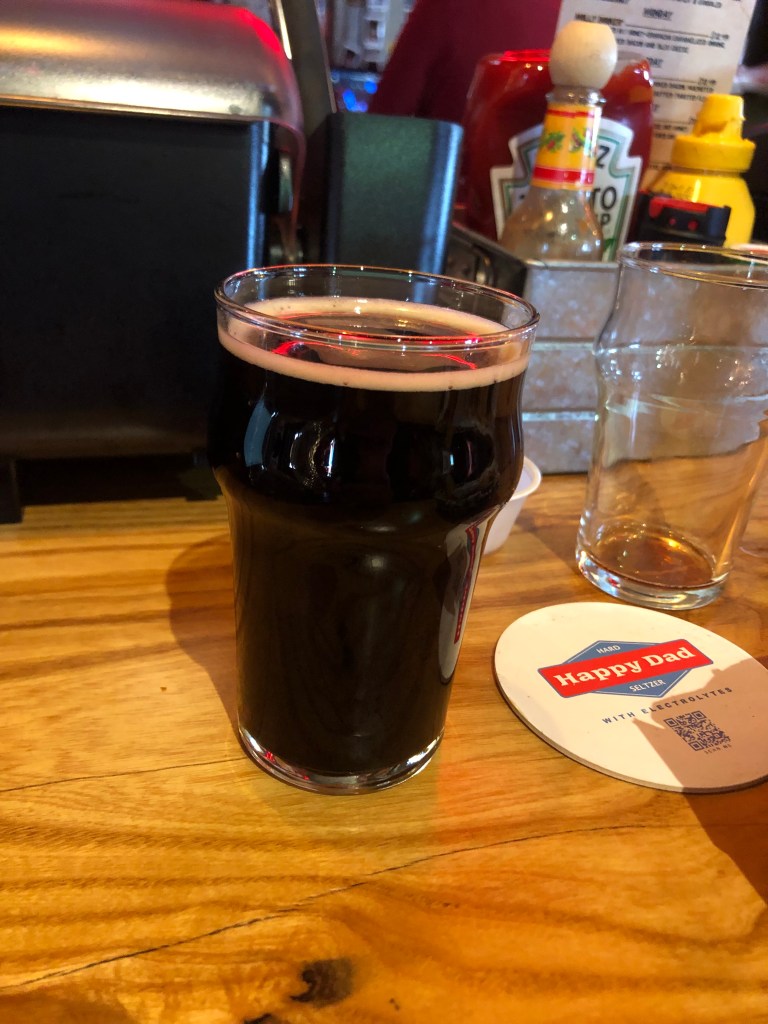
I got my BOTD at Jack Brown’s in Tuscaloosa. It was a milk stout from Southern Prohibition Brewing in Hattiesburg, Mississippi.

It was a very drinkable beer. Only lightly hopped (as is customary for this style of beer), it also had very little foam. The color was dark brown, like espresso. It even had a bit of roasty, espresso taste, though this was well balanced by the sweet, creamy goodness of lactose. I found this to be a rich, tasty brew, and at only 5.2 ABV, I treated myself to a second glass. Definitely worth 4 starts out of five.

California history · Hydrology · Road trips

Paradise Lost

My friend W (whom you would have read about in my memoir) and I are planning a camping trip in the El Dorado National Forest. The weather has been absolutely beautiful of late, so today I took out the Speedmaster for some reconnaissance in the forested region between Auburn and Lake Tahoe, scouting out possible campsites.

I began by cruising up CA 49 to Coloma (pop: 400, and the birthplace of California’s Gold Rush) then heading northwest to Georgetown (pop: 2,500 and one of the original Gold Rush towns). I had planned to get a bite at a local, historic cafe, but such a thing evidently doesn’t exist in Old Georgetown. Seriously, there’s very little going on in this place. Which puzzled me, because when I came through here a couple of years ago it seemed more viable.

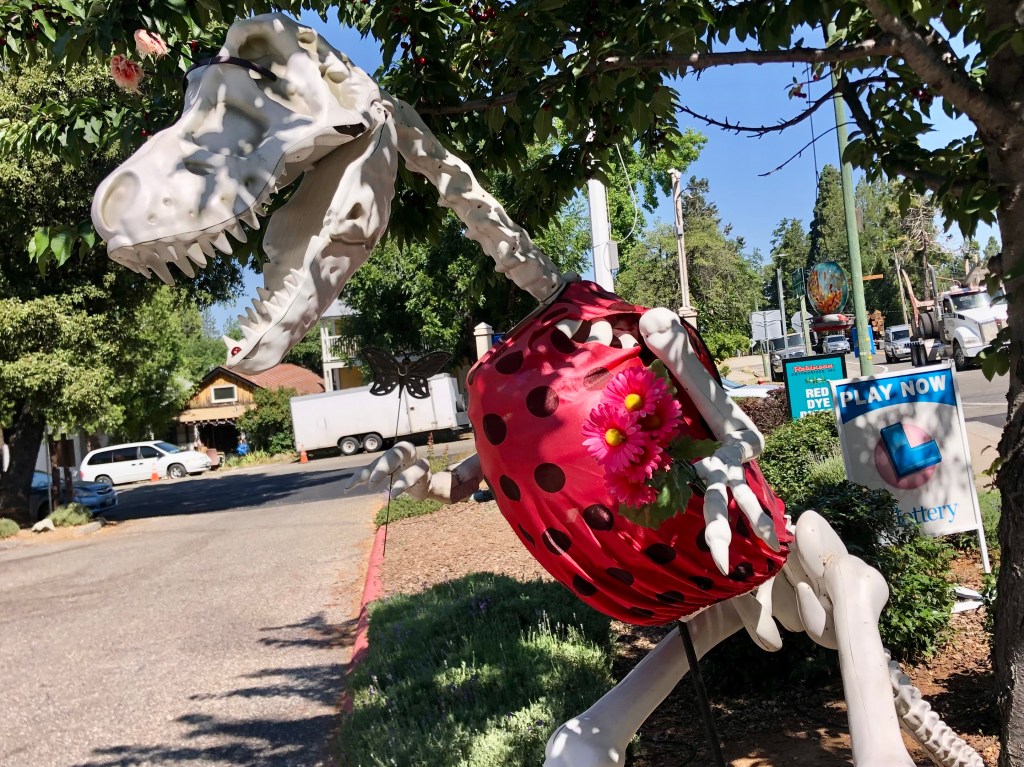
Unexplained dinosaur with ladybug costume at a Chevron station in Georgetown.

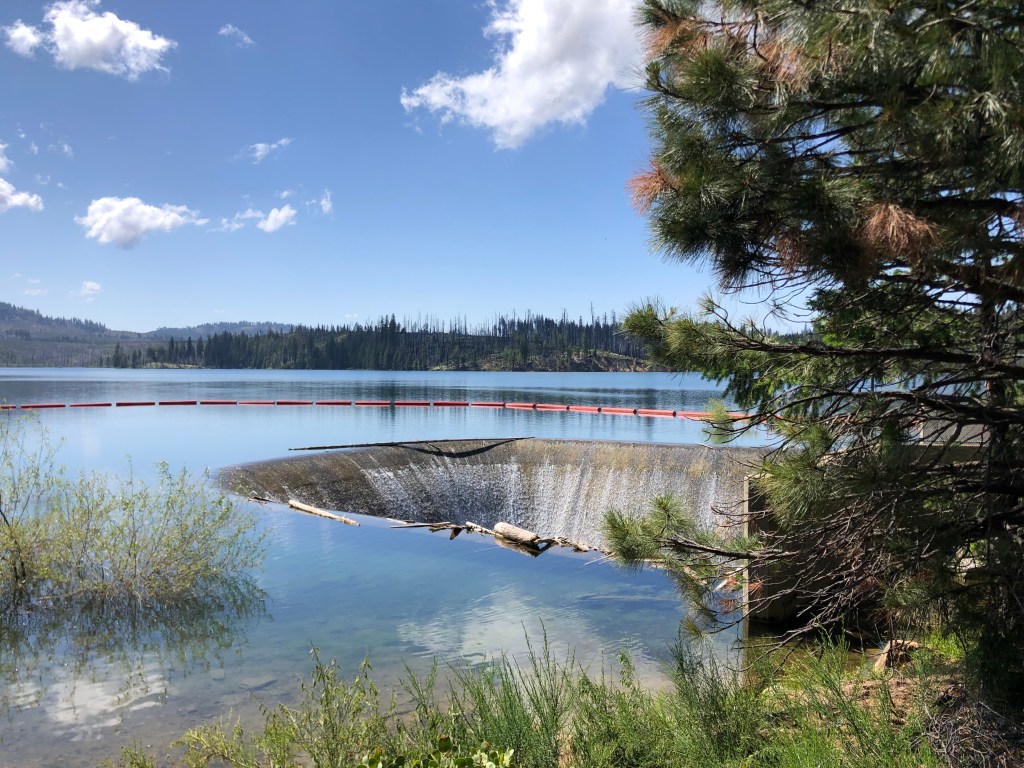
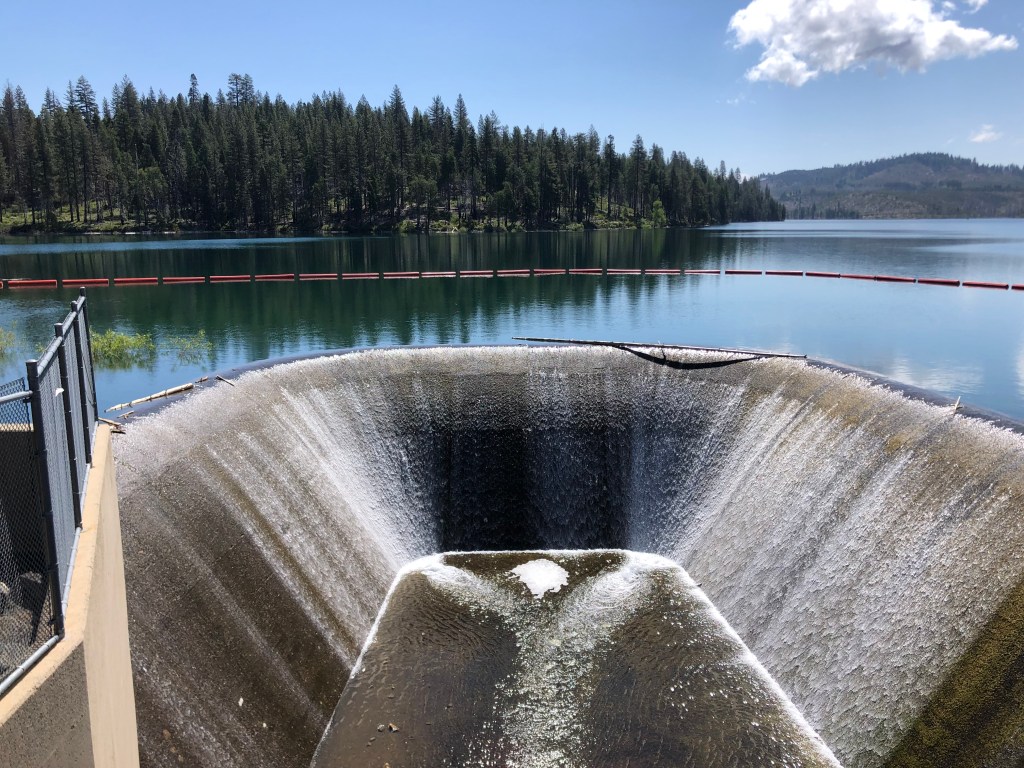
From Georgetown I continued east, immediately entering the El Dorado National Forest. Soon I encountered Stumpy Meadows Reservoir. It’s a peaceful, attractive spot with campsites and picnic facilities. As with many of California’s reservoirs, this one was created as part of the water infrastructure binge in the 1950s and 1960s. The Mark Edson Dam was constructed in 1960, and soon after the meadows were under a lake. Incidentally, the Edson dam is named after the first engineer at California’s Department of Water Resources. The reservoir was named after Edson at the same time, but soon thereafter, for reasons that are not entirely clear, descendants of the meadows’ original owner successfully lobbied to have the name changed to Stumpy Meadows Reservoir.

I was transfixed by this spillway on the edge of Stumpy Meadows Reservoir.
Another view of the spillway.

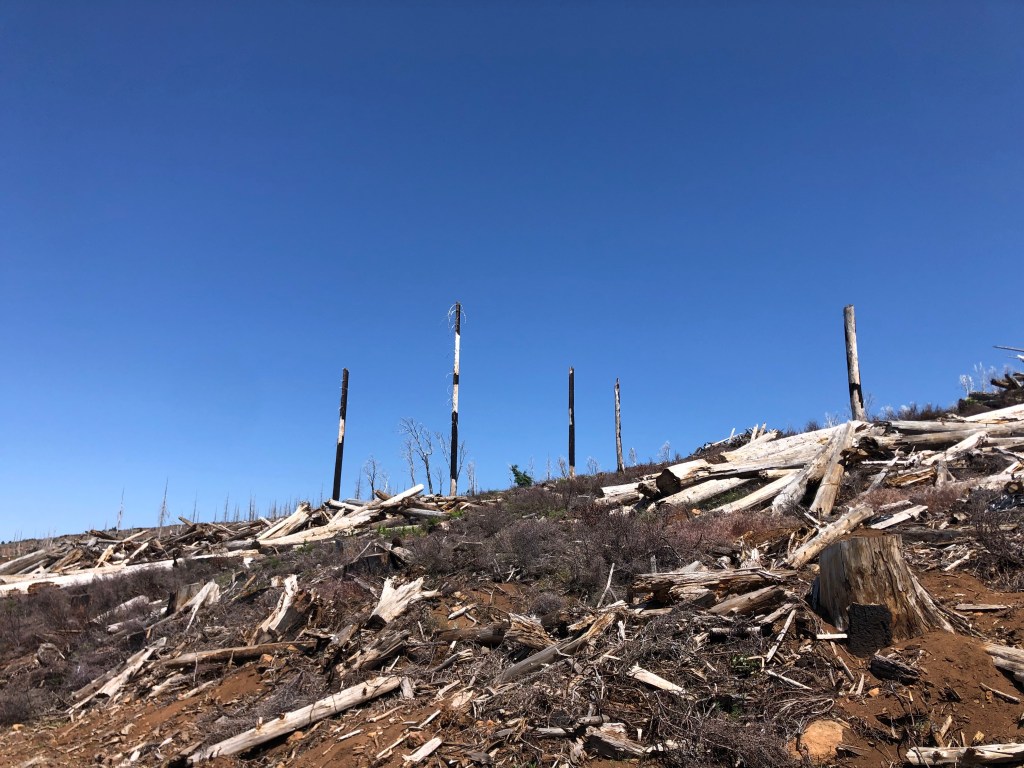
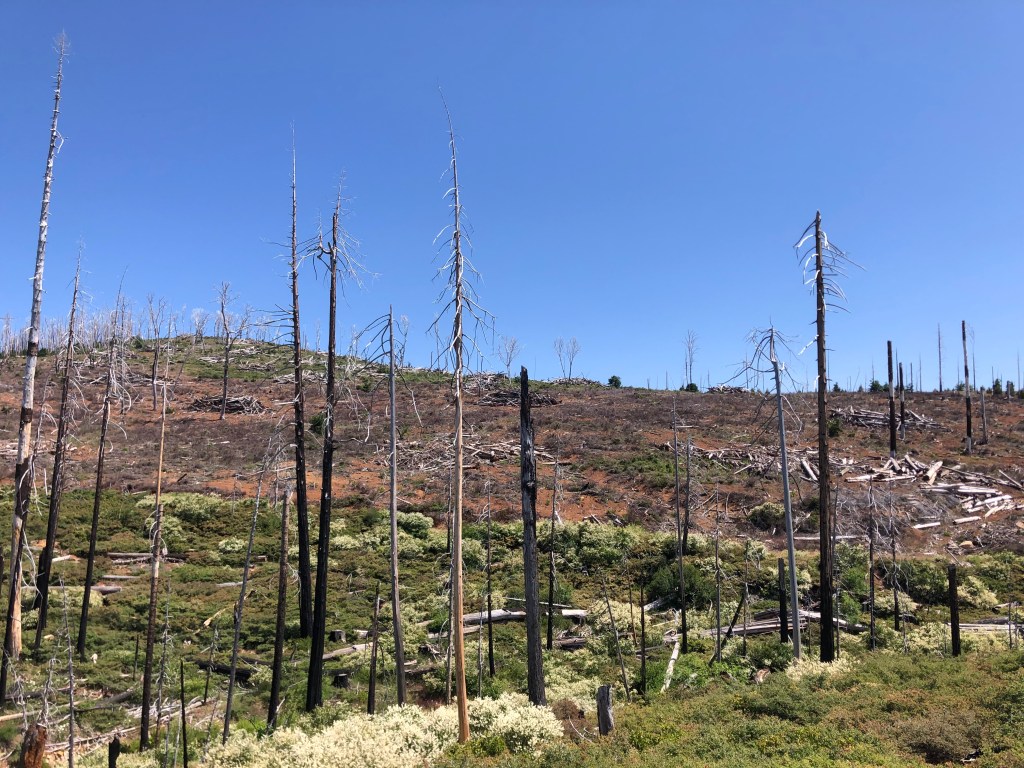
Continuing eastward I soon passed through huge swaths of charred forest that resulted from last year’s Mosquito Fire. That wildfire burned over 76,000 acres of land and destroyed or damaged almost 100 structures. It’s hard to wrap your head around the amount of destruction that can occur in just a short time…and how long it will take to grow back. No specific cause has been officially ascribed to the fire, although documents, news reports, and various lawsuits and criminal investigations all center on PG&E.

Thanks, PG&E.

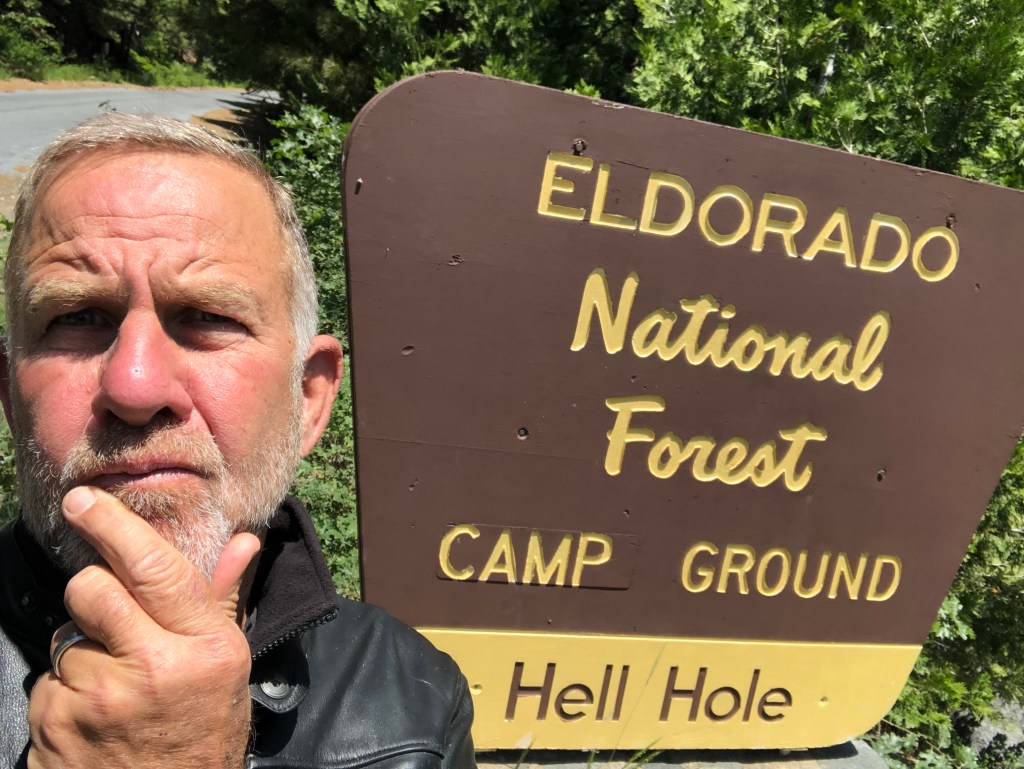
Eventually I passed beyond this hellscape and was again surrounded by green forest. I identified several prime camping spots that W and I might try out. And then I came upon something unusual:

I had a devil of a time finding this place…

The name Hell Hole certainly doesn’t conjure up idyllic landscapes the way the names Sugar Pine and Emerald Bay and even Stumpy Meadows do. In fact, it seems like the opposite of what you’d want for a campground. The name reminds me more of my first, cramped apartment, located in a shabby building in a gritty part of Sacramento. It also brings to mind a song by the fictitious heavy metal “band” Spinal Tap.

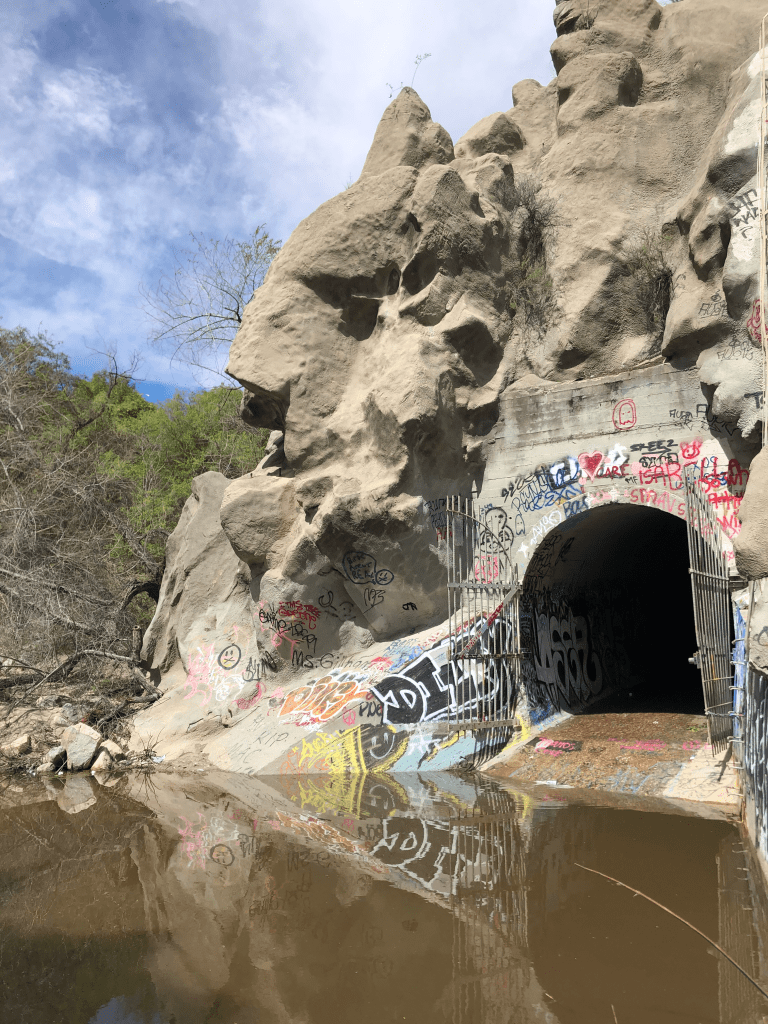
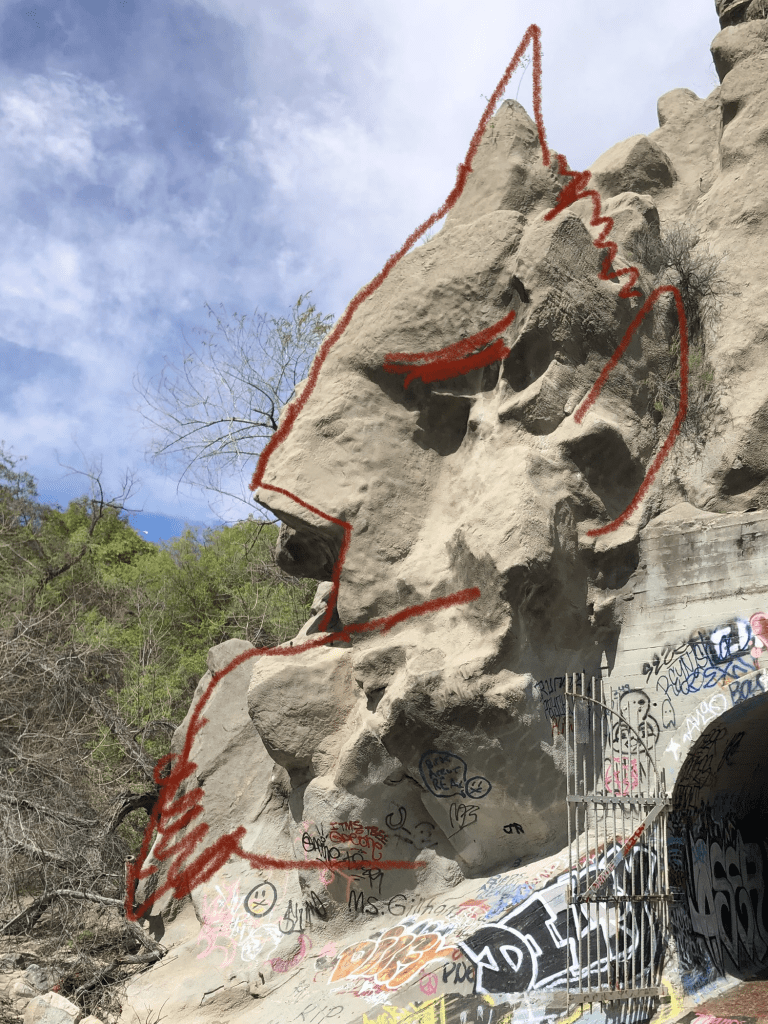
“Hell Hole” also got me thinking about an earlier trip to Devil’s Gate Dam in Pasadena, where a rock outcropping supposedly resembles a profile of the devil. Here’s my photo from that trip:

You don’t see it? How about now:

Anyway, the Hell Hole campground gets its name from the Hell Hole Reservoir, which got its name from Hell Hole canyon which it filled. Wikipedia gives this account of the name:

How the canyon came to be named Hell Hole is a combination of folklore and speculation. An early author, George Wharton James (1858–1923), visited the canyon in 1913.[2] He attributed the name to an unidentified miner seeking riches during the Squaw Valley mining excitement of 1862. It was “a hell of hole to get out of,” James wrote, but admitted his source for the place name was more speculative than the anonymous miner’s chances for riches at Squaw Valley.

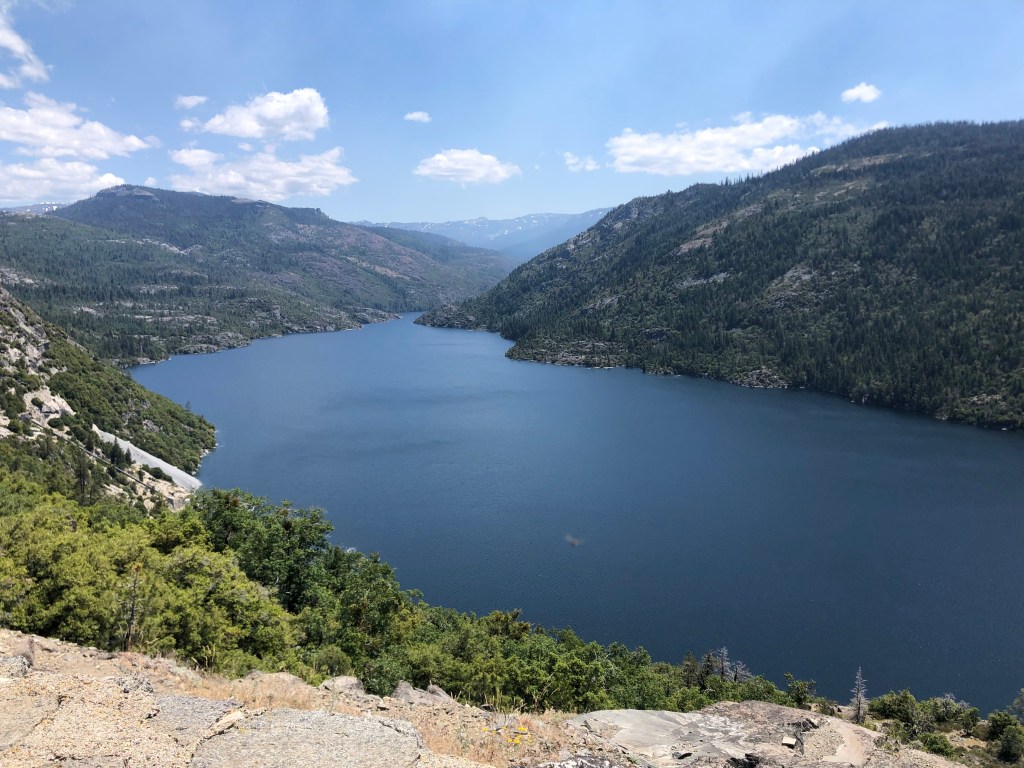
The reservoir was created in 1966 when the Placer County Water Agency dammed the Rubicon River. Covering about 1,250 acres, it’s a good-size reservoir. And despite its name, it’s a beautiful setting.

Dam this Hell Hole!

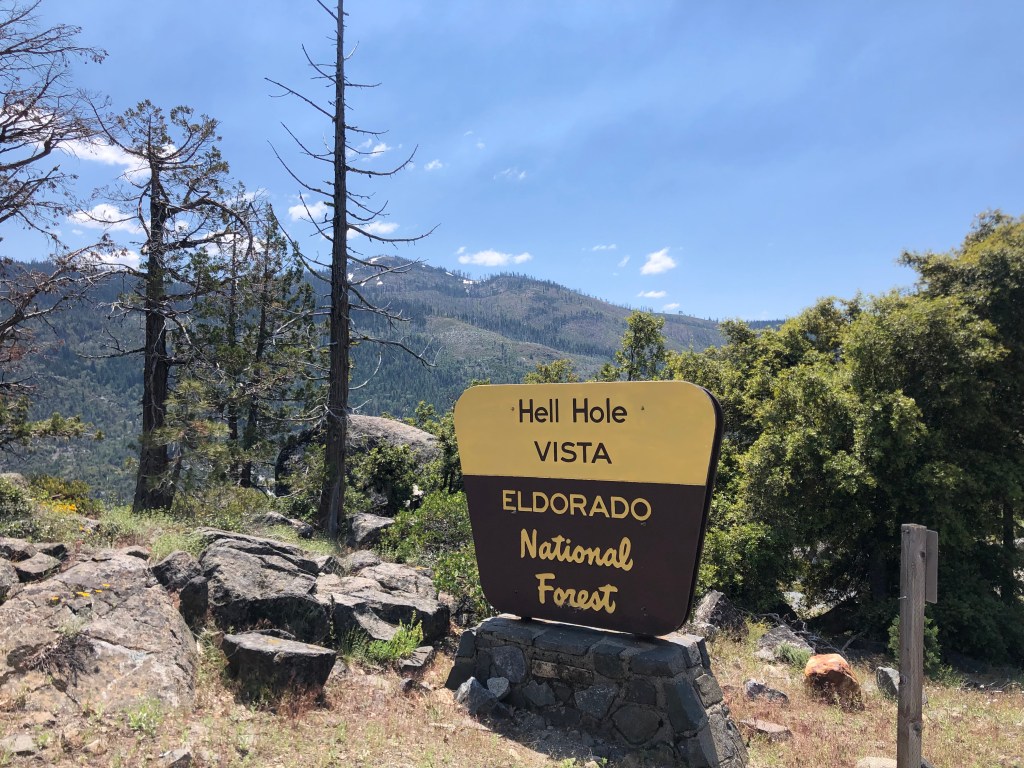
I hiked up to a scenic overlook, where I passed an enjoyable 30 minutes just looking at the scenery and enjoying the warm sunshine.

Three words that don’t normally go together.

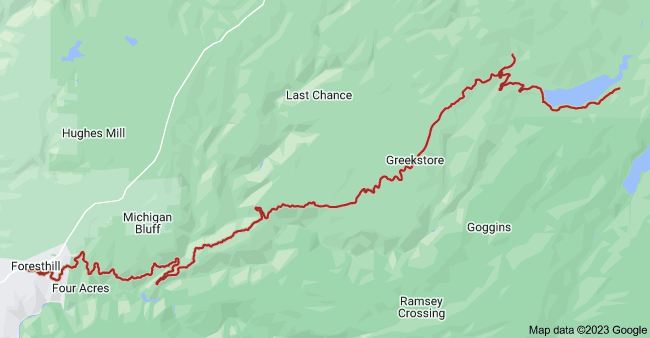
After chatting with some campers and making a mental note of this area for my outing with W, I figured it was time to start heading back. For my return trip, I planned to take Mosquito Ridge Road west to the town of Foresthill (pop: 1500), and then head home on CA-49 South. Mosquito Ridge Road is narrow and windy, and the asphalt is potholed and cracked, but the surrounding scenery made it worth the inconvenience.

Mosquito Ridge Road, in red. Hell Hole reservoir is on the center-right edge of the map.

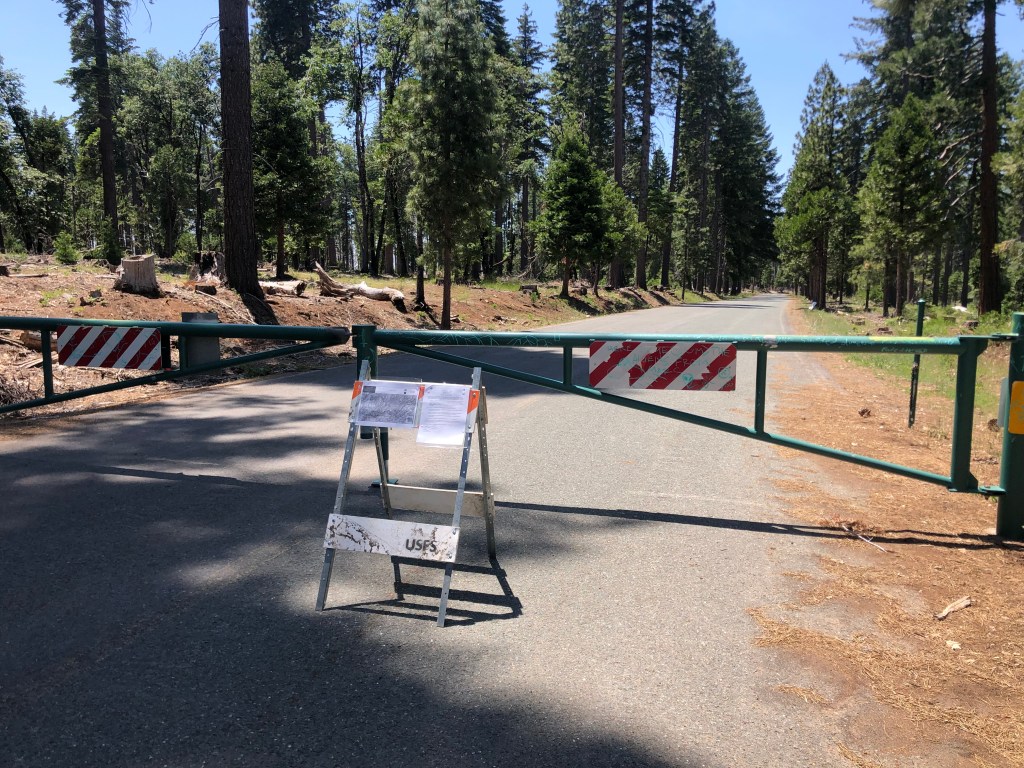
When I got on to Mosquito Ridge a sign informed me that Foresthill was 45 miles away, so I settled in for a long, slow ride. About halfway through my journey I encountered this unwelcome sight:

Not again…

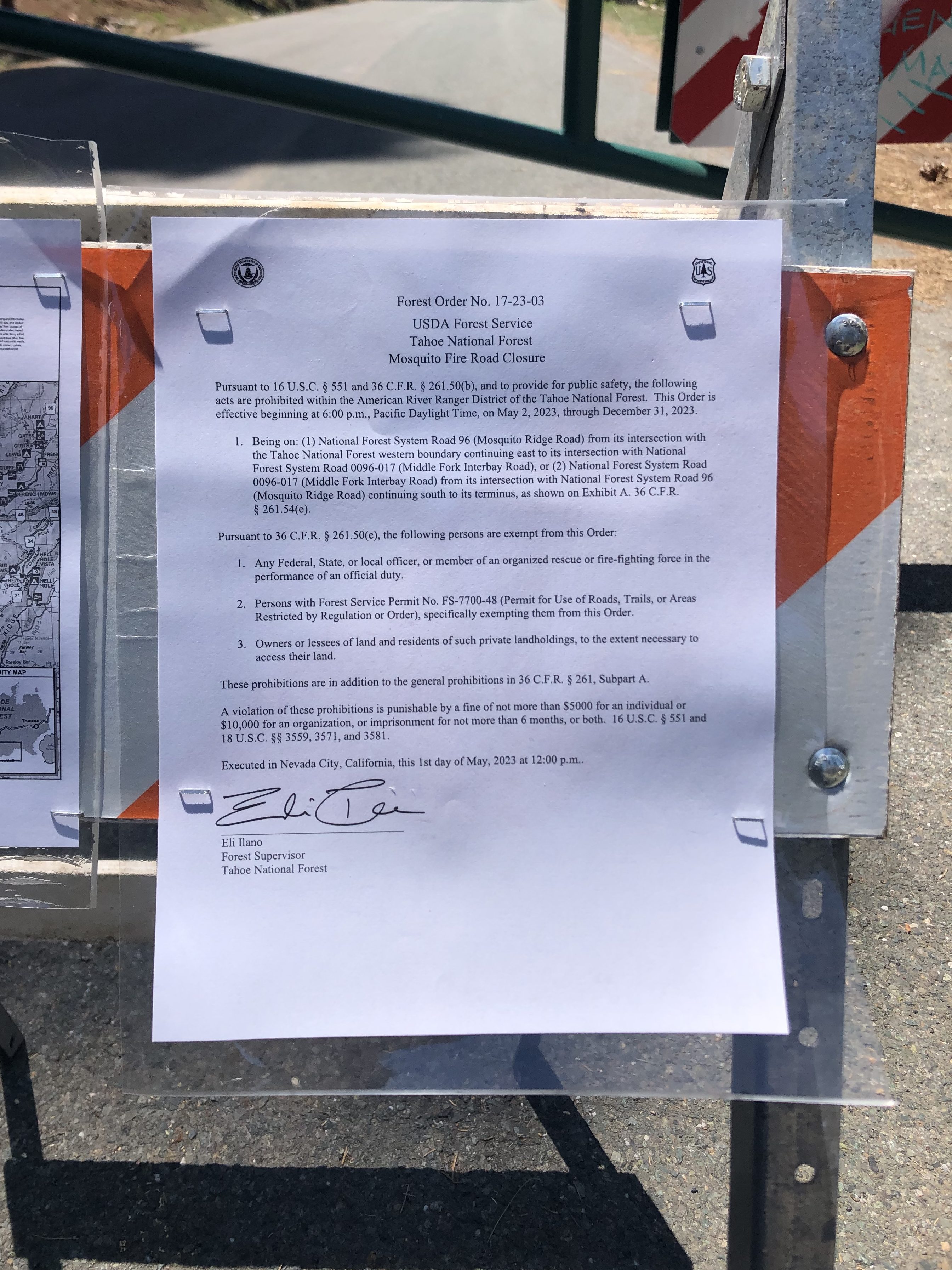
Attentive readers will recall that I’ve run into numerous road closures in my travels. It’s especially inconvenient for me as I’m riding a motorcycle with a small gas tank, so unexpected backtracking in remote areas can be stressful. What’s more irritating is this closure came with no forewarning, and the roadblock itself doesn’t really explain what’s going on. Indeed, instead of a “road closed” sign or something equally straightforward, there’s just a xeroxed office memo tacked to a folding barricade.

Excuse me while I consult with my lawyer…

This “forest order” cites “Section U.S.C. Sec. 551 and C.F.R….” blah blah blah… What caught my eye, though was the reference to a $5000 fine and 6 months in jail. Rather than figure out the specific coordinates of the prohibited zones and the details of the exemptions, I just turned around and went back towards the Hell Hole, and then retraced by initial route through the charred hellscape back to Georgetown, hoping I wouldn’t run out of gas.

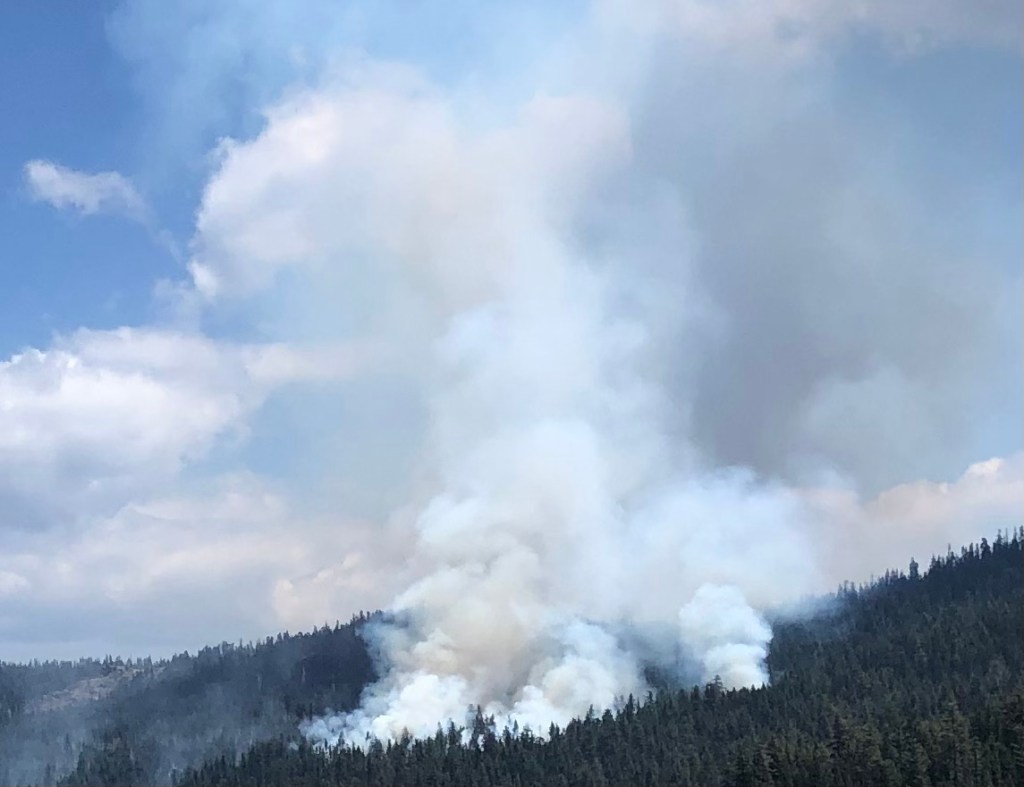
And then, as if on cue, I encountered a second unwelcome sight: A forest fire!

Where there’s smoke…

Feeling a little panicky, I got out my phone to call 911. But there’s no service out here in the middle of nowhere. I decided to find a ranger station at the Hell Hole. But then I noticed a portable, electronic sign board: “RX BURN. DO NOT REPORT.” I interpreted this to mean “prescribed burn,” even though technically their sign says “prescription burn.” What would Section U.S.C. 551 have to say about that?

The rest of the trip was uneventful. I got to Georgetown with 7 miles left in the tank, and I got home in time for cocktails. It was a hell of a trip.

California history · Hydrology · trains

Polar Express

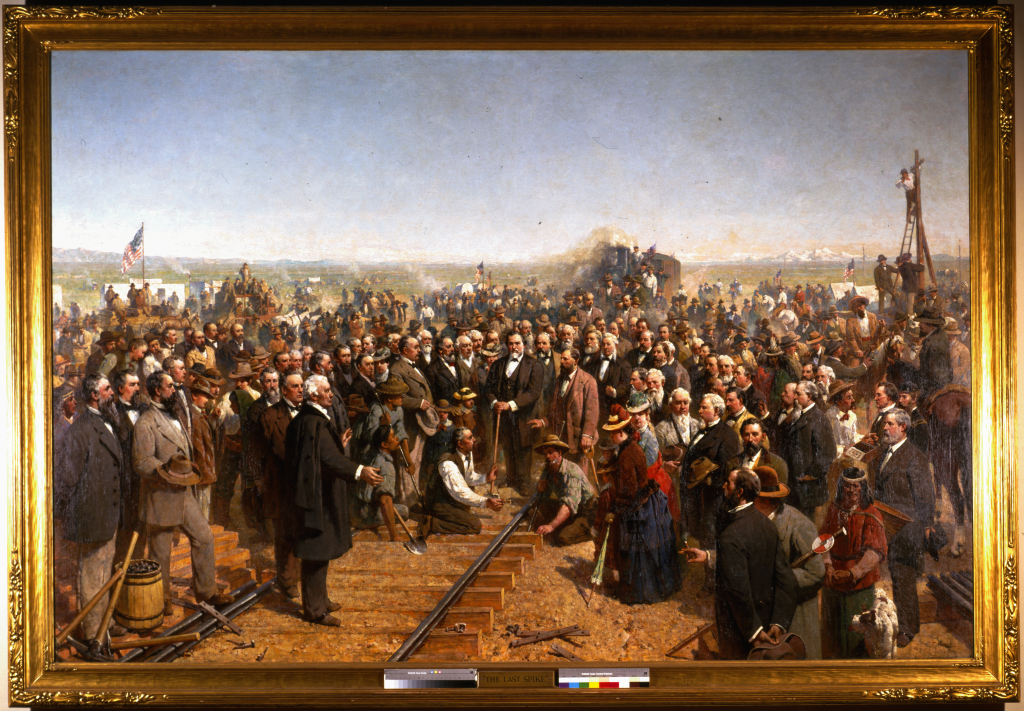
In the 1860s, the Central Pacific Railroad began laying tracks from Sacramento that would cross the Sierra Nevada mountain range and eventually connect with tracks that the Union Pacific was laying westward from Omaha. The two railroads were joined at Promontory Point, Utah on May 10, 1869. The country’s first transcontinental railroad was complete.

“The Driving of the Last Spike,” by Thomas Hill (1881). This painting, which isn’t entirely historically accurate, hangs in the California State Railroad Museum in Sacramento.

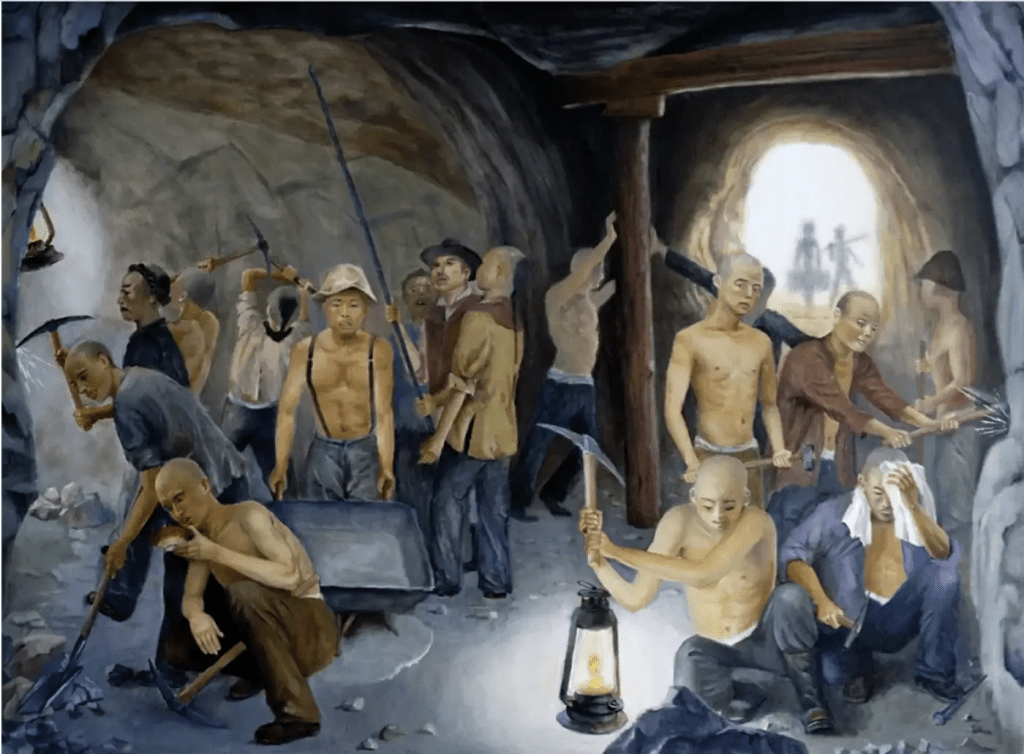
Much of the new railroad was hurriedly and haphazardly put down in a relatively straight shot across the Great Plains. But the much more difficult, dangerous, and impressive work involved cutting a roadbed across the Sierras. Fifteen tunnels would have to be dug through solid granite, using hand tools and blasting powder. Daily progress was measured in mere inches. In addition to the tunnels, various cuts, fills, and bridges were constructed to keep the roadbed at a manageably gradual incline. And because of the heavy snowfall in the Sierras, about 40 miles of snowsheds were built to protect tracks in the areas given to especially heavy snow and avalanches.

No picnic.

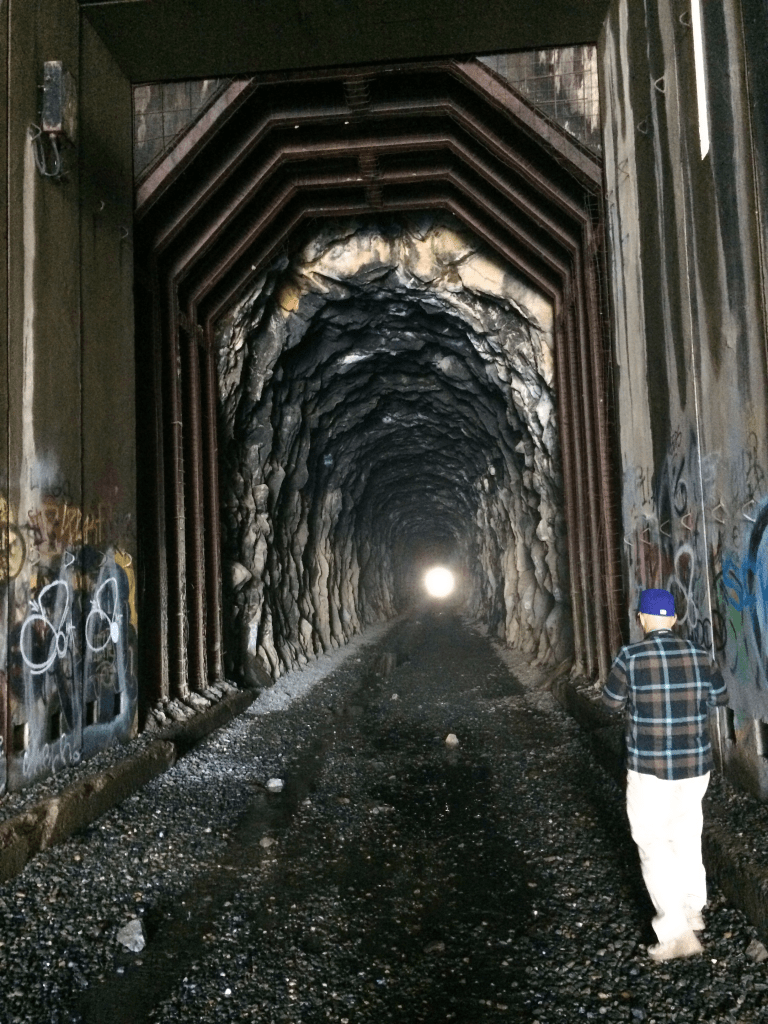
Today, over 150 years later, most of the original route is still in daily operation. (Some small improvements to the route have been made over the years, most notably the abandonment of the 1,687-foot long Summit Tunnel at Donner Pass. My friend Bill and I were able to walk through that abandoned tunnel a few years ago.)

Bill, literally walking in the footsteps of Chinese railroad workers.

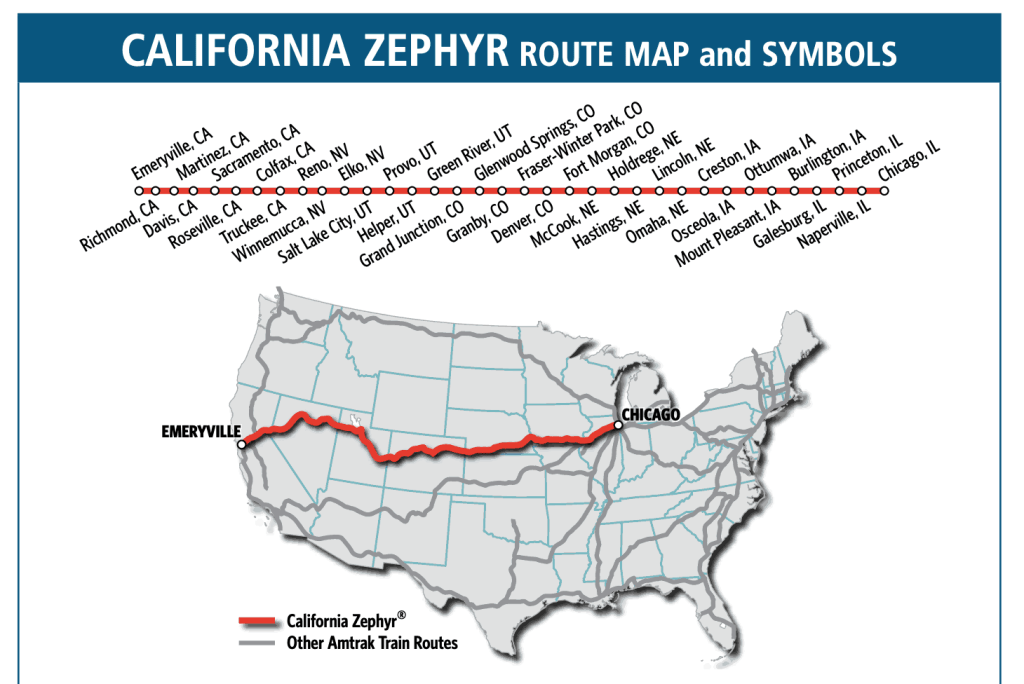
Amtrak (the country’s only remaining interstate passenger railroad) runs a daily train called The California Zephyr between Chicago and San Francisco, and naturally it travels the historic route over the Sierras. Now, you can catch glimpses of the railroad and its tunnels and snowsheds from your car window on Interstate 80, which roughly parallels the railroad. (I recommend the book Sierra Crossing by Thomas Howard, which describes the history of various routes over the Sierra Nevada.) But by car you just can’t appreciate the engineering marvel that is the Sierra route as well as you can by riding the rails themselves.

And so it was that, a few years back, my son (Ian) and I flew out to Chicago and boarded the California Zephyr. We were excited to experience the Sierra passage from the window of our compartment. But alas, Amtrak (which notoriously and habitually runs late) reached the Sierras not at midday as scheduled, but rather in the middle of the night as we slept.

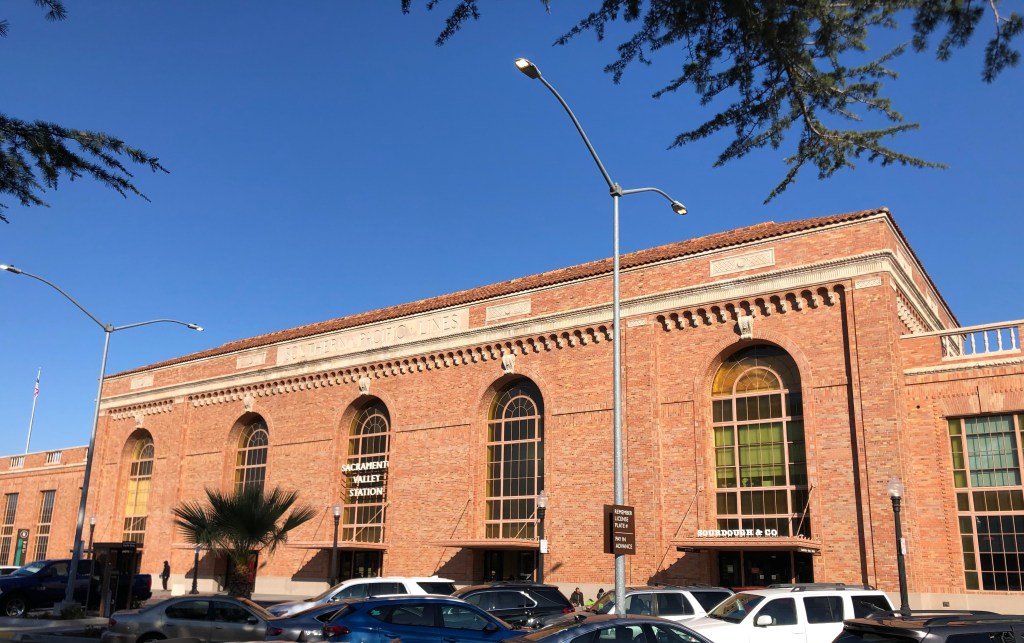
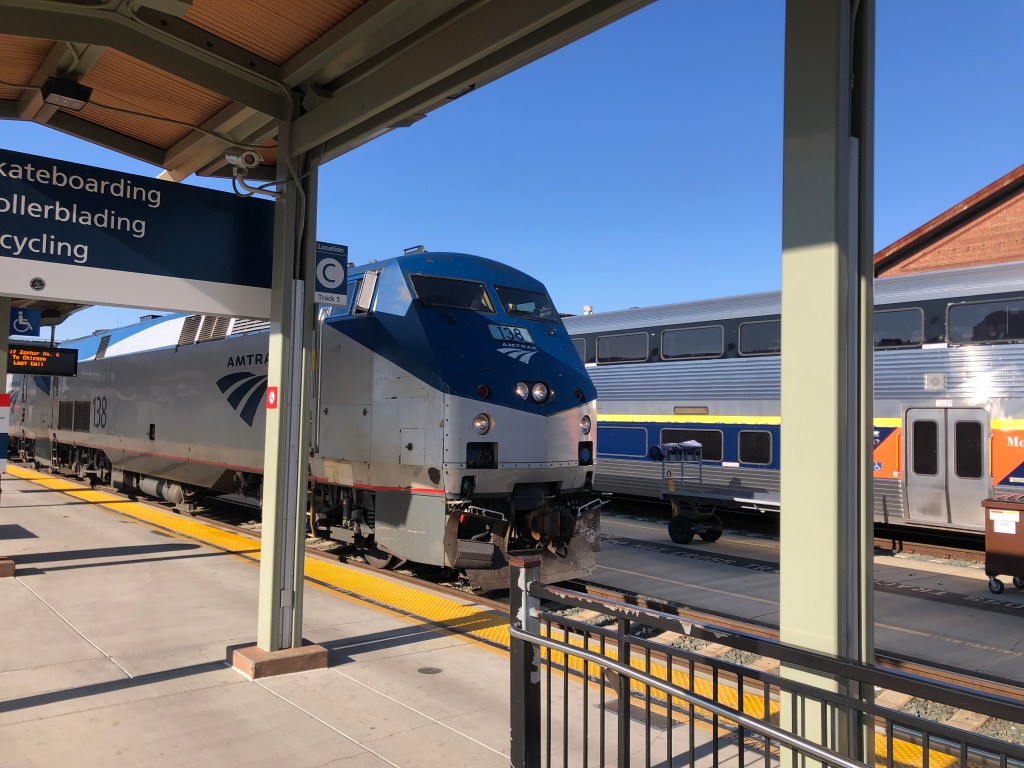
Yesterday Ian and I tried again. This time we are boarding at the historic Sacramento station and heading east. We’re only taking the Zephyr as far as Reno, because the whole point of this trip is to finally experience the Sierra crossing in daylight.

The historic Sacramento Station, built by the Southern Pacific in 1926.
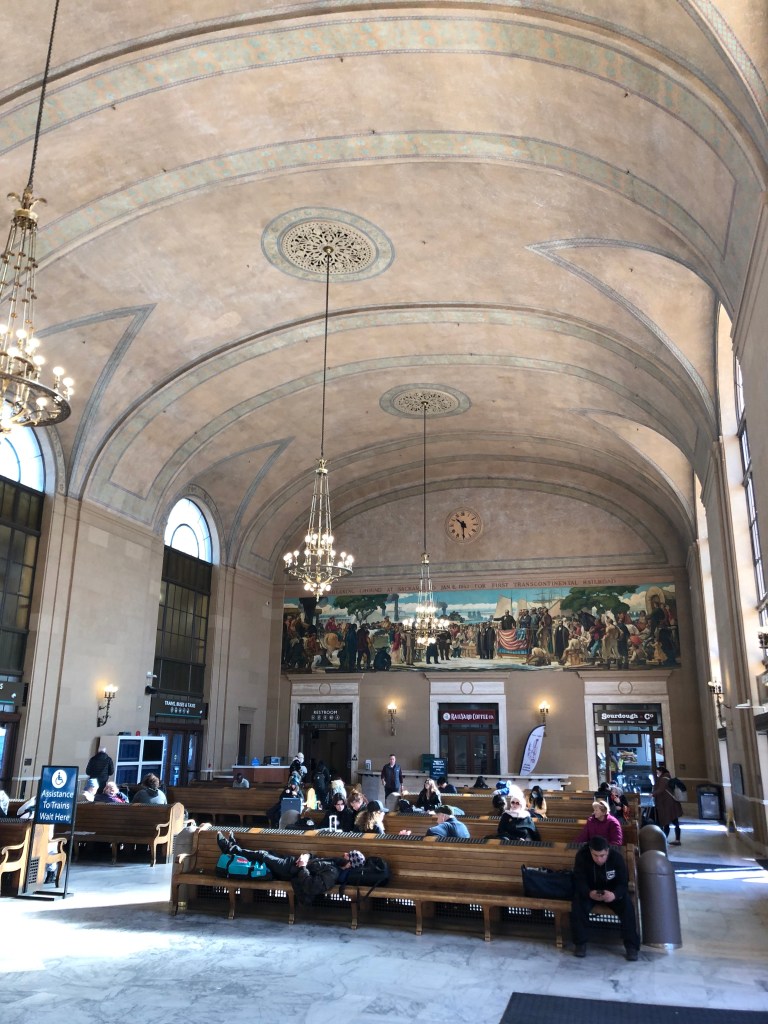
Interior of the station, in all its Renaissance Revival glory.
The California Zephyr arrived on time!

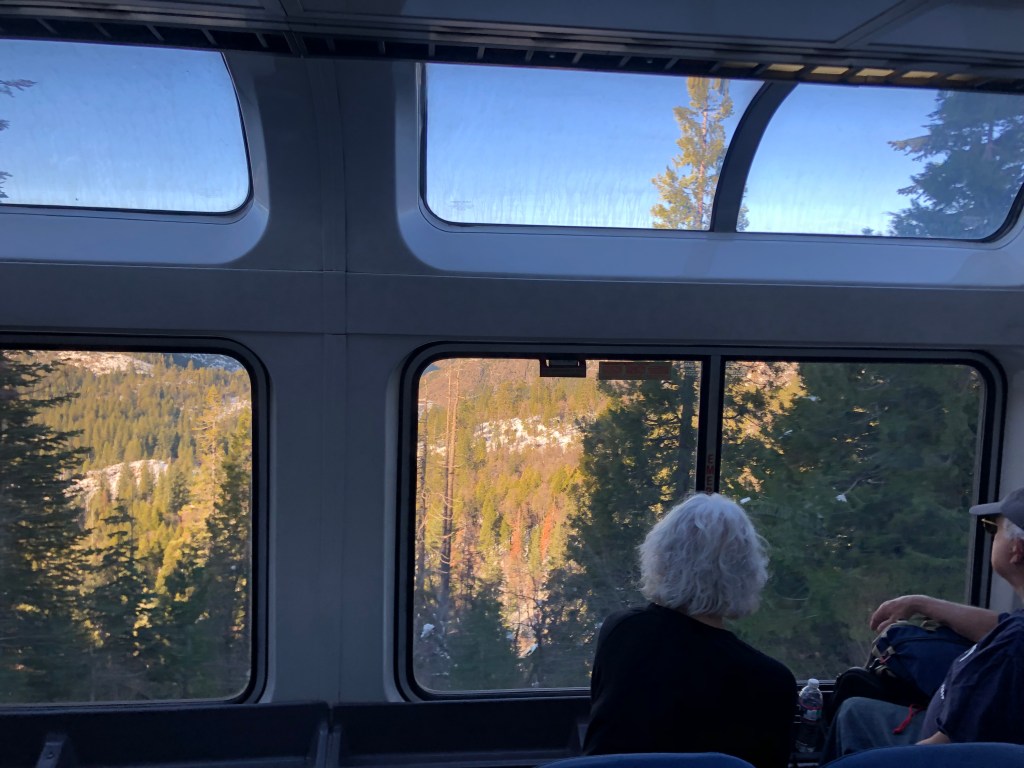
As the train started rolling we settled into our seats and began watching out the window at rather sketchy parts of Sacramento, Citrus Heights, and Roseville. We decided this might be a little more tolerable if we had beer, so we repaired to the club car. Fortified with our beers and some microwaved food, the scenery began to improve. Upstairs from the snack bar is a friendly and casual observation area, with nice big vista-dome windows and comfy chairs and tables. This is where we spent most of the trip.

Everyone loves the Vista Dome.

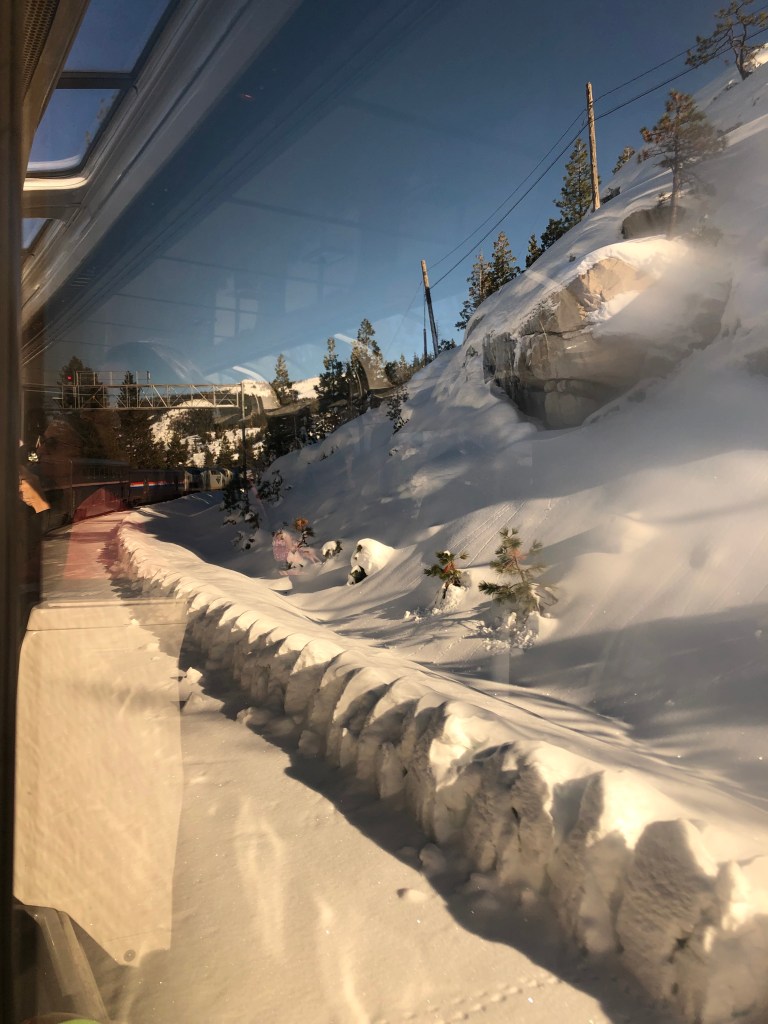
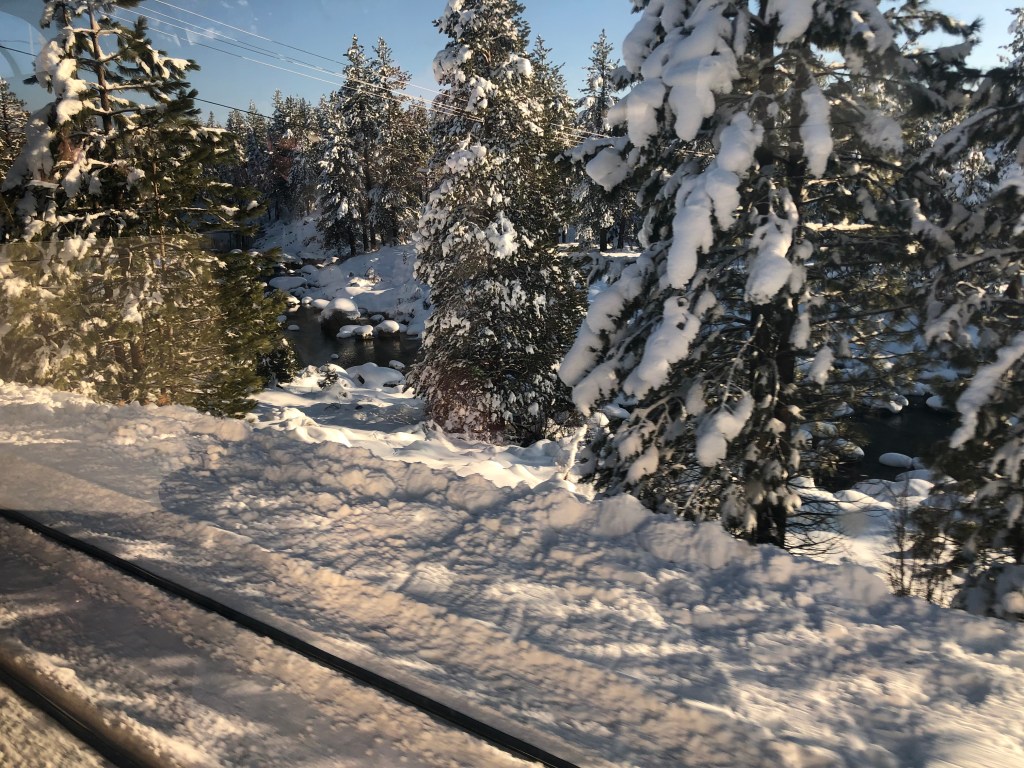
After a bit we started to climb into the foothills, and soon we encountered snow. Our climb over the Sierra had begun!

There’s something very relaxing about watching scenery through the window of a railroad car. The train moves steadily and smoothly, and the car is warm and comfortable. The passengers adopt an attitude like they’re in their own living rooms. Young parents entertain their kids, college students take pictures and send text messages, an older couple plays cards. One friendly guy was gushing to his seatmate about how he prefers train travel to the stress and hassle of flying. A few people were napping. Many just watched out the windows. It’s a remarkably relaxed way to travel, where you wear no seatbelt, you have freedom to move from room to room, and someone else up at the front of the train is in charge of getting you where you need to go.

Of course, I had my own specific interest in this particular route. I kept trying to imagine how the Central Pacific work crews managed to build this railroad over the Sierras using 1860s technology. They worked in subfreezing temperatures and massive snow drifts battling avalanches, gravity, and relentless granite walls. And yet they completed the job in just a few years. It’s hard to imagine CalTrans, even with all its modern equipment, ever matching that record.

After a few hours we reached Donner Pass at about 7,000 feet. The snow was at its thickest here, but it was pretty scanty by historic standards. A snowplow had passed through about a week earlier. Fortunately, brother-in-law Scott found a video of that very event: The plowing of Donner Pass around December 10.

The other thing I really like about going over the Sierra by train is the visual access to California’s remote and relatively untouched lands. In the more urbanized parts of the state where most of us live, very little evidence of our history remains. Historic buildings are torn down as soon as they are deemed “outdated.” Those that do remain are often rebuilt with modern materials or modified for ADA access. But here in the Sierra it’s not unusual to see 150-year-old relics still standing proud–Like many of those original tunnels that we passed through.

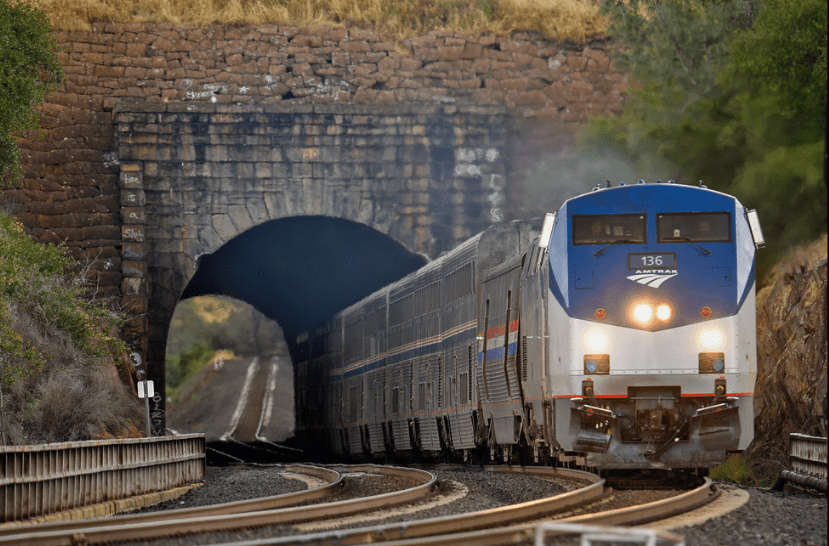
I did not take this photo, since I was onboard the train! Photo taken by Tom Taylor, who does excellent railroad photography.

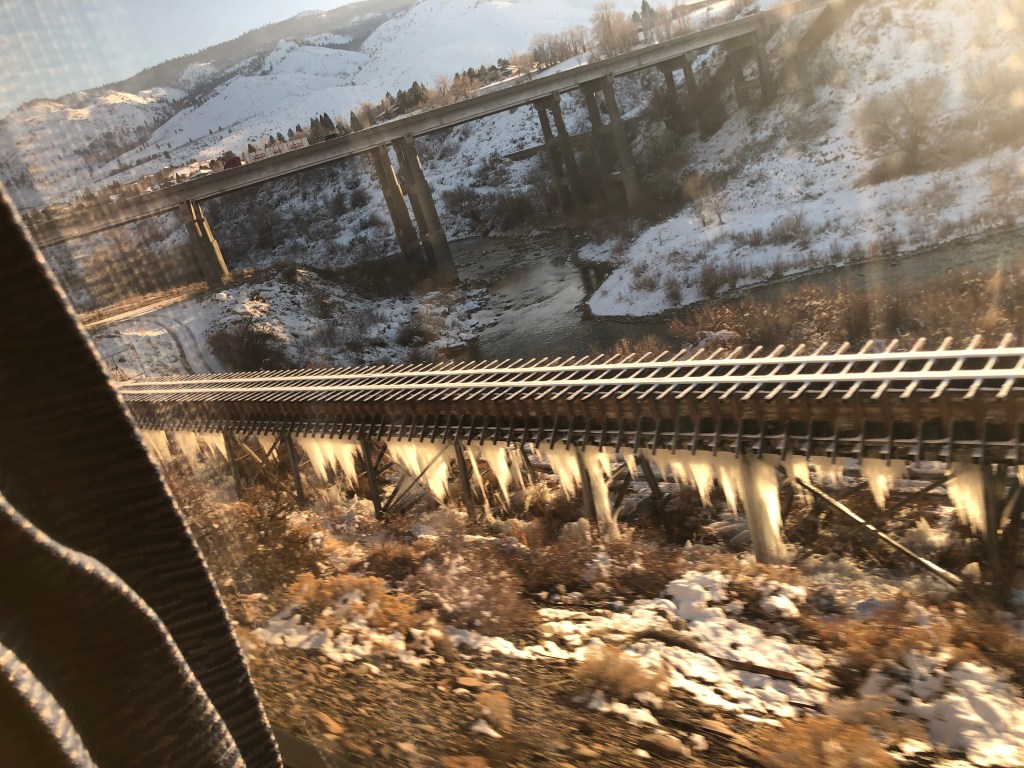
Another relic from a century ago is a collection of wooden flumes conducting water along the Truckee River. The water powers several century-old hydroelectric plants that are still in operation today.

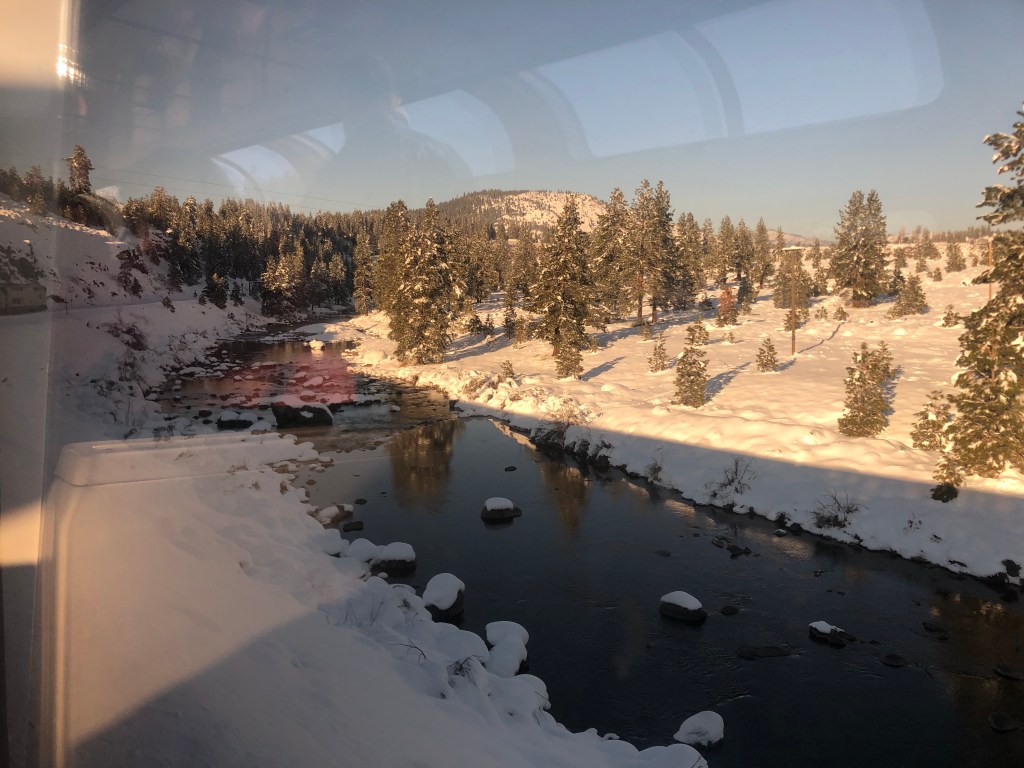
The Truckee River.
The flume is the railroad-track-like structure at the lower third of the photo. Note the icicles hanging beneath. Evidently the wooden flumes aren’t watertight.

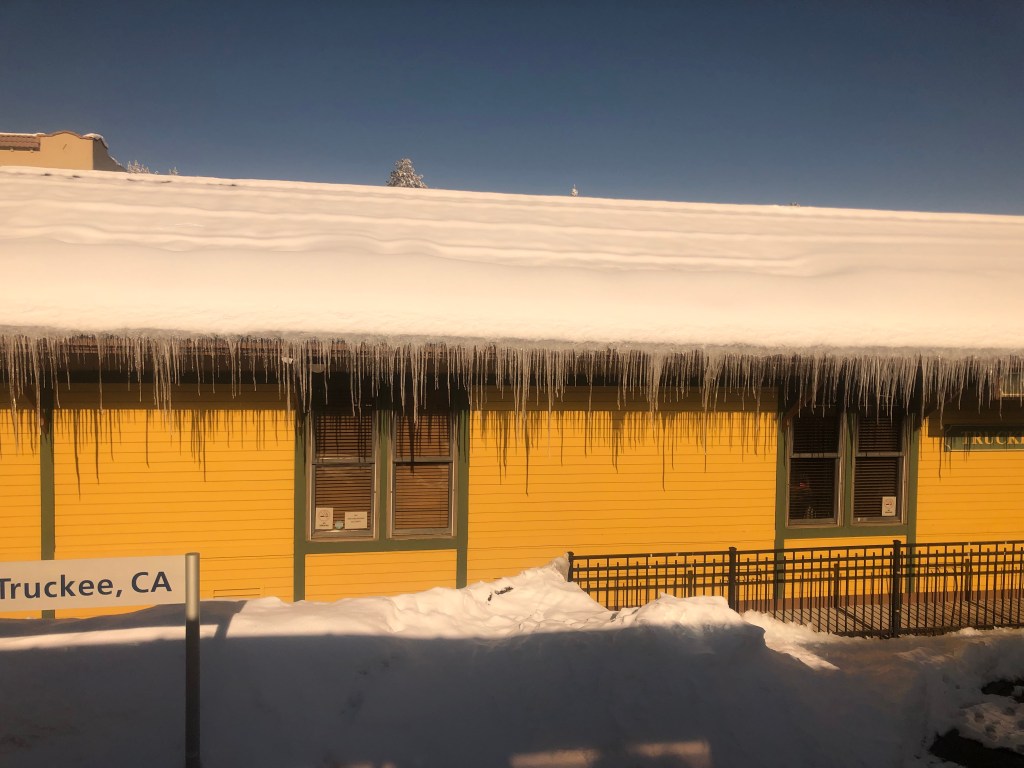
Speaking of Truckee, the town still has its old Southern Pacific station from 1900. It’s remarkably well preserved, and according to “The Great American Stations” website, “Renovations and modernization in 1985 altered the historic fabric only slightly.”

Careful standing under those eaves!

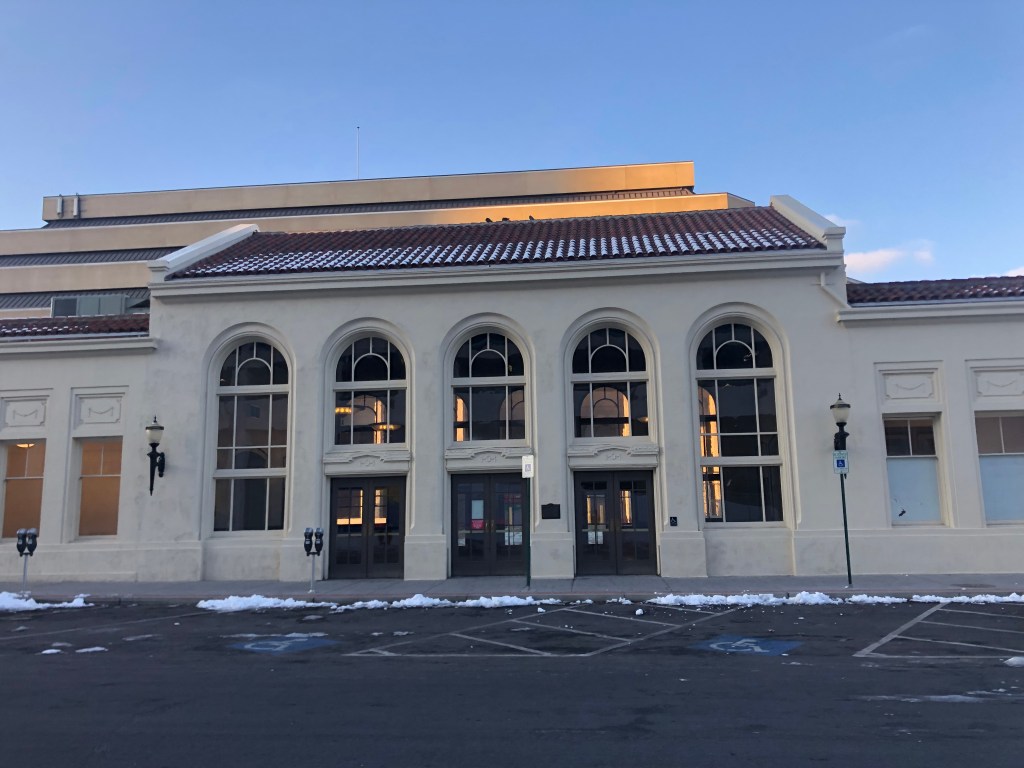
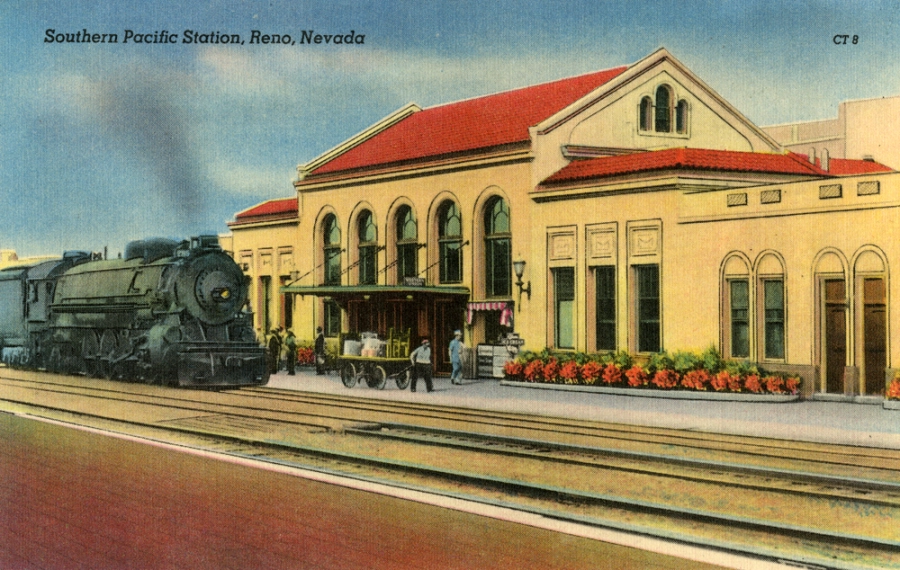
Eventually we got over the Sierras and dropped into Reno, NV (pop: 270,000). Reno’s current Amtrak station was grafted onto the city’s 1926 Southern Pacific depot in 2005. That same project lowered the railroad tracks into a 2-mile long ditch (a two-track-wide concrete canyon), in order to eliminate 11 grade crossings at street level. We got off the train down in this concrete canyon, enter a waiting room, and then climb stairs to the street level.

The Reno station at street level. (This is the original Southern Pacific portion of the structure; the Amtrak section is to the left.)
Reno’s Southern Pacific station in the steam era.

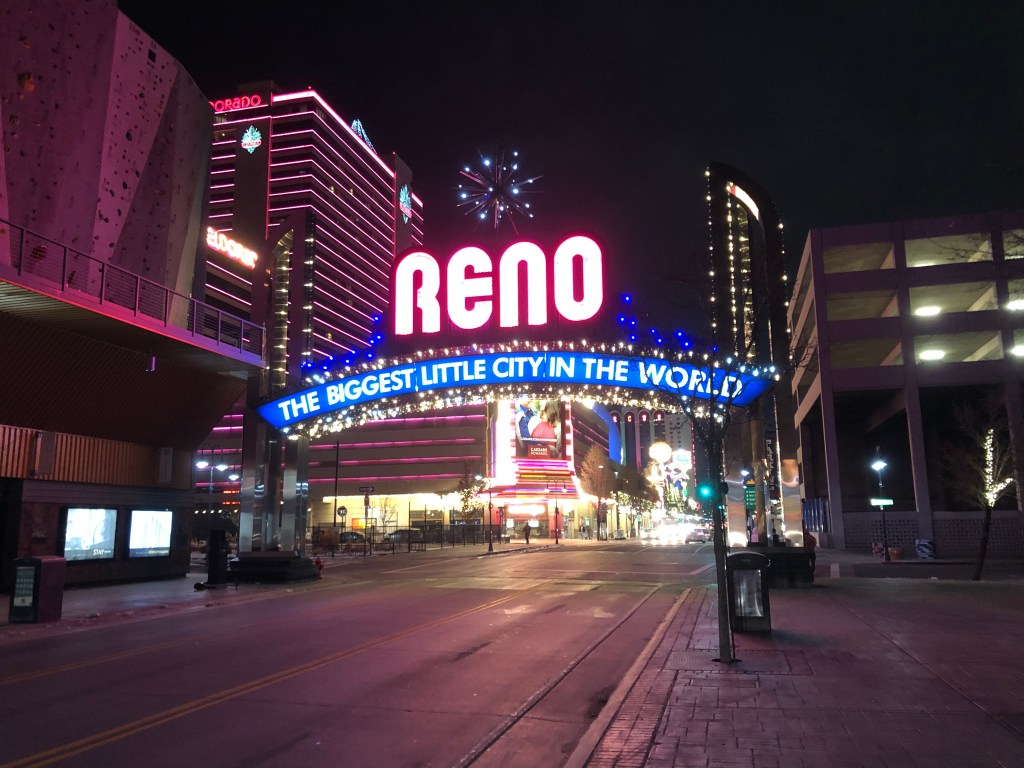
So, that’s about it for our Amtrak adventure over the Sierra. (We returned today, but obviously covered the exact same ground.) But it’s worth noting that we spent some time walking around Reno last night…

…and naturally I was able to squeeze in a Brew of the Day. So, without further ado, I present:

THE BREW OF THE DAY

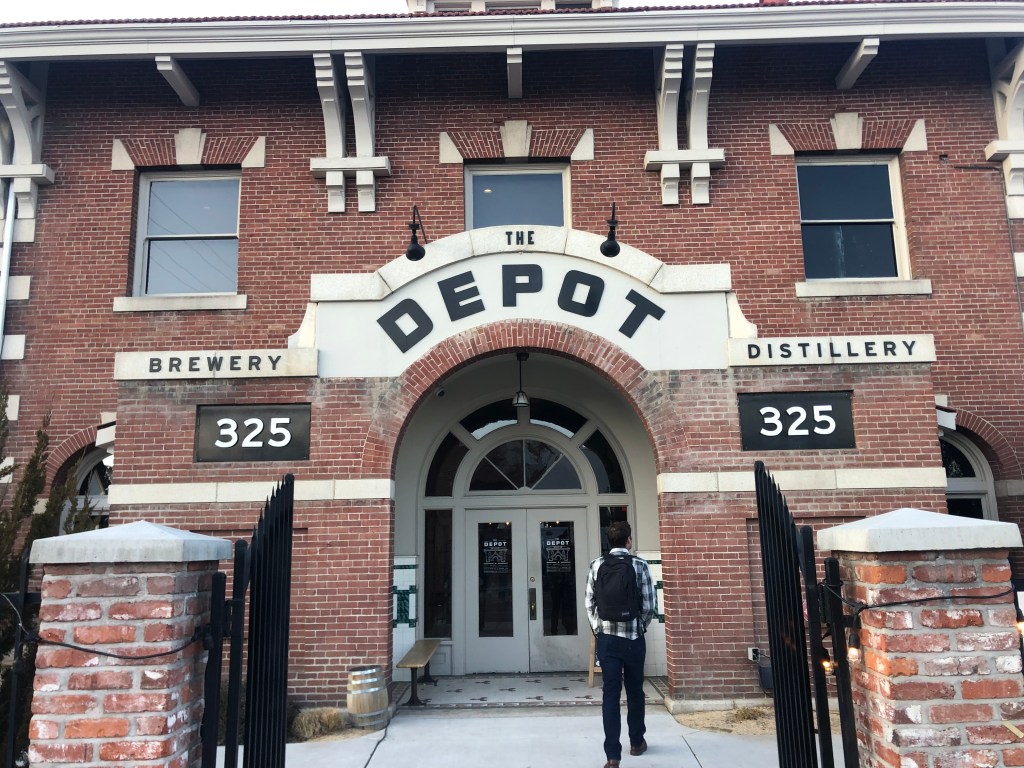
Just a few blocks from the Reno station is a brew pub named The Depot. Appropriately, it’s housed in the old Nevada-California-Oregon Railroad depot, which was built in 1910.

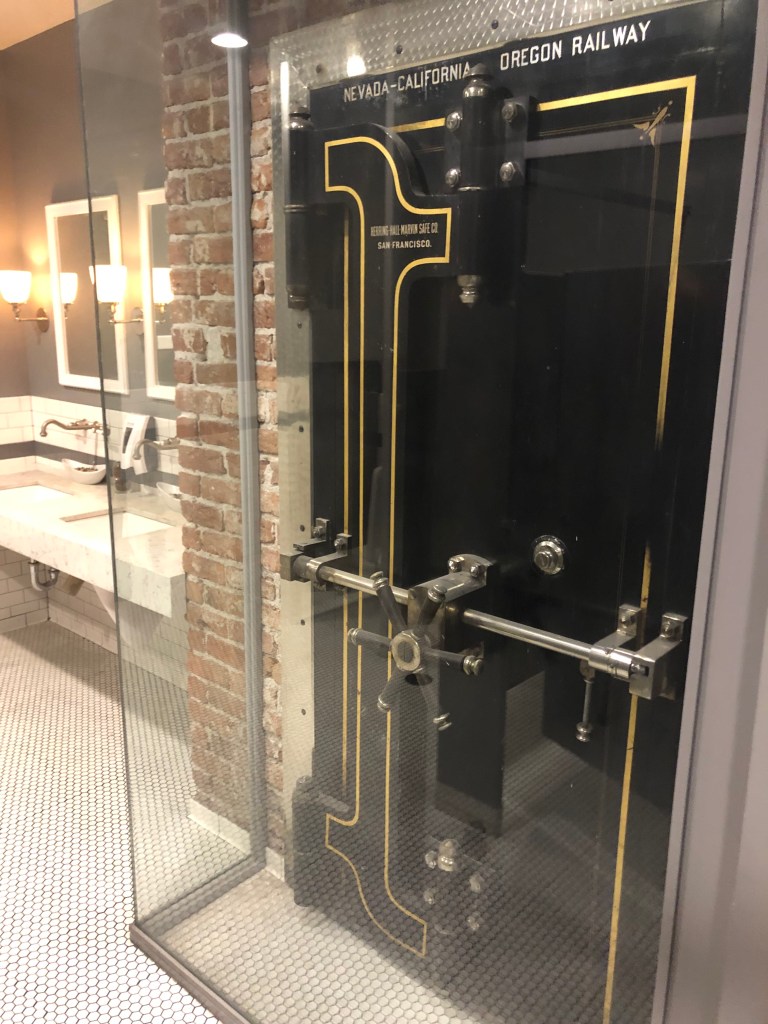
It’s a cool old building, remarkably preserved, with an impressive bar and attractive decor. There are neat old and anachronistic features everywhere, including the railroad’s ancient walk-in safe standing in the Men’s room.

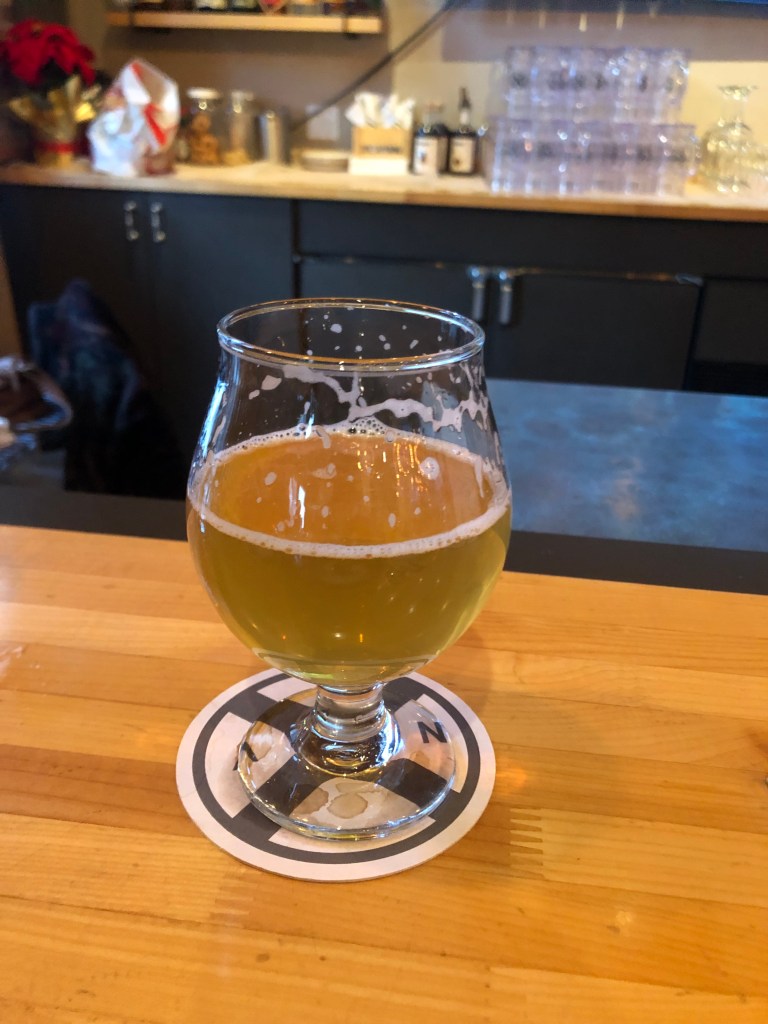
Feeling good about our find, we set ourselves down at the bar and studied the extensive beer menu. After much consideration I ordered something called a “Yankee and Kraut.” Let me quote how the menu describes it: “German beechwood smoked malt and Bavarian pretzel smoked sour ale.” (5.9% ABV.) I was intrigued. I’d literally never heard of anything like it. But I like Bavarian pretzels, and I like smokey drinks like Scotch or Mezcal or a smoked porter. What could go wrong?

Yankee and Kraut

The first sip I took definitely had a smokey profile, but it was fleeting and became immediately overwhelmed by a sour, vinegary assault on my tastebuds. This wasn’t a fun or playful sour like you get from sour gummy worms or Lemonheads. This was reminiscent of swimming pool acid. What’s more, the acidic, sour taste kept increasing with each new sip. And then, just when I thought it couldn’t get any worse, a “finish” reminiscent of off-brand window cleaner washed over my tongue and singed my sinuses. Meanwhile, there was not the slightest hint of “Bavarian pretzel” anywhere–not even the requisite salt or mustard, which would have been a welcome distraction for this beer. I cannot in good conscience give this anything higher than zero points. (The Mac ‘n’ Cheese Bites were awesome, though.)

California history · Hydrology

Spooky Castle in the Sierra Foothills

As a child I was never sent to prison–though not for lack of trying. But if the law had caught up with me, I surely would have been sent to juvenile hall (a place invariably referred to as “juvie” when I was growing up). For I grew up in a more enlightened time than that of the unfortunate wastrels of the 19th century. In those days, northern California felons as young as 14 years old would be sent to San Quentin or Folsom prison.

And then, in 1889, the California Legislature passed legislation to create a state reform school for boys. It was a progressive idea for the time: Instead of serving out their terms in prison alongside more seasoned felons, underage boys would be sent to live together at a youth facility, where they would attend school, learn a trade, and eventually be reintegrated into society.

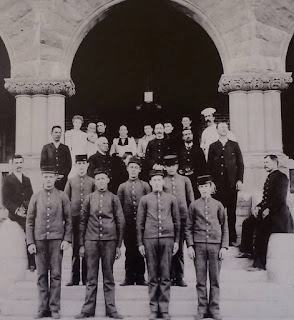
The new reform school’s first class (1894). All seven young men had been transferred from San Quentin.

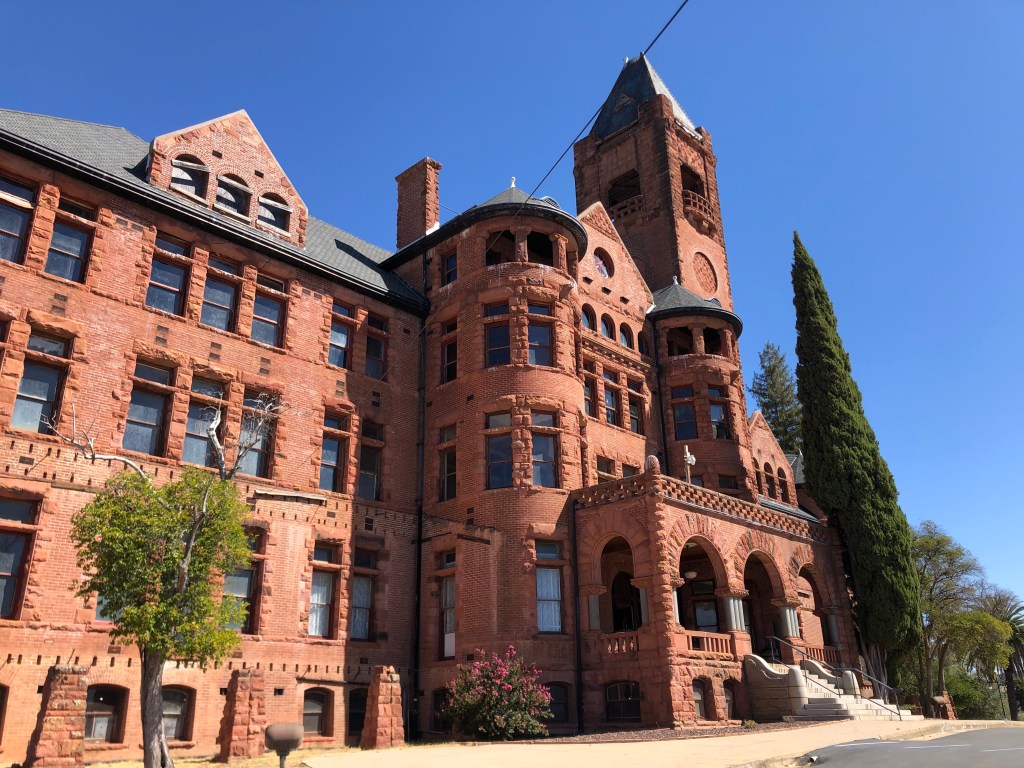
Originally the school was to be sited near Folsom Prison, but the Legislature ultimately decided to downplay the prison connection and place the new school in a more bucolic setting, amid the rolling, oak-studded hills of Amador County. They also gave it the milder name, “Preston School of Industry.” (Senator Edward Preston was the bill’s author.) Soon, an imposing, four-story stone building was being erected outside the tiny town of Ione, about 30 miles southeast of Folsom.

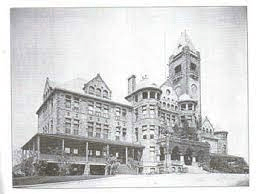
The Preston School of Industry, in all its Romanesque Revival glory.

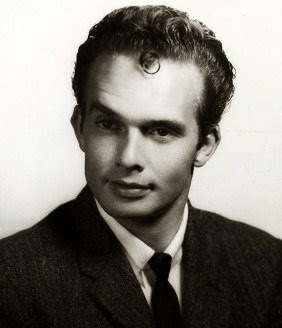
Preston opened its doors to student inmates (they were officially called “wards”) in 1894, and it eventually housed up to 800 wards at a time from all of the state. They weren’t all felons; during the Depression it was not unusual for some impoverished families to abandon their boys to Preston, where they would be fed and clothed at the state’s expense. One Preston “graduate” who would go on to become famous was country singer Merle Haggard, who was sent there in 1954 after being convicted of auto theft.

The Okie from Muskogee did a stretch at Preston School of Industry.

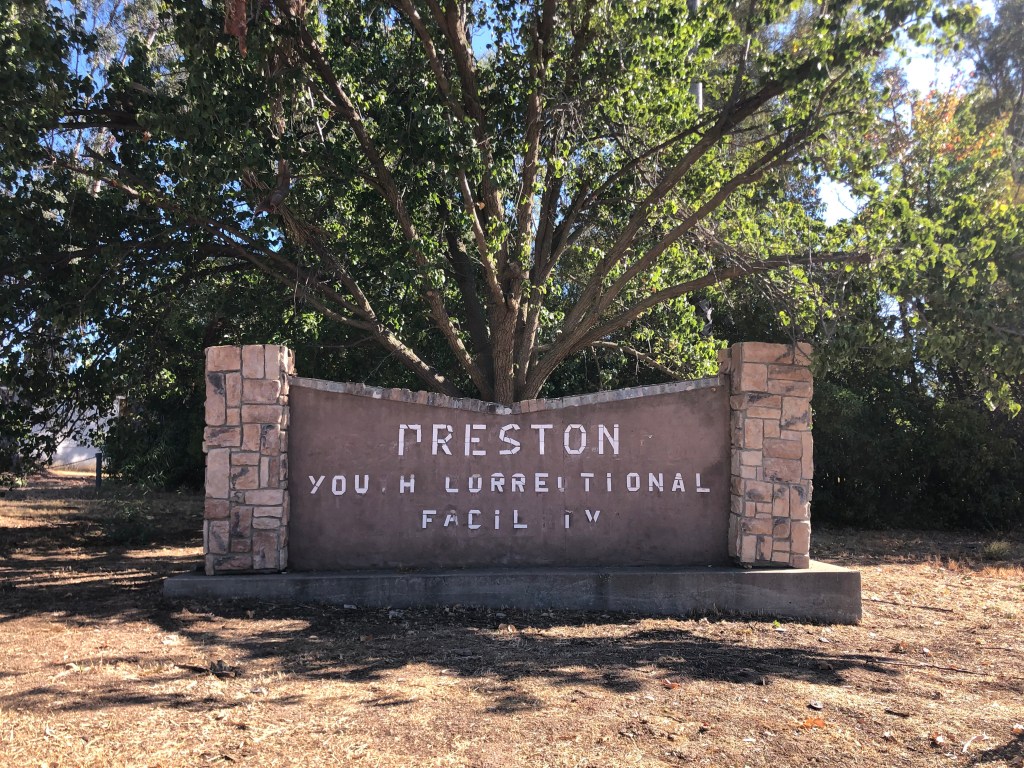
The Preston School of Industry was shut down in the late 1950s, when it was replaced with more modern facilities next door. The new facility adopted the name “Preston Youth Correctional Facility,” which, if you ask me, sounds less enlightened than “School of Industry.” The “new” facility itself shut down in 2011.

Well-intentioned step backward in nomenclature.

But what of the original building? The plan was to tear it down, and, incredibly, in 1960 the general public was invited to come in and take whatever usable pieces they wanted. Wainscoting, moulding, light fixtures, decorative tile, even parts of the slate roof were ransacked. But then local activists successfully fought to spare the building from the wrecking ball. The building became State Historical Landmark #867, and it’s been standing in a state of barely-arrested decay ever since.

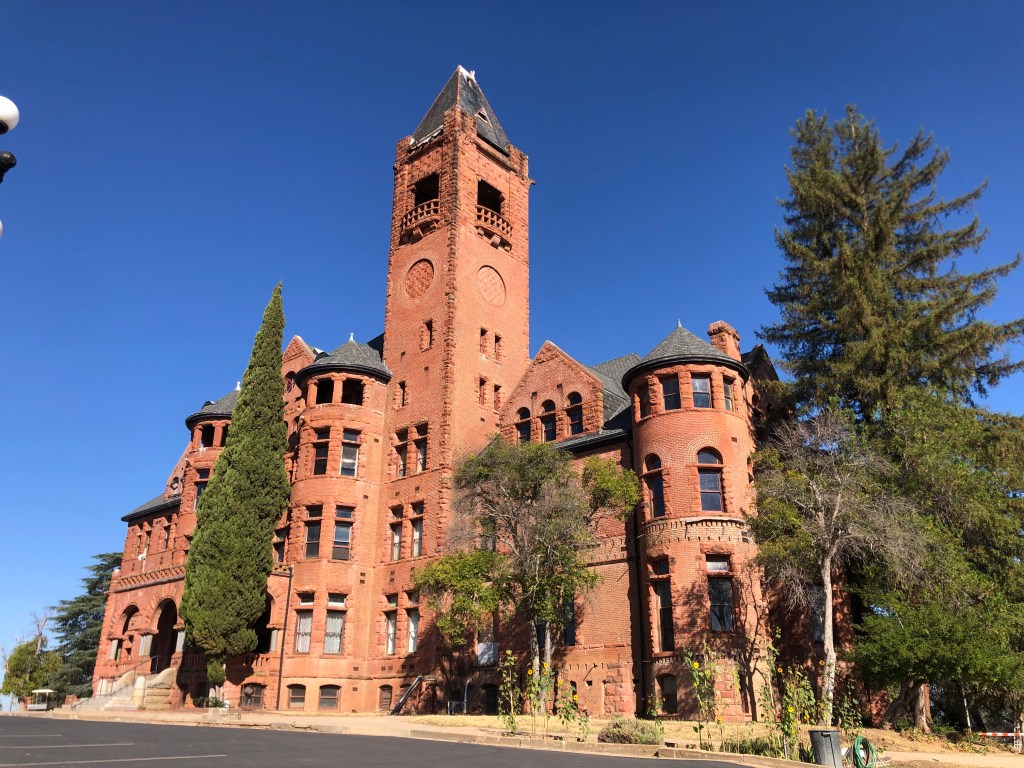
Today I visited what’s now known as Preston Castle. It’s as imposing as ever.

Can you imagine calling this home?
But be it ever so humble…

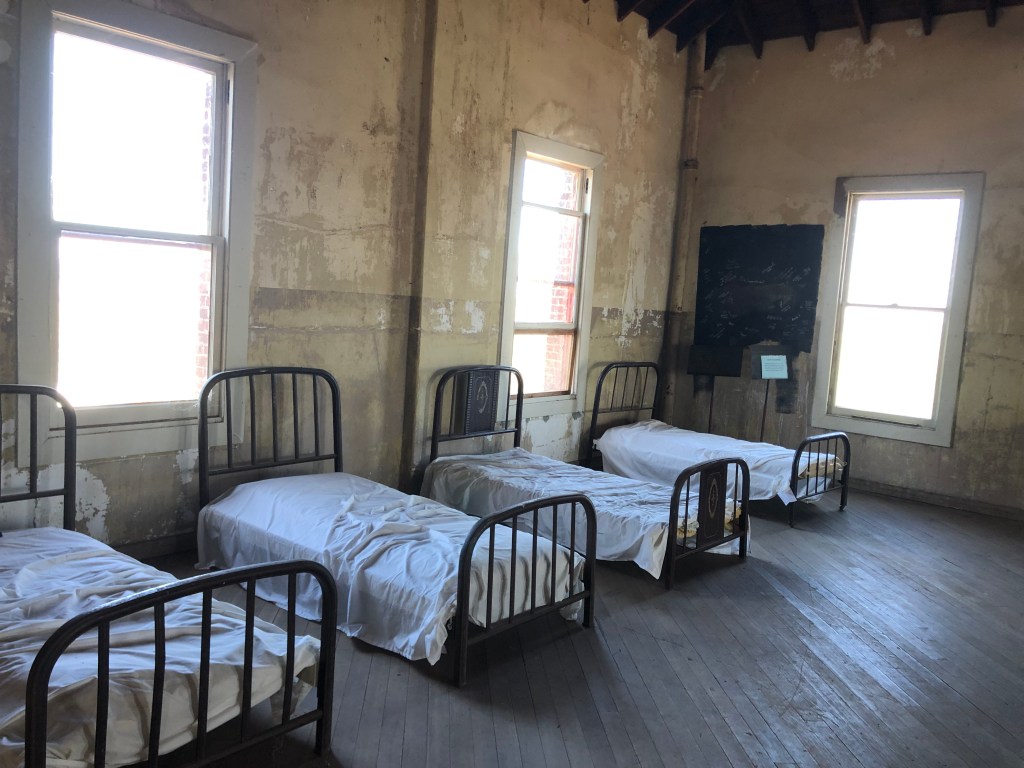
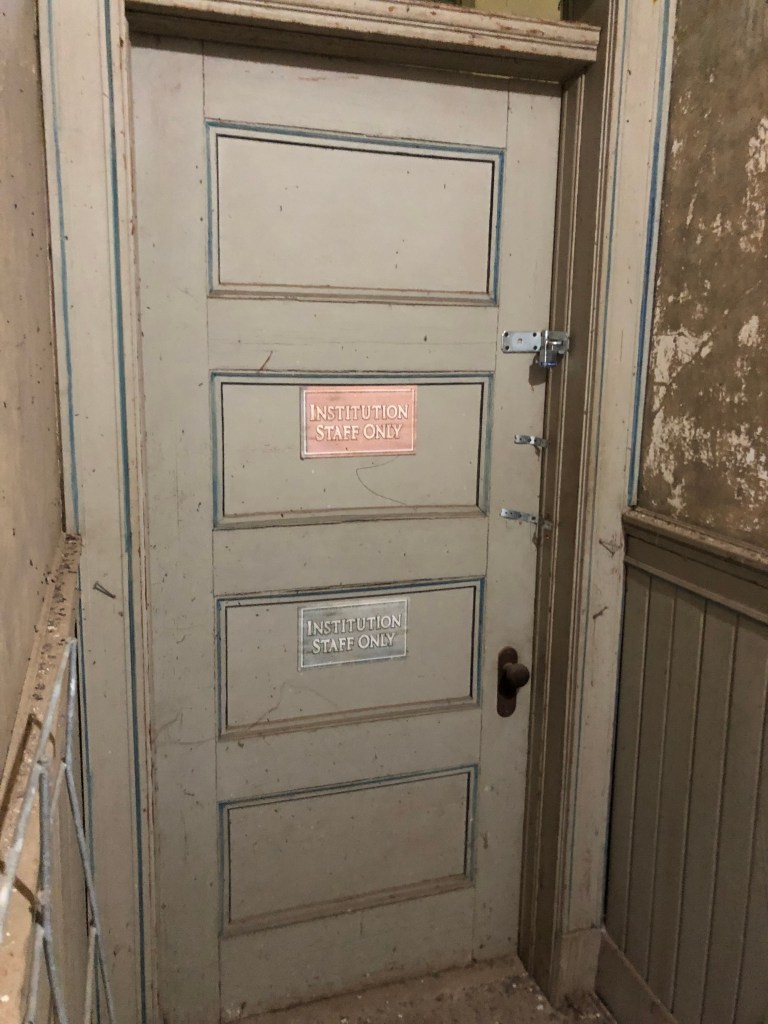
The building was open for self-guided tours today–the last day of the season, as it’s next going to be transformed into a haunted house for a Halloween fundraiser. From what I saw today, it won’t require much work to make it into a proper haunted house….

You know what’s creepier than a 100-year-old institutional ward?
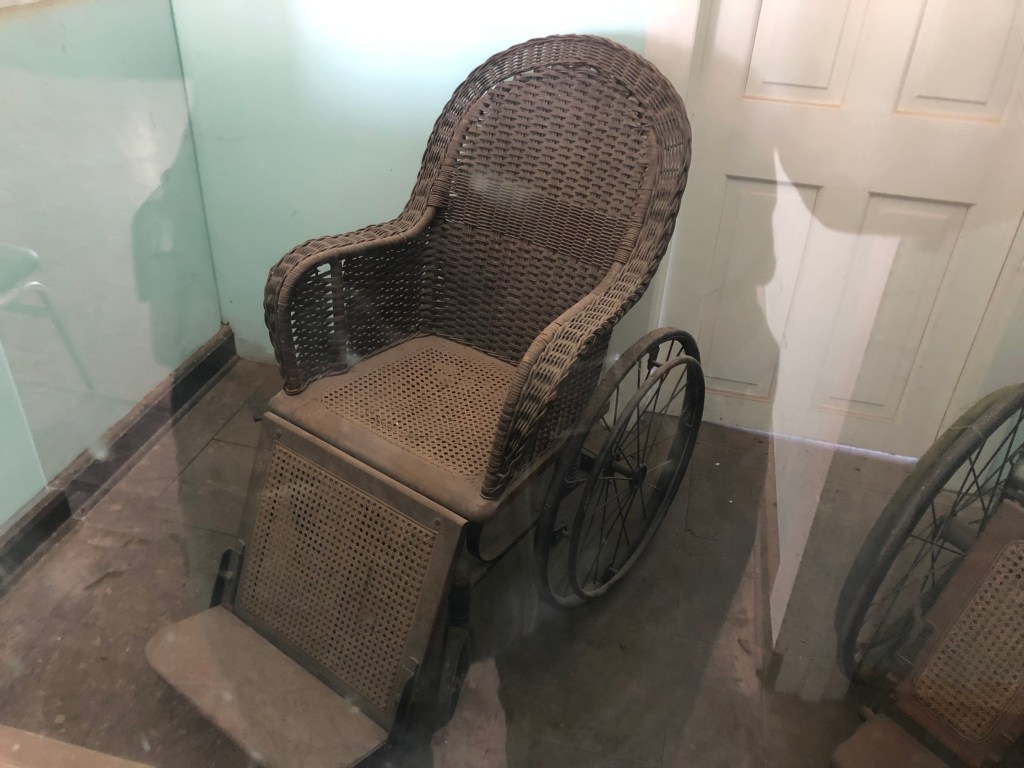
…It’s a 100-year-old institutional wheelchair.
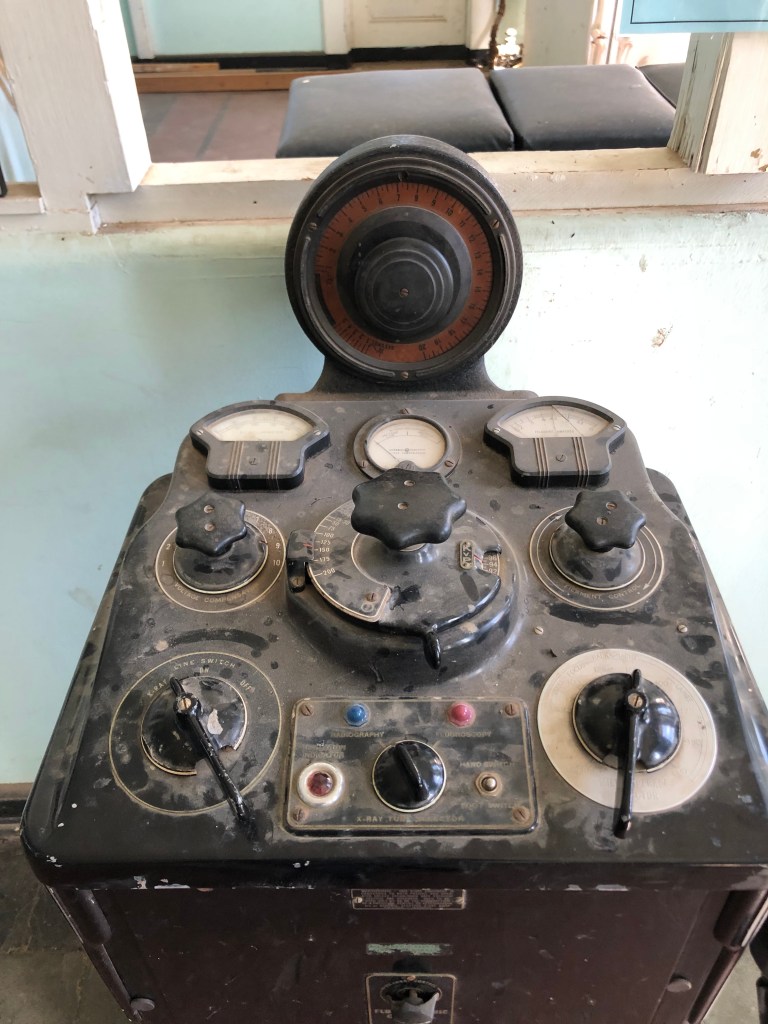
Runner up is this old-timey X-ray machine.

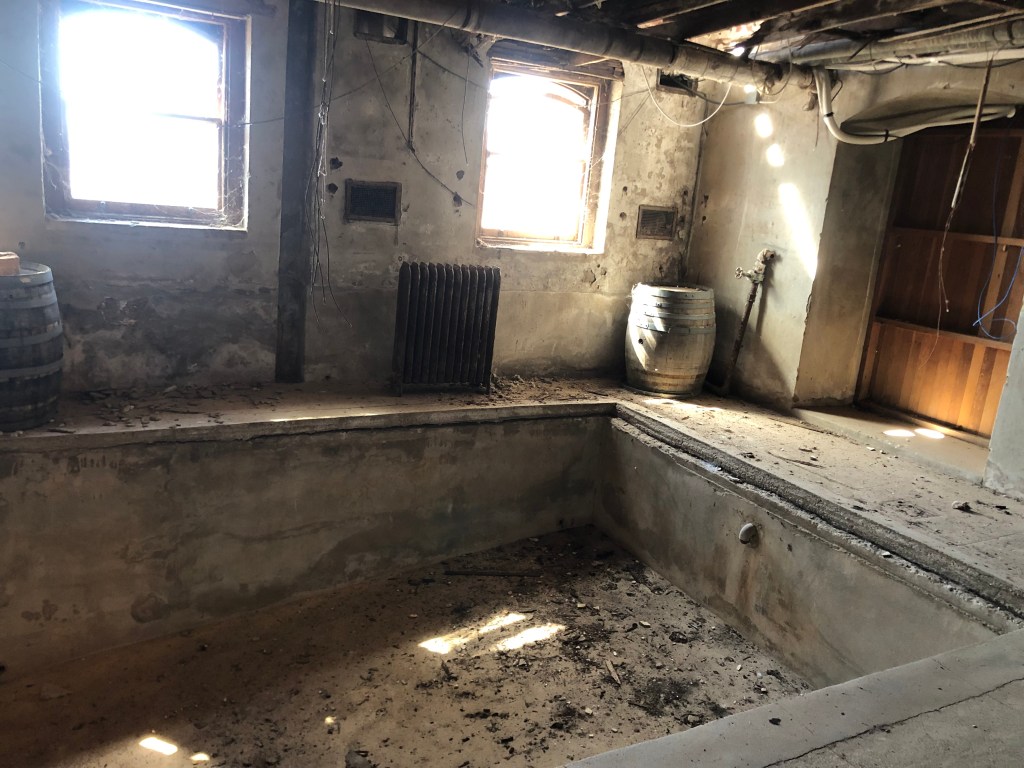
And then we have the infamous “plunge.” Newly-arrived wards would be stripped, shorn, and then required to swim through a chemical pool to rid them of lice and other bugs. I’m not making this up. (Some accounts say the pool was filled with lye, though I haven’t been able to confirm that.)

The Plunge. What? No jacuzzi?

Overall, a palpable sense of despair hangs over this place. I’m sure part of it is due to the state of decay. But the history doesn’t help.

As if anyone else would want to darken that doorstep!

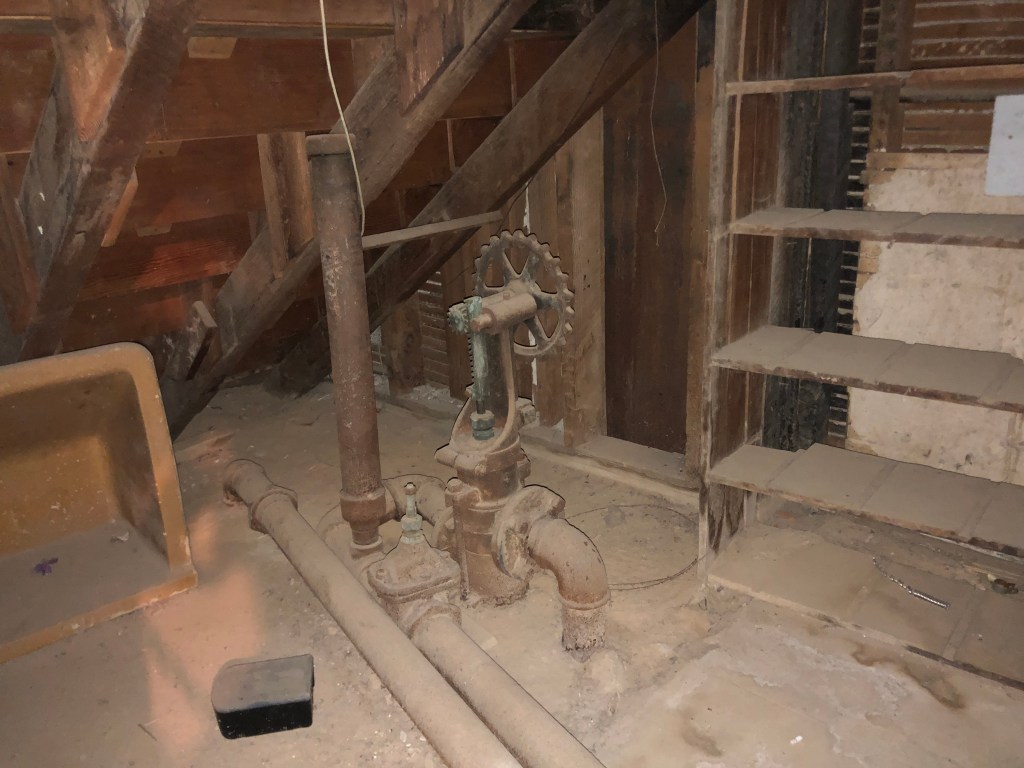
I noted that the Castle contained some innovative features. For example, it boasted a late-19th-century elevator, prior to electrification. The device was powered by water pressure. Alas, the elevator was soon deemed too slow and an unnecessary waste of water in the dry foothills, so it was removed. (From that point forward, everyone had to use stairs to move between floors in the four-story building.) But the lift mechanism remains today in the dusty basement.

Abandoned lift mechanism for Preston’s water-powered elevator.

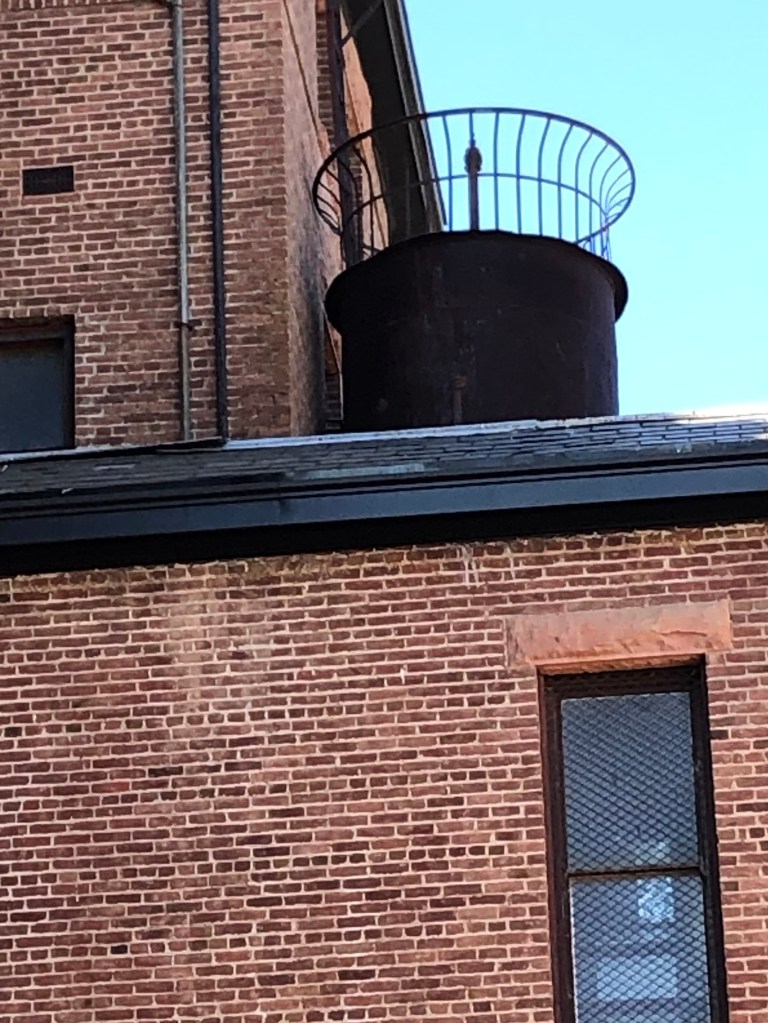
Another water-related innovation is the fire escape. It’s actually a spiral slide within a metal tube, which utilized a spray of water to lubricate the trip down. I’m not making this up either.

Top of the fire escape/water slide. Eat your heart out, Six Flags!

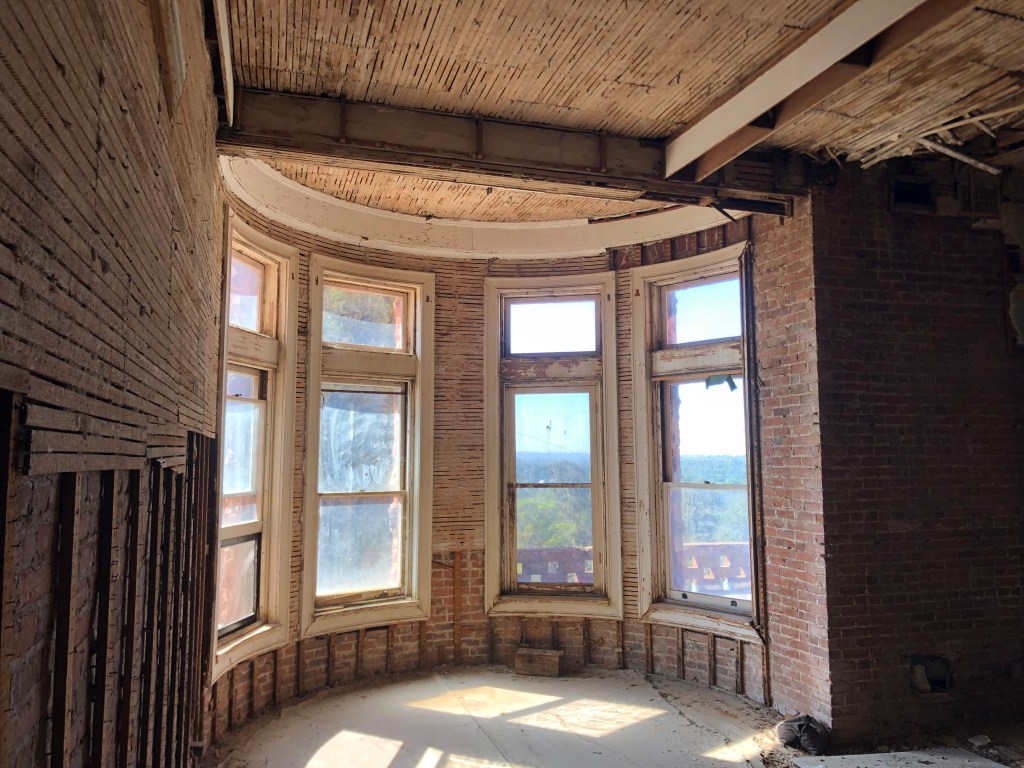
The only bright spot I observed during my visit was the reading room which adjoins the building’s library. You can still feel the lightness of spirit afforded by an open space and a good view.

Refuge for reading.

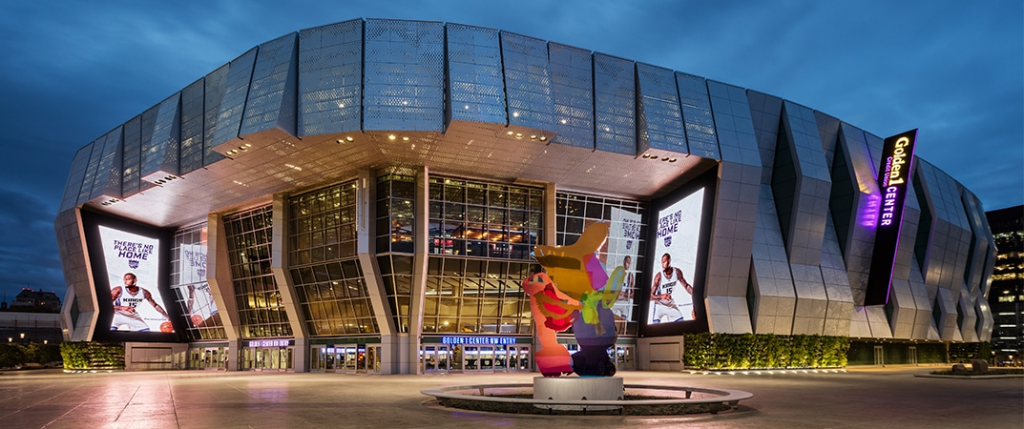
So, what to make of all this? First, I think we all owe a debt of gratitude to the original activists and to the Preston Castle Foundation for preserving this piece of history. Preston Castle is a stunning structure with a fascinating past. Second, I think we’re well advised to continually revisit the topic of how we’re dealing with the state’s youthful offenders. I’m of the opinion that we as a society must stand up to antisocial behavior…but, at the same time, I believe that no one is irredeemable. I don’t know how to balance those two thoughts, but I do have some confidence in this third point: Public institutions should pay some attention to architectural style. I’m looking at you, Golden 1 Center.