bridges · movie theaters · Road trips · trains

Blob Blog

By coincidence, I recently received as gifts two books concerning the Lincoln Highway. The first, which I read last year, is The Lincoln Highway by Amor Towles. It’s a fictional account about a trip along the fabled transcontinental route. The second book, which I’m currently reading, is American Road by Pete Davies. It’s a true account about a caravan of military vehicles which traversed the Lincoln Highway in 1919, in an effort to raise awareness and promote the paving of the route.
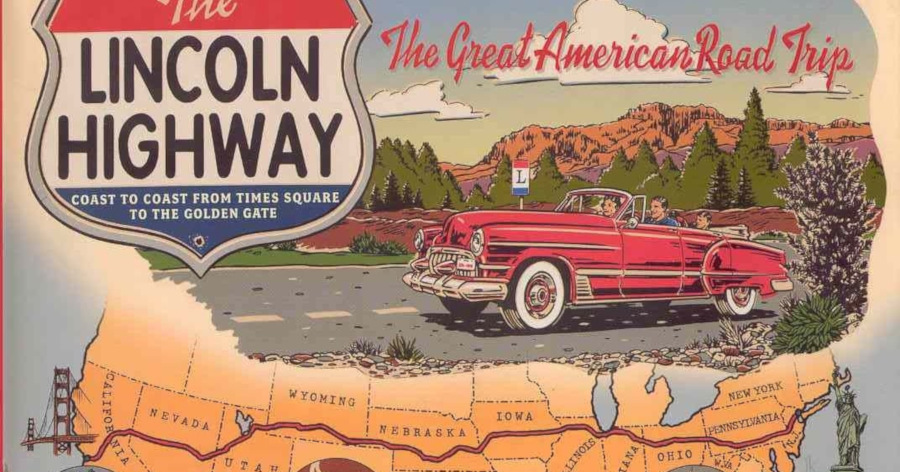
Established in 1913, the Lincoln Highway was the country’s first transcontinental route for automobiles. It began as a patchwork of existing stretches of roadway, most of which were just rutted dirt roads. Over time it got re-aligned and paved, with gas stations and diners and motels dotting the roadside. Today, most of the old Lincoln Highway is long gone, superseded by modern interstates.

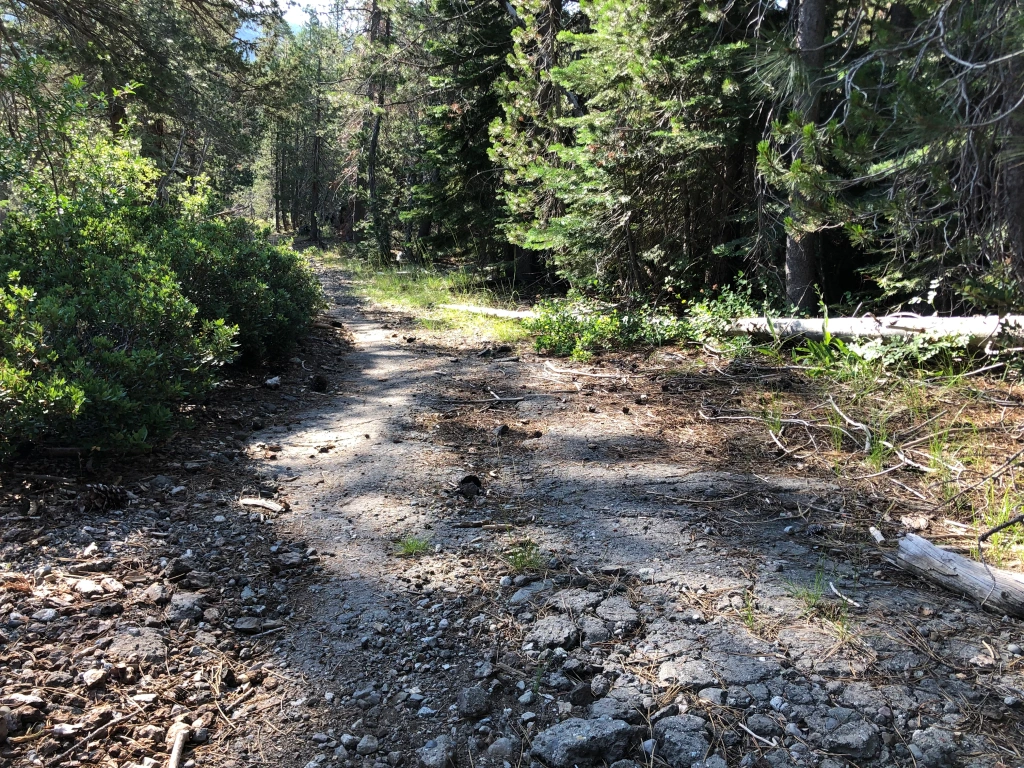
In California, I-80 roughly traverses the old route. There are a few markers and memorials a long the way. (A couple of years ago I hiked a crumbling, original section of the road near Donner Pass. Here’s the blog post and here’s the photo:)
I also discussed the Lincoln Highway and included a photo of an original Lincoln Highway marker in this blog post.

I bring all this up because today I drove around a hundred miles of the old Lincoln Highway route heading west out of Philadelphia. Most of the original route is now U.S. Route 30. I was hoping to see some ancient infrastructure and roadside structures from the Old Days, but most of the route today looks like any other two-lane highway. Yet I did spy a few elements that date back to the early 20th century.
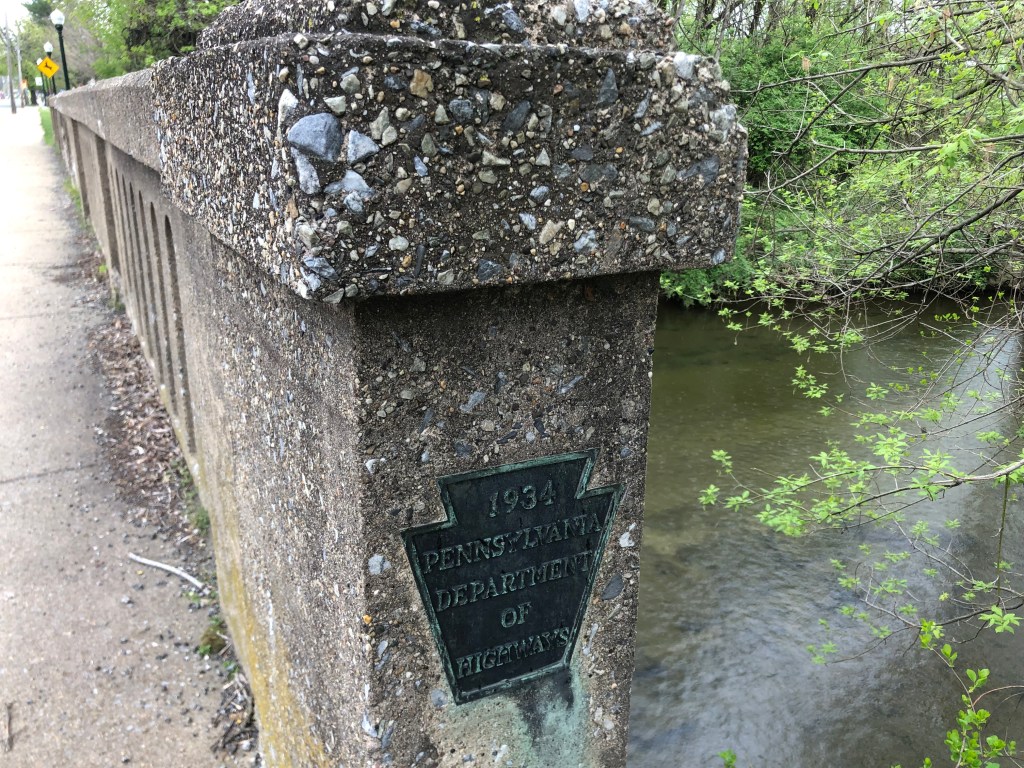
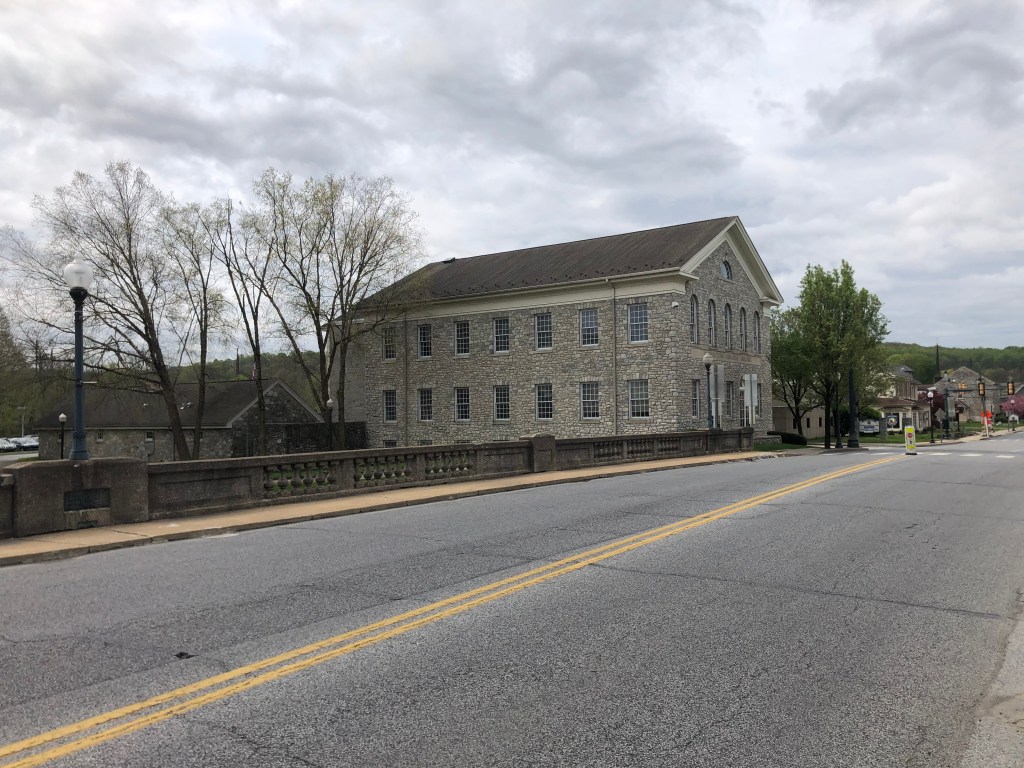
90-year-old bridge marker
1922 bridge and (presumably) much older building. These were surely around for the Lincoln Highway’s early years.
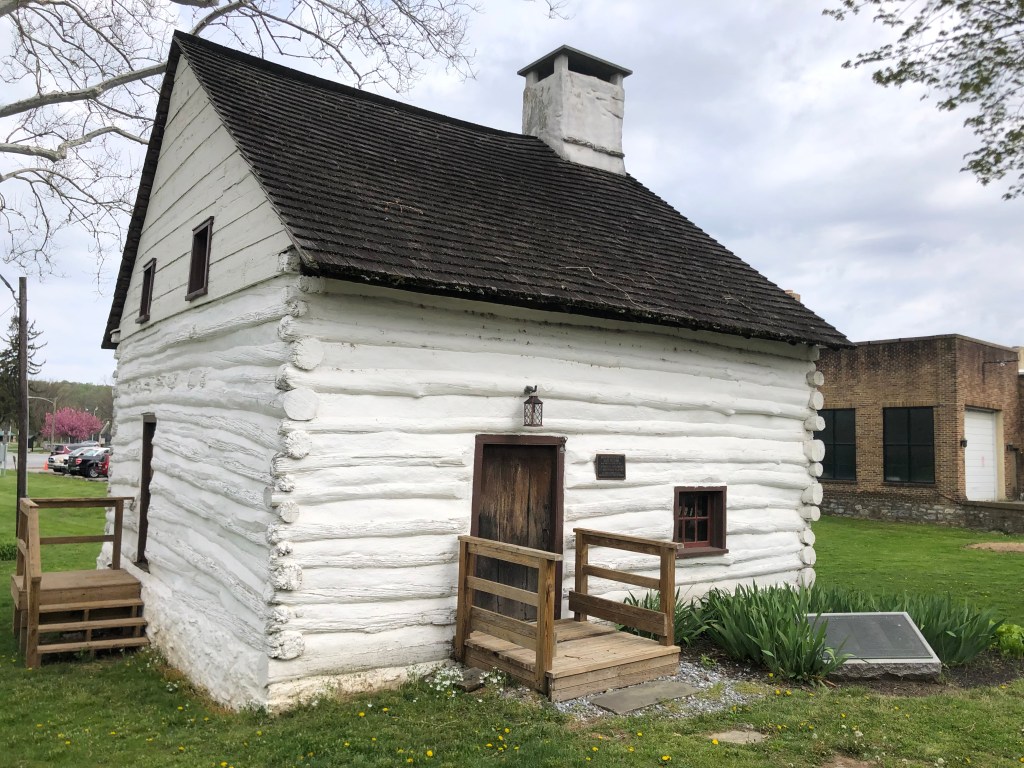
18th-century log house along Route 30.
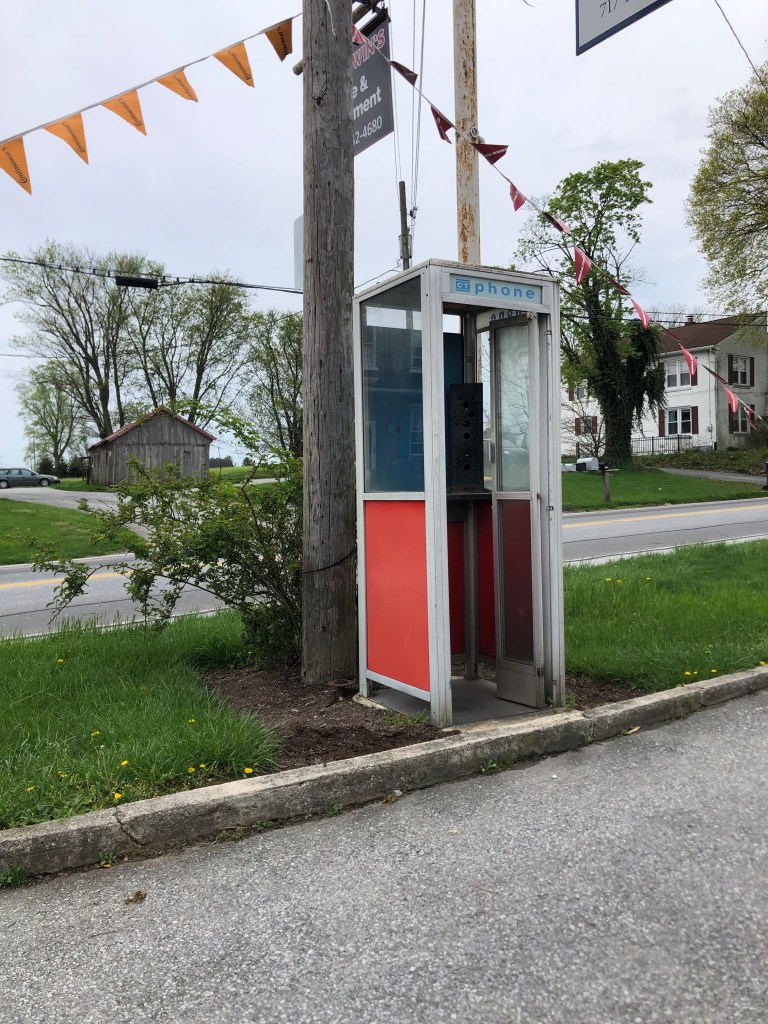
Phone booth in Compass, PA might not have been around for the original Lincoln Highway, but it qualifies as historic.

When I eventually arrived in Downingtown (pop: 7,900) I was feeling a bit peckish. I stopped at the mid-century Downingtown Diner, whose sign announces that it’s the “Home of the Blob.”
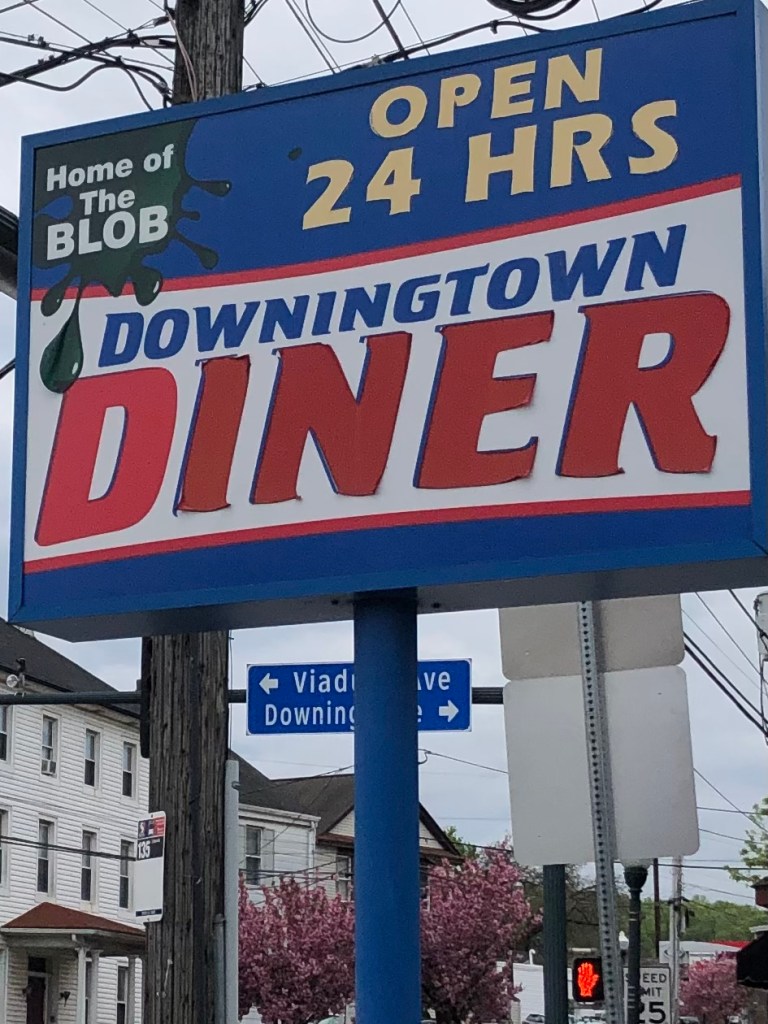
For the 90 percent of the country that isn’t familiar with the movie, is “home of the blob” a winning slogan for a diner?

You remember The Blob, right? It was a 1958 science fiction film that featured a young Steve McQueen in his first starring role. The plot (such as it is) involves a giant, carnivorous blob of Jell-O from outer space. Do yourself a favor and watch the trailer; there’s even a shot of the diner.

I went into the diner and was greeted by Shannon. I quizzed her about the Blob connection, but surprisingly (shockingly, even) she admitted to never having watched the movie. She did inform me, however, that the diner building was replaced since the movie was made. (“But the basement is original!”)
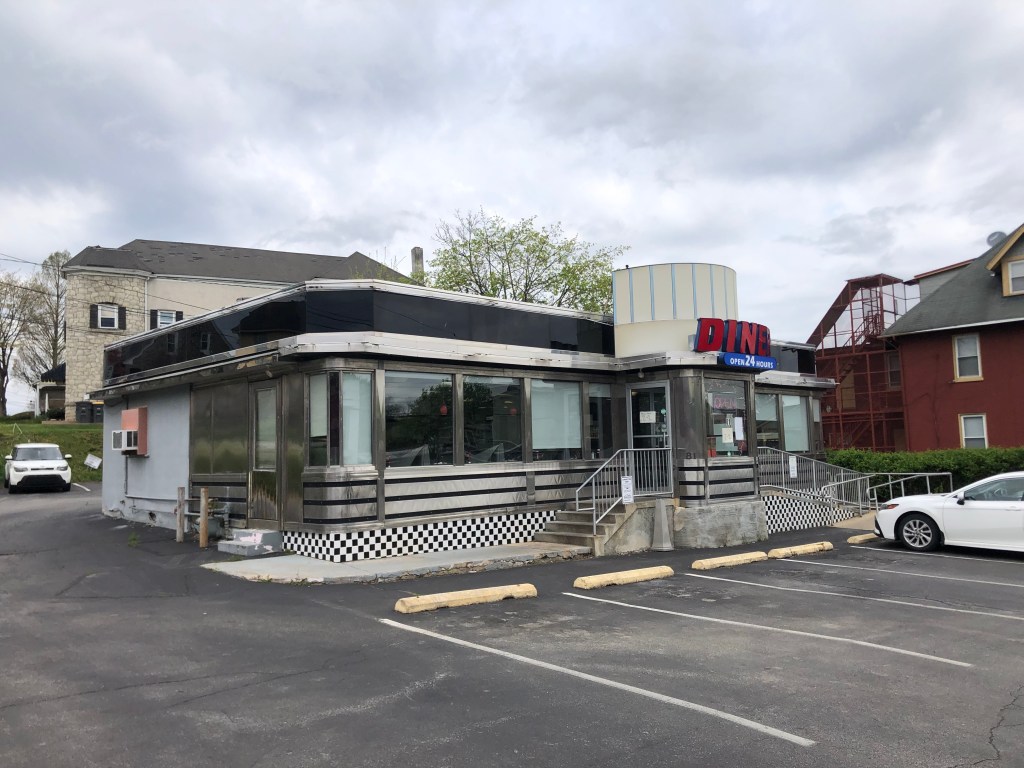
Though not the original, it does look a lot like the diner in the movie.

The Downington Diner doesn’t shrink from it’s B-movie connection. Not only is The Blob featured on their roadside sign, but the menu features a “Blob Special.”
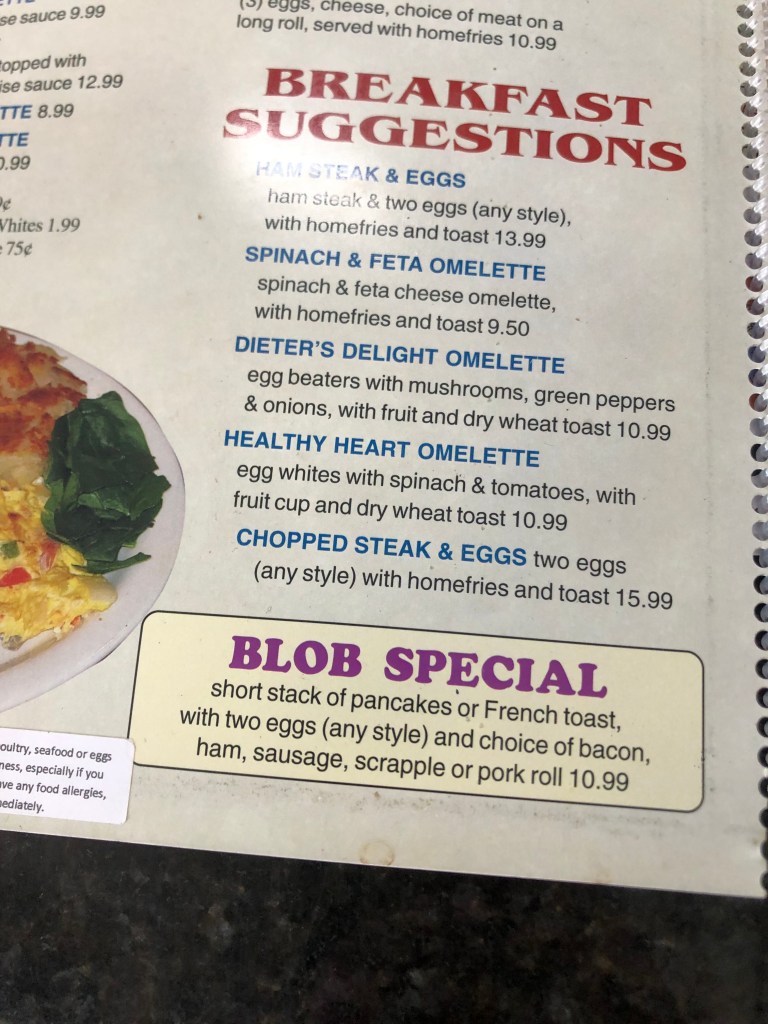
I couldn’t bring myself to order the Blob Special.

Shannon, who was as friendly and helpful as they come, instead whipped me up a delicious mint chip milkshake. (“It’s green, like the Blob!”) Which is true, if you go by the green blob on their sign. But it should be noted that the Blob in the movie is red.
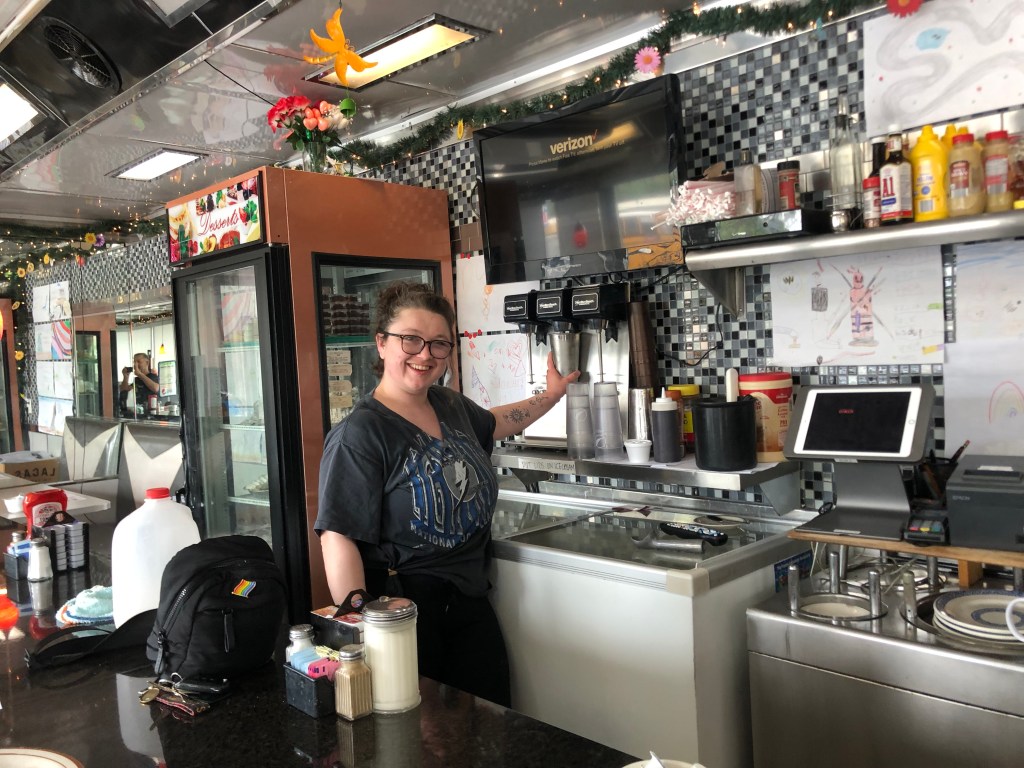
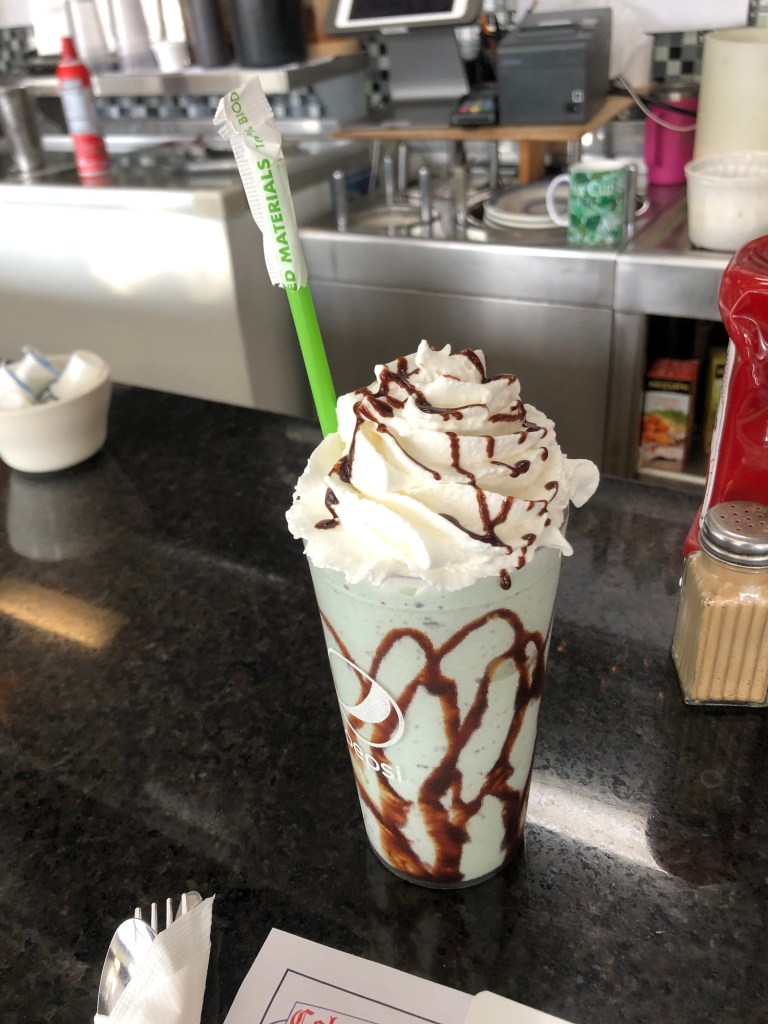
Shannon making a Blob-Shake.
Seriously the best milkshake I’ve ever had.

Now that I was fortified with 1,700 calories of blended ice cream, there was only one thing to do: Head over to the nearby town of Phoenixville (pop: 20,000), where the Blob’s famous Movie Theater Scene was filmed. (You saw it in the trailer, above.) Phoenixville was founded in 1849, and for years the local economy was centered on the Phoenix Iron Works. The company closed in the 1980s, and Phoenixville suffered a economic decline. But in recent years the city has been transformed, and today it appears charming and downright prosperous.

I sensed a good deal of civic pride in the spotless business district and beautiful homes. I even encountered a group of students from the local college who were spending the morning sprucing up the public spaces with rakes and brooms. These kids are seriously the best–energetic, outward-oriented, positive, friendly.
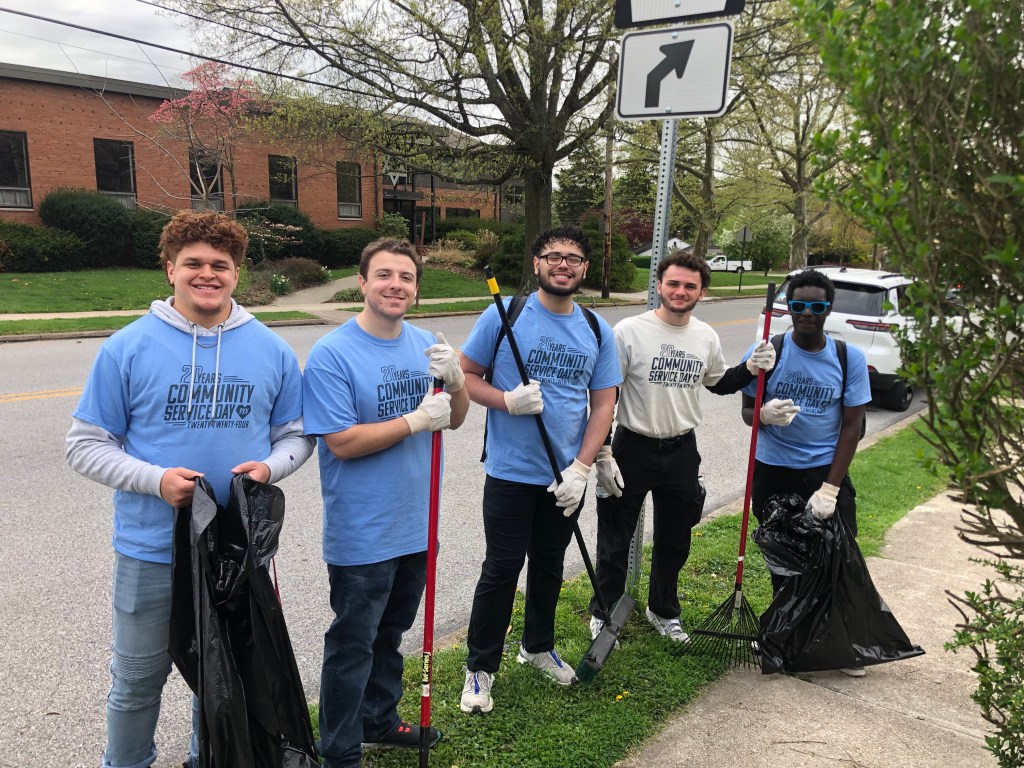
Makes me optimistic about our future!

But let’s get back to the reason I came to Phoenixville: to see the theater from The Blob. The place looks practically unchanged from its 1958 movie appearance.
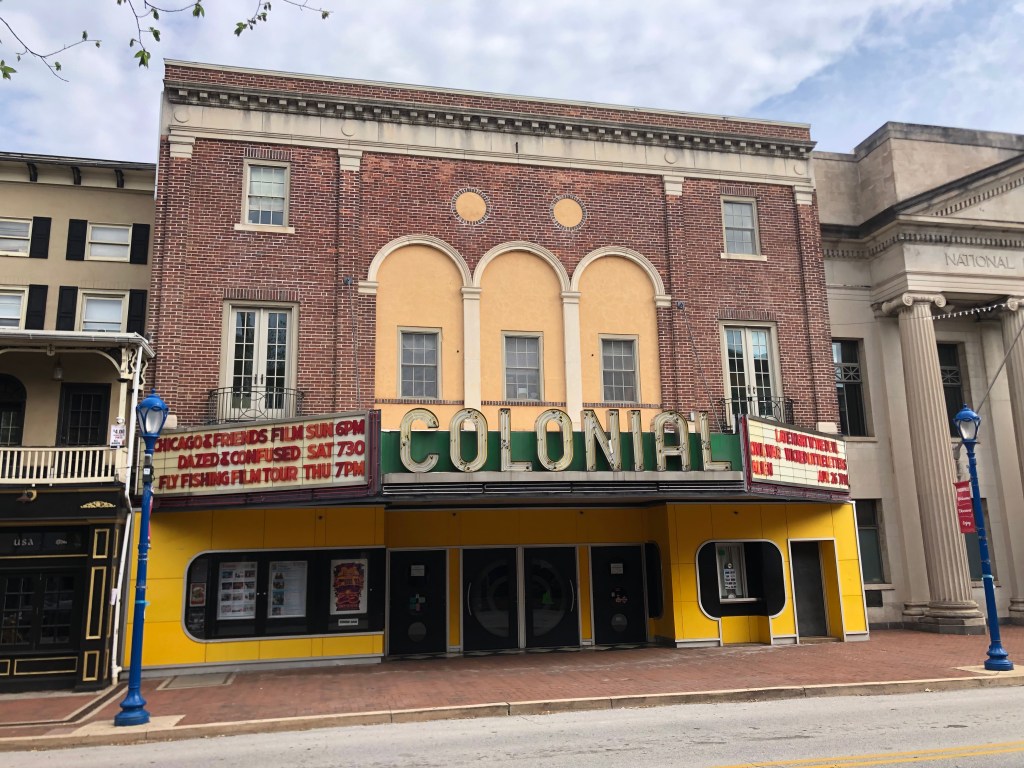
Still going strong.

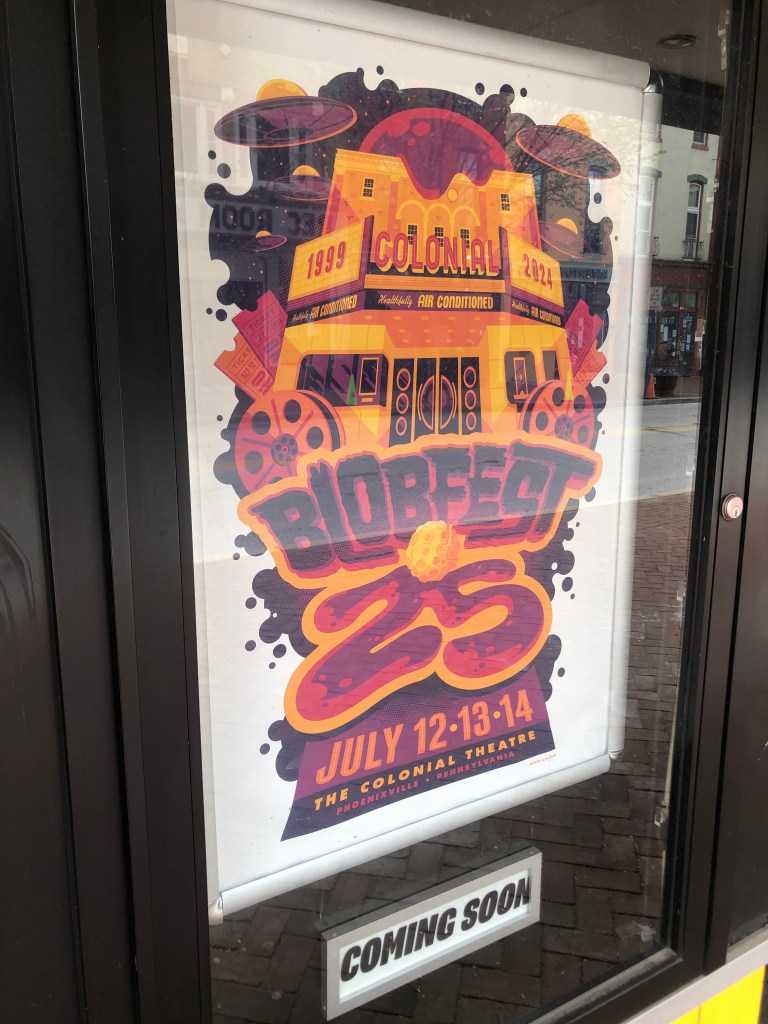
The Colonial Theater actually dates all the way back to 1903, when it started out hosting Vaudeville shows. Showbiz greats like Mary Pickford and Harry Houdini have graced its stage. It’s gratifying that the good people of Phoenixville have seen fit to preserve and support this historic venue. In fact, every summer the town and the theater throw a major festival called Blobfest. I’m seriously thinking about coming back in July…
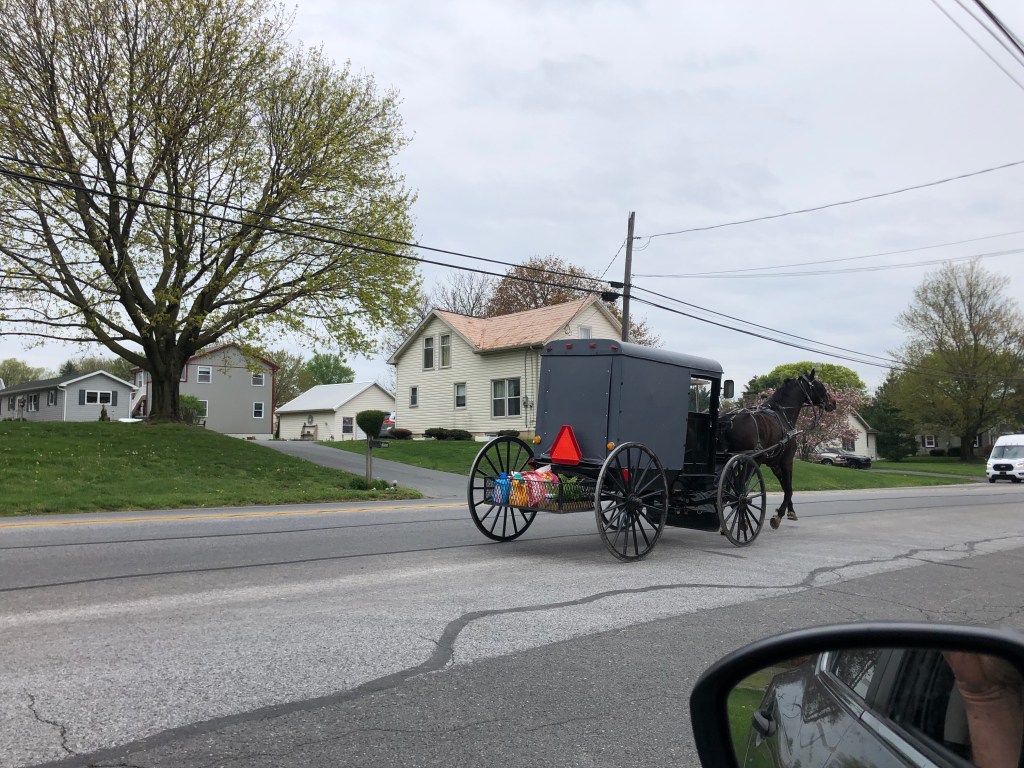
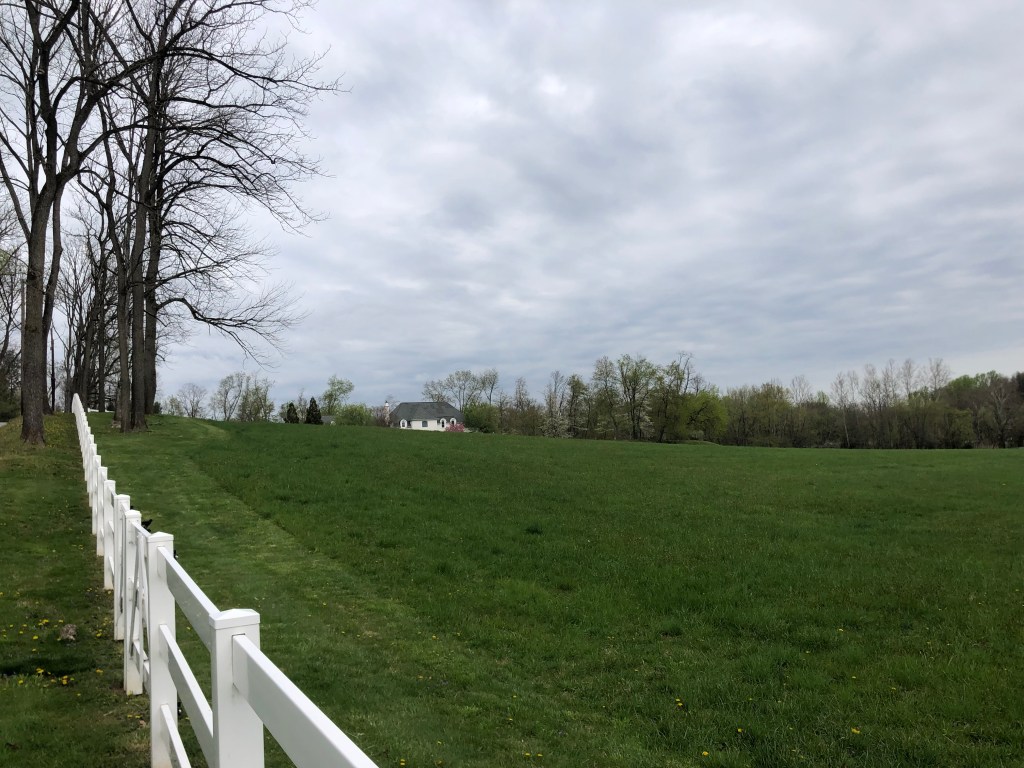
It was now time to return to the Lincoln Highway, which in the form of US Route 30, cuts through Pennsylvania’s picturesque Amish county. Farm houses, rolling hills, and horse-drawn buggies constitute the main scenery. I figure these scenes are pretty much unchanged from when the Lincoln Highway was established over a century ago.
Of course, when one travels through Pennsylvania’s Amish country one is obligated to take advantage of the Intercourse photo-op.
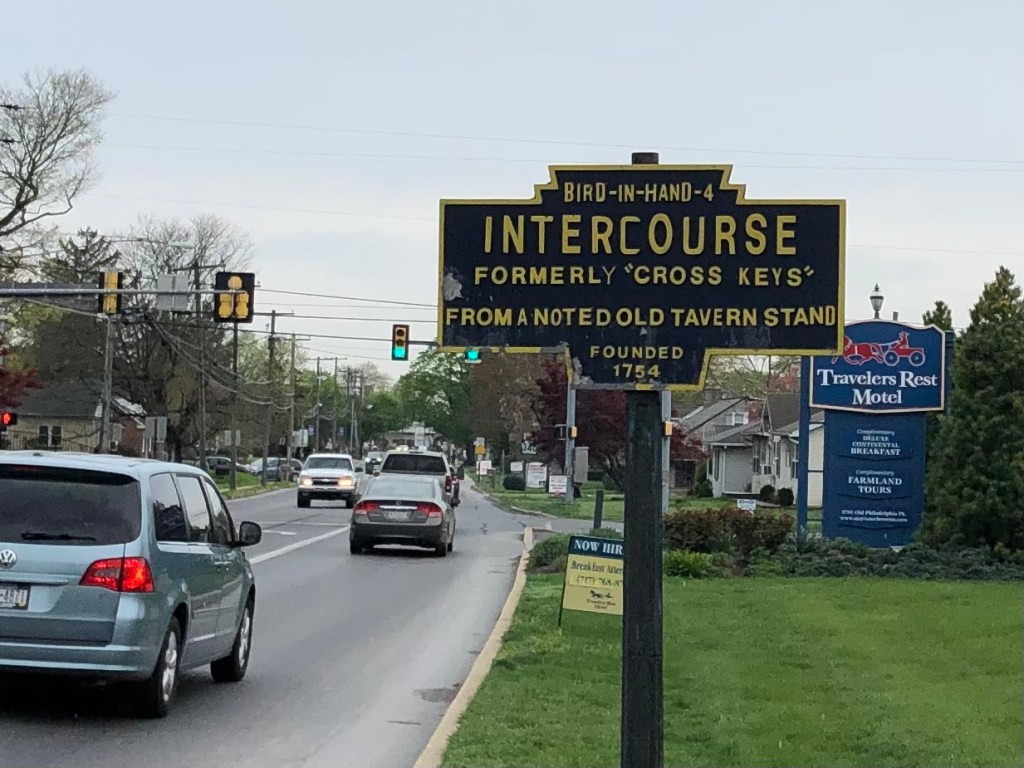
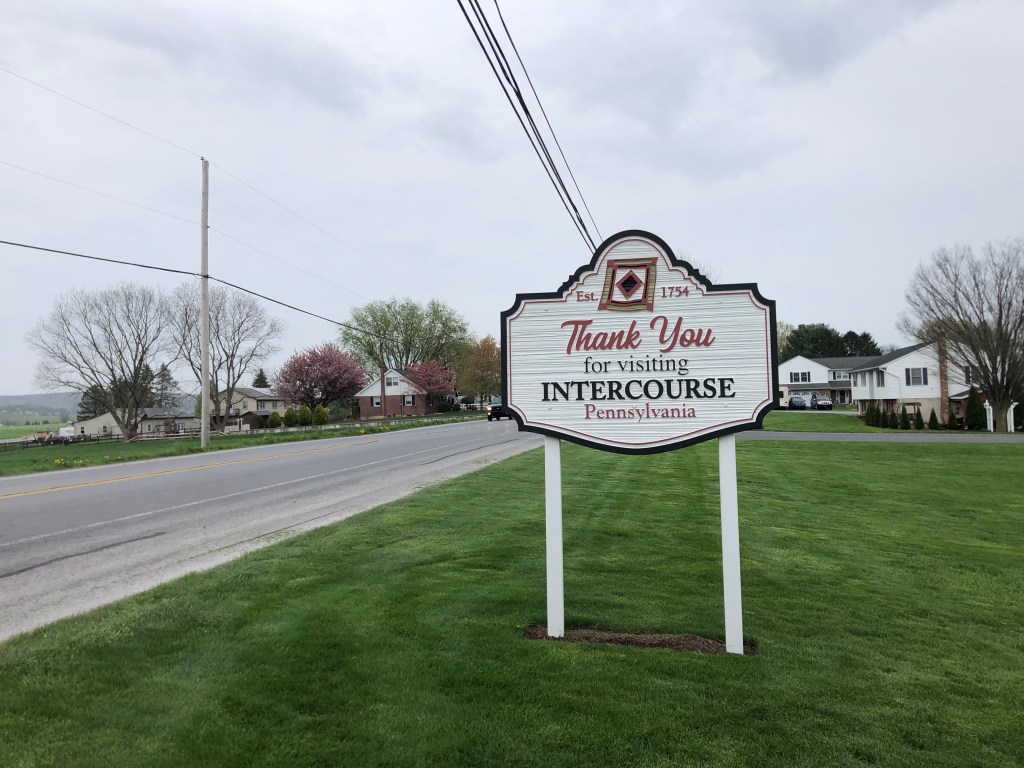
There’s got to be a story behind the name change.
“Please come again.”

After Intercourse I had a cigarette, and then headed into Strasburg, which is a well-known railroad Mecca. In addition to several impressive railroad museums, a steam-powered railroad, a model railroad display, and antique stores jammed with railroad memorabilia, Strasburg has a motel comprised entirely of old, full-size railroad cabooses.
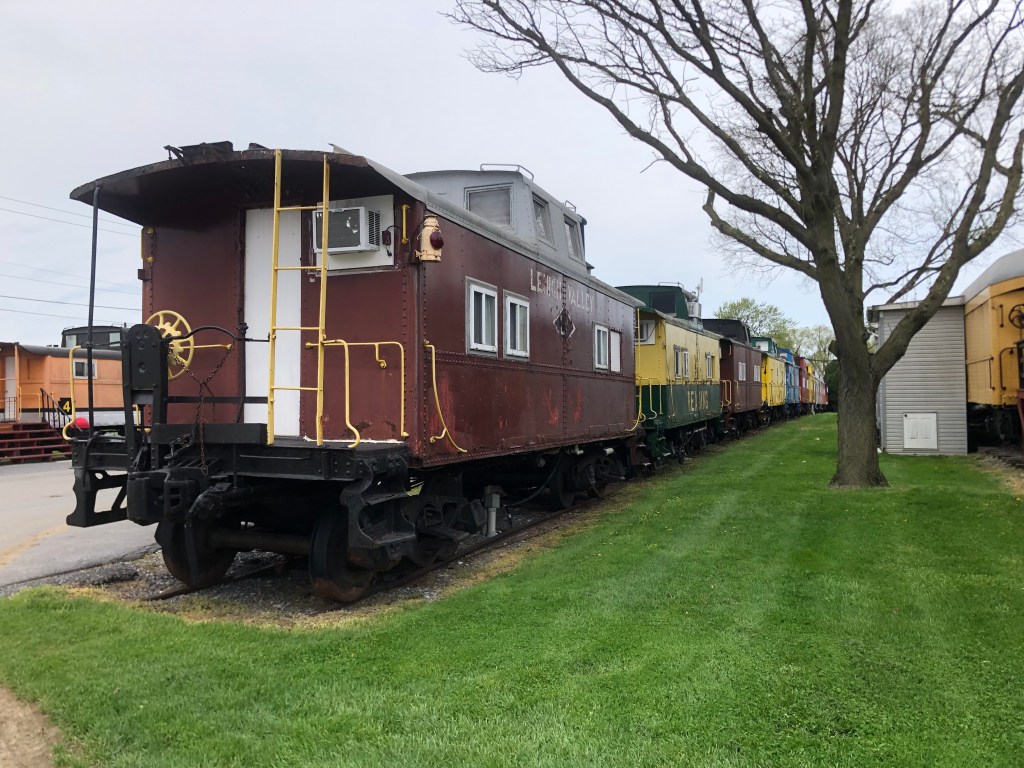
Not your father’s motel. (Well, not my father’s, at least.)

When I was a lad I begged my dad to let us stay at a place like this while we were on a driving vacation. What could be more cool than sleeping in a railroad cabooses? Dad said no, however, figuring that the fun factor (such as it was) wouldn’t justify the compromises in terms of comfort. But today I made a different calculation. So, over a half-century later, I’m finally spending the night in a caboose. It’s actually a nice little room, and the funky floorplan and high windows really lends a certain charm. Plugs, I’m surrounded by other railcars and a full-size steam railroad. I admit, however, that if my wife were with me this would not be an option.
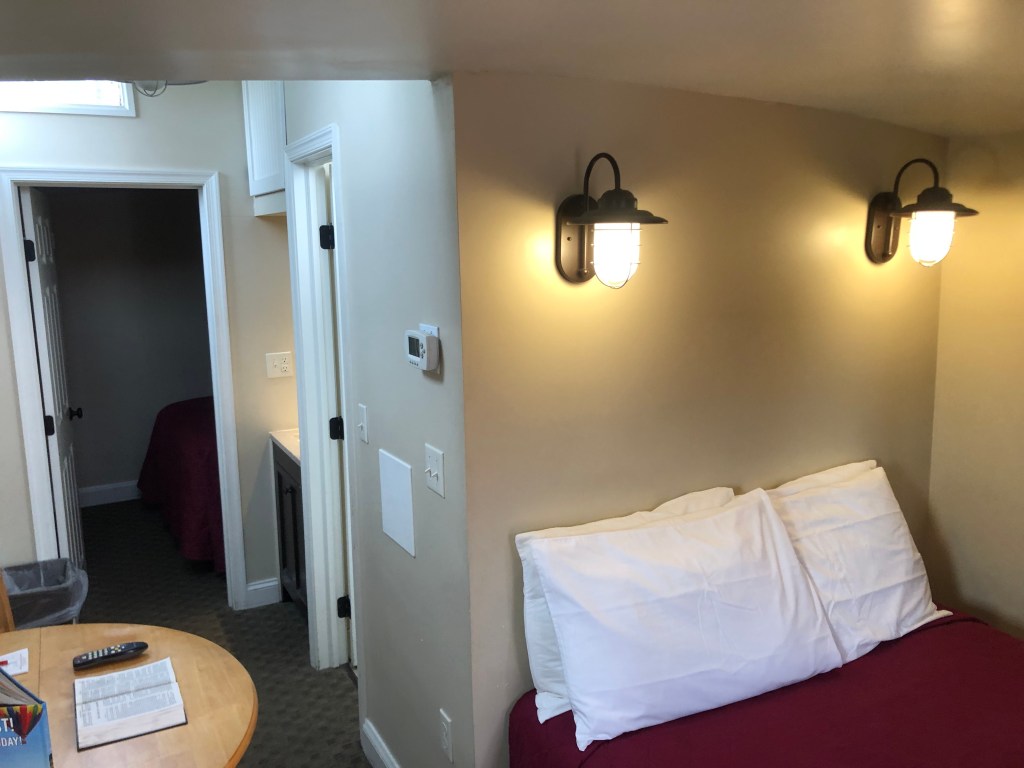
Finally!

BsOTD

Today’s Brews (note the plural) Of The Day come from Spring House Brewing Company in Strasburg. Their tavern on Main Street is comfortable and inviting, with ancient dark-wood paneling and a dark-wood stairway to unexplained upstairs rooms. My server (Dani) didn’t know how old the building is, but the ripples in the front window glass suggest at least a century.
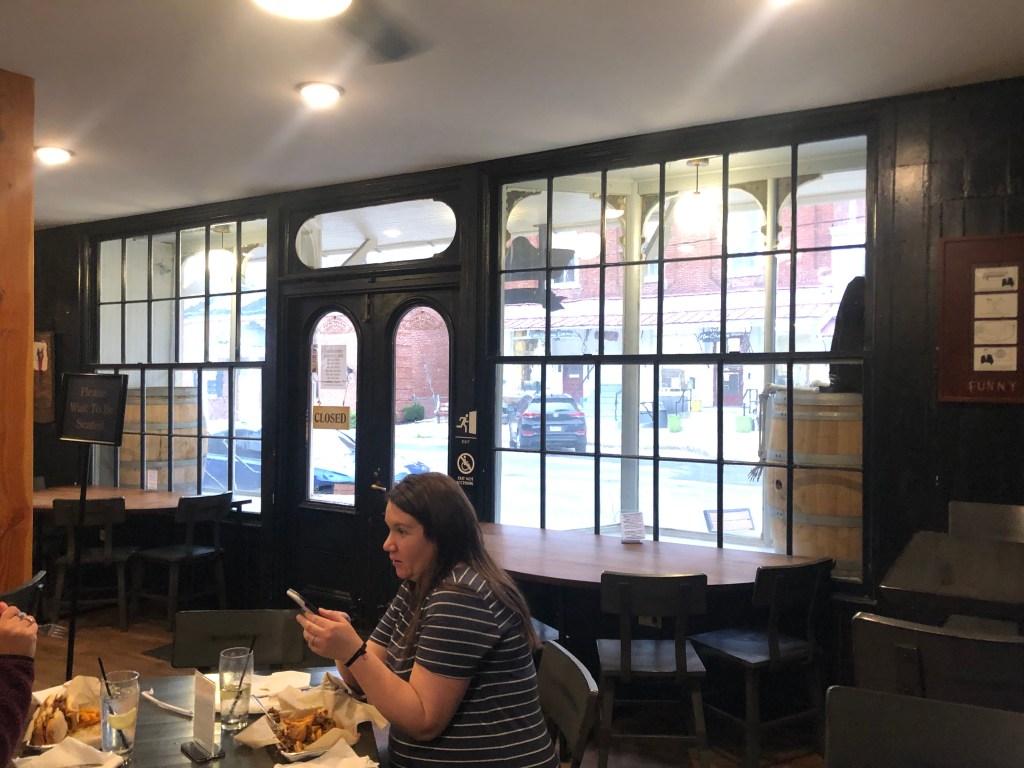
Cozy tavern.

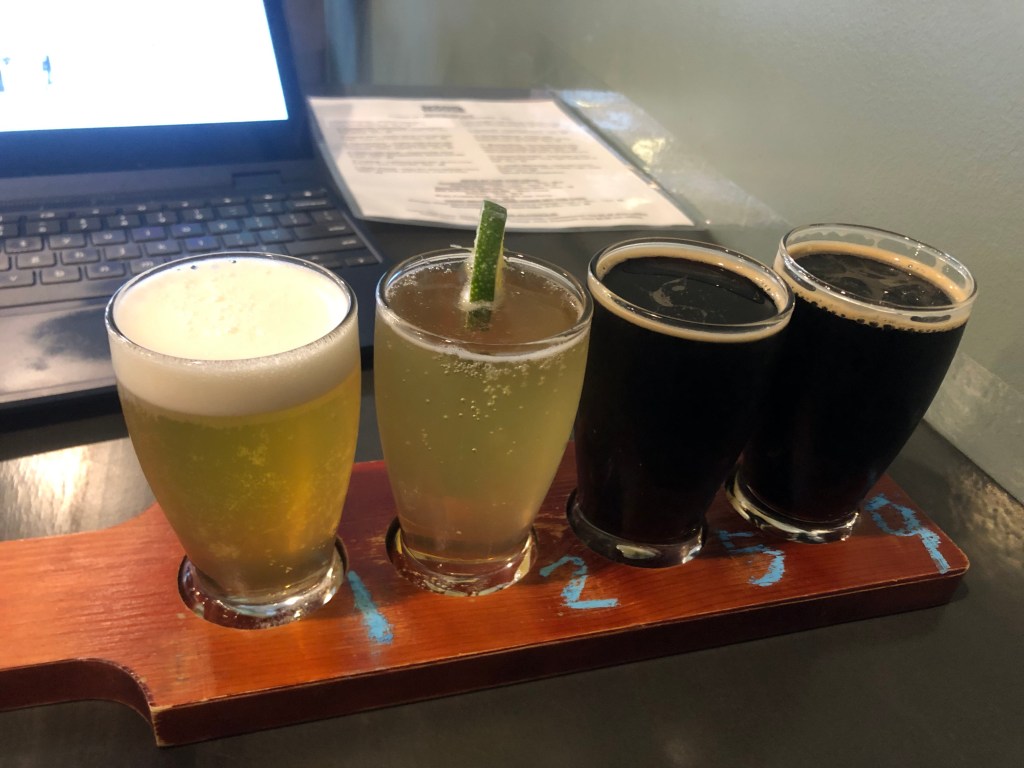
The brewery had 13 of their own beers on tap, and I found it hard to choose just one. So I ordered a flight of four. And then, I ordered another flight of another 4. What follows, then, are my eight Brews of the Day.
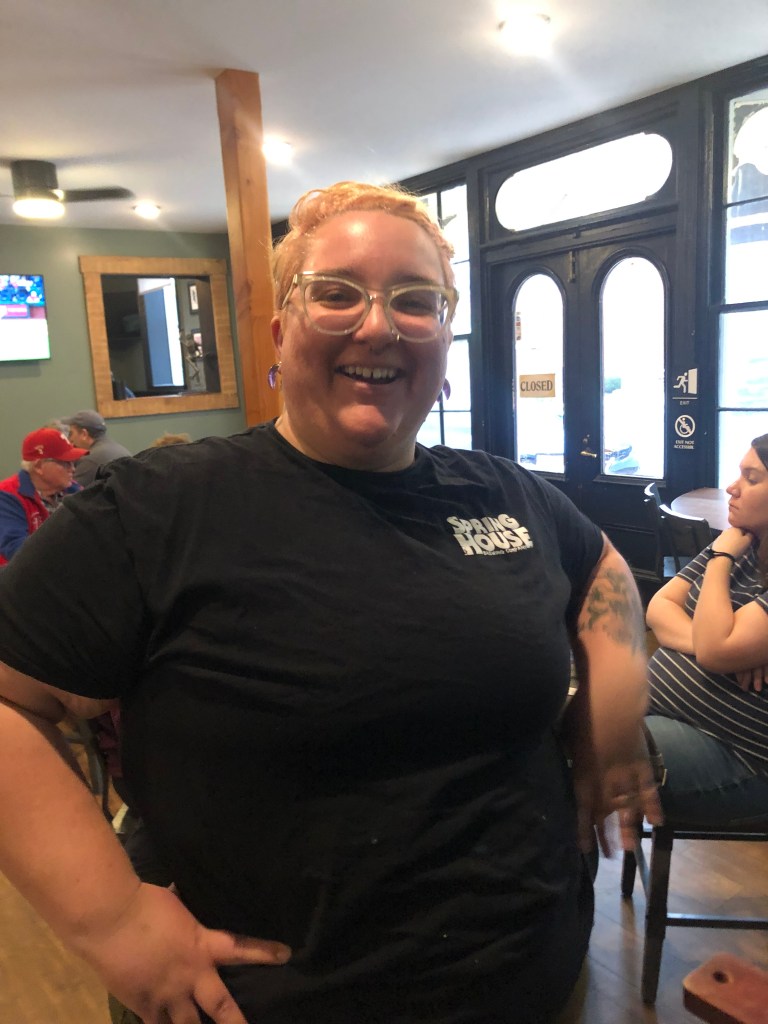
Server Dani, who delivered my 8 Brews of the Day.
My first 4 Brews of the Day (in order from left to right)

Empty Terrarium: Nitro Fruited IPA (6.3% ABV). Watery. Boring. A slight tinge of citrus but no real flavor and no fizziness. It’s like a chocolate Easter Bunny after the first, decapitating bite: no head and not hoppy. 1 star out of 5.

Commander Salamander: Fruited sour (4.5%). Seems to start with the same base as the Empty Terrarium, but somehow it’s fizzier (without really becoming hoppy). The sour taste is quite enjoyable–it’s fairly understated; more like sour apple gum than a lemon Warheads (TM) hard candy. This would be satisfying on a warm day (which today is not). It’s one of those beers that you should only have one of–not because of the alcohol, but because the second pint could be cloying. For the first glass, though, it’s quite satisfying. 3.5 stars.

Tasty Little Devil: Imperial Milk Stout (7.5%). Characteristic sweetness and creaminess of a milk stout. More roasty than chocolatey, But a slight peppermint note on the finish evokes a Christmas hot chocolate. Well balanced. I give it 3.5 out of 5 stars. I would have given it a 4 if they upped the alcohol at least to 8 percent, which in my mind is the floor for anything called “Imperial.”

Kerplunk! Imperial chocolate stout (8.0%). The punctuation is part of the name, presumably taken from the Milton Bradley game. A bit harsher than the Tasty Little Devil. But more importantly, this doesn’t really attain its potential. Reminds me of brownie mix stirred into water. 2 stars.
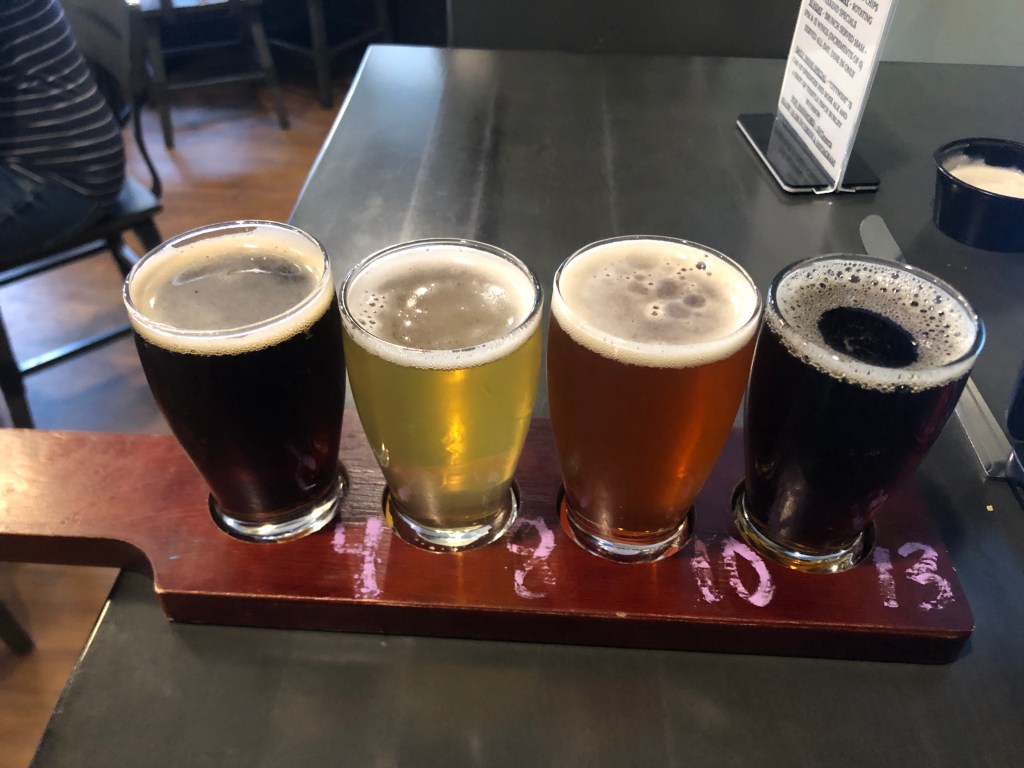
Next four Brews of the Day.

Painted Pony: English style brown ale (5.4%). Nicely balanced. A bit on the bitter side (which maybe is the “English style” coming through?) Definite chocolate notes. Good backbone. The kind of beer you’d enjoy at the neighborhood pub at the end of your 12-hour shift in the mines. 3 stars

The Angler: Cali Pale Ale (5%). Definitely the California style. Clean, citrusy, bright. It’s perfect for those of you who like this style of beer. Which I don’t. But I know quality when I taste it, so I’ll give it four stars.

Demon Squirrel: Amber lager (5.3%). Now this is interesting. Malty, with some hints of fruitiness. Very balanced hops. Heavy carbonation adds dimensionality and compensates for the neutral finish. Flavorful without being overpowering. 4.5 stars.

CASK Mild Party: Dark mild (3.3%). The name of the style (“dark mild”) says it all. Intentionally served at room temperature, this is a dark-colored beer with absolutely no structure, backbone, carbonation, or even flavor. It has the consistency and mouthfeel of dishwater. It tastes like watery tea that’s been left in a styrofoam cup on the dirty Formica counter for a day and a half. And it can’t even deliver a mild buzz. It’s the kind of beer that makes you question your faith in God. 1/2 star.
Cars · movie theaters · Road trips · trains

A Stew-pendous Day

This morning I awoke around 7:15, and looked out my window to see the world still cloaked in darkness. I figured it was still too early for the sun, since I was on the western edge of the eastern time zone. After my morning ablutions I returned to the window, but it was still dark outside. I looked up to see a blanket of black clouds covering the sky. The sun was entirely AWOL.

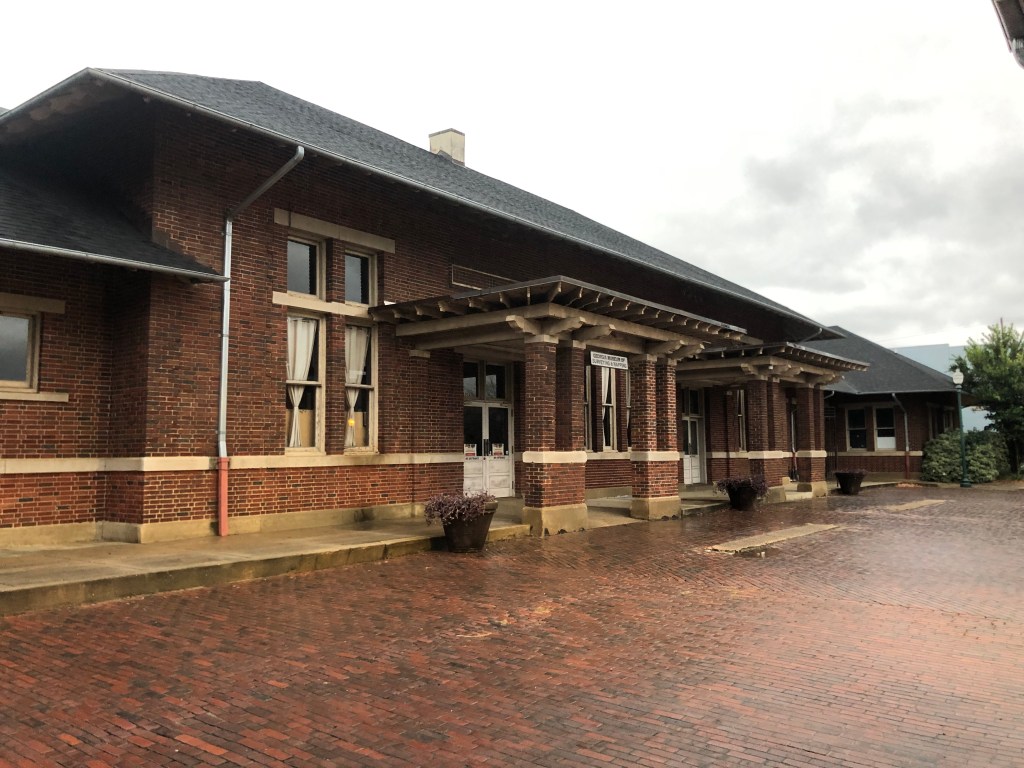
Undeterred, I got in my rental car and began to head out of Albany. But as I was passing through the historic downtown what do you think I saw? Yes, it was another Union Station. For those of you keeping score at home, I’m now up to four on this trip.

“Look for..the Union la-ble….”

Albany’s Union Station was constructed in 1913. It replaced an earlier depot that had been built in 1857, but wasn’t able to accommodate the vast increase in rail traffic. Union Station continued to serve trains until 1971, after which it was slated to be razed. However, preservationists in the town mobilized to protect the building from the wrecking ball that was knocking down so many old buildings in the 1970s. Union Station was placed on the National Register of Historic Places in 1975.

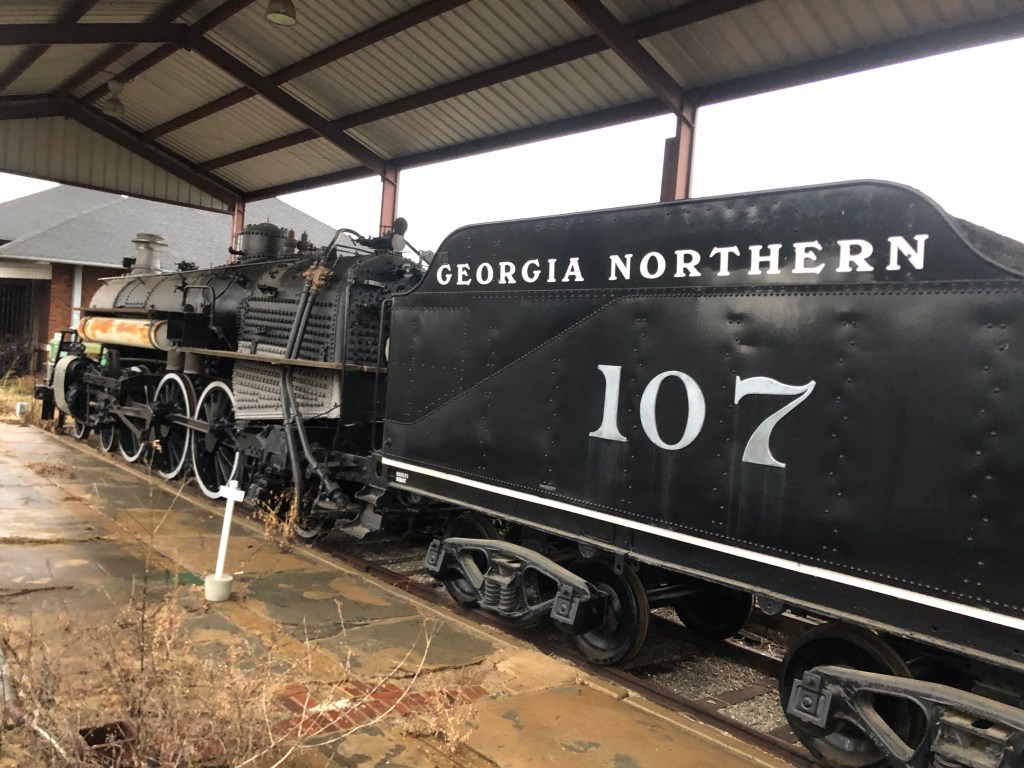
The station was renovated and became a museum. It was part of a larger “Heritage Plaza” project that includes several other historic buildings, including the old freight warehouse. There’s also a Georgia Northern steam locomotive and rail cars on the tracks behind the station.

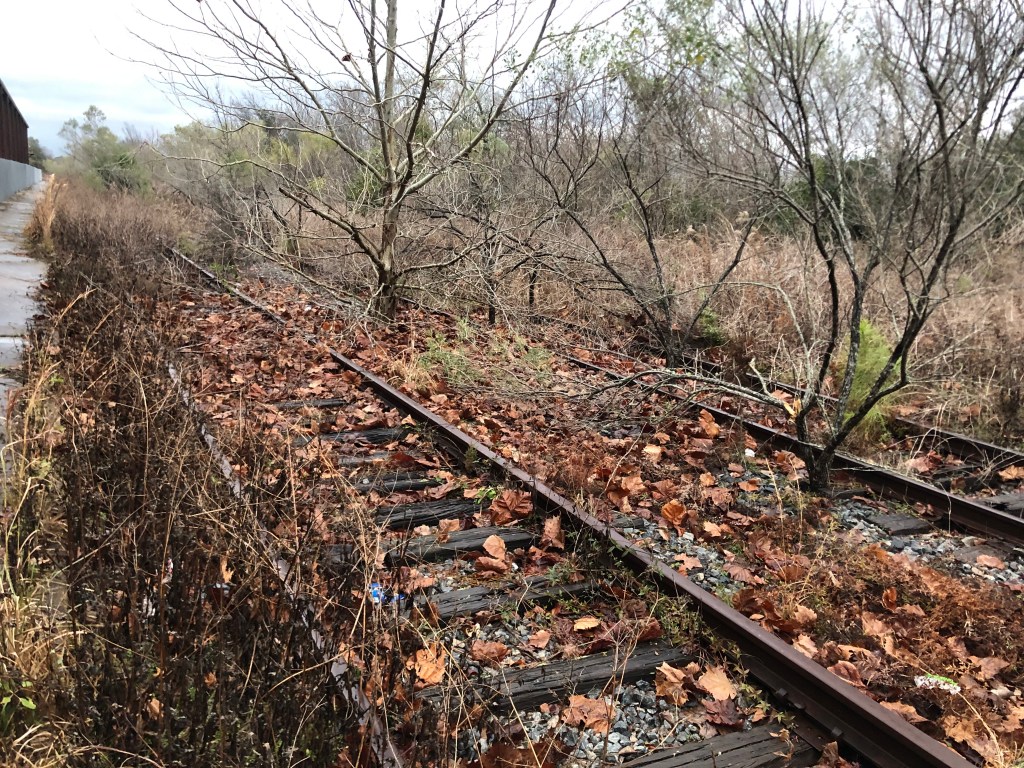
Looks like it’s been awhile since trains ran on Union Station’s tracks.

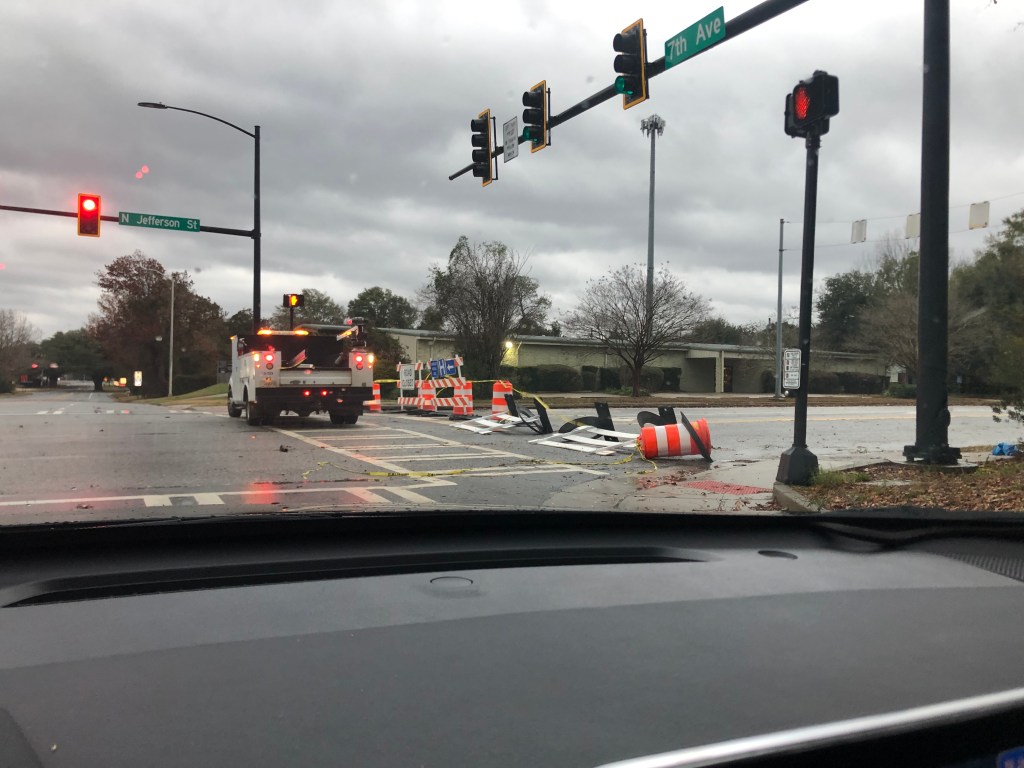
Having gotten my daily Union Station fix, I got back onto US 82 East. The wind had picked up and it was beginning to rain. As I drove out of town I saw public works crews blocking off streets and clearing drains.

Do they know something I don’t know?

Then, all of a sudden, the leaden skies fully opened up, and lightning started flashing like paparazzi from hell. This continued for the rest of the day. And in the mid-afternoon I started receiving tornado warnings on my iphone.

Thankfully, US 82 was not closed down by the storm, so I carefully made my way across Georgia with my wipers working overtime and only a few incidences of hydroplaning.

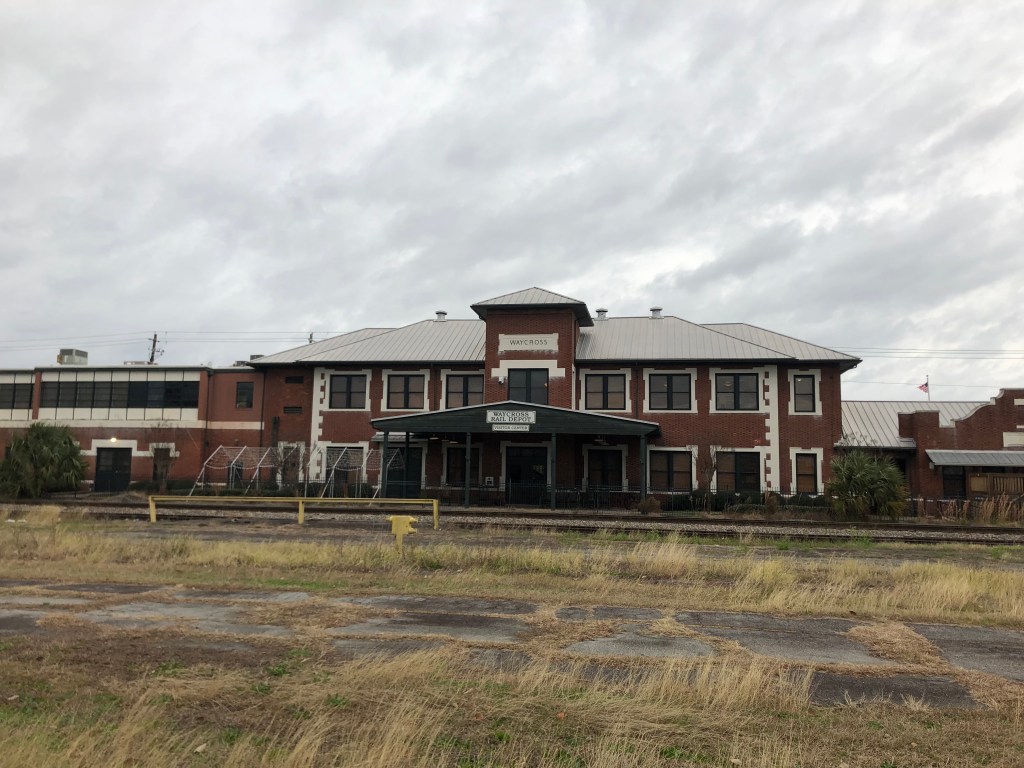
Because of the weather, I didn’t make many stops today. But I did break for lunch in the city of Waycross (pop: 14,000). Like so many of the places along Route 82, Waycross sprung up as a railroad town. In fact, its name references the town’s location at the intersection of six railroad lines. The town’s large, 1911 railroad station (can you guess its name??) was at the center of those rail lines, and it now houses the Chamber of Commerce and serves as a visitors center.

Union Station No. 5

The guy at the visitor center encouraged me to visit the nearby Okefenokee Swamp, since Waycross is “the closest city to the Swamp.” Be that as it may, it would still require a long drive along a narrow road through peat bogs during a major downpour. Maybe next time.

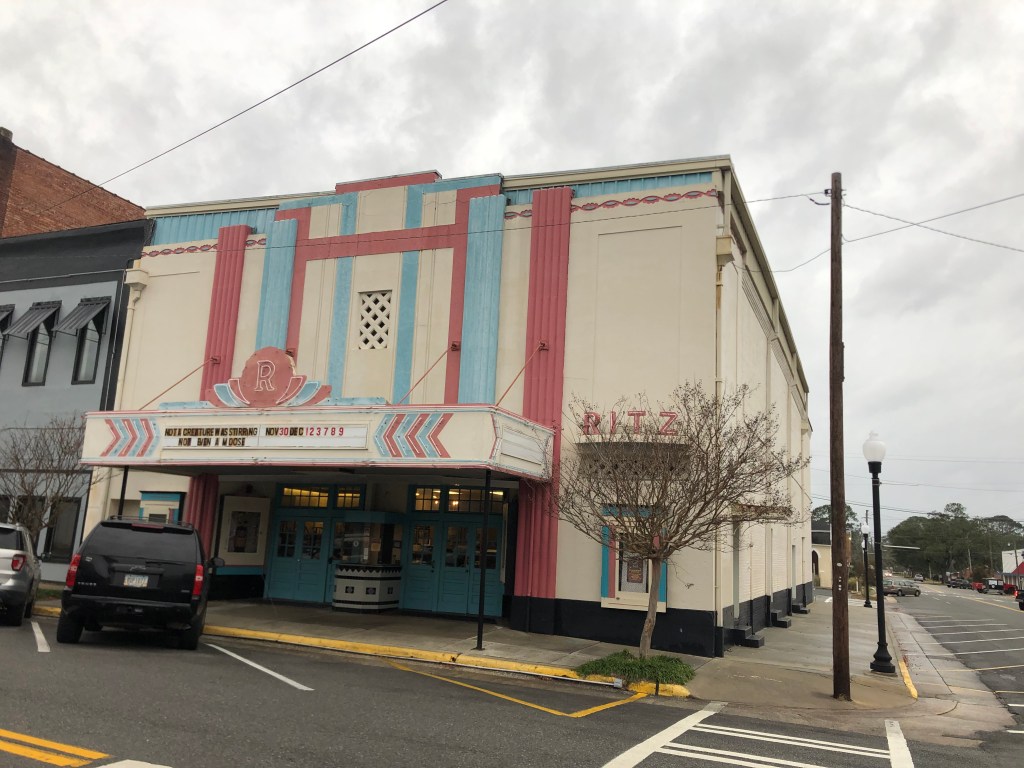
Instead, I took a leisurely drive around the town and encountered two historic theaters. The Ritz theater opened in 1913 as a vaudeville house called The Grand Theater. In the mid-1930s it was extensively remodeled into a movie theater and its name was changed to the Ritz. It closed in 1977. However in the mid-1980s a group of Preservationist citizens resurrected the theater as a live performance venue. Today it’s the city’s main stage for community theater.

Everything’s better on a Ritz.

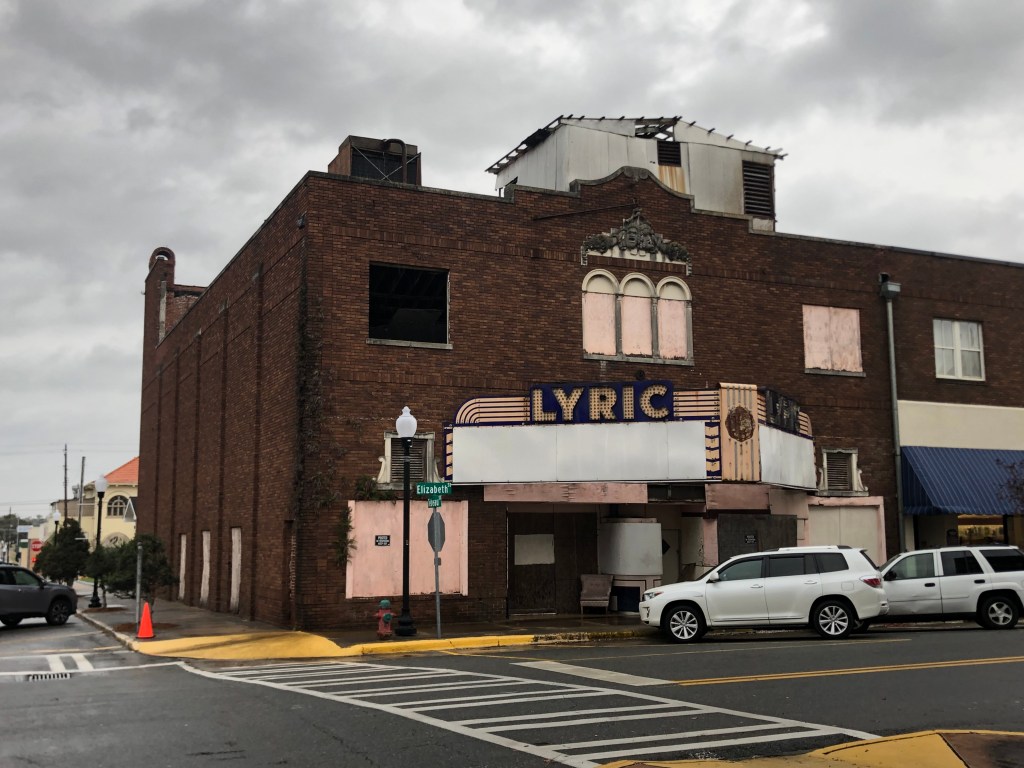
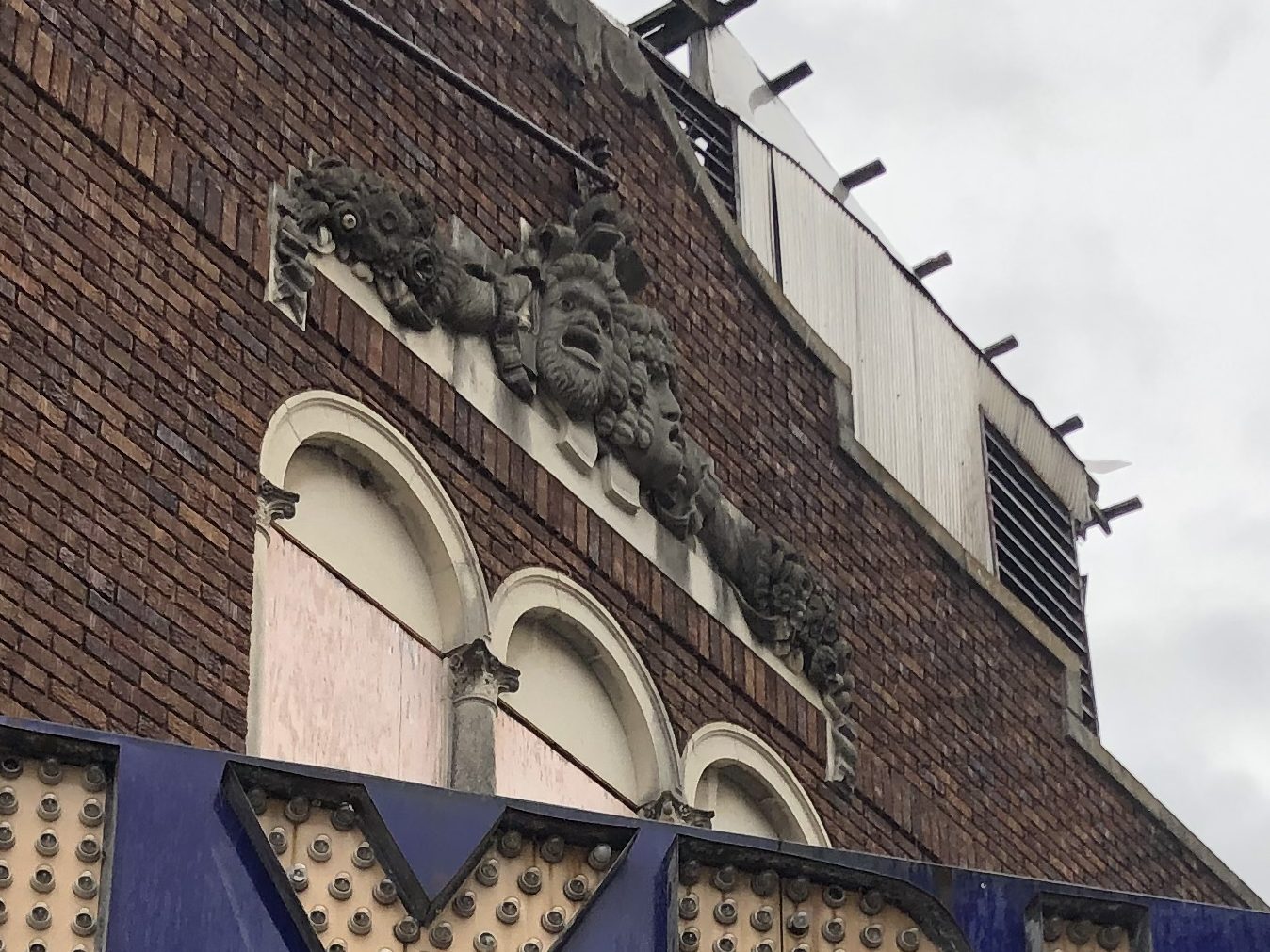
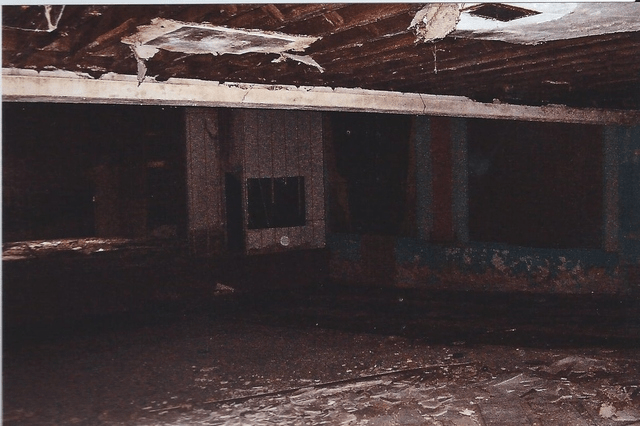
Waycross’s other theater has a less successful story. The Lyric Theater opened in 1923, and like the Ritz, it showed movies in the middle decades of the 20th century. I can’t find when it closed, but They Shoot Horses Don’t They? was playing there as late as 1970. For my money, the Lyric is far more interesting looking than the Ritz, but its interior is probably beyond salvation.

The Lyric Theater looks pretty solid, from a distance.
Note the detail in the original decoration of the facade.
2018 photo of the interior, from “Cinema Treasures” website.

The reason I came across those theaters is because I was looking for a Studebaker dealer. Let me explain:

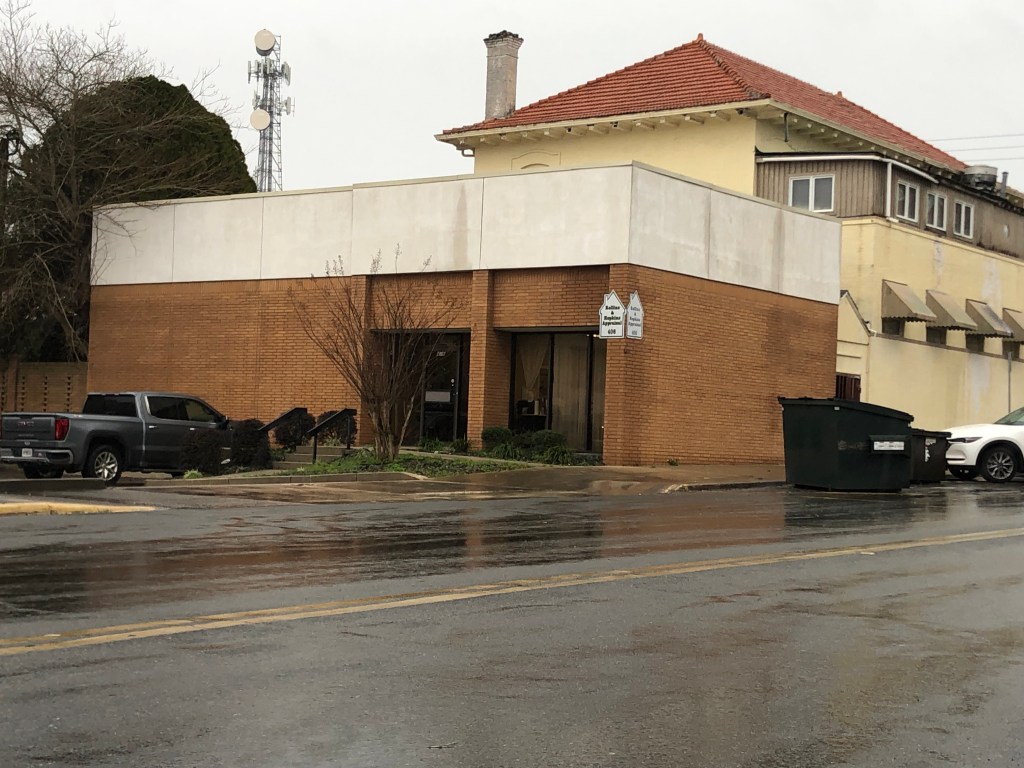
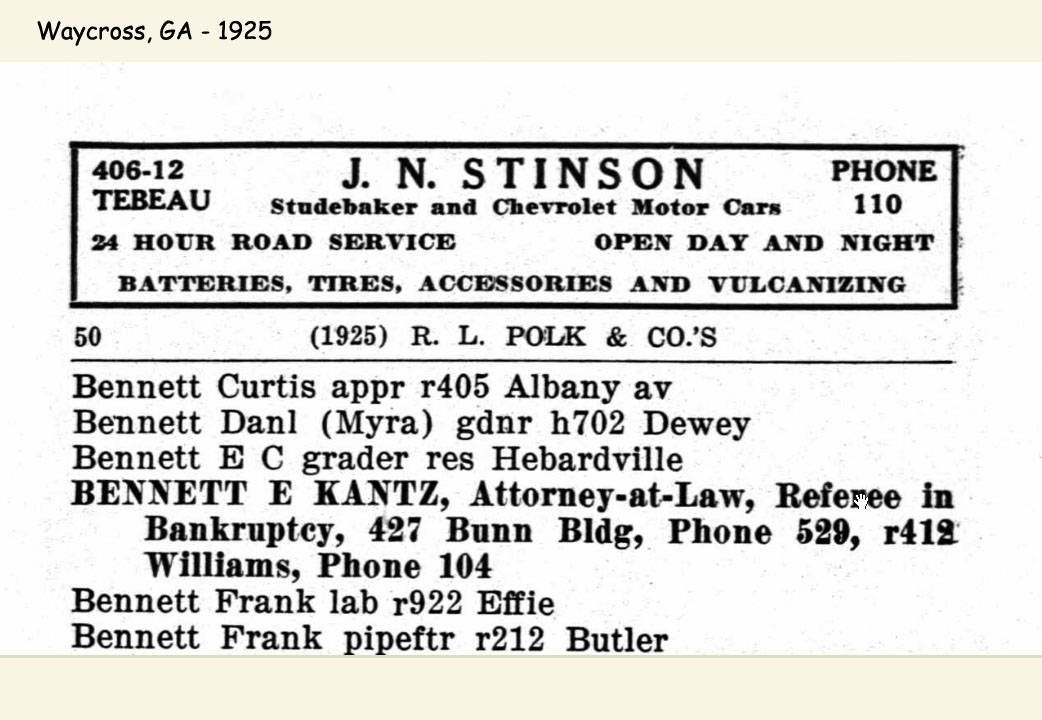
Loyal reader Victor R sent me a link to a database of Studebaker dealerships all across the country. The database lists two dealerships in Waycross: Johnson Motor Car Co. at 302 Albany Ave, and J.N. Stinson at 406 Tebeau St. The first address is now just a vacant lot, but there is a building at the Tebeau address. I think the current building is not the same as Stinson’s dealership, though, because according the database Stinson was in business in 1925. And what I saw today is clearly not a 1925 building.

Probably was not used as a Studebaker showroom.

Eventually I got back onto Route 82 to complete the final 60 miles of the trip. The weather was worsening again, but it was still driveable. A cup of coffee from a Waycross coffee bar kept me alert.

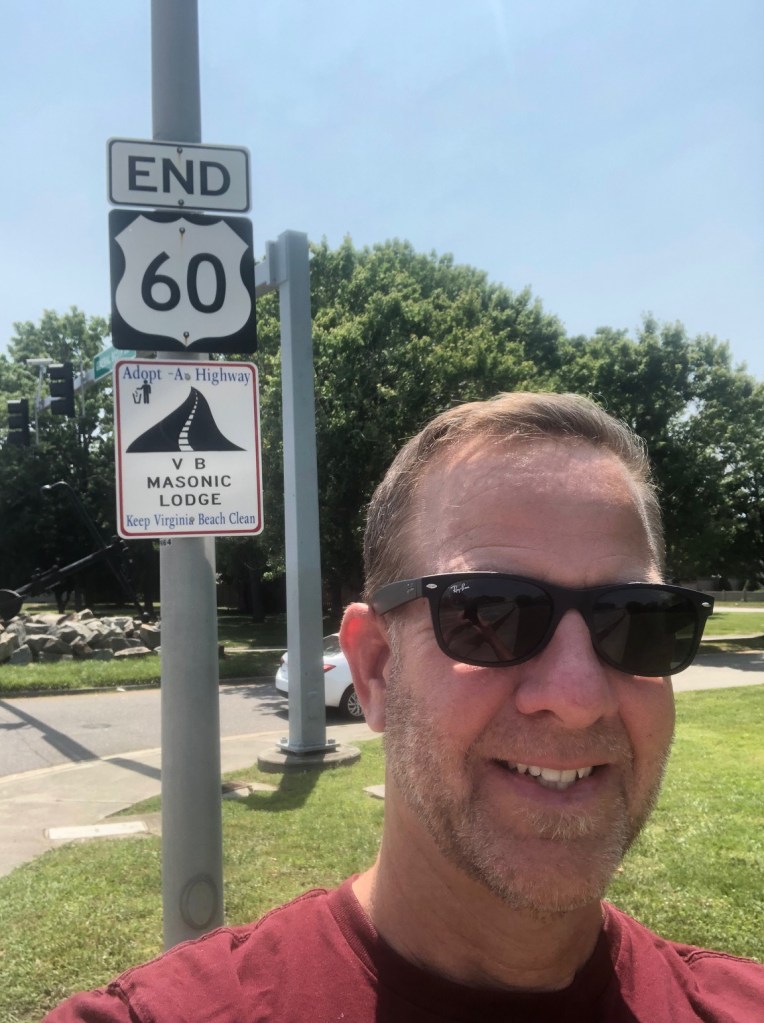
It seems that I’m always able to sense when I start to approach the Atlantic, and today was no exception. I don’t know if there’s a scent in the air, or if the landscape changes (definitely the density of trees thinned out), or if the development patterns change, or maybe the style of architecture is different. All I can say is that it felt like I was getting close to the end of the continent. I was anticipating the satisfaction, the closure, of arriving at that final Route 82 sign that says “END” on it. Like this one at the eastern end of Route 60:

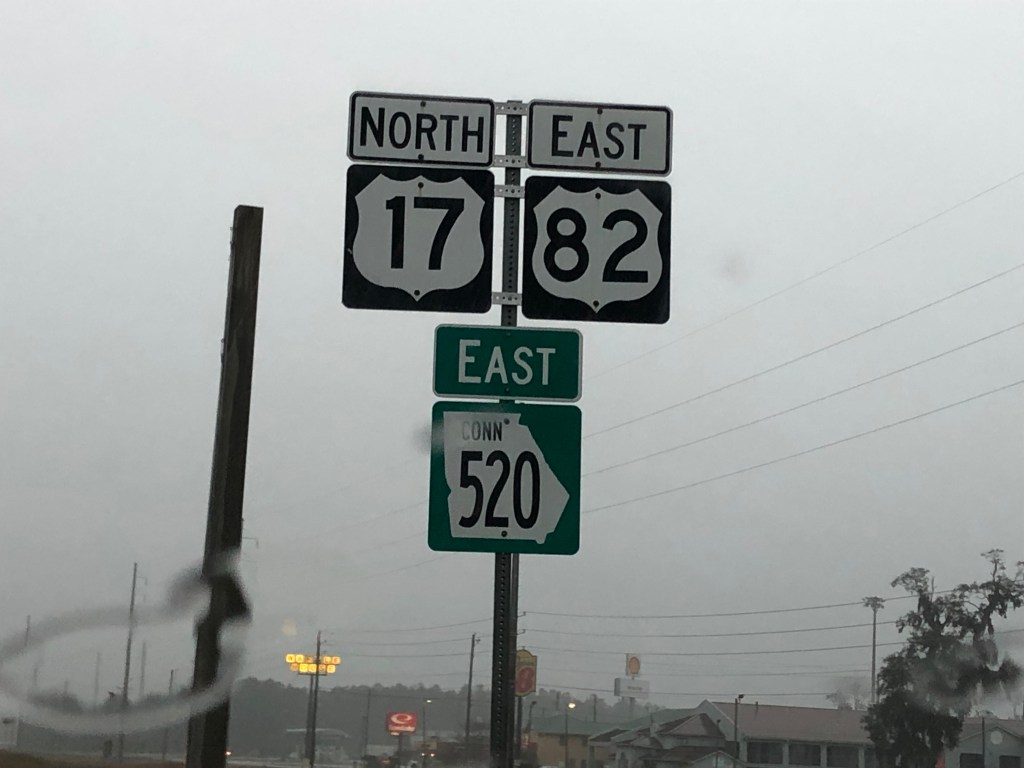
The rain was getting heavier, but I just knew I was almost there. I fixed my eyes on each sign I passed, straining to see past the rain on the windshield and the rapidly-sweeping wipers, anticipating the dopamine hit I would surely receive when I caught side of the “END.” And then, suddenly…I’m on US 17 north! What happened to US 82??

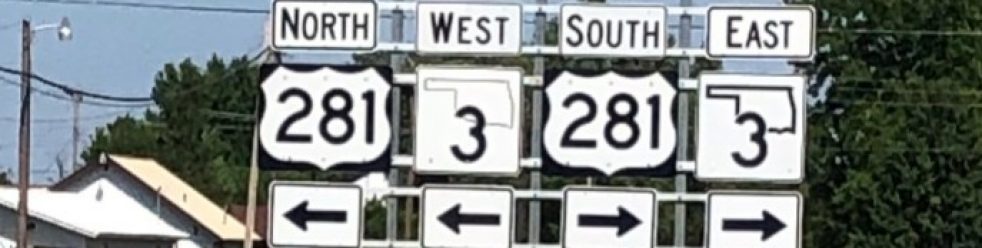
It took me some retracing of my steps to sort things out, but the bottom line is that there’s no END sign. Instead, there’s what I’ll call a “handoff” sign that marks both 82 East and 17 North simultaneously. This is the easternmost sign for US 82.

End of the line.

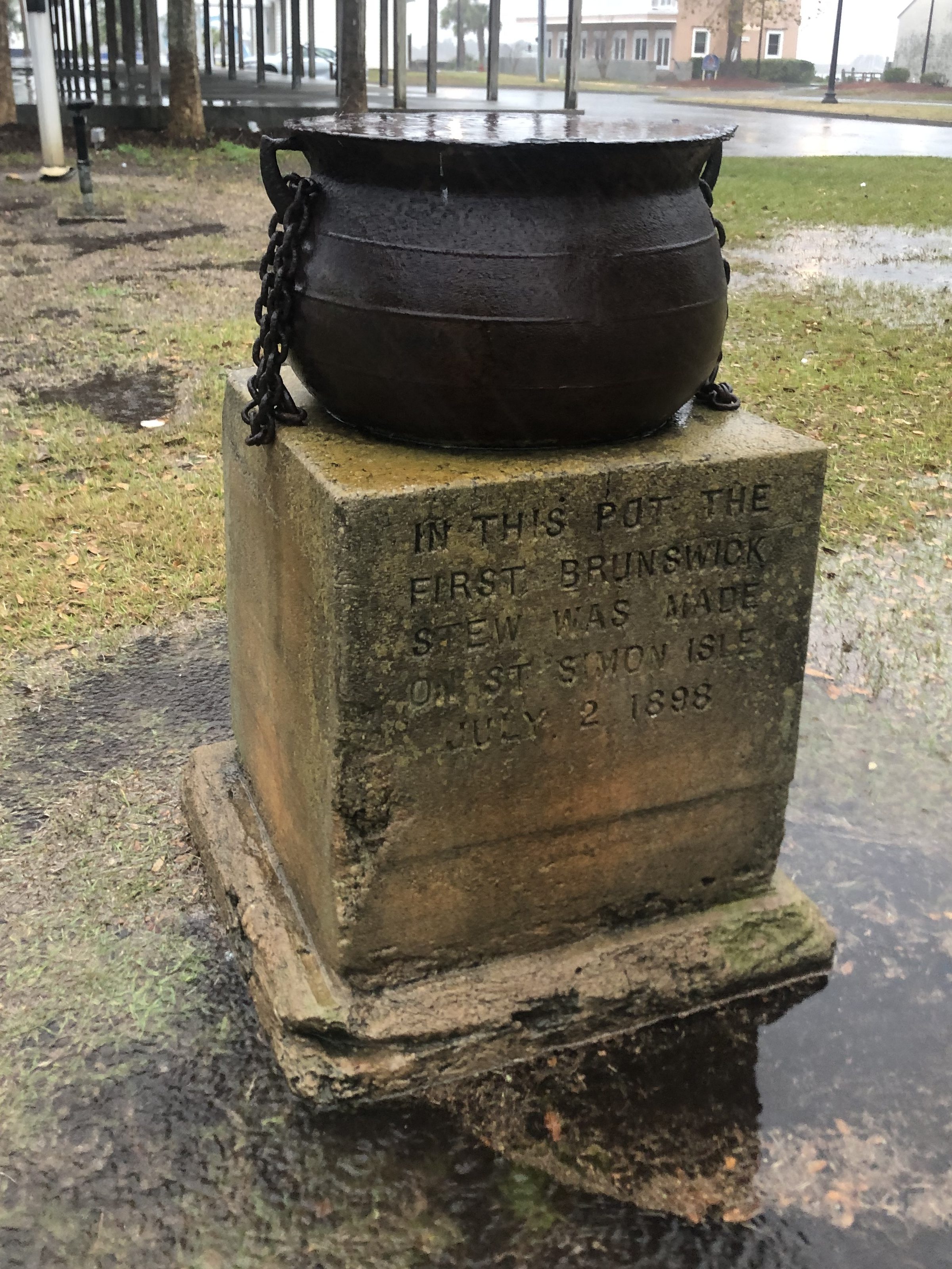
Well, that was anticlimactic. But no matter. I had safely made it to Brunswick, that’s what mattered. And to celebrate, I took a picture of the big stew pot that supposedly was used to make the first Brunswick Stew in 1898.

“In this pot the first Brunswick Stew was made on St. Simon Isle July 2 1898.”

There only remained two things left to do: First, I got my Brew of the Day (see below). And then, tomorrow, I will do a Mystery Travel Task that will complete an important collection for the Boilard Travel Archive. All will be made clear tomorrow. Now it’s on to the:

BREW OF THE DAY

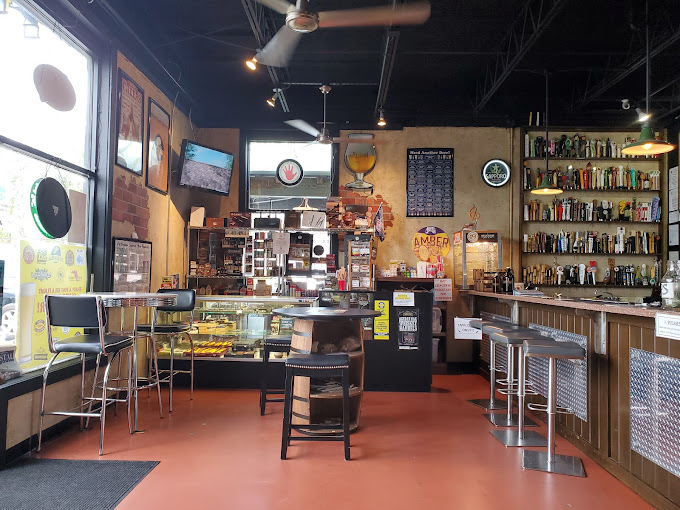
Today’s BOTD came from Weber’s Growler Factory in Brunswick. It’s an interesting place, with forty beers on tap to fill your growler or to drink there by the glass. They also have a lot of bottled beers and an extensive selection of cigars. Sadly, they also have one of the most disinterested, unfriendly bartenders you’ll ever meet.

Eclectic taproom. (photo lifted from Yelp, since I didn’t want to tick off the bartender with my camera)

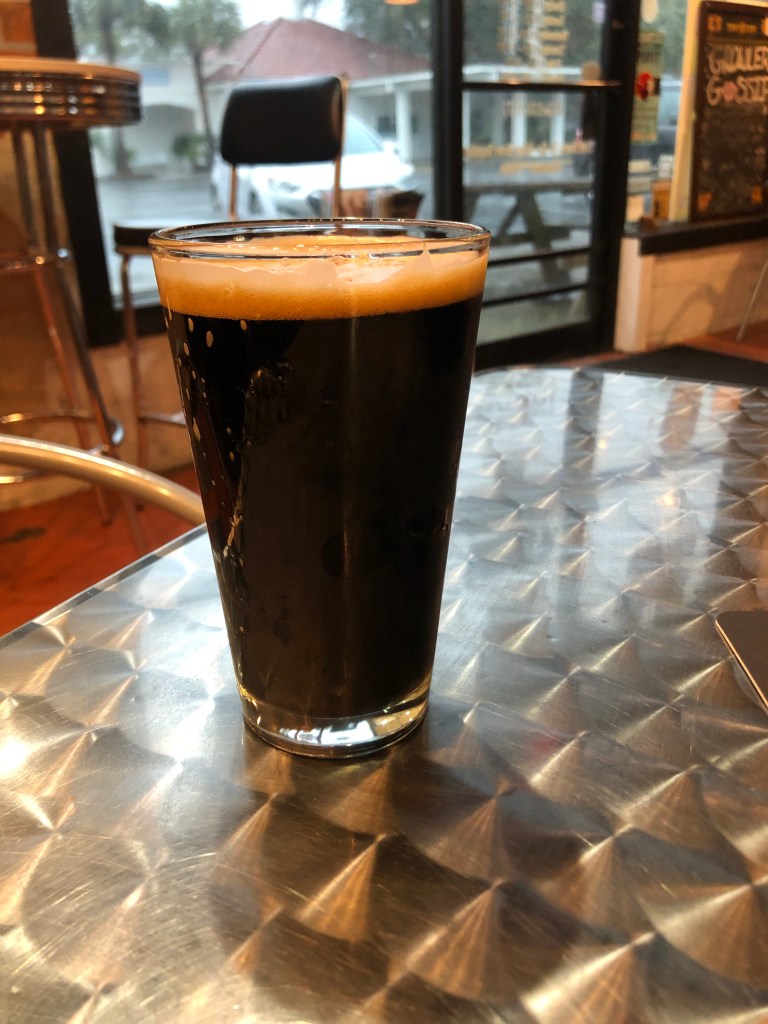
I was overwhelmed by the menu, so I asked for something local. Turns out the only beer from a Brunswick brewery is a Mexican lager. Lagers really aren’t my cup of tea, especially on a stormy winter day. So I asked if there was anything from elsewhere in Georgia. I ended up with a “De-stress Express” from Georgia Beer Company in Valdosta, GA.

All aboard the De-stress Express!

Interestingly, though I didn’t plan it, the De-stress Express is quite similar on paper to the Stone Xocaveza I drank last night. They are both stouts that are intended to evoke a mix of coffee and chocolate. But while Stone’s effort tasted flat and uninteresting and even a little off, today’s entry from Georgia was a winner.

De-Stress Express’s chocolate and coffee tastes don’t fight against each other; they complement each other. The coffee keeps the chocolate from being too cloying, and the chocolate keeps the coffee from being too bitter. Some light hoppiness is present, nicely balanced by the creamy, milky lactose. Today’s beer also had more carbonation than Stone’s, which helped to create a foamy head and to provide a nice tickle on the tongue. The beer comes across quite bright and fresh, which is a bit unusual for a stout. Perhaps that’s because it’s a local brew? Mouthfeel is very full-bodied and creamy. Definitely for sipping rather than quaffing. It took me almost half an hour to get through mine! ABV is a manageable 6.5 percent. I wish I could get it in California. Four stars out of five.

Cars · cemeteries · movie theaters · Road trips · trains

Ruminatin’

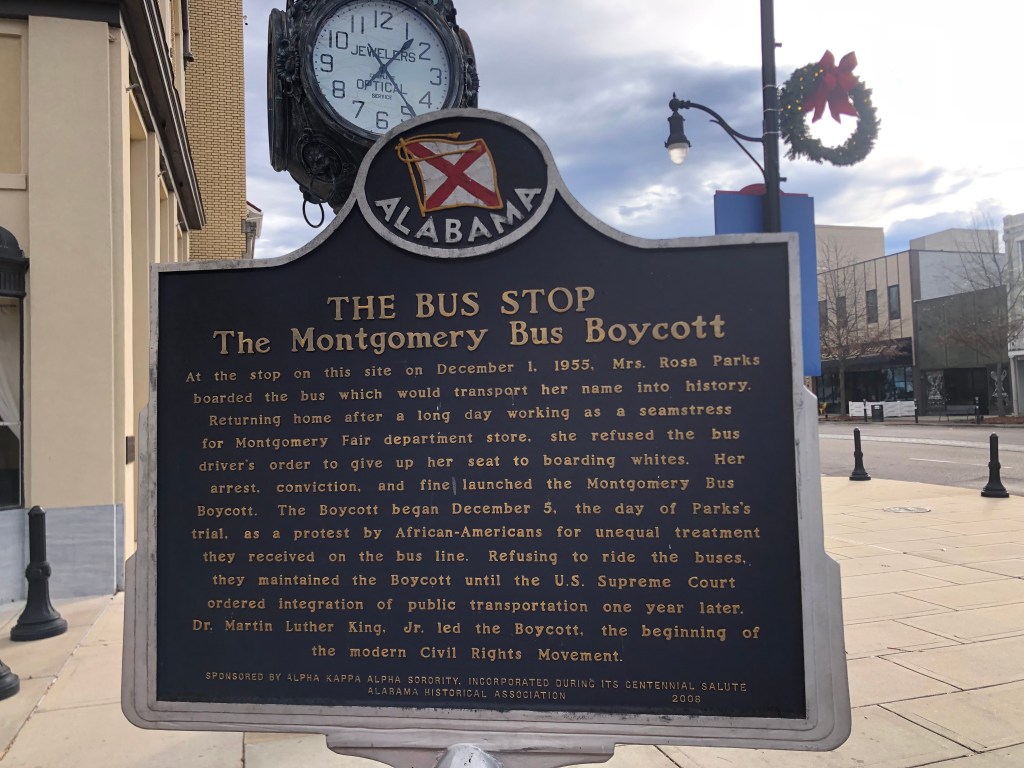
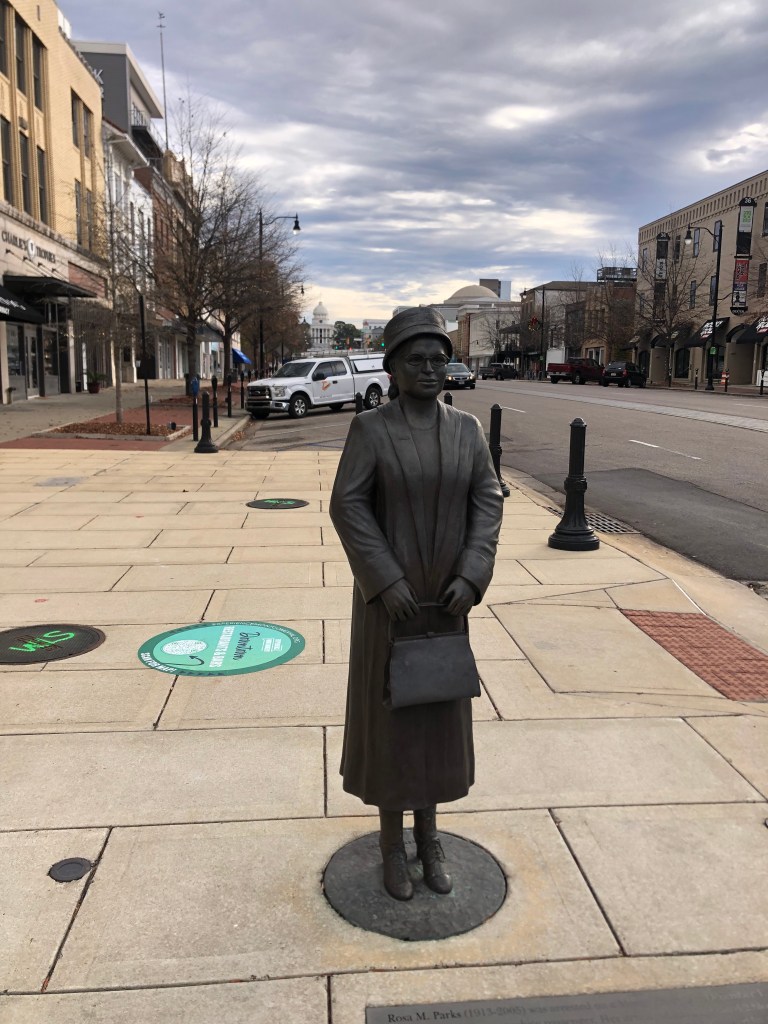
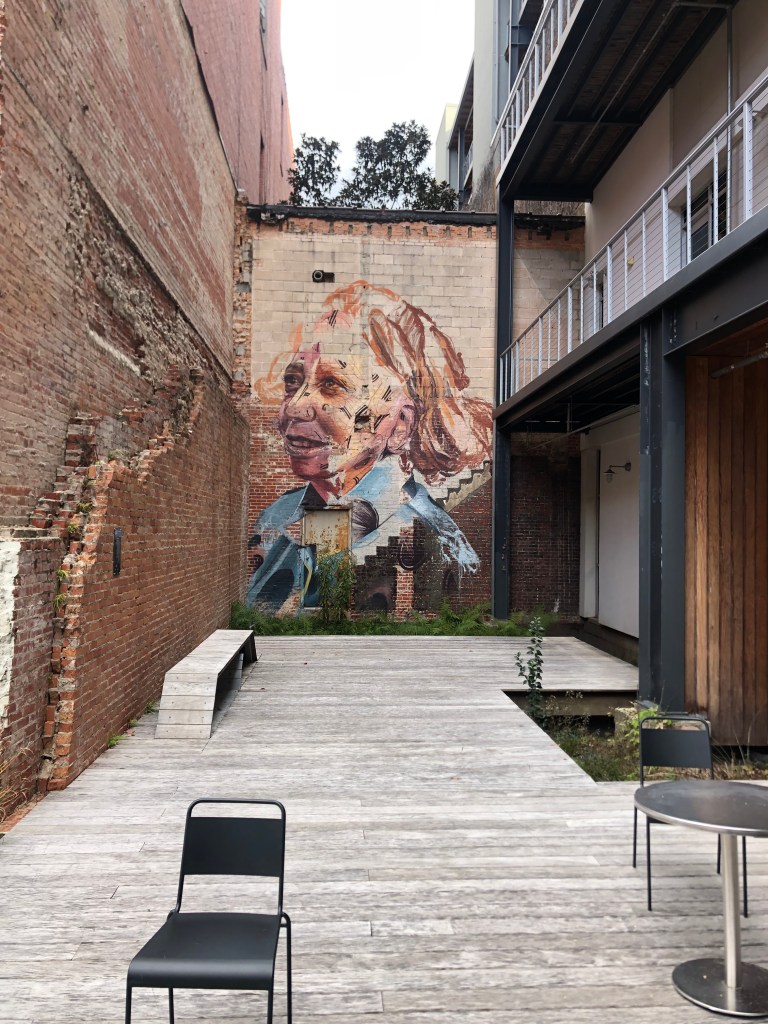
Only a short drive along Route 82 from my hotel takes one to Alabama’s capital city. Montgomery (pop: 200,000) is far and away the largest city I’ve been to on this trip. Montgomery was, of course, ground zero for the Civil Rights movement in the 1950s and 1960s. Throughout the downtown you encounter murals, statues, commemorative plaques, and other installations marking aspects of Montgomery’s civil rights history.

The spot where it all began.
Mother of the Freedom Movement.
Valda Harris Montgomery.

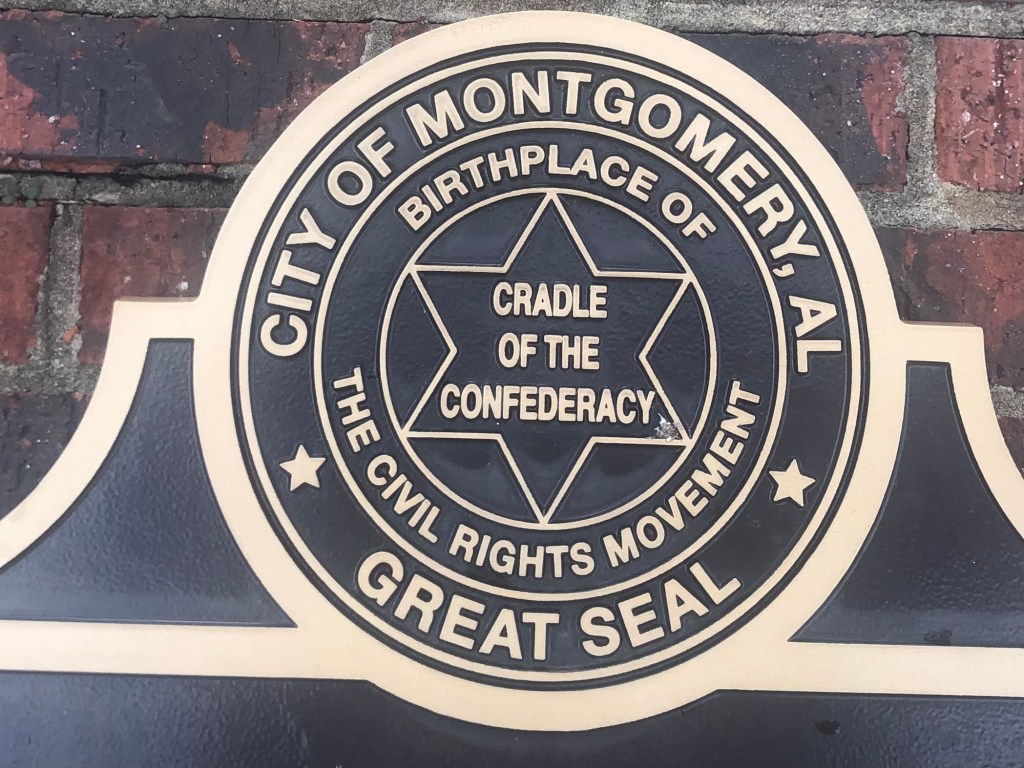
Montgomery’s streets are filled with many dozens of such iconography of the Civil Rights movement. Clearly the city’s official attitudes have changed greatly since the 1950s. And yet, it’s also evident that the city has not fully reconciled its history. The dissonance is captured in the city’s “great seal,” which I spotted on one of the historical markers:

By way of background: For many years, the city seal included the “Cradle of the Confederacy” phrase, but not the reference to the Civil Rights Movement. The latter phrase was added in 2002, in an effort to take the sting out of what sounded like a paean to the confederacy. And yet, to me this seems to simply highlight the simultaneous existence of two conflicting mindsets: an embrace of Montgomery’s history as the capital of the Confederacy, and an embrace of its role in promoting the Civil Movement.

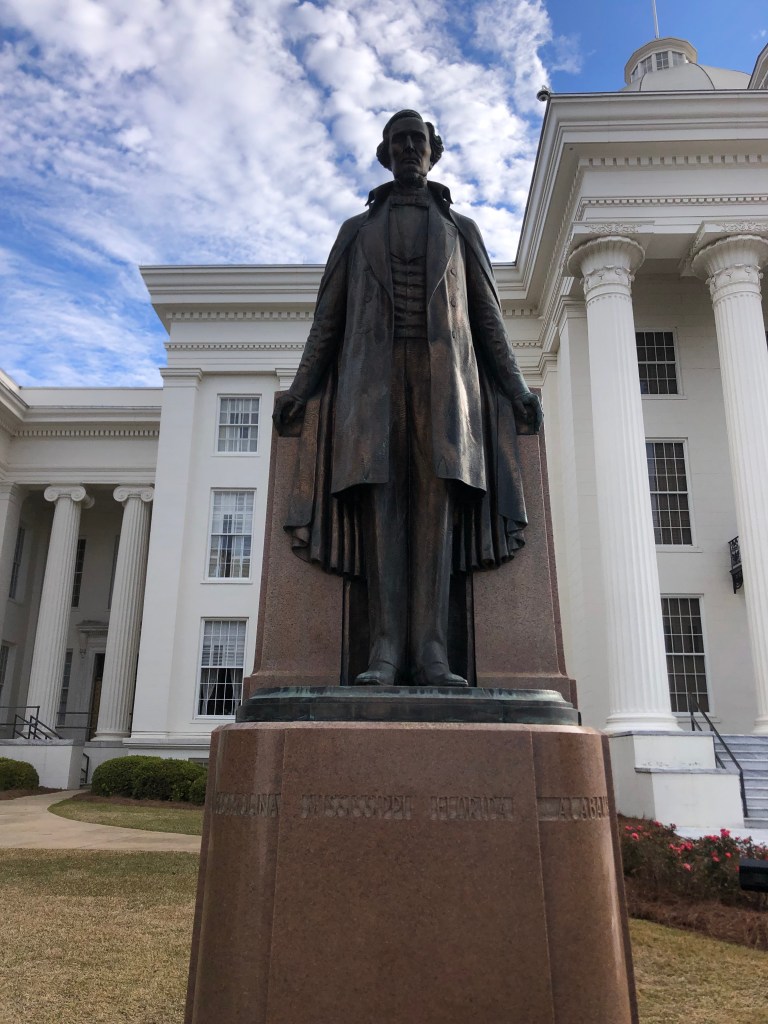
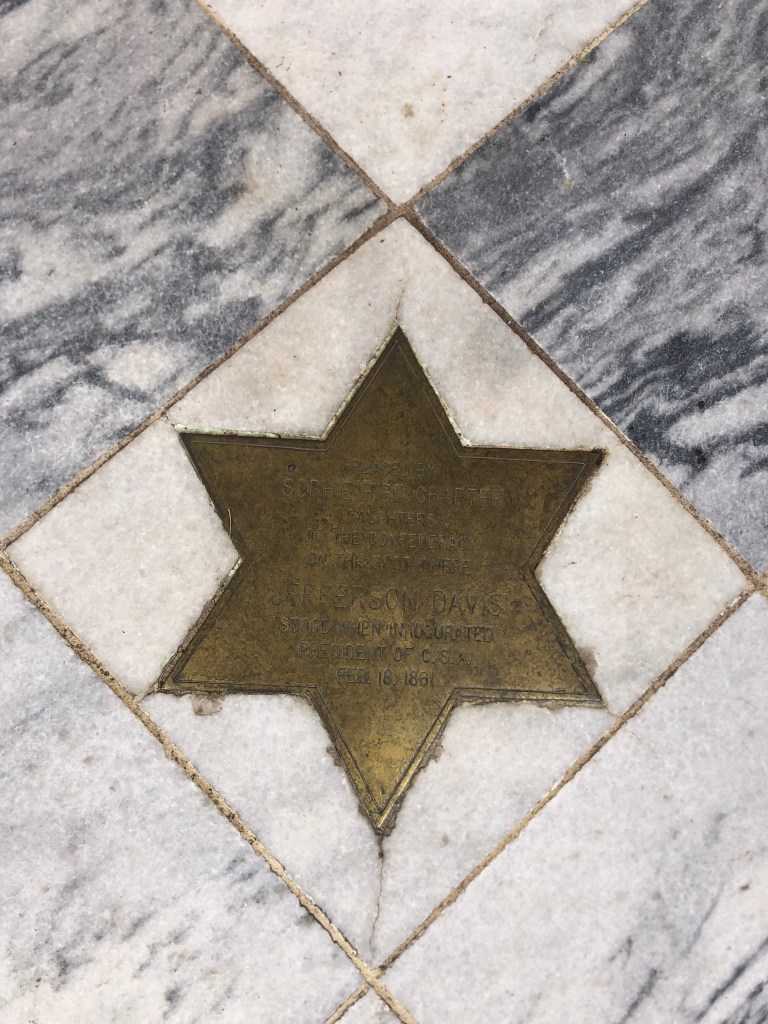
That contradiction becomes clearer as you walk up the street toward the Capitol building. There you can find a series of bronze reliefs depicting aspects of the slave trade and other mistreatment of African Americans. But you’ll also see a solemn statue of Confederate President Jefferson Davis, as well as a bronze star on the steps of the Capitol marking the spot where he took the oath of office.

Jefferson Davis doing his Count Dracula impersonation.
“Placed by Sophie Bibb Chapter Daughters of the Confederacy on the spot where Jefferson Davis stood when inaugurated President of C.S.A. Feb. 16. 1861.”

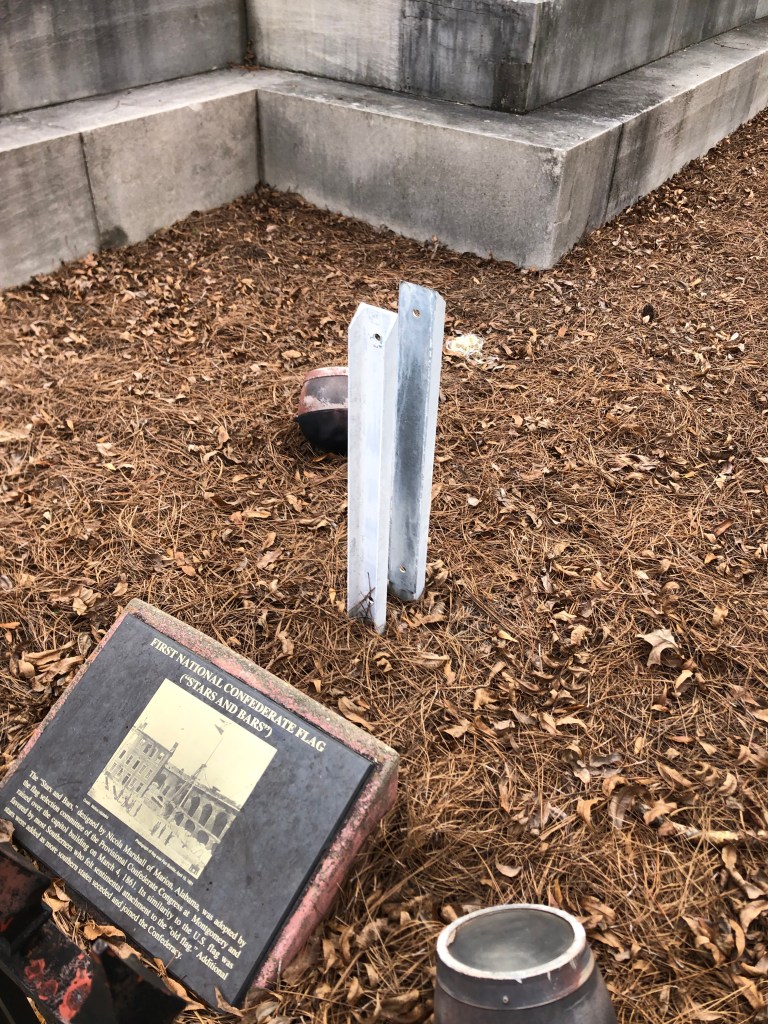
You’ll also see the empty spots where Confederate flags had flown until the Governor ordered their removal in 2015. But the bronze and limestone Confederate monument that those flags had surrounded still stands.

Flagless for over eight years.

I certainly don’t presume to tell Montgomerians how to reconcile the various aspects of their history. But I would observe that there is a difference between acknowledging history and celebrating it.

OK, now that I’ve once and for all solved the cultural arguments over the Civil War, let’s move on…

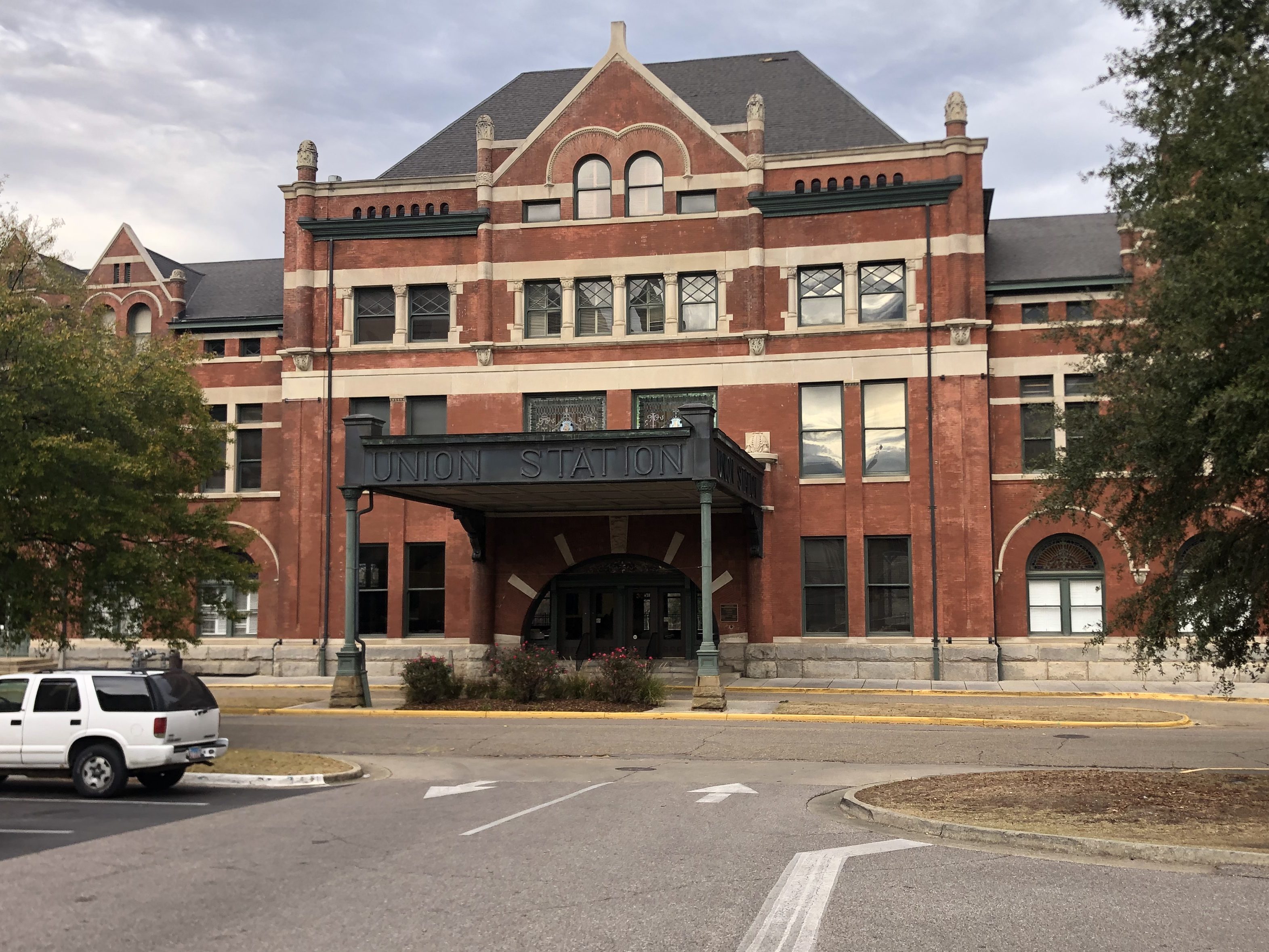
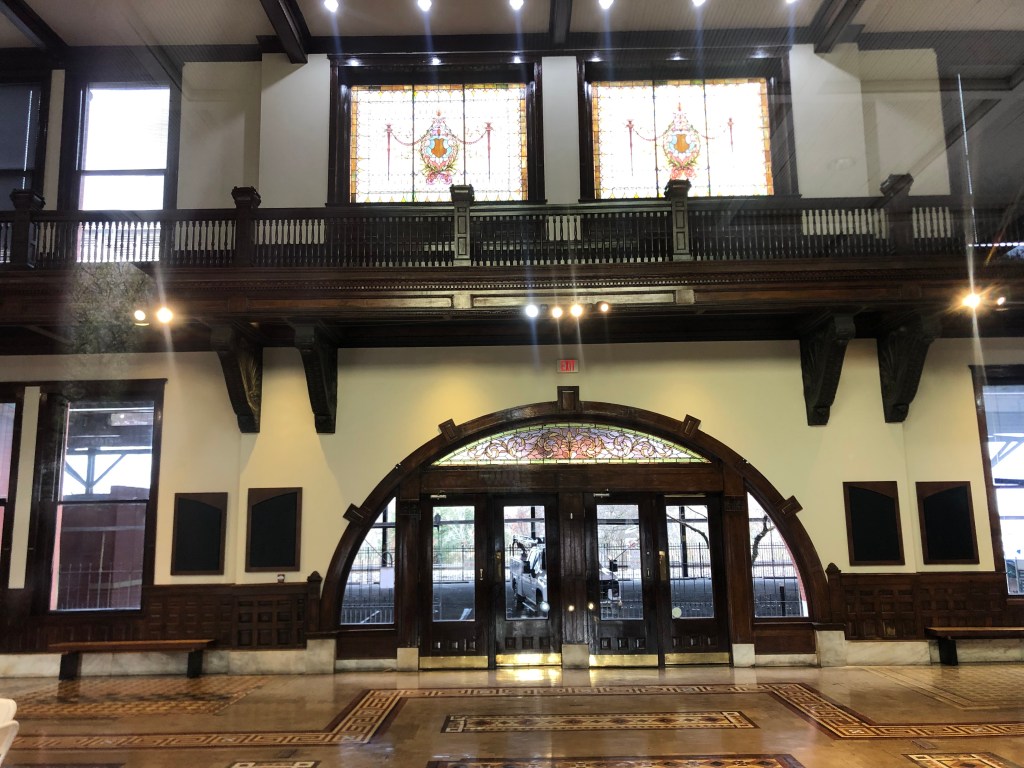
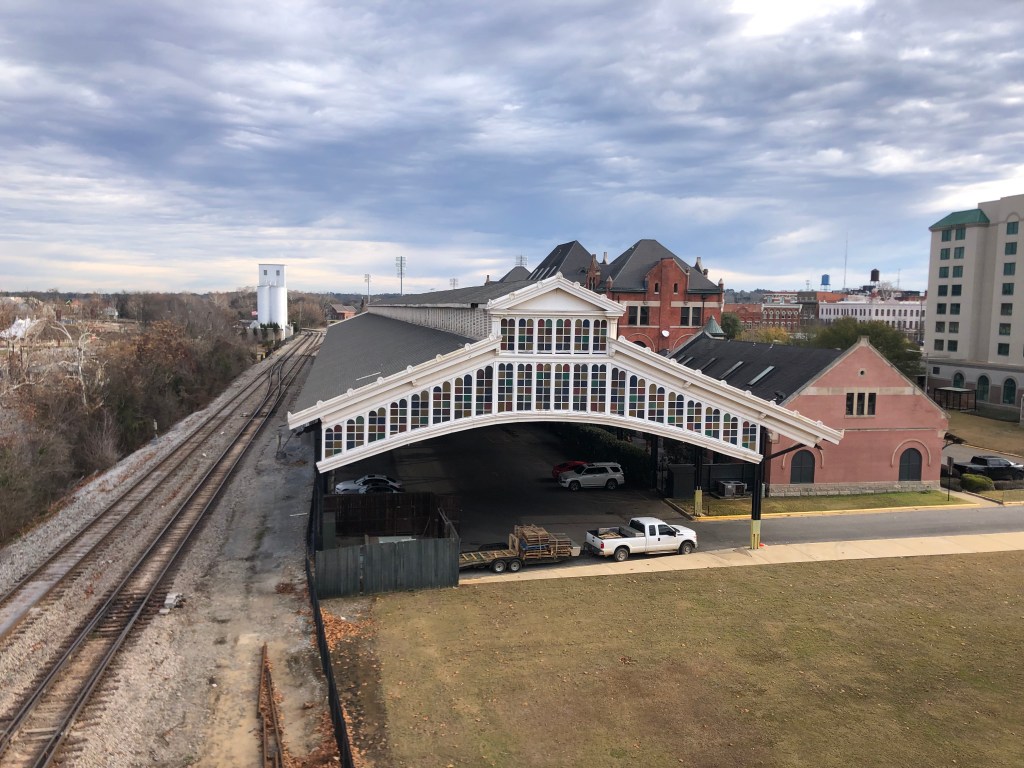
Believe it or not, while in Montgomery I encountered my third Union Station on this trip. Montgomery’s Union Station was built in 1898 for the Louisville and Nashville Railroad. It was one of the country’s busier stations, serving 44 passenger trains from a dozen railroads during its peak. Over time, of course, rail travel diminished and the last train stopped at Union Station in 1979. Since then the station was converted to a visitor center and has been leased to various commercial clients. You’ll note that this structure has been magnificently preserved; the comparison to Texarkana’s crumbling structure is stark.

Another day, another Union Station.
Interior of waiting room–now an event space.
Aerial view of covered trainshed adjoining Union Station. (Photo taken from atop a parking structure.)

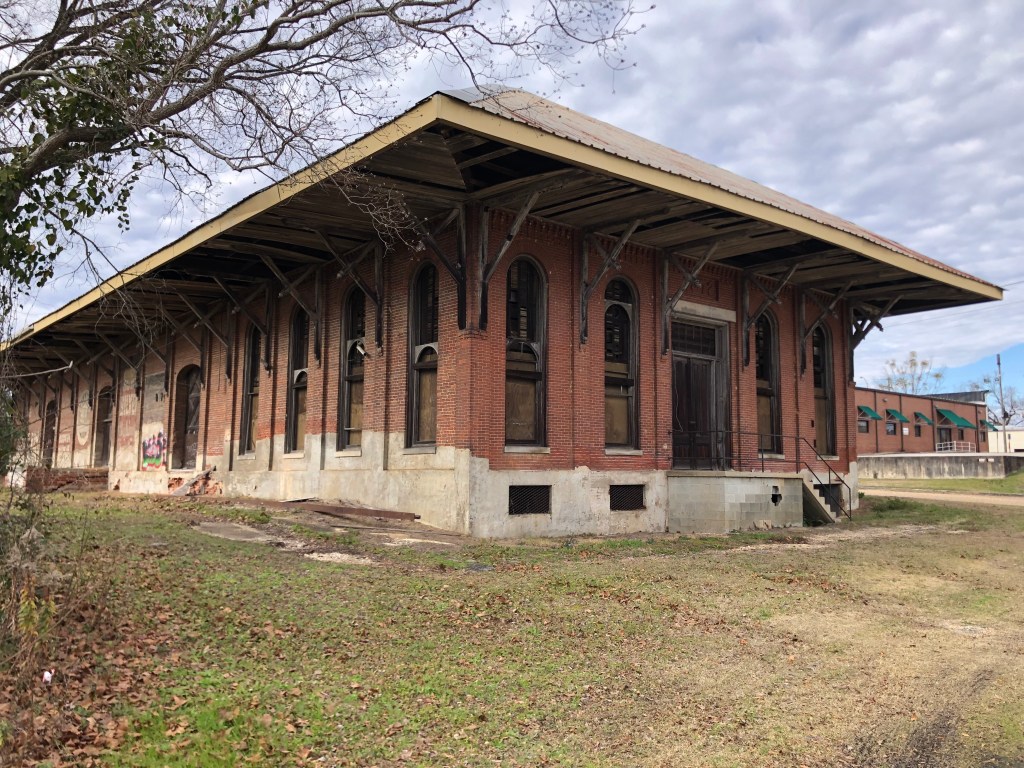
Railroads were crucial to the development and survival of southern towns. That’s true for the rest of the country as well, of course. But it seems that railroad infrastructure is more prominent in the towns I’ve encountered on this trip than it is in California towns. Maybe that’s just because California has (sadly) been more aggressive in tearing out the obsolete railroad infrastructure and substituting new housing developments and business parks. Whatever the reason, scenes like the one below (from Eufaula, Alabama) seem common on this trip.

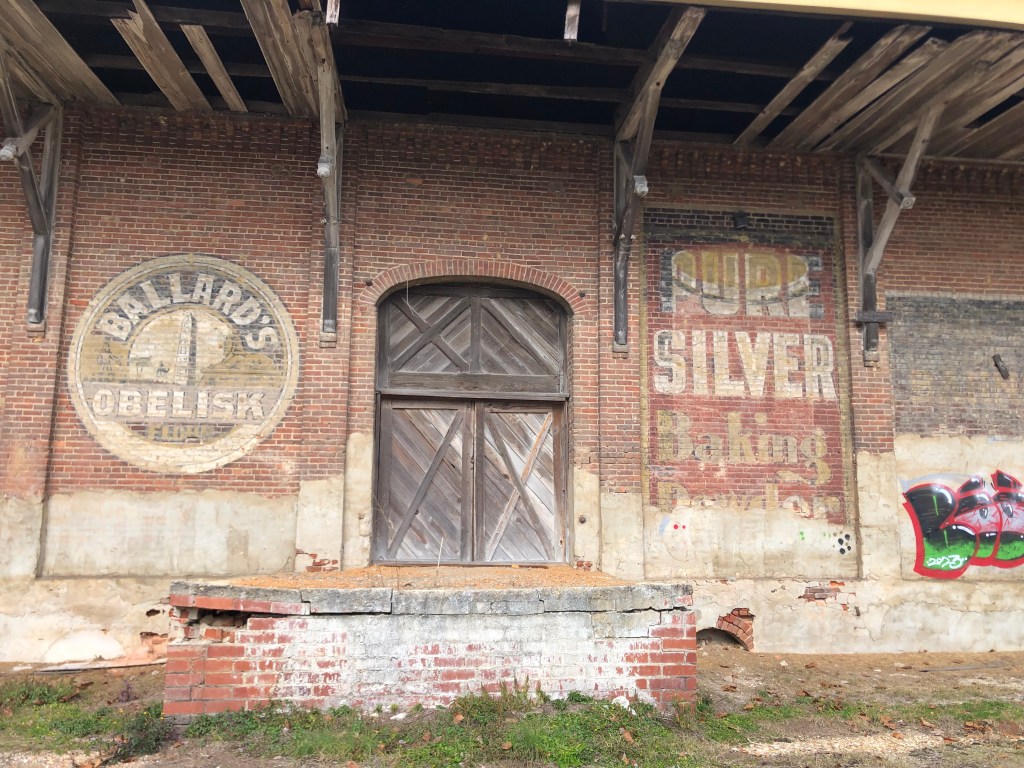
The Vicksburg and Brunswick Railroad built this passenger and freight depot in Eufaula, Alabama in 1872. It has not served passengers for over a century, and it’s now owned by the local Methodist Church for reasons that aren’t entirely clear.
Note to taggers: PLEASE don’t mess with those historic advertisements!

This leads to a third thought: I’ve given a lot of thought in this blog to the comparison of thriving and declining historic districts along various US highways, including of course Route 82. I’ve speculated about the influence of local universities, the re-routing of trains and highways (i.e., the Route 66 effect), and other possible factors. There’s also the chicken and egg question about needing funds to redevelop historic buildings, and needing redeveloped historic buildings in order to generate revenue. One thing does seem clear: some of the old towns have managed to successfully preserve and/or renovate their historic districts (let’s call them The Preservationists). Others have knocked down the old structures and replaced them with a Piggly Wiggly or a Dollar General (call them The Replacers). And still others, either due to a lack of will or a lack of funds, don’t do much of anything, and their buildings slowly decay. Call them the Porch-Sitters.

It’s not like any one approach is always the best. Circumstances and resources matter. But it should be clear that I especially appreciate those towns that have found a way to maintain aspects that make their town unique and that connect them with their history. I think the problem with the Replacers is they all end up looking alike, hosting the same Olive Gardens and Kohls and Home Depot and Bed Bath & Beyond.

I feel the sorriest for the Porch-Sitters. I think towns that slowly decay aren’t doing so because they don’t care. Rather, they’ve lost their major employers or their young people have moved away or the interstate siphoned off their drive-through traffic. They fall into a destructive cycle where the population and the infrastructure together age and eventually collapse.

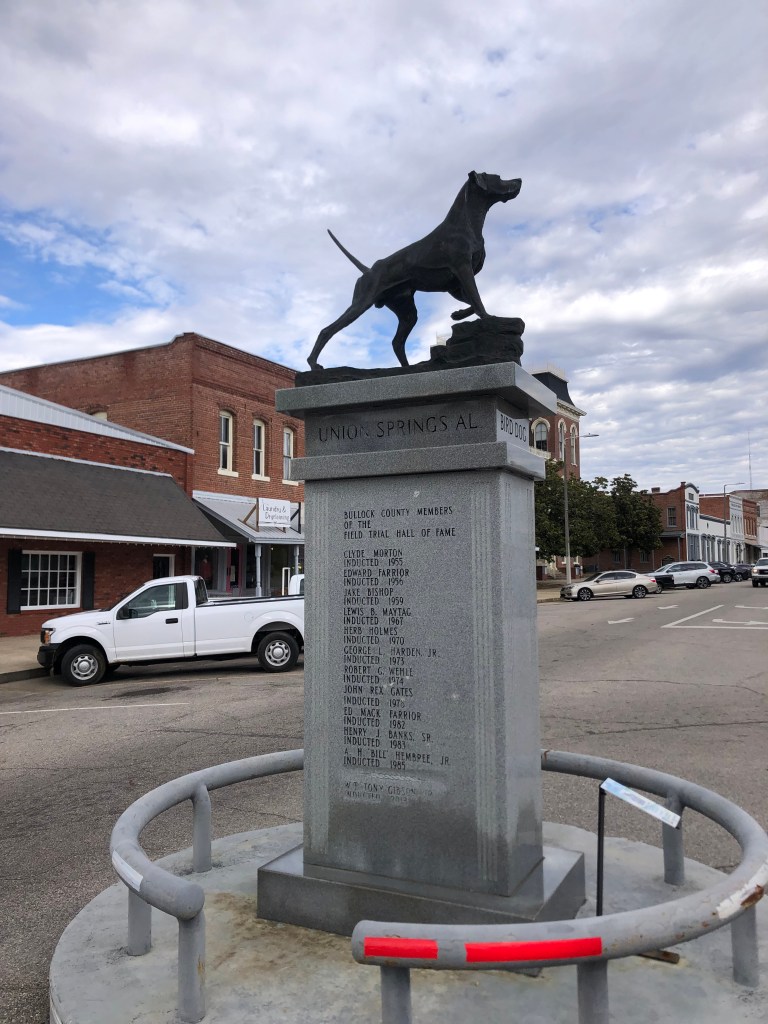
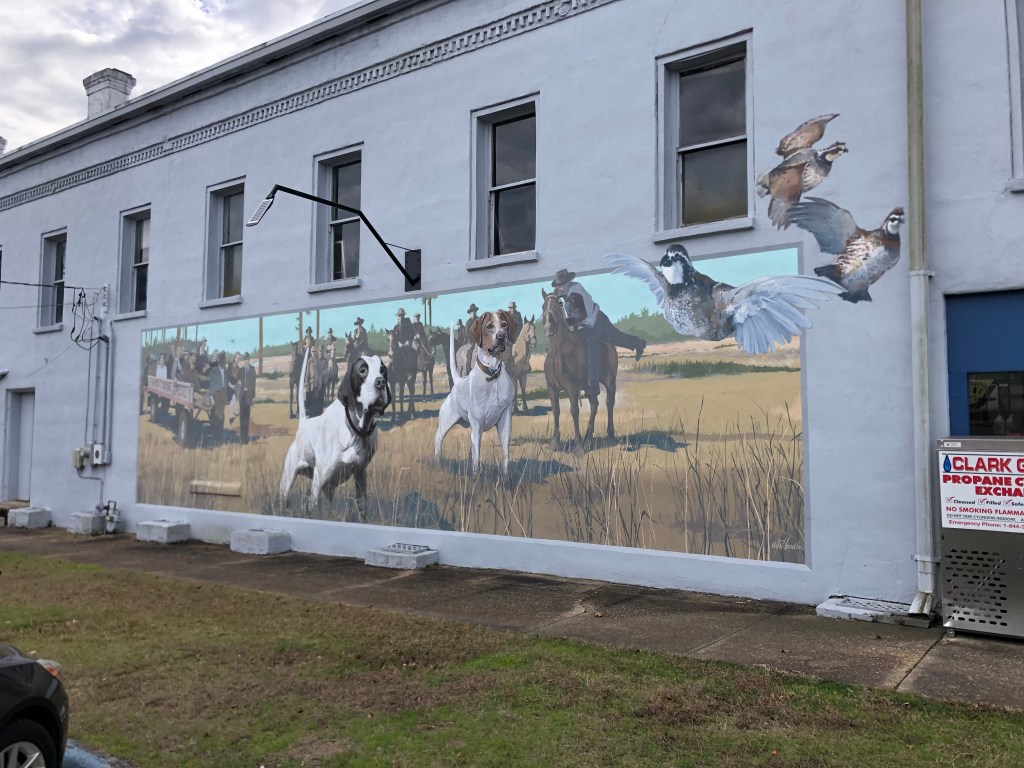
Today I drove through the town of Union Springs, Georgia (pop: 3,300). It’s not a prosperous town; about 44 percent of the population is below the poverty line. The local economy sprung up from the cotton industry, but in the 20th century many of the cotton fields were converted to hunting preserves. Interestingly, the town has capitalized on that change by rebranding itself “The Bird Dog Field Trial Capitol [sic] of the World.” The town hosts annual field trials for hunting dogs every fall and spring, and it has erected monuments and murals celebrating that fact.

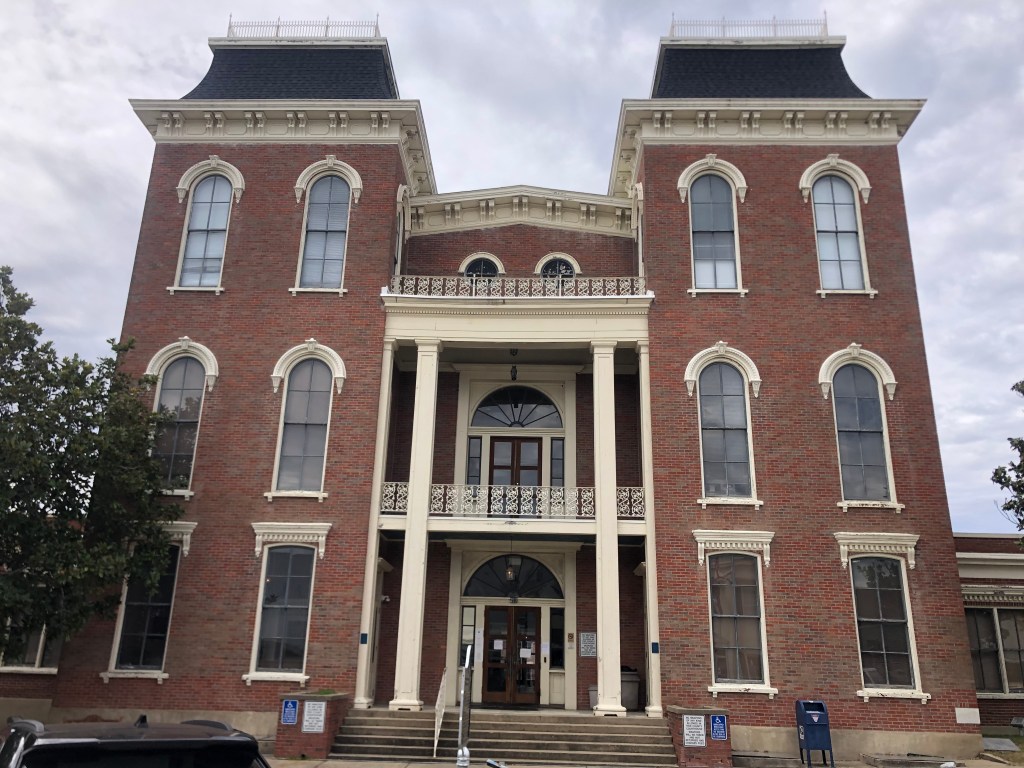
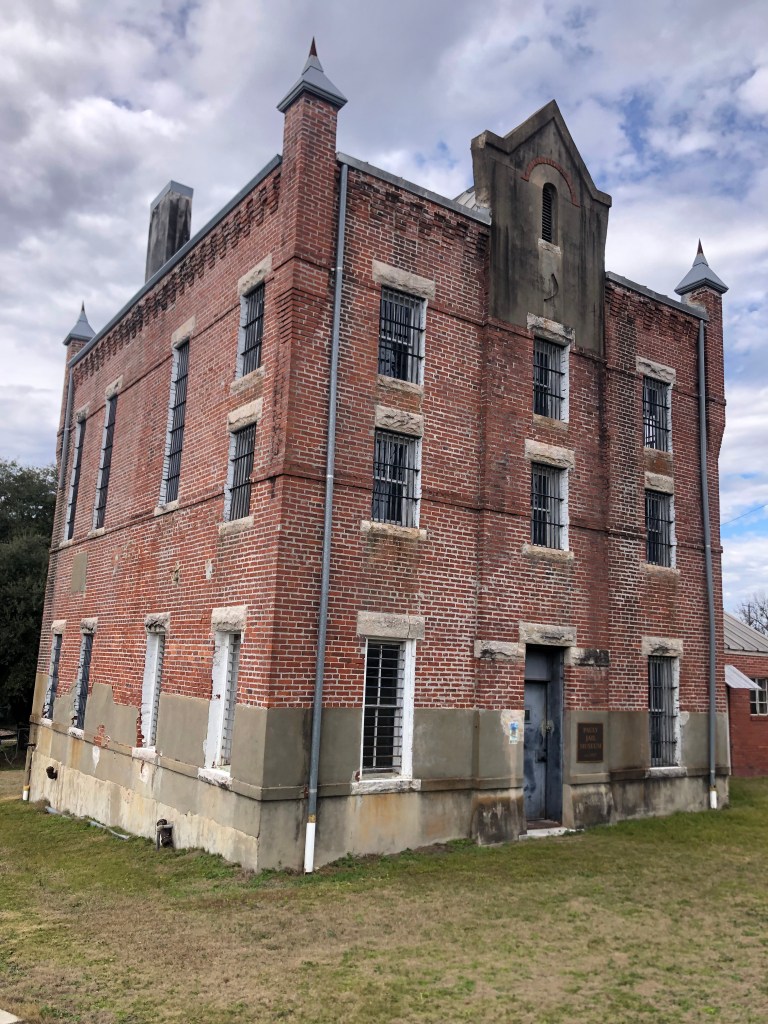
The town also restored its historic county courthouse and jail to the tune of about $2 million…

The 1871 courthouse looks impressive…but it wasn’t open to the public, because the Barney Fife-like guard was taking a break.
The 1897 jail was partially restored and converted to a museum….but it was closed to visitors when I saw it.

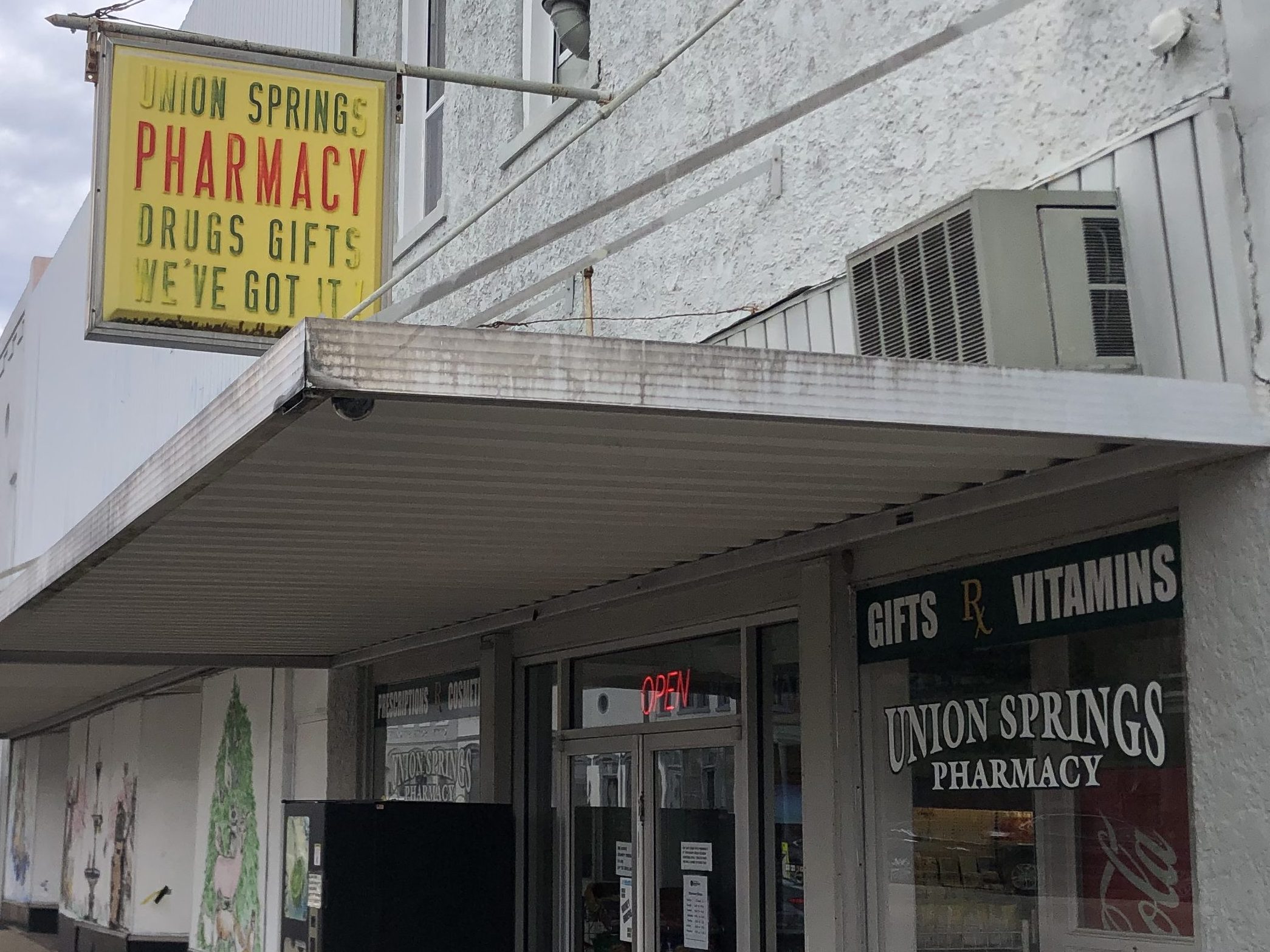
At the same time, however, most of the buildings along the commercial main street haven’t had a facelift in many years.

The one human being I saw on the street was a guard from the courthouse. He didn’t seem particularly interested in showing off his city to a (presumably rare) winter visitor. I’ll be interested to see how Union Springs fares over the next decade. I can’t quite tell whether the balance is tipping toward Preservation or Porch-Sitting.

About 40 miles further down Route 82 is the town of Eufaula (pop: 13,000). This town seems to be firmly in the Preservationist camp. Large, plantation-style homes line a section of US 82 as you come into town.

The core, historic business district, meanwhile, has a large number of shops, restaurants, cafes, professional services, and even a historic theater. I had lunch at a Mexican restaurant that was completely full of families and couples.

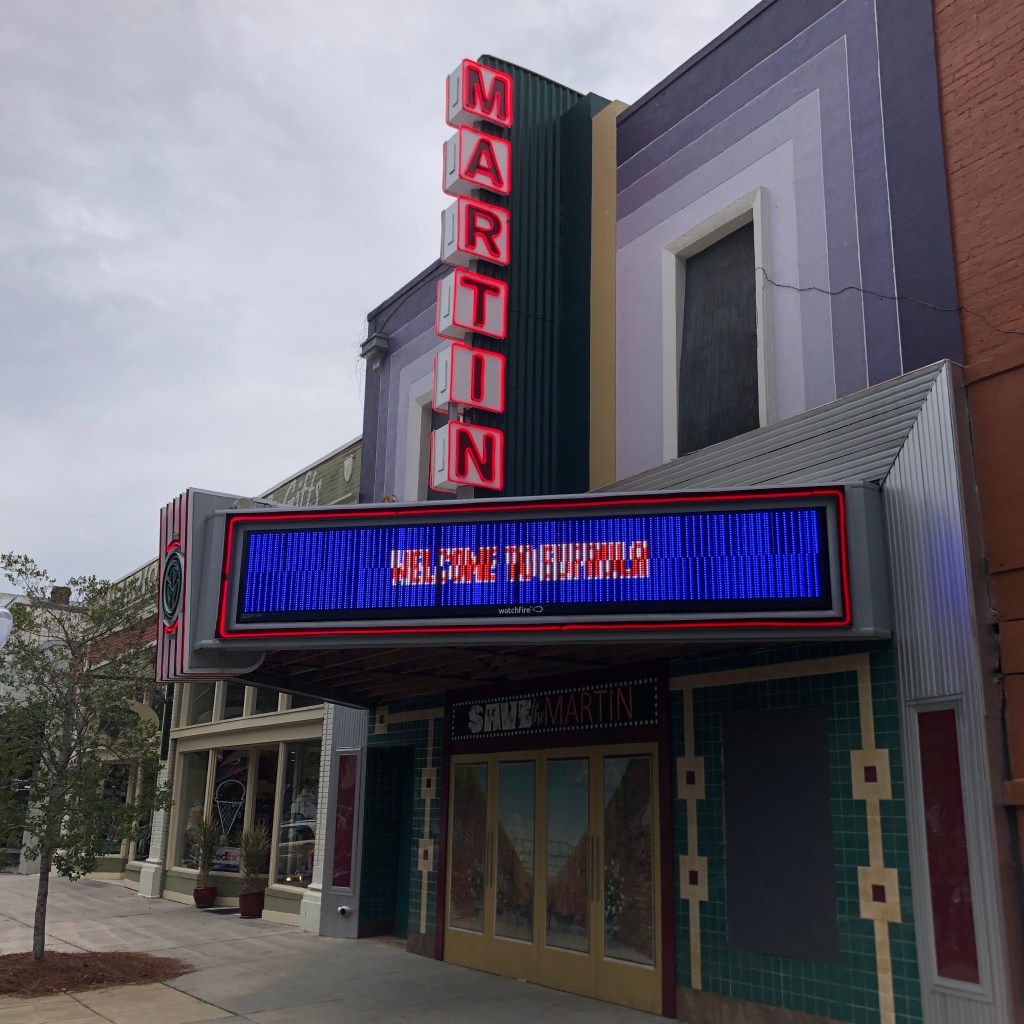
The 1927 theater facade was recently “restored” (with the unfortunate addition of a garish, pixelated marquee). The interior is still being renovated.

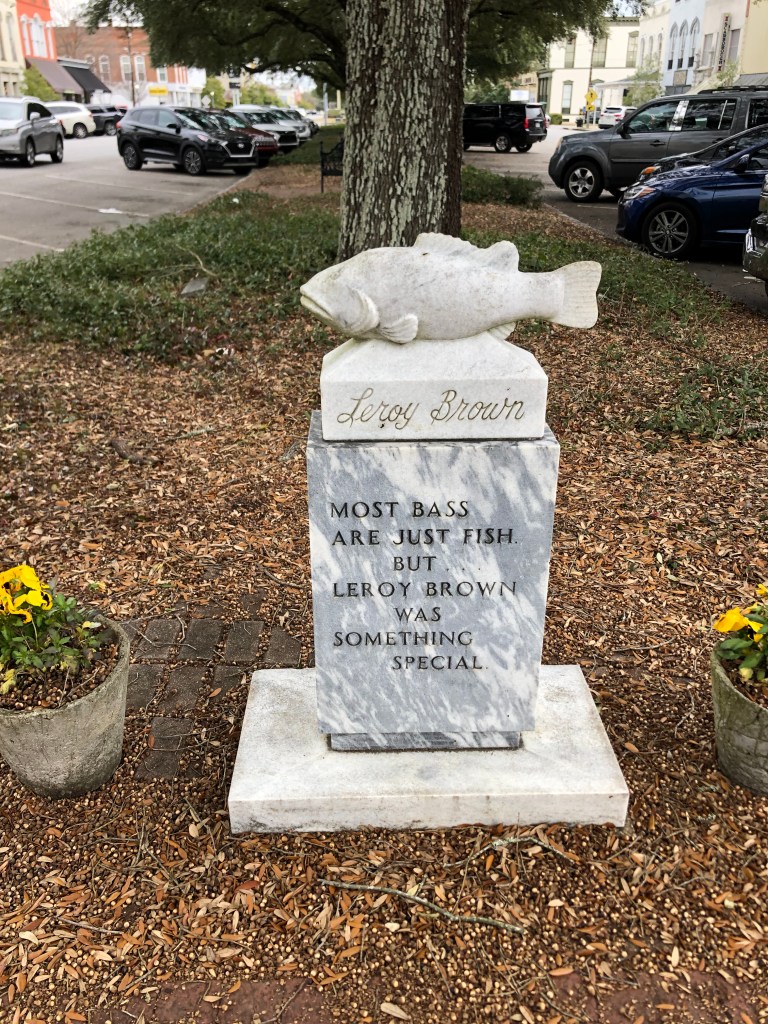
On a green, tree-lined strip in the middle of Main Street is what looks like a tombstone for a fish.

And meaner than a junkyard dog!

When the fish (a bass) was caught in 1973, the fisherman (Tom Mann) decided to keep it in an aquarium–sort of a half-ass catch-and-release, I suppose. Mann named the fish Leroy Brown (after the Jim Croce song) and taught him to jump through a hoop he held over the water. Leroy Brown became a town celebrity, and lived for seven years in that tank.

When Leroy Brown died in 1980, Mann held a funeral for him, and it’s said that over 500 mourners attended. The Governor of Alabama even declared it a day of mourning. I’m not making this up. For reasons too complicated to get into here (but not here), Leroy is not buried under this tombstone. But the town fondly recalls his memory.

And since we’re on a whimsical note: Today I had another opportunity to explore paranormal phenomena (after my failed Crossett Spook Light experiment). I learned of a place just a few miles off Route 82 in southwestern Georgia that’s been informally dubbed “Gravity Hill.” At first I thought it might be one of those roadside tourist traps like the Mystery Spot, but it’s actually just an unmarked, lonely stretch of narrow road in the countryside. Here’s how it works: After cresting a gently rolling hill, one drives down to the low point, just before the road begins to climb again. Stop your car here, put it into neutral, and let your foot off the brake. Gravity Hill is supposed to pull you backwards, uphill.

Although skeptical after the Crossett experience, I was willing to give it a whirl. So I cruised to the outskirts of the town of Fort Gaines on a narrow country road. I stopped my car at the low point, put the rental car in neutral, and released the brake. Nothing. I was about to declare this another fraud when I noticed that I was very slowly beginning to roll backwards, up the hill I’d just come down. The car gradually picked up speed until I was rolling uphill at maybe 10 mph. I repeated this several times, and it worked each time. I even recorded this video so you can judge for yourself:

I guarantee there’s no trick photography or anything like that going on. You’re seeing exactly what I saw. You may think it’s some kind of natural illusion or something like that, but I prefer not to think about it too hard.

I lost an hour due to a time zone change when I entered Georgia, so after my gravity experiment I decided to hunker down for the night in Albany, Georgia (pop: 69,000). Tomorrow I plan to reach the coastal terminus of US 82 in Brunswick.

Brew of the Day

I stopped in at the Mellow Mushroom, a pizza restaurant in Albany. It’s part of a multi-state collection of such restaurants, but each one is locally owned. And the company began in nearby Atlanta, so my guilt from eating at a chain restaurant was attenuated a bit.

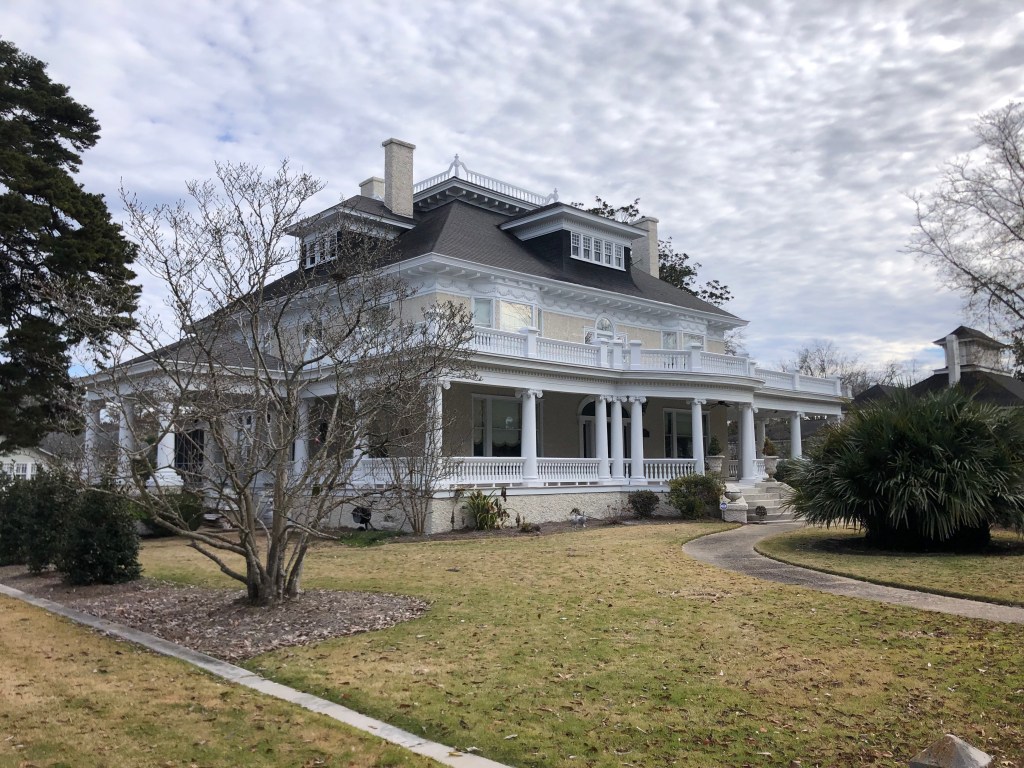
As you might imagine, the “mellow mushroom” theme is expressed in the decor and menu in the form of psychedelic trips, Jimmy Hendrix, the 1960s, and general hippie-ness. The sculpture in front of the restaurant says it all:

“Tune In, Turn On, Drop Out, Dude.”

Anyway, this place has a surprisingly large beer menu. So, along with my pepperoni-bacon-jalapeno pizza, I ordered a Stone Xocaveza imperial stout.

Note the decor in the background.

Now, San Diego-based Stone is a reliable brewery, with big, hop-forward beers. I especially like their Arrogant Bastard Ale. The Xocoveza looks inviting: the color is of a ruby-shot Coca Cola. It has no head to speak of, and in fact there’s little evidence even of carbonation. But none of this is fatal for a stout. And the nose is quite inviting–it smells of chocolate, maybe a hint of anise. Let’s see how it tastes…

(Sip. Gulp. Gag.)

This is quite possibly the worst Stone beer I’ve tasted. Flat as my feet. It’s like the half-finished glass of generic-brand root beer you put in the refrigerator and then forgot about. For a month.

Unlike a normal stout, this is not malty. And it’s not hoppy. In fact, it’s not really beer-y. The taste reminds me of meatloaf, somehow converted to liquid form.

But that’s a bit unfair…to meatloaf. I’m not a fan of meatloaf, but I acknowledge that it delivers a blend of different tastes. This beer, on the other hand, is one-dimensional. It lacks the complexity that one seeks in a good beer. What you taste on the front end is what you taste on the back end. And this tastes like back end.

And another thing–this is marketed as an “imperial stout.” In my book, the “imperial” part is supposed to signify a “big” beer, with an ABV that gets into the double digits. This, however, weighs in at a puny 8.1 percent. I suppose that might be about right for some people. But unless you wear a short-sleeved white shirt and place the title “Elder” before you last name, I think you’ll find the Xocoveza to lack the bite you’d expect from an imperial stout.

I give it one star. And that’s just because I like the color and the nose on this beer.
California history · cemeteries · churches · movie theaters · Road trips · trains

A Likely Story

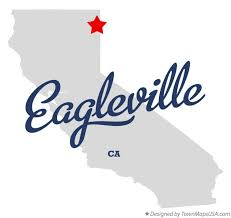
About half a century ago, when I was in the throes of adolescence, my dad loaded up our family and made the seven-hour drive from Sunnyvale to Eagleville, in the northeast corner of California. We were going to spend the Thanksgiving weekend with my Aunt Alice’s family. One of Alice’s brothers owned a house up there (in retrospect, it seems her extended family owned half the town).

Motto: “Any further north and you’d be in Oregon.”

Eagleville is a tiny town in Modoc County. (Today it boasts 45 residents, about half of whom presumably are related to Aunt Alice). I have three main memories from that weekend we spent there: (1) Mom was sick with a migraine headache, Dad was distracted by mom’s condition, and Dave and I knew no one else other than Aunt Alice and Uncle Edward (Dad’s brother). (2) The general store was the only business open that weekend, so my brother Dave and I hung out there for what seemed like hours, studying the comic books and MAD magazines. (3) There was a tiny church that was unlocked and empty; as a city slicker, I was surprised that people could be so trusting as to leave a building full of chalices and patens and suchlike just sitting there unattended. Even though Dave and I were not known for our high moral principles, we realized that it would be extremely bad karma to rip off anything from a church. So we left well enough alone.

As I recall, our Thanksgiving dinner was a traditional though awkward affair. All the expected Thanksgiving staples were there: turkey, stuffing, cranberry sauce, etc. But the four of us in my immediate family were clearly unfamiliar outsiders, while Aunt Alice’s family members were all comfortable together, laughing and joking and having fun. I envied their ease being in their own skin, and their grounding in that remote corner of California.

That Thanksgiving weekend still stands out from the 60 undistinguished others I’ve experienced. Perhaps it’s because it was the only Thanksgiving I spent with snow. Perhaps it’s because Eagleville felt like such a mysterious, remote, foreign place. Notably, I’ve never been back to Eagleville.

Until now.

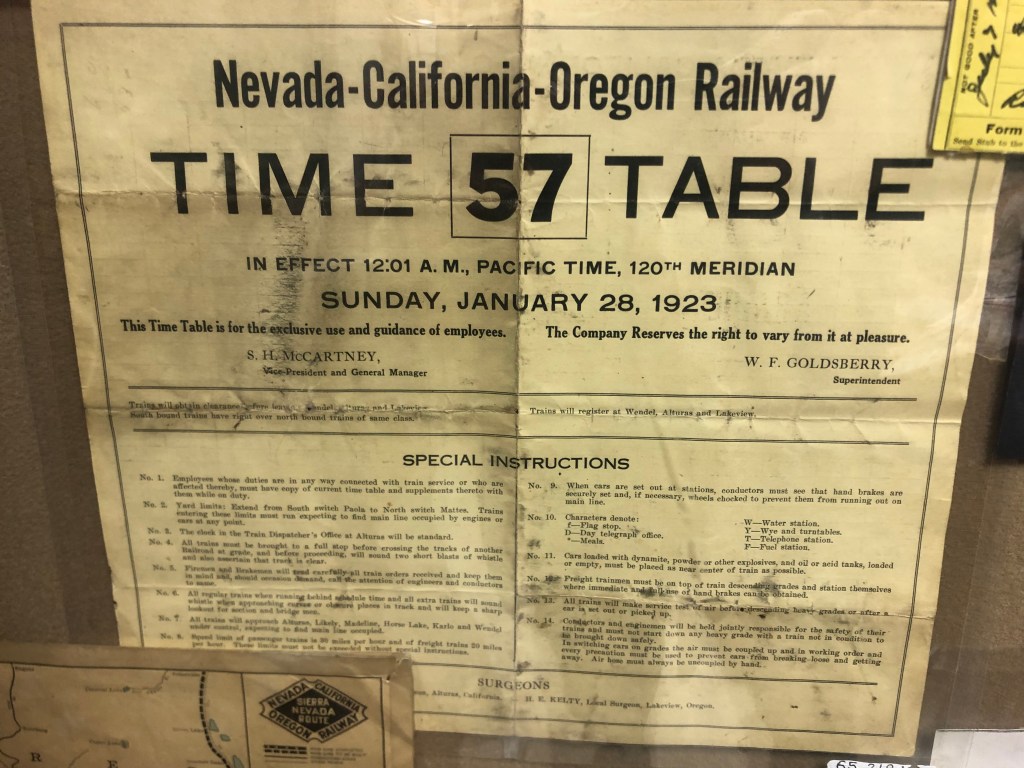
Recently I decided, for no particular reason, that I would revisit that tiny town and see how the reality stacked up against my memory. So I contacted my Uncle Edward, who helpfully supplied me with the address of the house where we stayed, which evidently still remains in Alice’s family. As loyal readers of this blog know, Uncle Ed is the creator and sole “staff” of The Dome of Foam, which is internationally recognized as the premier, authoritative, entertaining website on western railroads (particularly the Southern Pacific). I asked Uncle Ed if he could recommend any railroad-related sites in the greater Eagleville area, and he connected me with a doozy: The Nevada-California-Oregon (N-C-O) Railway, a now-defunct narrow-gauge railroad that connected Eagleville’s Surprise Valley with the outside world.

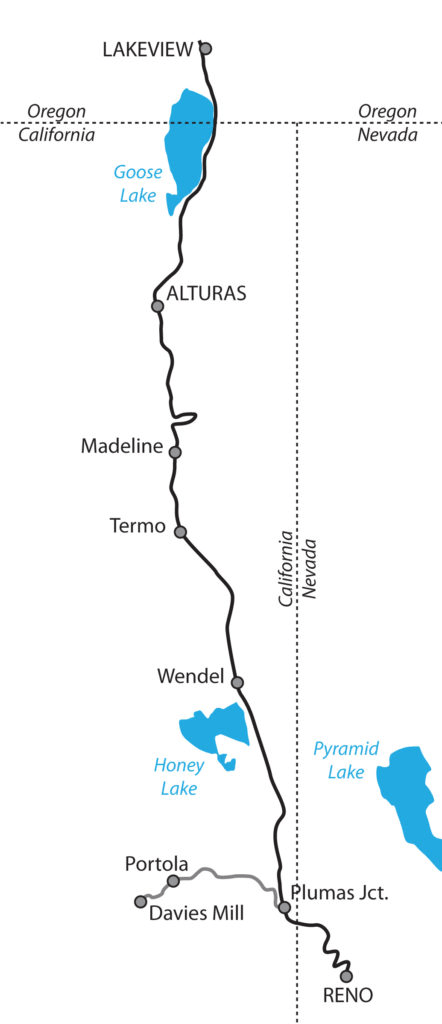
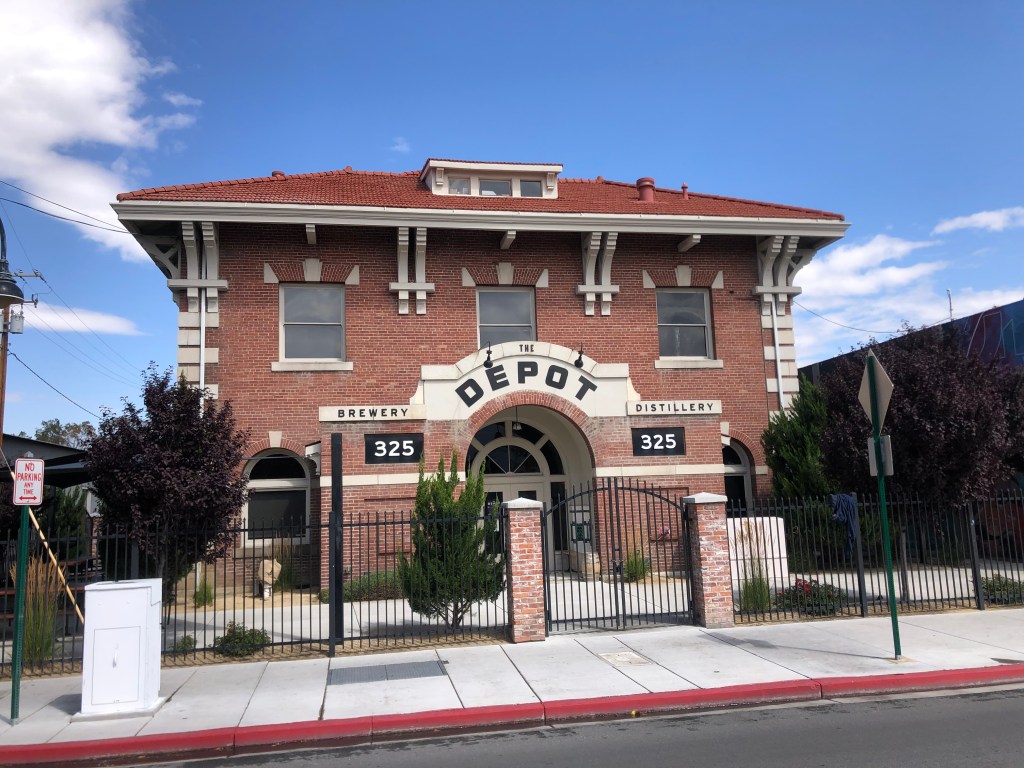
In doing a little research I read that the N-C-O Railway’s southern terminus was in Reno, Nevada, and I recalled that son Ian and I had visited that same depot just last winter. (Scroll down to the BOTD in this post.) It’s now a brewery/distillery, but they’ve keep the original exterior largely intact. The N-C-O also had a major presence in Alturas, which is just west of Eagleville. And the northern terminus was in Lakeview, Oregon, which is just north of Alturas.

Route of the N-C-O Railway.

So my plan became clear: my trip to Eagleville would generally follow the entire route of the N-C-O Railway, an I’d be able to visit historic structures in each of the three states served by the railroad.

And so this morning I set out on the trusty Speedmaster eastward to Reno (pop: 264,000). Within a couple of hours I was standing in front of the N-C-O’s Reno depot. Originally built in 1910, the building served as a railroad depot until 1937. After that it was used for railroad offices and was finally sold off for non-railroad purposes in 1975. It was eventually abandoned, then in 2014 it underwent renovation to become the brewery/restaurant it is today.

Once the southern terminus of the NCO Railway.
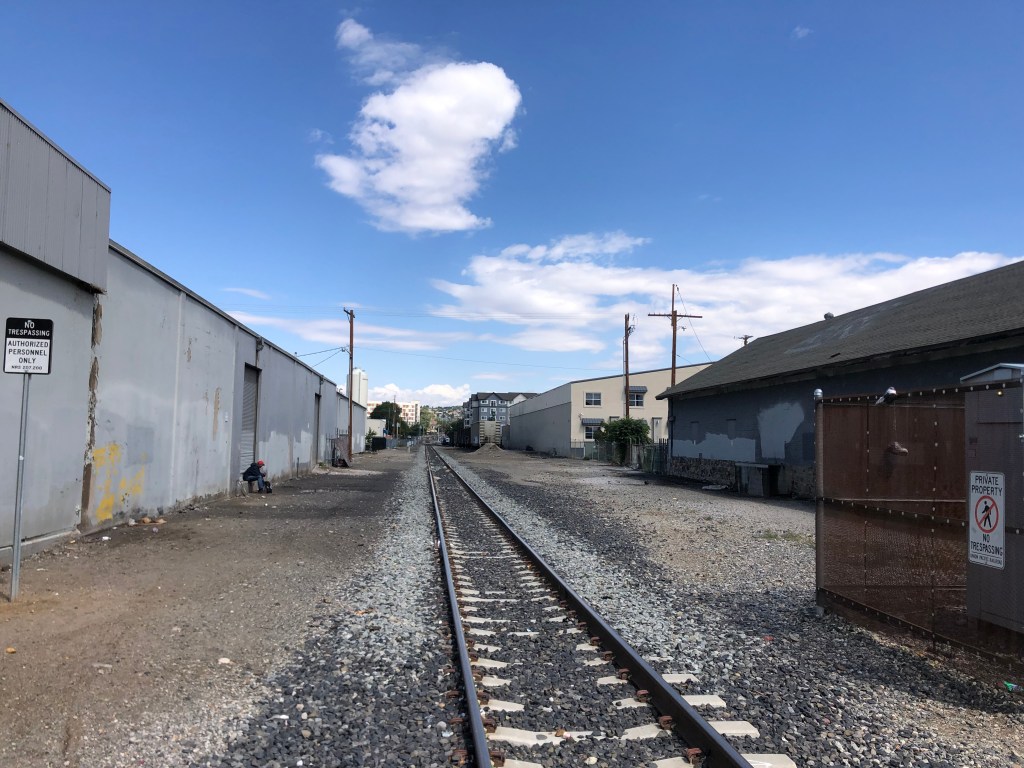
The rail line still runs alongside the Depot.
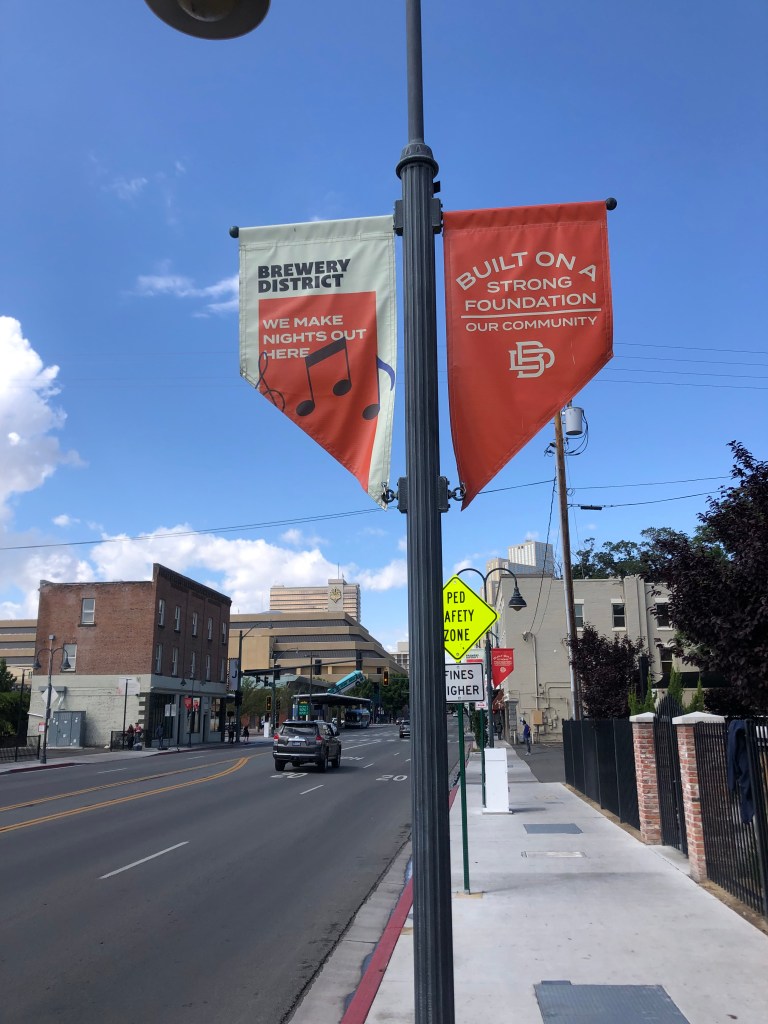
The Depot sits in the middle of Reno’s Brewery District, alongside a handful of other breweries and distilleries.

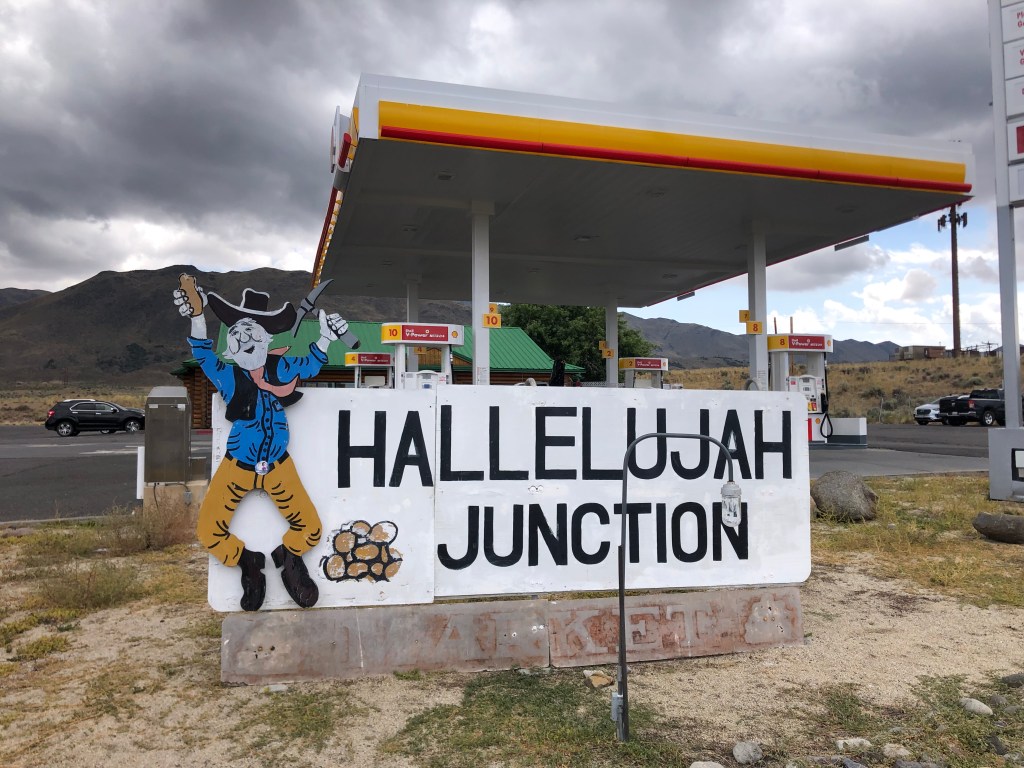
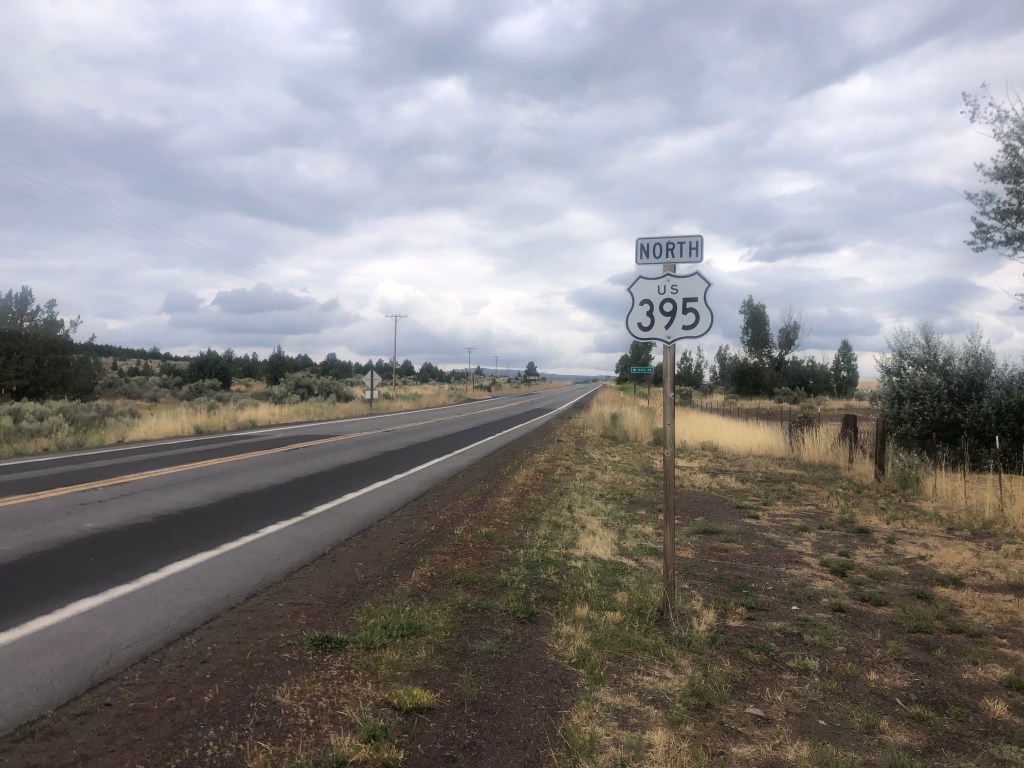
I next headed north on US 395. I’ve written about US 395 before (here and here and here, for example). You’ll recall that Hallelujah Junction (where US 395 intersects with CA-70) holds special significance. So I made a brief stop as as I passed through, to relive the magic.

Where I learned about the Seven Wonders of the Railroad World.

US 395 has a stark beauty to it. You don’t see much in the way of towns or even other cars. The quietude and long horizon are conducive to contemplation if not meditation.

Ommmmm…..

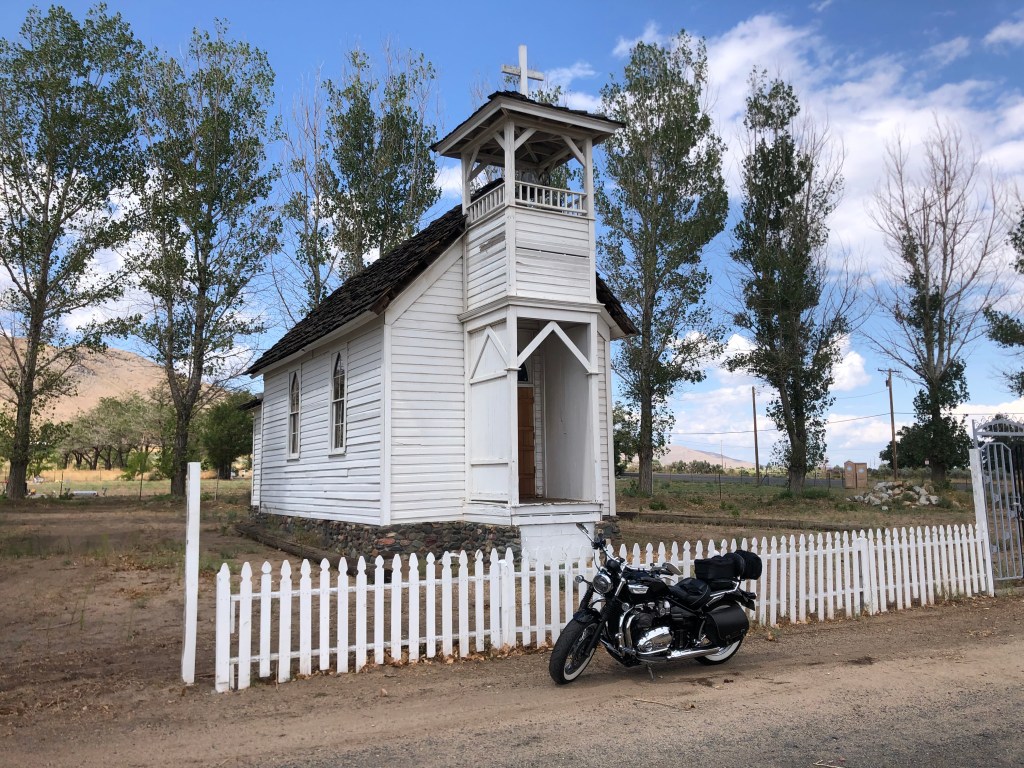
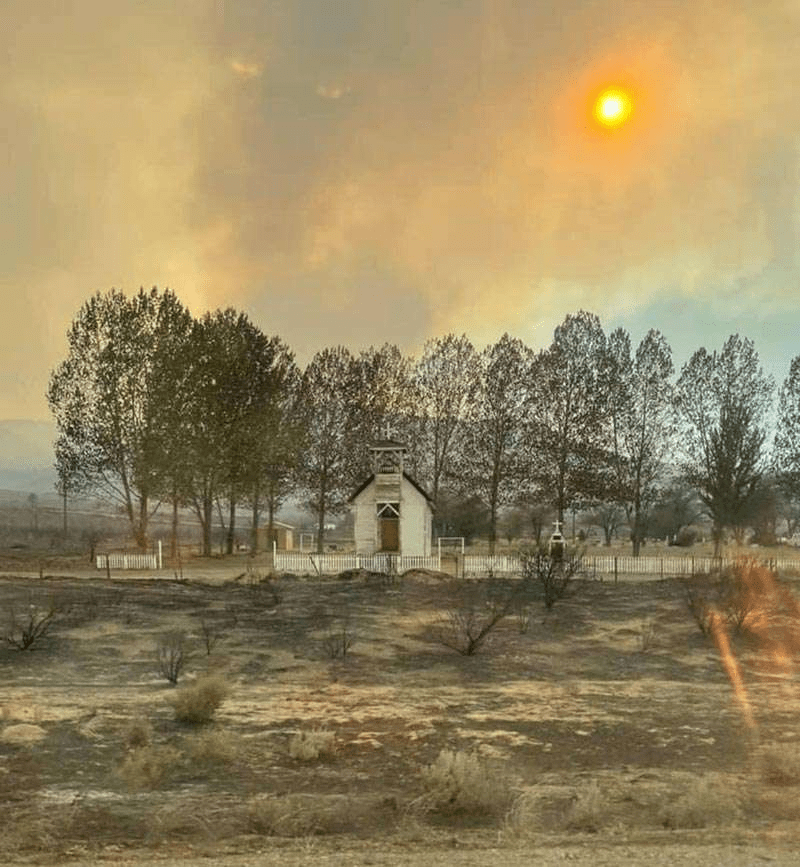
When the rare town does appear, I feel compelled to stop and look around a bit. One such town is Doyle (pop: 700). A couple of years ago Doyle lost much of its housing stock due to wildfires, so there really isn’t much going on here. But I was charmed by this historic chapel that somehow escaped the fire. Constantina Church was built around 1900 about five miles south of Doyle, and infrequent worship services were held there whenever a circuit priest was available. Services stopped around the 1920s, and the chapel was eventually abandoned. The structure was moved to Doyle in 1994, and it appears to be in regular use as a church once again.

Constantina Church today.
Same church in 2021, after the town’s fire.
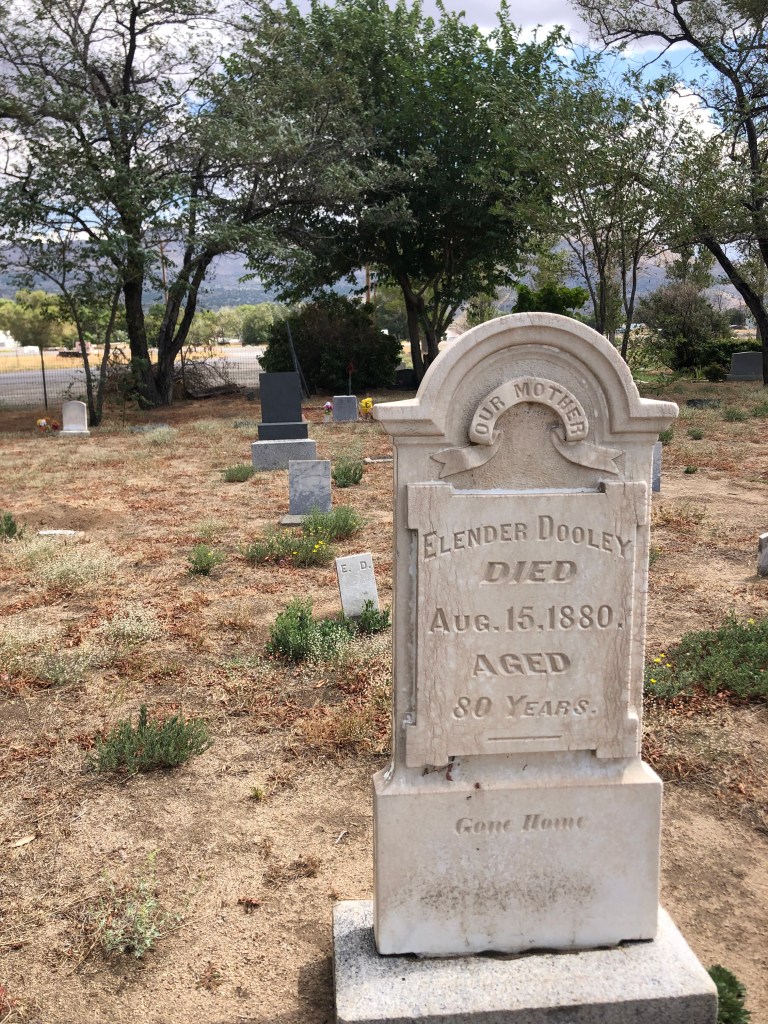
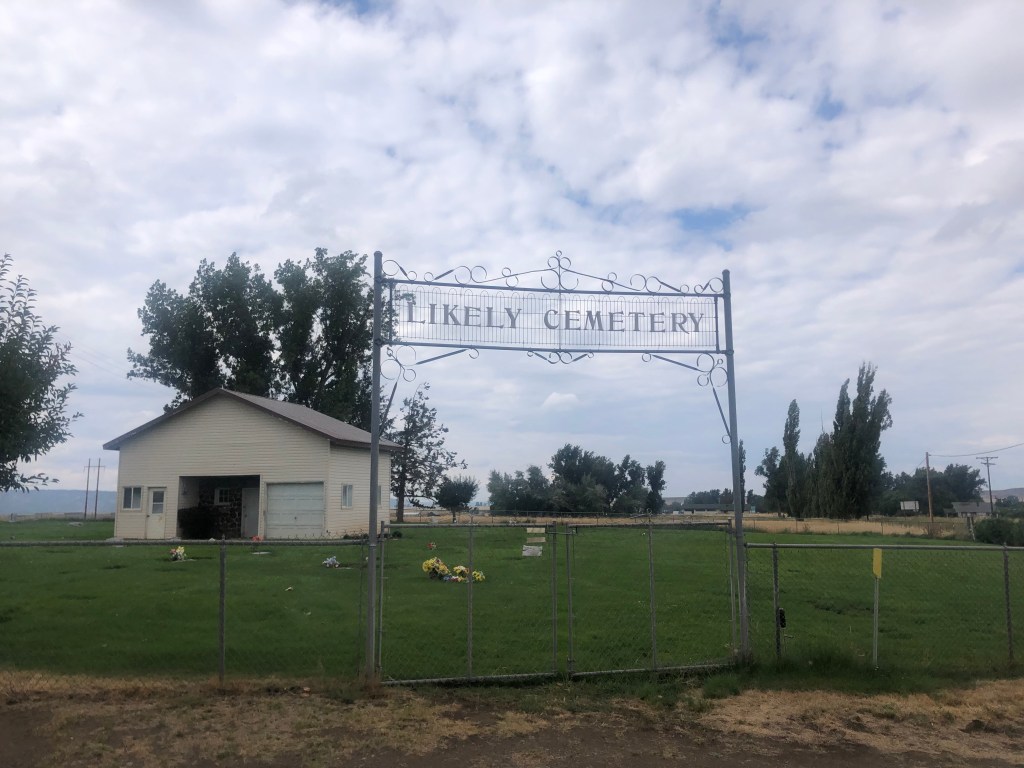
A historic cemetery is next to the church.

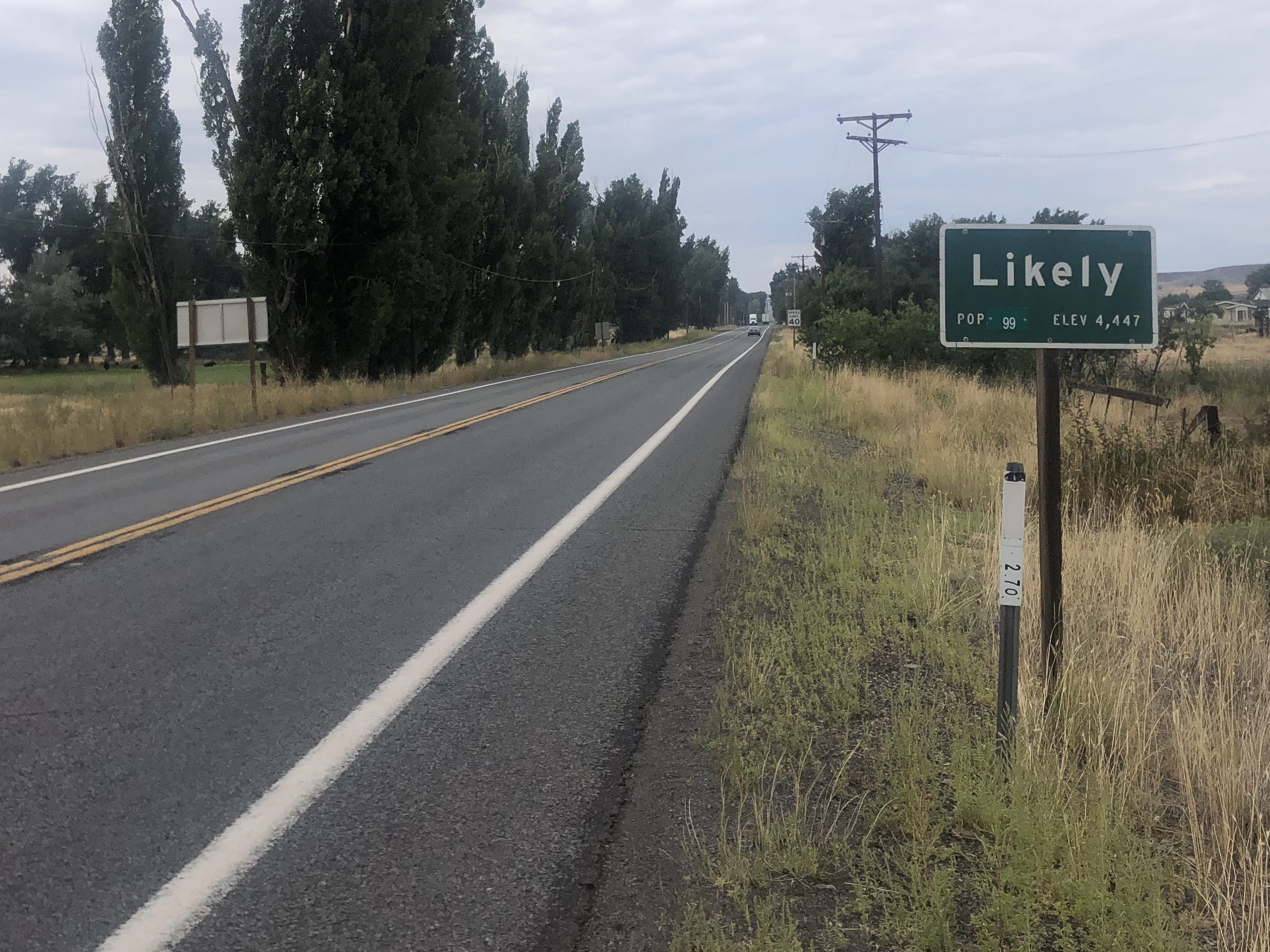
I also passed through the town of Likely (pop: 99). The story goes that, back when the area was being settled, some homesteaders were speculating about whether the settlement would become a proper town. One man (Billy Nelson) reportedly said “There’s likely to be a town here one day, and there’s just as likely not to be. So let’s call it Likely.”

A Likely story.
But we’re not sure.

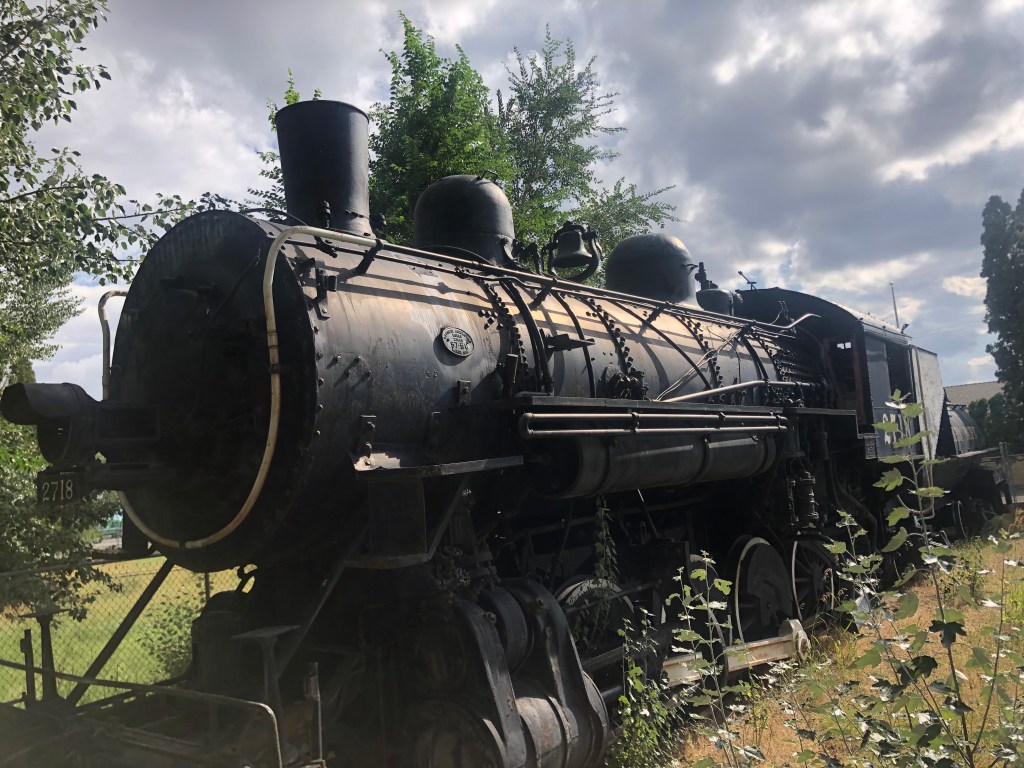
Finally I arrived at the relative metropolis of Alturas (pop: 2,700). Approaching from the south, the first thing you encounter is a striking, if somewhat faded, 1904 steam locomotive that used to run on the NCO line. The locomotive was presented to Alturas in 1956 by Southern Pacific (which had earlier bought up the NCO), and it resides outside the Modoc County Museum.

Standing still since 1956.

The story of the locomotive, as told by the local boosters, makes clear how much the NCO had meant to Alturas:

“This particular locomotive was utilized on the Alturas, California to Reno, Nevada route. The railroad was chartered as N.C.O. (Nevada, California, Oregon) in 1884. It was first established in Alturas in 1908 reaching Lakeview by 1912. The railroad and Alturas have an extensive symbiotic relationship from its inception to the day that Alturas was terminated as a home terminal on January 17, 1972, which was a devastating blow to the city as a large percentage of the population was forced to relocate to Klamath Falls, Oregon. Every business in town interacted with the railroad, whether by the influx of tourists or business travelers when the Southern Pacific offered a passenger service from 1927 to 1938. Even railroad workers who made their home base in Alturas, or stayed in one of the hotels made on impact on the town. The third floor of the Niles Hotel offered dorm style living for the railroad workers for decades. Before and during the time of passenger rails, the Southern Pacific and N.C.O. offered livestock shipment from 1908 to 1972, which provided most of its revenue. This was an option for the ranchers throughout the region to get their livestock to markets and sustained a way of life followed since the pioneers first arrived to this region.”

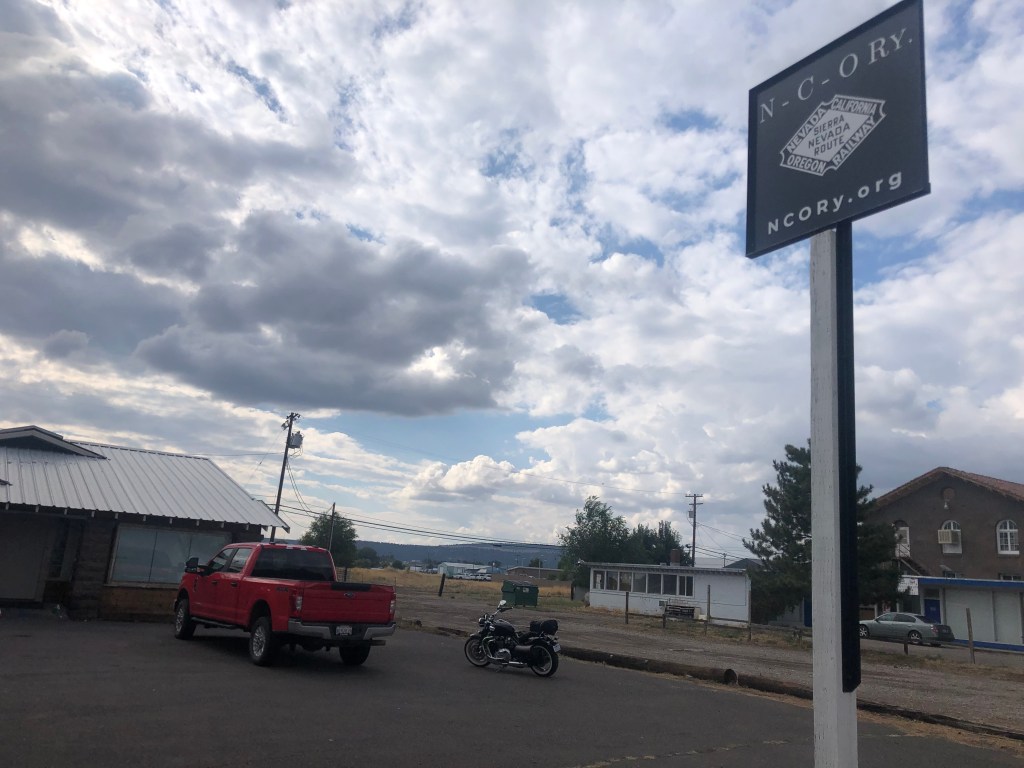
The docent at the museum was incredibly helpful when I told him of my interest in the NCO. He directed me to a place down the road where an old NCO structure was being renovated. “Look for the red truck and ask for Shane.” Dutifully I followed the directions, and was rewarded by the sight of a large NCO sign…and a red truck.

This must be the place….

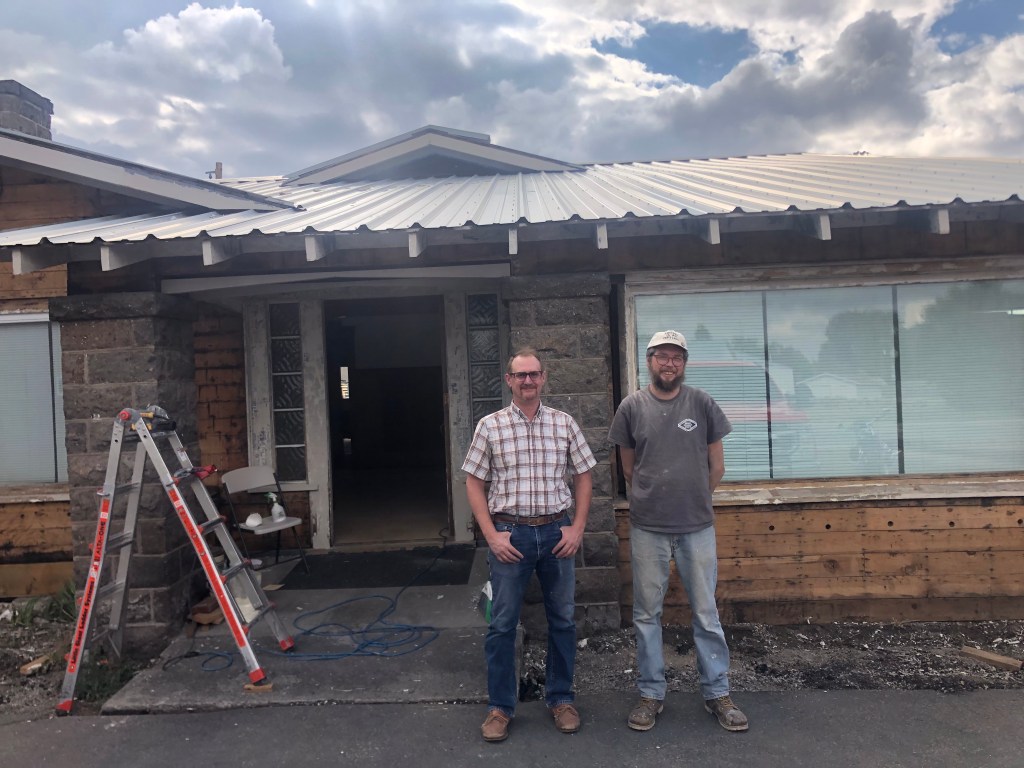
Shane turned out to be the head of a nonprofit organization called the Nevada-California-Oregon Railway. (Evidently the name was free to use.) The nonprofit is working to preserve the history of the NCO railroad, including buildings and rolling stock. The building where I met him (and where he was restoring some woodwork) had once been NCO crew quarters, and Shane’s dream is to turn the building into a museum.

Shane (left) and Andrew, taking a break from restoring the NCO crew quarters on Main Street, Alturas.

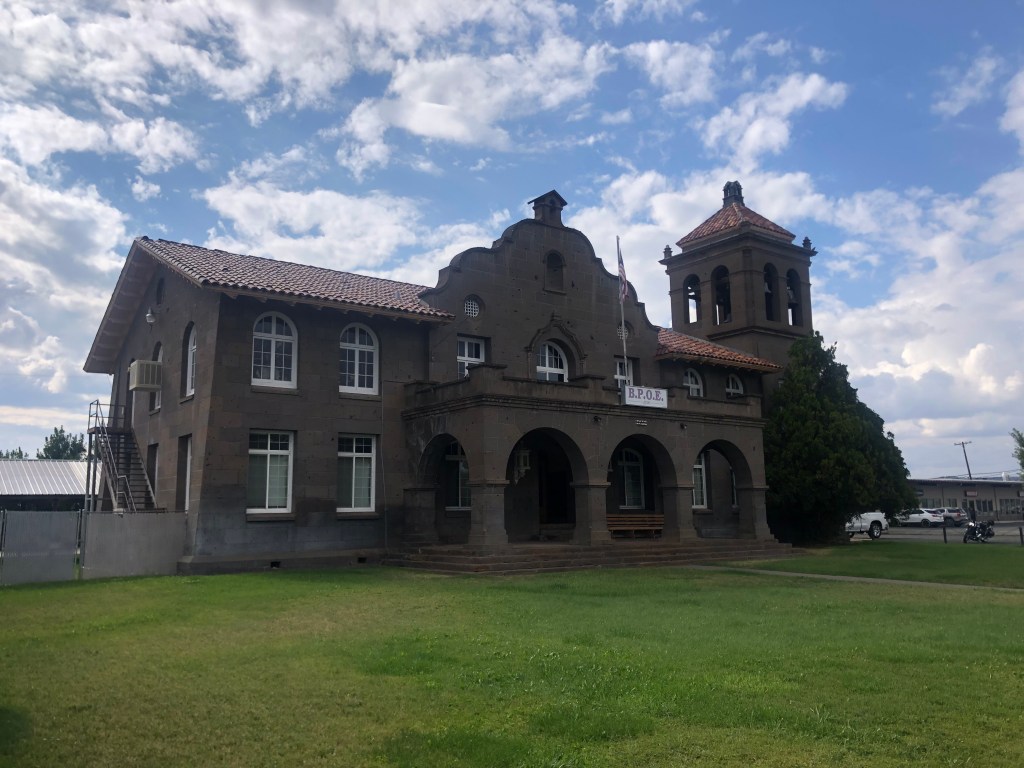
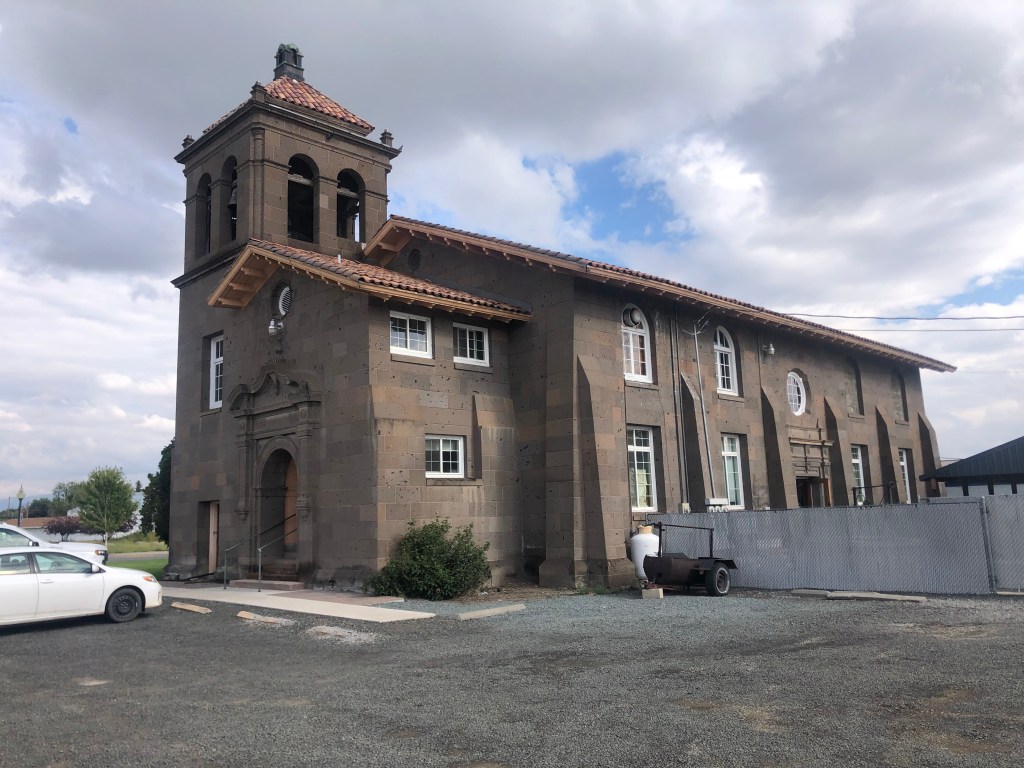
According to Shane, there are several NCO buildings still standing in Alturas. He pointed to a large Mission Revival building that had once served as the NCO’s headquarters. Built in 1918, the building became an Elks Lodge in 1974 and remains such today.

Attentive readers will recall that I encountered this building when I drove through town coming back from my Weiser trip last year. At the time I didn’t put together that this building and the Reno Depot shared the same lineage.
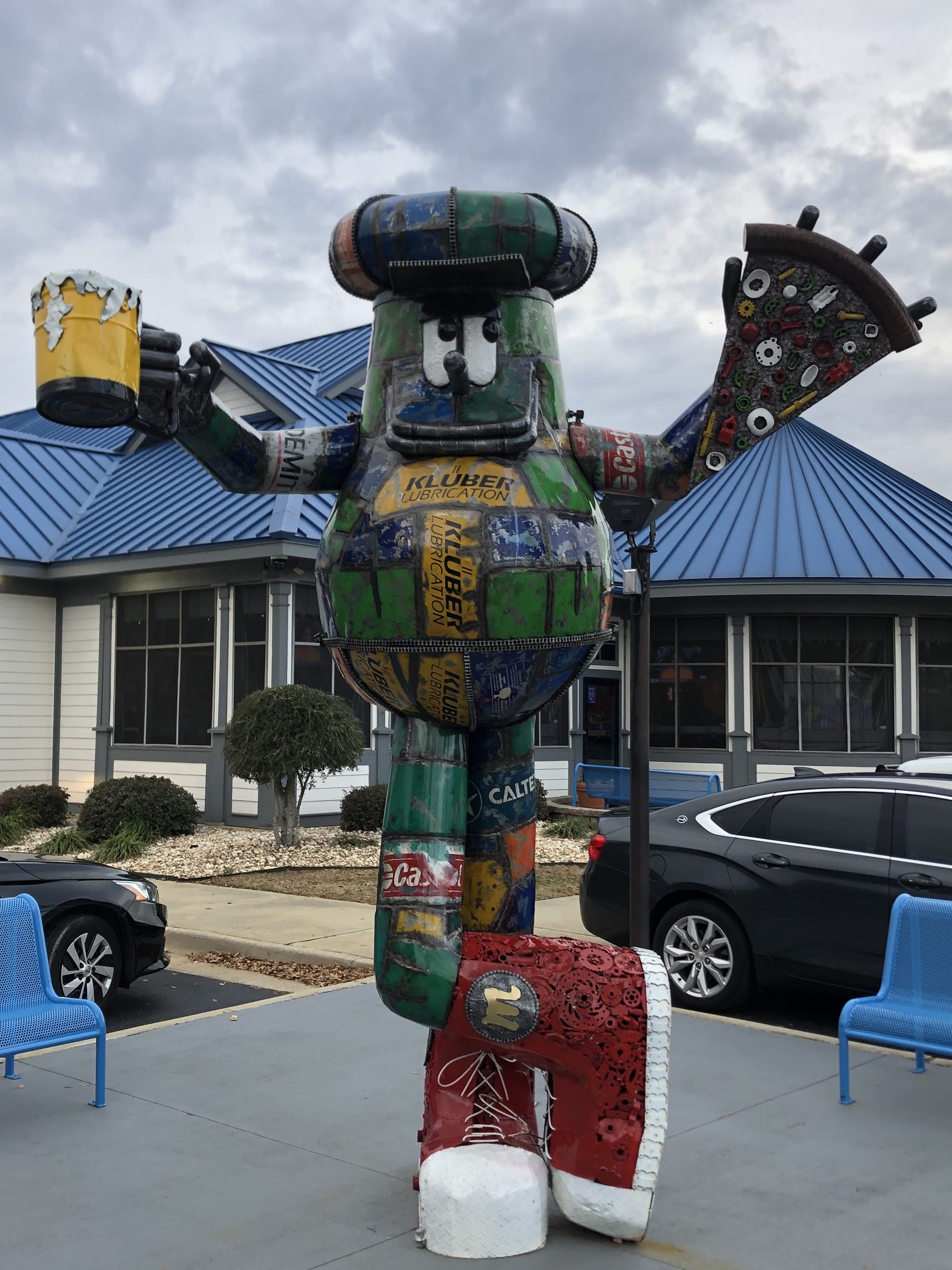
View from the parking lot.

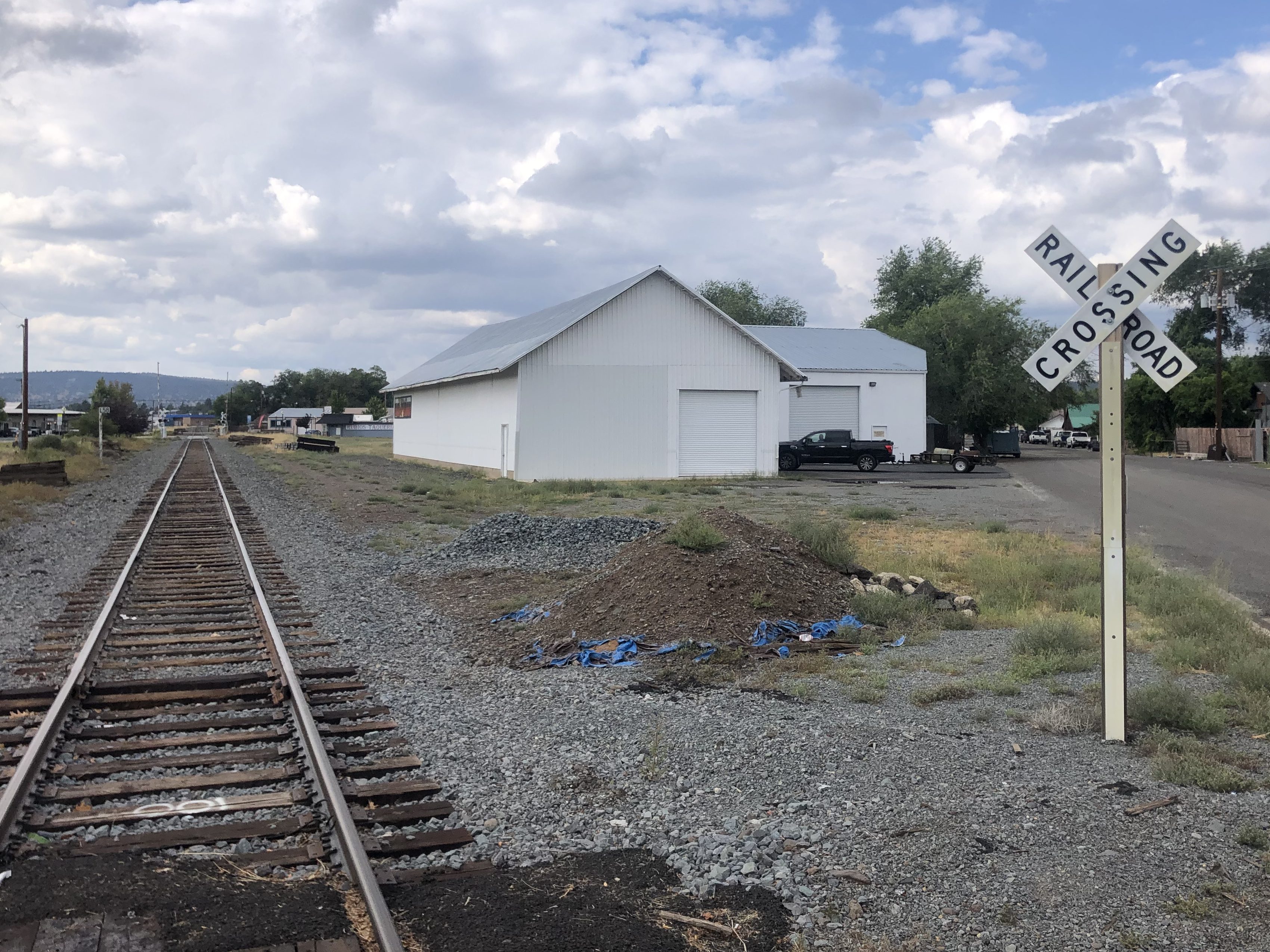
Shane also pointed to a carpet store which had once been the NCO’s freight depot in Alturas.

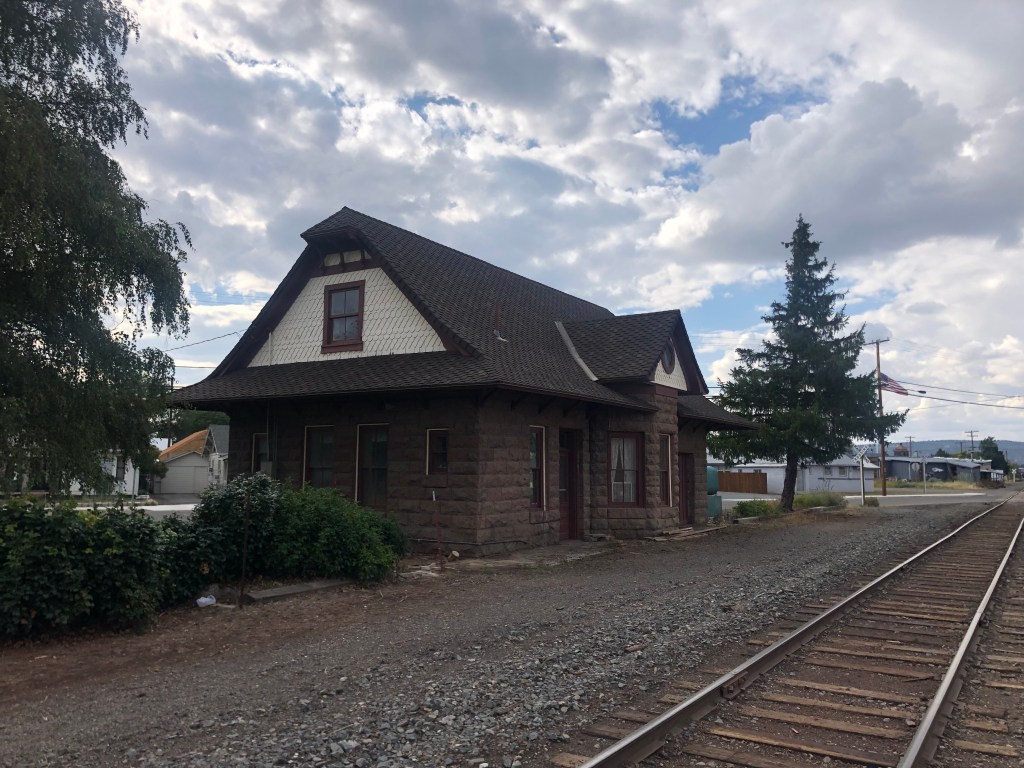
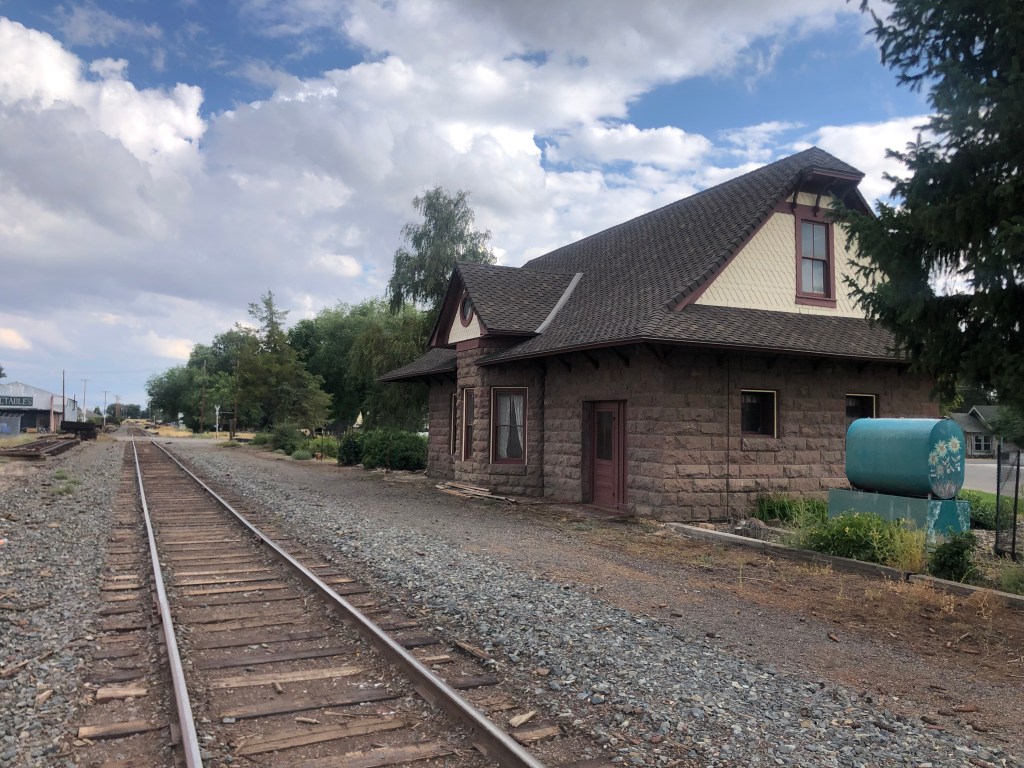
And finally, Shane directed me to the NCO’s passenger depot, which was constructed in 1908. Seven years later, it was decided that the station should be closer to the center of town, so it was moved, stone by stone, several blocks.

Peripatetic depot.

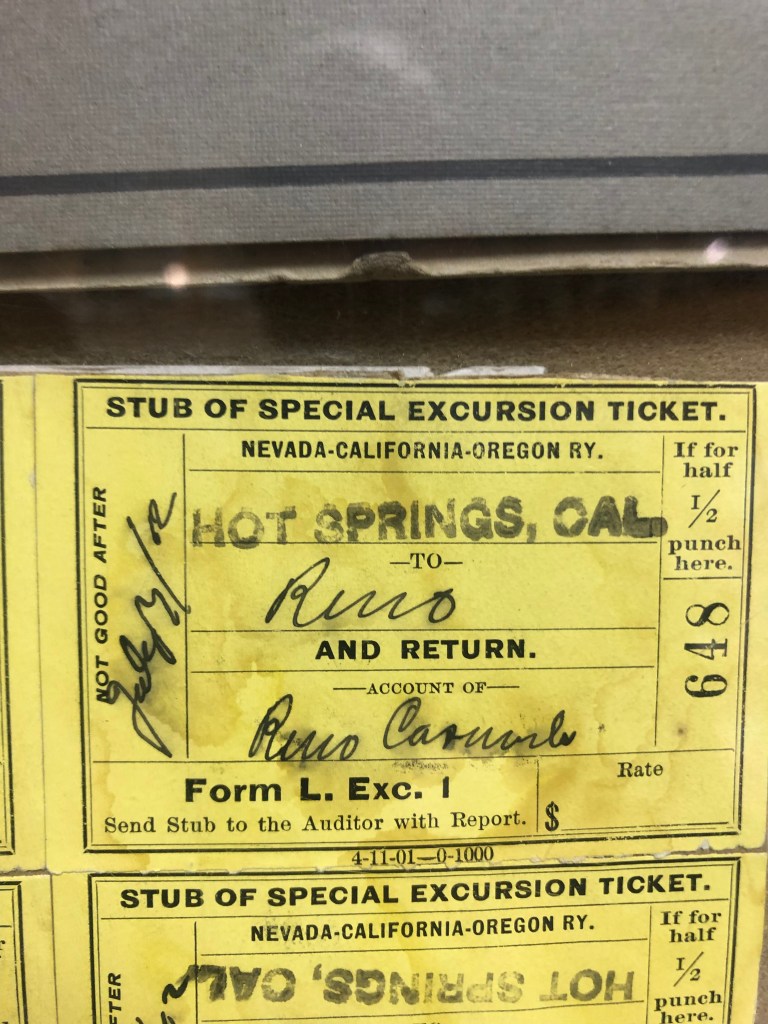
The Southern Pacific RR bought the NCO in 1926, and passenger service to Alturas was discontinued in 1938. Freight service ended in 1988. Still, Alturas remembers the NCO as an influential and pivotal part of its history. Indeed, the Modoc County museum includes a number of photographs and artifacts from the railroad.

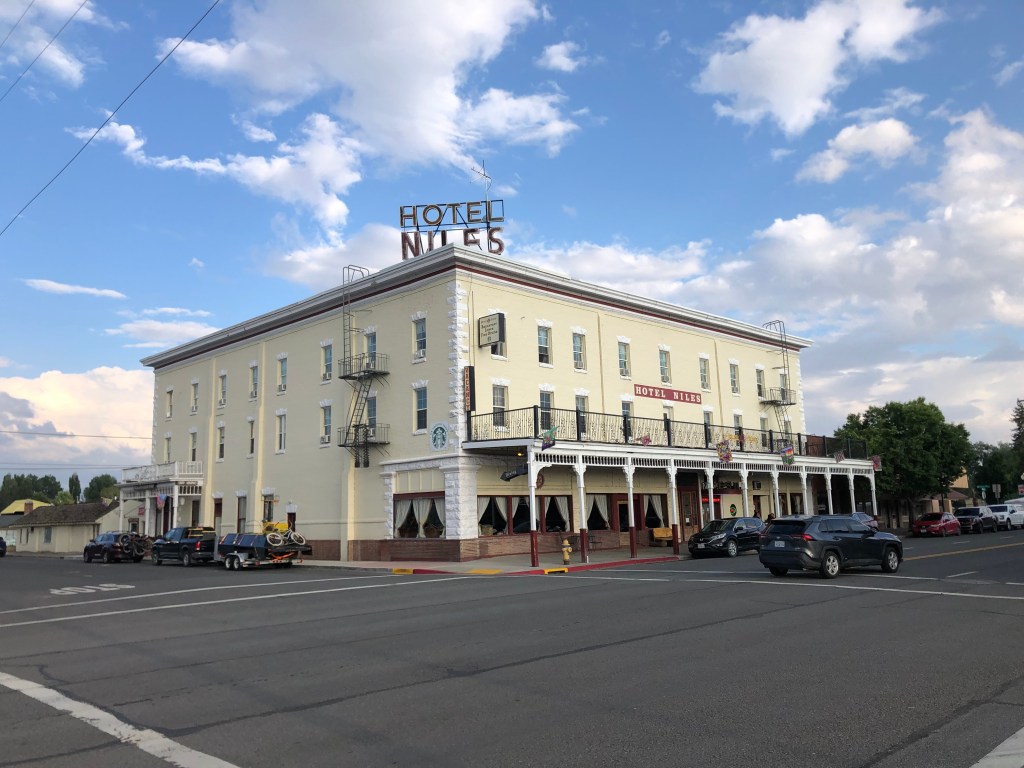
I’m holing up for the night in the Hotel Niles, a historic hotel that was built before the First World War. The hotel remains authentic, by which I mean the floors creak and the widows rattle. But it’s a fitting place to spend the night on this day of historical exploration.
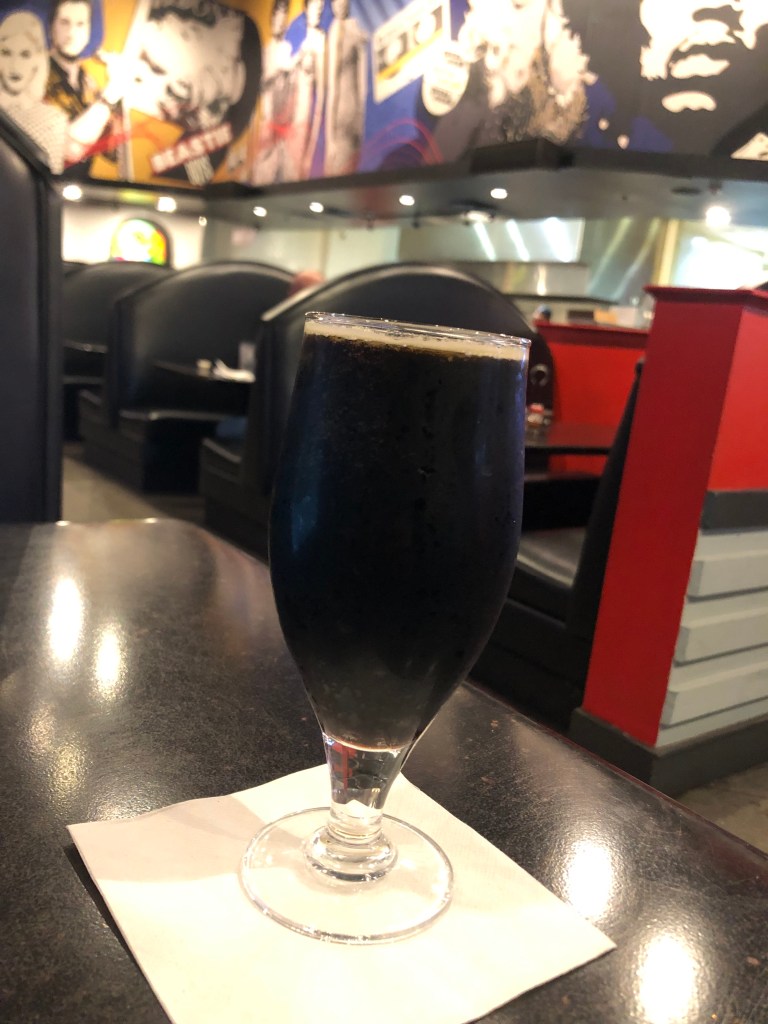
This image has an empty alt attribute; its file name is hotel-niles.jpg
I’m on the second floor of the left side.

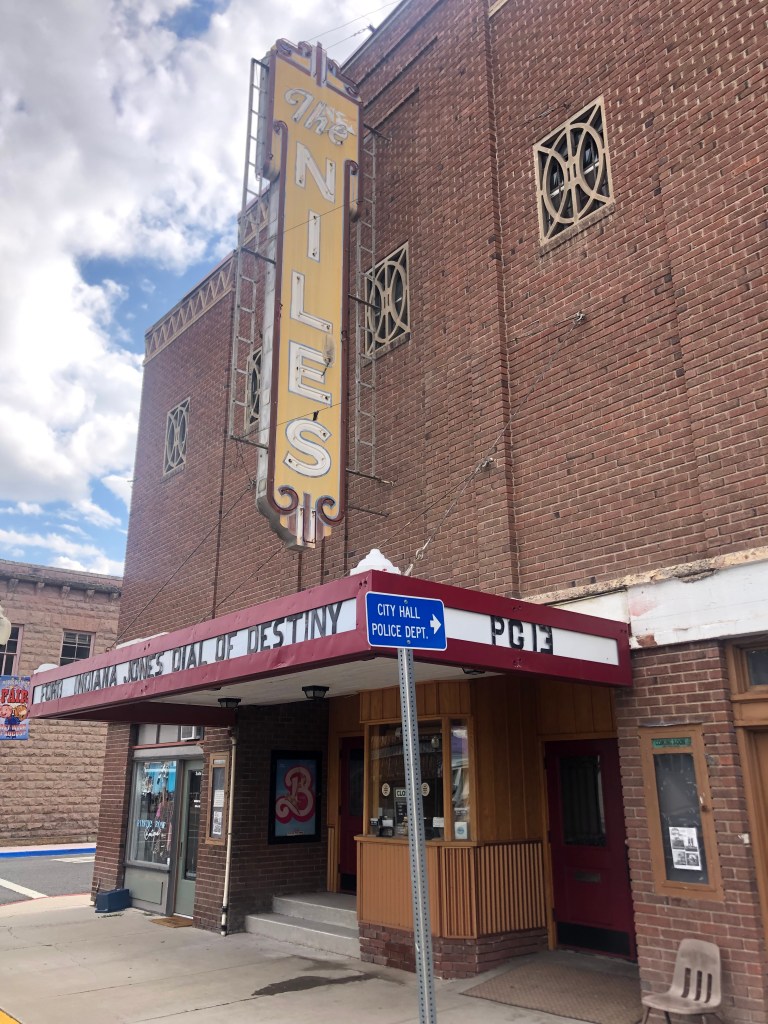
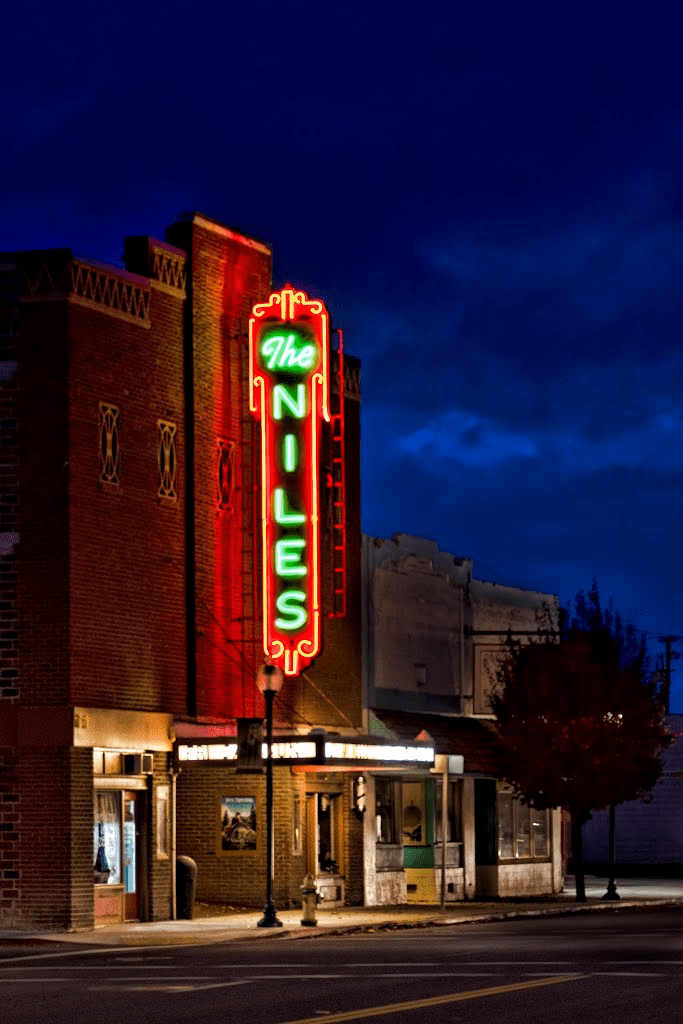
Incidentally, the hotel sits across the street from the Niles Theater. Built in 1937, it dates back to the era of art deco movie palaces. The neon itself is a sight to behold. An unlike many historic theaters, this one still shows first-run movies. (Next week it starts showing the Barbie movie. I’m not making this up.)

Note the telltale pink “B” on the lobby card.
(Night photo c/o the theater’s website.)

What are the odds that two buildings in such close proximity (the hotel and the theater) would both be named “Niles?” Well, both were built by local businessman J.E. Niles. He was 85 years old when the theater first opened.

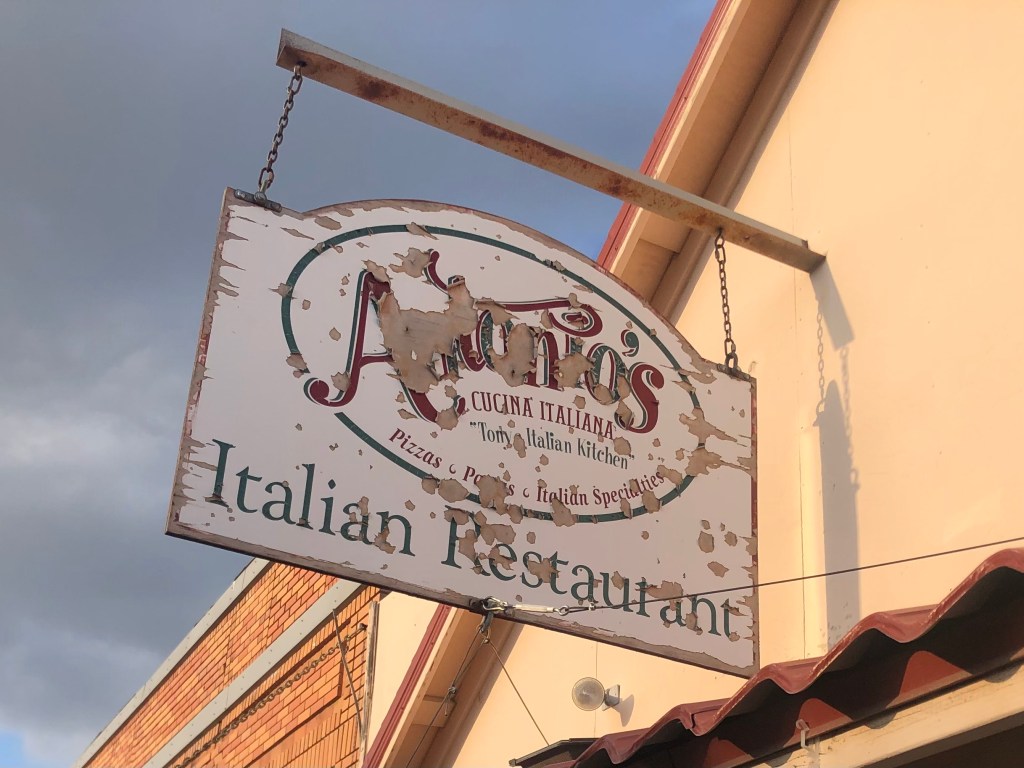
I had dinner down the block at a place called Antonio’s. Sadly I can’t recommend it. Even the BOTD is not worth mentioning.

You’d think I would have taken a hint from the condition of the sign.

Tomorrow I’m making the hour’s drive up to Lakeview to see the northern terminus of the NCO Railway. Then it’s off to Eagleville!

churches · movie theaters · Road trips · trains

Another Hub City and the Big Easy

I spent an hour this morning puttering around Hattiesburg a little longer. I really like this city. Two recurring themes really struck me:

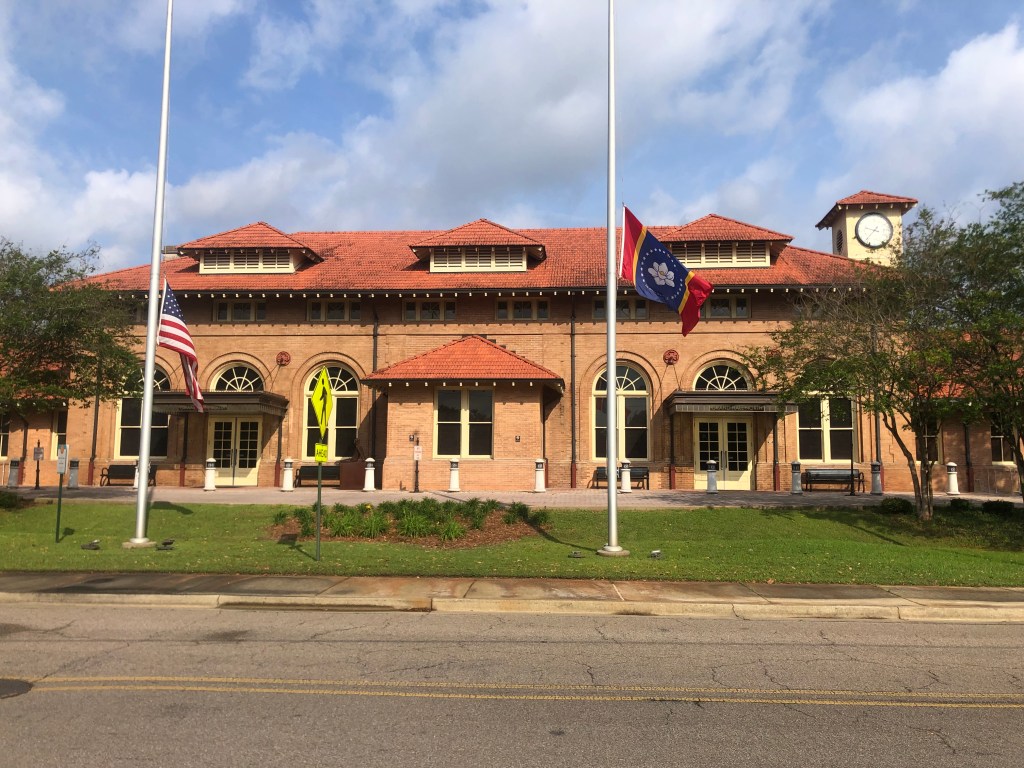
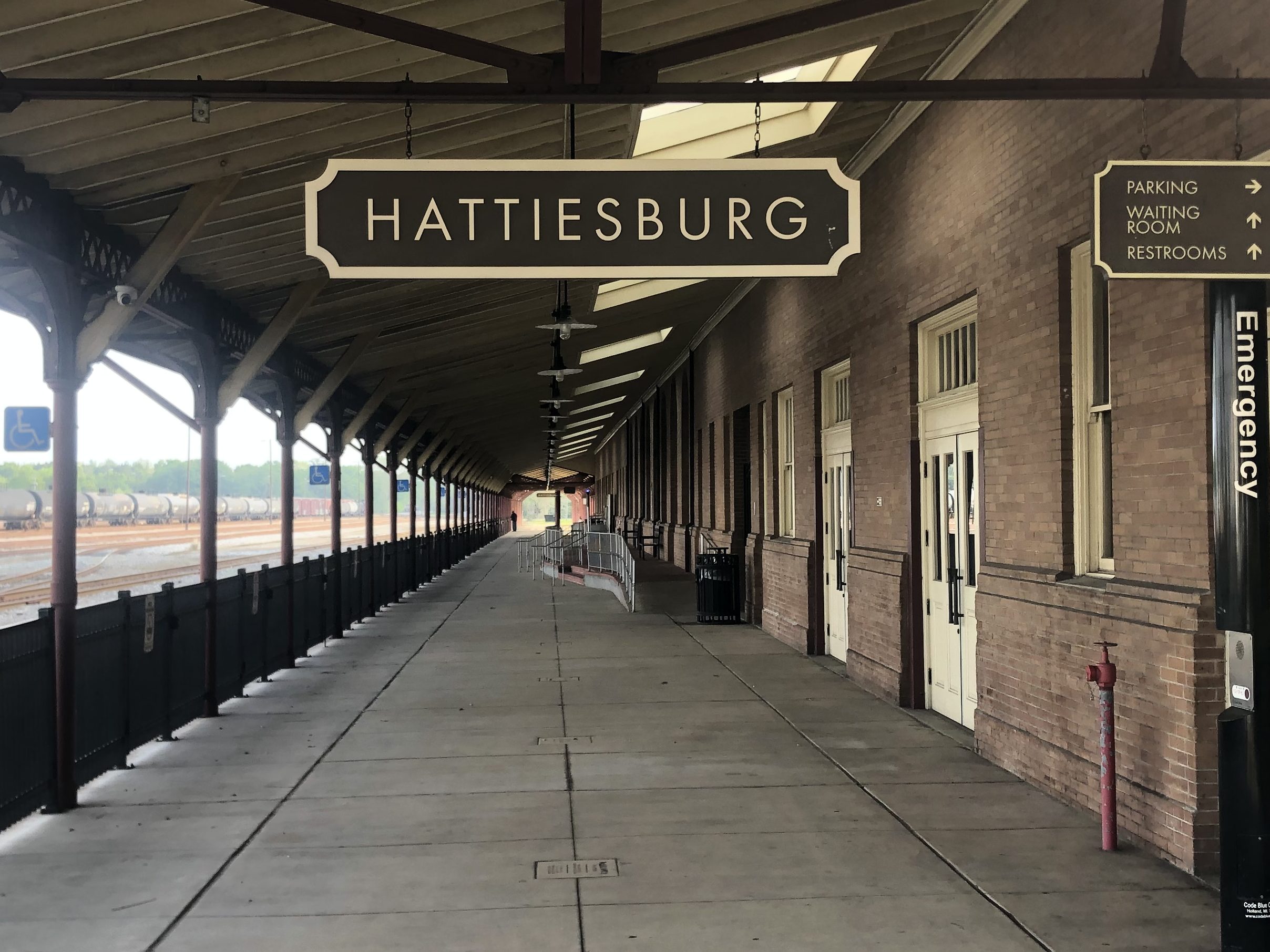
First, how many cities call themselves Hub City?? I’d thought it was a quaint moniker for Clarksdale, with its Devils Crossroads and all that. But Hattiesburg also claims the nickname. A quick search of Wikipedia lists about a score of cities that refer to themselves as “Hub City,” so it’s not at all unique. But admittedly Hattiesburg has good cause: it’s strategically located, with numerous highways and freeways and historic railroad routes. Indeed, its 1910 railroad station is huge, suggesting that a large number of trains came through here in the day.

Front of the Hattiesburg station

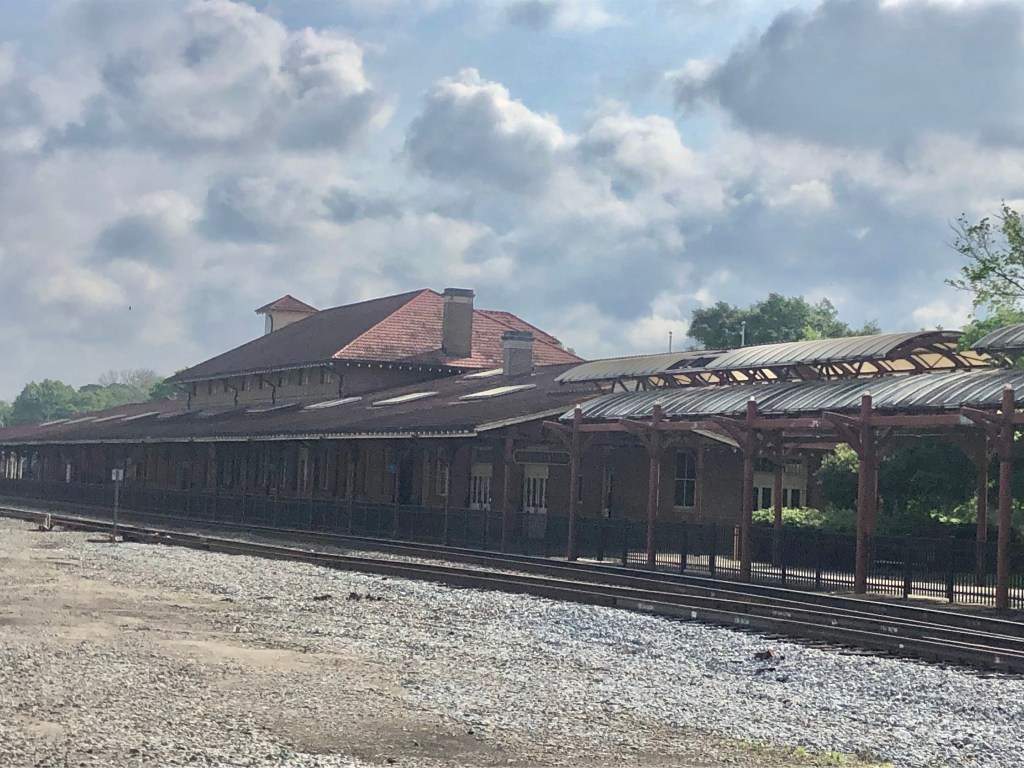
The station was restored about 15 years ago, and today serves as an intermodal transportation hub (there’s that word again), including daily Amtrak service.

The Amtrak main line at the back of the station.

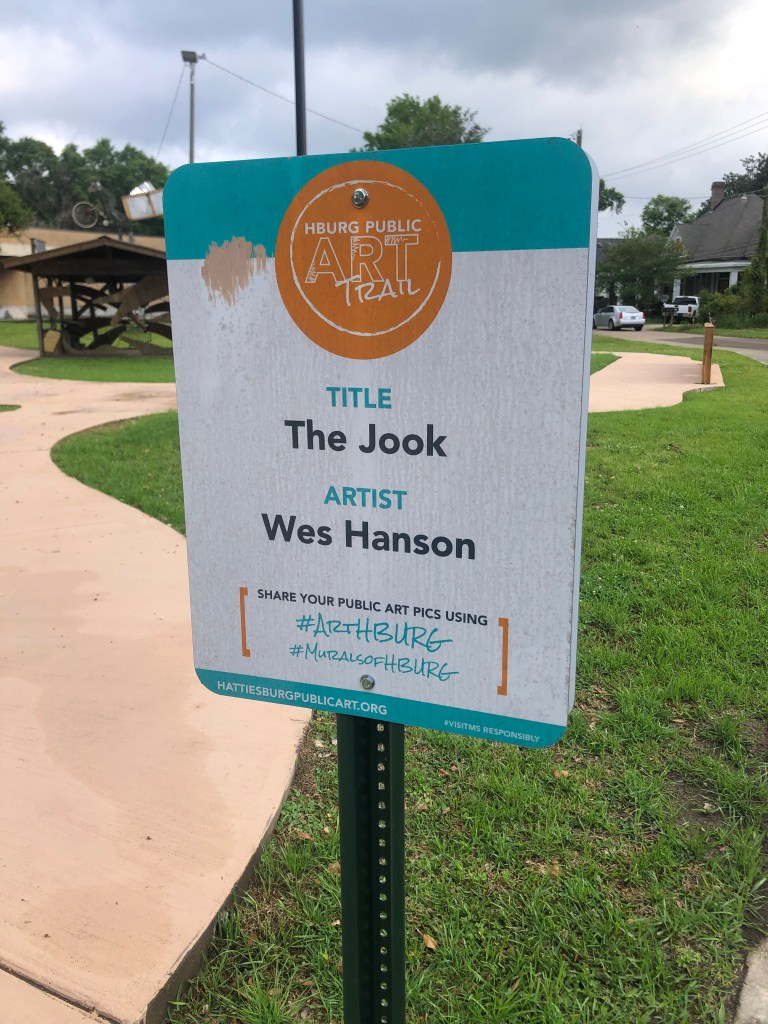
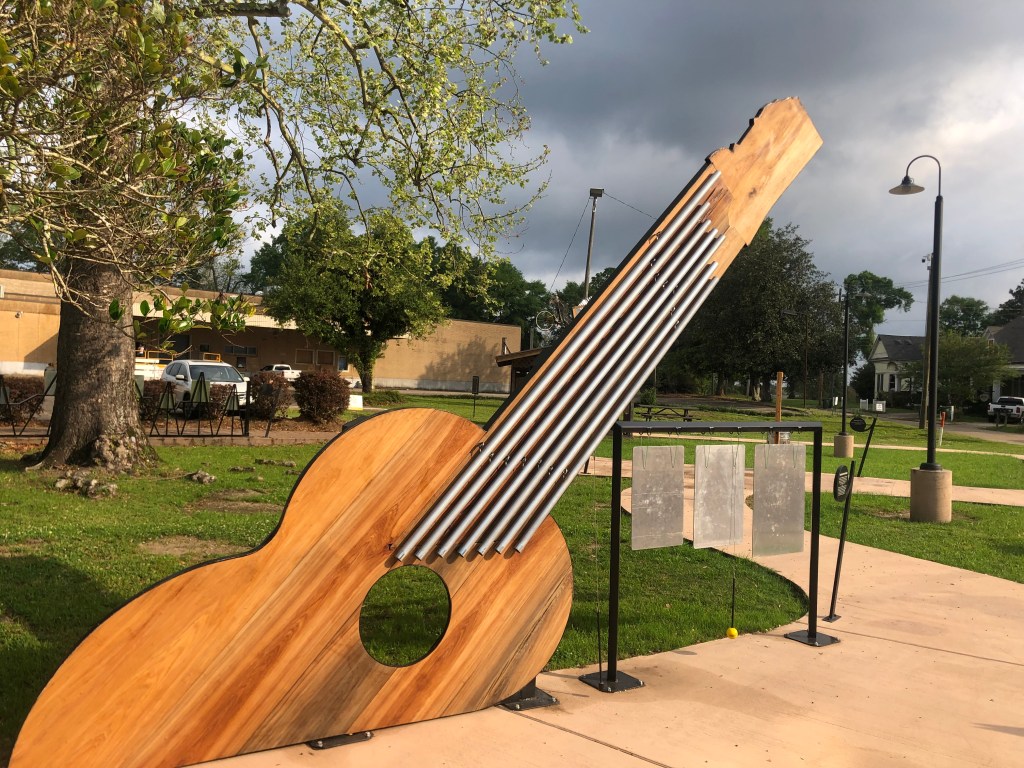
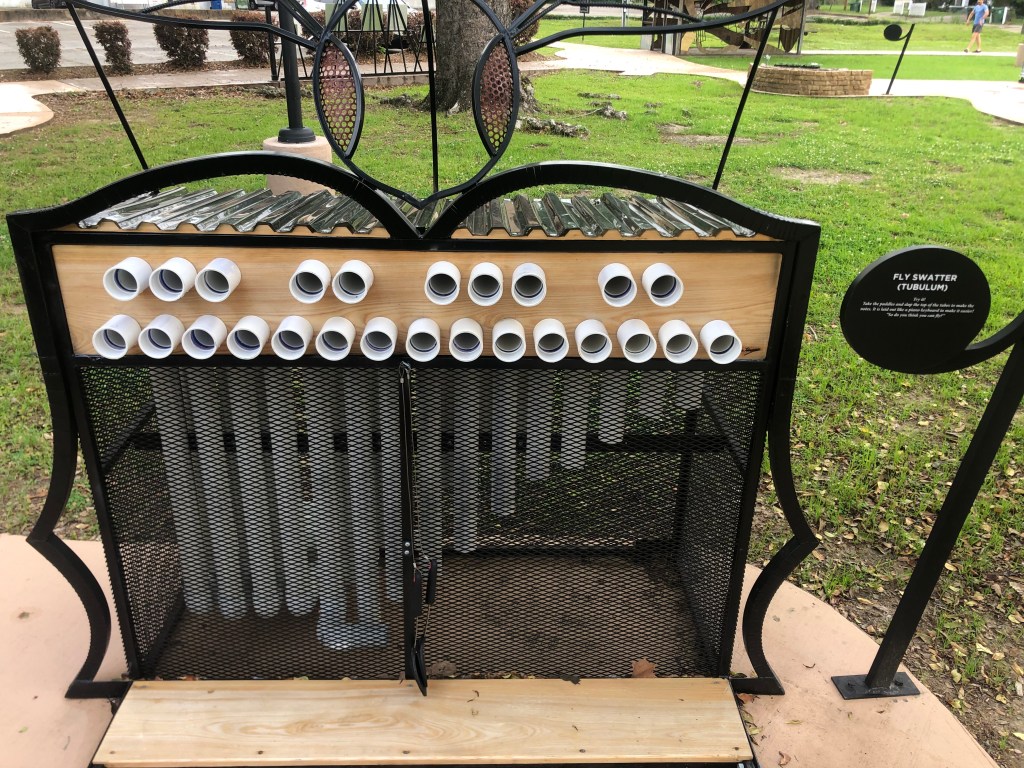
The second thing that struck me about Hattiesburg is that this city values the arts. Music (a recurring theme of this trip) is celebrated everywhere, such as this public art installation called “The Jook.”

The Jook is a collection of whimsical instruments that the public is invited to use to make their own music. They include a trash can bass, chimes and bells, a giant guitar, and a xylophone (of sorts).

The Jook’s name is a reference to Blind Roosevelt Graves and his Mississippi Jook Band, which recorded blues music in Hattiesburg in the 1920s and 1930s. Two of their 1936 songs–“Barbeque Bust” and “Dangerous Woman”–are considered by some to be the first rock&roll songs. Listen and decide for yourself:

It’s not exactly Chubby Checker, but I do sense some elements of early Rock&Roll.

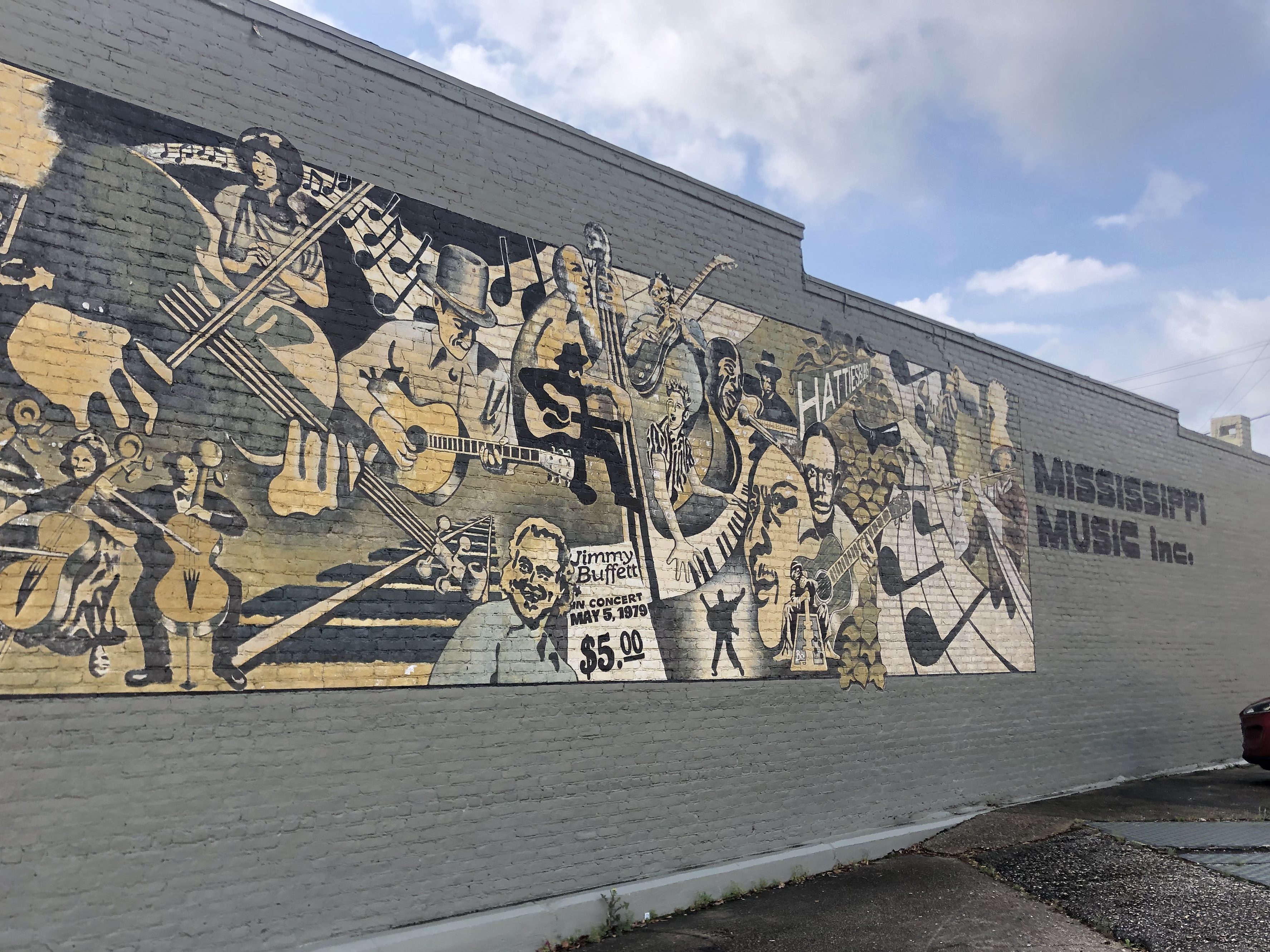
Other evidence of Hattiesburg’s musical bona fides is Mississippi Music Inc., a musical instrument sales and repair service and music teaching academy that opened in Hattiesburg in 1946.

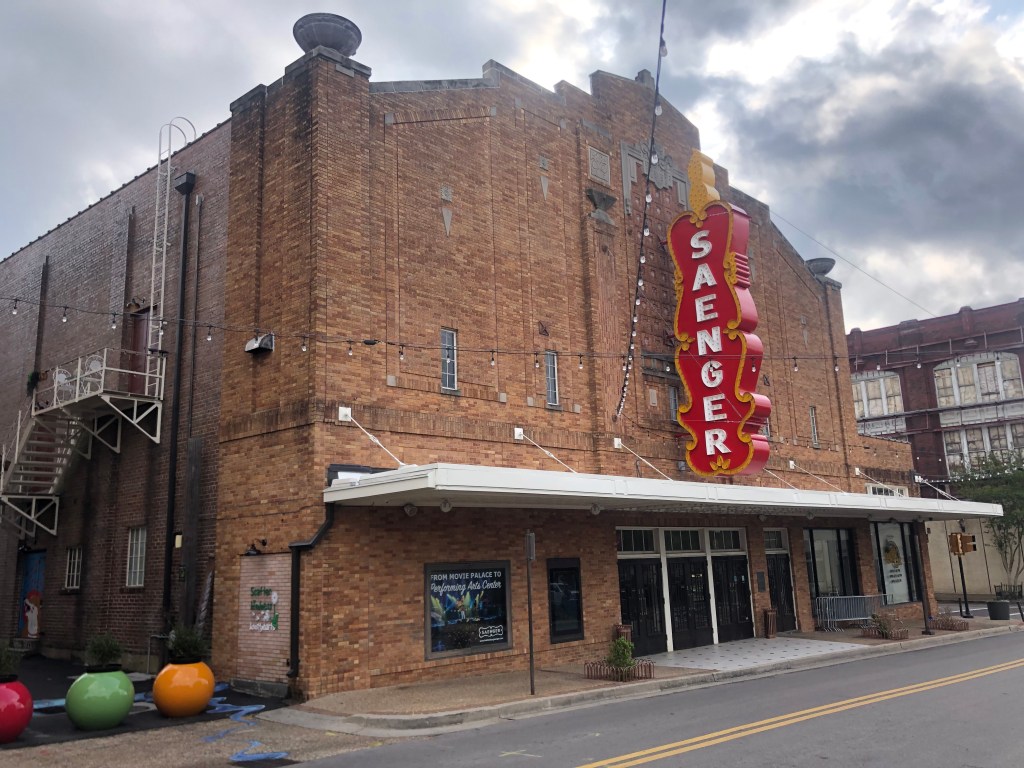
And then there’s the theater. I’ve come to the conclusion that one of the quickest, surest ways to measure a town’s cultural health is to see what they’ve done with their historic theater. Hattiesburg’s Saenger Theater was built in 1929 as a huge, thousand-seat silent movie theater, and it had an equally-impressive 778-pipe theater organ. The theater remained open for about 45 years, and closed in 1974. Along the way the organ (largely obsolete after the introduction of talkies) was sold off.

The city of Hattiesburg acquired the theater from Saenger, restored it, and (here’s the impressive part) managed to track down the original organ, purchased it, and put it back into the theater. The theater underwent a more extensive renovation in 2000, and today it serves as a major performing arts venue.

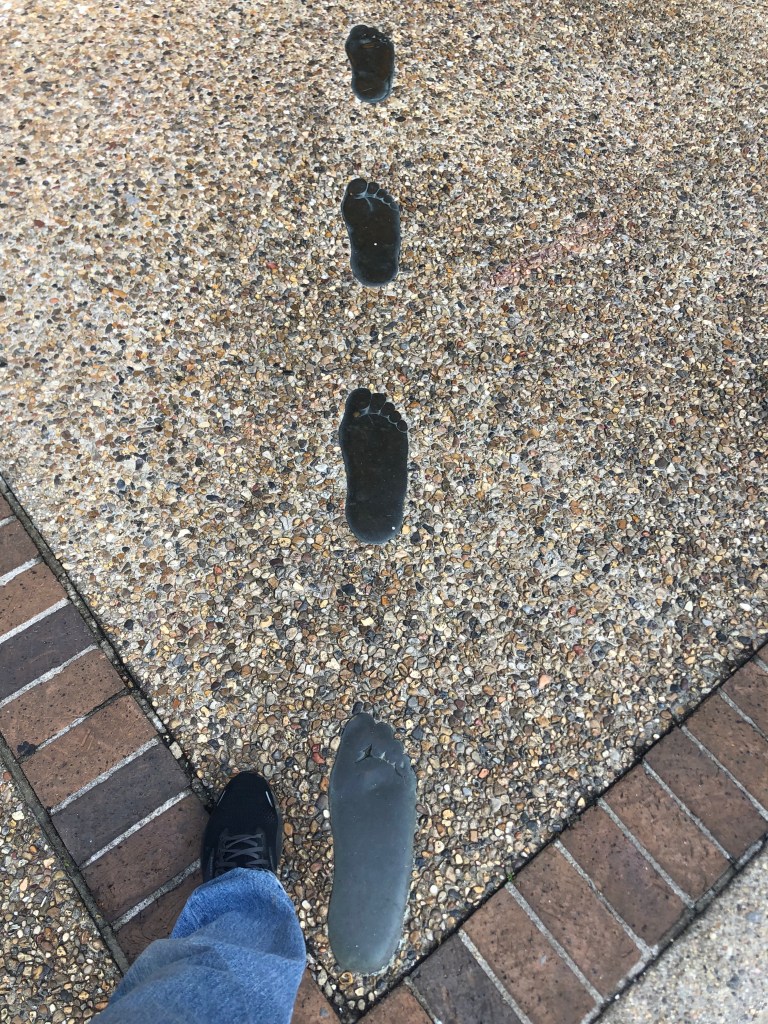
While I was exploring the downtown I was literally walking in the footsteps of a long-ago Hattiesburgian (?) named John Wesley Farley. Mr. Farley had once been enslaved, but eventually became a successful businessman in town. As a publicity stunt that I still don’t quite understand, he had bronze casts made of his size-14 feet. These were set into the sidewalk in front of a department store in 1903. The sidewalks were replaced in 1983, but the public works dept returned the footprints to their original location. Somehow that warms my heart.

Even bigger than my clodhoppers!

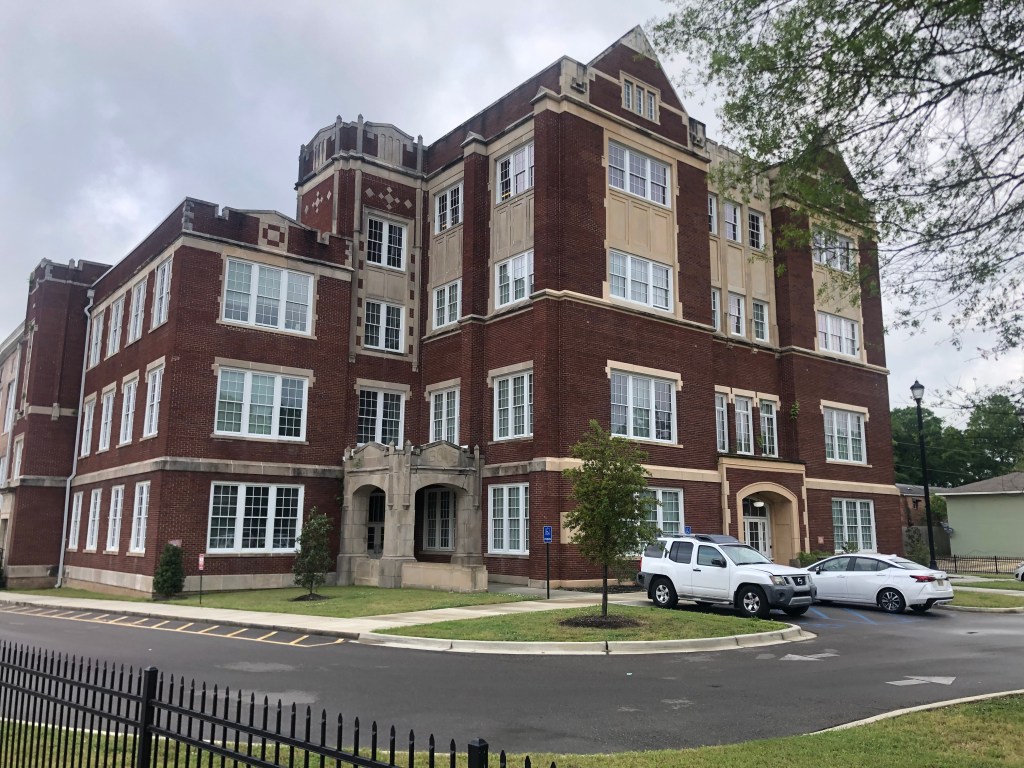
Another impressive story about Hattiesburg’s commitment to historic preservation is found at the old high school.

The Old Hattiesburg High School.

Originally built in 1921, the original high school building closed in 1959. After being used as the school district’s administrative offices for a few years, it became an antiques mall–which is typically the last stop before the wrecking ball. However, in 2002, the local historical society acquired the property with the intention of renovating it. Then Hurricane Katrina hit in 2005, And if that weren’t enough, arsonists torched the place in 2007. Despite all this, a project was funded to restore the historic structure and convert the interior to senior apartments. I consider this another sign of a healthy city: addressing civic needs while preserving the town’s history.

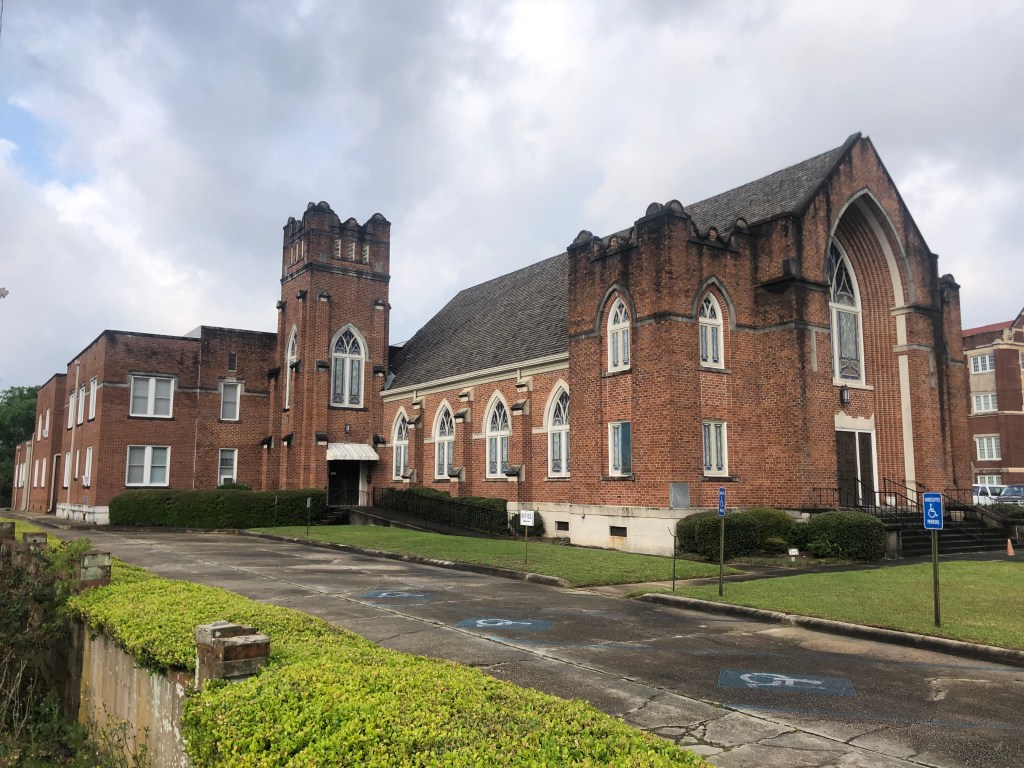
Oh, and I just wanted to include this photo of True Light Missionary Baptist Church (a name which rivals “the Holy Ghost Big Bang Theory Pentecostal Fire and Brimstone Mission Temple Firework Stand“). Anyway, this huge, impressive structure was built in 1903 and renovated in 1990. I can only imagine what it must be like in there on a Sunday. They also run a childcare center and various other missions.

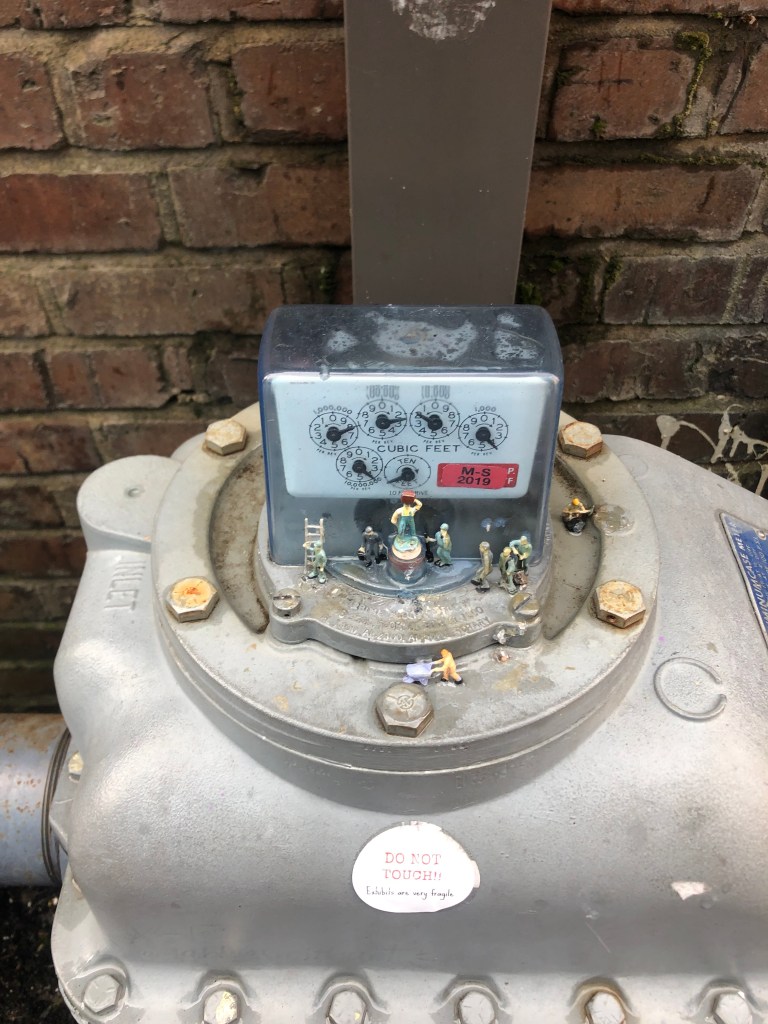
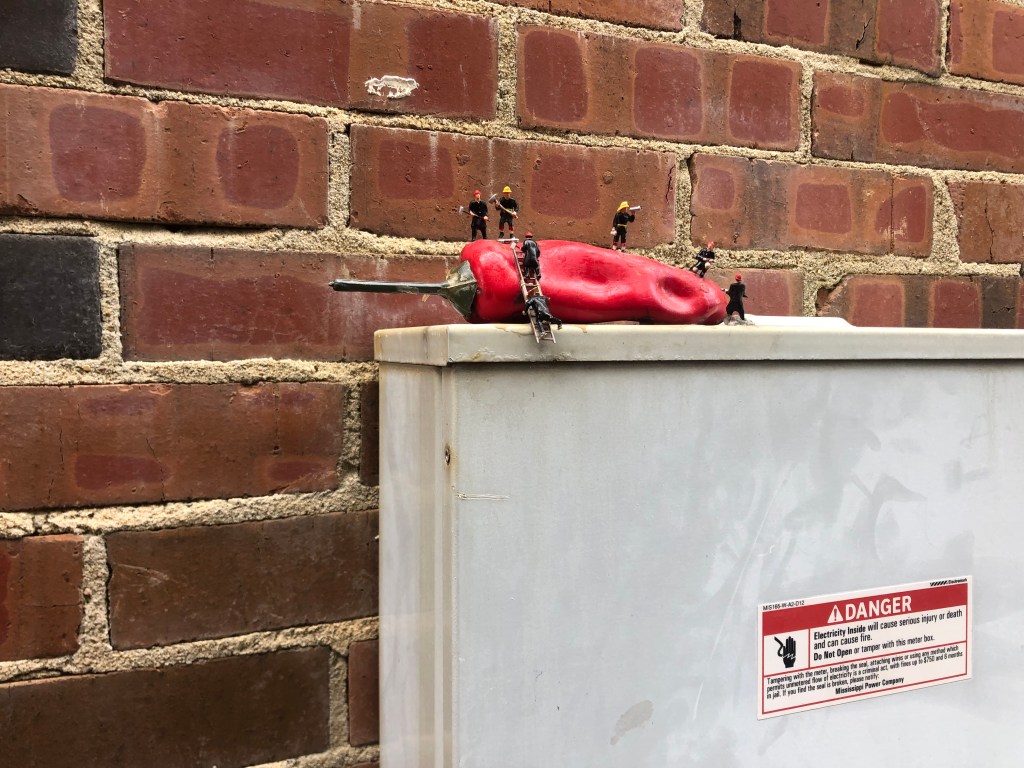
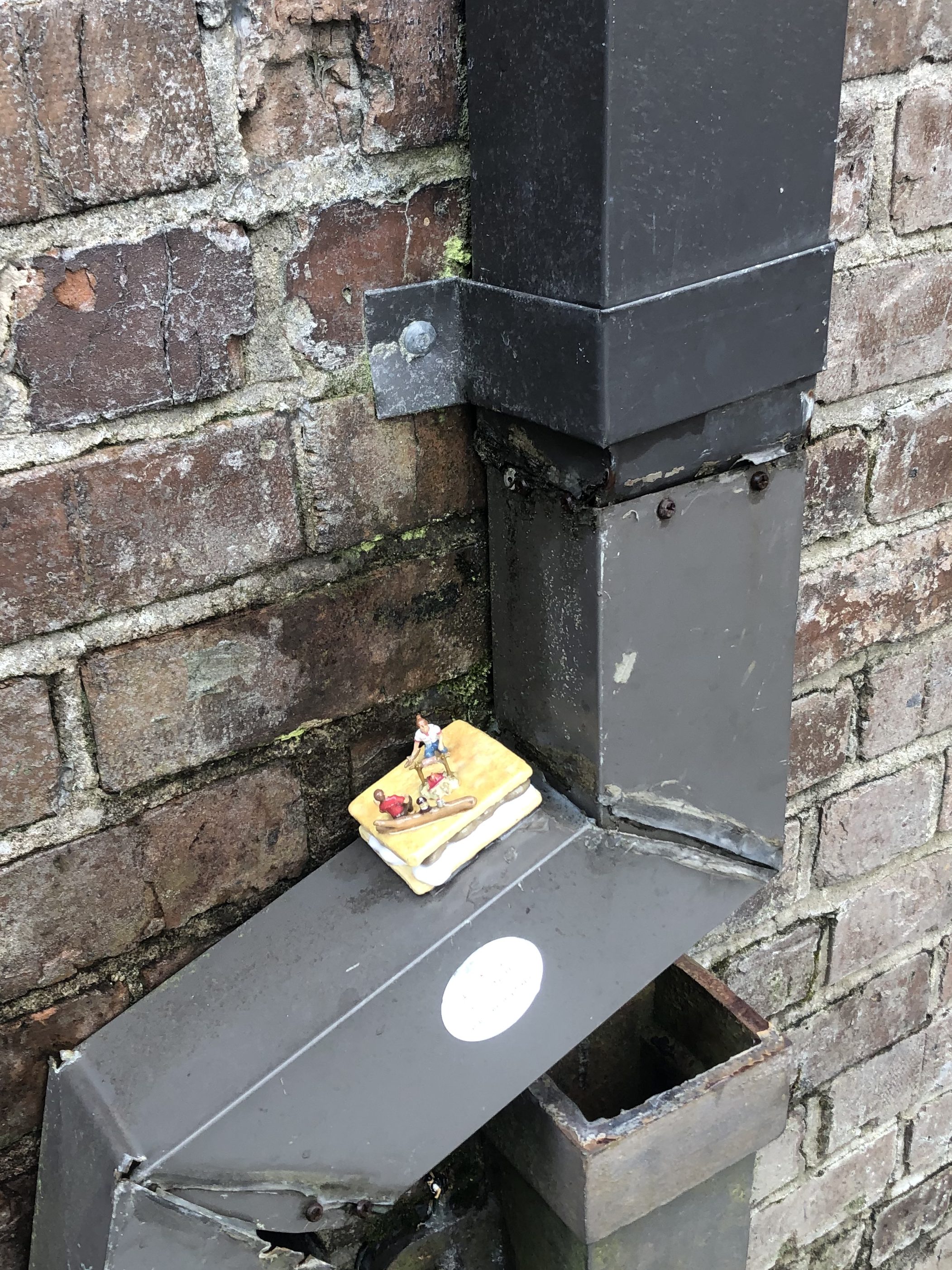
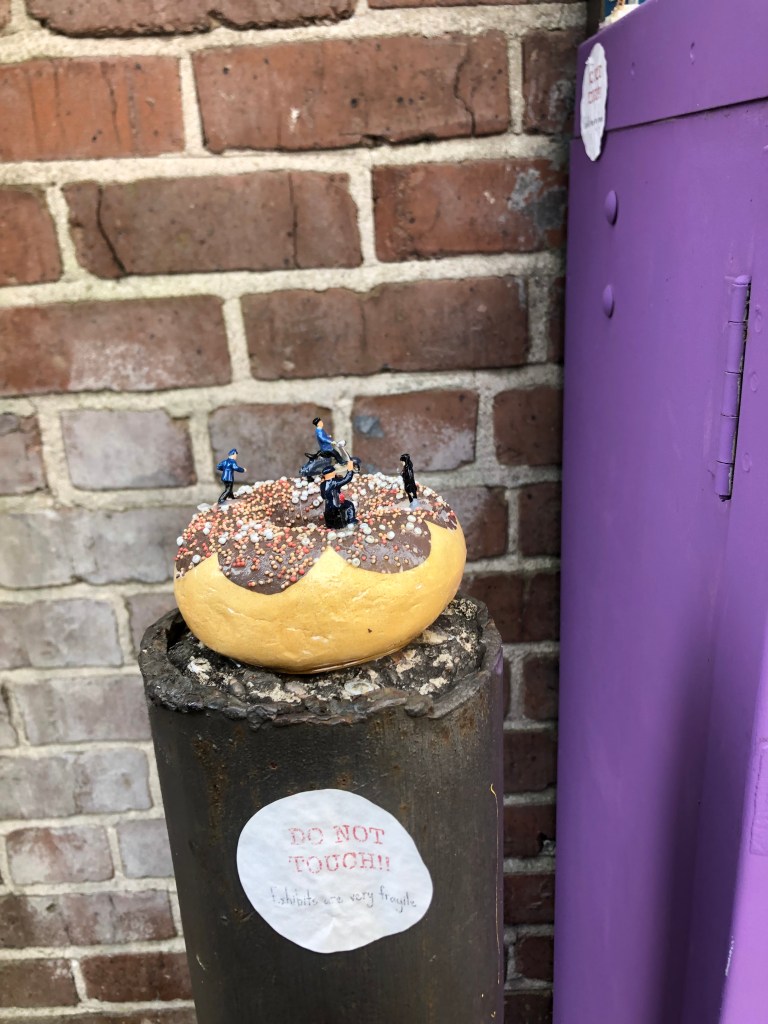
But what really delighted me (a phrase I seldom use) most about Hattiesburg was the “pocket art gallery” on a random alley behind a parking garage. At first I simply noticed what I thought were some tiny plastic figures that some child left on a water meter.

But then I saw more….

…and more…

…and more.

Soon, I realized the the alley was full of random, whimsical art installations.

What I found most notable was that these small, delicate installations were unmolested. So that’s another sign that Hattiesburg values the arts.

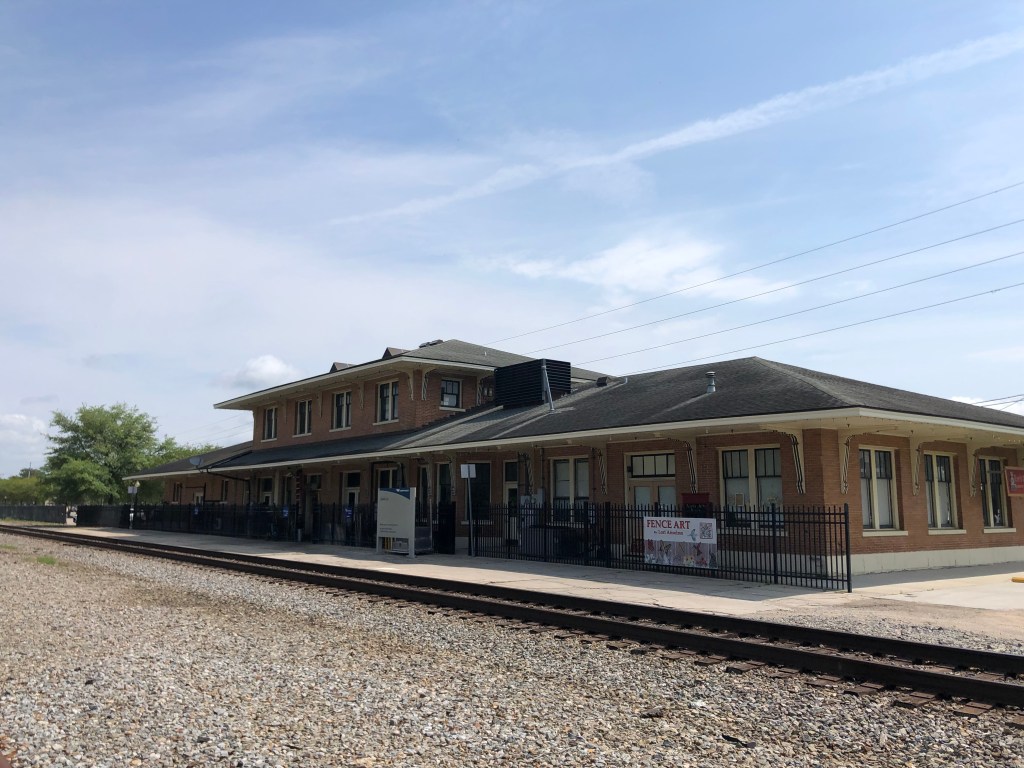
I hated to leave Hattiesburg–my new favorite city–but it was time to head south to the Big Easy. Along the way I stopped for gas in Slidell, Louisiana, which was the last stop before New Orleans. Like so many of these towns, Slidell (pop: 29,000) has a historic railroad station. This one, built in 1913, is still a functioning Amtrak station, but it also houses a popular restaurant and an art gallery. I’m starting to feel that the Deep South has something to teach the rest of us about preserving historic civic buildings.

The 1913 Slidell depot.
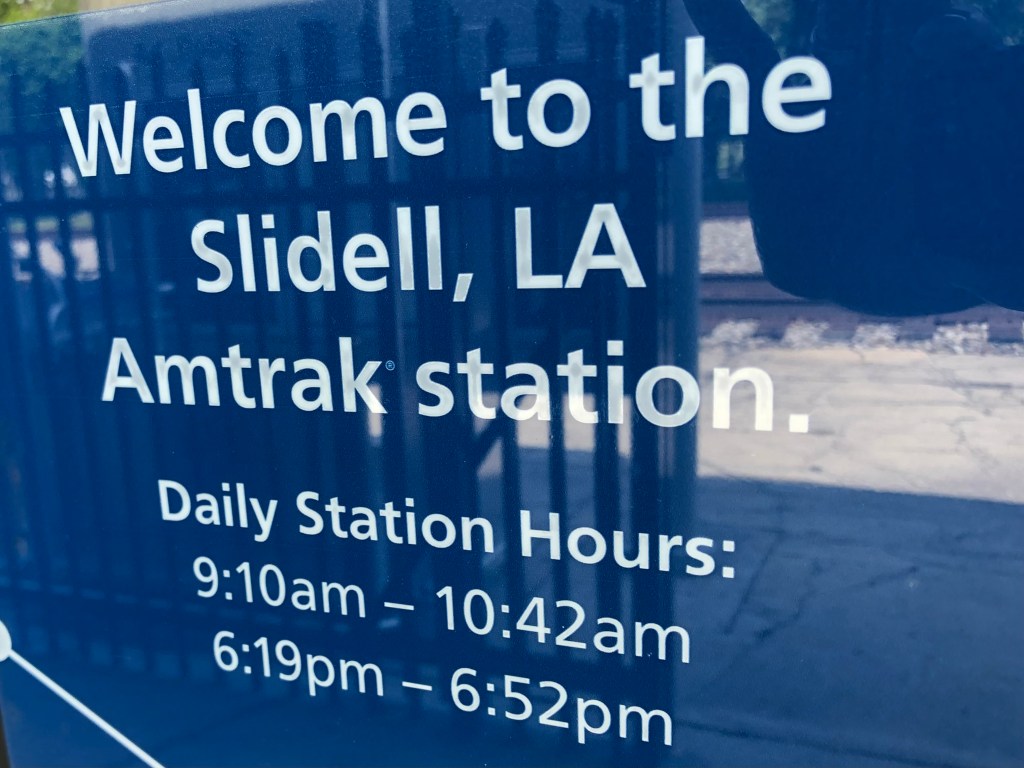
The station supposedly has a nice waiting room…but I didn’t arrive during the 2 hours and 5 minutes that it’s open each day. (C’mon, Amtrak! Do better!)

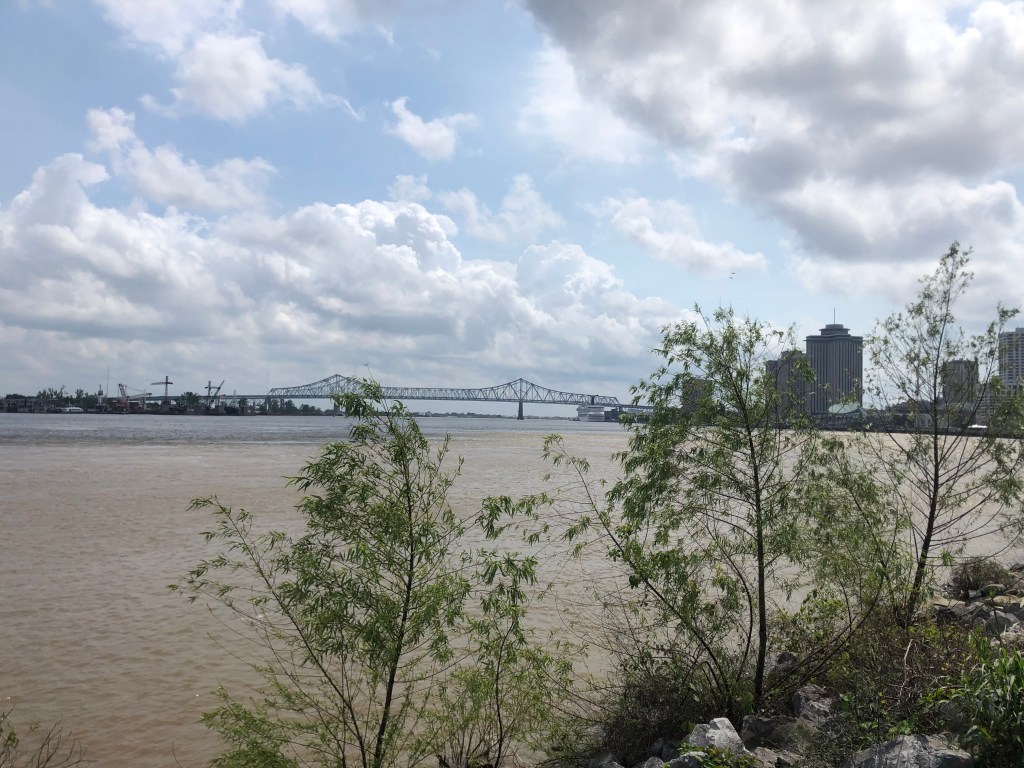
After getting gas and a coffee, I eased onto the 5-1/2 mile long causeway that crosses Lake Ponchartrain and drops you into New Orleans.

Lake Ponchartrain (viewed from downtown New Orleans).

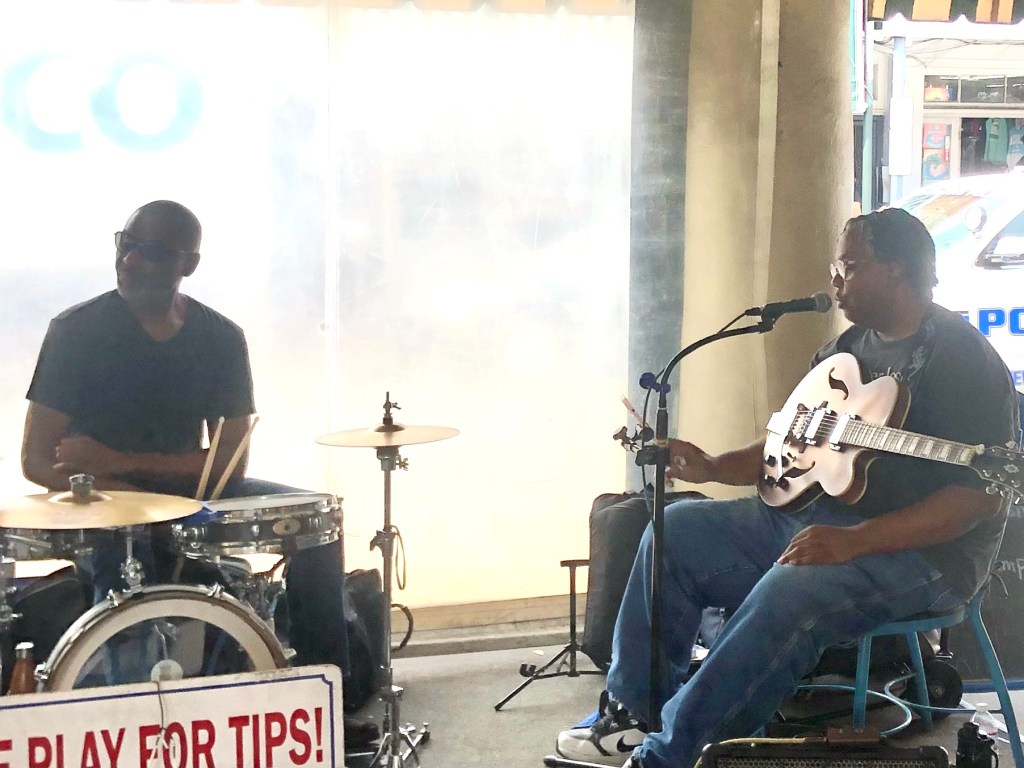
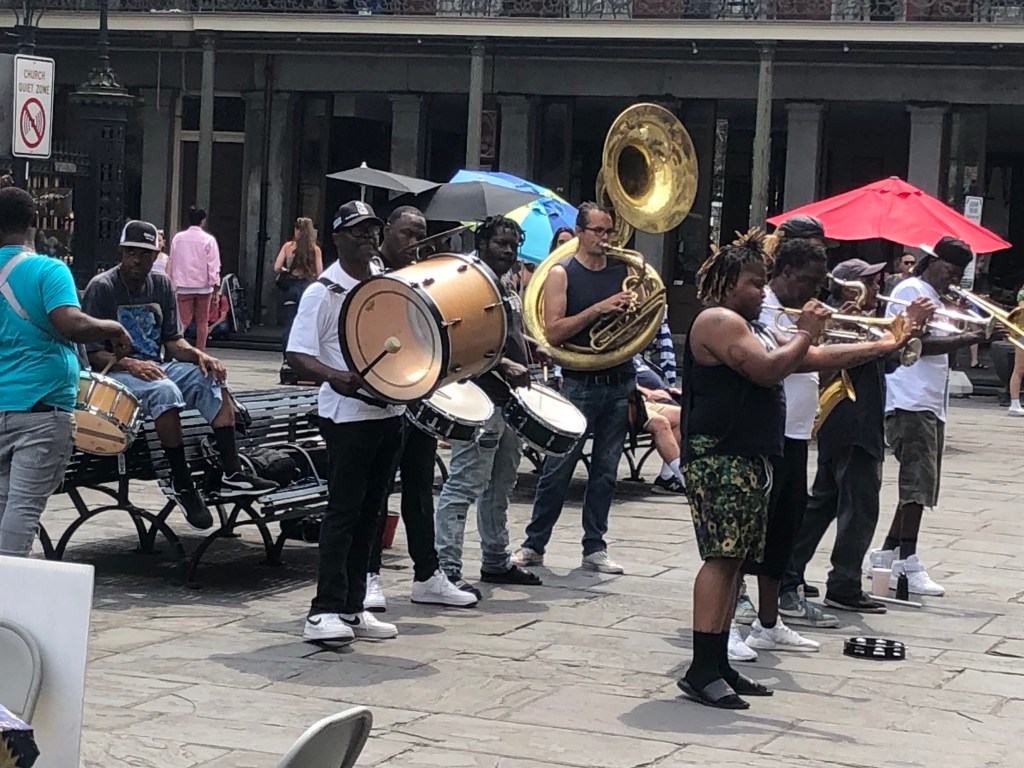
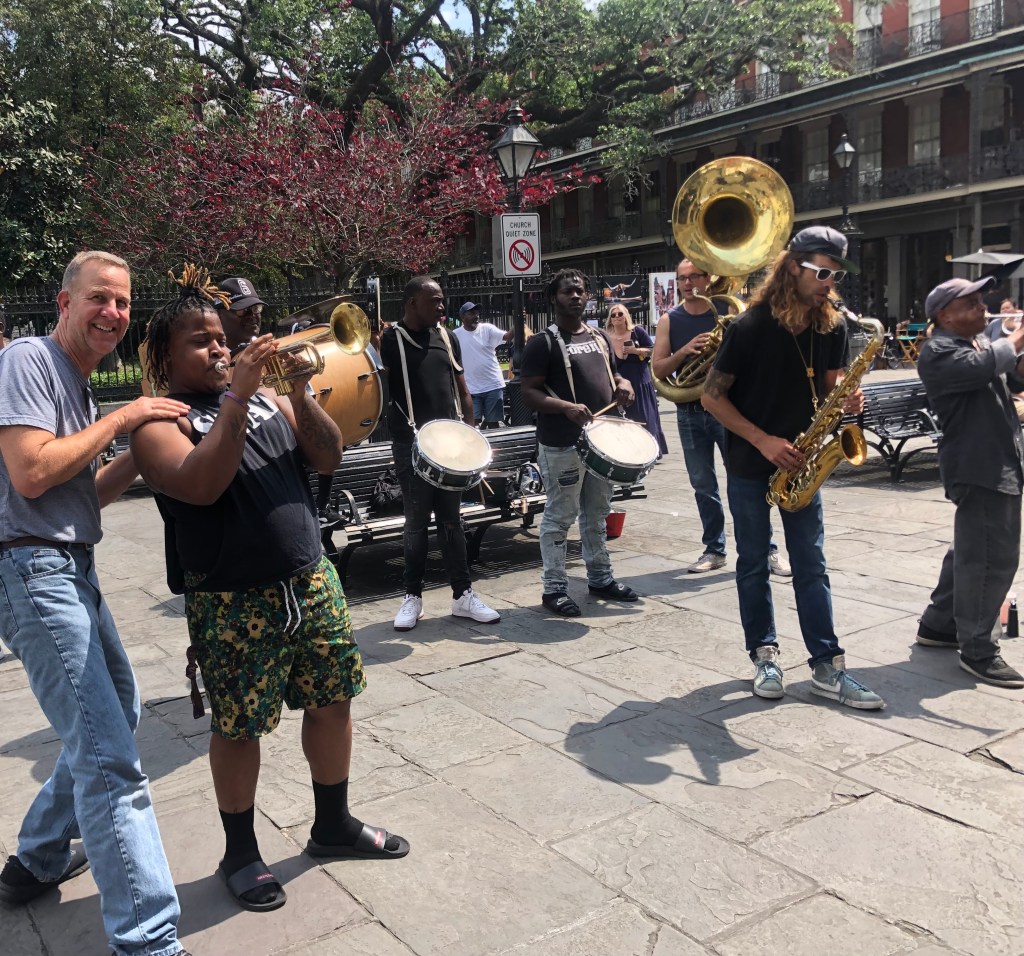
New Orleans (pop: 380,000) is of course a historic, culturally-rich, music-infused city. It’s also almost as hard to navigate by car as San Francisco. My goal was to get to the New Orleans Jazz Museum, which required life-threatening maneuvers along the narrow streets, several illegal turns, and a 20-minute search for a parking spot. Alas, after all that, I found the door to the museum was locked. They’re closed on Monday. So I spent the afternoon walking around the French Quarter. It was actually a good way to end this trip. Music floated from every corner. There were street buskers, jazz combos playing in restaurants, stereos blaring from upstairs apartments, and a second line performance, to name a few. Heck, there was even a pair of obviously inebriated street beggars who decided to sing their appeal for funds (“Can you spare a buck?/We’re down on our luck.”)

The Jazz Cats.
Second line performance.
Wish I’d brought my sax.

There are lots of different types of music played here in New Orleans, but the city is best known for its jazz. It feels like the natural progression from the other musical styles I’ve encountered on this road trip: Country, bluegrass, soul, R&B, Memphis blues, delta blues, and so on. I’m no expert on any of this music, but I can understand how they’re related–how they grow out of a uniquely American experience. I intend to expand my listening when I get home, following up on some of the styles and artists that I’ve encountered.

So that’s it for the trip. As always, I’m thankful for all the people I encountered along the way who’ve patiently explained their cities to me, taken me on tours, cooked food for me, served me drinks, and even cut my hair. I really love the people of this country.

I’m at the Airport Hilton getting ready to fly home on an early morning flight. But there’s one thing left, and that’s the…

BREW OF THE DAY

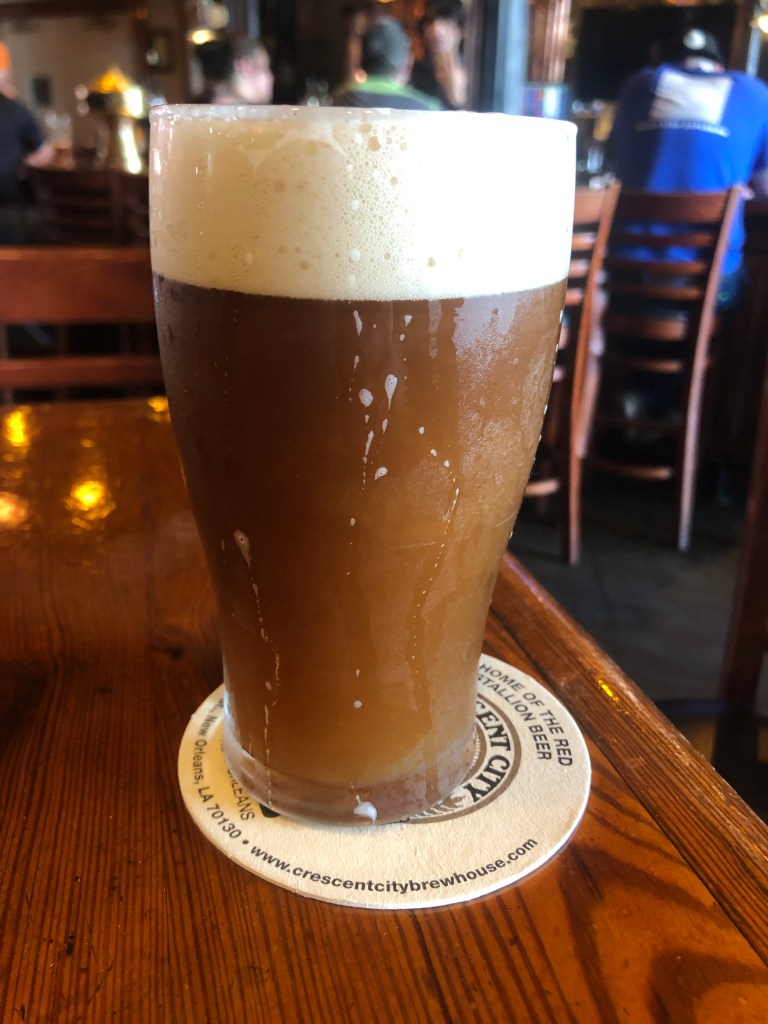
While wandering around the French Quarter I paid a visit to the Crescent City Brewhouse. They have a good selection of beers, all of which they brew themselves. I asked my server what he recommended, and he told me his favorite hands down was the “Weizenboch.” So that’s what I had–living on the edge.

This is a German style beer (as should be obvious from the name). The appearance screams the opposite of a Sleepy Hollow beer (i.e., it has a very prominent head). All that foam ensures an attractive presentation and it makes the first few sips especially enjoyable. The appearance is very cloudy, with a golden tan color. At only 6 percent ABV, it’s well suited for a mid-afternoon drink.

Ichabod Crane wouldn’t recognize it.

The taste is incredibly yeasty–like sourdough starter. Notes of banana peel and clove are prominent. Maybe a tiny bit of lemon? It’s not too hoppy (unlike some of the English styles I normally drink). Overall this is a very drinkable, approachable beer. It gets a solid 4 stars. Heck, I’m feeling good at the end of this trip; let’s give it a 4.5.