As you will recall from my last post, I recently flew out east to visit family and friends for a few days, after which I would travel the entire western segment of US Route 2, from St. Ignace, Michigan to Everett, Washington. The visits have been made, and I have now arrived at St. Ignace. I will be traveling Route 2 over the next 8 days. Be looking for daily posts on this site.
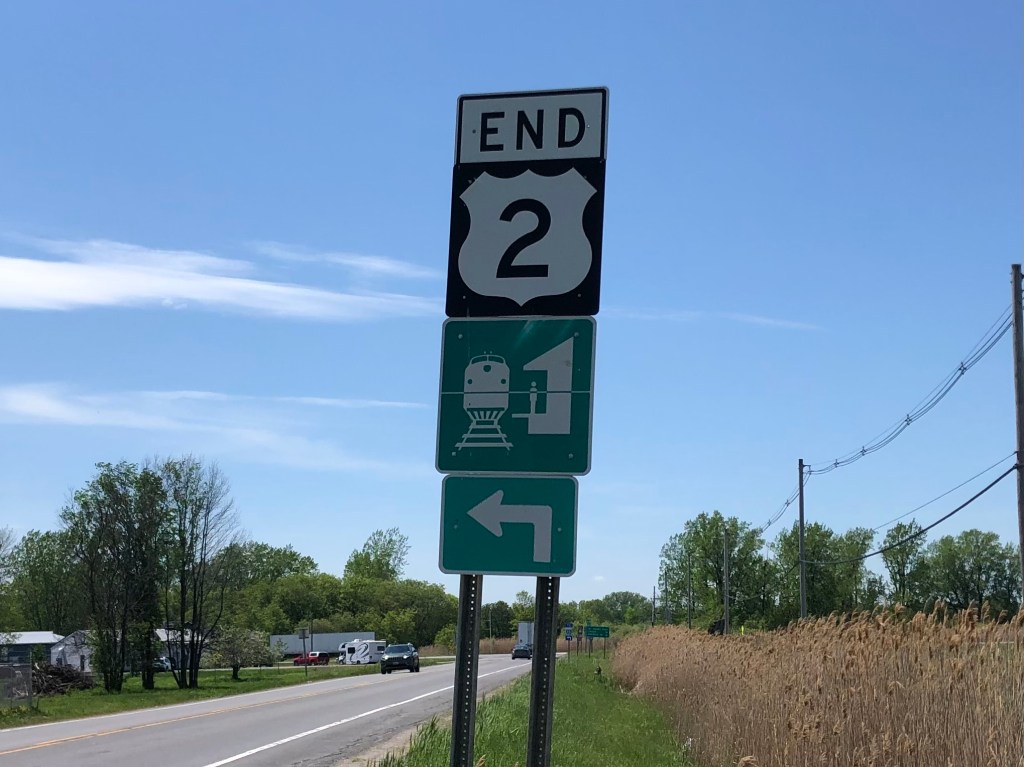
I did manage to drive a small portion of Route 2’s eastern segment while I was visiting as I left Cousin Bonnie’s in Vermont. That segment terminates (or begins, depending on your direction) at Rouse’s Point, NY. And (drum roll please) here it is:
All good things must come to an end.
I then spent the next two days making my way across Route 2’s lacuna. (Along the way I stopped at a Greek restaurant for a little moussaka. Ah, Lacuna Moussaka–what a wonderful phrase!)
Anyway, although I was technically not on Route 2 during this time, I did encounter a few noteworthy roadside oddities. And here they are:
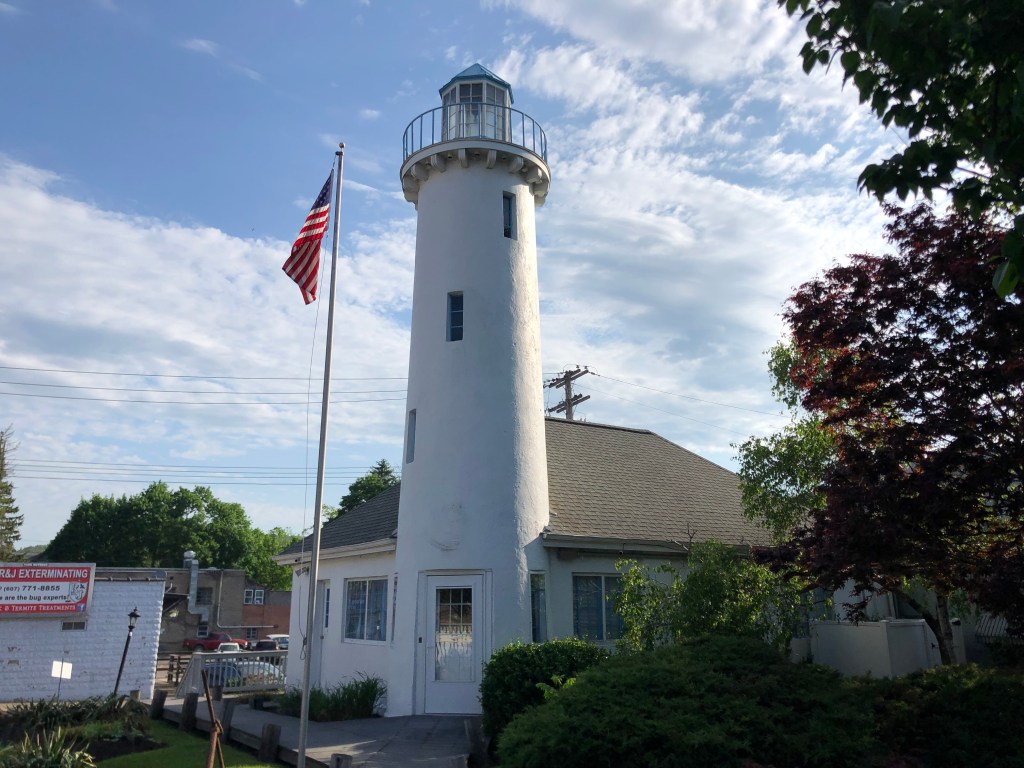
We start with this awesome, restored, historic building in Endicott, NY which was once part of the Lighthouse Service Station chain that supposedly served much of New England. It now appears to be some kind of private office or business, though there are no signs indicating what, exactly, they do.
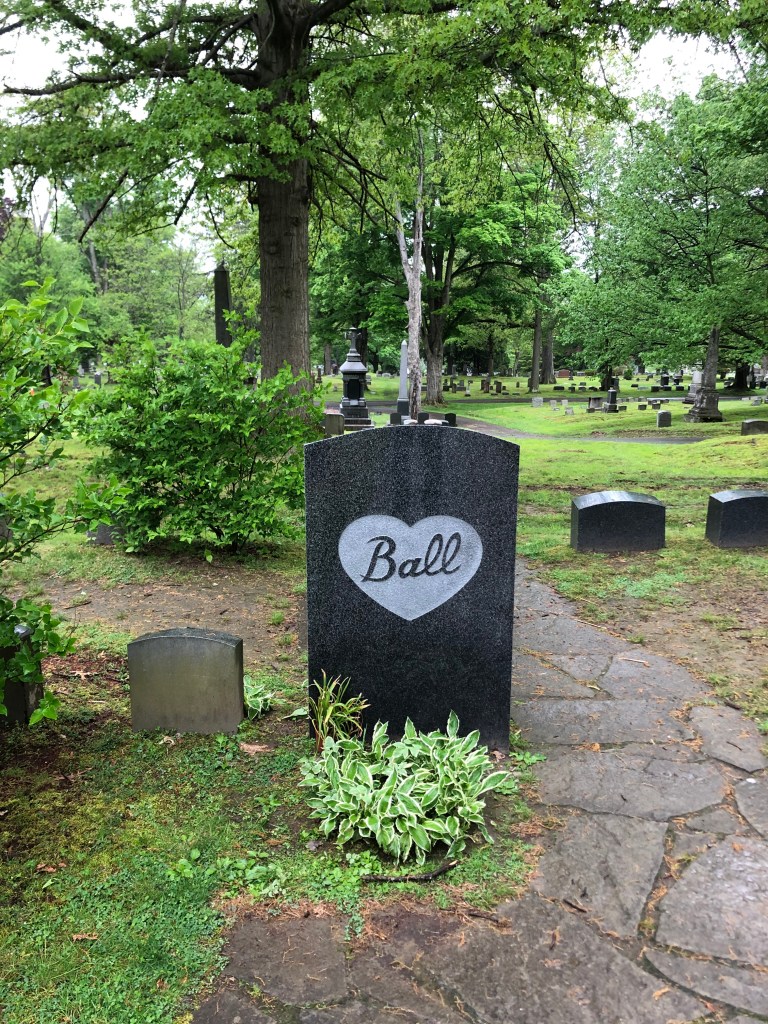
I also stopped a number of cemeteries (the east is lousy with ’em!), and found some notable gravesites:
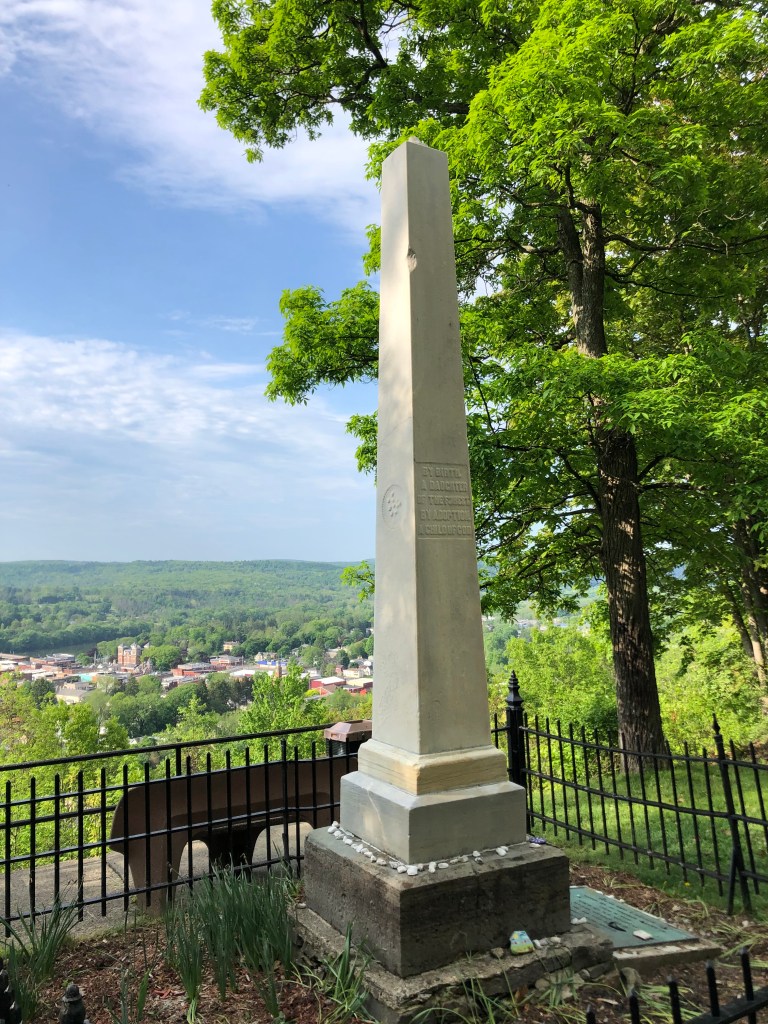
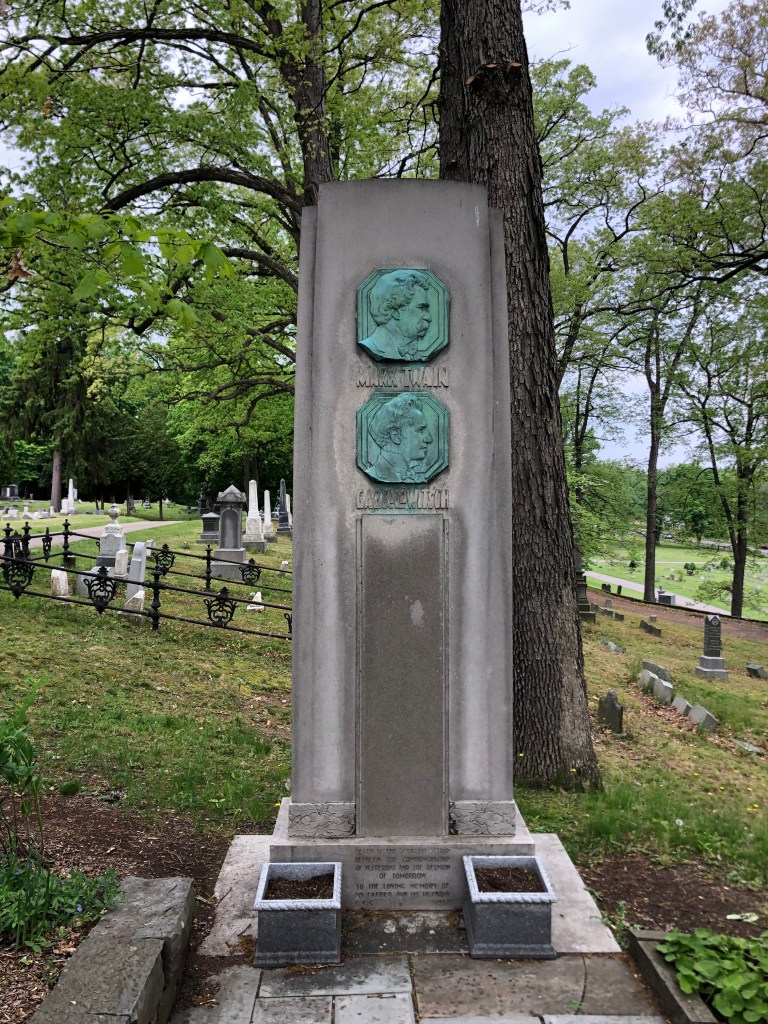
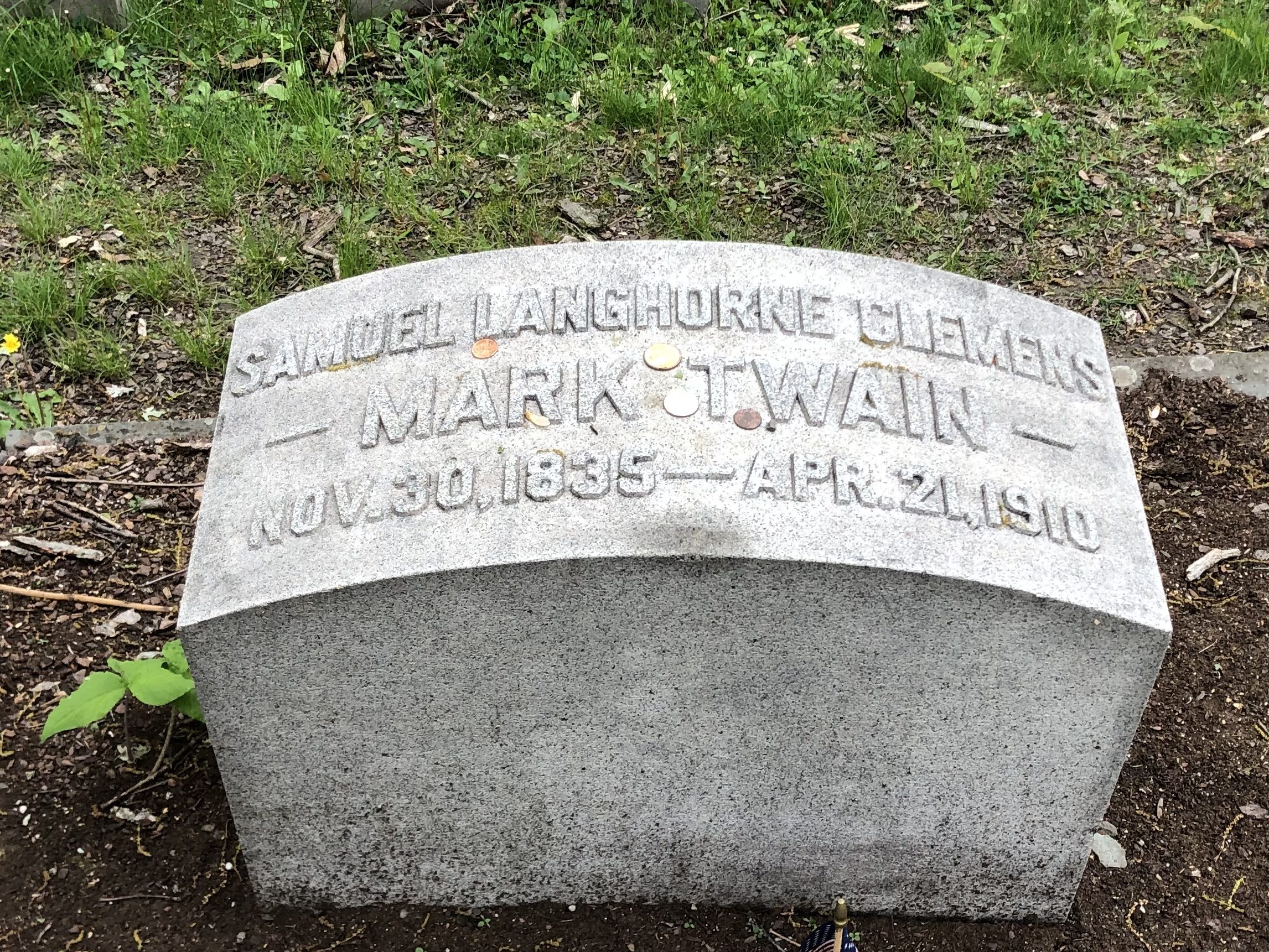
Lucille Ball’s grave (along with other famly members), in Jamestown, NY. Lucy was born in Jamestown, don’t you know.Obelisk alert! Here, in Owego NY, lie the remains of Sa Sa Na Loft, who was killed by a runaway freight train in 1852. It’s supposedly the “oldest white-sponsored grave tribute to a Native American woman.”In Elmira, NY: Family plot marker for Mark Twain and his son-in-law, Ossip Gabrilowitsch. Elmira was Twain’s wife’s hometown.
Let me note here my favorite Mark Twain factoid: When he was born in 1835, Halley’s Comet appeared in the sky. It was known that the comet passes earth every 75 years or so. And so, as the next encounter with the comet approached in 1910, Twain made this comment:
I came in with Halley’s Comet… It is coming again … and I expect to go out with it… The Almighty has said, no doubt: ‘Now here are these two unaccountable freaks; they came in together, they must go out together.’
And they did. Twain died the day after the comet emerged from the far side of the sun.
Hitched to Halley.
The most impressive cemetery I encountered during my Drive of the Lacuna was Lake View Cemetery, in Cleveland, Ohio. It includes these notable figures and impressive works of art:
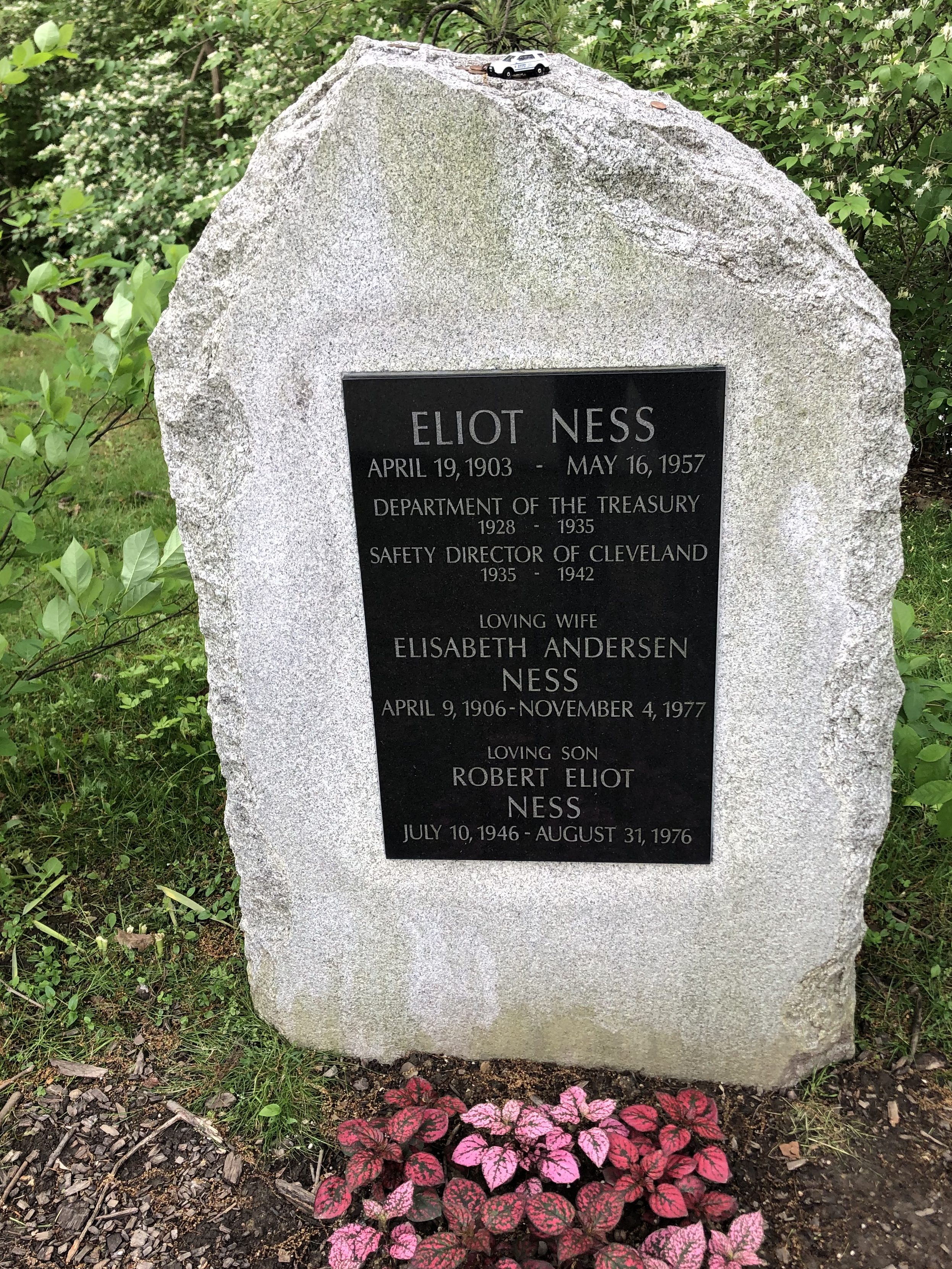
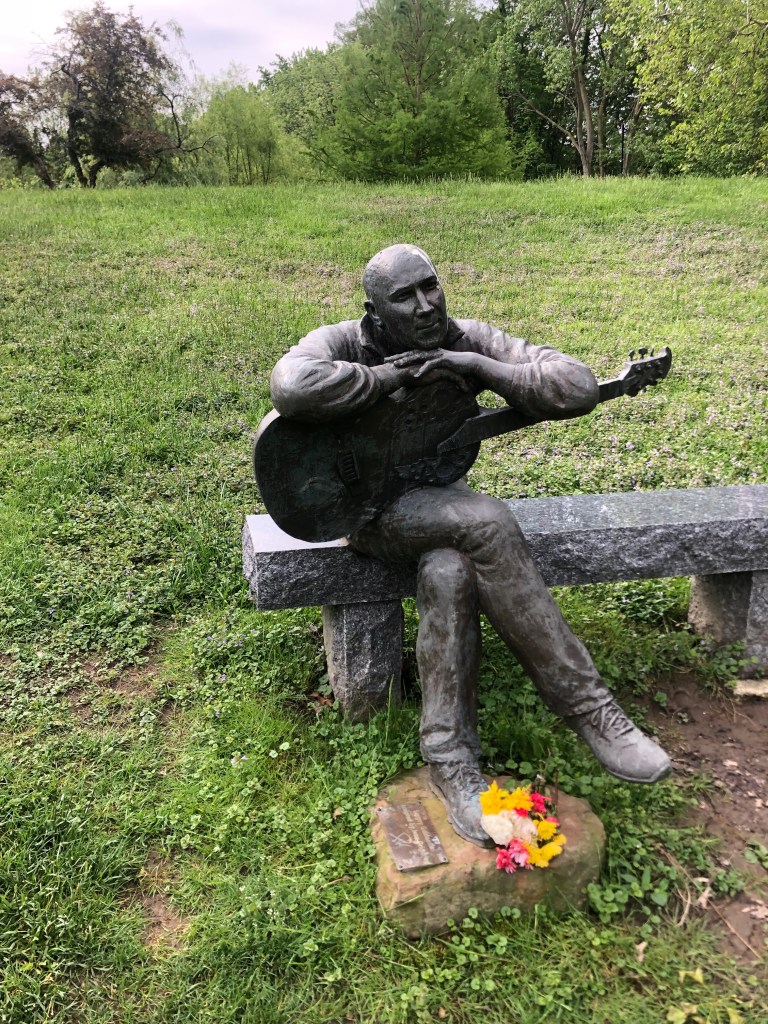
Marker for Untouchable Elliott Ness. His ashes were scattered over a pond just behind the marker.Very touching sculpture over the grave of local musician Sergei Gaidaenko. He’s of Ukrainian background.
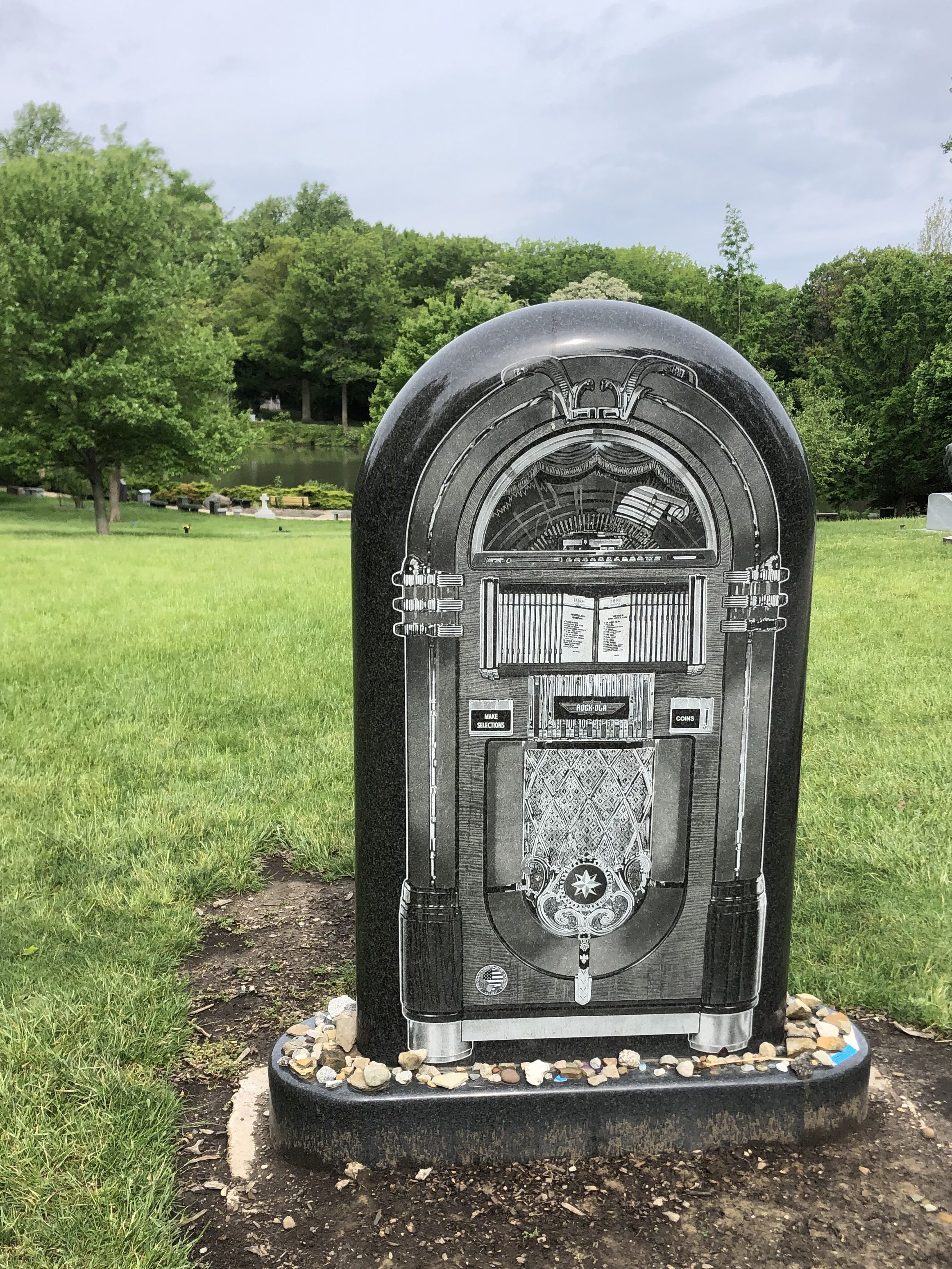
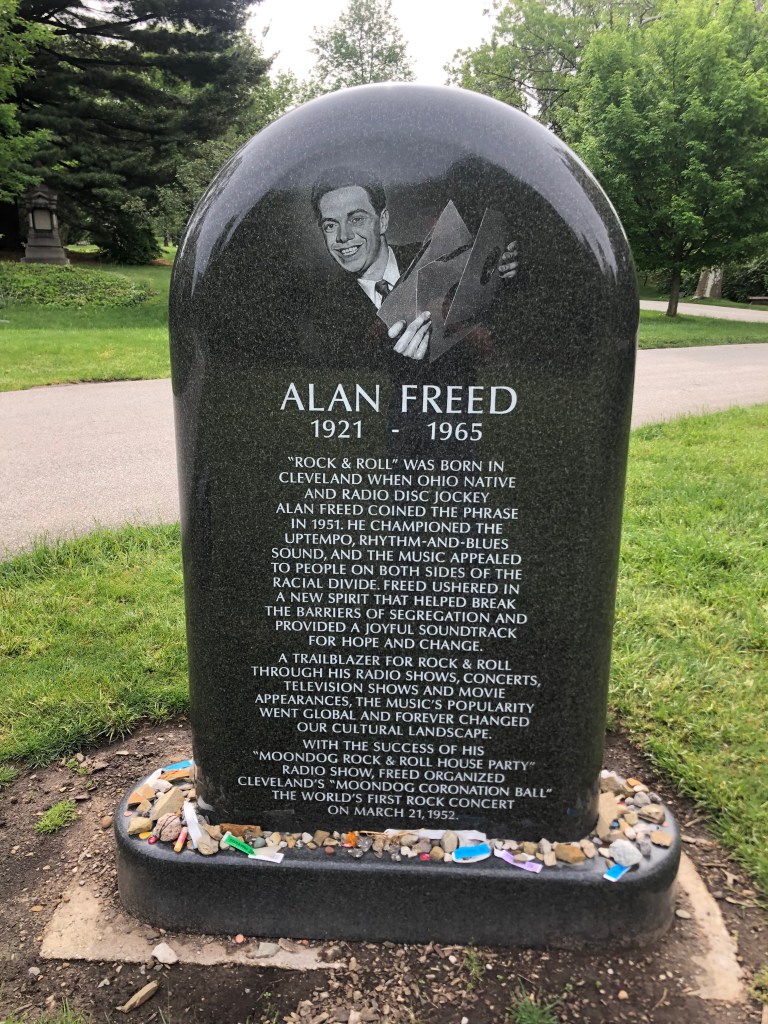
It’s well worth 45 seconds of your time to watch this video, with Sergei’s music in the background. I never met him but I miss him.Here’s something you don’t see every day: A jukebox tombstone. It belongs to local disk jockey Alan Freed, who supposedly coined the term “rock and roll” in 1951.
If you’re interested in what all the fuss was about, check this out:
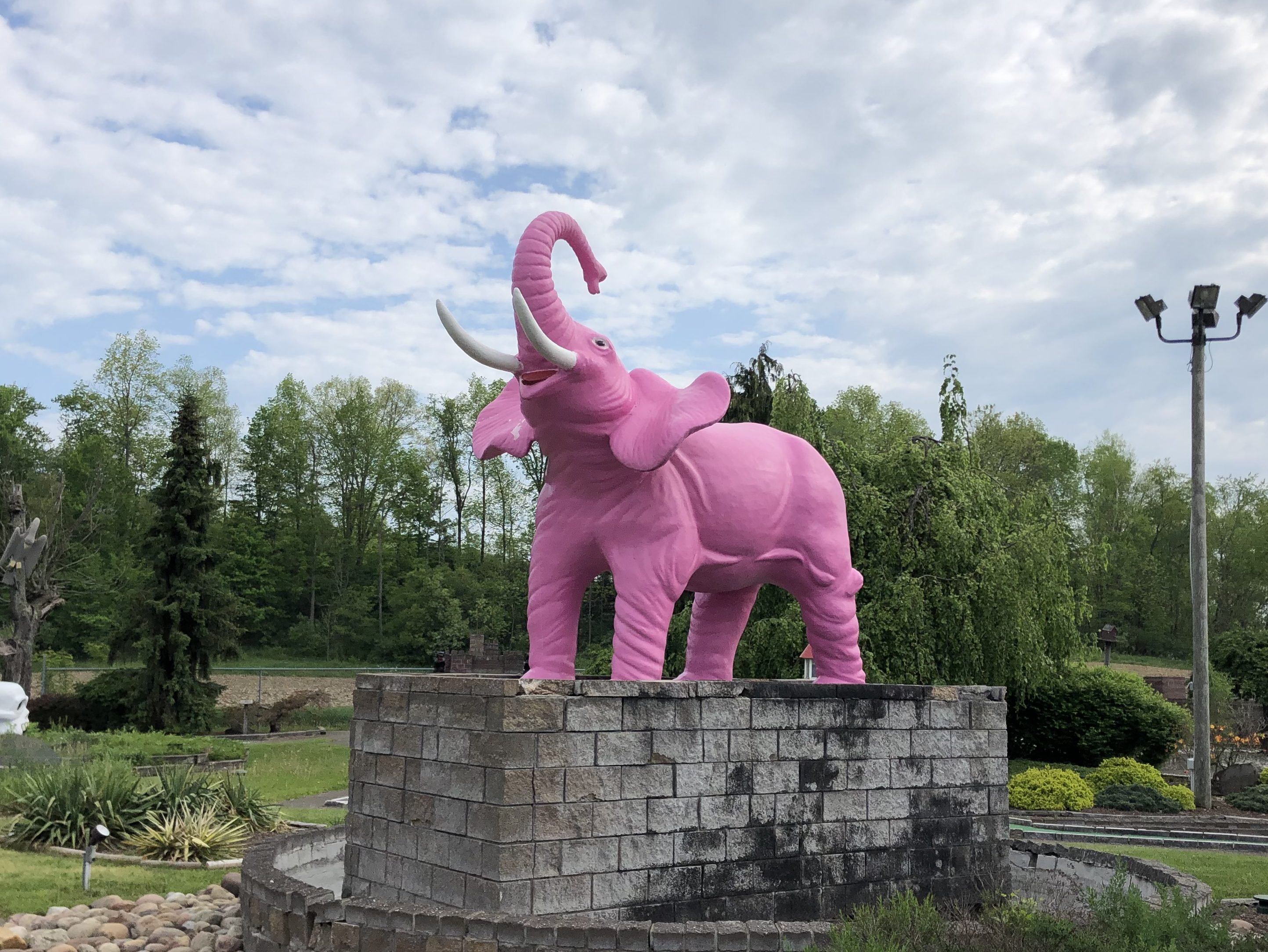
At a miniature golf course in Owego, NY. Alert readers will recall a number of Pink Elephant sightings on my earlier trips; see here for a refresher.
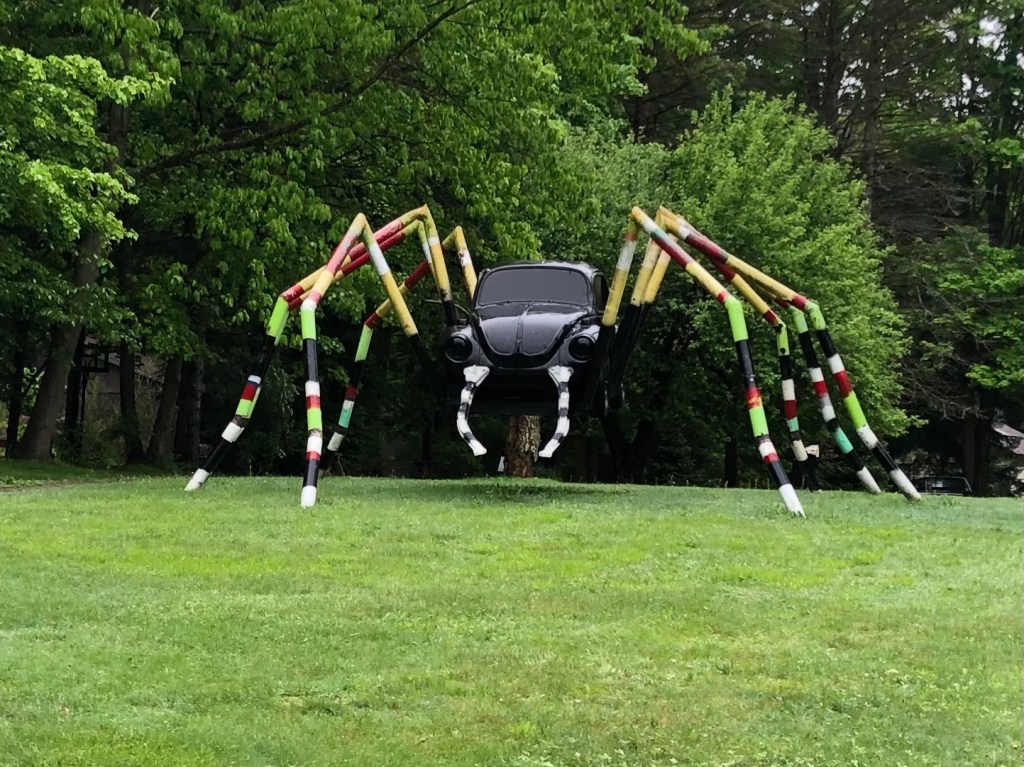
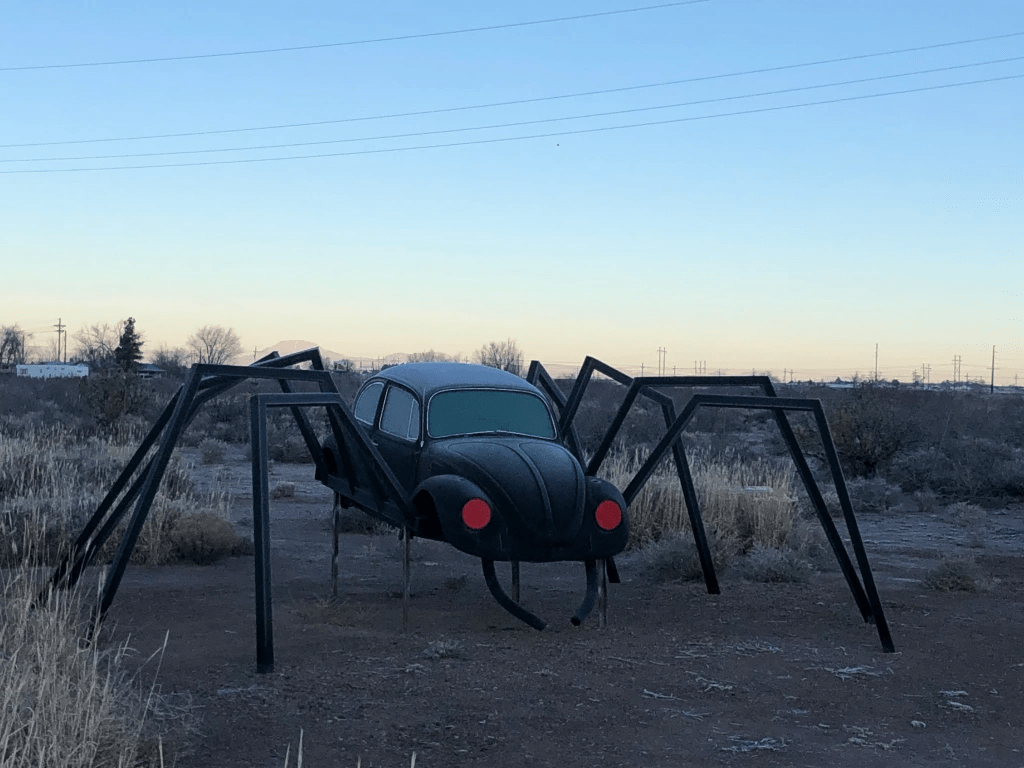
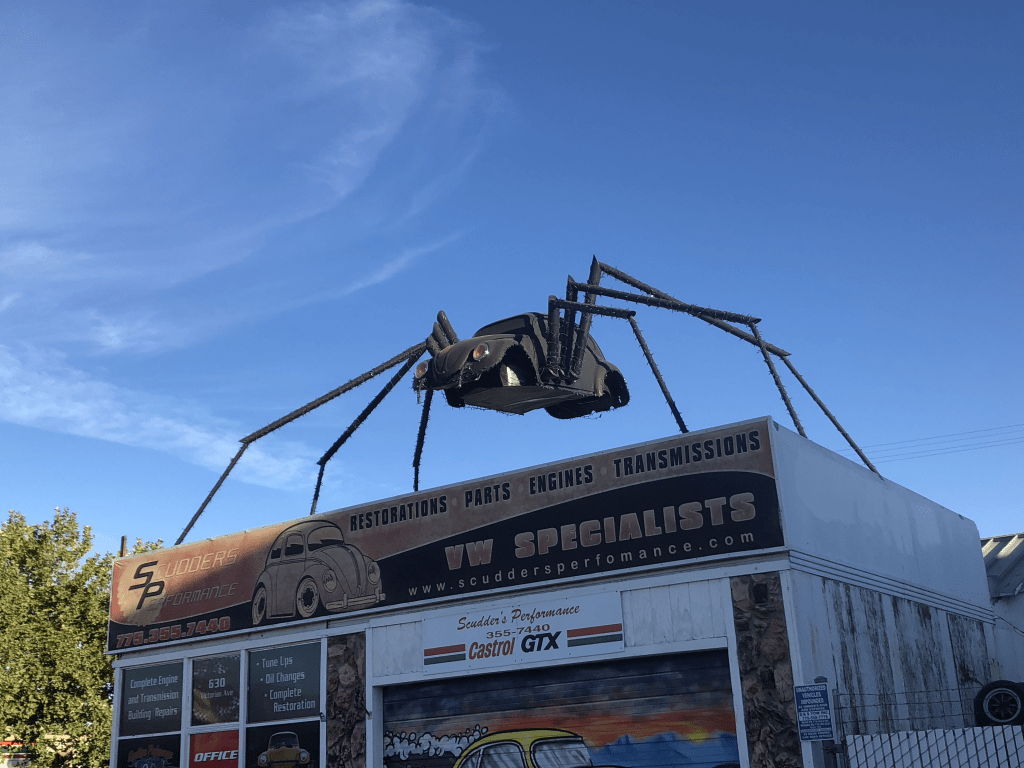
And speaking of recurring creatures, this Beetle/Spider in Erie, Pennsylvania very much resembles earlier encounters. Observe:
Erie, PennsylvaniaSomewhere in New MexicoReno, NV
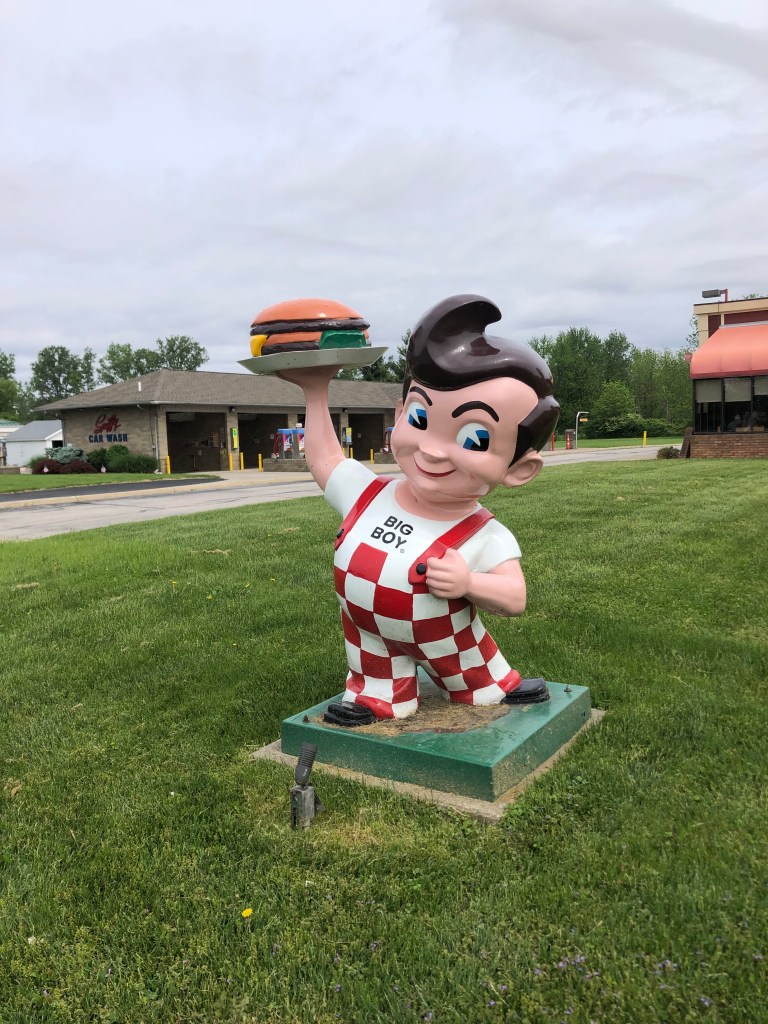
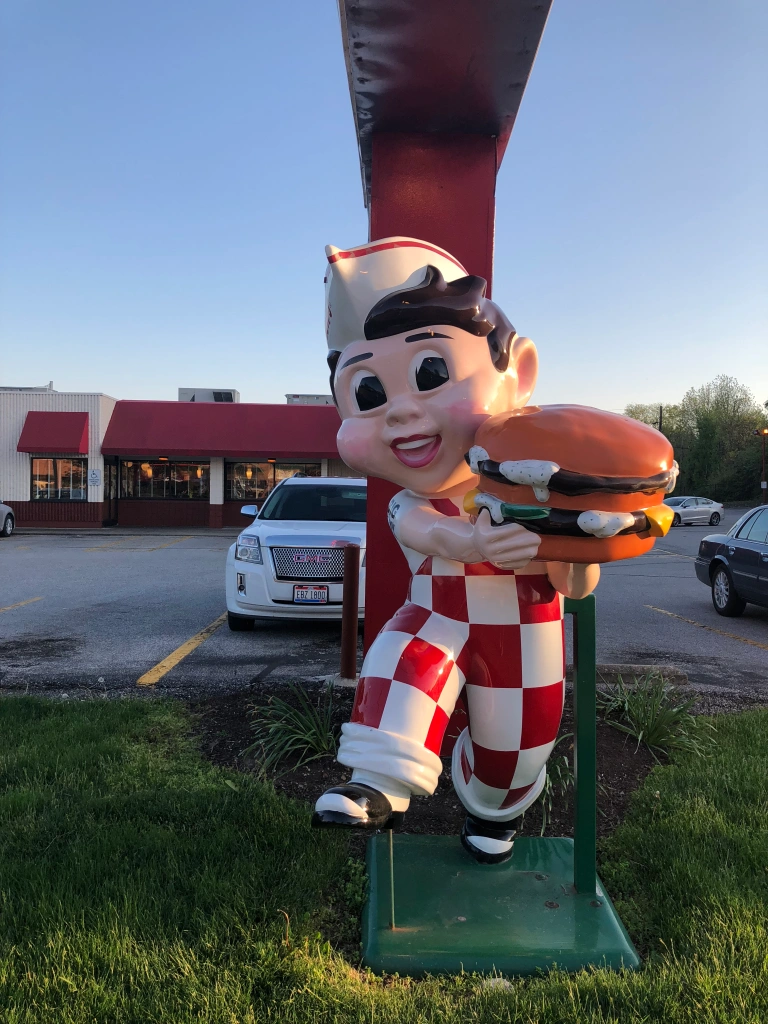
And of course, there’s this recurring fellow:
Fremont, OHMilford, OH (from a prior trip). Full story about the Big Boys is here.
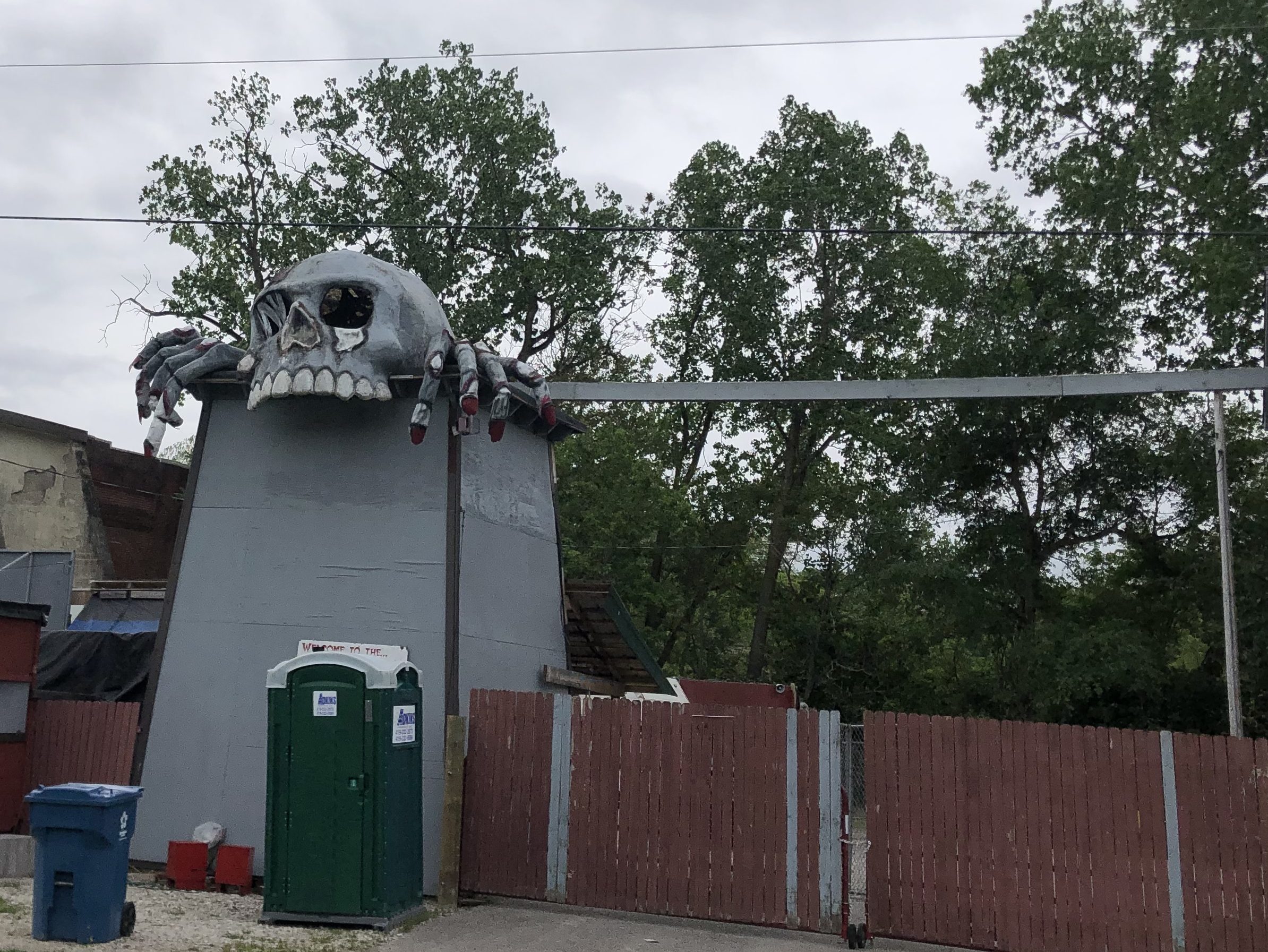
Finally, I bring you the Haunted Hydro, a so-called “Dark Attraction Park” that is open during the Halloween season.
Scary juxtaposition of skull and portapotty….
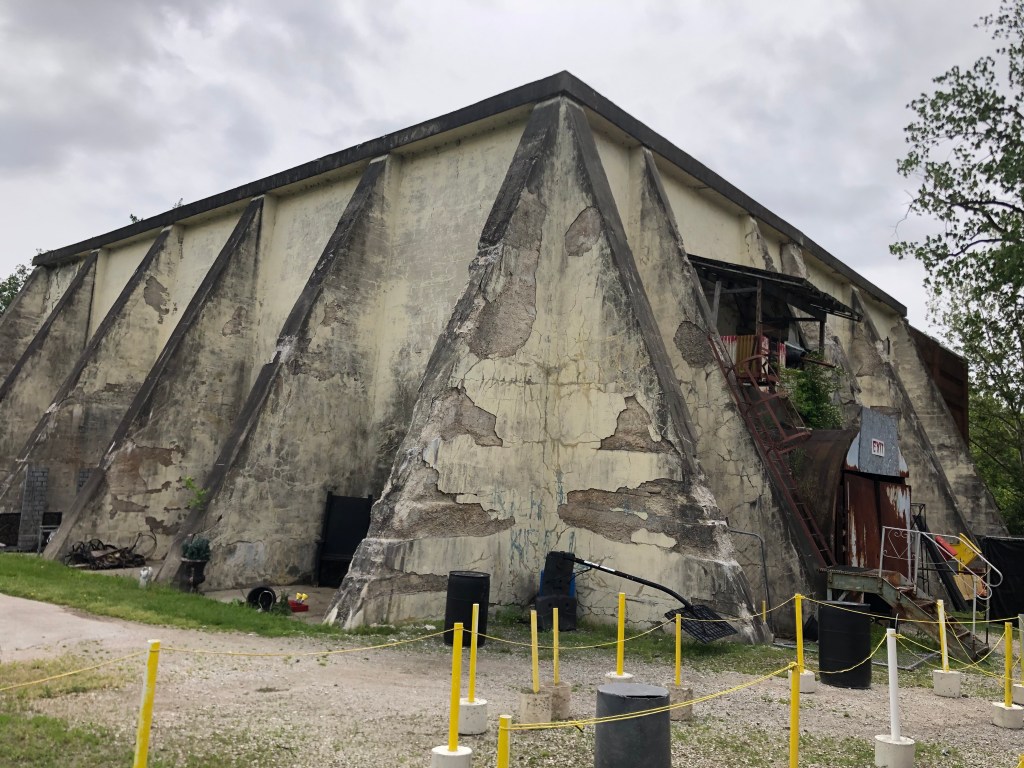
The place looks pretty run down, even abandoned. But I’m told that it’ll be resurrected in time for Halloween. The main part of the attraction is a century-old hydroelectric power plant (hence the “hydro” part of the name). You can see it in action here.
The 1911 Hydro
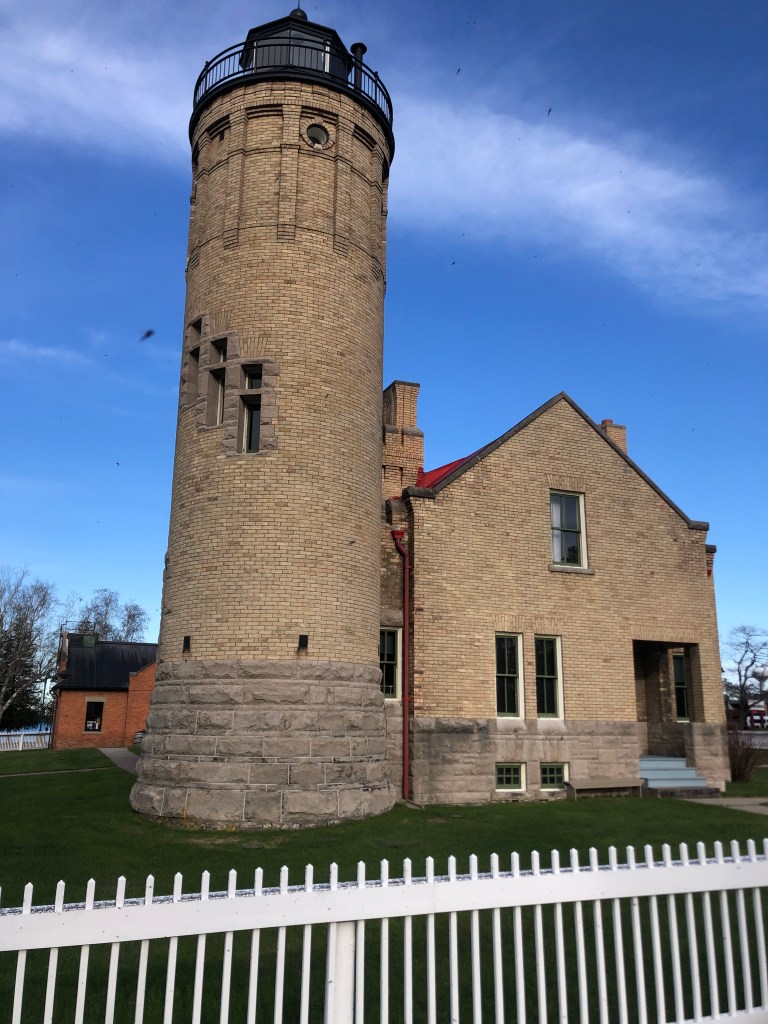
Finally, this afternoon I arrived in St. Ignace, Michigan, where I’ll start the western segment of Route 2 tomorrow morning. By the way, the the Lacuna ended as it began, with a lighthouse–this time a real one:
Yesterday my good friend Bill mentioned that there was going to be some kind of celebration in Sierra Foothills this weekend to commemorate a new locomotive acquisition by California’s Department of State Parks. Given my long-standing interest in trains, as well as the fact that the spring weather has been glorious this year, it sounded like a worthy day trip. I consulted my calendar, which, given my state of retirement, is as empty as a bird’s nest in December. So it was that Bill and I met this morning in the historic township of Jamestown.
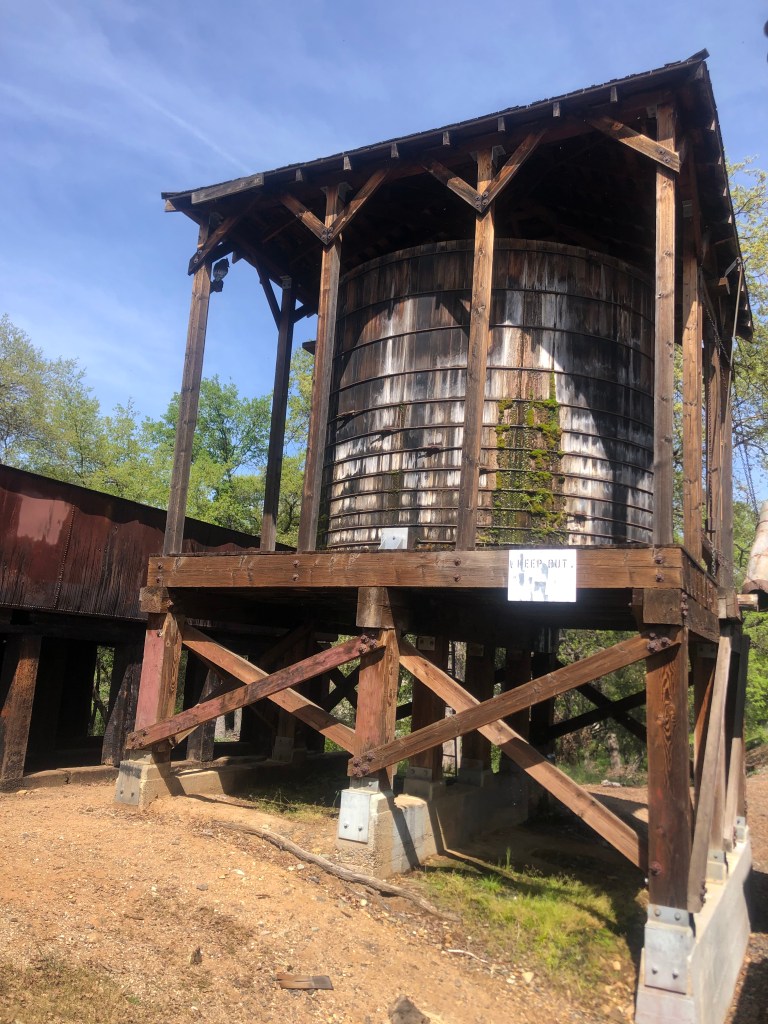
Jamestown (pop: 3,100) was founded just as the Gold Rush was beginning, in 1848. It remains a small, unincorporated town of Tuolumne County, about 100 miles southeast of Sacramento. The important thing about Jamestown, for our purposes today, is the railroad. The Sierra Railway Company was established in Jamestown in 1897, hauling ore from mining operations and timber from logging operations around the area.
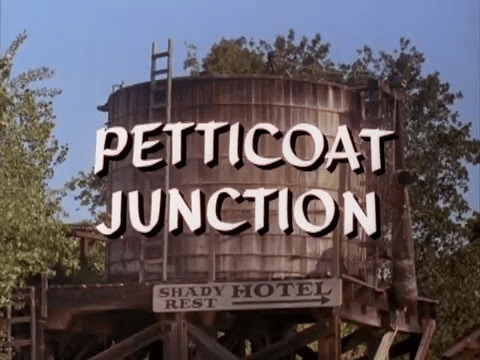
The narrow-gauge railroad operated into the 1960s. In addition to freight and passenger hauling, the Sierra Railway developed a niche as a “movie railroad,” whose trains and structures appeared in numerous Hollywood films (including High Noon (1952), 3:10 to Yuma (1957), and for you young ‘uns, Back To the Future Part III (1990). Oh, and it was featured in the opening credits of “Petticoat Junction” each week.
Then….…and now.
In 1971, after most of the commercial transportation purposes of the railroad had dried up, the Sierra Railroad’s Jamestown facilities (including a station, roundhouse, and shops) were opened to the public as “Rail Town 1897.” A decade later (i.e., 50 years ago this year), the facilities, along with locomotives and cars, were purchased by the California Department of Parks and Recreation for $750,000. Railtown 1897 was designated a State Historic Park. It remains a popular tourist destination, offering tours of the shops and steam train rides pulled by the original engines on the original tracks.
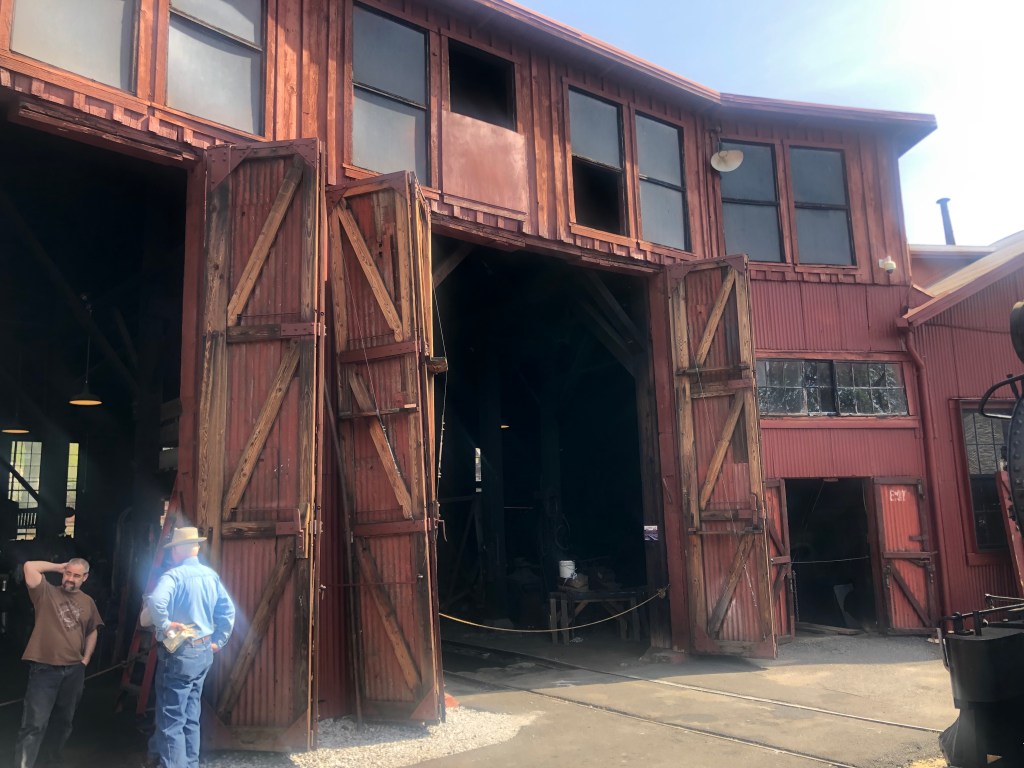
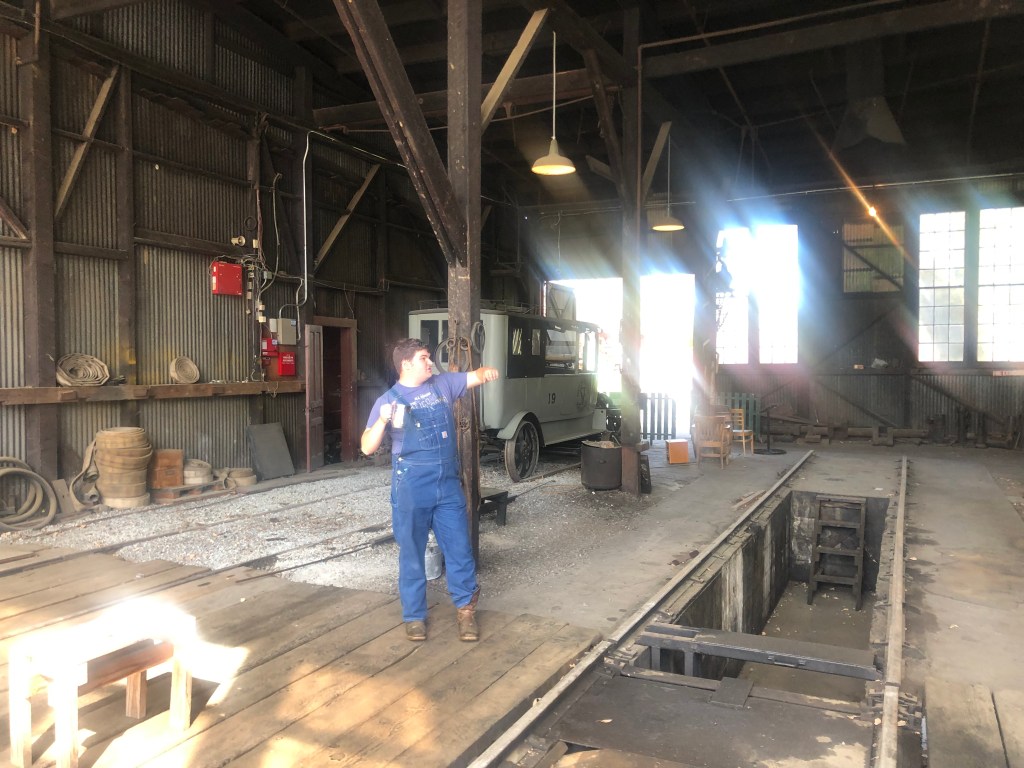
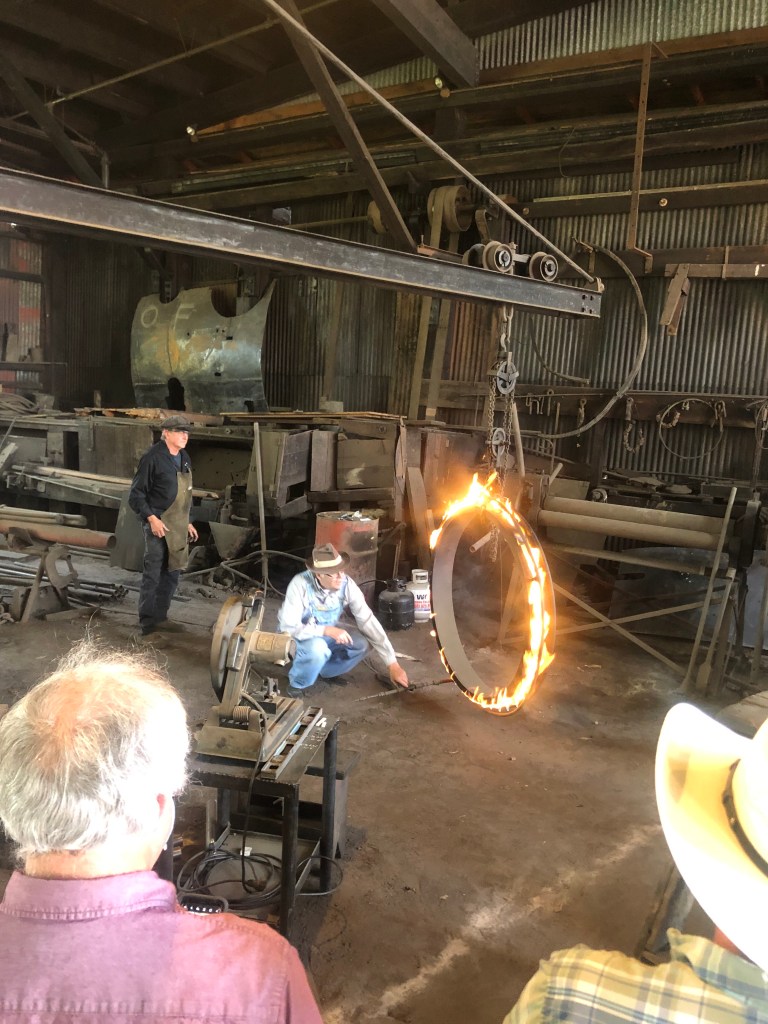
I can’t emphasize enough how unique and impressive this place is. The roundhouse is largely unchanged from how it looked over 100 years ago. Most of the same tools and equipment are still in place, and are used regularly to repair and restore locomotives and cars. They have vintage locomotives and rail cars that offer excursion rides every weekend. This place is an authentic time capsule.
The Roundhouse, over a century old and still in useInside the roundhouseDon’t try this at home.
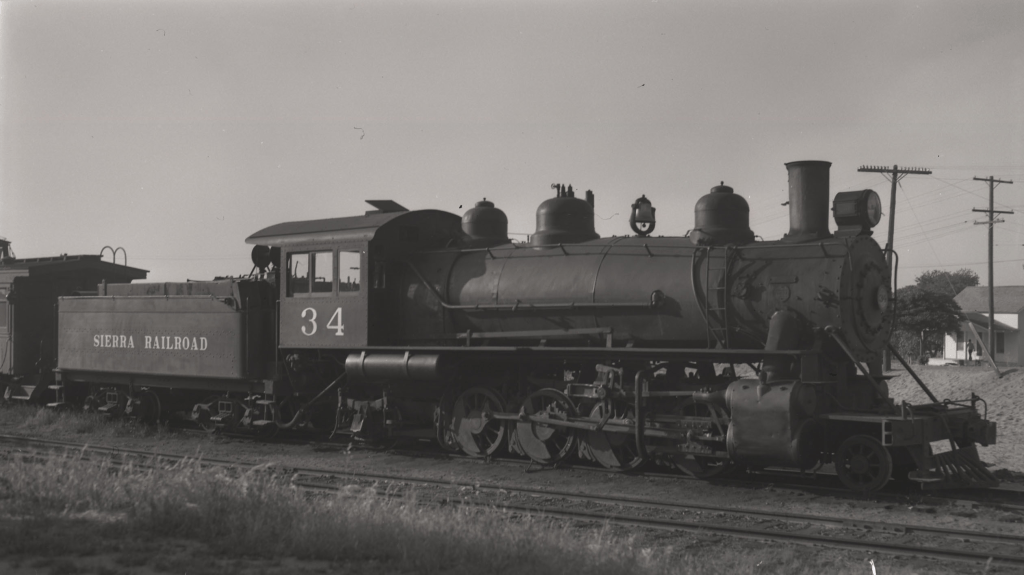
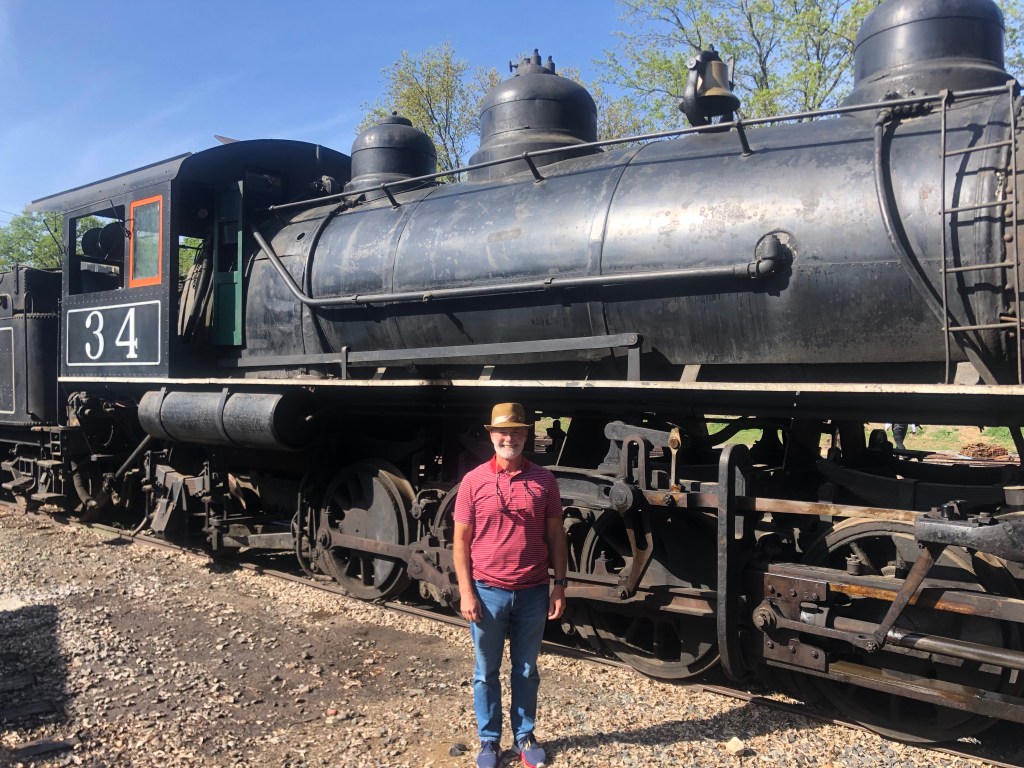
But let’s get back to the purpose of this trip. The whole reason we came was because Railtown 1897 had put out a press release that they had acquired a new locomotive. And by “new,” they meant “old.” The locomotive (Sierra Railway’s No. 34) was built almost a century ago. Sierra purchased it new in 1925 from the venerable Baldwin Locomotive Works and it remained on Sierra’s roster until the company closed in the late 1960s. The locomotive was eventually sold to a collector (someone who evidently didn’t think model trains were sufficiently authentic), but this collector never got around to moving the engine away from its stomping grounds. It just sat there in the roundhouse in Jamestown. Recently that owner/collector died, and the locomotive went up for sale. Money was provided by two generous donors–Chris Baldo and Marion Hatch–and Railtown was able to acquire the “pink slip” for the engine that’s been on their property for a century. Hence the big celebration today.
The engine in question is the Sierra Railway’s No. 34, seen here in its heyday:
Old Number 34Friend Bill in front of Old(er) No. 34 today
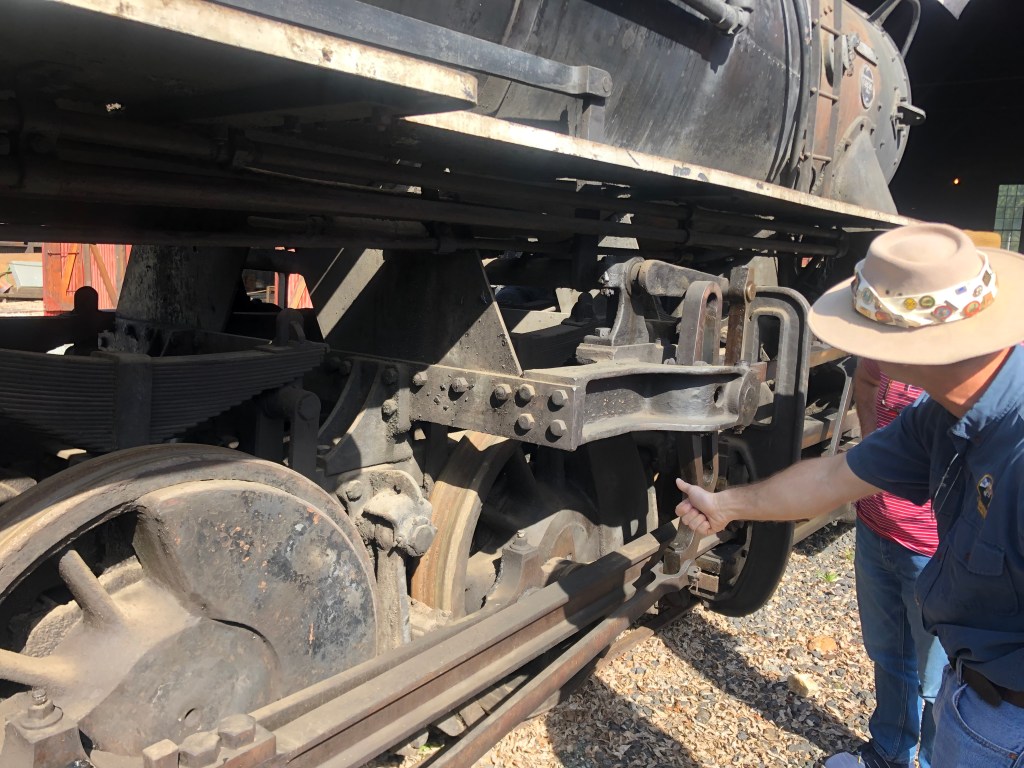
The engine hasn’t run since 1980, but, using words familiar to everyone who’s purchased a classic automobile, “it was running when we last shut her down.” The plan is to restore the locomotive to operational condition.
Like Charlie Brown’s Christmas tree, it just needs a little TLC…
They plan to do the restoration work right here, in the venerable old shops at Railtown. Bill and I hope to provide a little volunteer muscle on that project.
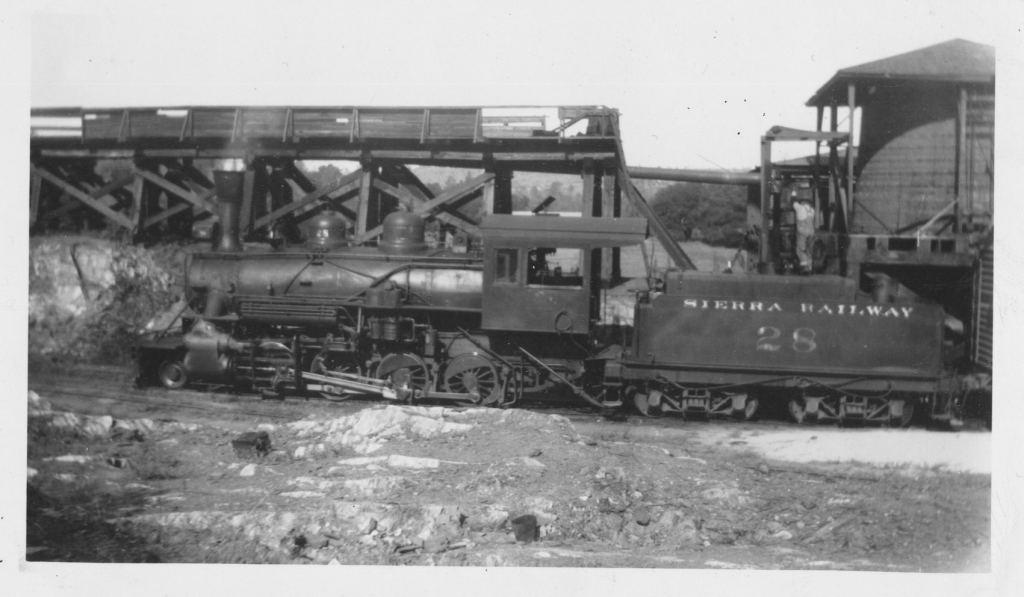
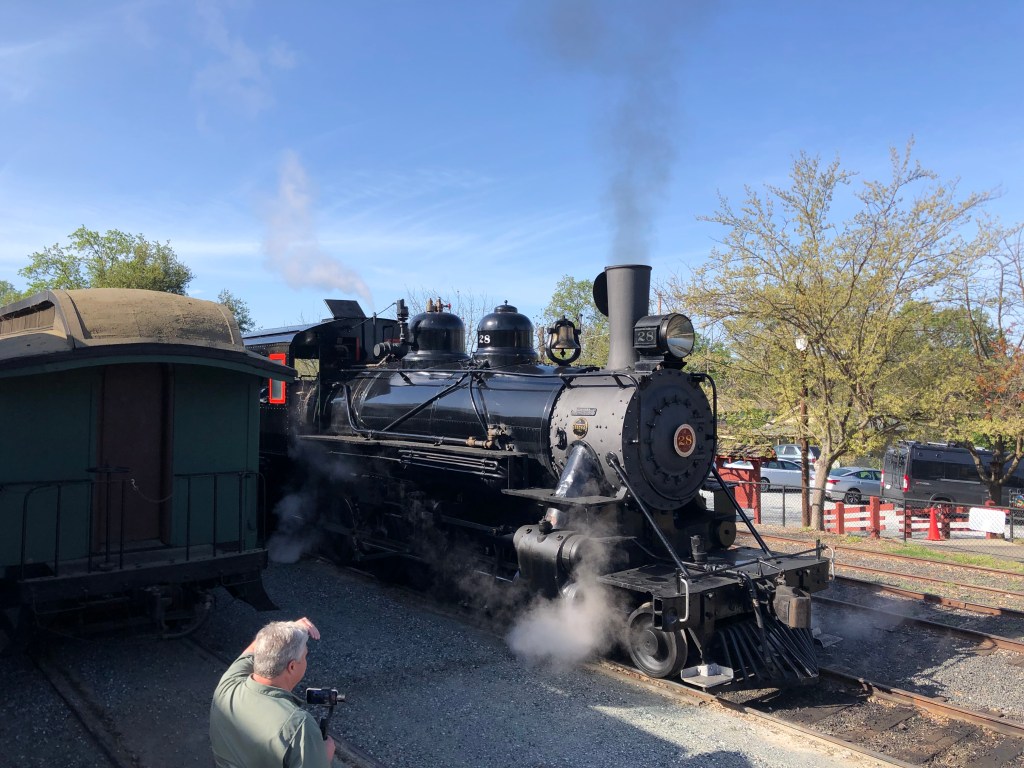
Meanwhile, Railtown does have other steam locomotives. These include the No. 28, which celebrates its 100th birthday this year. The engine hauled cement and rock for the construction of the O’Shaughnessy Dam at Hetch Hetchy in the 1920s, and then turned to regular freight and passenger service. It has appeared in various movies and television shows, including “Little House on the Prairie” and Bound for Glory.
Old No. 28, back in the day
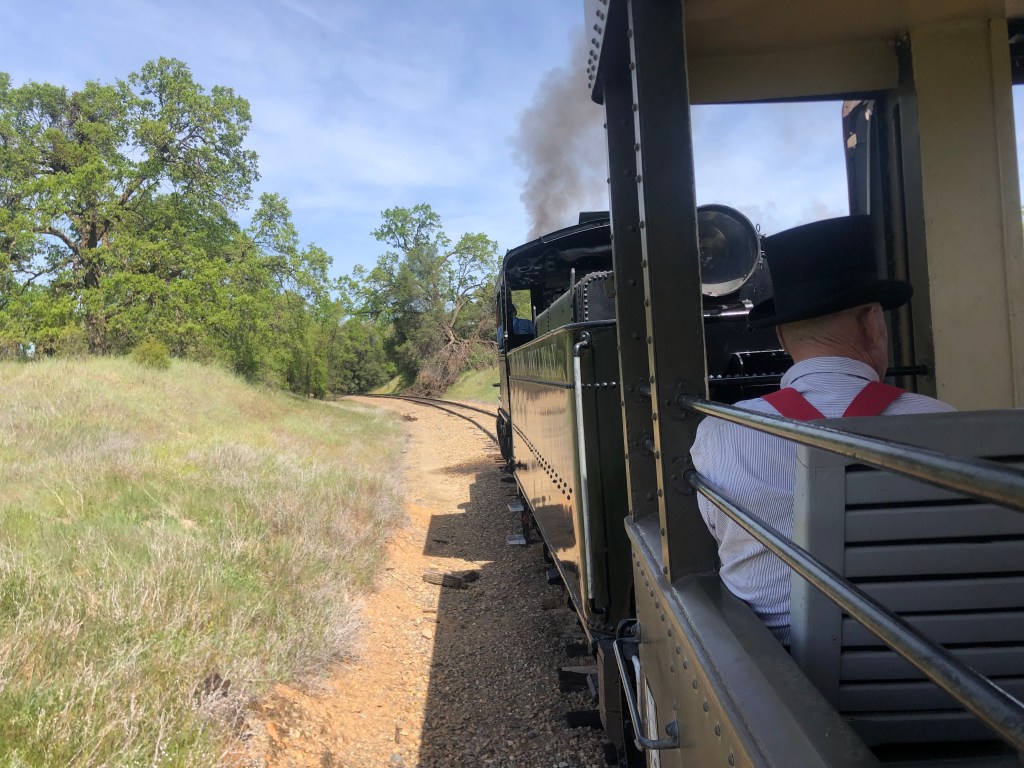
Today this same engine is still running strong. In fact, it pulled our excursion train this afternoon as we enjoyed an hour’s journey along the Sierra Railway’s old, historic tracks.
No. 28, under steam this morningView of the Old 28 from our passenger car
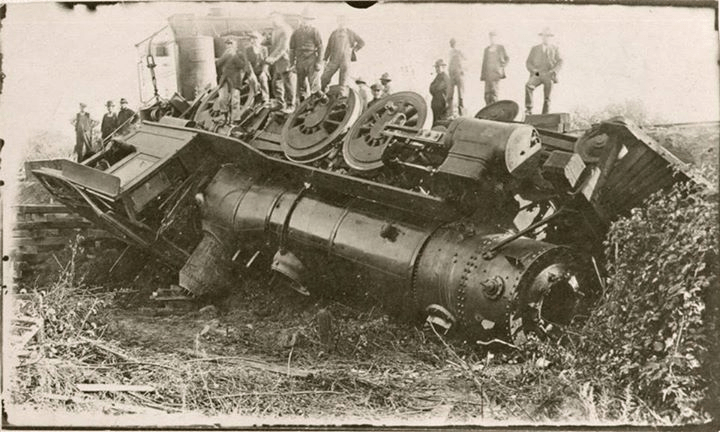
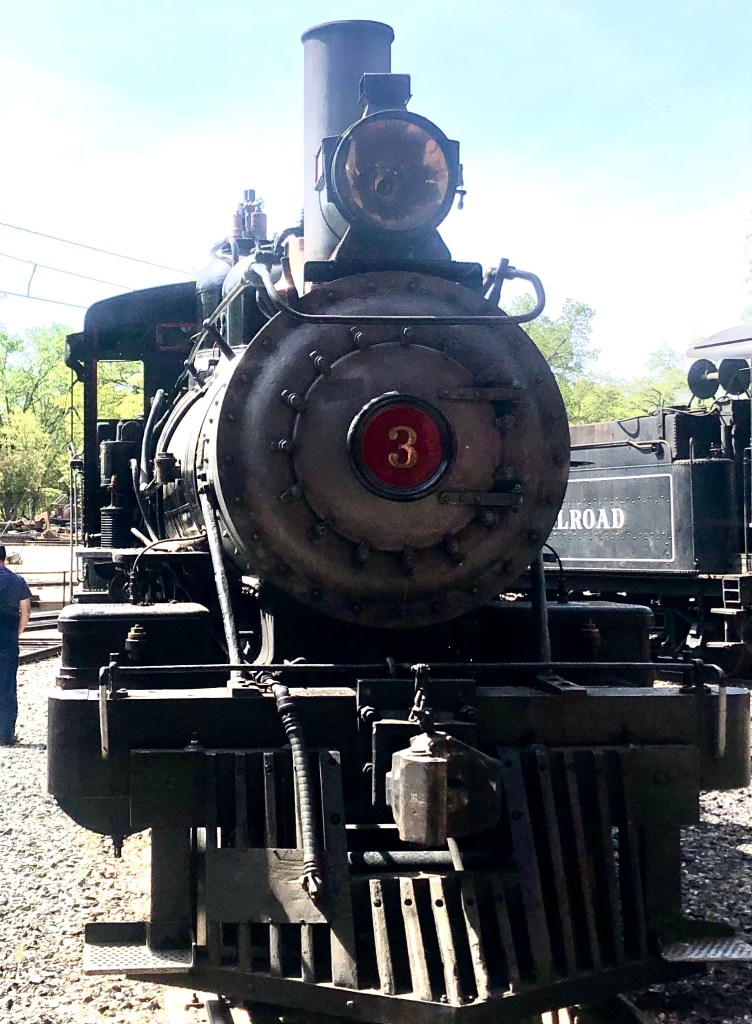
Railtown also has another operational steam engine–the No. 3, which was built in 1891(!). This locomotive has appeared in more movies than any other locomotive, and is regarded as an archetypal example of late 19th-century American trains. It’s been involved in a few mishaps over the years…
…like this one in 1918….
…but it’s been repaired each time, and remains in service to pull excursion trains.
Old No. 3 today
So, overall, the Sierra Railway’s facilities in Jamestown (i.e., “Railtown 1897”) is a remarkable, virtually unspoiled, authentic example of California’s railroading past. It’s well worth a trip. (Admission is $5. I’ll send you a fin if you’re strapped for cash.)
Postscript
Stick with me here; this is going to connect back to Railtown 1897.
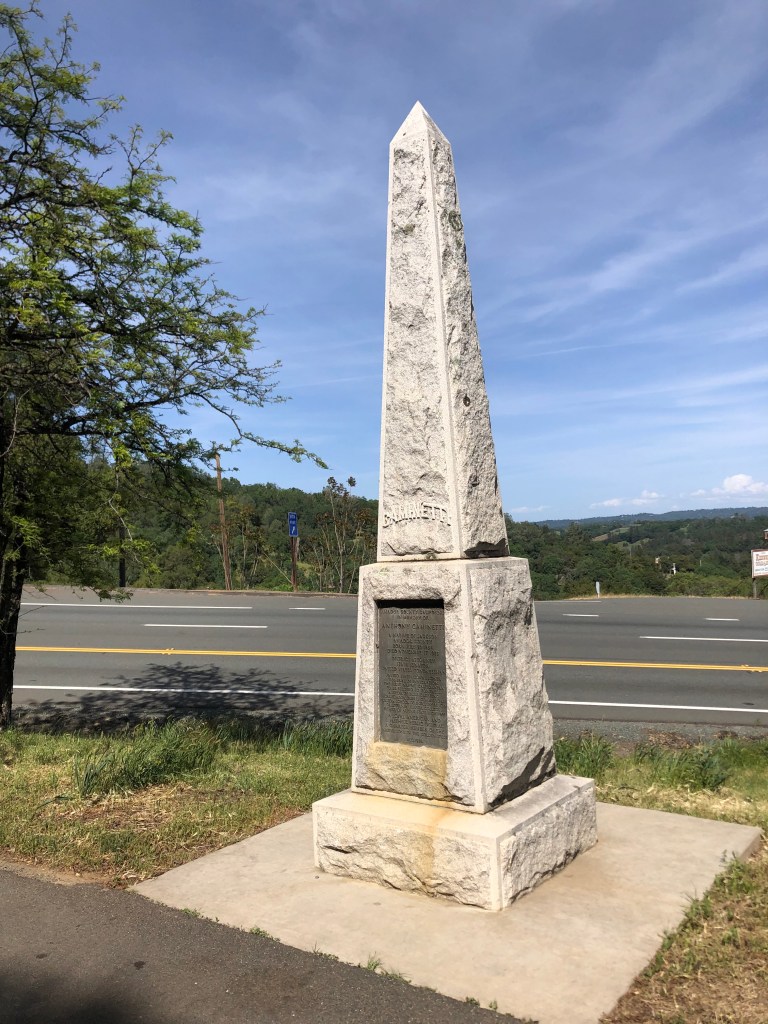
On the way home along Highway 49, I stopped in the town of Jackson (pop: 4,800) to check out this obelisk that I saw from the road:
Wouldn’t you have stopped for it?
The obelisk was erected in 1938 to honor favorite son Anthony Caminetti (1854-1923), who racked up an impressive resume. Allow me to quote the marker: “District Attorney, State Senator, United States Congressman, United States Commissioner, General of Immigration, the first native Californian to be elected to Congress, author of bills creating California Debris Commission, Preston School of Industry at Ione, California Junior Colleges, Father of Alpine State Highway, a loyal American and a faithful public official.”
Some of these posts sound impressive (Congressman, Senator…). Others are a bit less so. I mean, being one (of many) authors of certain pieces of legislation isn’t exactly herculean. It does, however, raise a critical question: What exactly is the “California Debris Commission,” anyway? Answer: it was an agency created in 1893 to clean up the damage that had been done to California’s waterways by the extensive use of hydraulic mining in the Sierras. The Commission was dismantled in 1986.
And here’s were we link back to Railtown 1897. For it turns out that the Clint Eastwood movie Pale Rider (1985) focuses on hydraulic mining and how it did extensive environmental damage to the rivers. And scenes from that movie were filmed at Railtown.
I do recommend the movie, by the way. Check it out here.
Now, I know that some of my loyal readership doesn’t get too excited about obelisks. So you’re excused if you want to pass over this particular post. But if you want a refresher on why these interest me, please check out this post from last year.
A surprising number of readers have sent in their own obelisk sightings after that post, proving that obelisks aren’t immune to the Baader Meinhof effect. Just do a search on “obelisk” on my blog’s main page, and you can see the wonderful variety of obelisks that have been spotted.
Today we add two more sightings:
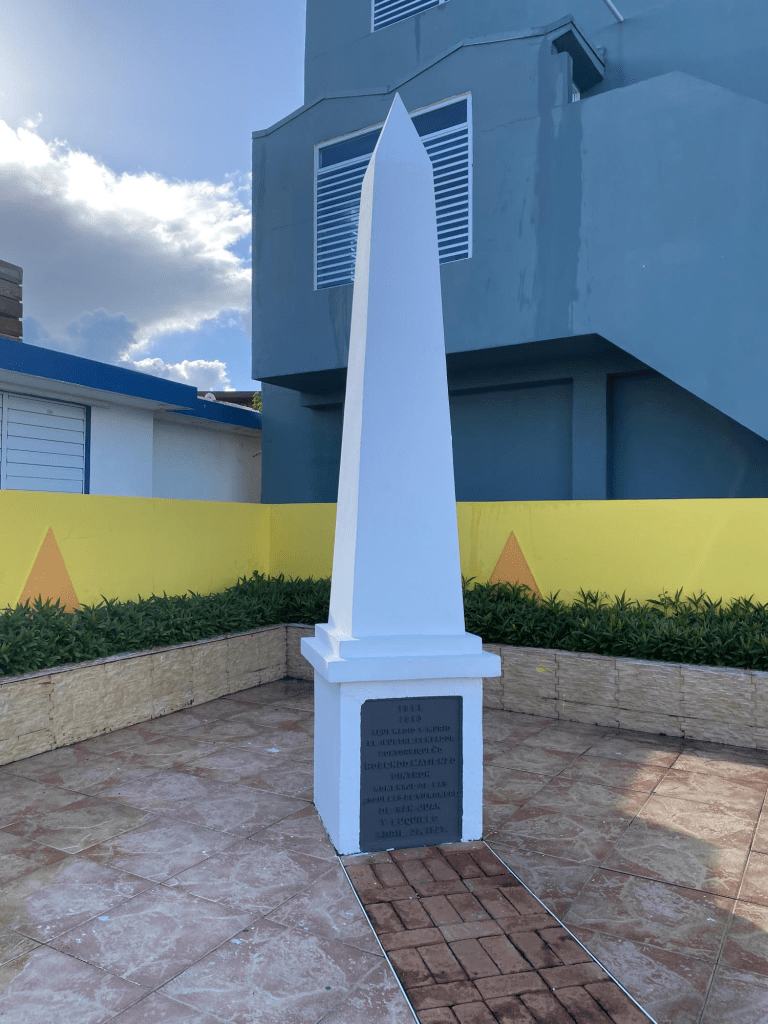
Friend Detlef K. was on vacation in Puerto Rico when he spied this simple obelisk in the town of Luquillo.
It’s a monument to Luquillo’s native son Rosendo Matienzo Cintrón (1855-1913). Cintrón was a lawyer who became something of a political firebrand. He seems to have held a broad range of political positions, many of which contradicted each other over time. He was imprisoned by the colonial government (Puerto Rico was under Spanish rule at the time) for being a Freemason, which evidently was illegal. After his release, he was elected to a local political office, and later helped establish the Puerto Rican Autonomist Party. Later, he welcomed the United States’ military intervention in the Spanish-American War, in which Spain ended up ceding Puerto Rico to the United States. In return, the US appointed Cintrón to important political positions over its new possession. Cintrón advocated for Puerto Rico to become a U.S. state, but later became a passionate proponent of Puerto Rican independence from the United States. Somewhere in all that, he earned himself an obelisk.
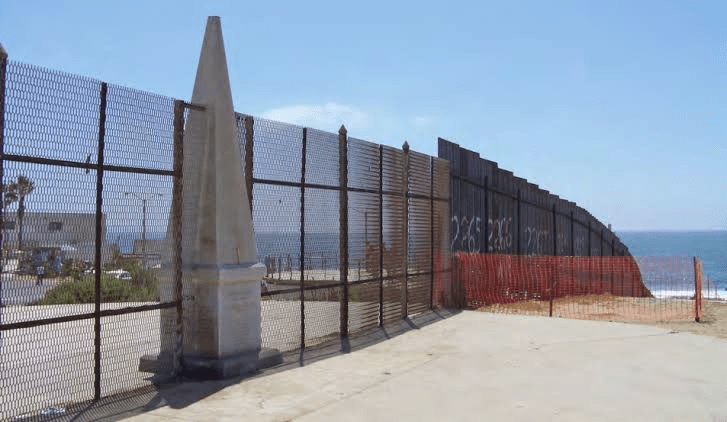
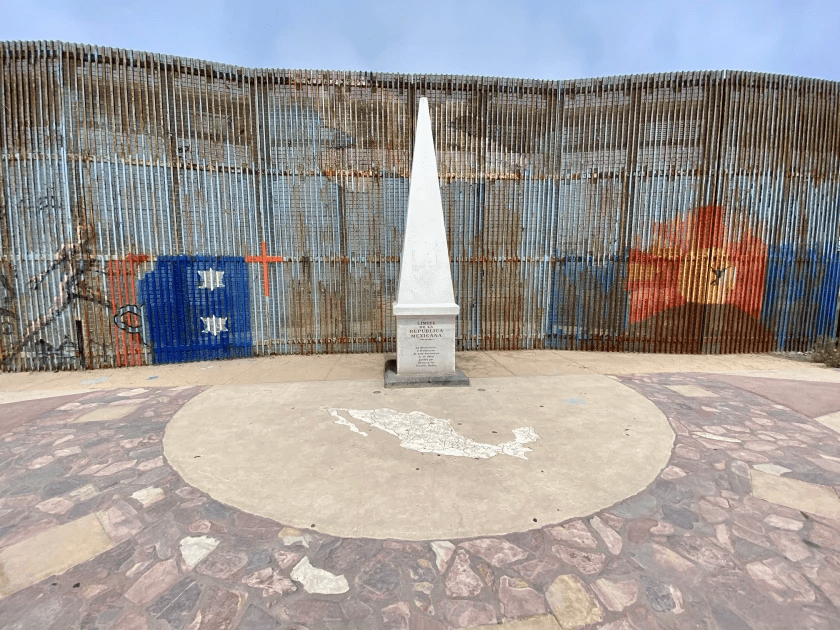
Meanwhile loyal reader Steve L. sent this picture of an obelisk in “Friendship Park,” which straddles the US-Mexican border near San Diego.
International Obelisk
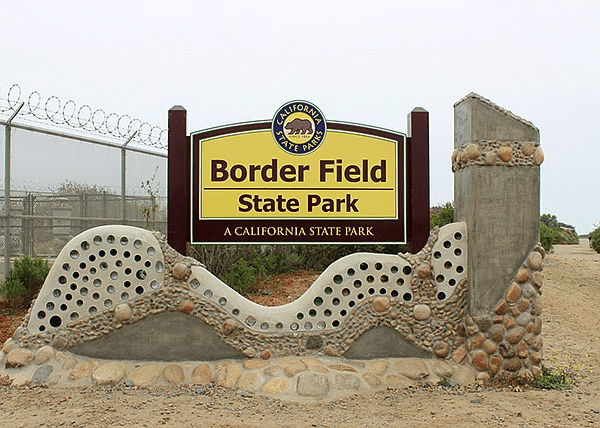
Friendship Park is part of a larger “Border Field State Park,” which makes every effort to look welcoming…notwithstanding various federal security measures that are in place.
The concertina wire is a nice touch.
Friendship Park was established in the 1971, and at the time the obelisk was not divided by a fence. (See historic photo, below.) The obelisk was originally erected in 1851 as a boundary marker after the Treaty of Guadalupe-Hidalgo.
But with rising concerns about illegal immigration in the 1990s, and then concerns about international terrorism after 9/11, security measures were put in place that changed the vibe of the park.
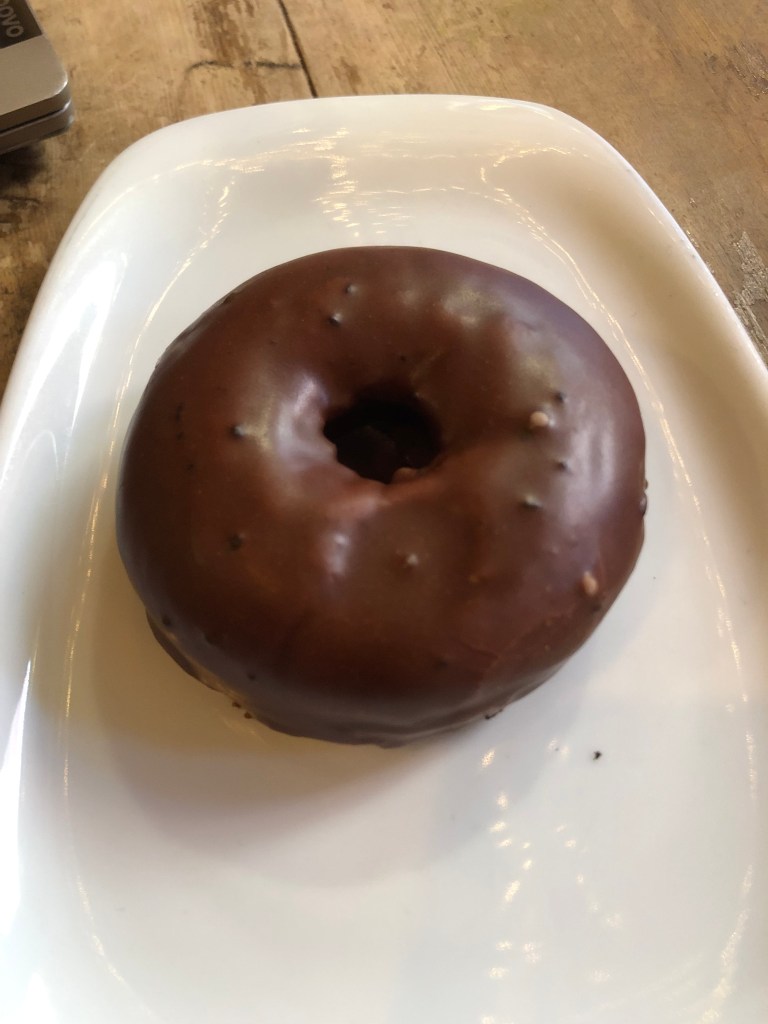
So, today is my birthday. I’m not going to dwell on that, other than to note it’s a prime number, and it earned me a free donut. Anyway, I figured that I’m not getting any younger, so I decided to spend the day exploring the back roads of the Sierra Foothills. The region is beautiful this time of year, with its rolling hills covered with deep green grass. And today was unseasonably warm, feeling much more like spring than winter. So I saddled up the Speedmaster and went to see what I could see.
Thank you, Totem Coffee in Placerville!
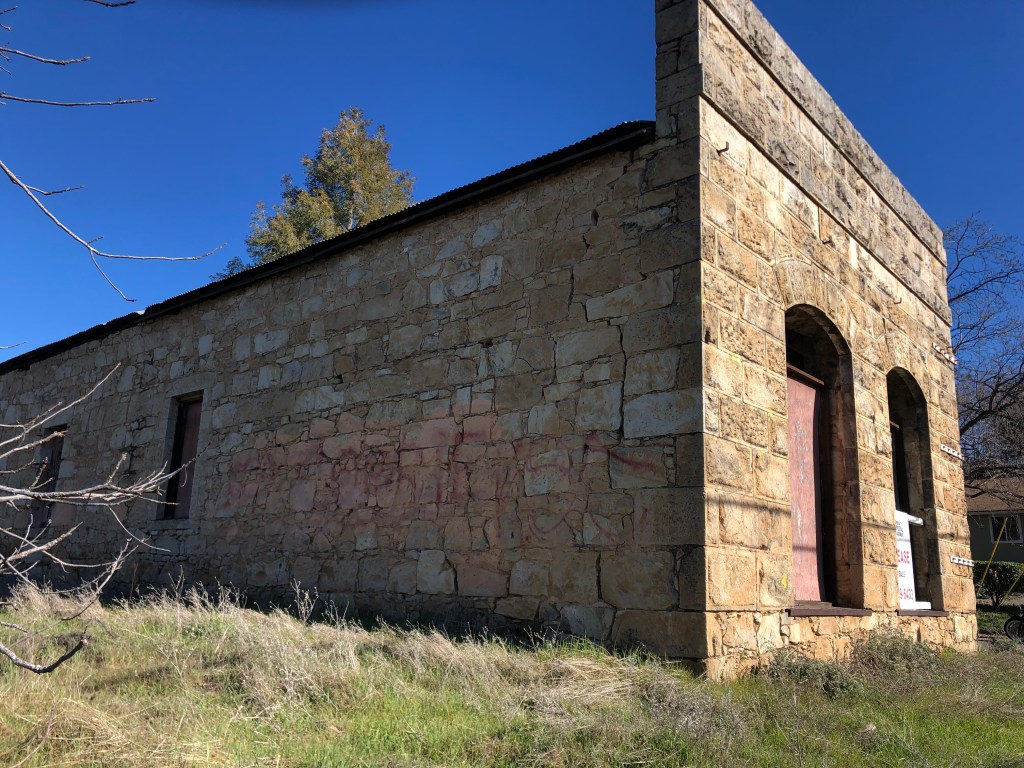
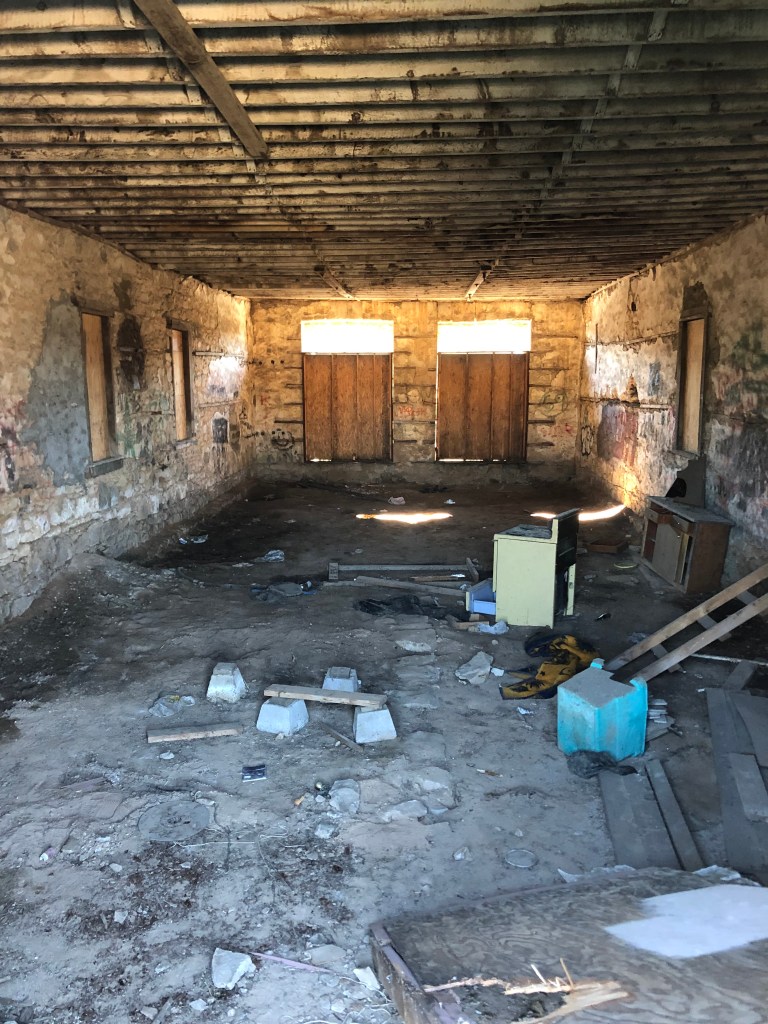
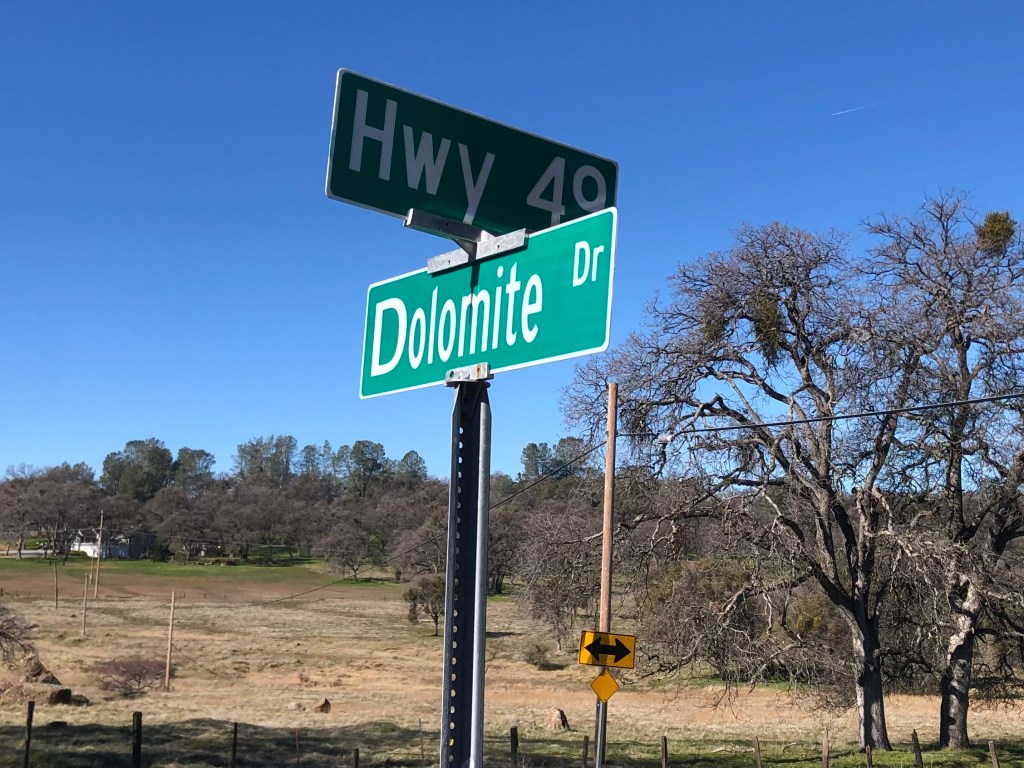
I found myself meandering along CA Route 49–a scenic, historic road that links a number of gold mining towns. (I wrote about an earlier trip along a stretch of it here.) This time I headed south on CA-49, starting around Coloma. I passed through the (relative) metropolis of Placerville, and soon came to Diamond Springs (pop: 11,000). To me, Diamond Springs is one of those gold rush towns that has somehow managed to maintain its historic charm while still being relevant in the 21st century. Its population has more than doubled since 2000. The most attractive business in town, for my money (literally), is Solid Ground Brewing. But the most picturesque building is the old General Store, from the 1850s. It’s for sale or lease, if any of my readers wants an investment property…
Interested? Call University Capital Management at 916-929-5433.Exterior detail of your future lease/purchase.Interior of the building. Like Charlie Brown’s Christmas tree, it just needs a little TLC.
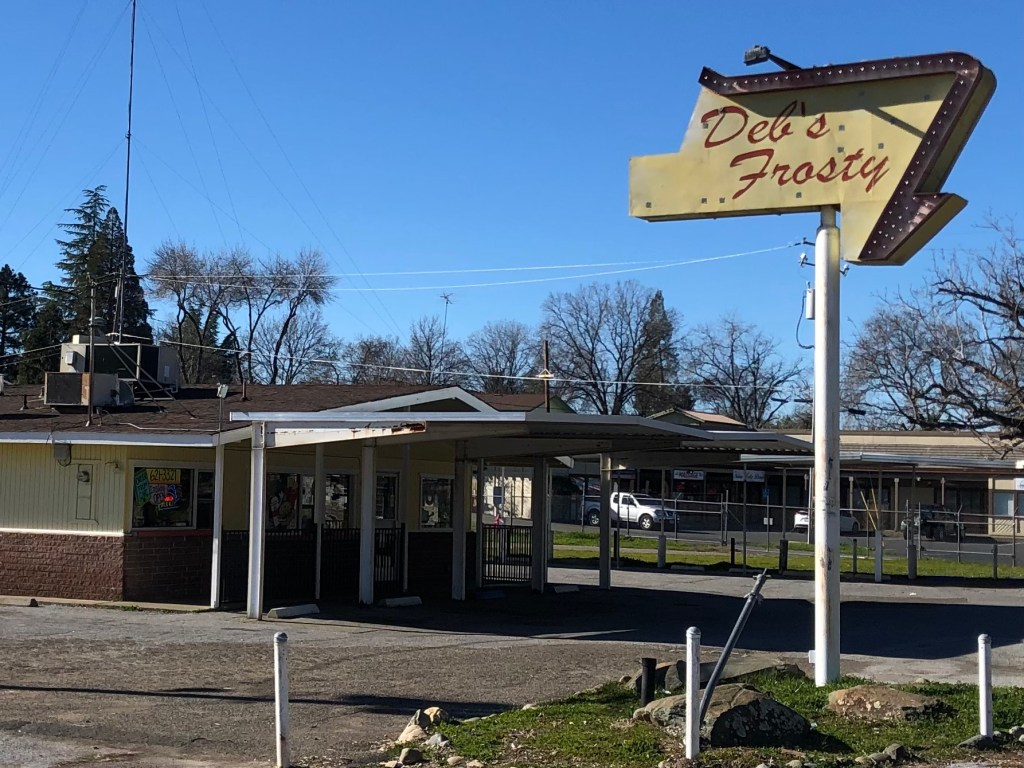
Now, in case you thought Diamond Springs was stuck in the Gold Rush era, it does have some “modern” buildings….from the 1950s. According to Yelp, Deb’s Frosty specializes in Mexican food. (??!)
The go-to spot for Chile Relleno.
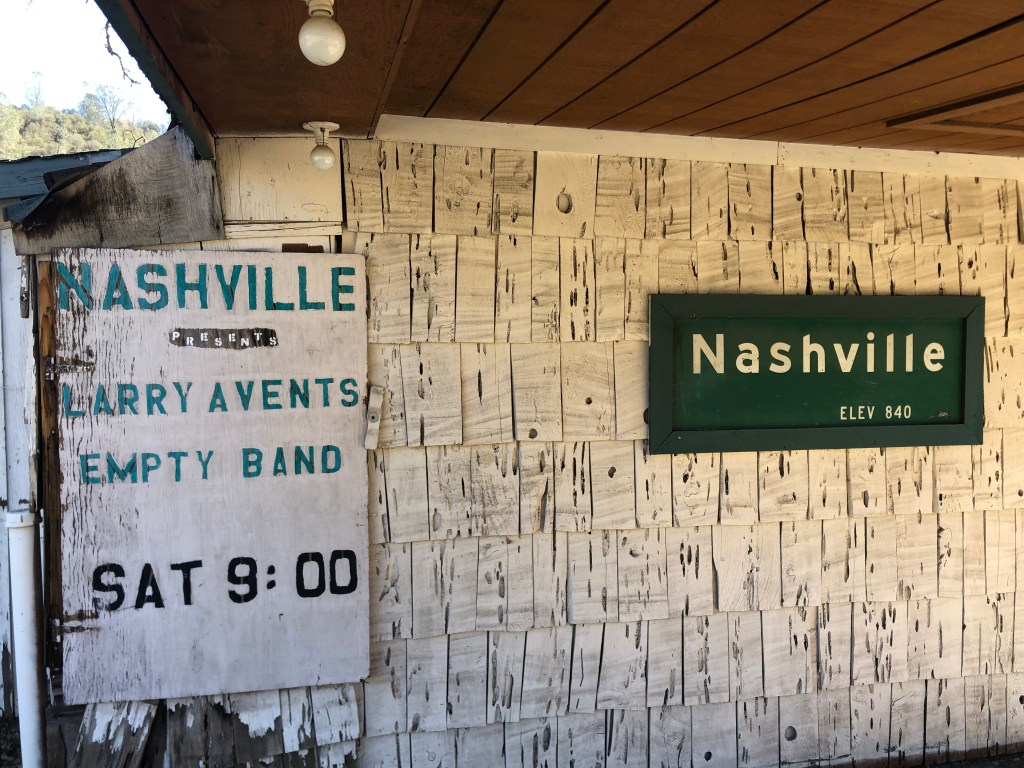
Somewhat further down 49 I entered Nashville. No, not the Nashville. But they do have their own music venue.
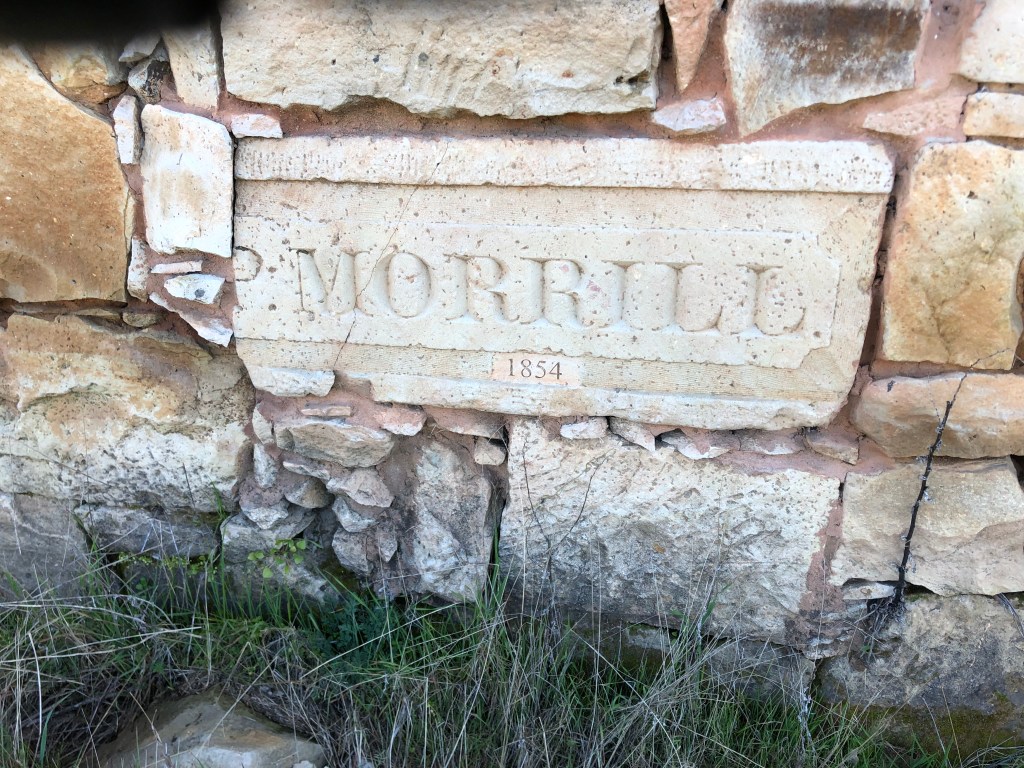
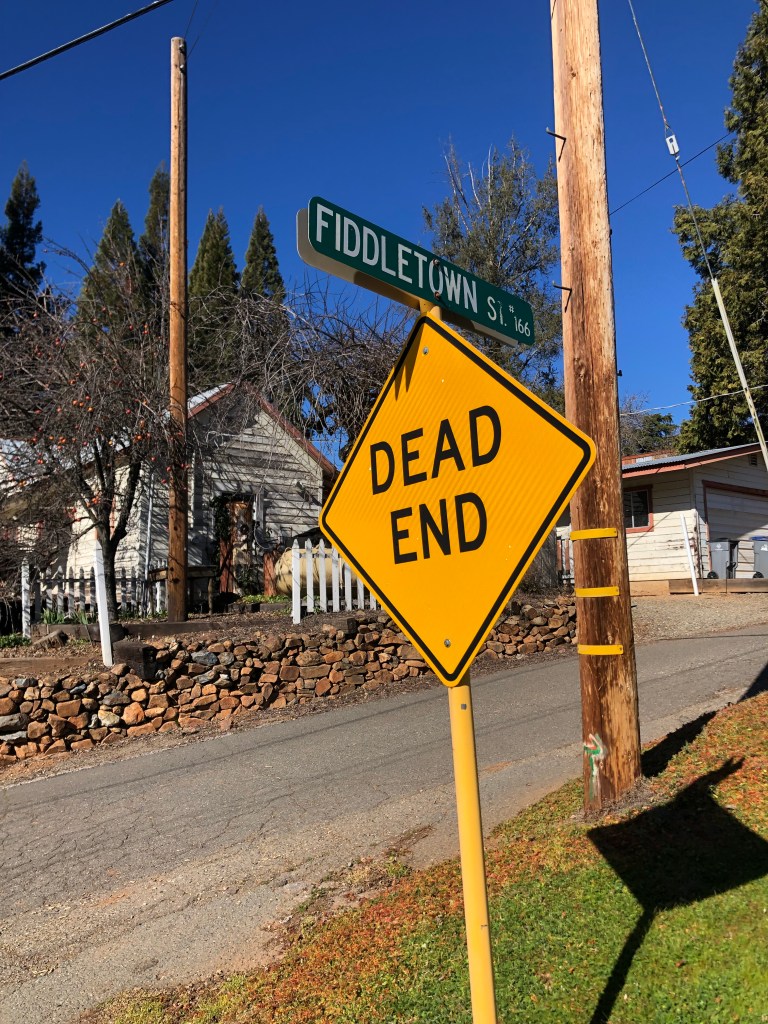
After a few random stops for gas, coffee, and Reeses (it’s my birthday, after all), ended up in Fiddletown (pop: 235). I spent several hours here. Fiddletown dates back to 1849, as do so many of the towns here in the Mother Lode Country. It didn’t start out as a particularly popular place to mine for gold, given that it didn’t have any year-round rivers or streams, which the miners needed for panning and placer mining.
Then, in 1852, gold was found in the region’s dry creekbeds, and everything changed. The town swelled with an influx of prospectors, and a canal was dug to divert water from the Cosumnes river into Fiddletown’s dry creekbeds. Not only did this facilitate easier gold mining, but it also opened the region to agriculture. By 1854 Fiddletown’s population exceeded 2000 souls.
With growth and wealth came the desire for respectability, which for some required changing the name to anything but “Fiddletown.” (It’s unclear where the original name came from, but one story suggests the original settlers from Missouri enjoyed playing fiddles in their spare time.) In any event, a decision was made in 1878 to change the name to “Oleta,” which was the name of a prominent resident’s daughter. Fortunately for those of us who appreciate local color, the original name was restored in 1932.
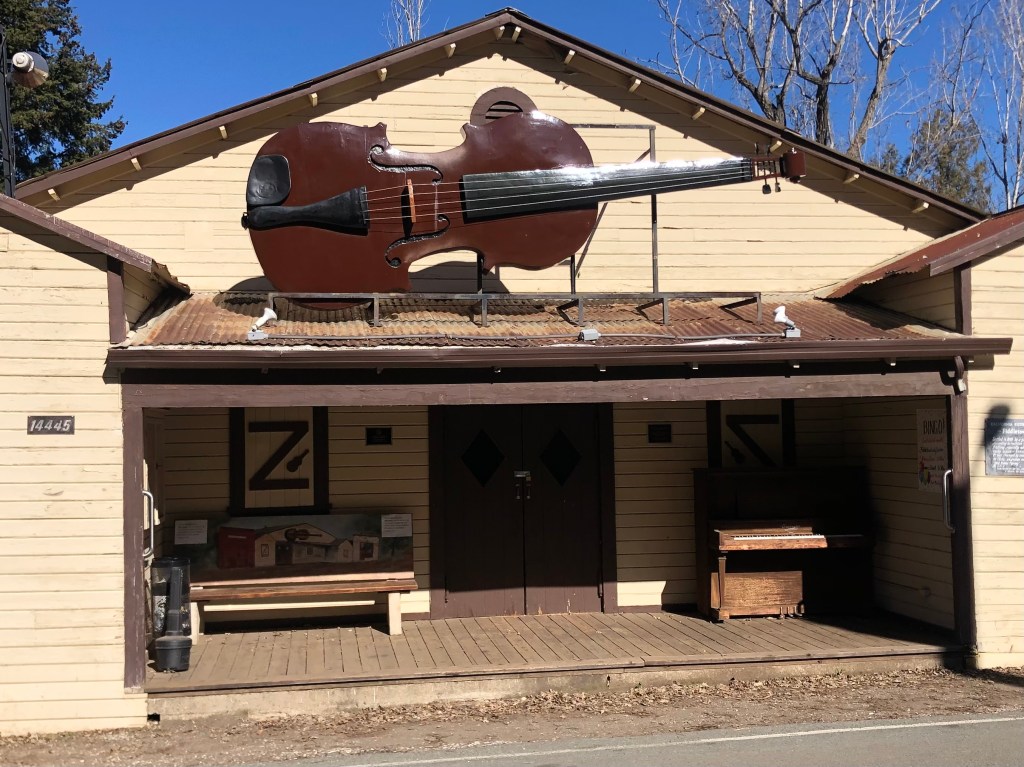
At some point, the town so embraced its name that it erected a huge fiddle over the community center. I’m told that there have been several iterations of this instrument. The latest version is made out of fiberglass.
It’s not a vile inn. It’s a fiddle.
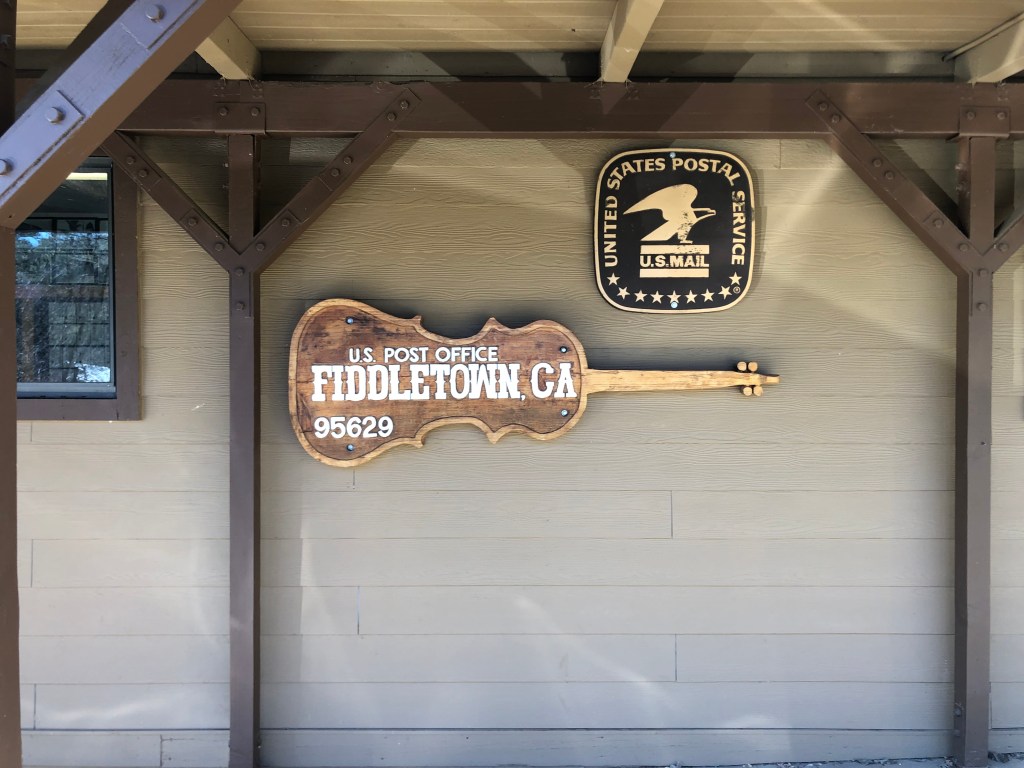
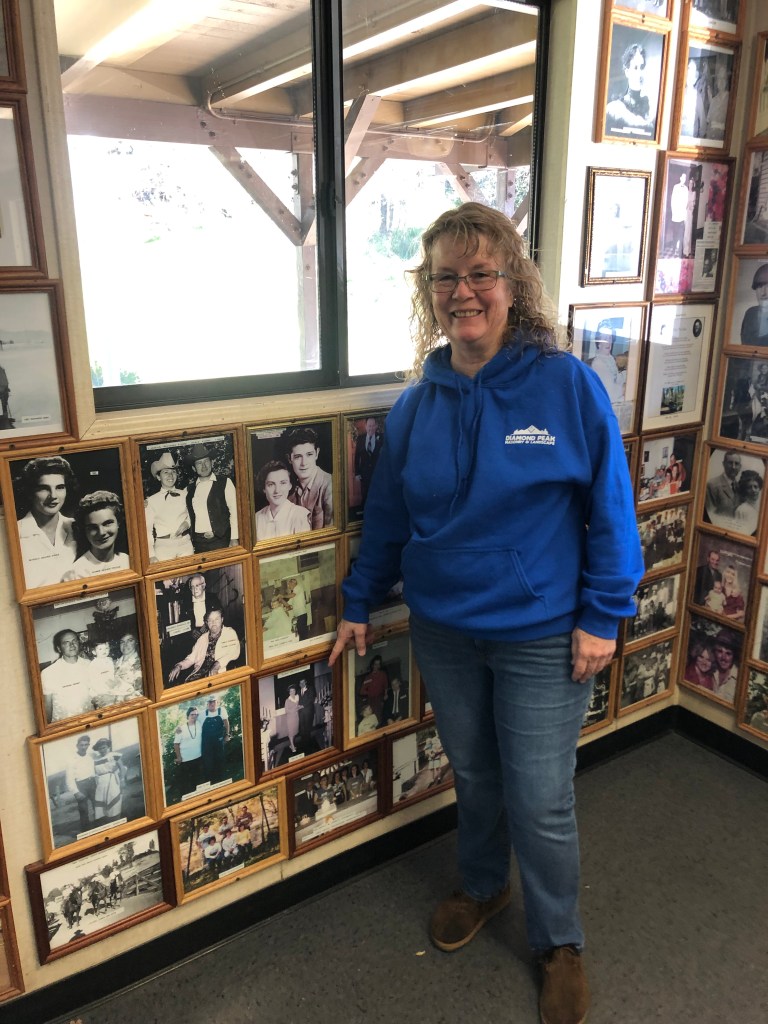
How do I know this? Because Michelle told me. I ran into Michelle at the town’s post office. The walls of the lobby are lined with historic photographs of the town’s residents, and I was perusing them when Michelle walked in to get her mail. There are literally hundreds of photos, so I asked her, “Is every resident in town pictured here? Where’s your photo?” She matter-of-factly told me that the post office ran out of wall space long ago, and replacing an old picture with hers “would require permission from the Post Mistress.”
Another Fiddle
Michelle then spent the next 20 minutes pointing out pictures of friends and relatives on the walls. She grew up in Fiddletown, and says it’s an wonderful place to live. She used to rollerskate in the community center (where the big fiddle is), and knows most of the residents. However, she said the town’s recent growth has made it difficult to keep track of everyone.
Michelle pointing to her grandparents’ wedding photo.
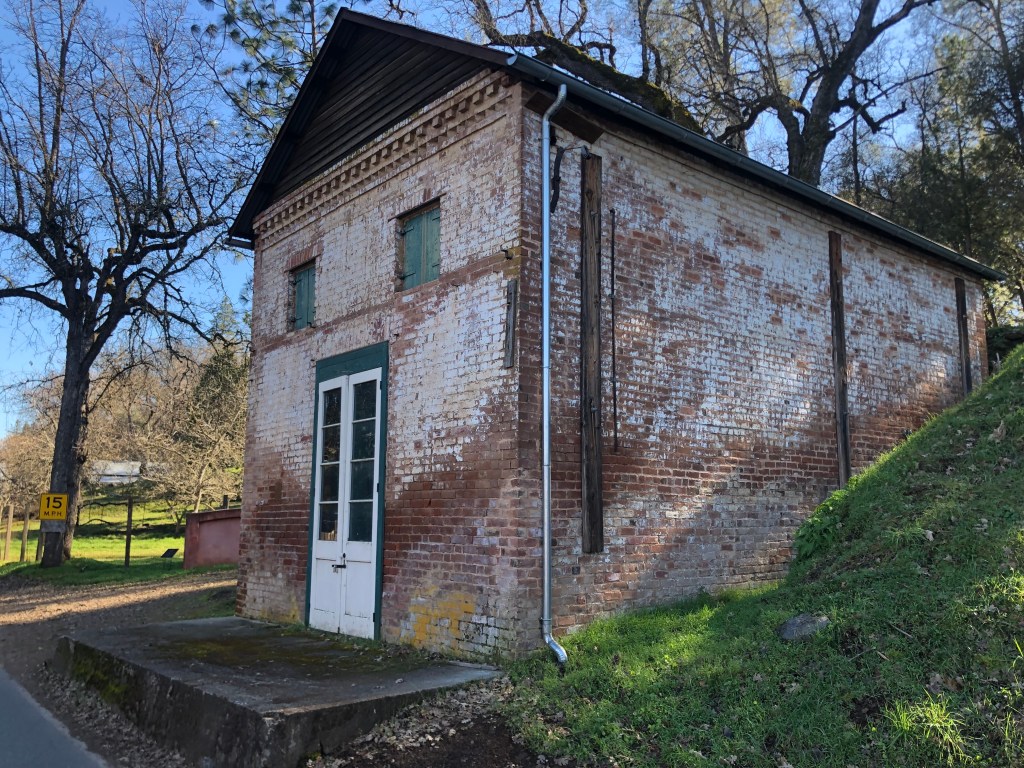
At some point Fiddletown became a major enclave for ethnic Chinese folks–in fact, for a time it boasted the state’s second-largest Chinese population, after San Francisco. Along the main street there are several well-preserved buildings that speak to the town’s Chinese heritage: A general store, a gambling hall, and an apothecary.
General store, built circa 1850.The “Fortune Peaceful Gambling House,” built circa 1852. It’s said that not only gambling but other vices–involving young women that weren’t your wife–took place within these walls.Apothecary, built from “rammed earth” in 1851.
The apothecary also serves as a museum (which, sadly, was closed when I visited). It contains personal effects from over 100 years of continuous habitation by Chinese “herb doctor” Yee Fung Cheung, his successor Chew Kee, and Chew Kee’s adopted son, Jimmie Chow. Jimmie Chow lived his entire life in Fiddletown, and was the town’s last Chinese resident when he died in 1965. Notably, Michelle (whom I’d met at the post office) had met Jimmie in the early 1960s. Her father and she took some fish heads to Jimmy’s house for his fish head soup. Michelle had thought it was a joke until she watched Jimmy add the heads to his soup pot. (If you’re interested, here is a recipe.) Michelle told me she was fascinated by the home/apothecary, and all the unusually artifacts therein.
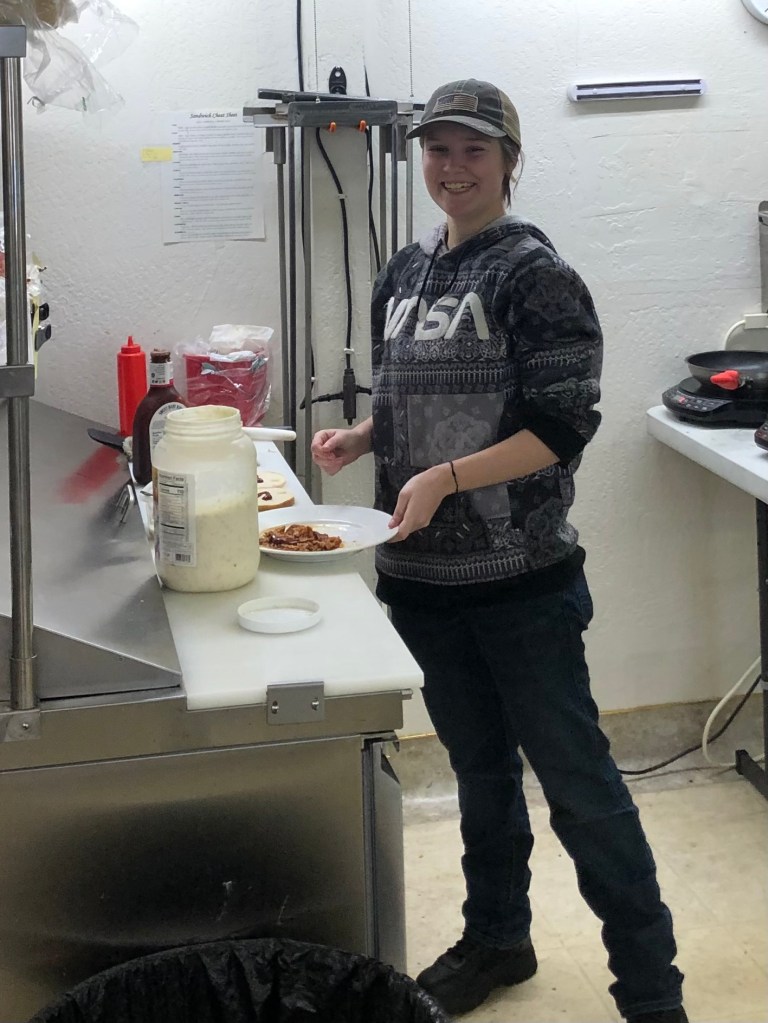
All this talk of fish heads was making me hungry, so I figured I’d scope out a place for lunch. There is exactly one place in town that will serve you a sandwich, so that made my choice easy. Improbably, it’s the Brown’s English Toffee store on Main Street. A young woman named Kailey, who’s been working there for the past two months, took my order. After a few false starts (they were out of the meat and the bread that I wanted. But other than that, they had just what I wanted for a sandwich!), she managed to produce a pulled pork sandwich with cole slaw.
Would you like mayo on that? I have plenty…
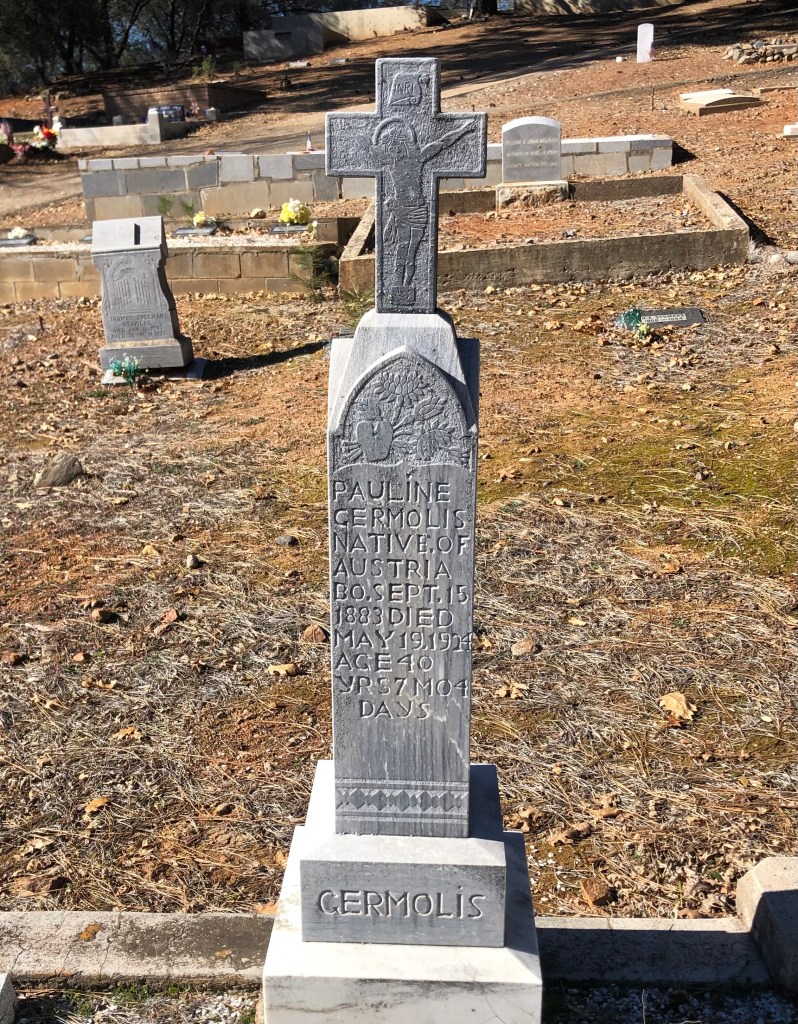
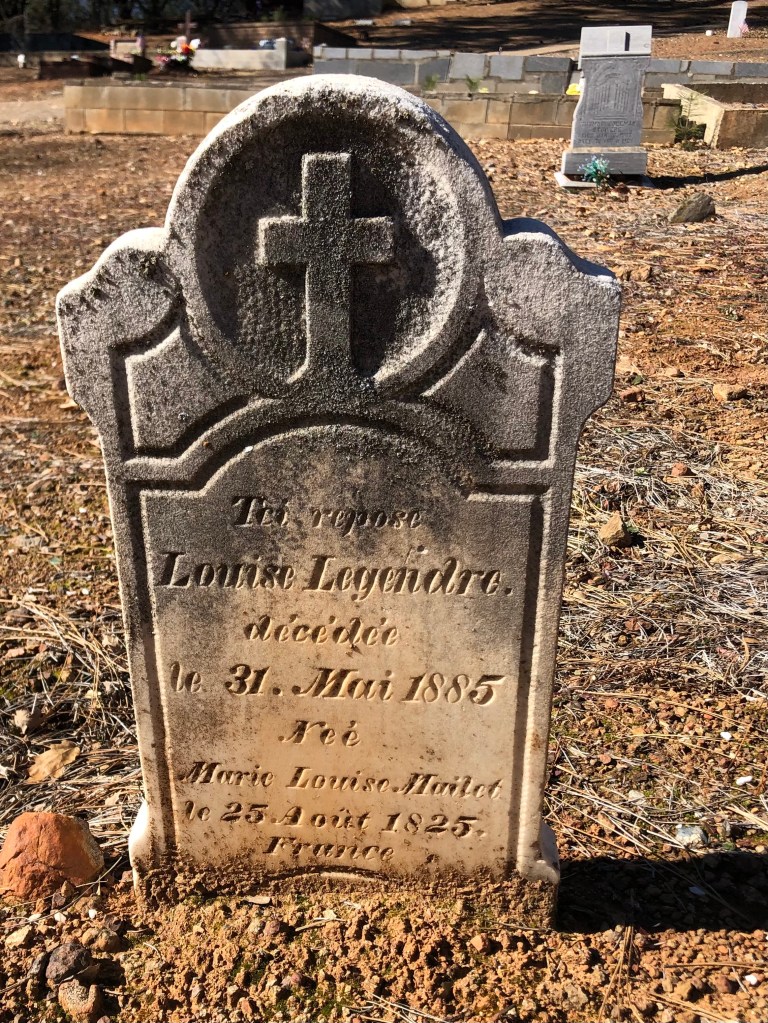
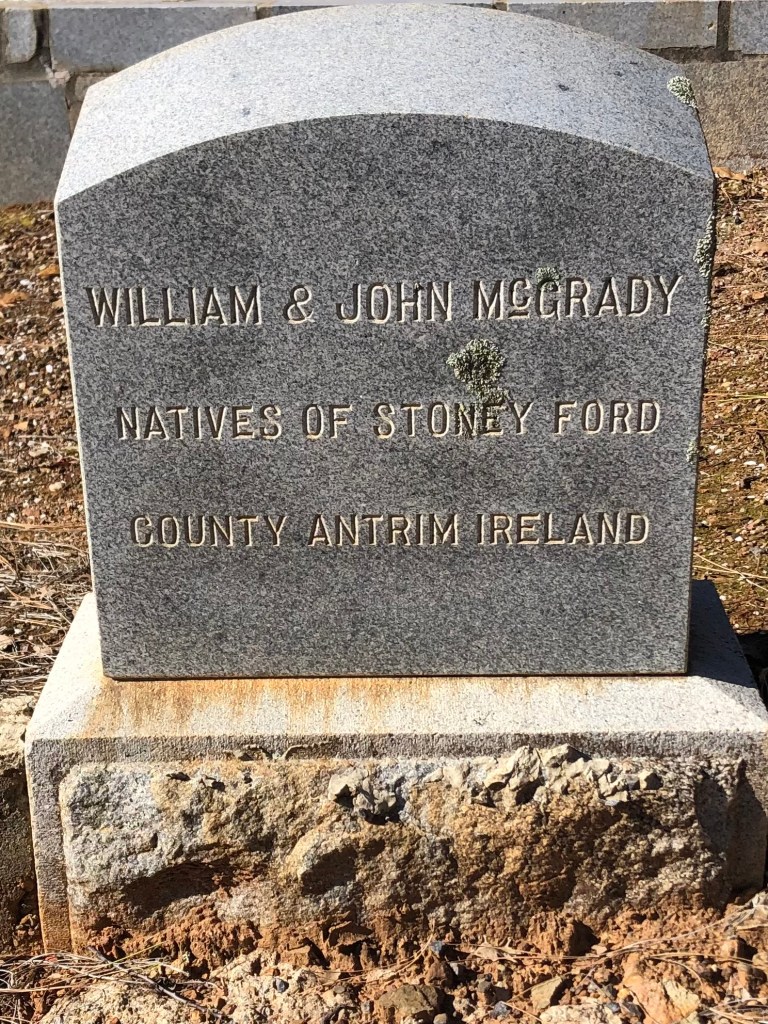
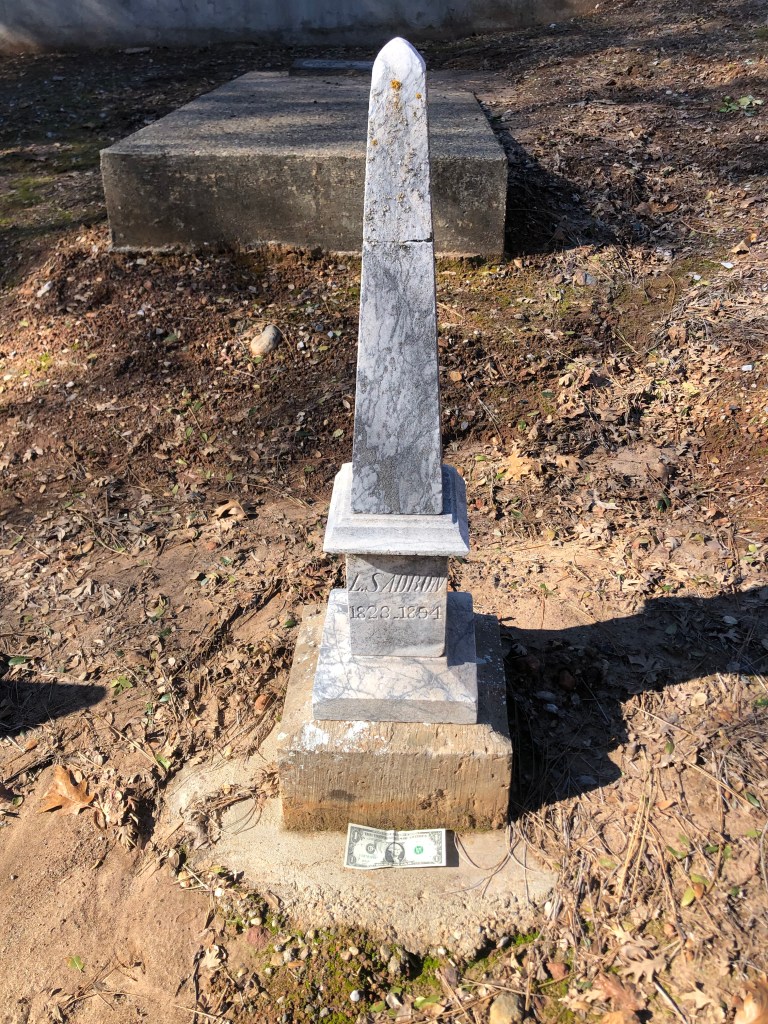
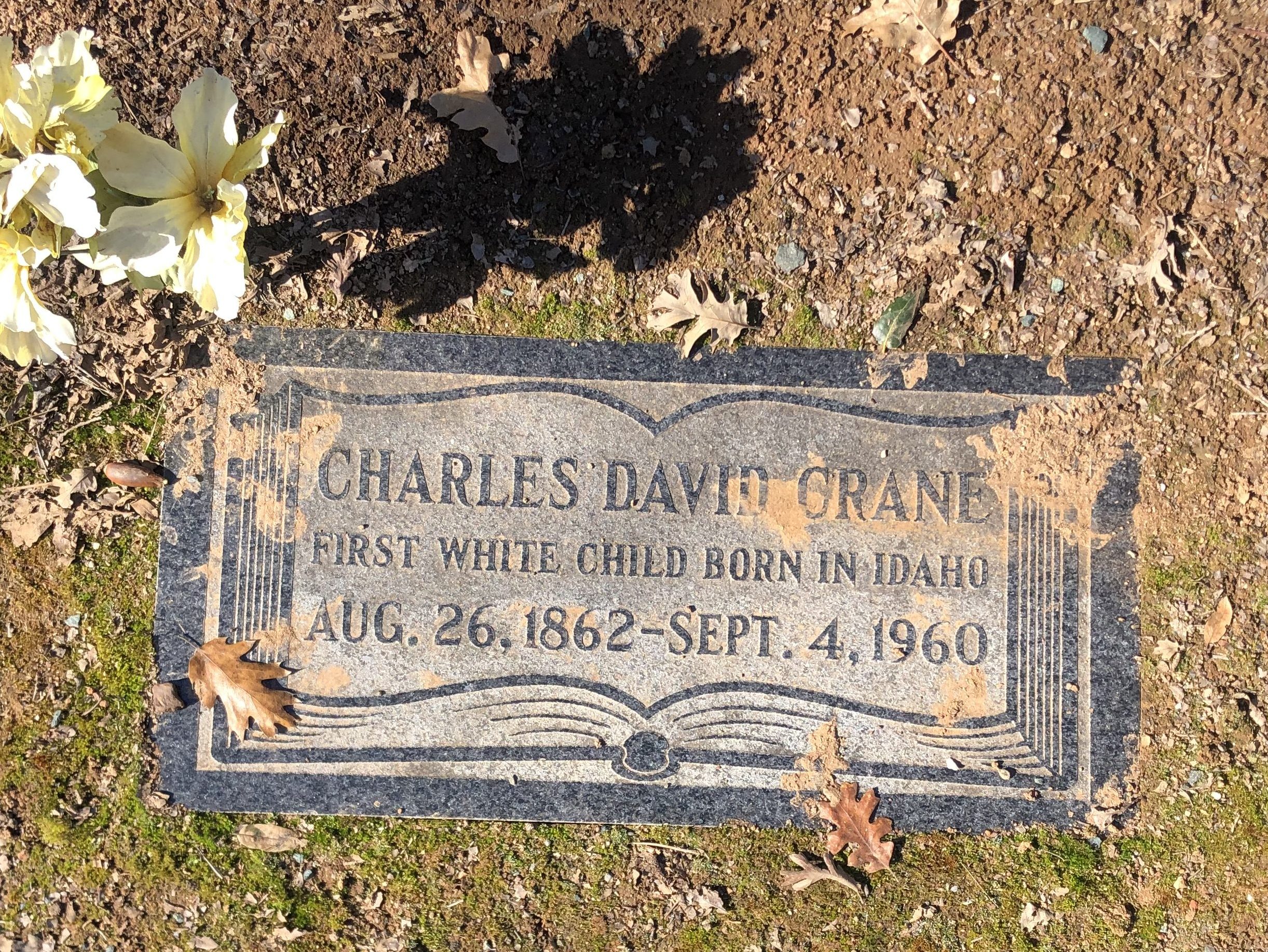
It was now time for my traditional cemetery visit. The Fiddletown Cemetery was established in 1870, and is the final resting place for a broad swath of humanity. The headstones offer testimony to the large number of countries from which the 49ers hailed:
Austrian, French, Irish….
And of course there’s an obelisk. This is tiny (see the dollar bill for scale). They couldn’t even fit on the poor guy’s first name!Everyone has an angle…
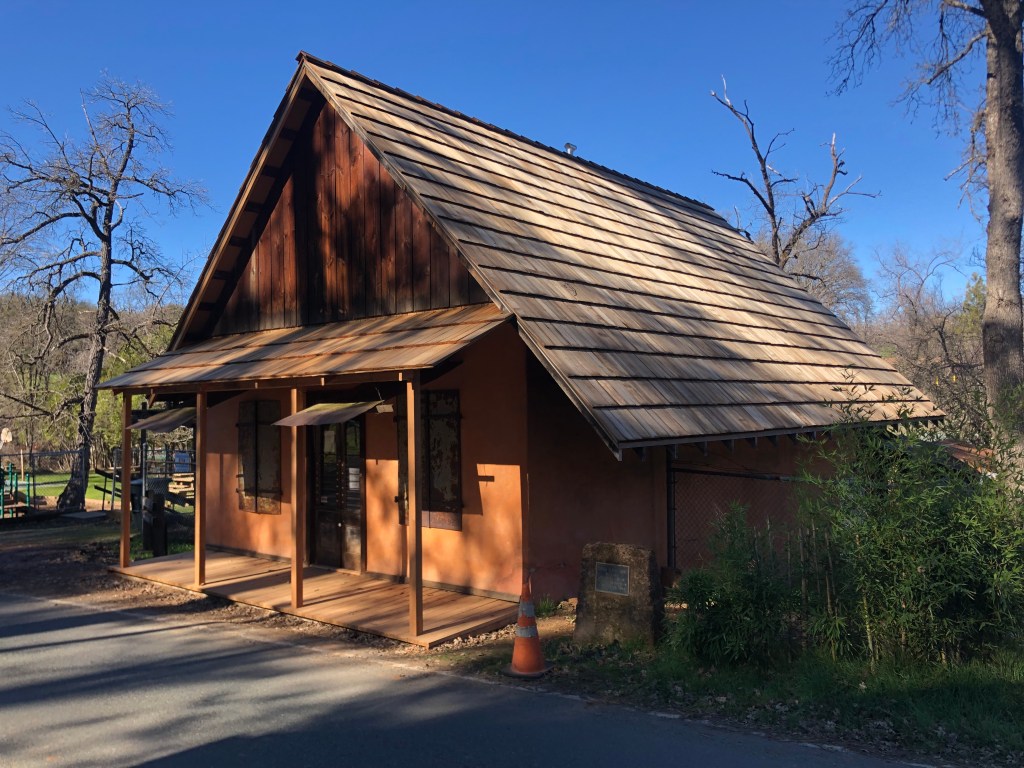
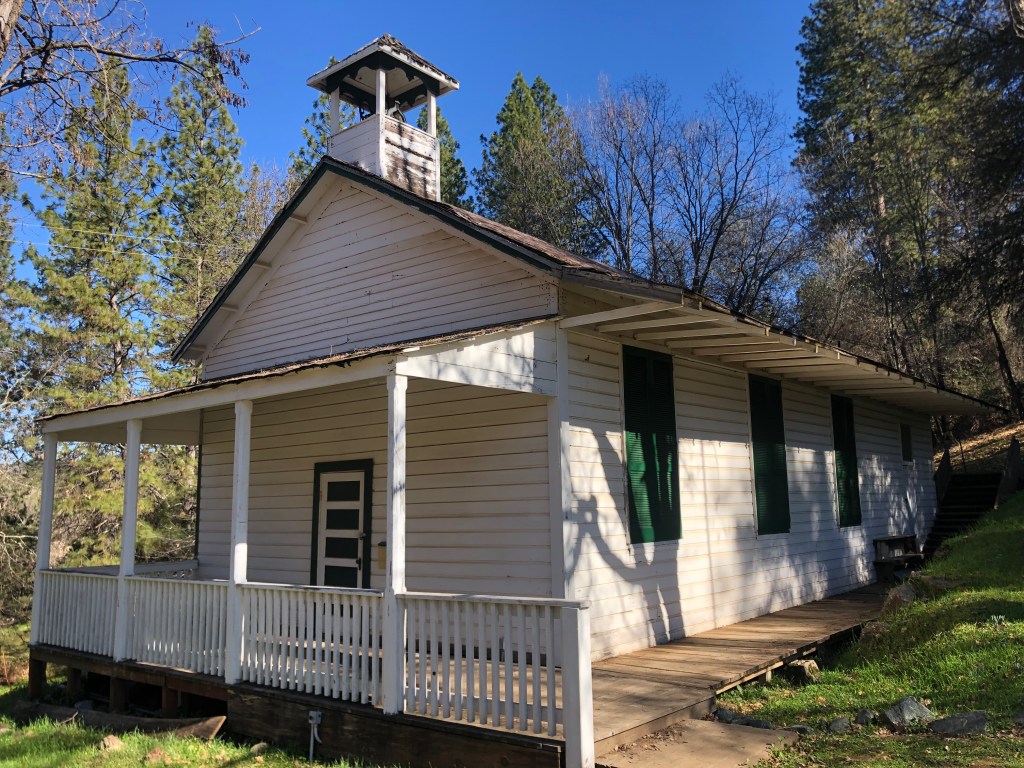
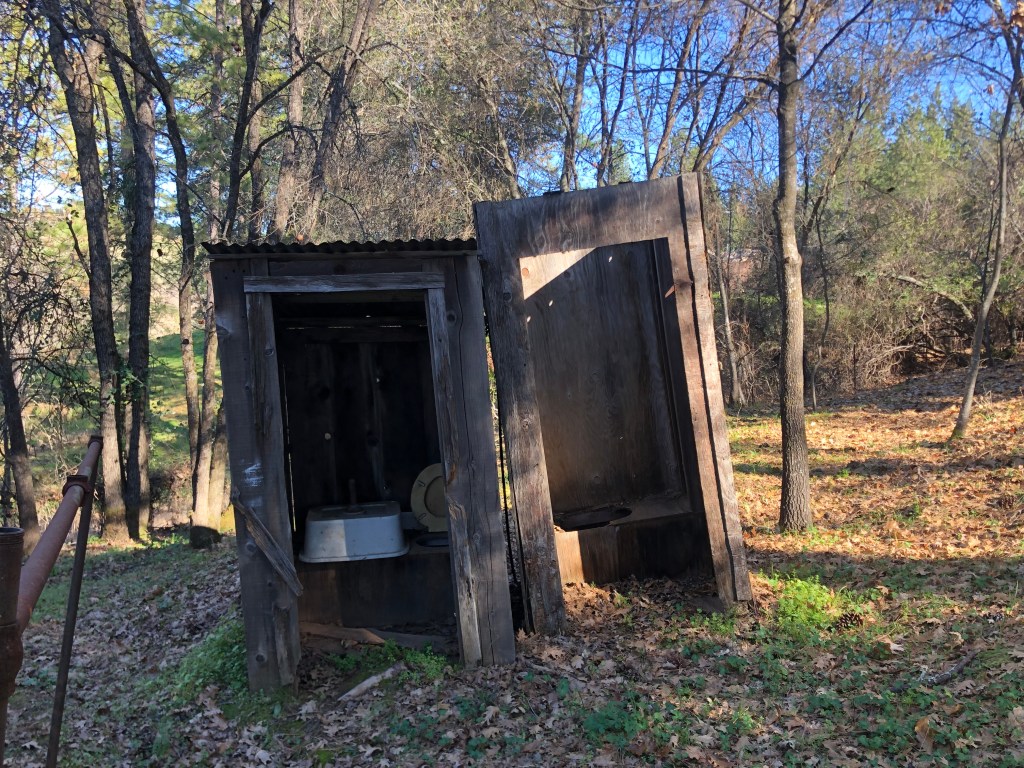
Across the street from the cemetery is Fiddletown’s historic one-room school. It was constructed in 1862 and was in operation until 1955, when the area schools were consolidated and relocated to the nearby town of Plymouth. The school had no running water, and featured outhouses (which are still extant) in the back.
The Schoolhouse….…and privies.
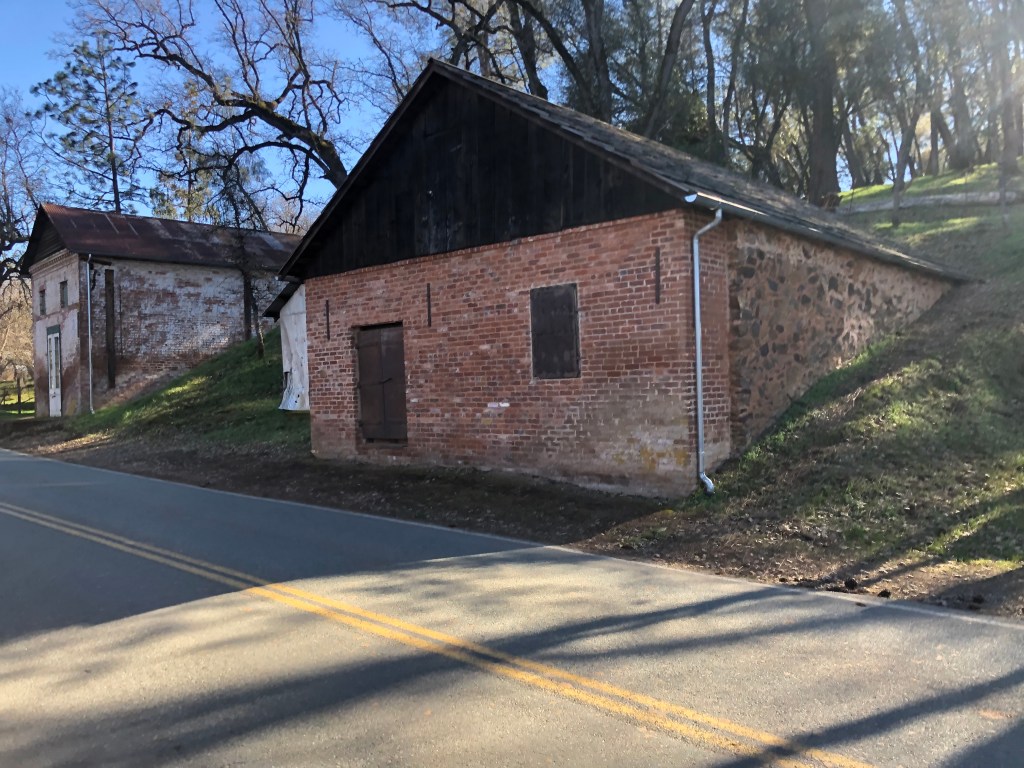
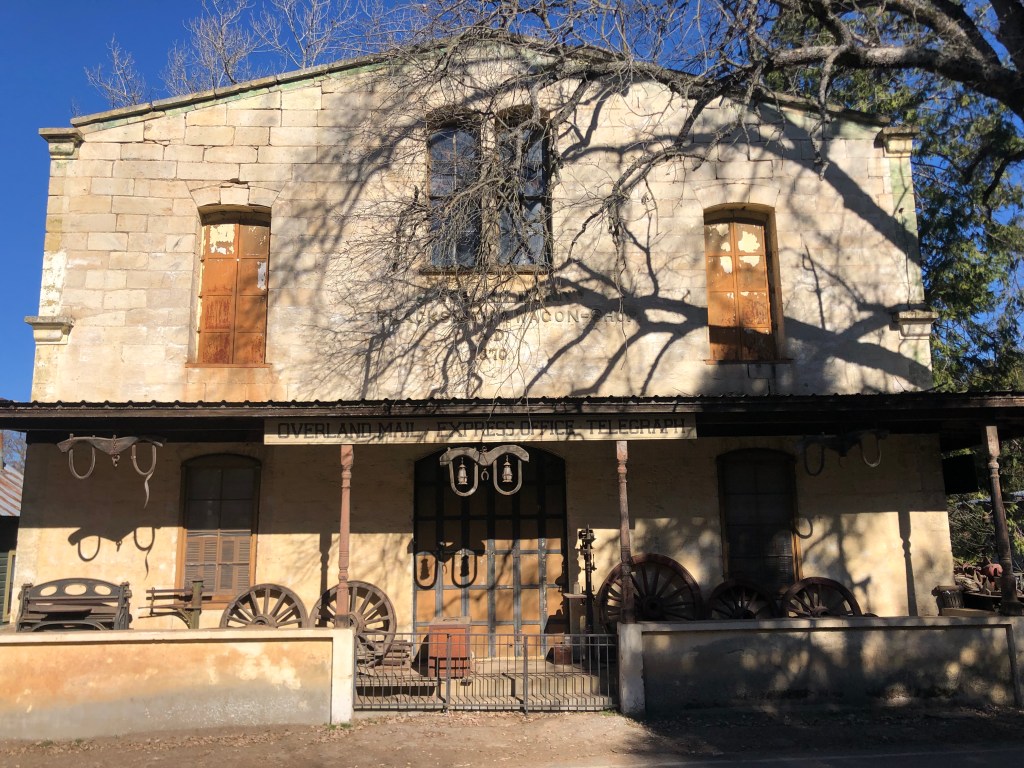
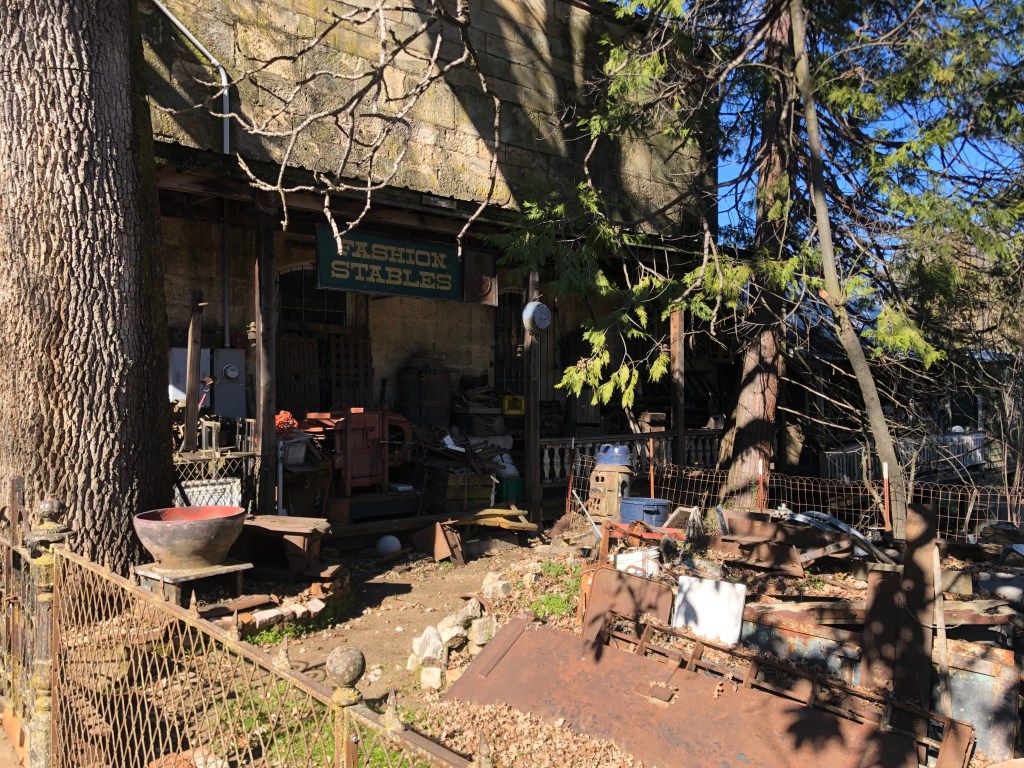
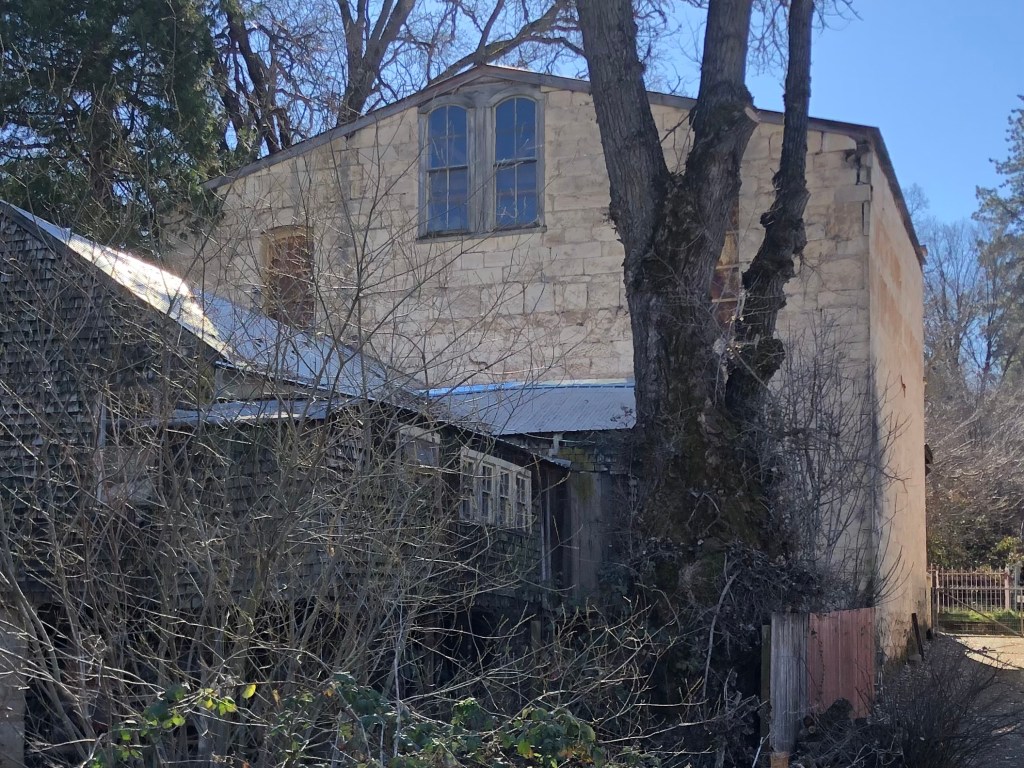
One other notable structure is the looming Schallhorn building, built in 1870. It was a long-time blacksmith’s shop and wagon repair facility, as well as a telegraph office and mail stop. Today it appears to be the site for accumulating various historic artifacts. The front porch is littered with wagon wheels, metalworking equipment, a safe, a old ovens, even a small railcar. Heaven knows what’s inside the massive building itself!
Front o the SchallhornMore junk on the sideBack view
It was beginning to get late, so I decided to head back home. One of my final glimpses of Fiddletown suggests a story that I honestly don’t really think pertains. If you ask me, I think this place has a future.
Unfair intimation.
So, that was my trip to Fiddletown. I managed to get home in the afternoon without incident. I wish you all a very happy Steve Boilard’s birthday. I suggest celebrating with the high-gravity imperial stout of your choice.
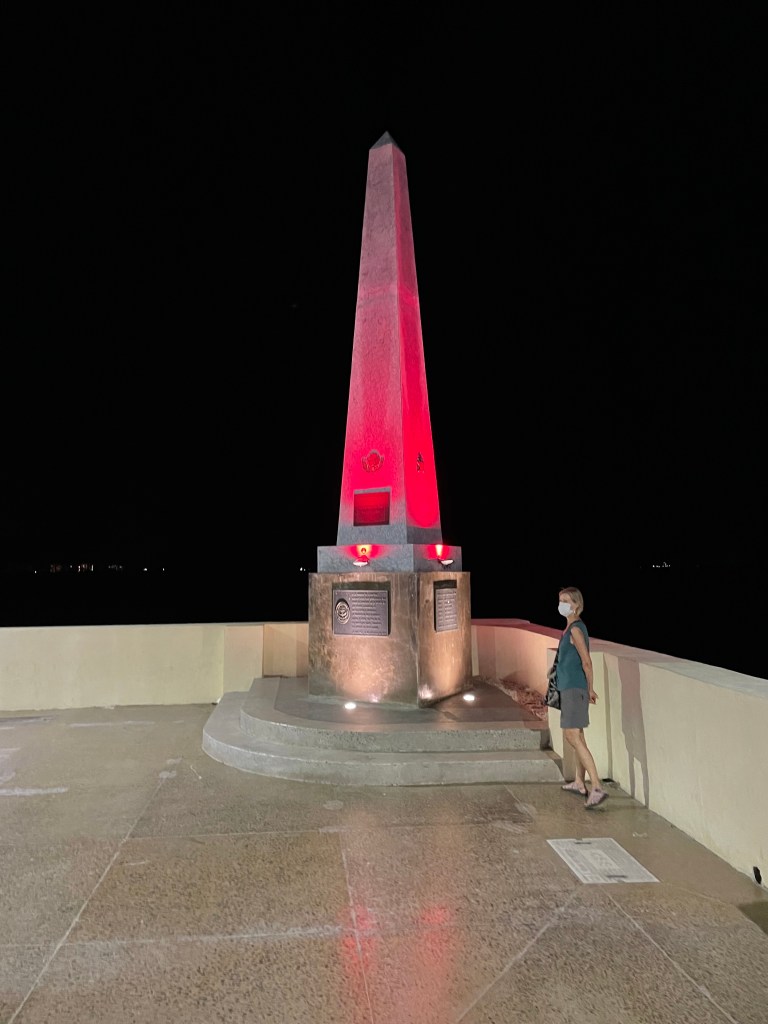
Loyal reader Brian W. recently shared this photo he took of a technicolor obelisk in La Paz, Mexico. He reports that the obelisk is a “memorial to the defenders of the homeland,” but he admits that his Spanish is a little rusty and it might actually commemorate the birthplace of disco.
This not the largest obelisk to appear in this blog, but it’s certainly the most colorful (at least, it’s decorated with a colorful light).
Send in your obelisk photos to keep this blog alive while our road trips are on hold during the winter.

 Chasing Phantoms