Breweries · bridges · California history · Cars · movie theaters · Road trips · Yard art

Been There, Done That, Got the T-Shirt

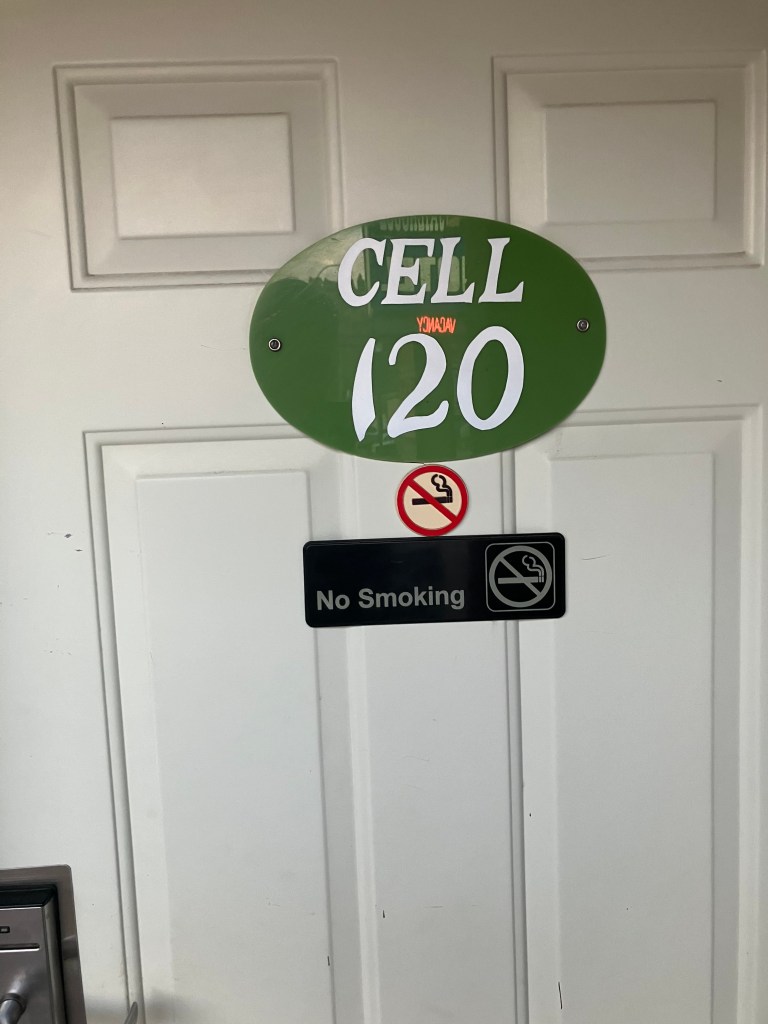
This morning I headed downstairs from my motel room to partake of the “free” breakfast. Then I spotted this sign in the breakfast room:
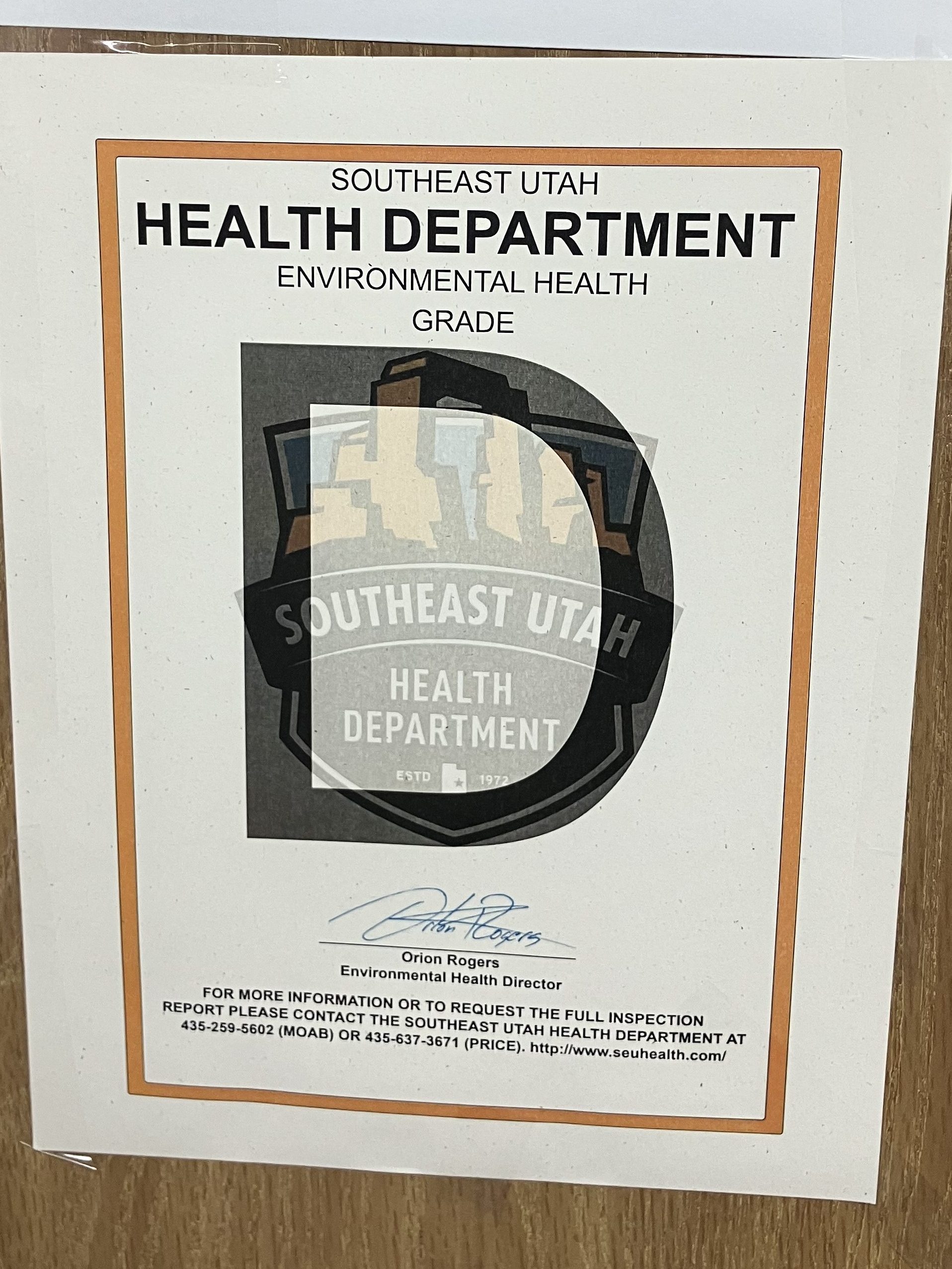
But a “D” is technically passing right? At least that’s what I used to tell my parents when I brought home my report card.

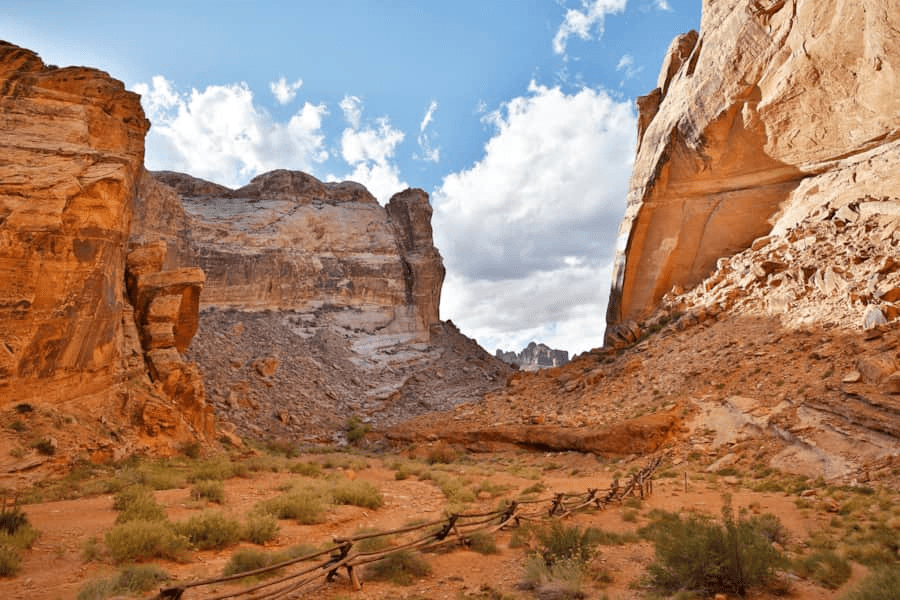
Instead of the motel breakfast, I got a gas-station coffee and donut. I then got onto the U-28 scenic byway, which carves its way through the Colorado River gorge towards Grand Junction. It was so spectacular it even made my donut taste good.
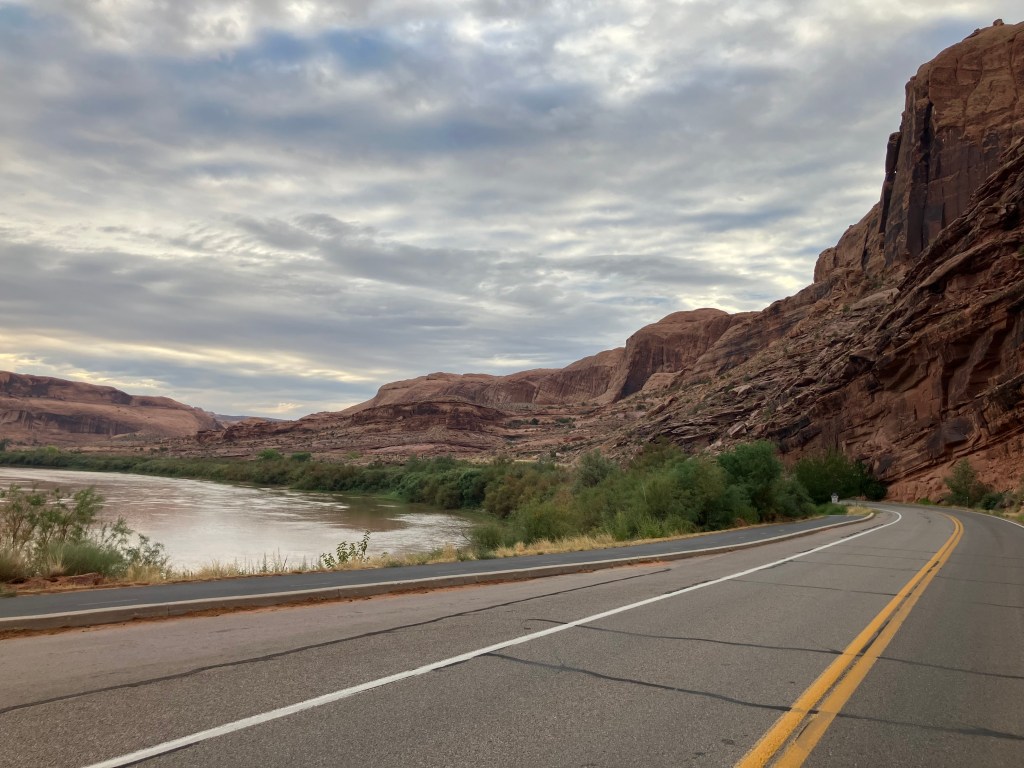
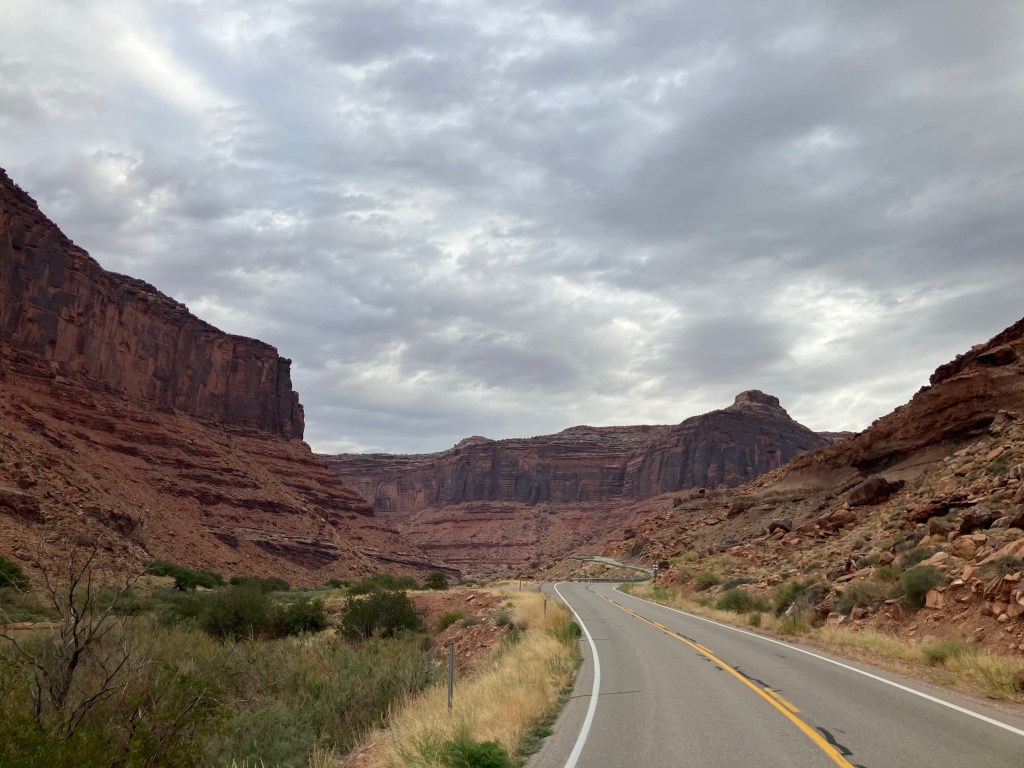
That’s the muddy Colorado River on the left.
A perfect setting for a Western…which it has been, many times.

After maybe half an hour of driving I came across a pedestrian suspension bridge that crosses the Colorado River. Attentive readers will recall that I’m a sucker for these things, so I looked for a place to pull over and sway my way across the (not-so-) mighty Colorado.
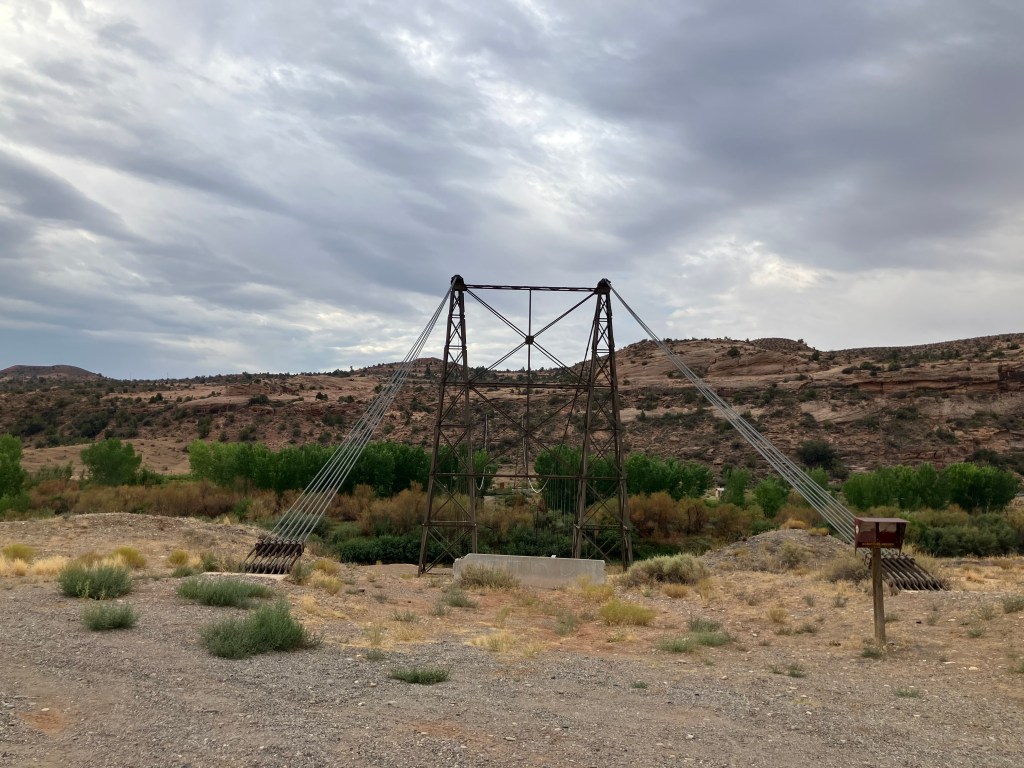
So far so good…

So imagine my disappointment when I discovered that the bridge’s decking was entirely missing.
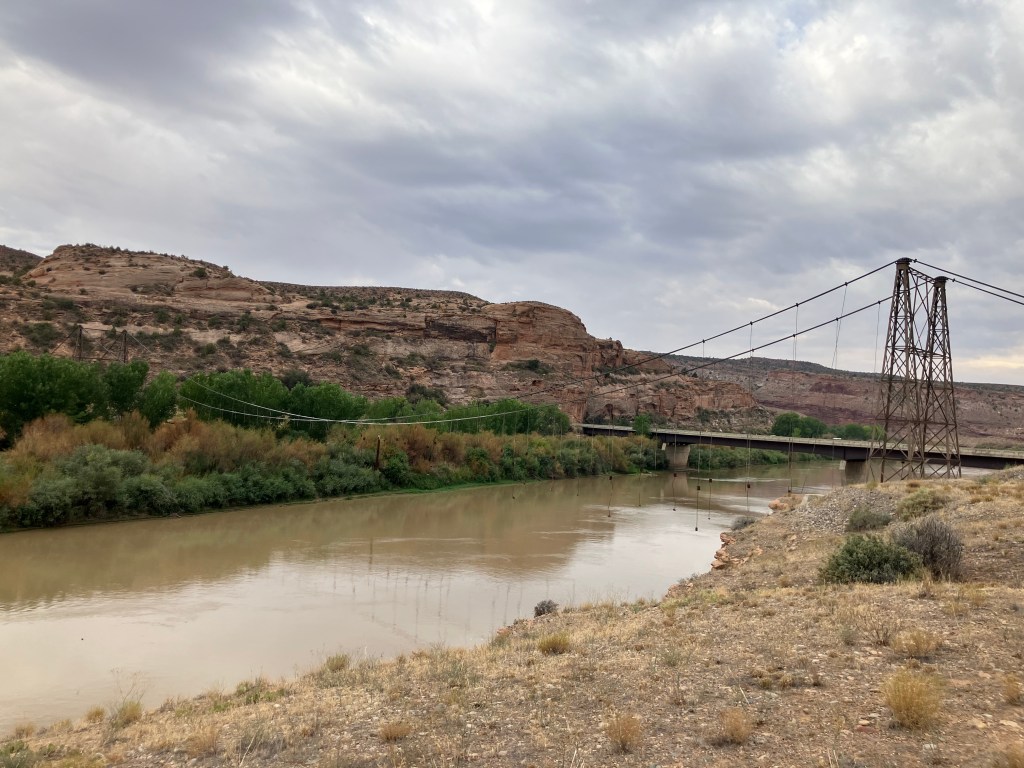
…but wait–what’s wrong with this picture?

Turns out the Dewey Bridge (for that’s its name) was built in 1916 and is Utah’s longest suspension bridge. It was fully restored in 2000….and eight years later some kid was playing with matches and the whole thing went up in flames.
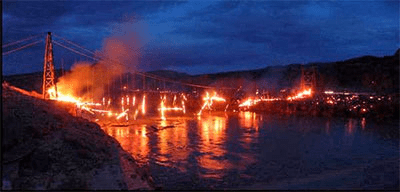
Kids, don’t play with matches! (2008 photo from Wikipedia Commons.)

A sad and ghostly air hangs about the skeleton of the Dewey Bridge. It set back my good mood a bit.

A little later I came to the town of Fruita, Colorado (pop: 13,400). I could live in this town. It’s one of those places that’s figured out how to preserve its history, cater to modern tastes, create a livable community, and attract tourists. The town is jammed with public art, and the main street has plenty of outdoor cafes and benches to relax, have a cup of coffee, and watch the world go by. It seems that most of the buildings along Main Street are historic and well-preserved or restored.

One public art installation that made me scratch my head was this rooster with no head:
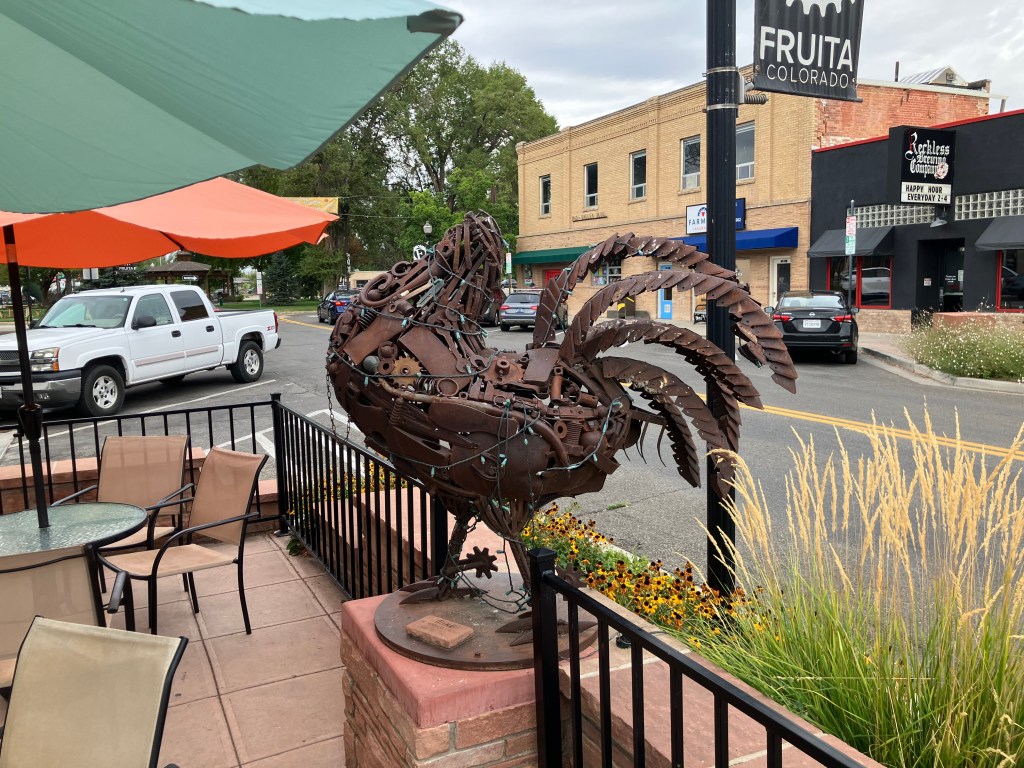
A friendly fellow drinking coffee at an outdoor table noticed me photographing the sculpture and gave me the story of Mike the Headless Chicken. (Trigger warning for those sensitive about food preparation by carnivores.) It seems that in 1945, a local farmer by the name of Lloyd Olsen was attempting to behead one of his chickens for dinner. His aim was a little off, and most of the chicken’s brain stem remained with the body. The chicken survived his beheading, flapping his wings and running around headlessly. What was Lloyd to do? He spent the next year and a half carefully feeding Mike (for that was the chicken’s name) individual kernels of corn through the throat and addressing Mike’s thirst with milk and water from an eyedropper. Mike became a sideshow attraction and gained national fame. Indeed, I remember reading about Mike in a “Ripley’s Believe It Or Not” paperback in the 1960s. Fruita still remembers Mike with the sculpture, T-shirts and other souvenirs, and an annual “Mike the Headless Chicken Festival” each spring. I am not making this up.

Fruita also has a lot of non-headless-chicken art around town. In fact, I noticed that many of the towns in eastern Utah and western Colorado feature interesting public art installations. Here is a sampling:
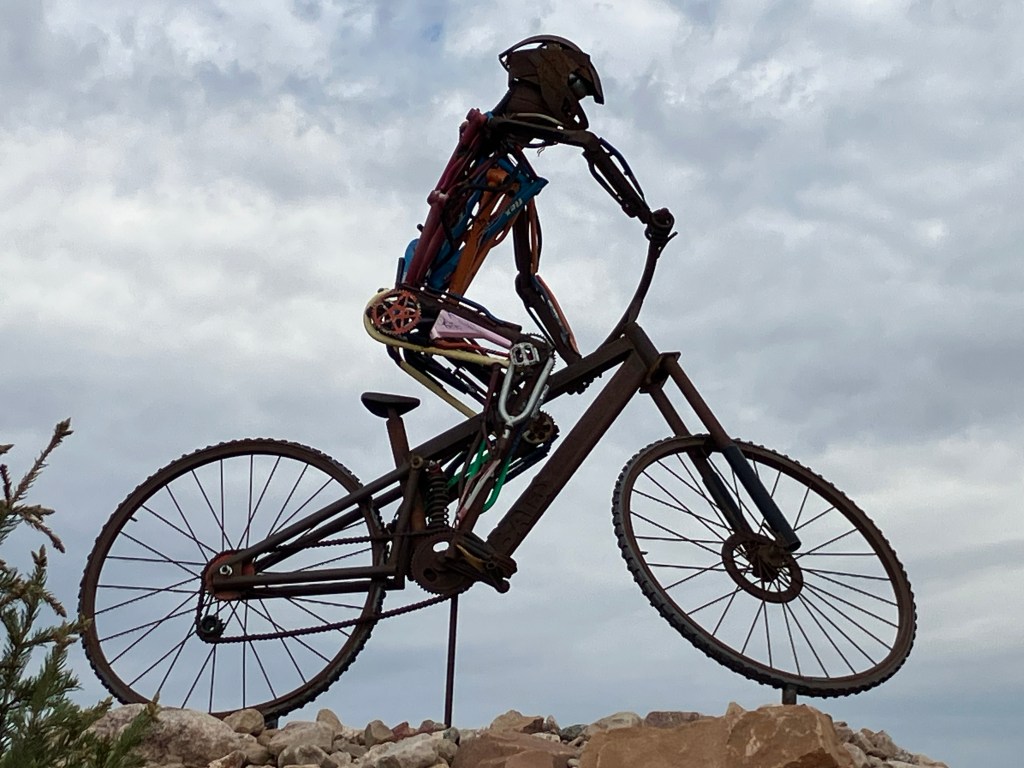
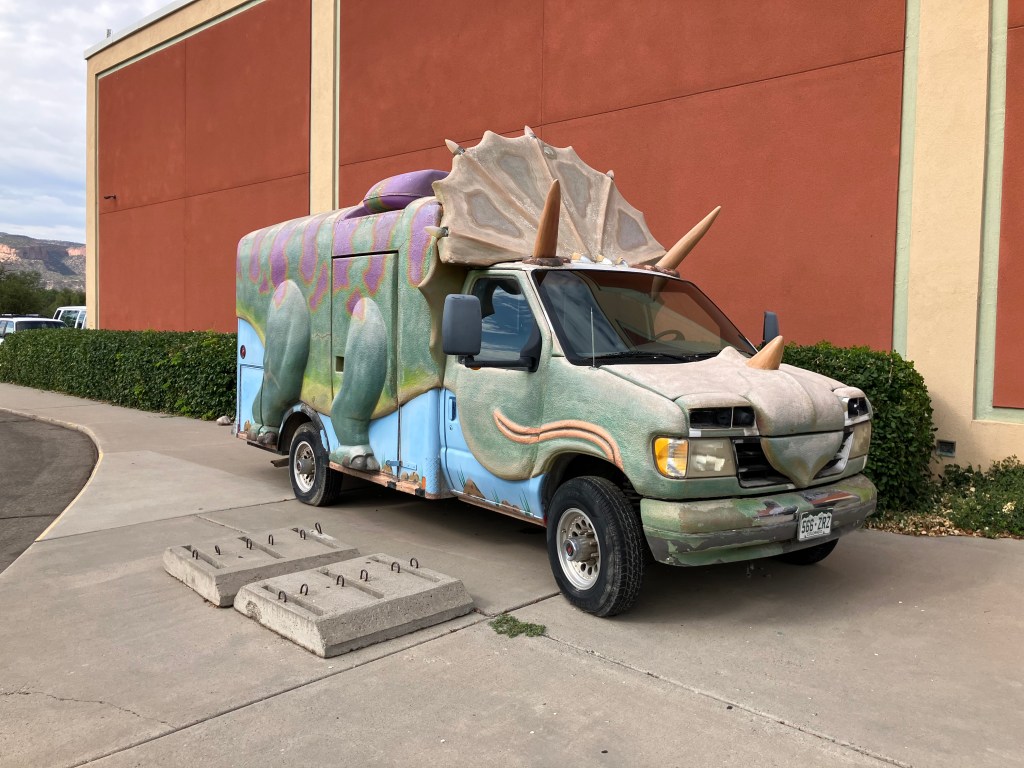
Bionic bicyclist in Fruita.
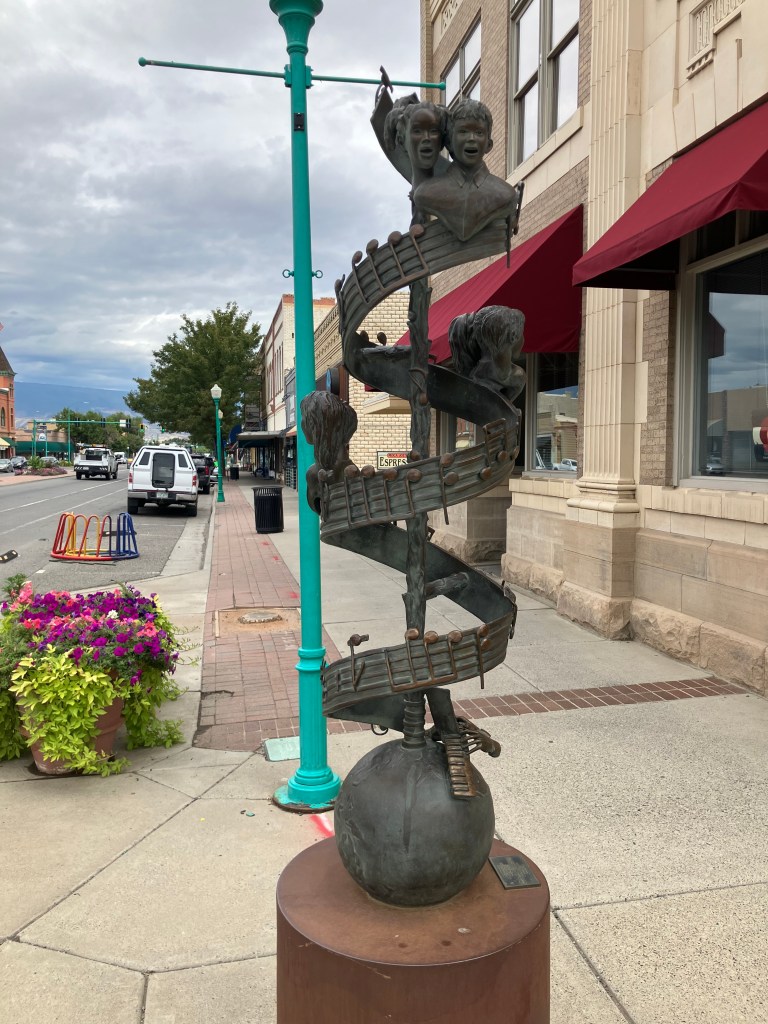
Sculpture honoring children’s music teacher David Carl Moore in Delta, Colorado.
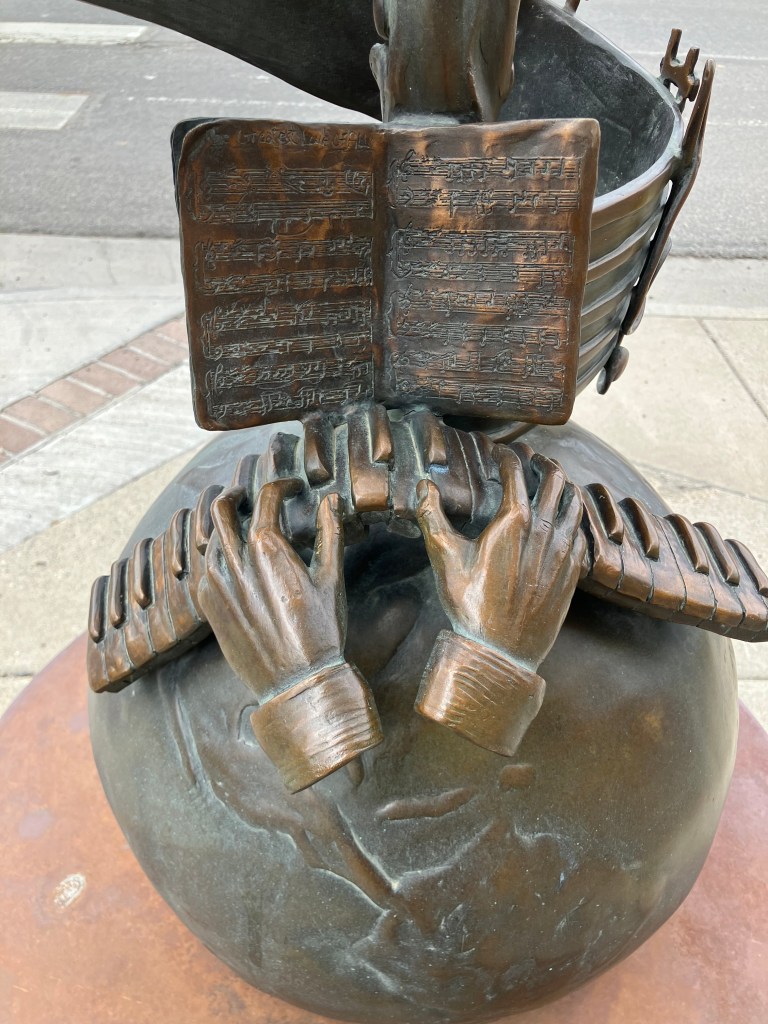
Detail of the Moore sculpture.
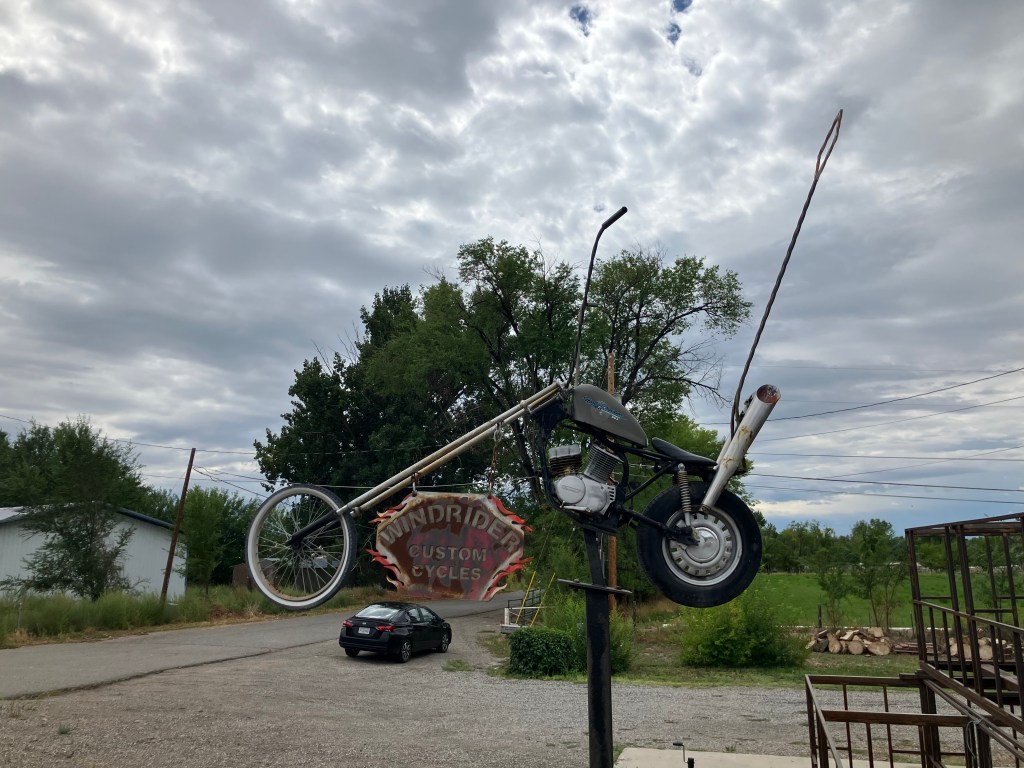
Windrider Custom Cycles sculpture in Delta.
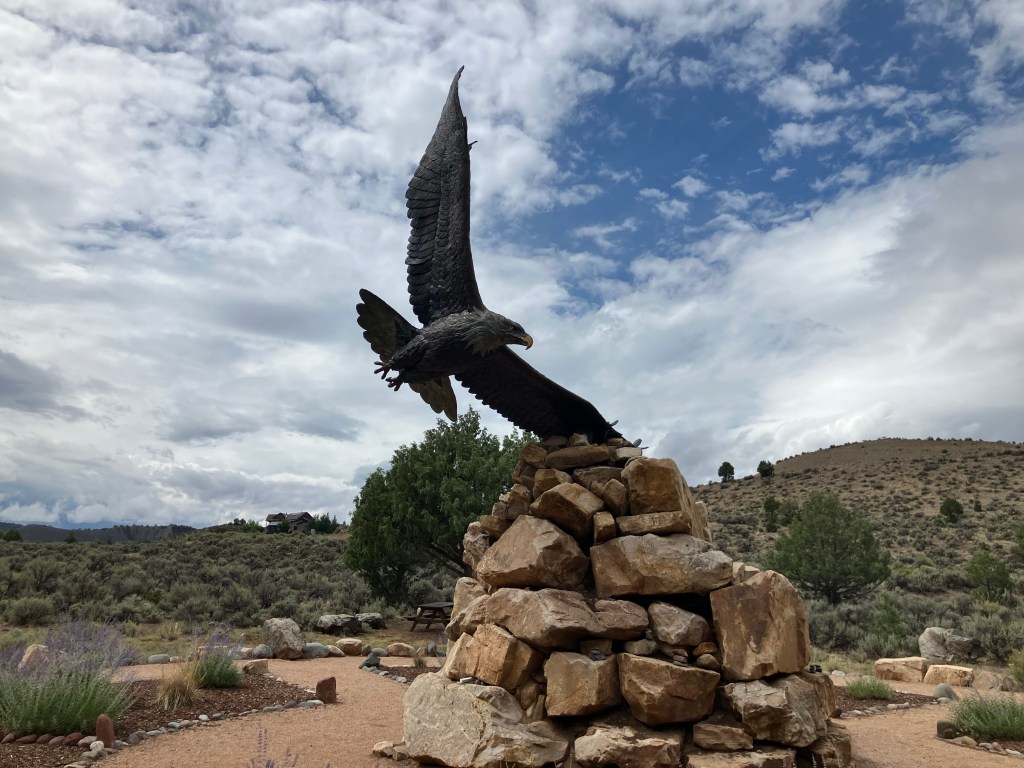
Sculpture at Dennis Weaver Memorial Park in Ridgway, Colorado. Dennis Weaver (I remember him as McCloud from the NBC television series) reportedly loved eagles and lived in Ridgway for many years.

I also randomly ran into these women playing the tubular bells (?) xylophones(?) that are installed at the park. Somehow I think Dennis Weaver would have appreciated it.
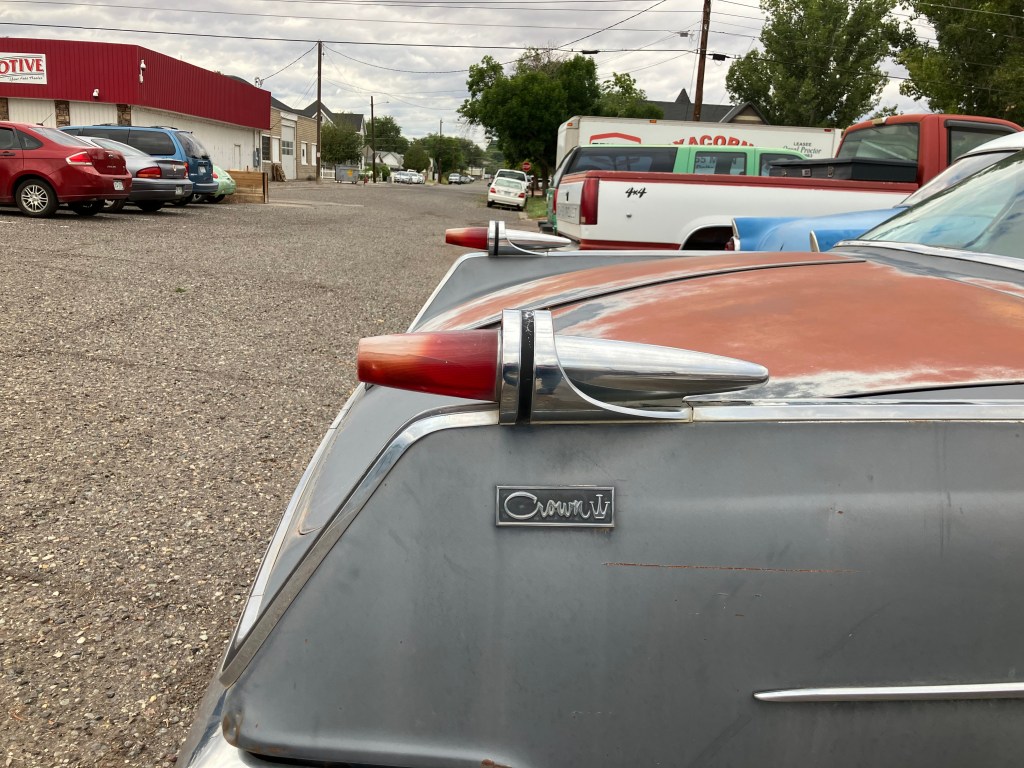
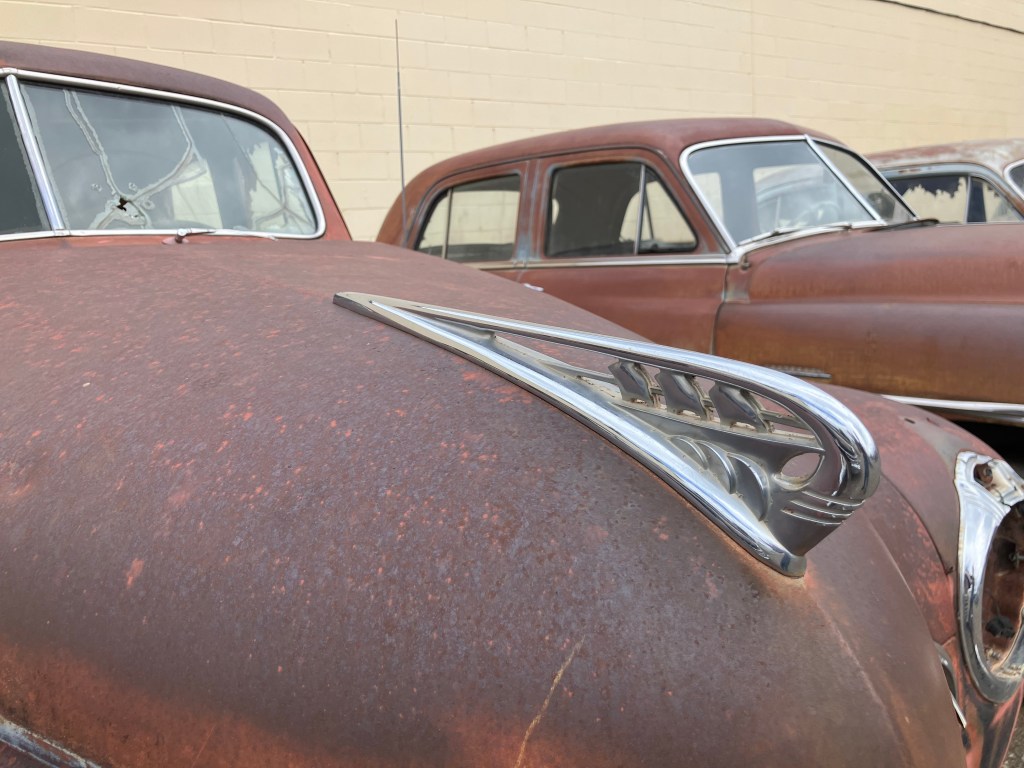
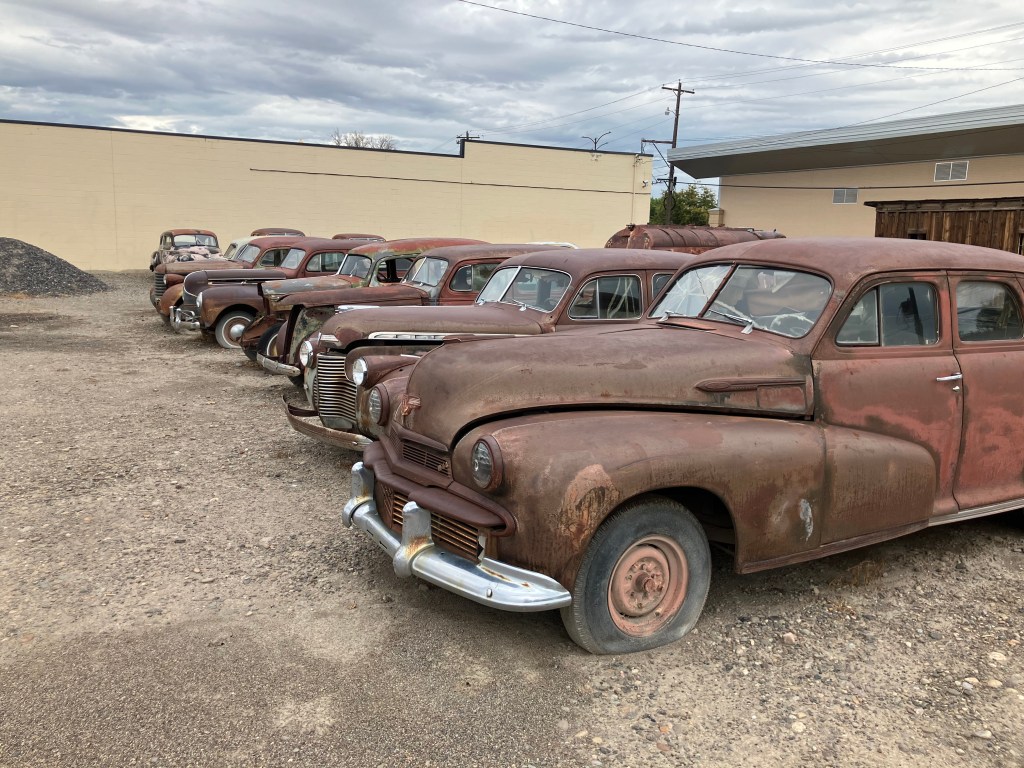
I’m not sure if it technically qualifies as art, but there is a large number of long-parked classic cars on both sides of the street in downtown Delta, Colorado.
Artistic Chrysler hood ornament.
Used car lots, frozen in time.

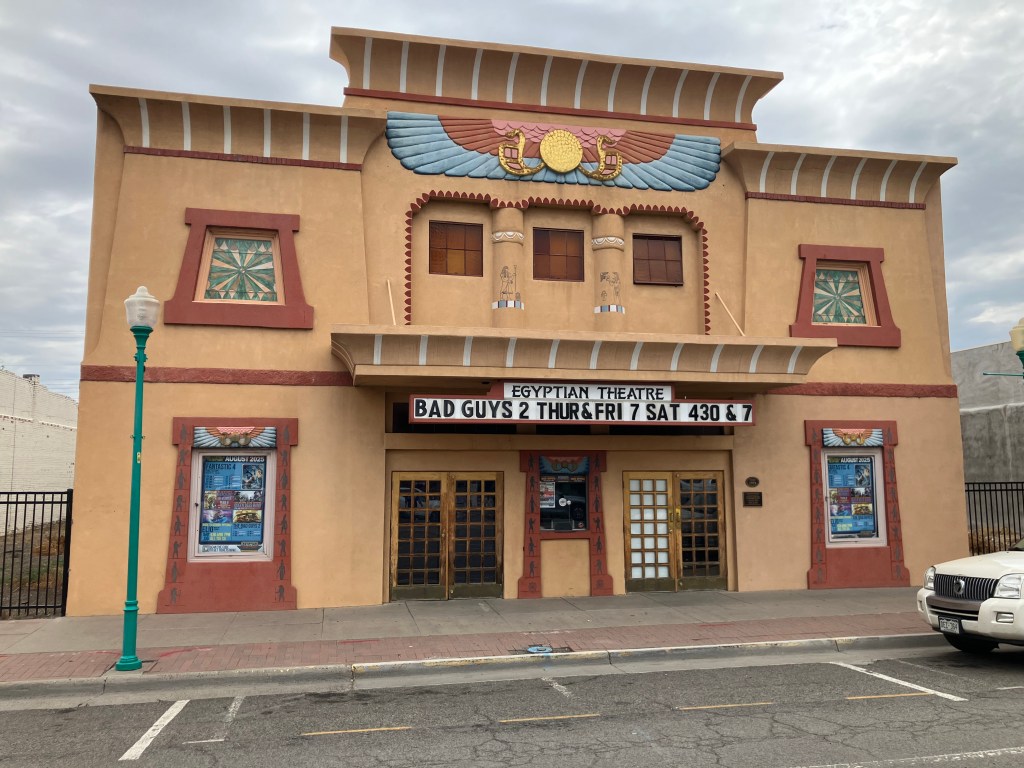
Also related to this theme of public art is the 1928 Egyptian Theater in Delta. It’s obviously been loving restored, and it regularly shows movies and hosts performances. It’s much smaller than the Egyptian Theater in Hollywood, but it similarly reflects the fascination with all things Egyptian in that era.
But let’s get back to the purpose of today, which was to complete my trek to Placerville, Colorado. You’ll recall that the California version of Placerville was originally called Hangtown, and the tree where those hangings took place (in 1849) stood on Main Street for many years. Even though it was cut down in 1853, the stump remains in the basement of an old Main Street building, where a dummy perpetually hangs from a noose.
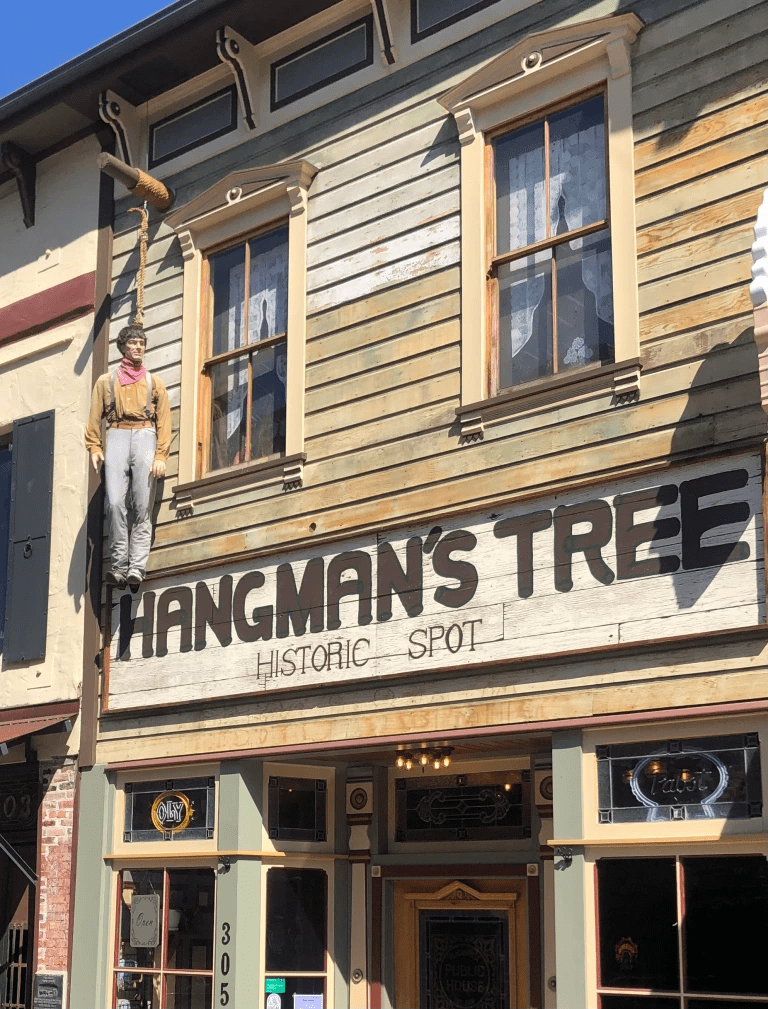
Photo by the author, from my 2021 blog post about Placerville, CA.

So it was auspicious that, just as I was getting close to Placerville, Colorado, I spotted this hangman’s tree in the town of Montrose:
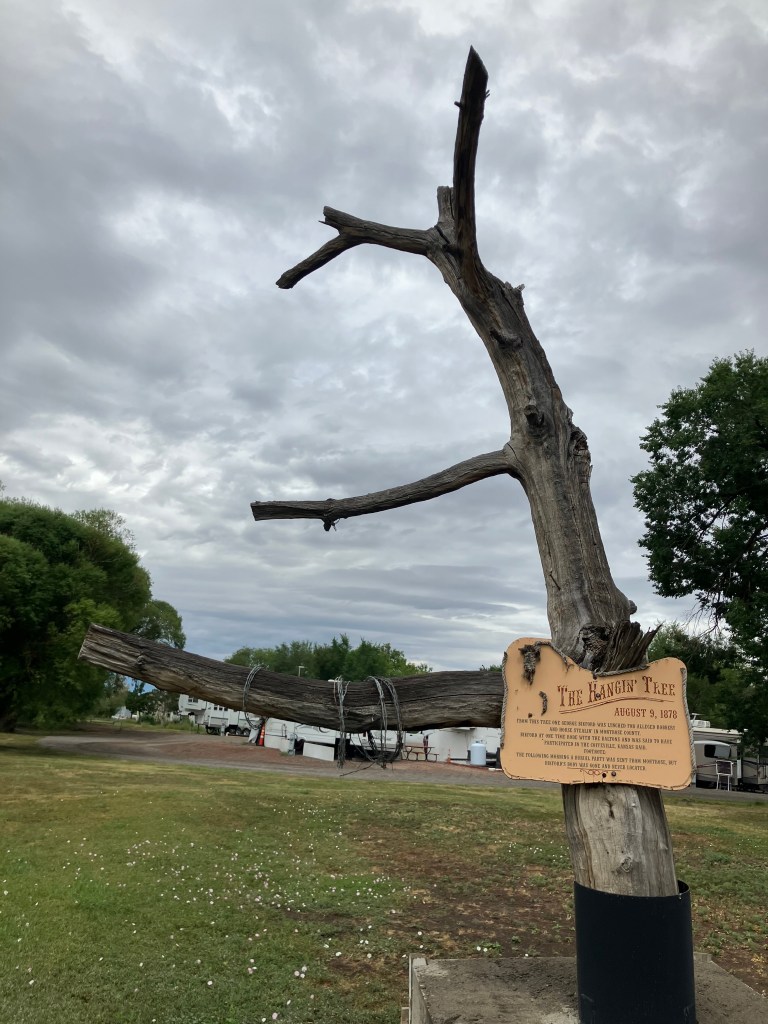
According to the sign, George Bikford was hanged from this tree for robbery and “horse stealin'” in 1878.

And so, with that preface, I finally came to the storied town of Placerville, Colorado. Let’s just say it wasn’t exactly El Dorado.
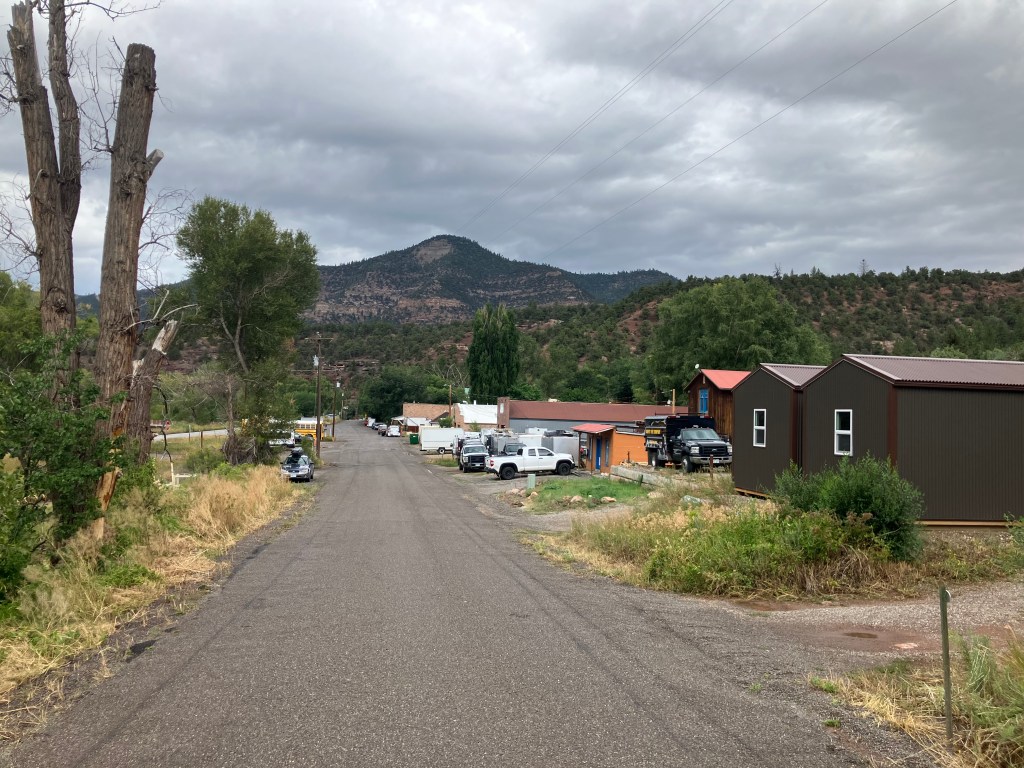
This is seriously about all there is to the town.

Pretty much all that makes up Placerville is a post office, a general store, a storage facility, and a few houses. In the 1800s it was a mining boom town, but as with many boom towns, the mines dried up and the population went elsewhere. Later, the failure of the local Trout Lake Dam in 1909 wiped out most of what remained.
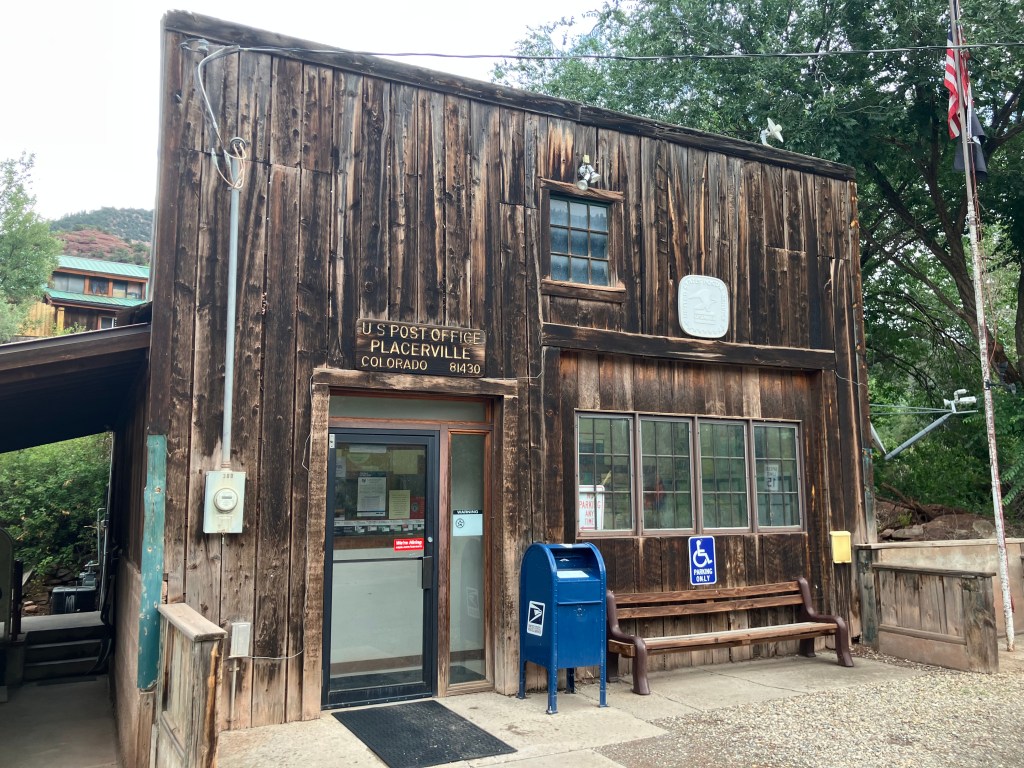
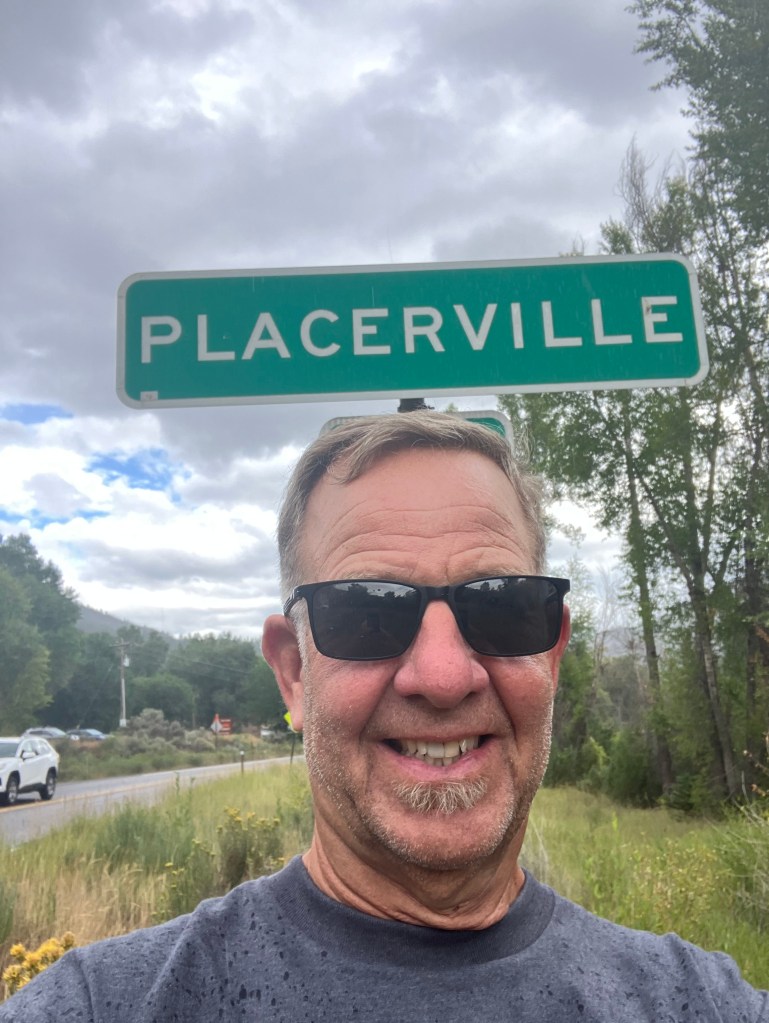
But be that as it may, I think we can declare this mission a success.
And (shockingly) I was even able to purchase Placerville merch at the general store!
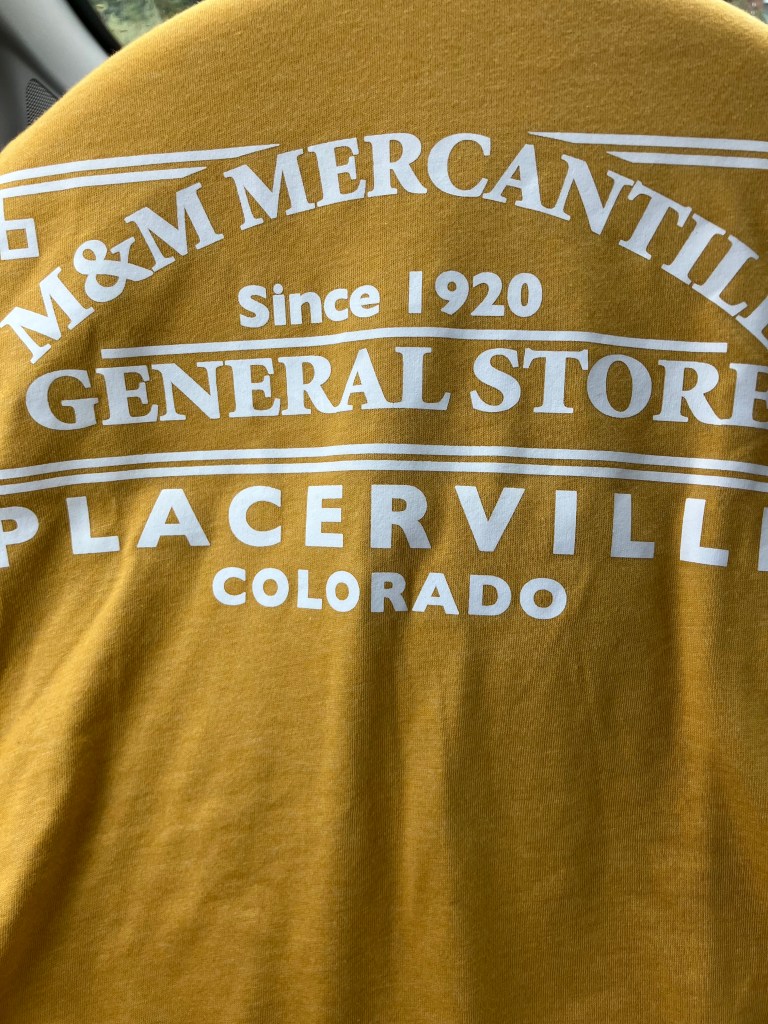
I was hoping for “My husband drove from Placerville to Placerville and all I got was this stupid T-shirt.”

BREW OF THE DAY

We have a winner!

In the town of Ridgway, Colorado (pop: 1,300) I stopped in at the Floating Lotus Brewery. It’s a friendly, casual place with an airy atmosphere, two outdoor patios, a stage for live music, and a great view of the neighboring property where John Wayne filmed some scenes from True Grit. Owner/Brewmaster Kenny Conley hooked me up with his favorite beer: the Blastoplast IPA.
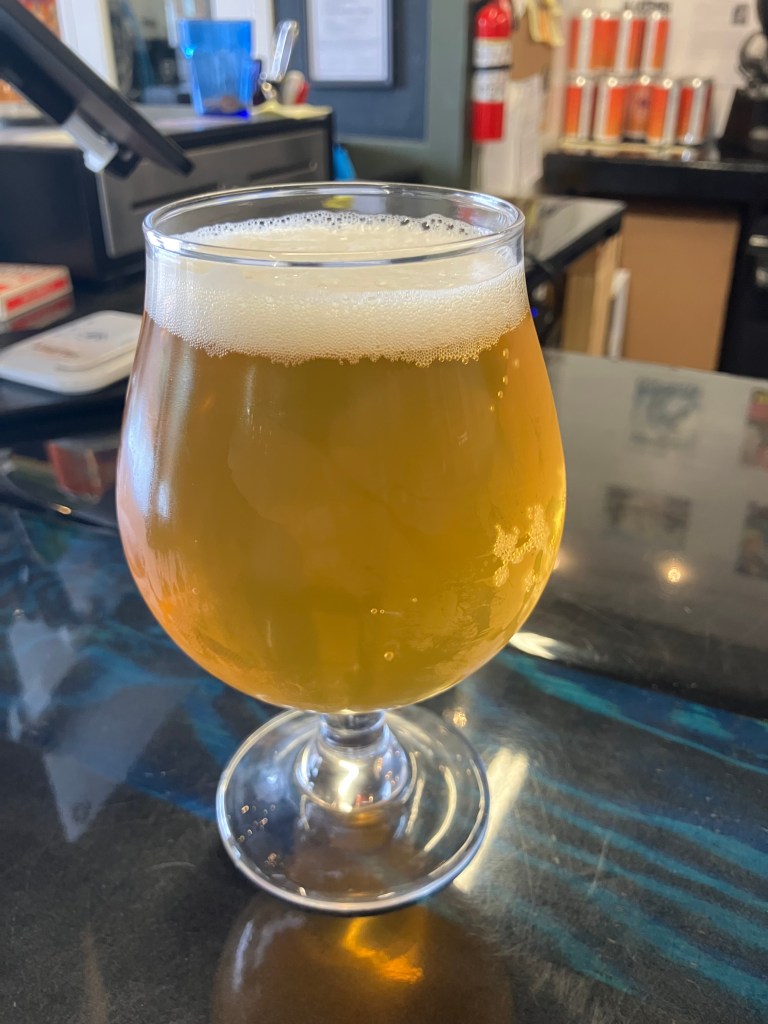
This was hands down the best beer I’ve had on this trip. Of course, that’s an admittedly low bar. But this is seriously a tasty brew. Unlike so many modern IPAs, this one is perfectly balanced. It’s not too hoppy, not to carbonated, not too pungent. At the same time, it’s flavorful and a bit “richer” than you’d expect from an IPA, without the astringent IPA afterburn you sometimes experience by the end of the glass. And at 6.3 percent ABV, I’d say the alcohol content is right where it should be. This is a five-star brew.
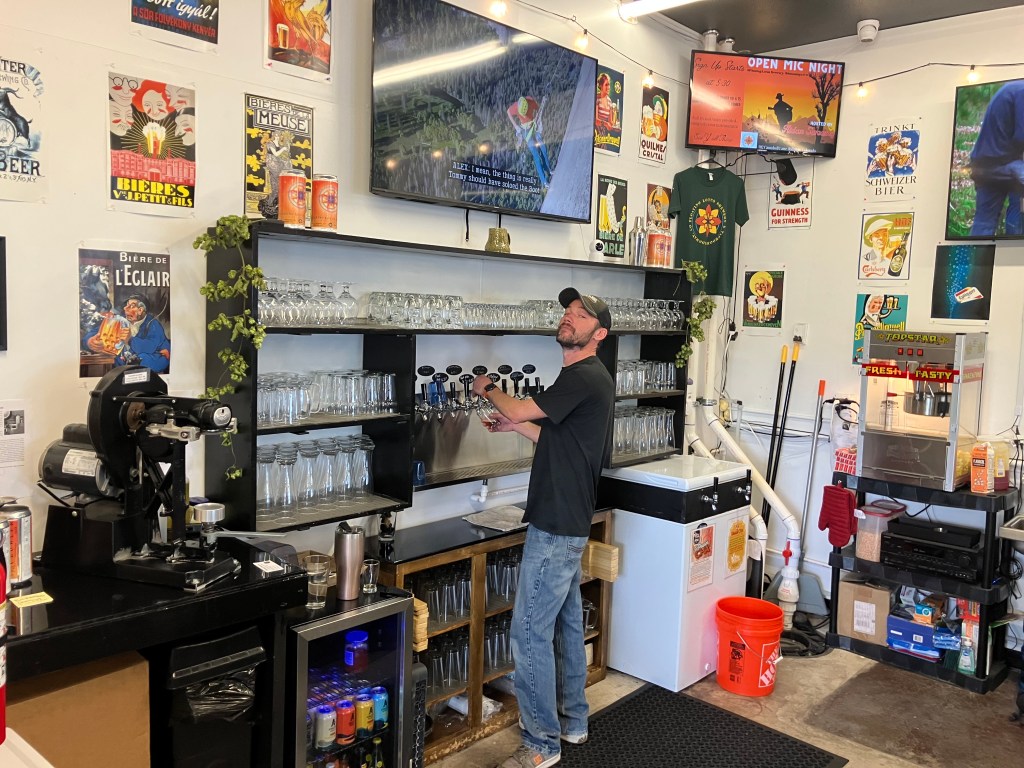
Kenny at his post. If you ever find yourself in Ridgway, or even in the vicinity of Telluride, pay him a visit!
Breweries · Road trips

Land of the Giants

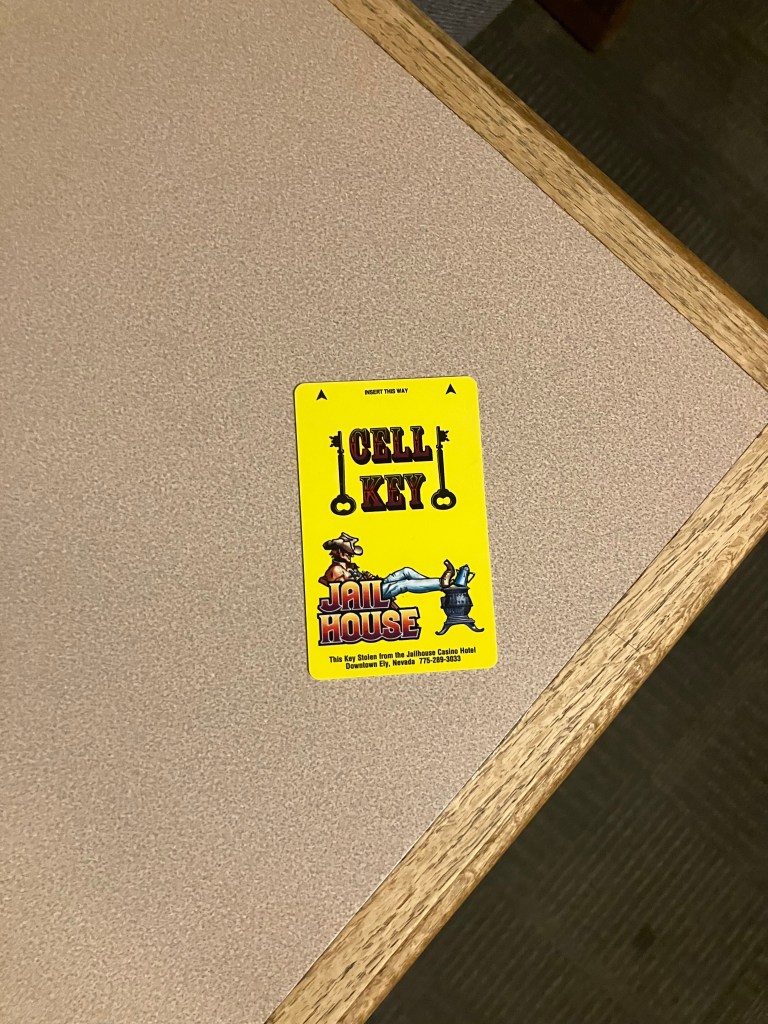
This morning I checked out of the Jailhouse Hotel early. I returned my hilariously-labeled “cell key” to the “warden” at the reception desk.

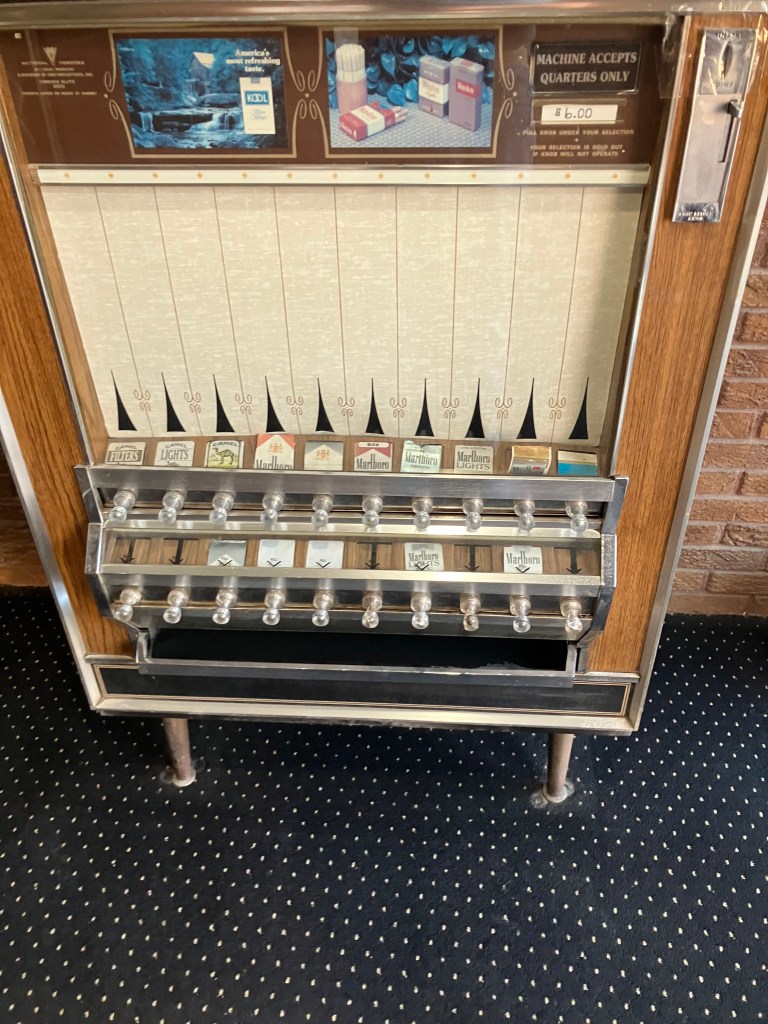
While I waited for the warden to finish processing my paperwork I glanced around the lobby and spotted this blast from the past:

Is anyone old enough to remember these?

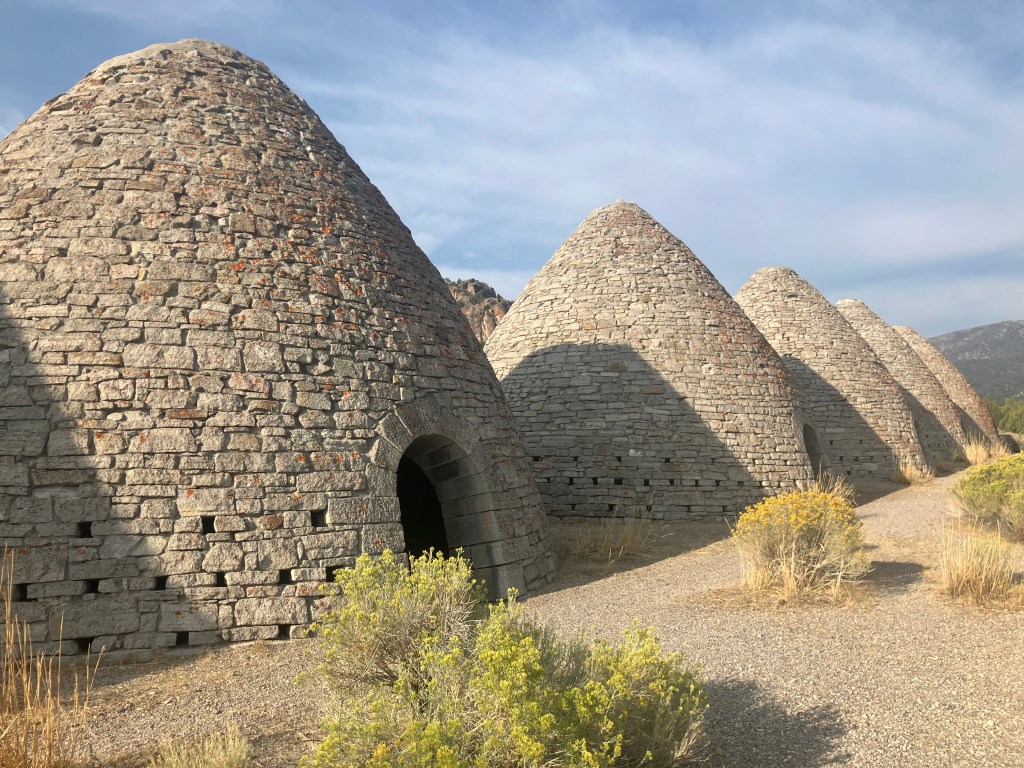
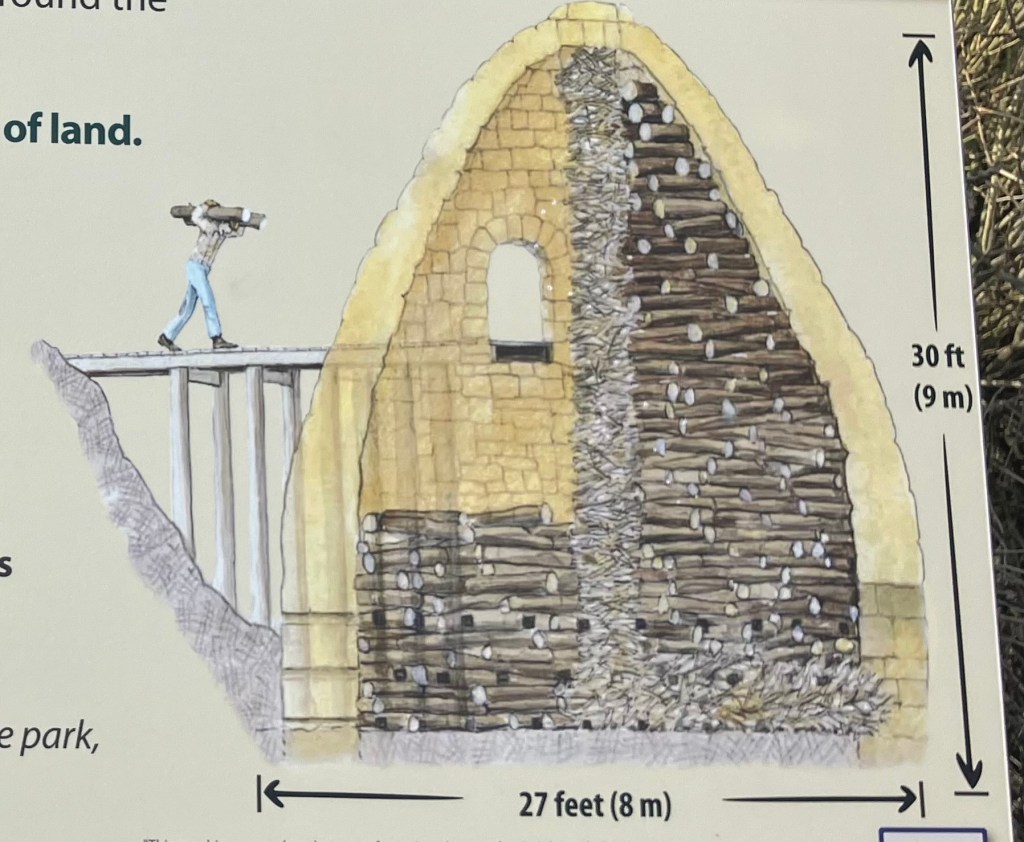
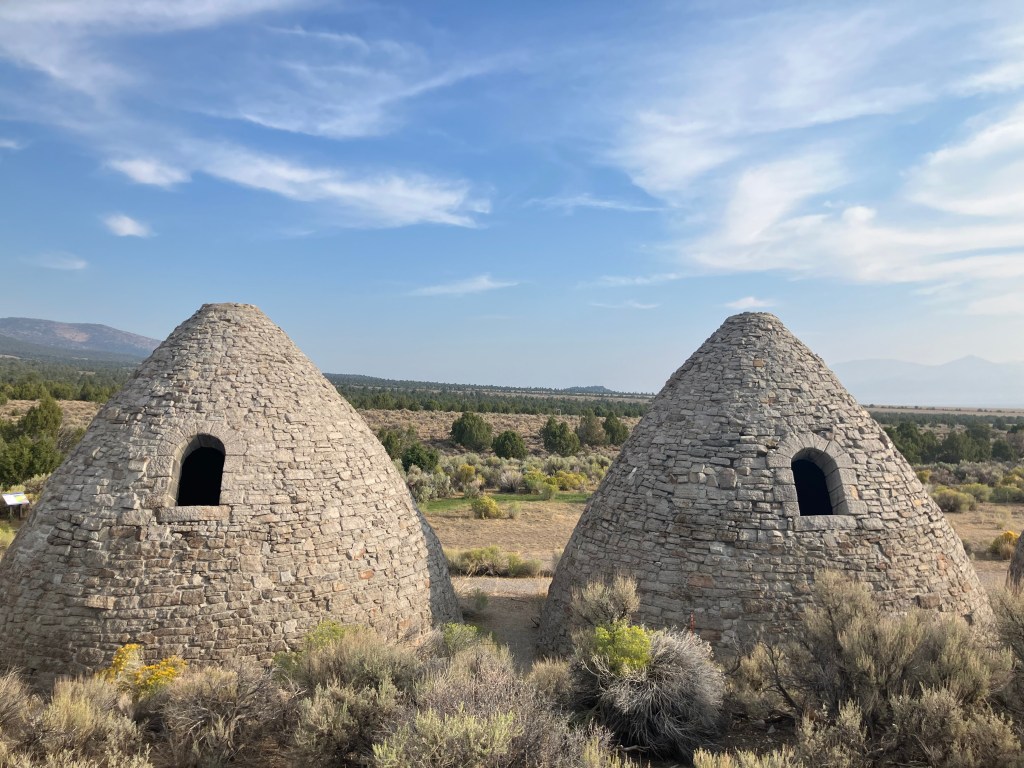
Eventually I was liberated from the Jailhouse and back in my car. On my way out of Ely I spied a sign for the “Ward Charcoal Ovens.” It looked like a minor detour on a dirt road, so I followed the sign. I’m glad I did. After a few dusty miles I encountered a collection of enormous, well-preserved, 19th-century ovens that had been used for making charcoal. Standing about 30 feet high, these are gigantic, otherworldly artifacts in the middle of nowhere.

The ovens were used to transform pinion pine and juniper into charcoal, which in turn was used to fire the smelters that melted ore during Nevada’s silver rush in the 1870s. These ovens were only used for a few years until the silver ran out, yet they’ve been standing for about a century and a half. I was impressed by how well-preserved they are. Not a speck of graffiti, no trash on the ground, and virtually no damage to the stone. (A ranger I talked to informed me that there has been some minor restoration work done to the mortar.)

The ovens (which somehow seem a little creepy to me, even in broad daylight) were a product of the era, when physical challenges (like melting ore) were met with ever-larger infrastructure (bigger locomotives, larger dams, these enormous ovens), rather than, say, intricate technological advances. It’s simultaneously awe-inspiring and incredibly wasteful. About 6 acres of trees would have to be felled each time an oven was filled, and after only a couple of years all the trees in the area had been cut down.

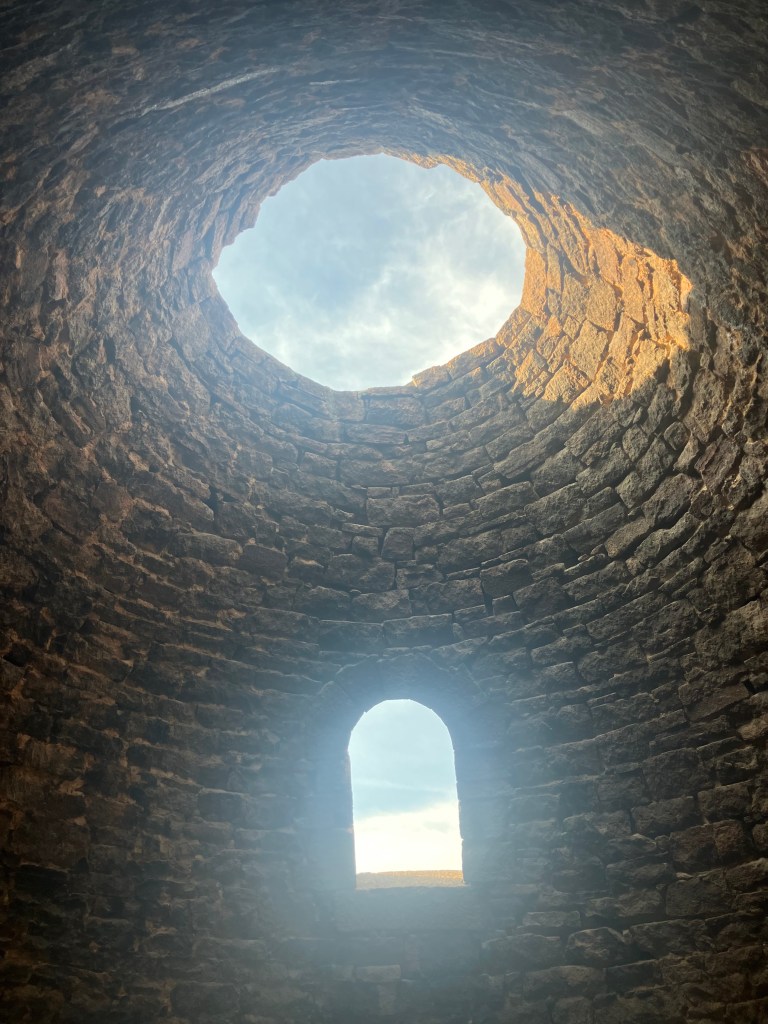
View from inside an oven. The top hole allows smoke to exit; the arched “window” on the side allows for the insertion of wood.

So, these ovens were environmentally damaging and obsolete in a few short years. On the positive side, they produce a cool echo effect.

The ovens are also, um, titillating.

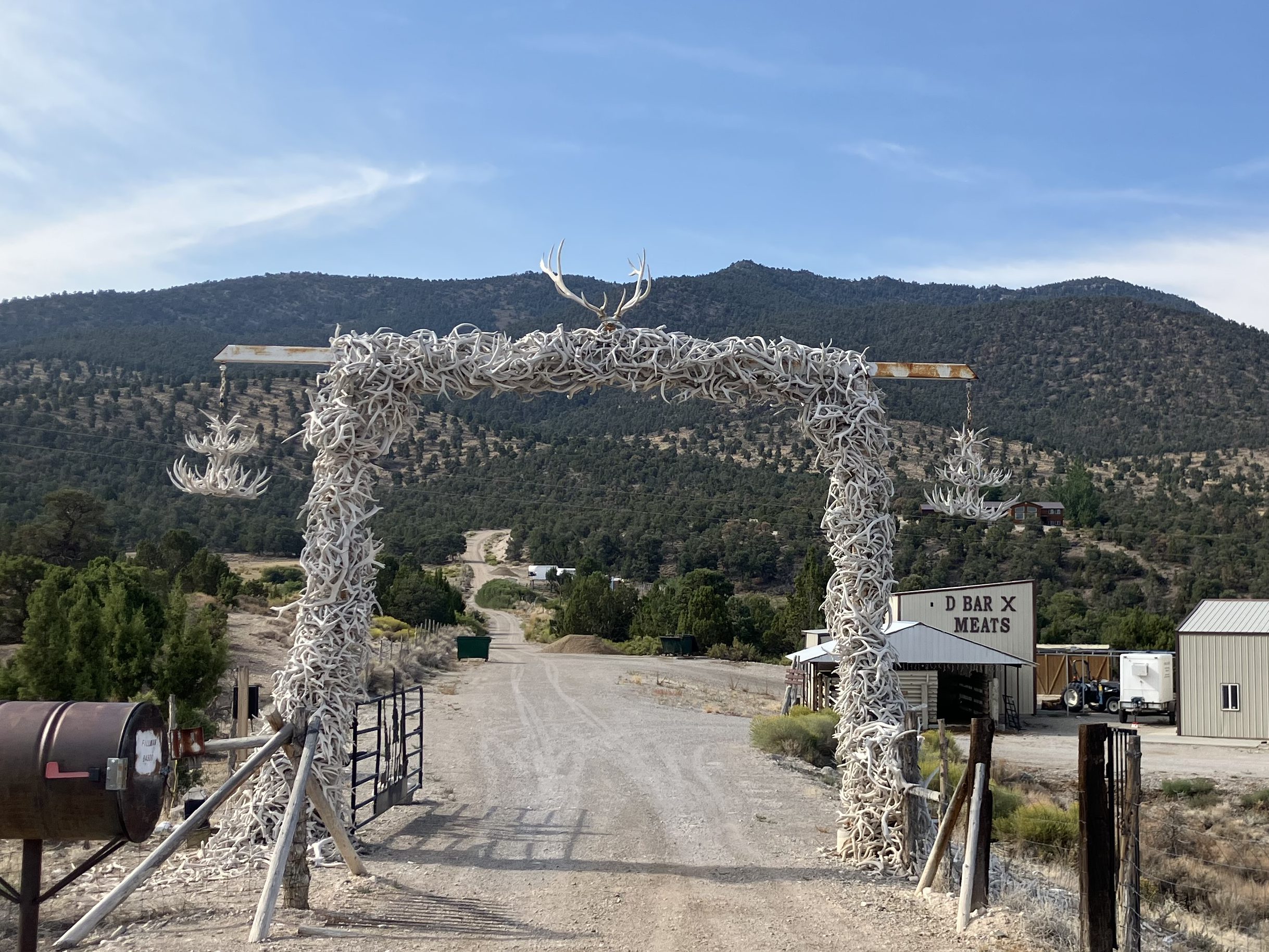
Speaking of racks, I came upon this impressive display at a butcher shop just outside Ely:

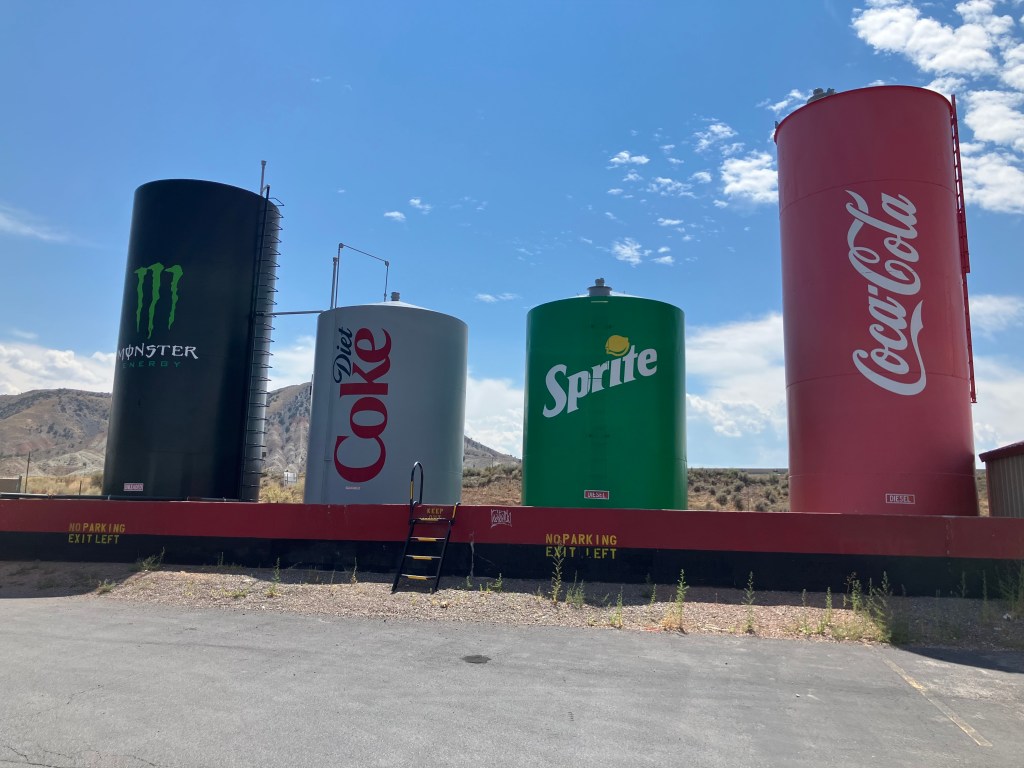
But to get back to the theme of “land of the giants,” I beheld these enormous soda cans at a gas station in Salina, UT. They actually contain diesel fuel, and so are not quite so unhealthy as you would guess from their labels.

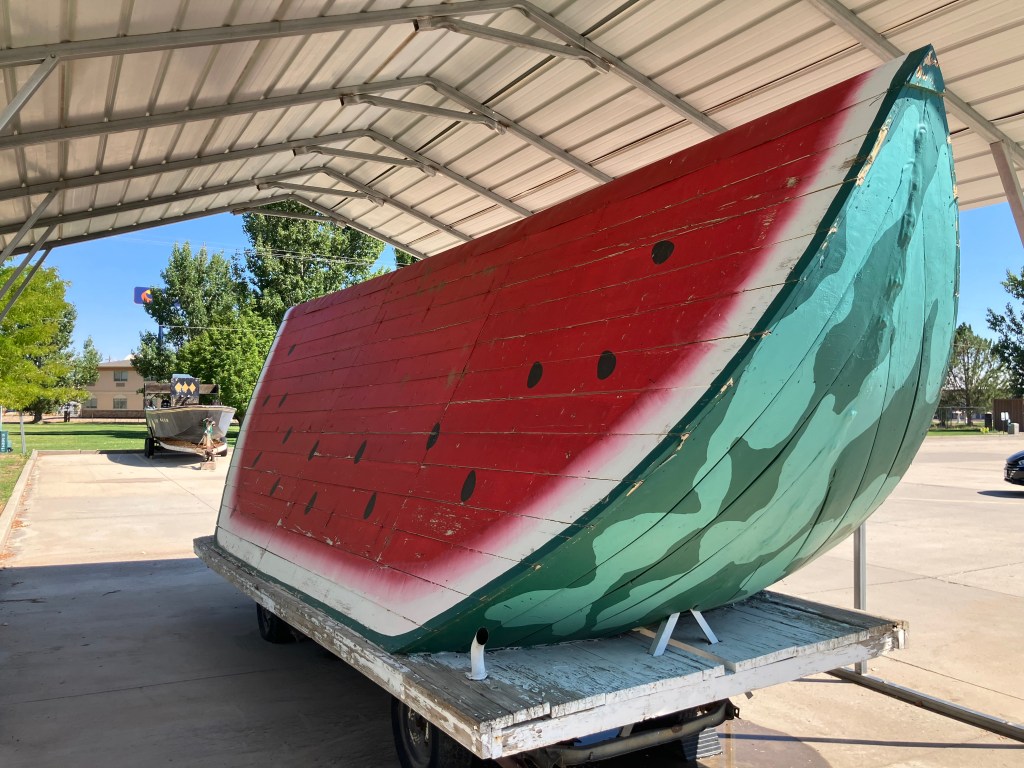
And to round out the Giants theme, this gigantic watermelon slice was sitting in a parking lot in Green River, UT (pop: 850), for no discernible reason.

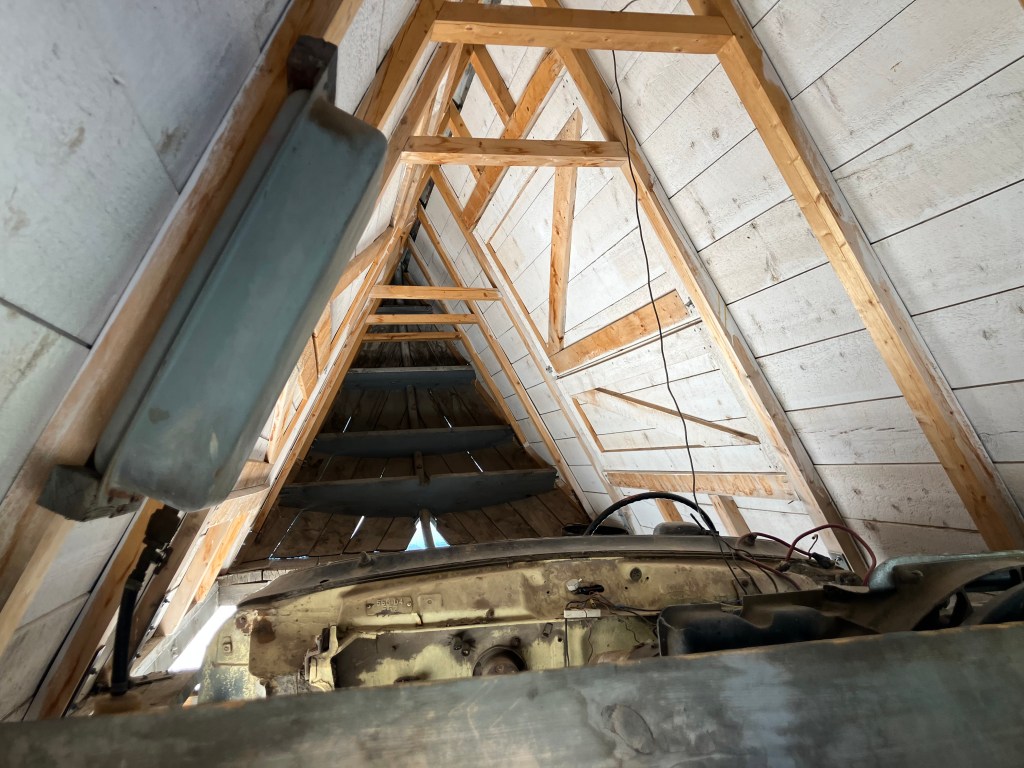
The watermelon slice is constructed entirely of wood, and a little Internet research reveals that it was built in the 1950s as a parade float of sorts. Remarkably, the watermelon is self-powered, with an engine hidden inside. I managed to sneak a photo through a small porthole (?).

Inside a giant seedless watermelon.

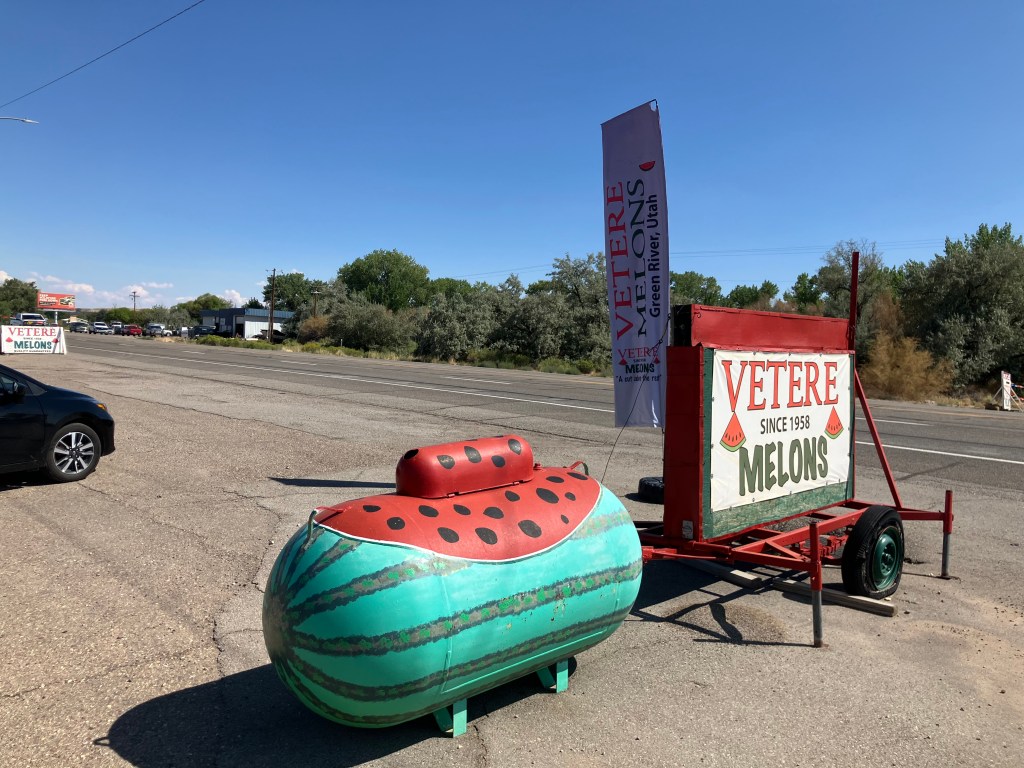
Watermelons seem to figure prominently in the local agriculture, as I saw watermelon vendors set up in several parking lots.

Cucurbitaceous propane tank.

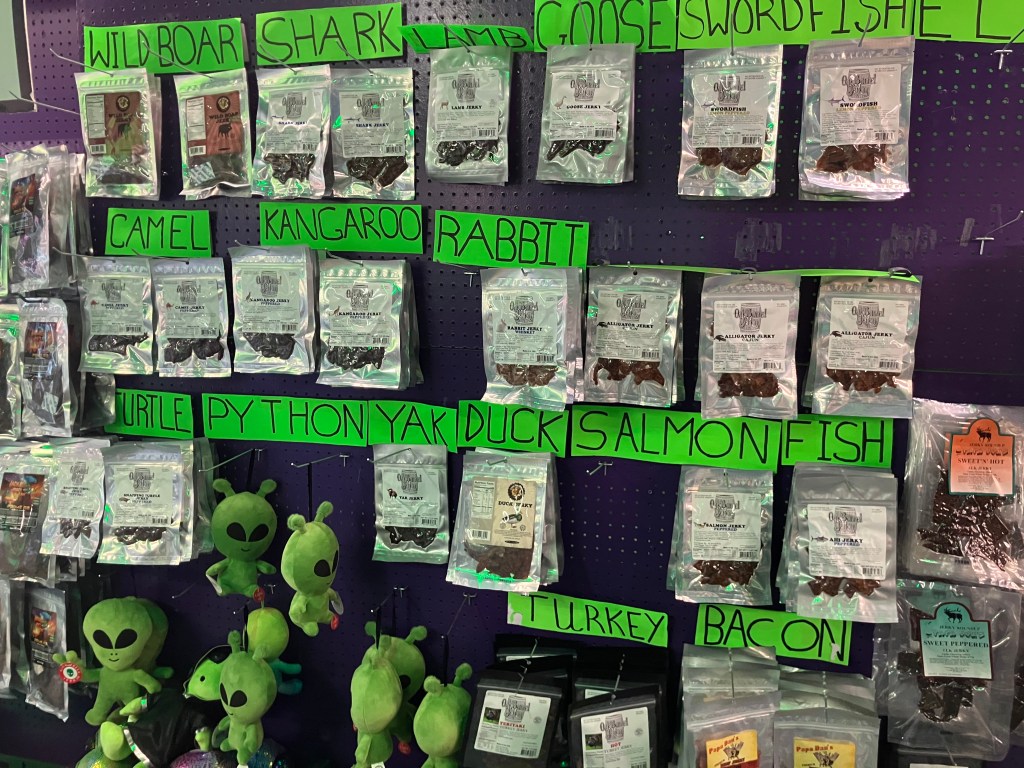
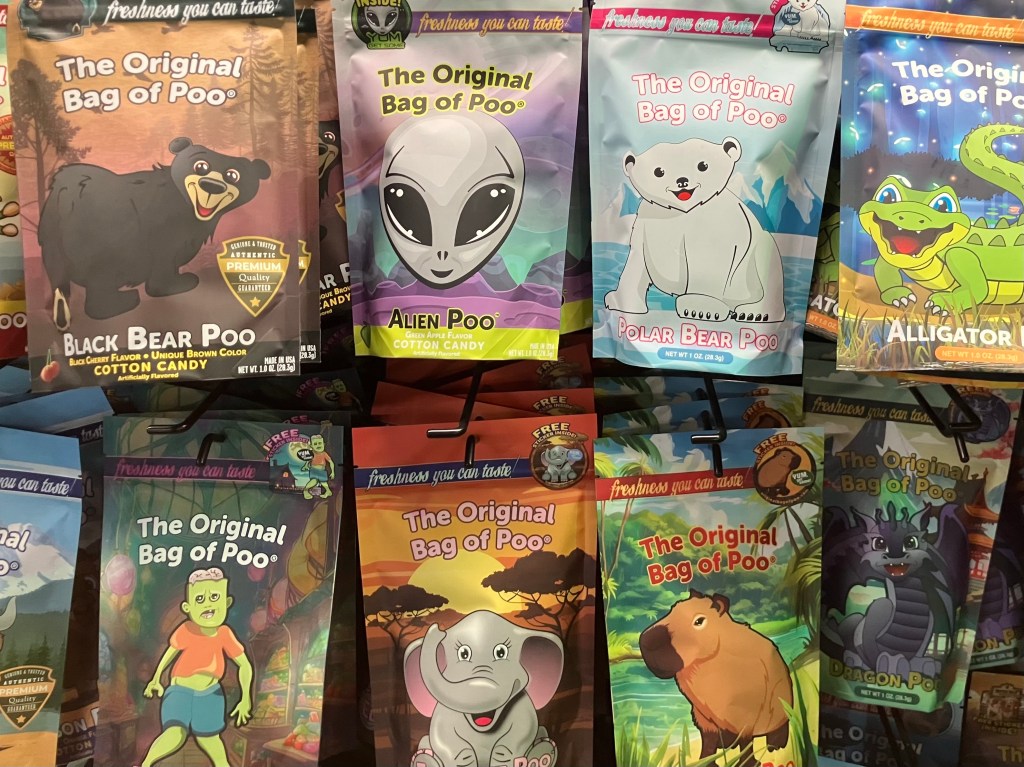
But more interesting to me near Green River was a place called “Jackass Joe’s,” which is a combination gas station and purveyor of all manner of quirky and irreverent stuff. Their specialties seem to be T-shirts (with their own name on them), exotic jerky, and various styles of candy “poo.”

Camel jerky?????
“Freshness you can trust.”
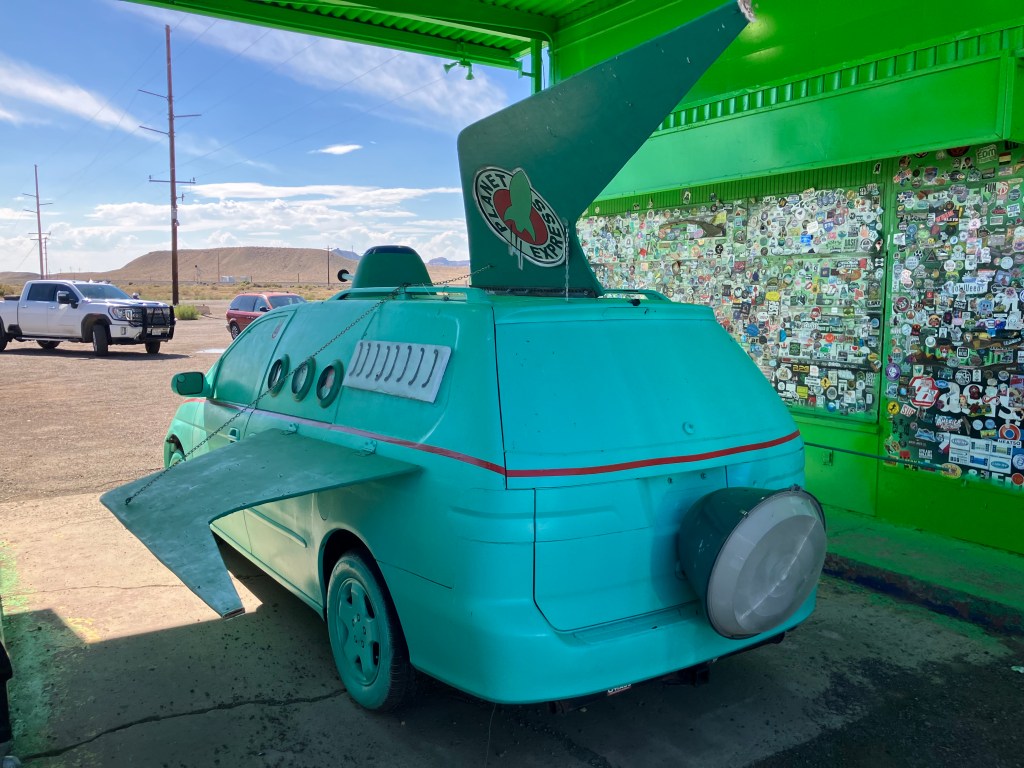
Jackass Joe decorates in an unexplained alien theme.
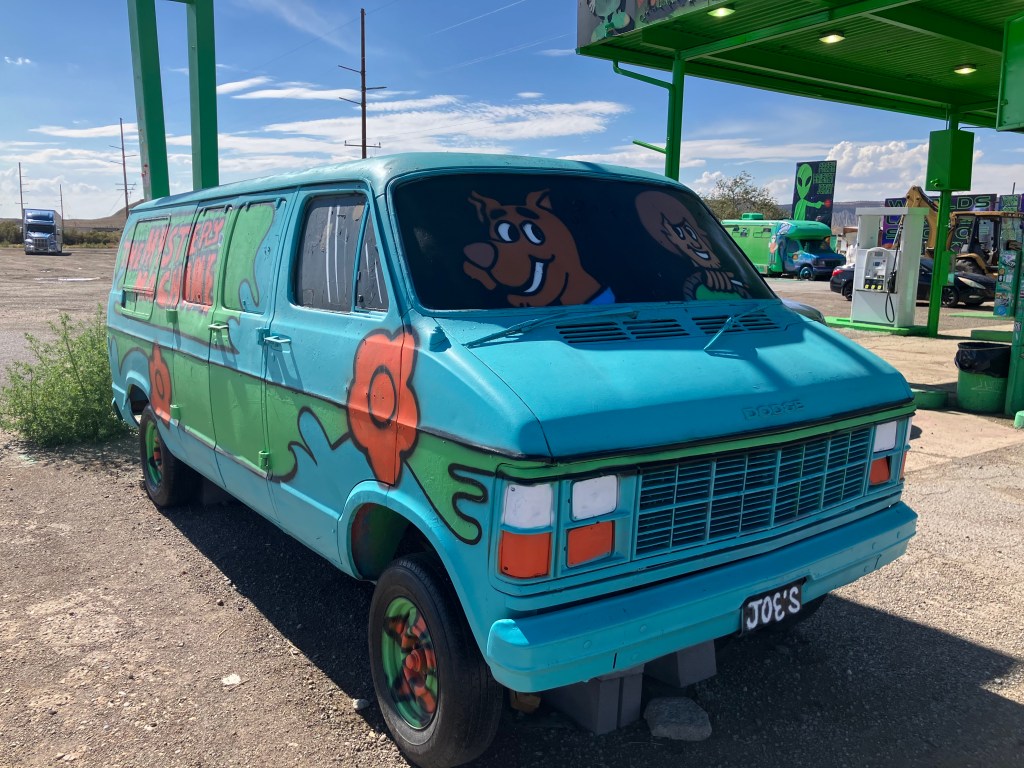
…and, randomly, Scooby Doo.

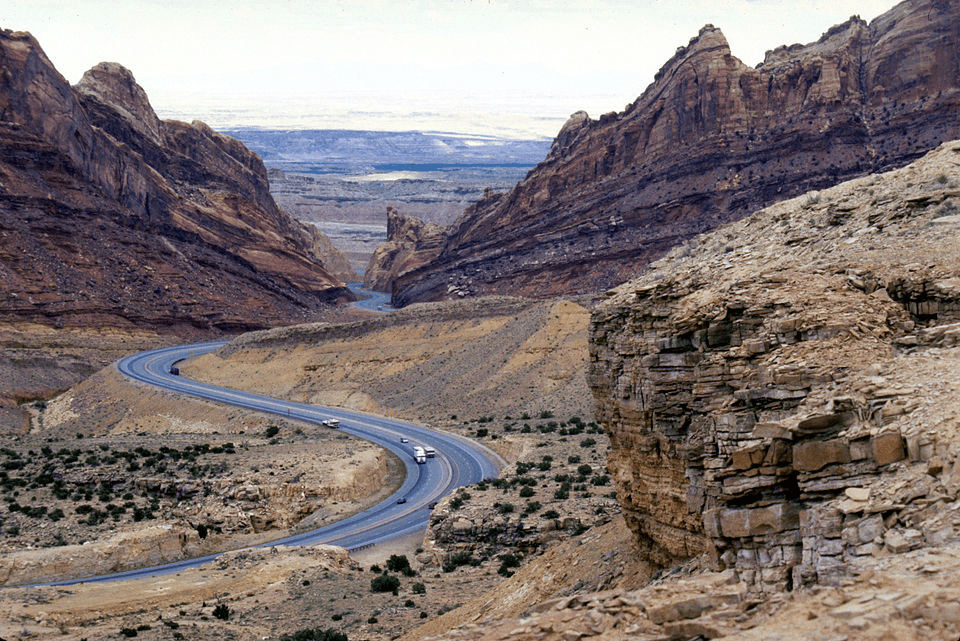
And yet, notwithstanding the fun factor of Jackass Joe’s and the various giant foodstuffs, by far the most impressive part of today’s journey was driving along I-70 through the San Rafael Swell and other geologic formations. It’s simply jaw-dropping. The craggy and stratified shapes are otherworldly, the colors are vivid and varied, and in keeping with our Land of the Giants theme, the scale is enormous. It was almost transformative to drive my little rental car along this narrow ribbon through these formations. Alas, I wasn’t able to take any photos, and more to the point, I realized my little iphone camera couldn’t possibly do the scene justice. So allow me to present a couple of photos taken from the Internet:

Public domain photo from US Dept of Transportation, showing Interstate 70 snaking through the San Rafael Swell in central Utah.
“Swell” photo from Utah Chamber of Commerce.

This section of Interstate 70 has been called an “engineering marvel,” as it twists over, through, and along these geologic formations, while attempting to minimize disruptions to the landscape. The construction process also unearthed various dinosaur fossils.

I’ve encamped for the night in Moab (pop: 5,400). Tomorrow we will finally arrive at Placerville, CO!

BREW OF THE DAY

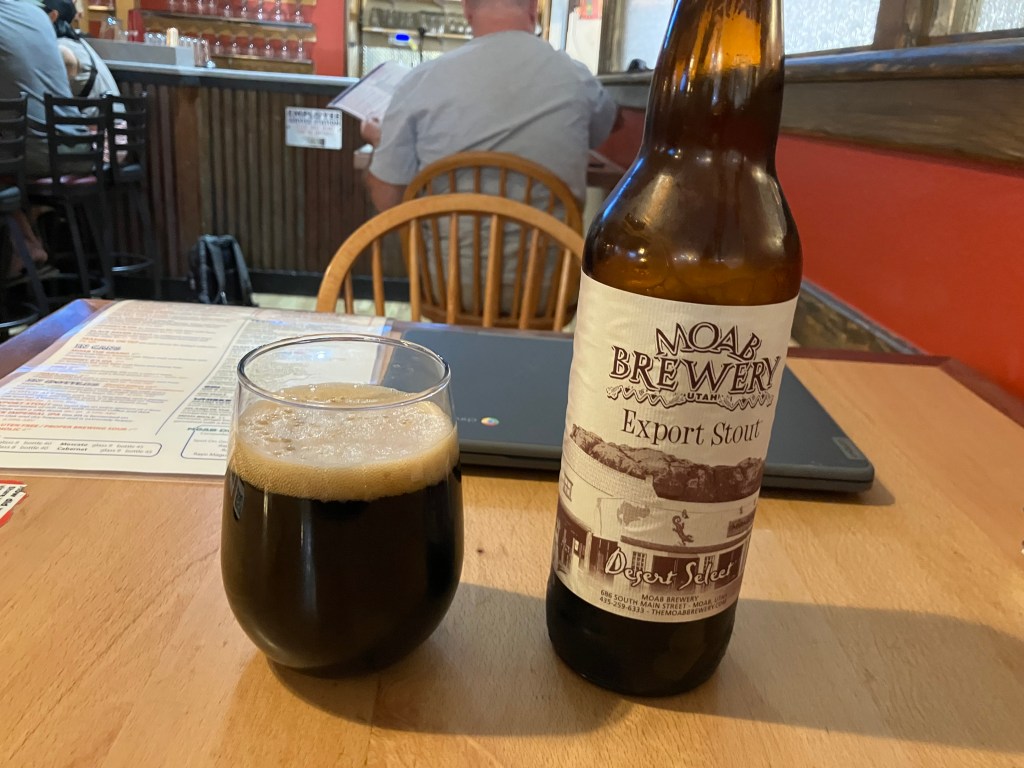
The BOTD comes courtesy of Moab Brewery. They have a fairly extensive menu of their own beers. I let the server choose for me, with the only instruction being that “I don’t want a light beer.” She directed me toward the “Export Stout.” Unfortunately, it is not available on tap (i.e., bottle only), and the bottle holds 22 ounces. So this is a commitment.

Unfortunately, it’s a commitment that doesn’t pay off. I was hoping for a rich, thick, malty, high-gravity beer. What I got was something closer to bathwater.

OK, maybe it wasn’t that bad. But it was definitely thin in body, and it had no nose to speak of. It’s very carbonated–maybe over-carbonated. The flavor tastes of burned coffee (like when the pot has been sitting on the heating element at the truck stop for a few hours) and something slightly vegetative, like maybe moldy alfalfa. Deep in the back of your nasal passages you get a slight sense of Volatile Organic Compounds, reminiscent of Testor’s model glue. The finish reminds me of Crayola crayons.

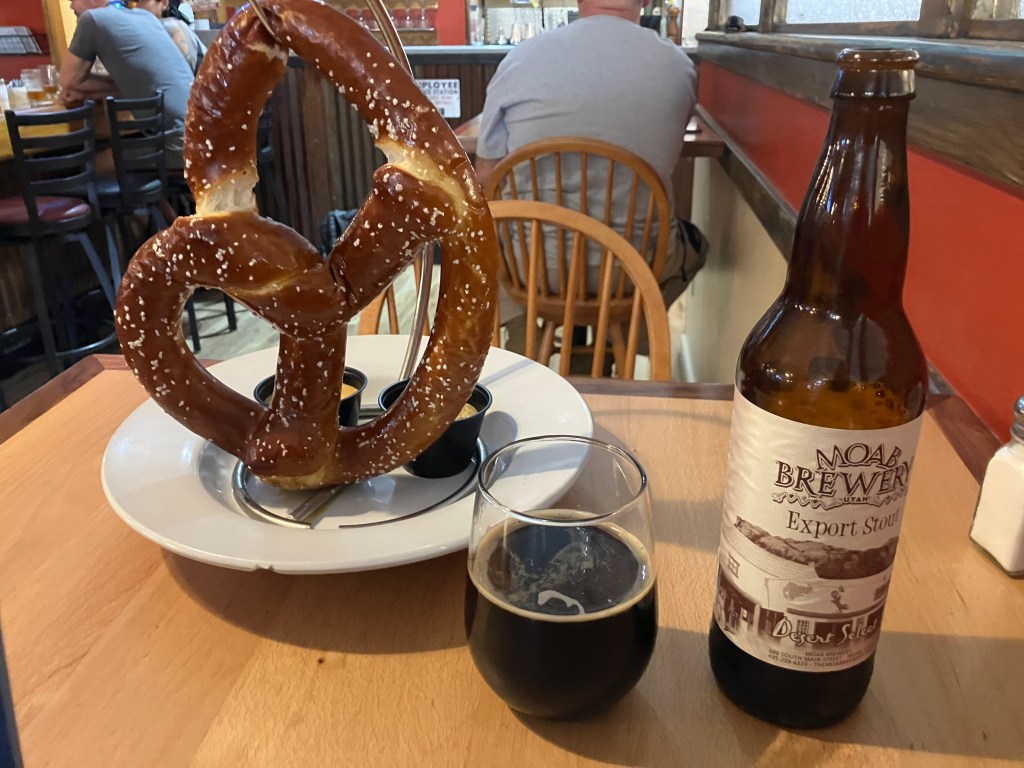
I’m afraid I can only give it 1 star. But I’ll give four stars to the most excellent brewery pretzel that paired with it.

bridges · California history · cemeteries · Road trips · trains

The Placerville Chronicles–Day 1

This morning I picked up my rental car in Placerville, California, and headed in the direction of Placerville, Colorado–some 900 miles to the east. (For those coming late to this story, the details are here.)

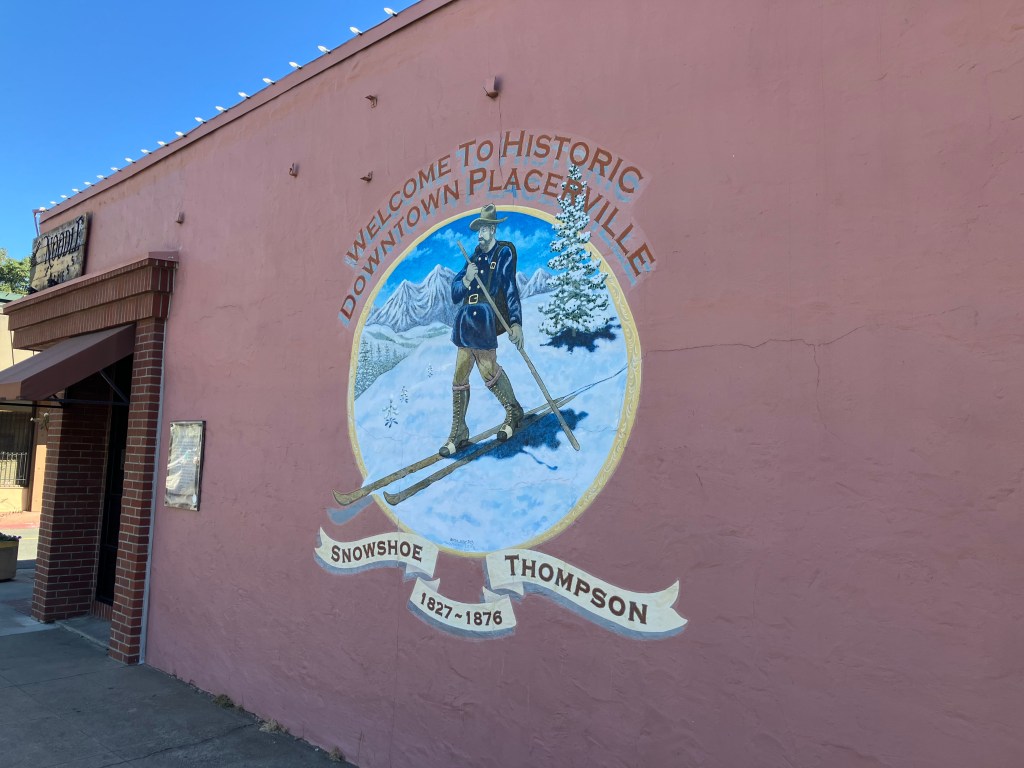
As I left Placerville I passed this mural that honors John Albert “Snowshoe” Thompson, a Norwegian immigrant who settled in Placerville in the mid 19th century. Every winter for 20 years (1856-1876) he made a twice-monthly trip over the Sierra Nevada range to deliver the mail. He made the 90-mile trek on skis (despite his “Snowshoe” nickname) from Placerville to settlements in Nevada.

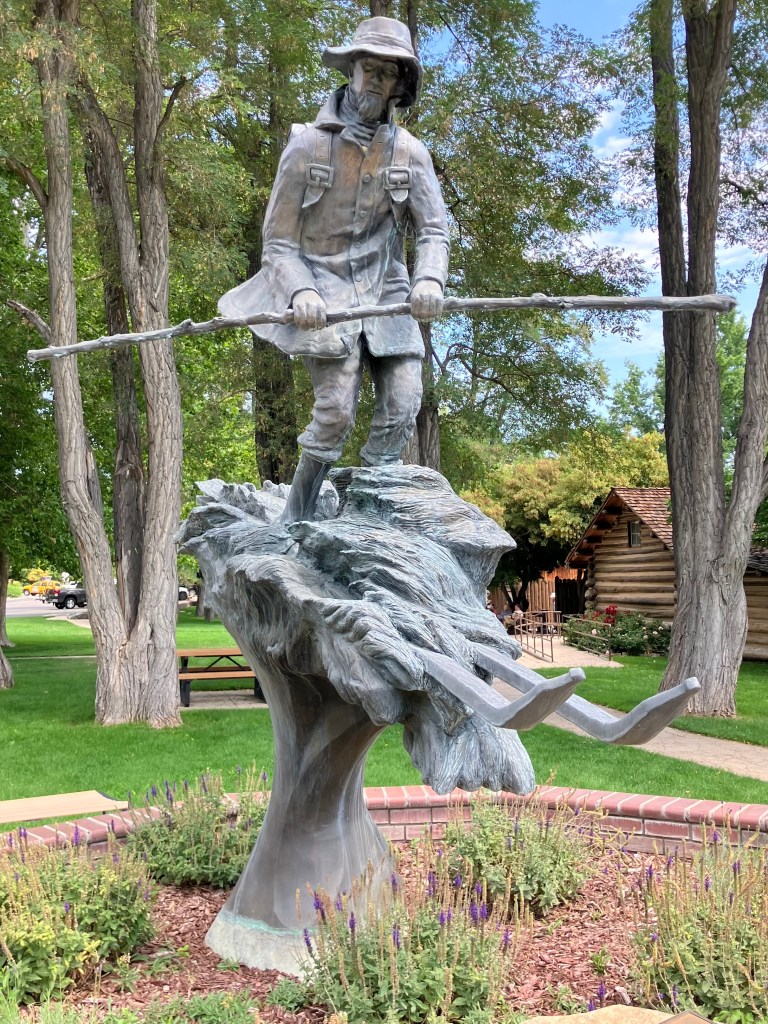
Unlike Snowshoe Thompson, I chose an easier passage over the mountain, driving a Nissan on US 50 over Echo Summit. I ended up in a little tourist trap of a town called Genoa, NV (pop: 1,300). Genoa brags that it’s the oldest settlement in Nevada…but I was struck by something that’s more relevant to this journey: Genoa was the eastern terminus of Snowshoe Thompson’s mail delivery route. And they have a statue to commemorate the fact.

Snowshoe Thompson, doing his Gorton’s Fisherman impression.

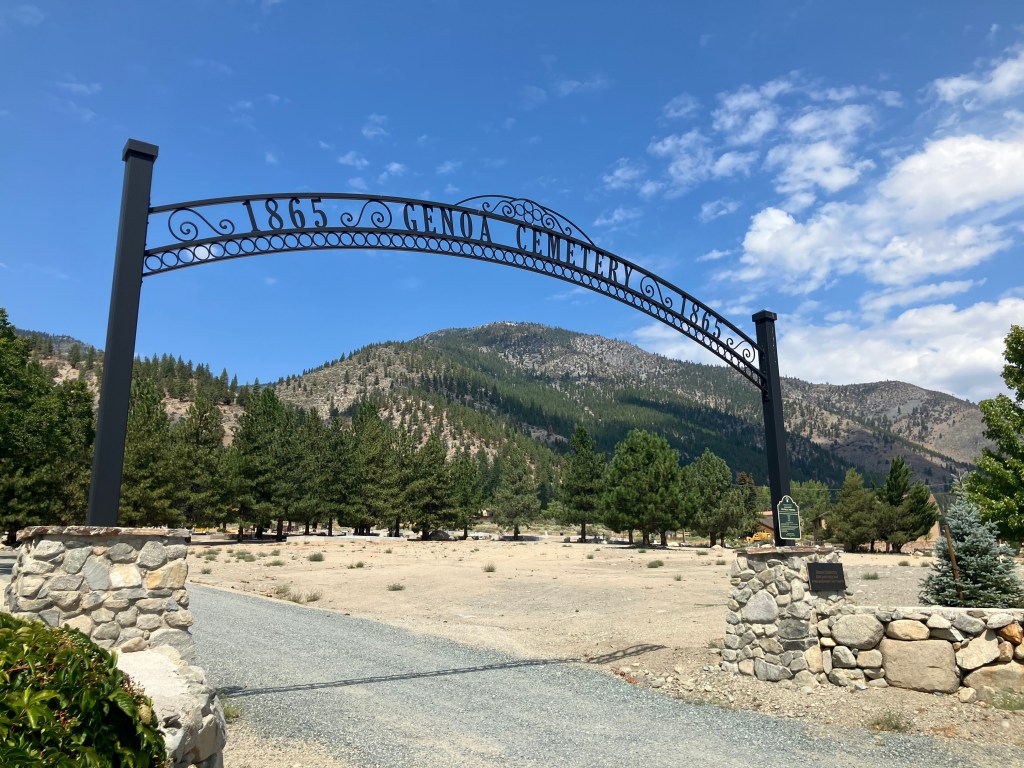
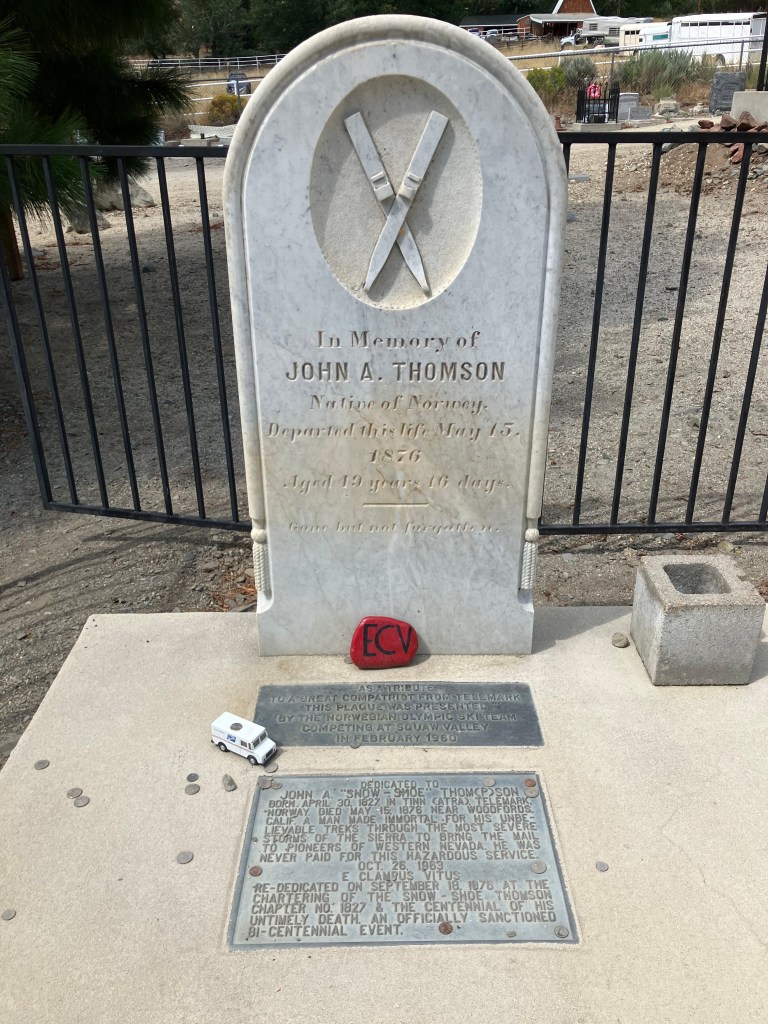
At some point Snowshoe Thompson moved his residence from Placerville to Genoa. In fact, Genoa became his final resting place.

The Postman Resteth.
Those pruning shears on the face of his tombstone presumably are meant to be skis. But who knows, given the misspelling of his last name.

Having appropriately honored this (quasi-)native son of Placerville, CA, it was time to continue my journey toward Placerville, CO. To do this, I passed through the “independent and sovereign nation” of Molossia.

What, you’ve never heard of Molossia? Neither had I. But it seems that there are about 11 acres of land in the town of Dayton, Nevada, whose owner (Kevin Baugh) has declared to be a sovereign nation. Molossia claims to have its own currency, postal service, navy, railroad, and various other trappings of a proper nation. President Baugh does have to pay property taxes to the county assessor, but he calls this “foreign aid.” Molassia’s back story is actually quite interesting and entertaining; if you’re interested, you should check their Wikipedia entry or their actual website.

The president of Molossia is very clear that you need to arrange your visit ahead of time. So a few weeks I emailed His Excellency, and got this response:

Steve, Greetings, and thank you for your interest in visiting our nation as a part of your travel blog. It is an honor.

I regret that we will be unable to host your visit to our nation on that date. … There are other events and activities taking place in Molossia on those dates, thus we will not be able to welcome you to our nation. My apologies.  Hopefully you will make it back out this way on a future tour date and we will be more than happy to welcome you to Molossia then.

Regards,

His Excellency President Kevin Baugh
Republic of Molossia

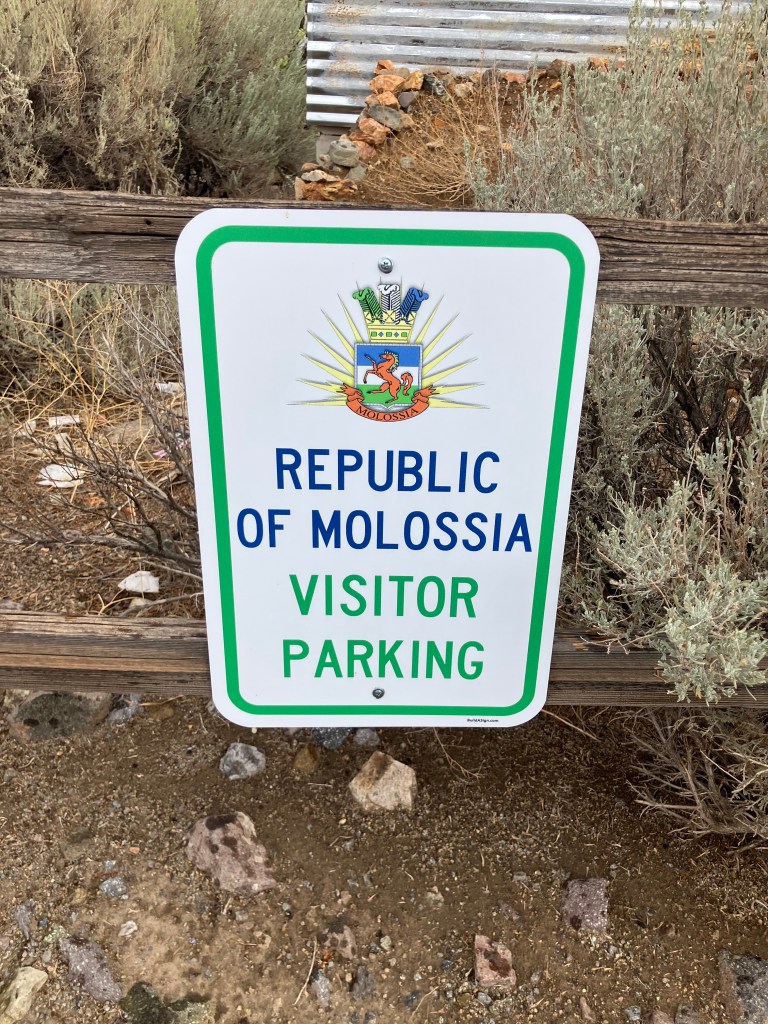
Undeterred, when I came to Dayton I drove up to the border of Molossia. Conveniently, there was an open parking spot.

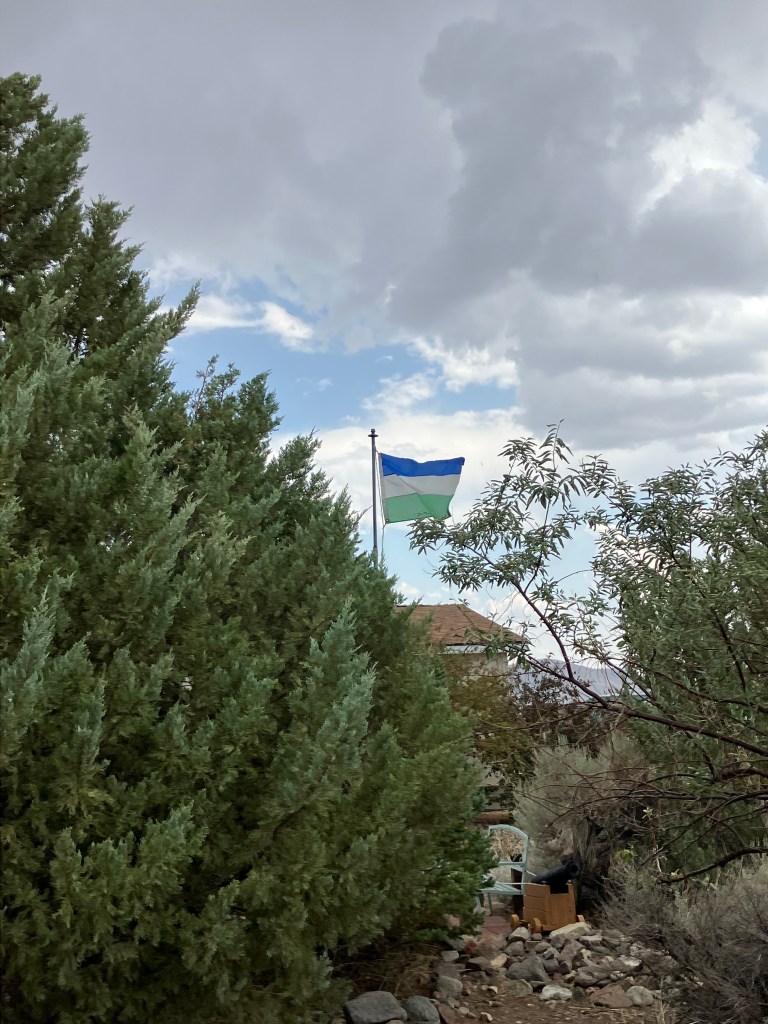
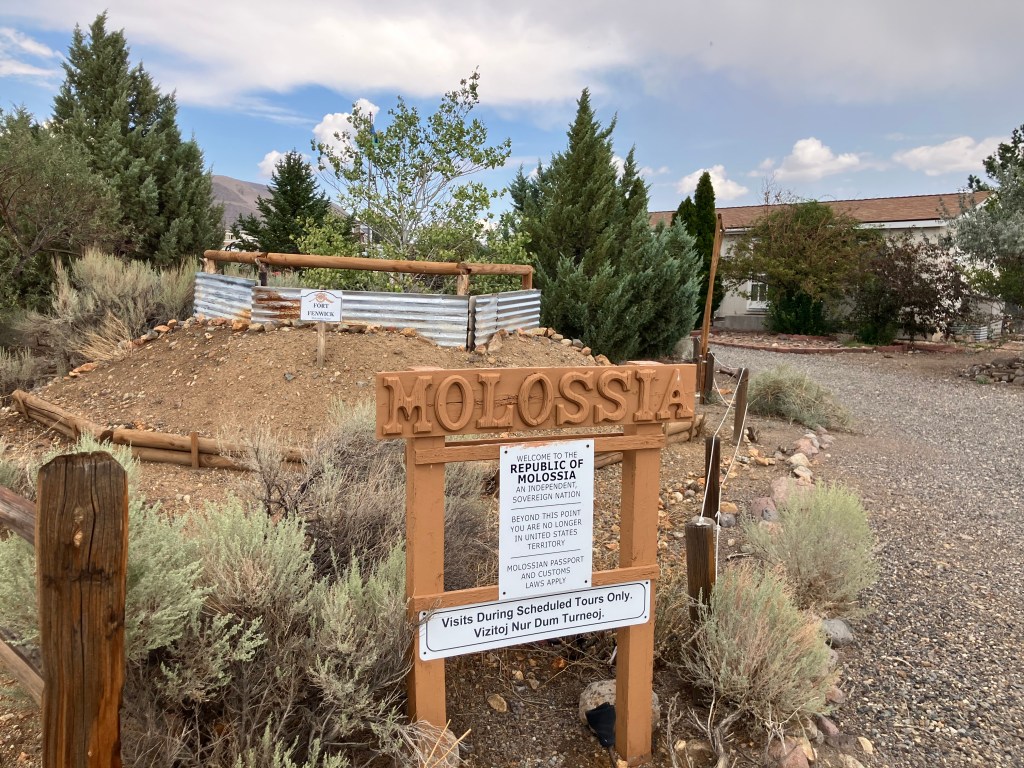
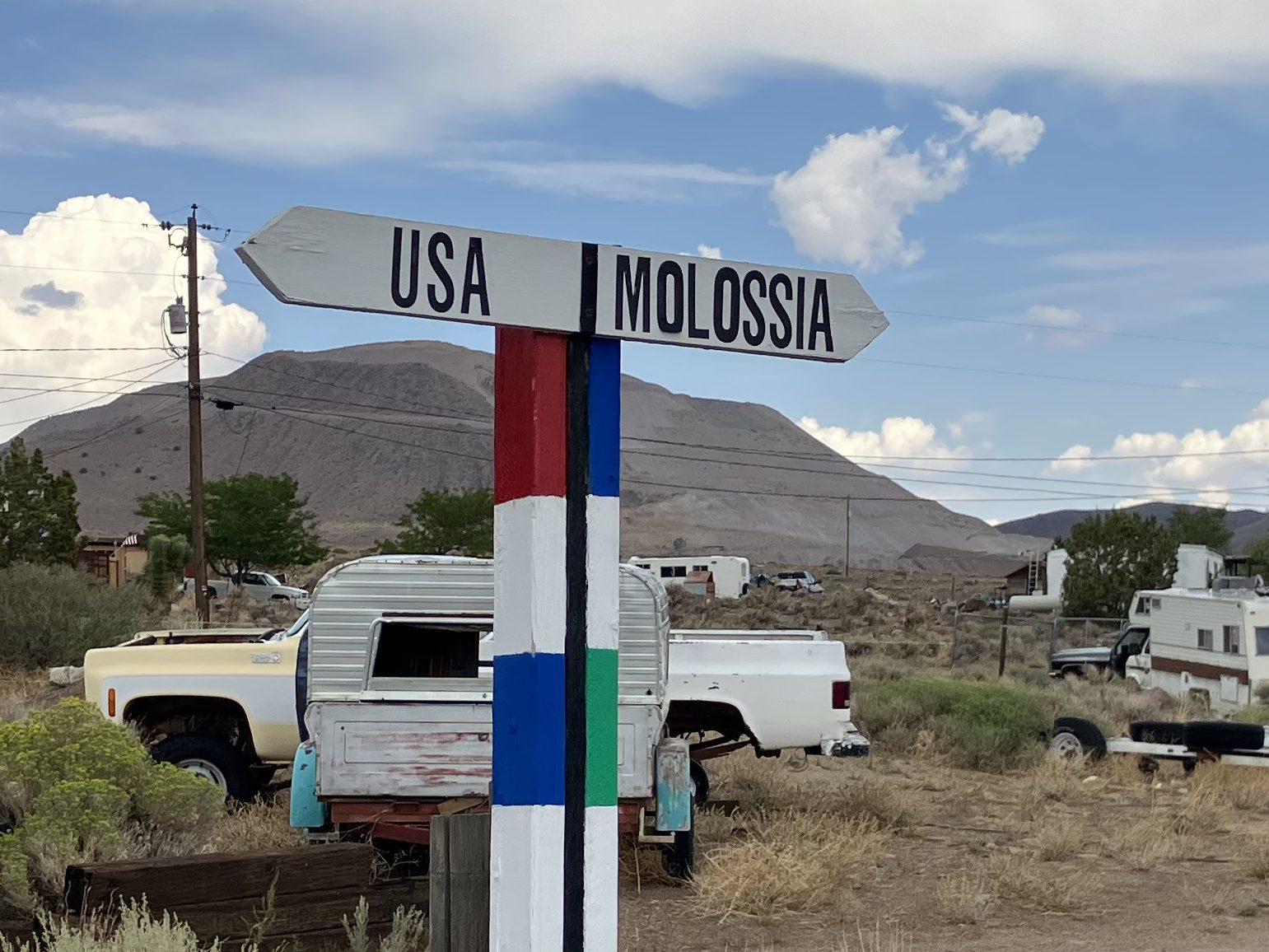
The Molossian flag was flying proudly, and a sign made clear that I was indeed about to leave the United States.

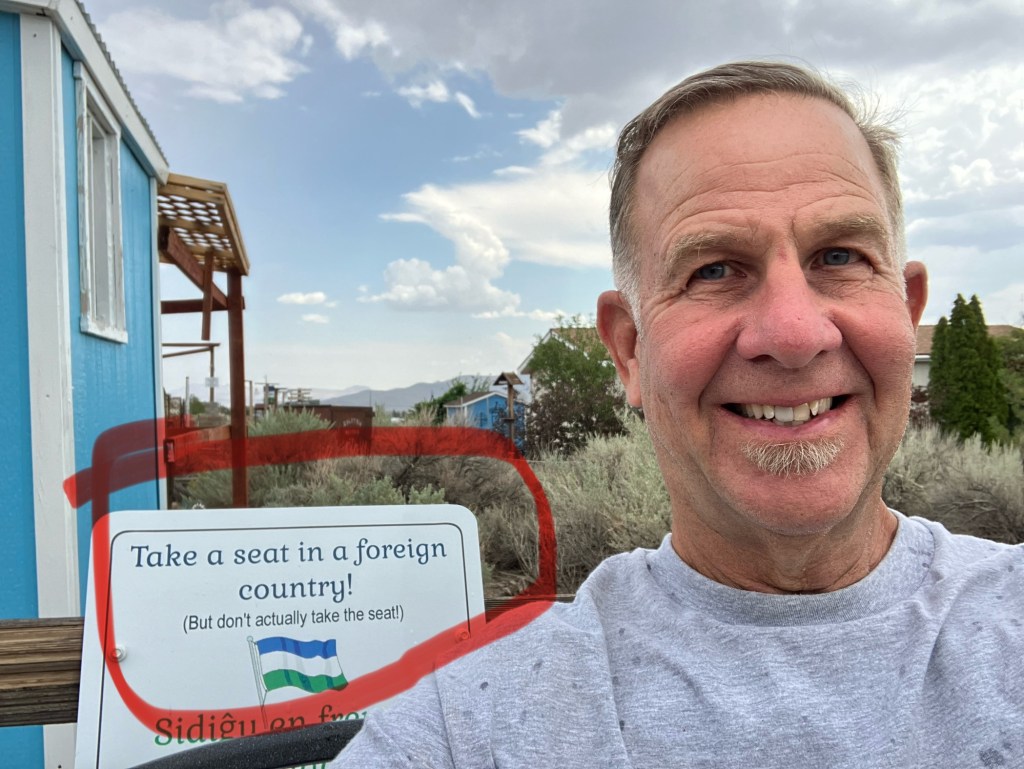
A sign next to a bench even invited me to “take a seat in a foreign country.”

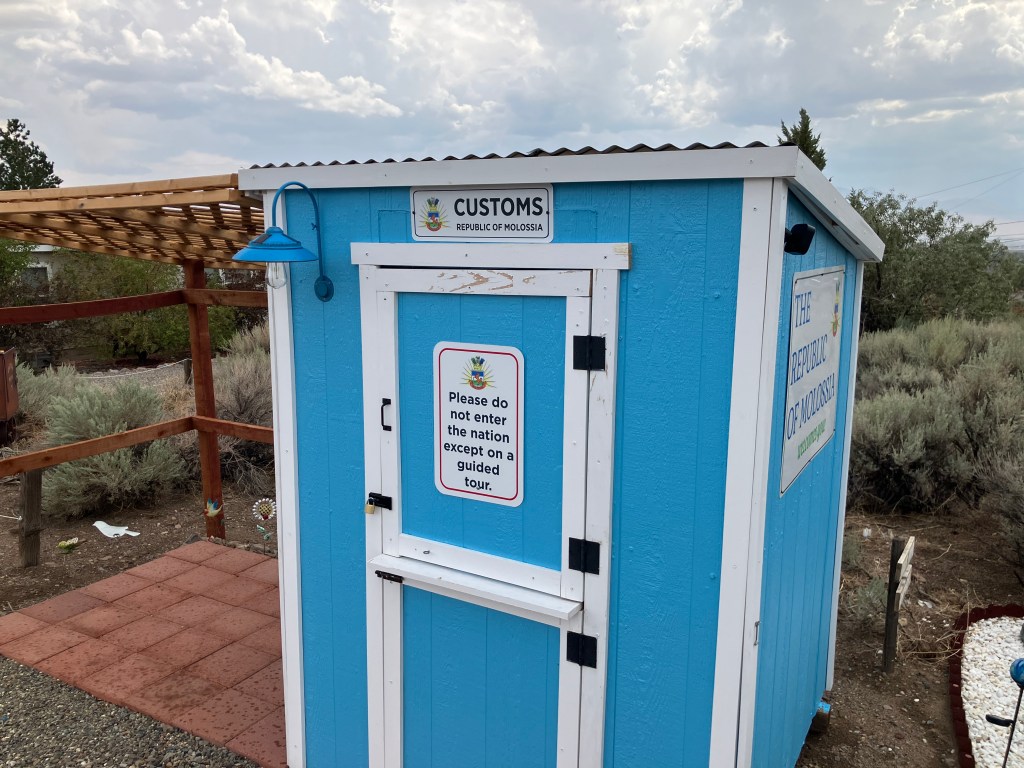
Despite my inability to secure a reservation, I decided to approach the customs building. Alas, it was locked up.

So I had no choice but to follow the signs back to the United States.

I plan to try to get on Molossia’s official tour list for 2026. When I have a date, I will announce it on this blog in case any of my loyal readers want to join my delegation. But for now, I had to bid a sad farewell to Molossia.

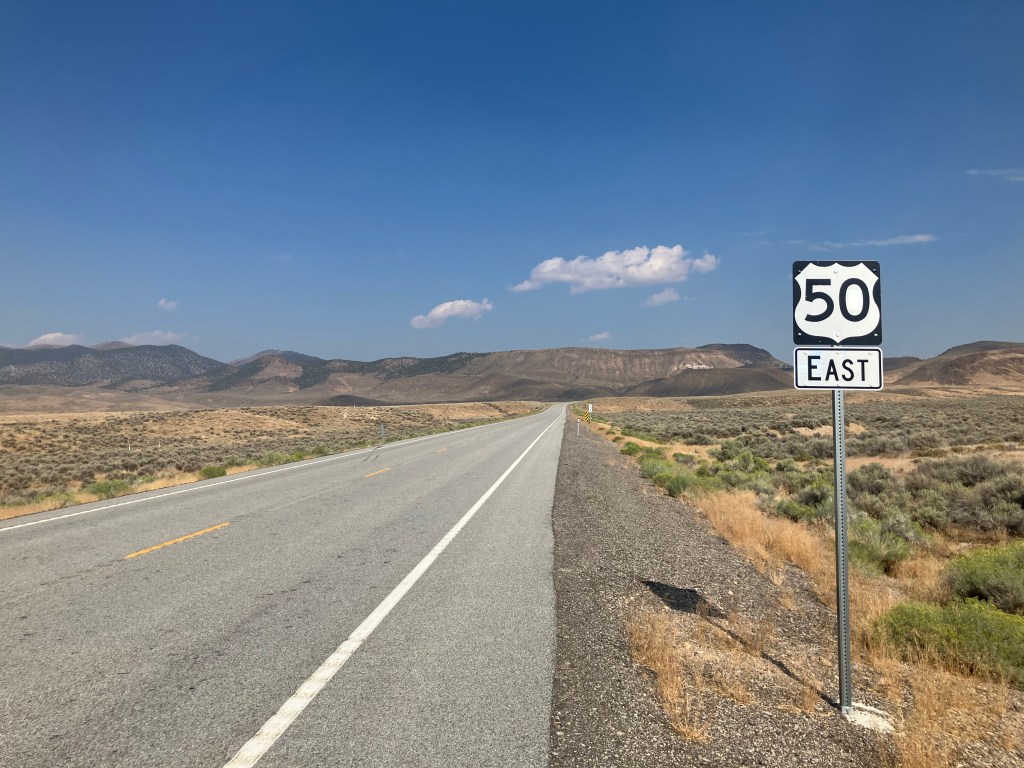
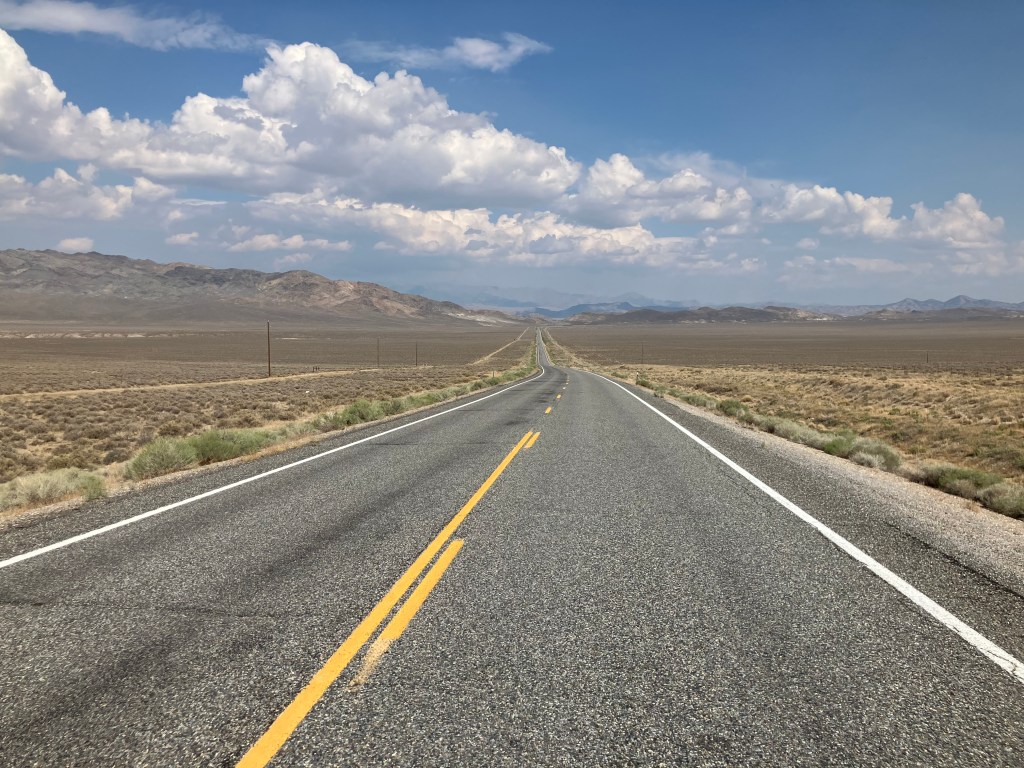
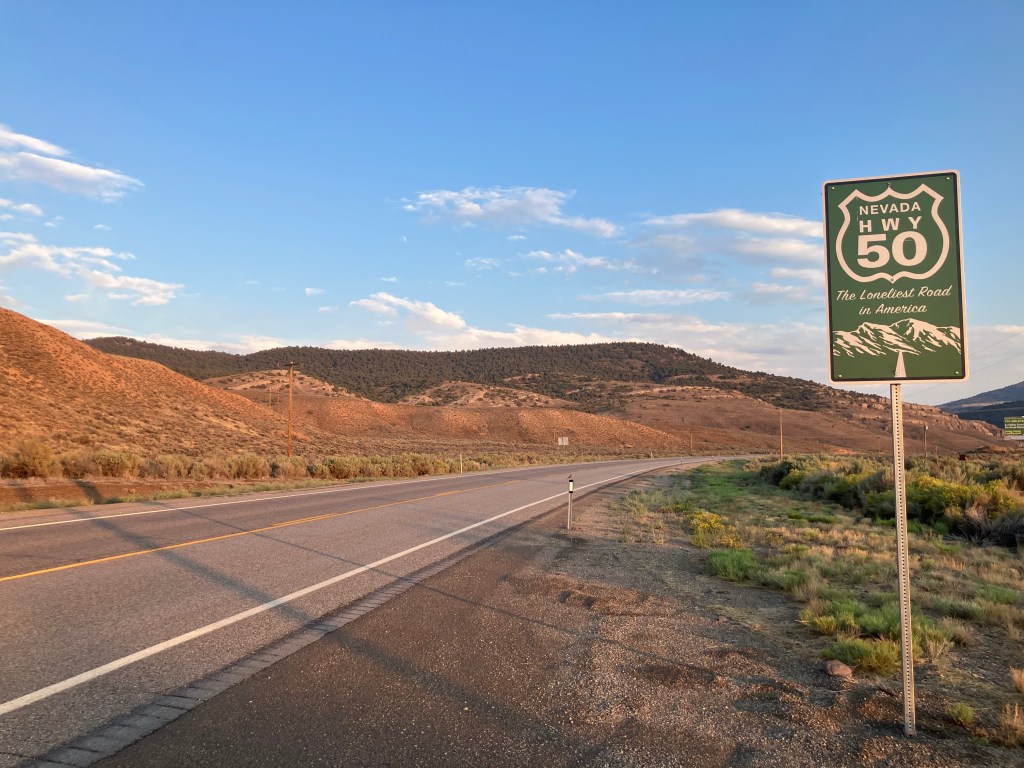
Almost all the remainder of today’s journey involved traveling US 50 across Nevada’s enchantingly bleak Great Basin. This stretch of highway is often called “The Loneliest Highway in America.” I’ve driven it several times (see my blog post here) and I always find it to be relaxing and contemplative. Today was no exception. Here are a few pictures to give you a sense of the landscape:

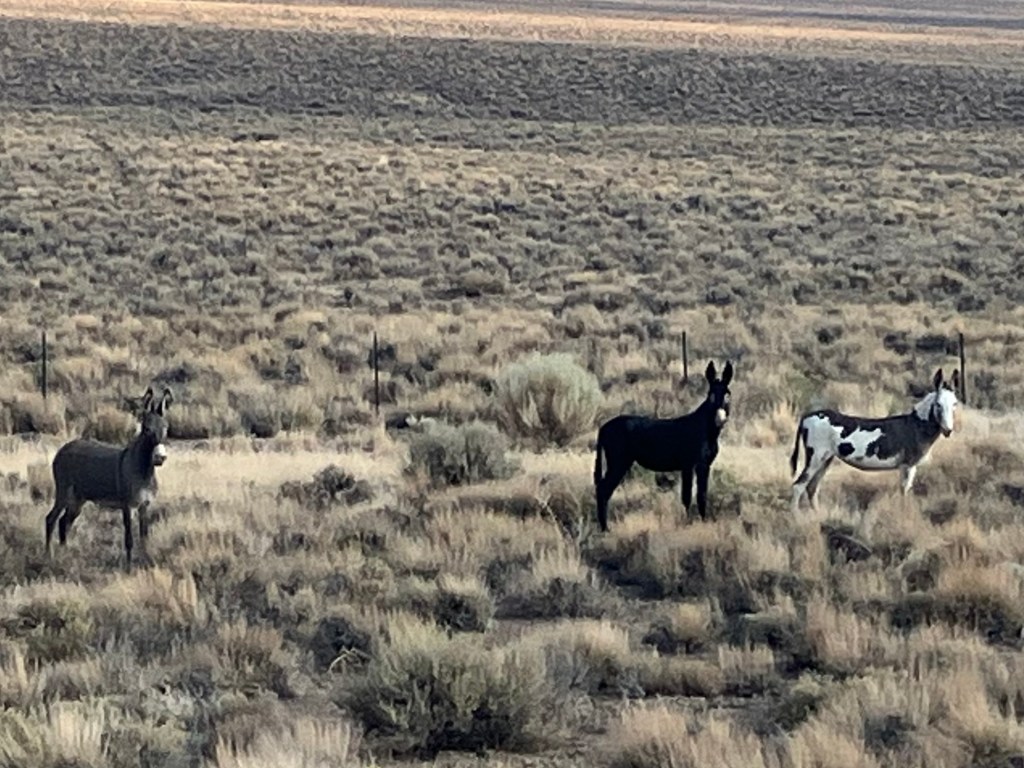
Inevitably, even out here in the middle of nowhere, you run into jackasses…
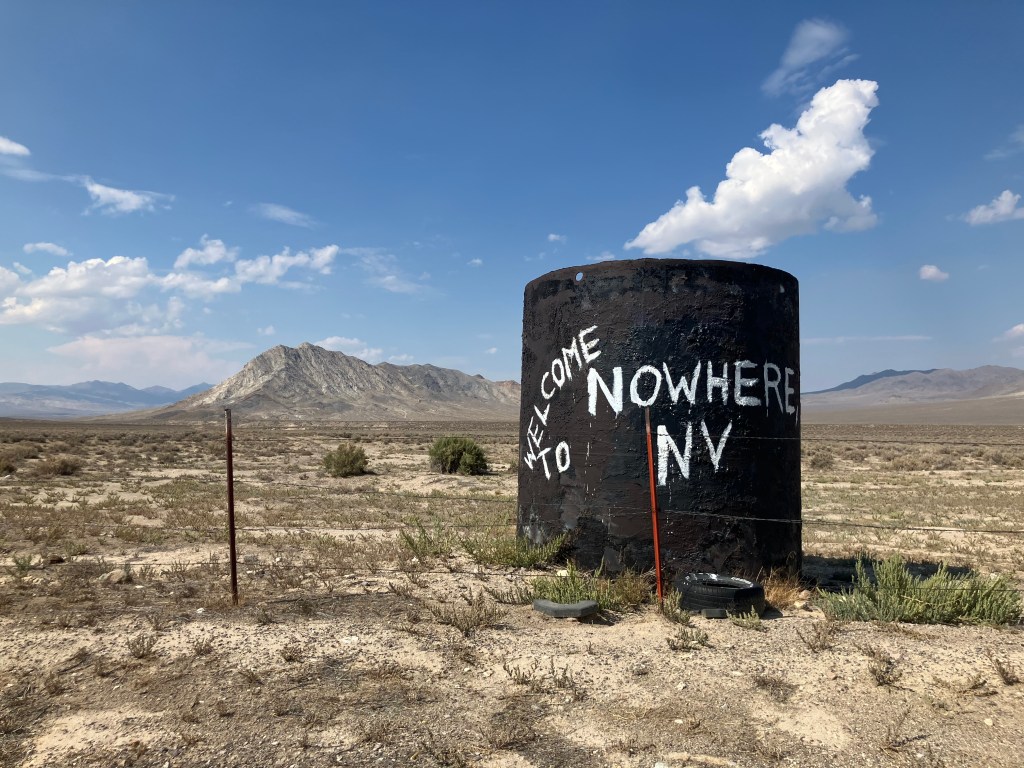
Speaking of the middle of nowhere…
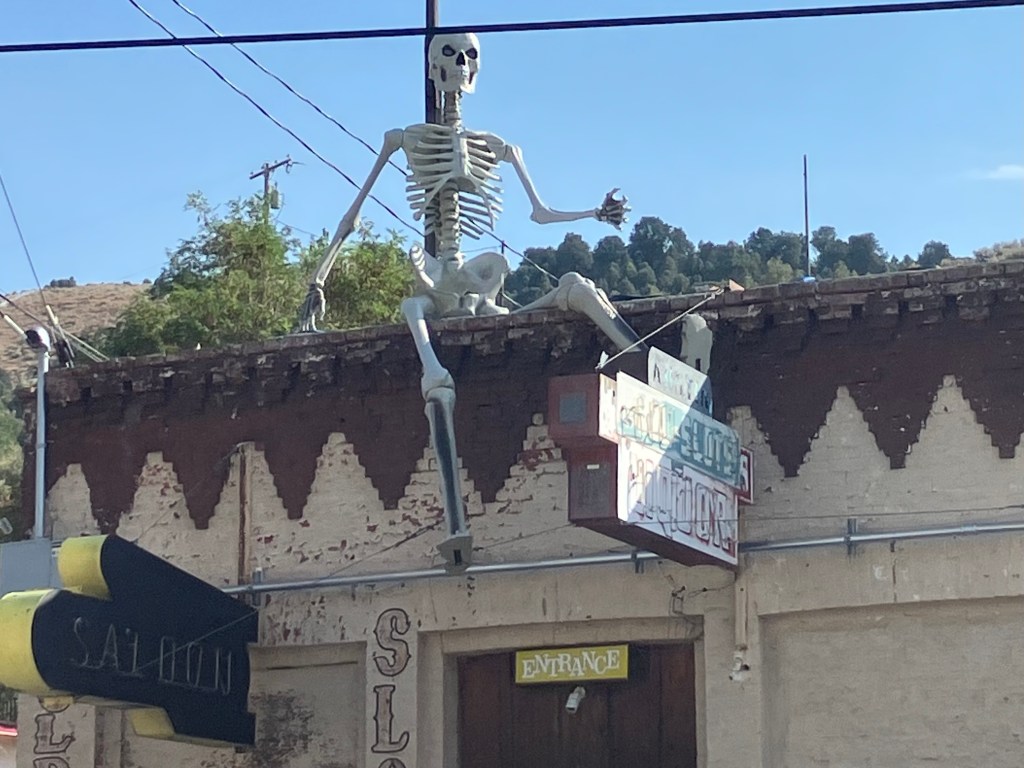
One of the few watering holes along the way, in Austin, NV.

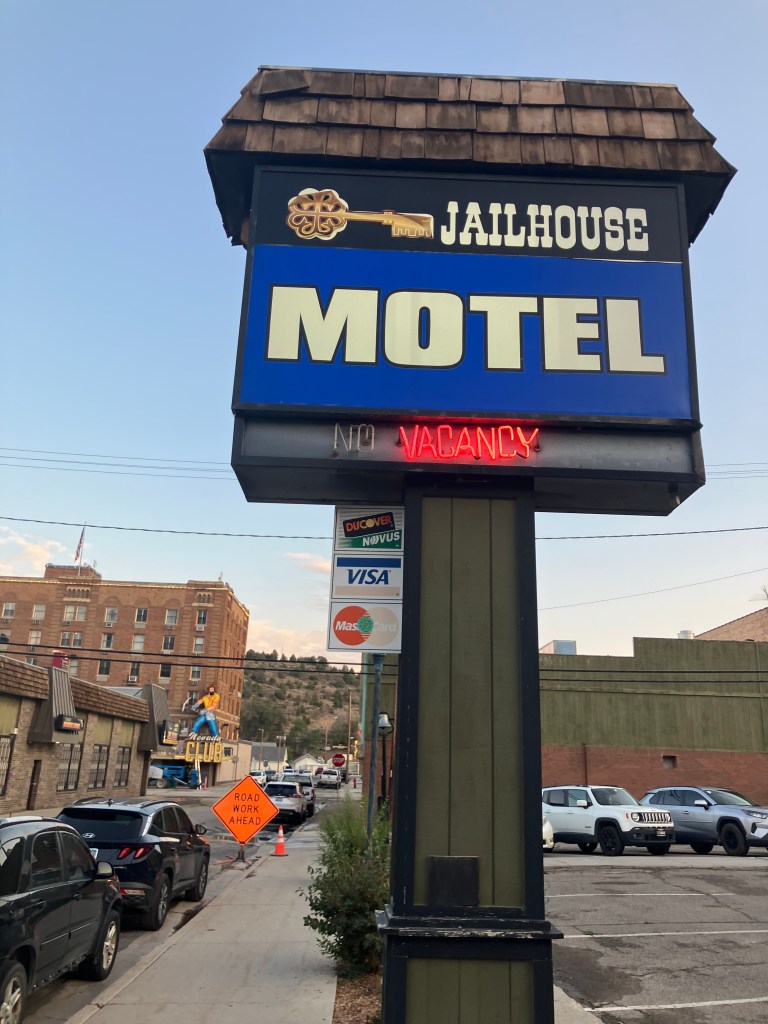
As the sunlight was wanting I stopped for the night in Ely, NV (pop: 3,900). Ely is well known for its superb railroad museum and heritage railway, but beyond that there isn’t much besides smoky casinos. I took a room at the Jailhouse Motel, whose reception desk is inside the adjoining smoky casino.

Also in the casino was something that passes for a bar, so I figured I’d try to get my Brew of the Day. But the beer selection was positively abysmal, and each seat at the bar was equipped with a huge, noisy video poker terminal. Looking at the bar’s sad patrons, I mumbled “terminal indeed,” and headed across the street to my room.

Hardy-har-har.

BRIDGE CORNER!

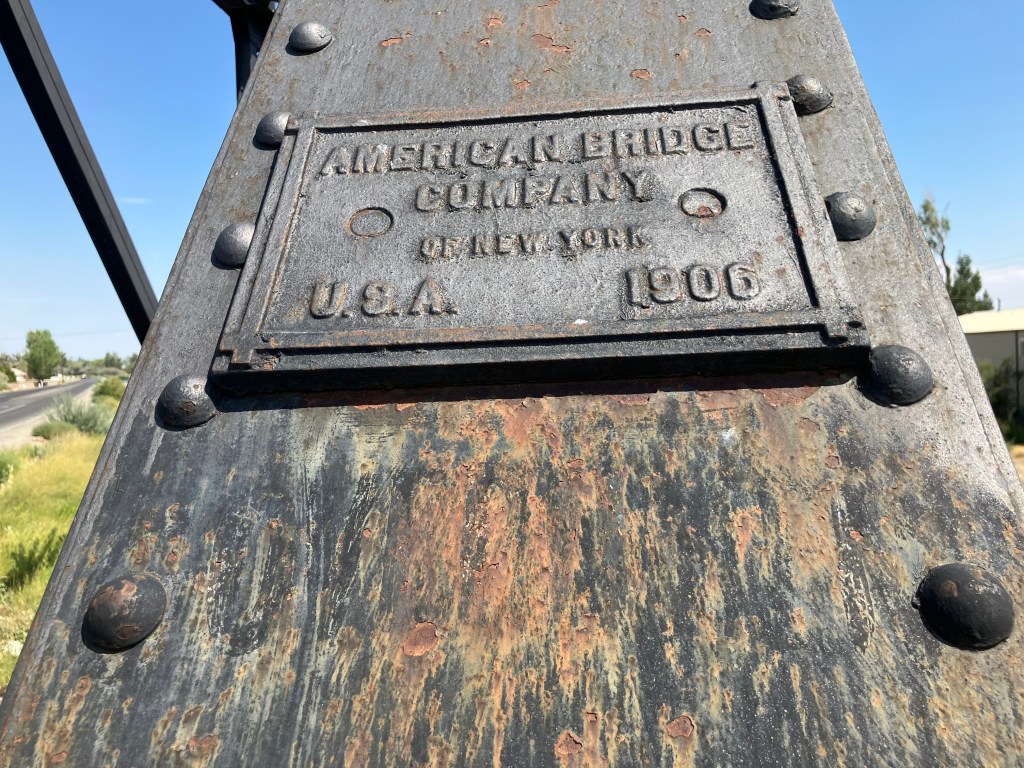
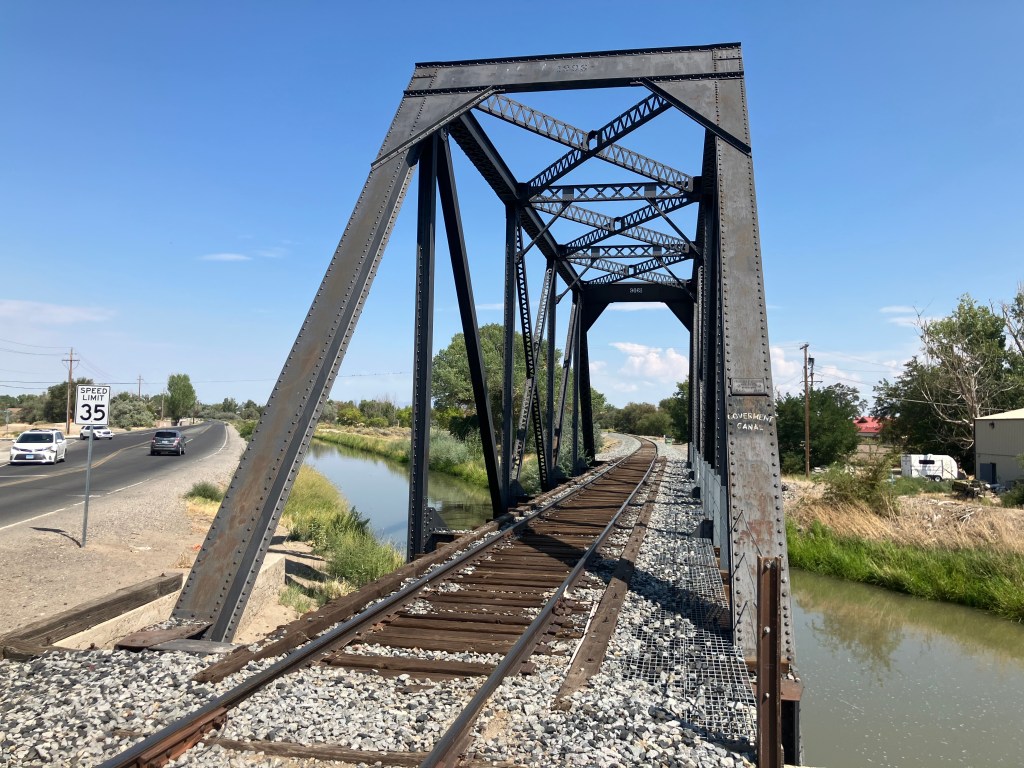
Although we don’t have a BOTD for today, we can offer you this 1906 railroad bridge over the Carson River in Fallon, NV:

As should be painfully obvious, this is a Pratt subdivided through-truss bridge. And, as a steel marker certifies, it’s made by the American Bridge Company of New York.

OK…thanks for indulging me. Tomorrow we’ll return to the BOTD.

California history · Road trips · trains

Tale of Two Cities

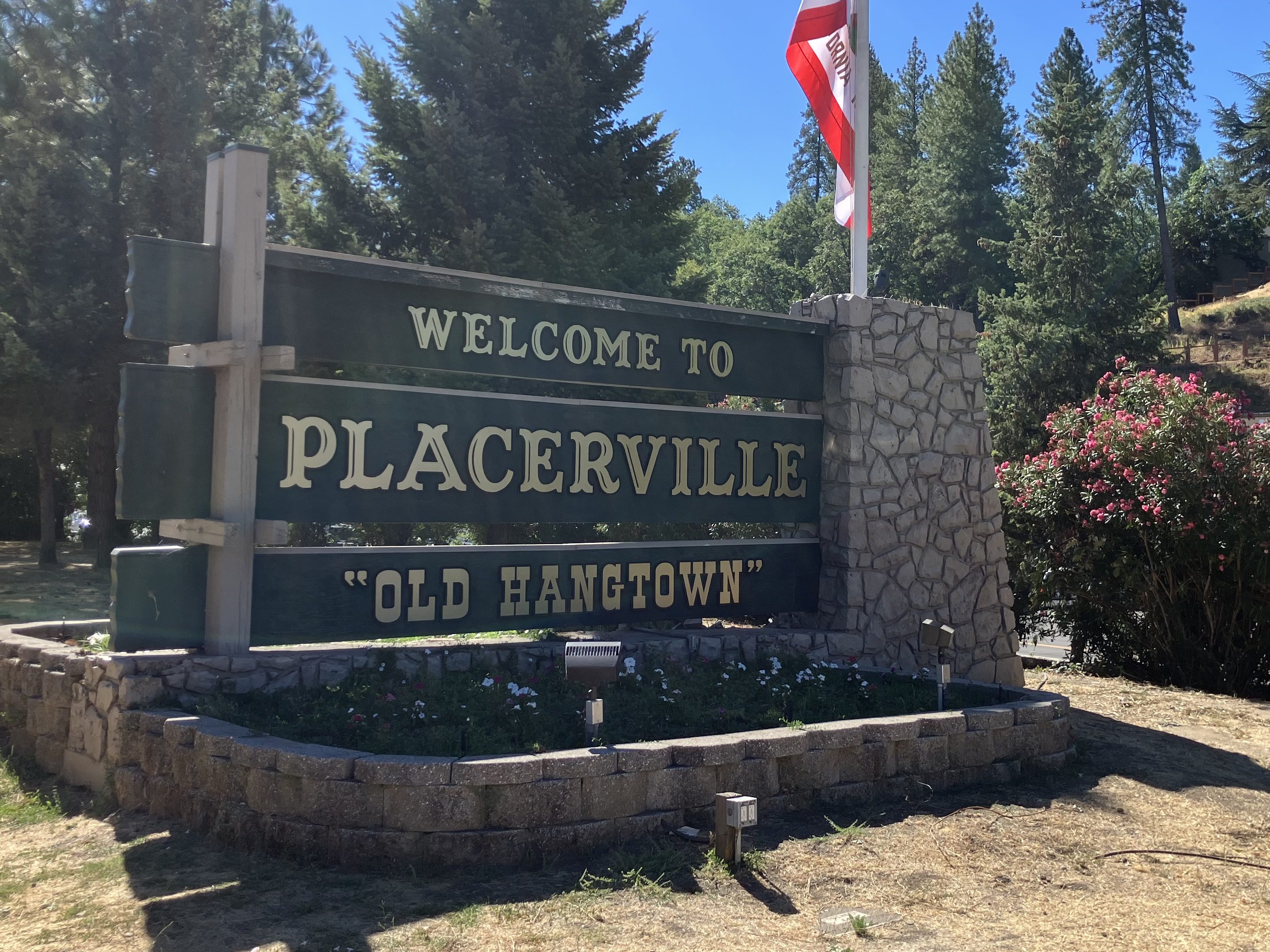
I’ve called many places “home” during my many years here on this big blue marble. Currently, I hang my hat in Placerville, California—a medium-sized town halfway between Sacramento and Lake Tahoe on US 50. Placerville started out as a mining camp during the California Gold Rush, and today it is the county seat of El Dorado County. And it may or may not be where Edgar Allan spent his final years, incognito.

The settlement was originally known as “Hangtown” because of the way justice was meted out from a big oak tree on Main Street. After the town got bigger and more respectable it changed its name to Placerville—a reference to the placer mining (that is, the relatively simple collection of gold from stream beds) which characterized the first years of the Gold Rush.

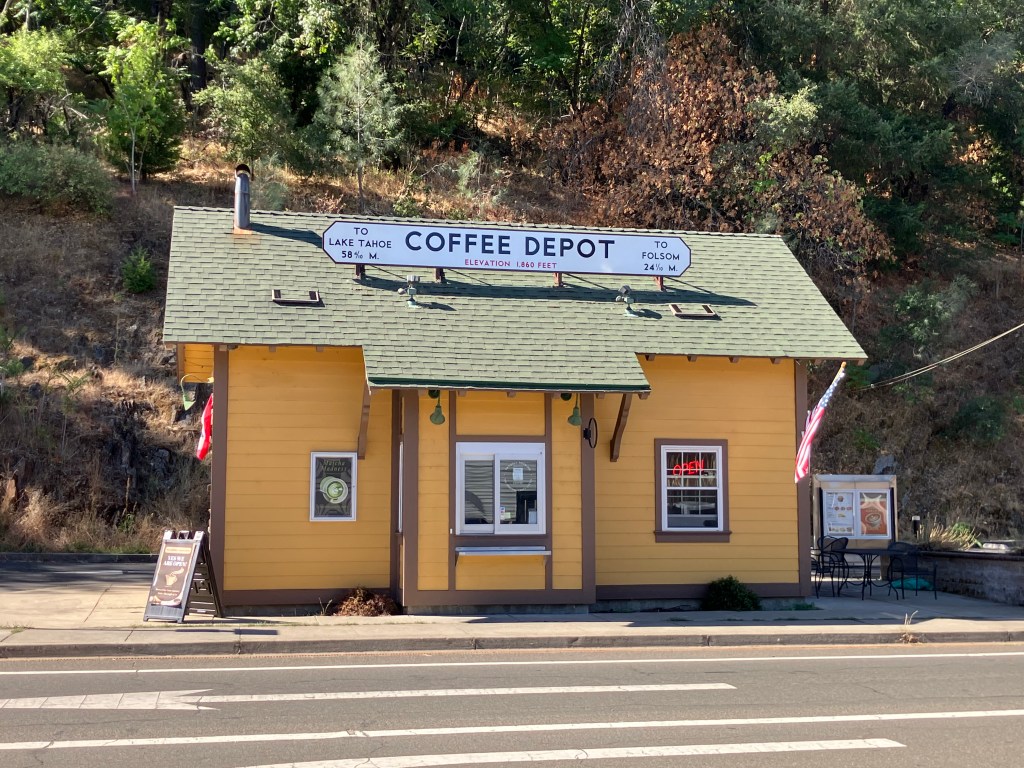
In addition to its gold mining heritage, Placerville is steeped in transportation history. Spurned by the original transcontinental railroad, Placerville was the eastern terminus of the Placerville and Sacramento Valley Railroad. It also served as a relay station for the Pony Express, and it’s where John Studebaker made his fortune selling wheelbarrows before he went back east to produce automobiles. (See my earlier blog post for more on these last two items.)

Faithful reproduction of Placerville’s 1889 depot. Placerville had hoped to be a stop on the original transcontinental railroad, but a more northerly route through Truckee was chosen.

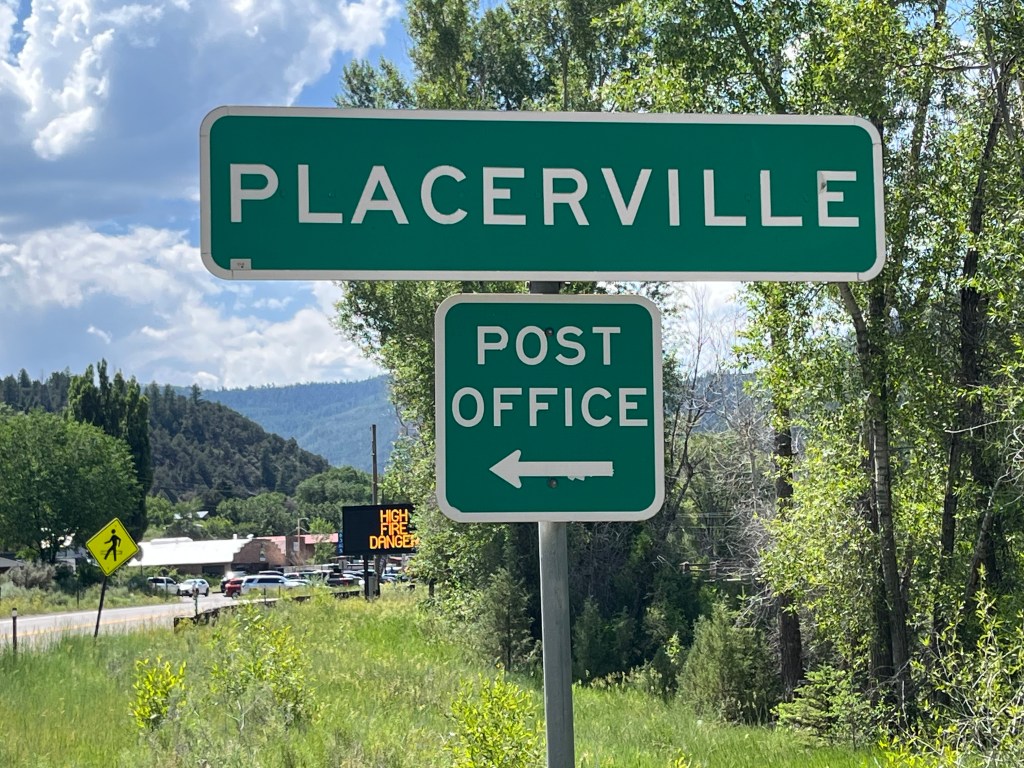
So, Placerville is a historic town with a unique and colorful history all its own. And yet about a month ago, my brother-in-law Scott was in Colorado and came across this sign:

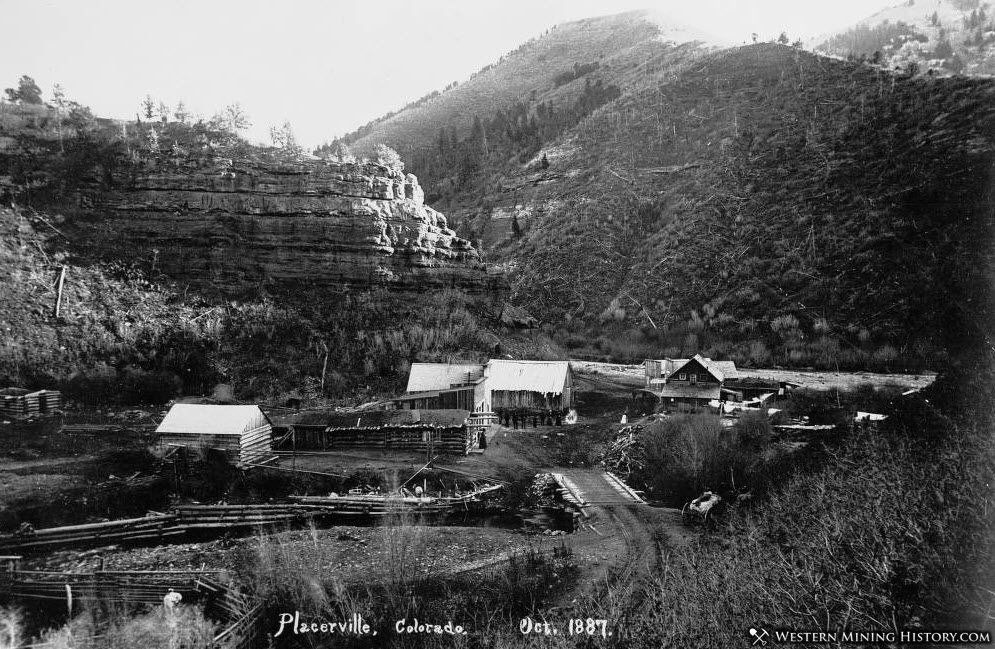
Who knew?? It seems there’s a second Placerville about 900 miles to the east. Evidently this eastern upstart was founded on Colorado’s San Miguel River in 1878, about three decades after “my” Placerville.

Photo c/o Western Mining History.

The two Placervilles presumably take their name from their shared history of placer mining. And yet there are significant differences: California’s Placerville sits at about 1800 feet in the Sierra foothills, while Colorado’s Placerville is perched at 7300 feet in the Rocky Mountains. The California version has a population of about 10,700, while the eastern upstart only has about 3 percent as many souls.

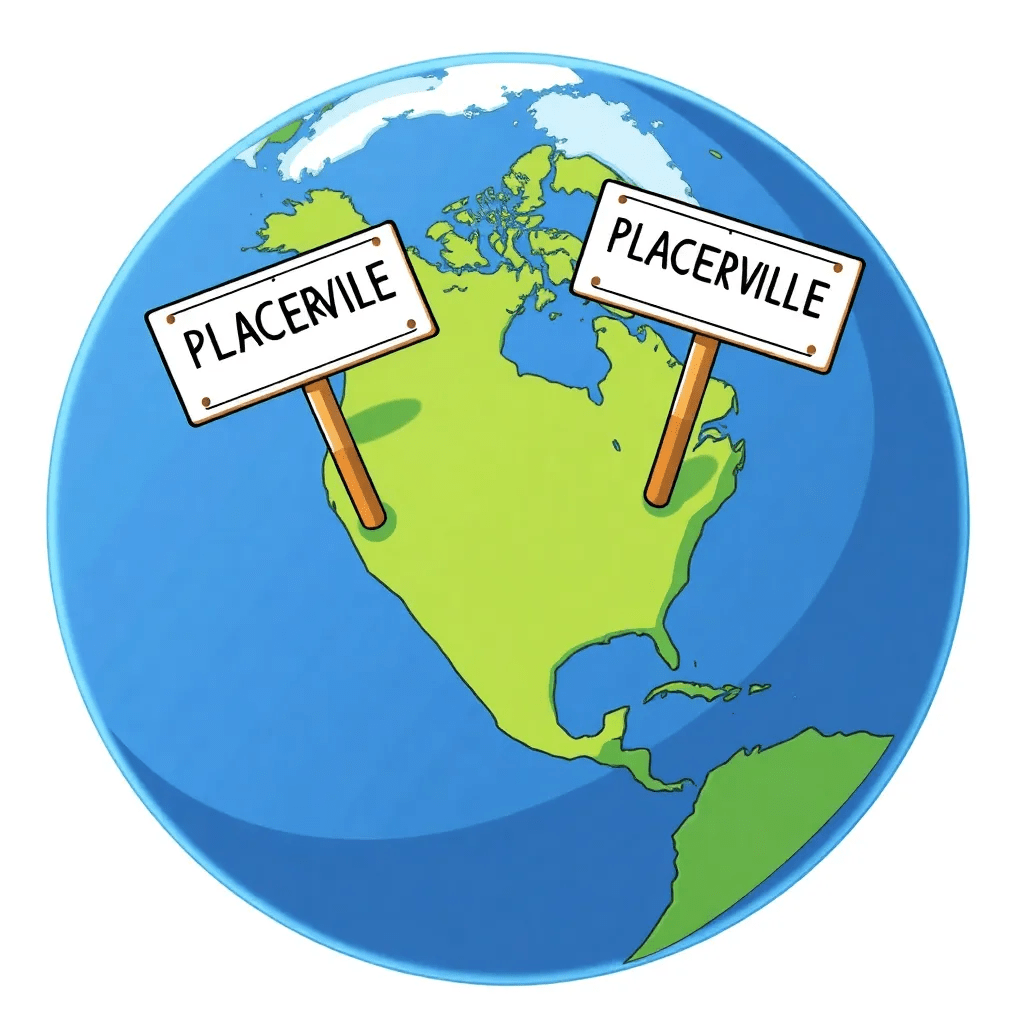
ChatGPT generated this image for me…and seems to have some trouble with spelling.

So, what to do with this discovery of Placerville’s doppelganger? Why, plan a Placerville-to-Placerville road trip, of course! And that trip starts tomorrow morning. To spice things up, my route is going to take me through a foreign nation. All will be revealed over the next couple of days. Stay tuned!

Road trips

For Your Summer Reading List

So, the summer is starting to wind down, but have you yet managed to read that great summer novel that captures your imagination, gets you thinking about the meaning of life, and has you eagerly telling your friends about the story? Well, look no further! I’ve found that book for you–and it just so happens that I’ve written it. It’s a story literally centuries in the making…sort of.

It’s titled Sundial in the Shade and it’s being released on September 15. Read on and I’ll tell you how you can get an early copy for free.

First, here’s a short description of the book:

Rael Hart’s carefree life of tagging, theft, and mild substance abuse is interrupted by a four-year stretch in the Los Angeles state prison. But he experiences an infinitely greater disruption upon his release, when he comes into possession of a cryptic journal containing an 18th-century recipe for personal redemption. His grudging effort to follow its prescription launches a transformative odyssey that involves, among other things, cigars, Milk Duds, and an ancient skeleton key.

On this journey Rael encounters several fellow-travelers with ambiguous motives, including an eccentric prison librarian, a disgraced LA Times reporter, a homicidal preacher, and an ex-girlfriend with more issues than Poor Richard’s Almanack. As Rael wrestles with the aggravating tradeoffs between a good life and a good time, he stumbles upon a destiny that’s been centuries in the making.

On September 15 the book will be available on Amazon in hardcover, paperback, and Kindle versions. But right now Goodreads is doing a “book giveaway,” which lets you enter to get a free Kindle version of the book on September 1. If you’re interested, you can sign up here. (Click on “Enter Giveway” on the left side of the screen, under the image of the book cover.) The giveaway ends on September 1. Be aware that to sign up you will need to have or create a Goodreads account. Thanks for your consideration of this offer. The more people who sign up, the higher the profile of my book on Goodreads.

New Road Trip

ChatGPT’s imagining of a “mysterious road trip.”

In other news: Next week I’ll be posting from the road as I make a 900-mile trip to a mystery location. Your only hint is that several days after I pick up my rental car in Placerville I will be in Placerville.

Oh, and this weekend we also will have a review of the new “Back to Hogwarts” collection of Krispy Kreme donuts. The things I do for you people…