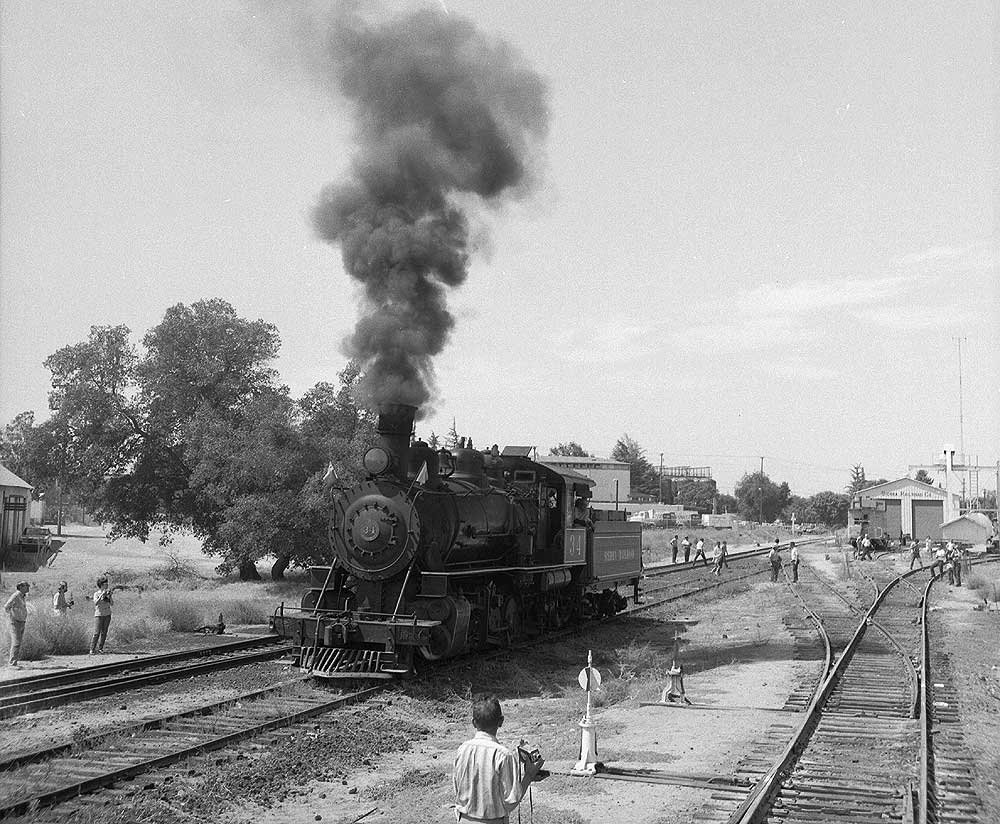
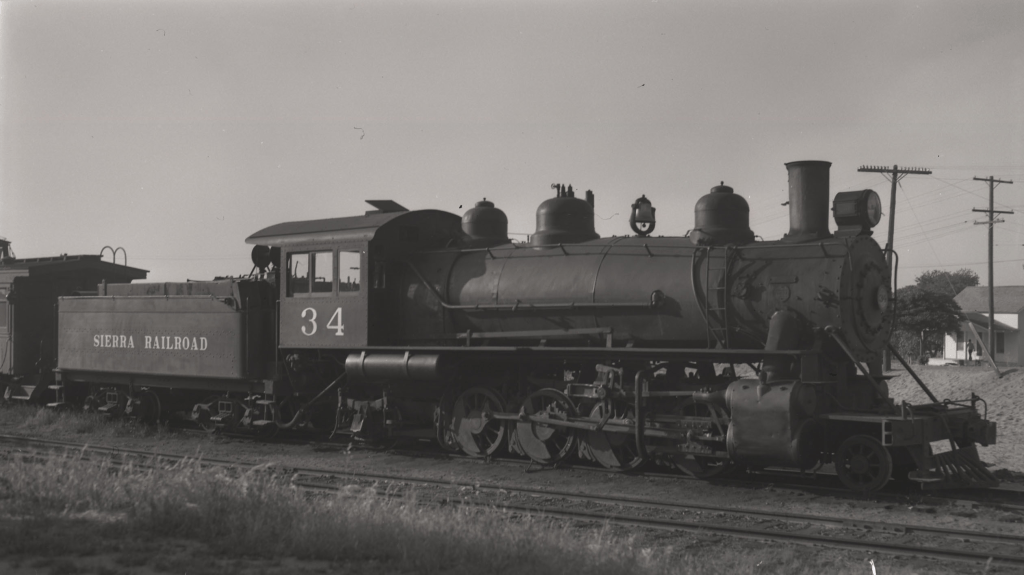
The Dome is developed, maintained, curated, etc. by my Uncle Edward–a retired railroad man and an amateur researcher/historian. He reminded me that he has a large collection of photos and other information related to Railtown. As an example, here’s Uncle Ed’s photo of the No. 34 (which I featured yesterday), which he took in 1971:
Back when she was still a runner.
The link to the Sierra Railroad section of The Dome is here. Be forewarned that once you go down that rabbit hole, you may never come back.
Yesterday my good friend Bill mentioned that there was going to be some kind of celebration in Sierra Foothills this weekend to commemorate a new locomotive acquisition by California’s Department of State Parks. Given my long-standing interest in trains, as well as the fact that the spring weather has been glorious this year, it sounded like a worthy day trip. I consulted my calendar, which, given my state of retirement, is as empty as a bird’s nest in December. So it was that Bill and I met this morning in the historic township of Jamestown.
Jamestown (pop: 3,100) was founded just as the Gold Rush was beginning, in 1848. It remains a small, unincorporated town of Tuolumne County, about 100 miles southeast of Sacramento. The important thing about Jamestown, for our purposes today, is the railroad. The Sierra Railway Company was established in Jamestown in 1897, hauling ore from mining operations and timber from logging operations around the area.
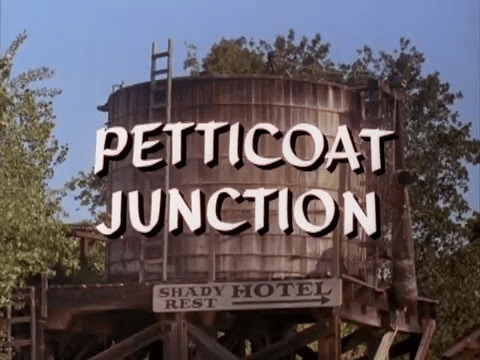
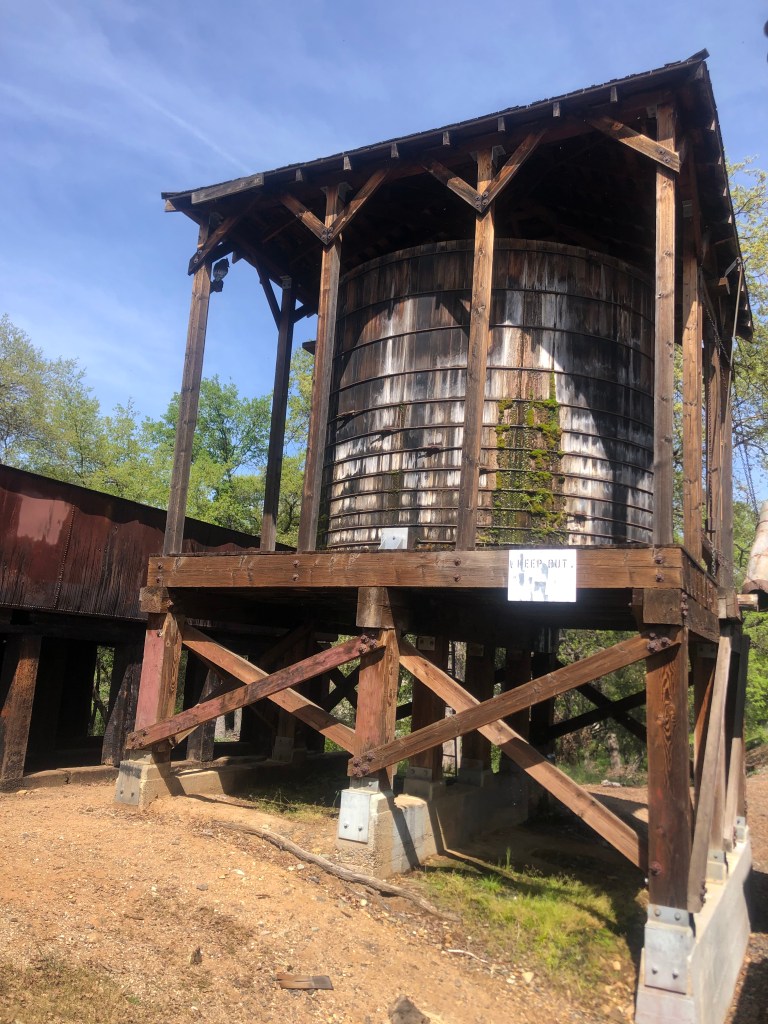
The narrow-gauge railroad operated into the 1960s. In addition to freight and passenger hauling, the Sierra Railway developed a niche as a “movie railroad,” whose trains and structures appeared in numerous Hollywood films (including High Noon (1952), 3:10 to Yuma (1957), and for you young ‘uns, Back To the Future Part III (1990). Oh, and it was featured in the opening credits of “Petticoat Junction” each week.
Then….…and now.
In 1971, after most of the commercial transportation purposes of the railroad had dried up, the Sierra Railroad’s Jamestown facilities (including a station, roundhouse, and shops) were opened to the public as “Rail Town 1897.” A decade later (i.e., 50 years ago this year), the facilities, along with locomotives and cars, were purchased by the California Department of Parks and Recreation for $750,000. Railtown 1897 was designated a State Historic Park. It remains a popular tourist destination, offering tours of the shops and steam train rides pulled by the original engines on the original tracks.
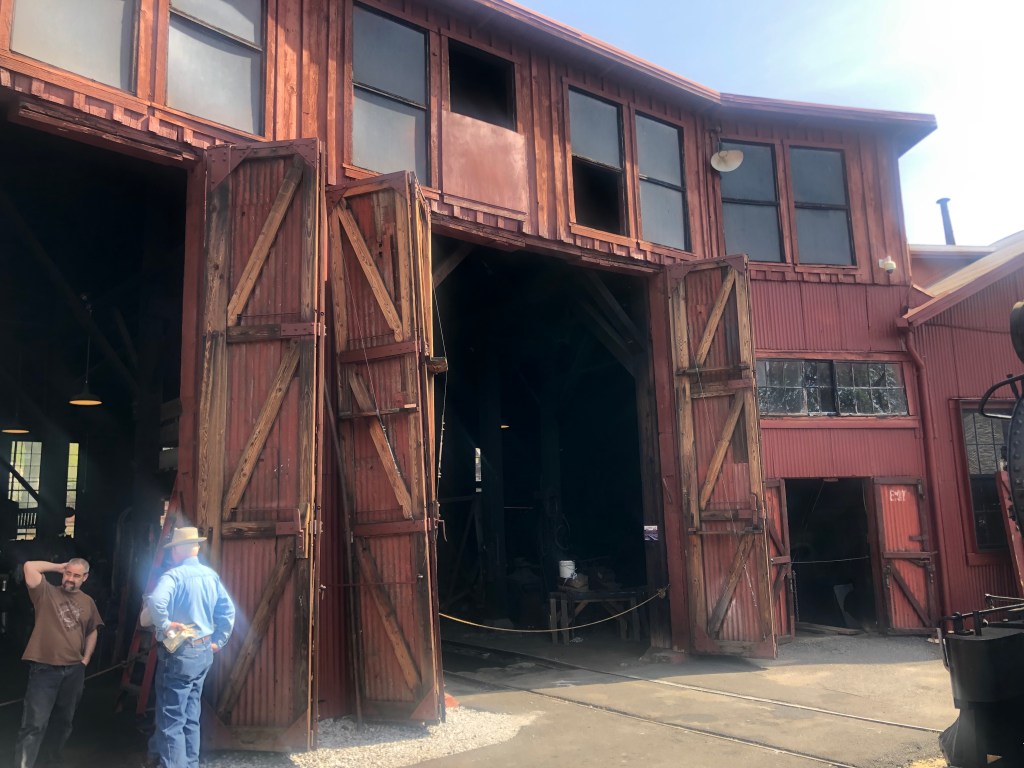
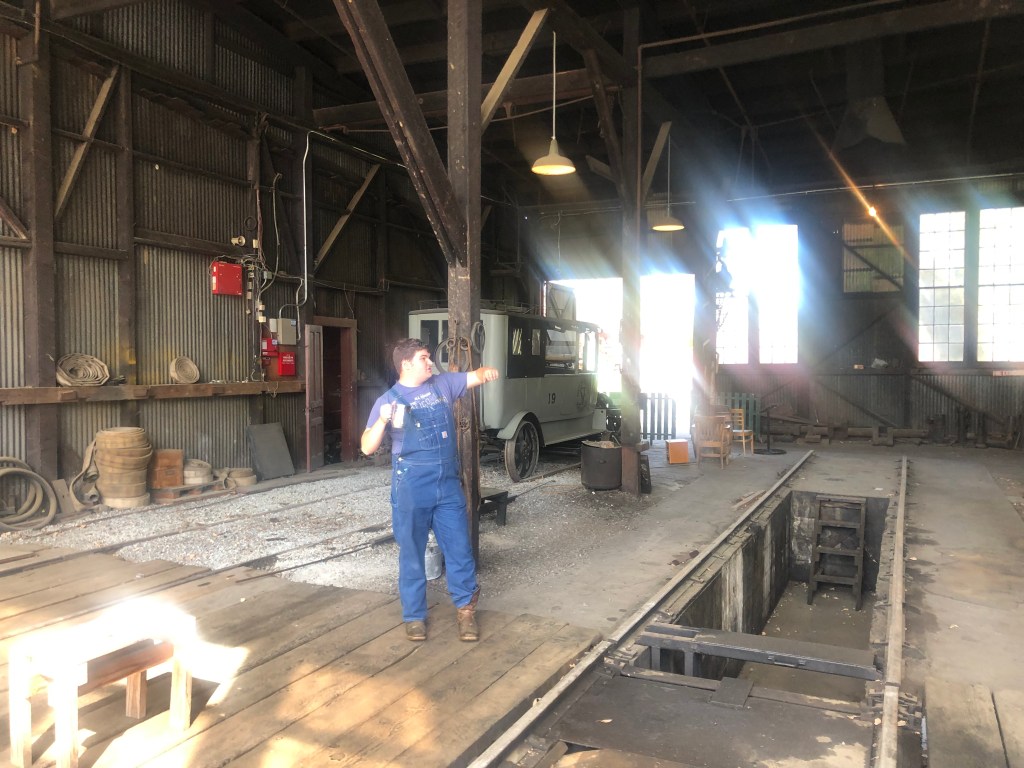
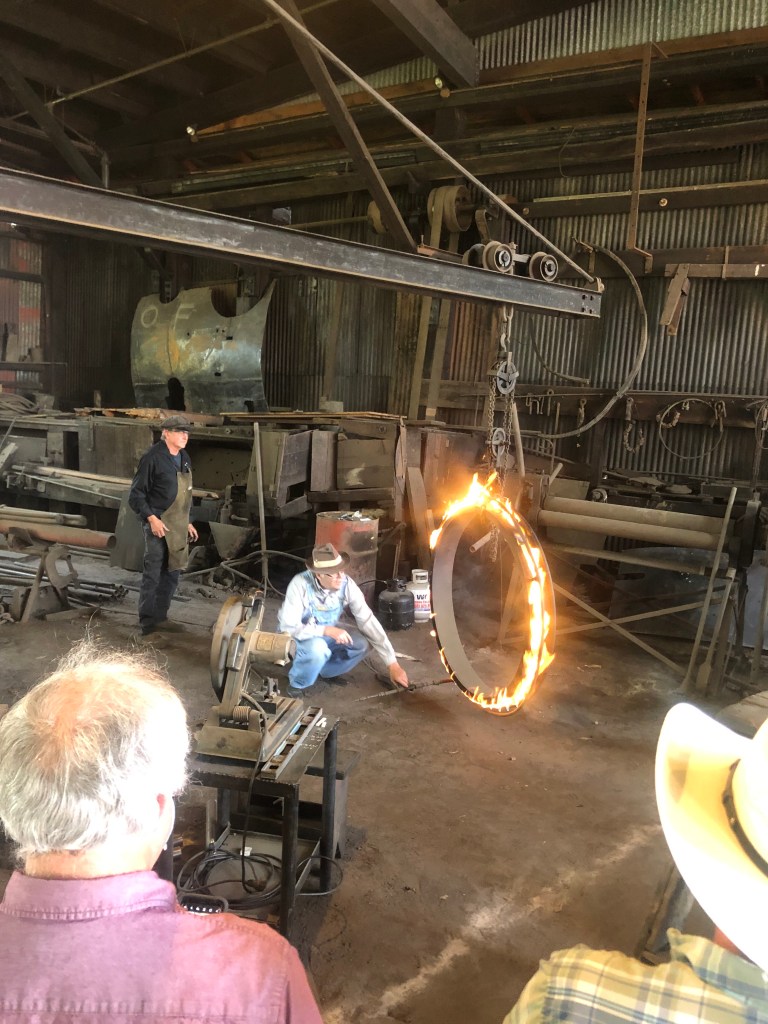
I can’t emphasize enough how unique and impressive this place is. The roundhouse is largely unchanged from how it looked over 100 years ago. Most of the same tools and equipment are still in place, and are used regularly to repair and restore locomotives and cars. They have vintage locomotives and rail cars that offer excursion rides every weekend. This place is an authentic time capsule.
The Roundhouse, over a century old and still in useInside the roundhouseDon’t try this at home.
But let’s get back to the purpose of this trip. The whole reason we came was because Railtown 1897 had put out a press release that they had acquired a new locomotive. And by “new,” they meant “old.” The locomotive (Sierra Railway’s No. 34) was built almost a century ago. Sierra purchased it new in 1925 from the venerable Baldwin Locomotive Works and it remained on Sierra’s roster until the company closed in the late 1960s. The locomotive was eventually sold to a collector (someone who evidently didn’t think model trains were sufficiently authentic), but this collector never got around to moving the engine away from its stomping grounds. It just sat there in the roundhouse in Jamestown. Recently that owner/collector died, and the locomotive went up for sale. Money was provided by two generous donors–Chris Baldo and Marion Hatch–and Railtown was able to acquire the “pink slip” for the engine that’s been on their property for a century. Hence the big celebration today.
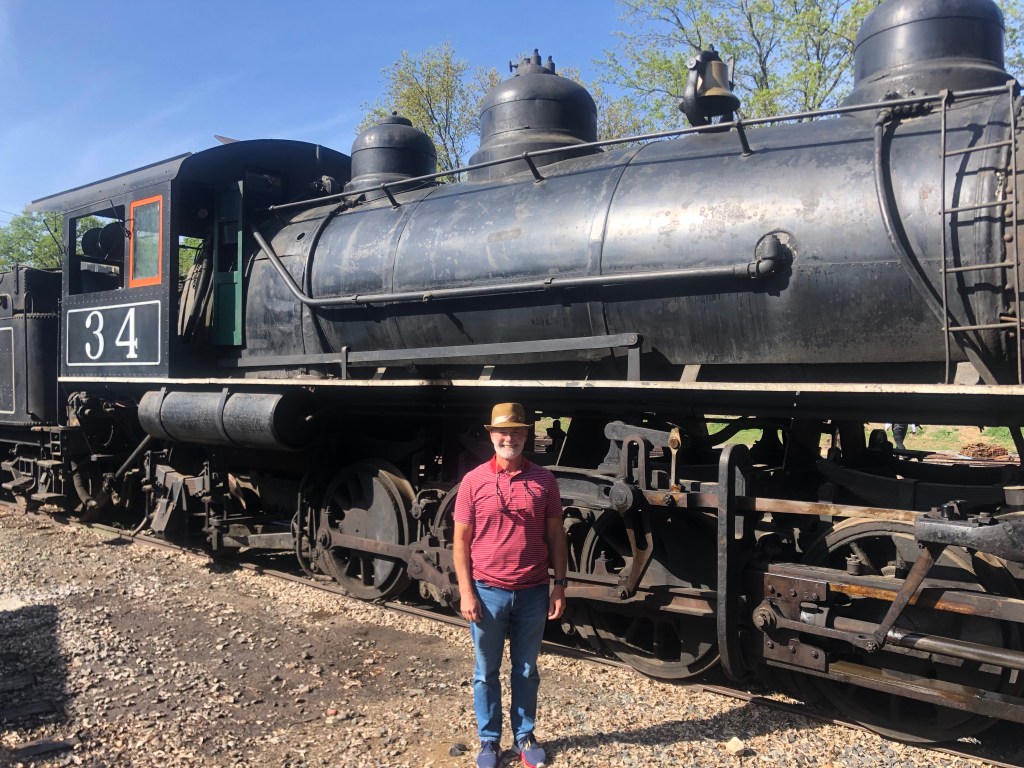
The engine in question is the Sierra Railway’s No. 34, seen here in its heyday:
Old Number 34Friend Bill in front of Old(er) No. 34 today
The engine hasn’t run since 1980, but, using words familiar to everyone who’s purchased a classic automobile, “it was running when we last shut her down.” The plan is to restore the locomotive to operational condition.
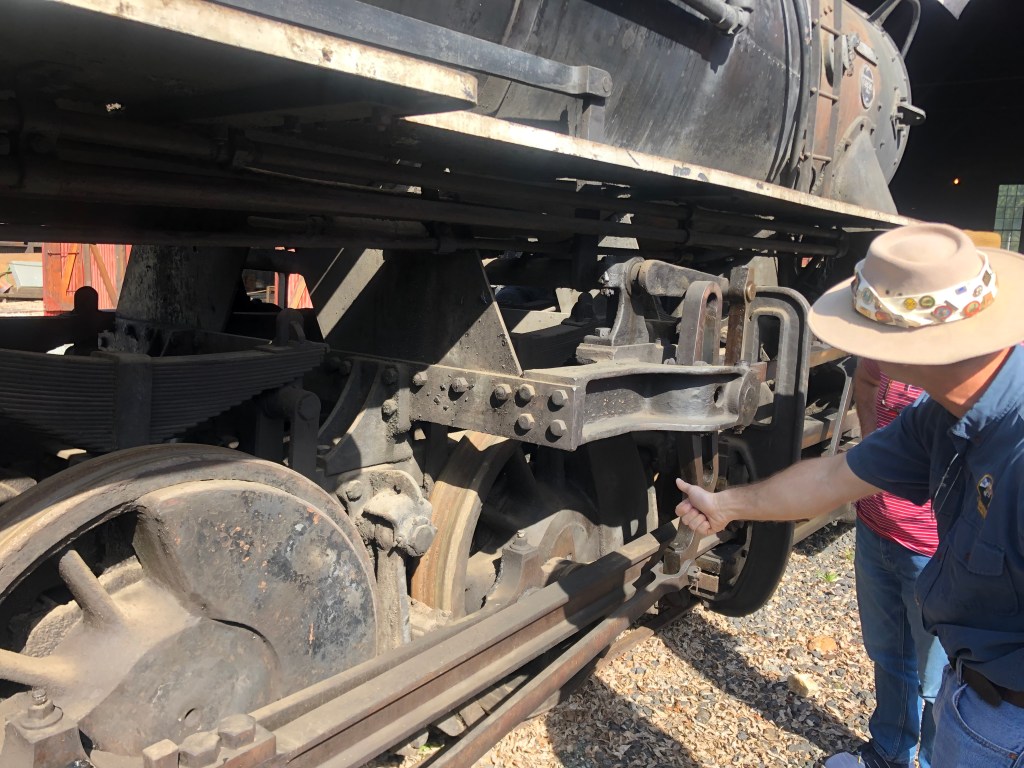
Like Charlie Brown’s Christmas tree, it just needs a little TLC…
They plan to do the restoration work right here, in the venerable old shops at Railtown. Bill and I hope to provide a little volunteer muscle on that project.
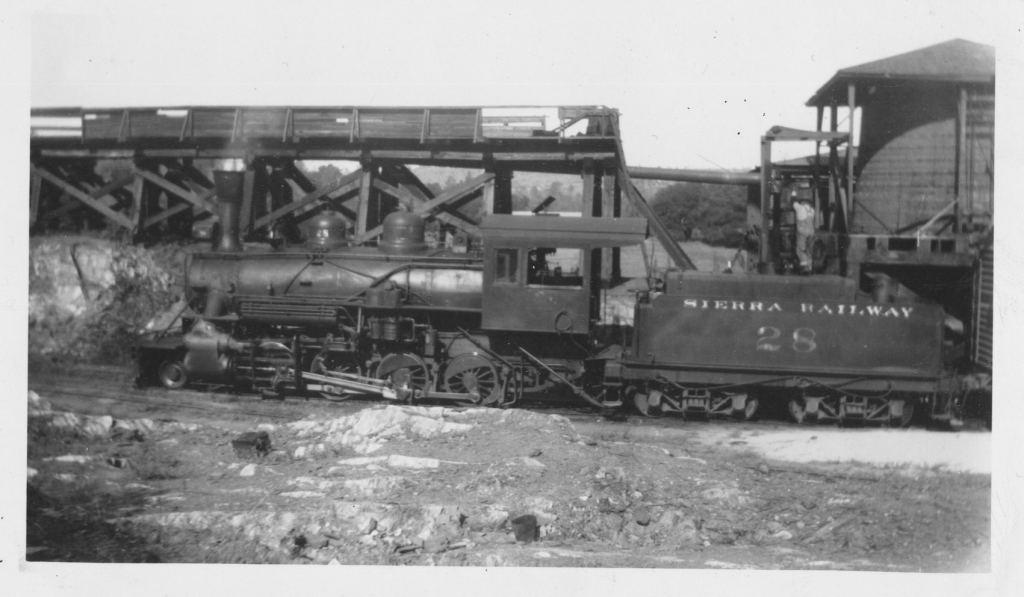
Meanwhile, Railtown does have other steam locomotives. These include the No. 28, which celebrates its 100th birthday this year. The engine hauled cement and rock for the construction of the O’Shaughnessy Dam at Hetch Hetchy in the 1920s, and then turned to regular freight and passenger service. It has appeared in various movies and television shows, including “Little House on the Prairie” and Bound for Glory.
Old No. 28, back in the day
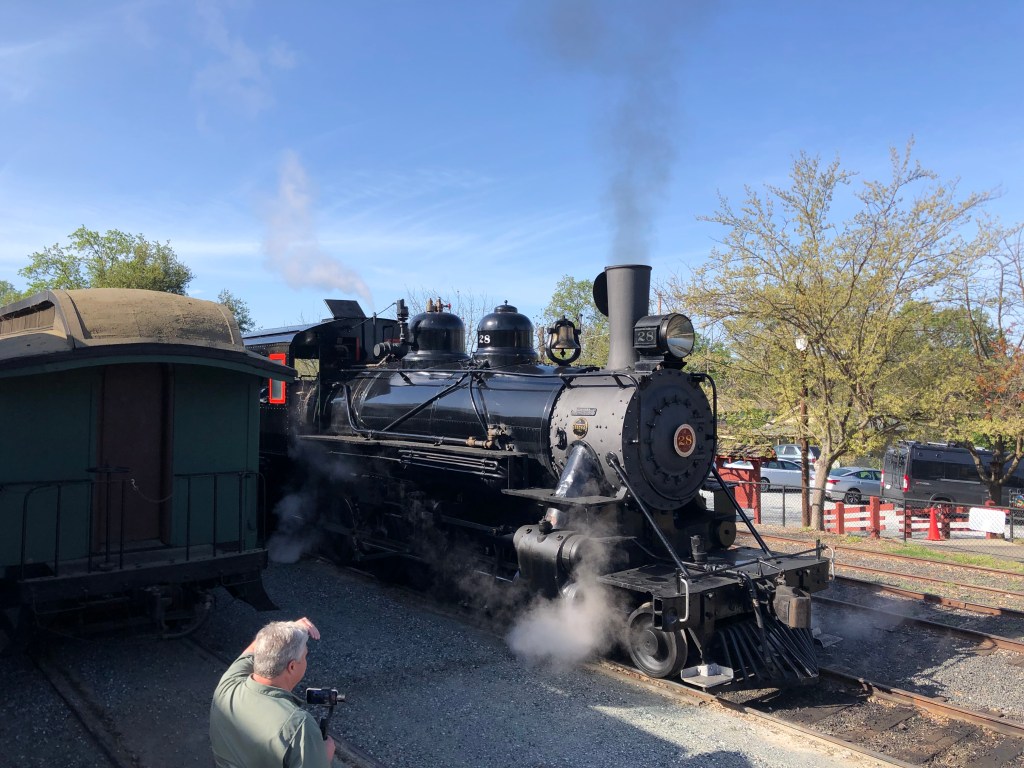
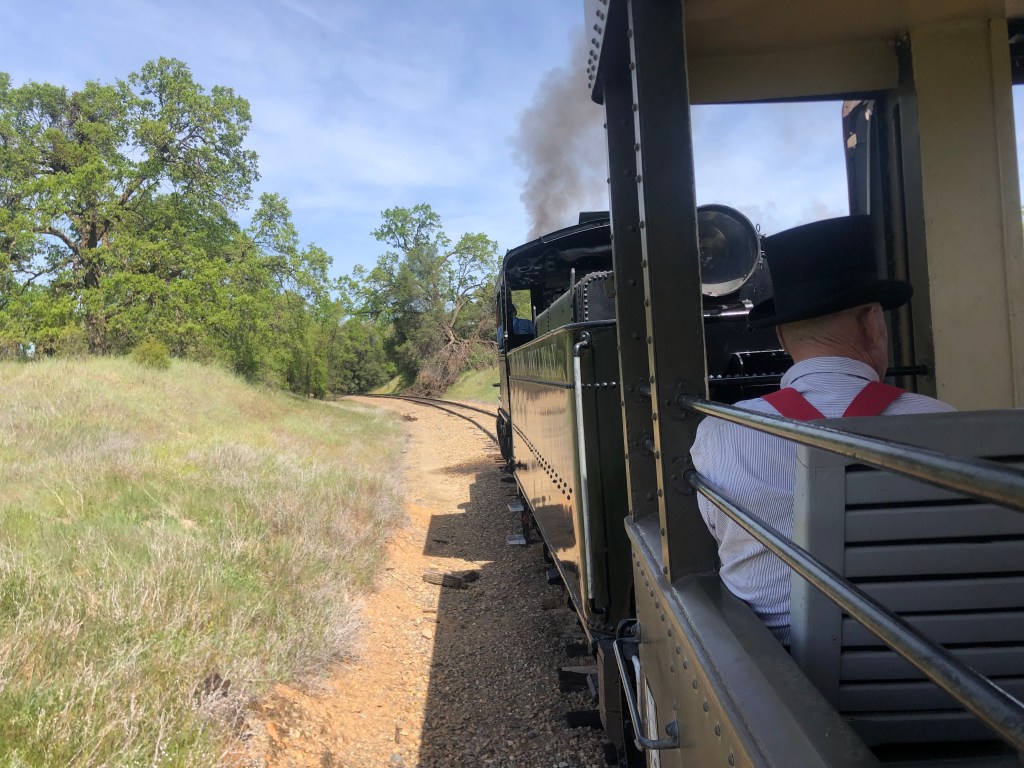
Today this same engine is still running strong. In fact, it pulled our excursion train this afternoon as we enjoyed an hour’s journey along the Sierra Railway’s old, historic tracks.
No. 28, under steam this morningView of the Old 28 from our passenger car
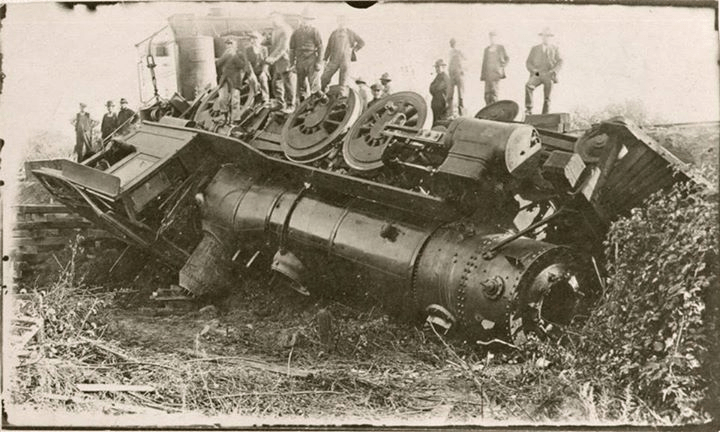
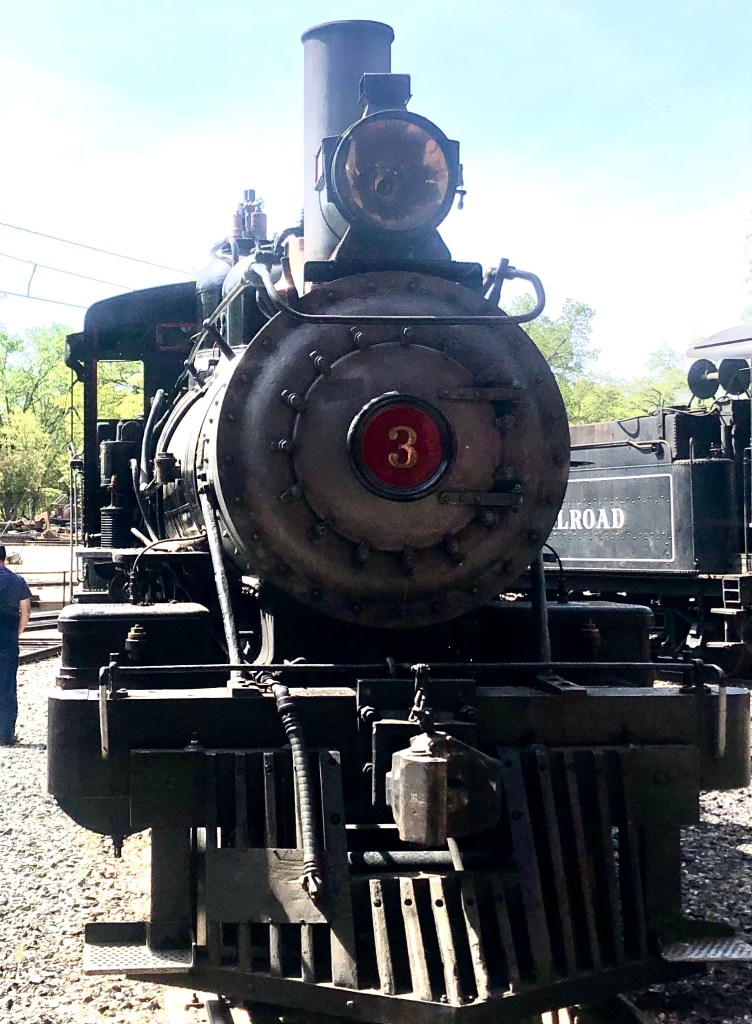
Railtown also has another operational steam engine–the No. 3, which was built in 1891(!). This locomotive has appeared in more movies than any other locomotive, and is regarded as an archetypal example of late 19th-century American trains. It’s been involved in a few mishaps over the years…
…like this one in 1918….
…but it’s been repaired each time, and remains in service to pull excursion trains.
Old No. 3 today
So, overall, the Sierra Railway’s facilities in Jamestown (i.e., “Railtown 1897”) is a remarkable, virtually unspoiled, authentic example of California’s railroading past. It’s well worth a trip. (Admission is $5. I’ll send you a fin if you’re strapped for cash.)
Postscript
Stick with me here; this is going to connect back to Railtown 1897.
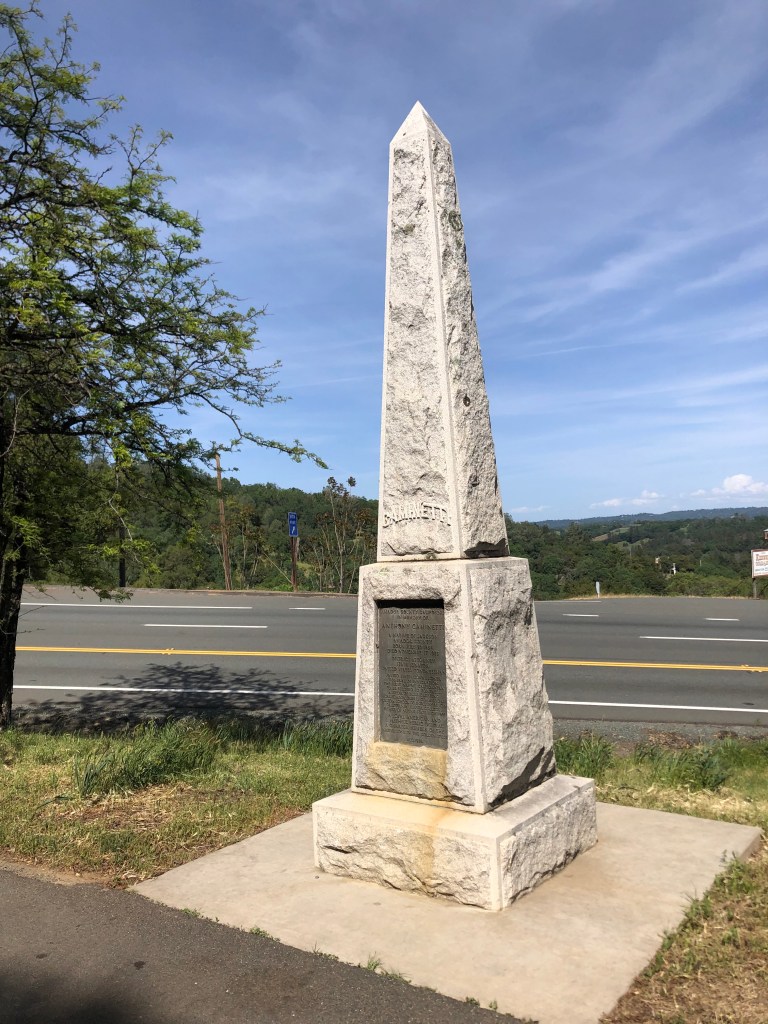
On the way home along Highway 49, I stopped in the town of Jackson (pop: 4,800) to check out this obelisk that I saw from the road:
Wouldn’t you have stopped for it?
The obelisk was erected in 1938 to honor favorite son Anthony Caminetti (1854-1923), who racked up an impressive resume. Allow me to quote the marker: “District Attorney, State Senator, United States Congressman, United States Commissioner, General of Immigration, the first native Californian to be elected to Congress, author of bills creating California Debris Commission, Preston School of Industry at Ione, California Junior Colleges, Father of Alpine State Highway, a loyal American and a faithful public official.”
Some of these posts sound impressive (Congressman, Senator…). Others are a bit less so. I mean, being one (of many) authors of certain pieces of legislation isn’t exactly herculean. It does, however, raise a critical question: What exactly is the “California Debris Commission,” anyway? Answer: it was an agency created in 1893 to clean up the damage that had been done to California’s waterways by the extensive use of hydraulic mining in the Sierras. The Commission was dismantled in 1986.
And here’s were we link back to Railtown 1897. For it turns out that the Clint Eastwood movie Pale Rider (1985) focuses on hydraulic mining and how it did extensive environmental damage to the rivers. And scenes from that movie were filmed at Railtown.
I do recommend the movie, by the way. Check it out here.
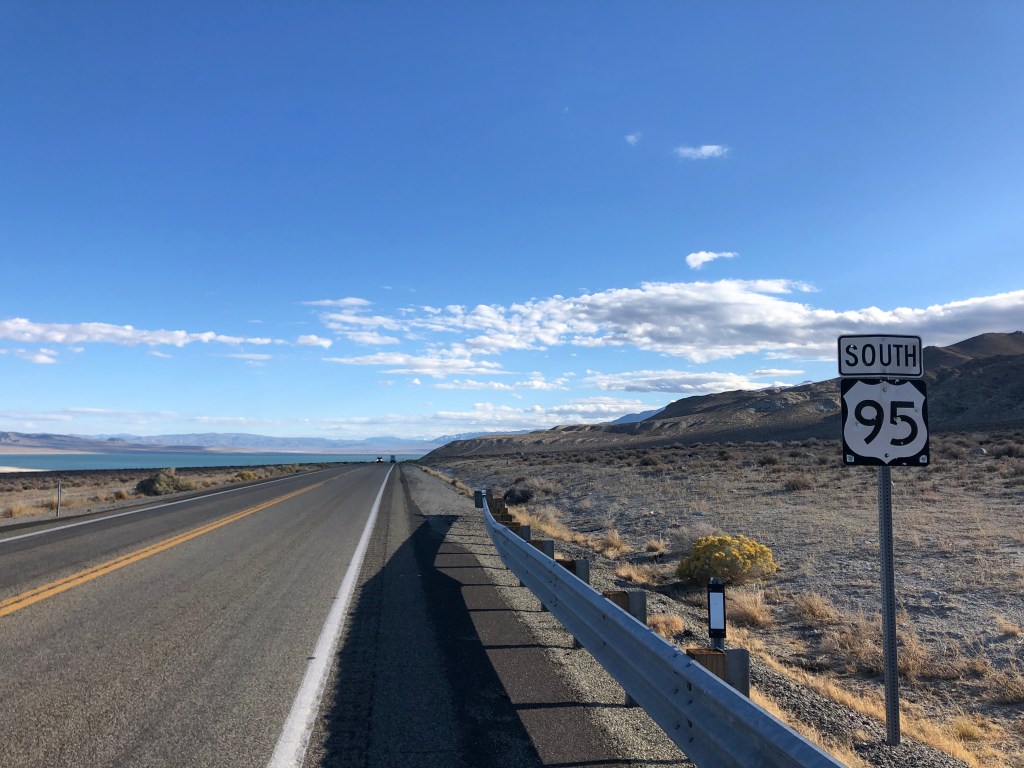
I awoke early in Hawthorne, got a decent breakfast at Mr. Beane’s coffee shop, and got back on the road. A short distance from Hawthorne US 95 takes a jog eastward, but otherwise today’s ride was looking a lot like yesterday’s.
Deja vu
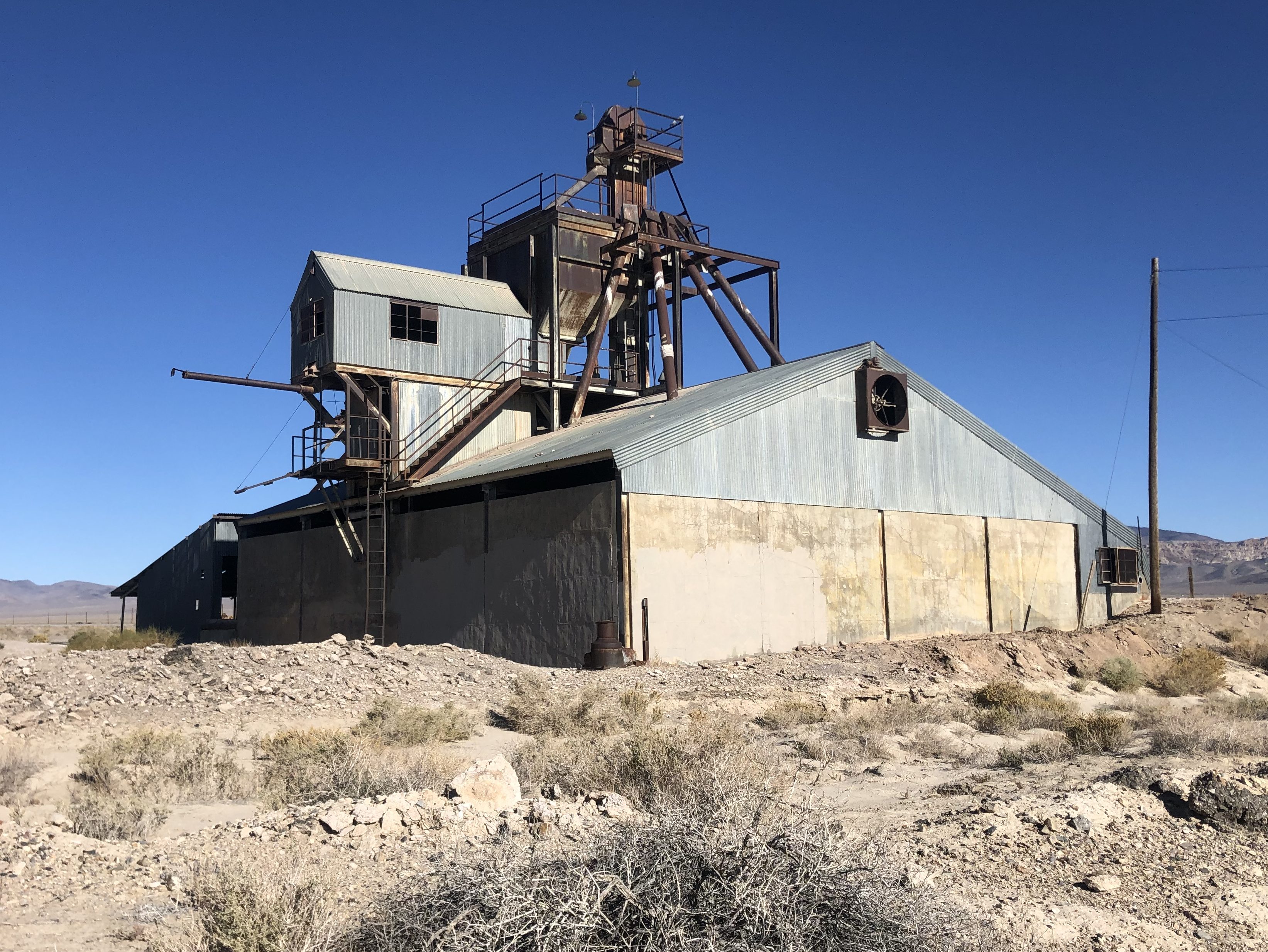
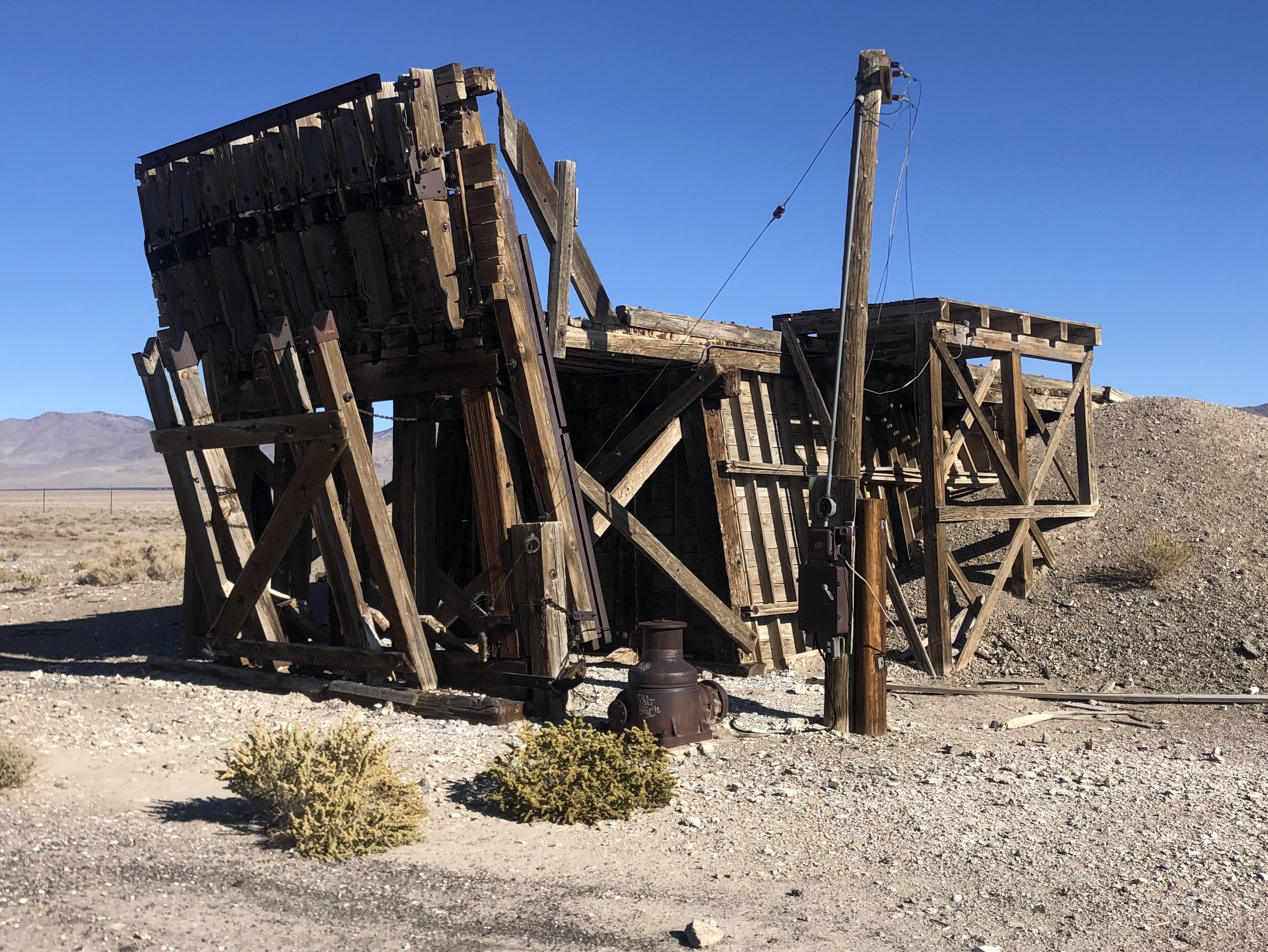
Then suddenly I found myself passing through another (nearly dead) town. Luning (pop: 87) was established in 1884 as a railroad town, with a trackside facility for loading magnesium ore onto freight cars. The once-active facility has long since shut down, but the main structures still stand, and I suspect the ghosts of long-since-passed stevedores still walk their creaky floors on moonlit nights.
Luning’s obsolete raison d’etre.
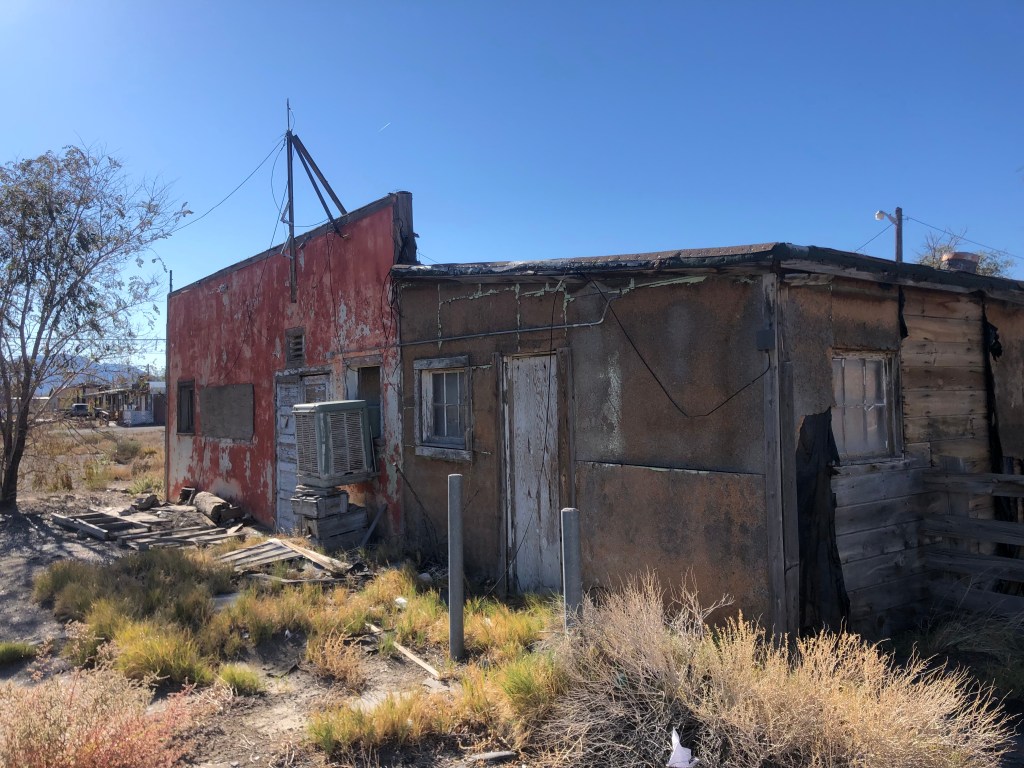
One wonders why 87 people still remain in this ghost town. From what I saw, the housing stock isn’t especially covetable.
Still inhabited.
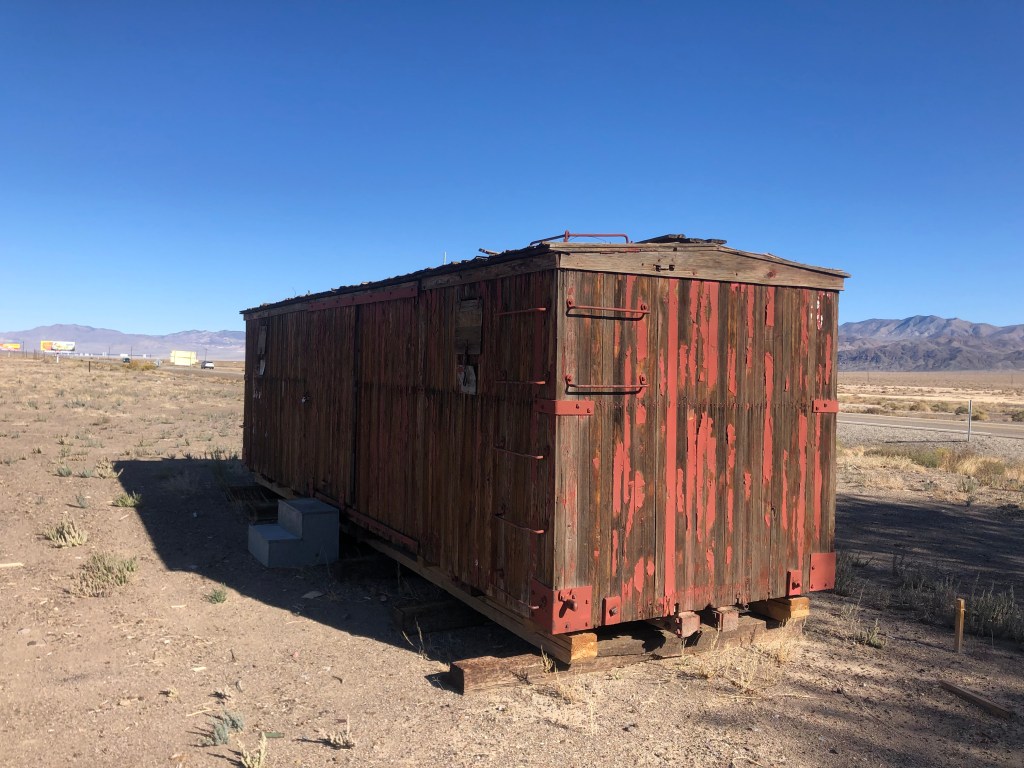
Some time after leaving Luning I came to a similar town. Like Luning, Mina (pop: 150) was founded as a railroad town over a century ago. As with so many Nevada towns, Mina owed its existence to mining operations. But the mines eventually played out, the residents began to move away, and the trains stopped coming through town.
Ancient railcar in Mina, now used for storage, apparently.
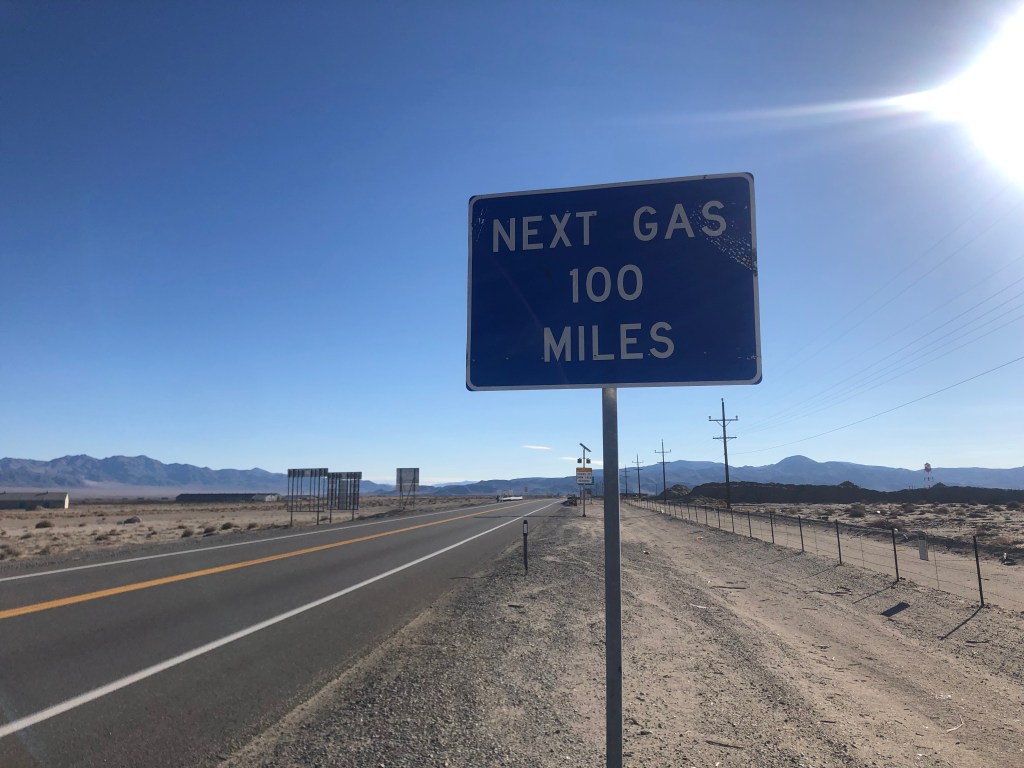
You’ve really got to wonder why anyone stays in this godforsaken place, with no working infrastructure to speak of, no job opportunities, and, to my eye at least, no pleasant surroundings. On top of all that, the nearest town with a gas pump and a mini mart is well over an hour away.
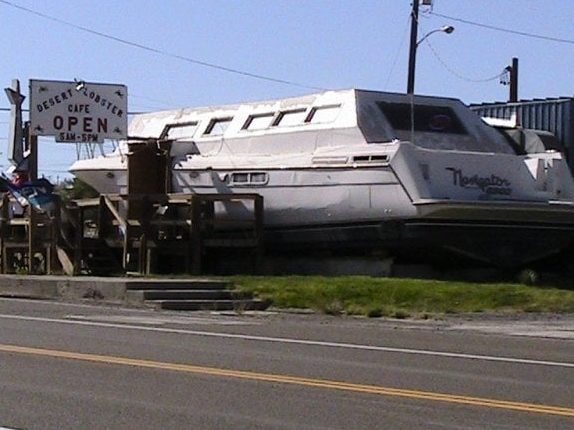
As far as I can tell, Mina is only known for two things. First, it used to have a restaurant named The Desert Lobster that was definitely unique. Owner Bob Eddy bought an old, damaged yacht he’d found in Texas and had it shipped to Mina, and this served as the front of his restaurant. But here was the genius of Bob’s plan: He would raise lobsters in greenhouses out in the desert, fed with water from a nearby spring. Sadly, wildlife officials eventually put an end to the lobster farm, and as of a few years ago the restaurant closed.
The Desert Lobster, back in the day. (Photo credit: Tom M., on Yelp)
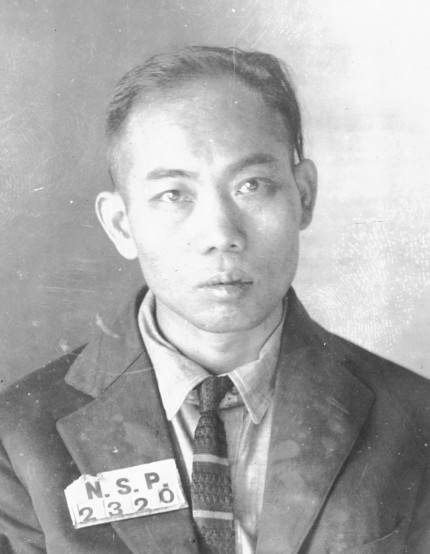
The other thing Mina is known for is its role in shaping America’s death penalty. In 1921 a Chinese immigrant by the name of Gee Jon was convicted of killing a laundry proprietor in Mina. He was sentenced to death, and was the first person to be executed by lethal gas. You can read the whole sordid tale here.
Gee Jon
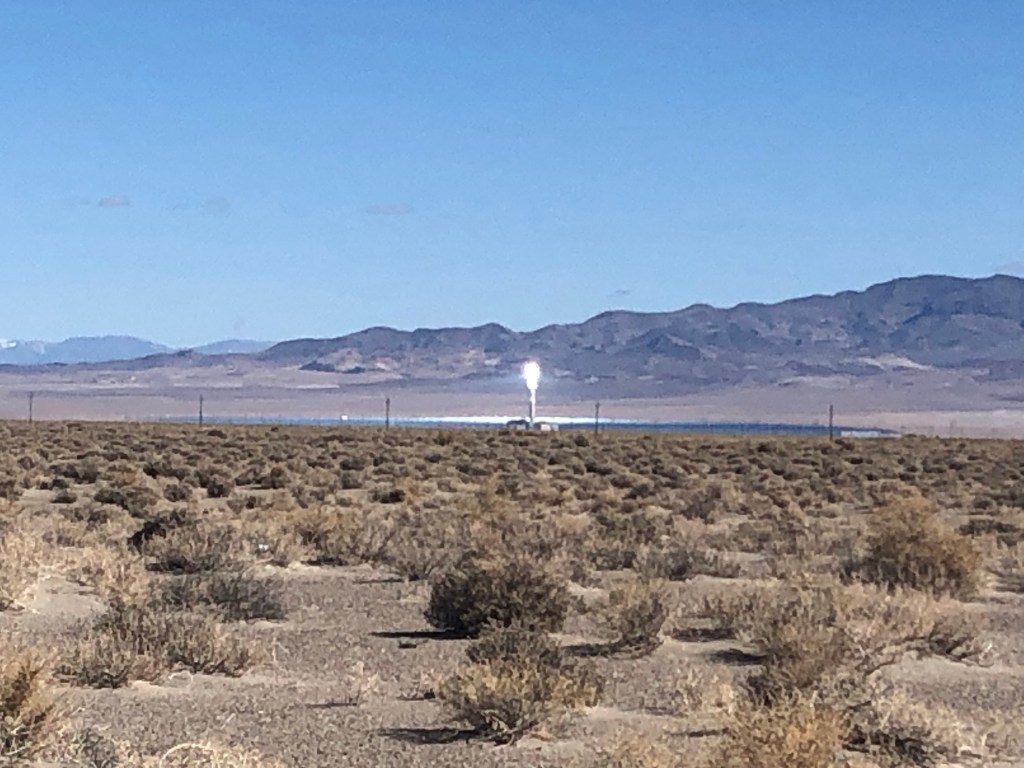
As I drove away from Mina I began to notice an intense point of light ahead of me on the left. For many miles the light kept getting brighter and closer. Finally I stopped at a rest stop near the light’s source and I learned that the light was coming from the Crescent Dunes Solar Energy Project. The project is essentially a huge array of mirrors sitting in the desert that concentrates sunlight at one point, creating enough heat to superheat liquid salt that is then used to produce steam and turn generators. (Think of it as frying an ant with a magnifying glass, on steroids.) Only about 6 years old, the plant has been beset with technical troubles and lawsuits. It was eventually shut down, but it appears to have been restarted by the time I drove by.
Not such a bright idea after all.
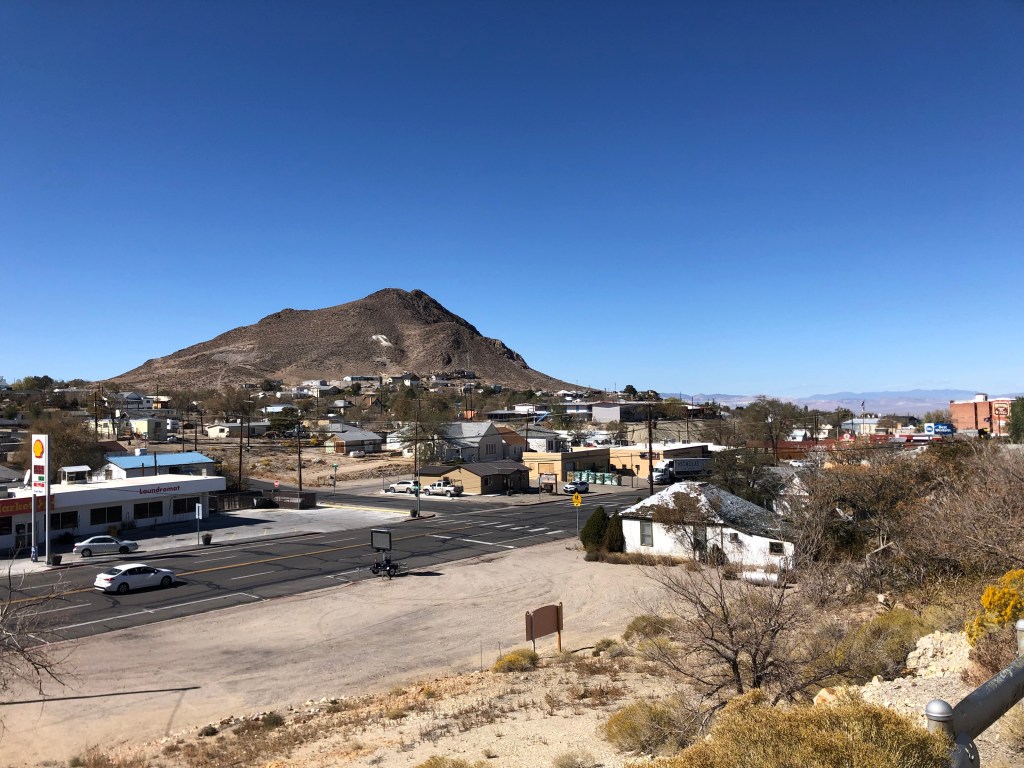
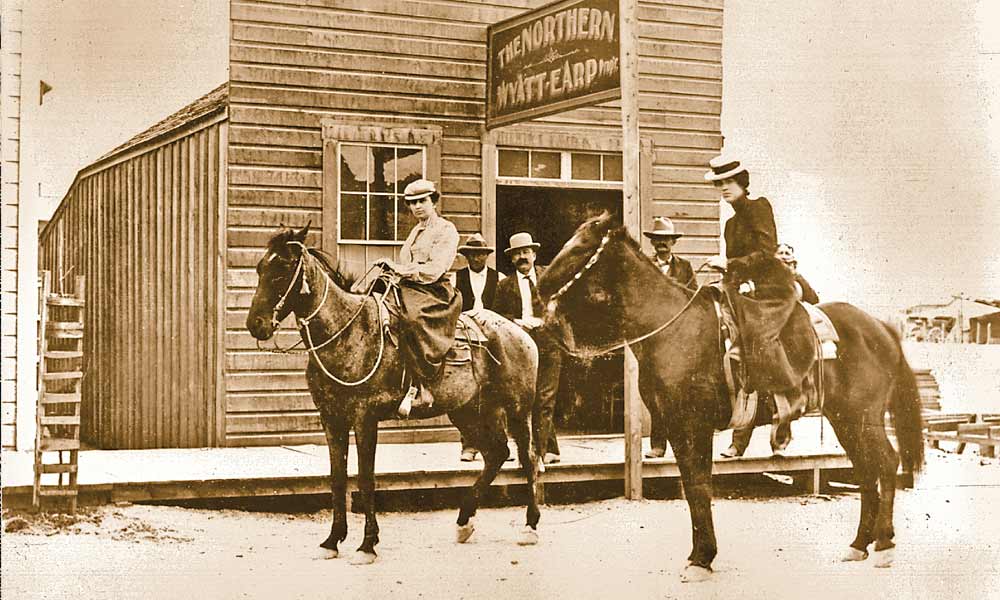
About an hour and half later I came upon the (relative) metropolis of Tonopah (pop: 2,500). Once the place that Wyatt Earp called home, Tonopah started out as a mining town around the turn of the 20th century. Like all the other mining towns it declined in the mid-century, but its location about halfway between Reno and Las Vegas seems to have helped it to survive as a convenient stopover location for those traveling between the two cities.
Downtown TonopahWyatt Earp’s bar in Tonopah
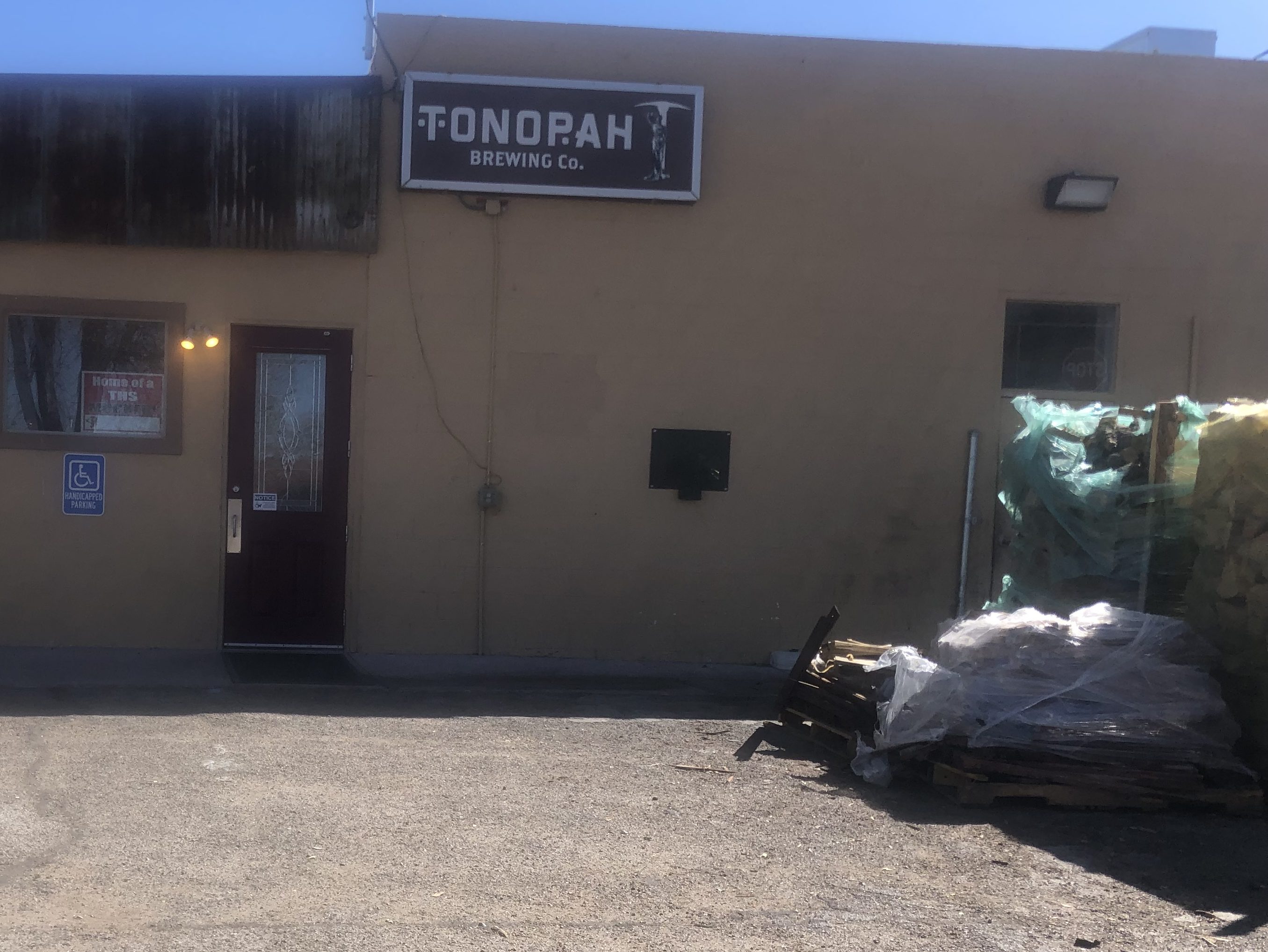
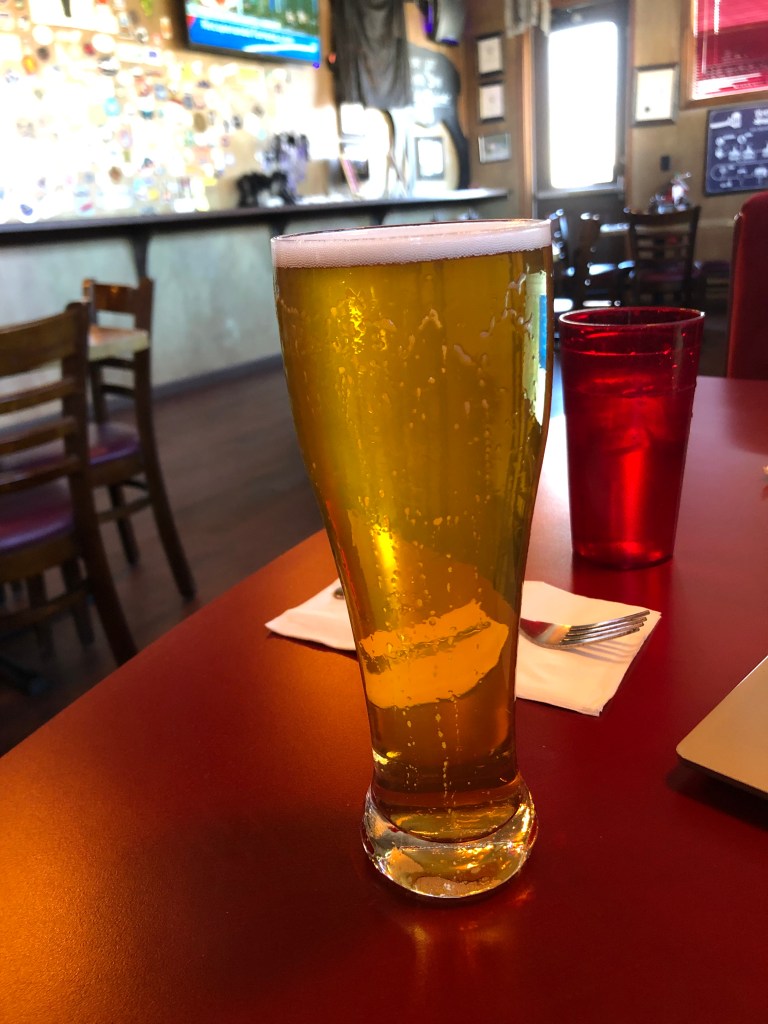
I stopped for lunch at the Tonopah Brewing Company, whose motto is “blood, sweat & beers” (seriously). I ordered their Double IPA, but managed to knock it over it before I’d had more than a sip. (The waitress was not happy with my clumsiness.) So I really can’t say much about the beer. But I can say that Tonopah Brewing Company is the absolute best brew pub in Tonopah. Of course, it’s also the absolute worst brew pub in Tonopah…because it’s the only brew pub in Tonopah. Perhaps because it’s the only game in town, the place seems to cater to every conceivable taste. The music is an unlikely combination of death metal, country&western, 1970s pop, and the Beastie Boys. And the television is tuned to a Spanish-language station.
Tonopah Brewing Company. Not much to look at from the outside.BOTD, moments before The Big Spill
They do have their own small-batch brewing setup, and they have their own smoker for in-house barbecue preparation. I had a decent pulled pork sandwich.
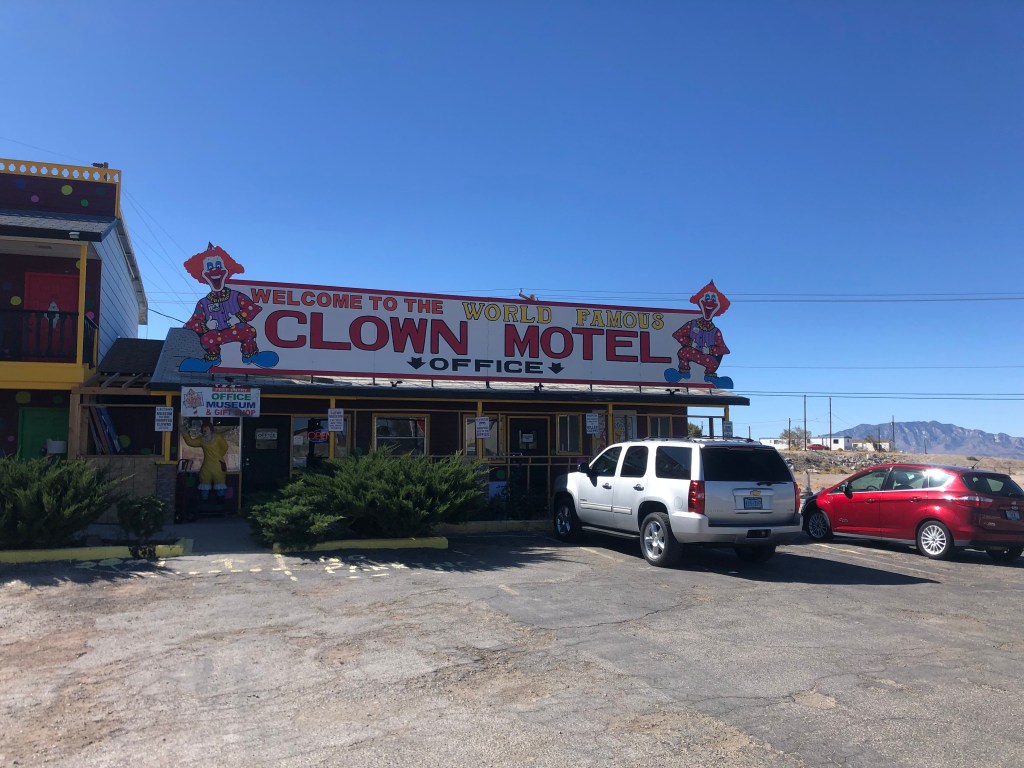
Thus fortified with smoked, cooked, dead animals and a sleeve soaked with beer, I got back on the familiar Route 95 and soon encountered what is surely the scariest part of this trip: Tonopah’s Clown Motel.
Please don’t kill me, Please don’t kill me….
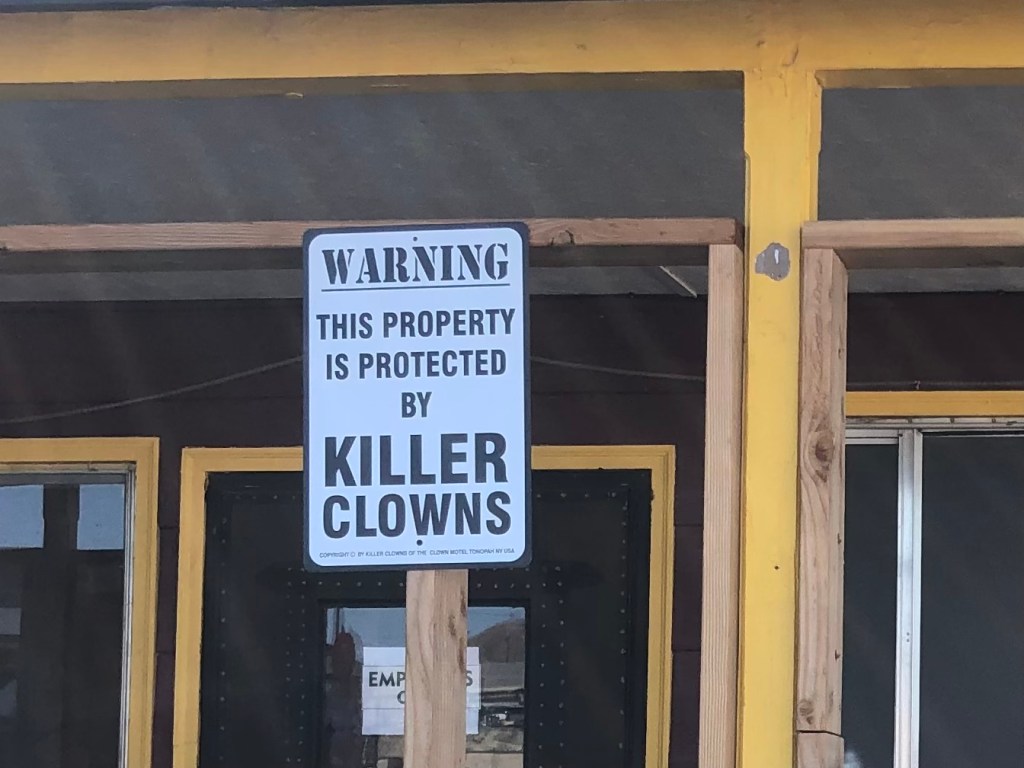
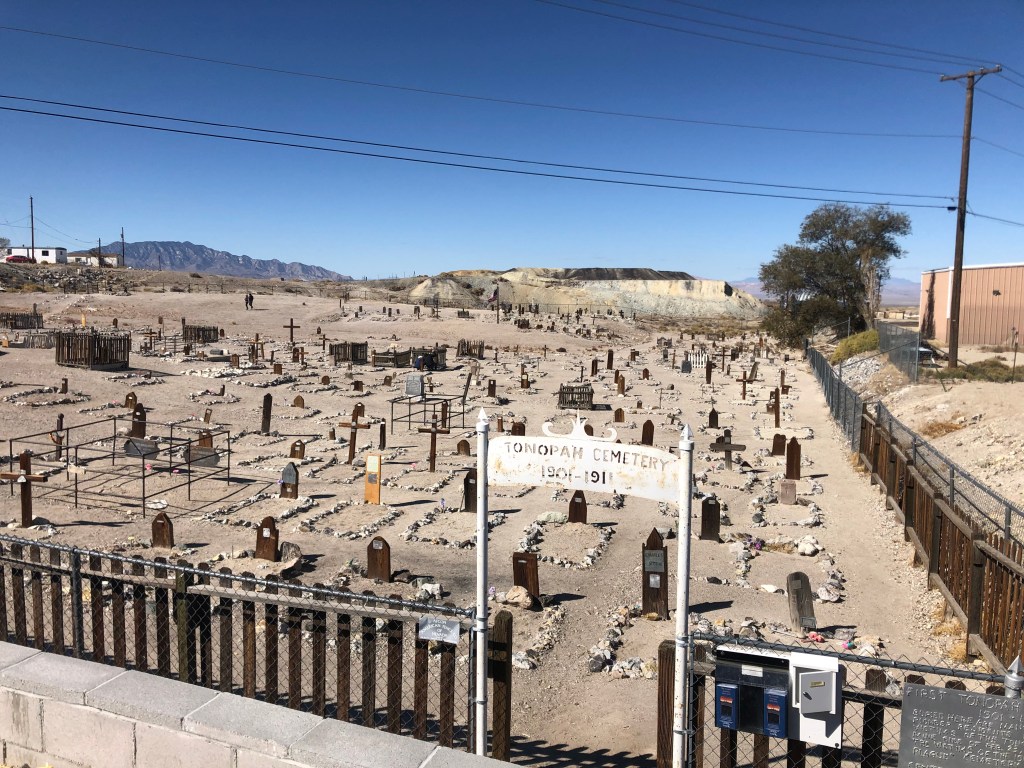
The hotel was originally opened in 1985, and it seems that the intent was innocent enough. The original owners, Leroy and Leona David, say they wanted to honor their late father who’d amassed a collection of about 150 clown figures (as one frequently does). The clown figures were used to decorate the property, and that’s about it. But over time the “creepy clown” trope became a thing, and books and movies like “It” pushed clowns into the realm of the truly scary. So the motel seems to have decided to swim with the tide and play up the creepy aspects of their clown theme. Oh, and did I mention that the motel sits right next door to an ancient cemetery? I’m not making this up.
Sign in front of parking lot. Way to reassure the kids whose parents take them here!
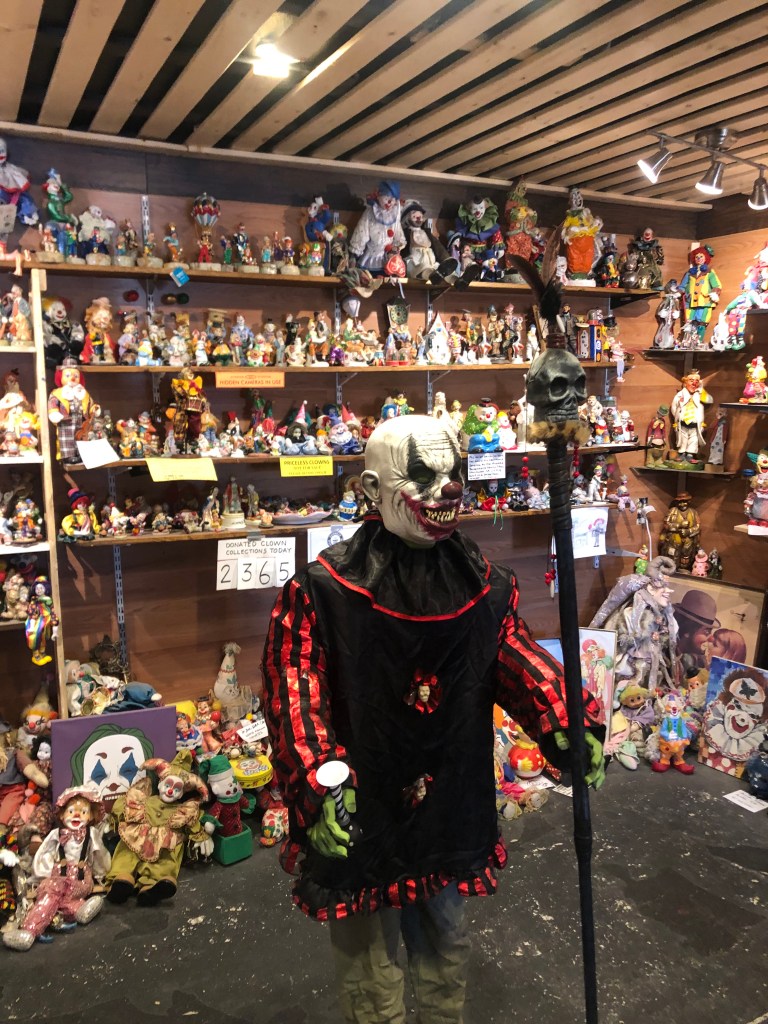
Over the years, the place has developed something of a cult following. Many people have sent in their own clown memorabilia, which now numbers over 2000 items. Many of the pieces are on display in the lobby, which doubles as a “clown museum.” The motel has also been featured on the television show “Ghost Adventures” in 2015. Supposedly a clown doll was caught on film moving by itself. You can judge for yourself!
In the lobby, which doubles as a “Clown Museum.”
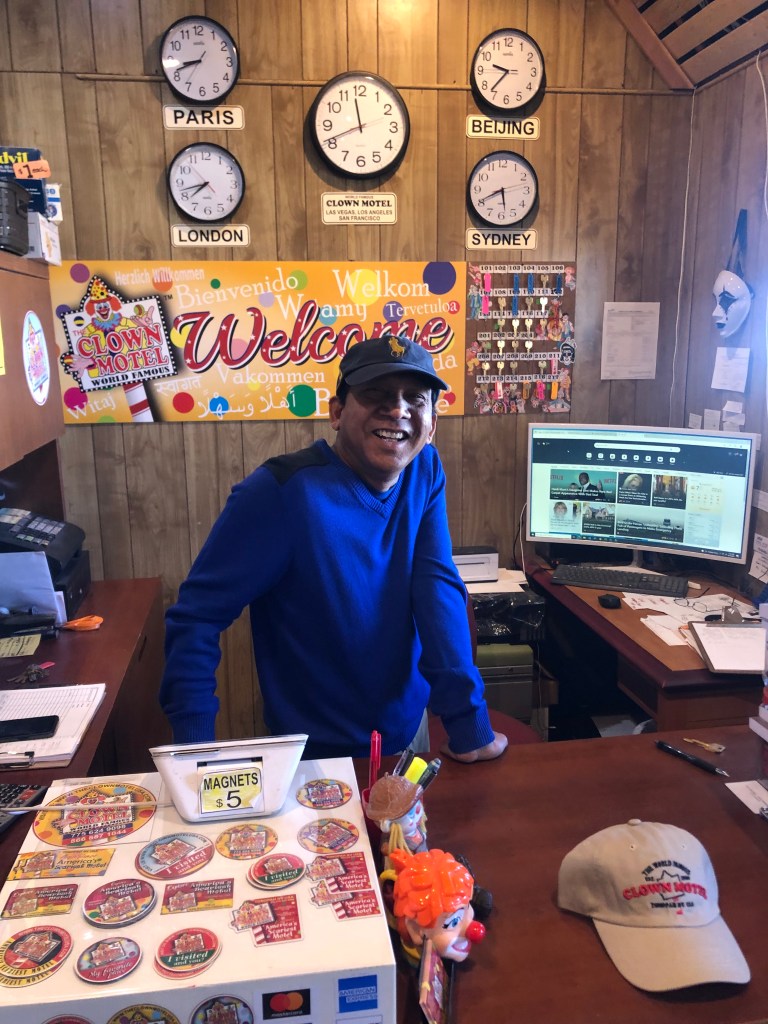
The current owner, Vijay Mehar, told me that Covid has really put a dent in business, but he’s making a go of it. He’s even amping up the scary clown vibe, decorating a few of the rooms with themes such as the “Halloween” room, the “Friday the 13th” room, and the “Exorcist” room. Again, I’m not making this up.
The man behind the clowns.
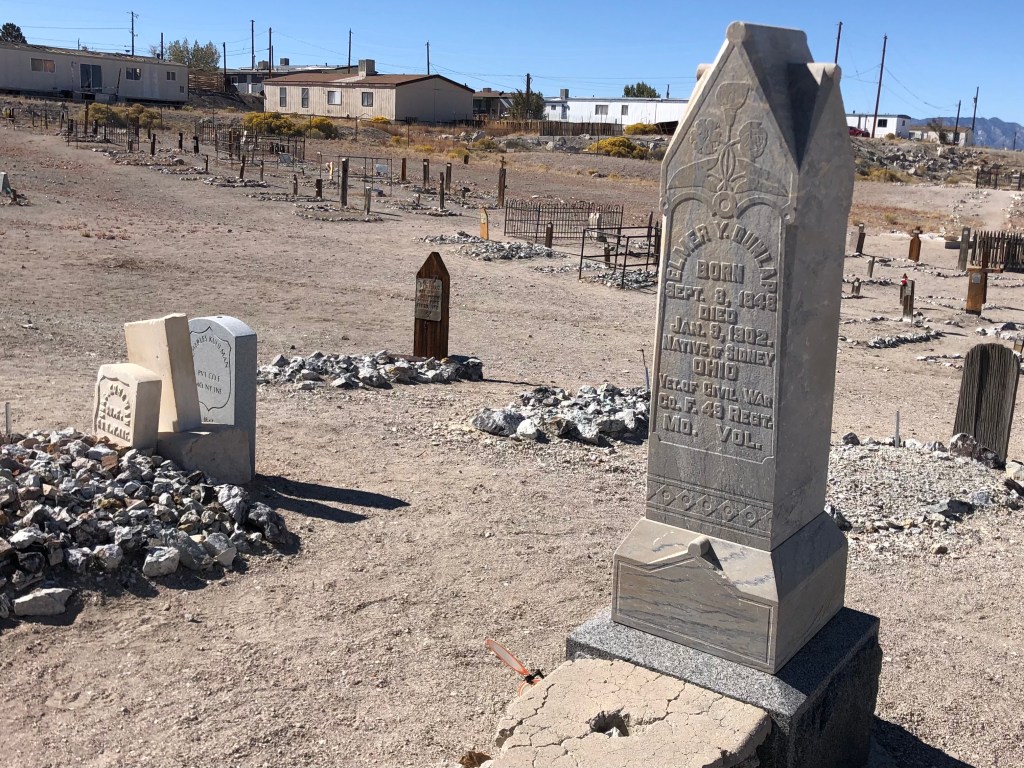
Vijay encouraged me to go take a walk through the neighboring graveyard, which butts up against the Clown Motel’s parking lot. It’s one of those desert cemeteries which lack trees, grass, or any other signs of life. I was surprised that Vijay hadn’t placed a few zombie clowns around the cemetery, in order to further advance the creepy clown vibe of his property.
Having pretty much exhausted the coulrobic aspects of Tonopah, I once again hit the road. Within 45 minutes I encountered the remarkably well-maintained, historic town of Goldfield (pop: 250). As the name suggests, Goldfield had started out as a gold mining encampment. The mines produced about $1 billion in gold (in today’s dollars.) The rich gold veins turned Goldfield into a boom town, and for a time it was Nevada’s largest city. Goldfield boasted some 20,000 residents at its peak in 1906. One of those residents in 1904 and 1905 was Virgil Earp (Wyatt’s brother), who was the town’s deputy sheriff.
A fire in 1923 destroyed much of Goldfield. Since gold production had become much less profitable by that point, there wasn’t much reason for people to rebuild their homes in the town. Those who did remain steadily declined until only a few hundred people were left in 1950, and Goldfield has limped along ever since.
Today Goldfield has just a handful of residents, but the town exudes a strength and robustness that belies its scant population. This is town that clearly values its history. The Goldfield Historical Society is a local nonprofit organization that actively works to preserve and restore Goldfield’s buildings and to promote its history. They’ve erected markers and plaques, organized walking tours, and held various fundraisers. You can see evidence of their work on almost every block.
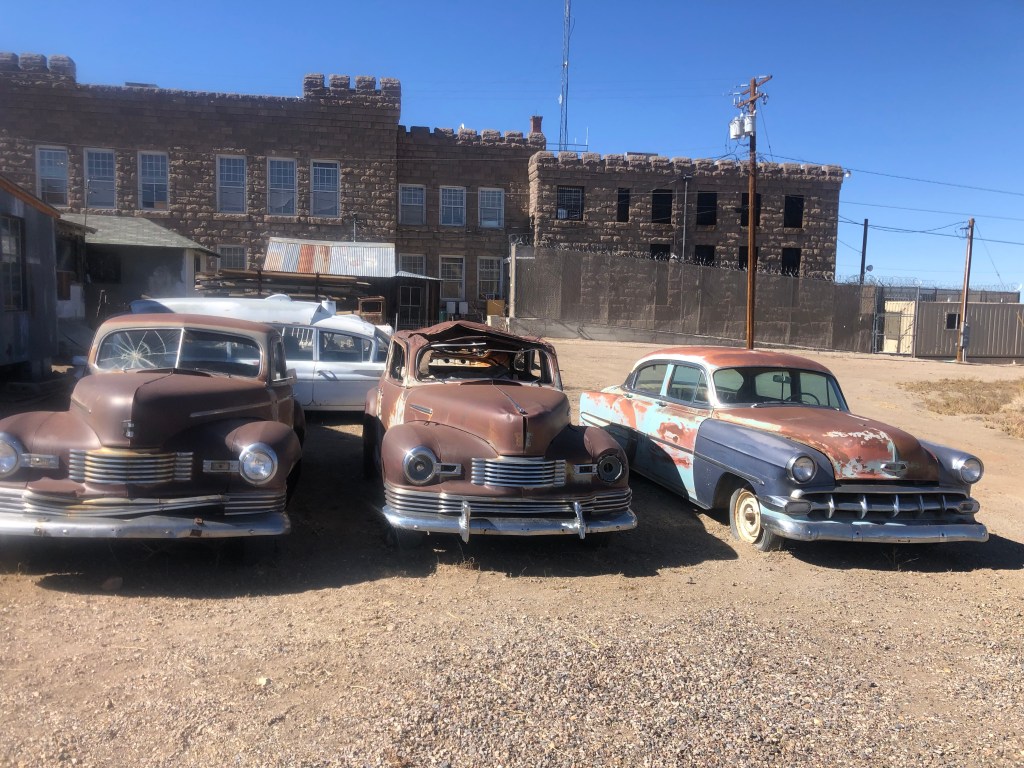
Originally Goldfield’s elementary school, this building is now the town’s public library. The grounds (on the other side) serve as a “historic equipment park.”A few cars that look like they haven’t moved in awhile. (Goldfield’s courthouse is in the background.)
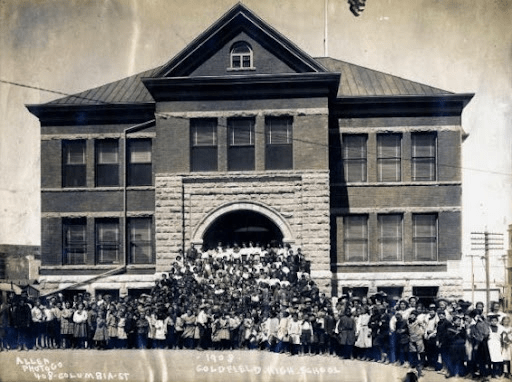
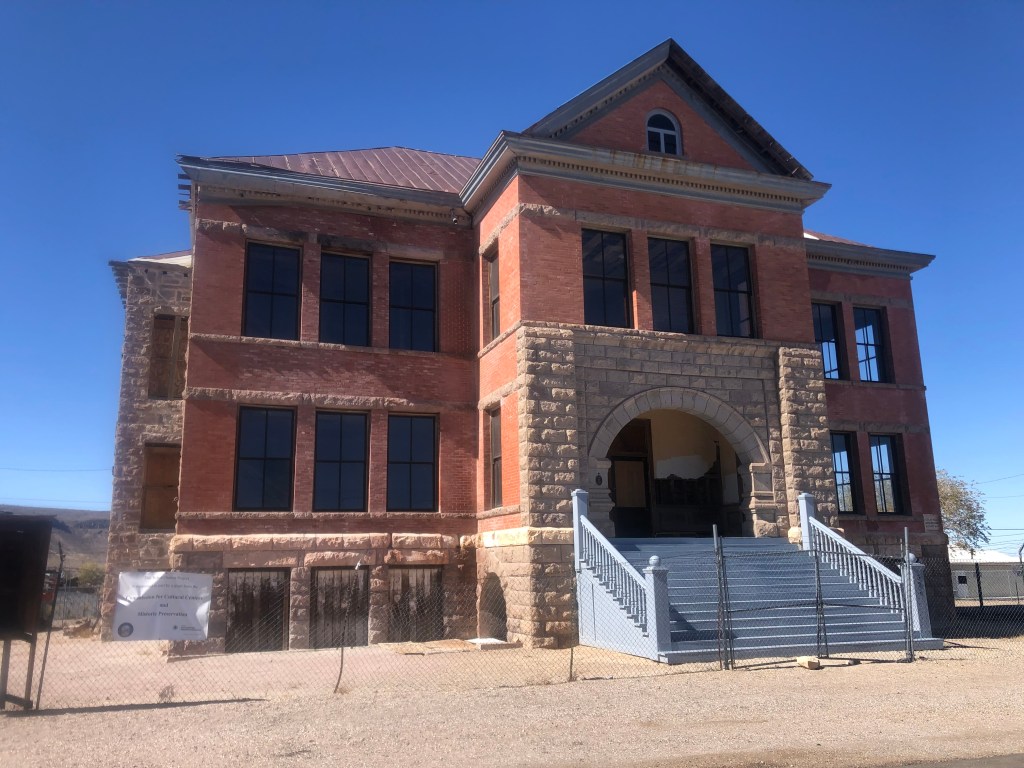
Goldfield High School is one of the historical society’s biggest projects. It was built in 1907, and its three stories served up to 450 high school students. The school closed in 1952, and it’s been shuttered ever since. After a half-century of neglect, the south wall collapsed, and efforts to save the structure finally began in earnest. The historical society has received grants and donations toward a full restoration of the building, which is ongoing.
Goldfield High School, back in the day.
Goldfield High School today.
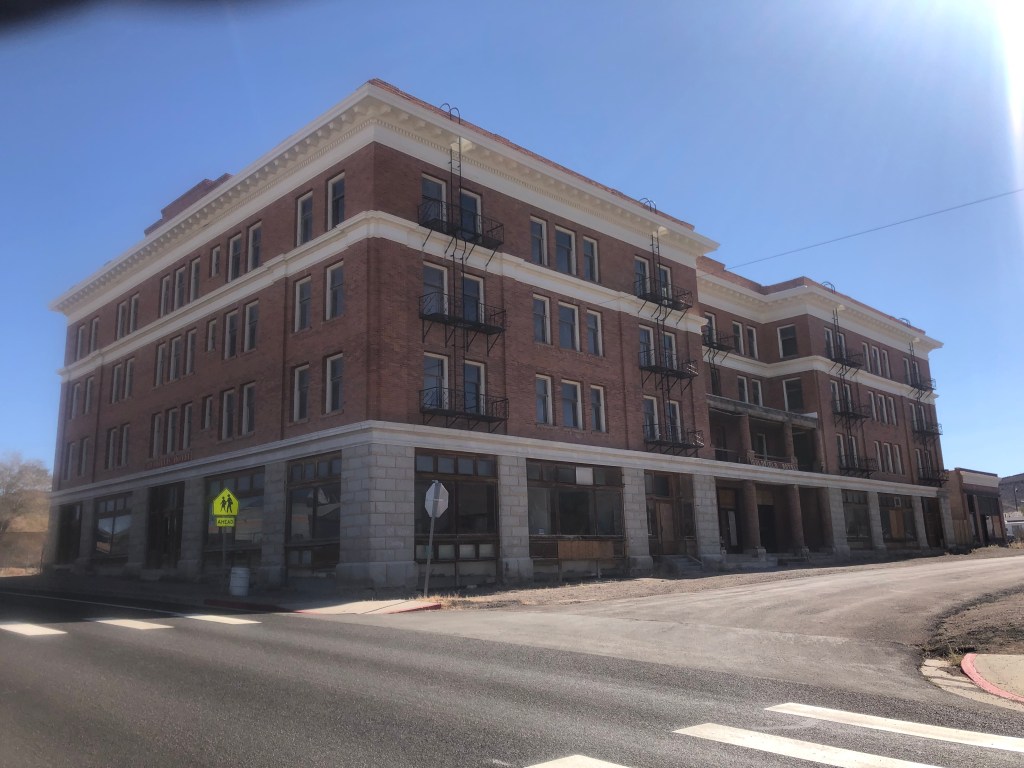
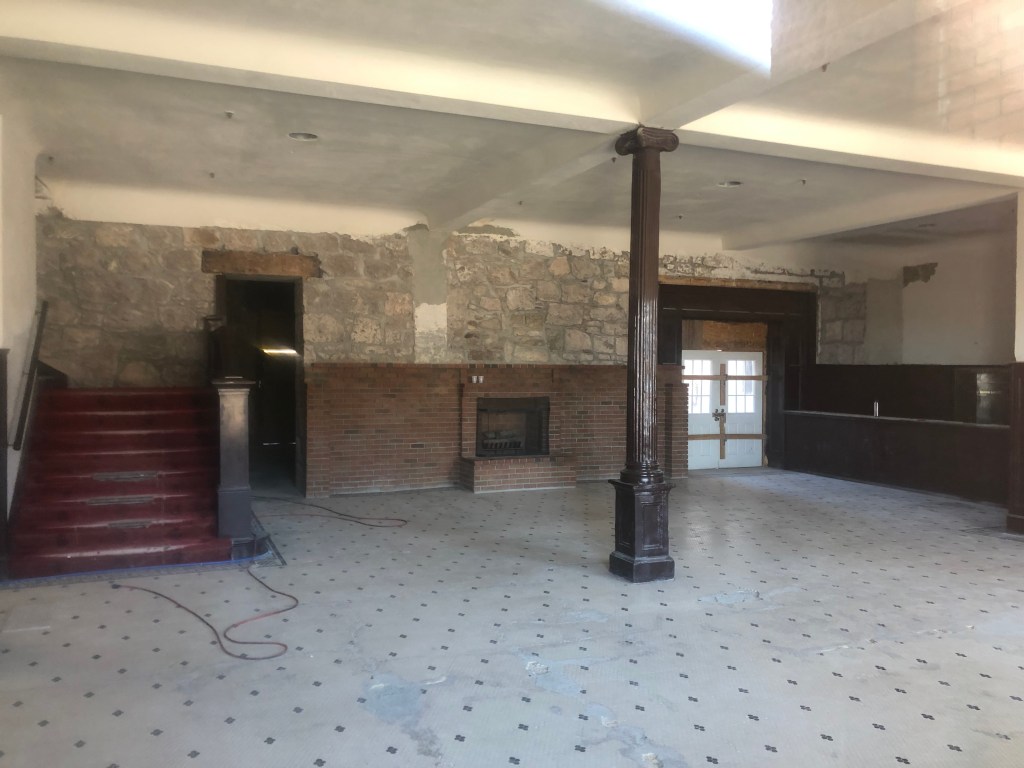
Another major restoration effort focuses on the Goldfield Hotel. It’s a huge structure, and in surprisingly good shape considering it was built in 1907, survived a flood and a fire, and has been vacant since World War II.
The Goldfield Hotel.
Inside the Goldfield Hotel. Don’t ask how I got this photo.
Ownership of the hotel has changed several times in recent years, and plans to make it into a boutique hotel seem to have fallen through. But I saw clear evidence of active restoration work when I visited. Oh, and that same Ghost Adventures show that went to the Clown Motel also has been to the Goldfield Hotel, and claim that they’ve seen evidence of hauntings. A local resident told me that the Ghost Adventures team had recently come back just a few months ago to do another feature on the hotel.
Anyway, it feels like there are historic structures all over this town. And I’m told that every single one of them has a current owner who’s either restored it or is planning to do so. Why does Goldfield have all this energy and civic pride, while towns like Luning and Mina have essentially disappeared?
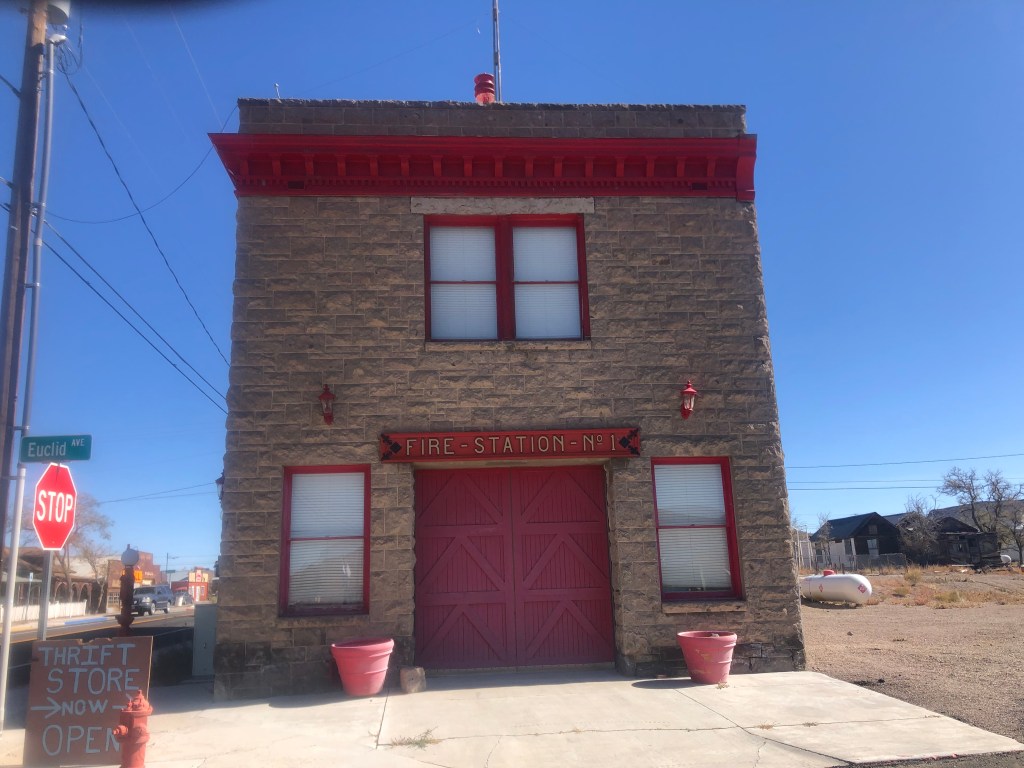
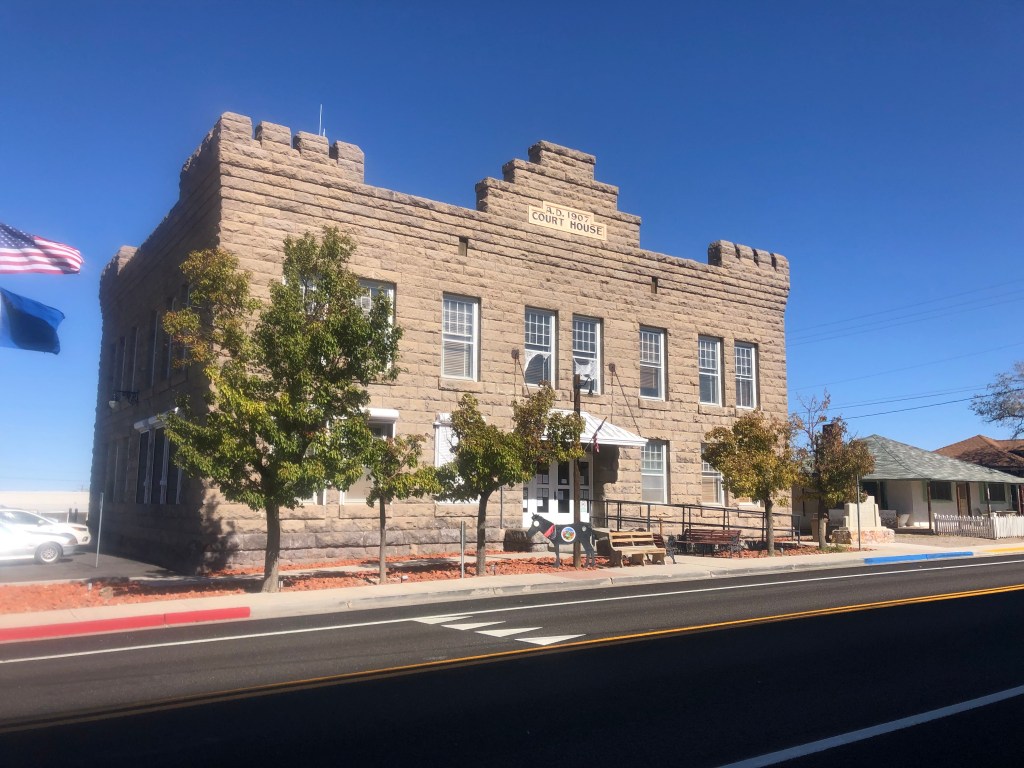
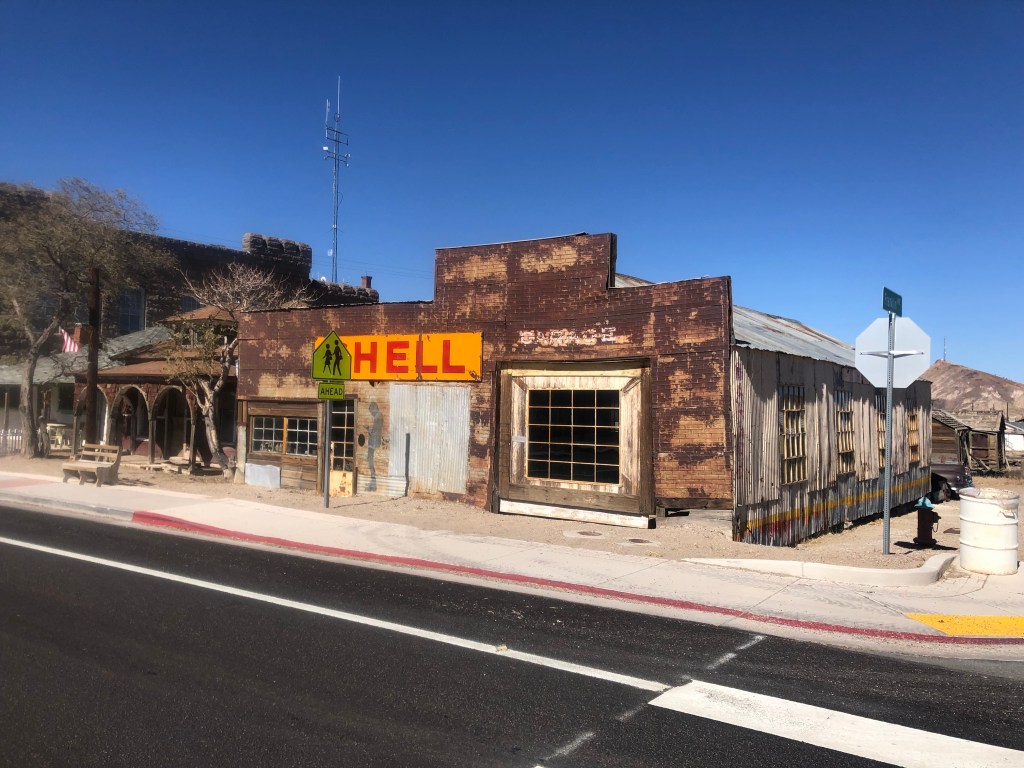
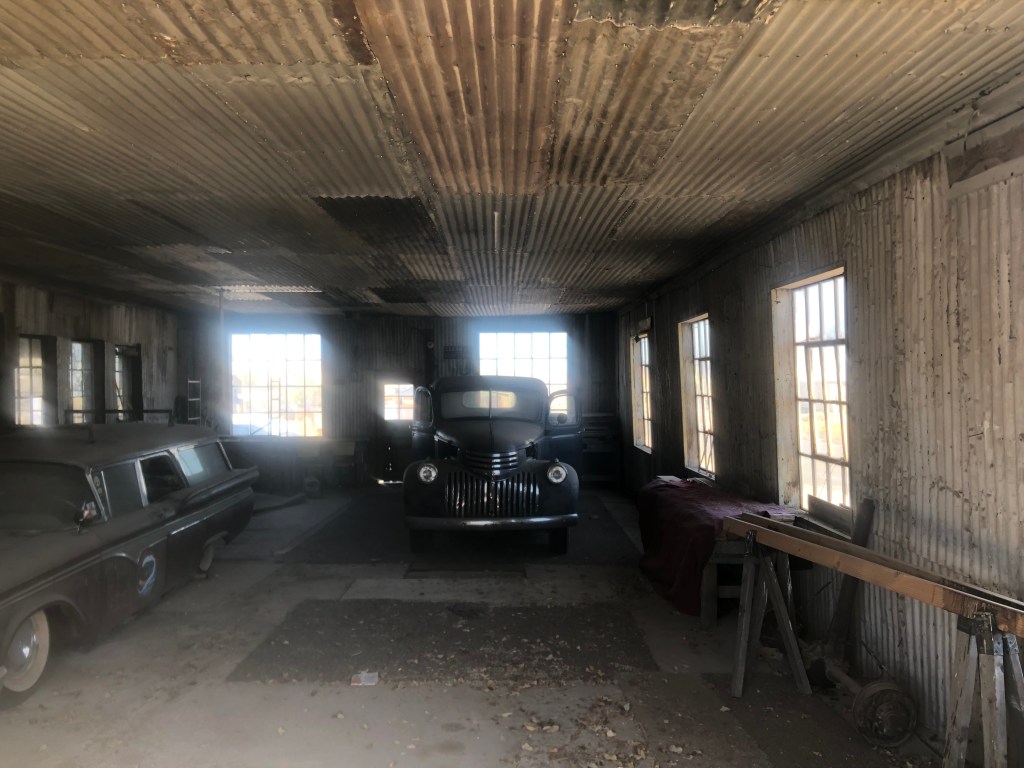
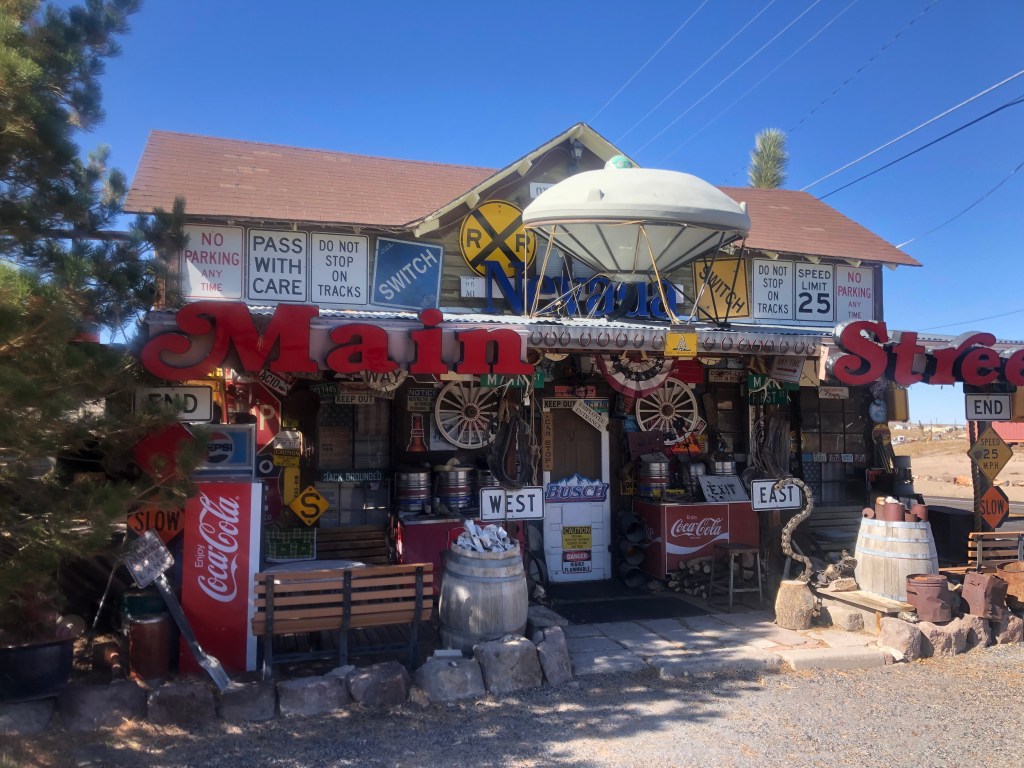
Goldfield’s fire station, from 1908. Beautifully restored, and now a museum (that’s only open by appointment).The Esmeralda County Courthouse in Goldfield, constructed in 1907Old filling station and garage, built around 1935. Inside the garageOf course, not everyone in Goldfield is on board with the historical society’s pleas for historical authenticity.
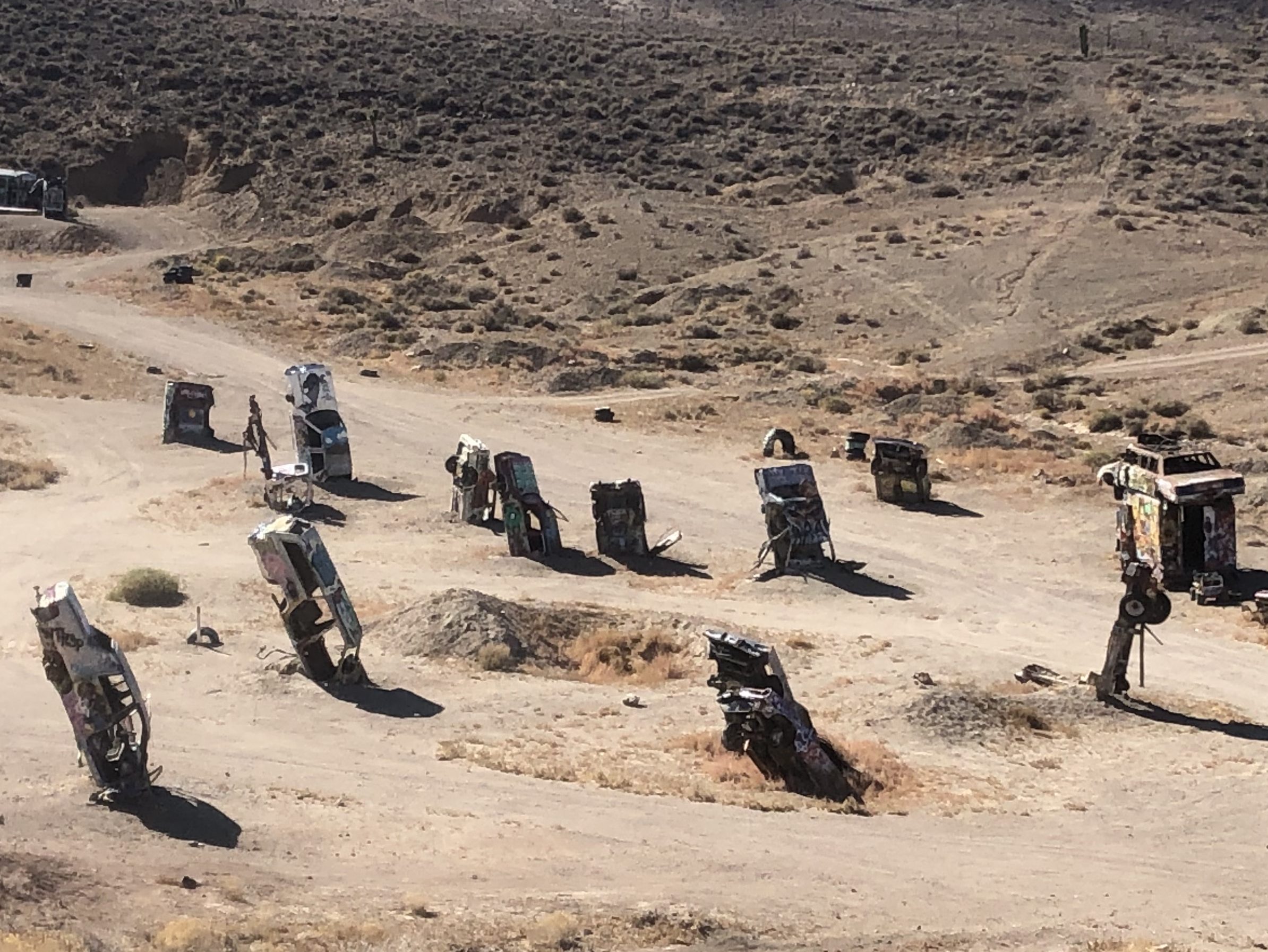
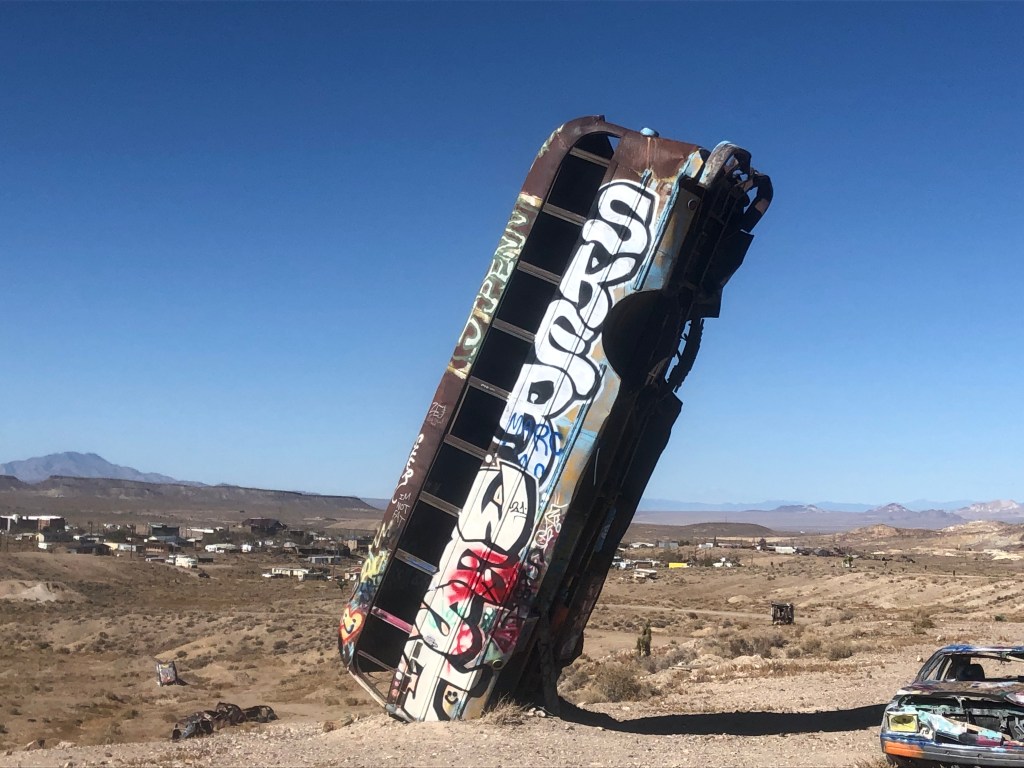
On the outskirts of town is a quite different type of attraction. The International Car Forest of the Last Church is a public art installation (I guess). It started when local resident Mark Rippie for some reason decided to stand a car on its nose in the desert outside Goldfield. This “art installation” was noticed by artist Chad Sorg as he was passing along Route 95, and Sorg was so taken by the piece that he settled in Goldfield to help Rippie expand the single car into a “forest” of abandoned cars. (I’m assuming that controlled substances played a part in the decisionmaking.) Today the “forest” includes over 40 vehicles, all of which are regularly covered and re-covered with graffiti by visitors. (The International Car Forest of the Last Church in fact encourages that behavior.) I hate to sound like a Philistine, but isn’t this all highly derivative of the much more famous and whimsical Cadillac Ranch?
Just a portion of the forestWon’t get fueled again
Yes. Well. So, after studying each vehicle with my arms behind my back and muttering “I can feel what the artist is trying to say,” like a hippie version of Woody Allen, I left the Forest and got back on US 95. After my enjoyable and engaging visit to Goldfield, I was back in the mode of speeding along endless miles of desert and an unchanging horizon. After a little over an hour I saw a large yellow sign ahead and, as I was about due for a break, I figured I’d make a stop.
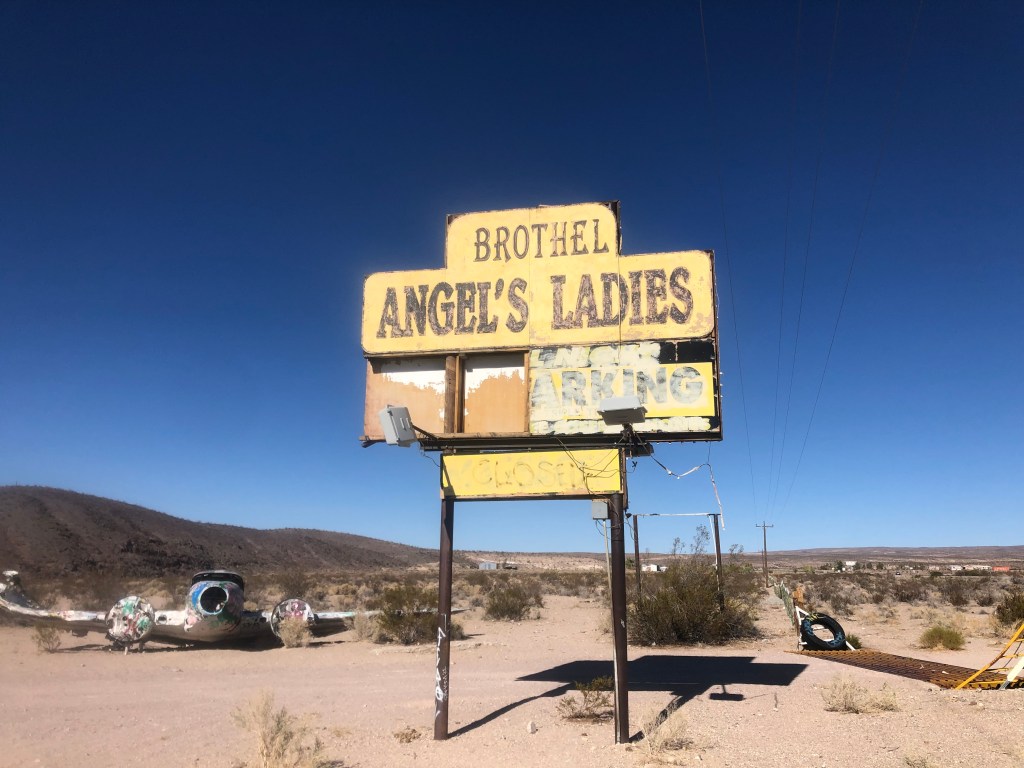
You at least have to admire the bluntness. No “Gentlemen’s Club” or similar euphemisms here!
As we all know, prostitution is legal in Nevada. Has been since 1971. You just have to conduct your activity in a licensed brothel. So, here we have the confusingly-punctuated “Angel’s Ladies” brothel, which has been around (under various names) for over a century. (Yes, evidently it operated illegally until 1971.) The place has been closed since 2014.
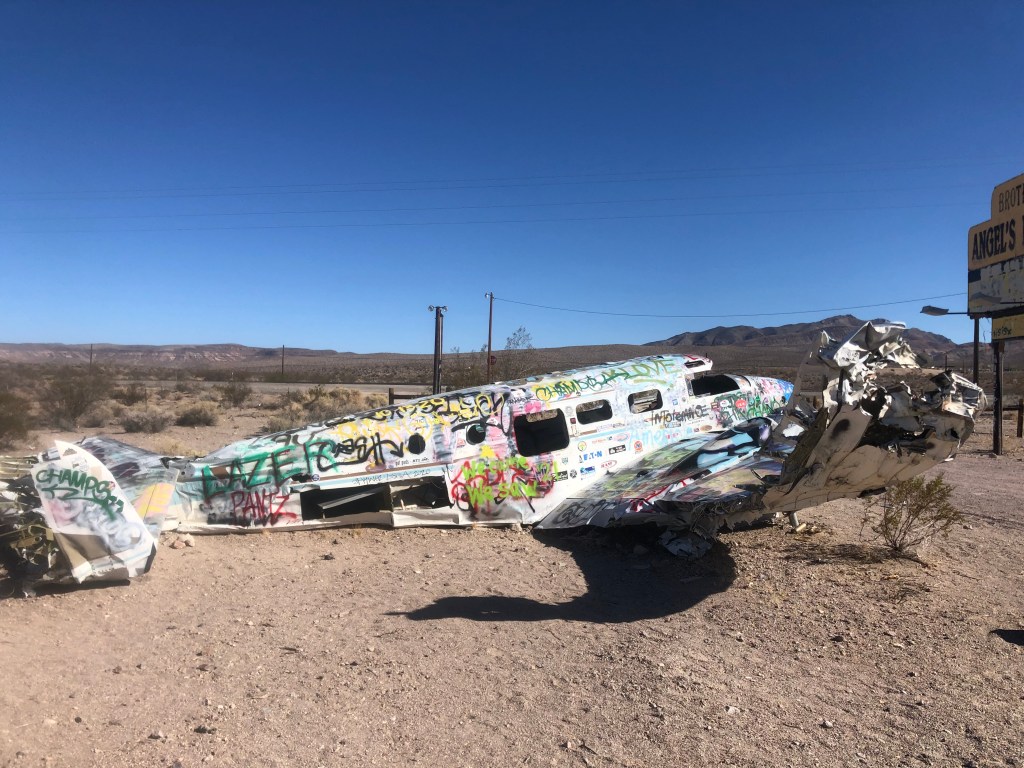
Alert readers might notice the wreckage of a small plane not far from the sign.
Well, there’s a story to it. It seems the brothel’s owners decided to run a promotion in 1978: They got this plane, and let volunteers parachute out of the plane from a low altitude over the property. If the jumper managed to land on a mattress that had been put on the ground, they won a free night at the brothel with the woman of their choice. Unfortunately, the pilot had some trouble during the promotion and crashed the plane right where you see it today. The owners evidently figured that it was worth more as a roadside attraction than as scrap, so they left it where it crash-landed. (News reports say that no one was hurt in the crash.)
Angel’s Ladies Brothel is just north of the town of Beatty, which is otherwise not notable. After passing Beatty, I started to plan (better late than never) on the remainder of my route. I decided that I didn’t want to go all the way to Las Vegas, as it really isn’t the kind of city that I’ve been seeking out on these trips. So I made a last-minute decision to leave US 95 and cut northwest through Death Valley and then take US 395 home. Those segments have been the subject of other blogs (like this and this), so I won’t detail the rest of the trip, except to say that Death Valley in the fall is stunning, and US 395 always affords awesome views of the eastern Sierras.
I’d also say that US 95 — at least the segment of it that I took through Nevada — is an interesting, stress-free, pleasant enough highway for those looking for such things. And I’m sure there were plenty of roadside attractions and stories that I missed, so I’d encourage you go out there and find some more!
Today Scott and I stuck around Louisville. This city, perched on the bank of the Ohio River, is very much a city of the past, with ancient structures, deep historical connections, and enduring traditions.
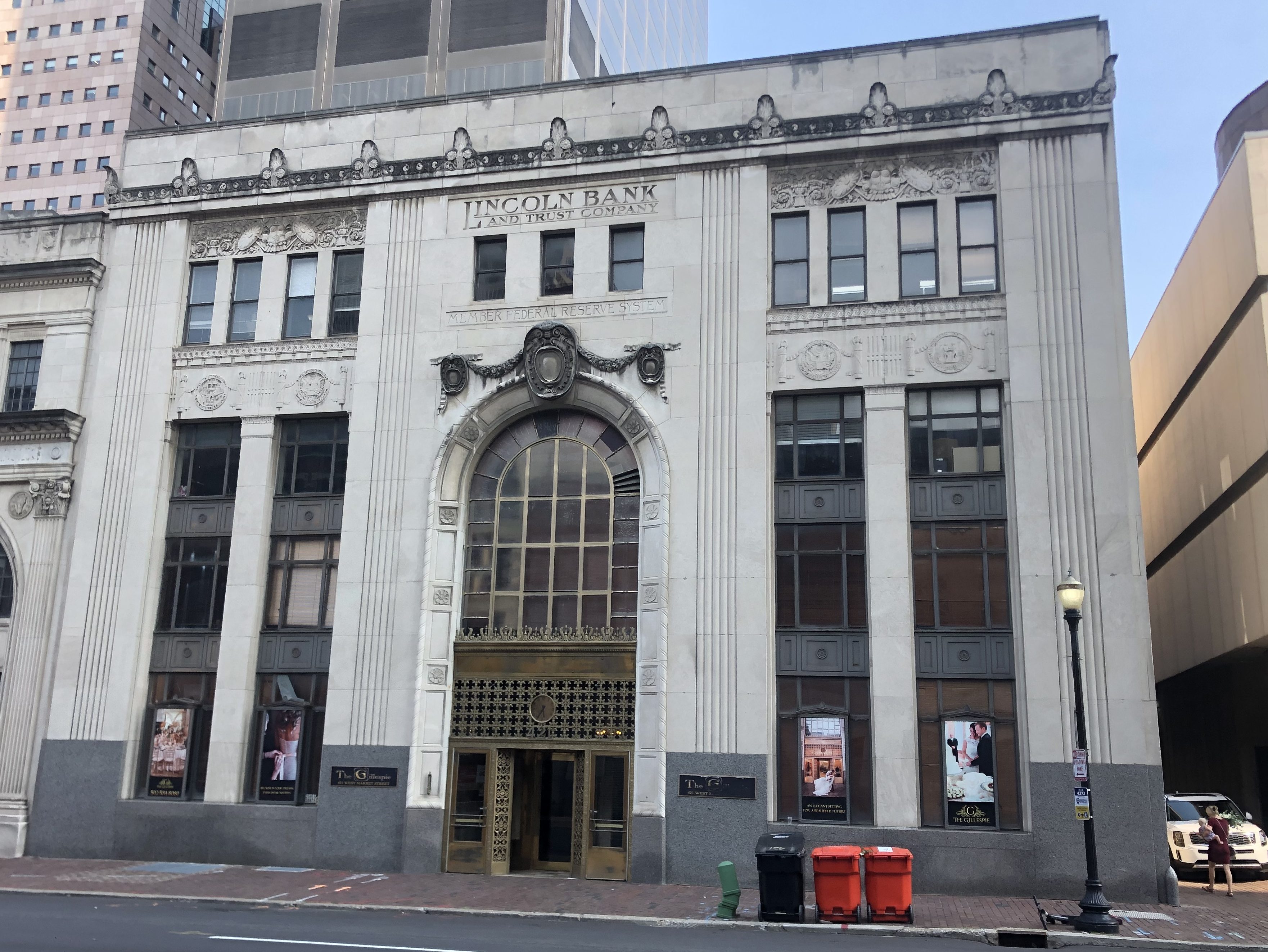
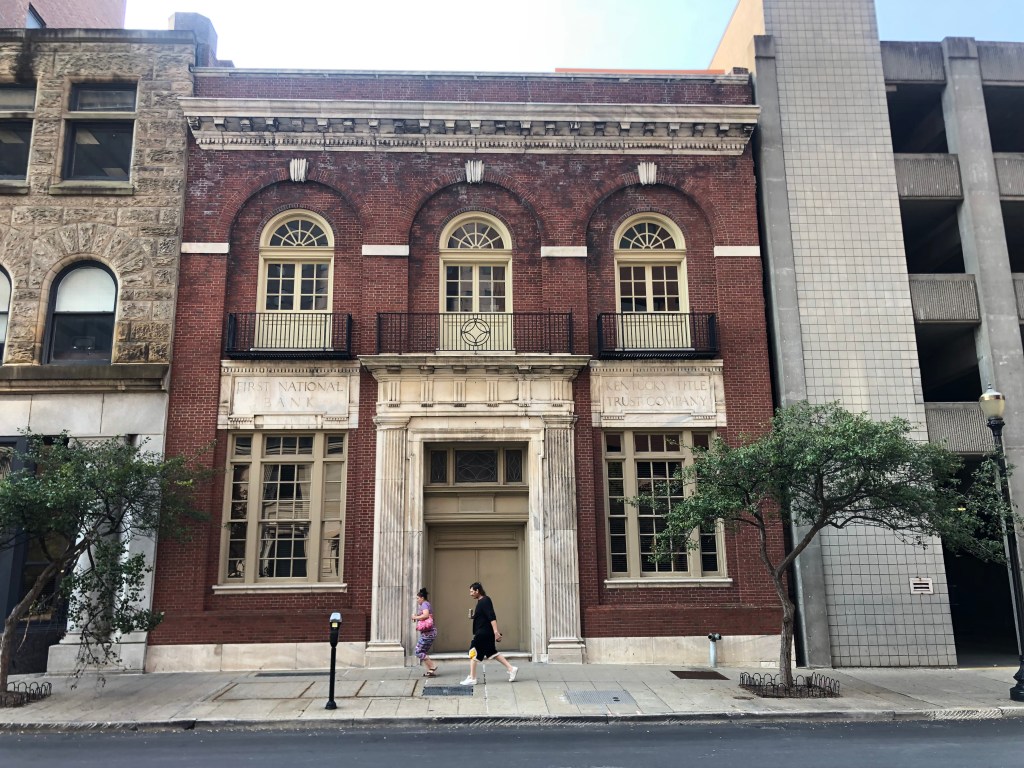
We spent the morning walking around downtown Louisville’s old financial district. It’s lined with looming, imposing banks and stock exchanges from the turn of the century. Most of these are now serving other purposes, such as art galleries or lofts or restaurants. They’re impressive and anomalous in the 21st century, and very much give Louisville a unique, historic vibe that you just can’t get from a hipster urban renewal project.
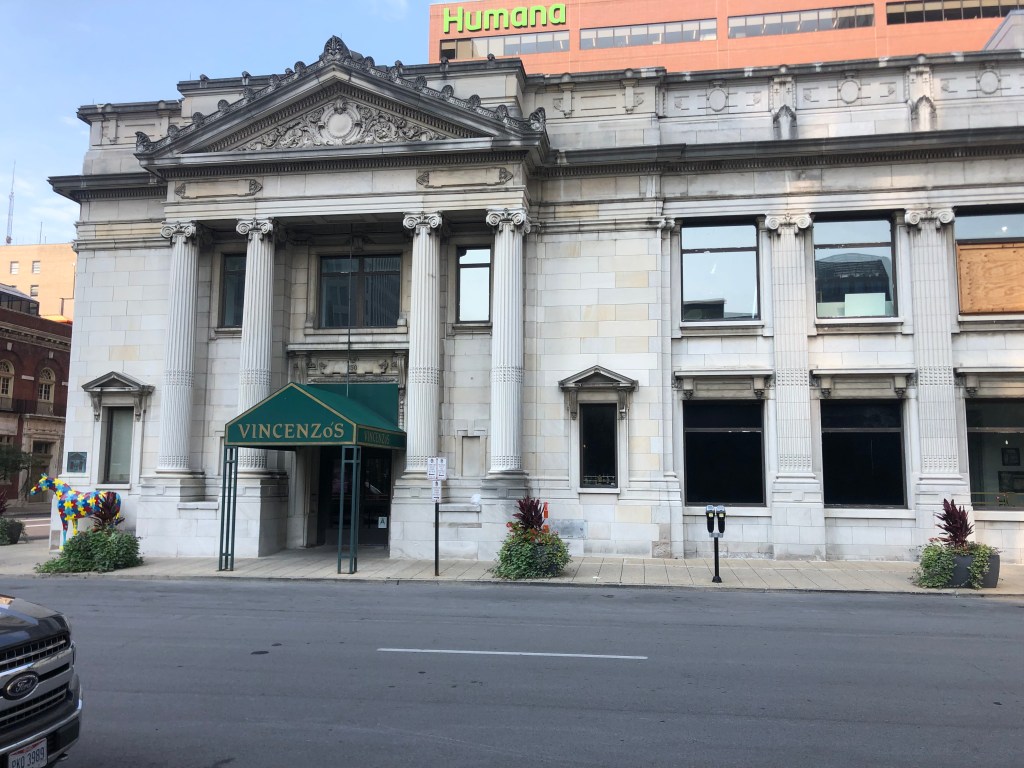
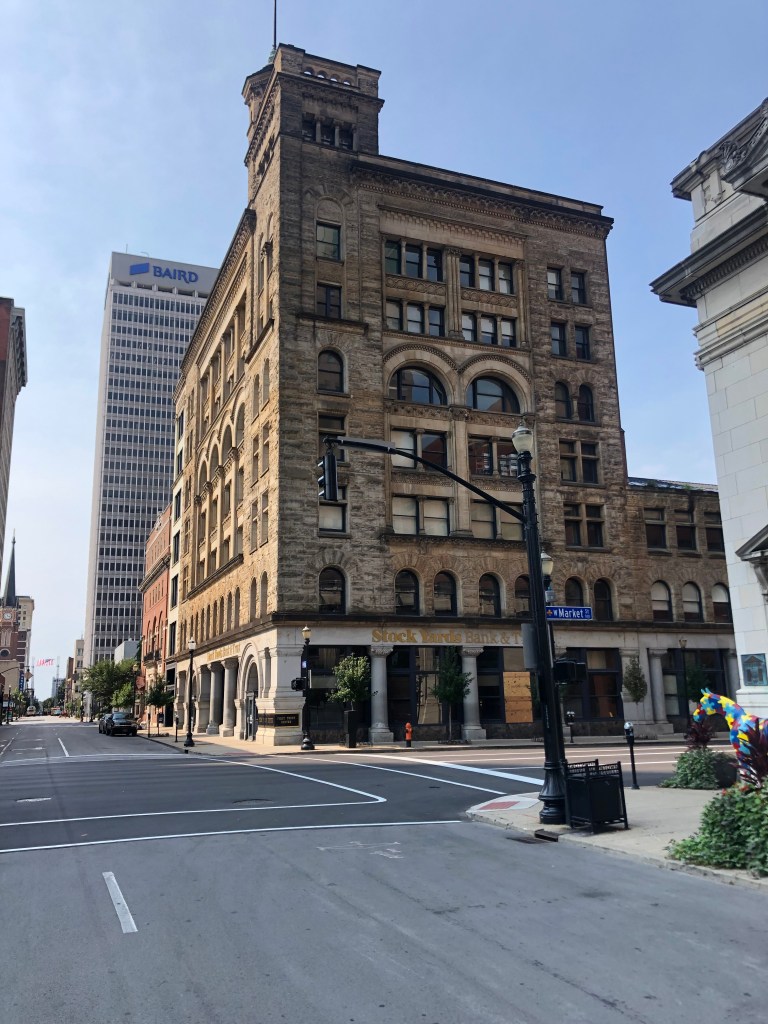
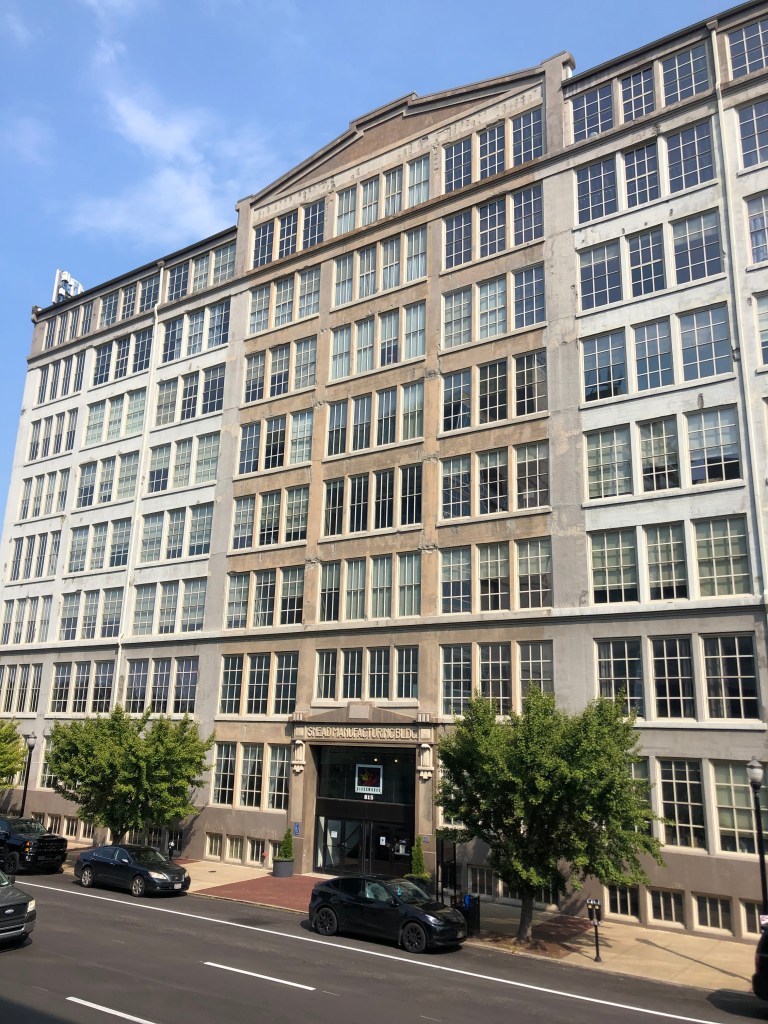
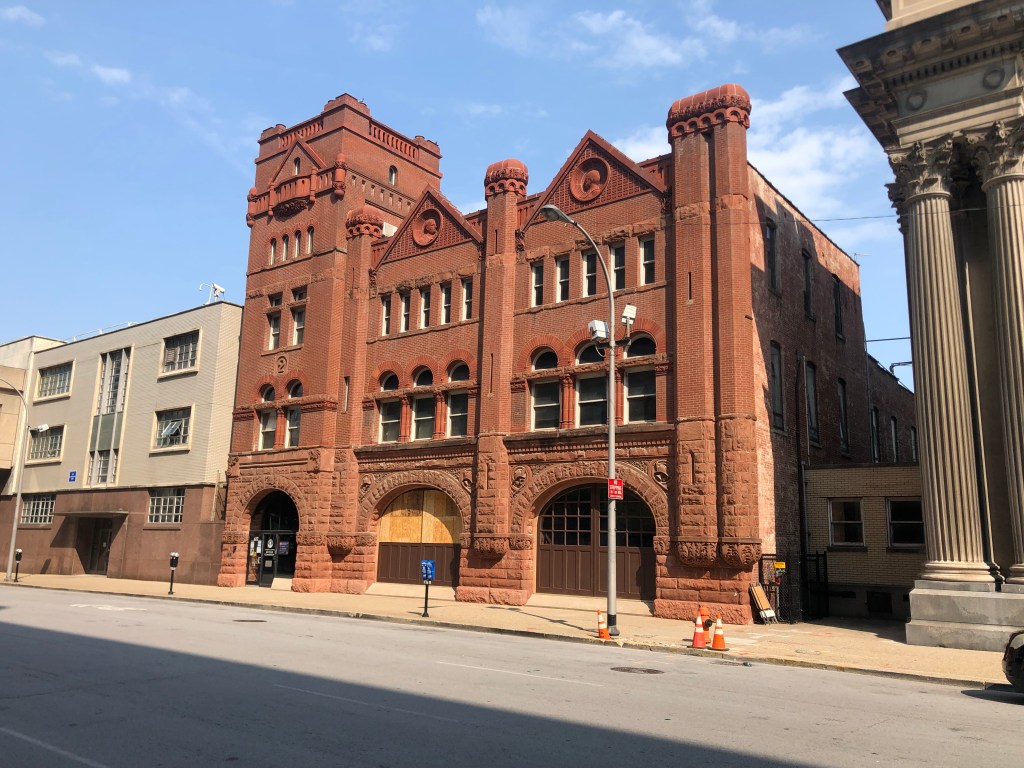
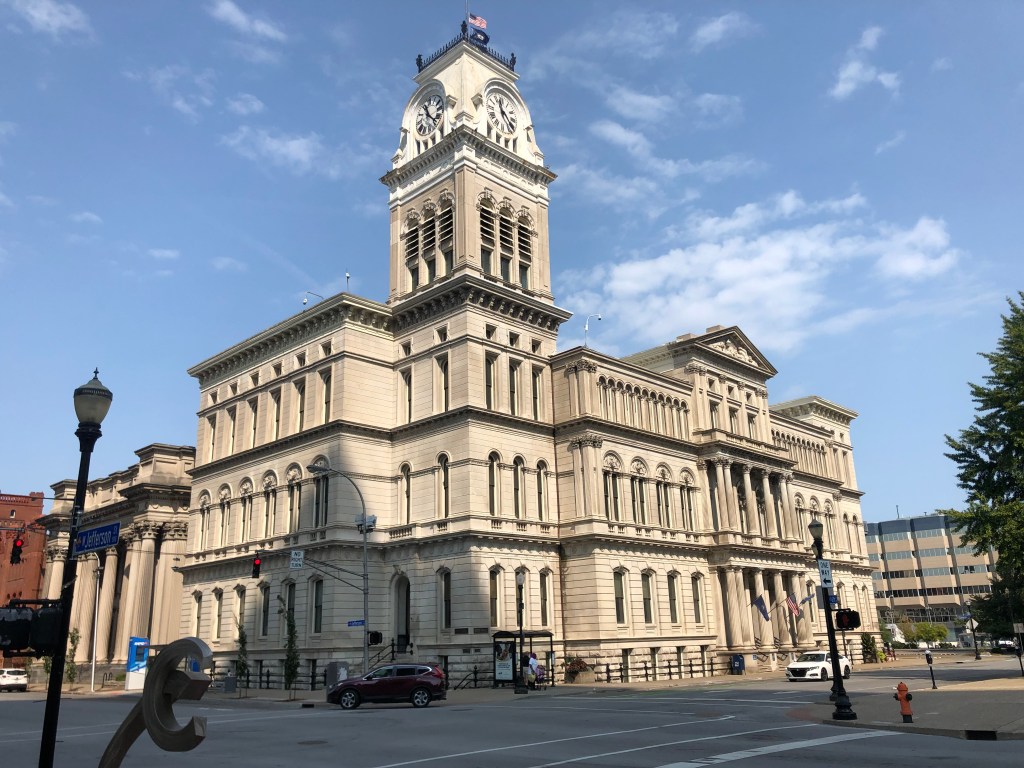
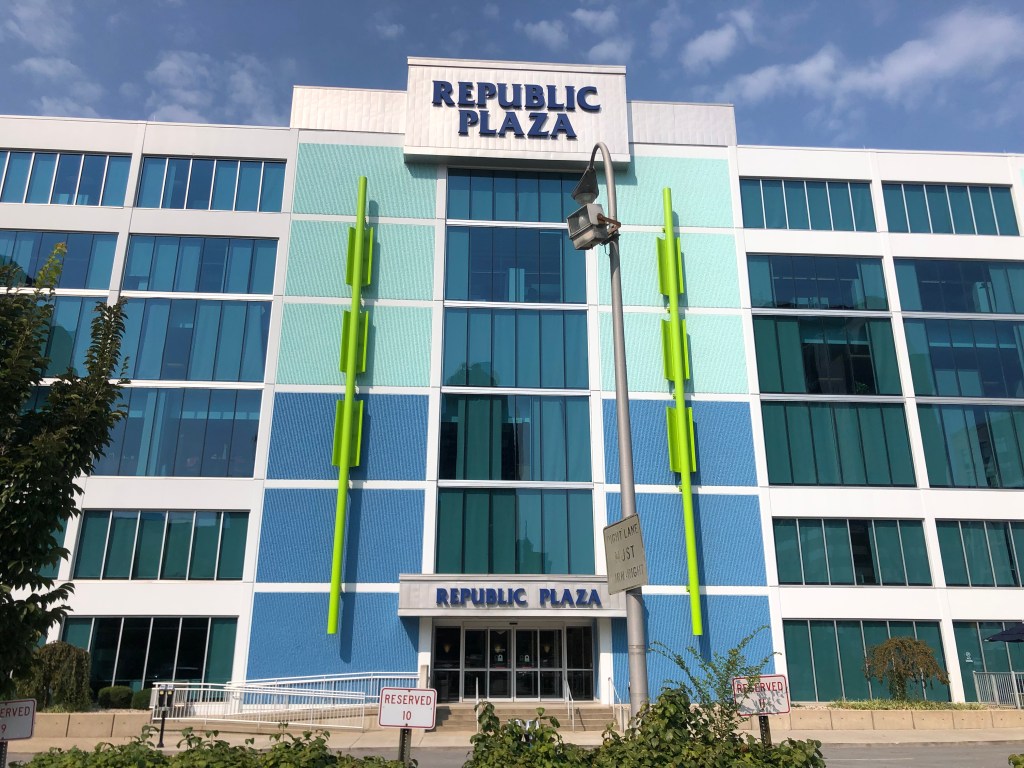
Lincoln Bank and Trust Co. building, constructed in 1929…right at the onset of the Great Depression. It remained a bank until 2005, and now serves as a reception venue.First National Bank – Kentucky Title building, from 1927.The German Bank Building, constructed in 1914. Four years later it was renamed Louisville National Bank. (Like many institutions, it was renamed during World War I to disassociate itself with the Germans.) Today it’s an Italian restaurant…thus associating itself with a different Axis power…Stock Yard Bank and Trust building, of unknown age.The Snead Manufacturing building was constructed in 1909, as a glassworks. In its later years it was widely regarded as one of Louisville’s ugliest buildings. (It also has one of the ugliest names.) It closed in 2012. Today it’s been converted to lofts and office space, and retains an artists glass studio.Historic fire station (Steam Engine Company #2), built in 1890. Now the Metro Revenue Commission building.The awesome City Hall building, from 1873.And, just for contrast, check out this more recent abomination from the so-called “modern” era. What was the architect thinking?? “I know! Let’s flank the doors with giant neon swizzle sticks!”
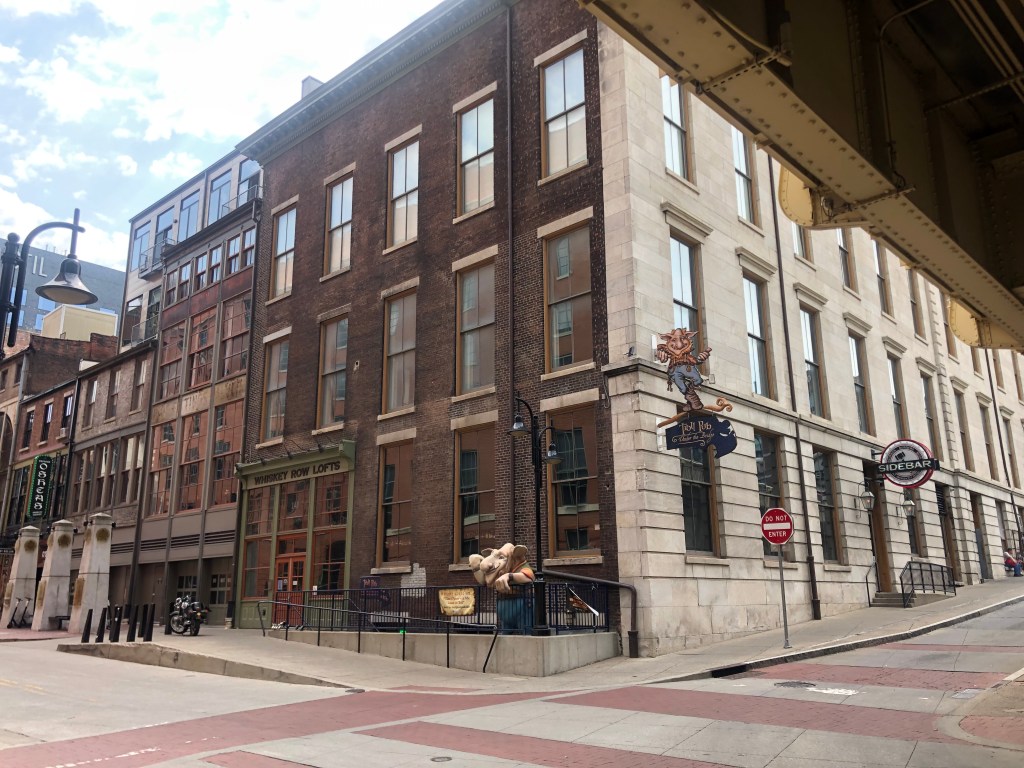
For lunch, we thought we would try the (slightly) celebrated Troll Pub. The name comes from the Three Billy Goats Gruff, since the pub sits under a bridge (Louisville’s Clark Bridge, which crosses the Ohio River into Indiana). The pub is in yet another of Louisville’s historic structures; this one was the headquarters of the Louisville and Nashville Railroad in the late 1800s.
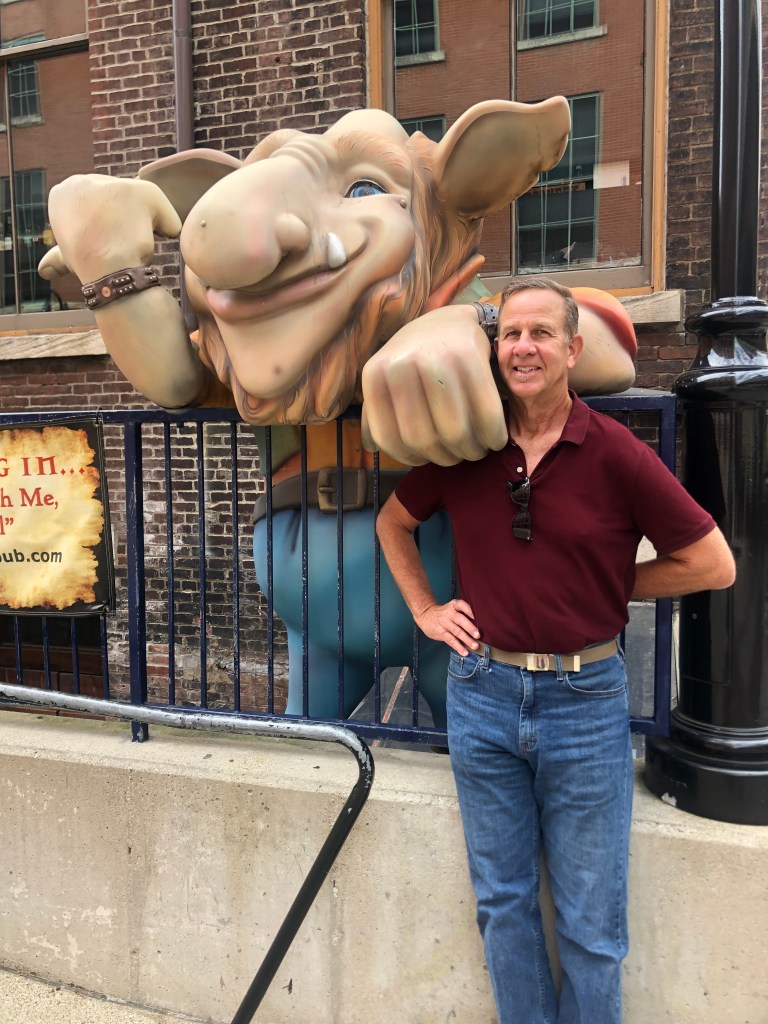
Alas, the pub’s kitchen didn’t open until 1 pm (which seems like an odd time to start serving the lunch crowd), so we left and I got a stale corn dog at a gas station. But at least we were able to get this cool picture with the troll.
“Who’s that tripping over my bridge?!”
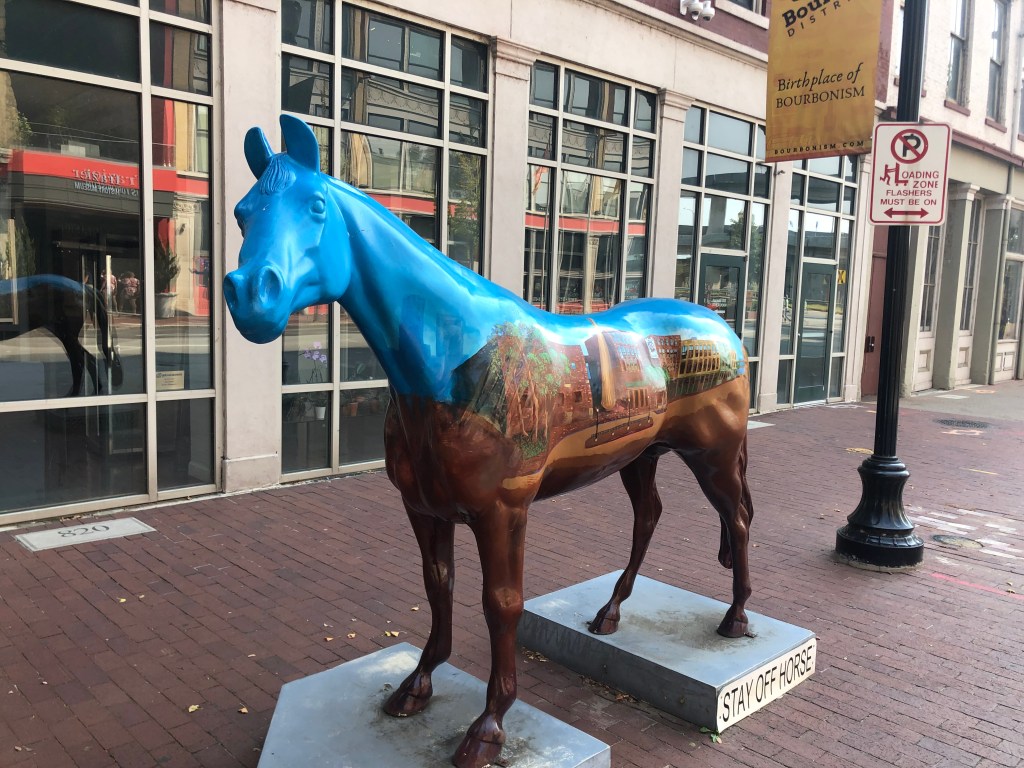
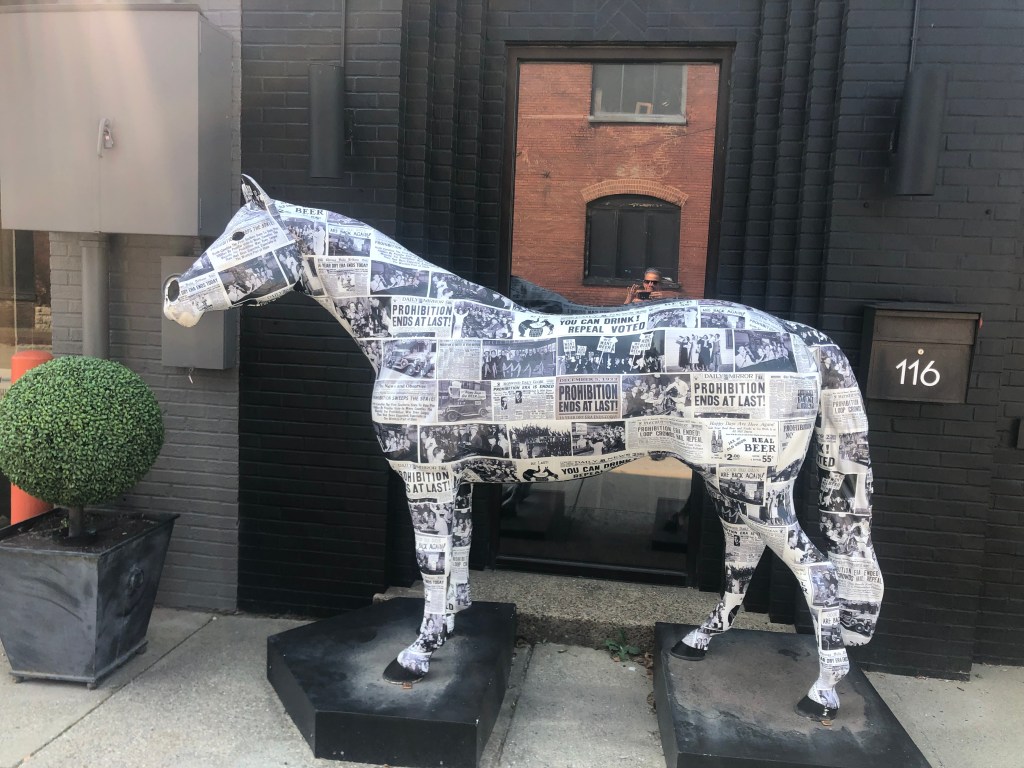
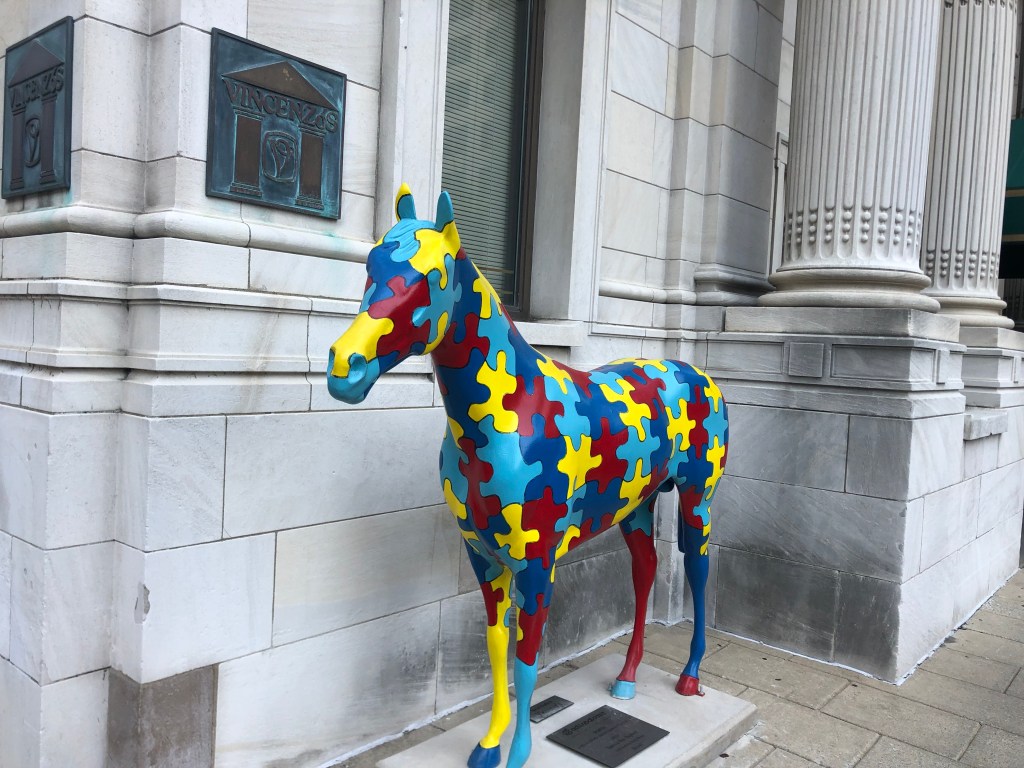
I addition to its cool architecture, Louisville has a strong sense of civic pride. A tangible example is the city’s Gallopalooza, which was a fundraising project whereby businesses and other groups bought and decorated fiberglass horses that were then placed around town. (This followed a popular trend adopted by a number of other towns in the early 2000s.) We encountered a handful of these horses today.
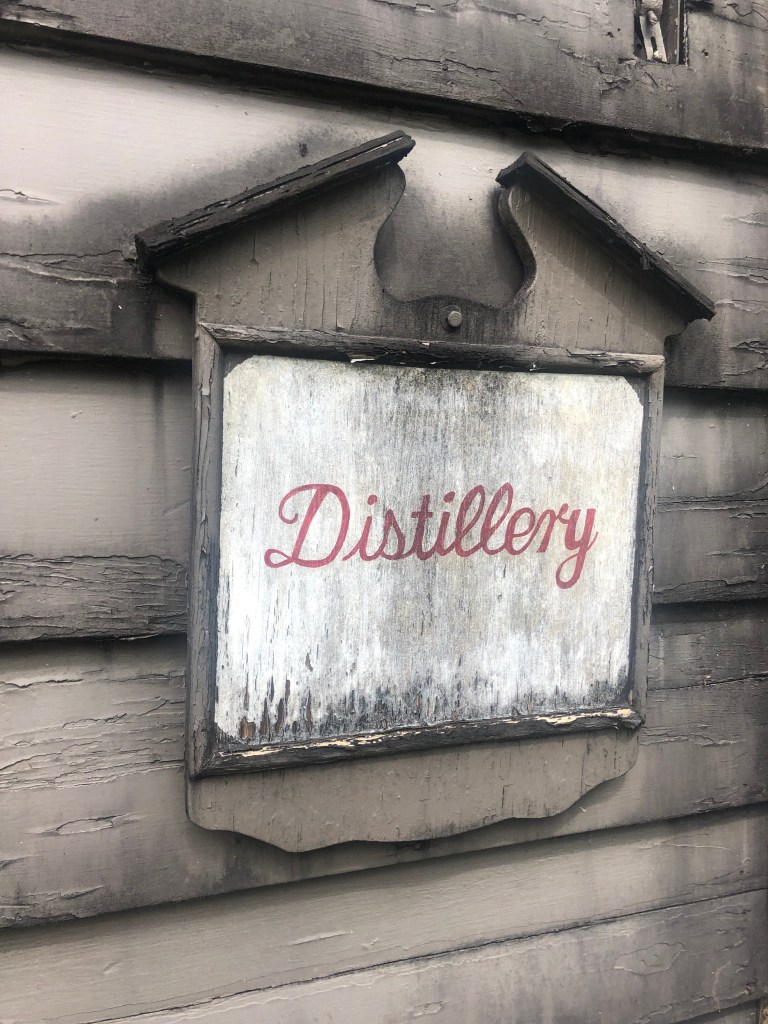
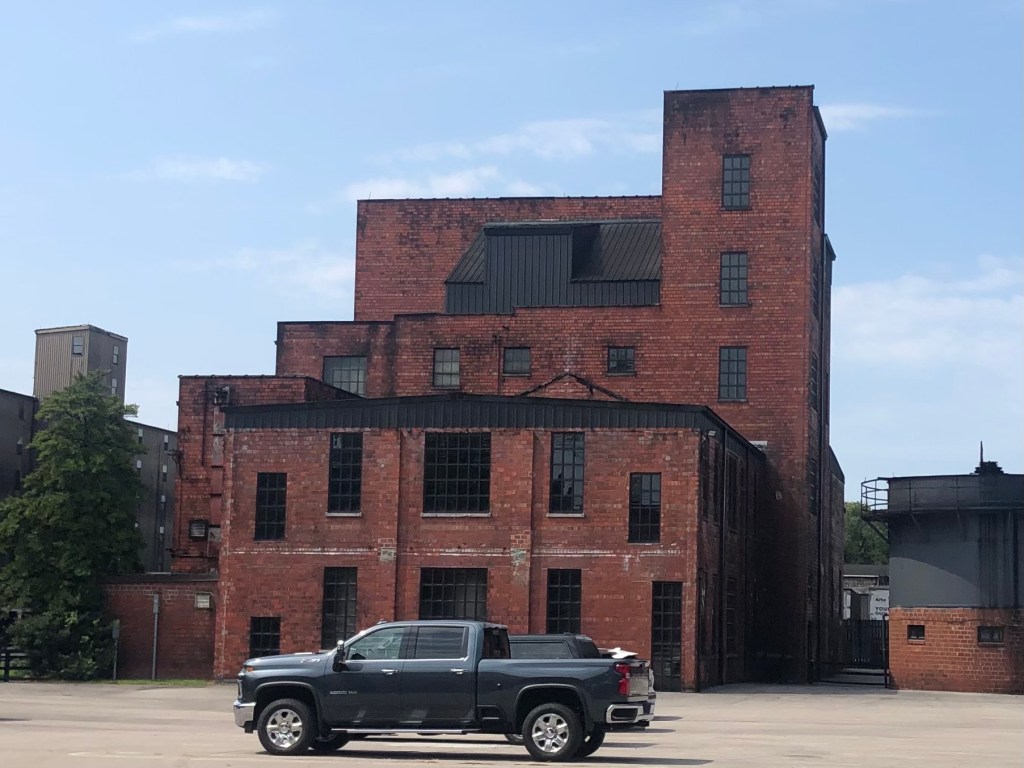
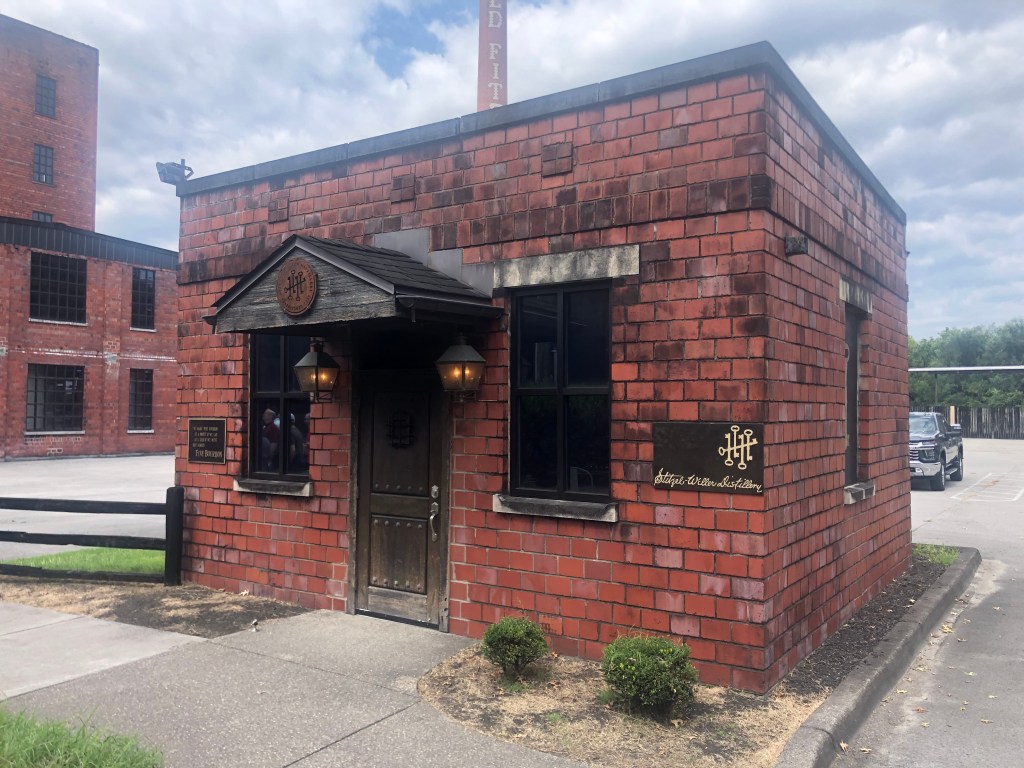
After lunch, we headed out for one final distillery tour, at Stitzel-Weller. The facility, which was constructed in 1935, was both fascinating and depressing.
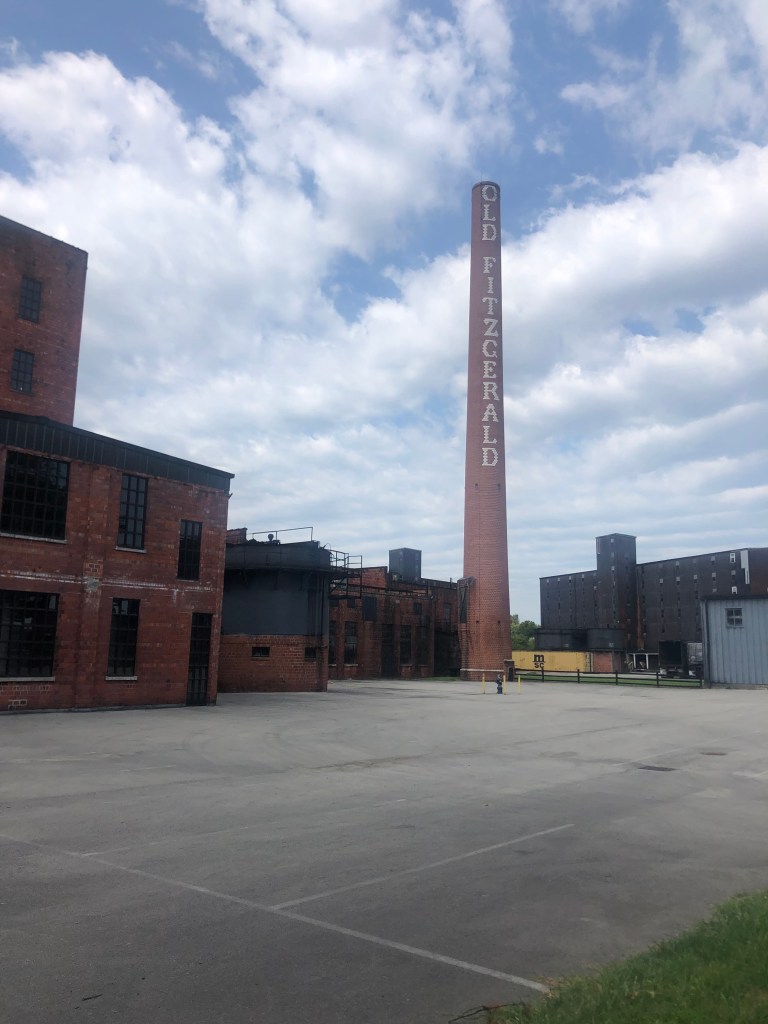
When we arrived, we were struck by the picturesque, historic setting with ancient trees, rambling old rick houses, an enormous brick smoke stack, and a tidy prewar administrative building in a state of arrested decay. It’s exactly the kind of place that I want to imagine my bourbon comes from: historic, well-worn, traditional, slow-paced, and unpolished.
(Old Fitzgerald had been one of Stitzel-Weller’s labels.)
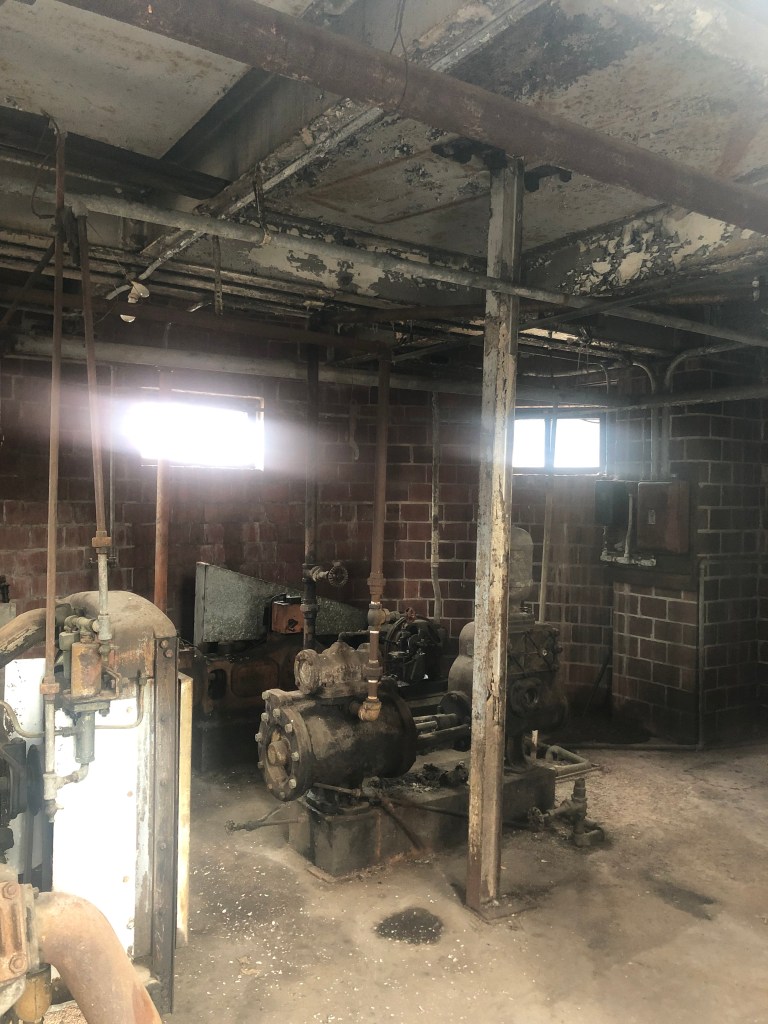
We were soaking up the atmosphere (quite literally in Kentucky’s summer humidity) and enjoying the tour when it became clear that this distillery has not produced whisky in over a quarter of a century. The family that owned it since its inception sold it in 1972, and it fell into the hands of a mega-corporation which shifted production to more efficient plants. The distillery’s buildings are now mainly just used to store barrels from other distilleries, and to conduct tours and tastings. It was somewhat eerie to walk through these buildings that once saw round-the-clock activity, but which now are inhabited mainly by ghosts.
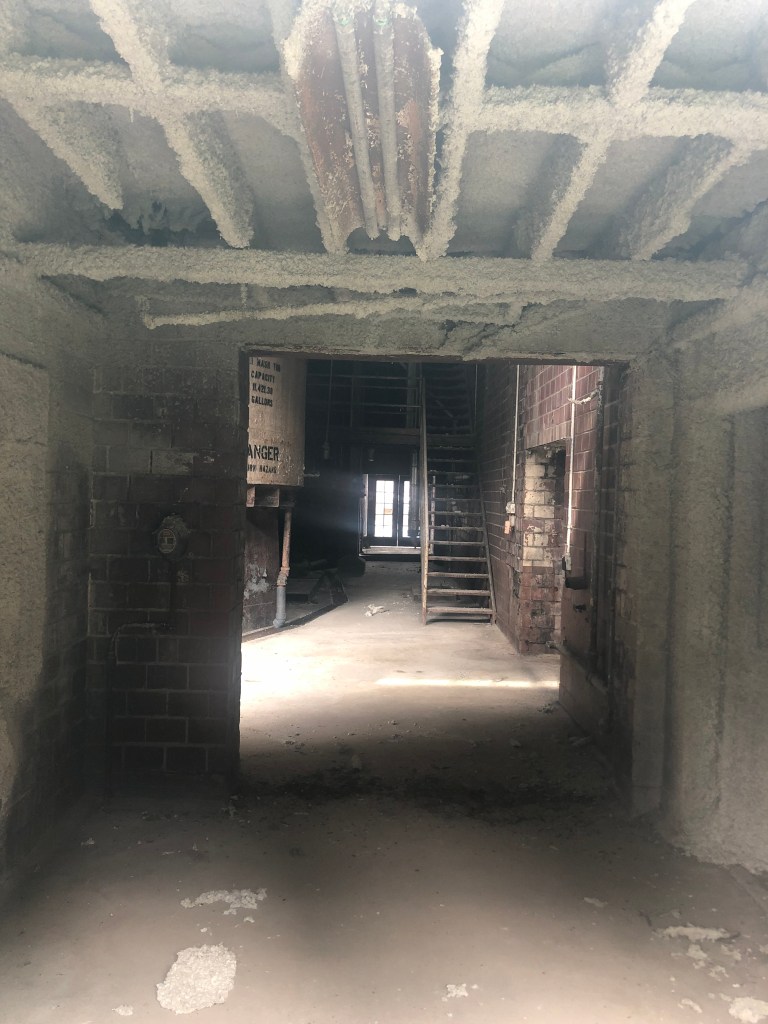
Just imagine what asbestos abatement would cost…
Furnished with this story of commercial quietus and exposed to this setting of decline and decay, we feel properly equipped to return to the Trail of Tears in the morning.
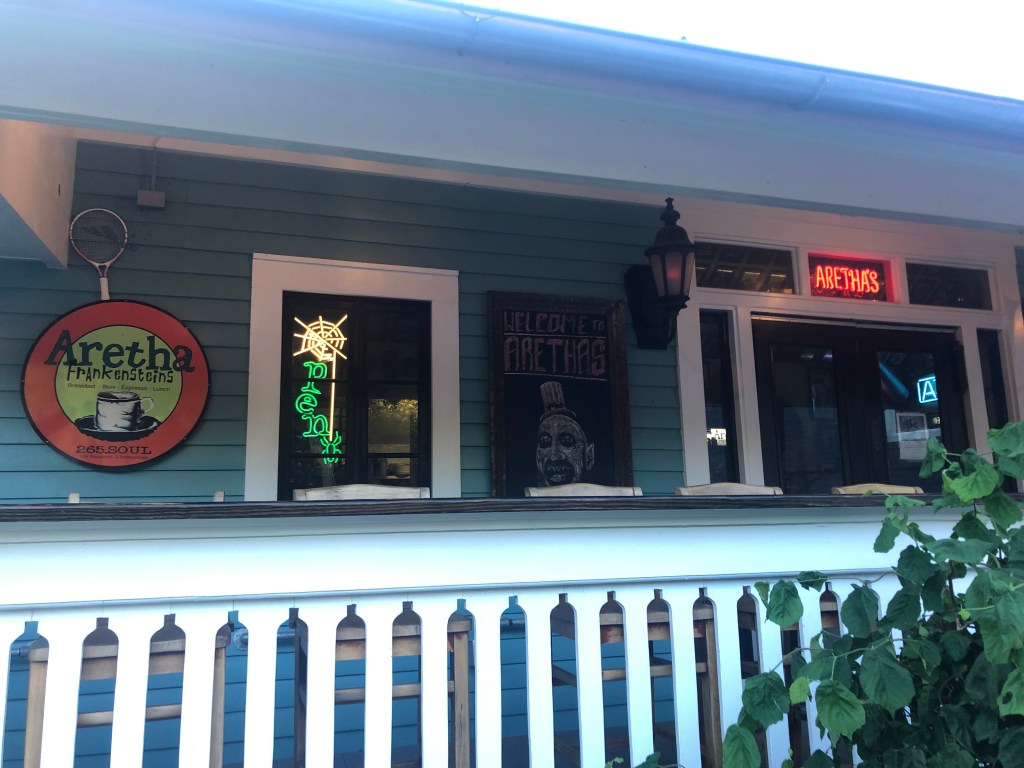
This morning we awoke in Chattanooga, and got a good, greasy breakfast at a place called Aretha Frankensteins. The restaurant is in a tidy house on a residential street, where the cook was smoking a doobie out on the porch.
R.E.S.P.E.C.T. the zoning ordinances…
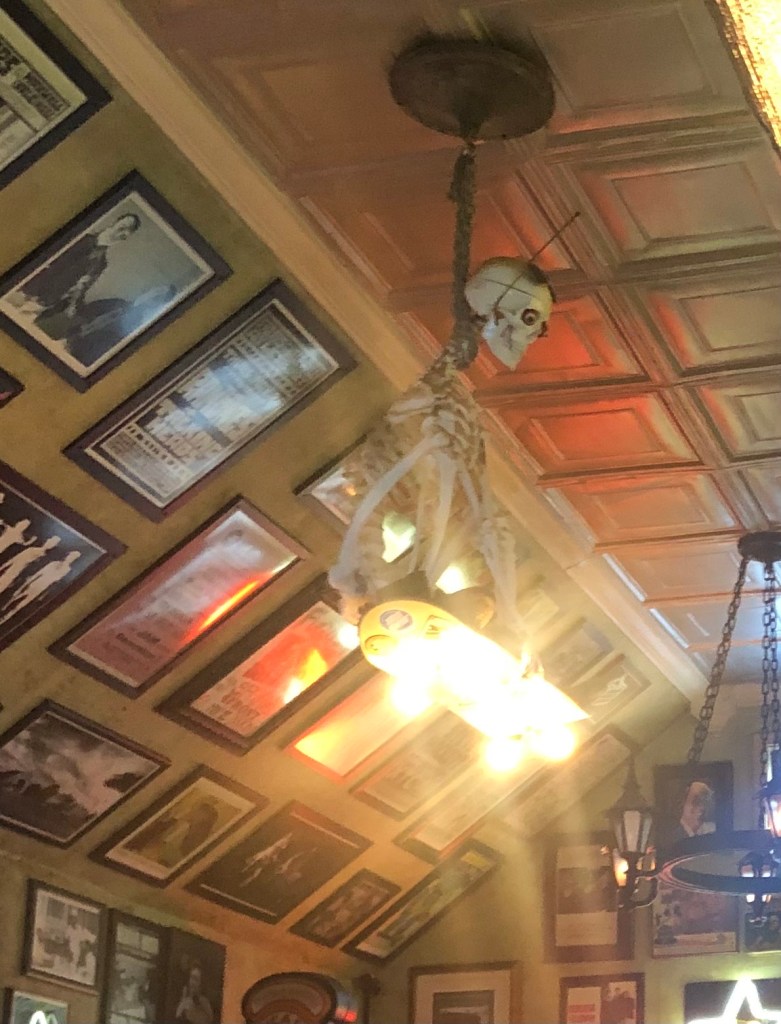
The interior is a mish-mash of horror movie stills, plastic skeletons, and various Halloween props. The biscuits were, um, to die for.
I say a little prayer…
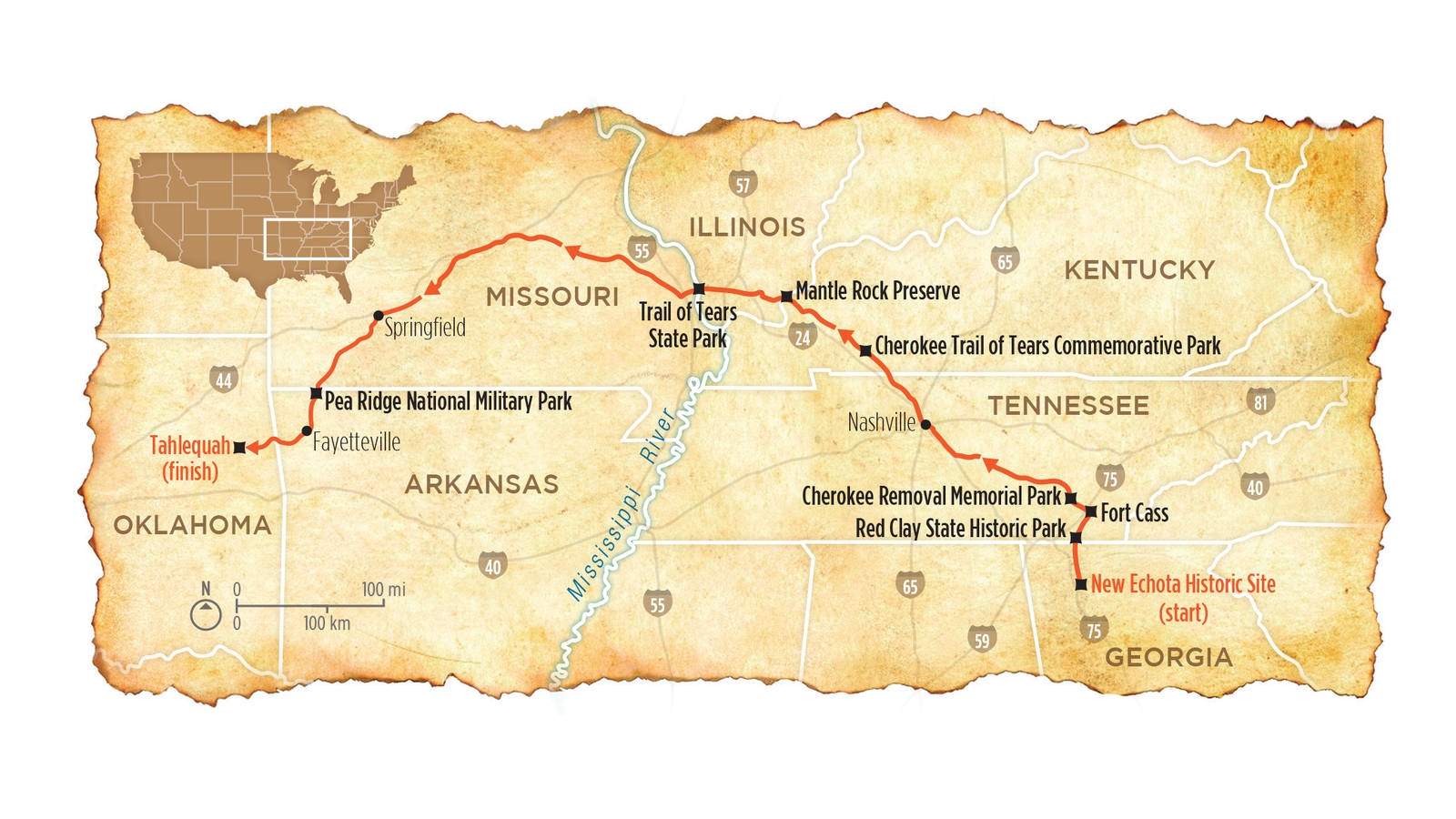
Suitably fortified, we headed out eastward to Red Clay State Historic park, just over the border from Georgia. This served as the Cherokee’s national seat of government from 1832 to 1837. But wait, you say: Wasn’t New Echota, Georgia (that we visited yesterday) the Cherokee capital? Indeed it was, but in the early 1830s Georgia passed a state law making it illegal for the Cherokees to gather and officially vote on anything. In order for their national Council to convene, therefore, they moved across the state line into Tennessee. See the two points at the right-hand end of the Trail of Tears, below.
The state park at Red Clay includes the reconstructed Council meeting house, as well as other structures. It’s much less impressive than New Echota, and clearly served as a makeshift site for a government-in-exile.
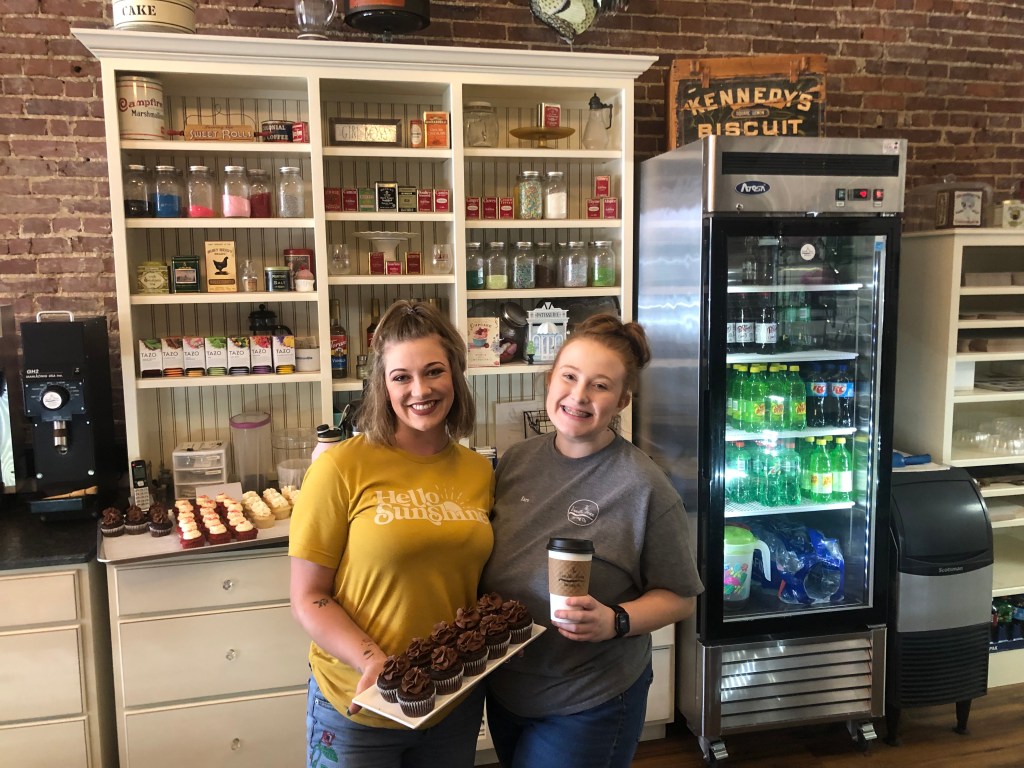
From Red Clay, we roughly followed the northern route that the Cherokees took when they were forced from Georgia to Oklahoma. We passed through a number of small, out-of-the way Tennessee towns, and skirted around the west side of Nashville. Along the way we stopped in McMinnville, TN (pop: 14,000) for lunch. We tried the Vanilla Bean Bakery, which hooked us up with baked goods an coffee. (I never said it was going to be a healthy lunch.)
The girls at The Vanilla Bean put together our to-go order…
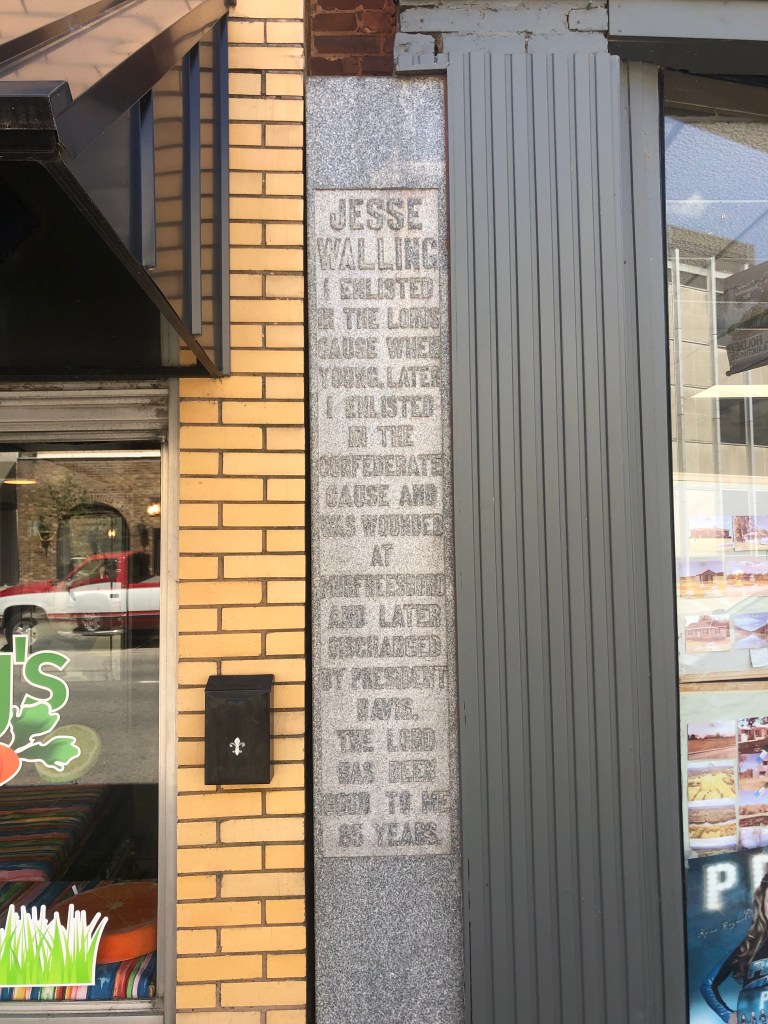
On the way out of The Vanilla Bean we passed a narrow, granite monument of sorts that was squeezed between two buildings. The monument reads: “JESSE WALLING. I enlisted in the Lord’s cause when young. Later I enlisted in the Confederate cause and was wounded at Murfreesboro and later discharged by President Davis. The Lord has been good to me 85 years.”
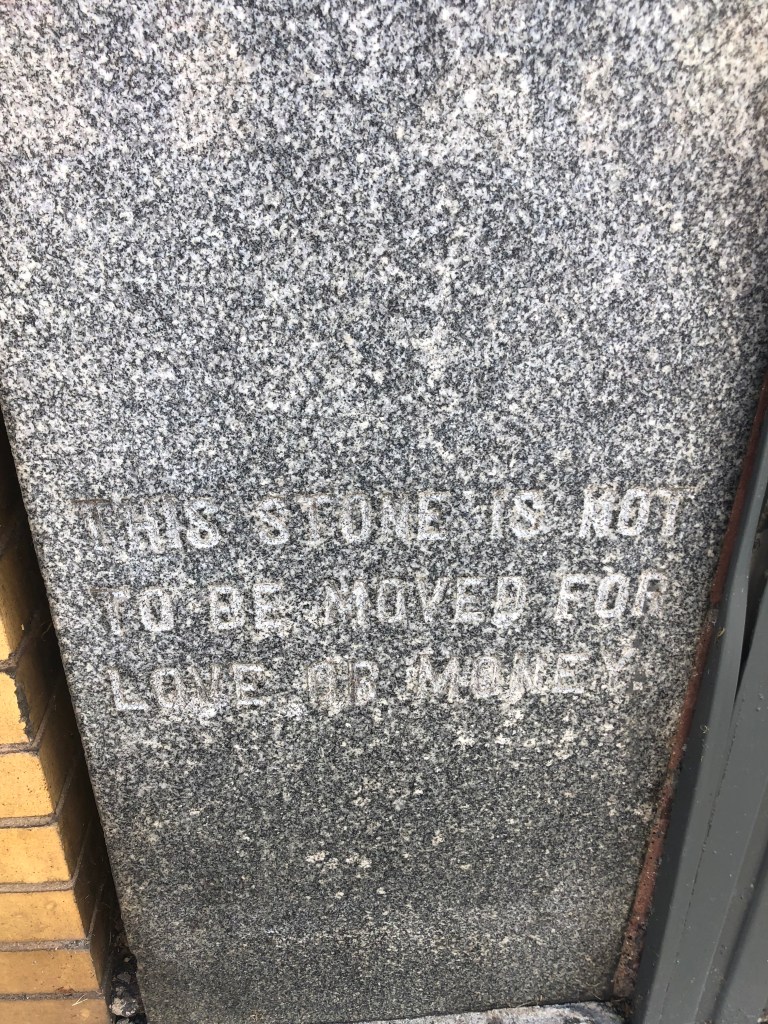
And just beneath the monument is an engraved notation: “This stone is not to be moved for love or money.” So evidently, Jesse’s wishes have been honored.
It turns out that Jesse Walling had been mayor of McMinnville, and he’d founded a bank, a power company, and a cotton mill. He died in 1930 at the age of 89. The Lord had been good to him, indeed.
He collected properties like a Monopoly player.
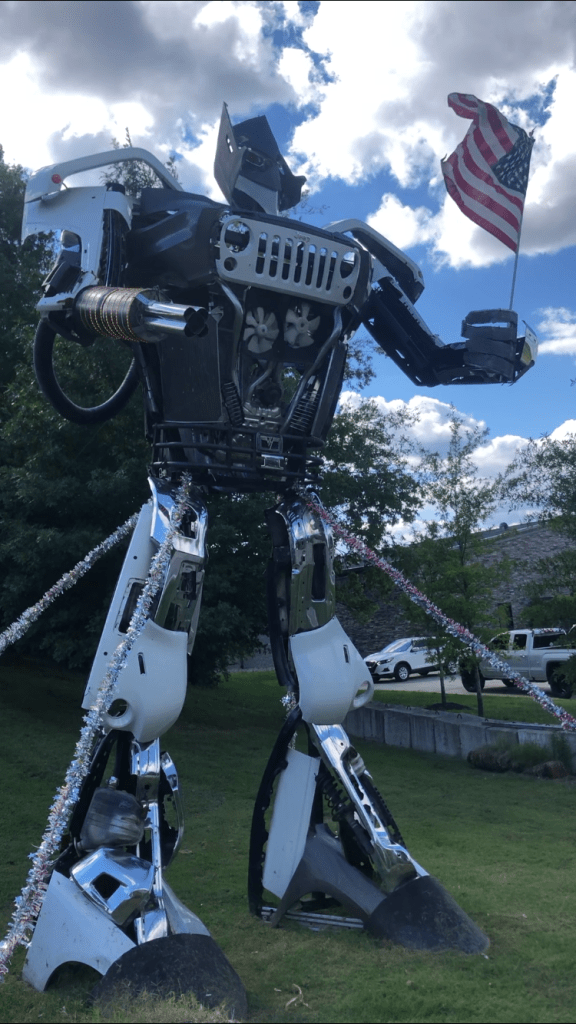
A little later along our route, in Goodlettsville, Tennessee, we encountered this Transformer-like yard art.
“I will never stop fighting for our freedom.” –Optimus Prime
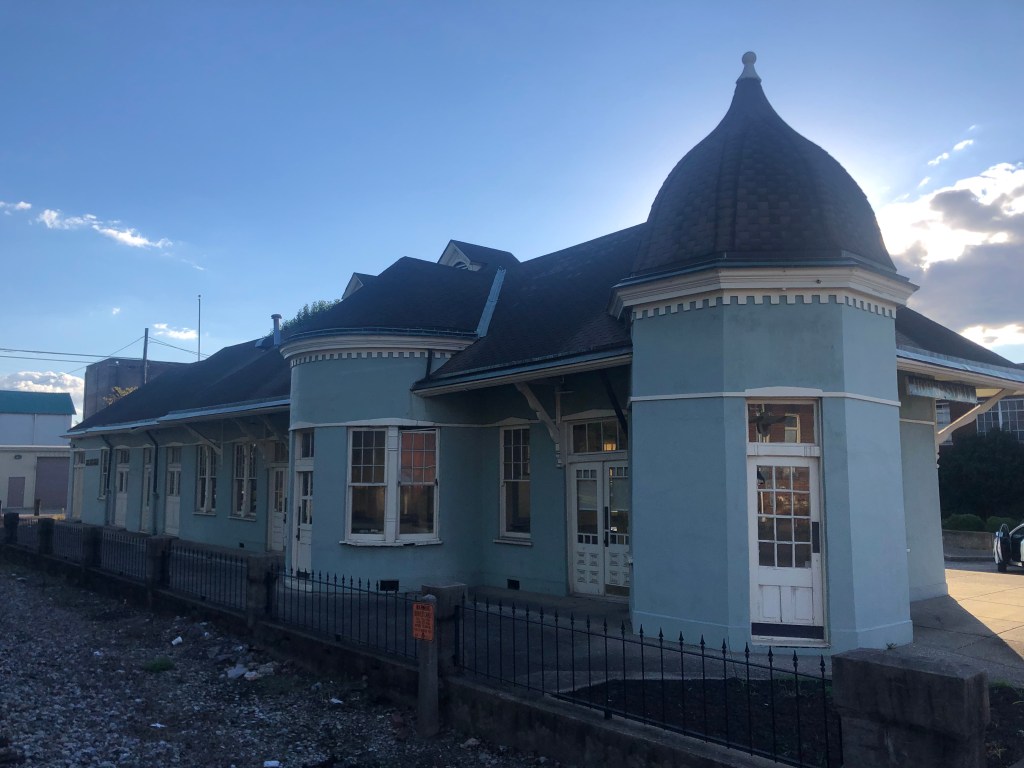
Eventually we entered Kentucky at roughly the same point that the Cherokees did 183 years ago. We headed up the “Dixie Beeline Highway,” and eventually found ourselves in the quaint town of Hopkinsville (pop: 32,000). It’s home to an unusual 1892 depot of the Louisville and Nashville Railroad.
The architect may have been suffering from “turrets” syndrome.
Hopkinsville was one of the few towns in the region permitting alcohol sales. It’s said that Hopkinsville was often referred to as “Hoptown,” because it was only station between Evanston, IL and Nashville, TN where a passenger could “hop off” and get a drink. I’m not making this up.
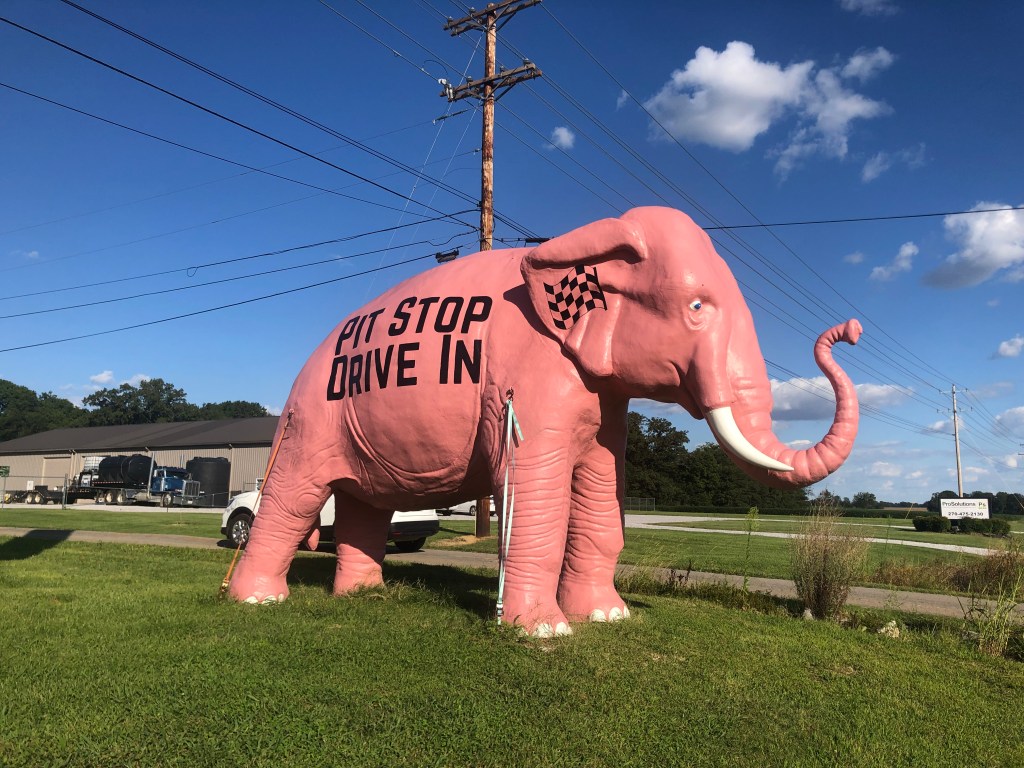
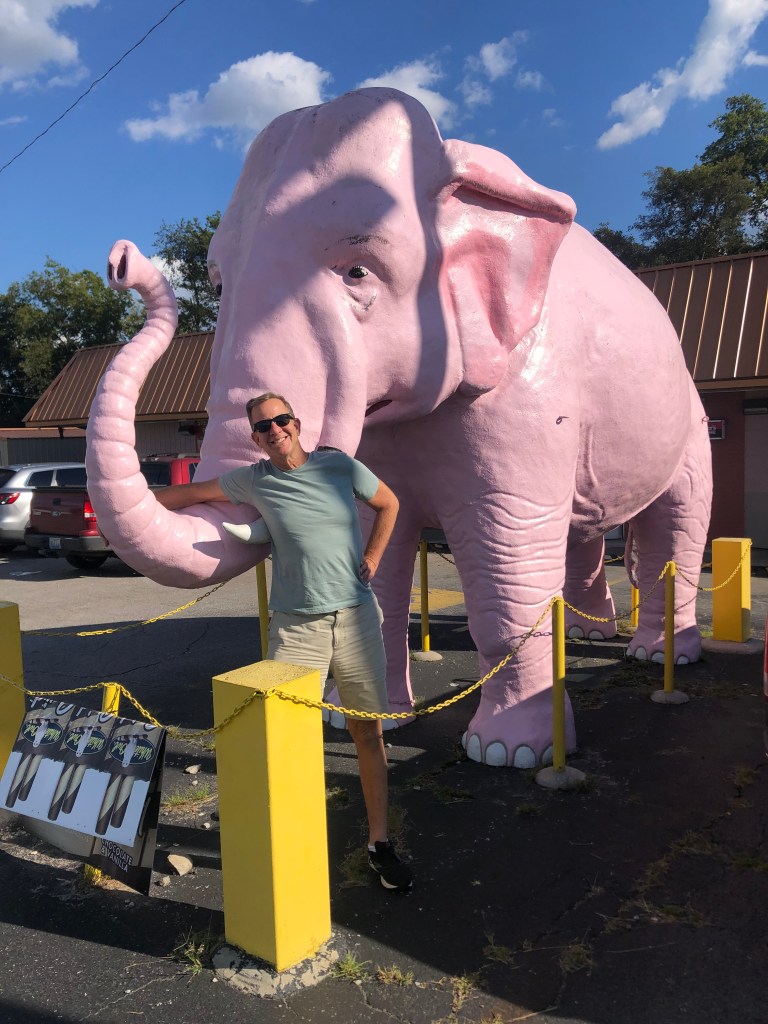
Speaking of drinks, on today’s drive we encountered a few pink elephants. Though located in different cities, they appear to have been manufactured out of fiberglass from the same mold. Alert readers will recall that I’ve run into a couple of similar (though slightly different) pink elephants on my Route 70 trip (see near the end of this post and this post.)
Outside a liquor store (of course) in Hopkinsville, KYOutside a gas station in Guthrie, KY
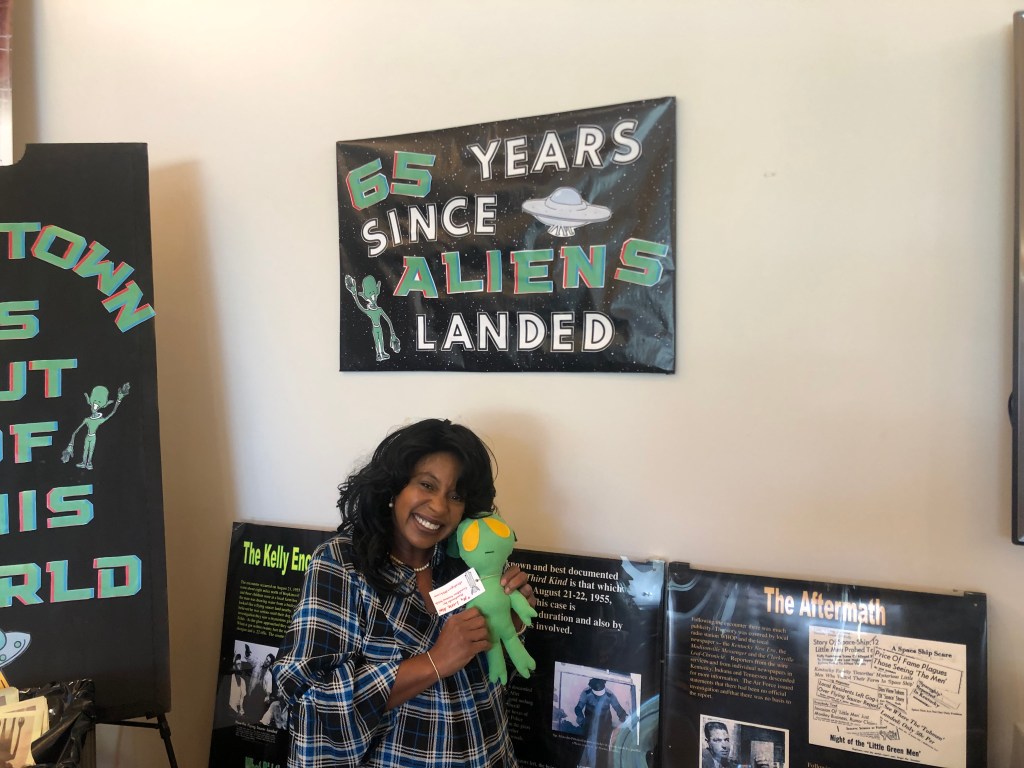
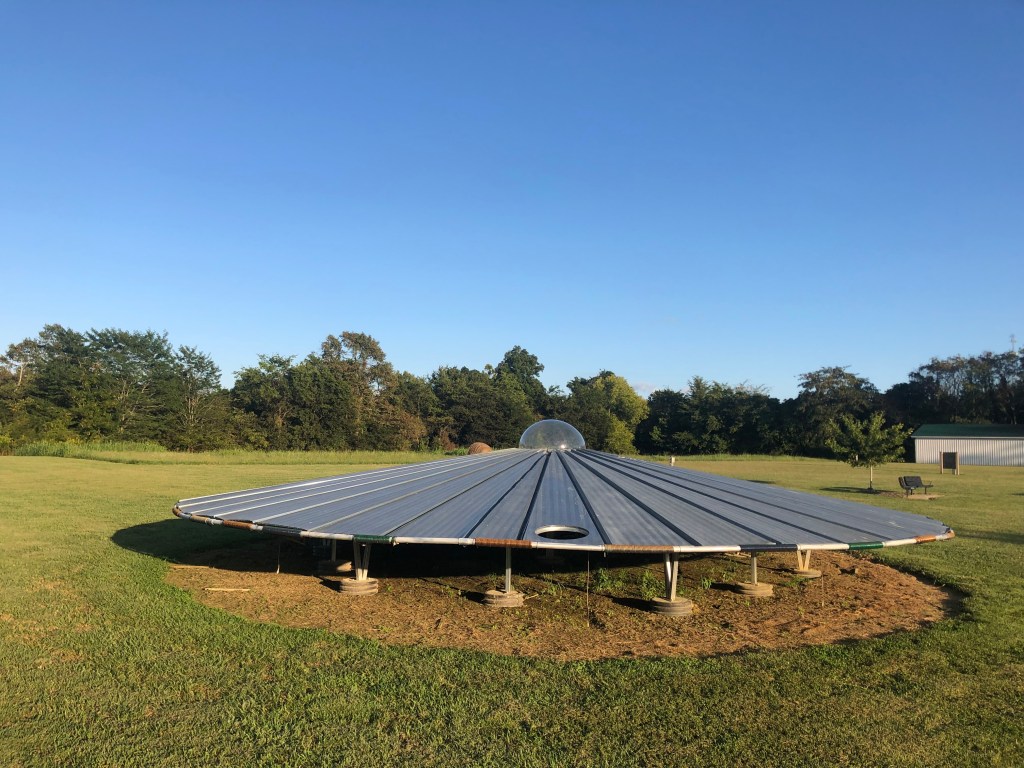
Finally, just three minutes before its 5 pm closing time, we arrived at the Hopkinsville-Christian County Visitors Center. It was on this land that Cherokees on the Trail of Tears camped, were reprovisioned, and (for a couple of them at least) died. We were greeted by Amy, who was the only person so far who’s showed any enthusiasm for our trek. In fact, Amy seems to show enthusiasm for everything, including a story about aliens landing in the area in 1955. It seems that the Lankford-Sutton family, which lived in a farmhouse a few miles up the road, watched a spaceship land on an adjoining field on the night of August 21, 1955. Little silver beings emerged from the ship and converged on the farmhouse. Some of the menfolk in the house fired shots at the beings (as one does), but the shots had no effect on them. The police were called out, but they could find no evidence of an alien invasion. The story was largely forgotten until 2005, when some townsfolk figured a 50th anniversary celebration would be a good way to draw tourists. There’s been an annual “Little Green Men” festival ever since. (Never mind that the men were originally claimed to have been silver, not green.)
Amy hawks an Alien doll, that she’s named Cletus.“”Flying saucer” at the scene where the alien invasion “happened” some 66 years ago. (Yes, Scott and I felt compelled to drive out to the field and check it out.)
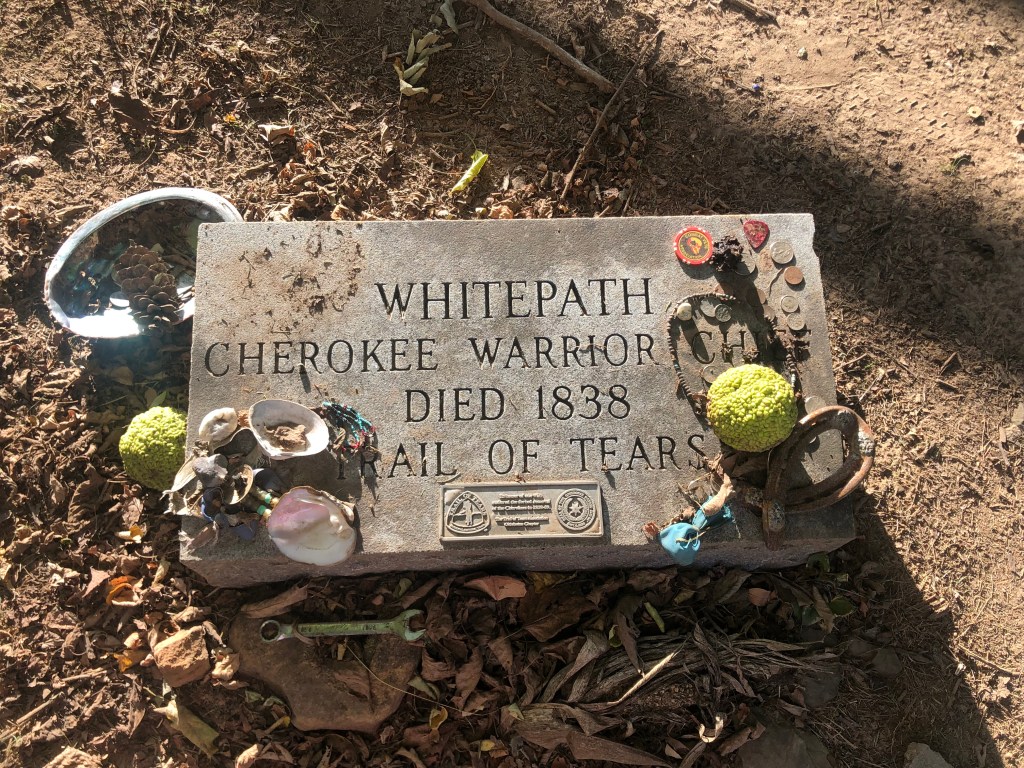
We spent some time chatting with Amy about her job (the Lord answered her prayers and led her to it two months ago), her home (on her parents’ 150-acre farm), the Trail of Tears (there’s going to be a big commemorative meeting of Indians at the Visitors Center this weekend), and various other topics. Sensitive that we were keeping her at her job well past closing time, we let her lock up while we moved outside to the area where the Cherokees had camped. Next to a creek were the graves of two Cherokee chiefs who had succumbed during the forced march. These are among the very few verified graves along the Trail of Tears.
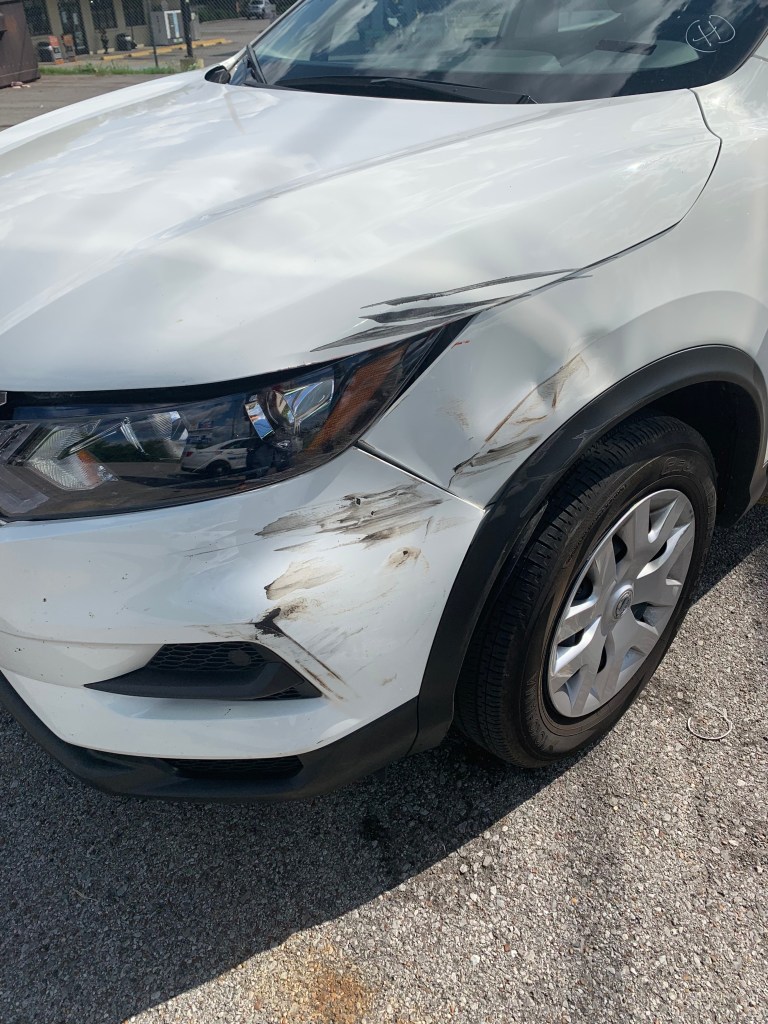
After a quick trip to a nearby field to view the “flying saucer” that commemorates the invasion (see above), it was time for us to take a long detour off the Trail of Tears, and head to Louisville for a day or two on Kentucky’s Bourbon Trail. But before we could start that detour, we got clipped by a maroon Dodge Caravan, which shot across four lanes to make a turn while we waited patiently at a stoplight. We tried to catch up with this hit-and-run driver, but lost him/her. Let us know if you see this vehicle!
You bastard.The damage.
Eventually we did make it to Louisville. It was now quite late, so there was no time for a BOTD. In fact, we barely had time to get a drive-though sandwich from Subway just as they were closing. Notably, Michelle (the cheerful southern belle who was working the take-out window) insisted she could guess our occupations based strictly on our voices when we ordered through the microphone. “One of you is in insurance, and the other is in the ministry.” She didn’t indicate who was the minister. But either way, she’s zero for zero.

 Chasing Phantoms