Uncategorized

Look Who’s Taki-ing

Last weekend our sons Michael and Ian, as well as Ian’s wonderful bride Katelyn and close family friend Veronica, all came out for a visit. We ended up (as one does) playing a game that required us to sequence a collection of commercial snack foods in order, from earliest date of introduction to latest. One snack food in that list was unfamiliar to me: Takis.

The young ‘uns all insisted that Takis were a delectable snack, something akin to Doritos but in a different shape with different flavors. I should try some, said they. I accepted the challenge, and this afternoon I plunked down $4.99 at Safeway for my own 9.9 ounce bag. My analysis will be revealed in this blog post. But let’s just say that, for intrigue, controversy, and divisiveness, Hunter Biden’s laptop ain’t got nothing on Takis.

First, let me acknowledge that this blog is nominally about road trips, but surely we can all agree that a significant component of the Road Trip Experience (RTE) is consuming gas station snacks. And that has Takis written all over it.

For those of you (like me) who have been unaware of the existence of Takis, they are a “rolled corn tortilla chip snack” made by a company called Barcel, which is a subsidiary of Grupo Bimbo, the Mexican international food company. You may have seen their mascot on delivery trucks.

Is that the ghost of Winnie the Pooh?

Anyway, according to Wikipedia, Takis were “invented” in Mexico in 1999, and introduced to the US market in 2004. They are said to be a “rolled tortilla chip” that is “fashioned after a taquito.” Now, given that two of my favorite foods are tortilla chips and taquitos, pounding a bag of Takis sounded like a no-brainer. So I dutifully made my way to the “chips and pretzels” aisle of our neighborhood Safeway and was faced with many, many different flavors of Takis. Indeed, according to Wikipedia, there are 29 distinct flavors of Takis, including such intriguing names as “Angry Burger” (spicy hamburger and dill pickle) and “Kaboom” (ketchup and sriracha). I went with “fuego” (hot chili pepper and lime, which Wikipedia calls “the spiciest of all varieties, as well as the most popular flavor”).

Goodbye cruel world.

I got home, poured myself a Scotch, and opened the bag. The shape of the Takis is indeed reminiscent of a (very small) taquito. But half of the true taquito experience (TTE) is burning your tongue with the mystery-meat magma that oozes from the rolled tortilla when you bite into it. The Taquis, by way of contrast, just crumble apart and release a dozen chemicals (including malodextrin, MSG, hydrolyzed soy protein, and disodium inosinate) onto your tongue. The experience is somewhat similar to eating a Flamin’ Hot Cheetos, but (1) it’s not quite so hot, (2) the texture is crispier and denser, and (3) your fingers do not get as stained.

Delivery system for disodium inosinate.

For me, the good folks at Barcel do a good job of approaching the “bliss point” for sugar, salt, and fat, thus triggering the release of endorphins and encouraging you to consume more. These Takis are addictive! But, at least for the “fuego” flavor, the high level of spiciness stops you from pounding an entire bag. Seriously; after eating maybe a third of the bag, I had sweat beads collecting on my forehead and my esophagus felt like it’d been sandpapered. But maybe forcing me to stop was a good thing: just one ounce of these things constitutes a serving, which is 150 calories. So an entire bag clocks in at 1,485 calories. And a bag also provides 100 percent of your daily recommended fat. And 178 percent of your sodium.

But let’s say that you’re one of those rare people who can stop after just one ounce. For you, I think these are a worthy snack. They have intense flavor, a crunchy and satisfying mouthfeel, and a perfectly-sized shape. But who’s going to limit themselves to one ounce on a road trip?

Earlier I mentioned some controversy about Takis. It seems Takis (and similar snacks, like some Cheetos) give rise to gastritis and ulcers. Indeed, a number of schools around the country banned the sale (and, in a few cases, possession) of Takis on campus. Some claim that Takis are as addictive as street drugs. In my humble opinion, it makes sense to impose some standards for food that’s sold at school. But surely Takis are no worse than many, many other snack foods. Do they ban Red Bull? Ding-Dongs? Pepsi? Starbucks?

Anyway, my final word on Takis is that they are indeed an intensely tasty snack, but I wouldn’t want to make them a habit. Scotch, on the other hand, is a whole different story.

UPCOMING ROAD TRIPS:

I realize I haven’t posted any road trips recently, and no doubt that’s caused considerable disappointment among my loyal readership. Never fear: In a couple of weeks, I will be heading north for a nostalgic trip to Eagleville. Stay tuned.

And then, in late September, I’ll be making a motorcycle tour along the southern Italian coast. I am not making this up. All will be revealed soon enough.

Finally, you will recall that each October I turn over this blog to a Halloween-themed series of posts. This October I will be continuing that tradition. But the specific theme will be, I think, especially intriguing. Make sure to block out the entire month for reading my blog.
cemeteries · Uncategorized

Bay Area Blues

It’s been about 7 weeks since I got back from my road trip along the Blues Highway in the Mississippi Delta. I do think the trip left a bit of an imprint on me — just as I think travel does for all people. As regards this particular trip I feel like I’m more aware of the influence of the blues in much of the music I listen to, and I have a slightly better understanding of the cast of characters who have moved the art form along.

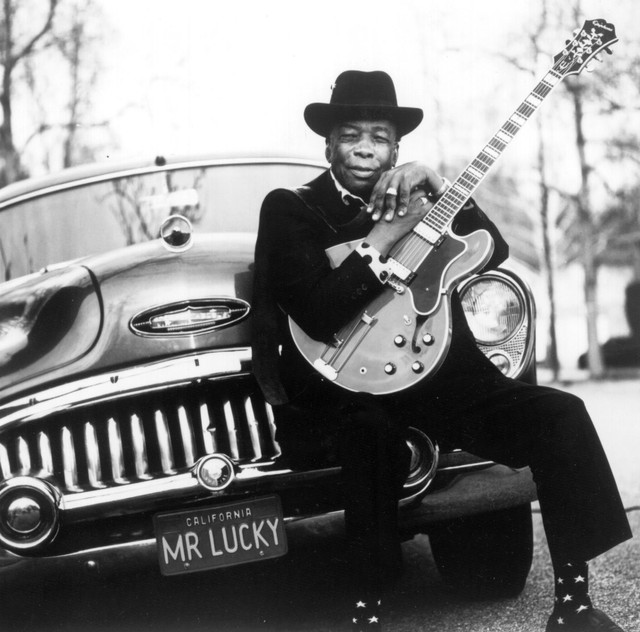
Enter John Lee Hooker. He was born in 1912 in Tutwiler, Mississippi, not far from Route 61 (the Blues Highway) which I drove on my road trip. John Lee Hooker was an incredibly influential Delta Blues artist, and his name kept turning up in the various blues museums I was visiting. He played an electric guitar like nobody’s business. And he popularized the song “One Bourbon, One Scotch, One Beer” long before George Thorogood made it popular all over again on his 1977 debut album.

“I said look man, come down here…”

And here’s something else about JLH: you saw him playing in the original Blues Brothers movie, as himself on the streets of Chicago in 1980. It’s worth watching that clip again, just to get into the mood:

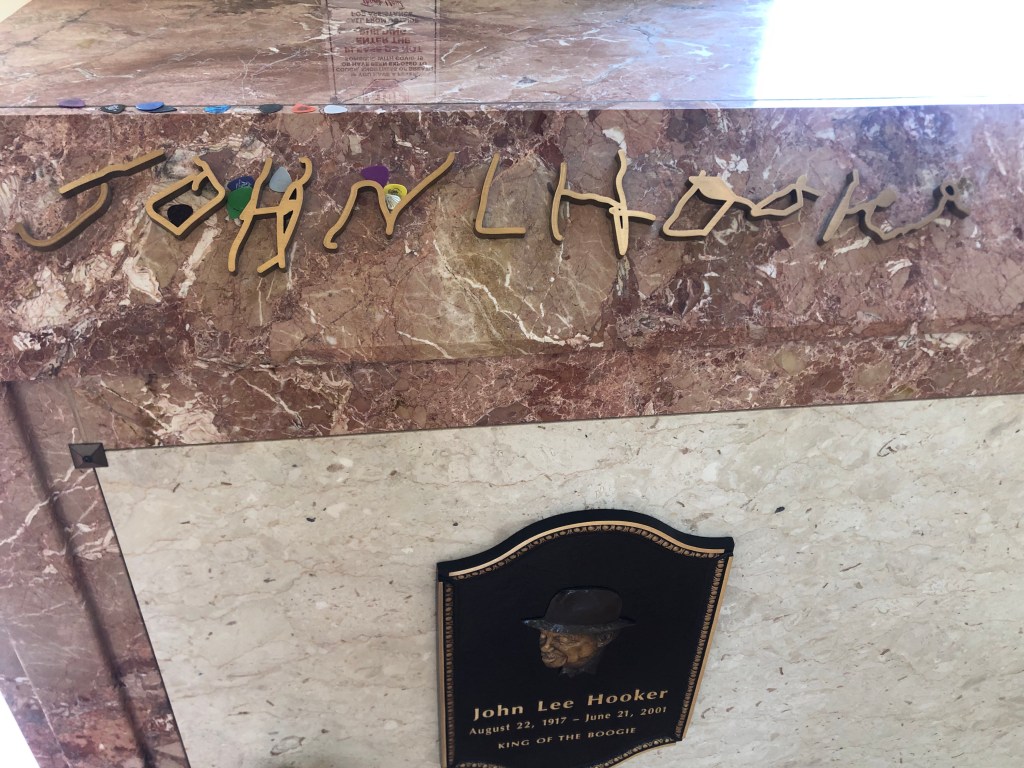
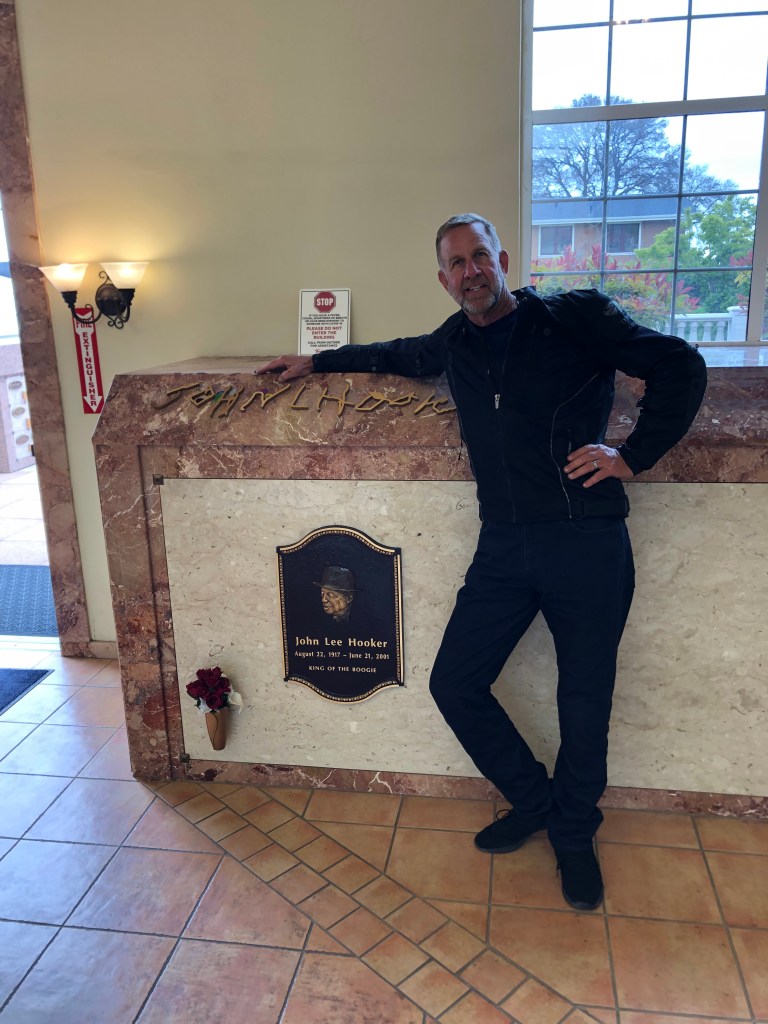
I mention all this because the other day I literally stumbled upon John Lee Hooker’s resting place:

The man was an amazing musician, but his handwriting evidently sucked.

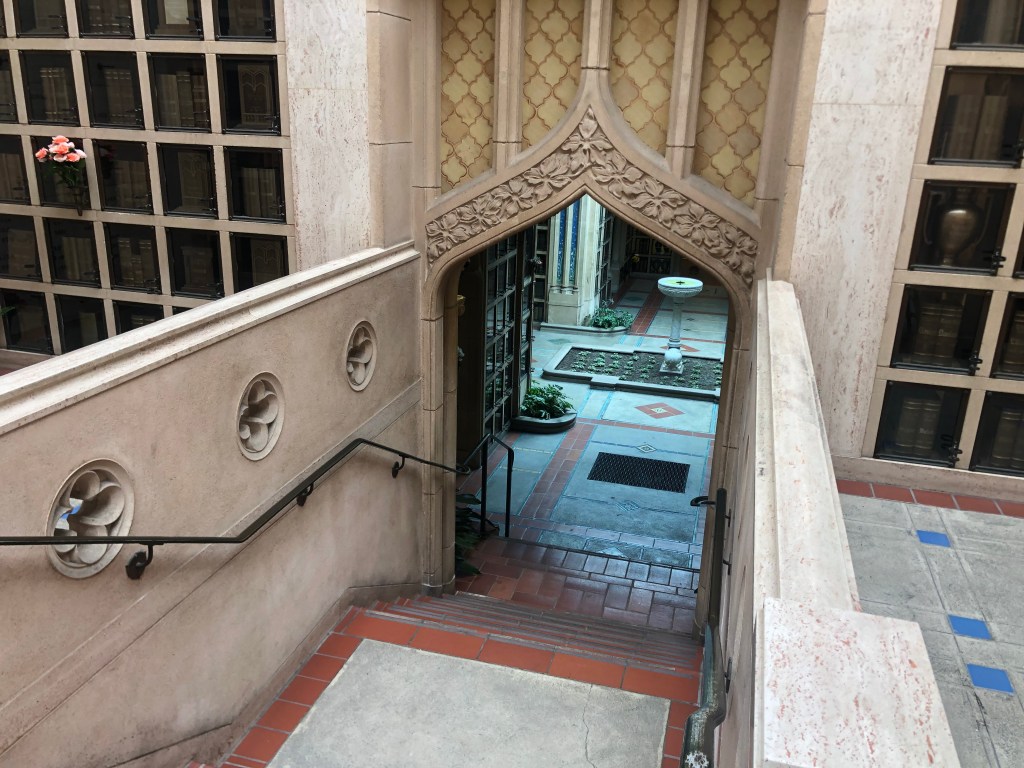
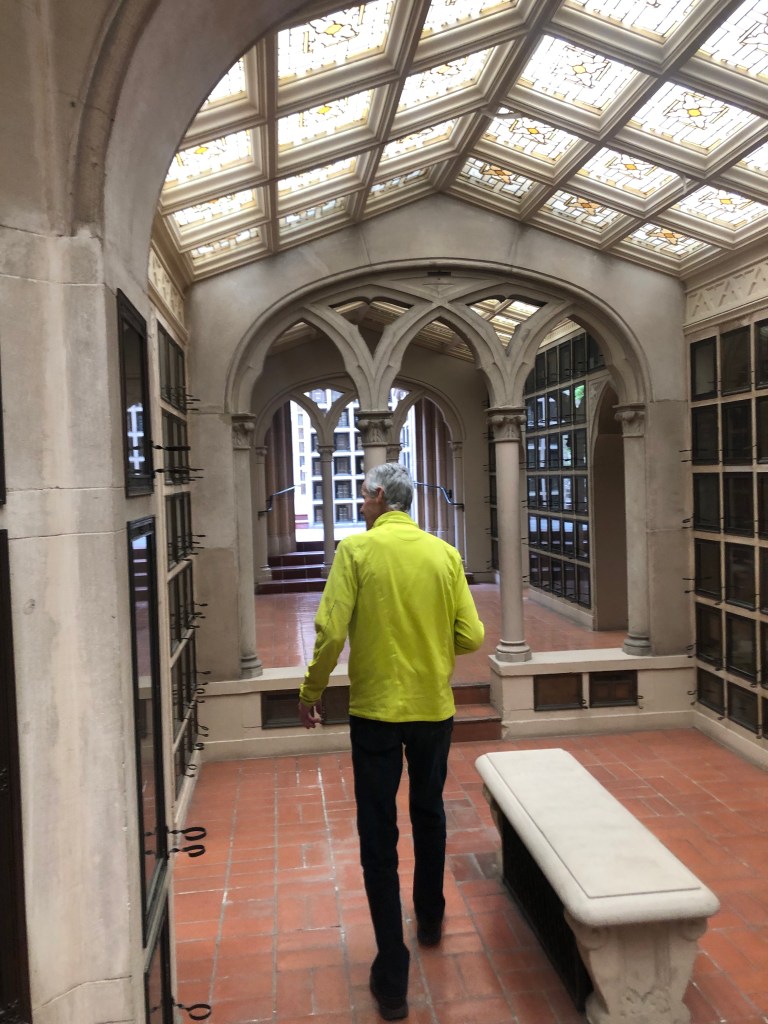
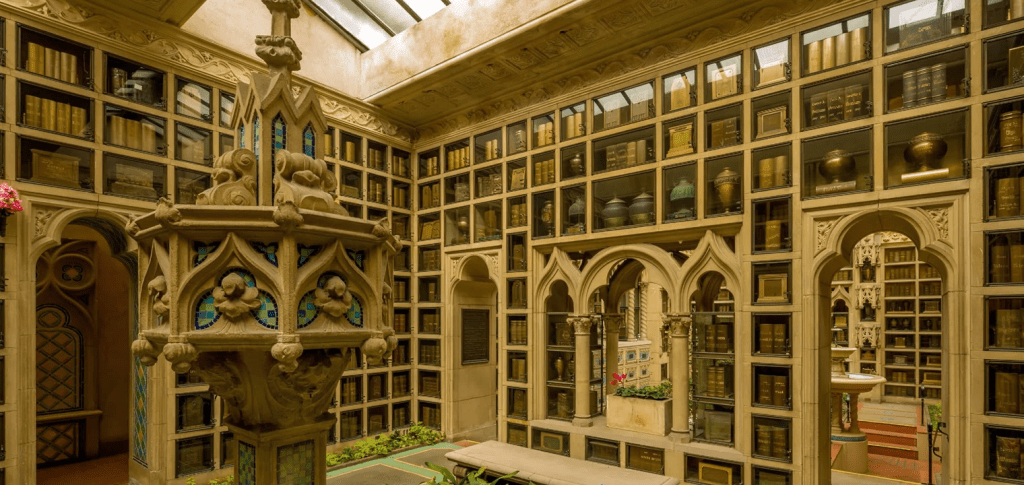
I had taken a ride to the Bay Area to visit with my old college roommate, Bruce. And, for reasons that still aren’t entirely clear, Bruce decided that we should visit The Chapel of the Chimes in Oakland. The COTC is a massive Moorish/Gothic columbarium that was designed by the famed architect Julia Morgan in 1928. (You’ll remember that Morgan designed Hearst Castle, among other iconic structures.) It would be easy to get lost in this place, with its multiple floors, twisting hallways, large airy rooms, and endless decoration. But it’s fascinating and over-the-top with its overwrought decoration.

Random doorway in the Chapel of the Chimes
Bruce trying to find his way out.
This photo stolen from the Internet gives a good sense of the Moorish decoration.

Anyway, to get back to John Lee Hooker: In his later years Hooker lived in California, with houses in Los Angeles and the Bay Area. He was inducted into the Blues Hall of Fame and the Rock and Roll Hall of Fame. He died in 2001 at age 88 (though there’s some dispute about his exact age; he was the son of a sharecropper in the early 20th century, and recordkeeping wasn’t that great at the time). He was in his house in Los Altos when he died, and evidently made the short journey to this final resting spot here in Oakland.

I’d urge you listen to a few songs by John Lee Hooker, and maybe even to visit the Chapel of the Chimes. And if you do, please help Bruce find his way out….

RIP the Boogie Man
Uncategorized

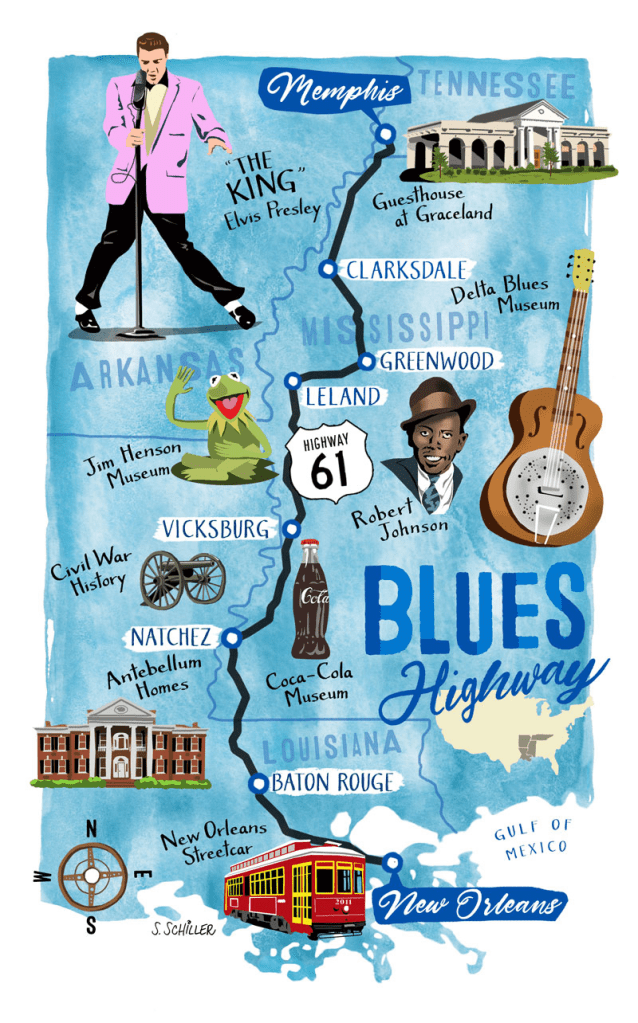
Cruising the Blues Highway

About a week ago winter officially ended and we entered that most glorious of seasons, the springtime. And that means a resumption of road trips. It’s time to return to the road, throwing caution to the wind and an inadequate supply of socks into my backpack.

Of course, the part of this continent that seems to have missed the “end of winter” memo is the Mississippi Delta (tornadoes, flooding, plagues of locusts and frogs). And, perhaps predictably, this is the location of my newest road trip.

Specifically, I stumbled upon a recommended road trip described as “The Blues Highway,” from Nashville, Tennessee to New Orleans, Louisiana. It takes you through the land of Elvis, BB King, Muddy Waters, and Booker T. Jones, not to mention various quirky landmarks that are best left to be revealed as I encounter them.

So my loving wife (who is always eager to help me leave) is about to drive me to Sacramento Intergalactic Airport, where I’ll be taking a red-eye on United. I’ll be landing in The Music City tomorrow at 9 am local time. (The flight goes by way of Washington, DC, which seems a little inefficient. But hey.) I’ll be blogging daily over the coming week…unless I get taken out by a pelting of toads.

Feel free to send me a message if you have any suggestions for stops generally along the Mississippi River. As is my usual approach, this trip isn’t planned out in any great detail….

C’est tout! Allons!

Cars · Puns · Uncategorized

Game of Thrones

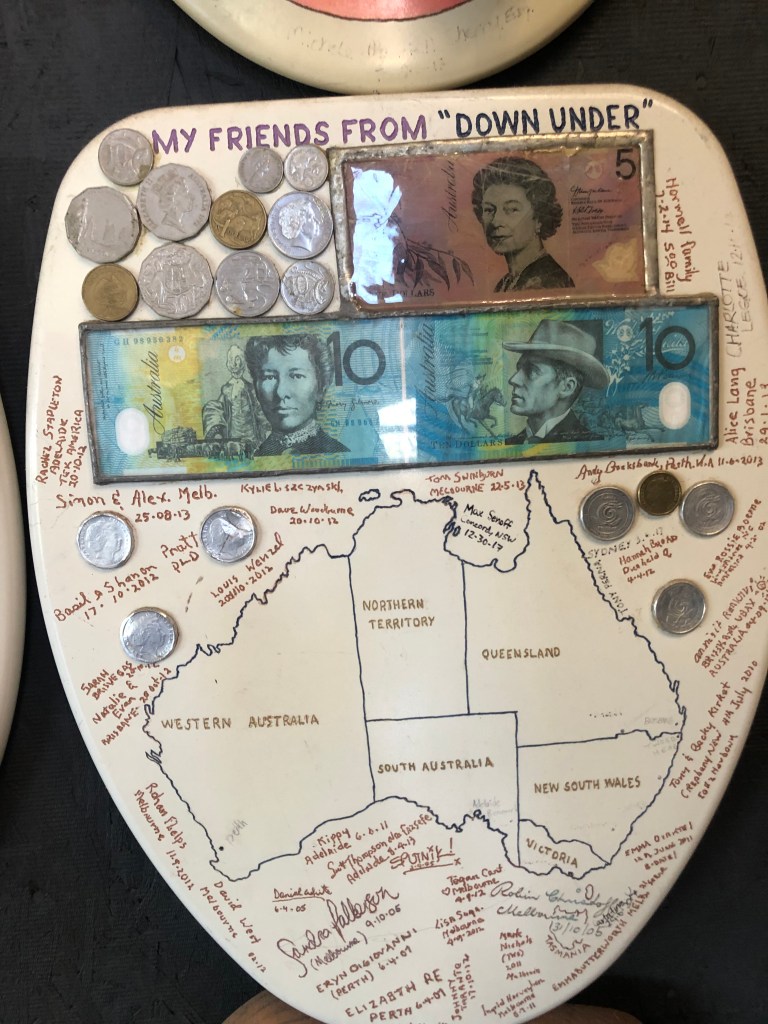
Once upon a time (in 1921, to be exact) a guy named Barney Smith was born in Eastland, TX. Barney became a plumber, but he also indulged his artistic side. In his words: “I went to a plumbing supply house one time, and they had about 50 toilet seats out on the dock that they were going to throw away. And I said [to the owner], what are you going to do with those toilet seats? I would like to have some of these toilet seats to do some art on.” Somehow Barney managed to get all those seats, and he began transforming them into works of art.

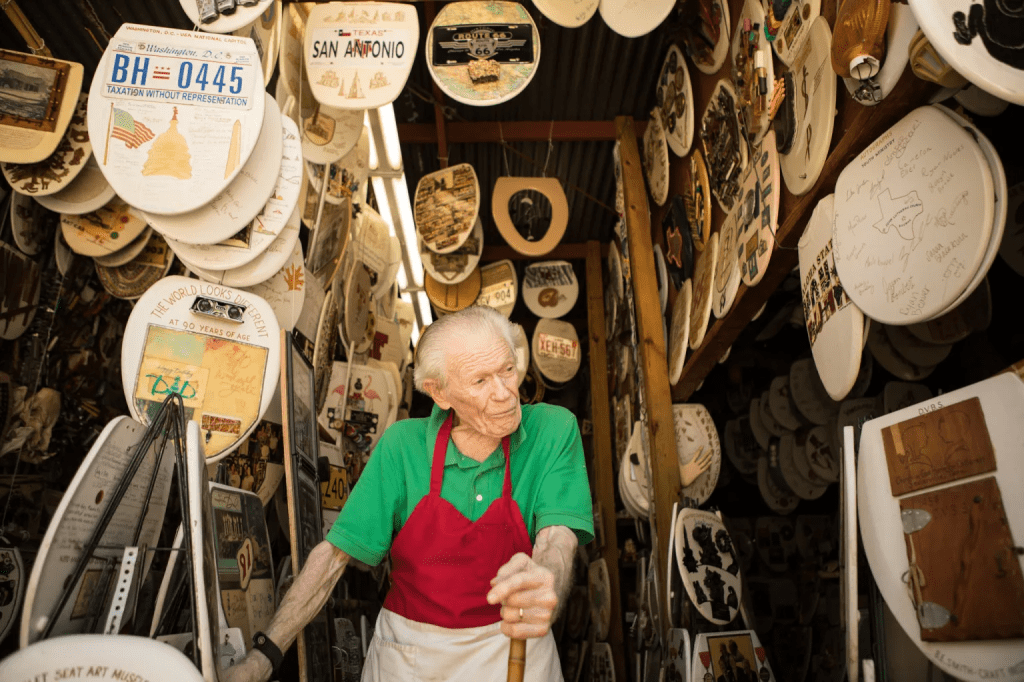
The art took various forms, but in general he glued found objects onto the seats and added lettering and other ornamentation. Barney kept getting more seats, and there seemed to be no topic that he couldn’t capture in toilet seat art: history, celebrities, professions, geography, transportation, entomology…the list goes on and on. Eventually, over a period of 50 years, he created over 1,400 of these objets d’art. The collection turned Barney into a minor celebrity, appearing in magazines like Life and People, and on television news programs like the Today Show. He displayed the seats in his garage, but in his twilight years he sought out a more permanent, public venue to display his collection.

Barney in his garage in 2016. Photo c/o Bonnie Arbittier / San Antonio Report

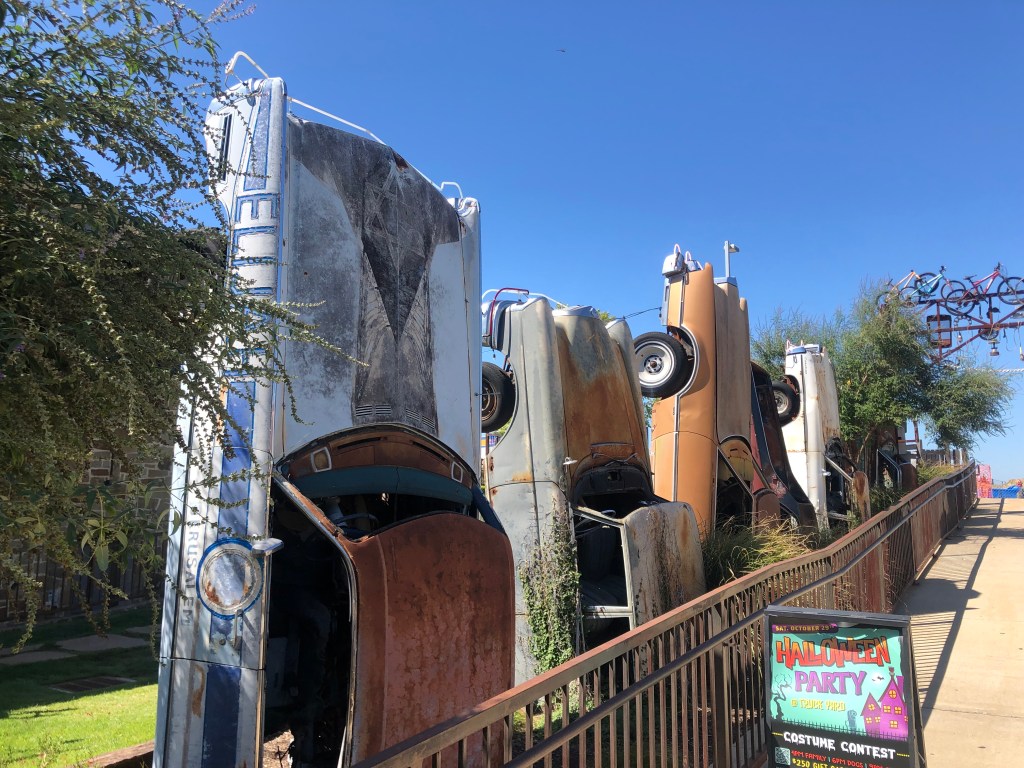
Meanwhile, in 2018, a guy named Jason Boso was about to open an outdoor beer garden with a Cadillac Ranch vibe called “The Truck Yard” just outside Dallas, TX.

Paging Stanley Marsh 3–we may have found your car.

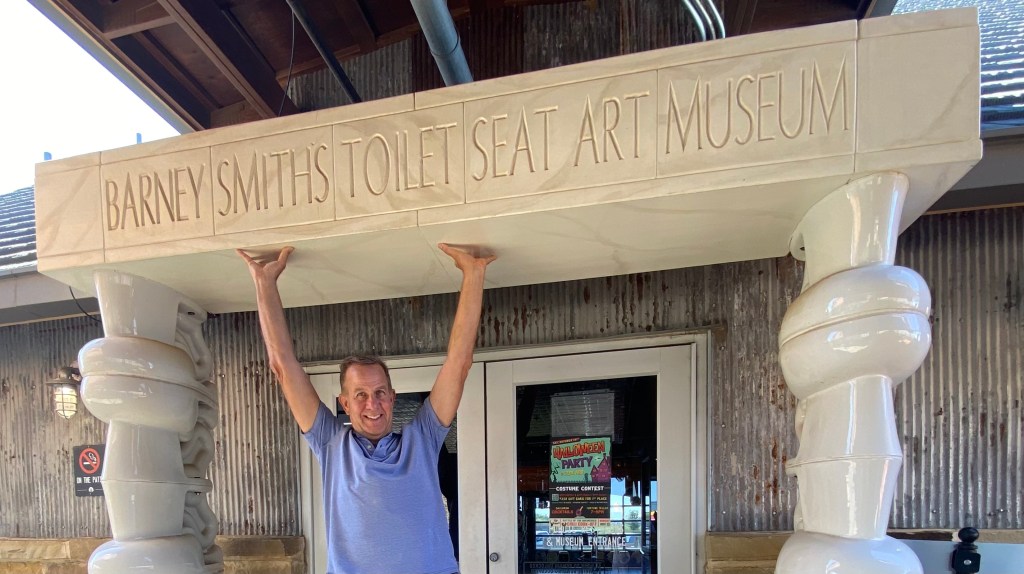
Jason had heard about Barney’s collection, and reached out to see if he could borrow a few pieces as decor for the Truck Yard. One thing led to another, and Jason ended up buying Barney’s entire collection, promising to put it on permanent public display. Barney Smith’s Toilet Seat Art Museum officially opened on Memorial Day 2019. The 98-year-old Barney Smith himself cut the…ribbon. A scant two months later Barney died peacefully, knowing that his toilet seats were in good hands.

My best Samson pose.

I mention all this because I’m in the Dallas area for a family birthday celebration (Happy Birthday, Michael!) and I suggested to my ever-suffering wife that, as long as we’re in town, we should visit the toilet seat museum. Yes, she puts up with a lot of crap in this marriage. And, being a woman, she normally wouldn’t stand for anything toilet-related. But even though at first she pooh-poohed the idea of joining me, she realized it was her duty. And that’s why she’s Number 1 in my book.

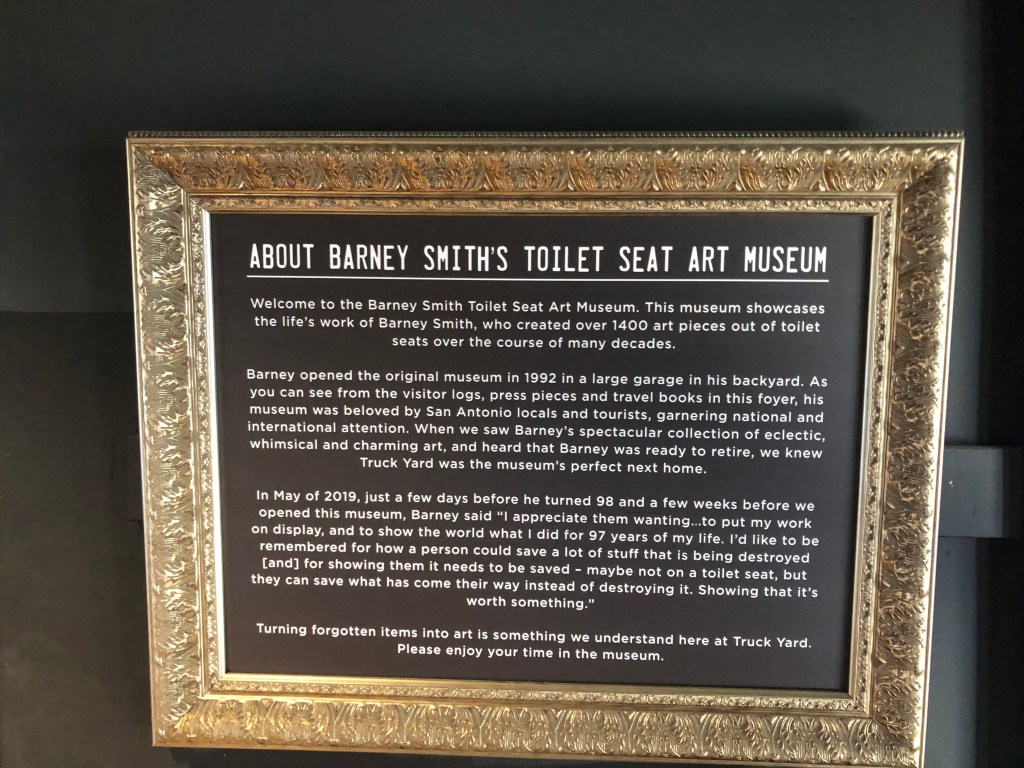
When you enter the museum a small anteroom gives you the poop on the collection. Not only is there a plaque and the original toilet seat sign from Barney’s garage, but there’s also a wall of newspaper clippings and magazine articles about Barney and his toilet seats.

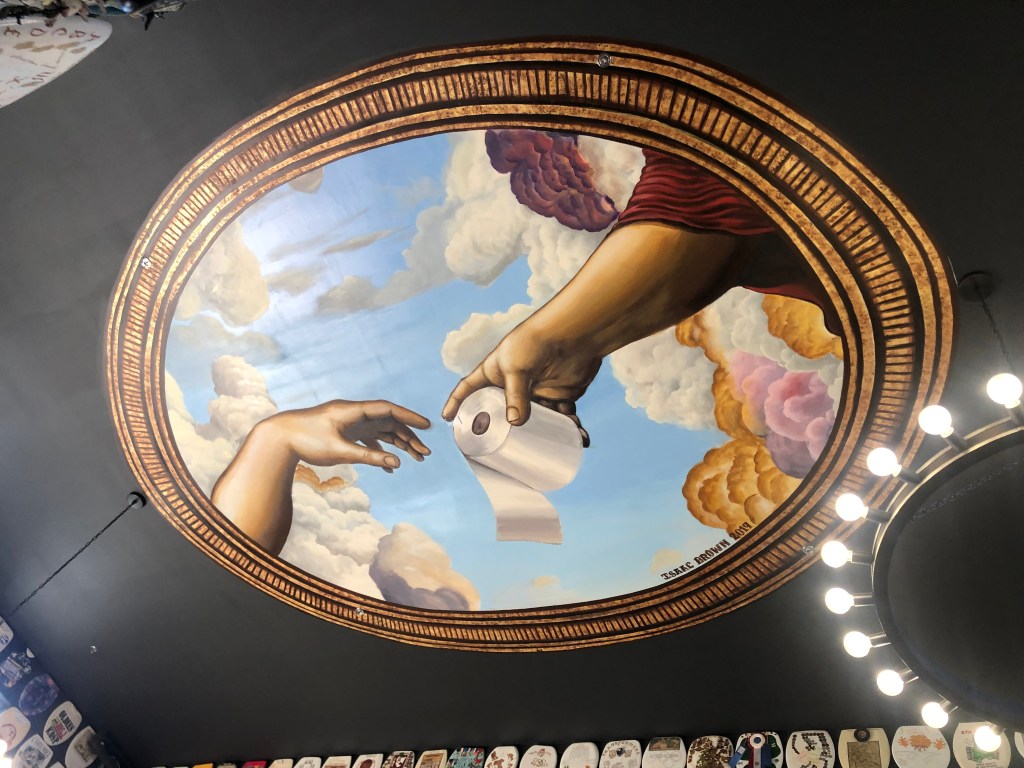
You then “pass” into the main museum room, whose ceiling is adorned with a variation on Michelangelo’s “The Creation of Adam.”

For scale, note the row of toilet seats along the top edge of the wall.

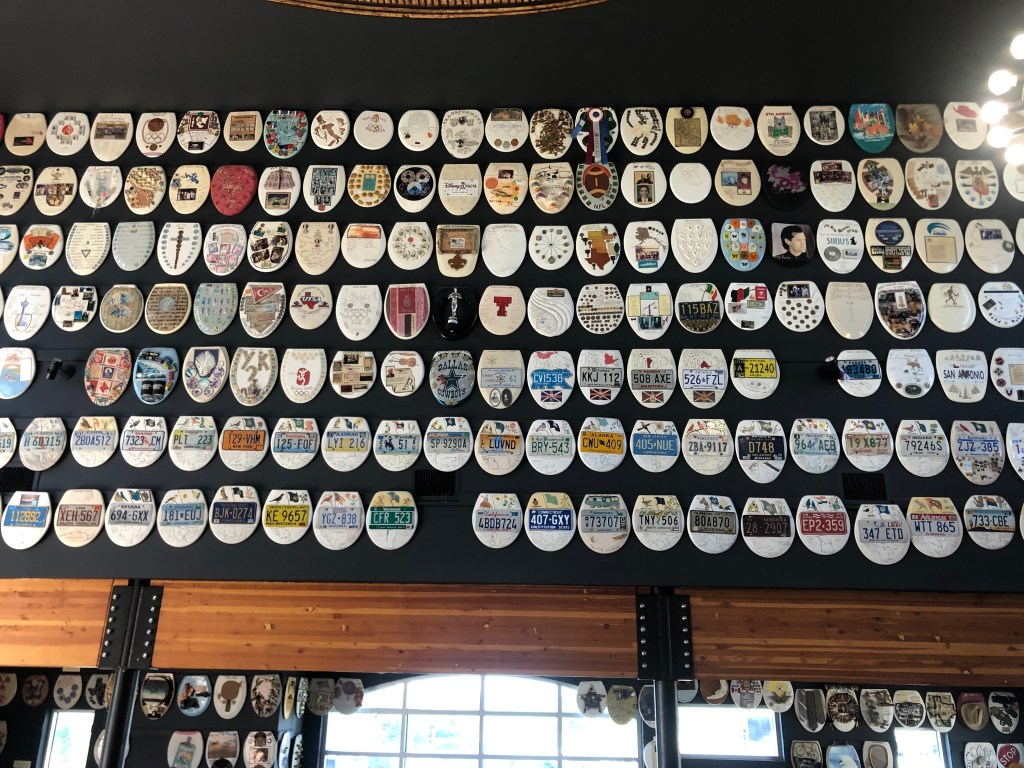
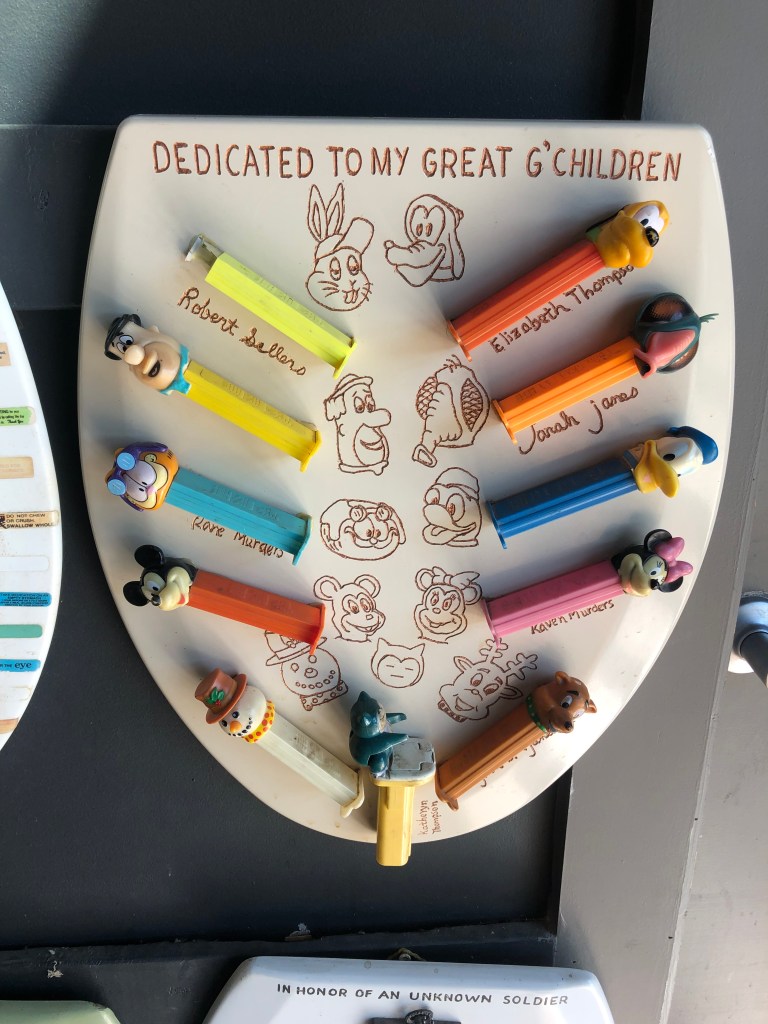
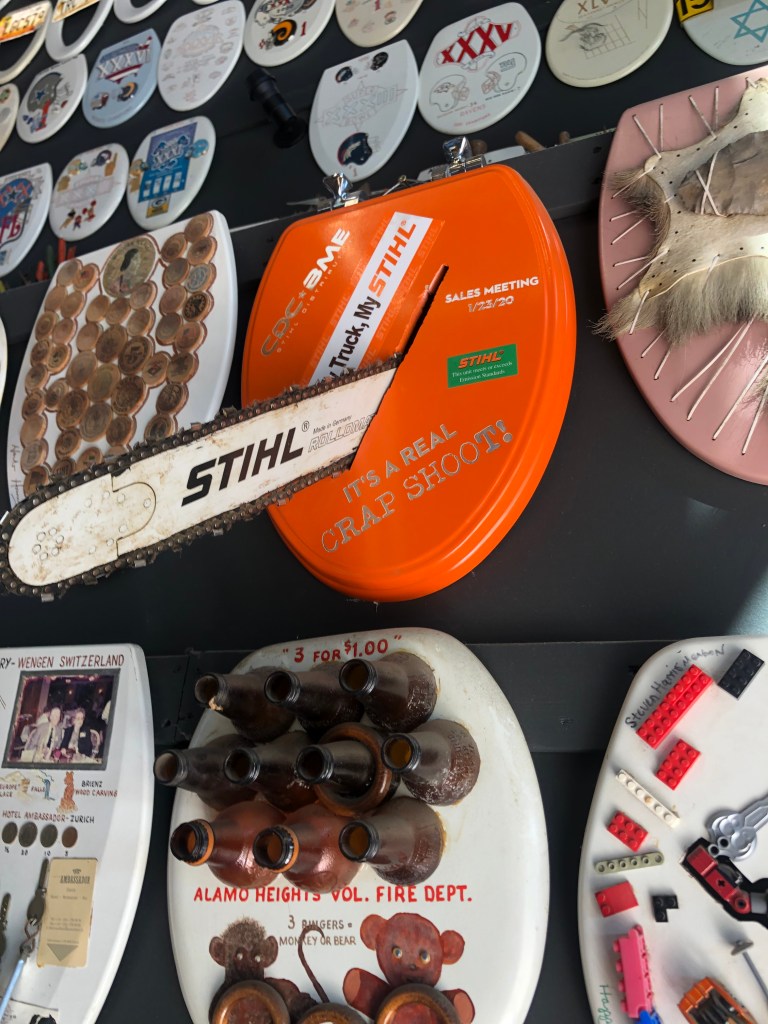
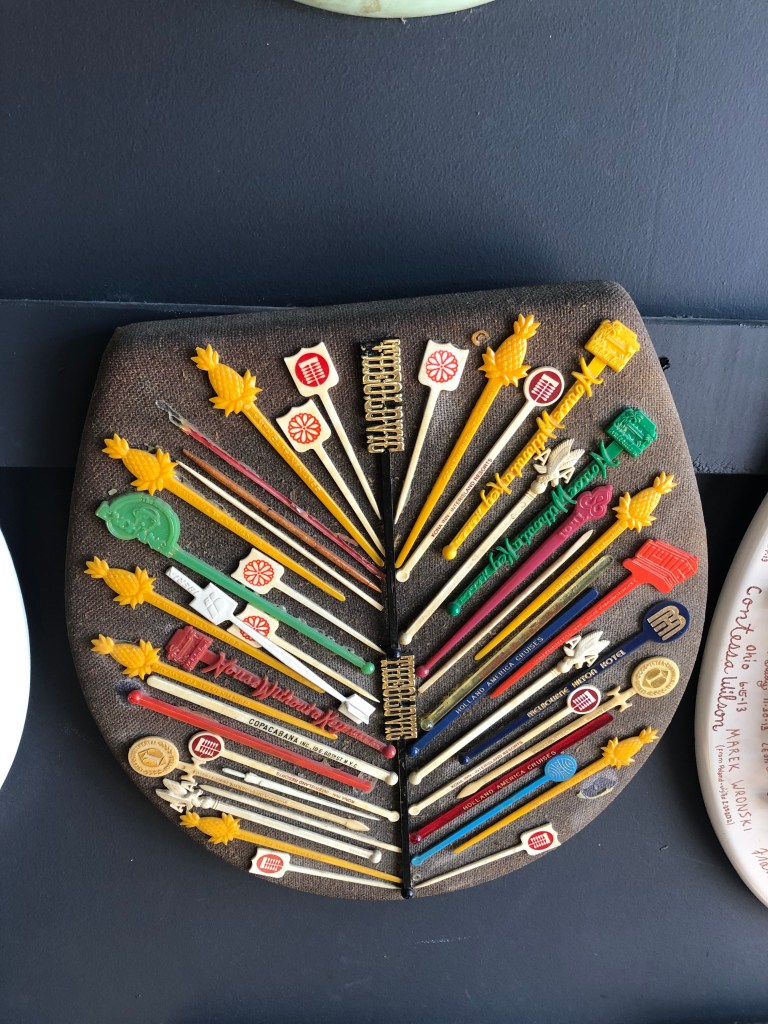
The walls are covered with the 1400-plus toilet seats that Barney decorated. Here’s just a small sample:

Every state is represented.
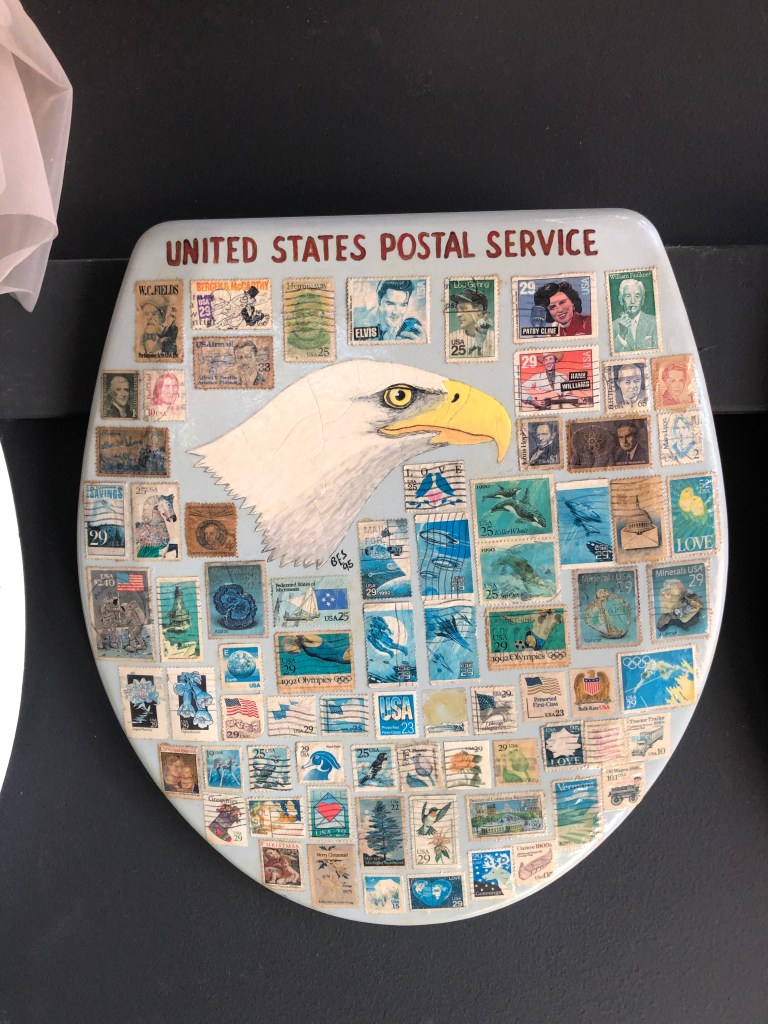
Ever receive a letter with postage “doo”?
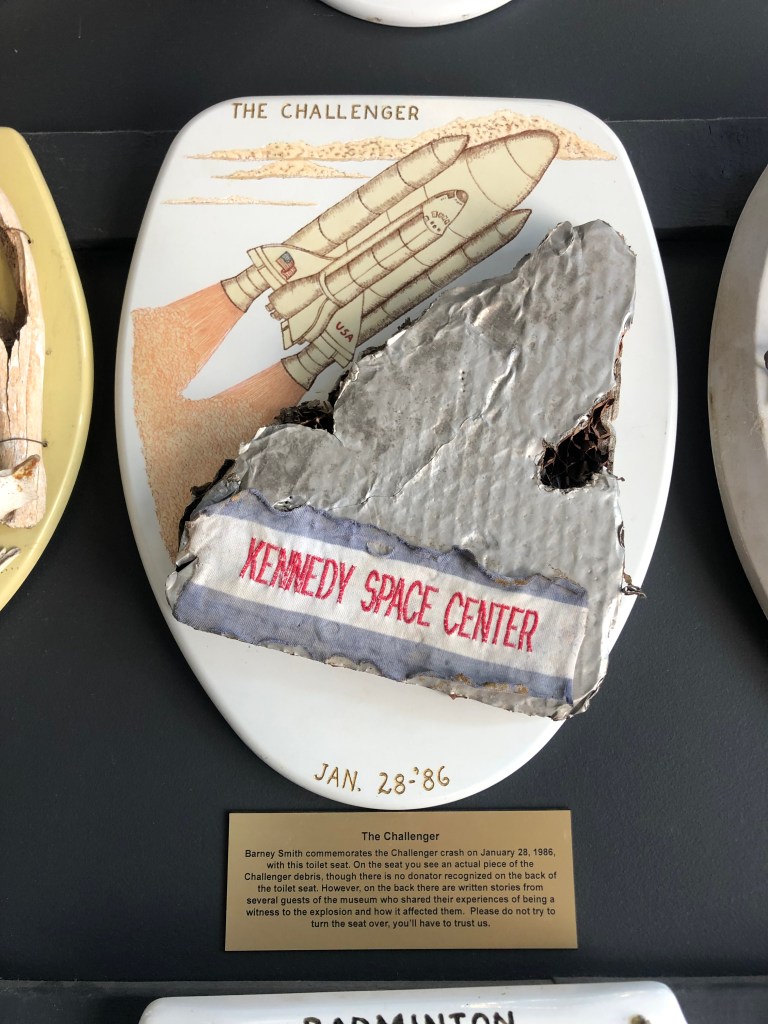
Jan 28, 1986: When things went to shit.
I’m surprised he didn’t include this one.
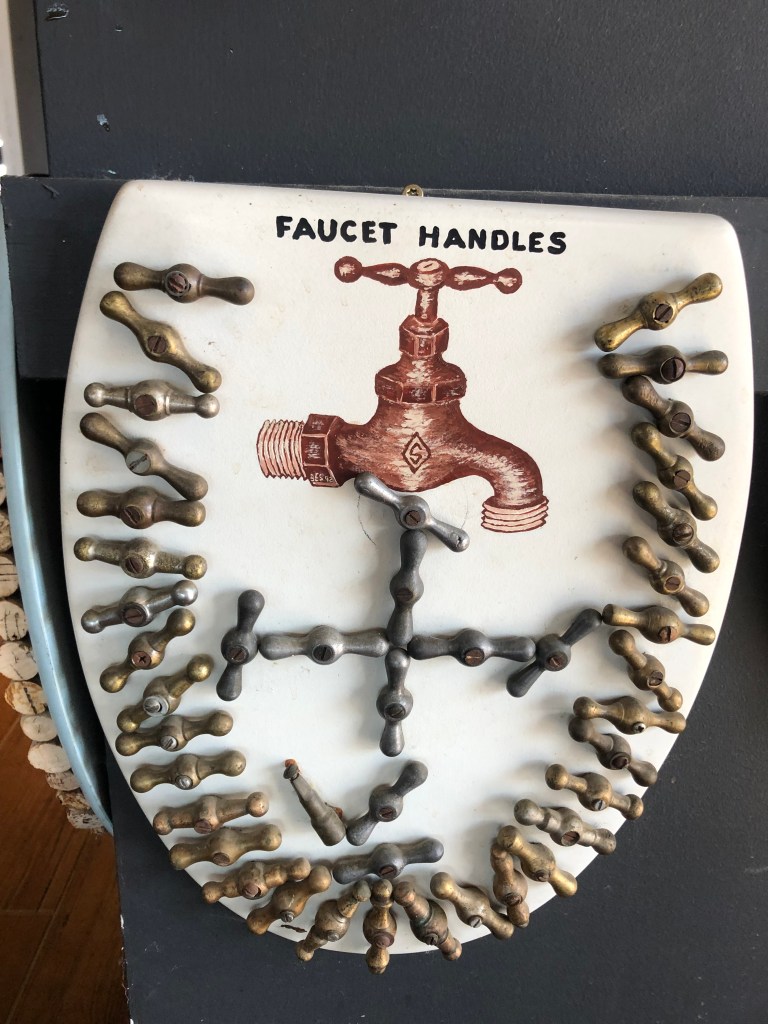
Handy for stopping leaks.
OK, it’s time to cut out the toilet puns.
Swizzle fo’ shizzle.
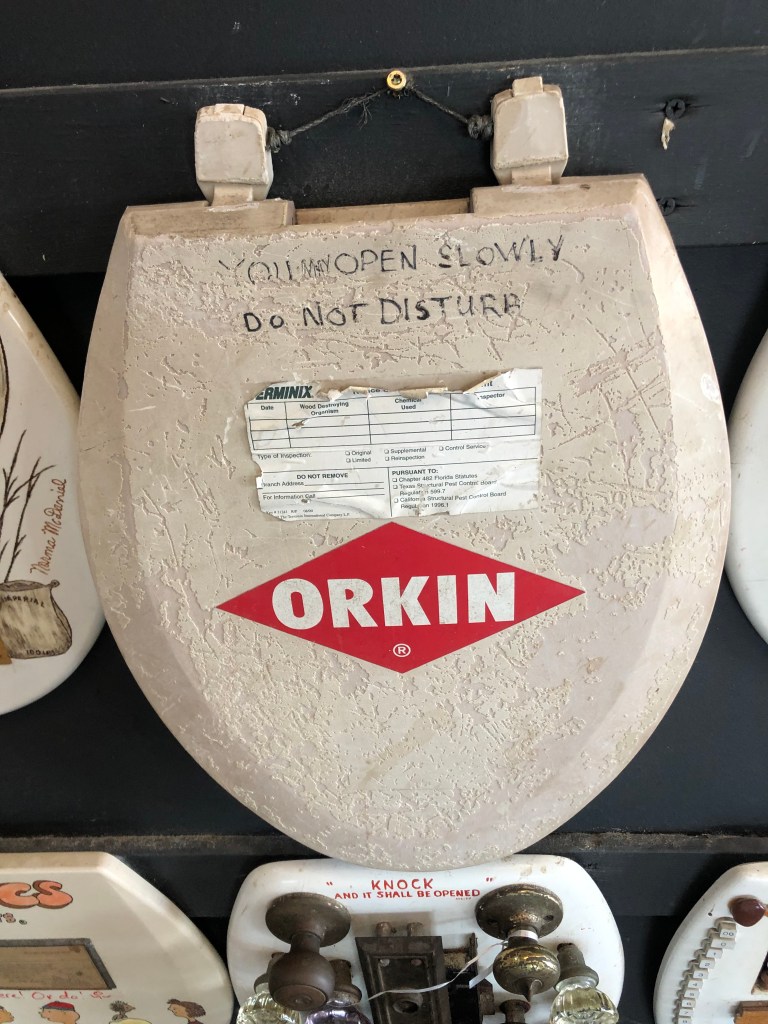
This one dares you to open it…
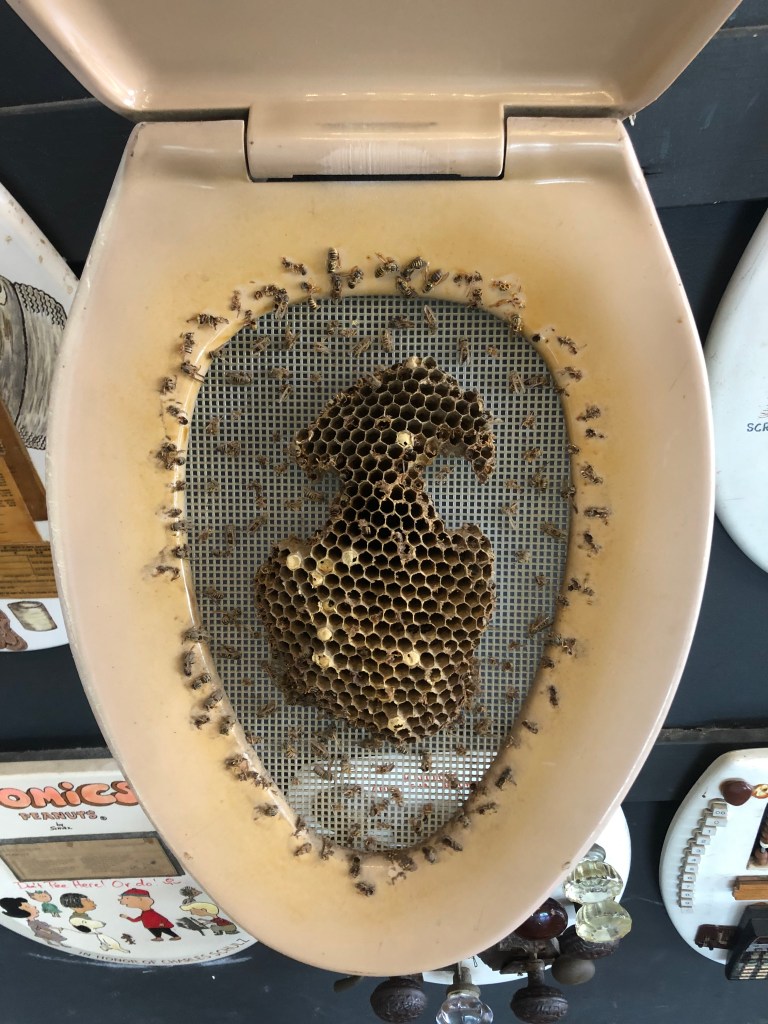
Bee careful!
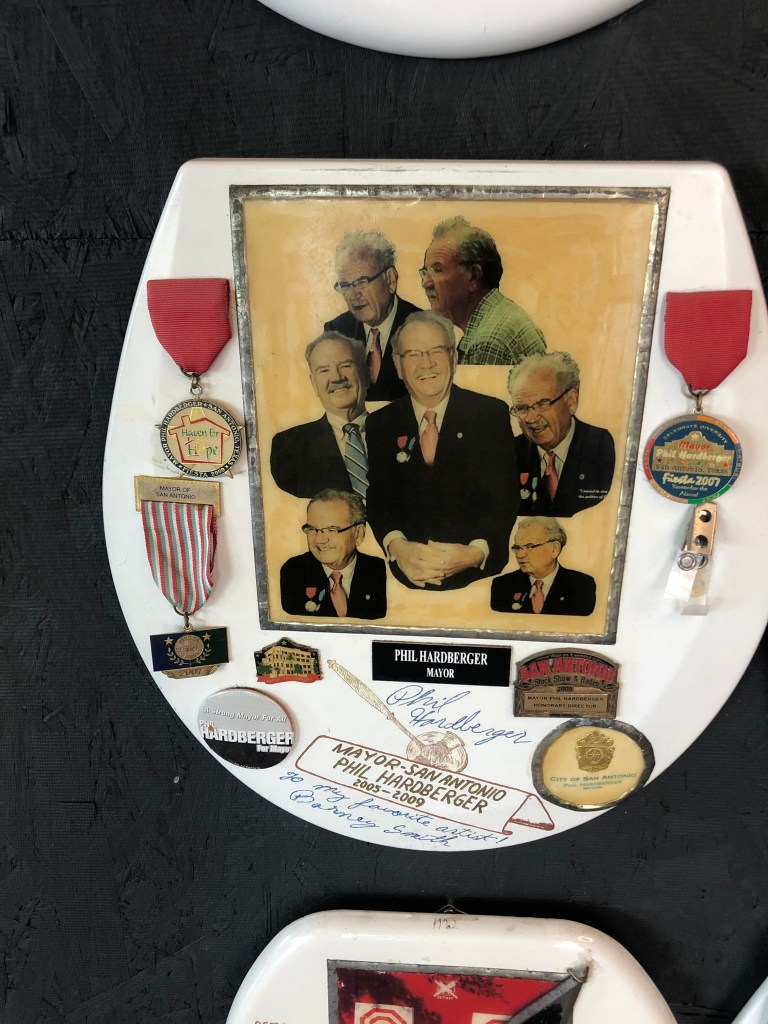
No offense to Mayor Hardberger specifically, but there’s something fitting about a politician getting free publicity from a toilet seat.
An unintentional tribute to the Queen. RIP.

I can’t say that any of this is high art, but the sheer scale is impressive. What’s more, you really get a sense of how Barney Smith was dedicated to his life’s work. Sure, he didn’t discover a cure for cancer, but it’s clear that he enjoyed a zest for life, loved people, and had a sense of humor. Surely the world needs more people like that. If you have a few extra minutes, check out this video of Barney at his garage-museum at age 96…shortly before the collection was moved to the Truck Yard. The part about Saddam Hussein’s toilet is especially interesting.

Uncategorized

Bonus: The Back Story on Creature Features

In the first post for my Frankenstein series, I mentioned the TV show Creature Features. Some of you recalled the show fondly, and others wondered what the fuss was all about.

For both groups, I have a special treat: Loyal reader Keith G. sent along a link to a story, written by his friend Bob Calhoun, describing the history of Creature Features…including efforts to resurrect it today. Check out the story here.

Thanks, Keith!