Anti-American Art
Discovering the ghosts of California and beyond, one road trip at a time.
Today we left the witches completely behind and focused on Boston’s colonial and revolutionary history.
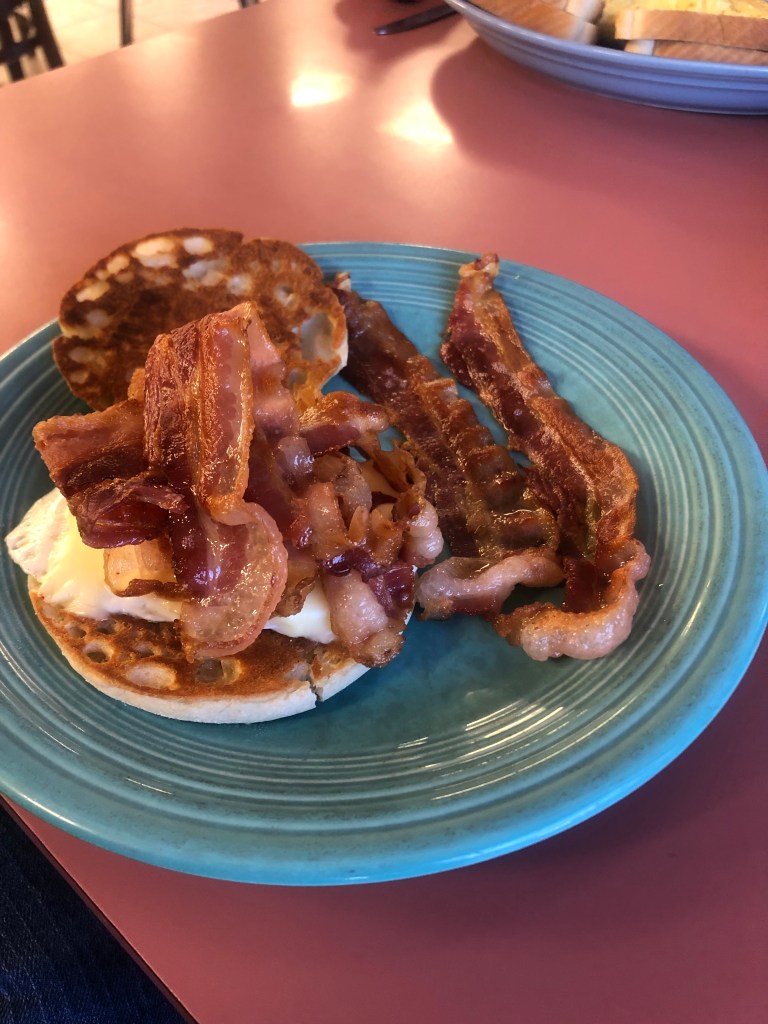
But first let me give a shout-out to Donna’s Restaurant of Boston’s North End. Donna herself served us. Her energy and sass reminded me of Flo on the 1970’s sitcom “Alice,” but with a Boston accent. This is where I started the day with a bacon-and-egg breakfast sandwich, plus a side order of bacon. If they served bacon juice, I would have had a glass of it.
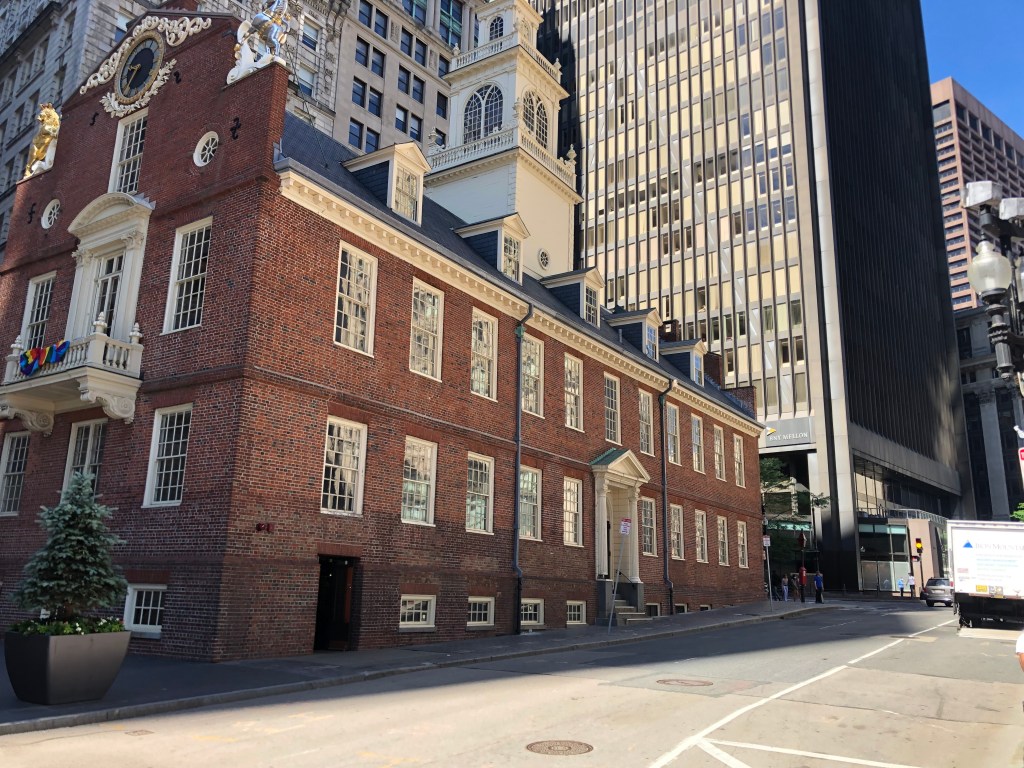
After satisfactorily clogging our arteries, we made our way into the downtown, where we visited Boston’s “Old Statehouse.” It’s the oldest surviving public building in Boston (and one of the oldest in the country), dating back to 1713. Boston was not just the provincial capital but it also served as the political and commercial center of New England. The city (like all of New England) was of course under British rule, so the “state house” was answerable to the Crown.
But as we know, the early 18th century saw worsening relations between Britain and the colonists. The protests against the stamp acts, the Boston tea party, Paul Revere’s ride (Listen my children….), and ultimately the battles of Concord, Lexington, and Bunker Hill all were Boston’s contributions to the revolution. As Boston got too big for its Colonial britches, Britain suspended the colonial Assembly, which thus was prevented from meeting in the old statehouse for almost a year. After the American Revolution, the old statehouse was used for a short time as the state of Massachusetts’ legislative building, but the growing state soon outgrew it and the legislature moved to the “new” (circa 1798) state house.
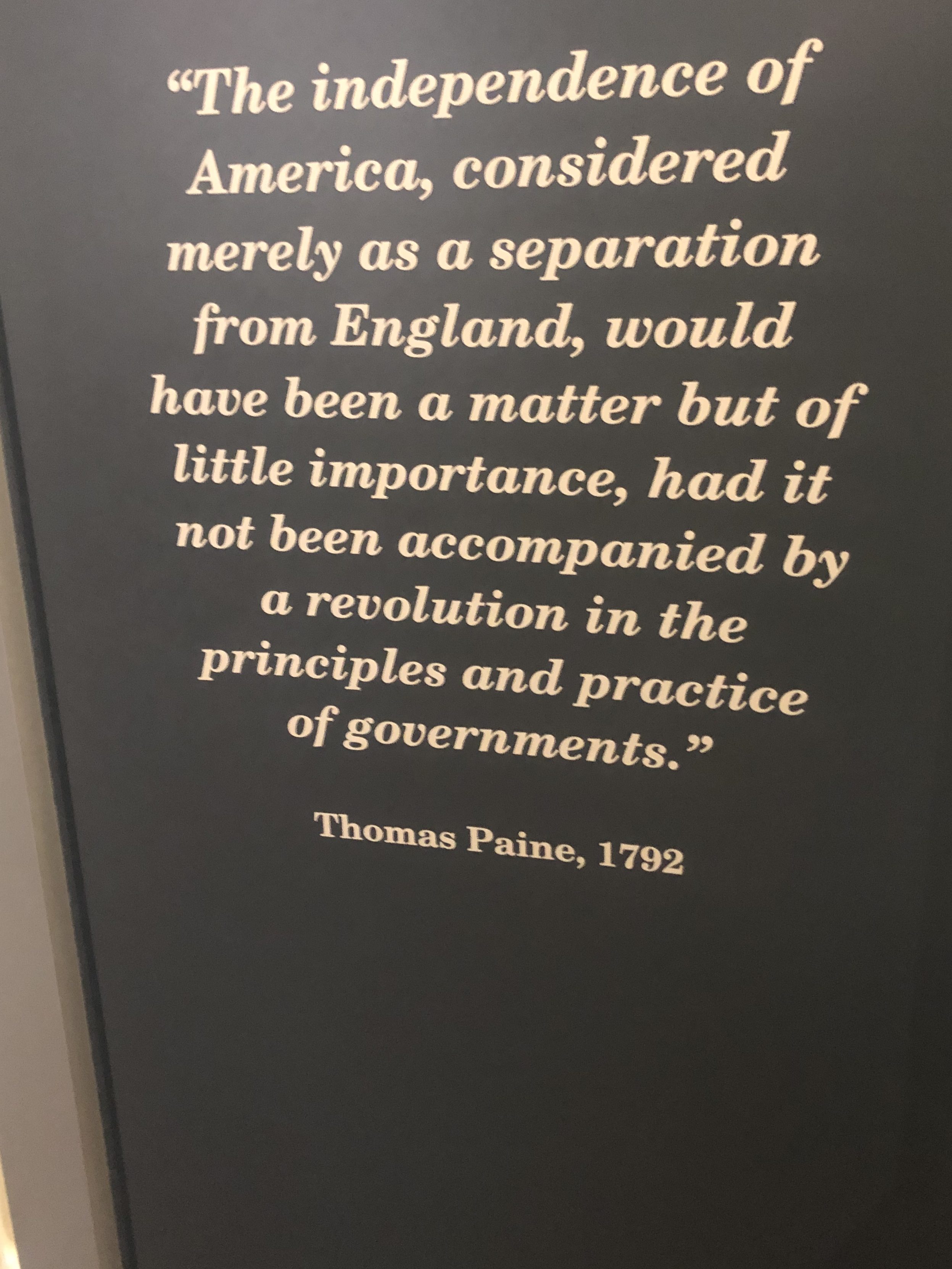
The old state house then became Boston’s city hall, and then a commercial building, before finally, in the 1880s, becoming the museum that we visited today. And an impressive museum it was. This is not just because of its artifacts (which were authentic and well-displayed) or even its docents (who were helpful and knowledgeable). Rather, what struck me about the museum was its story. Boston was, quite simply, the key to the American Revolution. I’m a sucker for the inspirational, heroic, and idealistic story of the revolution. Many Americans, and especially I, tend to take our system of government for granted. We think of it as our birthright, guaranteed to afford us the rights and protections we deserve. But when you dig into our revolutionary history, you’re reminded how tenuous this experiment once was, and how much it depended on a relatively small number of patriots, statesmen, and soldiers to keep it alive. Of course those people weren’t perfect; they had their flaws like all of us. But the history reminds us of our own responsibility to do our best in protecting our democracy and upholding its ideals.
OK. Lecture mode is now off.
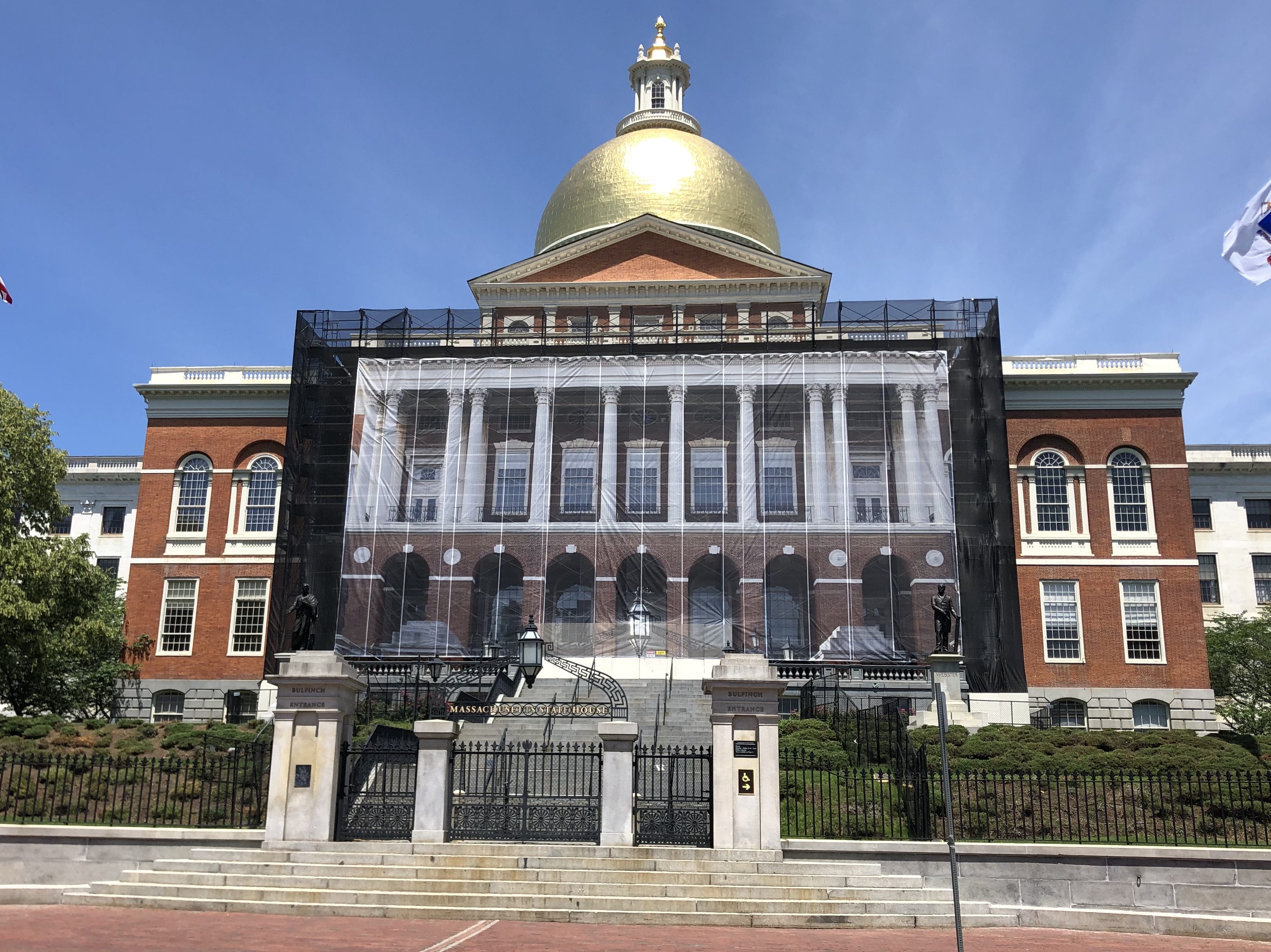
After the Old State House, we went to visit the “new” one (built in 1798 and where Massachusetts’ legislature meets to this day). Sadly, the building was being renovated, and we were only able to see it from the outside.
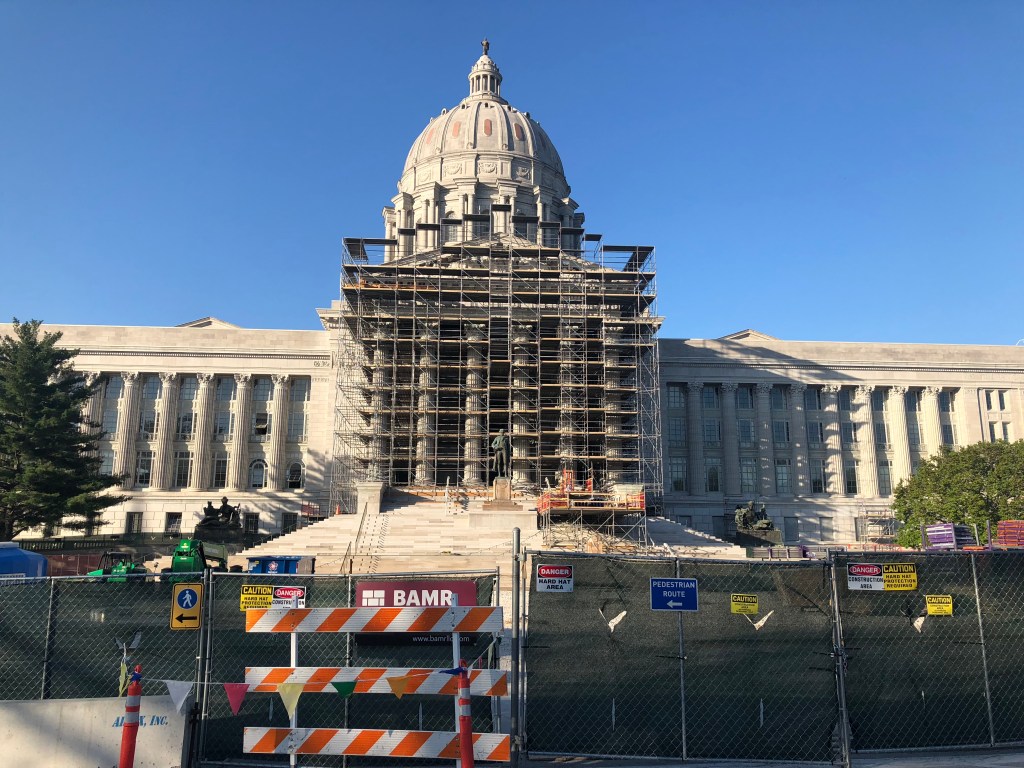
This nicely complements the photo I took in Jefferson City, MO on my Route 50 trip:
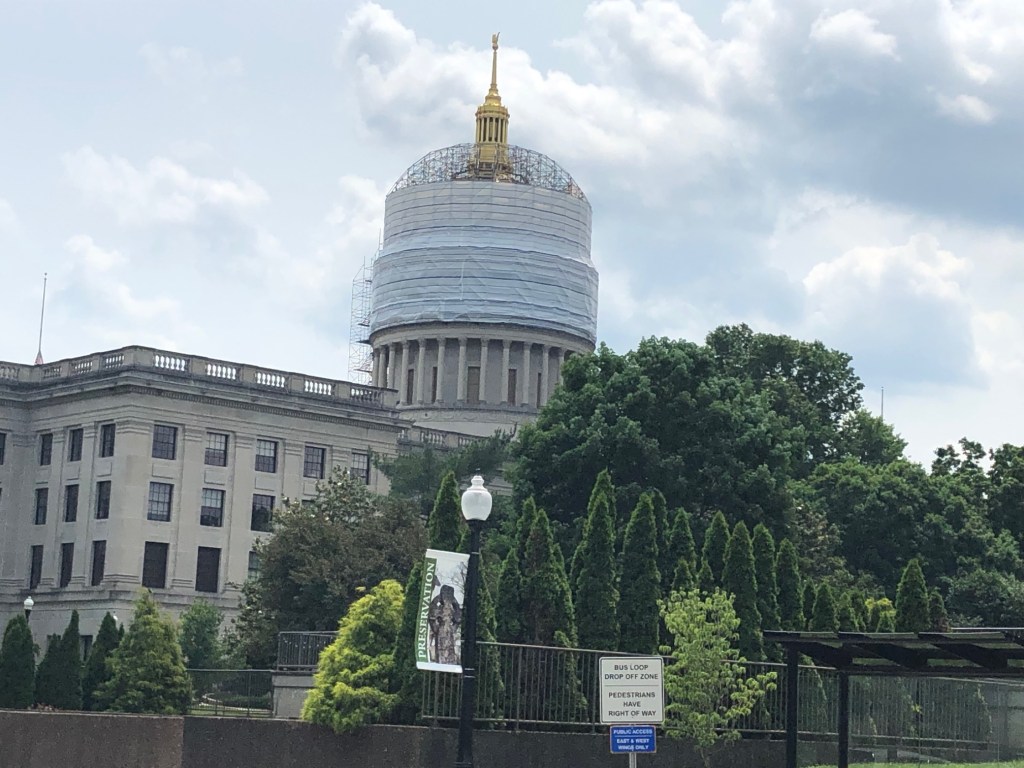
Oh, and I took this photo of West Virginia’s capitol in Charleston during my Route 60 trip:
But I digress.
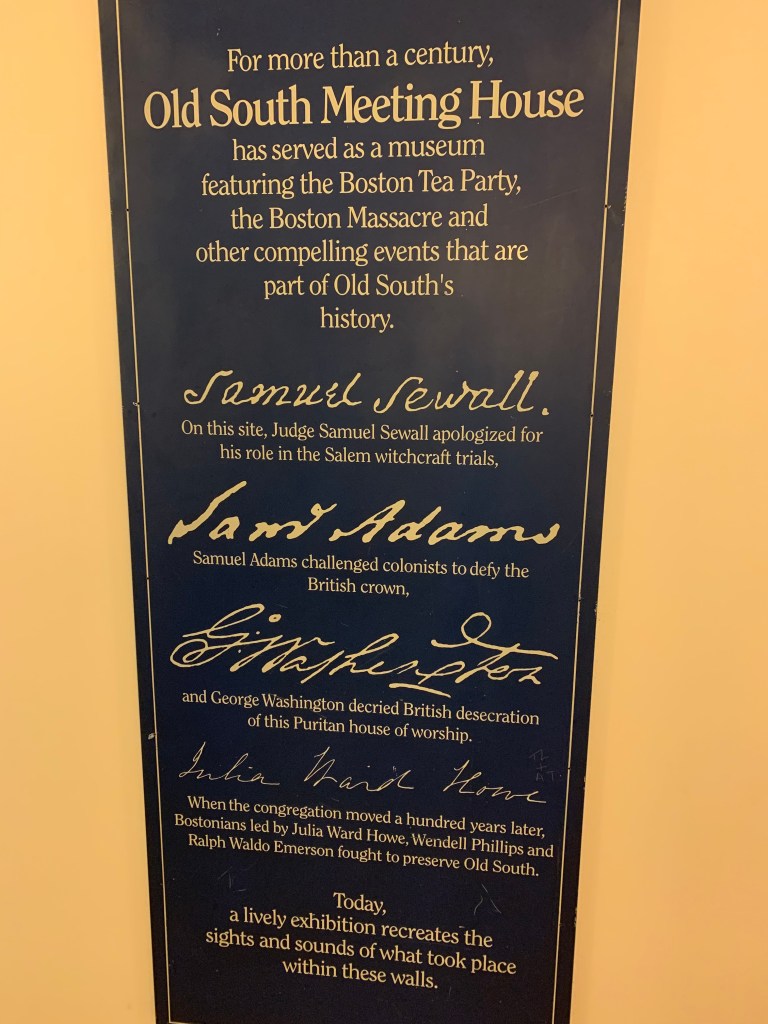
The rest of the day we spent at two main sites: One is the Old South Meeting Hall (constructed 1729), which was where much of the planning for the Boston Tea Party took place.
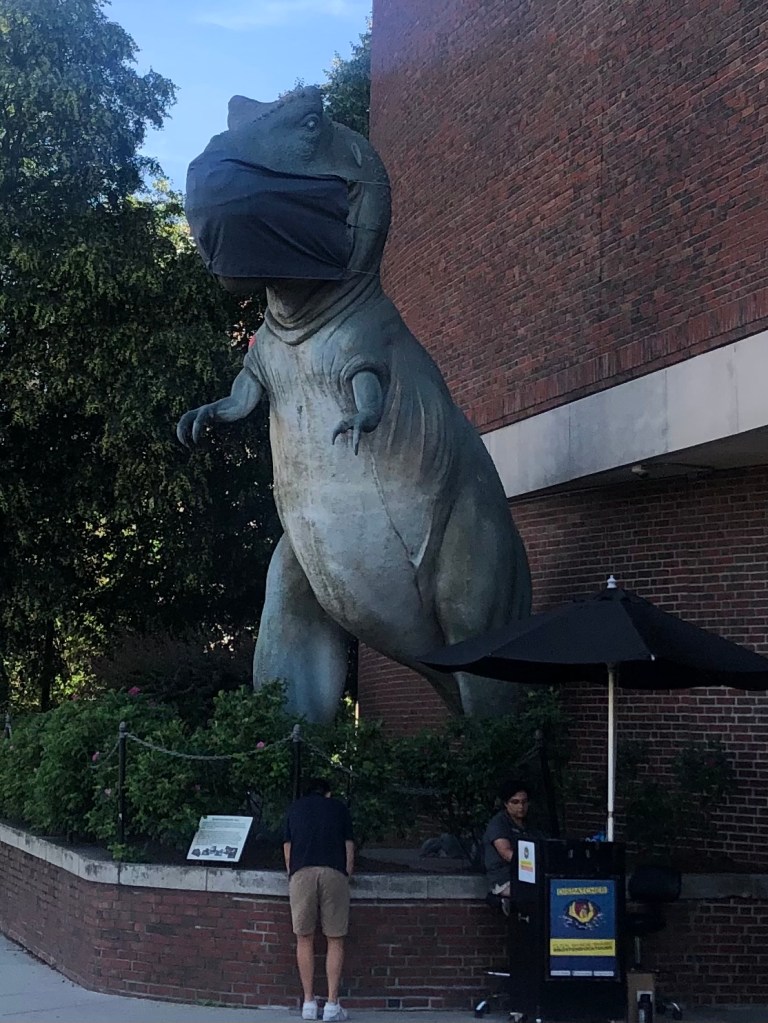
The other place we visited was the Boston Museum of Science, which was founded in 1830 and features (at least as far as we’re concerned) the world’s largest (three stories tall!) Van de Graaff generator. (If you don’t know what a Van de Graaff generator is, re-watch the laboratory scene in Frankenstein.)
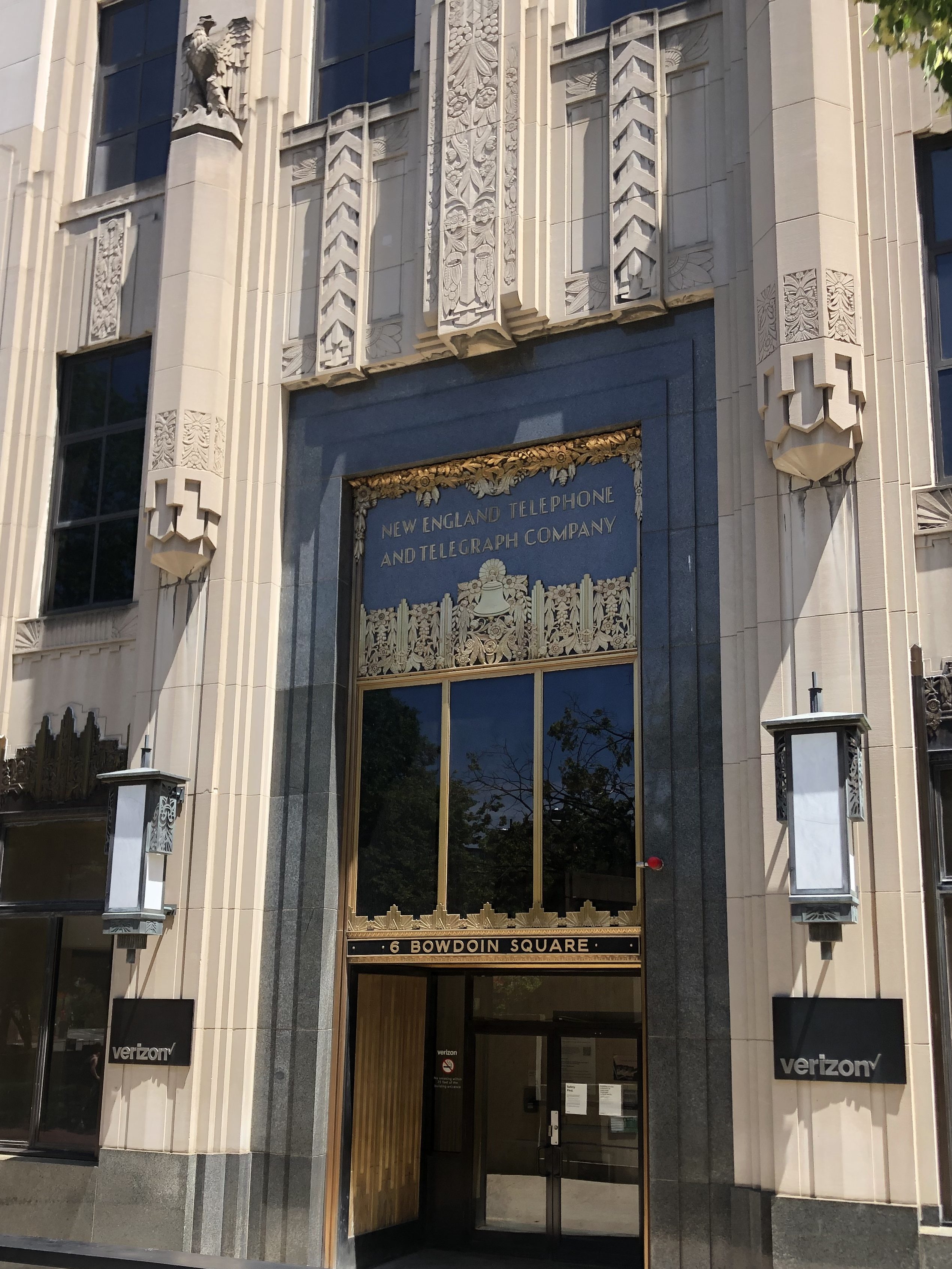
It’s been a great trip. Before ending with today’s BOTD, I’ll leave you with a few random photos from today:
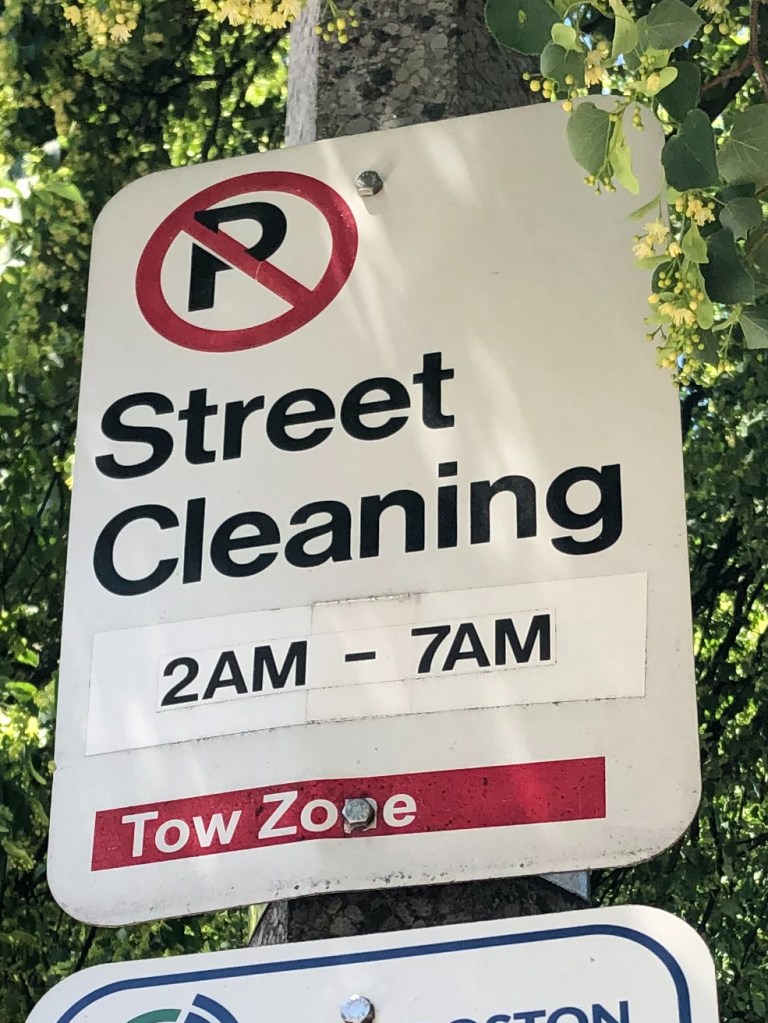
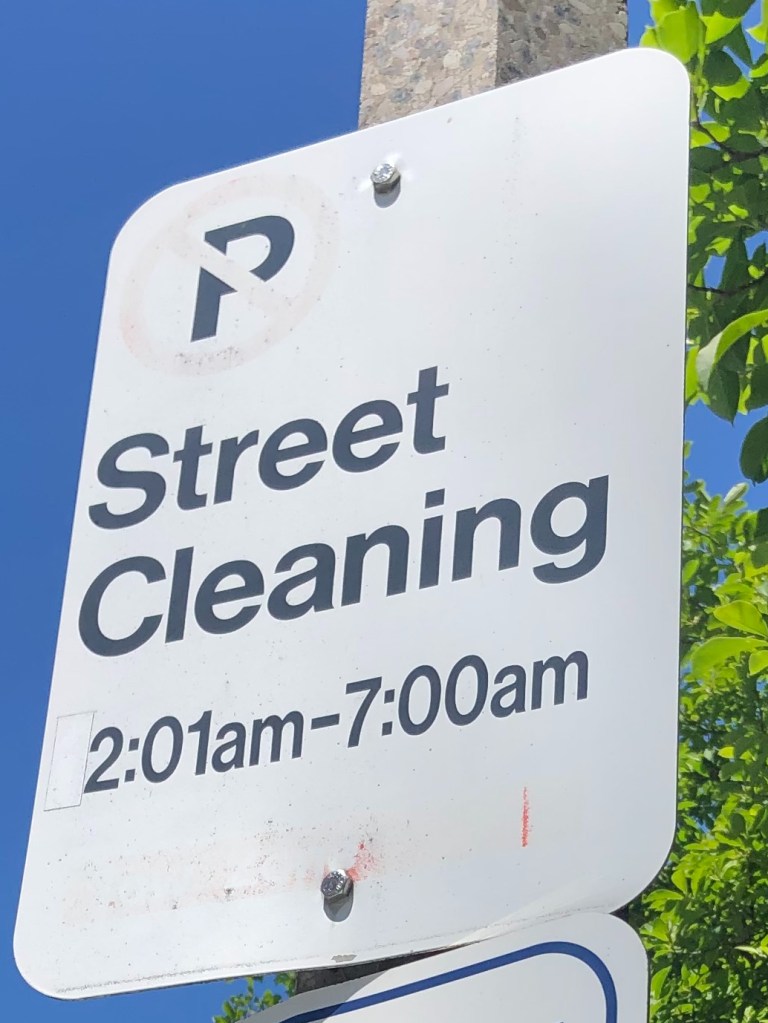
Check out the start times on these two signs, which are just one parking space away from each other. Clearly you’d want to choose the second one.
BREW OF THE DAY
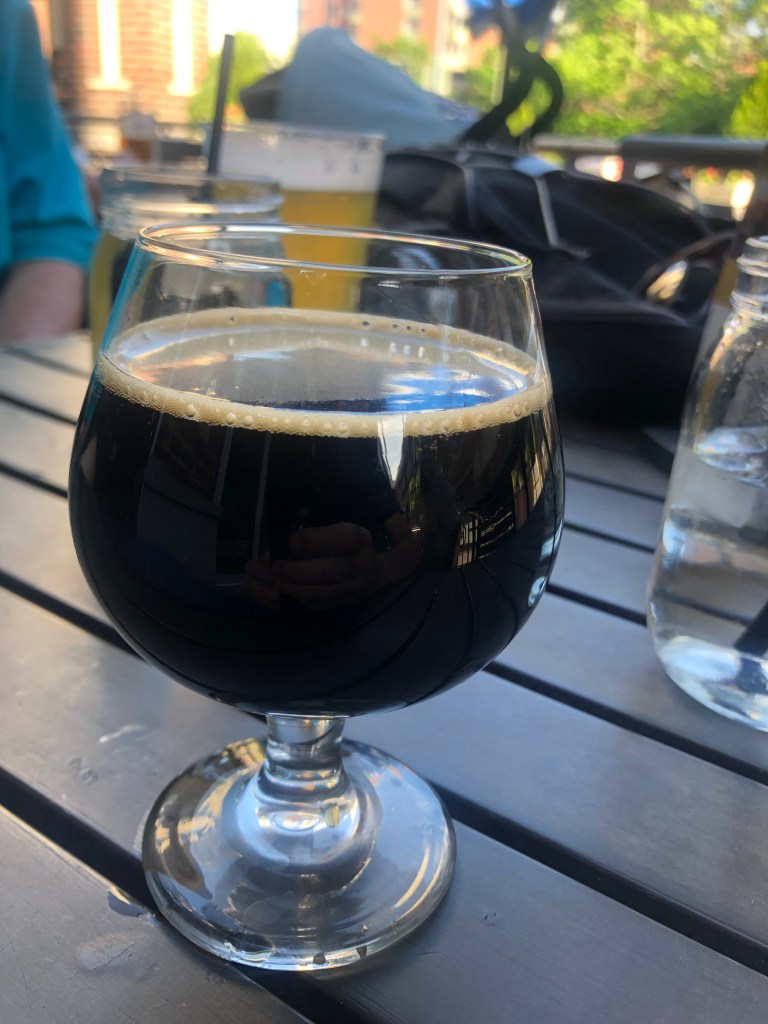
After about 40 miles of walking this week, we sat down for a final beer at “World of Beer” in downtown Boston. The place has the misfortune of being situated in a mall, and being part of a Florida-based chain, but it makes up for it with its extensive menu of literally hundreds of beers. After careful study (and tasting a few samples), I settled on a stout from Widowmaker Brewing (Braintree, MA). Like so many of these Massachusetts microbreweries, Widowmaker was started up by a couple of young home brewers a less than a decade ago. I had their “Candymaker with Coffee” stout. The front end of this beer is just what a like: big flavor, plenty of maltiness, some roasty notes, some sweetness, and some real body. It starts out great. But then it just kind of peters out. There’s no counter-balancing bitterness on the finish, and almost no carbonation to wash away the cloying sweetness. The coffee is hardly noticeable. And the ABV is a modest 7.0. So, despite the “Widowmaker” brand, this is a milquetoast beer. I give it three points.
——————————————————————
Tomorrow morning we fly back to California. Thanks to everyone for your comments and suggestions during this trip. And thanks to my good friend Vic for making this a team effort.
Until the next trip,
sdb
Today covered a lot of ground (literally). We began our day by leaving modern-day Salem and heading out to the nearby town of Danvers (pop: 27,000). Back in the day Danvers was known as “Salem Village” (to distinguish it from the larger town of Salem which holds that name to this day). Are you following me so far?
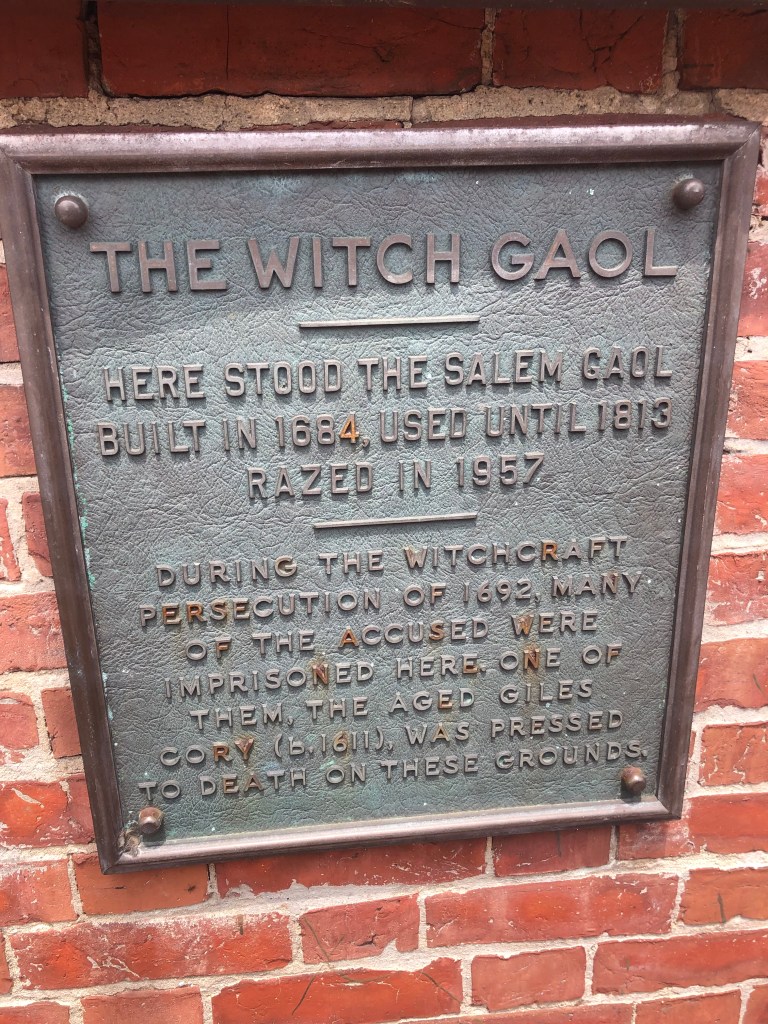
Danvers (nee Salem Village) gave birth to the Salem witch trials. For it was here in 1692 that the daughter (Betty) and niece (Abigail) of the village minister (Samuel Parris) accused the household’s slave of witchcraft. Accusations and counter-accusations flew, until some 19 people were hanged as witches. The hysteria eventually died down, and the village did its best to leave the whole ordeal behind it. Little was spoken about the events, and after Samuel Parris died in the 1780s, his home was torn down.
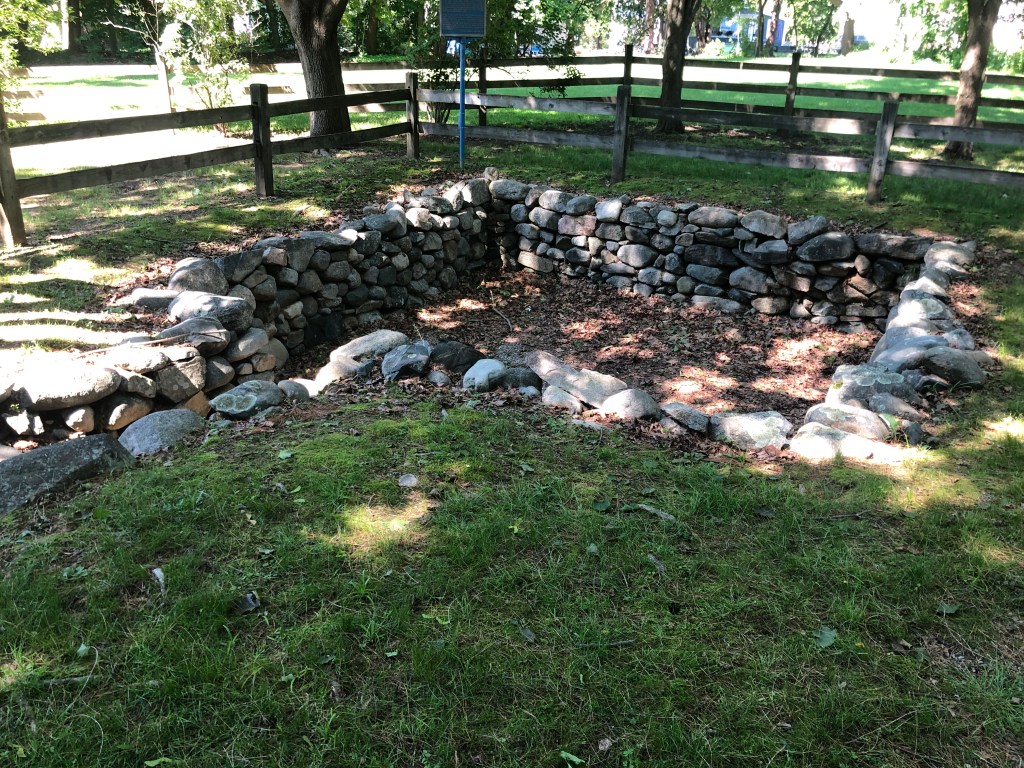
Then, in 1970, a young historian in town sought permission to do an archaeological dig at the site of Samuel Parris’ home. The foundation of the original home, where Betty and Abigail made those initial accusations that set into motion the witch hysteria, was uncovered in a field. The site was purchased by the city and today is preserved as a (not-well-marked) historic site. After some Google searches and a number of passes down the same stretch of a leafy, suburban street, we eventually found a narrow path leading to the archaeological site. Soon we were standing at Ground Zero of the Salem witch trials. There, in a shaded corner of the neighborhood, obscured by trees, we could almost feel the dread and fear that had sprung from that house.
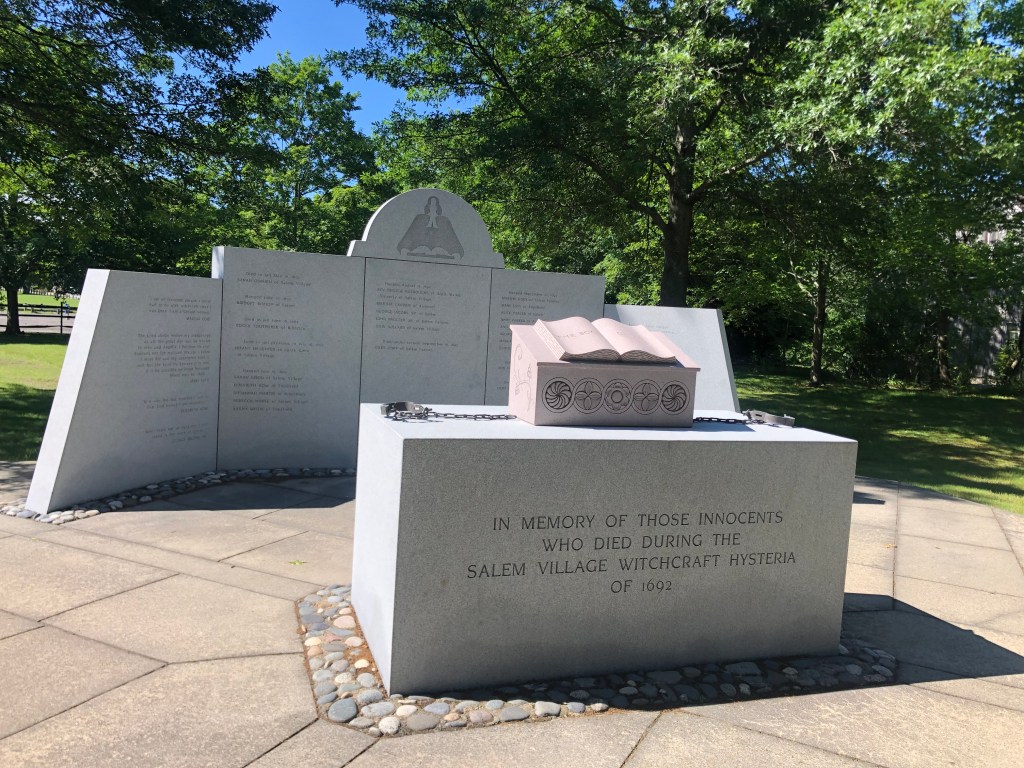
Not far from the Parris site is a slightly more accessible memorial to the victims of the witch trials. But still, unlike the witch-obsessed Salem, Danvers seems not to want to call a lot of attention to those past events.
After paying our respects, we left Danvers and headed out toward Boston (pop: 684,000). Boston is of course known for many things, but today’s focus was on Paul Revere. This reminds me of an incident when I was about 7 years old: My brother Dave and I decided (for no discernible reason) to sneak out of the house at 1 or 2 in the morning, and walk the sidewalks of our suburban neighborhood with a bedspread draped around our shoulders. We didn’t go very far and we didn’t engage in any kind of skullduggery, but it was exhilarating to be out when the entire city was asleep. After an hour of aimless wandering, we returned to our house and our beds.
The next day the neighbor girl, Jeanine, ratted us out. We were getting out of the family sedan with Mom and Dad when Jeanine scampered up our driveway. “Oh, it was so funny to see Steve and Dave outside last night!” she exclaimed. “I happened to be up and looking through the window when I saw them. They looked so funny with that bedspread! I don’t mean to get them in trouble or anything, but boy was that a sight!” Dad wasn’t quite as amused as Jeanine, and I recall that some kind of punishment was meted out.
The next day I was talking to my grandma on the phone. “I heard about your Midnight Ride of Paul Revere,” said she. I asked her what she was talking about. “The Midnight Ride of Paul Revere! You know, ‘Listen my children and you shall hear/Of the midnight ride of Paul Revere.” I still didn’t know what she was talking about. This triggered a five-minute remonstrance about how kids these days don’t get instructed in the classics.
I say all this because today, finally, I developed a decent understanding of Paul Revere’s ride while visiting his home in Boston’s North End. As my readers no doubt know, Paul Revere was a very accomplished and respected native son of Boston, and it was from this house that he made his “midnight ride” to warn of the approaching British troops in 1775.
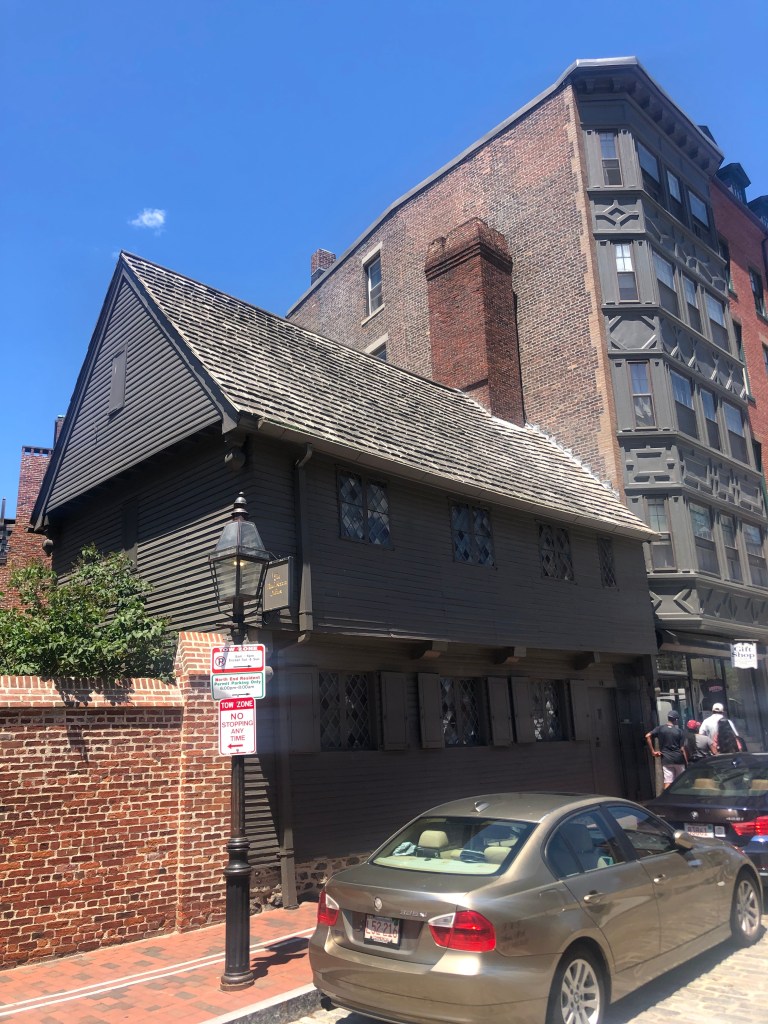
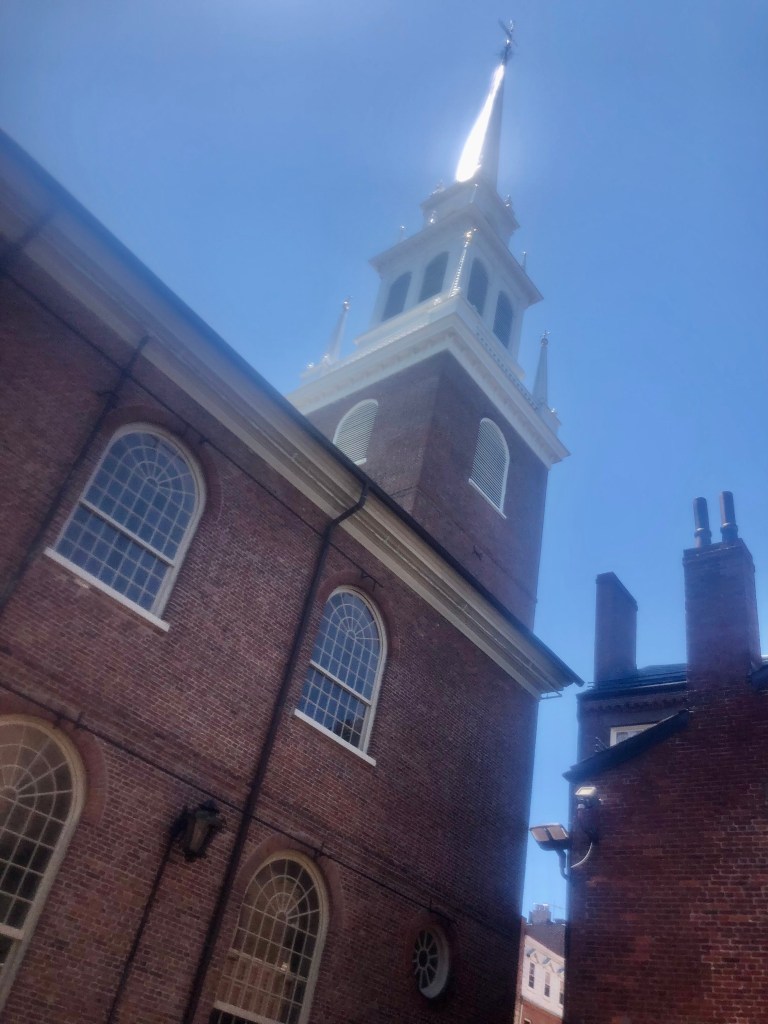
Apparently Henry Wadsworth Longfellow exercised some literary license when he wrote his ode to the event that later was quoted by my grandmother. For example, there were several riders that night, not just Revere riding alone, and Revere was actually captured before he reached Concord. And the placing of the lanterns (“one if by land, two if by sea”) was not to meant as a signal to Revere, but rather was used by him to signal others. Still, I found it moving later today when we visited the Old Church where the lanterns had indeed been hung.
After taking a lunch break at a local trattoria (this neighborhood is wonderfully full of Italian restaurants), we made our way across the Charles River to visit the USS Constitution. That wooden frigate was commissioned a few years after Paul Revere’s ride, and fought nobly in a number of sea battles. Over the centuries it has of course become obsolete, and a few times it’s come close to being scrapped. But each time it’s been saved, and today it’s a carefully-restored and well-preserved floating museum at Boston’s Charlestown Naval Yard. It’s said to be the oldest ship of any type that is still afloat.
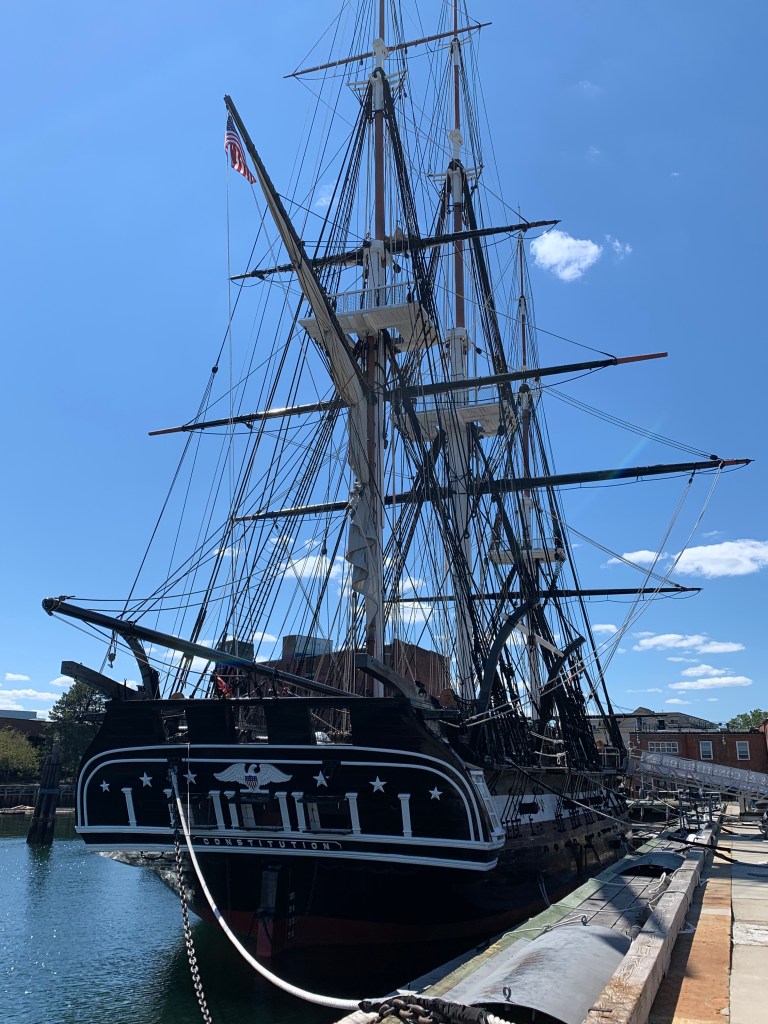
Sadly, Constitution wasn’t open to the public today. While we stood there looking at the ship from the shore, I noticed a structure that looked surprisingly like the Washington Monument. Let’s do a quick review:
Here’s the Washington Monument
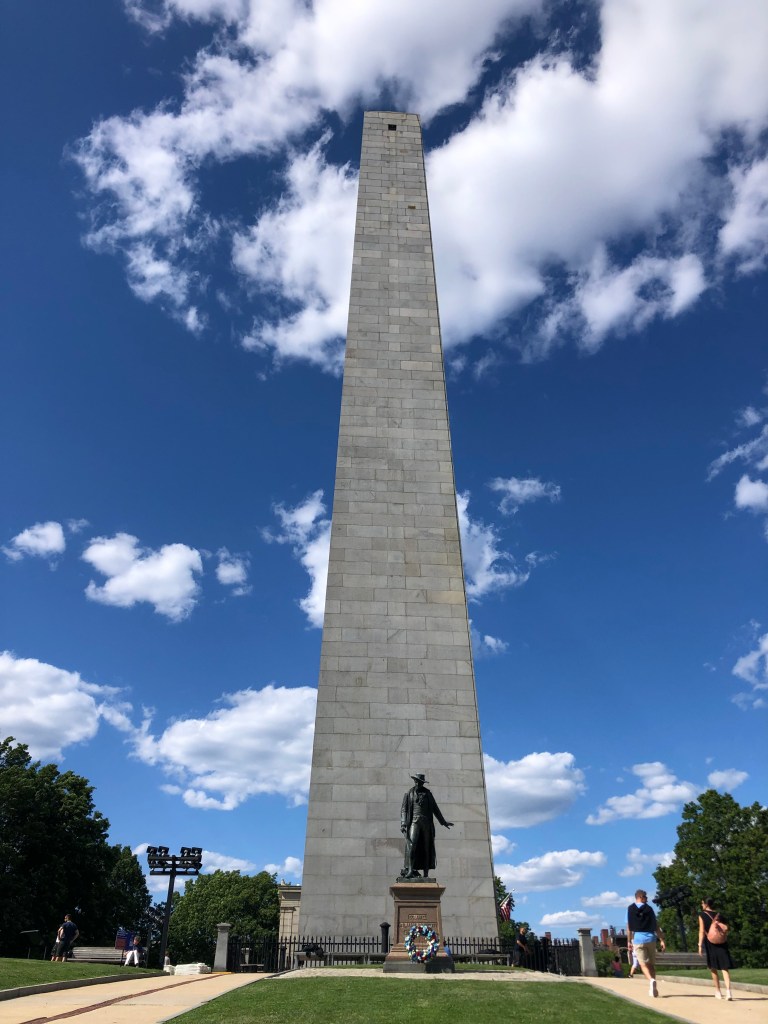
And here’s the obelisk I saw in the distance behind the USS Constitution:
I asked a docent near the USS Constitution about the structure that “looks like the Washington Monument.” You’d think I insulted his family. He sharply informed me that it’s the Washington Monument that copied Boston’s memorial, and not the other way around. Boston’s memorial is the Bunker Hill Monument, erected between 1825 and 1843. (Construction of the Washington Monument didn’t begin until 1848.) We took a hike to get a closer look at the Bunker Hill version.
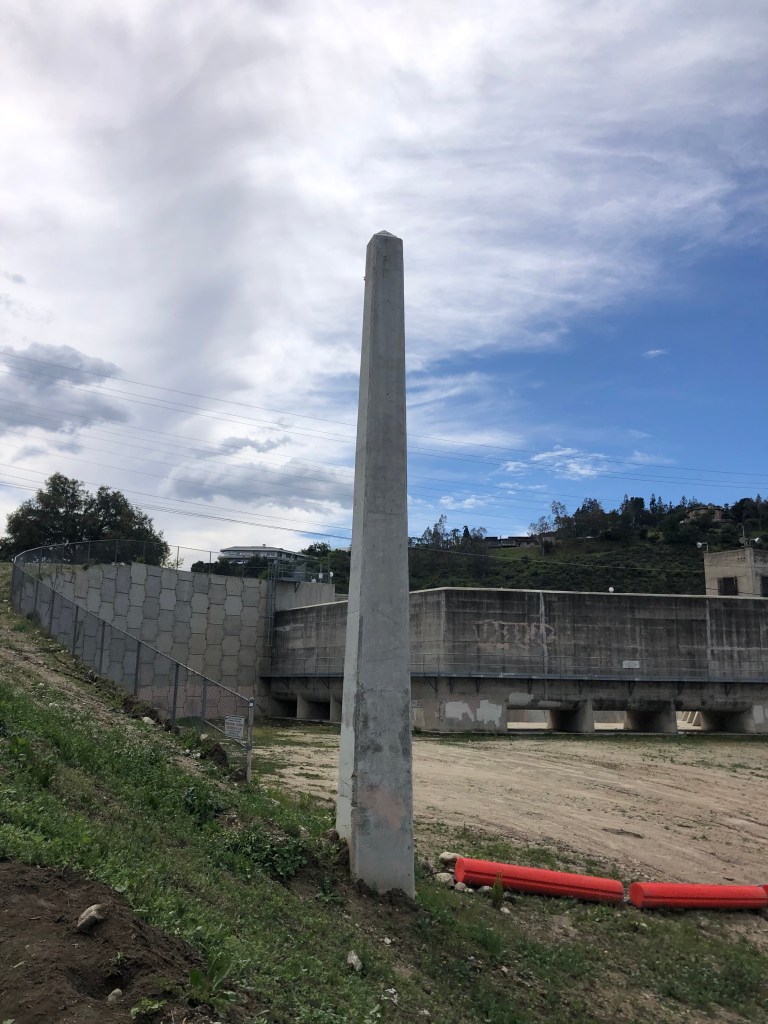
For good measure, let me share with you a picture I took in 2019 at the Devil’s Gate Dam in Pasadena. Seems that the “Bunker Hill” obelisk has a lot of company.
Tomorrow will be our last day in Massachusetts before we head back west.
BEER OF THE DAY
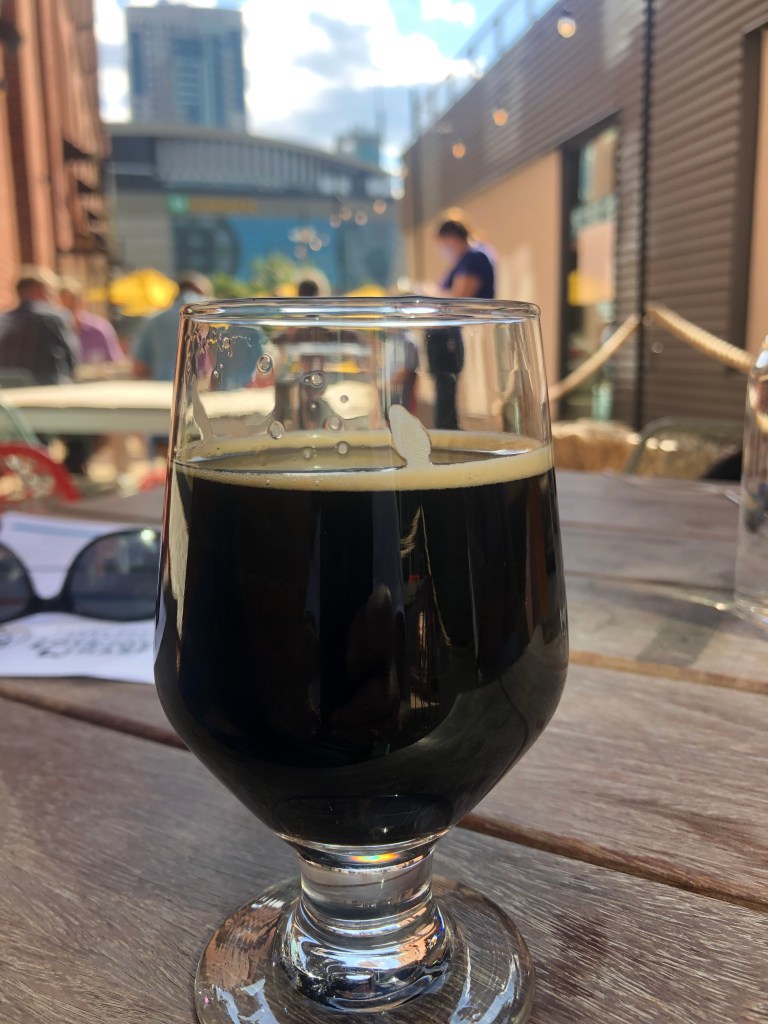
After close to ten miles of walking today, we felt we earned a refreshing beer at the Night Shift Brewing (est. 2012). I had the 2020 Darkling — an imperial stout aged in bourbon barrels. This is what I’ve been pining for since I left California. It’s dark as coal, rich as Midas, and big as Topsy. It has flavorful notes of toffee, coffee, caramel, and even butterscotch. The flavors constantly shift as it washes over your tongue, and they keep mixing a bit between sips. It’s balanced with a decent amount of hops bitterness and medium carbonation. At 12.8 percent ABV, this is not a beer to be trifled with. But I had two glasses anyway. I give it 5 well-earned points.
Today we made one more foray into Salem’s witch-infested past, this time at the Salem Witch Museum.The museum is housed in a Gothic Revival church originally constructed in the 1840s. The church closed in 1902, and after being used for a few other purposes (including an auto museum), it was transformed into the Witch Museum in 1972.
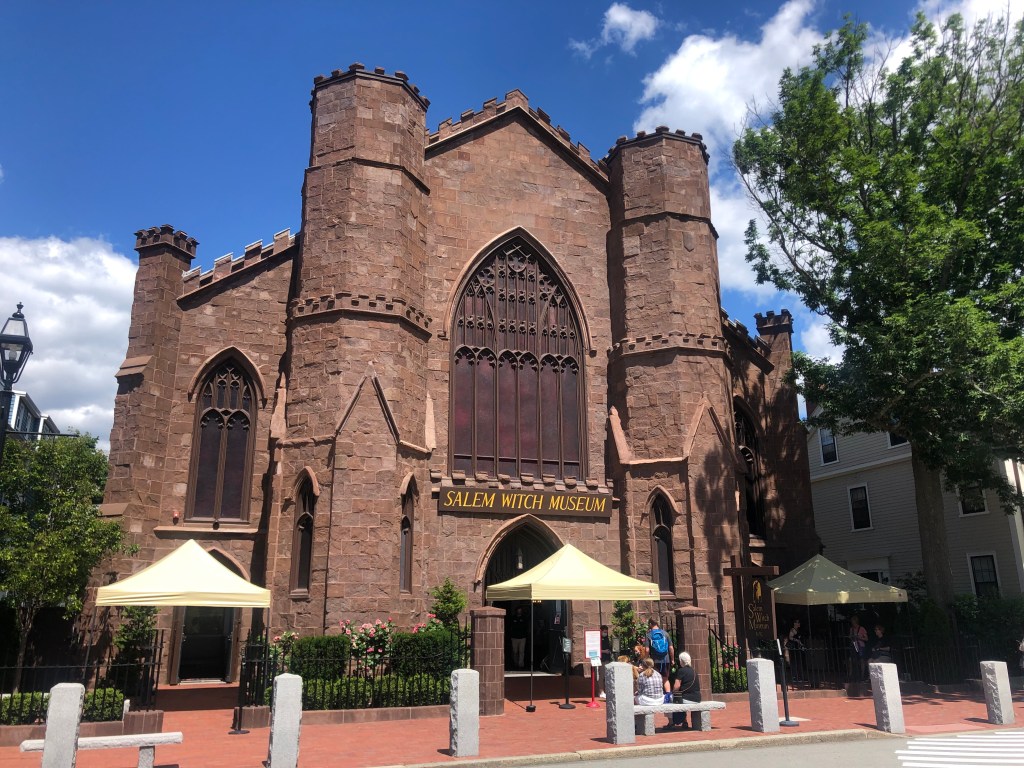
It’s an impressive structure, and the multimedia presentation of the Salem witch trials was entertaining. Still, Vic and I realized that by now we knew Salem’s witch story pretty well, so we didn’t learn much that was new. What’s more, the museum’s message is overly tendentious, hammering on the point, over and over, that our society still engages in forms of witch hunts. (I seem to remember a recent president making this claim…)
After the museum, we took the rental car on a leisurely trip along the Essex Coastal Scenic Byway. It was a breathtaking drive, with sweeping views of the Atlantic from Massachusetts’ north coast. The towns along the way are idyllic, and the homes are right out of the pages of Better Homes and Gardens. The weather was perfect, with temperatures in the mid-70s and a slight breeze.

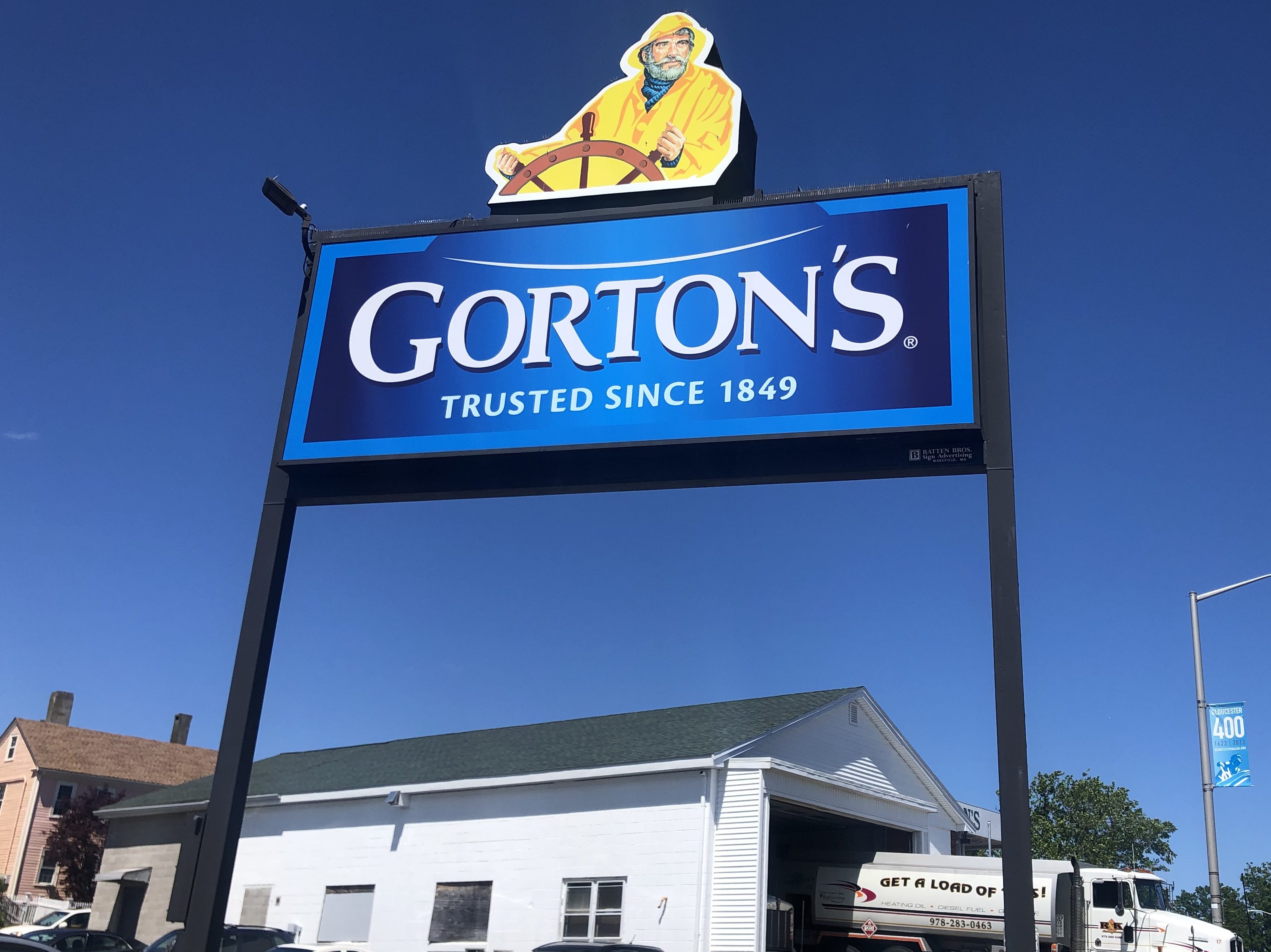
Being a native Californian, I don’t know much at all about the eastern seaboard. I did, however, recognize the Gorton’s Seafood fisherman in Gloucester. Gorton’s was founded in Gloucester in 1849, but their iconic fisherman didn’t appear in advertising until 1975.
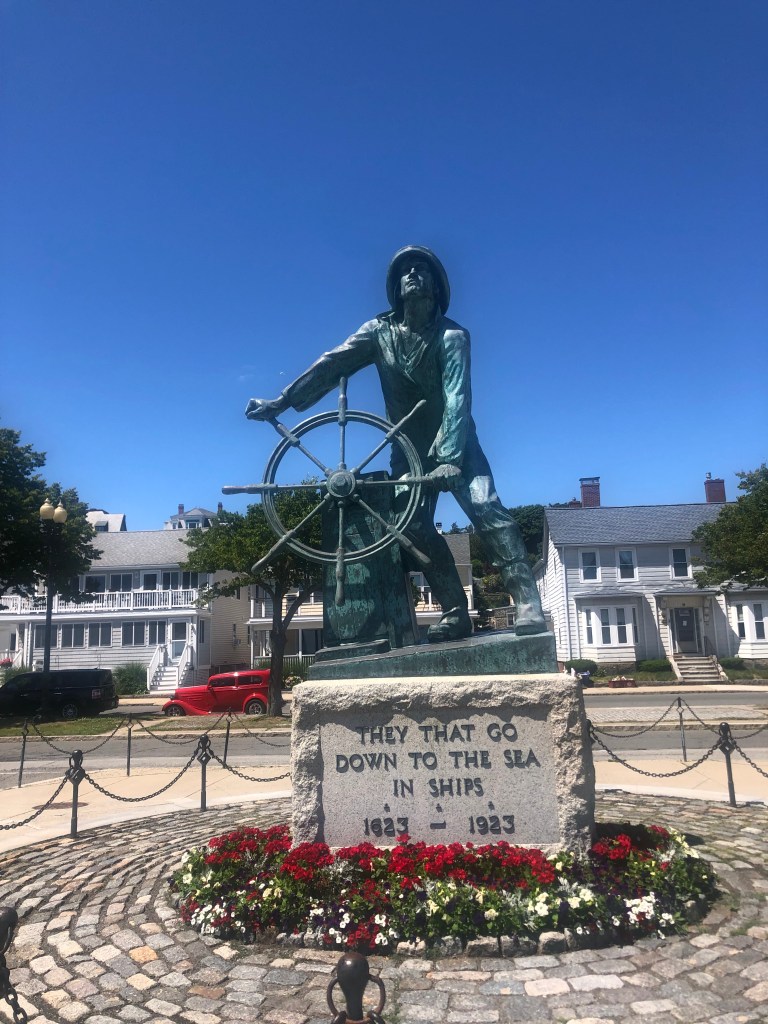
We also passed a bronze statue of a mariner at the wheel that looked suspiciously like the Gorton’s fisherman. The statue is part of a memorial to sailors lost at sea since 1716, with an array of plaques listing their names. The memorial statute was installed in 1925, so clearly it was Gorton’s (with their 1975 character) that copied the memorial, and not the other way around.
Upon returning to Salem, we continued with our witch-free diversions with a visit to The House of the Seven Gables. This, of course, is the mansion that Nathaniel Hawthorne wrote of in his 1851 novel of the same name. The house was originally constructed in 1668, and by the time Hawthorne visited it in the mid-19th century, it had been remodeled so that it only had only three gables. Hawthorne thought the idea of a house of seven gables sounded more interesting than “the house of the three gables,” so he envisioned its original form when he wrote his book.
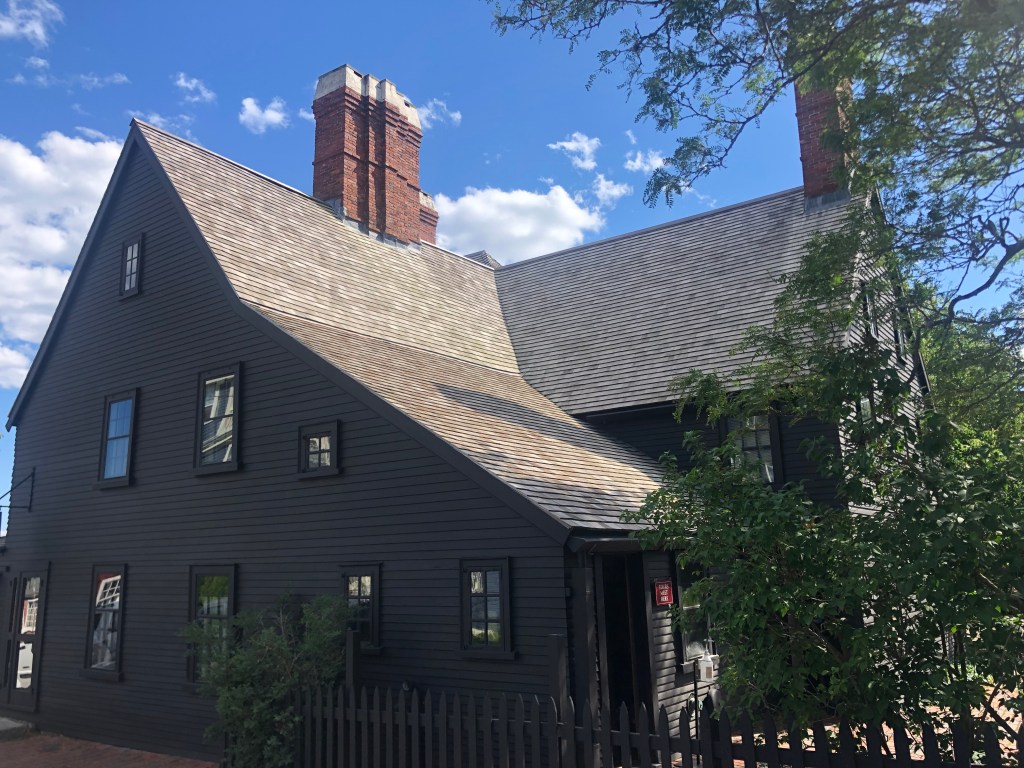
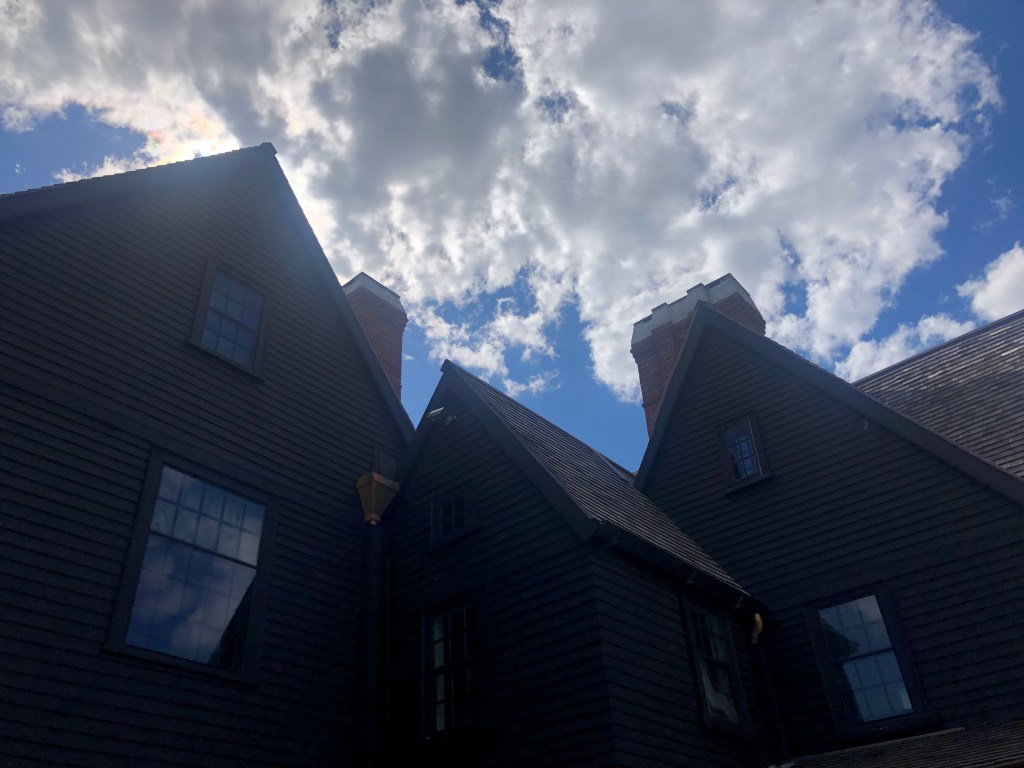
By the way, our Seven Gables diversion was not entirely witch-free. Nathaniel Hawthorne’s great-great-grandfather was John Hathorne (no “W”), who was a key, influential judges in the Salem witch trials. Nathaniel changed his last name from Hathorne to Hawthorne, in part to disassociate himself from his ancestor.
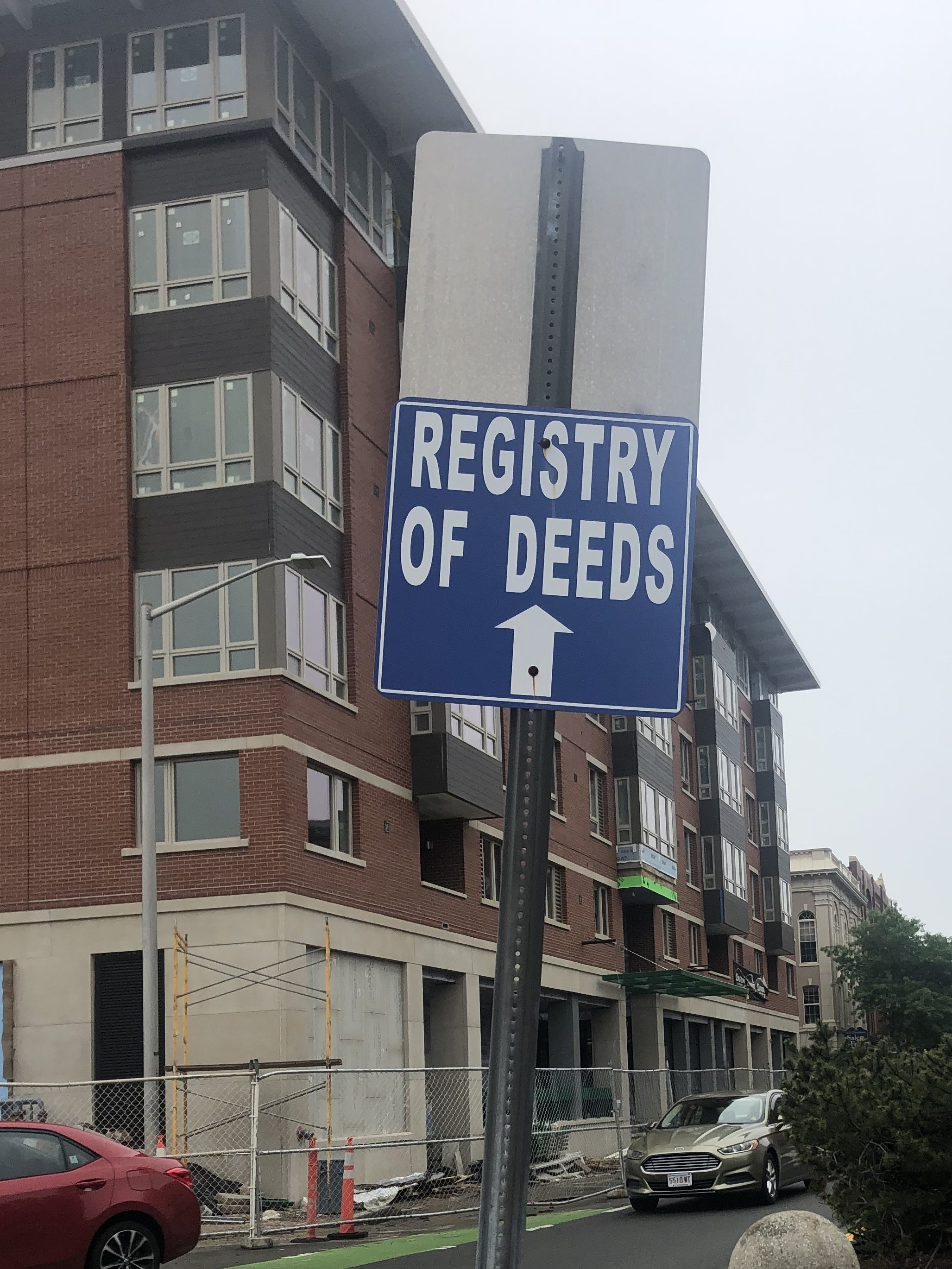
One final Hawthorne reference from today: The sight of this sign reminded me of Hawthorne’s The Scarlet Letter. Doesn’t it evoke a ledger of one’s offenses and wrongdoings?
And finally, speaking of signs, this local liquor store certainly sports a colorful moniker.
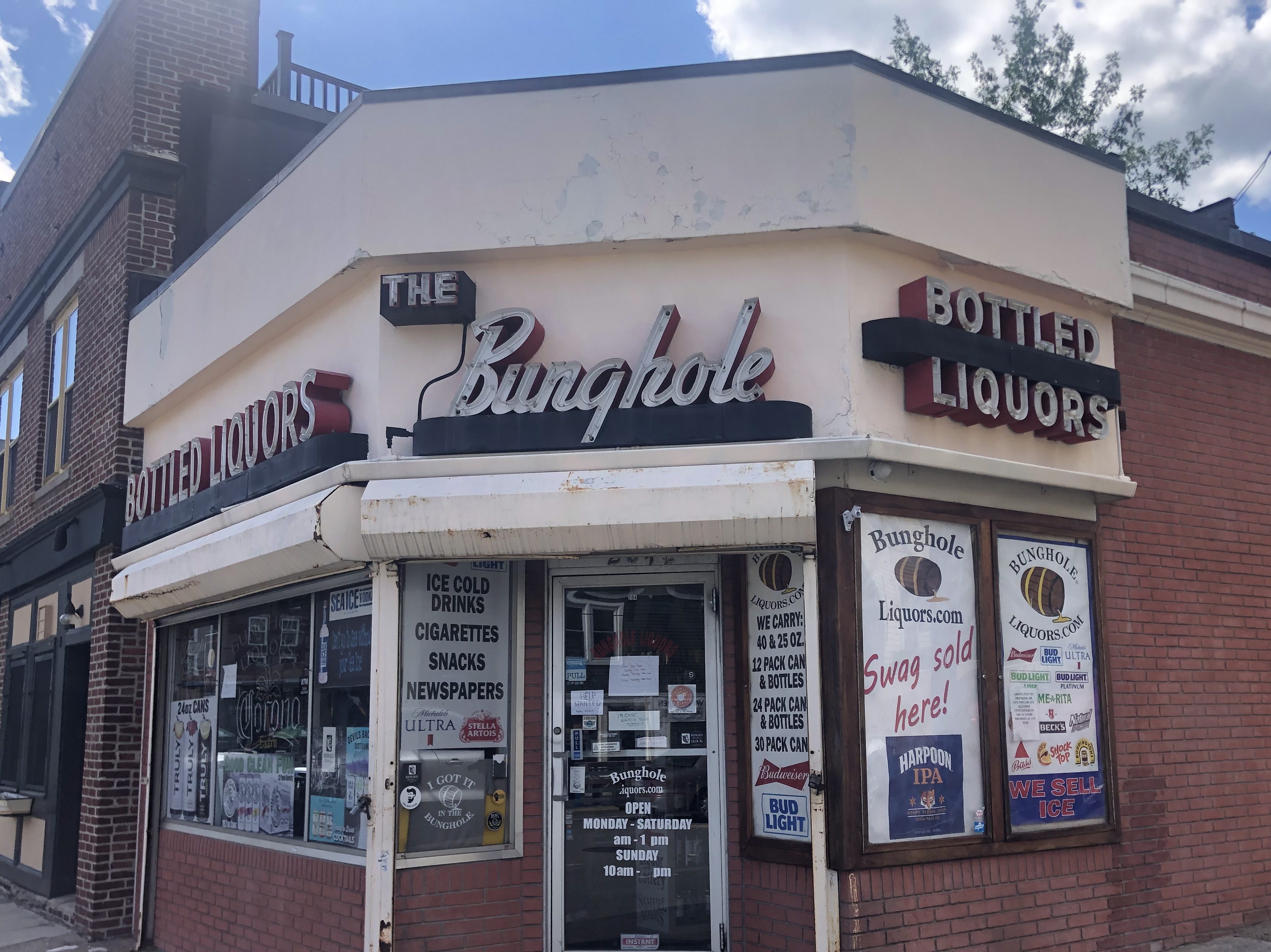
The place was a funeral home in the early 20th century, and during Prohibition the owner surreptitiously served liquor out of the basement. Such establishments at that time were sometimes called “bungholes” (a term related to wine barrels). After the 21st amendment was passed in 1933, the owner converted the funeral parlor to a full-scale liquor store. The nickname became the official name, providing endless amusement for visitors. (There’s also a line of tasteless merch.)
And so ends our third day in Salem. Tomorrow morning we’re off to historic “Salem Village,” aka Danvers.
BREW OF THE DAY
We found a local brewpub called East Regiment Beer Company. Established in 2014, it resides in what used to be Salem’s first fire station.The name references colonial Massachusetts’ militia, which is claimed to be the origin of the National Guard. This is a small (three-barrel) brewery, with a handful of their own beers on tap at any given time. I selected the BAF Porter.
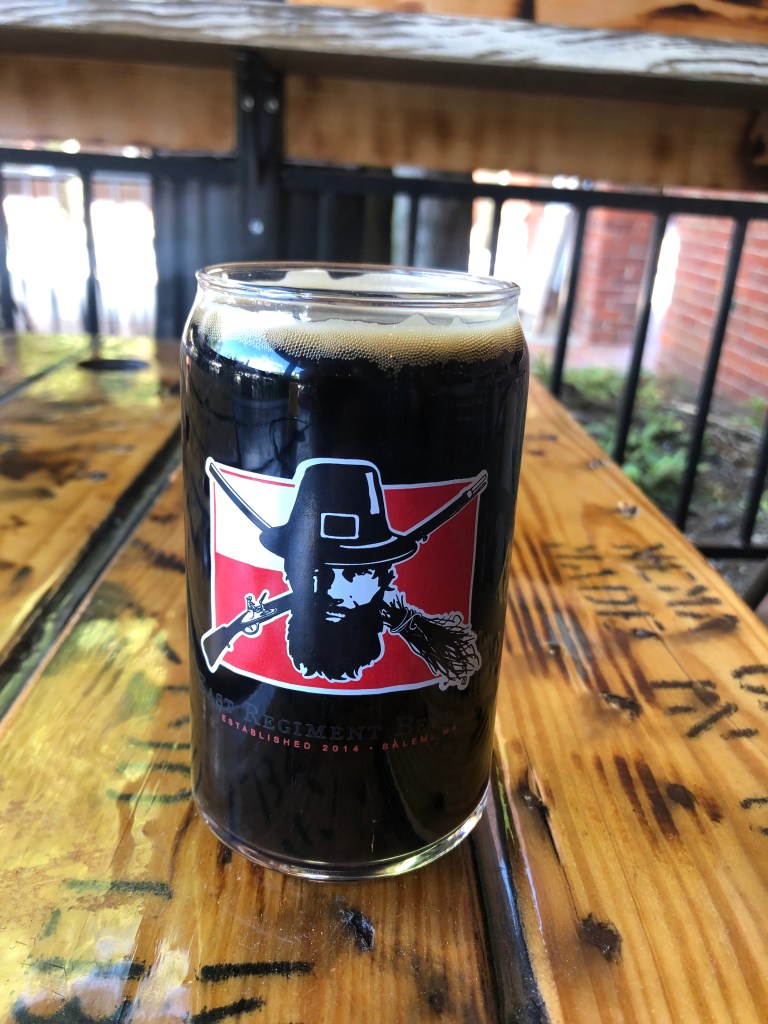
This is a mahogany-colored brew with just the slightest hint of lacy foam at the top. On the first sip, you’re greeted with roasty and nutty flavor that washes over your tongue. You notice a mild carbonation, which is just enough to keep things interesting. It’s not a thick or heavy beer — but it’s not watery either. It strikes that ideal viscosity that a porter should have.
The finish is slightly bitter, as you’d expect from a lightly hopped beer. Overall, I’d have to say the beer is balanced. But after a few sips, it becomes clear that this beer lacks complexity. There is no play of flavors, no grace notes. Just a big glass of roasty sameness, sip after sip after sip. By the time you’re drinking the second half, you’re tired of it. Let’s give it 3.5 stars.
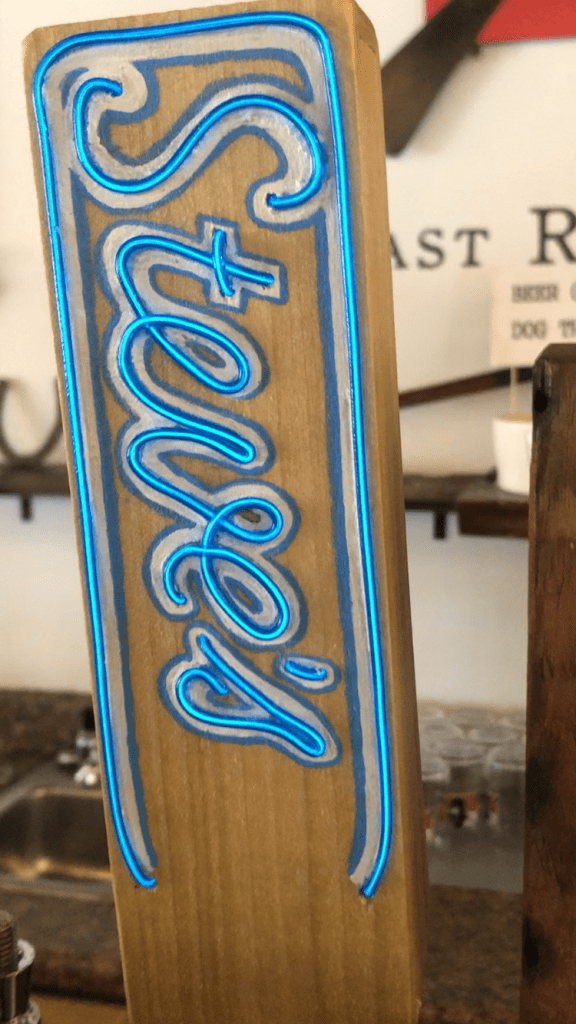
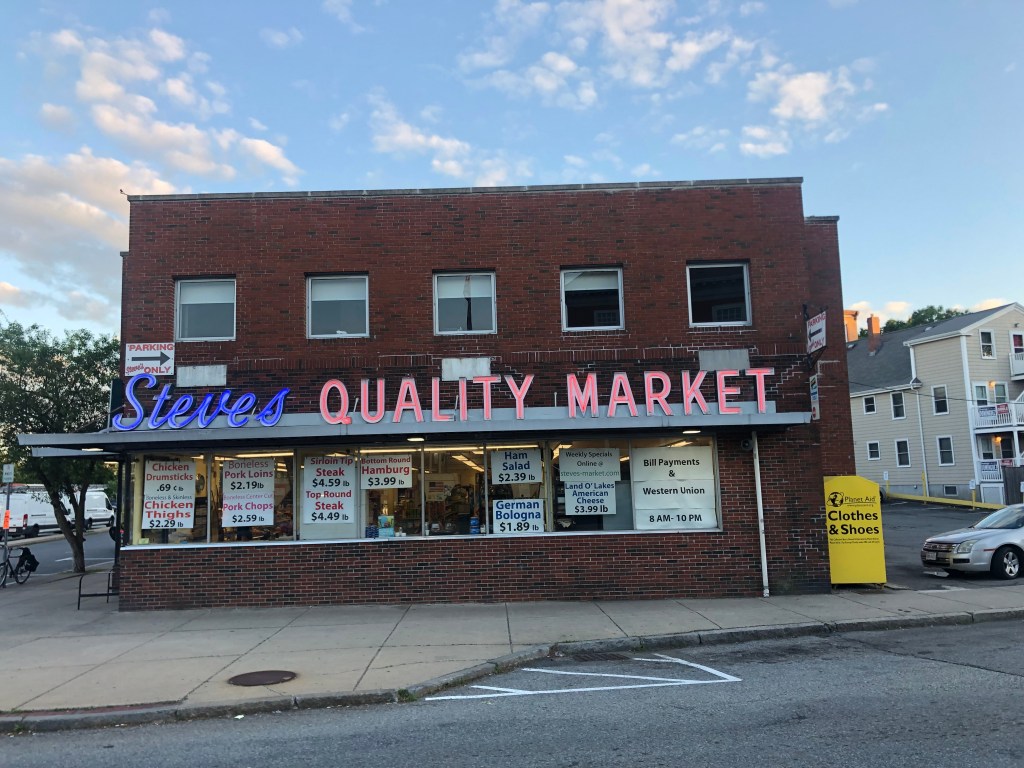
PS: As I was settling our account, the barkeep (Mike) pointed out a beer on tap that shares my name. “Steve’s Quality Saison” is a paean to the local “Steve’s Quality Market,” and the tap handle even has the same neon script as the signage on the store (which happens to be across the street from our hotel.) I wish I’d been aware of it when I ordered my porter!
Yesterday’s post, in which I anticipated what today held in store, was prescient, if I do say so myself. We were indeed beset on all sides by witch imagery, and our tour guide was in fact a local college student in a period costume with a flair for hystrionics. But let’s start at the beginning.
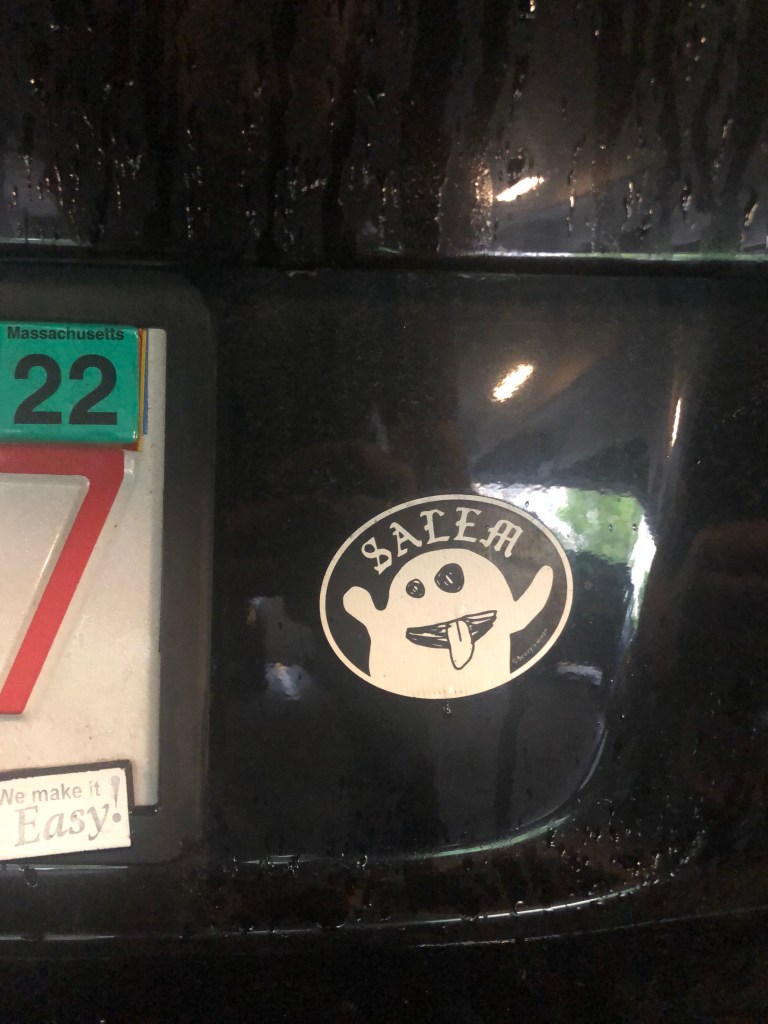
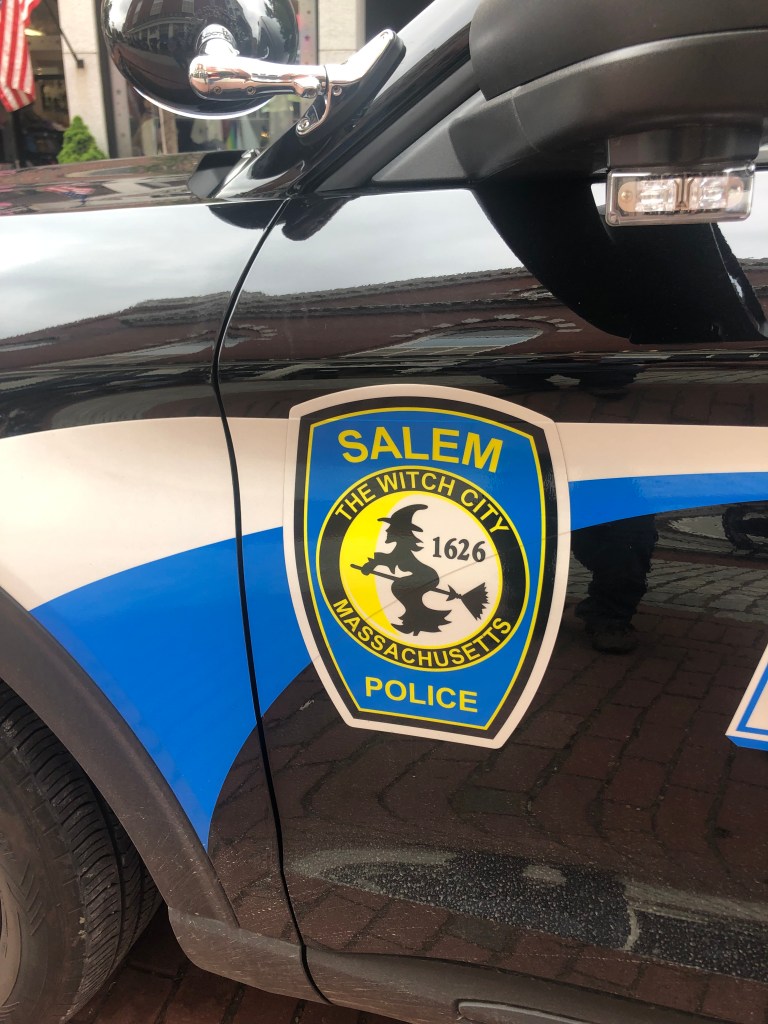
Salem seems to have a conflicted, love-hate relationship with its witch history. On the one hand, the witch trials are understandably seen as, well, witch trials. One wonders if 300 years ago an accused witch would have decried the whole thing as a “communist hunt.” On the other hand, and in saying this I mean no ill will, Salem doesn’t really have a lot else to attract tourists. And so it is that witch imagery is omnipresent. Even the local constabulary sports the silhouette of a flying crone.
We started off at the Salem Witch Museum, which is as straightforward of a name as you’re going to find. We were the only two people on the tour (evidently June is their slow season). Our guide was the aforementioned young woman inclined to stagecraft who’s getting her master’s in Salem history. As she took us past barely-animated tableaux of witch trials and suchlike, she explained the sordid history, which I’ll summarize here:
In 1692, the two daughters of Salem’s new minister were found cavorting in the woods. This was frowned upon in Puritan society, so the girls offered an excuse which would become a pop culture phrase in the 1970s: “The Devil made me do it.” Indeed, they claimed that one (or sometimes a few) local witches had cast spells on them. To strengthen their case, the girls would occasionally fall into catatonic states or writhe uncontrollably. Now, in those days, witches were very much considered a thing, and the townsfolk set about the business of discovering who these witches were, and putting an end to them.
In the year and a half that followed, accusations and counter-accusations flew, and some 200 people were arrested as witches. Nineteen of them were hanged. The hysteria came to an end only when the Governor’s wife was accused of witchcraft, and the Governor decided it was time to grow up and enter the (then-dawning) 18th Century.
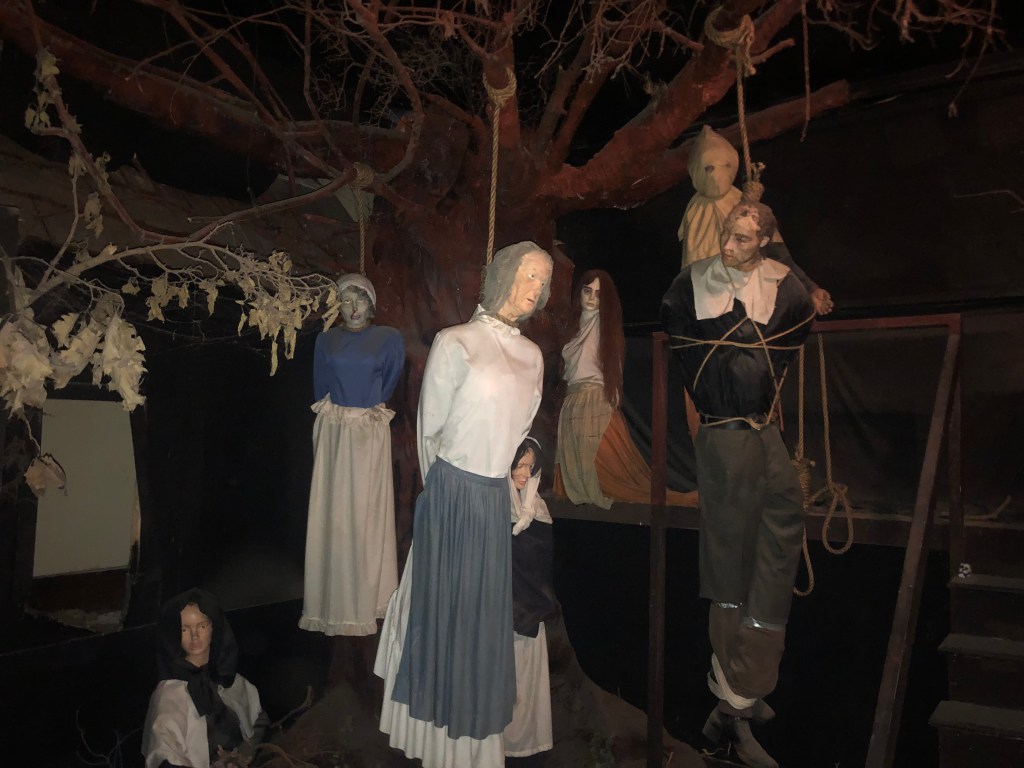
We then went to Salem’s Witch Dungeon Museum, which is a recreation of one of the jails (or, in the local vernacular, “gaols” where accused witches were held. They were not pleasant accommodations. And even if you were lucky enough to be acquitted, you then had to pay off your debt for the cost of food, shackles, and other provisions you had used before you could be released.
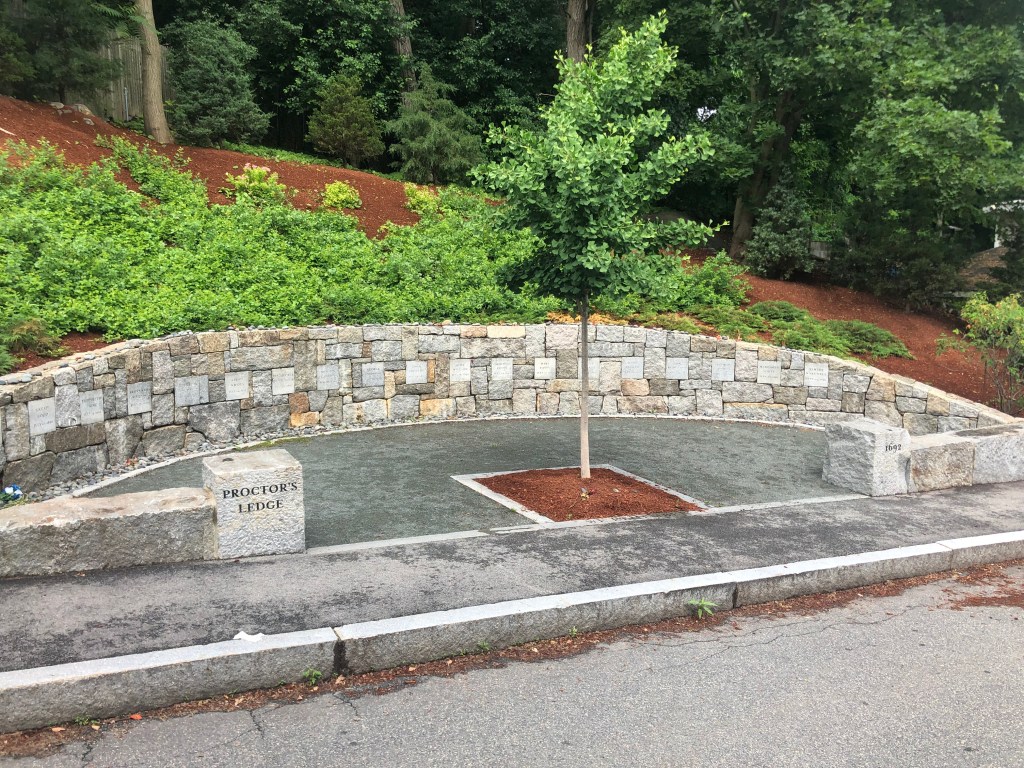
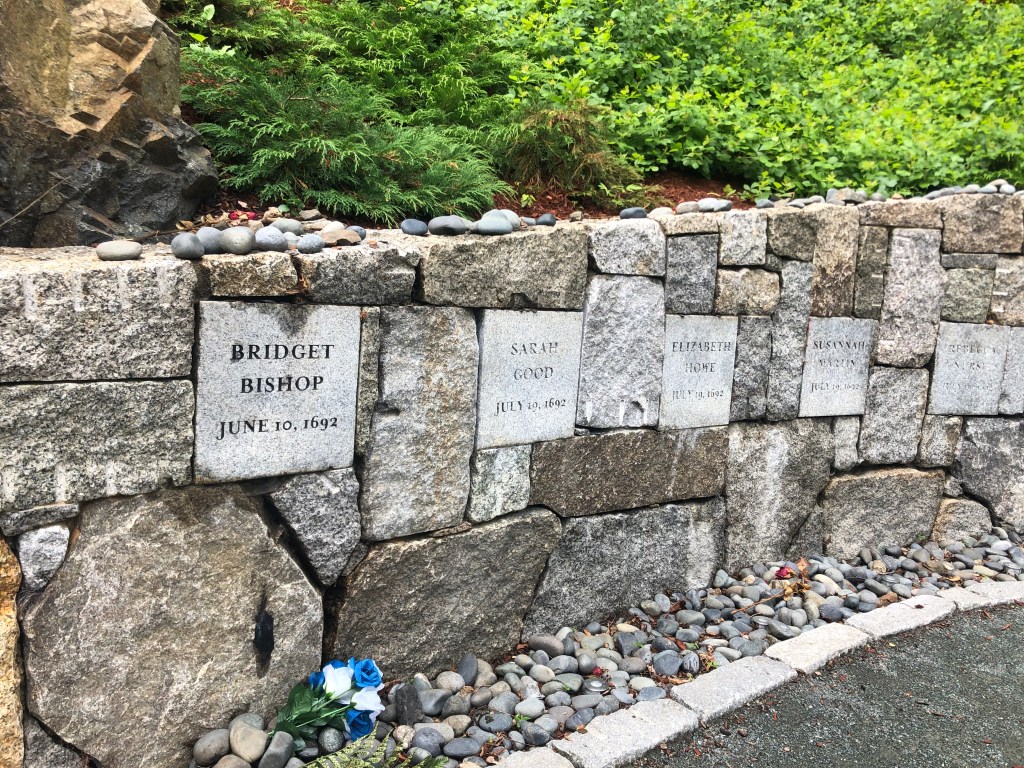
For a somewhat less lurid, even somber meditation on the events of 1692, we visited the (presumed) site of the hangings. For years no one was really sure where this storied “Gallows Hill” was located, but recent scholarship says it’s at a place known as Proctor’s Ledge, which sits behind the local Walgreens. A memorial was erected on the site in 2017, with the names of each of the 19 victims. (Excluded are the names of two dogs that also were hanged as witches.) (I am not making this up.)
But not all of modern Salem’s witch infrastructure is quite so gloomy. There is, for example, this brass statue of Samantha Stephens from the 1960s sitcom, “Bewitched.”
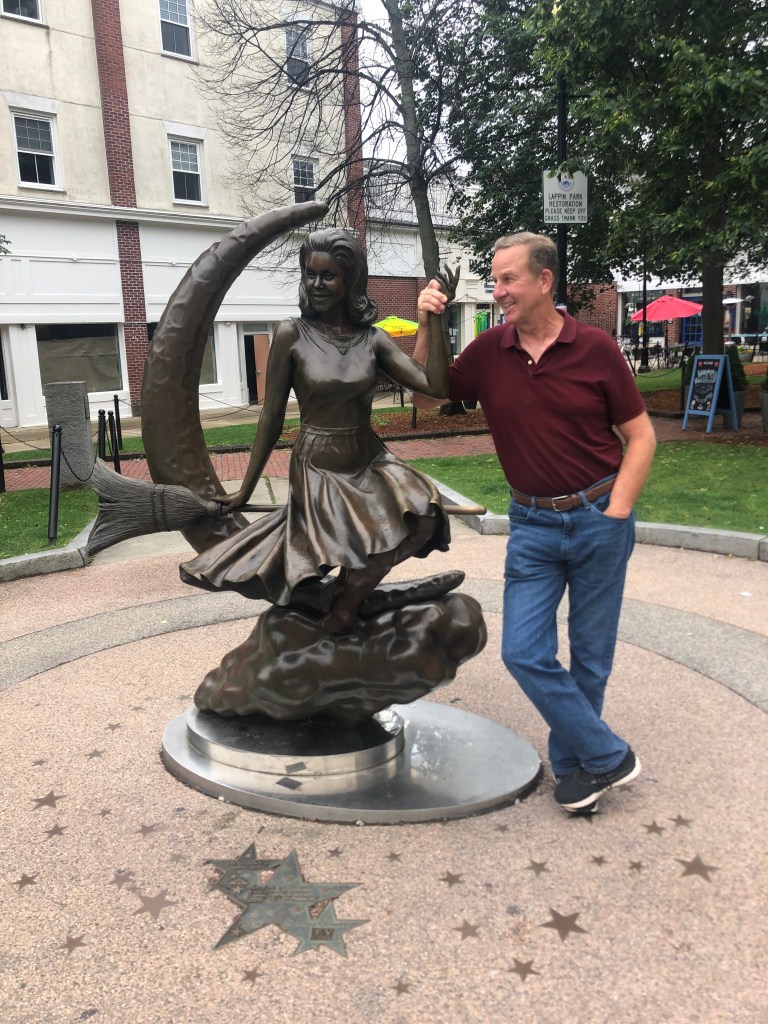
The statue was erected by TV Land in 2005, and it caused a bit of controversy. Some residents felt it showed an insensitivity towards witches…or at least toward those who were accused of being witches. “It’s a distortion of what went on,” harumphed one resident to NPR when the statue was unveiled. You think? A pretty blond witch living as a housewife in suburban 1960s America, with Paul Lynde as her wisecracking, campy uncle? Yeah, I guess that’s a distortion of what actually happened in a 17th-century Puritan community.
By the way, TV Land has erected statutes of other fictional characters in their hometowns, including Bob Hartley (Bob Newhart) in Chicago, Ralph Kramden (Jackie Gleason) at a New York bus station, Mary Richards (Mary Tyler Moore) at the same downtown Minneapolis corner where she throws her hat in the opening titles, and Andy and Opie Taylor (Andy Griffith and Ron Howard) in Raleigh, North Carolina. Sadly, Ron Howard is the only surviving member of this entire entourage.
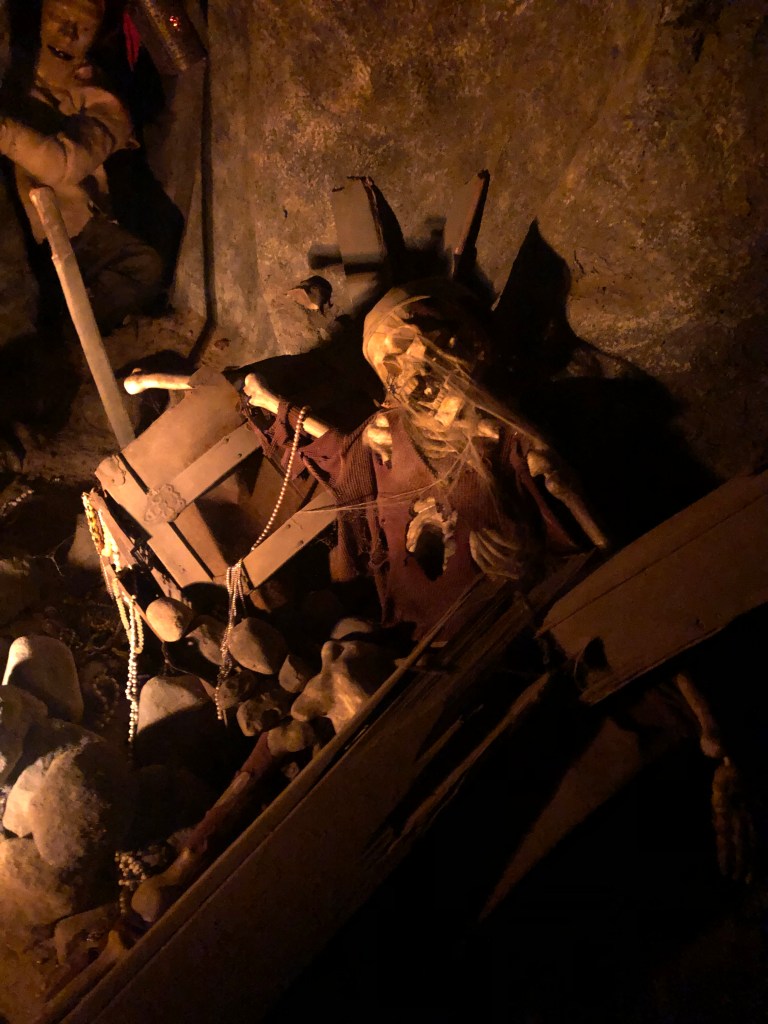
Finally, as we were getting a little saturated with witchy things, we decided to have a fresh, cleansing experience at Salem’s….wait for it….pirate museum! After a day of witch gaols and hangings and men being crushed to death, nothing restores your faith in humanity like a bunch of displays about bloodthirsty marauders on the high seas.
Brew of the Day
It turns out most of Salem’s brew pubs are closed on Tuesday. So we tried a restaurant that was supposed to have a good beer menu. Here is said menu:
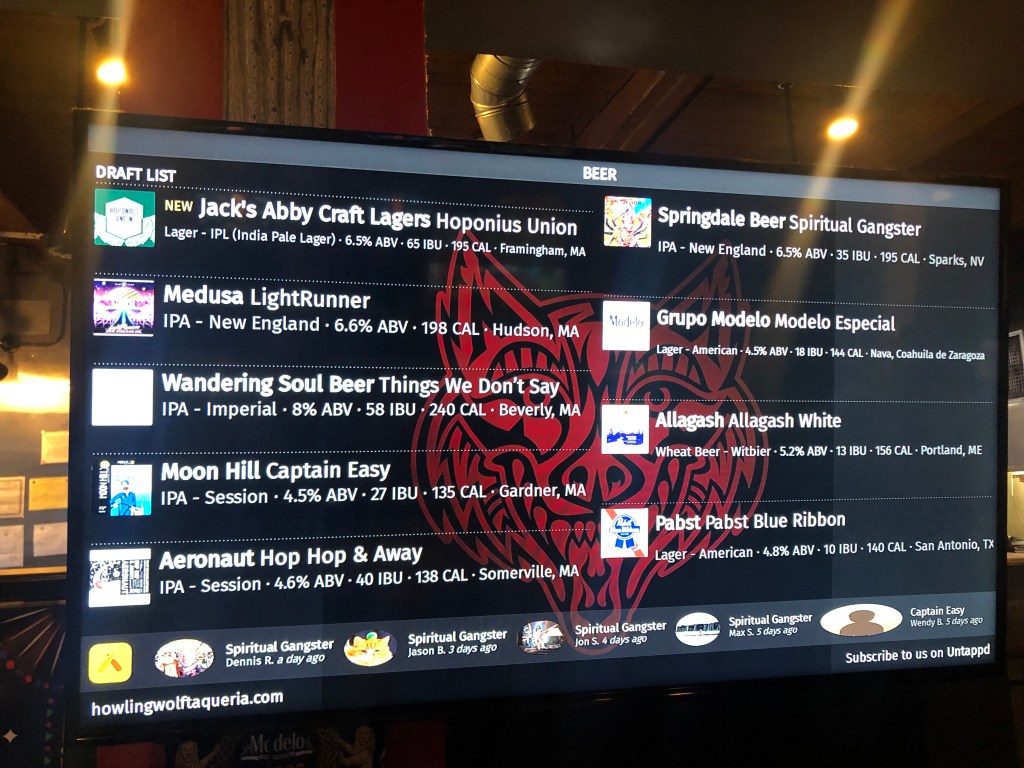
You’ll note that it’s all IPAs and lagers. Not a manly beer to be had. And for some reason, every single place we’ve been to over the past two days has PBR.
I had a margarita.
The devil made me do it.
 Chasing Phantoms