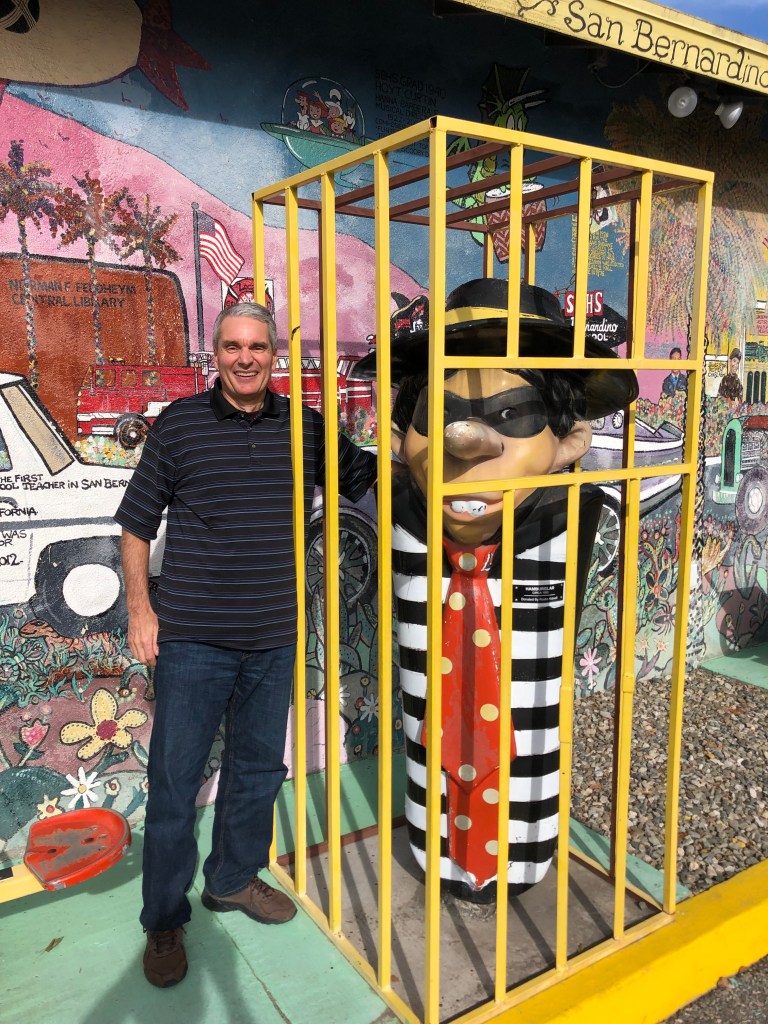
My good friend Vic and I have engaged in our share of aimless and/or pointless activities. Such as the time we had a hankering for a greasy meal from the Cracker Barrel restaurant, and we made the 550-mile drive from Sacramento to the nearest Cracker Barrel, which was in Boise, Idaho. After enjoying our meals we immediately got back in the car and returned home that same day. Vic and I have also visited the unofficial McDonald’s museum which resides inside the Juan Pollo Chicken headquarters in San Bernardino, and we flirted with the cowgirl waitress in a ten-gallon bra at the Big Texan Steak Ranch in Amarillo.
Vic (on left) with friend.
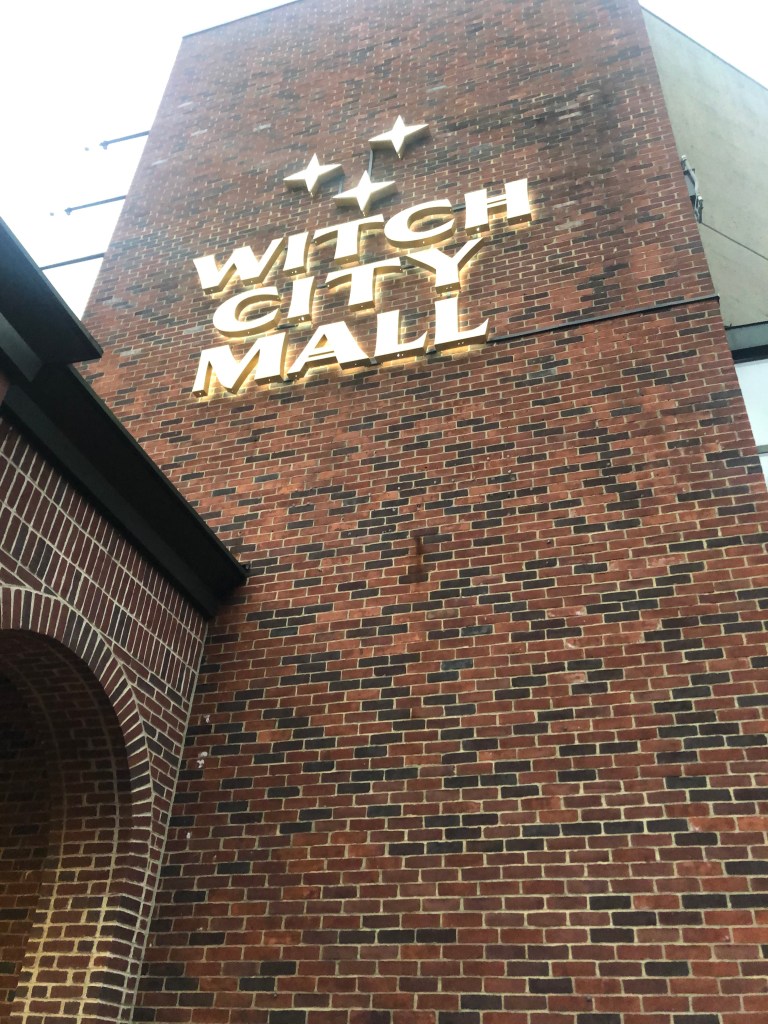
So when Vic recently observed that we were overdue for another “stupid trip,” I was all ears. (Those of you who have seen me in profile can attest to that fact.) Vic suggested that we make a pilgrimage (if you’ll pardon the expression) out to Salem, Massachusetts, home of the storied Salem Witch trials, to see what all the fuss was about. Admittedly, the fuss ended rather abruptly about 300 years ago, but growing up in California, our formal education studiously avoided any mention of events occurring before 1849. So we figured we’d correct for that oversight by listening to theater majors from North Shore Community College spin lurid, embellished tales about “The Troubles of 1692” while restlessly standing in reconstructed Colonial buildings next to a family of tourists from Minnesota wearing matching “WITCH WAY TO SALEM” shirts.
Which is why this morning we found ourselves at Sacramento Intergalactic Airport at Zero Dark Thirty. Vic and I took separate flights. This is not because we wanted to minimize the risk that the world might lose both of us in a plane crash, but because we each have frequent flier miles with different airlines.
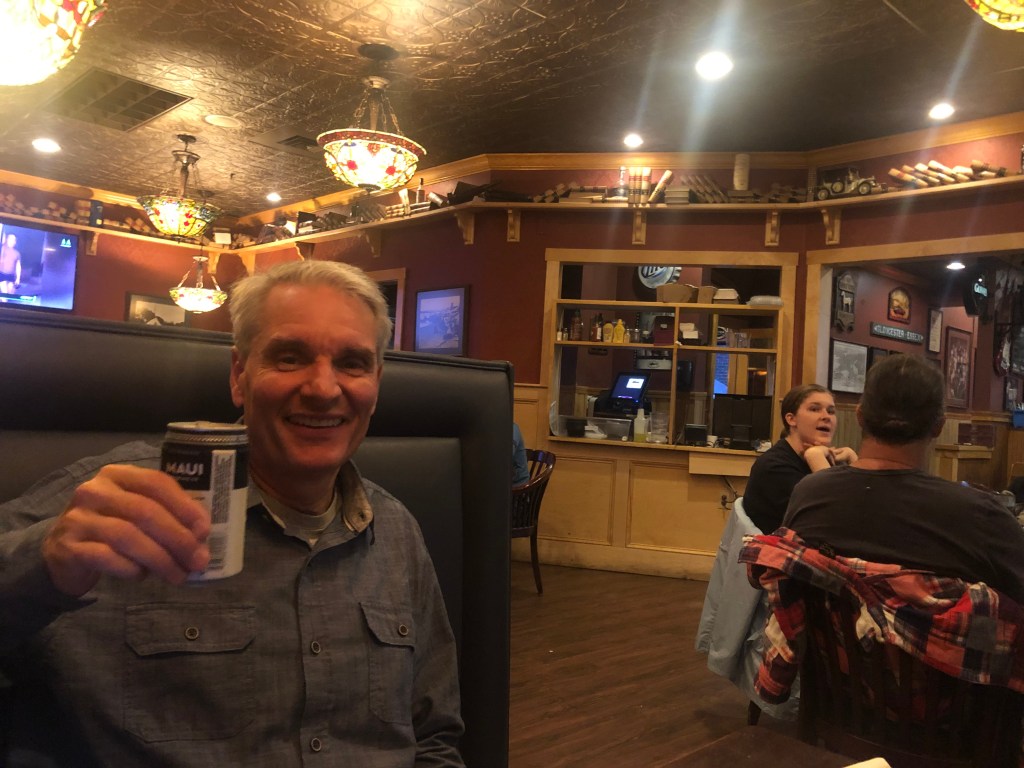
After a day of flying, we were reunited at Boston Logan Airport (motto: “You Think Your Flight Was Long? Just Wait Til You Experience Our Rental Car Shuttles!”) just in time for a relaxing, pub-inspired dinner and a couple of brews at the Village Tavern.
Now, the thing you should know about Salem is that, like most historic towns, they really try to capitalize on their cliches. Judging from the Chamber of Commerce literature, nothing significant has happened in Salem since the late 17th century. Most businesses proudly play up their historic link with sorcery and black magic.
Anyway, we arrived too late to explore much this evening. But tomorrow I’ll be able to report on Salem’s unholy history.
BREW OF THE DAY
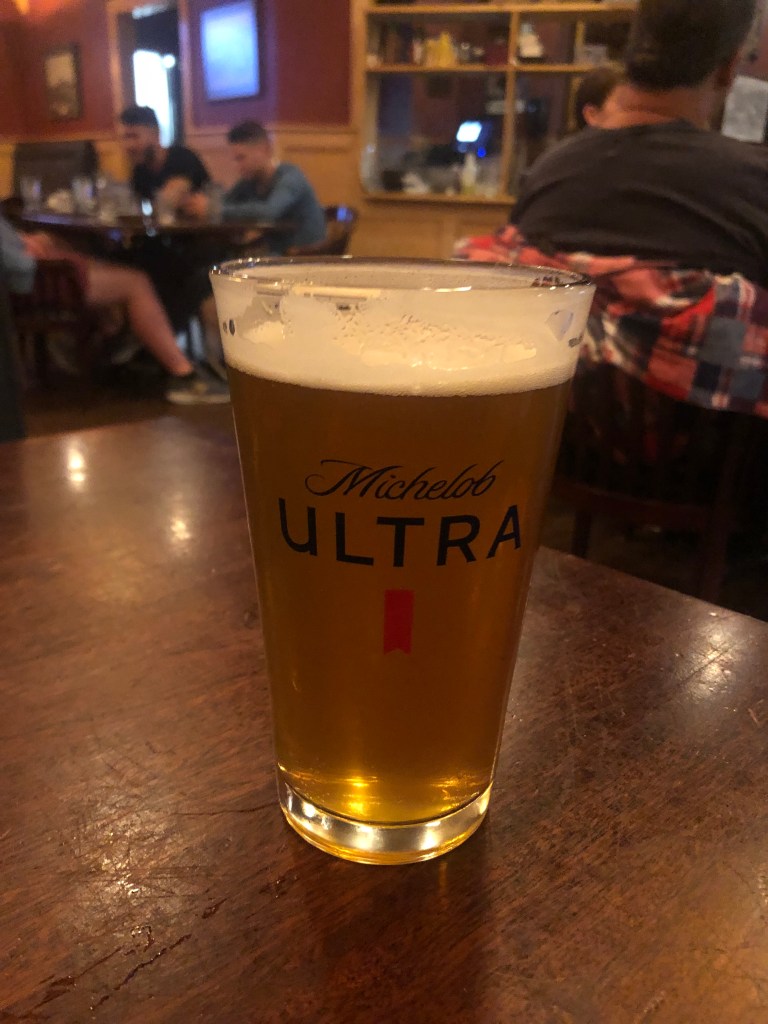
The Village Tavern has an extensive beer menu, but a significant portion is dedicated to the likes of Coors and PBR. However, I selected the intriguingly-named Lord Hobo Boom Sauce. (Disappointingly, it was served in a Michelob Ultra glass.)
My LHBS is a double IPA with an ABV of 7.8 percent. Lord Hobo Brewing was established in Woburn Massachusetts in 2015. It’s a decent brew, if you like IPAs. It’s piney and a little sweet, but it has almost no nose. (Those of you who have seen me in profile know that this does NOT apply to me.) It’s rather one-dimensional, uninteresting in color, and and has an aftertaste of straw. On the other hand, it has decent carbonation.
I think you’ll agree that the 1950s were the heyday for Los Angeles. This is partly because Los Angeles is defined by its car culture and its movie industry, and the 1950s were arguably a golden age for both of those themes. What’s more, LA was still a somewhat functional metropolitan area in the 1950s, before gridlocked freeways, ubiquitous homeless encampments, and persistent air pollution threatened the region’s liveability.
The 1950s also brought some iconic architecture to Los Angeles: The Wayfarers Chapel (designed by Lloyd Wright, and located just a couple of miles from my house), CBS Television City, Norm’s Coffee House, the Capitol Records building — a number of uniquely LA buildings were constructed during this period. But sometimes forgotten are the whimsical and wonderful creations of Russell C. Wendell. It was he who opened a chain of 10 “Big Donut Drive-In” restaurants around the city in the 1950s.
Wendell oversaw his donut empire into the 1970s, when he finally decided to sell off the individual restaurants and instead focus on his “Pup ‘N’ Taco” chain. (Taco Bell bought up those restaurants in the 1980s.)
So, what happened to the ten “Big Donut Drive-In” restaurants? Five of them were razed (insert “raised donut” joke here), and one of them was unceremoniously converted into a bagel shop. But four of the original Big Donut Drive Ins remain, still serving donuts to a loyal clientele. My mission today was to visit those remaining restaurants, and sample their wares. (The things I do for my readership…)
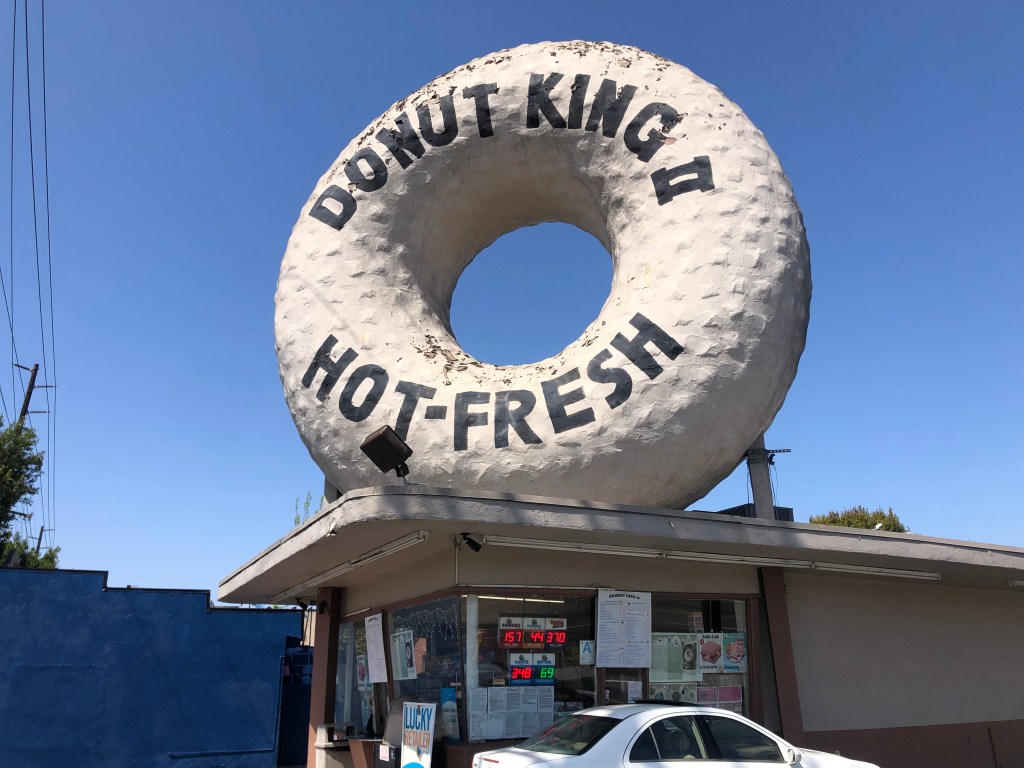
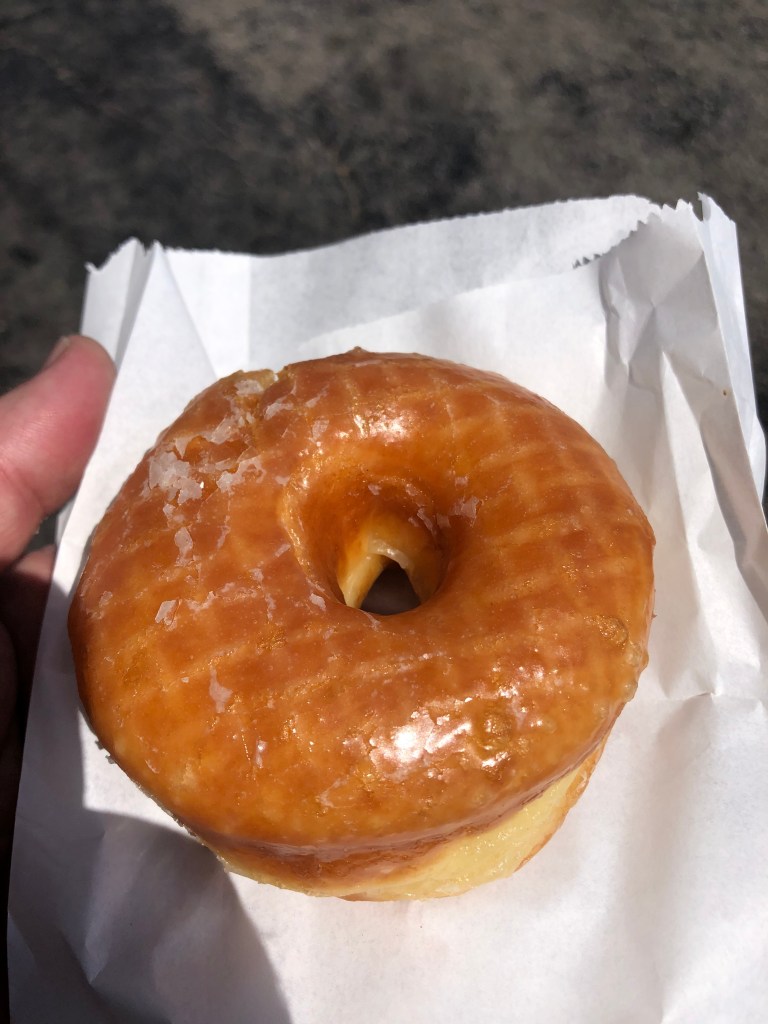
First up was “Donut King II,” in Gardena. This was the third of the original Big Donut Drive-Ins. It’s changed names and owners a few times, finally ending up with the rather humorless and unfriendly woman I met today.
Here’s a tip: “Donut” provoke the owner!
Now, I figured since I was visiting each of these donut shops, it would make sense to sample a donut from each one. But what kind of donut to purchase? I decided to let the owner (or manager) of each place make the choice. So I approached the scowling woman behind the window, who looked like she was tired of being interrupted by pesky customers. I asked her a simple question: Which is the best kind of donut that you sell? “We sell lots of different kinds of donuts. They’re all on the menu in front of you. Pick one.” I wasn’t going to be daunted that easily. “But which one is your favorite?,” I persisted, turning on the Boilard charm. “The glazed,” she immediately responded, most likely because she had a surfeit of them on the tray beside her. So glazed it was.
250 calories of fried goodness
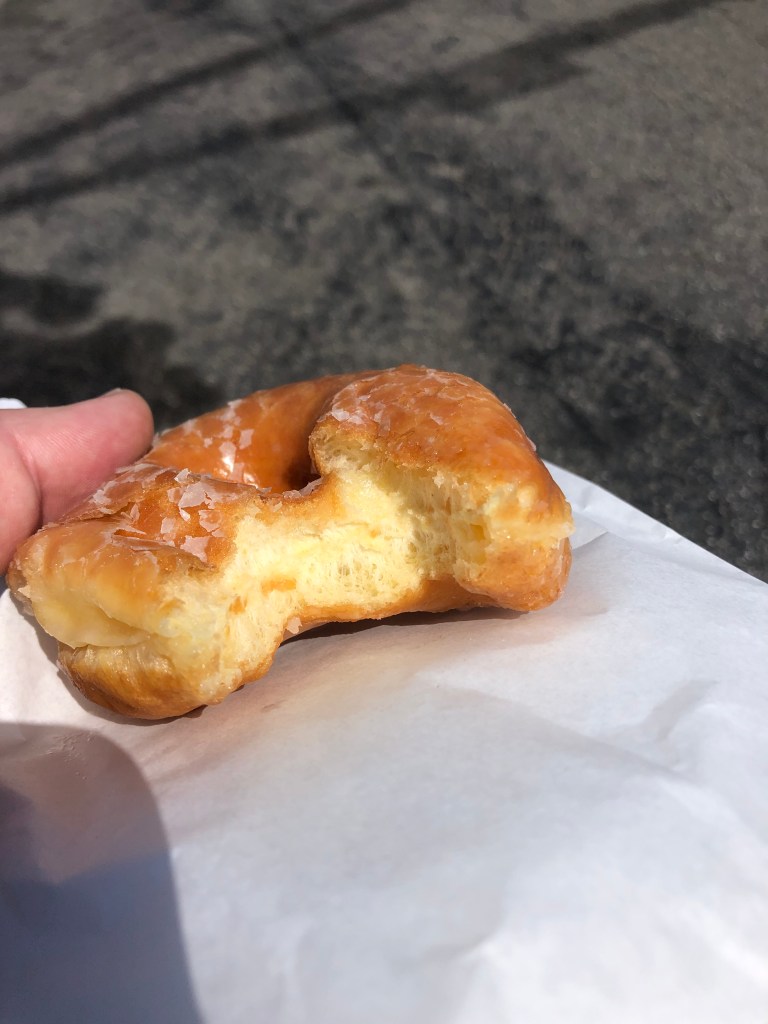
So let’s get down to brass tacks. This was a good donut. Not great, but good. The grid pattern (presumably from the cooling rack) gave the illusion of texture, and it was fried to a nice, golden brown. The glaze might have been a little thick, though, and the inside was slightly underdone. Overall, I give it a 7 out of 10.
A bit too gooey inside.
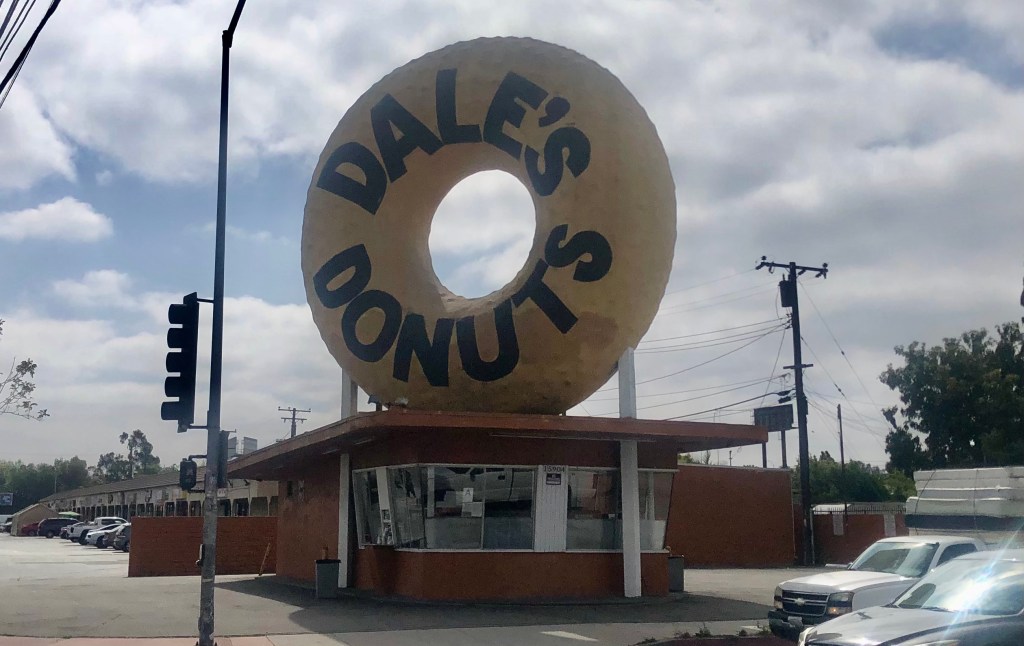
Having been fortified by fried, leavened dough, I moved on to Dale’s Donuts in Compton. There was that unmistakable, familiar, 32-foot-donut again, signalling that this was one of the original Big Donut Drive-Ins.
Donut mind if I do…
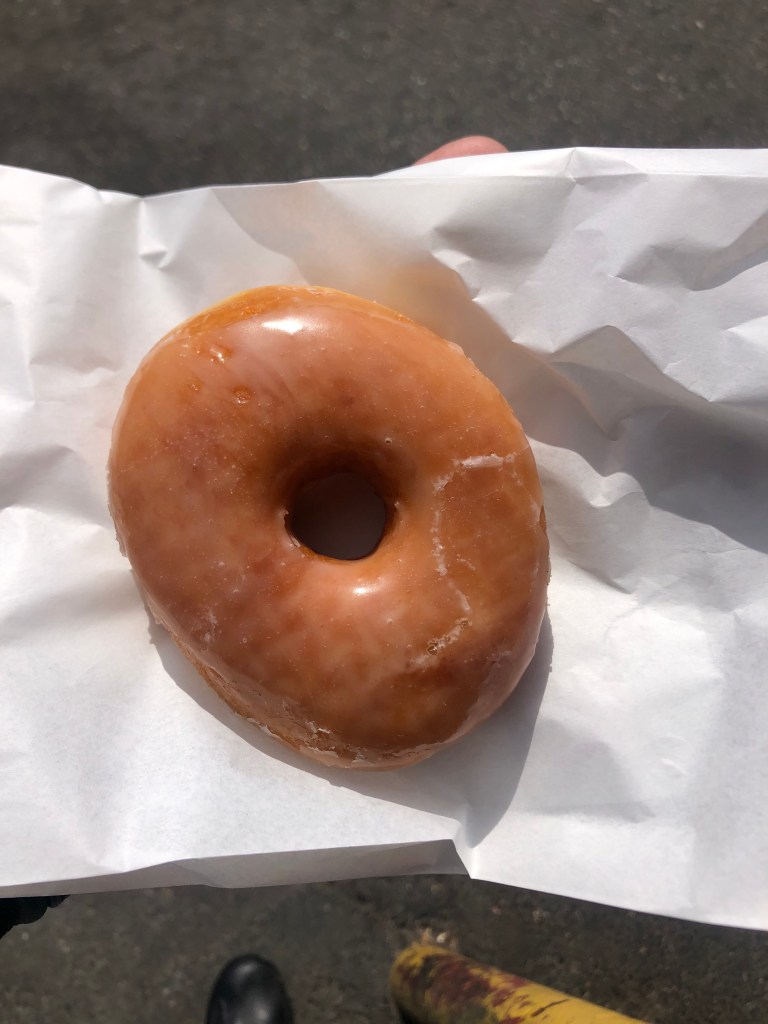
Here, the owner was a little more chatty, sharing that he bought the place 29 years ago. I asked if he bought it from Mr. Wendell himself. “No, just from my neighbors.” I asked him my usual question: Which is your best donut? He frowned, as though he’d never thought to reflect on the quality of his wares over the past 29 years. Finally, with a shrug, he said “Well, the glazed is pretty good.” So I acquired my second glazed donut of the morning.
Glazed and confused
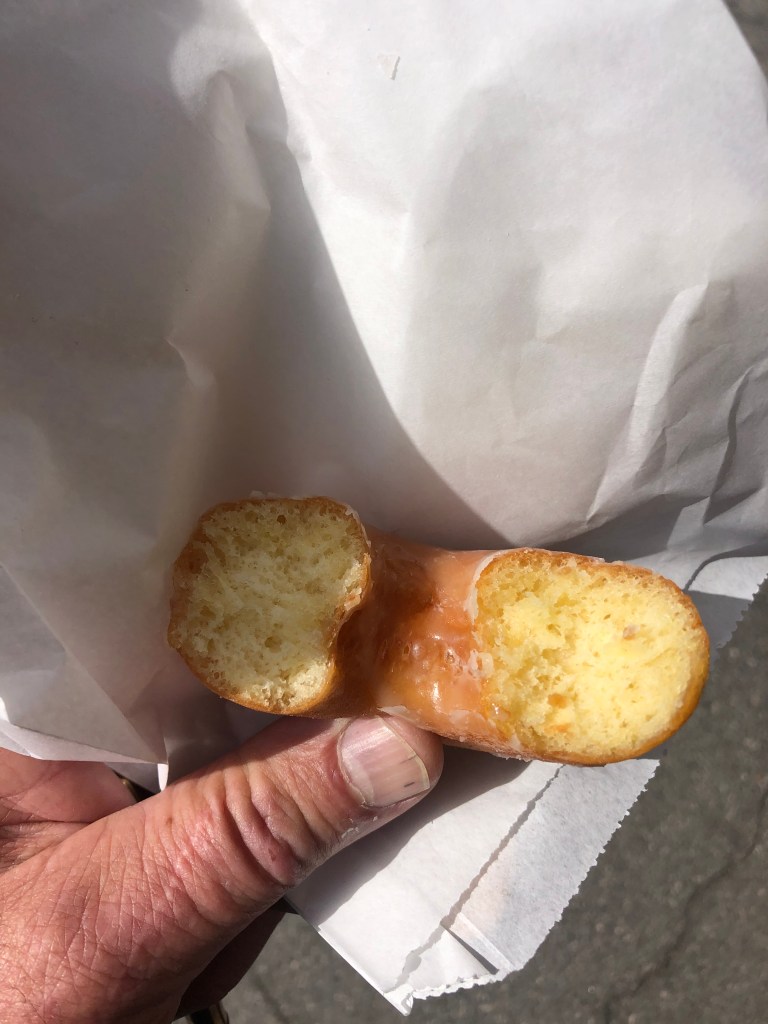
Now this glazed donut was clearly superior to the one from Donut King II. This donut had a much lighter glaze that was nicely bonded to the donut ring. The glaze was so delicate that I didn’t even get sticky fingers. The body of the donut was light, almost fluffy. I’d say it was fried perfectly. I give this a 9 out of 10.
Melts in your mouth, not in your hand
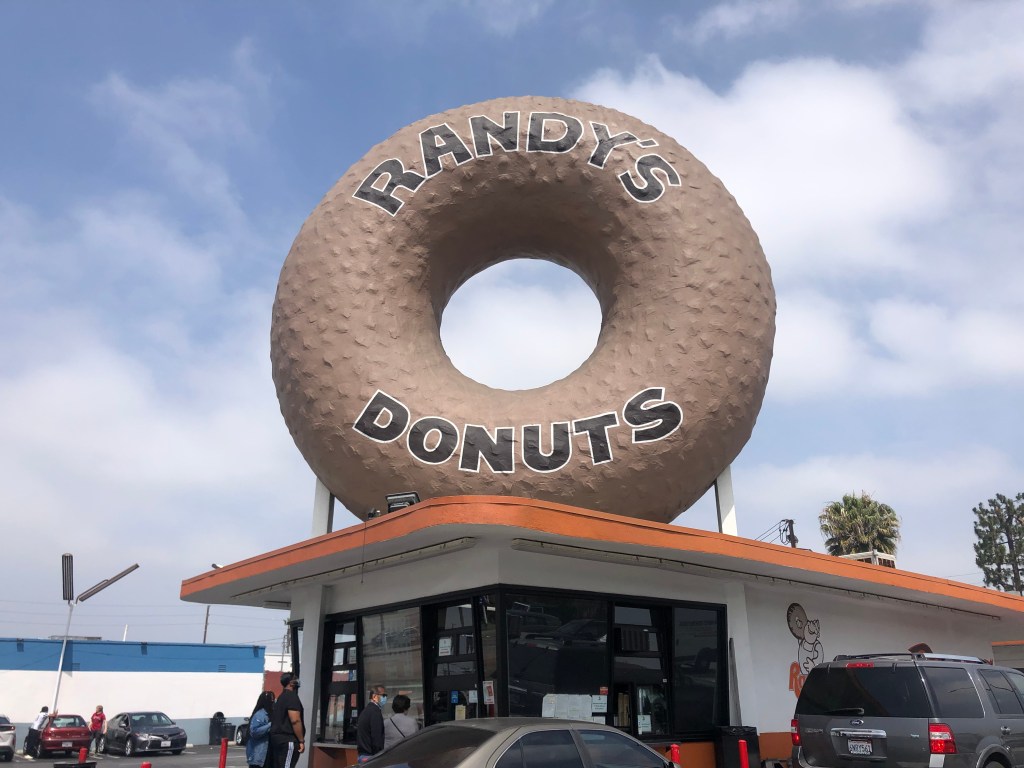
I was beginning to feel a sugar buzz, and raced up to Randy’s Donuts in Inglewood for my next fix.
Homer Simpson, eat your heart out
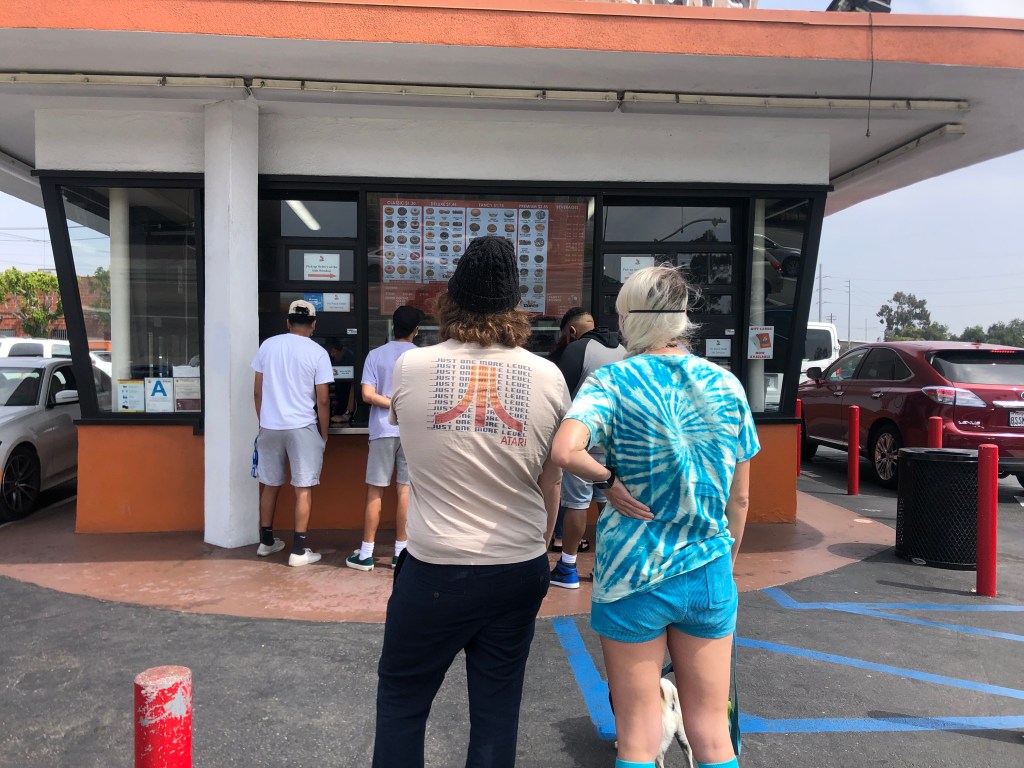
Constructed in 1953, this was the second of Wendell’s original buildings. And it’s the one that seems to get all the attention, due to its prime real estate. It’s located near LAX, and you probably saw it while gassing up your rental car. The place has been called Randy’s Donuts since Wendell sold it in 1976. The iconic sign has appeared in numerous movies, including Mars Attacks!, Earth Girls Are Easy, Coming To America, Crocodile Dundee in LA, and Iron Man 2. This place is clearly the Grand Dame of the Big Donut Drive-Ins. It is the best maintained, has the largest parking lot, and had a line of people standing six feet apart, waiting for their turn to get a ring of fried dough.
Aquamarine corduroy shorts and matching knee-high socks and tye-died shirt: Welcome to LA.
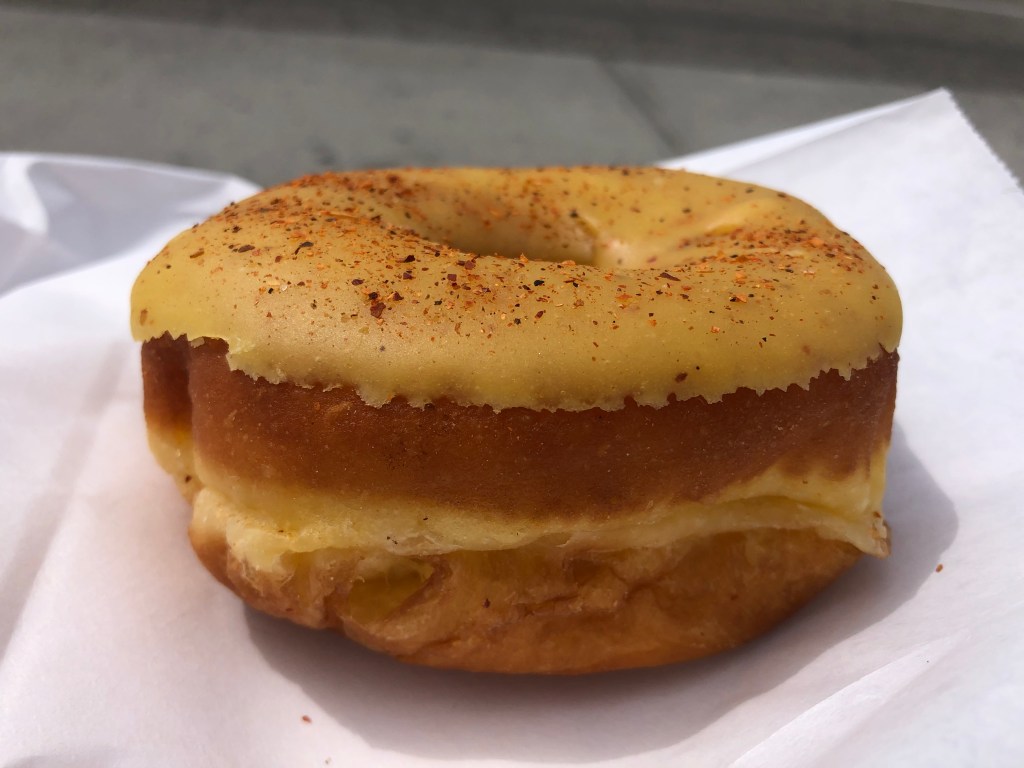
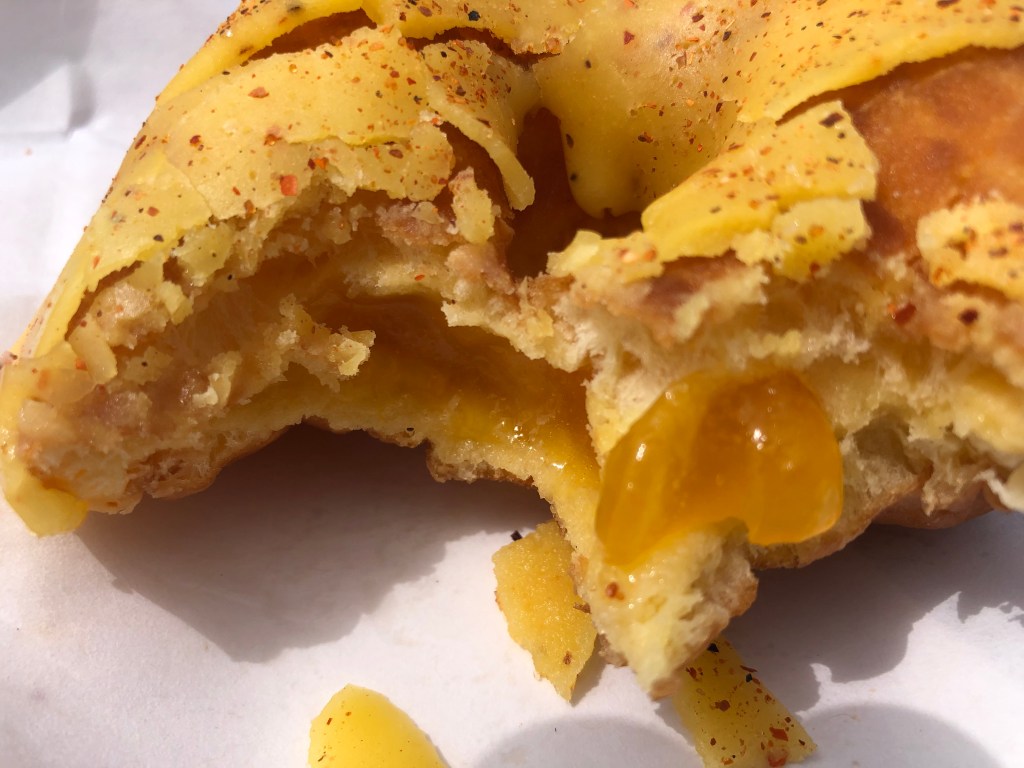
When I got to the front of the line, I asked the kid behind the counter which was their best donut. He smiled broadly: “That’s got to be the mango. We just invented it two days ago, and it’s our best seller!” Now this is the enthusiasm I was looking for. Hook me up, said I. And behold — this was no ordinary donut. In fact, it was more like a pastry (and with a $2.75 price to match).
Good enough to make a mango off his diet.
The first thing you notice biting into this “donut” is the heavy mango glaze. It cracked into pieces as I took the first bite, showering my lap with mango-icing shards. The next thing you notice is an overly-sweet, gooey mango filling, like the stuff they used to put in Hostess Pies when I was a lad. The third thing you notice is that the overall effect is rich and flavorful and robust; you’re overwhelmed with flavor and mouthfeel.
No mangoes were harmed in the making of this donut
Then, a moment later, you feel sick. I suppose I shouldn’t have eaten the whole thing, especially after already eating two glazed donuts just a short time earlier. But this thing is just too much. It’s too filling, and too gooey, and too sweet. And it’s two points (out of 10).
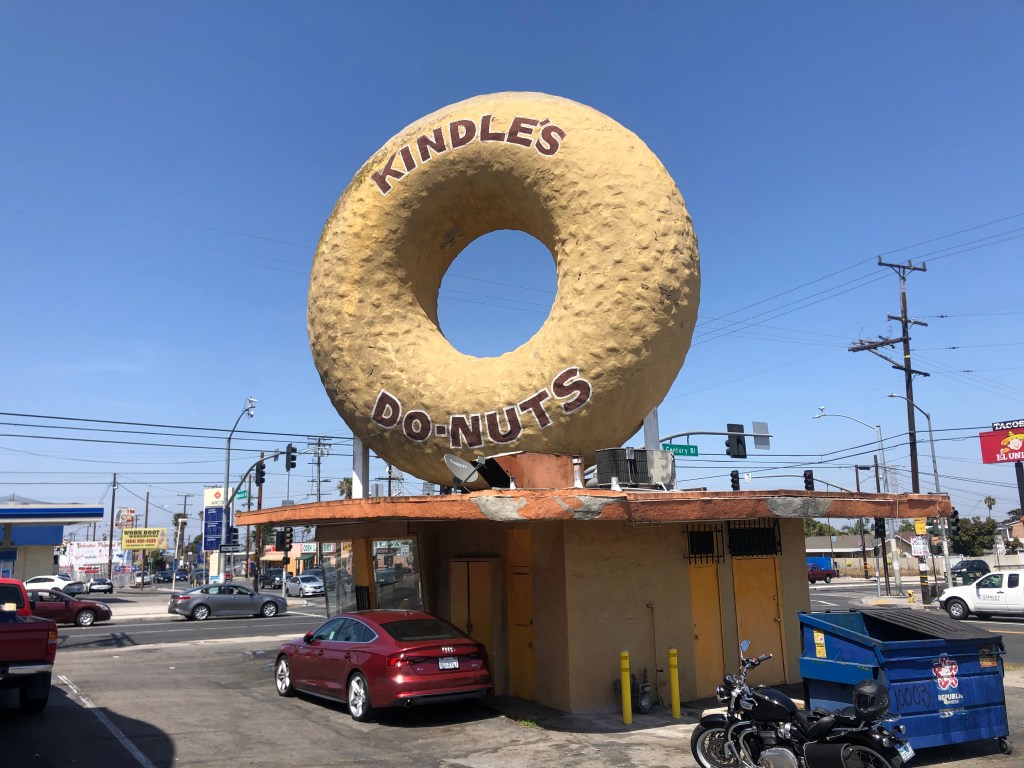
But I still had one more of the extant Big Donut Drive-Ins to visit: Kindle’s Do-nuts (note the hyphen) is the first of the 10 Big Donut Drive-Ins constructed by Wendell. It dates back to 1950, and, like most 71-year-olds, is showing some battle scars.
Before Amazon appropriated the Kindle name
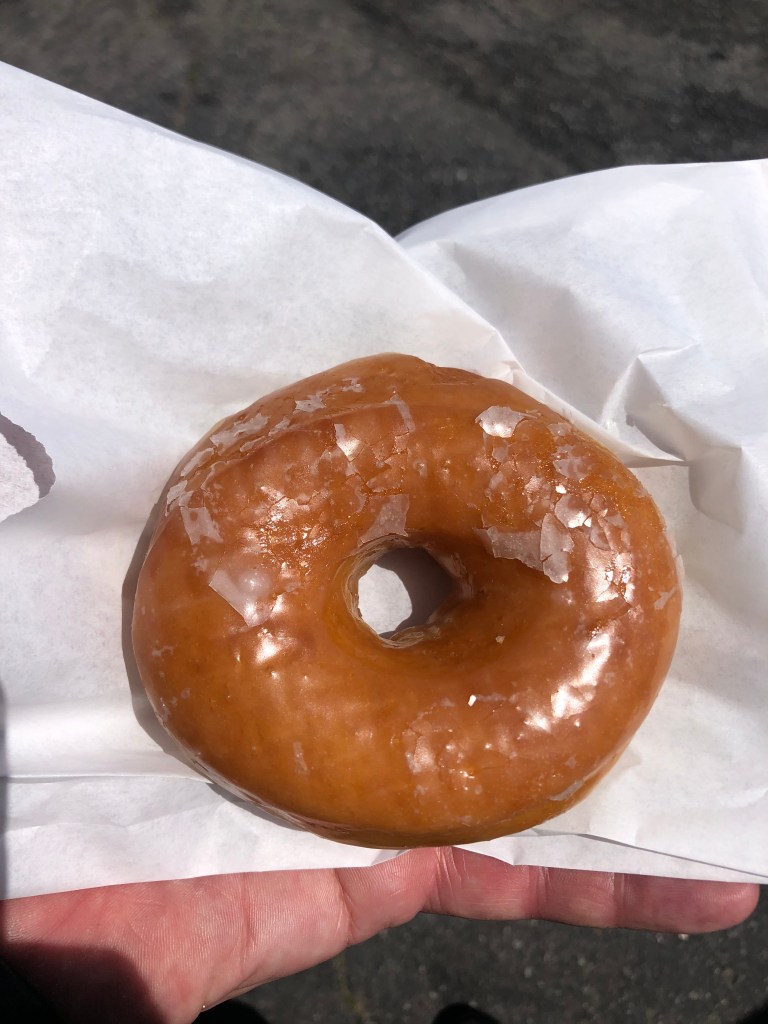
At Kindle’s I was again served by the establishment’s owner, who told me he’s owned the place for 30 years. “And which donut is the best?”, I asked. “Glazed. Hands down.” Now, I’m starting to think that glazed must be the wagyu beef of donuts, like you’re a fool to pick anything else. “OK, give me a glazed, Mac,” I said, trying to sound like an in-the-know donut aficionado.
A Kindle’s on a paperwhite
With two other glazed donuts (literally) under my belt, I felt qualified to critique this specimen. It wasn’t stellar. The glaze was applied a little unevenly, and it was a little too sweet. The ring itself seemed a bit stale, though the flavor was solid. I’ll give it a 5. Actually, let’s make it six, because my donut fatigue might be unnaturally lowering the scores.
So, the winner is Dale’s Donuts, with a score of 9 out of ten for their glazed donut. But more importantly, I have to commend the owners of all four establishments for retaining those iconic, 32-foot donuts. They’re preserving a little slice of LA history, and even architecturally tying together some disparate corners of the region. I recommend you check one or all of them out next time you’re in the area!
BONUS MATERIAL
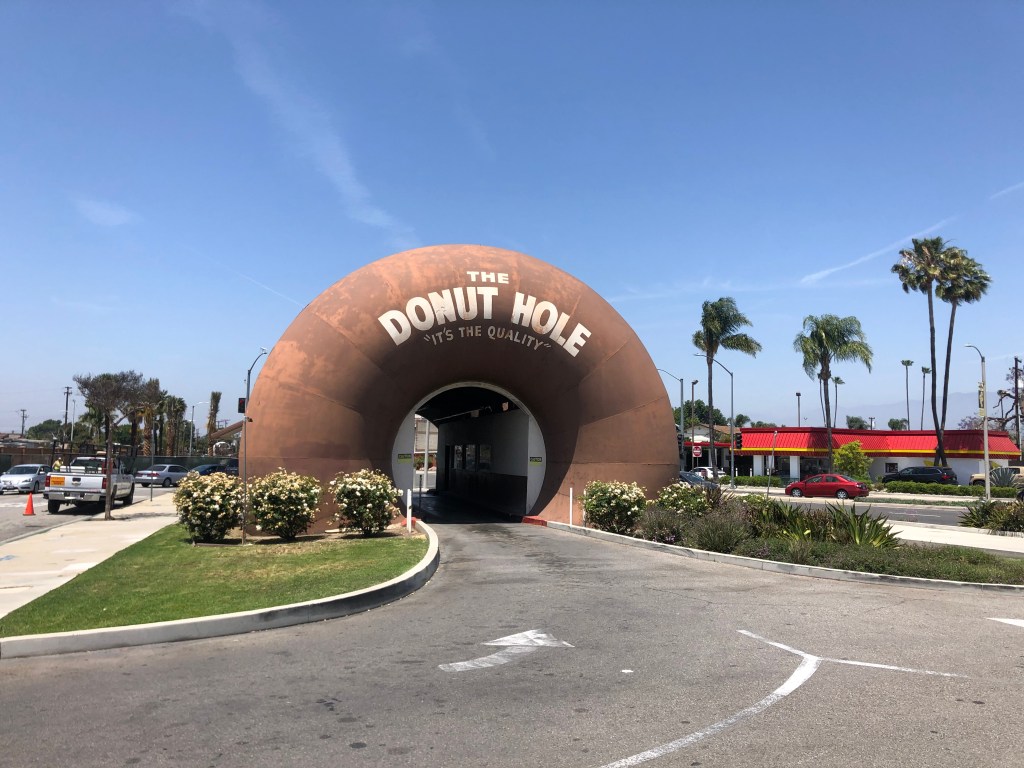
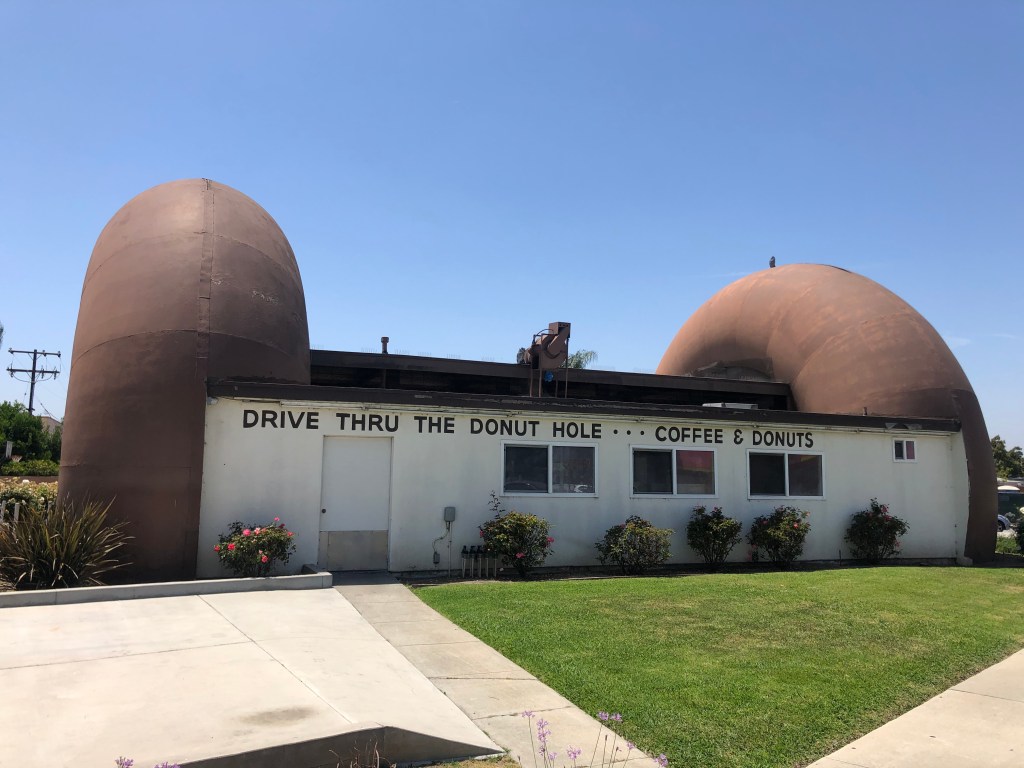
After I’d visited the four remaining Big Donut Drive Ins, there were still a few fat cells in my body that had not yet exploded from an infusion of donut calories. So to remedy this, I headed out to La Puente to visit a place called The Donut Hole. The Donut Hole is not one of Wendell’s original Big Donut Drive Ins, but it does have a giant donut incorporated into the architecture. In fact, it has two giant donuts. Behold:
Abandon hope all ye who enter hereSide view–donuts at the front and rear. If yo’u’ll pardon the expression.
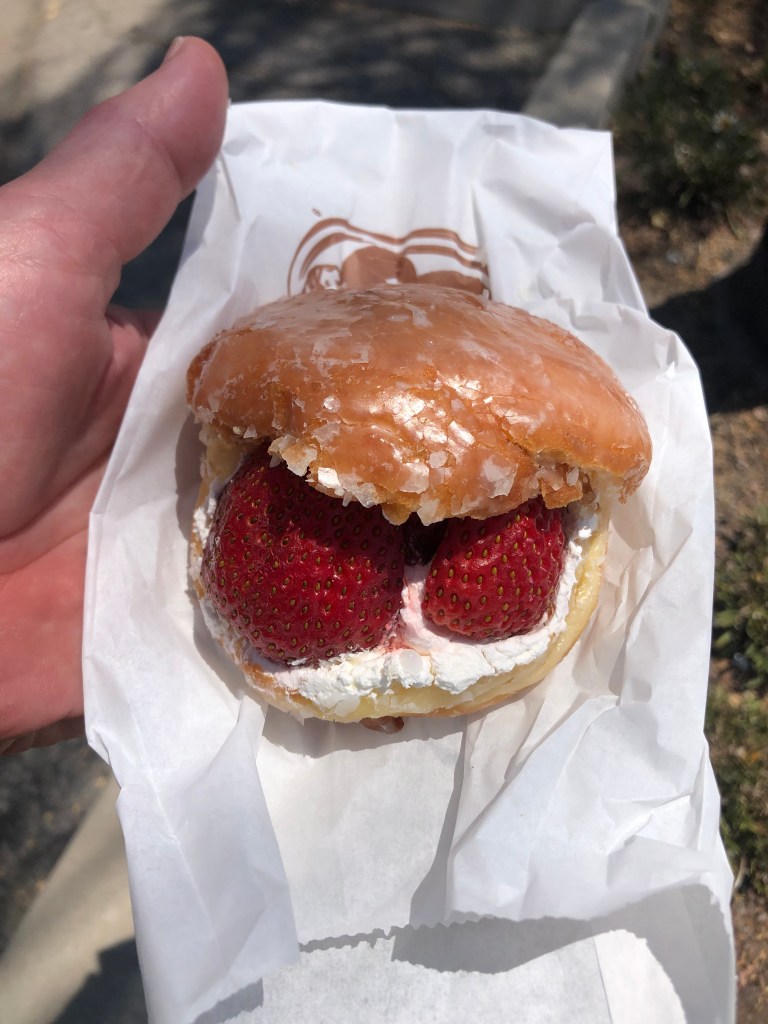
Unlike the Big Donut Drive Ins, this donut place doesn’t have a walk-up window. So I rode my motorcycle through one of the giant donuts. (Has that sentence ever been written before?) And I asked the young lady: Which is the best donut? “They’re all the best!” she said, cheerily. OK, which is your favorite?, I asked. “That would be the fresh strawberry donut. I love it!” Sold, said I.
Trigger warning.
Yikes. Now, on the plus said, it really does have whole, fresh strawberries. They’re nestled in fresh whipped cream. The overall effect is sort of like strawberry shortcake, but instead of shortcake, there’s a cloyingly sweet donut split like a hamburger bun. The first bite was wonderful. The sweetness of the donut and the whipped cream is balanced (a bit) with the (relative) tang of the strawberries. And the different textures worked together as well. The whole ensemble tasted fresh and flavorful.
And I learned my lesson after the mango disaster. I forced myself not to eat the whole thing. Just two bites — that’s all I had.
But next time, I’m going to The Donut Hole first, on an empty stomach.
Some years ago, my replacement unit (son Ian) and I drove the entire length of Route 66, from Chicago to Santa Monica. As the reader no doubt knows, Route 66 was one of this country’s first highways, dating back to 1926. It also had been the main way to get to southern California from points east, starting with the dust bowl migration and extending to the car culture of the 1950s and 1960s. Just one or two lanes in each direction, the road has an unhurried and scenic charm. Alas, as depicted in the movie “Cars,” Route 66 was eventually bypassed by various interstates, and the towns and businesses along the old Route slowly declined and eventually dried up. When Ian and I took our trip, we saw plenty of derelict buildings on the side of the road: motels, gas stations, diners, and the like. I suspect that many of those old landmarks that we saw over a decade ago are now gone.
Anyway, Route 66 has always occupied a soft spot in my heart, so I was inspired when my good friend Detlef recommended that I explore an old segment of Route 66 that crosses Cajon Pass (where one crosses from the Mojave Desert to the LA Basin. Or vice versa.) Now, when Ian and I drove Route 66, we didn’t drive on much of this particular segment, because it had been blocked by Interstate 15 in the 1970s. However, a few years ago, the good people of CalTrans redesigned the freeway and reconnected the discontiguous parts of old Route 66 over the pass.
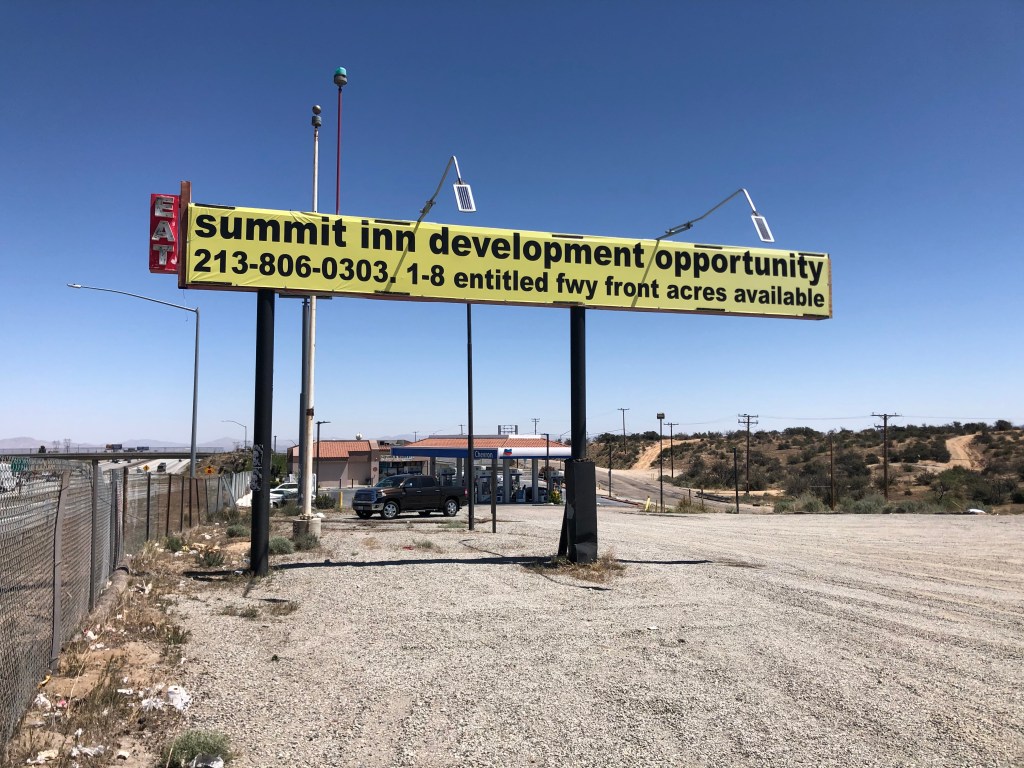
I began today’s tour at the Cajon Summit (approx. 4000 feet above sea level). For over half a century, the Summit Inn stood as a well-known landmark here. The owner, Cecil Stevens, finally sold the place in 2016, and a few months later the structure was destroyed by the “Blue Cut Fire” that ravaged much of the area. Timing is everything. Sadly, Cecil died of Covid just a couple of months ago (February 5). He was 88.
Glory DaysAnyone want to go in with me?On the site of the old Summit Inn. I have no idea what this is.
Now, the first part of Route 66 over the pass has been overlaid with Interstate 15. That’s not especially interesting. But you can take an old, rickety, rutted dirt road that had been used as a “shortcut” by motorists in the early years. This dirt road began as a wagon trail called the John Brown Toll Road. It was constructed in 1861–just as the Civil War was erupting. So I set out on this old original road.
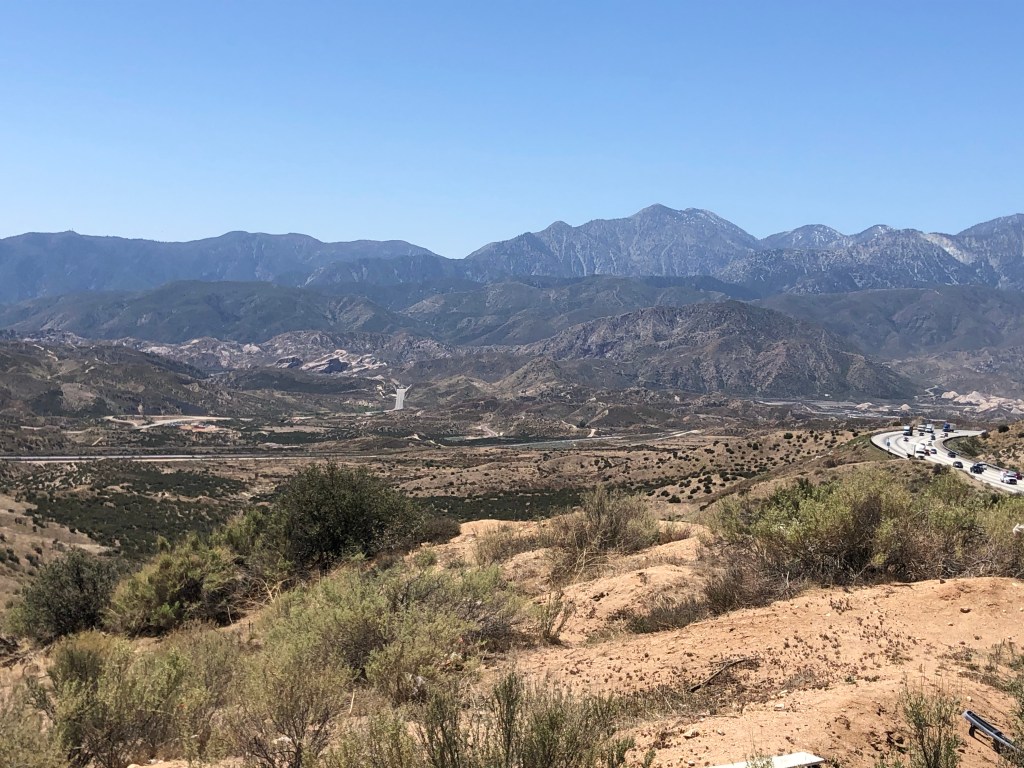
…but the old dirt road begins!View of Cajon Pass from John Brown Toll Road. Note I-15 to the right.
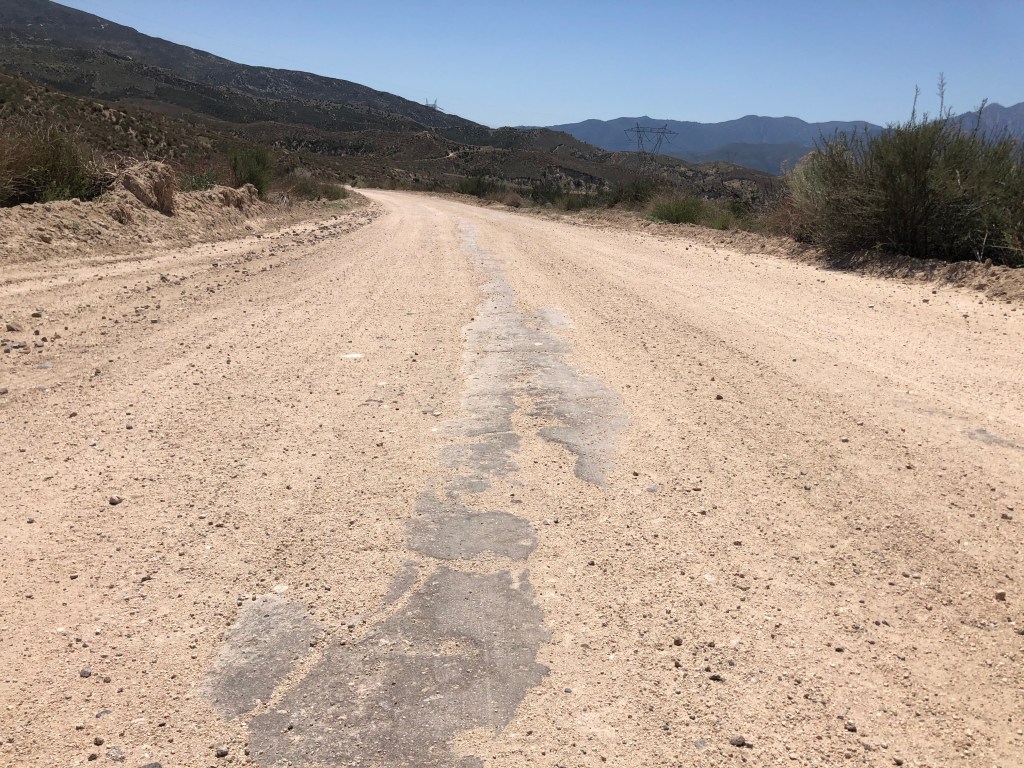
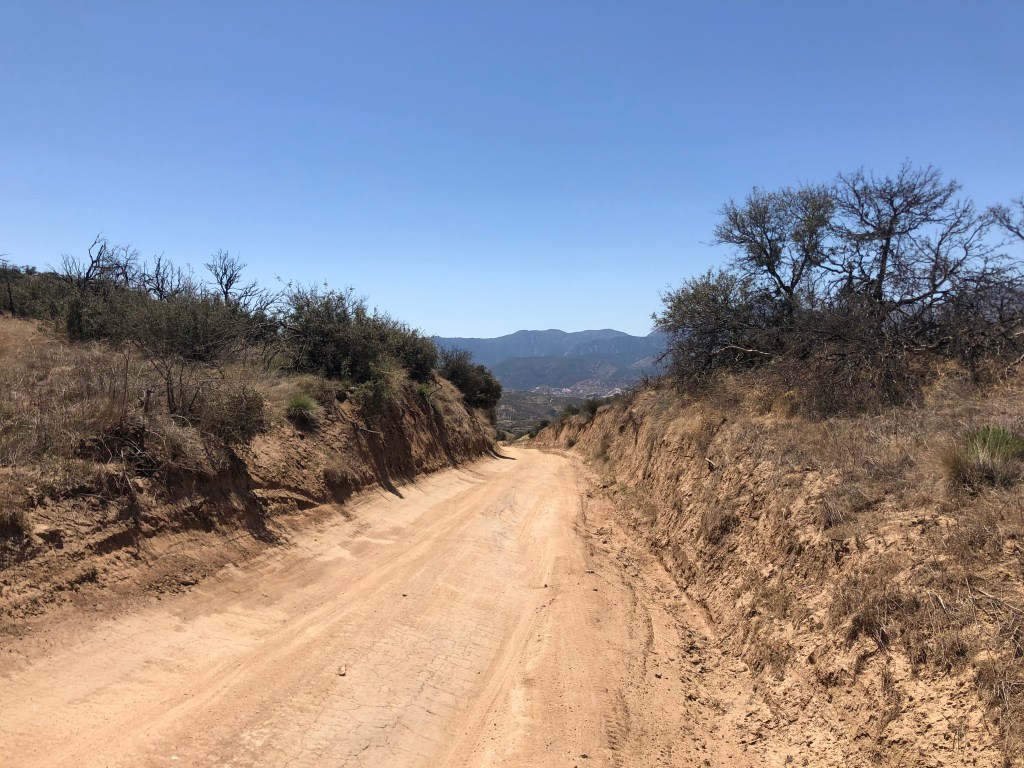
One wonders why this rutted, twisting road was ever considered a “shortcut” for Route 66. My understanding is that it used to be in better shape, and it even received pavement in 1914, but it’s narrow and steep and twisting. I was cruising along at about 5 mph.
Remnants of 1914 pavement.This cut originally was dug by hand in 1861!
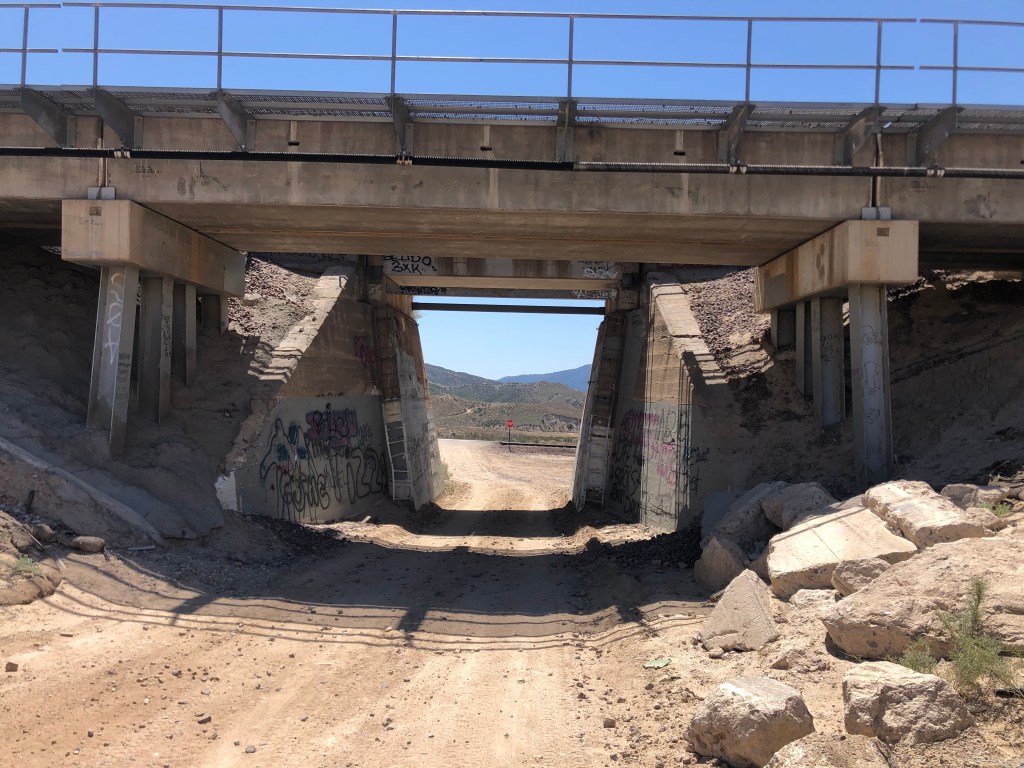
Now, there’s one thing you should know about Cajon Pass: It’s a Mecca for railroad enthusiasts. The railroad first crossed the pass in 1885, and today over 150 trains can pass through in a single day. As I made my way down the John Brown Toll Road, I encountered four sets of tracks, including a trip under these tracks from 1915.
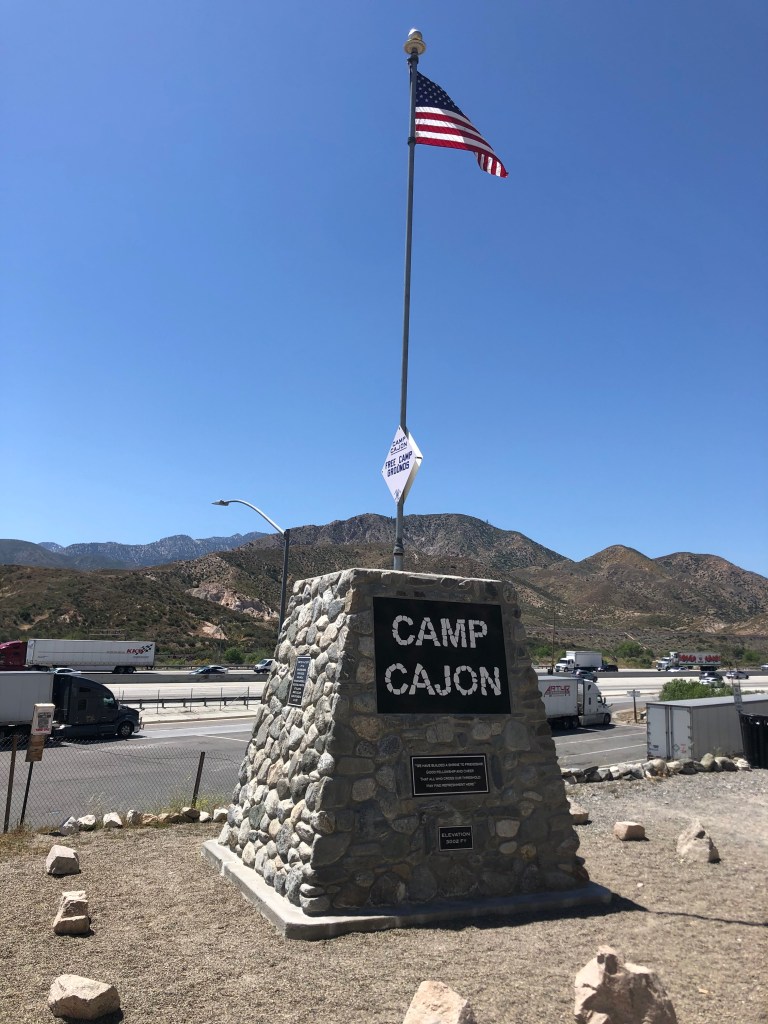
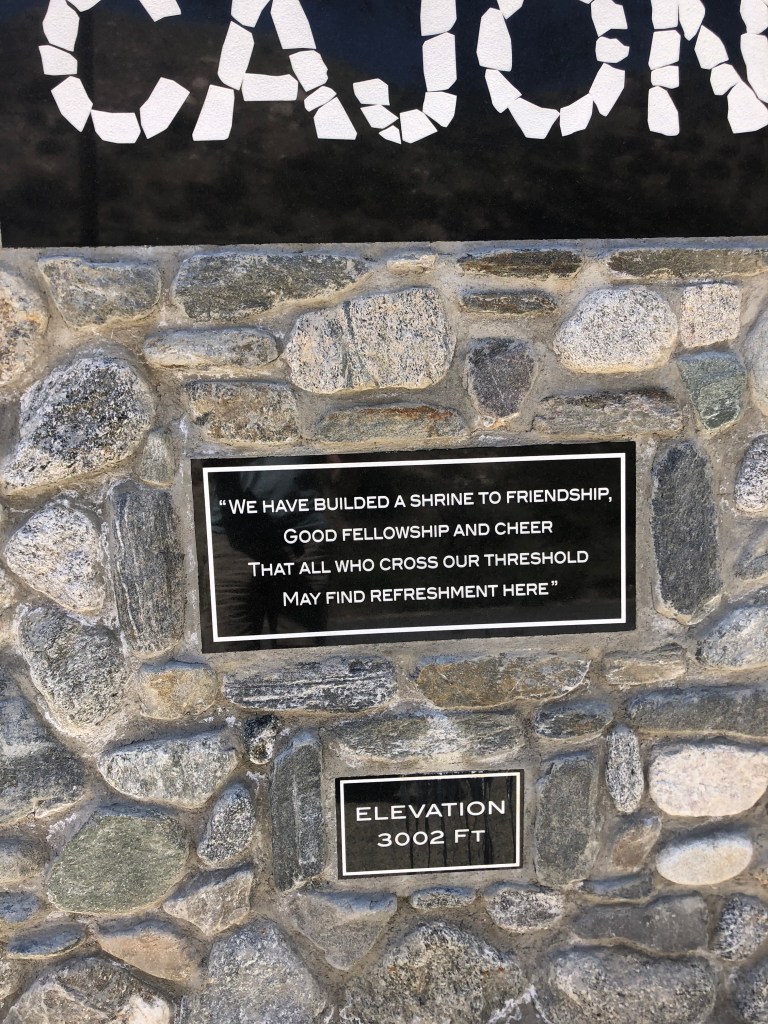
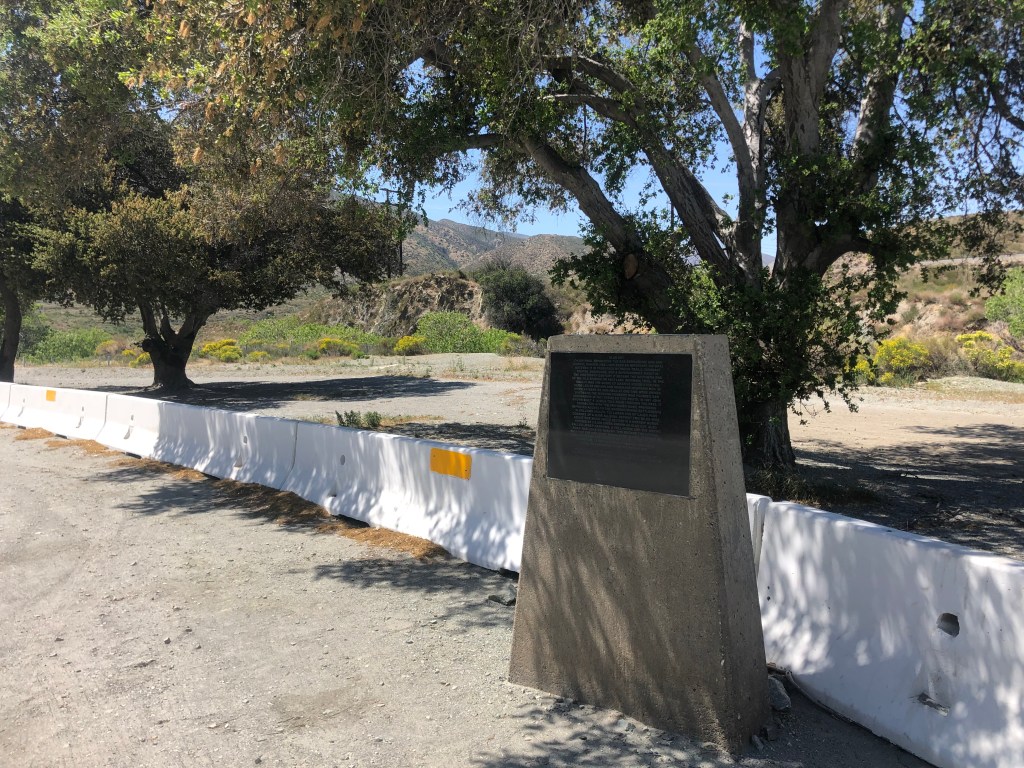
Eventually the John Brown Toll Road reconnects with the old Route 66 proper. At this location, there are several notable markers. One commemorates Camp Cajon, which was a popular resting spot, with various facilities, for travelers coming over the pass. It was developed in 1919, but was destroyed by a flood in 1938.
“We have builded”??
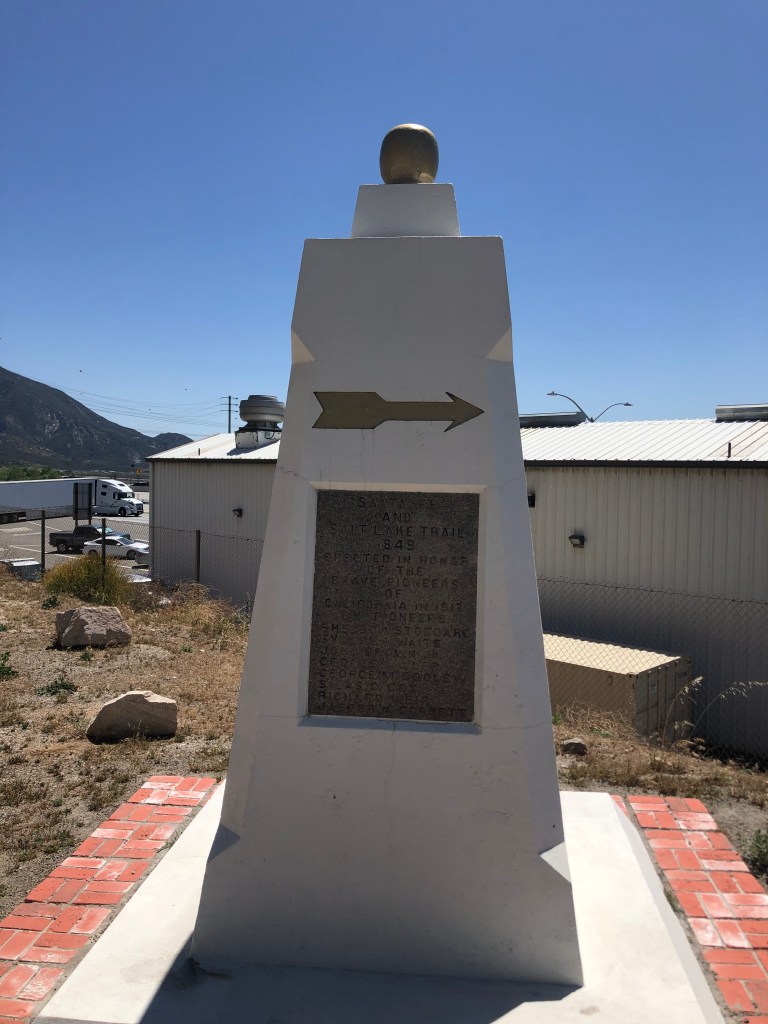
Another marker identifies this spot as the junction of the Santa Fe Trail and the Salt Lake Trail. It honors “the brave pioneers of California,” and was erected in 1917 by a group of eight pioneers. Notably, one of these pioneers in John Brown (of the Wagon Toll Road, which I’d just come down). Two others (Sheldon Stoddard and Sydney Waite) had been members of the “Lost 49ers” through Death Valley. Coincidentally, I’ve run into this group on two earlier trips: Death Valley and, more recently, Walker Pass. These three individuals, along with the other five who sponsored the monument, were all present at the dedication ceremony in 1917.
Monument “to the brave pioneers of California.”
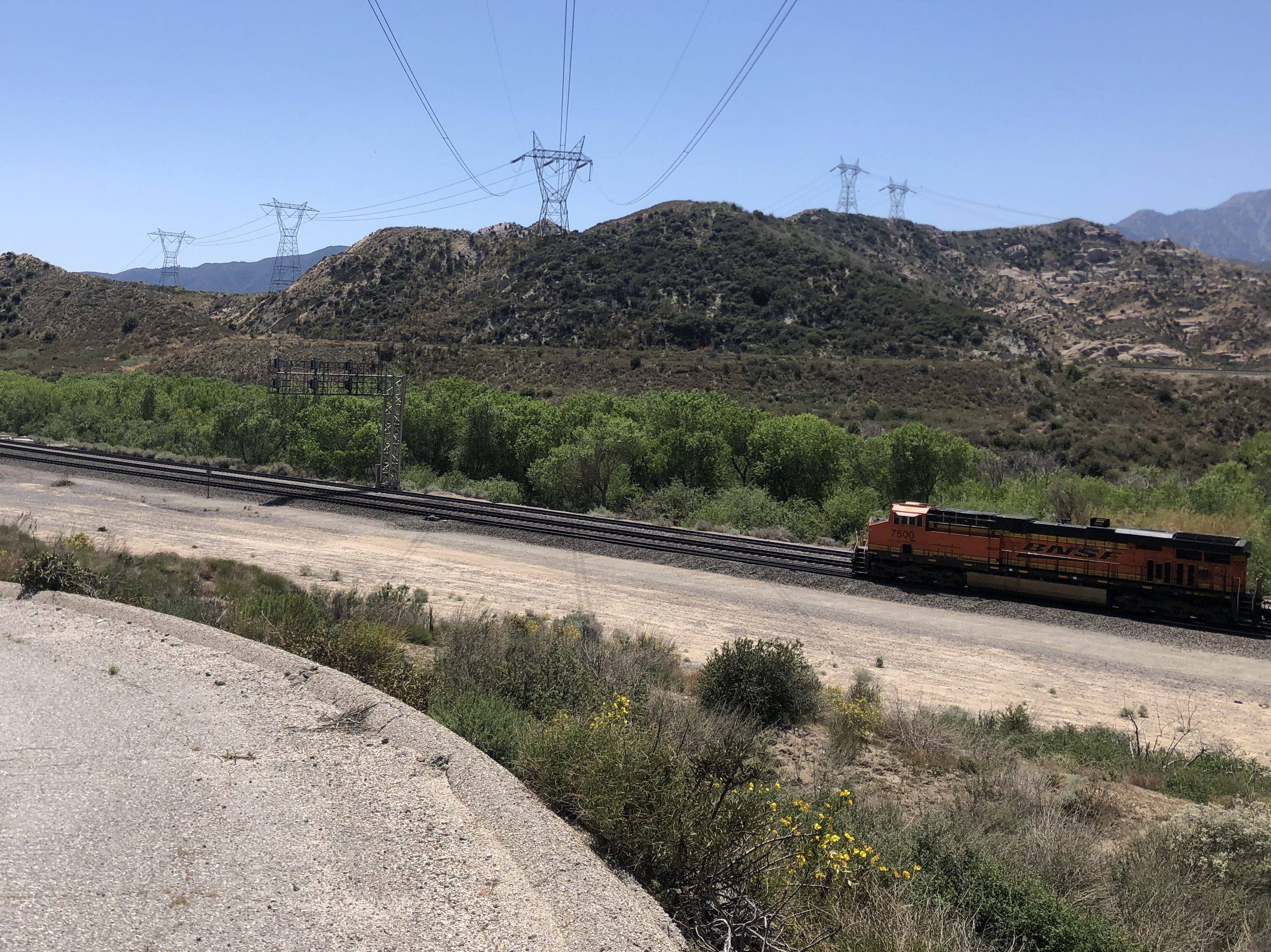
It was now time to get onto Route 66 proper. This segment parallels the modern Interstate 15. Now, as I mentioned, this is railroad country, and much of this road also parallels the old railroad line:
…or are you just happy to see me?
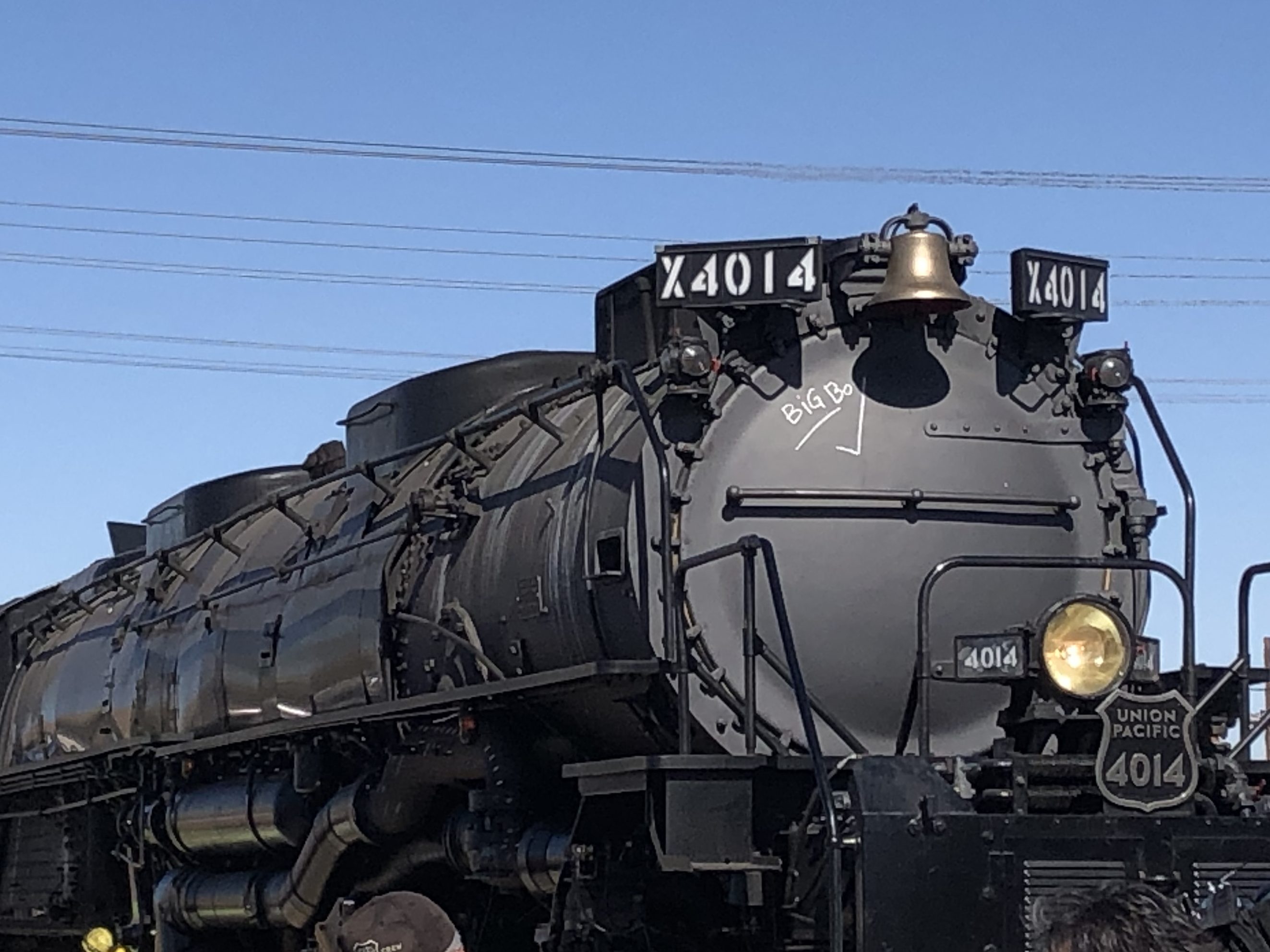
It struck me that this is the same segment of road where I’d camped out for over an hour, waiting for the Union Pacific’s restored “Big Boy” steam locomotive to come through in the fall of 2019. You can see my blog post about that event here.
The Big Boy on its way to through Cajon Pass in 2019.
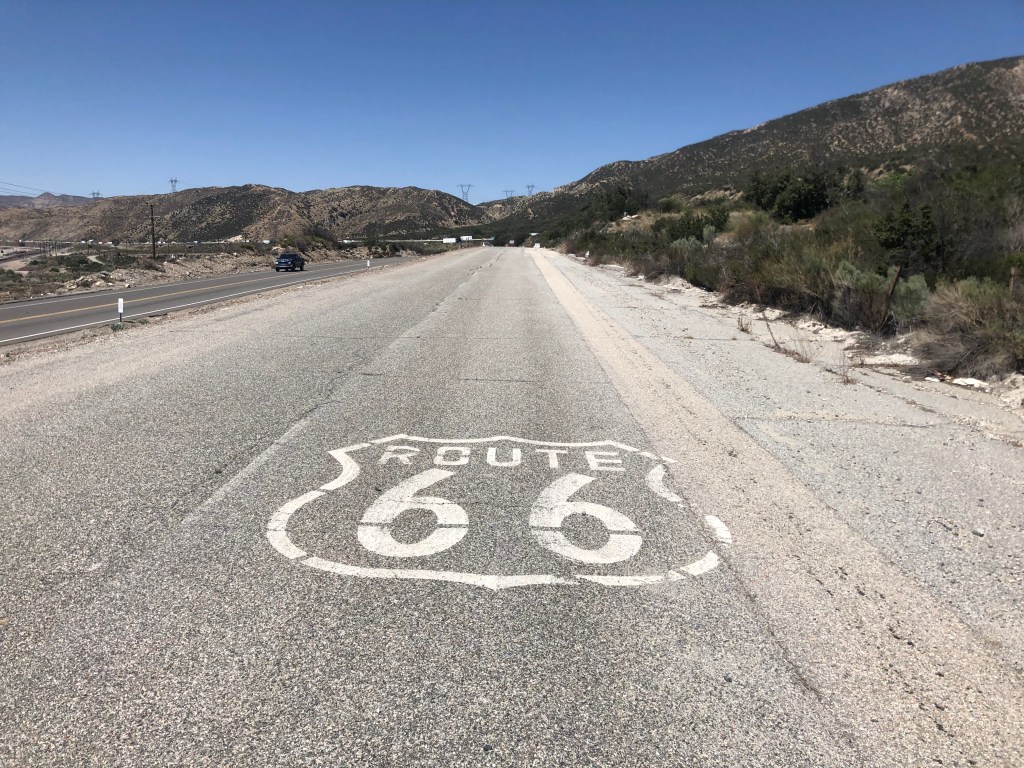
What’s especially cool about this stretch of Route 66 is the good people at CalTrans have repaved the southbound lanes of the old road, and made them into a comfortable two-way road. Meanwhile, they’ve left the northbound lanes of Route 66 unrestored, with periodic K-rail barriers to prevent people from traveling along it, thus preserving it as an artifact. There are even some of the old, painted “Route 66” shields still extant on the original roadbed.
Original roadbed.
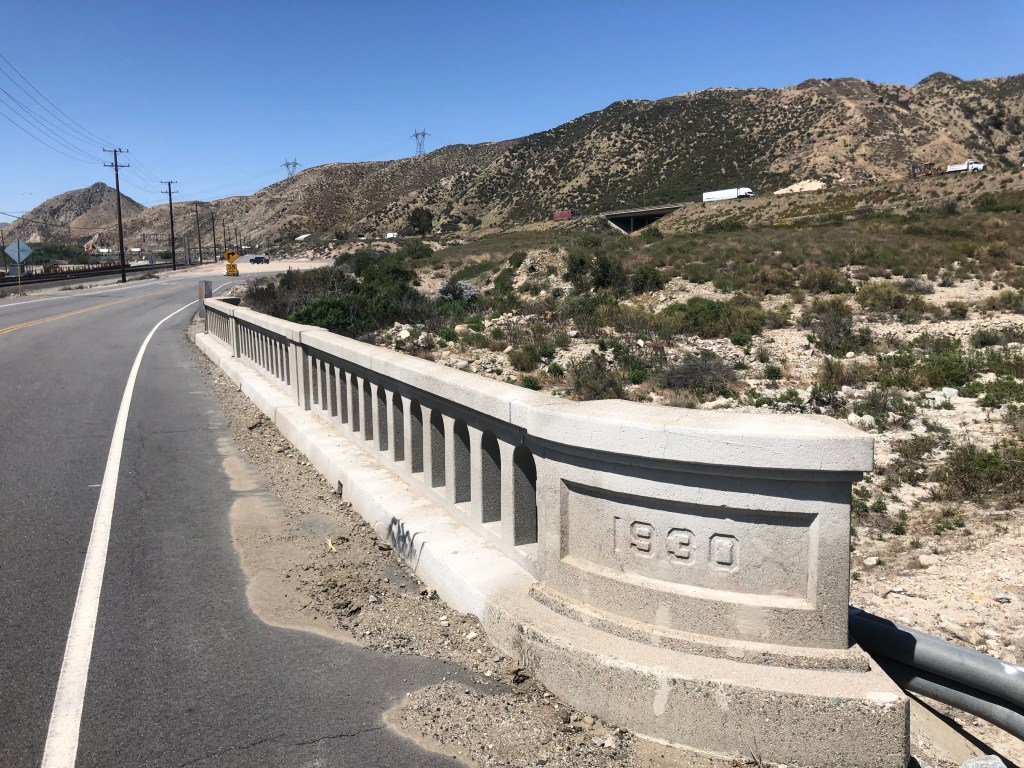
Also, some of the bridges from the early days are still in place, with their year of construction stamped in concrete:
From the Herbert Hoover administration.
A bit later I came to an old rest area that had been constructed in 1952. All that remains are some pavement markings and a memorial plaque.
Marker notes, among other things, that the tollhouse for the John Brown Toll Road was nearby.
Incidentally, this location sits on the San Andreas Fault, where the Pacific Plate and the North American Plate meet. In fact, it was the San Andreas Fault that created Cajon Pass in the first place.
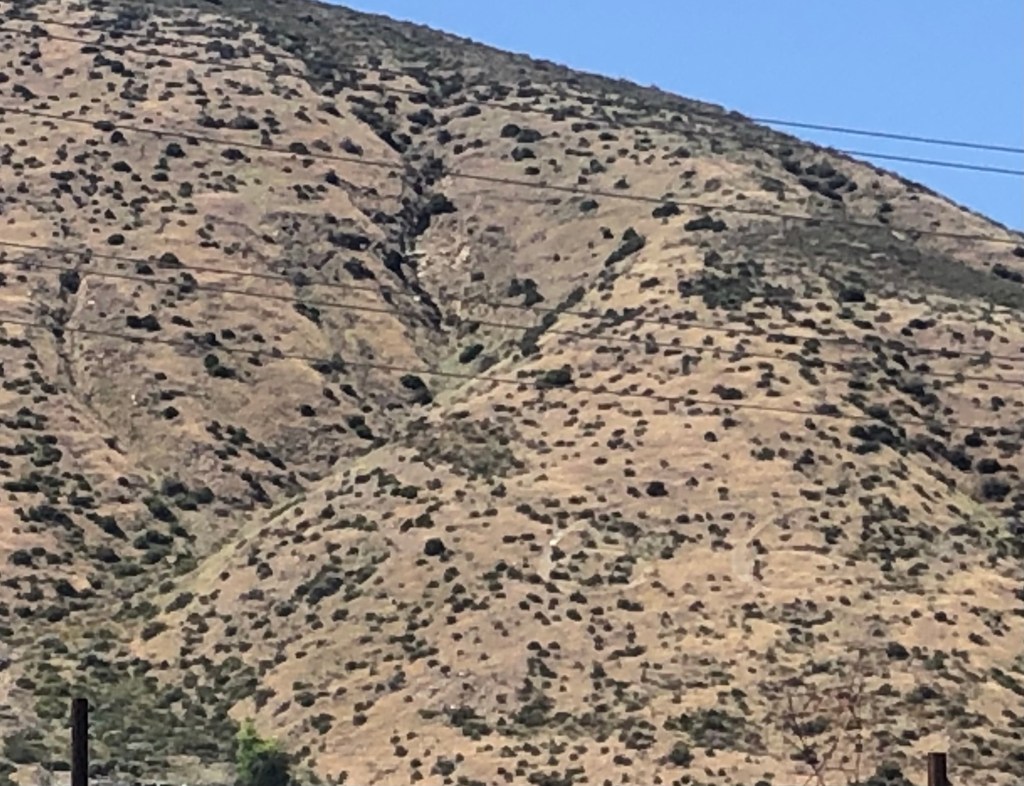
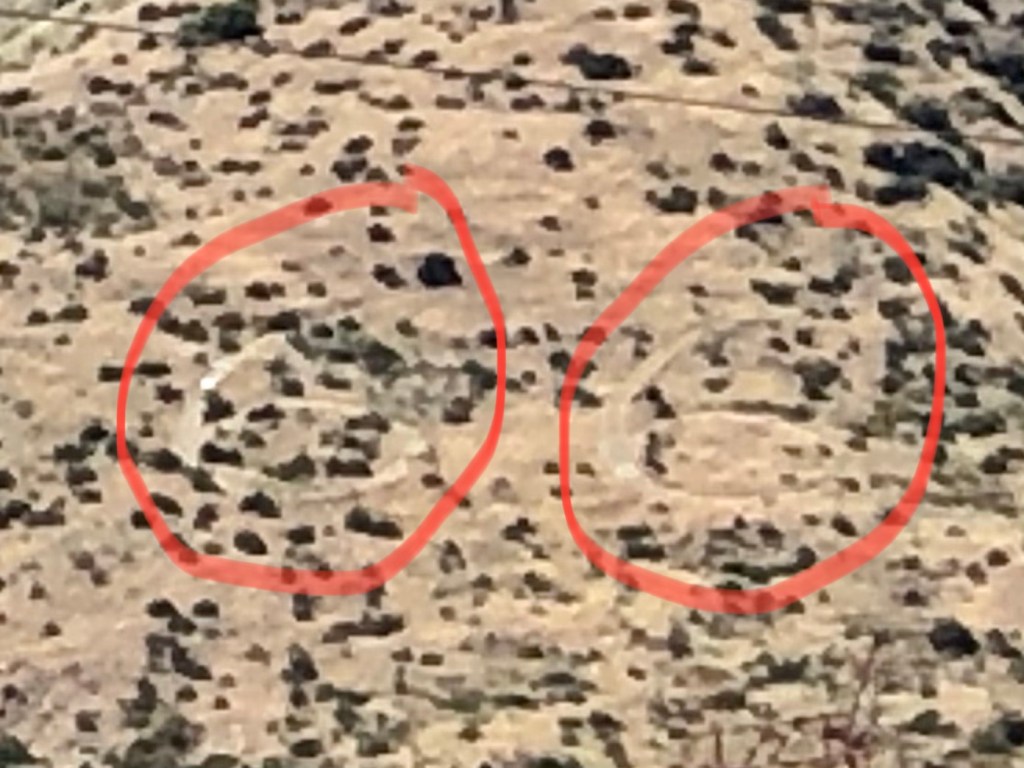
On a hillside next to the road I saw the faintly visible number “66” somehow carved into the earth. I can’t find any information about who did this and when. Tips are welcome!
Can you see it?
Now, let me explain that on my drive from LA to the Pass I was listening to a podcast called “Stuff You Should Know.” (If you’re not already familiar with it I’d recommend it to you.) At the end of the podcast, the hosts always read a letter from a listener. In today’s episode they read a letter they received from the great-great-great niece of one Helen Boss, who caused the car accident in which Sammy Davis Jr. lost his eye in 1954. You can listen to the podcast here (listener mail starts at 59:40).
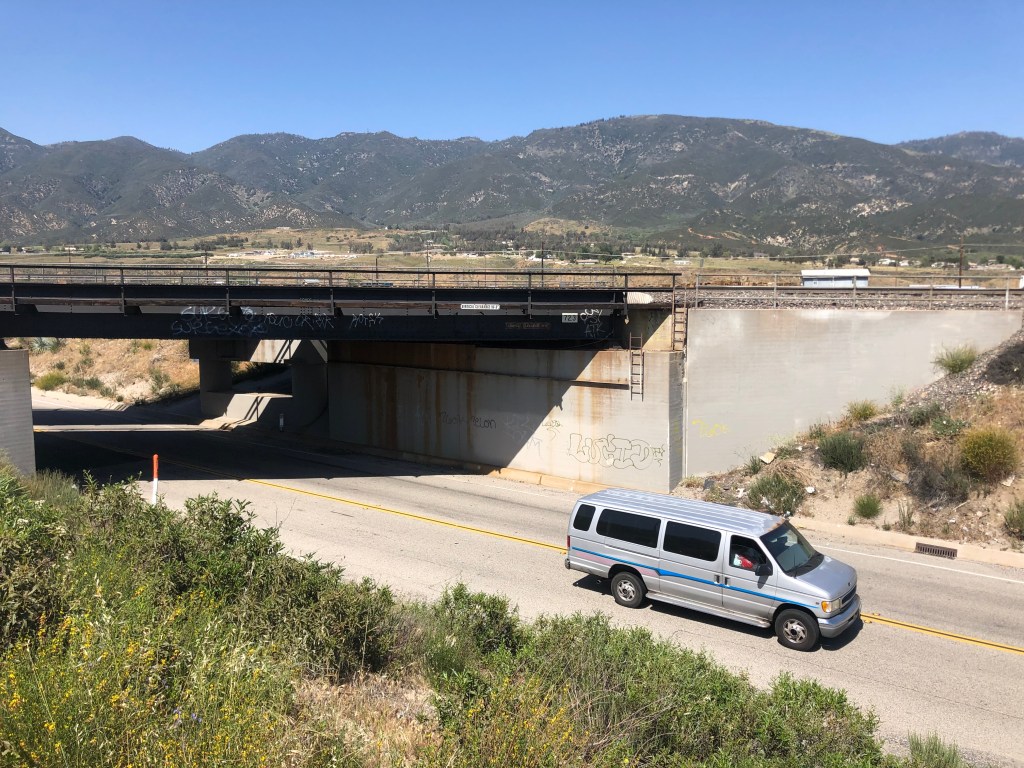
So imagine my surprise when, shortly after listening to that podcast, I found myself passing the exact place on Route 66 where Sammy’s accident occurred. I’m not making this up. The accident happened where the road passes under a railroad track. Evidently the 72-year-old Mrs Boss had missed her exit, and decided to back up in the early morning gloom. Sammy rear ended her and lost his left eye in the accident. Fortunately, no one was killed.
Where Sammy and Helen met.
Before long Route 66 completes its journey through Cajon Pass, and it enters the city of San Bernardino. At this point, almost no remnants of the old road and infrastructure remain. So I decided to jump back onto the interstate to head back home. But it’s worth noting that some other stretches of the original Route 66, along with some roadside structures, still exist on its final leg westward toward Santa Monica, on a road now named Foothill Boulevard. I drove that stretch a few years ago, and will assemble the photos into a blog entry at a later time.
So there you have it: A good stretch of the original Route 66 can still be driven over the Cajon Pass, bypassing the soulless and numbing Interstate. Thanks to Detlef for calling this to my attention!
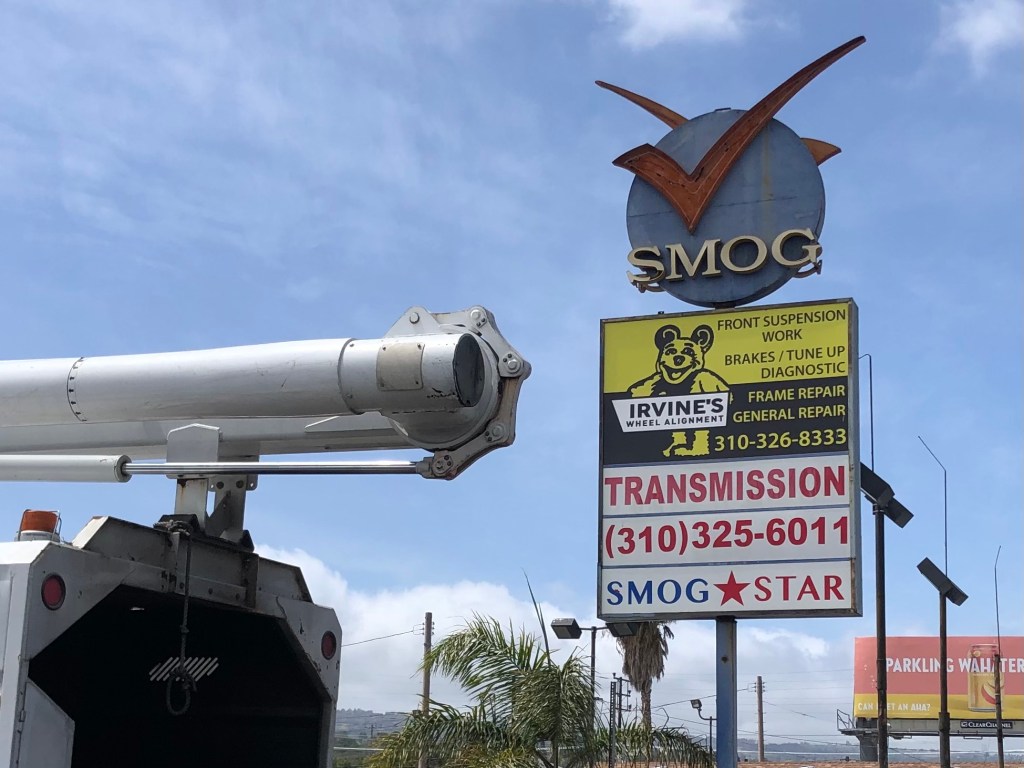
You’ll recall that about a month ago I posted a number of photos of the surviving “Laughing Bear” signs that advertised auto repair facilities whose mechanics were trained by Bear Manufacturing. I shared photos of these iconic signs that I’d encountered near my home. Well, today I came across another one: Irvine’s wheel alignment in Harbor City, CA.
My question is: Does the uppermost sign say “check smog”?
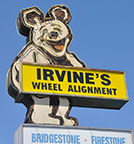
Word on the street (literally) is that this is not an original sign. The business is said to begun in the 1950s or 1960s, when they had a more traditional sign (see photo below). The new sign appeared within the last decade.
The original Irvine’s sign, now lost to history. (Photo courtesy of RoadsideArchicture.com.)
Please keep your eyes peeled for more such signs, and send me your photos!
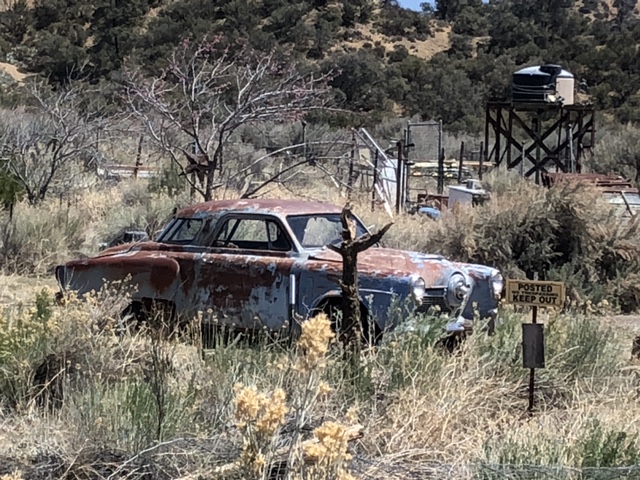
Out of the thousands of entries (well, more like a dozen) for our “Identify that rusted old car in a field” contest, we had one correct answer. To jog your memory, here is said vehicle, on the side of State Route 33 near Maricopa:
I did not give you any hints about this vehicle’s identity, but if I were to have given you one, I would have mentioned Fozzie’s car in The Muppet Movie:
So now, it all must be coming back to you. You’re hitting your head and saying “Oh, right! Of course! It’s a 1951 Studebaker Commander!”
Well, Ron Postrel knew it immediately, and he’s the winner of this contest, which earns him the remainder of my blue Peeps marshmallow abominations that I received for Easter.
Ron actually pegged the car as a 1951 Studebaker Champion. The two models look very similar. The differences primarily lay within their engines, brakes, and interior trim. So, with a rusted hulk in the field like this one, it’s really impossible to tell the difference. So Ron earns the prize.
Honorable mention goes to Peter Detwiler, who immediately identified it as a Studebaker Commander, although he was off by a couple of years. The key to the 1950-51 models was that “bullet nose” front. Here’s a picture of a properly restored model:
Stay tuned for more potentially enriching quizzes like this one!


 Chasing Phantoms