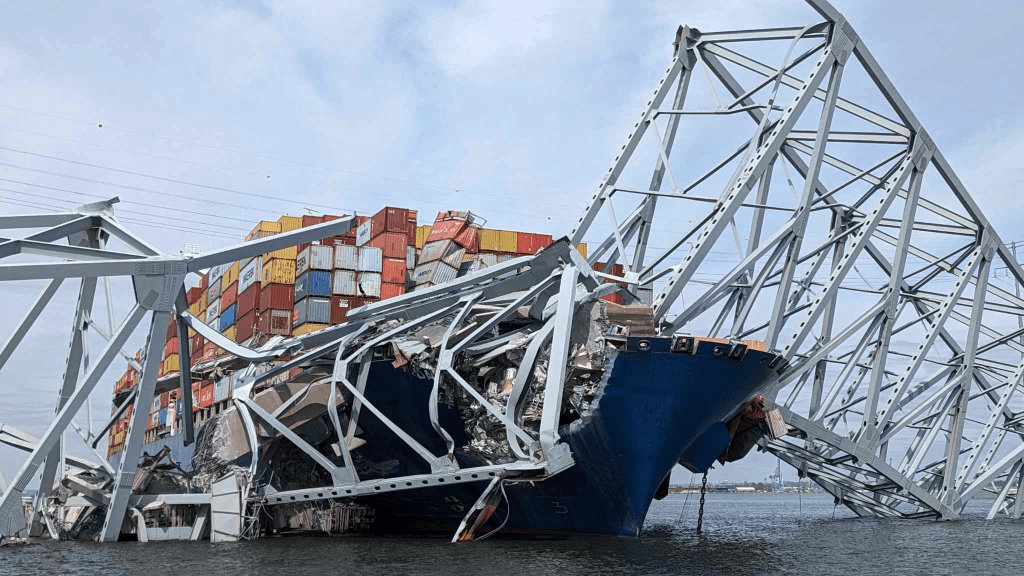
The longer answer is this: Son Ian recommended I take advantage of my proximity to Baltimore (pop: 570,000) and check out the remains of the Francis Scott Key bridge, which collapsed a scant 3 weeks ago. It’s the kind of light-hearted whimsy we Boilards are known for.
The FSK Bridge opened in 1977, and it carried over 11 million vehicles annually until a container ship struck one of its piers last month. Much of the span is now underwater, posing a hazard to ships.
“My bad!”
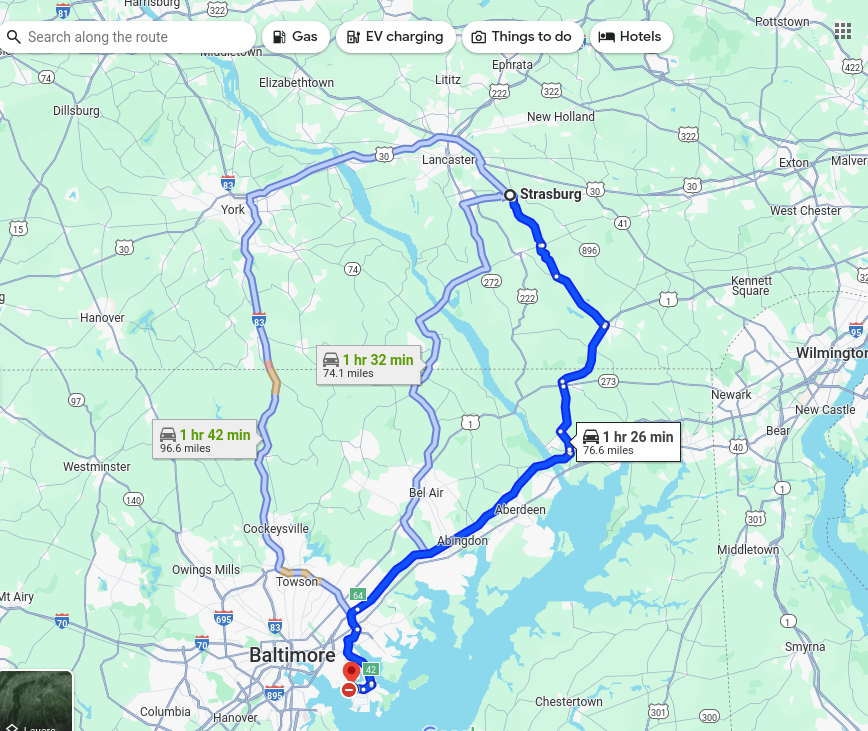
This week the Army Corps of Engineers is supposed to be removing much of that wreckage. It should make for a cool photo op! And according to Google Maps, I was only about an hour and a half from the foot of the bridge.
How hard could it be?
So after getting a cup of coffee and a Power Muffin from The Speckled Hen in Strasburg, I set out for the greater Baltimore area.
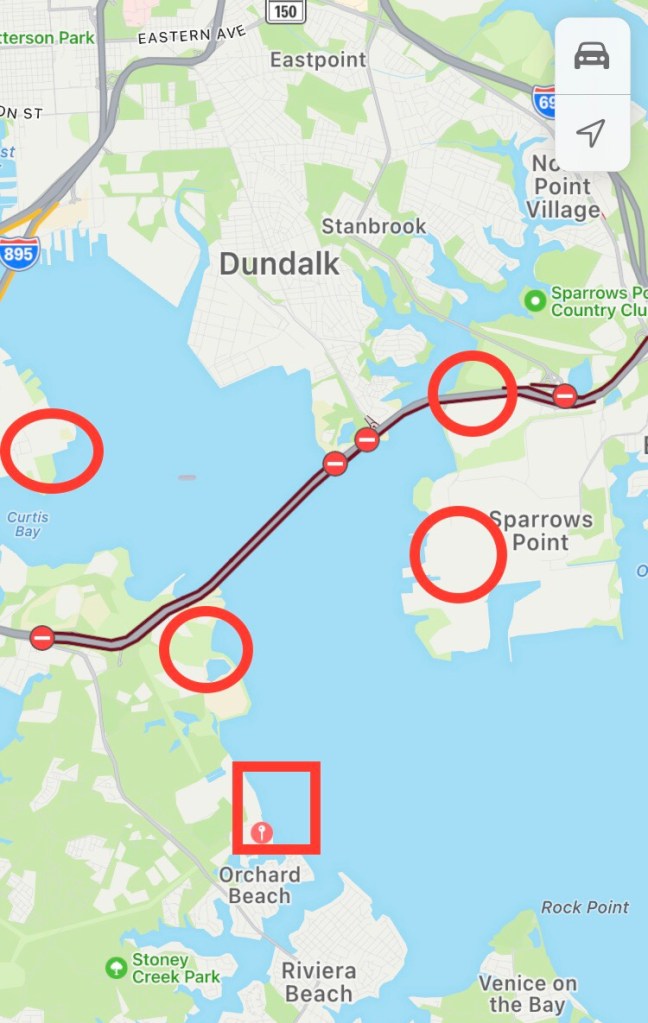
Getting there was easy enough–until the last couple of miles, when I encountered a police roadblock. They weren’t going to let me get anywhere close to the foot of the bridge. I’m not sure what I was expecting. I guess I envisioned a big, Roadrunner-style “Bridge Out” sign on sawhorses a dozen yards from the shore of Boston Harbor.
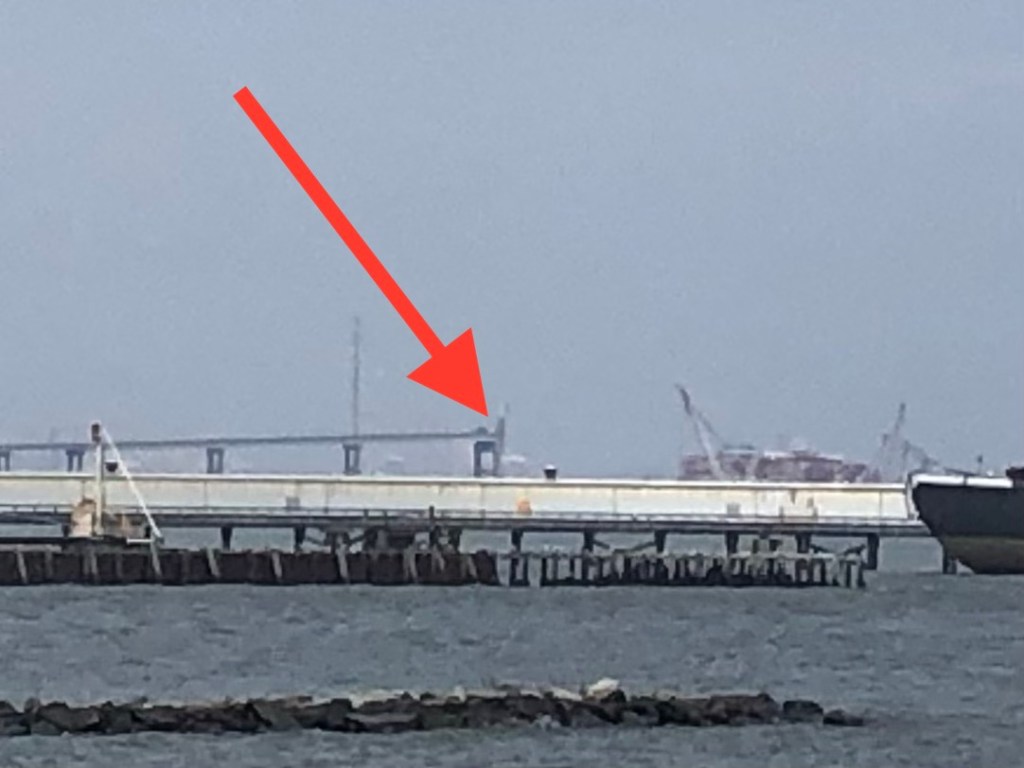
No matter. There’s more than one way to skin a cat. I consulted Google and found a nearby spot that should afford a good view of the salvage operation. Alas, all the property in the area seemed to be a naval base or some other official facility that prohibits visitors. Undeterred, I drove under the harbor through the miraculous Baltimore Harbor Tunnel, and approached the Key bridge from the southern end. More roadblocks. Finally, I headed further south to a private beach community, where through a combination of illegal parking and trespassing I was able to get a decent view of the Francis Scott Key bridge in the distance.
Circles represent my failed attempts to see the bridge; the square is where I finally succeeded.
FSK Bridge in the background, terminating at the head of the arrow.
So, now with that pointless project out of the way, I began a leisurely drive in the direction of Philadelphia.
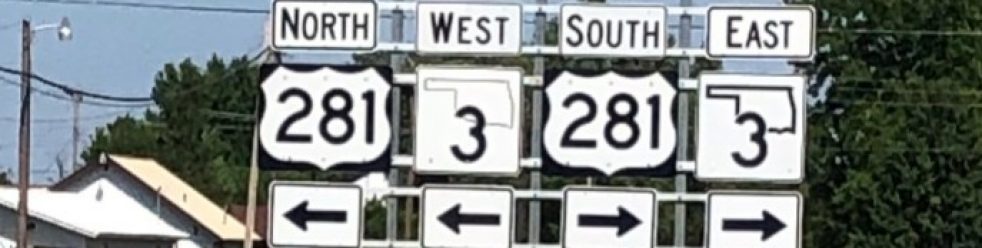
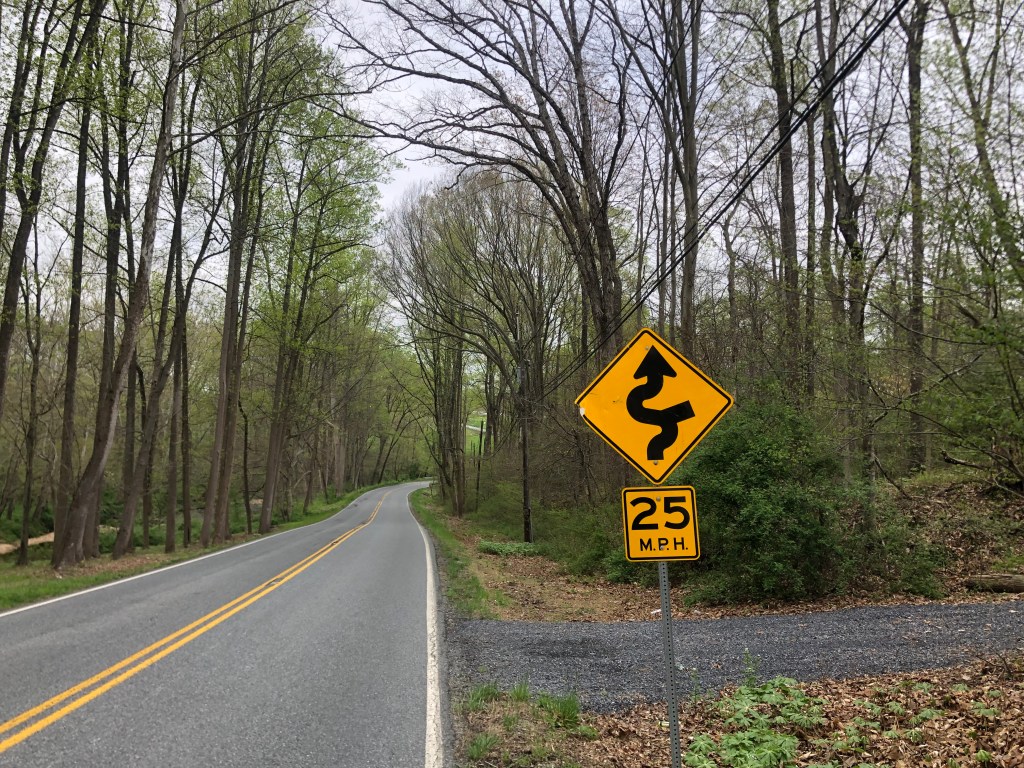
The drive through the Maryland countryside was pleasant and picturesque. The road carved its way through hills dense with trees and other flora. My only complaint is that some of the signage was a bit hard to comprehend at a glance.
Signs like these remind me of the nighttime driving scene in Pee Wee’s Big Adventure. It appears in the following clip, which is only 45 seconds. Note that the guy who uploaded the clip wants to point out you can see a pulley system moving the scenery. But we want to watch the clip just for the signs.
I know just how you feel, Pee Wee.
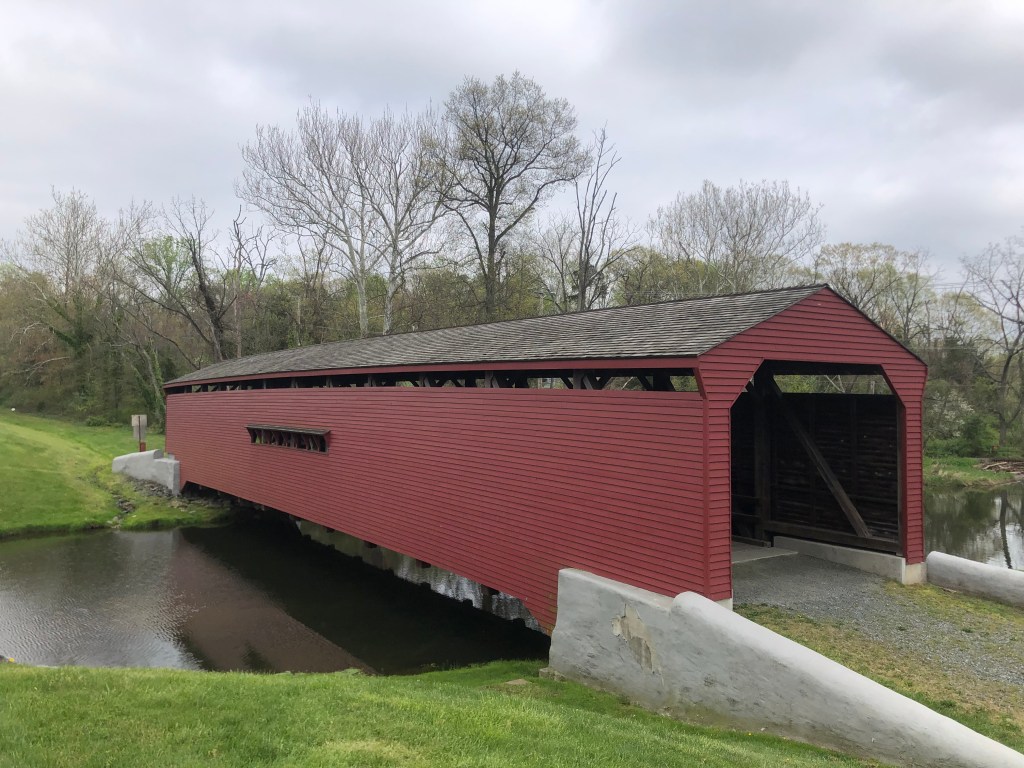
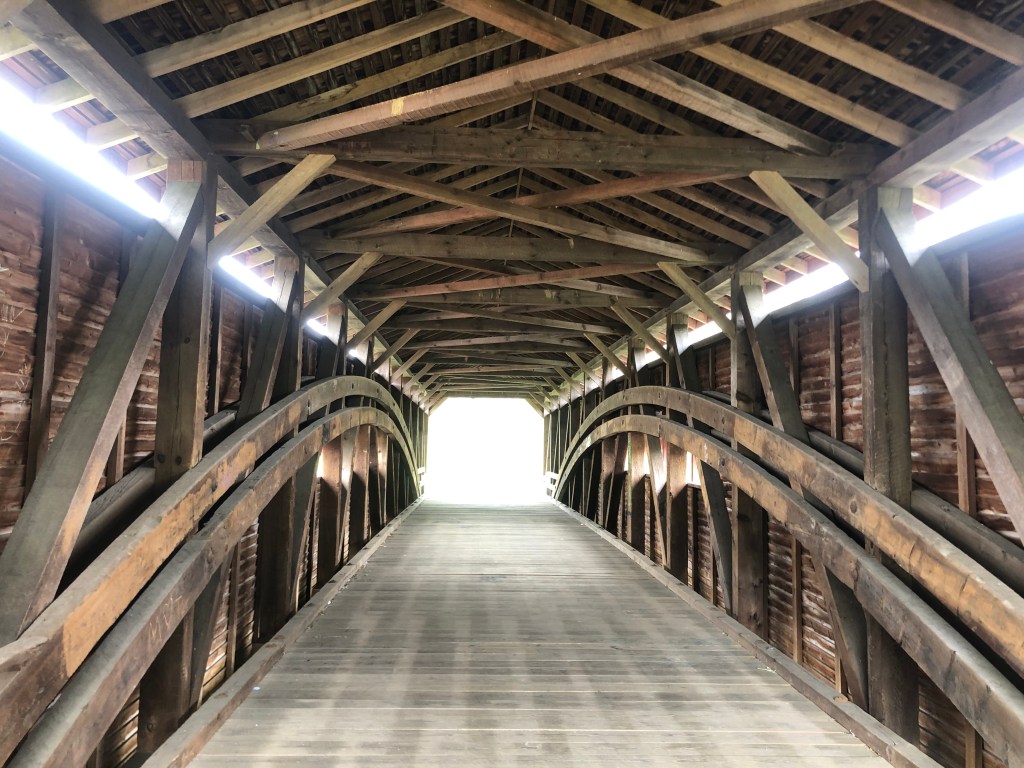
Along the way I passed another bridge that, like the FSK Bridge, no longer carries traffic. The Gilpin’s Falls covered bridge in Maryland’s Cecil County was originally constructed in 1860, and restored in 1959 and again in 2010. And unlike the FSK Bridge, it still sits on the same piers where it was placed in 1860.
Straight out of The Bridges of Cecil County.
Where form and function come together
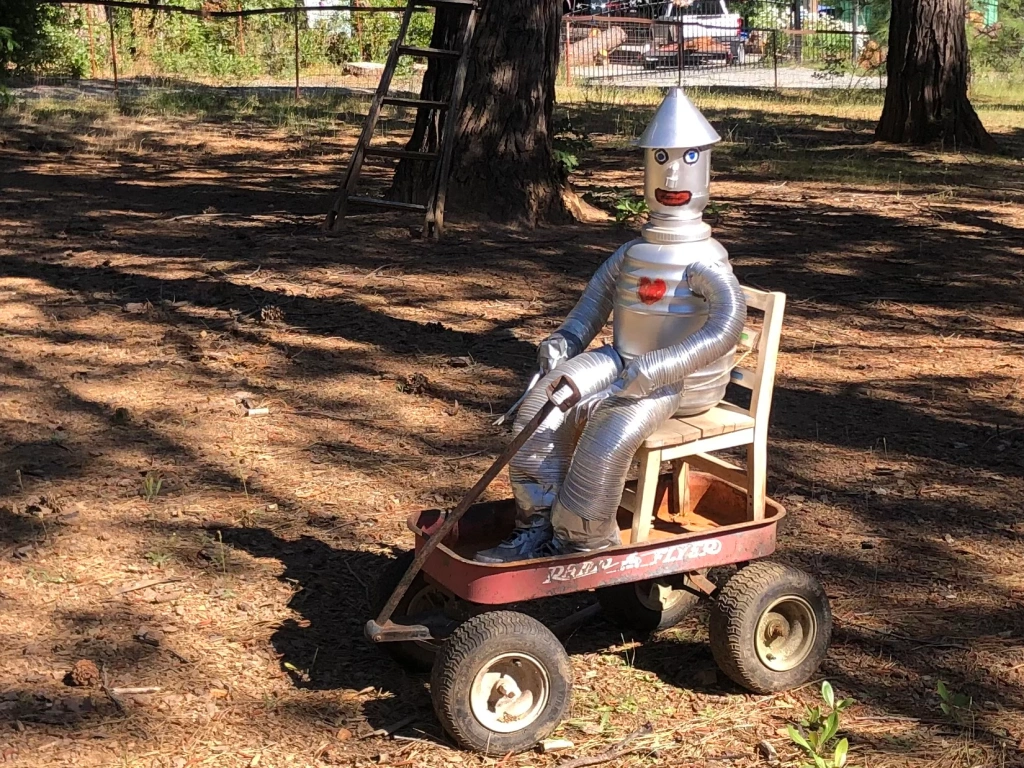
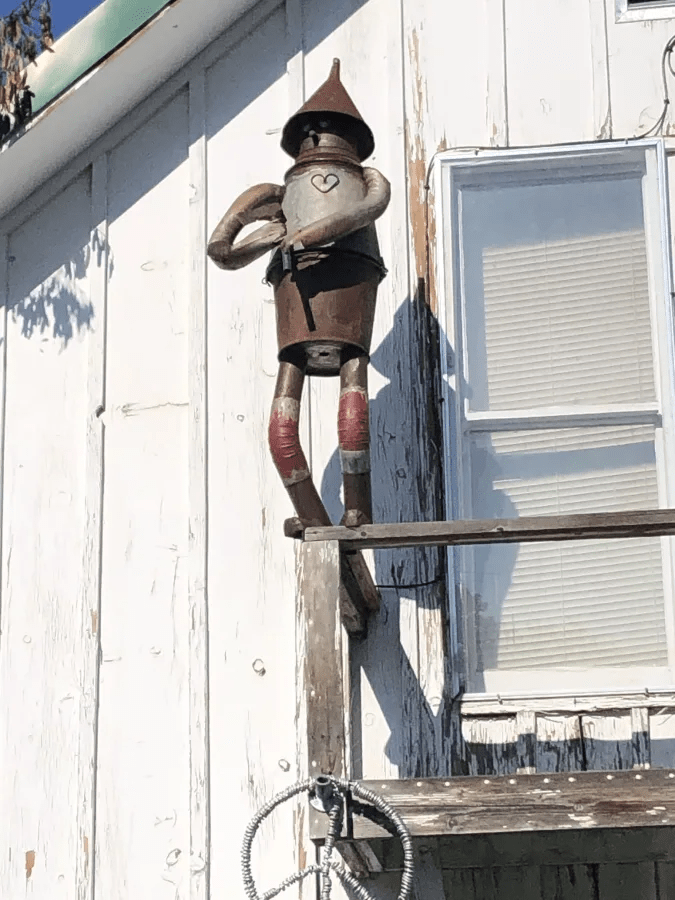
The next roadside attraction requires a bit of a setup: You may recall that I’ve been charmed by Tin Man-themed yard art that I’ve spotted on my travels. Here are two recent examples:
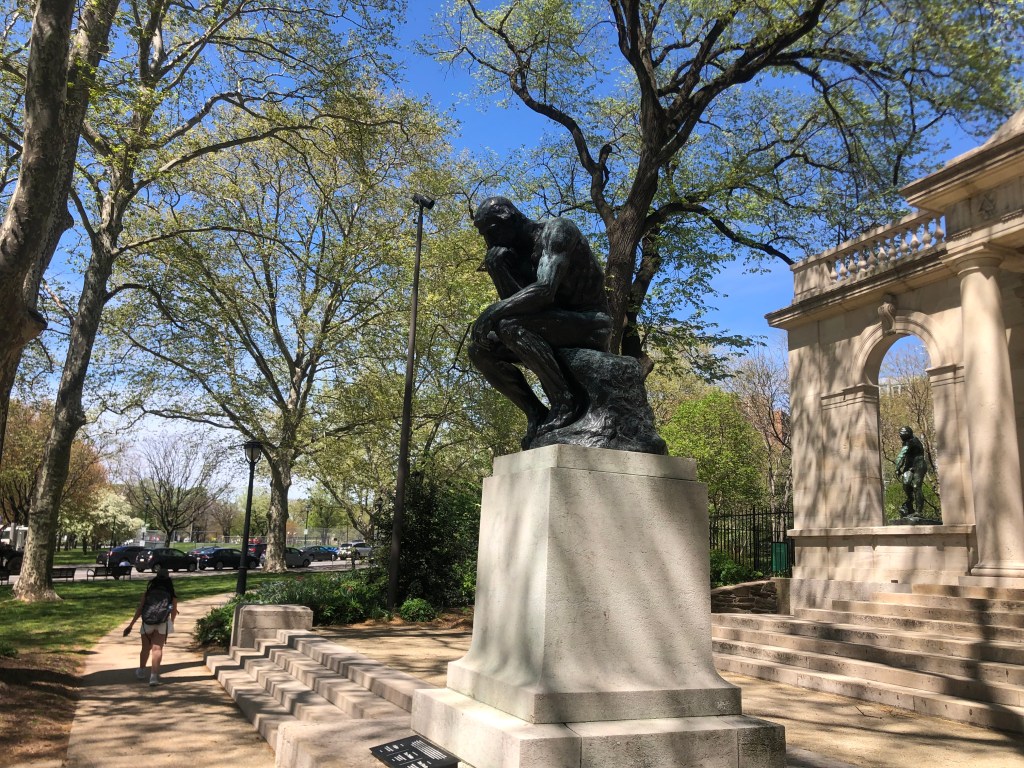
Now, recall my photo of Rodin’s “The Thinker” that I took in Philadelphia:
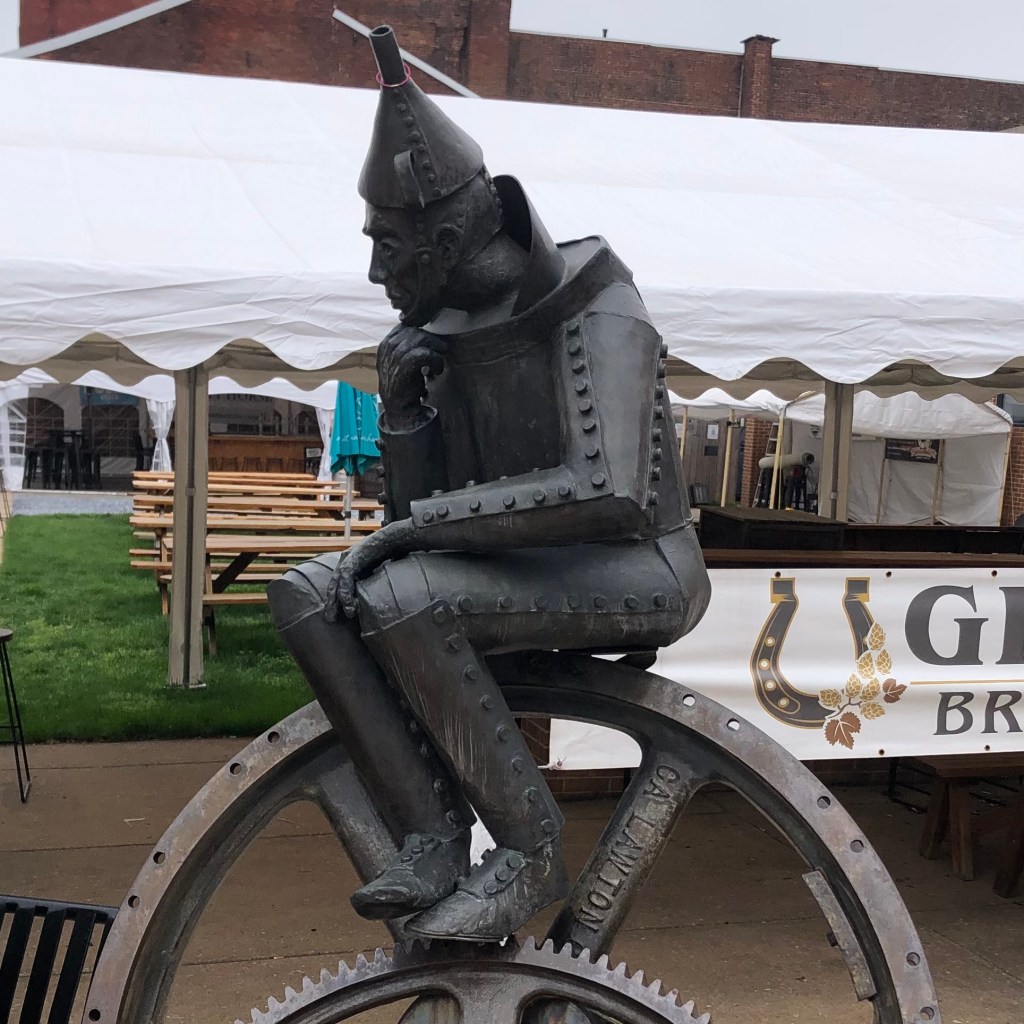
Put them together and what do you get? This sculpture of “The Tinker” (note spelling) that sits in front of a brewery in York, Pennsylvania.
For some reason I think this is brilliant!
The artist claims his sculpture says something about York’s industrial history. I don’t know about that, but I’m simply taken by the whimsy and humanity of the thing. As I’ve said before: This world needs more Tin Men.
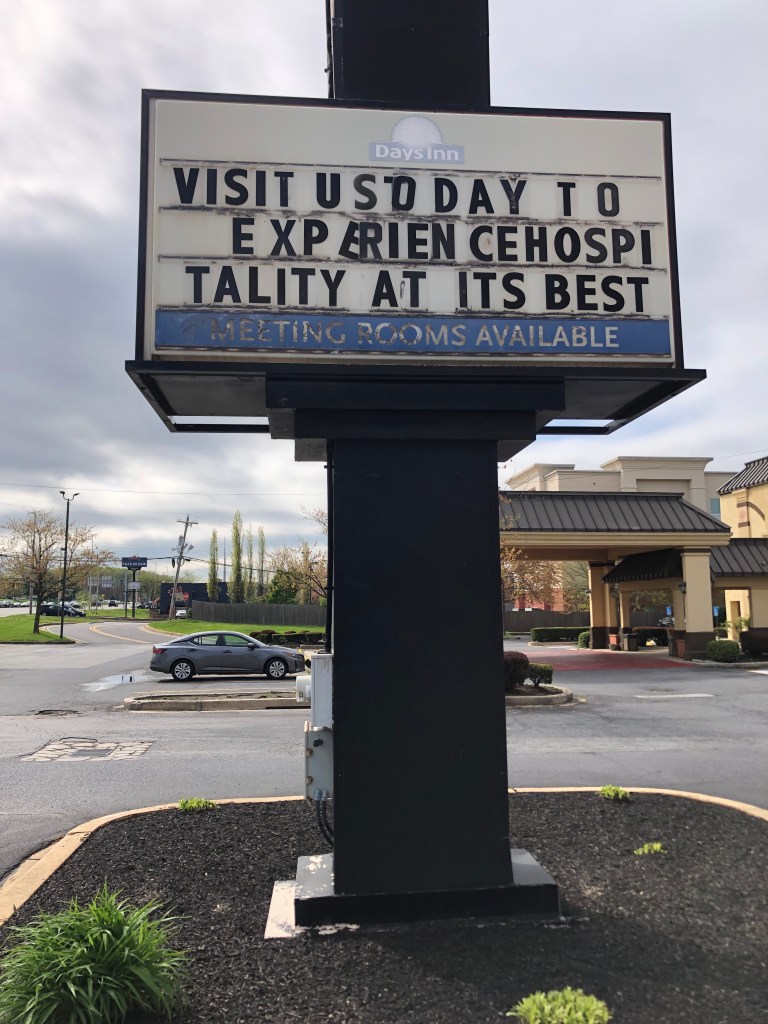
I stopped for the night in Wilmington, Delaware–less than an hour from Philly. After my big splurge on the Red Caboose Motel last night I figured I’d bed down in a simple Days Inn. Upon my arrival, I was greeted by this sign whose reference to “”the best” seems like a dubious claim.
At least they didn’t make the common error of adding an apostrophe to “its.”
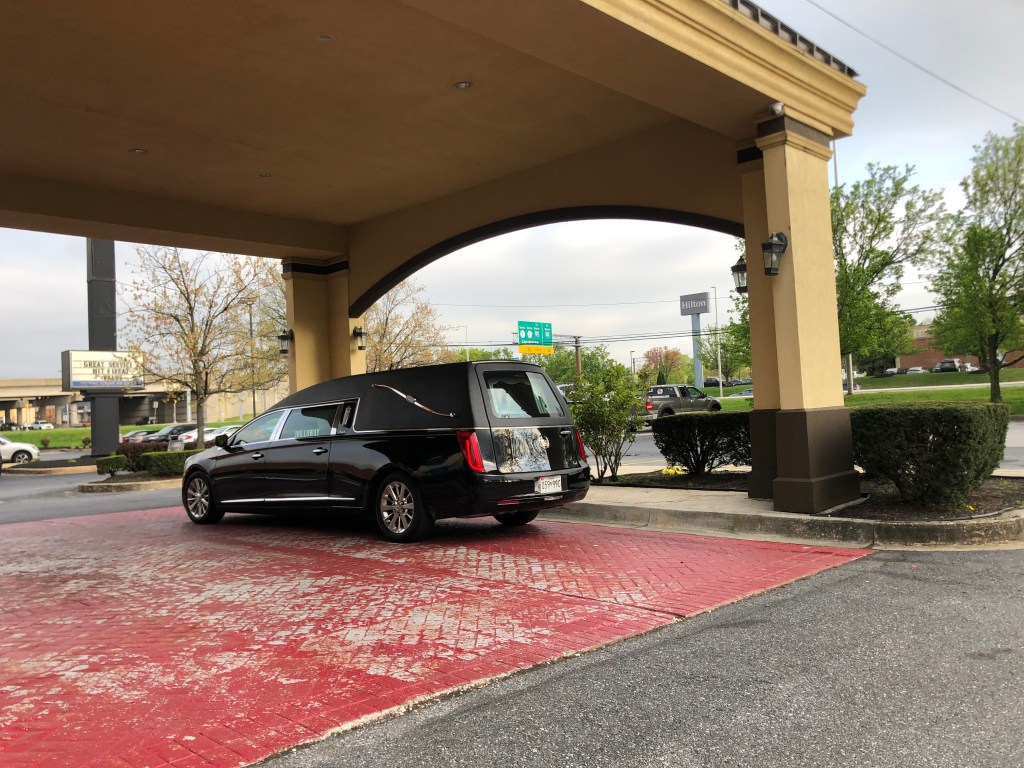
Then I got to the office and saw this idling near the front doors:
Must be check-out time.
Tomorrow I’ll head back into Philadelphia. God willing.
Mail Corner
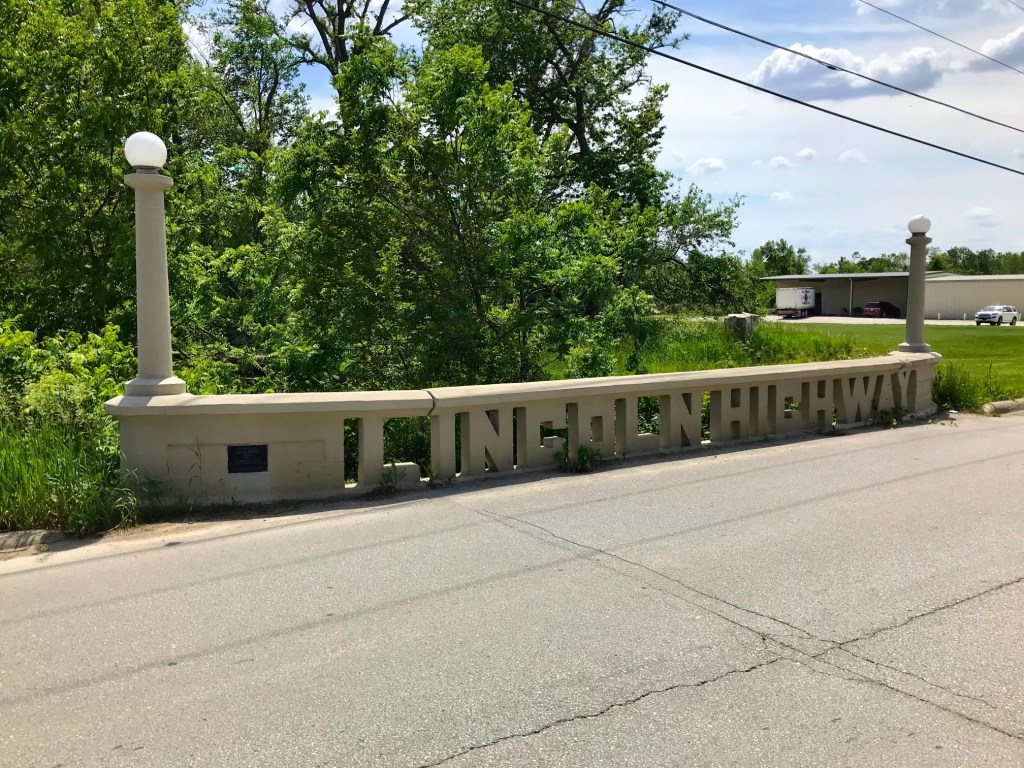
Loyal reader Brian W sent along this photo he took of a Lincoln Highway sign he spotted near Route 30 in Tama, Iowa. It dates from 1915, which is just two years after the Lincoln Highway was established.
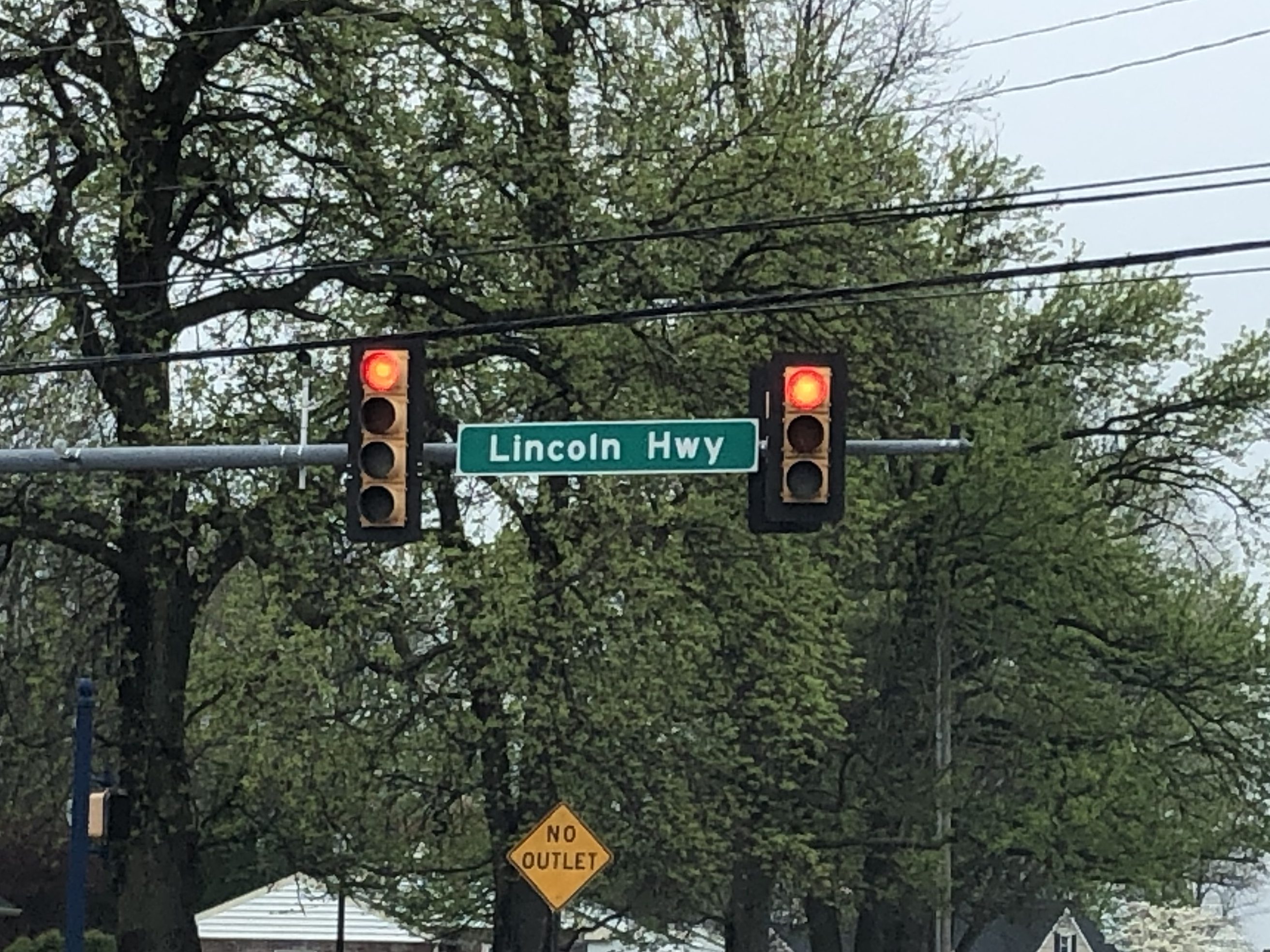
It’s a far cry from the boring, utilitarian signage I encountered today in Strasburg.
Brew of the Day
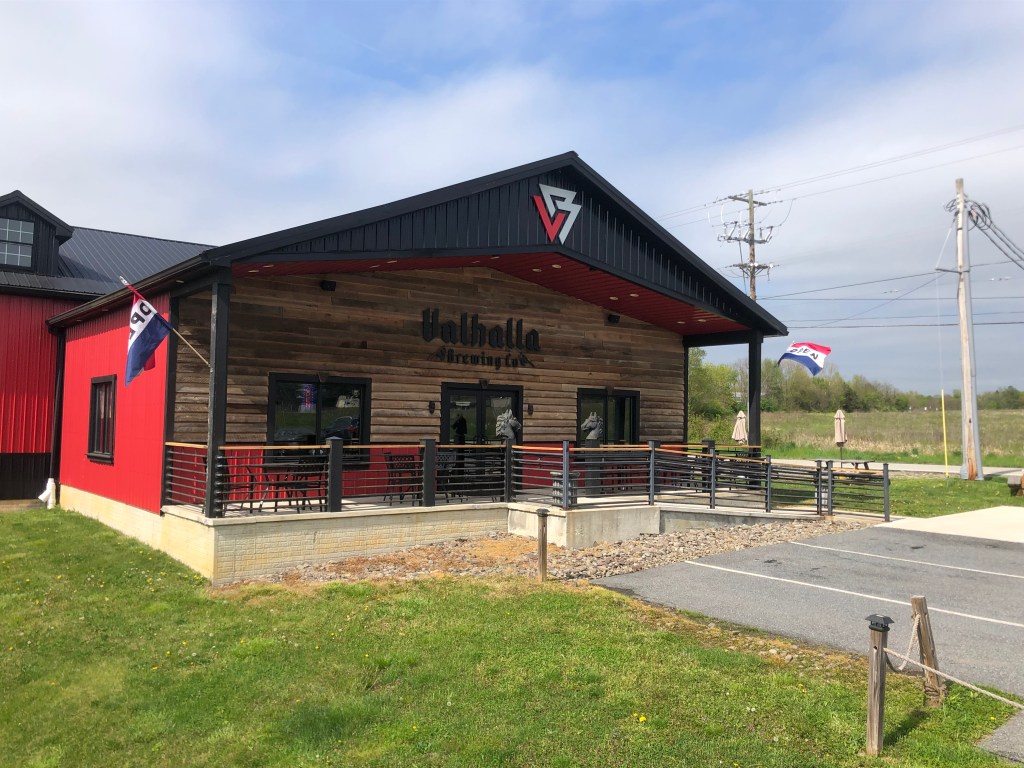
I got today’s BOTD at Valhalla Brewing Company in Elkton, Maryland. It’s an out-of-the-way roadhouse with an empty parking lot and an nearly-empty bar. The bartender spent most of his time leaning on the bar and staring at his phone. But to be fair, it was 2 in the afternoon on a Thursday.
Middle of nowhere. Which I guess is where you’d expect to find Valhalla.
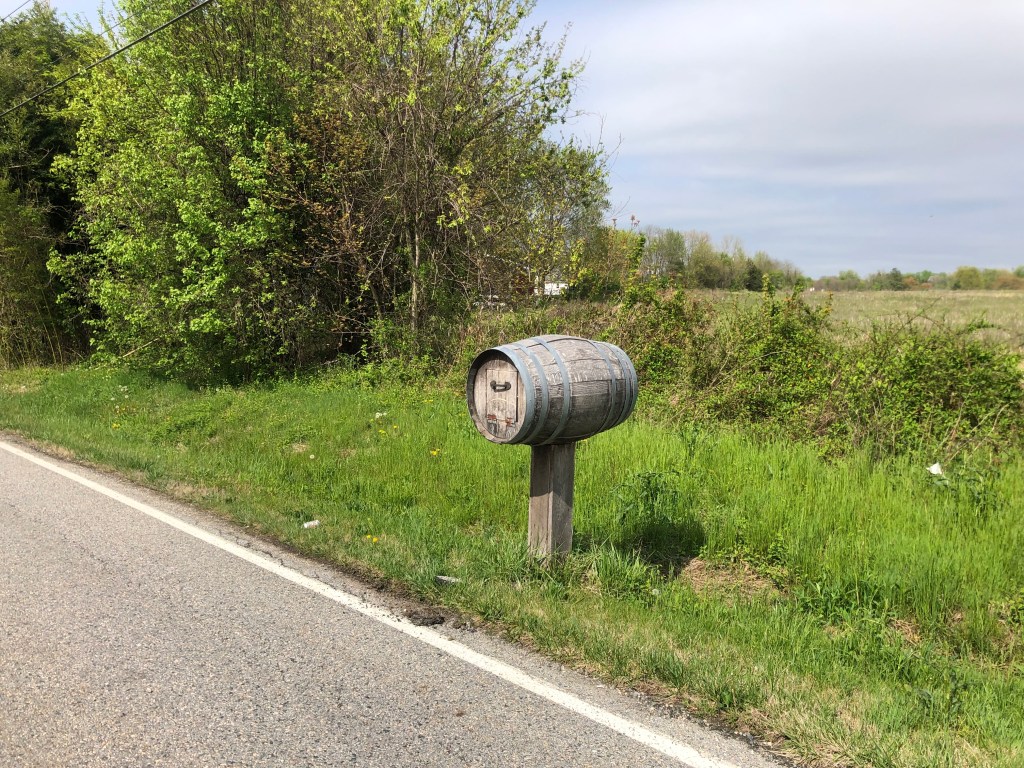
Cool mailbox, though.
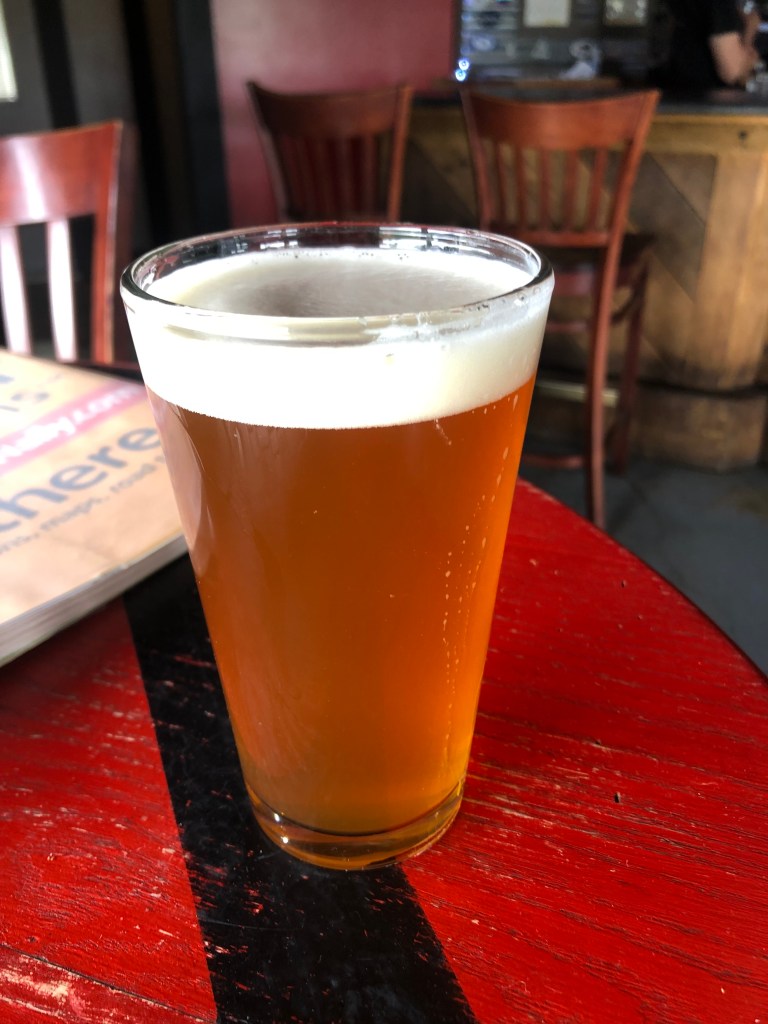
I chose the Zombie Ice Double IPA. It turns out it’s a guest brew, made by 3 Floyds Brewing Co, in Munster, Indiana. Behold the golden-copper color:
The first sip suggested that this is just a basic IPA. But with subsequent sips it became more interesting. The usual citrus and hops are omnipresent, but as you move through it you detect orange peel, library paste, and shoe polish. You might not think that sounds especially tasty, but somehow it works. There’s a total lack of pretentiousness about this beer (except for its name, of course). It’s solid, genuine, and hardworking. I give it a solid 4 out of 5 stars.
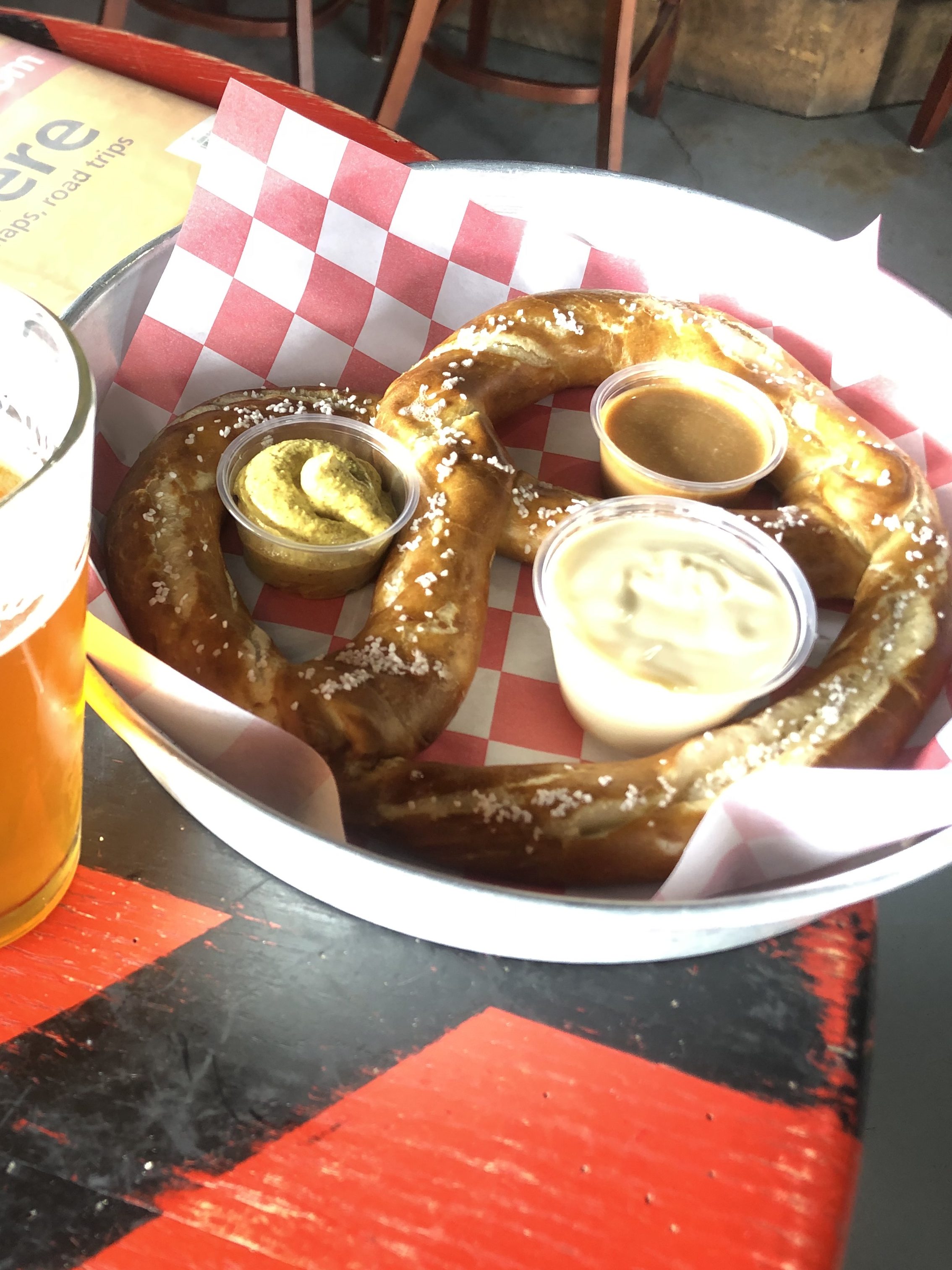
In the interests of full disclosure, I should note that I paired this IPA with Valhalla’s “Big Ass Pretzel,” which is served with mustard, beer cheese, and a maple-caramel sauce that is to die for. So consider that it might just be the pretzel talking. In fact, the Pretzel gave the beer 5 stars.
Thank you all for your kind comments, recommendations, and suggestions while I was cruising Route 82. I’m now back home, planning my next journey. Meanwhile, I leave you with a few additional photos from that trip that didn’t fit into the daily blog posts. Enjoy!
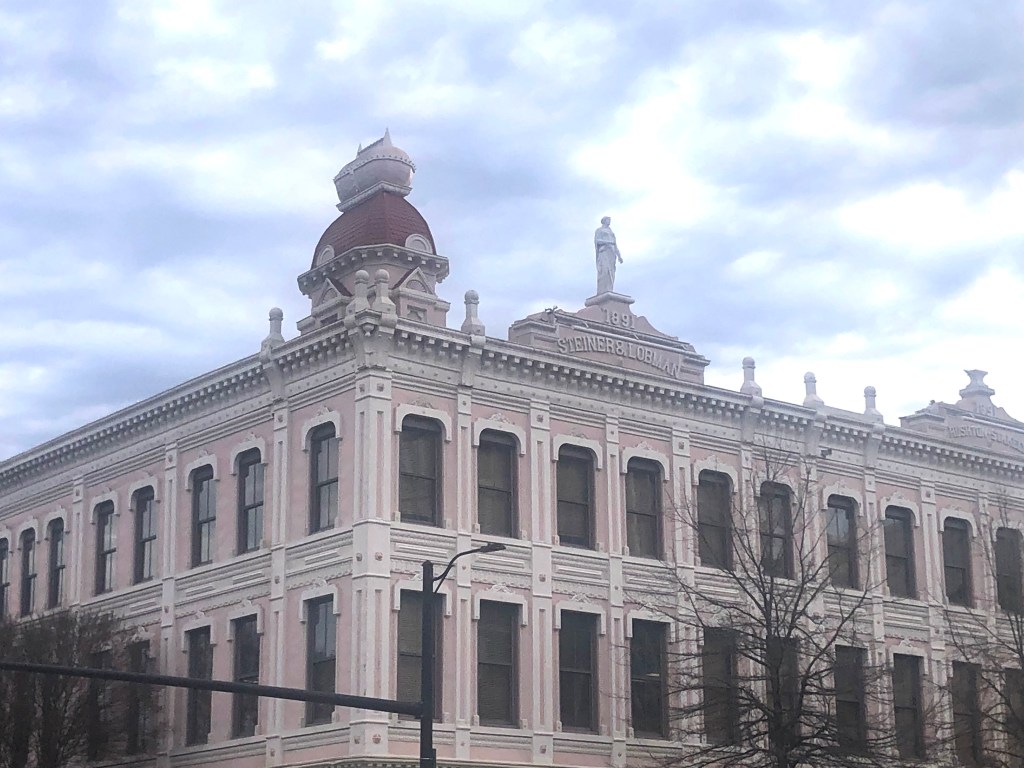
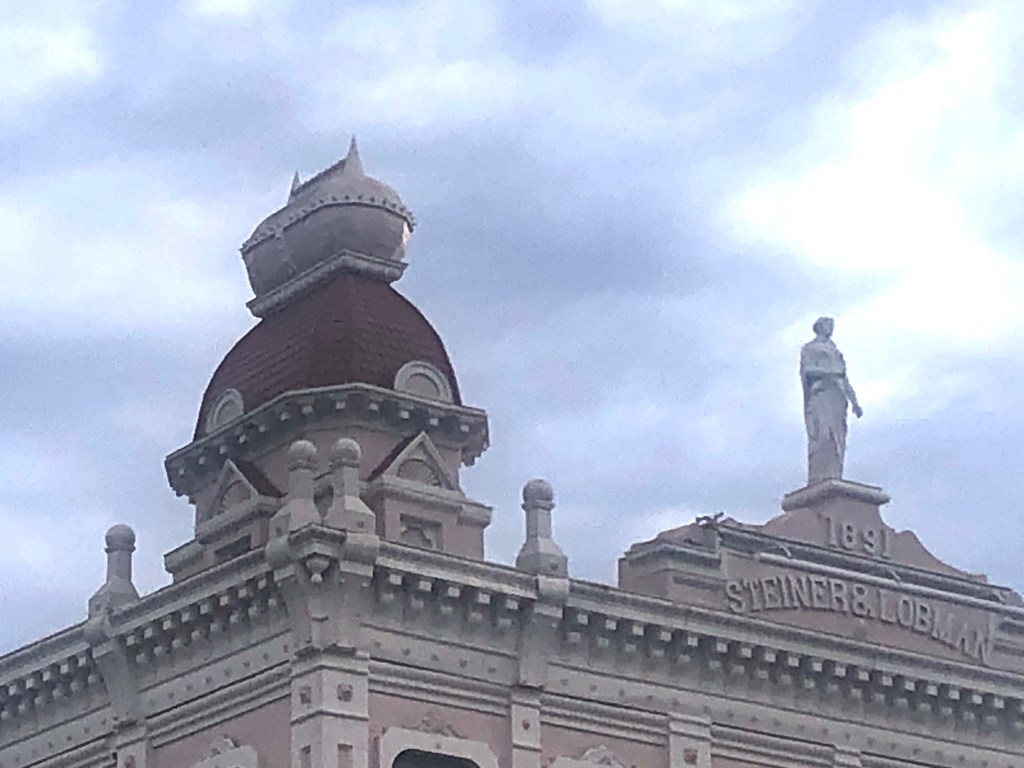
Impressive 1891 Steiner and Lobman building in downtown Montgomery, Alabama. But what’s that atop the front corner?
Yes, it’s a sarcophagus. The townsfolk say that the mortal remains of old man Steiner himself is entombed in it. Other sources scoff at that story.
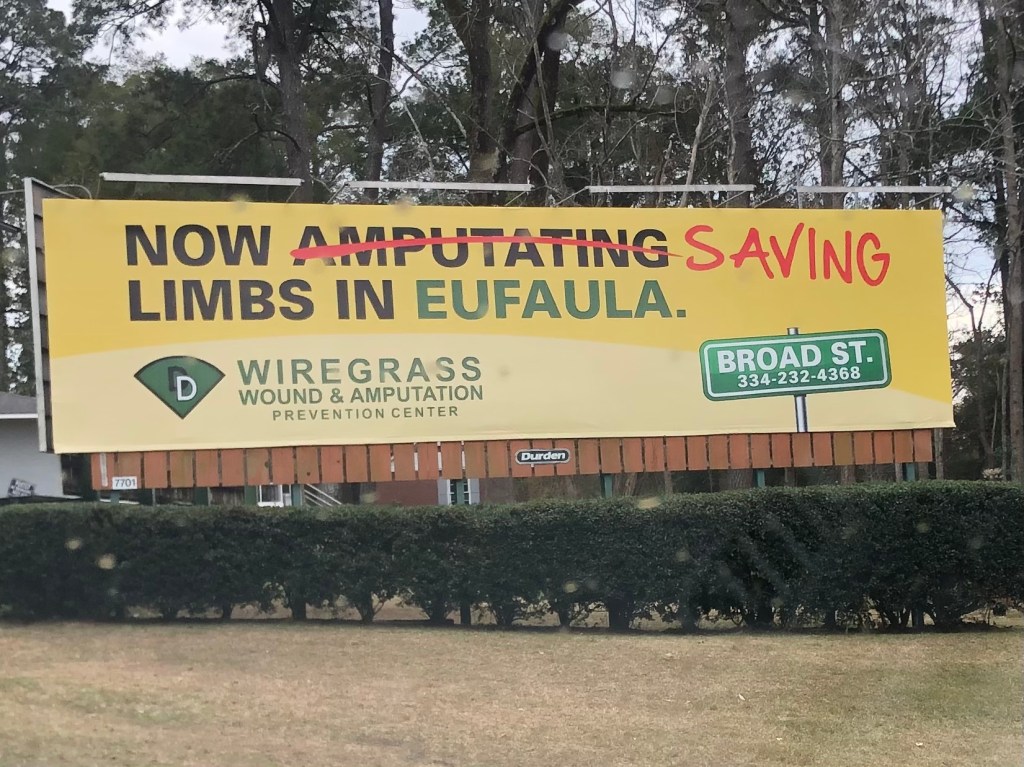
Billboard in Eufaula, Alabama. If you want your limb saved, your first choice probably wouldn’t be a place called an “Amputation Center.” And are amputations so common in Eufaula that they have a special center dedicated to the practice?
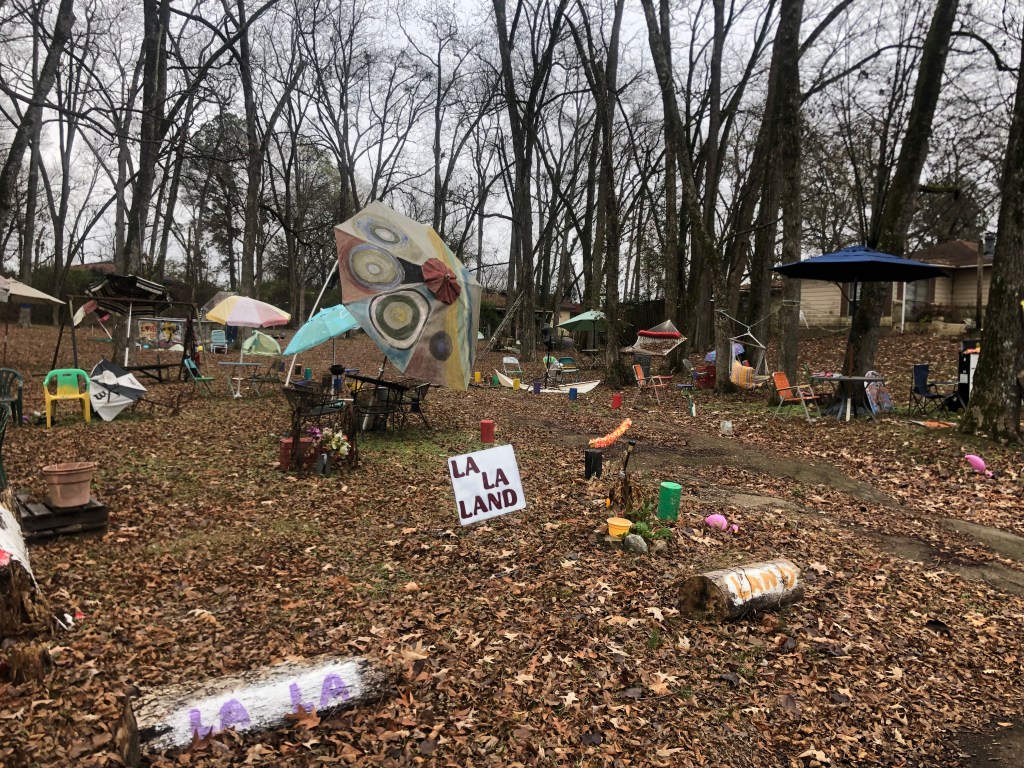
To you it might just look like a junky front yard, but it’s said that the owner, one Charles “LaLa” Evans, decorated his front yard as a tribute to his wife when she passed some 13 years ago.
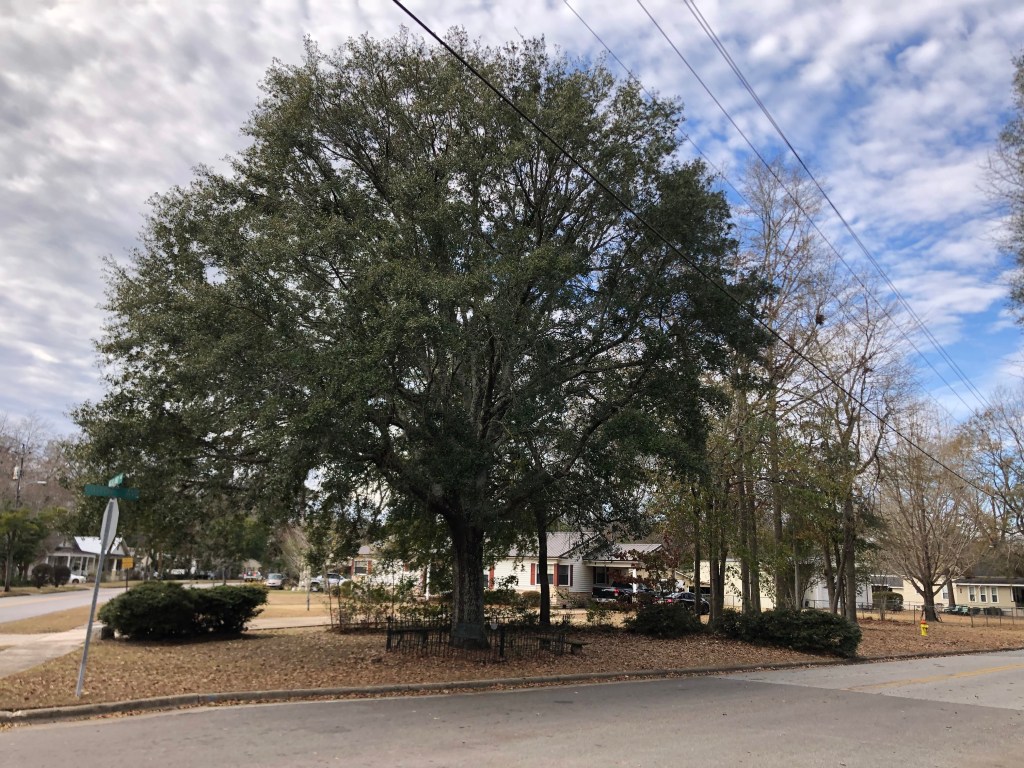
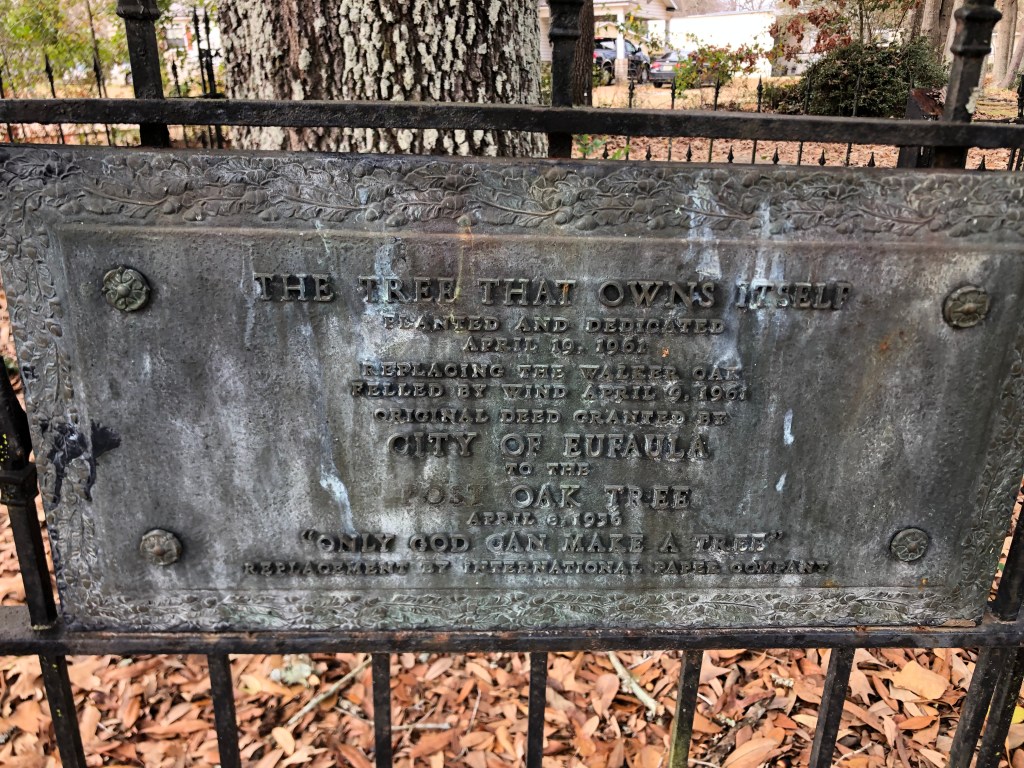
The good people of Eufala, Alabama call this “The Tree That Owns Itself.” The story is a bit confusing: in 1936, the mayor of Eufaula officially granted a deed to to a 200-year-old oak tree, which declared the tree to be “a creation and gift of the Almighty, standing in our midst—to itself—to have and to hold itself, its branches, limbs, trunk and roots so long as it shall live.” Sadly, it stopped living in 1961, when it was uprooted by a tornado. The townsfolk soon planted a new tree, which is the one you see here, and the mayor’s proclamation has been extended to it and all successor trees on this property. No one really knows why.
Plaqueunder The Tree That Owns Itself.
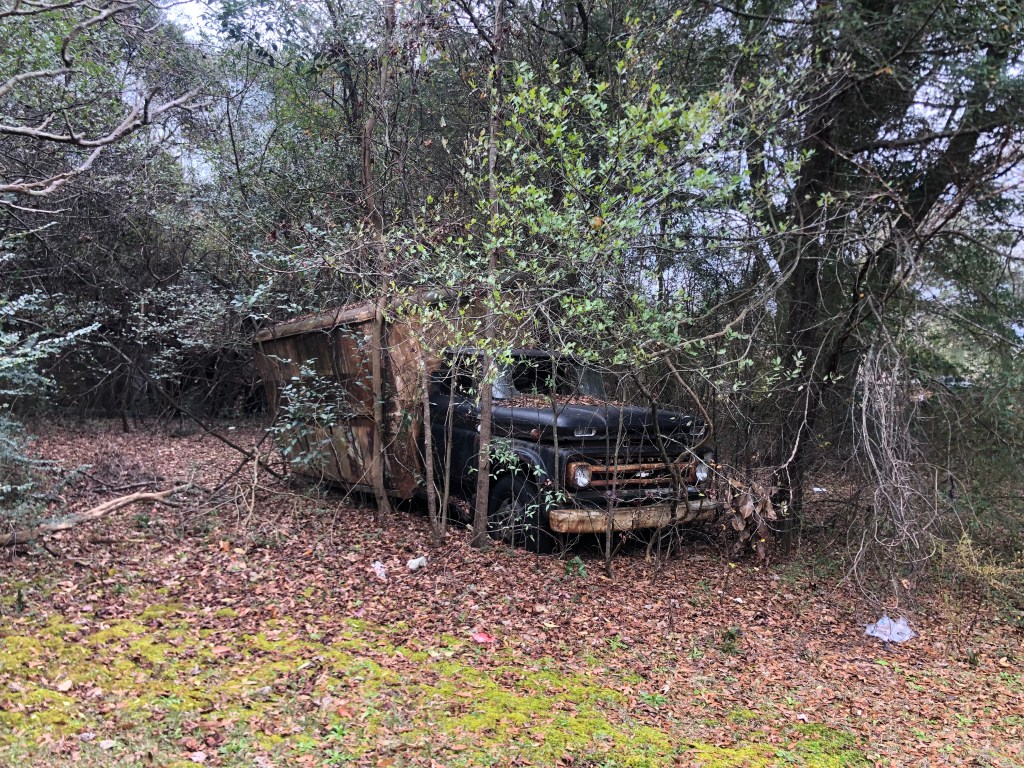
Speaking of trees that have been granted their freedom: Someone needs to free this truck from the tyranny of this tree in Midway, Alabama.
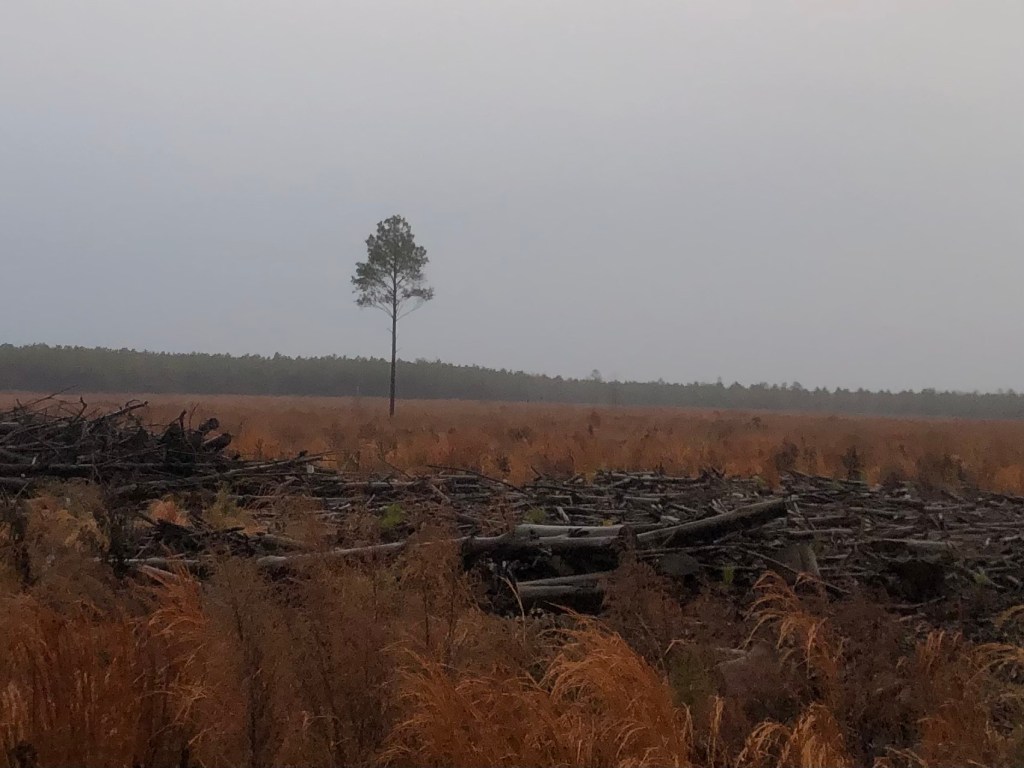
One more tree photo: This lone tree stands amid the carcasses of its brethren. Why it was spared, no one knows. But I took this photo when I was in Crossett, Arkansas, looking for the storied “Spook Lights.” Knowing that, doesn’t this photo seem a little sinister?
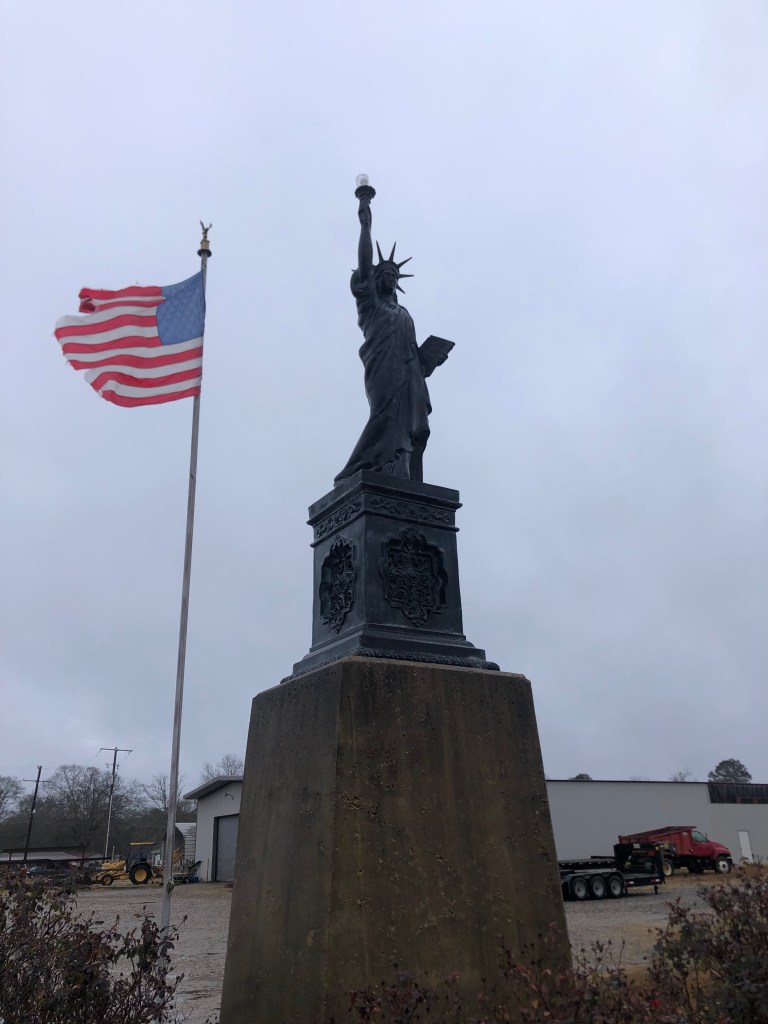
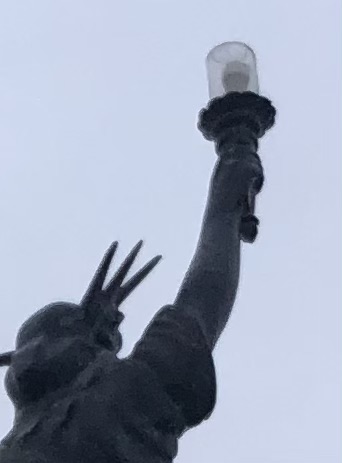
A miniature Statue of Liberty in Strong Arkansas. Not a bad reproduction…but wait, what’s up with her torch?
They cheaped out. Another Home Depot special.
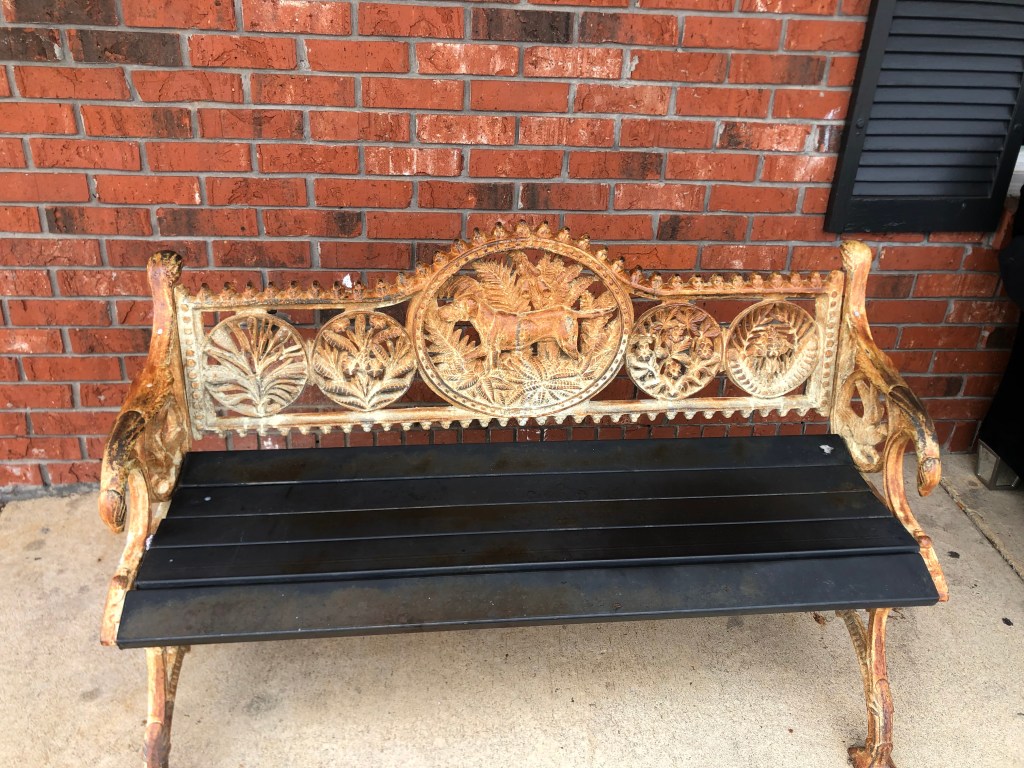
Sidewalk bench in Union Springs, Alabama, which you’ll recall is the “hunting dog field trial capital of the world.” Check out the center of the backrest.
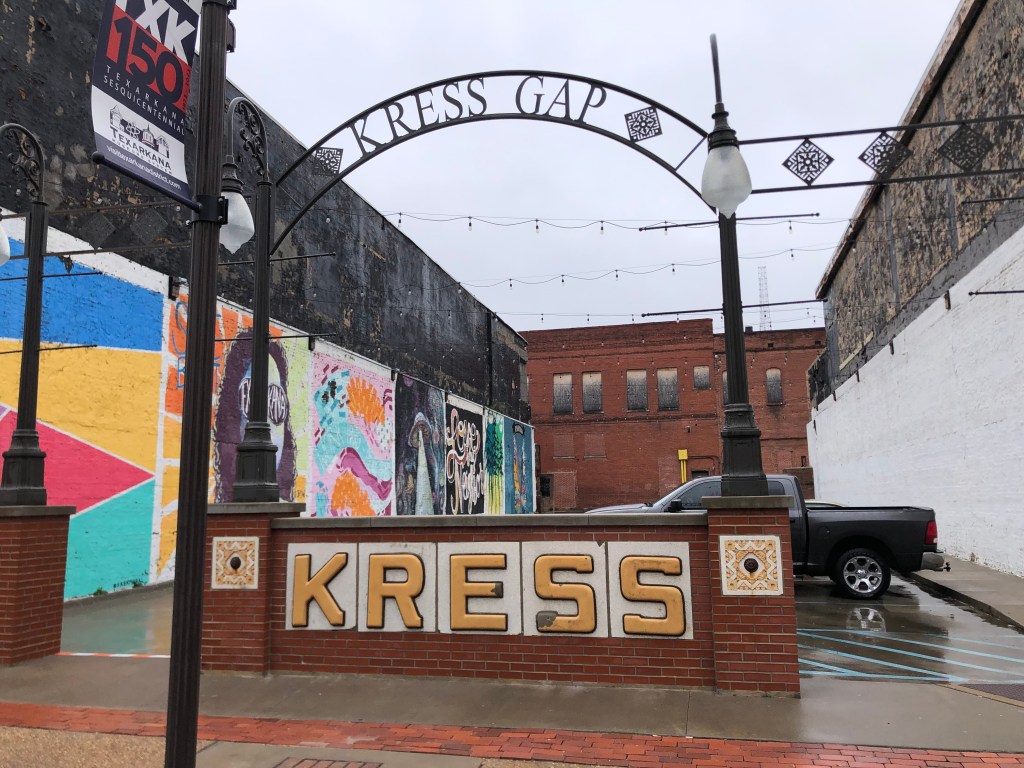
Former site of a Kress department store in Texarkana, Arkansas. As sad as it is to see a historic structure go, I do think it was a nice gesture to commemorate the place with its original signage.
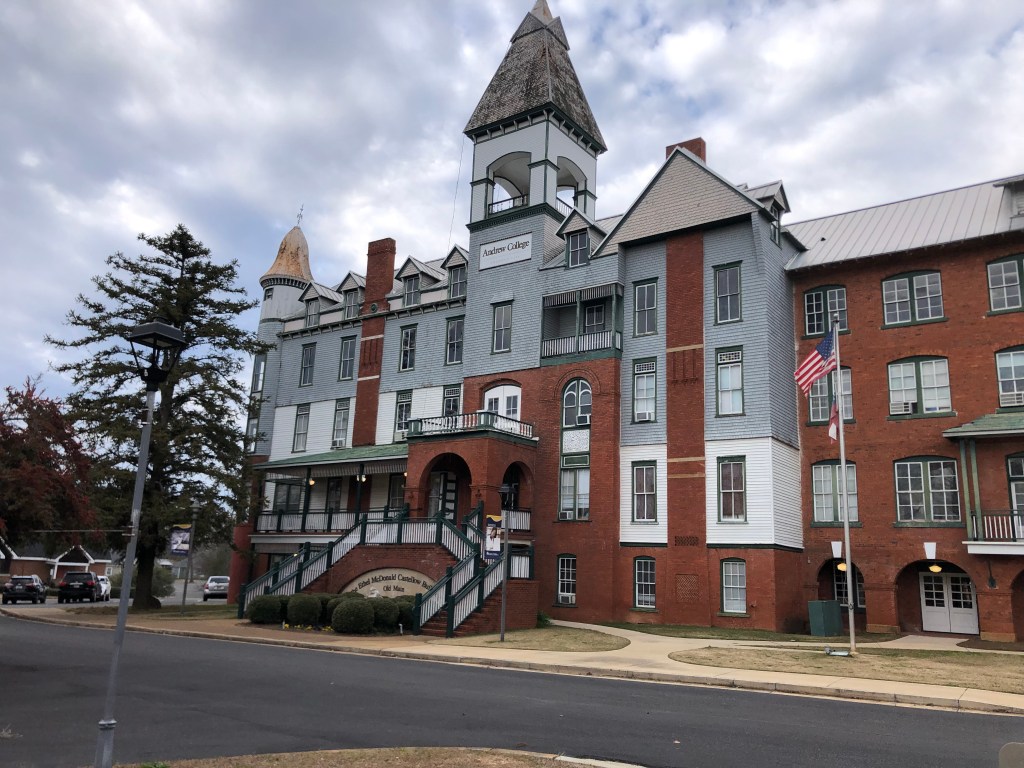
Andrew College in Cuthbert, Georgia, dates back to 1854. This main building was constructed in 1892. It’s still an active, accredited college today. I just like how it looks.
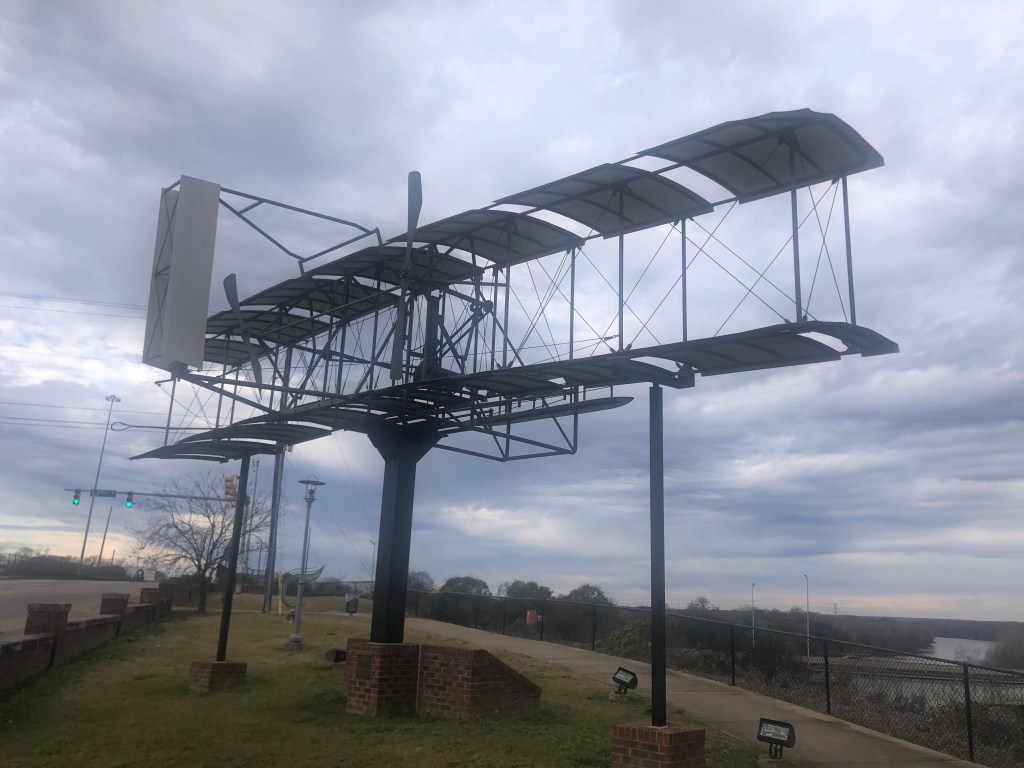
This flying machine seemed a bit out of place in Montgomery, Alabama. But it turns out that the Wright Brothers opened a flying school here in 1910.
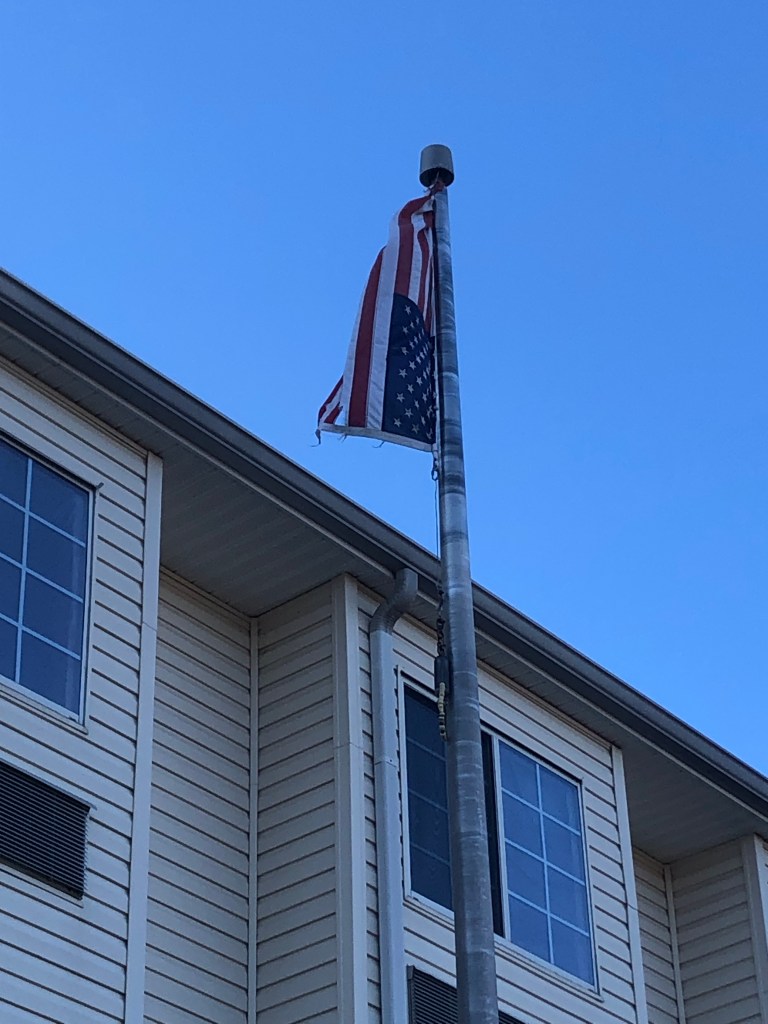
Distressed flag in Starkville, Mississippi. I asked a guy coming out of this building about it. He just looked up and shrugged.
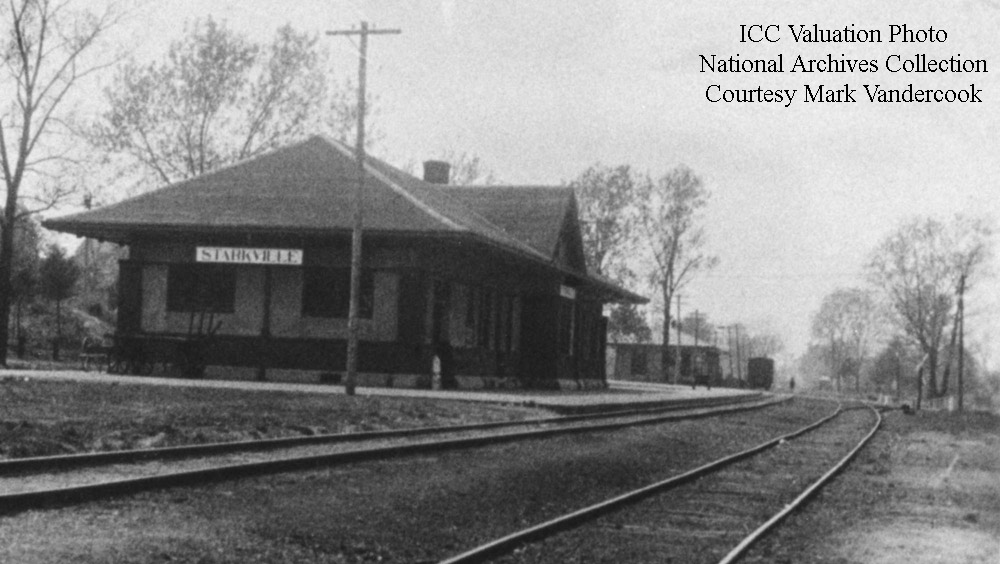
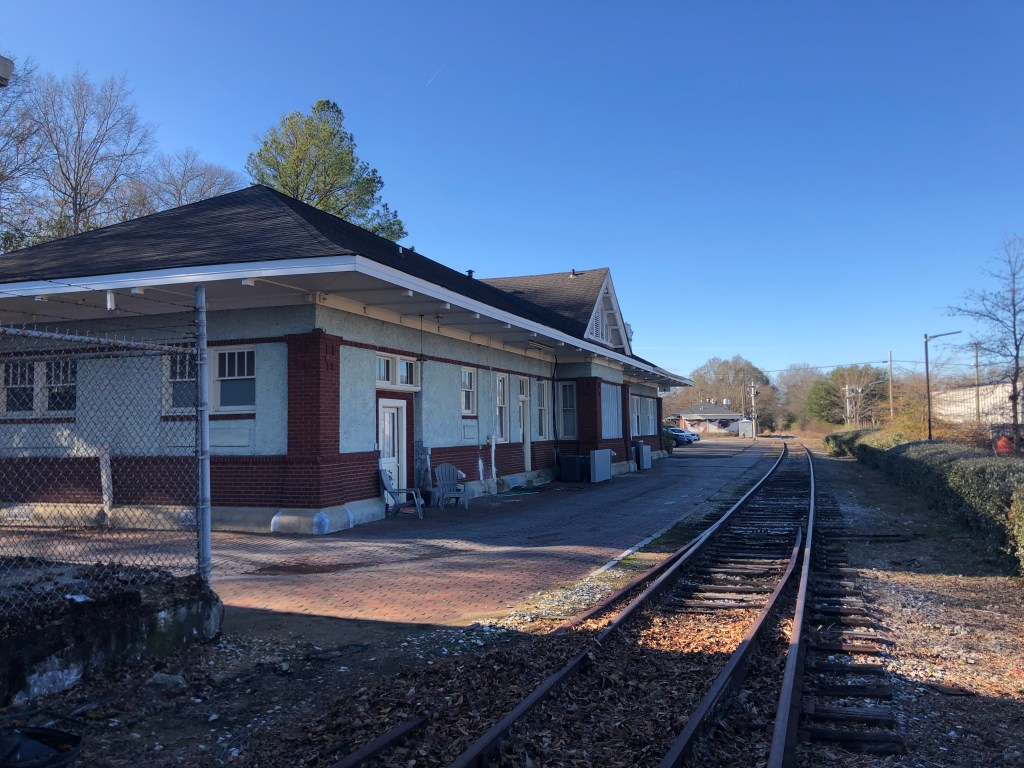
Like Texarkana and many other cities across the country, Starkville once had a “Union Station.” Unlike many of those other Union Stations, Starkville’s was not grand or ornate or even impressive. It was pretty much just your basic depot, one of many on the Mobile & Ohio line. Behold:
Starkville’s Union Station, as it appeared in 1916.
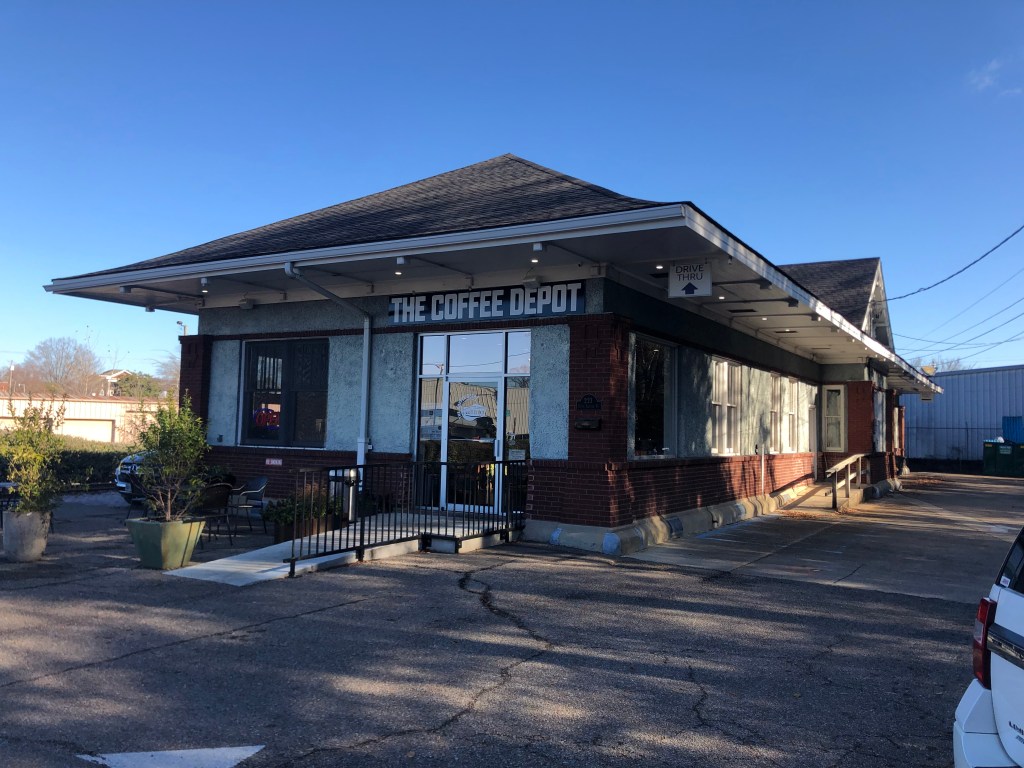
The station was built in 1914, and after the trains quit stopping in Starkville the building was converted into a pharmacy. In the course of time the pharmacy closed. And then, this morning, I had my breakfast in Union Station.
Union Station this morning. (This is the view from the back, to match the historic photo.)
Front view. Looking good after 110 years!
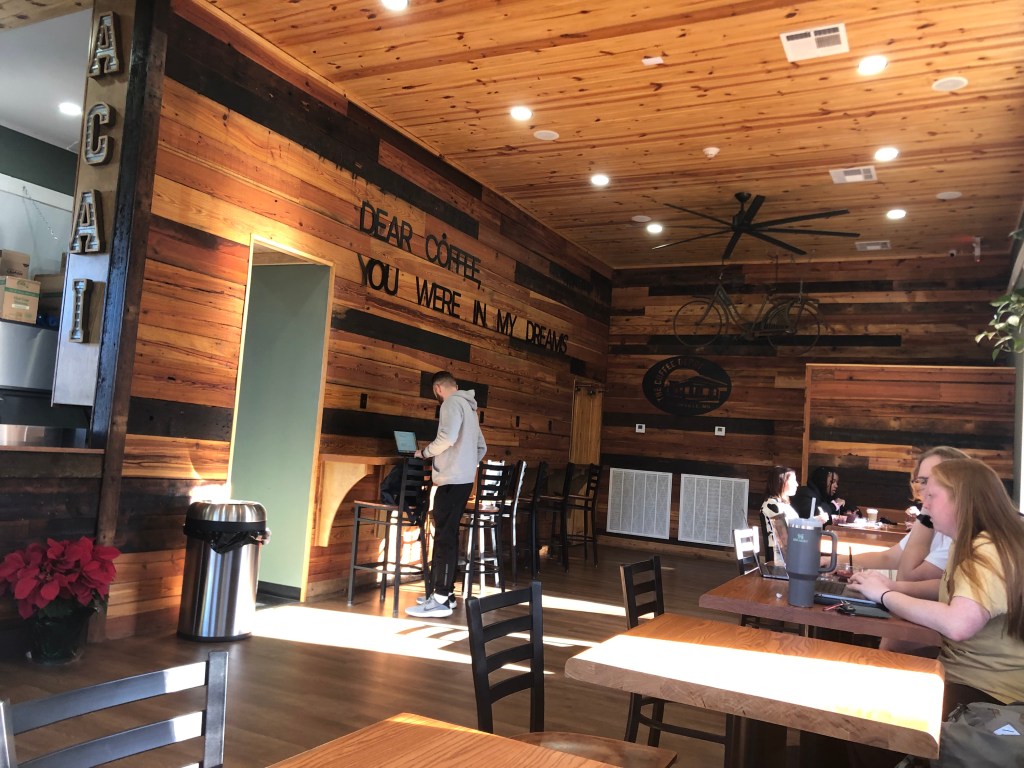
They’re calling it “The Coffee Depot” these days, though from the inside you’d never know it had once been a train station. Renovations were completed just last year, and it opened for business in June. The Coffee Depot is one of those modern, quality-focused coffee bars that cater to college students and what we used to call yuppies. It’s the first such place I’ve seen on my trip so far.
Yuppies and college students in their natural environment.
Though the breakfast menu is limited, the food is quite good. I had something called a “Depot Bowl,” which involved an acai base, strawberries, almonds, and peanut butter. The service is incredibly attentive and friendly. I would make this my usual coffee spot if I lived here.
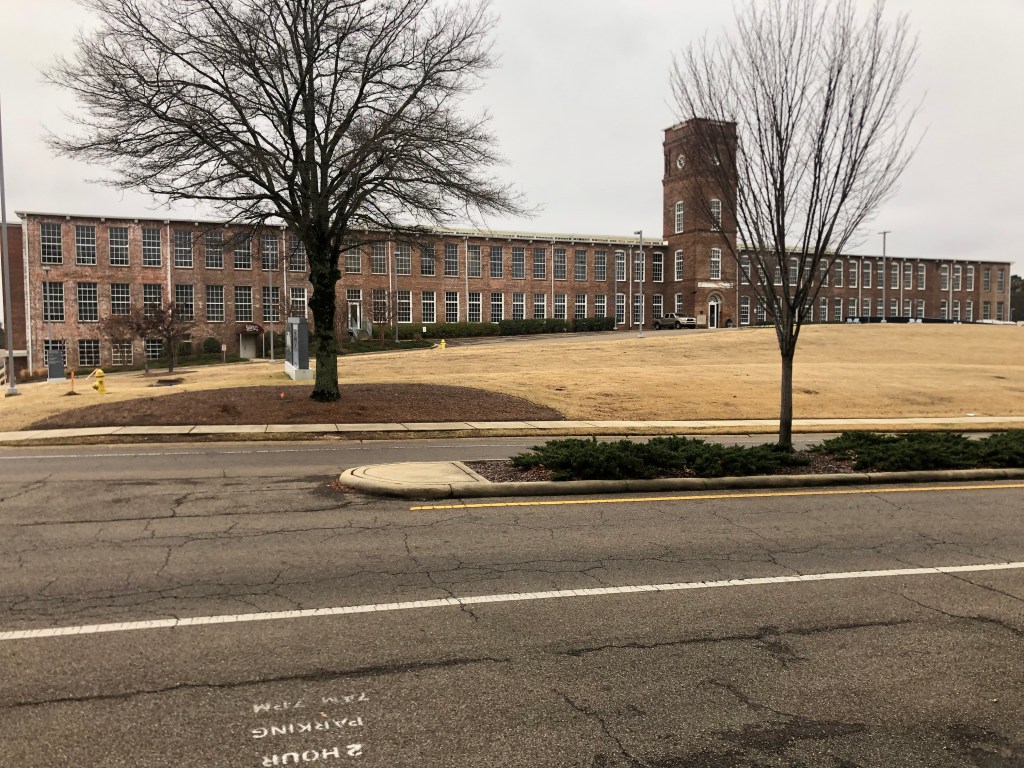
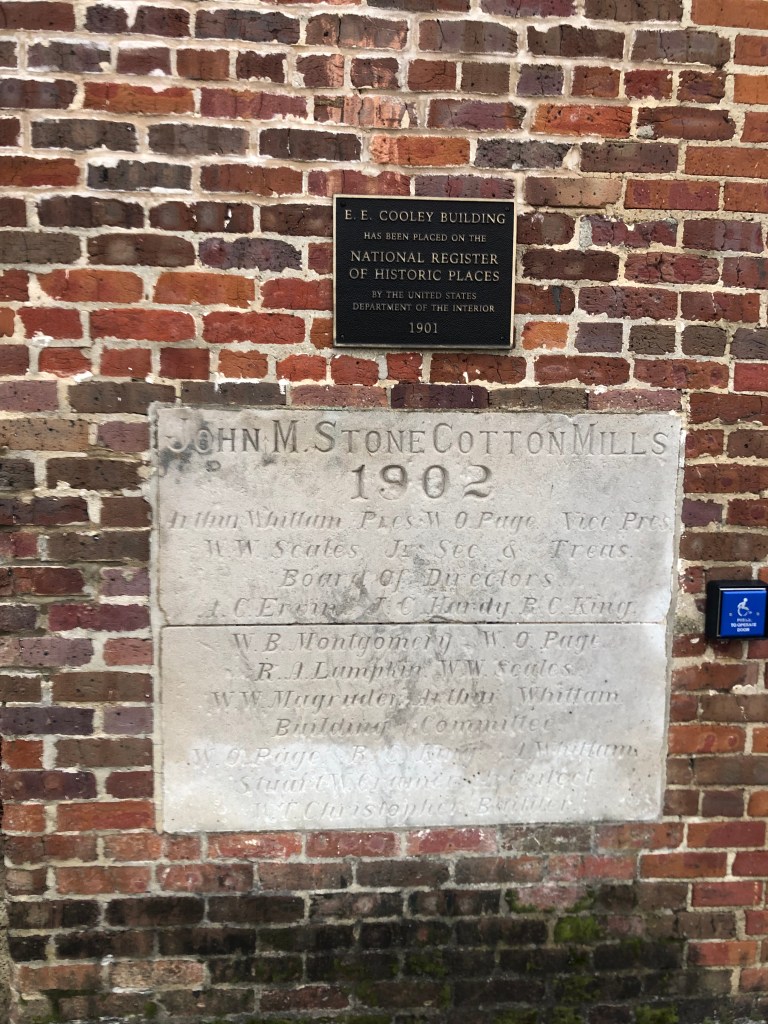
The Coffee Depot is located in the heart of Starkville’s historic downtown. Among other notable historic structures is the 1902 John M. Stone cotton mill. It closed and was sold to MSU in 1965 to house the university’s physical plant. Then, a few years ago, it was converted to an (enormous) events center.
More windows than the software aisle at Best Buy.
Relic from the days when every word was abbreviated.
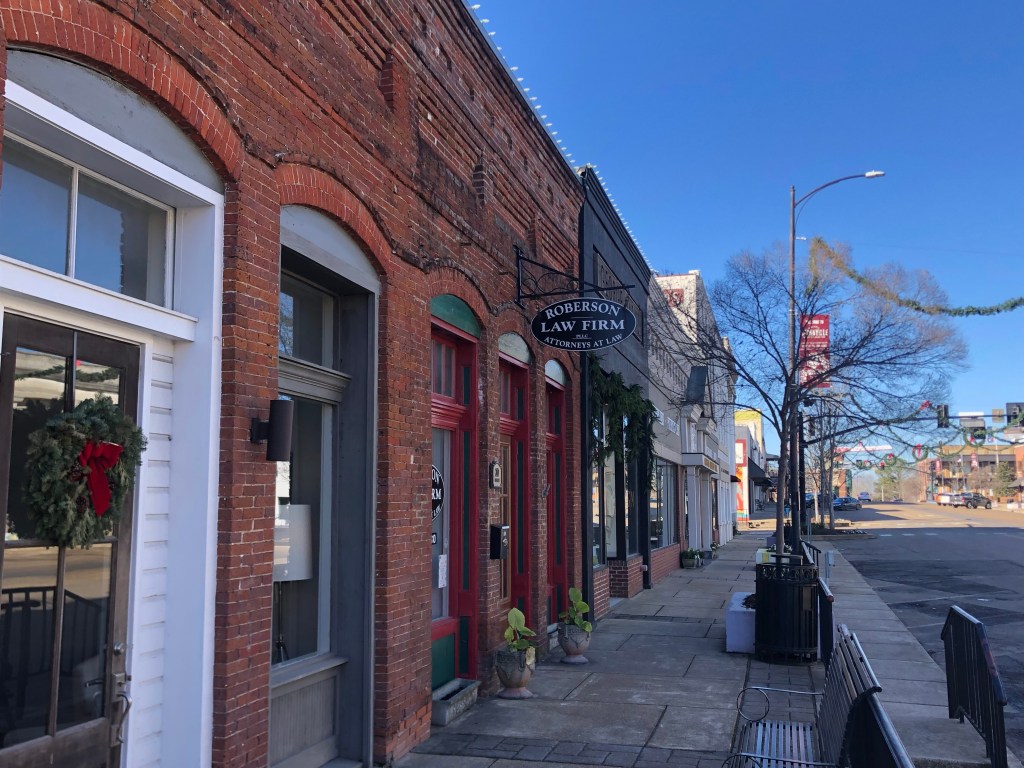
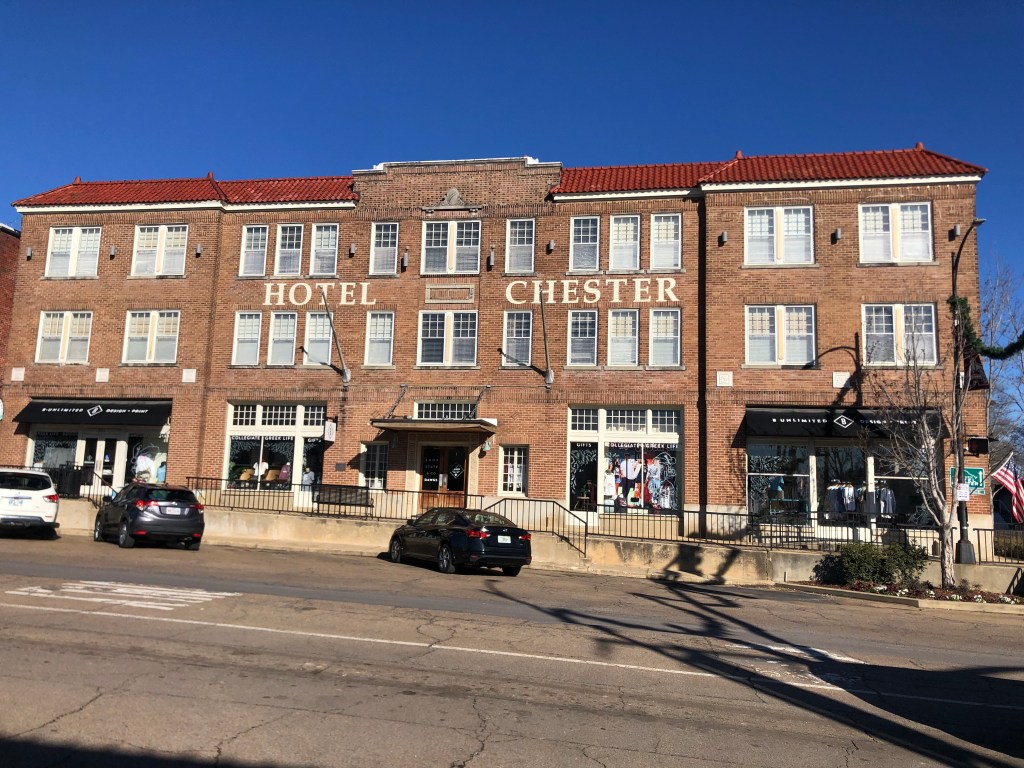
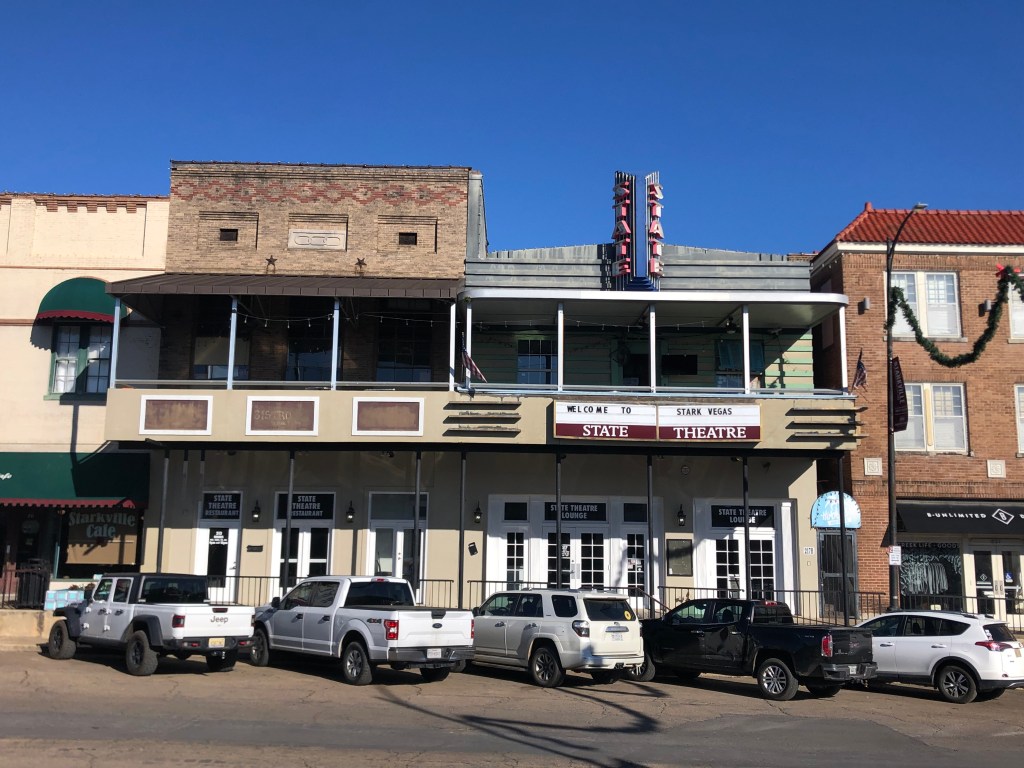
Starkville’s Main Street is a wonder to behold. It’s full of historic buildings, almost all of which have been lovingly restored. The pedestrian-friendly sidewalks are outfitted with benches and street art, and some of the cafes have outdoor seating. On top of all that, the sun finally came out and we’re enjoying glorious January weather.
The Hotel Chester, built in 1925, is still in operation.
Note the 1937 State Theater, which is now a music venue.
I think it’s no mystery why Starkville prospers while some of the other towns along this route are slowly dying. It’s got to be the presence of a major university. All that youthful energy, their future-oriented perspective, and of course their student loan money are all drivers for the local economy.
As much as I hated to leave the sunshine and the pleasant town, it came time to get back on the road. I was overdue for Reform. I speak, of course, about the town of Reform, Alabama.
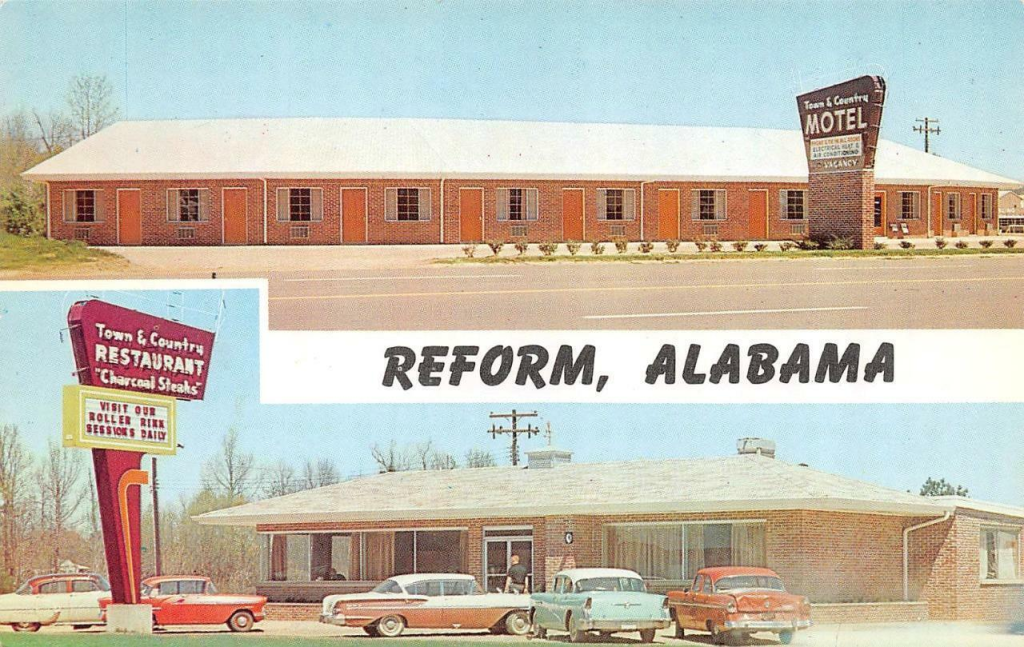
Reform (pop: 1,700) was incorporated in 1898. The story goes that a visiting evangelist urged the community to “reform,” and the townsfolk figured that was as good a name as any. Sadly, it appeared that none of the local businesses have capitalized on the obvious possibilities for a good pun or double entendre. Remember my visit to the town of Cool, California? Those people made use of the potential their name afforded. And Weed, Calif. sells T-shirts with its name in large letters. But not reform. There is no Reform School, no Reform Church, no Reform Fabricating Plant, and definitely no local chapter of Ross Perot’s political party. Even worse, the town apparently couldn’t be bothered to put up a sign at the city limits, thus denying me a photo opportunity.
On the other side of the ledger, Reform counts among its native sons a number of football luminaries: Tony Dixon of the Dallas Cowboys, Doug Elmore of the (then-) Washington Redskins, Michael Williams of the New England Patriots, and James Malone, who was head football coach at Northeast Louisiana State College in the 1950s. (Vic, that list was for you!)
Moving on.
I next came to the town of Northport, Alabama (pop: 31,00), which is planted on the periphery of Tuscaloosa. Northport is another college town. The influence of the University of Alabama is everywhere.
Call me Deacon Blues.
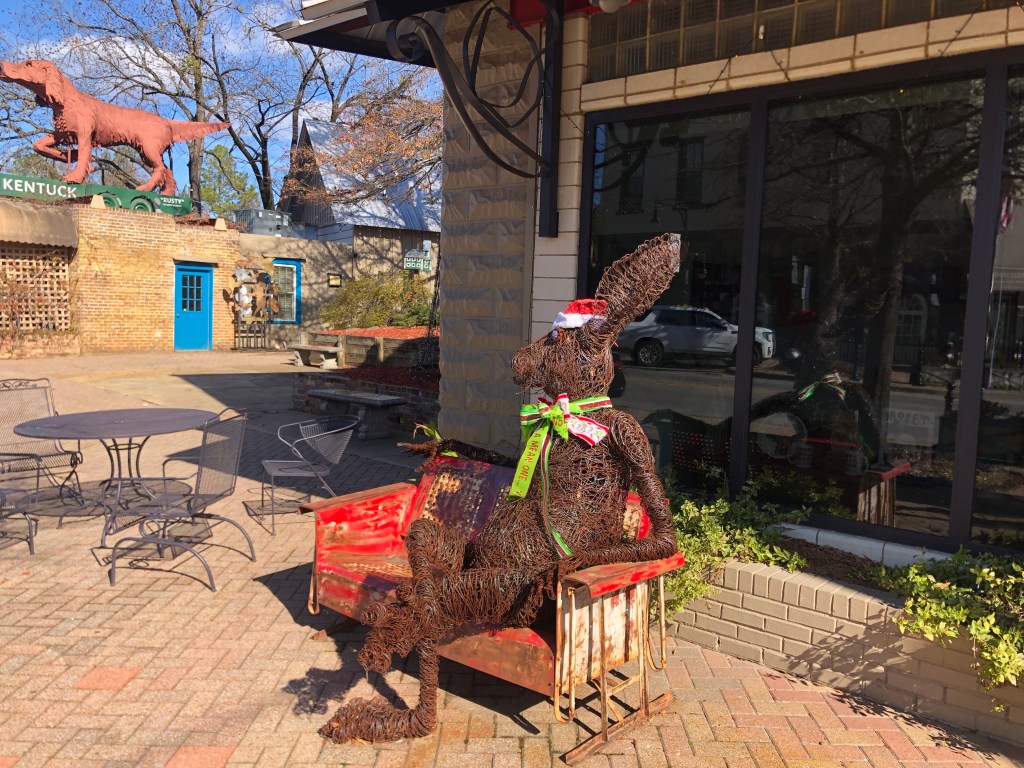
And, as we saw in Starkville, college towns tend to be more lively. Northport’s downtown restaurants were packed, and a whimsical art gallery was just opening. The arts scene is big here, with art walks held on the first Thursday of each month, and a major arts festival each October.
I love the posture of this rabbit.
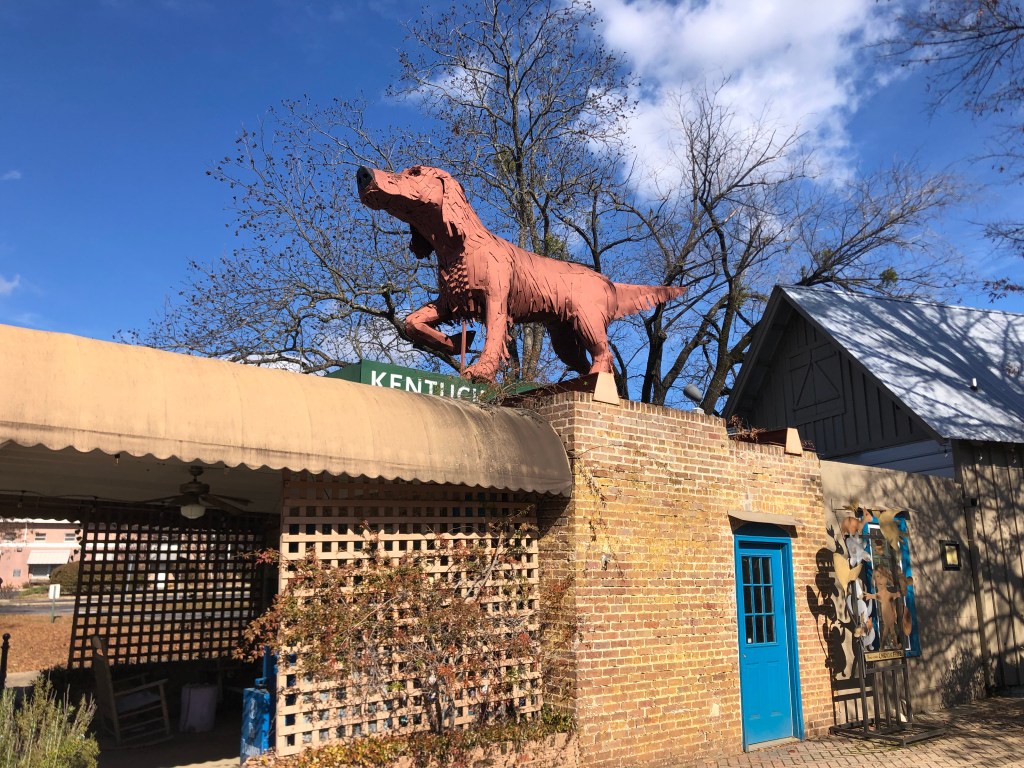
Artist Larry Godwin made this dog, “Rusty,” out of scrap metal in 1983.
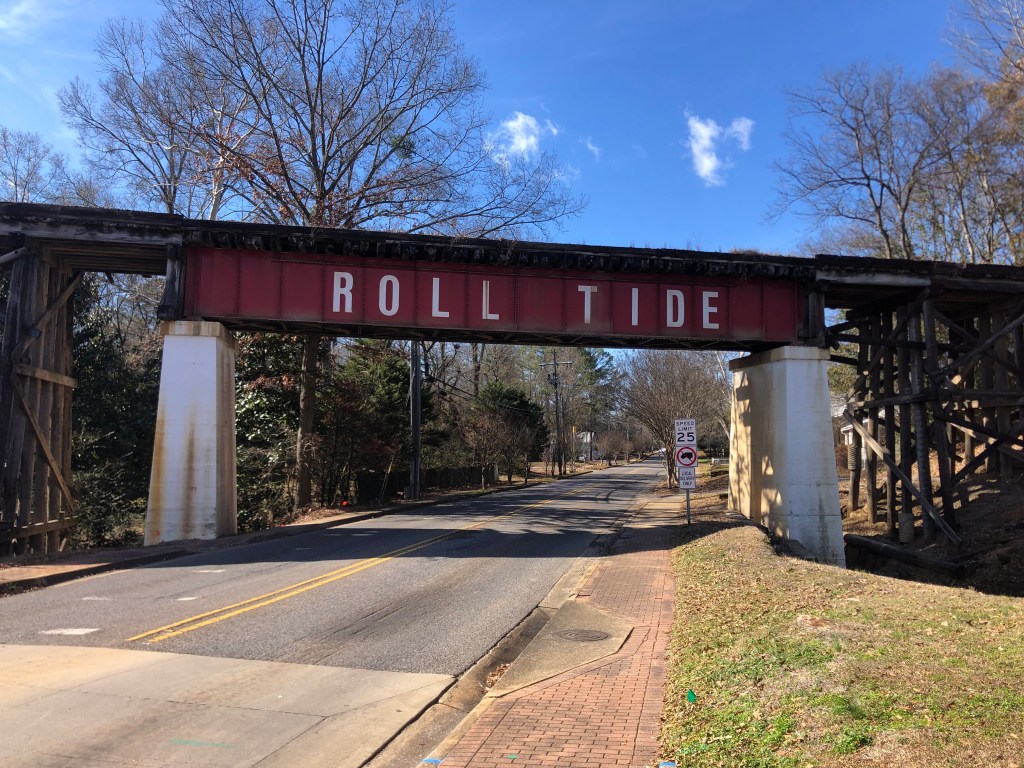
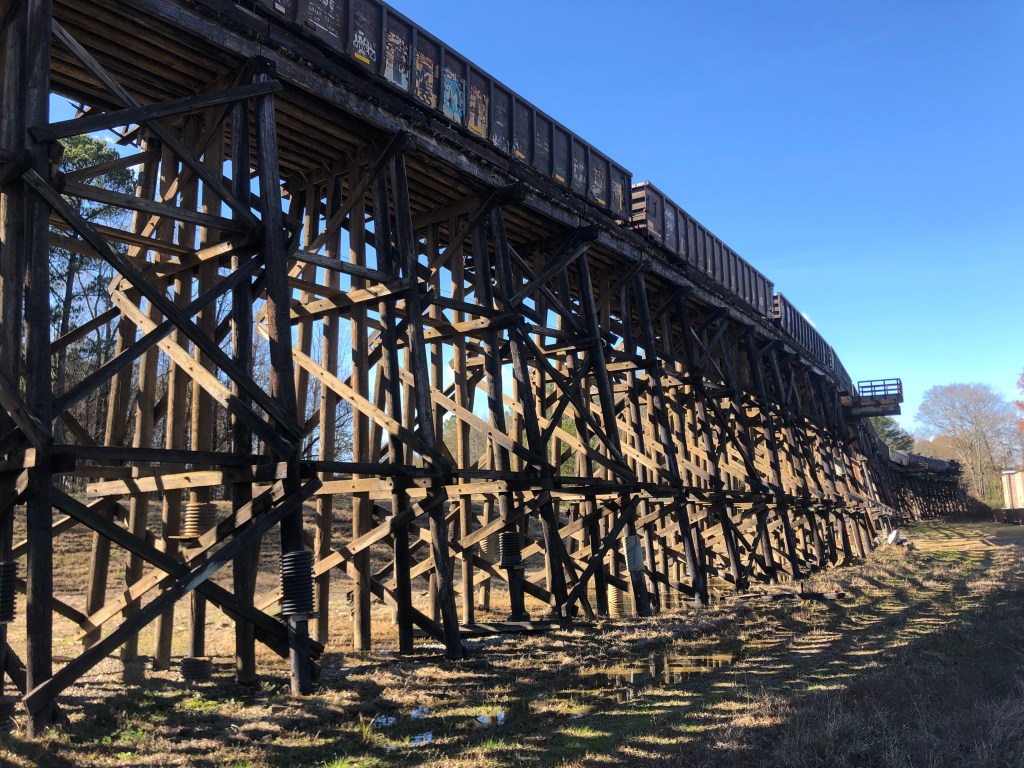
But it’s not all arts. Like so many of these towns, Northport has a rich railroad heritage. Remember the girder bridge in the “Roll Tide” photo, above? It’s part of a railroad trestle that was once the longest in the United States. It was designed and constructed for the Mobile and Ohio Railroad in 1898.
The word “spindly” comes to mind….
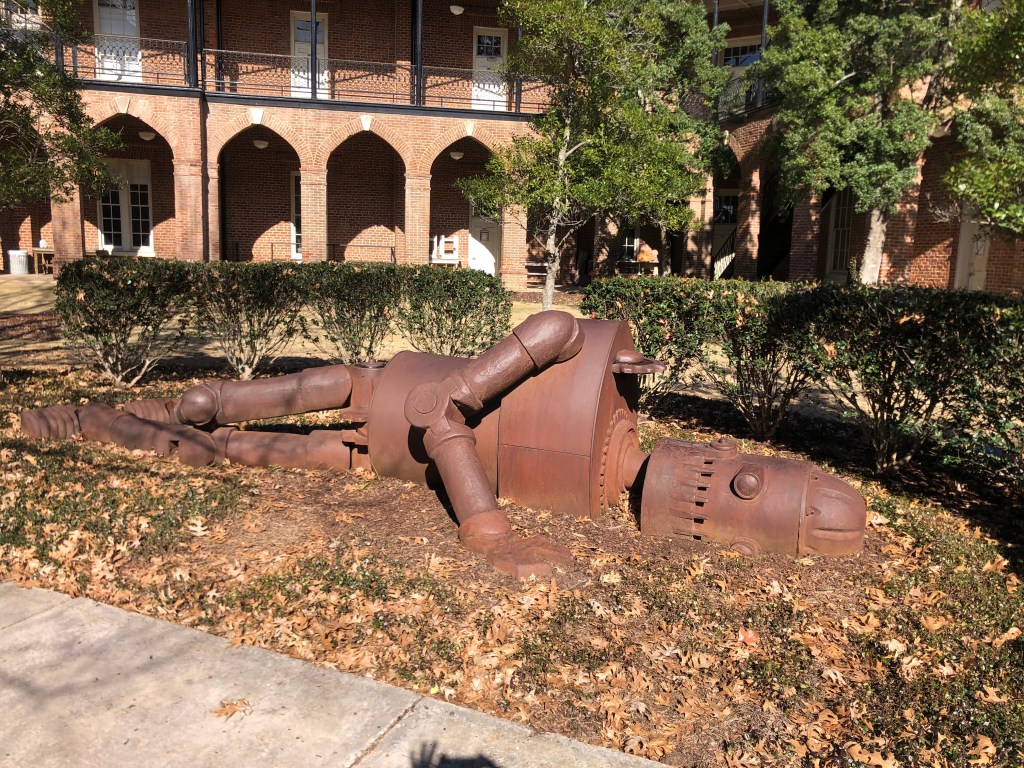
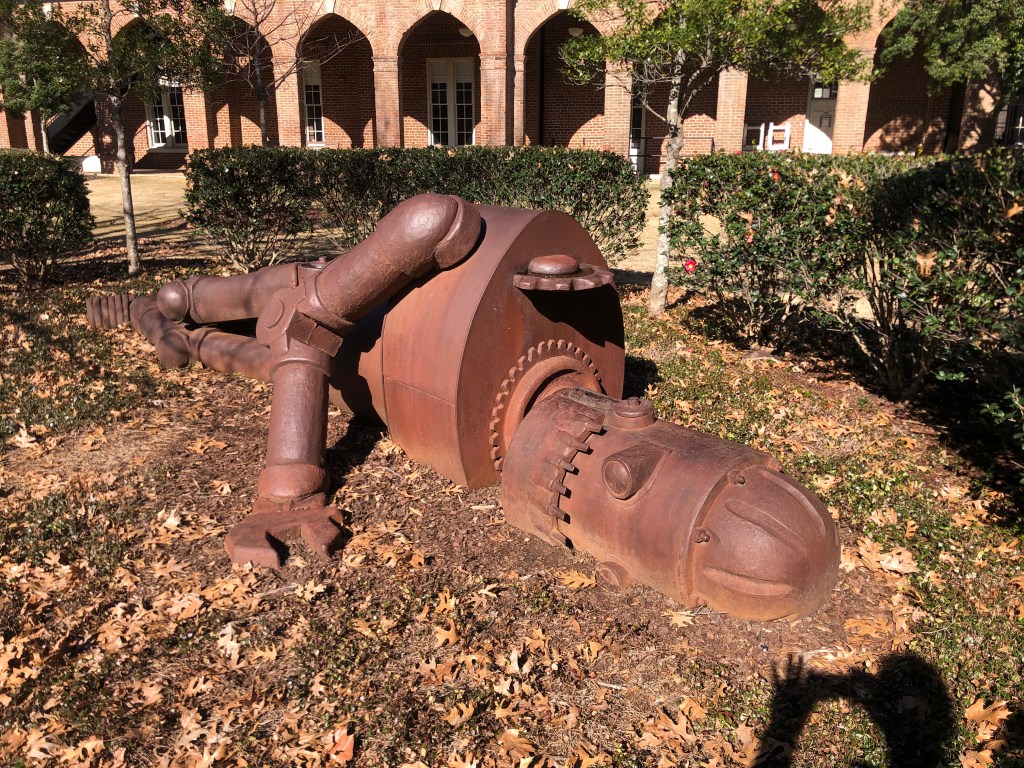
After taking a nice stroll in sunny Northport, I headed across the river to Tuscaloosa (pop: 101,000). Given all the focus on the Crimson Tide I felt compelled to make a visit to U of A (student pop: 39,000). It’s admittedly a beautiful, historic campus that feels orderly and cloistered. I especially enjoyed checking out the student art installations at Woods Quad.
“Goldie 1971,” created by U of A alum Joe McCreary, is supposed to evoke the decline of Birmingham’s steel industry.
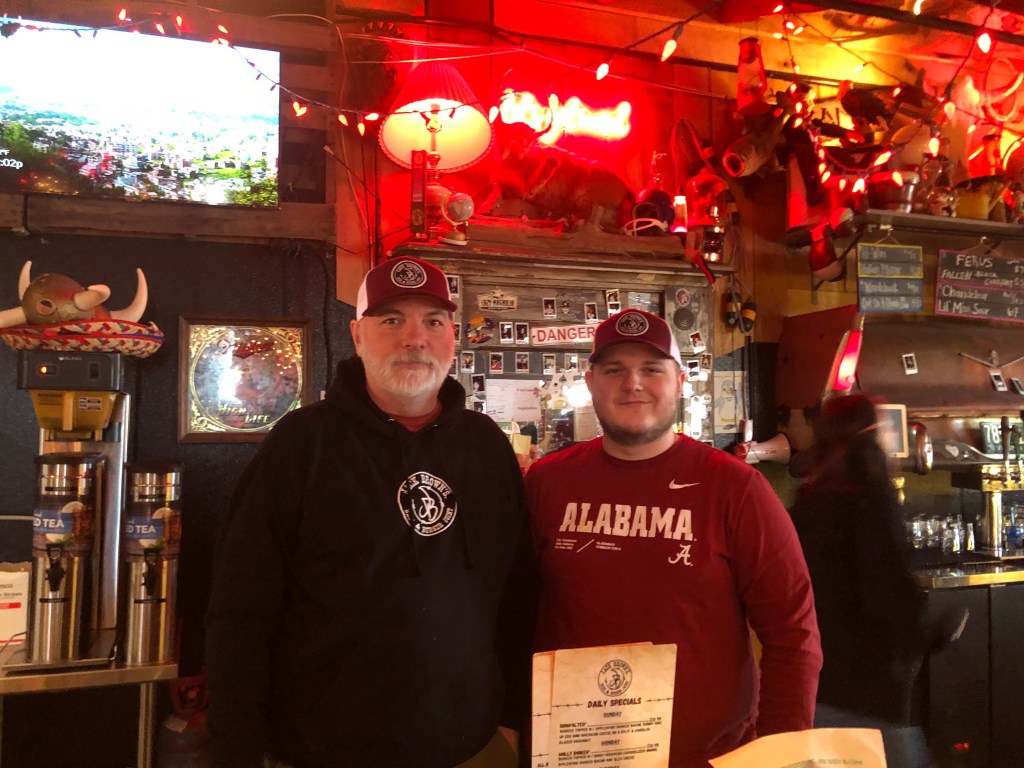
While in Tuscaloosa I stopped for lunch at Jack Brown’s Beer & Burger Joint. The place had just opened three months earlier, and it was packed to the rafters. What a setup! It felt like a roadhouse/dive bar, with that seat-of-your-pants vibe and tons of regulars bantering good-naturedly with the bartender. But wait: It turns out Jack Brown’s is a (privately-owned) chain of 17 restaurants. You can watch the owners telling the story here:
Anyway, chain or no chain, this place has customer service dialed in. Even though the place was packed, the staff were all over me, refilling my drink, bringing me food, asking about my trip, answering my questions about the town.
I decided to order the “Shocker” burger (a hamburger topped with fresh jalapeños, fresh habaneros, house-made Shocker sauce, and 2 slices of Pepper Jack cheese). I asked one of the servers about the sauce, but he said it was a trade secret. No matter; it was truly delicious. I topped it off with a deep-fried Oreo, which is evidently Jack Brown’s trademark (and only) dessert. It tastes kind of like a beignet, but with a core of softened chocolate cookie. What’s not to like?
While I ate my Shocker the manager speculated about the success of the place. It’s not just the awesome customer service and great food, he said. It’s also the “Notch Club.” All it takes to join is drinking 100 beers at your local Jack Brown’s. (After today I am already 2% of the way there, but more on that later.) Once you achieve Notch status, you get an official shirt, your picture goes on the wall, and you get invited to special events just for Notchers. With each 100 additional beers you get a patch for your shirt. And when you get to 1,000 beers, you become a “Saint.” Saints undergo a special investiture ceremony, get some kind of robe or something (I can’t quite remember the details here), and they get to add their own custom burger to the menu that is offered each year on your Saint Day. I tell you: If I lived in the south, I would be all over this thing.
Jack Brown’s manager and the guy who refused to divulge the ingredients of the Shocker Sauce.
Restored and rested from an enjoyable lunch and a few drinks, I got back onto Route 82 East. I’ve noticed that 82 is generally a straight road, but with gently rolling hills to vary the horizon as you drive. At this stage in these cross-country trips I find myself viewing the road, with its uniform signage and federally-mandated lane widths, to be a familiar, comfortable friend. Also, as I’ve mentioned in prior blogs, these US highways tend to be assembled out of pre-existing local roads, and therefore you have no choice but to cruise right through the center of each town along the way, as US 82 becomes, say, Main Street. Or you could think of it as Main Street filling in for US 82 for a few miles. Either way, it guarantees that the driver encounters the brick-and-mortar communities along the way.
Speaking of which: I’ve noticed some cultural themes as I’ve been driving through this part of the country. Some of them are what you’d expect: Lots of barbecue joints, lots of churches, lots of American flags. But some of the stereotypes are not in abundance. I have not seen a single Stars and Bars flag. I have seen only one sign professing support for Donald Trump. And while I’ve seen a lot of pickups, I’ve actually seen far more Nissan Altimas. [Editor’s note: Evidently Altimas are manufactured in Mississippi and Tennessee.]One welcome surprise (compared to my experience in California) is that gasoline can be purchased for about $2.59 a gallon.
The ubiquity of crosses all along the highway is perhaps most foreign for this California native. Most of the time it’s a simple and low-key statement in someone’s front yard, but today I passed an enormous display that was quite in-your-face. It’s really too big to be conveyed in a single photograph, so I took this video:
Don’t be cross…
The display is the life work of one William Carlton Rice. He’d been building, expanding, and maintaining this “cross garden” from the 1960s until his death in 2004. His family promised to maintain it after his passing, but old-timers say the place ain’t what it once was. If you’re interested, brief descriptions of the project and W.C. are here and here.
I noticed that somehow the road leading to W.C.’s property was lined with still more giant, wooden crosses….
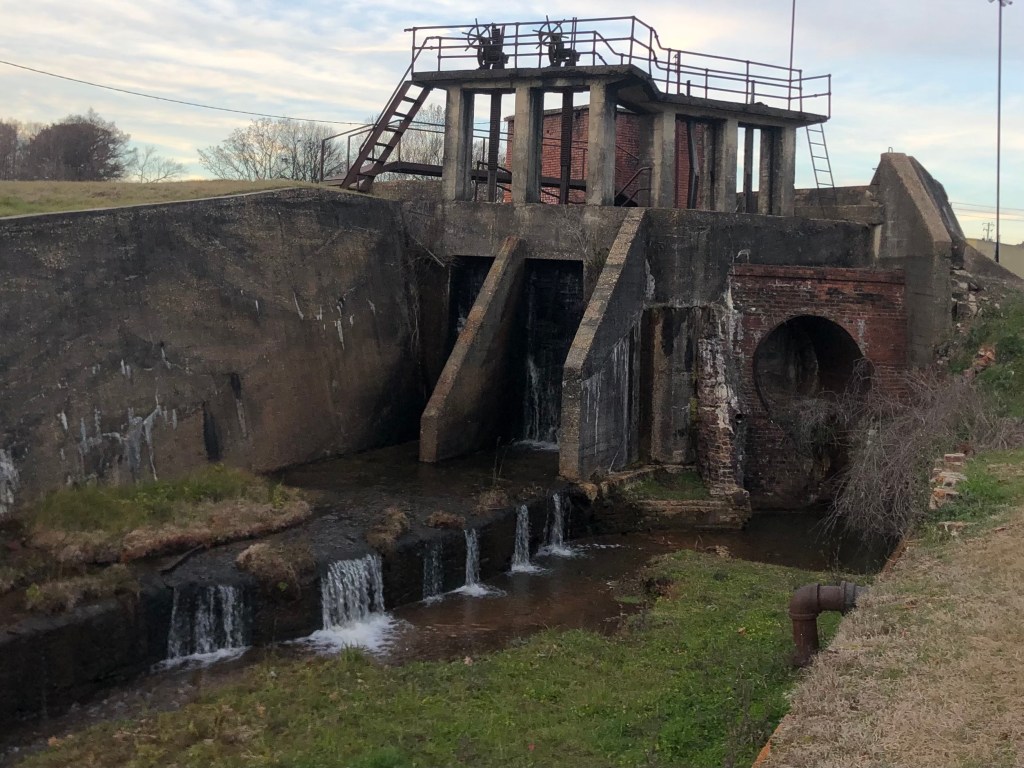
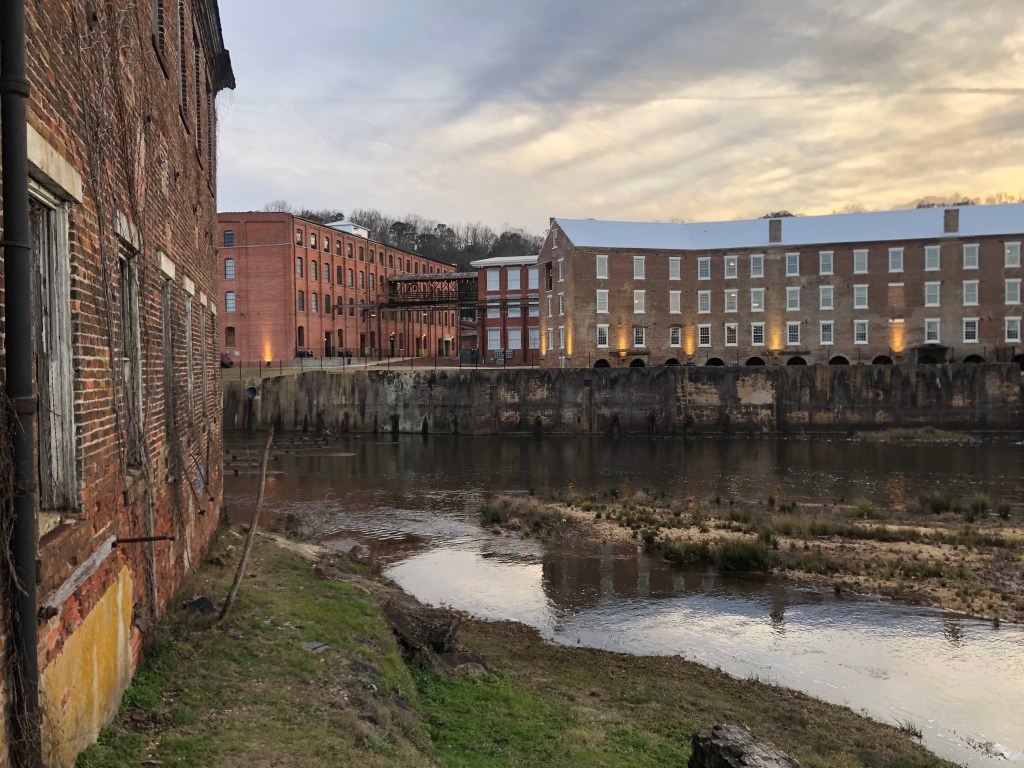
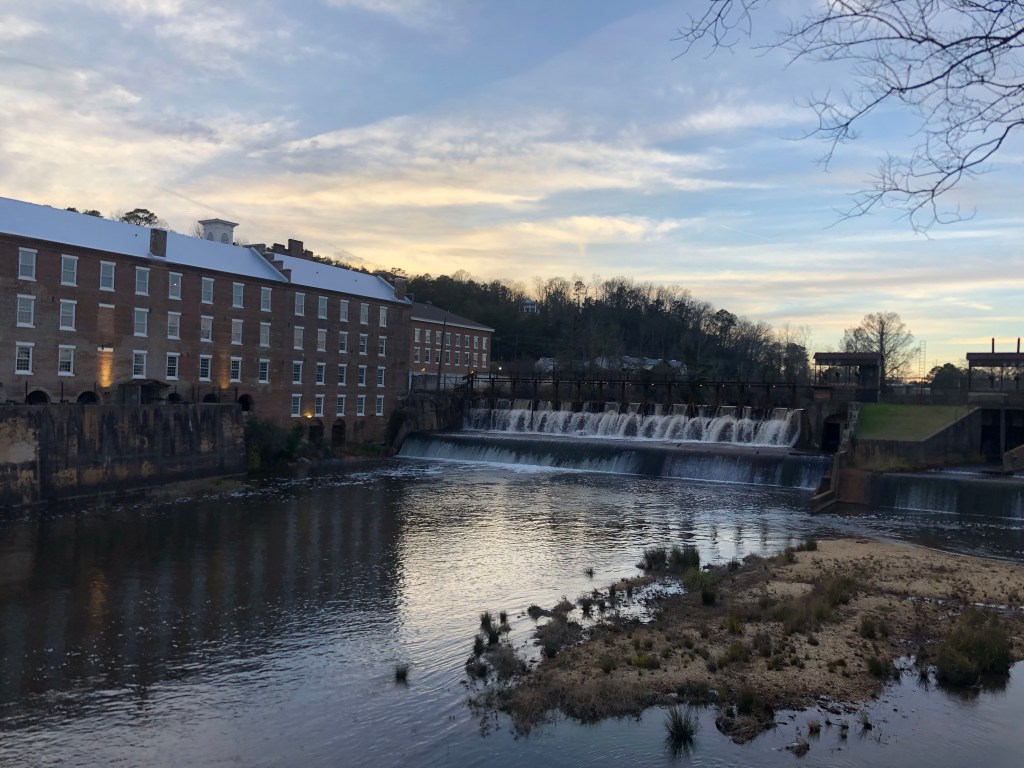
Daylight was growing short when I got to the town of Prattville (pop: 38,000). It was founded by the eponymous Daniel Pratt in 1839. Pratt was an industrialist from New Hampshire, and he figured that the flow of Autauga Creek, which runs through the area, would be a good power source for 19th-century industrial applications. Before long a thriving city had grown up, and today, for some wonderful reason, much of the historic town remains intact, like a giant time capsule. (Check out this list of historic structures from Wikipedia.)
I arrived at Prattville just at dusk, and I must say it felt otherwordly. The lighting was like a Thomas Kinkade painting, the creek was flowing steadily over a stepped dam next to the cotton gin manufacturing plant, and a young couple was holding hands and walking across a bridge.
Next to all these industrial remnants is the historic business district, which is now largely oriented toward tourists.
As it was getting dark, I decided to spend the night in Prattville. Tomorrow I will make my way into Georgia.
Brew of the Day
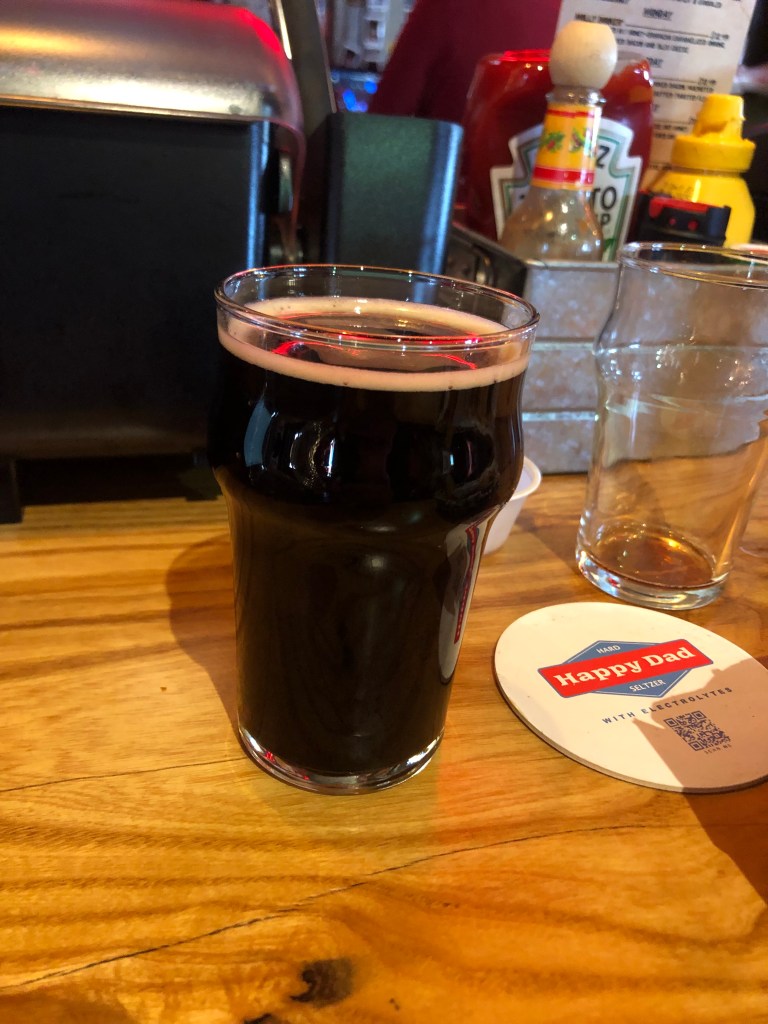
I got my BOTD at Jack Brown’s in Tuscaloosa. It was a milk stout from Southern Prohibition Brewing in Hattiesburg, Mississippi.
It was a very drinkable beer. Only lightly hopped (as is customary for this style of beer), it also had very little foam. The color was dark brown, like espresso. It even had a bit of roasty, espresso taste, though this was well balanced by the sweet, creamy goodness of lactose. I found this to be a rich, tasty brew, and at only 5.2 ABV, I treated myself to a second glass. Definitely worth 4 starts out of five.
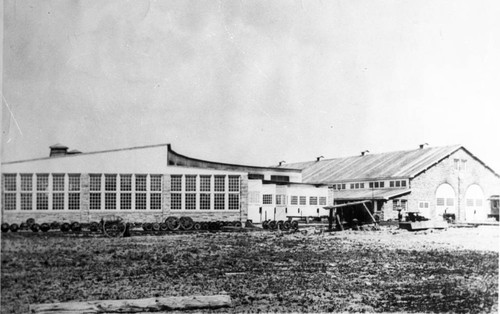
After getting my complimentary coffee and scone from the Niles Hotel this morning, I made a final circuit of Alturas looking for one final NCO structure. Apparently the old locomotive shops buildings are still around, but I could not find an address on the Interwebs. There was just this historic photo from the Modoc County Museum:
“Portrait of the old N.C. & O railroad shop in Alturas, Ca. Published by: The Journal of the Modoc County Historical Society in 1982. Old N. C. & O Railroad Shop”
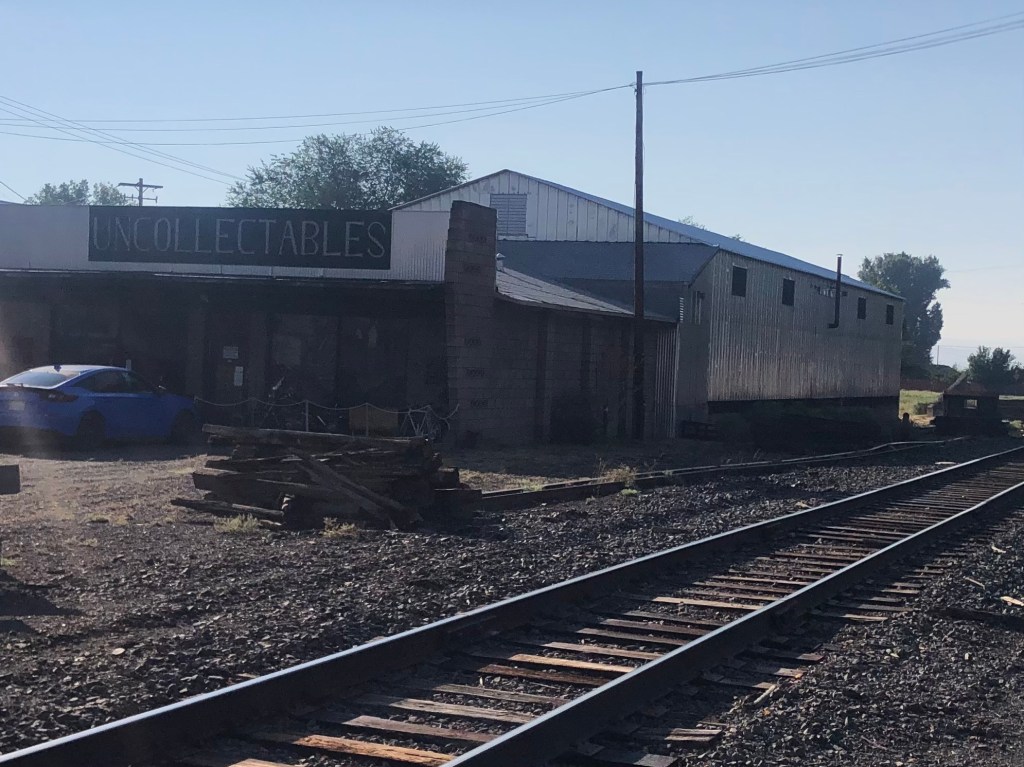
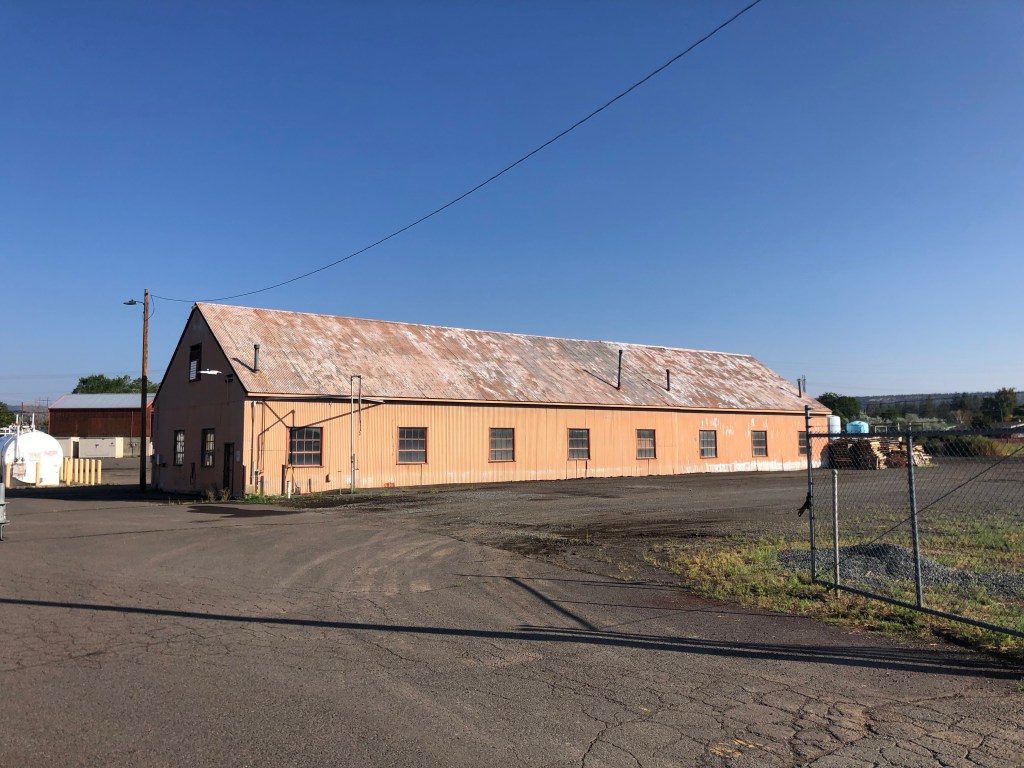
So I just cruised around the city, trying to hew to the rail line on the theory that railroad shops would be connected to the tracks somehow. Only two structures even remotely resembled the rightmost building in the historic photo, but I think they are not what I’m looking for. Here they are:
The roof of the building in the back has the right pitch. Note the misspelling on the “uncollectables” sign.
This CalTrans facility looks like it could have been an old train shed…
Anyone with information or even a hunch (I’m looking at you, Quasimodo) please let me know!
Around 9:30 am I left Alturas in defeat, and got back onto US 395 north. On my way to Lakeview, OR (which you will recall was the northern terminus of the NCO Railway), I passed a couple of noteworthy sites:
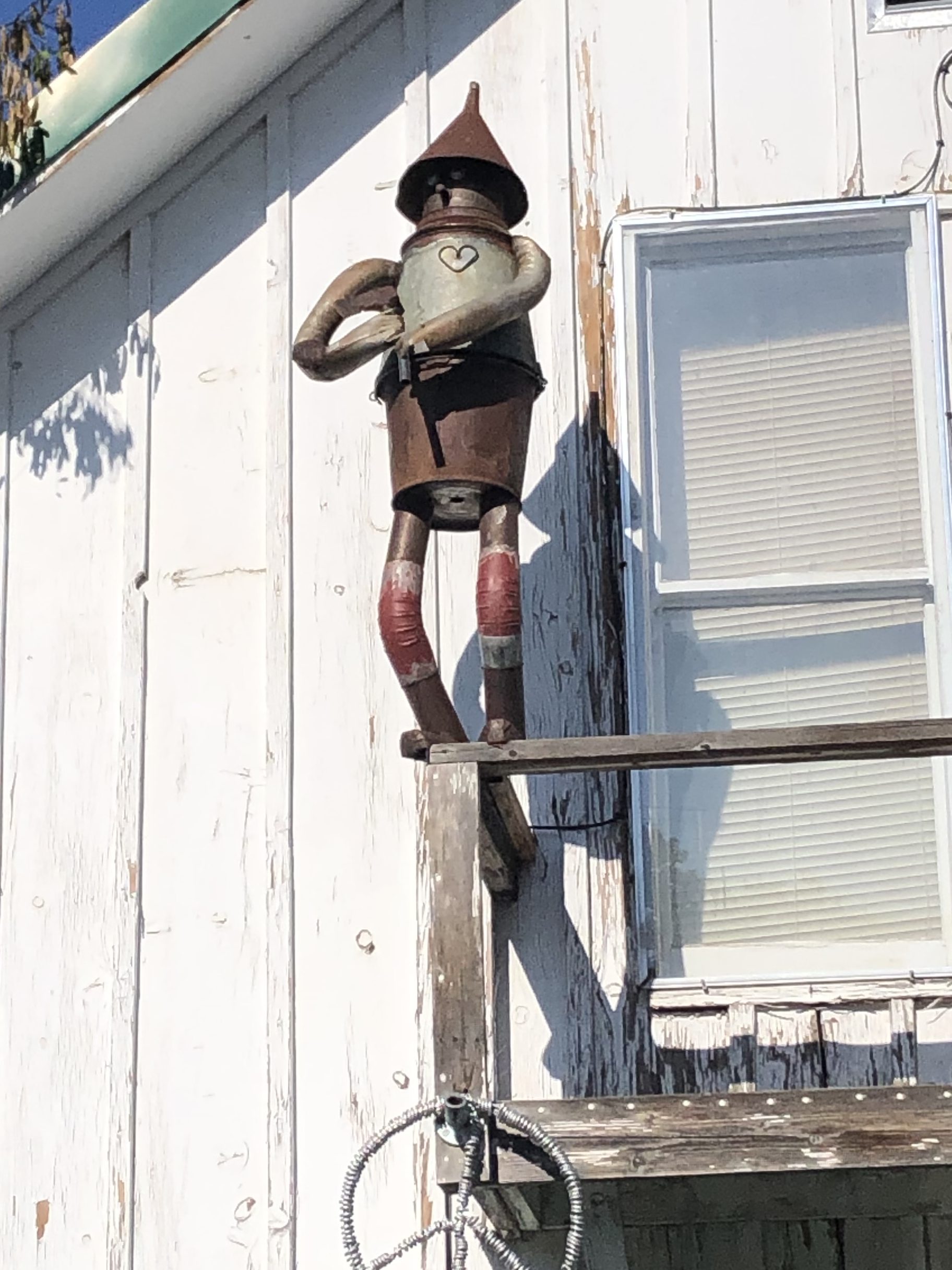
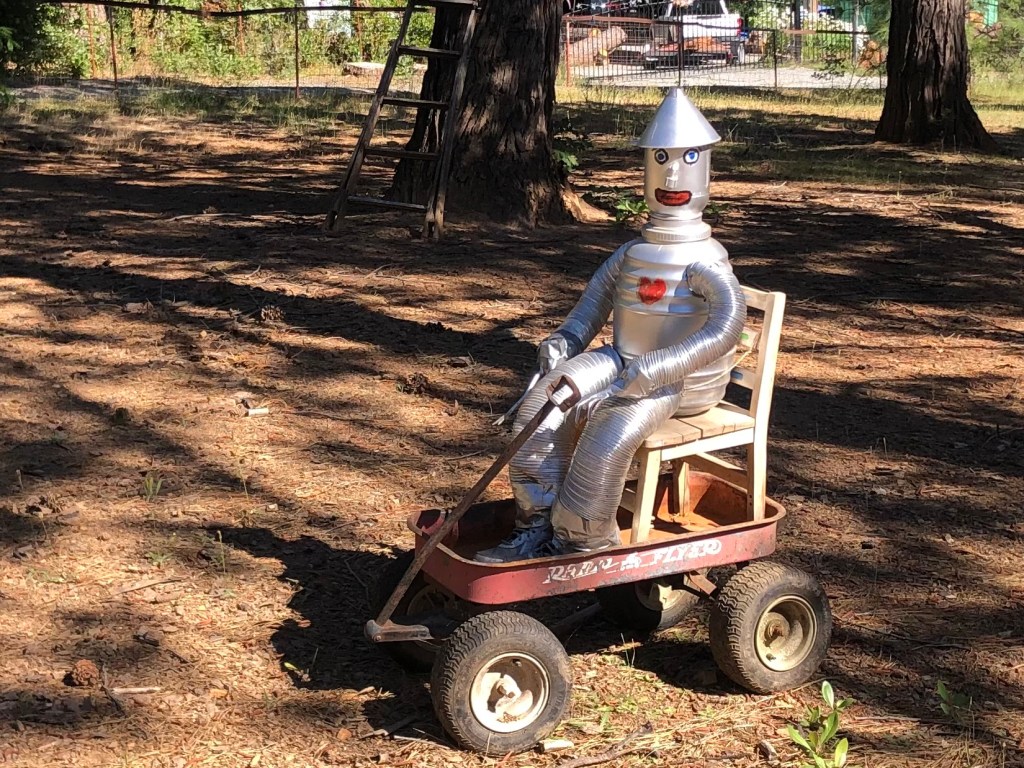
I spotted this Tin Man figure on the side of a house facing the road. Like the one I saw a month ago near Georgetown, CA, it brought a smile to my face. The owner came out of his house while I was taking the photo, and we had a nice chat. I think what this world needs is more Tin Men.
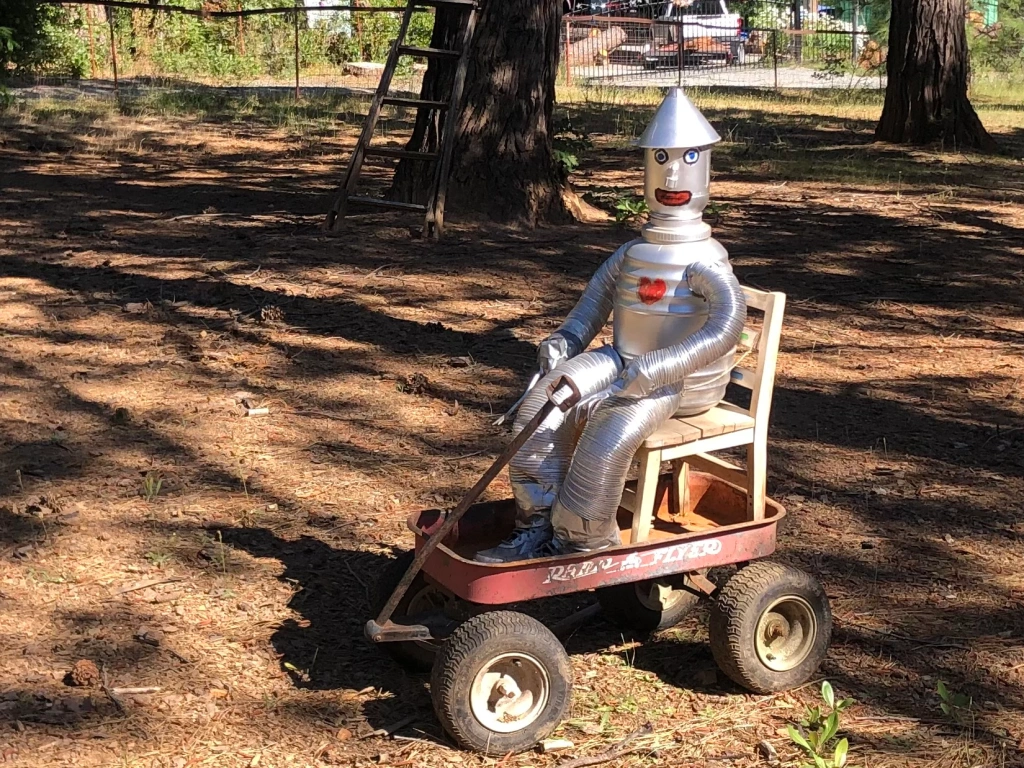
Here’s the one from Georgetown.
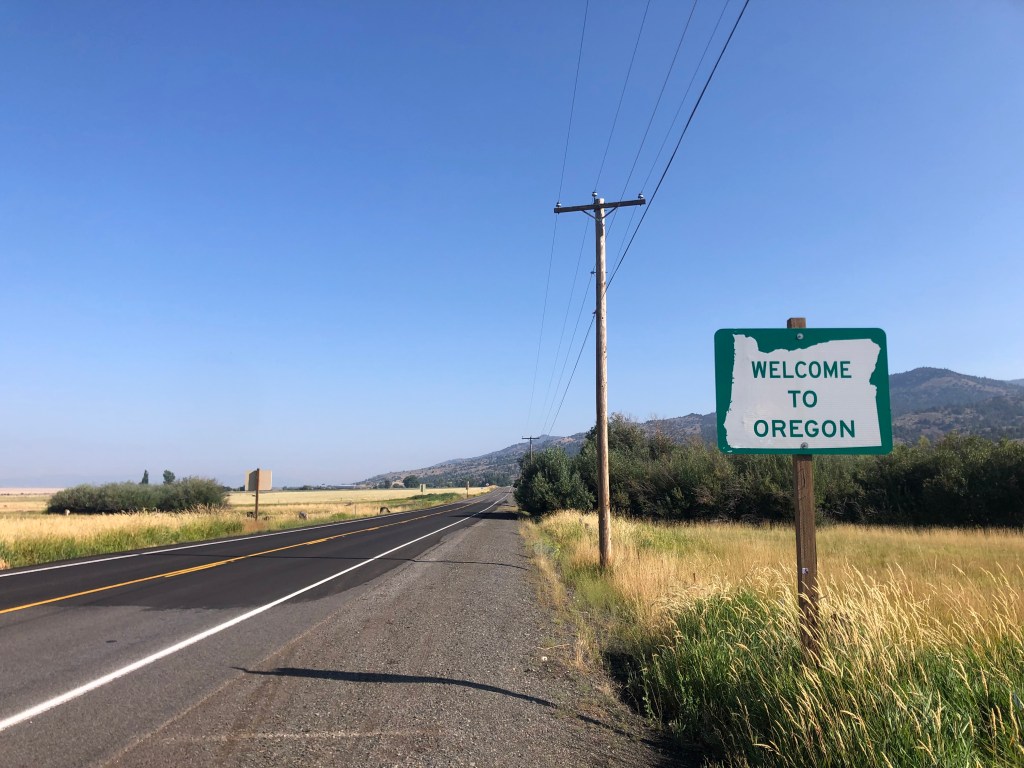
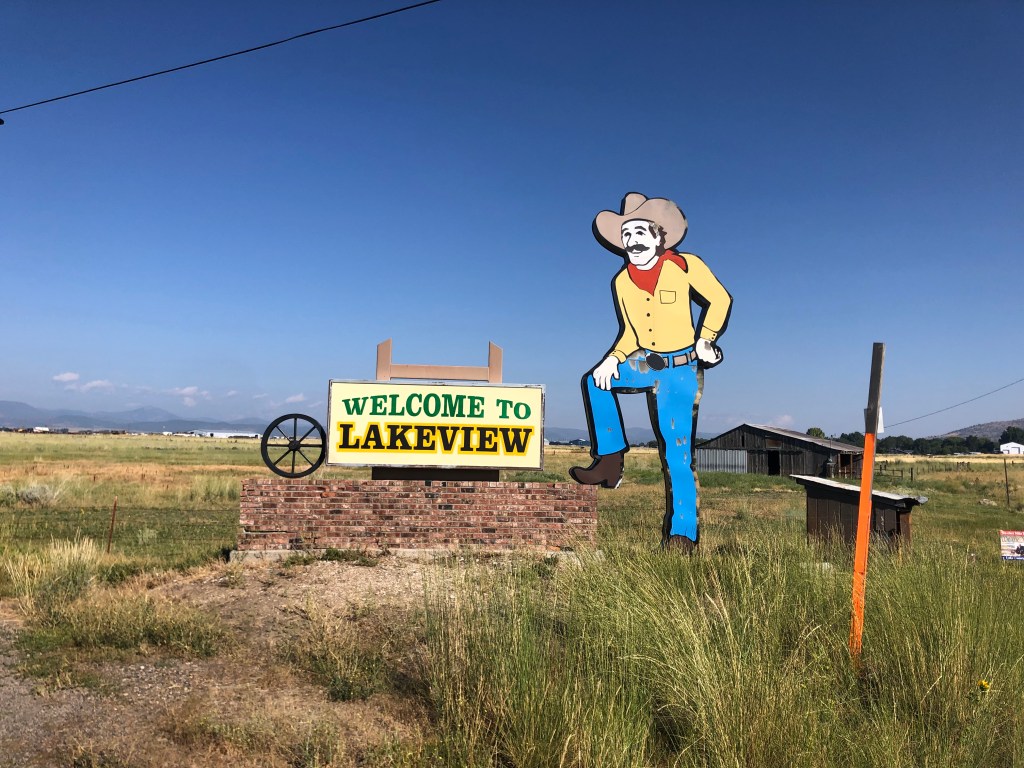
Entering the third state of the NCO!
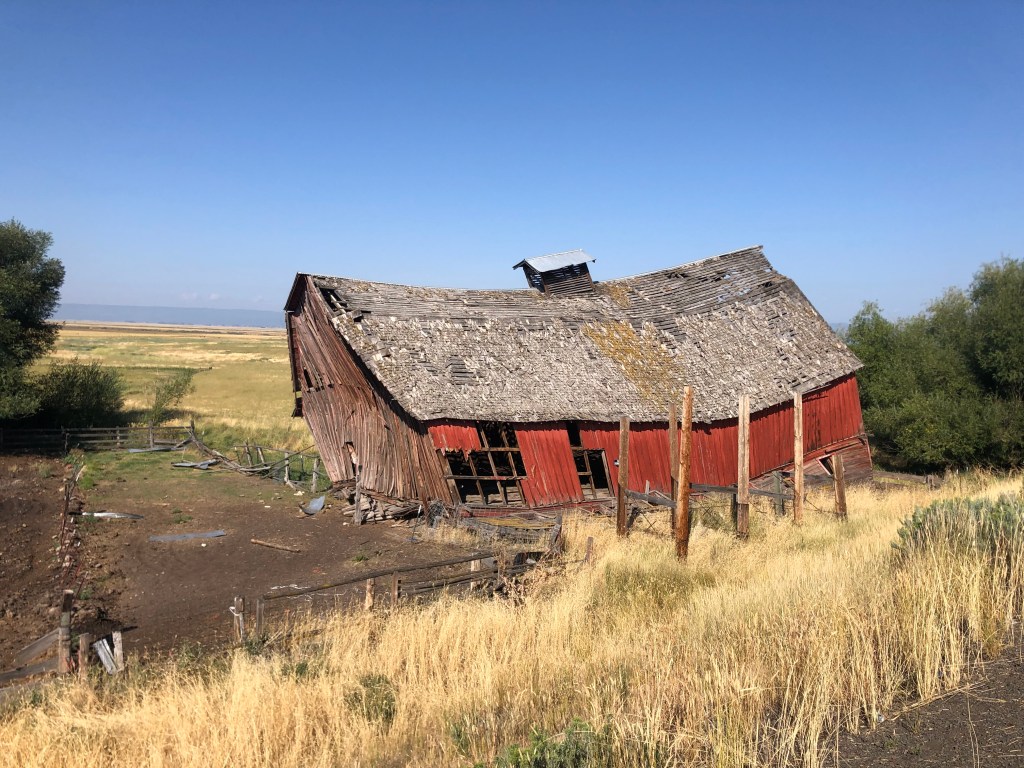
If Salvador Dali built a barn…
Finally I arrived in Lakeview, Oregon (pop: 2,500).
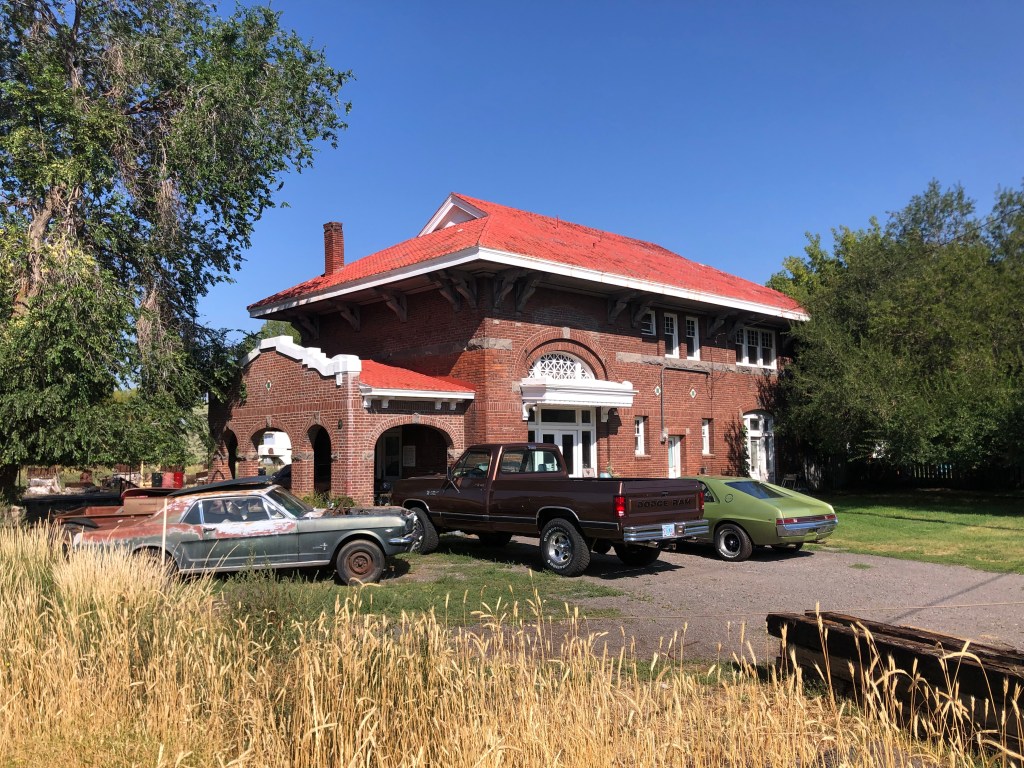
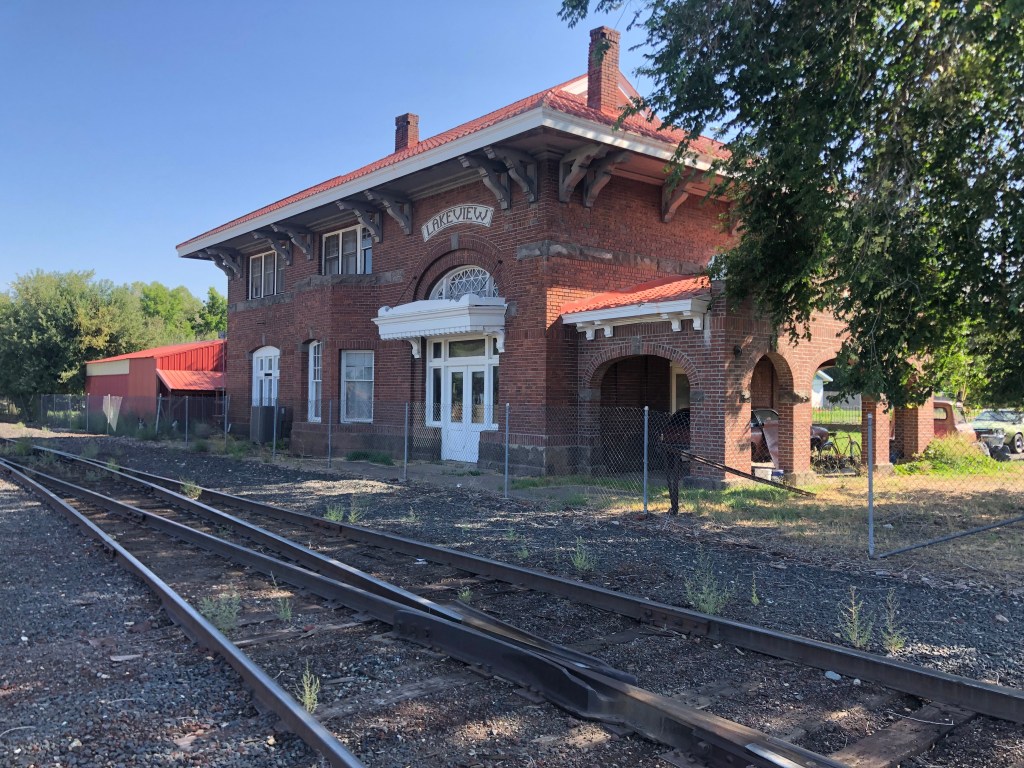
Just to the west of downtown I found the depot. It looked to be a happening place, with numerous cars parked in front.
Note the rare AMC Marlin (?) on the right.
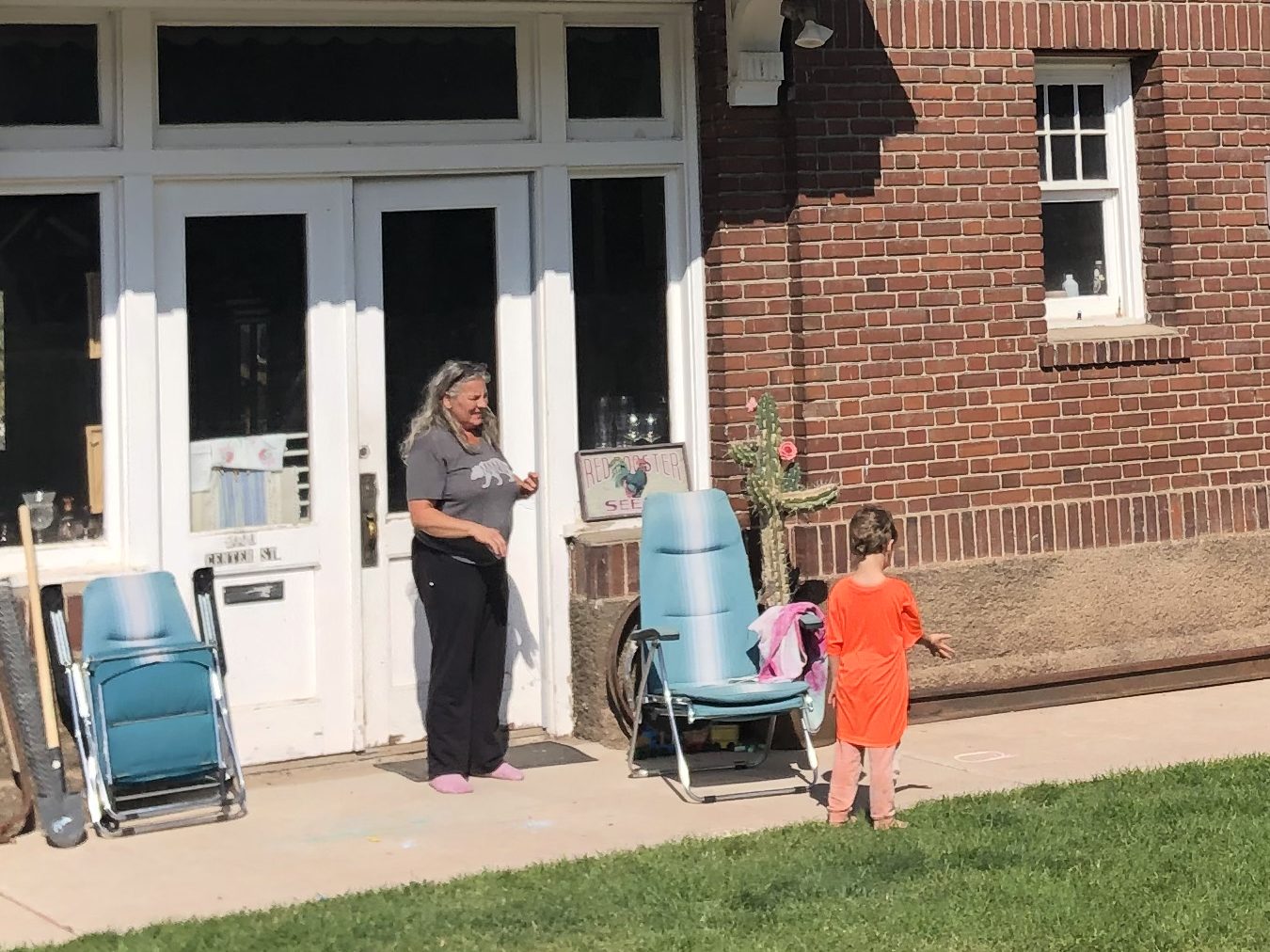
But it turned out that these cars all belong to the depot’s owner. For unlike the other depots on this trip, this one is serving as a private residence. The owner’s name is Carmen, and she bought the depot from the second owner (after the railroad sold it). She appears to have changed little of the outside of the building. As for the interior, I can’t say. She steadfastly ignored my repeated hints that I’d like to see the inside.
Carmen, managing her little Yardmaster.
Interestingly, the tracks immediately behind the depot are still active. It seems there’s a short line railroad that ships goods between Lakeview and Alturas. The tracks are essentially unprotected, and run just a dozen or so feet from the depot’s back door. For a railfan, it sounds ideal. For anyone else, it sounds noisy and dangerous. But I am grateful to Carmen for preserving this piece of NCO history.
Not your typical bungalow.
It was now finally time to fulfill the whole point of this trip: A return visit to Eagleville, CA. I said goodbye to Carmen and headed back down US 395 to Surprise Junction, then headed east on CA-299. After about an hour and a half I stopped in Cedarville (pop: 425) to get gas and lunch. Cedarville is only 17 miles from Eagleville, but the latter has almost no services, so I made use of the former.
While pumping gas I noticed numerous campers and RVs and VW buses lining up at the pumps. Almost all of them were carrying bicycles and other equipment, and the drivers and passengers all had fluorescent hair. “Burners,” muttered the gas station attendant. In response to my confused look, he explained that these folks were all going to the annual Burning Man event in the Black Rock desert. It struck me that, in their effort to be independent and iconoclastic, they all looked and behaved exactly the same way. That said, I did have to admire the work this guy put into his Burner Mobile.
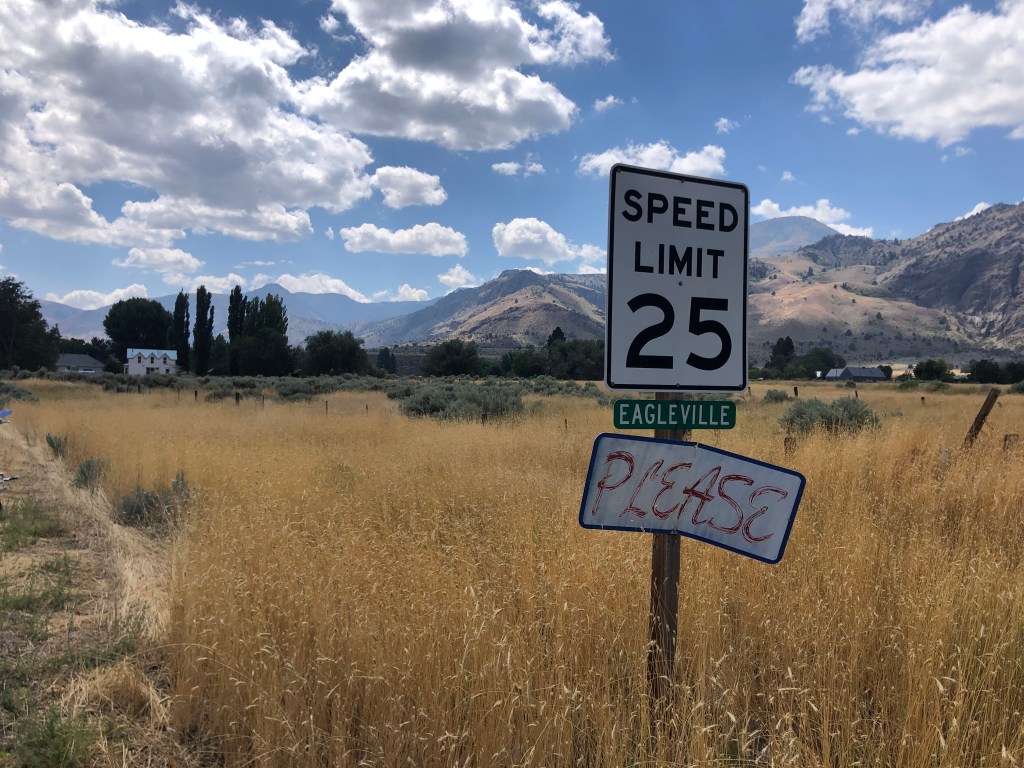
About 20 minutes after I’d finished my pit stop in Cedarville, I was standing in Eagleville (pop: 45) for the first time in almost half a century.
Perpetual plea.
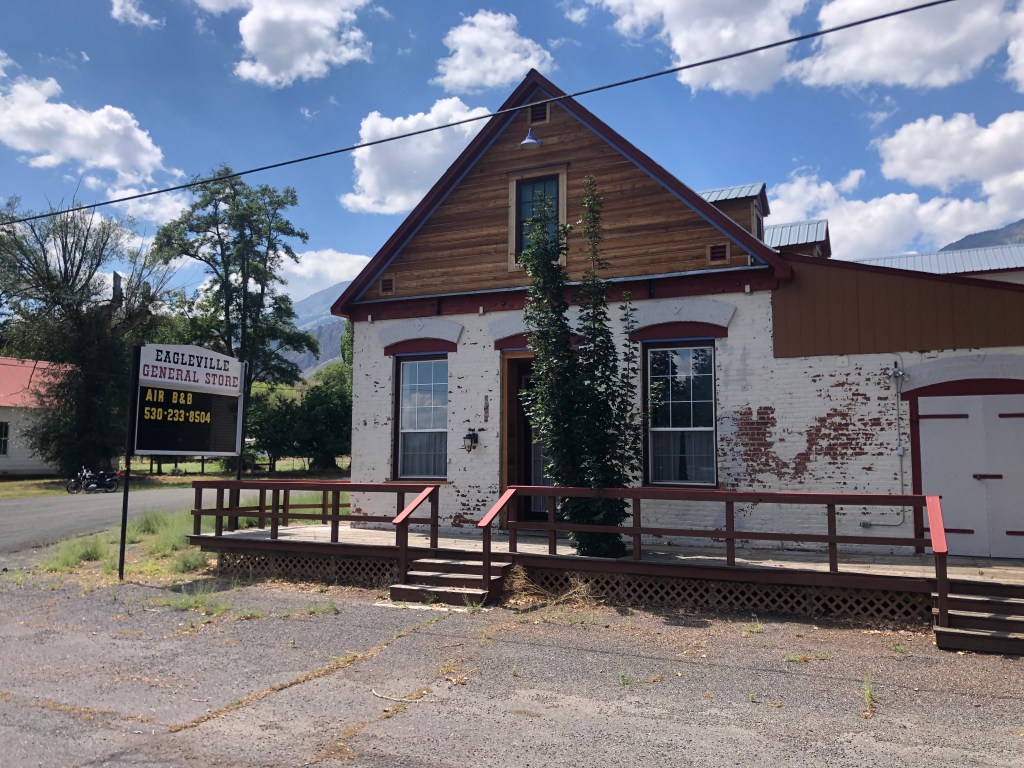
The first thing I noticed was the general store, which was originally built in 1876. It’s gone out of business, and the owners seem to be trying their luck renting it out as a B&B. I think that might be a stretch. The 150-year-old exterior walls look largely unchanged from when I had last seen it.
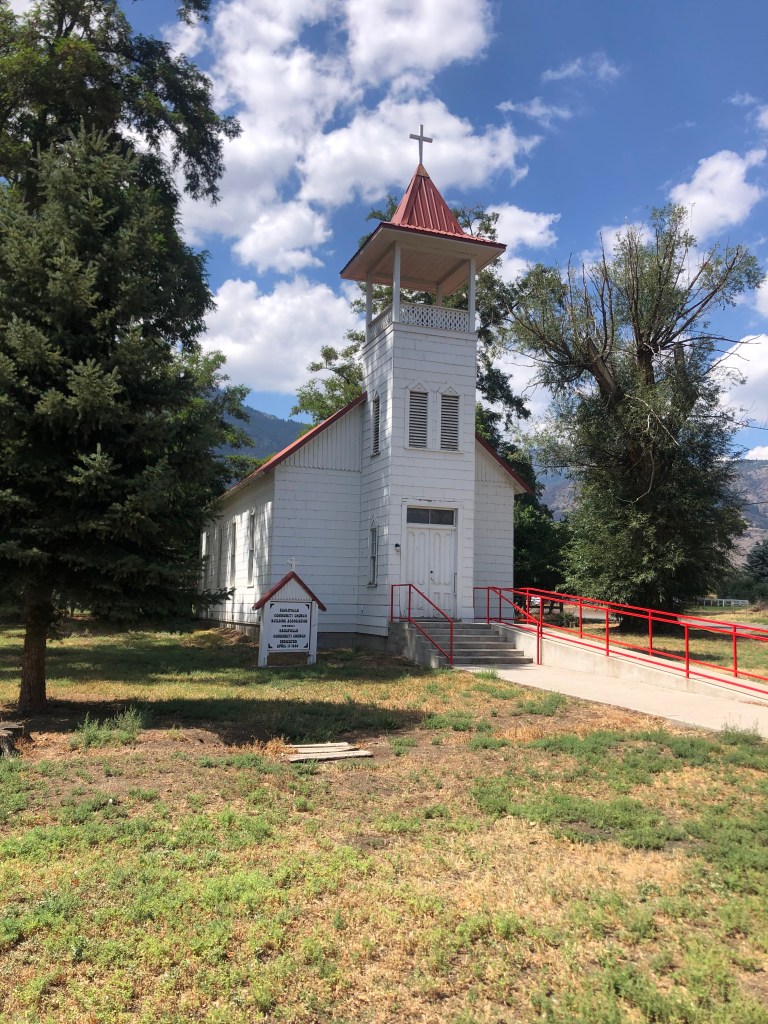
Across from the general store was the old (1888) church I’d remembered. It looked almost exactly the same as my memory, though I read it underwent some restoration work in 2000. This time, though, the door was locked. Evidently they are less trusting than they once were. And who can blame them? I also read the church no longer holds regular worship services.
A restored church that is no longer open for worship.
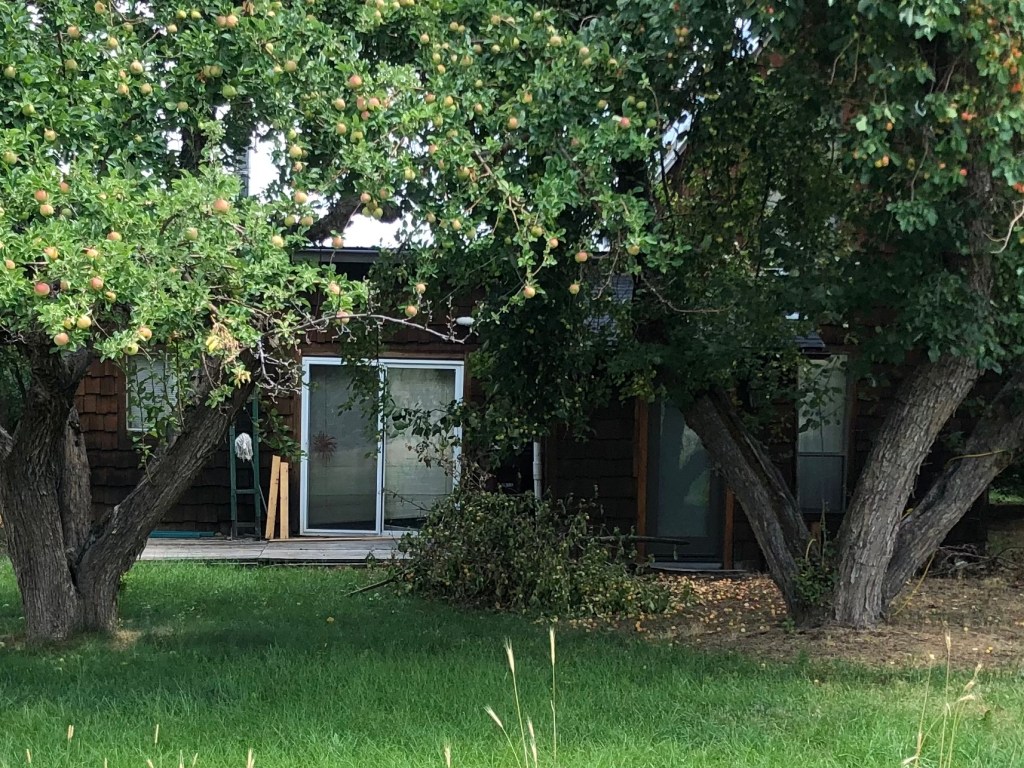
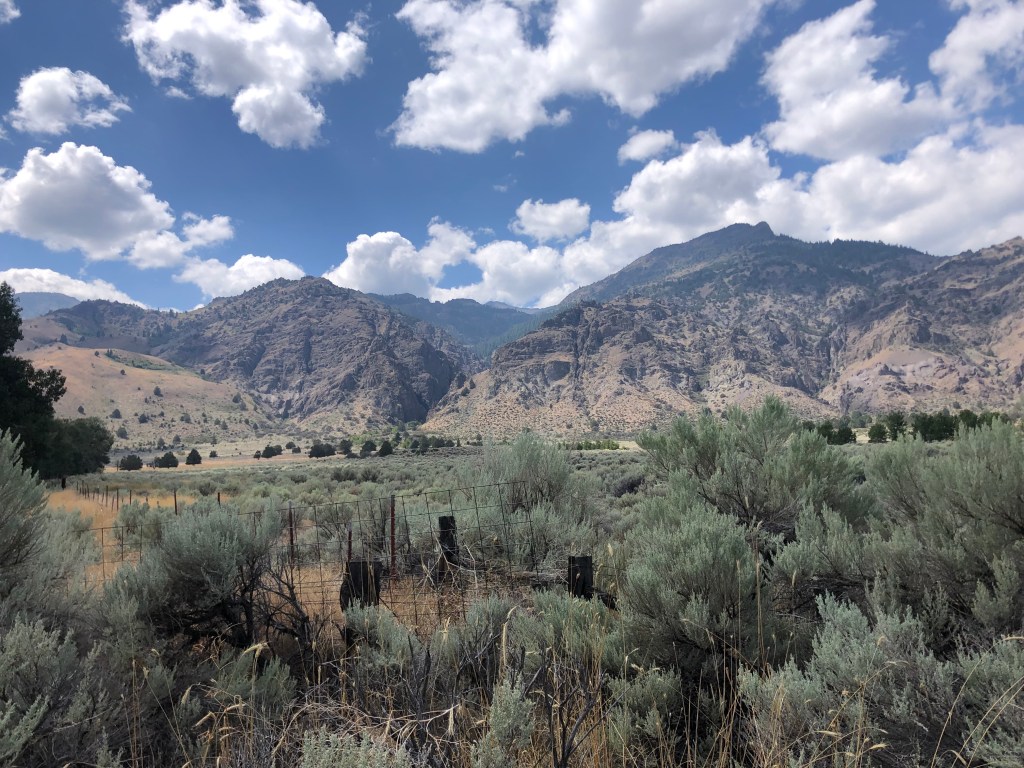
I then went down the street to the street Aunt Alice’s family maintains three homes. The house where we’d spent Thanksgiving in the mid-1970s was still there, seemingly frozen in time. The South Warner Mountains still stand sentry over the town.
Back of the house, just as I remembered it.
Great view from the family homestead.
Notably, I did not see one living soul in Eagleville. Maybe people stay indoors during the mid-day heat. But l it did feel a little unsettling. I guess some people prefer a quiet, isolated existence. Indeed, the gas station attendant in Cedarville told me he left Alturas to “escape the rat race.” He likes “how small this town of Cedarville is.”
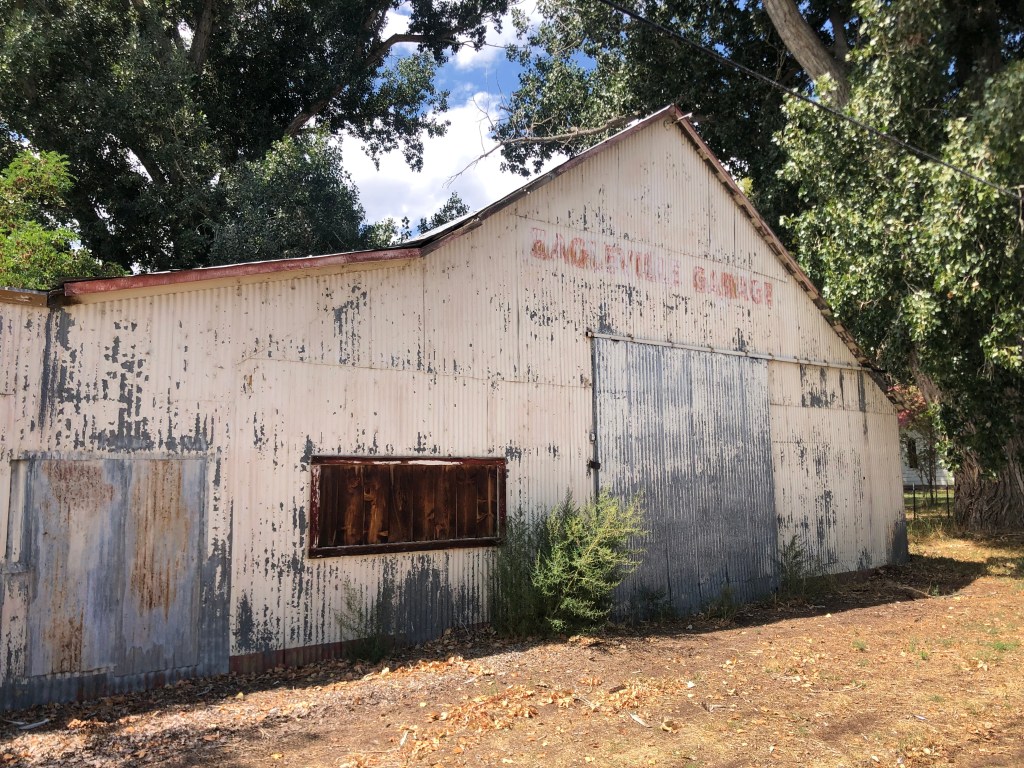
But Cedarville is a metropolis compared to Eagleville. At least Cedarville has a gas station. Most of Eagleville’s erstwhile businesses are long closed. Like the Eagleville Garage.
I think I’d go crazy in a place like Eagleville. But I’m glad it exists, and I’m glad that some people make it their home. We all need to find the place that suits us. In addition, there’s also something reassuring about a memory from my past retaining some physical form.
After melancholy reflections such as these, I got back on the road and started to head home. Hundreds of “burners” shared the road with me as they made their way to the Black Rock desert, seeking to transform one of the country’s most desolate places into a teeming metropolis….if only for a week.
Mail Bag/Miscellany:
I neglected to mention in yesterday’s blog that Uncle Ed’s Dome of Foam includes information on the NGO and its depots. Here is the link.
See also some further input that Ed and others posted in the comments section of yesterday’s blog.
Finally, here’s Edward’s photo of Carmen’s “house,” back when it was serving a very different function.
“Arrival in Lakeview,” 1974. From Uncle Ed’s Dome of Foam.
I spotted him in someone’s yard on Wentworth Springs Road near Georgetown, which is about halfway between Placerville and Colfax in the Sierra foothills. I was heading home from Lake Tahoe, opting for the scenic route that cuts through the El Dorado National Forest rather than US 50.
Loyal readers familiar with this blog know of my appreciation for yard art. Especially in this era, where so many of us seem to be poised to pounce on each other for using the wrong word or drinking the wrong beer, yard art is a whimsical, unencumbered gift to passersby. It’s outward-facing, offering a brief distraction or a chuckle and asking for nothing in return. I think yard art does far more to improve the world than any political placard listing beliefs or principles.
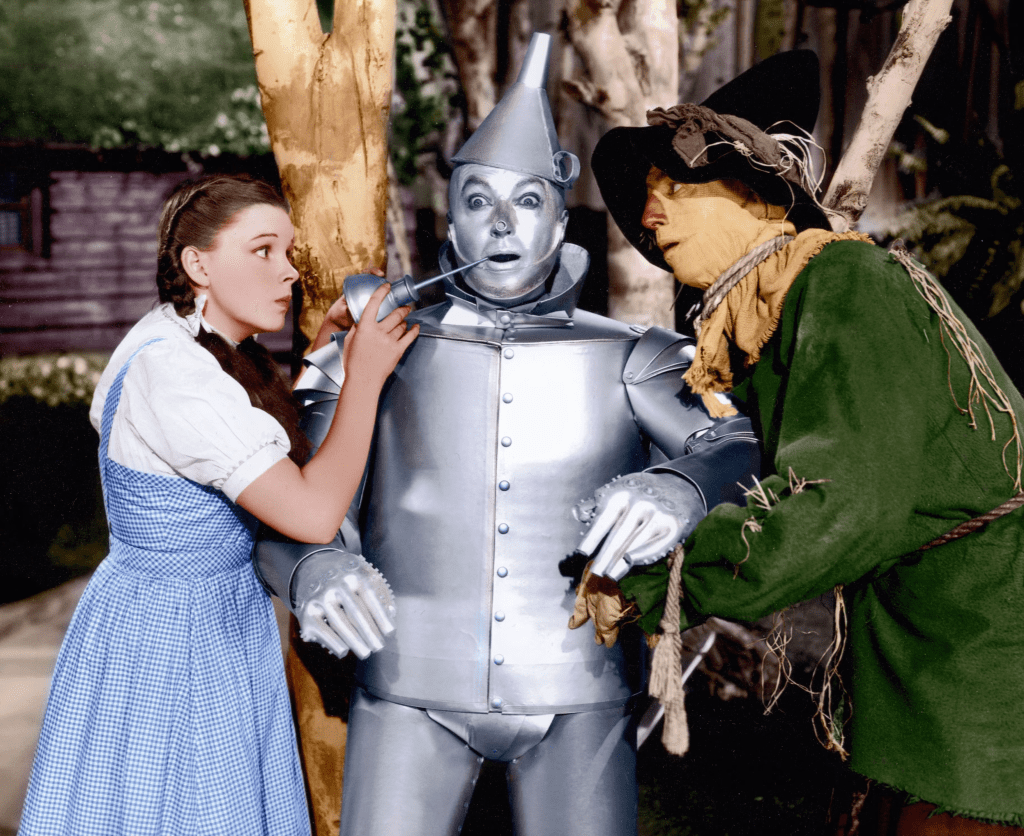
And yet I’m torn apart. Just because I’m presumin’ that I could be kind-a-human, If I only had a heart.

 Chasing Phantoms