“Spirits of the Dead” explores the mysteries of life and death in a convincing and evocative fashion–which is somewhat surprising, as Poe was a mere 18 years old when it was first published (under the title “Visit of the Dead.”) The poem is five stanzas long (the first two are reproduced above), and it does not stick with any consistent structure or rhyme scheme. For all that, it’s a remarkably haunting and, in its own way, beautiful poem. (I will let slide his rhyming of “Heaven” and “given.” But not so “pry” and “secrecy.”)
All that said, it’s the imagery that I find most notable: “gray tombstone,” “high thrones in the Heaven,” “red orbs, without beam,” “the breath of God,” “shadowy yet unbroken.” They’re the kind of phrases you’d find in a Gothic ghost story. And that’s convenient, because I’ve been dying (ha!) to make a ghost-themed cocktail. So let’s do this!
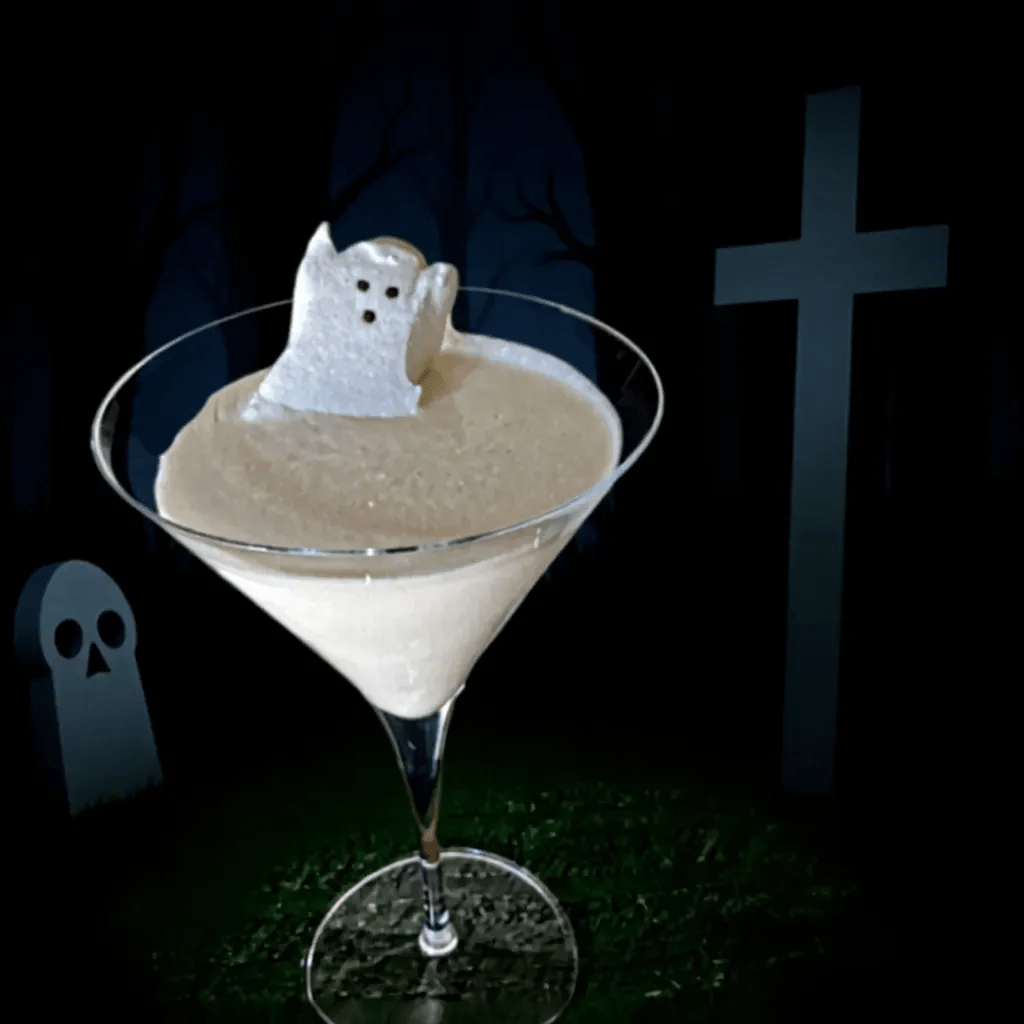
There are a number of “ghost” cocktails out there, most of which are white and frothy. Who am I to go against that formula? I’m envisioning something like Casper the Friendly Ghost, that’s cute and saccharine and, if you binge on it, makes you want to throw up. So let’s get to it!
Ingredients:
1-½ oz RumChata
1 oz vanilla vodka
2 oz Cool Whip
Splash of spiced rum
1 Peeps ghost
Mix all the liquid ingredients into a cocktail shaker with ice. Strain into a chilled martini glass. Garnish with a Peeps ghost. You should use your own judgment with the spiced rum. I added it to combat the cloying sweetness of the RumChata and Cool Whip, but you might not feel that’s quite as necessary as I did. Alternatively, you might substitute whipping cream for the Cool Whip. Follow your instincts here. Truth be told, the only indispensable ingredient is the Peeps ghost.
Poe-Script
The title “Spirits of the Dead” was borrowed for a 1968 horror film released by American International. The movie is an anthology of three Poe stories, each directed by a different director. However, none of the three tales relates to the eponymous poem. You should not confuse this with “Orgy of the Dead,” which was a 1965 nude zombie film by none other than Ed Wood.
“Hush, sir!” — “I’ll oblige you for once. You shall have my consent — and the plum, we mus’nt forget the plum — let me see! when shall it be? To-day’s Sunday — is’nt it? Well, then, you shall be married precisely — precisely, now mind! — when three Sundays come together in a week! Do you hear me, sir! What are you gaping at? I say, you shall have Kate and her plum when three Sundays come together in a week — but not till then — you young scapegrace — not till then, if I die for it. You know me — I’m a man of my word — now be off!” Here he swallowed his bumper of port, while I rushed from the room in despair.
The Tale
This is another of Poe’s lesser-known humorous tales. The story goes thus: the narrator seeks his uncle’s permission to marry his daughter Kate. But this uncle, who never makes things easy, decrees the marriage shall happen only “when three Sundays come together in a week.” This surely is intended as a “Twelfth of Never” kind of construction. And yet, it so happens that, three weeks later, two sea captains known to the uncle happen to arrive at his house. One has just finished sailing around the globe eastward, and one has just finished sailing around the globe westward. Since this happened before the invention of the International Date Line, the westward-traveling captain “lost” a day, and the eastern-traveling captain “gained” a day. (This is much in the same way that you and I lose or gain hours while traveling across time zones.) As a result, one captain believes that yesterday was Sunday, the other believes that tomorrow is Sunday, and the uncle believes that today is Sunday. Thus, three Sundays come together in one week, and the narrator can be wed.
This is all well and good, but, more importantly, it provides us a capital opportunity to make a Sundae Cocktail. Now, there are many rich, indulgent versions which involve ice cream and chocolate sauce and all the usual fixings for a sundae, and they almost all call themselves “decadent,” which is a dead giveaway that they are aimed at posers. More to the point, the alcohol in these typical sundae cocktails is limited to a sprinkling of liqueur over the top of the ice cream. This is cheating; anything that you eat with a spoon is not a cocktail.
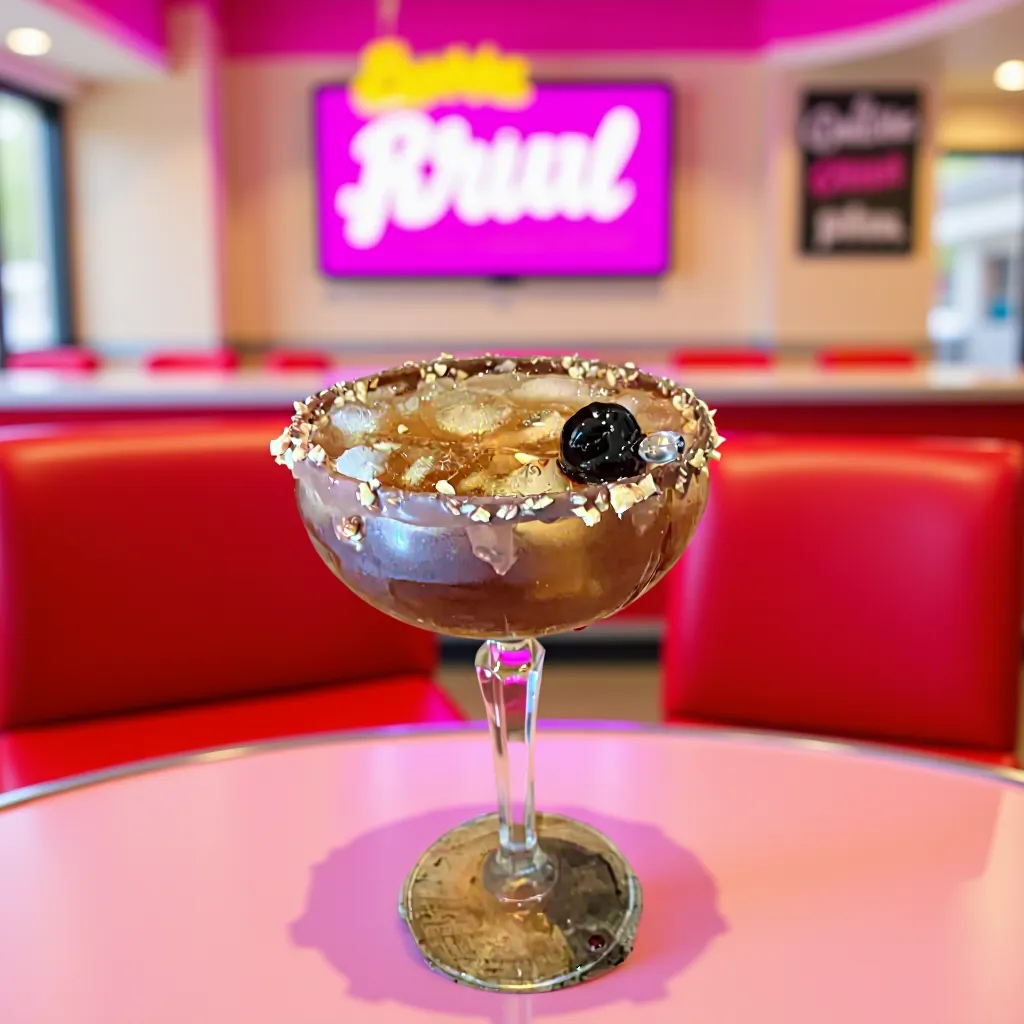
No, we are going to be more imaginative. And when I say “we,” I mean some random guy I found on the Internet who came up with something he says “tastes just like an ice cream sundae,” and it only has two ingredients: a “whipped cream whiskey” and some A&W soda. In his video he describes the taste as “gawd damm!” I was intrigued. I made and drank the drink, and it was tasty enough, but it fell a bit short in terms of invoking a sundae (let alone three sundaes in a week). So I added some creme de cacao and I rimmed the glass with some chopped nuts. Now we’re talking!
Ingredients:
2 oz Whiplash Whiskey
2 oz A&W cream soda
1 oz creme de cacao
1 tbs finely chopped peanuts (for rimming the glass)
1 maraschino cherry
Prepare a coupe glass (which, to my mind, look like something you might use to serve a scoop of ice cream) by moistening the rim with a little chocolate syrup and then coating the rim with chopped peanuts. Stir together the liquid ingredients in a mixing glass with ice, and strain into your prepared coupe glass. (I had added crushed ice to my coupe glass, because I thought it makes it look more like a sundae. You can forego this if you’re a purist, though.) Garnish with a maraschino cherry, of course! The result is a cocktail that even your crusty old Uncle Rumgudgeon would like.
Poe-Script
I find the concept of the international date line to be simultaneously fascinating and mind-bending. It was established in 1884, pretty much to solve the very issue that Poe identifies in his story. That is, if you keep adjusting your clock as you go around the world (adding or subtracting an hour every 15 degrees of latitude), you’ll eventually find yourself on a different calendar day than that recognized by the local population. To correct this problem, the IDL convention has you add or subtract a full 24 hours whenever you cross that (imaginary) line. If you find this concept intriguing, I highly recommend Umberto Eco’s novel The Island of the Day Before.
We had always dwelled together, beneath a tropical sun, in the Valley of the Many-Colored Grass. No unguided footstep ever came upon that vale; for it lay away up among a range of giant hills that hung beetling around about it, shutting out the sunlight from its sweetest recesses. No path was trodden in its vicinity; and, to reach our happy home, there was need of putting back, with force, the foliage of many thousands of forest trees, and of crushing to death the glories of many millions of fragrant flowers. Thus it was that we lived all alone, knowing nothing of the world without the valley — I, and my cousin, and her mother.
The Tale
This is a highly descriptive, tragically romantic tale, which may or may not involve a touch of madness. The narrator describes a magical, idyllic time when he lived in the Valley of the Many-Colored Grass with his cousin and her mother (a polycule that might sound familiar to those with knowledge of Poe’s biography). Several pages of this short tale are devoted to the beauty of the valley and of the lovely cousin, whose name was Eleonora. Alas, Eleonora is not long for this world, and in her final days the narrator makes a solemn vow that he “would never bind [himself] in marriage to any daughter on Earth.” He even invokes a curse, whereby he accepts “a penalty the exceedingly great horror of which will not permit [him] to make record of it here” if ever he were to violate his vow. (Do you see where this is headed?)
Eleonora is relieved to hear the narrator’s sacred vow, and dies an easier death because of it. Alas, the narrator soon afterward leaves the Valley of the Many-Colored Grass and finds himself in a strange land, where he encounters Ermengarde– “a maiden to whose beauty my whole recreant heart yielded at once.” He married this hot maiden, never mind the curse that doing so would invoke. And yet, during the night he heard Eleonora’s disembodied voice, urging him “Sleep in peace! For the Spirit of Love reigneth and ruleth, and, in talking to thy passionate heart her who is Ermengarde, thou art absolved, for reasons which shall be made known to thee in Heaven, of thy vows unto Eleonora.”
What struck out to me about this tale was Poe’s description of the luxuriant Valley of the Many-Colored Grass. So I figured what we need here is a Cocktail of Many Colors. And here it is:
Ingredients:
1 oz grenadine
1.5 oz pineapple juice
2 oz blue curacao and vodka (1 ounce of each, mixed together)
A few dashes of bitters (because this drink is way too sweet otherwise!)
Orange rind and two maraschino cherries (for garnish)
Chill the liquid ingredients. Then, create colored layers by s-l-o-w-l-y pouring each over the back of a spoon into a martini glass. (The blue curacao and vodka should already be mixed into a 2-ounce shot.) Gently add a few dashes of bitters by dripping them along the side of the glass. Create a garnish by shaping a thin strip of orange rind into a heart, with a maraschino cherry within each half of the heart, and held together with a cocktail pick. (See photo.) This represents the eternal love of the narrator and Eleonora…or perhaps their love broken in two?
Poe-Script
This tale has clear autobiographical elements. Poe did indeed live with his young cousin (Virginia) and her mother, and he eventually married Virginia when she was 13 years old. What’s more, Virginia became ill and eventually died. Poe would go on to woo (but not marry) other women. It is not known whether Virginia’s spirit ever forgave him and released him.
The application of electricity to a mummy three or four thousand years old at the least, was an idea, if not very sage, still sufficiently original, and we all caught it at once. About one-tenth in earnest and nine-tenths in jest, we arranged a battery in the Doctor’s study, and conveyed thither the Egyptian. … Readjusting the battery, we now applied the fluid to the bisected nerves — when, with a movement of exceeding life-likeness, the Mummy first drew up its right knee so as to bring it nearly in contact with the abdomen, and then, straightening the limb with inconceivable force, bestowed a kick upon Doctor Ponnonner, which had the effect of discharging that gentleman, like an arrow from a catapult, through a window into the street below.
The Tale
This is one of Poe’s more satirical tales, to the point of broad silliness. (I would be remiss, however, if I didn’t point out that the narrator confesses to drinking five bottles of a “brown stout” shortly before these events unfolded. It’s unclear whether this potentially impugns the veracity of the narration that follows.)
In any event, the narrator is present as a doctor and several colleagues unwrap an ancient Egyptian mummy and playfully apply an electric charge to its limbs. They are amazed to discover that they in fact revived a living being, and proceed to have a conversation with the now-fully-conscious body over cigars and brandy. Hence, “some words with a mummy.”
The principal topic of conversation is whether 19th-century American civilization is superior to the ancient Egyptian civilization. The doctor and his friends proffer example after example of their modern achievements in architecture, science, transportation, arts, and the like, while the mummy belittles each example and offers a more impressive counterpoint from his own time and land. The Mummy almost convinces the group that ancient Egypt was in fact more advanced than modern America, but the men manage a last-minute triumph when they superciliously ask whether ancient Egypt had ever managed “the manufacture of either Ponnonner’s lozenges or Brandreth’s pills.” The mummy was speechless. “Never was triumph more consummate; never was defeat borne with so ill a grace. Indeed, I could not endure the spectacle of the poor Mummy’s mortification. I reached my hat, bowed to him stiffly, and took leave.”
The tale is obviously a broad parody of nineteenth-century Western chauvinism. Accordingly, the supposed triumph of the men is so hollow that it belies their blind faith in their own society. The narrator ultimately seems to sense this, for at the end of the tale he confesses “I am heartily sick of this life and of the nineteenth century in general. I am convinced that every thing is going wrong.” And he announces his intention to get himself “embalmed for a couple of hundred years.” Surely you have never experienced such an impetus to slap your knee and guffaw.
In keeping with the decidedly sophomoric humor, I originally conceived this as incorporating General Mills’ Yummy Mummy breakfast cereal. For those of you not familiar with this cereal, Yummy Mummy was produced from 1988 to 1993 (and briefly resurrected [ha!] a couple of times after that). It was a spinoff to mainstays Count Chocula and Franken Berry, which were introduced in 1971 and are still available each Halloween season at Target and other purveyors of fine foods. Alas, Yummy Mummy, which was an allegedly fruit-flavored cereal, seems to have been permanently retired. Our inquiries to General Mills went unanswered, but we suspect it has something to do with the term being co-opted to mean attractive celebrity mothers, and all the baggage that goes along with it.
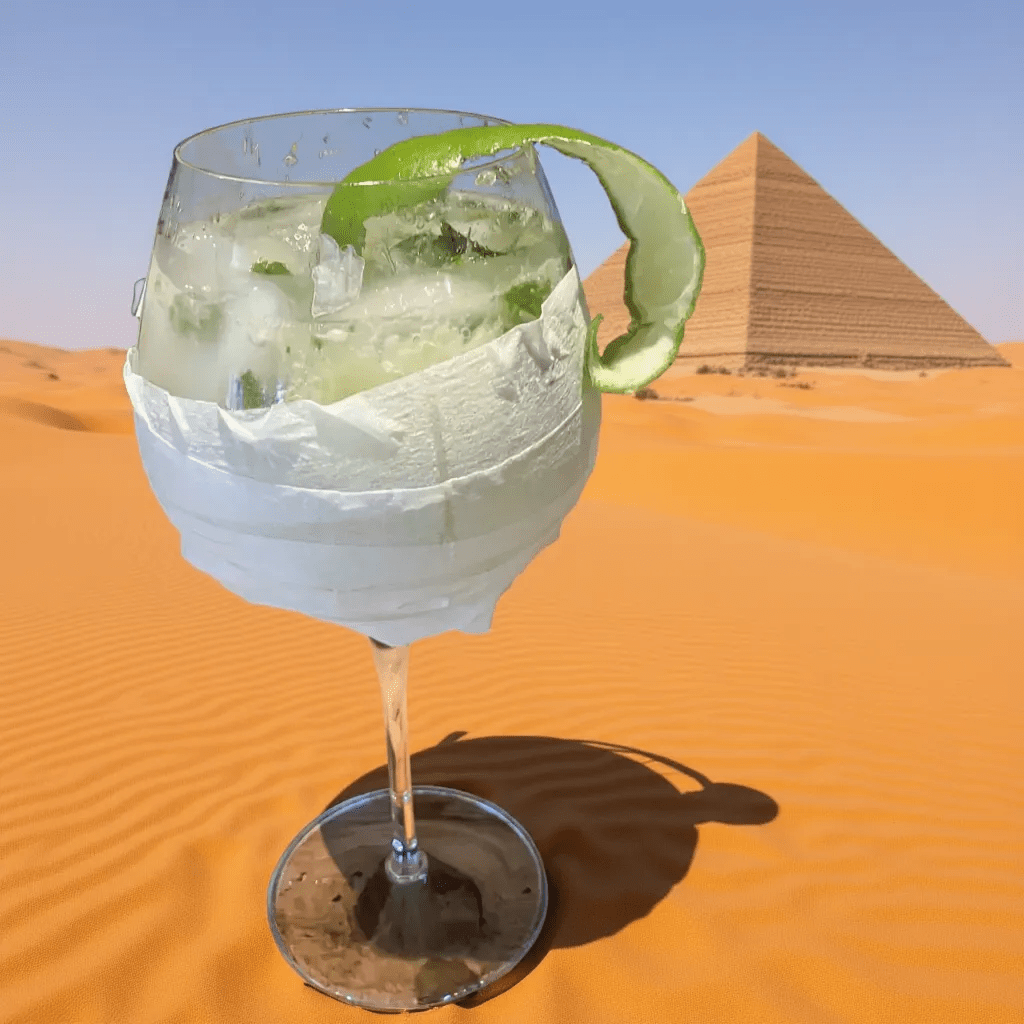
Now, fortunately for us, there’s a broad (ha!) category of cocktail called a Yummy Mummy, which generally is aimed at young mothers, especially on special occasions like Mother’s Day. So that will serve as our starting point. But as a link to Poe’s story this connection is a bit obscure. So to drive the point home we’ll wrap the glass in gauze. Really. You just read on.
Ingredients:
1 lime
2 oz Gin
1 tbsp simple syrup
5 slices of cucumber
Tonic water
Mint leaves
Roll of white, adhesive gauze
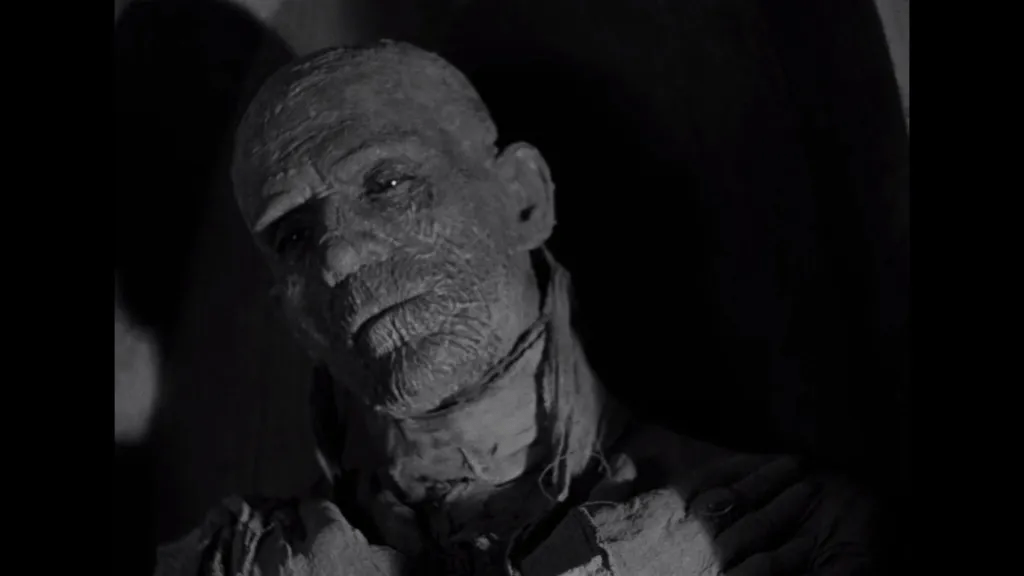
First you’re going to want to prepare your glass. Get a good-size wine glass, the kind that is shaped like a small fishbowl on a stick. Now wrap it with adhesive gauze. The idea is to evoke the idea of a wrapped mummy. To get the full effect, don’t apply the gauze too evenly; you want it to look like it’s been mouldering away in a pyramid for a few millennia, like Boris Karloff’s Imhotep in The Mummy. Fill it half-full with ice.
Set aside the glass and grab your lime (if you’ll pardon the expression). Using a sharp knife, cut off a length of peel about ½” wide and 3-4 inches long. This will serve as a garnish that will again evoke the idea of mummy bandages. (To get an idea of what comes to my mind’s eye, look at the cover of The Alan Parsons Project’s “Tales of Mystery and Imagination.”)
Now, take the mercilessly-flayed lime and quarter it. Toss two or three of those pieces in a cocktail shaker. Then add exactly three mint leaves and muddle it all together. (The three mint leaves mirror the three tana leaves that kept the mummy alive in Universal’s The Mummy’s Hand.) Now add the gin and syrup and some ice and shake it up. Next we need to add some cucumber slices. The number of slice I used is five, which equals the number of persons (living and/or dead) who were engaged in the conversation described above. Shake the content vigorously, then drain everything (including the muddled mint and lime) into your prepared glass.
Top off the glass with cold tonic water, and gently stir while offering the incantation “Allamistakeo” (the name Poe’s Mummy). Finally garnish with the lime peel at a jaunty angle.
The result is a highly refreshing drink that, if you close your eyes, should fit the bill of a standard Yummy Mummy cocktail. But with your eyes open and fixed on this drink, you cannot fail but think of Allamistakeo in all his Ponnonner-kicking, Egypt-defending glory.
Poe-Script
Italian composer Giulio Viozzi wrote a one-act opera entitled “Allamistakeo” in 1954. And yes, it was based on Poe’s story. A quick Google search did not uncover any recent performances of the opera in the United States. However, in 2023 there appeared an off-Broadway play called “The Mummy Speaks,” which is based on “Some Words With a Mummy.” If you’re lucky you might be able to catch a performance.
And now, while the whole assembly (the apes included) were convulsed with laughter, the jester suddenly uttered a shrill whistle; when the chain flew violently up for about thirty feet — dragging with it the dismayed and struggling ourang-outangs, and leaving them suspended in mid-air between the sky-light and the floor. Hop-Frog, clinging to the chain as it rose, still maintained his relative position in respect to the eight maskers, and still (as if nothing were the matter) continued to thrust his torch down toward them, as though endeavoring to discover who they were.
The Tale
Hop-Frog is a terrible story. I don’t mean that it’s poorly-written or not entertaining; rather, it’s grisly and sinister and a bit revolting. Still, it grips the imagination and simultaneously excites a variety of conflicting emotions. It is masterful. A terrible, masterful story.
It’s essentially a tale of vengeance. A king’s jester–who happens to be a “dwarf” (Poe’s term, not mine)–is habitually mistreated. But a line is crossed when the king mistreats the jester’s girlfriend. In that moment, the reader knows that this has become a revenge tale.
The literary fuse burns steadily and methodically, until the trap is sprung at the royal masquerade ball. The king and his seven courtiers are disguised as “ourang-outangs” (orangutans to you and me), having coated themselves with tar and flax, when the jester suddenly has them raised as a group by a chain and set on fire to die a horrible, grisly death as the horrified crowd looks on. The jester and the girl escape to a distant land, presumably to live happily ever after.
You realize, of course, that fire must somehow be featured in this drink. Which means we’re going to need some high-test alcohol. I’m making this drink in California where the upper limit is 151 proof (75.5% ABV). So I got myself a bottle of Don Q’s 151 rum. (The Bacardi 151 you remember from your high school parties has somehow vanished from the liquor stores like Hop-Frog from the kingdom.)
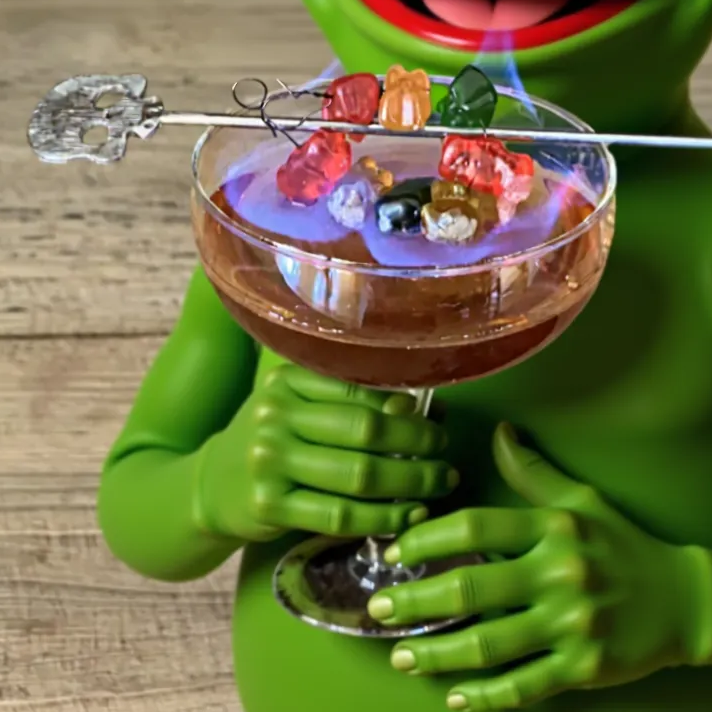
Now, 151 is virtually undrinkable, and it’s used here strictly for pyrotechnic purposes. For the base alcohol we’ll use a more-reasonable 80 proof spirit. Meanwhile, the centerpiece of this drink will be 8 immolating ourang-outangs. For these, I’ve substituted gummy bears. This is because (1) ourang-outangs are hard to find in edible candy form, and (2) the gummies kind of sparkle when they burn. (Some of you may have watched the famous “screaming gummy bear” at a science demonstration in elementary school. Seriously–it’s a thing.)
Ingredients:
13 gummy bears (8 as garnish, 5 for dissolving into the drink)
2 oz. Bacardi rum
½ oz. pineapple juice
½ oz. orange juice
Dash of lime juice
½ oz Don Q 151 rum
Small length of keychain chain, or wire
The main conceit here is to chain together eight gummy bears and light them on fire. Originally, I thought I could just soak them in 151 and that would make them ignitable, but they ended up dissolving before I remembered to take them out of the rum. Still, the resulting thick emulsion didn’t taste bad, so I decided to intentionally dissolve a few gummy bears into the base spirit. They lend a sweet, quasi-fruity taste to the rum, sort of like your grandma’s annual Christmas fruitcake that you’ve never eaten.
So, here are the steps:
Make the garnish. You want to “chain” together 8 gummy bears to represent the king and his 7 courtiers dressed as orangutans. I tried to thread a length of ball chain from a keychain through the gummy bears, but I got nowhere. So I turned to a length of thin but stiff wire, which easily slid through each gummy bear. Connect the “chain” into a loop, which mimics the setup in the Poe story.
Make the base spirit. Dissolve approximately five gummy bears into 2 ounces of Bacardi rum. This might be an overnight task. Stir occasionally. And keep it refrigerated.
Add the three juices (pre-chilled) to the base spirit, and stir well. Pour the mix into a coupe glass.
Balance a metal or other nonflammable bar spoon across the rim of the coupe glass. Drape the unfortunate orangutans over the spoon.
Slowly float a half ounce of 151 on top of the drink.
Ignite the 151 with your Zippo.
Admire your handiwork for a few seconds, then blow out the blaze.
(Optional) Pour the drink down the sink. After two sips it tastes disgusting.
Poe-Script
Some say that Poe may have identified with Hop-Frog. The character was abducted from his home country to serve the King of a distant kingdom. Poe, meanwhile, was taken (as an orphan) to live with the wealthy John Allan, at whose hands he often felt mistreated. And like Hop-Frog, Poe resented it when others would try to force him to drink against his will. In fact, one wonders if most of Poe’s characters contain autobiographical elements.





 Chasing Phantoms