2025 Poe Cocktails

Cocktail 10: The Black Cat

One morning, in cool blood, I slipped a noose about [the cat’s] neck and hung it to the limb of a tree;—hung it with the tears streaming from my eyes, and with the bitterest remorse at my heart;—hung it because I knew that it had loved me, and because I felt it had given me no reason of offence;—hung it because I knew that in so doing I was committing a sin—a deadly sin that would so jeopardize my immortal soul as to place it—if such a thing were possible—even beyond the reach of the infinite mercy of the Most Merciful and Most Terrible God.

The Tail (as it were)

The Black Cat is a horrible story. I say this as an animal lover, and in particular a cat lover. The narrator is unsympathetic, reprehensible, hateful. In the end, he gets only a portion of the comeuppance that he deserves. Perhaps the same could be said for all of us…

Still, it’s a spellbinding tale, with an air of Doom hanging over it, as well as murders, subterranean crypts, and madness. It even offers a bit of a moral, to wit: If you’re going to wall up a body, check for strays before mortaring in that final brick.

The fact that the narrator suffers from alcoholism makes it a bit awkward to base a drink on the story. And yet, no collection based on Poe’s tales can ignore this masterful narrative.

The full story is available here.

The Drink

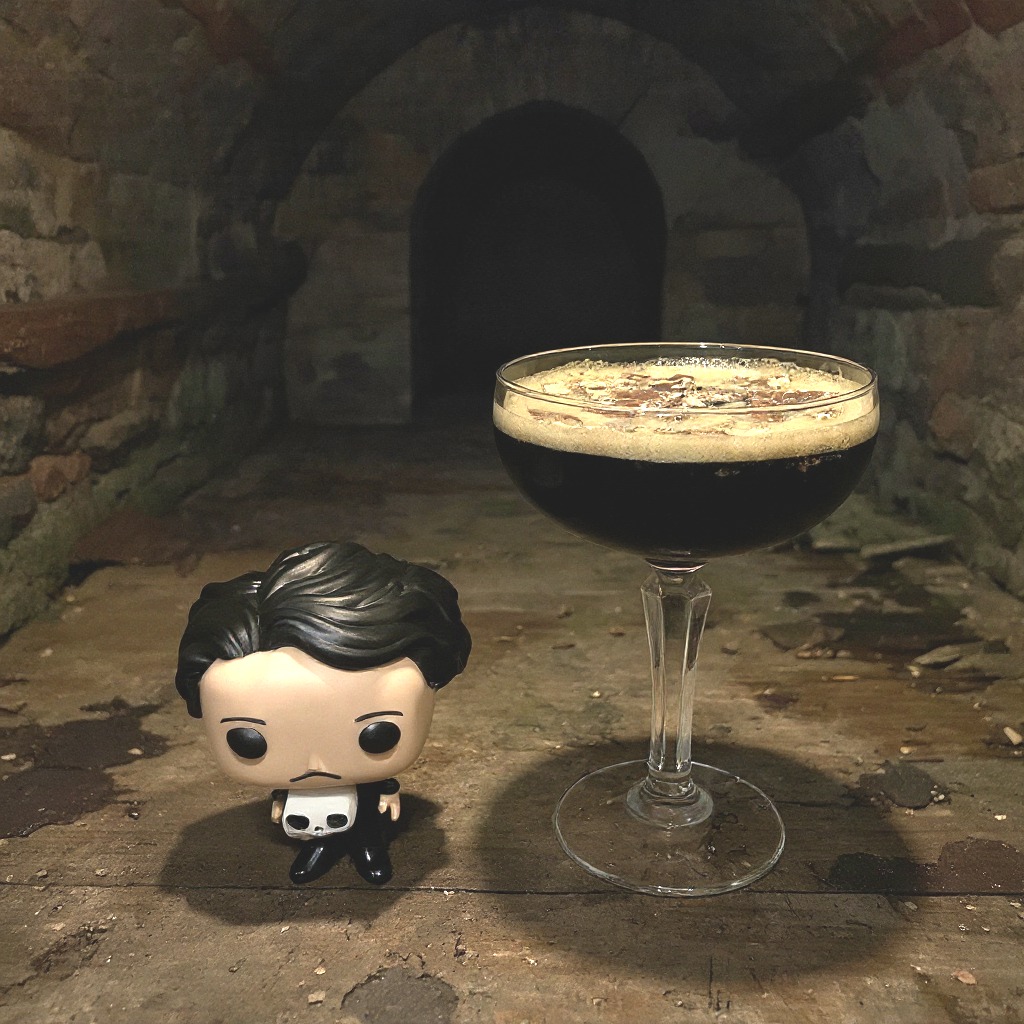
It goes without saying that this drink must be black in color. I started with Kahlua and coffee, which I further darkened with activated, food-grade charcoal. A bit of absinthe adds an unexpected anise element (and supposedly absinthe was one of Poe’s vices). Meanwhile, a Kit-Kat bar emphasizes the cat theme. (Readers of a certain age might recall the Kit-Kat commercials in the 1970s, featuring a lion as the cat. It was even less funny than it sounds here. And, sadly, the Kit-Kat bar is even less delicious in this drink than you might hope. Still, we persevere.)

Ingredients:

1-½ oz. Kahlua

1-½ oz. espresso (chilled)

¼ oz. absinthe (to rinse the glass)

1 activated charcoal capsule

1 Kit-Kat bar (crumbled)

Rinse a coupe glass with absinthe. Note that a little absinthe goes a long way; this is only a rinse. Now, pour the Kahlua, espresso, and charcoal into a cocktail shaker with ice, and shake to chill. Strain into the prepared coupe glass, and top with the crumbled Kit-Kat bar.

This is not a drink for everyone. You have to like strong flavors. The espresso and Kahlua go together pretty well, though the taste is quite intense. The addition of the absinthe adds an unusual twist, which may not be to every person’s taste. The Kit-Kat bar serves as a sweet, chunky chaser that helps you to forget about the odd drink you just downed.
Poe-script

Universal Pictures made not one but two films with Bela Lugosi called The Black Cat. The 1934 film co-stars Boris Karloff, while the 1941 version costars Basil Rathbone. Both movies claim to be “suggested by” Poe’s story, but neither one really has anything to do with Edgar’s masterpiece.
2025 Poe Cocktails

Cocktail 9: King Pest

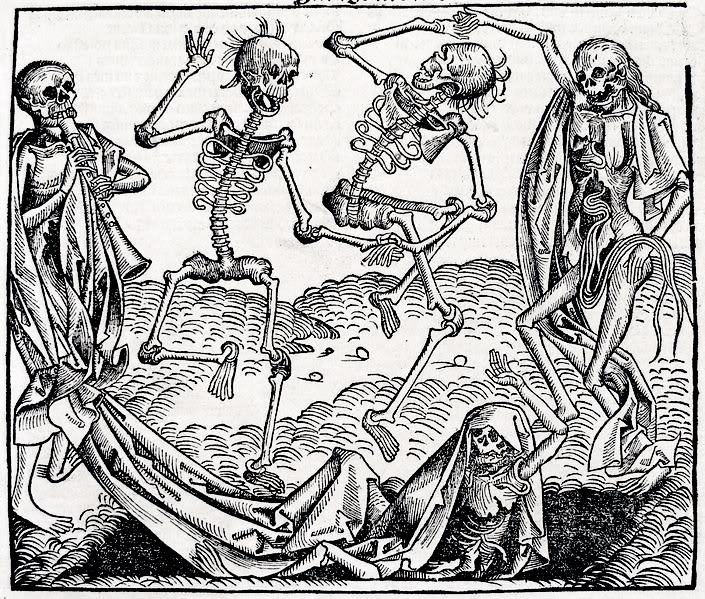
The room within which they found themselves, proved to be the shop of an undertaker — but an open trap-door in a corner of the floor near the entrance, looked down upon a long range of wine-cellars, whose depths the occasional sounds of bursting bottles proclaimed to be well stored with their appropriate contents. In the middle of the room stood a table — in the centre of which again arose a huge tub of what appeared to be punch. Bottles of various wines and cordials, together with grotesque jugs, pitchers, and flagons of every shape and quality, were scattered profusely upon the board. Around it, upon coffin-tressels, was seated a company of six….

The Tale

The story is a fairly simple one; two drunken sailors flee from a tavern without settling their bill and are chased through the streets of London by the proprietor. They escape into a deserted part of town that has been closed off because it’s Plague-ridden. They run into an old undertaker’s shop where they encounter a party of four men and two women drinking at a bottle-littered table, surrounded by skeletons and coffins and other funereal artifacts. The leader of the group (who calls himself “King Pest the First”) is annoyed by the interruption and as punishment orders the two sailors to drink “a gallon of Black Strap…at a single draught — and upon your bended knees.” The two instead create a diversion and manage to escape, each carrying off one of the women from the group.

This has got to be one of Poe’s most grotesque tales. (See the Poe-Script below for a bit more on this point.) The characters are all grossly exaggerated, the settings are cluttered and wild and baroque, the action is overplayed, the dialogue is florid. Oh, and the whole thing plays out as a farce or perhaps even a comedy, depending on your disposition, I suppose.

The full story is available here.

The Drink

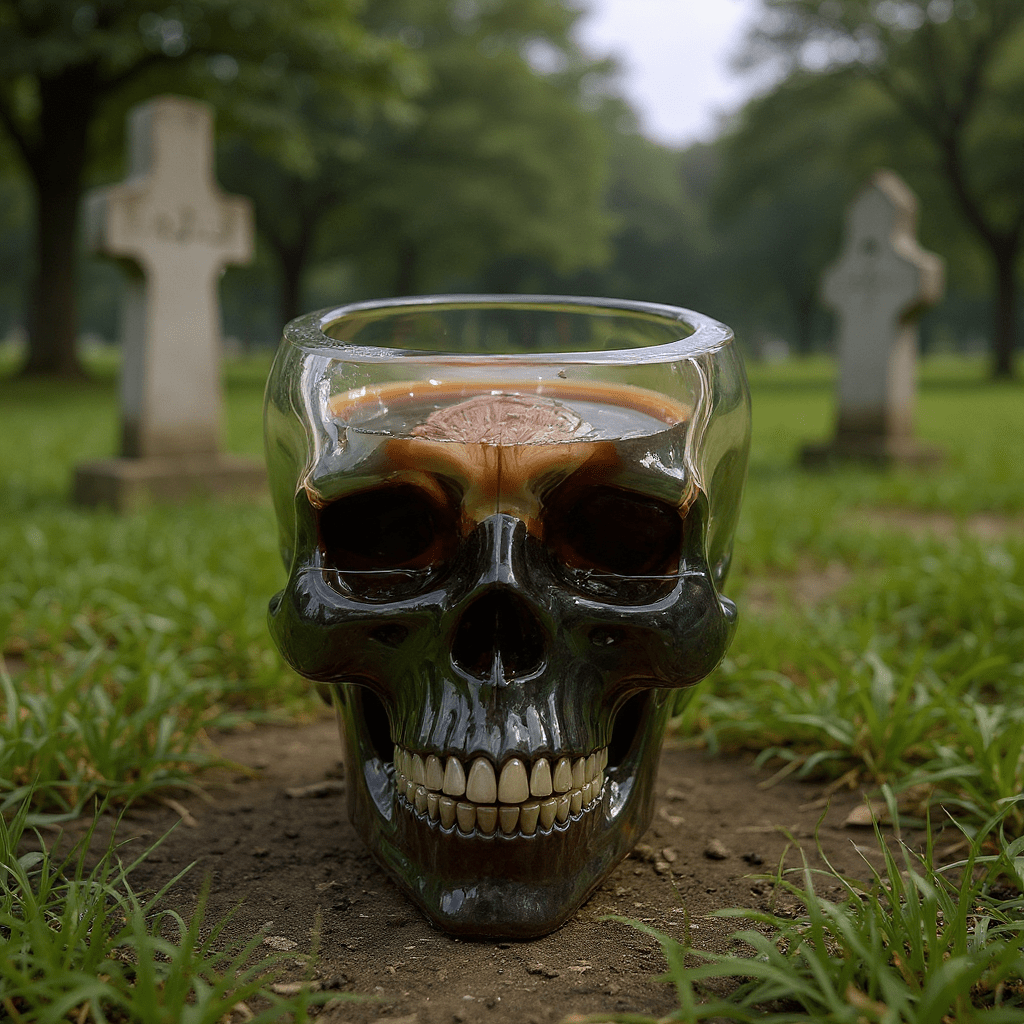
We, being of a more serious temperament, are going to zero in on that “blackstrap” that the sailors were sentenced to drink. This would be blackstrap rum, which is unusually dark and is made with molasses. (I procured a bottle of Cruzan Estate Diamond Black Strap Rum for this project.) With the addition of some espresso, a liqueur, and a few drops of tabasco (trust me on this one), you’ll have some proper “humming-stuff” (as the story’s main characters call it).

Ingredients:

1 gallon Blackstrap rum (or, if you don’t want to be that vérité, just use two ounces)

1 shot espresso

1⁄2 oz crème de cacao

A few drops of tabasco sauce

Stir all the ingredients in a mixing glass filled with ice. Strain into an iced skull cup (which is the vessel of choice used by the characters of the story). Garnish with something interesting if you like, but I demurred because didn’t want to distract from the imagery of the skull.

This cocktail isn’t for everyone, and when you take your initial sip your taste buds will become disoriented and perhaps threaten to kill you. But once they get re-oriented, you’ll find that this is actually a fairly balanced and interesting drink. The molasses flavor dominates, offset a bit by the bitter and astringent espresso and the spicy Tabasco. The creme de cacao softens the palate; it’s kind of a peace offering to your tongue. In the course of taking a sip, you’ll experience a range of emotions, from “why on earth did I make this drink” to “actually, I think I’ll have another.” Which is precisely what I did.

Poe-Script

Although King Pest was first published in 1835 in The Southern Literary Messenger, five years later it was included in a collection of Poe’s stories called Tales of the Grotesque and Arabesque. The story “King Pest” presumably is described by the first of the two adjectives.

2025 Poe Cocktails

Cocktail 8: A Predicament

But now a new horror presented itself, and one indeed sufficient to startle the strongest nerves. My eyes, from the cruel pressure of the machine, were absolutely starting from their sockets. While I was thinking how I should possibly manage without them, one actually tumbled out of my head, and, rolling down the steep side of the steeple, lodged in the rain gutter which ran along the eaves of the main building. The loss of the eye was not so much as the insolent air of independence and contempt with which it regarded me after it was out. There it lay in the gutter just under my nose, and the airs it gave itself would have been ridiculous had they not been disgusting. Such a winking and blinking were never before seen.

The Tale

If there is one word to describe Poe’s “A Predicament,” that word is “silly.” It employs the kind of humor in which I was trafficking at nine years old. Poe employs absurd descriptions of a five-inch tall poodle whose head is bigger than its body, and a three-foot tall servant with bow legs and no neck. It’s as though he’s describing cartoons in MAD Magazine. Sophisticated it is not.

The overwrought prose huffs and puffs melodramatically over trifles. “If! Distressing monosyllable! what a world of mystery, and meaning, and doubt, and uncertainty is there involved in thy two letters!”

But of course Poe is satirizing a form of writing popular at the time–a style Wikipedia calls the “Gothic Sensation Tale.” 

At the climax of the story the narrator (an ostentatiously dressed woman named Signora Psyche Zenobia, or perhaps Suky Snobbs) loses her eyeballs (!) in an absurdly improbable accident involving the minute hand of a huge clock in a church belfry. First one eyeball pops out and falls into the roof’s rain gutter. And then the other. And then they stare back at her.

And of course it is these two ocular orbs that we’re going to evoke with our cocktail.

The full story is here.

The Drink

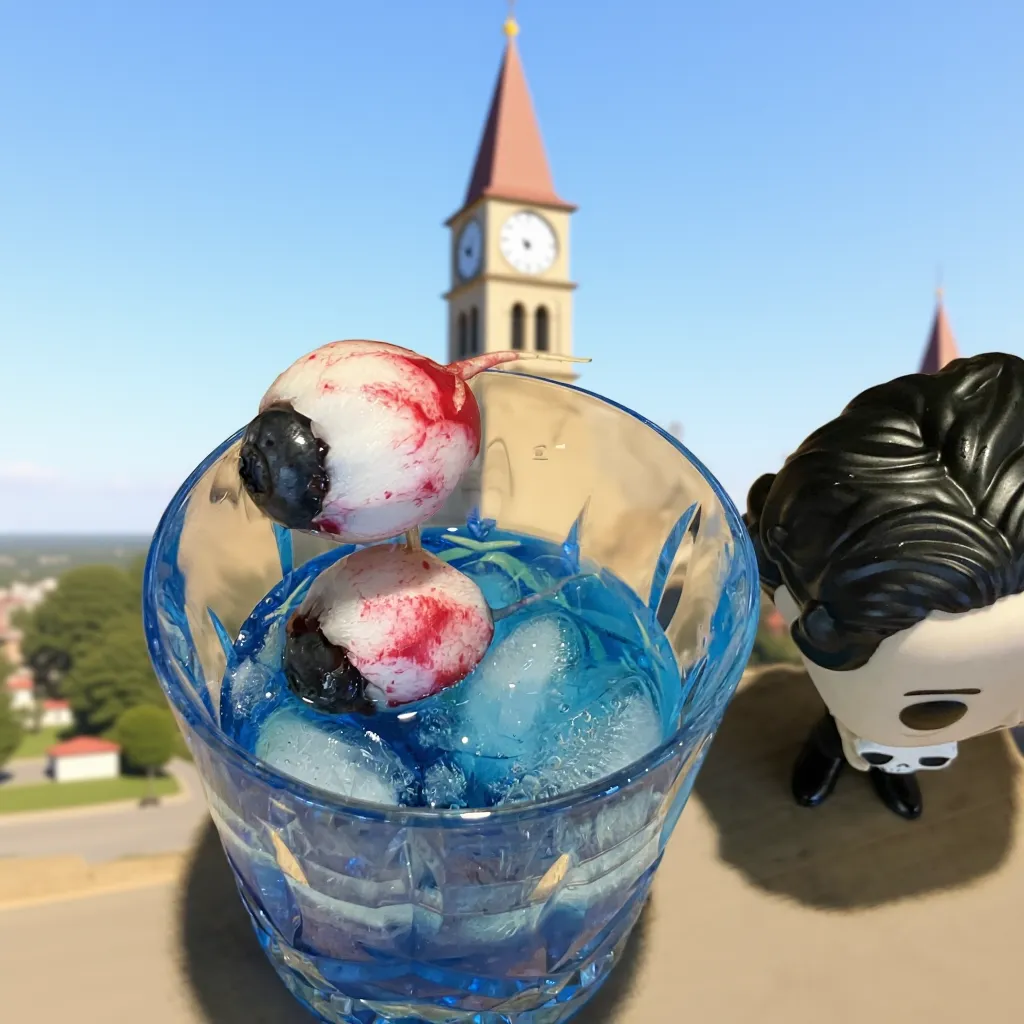
Every collection of Halloween cocktails has at least one recipe that features an eyeball or two. And there are many different ways to mimic an eyeball. The most promising method, visual-wise (ha!), employs something called “lychees.” These are allegedly tropical fruits that various questionable websites play up as a “superfood,” and which seem to be the fruit of choice for imitating an eyeball. But I scoured Safeway and couldn’t find them anywhere. When I asked the stock boy he looked at me like I’d just asked for a moon rock. I began to suspect everything I’ve read about lychees is Fake News. I mean, I’ve never seen one in a salad bar. They don’t appear on the Jamba Juice menu.

So, having been defeated in the lychee department, I naturally turned to radishes. These have the advantage of roughly sharing the size and shape of an eyeball, plus their root resembles an optic nerve, and on top of all this the red skin can be peeled to reveal a bloody-white eyeball. It’s as if the humble radish was born to stand in for an eyeball. I mean, what else is it going to do??

For the drink itself, I wanted something garish and colorful like Signora Psyche Zenobia, who informs us that she has a “commanding” appearance. Quoth she:  “On the memorable occasion of which I speak I was habited in a crimson satin dress, with a sky-blue Arabian mantelet. And the dress had trimmings of green agraffas, and seven graceful flounces of the orange-colored auricula.” I zeroed in on her sky-blue Arabian mantelet which, I am told, is a “woman’s short, loose sleeveless cloak or shawl.” And it seemed to me that blue curacao would evoke “sky-bue” admirably. So, we’re going to make what amounts to a Blue Hawaii, with a double-eyeball garnish.

Ingredients:

1-1/2 oz. vodka

1 oz. blue curacao

1 oz. pineapple juice

Garnish:

2 large radishes, with ocular nerve (that is, the root)

2 blueberries

A little raspberry jam

First, prepare your eyes! Use a potato peeler or some similar contraption to peel off most of the red skin from two radishes. Leave just enough red skin behind so as to resemble bloody veins and such. Then use a small melon baller or similar Inquisition-worthy torture device to hollow out the front of each radish. Put a dab of jam into each radish hole, followed by a blueberry. Congratulations–you’ve just made two eyes. Stick them on a long toothpick.

Now, mix the vodka, blue curacao, and pineapple juice with ice in a mixing glass, and strain into a rocks glass with fresh ice. Garnish with eyeballs. If you’ve done this right, they will regard you with an “insolent air of independence and contempt.”

Poe-Script

There is no such thing as lychees.

cemeteries · churches

Poe-nus Material

Speaking of Edgar Allan Poe…today is the 176th anniversary of his death. In celebration of the occasion, I’m providing this bonus post. No need to thank me, but feel free to remember me in your will.

So, I spent last weekend in Baltimore–the city where Poe wrote several of his better-known works, and where he is said to have died under mysterious circumstances. (For an entertaining, alternative history explaining those and subsequent events in Poe’s life, please see my short story “Poe’s Last Lament.”)

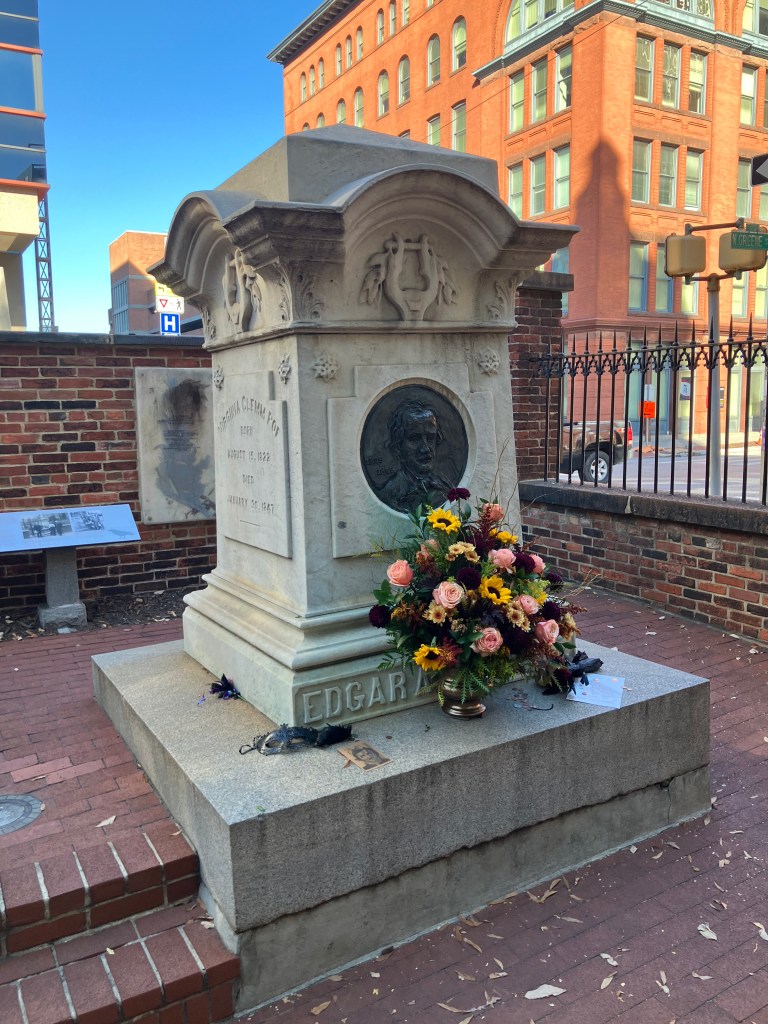
Anyway, I was, as I say, in Baltimore, where every October a crowd gathers in the neighborhood, where Poe once lived with his wife and mother-in-law/aunt, to participate in the International Edgar Allan Poe Festival. Among other things, we drank a toast to Poe at his gravesite at Baltimore’s Westminster Hall, visited the catacombs beneath the church, and watched a burlesque performance by an Australian stripper whose precise connection to Edgar Allan Poe continues to elude me. I’m not making this up.

Poe’s final resting place.

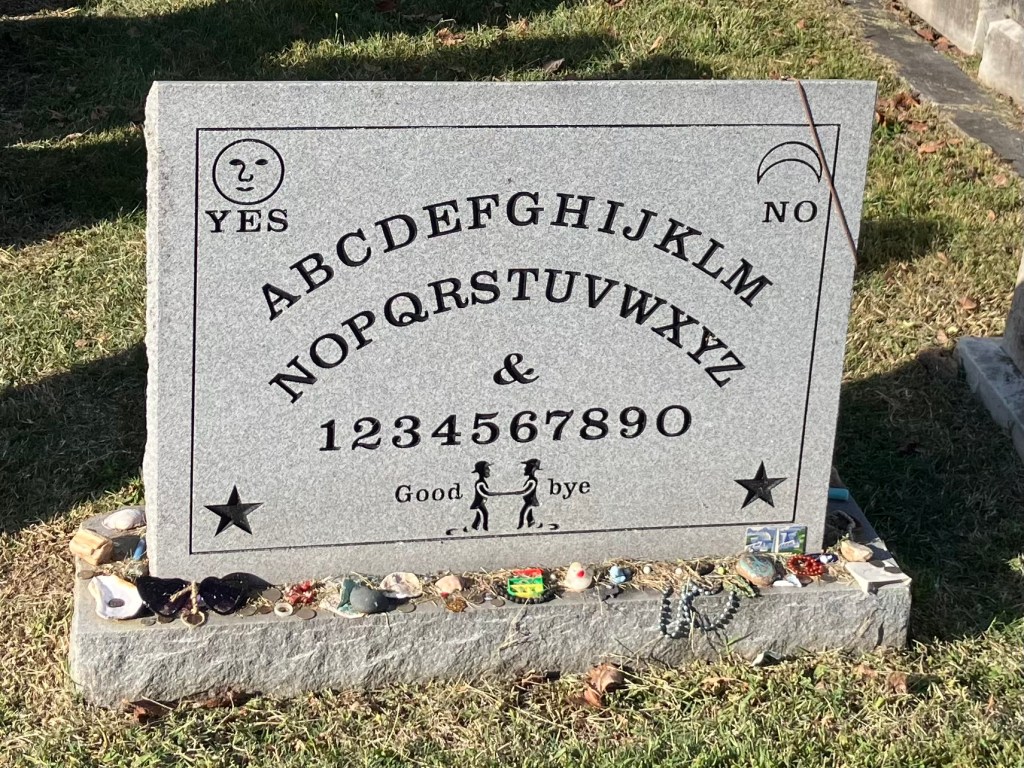
We also toured the beautiful and brooding Green Mount Cemetery (est. 1838), where a number of Poe’s relatives are buried. Green Mount is where I encountered the topic for this blog post. Take a gander at this headstone:

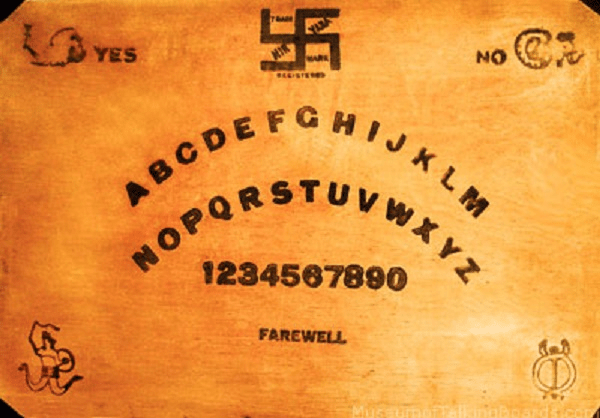
A standard element of a regulation Ouija board, the phrase “goodbye” is especially apropos on a gravestone.

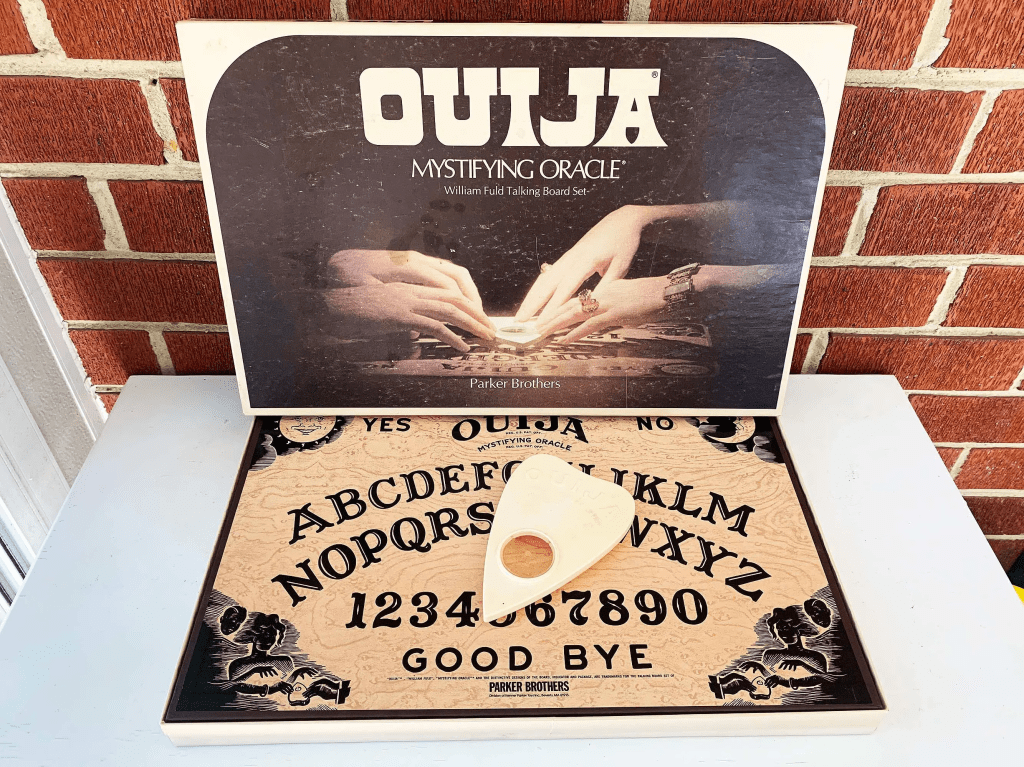
Readers of a certain age might remember this design from the family game closet, where the Parker Bros. Ouija game was kept.

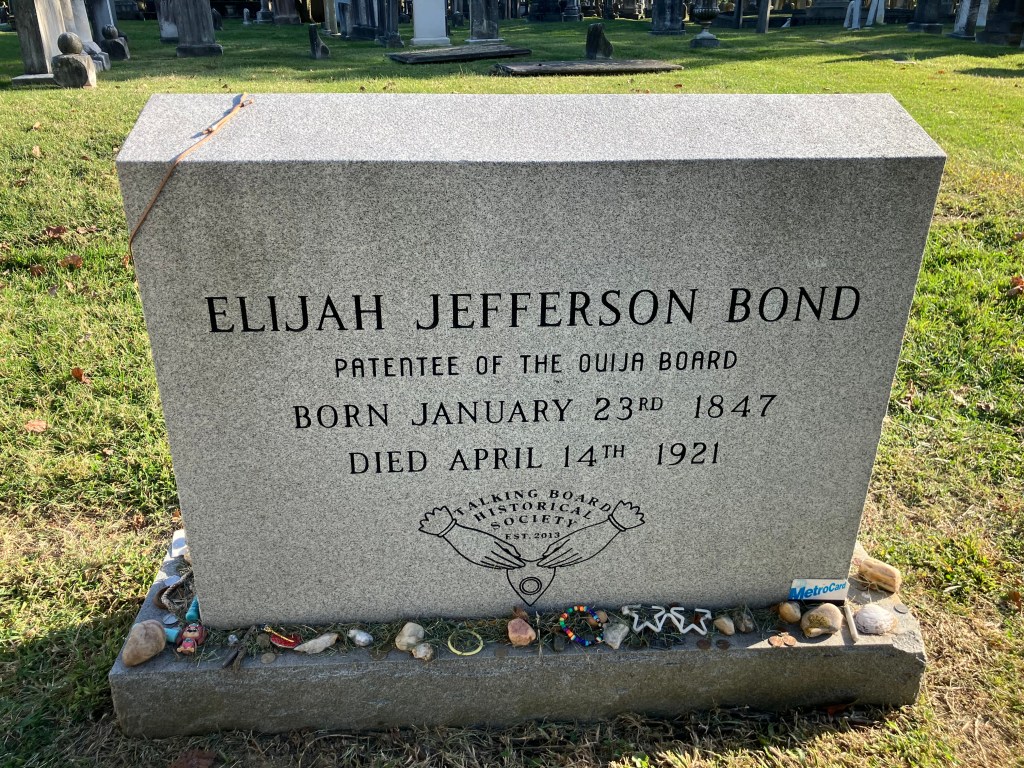
Turns out the Ouija headstone marks the mortal remains of the man who patented the Ouija board. Here’s a pic of the reverse side of the headstone:

Note that this headstone does not claim that Elijah Bond is the inventor of the Ouija board; he’s just the patentee. The full origin story of the Ouija board is quite convoluted, disputed, and fascinating, and I have now spent several days going down an Ouija rabbit hole. Here’s the Cliff’s Notes version:

  • The “talking board” (which is the broad category the Ouija board fits into) has been around for over a thousand years….well before the establishment of the US Patent Office.
  • Talking boards became insanely popular in the US near the end of the 19th century and the early 20th century, during the heyday of Spiritualism.
  • A prototype of the Ouija board was made famous in 1886, when it was used to supposedly communicate with a long-dead spirit.
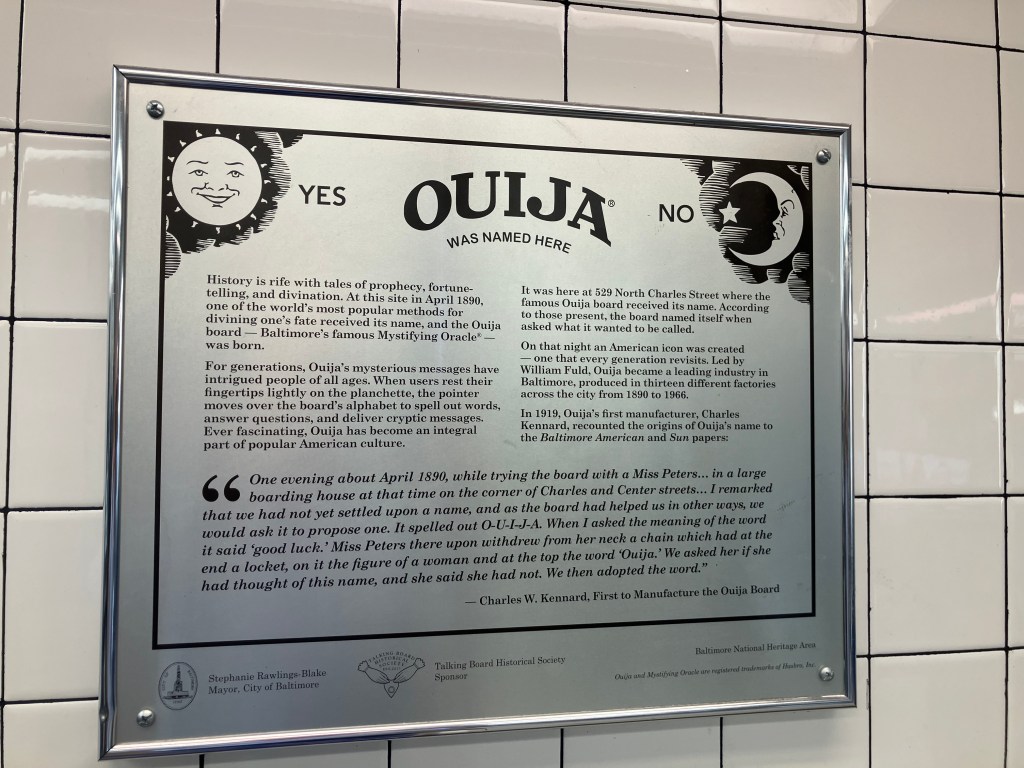
  • A few years later, Elijah Jefferson Bond–a Confederate veteran, inventor, and lawyer–sensed an opportunity and patented this version of the talking board. He called it Ouija. The Baltimore boarding house where he came up with the name still stands. Of course I had to visit it.
The building where Ouija get its name. Note that the ground floor–once a boarding house–now hosts a 7-11 store.
Plaque inside the 7-11.
  • Bond sold the US distribution rights for the Ouija board to the Kennard Novelty Company.
  • A few years after selling the distribution rights, however, Bond started selling a knock-off version of the Ouija board that he called “Nirvana.”
  • And here’s where I really feel down the rabbit hole: Bond created a company in 1907 to sell his Nirvana board. And what was its name? The Swastika Novelty Company. These are words that I would never expect to go together.
  • Now, to be fair, the swastika would not come to be associated with the Nazis for another decade or two. But according to Wikipedia, the company wasn’t dissolved until 2014!

Sadly (?), Parker Bros (now owned by Hasbro) no longer produces the Ouija board as part of its regular lineup. But it does occasionally offer a specialized version as a movie tie-in. Therefore, it seems that your best bet might be to seek out an old, original one on eBay. You might even track down an old Nirvana version…but you’d have to explain to your friends that the swastika is “grandfathered in,” as it were.

Modified Ouija board, with patent-evading design and pre-Nazi swastika.

Please let me know if you know of any other trivia related to the Ouija board (besides the oh-so-obvious link to The Exorcist). And thus we end this special post related to Poe, Baltimore, and Ouija.

2025 Poe Cocktails

Cocktail 7: Berenice

The teeth! –the teeth! –they were here, and there, and everywhere, and visibly and palpably before me; long, narrow, and excessively white, with the pale lips writhing about them, as in the very moment of their first terrible development. Then came the full fury of my monomania, and I struggled in vain against its strange and irresistible influence. In the multiplied objects of the external world I had no thoughts but for the teeth. For these I longed with a phrenzied desire.

The Tale

This is one of Poe’s more disturbing tales. The narrator, Egaeus, has grown up with his female cousin, Berenice, and is now about to marry her. However, she is afflicted by a wasting disease that seems to affect all of her body with the exception of her teeth. Egaeus, meanwhile, is increasingly afflicted with monomania, becoming intensely fixated on trivialities for hours, losing all sense of time and purpose. (And this was before the advent of smartphones!) He finds himself fixating on his cousin’s teeth.

Then Berenice apparently succumbs to her disease and is buried in the family plot. The next day Egaeus is awakened from a trace-like state in the library by a tap at the door. A servant reports that Berenice was discovered, alive but disfigured, near her open grave. Then Egaeus notices that his own clothing is covered with blood, and that a dirty shovel is leaning against the wall, and a small box is upon the table. As the horrible realization begins to break through, Egaeus lunges for the box, which falls and shatters upon the floor, scattering dental surgical tools and 32 teeth.

The full story is available here.

The Drink

Because this story centers on teeth, I decided that they must somehow be featured in the corresponding cocktail. But how? I decided to acquire a full set of 8 incisors, 4 canines, 8 bicuspids, and 12 molars. Naturally I turned to Amazon, which had on offer a set of “multicolored resin teeth.” By “multicolored,” they don’t mean the teeth are psychedelic, but rather that they have realistic, subtle variations in shading. I’m not quite sure what a normal use for these teeth might be. The packaging says “ provides an affordable and convenient solution for those who need to replace missing teeth, improve their smile, or create a realistic-looking denture for a costume or theatrical performance.” So, are you saying that I might use them to DIY my own dental work? The “costume” idea seems a little less insane, although how, exactly, would you incorporate a full set of individual teeth into a costume?

Now, I know what you’re thinking: Is that any less insane than incorporating the teeth into a cocktail? I did think about this, and decided if I can somehow isolate the teeth from the drink itself, there at least would be less chance that you’ll end up swallowing a few stray bicuspids. I resolved, therefore, to lock the teeth away in ice. This is especially appropriate because the last three letters of the story’s title spell ICE. C’mon–keep up with me here!

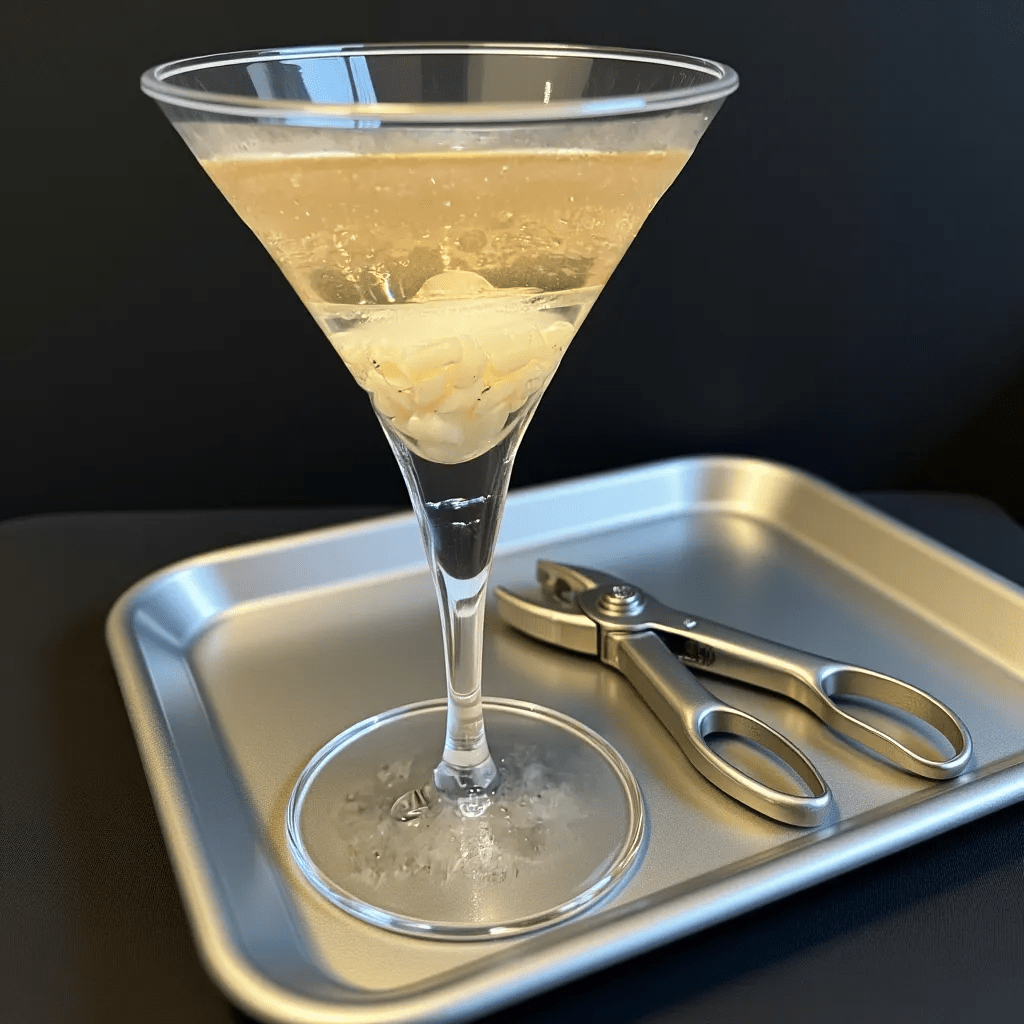
I decided to freeze the teeth in an inch or two of water at the bottom of a martini glass, so the teeth would be collected in a small space and thus be more noticeable. I also used distilled water in order to maximize the clarity of the ice. So as long as you finish the drink before the ice melts, you should be OK. 

Ingredients:
1 set of Synthetic Polymer Denture Teeth, Shade A2, Upper + Lower (about eight bucks on Amazon)

2 oz. gin

1 oz. dry vermouth

A dash or two of angostura bitters

Distilled water (to make it really pure, boil it once or twice)

Arrange the teeth at the bottom of a martini glass. Pour in a little distilled water so that it covers the teeth. Now freeze the glass in your freezer.

Once the water has frozen, mix the remaining ingredients together in a shaker with ice, and strain into the glass. Voila! You have a martini with teeth at the bottom.

You can, of course, use any other spirits in this drink, since the gimmick is just the teeth. I do think the ice is less noticeable by using a clear spirit. In fact, you might even ditch the bitters to make the teeth more visible still.

Poe-Script

As gruesome as Poe’s story is, it’s not beyond the realm of reality at the time of its publication in the 1830s. Digging up corpses and extracting their teeth was a thing, albeit the motivation was money rather than monomania. It seems that there was a market for human teeth, which were used to make dentures. I’m not making this up. So let’s give thanks for the advent of modern, Synthetic Polymer Denture Teeth, Shade A2!