Halloween Cocktails

Death in the Afternoon

As you may know, Death in the Afternoon is the name of a 1932 book by Ernest Hemingway. The title reminds one of an Agatha Christie story. (Agatha Christie wrote a number of books with “Death” titles , including Death In the Clouds, Death on the Nile, and Death Comes As the End.) Hemingway’s Death in the Afternoon, however, is definitely not a Whodunit, but rather is a treatise on and celebration of Spanish bullfighting. And knowing that the title is about the ritualized killing of an imprisoned, male cow is definitely a buzzkill.
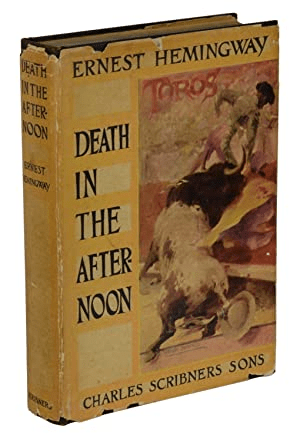
And yet, Hemingway repurposed that same title (Death in the Afternoon) for a cocktail he invented. It seems that, in 1935, writer Sterling North and a bookseller named Carl Kroch (I’m not making this up) put together a book that featured cocktail recipes from 30 famous writers, including Edgar Rice Burroughs, Christopher Morley, a bunch of people I never heard of, and Ernest Hemingway.
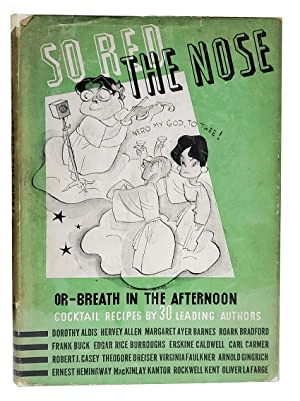
Now, for our purposes, “Death in the Afternoon” is a pretty good name for a Halloween cocktail. (And thanks to loyal reader Marie R for bringing this to my attention.) So let’s make one!

The Recipe: In Hemingway’s own words: “Pour one jigger absinthe into a Champagne glass. Add iced Champagne until it attains the proper opalescent milkiness. Drink three to five of these slowly.”
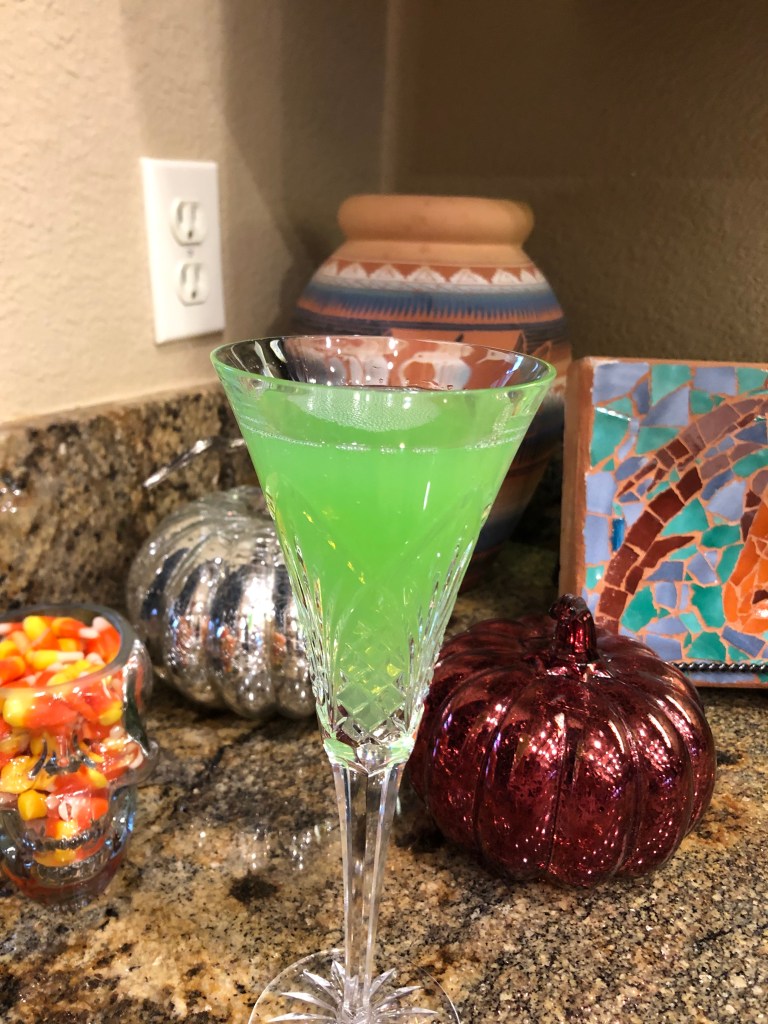
First of five…

The Ratings: Well, it’s another green cocktail. Thankfully the color is imparted by absinthe and not by chartreuse. The green is made lighter and somehow more neon by the addition of the champagne, which also lends an effervescence. It’s probably the fault of my inadequate absinthe selection that it didn’t achieve “the proper opalescent milkiness.” In any event, I suppose it’s worth two points for appearance, which is essentially a B- on my grading scale. It’s not especially entrancing, but the color is unusual, and the use of a champagne glass adds a little bit of interest. (It would have been better if I’d had one of the old-timey champagne glasses that you see in New Years Eve memes.)
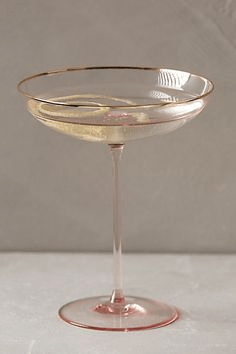
Now there’s a proper champagne glass!

As for the taste: I really wanted to like this one. Its Hemingway pedigree makes it cool, and the comingling of bohemian absinthe and patrician champagne is intriguing. The first sip was interesting — the licorice of the absinthe added depth and texture to the champagne. But with each successive sip the absinthe became more cloying and extraneous. I couldn’t see how this was an improvement over just a simple glass of good champagne. Of course, the absinthe (at 50% ABV) definitely boosts the alcohol content of the Roederer (12.5% ABV). (How on earth does Hemingway expect me to drink “three to five of these slowly”?!) But if your objective is simply to get inebriated, a good Scotch could achieve that objective with less fuss and muss. I can’t in good conscience give the taste more than 1.5 points. (My wife’s one-word comment about the taste was “Yuck.”)

I’ll give the full 2 points for the name, even though it’s actually a reference to a despicable sport. I’m still trying to imagine it as an Agatha Christie title.

Grand Total: 5.5 points

Halloween Cocktails

Back to Basics

Tonight we return to some October basics: apple cider, maple syrup, pumpkin pie spices, and some good bourbon. This will not be a gimmicky drink–No lychees here! But the list of ingredients is promising. Let’s make…

Nightmare on Bourbon Street

(Random graphic stolen from the Web. It’s not connected to the drink in any way.)

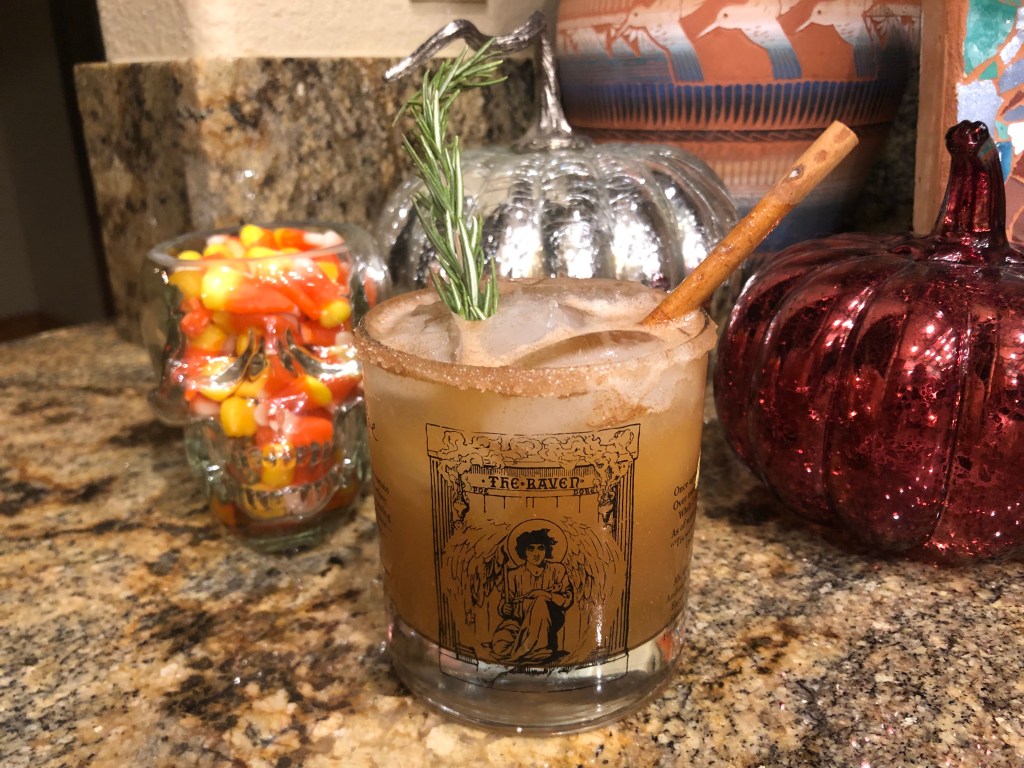
The Recipe: OK, this sounds awesome: Start by preparing a cocktail glass by rimming it with cinnamon sugar, and filling it with ice. For the occasion, I used my “Edgar Allan Poe’s The Raven” glass, provided to me by longtime friend Chris F.

Now, in a cocktail shaker, combine 1.5 oz bourbon (use the good stuff!), 1 oz fresh lemon juice, 1/4 cup apple cider, 2 tsp maple syrup (I get mine from Cousin Bonnie in Vermont), 1/4 tsp ground ginger, and 1/8 tsp ground cinnamon. Shake the hell out of it, and strain into the prepared glass. Now top the glass with Martinelli’s sparkling apple cider. (Note: The recipe actually asks that you top the drink with hard cider, but I figured Martinelli’s would be preferable. And I was right. As I always am. Well, sometimes.) Finally, add rosemary and a cinnamon stick as garnish.

The Ratings:

The appearance of this drink is welcoming and rich. To be fair, it’s not really Halloween-y, in that there’s no floating eyeballs or odd colors or fake blood. But it comes across as an honest, solid drink that’s somewhere between pumpkin and cinnamon in color. The rosemary evokes a tree in the spooky woods, and the cinnamon stick is a standard symbol of fall cookery. The sugar-cinnamon rim of the drink is just pure indulgence. I’ll give it 3 points for appearance. (It would have been 4 if I could have somehow called it a Halloween drink.)

Spooky woods

But let’s shift to the taste: O. M. G. This is the ideal drink for a fall evening. The apple cider (NOT apple juice, you Philistine) is rich and complex and earthy. It perfectly complements (NOT compliments, you Philistine) the caramel and vanilla of the bourbon. The lemon juice emphasizes the tartness of the cider, but the maple syrup emphasizes the sweetness of the cider. The ginger and cinnamon are suggestive of an apple pie, while the Martinelli’s tips the balance toward apple sweetness, and also lends an effervescence. And as if all that’s not enough, the rosemary garnish adds depth of flavor and brings out the earthy notes, while the cinnamon stick is suggestive of a hot apple cider (even though this drink is iced). How could I not give this four points for taste?

The name “Nightmare on Bourbon Street” simultaneously evokes the Freddy Krueger franchise and the iconic street in New Orleans. It’s scary and fun and historic. It gets the full 2 points.

Leatherman, eat your heart out!

Grand Total: 9 points.

Make one tonight, and thank me later.

Halloween Cocktails

Your Lyin’ Eyes

So, for reasons that are fast becoming obvious, I’m thinking of renaming this blog series, “Steve Ruins 31 October Cocktails.”

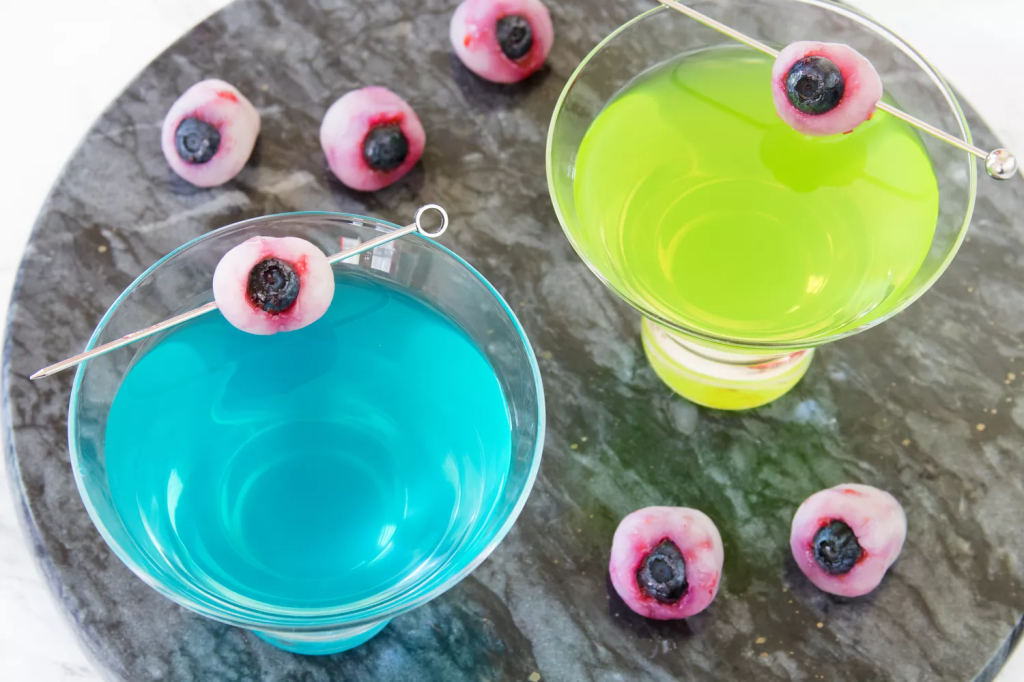
For today, I was feeling like it was time to make something with a high visual factor. And I landed on eyeballs (not literally). There are a number of Halloween cocktails that add eyeballs to the drink, so I figured I’d pick one.

Almost all the recipes I found used lychees for the eyeballs, with blueberries for the corneas. Judging from the photos, these are perfect imitations, all bloody like they were plucked from a cadaver.

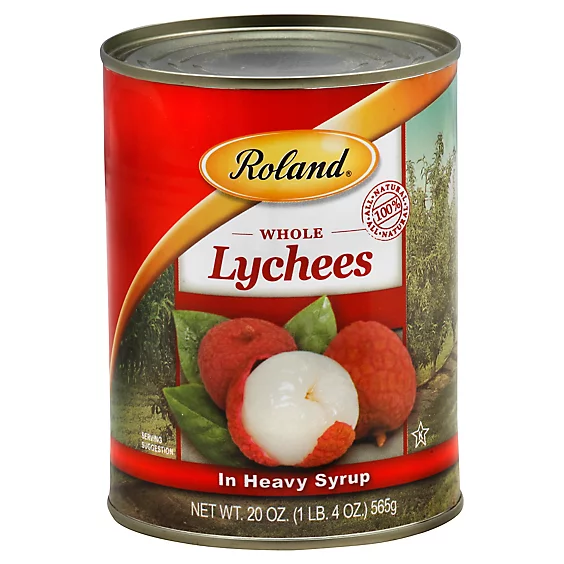
Now, I never heard of a lychee, but I figured the good folks at Safeway would know exactly what I was talking about. The millennial who was stocking the shelves looked at me like I was insane, but directed me to her (only slightly older) manager. The manager corrected my pronunciation (“It’s not LIE-chee, it’s LITCH-ee”). But despite her supposedly knowing the correct pronunciation, she seemed lost. “I think lycees are a kind of cheese,” said she. I thanked her and walked in the opposite direction from the cheese.

I googled “does Safeway carry lychees?” on my phone, and was informed that yes, Safeway does indeed carry this tropic fruit.

Supposedly available at a Safeway near you.

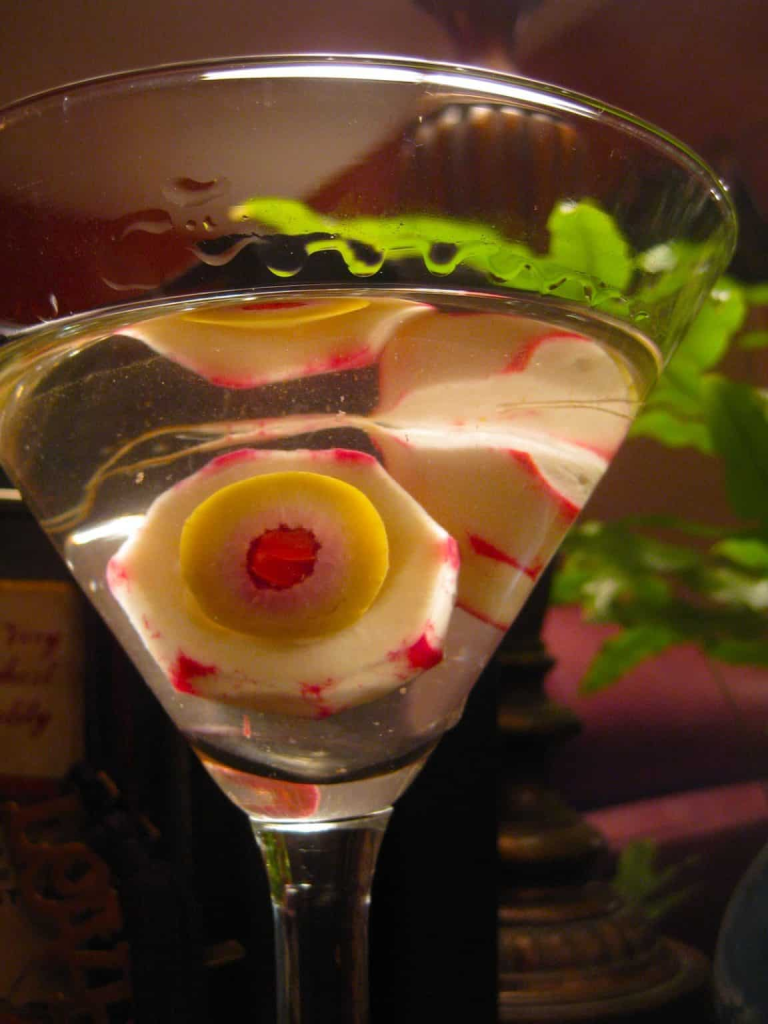
And yet I was unable to locate a single can at my friendly neighborhood Safeway. I asked more employees, but it seemed that they were all getting ready to call security. So I moved to plan B: I googled “How to make Halloween cocktail eyeballs?” As I mentioned, the most popular answer involved lychees, but I did find one site that recommended stuffing a pimento olive into a peeled radish. I made the necessary purchases, and came directly home.

c/o SweetThyme

Now, the lychee-based cocktails all used some kind of fruit juice, but I figured the radish/olive combo would clash with the fruit. So I figured I’d keep this simple and add the eyeballs to a proper martini.

My favorite martini uses dry gin and dry vermouth, but I don’t make it “dry.” That is, I use almost as much vermouth as I use gin. I also add a healthy dose of angostura bitters. Specifically:


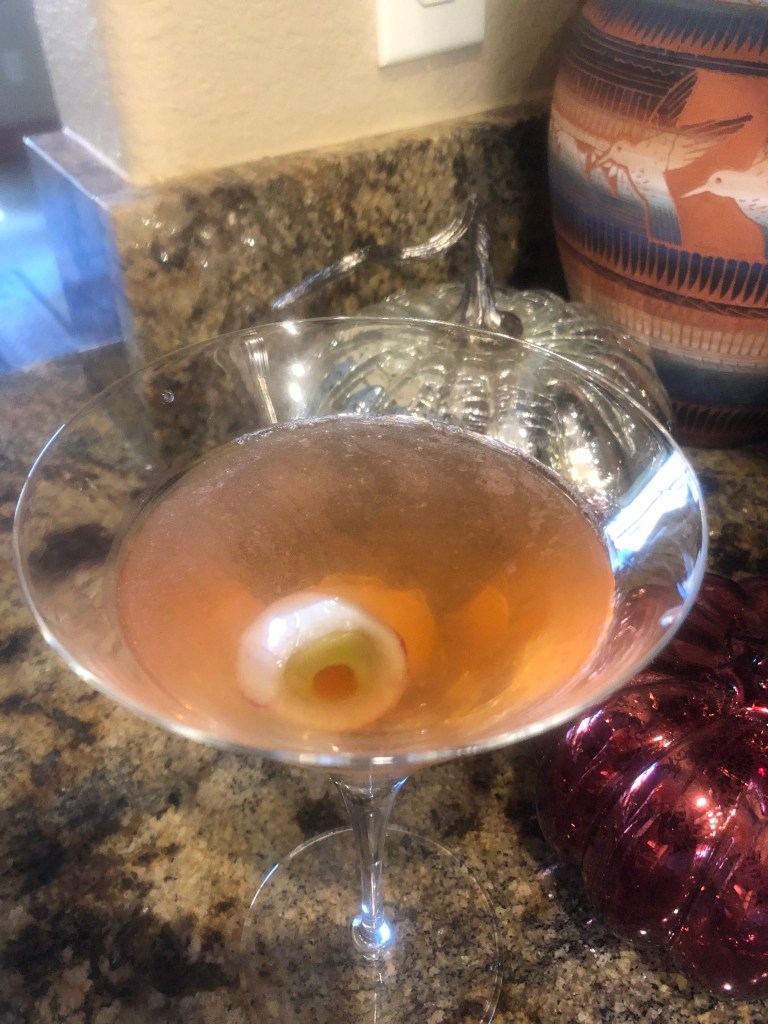
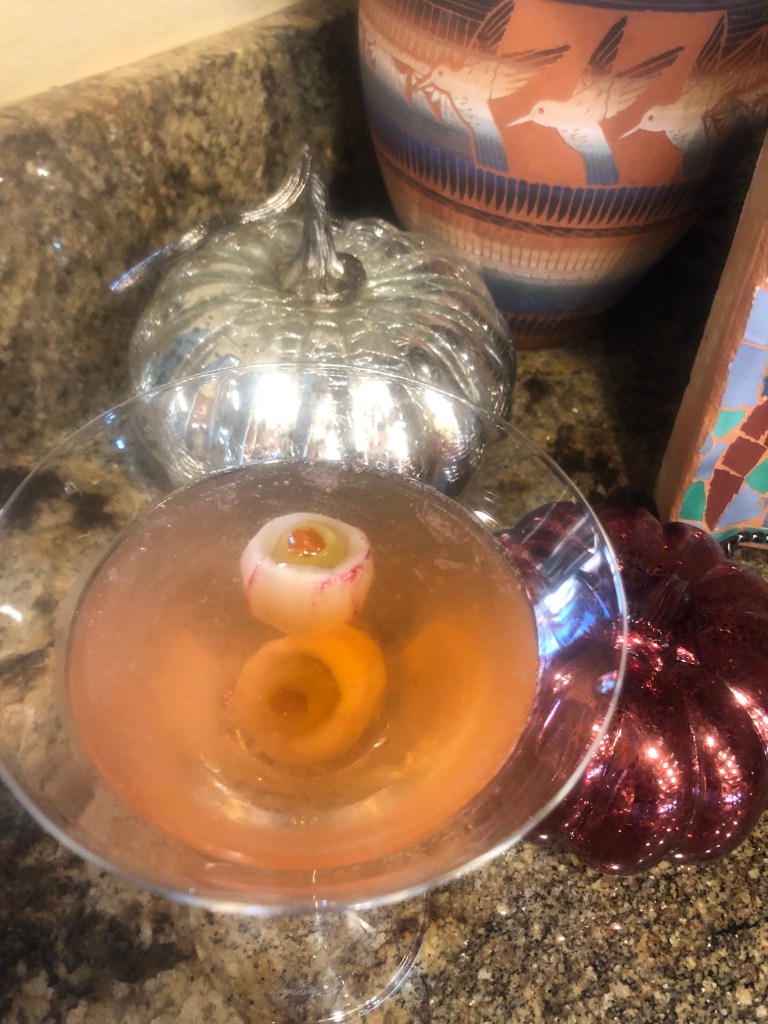
The Recipe: Add 2 oz gin and 1.5 oz dry vermouth to a cocktail shaker with ice. Shake (don’t stir) and pour into a martini glass. Add a healthy dash of Angostura bitters. For the eyeballs, remove the red skin from a couple of radishes using an apple peeler. Hollow out the middle with a paring knife and/or a small melon baller, and stick a pimento olive into the cavity. Drop the “eyeballs” into the glass.

Here’s lookin’ at you, kid.
I couldn’t get them both to focus on the camera.

The Ratings: The appearance is pretty much what I’d hoped for. The eyeballs are recognizable if not convincing, and they kind of peer at you through the briny martini. This would make a fun drink to serve to an unsuspecting guest. I’ll give it three points.

As for the taste: Well, it’s my longtime favorite martini! Of course I’m going to rate it high! The vermouth and the gin interplay perfectly, and the bitters provide interest and depth. However, I do need to knock the score down a bit because of the slight radish taste imparted by the eyeballs. So, three points.

The name of the drink that described the radish eyeballs was a “sake-tini” (that is, a martini made with sake). Sake-tini is one of the least spooky names for a Halloween cocktail. However, I didn’t actually make a sake-tini; instead, I made a wet martini. That too is a singularly un-spooky name. But I think it would be fair for me to name my martini, particularly when I’ve added eyeballs to it. Let’s call it a Zombie Socketini. And for that I’ll award 2 points.

Another good name option.

Grand Total: 8 points.

Halloween Cocktails

Mudslide!

If there’s one food item/flavor that receives more criticism than candy corn, it’s pumpkin spice. (Fascinating backstory here.) So naturally I am following up my Candy Corn Halloween Cocktail with a Pumpkin Spice Mudslide. It’s the kind of sacrifice that I’m known to make for my readership.

Now, to be honest about it, I had high expectations for today’s cocktail. I’ve felt burned by the past few liqueur-based, off-color drinks. I figured that something with a stronger, coffee-based backbone as well as some creamy substance (whipped cream) should stand out as an enjoyable drink. So I found this recipe for a pumpkin spice mudslide. It sounds like something they would serve at TGI Friday’s.

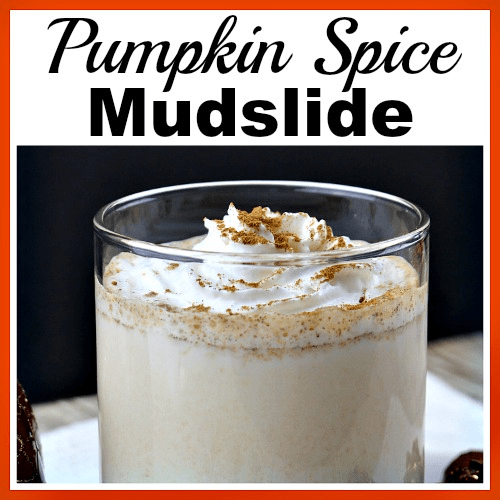
The archetype

Sadly, it didn’t live up to the expectations. Let’s do a quick postmortem.

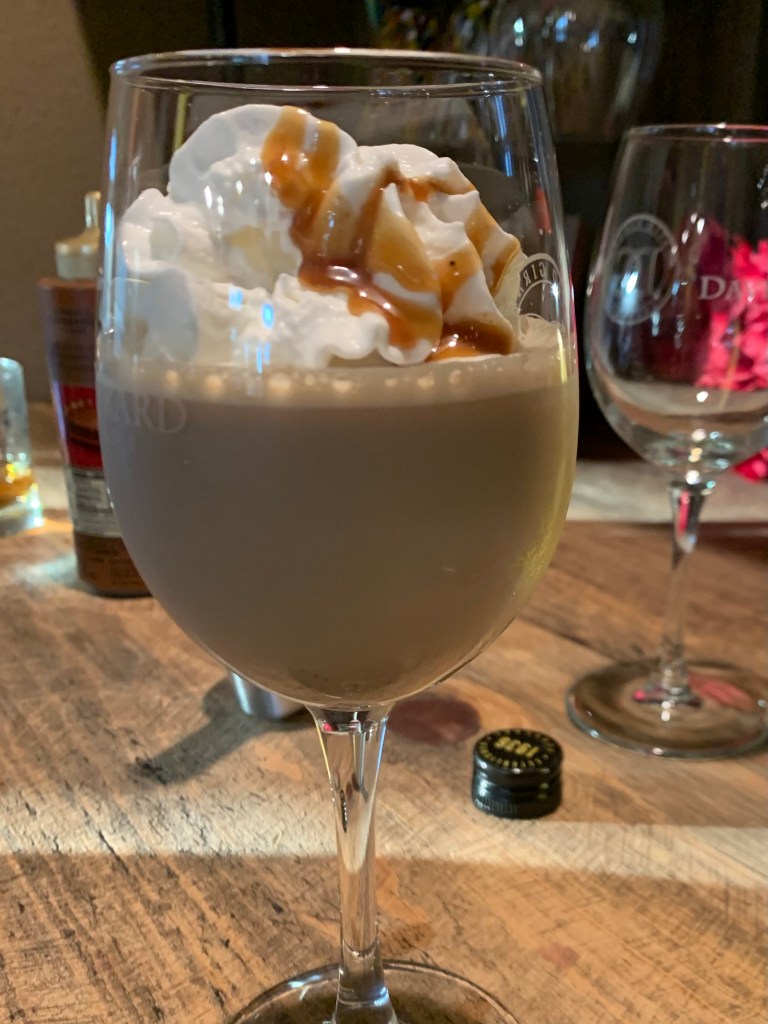
The recipe: Add 3 Tbsp Bailey’s Irish Creme, 2 Tbsp vodka, 2 Tbsp Kahlua, and 1/4 tsp pumpkin pie spice extract to a cocktail shaker. Add ice and shake well. Pour into a chilled glass, and top with whipped cream and little pumpkin pie spice (I used pumpkin spice syrup).

The Ratings: It looks like a mudslide. It’s not unappealing; in fact, it looks almost tempting. But it’s not very Halloween-y either. It just kind of sits there and looks at you. I’ll give the appearance 2 points.

In terms of taste, this was disappointing. It mainly tastes like Bailey’s. The vodka kicks up the alcohol a bit, but does nothing for the taste. And the Kahlua seems to have the same basic flavor profile as the Irish Creme. The pumpkin spice extract does nothing, at least in this small of a concentration. I was hoping for something like a rich milkshake, or at least some layered flavors. But no. This is just like taking a swig of Irish Creme. Yawn. 2 points.

As for the name: Pumpkin Spice Mudslide is simultaneously a boring name and false advertising. No points.

Grand total: 4 points.

Let’s hope we can come up with something better tomorrow. Feel free to send me your suggestions!

Halloween Cocktails

Children of the (Candy) Corn

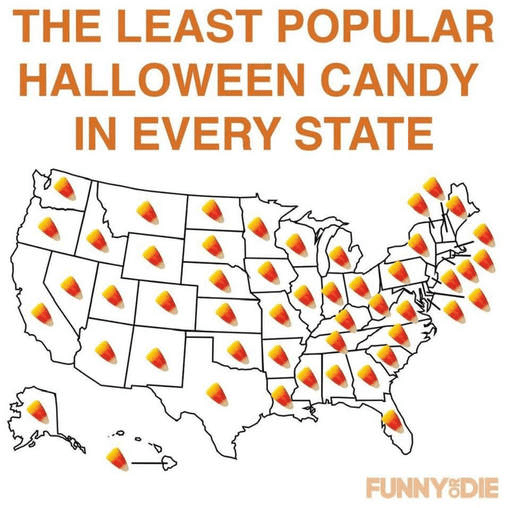
Ah, yes. Candy corn. One of the most maligned of Halloween “treats.” It’s the candy that every kid fears when trick-or-treating. It’s the fruit cake of Halloween. It’s the cheap alternative to proper chocolate candies that are purchased by Halloween grinches.

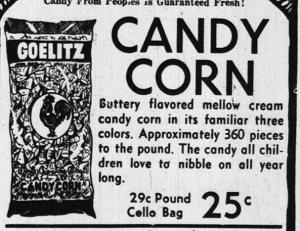
Now, as every schoolchild knows, candy corn was introduced to the unsuspecting world in 1888 by the Wunderle Candy Company. Its original name was “Chicken Feed.” (I’m not making this up.) Wunderle never really capitalized on their invention, which was marketed much better by Goelitz Candy around the turn of the century. Goelitz had the presence of mind to change the name to “candy corn.” Goelitz, as you may know, changed its own name to “Jelly Belly” in the late 20th Century.

Today, Brach’s controls 85% of the Halloween candy corn market. Which is a market with virtually no demand among end-users, but is purchased by households to pass out to unsuspecting trick-or-treaters.

Candy corn has somehow become an iconic Halloween “treat,” although it’s highly divisive and seemingly hated by all. Therefore, it makes sense that candy corn should somehow be featured in a Halloween cocktail. So here we go!

The Recipe: Betty Crocker has a recipe for something called a “Halloween Candy Corn Cocktail.” It’s easy to make and it highlights the “candy” prominently. You start by dumping 1 cup of candy corn into 1-1/2 cups of vodka. Let it stand for at least 4 hours. (I let mine slowly dissolve overnight.)

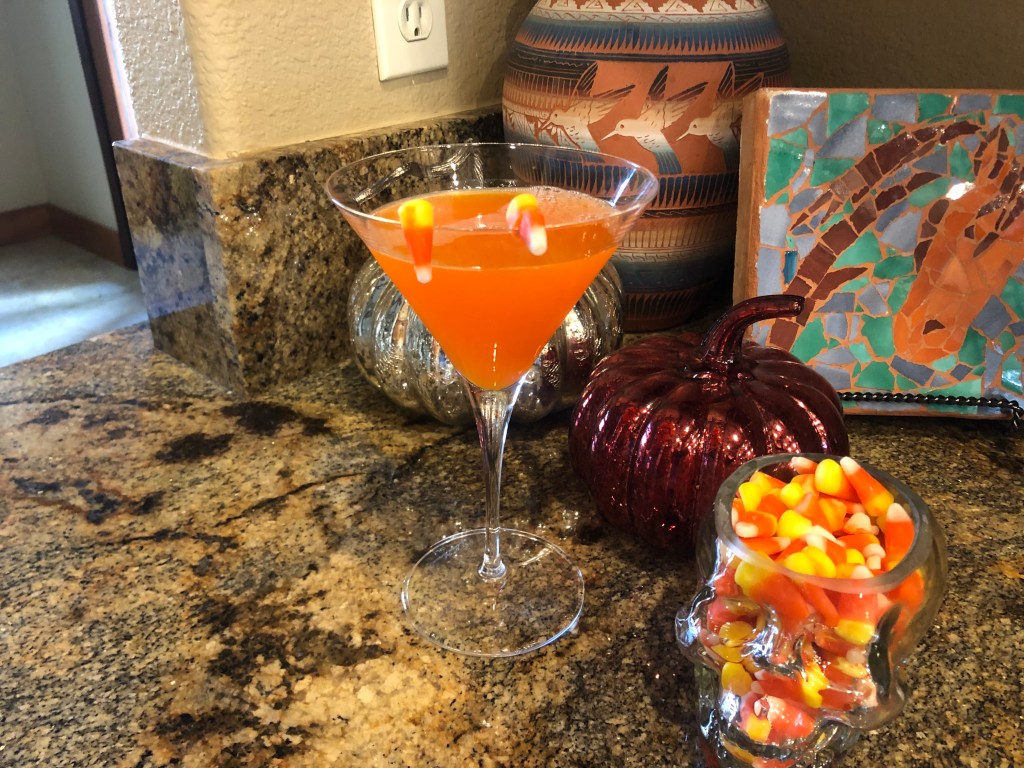
Now, strain the remaining candy out of the vodka mixture, and you’ve got a candy corn-infused vodka base. Pour 1/2 cup of the infused vodka into a cocktail shaker, add 1/4 cup of pineapple juice, and add ice. Shake and pour into a martini glass. Garnish with a couple of candy corns.

The Ratings:

This cocktail accomplishes the unthinkable: it takes candy corn and makes it taste worse.

But first things first: In terms of appearance, this cocktail definitely features the unmistakable orange color that’s in the center layer of candy corn. But it does not display the iconic tricolor layers (yellow, orange, white) that candy corn is known for. Truth be told, this cocktail looks pretty boring and unappealing. 1 point.

Let’s move on to taste: This cocktail tastes a lot like candy corn…which isn’t surprising because it’s actually made with a cup of candy corn, dissolved in vodka. I don’t know if the different layers (yellow, orange, white) of candy corn impart their own distinct flavors, but this cocktail obviously just has one nondescript flavor. The other thing I noticed is that you eat candy corn one little piece at a time, allowing your tongue and stomach to kind of pace themselves and ease into the experience. But this cocktail concentrates 5-10 candy corns into each gulp. On top of this, there’s an added quarter-cup of pineapple juice that seems a bit out of place. The juice adds sweetness where it’s not needed, and inserts a little tang that’s totally inappropriate. The overall effect is, in a word, gross. No points.

(I did try a second version that omits the pineapple juice. That is, I tried drinking just the infused vodka by itself. Result: Huge mistake. The vodka is made more prominent, and the candy corn flavor is way too cloying without the pineapple juice to cut it.)

Name: Could there be a name more pedestrian, unimaginative, and unappealing than “Halloween Candy Corn Cocktail”? No points.

Grand Total: 1 point. We have a new record (for low score)!