Today we’re going to take a break from those vile green liqueurs and get back to basics. We’re going to try a version of an Old Fashioned, that bourbon-based drink with an adjectival name. But the recipe gets Halloweenified with some pumpkin and maple syrup.
Dating back to the 19th century, the Old Fashioned is indeed old fashioned. It’s said that the drink was originally called a “bittered sling,” which I actually prefer as a name. But as drinks became ever fussier as time went on (recall my ordeal with the Herman), purists would ask their bartender for something “old fashioned,” and the new name stuck.
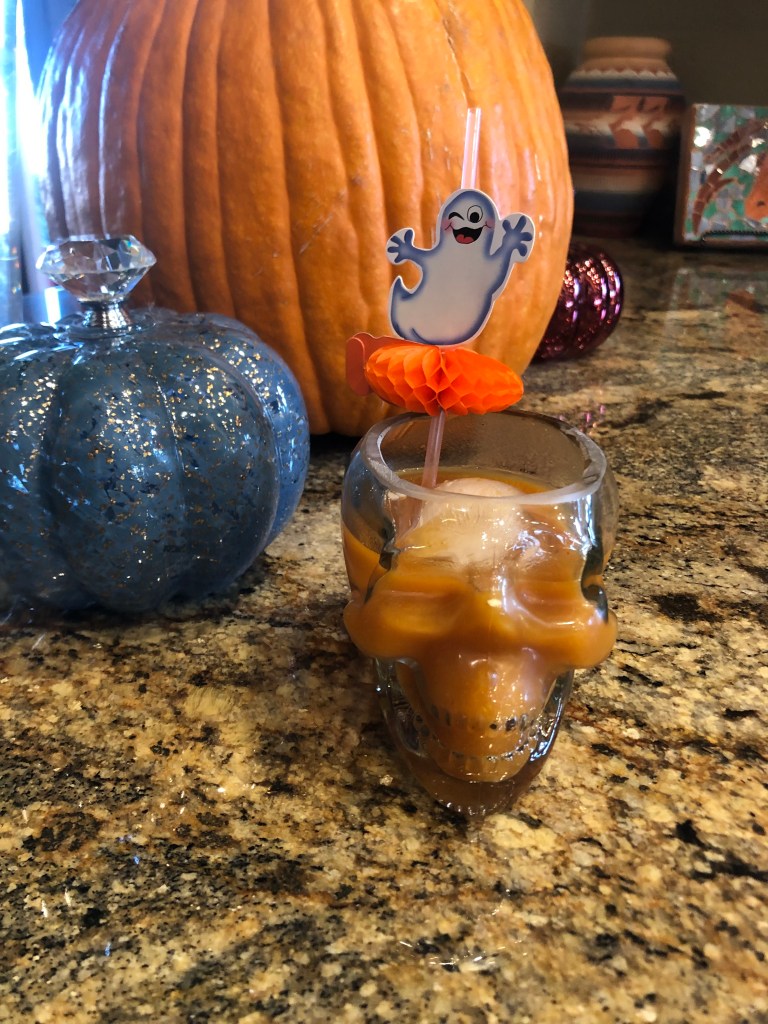
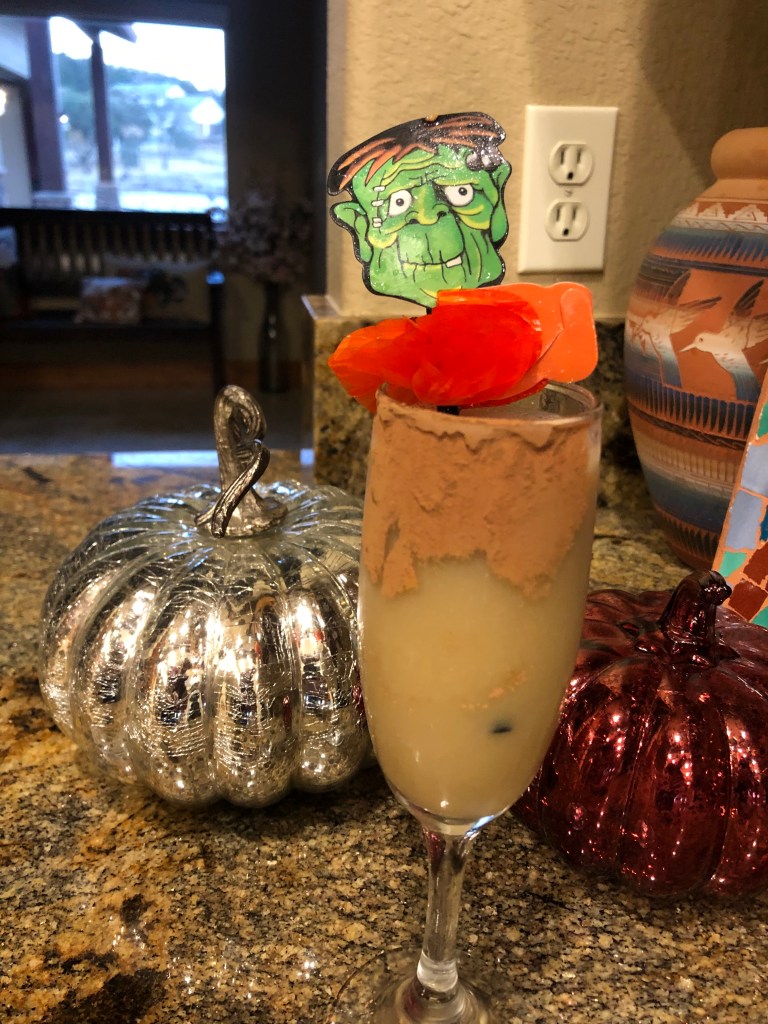
The Recipe: Mix 2 oz bourbon, 1 Tbsp pumpkin puree, 1/2 Tbsp maple syrup, 1/4 tsp pumpkin pie spice, 1/4 tsp vanilla extract, and a dash of Angostura bitters in a shaker. Pour over fresh ice.
The Ratings:
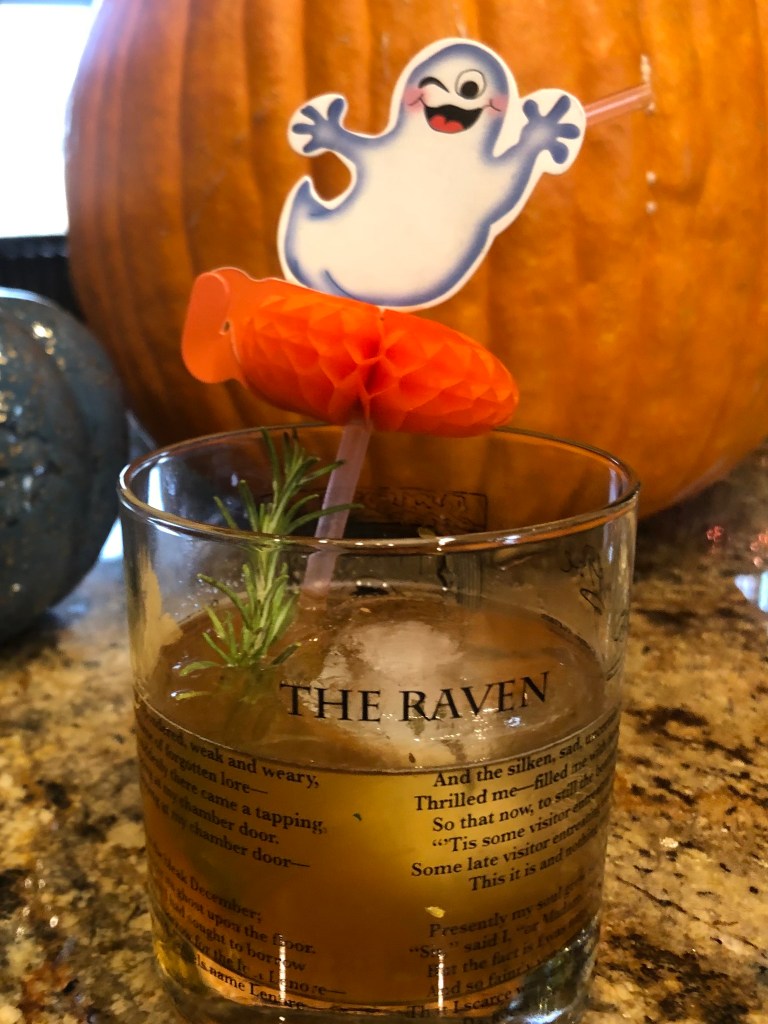
The appearance is somewhat off-putting. It’s not bright enough to be a frivolous, fun drink, and it’s not translucent enough to look like a proper Old Fashioned. The color looks like Bakelite plastic from the radio tuning knob of a 1940s Studebaker. It certainly doesn’t look like a Halloween drink. But it does have a vague pumpkin hue, so I’ll give it two points.
Old Fashioned indeed.
In terms of taste, the bourbon dominates, as it should. The bitters fight a bit against the maple syrup, and the pumpkin spices kind of get lost in all the infighting. But the pumpkin puree gives it a depth and heft not normally present in an Old Fashioned. I’ll give it 2.5 points.
I give the nameone point. It would have been two points if they’d had the presence of mind to name it an Old Fashioned Pumpkin.
Grand Total: 5.5 points.
Dark N’ Stormy Corner
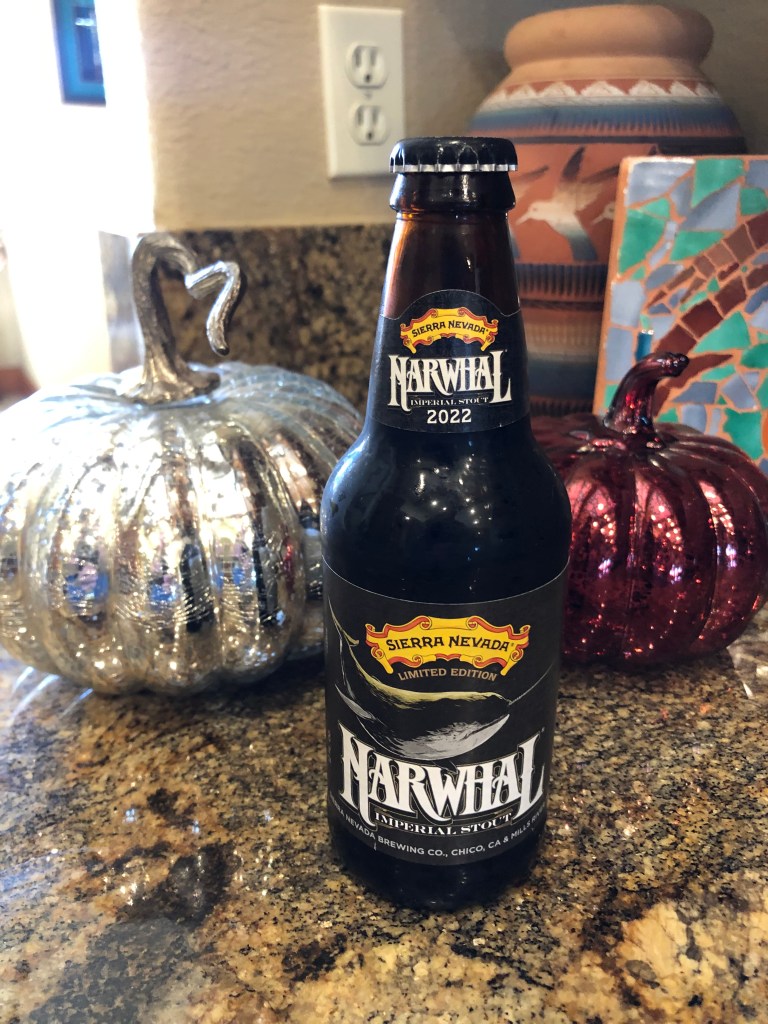
Recall that I’m trying to find a way to make this Dark N’ Stormy darker and stormier. This time I tried adding 2 oz of Sierra Nevada’s Narwhal to the drink. It did not improve on the taste. In the same way that filling your mattress with glass shards does not improve on its comfort. I find it surprising, because Narwhal (only available seasonally) is my favorite widely-available imperial stout. Best to just drink the beer on its own.
Do yourself a favor and grab a six pack before they’re gone til next year!
As for the Dark N’ Stormy, it’s back to the drawing board.
When we left off yesterday, I had made two Munsters-themed drinks (The Herman [or, as Grandpa calls it, The Hoiman] and The Lily). The drinks were a huge disappointment, and I traced most of the problem to a foul spirit called Chartreuse. (Foul Spirits would be an excellent name for a rock band, by the way.) Now, before I tell you what happened next, let me reiterate that Chartreuse is 110 proof (i.e., 55 percent ABV). And I ended up consuming one Herman and one Lily and then another Herman (as I tried omitting the lemon juice from the second one, hoping I could make the thing drinkable). Now for a little math: I drank 1.75 oz plus 1.5 oz plus 1.75 oz of Chartreuse, for a total of 5 oz of the foul stuff. And that equates to 5 x 55% = 2.75 ounces of pure alcohol. Now, maybe that doesn’t sound like a lot to you young ones, but at my advanced age that’s enough to do some damage. Or think of it this way: I drank the alcohol equivalent of 4.58 cans of that Budweiser swill you drink.
Then I went to bed.
I awoke around 2 pm with a pounding headache; I felt feverish; and my body felt like Indiana Jones’ after he’d been dragged behind a truck. (The wife says it would be worth it if I at least looked like Harrison Ford.)
I spent the next six hours in a feverish hell, weighing the pros and cons of ending it all right now. It might sound like I’m exaggerating, but I’m not. I don’t think it was purely the fault of the alcohol content. For it seems to me that one or more of the 130 herbs in that malignant, green swill destroy a person at a cellular level. Finally, around dawn, I was able to get a little sleep, and then a shower, and my condition had improved by 75 percent. In other words, I was now only feeling ghastly. Halloween theme indeed.
Now, as luck would have it, loyal reader Chris had sent me some recipes for various types of a drink called a “Corpse Reviver.” This sounded perfect. It had a suitably Halloween vibe, and also because my corpse needed reanimating. The Corpse Reviver is billed as a kind of hangover cure. What have I got to lose?
The Recipe: There are many different versions of this drink. Here’s the one I tried: Add 25 ml each (I just round it to an ounce) of London Dry Gin, sweet vermouth, triple sec, and lemon juice to a shaker. Add 1tsp abscinthe and 1-2 tsp simple syrup. Add ice and shake and pour.
The Ratings: Careful readers will note that I’m trying to counteract last night’s kitchen-sink drink that included a fussy green liqueur by drinking a different kitchen-sink drink that included a fussy green liqueur. (Today’s green spirit is absinthe. If you hate Jagermeister, you’ll detest absinthe.) Now, the Corpse Reviver only uses one teaspoon of the stuff, but somehow it dominates the drink. All you can really taste is the absinthe and the lemon juice. Which are two flavors that don’t belong on the same counter, let alone in the same drink. One sip was enough. I’m going to cure my hangover the old fashioned way: by eating a pint of ice cream in front of the TV in my underwear. No points for taste.
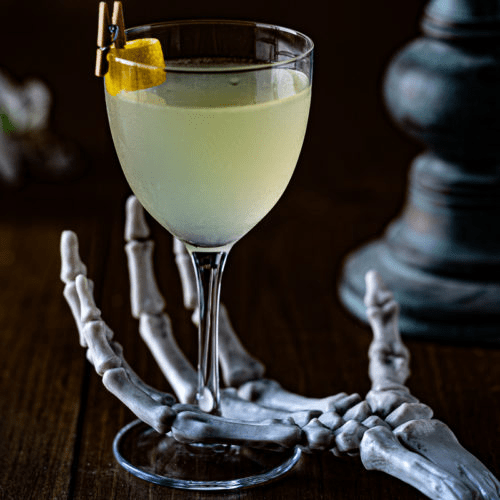
The appearance is unappealing. It resembles a cross between dishwater and a urine sample. But maybe that’s just because I’m still feeling a little green around the gills. No points.
Photo stolen from the Internet. Somehow, in my delirious state, I failed to take a picture of my version.
The name is worthy. I’ll give it two points.
Grand Total: 2 points.
Dark N’ Stormy Update:
In my spare time I’ve been experimenting with variations on the Dark N’ Stormy. I tried adding a spoonful of molasses in order to make it darker and give it a thicker profile. But the molasses congealed as soon as it encountered the cold drink. I tried shaking it up, which resulted in little shards of molasses drops swimming around the drink like dead, brown guppies. But even overlooking the appearance, the flavor was horrible. Surprisingly, molasses isn’t sweet enough for this drink. It lends a distinct tang and an odd taste of corn. Back to the drawing board…
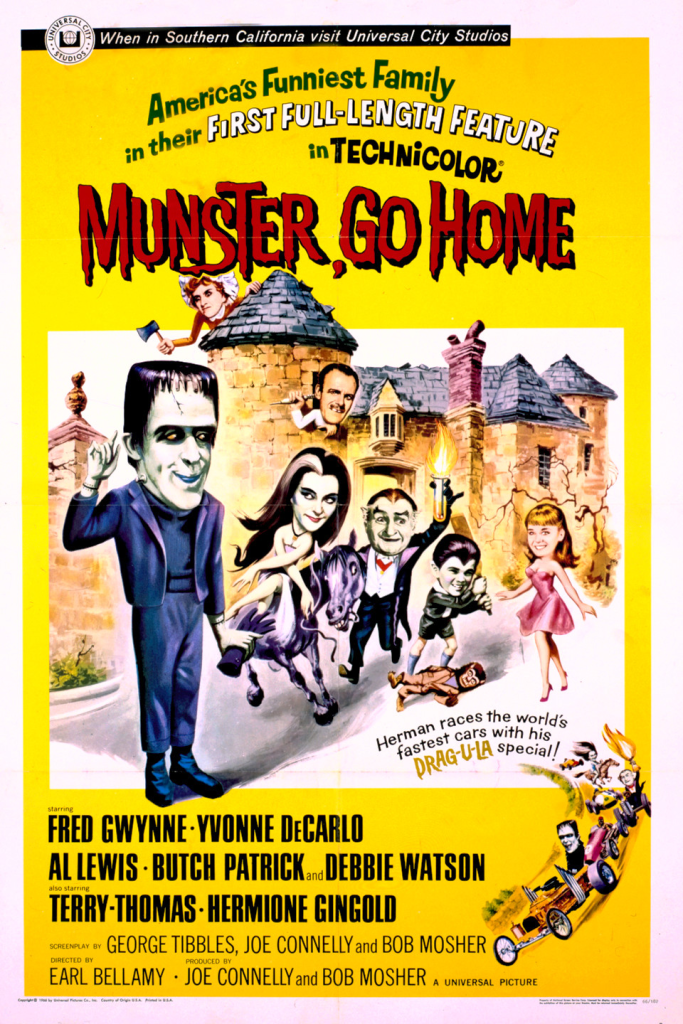
In the mid-1960s–at almost the same moment that the movie The Agony and the Ecstasy was released–a somewhat different motion picture came to the silver screen. The movie I’m talking about did not star Charleston Heston or Rex Harrison (as The Agony and the Ecstasy did), but instead it starred a lanky actor by the name of Fred Gwynne. Yes, I’m talking about Munster Go Home.
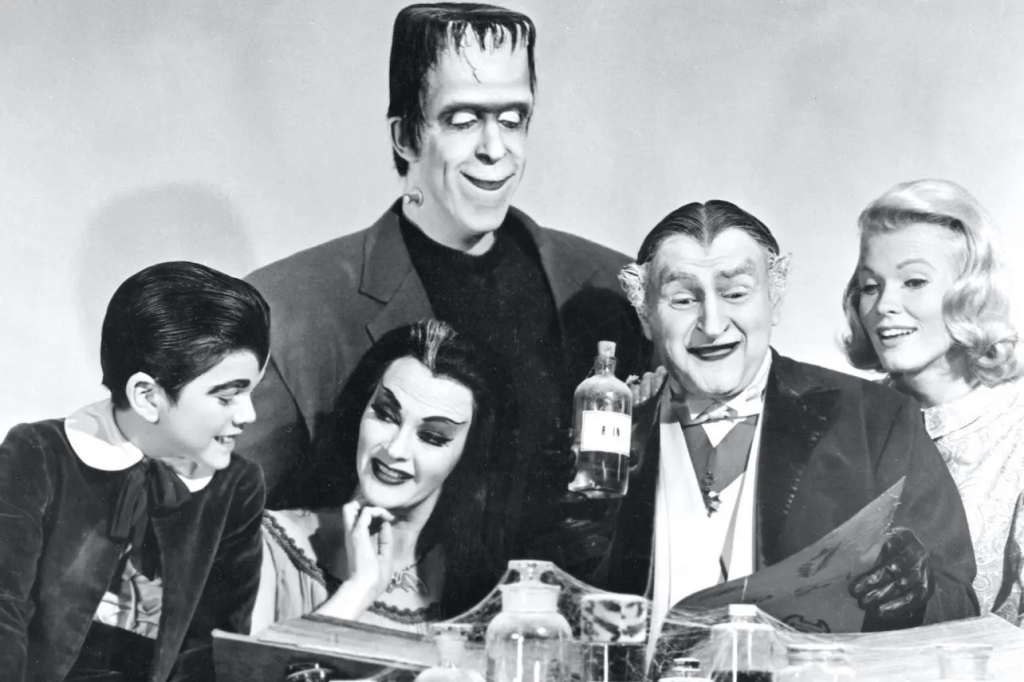
Munster Go Home capitalized on the popularity of the sitcom, The Munsters. Gwynne played a lovable Frankenstein’s Monster who headed a household of monsters that considered itself to be the typical mid-century American family. The TV show got pretty good ratings, and was even nominated for a Golden Globe(!) It was pretty saccharine, but what sitcom wasn’t in those days? True story: In grammar school, the teacher asked me and my classmates to name our favorite shows. I said “The Monsters,” because I naturally assumed that the TV advertisements were mispronouncing the name. I was laughed out of the room.
Anyway, I tell you all this because in my ongoing quest to find interesting Halloween libations for this month’s project, I happened across two Munsters-themed drinks: The Herman (named after Herman Munster, obviously) and The Lily (named after Herman’s vampire wife).
So what are we waiting for? Let’s get to it!
The recipe: Both the Herman and the Lily are heavily based on Chartreuse–a potent liqueur that clocks in at 110 proof. The color of Chartreuse is….hmmmm, I’m trying to think of just the right descriptive word for it. I’m sure it will come to me.
Meanwhile, the recipes are as follows:
The Herman
Add 1.75 ounces Green Chartreuse, 1.25 ounce Creme de Cocoa, 1 ounce fresh lemon juice (strained), and 1 egg white (strained) into an empty cocktail shaker and use the “dry shake” method (without ice) to emulsify the egg white. Add ice and shake until the sides of the shaker form frost. Dip one side of a chilled glass in lemon juice and roll in cocoa powder. Use a Hawthorne strainer to pour the drink over a mesh sieve, and into the chilled glass.
OK–that’s pretty fussy. The Lily is similar but even a bit more fussy:
Combine 1.5 ounces Green Chartreuse, 1 ounce Creme de Cocoa, 0.75 ounce fresh lemon juice (strained), 0.75 ounce raspberry puree (strained), and 1 egg white (strained) into an empty cocktail shaker and “dry shake.” Add ice and shake until the sides of the shaker form frost. Pour it into the same cocoa-powered glass as with the Herman.
What could go wrong?
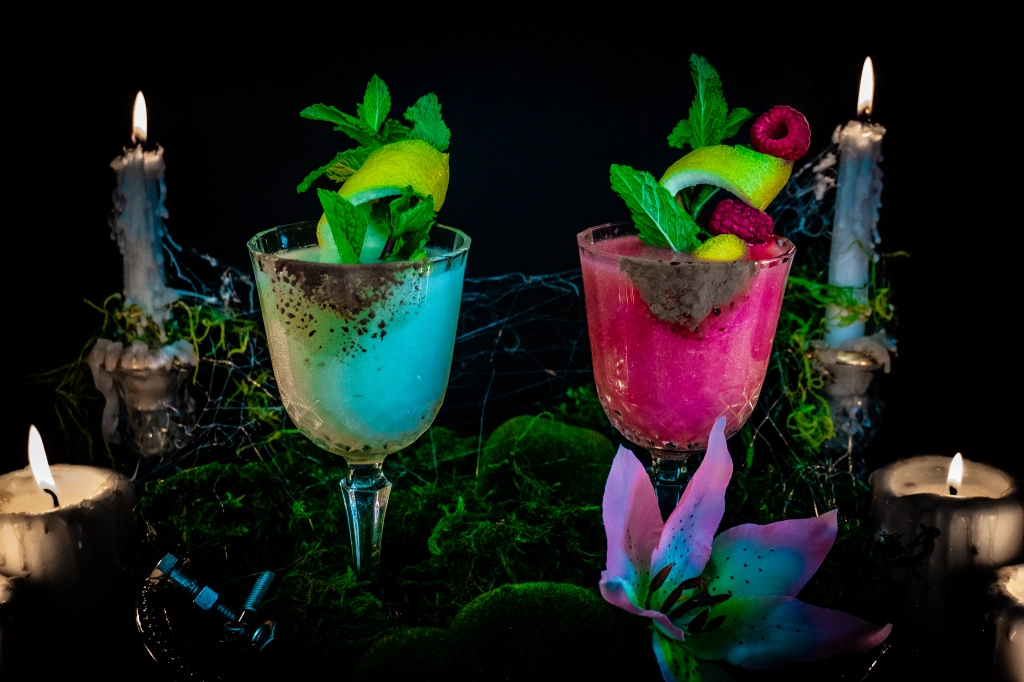
The Ratings: Here’s where the Agony and the Ecstasy reference surfaces. The Ecstasy is my joy in finding such a cool pair of drinks, based on a campy, cult television show, that remind me of my childhood and look really cool. I mean, look at the pictures from the online recipe!
Herman on the right, Lily on the left.
The agony is how they turned out in reality. I made the Herman first, and its appearance is, frank(enstein)ly, nothing like the recipe picture. The green of the chartreuse was completely obliterated by the creme de cacao, and perhaps also by the lemon juice and egg.
As green as the Mojave in August.
Now, the whole point of this drink is a rich, thick, green appearance, kind of like a Shamrock Shake. As you can see from the photo, my version is the color of turkey gravy.
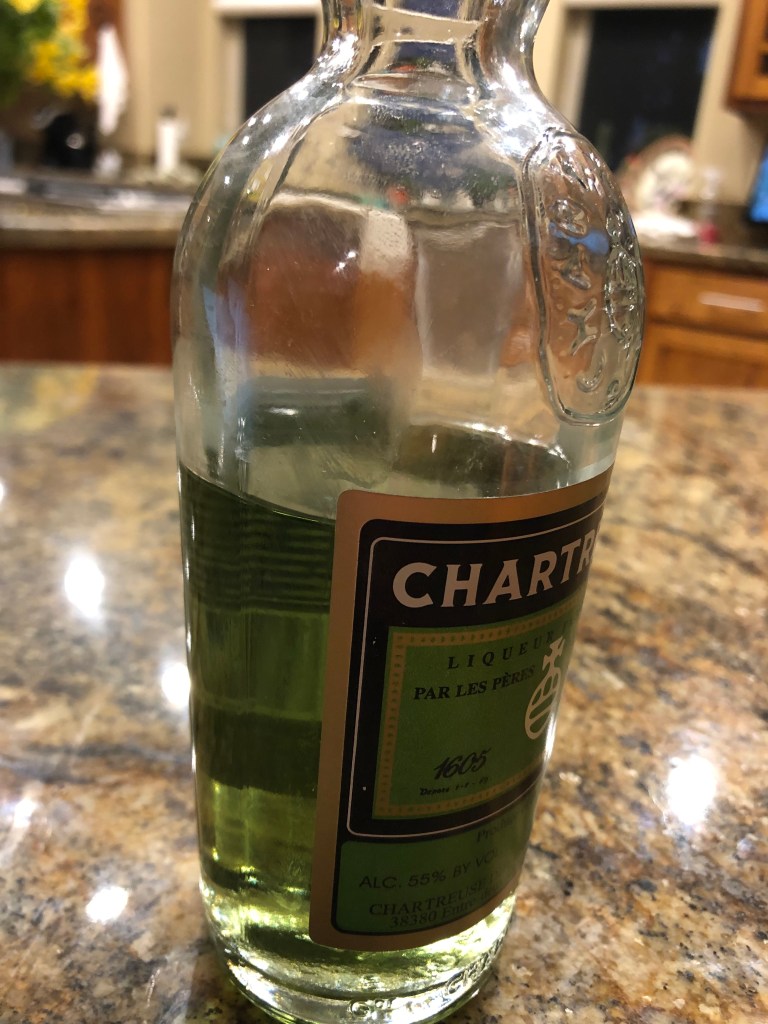
Now, the only source of the supposed green appearance is the Chartreuse, which doesn’t look up to the task. Here’s a pic of my bottle:
Not exactly up to Fred Gwynne’s standards.
As you can see, the liqueur is too yellowish, and is easily overwhelmed by the other ingredients. The result is an unappealing drink distinguished only by its ugly color. So, I can’t give the appearance of this drink anything more than one point. It’s not appetizing, it doesn’t evoke Herman Munster, and it’s kind of watery.
Now, if you thought the appearance was bad, let me tell you about the taste. It’s true I’ll drink anything (especially when I’ve invested $33 for a small bottle of Chartreuse), but I immediately regretted that action. (My wife literally spit out her sip into her hand–I’m not making this up.) This drink tasted foul. I should emphasize that I faithfully followed the recipe, with its “dry shaking” and straining and chilled glass and whatnot. I was expecting something rich and creamy and sweet, given the presence of creme de cacao and egg white. But the lemon juice (one full ounce of it!) dominated the drink. The Herman has a distinctly sour taste, which fights against the cocoa on the side of the glass. It reminds me of a granite counter cleaner that’s been churched up with yak’s spit.
Just for yuks (literally), I tried making it again without the lemon juice. Sadly, this was no better. Trying to isolate the issue, I tried a small sip of the key ingredient (Chartreuse) by itself. Ah, this was the problem. I’d never tried Chartreuse before, and I never plan to have it again. Now, I’m told that Chartreuse is made up of 130 different herbs and other plants (cinnamon, mace, hyssop, peppermint…), that the recipe goes back to the 17th century, that it’s produced by French monks, etc, etc. And maybe all that’s true. But it doesn’t change the fact that it tastes like Altoids dissolved in mid-grade gasoline.
Anyway, the taste of this drink scores a solid zero points.
As for the name: I guess “Herman” is kind of cute. I’ll give it the two points. Whatever.
Grand Total: 3 points.
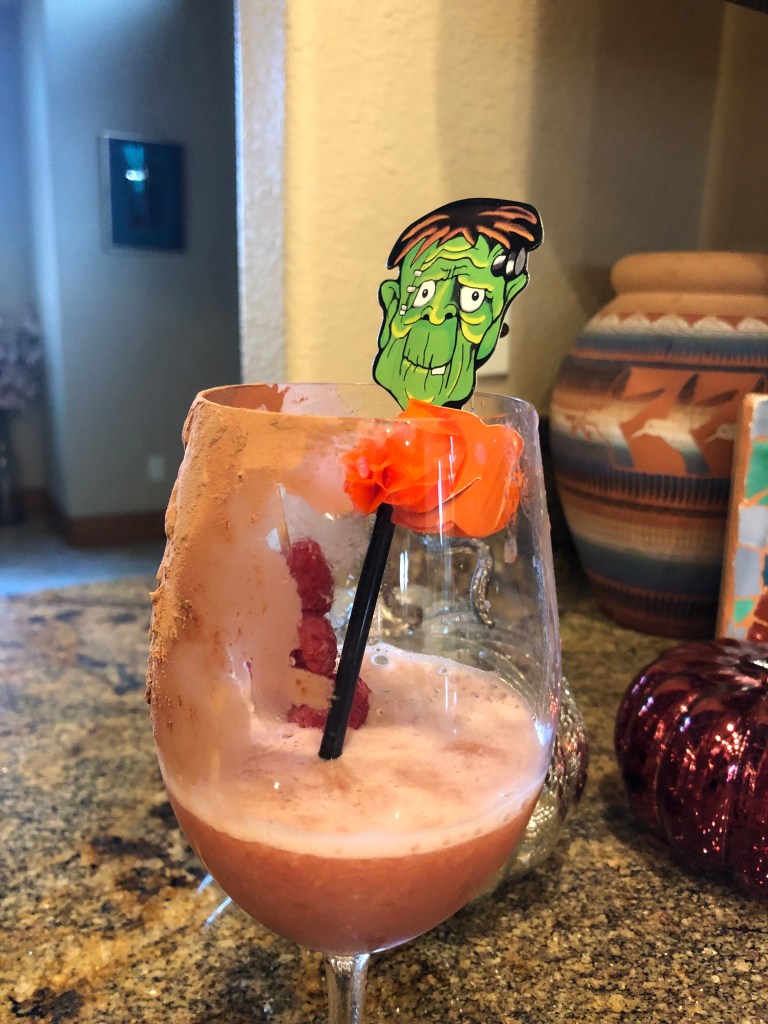
By the way: I did try making the Lily, and it was slightly better. The raspberries improved the flavor and the appearance. I’ll give the Lily a grand total of 5 points.
My version of the Lily. Nothing to write home about, but at least it’s not the Herman.
I’m drawing my drink recipes from a variety of sources, including cocktail books, suggestions from readers, and other blogs that have gone down this Halloween cocktail road before. In the latter category is a website by an “Icelandic Girl” named Helga Dis, who lives in Reykjavik. The blog is dedicated to trying out new drinks. As she’s trapped on a God-forsaken island in the North Atlantic, she has to make many of her ingredients from scratch, which causes one to appreciate BevMo.
Anyway, Helga’s got four drinks from 2020, and the “Haunted Graveyard” is one of them. Let’s try it!
The Recipe: Add 2 oz of bourbon, 1 oz of maple syrup, a couple of orange slices, and ice to a cocktail shaker. Shake and pour into a glass with fresh ice. Add a few drops of orange cocktail bitters, and add a garnish of torched rosemary. This last ingredient is created by simply holding a lighter under a small spring of rosemary until it gets a little charred. Helga’s instructions include this embarrassingly nervous warning about the process:
“Now for the mandatory fire warning. Burning the rosemary garnish is optional, and we do not recommend doing this unless you have a fire extinguisher close by. You should preferably have another person on standby in case anything goes wrong. Having a bowl with water close by might also be a good idea as the sprig can simply be dropped into the water in emergencies….Be careful not to burn your fingers or anything other than the sprig.” Thanks, Firepup.
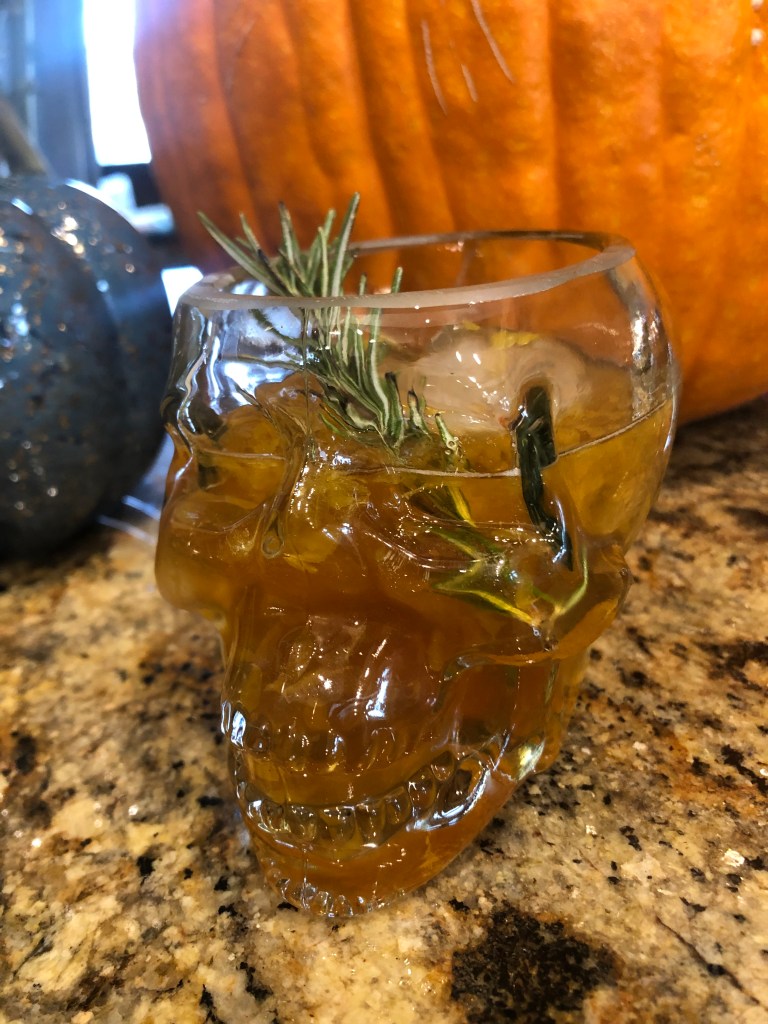
Anyway, I somehow managed to mix this cocktail without immolating myself:
The Ratings:
The taste is rich and flavorful. It’s very drinkable indeed. The maple and orange flavors really come through, though you hardly even notice the bourbon. The rosemary is a ghostly presence, but it’s definitely there. And I love rosemary. So this gets a solid 3 points out of four.
(Here I should admit that we didn’t have any oranges in the house, so I substituted segments of mandarin oranges for proper orange slices. Afterwards, my wife suggested that I should have substituted pineapple for the [nonexistent] orange slices. So I tried this on a second attempt:
Haunted Graveyard 2.0–Pineapple edition
Holy Hawaiian Pizza! This was a huge improvement. The pineapple has a bit more sharpness than the (mandarin) orange, and thus weaves its way between the bourbon and syrup quite nicely. If the recipe had called for pineapple instead of orange, I would have given the taste 4 points.
The appearance isn’t that remarkable, with the usual bourbon hue. But the spring of torched rosemary is distinctive. Perhaps just knowing that it’s been torched adds some Halloween vibe. I’ll give it 2 points.
The name gets the full 2 points. Not just a graveyard but a haunted graveyard. That’s pretty phantasmic. Way to go, Icelandic Girl!
GrandTotal: 7 points (8 points for the pineapple version).
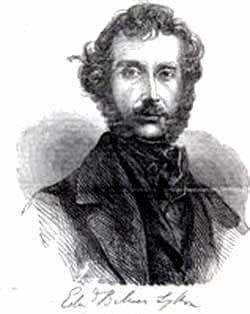
“It was a dark and stormy night; the rain fell in torrents—except at occasional intervals, when it was checked by a violent gust of wind which swept up the streets (for it is in London that our scene lies), rattling along the housetops, and fiercely agitating the scanty flame of the lamps that struggled against the darkness.”
Thus began Edward Bulwer-Lytton’s 1830 novel, Paul Clifford. The book has been maligned as an archetypal example of bad writing, with its florid phrases and purple prose. But, in my opinion, it stands up as a novel…at least by 19th-century standards.
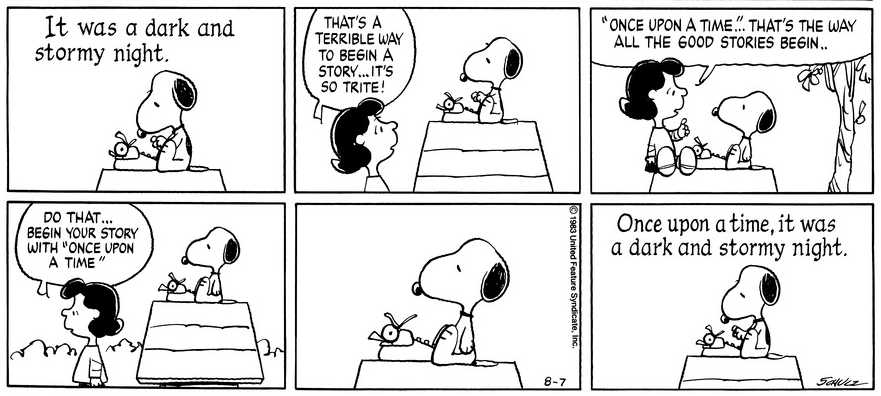
Still, over time, that introductory phrase–“It was a dark and stormy night”–became a trope for hack writing, a meme before memes were a thing. It was maligned in Charles Schultz’s “Peanuts” comic strip in the 1970s. In 2009 a movie by that name was released by Larry Blaimore, the man who brought us the inimicable “Lost Skeleton of Cadavra.” (And I actually do recommend that film.) Oh, and inevitably there came to be an annual contest poking fun at Bulwer-Lytton’s opening line. So, it’s well established that “Dark and Stormy Night” is a thing. And not a very good thing.
But for our purposes, “It was a dark and stormy night” sets a stereotypical Halloween scene. Think of the “Old Dark House” movies, which include, of course, the classic film starring Boris Karloff from 1932, and a 1963 remake starring Tom Poston (who you’ll remember from “Newhart”). Maybe next year’s October theme should be ODH movies…
An almost-unrecognizable Boris Karloff.
So if it hasn’t been made clear already, today’s cocktail is something called a “Dark and Stormy.” It’s a well-established drink, based on dark rum. I wouldn’t necessarily call it a Halloween drink, but the name does give it a reason to appear on our list.
The recipe: It’s simplicity itself. Combine 2 oz dark rum, 3 oz ginger beer, and 1/2 oz lime juice into an ice-filled glass. Stir, drink, and enjoy.
“…fiercely agitating the scanty flame…”
The ratings: I have to confess that this is the first time I’ve tried a Dark and Story. And I was pleasantly surprised. It’s one of the more drinkable rum-based drinks that I’ve encountered.
It’s appearance leads with a nice, honey-colored hue. The darkness of the rum is ameliorated a bit by the ginger beer, but it would be easy to darken it a shade with a heavier proportion of dark rum. Or maybe even add a bit of dark molasses? Sadly, there was no molasses in the house, so I wasn’t able to test this theory. In its basic incarnation, I can’t give it more than 2 points.
The taste is awesome! The substance and potency of the dark rum is nicely balanced by the ginger beer. The lime juice prevents the drink from being too cloying. It’s remarkably easy to drink. In fact, I was able to throw three of these back with no problem at all. Though perhaps that’s an indication of other concerns… Anyway, this is fully deserving of the full 4 points.
Frankly, the name is the only reason this drink is on our list this month. But what an evocative, moody name it is! It fully deserves the full 2 points.
Grand Total: 8 out of 10 points.
I think, in the background over the rest of this month, I’m going to experiment with some variations on the Dark and Stormy. I just tried adding a bit of coffee liqueur, but that didn’t do much for me. I think I’ll try adding Kahlua, molasses, more dark rum, and/or some imperial stout. I’ll keep you posted on developments. Or experiment yourself and let me know what you come up with!











 Chasing Phantoms